AI Under Trump: Deregulation, Preemption & the New Federal AI
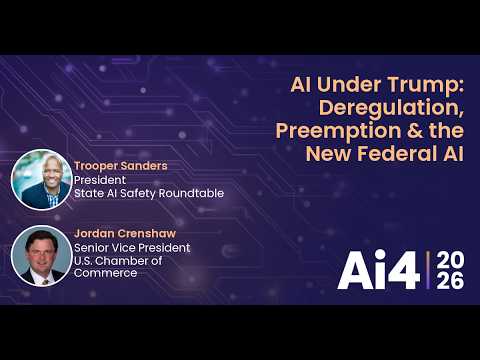
Ai4
AI-assisted summary of AI Under Trump: Deregulation, Preemption & the New Federal AI — original source. Check the original for full context.
Source published:
Detailed notes
## Background Published by Ai4 on YouTube on August 21, 2026, this panel features Trooper Sanders of the State AI Safety Roundtable and Jordan Crenshaw of the U.S. Chamber of Commerce. The discussion explores Washington's contentious AI policy landscape, focusing on federal deregulation, efforts to preempt state AI legislation, and the debate over who benefits and bears the costs when federal oversight recedes.
## TL;DR The panel debates Washington's push to preempt state-level AI regulations, contrasting concerns over small business compliance costs with the constitutional and systemic risks of leaving frontier AI unchecked. Jordan Crenshaw advocates for a four-step framework relying on technology-neutral enforcement and warns against costly state patchworks, while Trooper Sanders highlights how stripping state safety guardrails could trigger uninsurable commercial liabilities and overwhelm regulatory institutions. Despite differing starting points, both panelists agree that federal preemption via executive action is legally fragile and point toward 2027 for deliberate federal legislation, starting with foundational data privacy frameworks like the Secure Data Act.
## Atmosphere & style The panel maintains a measured, intellectually rigorous, and collegial atmosphere, eschewing partisan rhetoric in favor of deep legal and economic analysis. Despite representing potentially opposing interests—a civil society safety advocate and a senior business lobbyist—the speakers engage in a collaborative dialogue marked by mutual respect and surprising consensus. Listening to the exchange feels like sitting in on a high-stakes, behind-closed-doors Washington policy briefing that methodically strips away Silicon Valley hype to confront the grounded realities of constitutional federalism, administrative capacity, and insurance underwriting.
## Key takeaways - [00:04](https://www.youtube.com/watch?v=kTRg8A6lcZU&t=4s) Federal attempts to aggressively preempt state-level AI safety rules have faltered, sparking a rare bipartisan coalition of governors and state attorneys general defending state regulatory authority. - [00:04](https://www.youtube.com/watch?v=kTRg8A6lcZU&t=4s) Small businesses are adopting AI rapidly, with 58% utilizing the technology and 82% expanding their workforce, but 65% express deep concern over navigating a fragmented state-by-state patchwork. - [04:12](https://www.youtube.com/watch?v=kTRg8A6lcZU&t=252s) State-level administrative rulemaking, such as California's expansion of the CCPA, has created multi-million-dollar economic burdens that disproportionately strain smaller enterprises. - [04:12](https://www.youtube.com/watch?v=kTRg8A6lcZU&t=252s) Executive decrees attempting to preempt state AI regulations without comprehensive congressional statutory authorization face immediate constitutional challenges regarding state police and safety powers. - [06:46](https://www.youtube.com/watch?v=kTRg8A6lcZU&t=406s) Without clear guardrails, commercial liability insurers may exclude frontier AI and autonomous agentic workflows, threatening to stall enterprise adoption across regulated sectors like healthcare and finance. - [08:50](https://www.youtube.com/watch?v=kTRg8A6lcZU&t=530s) The U.S. Chamber advocates a four-step governance model: identifying concrete harms, applying existing laws, pinpointing specific statutory gaps, and deploying targeted, risk-based solutions. - [08:50](https://www.youtube.com/watch?v=kTRg8A6lcZU&t=530s) Sweeping state omnibus mandates like Colorado's AI law risk creating substantial economic friction, projected by the Chamber as a $50 billion drag affecting 700,000 jobs. - [12:24](https://www.youtube.com/watch?v=kTRg8A6lcZU&t=744s) Policy experts argue state lawmakers should prioritize enforcing technology-neutral consumer protection and anti-discrimination statutes rather than introducing duplicative, tech-specific legislation. - [12:24](https://www.youtube.com/watch?v=kTRg8A6lcZU&t=744s) Enforcing AI safety requires expanding institutional capacity and resources across legacy agencies like the FDA and FTC before advanced recursive and autonomous systems trigger public safety crises. - [17:19](https://www.youtube.com/watch?v=kTRg8A6lcZU&t=1039s) Data center developments face mounting local pushback over aesthetic concerns, grid strain, and rising utility rates, becoming the tangible focus of broader public anxiety surrounding AI. - [18:59](https://www.youtube.com/watch?v=kTRg8A6lcZU&t=1139s) Major regulatory frameworks require years of iterative negotiation to build durable policy, mirroring historical legislative efforts around mental health parity and prescription drug pricing. - [19:49](https://www.youtube.com/watch?v=kTRg8A6lcZU&t=1189s) Federal preemption is projected as more realistic by 2027, with comprehensive national data privacy legislation like the Secure Data Act serving as the foundational building block.
## Detailed walkthrough ### [00:04](https://www.youtube.com/watch?v=kTRg8A6lcZU&t=4s) Evaluating Washington's Approach to AI Regulation
The panel opens by framing the central conflict in contemporary artificial intelligence policy: the federal government's aggressive push to preempt state-level AI regulations. The moderator poses a foundational question to both panelists: is Washington’s current regulatory approach actually working? Trooper Sanders, President of the State AI Safety Roundtable, answers with an emphatic "spectacularly no." Sanders argues that federal preemption efforts have fallen completely flat, unintentionally forging a rare bipartisan coalition of governors and state attorneys general who refuse to be sidelined for the next decade. Drawing a parallel to civil aviation, Sanders asks the audience how many would board a completely unregulated aircraft, emphasizing that AI is "exponentially more complicated and dangerous than airplanes." He characterizes the Trump administration’s regulatory timeline as resembling a "student who didn't study for the bar exam until the night before," pointing to hastily assembled industry security agreements that should have been developed methodically over the past year.
Jordan Crenshaw, Senior Vice President at the U.S. Chamber of Commerce’s Technology Engagement Center, takes a more measured stance, calling the outcome "to be determined." However, Crenshaw highlights a fundamental misunderstanding among both Democrats and Republicans in Washington regarding the core definition and economic footprint of AI—a confusion mirrored in emerging state rules, such as recent debates in Florida. Crenshaw stresses that policy debates mistakenly focus almost entirely on Big Tech developers while ignoring Main Street. Small businesses are increasingly adopting AI to grow, but they face crippling compliance friction if subjected to a fragmented regulatory regime or ill-conceived federal mandates.
- **Small business AI adoption:** 58% of small businesses report using AI technologies. - **Workforce expansion:** Among small businesses utilizing AI, 82% are actively growing their workforce. - **Regulatory anxiety:** 65% of small business owners express concern over a confusing state-by-state patchwork of AI rules.
---
[04:12](https://www.youtube.com/watch?v=kTRg8A6lcZU&t=252s) The Costs of State Patchworks and CCPA Implementation
When pressed on specific state laws harming American enterprise, Crenshaw points past Colorado to the California Consumer Privacy Act (CCPA) and its aggressive enforcement apparatus. He illustrates how the California Privacy Protection Agency took a single sentence of statutory text and expanded it into a ten-page, half-billion-dollar regulatory burden. Under federal standards, a $100 million economic footprint qualifies as a major rule; California’s administrative implementation quintupled that threshold in its interstate impact. Even CCPA’s original author, Alastair Mactaggart, questioned the legal validity of these promulgated rules during the voting process. Crenshaw warns that such rushed state rulemaking places an outsized financial burden on small enterprises that lack the resources of incumbent tech giants.
```mermaid flowchart TD accTitle: Economic Impact of State-Level AI Regulations subgraph CA["California: CCPA Expansion"] A["Single Statutory Sentence"] --> B["10-Page Administrative Rule"] B --> C["$500M Interstate Impact"] C --> D["$16,000 Annual Cost / Small Business"] end subgraph CO["Colorado: Proposed AI Act Impact"] E["State Compliance Mandates"] --> F["$50B National Economic Drag"] F --> G["700,000 Jobs Impacted"] end ```
Addressing the administration's proposed executive orders to preempt state AI rules, Sanders argues they would be "dead on arrival in court very fast." He explains that under constitutional federalism, core police powers, public health, and safety protections belong inherently to the states. While Congress has the constitutional authority to pass statutory preemption as part of comprehensive national legislation, an executive decree attempting to strip states of their regulatory authority before federal statutes are enacted represents an unconstitutional overreach that would prompt dozens of state attorneys general to file immediate legal challenges.
- **California compliance burden:** The California Privacy Protection Agency acknowledged compliance costs of approximately $16,000 annually per small business. - **Federal major rule threshold:** Federal guidelines classify any regulatory action exceeding $100 million as a major rule, a benchmark California's agency exceeded fivefold.
---
[06:46](https://www.youtube.com/watch?v=kTRg8A6lcZU&t=406s) Insurance Insolvency and the Frontier AI Risk Landscape
Sanders addresses the tangible risks of stripping state authorities of oversight without robust federal guardrails. If preemption simply amounts to handing AI laboratories and frontier developers an unregulated "free reign," the economy faces severe systemic vulnerabilities—chief among them the uninsurability of advanced AI systems. Commercial liability insurers are already "blinking yellow" over recursive self-improvement and autonomous agentic workflows. Because underwriters cannot quantify, predict, or contain catastrophic liabilities associated with uncontrollable systems, they are threatening to exclude frontier AI from standard commercial liability policies.
Sanders warns that if the insurance industry steps back, the broader commercial ecosystem collapses: "AI may be innovative and disruptive. You know what's not? Insurance." Because frontier labs rely heavily on enterprise clients across highly regulated state sectors—such as healthcare, utilities, and financial services—enterprises facing tripled or quadrupled insurance premiums will simply abandon AI adoption. Without productive federalism that pairs national guidelines with state-level enforcement, market expansion will stall under the weight of uninsurable liabilities.
---
[08:50](https://www.youtube.com/watch?v=kTRg8A6lcZU&t=530s) The U.S. Chamber's Four-Step Regulatory Framework
Rejecting the notion that the Chamber seeks blanket deregulation, Crenshaw outlines the policy framework established by a bipartisan commission co-chaired by former Representatives John Delaney and Mike Ferguson. The framework establishes a disciplined four-step test to govern artificial intelligence without stifling innovation or duplicating existing legal authorities across consumer protection and civil rights law.
```mermaid flowchart LR accTitle: U.S. Chamber Bipartisan 4-Step AI Governance Framework Step1["1. Identify Concrete Harms"] --> Step2["2. Apply Existing Laws"] Step2 --> Step3["3. Pinpoint Regulatory Gaps"] Step3 --> Step4["4. Deploy Targeted Risk Solutions"] ```
Crenshaw points out that all 50 states already enforce broadly applicable consumer protection and anti-discrimination statutes, alongside 25 states that have enacted comprehensive consumer data privacy laws. Where genuine legal gaps exist—such as non-consensual deepfakes addressed by the federal Take It Down Act—targeted, risk-based measures should be enacted. Conversely, sweeping omnibus mandates like Colorado's AI legislation create friction that disproportionately harms startups. Drawing on findings from the Chamber's *Empowering Small Business* report, Crenshaw notes that excessive compliance requirements force startups to burn capital on legal and compliance teams rather than product development, perversely cementing the dominance of market incumbents.
- **Economic exposure of state rules:** The Chamber projects that implementation of Colorado's AI law alone would create a $50 billion drag on the national economy and affect approximately 700,000 jobs. - **Small business sentiment:** Survey data reveals that one-third of small businesses expect state-level AI mandates to increase technology costs, while another third report they would be less likely to deploy AI tools altogether.
---
[12:24](https://www.youtube.com/watch?v=kTRg8A6lcZU&t=744s) Technology-Neutral Enforcement vs. Institutional Capacity
When asked whether states should simply stand down while Washington deliberates, Crenshaw urges state lawmakers to focus on enforcing existing, technology-neutral statutes rather than drafting duplicative legislation. He observes that state legislators frequently introduce sweeping bills without conducting basic conflict checks against existing statutory authorities. Technology-neutral consumer protection frameworks naturally extend to future algorithmic breakthroughs—from generative models to quantum computing—preventing the need for legislative panic every time a new technology emerges.
Sanders agrees that existing legal frameworks provide a valuable baseline, but argues that statutes are useless without institutional enforcement capacity: "We need to have a consensus that government matters." He highlights the danger of under-resourced agencies trying to govern cutting-edge technologies. When agentic systems begin working alongside licensed healthcare professionals in clinical hospital environments, or when recursive AI tools—such as new ventures launched by Google co-founders—automate chemical and medical device discoveries at unprecedented speeds, legacy regulators like the FDA and FTC will be overwhelmed. Sanders warns that allowing public safety institutions to erode risks a catastrophic failure, triggering an aggressive populist backlash and rushed, reactionary emergency rulemaking.
---
[17:19](https://www.youtube.com/watch?v=kTRg8A6lcZU&t=1039s) Backlash Against Physical AI Infrastructure and Data Centers
The discussion shifts to the physical infrastructure powering artificial intelligence: the nationwide wave of community opposition to massive data center developments. Crenshaw states that the Chamber is not surprised by authentic local grievances regarding facility siting, aesthetic disruption, and electrical grid burdens driving up consumer utility rates. He observes that data centers have become the tangible, physical manifestations of broader public anxiety surrounding AI. However, Crenshaw also cautions that international adversaries and economic competitors are actively exploiting these local tensions to slow domestic infrastructure buildouts and undermine American competitiveness.
Reflecting on his prior experience in the White House Domestic Policy Council, Sanders concludes by comparing the current AI debate to historical regulatory transitions. He emphasizes that AI governance is "infinitely more complex" than past domestic policy challenges, expressing grave concern that policymakers are arbitrarily compressing their timeline to resolve foundational issues of safety, federalism, and liability.
[18:59](https://www.youtube.com/watch?v=kTRg8A6lcZU&t=1139s) The Inherent Deliberateness of Lawmaking: From Health Parity to AI
Reflecting on the pace of meaningful policy development, the discussion draws a historical parallel to the long, iterative fight for mental health parity in the 1990s—the principle that insurers must cover mental healthcare on equal terms with physical healthcare. That milestone required years of substantive negotiation, political maneuvering, and multiple revisions to get the policy mechanics right. A similar pattern was seen with recent congressional efforts to regulate complex prescription drug pricing regimes, which likewise demanded years of groundwork. Complex regulatory frameworks cannot be rushed, and AI safety is no exception: it cannot be effectively designed and rammed through in a matter of weeks without bringing key stakeholders, including the U.S. Chamber of Commerce and the broader business community, to the table.
This deliberate pace is not an accidental defect but a core feature of the American system. The nation's founders deliberately constructed the federal government to be slow, friction-filled, and frustrating to prevent hasty overreach and ensure thorough deliberation. AI policy must adapt to this constitutional architecture rather than bypass it, underscoring the urgent need for lawmakers and stakeholders to buckle down and do the necessary substantive work.
- **Historical Precedents**: Parallels drawn to 1990s mental health parity legislation and ongoing prescription drug pricing reforms, both taking multi-year cycles of drafting and revision. - **Institutional Design**: Acknowledgment that the legislative process was intentionally engineered by the founders to move slowly and withstand short-term impulses.
---
[19:49](https://www.youtube.com/watch?v=kTRg8A6lcZU&t=1189s) Outlook on Federal Preemption and Comprehensive Privacy Legislation
Turning to a final lightning-round question on whether a federal AI preemption statute will ever pass Congress, the panelists express genuine optimism. While acknowledging that passage is unlikely during the current congressional term, the outlook points toward 2027 as a realistic window for federal action.
However, the most immediate and foundational step must focus on comprehensive data privacy rather than direct AI mandates alone. Because artificial intelligence models depend entirely on the data used to train and run them, governing data inputs is the essential first building block. To establish a unified national standard, immediate attention must turn toward measures like the Secure Data Act, currently before the House of Representatives, to enact federal preemption and establish clear baseline rules for data governance. The session concludes with the moderator humorously noting that despite representing diverse regulatory and business viewpoints, the panelists found remarkable common ground across nearly every core policy question.
- **Preemption Timeline**: Anticipation that federal preemption legislation will not pass in the current Congress, but stands a strong chance by 2027. - **Priority Legislation**: The *Secure Data Act* in the House of Representatives highlighted as an essential preemptive foundation for governing the data underlying AI models.
## Notable quotes > [00:04](https://www.youtube.com/watch?v=kTRg8A6lcZU&t=4s) spectacularly no — Trooper Sanders
> [00:04](https://www.youtube.com/watch?v=kTRg8A6lcZU&t=4s) exponentially more complicated and dangerous than airplanes — Trooper Sanders
> [00:04](https://www.youtube.com/watch?v=kTRg8A6lcZU&t=4s) student who didn't study for the bar exam until the night before — Trooper Sanders
> [00:04](https://www.youtube.com/watch?v=kTRg8A6lcZU&t=4s) to be determined — Jordan Crenshaw
> [04:12](https://www.youtube.com/watch?v=kTRg8A6lcZU&t=252s) dead on arrival in court very fast — Trooper Sanders
> [06:46](https://www.youtube.com/watch?v=kTRg8A6lcZU&t=406s) blinking yellow — Trooper Sanders
> [06:46](https://www.youtube.com/watch?v=kTRg8A6lcZU&t=406s) AI may be innovative and disruptive. You know what's not? Insurance. — Trooper Sanders
> [12:24](https://www.youtube.com/watch?v=kTRg8A6lcZU&t=744s) We need to have a consensus that government matters. — Trooper Sanders
> [17:19](https://www.youtube.com/watch?v=kTRg8A6lcZU&t=1039s) infinitely more complex — Trooper Sanders
## Mentioned Trooper Sanders, Jordan Crenshaw, State AI Safety Roundtable, U.S. Chamber of Commerce, U.S. Chamber Technology Engagement Center, Donald Trump, Joe Biden, Alastair Mactaggart, John Delaney, Mike Ferguson, California Privacy Protection Agency, California Consumer Privacy Act (CCPA), Colorado AI Act, Take It Down Act, Secure Data Act, Food and Drug Administration (FDA), Federal Trade Commission (FTC), White House Domestic Policy Council, Google, Empowering Small Business
## Video description Trooper Sanders - President, State AI Safety Roundtable Jordan Crenshaw - Senior Vice President, U.S. Chamber of Commerce
This is the most contested AI policy conversation in Washington right now. The administration's executive orders rescinding Biden's AI EO, the push to preempt state AI laws through the reconciliation bill, the dismantling of AI safety review processes, and the deregulatory posture toward Big Tech are generating active legislative conflict. This panel asks the defining question of 2026: who benefits when Washington steps back from AI oversight — and who bears the cost? Panelists represent the full spectrum: a former federal regulator who knows what is being dismantled, a civil-society leader on what deregulation means for communities, a competitive-district Republican navigating the Trump AI agenda, a think tank scholar on U.S. vs. global regulatory divergence, and a veteran Silicon Valley legislator delivering a 30-year perspective on what this moment actually means.
[Source](https://www.youtube.com/watch?v=kTRg8A6lcZU)