Rutgers Ethicist Urges AI Sector to Adopt Positive Duty of Care
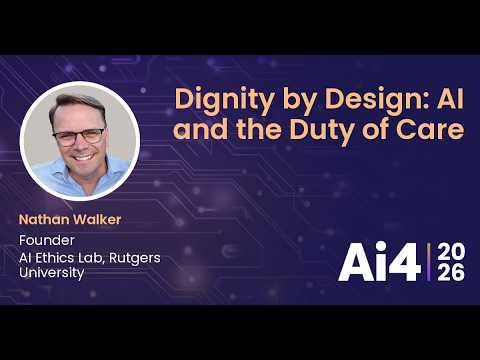
Ai4
Current AI safety benchmarks fail vulnerable users by only flagging risk rather than actively guiding them toward human support, requiring developers to replace passive compliance with affirmative duties of care.
AI-assisted summary of Dignity by Design: AI and the Duty of Care With Rutgers University — original source. Check the original for full context.
Source published:
Detailed notes
## Background Published on YouTube by Ai4 on August 15, 2026, this presentation features Dr. Nathan C. Walker, founder of the AI Ethics Lab at Rutgers University. The session outlines the "Dignity by Design" framework, exploring how treating human dignity as a foundational premise across global constitutions can transform AI ethics from a regulatory compliance checklist into an actionable way of life.
## TL;DR Dr. Nathan C. Walker introduces the 5-4-3 "Dignity by Design" framework, demonstrating that human dignity serves as the central root across international law and all major AI ethical clusters. Conceptualizing AI as an inhabited interactive environment rather than a passive tool, Walker emphasizes bridging cultural, psychological, and organizational distances to protect vulnerable populations. The talk urges organizations to evolve from passive risk mitigation ("do no harm") to a proactive positive duty of care, moving from merely "smart" tools to "wise" technology via the Decision Infrastructure Across the AI Lifecycle (DIAL) model. Ultimately, the framework cautions against outsourcing complex moral judgments, such as judicial sentencing, to algorithmic systems that entrench historical biases.
## Atmosphere & style The presentation carries a scholarly, authoritative, and deeply humanistic tone that blends constitutional jurisprudence with cutting-edge technology ethics. Dr. Walker speaks with measured conviction and intellectual clarity, grounding complex ethical dilemmas in tangible case studies like mental health chatbot benchmarks and cross-cultural disparities. The pacing feels deliberate, reflective, and morally urgent, creating an inspiring atmosphere that challenges engineers and executives to build technology with empathy and relational wisdom.
## Key takeaways - [00:04](https://www.youtube.com/watch?v=gxCIfynoPT0&t=4s) The Dignity by Design framework establishes a structured 5-4-3 model (5 premises, 4 objectives, 3 practical applications) to ground AI innovation in human worth. - [00:53](https://www.youtube.com/watch?v=gxCIfynoPT0&t=53s) Human dignity is grounded in an overwhelming global legal consensus, serving as a core premise in 82% of world constitutions and over 52 multinational treaties. - [00:53](https://www.youtube.com/watch?v=gxCIfynoPT0&t=53s) All major AI ethics clusters—including reliability, safety, personal autonomy, privacy, fairness, and accountability—fundamentally trace their moral authority back to human dignity. - [03:19](https://www.youtube.com/watch?v=gxCIfynoPT0&t=199s) AI governance must prioritize the protection of historically marginalized and vulnerable populations who bear disproportionate risks of technological harm. - [03:19](https://www.youtube.com/watch?v=gxCIfynoPT0&t=199s) Rather than treating AI as a passive instrument, it must be conceptualized as an interactive environment that humans inhabit and that reciprocally conditions human behavior. - [05:38](https://www.youtube.com/watch?v=gxCIfynoPT0&t=338s) Developers and regulators must actively close cultural, physical, psychological, and procedural moral distances separating them from the diverse communities impacted by their models. - [07:26](https://www.youtube.com/watch?v=gxCIfynoPT0&t=446s) Cultivating moral imagination allows technologists and policymakers to empathize with external perspectives and uncover institutional blind spots. - [07:26](https://www.youtube.com/watch?v=gxCIfynoPT0&t=446s) AI safety governance must advance beyond negative duties like passive risk flagging to enforce an active, positive duty of care that directs distressed users to human support. - [10:39](https://www.youtube.com/watch?v=gxCIfynoPT0&t=639s) The tech industry must shift from building merely 'smart' technology focused on speed and optimization toward 'wise' technology that balances short- and long-term societal well-being. - [13:17](https://www.youtube.com/watch?v=gxCIfynoPT0&t=797s) The Decision Infrastructure Across the AI Lifecycle (DIAL) operationalizes ethical reflection from initial venture capital funding through data curation, deployment, and audits. - [13:17](https://www.youtube.com/watch?v=gxCIfynoPT0&t=797s) Dignity by Design integrates with and elevates existing frameworks like Privacy by Design, Secure by Design, and Human-Centered Design by uniting them under a shared foundational premise. - [13:17](https://www.youtube.com/watch?v=gxCIfynoPT0&t=797s) Ethical safeguards must be context-specific, warning against the erosion of dignity when high-stakes human judgments—such as judicial sentencing—are outsourced to historical predictive models.
## Detailed walkthrough ### [00:04](https://www.youtube.com/watch?v=gxCIfynoPT0&t=4s) Framing Dignity by Design: The 5-4-3 Model
Dr. Nathan C. Walker introduces the fundamental question driving his scholarship at the AI Ethics Lab at Rutgers University and his resident research at the Rockefeller Foundation’s Bellagio Center: How can the technological advances of this century protect and advance the inherent worth and dignity of every person? To operationalize this question, Walker introduces the **Dignity by Design** framework, an actionable paradigm structured around five core premises, four central objectives, and three practical industry applications.
```mermaid flowchart TD accTitle: Dignity by Design Framework Overview subgraph Premises["5 Core Premises"] P1["1. Global Legal Consensus"] P2["2. Center of AI Ethics"] P3["3. Protection of Vulnerables"] P4["4. AI as an Environment"] P5["5. Bridging Moral Gaps"] end subgraph Objectives["4 Key Objectives"] O1["1. Moral Imagination"] O2["2. Positive Duty of Care"] O3["3. Beyond Dualism"] O4["4. Smart to Wise Tech"] end subgraph Applications["3 Practical Applications"] A1["1. Lifecycle Infrastructure (DIAL)"] A2["2. Complementary Frameworks"] A3["3. Sector-Specific Solutions"] end Premises --> Objectives --> Applications ```
[00:53](https://www.youtube.com/watch?v=gxCIfynoPT0&t=53s) Premises 1 & 2: Dignity in Law and AI Ethics
The first foundational premise rests on a deep global legal consensus. A comprehensive survey of eight decades of constitutional and international human rights law reveals that dignity clauses serve as a central premise in 82% of national constitutions worldwide, as well as over 52 multinational treaties. Civilizations across generations have codified human dignity at the core of the rule of law.
The second premise demonstrates that human dignity is the foundational root of the entire field of AI ethics. When analyzing families of AI principles, every major cluster inevitably traces back to dignity: - **Reliability Principles:** Safety and security exist fundamentally to protect an individual’s bodily and psychological dignity. - **Autonomy Principles:** Consent, notice, agency, and the human right to privacy uphold self-determination and personal worth. - **Collective Rights & Justice Principles:** Solidarity, environmental sustainability, fairness, and accountability all ground their legitimacy in preserving dignity across communities.
Because dignity anchors global jurisprudence and ethical frameworks, it must serve as the non-negotiable core when designing, developing, and deploying AI systems.
[03:19](https://www.youtube.com/watch?v=gxCIfynoPT0&t=199s) Premises 3 & 4: Vulnerable Populations and AI as an Environment
The third premise highlights the urgent duty to safeguard vulnerable populations who are disproportionately susceptible to technological harm due to identity, displacement, or systemic marginalization. Historically, systems failed to recognize the inherent worth of women, racial, ethnic, and religious minorities, children, aging adults, and people experiencing poverty, resulting in the systematic erosion of their rights.
The fourth premise rejects the conventional narrative that AI is merely an external tool used by people. Instead, AI must be conceptualized as an *environment* that humans inhabit. Users shape this digital environment to their personal needs and contexts, and the environment reciprocally alters and conditions human behavior. Framing AI as an interactive habitat rather than a passive instrument fundamentally shifts design and regulatory responsibilities toward safeguarding human development within these spaces.
[05:38](https://www.youtube.com/watch?v=gxCIfynoPT0&t=338s) Premise 5: Closing Moral Distance and Gaps
The fifth premise identifies significant moral gaps separating those who build, finance, and regulate AI from the end-users impacted by their systems. Walker maps these divides across several dimensions: - **Cultural Distance:** Silicon Valley products deployed in South Africa may overlook indigenous *Ubuntu* relational ethics, or miss the cultural nuances of Vietnamese Buddhists living in France, or ignore Cherokee indigenous governance principles. - **Physical & Environmental Distance:** The geographical separation between communities bearing the cost of resource extraction/environmental burdens and the markets consuming AI products. - **Psychological Distance:** The cognitive disconnect between an engineer writing chatbot algorithms and a vulnerable child interacting with the interface. - **Procedural Distance:** Internal corporate silos causing the "problem of many hands," where design, engineering, compliance, and product teams deflect accountability and engage in finger-pointing when failures occur.
[07:26](https://www.youtube.com/watch?v=gxCIfynoPT0&t=446s) Objectives 1 & 2: Moral Imagination and the Positive Duty of Care
To bridge these moral chasms, the first objective of Dignity by Design is activating **moral imagination**—the cognitive and empathetic capacity to inhabit ethical dilemmas from perspectives outside one’s own worldview. Understanding another person’s plight does not require agreement, but it cultivates ethical empathy, widens circles of compassion, and uncovers institutional blind spots.
```mermaid flowchart LR accTitle: Shift from Risk Mitigation to Duty of Care subgraph Traditional["Traditional AI Safety"] direction TB R1["Negative Duty"] --> R2["Do No Harm / Risk Flagging"] end subgraph DignityModel["Dignity by Design"] direction TB D1["Positive Duty"] --> D2["Active Guidance to Human Care"] end Traditional -.->|"Expands to"| DignityModel ```
The second objective transitions AI governance from purely negative duties (risk reduction and "do no harm") to an active, positive **duty of care**. Walker cites the Vera Mental Health benchmark study evaluating generative AI chatbots responding to suicidal ideation: - Benchmarked models successfully flagged suicidal ideation in diagnostic tests (represented by green safety detection indicators). - However, all tested models consistently failed at actively guiding distressed users toward human care resources. - Embedding human dignity as a design requirement transforms safety guardrails from passive risk detection into active lifelines that direct vulnerable users to human support.
[10:39](https://www.youtube.com/watch?v=gxCIfynoPT0&t=639s) Objectives 3 & 4: Relational Foresight and Moving from Smart to Wise Tech
The third objective moves beyond binary trade-offs (such as security versus freedom) and the gridlock of reactive hindsight and punitive oversight. By centering human dignity, teams shift from transactional, problem-focused debates to relational, foresight-driven deliberation.
The fourth objective challenges the tech industry’s overarching obsession with building merely "smart" technology focused narrowly on connectivity, optimization, and raw productivity. Walker urges a transition toward **wise technology**, invoking Robert J. Sternberg's definition of wisdom:
> "The use of one's intelligence, creativity, common sense, and knowledge as mediated by positive ethical values toward the achievement of a common good through a balance among intrapersonal, interpersonal, and extrapersonal interests over the short and long terms."
Applying this wisdom-centered paradigm prevents modern AI from repeating the structural harms seen during the dot-com bubble and the rise of social media.
[13:17](https://www.youtube.com/watch?v=gxCIfynoPT0&t=797s) Practical Applications: DIAL, Framework Integration, and Sector Specifics
Drawing on his experience training foundational model teams at OpenAI on First Amendment and human rights approaches, conducting ethics workshops at Adobe, and speaking at Google, Walker outlines three practical industry applications:
1. **Decision Infrastructure Across the AI Lifecycle (DIAL):** Operationalizing ethical reflection at every milestone—beginning at the venture capital, accelerator, and incubation stages by requiring startups to demonstrate how their business models uphold human dignity before building, through to data curation, training, deployment, auditing, and continuous updates. 2. **Complementary Integration:** Dignity by Design is built to elevate and strengthen existing paradigms—including Privacy by Design, Secure by Design, and Human-Centered Design—by anchoring them to their shared core premise. 3. **Sector-Specific Realization:** Ethical implementation cannot be one-size-fits-all. In finance, healthcare, education, and the legal sector, standards must be contextualized: - *Judicial Sentencing Warning:* When judges rely on algorithmic predictive mechanisms to assign prison sentences (e.g., deciding between four versus seven years), they outsource human judgment to models trained on historical datasets that replicate carceral inequities, eroding human dignity in the name of administrative efficiency.
[16:40](https://www.youtube.com/watch?v=gxCIfynoPT0&t=1000s) Synthesis and Call to Action
Walker concludes by synthesizing the core arc of the Dignity by Design framework: dignity is the proven consensus of global constitutional law and AI ethical principles. Because AI constitutes an interactive environment inhabited by vulnerable populations, developers have an urgent duty of care to bridge cultural, physical, psychological, and organizational distances.
By replacing transactional optimization with relational wisdom across the entire decision infrastructure, organizations can build genuinely trustworthy technology. Walker invites cross-sector leaders to collaborate with the AI Ethics Lab at Rutgers University to advance solutions-oriented scholarship and practice.
## Notable quotes > [00:04](https://www.youtube.com/watch?v=gxCIfynoPT0&t=4s) How can the technological advances of this century protect and advance the inherent worth and dignity of every person? — Dr. Nathan C. Walker
> [10:39](https://www.youtube.com/watch?v=gxCIfynoPT0&t=639s) The use of one's intelligence, creativity, common sense, and knowledge as mediated by positive ethical values toward the achievement of a common good through a balance among intrapersonal, interpersonal, and extrapersonal interests over the short and long terms. — Robert J. Sternberg
> Dignity is a central legal premise in over 158 national constitutions and 52 multinational instruments. — Dr. Nathan C. Walker
> It is the central principle on which all other AI ethics rest. — Dr. Nathan C. Walker
> Commitments such as privacy, security, and safety all reflect historical and contemporary efforts to uphold the inherent worth and dignity of every person. — Dr. Nathan C. Walker
> see AI ethics not as a regulatory compliance list, but as a way of thinking, a way of life. — Dr. Nathan C. Walker
> [05:38](https://www.youtube.com/watch?v=gxCIfynoPT0&t=338s) problem of many hands — Dr. Nathan C. Walker
> [13:17](https://www.youtube.com/watch?v=gxCIfynoPT0&t=797s) Decision Infrastructure Across the AI Lifecycle (DIAL) — Dr. Nathan C. Walker
## Mentioned Dr. Nathan C. Walker, AI Ethics Lab at Rutgers University, Rockefeller Foundation's Bellagio Center, Vera Mental Health, Robert J. Sternberg, OpenAI, Adobe, Google, Dignity by Design, DIAL (Decision Infrastructure Across the AI Lifecycle), Ai4
## Video description Nathan Walker - Founder, AI Ethics Lab, Rutgers University
Dignity is a central legal premise in over 158 national constitutions and 52 multinational instruments. It is the central principle on which all other AI ethics rest. Commitments such as privacy, security, and safety all reflect historical and contemporary efforts to uphold the inherent worth and dignity of every person. Join Dr. Nathan C. Walker, founder of the AI Ethics Lab at Rutgers University, to explore how Dignity by Design practices can help us see AI ethics not as a regulatory compliance list, but as a way of thinking, a way of life.
[Source](https://www.youtube.com/watch?v=gxCIfynoPT0)