Fabrion Splits AI Reasoning From Action to Prevent Operational Errors
Ai4
Placing generative models in direct control of transactional workflows causes 95% of enterprise pilots to fail, requiring companies to separate conversational intelligence from deterministic, permission-enforced execution layers.
AI-assisted summary of Democratising AI for the Enterprise With Fabrion — original source. Check the original for full context.
Source published:
Detailed notes
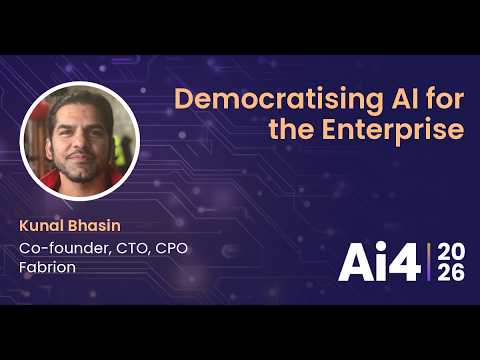
## Background Published by Ai4 on YouTube on August 15, 2026, this presentation features Kunal Bhasin, Co-founder, CTO, and CPO of Fabrion. The video outlines Fabrion's dual-brain, full-stack AI platform designed to solve enterprise AI governance challenges by separating conversational reasoning from deterministic operational execution across complex industrial knowledge graphs.
## TL;DR Kunal Bhasin explores the core enterprise dilemma where conversational LLMs hallucinate while rigid deterministic systems cannot adapt, contributing to a 95% failure rate for enterprise AI pilots. Fabrion resolves this by introducing a dual-brain architecture that decouples exploratory conversational reasoning from an auditable, IAM-enforced operational execution engine. Grounded in a four-layer Knowledge Fabric and an open industrial meta-model, the platform maps complex manufacturing ontologies—from parts catalogs to warranty pipelines—into verifiable data graphs. This model-agnostic, on-premises system continually learns from human feedback and fine-tunes open-weights models to ensure enterprise data sovereignty and long-term vendor independence.
## Atmosphere & style The presentation carries the sharp, authoritative cadence of a technical founder keynote aimed squarely at pragmatic enterprise operators. Bhasin balances engaging anecdotes about viral LLM logic failures with dense, systems-level architecture diagrams and clear governance workflows. The tone is deliberate, engineering-focused, and reassuringly realistic, cutting through generative AI hype to deliver a disciplined blueprint for production-grade industrial automation.
## Key takeaways - [00:04](https://www.youtube.com/watch?v=LN_xY92LLmE&t=4s) Enterprise AI faces a fundamental conflict between fast, conversational LLMs that hallucinate and rigid, deterministic legacy systems that cannot hold a dialogue. - [01:36](https://www.youtube.com/watch?v=LN_xY92LLmE&t=96s) MIT research indicates that approximately 95% of enterprise AI pilots fail to reach production deployment due to governance and reliability challenges. - [01:36](https://www.youtube.com/watch?v=LN_xY92LLmE&t=96s) The operational and financial penalties of executing incorrect transactional enterprise actions are substantially higher than merely generating incorrect conversational text. - [01:36](https://www.youtube.com/watch?v=LN_xY92LLmE&t=96s) Attempting to solve AI governance by simply using a secondary LLM to monitor the primary model without deterministic structural boundaries is an engineering anti-pattern. - [03:42](https://www.youtube.com/watch?v=LN_xY92LLmE&t=222s) Fabrion's dual-brain architecture decouples conversational exploration (Brain 1) from operational validation and execution (Brain 2). - [03:42](https://www.youtube.com/watch?v=LN_xY92LLmE&t=222s) Operational guardrails must be enforced through programmatic identity, access controls, and structured schemas rather than soft prompt instructions. - [03:42](https://www.youtube.com/watch?v=LN_xY92LLmE&t=222s) The underlying Knowledge Fabric links four core layers: granular IAM identity, semantic data ontologies, specialized domain agents, and deterministic system integrations. - [06:34](https://www.youtube.com/watch?v=LN_xY92LLmE&t=394s) Industrial enterprises with high complexity (such as automotive manufacturing with 10,000+ parts) require dynamic, AI-legible graph ontologies rather than static dashboards. - [08:03](https://www.youtube.com/watch?v=LN_xY92LLmE&t=483s) The platform's open meta-model standardizes messy enterprise data across Action Types, Certified Measures, Roles & Rules, and Analysis Directives. - [08:03](https://www.youtube.com/watch?v=LN_xY92LLmE&t=483s) A rigorous four-stage governance lifecycle (Declaration, Binding, Verification, Certification) allows agents to establish trust by returning grounded fallbacks or 'I don't know yet' when data is uncertified. - [10:02](https://www.youtube.com/watch?v=LN_xY92LLmE&t=602s) Capturing manual human overrides and enterprise queries enables continuous fine-tuning of self-hosted open-weights models, increasing platform determinism over time. - [10:02](https://www.youtube.com/watch?v=LN_xY92LLmE&t=602s) Enterprise AI architecture must be model-agnostic and deployable on-premises, creating a durable semantic layer that outlasts individual LLM releases and vendor choices.
## Detailed walkthrough ### [00:04](https://www.youtube.com/watch?v=LN_xY92LLmE&t=4s) The Enterprise AI Dilemma: Conversational Agents vs. Deterministic Systems
Kunal Bhasin, co-founder, CTO, and CPO of San Francisco-based startup Fabrion (backed by 8VC), outlines the fundamental challenge of bringing artificial intelligence into large, complex enterprises, particularly in heavy industrial manufacturing. He observes that modern enterprise AI deployments typically manifest in one of two distinct flavors. On one hand sits what he terms "the confident agent"—an LLM that is brilliant, incredibly fast, and never sleeps, yet occasionally invents supplier discounts or revenue numbers out of thin air. The true breakthrough of this paradigm is conversational interface design, capitalizing on the natural human inclination toward dialogue to make complex technology universally accessible.
On the other hand sit traditional enterprise software systems. These legacy platforms are strictly deterministic, auditable, reliable, and compliant, but they fundamentally cannot hold a conversation. In these rigid environments, answering a novel question becomes a heavyweight change event where innovation velocity is measured in months or quarters rather than days. Fabrion’s foundational thesis is to build from the bottom up to fuse these two conflicting natures—the non-deterministic, conversational flexibility of LLMs and the deterministic, audited reliability of enterprise platforms—into a unified platform.
- **Company Background:** Fabrion is a San Francisco startup backed by 8VC focused on complex enterprise verticals such as automotive and industrial manufacturing. - **The Core Dichotomy:** Fast, creative, conversational LLMs prone to hallucination versus rigid, deterministic, change-resistant enterprise applications.
---
[01:36](https://www.youtube.com/watch?v=LN_xY92LLmE&t=96s) The High Stakes of Action: Who Watches the AI?
Highlighting data from MIT research, Bhasin notes that roughly 95% of enterprise AI pilots fail to advance into production. The danger escalates dramatically as agents move beyond merely generating text into executing real-world business actions; taking an incorrect enterprise action carries far higher financial and operational penalties than producing incorrect words. When considering how to govern these systems, standard "one size fits all" policies fail. More critically, attempting to solve the governance dilemma by simply placing another AI tool in charge of watching the first AI is "a trap" rather than a viable engineering design pattern.
```mermaid flowchart TD accTitle: Dual Brain AI Architecture Overview subgraph Brain1["Brain 1: The Conversationalist"] direction TB A["Intent Pipeline"] --> B["Planner Loop"] B --> C["Knowledge Graph Reasoning"] C --> D["Proposed Pipe Plan"] end
subgraph Gate["Validation & Human-in-the-Loop"] direction TB E["Inspection Verdicts & Citations"] F["Human-in-the-Loop Approval"] end
subgraph Brain2["Brain 2: The Operator"] direction TB G["Attribute & Action IAM"] G --> H["Real Data Boundaries"] H --> I["Structured Tool Calls (Schemas)"] end
D --> E E --> F F --> G ```
To illustrate model vulnerabilities, Bhasin references classic riddles and logic puzzles where frontier LLMs famously stumble—such as calculating whether to drive or walk to a gas station, or the traditional riddle about a surgeon unable to operate on their son. While these slip-ups spark entertaining Reddit threads, translating that ungrounded reasoning into production quotes, invoices, or critical manufacturing sales figures creates unacceptable risk. LLMs cannot be permitted to act purely from raw parametric memory or pre-trained data. Surveying the audience on how many currently run AI pilots versus how many have achieved production deployment, Bhasin emphasizes that true production readiness demands rigorous guardrails rather than blind faith in foundation models.
- **MIT Research Metric:** 95% of enterprise AI pilots never make it to production environments. - **The LLM Governance Anti-Pattern:** Using a second LLM to monitor the first without structural, deterministic boundaries. - **Consequence Shift:** The transition from conversational hallucination (text errors) to operational execution (wrong transactional actions).
---
[03:42](https://www.youtube.com/watch?v=LN_xY92LLmE&t=222s) The Dual-Brain Architecture and the Knowledge Fabric
To solve the governance challenge, Fabrion implements a dual-brain architecture designed to separate generative reasoning from operational execution. "Brain One" is the Conversationalist: it reasons over enterprise knowledge graphs, explores hypotheses, and interacts with users, but is strictly prohibited from touching operational systems without validated guardrails. "Brain Two" is the Operator: engineered to be "boring on purpose," it validates all requests against concrete identity, permissions, and system roles. Rather than relying on a block of prompt text "begging the model to behave," the operator enforces real boundaries and permission loops.
Brain One runs an intent pipeline grounded in the enterprise ontology, producing candidate plans, evidence frames, and inspection verdicts alongside a human-in-the-loop planner loop. Brain Two enforces attribute-level and agent-action-level permissions through Fabrion’s native Identity and Access Management (IAM) engine. It mandates structured tool calls with strict schemas, completely eliminating unvalidated free-text commands.
| Architecture Layer | Core Component | Operational Function | |:--- |:--- |:--- | | **Layer 1: Identity (IAM)** | Granular Access Control | Enforces down to attribute- and agent-action level; programmatic rules replace prompt-based instructions. | | **Layer 2: Semantic Data** | Business & Data Ontology | Binds certified measures to canonical sources with compiled thresholds and full citation paper trails. | | **Layer 3: Specialist Agents** | Scoped Domain Agents | Act as lane-constrained lenses over specific ontology sub-graphs to draft proposals. | | **Layer 4: Integrations** | Deterministic Connectors | Interfaces directly with ERPs, MES platforms, legacy data lakes, IDPs, and BI dashboards. |
Both brains operate on top of a four-layer **Knowledge Fabric**: - **Identity:** Controls who may see and execute actions via enforced programmatic controls rather than system prompts. - **Data Layer:** Certified business measures tied to canonical enterprise sources with deterministic thresholds, providing an auditable paper trail and citation for every single number. - **Agent Layer:** Specialist agents constrained to specific operational lenses within the ontology to propose actions strictly within their designated lanes. - **Integration Layer:** Direct bi-directional integration with ERP, MES, data warehouses, identity providers, and business intelligence systems.
---
[06:34](https://www.youtube.com/watch?v=LN_xY92LLmE&t=394s) AI-Legible Ontologies for Complex Manufacturing
Modern industrial enterprises are far too intricate for static dashboards and too critical for ungrounded AI. In sectors like automotive manufacturing, a single vehicle model involves over 10,000 distinct parts, thousands of tier suppliers, assembly plants, warranty claim pipelines, bills of materials (BOM), and complex sales codes. Fabrion models these interconnected relationships into an AI-legible ontology.
```mermaid flowchart LR accTitle: AI Legible Manufacturing Ontology Model subgraph Core["Physical & Operational Entities"] V["Vehicle Model"] --- P["Assembly Plants"] V --- S["Suppliers"] V --- W["Warranty Claims"] end
subgraph DataFabric["Deterministic Knowledge Layer"] BOM["Bill of Materials / Parts Catalog"] KPI["Business Goals & KPIs"] SC["Sales Codes"] end
Core --- DataFabric DataFabric --> CQ["Certified Recorded Queries"] CQ --> AG["Monitored Agent Actions"] ```
Within this framework, every business object and relationship is grounded in certified, recorded queries originating from the underlying data fabric graph. Agents monitor and operate against this real-world operational graph with built-in data certification gates, eliminating the need for engineers to hand-craft validation logic from scratch. This allows conversational agents to "think in graphs" and navigate domain-specific business taxonomy while keeping enterprise operators firmly in control.
- **Manufacturing Scale:** Designed to handle vehicles and industrial assemblies spanning 10,000+ parts and thousands of global suppliers. - **Ontological Grounding:** Replaces static dashboards with dynamic graph representations linked to canonical parts catalogs, warranty records, and plant configurations.
---
[08:03](https://www.youtube.com/watch?v=LN_xY92LLmE&t=483s) The Open Meta-Model and Governance Lifecycle
Establishing an enterprise-wide guardrail layer requires an extensible, open-source approach based on industry standards rather than proprietary vendor silos. Fabrion structures its ontology around a core meta-model designed to ingest and normalize messy, fragmented enterprise data. Everything originates from a foundational "Concept" (such as a plant, factory, engineering change order, or KPI), which encapsulates four critical dimensions:
- **Action Types:** Permissible actions that human operators and autonomous agents can execute. - **Measures:** Numerical calculations, dimensions, sums, and aggregates bound to canonical data. - **Roles and Rules:** Precise security boundaries and conditional access controls. - **Analysis Directives:** Contextual business taxonomy explaining how data must be interpreted.
```mermaid flowchart TD accTitle: Open Meta Model to Deployment Architecture subgraph MetaModel["Core Meta-Model Concept"] AT["Action Types"] M["Measures"] RR["Roles & Rules"] AD["Analysis Directives"] end
MetaModel --> IndOnt["Industry Standard Ontology (e.g., Manufacturing)"] IndOnt --> Tenant["Tenant Instance (On-Premises Deployment)"] Tenant --> Engine["Model-Agnostic Execution Engine"] Engine --> Mod1["Frontier LLMs"] Engine --> Mod2["Fabrion Open-Weights Models"] ```
This meta-model maps onto standardized industry ontologies, which are then deployed inside the tenant’s private environment. Fabrion runs entirely on-premises or within the enterprise's sovereign infrastructure, ensuring sensitive operational data never leaves company walls. The execution engine remains completely model-agnostic, supporting frontier commercial LLMs as well as Fabrion-trained open-weights models.
The governance lifecycle strictly enforces four stages: **Declaration**, **Binding** to canonical sources, **Verification** against ontology guardrails, and final **Certification** by human operators. When an agent encounters uncertified data or ambiguous metrics, it explicitly outputs "I don't know yet" or provides a grounded fallback, establishing trust rather than fabricating answers.
---
[10:02](https://www.youtube.com/watch?v=LN_xY92LLmE&t=602s) Continuous Learning, Domain Skills, and Platform Tenets
Fabrion utilizes continuous learning backed by open-weights models to steadily enhance enterprise determinism. Every user query, decision, and manual human override is captured as an enterprise signal. Specialized "data agents" handle automated ingestion, enrichment, and cleansing pipelines. Through the **Fabrion Lab**, these signals are leveraged to fine-tune self-hosted open-weights models on internal enterprise taxonomy and operational workflows, continually evaluated against real agent actions and registered in a centralized agent registry. Over time, this feedback loop renders the overall platform increasingly deterministic.
```mermaid flowchart LR accTitle: Continuous Learning and Operational Skills Loop subgraph Feedback["Continuous Learning Loop"] direction TB Sig["Queries, Overrides & Exceptions"] --> DA["Data Agents (Ingest/Clean)"] DA --> Lab["Fabrion Lab (Fine-Tuning)"] Lab --> Reg["Agent Registry & Open Weights"] Reg --> Dual["Dual-Brain Platform"] Dual --> Sig end
subgraph Skills["Pre-Built Domain Skills"] direction TB S1["Parts & Bill of Materials"] S2["Warranty Claims Analysis"] S3["Plant Operations & S2P"] S4["Command Center Orchestration"] end
Dual -.-> Skills ```
On top of the ontology sits a modular **Skills Layer** offering pre-built domain manifests for manufacturing and automotive use cases, including Parts & BOM management, Warranty Claims analysis, Plant Operations, and Source-to-Pay (S2P) supply networks. These operational capabilities are managed through an enterprise **Command Center**, allowing business users to launch governed actions across their data fabric.
Bhasin concludes by reiterating Fabrion’s foundational architectural pillars: - **On-Premise Deployment:** Complete data sovereignty where internal assets never leave the client environment. - **Model Agnosticism:** Freedom to plug in external frontier models or self-hosted open-weights architectures with zero vendor lock-in. - **Guardrail-Driven Ontology:** A durable semantic asset that outlasts individual model releases.
The decisive question for enterprise leadership over the coming decade is not "which AI vendor should we pick," but rather: "How do we build an AI layer that adapts to our organization, gives us full control to accelerate our roadmap, and outlives any vendor we'll ever pick?"
## Notable quotes > Every enterprise AI platform today has one of two problems: either they put the LLM in charge (fast and creative, but hallucinates and can't be trusted with real enterprise actions) or they put rigid workflow tools in charge (reliable but inflexible, can't hold a conversation). — Kunal Bhasin
> The modern industrial enterprise is too complex for static dashboards and too critical for ungoverned AI. — Kunal Bhasin
> The enterprises that will dominate the next decade aren't asking 'which AI vendor should we pick', they're asking 'how do we build an AI layer that adapts to our organization and people, gives us full control to accelerate our AI roadmap, and is agnostic to every vendor we'll ever pick.' — Kunal Bhasin
> [01:36](https://www.youtube.com/watch?v=LN_xY92LLmE&t=96s) 95% of enterprise AI pilots fail to advance into production. — Kunal Bhasin
> [01:36](https://www.youtube.com/watch?v=LN_xY92LLmE&t=96s) taking an incorrect enterprise action carries far higher financial and operational penalties than producing incorrect words. — Kunal Bhasin
> [01:36](https://www.youtube.com/watch?v=LN_xY92LLmE&t=96s) attempting to solve the governance dilemma by simply placing another AI tool in charge of watching the first AI is 'a trap' rather than a viable engineering design pattern. — Kunal Bhasin
> [03:42](https://www.youtube.com/watch?v=LN_xY92LLmE&t=222s) Brain Two is the Operator: engineered to be 'boring on purpose,' it validates all requests against concrete identity, permissions, and system roles. — Kunal Bhasin
> [03:42](https://www.youtube.com/watch?v=LN_xY92LLmE&t=222s) Rather than relying on a block of prompt text 'begging the model to behave,' the operator enforces real boundaries and permission loops. — Kunal Bhasin
> [08:03](https://www.youtube.com/watch?v=LN_xY92LLmE&t=483s) When an agent encounters uncertified data or ambiguous metrics, it explicitly outputs 'I don't know yet' or provides a grounded fallback, establishing trust rather than fabricating answers. — Kunal Bhasin
## Mentioned Kunal Bhasin, Fabrion, 8VC, Ai4, MIT, Reddit, Fabrion Lab
## Video description Kunal Bhasin - Co-founder, CTO, CPO, Fabrion
Every enterprise AI platform today has one of two problems: either they put the LLM in charge (fast and creative, but hallucinates and can't be trusted with real enterprise actions) or they put rigid workflow tools in charge (reliable but inflexible, can't hold a conversation). Nobody has solved the governance problem: who watches the AI? Fabrion's dual-brain, full-stack AI platform answers this by separating conversational intelligence from operational execution; one brain reasons and proposes, the other validates and acts within real permissions, real data boundaries, and real human-in-the-loop controls, all connected through a full-stack knowledge-fabric of data, agents, integrations, and identity that plugs into the tools and systems your teams already use. The modern industrial enterprise is too complex for static dashboards and too critical for ungoverned AI. We believe that manufacturing lines, supply chains, product structures, and compliance regimes are complex knowledge graphs, and AI that thinks in graphs and works with people inside guardrails will master them. The enterprises that will dominate the next decade aren't asking "which AI vendor should we pick", they're asking "how do we build an AI layer that adapts to our organization and people, gives us full control to accelerate our AI roadmap, and is agnostic to every vendor we'll ever pick.
[Source](https://www.youtube.com/watch?v=LN_xY92LLmE)