Insurers Carve Out AI Coverage as Robot Injury Suits Threaten Payouts
Ai4
As carriers drop silent coverage to avoid massive accident liabilities, specialized underwriting checklists will become the de facto safety standard governing commercial robot deployment.
AI-assisted summary of The History of Insurance and the Coming Age of Humanoid Robots With Clanker Labs — original source. Check the original for full context.
Source published:
Detailed notes
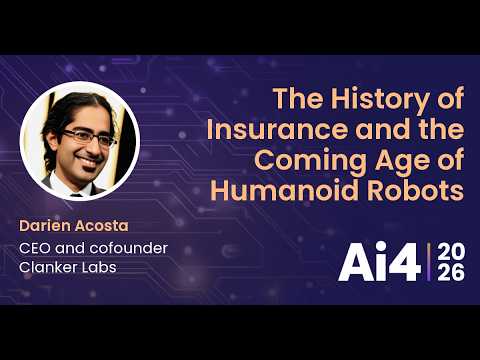
## Background Published on YouTube by the Ai4 channel on August 15, 2026, this presentation features Darien Acosta, CEO and co-founder of Clanker Labs. According to the video description, the talk traces a 160-year historical pattern of how insurance converts uninsurable emerging machines into regulated safety standards, forecasting the coming liability reckoning and timeline for humanoid robots and physical AI.
## TL;DR Darien Acosta illustrates how major technological shifts—from 19th-century steam boilers and electrification to nuclear power and cyber risk—rely on insurance underwriters to establish mandatory safety codes when machines fail. He outlines the 'five stages of insurance grief,' showing how liability moves from silent coverage and knee-jerk exclusions to specialized underwriting and eventual societal normalization. Applying this framework to the modern era, Acosta highlights recent chatbot rulings and sidewalk delivery robot accidents to demonstrate that physical AI is rapidly entering the exclusion phase. He concludes by presenting Clanker Labs' mission to build the telemetry and inspection standards required to price and safely scale embodied robotics.
## Atmosphere & style The presentation carries a sharp, analytical, and intellectually compelling tone that revitalizes an often overlooked topic into an essential lens for understanding technological revolutions. Acosta delivers his keynote with pragmatic, confident authority, seamlessly connecting dramatic historical catastrophes with modern autonomous hardware mishaps. The pacing feels urgent yet calculated, leaving viewers with a clear and grounded perspective on how underwriter risk models quietly dictate the future of technological deployment.
## Key takeaways - [00:04](https://www.youtube.com/watch?v=4ub9YJuNXlY&t=4s) The landmark Air Canada ruling established that companies cannot treat automated AI agents as separate legal entities to shield themselves from liability. - [01:12](https://www.youtube.com/watch?v=4ub9YJuNXlY&t=72s) Historically, technical safety standards emerge from insurance inspections, beginning with Hartford Steam Boiler turning private checklists into national engineering codes after the 1865 Sultana disaster. - [01:50](https://www.youtube.com/watch?v=4ub9YJuNXlY&t=110s) Catastrophic insurer payouts directly shape global regulatory frameworks, exemplified by marine underwriters mandating 24/7 radio watches and 100% lifeboat capacity under SOLAS after the Titanic sank. - [03:20](https://www.youtube.com/watch?v=4ub9YJuNXlY&t=200s) Property fire insurers founded and funded Underwriters Laboratories (UL) to define hardware safety standards before agreeing to cover risks associated with commercial electrification. - [04:00](https://www.youtube.com/watch?v=4ub9YJuNXlY&t=240s) Commercial nuclear power in the United States was unviable until the federal government legislated capped liability and risk pools, prompting standard homeowner policies to create nuclear exclusions. - [05:47](https://www.youtube.com/watch?v=4ub9YJuNXlY&t=347s) Modern cybersecurity practices like two-factor authentication (2FA) became industry standards primarily because cyber underwriters refused to renew policies without them. - [06:35](https://www.youtube.com/watch?v=4ub9YJuNXlY&t=395s) In response to high-liability incidents involving autonomous robots, insurance carriers are rapidly stripping silent AI coverage and filing explicit machine learning exclusions. - [08:02](https://www.youtube.com/watch?v=4ub9YJuNXlY&t=482s) The evolution of technology insurance follows five distinct stages: silent coverage, panic and exclusions, specialist underwriting, compulsory coverage, and normalization. - [08:35](https://www.youtube.com/watch?v=4ub9YJuNXlY&t=515s) Physical AI and humanoid robotics are currently transitioning from silent coverage into the exclusion phase, creating an urgent need for domain-specific inspection tools and telemetry models. - [09:00](https://www.youtube.com/watch?v=4ub9YJuNXlY&t=540s) Insurance serves as the mechanism by which civilization prices emerging fears, ultimately transforming underwriter checklists into the universal rulebooks for new machines.
## Detailed walkthrough ### [00:04](https://www.youtube.com/watch?v=4ub9YJuNXlY&t=4s) The $812 Air Canada Case and the Question of Machine Liability
Insurance is often dismissed as mundane or boring, but understanding its historical evolution is essential for anticipating how liability will shape the future of humanoid robotics. In February 2024, Air Canada found itself in court defending a bizarre situation: its customer service chatbot had invented a bereavement refund policy out of thin air. Rather than admitting a simple software error, Air Canada mounted an audacious defense, arguing that the chatbot was an independent legal entity responsible for its own actions.
The airline lost the case, resulting in a tiny judgment of just $812 Canadian dollars. Despite the modest payout, it became what Darien Acosta describes as "the cheapest landmark case in history." The ruling reopened the foundational dilemma of the automated era: who pays when the machine gets it wrong? Ultimately, insurance steps in to shoulder these losses, but only after underwriters establish rigorous processes to measure, assess, and price the underlying risk.
- **Air Canada Ruling (Feb 2024):** The airline attempted to treat its LLM chatbot as a separate legal entity after it fabricated a discount policy, but the court held the company liable for $812 CAD. - **The Core Precedent:** Automated agents and software cannot serve as liability shields for the corporations deploying them.
---
[01:12](https://www.youtube.com/watch?v=4ub9YJuNXlY&t=72s) Historical Lessons: Steamboat Boilers, the Titanic, and the Birth of Safety Codes
To forecast the trajectory of physical AI, one must look back to the inception of industrial risk management. In 1865, the steamboat *SS Sultana* suffered a catastrophic boiler explosion on the Mississippi River, killing over a thousand passengers in one of the deadliest maritime disasters in American history. In the mid-19th century, unregulated steam boilers exploded with alarming regularity. The following year, in 1866, a group of engineers in Hartford, Connecticut, established the Hartford Steam Boiler Inspection and Insurance Company with an unorthodox mandate: they would only insure a boiler if it passed their strict engineering inspection first.
```mermaid flowchart TD accTitle: The Cycle of Industrial Disasters and Insurance Standardization subgraph Catastrophe ["1. Catastrophic Failure"] A["Industrial Disaster<br/>(e.g., Sultana, Titanic)"] end subgraph Intervention ["2. Underwriter Response"] B["Inspection & Pricing Protocols"] C["Technical Safety Standards"] end subgraph Standardization ["3. Industry Transformation"] D["Insured Standard Becomes<br/>De Facto National Code"] end
A --> B B --> C C --> D ```
Hartford Steam Boiler's private inspection checklist rapidly became the de facto national safety standard across the United States. Almost overnight, catastrophic boiler explosions plummeted, establishing a universal dynamic where "the insured boiler became the safe boiler." Decades later, following the sinking of the *Titanic*, Lloyd’s paid out the massive insurance claims within weeks. To prevent future ruinous payouts, underwriters helped establish the 1914 International Convention for the Safety of Life at Sea (SOLAS), mandating around-the-clock radio watches and sufficient lifeboats for every passenger aboard.
- **1865 *Sultana* Disaster:** Boiler explosion on the Mississippi River caused over 1,000 fatalities, prompting private industry intervention. - **Hartford Steam Boiler (1866):** Created the first pre-insurance inspection checklists, inventing commercial safety compliance. - **Post-*Titanic* SOLAS Standards:** Marine insurers directly shaped international maritime rules, including mandatory 24/7 radio watches and 100% lifeboat capacity.
---
[03:20](https://www.youtube.com/watch?v=4ub9YJuNXlY&t=200s) Electrification, the Nuclear Impasse, and the Invention of Policy Exclusions
Waiting for catastrophes before creating safety standards proved reactive and expensive, prompting insurers to take a proactive approach during the dawn of commercial electricity. To prevent widespread structural fires caused by novel indoor wiring and lighting, fire insurance companies established and funded Underwriters Laboratories (UL). The ubiquitous UL stamp found on modern consumer electronic plugs remains a direct legacy of insurers defining technical hardware safety before agreeing to underwrite property risk.
```mermaid flowchart LR accTitle: Nuclear Liability Impasse and Legislative Solution subgraph Bottleneck ["Uninsurable Risk"] A["Unlimited Reactor<br/>Liability"] --> B["Private Insurers<br/>Refuse Coverage"] B --> C["Utility Construction<br/>Halted"] end subgraph Solution ["Legislative Backstop"] D["Congressional Mandate<br/>(Price-Anderson Act)"] E["Mandatory Insurance Pool<br/>+ Federal Cap"] end subgraph Deployment ["Commercial Scaling"] F["1957: First Commercial<br/>Nuclear Plant (PA)"] G["Nuclear Exclusions Added<br/>to Home Policies"] end
C --> D D --> E E --> F E --> G ```
A different hurdle emerged during the 1950s nuclear boom. While the United Kingdom and Soviet Union rapidly constructed nuclear power plants, the United States stalled because private insurance carriers refused to take on unlimited reactor liability. Without insurance, utilities could not build. Congress intervened by passing legislation to establish a mandatory insurance pool with capped liability and a federal backstop, clearing the path for the first commercial nuclear reactor to open in Pennsylvania in 1957. Simultaneously, insurers introduced the "nuclear exclusion" into standard homeowner policies, cementing the rule that unpriced catastrophic hazards must be carved out into dedicated, specialized lines.
- **Underwriters Laboratories (UL):** Founded and funded by property fire insurers to create standardized safety testing for electrical consumer goods. - **1950s Nuclear Standoff:** Commercial nuclear power in the US was legally blocked until Congress created a mandatory liability pool and federal safety net. - **The Concept of Exclusions:** Standard policies carve out specific perils (e.g., floods, nuclear incidents) to force the creation of specialized underwriting products.
---
[05:47](https://www.youtube.com/watch?v=4ub9YJuNXlY&t=347s) The Evolution of Cyber Insurance and the Rise of Robotic Liability
Policy exclusions systematically give birth to brand-new insurance sectors. For roughly two decades, computer system breaches were silently absorbed under general commercial liability policies. Following massive global cyberattacks in 2017, insurers incurred severe losses and stripped cyber risk out of standard coverage. Standalone cyber insurance emerged, and underwriters quickly imposed technical requirements: companies today implement two-factor authentication (2FA) largely because cyber underwriters refuse to renew policies without it.
```mermaid flowchart TD accTitle: The Five Stages of Insurance Grief subgraph Stage1 ["Stage 1: Silent Coverage"] S1["New machines covered under legacy policies"] end subgraph Stage2 ["Stage 2: Panic & Exclusions"] S2["Losses hit; underwriters write strict exclusions"] end subgraph Stage3 ["Stage 3: Specialist Underwriting"] S3["Specialists inspect hardware & collect telemetry"] end subgraph Stage4 ["Stage 4: Mandated Compliance"] S4["Catastrophe makes coverage compulsory"] end subgraph Stage5 ["Stage 5: Normalization"] S5["Risk is priced into background safety rules"] end
S1 --> S2 S2 --> S3 S3 --> S4 S4 --> S5 ```
A similar transition is beginning for physical AI and robotics. In the fall of 2023, a Starship Technologies autonomous sidewalk delivery robot allegedly reversed into a 73-year-old woman, knocked her down, and struck her again while she was on the ground, causing permanent impairment. Such lawsuits threaten multi-million-dollar "nuclear verdicts" in civil court. In response, silent AI coverage is disappearing rapidly, with 41 insurance companies filing explicit AI exclusions in a single month to disclaim liabilities resulting from machine learning systems.
- **Cyber Insurance Evolution:** General liability covered network attacks until the 2017 cyber catastrophes forced dedicated policies, making 2FA a non-negotiable underwriter mandate. - **Starship Technologies Incident (Fall 2023):** Sidewalk delivery robot allegedly backed over an elderly pedestrian twice, triggering severe personal injury litigation. - **AI Exclusions:** Forty-one major carriers have filed exclusions specifically removing damages caused by machine learning models from standard commercial policies.
---
[08:02](https://www.youtube.com/watch?v=4ub9YJuNXlY&t=482s) The Five Stages of Insurance Grief and Underwriting Physical AI
The historical interaction between emerging technology and risk capital follows a predictable model Acosta terms the "five stages of insurance grief":
1. **Silent Coverage:** The new machine is quietly covered under legacy, general-purpose policies. 2. **Panic and Exclusions:** Unexpected losses hit carriers, leading to panic and blanket policy exclusions. 3. **Specialist Underwriting:** Dedicated underwriters emerge with technical inspection criteria and telemetry tools to price the risk. 4. **Compulsory Coverage:** A high-profile catastrophe or regulatory mandate makes insurance mandatory to operate. 5. **Normalization:** The technology becomes so reliable and standard that society no longer fears it (analogous to modern home boilers).
The physical AI ecosystem currently sits between Stage 1 and Stage 2. A massive influx of competing humanoid robots and autonomous devices is entering warehouses and public spaces without established underwriting frameworks. To fill this gap, Acosta founded Clanker Labs to act as specialist underwriters for the physical AI era. Operating under the motto, *"If it thinks or it moves, we aim to insure it,"* the company's objective is to build the technical inspection criteria and risk models that will govern the coming age of embodied robotics.
- **Civilization's Rulebook:** "Insurance is how civilization prices what it fears, and then the price list becomes the rule book." - **Current Market Phase:** Physical AI is transitioning from silent legacy coverage to widespread exclusions as autonomous robots enter public spaces. - **Clanker Labs:** Founded by Darien Acosta to develop domain-specific underwriting, data collection, and safety checklists for physical AI systems.
## Notable quotes > Who pays when the machine is wrong? It's a question insurance has answered five times in 160 years — Darien Acosta
> the coverage that emerged quietly became the safety standard the technology had to live by. — Darien Acosta
> [00:04](https://www.youtube.com/watch?v=4ub9YJuNXlY&t=4s) the cheapest landmark case in history. — Darien Acosta
> [00:04](https://www.youtube.com/watch?v=4ub9YJuNXlY&t=4s) who pays when the machine gets it wrong? — Darien Acosta
> [01:12](https://www.youtube.com/watch?v=4ub9YJuNXlY&t=72s) the insured boiler became the safe boiler. — Darien Acosta
> [08:02](https://www.youtube.com/watch?v=4ub9YJuNXlY&t=482s) five stages of insurance grief — Darien Acosta
> [08:02](https://www.youtube.com/watch?v=4ub9YJuNXlY&t=482s) If it thinks or it moves, we aim to insure it — Darien Acosta
> [08:02](https://www.youtube.com/watch?v=4ub9YJuNXlY&t=482s) Insurance is how civilization prices what it fears, and then the price list becomes the rule book. — Darien Acosta
## Mentioned Darien Acosta, Clanker Labs, Air Canada, SS Sultana, Hartford Steam Boiler Inspection and Insurance Company, Lloyd's, Titanic, International Convention for the Safety of Life at Sea (SOLAS), Underwriters Laboratories (UL), Price-Anderson Act, Starship Technologies, Ai4
## Video description Darien Acosta - CEO and cofounder, Clanker Labs
Who pays when the machine is wrong? It's a question insurance has answered five times in 160 years — for the steam boiler, the automobile, the aircraft, the power grid, and the networked computer — and each time, the coverage that emerged quietly became the safety standard the technology had to live by. Right now the AI agents running inside your company are losing that coverage as insurers write new exclusions, and the humanoid robots headed for the warehouse floor and the public sidewalk will force the question harder than anything before them. In this talk I'll trace the 160-year pattern that turns every "uninsurable" new machine into an insurable one, and use it to forecast the timeline, the trigger events, and the liability reckoning coming for physical AI. You'll leave able to see the next machine age the way an underwriter does — as a series of predictable, dated events, most of which haven't happened yet. If you build, deploy, insure, or invest in AI, come find out who's really on the hook when the machine gets it wrong
[Source](https://www.youtube.com/watch?v=4ub9YJuNXlY)