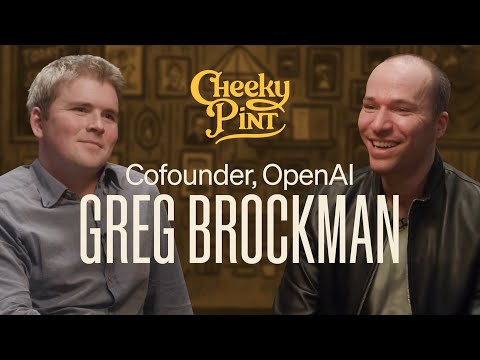
OpenAI's Brockman Links Level 4 AGI to Physical Energy Scaling
Stripe
The core barrier to achieving scientific-innovator AI has shifted from software algorithms to the physical infrastructure required to power massive data centers.
## Background
Published on June 18, 2025, by Stripe on YouTube, this video features a conversation between OpenAI cofounder Greg Brockman and John Collison. According to the page description, the episode explores research-driven product development, an early moment when OpenAI seemed doomed, S-curves in AI progress, and looming energy bottlenecks.
## TL;DR
In this discussion, Greg Brockman reflects on OpenAI's journey from a technology-first approach to discovering the power of the scaling hypothesis during their formative Dota 2 project. He details the transition from GPT-3's early general API days to the massive consumer and enterprise adoption of GPT-4 in areas like medicine, education, and 'vibe coding.' Looking forward, Brockman outlines OpenAI's five-level AGI framework, emphasizing that the primary bottleneck has shifted from software to physical infrastructure and energy. Ultimately, he shares personal anecdotes from his upbringing in North Dakota and defends his optimistic AGI timelines, highlighting OpenAI's commitment to delivering a major 'step function' breakthrough every year.
## Atmosphere & style
The conversation carries a casual yet deeply intellectual vibe, styled as a relaxed chat over a pint. The dynamic between Brockman and Collison is friendly and peer-to-peer, filled with playful skepticism and laughter when reflecting on past, overly ambitious AGI predictions. It feels like an authentic insider look that balances high-stakes tech history with nostalgic personal storytelling. The narrative arc moves from the chaotic, 'doomed' uncertainty of OpenAI's early days to a grounded, highly optimistic sense of wonder regarding the near future of human-AI collaboration.
## Key takeaways
- [00:00](https://www.youtube.com/watch?v=E6hCFDfkijU&t=0s) OpenAI rejected the traditional startup playbook by chasing technology first without a specific customer problem, a strategy that felt 'totally doomed' to cofounder Greg Brockman's builder instincts.
- [02:51](https://www.youtube.com/watch?v=E6hCFDfkijU&t=171s) The Dota 2 project validated the scaling hypothesis when the team observed a 2x performance gain for every 2x increase in compute, proving progress was predictable and scalable.
- [05:04](https://www.youtube.com/watch?v=E6hCFDfkijU&t=304s) OpenAI shifted from traditional outcome-based milestones to input-driven management after realizing they could not control the exact timeline of emergent AI capabilities.
- [07:52](https://www.youtube.com/watch?v=E6hCFDfkijU&t=472s) A strict version of the Turing test is no longer the primary industry goal; instead, the focus has shifted toward measuring practical and economic utility.
- [08:57](https://www.youtube.com/watch?v=E6hCFDfkijU&t=537s) AI product interaction is moving from anonymous, stateless sessions to deep personalization where users want the system to persistently retain their history and preferences.
- [10:26](https://www.youtube.com/watch?v=E6hCFDfkijU&t=626s) To protect its focus on AGI, OpenAI opted to build a general API rather than hiring domain specialists to pursue specific vertical products like medical applications.
- [10:26](https://www.youtube.com/watch?v=E6hCFDfkijU&t=626s) GPT-3 served as 'the world's best demo machine,' but it required the post-training breakthroughs of GPT-4 for developers to build reliable, sustainable businesses.
- [13:00](https://www.youtube.com/watch?v=E6hCFDfkijU&t=780s) Medicine, life coaching, and education are seeing rapid consumer adoption because the barrier to adding immediate value is low compared to existing traditional alternatives.
- [14:25](https://www.youtube.com/watch?v=E6hCFDfkijU&t=865s) AI adoption operates on two dimensions: capability and convenience. High model capability causes users to tolerate extreme interface friction until market forces inevitably force convenience to catch up.
- [14:25](https://www.youtube.com/watch?v=E6hCFDfkijU&t=865s) Current AI product development feels limited by mobile operating systems that lack native integrations, creating friction that feels out of date compared to the model's inner capabilities.
- [17:59](https://www.youtube.com/watch?v=E6hCFDfkijU&t=1079s) It is highly plausible that an AI will reach Level 4 AGI ('Innovators') and solve a Millennium Prize Problem or make novel scientific discoveries within the next two to five years.
- [17:59](https://www.youtube.com/watch?v=E6hCFDfkijU&t=1079s) The primary bottleneck of AI progress has shifted from software algorithms to physical infrastructure and energy availability.
- [22:06](https://www.youtube.com/watch?v=E6hCFDfkijU&t=1326s) Anxiety surrounding the data wall quieted as researchers transitioned to new S-curves, specifically leveraging reinforcement learning and synthetic data generation.
- [22:06](https://www.youtube.com/watch?v=E6hCFDfkijU&t=1326s) The most valuable enterprise use case for AI coding is executing massive refactors of legacy codebases rather than building new applications from scratch.
- [27:28](https://www.youtube.com/watch?v=E6hCFDfkijU&t=1648s) OpenAI uses a product strategy analogous to Disney: they create a highly capable core asset (the base model) and productize it into high-ROI applications with minimal extra work.
- [30:19](https://www.youtube.com/watch?v=E6hCFDfkijU&t=1819s) Reflecting on his 2017 prediction that AGI was two to three years away, Brockman notes that while the exact timeline shifted, the resulting technology is more practical and magical than anticipated.
- [31:10](https://www.youtube.com/watch?v=E6hCFDfkijU&t=1870s) OpenAI measures success by aiming to deliver at least one major qualitative 'step function' breakthrough each year, rather than tracking rigid, output-based metrics.
## Detailed walkthrough
### [00:00](https://www.youtube.com/watch?v=E6hCFDfkijU&t=0s) The "Doomed" Origins of OpenAI and the Power of Scale
The standard playbook for building a startup is to identify a specific customer problem and then build a technology to solve it. OpenAI did the exact opposite. Greg Brockman, who dropped out of MIT in 2010 to become Stripe's first engineer and later its CTO, co-founded OpenAI in 2015. He describes the early days of the company as a process of chasing the technology first, with absolutely no idea how it would eventually be applied. This approach felt "totally doomed" to Brockman's builder instincts, yet there was no other path forward.
The turning point that validated their approach was the scaling hypothesis, which OpenAI observed firsthand during their Dota 2 project. Led from an ML perspective by Jakub Pachocki and Szymon Sidor, the project began on a desktop with just 16 CPU cores to train a simple agent. Every week, the team scaled the compute by 2x and saw a corresponding 2x improvement in performance. This constant, predictable progress convinced them that they simply needed to keep going. While OpenAI might not have been the absolute first to conceptualize the scaling hypothesis, they had the conviction to pursue it further and more successfully than anyone else.
- **Key People:** Greg Brockman (Co-founder and former Stripe CTO), Jakub Pachocki, Szymon Sidor.
- **Dota 2 Scaling:** Started with 16 cores on a desktop, doubling compute weekly with linear performance gains.
- **The Core Driver:** The massive explosion of compute scale-ups from 1940 to today, paired with scalable algorithms capable of absorbing that compute.
---
[05:04](https://www.youtube.com/watch?v=E6hCFDfkijU&t=304s) Lessons from the Wilderness: The Dota 2 Breakthrough
The Dota 2 project served as a formative management and engineering crucible for OpenAI. Initially, Brockman tried to manage the project using traditional, outcome-based milestones—setting specific dates by which the AI had to beat certain players. This approach failed completely because the team could not control the exact timeline of emergent capabilities. Instead, they shifted to controlling the inputs: committing to running specific experiments and implementing particular features by set dates.
This input-driven approach culminated in a dramatic, high-stakes tournament run. After easily defeating their in-house players, the team brought their bot to "The International" tournament. On the first day, they went 3-0, 3-0, and then lost a match 2-1 because an opposing pro player used an in-game item the bot had never trained against. The team stayed up all night, finally getting a new training run started at 4:00 AM to incorporate the item.
The next morning, a semi-pro player testing the updated bot declared it "totally broken" because it was taking unnecessary damage. However, when he went in for the kill, the bot defeated him. The team realized the AI had autonomously learned a sophisticated "baiting" strategy. By stitching their original bot and this new baiting bot together, they created an undefeated system that went on to beat the number one player in the world. This experience solidified OpenAI's understanding of deep learning: you cannot always predict or control the exact path of the model, but if you measure progress rigorously and control the inputs, "you can do true magic."
---
[07:52](https://www.youtube.com/watch?v=E6hCFDfkijU&t=472s) Redefining the Turing Test and the Rise of Personalization
While many believe the Turing test has already been passed by modern LLMs, Brockman argues that a strict version of the test—where an AI is completely indistinguishable from a human over an extended period—has not yet been officially achieved or even targeted as a primary goal. Instead, the industry has shifted toward measuring economic and practical utility. Brockman recalls a board member in 2018 pointing out that if near-term Artificial General Intelligence (AGI) were truly on track, one would expect to see massive economic value already being delivered. At the time, that was a fair critique, but the landscape has since shifted dramatically.
One of the most significant product frontiers currently emerging is personalization. Historically, interacting with ChatGPT was like "walking into a shop off the street" where the merchant has no memory of who you are. Today, user behavior is flipping. While Brockman used to use "Incognito Mode" for search engines and temporary chats for ChatGPT to protect his privacy, he now wants the AI to remember everything about his past interactions because of the immense utility it provides.
- **The Personalization Shift:** Moving from anonymous, stateless interactions to persistent memory that tracks user history and preferences.
- **Product vs. Research:** OpenAI actively avoids siloing product and research teams, preferring to blur the lines and encourage cross-collaboration to bring these capabilities to life.
---
[10:26](https://www.youtube.com/watch?v=E6hCFDfkijU&t=626s) Backing Into a Product: From GPT-3 to AI Dungeon
When OpenAI developed GPT-3, they knew they needed to build a commercial product to fund their ongoing research, but they had no clear direction. They wrote down a list of 100 potential products, including specialized medical applications. However, they quickly realized that pursuing a specific vertical would force them to hire domain specialists (like doctors) and effectively abandon the "G" (General) in AGI.
To avoid this, they decided to build a general API and let the market figure out the use cases. This felt incredibly risky; Brockman recalls colleagues doubting that anyone would ever pay to generate samples from the model. The very first customer to prove them wrong and generate real revenue was *AI Dungeon*, a text-based adventure game. While this initially made them wonder if the future of OpenAI was in gaming, GPT-3 quickly proved to be "the world's best demo machine" across dozens of industries. However, because the base model was difficult to make reliable, it wasn't until the post-training breakthroughs of GPT-4 that developers could reliably build sustainable businesses on top of the technology.
- **First Paying Customer:** *AI Dungeon*, a text-based adventure game.
- **The Demo Milestone:** Bill Gates told Brockman that seeing GPT-4 was the best tech demo he had witnessed since first seeing the Xerox PARC interface.
---
[13:00](https://www.youtube.com/watch?v=E6hCFDfkijU&t=780s) Low Bars and High Impact: Medicine, Coaching, and Education
Although Brockman initially assumed medicine would be one of the last domains where AI could safely add value, it has become an area of rapid, grassroots success. The reason is simple: "the bar is so low, you just need to exceed WebMD." Because patients typically get very little face-to-face time with human doctors, they are turning to LLMs to debug complex personal health issues and even veterinary problems, often with highly successful diagnostic outcomes.
Beyond medicine, two other major consumer use cases are quietly experiencing massive adoption:
- **Life Coaching:** Users are increasingly using AI as a sounding board for personal advice and daily life coaching.
- **Education:** AI tools are successfully replicating the "Bloom's 2 Sigma" effect, providing highly personalized tutoring that significantly improves learning outcomes compared to traditional classroom settings.
[14:25](https://www.youtube.com/watch?v=E6hCFDfkijU&t=865s) Personalization, Capability, and the "Convenience" Bottleneck
The dream of personalized tutoring for everyone is what drove Sal Khan to start Khan Academy. When he was first shown GPT-4, his immediate reaction was, "This is the thing. We need to become a GPT-4 app." This represents a broader shift where AI applications are beginning to deeply affect daily life, with programming being another prominent professional example. We are rapidly heading toward a world where working productively without AI will feel as severely hampering as trying to do productive work today without a computer.
However, current AI product development often feels limited by operating systems. Two years ago, OpenAI released ChatGPT plugins to allow developers to write apps that ChatGPT could access, but the models back then simply were not good enough. Users were limited to three plugins at a time, and the system was unreliable. Today, the Model Context Protocol (MCP) is taking off as a robust way to hook AI up to different tools. While we still face interface limitations—such as not being able to easily access phone APIs—this is likely just a temporary six-month lag. Once models cross the capability threshold, people will find a way to build the necessary integrations.
A common frustration is the lack of a single, native button on mobile operating systems to ask ChatGPT about whatever is on the screen. Currently, a user has to take a screenshot, open the ChatGPT app, and click "upload photo," which "feels very 1993." This friction is a matter of convenience rather than capability. Since the API was released in 2020, OpenAI has viewed product adoption through these two dimensions:
* **Capability:** If the capability of a model is high enough, users will tolerate extreme inconvenience. If taking a screenshot and uploading it yields an amazing insight that saves a month of work, "you'll crawl the top of the mountain" to do it.
* **Convenience:** Once high capability establishes a specific workflow, market pressure on phone manufacturers and developers inevitably forces the convenience to catch up.
---
[17:59](https://www.youtube.com/watch?v=E6hCFDfkijU&t=1079s) The Path to Level 4 AGI and the Energy Bottleneck
To critics who argue that AI has yet to produce a single novel advancement in mathematics or science, the response is simple: "Just wait." It is highly plausible that an AI will solve one of the Millennium Prize Problems within the next two to five years. Solving a problem of that caliber is an incredibly high bar, but once reached, it unlocks countless other capabilities.
This progression aligns with OpenAI's five-level framework for tracking progress toward Artificial General Intelligence (AGI):
1. **Chatbots**
2. **Reasoners**
3. **Agents** (where the technology currently sits)
4. **Innovators** (systems capable of novel scientific discovery)
5. **Organizations**
Reaching Level 4 (Innovators) requires massive scale. For example, OpenAI's partnership with Oracle in Abilene, Texas, involves building massive data centers. Imagine dedicating the computational power of an entire state-of-the-art data center to "thinking hard about one problem," such as curing a specific cancer or solving a Millennium Problem. When this computational scale is coupled with the ability to experiment—whether through digital tools or robotic wet labs—the world will see a level of scientific output it has never experienced before.
This massive scale shifts the primary bottleneck of AI progress from software to physical infrastructure, specifically energy. It is fitting that "energy manufactured into intelligence" is becoming the ultimate bottleneck. While tech-sector growth has historically enjoyed easy exponential curves, physical infrastructure—which requires permitting, real estate, damming rivers, and building nuclear power plants—does not scale as easily. While fusion energy is highly anticipated, most industry observers place it at least five years away. In the meantime, capitalist markets and national competitiveness will force the issue. For America to remain competitive against global rivals who are building massive amounts of power, there is simply no choice but to solve the energy challenge.
---
[22:06](https://www.youtube.com/watch?v=E6hCFDfkijU&t=1326s) Overcoming the Data Wall and the Rise of "Vibe Coding"
The "data wall" was a major topic of concern in 2023, yet public anxiety around it has quieted without any apparent slowdown in AI progress. This is because when one paradigm taps out, researchers find a new S-curve. This aligns with Ray Kurzweil's view of technological progress: zoom out, and the transition between different S-curves looks like a smooth, uninterrupted exponential trend. Rather than hitting a hard wall, the industry transitioned to new paradigms like synthetic data and reinforcement learning (RL). The RL paradigm acts as a data production mechanism where the AI trains on its own generated data, allowing it to learn rapidly.
In the realm of software engineering, "vibe coding" has become a major trend. While AI is not yet widely trusted to run end-to-end software engineering in production without human oversight, it is rapidly evolving. Currently, vibe coding often automates the fun parts of coding (writing the initial logic) while leaving the tedious parts (review and deployment) to humans. The goal is to transition AI into a true "coworker" or a team of agents managed by a human. Eventually, this dynamic could even flip, where an AI manager deeply understands a company's goals and assigns meaningful tasks to human employees.
* **Context and Codebases:** While early AI coding tools excelled at single-shotting small apps from public libraries, newer tools like Codex are highly capable of navigating million-line enterprise codebases. Codex can grep through massive systems to locate functionality better than many human developers.
* **The Killer Enterprise Feature:** The most valuable enterprise use case for AI coding is not building new apps from scratch, but executing massive refactors—such as rewriting legacy COBOL applications or translating PHP. These tasks require immense mechanical work and sheer volume rather than highly novel creative thought, making them perfect "AI-shaped problems."
---
[27:28](https://www.youtube.com/watch?v=E6hCFDfkijU&t=1648s) OpenAI's Product Strategy and Growing Up in North Dakota
Deciding which products to build is a constant struggle for OpenAI. Launching ChatGPT forced the company to simultaneously operate as both a consumer and an enterprise business, which initially looked like an "unfocused strategy" to board members. However, the strategy is best understood through the analogy of a company like Disney. Disney creates a core asset—like *The Little Mermaid*—and then productizes it in multiple ways, from theme park rides to lunchboxes and T-shirts. Similarly, OpenAI builds a highly capable core base model and then looks for high-ROI applications that can be built with minimal additional work. Coding is a primary focus because speeding up OpenAI's own developers accelerates the development of everything else.
On a personal note, growing up in North Dakota profoundly shaped this perspective. It was an incredibly safe environment where "doors didn't even have working locks," allowing for a great deal of personal and academic freedom.
An anecdote from seventh grade highlights this freedom. Having learned some algebra from his father in the sixth grade, he and his mother asked the school if he could skip pre-algebra. The teacher condescendingly replied, "Every parent believes that their child is special. I can guarantee your son will be plenty challenged in my class." After a month of him sitting in the back of the classroom playing games on his calculator, the teacher tried to trip him up by calling on him randomly. He simply glanced at the board, answered "2x," and the teacher finally conceded.
[29:47](https://www.youtube.com/watch?v=E6hCFDfkijU&t=1787s) From Middle School Math to College Classes
Greg Brockman shares a story from his childhood about how his rapid progression in mathematics forced his schools to constantly adapt. After his teacher realized he had nothing left to learn in his current class, saying, "Your son has nothing to learn in this class," he was moved directly into eighth-grade algebra. However, by the time he actually reached the eighth grade, his middle school had completely run out of math classes for him to take.
To continue his education, Brockman began taking classes at the University of North Dakota while he was still in high school. Despite growing up in North Dakota, he stayed highly connected to the top math students across the country by participating in math camps and national math competitions. When jokingly asked if the social scene in North Dakota was "not too distracting," Brockman laughs it off, admitting it was not too distracting but was "definitely fun."
- Brockman skipped ahead to eighth-grade algebra early because he outpaced his curriculum.
- He took college-level courses at the University of North Dakota during his high school years.
- He maintained a network of elite peers nationwide through math camps and competitive math events.
[30:19](https://www.youtube.com/watch?v=E6hCFDfkijU&t=1819s) Reflecting on Past AGI Predictions
The conversation shifts to a memory from 2017, when the speakers were traveling to Camp YC. The interviewer recalls asking Brockman how far away Artificial General Intelligence (AGI) was, to which Brockman reportedly answered, "two or three years." Brockman reacts with playful skepticism, joking, "Did I say that? I don't see the recording." The interviewer presses on, asking how they should grade that prediction in hindsight, noting that while we did not fully achieve AGI by 2020, we "didn't not get AGI either."
Reflecting on his prediction journey, Brockman observes that the single most consistent theme in AI development is that "AI is surprising." He explains that the industry ended up with something different than what they originally pictured, but the result is "better, more magical" and far more helpful than anticipated. Because of this, he is incredibly happy with how the technology has unfolded, even if the exact timeline of the original prediction shifted.
- In 2017, Brockman predicted AGI was only two to three years away.
- He notes that the reality of AI development has deviated from early expectations but has yielded more practical and magical tools.
[31:10](https://www.youtube.com/watch?v=E6hCFDfkijU&t=1870s) The Step-Function Progress of OpenAI
Brockman explains that managing and predicting specific outputs in AI is incredibly difficult, which is why OpenAI shifted its focus. Instead of obsessing over rigid metrics, one of the core goals OpenAI has successfully achieved is ensuring that "every year to have at least one result that just feels like a step function better than anything before." He describes this as a tangible feeling where you "know when you see it" and you get "one really awesome AI feeling thing each year."
The interviewer commends this approach, noting that it is a great way to grade past predictions because it shows Brockman and OpenAI have "stopped setting metrics based on outputs" and instead focused on consistent, monumental leaps. Brockman enthusiastically agrees, concluding the discussion on an optimistic note by stating that "it does feel we're getting really close to something pretty magical."
- OpenAI's internal benchmark is to deliver at least one major "step function" breakthrough every year.
- Brockman emphasizes focusing on qualitative, magical leaps rather than rigid, output-based metrics.
> [27:28](https://www.youtube.com/watch?v=E6hCFDfkijU&t=1648s) Every parent believes that their child is special. I can guarantee your son will be plenty challenged in my class. — A teacher
> [29:47](https://www.youtube.com/watch?v=E6hCFDfkijU&t=1787s) Your son has nothing to learn in this class — A teacher
> [30:19](https://www.youtube.com/watch?v=E6hCFDfkijU&t=1819s) Did I say that? I don't see the recording. — Greg Brockman
> [30:19](https://www.youtube.com/watch?v=E6hCFDfkijU&t=1819s) AI is surprising — Greg Brockman
> [31:10](https://www.youtube.com/watch?v=E6hCFDfkijU&t=1870s) every year to have at least one result that just feels like a step function better than anything before — Greg Brockman
## Mentioned
OpenAI, Greg Brockman, Stripe, John Collison, MIT, Jakub Pachocki, Szymon Sidor, Dota 2, The International, Turing test, ChatGPT, GPT-3, AI Dungeon, Bill Gates, GPT-4, Xerox PARC, WebMD, Sal Khan, Khan Academy, Model Context Protocol, Millennium Prize Problems, Oracle, Abilene, Texas, Ray Kurzweil, Codex, Disney, The Little Mermaid, North Dakota, University of North Dakota, Camp YC
OpenAI co-founder Greg Brockman argues that AI progress is driven by relentless compute scaling and input-focused experimentation rather than traditional product-first roadmaps, shifting the field's primary constraints from algorithms to physical infrastructure and energy.
Scaling Compute and Input-Driven Management (0:00)
OpenAI inverted traditional startup orthodoxy by pursuing underlying technology before identifying market use cases. Brockman notes that conviction in the scaling hypothesis solidified during their Dota 2 project, where doubling compute weekly on a desktop setup delivered predictable, corresponding performance gains. Managing that project taught OpenAI to abandon rigid, outcome-based completion dates for emergent capabilities in favor of strictly controlling inputs—such as committing to specific experiments and continuous model training.
General Models and Product Pragmatism (10:26)
To fund ongoing research without narrowing general-purpose aims into vertical silos, OpenAI launched a general API rather than hiring specialized domain experts like doctors. Early revenue from unexpected applications like AI Dungeon demonstrated commercial traction, and GPT-4 later enabled dependable business applications. Brockman explains that model adoption balances raw capability with user convenience: users willingly endure friction when capability provides high utility, but operating system integrations eventually catch up once workflows solidify.
The Five-Level AGI Path and Energy Limits (17:59)
OpenAI tracks progress across a five-level framework: Chatbots, Reasoners, Agents (the current stage), Innovators, and Organizations. Brockman expects Level 4 models to emerge within two to five years, potentially solving a Millennium Prize Problem when massive compute clusters are concentrated on a single scientific objective. However, Brockman identifies physical infrastructure—notably energy generation and permitting for data centers—as the primary bottleneck superseding algorithmic limits, with technologies like nuclear power and eventually fusion required to sustain growth.
Overcoming the Data Wall Through New Paradigms (22:06)
Concerns over hitting a data wall in 2023 subsided as the industry transitioned to reinforcement learning and synthetic data, aligning with historical technology S-curves where self-generated training data replaces exhausted human data. In practical deployment, Brockman highlights enterprise code refactoring—such as migrating legacy COBOL or PHP systems—as an ideal, volume-heavy fit for models like Codex, setting the stage for AI agents to transition from vibe coding assistants to structured team collaborators.
While Brockman's earlier 2017 prediction that AGI was two to three years away did not strictly materialize, OpenAI has replaced rigid milestone targets with an operational benchmark of producing at least one qualitative step-function breakthrough each year.
[0:00] Greg Brockman: totally doomed
[5:04] A semi-pro player: totally broken
[5:04] Greg Brockman: you can do true magic
[8:57] Greg Brockman: walking into a shop off the street
[10:26] Greg Brockman: the world's best demo machine
[13:00] Greg Brockman: the bar is so low, you just need to exceed WebMD
[14:25] Sal Khan: This is the thing. We need to become a GPT-4 app.
[14:25] Greg Brockman: feels very 1993
[14:25] Greg Brockman: you'll crawl the top of the mountain
[17:59] Greg Brockman: Just wait.
[17:59] Greg Brockman: energy manufactured into intelligence
[22:06] Greg Brockman: AI-shaped problems
[27:28] A teacher: Every parent believes that their child is special. I can guarantee your son will be plenty challenged in my class.
[29:47] A teacher: Your son has nothing to learn in this class
[30:19] Greg Brockman: Did I say that? I don't see the recording.
[30:19] Greg Brockman: AI is surprising
[31:10] Greg Brockman: every year to have at least one result that just feels like a step function better than anything before
Original transcript
[0:00] This is totally backwards
[0:01] from how you're supposed
to do a startup, right?
[0:02] You're supposed to have a problem
[0:03] and we had no idea what the problem was.
[0:05] Is there a world where
the AI becomes the manager
[0:07] and it, you know, gives you ideas
[0:09] and gives you some tasks to do?
[0:10] This was probably the hardest
project that I've ever done,
[0:12] because it felt totally doomed, right?
[0:13] It's like, I know like every instinct,
[0:16] every builder instinct of mine.
[0:17] Did it actually feel doomed?
[0:18] Oh, I felt totally doomed.
[0:20] Greg in 2010 dropped out of MIT
[0:22] to become our first engineer
[0:24] and went on to become Stripe's CTO.
[0:26] In 2015 after he left,
he co-founded OpenAI.
[0:29] OpenAI is really cooking at the moment
[0:31] and Greg is one of the most
productive people I know.
[0:33] Cheers.
[0:37] Wow, you really have
some old school photos.
[0:40] Some deep cut GDB trivia.
[0:42] So yeah. We figure we've
gotta put people at ease,
[0:45] make people feel at home.
[0:47] Very nice. Thank you. Okay.
[0:48] Well, I just dive straight
into all the questions I have,
[0:50] which is a lot.
All right.
[0:51] If you were not working in AI,
[0:53] how could one have known that
[0:55] something was about to start working?
[0:56] People were telling you
that AI was the future
[0:58] in the 1970s, in the 1980s, the 1990s.
[1:01] Then very quickly, in the late 2010s
[1:02] everything started happening.
[1:04] Well, I was someone who
was not in the field
[1:07] and so, I remember very
much what it was like.
[1:09] 2013, 2014, it felt like
every day on Hacker News
[1:13] there'd be a new "deep
learning for X" article.
[1:16] And I remember being like,
"What is deep learning?
[1:18] I knew, like, one person in the field,
[1:21] and I asked them to introduce me
[1:24] to more people in the field,
[1:25] and I just kept getting introduced
[1:27] to a bunch of my smartest
friends from college.
[1:29] Now, if you actually look at
the work that was being done...
[1:32] 2012, basically,
[1:34] image recognition, for the first time,
[1:35] you could solve with the neural net
[1:36] much better than anything else.
[1:38] It just blew all these
[1:39] traditional computer vision
approaches out of the water.
[1:41] It's like this like learned system
[1:43] is able to outperform 40
years worth of, "Let's
[1:45] write down all the rules and try to
[1:47] handcraft the algorithm for the task."
[1:49] And it's very easy to then be like,
[1:52] "Okay. Well, this approach,
[1:54] sure it works for computer vision,
[1:55] but it's never gonna work
for machine translation."
[1:57] In 2014,
[1:58] suddenly, you're getting great results
[2:00] in machine translation.
[2:01] I think that this pattern was applied
[2:03] in subfield after subfield.
[2:05] One thing I've been wondering about is
[2:07] so many different things
[2:08] are finally working at the same time.
[2:12] We have LLMs, which are obviously amazing,
[2:14] but then we also separately have
[2:16] image models really working.
[2:18] We also have text-to-speech
and speech-to-text
[2:20] working way better than they were before.
[2:21] What's the common factor
[2:24] behind everything starting
to work at the same time?
[2:26] Well, it's deep learning, right?
[2:28] I think deep learning is the core-
[2:29] We've have deep learning for a long time.
[2:30] Why didn't deep learning
work in the 1980s?
[2:32] If you look at the number of orders
[2:34] of magnitude of compute that
[2:35] we've gone through from 1940 to today,
[2:38] I mean, it's just astounding.
[2:40] You think they're all
explained by compute scale-ups
[2:43] applied to the right algorithms?
[2:44] Of course, the type of algorithm changes,
[2:45] and some of those results
aren't even deep learning.
[2:47] But I think that fundamentally,
it is about compute,
[2:49] and you need an algorithm that is scalable
[2:51] that can actually absorb that compute.
[2:52] Was OpenAI the first company
[2:53] to take the scaling
hypothesis really seriously?
[2:57] I think that claiming the
first is always difficult,
[3:00] but I think that is clear that we sort of
[3:02] succeeded much more wildly
sooner than anyone else.
[3:06] I think that we had real conviction
[3:07] behind what we needed to do.
[3:09] Some people think that OpenAI
[3:11] set out to prove the scale hypothesis,
[3:13] whereas it was almost
the other way around,
[3:15] that the scale hypothesis
is what we observed
[3:17] as the thing that was working for us,
[3:19] and we really saw it for the first time,
[3:21] actually, during our Dota 2 project.
[3:24] We started out with 16 cores
to train a little agent-
[3:28] on Jakub and Szymon who
were leading the project
[3:31] from an ML perspective, on their desktop.
[3:34] Then, they scaled to 32 cores.
[3:36] It felt like every week
I'd come back to the office
[3:38] and they'd scaled it by another 2x
[3:40] and we had 2x performance-
[3:41] just so clear, you just
need to keep going.
[3:43] Where does this thing peter out?
[3:44] It just never did.
[3:45] Founders get too much credit,
[3:47] because you have an initial product
[3:49] that's a pretty reasonable idea
[3:50] Then you listen to the customers,
[3:51] and you follow what's working.
[3:52] So you were saying that was kind of OpenAI
[3:55] with the scaling hypothesis,
[3:56] where you started trying
to make Dota AIs work
[4:00] and you noticed that adding
more compute worked really well,
[4:03] and you said, "Where else
[4:05] will just throwing more
compute at it yield benefits.
[4:07] I think that's to the first order correct.
[4:10] I think one thing that
distinguishes OpenAI
[4:13] from the typical startup,
[4:15] is we did everything in reverse, right?
[4:18] It's like, you're supposed
to have a problem to solve.
[4:21] No one cares about the technology.
[4:22] Form the entity upfront.
[4:23] Exactly, yes.
[4:24] And for us, we really
chased the technology
[4:27] without any idea of how
it would be applied.
[4:30] A lot of pursuing the technology
[4:33] really is you have to let reality hit you
[4:35] cold, hard in the face.
[4:36] There's just no other
way to achieve results.
[4:39] You can't will it into existence.
[4:41] You can't convince people
[4:43] that this is the thing.
[4:44] It's like, you have to
actually, make the system work.
[4:46] We have to just sort of figure out
[4:48] what is the right frontier,
what are the problems,
[4:50] what are the things that
are on the edge of working,
[4:52] and to really double down on those.
[4:54] What else do you take
away from the Dota work?
[4:55] How else does it... Because you could
[4:57] have just started with LLMs
[4:58] and you know, we could have skipped
[4:59] that period in the wilderness,
[5:01] but it sounds like it
was somewhat formative
[5:02] for the OpenAI organization.
[5:04] I think Dota had many lessons,
[5:06] one of which actually was
a management lesson for me.
[5:10] I remember when we
started out the project,
[5:11] I tried to set a list
of milestones, right?
[5:14] It's like, "Okay, this date
we're gonna beat this player.
[5:16] This date, we're gonna beat this player."
[5:19] That didn't work?
It did not work at all.
[5:21] I remember our first milestone came and
[5:23] Went?
Exactly.
[5:25] And so you realize that
[5:27] you cannot control the outcome, right?
[5:29] You cannot set outcome-based milestones.
[5:31] What you can do is you
can control the inputs
[5:33] of we're gonna try these
experiments by this date.
[5:35] We're going to implement
this feature by this date.
[5:37] And that is what actually worked.
[5:39] And I remember it was one of those things
[5:41] that was just a story
that I could not have
[5:45] written in any better,
if we'd intended to.
[5:48] We beat our in-house best player
[5:52] and then we were playing as a semi-pro
[5:54] and he was just trouncing
us, trouncing us.
[5:56] Then, suddenly we're
starting to get pretty good.
[5:58] So we showed up at the international,
[6:01] this tournament blind.
[6:02] First day, we had three
players that we played against.
[6:04] We went 3-0, 3-0, and then 2-1.
[6:08] We're like, "Oh no. We lost.
[6:09] What happened?"
[6:10] It turned out that this pro
that we're playing against,
[6:12] he had used an item we'd
never trained against.
[6:14] And we were like, "Oh no,
[6:15] we're totally going to be hosed."
[6:17] So, what do we do?
[6:18] Well, we just need to change the training.
[6:20] And so people stayed up
all night to get this done.
[6:22] They added this extra item in there.
[6:25] 4am, they finally get the job running.
[6:28] That Wednesday, we're supposed to play
[6:28] against the number two
[6:30] and the number one player in the world,
[6:32] and our semi-pro plays against it.
[6:34] He's like, "This bot is totally broken."
[6:35] And we're like, "Oh no,
we like clearly had a bug.
[6:37] Something terrible has happened."
[6:39] He was like, "Look, it's
taking all this damage
[6:41] it doesn't need to.
[6:42] I'm gonna go kill it."
[6:42] He goes to kill it, he loses.
[6:44] And he was like, "That was weird."
[6:45] He'd realized that what had happened was
[6:47] it had learned a baiting strategy.
[6:49] And then we realized,
"Well, we have a super-bot,
[6:51] but it's so bad at the beginning,
[6:53] because it's trying to do the baiting.
[6:54] So, what if we just stitch the
two bots we have together?"
[6:57] And then that bot was just undefeatable,
[6:59] and we played against this
number one player and won.
[7:02] To me this is like the story of
[7:03] how deep learning works, right?
[7:05] Is it's like you kind of can't control
[7:06] where you're gonna go.
[7:07] You can control everything that goes in.
[7:09] You can put these metrics
in these measurements
[7:11] and you can have sort of the evaluations.
[7:13] And being able to gauge where you're at
[7:15] is almost as important as being able
[7:17] to make the forward progress.
[7:18] But if you get all those elements right,
[7:19] then you can do true magic.
[7:21] You're also describing something
[7:22] that worked really well
for an organization
[7:24] where it was motivating
to stay up all night.
[7:26] If the prize was impossibly far away,
[7:29] it wouldn't have been as motivating.
[7:31] But the fact that there was
a near-term reward function
[7:33] and you were able to
show concrete progress...
[7:35] I think so.
[7:36] I think some of
[7:38] my favorite engineering stories
have the same character.
[7:40] I remember you and I staying up all night
[7:42] to get our ISO 8583 integration.
[7:44] There's something about
staying up all night
[7:45] for like critical projects that
[7:47] actually have
[7:48] important history in
[7:49] all startups.
[7:50] I'm glad to hear that tradition
is alive and well at OpenAI.
[7:52] So, Dota has fallen, Chess
has fallen, Go has fallen.
[7:58] We've passed the Turing test,
[8:00] I think by anyone's measure.
[8:05] People comment on
[8:06] how there was little fanfare when we did,
[8:07] but we seem to have
pretty clearly done so.
[8:09] What's a good new Turing test?
[8:11] Well, I'll tell you two things.
[8:13] One, is that, if you look at
[8:14] the strict version of the Turing test,
[8:15] I would actually claim
we haven't done it yet.
[8:17] No one's really gone that extra mile
[8:19] to say, "Can we actually have an AI
[8:20] that like is fully
indistinguishable from a human?"
[8:23] It's not clear if it's
even a good task, right?
[8:25] But I think that the right
question to your point is like,
[8:27] well, what is the milestone
[8:30] that we should be chasing
in terms of capability?
[8:32] I remember talking to one of
our board members in 2018,
[8:35] and he said, you know,
"Look, I get that you
[8:39] were all excited about near-term AGI,
[8:41] but it just doesn't feel
like it's on track."
[8:44] I asked, "Well, what do you mean?"
[8:45] He said, "In a world with near-term AGI,
[8:47] you would expect massive economic value
[8:49] to be delivered by AI
already, and where is it?"
[8:52] In 2018, I think that was
a very fair criticism,
[8:55] and clearly, that's
starting to change now.
[8:57] It feels like one thing that
[9:00] may really change the AI
market is personalization.
[9:03] Up to quite recently, when
you asked ChatGPT a question,
[9:07] it was like walking into
a shop off the street.
[9:10] They've never met you before.
[9:11] They know nothing about you, whatever.
[9:12] That's obviously, not
ideal for this, you know,
[9:15] close part of your digital life.
[9:16] I'm curious how you're
thinking about personalization
[9:18] from a product point of view,
[9:19] because it feels to me like
[9:20] the most meaningful change
since the chat interface.
[9:25] Two and a half years ago.
[9:26] Two and a half years ago.
[9:28] I mean, I think it's absolutely critical,
[9:29] and I think it is very rightly considered
[9:32] to be kind of a next frontier.
[9:33] I'm someone who always, when
I just Google something,
[9:38] I go into Incognito Mode,
[9:40] because I don't even want my computer
[9:41] to remember that history.
[9:42] And I always used to go for
temporary chats on ChatGPT.
[9:45] But now my usage has totally reversed.
[9:47] I want ChatGPT to remember everything.
[9:49] I want it to remember my interactions,
[9:51] because it's useful.
[9:52] Okay. So you guys figured out,
[9:53] from a product point of view
[9:54] how to make the memory
actually work better.
[9:56] It's the product point of view,
[9:58] but also, really the
research point of view.
[10:00] And I presume there's a flip
flop between the product
[10:01] and research where,
when you find something
[10:03] that's useful from a
product point of view,
[10:05] then the product people say,
[10:06] "I'm just a product person,
[10:07] you researchers go
actually make this good."
[10:09] Then that kind of kicks off more research.
[10:10] Is that how it works?
[10:11] To some extent
[10:13] that's a failure mode in our mind.
[10:15] I think that we really
[10:16] don't want to have that kind of silo.
[10:18] We really want to blur the lines
[10:19] and have people cross-collaborate.
[10:21] And so, it's avery different mindset from
[10:22] how you would traditionally
build a product
[10:24] versus how you do research.
[10:26] Part of what had happened, actually,
[10:27] was that we had GPT-3,
[10:29] we knew we needed to build a product
[10:31] in order to be able to
continue to raise funding,
[10:33] and we were like,
[10:35] "Well, what product do we build?
[10:36] And we wrote down a list of,
[10:37] like, 100 different products.
[10:38] We could do a medical
thing. Then you're like,
[10:40] "Okay. Well, now we have
to sell to hospitals.
[10:43] We're gonna have to hire doctors."
[10:44] You realize you give up
on the G in AGI, right?
[10:47] You're gonna like go for a specific thing.
[10:49] Someone had the idea of saying,
[10:53] "Well, why don't we just make a API
[10:56] and let people figure it out?
[10:58] And, again,
[10:58] this is totally backwards
[10:59] from how you're supposed
to do a startup, right?
[11:01] You're supposed to have a problem,
[11:03] and we had no idea what the problem was.
[11:04] Yeah, yeah, yeah, we're
gonna back into the problem.
[11:06] And so this actually felt like this was
[11:07] probably the hardest
project that I've ever done,
[11:09] because it felt totally doomed, right?
[11:10] It's like, I know like every instinct,
[11:13] every builder instinct of mine says-
[11:14] Did it actually feel doomed?
[11:15] Oh, it felt totally doomed.
[11:16] It wasn't just like
open-ended or something?
[11:19] No, it felt doomed.
[11:19] But you were still doing it.
[11:21] Yeah. I mean, it's like, at some point,
[11:22] if you have... There was
definitely no other path.
[11:25] There was no other path.
[11:26] It was the only shot we had.
[11:28] I remember someone also saying like,
[11:30] "I can't imagine anyone paying
for samples from this model."
[11:33] And I was like, "You might be right."
[11:36] I'm still trying to imagine it myself.
[11:37] Yes. It was just not clear,
[11:39] were we above threshold
or below threshold?
[11:41] We showed it to people,
[11:43] and people were interested.
[11:44] But that's very different
from people being like,
[11:46] "I will build my company on top of this,"
[11:48] Yes. So, what was the first
use case to get any traction?
[11:51] AI Dungeon.
[11:52] What was that again?
[11:54] There you go.
[11:56] AI Dungeon was a
text-based adventure game.
[12:00] Oh sure, yeah, yeah, yeah, yeah.
[12:01] Okay. Bbut that was real revenue
[12:04] or that was non-zero revenue?
[12:05] It was enough.
[12:06] And, in fact, I believe
[12:07] they were our first paying user.
[12:09] And that gets you
confused for, you're like,
[12:10] "Ah, clearly the future of
OpenAI is gaming" you know?
[12:13] I know, back to our roots.
[12:14] Exactly.
[12:15] It's interesting too,
[12:18] because we had dreamed of
all of these applications,
[12:21] like medicine and all these things,
[12:23] and you start with the gaming application.
[12:25] But we could see signs of
life on so many other things.
[12:28] I think in many ways GPT-3 was like
[12:30] the world's best demo machine, right?
[12:32] When we released the API,
[12:33] people were coming with all
these cool things you could do,
[12:35] but making them reliable was so hard.
[12:38] It really wasn't until the
next generation of GPT-4,
[12:41] until we started to figure out
how to do post training well
[12:43] that then you were actually able to build
[12:45] real businesses on top of these things.
[12:47] Bill Gates was saying recently that GPT-4
[12:48] was the best demo he'd
ever seen since Xerox Park.
[12:52] You know this quote?
Yes.
[12:53] He said it to me the night that he saw it.
[12:56] Yeah. That's high praise.
[13:00] I wanna touch the medicine thing,
[13:02] because you've mentioned it.
[13:02] Like you said
[13:04] your family has personal stories.
[13:07] You've talked about getting
very valuable diagnostic help.
[13:11] We, ourselves, actually, it's
much more minor in our family,
[13:15] but we managed to fix a cat
[13:16] thanks to debugging it with an LLM.
[13:19] I think that's an interesting example,
[13:21] because so many people that I know
[13:24] have had some kind of
experience like this.
[13:26] Maybe it's because you actually
[13:28] don't get that much time from a doctor.
[13:32] Are there other examples like
this medicine application
[13:36] where you're seeing a lot of success,
[13:39] that many people have similar stories,
[13:40] but we just hear less about?
[13:42] Yeah, I think it's a great question.
[13:45] And by the way, I think
like medicine is an example
[13:47] of one where I kind of
thought it was gonna be
[13:50] one of the last domains that
[13:51] we would successfully
be able to add value in,
[13:53] but it turns out that the bar is so low,
[13:55] you just need to exceed WebMD.
[13:56] I think that we have seen
[13:59] other areas that are
like a real common theme.
[14:01] One that's very interesting right now
[14:02] is the life coach,
[14:03] life advice kind of application,
[14:05] where you just talk your AI.
[14:06] That's actually really taking off.
[14:07] Yeah. It really is.
[14:08] Education is another area
[14:12] that just like clearly is
really having an impact.
[14:15] There are studies coming out now
[14:17] that actually show that people
are able to learn better
[14:20] through the use of these tools.
[14:22] That's to be expected, right?
[14:23] It is the Bloom 2 sigma
effect in a product.
[14:25] Yes. And that, for example is like why,
[14:28] Sal Khan, started Khan Academy,
[14:31] to think about
[14:32] if you can give personalized
tutoring to everyone.
[14:34] We showed him GPT-4. He's like,
[14:35] "This is the thing.
[14:36] We need to become a GPT-4 app."
[14:38] I think that there are
[14:39] these really amazing applications
[14:42] that are affecting everyone's daily lives.
[14:45] Obviously, programming is another one,
[14:46] that people are seeing
[14:48] all across the board in
a professional context.
[14:50] We're heading to a world
[14:51] where, like,
[14:53] if you want to do productive work,
[14:56] and you don't have access to computer,
[14:57] you're going to be hampered.
[14:58] Similarly, not having access to AI,
[15:01] it's heading in the same direction.
[15:02] Speaking of not having access to AI,
[15:05] I will posit that these
days, it feels like
[15:10] AI product development
is mostly OS limited.
[15:15] Is that how you feel?
[15:16] Are we stuck at the moment?
[15:18] I do feel a little of stuckage,
[15:20] but not to worry, it was overcomeable.
[15:23] But yeah, I think it is true.
[15:25] Two years ago we released
plug-ins in ChatGPT.
[15:29] Do you remember those?
Yeah.
[15:30] That was trying to make it
[15:33] so anyone could write apps
that then ChatGPT could access.
[15:36] The models were just not that good, right?
[15:38] That we limited to like
three plug-ins at a time.
[15:41] You could have only so
many functions and stuff.
[15:43] It just wasn't that reliable.
[15:45] Now we're in a world where MCP basically
[15:48] is really taking off
[15:49] and is a way to hook up
your AI to different tools,
[15:54] and very much like kind of trying to take
[15:56] that same type of idea
and really make it work.
[15:59] Now, the world that
we're in is very similar,
[16:01] where there's certain
interfaces we don't have.
[16:03] Being able to access your
phone and all those APIs.
[16:07] There's a question of,
[16:08] is the model above threshold
to actually use them or not?
[16:11] My observation has been that basically,
[16:13] I think that there is maybe
a lag of, like, six months
[16:15] of different interfaces
that are hard to access.
[16:18] But once we have a model
that's good enough,
[16:20] we will find a way.
[16:21] People will find a way.
[16:23] I think that we're in a world
[16:24] where I have every
expectation that we will get
[16:27] the future that has been promised.
[16:28] It's just gonna take some work.
[16:30] I feel like there are many moments
[16:31] where I'm using my phone,
and I want a single button
[16:35] where it's just, like
[16:37] "ChatGPT what do you think of this?
[16:39] I need your comment. I
need your fact check.
[16:41] I need your explanation."
Something like that.
[16:43] You take a screenshot, and
you like go into ChatGPT,
[16:46] you click "upload photo."
[16:48] It feels very 1993
[16:50] versus the button on my
phone that just says,
[16:53] "Hey, ChatGPT, what do
you think about this?"
[16:54] Obviously, you guys are not
empowered to go build that.
[16:57] That's what I mean by it feels somehow
[16:58] like we're a little
operating system limited.
[17:00] I definitely get it,
[17:01] but I'll say, I think that
there are two dimensions.
[17:04] This is how I've been
thinking about things
[17:06] since we released the API back in 2020.
[17:08] There's capability and convenience.
[17:11] What you're referring to
is the convenience, right?
[17:14] It's like pretty inconvenient
[17:15] to do the screenshot and paste it.
[17:17] But the thing is, if the
capability is good enough,
[17:20] you are willing to accept any
sort of inconvenience, right?
[17:23] It's like if this, by
taking the screenshot
[17:26] and showing it to ChatGPT,
[17:27] it could give you amazing insight,
[17:29] it could tell you like how to, you know,
[17:30] build Stripe in some way,
[17:32] and it takes you like a month to do it,
[17:34] you have to crawl the top of the mountain,
[17:35] you'll do it, right?
[17:36] The convenience will not stop you.
[17:38] And so the point that I'm
trying to make is that
[17:41] if the capability is high enough,
[17:43] people will start doing a specific flow.
[17:45] They'll discover the use cases
[17:46] and the convenience will just catch up.
[17:47] In the convenience,
[17:48] there's so much pressure.
[17:49] There's pressure on
the phone manufacturer.
[17:50] There's pressure on us.
There's pressure on everyone
[17:52] in order to bring down the convenience.
[17:54] o, I just need to be patient,
[17:55] and it'll be great in three years time.
[17:56] Yes. And really lean in and use the AI.
[17:59] A criticism people like to levy of AI is,
[18:02] "Yeah, it's great and handy and all,
[18:04] but it hasn't come up with
a single novel advance
[18:09] in mathematics or science."
Have you?
[18:12] Well, you could have
[18:13] if you'd become a mathematician.
[18:15] But you know, but humanity has, you know,
[18:18] for keeping the scoreboard.
[18:20] What do you make of that criticism?
[18:22] Just wait.
[18:23] Okay, so you think like take
[18:27] one of the Millennium Prizes
[18:28] Do you think we plausibly will see that?
[18:29] I think for sure.
[18:30] I mean, there's no question.
[18:31] Two years, five years, 10 years?
[18:33] I think that is the question.
[18:34] It's just timing.
[18:35] That is my question.
[18:37] I mean, I would put two to five years
[18:39] as the right number.
[18:41] I think ultimately this comes back
[18:44] to the question of benchmarks, right?
[18:45] Actually being able to
solve a millennium problem
[18:48] is pretty high bar.
[18:51] Yeah.
[18:52] And once you can do that,
there's so many other things
[18:54] that will definitely be possible.
[18:56] And I think that we're starting
[18:57] to see the leading edges of this.
[18:58] And to me, if we look at
our definition of AGI...
[19:02] We recently started talking
[19:03] about this framework of
thinking about levels of AGI,
[19:06] starting from chatbots,
to reasoners, to agents,
[19:09] to innovators, to
organizations, Five levels.
[19:13] We're basically, somewhere
in level three right now.
[19:16] Level four,
[19:17] this innovator, like,
that's gonna be different.
[19:19] I recently posted some pictures
[19:20] of our visit to Abilene, Texas,
[19:22] where we're building these
big data centers together
[19:24] with our partner, Oracle.
[19:26] Imagine taking that whole data center
[19:32] and just thinking hard
about one problem, right?
[19:34] Imagine it just thinking about
[19:35] how to solve a Millennium Problem
[19:37] or how to cure a specific kind of cancer.
[19:39] Maybe it needs access to some apparatus.
[19:41] Maybe it needs access to robotic wet labs.
[19:42] Maybe it needs access
[19:43] to different tools in the world.
[19:45] But that level of computational power
[19:48] coupled with the ability to experiment
[19:50] and learn from your ideas,
[19:52] that is going to be something
the world has never seen.
[19:55] So yet again, we just haven't
put a respectable amount
[19:59] of compute on these problems
[20:01] compared to what we will be doing.
[20:02] Yeah, we're still on these
tiny little computers.
[20:04] So, that actually gets to,
[20:06] in terms of these scaling laws,
do they eventually run out
[20:09] because we just run out of compute?
[20:11] Or do we eventually get to the point
[20:13] where we're inventing new
kinds of nuclear energy,
[20:15] and that is what unlocks the next level?
[20:18] A lot of energy that comes
online now is for data centers,
[20:21] which was not true when you
guys started training GPT-2.
[20:25] Isn't that the upcoming bottleneck?
[20:28] I mean it's as it should be, right?
[20:30] It really should be that it's energy
[20:33] manufactured into intelligence
[20:35] and that's your only bottleneck.
[20:36] But I'm saying that'll
be like quite a plateau
[20:39] compared to the exponential growth
[20:41] we've seen over the past few years.
[20:44] Unless things really change in terms of
[20:46] permitting and plans for
building everything like that.
[20:48] This is I think the core, right?
[20:50] If you look at every trend in this field,
[20:54] there are these exponentials,
[20:55] these S-curves that
sum up to exponentials.
[20:57] Sure. But these exponentials
were mostly existing
[20:59] in like tech, Silicon Valley space
[21:03] where it was pretty easy
to have exponential growth.
[21:05] It's pretty hard in
permitting and real estate
[21:08] and damming rivers and
building nuclear power plants.
[21:11] It's harder to have
exponential growth there.
[21:13] Well, let's see how fusion pans out.
[21:15] Yeah. Okay, but even fusion,
[21:16] most industry observers would say
[21:18] is still five years away.
[21:20] And so, where does the next five years
[21:20] of power growth come from?
[21:22] I think that it is very possible
[21:24] that we end up bottlenecked on energy,
[21:27] and that's actually, one
reason that we've been spending
[21:28] a lot of time really trying
to advocate for the fact
[21:31] that we just need far more power.
[21:34] My observation of the
market is that ultimately,
[21:37] the capitalist markets do provide.
[21:39] I think there's this like
absolute tsunami of demand
[21:42] that is coming our way,
[21:44] but I feel some confidence
that, again, there's like,
[21:48] when there's enough pressure,
[21:49] when there's enough clarity
of, this is the bottleneck...
[21:51] And it's not just for any company, right?
[21:54] It's really for national competitiveness.
[21:56] You look at other countries
[21:57] that are just building
huge amounts of power,
[22:00] far more than we are.
[22:01] I think that actually for
America to remain competitive,
[22:04] there's just no choice but to build it.
[22:06] We've got to figure out power.
[22:06] We do.
Speaking of bottlenecks,
[22:08] everyone was talking about
the data wall in 2023.
[22:12] I think this is an interesting thing,
[22:13] where no one is talking
about the data wall anymore,
[22:15] and yet, it doesn't feel like
AI progress has slowed down.
[22:20] Is it just test-time compute?
[22:22] Is it, like, people were
wrong about the data wall
[22:24] and where it presented a bottleneck?
[22:26] Is there actually still a data wall,
[22:28] but it's two years away?
[22:29] It's basically, all of
these things, right?
[22:30] It truly is.
[22:32] It's like, you keep changing the paradigm.
[22:34] That is the real core of
[22:36] the Kurzweil view of the world,
[22:37] is that, fine, this one way
of doing things taps out.
[22:41] If you just look at that
one way of doing things,
[22:43] you feel hopeless.
[22:44] You feel like this is it,
[22:45] but somehow you will find a new S-curve.
[22:48] And I think that's what's happened.
[22:49] For example, synthetic data,
[22:50] for example, reinforcement
learning, right?
[22:51] If you think about the RL paradigm,
[22:53] fundamentally that's a data
production mechanism, right?
[22:56] And it just that the AI
[22:57] happens to be training on its own data
[22:59] and then you learn it very rapidly,
[23:00] and then you learn on that.
[23:02] Each of these has taken us much further.
[23:05] I think there are lots
of algorithmic ideas,
[23:07] lots of techniques, lots of ways
[23:08] of even using the existing data better.
[23:11] I think that fundamentally
the S-curves continue,
[23:15] and if you zoom out, it all
looks smooth and uninterrupted.
[23:19] So, it's kinda like chip miniaturization
[23:20] where each generation people are like,
[23:22] "Okay, well, that's the smallest
[23:23] you can possibly make a chip."
[23:25] Do you know what I mean?
[23:25] "That's it we're done
with miniaturization,"
[23:27] and somehow we figure out a way.
[23:28] Yes. Now one difference with chips
[23:30] is at the end of the day,
[23:30] there is some limit.
[23:33] Right. But we've never
been that close to that.
[23:35] Yes.
[23:37] Where does AI coding go?
[23:39] In particular, vibe coding
is all the rage right now.
[23:44] It's kind of the term of 2025.
[23:48] It's sort of working.
It's very impressive.
[23:51] No one is really fully
letting AI software engineers
[23:56] run end-to-end in production.
[23:58] I'm just curious,
[23:58] what are your one to two-year predictions
[24:00] on what happens with AI coding?
[24:02] Well, my general observation is that
[24:04] once something kind of
works in this field,
[24:06] the next gen is gonna be great.
[24:08] I think that's where we are
right now for AI coding.
[24:10] I think what we're going to see
[24:12] is AIs taking more and
more of the drudgery,
[24:16] more of this like pain, more of the parts
[24:18] that are not very fun for humans.
[24:20] Now, one thing that's
very interesting is that
[24:22] I think that so far, the vibe coding
[24:24] has actually taken a lot of code
[24:26] that is actually quite fun
[24:27] and left behind the
review and the deployment,
[24:29] these things that are not fun at all.
[24:31] I'm hopeful that we're actually
[24:32] gonna be able to make a lot of progress
[24:33] on these other areas as well,
[24:35] but fundamentally, we should really end up
[24:37] with a full AI coworker.
[24:39] And I think it really will be
anything you want to create,
[24:41] you can be the manager,
[24:43] and you can have
[24:44] this team of software engineering agents.
[24:45] Now, the thing that I think will be
[24:47] very interesting to see is,
[24:48] is there a world where
the AI becomes the manager
[24:51] and it gives you ideas,
[24:52] gives you some tasks to do?
[24:54] That's something that, again,
[24:55] it's just totally backwards
[24:56] in terms of how we think about it.
[24:58] But are there ways in
which you can actually
[25:00] have outcomes for companies
[25:04] and actually have people whose jobs
[25:05] become much more meaningful
[25:06] because they have an AI who
really deeply understands them
[25:09] in the same way that your
[25:10] AI doctor really deeply
understands all of your needs.
[25:14] But isn't part of the common thread
[25:16] that we're talking about here,
[25:17] often places where AI tools underperform,
[25:20] it's because they're trying
to do something generally,
[25:23] Like, voice recognition is not that good
[25:25] because it's trying to
recognize all voices
[25:27] as opposed to trying to recognize
[25:28] my voice in particular.
[25:30] Similarly, with AI coding,
they work well in places
[25:33] where you need no context at all
[25:36] and we're single-shotting an app based on
[25:39] publicly available libraries.
[25:40] In places where you have to understand
[25:43] a million-line code base,
[25:45] they haven't fully figured out
how to do a good job of that.
[25:50] Is that a fair parallel
[25:51] to draw between all these challenges?
[25:52] Well, I think there are
two things in there.
[25:54] One is that I think this
is already changing, right?
[25:57] So if you look at something like Codex,
[25:59] it's actually great at
operating in a big codebase.
[26:02] Like I ask it for where
functionality is implemented
[26:04] and it's better than I am at finding it.
[26:07] Which is kind of a wild fact.
[26:09] It's super cool to see
it like grepping around
[26:11] and just going and exploring.
[26:14] Actually, this is one thing
[26:15] that we really shot for with Codex,
[26:16] was to build a tool for software engineers
[26:19] who are not necessarily vibe coding.
[26:21] It's not about building
a new app from scratch,
[26:23] which is a cool demo,
[26:24] But that's not actually
[26:25] how most software gets written.
[26:27] Actually, I think maybe the
killer enterprise feature
[26:29] is refactors, right?
[26:30] It's like rewriting your
COBOL app or changing-
[26:33] When Facebook did hip
hop to do static PHP.
[26:37] If you think about it,
[26:38] the amount of deep, sophisticated thought
[26:41] that is required to accomplish a refactor
[26:43] is actually not that high.
[26:44] There's a lot of mechanical work
[26:46] that's just the sheer
volume of it that's hard,
[26:48] That's an AI-shaped problem for sure.
[26:52] I think we're going to see
a lot more productivity
[26:55] on all sorts of AI tasks as a result.
[26:58] Now, we are in a world where
you said a second thing,
[27:01] which is maybe you need
[27:03] to narrow down more.
[27:04] I think that the way these models work
[27:06] is you actually do want one model
[27:07] that knows more and more things,
[27:09] and you want it to have
some personalization to you,
[27:12] but the fact that is
[27:14] they have this one base model
[27:15] that kind of knows everything is actually
[27:17] a very useful starting point.
[27:18] So I do think that you're
going to see a world
[27:20] where we'll have more and
more capable base models
[27:22] and figuring out how you really connect it
[27:24] to all of your organization's code,
[27:25] and context, and history.
[27:28] How does OpenAI decide
what products to do?
[27:32] I'm just curious how you think about
[27:35] when to develop specific
products or when you think,
[27:38] "Oh, you contributed do that with ChatGPT,
[27:40] and that's good enough."
[27:41] Yeah. It's is a really
tough question, right?
[27:43] It's something we really struggle with,
[27:44] and I think that over time
[27:46] when we first launched ChatGPT,
[27:49] we're left with this, "Well,
we're an enterprise business,
[27:52] and we're a consumer business."
[27:53] And seems terrifying, as a startup.
[27:56] I remember talking to one of
my board members who said,
[28:00] "It just feels like what you have
[28:01] is an unfocused strategy at first,
[28:03] because you're just doing
all these different things."
[28:06] But if you think about it,
[28:07] maybe an analogies to
a company like Disney
[28:09] where you make one core asset
like Little Mermaid, right?
[28:13] Then, you productize it
[28:15] in all these different ways.
[28:16] You think about Little Mermaid the ride,
[28:18] the lunchbox, the T-shirt.
[28:21] I think that we have some element of that.
[28:22] We have a core model,
[28:23] and then we have a question of,
[28:24] "Well, what are the applications
[28:26] that this can add a lot of
value to quickly, right?
[28:29] With like a small amount
of additional work.
[28:31] So I think the question of
what areas to go into are
[28:34] how far does it take us
off the general path,
[28:37] the return on how important
is this domain area,
[28:41] especially for achieving the bigger goal,
[28:43] how much synergy is there across it
[28:45] with respect to other things we work on?
[28:46] So coding is one where
there's very clear synergy,
[28:49] very clear ROI.
[28:50] Because if we can speed ourselves up,
[28:52] that's something that
accelerates everything.
[28:55] How is being from North
Dakota, how has it shaped you?
[29:00] Look, North Dakota was an
amazing place to grow up.
[29:01] Was it actually? Come on.
[29:04] I've been there.
[29:06] And it was great.
[29:08] Look, it was incredibly safe.
[29:09] Our doors didn't even have working locks.
[29:11] It was that kind of place.
[29:13] I had a lot of freedom academically.
[29:15] Sixth grade, my dad
taught me some algebra.
[29:17] Seventh grade was the first time
[29:19] they split you into advanced math,
[29:20] so I was going to be taking pre-algebra.
[29:22] My mom took me to go see the teacher,
[29:25] and we asked, "Can you skip?"
[29:27] The teacher looked at
us very condescendingly
[29:29] and said, "Every parent believes
[29:31] that their child is special.
[29:33] I can guarantee your son will be
[29:35] plenty challenged in my class."
[29:36] And so, after a month of
me sitting in the back
[29:39] just playing games on my calculator
[29:40] and you know, she'd call me
randomly to try to trip me up,
[29:43] and I just look at the
board and be like, "2x."
[29:46] She said, "Okay, fair enough.
[29:47] Your son has nothing to
learn in this class."
[29:50] So, they moved me into
eighth grade algebra.
[29:52] But then eighth grade rolled around
[29:54] and I had no more math
left in my middle school.
[29:57] That's right you went to college, right?
[29:58] Well, so I did, in high school
[30:00] start going to University of North Dakota,
[30:02] and took a bunch of classes there.
[30:04] But also, I was connected
to a lot of people
[30:06] who were the top math kids in the country
[30:09] through things like math camp
and the math competitions.
[30:11] So, you're saying the social scene
[30:12] was not too distracting in North Dakota?
[30:15] Not too distracting,
[30:16] but it was definitely fun.
[30:19] Last question, do you remember
[30:20] we were going to Camp YC in 2017
[30:25] and I asked you how far AGI was away
[30:29] and you said two or three years.
[30:32] Did I say that?
[30:33] You did.
[30:34] I don't see the recording.
[30:35] Well, I'm just trying to think
[30:39] was I right, were you right?
[30:40] How should we grade that?
[30:41] Because we didn't get AGI,
[30:43] but we didn't not get AGI either.
[30:46] I'm curious if you have any reflections
[30:49] from your own AGI prediction journey.
[30:53] I think that we are...
[30:55] I will say I think that AI is surprising.
[30:57] I think that that is like the
single most consistent theme,
[31:01] is that the thing we were picturing,
[31:02] we got something different,
[31:03] but we got something better, more magical.
[31:06] Something that is more helpful.
[31:07] And so, I'm actually
quite happy with that.
[31:10] Now, predicting where you go,
[31:12] it's again, it's really hard
to manage the outputs here.
[31:14] One goal of OpenAI that we
have successfully achieved,
[31:17] is every year to have at least one result
[31:21] that just feels like
a step function better
[31:23] than anything before.
[31:24] You know when you see it kind of.
[31:26] You just have one really awesome
AI feeling thing each year.
[31:29] That kind of thing.
[31:30] I like that.
Yeah.
[31:31] That's a good way to tie it back,
[31:32] which is, you know, the way
we grade that prediction
[31:36] is that you've stopped setting
metrics based on outputs.
[31:38] Yeah, exactly, exactly.
Yeah. Yeah.
[31:40] Yes. But it does feel
we're getting really close
[31:42] to something pretty magical.
[31:44] I agree. Thank you.
Thank you.