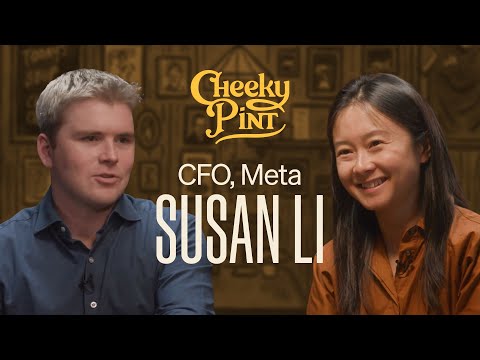
Meta CFO Li Shields Tech Outlays via Fungible GPU Backup Strategy
Stripe
Large AI infrastructure spend requires a strict multi-use framework where unneeded frontier model compute immediately redirects to core ads optimization to protect intermediate consolidated financial returns.
## Background
Published on YouTube by Stripe on June 18, 2025, this video captures a casual conversation titled 'A Cheeky Pint with Meta CFO Susan Li.' According to the page description, the episode features host John Collison chatting with Susan Li—the youngest CFO of a Fortune 100 company—about capital allocation, investor management, and her 17-year working relationship with Mark Zuckerberg.
## TL;DR
Meta CFO Susan Li reflects on her non-traditional, accelerated educational path and early career days on Wall Street before detailing her long tenure and internal rise at Meta. She explains how the company balanced intense macroeconomic headwinds in 2022 by tightening financial discipline, shifting from EBITDA metrics to a strict focus on free cash flow. Li also details Meta's current dual-bucket resource allocation strategy, which funds immediate, ROI-driven ad optimizations while managing massive, long-term AI CapEx investments and GPU infrastructure. Finally, she shares insights into Mark Zuckerberg's direct feedback culture and discusses how AI will reshape corporate productivity by automating operational tasks and scaling customer service.
## Atmosphere & style
The conversation carries a remarkably relaxed, candid, and self-deprecating tone, balancing high-stakes corporate strategy with a lighthearted, 'cheeky pint' pub vibe. Susan Li is highly approachable and witty, unassumingly poking fun at her own hyper-accelerated youth, her past tech-lag as a BlackBerry user, and her routine task of reviewing mundane expense reports. The narrative arc moves from nostalgic career beginnings to a vulnerable recounting of the intense investor pressure Meta faced during its late 2022 market trough. Throughout the exchange, the dynamic between the host and Li feels like an intimate, authentic peer-to-peer sharing of war stories, blending humor with sharp, practical business intellect.
## Key takeaways
- [00:00](https://www.youtube.com/watch?v=z6PHZJLo2Sk&t=0s) Susan Li had a remarkably rapid academic and early career progression, entering college at age 15 and joining Morgan Stanley at 19, supported by a school system that allowed bored children to move ahead.
- [03:13](https://www.youtube.com/watch?v=z6PHZJLo2Sk&t=193s) Meta fosters a strong culture of internal succession planning by identifying talent early and mapping out multi-year growth runways, which was pivotal in Li's transition toward the CFO track.
- [06:01](https://www.youtube.com/watch?v=z6PHZJLo2Sk&t=361s) Mark Zuckerberg is characterized as a world-class leader in providing timely, direct, and respectful feedback that eliminates ambiguity and helps employees quickly adapt.
- [09:07](https://www.youtube.com/watch?v=z6PHZJLo2Sk&t=547s) Meta categorizes its investments into a highly measurable, ROI-driven core business (Family of Apps) and long-term strategic bets (Reality Labs) where they invert traditional forecasting by calculating what the market size must be to justify the investment.
- [09:07](https://www.youtube.com/watch?v=z6PHZJLo2Sk&t=547s) Meta's core advertising business demonstrated powerful growth, doubling its Average Revenue Per User (ARPU) between 2015 and 2020, and doubling it again between 2020 and 2025.
- [15:05](https://www.youtube.com/watch?v=z6PHZJLo2Sk&t=905s) In late 2022, Meta's market capitalization troughed due to investor misunderstandings regarding temporary revenue headwinds caused by Apple's iOS privacy changes (ATT) and a post-COVID e-commerce pullback.
- [16:56](https://www.youtube.com/watch?v=z6PHZJLo2Sk&t=1016s) The creation of "free cash flow" hats at Meta served to visually remind leadership that relying on EBITDA can mask the true costs of doing business for a highly capital-intensive tech giant.
- [19:08](https://www.youtube.com/watch?v=z6PHZJLo2Sk&t=1148s) Meta's massive CapEx is currently driven by two distinct priorities: scaling AI infrastructure for ranking and recommendations in the core business, and the heavy upfront investment needed to train frontier models like Llama.
- [19:08](https://www.youtube.com/watch?v=z6PHZJLo2Sk&t=1148s) To mitigate investment risks, Meta treats its core advertising business as a highly valuable backup use case for its massive GPU compute clusters if primary frontier AI model bets do not materialize as expected.
- [19:08](https://www.youtube.com/watch?v=z6PHZJLo2Sk&t=1148s) GPU compute is highly fungible and harder to manage compared to headcount; inside Meta's budgeting process, teams almost never willingly trade away concrete headcount allocations for abstract GPU compute.
- [21:46](https://www.youtube.com/watch?v=z6PHZJLo2Sk&t=1306s) Blunt investor feedback during the October 2022 low point forced Meta's leadership to realize they must deliver strong consolidated financial results concurrently while funding multi-year technology development phases.
- [21:46](https://www.youtube.com/watch?v=z6PHZJLo2Sk&t=1306s) Meta's fundamental investor pitch has shifted over a decade from demonstrating an ability to scale social products to proving it is a highly efficient, scaled infrastructure and AI player capable of dynamically allocating massive GPU clusters.
- [27:01](https://www.youtube.com/watch?v=z6PHZJLo2Sk&t=1621s) AI productivity is viewed through two lenses: automating highly repetitive operational tasks and making previously low-ROI, human-intensive tasks (such as scaling customer account recovery support) economically viable.
## Detailed walkthrough
### [00:00](https://www.youtube.com/watch?v=z6PHZJLo2Sk&t=0s) Introduction and the Trajectory of Susan Li
The episode opens with a lighthearted observation about Instagram ads: "The joke people have about Instagram is the ads are better than the content." Susan Li, the Chief Financial Officer of Meta, admits she is a prime example of this phenomenon, having once purchased 25 color-changing umbrellas off an Instagram ad for her children and their friends. To her delight, they actually worked.
This conversation serves as the backdrop for introducing Li, who joined Facebook in 2008 as an individual contributor (IC4) and rose to become the CFO of the Fortune 100 giant in November 2022. Her career trajectory is remarkable: she attended high school at age 11, college at 15, joined Morgan Stanley at 19, and is now one of the youngest CFOs in the Fortune 100. When asked if this rapid progression was driven by her or her parents, Li jokes that because she graduated college at 19 after starting kindergarten at four, she actually had 15 years of formal education and is "woefully undereducated as it were," merely making up for a "rough start." She explains that she grew up in a school system that identified when kids were bored and allowed them to move ahead, an opportunity her parents always supported.
[01:39](https://www.youtube.com/watch?v=z6PHZJLo2Sk&t=99s) Early Days on Wall Street and Mentorship under Michael Grimes
Li recalls her very first day on the trading floor at Morgan Stanley’s Broadway headquarters. In an environment not traditionally known for being "inclusive and nurturing," an HR business partner stood up, got the attention of the entire trading floor, and loudly instructed everyone that no one was to serve Li any alcohol at company gatherings because she was underage. Li describes the experience of beginning her Wall Street career as being completely "mortified," though things quickly improved.
During her time at Morgan Stanley, Li worked under Michael Grimes, a legendary figure who has led tech investment banking at the firm for decades. She describes Grimes as an extraordinarily high-energy, endlessly curious "phenom" who has a strong point of view on everything—from tech companies and banking to parenting and why there should be more undergraduate sales programs in colleges.
- "He is going to outwork you and outlearn you," Li notes, reflecting on how spectacular it was as a young professional to see what true excellence looked like up close.
[03:13](https://www.youtube.com/watch?v=z6PHZJLo2Sk&t=193s) Meta's Culture of Internal Succession and Career Development
Li has been at Meta since April 2008. She points out that Meta’s senior leadership is uniquely tenured, with many executives having grown up within the company. She attributes this to a strong culture of internal succession planning, where the company identifies talented individuals early in their careers and maps out multi-year runways for their growth.
Li shares a pivotal moment in her own career when she was doing revenue forecasting—the "mathiest part of finance"—and was trying to decide between transitioning to a Product Manager role in News Feed or broadening her scope within finance. She sat down with David Ebersman, Meta's CFO at the time, who gave her advice that she still remembers viscerally:
- "Look, I know you're considering these options... I think doing that News Feed PM job would be really fun... But I also want you to know that I think you could be, you know, a CFO of this company someday."
- This conversation was an extraordinary confidence builder for Li, demonstrating how Meta's leadership actively invests in people by pushing them into roles they might not have proactively sought out themselves.
[06:01](https://www.youtube.com/watch?v=z6PHZJLo2Sk&t=361s) How Mark Zuckerberg Leads and the Power of Feedback
Reflecting on how Mark Zuckerberg has evolved over her 17 years at the company, Li notes that he has become a truly excellent public speaker through hosting weekly all-hands meetings. Crucially, she describes Zuckerberg as "world class" at giving feedback. His feedback is timely, direct, and respectful; it is never mean or belaboring, but "you cannot be mistaken after you have received the feedback."
Li shares a humorous anecdote from her early days in 2008 to illustrate the importance of feedback. Coming from the highly structured world of investment banking, she found herself in an environment with no infrastructure, having to hunt down individual engineers to understand ad server parameters. A few months in, she received a meeting invite for "power users of SQL." Believing this was a moment of recognition for her hard work, she showed up to find only five other people. The meeting organizer, a data analyst, informed them they had been called in because they were the five users whose massive, unoptimized table joins were consuming too much database power. Rather than just reprimanding them, the analyst taught them how to write better queries.
- "Just be a person who's good at receiving feedback," Li advises, noting that this willingness to learn and adapt is the key to longevity at a fast-growing company.
[09:07](https://www.youtube.com/watch?v=z6PHZJLo2Sk&t=547s) Resource Allocation: Fine-Tuning vs. Long-Term Bets
The discussion shifts to the central challenge of a tech CFO: allocating resources when core products cannot be easily quantified like traditional manufacturing. Li explains that Meta divides its investments into two buckets. The first is the highly measurable "Family of Apps" core business, where experiments are finely tuned based on engagement and monetization, and investments are strictly ROI-driven. This engine is incredibly powerful; Meta doubled its Average Revenue Per User (ARPU) between 2015 and 2020, and doubled it again between 2020 and 2025. Li shares that during a recent earnings callback, a major portfolio manager remarked, "The ads are so good," a sentiment she wouldn't have thought possible to improve upon five years prior.
The second bucket consists of long-term strategic bets like Reality Labs, where predicting annual revenue over a 20-year horizon is nearly impossible. For these investments, the finance team inverts the problem. Instead of demanding a precise forecast, they ask: "What does this have to be worth to pencil out at the end?" and check if that passes a sanity test based on potential market sizes.
- Li admits she is not a tech visionary—noting she was one of the last people at the company to trade her BlackBerry for an iPhone—but emphasizes that Zuckerberg's strategic vision is imperative for building the next computing platforms.
- She reminds her finance team that they must manage a "portfolio of bets." While many will fail, the ones that succeed will pay off so massively that they more than justify the overall roadmap.
[15:05](https://www.youtube.com/watch?v=z6PHZJLo2Sk&t=905s) Taking the CFO Reins in October 2022
Li officially took over as CFO on November 1, 2022, a time she jokingly refers to as "good timing" because Meta's market capitalization had troughed at around $230 billion. At that price, investors could buy Meta for roughly three times its projected 2025 net income—valuation territory usually reserved for declining industries like coal plants.
Li explains that the market severely misunderstood Meta's position at that moment due to two simultaneous, temporary revenue headwinds:
- **Apple's iOS Platform Changes (ATT):** Apple's 2021 privacy policy changes restricted tracking inside apps, which disrupted Meta's ad targeting capabilities.
- **The Post-COVID E-commerce Pullback:** The massive, pandemic-fueled surge in e-commerce was normalizing, leading to a temporary slowdown in ad spend.
[16:56](https://www.youtube.com/watch?v=z6PHZJLo2Sk&t=1016s) Turning the Ship and the Story of the Free Cash Flow Hat
The conversation shifts to the dramatic transition Meta experienced from the e-commerce-fueled heyday of 2021 to facing negative year-over-year growth for the first time in late 2022. While exogenous factors hurt revenue, the underlying core business—showing the best possible ads to the right people at the right time—remained fundamentally strong. Crucially, Meta demonstrated to the market that it could "turn the ship on costs" in a highly meaningful and rapid way.
This cost-conscious pivot is perfectly captured by a lighthearted anecdote about corporate swag. The speaker explains the origin of the "free cash flow" hat they are wearing. Mark Zuckerberg had previously gifted them an "EBITDA" hat, which was worn prominently in budgetary review meetings and kept in the background of Zoom calls. However, the speaker soon realized that for a capital-intensive business, "EBITDA" was a misleading metric because the "D" (depreciation) was becoming increasingly important to the company's financials. To prevent Zuckerberg or anyone else from thinking EBITDA was the end-all-be-all, the speaker created "free cash flow" hats. While there is only one EBITDA hat, they now hand out free cash flow hats "like candy" to remind everyone of the metric that truly matters.
- **Charlie Munger's Joke:** The host references Charlie Munger's famous quip that whenever you hear the word "EBITDA," you should mentally substitute it with "bullshit earnings."
- **CapEx Intensity:** For capital-intensive tech giants, ignoring depreciation and capital expenditures masks the true cost of doing business.
[19:08](https://www.youtube.com/watch?v=z6PHZJLo2Sk&t=1148s) The Future of CapEx and the Challenge of GPU Allocation
The discussion turns to the massive rise in capital expenditures (CapEx) across the tech industry, specifically at Microsoft, Google, and Meta. The speaker addresses whether this level of spending is sustainable over a 5- to 10-year period, or if the industry will run into physical bottlenecks like power availability. Currently, Meta's CapEx is driven by two main areas: its massive core consumer business (which requires AI infrastructure for ranking and recommendations) and the heavy upfront investment required to train frontier AI models.
If the compute required to train and run these models continues to scale infinitely, the industry will face "true problems of physics." However, the speaker hopes that research innovations, such as distributed training, will help bypass the need for single, massive, energy-intensive data center clusters. In the meantime, Meta manages its risk by maintaining "backup use cases" for its compute. If the primary use case (new products like Llama) does not require as much compute as anticipated, the capacity can be happily diverted to the core business for ads optimization.
- **Primary vs. Backup Use Case:** The primary use case for new CapEx is frontier models like Llama, while the backup use case is core ads optimization.
- **The Two-Year Horizon:** The real test for the industry will come in about two years, when companies must evaluate if they can get a reasonable ROI on their backup use cases if their primary AI bets do not fully materialize.
- **Fungibility of GPUs:** Unlike headcount, which is easily tracked via org charts (e.g., knowing exactly who works on Facebook Marketplace), GPU compute is highly fungible and difficult to account for, making it harder to manage and optimize.
- **Budgeting Trades:** In Meta's budgeting process, teams are allowed to trade headcount for compute. Interestingly, teams almost never trade away headcount for GPUs because headcount is concrete and guaranteed not to be diverted to other projects.
[21:46](https://www.youtube.com/watch?v=z6PHZJLo2Sk&t=1306s) Blunt Feedback from the October 2022 Earnings Call
The speaker shares a vivid, memorable anecdote from the low point of October 2022. Following a difficult earnings call, they were conducting standard investor callbacks—which are typically Q&A sessions with large investment teams. On one particular call, a portfolio manager told them, "We actually don't have any questions for you today. We just want you to hear feedback from us."
The investor delivered blunt but constructive feedback that deeply impacted how both the speaker and Mark Zuckerberg view their long-term projects. The investor explained that while they rooted for Meta's vision of building the next mobile platform and the future of computing, they asked: "Why should I invest in your stock today? Why don't I just wait for your phone equivalent, your scaled consumer product to come out... and invest in you then?" This forced Meta's leadership to realize they must deliver strong consolidated financial results along the way to give investors a reason to hold the stock during the years of development.
- **Investor Callbacks:** These are post-earnings, Reg FD-compliant touchpoints with major institutional investors, often involving large teams rather than simple one-on-one conversations.
- **The Shift in Investor Pitch:** Ten years ago, the pitch to investors was Meta's ability to scale social products. Today, the pitch relies heavily on being a highly efficient, scaled infrastructure and AI player that can dynamically allocate massive GPU clusters to their highest and best use.
[27:01](https://www.youtube.com/watch?v=z6PHZJLo2Sk&t=1621s) AI Productivity and the Future of Work
The conversation wraps up with a discussion on how AI productivity will manifest in large, established companies like Meta or Stripe, compared to lean startups that are keeping their headcounts small. The speaker views AI productivity through two distinct lenses. First, AI can automate highly operational, repetitive tasks. The speaker jokes that they currently act as a "very expensive machine learning model for approving expenses," scanning for a checklist of items rather than applying deep human intelligence.
Second, AI can make previously low-ROI tasks economically viable. A prime example is the laborious process of helping users who are locked out of their Facebook or Instagram accounts. Currently, verifying real identity and connections is too human-intensive to scale easily. If AI can assist human customer service agents—allowing them to unlock 50 accounts a day instead of five—it transforms a costly chore into a high-ROI customer service win.
- **The Expense Approval "Rat Holes":** The speaker admits that while expense approval is mostly automated, some of the "funny" or concerning expenses they review have occasionally taken them down highly entertaining "rat holes."
- **The Human Productivity Window:** Before machines completely take over jobs, there is a significant window where AI will simply make human workers substantially more productive and unlock services that were previously too expensive to offer.
## Notable quotes
> [00:00](https://www.youtube.com/watch?v=z6PHZJLo2Sk&t=0s) The joke people have about Instagram is the ads are better than the content.
> [00:00](https://www.youtube.com/watch?v=z6PHZJLo2Sk&t=0s) woefully undereducated as it were — Susan Li
> [01:39](https://www.youtube.com/watch?v=z6PHZJLo2Sk&t=99s) He is going to outwork you and outlearn you — Susan Li
> [03:13](https://www.youtube.com/watch?v=z6PHZJLo2Sk&t=193s) Look, I know you're considering these options... I think doing that News Feed PM job would be really fun... But I also want you to know that I think you could be, you know, a CFO of this company someday. — David Ebersman
> [06:01](https://www.youtube.com/watch?v=z6PHZJLo2Sk&t=361s) you cannot be mistaken after you have received the feedback — Susan Li
> [06:01](https://www.youtube.com/watch?v=z6PHZJLo2Sk&t=361s) power users of SQL
> [06:01](https://www.youtube.com/watch?v=z6PHZJLo2Sk&t=361s) Just be a person who's good at receiving feedback — Susan Li
> [09:07](https://www.youtube.com/watch?v=z6PHZJLo2Sk&t=547s) The ads are so good
> [09:07](https://www.youtube.com/watch?v=z6PHZJLo2Sk&t=547s) What does this have to be worth to pencil out at the end? — Susan Li
> [09:07](https://www.youtube.com/watch?v=z6PHZJLo2Sk&t=547s) portfolio of bets — Susan Li
> [15:05](https://www.youtube.com/watch?v=z6PHZJLo2Sk&t=905s) good timing — Susan Li
> [16:56](https://www.youtube.com/watch?v=z6PHZJLo2Sk&t=1016s) turn the ship on costs
> [16:56](https://www.youtube.com/watch?v=z6PHZJLo2Sk&t=1016s) bullshit earnings — Charlie Munger
> [19:08](https://www.youtube.com/watch?v=z6PHZJLo2Sk&t=1148s) true problems of physics
> [21:46](https://www.youtube.com/watch?v=z6PHZJLo2Sk&t=1306s) We actually don't have any questions for you today. We just want you to hear feedback from us.
> [21:46](https://www.youtube.com/watch?v=z6PHZJLo2Sk&t=1306s) Why should I invest in your stock today? Why don't I just wait for your phone equivalent, your scaled consumer product to come out... and invest in you then?
> [27:01](https://www.youtube.com/watch?v=z6PHZJLo2Sk&t=1621s) very expensive machine learning model for approving expenses
## Mentioned
Susan Li, Meta, Instagram, John Collison, Mark Zuckerberg, Facebook, Morgan Stanley, Michael Grimes, David Ebersman, News Feed, SQL, Family of Apps, ARPU, Reality Labs, BlackBerry, iPhone, Apple, iOS, ATT, Charlie Munger, EBITDA, Microsoft, Google, AI, Llama, GPUs, Facebook Marketplace, Reg FD, Stripe
Meta CFO Susan Li通过可替代GPU备用策略保障技术支出
庞大的AI基础设施支出需要严格的多用途框架;前沿模型不需要的算力会立即转用于核心广告优化,以保障中期的合并财务回报。
Meta首席财务官Susan Li回顾了她非传统的加速教育路径及早年在华尔街的职业生涯,随后详述了她在Meta长期的任职经历与内部晋升过程。她解释了公司在2022年如何通过收紧财务纪律、将重点从EBITDA指标严格转向自由现金流,以应对严峻的宏观经济逆风。Li还详细介绍了Meta目前采用的双重资源分配策略,该策略既为眼下以投资回报率(ROI)为驱动的广告优化提供资金,同时统筹巨额的长期AI资本支出(CapEx)投资与GPU基础设施。最后,她分享了对Mark Zuckerberg直接反馈文化的看法,并探讨了AI将如何通过自动化运营任务和拓展客户服务规模来重塑企业生产力。
Susan Li的学业和早期职业发展极为迅速,在允许感到学无所用的孩子超前学习的学校体制支持下,她15岁考入大学,19岁加入Morgan Stanley。 (0:00)
Meta深植内部接班人计划的文化,及早发现人才并制定多年的成长通道,这对Li走向CFO职位的过渡起到了关键作用。 (3:13)
Mark Zuckerberg被评价为善于提供及时、直接且尊重他人反馈的世界级领导者,这种反馈消除了模糊性,有助于员工快速调整适应。 (6:01)
Meta将其投资划分为高度可衡量、以ROI为导向的核心业务(应用系列Family of Apps)以及长期战略押注(Reality Labs);在后者中,他们反转了传统的预测方法,通过推算需要多大的市场规模来证明该投资的合理性。 (9:07)
Meta的核心广告业务表现出强劲增长,其每用户平均收入(ARPU)在2015年至2020年间翻了一番,并在2020年至2025年间再次翻倍。 (9:07)
Reading summary
Meta Chief Financial Officer Susan Li outlines how the company balances strict operational metrics with speculative, long-term technological bets, arguing that sustainable investor support requires delivering resilient free cash flow and consolidated earnings even while funding capital-intensive AI and computing platforms.
Leadership Development and Receptiveness to Direct Feedback (3:13)
Meta relies heavily on internal succession planning, identifying early-career talent and mapping multi-year progression paths. Li, who joined Facebook in 2008 as an individual contributor before rising to CFO in November 2022, credits former CFO David Ebersman with actively directing her trajectory toward corporate leadership rather than a product management role in News Feed. This internal promotion pipeline is sustained by a culture emphasizing high-velocity mentorship and institutional continuity across executive ranks.
Li emphasizes that operating at scale requires being coachable and responsive to direct feedback. Recalling an early experience where she and several colleagues were called out and then trained for running inefficient SQL queries that exhausted database capacity, Li underscores the necessity of continuous adaptation. She characterizes CEO Mark Zuckerberg as exceptionally direct and respectful when delivering critiques, establishing an internal standard where clear feedback is prioritized over consensus-seeking politeness.
Dual-Bucket Resource Allocation and Free Cash Flow (9:07)
To manage capital effectively, Meta divides investments into two distinct categories. The core Family of Apps business is strictly ROI-driven, optimizing engagement and ad performance. This operational focus enabled Meta to double its Average Revenue Per User (ARPU) between 2015 and 2020, and double it again between 2020 and 2025. Conversely, for speculative 20-year horizons like Reality Labs where traditional forecasting fails, Meta inverts the model by calculating what terminal enterprise value the division must achieve to justify cumulative development costs against total market sizes.
Alongside this allocation framework, Meta shifted executive focus from EBITDA to free cash flow. In capital-intensive technology companies, ignoring depreciation and capital expenditures masks the true costs of infrastructure. To reinforce cash generation across operational reviews, Li replaced early executive swag celebrating EBITDA with hats promoting free cash flow, reminding leadership of the primary metric governing capital allocation.
Market Headwinds and Meeting Investor Expectations (15:05)
When Li assumed the CFO role in November 2022, Meta’s market capitalization troughed near $230 billion, trading at roughly three times its projected 2025 net income. Li notes that markets discounted Meta due to two concurrent external pressures: Apple’s 2021 App Tracking Transparency privacy changes, which disrupted targeted advertising, and a cyclical post-pandemic slowdown in e-commerce ad spending.
A key turning point occurred during an October 2022 post-earnings callback, when a major institutional investor asked why shareholders should finance long-term speculative computing platforms today rather than waiting years to buy stock once commercialized products arrive. The feedback prompted Zuckerberg and Li to focus on rigorous cost management, proving that Meta can generate robust consolidated earnings during multi-year development cycles.
Managing CapEx Risk and AI Compute Allocation (19:08)
As industry-wide infrastructure spending accelerates, Meta faces capital intensity risks and potential physical constraints such as power availability. To de-risk its capital expenditure, Meta pairs speculative AI workloads with existing commercial workloads. While frontier models like Llama serve as the primary use case for new compute, unused cluster capacity can be seamlessly diverted into the core advertising engine for ranking and recommendations. Li notes that the sector faces a critical milestone within two years to see if secondary use cases can generate sufficient ROI if frontier bets fail to materialize.
Managing compute introduces operational complexity because GPUs are fungible, unlike headcount. In Meta's internal budgeting, teams allowed to trade headcount for compute rarely do so, as compute capacity is easily reassigned across the company. Concurrently, Li anticipates that near-term enterprise AI will generate high returns not by eliminating jobs, but by automating repetitive administrative processes and making previously cost-prohibitive operational tasks—such as manual user account recovery—economically viable.
Meta's operational model hinges on using a disciplined ad engine to subsidize frontier AI and hardware platforms; however, the long-term viability of this strategy remains dependent on achieving measurable returns on vast compute investments before physical infrastructure constraints and depreciation costs mount.
精炼阅读摘要
Meta首席财务官Susan Li阐述了公司如何在严格控制成本与进行长期高风险技术押注之间维持平衡。她指出,Meta通过聚焦自由现金流、为算力资本支出设立后备变现路径,并依托内部梯队培养与直接透明的反馈文化,在外部逆风与AI基础设施扩张周期中维持财务韧性。
资本配置:核心业务调优与长远赌注并存 (9:07)
Meta将其资本分配划分为两大逻辑互补的板块。第一类是高度可量化的核心应用家族(Family of Apps)。该板块完全由投入产出比(ROI)主导,通过持续细调推荐算法与变现效率,Meta的用户平均收入(ARPU)在2015至2020年间实现翻倍,并在2020至2025年间再度翻倍。机构投资者在财报回访中亦认可其广告匹配精准度的显著提升。
第二类则是以Reality Labs为代表的长期战略押注。由于长达20年的远期收入无法精确测算,财务团队采取逆向估算逻辑,不再索取不可靠的年度预测,而是测算该技术最终需达到多大规模才能证明前期投入的合理性,并结合潜在市场容量进行理性验证。Li强调,管理层管理的是一个“押注组合”,大部分项目可能失败,但极少数成功的押注将带来覆盖全局的超额回报;同时,2022年10月机构投资者的直率反馈促使管理层确立共识:在漫长的硬件与生态研发周期中,必须持续交付强劲的综合业绩,以维持公开市场的持股耐心。
估值低谷执掌与自由现金流纪律 (15:05)
Li于2022年11月1日接任CFO,彼时Meta市值跌至约2300亿美元的谷底,对应2025年预期净利润的估值倍数仅约三倍,估值水平堪比衰退中的传统行业。Li指出,市场当时的悲观情绪主要由两项阶段性逆风叠加造成:一是苹果于2021年推行的应用追踪透明度(ATT)隐私政策,严重干扰了广告定向投放;二是疫情驱动的电商交易爆发式增长逐步回落常态,导致广告投放阶段性收缩。
面对2022年晚期公司首次出现的营收同比负增长,Meta迅速展现了强有力的成本调整能力。Li特别指出,在重资本投入的科技巨头中,单纯关注EBITDA(税息折旧及摊销前利润)会因忽略折旧与资本开支而掩盖真实的运营代价。为此,Li在公司内部极力推行自由现金流(Free Cash Flow)考核,制作并广泛派发印有该指标的帽子以替换原有的EBITDA帽,明确将扣除资本投入后的真实变现能力作为首要衡量标准。
算力扩张挑战与GPU后备复用机制 (19:08)
针对科技巨头在基础设施上飞速攀升的资本支出(CapEx),Li分析了未来5至10年可能面临的电网负荷与物理极限瓶颈。当前Meta的资本开支主要流向两端:核心消费者业务的AI推荐与排序基础设施,以及前沿AI大模型的高额前期训练。若算力需求持续无限膨胀,产业将触碰物理边界,Li寄望于分布式训练等基础科研创新能打破对单一超大规模高耗能数据中心集群的依赖。
为规避巨额算力投入落空的风险,Meta为计算资源设定了“后备用例”(Backup Use Case)机制。新增算力开支的首要目标是训练以Llama为代表的前沿模型,但若前沿探索的需求不及预期,这批高规格算力可随时撤回并用于核心广告系统的排序优化。Li认为,未来约两年行业将迎来关键检验,即各大厂商能否在主力AI商业化未达预期时,依靠后备业务获取合理的资本回报。此外,与组织架构中清晰的人员编制相比,高度可互换的GPU在内部预算调度中更难追踪,业务团队往往倾向于保留确定的人员配额,而不愿交换容易被动态抽调的算力资源。
内部成长通道、反馈文化与AI应用 (6:01)
Li的职业轨迹折射出Meta成熟的内部人才梯队建设模式。她于2008年以初级员工(IC4)身份加入公司,在时任CFO David Ebersman等高管的跨年度规划与鼓励下,逐步成长为财富100强中最年轻的CFO之一。她指出Meta高管团队多由内部成长而来,其核心组织驱动力是高效、直接且尊重的反馈机制。Li回顾了早年因撰写低效SQL复杂查询占用大量数据库资源、随后接受分析师专门辅导的轶事,说明在快速扩张的组织中保持接纳反馈的心态是长期发展的关键。
在工作模式变革方面,Li将AI的生产力赋能分为两大维度:其一是将报销审批等高频、高度规则化的运营任务全面自动化,减少管理层在机械核查上的精力耗费;其二是赋予原本因人工成本过高而缺乏经济可行性的长尾业务以商业合理性。例如,在用户账号被锁定的申诉处理中,若AI能辅助人工核验并将单个客服每日解决量从5起提升至50起,便可将原本成本高昂的维护负担转化为具备高ROI的客户服务能力。
尽管Meta通过在核心广告系统与前沿模型之间建立算力后备复用机制来对冲风险,但在电力物理瓶颈隐现与行业资本开支高企的背景下,前沿AI模型能否在未来两年内跑通独立的商业化逻辑并匹配其高昂的算力投入,仍是管理层与公开市场共同面临的核心考验。
Source quotes
[0:00] The joke people have about Instagram is the ads are better than the content.
[0:00] Susan Li: woefully undereducated as it were
[1:39] Susan Li: He is going to outwork you and outlearn you
[3:13] David Ebersman: Look, I know you're considering these options... I think doing that News Feed PM job would be really fun... But I also want you to know that I think you could be, you know, a CFO of this company someday.
[6:01] Susan Li: you cannot be mistaken after you have received the feedback
[6:01] power users of SQL
[6:01] Susan Li: Just be a person who's good at receiving feedback
[9:07] The ads are so good
[9:07] Susan Li: What does this have to be worth to pencil out at the end?
[9:07] Susan Li: portfolio of bets
[15:05] Susan Li: good timing
[16:56] turn the ship on costs
[16:56] Charlie Munger: bullshit earnings
[19:08] true problems of physics
[21:46] We actually don't have any questions for you today. We just want you to hear feedback from us.
[21:46] Why should I invest in your stock today? Why don't I just wait for your phone equivalent, your scaled consumer product to come out... and invest in you then?
[27:01] very expensive machine learning model for approving expenses
Original transcript
[0:00] The joke people have about Instagram
[0:01] is the ads are better than the content.
[0:02] As someone who bought, like, 25 umbrellas
[0:05] that change color in the rain off of a ad-
[0:06] Do they work? They do.
[0:08] They are a source of real delight.
[0:10] Headcount's really easy to account for
[0:11] because you have org chart.
[0:12] GPUs don't have that property.
[0:13] In fact, you often wanna build out your infrastructure...
[0:16] You have no shenanigans. ...for it to be very fungible.
[0:20] Susan Li joined Facebook in 2008.
[0:22] She became CFO in 2022.
[0:25] It's a really interesting time for this discussion
[0:26] because Meta has a core business
[0:27] that's firing on all cylinders
[0:29] and Susan's had a front row seat
[0:31] for the growth of the company.
[0:33] Cheers. Cheers.
[0:36] You went to high school at 11, college at 15,
[0:40] Morgan Stanley at 19,
[0:42] and you're now the youngest CFO of Fortune 100 company.
[0:46] So just, what's... Was this you?
[0:49] Was this your parents?
[0:51] What's going on there?
[0:52] Well, you know, some might say,
[0:53] because I started kindergarten when I was four
[0:55] and I graduated from college when I was 19,
[0:58] that having 15 years of formal education is... you know,
[1:03] I'm woefully undereducated as it were,
[1:05] so I'm really just having to make up
[1:07] for, you know, that rough start.
[1:08] But if I remember right, you were also
[1:09] done with formal education at the age of 19, 20?
[1:17] That's because I dropped out.
[1:18] I wasn't early in progressing through the milestones,
[1:20] I just quit, whereas you actually got your bachelor's.
[1:22] Well, it seems like we shared the same disdain
[1:24] for sort of getting out of the schooling system
[1:25] as soon as possible.
[1:26] Hang on, this is your interview, not mine.
[1:30] I was in a school system that identified
[1:32] when kids were bored in school,
[1:33] and then just gave you opportunities to keep moving ahead
[1:36] and my parents always took them.
[1:39] When I showed up at Morgan Stanley for my first day,
[1:41] I was on the trading floor
[1:42] in the big Broadway headquarters at 1585.
[1:46] And the equivalent of an HRBP basically got the attention
[1:51] of everyone on the trading floor.
[1:52] They were like- Right 'cause this is
[1:53] investment banking, which is known
[1:54] for being an inclusive and nurturing culture.
[1:57] Very, very much so.
[1:58] And so she wanted everyone on the floor to stop
[2:00] and look at me and know that no one was to serve me
[2:03] any alcohol at any company gathering.
[2:05] So it was exactly the way you think about
[2:07] sort of beginning your career on Wall Street,
[2:09] you know, by being mortified.
[2:13] But it improved from there.
[2:14] Yes.
[2:16] You worked under Michael Grimes at Morgan Stanley.
[2:20] He, for people who don't know,
[2:22] he's been leading tech investment banking at Morgan Stanley
[2:25] for 20 years and he's just a phenom,
[2:28] like, I don't know how to describe him.
[2:29] He's just one of the most energetic people I've ever met.
[2:33] What did you learn from working with Michael?
[2:35] Grimes is extraordinarily sort of, like you said,
[2:40] very high-energy, applies that to a whole host of things.
[2:43] You go talk to Michael about tech companies, about banking,
[2:47] about parenting,
[2:48] about why there should be more undergraduate sales programs
[2:53] and colleges in the country.
[2:54] He's got a point of view on everything
[2:57] and he's endlessly curious.
[2:59] He is going to outwork you and outlearn you.
[3:02] It's actually a pretty spectacular thing
[3:06] as a young person starting in your career
[3:08] to see what excellence at this looks like.
[3:13] You've been at Meta for a very long time.
[3:17] April 2008.
[3:18] So, you joined in 2008.
[3:21] And one thing I've observed before is the
[3:22] senior leadership at Meta are all very tenured
[3:27] and often have done multiple things around the company
[3:29] or grown up around the company.
[3:31] What traits do the successful leaders at Meta
[3:33] have in common?
[3:36] Oh, that's a good question.
[3:39] Infinite patience.
[3:40] No, it's more than that.
[3:42] So, I joined as an IC4 and in finance,
[3:47] so actually pretty far away from the center of the-
[3:50] A few rungs down from the CFO.
[3:51] Yes, and also far away from the core of engineers
[3:54] building News Feed, right? Yes.
[3:55] I mean when you kind of talk to some of the folks now,
[3:59] they've always been at the sort of very heart
[4:01] of what the product was, you know, building or doing.
[4:05] But what I think is unique about Meta
[4:09] is we have a pretty strong culture
[4:11] of internal succession planning
[4:13] and trying to identify people who are talented
[4:17] quite early in their careers, actually,
[4:20] and think about a many-year runway
[4:22] in which you're going to grow and develop them.
[4:25] How did Meta succession-plan you?
[4:27] I started off my career
[4:29] doing mostly revenue forecasting,
[4:31] which was kind of like the mathiest part of finance.
[4:36] At some point,
[4:37] I had done that probably for about five-ish years,
[4:40] and I was trying to figure out what to do next.
[4:42] And the two kind of paths in front of me were,
[4:47] I was talking to some folks in News Feed
[4:49] about whether I should just go
[4:50] do something totally different and go be a PM in News Feed.
[4:54] Or the other option was to broaden my scope in finance,
[4:58] to take on sort of more traditional finance responsibilities
[5:01] that I really had not had that much exposure to.
[5:04] I remember sitting down with David Ebersman,
[5:06] who was our CFO at the time. He looked at me and said,
[5:10] "Look, I know you're considering these options,
[5:12] and I can tell you I think doing
[5:14] that News Feed PM job would be really fun
[5:16] and I think it'd be a great learning experience for you.
[5:19] I totally get it.
[5:20] But I also want you to know that I think you could be,
[5:23] you know, a CFO of this company someday."
[5:25] And to have someone who I admired as much as David Ebersman
[5:28] say that about me was an extraordinarily
[5:32] confidence building thing,
[5:34] and I will remember that conversation forever,
[5:35] very viscerally.
[5:38] So, I've had managers who I think have really invested in me
[5:43] by pushing me to take on things that I wouldn't have said,
[5:50] hey, can I please go do this thing next?
[5:51] It wouldn't have made obvious intuitive sense to me,
[5:54] but I think they thought it would be a good opportunity
[5:56] and that I was ready for it.
[5:57] And you know, and I think they were right.
[6:01] That's really cool.
[6:03] In the 17 years you've been at Meta,
[6:07] how has Mark changed as a leader?
[6:09] There are ways in which you clearly see someone
[6:12] evolve over 17 years.
[6:14] You know, Mark has done all-hands for all of those 17 years,
[6:16] and he clearly has become now
[6:18] a truly excellent public speaker.
[6:21] Mark is really good at giving feedback,
[6:22] like really world class at it.
[6:27] Maybe you should try to get yourself into a position
[6:29] where you can get some feedback...
[6:30] I'm sure Mark already has feedback for me.
[6:33] ...so you can experience it, but it's very timely,
[6:38] it's very direct, it's very respectful.
[6:42] But the sort of direct and respectful... It's never mean,
[6:45] it's never like belaboring some point,
[6:46] but you cannot be mistaken
[6:48] after you have received the feedback.
[6:49] He's really good at it.
[6:53] He kind of walks that line between being direct but kind
[6:57] in an extremely good way.
[6:59] One of the things people will often ask me
[7:01] is, "What kind of skills do you need
[7:05] to stay at a company for 17 years?" Or whatever it is.
[7:07] And when I think about it, I go back to...
[7:13] When I was IC4 and I joined in 2008,
[7:14] I'm building these first revenue models.
[7:17] I'd gone from banking, which is super organized,
[7:19] super structured, they don't even need to know your name,
[7:20] they just train you to immediately figure out
[7:23] how to find the backup to everything,
[7:25] so that two years later someone else can do this
[7:27] and so on and so forth,
[7:29] to, there was no infrastructure, right?
[7:31] So I'm hunting down the exact engineer
[7:33] who has built some ad server
[7:35] so that he can tell me what the parameters mean.
[7:38] And of course, the next time he changes them,
[7:39] he's not gonna tell me, and I have to go find him again,
[7:41] and he's like, "Oh, she's coming. Don't look her way."
[7:45] A few months in, I got a meeting invite
[7:49] for power users of SQL.
[7:51] And I thought, "My gosh." I'd been getting,
[7:52] a good amount of feedback
[7:54] about how things could be better,
[7:56] and here was finally this moment of recognition
[7:58] that... I didn't even know how to write queries in SQL
[8:01] when I started.
[8:02] And I show up to this meeting
[8:03] and there are five other people
[8:04] and the meeting organizer tells us that we have been called
[8:07] because we are the five users of SQL
[8:10] who consume too much power.
[8:13] And we have just been churning
[8:15] with our massive joint, tables through the-
[8:19] I love that you were all called
[8:20] to the principal's office.
[8:22] Basically, yes.
[8:23] But I often think back to this
[8:25] because this was was a data analyst
[8:28] who didn't know any of us that well,
[8:30] but had just generated his reports
[8:32] of who's using the most infrastructure
[8:34] and looked at the top people on the list
[8:36] and you know, thought, "Okay, this person in finance,
[8:38] it doesn't make sense why she's the third highest person
[8:41] on the list," and called us in
[8:43] and then taught us to write better queries.
[8:45] And like no one I think specifically told him to do that.
[8:48] And I think it's a little awkward
[8:50] when you call people in to do this,
[8:52] but he did it because it would make us
[8:53] all better at our jobs.
[8:54] And I think, for 17 years, I have been the beneficiary
[8:58] of a lot of feedback that has made me better along the way.
[9:01] So when people ask me this question, I always say,
[9:03] "Just be a person who's good at receiving feedback."
[9:07] You've mentioned your experience in forecasting.
[9:11] And what I think is the central challenge
[9:13] of a CFO in a large tech company is
[9:17] it's so hard to put numbers around the core thing we do.
[9:19] And what I mean by that is like if you're Boeing
[9:21] and you're producing the 787,
[9:23] you can have a very clear model that we're gonna spend
[9:24] this much, you know, manufacturing the 787,
[9:27] and then each one,
[9:28] we're gonna make this much gross profit on.
[9:29] And then at the like component-by-component level, you know,
[9:32] we're gonna change from hydraulic brakes to electric brakes,
[9:34] and it'll add this much cost, but it'll save this much fuel.
[9:36] It's all extremely quantified as a domain.
[9:38] Now you're dragging me into the
[9:39] resource allocation questions.
[9:40] Yes. Okay. Here we go.
[9:45] We really think about it as,
[9:47] there's stuff that we can rigorously measure.
[9:49] So that's a lot of the, you know, core family of apps
[9:53] work in terms of the impact on engagement,
[9:55] the impact on monetization.
[9:56] There's a lot of that stuff
[9:57] that is really finely tuned.
[9:59] And that really does seem extremely finely tuned.
[10:01] I was looking at the numbers
[10:02] and you doubled ARPU between 2015 and 2020,
[10:06] and then you doubled it again between 2020 and 2025.
[10:09] But like Meta wasn't bad at monetization in 2020,
[10:14] and it's doubled over that five-year period.
[10:16] No, and you know what?
[10:18] I just, you know, did earnings three weeks ago now.
[10:19] I was doing all my investor callbacks,
[10:24] and one of our largest investors on the call,
[10:28] one of the portfolio managers, said, "feeling pretty good."
[10:31] He goes, "The ads are so good."
[10:35] And you know what?
[10:36] Five years ago, I would've told you
[10:38] that the ads were really good,
[10:39] and that there was not really room
[10:41] for the ads to get better. But here we are,
[10:43] five years later, and the ads are even better.
[10:49] The joke people have about Instagram
[10:50] is the ads are better than the content.
[10:52] Well, I have to tell you,
[10:54] as someone who bought, like, 25 umbrellas
[10:57] that changed color in the rain off of a ad,
[10:59] that was not something I knew that I...
[11:01] Not that I needed, but that my children
[11:03] and all their friends needed...
[11:04] Do they work?
[11:05] They do. They are a source of real delight.
[11:07] So when the ads can be that good,
[11:08] that is a extraordinary thing.
[11:09] But getting back to your question.
[11:11] So, there's this very measurable part of the company
[11:14] and we generally try to trade those things
[11:17] off against each other, you know,
[11:18] when we are thinking of, when we're evaluating things
[11:20] within that bucket and we generally try to fund the things
[11:22] that are positive ROI.
[11:25] And I'm usually the person who's, you know,
[11:27] trying to just make sure we understand, like,
[11:29] yes, for every individual experiment,
[11:31] the expected return is something,
[11:32] but that's where we are on the curve today,
[11:34] but what about 50 experiments later?
[11:36] Does the curve still have the same slope?
[11:38] And then there's a set of things, right,
[11:40] which we constrain more in terms of, you know,
[11:45] there's some envelope of investment
[11:48] that we're willing to make
[11:50] that's not in this really ROI-driven bucket.
[11:53] It is very difficult to pencil out
[11:54] what the annual revenue forecast
[11:56] for Reality Labs is gonna look like over the next 20 years.
[12:01] And so for bets like that, we sort of invert the problem.
[12:06] But when we talk about the return on the investment,
[12:11] the question, you know,
[12:12] that we pose as a finance organization to Mark,
[12:17] and make sure that Mark
[12:18] and the board understand, is
[12:19] what does this have to be worth to pencil out at the end?
[12:23] And does that pass sort of the sanity check,
[12:27] the intuition about what building,
[12:30] about what the size of these markets can be
[12:31] based on maybe some comparisons
[12:33] to, you know, markets that exist today,
[12:34] but of course, you know, in another 10, 20 years,
[12:37] you expect that the world will look different
[12:39] and maybe those markets should be bigger or smaller
[12:41] for, you know, whatever reason.
[12:43] And that's kind of the guide which is like,
[12:47] hey, for this thing to succeed
[12:49] at the rate at which we're investing,
[12:50] it needs to be worth this at the end.
[12:52] And does that make sense?
[12:54] So in a way, investors may underestimate your ambition
[13:00] in some of these new areas,
[13:01] where it's like, this is not a hobby,
[13:02] this is us investing in markets
[13:05] that are worth a huge amount of money,
[13:08] if we create a new platform here.
[13:09] But the thing people may miss is that
[13:12] the upside case you're considering is really serious.
[13:15] Yes, and we're only building
[13:17] because we think that that sort of, it not only exists,
[13:20] but it's compelling
[13:21] and it's compelling for financial reasons,
[13:24] but also strategic reasons
[13:25] why we want that version of the world to exist.
[13:29] This is a place where I've gotta be honest with you.
[13:32] Like I was one of the last people at the company
[13:34] to hand my Blackberry over for an iPhone.
[13:36] So you're maybe not the-
[13:39] I am not a tech visionary.
[13:43] You know, there are many things I'm good at,
[13:45] but envisioning the future of the world
[13:47] and what I want it to be like is not one of them.
[13:50] I'm a very happy beneficiary of the technology
[13:53] built by the world around me.
[13:55] But Mark very much has a vision
[13:56] for what he wants that world to be.
[14:00] And for him, I think the sort of strategic imperative
[14:04] is that we have to be building
[14:05] these next states of the world, you know,
[14:08] for us to again, be a good business,
[14:10] but also just be a compelling company
[14:13] that builds technology and puts it out in the world
[14:15] and, you know, builds incredible experiences for people.
[14:18] I remind people in the finance organization all the time,
[14:19] we are very good
[14:24] at skeptically evaluating each bet, right?
[14:28] But the point is not that we have to look at every bet
[14:31] and be like, "This bet is going to work."
[14:33] The point is there is a portfolio of bets, right?
[14:35] And some of them are going to pay off
[14:38] massively beyond, in fact what the case on paper
[14:42] looks like when you make the bet,
[14:43] and many of them are going to not work out,
[14:46] but the ones that pay off are gonna more than
[14:48] sort of justify the overall investment strategy
[14:51] or the overall sort of roadmap that you're building toward.
[14:54] And if we just allowed ourselves to nix everything
[14:56] that sort of, you know, the paper case
[14:58] didn't seem high-confidence,
[14:59] then we would never make a lot of the important bets
[15:01] that have been really important
[15:03] over the history of the company.
[15:05] When did you take over?
[15:06] November 1, 2022.
[15:08] Okay. Yeah, so I think the- Good timing.
[15:11] ...the day you took over,
[15:13] the market cap troughed as $230-ish billion dollars?
[15:17] A real sign of market confidence in me, as you can tell.
[15:21] You probably remember what the number was,
[15:22] but I think it was around $230 billion dollars.
[15:24] And so that means the day that you took over as CFO,
[15:28] one could have bought Facebook, sorry, Meta,
[15:29] excuse me-
[15:31] as an investor for three times 2025 net income.
[15:35] And that's like coal plant territory.
[15:38] A very easy way to make money is to buy
[15:41] good and growing businesses for three times net income.
[15:46] Well, I hope you did.
[15:47] I did not, and this is why-
[15:50] I'm not in the investing business.
[15:53] There was something that people deeply misunderstood
[15:57] at that point about Meta.
[16:00] What did they misunderstand so much?
[16:02] Well, there's a bit here, by the way... someday
[16:03] I'm gonna ask you, you know, how you feel
[16:06] about having public market investors
[16:08] someday and when will that day be?
[16:10] This is my interview.
[16:13] But more to the point.
[16:14] You know, that sort of October 2022 moment happened
[16:17] at a, like there were multiple things going on,
[16:20] if you kind of rewind the clock.
[16:22] There were two big revenue headwinds.
[16:24] One was that the platform changes with AT&T
[16:28] had kind of rolled through from 2021,
[16:31] which was when it plunged. This was Apple changing
[16:32] their policies around what tracking was permissible
[16:36] inside of apps. Yes, exactly.
[16:38] So that was one thing.
[16:39] And then the second thing
[16:40] was just this sort of COVID fueled e-commerce avalanche
[16:45] was pulling back, and both of those things very-
[16:47] People were buying fewer color-changing umbrellas.
[16:50] Sadly for the children of the world, yes.
[16:52] And so both of those things had the effect
[16:54] of unfortunately having for us at the same time.
[16:56] So we really went from this
[16:57] e-commerce fueled heyday in 2021
[17:01] to now like negative year-over-year growth
[17:03] for the first time, which is obviously very alarming.
[17:05] Right.
[17:06] And so, you know, those stars kind of aligned
[17:09] in that stock-price-low kind of way in October, 2022.
[17:16] And I think what you've seen since then is a few things.
[17:19] One is that yes, there are these two exogenous factors
[17:22] that happened that were bad for revenue at the time.
[17:24] But the fundamental sort of underlying like business,
[17:29] which is can we show the best possible ads
[17:32] to the right people at the right time across, you know,
[17:34] the surface of consumer experiences that we are building,
[17:38] That continued to be very strong.
[17:40] And then the second thing is I think we demonstrated
[17:42] as a company that we are in fact able to turn the ship
[17:44] on costs in a, you know, very meaningful and very quick way.
[17:49] Speaking of that, you have to explain
[17:51] the free cash flow hat.
[17:51] Thank you for the hat, by the way.
[17:53] Oh, yes.
[17:54] You're welcome. Everyone really should have one.
[17:57] I think they are underworn out in the world.
[18:01] The joke of the story is that Mark at one point,
[18:04] gave me an EBITDA hat,
[18:07] which was a very kind gift from him to help me-
[18:10] It really sent a message,
[18:11] I hope you went and prominently wore it
[18:14] in many of the budgetary review meetings that you were in.
[18:16] I did.
[18:17] This is the EBITDA hat that Mark gave me.
[18:18] Yes.
[18:20] And I had it in my background,
[18:22] like, you know, my Zoom background for a long time.
[18:24] But I realized pretty quickly
[18:27] that we actually as a company, should be wearing
[18:28] free cashflow hats instead,
[18:32] because of course, the D of EBITDA
[18:35] is a number of growing importance
[18:40] through our financials,
[18:41] and I didn't want Mark to misinterpret and feel like,
[18:44] you know, EBITDA was gonna be
[18:46] the end-all-be-all financial metric for us.
[18:48] So there's only one EBITDA hat.
[18:50] There are many free cashflow hats,
[18:52] I give them out like candy,
[18:54] and try to make sure that people really understand
[18:56] that this is the hat that matters.
[18:58] Charlie Munger had the joke
[19:00] that anytime you hear "EBITDA,"
[19:01] you should substitute it with "bullshit earnings."
[19:03] And so you, similarly for a CapEx-intensive business,
[19:05] you wanna make sure people are not forgetting
[19:06] about the CapEx. Yes, exactly.
[19:08] Where does CapEx go for not just Meta,
[19:10] but the tech industry broadly?
[19:12] Because all of Microsoft, Google and Meta
[19:17] have gotten more CapEx intensive over the past few years
[19:20] compared to their prior steady states.
[19:23] Like just do we continue spending this fraction of revenues
[19:26] on CapEx over a 5 or 10-year period?
[19:29] Do we somehow get some kind of amazing compute gains?
[19:32] Are we ultimately bottlenecked on power,
[19:34] and so you just can't keep growing CapEx at this rate
[19:37] because you can't plug the data centers into anything?
[19:39] Where does CapEx go in an industry-wide level?
[19:42] That is the question that I assume
[19:44] that all of my counterparts at these companies and I
[19:48] are all thinking about.
[19:49] For us, there are the drivers
[19:52] of the way we're investing in CapEx today.
[19:54] Of course, we have, first of all,
[19:56] just a massively-scaled consumer business and core,
[20:01] you know, AI infrastructure that powers all the ranking
[20:04] and recommendations work and so on and so forth.
[20:05] So that's always been a reasonably big number for us,
[20:08] but also one because it was getting more mature
[20:09] that we were driving to be more efficient over time.
[20:13] And then now you have,
[20:14] among many of our peers and ourselves, this big investment
[20:18] to train what we all aspire to be, frontier models.
[20:22] And if you use those models to build
[20:25] great and scaled consumer experiences,
[20:27] then how much inference, you know,
[20:29] compute you're gonna need on top of that?
[20:31] If compute required
[20:33] continues to scale up in this way forever,
[20:34] then you're gonna run into some true problems of physics.
[20:37] But hopefully, there will be different kinds
[20:40] of research innovations along the way
[20:42] that will unlock things
[20:43] like being able to distribute the training so you don't need
[20:45] sort of one extremely large cluster somewhere
[20:47] and that will help with a lot of the energy
[20:49] and other challenges.
[20:51] So there's some question
[20:52] about what that looks like over time.
[20:54] And then there's this question about, you know,
[20:55] great, you can build all this capacity,
[20:58] and what do you do with them if it turns out
[20:59] you don't need as much compute
[21:01] for either training or inference as you thought?
[21:03] I think a lot of us
[21:05] have different backup use cases.
[21:06] So, up to some point, we would use a lot of compute
[21:09] very happily still, you know, in the core business
[21:12] and what we expect the core business to be
[21:14] three years from today.
[21:16] But frankly, we'd use more compute in the core business.
[21:18] Now, that doesn't scale forever, right?
[21:20] So the real question is what happens in like two years
[21:22] if you've built so much compute that you cannot envision
[21:25] a reasonable ROI on the backup use case
[21:29] if what you're building doesn't come to fruition.
[21:32] And that's something I think we're all gonna learn
[21:35] in the next few years.
[21:36] When you say the primary versus backup use case is
[21:39] new products like Llama and stuff,
[21:42] and the backup use case is ads optimization?
[21:45] Yes, exactly.
[21:46] You mentioned just doing earnings.
[21:47] Is there a specific anecdote
[21:49] that you can or want to discuss?
[21:54] In the October 2022 period, so we had an earnings call
[21:56] at the end of October,
[21:58] and as usual, I'm doing investor callbacks.
[22:00] And the investors were not shy about their feedback.
[22:07] And in fact, one of the calls- Investor callbacks,
[22:10] I don't know what this is.
[22:11] This is where you call the...
[22:13] This is like one one-on-ones, basically.
[22:14] Yes. It's pretty standard after earnings calls,
[22:17] where you touch base
[22:18] with some number of your largest investors.
[22:20] Sadly, it is not one-on-one.
[22:21] It's, you know, one of you
[22:23] and many, many people from their teams.
[22:26] And most of the time,
[22:27] they just ask you to clarify things.
[22:29] Obviously, everything is, you know, Reg FD compliant,
[22:33] but it mostly takes the form of questions.
[22:35] And you know, in October, 2022 for the first time,
[22:38] there were sometimes no questions.
[22:40] I mean, there was a call where basically
[22:42] one of the portfolio managers said,
[22:43] "We actually don't have any questions for you today.
[22:45] We just want you to hear, you know, feedback from us."
[22:48] Wow. More of a comment than a question.
[22:50] Yes, it was actually very memorable.
[22:53] And it was blunt feedback, I presume.
[22:55] Yes.
[22:56] And one of the things that really stuck with me
[22:57] from one of those conversations is someone said,
[23:02] "Look, I get that you're building the next,
[23:05] you know, the future of computing
[23:07] and the next mobile platform and all that.
[23:08] And that is great and I am glad someone wants to do it
[23:11] and I am rooting for you,
[23:14] but why should I invest in your stock today?
[23:16] Why don't I just wait for your phone equivalent,
[23:21] your scaled consumer product to come out,
[23:24] you know, and invest in you then,
[23:25] and you tell me that that's going to be years away?"
[23:29] And the way that question was framed actually
[23:34] really stuck with me.
[23:35] And, you know, is the way that frankly,
[23:38] now Mark and I think about this, which is like great,
[23:40] we've got a lot of these bets and you know,
[23:43] the bets are technologically exciting,
[23:45] people can get excited about them
[23:46] and the vision of the world.
[23:48] But as investors, they're like,
[23:50] "Cool, why don't I just wait for your bets to be ready,
[23:54] you know, be ready to succeed before I come?"
[23:56] We need people to invest with us along the way.
[24:00] When we think about the financial outlook
[24:02] of the company, you know, a large part of it
[24:05] is not just okay, cool, you're building the next,
[24:07] you know, massive platform out here in some decades,
[24:11] it's, why would you hold our shares until then?
[24:13] What do we need to keep delivering
[24:15] in terms of consolidated results?
[24:16] I found it really interesting
[24:18] how when the AI revolution started really ramping up,
[24:24] people realized, "Oh, we need a ton of GPUs
[24:27] to train leading-edge foundation models."
[24:30] You guys had done a huge GPU scale-up
[24:35] because you're doing a lot of AI in the core feed.
[24:39] And so I think there's some interesting optionality
[24:41] in being a scaled infra and AI player
[24:45] where we are very good at putting GPUs
[24:50] towards their highest and best use,
[24:52] and you have seen that we're very good
[24:56] at allocating compute, and that is why you should invest?
[24:59] That's quite different from the pitch maybe 10 years ago
[25:01] where it's "We're good at scaling social products."
[25:04] Yes.
[25:05] I think there's definitely an interesting point there.
[25:07] You know, as part of not wanting to miss the boat, you know,
[25:09] we built out, you know, enough capacity
[25:12] for Reels but also for future things,
[25:14] and we found that we were in fact
[25:16] able to put that capacity
[25:18] towards very good use, exactly as you said.
[25:21] So I do think an interesting question in the future will be
[25:24] allocating compute as a resource,
[25:28] It's a muscle we've built later as a company,
[25:30] because we, you know, had gotten very good
[25:33] at allocating headcount as a resource,
[25:35] and head count's really easy to account for
[25:37] because you have org charts, so you know exactly,
[25:39] this person reports to this person, to this person,
[25:39] this person is incontrovertibly working
[25:43] on Facebook Marketplace, for example.
[25:45] GPUs don't have that property.
[25:47] In fact, you often want to build out your infrastructure...
[25:49] You have no shenanigans. ...for it to be very fungible.
[25:50] Because you need to divert capacity to where...
[25:51] Suddenly something has happened
[25:55] in India and you want a lot of compute to be available
[25:58] to be used there. So it's not all like
[26:00] this GPU is labeled for Facebook Marketplace,
[26:02] and this is labeled for...
[26:04] So it's actually quite a bit more difficult
[26:06] to account for where the capacity is being used
[26:10] at any given point in time.
[26:11] And that means it's harder to manage,
[26:13] and it's harder to create the incentives
[26:15] around like are you using GPUs efficiently?
[26:18] You allow people to trade between people and GPUs, right?
[26:22] In the budgeting process, we have allowed people to trade.
[26:28] And not too surprisingly, even though
[26:31] you'll find that groups are often asking for compute,
[26:35] when that particular trade is on offer,
[26:39] people almost never trade for compute
[26:41] for exactly the reason I described,
[26:43] which is that if they get allocated
[26:45] 100 new head count, there is no chance
[26:48] that 26 of those head count
[26:49] will accidentally be working for something else.
[26:52] Yes, I see.
[26:53] So again, it's harder to account for.
[26:55] But you could joke that AI has shown up everywhere
[26:59] except in the large company hiring plans.
[27:01] When I talk to startups sometimes,
[27:03] they are actually delivering,
[27:05] they're having a huge amount of impact
[27:08] with a very small number of people
[27:11] and they plan to grow headcount slower
[27:13] than maybe the generation of startups that came before them.
[27:14] How do you think AI productivity actually shows up
[27:19] as more established companies, like a Stripe or like a Meta
[27:22] that just have a larger installed base?
[27:25] Yes.
[27:26] When we think about AI for productivity at Meta,
[27:29] I think there are two dimensions.
[27:30] One is how do you make
[27:32] the most operational parts of people's jobs
[27:34] less so and more interesting?
[27:36] And I say that as a person who is like
[27:38] a very expensive machine learning model
[27:40] for approving expenses.
[27:43] I'm not certain that when I approve expenses,
[27:44] I'm really adding a lot of deep human intelligence
[27:47] to this process, I'm scanning
[27:48] for a fairly checklistlist-able set of things.
[27:51] And yet I get multiple expenses every day.
[27:54] So how do you take that part of people's jobs...
[27:55] Do you ever get really funny ones?
[27:57] Those are concerning,
[27:58] yes, some of them have taken me down
[28:00] some really interesting rat holes.
[28:02] So, how do you basically
[28:06] make those parts of people's jobs
[28:07] automated so they can do more interesting things?
[28:09] And the second thing is, you know, there are actually things
[28:12] we don't do enough of today because right now,
[28:14] they're pretty low-ROI to do.
[28:16] The canonical example is,
[28:20] everyone knows someone who has gotten locked out
[28:22] of their Facebook or Instagram account.
[28:23] It is a pain to get back in.
[28:25] We know it is a pain to get back in.
[28:27] But it's super laborious,
[28:28] the process of like verifying that you're a real person,
[28:31] you have real friends in the platform.
[28:32] It's a hard problem, yeah. It's a hard problem.
[28:35] If we could actually make that more efficient
[28:39] and more productive and enable
[28:41] a currently a human reviewer
[28:44] or customer service agent to go from, you know, reviewing-
[28:49] I'm making up these numbers, but five a day to 50 a day,
[28:52] unlocking 50 accounts a day,
[28:54] you can actually make this a pretty high-ROI thing to do
[28:57] that you would invest in on an ROI basis alone.
[29:00] So I think there is a bit where...
[29:02] I think everyone is worried
[29:03] about the world where like the machines
[29:05] have come for all of our jobs,
[29:06] definitely my expense approval job, and maybe more.
[29:10] But I think there's actually a window before that
[29:14] where I think it's really about making humans
[29:17] substantially more productive than they are today.
[29:18] And makes new kinds of things possible
[29:20] that weren't economic or just not possible before.
[29:23] Yeah.
[29:24] I've kept you for way too long. Thank you.
[29:26] Thank you so much for having me.
[29:27] I really look forward to seeing that free cashflow hat
[29:29] everywhere in the wild.
[29:31] It is the perfect photo accessory.
[29:33] There we go.
[29:34] It's a good look. And it's green.
[29:35] And it's green, exactly.
[29:36] Thank you, it's very culturally on brand.
[29:37] Yes.
[29:38] Alrighty. Thank you.