Finomics Warns AI Coding Costs Will Outpace Developer Salaries
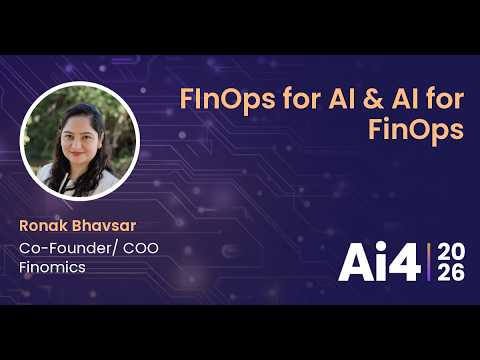
Ai4
Enterprises fail to cut payroll with artificial intelligence because human-in-the-loop requirements add compounding token and seat expenses directly on top of engineering salaries rather than replacing them.
AI-assisted summary of FInOps for AI & AI for FinOps With Finomics — original source. Check the original for full context.
Source published:
Detailed notes
## Background Published on YouTube by the Ai4 channel on August 17, 2026, this presentation features Ronak Bhavsar, Co-Founder and COO of Finomics. The session addresses the projected $2.59 trillion AI spend in 2026, outlining how enterprises can bridge critical governance gaps across token economics, AI seat licenses, and idle GPU detection while leveraging predictive AI and conversational interfaces to transform FinOps from reactive to proactive.
## TL;DR Ronak Bhavsar exposes how AI tooling and coding assistants frequently compound developer payroll and drain monthly budgets within days due to a lack of granular token and GPU visibility. To solve this, he outlines a two-way framework: 'FinOps for AI' to govern tokenomics, evolving consumption seat licenses, and fragmented GPU infrastructure, paired with 'AI for FinOps' to deliver predictive forecasting, real-time anomaly detection, and smart model routing that curbs developer FOMO. The talk concludes with an overview of Finomics and its conversational assistant, Finbot, which unifies multi-cloud, SaaS, and private infrastructure under a single taxonomy.
## Atmosphere & style The presentation carries a pragmatic, urgent, and highly structured tone, opening with a sobering reality check about runaway AI costs before transitioning into an empowering operational blueprint. Bhavsar speaks with authoritative clarity, using relatable enterprise anecdotes and data points to cut through industry hype. The concise, ten-minute session feels direct and solution-driven, culminating in a motivating call to accountability reinforced by a poignant Dr. Seuss quote.
## Key takeaways - [00:04](https://www.youtube.com/watch?v=GfLKCNLPahA&t=4s) AI tool costs are on track to surpass average developer salaries, adding a heavy consumption layer to engineering payroll rather than eliminating headcount. - [00:04](https://www.youtube.com/watch?v=GfLKCNLPahA&t=4s) Managing cost visibility is severely complicated by the modern enterprise software footprint, which averages roughly 371 distinct SaaS platforms. - [02:05](https://www.youtube.com/watch?v=GfLKCNLPahA&t=125s) Without granular team- and project-level token attribution, organizations risk exhausting multi-month AI budgets in single-digit days. - [02:05](https://www.youtube.com/watch?v=GfLKCNLPahA&t=125s) Input and output tokens have starkly different pricing structures, making dedicated TokenOps essential for controlling model consumption costs. - [02:05](https://www.youtube.com/watch?v=GfLKCNLPahA&t=125s) AI seat licensing is shifting away from flat-rate monthly subscriptions toward hybrid and consumption-based pricing models. - [02:05](https://www.youtube.com/watch?v=GfLKCNLPahA&t=125s) Fragmented telemetry across disparate GPU providers obscures idle compute capacity across public and private cloud environments. - [06:05](https://www.youtube.com/watch?v=GfLKCNLPahA&t=365s) Integrating AI into FinOps transforms financial management from retrospective invoice analysis into real-time, same-day anomaly detection. - [06:05](https://www.youtube.com/watch?v=GfLKCNLPahA&t=365s) Model recommendation engines counter developer 'FOMO' by routing workloads to right-sized LLMs instead of defaulting to expensive frontier models. - [06:05](https://www.youtube.com/watch?v=GfLKCNLPahA&t=365s) Conversational interfaces enable operators to query cloud, token, and project expenditures using natural language rather than maintaining static dashboards. - [07:57](https://www.youtube.com/watch?v=GfLKCNLPahA&t=477s) Effective AI cost governance requires unifying multi-cloud, SaaS, and private cloud CapEx and OpEx data under a single taxonomy.
## Detailed walkthrough ### [00:04](https://www.youtube.com/watch?v=GfLKCNLPahA&t=4s) The AI Cost Crisis: When Coding Tools Outpace Developer Salaries
Finomics co-founder Ronak Bhavsar frames the rapid advancement of artificial intelligence not just as an innovation engine, but as an impending financial crisis. While enterprises rush to embrace cutting-edge AI capabilities to accelerate development, they are frequently blindsided by how quickly their budgets evaporate. Bhavsar highlights recent tech headlines where large organizations have had to abruptly shut down internal token leaderboards in a panicked, reactive bid to stem runaway costs.
The widespread assumption that investing heavily in AI today will automatically cut engineering headcount and drive down organizational costs within two to three years is fundamentally flawed. Emerging data indicates that AI coding assistant costs are on track to surpass the average developer salary. Because companies require humans in the loop even as they become deeply AI-dependent, compounding tool expenses layer directly on top of existing engineering payroll rather than replacing it. This creates an urgent need for governance, control, and visibility across three core enterprise spending vectors: AI token usage, underlying cloud infrastructure, and enterprise SaaS platforms (where the average enterprise now manages roughly 371 distinct platforms).
- **Enterprise SaaS footprint:** An average enterprise currently maintains 371 SaaS platforms, compounding visibility challenges across cloud and software stacks. - **Budget depletion:** Reactive measures like disabling token leaderboards occur because organizations lack real-time visibility into developer consumption rates. - **AI economics myth:** AI tools do not automatically eliminate developer overhead; they add a significant consumption layer to existing human-in-the-loop engineering teams.
```mermaid flowchart TD accTitle: The Two-Way Intersection of FinOps and AI subgraph FinOpsForAI ["FinOps for AI (Controlling Costs)"] direction TB A1["Tokenomics & TokenOps<br>• Input vs. Output Tokens<br>• Team & App Attribution"] A2["AI Seat & License Reclamation<br>• Copilot / Claude<br>• Subscription to Consumption"] A3["GPU Cost Tracking<br>• Idle GPU Detection<br>• Multi-Provider Utilization"] end
subgraph Platform ["Finomics Unified Platform"] direction TB P1["Single Taxonomy Engine"] P2["5 Major Clouds • 50+ SaaS • Private Cloud CapEx/OpEx"] P3["Finbot Conversational Interface"] end
subgraph AIForFinOps ["AI for FinOps (Intelligent Automation)"] direction TB B1["Smart ML Forecasting<br>• 2026 & Multi-Month Projections"] B2["Real-Time Anomaly Detection<br>• Day-of Alerts vs. Month-End Surprises"] B3["Contextual Model Matching<br>• Mitigating Developer FOMO"] end
FinOpsForAI --> Platform AIForFinOps --> Platform ```
---
[02:05](https://www.youtube.com/watch?v=GfLKCNLPahA&t=125s) FinOps for AI: Managing Tokenomics, Seat Drift, and Idle GPUs
Adapting traditional cloud FinOps practices to artificial intelligence centers on three primary operational challenges: Tokenomics, AI seat licensing, and GPU utilization. Tokenomics—the economics governing input and output token consumption—remains poorly understood across engineering organizations. Bhavsar shares the story of an enterprise client whose development team completely exhausted their allocated monthly token budget in just the first three days because the company lacked granular tracking across specific teams, projects, and applications. Without proactive budgeting, forecasting, and anomaly detection, organizations cannot manage the wide cost discrepancies between input and output tokens.
Beyond tokens, AI seat licensing is undergoing a structural shift from predictable subscription-based tiers to variable, consumption-based pricing across tools like GitHub Copilot and conversational assistants. Failing to govern these seats risks draining innovation budgets entirely. Compounding this is the hardware layer: GPU infrastructure remains fragmented, with each provider offering disparate visibility metrics. Organizations routinely hemorrhage capital on idle or severely underutilized GPUs across public and private environments without realizing where capacity is being wasted.
- **Tokenomics attribution:** Input and output tokens carry starkly different pricing structures, requiring application- and project-level attribution to prevent multi-month budget exhaustion in single-digit days. - **Seat model evolution:** Licensing is transitioning from fixed flat-rate per-seat subscriptions to hybrid consumption models that demand active usage monitoring. - **GPU observability:** Disparate monitoring tools across different GPU providers obscure idle compute cycles and inflate operational expenditures.
---
[06:05](https://www.youtube.com/watch?v=GfLKCNLPahA&t=365s) AI for FinOps: Predictive Detection, Conversational Queries, and Beating Model FOMO
Flipping the premise, Bhavsar argues that machine learning and conversational interfaces should be deployed directly to fix the operational shortcomings of FinOps. Traditional FinOps is hindered by retrospective analysis—noticing a cost spike two months after the invoice arrives. Applying AI models enables predictive forecasting and same-day anomaly detection so engineering leads can intervene immediately. Furthermore, intelligent systems provide contextual recommendations to curb developer "FOMO" (fear of missing out), steering teams away from over-provisioned, ultra-expensive flagship models when lightweight, cost-effective models satisfy the technical requirements.
AI also transforms how operators interact with financial and telemetry data. Instead of building complex business intelligence dashboards or wrestling with disparate vendor portals, stakeholders can engage in natural-language conversations. Through simple queries, leaders can instantly discover last year's AWS spend, project their 2026 cost trajectory, forecast the next quarter's token burn, or isolate which specific microservice is driving unexpected consumption.
- **Proactive vs. reactive detection:** Catching cost overruns the day they occur rather than waiting for monthly or quarterly reconciliation cycles. - **Addressing developer FOMO:** Intelligent model recommendation engines match exact workload requirements to the most cost-efficient LLM, preventing unnecessary usage of high-priced frontier models. - **Natural-language FinOps:** Conversational AI replaces static dashboard maintenance with instant query responses regarding cloud, token, and project-level spend.
---
[07:57](https://www.youtube.com/watch?v=GfLKCNLPahA&t=477s) Finomics and Finbot: Unified Multi-Cloud Governance
To bridge these gaps, Bhavsar presents the Finomics platform and its TokenOps capability, designed to unify AI, multi-cloud, and software governance under a single taxonomy. Finomics aggregates data across five major cloud service providers, more than 50 enterprise SaaS integrations, and private cloud infrastructure—encompassing total cost of ownership (TCO), CapEx, and OpEx. This consolidated architecture removes the operational friction of toggling between vendor-specific consoles, providing organizations with unified governance, visibility, and model-routing intelligence.
Central to this experience is Finbot, Finomics' conversational AI interface that allows operators to interrogate their entire infrastructure ecosystem on demand. Closing the session, Bhavsar references a classic Dr. Seuss quote to challenge leaders to take direct accountability for their cloud and AI budgets: *"Unless someone like you cares a whole awful lot, nothing is going to change. It's not."*
- **Platform coverage:** Native support across 5 major cloud providers, 50+ SaaS integrations, and private cloud on-premises environments (CapEx/OpEx tracking). - **TokenOps module:** Built-in model recommendation, token usage telemetry, and AI seat license tracking. - **Finbot conversational agent:** On-demand chat interface for real-time infrastructure and financial queries without manual dashboard construction. - **Event call to action:** Attendees looking to implement an AI cost governance framework are invited to connect with the Finomics team at booth 722.
## Notable quotes > AI spending is projected to reach $2.59 trillion in 2026, yet most organizations still can't answer what a given token, seat, or GPU actually costs them. — Ronak Bhavsar
> [00:04](https://www.youtube.com/watch?v=GfLKCNLPahA&t=4s) AI coding assistant costs are on track to surpass the average developer salary. — Ronak Bhavsar
> [00:04](https://www.youtube.com/watch?v=GfLKCNLPahA&t=4s) Because companies require humans in the loop even as they become deeply AI-dependent, compounding tool expenses layer directly on top of existing engineering payroll rather than replacing it. — Ronak Bhavsar
> [00:04](https://www.youtube.com/watch?v=GfLKCNLPahA&t=4s) AI tools do not automatically eliminate developer overhead; they add a significant consumption layer to existing human-in-the-loop engineering teams. — Ronak Bhavsar
> [02:05](https://www.youtube.com/watch?v=GfLKCNLPahA&t=125s) Tokenomics—the economics governing input and output token consumption—remains poorly understood across engineering organizations. — Ronak Bhavsar
> [02:05](https://www.youtube.com/watch?v=GfLKCNLPahA&t=125s) Input and output tokens carry starkly different pricing structures, requiring application- and project-level attribution to prevent multi-month budget exhaustion in single-digit days. — Ronak Bhavsar
> [02:05](https://www.youtube.com/watch?v=GfLKCNLPahA&t=125s) Organizations routinely hemorrhage capital on idle or severely underutilized GPUs across public and private environments without realizing where capacity is being wasted. — Ronak Bhavsar
> [06:05](https://www.youtube.com/watch?v=GfLKCNLPahA&t=365s) Traditional FinOps is hindered by retrospective analysis—noticing a cost spike two months after the invoice arrives. — Ronak Bhavsar
> [06:05](https://www.youtube.com/watch?v=GfLKCNLPahA&t=365s) Intelligent model recommendation engines match exact workload requirements to the most cost-efficient LLM, preventing unnecessary usage of high-priced frontier models. — Ronak Bhavsar
> [07:57](https://www.youtube.com/watch?v=GfLKCNLPahA&t=477s) Unless someone like you cares a whole awful lot, nothing is going to change. It's not. — Ronak Bhavsar
## Mentioned Ronak Bhavsar, Finomics, Ai4, Finbot, TokenOps, GitHub Copilot, Claude, AWS, Terraform, Dr. Seuss
## Video description Ronak Bhavsar - Co-Founder/ COO, Finomics
AI spending is projected to reach $2.59 trillion in 2026, yet most organizations still can't answer what a given token, seat, or GPU actually costs them.
In this talk, I will show where AI has outrun the governance and visibility practices enterprises built for cloud, and how to close that gap across three fronts: token economics and attribution, AI seat and license reclamation, and idle GPU detection across public and private clouds. I will then flip the premise—using ML forecasting, self-tuning anomaly detection, and agentic recommendations delivered as executable Terraform—to make FinOps proactive instead of retrospective, closing with a live look at conversational FinOps in action.
Attend if you own an AI budget and want a framework you can start applying the week you get back.
[Source](https://www.youtube.com/watch?v=GfLKCNLPahA)