Reflex Links AI App Prototypes to Enterprise Clouds in Production Push
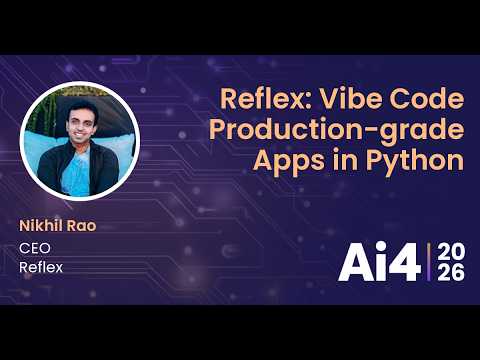
Ai4
Most AI-generated prototypes fail to reach production because organizations lack secure data integration and authentication, requiring inspectable Python codebases rather than throwaway mockups.
AI-assisted summary of Reflex: Vibe Code Production-grade Apps in Python — original source. Check the original for full context.
Source published:
Detailed notes
## Background Published on YouTube by Ai4 on August 17, 2026, this talk features Reflex CEO Nikil Rao addressing why most AI-generated applications stall out as prototypes rather than reaching enterprise production. The session focuses on overcoming organizational and technical roadblocks to successfully deploy and maintain Python internal tools in real-world environments.
## TL;DR Nikil Rao introduces Reflex as a full-stack Python platform that bridges the gap between rapid AI 'vibe coding' and enterprise-grade deployment. He breaks down the three core reasons internal AI prototypes fail: lack of secure data integration, missing access controls, and difficult operational maintenance. Reflex resolves these issues by unifying technical developer workflows and non-technical web builders around a single, inspectable Python codebase. Through a live demonstration, Rao illustrates how a prompt-generated Customer Risk Dashboard connects to enterprise data and deploys directly into self-hosted cloud infrastructure with full read/write capabilities.
## Atmosphere & style The presentation maintains a pragmatic, direct, and developer-focused tone that cuts through the hype of quick AI generation. Rao speaks with grounded confidence, pivoting from the chaotic 'wild west' of unmaintained laptop prototypes to an orderly, enterprise-ready workflow. The pacing is crisp and demonstrative, leaving the viewer with a sense of practical clarity about making AI applications durable and auditable.
## Key takeaways - [00:04](https://www.youtube.com/watch?v=Lw3pBNxlLHU&t=4s) Reflex originated as an open-source Python framework enabling data teams and backend engineers to build full-stack web applications without writing JavaScript. - [00:04](https://www.youtube.com/watch?v=Lw3pBNxlLHU&t=4s) The framework has seen massive enterprise adoption, with over 28,000 GitHub stars, 1,000,000 apps built, and usage across more than 30% of the Fortune 500. - [01:26](https://www.youtube.com/watch?v=Lw3pBNxlLHU&t=86s) While AI coding assistants make generating functional prototypes in an afternoon trivial, most internal AI apps stall out and fail to reach production. - [01:26](https://www.youtube.com/watch?v=Lw3pBNxlLHU&t=86s) Uncontrolled AI app generation has created an internal 'wild west' of siloed apps running insecurely on individual laptops without owners or maintenance plans. - [01:26](https://www.youtube.com/watch?v=Lw3pBNxlLHU&t=86s) Three core bottlenecks block AI apps from production: secure production data integration, corporate access control/authentication, and ongoing deployment and maintenance pipelines. - [03:47](https://www.youtube.com/watch?v=Lw3pBNxlLHU&t=227s) Reflex standardizes peripheral application requirements by providing built-in connections to warehouses like Snowflake and Databricks, corporate auth, and unified UI themes. - [03:47](https://www.youtube.com/watch?v=Lw3pBNxlLHU&t=227s) The platform bridges the technical divide by allowing non-technical teams (web builder) and engineers (CLI, Claude Code, Codex) to collaborate on the exact same Python codebase. - [03:47](https://www.youtube.com/watch?v=Lw3pBNxlLHU&t=227s) Eliminating static, throwaway Figma mockups prevents engineering teams from having to rebuild applications from scratch in code. - [05:40](https://www.youtube.com/watch?v=Lw3pBNxlLHU&t=340s) Applications generated on Reflex provide full read and write capabilities, allowing users to trigger live backend workflows rather than view static mock data. - [05:40](https://www.youtube.com/watch?v=Lw3pBNxlLHU&t=340s) For mission-critical enterprise applications, 'vibe coding' requires full code transparency and version-controlled Python source to verify logic against real data. - [05:40](https://www.youtube.com/watch?v=Lw3pBNxlLHU&t=340s) Reflex enables one-click deployment into self-hosted cloud infrastructure (AWS, GCP, Azure) managed through a single pane of glass administration console.
## Detailed walkthrough ### [00:04](https://www.youtube.com/watch?v=Lw3pBNxlLHU&t=4s) Introduction and the Reflex Open-Source Framework
Nikil Rao, co-founder and CEO of Reflex, introduces the core mission behind the platform: solving the challenge of taking "vibe-coded" AI prototypes all the way to production. While modern AI tooling makes spinning up basic internal applications faster than ever, getting those tools securely connected to enterprise data and approved across an organization remains a massive hurdle. Reflex originated as an open-source Python framework designed to empower data scientists, backend engineers, and AI practitioners to build full-stack web applications entirely in Python without touching JavaScript or modern frontend toolchains.
The framework has experienced rapid open-source adoption, scaling across the developer community and major enterprises. By giving Python developers the ability to construct both frontend UI and backend logic natively, Reflex aims to eliminate the friction that historically kept data teams reliant on dedicated frontend engineering resources to deliver functional user interfaces.
- Reflex has amassed over 28,000 GitHub stars. - Over 30% of the Fortune 500 currently use Reflex to power their internal application development. - More than 1,000,000 Reflex applications have been built globally to date.
```mermaid flowchart LR accTitle: The Reflex Production Pipeline subgraph DataLayer["Enterprise Data Layer"] A["Snowflake / Databricks"] B["Internal Company APIs"] end subgraph ReflexCore["Reflex Unified Platform"] C["Python Full-Stack Engine"] D["Role-Based Auth & Theming"] end subgraph Deployment["Production Cloud"] E["Azure / GCP / AWS Infrastructure"] F["Single-Pane Management Console"] end
DataLayer --> ReflexCore ReflexCore --> Deployment ```
[01:26](https://www.youtube.com/watch?v=Lw3pBNxlLHU&t=86s) The Prototype Graveyard: Why Vibe-Coded Apps Fail to Reach Production
With coding assistants such as ChatGPT and Claude Code, generating a working prototype of a dashboard or user interface in an afternoon has become trivial. However, Rao points out that the overwhelming majority of these AI-generated apps stall out as prototypes and never provide actual business value. The proliferation of AI has turned internal development into a "wild west" where different employees build in silos across fractured stacks, frequently leaving applications running unsafely on someone's laptop "in the back of a room" with no designated owner or security posture.
Rao identifies three fundamental blockers that prevent AI prototypes from crossing the chasm into production: 1. **Production Data Integration:** Connecting prototypes to sensitive, production-grade enterprise data sources securely rather than relying on static mock data. 2. **Access Control and Authentication:** Implementing corporate authentication, role-based access controls, and permission revocation for deployed internal tools. 3. **Operational Deployment and Maintenance:** App creation is only a tiny fraction of the lifecycle; editing, hardening, securing, and maintaining standard deployment pipelines account for the vast majority of engineering time.
[03:47](https://www.youtube.com/watch?v=Lw3pBNxlLHU&t=227s) Bridging the Gap: Unifying Technical and Non-Technical Workflows
To overcome the lack of organizational standards, Reflex standardizes the entire peripheral ecosystem around application development. The platform integrates directly with cloud data warehouses like Databricks and Snowflake, enforces organizational UI theming, handles identity and authentication out of the box, and provides one-click deployments to existing company infrastructure.
A central thesis of Reflex is closing the operational rift between technical and non-technical teams. Historically, non-technical stakeholders would design static prototypes in tools like Figma and hand them off to engineering teams, who would then discard the work and rebuild the application from scratch in code. Reflex creates a shared, bidirectional workflow where non-technical users can prompt and iterate via a no-code web builder, while technical engineers work through CLI agent toolkits, Claude Code, or Codex on the exact same underlying Python codebase.
- Standardizes enterprise-wide branding and UI components to ensure visual consistency across all internal tools. - Integrates seamlessly with existing enterprise identity providers for secure authentication and authorization. - Eliminates throwaway Figma handoffs by anchoring both web-based builders and developer CLI tools to a shared codebase.
[05:40](https://www.youtube.com/watch?v=Lw3pBNxlLHU&t=340s) Platform Demo: From Prompt to Deployed Mission-Critical App
Rao walks through a live demonstration of the Reflex platform, illustrating how integrations and builders interact. After connecting enterprise data resources, users can choose their preferred development workflow: interfacing via local agent toolkits like Claude Code and Codex, or using the native web-based builder. In the demo, a single natural language prompt generates a full Customer Risk Dashboard that identifies accounts vulnerable to churn and tracks customer product usage in real time.
Unlike superficial mockups, the generated app is fully interactive with read and write capabilities, allowing users to trigger underlying business workflows directly from the interface. Rao emphasizes that as "vibe coding" becomes more prevalent, it cannot replace code transparency for mission-critical apps: every Reflex app remains backed by auditable Python source code so teams can verify logic against real data. Once generated, apps can be deployed with one click into existing cloud infrastructure—such as AWS, GCP, or Azure—allowing enterprises to bring their own infrastructure and models while managing all internal applications through a single pane of glass.
- Supports full read/write interactivity, enabling dashboards to execute live database writes and backend workflows. - Emphasizes inspectable, version-controlled Python source code underneath AI generations to maintain mission-critical data integrity. - Provides a "single pane of glass" admin interface to monitor, maintain, and audit deployed apps across self-hosted enterprise clouds.
## Notable quotes > Most AI apps stop at the prototype. What does it take to get one all the way to production? — Nikhil Rao
> Anyone can generate a working internal app in an afternoon now. Getting one approved and deployed inside a real organization is a completely different problem, and most never make it. — Nikhil Rao
> Come if you are sitting on prototypes your organization will not let you use. — Nikhil Rao
> [00:04](https://www.youtube.com/watch?v=Lw3pBNxlLHU&t=4s) Reflex originated as an open-source Python framework designed to empower data scientists, backend engineers, and AI practitioners to build full-stack web applications entirely in Python without touching JavaScript or modern frontend toolchains. — Nikil Rao
> [00:04](https://www.youtube.com/watch?v=Lw3pBNxlLHU&t=4s) Over 30% of the Fortune 500 currently use Reflex to power their internal application development. — Nikil Rao
> [01:26](https://www.youtube.com/watch?v=Lw3pBNxlLHU&t=86s) The proliferation of AI has turned internal development into a "wild west" where different employees build in silos across fractured stacks, frequently leaving applications running unsafely on someone's laptop "in the back of a room" with no designated owner or security posture. — Nikil Rao
> [01:26](https://www.youtube.com/watch?v=Lw3pBNxlLHU&t=86s) App creation is only a tiny fraction of the lifecycle; editing, hardening, securing, and maintaining standard deployment pipelines account for the vast majority of engineering time. — Nikil Rao
> [03:47](https://www.youtube.com/watch?v=Lw3pBNxlLHU&t=227s) A central thesis of Reflex is closing the operational rift between technical and non-technical teams. — Nikil Rao
> [03:47](https://www.youtube.com/watch?v=Lw3pBNxlLHU&t=227s) Eliminates throwaway Figma handoffs by anchoring both web-based builders and developer CLI tools to a shared codebase. — Nikil Rao
> [05:40](https://www.youtube.com/watch?v=Lw3pBNxlLHU&t=340s) as "vibe coding" becomes more prevalent, it cannot replace code transparency for mission-critical apps: every Reflex app remains backed by auditable Python source code so teams can verify logic against real data. — Nikil Rao
## Mentioned Nikhil Rao, Reflex, Ai4, Python, JavaScript, GitHub, Fortune 500, Snowflake, Databricks, AWS, GCP, Azure, ChatGPT, Claude Code, Codex, Figma
## Video description Nikhil Rao - CEO, Reflex
Most AI apps stop at the prototype. What does it take to get one all the way to production?
Anyone can generate a working internal app in an afternoon now. Getting one approved and deployed inside a real organization is a completely different problem, and most never make it.
I will walk through where these apps actually die, using real examples from Python applications we have taken into hedge funds, engineering firms, and county governments.
Come if you are sitting on prototypes your organization will not let you use.
[Source](https://www.youtube.com/watch?v=Lw3pBNxlLHU)