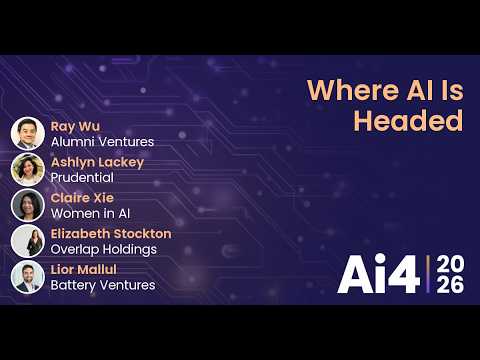
Battery, Alumni Ventures Shun AI Middleware for Hardware, Deep Verticals
Ai4
Venture investors warn foundation model labs will commoditize generic AI wrappers, forcing startups to build defensibility through specialized silicon, proprietary physical datasets, and outcome-based vertical software.
## Background
Published on YouTube by Ai4 on August 23, 2026, this panel session explores how leading venture capitalists are parsing the noise and deploying capital across the evolving artificial intelligence landscape. Moderated by Ashlyn Lackey of Prudential, the panel brings together investors and operators to examine opportunities in foundational infrastructure, vertical applications, autonomous agent frameworks, and defensible moats.
## TL;DR
Venture investors Ray Wu, Claire Xie, Elizabeth Stockton, and Lior Mallul break down the shift from simple conversational copilots to autonomous, full-stack AI agents and frontier hardware. They advocate for high-conviction 'barbell' strategies that back either foundational infrastructure and specialized silicon or deep vertical applications with proprietary workflows, deliberately bypassing easily commoditized middle-layer wrappers. The discussion highlights crucial founder evaluation signals, the strategic economics of balancing open-source and closed-source models in enterprise IT, and the imperative for incumbents to fundamentally re-architect their operational DNA to survive the transition to service-as-software delivery.
## Atmosphere & style
The conversation is pragmatic, analytical, and brisk, blending high-level market macro-theses with grounded, tactical advice for early-stage founders and enterprise buyers. The dynamic among the panelists is collegiate yet direct, utilizing sharp historical parallels—such as Amazon outmaneuvering Barnes & Noble and the virtualization of bare-metal servers—to deconstruct hype and emphasize execution speed. Listening in feels like sitting inside an active, candid strategy session where seasoned investors cut past marketing buzz to focus on genuine unit economics, proprietary data moats, and operational defensibility.
## Key takeaways
- [03:13](https://www.youtube.com/watch?v=OEKHdDqSJ1U&t=193s) True long-term defensibility belongs to AI-native architectures built directly on foundation models and proprietary datasets, whereas legacy companies bolting on conversational wrappers risk falling into the 'Barnes & Noble trap'.
- [06:31](https://www.youtube.com/watch?v=OEKHdDqSJ1U&t=391s) Investors are adopting a 'barbell' strategy that deploys capital into deep vertical software and sub-model hardware infrastructure while actively avoiding thin middle-layer orchestration and wrappers vulnerable to model lab absorption.
- [06:31](https://www.youtube.com/watch?v=OEKHdDqSJ1U&t=391s) Frontier deep tech and hardware investments create durable moats by generating novel, proprietary datasets from the physical world across bioengineering, material science, and specialized edge silicon.
- [09:08](https://www.youtube.com/watch?v=OEKHdDqSJ1U&t=548s) AI adoption is shifting from assistive copilots that suggest text to autonomous, outcome-oriented agents capable of completing multi-step operational workflows with up to 90% autonomy.
- [11:30](https://www.youtube.com/watch?v=OEKHdDqSJ1U&t=690s) Venture evaluation metrics in AI are moving away from traditional SaaS ARR expansion and seat count toward end-user retention, team adaptability, and verified units of autonomously resolved work.
- [11:30](https://www.youtube.com/watch?v=OEKHdDqSJ1U&t=690s) Compressed innovation cycles and immediate incumbent competition force early-stage AI founders to balance extraordinary execution velocity with simultaneous deep moat construction.
- [17:07](https://www.youtube.com/watch?v=OEKHdDqSJ1U&t=1027s) Founders commonly validate willingness to pay using closed-source frontier APIs before migrating mature or bounded workflows to fine-tuned open-source models to optimize unit economics and data control.
- [01:59:56](https://www.youtube.com/watch?v=OEKHdDqSJ1U&t=7196s) Unlike traditional SaaS with near-zero variable user costs, AI systems carry usage-based variable inference costs that push enterprises toward hybrid architectures balancing cloud scalability with on-premise security.
- [02:24:28](https://www.youtube.com/watch?v=OEKHdDqSJ1U&t=8668s) Open-weights models play a vital role in national competitiveness, sovereign AI security, and enabling cost-effective automation for small businesses with bounded workflows.
- [02:26:37](https://www.youtube.com/watch?v=OEKHdDqSJ1U&t=8797s) Software pricing models are shifting from per-seat licensing to outcome-based monetization and 'service as software' packages combining autonomous AI agents with domain service delivery.
- [02:30:22](https://www.youtube.com/watch?v=OEKHdDqSJ1U&t=9022s) As underlying AI capabilities commoditize across models, distribution velocity, community trust, and human relationships become the primary determinants of enterprise market leadership.
- [02:34:40](https://www.youtube.com/watch?v=OEKHdDqSJ1U&t=9280s) Enterprise buyers and government agencies evaluate AI adoption on hard ROI, typically demanding a 3x to 5x financial return through direct labor substitution or time savings.
- [39:42](https://www.youtube.com/watch?v=OEKHdDqSJ1U&t=2382s) Quantum computing inherently matches the probabilistic nature of modern AI models better than deterministic architectures, though commercial enterprise deployment timelines remain an open venture question.
- [40:19](https://www.youtube.com/watch?v=OEKHdDqSJ1U&t=2419s) Incumbents seeking to transition to service-as-software must overhaul company DNA to make autonomous agents their core execution engine rather than treating AI as an incremental feature on legacy workflows.
## Detailed walkthrough
### [00:04](https://www.youtube.com/watch?v=OEKHdDqSJ1U&t=4s) Panel Introductions and Audience Demographics
Ashlyn Lackey opens the panel by introducing her role on the emerging technology team at Prudential, where she focuses on sourcing trends across fintech, insurtech, and enterprise technology. The panelists introduce themselves:
* **Ray Wu** is a Managing Partner at Alumni Ventures, which he describes as one of the most active venture capital funds for individual investors in the United States, having raised \$1.6 billion over the past decade. Operating out of five US offices and expanding into Japan and the UK, the firm commands an 850,000-member community and focuses heavily on early- to growth-stage venture investments, with Wu leading their dedicated AI fund.
* **Claire Xie**, Founder and CEO of Women in AI, introduces her fast-growing community headquartered in San Francisco. Joking that this is her first time braving 100-degree Las Vegas weather, she shares her organization's mission to make AI "more human" by elevating female founders, builders, and executives across weekly events in San Francisco, New York, and Los Angeles.
* **Elizabeth Stockton** represents Overlap Holdings as Director of Government Solutions. Overlap is an early-stage deep tech and frontier venture firm investing in Seed, Series A, and Series B companies that are building capital-intensive businesses to solve world-scale problems. Operating out of Washington, D.C., with a distributed footprint across the US and Europe, she leverages her prior background in the Pentagon to bridge commercial deep tech with defense and industrial applications.
* **Lior Mallul**, a Tel Aviv–based Principal at Battery Ventures, highlights his eight-year tenure with the global firm, which deploys capital across the entire software and hardware stack from Seed to pre-IPO stages.
A quick show of hands from the room reveals a diverse mix of founders, investors, and startup operators eager to understand where capital is flowing and how venture expectations are shifting.
```mermaid
flowchart TD
accTitle: Alumni Ventures AI Native Taxonomy
accDescription: Flowchart illustrating Ray Wu's four layers of AI-first venture investment.
subgraph Infrastructure["AI-First Infrastructure Layer"]
A["Core Compute, Storage & Networking"] --> B["Foundation Models & Specialized Compute<br/>(Groq, Cohere, Lambda, Together AI)"]
end
subgraph Applications["AI-First Application & Interface Layer"]
B --> C["AI-First Work & Interface<br/>(Replit, Kore.ai)"]
B --> D["AI-First Vertical Industries<br/>(Hicksfield, Corgi Insurance)"]
end
subgraph DeepTech["AI-First Discovery Layer"]
B --> E["Physical-to-Virtual Twin Mapping<br/>(Bioengineering, Material Science, Quantum)"]
end
```
---
[03:13](https://www.youtube.com/watch?v=OEKHdDqSJ1U&t=193s) The AI-Native Paradigm and the Investment Stack
Asked where he is most excited to deploy capital, Ray Wu emphasizes that the venture landscape is moving rapidly past surface-level chat interfaces into full-stack, AI-native architectures. He draws a direct historical parallel to the dawn of e-commerce, comparing incumbents adding basic web wrappers to Barnes & Noble attempting to counter Amazon: "Even though Barnes & Noble added internet services, Amazon still wins." In the current cycle, true defensibility will belong to AI-first startups that build natively atop foundation models and proprietary datasets rather than legacy companies bolting on conversational widgets.
Wu breaks down the Alumni Ventures AI investment framework into four distinct horizontal and vertical vectors:
- **AI-First Infrastructure:** The foundational layer spanning specialized compute, distributed training, and model hosting, including portfolio bets such as Groq, Cohere, Lambda, and Together AI.
- **AI-First Work:** Solutions reimagining user interfaces and developer productivity workflows, exemplified by developer platforms like Replit and enterprise automation platforms like Kore.ai.
- **AI-First Industries:** Full-stack vertical applications integrating autonomous AI agents with domain-specific services, such as Hicksfield in generative media and Corgi Insurance in automated underwriting.
- **AI-First Discovery:** Deep scientific platforms bridging the physical and virtual worlds through digital twin mapping, bioengineering, novel material science discovery, and deterministic modeling coupled with quantum architectures.
---
[06:31](https://www.youtube.com/watch?v=OEKHdDqSJ1U&t=391s) Investment Perspectives Across the Stack: Barbell Approaches and Frontier Hardware
Lior Mallul frames the next decade of AI adoption as an architectural transformation akin to the early cloud era virtualizing bare-metal servers. To navigate the risk of commoditization, Battery Ventures applies a strict "barbell" investment thesis. Mallul deliberately avoids the middle orchestration and generic wrapper layers, warning that foundation model labs will inevitably subsume them. Instead, he focuses capital on the two ends of the spectrum: deeply specialized vertical software that encodes proprietary customer workflows, system-of-record integrations, and unique business logic; and the foundational substrate beneath the model layer, including hardware, edge acceleration, and low-latency networking.
```mermaid
flowchart LR
accTitle: Barbell AI Investment Strategy
accDescription: Battery Ventures barbell approach targeting vertical software and low-level hardware while avoiding the middle layer.
subgraph HighEnd["High Defensibility: Vertical Apps"]
VA["Deep Vertical Software<br/>Custom Workflows & Systems of Record"]
end
subgraph Squeeze["High Risk: Middle Layer"]
ML["Generic Wrappers & Thin Middlewares<br/>(Risk of being subsumed by Labs)"]
end
Elizabeth Stockton contrasts this by emphasizing Overlap Holdings’ mandate as a frontier deep tech fund that avoids pure software altogether. Overlap concentrates on physical hardware and capital-intensive technologies capable of generating novel, proprietary datasets from the physical world. She highlights portfolio company Tahoe Bio and their open-source virtual cell models on Hugging Face, alongside advanced material science ventures that systematically capture synthesis data to compress manufacturing and development cycles. On the hardware side, Stockton underscores massive demand for specialized silicon that enables low-power, on-device inference for industrial edge, aerospace, and defense environments.
---
[09:08](https://www.youtube.com/watch?v=OEKHdDqSJ1U&t=548s) The Evolution from Copilots to Autonomous AI Agents
Reflecting on her journey as a former founder who built an AI-powered sales development representative (SDR) platform four years ago before successfully exiting, Claire Xie traces the paradigm shift from assistive copilots to autonomous, outcome-oriented AI agents. Whereas early AI tools merely provided drafting suggestions, modern agents take full operational ownership of tedious cold outreach, customer support queues, and multi-step supply chain workflows, completing up to 90% of tasks without human intervention.
At Women in AI, Xie operates an internal team of 14 that acts as a testing bed, continually benchmarking 5 to 10 autonomous agent platforms across internal business functions. She notes that the fastest-scaling founders in her network are those who commit to building AI-native organizations from day one, systematically automating operational overhead to outpace competitors with leaner teams and higher execution velocity.
---
[11:30](https://www.youtube.com/watch?v=OEKHdDqSJ1U&t=690s) Founder Signals, Rapid Cycles, and Building Defensibility
When evaluating early-stage software companies, Lior Mallul notes that while classic venture criteria—such as market size, founder grit, and an unfair right to win—remain essential, AI requires new evaluation signals. In a post-copilot landscape, Battery Ventures evaluates post-launch startups on end-user retention and verifiable units of completed work:
- Measuring business outcomes rather than seat utilization (e.g., in IT service management, evaluating the volume of support tickets autonomously resolved alongside resolution accuracy).
- Evaluating team adaptability and mental agility over raw historical scaling metrics, as traditional year-over-year SaaS growth benchmarks (like 3x–4x ARR expansion) can be misleading in an industry experiencing constant architectural disruption.
```mermaid
flowchart TD
accTitle: AI Competitive Dynamics and Founder Velocity
accDescription: The compressed innovation cycle where startups must balance rapid execution with simultaneous moat building.
B --> C["Critical Founder Imperative"]
C --> D["Speed & Rapid Market Execution"]
C --> E["Simultaneous Deep Moat Construction"]
D & E --> F["Defensible, Category-Defining Winner"]
```
Ray Wu highlights how drastically innovation cycles have compressed compared to the early dot-com days at Cisco. Historically, startups enjoyed a long runway while legacy players hesitated. Today, enterprise incumbents recognize AI as an existential battlefield from day one, aggressively entering new markets. This forces founders to maintain extraordinary execution speed while concurrently engineering defensible moats.
Elizabeth Stockton adds that Overlap evaluates technical founders who operate as "a genius on two axes"—possessing world-class cross-disciplinary domain expertise in intersecting fields like silicon photonics and biomedical engineering. She emphasizes that in physical and industrial sectors, defensibility comes down to building deep customer trust and embedding into sticky operational environments, whether on construction sites, aerospace production lines, or mission-critical defense pipelines.
---
[17:07](https://www.youtube.com/watch?v=OEKHdDqSJ1U&t=1027s) Founder Playbooks: Customer Obsession, Scale, and Open-Source Decisions
Claire Xie shares tactical guidance for early-stage founders navigating product-market fit and architecture design. With roughly 60% of her community leading Seed-stage and Series A companies, she stresses that true defensibility starts with intense customer obsession rather than premature technical over-engineering:
- **Stage 1: Solution-Problem Fit:** Directly validate that the software eliminates a painful, mission-critical bottleneck for early pilot users.
- **Stage 2: Scalable Repeatability:** Establish a reliable sales motion to expand from a single customer to hundreds of SMBs, and eventually into enterprise contract tiers.
- **Navigating Open Source:** Xie describes model selection as an iterative business calculation. Many founders bootstrap their initial proof of concept on closed foundation APIs (like ChatGPT/OpenAI) to validate customer willingness to pay, before strategically deciding whether to migrate towards fine-tuned, open-source models to optimize unit economics, data sovereignty, and pipeline control.
[01:59:56](https://www.youtube.com/watch?v=OEKHdDqSJ1U&t=7196s) Balancing Model Economics and Enterprise IT Architecture
When designing an AI stack, founders must continuously evaluate unit economics and model selection. Key operational questions include whether a given solution consumes too many tokens to remain profitable and whether switching to alternative foundational models provides better scalability.
```mermaid
accTitle: Enterprise AI Infrastructure Trade-offs
flowchart LR
subgraph STACK["Model Options"]
CS["Closed-Source Models<br/>(High Frontier Capability)"]
OS["Open-Source / Open-Weights<br/>(Lower Inference Cost)"]
end
subgraph HYBRID["Enterprise IT Architecture"]
CLOUD["Cloud Deployment<br/>(Scalability & Speed)"]
PREM["On-Premises / Air-Gapped<br/>(Data Security & Control)"]
end
STACK --> HYBRID
```
While some developers are strictly open-source purists, Ray Wu emphasizes that model choice is ultimately a strategic IT architecture decision. Beyond selecting a model, enterprises must balance control, data sensitivity, and vendor dependence. Over time, enterprise AI is settling into a hybrid architecture that integrates cloud deployments with on-premises infrastructure.
- **Variable vs. Fixed Cost Structures:** Traditional SaaS products carry high initial build costs but very low variable costs per user. In contrast, AI systems incur variable inference costs that scale directly with usage, forcing executives to demand clear ROI metrics before committing to long-term adoption.
- **Enterprise Observability & Security:** Enterprise adoption requires full-stack operational readiness, including robust observability, scalable security controls, and high-system reliability alongside raw intelligence.
- **Inference Cost Differential:** On a global competitive level, open-source inference costs are significantly lower, making it a critical strategic lever for margin preservation.
---
[02:22:38](https://www.youtube.com/watch?v=OEKHdDqSJ1U&t=8558s) Regulatory Horizons and Defense Sector Constraints
Navigating open and closed-source decisions involves managing regulatory uncertainty. Elizabeth Stockton points out that founders must account for policy shifts that can swing dramatically every two years based on congressional control. While current federal guidance aims to preserve open-source access, passing statutory guardrails remains difficult due to legislative gridlock.
In highly regulated sectors like defense and national security, open source presents unique challenges. Government buyers maintain strict risk tolerances and stringent operational certification frameworks that open-source software may fail to clear. However, because government officials are bound to be responsible stewards of taxpayer dollars, the lower cost profile of open-source models keeps them in active consideration for public sector deployments.
---
[02:24:28](https://www.youtube.com/watch?v=OEKHdDqSJ1U&t=8668s) Open-Weights Models, Sovereign AI, and Bounded Workflows
Lior Mallul notes that public debates around restricting open-source software are prompting a push toward sovereign, US-originated open-weights models. Concerns over potential backdoors in weights supplied by foreign developers highlight the need for domestically vetted alternatives from companies like Mistral, Reflection, and Thinking Machines.
```mermaid
accTitle: Workflow Routing and Model Lifecycle
flowchart TD
subgraph PHASE1["Exploration Phase"]
EXPLORE["Exploratory / Unbounded Research"] --> CS["Closed-Source Models<br/>(Frontier Intelligence)"]
end
subgraph PHASE2["Production Transition"]
LAG["4–6 Month Capability Lag"] --> OS["Open-Source Transition"]
BOUNDED["Bounded / Simpler Workflows"] --> OS
end
PHASE1 --> PHASE2
```
Curtailing open-source models risks dampening overall ecosystem innovation during a critical period of global AI competition. Furthermore, open source lowers adoption barriers for small and medium-sized businesses (SMBs). For instance, a small dental practice seeking a multilingual AI receptionist might find closed-source API pricing prohibitively expensive, whereas fine-tuning an open-source model on a bounded workflow provides a viable economic path forward.
- **Domestic Ecosystem Support:** Building US-originated open-weights models helps preserve national technological competitiveness while mitigating security risks.
- **Democratizing SMB Automation:** Open-source models allow smaller businesses with tight budgets to automate back-office operations and customer-facing roles.
---
[02:26:37](https://www.youtube.com/watch?v=OEKHdDqSJ1U&t=8797s) Pricing Models, Customer Trust, and Building Moats
When building enduring venture-backed businesses, pricing models must directly reflect customer ROI. Lior Mallul highlights that long-term enterprise value depends on earning deep customer trust—a necessity as products evolve from internal co-pilots to autonomous agents performing core business workflows.
Rather than relying on traditional per-seat licensing, modern AI startups are adopting hybrid models combining platform fees, token usage bundles, or seat-free entry tiers designed to eliminate friction and maximize organizational penetration. Ray Wu adds that traditional defensibility stems from high switching costs, deep integration with legacy enterprise software, and gaining access to proprietary data and workflows.
- **Outcome-Based Monetization:** The paradigm is shifting from selling software licenses to selling direct business outcomes and packaged digital services.
- **Full-Stack Service Models:** New business structures are combining "high-tech inside" (autonomous AI agents) with "high-touch outside" (specialized service delivery), creating entirely new industry categories.
---
[02:30:22](https://www.youtube.com/watch?v=OEKHdDqSJ1U&t=9022s) Distribution, Community, and the Human Factor
Claire Xie addresses the debate between technological superiority and go-to-market execution. When multiple startups offer similar baseline AI capabilities, distribution and customer relationships decide the winner. Business decisions are driven by human networks, trust, and peer recommendations rather than raw benchmark scores alone.
```mermaid
accTitle: Customer Trust and Adoption Flywheel
flowchart LR
subgraph ENGAGE["Community Engagement"]
EVENTS["In-Person Events & Dialogues"]
SOCIAL["Social Proof & Peer Referrals"]
end
subgraph CONVERT["Conversion & Loyalty"]
TRUST["Customer Trust & Mindshare"]
ADOPT["Enterprise Product Adoption"]
end
ENGAGE --> CONVERT
```
To build brand loyalty and mindshare, leading AI companies engage in community building, regular stakeholder dialogues, and targeted brand touchpoints. Founders must realize that while AI tools automate workflows, enterprise procurement decisions remain fundamentally human.
At the same time, Elizabeth Stockton notes that breakthrough AI systems are enabling capabilities previously deemed impossible—such as discovering novel material alloys or accelerating drug development pipelines from years down to months.
---
[02:34:40](https://www.youtube.com/watch?v=OEKHdDqSJ1U&t=9280s) Audience Q&A: Government Implementations and Calculating ROI
During the interactive Q&A session, an audience member from a federal laboratory asked about the operational distinction between closed-source and open-source models within government agencies, noting that their department routinely deploys open-source models using Retrieval-Augmented Generation (RAG) inside air-gapped networks.
Lior Mallul clarified that organizations frequently use top-tier closed-source models during exploratory phases to benchmark state-of-the-art capabilities. Once a specific workflow is bounded and validated, developers typically transition the task to open-source models as open capability catches up—usually within a 4-to-6-month window—reducing costs while maintaining security inside air-gapped environments.
| Evaluation Metric | Soft / Qualitative Adoption | Hard / Financial ROI |
|:--- |:--- |:--- |
| **Primary Driver** | Mandates for enterprise AI adoption; executive exploration | Direct labor substitution; cost reduction |
| **Measurement Strategy** | Qualitative productivity improvements; workflow enablement | Replacing manual ticket resolution with automated agents |
| **Target Return** | Board-level AI usage goals | 3x to 5x return on software spend |
- **Air-Gapped Deployment:** Open-source foundation models combined with RAG enable federal agencies to operate secure, air-gapped AI systems without external data leakage.
- **Evaluating Startup ROI:** Enterprise buyers evaluate software spending against concrete cost-saving metrics, typically requiring a 3x–5x return on investment based on direct labor substitution or time savings.
<ElicitationsGroup message="Explore related topics from this panel session:">
<Elicitation label="Summarize VC perspectives on AI moats" query="Summarize the venture capitalists' key arguments regarding technical moats and defensibility in AI startups from the panel."/>
<Elicitation label="Compare open vs. closed source enterprise tradeoffs" query="Provide a detailed comparison table of open-source vs closed-source models for enterprise AI adoption based on the panel discussion."/>
</ElicitationsGroup>
[39:42](https://www.youtube.com/watch?v=OEKHdDqSJ1U&t=2382s) Quantum Computing's Natural Fit for Probabilistic AI
Reflecting on adjacent deep-tech frontiers, a panelist highlights their firm's investments in several quantum computing startups across the globe, emphasizing that quantum architecture is fundamentally suited for the future of artificial intelligence. While classical software has historically depended on deterministic computing, modern artificial intelligence models operate in a probabilistic paradigm. Because quantum computing inherently processes information probabilistically, the architectural fit between quantum systems and AI models is significantly tighter than previous computing frameworks. The primary challenge facing venture capitalists today is navigating the deployment horizon, as investors work to determine the exact timeline where long-standing technological promise realistically intersects with commercial enterprise viability.
- **Probabilistic vs. Deterministic Computing:** Quantum computing provides a natural computational substrate for probabilistic AI models compared to traditional deterministic computing architectures.
- **Investment Horizon:** The core debate for venture capital is identifying the realistic commercialization timeline to gauge when speculative theoretical promise converts into practical market utility.
---
[40:19](https://www.youtube.com/watch?v=OEKHdDqSJ1U&t=2419s) Incumbents vs. Upstarts: Navigating the Service-as-Software Transition
The discussion opens up to an audience member who lays out a practical dilemma facing established tech enterprises. The founder shares that they run a ten-year-old business intelligence firm that possesses hundreds of loyal, stable enterprise clients, strong brand equity, and deep domain expertise. As they transition their business toward an automated "service as software" delivery model, they confront an existential strategic question: will the long-term winner be a well-funded, AI-native startup that launches with massive venture capital and an aggressive marketing splash, or can an incumbent successfully defend their territory by modernizing? Invoking an earlier panel reference to Barnes & Noble failing to stave off Amazon despite adopting e-commerce technology, the founder asks the panel to diagnose their potential point of failure and specify what operational changes are required to prevent obsolescence.
The panelist who initially raised the Barnes & Noble comparison pushes back on the assumption that incumbents are inevitably doomed, while cautioning against superficial adaptations. While leveraging AI agents to optimize existing internal workflows is a necessary baseline, the real competitive battle hinges on execution speed and a fundamental overhaul of company DNA. Incumbents cannot merely layer AI tools on top of legacy architectures; they must cultivate a mindset where autonomous agents become the primary engine of capability generation across the entire organization—spanning client delivery, enterprise sales, customer acquisition, and technical support. The decisive failure mode for incumbents is not their brand or domain knowledge, but their inability to dismantle entrenched workflows, institutional inertia, and legacy operational processes fast enough to compete with clean-slate architectures.
```mermaid
flowchart TD
accTitle: Incumbent AI Transformation Paths
subgraph Incumbent["Incumbent BI Firm Assets"]
A["10-Year Track Record"]
B["Hundreds of Stable Clients"]
C["Deep Domain Context"]
end
subgraph Strategies["Operational Strategy Paths"]
D["Superficial Workflow Optimization<br/>(AI as an Add-On Tool)"]
E["DNA Re-architecture<br/>(Agent-First Capability Engine)"]
end
subgraph Outcomes["Market Outcomes"]
F["Barnes & Noble Trap<br/>(Defeated by Legacy Workflow Inertia)"]
G["Defensible Service-as-Software<br/>(Speed & Full Enterprise Transition)"]
end
Incumbent --> D
Incumbent --> E
D --> F
E --> G
```
- **Incumbent Advantages:** Established brand trust, hundreds of recurring enterprise contracts, and proprietary vertical domain knowledge built over a decade.
- **Upstart Advantages:** Green-field software architectures, heavy venture backing, aggressive market positioning, and no technical or organizational debt.
- **Primary Failure Mode:** Treating AI as an incremental optimization layer on top of legacy workflows rather than completely re-architecting company operations around autonomous agent execution.
---
[42:12](https://www.youtube.com/watch?v=OEKHdDqSJ1U&t=2532s) Session Wrap-Up and Unanswered Popcorn Prompts
With time running out, the moderator formally brings the session to a close, noting that the panel is completely "done done" and will have to skip their planned closing popcorn round. Rather than leaving the prepared discussion points unaddressed, the moderator shares the questions with the audience, inviting attendees to connect directly with the investors via LinkedIn and through the dedicated Ai4 conference networking app to continue the conversation.
The skipped lightning-round prompts center on three pressing industry themes:
- **Active Theses:** What specific AI layers, verticals, or emerging platforms the panelists are currently deploying capital into.
- **Market Exuberance:** Which current market segments, architectures, or trends within the generative AI landscape investors consider overly hyped.
- **Founder Guidance:** Concrete tactical advice for early-stage entrepreneurs currently building and fundraising in the AI ecosystem.
The panel concludes with mutual appreciation for the organizers, offering collective thanks to the Ai4 conference team for hosting the session before breaking for one-on-one discussions.
## Notable quotes
> [00:04](https://www.youtube.com/watch?v=OEKHdDqSJ1U&t=4s) more human — Claire Xie
> [03:13](https://www.youtube.com/watch?v=OEKHdDqSJ1U&t=193s) Even though Barnes & Noble added internet services, Amazon still wins. — Ray Wu
## Mentioned
Ai4, Alumni Ventures, Amazon, Ashlyn Lackey, Barnes & Noble, Battery Ventures, ChatGPT, Cisco, Claire Xie, Cohere, Corgi Insurance, Elizabeth Stockton, Groq, Hicksfield, Hugging Face, Kore.ai, Lambda, LinkedIn, Lior Mallul, Mistral, OpenAI, Overlap Holdings, Pentagon, Prudential, Ray Wu, Reflection, Replit, Tahoe Bio, Thinking Machines, Together AI, Women in AI
## Video description
Ray Wu - Managing Partner, Alumni Ventures
Claire Xie - Founder & CEO, Women in AI
Ashlyn Lackey - Director, Innovation Strategy, Prudential
Elizabeth Stockton - Director of Government Solutions, Overlap Holdings
Lior Mallul - Principal, Battery Ventures
As capital floods into AI, venture capitalists are placing high-stakes bets on the future of intelligence—backing not just models, but infrastructure, vertical applications, agent frameworks, and entirely new paradigms of human-computer interaction. In this candid panel, leading VCs share where they see opportunity, what signals they look for in an AI startup, and how they're thinking about defensibility in a world dominated by a few foundational players. You'll hear perspectives on timing, technical moats, the role of open source, and the likely shape of long-term winners. Whether you’re a founder, operator, or enterprise buyer, this session offers a rare look into how top investors are parsing the noise and shaping the next wave of AI innovation.
Venture investors at Ai4 argue that artificial intelligence defensibility is shifting away from thin wrapper tools toward full-stack native architectures, deep vertical integrations, and specialized physical hardware. As enterprise adoption matures, enduring value depends on quantifiable outcome-based return on investment, architectural flexibility between open and closed models, and fundamental organizational rewiring rather than superficial copilot add-ons.
Capital Reallocation Across the AI Stack (3:13)
Investors report moving away from generic conversational wrappers, which risk being subsumed by foundation model laboratories. Ray Wu of Alumni Ventures categorizes his firm's investments into four layers: infrastructure, workflow interfaces, vertical applications, and deep-tech discovery. Lior Mallul of Battery Ventures describes a barbell strategy that concentrates capital at the extreme ends of the spectrum—deep vertical applications integrated into enterprise systems of record, and foundational hardware such as edge acceleration and low-latency networking—while bypassing middle orchestration software. Elizabeth Stockton notes that Overlap Holdings avoids pure software entirely, backing capital-intensive physical hardware, on-device edge silicon, and scientific platforms that systematically extract proprietary datasets from the physical world.
Shifting Founder Metrics and Autonomous Agents (9:08)
The panel identifies an evolution from assistive copilots to autonomous agents capable of resolving multi-step workflows with minimal human oversight. Claire Xie of Women in AI observes modern agents handling up to 90% of tasks in domains like sales outreach and customer support queues. Because enterprise incumbents are competing aggressively from day one rather than hesitating as in previous tech cycles, traditional venture metrics like ARR expansion can be misleading. Battery Ventures evaluates post-launch software startups on verifiable units of completed work and outcome metrics—such as tickets autonomously resolved in IT management—rather than seat utilization.
Unit Economics and Enterprise IT Trade-offs (119:56)
Unlike traditional software-as-a-service models with near-zero marginal costs, AI deployments generate variable inference costs that scale directly with usage, prompting enterprise buyers to demand a 3x to 5x return on software spend. Ray Wu notes that enterprise IT architecture is trending toward hybrid setups that balance cloud scalability with on-premises security. While closed-source commercial APIs provide frontier intelligence during initial exploration, organizations increasingly transition bounded, repeatable workflows to lower-cost open-source models as open capabilities catch up across a four-to-six-month lag. In regulated spaces like defense, open-source architectures paired with retrieval-augmented generation enable deployment within secure, air-gapped environments.
Incumbent Survival via Organizational Rewiring (40:19)
When addressing whether established software vendors can withstand AI-native startups, panelists reject the notion that legacy firms are inevitably doomed. Incumbents maintain substantial advantages through brand equity, existing customer trust, and proprietary workflow context. However, Ray Wu warns that treating AI merely as an incremental feature layered onto existing workflows leads to obsolescence, comparing superficial adaptations to early e-commerce failures. Incumbents must fundamentally re-architect company operations around autonomous agent execution across sales, client delivery, and technical support to match the speed of green-field competitors.
The panel underscores that enduring success requires founders and incumbents to navigate continuous shifts in unit economics, domestic open-weights security, and compressed development cycles, while unanswered questions remain regarding commercialization timelines for probabilistic quantum architectures.
## Background
本内容由 Ai4 于 2026 年 8 月 23 日在 YouTube 平台发布。视频记录了一场由 Prudential、Alumni Ventures、Women in AI、Overlap Holdings 及 Battery Ventures 等机构的领袖与投资人参与的高级别圆桌研讨,重点探讨资本在 AI 基础设施、垂直应用、智能体框架以及新型人机交互范式中的布局逻辑与护城河构建。
## TL;DR
研讨会系统性探讨了 AI 投资从基础模型向下层硬件基础设施、向上层深度垂直工作流延伸的“哑铃型”策略,以及物理世界 AI 与独家数据源的战略价值。嘉宾们深入剖析了从 AI Copilot 迈向全自动 AI Agent 的落地演进,并就开源与闭源在企业 IT 架构、可变推理成本及高合规环境下的权衡展开了辩证分析。最后,针对传统在位企业与 AI 原生初创公司的竞争,投资人强调了重塑组织 DNA、以交付最终业务成果(ROI)及建立客户深度信任来构建长期壁垒的重要性。
## Atmosphere & style
整场研讨会专业务实且节奏紧凑,主持人的敏锐引导与四位嘉宾在软件、深科技(Deep Tech)及创业实战维度的多元视角形成了极具张力的思想碰撞。台下观众与嘉宾的即兴问答交锋尤为热烈,直击成熟企业转型焦虑与联邦合规现实等痛点,真实还原了一场高密度的闭门级创投对话。
## Key takeaways
- [00:31](https://www.youtube.com/watch?v=OEKHdDqSJ1U&t=31s) AI 行业正从早期的聊天交互(Chat)迈向全栈 AI 服务,投资重点聚焦于 AI 原生基础设施、人机交互与工作流、垂直行业智能体以及科学发现(如生物工程与新材料)四大战略板块。
- [06:31](https://www.youtube.com/watch?v=OEKHdDqSJ1U&t=391s) 软件投资呈现“哑铃型策略”:资本倾向于向下穿透至底层硬件与网络,或向上深耕垂直应用场景,而缺乏独特工作流与数据绑定的中间件层极易被基础模型巨头向下吞噬。
- [07:30](https://www.youtube.com/watch?v=OEKHdDqSJ1U&t=450s) 物理世界 AI 与硬件深度结合成为全新护城河,前沿风投更青睐通过端侧推理芯片及自建物理实验持续生成独家数据的项目(如虚拟细胞模型与特种材料研发)。
- [09:08](https://www.youtube.com/watch?v=OEKHdDqSJ1U&t=548s) 产品形态正在经历从辅助人类的“AI Copilot”向能够独立闭环交付业务结果、实现 90% 以上全流程自动化的“AI Agent”演进。
- [11:25](https://www.youtube.com/watch?v=OEKHdDqSJ1U&t=685s) 投资人评估初创企业的核心指标发生质变:不再单纯看 SaaS 订阅增速,而是考核 AI 实际闭环解决的具体工作量(如工单解决率)、准确度以及在巨头夹击下边奔跑边建护城河的战略敏捷度。
- [15:31](https://www.youtube.com/watch?v=OEKHdDqSJ1U&t=931s) 前沿硬科技领域的防御壁垒高度依赖具备跨学科能力的“双轴复合型天才”创始人,并要求团队以极度沉迷客户痛点的态度完成从单点 PMF 向规模化复制的跨越。
- [19:56](https://www.youtube.com/watch?v=OEKHdDqSJ1U&t=1196s) AI 时代的可变推理成本改变了软件的成本结构,促使企业高管与 CFO 更加关注长期 ROI,并推动企业 IT 走向结合开源与闭源的混合部署架构。
- [26:37](https://www.youtube.com/watch?v=OEKHdDqSJ1U&t=1597s) 传统按软件席位(Seat-based)收费的 SaaS 模式正在失效,取而代之的是与客户真实 ROI、业务成果(Outcome)和替代人力成本深度绑定的全栈服务定价机制。
- [30:22](https://www.youtube.com/watch?v=OEKHdDqSJ1U&t=1822s) 在模型能力与技术方案日趋同质化的背景下,强大的 GTM 分发渠道、高粘性社群认同以及攻克工业级难题的客户深度信任构成了胜出者的终极壁垒。
- [34:48](https://www.youtube.com/watch?v=OEKHdDqSJ1U&t=2088s) 在政府与高合规场景中,技术演进呈现清晰的阶段性路径:探索期依赖顶级闭源模型探寻能力边界,投产期则快速迁移至具备数据主权且支持物理隔离的自主微调开源模型。
- [39:42](https://www.youtube.com/watch?v=OEKHdDqSJ1U&t=2382s) 量子计算与现代大模型在底层范式上同属概率计算(Probabilistic Computing),具有长远的技术契合潜力,但商业化推进仍需谨慎评估工程落地的实际时间表。
- [40:55](https://www.youtube.com/watch?v=OEKHdDqSJ1U&t=2455s) 成熟在位服务商面临“服务即软件”的转型挑战,避免重蹈传统巨头覆辙的关键在于打破旧流程与沉重系统的组织惯性,将 AI Agent 彻底重塑为贯穿获客、交付与支持的核心能力引擎。
## Detailed walkthrough
### [00:04](https://www.youtube.com/watch?v=OEKHdDqSJ1U&t=4s) 研讨会与嘉宾背景介绍
研讨会由来自 Prudential(普德信)新兴技术团队的 **Ashlyn Lackey** 主持。作为主持人,她的主要职责是挖掘新兴趋势,并识别金融科技(Fintech)、保险科技(Insurtech)以及企业级科技(Enterprise Tech)的发展方向。紧接着,四位来自不同领域的重量级投资人与社区领袖依次进行了自我介绍:
* **Ray Wu**:Alumni Ventures 运营 AI 基金的管理合伙人。Alumni Ventures 是美国最活跃的面向个人投资者的风投基金之一,过去 10 年累计筹集了 16 亿美元,在美国设有 5 个办事处,并在今年拓展到了日本和英国,拥有约 85 万名委员会成员。
* **Claire Xie**:Women in AI 的创始人兼 CEO。该组织是旧金山发展最快的社区之一,专注于 AI 领域的女性创始人与领袖,使命是通过鼓励更多女性构建者和高管参与,让人工智能更具人文关怀。社区每周会在旧金山、纽约和洛杉矶举办活动。
* **Elizabeth Stockton**:Overlap Holdings 的政府解决方案总监(驻华盛顿特区)。Overlap 是一家早期前沿科技(Deep Tech/Frontier Tech)风投机构,重点投资 Seed、Series A 及 Series B 阶段致力于解决全球级难题的技术资本密集型公司,投资版图横跨美欧。
* **Lior Mallul**:Battery Ventures 的主要负责人(驻特拉维夫)。Battery Ventures 拥有 8 年团队经验,投资范围全面覆盖从 Seed 到 Pre-IPO 阶段的软件与硬件全栈架构。
随后,主持人 Ashlyn 与现场观众进行了互动调查,了解在座的创业者(Founders)、投资人(Investors)以及企业运营者(Operators)的比例分布,从而为接下来的深入探讨拉开序幕。
---
### [00:31](https://www.youtube.com/watch?v=OEKHdDqSJ1U&t=31s) AI 全栈投资切入点与四大战略板块
针对“当前最令人兴奋的 AI 投资方向”这一话题,**Ray Wu** 提出了 AI 行业正从简单的“聊天交互(Chat)”迈向“全栈 AI 服务(Full-stack AI Services)”的观点。他借用互联网初期的经典案例作类比:当年 Barnes & Noble 即使后期增加了网络销售业务,最终依然败给了原生于互联网的 Amazon。同理,AI 时代最值得关注的是那些原生构建于大语言模型、独家数据及全新基础设施之上的“AI Native / AI First”企业。
Ray 将 Alumni Ventures 关注的 **AI 原生架构(AI Native Stack)** 划分为四个核心层面:
```mermaid
accTitle: AI Native Stack Framework
flowchart TD
subgraph S1["底层与工作流"]
A["1. AI First Infrastructure<br>(算力/存储/网络/大模型)"]
B["2. AI First Work<br>(重构人机交互与工作流)"]
end
subgraph S2["应用与前沿探索"]
C["3. AI First Industries<br>(垂直行业全栈智能体服务)"]
D["4. AI First Discovery<br>(生物工程/材料科学/数字孪生)"]
end
A --> B
B --> C
C --> D
```
- **AI First Infrastructure(AI 原生基础设施)**:在传统的算力、存储和网络之上,衍生出了大语言模型层及周边服务。Alumni Ventures 在此领域已投资了 Groq、Cohere、Lambda 及 Together AI 等公司。
- **AI First Work(AI 原生工作流)**:改变人们与软件交互的方式及工作形态,代表投资项目包括 Replit 和 CoRise 等。
- **AI First Industries(AI 原生垂直产业)**:将 AI 智能体与传统行业深度结合,提供垂直全栈服务,例如 Hicksfield 以及专注于保险领域的 Corgi Insurance。
- **AI First Discovery(AI 原生前沿探索)**:利用 AI 在虚拟环境中实现物质特性的预测与发现(如生物工程、材料科学及数字孪生系统),并结合量子计算构建确定性 AI 模型。
---
### [06:31](https://www.youtube.com/watch?v=OEKHdDqSJ1U&t=391s) 投资视角分化:哑铃型策略与物理世界 AI
在谈到不同风投对技术栈偏好的差异时,**Lior Mallul** 与 **Elizabeth Stockton** 展现了截然不同但互为补充的投资视角:
**Lior Mallul (Battery Ventures)** 提出了针对软件与架构层的 **“哑铃型投资视角(Barbell Perspective)”**:
- **向下下沉(Beneath the Model Layer)**:穿透基础模型层,深入底层的硬件(Hardware)与网络层(Networking)。他认为位于中间的中间件层(Middle Layer)极易被基础模型厂商或顶级 AI 实验室向下吞噬(Subsumed)。
- **向上延伸(Higher in Application Layer)**:聚焦于深度垂直应用层。通过绑定独特的业务流程、系统集成以及不可替代的客户工作流,构建起模型无法泛化的防御壁垒。
**Elizabeth Stockton (Overlap Holdings)** 则代表了前沿硬件与物理世界 AI 的视角。Overlap 坚决不投纯软件项目,而是专注于**物理硬件与数据生成机制**:
- **独家数据源生成**:如投资公司 Tahoe Bio 推出的“虚拟细胞模型”(Virtual Cell Model,并在 Hugging Face 上开源),以及先进材料公司通过全新物理实验快速采集并喂入 AI 模型以加速产品研发。
- **端侧推理芯片(On-device Inference Chips)**:在工业控制、航天及国防(Space and Defense)等离线或高安全性场景中具有极高的应用价值。
---
### [09:08](https://www.youtube.com/watch?v=OEKHdDqSJ1U&t=548s) 从 AI Copilot 到 AI Agent:创业者实践
作为前 B2B SaaS AI 企业的创始人(曾打造过 AI SDR 自动化销售代表工具,后成功退出),**Claire Xie** 分享了创业者眼中的技术演进趋势。她指出,行业正在经历从单纯辅助人类的 **AI Copilot** 迈向能够对最终业务结果负责、实现 90% 以上全流程自动化的 **AI Agent** 的关键转折。
在她目前管理的拥有 14 人团队的公司中,他们正全力践行“AI 原生公司(AI Native Company)”理念:
- **全环节部署**:主动评估并测试 5 到 10 家 AI Agent 供应商,涵盖供应链、客户支持、市场营销及语音交互等各个部门。
- **社区观察**:在 Women in AI 社区中,无论是创立 3–4 年的老团队(高层将“变成 AI 原生团队”作为核心战略),还是 Day 1 即成立的初创公司,增长最快的团队共同点都是**极强的学习能力与在所有功能环节高度施展 AI 工具的能力**。
---
### [11:25](https://www.youtube.com/watch?v=OEKHdDqSJ1U&t=685s) 投资人的筛选信号与护城河构建
面对庞大的创业项目库,投资人如何在首次会面中评估项目的潜力和长期可持续性?两位投资人给出了具体标准:
**Lior Mallul** 指出,除了传统评估中的强执行力团队、庞大市场规模及“胜任权利(Right to Win)”外,AI 时代的指标正在发生质变:
- **完成工作量与效果(Completed Work & Accuracy)**:不再仅看传统 SaaS 的 3-4 倍年增长率,而是看 AI 实际完成了多少工作。以 ITSM(IT 服务管理)为例,关键在于看 AI 实际成功解决了多少工单(Tickets resolved)以及用户的留存与满意度。
- **极高的敏捷度(Flexibility & Self-reinvention)**:由于 AI 行业变化剧烈,团队必须具备随市场动态自我重塑的软实力。
**Ray Wu** 则强调了 **“压缩的周期(Compressed Cycle)”**。他回顾自己在思科(Cisco)经历互联网泡沫时代的经验,指出过去传统大公司反应迟钝,初创公司有充沛的跑道;而如今所有巨头都将 AI 视作生死战场(Battlefield)并全力追赶。因此,初创公司不仅跑得要快,还必须在奔跑中**同时建立护城河(Build a Moat as You Run)**,这对创始人的战略对齐能力提出了极高要求。
---
### [15:31](https://www.youtube.com/watch?v=OEKHdDqSJ1U&t=931s) 物理 AI 壁垒与创始人的 PMF 思考
在讨论到深层防御性(Defensibility)时,**Elizabeth Stockton** 提出了**“双轴天才(Genius on Two Axes)”** 的创始人画像:
- 创始人必须同时是两个领域的顶尖专家——例如同时精通**硅光子学(Silicon Photonics)** 与 **生物医学工程(Biomedical Engineering)**。只有这种跨学科极致复合型人才,才能开创全新的物理流程与品类。
- **客户信任与粘性**:在建筑工地或高精尖航空生产线落地 AI 时,能与客户建立极高的信任度;在政府及国防领域,早期与关键战略伙伴(Key Strategics)建立的深度合作关系将成为最坚固的壁垒。
**Claire Xie** 随后从创始人视角切入,指出不同阶段的企业思考护城河的演进逻辑:
1. **PMF 与客户执念(Customer Obsession)**:创始人必须极度沉迷于客户,问自己:“我的方案是否真的解决了具体的痛点?”
2. **从 1 到 N 的可复刻性(Repeatability & Scale)**:在验证“解决方案-问题契合(Solution-Problem Fit)”后,思考如何将单点成功复制到 500 家、上千家企业,并从 SMB(中小企业)向 Enterprise(大型 enterprise 客户)跨越。
---
### [18:51](https://www.youtube.com/watch?v=OEKHdDqSJ1U&t=1131s) 开源技术的战略抉择
在对话的尾声,**Claire Xie** 针对创业公司如何看待开源(Open Source)提出了实战见解:
- 利用闭源商业方案(如 ChatGPT / Claude)快速验证想法、搭建 Beta 产品并获取首批付费用户。
- 一旦产品逻辑和市场需求得到验证,是否使用或转向开源技术(如自行部署、微调开源模型)将完全演变为一项关于成本、控制力与定制化需求的**商业决策(Business Decision)**。
### [19:56](https://www.youtube.com/watch?v=OEKHdDqSJ1U&t=1196s) 开源与闭源的战略权衡:企业IT架构与可变推理成本
在讨论初创企业如何平衡模型选择与商业可行性时,嘉宾们深入剖析了开源(Open Source)与闭源(Closed Source)模型的深层逻辑。选择开源还是闭源并不仅仅是一个技术喜好问题,而是一个涉及企业控制权、数据敏感度与IT架构演进的重大战略决策。企业往往需要评估究竟是依赖单一巨头供应商,还是自主构建系统以掌握对数据的完全控制。从传统IT基础架构演进的历史经验来看,未来更有可能形成一种混合架构(Hybrid Model),即企业根据安全性、可扩展性与可观测性等需求,在本地部署(On-Premise)与云端、开源与闭源之间找到动态平衡。
```mermaid
flowchart TD
accTitle: AI模型选择与IT架构决策流程
subgraph Exploration["探索与原型阶段"]
A["闭源前沿模型 (SOTA LLMs)"] -->|"验证复杂工作流与能力边界"| B["确定高ROI业务场景"]
end
subgraph Production["生产与落地阶段"]
B --> C{"数据敏感度 & 成本考量"}
C -->|"高合规 / 低成本 / 明确工作流"| D["微调开源模型 + 内部部署/RAG"]
C -->|"高通用性 / 快速迭代"| E["托管闭源API / 混合架构"]
end
```
这种架构决策的核心驱动力之一是成本结构的根本变化。在传统软件或SaaS模式中,产品开发完成后主要属于固定成本,边际成本极低;然而在AI时代,推理成本(Inference Cost)变成了随调用量波动的可变成本。
- **推理成本的全球竞争**:开源模型的推理成本通常显著低于闭源模型,在激烈的全球竞争中,开源基础设施为控制每Token成本提供了经济可行性。
- **高管层的ROI审视**:高级管理层和CFO正越来越密切地审视AI的基础设施成本与长期可持续性,不再盲目为高昂的模型调用买单。
---
### [22:38](https://www.youtube.com/watch?v=OEKHdDqSJ1U&t=1358s) 监管不确定性与高合规/国防领域的模型应用边界
华盛顿特区政策层面的不确定性给创业者带来了长期的政策风险。每逢国会选举周期,对开源或闭源模型的监管风向就可能发生摇摆。尽管当前政府表态支持开源生态以保持技术获取的开放性,且国家网络总监(National Cyber Director)也在推进相关安全框架审查,但短期内国会很难出台明确且稳定的防护性法规。
与此同时,地缘政治与国家安全维度的讨论也日益尖锐。关于在特定领域限制使用某些开源模型的辩论时有发生,尤其是市场上许多开源模型并非源自美国本土,这引发了关于权重后门和供应链安全的顾虑。行业正在积极推动由 Mistral、Reflection 等公司主导的本土开源权重生态。而在国防与国家安全领域,虽然开源模型可通过本地化部署和网络物理隔离(Air-Gapped)规避外部风险,但创业公司若想向军方供货,必须在立项之初就与客户沟通合规认证与供应链风险承受底线。
- **赋能长尾中小企业(SMB)**:闭源模型的高额费用往往让小微企业望而却步,例如牙医诊所需要多语言智能前台,采用轻量级开源模型配合特定工作流才是唯一经济可行的路径。
- **政策与创新的平衡**:过度限制开源模型的使用可能会直接削弱美国在全球AI竞赛中的技术迭代速度。
---
### [26:37](https://www.youtube.com/watch?v=OEKHdDqSJ1U&t=1597s) 打造基业长青的AI公司:定价机制、客户信任与ROI对齐
探讨能够穿越周期并持续繁荣至2030年的商业模式时,投资人普遍认为核心在于定价策略与价值交付的重构。过去按软件席位(Seat-based)收费的SaaS逻辑正在失效,取而代之的是与客户投资回报率(ROI)深度绑定的定价机制。
```mermaid
flowchart LR
accTitle: AI商业模式向成果交付的演进
A["传统 SaaS 模式\n(售卖工具/席位)"] -->|"演进"| B["Copilot / 助手模式\n(效率提升 + 平台费/Token计费)"]
B -->|"深化"| C["Full-Stack 服务模式\n(售卖最终业务成果/替代劳动力成本)"]
```
AI正从辅助人类的“Copilot”演进为能够独立执行具体任务的自主代理。成功的商业模式必须建立在两点之上:一是获取客户的深度信任,以允许AI系统接管核心业务流;二是定价必须精准反映其所替代的劳动力时间与经济价值。
- **产品导入策略**:为加速渗透,不少高增长AI公司采取“零席位费(Free Seats)+ Token/使用量阶梯计费”的组合策略,大幅降低企业内全员尝试的门槛。
- **Full-Stack(全栈)AI服务**:AI不再仅仅作为软件出售,而是催生出“底层由高技术AI Agent驱动、外层提供高品质客户触达”的全新服务业态,直接按业务成果(Outcome)向客户交付价值。
- **替换壁垒与数据粘性**:当AI深度嵌入现有业务系统、接管核心工作流并沉淀专有数据时,企业的替换成本将大幅攀升,形成天然的竞争壁垒。
---
### [30:22](https://www.youtube.com/watch?v=OEKHdDqSJ1U&t=1822s) 胜出者的护城河:分发渠道、社群认同与客户痴迷
在底层技术方案日趋同质化的背景下,技术本身已不足以构成唯一的护城河。当市场上同时涌现出十几个甚至几十个同类型的AI应用(例如针对销售场景的AI SDR产品)时,决定胜负的关键往往是市场进入与分发能力(GTM Distribution)。
商业决策本质上仍是由“人”而非算法做出的。很多客户在选型时并不具备辨别细微算法差异的能力,他们往往基于熟人推荐、标杆案例或品牌认同来做决定。例如,用户在挑选自动生成领英帖子的营销AI工具时,更倾向于选择那些已经帮助知名创作者取得成功的同款工具。即便是头部AI巨头(如OpenAI),也开始通过周边文创和生活方式构建品牌忠诚度。
- **构建社区与情感共鸣**:通过持续的通讯(Newsletter)、社交互动以及高密度的线下活动建立对话机制,将普通受众转化为极具黏性的忠实用户。
- **突破不可能的物理边界**:真正的“客户痴迷”还体现在与顶尖产业机构深度协同,利用AI攻克以往被认为无法解决的工业难题,例如将新药研发流程缩短数年,或合成全新的特种合金材料。
---
### [34:48](https://www.youtube.com/watch?v=OEKHdDqSJ1U&t=2088s) 观众问答:国防与联邦政府环境下的开源/闭源落地路径
现场来自联邦实验室的观众提出疑问:在实际的政府与国防项目中,团队每天都在利用开源模型结合检索增强生成(RAG)技术并在物理隔离(Air Gap)网络中运行,为何台上还会讨论开源进入政府的阻碍?
嘉宾对此进行了澄清,并阐述了研发探索与规模化投产之间的生命周期演进:
1. **探索期青睐闭源SOTA**:在技术探索阶段,团队倾向于使用最顶级的闭源前沿模型(State-of-the-Art),以探寻AI能力能够覆盖的业务边界和最高上限。
2. **生产期转向自主开源**:一旦明确了受限的、定义清晰的自动化工作流,随着开源模型在4至6个月内迅速追赶上同等能力,团队在成本、数据主权和物理隔离等激励下,极具动力将业务平滑迁移至微调后的开源模型上。
---
### [37:44](https://www.youtube.com/watch?v=OEKHdDqSJ1U&t=2264s) 观众问答:初创企业客户ROI的量化逻辑
针对观众关于如何衡量投资回报率(ROI)的提问,投资人指出,这需要从初创公司为其企业客户带来的具体价值来评估。
对于能够明确替代人工作业的场景(如智能客服),ROI的计算非常直观:直接对比一名全职客服代表的年化人力成本与AI所能闭环解决的工单总量,企业通常要求初创产品展现出3到5倍于购买成本的投资回报。但在AI普及的早期阶段,部分ROI并不完全体现在直接的财务数字上——由于各家公司董事会均在全力推动AI战略转型,许多具有战略防御性质的方案(例如网络安全防护)或是提升组织敏捷度的定性工具,同样能在相对宽泛的ROI证明下快速获得预算批准。
### [39:42](https://www.youtube.com/watch?v=OEKHdDqSJ1U&t=2382s) 量子计算与 AI 的契合点:概率计算与落地时间表
在探讨前沿算力与技术架构时,投资人提到了对量子计算(Quantum Computing)领域的持续布局。从底层逻辑来看,量子计算与当前的 AI 演化范式有着天然的契合度:传统计算主要依赖确定性计算(Deterministic Computing),而现代 AI 架构与量子计算的本质都是概率计算(Probabilistic Computing)。这种计算特性的匹配,为未来突破传统算力瓶颈带来了巨大的潜在机会。
然而,对于投资人和创业者而言,关键的挑战依然在于时间表的把控。技术前景与实际工程落地之间的差距构成了所谓“承诺与现实(Promise vs. Reality)”的拉锯,如何准确判断商业化奇点何时到来,是当前该领域最值得关注的课题。
---
### [40:20](https://www.youtube.com/watch?v=OEKHdDqSJ1U&t=2420s) 观众提问:老牌服务商 vs. AI 新贵,谁能赢得“服务即软件”之战?
在现场问答环节,一位拥有 10 年历史的商业智能(BI)公司创始人提出了一个极具代表性的转型焦虑。该企业拥有数百家合作稳定的企业客户、深厚的行业信任度与垂直领域认知,目前正全力向“服务即软件(Service as Software)”的 AI 原生模式转型。提问者直接抛出核心疑问:在这场转型竞速中,究竟是谁能笑到最后?是凭借巨额融资和高调营销入场的 AI 初创企业,还是积极拥抱新技术的成熟在位者(Incumbents)?
提问者援引了经典的商业案例——当年传统书店巨头 Barnes & Noble 虽然后期极力投入电商技术,却依然在竞争中败给了原生数字企业亚马逊(Amazon)。他迫切想知道,传统成熟企业在面对 AI 颠覆浪潮时的“核心失败模式(Mode of Failure)”是什么,以及应当采取何种策略来避免重蹈覆辙。
---
### [40:55](https://www.youtube.com/watch?v=OEKHdDqSJ1U&t=2455s) 应对之道:重塑企业 DNA,让 AI Agent 成为核心能力生成引擎
针对该提问,投资人指出,成熟企业拥有一批高信任度的稳定存量客户,这本身是一个极大的护城河。转型通常从第一阶段的“工作流内部优化”开始,即利用 AI Agent 提升内部运转效率。然而,真正的胜负手不在于你是否采用了 AI 工具,而在于执行速度以及能否将整个服务体系的企业 DNA 进行彻底重构。
```mermaid
flowchart TD
accTitle: 传统服务型企业向 AI-Native 架构转型的路径对比
subgraph Legacy["传统模式(存在淘汰风险)"]
L1["传统系统与存量流程"] --> L2["仅将 AI 视作内部修补/优化工具"]
L2 --> L3["核心能力依然高度依赖人工"]
end
subgraph AINative["重构模式(胜出路径)"]
R1["重构服务业务 DNA"] --> R2["AI Agent 驱动全链条"]
R2 --> R3["客户获客 / 智能交付 / 售后支持"]
R3 --> R4["跨企业模型的自主能力生成"]
end
```
关键问题在于管理层的思维模式(Mindset):企业是否敢于打破原有的旧系统、旧工作流与既定流程,让 AI Agent 真正成为支撑业务的“核心能力生成引擎”,并全面贯穿于获客、交付、客户支持乃至跨企业级模型的全流程中。成熟企业失败的根源往往不是技术不可及,而是被既有的沉重系统和组织惯性所拖垮。只有敢于自我重构并率先建立 Agent 原生架构的企业,才能将存量客户优势转化为终局胜势。
- **存量企业的关键挑战**:不是缺乏技术认知,而是组织架构与业务流程难以摆脱对旧系统的路径依赖。
- **Agent 原生化指标**:衡量 AI 是否真正渗透至获客(Customer Acquisition)、日常服务交付(Service Delivery)以及客户支持(Support)等核心闭环。
---
### [42:11](https://www.youtube.com/watch?v=OEKHdDqSJ1U&t=2531s) 圆桌总结与未尽话题:关注方向、去泡沫化与创业建议
由于现场讨论极其热烈,圆桌环节在回答完该观众问题后已达预定时间上限,不得不遗憾取消原定的“快问快答(Popcorn Round)”环节。主持人随后向全场观众分享了原本准备深入探讨的核心议题,并诚挚邀请与会者在会后通过 LinkedIn 以及 Ai4 官方 App 与各位嘉宾继续展开深度交流。
原本预备交流的三个重点方向包括:
- **投资人当前正在积极下注的赛道**(What are we actively betting on?)
- **AI 领域中存在哪些被过度炒作的概念与泡沫**(What in AI do we think is overhyped?)
- **给正在 AI 赛道构建产品的创业团队的核心建议**(Advice for founders building in AI)
最后,嘉宾与主持人向现场观众以及 Ai4 会务团队表达了由衷的感谢,本场圆桌论坛在掌声中正式落下帷幕。
## Notable quotes
> [00:31](https://www.youtube.com/watch?v=OEKHdDqSJ1U&t=31s) 当年 Barnes & Noble 即使后期增加了网络销售业务,最终依然败给了原生于互联网的 Amazon。同理,AI 时代最值得关注的是那些原生构建于大语言模型、独家数据及全新基础设施之上的‘AI Native / AI First’企业。 — Ray Wu
> [06:31](https://www.youtube.com/watch?v=OEKHdDqSJ1U&t=391s) 向下下沉(Beneath the Model Layer):穿透基础模型层,深入底层的硬件(Hardware)与网络层(Networking)。他认为位于中间的中间件层(Middle Layer)极易被基础模型厂商或顶级 AI 实验室向下吞噬(Subsumed)。 — Lior Mallul
> [09:08](https://www.youtube.com/watch?v=OEKHdDqSJ1U&t=548s) 行业正在经历从单纯辅助人类的 AI Copilot 迈向能够对最终业务结果负责、实现 90% 以上全流程自动化的 AI Agent 的关键转折。 — Claire Xie
> [11:25](https://www.youtube.com/watch?v=OEKHdDqSJ1U&t=685s) 不再仅看传统 SaaS 的 3-4 倍年增长率,而是看 AI 实际完成了多少工作。以 ITSM(IT 服务管理)为例,关键在于看 AI 实际成功解决了多少工单(Tickets resolved)以及用户的留存与满意度。 — Lior Mallul
> [11:25](https://www.youtube.com/watch?v=OEKHdDqSJ1U&t=685s) 初创公司不仅跑得要快,还必须在奔跑中同时建立护城河(Build a Moat as You Run),这对创始人的战略对齐能力提出了极高要求。 — Ray Wu
> [15:31](https://www.youtube.com/watch?v=OEKHdDqSJ1U&t=931s) 创始人必须同时是两个领域的顶尖专家——例如同时精通硅光子学(Silicon Photonics)与生物医学工程(Biomedical Engineering)。只有这种跨学科极致复合型人才,才能开创全新的物理流程与品类。 — Elizabeth Stockton
> [18:51](https://www.youtube.com/watch?v=OEKHdDqSJ1U&t=1131s) 一旦产品逻辑和市场需求得到验证,是否使用或转向开源技术(如自行部署、微调开源模型)将完全演变为一项关于成本、控制力与定制化需求的商业决策(Business Decision)。 — Claire Xie
> [19:56](https://www.youtube.com/watch?v=OEKHdDqSJ1U&t=1196s) 在传统软件或SaaS模式中,产品开发完成后主要属于固定成本,边际成本极低;然而在AI时代,推理成本(Inference Cost)变成了随调用量波动的可变成本。
> [26:37](https://www.youtube.com/watch?v=OEKHdDqSJ1U&t=1597s) 过去按软件席位(Seat-based)收费的SaaS逻辑正在失效,取而代之的是与客户投资回报率(ROI)深度绑定的定价机制。
> [39:42](https://www.youtube.com/watch?v=OEKHdDqSJ1U&t=2382s) 传统计算主要依赖确定性计算(Deterministic Computing),而现代 AI 架构与量子计算的本质都是概率计算(Probabilistic Computing)。这种计算特性的匹配,为未来突破传统算力瓶颈带来了巨大的潜在机会。
> [40:55](https://www.youtube.com/watch?v=OEKHdDqSJ1U&t=2455s) 成熟企业失败的根源往往不是技术不可及,而是被既有的沉重系统和组织惯性所拖垮。只有敢于自我重构并率先建立 Agent 原生架构的企业,才能将存量客户优势转化为终局胜势。
## Mentioned
Ashlyn Lackey, Prudential, Ray Wu, Alumni Ventures, Claire Xie, Women in AI, Elizabeth Stockton, Overlap Holdings, Lior Mallul, Battery Ventures, Barnes & Noble, Amazon, Groq, Cohere, Lambda, Together AI, Replit, CoRise, Hicksfield, Corgi Insurance, Tahoe Bio, Hugging Face, ChatGPT, Claude, Mistral, Reflection, OpenAI, LinkedIn, Ai4
## Video description
Ray Wu - Managing Partner, Alumni Ventures
Claire Xie - Founder & CEO, Women in AI
Ashlyn Lackey - Director, Innovation Strategy, Prudential
Elizabeth Stockton - Director of Government Solutions, Overlap Holdings
Lior Mallul - Principal, Battery Ventures
As capital floods into AI, venture capitalists are placing high-stakes bets on the future of intelligence—backing not just models, but infrastructure, vertical applications, agent frameworks, and entirely new paradigms of human-computer interaction. In this candid panel, leading VCs share where they see opportunity, what signals they look for in an AI startup, and how they're thinking about defensibility in a world dominated by a few foundational players. You'll hear perspectives on timing, technical moats, the role of open source, and the likely shape of long-term winners. Whether you’re a founder, operator, or enterprise buyer, this session offers a rare look into how top investors are parsing the noise and shaping the next wave of AI innovation.
[Source](https://www.youtube.com/watch?v=OEKHdDqSJ1U)
Source quotes
[0:31] Ray Wu: 当年 Barnes & Noble 即使后期增加了网络销售业务,最终依然败给了原生于互联网的 Amazon。同理,AI 时代最值得关注的是那些原生构建于大语言模型、独家数据及全新基础设施之上的‘AI Native / AI First’企业。
[6:31] Lior Mallul: 向下下沉(Beneath the Model Layer):穿透基础模型层,深入底层的硬件(Hardware)与网络层(Networking)。他认为位于中间的中间件层(Middle Layer)极易被基础模型厂商或顶级 AI 实验室向下吞噬(Subsumed)。
[9:08] Claire Xie: 行业正在经历从单纯辅助人类的 AI Copilot 迈向能够对最终业务结果负责、实现 90% 以上全流程自动化的 AI Agent 的关键转折。
[11:25] Lior Mallul: 不再仅看传统 SaaS 的 3-4 倍年增长率,而是看 AI 实际完成了多少工作。以 ITSM(IT 服务管理)为例,关键在于看 AI 实际成功解决了多少工单(Tickets resolved)以及用户的留存与满意度。
[11:25] Ray Wu: 初创公司不仅跑得要快,还必须在奔跑中同时建立护城河(Build a Moat as You Run),这对创始人的战略对齐能力提出了极高要求。
[15:31] Elizabeth Stockton: 创始人必须同时是两个领域的顶尖专家——例如同时精通硅光子学(Silicon Photonics)与生物医学工程(Biomedical Engineering)。只有这种跨学科极致复合型人才,才能开创全新的物理流程与品类。
[18:51] Claire Xie: 一旦产品逻辑和市场需求得到验证,是否使用或转向开源技术(如自行部署、微调开源模型)将完全演变为一项关于成本、控制力与定制化需求的商业决策(Business Decision)。
[19:56] 在传统软件或SaaS模式中,产品开发完成后主要属于固定成本,边际成本极低;然而在AI时代,推理成本(Inference Cost)变成了随调用量波动的可变成本。
[26:37] 过去按软件席位(Seat-based)收费的SaaS逻辑正在失效,取而代之的是与客户投资回报率(ROI)深度绑定的定价机制。
[39:42] 传统计算主要依赖确定性计算(Deterministic Computing),而现代 AI 架构与量子计算的本质都是概率计算(Probabilistic Computing)。这种计算特性的匹配,为未来突破传统算力瓶颈带来了巨大的潜在机会。
[40:55] 成熟企业失败的根源往往不是技术不可及,而是被既有的沉重系统和组织惯性所拖垮。只有敢于自我重构并率先建立 Agent 原生架构的企业,才能将存量客户优势转化为终局胜势。
Source quotes
[0:04] Claire Xie: more human
[3:13] Ray Wu: Even though Barnes & Noble added internet services, Amazon still wins.
[6:31] Lior Mallul: barbell
[11:30] Elizabeth Stockton: a genius on two axes
[17:07] Claire Xie: Solution-Problem Fit
[17:07] Claire Xie: Scalable Repeatability
[146:37] Ray Wu: high-tech inside
[146:37] Ray Wu: high-touch outside
[40:19] service as software
[42:12] Ashlyn Lackey: done done
Original transcript
[0:04] So, as Claudia said, my name is Ashan Lackey and I
sit on the emerging technology team at Prudential.
[0:09] In my role, I source trends and I identify where
where the industry is headed across fintech,
[0:15] insure techch, and enterprise tech. I'm very
excited to be with you all here today. Um,
[0:20] and I'm going to pass it over to Ray so he can
introduce himself and his focus areas. Hey, uh,
[0:25] thanks for being here. My name is Ray Wu,
managing partner with Alumni Ventures. Uh,
[0:32] basically we're we're probably one of the uh
most active VC fund for individual investors
[0:37] in the US. Raised 1.6 billion in the last
10 years. Uh, five offices across the US,
[0:44] just expanding to Japan and the UK this year. Uh,
850,000 committee members and um, essentially we
[0:52] are very active in the virtual space. So if you
have a startup, if you're looking at investing
[0:57] into the venture space, look us up. Uh I'm running
the AI fund. So this is my focus. Uh happy to uh
[1:05] get into conversation, see uh share with uh the
audience in term of what we're seeing out there.
[1:12] Hi everyone, my name is Claire. I'm from San
Francisco. Happy to be here. Um I have not
[1:19] experienced a 100 degree weather in Vegas before,
so this is the first time. very excited to be
[1:24] here. I'm the founder and CEO of Women in AI.
We are one of the fast growing community in San
[1:31] Francisco focused on female founders and leaders
in the AI space. Our vision is to make AI more
[1:37] human by having more women founders, builders,
and executive working in the AI space. I thank
[1:44] you. Yes, I like that energy. Um uh so yeah
if you have any question about the community
[1:52] uh we run weekly event in the city in New York
as well as um in LA as well. So if you're from
[1:59] those cities come reach out to me and uh happy
to grab a coffee during the conference as well.
[2:04] Thank you. Hi everyone. Thank you for starting
your morning with us. I'm Elizabeth Stockton
[2:09] the director of government solutions at Overlap
Holdings. Overlap is an earlystage deep tech firm.
[2:14] We invest into seed series A and series
B companies uh building capital inhensive
[2:19] businesses solving world scale problems. I'm
based in Washington DC but the team is spread
[2:23] out across the US and we invest in the US uh and
in Europe. Good morning. Good morning everyone.
[2:29] I'm Leora. I'm part of uh the team at Battery
Ventures. Uh we invest across uh the software to
[2:35] hardware stack from seed to preipo. Uh I'm based
in Tel Aviv and uh been with the team for the
[2:42] past eight years. Awesome. Thank you all. And now
that we've shared a little bit about ourselves,
[2:48] would love to learn a little about you guys. Can
we get a show of hands if you are a founder? Okay.
[2:57] What if you are an investor? Okay. And kind of
that catchall bucket if you're an operator in the
[3:05] space. Okay. Awesome. Well, thank you so much for
sharing that. Um, we're gonna kick off and Ray,
[3:13] I'd love to ask you this first question. Where are
you most excited to invest in AI right now? Yeah,
[3:21] it's uh exciting is the key word for AI, right?
We see AI everywhere and uh just you can't escape
[3:30] the excitement within AI. So, um I think we are
moving beyond purely a chat into more of a full
[3:38] stack AI services. So we're really excited about
the the pure AI native type of companies. That's
[3:45] why we call AI first. Um the companies that
actually building on top the language models,
[3:50] the propriority datas and this kind of new
infrastructure that actually coming up. So if you
[3:56] think about the transition in the history, right?
We were in the from Amazon to Barnes & Noble's
[4:03] um during the internet age. Even though Barnes &
Noble add in the internet services, Amazon still
[4:09] wins. So in this case, I think within AI, we're
moving the same transition essentially from this
[4:15] kind of historical context into the AI native type
of startups and that's where we're excited about.
[4:21] So we can kind of look at the a few sectors within
that AI first infrastructures uh where you need to
[4:27] build all the services right traditional you have
computing you have storage you have networking and
[4:32] actually now you have this new layers sort
of the AI uh language models that actually
[4:38] building on top of that so there's basically a
set of investment we have done over the years
[4:42] uh from guac coher lambda together and and all
these services essentially around what the AI
[4:50] first infrastructure The next layers we look at is
AI first work. So essentially this AI is changing
[4:56] how we work. So you think about that where we're
in company like raplets uh core AI all this
[5:02] essentially changing the work how the interface
is going to change with the work infrastructure
[5:07] and then AI first uh industries we think that
AI is essentially going to integrate with all
[5:13] the traditional industry models actually become
a vertical fully stacked AI services. So you
[5:19] actually have AI agent and then you have a service
outside. So which could be a new model essentially
[5:24] in a way that how we construct uh the AI kind of
full stack right to that certain degrees. So in
[5:30] company like Hicksfield uh lambda uh not lambda
kicksfield uh corgi insurance of the world which
[5:37] is very much building this new layers. Then um
the the last is AI first discovery. We're looking
[5:44] at a lot of these kind of new areas where AI is
actually can help to discover the new properties
[5:50] that could be from bioengineering could be
material science essentially all this discoveries
[5:55] from the traditional physical environment into the
virtual environment how you have this kind of twin
[6:00] mapping between the fields. So a lot of these in
in this capabilities that we've seen both in term
[6:06] of the computing infrastructures um for example
from the quantum computing to all these new
[6:12] discoveries in in the uh in scientific field and
how you build uh deterministic type of AI models
[6:18] around that as well. So we're kind of around
that whole AI native stacks across the board
[6:24] on different sectors and you know Leor Elizabeth I
would love to know kind of what layer of the stack
[6:31] feels most attractive to you guys right now from
where you said um I think since we are so early
[6:37] in the AI adoption there's so many opportunities
so if you look at the next uh decade is pretty
[6:45] similar to how we got uh you know the the clouds
essentially virtualizing the bare metals and we're
[6:52] now going the same cycle with AI. So I'm looking
at anything from application to the infrastructure
[6:59] layer. Um but more specifically where I'm focusing
my time uh I have this sort of barble perspective
[7:08] uh that considering where the AI labs and the
models are are going to um the areas I'm more
[7:15] interested in are the ones that are beneath the
model layer and the infrastructure stack uh going
[7:22] down to the hardware or networking layers. um
kind of uh ignoring a little bit the the middle
[7:28] layer of the stack where I think this these layers
could be subsumed by the foundational models or
[7:34] the labs and then up the stack. I think there
are a lot of interesting opportunities on the
[7:39] uh deep application vertical vertical areas where
you can uh build defensibility and and modes given
[7:47] uh unique business processes integration customer
workflows that are not as generalized as the the
[7:54] foundation model would would offer. So in in
a high level I'm looking at you know down the
[8:00] stack and higher in the application areas and
interesting verticals that where I think could
[8:05] be built uh unique uh value proposition. Uh so at
overlap we again are frontier tech investors so
[8:12] we don't make any pure software investments. So
we're always looking for key innovations in the
[8:16] physical world hardware side. I think for us where
we're seeing that is with some of our portfolio
[8:20] companies that have entirely new processes to
generate new data sets. Whether that be on the
[8:25] biological front and Tahoe Bios virtual cell
model and them open sourcing that on hugging
[8:29] face or one of our advanced materials companies
that is very quickly collecting all of the new
[8:34] material science data that they have and then
feeding that in to really accelerate their own
[8:38] product development and figuring out how they can
manufacture things sooner. So I think we're really
[8:41] looking for where companies can generate a lot
of that own data or where they're building pieces
[8:46] uh that can have really key applications like new
chip companies that can do ondevice inference and
[8:51] we know there's so many applications across
industrials as well as space and defense.
[8:56] Thank you. Um so Claire hearing all of that and
recognizing you come from that founder world
[9:01] and you meet with so many founders where
are you seeing founders excited to build?
[9:08] Yes. So before I started woman AI uh about four
years ago, I started a B2B SAS AI company. And
[9:16] back then um my prior focus was um building
a AI SDR. So SDR stand for sales development
[9:26] representative. So automating that workflow of a
salesperson um taking all the boring code outreach
[9:35] and uh tedious work from their day-to-day job and
really helping them focus on most important thing
[9:41] which is building trust with their customer was
my vision and focus. I still stand true with that
[9:47] kind of vision even though um we did a smart exit.
I'm no longer working for uh that company but um
[9:55] transition from using a AI co-pilot to having AI
agent actually taking care of a business outcome
[10:02] and automating the entire workflow of SDR um or
any workflow right supply chain customer support
[10:10] marketing anything functional voice to basically
having an automated workflow be completely or 90%
[10:20] % um taken over by AI agent is something that
I'm still excited about and now we have a team
[10:28] of 14 at my company we try to become an AI native
company uh where we actively evaluating between
[10:39] um five to 10 AI agent AI companies to try
to automate each and every function of my
[10:46] team and that stands true to all the startup
I I've seen within MI community um they try to
[10:52] become an AI native company from day one or for
company who start around three or four years ago
[10:59] uh one of the biggest initiative uh on the execto
level is how do I or my company or my team become
[11:05] a native company or team. Um and that stays true
with every uh startup I see in my community. And
[11:13] the fastest moving and the fastest growing company
are someone who learn really fast and are able to
[11:20] utilize AI at every function of their team. I
love that comment about, you know, a founder,
[11:25] someone who's able to to utilize fast. I'd love
to maybe pivot into some of those other signals,
[11:30] what be it the startup or the founder. Uh Leor,
what what are the things you look for? you know,
[11:36] you have your first meeting with the startup and
they pitch you. What What makes them compelling?
[11:42] What makes you want to go into a deeper dive
with them? Yeah. And it's a it's a pretty broad
[11:48] question for me specifically because we look at
uh as as mentioned before at anything from early
[11:55] stage to growth stage, from hardware to software.
But let's pick on on software for for the time
[12:00] being and focus on the earlier stages uh of the
founder life cycle company life cycle. Um and I
[12:07] would say most of the things we uh try to try to
gouge with the opportunity pretty similar to how
[12:14] they were in the past. You know you want to find
a relentless strong team. You want to find a large
[12:20] large market opportunity. uh you want to find
a team that has the right to win or understand
[12:26] what's the right to win. Uh but specifically for
uh companies that already uh post launch stage
[12:35] uh I think some of the important key metrics or
signals that we are looking for uh is looking at
[12:41] the end user retention and the uh completed
work that was done by the application. So as
[12:48] some of the team here has mentioned before we
moved past this co-pilot stage to where AI is
[12:53] actually doing work. So if you're I don't know
you're selling some ITSM uh solution and you
[12:59] want to resolve tickets for your customers uh we
would look at uh how many tickets were actually
[13:06] resolved or the customer happy with that looking
at the accuracy uh of those uh of those actions
[13:13] etc. Um bes beside that uh one of the important
thing in the team that uh maybe changed since AI
[13:23] uh came came to to our world is um I think in the
past it was fairly easy quote unquote to be VC in
[13:32] software you could look for company scale three
4x year over year and then it looks like a nice
[13:37] opportunity and now it's very hard to know um
if this opportunity if this company could be you
[13:44] know sustainable and the growth could continue
there's so many changes in the industry. So you
[13:50] want to look for a team that is flexible and could
understand the market and change alongside with it
[13:56] uh and kind of re reinvent itself. Uh so this is
more uh like a soft skill and less uh quantitative
[14:04] uh metric that we look for uh but definitely in
a higher priority as as you qualify the team.
[14:11] The one we we look for a lot of founders actually
in the AI stage. I tend to be a little bit need
[14:16] to be faster. I I just think the cycle is very
compressed. Historically the way we see is like
[14:22] I was in Cisco for example in um internet boom.
Uh that period is takes much longer time. When
[14:28] we see the signal as a VC we can still chase it.
These days I think the runway is much shorter.
[14:34] One of the reason that before most the established
company do not believe in the new category AI is
[14:41] very different. Every company knows this is
the battlefield. So every company is coming
[14:46] in. That's why the runway is much shorter for
startup. So in order for a startup most of the
[14:52] times I mean historically you need to be build
this kind of barrier entry as you run and you
[14:58] run fast right because the big guys are chasing.
In this mode the big guys are chasing. So when the
[15:04] runway is shorter, the startup founders need to be
really fast and need to be establishing themselves
[15:10] quickly, but in parallel need to build a moat.
So that's something that I I do think a lot of
[15:15] founders think about it. I I think they either get
the fast part, sometime they get the moat part,
[15:20] but in order to get both actually takes a little
more thinking and strategic alignment. So that's
[15:25] something that we're looking for as well
in addition to what has been shared before.
[15:31] Elizabeth first would love to hear what you're
seeing on the physical AI side but then you know
[15:36] Ry brought up this idea of the moat would love to
maybe transition to a little bit about what really
[15:40] is defensibility as it relates to AI now. Sure. I
think on the last question, we like to say that we
[15:47] look for founders that are in some ways a genius
on two axes, right? So they're an expert both in
[15:52] silicon phetonics but also biomedical engineering
or other things there just because in some ways we
[15:56] look for the who is the only person or one of
five people that can go after and create this
[16:01] entirely new process and category and company
around it. So that's really what we look for
[16:06] um on the physical side of things. And then I
think transitioning to the defensibility and
[16:09] the moat in some ways it ties back to that of
who are the people who understand this market
[16:14] can build credibilities with these customers.
I think to raise earlier comment as we see AI
[16:19] diffusing across so many different verticals and
industries if you are walking in and whether you
[16:24] are walking onto a construction site or onto a
you know a highly specified aerodyning line and
[16:30] you are trying to bring these new processes and
data points in. It's how do you have that trust
[16:36] and work with those very sticky customers there.
I think also putting my former Pentagon hat on and
[16:42] how the government can be sticky there as well.
Uh it is where as companies are thinking through
[16:47] where they can get some of those key customers
that once they are in and build that trust
[16:52] can ramp up really quickly as well. So that's
where we look for companies if they, you know,
[16:55] at the seed or series A stage are already
having discussions with key strategics in their
[17:00] industries and really building those relationships
early. And Claire, from the founders perspective,
[17:07] what are the questions that founders should be
asking themselves as they're in product roadmap
[17:12] sessions and they're thinking about defensibility?
What what should be top of mind for them? Good
[17:19] question. Um I think it depend on the stage of
the company and which stage are you at right
[17:24] um so at women AAI we have around 60% of founders
were uh in the C stage plus uh stage right when
[17:32] you start building a momentum for your team
that means um are you actually solving a good
[17:39] customer painoint right is your solution actually
satisfaction for for your customer right getting
[17:47] uh really good Customer obsession is I think
stage number one is like does my solution really
[17:54] solve your problem and then after that if it does
then how do I repeat this right how do I repeat
[17:59] my solution to one customer to um 500 customer to
thousands customer to a million customer how do I
[18:08] sell this uh product from selling it to small
medium business to a larger scale uh customer
[18:14] right going to enterprise customer have those
conversation Um I think um those are some really
[18:21] important question that you should be asking and
the reason to know the only way to know that is
[18:26] by talking to your customer right don't be afraid
to go ask them be obsessed with them having those
[18:32] regular conversation really help you navigate
the product market fit first the solution pro
[18:38] problem fit right like whether your solution sol
that will be a product market fit where how can
[18:44] you repeat that and sell that to more people
and really scale and grow fast from there.
[18:51] Thank you. And kind of on that on that vein,
as founders are thinking about building,
[18:56] h how should they be thinking about the role of
open source because there's so much opportunity
[19:02] there? But but where does that opportunity
become too much? Good question. Um I actually
[19:10] have a really good friend and what they focus
on our open sourced uh application and they
[19:15] incubate open source company as well. Um I
think it is really a business decision for
[19:23] whatever product and service you're building.
Um the signal I saw from my founders community
[19:29] are they start using I don't know a clo
a closed business plan. When I started,
[19:35] I used CHBT and then I kind of upgraded from there
to like test your idea, right? How do I get this
[19:42] uh first better uh product ready so that I can at
least get a paying customer or a better customer
[19:50] to use my tool and then once you validate
idea then it become a business decision where
[19:56] uh how do I make uh a profitable business from
this? Is this too much token for my solution?
[20:02] should I be consider other foundational models
that can really help me uh scale from there and
[20:08] then you evaluate step by step by which makes
sense uh in the business decision but I have
[20:14] also seen people who are really just about
open source and they will not you know think
[20:19] about anything other than open source and I really
think it's a a personal and business decision from
[20:24] that standpoint Ry earlier you had mentioned you
know on the startup front runways getting shorter
[20:32] or the established players are chasing them down.
How does the open-source conversation factor into
[20:37] that runway? I think it's just how fast it can be
built. Um I I think open source the question come
[20:45] down to control to a certain degree enterprise
looking at what they can control whether they
[20:50] can depend on one many where they have to build
themselves right a lot of times it's also data
[20:57] sensitivities and the model sensitivity so a
lot of these I think go beyond just the model
[21:02] itself actually this is a question about how you
actually build the enterprise over time was IT
[21:08] infrastructure right so I was in Cisco as in HP
so a lot of times the question actually is about
[21:13] I mean over time it's more of a hybrid model I I
do think that's actually over time what becomes
[21:19] more the question people should ask is basically
is what do I have on prem what do I have in the
[21:25] cloud and how much is actually open source versus
closed source how much depend on what models I I
[21:30] think this is the the security the architectures
the scalability the the uh obsibilities a lot of
[21:37] these kind of enterprise want ability type
of things coming in in parallel is also
[21:42] a question of the cost right to a certain degrees
if you look at where inference cost a lot of open-
[21:47] source inference cost is much lower so that on a
global basis competition everywhere then that's
[21:55] also a cost discussion as well we started seeing
more people look at the cost infrastructures
[22:01] because that's something different from SAS right
traditional SAS model once you build a product is
[22:06] a fixed cost you don't actually the cost variable
is very little where in the AI case the cost is
[22:12] variable. So in that case then you look at
what's the cost structure for me to run this
[22:17] what's the ROI behind it. I think this is become
more and more the questions senior executive is
[22:22] going to ask because that's very important to the
long-term sustainability of the AI. So I think
[22:28] this is beyond just open source and closed source
actually this is more the strategic decision for a
[22:32] company think about how they actually architecture
the overall IT solution. If I can just jump in
[22:38] wearing my DC hat, I think there's also the
acknowledgement to every founders that you
[22:43] should plan for regulatory uncertainty in terms of
what access and lack of regulation around open and
[22:47] closed source models looks like now. Uh and that
those swings could happen every two years based on
[22:53] who is controlled uh controlling Congress, right?
This administration has said they are pro- open
[22:57] source models. They want to preserve access to
that. The National Cyber Director is briefing
[23:02] the AI review kind of model framework privately
today. We will see what leaks come out of that
[23:06] as well. But I think just an acknowledgement
that there is that uncertainty that founders
[23:10] are needing to navigate on and that no one should
plan for Congress to put any guard rails up now
[23:17] or probably in the near term even though there's a
lot of good faith effort happening in Washington.
[23:21] It's just so hard to solve. Well, and I think
that brings up another great point of depending
[23:25] on the sector you're building for, open source
might not be the right the right fit for you.
[23:34] I would be curious are there certain places where
you know specifically with your defense hat on you
[23:39] just sort of like nope you cannot do open source
and that's a non-starter for you. I think it's it
[23:48] is worth that like very detailed discussion with
customers. I think if you are trying to sell into
[23:52] the defense and national security apparatus that
just may be a risk tolerance that your end users
[23:58] are unwilling to accept or you may not be able
to get some of the key operational certifications
[24:03] um that you need. That being said, all government
officials want to be good good stewards of
[24:08] taxpayer dollars and I think the cost differential
is is there as well. So again in kind of we're
[24:12] still in the early days of them figuring out all
of that. But if you are building in those highly
[24:17] regulated constrained secure environments um
very important to have those customer discussions
[24:22] really before you even start building just to know
what those limits are. Yeah if I can add there's
[24:28] uh this public debate nowadays about banning the
open source usage in the states. So I think it it
[24:35] grunts couple of uh discussion points and first
most of the open source models we've we've seen
[24:43] um are coming from uh not outside of the US we'd
get people not necessarily trust them maybe there
[24:50] is some back door in the weights or something like
that so one factor that I think our ecosystem need
[24:55] is more uh USORN open source open weights model
and this is something that I think al already
[25:03] in in the works with companies like Mistra and
reflection and thinking machines and and others.
[25:08] So I think this is one push that is continuing
to to happen. Uh a second we need to consider
[25:14] as an ecosystem what happens to innovation if
we curtail this open-source uh usage and uh
[25:22] you know AI race is such a you know fast track
um race and we need you know the US to also be
[25:31] uh to catch up with everything that's that's
out there. Um so I think we need to allow this
[25:38] um in in what some some shape of of form. And
third, I think uh the open-source uh push is also
[25:45] lowering the barrier to adoption and enabling
some of the economics to work as we started to
[25:52] talk about uh getting getting work done. you
think you think about the use case of SMBs,
[25:58] everyone is chasing now, you know, high
high value enterprise um uh contracts,
[26:03] but if you're like a small dentist shop and you
want to have a a secretary in multiple languages,
[26:11] uh you not necessarily be economical doing that
on top of uh a closed source model. And sometimes
[26:18] this is something it could be leveraged in you
know simpler use cases more bounded workflows with
[26:25] open source models and you know maybe switching
model types from you know large language models to
[26:32] business models. I would be curious kind of where
you guys are thinking about what's going to build
[26:37] enduring companies, you know, business models
that will not just get them to the end of 2026,
[26:42] but will last them through say 2030, allow them to
pivot. Um, Leo, do you want to kick us off as you
[26:49] just Yeah, there there's a lot of debate around
uh I'm I'm taking a a subset of this question and
[26:56] going into the pricing. There is a lot of debate
around pricing discussion and how you price AI
[27:01] products. Um I think at the end of the day there
are two elements that are most most important in
[27:08] your uh if you think about the business model. One
is uh having something that creates and gets the
[27:15] customer trust because if you want to move from
being like inside or a co-pilot to doing actual
[27:21] work, you need customer trust. And the second
is to have your business model or pricing model
[27:28] align with the customer ROI. Um so you basically
think about what's the value that the customer
[27:36] earn with each action that you take on behalf and
you essentially replace uh labor or people's time
[27:46] and if you align your pricing and business model
with that uh I think there's higher chances of
[27:52] of success uh in practice what we are seeing on
the ground is a lot of people uh trying to sell
[27:59] combination of some platform form fee and usage
or sell bunches of of tokens. And because we're
[28:06] so early again in in this AI journey, some of
the um fast growing companies have enabled uh
[28:14] um you know free seats so everyone could use in
the organization but essentially charges you on
[28:20] on the tokens and I think this increased uh the
speed of like the the inertia of uh getting into
[28:27] the organization. would love to actually throw
that question to the the entire panel or maybe
[28:33] to talk more broadly around what will separate
the winners from those who might be left behind.
[28:42] Yeah, it's actually the question actually come
back to business model and mode are very similar
[28:47] to a certain degree right so the way we look at is
is one is um since we talk about trust I think is
[28:55] how do you actually integrate with the existing
system a lot of times one is increase the cost
[29:01] of replacement I do think that's to a certain
degree that has been mold before and I think
[29:06] that continue to be the moat um is the trust
is the passion of the customers to how quickly
[29:12] they're willing to come on board uh talking about
essentially then when they come on board are they
[29:19] willing to give you the important data and also
the workflow associated with that I I think that
[29:25] is to a certain degree is how enterprise um look
at this equation right so so that's one area the
[29:33] second is I I think a lot of these is the the the
areas around the maybe a full stack some of these
[29:40] new possibilities that becomes happens because
AI is no longer a just a software actually now
[29:47] we're actually changing from selling a software to
selling outcome to a certain degree that can be a
[29:53] new full stack services right you can have the
uh high high-tech inside which is all AI agent
[29:59] and high touch outside which is a new service
model historically you can build completely
[30:04] new services around with AI agent and be able to
package it almost become industry themsel mselves.
[30:10] So that's actually some of the new models
and could be a new wave of the new companies
[30:15] coming up that actually did not exist before.
So a lot of new possibilities I think was AI.
[30:22] Claire, I would be curious how being customer
obsessed, the the phrase you used earlier,
[30:28] ties into being a winner. And do you think that
there is to a certain point something at odds
[30:36] of being so technology focused and having the
best technology versus being customer first?
[30:42] Cuz sometimes the customers are not quite ready
for the technology that exists. Good question. as
[30:48] a community builder, I would definitely say that
uh I'm a human focused and that's basically what
[30:54] I believe in. Um but to take it a little bit more
seriously, uh when I was building a company uh for
[31:01] example AI SDR, we had around 10 20 other AI agent
company in a similar stage with a little bit of a
[31:09] precc getting over the same customer, right? Like
who won and that's a question of distribution,
[31:16] right? go to market distribution um how you can
get your product to the hands of your customer
[31:22] first right be the first one to the market but
if you're not the first one like how do you
[31:27] build your mold and what I've seen repeatedly but
also I'm basing living a bubble right people make
[31:35] business decision based on who I know right
I have a business problem who I know that
[31:40] is building that right uh have I heard about my
friend who's uh recommending some service to me
[31:45] um that's basically how I see a business get
adopted uh and customers got win over. It's
[31:51] not because you have the most flashy toolbox. I
feel like essentially people are kind of building
[31:57] similar things and the really like advanced
technology may not exist in the product and
[32:04] service you're trying to choose from. For example,
when I was choosing from oh what are the marketing
[32:10] um AI agent for me to write my LinkedIn post?
How do I automate that workflow to build a
[32:16] personal branding but also business branding for
my brand? And someone recommended me uh copy AI,
[32:24] there's Stanley, there's other different tool.
Which one did I choose? I choose the one that my
[32:29] friend who built 100 uh thousand uh followers on
LinkedIn choose right because I see her success.
[32:37] Uh I trust her that she's using the tool to
get that milestone. Therefore I decided to use
[32:43] that. So you have seen on the larger scale um AI
company for example uh open AI for they start to
[32:51] get into the lifestyle business of like designing
customized merch high quality lifestyle business
[32:58] because essentially you're trying to build the
trust with your customer right you want people
[33:03] to be religious about you want people to support
you and how do you do that is by building a strong
[33:09] community. um have a regular dialogue with them
either through your newsletter, through your
[33:15] social media, through regular uh in-person event
to build that trust and then convert that into
[33:21] uh one of the most loyal customer. Um and I've
seen many company doing the same thing. That's
[33:27] why inerson connection is so important because
at the end of the day, the human are the one
[33:32] who's making those business decisions, not the
robot. I can jump in as well. Well, I mean,
[33:38] I think what's so exciting about this time is
that companies are delivering things that we
[33:42] like did not think was possible, right? Whether
it be entirely new materials or alloys that like
[33:47] could not be created and manufactured previously
or we are able to dramatically cut down pieces
[33:52] of the drug pipeline by factors of years if not
months. So I think being that customer obsessed
[33:57] also allows new entrance to work with a lot of
the key structural institutional players to say
[34:02] hey let's think through what the right model
or structure should be because we didn't think
[34:07] this was possible 6 12 18 months ago as well. I
I love that point um that we do need to adapt for
[34:14] these new times. Leor before we jump to audience
questions anything you want to add on on which of
[34:23] the questions? Okay. Um, so would love if you guys
have questions, raise your hand, let us know. Uh,
[34:30] we'll probably spend five, six minutes on it, and
then we're going to close with a, you know, some
[34:35] popcorn questions that I have for our panelists.
So, make sure you raise those hands, raise them up
[34:40] high, and we do have a microphone uh, running
around. Hello, I'm from Western Virginia,
[34:48] the federal government sort of thing too. We're
in a a labs. I'm getting confused about the DOW
[34:55] not using the open-source products as long as you
get a feder certification. The open-source product
[35:02] can be used we use every day. So I'm trying to
understand what is the especially in the AI world.
[35:09] I'm trying to understand what is that is all about
just I'm trying to understand the question uh the
[35:14] opensource product. We use open source every day
part of our BW programs but you need to get some
[35:21] sort of classifications and some sort of an supply
chain risk management requirements. I'm trying to
[35:27] ask a panel. I didn't understand what people
were saying. Just I'm trying to understand.
[35:37] To confirm the question is kind of um the
distinction between when to build on a closed
[35:42] source or open source model. Can you hold the mic
closer to your mouth? We're having some trouble.
[35:47] I'm doing currently in the department. Uh whatever
we do, whatever we do, we take the open source
[35:52] models. we do something called retrieval argument
generation rack on top of it and do provide an air
[35:58] gap for them. That's what we're doing right now.
So I'm trying to understand what is the difference
[36:03] why we are saying open source and core source.
Yeah, we take that and we do some taking the
[36:08] foundational models building retrieval argument
generation on the top of it and do some sort of a
[36:13] air gap sort of thing on our whatever our networks
are and we are leveraging them. I'm trying to
[36:18] understand what is that what was the panel is
discussing and especially on the open source
[36:24] and closed source models in a federal government.
That's what I'm trying to understand. I think one
[36:30] nice thing about open source is you cannot you
know essentially stop it. You can you can try but
[36:35] it's open to to everyone. But more specifically
to what I think you've you've asked as the way I
[36:41] see it u right now we're seeing the huge uptick in
closed source models as people using sort of the
[36:48] state-of-the-art models to investigate and explore
what what could be done. So you want to choose
[36:54] uh the the top intelligence that's available and
try to research what workflows or what things AI
[37:00] could do. But as you move forward into like
production and you found something that could
[37:06] work by that time I think open source catches up
in capabilities there's like maybe four six months
[37:11] delay uh and there is almost uh all the incentives
in the world to try to convert if you if possible
[37:19] you're technical enough uh to convert from closed
source to open source especially if those are like
[37:24] very uh bounded or well- definfined workflows that
that are uh that could be uh automated versus,
[37:32] you know, exploratory open-ended uh question or
research project that state-of-the-art models
[37:38] would be better for. Thank you all the panelists
for sharing. Uh two quick questions. First,
[37:44] how do you measure or come up with
ROI on investment today? And second,
[37:48] how do you think quantum compute can change that
or just overall investment landscape? Thank you.
[37:58] ROI. I think that's a tricky one and I
think it's another hot topic. I would
[38:02] be curious ROI on our investments as a
fund or ROI from the company perspective
[38:11] which which ROI from our startups that are
working with customers. Yeah, I I think
[38:18] um this is is it's you know it's a broad range and
this is a question we ask the customers before we
[38:25] we invest. How do you how do you im measure
the value you get from this this startup and
[38:30] uh the answer could be very broad from uh yeah
they're completing this work uh in customer
[38:35] service instead of uh our customer agent, right?
And there is very simple math you could do. How
[38:43] much an agent could you know cost you in a year
versus how many tickets are being resolved with
[38:48] with the AI etc. I mean the the business case the
customer is doing is very simple. Can can this
[38:55] uh startup product return the cost three four 5x
over uh what I paid for it? Right? uh but it it
[39:03] could also be softer softer in terms of it's not
quant quantitive because we're again early in this
[39:10] AI adoption and every board of every company
uh wants to increase AI adoption and usage. So
[39:18] sometimes you you can see solutions coming in with
less less defined ROI uh qualitatively and maybe
[39:27] there different uh incentives to adopt. Uh there's
also like you know solutions like cyber security
[39:34] etc that are not necessarily um financial driven.
You have a question around quantum right. So um
[39:42] yeah we invest in several quantum computing
companies uh regarded of the world. So I think
[39:49] quantum computing actually fits very well into the
uh AI mode only because probabilistic computing
[39:55] you think about it actually is is a is much better
fit compared to before is deterministic computing.
[40:01] So I I think there's a lot of opportunity around
that and uh I I just think from um the um the
[40:08] timeline perspective maybe uh we were just trying
to figure out the right timeline because that's
[40:13] where this kind of promise versus reality is uh
has become very interesting. Uh thank you all very
[40:20] much. It's very informative. I had a question.
I typed it out here. Um I have a 10-year-old
[40:24] business intelligence company. Uh we have hundreds
of stable clients. They trust our brand. We have
[40:29] deep domain context. are moving to service
as software. Um, but my question is who wins
[40:35] that race? What do you see? Do you see the new
player who comes in with a big marketing splash,
[40:40] big investment without a stable brand winning or
do you see the existing incumbent moving over?
[40:45] Somebody prior had talked about Barnes & Noble
still losing to Amazon even though they brought
[40:49] in technology. Wanted and what is my point of
failure, my mode of failure that if I what do
[40:54] I need to do to make sure that I don't lose? Yeah,
that was my comment. Um I I I think if you already
[41:03] have a stable customer list and you're essentially
first thing is optimization right you're basically
[41:08] essentially optimize the internal workflows with
AI uh agent I think that's great but there's many
[41:14] different ways you can essentially if you think
about overall operations a lot of these you can
[41:19] the question come down to a speed and how do you
actually rearchitecture your service business
[41:25] um as it's company DNA to a certain degree
I'm not saying which one has is basically
[41:31] winning is more about the mindset in term of
can you actually let the agent be your primary
[41:37] uh capability generation for that. So both on the
service perspective, from a customer acquisition
[41:43] perspective, from the support, from across the
the whole enterprise models you're working with,
[41:49] would that be something that you are willing
to kind of adopt and become the first into
[41:53] that architectures? I I think that's more of a
question. Not because the old one for sure is
[41:58] not going to win for in this case. It's just
more of a when you have a legacy system and
[42:03] when you have a legacy workflow, when you have all
this existing process is how you actually change
[42:08] that. I think that's more of a question. Okay.
And on that note, we are done done. We're not
[42:14] going to even have time for our popcorn round.
So instead, I'm going to share these questions
[42:18] with you all and invite you to reach out to all
of us. We are all on LinkedIn. We are all on the
[42:23] AI for app and ask us these questions. Um outside
of this panel, some of the things we were thinking
[42:29] about were what are we actively betting on? Uh
what in AI do we think is overhyped? and what
[42:35] advice would you give founders that are building
an AI? So, please reach out. We're we're all open
[42:43] to conversation. I'm speaking for everybody and
I think I will also speak for everybody on this
[42:47] panel when I say thank you to the AI14. This has
been wonderful and thank you for the opportunity.