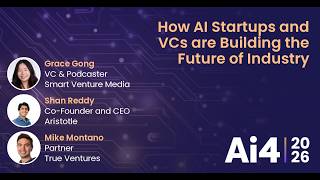
True Ventures, Aristotle See Open-Weight Harnesses Beating Frontier AI
Ai4
Vertical startups will survive platform risk only by owning proprietary task harnesses and fine-tuning open-weight models, as generalized frontier labs face misaligned incentives and degrade on specialized human workflows.
## Background
Published on YouTube by Ai4 on August 22, 2026, this panel features moderator Grace Gong (Smart Venture Media), Mike Montano (Partner at True Ventures), and Shan Reddy (Co-Founder and CEO of Aristotle). According to the video description, the session explores how forward-looking founders and investors are building AI-first companies, scaling in competitive markets, and creating enduring value in an era reshaping every industry.
## TL;DR
The panel explores how the commoditization of software engineering is shifting early-stage venture evaluation from raw coding ability toward domain obsession, user proximity, and lean, agent-augmented teams. Shan Reddy details how vertical startups can withstand foundation model platform risk by building specialized domain harnesses, training open-weight models, and adopting outcome-based business models like 'family deployed engineering' in education. Mike Montano contrasts inflated AI valuation hype with disciplined venture investing, emphasizing physical ground-truth moats across robotics and deep tech, while spotlighting consumer voice as an overlooked frontier. The discussion culminates in sharp reflections on the societal misalignment of AGI labs supplanted by human agency, the mainstreaming of consumer AI security demands, and the rise of autonomous agent-to-agent infrastructure.
## Atmosphere & style
The session carries an energetic, pragmatic, and remarkably candid tone, opening with a playful interactive crowd poll before diving into technical depth. Montano provides grounded, veteran operating insight from his decade scaling Twitter engineering, paired with Reddy's sharp, unfiltered founder perspective that openly challenges Silicon Valley consensus on frontier labs and valuations. It feels like an authentic, high-signal debrief among active builders that strips away generative AI hype to confront the real operational and economic mechanics of the tech landscape.
## Key takeaways
- [03:41](https://www.youtube.com/watch?v=rJt6WCICPjI&t=221s) Software construction has become commoditized, shifting early-stage venture evaluation from raw technical execution to customer obsession, domain mastery, and lean AI-agent automation.
- [07:43](https://www.youtube.com/watch?v=rJt6WCICPjI&t=463s) Thin API wrappers face high extinction risk from frontier labs, while specialized startups survive by building proprietary harnesses and intelligence tailored to domain-specific workflows.
- [07:43](https://www.youtube.com/watch?v=rJt6WCICPjI&t=463s) Frontier foundation models can regress on niche domain tasks like teaching even as reasoning and coding benchmarks rise, incentivizing startups to post-train open-weight models that slash inference costs by 10x to 100x.
- [11:25](https://www.youtube.com/watch?v=rJt6WCICPjI&t=685s) Physical and human-centric domains operate on long, lagging verification loops that frontier labs cannot easily simulate, creating durable defensibility for vertical startups.
- [14:07](https://www.youtube.com/watch?v=rJt6WCICPjI&t=847s) Autonomous agents capable of completing end-to-end tasks are replacing traditional per-seat SaaS licensing with outcome-based and usage-based pricing models.
- [16:37](https://www.youtube.com/watch?v=rJt6WCICPjI&t=997s) Continuous, real-time AI tracking of student problem-solving provides leading indicators of learning that challenge the century-old Prussian model of standardized testing.
- [23:24](https://www.youtube.com/watch?v=rJt6WCICPjI&t=1404s) Engineering teams no longer require massive headcount; top-tier talent amplified by AI agents and internal productivity tooling can achieve unprecedented execution velocity.
- [32:26](https://www.youtube.com/watch?v=rJt6WCICPjI&t=1946s) Consumer technology is experiencing an unprecedented reopening as incumbent defensive moats weaken, positioning voice and human-centric daily utilities as major untapped opportunities.
- [34:16](https://www.youtube.com/watch?v=rJt6WCICPjI&t=2056s) Physical AI companies generate durable moats by capturing proprietary, empirical ground-truth data from the physical world that cannot be scraped from the public internet.
- [38:37](https://www.youtube.com/watch?v=rJt6WCICPjI&t=2317s) Raising early rounds at inflated AI hype valuations creates severe downstream financing and recapitalization risks, giving measured outsider founders a structural advantage.
- [41:28](https://www.youtube.com/watch?v=rJt6WCICPjI&t=2488s) Because frontier AGI labs lack economic incentives to protect human workers from displacement, independent startups and civil society must build infrastructure that preserves human agency.
- [42:57](https://www.youtube.com/watch?v=rJt6WCICPjI&t=2577s) As autonomous AI agents assume direct control over personal data and sensitive user workflows, data privacy and security have shifted from passive preferences to mainstream market-moving requirements.
- [44:35](https://www.youtube.com/watch?v=rJt6WCICPjI&t=2675s) Software infrastructure is transitioning from human-facing graphic interfaces to Agent-to-Agent (A2A) architectures, where autonomous agents act as the primary users and buyers of developer tools.
## Detailed walkthrough
### [00:04](https://www.youtube.com/watch?v=rJt6WCICPjI&t=4s) Audience Interactive Poll and Introductions
Moderator Grace Gong kicks off the session with an interactive exercise to get a feel for the crowd, asking everyone to stand up and navigate through a succession of eliminations. She tells the founders in the room to sit down first, followed by the investors, then operators, and finally the rest of the attendees. She laughs and thanks the audience for choosing their panel out of roughly 400 competing sessions at the conference and successfully navigating the maze of hallways to reach the room.
```mermaid
flowchart TD
accTitle: Audience Filter by Roles
A["Conference Attendees"] --> B["Founders Sit Down"]
B --> C["Investors Sit Down"]
C --> D["Operators Sit Down"]
D --> E["Remaining Attendees Sit Down"]
```
Grace turns to the panelists for quick introductions, noting that Mike insisted founders go first. Shan Reddy introduces himself as co-founder and CEO of Aristotle, a San Francisco-based startup training AI models specifically for teaching, with the overarching mission of creating "the world's greatest tutor that any student can access anytime." Mike Montano follows with his background: he is a partner at True Ventures, a seed-stage venture fund that has deployed nearly $4 billion over the past 20 years, investing in founders at the earliest inflection points—often before they even have an idea.
Mike recounts his personal history in Silicon Valley, which began roughly 20 years ago when he immigrated from Canada. His first venture backer was Y Combinator, followed immediately by True Ventures. That startup was eventually acquired by Twitter in 2011 to establish Twitter's publishing and advertising analytics infrastructure. What Mike envisioned as a short stint turned into over a decade at Twitter, culminating in his role leading global engineering, where he scaled the organization from 1,500 to 3,000 engineers over four years while driving the integration of machine learning and neural networks into the core product. After departing Twitter at the end of 2021, Mike spent time angel investing and advising before joining True Ventures as a partner to help founders navigate the "zero to one" idea maze and build organizations differently in the AI era.
[03:41](https://www.youtube.com/watch?v=rJt6WCICPjI&t=221s) What Has (and Hasn't) Changed in Early-Stage Fundraising
Grace points out that while scaling an engineering team from 1,500 to 3,000 people was once a major badge of honor, startups today run lean with AI agents. She asks both panelists how venture evaluation is shifting—particularly as raw technical development becomes accessible to anyone and investor focus pivots heavily toward go-to-market execution.
Mike explains that the fundamental anchors of early-stage investing have remained identical: the caliber of the founder and the scale of the market. True Ventures continues to look for mission-driven founders willing to take massive personal and professional risks to capture huge, expanding markets. What has changed entirely, Mike emphasizes, is the commoditization of software construction. When Mike interviewed for Y Combinator back in 2008, what secured his team a spot was not the pitch idea, but the physical software they had already engineered and designed for a prior failed venture; in 2008, simply shipping complex software was technically arduous. Today, building software is trivial. Investors instead scrutinize whether founders possess an obsessive connection to their end users, domain mastery, and novel approaches to building organizations that leverage AI automation rather than relying solely on traditional computer science pedigree.
Shan agrees that shipping code has never been easier, but argues that building a product people genuinely love and return to is harder than ever. He points out that the web has become saturated with cookie-cutter, AI-generated frontends sharing the identical design systems and palettes, remarking that "the internet is filling with slop." In this environment, differentiation requires an obsessive proximity to users, distinctive taste, and defensibility at the underlying intelligence layer rather than simply skinning existing frontier models.
- Seed investing anchors remaining constant: high-conviction founders with a clear sense of purpose and massive addressable markets.
- Shift in technical moats: in 2008, technical execution alone could secure VC backing; in 2026, writing code is a commodity.
- Organizational impact: startups are rethinking team headcount by automating core workflows with AI agents.
[07:43](https://www.youtube.com/watch?v=rJt6WCICPjI&t=463s) Dodging the Frontier Model Steamroller: Education as a Wedge
Grace addresses the looming threat of platform risk—often referred to as being "Clauded"—where frontier model labs like Anthropic and OpenAI continuously expand their scope, steamrolling thin startup wrappers. She asks how founders can construct defensible moats under this pressure.
Shan notes that it would be irrational for any AI founder to claim they are not worried about Anthropic or OpenAI. However, defensibility comes down to aligning company incentives and owning specialized intelligence. Frontier labs prioritize generalized intelligence, multi-step agentic reasoning, and complex coding benchmarks. In contrast, Aristotle's entire existence revolves around pedagogical pedagogy: untangling student misconceptions, pacing instruction, and achieving tangible learning outcomes. Shan reveals that as frontier labs release newer reasoning models—such as the recent Anthropic models—the models have actually *regressed* on Aristotle's internal teaching evaluations. While the models are getting sharper at longitudinal coding and complex engineering tasks, they are actively getting worse at teaching.
```mermaid
flowchart LR
accTitle: Frontier Labs vs Specialized Education Stack
subgraph Frontier["Frontier AI Labs (Anthropic / OpenAI)"]
direction TB
F1["Coding & Complex Logic"]
F2["Generalized Reasoning"]
F3["Regressing on Teaching Evals"]
end
subgraph Aristotle["Aristotle Specialty Stack"]
direction TB
A1["Pedagogical Models"]
A2["Student Confusion Resolution"]
A3["Domain-Specific Learning Evals"]
end
Frontier -.->|Incentive Mismatch| Aristotle
```
Aristotle counters this by assembling in-house learning specialists and top educational AI researchers to train proprietary models explicitly optimized for education—a space the major labs lack the incentive to deeply tailor for. Shan concludes with a sharp distinction for startups in the generative era: while thin "wrappers" that merely repackage raw API outputs will inevitably die, well-engineered "harnesses" that govern intelligence and build end-to-end domain expertise will survive and thrive.
- **The Teaching Paradox**: Frontier models demonstrate noticeable regressions on pedagogical evaluations even as their benchmark scores for coding and multi-step reasoning climb.
- **Incentive Alignment**: Major foundation model labs focus on horizontal enterprise intelligence, leaving vertical learning workflows underserved.
- **Survival Metric**: Pure thin wrappers around third-party APIs face extinction, whereas specialized harness architectures with customized intelligence are positioned to endure.
[11:25](https://www.youtube.com/watch?v=rJt6WCICPjI&t=685s) Harness Ownership and the Shift to Post-Trained Open-Weight Models
In domains like software engineering, verification loops are short and immediate: foundation model labs can run thousands of automated feedback loops over vast datasets, driven by engineers building for engineers. In contrast, physical and human-centric domains—such as healthcare and education—operate on long, lagging verification cycles. A parent evaluating whether an educational tool works cannot simulate a college admission or an exam result overnight; validation takes three to six months. Because foundation labs cannot easily simulate these physical-world loops, startups have a distinct opportunity to build and own the "harness layer" on both the consumer and enterprise sides. Enterprises are unwilling to hand over their proprietary IP and context to third-party labs, giving startups a strong moat in managing orchestration, IP preservation, memory, and model interchangeability.
The operational strategy around foundation models has shifted radically. While startups previously scrambled to adopt every incremental state-of-the-art closed model regardless of fit, the ecosystem is now pivoting toward open-weight models that are post-trained specifically on proprietary workflows. Closed, long-horizon foundation models are often slow, prohibitively expensive, and may even degrade in quality when applied to narrow, specialized domains. Running fine-tuned open-weight models on a startup's internal stack can slash inference costs by one to two orders of magnitude, freeing up substantial margin to invest directly into user experience and product development.
```mermaid
flowchart TD
accTitle: Closed Foundation Models vs Specialized Open-Weight Stacks
subgraph ClosedLabs["Generalist Frontier Models"]
A["Proprietary Closed Model API"] --> B["High Latency & Expensive Compute"]
B --> C["Generic Reasoning / Degradation on Niche Tasks"]
end
subgraph StartupHarness["Domain-Specific Startup Harness"]
D["Open-Weight Base Model"] --> E["Post-Training on Domain Data"]
E --> F["Proprietary Harness & Memory Layer"]
F --> G["10x-100x Lower Inference Costs"]
F --> H["Continuous Domain-Specific Reward Loop"]
end
```
- **Short vs. Long Horizon Loops:** Coding tools provide instant test pass/fail signals, whereas education and healthcare outcomes require months of real-world observation.
- **Cost Reduction:** Running a post-trained open-weight model on private infrastructure frequently delivers a 10x to 100x cost reduction compared to generic frontier API calls.
- **Builder Rubric:** Founders building on top of foundational models must always ask: *"What happens when the underlying model gets 10 times better?"*
---
[14:07](https://www.youtube.com/watch?v=rJt6WCICPjI&t=847s) Outcome-Based Pricing and "Family Deployed Engineering"
The shift toward autonomous AI agents is disrupting traditional per-seat SaaS pricing models (such as paying $10.99 per seat across a 500-person enterprise). Because AI agents can execute entire end-to-end workflows rather than merely serving as productivity software for human seats, startups are transitioning toward outcome-based and usage-based pricing.
To deliver personalized value in an education market where outcomes are hard to evaluate, Aristotle borrows from enterprise playbooks. Inspired by the forward-deployed engineering model popularized by Palantir—where technical staff embed directly with clients to manage non-deterministic AI behavior—Aristotle utilizes "family deployed engineers." These engineers work directly with parents and students to customize the AI tutor for their specific curriculum and learning requirements.
```mermaid
flowchart LR
accTitle: Evolution of Software Business Models
subgraph TraditionalSaaS["Traditional SaaS"]
A["Per-Seat License<br/>(e.g., $10.99/user/mo)"] --> B["Software as a Tool"]
end
subgraph AgenticPricing["AI-Native Delivery"]
C["Family / Forward Deployed Engineers"] --> D["Custom AI Tutor / Agent"]
D --> E["Outcome & Progress-Based Pricing"]
end
```
- **SaaS Pricing Evolution:** Moving away from per-seat subscriptions toward pricing tied to completed tasks, usage, and verified educational outcomes.
- **Buyer Persona in EdTech:** Parents are the primary economic buyers of tutoring services, whereas motivated students seeking tutoring directly remain the exception.
- **Family Deployed Engineers:** Direct engineering support helps bridge the non-deterministic nature of generative models and tailors the AI agent to the family's specific academic goals.
---
[16:37](https://www.youtube.com/watch?v=rJt6WCICPjI&t=997s) Transforming Education: Continuous Leading Indicators vs. Prussian Testing
Modern American schooling relies heavily on the "Prussian model"—a system established roughly a century ago that sorts students strictly by age and evaluates them through periodic, standardized assessments like the SAT, ACT, state exams, or TOEFL. These infrequent evaluations serve only as lagging indicators, offering poor insight into a child's day-to-day cognitive growth or specific learning roadblocks.
By contrast, an AI tutor observing thousands of problem attempts, struggle points, and time-of-day learning variations builds an internal reward function that traditional testing cannot match. Drawing on parallels to tracking leading versus lagging metrics during Twitter's growth, early trust is built by surfacing continuous leading indicators to parents (such as weekly concept mastery and knowledge transfer across domains) long before a standardized test score arrives three to six months later. Historically, 1-on-1 personalized tutoring has been the gold standard of education for millennia; AI makes scaling this bespoke approach economically viable for the first time.
- **Prussian Model Limitations:** Batching students into age-based cohorts with standardized testing is a relatively recent, one-size-fits-all institutional structure.
- **Continuous Reward Function:** Tracking student problem-solving over hundreds of hours creates a real-time assessment of ability, eliminating reliance on stressful, high-stakes test snapshots.
- **Value Migration:** As underlying models commoditize, defensive value is concentrating at the application and user-experience layer, where personalized learning interfaces and trust-building feedback loops are managed.
[21:52](https://www.youtube.com/watch?v=rJt6WCICPjI&t=1312s) The Shift to Multiplayer AI and One-Person Companies
Grace Gong opens the discussion by highlighting the rise of the "one-person company" and the ambition to build one-person billion-dollar startups using agentic workflows. Citing tools like Polsia, whose founder appeared on her show to discuss building an end-to-end stack for solo founders, she notes how rapidly workflows are evolving across platforms like Microsoft Teams and Slack. Slack's recent Model Context Protocol (MCP) integrations, for instance, facilitate true "multiplayer AI" environments where team members interact seamlessly alongside each other's custom AI agents. With software infrastructure transitioning from purely human teams to mixed human-agent setups, Gong asks Mike Montano and Shan Reddy how they currently evaluate what to build in-house versus who to hire.
```mermaid
flowchart TD
accTitle: Multiplayer AI Collaboration Framework
accDescription: Diagram showing human and agent collaboration across modern organizational platforms.
subgraph Platform["Multiplayer Workspace (Slack MCP / Teams)"]
H1["Founder / Engineer"] <--> A1["AI Coding & GTM Agents"]
H2["VC / Advisor"] <--> A2["AI Co-Workers & SDRs"]
H1 <--> H2
A1 <--> A2
end
Platform --> Output["Rapid Prototyping & High-Velocity Execution"]
```
[23:24](https://www.youtube.com/watch?v=rJt6WCICPjI&t=1404s) Internal AI Tooling, Leverage, and Evaluating Engineering Talent
Responding from an investor's perspective, Mike Montano explains that venture capitalists historically looked at pitch deck team slides purely to evaluate founder pedigree, networks, and traditional hiring roadmaps. Today, investors must assess how effectively founders augment their core personnel with internal AI agents and co-workers. Montano reflects on his background as an engineer, noting that twenty years ago, advising early-stage founders to spend time building internal productivity tooling was considered terrible advice because they needed to focus strictly on customer feedback. In the current paradigm, however, middle-layer infrastructure is still maturing, and founders can build high-leverage internal teammates in a matter of weeks rather than years. Montano recalls being initially skeptical of custom internal tooling Shan was building at Aristotle, only to realize its immense value once Shan showed it had taken just two weeks to create, drastically boosting execution velocity while conserving capital.
Shan Reddy addresses how this technological shift fundamentally changes technical hiring. He observes that AI acts as an amplifier: engineers who were mediocre before AI are now significantly worse because they lean on sloppy generated outputs, while top-tier engineers have become exponentially more capable. When evaluating candidates, Aristotle continues to test core systems engineering, technical caliber, and product intuition both with and without AI. Shan emphasizes that working with AI requires a distinct, emerging skill set: the ability to parse dense, messy code outputs from language models and cleanly untangle complex codebases after autonomous agents have run through them.
- **Capital Efficiency over Headcount:** Montano stresses that outside of a few massive tech incumbents, building 3,000-person engineering organizations is no longer necessary or justifiable.
- **Evaluation Criteria:** Aristotle filters candidates for fundamental systems thinking first, then checks whether they possess the curiosity and discipline to leverage AI agents effectively without introducing architectural debt.
[27:17](https://www.youtube.com/watch?v=rJt6WCICPjI&t=1637s) Founder-to-Founder Networks and Frontier Knowledge Sharing
Montano points out that the rapid evolution of the AI stack alters the traditional relationship between venture capitalists and founders. While human mentorship and decades of operating experience remain crucial, traditional VC "armchair advice" often fails to apply to frontier agent stacks, AI-driven sales development representatives (AI SDRs), and modern go-to-market workflows that didn't exist even a few years ago. Consequently, the greatest value an investor can offer is connecting founders directly with other active builders who operate on the cutting edge. Montano highlights that True Ventures leverages a dense network of repeat entrepreneurs—including over 60 founders backed more than twice and several backed up to five times—with more than half of firm deal flow driven by founder referrals.
Shan affirms the power of this peer network, mentioning that Aristotle frequently consults with fellow True Ventures portfolio founders, such as the creator of Polsia. Although Aristotle focuses heavily on core agent engineering and technical problem-solving, having immediate access to builders who are pioneering AI-native go-to-market and marketing automation allows them to construct modern consumer acquisition channels rapidly without reinventing the wheel.
> "A lot of how you need to build as a founder today isn't how I built technology 15 years ago, 20 years ago, 10 years ago, even 5 years ago... They need access to founders at the frontier and they need signal, not noise." — Mike Montano
[30:06](https://www.youtube.com/watch?v=rJt6WCICPjI&t=1806s) Consumer Standards, Go-to-Market Strategy, and AI-Driven Funnels
Grace steers the conversation toward go-to-market execution and product differentiation, observing that ubiquitous consumer tools like ChatGPT and Anthropic have dramatically raised end-user expectations across both consumer applications and enterprise B2B SaaS. Users now expect seamless, highly responsive intelligence across all professional software interfaces.
Shan explains that while customer acquisition fundamentals remain consistent, AI completely transforms operational velocity across the consumer funnel:
- **Automated Quality Assurance:** Autonomous coding agents continuously analyze user sessions, diagnosing and resolving application bugs, performance bottlenecks, and failures faster than human QA teams previously could.
- **Classic Funnel Bottlenecks:** The core phases of consumer conversion remain the same: the initial ad impression, the sign-up conversion funnel, and the post-onboarding product experience.
- **Hyper-Scale A/B Testing:** Rather than altering the underlying nature of marketing funnels, AI allows teams to generate, deploy, and rigorously test massive variations across every step of the conversion funnel in real time.
[32:26](https://www.youtube.com/watch?v=rJt6WCICPjI&t=1946s) The Untapped Frontier in Consumer AI and Voice
A major shift is quietly underway in consumer technology, marking the first time in over a decade that the consumer landscape has genuinely opened up to newcomers. Throughout the prior era, dominant social platforms held an insurmountable defensive moat; incumbent giants like Twitter and Facebook could instantly copy and neutralize any emerging product that gained modest traction. That dynamic has been shattered by fundamental shifts in consumer habits and interaction patterns. ChatGPT demonstrated this paradigm shift by expanding almost exclusively through organic word-of-mouth, becoming the fastest-growing consumer technology product in history.
```mermaid
flowchart TD
accTitle: Evolution of Consumer Tech Barriers
subgraph Past["The Past Decade: Platform Monopolies"]
Incumbents["Incumbent Giants<br/>(Twitter, Meta)"] -->|"Instant feature cloning"| Moat["High Defensive Moat<br/>Startups Stifled"]
end
subgraph Present["The Present Era: AI Paradigm Shift"]
Habits["Shifted Consumer Behaviors<br/>(ChatGPT Word-of-Mouth)"] --> Modalities["Emerging Modalities & Form Factors<br/>(Voice, Novel Hardware)"]
Modalities --> Needs["Solving Fundamental Needs<br/>(Human Connection, Daily Life)"]
end
```
With interfaces, form factors, and hardware now fully up for grabs, voice stands out as a massively underrated modality poised for transformation once key technical hurdles are crossed. While roughly two billion people already interact with consumer AI tools regularly, consumer spending has lagged behind engagement. As applications evolve from novelties into tools that address fundamental human needs—such as genuine connection and life essentials—monetization will catch up. This inflection point arrives precisely as mainstream venture capital has pulled back from consumer investments over recent years, leaving an open field with far less competition for ambitious founders.
---
[34:16](https://www.youtube.com/watch?v=rJt6WCICPjI&t=2056s) Physical AI, Deep Tech Diligence, and Real-World Ground Truth
The conversation shifts toward physical AI and the complex operational challenges of merging custom hardware manufacturing with advanced software models. True Ventures approaches this frontier through a founder-driven philosophy rather than rigid thematic mandates concocted in annual partner meetings. By following founders across their broader network, the firm established an early track record backing tangible, real-world consumer hardware and physical brands, including Blue Bottle Coffee, Peloton, Fitbit, and Ring. Because evaluating deep domains like robotics and biotechnology demands technical expertise beyond internal partner backgrounds, the firm systematically relies on its existing portfolio founders to assist in diligence.
```mermaid
flowchart LR
accTitle: Real-World Data Gathering to AI Moat
subgraph PhysicalAcquisition["Field Acquisition"]
A["Extreme Environments<br/>(Antarctic, Rainforests, Plants)"]
B["Mass Spectrometry & Field Indexing"]
end
subgraph ProprietaryMoat["AI Platform Layer"]
C["Proprietary Biological & Satellite Data"]
D["Novel Drug Discovery & Earth Observation"]
end
A --> B --> C --> D
```
This model is reflected in portfolio companies bridging AI with empirical physical data:
- **Enveda Biosciences**: Conducts high-throughput mass spectrometry on thousands of medicinal plant species, systematically transforming historical botanical remedies into a proprietary molecular database for novel drug discovery.
- **Basecamp Research**: Dispatches teams to extreme geographic environments—from the Antarctic to remote rainforests—to sequence and index rare proteins, creating foundational biological training sets that cannot be scraped from the public internet.
- **ICEYE**: Deploys constellations of compact, persistent synthetic-aperture radar (SAR) satellites to deliver uninterrupted earth observation data.
While Shan Reddy notes that Aristotle remains entirely focused on software without physical hardware ambitions, he observes that the sheer momentum across robotics—spanning factory automation to humanoid assistants in the home—will define the coming decade. Outside robotics startups like Bedrock Robotics (applying autonomous heavy-equipment technology born out of Waymo to bulldozers) and Dexterity (deploying industrial manipulation robots across warehouse logistics) underscore how automation is commanding multi-billion-dollar valuations across industrial infrastructure and real estate.
---
[38:37](https://www.youtube.com/watch?v=rJt6WCICPjI&t=2317s) The Valuation Trap and the Advantage of Outsider Founders
Venture valuations across AI have grown noticeably detached from real-world business fundamentals, with massive pools of capital bidding up the same narrow pool of high-profile startups. Yet venture history repeatedly proves that generation-defining companies are rarely built by consensus insiders; they are forged by outsiders who diverge from conventional Silicon Valley resumes and large research lab pedigrees to tackle unglamorous, highly lucrative industries. For an early-stage firm deploying initial checks between $1 million and $5 million, chasing hype-fueled rounds at inflated entry prices degrades long-term fund performance and undermines alignment with founders.
Founders who raise at excessive valuations face severe structural risks:
| Strategy Aspect | Chasing Peak Valuation | Measured Capitalization Strategy |
|:--- |:--- |:--- |
| **Next-Round Bar** | Sets unrealistically steep ARR targets for Series A/B | Keeps downstream revenue multiples achievable |
| **Operational Focus** | Treats fundraising announcements as victory milestones | Treats fundraising as an intermediate checkpoint |
| **Down-Market Resilience** | High vulnerability to down-rounds, recapitalizations, and dilution | Retains control over company destiny and runway |
| **Founding Timeline** | Prioritizes short-term paper valuation velocity | Operates on a realistic 7-to-10-year enterprise horizon |
Because enterprise fundraising rounds establish aggressive benchmarks for subsequent financing, seasoned repeat founders deliberately pace their valuations to protect their ownership, ensure operational flexibility, and navigate the multi-year grind required to build enduring companies.
---
[41:28](https://www.youtube.com/watch?v=rJt6WCICPjI&t=2488s) Hot Take: The AGI Labs and the Displacement of Human Agency
Asked for an unscripted hot take on the AI landscape, Shan Reddy challenges the implicit direction of the leading frontier research organizations. Within San Francisco tech circles, consensus has settled on the belief that Artificial General Intelligence (AGI) and Artificial Superintelligence (ASI) will arrive in the near future, rendering standard human knowledge work obsolete. Prominent lab founders publicly voice grave ethical and societal anxieties in essays and manifestos regarding this impending obsolescence, yet their corporate architecture remains directly misaligned with solving it.
The provocative contradiction at the heart of the AI ecosystem is that frontier labs—funded by trillions of institutional dollars and fueled by the industry's premier engineering minds—are actively racing to develop systems that supplant human labor. Because those frontier labs will privately own and control that synthetic intelligence, they face virtually no commercial incentive to solve what happens to ordinary people after human capabilities are eclipsed. The ultimate responsibility lands squarely on independent startups, peripheral industries, and civil society to build the defensive infrastructure and software tooling necessary to ensure humanity preserves agency, economic relevance, and a permanent place in the technological future.
[42:57](https://www.youtube.com/watch?v=rJt6WCICPjI&t=2577s) Consumer Privacy and Security as Mainstream AI Demands
The panel reflects on consumer adoption, noting that while consumer AI and voice applications are wide-open frontiers, privacy and security are reaching a critical turning point. Historically, users have been willing to sacrifice their privacy for convenience and social utility—succumbing to network effects like staying on Instagram because all their friends are there. However, autonomous AI agents handle deeply personal data and exercise direct agency over user tasks, which fundamentally changes the equation.
Consumers will soon demand rigorous privacy and trust from AI platforms in a way that actively moves the market. Companies that fail to prioritize security or experience lapses in user trust risk immediate abandonment. The urgency around AI security is underscored by real-world fraud vectors, such as malicious actors generating voice and video clones of individuals to run extortion or impersonation scams against family members. As AI models become capable of acting autonomously on personal data, privacy is shifting from a passive luxury into an absolute mainstream requirement.
- **Market-Moving Privacy**: Users will no longer tolerate data exploitation once AI agents are granted operational control over sensitive workflows and accounts.
- **Immediate Repercussions for Startups**: AI platforms that slip up on trust and security will face rapid churn, making data integrity a core retention metric.
- **Identity and Impersonation Risks**: The weaponization of generative media—such as cloned voices targeting relatives for money—has elevated cybersecurity from an enterprise concern to everyday consumer defense.
---
[44:35](https://www.youtube.com/watch?v=rJt6WCICPjI&t=2675s) The Shift to Agent-to-Agent Software and Infrastructure
The paradigm of software design is undergoing a massive shift from human-facing applications toward "Agent-to-Agent" (A2A) architectures. While designing tools for human visual and cognitive preferences has driven software for decades, founders are now building native agent equivalents of familiar products, such as agent-focused email systems, design tools (the "AI agent version of Figma"), and optimized data infrastructure (such as specialized KV cache architectures serving as the "agent version of Databricks"). Because AI agents process information and prioritize workflows fundamentally differently than people do, software interfaces must be rebuilt from the ground up to serve autonomous digital workers.
```mermaid
flowchart TD
accTitle: Human-Centric vs Agent-to-Agent Infrastructure
subgraph HumanInteraction["Traditional Human Paradigm"]
H["Human User"] --> WB["Standard Web Browser"]
WB --> UI["Predictable UI & Web Pages"]
UI --> DB1["Standard Relational DB"]
end
subgraph AgentInteraction["Agent-to-Agent Paradigm"]
A["Autonomous AI Agent"] --> MW["Agent Middleware & Orchestration"]
MW --> PAR["Parallel Task Execution & Non-Deterministic Calls"]
PAR --> A2A["Agent-to-Agent APIs & Agent-Native Storage"]
end
```
Beyond application software, agent infrastructure represents an untapped frontier outside the major frontier research labs. The way AI agents traverse the internet departs entirely from human browsing: while human web traffic involves predictable page loads and sequential clicks, agents spin up hundreds of parallel tasks, require dynamic orchestration, communicate through automated messaging, and exhibit non-deterministic behavior. This dynamic creates an impending "golden era of infrastructure" centered on agent middleware, where AI agents themselves—rather than human IT buyers—will act as the primary purchasers and consumers of developer software.
- **Agent-First Tooling**: New software categories are emerging where AI agents communicate directly with other agents without intermediate human-centric graphic interfaces.
- **Divergent Traffic Patterns**: Agent network usage is non-deterministic, highly concurrent, and demands specialized orchestration and database architectures distinct from traditional HTTP web traffic.
- **Agents as Software Buyers**: As automated workflows take over decision-making, the next generation of enterprise middleware will be selected and purchased directly by autonomous agents.
## Notable quotes
> [00:04](https://www.youtube.com/watch?v=rJt6WCICPjI&t=4s) the world's greatest tutor that any student can access anytime. — Shan Reddy
> [03:41](https://www.youtube.com/watch?v=rJt6WCICPjI&t=221s) the internet is filling with slop. — Shan Reddy
> [11:25](https://www.youtube.com/watch?v=rJt6WCICPjI&t=685s) What happens when the underlying model gets 10 times better? — Shan Reddy
> [27:17](https://www.youtube.com/watch?v=rJt6WCICPjI&t=1637s) A lot of how you need to build as a founder today isn't how I built technology 15 years ago, 20 years ago, 10 years ago, even 5 years ago... They need access to founders at the frontier and they need signal, not noise. — Mike Montano
## Video description
Grace Gong - VC & Podcaster, Smart Venture Media
Mike Montano - Partner, True Ventures
Shan Reddy - Co-Founder and CEO, Aristotle
The AI era is reshaping every industry, and the most ambitious startups—backed by forward-looking investors—are at the center of that transformation. This session brings together pairs of founders and their VCs for a candid conversation on how they’re tackling big problems, scaling in competitive markets, and navigating the unique challenges of building AI-first companies. Panelists will share perspectives on where the biggest opportunities lie, how to balance speed with responsibility, and what it takes to create enduring value in a rapidly evolving landscape. Expect an insider’s look at how entrepreneurs and investors are partnering to shape the next wave of industry leaders in the age of AI.
True Ventures 与 Aristotle 认为开放权重框架将超越前沿 AI
垂直领域初创公司只有掌控专有任务框架并微调开放权重模型,才能抵御平台风险;而通用前沿实验室则面临动机失谐的问题,并在专业人类工作流的表现上出现退化。
该研讨深入探讨了软件工程的商品化如何促使早期风投评估重心从单纯的编程能力,转向对特定领域的极致专注、贴近用户以及由智能体赋能的精简团队。Shan Reddy 详细阐述了垂直初创公司如何通过构建专有领域框架、训练开放权重模型,并采用教育领域“家庭部署工程”等基于结果的商业模式,来抵御基础模型带来的平台风险。Mike Montano 将膨胀的 AI 估值炒作与审慎的风投策略进行了对比,强调机器人与深科技领域中物理真实世界事实所构筑的护城河,同时指出消费级语音是一个被忽视的前沿方向。讨论最后深刻反思了 AGI 实验室与人类自主权之间的社会性失谐、消费级 AI 安全需求的主流化,以及自主智能体间基础设施的兴起。
软件构建已彻底走向商品化,早期风投的评估重心已从单纯的技术交付能力,转向创始人对用户的极致洞察、垂直领域认知以及利用 AI Agent 驱动的极简团队架构。 (3:41)
简单的 API 套壳应用正面临被前沿模型实验室碾压的高风险,初创企业的生存关键在于构建专有的 Harness 架构与适配垂直业务流的专有智能。 (7:43)
通用前沿模型在编程等逻辑基准上升的同时可能在教育等专业领域发生能力退化,促使初创企业后训练开源权重模型,从而将推理成本大幅削减 10 至 100 倍。 (11:25)
能够自主端到端交付结果的 AI Agent 正在颠覆传统的按席位订阅 SaaS 模式,推动商业化全面转向基于任务交付与实际成效的结果计费体系。 (14:07)
消费级科技领域十年来固化的巨头护城河正被打破,随着交互习惯向语音等新模态迁移,聚焦人类基本需求与日常实用价值的应用迎来了巨大的窗口期。 (32:26)
Reading summary
As basic software creation becomes commoditized, early-stage AI startups must establish moats through domain-specific intelligence harnesses, proprietary data loops, and lean organizational leverage rather than relying on thin wrappers around frontier models, according to True Ventures partner Mike Montano and Aristotle CEO Shan Reddy.
Domain Harnesses and Post-Trained Models (7:43)
While writing software in 2008 was technically difficult, Mike Montano explains that building code has become trivial, shifting venture evaluation toward founder connection to end users and domain mastery. Shan Reddy notes that simply wrapping frontier models creates undifferentiated products, warning that the web is filling with generic AI-generated interfaces. Furthermore, foundation model labs optimize for horizontal reasoning and coding benchmarks, which Reddy states has caused recent frontier models to regress on pedagogical evaluations. To insulate against platform risk, startups in physical or human-centric domains—such as healthcare and education—rely on long-horizon feedback loops that foundation labs cannot easily simulate.
Rather than chasing closed, expensive frontier APIs, startups are increasingly fine-tuning open-weight models on proprietary workflows. Montano and Reddy emphasize that self-hosting post-trained open models can reduce inference costs by 10x to 100x. This structural cost advantage protects margins and allows founders to build end-to-end harnesses that preserve proprietary context and intellectual property.
Lean Headcounts and Amplified Technical Hiring (23:24)
The widespread deployment of AI agents has shifted early-stage startup architecture away from large engineering teams. Montano, who previously scaled Twitter's engineering from 1,500 to 3,000 employees, contends that massive headcount is no longer justifiable or necessary. Instead, investors evaluate how founders augment themselves with internal AI tooling and agents, which can now be prototyped in weeks to accelerate velocity while conserving seed capital.
At the same time, Reddy observes that AI acts as an amplifier: it makes mediocre programmers worse because they lean on sloppy generated outputs, while top engineers become exponentially more productive. Aristotle evaluates engineering candidates on core systems thinking and their ability to untangle complex codebases after autonomous agents have modified them. Montano adds that because agent workflows are evolving rapidly, traditional venture capital advice is often obsolete; founders increasingly depend on peer networks of active builders to navigate modern AI-driven sales and go-to-market pipelines.
Outcome-Based Pricing and Physical Data Moats (14:07)
Agentic automation is challenging traditional per-seat enterprise SaaS pricing. Because AI executes end-to-end work rather than functioning as a passive productivity tool, pricing models are transitioning toward delivered outcomes and completed tasks. To bridge model non-determinism in education, Aristotle employs 'family deployed engineers' inspired by Palantir's enterprise deployment model to adapt AI tutors directly to student curricula, using continuous problem-solving metrics as leading indicators of mastery rather than relying on lagging standardized tests.
Defensive value is also concentrating in physical-world data acquisition where public web data cannot suffice. True Ventures backs companies pairing AI with empirical collection, such as Enveda Biosciences using mass spectrometry on medicinal plants, Basecamp Research sequencing proteins in extreme environments, and ICEYE deploying radar satellites. Montano cautions founders against chasing inflated entry valuations for these operations, pointing out that aggressive paper valuations create unrealistic revenue hurdles for downstream rounds and vulnerability to down-rounds.
Consumer Trust and Agent-to-Agent Infrastructure (44:35)
Shifts in consumer behavior are unlocking consumer technology opportunities for the first time in a decade, particularly through voice interfaces that address fundamental human needs. However, as autonomous agents gain operational control over personal accounts, consumer tolerance for data exploitation is evaporating. The emergence of malicious voice and video cloning scams is elevating data security and privacy from enterprise compliance concerns into mainstream consumer retention requirements.
Simultaneously, software design is transitioning toward 'Agent-to-Agent' (A2A) architectures. Unlike human browsing patterns characterized by predictable page views and clicks, autonomous agents spin up hundreds of parallel tasks and generate non-deterministic traffic. Montano and Reddy outline an emerging era of agent middleware—spanning specialized key-value cache systems, agent-native databases, and automated coordination protocols—where autonomous software agents, rather than human IT procurement teams, will serve as the primary buyers and consumers of infrastructure.
Shan Reddy argues that while frontier research labs aggressively pursue synthetic general intelligence aimed at supplanting human labor, their corporate structures lack the commercial incentive to address the displacement of ordinary workers. Consequently, the responsibility falls onto independent startups to design domain-specific tooling that safeguards human agency and economic relevance.
## Background
本内容由 Ai4 频道于 2026 年 8 月 22 日发布在 YouTube 平台上,记录了一场题为《AI 初创企业与风投如何构建未来产业》的高峰圆桌论坛。活动由 Smart Venture Media 的 Grace Gong 主持,邀请了 True Ventures 合伙人 Mike Montano 与 Aristotle 联合创始人兼 CEO Shan Reddy,共同探讨 AI-first 企业在技术变革期如何攻克规模化挑战、平衡发展速度与社会责任,并在激烈的行业演进中建立长期壁垒。
## TL;DR
对话深入拆解了生成式 AI 时代初创公司与风险投资范式的底层重构。嘉宾指出,代码编写与前端构建已被高度商品化,单纯套壳调用 API 的初创公司注定消亡,真正的壁垒转向了垂直深耕的 Harness 线束架构、私有数据飞轮与极致产品品味。讨论还涵盖了从按席位收费转向按成果交付的商业化变革、精益人机协作对千人研发大团队的替代、物理世界 AI 的突破性布局,以及面向未来“Agent-to-Agent”智能体专用基础设施的巨大机遇与安全伦理挑战。
## Atmosphere & style
整场对谈气氛极具硅谷极客务实风采与前沿洞察力,既有破冰时的幽默风趣,又有对行业同质化现状(如“AI Slop”与套壳必亡论)的尖锐批判。投资人与创业者之间形成了默契的技术与商业共振,从早期工程经验的沉淀层层推进到对人类主体性存亡的深刻反思。听众能切身感受到一线构建者在技术剧变前沿的清醒与紧迫感,既充满对消费级与物理世界 AI 的创新亢奋,又保持着对估值泡沫与安全信任的冷静克制。
## Key takeaways
- [03:46](https://www.youtube.com/watch?v=rJt6WCICPjI&t=226s) 软件构建与代码生成已被高度商品化,单纯的技术实现不再构成壁垒,极具审美质感的用户体验、对客户需求的极致洞察以及模型自主权成为竞争核心。
- [07:42](https://www.youtube.com/watch?v=rJt6WCICPjI&t=462s) 前沿通用大模型在长程编程上持续提升,但在垂直教学与启发式引导评测中反而出现退化;只做浅层调用的套壳(Wrappers)公司注定消亡,构建底层垂直系统与深度线束架构(Harnesses)才能生存。
- [11:25](https://www.youtube.com/watch?v=rJt6WCICPjI&t=685s) 基于开源权重模型(Open-weights)进行专项后训练(Post-training),在自建栈上运行特定垂直场景的成本可比调用前沿商业 API 降低 10 到 100 倍,极大拓展了初创企业的毛利空间。
- [14:07](https://www.youtube.com/watch?v=rJt6WCICPjI&t=847s) 传统 SaaS 按人头席位订阅(Per-Seat)的模式正被颠覆,AI 时代端到端自主交付的特性推动商业计费向按成果(Outcome-based)和按用量(Usage-based)转型。
- [16:01](https://www.youtube.com/watch?v=rJt6WCICPjI&t=961s) 传统标化考试等滞后指标周期漫长,AI 导师通过上千次高频交互构建实时认知图谱,将教育成效验证从“数月一次”转化为日常可见的先行指标反馈。
- [18:37](https://www.youtube.com/watch?v=rJt6WCICPjI&t=1117s) AI 正在打破拥有百年历史的流水线式普鲁士大班教育体系,以极低边际成本让人人享有历史上属于特权阶层的“一对一专属导师”。
- [23:17](https://www.youtube.com/watch?v=rJt6WCICPjI&t=1397s) AI 时代不再需要组建数千人的庞大工程团队,精益核心团队搭配自研 AI Agent 虚拟队友,能以极高资本效率在数周内撬动巨大业务体量。
- [25:42](https://www.youtube.com/watch?v=rJt6WCICPjI&t=1542s) 工程师招聘逻辑发生巨变:优秀的工程师借助 AI 变得更强,而平庸的开发者则更差;核心门槛转向底层系统架构思维以及为 AI 密集但混乱的代码进行“排雷理顺”的能力。
- [27:11](https://www.youtube.com/watch?v=rJt6WCICPjI&t=1631s) 投资人的传统经验在飞速演进的 AI 技术栈前逐渐失效,早期创始人更需要链接最前沿的一线同侪创业者(Frontier Builders)社区以获取高纯度实战经验。
- [32:26](https://www.youtube.com/watch?v=rJt6WCICPjI&t=1946s) 全球近 20 亿常规 AI 用户的行为习惯已被彻底重塑,随着风投资本从消费端撤退留出生态真空,逆周期构建消费级 AI 应用与语音交互迎来十年一遇的窗口期。
- [34:16](https://www.youtube.com/watch?v=rJt6WCICPjI&t=2056s) 物理世界 AI(Physical AI)正通过极端环境采样、高通量质谱分析与雷达卫星等手段构建专属私有数据库,深度改造生命科学与工业制造。
- [38:37](https://www.youtube.com/watch?v=rJt6WCICPjI&t=2317s) 早期过高估值是在人为抬高下一轮营收门槛,真正颠覆性的伟大企业往往由深耕垂直传统大行业的“局外人”打造,创业需要保持 7 到 10 年的资本耐心。
- [41:28](https://www.youtube.com/watch?v=rJt6WCICPjI&t=2488s) 顶级 AI 实验室在机制上缺乏思考“人类被取代后何去何从”的动力,初创团队和全社会必须主动构建增强人类主体性与个体价值的工具。
- [42:57](https://www.youtube.com/watch?v=rJt6WCICPjI&t=2577s) 用户交托给 AI 的深度行动控制权促使数据隐私与安全从“锦上添花”彻底演变为大众刚需,缺乏安全信任交付的产品将被市场快速淘汰。
- [44:11](https://www.youtube.com/watch?v=rJt6WCICPjI&t=2651s) 软件生态正在迈向 Agent-to-Agent 时代,AI 智能体将直接成为软件的采购者与使用者,专为非确定性与高并发工作流设计的 Agent 中间件迎来爆发期。
## Detailed walkthrough
### [00:04](https://www.youtube.com/watch?v=rJt6WCICPjI&t=4s) 破冰互动与迷宫般的会场:谁在现场?
会议在轻松幽默的互动中拉开帷幕。主持人 Grace Gong(Smart Venture Media 风险投资人兼播客主)一开场便带着好奇,想要摸清台下听众的真实身份。她邀请在场所有人全体起立,随后半开玩笑地开始做排除法:先请创始人坐下,接着让投资人和运营专家依次就座。看到依然站着的部分观众,现场爆发出一阵欢笑,Grace 调侃道:“至于剩下的各位是谁,我们稍后再研究!”
她由衷感谢大家在本次大会多达 400 场平行论坛的激烈竞争中,穿过犹如迷宫般的复杂场馆找到这间会议室。Grace 强调,今天请到了极为顶尖的创业者与投资人,一同深度拆解 AI 浪潮下初创企业与风险投资生态所经历的剧烈震荡与全新规则。
- **现场观众构成**:涵盖了创始人、种子期及成长期投资人、企业运营者等多重角色。
- **会议背景**:从数百场同台竞争的论坛中脱颖而出,直奔当下最核心的议题——AI 与 VC 的前沿博弈。
---
### [01:39](https://www.youtube.com/watch?v=rJt6WCICPjI&t=99s) 嘉宾背景:从全球顶级工程主管到AI教育颠覆者
在自我介绍环节,投资人 Mike Montano 展现了绅士风度与“创始人优先”(Founders first)的极客原则,让 Aristotle 联合创始人兼 CEO Shan Reddy 先行发言。Shan 介绍,Aristotle 是一家总部位于旧金山的初创公司,致力于构建下一代 AI 导师平台。他们的目标不是做简单的搜题工具,而是针对教学规律自研并微调 AI 模型,打造人人随时随地都能获取的“世界上最优秀的虚拟导师”。
随后,True Ventures 合伙人 Mike Montano 分享了他横跨近二十年的科技生涯。True Ventures 是一家专注极早期投资的机构,管理资金近 40 亿美元,往往在创始人尚未成型商业构想的阶段就入场下注。Mike 本人二十年前从加拿大移居硅谷开启创业,最初由 Y Combinator 提供孵化投资,紧接着便拿到了 True Ventures 的种子轮资金。2011 年,随着 Twitter 刚开始搭建广告商业化体系,Twitter 收购了 Mike 的公司用于构建面向广告主和发布商的分析平台。Mike 本以为自己只会在大厂短暂停留便重回创业一线,却未曾料到在 Twitter 一待就是十余年,最终统领全球工程团队,并在四年内将工程团队从 1,500 人迅速扩张至 3,000 人。在此期间,他主导了机器学习与神经网络在产品底层架构中的全面应用。2021 年底离开 Twitter 后,他以天使投资人和顾问身份深度陪伴诸多初创团队,随后以合伙人身份正式加入 True Ventures,专攻“从 0 到 1”的创新迷宫探索与团队规模化建设。
- **Shan Reddy**:Aristotle 联合创始人兼 CEO,总部位于旧金山,专注于专有教学 AI 模型的研发与个性化导师系统。
- **Mike Montano**:True Ventures 合伙人,前 Twitter 全球工程负责人(统领并扩张 1,500 至 3,000 名工程师),YC(2008 届)校友,拥有近 20 年构建高并发与机器学习系统的经验。
---
### [03:46](https://www.youtube.com/watch?v=rJt6WCICPjI&t=226s) 创业范式转移:当写代码被彻底平民化,什么才是护城河?
Grace 将话题切入当下核心转折点:过去投资人往往将工程团队规模(如扩充至上千名工程师)视为实力象征,技术本身构成了天然护城河;但在当今 AI Agent 和大模型高度普及的背景下,任何人都能在极短时间内写出可用代码,融资与评估的标准发生了天翻地覆的变化。市场焦点似乎正从单纯的技术实现全面倒向 Go-to-Market(GTM,市场拓展策略)。
```mermaid
flowchart TD
accTitle: 软件开发范式与投资壁垒转移
subgraph 传统范式["2008年:技术构建壁垒"]
A["高门槛工程与设计"] --> B["构建产品本身即是护城河"]
B --> C["计算机专业背景团队主导"]
end
subgraph AI新范式["当下:智能化商品化时代"]
D["AI工具泛滥 / 代码生产平民化"] --> E["互联网充满同质化垃圾内容 (AI Slop)"]
E --> F["胜负手:极致审美 + 客户痴迷 + 私有模型智能"]
end
```
针对这一转变,Mike 指出,种子期投资的底层逻辑其实从未改变——核心永远是“优秀的创始人”与“巨大的潜在市场”。投资人依旧渴望寻找那些具备崇高使命感、敢于孤注一掷承担巨大风险的颠覆者。但真正发生巨变的是:**构建产品(Building)本身已经被高度商品化。** 回顾 2008 年面试 Y Combinator 时,合伙人们惊叹于他和联合创始人亲手设计的界面与写出的代码,因为在当时那是极难跨越的技术高墙;而如今,写出前端和后端代码已变得轻而易举。现在的 VC 更看重的是对客户需求的近乎偏执的狂热、对所处行业的深刻洞察,以及在团队扩张上如何利用 AI 自动化重构组织架构。如今能打造百亿级企业的,早已不再局限于纯计算机专业出身的极客。
Shan 对此表示高度赞同,并给出了更尖锐的一线观察。他直言,尽管交付代码的门槛降到了历史最低,但**做出一款用户真正渴望且长期留存的好产品,难度反而比以往任何时候都高**。当下互联网上充斥着无数由 AI 一键生成的代码、完全雷同的配色方案与千篇一律的设计系统,整个网络环境正在被这类“AI 垃圾内容”(AI Slop)迅速填满。在这场同质化泥潭中,早期的初创公司要想生存,就必须在体验上提供极度细腻、量身定制的质感,同时在模型智能层(Model Layer)拥有自己的核心资产,而不是仅仅依赖所有人都唾手可得的通用模型。
- **核心观点**:代码与前端生成的平民化让构建成本归零,但将“品味”(Taste)、用户体验与模型自主权推向了竞争核心。
- **名言金句**:
> "The internet is filling with slop."(互联网正被 AI 垃圾产物迅速填满。)
> "Building isn't hard anymore. Building is in many ways commoditized."(造软件已经不再困难,构建在很多层面上已被彻底商品化。)
---
### [07:42](https://www.youtube.com/watch?v=rJt6WCICPjI&t=462s) 垂直模型防御战:对抗大模型巨头的挤压与“套壳即亡”定律
面对 Grace 抛出的尖锐问题——诸如 Anthropic 或 OpenAI 等拥有海量资源的大模型底座正在大举下场扫荡各类垂直功能,初创公司是否面临被大厂“踩踏”(Cloudshed)甚至覆灭的危险?初创公司又该如何建立真正的壁垒?
Shan 坦言,如果说初创团队毫不担心 Anthropic 进场做竞品,那是自欺欺人。但初创公司的破局关键在于**商业动机与激励机制的底层差异**。大模型实验室(如 Anthropic、OpenAI)的核心诉求是通用推理能力、复杂长程代码任务与横向基准测试;而 Aristotle 存在的唯一意义是“教会学生”,即如何循序渐进地拆解困惑、因材施教并最终交付真实的学习结果。
```mermaid
flowchart LR
accTitle: 通用前沿大模型与垂直教学智能的分野
subgraph 大模型实验室["前沿大模型实验室 (OpenAI / Anthropic)"]
direction TB
L1["目标:通用长程推理 / 代码生成"]
L2["局限:忽视纵向垂直领域的微观认知过程"]
L3["测评表现:通用智力提升,教学引导能力反而退化"]
end
subgraph 垂直领域纵深["Aristotle 垂直教学壁垒"]
direction TB
A1["自建教育评测集 (Internal Teaching Evals)"]
A2["全球顶级学习专家与教育科研团队协同"]
A3["打造深层线束架构 (Harness),拒绝单纯套壳"]
end
L1 -.->|无法覆盖垂直业务动机| A1
```
Shan 透露了一个令人震惊的内部实测现象:随着通用大模型不断演进(例如 Anthropic 发布的最新模型系列),虽然它们在长序列编码任务中表现惊艳,但在 Aristotle 内部的**教学与引导评测体系(Teaching Evaluations)中,大模型的表现反而出现了明显倒退(Regressed)**。换句话说,模型表面上变得越来越“聪明”,却在“如何教导人类”这件事情上越变越糟。它们往往直接吐出答案或陷入枯燥陈述,缺乏教育者循循善诱的启发式沟通。正因如此,依赖公版前沿模型会迅速遇到智力瓶颈,初创公司必须建立属于自己的学习专家团队,训练专属的教学模型,深耕大厂根本无暇顾及且缺乏商业激励的垂直腹地。
在谈及生存法则时,Shan 给出了极其犀利的行业定论:“坦白讲,我认为那些单纯套壳(Wrappers)的初创公司必死无疑;而那些能够构建深度线束架构(Harnesses)的公司,才能真正生存并繁荣成长。”
- **教学模型评测倒退反差**:最新通用大模型在编程与长上下文任务上持续突破,但在教育启发、耐心拆解难题等教学评测指标上反而出现倒退。
- **套壳与线束之争**:
> "Startups that are wrappers are going to die. I think harnesses will thrive and survive."(只做浅层套壳调 API 的初创公司注定消亡,而构建起底层垂直系统与深度线束架构的产品才能基业长青。)
### [11:25](https://www.youtube.com/watch?v=rJt6WCICPjI&t=685s) 评测回环的滞后性、Harness 层机会与模型成本的十倍级下降
在探讨 AI 创业机会时,不同垂直领域的验证闭环速度存在本质差异。在编程这类极易验证的领域,基础大模型实验室能够针对海量数据跑上万次迭代循环,且研发代码 Agent 的人本身就是软件工程师。然而,在涉及物理世界真实数据的领域——例如教育和医疗,其验证反馈循环不仅漫长,而且高度滞后。以教育为例,家长在乎的是孩子能否考上好大学、在 3 到 6 个月后的考试中取得好成绩,这种长期结果根本无法在短时间内模拟或即时反馈。因此,创业公司在消费端和企业端的核心机遇在于掌控其交互框架与评测基座(Harness Layer)。企业绝不愿轻易交出自己的核心数据资产、专有知识库与长期记忆,加之出于成本考虑,企业势必需要灵活切换底层模型。创业者在基于模型构建产品时,必须思考一个核心准则:“如果底层基础模型的能力在未来提升 10 倍,我的产品架构会发生什么变化?”
与此同时,模型调用与定价逻辑正在发生根本性转折。一年半到两年前,全行业几乎对每一个最新推出的 SOTA(State-of-the-Art,最先进)模型趋之若鹜,一旦有最强模型面世,所有人都会将其套用到所有场景。但现在行业风向已变,无论在企业级还是消费级初创公司中,开源权重模型(Open-weights Models)及其专项后训练(Post-training)正被广泛采用。一方面,顶尖通用模型并非针对具体业务场景优化,甚至在某些垂直学习质量上会出现退化;另一方面则是高昂的推理成本,长思考链、处理高复杂度任务的大模型耗时长且极其昂贵,在特定垂直系统的 Harness 中表现并不稳定。相比之下,在自建技术栈上运行针对特定场景微调的开源权重模型,其运行成本比调用前沿商业 API 便宜 1 到 2 个数量级(便宜 10 到 100 倍),这为初创公司留出了充裕的毛利空间来反哺产品创新。
- **垂直领域验证延迟**:编程 Agent 可以实现秒级代码执行与报错重试,而教育(升学、考试)与医疗(疗效、康复)的效果验证通常需要 3 至 6 个月甚至更久。
- **开源后训练的成本红利**:自建栈运行经过 Post-training 的开源大模型,单位经济效益(Unit Economics)可实现 10x 至 100x 的成本优化。
---
### [14:07](https://www.youtube.com/watch?v=rJt6WCICPjI&t=847s) SaaS 商业模式重构:从按人头收费到“家庭驻场工程师”
随着 AI Agent 能够端到端交付完整成果,硅谷开始广泛热议“传统 SaaS 已死”的论调。在过去,以 Canva 等为代表的典型 SaaS 商业模式是按席位订阅(Per-Seat Pricing,如每人每月 10.99 美元),公司按团队员工总数购买账号;但在 AI 时代,由于智能体可以自主完成从最初需求对接到底层成果产出的全流程,按结果(Outcome-based)或按实际用量(Usage-based)计费正在成为新的主流定价范式。
为应对这种转变,Aristotle(亚里士多德)在商业化与交付方式上做出了大胆探索。Shan Reddy 向现场观众提及了在 Palantir 等企业级巨头中闻名的“驻场工程师”(Forward Deployed Engineer, FDE)概念——即派遣工程师直接驻扎在客户现场,确保交付高效、顺畅且高度定制化。鉴于 AI 应用具备高度的非确定性(Non-deterministic)与系统复杂性,部署优质的 AI 体验需要打通众多专用组件。由于教育产品的核心购买决策者是家长而非学生本身,Aristotle 开创性地设立了“家庭驻场工程师”(Family Deployed Engineers),让技术人员直接深入真实家庭场景,为每个孩子量身定制专属的 AI 导师系统。
```mermaid
flowchart TD
accTitle: 从传统SaaS到AI结果导向交付模式
subgraph Traditional["传统 SaaS 模式"]
T1["按席位收费 (Per-Seat)"] --> T2["提供通用软件工具"]
T2 --> T3["由员工/用户自行操作完成工作"]
end
subgraph ModernAI["AI 时代新型交付与定价"]
A1["端到端 AI Agent"] --> A2["家庭/现场驻场工程师 (FDE) 定制"]
A2 --> A3["直接交付学习/业务成果"]
A3 --> A4["按成果/用量收费 (Outcome-based)"]
end
```
---
### [16:01](https://www.youtube.com/watch?v=rJt6WCICPjI&t=961s) 重塑教育评估:从滞后的标化考试到实时“奖励函数”
教育领域最大的痛点之一在于教育产品质量评估体系的严重匮乏与滞后。无论是各州级别的统考,还是全美乃至全球通行的 SAT、ACT、TOEFL,这些标准化测试每隔数月或数年才举行一次。在 Shan Reddy 看来,这种源自工业时代的评估方式是极其陈旧过时的,在考场高压环境下,一次孤立的考试根本无法全面反映学生的真实认知画像、心理素质与实际能力。
AI 导师的介入彻底颠覆了这种评估逻辑。当 AI 导师陪伴学生完成了数百上千道习题,全程记录他们在何处卡壳、如何克服思维障碍、在一天中不同时间段的学习状态以及在不同学科间的认知迁移时,AI 实际上拥有了传统教育体系从未拥有过的精准、连续的“奖励函数”(Reward Function)。基于这种高频认知追踪,Aristotle 正在试验新型的成果计费模式:系统能够实时向家长同步孩子的真实理解进展、薄弱环节以及所需支持,将原本压在 6 个月后标化考试上的不确定性,转化为日常可见、高度透明的成长反馈,以此建立起深厚的用户信任与持续付费意愿。
- **传统标化考试局限**:SAT/ACT 等测试周期长、频次低,容易受考生临场心理压力干扰,无法实时指导教学过程。
- **AI 动态评估体系**:通过成千上万次交互建立高密度的认知图谱,把教育成效的验证周期从“数月一次”压缩到“实时跟踪”。
---
### [18:37](https://www.youtube.com/watch?v=rJt6WCICPjI&t=1117s) 先行指标的信任建立与打破百年普鲁士教育体制
针对教育产品的反馈机制,Mike Montano 结合自身在 Twitter 的增长与工程经验,深入阐述了“先行指标”(Leading Indicators)与“滞后指标”(Lagging Indicators)的辩证关系。在教育消费决策中,孩子的最终成绩、升学录取结果、SAT 分数都是典型的滞后指标,家长往往依赖这些滞后结果来确认其购买决策的正确性。然而,如果初创公司能凭借底层认知科学与神经科学模型,向家长证明其拥有全球顶级的学习追踪平台,就能够将信心建立在先行指标之上——“你将在 3 个月后的考卷上看到结果,但我们现在、在每周的详细数据报告与交互反馈中,就已经确知你的孩子真正掌握了知识。”这种将硬核技术转化为极致用户体验(UX)的能力,正是应用层捕获巨大产业价值的核心所在。
从人类教育文明的演进史来看,当前一个老师面对一群按年龄划分的学生、并以统一标化考试进行衡量的“一刀切”课堂模式,其实是距今仅百余年历史的“普鲁士教育模型”(Prussian Model)。纵观数千年历史,真正能够培养出顶尖人才的教育形式始终是“一对一精英导师制”(1-on-1 Tutoring)。受限于人力成本,这种顶级产品形态在过去只属于极少数特权阶层,而当下 AI 技术的突破,终于让人类历史上首次有机会以极低边际成本将一对一专属导师普及给每一个家庭。
- **指标分层管理**:
- **滞后指标(Lagging)**:GPA 成绩、标化考试分数、大学录取通知书(验证周期 3~12 个月)。
- **先行指标(Leading)**:跨领域知识迁移表现、交互式解题熟练度、自适应认知突破频率(周级/实时反馈)。
- **教育范式重构**:打破 100 多年历史的普鲁士流水线式大班教学,依托 AI 实现千百年来被验证为最有效的“一对一因材施教”。
### [21:52](https://www.youtube.com/watch?v=rJt6WCICPjI&t=1312s) 从一人独角兽到多人人机协作:AI 时代团队构建的新逻辑
Grace Gong 开篇点出了当下硅谷与创业圈最为瞩目的范式转移——“一人公司”(One-person Company)乃至“一人十亿美元独角兽”的崛起。她提到近期业内热议的新闻,有两兄弟仅凭二人之力做针对 Ozempic(减肥药)的精准营销便打造出估值数亿美元的暴利企业。在 Grace 自己的播客节目中,她曾专访过 Pulseia 的创始人,该项目正是致力于提供整套“一人 AI 工具栈”(One-person AI Stack),让独立创业者通过多 Agent 协同来运转全盘业务。不仅如此,企业内部的人机协同也在走向“多人与多智能体交互”(Multiplayer AI):从 Microsoft Teams 内为市场营销、写代码等各环节配备专用 Agent,到近期 Slack 团队推出的 MCP(模型上下文协议与智能体协作支持)——人类不仅能与同事协同,还能与彼此的 AI Agent 共同办公。面对这一趋势,Grace 抛出核心问题:在 AI 时代,初创团队究竟该如何规划招聘与自研内部工具的边界?
- **一人 AI 技术栈趋势**:个人创业者正在借助垂直 Agent 矩阵,以极低的人力成本撬动以往需要数百人才能支撑的业务体量。
- **多人人机混合协作(Multiplayer AI)**:Slack、Microsoft Teams 等平台加速推进人与 Agent、Agent 与 Agent 之间多维互联的工作流,彻底改变了团队协作的基础架构。
---
### [23:17](https://www.youtube.com/watch?v=rJt6WCICPjI&t=1397s) 资本效率与内部杠杆:告别三千人研发团队的时代
Mike Montano 从早期投资机构的角度剖析了对团队评估维度的剧变。过去,投资人在评估 Pitch Deck 时,团队页(Team Slide)的核心在于创始人的过往履历、人脉网络以及他们能从哪些大厂挖到顶级人才。然而在今天,更为关键的指标变成了“创始人如何通过 AI 协作者和 AI Agent 来放大自身团队产能”。Mike 回忆起 20 年前自己做工程师创业时,如果一个应用层初创公司把大把时间投在自研基建和内部生产力工具上,他一定会斥责对方:“你疯了吗?别浪费时间,赶紧去贴近客户做产品!”
但如今的底层逻辑完全变了。首先,AI 时代中间层的工具链与基础设施仍处于极不成熟的早期;其次,如今创始人只需耗费“数周”而非过去的“数年”,就能自主搭建出高杠杆的 AI“虚拟队友”。Mike 坦言,当 Shan Reddy 最初告诉他 Aristotle 仅用两周时间就自研出提效工具链时,他瞬间理解了这种极高的资本效率。Mike 直言,除了极少数超级巨头外,未来再也没有任何初创公司需要建立 3,000 人的庞大工程团队。创业者即使卖的不是 AI 接口,内部也必须深度应用 AI,否则就是在巨大地错失资本效率与市场推进速度。
```mermaid
flowchart TD
accTitle: 传统与AI时代团队扩张模式对比
subgraph Traditional["传统团队扩张模式(高成本/低弹性)"]
T1["业务需求激增"] --> T2["大规模招聘工程/营销团队"]
T2 --> T3["组织臃肿(甚至达数千人)"]
T3 --> T4["沟通内耗与高资本消耗"]
end
subgraph AIAugmented["AI 时代新型精益模式(高杠杆/高速度)"]
A1["业务与系统需求"] --> A2["数周内自研/部署定制 AI Agent 矩阵"]
A2 --> A3["人机混合协同(精益核心团队 + AI 队友)"]
A3 --> A4["极高资本效率与倍速业务迭代"]
end
```
---
### [25:42](https://www.youtube.com/watch?v=rJt6WCICPjI&t=1542s) AI 时代的工程师招聘:底层系统思维与代码“排雷”能力
面对 AI 编程工具的普及,Shan Reddy 给出了一个极其鲜明甚至残酷的招聘洞察:“在 AI 出现之前就不合格的工程师,现在变得更差了;而在 AI 出现前就出类拔萃的工程师,如今变得强得不可思议(Engineers who were not good engineers before AI are now much worse engineers. And engineers who were great before AI are now incredibly good engineers)。”
Shan 解释道,虽然 Aristotle 的技术面试考核在外界看来可能显得有些“复古”,但他们依然会严格考察候选人在有无 AI 辅助两种情境下的表现:
1. **核心系统工程思维(Core Systems Engineering Thinking)**:能否深刻理解底层系统架构的设计原则与运行机制。
2. **产品思维与技术硬实力**:能否跳出代码本身,从产品目标出发做技术权衡。
3. **AI 生成代码的排错与理顺能力(Untangle the Wires)**:这是 AI 时代涌现的全新核心技能。编程大模型倾泻出的代码往往极其密集但又漏洞百出(dense yet sloppy)。当 AI 对着代码库疯狂输出后,只有真正具备深厚功底的顶级工程师,才能敏锐地拆解其中的混乱逻辑并重塑架构。
因此,Aristotle 的招聘策略非常明确:锁定那些原本就具备扎实基本功,同时又对前沿 AI 工具有着极高好奇心、深度熟练度与掌控力的超级开发者。
---
### [27:11](https://www.youtube.com/watch?v=rJt6WCICPjI&t=1631s) 投资人角色重构:从经验说教到前沿构建者社区赋能
Mike Montano 进一步指出,技术栈与 GTM(Go-To-Market,市场推进)玩法的急速演变,正在从根本上重塑风险投资人与创始人之间的合作纽带。虽然投资人几十年累积的运营、创业与管理经验在人性理解与宏观判断上依然宝贵,但在日新月异的技术前沿领域——例如 Agent 架构设计、AI SDR(销售自动化)开发以及新兴获客打法——投资人来自 5 年、10 年甚至 20 年前的“扶手椅式说教”(armchair advice)往往已经失效。
创始人此刻最迫切需要的,是直接链接那些同样身处最前沿、正在一线攻坚的同侪创业者(Frontier Builders),以获取真正的高纯度“有效信号”(Signal)而非噪音。以 True Ventures 为例:
- 基金投资组合中,有 **60 多位创始人** 获得了他们两次以上的连续投资,甚至有部分老兵被连续投资高达 **5 次**。
- 超过 **50% 的项目案源** 直接来自被投创始人的内部推荐。
Shan 对此深表赞同,并透露了一个生动的跨团队协同细节:Grace 在开场提到的 Pulseia 创始人同样是 True Ventures 的被投成员。Aristotle 作为一家面向 C 端的消费级企业,在攻坚底层高难度 Agent 架构的同时,正是借助 Pulseia 创始人在营销与 GTM 自动化领域的深度实战经验,得以在 2026 年以全 AI 驱动的全新方式迅速搭建起自身的市场获客体系。
---
### [30:06](https://www.youtube.com/watch?v=rJt6WCICPjI&t=1806s) 消费级标杆拉高期望:AI 驱动的极速 A/B 测试与 GTM 突围
讨论转向具体的市场破局与产品打造。Grace 指出,当各类 AI Agent 与应用的同质化日益严重、产品壁垒难以构筑时,GTM 策略至关重要。她在开场前曾与 Mike 交流过一个重要现象:大众日常频繁使用 ChatGPT、Anthropic (Claude) 等体验极致的消费级 AI 工具,这种使用习惯无形中极大地拔高了他们对企业级 B2B SaaS 的性能与交互预期,进而推动了从消费级体验反哺企业级商业化的浪潮。
Shan 分享了 Aristotle 在消费级应用维度的双重应对策略:
- **自动化诊断与系统运维**:利用 Coding Agent,团队能够以前所未有的速度自动捕捉、诊断并修复应用中的 Bug 与运行低效,并实时分析海量用户会话,确保产品体验保持在极高水准。
- **GTM 漏斗的海量全自动 A/B 测试**:数字化消费品与自服务结账业务的核心瓶颈数十年来从未改变——始终围绕“首条曝光广告”、“转化漏斗”、“注册后的初始产品体验”这三大关卡展开。AI 带来的真正变革在于,团队现在能够以极高的计算与工程效率,瞬间为漏斗中的每一个节点生成成千上万种变体,展开规模惊人的超高速 A/B 测试,从而在同质化竞争中实现数据驱动的精准突围。
### [32:26](https://www.youtube.com/watch?v=rJt6WCICPjI&t=1946s) 消费级 AI 迎来十年一遇的窗口期与语音模态的潜力
Mike Montano 对消费级(Consumer)AI 的前景表达了极高的热情。他回顾过去十余年的互联网格局,指出以往任何具备潜力的消费级创新都极易被平台巨头迅速抄袭——他在 Twitter 工作期间亲身体验过这一机制,也见证了 Facebook 等巨头对新兴产品的快速复制。然而,底层用户行为模式如今发生了根本性的颠覆,消费者与 AI 交互的习惯已被彻底重塑。ChatGPT 早期几乎完全依赖口碑传播便打破了消费级互联网产品的增长纪录,证明了新型硬件设备与交互界面正处于洗牌期。
在交互形式上,Mike 特别看好被低估的语音(Voice)模态,认为语音一旦完成关键的技术跨越,将释放出服务消费者的巨大潜力。目前全球已有近 20 亿消费者在日常生活中频繁使用 AI,但真正的付费转化尚未全面爆发。随着 AI 开始切实满足人类在连接、居住等深层核心需求,消费端商业价值将大幅释放。加之过去几年风投资金普遍撤出消费领域,竞争噪音减少,当前恰恰是构建消费级 AI 应用的绝佳时间点。
- **用户规模与商业化脱节**:全球已有近 20 亿常规 AI 用户,但实际消费支出尚未跟上,核心在于产品需深度解决人类的基础痛点。
- **逆周期构建优势**:风投资本在过去几年大幅缩减对消费类项目的注资,为专注产品创新的团队留出了极具吸引力的生态真空。
---
### [34:16](https://www.youtube.com/watch?v=rJt6WCICPjI&t=2056s) 物理世界 AI(Physical AI)与突破性深度科技布局
针对 Grace Gong 提出的“物理世界 AI(Physical AI)研发门槛高、软硬件结合复杂”的挑战,Mike 阐述了 True Ventures 的投资哲学:机构不采用预先设定条条框框的“主题驱动”(Thesis-driven)策略,而是坚持“创始人驱动”(Founder-driven),通过创始人网络拓展至多元领域。凭借早期投资 Blue Bottle Coffee、Peloton、Fitbit 和 Ring 等硬件与消费品牌的历史积淀,团队建立了深厚的技术尽调网络。
```mermaid
flowchart TD
accTitle: 物理世界 AI 与科学大模型数据飞轮
subgraph S1["真实世界专属数据采集"]
A["Enveda: 质谱分析全球植物历史药效"]
B["Basecamp Research: 南极/雨林极端环境蛋白测序"]
C["ICEYE: 小型化高频重访雷达卫星星座"]
end
subgraph S2["AI 驱动发现与建模"]
D["专属私有数据库 (Proprietary Data)"]
E["AI 药物筛选与新型蛋白质设计平台"]
end
subgraph S3["真实场景落地应用"]
F["现代生物医药创新"]
G["工业制造 / 具身智能机器人"]
end
A --> D
B --> D
C --> D
D --> E
E --> F
E --> G
```
Mike 列举了多家正在用 AI 改造实体科学与物理世界的代表性被投企业:
- **Enveda Biosciences**:通过对全球大量药用植物进行高通量质谱分析(Mass Spec),构建起独家的植物代谢物与分子数据库,在此基础上利用 AI 进行新药研发。
- **Basecamp Research**:深入南极洲、热带雨林等全球极端环境采集稀有生物样本,对蛋白质进行数字化索引,构建起用于新型蛋白质发现与设计的专有 AI 平台。
- **ICEYE**:在欧洲部署小型合成孔径雷达(SAR)卫星星座,实现对地球物理环境的高频重访监测。
Shan Reddy 补充表示,虽然 Aristotle 目前专注于纯软件层,但他对具身智能与人形机器人(Humanoid Robotics)在工厂地面与家庭环境中的演进充满期待。Grace 也提到,包括由 Waymo 背景团队创立的自主重型设备公司 Bedrock Robotics(打造自动驾驶推土机)以及工业分拣机器人公司 Dexterity(由 Samir Menon 创立)等,正在以数十亿美元的估值对传统工业和地产业产生深远变革。
---
### [38:37](https://www.youtube.com/watch?v=rJt6WCICPjI&t=2317s) 估值泡沫警示与非共识(Contrarian)投资逻辑
在切入争议性话题前,Mike 深入分析了当前 AI 估值虚高与资本扎堆的现状。他指出,许多早期估值已严重脱离商业实际,大量资金在追逐具有相同大厂/实验室履历的同质化创业团队。然而商业历史一再证明,真正具有颠覆性意义的伟大企业往往由行业“局外人”(Outsiders)创立——他们深耕非科技垂直领域的大市场,不按常理出牌。
作为在早期开出 100 万至 500 万美元支票并预留后续跟投储备的基金,True Ventures 坚决避免盲目参与热门交易的竞价拼杀。Mike 向创业者发出提醒:**融资不是终点里程碑,而是漫长旅程中的一步**。如果在种子轮或 A 轮将估值推至过高水平,实际上是在为下一轮融资人为设定难以企及的营收考核门槛;一旦增长速度或现金跑道无法匹配该估值,企业将陷入被动。优秀且经验丰富的连续创业者通常懂得合理控制资本节奏,因为构建一家基业长青的企业通常需要 7 到 10 年的长期耐力。
---
### [41:28](https://www.youtube.com/watch?v=rJt6WCICPjI&t=2488s) AI 激进观点:巨头研发 AGI 与人类价值的存亡博弈
在谈及 AI 领域的“激进观点”(Hot Take)时,Shan Reddy 指出,硅谷目前对于“通用人工智能(AGI)乃至超级智能(ASI)将在未来几年内超越人类智力”已形成高度共识,这本身已算不上非共识观点;即使是 Anthropic 创始人等顶级研究者也在博客中公开表达了对人类知识工作全面过时的忧虑。
Shan 代表 Aristotle 提出了一个极具挑衅性的深刻命题:
> **“当前行业内所有的顶级 AI 实验室——全场所有人都在向它们支付巨额费用——正在筹集并挥霍数万亿美元,汇聚我们这一代最聪明的头脑,致力于让‘人类本身过时’(Make humanity obsolete)。更危险的是,由于这些机构未来将垄断这些超级智能的所有权,他们在机制上完全缺乏动力去深入思考人类在被取代后该何去何从。”**
Shan 强调,面对这种激励机制的扭曲,责任落在了初创企业、垂直行业以及全人类自身肩上:必须立刻行动,研发能够增强人类主体性、赋能个体价值的工具与基础设施,确保在 AGI 降临的技术未来中,人类依然能够保有尊严与不可替代的立足之地。
### [42:57](https://www.youtube.com/watch?v=rJt6WCICPjI&t=2577s) AI 时代消费级隐私与安全意识的真正觉醒
对 AI 未来机遇的展望中,嘉宾提出了一个极具前瞻性的观点:AI 浪潮可能会最终促使广大消费者在市场上真正、切身地为“数据隐私与安全”(Privacy & Security)买单并推动变革。长期以来,大众虽然口头上宣称在乎隐私,但在实际生活中却极易为了便利而妥协——比如明知隐私受损,但因为“身边所有的朋友都在 Instagram 上”,人们依然会毫不犹豫地交出个人数据。
然而,AI 与自主智能体(Agents)的普及将彻底打破这种长期存在的妥协平衡。用户如今交托给 AI 的不仅是极其敏感的个人私密数据,更是越来越深度的行动控制权。在这样的交互模式下,任何在数据安全、用户信任与隐私保护上出现疏漏或掉以轻心的企业,都将在瞬间失去用户的信赖。隐私与安全不再只是“锦上添花(nice-to-have)”的宣传噱头,而是将借由 AI 的渗透真正演变为大众消费市场的核心刚需。
- **隐私妥协的终结**:过去消费者愿意为社交和便利牺牲隐私,但 AI 涉及的深度控制权与敏感数据将倒逼消费者建立极高的防线。
- **信任壁垒**:无法提供极致安全保障和隐私信任交付的企业,在 AI 时代将面临快速被市场淘汰的风险。
---
### [44:11](https://www.youtube.com/watch?v=rJt6WCICPjI&t=2651s) Agent-to-Agent 范式与专为智能体打造的下一代基础设施
讨论随即延伸至更具象的安全隐患与范式转移。Grace Gong 提到前一日参加 Black Hat(全球黑帽安全大会)周边活动的见闻,指出如今任何人都能轻易利用 AI 生成特定个人的数字分身或声音克隆,并以此精准诈骗其亲属(例如冒充孙辈向外婆骗钱),这让安全与防御成为迫在眉睫的底层需求。
与此相呼应的另一个重大趋势是行业正在全面迈入“Agent 对接 Agent”(Agent-to-Agent)的时代。创业者们不再仅仅围绕人类用户的习惯设计软件,而是开始为 AI Agent 定制全套工具生态——例如 Agent 专用邮箱(Agent Mail)、AI Agent 版本的 Figma(供智能体之间协同设计)、以及专为 Agent 处理 KV cache 和数据流转的 Agent 版 Databricks。
```mermaid
flowchart TD
accTitle: Agent-to-Agent 基础设施架构与演进
subgraph S1["人类使用模式(传统 Web)"]
H["人类用户"] --> W["传统 Web 页面加载 / 单线程交互"]
W --> D1["确定性交互 & 传统数据库"]
end
subgraph S2["智能体使用模式(AI 基础设施)"]
A1["AI Agent A"] <--> M["Agent 中间件 / 编排层 (Orchestration)"]
A2["AI Agent B"] <--> M
M --> P["海量并行任务 & 非确定性执行"]
M --> K["专有存储 (KV Cache / Agent DB)"]
end
```
嘉宾进一步强调,除头部 AI 实验室外,外部针对 Agent 基础设施(Agent Infra)的构建才刚刚拉开序幕。Agent 访问和调用互联网的方式与人类截然不同:人类浏览网页是线性的、规模可预测的;而 Agent 的行为模式高度非确定性(Non-deterministic),其消息通信、任务编排(Orchestration)、数据库存储以及高并发并行任务的拉起逻辑都完全被重写。这为基础设施创业者带来了巨大的“黄金时代”机遇:
- **软件买家的转变**:未来软件的直接使用者乃至采购决策者将直接变成 Agent("agents will become the buyers of your software")。
- **中间件大爆发**:专为 Agent 交互、并发调度与非确定性工作流打造的 Agent Middleware(智能体中间件)将迎来前所未有的繁荣。
- **终局注脚**:整场座谈在“就让我的 Agent 去和你的 Agent 沟通吧(let my agent talk to your agent)”的风趣调侃中圆满收尾。
## Notable quotes
> [03:46](https://www.youtube.com/watch?v=rJt6WCICPjI&t=226s) The internet is filling with slop. — Shan Reddy
> [03:46](https://www.youtube.com/watch?v=rJt6WCICPjI&t=226s) Building isn't hard anymore. Building is in many ways commoditized. — Mike Montano
> [07:42](https://www.youtube.com/watch?v=rJt6WCICPjI&t=462s) Startups that are wrappers are going to die. I think harnesses will thrive and survive. — Shan Reddy
> [11:25](https://www.youtube.com/watch?v=rJt6WCICPjI&t=685s) 如果底层基础模型的能力在未来提升 10 倍,我的产品架构会发生什么变化?
> [25:42](https://www.youtube.com/watch?v=rJt6WCICPjI&t=1542s) Engineers who were not good engineers before AI are now much worse engineers. And engineers who were great before AI are now incredibly good engineers. — Shan Reddy
> [38:37](https://www.youtube.com/watch?v=rJt6WCICPjI&t=2317s) 融资不是终点里程碑,而是漫长旅程中的一步。 — Mike Montano
> [41:28](https://www.youtube.com/watch?v=rJt6WCICPjI&t=2488s) 当前行业内所有的顶级 AI 实验室——全场所有人都在向它们支付巨额费用——正在筹集并挥霍数万亿美元,汇聚我们这一代最聪明的头脑,致力于让‘人类本身过时’。更危险的是,由于这些机构未来将垄断这些超级智能的所有权,他们在机制上完全缺乏动力去深入思考人类在被取代后该何去何从。 — Shan Reddy
> [44:11](https://www.youtube.com/watch?v=rJt6WCICPjI&t=2651s) agents will become the buyers of your software
> [44:11](https://www.youtube.com/watch?v=rJt6WCICPjI&t=2651s) let my agent talk to your agent
## Mentioned
Grace Gong, Mike Montano, Shan Reddy, Smart Venture Media, True Ventures, Aristotle, Y Combinator, Twitter, Anthropic, OpenAI, Palantir, Canva, Pulseia, Slack, Microsoft Teams, ChatGPT, Claude, Blue Bottle Coffee, Peloton, Fitbit, Ring, Enveda Biosciences, Basecamp Research, ICEYE, Waymo, Bedrock Robotics, Dexterity, Samir Menon, Black Hat, Databricks, Figma
## Video description
Grace Gong - VC & Podcaster, Smart Venture Media
Mike Montano - Partner, True Ventures
Shan Reddy - Co-Founder and CEO, Aristotle
The AI era is reshaping every industry, and the most ambitious startups—backed by forward-looking investors—are at the center of that transformation. This session brings together pairs of founders and their VCs for a candid conversation on how they’re tackling big problems, scaling in competitive markets, and navigating the unique challenges of building AI-first companies. Panelists will share perspectives on where the biggest opportunities lie, how to balance speed with responsibility, and what it takes to create enduring value in a rapidly evolving landscape. Expect an insider’s look at how entrepreneurs and investors are partnering to shape the next wave of industry leaders in the age of AI.
[Source](https://www.youtube.com/watch?v=rJt6WCICPjI)
Source quotes
[3:46] Shan Reddy: The internet is filling with slop.
[3:46] Mike Montano: Building isn't hard anymore. Building is in many ways commoditized.
[7:42] Shan Reddy: Startups that are wrappers are going to die. I think harnesses will thrive and survive.
[11:25] 如果底层基础模型的能力在未来提升 10 倍,我的产品架构会发生什么变化?
[25:42] Shan Reddy: Engineers who were not good engineers before AI are now much worse engineers. And engineers who were great before AI are now incredibly good engineers.
[38:37] Mike Montano: 融资不是终点里程碑,而是漫长旅程中的一步。
[41:28] Shan Reddy: 当前行业内所有的顶级 AI 实验室——全场所有人都在向它们支付巨额费用——正在筹集并挥霍数万亿美元,汇聚我们这一代最聪明的头脑,致力于让‘人类本身过时’。更危险的是,由于这些机构未来将垄断这些超级智能的所有权,他们在机制上完全缺乏动力去深入思考人类在被取代后该何去何从。
[44:11] agents will become the buyers of your software
[44:11] let my agent talk to your agent
Source quotes
[0:04] Shan Reddy: the world's greatest tutor that any student can access anytime.
[3:41] Shan Reddy: the internet is filling with slop.
[11:25] Shan Reddy: What happens when the underlying model gets 10 times better?
[27:17] Mike Montano: A lot of how you need to build as a founder today isn't how I built technology 15 years ago, 20 years ago, 10 years ago, even 5 years ago... They need access to founders at the frontier and they need signal, not noise.
Original transcript
[0:04] Good morning. Thank Okay, so we were taking a
wild guess on like who is actually listening.
[0:10] I want to do a quick little exercise with all of
you. Maybe can you all stand up, please? Okay,
[0:17] stand up. Stand up. Okay, amazing. Wow.
Like this room. [laughter] Uh I love the
[0:22] room. Love the room. Okay, so um founders,
please sit down. founders. Chan. Okay,
[0:31] sit down. [laughter] I'm just kidding.
Uh, investors, sit down, please.
[0:39] Um, I guess operators, sit down.
[0:50] Who are the rest of you? Y'all can sit down.
We We'll figure that out later. But so good to
[0:57] see all of you here. Thank you for choosing our
panel between the competitive 400 other panels at
[1:03] this conference and really make your way out of
this maze to actually find our conference room.
[1:09] Um I feel like it really takes some talent and
today we have some amazing investor and founders
[1:17] on this panel. We're going to cover everything AI
in the startup and VC land. Um so I want to start
[1:24] with the first question. I wanted to maybe
we could do like a little bit quick intro of
[1:29] uh Mike and Sean. Um do you guys want to give us
a quick? Okay. Mike said founders founder first.
[1:39] Founders first always. [gasps] Uh great to be
here. Thanks everyone for coming. My name is Sean
[1:45] Ready. Um I'm the CEO and one of the co-founders
of Aristotle which is an AI tutoring platform. So,
[1:51] we train AI models for teaching um and
are building what we think will be the
[1:56] world's greatest tutor that any student can access
anytime. We're a startup based in San Francisco.
[2:08] Uh and my name is Mike Montano. I'm a partner
at True Ventures. True Ventures is a seed stage
[2:13] investor. Uh we invest in founders at the earliest
stage, sometimes before they have ideas. We've
[2:18] deployed close to $4 billion in the last 20 years.
Um my journey in tech started almost 20 years ago.
[2:24] I was a founder myself. I moved here from Canada.
Um and my first investor was Y Combinator. My
[2:30] second investor was actually True Ventures.
Um and that's how I started a really long
[2:34] um relationship uh with this firm. the company
that I started um we sold that to Twitter um
[2:41] to bootstrap Twitter's uh publishing analyt
analytics for advertisers and publishers in
[2:46] 2011 as Twitter was rolling out advertising. Um I
ended up staying at the company a lot longer than
[2:51] I thought as a founder. I thought I'd be back out
and building again. I got the chance to work on
[2:56] some pretty incredible products at incredible
scale. I spent a little over a decade there
[3:00] um culminating in running the global engineering
team. I scaled a team of about 1,500 engineers up
[3:05] to about 3,000 engineers um in the last four years
that I was there. I think the most interesting and
[3:11] exciting part of that though was the application
of machine learning and neural networks to the
[3:15] product. Uh when I left the company at the end
of 2021, I had the fortunate opportunity to have
[3:21] worked with a a number of incredible founders as
an angel investor, as an adviser. Um, and I came
[3:26] on board at True as a partner here, um, because I
just love working with the team and working on the
[3:31] earliest stages of building and helping founders
go from zero to one, navigate that idea maze,
[3:37] think about how to deploy technology, think about
how to grow and scale teams, and how to do that
[3:41] differently in this AI world. Amazing. Uh, Mike,
I know that you said uh, from 3,000 to 15,000,
[3:52] it's a huge flat. It's it's a huge um flex back
then but I feel like nowadays like we're using
[3:58] AI agents. So I want to start the first question
to both of you when is uh so it's in this climate
[4:06] um what is changing so like in the past obviously
investor are evaluating based off like the growth
[4:13] is based off like company size or like you know
the product I uh the product a lot of the product
[4:19] building the product is about like your technical
expertise or technical mode but nowadays we're
[4:24] seeing a huge shift in uh people are like more
paying attention to go to markets Since everyone
[4:30] anyone can build a technical product. Um maybe
we could talk about the trends that you guys
[4:35] are seeing in the venture and startup land on you
know how do you effectively raise money in 2026.
[4:44] Take it first first Evan and you go. Uh I think
the first off the things that haven't changed
[4:50] for me and for my partners and for I think many
of us in the venture community are what really
[4:54] matters to us at the seed stage is the founder
and the market. Um so we are still looking for
[4:59] founders who have a sense of purpose. Founders who
are willing to kind of really build something um
[5:05] with a huge vision and put it all on the line and
take lots of risk and we love to do that alongside
[5:10] them. Um we are looking for founders still who
are building in massive markets which have huge
[5:15] opportunities to grow. Um what I think has changed
is that building is in many ways commoditized.
[5:21] when I interviewed for YC back in 2008, the thing
that got me into Y Combinator um was not the idea
[5:27] that my co-founder and I were pitching, but
it was actually the product that we'd built,
[5:31] the startup that we'd failed with before we built
NYC. Because the partners looked at us and said,
[5:37] "Wow, you built that. Did you design that? Did you
engineer that?" Because in 2008, that was hard to
[5:42] do. That's not hard anymore. The building isn't
hard. So, there's different things that we're
[5:47] looking for today. Some of them were still true
back then, but we're looking for founders who
[5:52] have an obsession with serving their customers,
who have a deep understanding of the world that
[5:56] they're looking to to solve. Maybe they've been in
that world, maybe they're living on the frontier
[6:00] of AI. We're also looking at founders who might
be building entirely differently. They might
[6:05] think about hiring completely differently in terms
of their team because they're able to build and
[6:10] automate so much with AI. So there's a lot more to
kind of unpack there, but I will like reemphasize
[6:15] that I think the founder, the protagonist in the
journey hasn't changed for us. Big markets haven't
[6:20] changed for us. In fact, I think AI has enabled
more big markets to be served by technology. Um,
[6:26] but there are certainly things in founders
that make it so that it's not just, you know,
[6:31] the engineer CS background who can go and
build a massive scaled venture business today.
[6:38] I I think it's it's easier, as Mike said, to
ship code than ever before, but I would argue
[6:44] it's still just as difficult, if not harder than
ever before, to build a really good product that
[6:50] people actually want and use. I think everyone
in this room has seen the massive proliferation
[6:55] of AI generated code code frontends with the exact
same color, color scheme, and design system. This
[7:03] like the internet is filling with slop. So uh
for us as an early stage startup that is trying
[7:09] to do something different and build an amazing
product, it still remains incredibly important
[7:14] to be very close to our users um and to build a
product that is meaningfully differentiated. Now
[7:19] in terms of differentiation, one of the one one
of the pieces of this that I think is incredibly
[7:23] important to us is at the model layer. If we're
using the same intelligence that everyone else is,
[7:28] um it's going to be really difficult for us
to differentiate. Um, so a couple of things
[7:32] here. Hyperfocusing on the user, really building
a product that feels highly premium and tailored
[7:37] to them and owning our own intelligence.
I really like what you said about like you
[7:43] know um hyperfocus on the customer cuz nowadays
like you know um like you both mentioned like
[7:49] anyone can build anything at all times and uh
the idea the taste really matters the most.
[7:55] Um I want to talk about like you know Shen since
you built your own model for education maybe we
[8:02] could talk about the education market in general
and you know I'm sure like many of the founders
[8:08] here so like at our own conference like we
we host our own conference in San Francisco
[8:12] and many of like the tech leaders came like uh
you know the president of Cisco the founder of
[8:17] Hicksfield founder of Jinspark a lot of like hot
AI companies and uh tech leaders like the former
[8:22] CEO of Instagram of Microsoft a lot of like
the tech leaders came and one of the things
[8:27] that people talk about is um being cloudshed as um
like a big concern as like anthropic is actually
[8:34] building anything and everything and um so how
do you think about the building a moat in your
[8:41] own product um and maybe I guess Mike you can
since you're a former founder and investor you
[8:49] can talk about like as an investor [snorts] how do
you see this as well to think about like founder
[8:56] We can start with the model. Yeah, sure. I mean,
obviously an incredibly important question. Um,
[9:01] so one thing that I'll say here broadly is that
of course I mean so so many startups it would
[9:08] it would be highly irrational for us to sit up
here and say we're not worried about anthropic
[9:12] building what we're building. You know they're
highly wellresourced. Um, one of the things that
[9:16] we think about is is is where do where do our
business incentives lie as a company? We have
[9:22] built a startup um whose reason to exist is to
teach students to help them grow to help them
[9:32] work through confusions to help them truly achieve
learning outcomes. Um which is a hard thing to do.
[9:41] Given that uh we we we find that it's we
we found that very quickly that it's going
[9:46] to it's incredibly important for us to train a
model um uh to to for teaching. Um we're we're
[9:52] finding ourselves very quickly bottlenecked by
the intelligence of the frontier models. In fact
[9:58] uh recent models as they've come out specifically
the new uh uh five series from anthropic have
[10:03] actually regressed on our internal teaching
evaluations. In short, models are getting
[10:09] quote unquote smarter, better at longitudinal uh
complex long horizon tasks and coding. They are
[10:15] getting worse at teaching. So, uh as we think
about differentiation, we think about uh what
[10:23] pieces of the stack can we really own and become
absolute experts at that no one else is really
[10:28] strongly incentivized to do and certainly the big
labs are not really strongly incentivized to do.
[10:33] And for us, that's that's education. Um and uh
it's a problem that's incredibly important to us
[10:37] and it's it's a problem that um we we think a lot
about and are hiring a team um to be experts in
[10:44] learning specialists, the best researchers in the
world for education and training models that are
[10:49] outside of the purview of what the big labs are
focusing on. Now that's not to say that I can sit
[10:55] here and promise to everyone that that it's not
going to be a focus over time. Um, but as an early
[11:00] stage startup, that's that's where we sort of um
own our wedge. I think OpenAI and Anthropic are
[11:08] phenomenal generational companies. Um, and I think
they're they've democratized AI in in incredible
[11:13] ways for both consumers and enterprises today,
which is is really amazing. Um, bluntly, I think
[11:20] startups that are rappers are going to die. Um, I
think harnesses will th will thrive and survive.
[11:25] And I think that's where um you look at domains
that are easily verifiable like coding and it's
[11:32] not a huge surprise that um the big labs are able
to run thousands and thousands of loops against
[11:38] tons of data and the people building coding agents
are coders and engineers themselves. I think in
[11:44] domains where there's um real physical world data
where the verifiable loops are actually kind of
[11:50] longer and lagging, you can think of education
as a good example of that. You can think of um
[11:55] healthcare as an example of that. There's a whole
bunch of others in education like I care if my
[11:59] kids get into college. I care if my kids do well
on the on their exams in 3 months or 6 months.
[12:04] That's not something that can be simulated today
overnight um and be really kind of like returned
[12:10] easily. So I do think um at various levels owning
that harness is a real opportunity for startups to
[12:16] go in on the consumer side and in the enterprise
side. I don't think enterprises are going to want
[12:21] to hand over all of their IP. I think they're
going to want to really own a lot of that IP and
[12:26] that memory and they're also have cost incentives
to want to swap out models. So I think there's a
[12:30] lot of interesting um opportunity for startups
in that kind of harness layer. But I think it's
[12:36] a good kind of rubric if you're building um
something on top of a model to think like what
[12:40] happens when the model gets 10 times better. U
because it probably will. Yeah. This this last
[12:45] piece that you touched on here with price I think
is an important one that is that that has been
[12:49] non-obvious I think for a little while maybe a
year and a half two years ago. Uh the adoption
[12:54] of a next incremental state-of-the-art model was
incredibly high virtually industrywide. As soon
[13:00] as a new model that was best-in-class came out,
everyone was using it for everything. This is
[13:05] starting to change. We're seeing more openweight
models. We're seeing more post-training of open
[13:11] source models in enterprise and consumer startups
all over the place. And it's not only because of
[13:16] the phenomenon that that I pointed to earlier
around, you know, they're uh state-of-the-art
[13:19] models are not optimized for a use case. We're
seeing degradation and learning quality and new
[13:23] models, but it's also a pricing question. uh
these super long horizon uh models that can do
[13:28] amazing highly complex things take a long time
to run are very expensive and may or may not
[13:35] increasingly work in our harness for our use case.
So price price is a big point here as well. um the
[13:41] the margins that we see on a model that we run on
our own stack that's post-trained for our use case
[13:47] from a you know say a a large but open weights
model is an order of magnitude sometimes two
[13:53] orders of magnitude cheaper to run and this gives
us you know this gives us a lot of headroom to
[13:59] invest in other parts of the product. Um I really
like that you mentioned about pricing. So not only
[14:07] just like the models pricing but I guess like
nowadays um AI really shift how startup started
[14:14] charging people. So uh there's another keywords
in Silicon Valley right now is SAS. So which is
[14:20] people always say SAS is dead though like I don't
think it's like fully true but there's like some
[14:25] nuance to it as um in the past people are charging
a team per seat right if you like have Canva and
[14:32] then you like charge you know $10.99 per month
and like you know if you have like 500 people
[14:37] you buy like a seat for everybody so that's like
the traditional SAS model but nowadays with AI
[14:42] because of AI agent can technically do the entire
service from from to from like from like you know
[14:49] the first touch point to in the end like give
you like a finished product. So people started
[14:53] charging based off like outcome or usage based
pricing. Um so maybe we could start with Sean on
[15:00] like you know how do you guys charge and Mike's
opinion on this as well? Sure. Yeah. Uh maybe uh
[15:09] show of hands. I'd be curious. I know this this
term has been thrown around a lot but forward
[15:13] deployed engineering. Who's here has heard of
forward deployed engineering? any any folks that
[15:19] are forward deployed engineers here? Well, this is
hero people. Wow. It's it's the new way. I mean,
[15:27] I think there were there were there have been
companies that have been doing this for a long
[15:29] time, famously Palunteer and others. And and
broadly what it means is just deploying one of
[15:32] your engineers in enterprise to you know uh uh
uh make the deployment process faster, better,
[15:37] more efficient and more personalized to that to
that deployment. Um, this is becoming a really big
[15:43] thing in a lot of startups these days because
AI applications are highly non-deterministic
[15:50] and complex to build and there's a whole slew of
different sort of specialized components that you
[15:54] need to really master in order to deploy a really
good um AI application. Many of you know this. Um,
[16:00] the way that we do this at Aristotle, we sell
to families, we sell to parents. Parents are
[16:06] the buyers not only of AI tutors like Aristotle,
but human tutors. Historically, parents are the
[16:11] ones that go seek them out. Um, sometimes
really motivated kids will seek out a tutor
[16:15] for themselves, but it's it's uncommon. Um, and so
what our team does um is is is we we have what we
[16:22] call family deployed engineers um that work with
families directly to customize a tutor for their
[16:29] use case. Now when it comes to outcomes, outcomes
are as as Mike alluded to long horizon and tough
[16:37] to track in education. This is one of in our view
one of the fundamental issues in education broadly
[16:43] but also American education is we don't have
great systems for evaluating the quality of the
[16:50] education product that we are serving. We have
standardized tests that shift every few months,
[16:56] sometimes every couple years. We have at the state
level we have standardized tests at the broader
[17:02] sort of national international level like the SAT,
ACT, TOEFL and others. Um but these are antiquated
[17:09] uh methodologies for evaluating a student's
caliber um and understanding in certain domains.
[17:16] And so one of the great opportunities that we see
with AI tutoring is that a tutor that has worked
[17:21] with the student, has done hundreds to thousands
and more problems with the student, has seen how
[17:25] they struggle and work through that struggle, has
seen them learn at, you know, different times of
[17:31] day on different courses is very well suited to be
a great judge of a student's academic performance.
[17:41] In other words, we have a reward function that
no one else in the education system has. And
[17:48] so when we think about outcomes based pricing,
we um we we we work directly with our parents
[17:54] to basically be constantly surfacing how is how
much is the student learning, how are they doing,
[18:00] what are they struggling with, where do they need
more support, and surfacing those outcomes back
[18:04] to the parent. Um we're experimenting with this
model of pricing. Parents are really responding to
[18:09] it. but something that gives them a stronger sense
of how their kid is doing than a 6 months off SAT
[18:15] test that a kid might be really stressed out about
that may or may not really represent their their
[18:20] full profile uh and psychology and ability as a
student might. Um so so we think this model will
[18:27] work really well. Parents really resonate with
it and we think it's it's it's one of the things
[18:31] that's going to really drive um both trust in the
product and spend over time for us as a business.
[18:37] A little bit of a tangent here, but I think that's
so fascinating to think about how you're building
[18:41] this kind of like model of how each individual
student on a personalized level is is capturing
[18:46] knowledge is understanding and their ability
to learn. Um, you can imagine kind of like
[18:50] extrapolating that forward to being able to deploy
the right personalized learning techniques. like
[18:56] not only are you kind of like looking at kind
of hundreds of years of learning science and
[19:01] cognitive neuroscience to think about how to
teach people um but you could do that at scale
[19:05] at a personalized um level if you understand what
someone someone knows and I think you know back to
[19:10] my kind of experience in in social media one of
the things we thought about when we were growing
[19:14] Twitter was thinking about both leading indicators
and lagging indicators and I think you're like
[19:18] your customers parents are often going to be
um really kind of like having confirmation in
[19:24] their purchase decisions through those lagging
indicators of like how are my how are my kids
[19:28] grades? Are they getting into college? How did
they do an SAT? Um but to the extent you can
[19:32] build trust in your leading indicators of hey
in this kind of like global platform my child
[19:39] is learning. They're accumulating knowledge.
They're demonstrating the ability to transfer
[19:44] it from domain to domain. Um I think it's really
fascinating to think about um the extent to which
[19:50] you build the trust that parents have that you
can go back to them and say I know that your kid
[19:55] is learning because we have this platform that
understands learning better than anyone else.
[19:59] You'll see it on the test in 3 months but I know
it right now. I know it on a weekby-eek basis.
[20:03] I know it in the reporting. I know it in all
the um the feedback loop that comes to me as a
[20:08] parent. And I'm sure that comes into the product
design experience as well because as much as we
[20:12] talk about kind of the hard technical problems
that you're solving, I think the user experience
[20:17] um for both parents and students is probably
a key part of really making a business like
[20:22] yours work. Um and that's where I also think as
an investor like a lot of the value is moving
[20:26] up to the application um layer of the stack much
like it did in previous waves. Yes, I I think so
[20:33] much I agree with so much of that. Um, one of
the interesting things that we think about is
[20:38] the structure of education broadly and what the
product looks like in America right now and why
[20:42] that is. The system of having a one-sizefits-all
classroom with standardized testing is a very
[20:48] new product in the history of humanity. This is
something that has not existed for more than 100
[20:52] years or so. The Prussian model is what it's
called um of of education of a uh one teacher
[20:59] teaching a group of students that are grouped by
age and giving them a standardized assessment is
[21:03] a very new product. Historically, the students
that have really excelled have all had the exact
[21:11] same product. It's a one-on-one tutor. This has
been the best product in education for millennia.
[21:16] Um and so what we are trying to do is is just
bring that uh bring that to life now which we
[21:22] think is finally possible with uh with AI and
we think it's one of the great promises of AI.
[21:28] Um speaking of I feel like the uh I want to
talk about teams right so like since many
[21:34] people here are like operators or like founders
so I'm sure either you're ensembling your own
[21:40] um team but or you are actually working on a team
and thinking about potentially using AI to like
[21:46] you know do some of the works and uh nowadays
like in Silicon Valley I feel like there is a
[21:52] huge shift from um you know one person company
so like lately you you know obviously I'm sure
[21:58] um maybe you guys have heard about the news
that there is like two brothers that were doing
[22:03] uh you know like a ozic marketing and then become
a billiond dollar company and like there was like
[22:08] a huge trend of like people are doing one person
company or like they're trying to do like a one
[22:14] person billion dollar company so on our show we
had the founder of Posia so like he is essentially
[22:20] doing uh like the tool the toolings for like a one
person AI stack like you know uh you're leveraging
[22:26] their agents to run your own like one person
company and I've seen a lot of people started
[22:32] building out their own like agent or like avatars
to like for example you go on Microsoft team you
[22:38] started getting um a agent for everything so you
uh you you you got an agent for marketing you got
[22:45] an agent for coding and everything so uh nowadays
I see a huge shift of like multiplayer AI as like
[22:52] um I was recently invited by the Slack team to
like had have dinner with like the CM of Slack.
[22:58] So, Slack launched launch a MCP uh to help you
like to help the teams to work with both like
[23:05] human and agents. So, I can like through
Slack MCP I can work with you. I uh Sean,
[23:11] I can work with Mike and I can also work with Sean
and Mike's agent as well. So, um for you guys, how
[23:17] do you think about who to hire and what to build
in house? Yeah, fascinating question. Um, I will
[23:24] say from like the investor standpoint, every deck
that we see typically has like a team slide. Like
[23:29] we're looking at the founders and what they've
done before and like what their background is and
[23:33] what makes them special. Um, and often like part
of the assessment is like, okay, where are they
[23:37] going to draw from? Who's their network? How are
they going to hire? And that's been historically
[23:41] like what we looked at. Um, today I think just
as important is how they're like augmenting that
[23:46] team and perhaps even like scaling up the the
part of that team that is their AI co-workers,
[23:51] their AI agents that work for them. There was a
a set of things that would have been bad advice
[23:56] for startups, especially at the application layer
to build 20 years ago when I was getting started,
[24:00] which was like go and invest in a ton of time
and energy into like your own infrastructure um,
[24:05] and building your own tooling to make yourself
more productive. I'm an engineer by craft,
[24:09] so like I love investing in productivity, but I
think there was like bounds towards like how much
[24:14] that made sense. And some of the stuff that when
Sean was getting started with Aristotle that he
[24:18] spent time building out, I would have 20 years ago
said, "You're crazy. Like stop wasting your time
[24:23] on that. Get close to your customer and build your
product." But the amount for two reasons. One,
[24:27] the infrastructure in that kind of middle layer
and the tooling is very immature for this new wave
[24:33] of of building and it's still being built out. And
two, the kind of leverage you can create in terms
[24:38] of like really building teammates for yourself
in the order of weeks, not months and years that
[24:43] it would have taken in the past creates tremendous
leverage and speed. And and for me as an investor,
[24:49] I think it's actually important for me to assess
like how are you using AI internally. Whether your
[24:53] end customer, your end customer should be
benefiting from AI, whether it's exposed as
[24:58] that interface and you're selling AI, like that
might not be the case. But if you're not using
[25:02] AI internally, I think you're really um missing
a huge opportunity to be capital efficient and
[25:07] missing a huge opportunity to go fast at your
market. Um and I remember Sean shared a bunch
[25:12] of examples of how they were building stuff that I
was scratching my head in the early days, but then
[25:17] when he told me he did it in 2 weeks, I was like,
"Oh, I get it. This is like you put a fraction of
[25:22] the capital that you have at your disposal um to
use to really increase your team's velocity to be
[25:28] able to build better for customers and and all of
that." So, I think the way teams are built looks
[25:32] incredibly different going forward than it did.
I hope nobody builds outside of like a handful
[25:37] of really massive companies. A 3,000 person
engineering team again is just not necessary. Um,
[25:42] yeah, go ahead, Sean. I think I think all of that
resonates. I I think our answer is is is pretty
[25:48] quick on this. It's engineers who were not good
engineers before AI are now much worse engineers.
[25:56] And engineers who were great before AI are now
incredibly good engineers. And so it's still on
[26:00] us as we do our coding evaluations for example uh
we we test for we test for the things that are I
[26:08] guess our it might look a little bit antiquated
but but we test for core systems engineering
[26:13] thinking we we test for for product thinking we
test for technical caliber with and without AI
[26:22] what we find is you know our engineers that but I
guess what I'll also say is that not all awesome
[26:28] engineers pre-AII are now great engineers with
AI. So, so there is some new skill set that is
[26:35] figuring out how to parse the uh this this flow
of really sometimes dense but often times sloppy
[26:46] um output that we'll get from coding models being
able to untangle the wires of a of a code base
[26:52] after AI has run out it for a while. Um this is
this is how we think about hiring now. We got to
[26:57] we got to find people who were awesome engineers
before AI came out and have those core skills and
[27:04] now have had enough curiosity and familiarity and
time with these tools to lever up their skill set
[27:11] and work much faster than they ever could. I think
one thing that I'll I'll quickly add on to this is
[27:17] I think this actually changes um the the pace at
which the technology stack the go to market stack
[27:24] is changing changes the relationship between VCs
and um and and founders in a pretty substantial
[27:30] way. Um I think you know VC my partners um
other VCs out there we have in many cases
[27:36] like decades of experience in different domains
operating founding running teams leading in public
[27:42] companies and things like that which can be still
invaluable and I think the relationship today
[27:46] between VCs and founders the human aspect of that
is actually more important not less and I can talk
[27:52] um a lot more about that but I think the
really interesting thing is a lot of how
[27:57] you need to build as a founder today isn't how
I built technology 15 years ago, 20 years ago,
[28:03] 10 years ago, even 5 years ago. And I think one
of the things that that I I see in our portfolio
[28:09] that founders who come back to to be with a part
of Trurugan, we have 60 plus founders who have
[28:16] um we've backed more than twice. We have we have a
couple founders who we've backed five times. More
[28:21] than half of our deal flow comes from um referrals
is that they need access to other founders who are
[28:28] building at the frontier. They need access to
founders at the frontier and they need signal,
[28:32] not noise. And I think that's one of the
things that we as a firm and I think some of
[28:35] the best firms are trying to do. Every firm touts
community, but I think the ability for a good firm
[28:41] at scale to be able to connect founders with other
builders because the agent stack is changing. The
[28:47] way you build an AISDR is changing. The way you go
to market is changing. And my advice, my armchair
[28:52] advice as a VC might not be relevant in those
areas. there there are in a lot of other areas,
[28:58] but I think building community for founders is one
of the best ways that investors can help founders
[29:03] who are building. And one of the things that if
I were a a founder today, I'd be looking for my
[29:07] investors to be able to help me with is help me
get close to other frontier builders. Yeah, I I
[29:14] I 100% agree with this and it's been incredible
to have a community of founders who are really at
[29:18] the cutting edge in each one of their individual
domains. um the founder of Pulseia, the company
[29:22] that Grace mentioned earlier that is doing among
other things building amazing full stack tooling
[29:28] for automating go to market and marketing um has
been is also a true ventures portfolio company
[29:35] uh and is has been like a huge resource for us
in figuring out how we launch our go to market
[29:40] function. We're working on a lot of hard technical
problems, engineering problems, agent engineering
[29:45] problems. Um, but of course we're consumer company
and so we need to learn how do you build out
[29:50] a go to market function? How do you build out a
marketing function and how do you do that in 2026
[29:54] where we should use as much AI as possible for it.
Um, having that community that dense network has
[30:00] been super super important for us to figure all of
these pieces out. I really like that you brought
[30:06] up a point for like go to market since nowadays
like the differentiation is very like hard to
[30:13] build between like different AI apps or like just
like AI agents and uh so what would you say is
[30:21] like your current go to market strategy since you
know I feel like a lot of people can build like a
[30:27] very similar tool but like how you I I would say
like nowadays like before our um panel so Mike
[30:33] mentioned a good point about like nowadays like
all the consumer apps really raise the standard
[30:38] of all the B2B SAS as you know people are using
tragic PT or anthropic um day-to-day as a human
[30:46] being and then they expect the same kind of
performance to uh when they go to work. So I see
[30:52] there's like a huge shift like people leveraging
these um consumer aspect of tooling to you know
[30:58] uh actually monetize off like the enterprise side
and I guess like what would you guys think is like
[31:04] the I guess like building how do you really build
like the best like consumer app as well as like
[31:09] the you know how do you think about go to market
in general? Yeah. So, so on the consumer app side,
[31:17] what I'll say is that, you know, one of the one
of the amazing benefits of having coding agents
[31:20] is that now we can both diagnose and resolve bugs,
inefficiencies, failures in the application faster
[31:28] than ever before. What we can also do is
constantly analyze user sessions to make
[31:33] sure that you know the product is performing
highly efficiently and efficaciously. Um,
[31:38] so this is this is a you know huge benefit of
having AI in our workflows. Um then when it
[31:42] comes to go to market um what I'll say is that the
bottlenecks that existed before AI are the same
[31:48] bottlenecks that we have now u but now we just
have extra intelligence and tooling to be able
[31:53] to solve those. So for a consumer business like
ours it's what is that first ad that a consumer
[31:58] sees what is the conversion funnel to get them to
sign up and then what is the product experience
[32:02] on the other side. All three of those are are the
same challenge that we've had in digital consumer
[32:07] and you know in many ways enterprise um uh you
know self-s served checkouts for decades now.
[32:14] Um the benefit is that now we can rigorously and
super efficiently spin up varants for gigantic
[32:21] AB tests of every piece of this funnel super
quickly. So it's the same problems that we've
[32:26] had. We just have better tooling to solve it.
I'll touch on the consumer side as well. Um,
[32:31] again, I am so excited about consumer right now.
Um, for a number of reasons. It feels like for
[32:37] the first time in like a decade plus, consumer
opportunities are like really up for grabs. Um,
[32:42] for the last decade or so, it was so easy for
there to be like platform um, copycats. Like I
[32:48] worked at Twitter. I saw what we did. I saw what
Facebook did. I saw how easy it was for anything
[32:52] that got traction to be copied. And I think what
has changed is behaviors have changed. um the way
[32:58] that people are consumers are interacting with
AI has fundamentally changed and chatbt grew
[33:03] initially entirely off of word of mouth and it's
the fastest growing product in the history of
[33:07] I think consumer um internet consumer technology
and so I think behaviors have changed. I think the
[33:13] interface and hardware and devices are completely
up for grabs because we're seeing new forms of
[33:18] like work getting done. Um I'm really bullish on
voice. I think voice is really underrated. I think
[33:23] there's some technology leaps that have to happen,
but I think it's an incredible modality that has
[33:28] not yet reached the full capability of serving um
consumers. I think consumer adoption and awareness
[33:34] is there. You know, you've got almost 2 billion
consumers who are using AI on a regular basis,
[33:39] but the spend isn't there yet. Um and I think
as we start to deliver outcomes for consumers
[33:44] whether that like meets some real fundamental
human need of connection shelter shelter connect
[33:51] uh any number um any number of kind of like human
needs I think we're going to see a lot of exciting
[33:56] stuff there and also VC dollars have kind of
shifted away um VC dollars have um really in the
[34:02] last couple years declined towards um investing in
consumer and I think um it's a really good time to
[34:08] be building in consumer right now. I think there's
a lot of opportunity. Agreed. Um, [laughter] so I
[34:16] wonder um, one of the things I'm seeing in Silicon
Valley is physical AI. It's like another huge
[34:23] piece. Um, I don't know if Sean has like any kind
of like uh, plan on making any physical product,
[34:29] but you know, True Venture has been investing
in a lot of these like really cool physical
[34:33] AI products. Um what are some trends that you
guys are seeing in the physical AI space? And
[34:41] uh since doing anything physical requires like a
huge challenges on like since like any physical
[34:49] AI product you have to actually manufacturing the
product plus the you know software/ AI side that
[34:56] like you are developing. um how do you guys
think about you know the valuation of these
[35:02] companies but also on the other hand like nowadays
AI companies valuation is pretty crazy as well so
[35:07] like um what's a what's a thought there so much
in there um that I can try and talk about in
[35:12] terms of like valuation and things like that but
let let me start with like physical and hardware
[35:17] and real world um one of the things that I think
again to to talk about our firm that's unique is
[35:22] we're not thesis driven in that we like go and we
sit down at the beginning of the year and we write
[35:25] down four thesis and then we go like chase Um, we
are founder driven. We have always followed our
[35:30] networks and followed founders into interesting
spaces and that's allowed for us to be kind of
[35:34] completely vertical agnostic and we've as a result
invested in things from being like the earliest of
[35:39] investors in things like blue bottle coffee to
pelaton and um Fitbit and Ring. Um, and so we
[35:47] have deep roots as a firm in hardware and consumer
and and some real world kind of technologies and
[35:52] that's taught us a lot and it's also led to a lot
of referrals to founders building in those domains
[35:56] cuz the best people to do help us do diligence
in a physical real world domain like that's I'm
[36:01] a physics nerd going back to high school. I'm an
electrical and computer engineer so I have some
[36:06] credibility in those domains but not really when
it comes to robotics, biotech, etc. Our founders
[36:11] help us with a lot of our our diligence. And fast
forward today, um we have a number of companies.
[36:17] Two that I'll mention are Invea and Base Camp
Research. These are companies that have gone out
[36:21] into the real world in um Invea's case. They've
gone and they've done mass spec on like a whole
[36:27] ton of like plant life um based on the thesis
that a lot of modern medicine is actually has been
[36:33] derived a lot of successful modern medicine has
been derived from um historic usage of plants. But
[36:38] they've done mass spec on them. So they have this
huge proprietary database um of how plants um work
[36:46] and they basically are developing drugs on top of
that. Base camp research um has gone and indexed
[36:52] um proteins in the most rare parts of the world
in the Antarctic in um in rainforests and they use
[36:58] that to build a platform for protein discovery and
protein development. Um so really interesting and
[37:03] not easily rep replicable. Um so they're going out
into the real world. We have a satellite company
[37:09] called ISI in Europe that's doing an incredible
job kind of deploying these really small reusable
[37:14] um uh satellites. Uh so so much kind of like
interesting stuff in that world. Um hard to
[37:19] diligence and that's why we leverage our founders
so much. But I think there's so much opportunity
[37:23] um because AI just pulls um into these domains
where software couldn't easily go before. And
[37:29] I can talk about valuations, but I'll let um Sean
speak a bit. Yeah. No, no plans for physical yet,
[37:36] but I'm I I I just I love watching the space and
seeing how much is happening there. So many sick
[37:42] companies in the True Ventures portfolio. So many
that are coming out in humanoid robotics like
[37:46] uh um uh ones that are um on factory floors,
ones that are in the home. It's going to be
[37:52] such an incredible next decade. Um not only on
we've had awesome software, but um we're going
[37:58] to see so much cool stuff for sure. I feel like
the traditional companies are making a comeback.
[38:04] So um on our podcast and like at our like
founder dinners we had the founder of like
[38:09] um Batrock Robotics. They're doing like you know
um basically Whimo version of the bulldozers and
[38:15] they were coming out of like the Whimo team and
there is uh you know Samir from uh Dexterity.
[38:21] They're doing like the industrial robots. I feel
like those are some like really everybody's like
[38:26] valued over billion because of like you know
these are going to make huge impact in both
[38:31] like industrial or like the real estate industry
in general. Um I wanted to talk about like you
[38:37] know I know that we have a few minutes left but
I wanted to keep the uh you know spicy question
[38:42] for last. So what is your AI hot take? This is
unprepared. So guys, go talk about valuations
[38:53] for a sec so you can think. [laughter] Mike
really want to go there, but go uh yeah, I mean
[38:59] valuations in some cases have become a little
bit decoupled from from reality. And I think
[39:04] uh that's fine. But what I see broadly is like a
lot of dollars chasing the same sets of startups.
[39:09] And I think what history has told us as investors
is that some of the biggest companies that have
[39:14] been built in the last couple decades in the last
few generations come from outsiders. Um come from
[39:19] people who are you know against the grain or don't
have all the same resume or didn't all work at the
[39:24] big labs. Um even more so with AI I think like you
work in some really um outside of tech domain but
[39:31] there's a big market there. Um then I think you
can really build some phenomenal transformative
[39:38] companies. I think the onus is on um us as
investors um on founders uh themselves to kind
[39:44] of get in front to help get try and get in front
of the right investors but to do the diligence
[39:48] and find um the right uh contrarian like we all
say we're contrarian but like so many investors
[39:53] so many of us are just chasing the same deals and
bidding and like paying crazy prices but I don't
[39:58] think that's the right place for a certainly a
model like ours where we write one to5 million
[40:02] checks at the outset and then we have reserves to
go the distance with companies um we're not going
[40:08] to build a great business and we're not going to
serve the best founders to our like setup if we
[40:13] just chase the hottest deals. So, I'm really
a fan of of that. And then the final thing,
[40:18] this might sound like a self-s serving VC saying
don't raise at the highest possible valuation,
[40:22] but I think there's really real implications of
the valuation that you um that you raise money
[40:27] at. Fundraising is not an end milestone. It's
a step along the way. And when you raise money
[40:32] beyond seed, at series A, etc., you're kind of
especially if you're like an enterprise business,
[40:37] you're pegging the valuation or you're pegging
like your revenue for the next round that you have
[40:42] to meet. And so you're you have to kind of balance
this like how much runway am I giving myself? How
[40:46] quickly will I grow? And how much and how high
have I just set the bar for the next round of
[40:51] funding. I really love founders to have a lot of
control of their company and the control of their
[40:56] destiny. And I think it's really good to have like
the right aligned investors on board. And I think
[41:02] um I see a lot of repeat founders being really
savvy about like how they capitalize the company,
[41:07] where they set the bar, where they don't set
the bar. Um because this is a a marathon, not
[41:13] a sprint. The best companies are built in 7 to 10
years. Um and you need to think about capital not
[41:18] just at this like one point in time um but beyond
that for sure. Okay. AI hot takes go. All right. I
[41:28] don't I don't have many super hot takes. I think
one is more of an interpretation or observation
[41:34] which is that if we if we look at the models
that are coming out of all of the best labs,
[41:41] everyone is talking about AGI ASI like a model
that is going to exceed human intelligence. Um
[41:50] this is certainly not a hot take and certainly
not one a hot take in San Francisco argue. This is
[41:54] like actually overwhelmingly consensus. AGI is is
coming in the next couple of years and um the the
[42:01] worry is that a lot of sort of human knowledge
work will become completely obsolete and that
[42:05] we're not thinking super particularly rigorously
about what place humanity has in that future. Um
[42:10] if you read the blog posts from folks like uh the
founders of anthropic, they're very worried about
[42:16] this. Um, so our provocative hot take at Aristotle
is that all of the big labs that all of us in this
[42:22] room pay a lot of money towards are raising and
spending trillions of dollars and many of the
[42:29] smartest people of our generation to make humanity
obsolete and they're highly disincentivized from
[42:36] thinking very rigorously about what happens
after that. they will have access. They will they
[42:39] will own that intelligence. And so it's on us,
startups, industry, just, you know, citizens of
[42:47] Earth to think a little bit about what does that
future look like and how do we create create the
[42:52] tooling to make sure that humanity stays relevant
and and and and continues to have a place. Um, and
[42:57] we think education is going to be maybe the most
important part of that. I should have gone first
[43:02] because I think that was a better one to end on,
but I'll share really quickly. Um, I shared two
[43:06] already. Like I think consumer is wide open right
now and very exciting. I think voice is really
[43:11] exciting. I suppose one hot take that I might
have is that I think AI might finally be the thing
[43:18] that causes consumers to genuinely care in a way
that really moves the market about privacy. Um, I
[43:26] think people have always cared about privacy, but
they've been willing to sacrifice it for a long
[43:30] time. Um, and I think AI will break that. I think
people are really going to demand because of the
[43:35] types of data and control that they're going to
hand over to AI and agents. And I think businesses
[43:39] that do not deliver care, trust, privacy, security
um and those that slip up are going to lose trust
[43:49] very quickly. And I think there's a really massive
um need to deliver that. And I think it's going to
[43:53] be a mainstream consumer need. No longer kind of
this it's nice but I like all my friends are on
[43:58] Instagram so I'm going to do it or or whatever
like the analogy is. Um I think privacy and
[44:04] security um become really mainstream thanks to AI.
Um I don't want to like promote another conference
[44:12] at a a conference but like yesterday I went to the
some like um side party for like black hat. I feel
[44:18] like like you said I feel like security is going
to be a huge thing as um anyone can basically
[44:23] creating like a AI version of you to like you know
ask money from like your grandma or something. So
[44:29] um I do think security is a huge thing. My other
I would say like a hot take would be like nowadays
[44:35] we're entering an era of this is very not very
hot take in Silicon Valley but maybe hot take year
[44:39] but like it's um everyone's building for agents
now so we have agent mail we have you know uh so
[44:46] like on our podcast we have the founder of moda
so essentially they're building the uh like AI
[44:50] agent version of Figma so like it's agent talking
to agent and uh you know we have the founder of
[44:57] tensor mash he's building KV cache essentially the
uh the data um the the agent version of you know
[45:05] data bricks or like so essentially everyone is
like creating the solution instead of for human it
[45:11] is for AI agent because AI agent will not really
pick up on a lot of things that human find really
[45:16] interesting so I do feel like we're entering an
era of like agent to agent um just expanding on
[45:22] that quickly I know we're like running towards
the end but like I think agent infra hasn't really
[45:26] been seen yet outside of the big labs I think
the way agents use the internet is completely
[45:31] different from how humans like if you think about
how we load a web page and pull down a website,
[45:35] it's predictable. It's at a certain scale.
Agents behave completely differently. Um the way
[45:40] they handle messaging, orchestration, database
storage, the way they spin up parallel tasks,
[45:44] the way they're non-deterministic, everything
about them needs to change. And I think we're
[45:48] going to see this incredible proliferation of like
agent middleware. So if I were a an infrastructure
[45:52] founder, I would really look to be building for
um I think it's really interesting to build for
[45:57] agents. I think their agents will become the
buyers of your software and um I think it'll
[46:02] be uh a golden era of infrastructure for sure.
On that note, let my agent talk to your agent.