Deploy AI Bots Replaces SMB Staff With Autonomous Agent Swarms
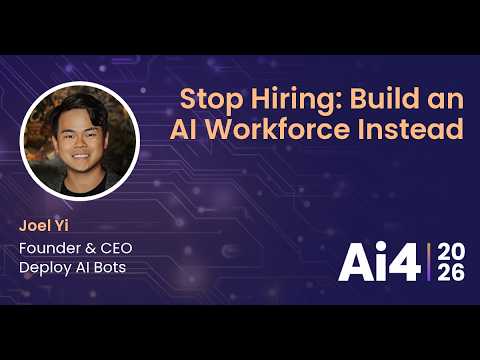
Ai4
Business growth depends on deploying autonomous agent swarms against discrete operational bottlenecks rather than building frontier models, rendering traditional SMB hiring obsolete.
AI-assisted summary of Stop Hiring: Build an AI Workforce Instead With Deploy AI Bots — original source. Check the original for full context.
Source published:
Detailed notes
## Background Published on YouTube by Ai4 on August 18, 2026, this presentation features Joel Yi, Founder and CEO of Deploy AI Bots. According to the page description, Yi draws on his experience training over 300 companies to demonstrate how small and medium-sized businesses can move beyond basic chatbots and deploy autonomous AI agent workforces to run operations, sales, and customer support end-to-end.
## TL;DR Joel Yi presents a blueprint for replacing conventional hiring with autonomous AI agent workforces, opening with a demonstration of a primary Hermes agent spinning up specialized sub-agents without human intervention. To illustrate production viability, he deconstructs an automated DM setter and scheduling receptionist running across a 200-location vehicle tinting franchise via GoHighLevel and Shopmonkey. He explains that robust production agents rely on three practical pillars: the reasoning Brain, tool-executing Hands and Arms, and behavioral Guardrails codified in simple configuration files like `SOUL.md`. Finally, Yi urges founders to prioritize distribution and business outcomes over technical perfection, showing how targeting unglamorous, high-value bottlenecks—such as legal demand letter drafting—yields high-margin enterprise agency contracts.
## Atmosphere & style The presentation carries an energetic, direct, and demystifying tone, opening with Yi commanding the room's full focus as he walks attendees through a silent, fast-paced deployment GIF. It feels part technical masterclass and part no-nonsense founder playbook, balancing personal credibility from his cybersecurity and engineering background with sharp commercial pragmatism. The delivery is punchy and accessible, cutting through artificial intelligence hype to leave business owners feeling equipped and urgently motivated to deploy autonomous tools.
## Key takeaways - [00:04](https://www.youtube.com/watch?v=1eWQ666_vNQ&t=4s) Autonomous AI agents have progressed to the point where they can orchestrate, configure, and spawn other specialized agents without human intervention. - [00:04](https://www.youtube.com/watch?v=1eWQ666_vNQ&t=4s) Self-learning and self-healing multi-agent swarms represent an operational shift toward practical artificial general intelligence (AGI). - [02:00](https://www.youtube.com/watch?v=1eWQ666_vNQ&t=120s) Software development timelines have collapsed drastically; complex machine learning projects that required six months in 2018 can now be reproduced within 24 hours using modern LLM tools. - [02:00](https://www.youtube.com/watch?v=1eWQ666_vNQ&t=120s) Training underserved youth in agent engineering provides direct economic mobility, raising earning potential and serving as a safeguard against trafficking. - [02:00](https://www.youtube.com/watch?v=1eWQ666_vNQ&t=120s) Small and medium-sized businesses (SMBs) offer the highest-leverage, immediate opportunity for autonomous agent deployments compared to slow-moving enterprise systems. - [03:45](https://www.youtube.com/watch?v=1eWQ666_vNQ&t=225s) Production-grade AI agents can autonomously execute end-to-end commercial workflows, including customer qualification, pricing estimation, payment processing, and calendar scheduling. - [03:45](https://www.youtube.com/watch?v=1eWQ666_vNQ&t=225s) Agent behaviors, objection-handling logic, and escalation triggers can be effectively orchestrated using simple, plain-text configuration files like SOUL.md. - [03:45](https://www.youtube.com/watch?v=1eWQ666_vNQ&t=225s) Every production AI agent architecture balances three core components: the Brain (LLM reasoning), the Hands and Arms (execution tooling and APIs), and Guardrails (deterministic boundaries and fallback protocols). - [03:45](https://www.youtube.com/watch?v=1eWQ666_vNQ&t=225s) Job displacement from AI is driven primarily by individuals who master building and deploying AI agents replacing those who do not. - [07:31](https://www.youtube.com/watch?v=1eWQ666_vNQ&t=451s) Market distribution and concrete business outcomes matter more for commercial success than technical superiority or developing frontier models. - [07:31](https://www.youtube.com/watch?v=1eWQ666_vNQ&t=451s) Building a high-margin AI agency relies on identifying and automating unglamorous, high-friction operational bottlenecks—such as drafting state-specific legal demand letters.
## Detailed walkthrough ### [00:04](https://www.youtube.com/watch?v=1eWQ666_vNQ&t=4s) AI Workers Building AI Workers: The Autonomous Agent Swarm
Joel Yi kicks off his presentation by urging the audience to close their laptops, get off Facebook, and pay close attention to a silent 60-second GIF playing on the screen. He narrates the demonstration in real time, explaining that he woke up that morning facing an overwhelming workload and decided to test a simple premise: having his autonomous AI agents spawn additional autonomous agents to handle the workload for him. Running on Hostinger, his Hermes agent is shown orchestrating the setup and deployment of five new functional agents from scratch without human intervention. By the end of the GIF, the system has spun up distinct roles, including an AI project manager and an AI funnel builder, ready to execute tasks directly inside his marketing agency.
Taking a quick pulse of the room, Joel asks for a show of hands to gauge familiarity with the open-source agent ecosystem, polling the audience on frameworks ranging from well-known to obscure: OpenClaw, Hermes agents, LangGraph, LangChain, and the Claude Agent SDK. The takeaway, he emphasizes, is that "AI workers can now build other AI workers." This dynamic points directly toward a phase of artificial general intelligence (AGI) characterized by self-learning and self-healing multi-agent swarms. Acknowledging that his talk’s title—"Stop Hiring: Build an AI Workforce Instead"—can sound provocative or anti-human, Joel insists that understanding this structural transition offers business owners an entirely different, highly leveraged blueprint for scaling.
```mermaid flowchart TD accTitle: Autonomous Agent Generation and Deployment Flow subgraph Orchestration["Agent Orchestration Engine"] A["Primary Hermes Agent"] --> B["Hostinger Infrastructure"] B --> C["Automated Provisioning"] end
subgraph DeployedSwarm["Deployed Autonomous Workforce"] C --> D["AI Project Manager"] C --> E["AI Funnel Builder"] C --> F["Specialized Sub-Agents"] end
D --> G["Agency Execution & Operations"] E --> G F --> G ```
[02:00](https://www.youtube.com/watch?v=1eWQ666_vNQ&t=120s) From Handcoding Neural Networks to Deploying Agent Workforces
Joel grounds his perspective in his technical and operational background. Back in 2018—four years before ChatGPT revolutionized the industry—he handcoded a neural network from scratch that won first place in his university’s capstone competition against hundreds of students. The project, a plant and flower identification application, required six grueling months just to train on 10,000 images of roses. He jokes that the ordeal made him never want to look at a rose again, especially since debugging back then required hands-on intervention from his professors. In contrast, modern tools like ChatGPT and Claude Code allow developers to recreate that entire six-month project in less than twenty-four hours.
Following his academic work, Joel served as a U.S. Army cybersecurity officer, becoming one of the first one hundred personnel assessed into that specific branch after securing a Top Secret clearance at age twenty. Today, alongside giving TEDx talks and training students at MIT and the Harvard Kennedy School, he hosts international AI deployment workshops, including large-scale events in Seoul, South Korea. Outside of enterprise tech, he directs a non-profit foundation in his home country of Malaysia, where underserved youth are taught to build autonomous AI agents. The initiative helps participants secure technical roles earning three to four times their previous baseline wages, serving as a direct economic vehicle to combat human trafficking. In commercial operations, Joel’s company focuses specifically on building and operationalizing AI agents for small and medium-sized businesses (SMBs) rather than enterprise giants.
- Handcoded a flower-recognition neural network across six months using 10,000 training images in 2018; modern LLM coding environments reproduce the same outcome within a single day. - Commissioned as an early U.S. Army cyber officer with a Top Secret clearance obtained at age 20. - Operates a Malaysian non-profit training marginalized youth in agent development to triple or quadruple local income levels and prevent trafficking exploitation. - Specializes in building and implementing autonomous agent pipelines tailored specifically for SMB agencies rather than massive enterprise clients.
[03:45](https://www.youtube.com/watch?v=1eWQ666_vNQ&t=225s) Anatomy of a Production AI Agent: 200 Franchise Locations on Autopilot
To prove that autonomous agents are practical revenue drivers rather than theoretical toys, Joel breaks down a live client implementation: an automated direct-message (DM) setter and receptionist deployed across a 200-location vehicle tinting franchise in Colorado. Operating inside GoHighLevel (GHL), the bot autonomously handles inbound inquiries, answers technical windshield and tinting specifications, calculates final price estimates, handles pricing drops, and manages the entire customer calendar by scheduling bays for specific dates and morning time slots. Crucially, the bot closes transactions directly: it follows up persistently until collecting a deposit, confirms receipt of funds, and connects via API to the automotive shop management software Shopmonkey to schedule technicians into service bays.
Joel pulls up the agent's core architecture, packaged in a single configuration file titled `SOUL.md`. The document demystifies agent development by breaking complex operational behavior into clean, plain-text rules: - An overarching behavioral persona dictating how the setter presents vehicle options and negotiates prices. - Rigorous automated follow-up sequences triggered whenever a prospect goes silent. - Objection handling matrices covering pricing hesitations, military discounts, and in-person cash deposits. - A deterministic human handoff protocol that escalates unresolved questions directly to human agency staff.
Every production agent, Joel explains, simply balances three fundamental components: the "Brain" (the underlying LLM), the "Hands and Arms" (the execution harness or tooling that takes action across external software), and the "Guardrails" (the left and right limits governing what the system can and cannot say or execute). He reassures the audience that building these tools requires no mystical skill set: "The people that will get replaced, it's not because of AI... The people that will replace the people that get replaced will be from people that actually can build AI agents."
```mermaid flowchart LR accTitle: Production DM Setter Integration Pipeline subgraph Inbound["Customer Interaction"] A["Customer DM"] --> B["GoHighLevel CRM"] end
subgraph AgentCore["SOUL.md Agent Harness"] B --> C["Brain: LLM Reasoning"] C --> D{"Confidence Check"} D -- "Standard Path" --> E["Objection / Pricing / Calendar"] D -- "Uncertain" --> F["Human Handoff Fallback"] end
subgraph Execution["Backend Action"] E --> G["Stripe / Deposit Collection"] G --> H["Shopmonkey Bay Scheduling"] end ```
[07:31](https://www.youtube.com/watch?v=1eWQ666_vNQ&t=451s) Distribution Beats Tech: Finding and Monetizing $10,000 Problems
Shifting to commercial strategy, Joel challenges the audience's assumptions about technical superiority versus market execution. While many developers and computer science graduates may possess deeper raw coding abilities, technical excellence alone does not determine market success. "I will always beat you on one thing: I will always beat you on distribution and business outcome," Joel asserts. He describes the tragic archetype of the brilliant engineer who builds world-class systems that wither in obscurity: "Imagine being the best in the world at tech but nobody knows who you are. That’s like the worst demise in my mind."
The path to building a high-margin AI agency does not require competing with OpenAI or inventing the next frontier foundation model. Instead, founders should consult directly with SMBs and professional services firms to identify straightforward, unglamorous bottlenecks—what he terms the "$10,000 problem." As an example, Joel cites an engagement with a top-six U.S. law firm. During discovery, the firm revealed that paralegals and attorneys spent hours manually drafting state-specific demand letters. Rather than having attorneys navigate ChatGPT prompts, the firm paid Joel's team $15,000 to construct a dedicated, repeatable autonomous agent that drafts demand letters strictly adhering to distinct state laws.
Joel concludes by sharing a QR code granting free access to three developer training modules: - A step-by-step tutorial on building an initial OpenClaw agent. - A foundational guide for configuring and deploying Hermes agents. - A commercial framework for launching and scaling a forward agent deployment agency.
Directing attendees to his content via `@aiclawbots` on Instagram, he leaves the room with a final directive to stop overcomplicating the technology and start actively deploying agents against high-value real-world workflows.
## Notable quotes > [00:04](https://www.youtube.com/watch?v=1eWQ666_vNQ&t=4s) AI workers can now build other AI workers. — Joel Yi
> [00:04](https://www.youtube.com/watch?v=1eWQ666_vNQ&t=4s) Stop Hiring: Build an AI Workforce Instead — Joel Yi
> [03:45](https://www.youtube.com/watch?v=1eWQ666_vNQ&t=225s) The people that will get replaced, it's not because of AI... The people that will replace the people that get replaced will be from people that actually can build AI agents. — Joel Yi
> [07:31](https://www.youtube.com/watch?v=1eWQ666_vNQ&t=451s) I will always beat you on one thing: I will always beat you on distribution and business outcome. — Joel Yi
> [07:31](https://www.youtube.com/watch?v=1eWQ666_vNQ&t=451s) Imagine being the best in the world at tech but nobody knows who you are. That’s like the worst demise in my mind. — Joel Yi
## Mentioned Joel Yi, Deploy AI Bots, Hostinger, Hermes Agent, OpenClaw, LangGraph, LangChain, Claude Agent SDK, Claude Code, ChatGPT, U.S. Army, MIT, Harvard Kennedy School, GoHighLevel, Shopmonkey, OpenAI, @aiclawbots
## Video description Joel Yi - Founder & CEO, Deploy AI Bots
After training 300+ companies on deploying their first AI Agents, I'll show you how AI is moving beyond chatbots into fully autonomous systems that can run real parts of your business. Most companies are still experimenting with tools, but I’ll explain how to deploy AI agents that handle operations, sales, and customer support end-to-end. You’ll learn how SMBs are already replacing repetitive workflows with intelligent systems like OpenClaw and Hermes Agents. I’ll break down practical use cases, costs, and how to get started without a technical team. If you want to scale faster with fewer people, this session will give you the blueprint.
[Source](https://www.youtube.com/watch?v=1eWQ666_vNQ)