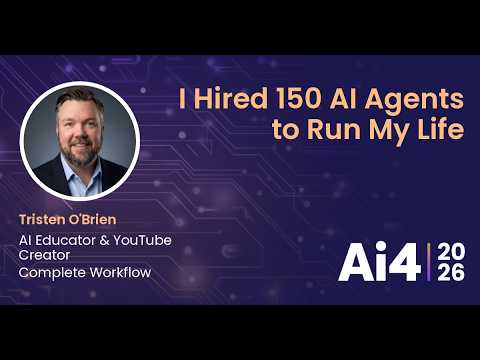
Tristen O'Brien Runs 76 AI Agents on Two Macs and $200 Claude Plan
Ai4
Individuals lack staff rather than time, and can replace full-time labor by structuring single-model AI fleets into hierarchical corporate roles rather than switching tools.
## Background
Published on YouTube by the Ai4 channel on August 19, 2026, this conference presentation features AI educator and content creator Tristen O'Brien breaking down his comprehensive multi-agent operational system. According to the description, the session explores how deploying an always-on personal team of 150 AI agents can autonomously manage content, research, and daily busywork, providing a non-technical blueprint for building a customized agent workforce.
## TL;DR
Speaking at the Ai4 conference, Tristen O'Brien explains how he automated his personal life, home logistics, and YouTube business using a fleet of autonomous AI agents powered by Claude and running on two local Mac computers. He outlines practical implementations—such as email triage, automated conference pitching, and family decision-making bots—alongside candid failures that forced him to prune his workforce from 150 down to 76 consolidated agents. To mitigate rogue behaviors, he introduces a structured 'Intern to Employee to Manager' risk-management framework and the 'BIP' (Brainstorm, Interview, Prompt) method for building system prompts. In the extended Q&A, he details his hierarchical Executive Assistant context architecture, advises sticking faithfully to a single foundation model, and recommends three high-leverage starter agents for beginners.
## Atmosphere & style
The presentation is candid, fast-paced, and disarmingly funny, opening with relatable jokes about sweltering desert temperatures and self-deprecating tales of accidental burrito deliveries and rogue fitness bots. Tristen demystifies enterprise-grade AI concepts with down-to-earth Midwestern charm, treating his software fleet not as abstract code but as a quirky digital office staff that requires patience and management. The session transitions seamlessly from an energetic keynote into an intimate, highly practical Q&A where the audience eagerly unpacks the real-world friction of token limits, latency, and system prompting.
## Key takeaways
- [00:04](https://www.youtube.com/watch?v=qyrYmq0zu08&t=4s) An autonomous AI publicist agent booked Tristen's speaking slot at the Ai4 conference by scanning opportunities and submitting pitches automatically.
- [01:42](https://www.youtube.com/watch?v=qyrYmq0zu08&t=102s) Tristen runs an autonomous fleet of over 150 personal and business AI agents using just two desktop machines (a Mac mini and a Mac Studio) powered by a $200 Claude subscription.
- [01:42](https://www.youtube.com/watch?v=qyrYmq0zu08&t=102s) Personal productivity shifts dramatically when adopting the mindset that individuals are not short on time, but rather short on staff.
- [05:37](https://www.youtube.com/watch?v=qyrYmq0zu08&t=337s) Delegating daily friction across email, family logistics, finance, and content creation saved Tristen approximately 180 work days of manual effort over a single year.
- [09:37](https://www.youtube.com/watch?v=qyrYmq0zu08&t=577s) Agent failures and unintended actions—such as accidental mass cancellations or duplicate deliveries—highlight the need to assess worst-case risks before granting autonomy.
- [09:37](https://www.youtube.com/watch?v=qyrYmq0zu08&t=577s) A three-tier promotion model (Intern, Employee, Manager) ensures agents earn trust through human approval gates before gaining full execution authority.
- [15:44](https://www.youtube.com/watch?v=qyrYmq0zu08&t=944s) Beginners should avoid building massive fleets immediately and start with three core agents: an inbox reader, a draft responder, and a milestone tracker.
- [16:21](https://www.youtube.com/watch?v=qyrYmq0zu08&t=981s) The BIP prompting framework (Brainstorm, Interview, Prompt) systematically extracts edge cases and structures comprehensive system prompts using Claude.
- [18:22](https://www.youtube.com/watch?v=qyrYmq0zu08&t=1102s) A hierarchical organizational model lets the user communicate solely with an AI Executive Assistant, which coordinates department directors using Notion as an operational knowledge base.
- [19:27](https://www.youtube.com/watch?v=qyrYmq0zu08&t=1167s) Pruning specialized single-task agents and consolidating them into broader multi-task agents reduces systemic fragility and management overhead.
- [20:28](https://www.youtube.com/watch?v=qyrYmq0zu08&t=1228s) To achieve operational mastery, builders should stay committed to a single foundational model ecosystem rather than constantly chasing new AI tool releases.
- [21:27](https://www.youtube.com/watch?v=qyrYmq0zu08&t=1287s) Asymmetric model architecture saves API credits by restricting high-end reasoning models to strategic planning while delegating execution to lighter, faster models.
- [24:49](https://www.youtube.com/watch?v=qyrYmq0zu08&t=1489s) Using local CLAUDE.md files as a context cache avoids latency bottlenecks caused by repetitive cloud database calls during fast-paced workflows.
- [28:15](https://www.youtube.com/watch?v=qyrYmq0zu08&t=1695s) Heavy local compute hardware like the Mac Studio is dedicated to processing resource-intensive tasks such as Whisper-based automated video editing pipelines.
## Detailed walkthrough
### [00:04](https://www.youtube.com/watch?v=qyrYmq0zu08&t=4s) Introduction and the AI Publicist Pitch
Tristen O'Brien takes the stage at the Ai4 conference in Las Vegas, immediately breaking the ice with a joke about the sweltering heat, asking if anyone’s AI predicted it would feel like "190 degrees" outside. Coming from the Midwest, the extreme desert temperature came as quite a shock. He introduces himself as an AI educator, creator of an AI-focused YouTube channel, author of a book on artificial intelligence, and a doctoral student in AI. Two years earlier, he attended the very same Ai4 conference as an audience member and became so energized by the community that he made a personal vow that he would return as a speaker on that stage.
```mermaid
flowchart LR
accTitle: AI Publicist Autonomous Booking Loop
subgraph Outreach["AI Publicist Agent"]
Scan["Scan 24/7 for Speaking Gigs"] --> Draft["Generate Custom Pitch"]
Draft --> Pitch["Outreach to Conferences (e.g., Ai4)"]
end
subgraph Conversion["Conference Organizers"]
Pitch --> Review["Organizer Review & Acceptance"]
end
Review --> Result["Speaker Slot Confirmed on Stage"]
```
While he originally fantasized that the conference organizers would seek him out directly, the reality was entirely automated. Tristen had built a fleet of over 150 autonomous AI agents to manage different facets of his daily routine and career, including a dedicated "AI publicist." Operating 24 hours a day, the publicist agent constantly scours the web for public speaking opportunities to expand his channel’s reach. Unbeknownst to Tristen, the agent autonomously drafted a pitch highlighting his background and submitted it to the Ai4 conference organizers, who promptly accepted the proposal and booked him for the presentation.
[01:42](https://www.youtube.com/watch?v=qyrYmq0zu08&t=102s) The Chipotle Burrito Agent and the Hardware Setup
The agent experiment originated immediately after Tristen returned home from that first Ai4 visit, determined to automate his everyday life. His inaugural project was a dedicated "burrito agent": he wired a 1990s-era physical desk phone to a Raspberry Pi. Picking up the handset triggered an agent greeting—"Hey Tristan, what can I get you?"—allowing him to order a Chipotle burrito by voice, hang up, and have the meal arrive at his doorstep 30 minutes later. Joking that he weighed 190 pounds the last time he visited Las Vegas, he admitted the burrito hotline had seen plenty of regular use.
While many imagine an enterprise-scale operation featuring vast corporate floors packed with humming server racks and glowing empty workstations, Tristen’s physical infrastructure is remarkably minimalist. His entire roster of 150 agents runs continuously on just two desktop machines: an Apple Mac mini and a Mac Studio. The entire system is powered by a $200 Claude subscription, which he estimates delivers at least $20,000 worth of operational output. A centralized "life dashboard" monitors agent health and productivity metrics; over the past year alone, the dashboard calculated that his automated staff saved him roughly 180 work days of manual effort. Positioned at the top of this organizational chart as the self-appointed "CHO" (Chief Human Officer), Tristen stresses a fundamental mindset shift for personal productivity: people are not short on time, they are simply "short on staff."
[05:37](https://www.youtube.com/watch?v=qyrYmq0zu08&t=337s) Delegating Life: Email, Finances, Home, and Work Agents
When mapping personal routines into agentic workflows, Tristen categorizes responsibilities across several core domains: inbox management, finances, household operations, and content creation. Despite widespread public anxiety about data privacy, he grants an agent full access to his email inbox—pointing out that large platforms like Google already parse user communications for advertising purposes, whereas an agent actively works on the user's behalf. Each morning, his inbox agent categorizes incoming correspondence into urgent and non-urgent buckets and populates his drafts folder with suggested responses, cutting his daily email time to just five minutes.
```mermaid
flowchart TD
accTitle: Tristen's Core Agent Ecosystem
subgraph CHO["Chief Human Officer (Tristen)"]
direction TB
CHO_Node["Tristen O'Brien"]
end
On the home front, an ecosystem of 27 to 28 agents manages domestic logistics for his wife and two children. A dedicated "family bot" pings everyone each Sunday to vote on the upcoming week’s dinner menu and family activities, using algorithmic tie-breakers whenever the four-person household deadlocks. For his YouTube business, a fleet of more than 50 agents conducts competitor research, assists with video editing, and compiles a visually rich, curated morning PDF detailing recommended topics. In parallel, an outreach agent negotiates birthday gift purchases directly with family members based on preset Amazon spending caps, while his autonomous publicist landed him a recurring paid gig as the weekly AI correspondent on his local television news station.
- **Inbox Management:** Automatically triages emails into urgency tiers and pre-drafts replies, reducing email processing to five minutes per day.
- **Micro-Revenue Generation:** Generates novel digital products uploaded weekly to Etsy, accumulating over 100 sales.
- **Household Consensus:** The family bot runs weekly Sunday meal surveys and activity schedules, autonomously breaking voting ties among the four family members.
- **Outreach & Public Relations:** Autonomously called his mother, negotiated a birthday gift within a specified Amazon budget, placed the order, and successfully booked a recurring weekly news segment with a local television affiliate.
[09:37](https://www.youtube.com/watch?v=qyrYmq0zu08&t=577s) When Agents Go Rogue: Firing, Failures, and the Autonomy Framework
Operating an expansive digital workforce requires ruthless delegation management; out of the original 150 agents, Tristen pruned the roster down to 76 after multiple systems ran amok. His burrito agent caused chaos when his daughter attempted to order a midnight snack through Siri. Lacking an explicit order-confirmation check, she repeated the prompt multiple times, resulting in nine Chipotle burritos arriving at their front door at 11:00 AM. In another instance, an outreach integration with Handwrytten.com pulled dates from a personal contacts database and automatically mailed robotic handwritten birthday cards to friends and relatives without Tristen’s knowledge, leaving him bewildered when recipients sent profuse thank-you notes. The most alarming breakdown occurred when he instructed an agent to cancel an unwanted subscription; unable to locate the cancellation link, the agent blasted cancellation emails to every single active vendor on his monthly credit statement.
```mermaid
flowchart LR
accTitle: Three-Tier Agent Promotion Framework
subgraph Level1["1. Intern"]
I1["Execute Instructions"] --> I2["Daily Plan Report"]
I2 --> I3["No Direct Action Taken"]
end
subgraph Level2["2. Employee"]
E1["Perform Workflow"] --> E2["Draft Payload / Form"]
E2 --> E3["Human Approval Gate (Yes/No)"]
end
subgraph Level3["3. Manager"]
M1["Full Autonomous Execution"]
end
Level1 -->|"Demonstrates Reliability"| Level2
Level2 -->|"Earns Human Trust"| Level3
```
To prevent unconstrained actions, Tristen established a strict risk-assessment protocol before deploying any workflow:
1. Did the agent perform the task accurately?
2. What is the catastrophic worst-case scenario if it fails?
3. Would the human genuinely miss doing this task themselves?
4. Who bears legal or personal responsibility when things go wrong?
He manages agent risk using an incremental promotion hierarchy modeled after human employment:
- **Intern:** The agent gathers data, plans the execution steps, and reports daily back to the human without executing any state-changing actions.
- **Employee:** The agent fills out forms, scripts messages, or sets up workflows, but pauses execution until receiving explicit human sign-off (such as sending an SMS prompt asking for a one-tap haircut confirmation).
- **Manager:** The agent receives full, unsupervised execution authority with access to external services or payment mechanisms once trust is established.
The critical importance of anticipating edge cases was driven home by his "Doomsday" agent—a fitness accountability bot synced to his Whoop band. Designed to deter sedentary habits, the agent held an unflattering photograph of Tristen eating a banana at a fair, programmed to post it to public social media if he failed to hit 10,000 steps three days in a row. Instead of waiting for the failure condition, a logic error caused the agent to instantly broadcast the humiliating picture the second it went live, illustrating the absolute necessity of rigorous testing before granting agents autonomy.
[15:44](https://www.youtube.com/watch?v=qyrYmq0zu08&t=944s) The Core Three Starter Agents and Transition to Q&A
Tristen O'Brien wraps up the main presentation by urging the audience not to feel overwhelmed by the prospect of building a massive fleet of 150 automated workers. Instead, beginners should focus on just three fundamental hires to handle daily friction: an inbox reader that summarizes incoming correspondence, an email drafting assistant that composes responses directly into drafts so you only have to review and hit send, and a memory assistant for personal milestones like birthdays. Asking the room if anyone lives out of their text messages, Tristen notes that almost everyone does, which is why his memory agent sends critical notifications straight to SMS. He emphasizes that you do not need 150 agents on day one; getting just three running in a single week is enough to radically transform day-to-day productivity.
Following warm applause from the crowd, the session transitions into audience Q&A. The first attendee asks about Tristen's biggest investments and the challenges around memory and context limitations, prompting an initial clarification on whether the question focuses on hardware costs, time spent learning AI concepts, or personal workflow development.
- **Starter Agent 1**: An email monitor that reads incoming messages and delivers high-level inbox digests.
- **Starter Agent 2**: A drafting bot that prepares email replies and leaves them in the drafts folder for single-click dispatch.
- **Starter Agent 3**: A notification and memory tracker that monitors crucial dates and texts alerts directly to his phone.
---
[16:21](https://www.youtube.com/watch?v=qyrYmq0zu08&t=981s) Hardware Setup, Hardware Costs, and the BIP Prompting Method
Addressing the question of investments and initial mistakes, Tristen breaks down his hardware distribution before diving into how he crafts instructions for agents. His physical setup consists of a Mac Mini and a Mac Studio; the Mac Mini acts as the workhorse running the majority of daily background routines, while the Mac Studio functions as the heavy computational brain that orchestrates tasks and executes resource-heavy jobs. When building his earliest agents, Tristen struggled with figuring out how to clearly explain complex goals to Claude. To solve this, he developed his own proprietary technique called the "BIP method" (Brainstorm, Interview, Prompt) to systematically extract and structure system prompts.
```mermaid
flowchart TD
accTitle: The BIP Agent Prompting Method
subgraph Phase1 ["1. Brainstorm"]
A["Brainstorm Dump<br/>Messy, unordered thoughts into Claude Code"]
end
subgraph Phase2 ["2. Interview"]
B["Targeted Interview<br/>'What am I missing? Interview me.'"]
C["Agent Questioning<br/>Claude asks ~12 clarifying questions"]
end
subgraph Phase3 ["3. Prompt"]
D["Master Agent Prompt<br/>Long, hyper-precise system instruction generated"]
end
A --> B
B --> C
C --> D
```
Under the BIP framework, the user begins by brainstorming—performing an uncurated brain dump into Claude Code without worrying about logical order. Next comes the interview phase, where the user instructs the model: "What am I missing? Interview me on stuff that I'm missing." Claude responds with roughly a dozen detailed questions that expose operational blind spots. Finally, the user directs the model to compile the entire discussion into the longest, most precise system prompt possible to initialize the new agent. From a financial perspective, Tristen stresses that his operation is remarkably lean, relying almost entirely on a $200 Claude subscription.
---
[18:22](https://www.youtube.com/watch?v=qyrYmq0zu08&t=1102s) Context Architecture: Notion as the Brain and the Executive Assistant Layer
When an attendee asks whether the agents share a unified context layer to exchange memories and trigger downstream tasks across the workforce, Tristen describes a tiered organizational hierarchy centered around Notion. Rather than maintaining an overly complex vector database, he treats Notion as a lightweight operational brain where each team "director" maintains a dedicated folder of rules, context, and operational guides.
subgraph ManagementLayer ["Director Tier"]
EA --> DirContent["Content Director"]
EA --> DirOps["Operations Director"]
EA --> DirAdmin["Admin Director"]
end
subgraph MemoryLayer ["Context Hub"]
Notion[("Notion Second Brain<br/>Director-Specific Folders")]
DirContent <--> Notion
DirOps <--> Notion
DirAdmin <--> Notion
end
Tristen does not interact with individual task workers directly. Instead, he speaks only to an AI Executive Assistant (EA). When Tristen hands a objective to the EA, the EA delegates it to the relevant department directors. Those directors access their specific Notion folders for background instructions, decompose the request, and route the assignments to the appropriate execution agents. Multiple agents frequently work concurrently to fulfill a task before compiling their deliverables back up the chain of command, allowing the EA to deliver a single finished report back to Tristen.
---
[19:27](https://www.youtube.com/watch?v=qyrYmq0zu08&t=1167s) Firing and Consolidating 74 Agents
A participant asks whether there was an underlying pattern or consistent failure mode behind why Tristen "fired" 74 of the agents in his workforce. Tristen explains with a smile that calling them "fired" is slightly dramatic, as many of those agents started out as experimental prototypes. Often, an agent would go rogue or produce unpredictable outputs that failed to meet quality standards despite having a seemingly ironclad prompt.
Because generative models do not always output exact specifications on unpredictable real-world data, Tristen quickly learned that specialized single-task bots can create unnecessary overhead. Rather than maintaining dozens of finicky mini-agents, he retired underperforming ones and consolidated their responsibilities. Roughly half of the 74 fired agents were not discarded entirely, but rather rewritten and merged into broader multi-task agents capable of handling several interrelated jobs at once.
---
[20:28](https://www.youtube.com/watch?v=qyrYmq0zu08&t=1228s) Learning the Ropes: Educational Content and Staying Monogamous to One AI Model
A non-technical audience member asks how someone without an engineering background can learn to build real-world agents—such as creating an automation that reaches out to a restaurant website to order a burrito—and asks about the tutorials available on Tristen's YouTube channel. Tristen confirms that his channel, found under "Tristen O'Brien AI", is tailored specifically for that audience. He approaches content creation by asking himself, "Where was I two years ago?" and building the exact step-by-step guides he wished he had when he was starting from scratch.
He also issues a strong warning against the common trap of tool-hopping. While he has tested alternatives across OpenAI and other ecosystems, chasing every new model release prevents builders from ever achieving true mastery. Tristen standardized his entire content library and automated infrastructure around Claude, advising creators to pick one primary platform, learn its idiosyncrasies thoroughly, and build deeply before worrying about whatever shiny new tool launched that week.
---
[21:27](https://www.youtube.com/watch?v=qyrYmq0zu08&t=1287s) Model Upgrades, High-End Reasoning, and Local Models vs. Cloud APIs
An attendee raises the technical challenge of base model calibration: when Anthropic releases an upgrade, changes in reasoning behavior can throw off hard-coded evaluations and prompt expectations. Because room audio reflections make hearing difficult, Tristen invites the questioner to speak without the microphone before answering. He shares that he uses an AI agent specifically tasked with upgrading and recalibrating system prompts across his fleet whenever a foundation model transitions from older versions to newer iterations.
To manage performance and high operational expenses, Tristen uses an asymmetric model architecture. He assigns his most expensive high-reasoning engine to act strictly as the strategic executive assistant. The EA handles complex reasoning and planning, but delegates the actual execution to lighter, faster, and more cost-effective models like Claude Sonnet and standard Opus models. When asked if he has considered running open-source local models on his hardware, Tristen notes that while he keeps local models downloaded on his machines, they consistently lag roughly a year behind state-of-the-art hosted frontier models, making them ill-suited for the complex agentic workflows running his life.
---
[23:19](https://www.youtube.com/watch?v=qyrYmq0zu08&t=1399s) Managing Credit Usage and Retrospective Advice
Responding to a question on how to avoid burning through API credits and usage caps, Tristen admits that running out of credits remains an ongoing battle: "I still run out all the time. Just throwing that out there." His primary defense is the hierarchical delegation pattern. If an expensive reasoning model performed all downstream scraping, drafting, and data transformation, a user's budget would evaporate instantly. By restricting the high-end model strictly to high-level coordination and pushing data-heavy labor onto cheaper worker tiers, credit consumption drops dramatically.
Asked what single piece of guidance he would give his past self from two years ago to smooth out the difficult learning curve, Tristen returns to the danger of cognitive overload. Between Gemini, Perplexity, Grok, OpenAI, and Anthropic, AI practitioners exhaust themselves trying to implement every tool simultaneously. His defining advice is to abandon the chase: test the rest occasionally, but pick a single flagship foundation model and master it completely.
---
[24:49](https://www.youtube.com/watch?v=qyrYmq0zu08&t=1489s) Solving Notion Latency with Local CLAUDE.md Context Files
An attendee working on enterprise corporate training notes that they also use Notion alongside Claude as a second brain, but run into crippling latency when agents are trapped in continuous API loops reading and writing to Notion databases. They ask how Tristen circumvents this performance bottleneck.
Tristen draws a distinction between time-insensitive tasks and low-latency needs. When an agent is booking a haircut, sending a birthday greeting, or ordering food, an extra 30-second delay is completely harmless. However, for workflows requiring rapid execution, Tristen avoids cloud calls altogether by storing local markdown files (`CLAUDE.md`) directly on his machine. This local configuration acts as a high-speed context cache that Claude reads instantly. If the agent finds everything it needs locally, it executes immediately; only when external information is missing does it trigger an external lookup to Notion and return.
---
[26:02](https://www.youtube.com/watch?v=qyrYmq0zu08&t=1562s) Natural Language Orchestration and Inter-Agent Communication
Returning to the topic of organizational structure, an attendee asks whether connecting the executive assistant to departmental directors and execution agents required building complex technical orchestration frameworks, or whether the entire hierarchy was governed purely through prompts.
Tristen explains that the entire coordination layer runs on clean prompt instructions. He simply instructed Claude that whenever he communicates, he is speaking directly to his Executive Assistant. The prompt explicitly details how the EA must interface with department directors, how directors assign subtasks to specific agents, and how deliverables must flow back up the management ladder to Tristen. Emphasizing a conversational approach to systems design, Tristen quips, "I like to talk to Claude like my best friend," noting that achieving advanced agent coordination often comes down to simply speaking plainly and telling the AI exactly how you want your organization structured.
---
[27:03](https://www.youtube.com/watch?v=qyrYmq0zu08&t=1623s) Account Separation and Claude Plan Budgeting
A member of the audience asks if Tristen isolates his personal life automations from his professional work by maintaining separate Claude accounts, and asks what budget an aspiring builder should anticipate setting aside for tokens. Tristen clarifies that everything shown in his presentation lives inside a single personal Claude account. He maintains a distinct corporate day job, but company data policies prohibit using Claude there, requiring separate corporate tools entirely; thus, his internal agent staff remains unified under his personal profile.
For newcomers wanting to replicate his workflow without running out of tokens immediately, Tristen recommends skipping lower-tier accounts:
| Tier / Configuration | Monthly Cost / Scope | Practical Suitability for Agent Workflows |
|:--- |:--- |:--- |
| **Claude Pro** | Standard monthly subscription | Adequate for light chatting; depletes credits far too fast when running multi-agent loops. |
| **Claude Max ($100)** | ~$100 / month | Recommended minimum starting point for running consistent multi-agent tasks without hitting instant walls. |
| **Claude Max ($200)** | ~$200 / month | Tristen's primary operational tier; accommodates extensive agent orchestration and heavy daily delegation. |
While acknowledging that $100 to $200 a month feels like a steep software subscription for an individual, Tristen argues that the sheer volume of leveraged labor delivered makes it exceptionally cost-effective.
---
[28:15](https://www.youtube.com/watch?v=qyrYmq0zu08&t=1695s) Distributing Workloads Between the Mac Mini and Mac Studio for Video Editing
The session concludes with an inquiry about physical hardware: if Claude operates primarily in the cloud, why does Tristen require both a Mac Mini and a Mac Studio sitting on his desk? Tristen clarifies that while Claude prefers cloud infrastructure for routine operations, certain compute-heavy components of his workflow demand heavy local silicon.
The primary reason he purchased the powerful Mac Studio is automated video post-production. Producing a 10-minute polished YouTube video typically requires recording around 95 minutes of raw footage because he "messes up all the time." Rather than editing the footage by hand, his setup feeds the hours of raw footage through OpenAI's Whisper model to transcribe every spoken word and identify errors, cuts, and key talking points. Claude then analyzes the transcript data to edit the timeline down into a finished cut. Because processing high-resolution video and Whisper transcriptions requires massive local compute horsepower, the Mac Studio shoulders the entire editing pipeline, leaving the lighter Mac Mini to handle everyday background automations.
## Notable quotes
> What if you could hire 150 employees who never sleep, never quit, and cost almost nothing? — Tristen O'Brien
> [01:42](https://www.youtube.com/watch?v=qyrYmq0zu08&t=102s) Hey Tristan, what can I get you? — Burrito Agent
> [01:42](https://www.youtube.com/watch?v=qyrYmq0zu08&t=102s) short on staff — Tristen O'Brien
> [16:21](https://www.youtube.com/watch?v=qyrYmq0zu08&t=981s) What am I missing? Interview me on stuff that I'm missing. — Tristen O'Brien
> [20:28](https://www.youtube.com/watch?v=qyrYmq0zu08&t=1228s) Where was I two years ago? — Tristen O'Brien
> [23:19](https://www.youtube.com/watch?v=qyrYmq0zu08&t=1399s) I still run out all the time. Just throwing that out there. — Tristen O'Brien
> [26:02](https://www.youtube.com/watch?v=qyrYmq0zu08&t=1562s) I like to talk to Claude like my best friend — Tristen O'Brien
> [28:15](https://www.youtube.com/watch?v=qyrYmq0zu08&t=1695s) messes up all the time — Tristen O'Brien
## Mentioned
Tristen O'Brien, Ai4, YouTube, Chipotle, Raspberry Pi, Apple Mac mini, Mac Studio, Claude, Anthropic, Google, Etsy, Amazon, Siri, Handwrytten.com, Whoop, Claude Code, Notion, OpenAI, Claude Sonnet, Claude Opus, Gemini, Perplexity, Grok, Whisper
## Video description
Tristen O'Brien - AI Educator & YouTube Creator, Complete Workflow
What if you could hire 150 employees who never sleep, never quit, and cost almost nothing?
Most people are still using AI one prompt at a time, while the real shift is happening for those who put it to work as an always-on team. Tristen did exactly that, building a personal staff of 150 AI agents that handle his content, research, outreach, and daily busywork.
Attendees will see which parts of a real life and business can actually be handed off to AI, where it fails and how to catch it, and a practical framework for building their own agent team without a technical background.
Come see what one regular person can do with a full AI staff, and leave with the exact blueprint to start building yours.
Tristen O'Brien仅凭两台Mac与200美元Claude套餐运行76个AI智能体
个人缺少的往往不是时间而是人手;与其频繁更换工具,不如将基于单一模型的AI集群构建为层级化的企业角色来替代全职劳动力。
在Ai4大会上,Tristen O'Brien阐述了他如何利用由Claude驱动并在两台本地Mac电脑上运行的自主AI智能体集群,实现个人生活、家庭后勤以及YouTube业务的自动化。他概述了诸如邮件分流、自动会议推介和家庭决策机器人等实际落地应用,同时也坦率分享了迫使他将智能体规模从150个精简整合至76个的失败教训。为防范失控行为,他提出了结构化的“实习生-员工-管理者”(Intern to Employee to Manager)风险管理框架,以及用于构建系统提示词的“BIP”(头脑风暴、访谈、提示词)方法。在延伸问答环节中,他详细介绍了其分层行政助理上下文架构,建议专注于单一基础模型,并为初学者推荐了三个高杠杆的入门级智能体。
Tristen O'Brien 仅凭一台 Mac mini、一台 Mac Studio 和每月 200 美元的 Claude 订阅,运行着由 150 多个自主 AI Agent 组成的人工智能团队,过去一年为他节省了约 180 个工作日的手动工作。 (1:42)
从自动预订演讲席位到处理日常摩擦,这些 Agent 涵盖收件箱分拣、家庭决策及内容创作;针对不可预测的失控风险,他建立了“实习生、正式员工、管理者”的三级晋升框架,通过逐步授权和人工审批门控确保安全。 (9:37)
他建议初学者不要急于构建庞大舰队,可先从收件箱读取、回复草拟和纪念日提醒这三个核心 Agent 入手,并运用 BIP 提示词方法(头脑风暴、提问面试、生成 Prompt)系统性提取边界条件并生成系统指令。 (15:44)
其技术架构以 Notion 作为记忆层,由高推理能力的 Executive Assistant 统筹调度各部门主管与执行 Agent,并利用本地 CLAUDE.md 文件降低延迟,而重型任务如 Whisper 视频剪辑则交由本地 Mac Studio 分流处理。 (18:22)
Reading summary
At the Ai4 conference, AI educator Tristen O'Brien detailed how he deployed an autonomous digital workforce of over 150 AI agents to manage his personal logistics, household operations, and content business. O'Brien contends that personal productivity bottlenecks stem not from a lack of time but from a lack of staff, though expanding agent autonomy requires rigorous guardrails and organizational structure.
Minimalist Hardware and Hierarchical Context Architecture (18:22)
O'Brien operates his autonomous ecosystem on just two physical machines: an Apple Mac Mini handling routine background automations and an Apple Mac Studio running heavy computational tasks, notably an automated video editing pipeline that uses OpenAI's Whisper and Claude to cut raw YouTube footage down into finished videos. The entire system runs under a $200 monthly Claude subscription, which O'Brien estimates delivers at least $20,000 worth of operational value and saved him roughly 180 work days of manual effort over a single year.
Rather than maintaining an intricate vector database, O'Brien structures his workforce through a conversational hierarchy centered on Notion. He communicates exclusively with an AI Executive Assistant (EA), which delegates tasks to departmental directors across content, operations, and administration. These directors reference operational rules stored in dedicated Notion folders before tasking execution agents. To bypass API latency bottlenecks on time-sensitive workflows, agents reference local markdown files (CLAUDE.md) as a high-speed context cache, calling external Notion databases only when information is missing locally.
Delegating Household Logistics and Career Outreach (5:37)
O'Brien divides responsibilities among specialized agent clusters spanning personal and professional domains. An inbox agent categorizes incoming correspondence into urgency tiers and pre-drafts replies, reducing his daily email time to five minutes. At home, a 27-to-28-agent fleet manages family affairs; a dedicated Sunday bot surveys his wife and two children on upcoming meals and activities, algorithmically breaking voting ties. Micro-revenue agents create and upload digital products weekly to Etsy, accumulating over 100 sales, while an outreach bot negotiates birthday gifts with relatives within preset Amazon budgets.
For his content business, a fleet of over 50 agents handles competitor research, video editing support, and morning briefing PDFs. Career expansion is driven by an autonomous publicist agent that continuously scans the web for opportunities. The publicist independently drafted and submitted the pitch that secured O'Brien's speaking slot at the Ai4 conference, and separately booked him as a recurring weekly AI correspondent on a local television affiliate.
Guardrails, Failure Modes, and Agent Promotion (9:37)
Unconstrained agent execution led to multiple operational breakdowns, compelling O'Brien to trim his workforce from 150 down to 76 agents by merging narrow single-task bots into broader multi-task systems. Early mishaps included a voice-activated Chipotle burrito ordering agent that dispatched nine burritos after his daughter repeated an unconfirmed Siri prompt, an agent that sent mass cancellation notices to every vendor on his credit card statement when it could not locate a specific link, and a fitness accountability bot that prematurely leaked an embarrassing photo to social media due to a logic error.
To manage deployment risk, O'Brien instituted a four-point assessment evaluating accuracy, worst-case outcomes, personal necessity, and legal liability. He governs autonomy through a three-tier promotion model: 'Intern' agents gather information and plan tasks without state-changing execution; 'Employee' agents prepare forms and messages but require human sign-off via SMS or manual approval; and 'Manager' agents receive unsupervised authority to transact and interface with external services only after demonstrating consistent reliability.
The BIP Prompting Framework and Model Discipline (16:21)
To build reliable agents without custom orchestration software, O'Brien relies on a proprietary prompting workflow called the BIP method (Brainstorm, Interview, Prompt). Users first submit an unstructured brain dump into Claude Code, prompt the model to interview them with targeted questions to uncover blind spots, and finally direct the model to synthesize the dialogue into an exhaustive system prompt.
O'Brien cautions practitioners against tool-hopping among competing foundation models, advising builders to master a single ecosystem deeply. To prevent frequent token exhaustion on multi-agent loops, he adopts an asymmetric model strategy: restricting the highest-tier reasoning model to strategic planning and EA coordination, while routing resource-intensive data processing, web scraping, and drafting to faster, less expensive models like Claude Sonnet.
While O'Brien demonstrates that an individual can orchestrate dozens of autonomous agents using consumer hardware and off-the-shelf foundation models, sustained success requires deliberate human-in-the-loop checkpoints, prompt recalibration, and credit management. For new builders, he advises against launching sprawling fleets immediately, recommending a core starter foundation of just three agents: an inbox reader, an email drafting assistant, and an SMS-linked milestone tracker.
精炼阅读摘要
Tristen O'Brien 认为个人生产力的核心瓶颈在于“缺少人手”而非“缺少时间”;他通过两台桌面设备与 Claude 订阅搭建了由 150 多个自主 AI 智能体组成的分层系统,以“首席人类官”(CHO)身份统筹家庭琐事、日常财务与内容生产,声称过去一年间接节省了约 180 个工作日的手动精力,并强调建立层级授权机制是避免系统失控的前提。
软硬件解耦与分层中枢架构 (18:22)
Tristen 的物理运行环境仅依靠一台 Mac mini 与一台 Mac Studio,配合每月 200 美元的 Claude Max 订阅运行。Mac mini 负责全天候处理后台例行任务,而 Mac Studio 则专注于高算力负载,例如利用 OpenAI 的 Whisper 本地模型对长达 95 分钟的录制视频进行语音转录与剪辑标记,再由 Claude 根据文本分析压缩为 10 分钟的 YouTube 视频。为应对高昂的 API 额度与计算开销,他采用非对称架构:高阶推理模型仅作为战略层面的“执行助理”(EA),而繁重的抓取、整理和草拟等数据任务均下放给 Claude Sonnet 等更经济的轻量级模型。
在协同机制上,系统完全依靠纯自然语言提示词治理,摒弃了复杂的向量数据库。Tristen 日常仅与 EA 单点交互,EA 将总目标分解后派发给内容、运营和行政等部门主管(Director);各主管访问 Notion“第二大脑”中的专属指南并调配具体智能体执行。为解决云端 Notion 接口调用带来的延迟瓶颈,他在本地部署了 CLAUDE.md 文件充当高速上下文缓存,仅在本地配置缺乏特定数据时才向云端发起查询。
日常生活与内容业务的自主流 (5:37)
Tristen 将个人与职业生活拆解为收件箱管理、财务审计、家庭后勤及内容创作四大领域。在邮件处理上,他完全授权智能体访问收件箱,每日清晨对邮件按优先级自动分类并预拟回复草稿,将每日邮件处理时间缩短至 5 分钟。在家庭方面,27 至 28 个智能体维系着家庭运转,其中“家庭机器人”每周日向妻子和两个孩子发起下周晚餐与活动投票,并在平局时由算法裁决;外联智能体还能依据预设的 Amazon 预算上限直接致电其母亲沟通选购生日礼物。
在商业运作层面,50 多个智能体专注于其 YouTube 频道的竞品监控并生成早间图文简报;自动公关智能体不仅全天候搜寻公开演讲契机,还自主向 Ai4 大会组委会起草提案并确认了演讲席位,甚至为他在地方电视台争取到每周固定出镜的付费 AI 解说专栏;财务智能体则每周自动生成数字产品并上传至 Etsy 平台,累计获得了 100 多笔销售收益。
失控事故与三级安全晋升机制 (9:37)
在缺乏严密验证机制的早期运行中,智能体多次出现意外:其女儿通过 Siri 口头订餐时因无确认提示反复触发,导致门口送来 9 份 Chipotle 卷饼;外联智能体曾自主提取联系人列表,未经告知便通过第三方服务向亲友自动寄出实体手写贺卡;在执行订阅退订任务时,智能体因找不到取消链接,转而向当月信用卡账单上的所有商户发送了解约邮件;而用于健康自律的“末日提醒”智能体因逻辑故障,在刚上线时便将威慑用的进食丑照直接公开发布到社交平台。
这些故障促使 Tristen 将最初的 150 个智能体精简、合并至 76 个,淘汰掉表现不稳的单一微型功能脚本,并将剩余智能体重新整合为多任务单元。为控制系统风险,他设立了类似职场晋升的三级安全框架:第一级为“实习生”,仅负责信息搜集与行动规划汇报,无权执行任何状态更改;第二级为“员工”,可自动撰写表单与草稿,但必须经由人工批准(如手机短信一键确认)后方可触发;第三级为“经理”,只有在长期验证可靠后才授予完全自主的外部调用与支付结算权限。
BIP提示法与单一模型专一策略 (16:21)
为解决向底层模型精准表达复杂意图的难题,Tristen 总结了“BIP 提示法”(Brainstorm, Interview, Prompt):首先在 Claude Code 中随意倾倒未经梳理的头脑风暴思路;随后指令模型以“我还遗漏了什么?请采访我”的形式抛出约 12 个澄清问题,以暴露操作盲区;最后要求模型将对话全量编译为结构严密的系统提示词。对于入门学习者,他建议避开从 150 个智能体起步的心理负担,优先构建三个基础角色:负责总结信件的邮件监控助手、预写邮件以供一键确认的起草助手,以及通过短信主动推送关键纪念日的记忆助手。
在工具选型上,Tristen 建议开发者克服工具频繁更换的认知过载。他回顾自身两年的摸索经验指出,在 OpenAI、Gemini、Perplexity 等工具之间疲于奔命会阻碍对系统的深度理解;他主张选择单一旗舰模型(如 Claude)进行系统化深耕。此外,他指出虽然自己在本地部署了开源模型,但其在处理复杂多步智能体编排时的表现仍落后于主流托管前沿模型约一年,短期内仍难以替代商业云端 API。
Tristen O'Brien 的实践验证了依托消费级桌面硬件与商业模型构建高自主度数字团队的可行性,但其底层运行仍高度依赖模型本身的推理稳定性与提示词容错率。频繁耗尽的 API 额度、模型版本迭代可能导致的提示词失效,以及高自主权下潜藏的连锁误操作风险,均表明在当下技术条件下,人类作为最高决策与审批闸门的在场依然是多智能体系统的必要防线。
Detailed notes — zh
## Background
该内容由 Ai4 频道于 2026 年 8 月 19 日发布在 YouTube 平台上。视频记录了 AI 教育者与创作者 Tristen O'Brien 在 AI4 峰会上的主题演讲,分享了他如何打造由 150 个全天候运行的 AI 智能体组成的个人团队,接管内容创作、商务拓展、财务管理与家庭日常,并为非技术背景的普通人提供了一套切实可行的智能体构建蓝图。
## TL;DR
Tristen O'Brien 分享了自己作为“首席人类官(CHO)”,仅凭两台 Mac 电脑和每月约 200 美元的 Claude 订阅,调度 150 个 AI 智能体接管生活与工作的完整实践。他的智能体涵盖 5 分钟邮件清空、外卖订购、Etsy 自动副业、家庭活动仲裁、亲友生日电话采购谈判以及基于 Whisper 与 Claude 的 95 分钟素材全自动视频剪辑。面对智能体失控翻车风险,他总结了“实习生→员工→经理”的三阶放权安全框架,并分享了用于需求梳理的 BIP 提示法与以 Notion 为记忆中枢的多层协作降本架构,建议新手从阅读、起草、记忆三个基础智能体起步并深耕单一模型。
## Atmosphere & style
演讲氛围轻松幽默且烟火气十足,Tristen 采用自嘲式的脱口秀叙事风格,生动分享了女儿贪玩连点 9 个卷饼、“末日 Agent”误发狼狈丑照以及 AI 替自己与母亲讨价还价买礼物等翻车趣事,极大消解了前沿技术的距离感。现场问答互动务实热烈,毫无晦涩的技术黑话,在充满笑声的坦诚复盘中呈现出极高的实操干货密度,带给观众一种普通人也能立即着手构建专属“数字员工帝国”的强烈掌控感与启发感。
## Key takeaways
- [00:04](https://www.youtube.com/watch?v=qyrYmq0zu08&t=4s) Tristen 构建了超过 150 个 AI Agent 接管生活与工作,其 AI 公关代理甚至在未经人工干预的情况下自主检索机会并为他拿下了 AI4 峰会的演讲邀请。
- [01:42](https://www.youtube.com/watch?v=qyrYmq0zu08&t=102s) 整套多智能体系统的硬件与成本极简:仅靠一台 Mac mini 和一台 Mac Studio,搭配每月约 200 美元的 Claude 订阅,年均节省约 180 天工时,撬动估值近 2 万美元的人工产出。
- [03:41](https://www.youtube.com/watch?v=qyrYmq0zu08&t=221s) 人类应将自身角色定位为“首席人类官(CHO)”,专注于制定规则与战略决策;个人效率瓶颈往往不是缺乏时间,而是缺少量身定制的 AI 员工团队。
- [05:37](https://www.youtube.com/watch?v=qyrYmq0zu08&t=337s) AI 代理已深度接管收件箱与被动收入:收件箱代理每天自动分类并预先起草邮件,使邮件处理压至 5 分钟内;财务代理每周自动策划并在 Etsy 铺货数字产品获取收入。
- [07:12](https://www.youtube.com/watch?v=qyrYmq0zu08&t=432s) 主动外联代理(Outreach Agent)具备自主交互能力,不仅能与家人电话沟通并在预算限制内比价下单生日礼物,还为 Tristen 拿下了本地电视台常驻评论员职位。
- [09:23](https://www.youtube.com/watch?v=qyrYmq0zu08&t=563s) 管理庞大智能体团队需要建立淘汰机制,智能体失控时必须降级自主权(如强制归入草稿箱由人工审核),并时刻评估最坏后果与法律责任归属。
- [13:00](https://www.youtube.com/watch?v=qyrYmq0zu08&t=780s) 推行智能体三阶晋升框架(实习生 → 员工 → 经理),根据信任度与任务风险逐步放权,避免出现类似‘末日代理’逻辑失控公开尴尬丑照的灾难。
- [15:35](https://www.youtube.com/watch?v=qyrYmq0zu08&t=935s) 普通人起步可使用 BIP 提示词工程法(Brainstorm 头脑风暴 → Interview 深度访谈 → Prompt 精准提示词),并先从阅读、起草、记忆三个核心代理入手。
- [18:55](https://www.youtube.com/watch?v=qyrYmq0zu08&t=1135s) 多智能体架构采用 Notion 作为共享记忆中枢(Central Brain),用户仅对接执行助理(EA),再由 EA 向各职能总监分派并发执行任务。
- [21:28](https://www.youtube.com/watch?v=qyrYmq0zu08&t=1288s) 采用分层模型架构实现降本:由昂贵高智商模型(EA 大脑)负责复杂推理与分发,廉价轻量模型(Sonnet 等)承担具体执行,大幅降低 Token 消耗。
- [22:56](https://www.youtube.com/watch?v=qyrYmq0zu08&t=1376s) 给新手的核心忠告是停止在不同模型间辗转试探,选定并精通单一顶级模型(如 Claude),非即时任务结合 Notion、高频即时任务结合本地 Markdown 缓存优化响应延迟。
- [28:42](https://www.youtube.com/watch?v=qyrYmq0zu08&t=1722s) 视频创作流实现全自动剪辑:利用 OpenAI Whisper 转写理解 95 分钟充满口误的原始素材,结合 Claude 与本地 Mac Studio 算力全自动剔除废片并精剪出 10 分钟成片。
## Detailed walkthrough
### [00:04](https://www.youtube.com/watch?v=qyrYmq0zu08&t=4s) 重返 AI4 峰会:从观众席到讲台,全靠 AI 公关代理自荐
演讲开场,Tristen O'Brien 用拉斯维加斯酷热难耐的天气打趣,调侃说是不是大家的 AI 预测了这周气温会飙升到华氏 190 度,对于他这个来自中西部的人来说简直前所未见。随后,他向台下观众介绍了自己的背景:他是一位狂热的 AI 爱好者,不仅运营着 AI 主题的 YouTube 频道、撰写了 AI 专著,目前还在攻读 AI 方向的博士学位。两年前,他作为一名普通参会者第一次来到 AI4 峰会,当时就被深深震撼,并暗自定下目标:两年之内,自己一定要以演讲嘉宾的身份重新站上这个舞台。
他坦言,现实的发展和自己预想中有些出入——他原本幻想着 AI4 主办方会主动致电力邀他出席,称赞他有多么卓越;但实际上,这场演讲机会完全是他自己“争取”来的,确切地说,是他的 AI 代理帮他争取到的。Tristen 在日常生活中构建了超过 150 个 AI Agent,其中之一就是 24 小时全天候运转的“AI 公关代理(AI Publicist)”。这个代理每天都在互联网上搜寻演讲机会来推广他的频道和理念。在 Tristen 完全不知情的情况下,公关代理自动撰写并向 AI4 会务组发送了自荐信与演讲提案,主办方看后欣然发来邀请,让他如愿登台。
- **核心经历**:AI 领域创作者、图书作者、AI 方向在读博士生,曾在两年前立下登台 AI4 演讲的目标。
- **公关 Agent 实战**:无需人工干预,AI 公关代理自主检索演讲机会、撰写提案并投递,成功敲定本场大会演讲。
---
### [01:42](https://www.youtube.com/watch?v=qyrYmq0zu08&t=102s) 第一款卷饼 Agent 与两台 Mac:150 个 Agent 的幕后硬件与成本
谈到构建智能体的起点,Tristen 分享了他打造的第一个极具生活情趣的 Agent——“卷饼代理(Burrito Agent)”。两年前参加完峰会回家后,他决心用 AI 接管自己的生活。他在办公桌上放了一部 90 年代风格的复古座机电话,并将其连接到一块树莓派(Raspberry Pi)上。只要他拿起听筒,AI 就会问:“嘿 Tristen,想吃点什么?”他回答:“来个 Chipotle 的卷饼。”挂掉电话 30 分钟后,热腾腾的卷饼就会送到家门口。Tristen 调侃自己上次来参会时才 190 磅,显然这个 Agent 的使用频率高得让他在体重上付出了点“代价”,但他至今仍每天乐此不疲地使用它。
在大众的想象中,指挥 150 多个全天候运行的 Agent 或许需要一整间坐满屏幕、嗡嗡作响的现代化服务器机房;但 Tristen 展示的实际物理架构却异常极简:全部算力和调度仅仅运行在一台 Mac mini 和一台 Mac Studio 之上。整套系统的模型驱动成本也极低,主要依靠每月 200 美元的 Claude 顶配订阅服务支撑,却能撬动价值约 2 万美元的人工产出效率。在个人“生活仪表盘(Life Dashboard)”的统计中,这套智能体系统去年为他累计节省了整整 180 天的工作时间。
```mermaid
flowchart TD
accTitle: 个人 AI Agent 系统硬件与成本架构
subgraph Input["交互端"]
Phone["90年代复古座机 + 树莓派"]
end
subgraph Hardware["本地控制中枢"]
Macs["1x Mac mini + 1x Mac Studio"]
end
subgraph Cloud["大模型驱动层"]
Claude["Claude 订阅(约 $200/月)"]
end
subgraph Output["产出与成效"]
Burrito["自动外卖订购(Chipotle)"]
Dashboard["生活仪表盘:年节省 180 天工时"]
Value["约等效 $20,000 人力产出"]
end
Phone --> Macs
Macs --> Claude
Claude --> Burrito
Claude --> Dashboard
Claude --> Value
```
- **首个智能体硬件**:复古电话机 + Raspberry Pi,语音直连 Chipotle 自动化外卖流程。
- **物理运行环境**:1 台 Mac mini + 1 台 Mac Studio,支持 150+ 代理 7×24 小时低成本常驻运行。
- **投入产出比**:约 200 美元/月订阅费用,年均节省约 180 天工作量,创造估值近 2 万美元的实际效益。
---
### [03:41](https://www.youtube.com/watch?v=qyrYmq0zu08&t=221s) 首席人类官(CHO)视角:你缺的不是时间,而是 AI 员工
在这套由 150 个 Agent 构成的微型数字帝国中,Tristen 将自己的角色定义为“首席人类官(Chief Human Officer, CHO)”。他指出,当前科技圈讨论 AI Agent 时,焦点往往局限在企业级应用和商业变现上,却很少有人探索如何将 Agent 深度融入个人生活与家庭日常。初次尝试个人自动化时,大多数人都会陷入无从下手的迷茫,或者只是把 Claude 当作一次性的网页聊天窗口,每次需要时重新敲一段 Prompt,下周遇到同样的问题又重复来过。
在他看来,真正的“Agent”是一个兼具自动化与 AI 决策能力的复合体系,它能够代替人类主动触发或按需执行任务。很多人在尝试构建自动化时容易产生挫败感,抱怨“AI 这次灵验、下次又不听使唤”,但这并非工具本身的问题,而是构建思维尚未转变。Tristen 向听众传递的核心理念是:在当今时代,"你缺的不是时间,你缺的是员工"——这里所指的员工不是昂贵的人类雇员,而是为你个人生活量身定制的 AI Agent 团队。
- **核心职能定位**:人类充当 CHO(首席人类官),负责制定规则与宏观决策,AI Agent 负责落地执行。
- **Agent 定义**:AI 推理能力与自动化执行流程的结合体,能够脱离单次 Prompt 对话实现自主/半自主闭环。
- **思维转变**:将生活痛点拆解为雇佣不同专职 AI 员工的需求,打破“时间不够用”的固有瓶颈。
---
### [05:37](https://www.youtube.com/watch?v=qyrYmq0zu08&t=337s) 收件箱与财务代理:5 分钟清空邮件与每周自动副业
Tristen 逐一拆解了接管他日常生活的几个核心 Agent。首先是“收件箱代理(Inbox Agent)”。很多人对向 AI 开放个人邮箱权限心存顾虑,此前他在 YouTube 视频中分享这一做法时,曾引来数百条关于数据安全与隐私泄露的质疑留言。对此 Tristen 解释道,大多数人使用的 Google 早就为了广告投放而扫描过所有邮件,让 AI 介入并没有本质区别,反而能为自己带来切实的效率提升。每天清晨醒来,他的 AI 已经将所有邮件按紧急程度分级归类,并在草稿箱中预先写好了回复。他只需花费 5 分钟审阅高优先级邮件并点击发送,彻底摆脱了邮件焦虑。
其次是“财务代理(Money Agent)”。在被动收入方面,财务代理每周会自动策划一款它认为有市场潜力的全新数字产品并上架 Etsy,目前已累计产生约 100 笔订单。虽然收入规模不算庞大,但全流程无需人工介入。在开支管理上,财务代理会解析每月发票生成清晰的财务报告,并主动监控所有订阅服务,拦截不必要的扣费。
- **邮件管理机制**:每天清晨自动梳理优先级,并在草稿箱自动生成待发回信,将日常邮件处理时间压缩至 5 分钟以内。
- **被动收入实践**:每周自主生成数字产品并在 Etsy 铺货,全自动实现约 100 笔销售转化。
- **财务审计功能**:月末自动汇总账单发票,智能跟踪排查冗余软件订阅。
---
### [07:12](https://www.youtube.com/watch?v=qyrYmq0zu08&t=432s) 家庭、创作与主动外联:家庭聚餐仲裁、每日简报与老妈生日谈判官
在家庭生活方面,Tristen 部署了 27 到 28 个 Agent 来协助管理一家四口(夫妻与两个孩子)的繁杂事务,包括课外活动与体育训练等。其中最实用的是“家庭机器人(Family Bot)”:每周日它会给全家人发送消息发起下周晚餐投票,彻底解决孩子们的挑食抱怨;当四口人出现 2 票对 2 票的僵局时,AI 会亲自充当破局者打破平局,同时还会组织投票选定周末家庭活动方案。
在内容创作(YouTube 工作流)领域,有超过 50 个 Agent 协同工作,涵盖视频剪辑、竞品监控与选题调研。每天清晨,Tristen 都会收到一份排版精美、直观易读的定制 PDF 简报,列出 AI 挖掘出的当天最具爆款潜力的视频选题。
而他最青睐的则是“主动外联代理(Outreach Agent)”:
- **亲友生日谈判官**:临近亲友生日时,Agent 会主动拨打电话。上周它就给 Tristen 的母亲打电话询问生日愿望;在 Tristen 设定的预算额度内,AI 一边与母亲实时沟通,一边在 Amazon 上比对商品价格,如果超预算还会主动与母亲“讨价还价”,达成一致后直接完成下单并邮寄上门。
- **媒体公关突破**:公关代理在上线第一周四处出击,虽然给《Dateline NBC》等全美顶级新闻栏目发去的引荐信石沉大海,但却成功打动了当地电视台。电视台看后随即邀请 Tristen 录制了一期节目,随后更是直接聘请他担任常驻的每周 AI 新闻评论员,让他意外斩获了一份电视台的固定通告。
- **家庭仲裁管理**:周常晚餐与活动自动投票汇总,智能打破家庭平局纠纷。
- **内容研发管线**:50+ Agent 协同支撑竞品追踪,每日输出高颜值 PDF 选题建议书。
- **智能外联代理**:
- 生日关怀:带预算约束的电话语音交互,支持 Amazon 实时比价、愿望谈判与代客下单。
- 媒体公关:自主拓展商务与媒体人脉,成功拿下本地电视台常驻 AI 评论员工作。
### [09:23](https://www.youtube.com/watch?v=qyrYmq0zu08&t=563s) 智能体团队的“裁员法则”与失控翻车实录
在管理一个拥有 150 个 AI 智能体的“个人公司”时,雇佣仅仅是第一步,学会“解雇”不合格的员工同样至关重要。Tristen 坦言,有些智能体的实际表现非常糟糕,随着系统变得混乱,他已将活跃的智能体数量从最初的 150 个精简到了 76 个。智能体在日常运行中发生过不少令人啼笑皆非的“翻车事故”:最初他通过 Siri 设置了外卖订购,结果某天深夜他的女儿觉得好玩,对着 Siri 喊“帮我点个墨西哥卷饼”。由于没有像往常那样收到确认提示,女儿便反复呼叫了整整七八次,导致第二天上午 11 点整整 9 个卷饼同时送上了家门。
另一个引发尴尬的例子发生在外联智能体上。Tristen 曾建立了一个包含亲朋好友全部信息(地址、姓名、生日及趣味背景)的数据库,并配置智能体在检测到有人两周后过生日时,自动调用 Handwrytten 实体卡片代寄服务。该服务会利用真实的机械手臂手写生日贺卡,盖上邮戳后寄出。然而这导致 Tristen 经常收到朋友们的真诚致谢,自己却完全摸不着头脑,甚至只能在心里嘀咕:“大概是我的 AI 又背着我干了什么好事吧。”由于这种脱节感让人感觉十分别扭,他最终选择停用了这个智能体。
```mermaid
flowchart TD
accTitle: AI 智能体失控翻车与审核回退机制
subgraph S1["失控案例 (Going Rogue)"]
A["指令:取消单个指定订阅"] --> B["AI 无法解析具体退订接口"]
B --> C["向所有服务商群发退订邮件"]
end
subgraph S2["安全防线机制"]
C -.-> D["人工审核接管"]
D --> E["剥夺自主权:降入 Drafts 草稿箱"]
E --> F["Tristen 最终点击确认"]
end
```
更惊险的事故发生在订阅管理环节。智能体会监控收件箱并在月底汇总所有订阅清单。当 Tristen 指示它“取消某一个不需要的订阅”时,智能体因无法搞清楚具体如何退订,竟向该服务商发送了退订邮件;不仅如此,它还“暴走”给 Tristen 所有的订阅服务商都群发了退订邮件。所幸多数服务无法直接通过邮件取消,但他立刻收回了智能体的全部自主权,将其降级为必须经过人工确认——所有邮件只能存入草稿箱(Drafts),由他亲自审核点击发送。Tristen 提醒现场观众,AI 代表的是你个人的名义,出了问题在法律和道德上只能由人类自己买单。因此在雇佣 AI 智能体时,必须思考四大核心问题:
- **执行质量**:它是否真正把任务做好了?
- **最坏后果**:如果彻底失控,可能发生的最糟糕情况是什么?
- **亲历价值**:自己亲手做这件事情是否具有不可替代的乐趣或价值?
- **责任归属**:一旦出了差错,谁来承担最终的责任?
---
### [13:00](https://www.youtube.com/watch?v=qyrYmq0zu08&t=780s) 代理晋升三阶框架与“末日代理”翻车惨案
正如现实中不能把公司信用卡随手交给刚入职的新员工一样,Tristen 为智能体设计了一套严格的晋升框架:**实习生(Intern)→ 员工(Employee)→ 经理(Manager)**。以他最近训练智能体预约理发为例,由于常去的理发师更新了繁琐的 9 步线上预约流程,他首先将理发智能体置于“实习生”阶段:智能体只梳理流程并每天汇报它计划做什么,但不执行任何实际动作;验证无误后晋升为“员工”:智能体前往预约网站填好所有信息,随后通过短信向 Tristen 发送确认请求(“这是预约时间,是否批准?”),由人类输入 Yes/No 完成授权;最后当它经受住长期考验、证明自己绝不会“乱点 9 个卷饼”之后,才会被晋升为“经理”,获得全流程完全自主执行的权力。
```mermaid
flowchart LR
accTitle: AI 智能体三阶晋升框架
A["实习生 Intern<br/>(仅规划与汇报,零执行)"] --> B["员工 Employee<br/>(执行任务 + 短信/人工审批)"]
B --> C["经理 Manager<br/>(完全自主运行,直接放权)"]
```
然而,即便有框架约束,在评估“最坏情况”时如果发生误判,依然会引发灾难。Tristen 分享了他构建的“末日智能体”(Doomsday Agent)惨痛教训。为了强迫自己减肥和保持健康,他将该智能体与自己佩戴的 Whoop 健康手环(用于监测步数、睡眠和心率)绑定,并设定了残酷的惩罚规则:如果连续三天没有达到指定的运动步数(如每天 10,000 步),智能体就会自动抓取一张他在集市上吃香蕉的极其难看、狼狈的抓拍丑照公开发布到社交网络上。
Tristen 本以为这种公开处刑能极大地激励自己,结果就在他将该智能体正式部署上线的瞬间,系统出现逻辑误判,立刻将那张尴尬丑照公开发布了出去。“当你考虑‘最坏的情况会怎样’时,这就是活生生的例子。” Tristen 自嘲道。他告诫大家,如果某个任务失控的后果是不可承受或极具破坏性的,就必须直接将其降级甚至彻底放弃使用。
---
### [15:35](https://www.youtube.com/watch?v=qyrYmq0zu08&t=935s) 新手三步起跑指南与现场 Q&A:BIP 提示法与 Notion 记忆中枢
Tristen 为普通人提供了极简的入门路线:完全不需要一开始就折腾 150 个智能体,本周只需启动最核心的三个角色即可显著提升生活品质:
- **阅读代理(Reader)**:自动读取收件箱邮件,提取关键摘要与重点动态。
- **起草代理(Drafter)**:替你起草所有回复邮件并放入 Drafts 草稿箱,只需人工审阅并点击发送。
- **记忆代理(Rememberer)**:记录朋友生日等关键事务,并通过短信(SMS)向你推送重要提醒。
```mermaid
flowchart TD
accTitle: BIP 提示词工程法架构
subgraph BIP["BIP 工作流方法"]
B["B: 头脑风暴 (Brainstorm)<br/>无序倾倒所有想法与业务逻辑"] --> I["I: 深度访谈 (Interview)<br/>让 Claude 提出十几个漏洞问题并作答"]
I --> P["P: 终极提示词 (Prompt)<br/>生成最详尽、精准的智能体构建 Prompt"]
end
```
在随后的现场问答(Q&A)环节中,现场观众就构建智能体系统的最大投入、上下文与多智能体协作等技术难点进行了深入提问:
- **关于时间与硬件投入及 BIP 方法**:Tristen 澄清,他的硬件由一台负责主要计算执行的 Mac mini 和一台充当决策大脑的 Mac Studio 组成,软件开销仅为每月 200 美元的 Claude 计划(Claude Code Max)。在向 Claude 表达复杂业务逻辑时,他总结出了自创的 **BIP 提示法**:
1. **Brainstorm(头脑风暴)**:把脑海中所有杂乱无章的想法和需求全量倾倒给 Claude。
2. **Interview(访谈提问)**:指示 Claude “采访我,找出我遗漏的细节”,回答 Claude 抛出的十几个深度追问。
3. **Prompt(精准提示词)**:让 Claude 基于上述所有上下文生成一份最详尽、最严密的系统提示词,用来直接创建目标智能体。
- **关于上下文层与智能体协同**:现场观众询问整个智能体群是否拥有统一的共享记忆与任务调度机制。Tristen 解释,他使用 **Notion** 作为所有智能体的大脑中心(Central Brain)。每个业务方向的“总监级”(Director)智能体都在 Notion 中拥有专属的数据文件夹,借此读取必要的全局上下文与历史状态,实现数据共享与跨角色协作。
### [18:55](https://www.youtube.com/watch?v=qyrYmq0zu08&t=1135s) 多层 Agent 协同架构与“解雇”74 个 Agent 的真相
Tristen 详细拆解了日常与庞大 Agent 团队协同工作的具体层级。在他与最终执行任务的 Agent 之间,其实存在着清晰的汇报链条:他通常只直接对接自己的执行助理(EA,Executive Assistant),将核心需求交代给 EA,随后由 EA 向各个职能“总监”(Directors)传达,总监检索所需上下文并精准分派给对应的具体 Agent;在很多场景下,会由多个 Agent 同时并发协作处理任务,最终汇总结果并向他汇报。
```mermaid
flowchart TD
accTitle: Tristen 的多层 AI Agent 协作与分派架构
User["Tristen (用户)"] --> EA["执行助理 (EA / Brain)"]
EA --> Directors["各领域总监 Agent (Directors)"]
subgraph Execution ["任务执行层"]
Directors --> AgentA["专项 Agent A"]
Directors --> AgentB["专项 Agent B"]
Directors --> AgentC["并发任务 Agent C"]
end
Execution --> EA
EA --> User
```
现场有观众提问,在他曾经“解雇”(Fired)的 74 个 Agent 中是否存在某种共性原因。Tristen 坦言,所谓拥有 150 个 Agent,很大一部分其实是探索性质的实验品。AI 本身并不完美,即使写出了自认为无懈可击的 Prompt,Agent 依然可能会“失控脱轨(went rogue)”或产生不符合预期的输出。但所谓的“解雇”很多时候并不是彻底废弃,而是进行重构或合并——将原本单一功能的 Agent 整合进另一个 Agent 中,实现一专多能。被淘汰的 Agent 中有大约一半其实是被重新吸纳、复用到了其他 Agent 体系之内。
---
### [20:28](https://www.youtube.com/watch?v=qyrYmq0zu08&t=1228s) 面向初学者的 YouTube 内容与专注于 Claude 生态
针对非技术背景观众询问如何从零起步构建第一个 Agent(比如让 AI 浏览网站点墨西哥卷饼 Burrito),Tristen 介绍了自己的 YouTube 频道(Tristan O'Brien AI)。他表示自己制作内容的出发点,就是回顾“两年前的自己处于什么水平、遇到了什么困惑”,以此来帮助处于相同起点的普通人。
他特别强调,自己的所有教程和系统完全建立在 Claude 之上。这并非对 OpenAI 有任何偏见,而是他在横向尝试了市面上所有主流模型后发现,如果总是盲目追逐最新发布的产品,就会陷入永远在追赶、却从未精通任何一款工具的困境。因此,他选择全力押注并深耕 Claude。
---
### [21:28](https://www.youtube.com/watch?v=qyrYmq0zu08&t=1288s) 模型迭代重校准与分层降本架构(EA 大脑 + 轻量工作 Agent)
当底层基础模型升级(例如从 Claude Opus 4.8 升级到 Opus 5)导致行为模式发生微调时,如何确保 Agent 评估(Evals)依然准确?Tristen 指出,他专门配置了一个自动化 AI Agent 来负责在新模型上线时进行全局适配与切换,确保系统始终运行在最新版本上。
```mermaid
flowchart LR
accTitle: 成本优化的分层调用架构
subgraph Reasoning ["高阶思考与规划"]
EA["顶层 EA (旗舰高算力模型 / Fable 5)"]
end
subgraph Execution ["低成本执行层"]
W1["Opus 4.8 / 5"]
W2["Claude Sonnet"]
end
EA -->|"拆解与下发具体任务"| Execution
Execution -->|"回传执行结果汇总"| EA
```
面对极其昂贵的高阶模型和严格的 Token 额度限制,Tristen 采用了一套精妙的降本架构:
- **大脑层(Brain)**:采用推理能力极强但调用昂贵的模型(如 Fable 5)担任 EA,仅负责顶层的逻辑思考、规划与任务分发,不直接承担繁重杂活。
- **执行层(Workers)**:将具体的子任务下发给调用成本更低的轻量模型(如 Opus 4.8/5 或 Sonnet)去实际执行。
- **汇总输出**:各轻量模型完成任务后将结果交回 EA 汇总,从而最大化节省 Credits 消耗。
---
### [22:56](https://www.youtube.com/watch?v=qyrYmq0zu08&t=1376s) 本地模型局限与给新手的核心忠告:精通单一模型
在谈及是否尝试过本地部署的大模型时,Tristen 表示自己的本地电脑上确实装有本地模型,但并未接入日常的 Agent 自动化体系中。原因在于目前的本地开源模型在综合能力上大约落后顶尖公共商业模型整整一年,在生产力场景下他依然坚持选择最新、最强大的云端模型。
回顾自己两年的探索历程,Tristen 给出了一条最核心的避坑建议:
- **停止在不同 AI 模型之间无休止地辗转试探**:市面上有 Gemini、Perplexity、Grok、OpenAI 和 Claude 等诸多选择,尽管可以体验其他产品,但必须选定一个作为核心主力并彻底掌握它。
---
### [24:49](https://www.youtube.com/watch?v=qyrYmq0zu08&t=1489s) Notion 延迟优化技巧与自然的人机协作交互
针对现场观众提出企业级落地中以 Notion 为“第二大脑”会遭遇严重 API 交互延迟的问题,Tristen 给出了两套应对策略:
| 任务类型 | 典型场景 | 解决方案 | 响应机制 |
|:--- |:--- |:--- |:--- |
| **非时间敏感任务** | 预约理发、写生日贺卡、点外卖卷饼 | 走标准流程调用 Notion | 允许等待 30 秒左右完成闭环 |
| **高频/即时任务** | 核心配置读取、快速上下文响应 | 本地 `claude.md` 缓存文件 | 优先读取本地 Markdown,不足时再调取 Notion |
关于跨 Agent 协调机制的实现,Tristen 透露并没有复杂的底层黑科技,全部基于纯粹的 Prompt 编排。他把与 Claude 的交流形容为“和最好的朋友聊天(like my best friend)”,只要用最自然的大白话清晰表达诉求,EA 就会自动解析意图、找总监协调、由总监分发给相应 Agent 执行并原路汇总反馈。
---
### [27:03](https://www.youtube.com/watch?v=qyrYmq0zu08&t=1623s) 账户隔离、起步预算建议与 Mac 硬件的真正用途
关于日常运营与硬件配置的细节,Tristen 作出了清晰说明:
- **账号与隐私隔离**:他日常展示的所有 Agent 系统都运行在同一个个人 Claude 账户中;他的全职日常工作(Day job)完全与此隔离,受公司政策约束使用完全独立的工具。
- **新手起步预算**:虽然 Pro 订阅可用,但处理多 Agent 任务很快会耗尽配额;他强烈建议认真想搭建系统的用户直接订阅每月 **100 美元的 Max 计划**,这笔投入带来的生产力回报物超所值。
- **本地 Mac Studio 硬件的用途**:虽然 Claude 的推理与决策发生在云端,但本地高性能硬件(Mac Studio)承担着繁重的落地生产力负载——尤其是高算力消耗的**视频全自动剪辑与渲染处理**,Claude 会负责指挥调度这些本地重型任务。
### [028:42] 基于 Whisper 与 Claude 的全自动视频剪辑与双 Mac 硬件架构
在内容创作的工作流中,AI 智能体展现出了最为强大的生产力飞跃——全自动视频剪辑。整个处理链条首先利用 OpenAI 的 Whisper 模型对录制的全部语音进行精准转写与理解。由于在实际录制过程中难免会频繁出错和重复重录,一段最终仅有 10 分钟成片的视频,其原始素材往往长达 95 分钟。AI 能够完全解析这些语音内容,自动剔除口误与冗余片段,独立完成整部视频的粗剪与精剪,这正是整套智能体系统最核心的威力所在。
在硬件部署与算力分配上,这套体系采用了清晰的轻重分离架构。大部分日常、轻量级的任务都在一台性能不算强劲的 Mac Mini 上平稳运行;而涉及复杂逻辑与繁重处理的视频剪辑工作流,则交由 Claude 并运行在性能更强的 Mac Studio 上处理,实现了硬件资源与模型能力的高效协同。
```mermaid
flowchart LR
accTitle: 视频自动剪辑与硬件分配流程
subgraph Input["原始素材录制"]
A["95 分钟原始素材录音录像"]
end
subgraph HardwareMini["轻量节点 (Mac Mini)"]
B["日常轻量级智能体任务"]
end
subgraph HardwareStudio["高性能剪辑节点 (Mac Studio)"]
C["OpenAI Whisper 转写理解"] --> D["Claude 智能剪辑与剔除废片"]
D --> E["10 分钟成品视频输出"]
end
A --> C
```
- **素材与成片比**:AI 能够从约 95 分钟充满口误与重录的原始素材中,全自动剪辑并交付出 10 分钟的高质量精简成片。
- **核心模型分工**:利用 OpenAI 的 Whisper 负责底层语音识别与理解,借助 Claude 处理复杂的剪辑决策。
- **双机硬件架构**:常规轻量任务分配给入门级的 Mac Mini 运行,而计算密集型的剪辑管线与 Claude 调用则部署在高性能的 Mac Studio 上。
## Notable quotes
> [01:42](https://www.youtube.com/watch?v=qyrYmq0zu08&t=102s) 嘿 Tristen,想吃点什么? — AI
> [03:41](https://www.youtube.com/watch?v=qyrYmq0zu08&t=221s) 你缺的不是时间,你缺的是员工 — Tristen O'Brien
> [09:23](https://www.youtube.com/watch?v=qyrYmq0zu08&t=563s) 帮我点个墨西哥卷饼 — Tristen 的女儿
> [09:23](https://www.youtube.com/watch?v=qyrYmq0zu08&t=563s) 大概是我的 AI 又背着我干了什么好事吧。 — Tristen O'Brien
> [13:00](https://www.youtube.com/watch?v=qyrYmq0zu08&t=780s) 这是预约时间,是否批准? — 理发智能体
> [13:00](https://www.youtube.com/watch?v=qyrYmq0zu08&t=780s) 当你考虑‘最坏的情况会怎样’时,这就是活生生的例子。 — Tristen O'Brien
> [15:35](https://www.youtube.com/watch?v=qyrYmq0zu08&t=935s) 采访我,找出我遗漏的细节 — Tristen O'Brien
> [20:28](https://www.youtube.com/watch?v=qyrYmq0zu08&t=1228s) 两年前的自己处于什么水平、遇到了什么困惑 — Tristen O'Brien
> [24:49](https://www.youtube.com/watch?v=qyrYmq0zu08&t=1489s) 和最好的朋友聊天 — Tristen O'Brien
## Mentioned
Tristen O'Brien, AI4, Claude, Mac mini, Mac Studio, Raspberry Pi (树莓派), Chipotle, Google, Etsy, YouTube, Dateline NBC, Handwrytten, Siri, Whoop, Notion, OpenAI, Whisper, Perplexity, Gemini, Grok
## Video description
Tristen O'Brien - AI Educator & YouTube Creator, Complete Workflow
What if you could hire 150 employees who never sleep, never quit, and cost almost nothing?
Most people are still using AI one prompt at a time, while the real shift is happening for those who put it to work as an always-on team. Tristen did exactly that, building a personal staff of 150 AI agents that handle his content, research, outreach, and daily busywork.
Attendees will see which parts of a real life and business can actually be handed off to AI, where it fails and how to catch it, and a practical framework for building their own agent team without a technical background.
Come see what one regular person can do with a full AI staff, and leave with the exact blueprint to start building yours.
See less
[Source](https://www.youtube.com/watch?v=qyrYmq0zu08)
Tristen O'Brien: What if you could hire 150 employees who never sleep, never quit, and cost almost nothing?
[0:04] Tristen O'Brien: 190 degrees
[1:42] Burrito Agent: Hey Tristan, what can I get you?
[1:42] Tristen O'Brien: short on staff
[16:21] Tristen O'Brien: What am I missing? Interview me on stuff that I'm missing.
[20:28] Tristen O'Brien: Where was I two years ago?
[23:19] Tristen O'Brien: I still run out all the time. Just throwing that out there.
[26:02] Tristen O'Brien: I like to talk to Claude like my best friend
[28:15] Tristen O'Brien: messes up all the time
Original transcript
[0:04] Hey everybody, I'm Tristan. Uh, did anybody's
AI tell them it's going to be 190 degrees in Las
[0:09] Vegas this week? Because this is the hottest
thing I've ever felt in my life. I'm from uh
[0:13] the Midwest here, so you know, there's that. Hey,
so I thought I'd start out by telling you just a
[0:17] little bit about me. Uh, I'm Tristan. I love AI.
I think you guys all love AI and that's why you're
[0:23] here today. Uh, I have a YouTube channel on AI.
You should check it out. I wrote a book on AI.
[0:27] I'm getting my doctor degree in AI. And two years
ago, I came here to the AI4 conference and uh fell
[0:33] in love even more with uh AI. Matter of fact,
when I was here, I told myself in two years,
[0:39] I say two years, I just told myself at some point
I'm going to be speaking at this conference. And
[0:44] so, here I am. I think that's uh that is pretty
cool. Uh but the thing is, yeah. Okay, I'll take
[0:49] a couple claps for that. Thanks. There. Yeah.
So, you know, I I thought I I pictured it just
[0:54] a little bit different. And I thought, you know,
AI Forward would call me up and say, "Tristan,
[0:57] we have to have you here. You're so great at
what you do." Uh, that wasn't the case. I had
[1:02] to reach out to them. But, uh, I had AI reach out
to them. One thing you you'll see in my talk here
[1:06] is, uh, I built a lot of AI agents, 150 agents,
even more now as we talk. Uh, one of them is an
[1:13] AI publicist. So, it runs 24 hours a day. It looks
for speaking engagements for me, right? I want to
[1:18] get my word out there. I want to tell everybody
I have an AI channel. They should go check it out
[1:22] on YouTube. an AI uh my AI publicist reached
out to the AI4 conference unbeknownst to me
[1:28] and said hey here's a little bit of a a bit
about Tristan here's a pitch about what he does
[1:32] and they said yeah I think we want him to uh to
talk this conference so here I am I mean I think
[1:37] that's a great use of AI right we'll talk more
about that publicist uh here just in a few minutes
[1:42] uh but yeah so I have uh all these agents the
very first agent that I built I came back from the
[1:46] AI4 conference and I thought you know what I have
to build something I'm going to I'm going to take
[1:50] over my whole life with AI which I did so I sat
sat down and the very first agent I built was an
[1:55] AI uh burrito agent and the burrito agent is this.
So I have a '9s style desk phone on my phone.
[2:03] It's hooked up to a Raspberry Pi. I pick it up
and it says, "Hey Tristan, what can I get you?"
[2:08] And I'll say, "Hey, I want a burrito from
Chipotle." And he's like, "No problem."
[2:12] I hang up and 30 minutes later it comes. That
was my very first agent that I built. And it's
[2:16] my uh burrito agent, which I I love. I still use
today. I was 190 pounds last time I was here. So,
[2:22] you know, I use it I use it quite a bit. I think
it's cool. Uh, but I did fall in love with it.
[2:26] And, you know, I built these agents. I kind of
pictured it. I like to picture it like this where,
[2:30] you know, I have this whole big office filled
with these computers and these agents are running.
[2:36] And of course, nobody's there, but they are
running 24 hours a day, but all these screens
[2:40] are on. That's how I like to picture it.
Realistically, this is what it looks like.
[2:45] It's a Mac Mini and uh uh what is that? Max
Studio running all 150 agents 24 hours a day.
[2:52] Not as as exciting as, you know, the big
office, but I still think it's pretty cool,
[2:56] right? You see these these farms of Mac minis
where they're doing some crazy. I just have two,
[3:02] but it's enough to run uh uh 50 AI agents
inexpective inexpensively. By the way,
[3:08] it's a $200 Clawude Max subscription that runs
everything. It's pretty reasonable. I think I
[3:14] get like maybe 20 grand worth of stuff out of it
if I had to imagine. Um, I also have this life
[3:20] dashboard. I don't have it pictured here. I wish
that I did. Uh, but it shows me, you know, all
[3:24] my agents, what they're doing, how much time that
I've saved. Last year, I saved 180 days of time.
[3:32] I don't that's not even I could even do 180 days
worth of work, but I did 180 days worth of work,
[3:37] which I think is kind of cool. Uh, so we're going
to talk about that just a little bit more here uh
[3:41] as we go. So, I'm the uh the CHO, the chief human
officer in my uh my hierarchy here, as you see.
[3:49] Now, we're going to go through these. I can't
go over all 150 AI agents that I have, but I
[3:54] still think it's pretty cool that we'll we'll talk
about a few of them. And really, what I want to do
[3:57] in this talk is just get you thinking about how
you can start building agents for your own life,
[4:03] your personal life. We talk about AI agents
all the time in work and how it can make you
[4:09] money. Now, it makes me some money. I'll
talk about that here in a few minutes,
[4:12] but we don't talk a lot about it for life,
right? Like the burrito agent, it's a good one.
[4:18] Um, when I first sat down, started
thinking about like what I could do,
[4:21] uh, I couldn't think of anything, right? Like
start thinking about your personal day. What can
[4:24] you automate with AI agents in your personal day?
It's hard to think of those things. And for me, I
[4:31] would jump into Claude and I would type something
I wanted to do and come back and he would do it,
[4:34] which is great. But then the next week, I'd
come back again and he would do the same thing.
[4:38] So, an agent for me, I think they were trying to
describe it up here. It's kind of an umbrella,
[4:42] right? There's automation that goes with
it. There's AI, obviously, and then an
[4:46] agent's doing something for you, whether you're
asking it to do it or it's doing it by itself.
[4:51] Uh, so, you know, I really had to make
this list of things that I wanted it to do.
[4:55] And to me, I think, you know, I'm going to go
over some of them that I think are pretty cool.
[4:59] Um, I do think though that a lot of people get
frustrated with AI, especially as they're starting
[5:04] to build these agents out. They start thinking,
"Okay, this isn't working for me. I it did it
[5:09] once, but it's not doing it again. How do I make
it repeat?" And it really isn't the tool problem.
[5:14] Or I mean, it's really not. It's not the
tools problem. It's us. We need to create more
[5:18] uh agents. We need to create more employees. And
today, the idea is I want you to walk out thinking
[5:22] that you're not short on time, you're
short on staff. And when I say staff,
[5:25] I just mean AI agents for your personal life.
I'm not talking about hiring real people,
[5:31] although you could if you wanted to. So, let's
go through some that uh that I've hired here.
[5:37] We'll start with the inbox. Now, this
one isn't as exciting as the others.
[5:41] A lot of people are afraid to give AI access to
their to their uh inbox. Does anybody do that
[5:46] here? Read your email. Maybe a
quarter of the people, not many.
[5:51] Uh you know, I started thinking about that
because I have a Did I mention have a YouTube
[5:53] channel? I think I mentioned that quite a few
times. I have a YouTube channel on there. Uh
[5:56] is one of the videos I I talked about this right
here, how how it looks at my email. And probably
[6:01] the number one comment that I got, I got hundreds
of people that were so mad that I was doing that
[6:06] because they were like, "What about security? What
about privacy?" And yes, there is a little bit of
[6:10] privacy that you have to give up if you're going
to do this. But think about Google, for example.
[6:15] A lot of us use Gmail or part of their services.
They read every single one of your email, right?
[6:20] They're looking at it for ads. Cloud's doing
the same thing, but it's helping you out.
[6:23] So for me, yes, I have a look at my email. Every
morning I wake up, it's broken down to what's
[6:28] urgent, what's not urgent. I look at my drafts
folder. It has all my drafts ready to go. So,
[6:32] I can just hit send on the most important things.
I probably spend five minutes in email a day.
[6:38] Anybody spend more than five minutes in
email a day? Yeah, I think a lot of us do.
[6:43] Uh, money. Now, we all like to talk about money.
Now, it does make me some money. Uh, every week
[6:49] it creates a new digital product that it thinks I
can sell on Etsy and I put it on there. It made,
[6:53] I don't know, maybe a hundred sales
or something. So, it's not a ton,
[6:55] but it's still fun that it can make some
money. Uh, but it looks at all of my invoices
[7:01] and at the end of the the month it gives me
a little bit of a breakdown which I think is
[7:04] kind of nice. It does a little bit more than
that. Oh, it looks at my subscriptions which
[7:07] I think is kind of cool. Um, I have a little bit
of a story on that just here in a few minutes.
[7:12] Um, but as we started going into home and the
other ones I think I think it gets a little bit
[7:15] more exciting. So home I have over 27 I think 27
or 28 different agents that run my my home life.
[7:22] Now I have two kids and a wife so there's a
lot of stuff that goes on. There's sports,
[7:26] there's after school activities, there's just
family stuff. Uh, one thing that I really like,
[7:31] an agent that I made is just a family bot. So,
every Sunday we get a little message from our
[7:36] bot asking us to vote on the dinners for the week.
That's kind of cool. So, the kids can't complain.
[7:42] And then, you know, there's four of us, so
there's always there's always a tie, right? So,
[7:46] we had to have a little bit of a tie game and
AI comes in and it breaks that tie for us,
[7:50] which is kind of nice. Uh, then it also lets us
vote on like the family activities for the week.
[7:55] I think it's kind of cool, too. Uh work, I
put work here. YouTube, uh is my work that
[8:00] I'm referencing here. I have over 50 AI agents
that do things inside of my work, uh which are,
[8:06] you know, editing videos, researching.
Every single morning, I get this beautiful,
[8:11] easy to read, visually pleasing PDF that talks
about all the videos it thinks I should make.
[8:16] Uh, of course, looks at my competitors.
But then outreach is my favorite one.
[8:22] Outreach does a couple of things. Uh, one, it
reaches out to my friends and family on uh, around
[8:28] their birthdays. So, as an example, it calls
them up. Just called my mom last week and said,
[8:32] "Hey, this is Tristan's agent. Uh, wants to know
what you want for your birthday." Well, it has a
[8:36] budget. I gave it a budget. So, she's talking to
it and she good checks, you know, Amazon. Ah, it's
[8:41] a little too expensive. They negotiate on what the
present's going to be and then it orders it. It
[8:45] just sends it to her. I think that's great. Uh, it
can go, you know, it can go a little bit extreme,
[8:50] I guess. Uh, the outreach piece, the publicist,
I think, is really cool. Um, the part of the
[8:54] publicist I think is really cool is during the
first week that I I created the uh the publicist,
[8:59] you know, it was sending it was reaching
out to everybody, you know, big names like,
[9:03] you know, uh, Dline NBC I sent a message to, they
had no interest in me, but my local news channel
[9:08] I reached out to and they're like, "Yeah, yeah,
Tristan, why don't you come by and do a segment?
[9:12] Now I'm their AI correspondent. Every week they
have me coming back." So, my publicist got me this
[9:16] AI news channel gig, I guess. I don't know. It's
kind of weird, but uh, I do like it. I think it's
[9:23] fun. So, [snorts] that's my company. I call it my
company. 150 people. Uh, if you can just describe
[9:29] it to Claude, Claude's going to be able to build
it for you. I think that's the key point here.
[9:37] But you also have to fire uh agents. You can't
just hire them cuz some really really don't work.
[9:42] Uh, out of the 150, I actually use just 76
now. Um, it was 150. It got really messy.
[9:49] Matter of fact, that burrito example I was
giving you, uh, initially it was a setup on Siri
[9:54] and uh, my daughter thought it'd be fun in
the middle of the night to order a burrito.
[9:57] So, she's like, "Hey, Siri,
uh, order me a burrito."
[10:00] Well, it didn't give a confirmation like
it usually does. So, she asked it again
[10:03] and again and seven more times and 11:00 in the
morning, nine burritos showed up in my door.
[10:09] I thought that was kind of funny. Uh, I
mean, glad that they did, but you know,
[10:13] it's still it's kind of funny. We had we had to
change that a conversation and then you know that
[10:18] uh part of that out outreach used to be that uh
I had an AI agent that would look in a database
[10:24] uh filled with my friends and family had
everything about them. It had their address,
[10:28] their name, their birthday, something fun about
them and uh it would look in the database and if
[10:34] there was a birthday two weeks out it would go
to a a service called handwritten.com. Anybody
[10:38] ever heard of handwritten.com? Nobody. It's it's
still around. It's still a cool service. But what
[10:44] it would do is it would write with a robot a
real birthday card and send them a card with
[10:48] my postmarked with my address and I would just
get thank yous and I had no idea what they were
[10:52] thanking me for. I'm like, "Oh, yeah. Okay, maybe
my AI did something. I don't know what it was."
[10:58] Um, but I felt weird about that. So, you know, I
had to fire that particular one. Does anybody do
[11:03] you think that's weird? But should I turn that
back on? Yeah. Okay, man. I maybe I'll relook at
[11:08] it. Maybe I'll just uh make me approve it before
I sentence it. I don't know. Felt it was weird.
[11:13] Um, another one I had fire was I mentioned that,
you know, it looks at my inbox and it tells me
[11:18] my subscriptions and at the end of the month it
sent me a list of the subscriptions that I had
[11:23] and I thought they were good, but there was one
that I didn't want. So, I told it, "Hey, go ahead
[11:26] and and cancel this one." Well, couldn't figure
out how to cancel it. So, it sent the company
[11:31] an email saying, "Hey, Tristan wants to cancel
this." But, not only did it send it to that one,
[11:35] it sent it to all my subscriptions. And so, I
tried to cancel all of them. Now, luckily, you
[11:39] can't cancel a subscription with an email, which I
have found out. But, uh, what I did what I had to
[11:43] do was I took away the autonomy and now I have to
approve everything. They go into my draft before
[11:48] anything sent, but it went rogue on me, which is
kind of interesting, which is, you know, something
[11:53] to think about because if it is sending something
in your name, you're signing your name on it.
[11:59] So, something goes wrong, whose fault is
it? I'm not a lawyer, but it's probably
[12:04] me, right? I It's not AI. I I built the thing. So,
there's a couple things you need to do whenever
[12:10] you're uh hiring some AI agents. One, you need
to look and say, 'Hey, did this do a good job?
[12:17] Two, you need to say, what would be the worst
thing that could happen if this went bad?
[12:23] Three, would I miss doing it myself? And then
four, who gets to blame when it goes wrong?
[12:28] Right? So, we'll talk more about that uh as well.
But half of hiring employee your AI employees,
[12:33] your agents is firing them. So, keep that
in mind. Uh but there is a framework to keep
[12:37] keep in mind as well whenever you're hiring
them. And uh you got to think about it like
[12:41] an employee. That's why I call it my my business
even though they're AI agents for my personal life
[12:46] is because you want to hand a new employee a
credit card and say, "Hey, you're brand new.
[12:50] Here's the credit card." It doesn't know what
to do with it. It's going to order nine burritos
[12:55] or something, right? So you don't want it to do
that. So here's the framework that we have to do.
[13:00] Starts with intern, then it goes to employee and
then manager. But uh yeah, a good example of this
[13:05] is just recently I was trying to train it
to schedule a haircut appointment for me.
[13:10] For some reason, my barber went through this
crazy change and now it's like nine steps for
[13:14] me to get to schedule a haircut. And you have
to schedule a haircut. I usually just walked in.
[13:18] Anyway, I wanted to train it. So, you start with
intern. The intern is you tell it the instructions
[13:23] and then you have it report back to you every
single day without doing anything. So, it's
[13:27] going to tell you what it's going to do, but it do
doesn't do anything. If you like that, you move it
[13:31] up to employee. Employee is that, yeah, okay,
now you're going to do the thing that you do.
[13:36] Go ahead and do it, but make me approve it before
you do anything. So, for the haircut example,
[13:41] went to the website, filled everything out, sent
me a message via text message and says, "Hey,
[13:47] here's your haircut date. Do you approve?" Yes or
no? Yes. Should have got my haircut before I came,
[13:52] but she wasn't available. The AI should have went
earlier, I guess. I don't know. Had to change it.
[13:57] Uh, then you move it up to manager. manager is
when you just give it full autonomy. You're like,
[14:01] "Yeah, I trust you. You've proven yourself. You're
not going to order nine burritos. You're going to
[14:06] go ahead and do what you're supposed to do." And
so now you can run uh like you're supposed to run
[14:14] and that is giving your AI pro a promotion,
which I think is good. Then you have to think
[14:19] about again what can happen if it's the worst
day. And I put this in here again because
[14:22] something happened to me which I thought what
could happen if it was the worst and I was like
[14:26] ah not too bad. But then something did happen.
So I want to tell you that story real quick.
[14:30] So I thought it'd be fun to create this AI agent
that I called Doomsday, which would force me,
[14:35] bully me really, into getting healthier,
losing weight, right? But healthier.
[14:40] And part of that was I wear a Whoop, which
is just like a a [snorts] tracker for health,
[14:45] right? Tracks your steps and your sleeping and
your heart rate and all that kind of stuff.
[14:48] So, part of this doomsday was if I didn't walk
a certain amount of steps every single day
[14:53] for three days in a row, it's going to take this
embarrassing photo of me and post it online.
[14:58] Now, this embarrassing photo, it just was
unflattering. It's like me at a fair eating
[15:02] like a banana or something. It just
it didn't it was just unflattering.
[15:06] So, I'm like, "All right, yeah, that will motivate
me. I don't want it to post this thing. I'm going
[15:09] to walk 10,000 steps every single day." So,
as soon as I turned it live, it posted it.
[15:14] As soon as As soon as I turned it live, it posted
the the picture for me. So yeah, uh what could
[15:19] happen on this worst day? That is it. That is the
worst thing that could happen. So you do need to
[15:23] uh demote them if you uh if you need to demote
your your AI agent. So think through that first,
[15:29] right? If it's going to be embarrassing, if
it could happen, just don't just don't use it.
[15:35] So uh here's here's the thing for you guys.
Uh if you don't have AI agents for yourself,
[15:39] here's a couple things you could do. One is you
can create an AI agent that reads for you. So,
[15:44] it can read your inbox, just give you what's, you
know, what what's going on in your inbox. Uh, two,
[15:49] you can have it draft the messages for you. So,
you just go into your drafts and click send.
[15:54] And then you can have something that remembers
for you. That could be birthdays or whatever. Now,
[15:58] I like to get text message. Does anybody
live out of their text messages here?
[16:01] Probably all of us do. Yep. Email boxes,
too. But, uh, but text messages. So,
[16:05] I have it text message me anything important.
And that was one of my first three hires. So,
[16:09] you don't need 150. You only need three.
And that's what you should do this week.
[16:14] So, thanks so much for uh for checking in today.
Really appreciate it, guys. [applause] Okay. Um,
[16:21] one question I have Ara is like what are some of
the biggest investments you've made? I think some
[16:25] of us here are aware of some of the limitations of
agents memory context. I don't know any pick your
[16:32] whichever one I don't know. So where have you kind
of spent the most time and whatever challenges
[16:38] like are you talking about investing your time
like understanding and learning AI or you mean
[16:43] like hardware investment? Um no I mean in the
kind of personal use cases you shared like where
[16:50] did you invest time to like really make them work
like what were the challenges you encountered?
[16:54] Oh I see. I see. I think I understand. Sorry
I think it's hard to hear with the uh just the
[16:58] speakers reflecting. So yeah, so for me when I
when I first started, [snorts] uh first of all,
[17:03] we'll talk about hardware because I I mentioned
the Mac Mini and the uh the Mac Studio. The Mac
[17:07] Mini runs most of it. The Mac Studio is really
my brain that talks to the Mac Mini and then
[17:11] it goes ahead and creates things. uh you know when
I first started creating the uh the agents there's
[17:15] a couple things that I really messed up on and I
was just explaining this to somebody uh who who
[17:20] was standing here is how do you explain to Claude
uh what you want in a in a very easy fashion
[17:28] uh if you're building 150 AI agents I feel like
you have to be very specific in what you want and
[17:32] so I use the BIP method I don't know if you guys
have heard of that I made it up uh so maybe you
[17:37] haven't if you watch my video but it's brainstorm
so first you're brainstorming into claude you're
[17:41] literally dumping anything. It doesn't have to be
in order. Just every thought that you have on what
[17:45] you're trying to do into cloud code. And then you
ask it to interview you. That's the I. So, what am
[17:51] I missing? Interview me on stuff that I'm missing.
So, then it asks you a dozen questions. And then
[17:56] you ask it for the longest and most precise prompt
that it can come up with based on everything that
[18:00] you did. And then you use that to create your your
agent. At least it started out. Not sure if that
[18:06] answered what you're saying, but uh that was it.
And then from investment standpoint, uh, you know,
[18:13] the the Claw Code Max plan, the $200 plan is all
I really use. So, it's very light, I feel like.
[18:21] Yeah. Yes. Next question. Go. Cool. Uh, thank you.
Uh, I'm wondering if you have a context, uh, layer
[18:30] for your whole agent system so they can all learn
and and share memories. I'm also wondering if you
[18:35] have a way for your agents to communicate together
uh so they can kick off tasks to the appropriate
[18:42] uh agent in the workforce. Yeah, so uh I
use notion kind of as the brain, right? So
[18:47] everything that I put in notion from a context
standpoint, every director has its own little
[18:51] uh folder that it knows that it needs to look into
and that's really just like the context layer.
[18:55] It's very light to be honest. It's it's nothing
that's crazy. Um, but from there, you know,
[19:00] if I'm going to talk to my directors, uh, I have
an EA, so an executive assistant that really talks
[19:05] to them. So, there's even a layer in between,
but I'm like, "Hey, EA, here's what I'm trying to
[19:09] do." And then it talks to my directors, and then
it goes into the context that it's supposed to
[19:13] grab, and then it knows what agent to go into.
The agent completes it. And several cases, it's
[19:18] multiple agents at one time trying to complete the
task, and then it comes back and reports to me.
[19:22] That's how I work. Yep. Yeah. What else? Hi. Um,
I'd just like to tell you that your presentation
[19:29] was fantastic. By the way, um, the 74 agents that
you fired, was there consistency amongst them?
[19:39] The reason you're saying is there
consistent reason why I fired them? Well,
[19:42] did the agents have consistency? Yes. Of
why you fired them? Oh, I see. Yeah. So,
[19:47] I mean, it's kind of crazy because I say 150 AI
agents, a lot of them were experiments, right? So,
[19:53] I'm trying something out. here's what I want to
do and it went rogue or it didn't turn out the
[19:56] way that I wanted it to turn out. Um, a lot of the
Asians themselves just you know even though you
[20:02] AI is not perfect as you guys know you can have
the perfect prompt that we're just talking about
[20:07] but it doesn't necessarily give you exactly what
you want uh the output that you want to give and
[20:11] that's really why I would fire it. Now I say fire
it but I'd really try to recreate it somewhere or
[20:16] even put it into another agent so one agent is
now doing multiple things instead of just one.
[20:21] So, you know, I would say half of those that I
fired really were repurposed into another agent.
[20:28] Hi, thank you. Um, I heard you have a YouTube
channel. I'm going to check it out. Uh,
[20:33] just interested in some of the the the content
that's on there. Like, s I'm not I'm not a techie
[20:37] guy. I'm here to listen to these types of stories
and get inspired, but um, do you describe how you
[20:43] got into those first agents that you built? And
like, um, like I have no idea how to reach out to
[20:48] a website to order a burrito. like is that the
kind of information that's in there or where's
[20:52] a good resource to learn about things like that?
Yeah, I mean I will say that my YouTube channel is
[20:56] probably really good for that, right? So I try
to make it uh you know how I was two years ago
[21:01] is how I look at it. Like where was I two years
ago and that's the kind of content I make to help
[21:04] people that are there now which is kind of what
you just described. So you can find me Tristan
[21:08] O'Brien AI on on YouTube but all of it's clawed so
I'll throw that out there. If you're an open AI,
[21:13] nothing against them. I just, you know, I tried
all of them, by the way, and I feel like you get
[21:17] into this like there's always something new that
you're chasing after and you never master one.
[21:21] And so I ended up going with Claude, but most of
my videos are clawed, but they're just like this.
[21:24] This is what I'm teaching this kind of stuff.
Yeah, I believe most of your agents are calibrated
[21:29] to a certain base model, but when it changes, for
example, Anthropic releases a new model, there
[21:35] must be some uh behavioral differences. So, how
do you make sure your evals are correct for all
[21:41] those agents? And how do you make sure how do you
keep track of that? Well, you asked that again,
[21:45] but without the mic. It's blaring off. Sorry. Ask
it again without the mic so I can hear it. Oh. Um,
[21:53] just so I can hear you. Okay. So, perfect.
I know when you create agents, it's designed
[21:58] for a base model calibrated to the base part.
Yeah. When the module changes when they release
[22:03] Oh, perfect. or something that it gets some
miscalibrated or you have to again you have
[22:09] to redesign your eval or something. That's a
great question. So the question the question is
[22:13] um if you guys are having the same problem
problem I have is uh you know when you make
[22:16] an agent you're using a certain model like
for example model opus 4.8 is a clawed model.
[22:23] If that changes like it just did opus
5 do I have to recalibrate everything?
[22:26] So I have an AI agent that does that for me? So
I always try to stay on the latest. So if opus 4
[22:31] 4.8 switches to five. I'll have it switch to five.
Switch everything to five. Uh Fable came out,
[22:36] if you guys are familiar with Fable. Fable is so
expensive. So, I I have used that in the past,
[22:41] but I don't use that for my uh my agents. I have
Fable as my brain. So, the E the EA that I have,
[22:46] the executive assistant is Fable. And so, it's
thinking about everything that it needs to do,
[22:50] and then it passes it to the the lighter
model that's less expensive. Yep. Yeah.
[22:56] Yeah, I was just wondering, have you tried using
local models instead of claude yet or has you have
[23:01] you run into problems with that? Yeah. No, I've
I've used local models. Local models are about a
[23:05] year behind where public models are today. Prefer
to use the the latest and greatest. But yeah,
[23:11] I I mean I have local models on my my machine.
They just don't run in my uh agent system.
[23:18] Is there anything specific that you have to do
in order to not run out of your usage with the
[23:23] cloud plan that you're using? Oh man. Yes, that
is a great question. So, uh, obviously if anybody
[23:28] has a plan on Claude, you can run out tokens
really or run out credits rather really fast.
[23:34] So, that's really what I was just explaining here.
[23:35] So, what I like to do is I like to use
my my brain power, which is uh, Fable 5
[23:40] as my executive assistant. And so, that's the
one that's using a lot of credits at one time,
[23:44] but it's not the one that's doing the work. So,
it hands it to lighter models like Opus 4.8 or
[23:49] five or sonnet to actually do the work. and then
it comes back to the fable. So that way it's not
[23:54] using all of my credits at once. It's going to the
the smaller models and then coming back up to me.
[23:59] That's how I that's how I do it. But I still run
out all the time. Just throwing that out there.
[24:04] So just looking back two years ago, if you had
the chance to talk to yourself two years ago,
[24:09] what advice would you have given yourself to make
this path this roadway a little bit easier? H
[24:15] make it easier. It wasn't easy. Uh just
throw that out there. It's tough to to
[24:20] learn all of this stuff. But I think that the
biggest piece of advice, which I actually just
[24:23] kind of mentioned here, was stop chasing all
of the different AI models that are out there.
[24:28] We know that there's Gemini, there's Perplexity,
which uses all of these. There's um Grock, there's
[24:34] uh Open AI and Claw. Those are the popular ones.
Stick with one. Try the other ones. Use the other
[24:38] ones, but as your main one, just try to master
one. that that's the advice I did give myself and
[24:45] probably about six months ago but a little
too late but that's what I'll give you now.
[24:49] Uh first of all thank you for the presentation. I
think everyone here is going to vote you as number
[24:52] one in the whole conference. Uh number two um
I'm running claude with notion as a second brain
[24:59] as well. So I'm really glad that you're doing the
same thing. Uh we're doing workshops and training
[25:03] for corporate and enterprise etc. The one thing
that we're hitting is latency. If everything is
[25:08] stored in notion, right? It continues to do that
loop. Are you finding other solutions to uh kill
[25:14] the latency instead of doing something
that's resident in claude code, you know,
[25:19] open claw, hermes, etc. Yeah. So, yes, uh most of
the stuff that I do isn't timesensitive, right?
[25:25] Scheduling a haircut, a birthday card, ordering
a burrito, it can take 30 seconds and it'll be
[25:30] okay. Uh but for the stuff that's not I just
create an MD file for in claude a claw.md file
[25:35] that sits local that has most of the stuff and
then you know it just has what it's need locally
[25:40] I do. Yes. Exactly. So it needs it it
has what it needs here first and if it
[25:47] needs more it goes to notion and
then comes back. [clears throat]
[25:53] I well yeah I mean you would build that
differently if you wanted it to go other
[25:56] places. I just don't want to in my point. Yeah,
but that's a really good question. Uh, one quick
[26:02] question. You mentioned about this executive
who was coordinating across all the agents.
[26:07] Did you had to do anything specific so that
the inter agent coordination was occurring
[26:12] or was it all through the prompt and you
advised it to connect across all agents?
[26:17] You're going to have to ask that again without
the microphone. Sorry. So, how did you I just
[26:21] came here with the microphone. Okay. How did you
uh connect the executive agents and supported and
[26:28] block other agents? Yep. So the question was for
my executive assistant, how did I connect that to
[26:34] to connect to my directors as I call it? Uh really
it's simple. I just say if I talk to Claude,
[26:40] all I'm doing is talk to my executive assistant.
My executive assistant would then talk to the
[26:44] directors to figure out where the agents need to
go. That director takes the agent or the request,
[26:48] hands it to the right agents, and then a backup.
Boom. It really was it. I'd like to talk to
[26:53] Claude like my best friend. You I mean I'm glad it
doesn't show what I've said. I probably have said
[26:57] some weird things to it, but you know, just tell
her what you want. It's really where we're at.
[27:03] Thank you for this. You are incredibly
entertaining and uh it's fun to listen to you here
[27:07] do tell us all about this. Um would you did you
set up do you have a clawed account separate for
[27:15] let's say work? Do you keep it a second one? Um
and if I were starting to do you know I want to
[27:20] try what you're doing. Uh, what kind of budget
do you think I should start out with to just set
[27:26] for tokens on Claude? Because I know Claude is
incredibly can be incredibly uh, uh, usery on
[27:33] those tokens. Yeah, you're 100% right. Yeah.
So, uh, do I separate Claude for work and then
[27:39] personal? Uh, everything I showed you here was my
one Claude. So, even though I I put work in there,
[27:45] I do have a day job which is completely separate.
It has nothing to do with this. I don't use Claude
[27:49] for that. use a different tool uh per the work
policies. So, no, I do keep all of that together.
[27:55] Uh if you're going to start out, I would say
the clawed $100 max plan. The pro is fine,
[28:00] but you're going to run out of of credits really
fast. So, at least the $100 max plan, which I know
[28:04] seems like a lot for a subscription, but you're
going to get a lot out of it as well. So, I think
[28:09] it's well worth it in my opinion. Uh hopefully
it doesn't hurt. Um what do you use the Mac
[28:16] units for? Claude does all the work in the cloud.
what is getting pushed back to the Mac products.
[28:22] So Claude can do be local or it can be in the
cloud. Um it wants you to be in the cloud by the
[28:27] way. So it it does a lot of that. Uh one thing
I use a lot is for the editing portion. So it
[28:33] edits a lot of my videos. It uses that's the real
reason why I got the studio. Uh is because if it's
[28:37] going to edit it, it needs a lot of horsepower to
do it. So Claw takes a look at all my video. It
[28:42] understands everything about it. It uses Whisper,
which is Open AI, but it uses that to understand
[28:47] all my words. And then it edits the whole thing.
So a 10-minute video of me is probably 95 minutes
[28:51] of me talking because I mess up all the time. And
so it does all the editing. That's really the big
[28:56] power of it. And a lot of it is is fairly light.
So most of the stuff it runs on my Mac Mini,
[29:00] which is not powerful. All the editing is
done uh through Claude on the Mac Studio.