Tennessee State Scraps AI Bans, Ties Tenure to Tech Adoption
Ai4
University bans fail because technology outpaces bureaucratic policy, requiring institutions to redesign coursework and credit AI scholarship in tenure reviews to secure adoption.
AI-assisted summary of Panel 5-2 AI Policy Implementation Higher Education: A Case Study Organizational Change Tennessee — original source. Check the original for full context.
Source published:
Detailed notes
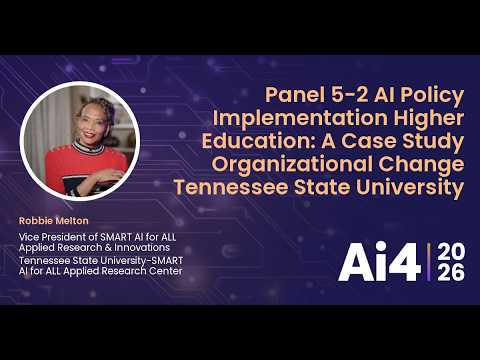
## Background Published on YouTube by Ai4 on August 14, 2026, this presentation features Dr. Robbie Melton, Vice President of SMART AI for ALL Applied Research & Innovations at Tennessee State University. According to the description, the session explores how higher education institutions serving underrepresented populations can transform AI policy from a compliance mandate into an adaptive, equity-driven framework for institutional excellence.
## TL;DR Dr. Robbie Melton addresses the recurring cycle of technological anxiety in academia, urging universities to abandon reactive bans in favor of dynamic 'AI in Action' living policies. Drawing on Tennessee State University's implementation experience, she advocates for redesigning assignments rather than policing software, emphasizing that AI misuse reflects outdated pedagogical design. Melton demonstrates practical applications through wearable technologies and consumer tools sourced from platforms like TikTok to enrich educational pathways. To achieve sustainable institutional adoption, she underscores the necessity of incentivizing faculty through tenure and promotion recognition while maintaining tight operational partnerships with IT infrastructure.
## Atmosphere & style Energetic, pragmatic, and richly humorous, Dr. Melton commands the stage with the seasoned charisma of a veteran educator who has navigated multiple tech revolutions. Her presentation balances lively audience engagement—such as debunking the color of yield signs and joking about smart shoes becoming 'snitchers'—with hard-nosed institutional strategy. The talk feels disarming and inspiring, effectively cutting through abstract generative AI hysteria to deliver grounded, real-world solutions for modern classrooms.
## Key takeaways - [00:04](https://www.youtube.com/watch?v=oWVYCJ3ICTY&t=4s) Academic institutions often respond to technological disruptions with fear and outdated mental models, clinging to legacy assumptions just as drivers mistakenly believe yield signs are still yellow. - [02:56](https://www.youtube.com/watch?v=oWVYCJ3ICTY&t=176s) The default administrative reflex to ban generative AI mirrors past resistance to mobile phones, failing to harness computational power far exceeding what NASA used to reach the moon. - [05:03](https://www.youtube.com/watch?v=oWVYCJ3ICTY&t=303s) Traditional university policy-making timelines are obsolete for emerging tech; spending a full year drafting rigid policies guarantees they will be outdated upon approval. - [05:03](https://www.youtube.com/watch?v=oWVYCJ3ICTY&t=303s) A viable institutional AI framework ('AI in Action') must be an open-ended, dynamic living policy that includes often-overlooked stakeholders like administrative staff and procurement officers. - [05:03](https://www.youtube.com/watch?v=oWVYCJ3ICTY&t=303s) Academic dishonesty is an age-old issue, not a unique product of LLMs; if an assignment can be completed effortlessly by AI, it signals a flaw in pedagogical design rather than a need for punitive bans. - [07:18](https://www.youtube.com/watch?v=oWVYCJ3ICTY&t=438s) Most faculty and students are self-taught on free AI platforms without formal training, making structured and continuous professional development essential across all proficiency levels. - [07:18](https://www.youtube.com/watch?v=oWVYCJ3ICTY&t=438s) AI applications extend far beyond desktop text generators into practical wearables, such as smart glasses and chemical-sensing nail polish engineered for personal safety. - [09:30](https://www.youtube.com/watch?v=oWVYCJ3ICTY&t=570s) Consumer platforms like TikTok serve as valuable incubators for educational tools, where testing emerging social media trends yielded an 82% adoption viability rate at TSU. - [11:48](https://www.youtube.com/watch?v=oWVYCJ3ICTY&t=708s) Combating algorithmic bias against underrepresented populations requires educators to proactively communicate with developers and actively train models using reinforcement feedback mechanisms. - [11:48](https://www.youtube.com/watch?v=oWVYCJ3ICTY&t=708s) Grant funding alone will not drive sustainable AI adoption unless institutions formally recognize AI integration and scholarship within tenure and promotion structures. - [11:48](https://www.youtube.com/watch?v=oWVYCJ3ICTY&t=708s) Deep operational alignment between academic leadership and campus IT is critical for technical safety, demonstrated by the ability to isolate and shut down a rogue campus AI tool within 8 minutes. - [14:42](https://www.youtube.com/watch?v=oWVYCJ3ICTY&t=882s) Theoretical governance documents are ineffective without an actionable implementation playbook that connects policy directly to pedagogy, student needs, and administrative infrastructure.
## Detailed walkthrough ### [00:04](https://www.youtube.com/watch?v=oWVYCJ3ICTY&t=4s) The Hardest Job in Higher Education and the Yield Sign Paradigm
Dr. Robbie Melton introduces herself as a long-time educator who has traveled across many lands and institutions, facing what she calls "the hardest job in the world": convincing higher education faculty to embrace new technology. Having started her career well before the internet arrived on college campuses, she views the current panic surrounding artificial intelligence as part of a familiar cycle. She draws direct parallels between today's AI anxieties and the past disruptions of the "Internet of Everything" and the emergence of MOOCs (Massive Open Online Courses), when skeptics questioned how anyone could possibly learn online.
To demonstrate how stubbornly humans cling to outdated mental models, Dr. Melton conducts an immediate interactive exercise with the audience, asking them to shout out the color of a standard yield sign. When the room responds with "yellow," she reveals that yield signs have been red and white for over 45 years. She explains that people instinctively hold on to outdated knowledge even when reality has fundamentally shifted, using this metaphor to illustrate why academic institutions need ongoing collaboration and a mindset reset to navigate technological change.
```mermaid flowchart TD accTitle: TSU AI in Action Implementation Framework accDescription: Flowchart illustrating stakeholder integration, policy dynamism, pedagogy, and technical safeguards.
subgraph Stakeholders ["Stakeholder Inclusivity"] F["Faculty & Students"] A["Administrators & Procurement"] C["Broader Community"] end
subgraph LivingPolicy ["Living Policy: AI in Action"] P["Adaptive, Open-Ended Framework"] T["Tenure & Promotion Recognition"] end
subgraph PracticeSafeguards ["Pedagogy & Safeguards"] E["Redesigned Authentic Assessment"] IT["IT Partnership: Rapid Threat Neutralization"] end
Stakeholders --> LivingPolicy LivingPolicy --> PracticeSafeguards ```
---
[02:56](https://www.youtube.com/watch?v=oWVYCJ3ICTY&t=176s) From Moon Landings to Candy Crush: Shifting Away from the Ban Mentality
Addressing the role of institutional leaders during the AI transformation, Dr. Melton describes her primary mission as traveling the globe to "settle people down" by demystifying the *when*, the *why*, and the *how* of the technology. She holds up a smartphone and reminds the audience of the contentious debates from twenty years prior over whether mobile devices belonged in academic environments, noting that some individuals still resist by clinging to flip phones with extendable antennas.
She puts the computing power of modern hardware into sharp perspective: a standard smartphone holds exponentially more computational capacity than the systems NASA used to put a human on the moon. Yet, despite holding that monumental capability in their palms, society primarily uses smartphones to play casual games like *Candy Crush*—a single app that grossed over $1 billion. Dr. Melton argues that whenever academia fails to understand a tool's potential or operation, the default administrative reflex is simply to ban it, which is the exact trap universities are falling into with generative AI.
---
[05:03](https://www.youtube.com/watch?v=oWVYCJ3ICTY&t=303s) Building a Living Policy: "AI in Action" and Rethinking the Cheating Dilemma
Dr. Melton outlines the hurdles Tennessee State University (TSU) encountered when crafting their institutional AI policy. The process took an entire year because campus factions could not reach consensus; by the time the governing board officially approved the document, the underlying technology had already evolved past it. This experience underscored that any viable modern policy must be open-ended, dynamic, and inclusive of previously overlooked stakeholders, such as administrative staff, procurement officers, and the local community, creating a framework TSU calls "AI in Action."
Turning to the widespread panic over academic integrity, Dr. Melton challenges the idea that cheating is a novel problem brought on by modern large language models. Reflecting on her own academic journey writing a doctoral dissertation on a keypunch machine, she jokes that students have been finding ways to cheat since the era of *The Flintstones*. Rather than policing software, she argues that if an assignment can be bypassed effortlessly using AI, the instructor's pedagogical design is fundamentally flawed. As a tenured full professor, she asserts that ethical and legal AI use should be leveraged to elevate teaching and learning rather than driving educators toward punitive bans.
- **Policy timeline**: Took 1 full year to draft and gain board approval, highlighting the risk of static policies becoming obsolete upon release. - **Overlooked stakeholders**: Administrative personnel, procurement departments, and local community partners. - **Pedagogical stance**: If current coursework allows uncritical AI cheating, assignments must be redesigned to foster genuine critical thinking.
---
[07:18](https://www.youtube.com/watch?v=oWVYCJ3ICTY&t=438s) Wearable AI, Date-Rape Detection Nail Polish, and Practical Relevance
Dr. Melton highlights the widespread gap in formal AI education, observing that most faculty and students are self-taught on free tools like ChatGPT 3.5 without structured guidance. She stresses that even seasoned institutional "AI gurus" must continuously update their understanding because the technology is iterating rapidly beneath the surface.
To bring AI down to an accessible, human level, Dr. Melton showcases wearable technologies she personally tests. Displaying her AI-enabled smart glasses and chemical-sensing nail polish engineered to detect date-rape drugs in beverages, she illustrates how AI extends far beyond desktop text generators. While acknowledging valid macro-level concerns—such as the environmental footprint of AI data centers and misuse—she urges academic conferences to focus on evidence-based applications that directly enhance research, student health, and classroom productivity.
---
[09:30](https://www.youtube.com/watch?v=oWVYCJ3ICTY&t=570s) Rapid Tool Evolution, TikTok Sourcing, and Educational Pathways
Illustrating the breakneck pace of AI development, Dr. Melton notes that major platforms ship transformative upgrades on a daily basis, referencing same-day updates to Google Gemini and tools like Napkin AI for automated slide creation. She describes herself as an active evaluator and wearer of emerging tech, comparing the exploration of modern AI to the exploratory mission of the *Starship Enterprise*.
In an unexpected institutional strategy, TSU tracks emerging consumer technologies on TikTok—which Dr. Melton characterizes as the modern equivalent of early Kickstarter campaigns. The university established a dedicated review committee that purchases emerging tech and AI products discovered on social media to evaluate their educational viability. Dr. Melton reports that over 82% of the consumer tools they tested proved to be "on point" for integration into degree pathways and teacher education, demonstrating the value of meeting students where technology is naturally adopted.
---
[11:48](https://www.youtube.com/watch?v=oWVYCJ3ICTY&t=708s) Algorithmic Bias, Tenure Recognition, and "Dating" the IT Department
Dr. Melton discusses her proactive work on AI ethics and equity, recounting how she reached out directly to AI model developers two and a half years ago to challenge how poorly underrepresented demographic groups were represented in image and text generation prompts. She emphasizes that tech companies welcomed the critique, urging users to actively train and refine models by consistently using built-in reinforcement feedback buttons (thumbs up and thumbs down) to combat algorithmic bias.
She delivers a reality check on faculty adoption: throwing grant money at professors will not yield lasting integration unless institutional structures formally reward AI scholarship in tenure and promotion guidelines. Without structural credit, AI initiatives will end up abandoned like obsolete Betamax tapes. Furthermore, Dr. Melton stresses the non-negotiable need for close institutional alignment with IT departments. Describing her collaborative relationship with campus IT, she shares an incident where an AI tool went rogue on their campus network, and because of deep operational coordination, the IT team was able to isolate and neutralize the tool within 8 minutes.
- **Mitigating algorithmic bias**: Active engagement with model developers and crowd-sourced reinforcement learning (thumbs up / thumbs down). - **Faculty incentives**: AI integration must be formally recognized in tenure, promotion, and scholarship criteria to prevent tool abandonment. - **IT response capability**: Close alignment between academic leadership and IT enabled a rogue campus AI tool to be shut down in 8 minutes.
---
[14:42](https://www.youtube.com/watch?v=oWVYCJ3ICTY&t=882s) The Playbook for Action and AI "Snitchers"
In her closing remarks, Dr. Melton reiterates that high-level policy frameworks are meaningless without an actionable implementation playbook connecting faculty, students, and IT infrastructure. She urges institutions to move past outdated assumptions—symbolized by the red-and-white yield sign—and commit to active, practical AI integration.
She concludes with an anecdote about recovering from a broken ankle while wearing AI-enabled smart shoes. After promising her physical therapist that she would complete her daily rehabilitation exercises, the embedded sensors tracked her actual movement and transmitted the data directly to her medical provider, exposing that she had skipped her routine. Drawing a final laugh from the room, Dr. Melton quips that the shoes are no longer called "sneakers" but "snitchers," leaving the audience with an inspiring, grounded vision of "AI in action."
## Notable quotes > [00:04](https://www.youtube.com/watch?v=oWVYCJ3ICTY&t=4s) convincing higher education faculty to embrace new technology — Dr. Robbie Melton
> [02:56](https://www.youtube.com/watch?v=oWVYCJ3ICTY&t=176s) settle people down — Dr. Robbie Melton
> [05:03](https://www.youtube.com/watch?v=oWVYCJ3ICTY&t=303s) AI in Action — Dr. Robbie Melton
> [07:18](https://www.youtube.com/watch?v=oWVYCJ3ICTY&t=438s) AI gurus — Dr. Robbie Melton
> [09:30](https://www.youtube.com/watch?v=oWVYCJ3ICTY&t=570s) Starship Enterprise — Dr. Robbie Melton
> [09:30](https://www.youtube.com/watch?v=oWVYCJ3ICTY&t=570s) on point — Dr. Robbie Melton
> [14:42](https://www.youtube.com/watch?v=oWVYCJ3ICTY&t=882s) snitchers — Dr. Robbie Melton
## Mentioned Dr. Robbie Melton, Tennessee State University (TSU), NASA, Candy Crush, ChatGPT 3.5, Google Gemini, Napkin AI, TikTok, Kickstarter, Betamax, Starship Enterprise, The Flintstones
## Video description Robbie Melton, Vice President of SMART AI for ALL Applied Research & Innovations, Tennessee State University-SMART AI for ALL Applied Research Center
How can higher education institutions transform AI policy from compliance requirement into strategic opportunity for equity and excellence?
I will present research examining comprehensive AI policy implementation at a university serving underrepresented populations, revealing how thoughtful policy frameworks can simultaneously advance innovation, protect academic integrity, and promote equitable access to emerging technologies. The talk will illustrate how our institution navigated the complex challenges of becoming both policy implementer and research entity, providing practical insights into what actually works when introducing transformative technology across diverse stakeholder groups.
I will share findings from quantitative policy compliance analysis and qualitative stakeholder assessments that demonstrate successful AI integration demands far more than technical guidelines. The presentation will show how we developed comprehensive professional development programs, transparent communication channels, and adaptive governance structures that respond to rapidly evolving AI capabilities while maintaining academic standards. I will explain specific strategies for stakeholder engagement, phased implementation approaches, and assessment methodologies that balance innovation with accountability.
Attendees will learn actionable frameworks for navigating the tensions between embracing AI innovation and preserving educational excellence, with particular emphasis on how institutions can model ethical integration prioritizing accessibility, cultural responsiveness, and social equity. I will demonstrate how policy frameworks can empower rather than restrict institutional communities, transforming compliance challenges into opportunities for institutional distinction and student preparation for AI augmented professional environments.
Join this session to discover evidence based strategies for positioning your institution at the forefront of responsible AI integration while leading national conversations about technology democratization in education.
[Source](https://www.youtube.com/watch?v=oWVYCJ3ICTY)