Cal State Scraps Syllabi for AI Agent Drills as Entry Jobs Drop 66%
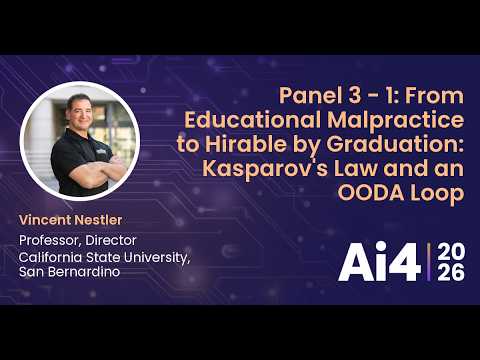
Ai4
Teaching static curricula is educational malpractice during widespread AI labor replacement, leaving employability dependent on mastering human-machine orchestration rather than solo tasks.
AI-assisted summary of Panel 3 - 1: From Educational Malpractice to Hirable by Graduation: Kasparov's Law and an OODA Loop — original source. Check the original for full context.
Source published:
Detailed notes
## Background Published on YouTube by the Ai4 channel on August 14, 2026, this talk features Vincent Nestler, Professor and Director at California State University, San Bernardino. Nestler addresses how failing to update academic syllabi in the face of rapid AI advancement constitutes educational malpractice and outlines how human-AI orchestration frameworks can make students employable before graduation.
## TL;DR Vincent Nestler contends that traditional multi-year curriculum cycles fail students in an economy where AI replaces baseline entry-level labor. Drawing on Kasparov's Law, he redefines employability as the orchestration of AI workflows that neither a human nor an AI can accomplish alone. Nestler demonstrates this by detailing how he discarded his cybersecurity syllabus mid-semester to deploy a live autonomous OpenClaw telemetry range, resulting in rapid job placement for his students. He concludes by challenging academia to adopt an OODA-loop approach and integrate real-world AI tooling rather than clinging to obsolete curricula.
## Atmosphere & style The presentation carries a punchy, provocative, and urgent tone, cutting through academic complacency with sharp pragmatism and candid critique. Nestler speaks with high energy and authentic conviction, moving fluidly from engaging parables to technical deployment breakdowns. The session feels like an invigorating wake-up call, directly confronting the anxiety of workforce automation with tangible, battle-tested solutions for student success.
## Key takeaways - [00:04](https://www.youtube.com/watch?v=Pa7NIssoQMU&t=4s) Treating an academic syllabus as a rigid contract in an era of rapid AI advancement constitutes educational malpractice, preparing students for an obsolete job market. - [02:02](https://www.youtube.com/watch?v=Pa7NIssoQMU&t=122s) Market forces (achieving tasks better, faster, safer, or cheaper) and military imperatives make rapid, aggressive AI adoption inevitable across industries. - [02:45](https://www.youtube.com/watch?v=Pa7NIssoQMU&t=165s) Unlike past technological disruptions that created new human roles, AI functions as a direct replacement technology, heavily impacting entry-level job availability. - [05:15](https://www.youtube.com/watch?v=Pa7NIssoQMU&t=315s) The definition of hirable has shifted to tasks that neither a human alone nor an AI alone can perform, requiring workers to become AI-augmented. - [06:50](https://www.youtube.com/watch?v=Pa7NIssoQMU&t=410s) Kasparov's Law shows that a weak human using an ordinary AI guided by a superior process consistently defeats a strong standalone human or AI, meaning education must prioritize orchestration over static tools. - [10:02](https://www.youtube.com/watch?v=Pa7NIssoQMU&t=602s) Traditional 2-to-6-year curriculum approval cycles guarantee obsolescence; educators must adopt John Boyd's OODA Loop to adapt course content in real time. - [11:40](https://www.youtube.com/watch?v=Pa7NIssoQMU&t=700s) Pivoting cybersecurity labs to live-fire ranges with OpenClaw agents taught students how to manage autonomous offensive and defensive AI workflows. - [14:05](https://www.youtube.com/watch?v=Pa7NIssoQMU&t=845s) Hands-on experience orchestrating autonomous AI agents directly enabled students to overcome hiring slumps and secure employment before graduation. - [16:06](https://www.youtube.com/watch?v=Pa7NIssoQMU&t=966s) Accusing students of cheating for using AI is misguided; instructors who reuse static, outdated syllabi and exams are the ones failing their fiduciary duty to students.
## Detailed walkthrough Here is a detailed walkthrough of Vincent Nestler's talk on integrating AI into modern education and training.
---
[00:04](https://www.youtube.com/watch?v=Pa7NIssoQMU&t=4s) Testing Assumptions and the Academic Syllabus Crisis
Vincent Nestler opens his talk with a parable about Thomas Edison. Before hiring lab assistants, Edison would take applicants out to dinner and observe how they ate. If a candidate salted their food before tasting it, Edison refused to hire them because they acted on unverified assumptions. Nestler uses this story to gauge his audience, asking how many attendees are educators teaching AI as a core subject, educators trying to integrate AI into existing courses, or industry professionals.
He shifts to the core dilemma of higher education: traditionally, an academic syllabus functions as a rigid, legally binding contract. Altering a syllabus mid-semester is treated as a major institutional offense. However, Nestler argues that sticking to a pre-planned syllabus in today's fast-moving environment constitutes **educational malpractice**, whereas throwing it out to adapt to real-world AI developments directly enabled his students to secure employment before graduation.
```mermaid flowchart TD accTitle: Market Forces and Military Imperatives Driving AI Adoption subgraph Drivers["Exogenous Pressures"] MF["Market Forces: Fiduciary duty to adopt AI for efficiency"] MR["Military Reality: Global arms race for AI dominance"] end subgraph Impact["Labor Market Shifts"] EL["66% drop in entry-level jobs"] RE["AI acts as a replacement technology for human labor"] end Drivers --> Impact ```
* **Thomas Edison’s Salt Test:** Edison rejected candidates who salted food before tasting it to filter out people who rely on unexamined assumptions. * **The Syllabus Contract:** In higher education, modifying a syllabus mid-term is considered a serious breach of academic protocol. * **The Educational Malpractice Thesis:** Keeping a syllabus static when technology fundamentally shifts leaves students prepared for a job market that no longer exists.
---
[02:02](https://www.youtube.com/watch?v=Pa7NIssoQMU&t=122s) Market Forces, Military Realities, and Replacement Technology
Nestler highlights two immutable forces driving the rapid adoption of AI that any policy maker, ethicist, or educator must acknowledge:
1. **Market Forces:** If AI enables a process to become *better, faster, safer, or cheaper* without compromising other standards, business leaders have a fiduciary duty to adopt it. Failing to do so allows competitors to take market share, risking total company failure rather than minor job losses. 2. **Military Imperative:** Nations across the globe operate under the belief that maintaining superior AI capabilities is required to remain a dominant power.
Addressing claims that AI will simply act as a productivity enhancer like past technological disruptions, Nestler disputes the analogy of the automobile replacing horse-drawn carriages. While automobiles eliminated horse-and-buggy roles, they created factory, dealership, and mechanic jobs—creating better opportunities for *humans*, even if it displaced *horses*. AI, however, is a direct **replacement technology** for human labor across global markets. For example, a year prior, EnGadget introduced AI to translate content from English to Spanish in their South American offices; within three months, the entire editorial translation staff was eliminated.
* **Market Adoption Drivers:** AI must fulfill at least one of four conditions—better, faster, safer, cheaper—to force widespread market adoption. * **LinkedIn Metrics:** A 177% surge in LinkedIn profiles claiming AI skills. * **Entry-Level Job Decline:** A 66% reduction in entry-level job postings—the traditional target tier for university graduates. * **Translational Displacement:** EnGadget eliminated its entire Spanish editorial translation team within three months of introducing AI tools.
---
[05:15](https://www.youtube.com/watch?v=Pa7NIssoQMU&t=315s) Re-defining "Hirable" and Kasparov's Law
Nestler points to a shift initiated by the CEO of Shopify. Two years ago, a manager proposing an AI solution over a human hire had to prove AI could do the job. Today, Shopify's policy dictates that managers must prove a human candidate is such a specialized "unicorn" that AI *cannot* perform the role before approval for a new hire is granted.
This shift reshapes the baseline definition of employability for university graduates and workers alike:
$$\text{Hirable Standard} = \text{Tasks that neither a Human Alone nor AI Alone can perform}$$
If a human can perform a task alone, AI will eventually do it cheaper. If AI can perform it alone, no human will be hired. Workers must become **AI-augmented**. Nestler notes that entry-level cybersecurity roles historically started at the IT helpdesk—a tier he has not used in two years due to tools like ChatGPT, Perplexity, and Claude operating directly on local files to diagnose and fix technical issues.
```mermaid flowchart LR accTitle: Kasparov's Law of Human-AI Orchestration subgraph WeakCombination["Winning Strategy (Kasparov's Law)"] H["Weak Human"] AI["Ordinary AI"] P["Superior Process / OODA Loop"] end subgraph StrongSolo["Defeated Strategy"] S["Strong AI / Strong Human alone"] end H & AI & P -->|Outperforms| StrongSolo ```
To navigate this, Nestler draws on **Kasparov’s Law**. Following his 1997 defeat against IBM’s Deep Blue, grandmaster Garry Kasparov observed that while a top-tier AI will defeat a top-tier human in chess, a **weak human using an ordinary AI process guided by a superior workflow** will consistently defeat a strong AI or strong human working alone. Educational focus must therefore pivot from teaching specific static tools to teaching the orchestration process.
---
[10:02](https://www.youtube.com/watch?v=Pa7NIssoQMU&t=602s) The Instructional OODA Loop and the OpenClaw Cybersecurity Lab
Traditional instructional design operates on a 2-to-6-year curriculum approval cycle (proposal, textbook selection, slides, committee review, degree path roll-out). In an environment advancing as fast as AI, a multi-year cycle guarantees that course content is obsolete before students graduate. Educators must instead adopt John Boyd's **OODA Loop** (*Observe, Orient, Decide, Act*) to continuously update coursework in real time.
```mermaid flowchart TD accTitle: Cybersecurity Telemetry Range Architecture subgraph AttackDefend["Live Telemetry Range"] Red["Red Team (Students)"] Blue["Blue Team (Students)"] Agent["OpenClaw Agents"] end subgraph Orchestration["Real-Time Coordination"] Disc["Discord Integration"] Dash["Heroku Dyno Telemetry Dashboard"] end Red & Blue <--> Agent Agent --> Disc Disc --> Dash Agent -- "Shared Exploits / Creds" --> Agent ```
To demonstrate this approach, Nestler modified his spring undergraduate cybersecurity courses at California State University, San Bernardino mid-semester. When **OpenClaw** (formerly *Clawbot* / *Moltbot*) was released—a framework Nvidia CEO Jensen Huang publicly called one of the most important software releases—Nestler scrapped his existing syllabus to integrate it directly into the curriculum.
During California State University, San Bernardino's week-13 capstone event, blue team students configured, monitored, and defended a full network built from scratch, while red team students launched attacks against university-hosted LLM credentials using OpenClaw framework agents:
* **Real-time Threat Sharing:** Automated OpenClaw agents linked to Discord channels sent discovered vulnerabilities and compromised credentials across all student teams simultaneously, forcing defenses to respond instantly. * **Continuous Automation:** Students configured API keys and autonomous agents to maintain security operations and attack sequences overnight while they slept. * **Employment Outcomes:** Students added these hands-on autonomous AI orchestration skills directly to their resumes. One international student on a visa had submitted over 500 job applications with zero callbacks; after updating her resume to reflect her work with AI agents and telemetry ranges, she received immediate responses and accepted a job offer on graduation day.
---
[16:06](https://www.youtube.com/watch?v=Pa7NIssoQMU&t=966s) Re-evaluating Cheating and Educational Resources
Nestler reframes the debate around academic integrity. While faculty often accuse students of cheating when they use generative AI tools, Nestler argues that the professors themselves are committing a form of cheating:
> "Professors will say it's cheating if you use AI. Actually, it's the professor that's cheating... because you're using the same damn syllabus that you had last semester and you're expecting it to work again... It's like you know that the answers are out there and you still give the same test."
Educators have a fundamental duty to adjust to economic realities so students graduating with significant tuition debt acquire actual hirable skills. Nestler notes that his courses are shifting away from OpenClaw toward **Hermes** for upcoming terms as part of their ongoing OODA loop cycle.
* **Curriculum Resources:** Nestler shares a repository containing curated AI job interview questions, skill demand metrics, and daily industry briefings at [thehorizon.org](https://thehorizon.org). * **Final Warning:** "It's educational malpractice if you don't do AI in the classroom, no matter what subject you're teaching... or you're going to have people with $200,000 of debt and no way to pay it off."
---
<ElicitationsGroup message="Explore related concepts and applications:"> <Elicitation label="Explore Kasparov's Law in detail" query="Tell me more about Kasparov's Law and Advanced Chess (Centaur Chess), including how process beats raw computational power."/> <Elicitation label="Break down the OODA Loop framework" query="Explain John Boyd's OODA Loop framework and how it applies to rapid decision-making in tech and organizational strategy."/> </ElicitationsGroup>
## Notable quotes > [00:04](https://www.youtube.com/watch?v=Pa7NIssoQMU&t=4s) Educational malpractice used to mean throwing out your syllabus in the middle of the term, and I'll argue that this fall it means keeping it, because a course that doesn't put AI in students' hands is preparing people for a world that no longer exists. — Vincent Nestler
> [02:02](https://www.youtube.com/watch?v=Pa7NIssoQMU&t=122s) If AI enables a process to become better, faster, safer, or cheaper without compromising other standards, business leaders have a fiduciary duty to adopt it. — Vincent Nestler
> [05:15](https://www.youtube.com/watch?v=Pa7NIssoQMU&t=315s) Hirable now means work that neither a human alone nor an AI alone can do, because if a person can do the task alone then AI does it cheaper, and if AI can do it alone then nobody gets hired. — Vincent Nestler
> [05:15](https://www.youtube.com/watch?v=Pa7NIssoQMU&t=315s) That definition, not a list of tools, is what has to dictate what we teach. — Vincent Nestler
> [05:15](https://www.youtube.com/watch?v=Pa7NIssoQMU&t=315s) What earns that bar is the skill Kasparov found after Deep Blue, where a weak player with an ordinary engine and a better process beat a strong player with a strong computer and a worse one. — Vincent Nestler
> [05:15](https://www.youtube.com/watch?v=Pa7NIssoQMU&t=315s) So the thing worth grading, and the thing worth doing at work, is the process by which a person orchestrates the machine. — Vincent Nestler
> [16:06](https://www.youtube.com/watch?v=Pa7NIssoQMU&t=966s) Professors will say it's cheating if you use AI. Actually, it's the professor that's cheating... because you're using the same damn syllabus that you had last semester and you're expecting it to work again... It's like you know that the answers are out there and you still give the same test. — Vincent Nestler
> [16:06](https://www.youtube.com/watch?v=Pa7NIssoQMU&t=966s) It's educational malpractice if you don't do AI in the classroom, no matter what subject you're teaching... or you're going to have people with $200,000 of debt and no way to pay it off. — Vincent Nestler
## Mentioned Vincent Nestler, California State University, San Bernardino, Thomas Edison, EnGadget, Shopify, Garry Kasparov, IBM Deep Blue, ChatGPT, Perplexity, Claude, John Boyd, Jensen Huang, Nvidia, OpenClaw, Heroku, Discord, Hermes, thehorizon.org
## Video description Vincent Nestler, Professor, Director, California State University, San Bernardino
Educational malpractice used to mean throwing out your syllabus in the middle of the term, and I'll argue that this fall it means keeping it, because a course that doesn't put AI in students' hands is preparing people for a world that no longer exists. The bar has moved. Hirable now means work that neither a human alone nor an AI alone can do, because if a person can do the task alone then AI does it cheaper, and if AI can do it alone then nobody gets hired. That definition, not a list of tools, is what has to dictate what we teach. What earns that bar is the skill Kasparov found after Deep Blue, where a weak player with an ordinary engine and a better process beat a strong player with a strong computer and a worse one. So the thing worth grading, and the thing worth doing at work, is the process by which a person orchestrates the machine. I'll show what happened when I acted on that: mid-semester I threw out the syllabus for two undergraduate cybersecurity classes and rebuilt them around OpenClaw when the framework was weeks old, then ran an open-source telemetry range on a single Heroku dyno for 69 teams and 2,518 events over 15 days, with students running that same framework on offense while defending university-hosted LLM credentials under live attack. You'll get the failures with the wins, including one hardened firewall no team breached and a majority of teams who never got past reconnaissance, plus the process-trace rubric we use to grade the orchestration instead of the answer and a two-tier adoption path that starts on a community-account budget and scales to on-premises inference. Come if you own a curriculum or a training program and you're trying to work out how fast you're allowed to move, and I'll tell you the part I didn't plan, which is that several students were interviewed and hired before the capstone even ended.
[Source](https://www.youtube.com/watch?v=Pa7NIssoQMU)