Oklahoma Outreach Lifts AI Use to 74% by Tackling Fear Over Tech
Ai4
Enterprise AI adoption stalls from unaddressed human emotion rather than software limits, and treating implementation as adult learning rather than an IT rollout is what unlocks workplace fluency.
AI-assisted summary of Panel 5 - 3: Leading Human-Centered AI Adoption: From Awareness to the Human Edge — original source. Check the original for full context.
Source published:
Detailed notes
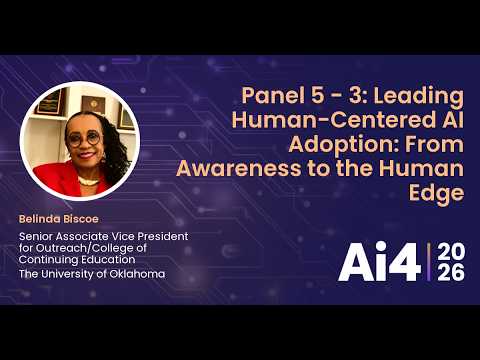
## Background Published on YouTube by Ai4 on August 14, 2026, this presentation features Belinda Biscoe, Senior Associate Vice President for University Outreach at the University of Oklahoma. The session outlines a three-year, data-backed initiative that guided an organization of 1,400 employees from AI skepticism and fear to confident fluency by prioritizing human behavior over technology.
## TL;DR Belinda Biscoe details a longitudinal case study showing how the University of Oklahoma's College of Continuing Education overcame intense workplace anxiety surrounding generative AI. Utilizing a five-stage framework rooted in psychological safety, empirical sentiment analysis, and continuous adult learning, the division achieved a 74% adoption rate within one year without executive mandates. As training progressed, initial dread evolved into mature ethical inquiry, with 95% of employees ultimately articulating their irreplaceable human edge. Biscoe emphasizes that successful digital transformation depends on treating AI adoption as an adult education challenge rather than a standard IT rollout.
## Atmosphere & style The presentation carries an authoritative yet deeply empathetic tone, anchored by Biscoe's dual perspective as an organizational leader and research psychologist. She connects with the audience through candid, relatable anecdotes of early workforce resistance before systematically walking through data-backed outcomes. The delivery feels pragmatic, reflective, and empowering, balancing rigorous organizational research with an inspiring reaffirmation of human judgment.
## Key takeaways - [00:04](https://www.youtube.com/watch?v=J4Q4sOQ7Uqk&t=4s) The primary barrier to successful enterprise AI adoption is human emotion and behavior rather than software capability. - [00:04](https://www.youtube.com/watch?v=J4Q4sOQ7Uqk&t=4s) Investing in people before technology helped a 1,400-person workforce transition from 50% having zero AI experience to 95% articulating their irreplaceable human value. - [02:16](https://www.youtube.com/watch?v=J4Q4sOQ7Uqk&t=136s) Baseline organizational resistance can manifest as extreme fear or moral objection, making empirical sentiment tracking and psychological research essential. - [04:53](https://www.youtube.com/watch?v=J4Q4sOQ7Uqk&t=293s) Employee fear should be treated as a legitimate baseline and mandatory starting line rather than an operational failure to be dismissed with cheerleading. - [04:53](https://www.youtube.com/watch?v=J4Q4sOQ7Uqk&t=293s) Leaders must visibly participate as fellow learners to model curiosity and build psychological safety across the organization. - [07:48](https://www.youtube.com/watch?v=J4Q4sOQ7Uqk&t=468s) Structured, non-mandatory adult learning drove AI usage from 50% zero-experience to 74% regular or occasional adoption within a single year. - [07:48](https://www.youtube.com/watch?v=J4Q4sOQ7Uqk&t=468s) Employee skepticism regarding algorithmic bias and output fairness reflects critical thinking and ethical maturity rather than negative resistance. - [07:48](https://www.youtube.com/watch?v=J4Q4sOQ7Uqk&t=468s) 89% of employees affirmed that essential human skills—including empathy, contextual judgment, and ethical decision-making—became more strategic in an AI-embedded workplace. - [11:49](https://www.youtube.com/watch?v=J4Q4sOQ7Uqk&t=709s) Pre-assessment sentiment discovery (Stage 2) and the 'Human Edge' (Stage 5) are the two critical phases organizational leaders most commonly skip during AI rollouts. - [11:49](https://www.youtube.com/watch?v=J4Q4sOQ7Uqk&t=709s) AI adoption must be framed and managed as an adult learning process rather than an IT deployment to avoid alienating non-technical employees. - [11:49](https://www.youtube.com/watch?v=J4Q4sOQ7Uqk&t=709s) Professional development must deliver role-tailored practical workflows rather than generic, high-level software feature demonstrations. - [15:36](https://www.youtube.com/watch?v=J4Q4sOQ7Uqk&t=936s) Long-term competitive advantage in the AI era will belong to organizations that prioritize the human side of transformation over tool procurement.
## Detailed walkthrough ### [00:04](https://www.youtube.com/watch?v=J4Q4sOQ7Uqk&t=4s) Introduction and the Journey to the Human Edge
Belinda Biscoe introduces herself as the Senior Associate Vice President for University Outreach in the College of Continuing Education at the University of Oklahoma. As head of one of the nation's largest continuing education organizations, she oversees approximately 1,400 employees across 17 distinct departments. Addressing an audience spanning academia, corporations, nonprofits, and industry, Biscoe presents a three-year case study titled *"Leading Human-Centered AI Adoption: From Awareness to the Human Edge."* Her central thesis challenges the tech-first narrative dominating enterprise adoption: the primary barrier to digital transformation is not software capability, but human emotion and behavior.
Reflecting on the baseline conditions in 2023–2024, Biscoe reveals that half of her workforce had never used or touched an artificial intelligence tool. Reactions ranged from outright fury to paralyzing fear, with multiple staff members convinced their professional careers had reached an abrupt end. By 2026, after intentionally investing in people before tools, 95% of those employees could articulate precisely what makes them irreplaceable in an AI-embedded workplace. Rather than pushing rapid rollouts or top-down mandates, the organization unlocked fluency by directly addressing emotional paralysis through a structured, people-first roadmap.
- **Workforce Size:** Approximately 1,400 employees (800 full-time staff, 600 part-time and occasional workers). - **Core Shift:** From 50% having zero AI experience in 2023–2024 to 95% having clear conviction of their unique, irreplaceable human value by 2026.
---
[02:16](https://www.youtube.com/watch?v=J4Q4sOQ7Uqk&t=136s) Gauging Resistance, Early Backlash, and Mixed-Methods Research
Engaging the room, Biscoe asks how many organizational leaders still grapple with employees terrified of AI, or have invested in expensive licenses only to watch tools sit unused. Hands shoot up across the audience. Identifying herself as a baby boomer who nonetheless tends toward early technology adoption, Biscoe notes that she began experimenting with generative AI roughly five years prior. Recognizing immediately that the technology would be a profound game-changer, she resolved to build comprehensive AI literacy across the entire college.
Initial resistance was extreme. In a baseline, college-wide survey distributed to assess organizational readiness, one employee responded with the verbatim assessment: "This is against God and humanity." Others openly declared they would quit their jobs if the college forced AI implementation. To navigate this friction systematically, Biscoe leaned into her background as a research psychologist. She established a rigorous mixed-methods study spanning three years across all 17 departments, combining qualitative sentiment analysis with quantitative surveying before and after every training initiative.
- **Baseline Sentiment:** 28% of employees in Year 1 believed AI offered zero meaningful benefits to their daily work. - **Methodology:** Longitudinal mixed-methods design pairing broad annual surveys with pre- and post-session evaluations for all professional development modules.
---
[04:53](https://www.youtube.com/watch?v=J4Q4sOQ7Uqk&t=293s) Creating Psychological Safety and Continuous Professional Development
Rather than ignoring employee apprehension or brushing it aside with corporate cheerleading, leadership made a calculated choice to treat fear as a legitimate baseline. Biscoe emphasizes that leadership deliberately avoided sending hollow, celebratory emails declaring, "Oh, this is so exciting." Instead, they established psychological safety by acknowledging that all major technological disruptions introduce genuine challenges alongside operational advantages. In her view, employee fear is never an operational failure—it is simply the mandatory starting line.
The centerpiece for organizational learning became the annual "State of Outreach" conference, a large-scale gathering repurposed to deliver deep professional development. Rather than treating training as an isolated, one-and-done event, the college structured continuous, multi-tiered learning emphasizing organizational learning, workforce readiness, ethical reflection, and practical hands-on application. Survey data gathered prior to the programming directly dictated the curriculum. In later phases, this included voluntary deep-dive training on Microsoft Copilot, ensuring that instruction matched staff readiness rather than administrative assumptions. Throughout, Biscoe visibly participated as a fellow learner, reinforcing curiosity from the top down.
```mermaid flowchart TD accTitle: The Five-Stage Human-Centered AI Framework subgraph Foundation ["1. Alignment & Baseline"] A["Stage 1: Leadership Commitment<br/>& Demonstrated Curiosity"] --> B["Stage 2: Pre-Assessment & Sentiment Discovery<br/>(Fears, Needs, Literacy)"] end subgraph Implementation ["2. Literacy & Context"] B --> C["Stage 3: Organization-Wide Shared Awareness<br/>(Common Vocabulary & Safety)"] C --> D["Stage 4: Role-Specific Training<br/>(HR, Finance, Research, Admin)"] end subgraph Maturation ["3. Strategic Edge"] D --> E["Stage 5: The Human Edge<br/>(Critical Inquiry, Ethics & Irreplaceable Skills)"] end ```
---
[07:48](https://www.youtube.com/watch?v=J4Q4sOQ7Uqk&t=468s) From Existential Dread to Operational Sophistication
The impact of this approach materialized rapidly. Within a single year—without mandating usage, procuring a disruptive new AI platform, or exerting coercion—the college's metrics inverted: zero-experience rates collapsed from 50%, while 74% of the workforce reported using AI regularly or occasionally. Crucially, employee concerns did not vanish; instead, they matured. What began as existential dread about employment survival transformed into operational sophistication and critical inquiry.
Staff members across all administrative functions—educators, HR specialists, grant writers, and frontline customer service staff—began evaluating algorithmic bias and actively questioning automated outputs. Employees moved toward asking nuanced, systemic questions, such as: "Who benefits more from an AI-automated process?" For Biscoe, skepticism shifted from being a symptom of obstinate resistance into concrete proof of organizational growth, ethical leadership thinking, and critical maturity.
- **Adoption Surge:** 74% of staff using AI regularly or occasionally after 12 months of structured learning. - **Role Value Recognition:** 89% of employees affirmed that their human roles had become *more* critical and strategic in an AI-embedded workflow. - **Key Human Assets Identified:** Ethical decision-making, contextual judgment, empathy, and cross-functional collaboration.
---
[11:49](https://www.youtube.com/watch?v=J4Q4sOQ7Uqk&t=709s) The Five-Stage Framework and Key Leadership Lessons
Biscoe formalizes the college's methodology into a transferable five-stage model, highlighting Stages 2 and 5 as the steps leaders most frequently skip when rolling out new systems. Stage 1 requires leadership to make an explicit commitment and model vulnerability as active learners. Stage 2 mandates continuous empirical surveying to pinpoint what employees fear, know, and require before designing any learning intervention. Stage 3 builds organization-wide awareness and shared vocabulary, unifying staff through common experiences. Stage 4 delivers role-specific application tailored to functional duties—such as budgeting for accountants, talent management for HR, or literature synthesis for grant writers—honoring adult learning theory. Stage 5 targets the "Human Edge," elevating irreplaceable cognitive and interpersonal assets.
From this framework, Biscoe extracts fundamental operating principles: AI adoption is an adult learning challenge, never a standard IT software rollout. Framing implementation as an IT project alienates non-technical workforces immediately. Furthermore, so-called "soft skills" must be recognized as strategic assets that serve as an organization's primary competitive advantage in an automated landscape.
- **Actionable Recommendations for Leaders:** - Survey comprehensively *before* configuring training curricula. - Establish baseline literacy and common vocabulary before tool deployment. - Create collective, low-stakes shared experiences across departments. - Deliver role-tailored instruction rather than generic feature demos. - Build explicit ethical frameworks alongside technical workflows. - Treat human skills as hard strategic assets rather than secondary soft skills.
---
[15:36](https://www.youtube.com/watch?v=J4Q4sOQ7Uqk&t=936s) Open Questions, Study Limitations, and Call for Collaboration
Concluding her presentation, Biscoe outlines the institutional boundaries of the initiative and poses critical research questions that remain unanswered. Because the study was conducted within a single university continuing education division, the findings are compelling but not yet universally generalizable across corporations, government agencies, or alternative nonprofit ecosystems. Additionally, survey participation was voluntary, introducing potential self-selection bias among more engaged staff, while survey instruments evolved from year to year rather than remaining static.
Biscoe leaves the audience with core questions currently driving her academic inquiries: how sustained AI adoption affects long-term employee well-being and productivity, and precisely which human capabilities correlate most strongly with resilient AI integration. She invites attendees to partner on comparative, multi-site studies and longitudinal tracking across other enterprise environments, reiterating her overarching philosophy: "The organizations that will win with AI in this era will not be the ones with the best tools; they will be the ones who figured out the human side first."
## Notable quotes > I've watched an organization of 1,400 people go from fear to fluency with AI, and I can show you exactly how we did it. — Belinda Biscoe
> Whether you lead a Fortune 500 team, a startup, or a university, the #1 reason AI adoption stalls isn't the technology; it's the people, and most leaders are skipping the steps that actually change behavior. — Belinda Biscoe
> the most powerful outcome of our AI initiative wasn't that people used AI more; it's that they became clearer about what makes them irreplaceable. — Belinda Biscoe
> [00:04](https://www.youtube.com/watch?v=J4Q4sOQ7Uqk&t=4s) Leading Human-Centered AI Adoption: From Awareness to the Human Edge. — Belinda Biscoe
> [02:16](https://www.youtube.com/watch?v=J4Q4sOQ7Uqk&t=136s) This is against God and humanity. — Survey Respondent
> [04:53](https://www.youtube.com/watch?v=J4Q4sOQ7Uqk&t=293s) Oh, this is so exciting. — Belinda Biscoe
> [07:48](https://www.youtube.com/watch?v=J4Q4sOQ7Uqk&t=468s) Who benefits more from an AI-automated process? — Staff Member
> [15:36](https://www.youtube.com/watch?v=J4Q4sOQ7Uqk&t=936s) The organizations that will win with AI in this era will not be the ones with the best tools; they will be the ones who figured out the human side first. — Belinda Biscoe
## Mentioned Belinda Biscoe, University of Oklahoma, College of Continuing Education, University Outreach, Ai4, Microsoft Copilot, State of Outreach Conference
## Video description Belinda Biscoe, Senior Associate Vice President for Outreach/College of Continuing Education, The University of Oklahoma
I've watched an organization of 1,400 people go from fear to fluency with AI, and I can show you exactly how we did it. Whether you lead a Fortune 500 team, a startup, or a university, the #1 reason AI adoption stalls isn't the technology; it's the people, and most leaders are skipping the steps that actually change behavior. In this session, I'll share three years of real data, a five-stage framework you can take back to your organization Monday morning, and the counterintuitive truth we discovered: the most powerful outcome of our AI initiative wasn't that people used AI more; it's that they became clearer about what makes them irreplaceable. Come ready to rethink your AI strategy, because the organizations that will win aren't the ones with the best tools; they're the ones who figured out the human side first.
[Source](https://www.youtube.com/watch?v=J4Q4sOQ7Uqk)