Dane Seelen Says AI Access Yields Zero Edge Without Proprietary Data
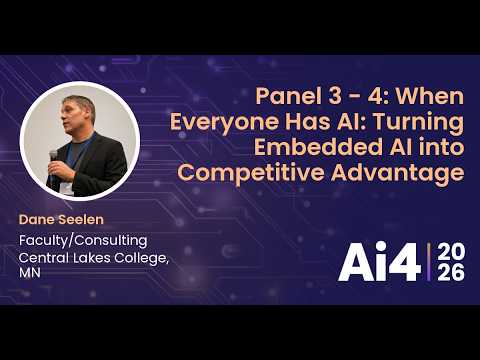
Panel 3 - 4: When Everyone Has AI: Turning Embedded AI into Competitive Advantage — Ai4

Ai4

Commoditized enterprise AI fails to create competitive advantage unless companies integrate models with proprietary institutional data, redesigned workflows, and strict human accountability.

AI-assisted summary of Panel 3 - 4: When Everyone Has AI: Turning Embedded AI into Competitive Advantage — original source. Check the original for full context.

Source published:

Detailed notes

## Background Published by the Ai4 channel on YouTube on August 14, 2026, this presentation features Dane Seelen of Central Lakes College discussing the 'Embedded AI Paradox.' The talk explores how organizations can generate genuine competitive advantage when AI tools become commoditized and ubiquitous, introducing a practical framework covering data, workflows, workforce skills, and governance.

## TL;DR Dane Seelen demonstrates that because artificial intelligence has become an ambient, commoditized utility embedded across standard enterprise software, basic access to AI tools no longer yields a competitive edge. Sustainable business value instead requires organizational readiness, accountable workflow redesign, and integration with non-replicable proprietary assets like institutional knowledge and specialized historical data. Seelen outlines a four-stage adoption and learning cycle—mapping AI presence, assessing organizational readiness, building problem-first workflows, and evaluating net business value—to help leaders make disciplined, evidence-based decisions about scaling, pausing, or halting AI initiatives.

## Atmosphere & style The presentation carries a pragmatic, intellectually grounded, and refreshingly candid tone that cuts cleanly through contemporary AI conference hype. Seelen presents with the methodical clarity of an experienced educator and practitioner, anchoring abstract strategic concepts in concrete operational realities like industrial maintenance diagnostics. The session feels like an executive reality check, shifting the narrative away from vendor excitement toward disciplined organizational capability, accountability, and the irreplaceable value of human expertise.

## Key takeaways - [00:04](https://www.youtube.com/watch?v=TrMRwyf-I3c&t=4s) Access to foundational AI models and software has become commoditized; competitive advantage now relies on organizational readiness, process integration, and knowing when AI is not yet the appropriate solution. - [03:05](https://www.youtube.com/watch?v=TrMRwyf-I3c&t=185s) AI creates operational value by synthesizing fragmented institutional data and technical history across complex systems, while human experts retain ownership of physical execution, safety, and final decisions. - [07:26](https://www.youtube.com/watch?v=TrMRwyf-I3c&t=446s) Embedded AI bypasses traditional top-down procurement lifecycles, often entering workflows silently through background vendor updates or unmanaged individual employee adoption. - [09:34](https://www.youtube.com/watch?v=TrMRwyf-I3c&t=574s) The Embedded AI Paradox highlights that as AI becomes more universally accessible and functionally capable, owning or licensing AI tools provides diminishing competitive differentiation. - [09:34](https://www.youtube.com/watch?v=TrMRwyf-I3c&t=574s) Grounding AI strategy in the Resource-Based View and Dynamic Capabilities reveals that identical AI tools yield asymmetric outcomes based on unique internal data, workforce skills, and organizational learning loops. - [12:33](https://www.youtube.com/watch?v=TrMRwyf-I3c&t=753s) Organizations fall into a major strategic trap by conflating simple tool access with active deployment, workflow integration, measurable net value, and true competitive advantage. - [13:23](https://www.youtube.com/watch?v=TrMRwyf-I3c&t=803s) Organizational AI readiness depends on four institutional pillars: workforce capability, leadership capability, workflow standardization, and systemic organizational support. - [15:06](https://www.youtube.com/watch?v=TrMRwyf-I3c&t=906s) Effective implementation requires an accountable, problem-first workflow design that establishes clear data boundaries and preserves explicit human ownership for operational outcomes. - [15:06](https://www.youtube.com/watch?v=TrMRwyf-I3c&t=906s) Calculating net organizational value requires weighing holistic workflow acceleration against hidden offset costs like verification time, error mitigation, upskilling, and governance overhead. - [15:06](https://www.youtube.com/watch?v=TrMRwyf-I3c&t=906s) Measurable net value should trigger one of four disciplined strategic decisions: expanding the deployment, modifying and retesting parameters, pausing the initiative, or stopping it entirely. - [17:02](https://www.youtube.com/watch?v=TrMRwyf-I3c&t=1022s) Defensible advantage is built by coupling standardized AI capabilities with non-replicable firm assets, such as deep historical records, institutional memory, and context gained through iterative operational learning. - [18:48](https://www.youtube.com/watch?v=TrMRwyf-I3c&t=1128s) Leaders must govern AI through practical diagnostic inquiries that verify real-world usage, evaluator hands-on competency, problem accountability, hard baseline metrics, and firm-specific asset leverage.

## Detailed walkthrough ### [00:04](https://www.youtube.com/watch?v=TrMRwyf-I3c&t=4s) The Core Question of Competitive Advantage in the AI Era

Dane Seelen opens with a straightforward yet challenging question: if your competitor can buy the exact same AI tools, subscribe to the exact same platforms, and access the same foundational models, where does your competitive advantage actually come from? Drawing on over four years of hands-on work across education, research, consulting, and building AI-supported workflows—ranging from employee training and organizational governance to practical agentic deployments—he points out an uncomfortable reality: securing access to AI is relatively easy because everyone has it, but building the organizational capability to use it effectively, responsibly, and measurably is vastly harder.

```mermaid flowchart TD accTitle: The AI Capability Gap accDescription: Diagram showing that basic AI access is a common baseline, while organizational readiness drives true advantage. subgraph S1["Common Baseline"] A["Commoditized AI Tools\n& Models"] end subgraph S2["Organizational Differentiators"] B["Internal Knowledge & Data"] C["Redesigned Workflows"] D["Workforce Skills & Governance"] E["Continuous Learning Loops"] end subgraph S3["Strategic Outcome"] F["Measurable Competitive Advantage"] end A --> B A --> C A --> D A --> E B --> F C --> F D --> F E --> F ```

The issue is accelerating because AI is no longer confined to standalone enterprise subscriptions or niche tooling; it is increasingly embedded directly into existing enterprise software or accessed ad hoc by individual employees. True advantage cannot stem from basic access alone. Instead, it relies on an organization's readiness to harness its internal resources in tandem with AI, spot operational gaps, and adapt dynamically. Seelen also notes that knowing where *not* to deploy AI is just as vital as knowing where to apply it: in many situations, leaders need the discipline to draw a line in the sand and conclude that AI is "not yet" the right fit.

- AI access has become commoditized across products, platforms, and models. - Sustainable advantage lies in readiness, resource integration, and gap identification. - Strategic maturity requires identifying when AI is "not yet" an appropriate solution.

---

[03:05](https://www.youtube.com/watch?v=TrMRwyf-I3c&t=185s) Troubleshooting Complex Systems: A Maintenance Case Study

To ground the concepts in operational reality, Seelen illustrates the diagnostic process using an industrial maintenance scenario, though the principle applies equally across any business function. When a critical production machine halts unexpectedly, a technician cannot simply flip to a single chapter in a service manual. Machine failures do not occur along tidy chapter lines; they happen across interconnected mechanical, electrical, sensory, software, and network subsystems.

```mermaid flowchart LR accTitle: AI Supported Troubleshooting Workflow accDescription: Flowchart illustrating how AI synthesizes disparate organizational knowledge to assist a human technician. subgraph Input["Symptom & Context Gathering"] A["Operator Observations\n& Machine State"] end subgraph Knowledge["Organizational Data Assets"] B["Service Manuals\n& Schematics"] C["Repair History\n& Sensor Logs"] D["Senior Tech Tacit Knowledge"] end subgraph Synthesis["AI Diagnostic Synthesis"] E["Cross-Reference & Rank Causes"] F["Recommend Next Logical Test"] end subgraph Human["Human Verification & Action"] G["Technician Executes Test\n& Owns Decision"] end

A --> E B --> E C --> E D --> E E --> F F --> G ```

Rather than forcing a technician to manually wade through multiple 300-page technical manuals, an AI-supported workflow can aggregate disjointed information—electrical schematics, repair histories, safety procedures, and the institutional knowledge of veteran technicians who may be off-shift. The system compares current symptoms against past failure modes, ranks the most probable root causes, and recommends an ordered sequence of diagnostic tests. The human technician remains completely central: they verify recommendations, carry out physical tests safely, and own the final decision. AI does not replace technical expertise; it enables the technician to rapidly leverage the entire organization's accumulated knowledge.

- Machines fail across multi-layered systems (sensors, networks, software, hardware), not according to single manual chapters. - AI synthesizes disparate data sources to rank likely failure causes and suggest next steps. - The human technician retains ownership of safety, physical execution, and final decisions. - Value is not captured by blindly accepting an initial AI output, but through the overarching system: context, review standards, and organizational learning. - When an AI output is flawed, the right question is not "does AI work?", but "which part of the workflow, data, leadership, or training broke down?"

---

[07:26](https://www.youtube.com/watch?v=TrMRwyf-I3c&t=446s) The Spread of Embedded AI and the Breakdown of Traditional Adoption

Technology adoption historically followed an orderly top-down lifecycle: leadership identified an organizational need, evaluated vendor solutions, made a formal purchase, and planned a controlled rollout. Embedded AI completely shatters this sequence. Capabilities routinely appear overnight through silent background updates to existing enterprise software, vendor feature additions, or unmanaged employee adoption of public web tools.

Sharing an example from his own work at the college, Seelen notes that Adobe suddenly enabled automatic AI summarization inside their standard PDF reader without any prior announcement or IT email notification. Because tools appear silently and employees interact with them inconsistently—using varying levels of context, unvetted data sources, and divergent review standards—organizational outputs become erratic. The fundamental management question shifts from "should we adopt AI?" to discovering where AI is already active, governing its existing usage, and channeling that unmanaged access into structured, measurable business value.

---

[09:34](https://www.youtube.com/watch?v=TrMRwyf-I3c&t=574s) The Embedded AI Paradox and Theoretical Foundations

The rapid commoditization of AI gives rise to the **Embedded AI Paradox**: as AI systems grow more capable and valuable in daily operations, direct access to them becomes less distinctive as a source of competitive differentiation. When every organization has equal access to high-grade tools like Microsoft Copilot inside Office 365, holding a license provides zero unique edge.

| Theoretical Framework | Application to Embedded AI | Core Insight | |:--- |:--- |:--- | | **General Purpose Technology (GPT)** | Explains why AI spreads universally across industries, functions, and tools, shifting academic framing away from standard Technology Acceptance Models (TAM) to an ambient utility akin to electricity or the internet. | AI is an underlying infrastructure embedded everywhere, not a discrete, isolated software package. | | **Resource-Based View (RBV)** | Explains why identical tools yield vastly different business outcomes due to unique proprietary data, workforce skills, leadership routines, and internal relationships. | Common access + heterogeneous internal resources = asymmetrical organizational performance. | | **Dynamic Capabilities** | Explains the necessity of organizational sensing, workflow redesign, empirical evaluation, and continuous learning from AI interactions. | Long-term advantage depends on an organization's speed and discipline in reconfiguring processes. |

To operationalize these principles, Seelen introduces a four-stage framework designed to systematically transform commoditized AI access into measurable performance gains:

1. **Map AI Access and Exposure** $\rightarrow$ Produces an enterprise-wide *access map*. 2. **Assess Organizational AI Readiness** $\rightarrow$ Produces an objective *readiness profile*. 3. **Develop AI Workflow Integration** $\rightarrow$ Yields a *documented, AI-supported workflow*. 4. **Evaluate Organizational Value** $\rightarrow$ Generates an *evidence-based decision path* for ongoing investment and operational adjustment.

[12:33](https://www.youtube.com/watch?v=TrMRwyf-I3c&t=753s) The Fallacy of Conflating Access with Advantage

Organizations routinely make the mistake of treating fundamentally different operational milestones as if they were identical. Mere access to artificial intelligence does not mean an enterprise is equipped to use it effectively. Furthermore, actively deploying AI tools does not imply they have been responsibly integrated into recurring, day-to-day work, nor does embedding AI into an existing workflow prove that it creates tangible value. Most critically, even when clear organizational value is demonstrated, it does not automatically generate a sustainable competitive advantage. Conflating these milestones causes leadership to rush headlong from technology acquisition directly into unverified claims of value, bypassing the essential groundwork of readiness, workflow design, measurement, and governance.

To navigate this trap, organizations must treat AI adoption not as a linear checklist to be completed once, but as a continuous learning cycle. Discoveries, metrics, and friction points evaluated in later stages must loop back to inform and adjust foundational assumptions made in earlier phases.

```mermaid flowchart TD accTitle: Four Stage AI Adoption and Learning Cycle subgraph Preparation["Diagnostic & Readiness"] S1["Stage 1: Diagnostic Mapping<br/>(Approved, embedded, shadow AI)"] S2["Stage 2: Readiness Evaluation<br/>(Workforce, leadership, workflow, support)"] end subgraph Execution["Implementation & Evaluation"] S3["Stage 3: Accountable Workflow Design<br/>(Problem-first, judgment & accountability)"] S4["Stage 4: Net Value Assessment<br/>(Expand, modify, pause, or stop)"] end

S1 --> S2 S2 --> S3 S3 --> S4 S4 -.->|"Informs future iterations"| S1 ```

[13:23](https://www.youtube.com/watch?v=TrMRwyf-I3c&t=803s) Stages 1 & 2: Diagnostic Mapping and Four Dimensions of Readiness

The first two phases of the framework establish where AI is already present and whether the company possesses the institutional maturity to deploy it responsibly. Stage one is purely diagnostic: the organization builds an "AI access map" tracking every touchpoint where AI exists. This inventory goes far beyond enterprise software license audits; it catalogues sanctioned enterprise platforms, automated features embedded inside existing enterprise suites, public AI tools, and informal, unsanctioned employee experimentation. Constructing this visibility exposes not just what the enterprise deliberately purchased, but where unmonitored exposure is quietly introducing operational risks or organic opportunities.

Stage two evaluates operational readiness across four distinct institutional pillars: - **Workforce Capability:** Whether frontline personnel know how to operate AI systems, critically question generated outputs, identify technical limitations, and rigorously verify information. - **Leadership Capability:** Whether managers can match AI to genuine operational problems rather than chasing trends, establish enforceable lines of accountability, facilitate safe experimentation, and possess the discipline to recognize when AI is the wrong solution. - **Workflow Readiness:** Whether underlying business processes are sufficiently mapped, standardized, and understood so that redesigning them around AI is actually feasible. - **Organizational Support:** The presence of established governance structures, curated and reliable data sources, vetted software, targeted training programs, technical help desks, and explicit corporate expectations.

Frontline staff cannot realistically evaluate or trust AI tools without prior, task-relevant experience in a safe environment. However, achieving organizational readiness merely sets the stage for action—it offers zero guarantee that the technology will actually enhance operational performance.

[15:06](https://www.youtube.com/watch?v=TrMRwyf-I3c&t=906s) Stages 3 & 4: Designing Accountable Workflows and Evaluating Net Value

Stage three shifts from baseline readiness to practical execution, which must start with an explicitly defined operational problem rather than an executive mandate to "use more AI." In this phase, the enterprise identifies the workflow friction point, defines what approved internal data the AI is permitted to draw from, establishes strict boundaries for mandatory human intervention, and designates who remains answerable for the end result. Preserving clear human accountability is non-negotiable even in highly automated environments, because when an autonomous system makes an operational error, an identifiable person or role must own the consequence. The ultimate deliverable of stage three is not an impressive software demo or an isolated tool, but a fully documented, AI-supported workflow that harmonizes technical capabilities, internal institutional data, worker expertise, human verification, and formal oversight.

Stage four demands a disciplined calculation of net organizational value against an established operational baseline. A common illusion is assuming that because an AI generates a response faster, the entire process has accelerated; in reality, employees may expend equal or greater time double-checking synthetic outputs, tracking down omitted context, fixing subtle hallucinations, or mitigating novel compliance issues. True evaluation weighs holistic end-to-end operational improvements against all accompanying overhead costs.

- **Primary Performance Metrics:** Processing time, output quality, equipment downtime, throughput, and customer resolution rates. - **Hidden Offset Costs:** Verification time, workforce upskilling, technical infrastructure, ongoing administrative governance, and risk mitigation. - **The Four Stage-Four Outcomes:** Once net value is weighed against baseline data, leaders must enforce one of four decisions: expand the deployment, modify and retest the parameters, pause the initiative, or stop it entirely.

As Dane Seelen emphasizes, this testing phase exists to stress-test real utility rather than "defending a decision that has already been made," reminding leaders that "the goal is not maximum AI use. The goal is better work."

[17:02](https://www.youtube.com/watch?v=TrMRwyf-I3c&t=1022s) Building Advantage on Firm-Specific Organizational Context

Even when an AI-augmented process delivers measurable, positive net value, it does not guarantee a competitive advantage. When an organization relies on off-the-shelf, commercial AI products, its competitors can readily buy access to identical foundational models, configure similar feature sets, and achieve parity overnight. Genuine differentiation emerges only when standardized AI technology is inextricably combined with internal, non-replicable corporate assets.

These defensible assets include proprietary historical records, deep institutional memory, technician intuition, customer goodwill, and context accrued through iterative operational failures and improvements. In an industrial or facilities maintenance setting, for example, a rival can buy the identical diagnostic software, but they cannot buy a company's decades of specific repair histories, specialized technician experience, contextual operational knowledge, or idiosyncratic environmental lessons. While Seelen illustrates this principle using maintenance operations, he notes that this exact dynamic has been field-tested across diverse business cases. Sustainable advantage resides not in the underlying AI product, but in the proprietary, organization-specific ecosystem built around it—the integration of technology, experienced people, customized workflows, trusted partnerships, and dynamic organizational learning.

[18:48](https://www.youtube.com/watch?v=TrMRwyf-I3c&t=1128s) Five Strategic Questions for Organizational Leaders

To help executives cut through conference hype and pivot from product showcases toward strategic execution, Seelen outlines five diagnostic questions every leadership team must confront:

1. **Where is AI already available or being used?** Never assume that usage originates with an official IT procurement order: "Trust me, you have people using it whether you know about it or not." 2. **Do the people evaluating it have enough practical experience to judge this?** Avoid the widespread corporate pitfall where non-technical executives who have never directly used AI tools sit in boardrooms acting as the sole arbiters of multi-million-dollar AI software budgets. 3. **What specific workflow problem are we trying to solve, and who remains accountable?** Ground initiatives in explicit operational pain points with clear human ownership rather than vague technology adoption goals. 4. **What baseline and net value measures will determine whether we expand, change, pause, or stop?** Establish hard metrics before rollout to objectively dictate whether to scale, adjust, hold, or terminate an implementation. 5. **What firm-specific data, knowledge, expertise, routines, relationships, or learning will this strengthen or leverage?** Focus on isolating and reinforcing the distinct, non-commoditized enterprise assets that competitors cannot reproduce simply by buying the same software license.

These strategic inquiries intentionally steer executive discussions away from tool novelty, vendor demonstrations, and sweeping claims. Instead, they force leadership teams to anchor investments in organizational capability, measurable productivity, operational responsibility, and long-term defensibility. Closing the session, Seelen invites industry partners to collaborate on expanding this conceptual and case-tested framework into a broader empirical research study.

## Notable quotes > [00:04](https://www.youtube.com/watch?v=TrMRwyf-I3c&t=4s) if your competitor can buy the exact same AI tools, subscribe to the exact same platforms, and access the same foundational models, where does your competitive advantage actually come from? — Dane Seelen

> [00:04](https://www.youtube.com/watch?v=TrMRwyf-I3c&t=4s) not yet — Dane Seelen

> [03:05](https://www.youtube.com/watch?v=TrMRwyf-I3c&t=185s) does AI work? — Dane Seelen

> [03:05](https://www.youtube.com/watch?v=TrMRwyf-I3c&t=185s) which part of the workflow, data, leadership, or training broke down? — Dane Seelen

> [07:26](https://www.youtube.com/watch?v=TrMRwyf-I3c&t=446s) should we adopt AI? — Dane Seelen

> [15:06](https://www.youtube.com/watch?v=TrMRwyf-I3c&t=906s) use more AI. — Dane Seelen

> [15:06](https://www.youtube.com/watch?v=TrMRwyf-I3c&t=906s) defending a decision that has already been made — Dane Seelen

> [15:06](https://www.youtube.com/watch?v=TrMRwyf-I3c&t=906s) The goal is not maximum AI use. The goal is better work. — Dane Seelen

> [18:48](https://www.youtube.com/watch?v=TrMRwyf-I3c&t=1128s) Where is AI already available or being used? — Dane Seelen

> [18:48](https://www.youtube.com/watch?v=TrMRwyf-I3c&t=1128s) Trust me, you have people using it whether you know about it or not. — Dane Seelen

> [18:48](https://www.youtube.com/watch?v=TrMRwyf-I3c&t=1128s) Do the people evaluating it have enough practical experience to judge this? — Dane Seelen

> [18:48](https://www.youtube.com/watch?v=TrMRwyf-I3c&t=1128s) What specific workflow problem are we trying to solve, and who remains accountable? — Dane Seelen

> [18:48](https://www.youtube.com/watch?v=TrMRwyf-I3c&t=1128s) What baseline and net value measures will determine whether we expand, change, pause, or stop? — Dane Seelen

> [18:48](https://www.youtube.com/watch?v=TrMRwyf-I3c&t=1128s) What firm-specific data, knowledge, expertise, routines, relationships, or learning will this strengthen or leverage? — Dane Seelen

## Mentioned Dane Seelen, Ai4, Central Lakes College, MN, Adobe, Microsoft Copilot, Office 365, General Purpose Technology (GPT), Technology Acceptance Model (TAM), Resource-Based View (RBV), Dynamic Capabilities

## Video description Dane Seelen, Faculty/Consulting, Central Lakes College, MN

When AI becomes embedded in the same software used by nearly every organization, what still creates competitive advantage?

This talk will examine the Embedded AI Paradox: AI may remain highly valuable even as access becomes less rare, making ownership alone a weaker source of differentiation. I will explain how AI Capability Exploitation and AI-Ready Organizational Capability can help organizations turn commonly available AI tools into better decisions, redesigned workflows, and stronger operational performance. Attendees will leave with a practical framework for evaluating readiness across data, knowledge, workflows, workforce skills, governance, and organizational learning, while understanding why human judgment remains essential. Attend to learn why the real advantage may no longer come from having AI, but from preparing people and processes to use it better than competitors.

[Source](https://www.youtube.com/watch?v=TrMRwyf-I3c)

中文简报

Dane Seelen:缺乏专有数据,单纯接入AI无法带来竞争优势 商品化的企业级AI无法创造竞争优势,除非企业将模型与专有的机构数据、重新设计的工作流程以及严格的人工问责机制相结合。 Dane Seelen论证指出,由于人工智能已成为融入标准企业软件的泛在化、商品化通用工具,单纯获取AI工具已不再具备竞争优势。可持续的商业价值反而依赖于组织就绪度、具备问责机制的工作流重构,以及与机构知识和专门历史数据等不可复制的专有资产相整合。Seelen概述了一个包含四个阶段的采纳与学习周期——摸清AI应用现状、评估组织就绪度、构建以问题为先的工作流以及评估企业净价值——以帮助管理层基于证据做出严谨决策,明确何时应当扩展、暂停或终止AI项目。 随着基础 AI 模型与工具的普及和商品化,“嵌入式 AI 悖论”表明单纯购买或拥有软件已无法提供持续差异化,企业的真正优势取决于组织准备度及流程重构能力。 (0:04) 以复杂工业维护为例,AI 的核心价值在于跨系统综合分散的技术手册与历史维修数据,人类专家则始终保留物理操作、安全把控与最终决策权。 (3:05) 嵌入式 AI 彻底打破了自上而下的传统 IT 采购流程,常通过后台版本更新或员工自发使用悄然渗透,迫使管理层必须绘制“AI 接入图谱”以治理未经监管的影子使用。 (7:26) 企业常陷入将工具获取误认为产生竞争优势的战略误区;落地必须依托员工能力、领导力、工作流与支持体系四大支柱,并以具体业务痛点为先导推进流程改造。 (12:33) 评估 AI 成效必须扣除人工校验与合规等隐性成本以衡量真实净价值,而不可复制的竞争壁垒只能建立在标准化 AI 与专有数据、员工隐性经验及组织动态学习的深度结合之上。 (17:02)

Reading summary

Dane Seelen argues that as artificial intelligence becomes commoditized and silently embedded across standard software, access alone provides zero competitive edge; sustainable advantage requires integrating tools with proprietary firm assets, disciplined governance, and accountable workflows. The Embedded AI Paradox and Adoption Shifts (9:34) Traditional enterprise technology adoption relied on deliberate, top-down procurement, but embedded AI enters organizations through silent background updates—such as automated PDF summarizers appearing overnight—and unsanctioned employee experimentation. This dynamic creates the 'Embedded AI Paradox': as tools like foundational models become more ubiquitous and capable, direct access to them becomes less competitively distinctive. Drawing on General Purpose Technology theory, the Resource-Based View, and dynamic capabilities, Seelen notes that identical tools yield asymmetric business results when paired with heterogeneous internal resources. True differentiation stems not from procuring commercial software licenses that any competitor can purchase, but from an organization's internal readiness to adapt workflows, harness unique data, and recognize when AI is 'not yet' appropriate. Diagnostic Mapping and Four Readiness Pillars (13:23) Organizations frequently conflate tool access with operational competence and commercial value. To navigate this gap, Seelen outlines an iterative cycle beginning with diagnostic mapping and readiness evaluation. Stage one builds an access map cataloguing sanctioned enterprise platforms, ambient features embedded within existing suites, and informal, shadow usage that introduces unmonitored operational exposure. Stage two assesses institutional maturity across four pillars: workforce capability (evaluating and verifying synthetic outputs), leadership capability (matching tools to real problems and establishing accountability), workflow readiness (standardizing underlying processes for redesign), and organizational support (providing curated data, governance, and training). Seelen emphasizes that achieving baseline readiness sets the stage for action but does not itself guarantee improved performance. Accountable Workflow Design and Net Value Assessment (15:06) Operationalizing AI requires solving specific operational friction points rather than fulfilling mandates to deploy technology. In an industrial maintenance setting, for example, machine breakdowns span mechanical, electrical, and sensor subsystems rather than tidy manual chapters. An effective workflow aggregates schematics, sensor logs, and institutional knowledge to rank probable failure modes, while the human technician retains complete ownership over physical testing, safety, and ultimate decisions. Evaluating the net organizational value of these workflows requires measuring primary performance metrics against hidden offset overhead, such as hallucination mitigation, verification time, upskilling, and compliance infrastructure. Faster initial output generation can be negated if employees expend equal time correcting errors. Net assessments must drive one of four firm decisions: expanding the rollout, modifying parameters, pausing the initiative, or halting it entirely. Grounding Advantage in Firm-Specific Defensibility (17:02) Because competitors can achieve parity overnight by licensing identical foundational models, sustainable defensibility depends on non-replicable internal assets. These include proprietary historical records, technician intuition, operational learning loops, and deep institutional memory built through iterative failures. To move past vendor hype, Seelen recommends leadership teams address five strategic questions: identifying where AI is already active, ensuring evaluators have practical hands-on experience, establishing human accountability for specific workflow problems, defining baseline metrics for deployment decisions, and isolating which proprietary assets the technology will reinforce. While Seelen's four-stage framework is grounded in field-tested operational cases like industrial maintenance, he notes that realizing sustainable competitive advantage remains an ongoing learning loop and invites industry collaboration to expand the model into a broader empirical research study.

精炼阅读摘要

Dane Seelen 指出,随着人工智能工具和大模型全面商品化并静默嵌入企业日常软件,单纯获取技术接入权限已无法构成竞争优势;企业真正的壁垒在于将通用技术与自身特有的组织能力、专有数据、严谨工作流及清晰的人类问责机制深度结合。 嵌入式AI悖论与技术接入平庸化 (9:34) Seelen 表示,当前的 AI 普及打破了以往自上而下的采购与部署流程。功能常通过后台静默更新(例如 Adobe PDF 软件未经事先通知即上线摘要功能)或员工自发的非正式尝试直接渗透进业务流程。这种普遍接入引发了“嵌入式AI悖论”:随着工具在日常运营中越来越通用,仅凭购买软件许可(如 Microsoft Copilot)所带来的差异化优势反而趋近于零。 从通用技术(GPT)、资源基础观(RBV)及动态能力理论来看,AI 类似电力等通用基础设施,自身无法直接决定胜负。相同的通用工具之所以在不同机构产生巨大的业绩落差,核心在于各组织所拥有的非均质内部资源、员工技能、领导惯例以及持续重构工作流的动态适应能力。 破除接入即优势误区与四阶段推进 (12:33) 许多企业常犯的错误是将“拥有工具”、“有效使用”、“日常嵌入”、“创造价值”与“形成竞争优势”等不同阶段混为一谈,从而在缺乏准备的情况下冒进并得出不切实际的价值论断。为此,Seelen 提出了一个循环推进框架,将技术落地视为持续的学习闭环,而非一次性的线性清单。 该框架的前两个阶段聚焦于摸底与就绪度诊断:第一阶段绘制“AI接入地图”,全面盘点官方许可平台、企业套件内嵌功能、公开网络工具以及影子 AI;第二阶段从四大支柱评估就绪度,即员工的操作与审慎核查能力、管理层识别真实问题并建立问责的领导力、底层工作流的标准化程度,以及包含数据治理和培训在内的组织支持体系。Seelen 强调,缺乏安全环境下的实操经验,一线员工无法建立对工具的客观判断与信任。 复杂排障中的工作流重构与人类问责 (3:05) 第三阶段要求必须从具体的业务痛点出发重构工作流,严禁流于“多用 AI”的空泛行政命令。Seelen 以工业设备维护为例,指出复杂机器故障往往交织着机械、电气、传感和网络等多重子系统,无法依赖翻阅单一手册解决。AI 能够汇集电路图、维修历史、传感器日志以及资深技师的隐性经验,对故障原因排序并推荐诊断测试序列。 然而,工作流的核心依然是人:现场技术人员负责核实建议、安全执行物理测试并承担最终责任,技术并不能替代人类专业判断。Seelen 认为,当系统输出出现瑕疵时,正确的反思不应停留于空泛质疑“AI 是否管用”,而应精确追查数据源、工作流设计、管理指令或技能培训哪一环节发生了断裂。 真实净价值核算与不可复制的专有资产 (15:06) 第四阶段要求对照基准指标严谨核算净价值。企业容易陷入“生成速度变快即等于流程提效”的假象,但实际操作中,校验虚假信息、修补幻觉、弥补遗漏上下文和应对合规风险所消耗的隐形成本往往抵消了表面收益。管理层在综合考量处理时间、故障停机时间与校验治理成本后,必须在“扩大规模、修改测试、暂停执行或彻底终止”四种决断中做出明确选择,秉持“目标不是最大限度使用 AI,而是产出更好工作”的原则。 Seelen 强调,即使流程实现了正向净价值,如果完全依赖市售现成产品,竞争对手亦能通过相同采购迅速拉平差距。企业持久的防御壁垒只能建立在非标准化资产之上——例如数十年积累的专有维修档案、组织记忆、一线经验、客户信任以及在反复试错中沉淀的特有运营惯例。 Seelen 总结指出,管理层应通过排查隐性使用、确保评估人员具备实操经验、锚定业务痛点与明确问责人、预设净价值核算基线,以及识别专有资产这五个战略问题进行严格自查,以此摆脱供应商营销话术的干扰;他同时呼吁行业伙伴开展协作,进一步通过实证研究拓展此框架的工业应用。

Detailed notes — zh

## Background 本内容由 YouTube 频道 Ai4 于 2026 年 8 月 14 日发布,主讲人为来自明尼苏达州中央湖泊学院(Central Lakes College)的教师兼咨询顾问 Dane Seelen。视频围绕“当每个人都拥有 AI 时,如何将嵌入式 AI 转化为竞争优势”展开,系统探讨了在 AI 工具日益商品化普及的背景下,企业如何通过组织能力准备与工作流重塑构建核心护城河。 ## TL;DR Dane Seelen 深入剖析了“嵌入式 AI 悖论”:随着 AI 渗透进日常软件套件,获取工具的门槛大幅降低,仅靠拥有 AI 已无法构成差异化竞争优势。真正的护城河在于组织能否将通用 AI 与企业专有的数据资产、专家经验和组织学习机制深度绑定。为此,他提出了一个涵盖“映射访问、评估就绪度、开发工作流集成、评估组织净价值”的四阶段落地框架,并提醒企业领导者重视问责机制、严谨设立基准线,以务实的业务成果而非盲目的技术崇拜来指导 AI 战略决策。 ## Atmosphere & style 整场演讲呈现出一种清醒、务实且极具洞察力的学术与实战交织风格。讲者以接地气的教育者视角切入,语调沉稳笃定,不兜售技术狂热,而是用工业运维等鲜活场景层层剖析复杂系统的现实挑战。现场穿插着讲者下意识想点名互动的幽默自嘲,整体氛围在严密的逻辑论证中保持着亲和力,让观众在远离营销噱头的冷静思考中感受到战略落地的紧迫感与务实力量。 ## Key takeaways - [00:04](https://www.youtube.com/watch?v=TrMRwyf-I3c&t=4s) 当通用 AI 工具对所有竞争对手均唾手可得时,单靠获取或拥有 AI 工具已无法构成企业的核心竞争优势与壁垒。 - [00:04](https://www.youtube.com/watch?v=TrMRwyf-I3c&t=4s) 企业应当清醒界定 AI 的适用边界,在许多业务场景下,最准确的战略判断往往是“尚不适用”(not yet),避免盲目跟风上马。 - [03:05](https://www.youtube.com/watch?v=TrMRwyf-I3c&t=185s) 工业设备故障往往是多系统复杂耦合的产物,AI 的核心价值在于跨系统整合分散数据与隐性经验并推荐测试步骤,而最终决策与操作依然依赖人类专家闭环。 - [06:10](https://www.youtube.com/watch?v=TrMRwyf-I3c&t=370s) 应用 AI 的真正威力不在于单一提示词及首次生成的答案,而在于围绕 AI 构建的整体支持体系与在失败中迭代的组织学习能力。 - [07:26](https://www.youtube.com/watch?v=TrMRwyf-I3c&t=446s) 嵌入式 AI 彻底颠覆了传统的自上而下线性采购部署路径,正通过软件静默更新与员工自发探索等离散渠道无感渗透入企业各业务环节。 - [09:34](https://www.youtube.com/watch?v=TrMRwyf-I3c&t=574s) “嵌入式 AI 悖论”揭示了 AI 工具越是在操作层面变得实用且易得,在战略层面就越难以凭借工具本身为企业提供差异化竞争壁垒。 - [09:34](https://www.youtube.com/watch?v=TrMRwyf-I3c&t=574s) 学术界已从技术接受模型(TAM)转向通用技术(GPT)、资源基础观(RBV)与动态能力理论,证明工具平等下产生绩效差距的核心在于企业独有的数据与组织惯例。 - [11:56](https://www.youtube.com/watch?v=TrMRwyf-I3c&t=716s) 构建组织 AI 能力落地需经历映射暴露面、评估就绪度、工作流深度集成与评估组织价值四个循环阶段,而非单向线性打勾清单。 - [12:33](https://www.youtube.com/watch?v=TrMRwyf-I3c&t=753s) 组织不能将“拥有工具”、“员工日常使用”、“嵌入工作流”与“创造净价值或竞争优势”混为一谈,必须警惕未经验证就宣称价值的认知误区。 - [12:33](https://www.youtube.com/watch?v=TrMRwyf-I3c&t=753s) 真实的组织就绪度涵盖员工能力、领导层实操认知、工作流梳理程度及组织支持治理四大维度,是实现成效的必要而非充分条件。 - [15:06](https://www.youtube.com/watch?v=TrMRwyf-I3c&t=906s) AI 工作流集成必须明确业务痛点、合规数据边界、人工复核节点及明确的权责归属,严密界定“当自动化犯错时由谁担责”。 - [15:06](https://www.youtube.com/watch?v=TrMRwyf-I3c&t=906s) 对 AI 的效益衡量必须基于业务基准线扣除培训、排错纠偏及治理等隐性成本,评估结果应直接导向“扩展、修改再测、暂停或彻底终止”四类明确行动之一。 - [17:02](https://www.youtube.com/watch?v=TrMRwyf-I3c&t=1022s) 将大众化 AI 转化为持久护城河的唯一途径,是将其与专有历史数据、隐性行业经验、客户信任及自适应组织架构深度绑定。 - [18:48](https://www.youtube.com/watch?v=TrMRwyf-I3c&t=1128s) 领导者在评估 AI 项目前须自问实操经验、真实痛点、问责机制、净价值基准及专有资产利用率这五个问题,以摆脱对技术 Demo 的盲目追捧。 ## Detailed walkthrough ### [00:04](https://www.youtube.com/watch?v=TrMRwyf-I3c&t=4s) 核心提问与嵌入式 AI 的战略现实 当竞争对手能够购买完全相同的 AI 产品、订阅相同的平台并调用相同的底层大模型时,企业的核心竞争优势究竟来自哪里?Dane Seelen 结合自身过去四年作为教育者、研究者、咨询顾问以及一线 AI 工作流开发与测试者的经历,直截了当地指出了当下的现实:获得 AI 的访问权限(Access)在今天极其容易,但构建起一套能够“有效、负责任且可衡量”地利用 AI 的组织能力(Organizational Capability),却面临巨大挑战。 AI 的普及方式已经发生了本质转变。它不再局限于独立购买的高门槛专业软件,而是全面渗透并嵌入到企业现有软件套件以及员工可自主访问的各类日常工具之中。因此,单纯拥有 AI 工具绝不可能成为企业的核心护城河。真正的竞争壁垒,取决于组织能否做好准备,将自身内部资源与 AI 紧密结合,敏锐识别能力缺口,并做出动态调整。Dane 特别强调,尽管 AI 效益显著,但明智的组织必须清醒界定 AI 的适用边界;在许多业务场景中,最准确的判断往往是“尚不适用”(not yet),需要明确划定界线,避免盲目上马。 --- ### [03:05](https://www.youtube.com/watch?v=TrMRwyf-I3c&t=185s) 设备运维案例:跨系统故障排查与人机协同 为使论点更加具象,Dane 引入了一个工业设备维护的典型场景。当工厂的核心生产设备突然停机时,现场维修技师绝不可能仅仅翻开一本操作手册的某一章节就直接找到答案。真实的故障诊断始于极其复杂的上下文信息收集:设备停机前处于什么运行状态?发生了哪些变化?变化是在何时发生的?操作员在停机前一瞬间观察到了什么异常? 现实中的工业与技术系统高度耦合,一个表面上的机械故障,深层原因可能涉及传感器失灵、网络连接中断、软件参数配置错误、电气元件烧毁,或是上述多因交织的综合问题。如果依赖传统方式,技师需要翻阅各个领域动辄长达 300 页的专业手册,耗时极长。而“机器是按照系统(systems)出故障的,绝不会按照某位工程师编写手册时的章节目录来出故障”。 ```mermaid flowchart TD accTitle: AI 支持下的跨系统故障诊断流程 accDescription: 展示多源数据输入经过 AI 整合推理后,由人类技师验证并执行测试闭环排查故障的过程。 subgraph Inputs ["多源组织资源与历史沉淀"] D1["服务手册与电气图纸"] D2["历史维修记录"] D3["资深技师隐性经验"] D4["现场即时上下文"] end subgraph AI_Engine ["AI 辅助分析层"] A1["综合多源信息与症状对比"] A2["排序潜在故障诱因"] A3["推荐下一逻辑测试步骤"] end subgraph Human_Loop ["人类专业决策与闭环"] H1["技师验证建议并遵循安全规范"] H2["执行现场测试与排查"] H3["形成新上下文并收敛排查路径"] end Inputs --> AI_Engine A1 --> A2 --> A3 A3 --> H1 H1 --> H2 H2 --> H3 H3 -- "反馈新数据" --> A1 ``` 在这一场景中,AI 赋能的工作流展现了显著价值: - **多源数据整合**:迅速关联维修手册、电气原理图、历史维保日志、安全规程以及老技师沉淀的排障经验。 - **动态推理与收敛**:比对当前故障表象与历史案例,对潜在诱因进行概率排序,并给出下一步最具逻辑性的测试步骤建议;每一次测试结果都会注入新的上下文,逐步收敛排查范围。 - **人机权责划分**:AI 并非取代技师的专业判断,而是帮助技师更高效地调度组织知识。最终验证建议、实操测试、执行安全规程并做出最终决策的,依然是人类专家。 - **潜在效益与验证**:缩短故障隔离时间、减少停机损失、提升综合产能。但这些效益仅是潜在可能,必须经过严格实测与量化,而非理所当然的假设。 --- ### [06:10](https://www.youtube.com/watch?v=TrMRwyf-I3c&t=370s) 超越单一提示词:构建系统能力与组织学习 运维案例揭示了一个关键认知:使用 AI 的真正价值,绝不在于向 AI 工具抛出一个问题并全盘接受其返回的第一个答案,而在于围绕 AI 构建的整体支持系统——这包括企业沉淀的数据资产、员工的专业素养、标准化的测试验证流程、审查机制,以及从每次结果中持续迭代的组织学习能力。 当 AI 给出的初次建议不尽如人意甚至完全错误时,低效的组织只会质疑“AI 到底管不管用”,而具备成熟能力的组织则会深入诊断:“究竟是工作流、数据质量、员工技能、领导力支持,还是底层 AI 系统需要改进?”单一的失败结果不能说明技术本身的成败。组织应当通过在真实工况下测试工作流、测量指标变化并从反馈中学习,来建立真正的技术应用韧性。在分享这一观点时,台下一位观众稍稍抬了下手,Dane 下意识地准备点名互动,随后幽默地自我调侃道:“你们肯定能看出来我平时是个当老师的,因为她刚一抬手,我就条件反射地想点名提问了。” --- ### [07:26](https://www.youtube.com/watch?v=TrMRwyf-I3c&t=446s) 嵌入式 AI 的隐形渗透与企业治理挑战 传统的企业 IT 技术采纳遵循明确的线性流程:管理层识别业务需求 $\rightarrow$ 选型评估 $\rightarrow$ 采购审批 $\rightarrow$ 规划并执行部署。然而,嵌入式 AI(Embedded AI)彻底颠覆了这种传统范式: - **无感更新推送**:企业已采购的软件平台在例行更新中直接植入 AI 功能(例如 Adobe 在未向用户发送任何通知邮件的情况下,直接在 PDF 阅读器中上线了文档自动摘要功能)。 - **供应商静默集成**:SaaS 厂商在现有产品架构中直接激活 AI 组件。 - **员工自主使用**:一线员工绕过 IT 部门,自行借助公开的外部 AI 工具处理业务。 ```mermaid flowchart LR accTitle: 传统技术采纳路径与嵌入式 AI 扩散路径对比 accDescription: 对比传统自上而下的采购部署模式与嵌入式 AI 自下而上、静默渗透的扩散模式。 subgraph Traditional ["传统技术采纳路径(可控线性)"] T1["识别业务需求"] --> T2["选型与采购"] --> T3["规划与正式部署"] end subgraph Embedded ["嵌入式 AI 渗透路径(无感离散)"] E1["现有软件例行静默升级"] E2["员工自发调用外部工具"] E3["供应商后台新增 AI 特性"] end Traditional -.->|被颠覆| Embedded ``` 这种无感且分散的渗透直接导致许多企业在管理层尚未形成正式决议前,内部就已经普遍存在 AI 使用行为。由于不同员工使用的工具各异、输入的上下文质量参差不齐、依赖的数据源不一致且缺乏统一的审查标准,企业最终获得的产出质量极不稳定。因此,企业战略的核心议题已经不再是“我们要不要引入 AI”,而是必须回答: - AI 目前已经在企业的哪些环节实际存在并被使用? - 组织是否有能力识别并规范治理这些分散的 AI 使用行为? - 组织能否将这种普遍存在的工具访问权,转化为可量化的业务价值? --- ### [09:34](https://www.youtube.com/watch?v=TrMRwyf-I3c&t=574s) 嵌入式 AI 悖论与三大理论支撑 随着 AI 工具在操作层面的实用性大幅增强,企业获取这些工具的门槛却降至历史最低,这种现象构成了“嵌入式 AI 悖论”(The Embedded AI Paradox):**AI 在操作层面越发具有价值,而在战略层面却变得越发难以带来独特性。** ```mermaid flowchart TD accTitle: 嵌入式 AI 悖论与三大理论支撑体系 accDescription: 展示嵌入式 AI 悖论的成因及解释该现象的三大管理学理论视角。 subgraph Paradox ["嵌入式 AI 悖论 (The Embedded AI Paradox)"] P1["AI 业务操作价值极高 (越来越实用)"] P2["AI 访问壁垒极低 (战略独特性下降)"] P1 <--> P2 end subgraph Theories ["三大理论解释视角"] T1["通用技术视角 (GPT)<br/>类似电力与互联网,全方位渗透成为基础设施"] T2["资源基础观 (RBV)<br/>平等工具访问!= 相同产出;差异源于专有数据与组织知识"] T3["动态能力理论 (Dynamic Capabilities)<br/>识别机遇、重塑工作流、评估与敏捷调优的能力"] end Paradox --- Theories ``` Dane 从三大经典管理与技术理论视角对这一悖论进行了深入剖析: 1. **通用技术视角(General Purpose Technology, GPT)**:学术界此前多采用技术接受模型(TAM)研究 AI,但近 6 到 9 个月来已迅速转向通用技术视角。AI 不再是单一部门或特定行业的孤立软件,而是正在演变为如同互联网和电力一样的底层通用基础设施,无处不在地嵌入一切系统之中。 2. **资源基础观(Resource-Based View, RBV)**:解释了为何拥有完全相同的工具访问权却产生截然不同的业务结果。正如许多企业同样使用 Office 365 并具备相同级别的 Copilot 权限,但最终的产出差距取决于企业各自独有的专有数据资产、员工经验技能、领导力水平、组织惯例及协作信任。 3. **动态能力理论(Dynamic Capabilities)**:阐明了敏捷适应与组织学习的关键作用。企业必须具备主动识别新机遇、彻底重塑工作流、客观评估执行结果、从实践中快速学习并在必要时果断调整战略方向的能力。 --- ### [11:56](https://www.youtube.com/watch?v=TrMRwyf-I3c&t=716s) 从访问到价值:四阶段落地框架导引 单纯拥有 AI 无法构建长期竞争壁垒,真正的战略优势来源于构建能够比竞争对手更高效利用 AI 的能力体系、流程架构、知识网络与学习机制。为此,Dane 提出了一个将 AI 访问权转化为可衡量组织价值的四阶段落地框架: | 阶段序号 | 阶段名称 | 核心行动与目标 | 阶段核心交付成果 | |:--- |:--- |:--- |:--- | | **第一阶段** | **映射 AI 访问与暴露**<br/>(Map AI Access and Exposure) | 全面摸底现有软件资产及员工自主使用中已存在的 AI 能力与技术暴露面 | **AI 访问地图**<br/>(Access Map) | | **第二阶段** | **评估组织 AI 就绪度**<br/>(Assess Organizational AI Readiness) | 评估组织在数据资产、员工技能、流程治理等维度的准备水平 | **就绪度画像**<br/>(Readiness Profile) | | **第三阶段** | **开发 AI 工作流集成**<br/>(Develop AI Workflow Integration) | 将 AI 能力深度嵌入并重构实际业务操作与业务流 | **记录在案的 AI 支持工作流**<br/>(Documented AI-Supported Workflow) | | **第四阶段** | **评估组织价值**<br/>(Evaluate Organizational Value) | 量化评估实际产出效益,为企业下一步战略行动提供依据 | **基于证据的决策方案**<br/>(Evidence-Based Decision) | ### [12:33](https://www.youtube.com/watch?v=TrMRwyf-I3c&t=753s) 区分“拥有”与“价值”:四阶段评估循环与前两阶段诊断 企业常常陷入一种认知误区,将获得 AI、使用 AI、创造价值与建立竞争优势这几件事混为一谈。拥有 AI 工具的使用权,并不代表企业已经具备有效使用它的能力;员工在日常中使用 AI,并不意味着它已被负责任地融入到重复性的核心业务流程中;即使将 AI 嵌入工作流,也不能证明该流程一定创造了实际价值;甚至证明了组织价值,也绝不等于自动转化为了持久的竞争优势。企业往往过于急躁地从“获得访问权限”直接跃进到“宣称创造价值”,却跳过了对就绪度、流程重塑、效果衡量和问责机制的审视。因此,这套评估框架绝不是一次性的打勾清单,而是一个闭环的“学习循环”(learning cycle),后期阶段的评估反馈必须反哺并指导前期阶段的决策。 ```mermaid flowchart TD accTitle: AI组织能力落地与价值评估四阶段循环 subgraph S1S2["前期阶段:诊断与就绪准备"] S1["阶段 1:诊断评估<br/>(绘制 AI 访问与使用全景图)"] S2["阶段 2:四维就绪度评估<br/>(员工/领导/工作流/组织支持)"] end subgraph S3S4["后期阶段:落地与价值验证"] S3["阶段 3:工作流深度整合<br/>(界定问题、数据、人工判断与问责)"] S4["阶段 4:净价值评估与决策<br/>(基准衡量:扩展/修改/暂停/终止)"] end S1 --> S2 S2 --> S3 S3 --> S4 S4 -.->|"评估反馈反哺前期决策 (学习循环)"| S1 ``` 框架的前两个阶段聚焦于摸清底细与安全就绪。第一阶段是“诊断阶段”,组织需要系统绘制一张“AI 访问全景图”(AI access map),全面盘点 AI 存在于何处、如何被使用以及员工积累了哪些经验。这不仅包含经过 IT 审批的官方工具和企业软件中自带的嵌入式 AI 功能,还包括公开工具和员工私下的非正式探索。这远超传统的软件资产盘点,能清晰揭示未经报备的使用究竟带来了机会还是潜藏着合规风险。 第二阶段则深入评估组织在四个核心维度的“真实就绪度”: - **员工能力(Workforce Capability)**:员工是否能够熟练使用 AI、敢于质疑其生成结果、清晰认识到其局限性,并具备核实与验证输出质量的专业能力。 - **领导层能力(Leadership Capability)**:管理人员是否能精准识别适合 AI 解决的具体问题、建立严格的责任机制、支持负责任的探索,并在 AI 并非最优解时果断叫停。 - **工作流就绪度(Workflow Readiness)**:当前的工作流程是否已被充分梳理和理解,以支持重构与再设计。 - **组织支持体系(Organizational Support)**:包括明确的治理规范、合规工具库、可靠的信息源、系统培训、技术支持以及清晰的行为预期。 必须明确的是,就绪度仅仅是开展行动的必要前提,它本身并不能直接证明 AI 能够改进业务成果。 --- ### [15:06](https://www.youtube.com/watch?v=TrMRwyf-I3c&t=906s) 阶段三与阶段四:工作流整合与真实净价值衡量 进入后两个阶段,核心问题转变为:AI 是否能真正融入实际业务流程,以及这种融合能否产生足够的净价值以支撑持续投入。第三阶段必须始于一个清晰明确的具体业务痛点,而非单纯为了“使用更多 AI”而盲目跟风。在此阶段,组织需要界定工作流挑战、确定 AI 被允许调用的合规数据范围、标定必须依赖人工判断的关键节点,并彻底明确最终责任人。 这一环节至关重要,哪怕在高度自动化的 AI 场景下,问责机制也一刻不能缺失——“当全自动 AI 犯下错误时,究竟由谁来承担责任?”最终交付的成果绝不仅是一个 AI 工具或一次成功的演示 Demo,而是一套详尽记录的“AI 赋能工作流规范”,清晰展示技术工具、组织专有信息、员工专业知识、人工复核流程与权责架构是如何协同运转的。 第四阶段则是基于基准线(Baseline)对组织净价值进行严格评估。单点上 AI 生成速度更快,绝不等于整个端到端工作流的效率得到了提升;员工可能需要耗费大量时间去验证结果、纠正幻觉与错误、查找缺失信息或应对伴生的新风险。因此,组织必须建立全面的产出衡量指标,并基于事实数据作出四种明确决策之一: - **衡量指标与隐性成本**:评估耗时、交付质量、停机时间、吞吐量以及客户响应速度等直接产出,同时必须扣除全流程中的培训成本、核验耗时、技术支持支出、实施成本、治理合规开销与潜在风险。 - **阶段决策四选一**:评估证据必须直接导向四个行动之一——全面推广扩展(Expand)、修改并重新测试(Modify and retest)、暂时搁置(Pause),或者彻底终止(Stop)。 - **价值核心导向**:此阶段的本质是严格测试净价值,而非为了“证明”净价值而粉饰数据,更不是为了给既定决策强行辩护。“最终目标绝不是追求 AI 使用量的最大化,而是追求工作成果的卓越(better work)。” --- ### [17:02](https://www.youtube.com/watch?v=TrMRwyf-I3c&t=1022s) 嵌入式 AI 悖论与企业专有竞争优势的构建 即使某个 AI 赋能的工作流展现出了可衡量的商业价值,它也并不必然转化为可持续的竞争优势。这就是“嵌入式 AI 悖论”的核心所在:市面上广泛可得的商用 AI 产品确实能帮企业提升效率,但竞争对手同样可以通过付费购买相同的产品、调用相同的模型接口,从而轻易复制完全一样的功能与结果。 真正能够建立竞争优势的契机,在于将这种大众化、通用型的技术,与企业自身特有且难以被外界复制的“专有资源”进行深度绑定。这些专有资源包括企业独有的核心业务数据、长期沉淀的组织隐性知识、深度的行业专家经验、稳固的客户信任关系,以及在工作流中不断迭代磨合所建立的组织学习能力。 ```mermaid flowchart LR accTitle: 嵌入式AI到企业专有竞争优势的转化路径 subgraph Common["通用/可购买层(无壁垒)"] AI["通用商业 AI / 嵌入式大模型<br/>(竞品亦可采购/调用)"] end subgraph Proprietary["企业专有资源层(高壁垒)"] Data["专有历史数据 & 故障维修记录"] People["技术人员实操经验与业务上下文"] Workflow["重塑的工作流与跨部门信任体系"] Learning["迭代学习与组织适应能力"] end Common --> System["构建组织专有系统架构<br/>(System Built Around AI)"] Proprietary --> System System --> Advantage["真正的差异化竞争优势<br/>(难以被竞对购买或复制)"] ``` 以设备维护场景为例,竞争对手或许能买到同样的 AI 诊断软件,但他们无法买到目标企业数十年来积累的设备维修历史数据、资深技师应对各类复杂突发故障的实操经验,以及对特定工况和操作环境的深刻理解。随着时间推移,企业还在实际应用中持续对工作流进行调优。 因此,最终形成竞争壁垒的从来不是孤立的 AI 软件产品本身,而是围绕技术构建起来的“企业专有系统架构”——涵盖技术、人才、定制化工作流、协作关系以及持续学习与自适应的能力。这套深度耦合的组织系统,才是竞争对手花钱买不来、抄不走的真正护城河。 --- ### [18:48](https://www.youtube.com/watch?v=TrMRwyf-I3c&t=1128s) 领导者走出会议室必问的五大核心问题 在演讲尾声,讲者为企业高管和团队领导者提炼了五道极具实操性的自查问题,呼吁大家在会后回归业务实际时认真对照审视: 1. **AI 究竟已在何处可用,或正在被如何使用?** 千万不要假设 AI 应用始于正式的采购审批;许多一线员工早已在日常工作中自行探索使用。 2. **评估和决策 AI 项目的人员,是否具备足够的实操经验来作出明智判断?** 现实中充斥着荒谬的现象:会议室里人们正激烈争论是否要投入重金立项 AI 项目,而现场四分之三握有决策权的关键管理者自己却从未使用过 AI。 3. **我们试图通过 AI 解决的具体工作流痛点是什么?当出现差错时,谁来承担最终责任?** 4. **我们将采用哪些基准线(Baseline)和净价值评估指标,来决定该流程应当扩展、调整、暂停还是终止?** 5. **这项 AI 应用能够强化或利用企业自身的哪些专有数据、隐性知识、专家经验、业务惯例、合作关系或组织学习能力?** 这五个问题能够帮助管理层迅速脱离对技术新鲜感的盲目追捧,看穿产品 Demo 的营销噱头,摆脱对 AI 泛泛而谈的宏大叙事;将领导层的战略注意力牢牢锚定在组织核心能力建设、可量化的业务产出、严格的问责机制以及长期的战略价值之上。 最后,讲者表示虽然本框架最初以概念模型和个别应用案例为基础成型,但他目前正在推进更深入的实证研究(Empirical study),并热情邀请有兴趣进一步探索与落地的企业组织建立联系、参与研究合作或索取完整的研究论文。 ## Notable quotes > [00:04](https://www.youtube.com/watch?v=TrMRwyf-I3c&t=4s) 获得 AI 的访问权限在今天极其容易,但构建起一套能够有效、负责任且可衡量地利用 AI 的组织能力,却面临巨大挑战。 — Dane Seelen > [03:05](https://www.youtube.com/watch?v=TrMRwyf-I3c&t=185s) 机器是按照系统出故障的,绝不会按照某位工程师编写手册时的章节目录来出故障。 — Dane Seelen > [06:10](https://www.youtube.com/watch?v=TrMRwyf-I3c&t=370s) 你们肯定能看出来我平时是个当老师的,因为她刚一抬手,我就条件反射地想点名提问了。 — Dane Seelen > [09:34](https://www.youtube.com/watch?v=TrMRwyf-I3c&t=574s) AI 在操作层面越发具有价值,而在战略层面却变得越发难以带来独特性。 — Dane Seelen > [12:33](https://www.youtube.com/watch?v=TrMRwyf-I3c&t=753s) 拥有 AI 工具的使用权,并不代表企业已经具备有效使用它的能力;员工在日常中使用 AI,并不意味着它已被负责任地融入到重复性的核心业务流程中。 — Dane Seelen > [15:06](https://www.youtube.com/watch?v=TrMRwyf-I3c&t=906s) 当全自动 AI 犯下错误时,究竟由谁来承担责任? — Dane Seelen > [15:06](https://www.youtube.com/watch?v=TrMRwyf-I3c&t=906s) 最终目标绝不是追求 AI 使用量的最大化,而是追求工作成果的卓越。 — Dane Seelen > [17:02](https://www.youtube.com/watch?v=TrMRwyf-I3c&t=1022s) 最终形成竞争壁垒的从来不是孤立的 AI 软件产品本身,而是围绕技术构建起来的企业专有系统架构。 — Dane Seelen > [18:48](https://www.youtube.com/watch?v=TrMRwyf-I3c&t=1128s) 会议室里人们正激烈争论是否要投入重金立项 AI 项目,而现场四分之三握有决策权的关键管理者自己却从未使用过 AI。 — Dane Seelen ## Mentioned Dane Seelen, Central Lakes College, Ai4, Adobe, Office 365, Copilot, 技术接受模型 (TAM), 通用技术 (GPT), 资源基础观 (RBV), 动态能力理论 (Dynamic Capabilities) ## Video description Dane Seelen, Faculty/Consulting, Central Lakes College, MN When AI becomes embedded in the same software used by nearly every organization, what still creates competitive advantage? This talk will examine the Embedded AI Paradox: AI may remain highly valuable even as access becomes less rare, making ownership alone a weaker source of differentiation. I will explain how AI Capability Exploitation and AI-Ready Organizational Capability can help organizations turn commonly available AI tools into better decisions, redesigned workflows, and stronger operational performance. Attendees will leave with a practical framework for evaluating readiness across data, knowledge, workflows, workforce skills, governance, and organizational learning, while understanding why human judgment remains essential. Attend to learn why the real advantage may no longer come from having AI, but from preparing people and processes to use it better than competitors. [Source](https://www.youtube.com/watch?v=TrMRwyf-I3c)

Source quotes

[0:04] Dane Seelen: 获得 AI 的访问权限在今天极其容易,但构建起一套能够有效、负责任且可衡量地利用 AI 的组织能力,却面临巨大挑战。 [3:05] Dane Seelen: 机器是按照系统出故障的,绝不会按照某位工程师编写手册时的章节目录来出故障。 [6:10] Dane Seelen: 你们肯定能看出来我平时是个当老师的,因为她刚一抬手,我就条件反射地想点名提问了。 [9:34] Dane Seelen: AI 在操作层面越发具有价值,而在战略层面却变得越发难以带来独特性。 [12:33] Dane Seelen: 拥有 AI 工具的使用权,并不代表企业已经具备有效使用它的能力;员工在日常中使用 AI,并不意味着它已被负责任地融入到重复性的核心业务流程中。 [15:06] Dane Seelen: 当全自动 AI 犯下错误时,究竟由谁来承担责任? [15:06] Dane Seelen: 最终目标绝不是追求 AI 使用量的最大化,而是追求工作成果的卓越。 [17:02] Dane Seelen: 最终形成竞争壁垒的从来不是孤立的 AI 软件产品本身,而是围绕技术构建起来的企业专有系统架构。 [18:48] Dane Seelen: 会议室里人们正激烈争论是否要投入重金立项 AI 项目,而现场四分之三握有决策权的关键管理者自己却从未使用过 AI。

Source quotes

[0:04] Dane Seelen: if your competitor can buy the exact same AI tools, subscribe to the exact same platforms, and access the same foundational models, where does your competitive advantage actually come from? [0:04] Dane Seelen: not yet [3:05] Dane Seelen: does AI work? [3:05] Dane Seelen: which part of the workflow, data, leadership, or training broke down? [7:26] Dane Seelen: should we adopt AI? [15:06] Dane Seelen: use more AI. [15:06] Dane Seelen: defending a decision that has already been made [15:06] Dane Seelen: The goal is not maximum AI use. The goal is better work. [18:48] Dane Seelen: Where is AI already available or being used? [18:48] Dane Seelen: Trust me, you have people using it whether you know about it or not. [18:48] Dane Seelen: Do the people evaluating it have enough practical experience to judge this? [18:48] Dane Seelen: What specific workflow problem are we trying to solve, and who remains accountable? [18:48] Dane Seelen: What baseline and net value measures will determine whether we expand, change, pause, or stop? [18:48] Dane Seelen: What firm-specific data, knowledge, expertise, routines, relationships, or learning will this strengthen or leverage?

Original transcript

[0:04] So this morning I'm going to start with  a simple question. If your competitor can [0:07] purchase the same AI products, subscribe to the  same PL platforms and access the same model, [0:15] what's exactly your competitive advantage.  Now over the past four years, I've worked [0:20] with AI from several different perspectives.  as an educator, a researcher, a consultant, [0:26] someone directly involved in developing and  testing AI supported workflows. That journey [0:31] has included employee training, organizational  readiness and governance, workflow innovation, [0:39] AI agents, agenic AI deployments, and practical  projects intended to solve real world operations. [0:47] Throughout this journey, what I have learned  is that having access to AI is relatively easy, [0:53] right? We all have it. Building the organizational  capability to use it effectively, responsibly, [1:01] and measurably, that's much more difficult. The  question is becoming increasingly important. Uh [1:08] because AI is no longer limited to standalone  subscriptions or specialized tools. It is now [1:14] embedded in many products that organizations  may already own as well as in tools employees [1:20] can access independently which makes it even  trickier. Uh my argument today is that access to [1:25] AI will not be the primary source of competitive  advantage. The advantage will come from how [1:31] well an organization is prepared to utilize  their own resources in collaboration with AI, [1:38] identify the gaps and adjust accordingly.  To help bridge this gap, I will be using a [1:43] maintenance example to make my overall points more  practical. But really do please keep in mind um [1:51] the maintenance is just an example to help set the  stage, right? It is applicable to any department [1:56] within any business. Um and it can apply across  different organizational functions and workflows. [2:03] It is also important to recognize that al  although AI can provide meaningful benefits, [2:10] organizations must determine not only where AI  could add value, but also where it may not be an [2:15] appropriate solution. I've been in many meetings  where AI was not the correct solution. And the [2:23] correct phrase there really should be not yet  because there's still maybe changes down the [2:27] road that might affect that, right? But I think  it's a very important point to make. um whether [2:34] you're an academic professional, you're a business  professional, sometimes you got to draw a line in [2:39] the sand and say AI is not ready for that or  we should be using it for yet. Um I will then [2:47] present a four-stage framework for moving from AI  access to measurable organizational value. Let us [2:54] begin with a situation in which the cost finding  the right information is immediately visible. [3:05] Now consider a business that has a critical  production machine stop. Their maintenance [3:10] department and/or technician does not simply  open one chapter in a service manual and find [3:16] the answer. The diagnosis begins by gathering  context. What was working? What changed? When [3:22] did it change? What did the operator observe  immediately before the failure? Right? It's [3:28] it's still it's again it's human interaction and  collaboration even in a time where AI can still be [3:33] helpful. I've experienced this challenge firsthand  uh through my work with electrical systems, [3:40] mechanical systems, IT infrastructure, production  equipment. Uh basically I ran some singular case [3:48] studies on my own end doing this using AI to solve  problems in relation to servicing equipment. Um, [3:55] and this is important because what first appears  to be a mechanical failure may actually involve [4:01] a sensor, a network connection, a software  setting, an electrical component, or honestly, [4:07] it could be a combin combination of all those  issues. Now, again, just for one second, [4:12] think of the maintenance technician. Every one  of those things I just said has a 300page book [4:18] explaining how it works, right? reading through  all those to find a problem versus using AI to [4:24] help you find the problem. Sounds simple,  but there's a clear profitability aspect to [4:32] this that businesses need to take in mind. Just  because AI costs money doesn't mean you don't [4:36] save somewhere else. So, the organization also has  other factors and resources that should be used. [4:45] These could be service manuals, electrical  diagrams, repair history, safety procedures, [4:51] uh knowledge developed by experienced technicians  that might not be working that day when a younger [4:57] technician is working or less an experienced  technician is working. Machines basically [5:04] fail according to systems, not according to the  chapter structure some engineer wrote in a book. [5:11] Um, this is where AI may be able to help. An  AI supported process can bring together the [5:17] information from multiple sources, compare  the current symptoms with previous failures, [5:21] rank the likely causes, and recommend the next  logical text. Each completed test then provides [5:28] a new context and helps narrow the path. The  technician is still critical. They still need [5:33] to verify the recommendation, perform the test,  follow the safety procedures, and owns the final [5:39] decision. The human element is still there. AI  does not replace the techn technician's expertise. [5:47] It helps the technician apply the organization's  available knowledge more efficiently. This could [5:55] lead to faster isolation, less downtime, improved  thorough output. But those are potential outcomes, [6:01] not guaranteed results. Each connection must  be tested and measured rather than assumed. [6:10] Now this example also reveals something  important. Value does not come from asking [6:15] an AI tool a question and accepting the first  response. The value comes from the broader [6:21] system around the AI tool. The company's  information, the employees expertise, the [6:27] testing process, the review requirements, and the  organization's ability to learn from the result. [6:34] So when the first recommendation is weak  or wrong, the question should not simply [6:38] be does AI work. The better question is  what part of the workflow, data, employees, [6:45] leadership or AI system needs improvement?  This is critical. That distinction matters [6:52] because one week result, one weak result does  not tell us what actually failed. A capable [6:59] organization diagnoses the result. It trains  employees. It connects appropriate information. [7:04] It tests the workflow under real conditions  and it measures what happens. Do not judge AI [7:11] from one response. Judge the organization  by how well it learns from that response. [7:19] You can tell I'm a teacher cuz she raised her  hand for a second and I twitched my question. [7:26] The challenge becomes even more important because  many organizations may already be using AI before [7:31] leadership believes it has formally adopted it.  Traditional technology adoption usually follows a [7:37] recognized sequence. Leadership identifies a need,  selects a technology, purchases it, and then plans [7:44] its deployment. That's pretty much how things have  worked for quite some time. Embedded AI disrupts [7:51] that service. AI capabilities can appear through  an update to a platform an organization already [7:58] owns. Employees can independently access open  public tools. Vendors can access new features [8:05] um within existing products. Um this actually  just happened to me working at the college the [8:10] other day. Adobe now has summarization built  into their PDF reader. The organization just [8:18] turned it on just to give some context. AI can  become a part of everyday software without a [8:25] separate purchase, formal implementation  project, or clear organizational decision [8:30] to adopt it. And just for reference, I  got no email that was being turned on. [8:37] As a result, access Oh, sorry. This can also  help explain why organizations in experience [8:44] inconsistent results. Employees  may be using different tools, [8:47] providing different levels of context,  relying on different information, [8:52] and applying different standards of review. The  strategic question is therefore no longer simply [8:58] should we adopt AI. In many organizations,  adoption may already be under the way. The [9:04] more important questions are where is AI  already present? How is it being used? Can [9:10] the organization recognize and govern that  use? and can it convert that access into a [9:16] measurable organizational value that embedded  reality creates an important strategic tension. [9:24] AI may becoming more useful at the same time  that access to it is becoming less distinctive. [9:34] So now why does this matter strategically?  Well, that tension leads to what I describe [9:38] as the embedded AI paradox. Organizations are  increasingly beginning from the same basic AI [9:44] starting points. As AI improves, it becomes more  capable and potentially more useful in everyday [9:51] operations. At the same time, the access  to those capabilities becomes less rare. [9:58] Competitors can often purchase the same products,  subscribe to the same platform, and use many of [10:04] the same models. This creates the paradox. AI can  become more valuable operationally while becoming [10:10] less distinctive strategically. First, this is  explained through the use of the general purpose [10:16] technology perspective, which helps explain why  AI is spreading so quickly across industries, [10:21] job roles, and products. Like many other broad  technologies, its influence is not limited to [10:27] one department, one organization, or one industry.  Um to add some context to that about 6 to9 months [10:36] ago most published work on AI followed TAM  the technology acceptance model and other [10:41] adoption models however it is shifting now they're  considering AI an embedded technology no different [10:48] than the internet no different than electricity  because it will be ingrained in everything second [10:55] the resource-based view helps explain why  equal access does not produce equal outcomes [11:01] Two organizations can purchase the same AI  platform. In fact, many of you have Office [11:06] 365. Probably all have the same level of co-pilot  access. But they may have different you may have [11:14] different data. You may have different employee  expertise, leadership capability, routines, [11:20] relationships, and organizational knowledge.  The dynamic capabilities helps explain why [11:26] adaption and learning matter. Organizations must  be able to recognize opportunities, redesign work, [11:33] evaluate results, learn from experience, and  change direction when necessary. Together, these [11:40] perspectives point to an important conclusion.  Access becomes common. Organizational capability [11:46] does not. The strategic advantage, therefore,  does not come from simply possessing AI. It comes [11:52] from building the capabilities, workflows,  knowledge, and learning systems needed to [11:56] use it more effectively than others. The proposed  four-stage framework provides a structured way to [12:02] do that. The first stage is to map AI access and  exposure. The second is to assess organizational [12:08] AI readiness. The third is to develop AI  workflow integration. And the fourth is to [12:14] evaluate organizational value. Each stage produces  a distinct output. an access map, a readiness [12:21] profile, a documented AI support workflow,  and an evidence-based decision about what [12:27] the organization should do next. The framework is  designed to separate conditions that organizations [12:33] often treat as though they are the same. Having  access to AI does not mean that organization is [12:39] ready to use it effectively. Organizations  using AI do not necessarily mean it has been [12:45] responsibly integrated into reoccurring work.  Integrating AI into a workflow does not prove [12:51] that workflow creates value and even demonstrated  organizational value does not automatically create [12:58] a competitive advantage. These distinctions  matter because organizations can move too [13:02] quickly from access to claims of value without  first examining readiness, design, measurement, [13:09] and accountability. The framework is not intended  to be a one-time checklist. It is a learning [13:14] cycle. evaluation in the later stages should  inform decisions made in the earlier stages. [13:23] The first two stages focus on whether  understanding where AI already exists [13:28] and where the organization is prepared to use  it responsibly. Stage one is diagnostic. The [13:34] organization maps where AI is available, how  it is being used, and what experience employees [13:41] have already developed. This includes approved  tools, features embedded in existing platforms, [13:46] public tools, and informally experimentation. This  goes beyond traditional software inventory. An AI [13:53] access map reveals not only what the organization  purchased, but also where organ AI exposure and [14:00] use may already be creating opportunities or  risks. Stage two asks whether the organization [14:06] is actually ready across four areas. Workforce  capability examines whether the employers can [14:12] use AI, questions its results, recognizes  limitations, and verifies outputs. Leadership [14:19] capability examines whether managers can identify  appropriate problems, establish accountability, [14:26] support responsible experimentation, and  recognize when AI is not the right solution. [14:33] Workforce readiness as whether the current work  is understood well enough to be redesigned. [14:39] Organizational support includes governance,  approved tools, reliable information, training, [14:45] technical assistance, and clear expectations. The  key point is that employees need safe, approved, [14:51] and task relevant experience before they can  actually evaluate AI responsibly. However, [14:58] readiness only creates the conditions for actions.  It does not prove AI will improve the work. [15:06] The final two stages examine whether AI can be  integrated into actual work and whether that [15:11] integration creates sufficient value to continue.  Step three begins with a clear defined problem, [15:17] not simply desire to use more AI. The organization  identifies the workflow challenge, determines [15:25] what approved information the eye should use,  establishes where human judgment is required, [15:30] and clarifies who remains accountable. And that  part is critical. Accountability will matter even [15:36] with automated AI because what happens when the  automated AI makes a mistake? Who's accountable? [15:43] Right? The output is not merely an AI tool or a  successful demonstration. It is a documented AI [15:50] supported workflow showing how the technology,  organizational information, employee expertise, [15:56] review process, and accountability structure  work together. Stage four eval evaluates the [16:03] organizational value that requires a baseline. A  faster AI response does not necessarily mean the [16:10] entire workflow is faster. Employees still may  need time to verify the result, correct errors, [16:16] locate missing information, or manage new risks.  Organizations should therefore measure outcomes [16:23] such as time, quality, downtime, thoroughut,  throughput or customer response while also [16:30] accounting for training, verification, technical  support, implementation costs, governance and [16:36] risks. The evidence should lead to one of the four  decisions. Expand the workflow, modify and retest, [16:44] pause it, or stop it. The stage is about testing  net value, not proving net value or defending a [16:51] decision that has already been made. The goal  is not maximum AI use. The goal is better work. [17:02] Even when an AI supported workflow produces  measurable value, that does not automatically [17:08] mean it creates a competitive advantage. A widely  available AI product may help an organization [17:13] improve performance, but competitors may able to  purchase the same product, access the same model, [17:19] basically reproduce the same features and  results. Competitive advantage becomes more [17:25] plausible when the common technology is  combined with resources that are specific [17:30] to the organization and difficult for others to  reproduce. Those resources may include proprietary [17:37] data, accumulated organizational knowledge,  expertise, trusted relationships, and learning [17:44] developed through a re an iterative process of  improvement of using AI with these workflows. [17:55] What the competitor may not possess is the same  repair history, technician experience, knowledge, [18:01] operating context, and all the other things from  previous failures. Over time, the organization [18:08] may also improve the workflow. The advantage  therefore is not that AI product alone. It is [18:15] the organization specific system built around  it. the technology, the people, the workflow, [18:20] the relationships, and the ability to learn and  adapt. That competition is much more difficult for [18:27] a competitor to purchase and reduce. Although  I've again although I've used a maintenance [18:31] example for this, I have tested the same model  with other business case scenarios and it is [18:37] applicable and does work. Um, now running short  on time. So, first before you all leave today, [18:48] here's here's five questions I think leaders  should ask after this conference. Um, first, [18:54] where I where is AI already available or  being used. Do not assume AI use begins with [19:02] a formal purchase. Trust me, you have people  using it whether you know about it or not. [19:08] Second, do the people evaluating it have enough  practical practical experience to judge this? [19:16] That that's important. I've been in lots of  meetings where they're debating about spending [19:21] significant dollars on AI and 3/4 of the people in  the room have never used AI, but they're going to [19:27] be the key decision makers. Third, what specific  workflow problem are we trying to solve? and who [19:35] remains accountable. Fourth, what baseline and net  value measures will determine whether we expand, [19:41] change, pause or stop? And the fifth, what firm  specific data, knowledge, expertise, routines, [19:49] relationships, or learning will this strengthen  andor can we leverage with AI? These questions [19:56] move the conversation away from novelty, product  demonstrations, and general claims about AI. [20:02] They keep focused leadership attention on  organizational capability, measurable work, [20:07] responsibility and strategic value. So just  want to thank everyone for their time. Um if [20:15] anyone's connect interested um I am interested in  connecting with organizations willing to examine [20:22] uh this a little further. Uh while this  framework was written as conceptual with [20:28] some singular case use that I've completed,  I am looking at doing a more empirical study [20:33] to this end. Uh if you have any other questions  or would like a copy of the full paper I wrote, [20:39] um just go ahead and use my email or scan the QR  code and feel free to fill out the form. Thanks.