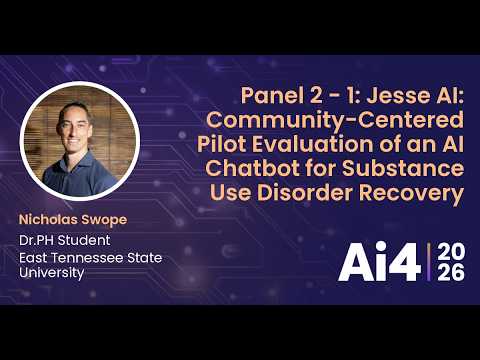
Panel 2 - 1: Jesse AI: Community-Centered Pilot Evaluation of an AI Chatbot for Substance Use
Ai4
AI-assisted summary of Panel 2 - 1: Jesse AI: Community-Centered Pilot Evaluation of an AI Chatbot for Substance Use — original source. Check the original for full context.
Source published:
Detailed notes
## Background Published by the Ai4 channel on YouTube on August 19, 2026, this presentation features East Tennessee State University DrPH candidate and Backyard AI consultant Nicholas Swope. It explores the design, safety guardrails, and pilot evaluation of Jesse AI, a 24/7 anonymous chatbot created alongside Recovery Resources Tennessee to assist men in sober living with cravings, house rules, and community resources.
## TL;DR Nicholas Swope presents the implementation science behind Jesse AI, an anonymous RAG-powered chatbot developed for a men's sober living facility in Northeast Tennessee. Built to bridge 24/7 staffing gaps and relieve repetitive administrative burdens without replacing human peer connection, the platform incorporates local vernacular, safety off-ramping, and verified regional recovery resources. Evaluation data from a 7-day pilot involving 125 residents demonstrated strong engagement, favorable usability ratings on the Mobile Application Rating Scale, and particular utility for newly arriving residents. To ensure long-term sustainability and authentic adoption, the architecture features a no-code update pipeline for non-profit staff and a cultural voice filter modeled on staff interviews.
## Atmosphere & style The presentation carries a grounded, compassionate, and pragmatic tone that balances public health research with authentic grassroots recovery advocacy. Swope speaks with transparent humility about technical crashes and initial design missteps, grounding technical AI concepts in the lived experiences of residents. The delivery feels purposeful, earnest, and deeply respectful of the community, prioritizing human dignity and practical utility over flashy technological novelty.
## Key takeaways - [00:04](https://www.youtube.com/watch?v=aHzvRsjh2fs&t=4s) Nicholas Swope introduces Jesse AI as an applied AI chatbot developed through implementation science to create sustainable, mission-aligned tools for resource-constrained substance recovery environments. - [01:48](https://www.youtube.com/watch?v=aHzvRsjh2fs&t=108s) Recovery Resources Tennessee, a peer-run nonprofit serving 169 men in sober housing, faced critical operational bottlenecks including staff time constraints, lack of 24/7 staffing, and repetitive navigation queries from newly released residents. - [04:40](https://www.youtube.com/watch?v=aHzvRsjh2fs&t=280s) A complex, personalized chatbot with user logins and EHR integration was rejected by staff and residents due to institutional distrust, leading the team to adopt a fully anonymous, conversational architecture. - [06:14](https://www.youtube.com/watch?v=aHzvRsjh2fs&t=374s) Jesse AI integrates a curated knowledge base of house rules and 12-step literature, 398 verified regional resources in Northeast Tennessee, local vernacular tuning, and automated safety off-ramps for crisis situations. - [08:52](https://www.youtube.com/watch?v=aHzvRsjh2fs&t=532s) During a 7-day pilot with 125 active residents out of 169 eligible men, Jesse AI processed roughly 1,500 queries across 700 conversational sessions, averaging two queries per session. - [08:52](https://www.youtube.com/watch?v=aHzvRsjh2fs&t=532s) Residents used Jesse AI across varied recovery stages, from new residents navigating house rules and meeting locations to senior peer mentors using it as a sponsorship and craving management toolkit. - [10:50](https://www.youtube.com/watch?v=aHzvRsjh2fs&t=650s) Evaluation via the Mobile Application Rating Scale (MARS) yielded an overall rating of 'good,' with users praising rapid response latency and around-the-clock availability despite high launch traffic causing an initial server crash. - [12:44](https://www.youtube.com/watch?v=aHzvRsjh2fs&t=764s) Data triangulation revealed high active engagement and strong utility, with senior residents noting the bot would have served as an invaluable onboarding lifeline during their early transition into sober living. - [14:02](https://www.youtube.com/watch?v=aHzvRsjh2fs&t=842s) To ensure long-term sustainability, Jesse AI utilizes a RAG architecture that allows non-technical nonprofit staff to update policies and local resource directories directly without coding expertise. - [15:03](https://www.youtube.com/watch?v=aHzvRsjh2fs&t=903s) An initial deployment failure caused by generic, robotic phrasing was resolved by conducting qualitative interviews across all staff and founders to build a cultural voice filter into the response generation pipeline.
## Detailed walkthrough ### [00:04](https://www.youtube.com/watch?v=aHzvRsjh2fs&t=4s) Introduction and Implementation Science in Recovery
Nicholas Swope introduces Jesse AI as an applied artificial intelligence tool designed specifically for a mission-driven substance use recovery organization. Drawing on more than a decade of experience as a public health practitioner, his current doctoral work in public health and AI applications at East Tennessee State University, and his role as lead consultant for Backyard AI, Swope frames the project around implementation science—which he colloquially defines as "the jargony term to say how do we do stuff that sticks?" Rather than focusing purely on technical novelty, the objective is understanding how to build, integrate, and sustain practical technology within non-tech community environments.
The presentation is structured into four core areas: introducing Jesse AI, sharing authentic stories from residents in recovery, presenting preliminary empirical results from the pilot implementation, and detailing an organizational adoption framework.
- Speaker background: Over 10 years as a public health practitioner; DrPH candidate at East Tennessee State University studying AI application; Lead Consultant at Backyard AI. - Presentation roadmap: Jesse AI overview, recovery case studies, pilot evaluation data, and a replicable implementation framework.
---
[01:48](https://www.youtube.com/watch?v=aHzvRsjh2fs&t=108s) Recovery Resources Tennessee and the Pain Points of Care
The pilot was conducted in the epicenter of the Appalachian overdose crisis in the far northeast corner of Tennessee. Swope partnered with Recovery Resources Tennessee, a peer recovery support nonprofit where every staff member and resident is in personal recovery. The organization serves 169 resident men living in sober housing, almost all of whom were recently released from incarceration. Swope emphasizes that if a technology solution can succeed in this high-need, low-resource environment, it can be replicated anywhere.
About 13 months prior, Swope sat down with the organization's leadership not with an immediate technical pitch, but to ask fundamental diagnostic questions: what was working, what was failing, and what administrative burdens were "stealing your soul" and pulling staff away from their mission. The organization identified three primary bottlenecks:
```mermaid flowchart TD accTitle: Organizational Pain Points at Recovery Resources Tennessee accDescription: Flowchart illustrating the primary operational challenges leading to the need for Jesse AI. subgraph Bottlenecks["Core Organizational Challenges"] A["Staff Time Deficits<br/>Spreading small staff thin with repetitive inquiries"] B["24/7/365 Coverage Gaps<br/>Inability to staff sober houses around the clock"] C["High Resident Navigation Load<br/>Post-incarceration men asking recurring entry questions"] end Bottlenecks --> D["Risk to Human-Centered Culture<br/>Need tools that assist without replacing interpersonal touch"] ```
- **Staff Bandwidth Constraints**: Staff members were spread exceedingly thin answering basic administrative and navigation questions throughout the day. - **Coverage Deficits**: The nonprofit lacked the funding and capacity to provide physical staffing 24 hours a day, 7 days a week, 365 days a year. - **Repetitive Basic Queries**: Men newly transitioning out of incarceration into sober living had hundreds of questions; while critical issues required staff intervention, the vast majority were identical, recurring queries about house rules and local resources. - **Preserving the Human Touch**: Any proposed intervention had to preserve and enhance, rather than replace, the interpersonal connection central to peer recovery.
---
[04:40](https://www.youtube.com/watch?v=aHzvRsjh2fs&t=280s) Chatbot Architectures: Why Complete Anonymity Won
When Swope initially proposed a sophisticated, deeply integrated chatbot 13 months prior, the staff reacted with immediate skepticism, hearing it as "too much, too fast" and fearing an "AI takeover." In a population with deep-seated institutional distrust toward both government and technology, a complex system would fail. Swope conceptualizes chatbot architectures across three general categories:
```mermaid flowchart LR accTitle: Spectrum of Chatbot Architectures accDescription: Three-tier spectrum comparing heavily personalized, semi-personalized, and fully anonymous chatbot architectures. subgraph Spectrum["Chatbot Integration Spectrum"] A["Heavily Personalized<br/>• EHR integration<br/>• Mandatory login<br/>• Warm handoffs"] B["Semi-Personalized<br/>• Optional accounts<br/>• Partial data linkage<br/>• Limited handoffs"] C["Fully Anonymous<br/>• Purely conversational<br/>• Zero name/identity tracking<br/>• Localized knowledge base"] end A -. Rejected: Created distrust.-> C B -. Bypassed for simplicity.-> C C ==> D["Selected Model: Jesse AI"] ```
While Swope originally envisioned a heavily personalized architecture with user logins and warm clinical handoffs similar to an electronic health record (EHR) assistant, community feedback proved that this approach would alienate residents. Instead, the team selected a completely anonymous, purely conversational model. By eliminating user tracking and authentication barriers, the tool respected resident privacy while delivering immediate utility.
---
[06:14](https://www.youtube.com/watch?v=aHzvRsjh2fs&t=374s) System Design, Safety Off-Ramping, and Localized Knowledge
Jesse AI was developed through three successive rounds of staff co-design and pilot testing. The platform was built using a Retrieval-Augmented Generation (RAG) library hosted on an accessible platform rather than custom hard-coded software, ensuring nonprofit staff can independently update and maintain the system long after the academic research concludes.
```mermaid flowchart TD accTitle: Core System Components of Jesse AI accDescription: Diagram showing the four foundational architectural elements of Jesse AI. subgraph Engine["Jesse AI Architecture"] K["Curated Knowledge Base<br/>Policies, house rules, 12-step literature"] V["Regional Vernacular<br/>Trained on Northeast Tennessee dialect and recovery idioms"] R["398 Local Verified Resources<br/>Geo-located AA/NA meetings and basic needs services"] S["Safety Off-Ramps<br/>Automated triage for cravings, self-harm, and crisis"] end Engine --> Out["24/7/365 Anonymous Resident Support"] ```
The system is anchored by four key structural elements: - **Curated Knowledge Base**: Houses organizational policies, standard house rules, and literature for their 12-step recovery model. - **Localized Regional Vernacular**: Tailored to recognize the specific conversational patterns, slang, and dialect of Northeast Tennessee residents. - **398 Verified Regional Resources**: Hyper-localized community directory (e.g., looking up Alcoholics Anonymous meetings specifically in Johnson City, Tennessee, rather than generic national directories). - **Safety Off-Ramping**: Context-aware safety triggers that instantly identify statements involving cravings, suicidal ideation, or intentions of harm to self and others, directing users to emergency support.
---
[08:52](https://www.youtube.com/watch?v=aHzvRsjh2fs&t=532s) Pilot Usage Data and Resident Stories: Justin and Danny
The quantitative pilot, conducted as part of Swope's doctoral dissertation, evaluated system usage over a 7-day monitoring window across the facility's population. Out of 169 eligible residents, 125 men voluntarily opted into the pilot. During that single week, the bot processed roughly 1,500 individual queries across approximately 700 distinct conversational sessions—averaging about two queries per interaction stream before the resident successfully resolved their inquiry.
Beyond aggregate analytics, Swope highlighted the lived experiences of two residents:
- **Justin**: A newer resident who utilized Jesse AI primarily for orientation and logistics, using hyperlinked GPS integrations to navigate to local 12-step meetings, as well as looking up internal sober living house rules and organizational policies. - **Danny**: A resident with two years of sustained recovery who serves as a house leader and mentor. Danny used Jesse AI not only to manage his own personal recovery cravings, but as an active sponsorship and mentorship toolkit to help junior housemates navigate acute cravings, find external social services, and organize 12-step sponsorship plans.
---
[10:50](https://www.youtube.com/watch?v=aHzvRsjh2fs&t=650s) App Evaluation (MARS) and Qualitative Focus Group Findings
Following the week-long deployment, residents completed the Mobile Application Rating Scale (MARS), evaluating Jesse AI across four standardized dimensions: engagement, functionality, aesthetics, and information quality. On the MARS 1-to-5 scale (where 1 is completely inadequate and 5 is excellent), residents anonymously assigned an overall rating of "good."
In qualitative focus groups, Swope gathered targeted feedback on what functioned well, what failed, and what required refinement:
- **What Worked Well**: Residents praised the rapid response latency, instant access to accurate meeting locations, frictionless navigation to basic community needs, and around-the-clock availability. - **Challenges and Failures**: Residents identified specific resource coverage gaps where information was missing or outdated. Swope noted that high initial launch traffic actually caused a technical system crash, requiring an emergency mid-launch scramble to restore server availability.
[12:44](https://www.youtube.com/watch?v=aHzvRsjh2fs&t=764s) Triangulating Pilot Data and Value for New Residents
Synthesizing user feedback, focus groups, and survey metrics revealed several critical insights into how Jesse AI functions in practice. Initial user reactions highlighted areas for improvement—specifically addressing the overly homogeneous tone across responses, expanding the underlying knowledge base, and refining the conversational user experience. When triangulating these preliminary data streams, three major conclusions emerged: residents are actively using the application, individual survey responses validate that the tool performs reliably, and it holds exceptional value for newcomers entering recovery housing.
Focus groups surfaced an enthusiastic undercurrent among senior residents who had already spent a year or two in the program. Reflecting on their own early days in recovery, these veterans commented, "Man, this is cool, but I would have loved this being new." This strong endorsement highlighted the chatbot's potential as an onboarding lifeline, easing the transition for incoming residents navigating unfamiliar rules and support systems during their vulnerable first weeks.
- **Key Preliminary Triangulation Insights:** - High resident engagement and active real-world usage. - Favorable individual survey evaluations confirming functionality. - Disproportionate value for newly arrived residents adjusting to the sober living environment.
---
[14:02](https://www.youtube.com/watch?v=aHzvRsjh2fs&t=842s) Implementation Science and Non-Technical Knowledge Base Management
From an implementation science standpoint, long-term sustainability hinges on empowering the non-profit's internal team. Because policy manuals, house rules, and recovery resources evolve continuously, the technical architecture must allow non-technical staff to make seamless updates. A major design priority was building an accessible administrative pipeline where staff can update policy documents and RAG library resources directly without requiring specialized technical expertise.
Ensuring non-profit staff can maintain instant data synchronization ensures the chatbot's knowledge base reflects the latest organizational policies in real time. This operational integration bridges the gap between high-level technological capability and day-to-day grassroots utility, keeping the tool maintainable within resource-constrained recovery environments.
```mermaid flowchart TD accTitle: Jesse AI Knowledge Base and Voice Filter Architecture accDescr: Flow diagram showing how non-profit staff updates feed the RAG library, which passes through a cultural voice filter before delivering responses.
subgraph StaffAdmin["Staff & Knowledge Management"] A["Non-Profit Staff\n(Non-technical)"] -->|"Update rules & policies"| B["RAG Knowledge Base\n& Policy Library"] end
subgraph PromptEngine["Jesse AI Response Pipeline"] C["User Query"] --> D{"Voice & Persona Filter\n(Founders & 8 Staff Profiles)"} B --> D D --> E["Contextualized Recovery\nSupport Response"] end ```
---
[15:03](https://www.youtube.com/watch?v=aHzvRsjh2fs&t=903s) Overcoming Early Failure Through Cultural Voice and Persona Design
The initial pilot of Jesse AI roughly nine months earlier struggled significantly upon release, essentially falling on its face with staff and residents. Qualitative feedback revealed why: the generic AI lacked the distinct voice, persona, idioms, and relational tone native to the organization. Without these shared cultural markers, the tool felt sterile and disconnected from the community it sought to support.
To remedy this disconnect, Swope conducted in-depth qualitative interviews with both co-founders and all eight staff members at Recovery Resources Tennessee. These narratives and behavioral patterns were distilled into a specialized voice filter. In the revised architecture, whenever Jesse retrieves factual information from the knowledge base, it passes the data through this cultural voice layer first. This ensures every output resonates with the warmth, recovery terminology, and authentic persona of the house staff before reaching the user.
- **Initial Launch Obstacle:** Failed user adoption due to robotic, generic chatbot phrasing that lacked organizational identity. - **Formative Data Collection:** Comprehensive qualitative interviews conducted across both founders and all 8 staff members. - **Architectural Adjustment:** Implemented a two-stage retrieval pipeline passing raw knowledge through an organizational voice filter prior to final output generation.
---
[16:34](https://www.youtube.com/watch?v=aHzvRsjh2fs&t=994s) Acknowledgments and Collaborations
The presentation concluded with deep gratitude for the frontline workers and leadership at Recovery Resources Tennessee, whose dedication makes community-driven recovery work in northeastern Tennessee possible. Swope welcomed outreach from other mission-driven organizations, technologists, and academic researchers seeking to collaborate, replicate the implementation framework, or explore future studies in technology-supported recovery.
## Notable quotes > It's 2 a.m. in a sober living house; a resident is fighting a craving, and no staff is on site. Who answers? — Nicholas Swope
> [00:04](https://www.youtube.com/watch?v=aHzvRsjh2fs&t=4s) the jargony term to say how do we do stuff that sticks? — Nicholas Swope
> [01:48](https://www.youtube.com/watch?v=aHzvRsjh2fs&t=108s) stealing your soul — Nicholas Swope
> [04:40](https://www.youtube.com/watch?v=aHzvRsjh2fs&t=280s) too much, too fast — Nicholas Swope
> [04:40](https://www.youtube.com/watch?v=aHzvRsjh2fs&t=280s) AI takeover — Nicholas Swope
> [10:50](https://www.youtube.com/watch?v=aHzvRsjh2fs&t=650s) good — Nicholas Swope
> [12:44](https://www.youtube.com/watch?v=aHzvRsjh2fs&t=764s) Man, this is cool, but I would have loved this being new. — Resident
> keeps technology in service of human relationships, not in place of them — Nicholas Swope
## Mentioned Nicholas Swope, East Tennessee State University, Backyard AI, Recovery Resources Tennessee, Jesse AI, Justin, Danny, Alcoholics Anonymous, Mobile Application Rating Scale (MARS)
## Video description Nicholas Swope, Dr.PH Student, East Tennessee State University
It's 2 a.m. in a sober living house; a resident is fighting a craving, and no staff is on site. Who answers? In Northeast Tennessee's Appalachian region, where overdose deaths are high and recovery resources are scarce, I partnered with Recovery Resources Tennessee to design and pilot "Jesse AI," a chatbot that provides residents with 24/7/365, name-free support for cravings, house rules, 12-step questions, and job help. In this talk, I will share the community-centered design process, the safety guardrails that made it responsible, and fresh pilot data collected just weeks before the conference. If you want a replicable model for adopting AI in low-resource, mission-driven organizations that keeps technology in service of human relationships, not in place of them, this session is for you.
[Source](https://www.youtube.com/watch?v=aHzvRsjh2fs)