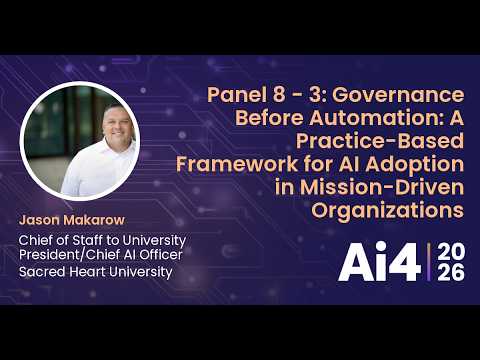
Panel 8 - 3: Governance Before Automation: A Practice-Based Framework for AI Adoption in
Ai4
AI-assisted summary of Panel 8 - 3: Governance Before Automation: A Practice-Based Framework for AI Adoption in — original source. Check the original for full context.
Source published:
Detailed notes
## Background Published on YouTube by Ai4 on August 21, 2026, this presentation features Jason Makarow, Chief of Staff to the President and Chief AI Officer at Sacred Heart University. The session outlines a practice-based AI governance framework constructed in 12 weeks on existing infrastructure, demonstrating how organizations can align with the NIST AI Risk Management Framework to govern shadow AI and prevent operational liability.
## TL;DR Jason Makarow explains how Sacred Heart University developed an enterprise-wide AI governance framework for $114,000 in 12 weeks using native Microsoft 365 tools instead of costly external consultants. The initiative addresses both governance blind spots and underutilized software capabilities across an institutional footprint of nearly 400 applications. Grounded in organizational change theory and the NIST AI RMF, the model establishes an 'enablement over restriction' approach featuring a two-track liaison system, automated intake, and a strict 5-question vendor compliance checklist. Real-world scenarios demonstrate how human oversight catches silent vendor feature creep, prevents rogue script data leaks, and guards against algorithmic mission drift.
## Atmosphere & style The presentation carries a pragmatic, lucid, and reassuring tone that balances scholarly organizational theory with gritty operational reality. Makarow speaks with engaging candor and accessible authority, using vivid workplace scenarios—such as well-intentioned interns running local Python scripts and unexpected vendor toggles—to ground abstract risks in everyday organizational life. The talk feels empowering and refreshingly practical, transforming what is often framed as an expensive, overwhelming compliance nightmare into an achievable, low-cost operational discipline.
## Key takeaways - [00:04](https://www.youtube.com/watch?v=v4I_pj_zaeY&t=4s) Sacred Heart University successfully designed and deployed an enterprise-wide AI governance framework in 12 weeks for $114,000 using existing Microsoft 365 infrastructure. - [01:59](https://www.youtube.com/watch?v=v4I_pj_zaeY&t=119s) Legacy procurement reviews miss embedded AI risks, creating both a governance gap of unmonitored shadow tools and a capacity gap of paid AI features sitting idle without training. - [05:21](https://www.youtube.com/watch?v=v4I_pj_zaeY&t=321s) With 88% of organizations deploying AI and 95% of pilots failing without governance, adoption must be treated as an organizational change challenge grounded in enablement over restriction. - [07:09](https://www.youtube.com/watch?v=v4I_pj_zaeY&t=429s) Sacred Heart's modular governance model maps six practical components directly to the four NIST AI Risk Management Framework functions: Govern, Map, Measure, and Manage. - [10:33](https://www.youtube.com/watch?v=v4I_pj_zaeY&t=633s) Shadow AI manifests through two primary vectors: silent vendor feature creep in core software updates and well-intentioned staff automating tasks with personal API keys. - [10:33](https://www.youtube.com/watch?v=v4I_pj_zaeY&t=633s) Traditional SIEM and DLP security systems routinely fail to detect outbound API calls and data exfiltration from local employee scripting environments. - [13:42](https://www.youtube.com/watch?v=v4I_pj_zaeY&t=822s) A two-track liaison model resolves enterprise stalemates by separating programmatic/academic autonomy from administrative compliance under a Chief AI Officer. - [15:56](https://www.youtube.com/watch?v=v4I_pj_zaeY&t=956s) Vendor compliance requires contractual enforcement across five criteria, particularly mandatory 24- to 48-hour breach notification windows and binding no-training clauses. - [19:04](https://www.youtube.com/watch?v=v4I_pj_zaeY&t=1144s) Technically accurate AI models can still cause mission failure and algorithmic bias if demographic and equity considerations are not actively audited by human overseers. - [20:43](https://www.youtube.com/watch?v=v4I_pj_zaeY&t=1243s) Modern workforce preparation must shift from teaching basic prompt generation to developing employees who know how to critically govern AI and maintain human-in-the-loop verification. - [20:43](https://www.youtube.com/watch?v=v4I_pj_zaeY&t=1243s) Scalable AI governance does not require expensive data science teams or external software, relying instead on automated intake, centralized registries, and active committee champions.
## Detailed walkthrough ### [00:04](https://www.youtube.com/watch?v=v4I_pj_zaeY&t=4s) Governance Before Automation: The Sacred Heart University Model
Jason Makarow, Chief of Staff to the President and Chief AI Integration Officer at Sacred Heart University, introduces the practical reality facing modern institutions: whether leadership realizes it or not, every organization is already utilizing artificial intelligence. Sacred Heart University, a Catholic institution in Connecticut with roughly 10,000 students, 1,300 employees, and an annual revenue between $500 million and $600 million, set out to establish strict "governance before automation" prior to rolling out any enterprise-scale AI tools. Rather than commissioning expensive external consultants or hiring an army of data scientists, the university designed and deployed a comprehensive governance framework in just 12 weeks on an operating budget of $114,000 by leveraging existing infrastructure.
Makarow highlights that in an enterprise with half a billion dollars in revenue, a $114,000 investment represents less than two-tenths of one percent of operating revenue. The initiative began as an internal research project commissioned by the university president to prevent ungoverned deployments and manage organizational risk. While Makarow’s accompanying academic paper provides formal documentation and scholarly rigor, his presentation focuses on the practical application, offering a blueprint that leaders across higher education, healthcare, financial services, and corporate sectors can implement immediately.
- **Institution Profile:** Sacred Heart University (Fairfield, CT), ~10,000 students, 1,300 employees, $500M–$600M annual revenue. - **Project Scope:** Comprehensive AI governance framework constructed in 12 weeks. - **Budget:** $114,000 total expenditure utilizing existing Microsoft 365 infrastructure (<0.02% of university revenue). - **Core Directive:** Mandate robust governance prior to deploying enterprise AI systems.
---
[01:59](https://www.youtube.com/watch?v=v4I_pj_zaeY&t=119s) The Hidden AI Footprint: Uncovering the Governance and Capacity Gaps
To understand their baseline risk, the administration asked the Vice President of IT a fundamental baseline question: how much was the university spending on software? The answer was eye-opening—$22 million distributed across 396 distinct applications. While every single platform had passed through standard procurement checks for cost, functional utility, and technical compatibility, legacy procurement processes had never been designed to interrogate generative and autonomous technologies. Nobody was asking the critical modern questions: Which applications are executing external API calls? Where is the data payload routed? Is proprietary data hitting an unmonitored third-party endpoint? Does the vendor's terms of service grant them rights to ingest institutional data to generate model derivations? And when marketing materials claim a tool is "AI-powered," is it secretly routing prompts to OpenAI or Anthropic under the hood without contractual disclosure?
```mermaid flowchart TD accTitle: Dual Gaps in Legacy Software Procurement accDescription: Diagram showing how legacy procurement overlooks third-party API exposure and creates simultaneous governance and capacity gaps.
subgraph Audit["Software Landscape ($22M / 396 Apps)"] Legacy["Legacy Procurement Review<br/>(Cost, Functionality, Compatibility)"] Hidden["Unasked Technical Questions<br/>• External API Calls?<br/>• Payload Routing & Endpoints?<br/>• Vendor Data Rights / Training?<br/>• Undisclosed LLM Dependencies?"] end
subgraph Gaps["The Dual Gaps"] GovGap["Governance Gap<br/>'You can't govern what you don't know about'"] CapGap["Capacity Gap<br/>'You can't use what no one has taught you'"] end
Legacy --> Hidden Hidden --> GovGap Hidden --> CapGap ```
The university's subsequent audit revealed embedded AI components lurking across standard contract management systems, security camera networks, donor propensity modeling software, and student retention tracking platforms. The issue was not employee negligence; rather, commercial software capabilities evolved far faster than institutional procurement mechanisms could adapt. Simultaneously, the audit uncovered an equal and opposite failure: the capacity gap. Employees were actively using platforms containing paid AI features, but because nobody had received training or strategic guidance on them, those operational capabilities sat completely idle. As Makarow observes, "The governance gap and the capacity gap really became two sides of the same coin. You can't govern what you don't know about, and you can't use what no one else has yet taught you."
- **Software Audit Findings:** $22 million annual spend across 396 active software applications. - **Embedded AI Identified In:** Contract lifecycle management, campus camera systems, advancement/donor modeling platforms, and student tracking software. - **Legacy Procurement Blind Spots:** Unmonitored API calls, data payload routing, third-party model endpoints, intellectual property/derivative rights in terms of service, and undisclosed third-party foundation models (e.g., OpenAI, Anthropic). - **The Twin Gaps:** The governance gap (unmonitored risk) paired directly with the capacity gap (underutilized paid features).
---
[05:21](https://www.youtube.com/watch?v=v4I_pj_zaeY&t=321s) The Change Management Imperative and Academic Foundations
Industry data underscores that ungoverned adoption is a widespread crisis. The McKinsey 2025 State of AI survey revealed that 88% of organizations now utilize AI within at least one business function. Concurrently, MIT’s Project Nanda reported that 95% of enterprise AI pilots fail when implemented without governance. Makarow stresses that overcoming these odds requires treating AI adoption not as an IT initiative, but as an organizational change challenge. The framework draws directly upon classic organizational behavior and leadership theories:
1. **Kotter’s 8-Step Change Model:** Structures the phased sequencing of implementation to ensure enterprise buy-in and sustainability. 2. **Rogers’ Diffusion of Innovations:** Informs the structure of committee members serving as active internal champions across departments. 3. **Heifetz’s Adaptive Leadership:** Separates technical architecture problems from the adaptive challenge of altering how faculty and staff evaluate daily tools. 4. **Bolman and Deal’s Four-Frame Model:** Ensures the governance structure operates simultaneously across structural, political, symbolic, and human resource dimensions. 5. **Schein’s Organizational Culture Framework:** Establishes a philosophy grounded in "enablement over restriction."
Makarow jokes about a meme circulating around Sacred Heart showing his photo with the caption "I start negotiating it," clarifying that his mandate as Chief AI Integration Officer is not to act as an institutional roadblock, but to safely enable operational transformation. As a practice-based case study rather than an experimental trial, the resulting framework provides an operating model supported by seven testable propositions for future empirical research, requiring zero new hires, zero external software platforms, and no incremental licensing fees.
- **McKinsey 2025 AI Survey:** 88% of organizations deploy AI in at least one business unit. - **MIT Project Nanda Finding:** 95% of enterprise AI pilots fail in the absence of governance. - **Operating Philosophy:** "Enablement over restriction" rather than restrictive IT gatekeeping. - **Resource Constraints:** Designed to succeed without specialized data science teams or external consulting retainers.
---
[07:09](https://www.youtube.com/watch?v=v4I_pj_zaeY&t=429s) Architecture: Mapping the Six Components to the NIST AI RMF
To ensure rigorous compliance and broad interoperability, Sacred Heart structured its six-component governance model around the four core functions of the National Institute of Standards and Technology AI Risk Management Framework (NIST AI RMF): **Govern**, **Map**, **Measure**, and **Manage**. Every functional requirement was implemented directly inside the university's existing Microsoft 365 ecosystem, eliminating the need for bespoke enterprise software.
```mermaid flowchart TD accTitle: NIST AI RMF Alignment of the Sacred Heart Governance Framework accDescription: Mapping the four NIST AI RMF functions to the six operational components built inside Microsoft 365.
subgraph NIST["NIST AI RMF Core Functions"] direction TB G["GOVERN"] Mp["MAP"] Ms["MEASURE"] Mg["MANAGE"] end
subgraph SHU["SHU Modular Framework (Built in M365)"] direction TB C1["Committee Charter & Guiding Principles"] C2["Three-Tiered Risk Classification System"] C3["Shadow AI Inventory"] C4["Registry Data Capture & ROI Tracking"] C5["Vendor Review & Compliance Checklist"] C6["Automated Intake Workflow & Ongoing Oversight"] end
G --> C1 Mp --> C2 Mp --> C3 Ms --> C4 Mg --> C5 Mg --> C6 ```
Each component directly addresses a distinct operational governance vulnerability while fulfilling a specific cultural and behavioral role within the enterprise:
- **Govern:** Executed through a formal AI committee charter and clear institutional guiding principles that set strategic direction. - **Map:** Operationalized through a three-tiered risk classification system paired with an exhaustive shadow AI inventory to identify existing technical debt. - **Measure:** Maintained via an intake registry data capture process and dedicated ROI tracking methodology to gauge business value. - **Manage:** Enforced through standard vendor compliance reviews, automated intake workflows, and ongoing lifecycle monitoring.
---
[10:33](https://www.youtube.com/watch?v=v4I_pj_zaeY&t=633s) Real-World Scenarios: Silent Feature Creep and the Well-Intentioned Script
To demonstrate how ungoverned "shadow AI" manifests as a present operational reality rather than a speculative future risk, Makarow outlines two scenarios common across both corporate and academic settings.
The first scenario involves silent feature creep in core enterprise platforms. An organization runs standard HR software such as Workday or Dayforce. During a routine software update, the vendor quietly introduces an automated AI module designed to screen, score, and rank job applicants. No HR manager submitted a procurement ticket or purchased new software; an HR coordinator simply noticed the toggle, assumed it was helpful, and enabled it. For months, the algorithm evaluates candidates in production while legal remains entirely unaware, no testing for disparate impact is conducted, and the institution has no idea whether applicant resumes are being ingested into the vendor's central training set.
```mermaid flowchart LR accTitle: Two Vectors of Shadow AI accDescription: Flow showing silent enterprise vendor feature creep versus internal script automation with personal API keys.
subgraph Scenario1["Scenario 1: Vendor Feature Creep"] U1["Routine HR Platform Update<br/>(Workday / Dayforce)"] --> F1["Coordinator Enables Silent AI Ranking"] F1 --> R1["Months of Production Scoring<br/>(No Legal Review / No Disparate Impact Audit)"] end
subgraph Scenario2["Scenario 2: Well-Intentioned Automation"] U2["Finance / Ops Task Assigned to Intern"] --> F2["Local Python Script + Personal OpenAI API Key"] F2 --> R2["ERP Data Exported Off-Network<br/>(Uninspected Endpoint / Training Data Ingestion)"] end ```
The second scenario stems from well-intentioned employee problem-solving. A tech-savvy recent college graduate or intern in finance or operations is asked to clean and summarize complex institutional data. Naturally leveraging skills learned in school, the employee sets up a local Python environment on their laptop, plugs in a personal API key, and writes a script that extracts bulk records directly from the enterprise ERP, passes them to a public LLM endpoint for classification, and outputs a formatted spreadsheet. The operational problem is solved efficiently, but sensitive corporate data has quietly exited the network perimeter. Standard Security Information and Event Management (SIEM) tools and Data Loss Prevention (DLP) filters rarely flag the activity without deep endpoint traffic inspection. The employee was not acting maliciously; they simply used the best tool available to complete an assigned task because leadership failed to provide a governed alternative.
- **Scenario 1 (HR Feature Creep):** Workday/Dayforce auto-update silently introduces candidate ranking; activated without legal review, bias auditing, or data privacy verification. - **Scenario 2 (Rogue Script Automation):** Tech-savvy new hires run local Python scripts using personal API keys to process ERP exports through external LLMs. - **Security Visibility Failure:** Traditional SIEM and DLP systems routinely miss outbound API calls generated from local scripting environments without granular endpoint payload inspection. - **Root Cause:** Operational staff solving business problems with unapproved tools in the absence of sanctioned, well-governed alternatives.
[13:42](https://www.youtube.com/watch?v=v4I_pj_zaeY&t=822s) Enablement Over Restriction and the Two-Track Liaison Model
When unvetted tools or rogue scripts circulate within an organization, data frequently gets exposed without proper oversight. Rather than assigning blame to an individual or department, an effective framework catches these activities through a designated committee champion who flags the issue. The goal is "enablement over restriction"—the tool is not killed; it is governed. The organization exists not to say no, but to ensure that everyone knows what they are using and how to use it safely.
```mermaid flowchart TD accTitle: Two-Track Governance Liaison Model subgraph Stakeholders["Competing Domain Perspectives"] A["Academic / Clinical / Programmatic<br/>(e.g., Dean: Academic Priority)"] B["Compliance / Operations / Legal<br/>(e.g., Officer: Data Privacy)"] end
subgraph Mediation["Governance Mediation Layer"] C["Chief AI Officer / Integration Liaison"] end
subgraph Resolution["Governed Outcomes"] D["Valid Vendor Contracts"] E["Preserved Curriculum / Clinical Autonomy"] F["Compliance & Security Verification"] end
A --> C B --> C C --> D C --> E C --> F ```
This model directly resolves common enterprise stalemates. For example, if a dean wants to deploy an AI tutoring program for students, a compliance officer might block it because it processes sensitive student records. The dean views it as an academic decision, while the compliance officer treats it as a data decision. Both are right, and historically the victor was simply whichever party had the ear of senior leadership. A Chief AI Officer serves as the neutral liaison: domain leaders do not sign vendor contracts, and compliance officers do not dictate academic curriculum. At Sacred Heart University, this is structured as a two-track model—one track for administrative AI integration and a separate track for faculty, acknowledging faculty autonomy. This dynamic applies far beyond higher education: - **Higher Education:** Academic vs. Administrative / Staff governance - **Healthcare:** Clinical decisions vs. Administrative compliance - **Nonprofits:** Programmatic mission vs. Operational management - **Government:** Policy creation vs. Field operations
---
[15:56](https://www.youtube.com/watch?v=v4I_pj_zaeY&t=956s) The 5-Question Vendor Compliance Checklist
Enterprise leaders frequently attend vendor demos where sleek presentation slides boast SOC 2 Type II compliance, FERPA compliance, HIPAA readiness, and promises that no customer data is used for model training. Impressed CEOs and university presidents often want to sign immediately, but organizations must systematically evaluate five foundational criteria before executing any contract:
| # | Governance Requirement | Critical Criteria & Contractual Obligations | |---|---|---| | **1** | **Data Handling Agreement** | The vendor must be contractually bound to specific regulatory roles (e.g., designated as a "school official" under FERPA, or signing a Business Associate Agreement under HIPAA). | | **2** | **Data Residency** | The contract must specify geographic location; US-based companies may host or process data overseas, triggering shifting jurisdictional obligations. | | **3** | **No-Training Clause** | Language preventing customer data from training proprietary models must appear explicitly in binding contractual terms, not merely on marketing materials or a website FAQ. | | **4** | **Breach Notification Timeline** | Vague phrases like *"as soon as practical"* or *"as soon as possible"* are completely meaningless. Contracts require defined windows (e.g., **48 hours** at Sacred Heart University; **24 hours** in higher-security environments). | | **5** | **Encryption & Audit Verification** | Verification of encryption standards at rest (**AES-256**) and in transit (**TLS 1.2+**), validated via documented architecture, SOC 2 Type II audit reports testing controls over time, and third-party penetration testing completed within the last 12 months. |
Most vendors easily pass the first three questions but fail when pressed on strict breach timelines and verifiable encryption audits.
---
[19:04](https://www.youtube.com/watch?v=v4I_pj_zaeY&t=1144s) Preventing Mission Failures and Algorithmic Bias
AI systems that achieve flawless technical accuracy can still fail catastrophically against an organization's core institutional mission. Because artificial intelligence does not understand organizational values, human oversight must interpret and enforce those promises:
- **Healthcare Example:** A Catholic hospital system or nursing school deploying an AI model to predict patient readmission risk may find the model was trained on data that underrepresents low-income patients. While the algorithm functions accurately for commercial insured patients, it performs poorly for Medicare and Medicaid patients, contradicting the institution's core mission to "serve all patients with dignity." - **Financial Services Example:** A financial institution or university deploying AI models to score loan or merit-aid applications may produce an algorithm that approves suburban applicants at higher rates than urban applicants. While mathematically consistent, it directly undermines commitments to equal financial access.
---
[20:43](https://www.youtube.com/watch?v=v4I_pj_zaeY&t=1243s) Forming AI-Literate Graduates and Low-Cost Governance
Organizations are entering a new phase of talent acquisition: hiring college graduates who grew up using AI intuitively, just as previous generations adopted Google search without a formal framework. While virtually every graduate knows how to write a prompt and summarize a document, organizations desperately need employees who understand how to *govern* AI, question model outputs, and maintain a rigorous "human in the loop."
```mermaid flowchart LR accTitle: Core Components of Accessible AI Governance subgraph Inputs["Zero New Budget / Existing Tech"] A["Existing IT Infrastructure"] end subgraph Governance["Operational Governance Engine"] B["Automated Intake Process"] C["AI System Registry"] D["Human Committee Champions"] end subgraph Outcomes["Institutional Value"] E["Sound & Safe Decision-Making"] F["Mission & Regulatory Alignment"] end
A --> B B --> C C --> D D --> E D --> F ```
Institutions do not need multi-million dollar budgets, massive data science teams, or complex third-party software platforms to establish enterprise-grade AI governance. Success relies on leveraging existing organizational infrastructure, deploying an automated intake workflow, maintaining a centralized registry, and embedding human committee structures rather than relying on static paper policies.
## Notable quotes > [01:59](https://www.youtube.com/watch?v=v4I_pj_zaeY&t=119s) The governance gap and the capacity gap really became two sides of the same coin. You can't govern what you don't know about, and you can't use what no one else has yet taught you. — Jason Makarow
> [05:21](https://www.youtube.com/watch?v=v4I_pj_zaeY&t=321s) Eighty-eight percent of organizations now use AI in at least one function, and 95% of enterprise AI pilots fail without governance. — Jason Makarow
> [05:21](https://www.youtube.com/watch?v=v4I_pj_zaeY&t=321s) I start negotiating it — Jason Makarow
> [13:42](https://www.youtube.com/watch?v=v4I_pj_zaeY&t=822s) enablement over restriction — Jason Makarow
> [15:56](https://www.youtube.com/watch?v=v4I_pj_zaeY&t=956s) as soon as practical — Jason Makarow
> [15:56](https://www.youtube.com/watch?v=v4I_pj_zaeY&t=956s) as soon as possible — Jason Makarow
> [19:04](https://www.youtube.com/watch?v=v4I_pj_zaeY&t=1144s) serve all patients with dignity — Jason Makarow
> [20:43](https://www.youtube.com/watch?v=v4I_pj_zaeY&t=1243s) human in the loop — Jason Makarow
## Mentioned Jason Makarow, Sacred Heart University, NIST AI Risk Management Framework, Microsoft 365, OpenAI, Anthropic, McKinsey, MIT Project Nanda, John Kotter, Everett Rogers, Ronald Heifetz, Lee Bolman, Terrence Deal, Edgar Schein, Workday, Dayforce, Google
## Video description Jason Makarow, Chief of Staff to University President/Chief AI Officer, Sacred Heart University
Eighty-eight percent of organizations now use AI in at least one function, and 95% of enterprise AI pilots fail without governance. I will present a framework for AI governance that was built in 12 weeks on existing infrastructure at a mission-driven university, aligned with the NIST AI Risk Management Framework and grounded in organizational change theory. The talk uses four scenarios drawn from healthcare, financial services, and higher education to show how six modular components, including a risk classification system, an automated intake workflow, and a committee-as-champions model, detect and govern shadow AI before it creates liability. Attendees will leave with a governance model they can adapt to any organization, a vendor compliance checklist, and a new way to think about forming employees who can govern AI, not just use it. This talk bridges academic research and operational practice for anyone responsible for AI adoption at scale.
[Source](https://www.youtube.com/watch?v=v4I_pj_zaeY)