Cal Poly AI Links State Lawmaker Votes to Donor Cash for Reporters
Ai4
Raw legislative data fails to hold elected officials accountable unless AI tools actively connect transcripts to campaign donations and route anomalies directly into newsrooms.
## Background
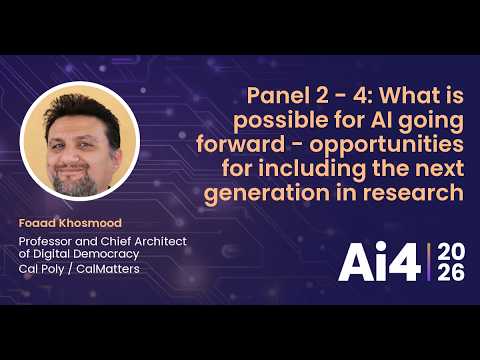
Published on YouTube by Ai4 on August 22, 2026, this presentation features Foaad Khosmood, Professor of Computer Engineering at Cal Poly and Chief Architect of Digital Democracy in partnership with CalMatters.
## TL;DR
Foaad Khosmood begins by illustrating how running an academic research lab parallels building a startup, detailing the mechanics of paper development, resource trade-offs, and raising over $20 million in non-equity grant funding. He then highlights the acute transparency deficit in state governments, noting that zero US states historically provided full, searchable, speaker-attributed legislative proceedings. To bridge this gap, the Digital Democracy initiative leverages NLP, audio transcription, and cross-database entity resolution to link floor speeches, voting records, and campaign contributions. In partnership with CalMatters, Digital Democracy 2.0 now delivers automated AI tip sheets to investigative journalists and personalized legislative newsletters to citizens, driving dozens of impactful accountability stories.
## Atmosphere & style
The talk carries an informative, pragmatic, and purpose-driven tone, blending scholarly rigor with the practical realities of software engineering and startup execution. Khosmood delivers his insights with clear, measured authority, engaging the audience by demystifying the research process and exposing civic data blind spots. The presentation creates a grounded yet inspiring impression of how artificial intelligence and natural language processing can be channeled directly into strengthening local journalism and democratic accountability.
## Key takeaways
- [02:04](https://www.youtube.com/watch?v=A_t7Qc3PlEo&t=124s) Academic paper development closely mirrors the startup lifecycle, requiring clear problem motivation, competitive literature review, needs assessments, and resource trade-off analysis.
- [02:04](https://www.youtube.com/watch?v=A_t7Qc3PlEo&t=124s) Academic research labs can secure significant capital without commercial equity, evidenced by over $20 million raised in philanthropic and grant funding for civic technology projects.
- [10:21](https://www.youtube.com/watch?v=A_t7Qc3PlEo&t=621s) A severe transparency deficit exists across US state governments, with zero out of 50 states historically offering verbatim, searchable legislative transcripts with speaker attribution.
- [10:21](https://www.youtube.com/watch?v=A_t7Qc3PlEo&t=621s) Standard government closed captioning feeds fall short of enabling true civic accountability due to low accuracy and the absence of speaker identification.
- [11:56](https://www.youtube.com/watch?v=A_t7Qc3PlEo&t=716s) Digital Democracy expanded from basic transcription into a multi-dimensional platform connecting transcripts, votes, campaign finance, and lobbying records across states covering over one-third of the US population.
- [11:56](https://www.youtube.com/watch?v=A_t7Qc3PlEo&t=716s) Raw multi-dimensional databases rarely see direct public adoption without specialized delivery mechanisms, necessitating direct integration into the journalism ecosystem.
- [11:56](https://www.youtube.com/watch?v=A_t7Qc3PlEo&t=716s) Digital Democracy 2.0 partnered with non-profit newsroom CalMatters to build automated AI tip sheets that flag legislative anomalies, such as conflicts between donor interests and voting records.
- [11:56](https://www.youtube.com/watch?v=A_t7Qc3PlEo&t=716s) The platform delivers automated 'My Legislator' weekly newsletters to bridge the information gap between constituents and their elected representatives.
- [19:20](https://www.youtube.com/watch?v=A_t7Qc3PlEo&t=1160s) Automating legislative research has saved journalists up to a week of manual work per story, enabling dozens of investigative articles and contributing to an Emmy Award-winning report.
- [19:20](https://www.youtube.com/watch?v=A_t7Qc3PlEo&t=1160s) The initiative has expanded beyond California to Hawaii and open-sourced historical legislative datasets on Hugging Face for public academic research.
## Detailed walkthrough
### [00:04](https://www.youtube.com/watch?v=A_t7Qc3PlEo&t=4s) Introduction and Speaker Background
Foaad Khosmood introduces himself as a Professor of Computer Engineering at California Polytechnic State University (Cal Poly) and Chief Architect of Digital Democracy. He highlights his academic and professional background, having worked in the technology industry at companies like Intel and IBM after completing his undergraduate degree before returning to academia to earn his PhD in Computer Science with a specialization in Natural Language Processing (NLP). At Cal Poly, he teaches video game systems and data science, while focusing his research on NLP applications within the digital humanities.
Before diving into his main research project, Khosmood frames the talk into two primary segments: the process of conducting research with students, and the story and architecture behind the Digital Democracy project. He also encourages the audience to attend upcoming sessions featuring his students' papers and his main conference presentation the following day.
* **Speaker:** Foaad Khosmood (Professor of Computer Engineering, Cal Poly)
* **Industry Experience:** Intel, IBM
* **Specialization:** Natural Language Processing (NLP), Digital Humanities, Video Game Systems, Data Science
---
[02:04](https://www.youtube.com/watch?v=A_t7Qc3PlEo&t=124s) The Academic Research Process as a Startup
Drawing parallels between academic research and starting a company, Khosmood explains that "developing a paper is a lot like being in a startup." In the research ecosystem, papers serve as the primary currency required for PhD programs and industrial R&D labs alike. Senior professors running research labs carry the financial burden of securing funding through grants to pay student stipends, tuition, and equipment costs.
To guide students through paper development, Khosmood outlines key components that map directly to startup workflows:
* **The Hook / Motivation:** Establishing a compelling narrative or problem statement to capture attention.
* **Related Works (Market Research):** Conducting thorough literature reviews to ensure the proposed work does not duplicate existing efforts, saving time and clarifying novelty.
* **Needs Assessment:** Demonstrating utility and demand to convince reviewers and funding bodies.
* **Cost & Metrics Analysis:** Evaluating trade-offs not only in financial terms, but in compute resources, runtime efficiency, maintenance, and statistical significance.
Addressing the critique that academic research lacks financial pressures, Khosmood notes that his team has raised over $20 million in grant and philanthropic funding for their initiatives—achieved with zero equity and zero expected return on investment (ROI).
---
[10:21](https://www.youtube.com/watch?v=A_t7Qc3PlEo&t=621s) The Transparency Deficit in State Governments
Khosmood transitions to the core focus of his work: the Digital Democracy project. He poses a question to the audience regarding how many US states produce full, searchable legislative proceedings detailing exact speaker contributions. While expectation suggests all 50 states should do so, the reality is zero.
Historically, state legislative proceedings lacked verbatim records identifying which lawmaker made specific statements during committee hearings or floor sessions. Although some states like California later introduced closed captioning, these feeds lack speaker attribution and maintain low textual accuracy. This lack of transparency prevents citizens from holding elected officials accountable for promises or votes made in public meetings.
---
[11:56](https://www.youtube.com/watch?v=A_t7Qc3PlEo&t=716s) Evolution of Digital Democracy (1.0 to 2.0)
Founded in 2014 by former California State Senator Sam Blakesley alongside Cal Poly faculty and students via the Institute for Advanced Technology and Public Policy, Digital Democracy originally aimed to generate full, searchable legislative transcripts. By 2015, the project successfully expanded beyond simple transcription to build a multi-dimensional platform connecting transcripts with vote records, campaign donations, bill histories, and lobbying activity across four major states: California, Texas, Florida, and New York (covering over one-third of the US population).
```mermaid
flowchart TD
accTitle: Digital Democracy Platform Evolution Architecture
subgraph DataCollection ["1. Raw Legislative Data Sources"]
A["Committee Audio / Video"]
B["Government Vote & Bill Databases"]
C["Campaign Finance & Lobbying Records"]
end
subgraph Distribution ["3. Stakeholder Delivery Vehicles"]
G["AI Tip Sheets for Journalists"]
H["'My Legislator' Weekly Newsletter"]
I["Public Search Portal (digitaldemocracy.org)"]
end
A --> D
B --> E
C --> E
D --> F
E --> F
F --> G
F --> H
F --> I
G --> J["News Stories & Public Accountability"]
```
Despite building comprehensive databases, the team observed a engagement challenge: ordinary citizens rarely navigated complex 25-dimensional legislative data unless they already knew precisely what to look for. While power users, investigative reporters, and government agencies (including the FBI) utilized the system, reaching the general public required partnering with the journalism ecosystem.
Partnering with **CalMatters**—a non-profit, non-partisan news organization whose content is freely syndicatable across California—the project launched **Digital Democracy 2.0**:
* **AI Tip Sheets for Reporters:** An automated workflow alerting newsrooms to legislative anomalies, such as a lawmaker voting against a measure opposed by a major campaign donor.
* **"My Legislator" Newsletter:** A weekly automated summary delivering tailored updates on local representatives' votes, authored bills, campaign contributions, and key quotes directly to constituents.
---
[19:20](https://www.youtube.com/watch?v=A_t7Qc3PlEo&t=1160s) Project Impact and Expansion
The Digital Democracy 2.0 platform has substantially streamlined investigative journalism, saving reporters up to a week of manual research per story. Since its deployment, the system has enabled over 50 to 60 published news stories across California and contributed to an Emmy Award-winning investigative report.
The initiative has expanded platform operations to Hawaii, with plans underway to incorporate Texas. Historical dataset archives have also been made available on Hugging Face for public academic research.
* **Primary Web Portal:** `digitaldemocracy.org`
* **Media Partner:** CalMatters
* **Active / Historical States:** California, Texas, Florida, New York, Hawaii
<ElicitationsGroup message="Explore further options related to this talk:">
<Elicitation label="Summarize the key architectural components of Digital Democracy 2.0" query="Summarize the key architectural components and data sources used in Digital Democracy 2.0 based on Foaad Khosmood's presentation."/>
<Elicitation label="Explain how AI tip sheets identify anomalies in legislative votes" query="Explain how the Digital Democracy platform uses AI tip sheets to identify anomalies between campaign donations and legislative voting behavior."/>
</ElicitationsGroup>
## Notable quotes
> [02:04](https://www.youtube.com/watch?v=A_t7Qc3PlEo&t=124s) developing a paper is a lot like being in a startup. — Foaad Khosmood
> [02:04](https://www.youtube.com/watch?v=A_t7Qc3PlEo&t=124s) The Hook / Motivation — Foaad Khosmood
> [02:04](https://www.youtube.com/watch?v=A_t7Qc3PlEo&t=124s) Related Works (Market Research) — Foaad Khosmood
## Mentioned
Foaad Khosmood, California Polytechnic State University (Cal Poly), Digital Democracy, Digital Democracy 2.0, Intel, IBM, Sam Blakesley, Institute for Advanced Technology and Public Policy, CalMatters, Federal Bureau of Investigation (FBI), Hugging Face, California, Texas, Florida, New York, Hawaii
## Video description
Foaad Khosmood, Professor and Chief Architect of Digital Democracy, Cal Poly / CalMatters
Cal Poly研发AI 为记者关联州议员投票与捐款资金
原始立法数据难以对民选官员进行有效问责,除非利用AI工具主动将会议记录与竞选捐款关联,并将异常情况直接推送至新闻编辑室。
Foaad Khosmood 首先阐述了运营学术研究实验室与创办初创公司的相似之处,详细说明了论文开发机制、资源权衡取舍,以及筹集超过2000万美元非股权资助资金的经历。随后,他指出了各州政府存在的严重透明度不足,提到历史上全美没有一个州能提供完整、可检索且标明发言人的立法会议记录。为了弥合这一差距,Digital Democracy 项目利用 NLP、音频转录和跨数据库实体解析技术,将议会发言、投票记录与竞选捐款关联起来。通过与 CalMatters 合作,Digital Democracy 2.0 目前可向调查记者自动提供 AI 新闻线索简报,并向公众发送个性化的立法简讯,推动了数十篇具有影响力的问责报道。
学术论文的研发流程与初创公司高度相似,需要明确问题动机、进行文献调研、完成需求评估以及权衡算力与成本,且该团队已通过慈善与赠款为公民科技项目筹集超2000万美元。 (2:04)
全美50个州长期缺乏可检索且标明发言人的逐字立法记录,常规的政府隐藏字幕也因准确率低且缺失发言人标识而难以实现公众监督。 (10:21)
Digital Democracy项目从基础转录升级为多维平台,关联了加利福尼亚、得克萨斯、佛罗里达和纽约等覆盖全美超三分之一人口地区的转录记录、投票、竞选资金和游说数据。 (11:56)
由于公众极少直接使用复杂的原始数据库,项目转型为Digital Democracy 2.0并与非营利新闻机构CalMatters合作,通过AI线索简报自动预警立法异常,并推出“My Legislator”每周通讯直接触达选民。 (11:56)
Reading summary
Foaad Khosmood argues that operating academic AI research like a startup allows universities to address systemic civic transparency deficits, demonstrated by the Digital Democracy platform's conversion of statehouse proceedings into actionable intelligence for journalists and voters.
Operating Academic AI Research Like a Startup (2:04)
Khosmood compares managing an academic research lab directly to running a startup, explaining that research papers serve as the primary currency for PhD graduates and industrial R&D positions. Lab leaders bear the responsibility of securing grant funding to cover student stipends, tuition, and hardware. Khosmood notes his team has raised over $20 million in philanthropic and grant funding under this model with zero equity distribution and no expected financial return on investment.
To train students effectively, he maps paper development directly to product iteration: establishing a compelling problem narrative, using literature reviews as market research to prevent duplicated effort, conducting needs assessments for reviewers, and balancing trade-offs in compute resources, maintenance costs, and statistical significance alongside monetary budgets.
The Legislative Transparency Deficit in State Governments (10:21)
Addressing the focus of his civic research, Khosmood highlights that zero out of 50 U.S. states provide comprehensive, searchable transcripts of legislative floor sessions and committee hearings with precise speaker attribution.
While some jurisdictions like California have implemented closed captioning, Khosmood points out that these services fail to identify which lawmaker is speaking and suffer from low transcription accuracy. Consequently, constituents and watchdogs have historically lacked accessible, verifiable records to hold state officials accountable for verbal promises and public hearing statements.
Synthesizing Civic Data into Actionable Newsroom Intelligence (11:56)
Founded in 2014 by Khosmood and former California State Senator Sam Blakesley, Digital Democracy initially targeted transcript generation before expanding into a multi-dimensional platform connecting transcripts, bill histories, voting logs, and campaign contributions across California, Florida, New York, and Texas. However, the team discovered that ordinary citizens rarely searched multi-dimensional legislative datasets on their own, leaving usage largely confined to power users and investigators.
To bridge this adoption gap, the project initiated Digital Democracy 2.0 in partnership with non-profit news organization CalMatters. The system processes raw data into two public-facing products: AI tip sheets alerting investigative reporters to legislative anomalies—such as committee votes aligned with campaign donor interests—and the 'My Legislator' weekly automated newsletter that sends tailored summaries of local representatives' actions directly to constituents.
Investigative Impact and Multi-State Expansion (19:20)
According to Khosmood, automating cross-database synthesis has reduced investigative research time by up to a week per story. In California, the platform has supported 50 to 60 published news stories and contributed to an Emmy Award-winning investigative report.
The project has expanded operations to Hawaii, with preparations underway to incorporate Texas legislative proceedings. In addition to powering active newsroom workflows, the team has released historical legislative dataset archives on Hugging Face for external academic use.
Digital Democracy demonstrates that surfacing civic information requires pairing speech processing and entity resolution with existing distribution ecosystems like local journalism, rather than relying on raw public databases alone. A persistent operational question remains how effectively this pipeline can scale across distinct statehouse reporting landscapes.
[2:04] Foaad Khosmood: developing a paper is a lot like being in a startup.
[2:04] Foaad Khosmood: The Hook / Motivation
[2:04] Foaad Khosmood: Related Works (Market Research)
[2:04] Foaad Khosmood: Needs Assessment
[2:04] Foaad Khosmood: Cost & Metrics Analysis
[11:56] Foaad Khosmood: AI Tip Sheets for Reporters
[11:56] Foaad Khosmood: My Legislator
[19:20] Foaad Khosmood: digitaldemocracy.org
Original transcript
[0:04] I don't have any slides but I encourage you to
go to my students talks which are in the next
[0:11] session and there's two talks and partially some
of the stuff I'm talking about here they will be
[0:17] covering and I'm really proud of them so that will
be great also I'm speaking at the main conference
[0:22] tomorrow at 4 uh if you're interested in more
about this subject so uh my name is Fad Kosmood
[0:30] I am a professor of computer engineering uh over
in California Polytechnic State University and um
[0:41] I just a little bit of background about myself um
I graduated in computing myself and I worked for
[0:49] years in the industry um right out of undergrad.
uh worked for companies like Intel and IBM and
[0:58] uh did some tech work. Um then I got uh came back
and got my uh PhD in computer science and uh here
[1:10] over at Kalpoli I teach video games systems um
data science but my PhD is in natural language
[1:20] processing and uh that's the aspect of which I
want to talk about today. So I do some research in
[1:28] natural language processing in digital humanities
and my main project that I'm going to talk about
[1:34] today and the two papers are about is called uh
digital democracy. But I promised Jill who invited
[1:41] me to this talk to um um say something about what
it's like doing research with students. And so I'm
[1:50] going to divide this talk in two sections. And um
I first want to talk about that research process
[1:58] with students and then I'm going to get into uh
the project that we're involved in if that's okay
[2:04] with everyone. Okay. So I always tell my students
that um doing research and developing a paper
[2:18] is a lot like being in a startup. And it's true.
There's so many aspects that are the same. Now why
[2:25] do I say developing a paper? Because developing
paper is kind of like the currency in research.
[2:30] If you want to do any kind of research at a PhD
level or at a company that has a research arm like
[2:37] most Silicon Valley companies do, what you need to
do is produce papers. The whole system is built on
[2:44] papers, right? Um, you produce papers. The paper
lays out an interesting idea and an experiment
[2:52] that proves it. Then you submit that paper to
a peer-reviewed um venue be at a conference.
[3:02] Conference are really really um important in
computer science or journals. Journals consider
[3:07] a little too slow for computer science. But in
any case, there's going to be a group of peers
[3:13] who is going to take a look at this and say that
yeah, this is a good idea. and then they'll accept
[3:20] it and you present it and then others will be
inspired by it, others will cite it. It might
[3:26] lead to you know bigger and better things.
That's kind of like the how research is done.
[3:35] The paper is the key. And most grad schools when
they want to um recruit um new PhD students,
[3:50] their number one concern is whether or not this
PhD student is going to be able to contribute
[3:59] to a paper. This is very important. There is
unfortunately a lot of financial concerns with PhD
[4:08] um education here at Cal here in uh US. uh the
usually the uh the um senior professor in a lab
[4:20] uh is also responsible for raising all the money
to pay the PhD students to pay their tuition,
[4:27] pay them stipens, uh pay for the equipment
and everything. So they kind of rely on a
[4:34] lot of grants and grants well they're given to
uh researchers who have made contributions and
[4:42] contributions are measured by the quality and
the value of your papers. So when you bring in
[4:49] a new PhD student you have to um basically train
them on how to write papers and that's not very
[4:57] easy. Uh it might take years. So I always tell my
students who are interested in in a PhD program
[5:03] to get involved with some research and put put
their efforts in writing a paper together with
[5:11] professors or others. But that will be like the
number one thing that kind of proves your value
[5:16] to this organization and then looking at what it
takes to write a paper. I think it does have a
[5:24] lot to do a lot of similarities with startups.
First of all, a paper just like just like a
[5:33] startup process needs a good hook. It needs a good
motivation. It needs a personal story or some kind
[5:42] of uh way of getting attention. What's happening
in the uh in the you know broader community and so
[5:49] on. So um so that is the same on both. Then you
need related works. Paper big section of it is
[5:57] called related works. And related works, I'm sure
you know all about this, right? Is essentially
[6:05] just doing market research. It's exactly the same.
It's very important in that it first lets you know
[6:14] what everyone else is doing in this area. And why
is that important? because it'll save you time if
[6:21] the thing you're thinking of doing is already done
and you wouldn't want to reinvent the wheel. So,
[6:30] it's very important that but most of the time
maybe something similar to it has been done
[6:36] or maybe even something very similar to your
idea has been done and you could shift your
[6:40] idea. You could change it so that it could get
to the level of contribution you want to make.
[6:48] and uh related works is important for that as well
and it's just just as important in startups for
[6:52] market research purposes. Then you have to say
why this is needed. Why is this even required
[7:00] or a thing? This is something investors look at
all the time. This might be a good idea. It may
[7:07] have never been done before, but will anyone
use it? You have to have that burden as well.
[7:14] And of course you have to come up with very good
cost analysis. Now in research papers especially
[7:21] in computer science cost is not necessarily
just dollars. It's also time. It's compute. It's
[7:31] um practicality maintenance things like that.
And that all has to be laid out because what
[7:38] you're doing in a scientific paper is proving a
hypothesis. And in order to prove that hypothesis,
[7:44] you have to show all these numbers, all these
experiments and you show that you know your way
[7:50] works better by proving that it's statistically
more significant in some very important metric.
[7:56] So all of that has to be done. But you know some
people come back and say well this is not a good
[8:03] analogy because you don't have to worry about
money. And I really really wish that was true.
[8:10] you do have to worry about money all the time.
Uh getting grants in uh PhD institutions is
[8:18] all about money and you know your projects they
have to have they have to have funding. So um I
[8:28] challenge anyone who says this is not as difficult
as a startup because startups have to raise money.
[8:34] We have raised over $20 million for a project
with zero equity and zero ROI expectation. Okay,
[8:45] which startup can say that? It's very important
to be able to persuade people to do that. So
[8:58] I want to say that um research uh has
much in common with um startup culture and
[9:10] um and the proof is in the pudding. I mean
I talked about how much we've raised for our
[9:16] projects. Our research partner, Cal Matters, is
a nonprofit news organization that is the number
[9:25] one source of news for statewide capital-based
reporting in California. I'm sure some of you
[9:32] have come across this news u items in various
feeds and so on but there are no pay walls and
[9:42] any journalistic outfit in California anyone any
local news or any newsletter or anyone who is
[9:51] interested is allowed to republish their stories
for free in their own publication different models
[10:01] but successful because it's been able to raise
entirely philanthropic money to stay alive in
[10:09] a very very tight uh news ecosystem. Okay, so
let me now transition over to digital democracy.
[10:21] So um digital democracy fundamentally started
as a project to bring transparency to state
[10:28] governments. So uh let me um let me ask
you a question. How many of the US states
[10:38] would you say produce a full proceedings of
their legislative activities? By that I mean
[10:49] you can find out which lawmaker
said what during a meeting. How
[10:56] many would you say? Good number. Good
number. What else? Any other guesses?
[11:07] Should be 50. Should is doing a lot of work. It's
zero. The answer is zero. And first of all, this
[11:17] is entirely against ADA, but um but here we are.
There is zero state governments producing a full
[11:28] transcript. Uh so you can find out which lawmaker
said what. When we started in this project,
[11:34] which was over 10 years ago, there was nothing.
Since then, California has started producing close
[11:41] captioning, but that is not the same because it
doesn't say who spoke and the quality is pretty
[11:47] poor. Okay. So, with that motivation, let me tell
you about our project. Our project was started by
[11:56] um a guy named Sam Blakesley. He was a state
representative of the area of San Louis Bispo and
[12:03] later in the state senate. And then he retired.
Once he retired around like um 2014, he started
[12:12] this institute called the Institute for Advanced
Technology and Public Policy. And his goal was
[12:18] just to spill all the tricks, all the tricks
that the legislature has uh about, you know,
[12:26] how they do things that the public doesn't know
about. And one of the biggest things, of course,
[12:30] was this transparency issue. People could be
promising things in various settings including
[12:36] inside of a meeting, a public meeting and be like,
"Yes, I will do this blah blah blah." But there
[12:42] will be no record of it. So no one could hold them
accountable. And so we started with just this very
[12:48] simple idea of bringing this full proceedings to
life. And um we started doing this we just out of
[12:58] a small office in St. Louis Abyspo using just a
few professors and part-time computer students,
[13:04] computing students. Uh we embarked on this
journey. The original goals were modest. Produce
[13:12] the transcript. That's kind of all we want. Go to
a website, see the transcript. Okay. And we did.
[13:19] Wasn't too hard. There was enough technology
available. Even back then, even in the pre-LM
[13:23] days, could be done. Um but then we realized
when you look at this transcript as a lay person
[13:32] as most people are like who even knows you know
what their representatives names are? most people
[13:38] don't, right? And uh the subjects that they're
talking about people aren't that familiar and
[13:44] the and the organizations they use in their speech
people don't know and uh the history of the uh of
[13:51] the people who are doing the speeches people don't
know. So we quickly realized this is not enough
[13:58] for ordinary citizen to participate in democracy.
So what we needed was to provide the full context.
[14:06] So, it's not just who said it, but when were they
elected, what other bills have they authored, who
[14:13] has donated to them, what did they say about the
subject before? And that quickly became a very,
[14:20] very big project. And um we embarked on it and we
were able to accomplish it. We in 2015 just out of
[14:30] our office in San Louis Abyspo produced the first
full transcripts and this metadata about bills and
[14:39] votes and things like that which were available
in government sources. The transcripts weren't but
[14:44] the other stuff was but the government databases
were so bad and they were not interoperable with
[14:51] each other. So it was very difficult for example
to know that the Bobsmith who is currently in
[14:57] front of the legislature speaking about something
also lobbied on something else two years ago.
[15:02] You know very difficult to know know that. Right.
Put all that together and in 2015 we produced the
[15:09] first comprehensive transcripts in four states.
Um California, Texas, Florida and New York. That's
[15:16] over a third of the United States. recently
published the all the all the records of those
[15:21] things uh in hugging face if you want to look them
up and that was great. Um, fast forward a few more
[15:30] years, we realized we are not getting enough user
engagement even with all the context. It's kind of
[15:37] a wonkish subject and people just aren't into it.
And um there's no way to sort of um take this like
[15:47] large database 25dimensional data at any point
you know and uh try to make like a uh person who
[15:54] doesn't know anything about the legislature but
cares about a particular cause really understand
[15:58] it right so it was good for insiders a lot of
people in the uh legislature themselves and the
[16:07] staff were using it FBI was using it because they
were investigating all these like election fraud
[16:14] and things like that. Um and uh some you know
people who were in the news industry were using
[16:20] it heavily and they given us really good good
feedback but ordinary people weren't using it. And
[16:25] we realized what we needed was a vehicle a vehicle
to to um deliver this to the ordinary citizen.
[16:35] And just going on a website and clicking around
and typing things. You have to know what you're
[16:40] looking for before you can get something useful
if you don't know anything already. So, we decided
[16:45] that vehicle was already here because for what,
hundreds of years, maybe 800 years, we've had the
[16:53] news industry, right? News reporters make stories,
put all of the interesting things in them, report
[17:05] the facts, report the breaking news in a package
that everyone is already familiar with and able to
[17:11] consume. So our goal became now we need to empower
the reporter. So starting with our partnership
[17:20] with Cal Matters, we did the digital democracy
2.0 know and in this version we still had the
[17:27] same proceedings and searchable records and uh
you know all the votes and all the donations
[17:33] and everything but now we also had a new tool for
reporters this called AI tip sheets in this system
[17:41] a reporter can log into uh our AI tip sheet system
AI for reporters actually we had that before AI4
[17:49] was here and you what you can do is um you'll see
a stream of cards that um that each correspond to
[17:58] one interesting thing that happened in the in the
legislature that day. For example, a meeting was
[18:05] held or a vote was taken or a veto, something like
that. And then when you were click on the cards,
[18:12] you can sort of sort them. You can um search them
by tags. Have they do they have to do with your
[18:18] hometown? Are they about a subject? like water is
big in California. Are they about water? Things
[18:24] like that. And then you click on it and then
you'll get all the facts and figures including
[18:29] the full transcripts including everything
that happened including like AI summaries of
[18:35] the discussion and the full discussion as well
and all the interesting things. For example,
[18:42] did someone who was part of a committee vote for
a bill which was opposed by an organization that
[18:53] had previously donated to that same person like
that. And uh we look for anomalies like that and
[19:00] we publish them in these tip sheets and reporters
take a look and uh if something looks interesting
[19:06] they will take all the facts. it will save them
about a week of uh doing research and then they
[19:12] will uh use that to uh write a story and uh it's
seen a lot of success. Uh we just went live with
[19:20] it last year and um already have over 50 60
stories out throughout the state. We've won
[19:28] an Emmy for one of the stories that was really
good. Uh we've expanded to Hawaii with this new
[19:33] version and we're looking at Texas very soon as
well. And then just recently we also released a
[19:40] um newsletter called my legislator newsletter
available from Cal Matters if you want to look.
[19:46] And uh this will give you a weekly report every
week on everything that your legislator, your
[19:54] hometown legislator did, all the votes they took.
What is the status of the bills they authored? if
[20:01] those bills saw any action, any donations,
interesting quotes, all these things being
[20:08] developed for all 120 legislators all the time
using AI but with a lot of backend work still done
[20:17] with students and engineers at Cal Matters. So, I
encourage you to take a look, come to the talks,
[20:24] the two that are in the next hour and my talk
tomorrow at 4 or just go to digitaldemocracy.org.
[20:30] org to see for yourself. Search for something
interesting and see the entire proceedings and
[20:37] um and look for stories that have been developed
with digital democracy. Okay. Thank you.