QCI Integrates Photonic Solvers With GPUs to Speed Generative AI Models
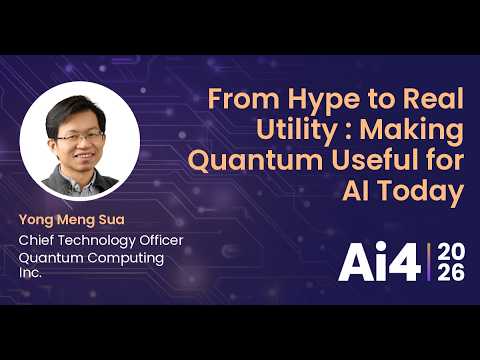
Ai4
Enterprises can achieve immediate performance gains in AI diffusion and signal processing using room-temperature photonic hardware without waiting decades for fault-tolerant quantum computers.
AI-assisted summary of From Hype to Real Utility : Making Quantum Useful for AI Today With Quantum Computing Inc. — original source. Check the original for full context.
Source published:
Detailed notes
## Background Published on YouTube by Ai4 on August 15, 2026, this talk features Yong Meng Sua, Chief Technology Officer at Quantum Computing Inc. (QCI). According to the description, the presentation demonstrates how quantum-inspired and photonic computing deliver practical utility for modern AI and optimization workflows today without relying on distant fault-tolerant quantum systems.
## TL;DR Rather than waiting decades for error-corrected universal quantum computers, Quantum Computing Inc. deploys room-temperature photonic hardware like the Dirac-3 entropic solver to accelerate discrete mathematical kernels in AI and optimization workloads. Operating as a complementary co-processor alongside GPUs, the technology improves generative diffusion modeling, enhances structured sequence recovery, and denoises weak lidar signals across real-world deployments with NASA and commercial data centers. To overcome data transfer latency bottlenecks and reduce energy consumption, QCI is advancing 3D heterogeneous integrated photonics that combine thin-film lithium niobate, silicon photonics, and CMOS electronics directly alongside classical compute.
## Atmosphere & style The presentation carries a pragmatic, grounded, and refreshing tone that intentionally cuts through the speculative hype dominating the quantum computing industry. Yong Meng Sua presents with a calm, engineering-focused clarity, pivoting away from distant theoretical promises toward tangible hardware racks, rigorous classical benchmarks, and immediate commercial viability. Listening to the talk feels like an honest industry reality check, replacing futuristic abstractions with concrete architectural roadmaps and measurable real-world deployments.
## Key takeaways - [00:04](https://www.youtube.com/watch?v=d3FThrXyXhw&t=4s) Rather than waiting 5 to 25 years for fault-tolerant quantum machines to replace classical compute, room-temperature quantum photonics can immediately accelerate discrete mathematical kernels like optimization and signal recovery. - [02:26](https://www.youtube.com/watch?v=d3FThrXyXhw&t=146s) The Dirac-3 entropic solver operates at room temperature in a 5U rack form factor by utilizing an open quantum optical feedback loop that harnesses vacuum fluctuations as computational fuel. - [02:26](https://www.youtube.com/watch?v=d3FThrXyXhw&t=146s) Photonic neuromorphic computing processes dynamic non-linear optical states to handle real-time edge inference, pattern recognition, and time-series forecasting. - [05:46](https://www.youtube.com/watch?v=d3FThrXyXhw&t=346s) Integrating the Dirac-3 as a Quantum Reverse Kernel inside standard diffusion models improves FID by 46% and Inception Score by 61% without requiring any retraining of pre-trained neural weights. - [05:46](https://www.youtube.com/watch?v=d3FThrXyXhw&t=346s) Native cubic and higher-order polynomial solving on photonic hardware enables modeling complex multi-variable interactions, achieving an 89% valid sequence recovery rate in discrete diffusion compared to 44% classically. - [09:55](https://www.youtube.com/watch?v=d3FThrXyXhw&t=595s) Photonic quantum-AI filtering has been validated across five NASA projects to successfully separate weak lidar return signals from strong solar background noise. - [09:55](https://www.youtube.com/watch?v=d3FThrXyXhw&t=595s) Photonic solvers are physically deployed in commercial data centers to tackle real-world optimization problems, including protein folding for drug discovery with Tri-I TDI. - [13:03](https://www.youtube.com/watch?v=d3FThrXyXhw&t=783s) Quantum systems are designed as hybrid co-processors that complement GPU-driven AI pipelines across data acquisition, denoising, and edge optimization rather than replacing classical computing. - [13:03](https://www.youtube.com/watch?v=d3FThrXyXhw&t=783s) QCI is developing a 3D heterogeneous material stack combining Thin-Film Lithium Niobate (TFLN), silicon photonics, and CMOS electronics to cut power draw and operational latency. - [18:06](https://www.youtube.com/watch?v=d3FThrXyXhw&t=1086s) To resolve communication latency between external software stacks and the photonic solver core, photonic chips are being designed for direct co-packaging alongside GPUs.
## Detailed walkthrough ### [00:04](https://www.youtube.com/watch?v=d3FThrXyXhw&t=4s) Moving from Quantum Hype to Real Utility Today
Following an introduction by Peggy and an inspiring opening story from the previous speaker, Nolan, the focus turns to the fundamental purpose of technology: whether artificial intelligence or quantum computing, human innovation must ultimately serve the greater human good. Moving from aspirational visions to the practical realities—what is candidly described as returning "to the darker side of the world"—the discussion shifts directly to cutting through industry hype to make quantum technology genuinely useful for AI workflows today. After presenting standard SEC forward-looking statements, the session addresses the persistent questions that follow anyone working in the quantum space: "When will a fault-tolerant quantum computer break RSA?" or "When will quantum computers finally compete with GPUs?"
These questions are fundamentally flawed because they tether quantum computing to a distant horizon requiring millions of error-corrected physical qubits deployed 5, 15, or 25 years into the future. That theoretical framing creates severe strategic deployment paralysis for enterprises. A much more practical question is asking what quantum photonics hardware can deliver right now. Instead of attempting to replace general-purpose classical compute, quantum photonics can specifically target discrete computational kernels—such as combinatorial optimization, temporal inference, and signal recovery—operating entirely at room temperature. Crucially, these systems can be evaluated and benchmarked in a straightforward, practical manner directly against standard CPUs and GPUs so enterprises can determine whether the investment yields tangible return.
- **Fault-Tolerant Horizon**: Long-term quantum roadmaps frequently focus on 5- to 25-year timelines requiring millions of error-corrected qubits. - **Immediate Value Proposition**: Room-temperature quantum photonics hardware targets specialized mathematical acceleration rather than universal compute replacement. - **Evaluation Criteria**: Benchmarked against classical hardware metrics to assess commercial cost-effectiveness and performance gains.
---
[02:26](https://www.youtube.com/watch?v=d3FThrXyXhw&t=146s) QCI's Core Hardware: Dirac-3 Entropic Solver and Neuromorphic Computing
Quantum Computing Inc. (QCI) delivers two primary hardware platforms available either on-premises or via cloud subscription: the Dirac-3 entropic quantum optimization machine (a photonic analog solver) and a photonic neuromorphic reservoir computer. The Dirac-3 machine takes an inverted approach to traditional gate-based quantum computing. Rather than isolating pristine qubits from environmental noise in cryogenic setups, entropic quantum computing operates as an open quantum system that harnesses decoherence and quantum vacuum fluctuations as computational "fuel." Mathematical problems are encoded into an optical feedback loop mixed with vacuum fluctuations, evolving iteratively toward the global minimum energy state representing the optimal solution.
```mermaid flowchart LR accTitle: Entropic Photonic Quantum Computing Loop subgraph Input["Problem Formulation"] A["Encoded Problem<br/>(QUBO / Analog / Multi-level)"] end subgraph PhotonicCore["Optical Feedback Core (Room Temperature)"] B["Optical Feedback Loop"] C["Quantum Vacuum<br/>Fluctuations"] B <--> C end subgraph Output["Solution Convergence"] D["Iterative Evolution<br/>(25–100 Cycles)"] E["Optimal Ground State /<br/>Statistical Distribution"] D --> E end A --> B B --> D ```
In parallel, QCI's photonic neuromorphic platform encodes data into dynamic photonic states, leveraging rich non-linear optical properties for real-time time-series prediction, edge inference, pattern recognition, and signal reconstruction. Packaged in a compact 5U rack-mount form factor, the Dirac-3 operates at room temperature with low power consumption. It functions as a drop-in acceleration solver for NP-hard problems, discrete and continuous optimization, Quadratic Unconstrained Binary Optimization (QUBO), integer programming, and analog multi-level encoding.
- **Dirac-3 Form Factor**: Packaged as a standard 5U rack-mount photonic server operating at room temperature with low operational power draw. - **Algorithmic Scope**: Solves discrete, continuous, QUBO, integer, and analog optimization problems via qubit and multi-level photonic states. - **Execution Profile**: Typically completes 25, 50, or 100 feedback iterations to establish a robust statistical distribution of optimal ground states. - **Neuromorphic Capabilities**: Processes dynamic non-linear photonic states for temporal sequence prediction and edge AI inference.
---
[05:46](https://www.youtube.com/watch?v=d3FThrXyXhw&t=346s) Quantum Reverse Kernels and Discrete Diffusion in AI Workflows
The utility of photonic hardware becomes evident when integrating the Dirac-3 solver directly into modern generative AI pipelines. In standard diffusion architectures, neural networks iteratively denoise data across 25 to 100 steps to synthesize images or video. By introducing a programmable Quantum Reverse Kernel (QRK) powered by the Dirac-3 as an internal sampling layer, the system evaluates all possible solution spaces in parallel during each generation step. This architecture requires zero retraining—using existing pre-trained neural network weights without needing external optimization solvers bolted on—delivering a 46% improvement in Fréchet Inception Distance (FID) to match ground truth distributions and a 61% boost in Inception Score for enhanced structural clarity.
```mermaid flowchart TD accTitle: Quantum-Enhanced AI Generative Pipeline subgraph ClassicalStack["Standard Diffusion Pipeline"] A["Pre-Trained Neural Weights<br/>(No Retraining Required)"] B["Iterative Denoising Loop<br/>(25–100 Steps)"] A --> B end subgraph QuantumLayer["Dirac-3 Photonic Sampler"] C["Parallel Solution Sampling<br/>(Quantum Reverse Kernel)"] D["Higher-Order / Cubic<br/>Correlation Analysis"] B <--> C B <--> D end subgraph Results["Generated Output"] E["Synthetic Images / Discrete Sequences<br/>(46% Better FID, 61% Inception Boost)"] B --> E end ```
Beyond continuous image generation, discrete diffusion architectures model sequential structured data such as DNA sequences. Traditional sequence generators factorize dependencies and struggle beyond simple pairwise relationships. Leveraging native cubic and higher-order polynomial solvers within the Dirac platform enables the system to capture multi-variable interactions naturally. When testing sequence generation, the quantum-enhanced model achieved an 89% valid ground-truth sequence recovery rate compared to just 44% for standard mathematical models. Furthermore, drawing 15 candidate sequences at a time consistently yields sequences that satisfy triadic motif rules, underscoring that identifying high-order correlations is essential for accurate synthetic data and image reconstruction.
- **Generative Improvements**: Yields a 46% better FID score and a 61% higher Inception Score without modifying or retraining underlying neural weights. - **Sequence Reconstruction**: Achieves an 89% valid sequence generation rate matching ground truth versus 44% for standard mathematical models. - **High-Order Interactions**: Native cubic terms solve complex triadic motif structures without mathematical factorization approximations.
---
[09:55](https://www.youtube.com/watch?v=d3FThrXyXhw&t=595s) Real-World Deployments: NASA Lidar Denoising and Data Center Integration
Moving past synthetic datasets and toy models, QCI's photonic solvers have been evaluated on real-world observational data across five collaborative projects with NASA. NASA had long encountered severe bottlenecks when using standard AI models to denoise weak lidar signals recorded against overwhelming solar background noise; over-filtering stripped away essential signal features, whereas under-filtering left excessive noise. Integrating the Dirac-3 solver alongside AI denoising algorithms enabled precise modeling of background noise characteristics, isolating and removing structured environmental noise without sacrificing the underlying lidar return signal.
```mermaid flowchart LR accTitle: NASA Lidar Denoising Architecture subgraph SignalInput["Raw Optical Acquisition"] A["Weak Lidar Return"] B["Strong Sunlight Noise"] A & B --> C["Noisy Composite Signal"] end subgraph Processing["Hybrid Processing"] D["Classical AI Filter"] E["Dirac-3 Correlation Solver"] C --> D D <--> E end subgraph CleanOutput["Reconstructed Signal"] F["Denoised Lidar Profile<br/>(Preserved Critical Features)"] E --> F end ```
Transitioning quantum systems from laboratory demonstrations to customer environments remains a critical hurdle across all quantum modalities. QCI has demonstrated physical installations of the Dirac-3 system inside operational commercial data centers, including the Quantum Corridor Quantum-Safe Network in Indiana and The Forge at the Center for Federal Services Research in Washington, D.C. Within these data center rack environments, collaborators such as the Tri-Institutional Therapeutics Discovery Institute (Tri-I TDI) leverage the platform to solve complex protein folding optimization problems, assisting molecular structural discovery for targeted drug development.
- **NASA Lidar Denoising**: Successfully extracts weak return signals submerged in high-intensity solar background noise across five NASA initiatives. - **Data Center Deployments**: Operational rack-mounted installations at Indiana's Quantum Corridor and Washington, D.C.'s The Forge. - **Biomedical Application**: Utilized by the Tri-Institutional Therapeutics Discovery Institute for conformational optimization in protein folding and drug discovery.
---
[13:03](https://www.youtube.com/watch?v=d3FThrXyXhw&t=783s) The Hybrid Quantum-AI Stack and Integrated Photonics Architecture
Quantum computing is not designed to replace AI or classical GPUs; it is built to operate as a complementary co-processor across hybrid pipelines. In this architecture, classical sensors capture raw inputs, a quantum-AI solver denoises the signal, GPUs handle core neural network training and inference, and a quantum layer manages complex optimization and decision-making at the edge. To separate commercial reality from hype, enterprises must evaluate five pragmatic criteria:
| Evaluation Criterion | Practical Requirement | |:--- |:--- | | **Deployment Timeline** | Can the solution run in production within the current fiscal quarter? | | **Classical Benchmarking** | Does it measurably outperform classical CPU/GPU baselines on identical workloads? | | **Problem Relevance** | Does it address an immediate, high-value business bottleneck? | | **Infrastructure Integration** | Can it integrate cleanly into existing IT and data center environments? | | **Energy Economics** | Does the performance gain justify the operational power and cost footprint? |
```mermaid flowchart TD accTitle: 3D Integrated Photonics Stack subgraph Stack["3D Heterogeneous Material Stack"] L1["Thin-Film Lithium Niobate (TFLN)<br/>(Unmatched Non-Linear Optics & Electro-Optics)"] L2["Silicon Photonics Layer<br/>(Scalable Waveguides & Optical Interconnects)"] L3["CMOS Electronics Base<br/>(Standard High-Speed Logic & Control)"] L1 <--> L2 L2 <--> L3 end ```
To eliminate energy and latency overheads, QCI is pursuing 3D heterogeneous photonic integration. Following the acquisition of a specialized semiconductor facility, the company is combining thin-film lithium niobate (TFLN)—leveraging 15 years of material development for non-linear optical properties—with silicon photonics and standard CMOS electronics. This domestic U.S. supply chain enables high-density electro-optical interconnects that dramatically reduce energy per bit. Organizations can validate these capabilities quickly through structured 90-day pilot programs, testing specific computational kernels against classical baselines before scaling up deployment.
- **Core Takeaway 1**: Real-world quantum utility does not require waiting decades for fault-tolerant universal machines. - **Core Takeaway 2**: Quantum architectures naturally complement and accelerate GPU-driven AI pipelines rather than competing with them. - **Core Takeaway 3**: Performance must be judged honestly on immediate benchmark improvements rather than multi-decade promises. - **Pilot Implementation**: 90-day structured proof-of-concept projects allow organizations to identify viable kernels and measure concrete ROI.
---
[18:06](https://www.youtube.com/watch?v=d3FThrXyXhw&t=1086s) Q&A: Overcoming Latency with Co-Packaged Photonic Chips
In the concluding question-and-answer exchange, an attendee asks about the real-world cost-effectiveness and practical complexity of integrating these photonic systems into industrial environments. The response highlights the primary operational bottleneck currently limiting hybrid systems: data transfer latency. While the internal Dirac solver demonstrates clear algorithmic improvements over classical routines, streaming data back and forth between client software, embedded control layers, and the physical photonic core introduces communication overhead where "time and money are wasted."
To eliminate these latency barriers and make scaling cost-effective, QCI is advancing its 3D integrated photonic chip platform. By packaging thin-film lithium niobate and silicon photonics directly alongside GPUs using optical interconnect architectures similar to modern data center networking, the system avoids external software-stack delays. Co-packaging the photonic hardware directly with classical compute processors removes intermediate communication bottlenecks, paving the way for low-latency, cost-efficient quantum acceleration in production AI workloads.
- **Latency Bottleneck**: Current hybrid setups incur latency transferring data between client software, embedded layers, and the optical solver. - **Co-Packaging Solution**: 3D integrated photonic chips designed to sit directly adjacent to GPUs to eliminate interconnect delays. - **Industrial Scaling**: Direct optical co-packaging reduces transmission overhead, bringing down the total operational cost of quantum-accelerated AI.
## Notable quotes > Quantum computing is often positioned as a future breakthrough, but meaningful value is already being realized today. — Yong Meng Sua
> These technologies are not replacements for classical AI, but powerful complements, particularly for complex optimization, pattern recognition, and data-intensive decision-making. — Yong Meng Sua
> Join this session to separate signal from noise and start leveraging quantum for practical impact today. — Yong Meng Sua
> [00:04](https://www.youtube.com/watch?v=d3FThrXyXhw&t=4s) to the darker side of the world — Yong Meng Sua
> [00:04](https://www.youtube.com/watch?v=d3FThrXyXhw&t=4s) When will a fault-tolerant quantum computer break RSA? — Yong Meng Sua
> [00:04](https://www.youtube.com/watch?v=d3FThrXyXhw&t=4s) When will quantum computers finally compete with GPUs? — Yong Meng Sua
> [02:26](https://www.youtube.com/watch?v=d3FThrXyXhw&t=146s) fuel — Yong Meng Sua
> [18:06](https://www.youtube.com/watch?v=d3FThrXyXhw&t=1086s) time and money are wasted — Yong Meng Sua
## Mentioned Yong Meng Sua, Peggy, Nolan, Quantum Computing Inc. (QCI), Ai4, Dirac-3, Quantum Reverse Kernel (QRK), NASA, Quantum Corridor, The Forge, Center for Federal Services Research, Tri-Institutional Therapeutics Discovery Institute (Tri-I TDI), Thin-Film Lithium Niobate (TFLN), CMOS, GPU, CPU, RSA
## Video description Yong Meng Sua - Chief Technology Officer, Quantum Computing Inc.
Quantum computing is often positioned as a future breakthrough, but meaningful value is already being realized today.
In this talk, I will highlight how quantum-inspired and photonic computing approaches are delivering practical solutions to real-world AI and optimization challenges, without relying on fault-tolerant quantum systems. These technologies are not replacements for classical AI, but powerful complements, particularly for complex optimization, pattern recognition, and data-intensive decision-making. Drawing on real world deployment, I will discuss where quantum and photonics approaches are already gaining traction, how they complement existing AI workflows, and what differentiates practical solutions from theoretical promise. Join this session to separate signal from noise and start leveraging quantum for practical impact today.
[Source](https://www.youtube.com/watch?v=d3FThrXyXhw)