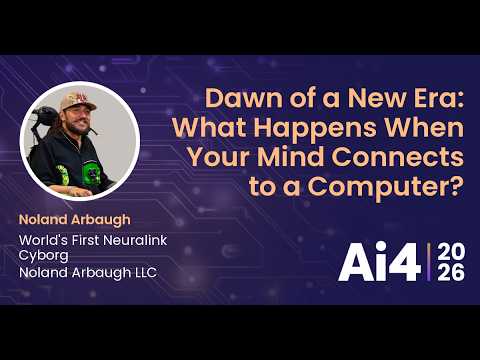
Neuralink's Arbaugh Sees Brain-Spine Bridges Curing Paralysis
Ai4
Two and a half years after receiving his implant, the first Neuralink patient says wireless bridges connecting the motor cortex to the spinal cord will bypass severed nerves and allow newly injured patients to walk within his lifetime.
## Background
Published on YouTube by the Ai4 conference channel on August 21, 2026, this keynote features Noland Arbaugh, the first recipient of the Neuralink brain-computer interface. The session explores how BCIs are transforming disability, communication, and human agency, while highlighting the ethical considerations and real-world human impact of emerging neural technologies.
## TL;DR
Noland Arbaugh shares his personal journey from a paralyzing 2016 swimming accident that left him with a C4-C5 spinal cord injury to becoming the first human recipient of Neuralink's 1,024-electrode brain-computer interface. He describes the robotic surgery and explains how regaining digital agency enabled him to complete a 22-credit-hour semester with a 4.0 GPA and launch a professional speaking business. Urging technologists to prioritize human empathy and dignity over mere novelty, Arbaugh illustrates how background AI engineering creates tangible life transformations. In the closing Q&A, he breaks down the mechanics of decoding motor intent into computer cursor movements and discusses future spinal bridge implants designed to bypass paralysis entirely.
## Atmosphere & style
The presentation blends self-deprecating humor with deeply poignant reflection, moving effortlessly between witty jokes about hospital pranks and the raw gravity of living with quadriplegia. Arbaugh commands the stage with warmth and authentic humility, disarming a room of high-level AI developers by framing himself as an ordinary person elevated by extraordinary engineering. The emotional arc feels intimate and triumphant, leaving listeners inspired by the life-affirming power of technology rooted in genuine human resilience.
## Key takeaways
- [00:04](https://www.youtube.com/watch?v=69UjyGsCC-s&t=4s) Noland Arbaugh introduces himself as the world's first Neuralink BCI implant recipient, speaking at AI4 roughly two and a half years into the clinical study.
- [02:03](https://www.youtube.com/watch?v=69UjyGsCC-s&t=123s) In 2016, a freak accident in a Poconos lake caused a C4-C5 spinal dislocation that left Noland completely paralyzed with quadriplegia below the shoulders.
- [04:00](https://www.youtube.com/watch?v=69UjyGsCC-s&t=240s) After seven years of living with quadriplegia, Noland seized the opportunity to apply for Neuralink when his friend Greg Bain told him about the trial.
- [04:00](https://www.youtube.com/watch?v=69UjyGsCC-s&t=240s) The Neuralink procedure involved a craniectomy and robotic placement of 64 threads holding 1,024 electrodes into his left motor cortex in just over two hours.
- [06:46](https://www.youtube.com/watch?v=69UjyGsCC-s&t=406s) The BCI implant transformed Noland's life by restoring personal agency, enabling him to return to college with a 4.0 GPA across 22 credit hours.
- [06:46](https://www.youtube.com/watch?v=69UjyGsCC-s&t=406s) Noland founded a professional public speaking business to raise awareness about brain-computer interfaces and human potential.
- [09:42](https://www.youtube.com/watch?v=69UjyGsCC-s&t=582s) Technology is fundamentally about people; true progress happens when engineers identify profound human vulnerabilities and build solutions to address them.
- [14:14](https://www.youtube.com/watch?v=69UjyGsCC-s&t=854s) The ripple effect of technological innovation restores dignity, emotional well-being, and daily joy to individuals with severe physical disabilities.
- [17:27](https://www.youtube.com/watch?v=69UjyGsCC-s&t=1047s) The BCI functions by recording motor cortex firing patterns when Noland attempts hand movement, decoding those neural signals into real-time computer cursor control.
- [17:27](https://www.youtube.com/watch?v=69UjyGsCC-s&t=1047s) Neuralink aims to cure paralysis in the future by pairing motor cortex implants with spinal implants to wirelessly bridge damaged neural pathways and restore physical mobility.
## Detailed walkthrough
### [00:04](https://www.youtube.com/watch?v=69UjyGsCC-s&t=4s) Opening with an Aggie "Howdy" and Imposter Syndrome Among AI Nerds
Noland Arbaugh takes the stage by invoking a cherished Texas A&M tradition. He playfully warns the audience that while they could debate later why their universities might be inferior to his, Aggie protocol dictates that whether speaking to one person or a crowd of one hundred thousand, one begins with a hearty "Howdy." After coaxing a loud response from the room, he introduces himself as the very first recipient of the Neuralink brain-computer interface (BCI) implant—a milestone that took place roughly two and a half years prior, putting him near the midpoint of the clinical study.
When first invited to speak at AI4, Noland had two immediate reactions: excitement that he would be a hit with fellow nerds, followed by genuine self-doubt about what value he could truly provide. He reflects on his persistent feeling that he hasn't done anything inherently extraordinary, viewing himself merely as someone who played his part in the circumstances handed to him. Standing before a room full of AI pioneers who could easily talk circles around him, he promises to return later to that core question of what he has to offer.
[02:03](https://www.youtube.com/watch?v=69UjyGsCC-s&t=123s) The 2016 Freak Accident in the Poconos and Life with Quadriplegia
Noland takes the audience back ten years to the sudden event that altered the course of his life. On June 30, 2016, while working at a summer camp in the Poconos, he and a group of friends rushed from the beach into a lake to pull a prank on some camp counselors. Just as he went under the surface, he was struck in the side of the head by an unknown impact—whether a stray fist, an elbow, or a collision with another swimmer.
The blunt trauma caused an instantaneous dislocation and relocation of his C4-C5 vertebrae. He opened his eyes face down in the water, instantly realizing he was paralyzed. Unable to move, he held his breath until he could no longer hold out, eventually inhaling water before being rescued. The injury left him completely paralyzed below the shoulders, stripped of all motor function and physical sensation. He describes the grueling reality of navigating that existence for years, emphasizing that getting through it was never easy and was only made possible through his deep faith and an unwavering support network.
[04:00](https://www.youtube.com/watch?v=69UjyGsCC-s&t=240s) Greg Bain’s Call, Brain Surgery, and a Post-Op Prank
Approximately seven years after the accident, Noland received an unexpected phone call from his friend Greg Bain, who opened bluntly with: "You want to get a chip in your brain?" Noland answered without hesitation, joking that he had "nothing better going on." Greg helped him complete the application over the phone, and within four months, Noland was on an operating table undergoing brain surgery.
```mermaid
flowchart LR
accTitle: Neuralink Surgical and Implant Architecture
subgraph Surgery["Surgical Placement"]
A["Craniectomy in Skull"] --> B["Robot Inserts 64 Threads"]
B --> C["1,024 Total Electrodes<br/>in Left Motor Cortex"]
end
subgraph Hardware["Hardware Integration"]
C --> D["Chip Mounted with Bracket"]
D --> E["Scalp Repositioned & Stapled"]
end
Surgery --> Hardware
```
Noland dismisses the idea that volunteering required immense bravery, asserting that almost anyone living with quadriplegia would jump at the exact same chance. He humorously recounts the surgical procedure:
- A neurosurgeon performed a craniectomy, cutting back a portion of scalp and drilling a circular opening in the skull with a specialized surgical tool, flatteringly commenting that Noland had a "beautiful brain."
- Neuralink's custom surgical robot precisely inserted 64 ultra-fine threads—each a fraction of the width of a human hair—into his left motor cortex.
- Across those 64 threads sit 16 electrodes each, providing a total of 1,024 recording sites.
- The implant was fixed into the skull opening with a titanium bracket, the scalp was pulled back over and stapled shut, and the entire operation concluded in just over two hours.
Coming out of anesthesia, Noland immediately seized the opportunity to prank his mother. When she looked down at him and asked, "Hi honey, how are you feeling?", he stared blankly back and deadpanned, "Who are you?"—a gag his mother did not particularly appreciate at the time.
[06:46](https://www.youtube.com/watch?v=69UjyGsCC-s&t=406s) Reclaiming Agency: 22 Credit Hours with a 4.0 and a Speaking Career
Before the implant, Noland’s life felt trapped in endless, stagnant routine. Every day involved trying to find a purpose, only to collide with systemic dead ends. He failed to qualify even for basic disability work-placement programs, and applications submitted to the largest spinal cord injury research databases in North America yielded absolute silence.
The successful implant served as the turning point that kick-started his life again, providing him with genuine independence, personal agency, and the means to pursue a career. Over the two and a half years in the trial, he has rebuilt his life with remarkable momentum:
- Returned to higher education, completing his first semester back with 22 credit hours and a perfect 4.0 GPA.
- Founded and scaled his own professional public speaking business, which has been operating for a year to share his journey and raise awareness about BCI potential.
Noland credits these milestones to the technologists, researchers, and AI developers who dedicate their careers to turning ambitious visions into tools that tangibly improve human lives.
[09:42](https://www.youtube.com/watch?v=69UjyGsCC-s&t=582s) The "Humble Cyborg" Perspective: People-First Technology
Revisiting his opening question about what he brings to the conference, Noland jokes about his defining qualities: he is both an extraordinarily humble man and a "pretty awesome cyborg" who has descended among "mere mortals" to grant insight. His real message, however, is a call to keep humanity at the center of technological development.
He emphasizes that beyond headlines, social media buzz, and technical demonstrations, the true essence of technology lies in the human beings building it and the people whose lives it transforms. When he wheels through conference halls and examines company booths, he focuses on the human intent behind the algorithms. Real, lasting change does not stem merely from building something profitable or flashy; it happens when engineers identify a profound human vulnerability and bridge it with extraordinary effort.
[14:14](https://www.youtube.com/watch?v=69UjyGsCC-s&t=854s) The Ripple Effect of Innovation: Bringing Smiles and Changing Lives
Noland explains that he represents the living answer to what happens when human consciousness meets computer processing: he is the end result of countless hours of engineering, sweat, and problem-solving. Even when developers are working on background infrastructure or supporting tools that sit several degrees removed from end-users, that effort directly enables breakthroughs like Neuralink.
The impact ripples far beyond the individual recipient. Noland shares that his mother recently observed that he simply smiles far more often now—a subtle, deeply emotional shift that he considers truly revolutionary. He expresses profound gratitude to the audience, noting that developers in AI and technology are pioneering a new world that restores dignity and self-determination to those who need it most.
[17:27](https://www.youtube.com/watch?v=69UjyGsCC-s&t=1047s) Q&A: Decoding Motor Intent and the Future of Spinal Cord Bridges
During the question-and-answer period, attendees ask about the real-time mechanics of the Neuralink device and what future developments excite him the most.
```mermaid
flowchart TD
accTitle: Neuralink Real-Time Control vs Future Spinal Bridge
subgraph Current["Current BCI Control Pipeline"]
M1["Motor Cortex Intent<br/>(Attempted Movement)"] --> E1["1,024 Electrodes on 64 Threads"]
E1 --> D1["Neuralink Chip & Decoder"]
D1 --> C1["Computer Output<br/>(Cursor Movement & Clicks)"]
end
subgraph Future["Future Spinal Bridge Architecture"]
B1["Motor Cortex Implants<br/>(Left & Right Hemispheres)"] --> W1["Wireless Relay Bridge"]
W1 --> S1["Spinal Implant<br/>(Below Level of Injury)"]
S1 --> P1["Re-innervate Muscle Movement"]
end
```
Noland explains how he operates a computer:
- When he attempts or visualizes moving his paralyzed right hand (directing it up, down, left, right, or performing left and right clicks), neurons in his motor cortex fire patterns intended for his limb.
- Because the physical path down the spinal cord is severed, the 1,024 electrodes in his motor cortex capture these firing patterns and transmit the data to a decoding algorithm.
- Through ongoing calibration and data modeling, the system translates his neural activity into smooth, highly proficient computer cursor control that rivals able-bodied input.
Looking ahead, Noland discusses Neuralink's pipeline project aimed at curing paralysis. By placing implants across the motor cortex (spanning both hemispheres) and pairing them with an additional implant positioned below the site of injury in the spinal cord, the devices can communicate wirelessly to bypass the damaged neural tissue. While acknowledging that years of muscle atrophy might limit his own physical recovery, he envisions a future where newly injured spinal patients receive implants immediately, bypass years of bed rest, and walk straight out of the hospital. He firmly believes this breakthrough will occur within his lifetime.
## Video description
Noland Arbaugh - World's First Neuralink Cyborg, Noland Arbaugh LLC
The talk will challenge how we think about disability, technology, and human potential. It will show how brain-computer interfaces are already reshaping independence, communication, and daily life. I will explain what this technology actually is, what it is not, and why ethics matter as much as innovation. Attendees will leave with a clearer view of the future and their place in it. Come ready to rethink what is possible.
Noland Arbaugh, the first recipient of a Neuralink brain-computer interface (BCI), illustrates how direct neural decoding can restore autonomy after complete quadriplegia, arguing that technologists must prioritize human vulnerability over commercial novelty.
From Traumatic Injury to Cortical Implantation (2:03)
A June 30, 2016 swimming accident in the Poconos caused a C4-C5 vertebral dislocation and relocation that left Arbaugh paralyzed below the shoulders, devoid of sensation and motor function. After seven years of living with complete quadriplegia, Arbaugh submitted an application through his friend Greg Bain to participate in Neuralink's clinical study. Within four months, he underwent a two-hour surgical procedure that involved a craniectomy and robotic placement of the BCI.
The specialized surgical robot inserted 64 ultra-fine threads—each bearing 16 electrodes, for a total of 1,024 recording sites—into his left motor cortex. The implant was anchored to his skull with a titanium bracket before his scalp was stapled shut. Arbaugh dismissed the notion that volunteering required unusual bravery, asserting that most individuals living with quadriplegia would readily accept the opportunity to regain independence.
Restoring Educational and Professional Agency (6:46)
Prior to the implant, Arbaugh encountered persistent institutional barriers, failing to qualify for basic disability work-placement programs and receiving no responses from major North American spinal cord injury research registries. Approximately two and a half years into the clinical study, the BCI provided the operational capability he needed to break that stagnation.
Using the interface, Arbaugh returned to higher education, finishing his first semester with 22 credit hours and a 4.0 GPA. He also established and operated a commercial public speaking business for a year to raise awareness about neural interfaces. Arbaugh noted that this restored autonomy produced a noticeable psychological improvement, observing that the ability to direct his own life brought genuine purpose and measurable emotional recovery.
Neural Decoding and Real-Time Interface Mechanics (17:27)
Arbaugh operates computer hardware by attempting or visualizing intended movements of his paralyzed right hand, such as directional navigation and mouse clicks. Although the biological spinal pathway is disconnected, the 1,024 electrodes in his left motor cortex capture the corresponding neural firing patterns.
Neuralink's software algorithms continuously decode and model this raw cortical activity into digital inputs. Arbaugh stated that through iterative calibration, the system translates his motor intent into fluid cursor manipulation that matches the speed and precision of standard able-bodied inputs.
Human-Centered Design and Spinal Bridge Horizons (9:42)
Arbaugh urged software developers and artificial intelligence researchers to center their efforts on tangible human outcomes rather than industry publicity or commercial profitability. He argued that the most consequential technological breakthroughs occur when engineers target severe human limitations with focused, sustained technical problem-solving.
Looking toward long-term medical applications, Arbaugh highlighted Neuralink's pipeline project to bypass spinal injuries entirely. The proposed architecture pairs bilateral motor cortex implants with a secondary spinal implant placed below the injury site, relaying signals wirelessly to stimulate paralyzed muscles. While conceding that preexisting muscle atrophy from years of paralysis may limit his own physical recovery, Arbaugh expressed conviction that newly injured patients will one day bypass prolonged bed rest and walk directly out of hospitals within his lifetime.
Arbaugh's experience demonstrates that brain-computer interfaces have progressed from experimental lab prototypes to functional tools of daily independence, though the broader realization of motor-bypass systems remains contingent on ongoing hardware development and the physiological limits of long-term muscle atrophy.
[0:04] Noland Arbaugh: Howdy
[4:00] Greg Bain: You want to get a chip in your brain?
[4:00] Noland Arbaugh: nothing better going on
[4:00] Neurosurgeon: beautiful brain
[4:00] Noland Arbaugh's mother: Hi honey, how are you feeling?
[4:00] Noland Arbaugh: Who are you?
[9:42] Noland Arbaugh: pretty awesome cyborg
[9:42] Noland Arbaugh: mere mortals
Original transcript
[0:04] Okay. So, before we get started, I went to school
at Texas A&M. And you know, we can argue later on
[0:11] how your schools are worse than mine. But first,
uh we have a little old tradition at Texas A&M.
[0:17] Whenever you are greeting one person, you're
speaking to a hundred or 100 thousand. Uh you
[0:23] give a howdy and everyone gives a nice big Texas
howdy back. So, let's try that again. Howdy.
[0:30] Love it. Ye-haw. So, um, my name is Nolan Arba.
I am the first recipient of the Neurolink BCI
[0:41] implant. Um, that happened about two and a half
years ago now. Yeah. So, I'm close to halfway
[0:47] through this study. Uh, when I was asked to
speak here at AI4, two thoughts crossed my mind.
[0:57] First was, heck yeah, I'm a hit with nerds. Um,
so I figured it'd be a great time. Uh, next was
[1:05] what do I really have to offer? You know, this
is something I come back to over and over again
[1:11] when I'm asked to speak anywhere is what
can I give to the people listening to me.
[1:18] Um, I don't feel that I've done anything special.
I don't feel that I am anything special. I have
[1:25] really just played my part as I feel anyone in my
circumstances would have. So again, that brings me
[1:34] back to what do I really have to offer, especially
in a room full of people who can absolutely talk
[1:40] circles around me when it comes to AI. Um,
people who are obviously much smarter than I am.
[1:49] We'll come back to that because that
question, what can I really offer y'all? Um,
[1:57] I'll get to a bit later. And I mean, who
doesn't love a bit of foreshadowing? So,
[2:03] a bit of backstory then. About 10 years
ago, I was in a freak accident. Um,
[2:09] I was working at a summer camp up in the Poconos's
and a group of friends and I were running from um
[2:18] the beach into a lake to play a prank on some uh
gals and as we were about to go under the water,
[2:26] I got hit in the side of the head. Don't know
what happened. It could have been a stray fist,
[2:31] elbow, maybe I hit head with someone. Not
really sure and it honestly doesn't matter. But
[2:37] I instantaneously dislocated and relocated my
C4C5 and woke up face down in the water. Um
[2:45] immediately knew I was paralyzed and so I just
held my breath as long as possible and then I
[2:51] like to say I took a big drink. Uh that again just
came up on my 10year uh reunion, you would say 10
[3:00] year anniversary since my accident on June 30th,
2016. That left me completely paralyzed below my
[3:08] shoulders. I have no movement or sensation um
below my shoulders. And that's how I lived for
[3:16] many years. It's how I continue to live. It
was extremely hard. I won't lie and say that
[3:23] this whole process has been easy, that I've
been positive every day. I have an incredible
[3:28] support system around me. I have great faith and
that is why I am here today in front of y'all.
[3:36] I would have never made it on my own. In all
of that, I've learned a lot. Um, I've had to
[3:44] try and try again. uh fail and
overcome more adversity than I think
[3:52] most people face in a lifetime.
And it was extremely hard. Um
[4:00] about 7 years after my accident, I got
a call on the phone. My buddy Greg Bane
[4:08] called me up and the first words out of his mouth
were, "You want to get a chip in your brain?"
[4:13] Naturally, I said, "Yeah, got nothing better going
on." So, uh, he helped me apply over the phone and
[4:21] 4 months later, I was getting brain surgery.
That process was not as daunting as a lot of
[4:30] people might think. It was a much easier decision
for me than I think people really understand.
[4:38] Um, I get told a lot that uh I was really
courageous, really brave. I don't see it that
[4:44] way. I think that anyone given the opportunity uh
in my situation would have done the same thing.
[4:52] Um, I don't know that I've met anyone in my life
who wouldn't have jumped at this opportunity
[4:57] um if they were a quadriplegic. So really, I feel
like a cog in the machine. I feel that nothing
[5:05] I've done is really that big of a deal. Um, the
surgery itself was pretty simple, relatively.
[5:17] a neurosurgeon uh cut back a piece of my scalp,
drilled a hole in my skull called a craniactomy
[5:25] with a nice little um surgical tool and said I
had a beautiful brain, which is a compliment I've,
[5:33] you know, always wanted to hear. I I had my
suspicions, but it's nice to hear it confirmed.
[5:39] Afterwards, a robot that Neurolink
built and implanted 64 threads
[5:46] a fraction the size of a human hair into my
motor cortex on the left side of my brain.
[5:52] On those threads, there are 16 electrodes
totaling what's that 1,024. Um, and
[6:01] with those uh electrodes in place, the
surgeon then mounted that chip over the hole
[6:08] with a bracket. Um, drilled it into my skull
and then covered me back up and stapled it up.
[6:14] And a little over 2 hours later, I was waking
up out of surgery, coming out of anesthesia, and
[6:20] had one of the most brilliant moments of my life
where I decided to play a uh I would say welld
[6:28] deserved, but maybe a nice little prank on my mom.
Um, looking up at her, she said like, "Hi honey,
[6:35] how are you feeling?" And I just went, "Who are
you?" She did not appreciate that at all. Um but
[6:46] you know after my accident it felt like life
stopped. Every day was the same routine. Every
[6:54] day I didn't feel like I was making any progress.
Every day I was just trying to find a way to
[7:01] wake up and get something done. U move
my life forward in some meaningful way.
[7:09] Every step of the way I found roadblocks. I found
reasons why it wasn't going to be possible. I
[7:16] tried finding work, but I didn't even qualify for
uh work placement for people with disabilities.
[7:23] I tried applying for the largest database
of studies in North America for people
[7:27] with spinal cord injuries, and I
never heard back from a single one.
[7:32] All of these things just kept getting in
my way, and I I didn't have any answers.
[7:39] It felt like that prank, that that moment of
pure genius, um, if I might say so myself,
[7:47] is when my life really started moving
again. I have been given the chance to
[7:56] regain some independence, to regain some amount of
agency in my life again, to really take control of
[8:06] my future and find some way to make a difference,
find some way to help others, find some way to
[8:12] hopefully provide for myself long term. Things
that were just a pipe dream before Neuralink.
[8:20] in so many ways that I can't even begin to
describe my life has been changed for the better.
[8:28] Two and a half years into this study and I've had
a lifetime of adventure. I have um gone back to
[8:38] school. I completed my first semester last fall,
22 credit hours with a 4.0. Thank you. Thank you.
[8:48] I I have um started building a business, a
speaking business, because it's something
[8:55] I'm incredibly passionate about, being able to
travel around and tell my story and hopefully um
[9:02] make a difference in the world, tell people about
Neuralink, tell people about my experiences. And
[9:08] um started all that on my own. And that's
been going on for about a year now. with
[9:13] with some success. I would say um it's been more
than I could have ever dreamed of. And this all
[9:20] happened because well, first off, a little uh call
from my buddy Bane, but because there are people
[9:27] out there working on projects like this, working
in tech, working with AI, who have visions,
[9:36] and who have dreams and aspirations, and who
are willing to put in the work to help others.
[9:42] So, coming back to um what do I have to offer
y'all? What do I have that is uniquely me,
[9:51] uniquely mine to give to each and every one of you
to leave some impact, leave some uh something of
[9:59] me at this conference? And there are two things
you need to know about me. First is that I'm a
[10:07] humble man. Super humble man actually. Second is
that I'm awesome. uh and uh pretty awesome cyborg
[10:17] if I do say so myself. So, as a super awesome,
very humble cyborg, I have uh come down to this
[10:29] conference to you mere mortals, I might say,
uh to bless you with a bit of insight um from
[10:36] some higher being. And it is that there is more to
this conference. There's more to tech and AI than
[10:51] a lot of what I think is not only shown in
the news and media, not only shown online, um,
[10:59] but something that only happens when you
interact with people who are behind the projects.
[11:04] I am a living example of what the culmination of
thousands of hours, blood, sweat, and tears, um,
[11:13] dreams, and hard work can accomplish when you
put your mind to something and you leverage
[11:19] the tools that you have been given. With all of
these advancements that we are constantly seeing
[11:27] in the world of AI, we're able to
make real change in people's lives.
[11:33] The world is changing and I think Neurolink is
at the forefront of BCI at the very least of
[11:42] not only a very special place in my heart
but on a real path to change the world
[11:47] and I can say that with much confidence because
it is absolutely changed my life for the better.
[11:53] I look at the other participants in the study
and how much it's doing for them as well.
[11:58] So when I come to a conference like this and I am
wheeling around talking to people, when I am doing
[12:05] interviews, when I'm driving by the booths, I
see more than just the projects y'all are working
[12:10] on. I see the people behind the projects. I have
always been people first. I am a firm believer in
[12:20] what we can do when we put our minds
to something above ourselves. when we
[12:27] look towards helping others instead of making
money or instead of just creating something cool.
[12:33] And I'm not saying there's anything wrong
with that. But when it comes down to it,
[12:37] I believe that the real change in the
world comes from finding a need and
[12:45] filling that need with something extraordinary,
something incredible, something worthwhile,
[12:52] something that will change someone's life. When I
look at all of you, I see the same thing. And you
[12:58] may not be creating the next Neuralink. You may
not be creating some next gen medical device or
[13:09] doing something that will end up
on the front pages tomorrow. But
[13:14] from the work that I've seen, from the people
I've worked with behind closed doors, from
[13:20] the engineers that I've met at Neurolink, um
people that I've met around while I'm speaking,
[13:26] they are all so driven and they're so passionate
and I can see the hunger in their eyes.
[13:31] And I can see what happens when you're willing to
[13:35] take on a role, take on a support role even to
make someone's life better. I am what happens when
[13:45] the human mind connects to a computer. I am
the answer to that question. What can I offer?
[13:53] It's me. You guys are looking at what happens
at the end of all of these projects that you're
[13:59] working on. Maybe it's not something that's
going to directly affect someone's life like
[14:04] Neuralink has mine, but I know that each
and every one of these projects in some way,
[14:09] at least I hope, will help someone down the
road. And y'all should be very proud of that.
[14:14] It's not something that I see in many other
fields. Y'all are pushing the boundaries.
[14:20] Y'all are leading from the front in a lot of
ways with AI. We're creating a new world and
[14:28] what will be all because of the work y'all are
putting in. And with that comes people like me.
[14:35] People whose lives have been so directly affected.
People who are in a better place because of it.
[14:42] It's not just me either. It's my family. My mom
said once that she sees that I smile more. I mean,
[14:52] something as simple as that is revolutionary
in so many ways. And so, I can only look out
[14:59] at all of you and see that potential. I see the
potential for real change. I see the potential for
[15:07] affecting someone's life in a meaningful way.
And if there's one thing I want all of y'all to
[15:14] take away from this is that the work you're
doing can so directly change someone's life
[15:22] in a meaningful way. And I sincerely and
actually humbly this time say thank you.
[15:29] It's it's not every day that I get to be in a room
full of people who are creating things to help
[15:36] others. whether it's, you know, uh, three degrees
removed from directly influencing someone's life,
[15:43] I don't see a difference. I see y'all creating
tools that will make someone's life easier
[15:49] and maybe making that person's life easier
makes it easier for them to create something
[15:54] like Neuralink. It doesn't matter in my eyes. I am
just honored to be here. I'm honored to be able to
[16:01] speak in front of y'all and to hopefully get in
spend get to spend some time with y'all because
[16:07] I'm a people person first. Um it's I know this
this whole conference is about AI and the future
[16:14] of AI and uh the ethics behind it and you know
where it's going but for me it's always been
[16:22] the people. It's always been who are the
people behind these projects? Who are the
[16:26] ones who uh are making it happen? And who are
the ones who are making the decisions? Uh what
[16:31] are their dreams? What are their aspirations? Uh
why are they making what they're making? Because
[16:37] these sorts of people, you uh everyone that
I've met are the same people who have changed
[16:43] my life. Uh same people that are going to change
the world. Um and again, I I can say that from
[16:48] personal experience. So again, I just want to say
thank you. Um I really appreciate y'all coming to
[16:55] hear me speak. I wish I could have spent an hour
talking to y'all because there's so much more to
[17:01] this technology. There's so much more that I could
say. 20 minutes is not enough for me to go into
[17:07] all the ins and outs of this. Um, but I'm just
I'm really grateful to be here and I really am uh
[17:15] just honored to be invited and I hope to get
to speak with as many of you as possible and
[17:21] maybe see y'all at the next one. But um I
think that's about it for me. So, thanks y'all.
[17:27] What are some of the things that the
Neuralink allows you to do? Yeah. So,
[17:32] really uh connecting to a computer is just the
beginning. Um I can uh attempt to move and imagine
[17:41] moving with the device. And what that does is
all of the neurons in my brain and my motor
[17:47] cortex fire. they um are then recognized by the
chip and patterns sent to a decoder and then that
[17:56] gives outputs on a computer. So I attempt to move
or imagine moving my right hand, right, left, up,
[18:02] down, uh left click, right click, and all of those
neurons in my brain, they're firing. They just
[18:08] can't get down because of my spinal cord. And uh
at that point, it's all just well, I wouldn't say
[18:14] magic. There's a lot of science and engineering
behind it. But as I calibrate more and I feed
[18:19] more data, then uh I can control a computer almost
as proficiently as any of you. Um which is a game
[18:27] changer in my world. It's absolutely changed my
whole life. Hi. What What would you like to see
[18:32] created uh on top of Neurolink in the future?
So Neurolink has a project uh in the pipeline.
[18:42] I've seen some videos of it. Um it's something
that I am looking forward to uh down the line.
[18:48] Neuralink is able to put a chip in the brain
in the motor cortex, maybe multiple chips
[18:54] across the left and right brain in the motor
cortex and then put another chip below the level
[18:58] of injury in the spinal cord and those chips will
speak to each other. It'll bridge that gap. So no
[19:05] longer will there be that break and it would
allow someone with paralysis to move. Again,
[19:11] this may not work so great with someone like me
whose body is essentially deteriorated to a point
[19:17] maybe beyond uh no return. My muscles have
atrophied and I'm not sure how usable my body
[19:23] is at this point. But I like to think of someone
who has just had a spinal cord injury goes into
[19:28] the hospital, gets the surgery and doesn't have
to lose any any day where their body is lying in a
[19:35] bed. as soon as they are recovered from whatever
injury they have, they can walk out of the
[19:39] hospital with a neural link. Um, I think it could
happen in my lifetime. I I honestly think it will.