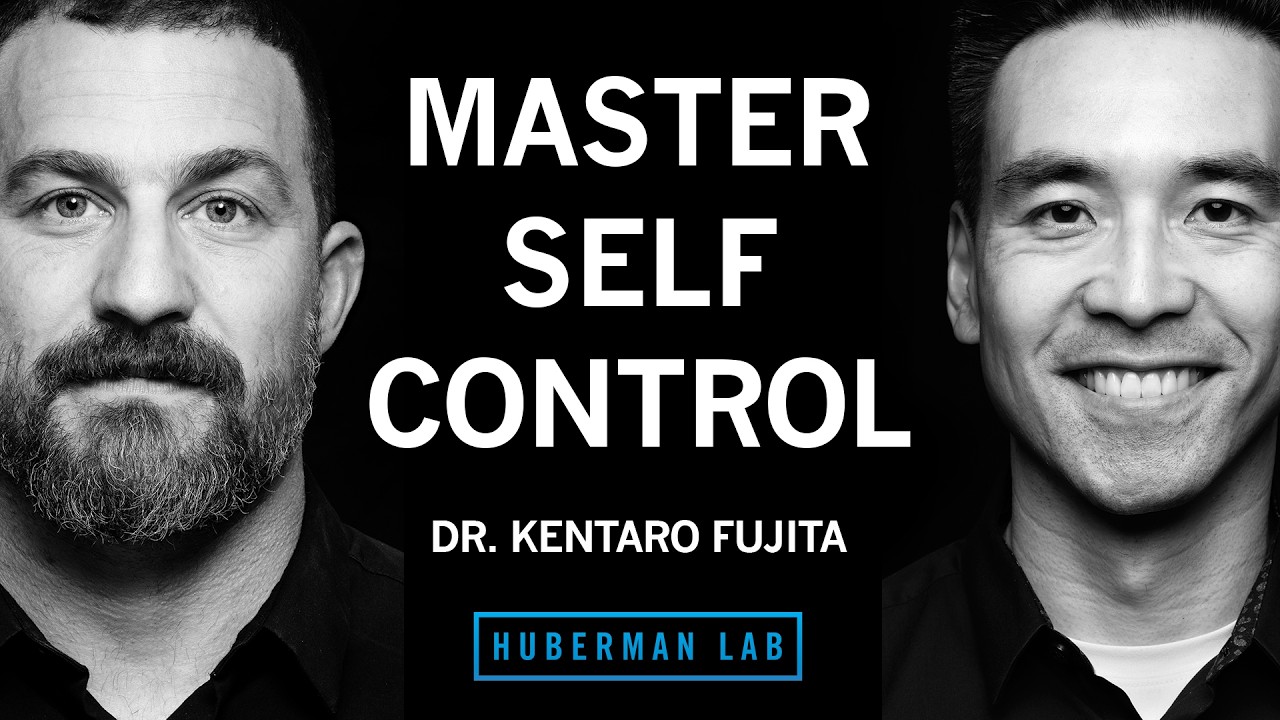
Fujita Reframes Self-Control From Willpower to Diverse Psychological Tools
Andrew Huberman
Long-term goal pursuit succeeds when individuals rely on intrinsic motivation and align daily habits with abstract high-level values rather than exhausting raw cognitive suppression.
## Background
This episode was published on YouTube on May 11, 2026, by Andrew Huberman on his Huberman Lab channel. It features an in-depth conversation with Dr. Kentaro Fujita, a professor of psychology and motivation expert, discussing the science-backed tools needed to master self-control, build sustained motivation, and overcome procrastination.
## TL;DR
The discussion breaks down how self-control is a dynamic, teachable cognitive skill rather than an innate trait, clarifying common misconceptions surrounding the classic Stanford marshmallow tests and the willpower depletion debate. Dr. Fujita emphasizes the power of focusing on high-level 'why' motivations over immediate 'how' execution details to navigate friction and bypass temptations. The conversation also explores the psychological mechanics of behavioral streaks, the distinct trade-offs between absolute abstinence and intentional moderation, and the long-term benefit of finding intrinsic meaning in mundane tasks. Ultimately, the episode provides a psychological toolkit for sustainable goal pursuit by leveraging mindsets like cognitive distancing, identity-driven self-talk, and cultural frameworks like ikigai.
## Atmosphere & style
The atmosphere of the podcast is deeply intellectual yet highly practical, blending rigorous scientific debate with a grounded, collaborative energy between Huberman and Dr. Fujita. It feels like an academic masterclass that remains highly accessible, shifting smoothly from dense research metrics to real-world behavioral strategies. There is a palpable sense of curiosity and shared discovery, balancing technical deep dives with motivational, introspective moments that encourage listeners to examine their own psychological archetypes.
## Key takeaways
- [00:00](https://www.youtube.com/watch?v=e89rVf4Pf0k&t=0s) Focusing on the broader 'whys' and fundamental purposes behind actions is significantly more effective for self-control and resisting immediate temptations than simple self-prohibition.
- [08:24](https://www.youtube.com/watch?v=e89rVf4Pf0k&t=504s) The long-term predictive power of the classic Stanford marshmallow test was heavily challenged when modern replication attempts adjusted for socioeconomic status (SES) and environmental covariates, showing that environment stability plays a massive role in a child's choices.
- [12:41](https://www.youtube.com/watch?v=e89rVf4Pf0k&t=761s) Self-control is a teachable, dynamic cognitive skill that can be systematically learned and practiced over time rather than a fixed genetic trait.
- [17:35](https://www.youtube.com/watch?v=e89rVf4Pf0k&t=1055s) Impulse and temptation are inherently linked to physical movement; utilizing mechanical redirection strategies or approach-avoidance actions can measurably improve real-life self-control.
- [24:30](https://www.youtube.com/watch?v=e89rVf4Pf0k&t=1470s) The long-standing 'willpower depletion' or muscle theory failed to cleanly replicate in massive multi-lab studies, revealing that an individual's personal lay beliefs about whether willpower is finite or rechargeable heavily mediates their mental exhaustion.
- [32:17](https://www.youtube.com/watch?v=e89rVf4Pf0k&t=1937s) Willpower is narrowly defined as the active, effortful suppression of an impulse, whereas self-control is a broader capability optimized by behavioral and psychological strategies that bypass active willpower depletion.
- [34:28](https://www.youtube.com/watch?v=e89rVf4Pf0k&t=2068s) Primal emotional counterweights like fear, disgust, or short-term negative repellents (such as framing an immediate sugar crash) can be intentionally leveraged to aid self-control when the executive forebrain is fatigued.
- [01:01:57](https://www.youtube.com/watch?v=e89rVf4Pf0k&t=3717s) Psychological distance determines self-control clarity; future goals prompt abstract, positive 'why' thinking, while immediate choices trigger a focus on concrete, often unpleasant 'hows' that lead to failure if not artificially managed.
- [01:05:19](https://www.youtube.com/watch?v=e89rVf4Pf0k&t=3919s) Rather than relying on single-instance willpower struggles, individuals should stack the deck by compounding multiple high-level motivations (health, role modeling, capability) to override localized limbic temptation.
- [01:08:46](https://www.youtube.com/watch?v=e89rVf4Pf0k&t=4126s) Physical movement and an adrenaline feedback loop from a simple 5-minute warm-up biologically increase the neural signal-to-noise ratio, effectively boosting initial motivation.
- [01:18:27](https://www.youtube.com/watch?v=e89rVf4Pf0k&t=4707s) Establishing consistent psychological patterns and maintaining unbroken streaks tap into a powerful human desire for completeness, making the routine itself a self-sustaining motivator.
- [01:22:16](https://www.youtube.com/watch?v=e89rVf4Pf0k&t=4936s) Abstinence is computationally simple and saves executive stamina because choices are pre-decided, whereas moderation is highly complex to maintain but offers critical long-term protection against burnout.
- [01:29:27](https://www.youtube.com/watch?v=e89rVf4Pf0k&t=5367s) Society heavily promotes a single-goal mindset, but pursuing an extreme focus neglects multiple 'invisible goals' like family or health, requiring individuals to proactively understand and accept these life asymmetry trade-offs.
- [01:36:34](https://www.youtube.com/watch?v=e89rVf4Pf0k&t=5794s) Long-term goal adherence is virtually impossible through external motivation alone; developing a genuine intrinsic interest in a discipline serves as a vital buffer against failure.
- [01:51:54](https://www.youtube.com/watch?v=e89rVf4Pf0k&t=6714s) The 'Batman Effect' proves that manufacturing psychological distance by using third-person self-talk or adopting a character persona helps individuals successfully step outside cognitive myopia and execute superior self-control.
- [01:58:16](https://www.youtube.com/watch?v=e89rVf4Pf0k&t=7096s) Shared reality and interpersonal validation from a peer or mentor provide an immensely potent motivational boost, while writing thoughts down externalizes subjective mental loops into objective objects.
- [02:06:41](https://www.youtube.com/watch?v=e89rVf4Pf0k&t=7601s) The landmark Stanford marker experiments established that introducing an explicit, transactional reward beforehand undermines and damages an individual's baseline intrinsic passion for an activity.
- [02:10:46](https://www.youtube.com/watch?v=e89rVf4Pf0k&t=7846s) Integrating Japanese cultural concepts like wabi-sabi (embracing imperfection and 'the suck') and ikigai (finding deep meaning in simple, ritualistic acts) can counteract a crushing Western obsession with perfect optimization and downstream rewards.
## Detailed walkthrough
### [00:00](https://www.youtube.com/watch?v=e89rVf4Pf0k&t=0s) The Power of "Why" over "What" in Self-Control
In his own psychological research, Dr. Kentaro Fujita has demonstrated that shifting a person's focus toward the fundamental purpose behind their decisions—the broader "whys" of their actions—significantly improves their ability to resist immediate temptations. For example, standing in front of a piece of chocolate cake and simply telling oneself, "I'm not supposed to eat that because I'm on a diet," lacks psychological power. Conversely, reframing the dilemma around higher-order reasons—such as wanting to be a healthy role model for one's children, or looking fit for upcoming family wedding photos—substantially increases the odds of successfully avoiding the cake. This mental shift provides individuals with a sense of meaning, equipping them with the intrinsic motivation required to hold out against immediate gratification.
---
[00:50](https://www.youtube.com/watch?v=e89rVf4Pf0k&t=50s) Introduction of Dr. Kentaro Fujita
Andrew Huberman introduces the episode of the Huberman Lab Podcast, framing it as a exploration of science and science-based tools for everyday life. He introduces his guest, Dr. Kentaro Fujita, a professor of psychology at Ohio State University and a leading expert in the science of motivation and self-control. Huberman notes that this conversation is highly relevant for anyone who has ever struggled with procrastination, difficulty sticking to goals, or defining a clear vision for their life. The episode promises to bridge the gap between rigorous scientific data and practical, real-world takeaways that people of all ages can implement to build mental resilience.
The discussion covers a broad array of critical psychological concepts, including:
* The validity and modern criticisms surrounding the famous Stanford marshmallow experiments.
* The widespread misunderstandings of intrinsic versus extrinsic motivation, clarifying that receiving external rewards for an activity one naturally loves does *not* actually diminish the inherent motivation to perform it.
* Data-driven, actionable steps required to effectively initiate and achieve both short-term and long-term goals.
* Proven scientific strategies to break free from impulsive behavioral states and chronic procrastination.
Huberman adds his standard disclaimer that the podcast is entirely separate from his official teaching and research roles at Stanford School of Medicine. It is funded by sponsors to support his personal mission of bringing zero-cost scientific information and tools to the general public.
---
[03:06](https://www.youtube.com/watch?v=e89rVf4Pf0k&t=186s) Unpacking the Classic Stanford Marshmallow Test
Huberman welcomes Dr. Fujita to the show, noting that the public conversation surrounding motivation, willpower, tenacity, and discipline is overdue for a modern update. He prompts Dr. Fujita to explain the ubiquitous "marshmallow experiment," which often serves as a cultural symbol for whether self-control is an innate, unchangeable trait or a skill that can actively be cultivated.
Dr. Fujita explains that the marshmallow test was actually a comprehensive series of experiments conducted by psychologist Walter Mischel at Stanford University spanning across the 1960s, 70s, and 80s. In the classic experimental setup, a child is seated in a room in front of a plate containing a highly desirable treat, typically a single marshmallow. The researcher informs the child that they must step out of the room for a short period. The core proposition given to the child is a classic self-control dilemma: trade a smaller, immediate reward for a larger, delayed one. If the child can successfully resist eating the single marshmallow while the adult is away, they are rewarded with two marshmallows upon the researcher's return.
Dr. Fujita shares a "dirty little secret" about the original study: virtually no child actually managed to wait the entire 15 minutes that the experimenter was gone. Instead, researchers started a timer the moment the door closed to measure exactly how many minutes and seconds a child could hold out before giving in to temptation. This specific duration of time was recorded as the primary dependent variable, serving as the benchmark measurement for the child's baseline ability to delay gratification.
---
[05:11](https://www.youtube.com/watch?v=e89rVf4Pf0k&t=311s) The Excitement and Predictive Claims of the Study
The immense public excitement and enduring legacy surrounding the marshmallow test do not stem from the immediate behavioral observations, but rather from the longitudinal follow-up data analyzed many years later. Researchers tracked the original participants into adulthood to see how their childhood delay times correlated with major life outcomes. The long-term findings were genuinely shocking to the scientific community: children who waited longer before eating the single marshmallow statistically went on to achieve significantly higher academic marks, earn greater incomes, maintain healthier social relationships, and enjoy superior physical and mental health. Furthermore, they exhibited lower rates of incarceration and fewer reported behavioral problems. These striking correlations initially convinced both researchers and the public that early self-control was the definitive, foundational predictor of lifelong success.
- **Key life outcomes correlated with longer delay times:**
* Higher academic achievement and school performance
* Greater career success and lifetime income
* More robust social networks and higher numbers of friendships
* Enhanced physical and mental health outcomes
* Significantly lower rates of incarceration and problematic social behaviors
---
[06:20](https://www.youtube.com/watch?v=e89rVf4Pf0k&t=380s) Trust, Rationality, and Socioeconomic Factors
When Huberman asks if any children actually received the double marshmallow reward, Dr. Fujita notes that it largely depended on the specific parameters of the data set, as later experimenters often shortened the waiting period to 10 minutes to make it more developmentally manageable. Crucially, Dr. Fujita highlights that a child's willingness to wait hinges entirely on their trust in the experimenter. If a child perceives the adult as unreliable—which researchers tested by having adults intentionally "forget" promises prior to the test—the children sensibly refuse to wait and eat the single marshmallow immediately. From a behavioral economics standpoint, grab-and-go behavior in an unpredictable environment is entirely rational.
Huberman asks if this trust dynamics plays out similarly in parenting, such as when a parent commands a child to stay off electronic devices but is immediately seen checking their own phone. While Dr. Fujita cannot cite a specific self-control study on that exact scenario, he underscores the profound impact of "social modeling." He references the famous "Bobo doll" experiments, where children who witnessed an adult aggressively punching an inflatable clown doll were far more likely to violently punch the doll themselves when left alone. Children are remarkably observant of adult behaviors, meaning that parental hypocrisy directly alters a child's understanding of what actions are appropriate and intelligent in a given environment.
---
[08:24](https://www.youtube.com/watch?v=e89rVf4Pf0k&t=504s) Methodological Criticisms and the Replication Debate
Huberman notes that like many paradigm-shifting theories in psychology and neuroscience—such as growth mindset—the marshmallow test has faced intense criticism over the years, with critics alleging data collection biases and a lack of true predictive power. Dr. Fujita explains that the most prominent modern blow to the study came from a massive replication attempt utilizing a large data set of children tested at age four and tracked into adolescence. When researchers looked at the raw correlation, the original finding initially seemed to replicate. However, once the researchers statistically adjusted the data for socioeconomic status (SES) and 30 to 40 other environmental covariates, the predictive power of the child's delay time entirely vanished. This sparked widespread media coverage declaring the classic marshmallow test to be completely "bunk."
The critique heavily targeted the original Stanford cohort, pointing out that those children were selected from the university's affluent daycare and did not represent average American families. This demographic reality alters how one interprets self-control:
* **High SES Environments:** Extremely stable and highly predictable. Waiting patiently for a future reward almost always pays off, making a long delay time a highly adaptive strategy.
* **Low SES Environments:** Highly unpredictable and unstable. Resources and rewards come and go quickly; saving or waiting rarely guarantees a future payoff. Therefore, eating the treat immediately is a sensible, logical choice rather than a failure of willpower.
However, the debate did not end there. Researcher Yuuko Munakata and her team reanalyzed that exact same replication data set using a more conservative, theory-driven approach. Instead of throwing the "kitchen sink" of 30 indiscriminate variables into the statistical model, they only controlled for factors firmly backed by established developmental research. Under these refined parameters, delay of gratification once again cleanly predicted adolescent behavioral outcomes, effectively validating the essence of Mischel's original findings and keeping the scientific debate alive.
---
[12:41](https://www.youtube.com/watch?v=e89rVf4Pf0k&t=761s) Self-Control is a Teachable Skill, Not an Innate Talent
Dr. Fujita argues that the hyper-fixation on whether the test can predict a child's future income or jail time causes people to completely "miss the boat" on what makes Walter Mischel's work profoundly important. While showcasing long-term life outcomes is a useful tool for securing federal grant money, the true value of the marshmallow test lies in the intervention experiments where Mischel and his team actively taught children strategic mental tools to improve their self-control. When children were equipped with these psychological strategies, their ability to delay gratification skyrocketed. This proves that self-control is not an immutable, innate genetic talent, but rather a dynamic cognitive skill that can be systematically taught, practiced, and mastered over time.
To illustrate this developmental curve, Dr. Fujita shares how children of different ages approach temptation:
* **Three-year-olds:** When asked how to resist the treat, they naively believe they should stare directly at the single marshmallow. They mistake intense visual focus for motivation, falsely assuming that looking at what they desire will give them the strength to wait. Consequently, they fail quickly.
* **Five-year-olds:** Children at this age have naturally begun to learn the basic mechanics of self-control. They intuitively realize that staring is a losing battle, choosing instead to close their eyes, cover their face, or turn the plate away to avoid temptation.
This cognitive understanding carries profound long-term implications. Longitudinal data shows that when children are assessed years later at age 13, those who explicitly understand these mental "rules" of self-control display significantly fewer behavioral problems. Mischel even took these insights to summer camps tailored for children with severe behavioral disorders, confirming that teaching actionable psychological tactics can fundamentally reshape a person's capacity for behavioral restraint.
### [14:42](https://www.youtube.com/watch?v=e89rVf4Pf0k&t=882s) The Teachability of Self-Control
A vital takeaway from camp-based studies of self-control is that knowledge and specific strategies directly correlate with fewer behavioral issues. Children who understand which behavioral tricks work and which do not are far less likely to exhibit problems than their peers who lack this insight. This underscores the idea that self-control is not an entirely innate trait that individuals are simply born with; rather, it is a skill that can be systematically taught, learned, and refined through trial and error over time. This foundational lesson about personal growth and improvement is an optimistic truth that frequently gets overlooked in mainstream discussions of behavioral studies.
### [15:08](https://www.youtube.com/watch?v=e89rVf4Pf0k&t=908s) Sponsor: David Protein Bars
The podcast pauses for a message from its sponsor, David, a company creating unique protein bars. Their latest release, the Bronze Bar, boasts an impressive nutritional profile tailored for those tracking their macronutrients. The speaker, having tried countless options over the years, calls these the best-tasting protein bars he has ever encountered. Featuring a marshmallow base covered in a rich chocolate coating, they effectively mimic the experience of eating an actual candy bar.
While the speaker emphasizes that his diet consists primarily of whole foods—including meat, chicken, fish, eggs, fruits, and vegetables—he integrates one or two David bars into his daily routine as a convenient snack. This habit allows him to efficiently hit his personal macro target without logging excess calories.
- **Protein content:** 20 grams of protein per bar
- **Caloric value:** 150 calories
- **Sugar content:** 0 grams of sugar
- **Available flavors:** Cookie Dough, Caramel Chocolate, Double Chocolate, and Peanut Butter Chocolate
- **Target metric:** Promotes hitting a goal of 1 gram of protein per pound of body weight
- **Special offer:** A "buy four cartons, get the fifth carton free" deal is available at [davidprotein.com/huberman](https://davidprotein.com/huberman)
- **Retail availability:** Found online and in major retail locations including Target, Walmart, and Kroger
### [16:27](https://www.youtube.com/watch?v=e89rVf4Pf0k&t=987s) Sponsor: Lingo by Abbott
The second sponsor of the episode is Lingo, a continuous glucose monitor (CGM) and app developed by Abbott. Managing glucose over time stands as a critical pillar of both short-term and long-term metabolic health. Because fluctuating blood sugar levels directly impact brain function, daily mood, and baseline energy levels, the ideal goal is to maintain relatively stable glucose throughout the day, actively avoiding sharp peaks and deep valleys. The speaker shares that he personally uses Lingo to gain visibility into how his unique biology responds to specific foods, exercise regimens, and daily stressors.
- **Data tracking:** Provides minute-by-minute glucose data directly inside the mobile app
- **Public health context:** The CDC estimates that more than one in three American adults has pre-diabetes, and a vast majority of those individuals are entirely unaware of their condition
- **Listener discount:** Offers US and UK listeners a 10% discount on a four-week plan via [hellolingo.com/huberman](https://hellolingo.com/huberman)
### [17:35](https://www.youtube.com/watch?v=e89rVf4Pf0k&t=1055s) Top-Down Inhibition and Behavioral Redirection
The conversation transitions to the highly entertaining visual strategies children utilize during the famous marshmallow tests. The speaker notes with a smile that the children's actions are adorable and perfectly mirror adult behaviors, albeit in a much purer, raw form. He recalls a video of a young boy leaning right into a marshmallow, repeatedly whispering "yum yum yum yum yum" to simulate the joy of eating it, before forcing himself to look away. This cyclic struggle of leaning in and pulling back highlights a fundamental neurological concept known as "top-down inhibition"—the conscious, cognitive suppression of an immediate impulse.
Drawing a parallel to his current real-world experience, the speaker describes training his own bulldog-mastiff puppy. When a treat is placed directly in front of the dog, the puppy will intentionally avert its eyes to resist the intense temptation to eat it. Amusingly, if the speaker commands the puppy to "look at me," the dog finds the task of resisting the food much easier. This implies that while the animal appears deeply disciplined, it is actually relying on a mechanical redirection strategy. All mammals equipped with top-down inhibition pathways likely develop individualized, highly unique strategies to cope with temptation based on their age and specific personality.
- **Physical manifestation:** Impulse and temptation are inherently linked to physical movement
- **Adult analogies:** Many cultures utilize physical objects like worry beads to dispel anxiety, while stressed adults often channel a "revving of the engine that drives movement" into a walk or a run
- **Camp counselor philosophy:** The speaker shares a golden rule he learned while working with children: when managing high-energy groups, a leader must "be a channel not a dam," because forcing young kids to sit entirely rigid is an exercise in futility
### [19:37](https://www.youtube.com/watch?v=e89rVf4Pf0k&t=1177s) The Etymology of Motivation and Approach-Avoidance Tasks
The guest validates these observations, noting that while he is speculating and does not know of specific studies tracking raw physical movement in these scenarios, the connection makes perfect sense. linguistically, the Latin root for the word motivation literally means "to move." Motivation is designed to be the foundational energetic force that impels physical action. To illustrate how this is explored scientifically, the guest outlines specific computer-based training experiments.
```
[ Temptation / Bad Object ] <--- Pull Joystick Back (Creates psychological distance)
[ Target / Good Object ] ---> Push Joystick Forward (Simulates approach behavior)
```
In these approach-avoidance paradigms, subjects use a joystick to interact with digital objects. If an object appears that they are supposed to avoid (such as a chocolate cake for a dieter), they pull the joystick back, mechanically creating psychological distance. If a positive target appears (like broccoli), they push the joystick forward. Research indicates that executing these physical actions helps reinforce cognitive evaluations and over time, measurably improves a person's real-life self-control.
- **Fidgeting and learning:** Supplementary research hints that individuals who fidget may actually retain information better than those who force themselves to sit perfectly still
- **Analog note-taking:** Studies show that taking notes by hand with pen and paper yields superior learning retention compared to typing on a computer keyboard
### [21:42](https://www.youtube.com/watch?v=e89rVf4Pf0k&t=1302s) The Great Willpower Depletion Debate
The speaker raises a nuanced, long-standing question: does doing difficult things make subsequent hard tasks easier, or does it exhaust a finite mental resource? On one hand, conquering early morning challenges like a cold shower or an intense workout can induce a victorious state of mind where an individual feels ready to handle anything else the day throws at them. On the other hand, heavy exertion can seemingly drain a physical or psychological resource pool, making it far tougher to resist temptations or push through complex cognitive tasks later in the afternoon.
The guest explains that this concept introduces one of the most fiercely debated and highly controversial topics in modern social psychology: the "depletion effect".
> "There was a big boom of experiments in the 2000s that suggested... self-control is kind of like a muscle. And if I use it for one type of task, I exhaust it for all others."
According to this classic muscle metaphor, if you exercise willpower on a task, you must wait for it to recharge before utilizing it again. However, if you systematically train it over a long period, it should theoretically grow stronger.
### [24:30](https://www.youtube.com/watch?v=e89rVf4Pf0k&t=1470s) Replication Failures and the Power of Lay Beliefs
Unfortunately, the original experiments validating this muscle theory have come under heavy fire because modern, multi-lab replication efforts have yielded highly mixed and contradictory results. In a standard laboratory setting, a participant is assigned a difficult task requiring high self-control, followed immediately by a second, entirely unrelated difficult task.
- **The Finger-Writing Example:** A right-handed subject might be forced to write a lengthy passage exclusively with their left hand, a tedious exercise requiring significant conscious effort and inhibition.
- **The Stroop Task:** Immediately afterward, the subject is tested using the Stroop Task, where they view color words printed in mismatched ink (e.g., the word "blue" written in red ink). The subject must state the color of the ink ("red"), meaning they have to actively inhibit their dominant, automatic impulse to read the literal word ("blue").
If the depletion effect is real, the handwriting task should cause the participant to perform significantly worse on the Stroop Task, leading to slower response times and a higher frequency of errors. Because a massive, multi-lab collaboration led by the original pioneers of the theory failed to replicate this exact drop-off, a broad consensus emerged in the psychological field that the lab-based depletion effect might not actually exist.
Despite the clinical skepticism, the guest confesses to an uncomfortable academic position: he firmly believes depletion is a real phenomenon because he experiences it constantly in his daily life. He hypothesizes that the scientific community simply hasn't figured out how to properly bottle the experience within an artificial laboratory setting.
Crucially, psychology research by Veronica Job reveals that a person's underlying "lay beliefs" about willpower act as the ultimate mediator. Individuals who fill out questionnaires stating that strenuous tasks leave them feeling "recharged" actually show zero performance drops after a hard task. Conversely, those who inherently believe that willpower is an exhausting, drainable resource show classic, severe depletion effects. Ultimately, the personal narratives we carry about our own internal resources dictate whether doing hard things leaves us energized or entirely spent. Hearing this, the host vows to consciously stamp the belief into his own mind that doing hard things permanently makes subsequent challenges easier.
[29:22](https://www.youtube.com/watch?v=e89rVf4Pf0k&t=1762s) Tolerating Friction and the Limitations of Willpower Training
The discussion begins with a shared observation about how humans handle immense pressure across completely different domains, from elite military selection to matrix math. Andrew raises the idea that navigating challenging scenarios isn't actually about the specific task itself, but rather about learning to recognize and tolerate a distinct state of mental and physical friction. After sharing a lighthearted moment bonding over the intense, visceral frustration of both being "failed musicians," Andrew suggests that real tenacity is built on pushing through this exact state of discomfort, regardless of whether it stems from a grueling physical workout or a taxing intellectual challenge.
Responding systematically, his guest acknowledges that while individuals possess highly varied baseline levels of distress tolerance, trying to train willpower as a generalized, brute-force mental muscle usually fails. Typical willpower training paradigms—such as forcing subjects to complete thousands of repetitive cognitive trials or intentionally utilizing their non-dominant hand at home for a week—have historically yielded disappointing results. While isolated studies hint at minor improvements in self-control, comprehensive reviews of the scientific literature indicate that these grueling exercises produce highly volatile and discouragingly small long-term gains.
- General willpower training models (e.g., non-dominant hand exercises, thousands of Stroop task trials) show highly variable results and a very small average effect size.
- Distress tolerance dictates how much unpleasantness an individual will endure, and it is traditionally trained through direct exposure.
[32:17](https://www.youtube.com/watch?v=e89rVf4Pf0k&t=1937s) Willpower vs. Self-Control: Lessons from the Marshmallow Test
To clarify why brute-force training falls short, a critical distinction is drawn between willpower and self-control. Willpower is defined narrowly as the effortful, active suppression of an impulsive tendency—using "mental muscles" to actively push down a craving, like staring at a slice of cake and forcing oneself not to eat it. Self-control, however, is a much larger umbrella. To illustrate this, the speaker highlights Walter Mischel’s famous delay of gratification paradigm, noting that Mischel wasn't actually testing whether children could simply "gut it out" using pure willpower. Instead, the successful children naturally relied on external psychological and behavioral strategies, such as physically covering their eyes, turning away from the bowl, or playfully imagining the marshmallows as puffy white clouds in a picture frame.
Because these creative reframing tools do not rely on depleting a limited reservoir of willpower, they can be easily taught and scaled to significantly optimize an individual's self-control.
- **Willpower:** The effortful suppression or inhibition of an impulsive tendency.
- **Self-Control:** A broader capacity enhanced by behavioral and psychological strategies that do not actively leverage willpower.
- **Walter Mischel's Paradigm:** Showed that children succeeded not through raw willpower, but by employing cognitive strategies like reframing temptations as abstract objects (e.g., clouds).
[34:28](https://www.youtube.com/watch?v=e89rVf4Pf0k&t=2068s) Neurobiology and Fighting Fire with Fire
Andrew introduces a crude, neuroscience-anchored hypothesis regarding how we override deep-seated biological urges. High-level strategic planning relies on a distributed forebrain network, whereas basic survival impulses (mating, eating, sleeping) act like binary switches hotwired directly into deep limbic and hypothalamic circuitries. When severe fatigue goes as far as to shut down the forebrain, the hypothalamus naturally demands that we hit the snooze button. Andrew proposes that the most effective way to counteract these hardwired desires is to "go a layer deeper" into the limbic system, utilizing primal emotional counter-weights like severe disgust or intense fear—such as animating a visceral phobia of failing an exam—to shock the system awake.
This concept turns traditional psychological models entirely on their head. For decades, mainstream self-control researchers explicitly preached that the secret to success was "cooling your cognitions"—meaning individuals had to completely quiet their emotional, "animalistic" hot systems and make decisions from a detached, clinical standpoint. However, emerging research is beginning to validate Andrew's counter-intuitive hypothesis of "fighting fire with fire," proving that hot emotional responses can be actively redirected to champion self-control rather than undermine it.
- High-level strategy and future planning involve the forebrain, while primal survival urges are rooted in deep limbic and hypothalamic circuitry.
- Mainstream historical frameworks emphasize "cooling cognitions" to quiet the emotional system.
- Emerging research by Paul Stillman and Caitlin Woolley demonstrates that framing choices through short-term negative repellents (like visualizing an immediate post-cake sugar crash) effectively pushes people away from unhealthy impulses.
[38:13](https://www.youtube.com/watch?v=e89rVf4Pf0k&t=2293s) The Power of Higher-Order Meaning and the Self-Control Toolkit
The conversation shifts toward the positive side of emotional driving forces, or navigating through "love" rather than fear. Research shows that grounding a difficult choice in a deeply personal, high-level "why"—such as staying healthy to walk a child down the aisle or setting an honorable example for family—infuses the immediate point of friction with profound meaning. This emotional elevation is vastly more effective than sterile, uninspiring goals like simply "being on a diet." Moving between these abstract long-term values and concrete short-term repellents gives individuals a comprehensive spectrum of defense against impulsive behavior.
Andrew bridges this concept to extreme real-world applications, referencing former Navy SEAL David Goggins, who famously pumps negative social media comments into his headphones and uses intense verbal self-flagellation to fuel his relentless athletic and academic pursuits. While some critics label this pathological, both speakers agree that it serves as a powerful testament to personalizing one's approach. In concluding the segment, the guest highlights the concept of the "self-control toolkit," an adaptable psychological framework acknowledging that because human personalities vary so wildly, a strategy that brilliantly empowers one individual might completely demoralize another.
- Thinking about higher-order "whys" provides immediate psychological meaning that vastly outpaces sterile motivations.
- Short-term battles are best fought with immediate, short-term framing (both positive and negative), while long-term endurance requires long-term alignment.
- The "Self-Control Toolkit" framework, co-authored with Ethan Kross, embraces the idea that different strategies work for different psychological archetypes (e.g., highly reactant individuals can turn negative criticism into fuel, while others may find it entirely demotivating).
The Self-Control Toolbox and Learning from Failure
Different self-control strategies work for different contexts, rather than a single method serving every situation. For instance, the hardest part of a workout might be simply getting started—putting on the clothes, getting on the bike, or lifting the first weight while battling a litany of excuses. In these initial moments, an effective strategy is to ask, "What would my heroes do?" or invoke a "What would Jesus do?" mindset. Imagining someone you deeply admire, or someone who looks up to you, provides the inspiration needed to embody that ideal persona and begin. However, that strategy loses its effectiveness at the end of a workout when pumping out a final rep or pushing through the last minute of a grueling climb. At that point, raw willpower, gritting one's teeth, and just getting it done becomes the superior approach. Tailoring self-control is a lifelong journey of trial and error where individuals must explore the entirety of their personal "self-control toolbox."
This perspective shifts the understanding of self-control from an innate, fixed trait to a cultivable skill. When people fail at self-control, they frequently personalize it by thinking they are terrible people with inherently bad willpower. Adopting a toolbox approach reframes failure as a neutral indicator that a specific tool simply did not work in that instance. This turns failure into a hopeful, positively toned opportunity for self-growth, exploration, and discovery.
* **The Workout Struggle:** The speaker notes that getting started is their personal hurdle, requiring inspirational strategies, whereas the final structural push demands raw willpower.
* **Reframing Failure:** Viewing self-control as a dynamic skill helps eliminate the "I'm a terrible person" mindset, replacing guilt with constructive self-analysis.
---
Sponsor: AG1 Foundational Nutrition
The podcast host shares that they have been taking AG1 daily for nearly 15 years, having originally discovered the supplement back in 2012 long before starting the podcast. AG1 is described as the highest quality and most comprehensive foundational nutritional supplement available on the market. It consolidates vitamins, minerals, prebiotics, probiotics, and adaptogens into a single, great-tasting scoop designed to support gut health, immune function, and overall energy. While a diet of high-quality whole foods is ideal, most people still experience gaps in their daily intake of prebiotics, vitamins, and minerals, which AG1 helps fill. When asked for a single supplement recommendation to support physical health, mental health, and performance, the host always points to AG1.
Listeners can access a special offer by visiting `drinkag1.com/huberman`. For a limited time, a subscription includes a free bottle of vitamin D3K2 and a week's supply of AGZ, a sleep supplement that the host personally helped design. AGZ is the only sleep supplement the host takes, noting that its specific blend has dramatically improved both their slow-wave deep sleep and rapid eye movement (REM) sleep.
* **History of Use:** The host has used AG1 daily since 2012.
* **Core Ingredients:** Contains vitamins, minerals, prebiotics, probiotics, and adaptogens.
* **Special Promotion Items:** Subscriptions via the custom URL include a free bottle of D3K2 and a week's supply of the AGZ sleep supplement.
---
The Cognitive "Warm-Up" and Attractor States of Focus
Motivation and focus are often mistakenly expected to behave like a sudden "step function" or an instant light switch, where a person can simply show up to a hard task and immediately lock into a deep state of concentration. While everyone inherently understands the necessity of physical warm-ups or warm-up sets before a heavy workout, there is a cultural blind spot regarding the mental warm-up required for creative or intellectual tasks. The brain operates less like a digital toggle and more like an "attractor model." In this neurological framework, initial brain activity resembles a ball bearing rolling around a flat surface; over time, through repeated efforts and cognitive "reps," the surface becomes concave, allowing the brain to eventually drop into a stable groove of deep focus. This transition takes time and requires pushing past early distractions, such as picking up a phone multiple times before finally removing it from the room.
Understanding these mental transitions is crucial because humans are not robots, and modern lives demand moving dynamically between highly divergent brain circuits—shifting from a workout, to a classroom, to parenting. This prompts deeper questions into whether specific psychological tools can help individuals embed this awareness, transition into focus states more efficiently, or gracefully exit highly motivated states when a task demands it.
---
Matching Motivation Types: Promotion vs. Prevention
Motivation is shaped by a dynamic interplay between a person's cognitive orientation and the task at hand. If a workout is framed purely as an hour of pain, motivation plummets; however, changing the mindset to view it as "me becoming the better me" activates an entirely different set of underlying motives. This cognitive realignment acts as its own style of warm-up, allowing individuals to maximize their drive by finding the right thoughts to align with their goals. Beyond the sheer volume of motivation, the *type* of motivation matters immensely. Motivation science highlights two primary orientations: a promotion mindset focused on nurturance, advancement, and making gains, and a prevention mindset focused on safety, security, and preventing losses.
Just like sports require different mindsets for offense and defense, real-world tasks require specific motivational matches to optimize performance. On offense, an individual should play to win by focusing on promotion and gains; on defense, they must often focus on preventing losses through a security-driven mindset. A mismatch between the task and the motivational type leads to a feeling of friction where performance suffers and things just do not feel right.
* **Regulatory Fit:** Research conducted alongside colleagues Abigail Scholer and David Maelie demonstrates that people possess intuitive insight into whether a task requires a promotion or prevention mindset, and they naturally try to cobble together the correct thoughts to match it.
* **The Yerkes-Dodson Law:** This classic U-shaped psychological function highlights that both too little and too much motivation degrade performance. Excessive motivation can induce choking because an individual overthinks a task due to high stakes.
* **Contextual Scaling:** The speaker notes that while intense motivation works for extreme goals, running "absolutely crazy" like elite competitor David Goggins at a children's daycare soccer game would be counterproductive; motivation must be consciously scaled to a functional sweet spot.
---
The Psychology of Task Switching and Goal Disengagement
Moving between activities introduces a well-documented cognitive phenomenon known as "switch cost." This represents a distinct delay and brief decline in performance during the exact moment of transitioning tasks, caused by a form of "cognitive inertia" where the mind remains tethered to the rules and patterns of the previous activity. Zooming out further, this friction is deeply connected to the psychological process of disengaging from a goal once it has been completed or rendered impossible. Historically, research on self-control and grit has disproportionately focused on persistence, leaving the mechanics of disengagement far less understood despite its profound impact on mental well-being.
When a window of opportunity closes, the ability to intentionally disengage is vital for long-term health. Examples include a woman crossing the biological age threshold for having children, or an athlete aging out of a sport or sustaining a career-ending injury. Data shows that individuals who are adept at disengaging from unviable goals preserve their mental well-being and re-engage with new, productive goals much faster. However, because contemporary culture heavily overemphasizes grit and persistence, the psychology of knowing exactly when to quit remains understudied.
---
Recalibrating the Notion of Optimal Performance
Cultivating motivation and self-control requires a deliberate convergence of physical state, mental state, and conceptual identity, such as maintaining the internal belief: "I'm a person who works out even if he doesn't want to". These identity statements require healthy, practical caveats; the host explicitly notes that they do not subscribe to a strict "no days off" ethos, choosing instead to take weekly rest days and cycle their training. A common pitfall among high performers in athletics, academia, and music is the temptation to chase a flawless state of mind. Once someone experiences a perfect "flow state" or the rewarding feeling of neuroplasticity after grinding out a tough skill, they mistakenly believe they must recreate that pristine condition every single time to perform at all.
In contrast, elite military communities offer a powerful alternative to this obsession with optimal conditions. Figures from the Tier 1 Special Operations community, such as Coleman Ruiz, DJ Shipley, Jocko Willink, and David Goggins, were forged in environments like BUD/S that systematically break down expectations of comfort. As Jocko Willink often emphasizes, the starting line begins where it actively sucks—when you are cold, wet, sandy, and your weapons are damp. This mindset completely recalibrates the concept of performance, teaching individuals to execute tasks effectively without needing a perfect environment. This stands in stark contrast to spaces like academia, where the prevailing advice focuses heavily on ideal parameters like securing perfect sleep and precisely calibrating caffeine intake before attempting hard work.
[59:21](https://www.youtube.com/watch?v=e89rVf4Pf0k&t=3561s) The Fallacy of Optimization and "Crap Conditions"
The discussion opens with a critique of optimization culture and the classic inverted U-shaped curve of stimulation. One speaker notes that while the concept of tracking under- or over-stimulation is helpful, the obsession with optimization can become a major trap. It fosters the belief that we must reach a perfect, fully optimized state before we can begin "the real work." Instead, the speaker raises the question of whether we can rewire our minds to find motivation in uncomfortable spaces—essentially starting from a "place of suck" or purposely embracing "crap conditions" like David Goggins doing 3:00 a.m. workouts to build authentic mental toughness.
In response, the co-speaker points out how incredibly creative human beings are at inventing justifications to skip out on self-control. People will blame mismatched gym clothes, too much sun, too little sun, or any slight atmospheric deviation to avoid hard work. In creative fields like writing, people frequently delay their work by waiting for the perfect moment or for the "muses" to strike. In reality, most days will be far from perfect, and it requires simply pushing through the initial discomfort until the mind warms up to an optimal state. The culture of optimization ironically provides a sophisticated excuse to delay hard things because the baseline environment is rarely entirely perfect.
[01:01:57](https://www.youtube.com/watch?v=e89rVf4Pf0k&t=3717s) The Distance-Dependence of Self-Control: Whys vs. Hows
Self-control struggles are uniquely frustrating because our clarity is highly dependent on psychological distance. When a challenge or goal is far away in the future—such as planning to exercise more next year—our mindset is abstract and focused on desirability. We easily connect with the positive "whys" of our choices. However, when next year becomes today, our perspective radically shifts toward feasibility. We suddenly become hyper-focused on the concrete, negative "hows" of the process. Because doing hard things is inherently unpleasant in the moment, focusing on the "how" causes people to abandon their plans, only to regain clarity and feel completely perplexed by their failure once the moment has safely passed.
To study and combat this phenomenon, experiments were conducted where participants were primed to think generally about either the "whys" or the "hows" of their unrelated goals. After warming them up with these specific frames of mind, they were given an entirely separate self-control task.
- Participants who were primed with abstract "why" thinking exhibited significantly better self-control than those focused on "how."
- This experimental success comes from artificially simulating the long-distance mindset right at the moment of proximity, overriding the immediate friction of a difficult task.
[01:05:19](https://www.youtube.com/watch?v=e89rVf4Pf0k&t=3919s) Stacking the Deck Against Temptation
The conversation moves toward the nature of chemical and psychological rewards. It is argued that while effort-free dopamine or reinforcement can sometimes be harmless, "there's nothing quite like rewards that follow intense, prolonged effort." The speakers emphasize that people often make the mistake of viewing self-control as a fair, one-on-one binary fight—such as a person trying to lose weight staring directly at a piece of cake. Instead of keeping it a fair fight, individuals should completely stack the deck in their favor by compounding their motivations.
By leveraging multiple "whys" at once—such as wanting to be healthier, desiring to set a good example for one's children, and proving one's own capability—a person brings high-level concepts and intense internal motivations to bear against a localized temptation. If a temptation is limbic, the solution is to "come in with more limbic" power spread across time. This creates a virtuous, upward cycle: successfully pushing through builds confidence and self-esteem, making the next challenge easier. Conversely, giving in triggers a downward spiral of negative self-talk, where the individual convinces themselves they are incapable of growth.
[01:08:46](https://www.youtube.com/watch?v=e89rVf4Pf0k&t=4126s) The Neuroscience of the Warm-Up and the Role of Competitiveness
Aligning these cognitive, motivational, and biological systems can initially feel like "herding sheep." However, the mind likes repetition, and the process of warming up becomes increasingly rapid over time. This concept of a cognitive warm-up mirrors literal neural activity. When monitoring large networks of neurons via calcium imaging or electrodes during a new task, the brain initially shows a massive amount of background noise—referred to colloquially as "hash." As the behavior or perceptual task is repeated, the signal-to-noise ratio dramatically improves, and the neural circuit settles into clear attractor states.
- This neurological transition is driven by physical movement; research by Peter Strick at the University of Pittsburgh shows that brain areas controlling large musculature activate the release of adrenaline when we move.
- The released adrenaline directly feeds back into those same circuits, meaning a 5-minute physical warm-up biologically increases the signal-to-noise ratio and boosts motivation through chemical shifts, rather than purely psychological effort.
Turning to the psychological drivers of performance, the speaker explores the role of competitiveness, questioning whether it follows a normal or binary distribution in the population. Reflecting on their time as a postdoc in a highly competitive scientific field, the speaker recalls how competing against rival labs for limited resources acted as a profound motivator. Even though they do not consider themselves an innately competitive person who has to win at a casual game of ping-pong, having an "enemy" brought out their absolute best work. This prompts a broader question about hyper-motivated icons like Michael Jordan, who seemed fiercely competitive about absolutely everything, and how that dynamic influences high-pressure, peak academic environments like Harvard and Stanford.
[01:12:50](https://www.youtube.com/watch?v=e89rVf4Pf0k&t=4370s) Competitiveness, Motivation, and the Self-Control Toolbox
When looking at how competitiveness interacts with willpower and self-control, there is little direct research tying the two together tightly. Instead, competitiveness is best understood through the lens of achievement motivation—the intense desire to perform exceptionally well, particularly relative to others. This motivation is normally distributed across the population, meaning it is inherently stronger in some individuals and weaker in others. While culture often champions competitive drive, humans possess a vast constellation of other powerful impulses, such as the motivation for power, control, self-esteem, competence, and belonging.
Belonging motivation is a deeply ingrained evolutionary trait. Because humans are a social species that historically relied on groups for survival, the drive to connect is immense. People with high belonging motivation will "bend heaven and earth" to get back into a group if they face rejection. Rather than relying on a single drive, individuals should evaluate their aggregate motivations to combat temptations. Self-control shouldn't be a fair, one-on-one fight against a temptation; instead, you should stack the deck by bringing all your distinct internal motivations to bear.
Recognizing what uniquely drives you allows you to strategically activate those elements as tools. For example, on a fitness platform like Peloton, a highly competitive person might thrive on the leaderboard to fuel their performance. Conversely, a belonging-motivated person might hide the leaderboard entirely, drawing their strength simply from the act of staying synchronized with the group. True self-control requires deeply exploring your own psychological makeup through exposure to different environments, discovering what makes you tick, and then exploiting those specific tools within your personal self-control toolbox.
* Achievement motivation peaks when an individual secures the number one spot, while being number two often fosters rivalry that fuels further performance.
* Human strength historically derives from collective group power, as an isolated human is inherently vulnerable.
---
[01:17:07](https://www.youtube.com/watch?v=e89rVf4Pf0k&t=4627s) Sponsor Break: Element Electrolytes
The discussion pauses briefly to acknowledge the episode's sponsor, Element. Element is an electrolyte drink mix designed with a science-backed ratio of sodium, magnesium, and potassium, completely omitting sugar. Proper hydration is underscored as a non-negotiable foundation for cell, neuron, and overall cognitive and physical performance, given that even minor dehydration can significantly impair function.
The host shares his personal daily regimen, explaining that because his mornings start rapidly with immediate work or exercise, he dissolves an Element packet into 16 to 32 ounces of water right upon waking. He also consumes it during physical training to replenish the water and minerals lost through sweat, highlighting flavors like watermelon, raspberry, citrus, and lemonade.
---
[01:18:27](https://www.youtube.com/watch?v=e89rVf4Pf0k&t=4707s) The Power of Consistency and the Mechanics of Streaks
Shifting back to self-control strategies, a personal experiment in "immense consistency" is introduced. Rather than constantly aiming for peak performance, the focus is placed on showing up without fail. Even when focus wavers or exhaustion sets in, maintaining a nightly pre-sleep practice for over two years has tapped into a different part of the psyche—one where the primary objective is the uninterrupted execution of the routine itself. This introduces a broader debate regarding the psychological profiles of abstinence versus moderation. An everyday example illustrates this dynamic: facing a compressed schedule and feeling unmotivated for a high-intensity interval training (HIIT) workout on an assault bike, the choice was made to just complete the eight rounds half-heartedly. By the third or fourth round, motivation naturally surged, demonstrating that the primary barrier to execution is often the mental concept of the effort rather than the physical effort itself.
Psychological theoretical models heavily emphasize patterns over isolated acts, noting that established patterns exert a unique cognitive hold over an individual. For example, tracking daily movement rings on an Apple Watch can yield an unbroken streak of 500 days. At that stage, preserving the streak becomes a powerful, self-sustaining motivator that completely independent of the original health reasons for exercising. Humans naturally crave the "gestalt" or the sense of completeness that an orderly, unbroken system provides, whereas sporadic behaviors lack this compelling architecture.
* The behavioral shift from a "semi-lazy" start to high motivation during a workout reveals that starting is often the primary friction point.
* Cognitive patterns can form strict habits that lock behaviors into place more effectively than sporadic, time-independent actions.
---
[01:22:16](https://www.youtube.com/watch?v=e89rVf4Pf0k&t=4936s) The Trade-offs of Abstinence vs. Moderation
While rigid behavioral patterns offer massive motivational advantages, they also carry distinct psychological drawbacks. An obsession with maintaining a perfect streak can lead to irrational behaviors, such as running on a treadmill in the middle of the night just to secure daily steps. This behavioral rigidity sparked a collaborative research line investigating the specific trade-offs between abstinence—defined as never indulging a temptation or always selecting the goal-directed path—and moderation, which allows for the occasional calculated lapse.
Abstinence is computationally simple. Because the choice is pre-decided (e.g., exercising every Monday at 5:00 p.m. without exception), it requires no active decision-making in the moment and yields rapid progress. However, its severe lack of flexibility can border on the absurd, such as choosing to abandon a major family event like a daughter's wedding just to complete a scheduled workout. Crucially, abstinence operates on an "all-or-none" framework; if the pattern is broken by a single lapse, the goal is often perceived as entirely destroyed. Moderation, by contrast, requires an individual to consciously integrate an indulgence with their long-term goal, maintaining the awareness that a single slice of chocolate cake or an occasional study break will not derail sustained progress over time.
Choosing the correct strategy depends heavily on the nature of the goal and individual personality traits. Certain goals inherently demand absolute abstinence; for instance, marital fidelity is completely broken by a single lapse. Conversely, academic goals readily accommodate moderation, as a short Netflix break during an intense study session does not equal academic failure. Personality alignment also dictates success: individuals who favor rigid, black-and-white structures typically excel with abstinence, whereas those who crave variety perform better under systems of moderation. Current laboratory findings suggest that individuals frequently stumble by selecting the wrong behavioral pattern for their specific tasks.
* In-the-moment post-hoc justifications of indulgence differ from structured moderation, as true moderation holds the overarching goal firmly in mind.
* Computational simplicity in abstinence means saving executive stamina, as decisions are eliminated before temptation arises.
* Initial research suggests a widespread tendency for individuals to misalign their chosen control strategy (abstinence or moderation) with the nature of their goal.
---
<ElicitationsGroup message="What would you like to do next?">
<Elicitation label="Analyze personal goals" query="Analyze my current fitness and productivity goals to determine if abstinence or moderation is the better strategic fit." />
<Elicitation label="Design a habit-streak tracker" query="Create a visual habit-streak tracker framework optimized for computational simplicity and consistency." />
<Elicitation label="Optimize a self-control toolbox" query="Draft a personalized self-control toolbox by identifying my core drivers like belonging and achievement." />
</ElicitationsGroup>
[01:27:04](https://www.youtube.com/watch?v=e89rVf4Pf0k&t=5224s) Abstinence vs. Moderation and the "Long-Distance Runner" Bias
When surveying participants on the concepts of abstinence versus moderation, an intriguing psychological bias emerges: people generally view an individual who chooses absolute abstinence as having superior self-control compared to someone practicing moderation. This is highly ironic because, in practice, moderation is significantly more difficult to maintain. Abstinence is a simpler, more binary decision, yet people trying to start a diet, execute an exercise plan, or build new habits frequently default to it anyway, overlooking the fact that moderation might serve them better in the long run.
Reflecting on how this relates to long-term goals, a personal anecdote illustrates the danger of this all-or-nothing mindset. Advice from a scientist father when pushing hard academically after high school serves as a reminder: "You got to be a long-distance runner in this game." Burnout is a genuine threat, and success requires discovering what can be sustained consistently over time.
Further wisdom from Bob Knight, a neurologist and psychologist at Berkeley, reinforces this perspective. When asked for the absolute key to sustaining long-term pursuits, his advice was to find a non-destructive way to reset yourself each week, and figure out an investment level for five or six days a week that can be updated every five years as personal life shifts. For Knight, his completely mindless, non-destructive reset activity was fishing—a total escape where he did not think about science or any other obligations. The week functions as a fundamental unit of work, and failing to implement a regular reset button inevitably leads to unsustainable, real physical and mental burnout.
- **The Moderation Paradox:** Participants perceive abstinence as a sign of higher self-control, despite moderation being the psychologically more complex and difficult behavior to maintain.
- **The Weekly Unit:** Structuring work around the week as a fundamental unit requires building in a weekly reset to maintain long-distance performance.
- **The 5-Year Calibration Rule:** Energy investments should be systematically updated roughly every five years or whenever major life transitions occur (e.g., moving from graduate student to post-doc, or starting a family).
[01:29:27](https://www.youtube.com/watch?v=e89rVf4Pf0k&t=5367s) The Illusion of the Single-Goal Mindset and Elite Asymmetry
Society is exceptionally skilled at promoting a "single goal" mode of pursuit, encouraging people to sacrifice absolutely everything for one highly prioritized objective. From a young age, children are tracked into rigid, goal-directed paths, told to throw all their effort into becoming an athlete, a scientist, or a doctor. This single-minded focus is undeniably effective for achieving hyper-specialized success, but it neglects a core truth about human nature: humans never actually pursue just one goal at a time. In reality, individuals harbor multiple "invisible goals"—such as maintaining health, exercising, spending time with family and friends, or nurturing an artistic side—that frequently get starved of due diligence because society defines success through a singular lens.
This tension explains why people default to abstinence over moderation; they choose to subordinate and sacrifice every other life goal for the sake of the primary one. However, systematically divvying effort among multiple goals can yield a collective gain that far outweighs the results of sacrificing everything for a single obsession. In the United States, extreme, single-minded performers like Michael Jordan, Mike Tyson, gymnasts, or Yo-Yo Ma are deeply revered, yet members of elite communities like Tier 1 operations will openly admit there was almost zero balance in their lives during their ascent. Very few people can sustain that extreme level of performance over time while maintaining a stable, healthy personal life.
Lately, a cultural trend of demonizing these elite figures for their extreme, compulsively competitive natures has emerged, which seems hypocritical given how much the public enjoys the rewards of their dynasties and iconic moments. Just like shaping a specific dog breed through intense training to perform extreme behaviors, shaping a child's neural circuits around a singular athletic or academic behavior inevitably creates an asymmetric wiring. It is perfectly acceptable to celebrate these individuals if that is what they genuinely wanted, while simultaneously recognizing that most people are simply unwilling to make those massive structural sacrifices. Proactively understanding these trade-offs prevents the intense retrospect regret felt both by generalists who wish they had sacrificed more for greatness, and specialists who wish they hadn't killed themselves for a singular prize.
- **Invisible Goals:** Crucial but unacknowledged human desires (health, relationships, art) that are frequently neglected due to a single-goal cultural narrative.
- **Extreme Icons:** Figures like Michael Jordan, Mike Tyson, and Yo-Yo Ma represent extreme, asymmetric neural and behavioral wiring, not balanced lifestyles.
- **Proactive vs. Retrospective Trade-offs:** The scientific literature lacks robust data on how people balance these competing modes, leaving individuals to learn the harsh trade-offs through hindsight rather than foresight.
[01:35:11](https://www.youtube.com/watch?v=e89rVf4Pf0k&t=5711s) Hyper-Specialization in the Modern Digital Carnival
Modern social media introduces an bizarre distortion to these behavioral extremes. By managing social media consumption strictly—such as allocating specific time windows and keeping platforms like X and Instagram on a separate phone entirely—one can avoid constant distraction. However, looking at the digital landscape reveals subcultures like "high-speed cup grabbers" or cup stackers who manipulate objects at blinding speeds, even running physical clocks in the background to prove their footage isn't artificially accelerated.
It is fascinating yet strange to realize how much time is sacrificed for hyper-specialized attention. In the past, such unique talents were confined to a traveling carnival passing through town once in a while. Today, anyone can reach into their pocket and instantly witness the absolute outer limits of trained human behavior. This constant exposure creates a false, pervasive impression that a person must be entirely hypertrophied in a single skill or attribute to truly be living, which could not be further from the truth.
[01:36:34](https://www.youtube.com/watch?v=e89rVf4Pf0k&t=5794s) Intrinsic Motivation and the True Architecture of Self-Control
While it is easy to assume that hyper-specialized individuals perform strictly for external attention, psychological research suggests they usually do it out of a deep, intrinsic love for the task itself. Sustaining hard behaviors over a long period is virtually impossible if an individual relies exclusively on external motivation. Studies by researchers like Ayelet Fishbach and Caitlin Woolley demonstrate this dynamic perfectly; for instance, gym-goers who focus entirely on the long-term, delayed benefits of working out have mediocre attendance, whereas those who introduce intrinsic rewards—like listening to their favorite music while running on the treadmill—are far more likely to go regularly. Motivation persists through immense difficulty only when there is something to love about the process itself.
This insight exposes the flaws in how society traditionally teaches self-control. The standard classroom environment forces children to sit quietly in chairs through rule-imposed, externally dictated compliance. This framework is highly inefficient because the child has no internal desire to sit still. True self-control is built far more effectively by operating within a domain of genuine intrinsic interest. Engaging in a loved activity makes an individual naturally willing to endure hardships, explore variations, and seek out optimal methods.
Reflecting on personal experiences in martial arts highlights this reality. After losing competitions or enduring miserable practices, the drive to keep showing up did not stem from a generic desire to win, but from a fundamental love for the process. If a chosen pursuit is incredibly difficult and lacks intrinsic joy, every external feedback loop begins to feel like a punishment. To consistently pursue anything over time, a person must enjoy the process so thoroughly that they almost "enjoy the pain," finding a sustainable, quiet reward within the daily grind itself.
- **Gym Motivation Study:** Research by Fishbach and Woolley indicates that immediate intrinsic rewards (e.g., good music) predict habit persistence far better than long-term instrumental benefits.
- **Flaw in Classroom Discipline:** Traditional self-control training is externally imposed rather than internally driven, making it fragile outside of rule-enforced environments.
- **The Process over the Prize:** Intrinsic love for a discipline acts as a buffer against failure, turning potential psychological punishments into accepted parts of the journey.
[01:40:11](https://www.youtube.com/watch?v=e89rVf4Pf0k&t=6011s) Health Insights and Biomarker Tracking
Taking a brief moment to acknowledge the sponsor, Function, highlights the modern tools available for tracking systemic health. Function offers over 160 advanced lab tests designed to provide individuals with a comprehensive snapshot of their bodily well-being, featuring deep insights into heart health, hormone levels, autoimmune function, and key nutrients. They have also expanded their services to grant patients direct access to advanced imaging like MRI and CT scans. Rather than just handing over raw numbers, the platform provides tailored health optimization recommendations curated by top physicians based on individual biomarkers. For example, a recent personalized lab panel revealed critical updates regarding specific internal health metrics...
[01:40:46](https://www.youtube.com/watch?v=e89rVf4Pf0k&t=6046s) Under the Hood: Blood Lipids and Proactive Health
Andrew Huberman shares a personal health update regarding a time when his blood lipids were slightly out of range. To tackle this, he started supplementing with nattokinase, an enzyme known to naturally help lower LDL cholesterol. A follow-up test confirmed that the strategy successfully brought his blood lipids back exactly where he wanted them. Reflecting on this, Huberman stresses how vital comprehensive lab testing is, comparing it to "knowing what's going on under the hood."
While he has been tracking his blood work for years, Huberman recalls how it used to be a frustratingly complicated, time-consuming, and expensive endeavor. He notes that he used to spend thousands of dollars a year trying to get this data, only for the results to be low quality. He endorses the service Function, noting that its membership costs only a dollar a day ($365 a year) and serves as an affordable way to stay proactive and avoid major health challenges. He offers a promotional link and a discount code for his audience.
- **Nattokinase:** The supplement Huberman used to naturally lower his out-of-range LDL cholesterol.
- **Function Membership Cost:** $365 a year (broken down to a dollar a day).
- **Discount Promo:** Listeners can visit `[functionhealth.com/huberman](https://functionhealth.com/huberman)` using the code `Huberman` for a $50 membership credit.
---
[01:41:48](https://www.youtube.com/watch?v=e89rVf4Pf0k&t=6108s) Activation Energy and "Chop Wood, Carry Water" Tasks
Transitioning back to the core discussion, Huberman highlights a concept that fascinates him: the varying levels of "activation energy" in people. Some individuals possess incredibly low activation energy, meaning they can snap into action immediately without friction, whereas others require an immense internal push to get moving. Drawing from his time running scientific research labs, Huberman observes that while people do not necessarily fall into two neat bins, there is a distinct split in how people handle tedious tasks. He admits he used to try correlating this trait with a person's upbringing—wondering if they grew up on a farm or had highly structured parents—but found no clear pattern.
Huberman vividly describes the reality of laboratory work, noting that tasks like acid washing glass covers or aliquoting antibodies are incredibly boring after the first time. While music can make these chores a little more bearable, many people immediately push back once they realize a technician could do it for them. However, a certain subset of people simply say "Okay" and push forward, seemingly drawing energy from the process. Huberman notes he initially assumed that the individuals who avoided this "chop wood, carry water stuff" would be the ones with the best or most creative ideas, but that did not turn out to be true at all. Turning the mirror on himself, Huberman admits he is highly efficient and "plug and chug" about certain tasks, but deeply resistant to others.
---
[01:43:28](https://www.youtube.com/watch?v=e89rVf4Pf0k&t=6208s) Sacredness in the Mundane: The Stanford Sleep Lab Anecdote
Huberman recalls advice from his university chairman, who once joked that academia is a funny career because "the higher you go up the ladder, the more low-level crap they give you to do." To illustrate how great leaders handle this, Huberman shares an anecdote from a summer he spent working at the Stanford Sleep Lab during college. He worked under Seiji Nishino, an exceptionally talented MD/PhD who co-ran the massive, high-stakes project hunting for the narcolepsy gene. Despite running a giant program, Nishino would regularly come into the lab to perform the most rudimentary tasks right alongside the technicians.
When a young Huberman asked him why he did this, Nishino simply replied, "Oh, I just like to show people that I'll do this. And yet, I also just like doing it because it makes everything else easier." This lack of complaint left a permanent impression on Huberman, who still reveres Nishino to this day. Huberman jokes that for himself, getting over the hurdle requires having to "scruff yourself and make yourself do it," but wonders why it comes naturally to others, questioning if it comes down to upbringing, analysis paralysis, or a sense of specialness. Nishino's co-worker on the project, Emmanuel Mignot, would eventually help discover the narcolepsy gene within the orexin/hypocretin system.
- **Seiji Nishino:** The MD/PhD running the Stanford Sleep Lab project who modeled doing rudimentary tasks without complaint.
- **Scientific Discovery:** Nishino and Emmanuel Mignot ultimately isolated the narcolepsy gene in the orexin/hypocretin system, which has massive implications for hunger regulation and obesity treatments.
- **Circadian Tip:** Nishino, who worked heroic hours and slept only 4-5 hours a night, was the very person who first taught Huberman that viewing morning and evening sunlight anchors the circadian rhythm.
---
[01:44:53](https://www.youtube.com/watch?v=e89rVf4Pf0k&t=6293s) Ikigai, Rituals, and Collective Effervescence
Ken responds to Huberman's query by drawing from a philosophical perspective rooted in his own Japanese heritage, introducing the concept of *ikigai*. In Japanese culture, ikigai allows an individual to find profound purpose within a seemingly mundane task, like sweeping a temple floor. Though the task appears trivial from the outside, viewing it as an essential cog in a giant system dramatically enhances a person's well-being. Ken notes that people will happily perform these simple tasks until they are 90 years old because they infuse life with meaning. This practice transforms routine actions into powerful rituals that connect the practitioner to every person who performed the ritual in the past, and everyone who will perform it in the future.
To anchor this idea in modern psychology, Ken cites the work of his colleague Shira Gabriel at Stony Brook Buffalo, who studies "collective effervescence." This term describes the magical, sacred experiences people feel when they are part of a crowd altogether doing the same thing—whether that is cheering at a football game or singing along at a Taylor Swift concert. Ken speculates that for a principal investigator (PI) like Nishino, engaging in basic lab chores might be a visceral way to remain connected to the "essence of the science itself" when the rest of their day is consumed by dry administrative paperwork. Ken draws a final parallel to his time practicing martial arts, where tying armor or bowing can be dismissed as stupid traditions, or embraced meaningfully as a conduit for social belonging.
- **Ikigai:** A Japanese conceptual framework defined here as finding purpose, meaning, and well-being in simple, everyday tasks.
- **Shira Gabriel:** A researcher at Stony Brook Buffalo who studies "collective effervescence" and the shared sacredness of crowd experiences.
- **Social Belonging:** Ken re-emphasizes that feeling a sense of belonging is one of the single most powerful human motivations.
---
[01:48:58](https://www.youtube.com/watch?v=e89rVf4Pf0k&t=6538s) Mental Time Travel and Self-Control Under Stress
Huberman shifts the focus to an obsession of his: the unique human ability to dynamically regulate time and perception. He contrasts human behavior with his dog, who cannot resist a piece of meat placed on the floor unless explicitly trained with a command and a threat of penalty. Humans, however, use "mental time travel" to extricate themselves from the immediate temptation of the present moment. Huberman references the classic marshmallow test where children turn around, cover the treat, or imagine a cockroach on it to resist. He also notes how figures like David Goggins or scientist Samer Határ (who successfully overcame severe weight issues) use the past as a powerful fuel, linking their fear of returning to an old state to a healthier future concept.
Because dynamic time perception narrows sharply under stress, Huberman asks Ken if self-control models actively account for a person's current baseline of anxiety or calmness. He points out how common it is for people to become anxious eaters, or how 12-step recovery programs explicitly warn members to protect themselves against states like being angry, lonely, or tired. Ken agrees entirely, stating that "self-control fails when we are not able to move in distance." Because self-control is entirely distance-dependent, the most robust behavioral strategies rely on physically or psychologically distancing oneself from a temptation.
- **Samer Határ:** A scientist and past podcast guest who used the memory of being heavily overweight as a psychological motivator to maintain his health.
- **The Self-Control Rule:** Self-control is easy when a temptation is far away, but exceptionally difficult when it is close.
---
[01:51:54](https://www.youtube.com/watch?v=e89rVf4Pf0k&t=6714s) Psychological Distance and the Batman Effect
Ken explains that strong emotional states, fatigue, and alcohol consumption all induce a form of cognitive "myopia." When a person is exhausted or intoxicated, their brain drops into a highly concrete, local attractive state focused entirely on the "here and now" and the "how," rather than the "why." Rather than making self-control require more physical effort, these states simply bias the brain, making it much easier to think proximally rather than distally. To break out of this proximity trap, Ken highlights the research of Ethan Kross on "self-talk," noting that simply referring to yourself in the third person (e.g., asking "What does Ken want to do?") instead of using "I" instantly manufactures psychological distance.
To showcase how powerful this distancing can be, Ken shares a fascinating study conducted by Angela Duckworth and Rachel Carson at the University of Minnesota. Researchers gave young children various costumes to wear while performing a difficult self-control task, allowing a boy to put on a Batman cape and cowl, for instance. The children were told to ask themselves, "What would Batman do?" The data showed that the children emulating Batman displayed significantly better self-control. Ken explains that by simulating another character's mind, the children literally activated the superior neural circuitry associated with that persona, effectively turning themselves into someone else to override their immediate desires.
- **Ethan Kross:** A psychologist whose research proves that third-person self-talk creates the cognitive space needed to handle temptations.
- **The Costume Study:** Conducted by Angela Duckworth and Rachel Carson at the University of Minnesota, demonstrating that kids thinking like Batman exhibit vastly superior self-control.
- **Neural Circuitry:** Simulating another person's mind requires the brain to actively mirror and adopt the cognitive control pathways attributed to that character.
[01:54:37](https://www.youtube.com/watch?v=e89rVf4Pf0k&t=6877s) Cultivating Psychological Space Through Perspective Shift
When individuals find themselves depleted, overwhelmed, or emotionally charged, accessing their underlying purpose or maintaining distance from immediate stressors becomes immensely challenging. In these moments, the goal isn't to completely suppress or eliminate emotion, but rather to establish a healthy buffer of "psychological space." A highly effective method to achieve this distance involves shifting perspectives by consciously adopting the mindset of someone they deeply respect or admire. This cognitive transition allows a person to step outside of their own immediate mental loop and evaluate the situation through a more grounded lens.
[01:55:01](https://www.youtube.com/watch?v=e89rVf4Pf0k&t=6901s) The Spectrum of Self-Talk, Visualization, and External Motivation
The mechanics of personal motivation encompass a diverse range of internal and external modalities, from silent thoughts to explicit visual or social cues. In casual discourse, people often reflect on the distinct impact of words spoken purely in one's head, spoken aloud in isolation, written down on paper, or explicitly shared with a peer. A familiar historical artifact of external motivation is the ubiquitous corporate or school poster from the early 2000s—often featuring a serene sunrise paired with a caption like "Inspiration: when the moment meets the opportunity." While these innocuous, corporate-approved concepts became safe from modern criticism, their actual psychological utility remains an open area of interest compared to modern personal tools, such as using artificial intelligence to generate a future image of oneself achieving a long-term goal.
The effectiveness of these diverse motivational strategies depends heavily on an individual's personal cognitive style. For instance, people who inherently possess a highly active internal monologue generally find structured self-talk like "Andrew, you got this" to be highly impactful, experiencing a direct emotional lift from positive self-statements and a corresponding drop from negative ones. Conversely, visual thinkers benefit much more from third-person imagery or visualization strategies, such as picturing themselves successfully executing a task. This distinction highlights that the human cognitive architecture is distributed along a verbal-to-pictorial spectrum, meaning a tool that works profoundly for one person might fail entirely for another.
- **Cognitive Styles:** Individuals fall along a spectrum where some are primarily verbal thinkers who respond strongly to self-talk, while others are pictorial thinkers who derive greater utility from visualization.
- **Third-Person Perspective:** Shifting from a first-person perspective to viewing oneself from a third-person viewpoint serves as an established psychological distancing strategy, though its efficacy varies based on an individual's visual thinking capacity.
[01:58:16](https://www.youtube.com/watch?v=e89rVf4Pf0k&t=7096s) Shared Reality and the Social Validation of Goals
Beyond individual cognitive exercises, the act of communicating with another human being introduces a profound psychological phenomenon known as "shared reality." This occurs when an individual expresses an idea or feeling, and the recipient responds in a manner that indicates they are perfectly aligned on the same wavelength. Humans naturally assign a premium truth value to these validated exchanges, making the concept feel significantly more concrete than a purely internal thought. For example, generic institutional messaging—such as the "You belong" banners frequently hung across modern college campuses to promote inclusion—often carries the same detached, minimal efficacy as old-world office motivational posters. However, if a peer or respected mentor looks an individual in the eye and sincerely delivers the exact same message—"I think you really belong. I think I'm really happy that you're here"—the impact is intensely transformative due to the underlying social connection.
This dynamics of interpersonal validation has a direct, measurable bearing on the execution of self-control and goal pursuit. Stating a commitment like "I'm going to do this" to an engaged partner who responds with a genuine "I know you're going to do this" provides an immensely potent motivational boost. This exchange carries vastly more behavioral power than speaking to an indifferent listener who merely offers a dismissive "Uh-huh, good luck." Because humans are an inherently social species, creating a sense of oneness or shared belief with others helps internal thoughts transition into tangible realities. Externalizing ideas by writing them down functions similarly; it separates the thought from the thinker, transforming subjective mental loops into objective objects on a page that can be observed from a distance.
- **Shared Reality:** A psychological state created when a shared understanding or shared wavelength is validated between individuals, lending a heightened sense of objective truth to the conversation.
- **Writing as Externalization:** Putting thoughts into written words provides motivation and emotional regulation because it shifts the material out of the creator's subjective experience, allowing them to look at the text "as if it was not me."
[01:59:46](https://www.youtube.com/watch?v=e89rVf4Pf0k&t=7186s) Psychological Warfare and the Power of Externalizing the Mind
The concept of thought externalization mirrors the classic philosophical riddle: if a tree falls in the woods and no one is there to witness it, does it make a sound? While an individual obviously knows their own internal experiences occurred without a witness, an objective loop closes and amplifies the experience the moment a thought is explicitly witnessed, registered, and validated by the outside world. This amplification can be leveraged across various arenas, including intense competitive sports.
A notable real-world example is endurance runner Ken Rideout, an incredibly competitive athlete in his 50s from a hardscrabble background who regularly outperforms younger fields. During an grueling endurance race in the Gobi Desert, Rideout found himself hurting badly while running alongside the race leader. In a deliberate act of psychological warfare, Rideout pulled out his earbud, turned to his competitor, and confidently declared, "I don't know what it is about me, I just don't get tired." Upon witnessing the sudden flash of fear cross his opponent's face, the externalized claim was validated, making it instantly feel more authentic to Rideout himself. He went on to decisively crush the competition and win the race.
Whether used as a aggressive weapon on the racetrack or as an encouraging tool in mentorship, externalizing a belief fundamentally alters an individual's personal boundaries of possibility. In an academic or professional setting, mentors frequently leave a lifelong, inspiring mark on their graduate students through completely unplanned, casual side conversations. Rather than remembering structured lectures, students often vividly retain the brief moments where a respected advisor validated a minor personal struggle or directly reinforced a long-term dream by saying, "I know you have this goal and I think you can do it." Conversely, because this social loop is exceptionally powerful, validation can be deeply destructive if a mentor accidentally confirms a student's deep-seated insecurities or self-doubts.
[02:03:46](https://www.youtube.com/watch?v=e89rVf4Pf0k&t=7426s) Music as an Anchor for Nostalgia and Self-Continuity
Music serves as a powerful, non-verbal cognitive anchor capable of executing a unique form of personal time-and-space travel. Certain songs possess the immediate ability to teleport a listener back to a highly specific, past developmental chapter of their life, encapsulating complex periods of struggle and growth without requiring full, scripted sentences. While mainstream media frequently mischaracterizes nostalgia as a bittersweet or purely negative mental state, psychological research demonstrates that nostalgia actually performs a vital, highly functional role in human motivation.
When an individual experiences a destabilizing identity crisis or feels disconnected from their core identity, nostalgia provides a reliable anchor. It allows the individual to look back across time and establish a clear sense of "self-continuity"—a coherent structural narrative linking who they were in the past directly to who they have become in the present. This profound sense of oneness and existential alignment reassures the individual that they belong in the world for a specific purpose. While playing a nostalgic piece of music may not perfectly replicate the exact situational drives a person possessed decades prior, it successfully reactivates a close connection to the period when those drives were forged. This reflective process can either re-energize current goals or safely deactivate old motivations, gently forcing the individual to re-evaluate what truly matters to them in the present moment.
- **Nostalgia's Function:** Far from a uselessly sad emotion, nostalgia actively supports psychological well-being by helping individuals maintain a stable narrative of self-continuity over time.
- **Existential Anchoring:** Connecting with past iterations of the self via music helps fulfill core existential needs, reinforcing personal purpose and a sense of belonging.
[02:06:41](https://www.youtube.com/watch?v=e89rVf4Pf0k&t=7601s) Revisiting the Stanford Marker Studies on Intrinsic Motivation
The foundational dynamic between intrinsic motivation (doing an activity for its inherent enjoyment) and extrinsic motivation (doing an activity to earn an external reward) is famously highlighted by a classic series of psychological experiments conducted at Stanford University. Researchers subtly observed a group of young children to identify which ones naturally chose to pass the time by drawing with markers. The experimenters then introduced an explicit reward structure for drawing and tracked the subsequent behavioral shifts. Over time, the children who were rewarded for their art began to draw significantly less when left to their own devices, leading to the landmark conclusion that the introduction of an explicit, transactional reward effectively undermines a person's baseline internal passion for an activity.
While these historical results have thoroughly held up over time, they occasionally appear fundamentally at odds with modern societal intuitions, such as the basic economic expectation of being paid a salary for an occupational job. This apparent paradox dissolves when analyzing the precise conditions under which the Stanford marker studies were structured:
| Experimental Group | Reward Condition | Subsequent Intrinsic Motivation |
|:--- |:--- |:--- |
| **Expected Reward** | Children were explicitly told *before* drawing that they would receive a reward upon completion. | **Decreased significantly;** children began viewing the activity purely as a transactional means to an end. |
| **Unexpected Reward** | Children drew freely and were surprised with a reward *after* they had finished. | **Maintained;** baseline internal interest remained completely intact. |
| **No Reward Control** | Children drew freely with no reward introduced at any point. | **Maintained;** baseline internal interest remained completely intact. |
The crucial takeaway from the data is that internal drive is specifically damaged when an individual enters an activity with the explicit, prior knowledge that their performance is tied directly to a tangible payout. When the action is consciously framed as a mere instrument to secure an external benefit, the pure, underlying love for the craft itself begins to diminish.
[02:08:40](https://www.youtube.com/watch?v=e89rVf4Pf0k&t=7720s) The Psychology of Adult Motivation and the Risk of Exploitation
The conversation shifts to how adults handle the overlap between loving their work and receiving financial compensation for it. There is a psychological risk that high pay can lead to confusion, causing an individual to mistakenly believe they are only working for the money, which can ultimately damage their intrinsic drive. However, adults who possess a clear understanding of their true passions may remain resistant to this shift. For expert listeners, this dynamic is grounded in the "attributional approach" to psychology, where the conclusions a person draws about *why* they take action directly dictate how their motivation flows. If an action is re-coded as a bid for extrinsic rewards, overall motivation drops.
Conversely, expanding one's reasoning can create an exponential motivational boost. For instance, an adult can connect their love for a job with the financial resources it provides to take care of loved ones. Turning to the professional landscape, a striking discrepancy exists between fields. In academic science, nobody enters the field to get rich; the immense workload of running a laboratory heavily reflects a core love of discovery. In contrast, performing artists often face intense internal dissonance. They might start taking massive tours or signing album deals strictly for financial reasons, quickly adapting to an expensive lifestyle that distances them from their initial creative joy.
This dynamic introduces a dangerous and "pernicious" exploitation effect in the workplace. Research suggests that when employers realize an employee genuinely loves their job, they often feel less pressure to compensate them fairly because they know the person would do the work anyway. To get the same output from an extrinsically motivated individual, an employer has to pay significantly more. This creates an ethical dilemma regarding fairness: employers heavily prize intrinsically motivated workers because they are the ones who will go the extra mile, yet these exact employees are the most vulnerable to being undercompensated and taken advantage of.
- The attributional approach dictates that shifting focus to extrinsic rewards causes overall motivation to drop.
- Academic scientists uniquely demonstrate a high volume of work that is powered almost purely by a love of science and discovery.
- Performing artists frequently struggle with psychological dissonance when financial demands dictate album deals and touring schedules.
- Intrinsically motivated individuals require lower baseline financial incentives to perform the same tasks as extrinsically motivated individuals, making them highly vulnerable to structural exploitation.
[02:10:26](https://www.youtube.com/watch?v=e89rVf4Pf0k&t=7826s) Life Lessons in Academia and the Power of Mundane Habits
An anecdote from a salary negotiation during a junior professorship at UCSD highlights the strange logic sometimes found in career advancement. The department chairman at the time laid out two unforgettable rules: first, a junior professor cannot out-earn the person running the department; and second, "never forget, you're going to make far less money than you deserve for most of your career. And then you're going to make far more money than you deserve at the end of your career." While this serves as a notoriously poor argument for a young academic struggling to afford basic housing, it often proves accurate over a lifetime.
This long-term career perspective highlights the value of maintaining standard, everyday routines. Highly successful creative figures with exceptionally long careers consistently report that they still intentionally engage in mundane, everyday tasks. Even with access to hired help, they continue picking up after their kids or edging the lawn. When these individuals previously attempted to cut out daily chores to focus exclusively on creative outputs, they discovered it actually backfired, resulting in lower motivation. Staying anchored in the regular, grounded processes that defined the early and mid-stages of a career functions like a "mental muscle" that keeps a person connected to their craft.
[02:14:06](https://www.youtube.com/watch?v=e89rVf4Pf0k&t=8046s) Embracing Japanese Cultural Concepts: Mindfulness, Wabi-Sabi, and Ikigai
The dialogue pivots to cultural philosophies as the speaker clarifies his perspective as a Nisei, a second-generation Japanese American born in the United States. Though he has never lived in Japan and connects with his heritage primarily through cooking, eating, and practicing the traditional martial art of Kendo (Japanese sword fighting), he reflects on how Western society could benefit from integrating specific Eastern concepts. While modern Western psychology heavily studies mindfulness, our culture still fails to realize the absolute importance of taking regular breaks and taking our "foot off the gas." True mindfulness isn't just about indulging in a specific pleasure like a slice of chocolate cake; it is the simple, non-goal-directed act of quietly enjoying being alive in the current moment.
Another profound concept is *wabi-sabi*, which finds deep beauty in decay, aging, and imperfection. This philosophy stands in stark contrast to Western cultural spaces, which are relentlessly obsessed with optimization and flawless presentation—evident in our landscaping, wrinkle-free clothing choices, and the prevalence of cosmetic surgery. In traditional Japanese culture, flaws are intentionally built into items to give them character and beauty. Aligning *wabi-sabi* with psychology means "embracing the suck" and accepting a lack of perfection as a starting point to strive for something better, rather than waiting for a flawless end state.
Finally, the concept of *ikigai* offers a powerful alternative to the modern lack of happiness. Western culture is chronically future-oriented, meaning people fixate strictly on a downstream prize—whether that is a trophy degree, founding a major company, or scripting out a perfect family image. When reality deviates from these strict mental models, people frequently find themselves crushed under the pressure. *Ikigai* emphasizes finding deep meaning, connection, and purpose within highly repetitive, simple, and ritualistic daily acts. The most mundane chores we perform might actually be the most vital parts of our lives, but we fail to register them as such because our eyes are constantly fixed on the horizon.
- **Nisei:** A term referring to a second-generation Japanese American born in the United States.
- **Kendo:** A traditional Japanese martial art centered around sword fighting.
- **Wabi-Sabi:** A cultural philosophy centered on accepting imperfection, asymmetry, and the beauty of natural decay.
- **Optimization Obsession:** The Western tendency to demand perfection in appearance, family structures, and personal achievements, which often leaves people fragile when unexpected hardships occur.
- **Social Media Exception:** A modern phenomenon where authentic confessions of failure or descriptions of unorthodox, quiet human wins generate massive waves of digital empathy and interest, highlighting a natural human magnetism toward shared vulnerability.
[02:21:12](https://www.youtube.com/watch?v=e89rVf4Pf0k&t=8472s) The Future of Self-Control Research: Multi-Goal Juggling and Core Values
Looking ahead to the next frontier of behavioral science, the speaker outlines the specific lines of inquiry that excite him most. Historically, psychological research has treated self-control entirely as a short-term tactic, focused on what an individual must do to resist a single, immediate temptation. This "one-shot deal" approach is deeply flawed because long-term goals are never accomplished through an isolated behavior; they require highly durable, repeated patterns of action over time. The field has historically avoided studying these extended behavioral patterns simply because tracking them in a laboratory setting or out in the field is incredibly difficult.
- **Shifting from Single to Repeated Actions:** Transitioning away from short-term temptation resistance models to find better ways to map continuous, long-term habits.
- **The Pursuit of the Many:** Moving beyond single-goal frameworks or basic binary balances (like work-life balance) to explore how the human mind simultaneously manages a vast constellation of desires.
- **Unconscious Goal Tracking:** Investigating whether humans are actively pursuing underlying objectives throughout their day without any conscious awareness of doing so.
- **The Value-Goal Link:** Mapping the poorly understood psychological bridge that connects day-to-day behavioral goals directly to a person's deepest, foundational core values.
[02:22:49](https://www.youtube.com/watch?v=e89rVf4Pf0k&t=8569s) The Future of Goal Science and Internal Alignment
The conversation wraps up with a reflective look at how people align their immediate goals with deeper, broader motivations—a concept previously described as "getting our ducks in a row." The host prompts a deeper look into this mechanism, asking whether the human system automatically knows these levels of goals are aligned and connects them retrospectively, or if the deliberate act of making those connections is what truly impacts us. Dr. Kentaro Fujita admits that science does not yet fully comprehend how people manage this hierarchy. He calls the phenomenon "magical," noting that when humans actually get this alignment right, they are capable of achieving truly amazing things.
Looking ahead, Dr. Fujita identifies this exploration as the frontier of psychological science. The field needs to uncover the exact internal cues and signals that allow individuals to discover what they truly want and whether a chosen goal genuinely resonates with their core motives. He notes that answering these big questions will not necessarily require massive methodological breakthroughs, but rather a shift in focus toward the dynamics of self-discovery and alignment. The host expresses his excitement for these future discoveries, thanking Dr. Fujita for bringing deep humanity, dynamic toolboxes, and practical frameworks to a subject that everyone grapples with for life advancement.
- **The Core Mystery:** How people align immediate goals with fundamental motives is still poorly understood, with Dr. Fujita calling it "magical."
- **Future Research Directions:** Identifying the specific internal cues and signals humans use to discover what they genuinely want.
- **Host's Appreciation:** Praises Dr. Fujita for moving past studying goals in isolation and instead embracing the messy, dynamic reality of human life.
---
[02:25:14](https://www.youtube.com/watch?v=e89rVf4Pf0k&t=8714s) Podcast Support and the "Protocols" Book Announcement
Following the departure of the guest, the host transitions into his standard closing routine, guiding listeners on how to support the show. He reminds the audience that subscribing to the YouTube channel is an excellent, zero-cost way to offer support, alongside following the podcast and leaving up to a five-star review or comments on Spotify and Apple. He encourages listeners to check out the episode sponsors as the primary way to keep the show funded, and invites feedback or guest suggestions in the YouTube comments section, emphasizing that he reads all of them.
The host then shares an exciting milestone: the upcoming release of his very first book, entitled *Protocols: An Operating Manual for the Human Body*. The book represents the culmination of more than five years of focused writing and draws from over 30 years of research and personal experience. It is designed to provide scientific substantiation alongside actionable protocols for a wide array of physical and mental optimization needs, ranging from sleep and exercise to stress control, focus, and motivation.
- **Book Title:** *Protocols: An Operating Manual for the Human Body*
- **Development Time:** Over 5 years of writing, based on 30+ years of research and experience.
- **Pre-sale Information:** Available for pre-order at `protocolsbook.com` with links to various vendors.
- **Core Topics Covered:** Sleep, exercise, stress control, focus, and motivation.
---
[02:26:37](https://www.youtube.com/watch?v=e89rVf4Pf0k&t=8797s) Social Media and the Neural Network Newsletter
To conclude the episode, the host points listeners toward his external educational resources. He notes that he can be found under the handle @HubermanLab across all major social media platforms, including Instagram, X, Threads, Facebook, and LinkedIn. The content shared on these channels focuses on science and science-related tools; while some of it overlaps with the podcast, a significant portion consists of distinct, platform-specific information.
Finally, he highlights the Neural Network newsletter, a completely free monthly resource that delivers concise podcast summaries and actionable, one-to-three-page protocol PDFs. These documents distill complex topics like sleep optimization, dopamine regulation, deliberate cold exposure, and foundational fitness (both cardiovascular and resistance training) into clear blueprints. Listeners can sign up by navigating to the newsletter tab on `hubermanlab.com` and entering their email, which is strictly kept private. The host offers a final thank you to Dr. Kentaro Fujita and closes with his signature sign-off, thanking the audience for their enduring interest in science.
- **Social Media Handle:** @HubermanLab on Instagram, X, Threads, Facebook, and LinkedIn.
- **Newsletter Features:** Free monthly distribution, podcast summaries, and 1–3 page protocol PDFs.
- **Newsletter Protocol Examples:** Sleep optimization, dopamine management, deliberate cold exposure, and foundational fitness.
- **Privacy Policy:** Email addresses are completely private and never shared with third parties.
## Notable quotes
> [22:30](https://www.youtube.com/watch?v=e89rVf4Pf0k&t=1350s) There was a big boom of experiments in the 2000s that suggested... self-control is kind of like a muscle. And if I use it for one type of task, I exhaust it for all others. — Kentaro Fujita
> [01:05:19](https://www.youtube.com/watch?v=e89rVf4Pf0k&t=3919s) there's nothing quite like rewards that follow intense, prolonged effort. — Andrew Huberman
> [01:27:04](https://www.youtube.com/watch?v=e89rVf4Pf0k&t=5224s) You got to be a long-distance runner in this game. — Dr. Kentaro Fujita's father
> [01:59:46](https://www.youtube.com/watch?v=e89rVf4Pf0k&t=7186s) I don't know what it is about me, I just don't get tired. — Ken Rideout
> [02:10:26](https://www.youtube.com/watch?v=e89rVf4Pf0k&t=7826s) never forget, you're going to make far less money than you deserve for most of your career. And then you're going to make far more money than you deserve at the end of your career. — The department chairman at UCSD
## Mentioned
Kentaro Fujita, Andrew Huberman, Walter Mischel, Stanford University, Ohio State University, Stanford School of Medicine, David Protein Bars, Lingo, Abbott, CDC, Veronica Job, Paul Stillman, Caitlin Woolley, David Goggins, Ethan Kross, Yuuko Munakata, Abigail Scholer, David Maelie, Yerkes-Dodson Law, Coleman Ruiz, DJ Shipley, Jocko Willink, BUD/S, Peter Strick, University of Pittsburgh, Michael Jordan, Harvard, Stanford, Peloton, Element, Apple Watch, Netflix, Bob Knight, Berkeley, Mike Tyson, Yo-Yo Ma, Ayelet Fishbach, Function, Seiji Nishino, Emmanuel Mignot, Shira Gabriel, Samer Határ, Angela Duckworth, Rachel Carson, Batman, Ken Rideout, Taylor Swift, UCSD, Japanese, Kendo, wabi-sabi, ikigai, YouTube, Spotify, Apple, Protocols: An Operating Manual for the Human Body, protocolsbook.com, @HubermanLab, Instagram, X, Threads, Facebook, LinkedIn, Neural Network newsletter, hubermanlab.com
Psychologist Dr. Kentaro Fujita argues that self-control is a trainable cognitive toolkit rather than an innate genetic trait or brute-force willpower muscle. Sustained discipline relies on framing decisions around higher-order purposes, creating psychological distance, and matching motivational strategies to specific contexts.
Reinterpreting the Marshmallow Test as Teachable Strategy (5:11)
While longitudinal follow-ups of Walter Mischel's Stanford marshmallow experiments correlated longer delay times with higher incomes, better academic performance, and fewer behavioral problems, Dr. Fujita emphasizes that these correlations obscure the study's primary value. Delaying gratification depends heavily on situational trust in the environment and experimenter; when adults prove unreliable, grabbing the immediate reward becomes a rational choice. Furthermore, intervention studies demonstrated that children could rapidly learn mental diversion techniques—such as averting gaze or reframing the reward—confirming that self-control can be systematically taught and practiced over time rather than existing as an immutable personal attribute.
The Failure of Muscle Depletion and Willpower Training (24:30)
Traditional psychological models conceptualized self-control as a finite mental muscle that becomes depleted with use, but large-scale multi-lab replication efforts have failed to reproduce this depletion effect on tasks like the Stroop test. Similarly, attempting to build a general willpower reserve through repetitive brute-force drills—such as forcing non-dominant hand usage for a week—yields volatile, negligible long-term gains. Rather than relying on raw mental suppression, effective self-control requires an adaptable toolbox. Early task phases might demand heroic persona adoption or emotional counter-weights, while final stages require physical tolerance of friction.
Cognitive Distance, 'Why' Framing, and the Batman Effect (61:57)
Self-control functions across psychological distance. When goals are distant, individuals easily connect to abstract, desirable 'whys' (such as general health), but when confronted with immediate friction, focus shifts to concrete, deterrent 'hows'. Priming individuals with abstract 'why' reasoning significantly enhances impulse resistance by reproducing long-range clarity in the immediate moment. Because stress, fatigue, and alcohol restrict focus into a proximal 'here-and-now' state, deliberate distancing strategies become essential. Techniques such as third-person self-talk or adopting an alter ego—demonstrated in studies where young children performed better on tasks by asking 'What would Batman do?'—help decouple immediate emotions from goal pursuit.
Trade-offs Between Abstinence and Moderation (82:16)
Rigid behavioral streaks and absolute abstinence offer computational simplicity because they remove real-time decision-making, allowing habits to run automatically. However, strict abstinence relies on an fragile all-or-nothing framework where a single lapse can cause perceived failure, sometimes prompting irrational behavior just to maintain a metric. Moderation requires conscious integration of occasional indulgences without derailing long-term progress, making it psychologically harder to sustain despite often being superior for avoiding burnout.
Intrinsic Motivation and Process Realignment (96:34)
Relying exclusively on external rewards undermines natural persistence, as demonstrated by the Stanford marker studies where children promised explicit rewards for drawing subsequently chose to draw less during free time. Adults maintain drive when they frame necessary labor around internal purpose or couple tedious activities with immediate positive elements, such as music. Over-optimizing conditions can also become a sophisticated excuse for delay; sustained execution often requires starting in uncomfortable, suboptimal baselines and moving physically to trigger neural focus transitions.
Dr. Fujita notes that self-control research must evolve beyond isolated, single-temptation laboratory tests. The future of motivation science lies in understanding how individuals manage competing long-term goals simultaneously, track objectives unconsciously, and link daily routines to core personal values.
[22:30] Kentaro Fujita: There was a big boom of experiments in the 2000s that suggested... self-control is kind of like a muscle. And if I use it for one type of task, I exhaust it for all others.
[65:19] Andrew Huberman: there's nothing quite like rewards that follow intense, prolonged effort.
[87:04] Dr. Kentaro Fujita's father: You got to be a long-distance runner in this game.
[119:46] Ken Rideout: I don't know what it is about me, I just don't get tired.
[130:26] The department chairman at UCSD: never forget, you're going to make far less money than you deserve for most of your career. And then you're going to make far more money than you deserve at the end of your career.
Original transcript
[0:00] In my own research, we have shown that
[0:03] if we can get people to think about
[0:05] their whys, the purposes behind their
[0:07] decisions, the broader purposes behind
[0:09] their what they're doing, they're much
[0:10] more likely to be able to overcome the
[0:12] temptation. So, if there's a piece of
[0:14] chocolate cake in front of me and I'm
[0:15] trying not to eat it, if you said, "Oh,
[0:17] I'm I'm not supposed to eat that because
[0:19] I'm on a diet." That doesn't have much
[0:21] magic to it. But, if instead I'm saying
[0:23] things like, "I need to do this for my
[0:24] family. I want to look good for my
[0:26] children's wedding photos." Or, you
[0:27] know, "My children are looking at me. I
[0:29] want to be a good example." Or all these
[0:30] other kinds of reasons that you might
[0:32] these higher order reasons that you
[0:34] might have for getting healthier, being
[0:36] fitter, or whatever, not eating the
[0:37] cake, we show that that increases the
[0:40] odds that people will avoid the cake.
[0:43] And we think it's cuz it's giving people
[0:44] meaning. If these are higher order
[0:46] things that I care about, and these are
[0:47] what's going to motivate me to hold out.
[0:50] Welcome to the Huberman Lab Podcast,
[0:52] where we discuss science and
[0:54] science-based tools [music] for everyday
[0:55] life.
[0:59] I'm Andrew Huberman, and I'm a professor
[1:01] of neurobiology and ophthalmology at
[1:04] Stanford School of Medicine. My guest
[1:06] today is Dr. Kentaro Fujita, professor
[1:08] of psychology at Ohio State University,
[1:11] and an expert in the science of
[1:12] self-control and motivation. If you're
[1:15] somebody who has ever struggled with
[1:16] procrastination, sticking to a goal, or
[1:19] coming up with the goals for your life,
[1:20] today's episode is for you. We start off
[1:23] today's discussion talking about the
[1:24] famous two marshmallow experiment, the
[1:26] one where they placed kids in a room
[1:27] with a marshmallow and told them that if
[1:29] they delayed gratification for that
[1:31] marshmallow, meaning they didn't eat it,
[1:33] they would then get two marshmallows.
[1:34] Those experiments received a lot of
[1:36] attention in that they were supposed to
[1:38] predict whether people would be
[1:39] successful later in life. We talk about
[1:41] the criticism of those experiments, but
[1:43] also how some of those conclusions were
[1:45] valid, and more importantly, how people
[1:47] of any age, including you, can build
[1:49] mental resilience and your ability to
[1:52] experience deferred gratification toward
[1:54] your goals. We also talk about intrinsic
[1:56] versus extrinsic motivation. These are
[1:58] topics that are very misunderstood out
[2:00] there, but Dr. Fujita clarifies that
[2:03] when we receive rewards for something we
[2:04] are naturally inclined to do, meaning
[2:06] that we love, it does not reduce our
[2:08] motivation to do that thing. And this is
[2:10] an important point and we go into it in
[2:12] terms of the practical steps for
[2:14] building and maintaining your progress
[2:15] on goals. We also talk about what the
[2:17] data say about the specific steps that
[2:20] are most effective to both initiate and
[2:22] reach short and long-term goals. We also
[2:25] talk about how to get out of impulsive
[2:27] states and states of procrastination.
[2:29] What the data say about how to do that.
[2:31] Today's episode is really focused on
[2:33] science and more importantly practical
[2:35] takeaways, several of which I plan to
[2:37] incorporate into my own life. I only
[2:39] wish I had this knowledge when I was
[2:41] younger, but now thanks to Dr. Fujita
[2:43] coming on the podcast, people of all
[2:45] ages can make great use of the
[2:46] information and data from his studies.
[2:49] Before we begin, I'd like to emphasize
[2:50] that this podcast is separate from my
[2:52] teaching and research roles at Stanford.
[2:54] It is, however, part of my desire and
[2:55] effort to bring zero cost to consumer
[2:57] information about science and
[2:59] science-related tools to the general
[3:00] public. In keeping with that theme,
[3:02] today's episode does include sponsors.
[3:05] And now for my discussion with Dr.
[3:06] Kentaro Fujita. Dr. Kentaro Fujita,
[3:10] welcome. Thank you. Really excited to be
[3:12] here today.
[3:13] I'm super excited to talk to you. We
[3:15] hear so much about motivation,
[3:17] discipline, willpower, tenacity, but we
[3:20] really haven't had a modern update on
[3:22] the psychology of these in a long while.
[3:25] Not just on the podcast, but I think
[3:27] most people have heard of the so-called
[3:29] marshmallow experiment, which hopefully
[3:31] you could explain to us. Tell us what it
[3:33] revealed, some of the criticisms, maybe
[3:35] even some criticisms of the criticism,
[3:38] because I think the marshmallow
[3:39] experiment, which everyone will learn
[3:41] about momentarily if they don't already
[3:43] know what that is, sort of stands as
[3:44] this,
[3:45] you know, symbol of whether willpower is
[3:49] somehow innate or whether it's something
[3:52] that can really be cultivated. So, if
[3:54] you would, uh what is the marshmallow
[3:56] experiment?
[3:57] >> So, the marshmallow test was actually a
[3:59] series of experiments that was conducted
[4:01] by Walter Mischel
[4:02] uh in the '60s to '70s to '80s at
[4:06] Stanford. And what happens in the
[4:08] classic paradigm is a child comes in and
[4:12] is seated in front of a plate with some
[4:13] kind of thing that they really want.
[4:16] Generally speaking, it was a single
[4:17] marshmallow. And the children were told
[4:20] that the experimenter was going to leave
[4:22] for a while,
[4:24] but if they could avoid eating the one
[4:27] or or basically hold out and not eat
[4:29] [snorts] the one,
[4:31] and it was still there when the
[4:32] experimenter came back, they could get
[4:34] two marshmallows. So, this is
[4:35] essentially [snorts] a self-control
[4:36] problem because you have a smaller,
[4:38] sooner reward, and you're sort of
[4:40] trading that off with a larger, later
[4:41] reward. And the key dependent variable
[4:43] here was how long the child could wait.
[4:46] Now, the dirty little secret about the
[4:48] marshmallow experiments is that no child
[4:50] waited the full 15 minutes that the
[4:51] experimenter was gone,
[4:53] but what you could do is you could
[4:56] basically, as soon as the door closed,
[4:57] you would start the timer, and then the
[5:00] the amount and and you were just
[5:01] basically looking to see how long the
[5:03] children would wait. That was
[5:04] interpreted as the child's delay of
[5:07] gratification ability or the otherwise
[5:09] self-control.
[5:11] Now, there were a series of experiments
[5:12] that we can talk about. Um they used
[5:14] these experiments to learn a lot about
[5:16] the different tactics and skill uh
[5:18] tricks and tools that kids could learn
[5:20] to use to improve their delay of
[5:22] gratification, but that's not what
[5:23] everybody knows. What everybody knows
[5:25] about these experiments is that
[5:27] many years later, they analyzed data in
[5:30] which they looked at children's delay
[5:32] times. So, again, how long did they wait
[5:33] before they indulged in the one
[5:35] uh one marshmallow,
[5:37] and then they they they saw to what
[5:39] extent it was correlated with important
[5:40] life outcomes like academic achievement,
[5:43] career success, income, uh even things
[5:46] like incarceration, social
[5:48] relationships, and what they found was
[5:50] shocking. The longer children could wait
[5:53] before eating the single marshmallow,
[5:55] the more likely
[5:57] uh they were to have to to do well in
[5:59] school, more likely make more money,
[6:01] have more friends, have better physical
[6:03] and mental health, uh and also have
[6:05] lower incarceration uh and problematic
[6:08] behave social behavior reports.
[6:11] Uh and so this got people really excited
[6:12] about self-control because it was like
[6:14] it it suggested it was a key skill for
[6:16] important life outcomes. And this is
[6:18] what generated a lot of that excitement.
[6:20] Did any of the kids actually get two
[6:22] marshmallows as a reward? It depends on
[6:24] the data set. So,
[6:26] research has now shown that the
[6:28] marshmallow test waiting times depend on
[6:29] a lot of things. Um so, in the original
[6:32] experiments, there were something like
[6:33] 15 minutes. Others experimenters have
[6:35] shortened that time to 10 minutes, and
[6:38] that's a little easier for children to
[6:39] do. Another really important thing about
[6:41] the marshmallow test is that the child
[6:43] has to trust the experimenter. If you
[6:45] don't trust the experimenter, why should
[6:47] you bother waiting, right? It's
[6:49] perfectly rational just to go ahead and
[6:50] grab the one if you don't trust the
[6:52] experimenter's actually going to bring
[6:53] you two. Um so, there have been
[6:55] experiments in which the experimenter
[6:57] looks reliable or unreliable in front of
[6:59] the child, so they forget something or
[7:01] they remember to do something. And when
[7:03] experimenters are unreliable, children
[7:06] do not wait. They just go and grab the
[7:07] marshmallow. And it's been argued that
[7:09] that's actually a sensible rational
[7:10] behavior. So, the setup here, it sounds
[7:13] really simple, but there's a lot of
[7:16] uh art behind this to make this
[7:17] experiment work the way that's supposed
[7:19] to.
[7:20] Is it a leap to assume that the adage
[7:23] that children who observe their parents
[7:25] doing the thing that the kids are told
[7:27] not to do are less likely to follow
[7:29] instructions? For instance, if parents
[7:31] say, "Listen, no electronic devices
[7:32] until after dinner and you've done your
[7:34] homework." and then the kids see their
[7:35] parent look at their phone, uh
[7:38] does that reduce trust in the parents'
[7:40] advice?
[7:41] I don't know if it reduces the trust in
[7:43] the parents' advice, but there is a lot
[7:45] of research on what's known as social
[7:46] modeling. Uh the most famous experiment
[7:49] of this, they brought in a blow-up doll,
[7:51] which they it was a clown, uh and it was
[7:53] referred to as Bobo.
[7:55] Uh and kids either watched the video of
[7:57] an adult punching Bobo or being nice to
[7:59] Bobo, and then we're allowed [snorts] to
[8:01] play with Bobo themselves. And those
[8:03] that watched the the adult punch Bobo
[8:05] were more likely to punch Bobo
[8:06] themselves. So, this suggests that
[8:08] children are very observant for own
[8:10] behavior. And so, if you are acting in a
[8:11] certain way, children are learning that
[8:13] that's the appropriate way to learn. So,
[8:15] I don't know that it's been done
[8:16] specific on self-control. It may have.
[8:18] Um but certainly in many, many other
[8:20] behaviors, children are remarkably
[8:22] observant of what adults do.
[8:24] I won't hold you responsible for
[8:25] defending or holding up the marshmallow
[8:28] experiments, but they've received a lot
[8:30] of criticism over the years. As have
[8:32] many paradigm-shifting
[8:35] areas of psychology, right? I I mean, I
[8:37] or or neuroscience. You know, I think
[8:39] it's uh important for everyone to know
[8:41] that the moment that there's sort of a a
[8:43] theory put forth, like growth mindset or
[8:45] for the developmental neurobiologist,
[8:47] the idea that all neurons in the cortex
[8:50] migrate radially, like
[8:52] two, five years later,
[8:54] someone's going to find an exception to
[8:55] that, and then the whole thing seems to
[8:57] crumble, but then it sort of comes back
[8:58] where the answer is both.
[9:00] In terms of the the marshmallow
[9:02] experiment, I've heard a lot of
[9:03] criticism. It wasn't as predictive as we
[9:05] thought. Maybe the experimenters were um
[9:08] sort of bi- biasing the data collection.
[9:11] What are the valid criticisms in your
[9:13] view? And what are the criticisms of the
[9:15] criticisms in your view?
[9:17] So, as I mentioned, the marshmallow
[9:19] experiments or marshmallow tests, they
[9:21] have to be set up right. And like a lot
[9:24] of other psychology experiments, I think
[9:26] the psychologists
[9:27] kind of intuitively understood what it
[9:29] took to get it right, but we're not very
[9:31] good at articulating those for others to
[9:33] follow in kind of a recipe book. The
[9:36] most famous criticism or the one that
[9:37] got the most press recently is that
[9:40] there was a very large data set of
[9:41] children outcomes in which they
[9:43] completed the marshmallow test at 4
[9:45] years old
[9:46] and then a bunch of different life
[9:48] outcomes at adolescence. And so they
[9:50] basically wanted to see whether they
[9:52] could replicate the marshmallow test.
[9:54] And they In principle, they should have.
[9:56] And they did and they did not. So, if
[9:58] you looked at the simple correlation
[10:00] between did delay time predict outcomes
[10:03] like academic achievement and
[10:05] problematic behavior, the answer was
[10:07] yes. It seemed to replicate.
[10:10] But then the the the researchers
[10:13] controlled for things like social
[10:15] economic status, which is one of the
[10:16] criticisms of the original Stanford
[10:18] studies because Stanford children, or at
[10:21] least the children that were going to
[10:22] the Stanford University daycare where
[10:24] these experiments were being conducted,
[10:26] were not your average American family.
[10:29] Mostly well-to-do. And this matters. And
[10:32] so when the researchers they had like 30
[10:34] or 40 other covariables that they were
[10:36] controlling for. When they controlled
[10:37] for all these other variables,
[10:39] children's delay of gratification was no
[10:41] longer predicting these outcomes that
[10:42] was supposed to. And so this paper got a
[10:44] lot of attention
[10:46] for basically saying, "Look, there's
[10:47] this The marshmallow tests are bunk."
[10:50] Now, this has been controversial because
[10:52] the question is was that statistical
[10:54] adjustment appropriate and are we
[10:56] interpreting that statistical adjustment
[10:58] correctly? Um there have been other
[11:00] experimenters other researchers who have
[11:03] come along. One of them is named Yuuko
[11:04] Muna- Kata and her team. They took the
[11:06] same data set and they reanalyzed it
[11:09] with a different set of assumptions, a
[11:10] lot more conservative. So, rather than
[11:12] 30 throwing in 30 covariates, they put
[11:14] in theory-driven covariates, ones that
[11:17] made sense from what we know already
[11:18] about research as opposed to like
[11:20] throwing in the kitchen sink.
[11:22] Um and when they did that, they still
[11:23] found that delay of gratification
[11:25] predicted reports of problematic
[11:27] behavior, which suggests a very clean
[11:29] replication of the original marshmallow
[11:31] test. So,
[11:33] you know, some people have suggested
[11:34] that that that failure to replicate the
[11:37] original marshmallow test, it got a lot
[11:39] of attention, but it may not have been
[11:42] the final answer because these
[11:43] experimenters, again, came along, looked
[11:45] exactly the same data set, and came to
[11:47] the opposite conclusion. So, there's
[11:49] still a bit of a debate out there, but I
[11:51] think the main point to take away here,
[11:52] again, is that the way that you set up
[11:55] the marshmallow test is really
[11:56] important. You have to have trust, you
[11:58] know, and the argument about social
[12:00] economic status is that kids who grow up
[12:03] in high SES environments, they're very
[12:05] stable, they're very predictable. So,
[12:07] when you wait, you are more likely to
[12:09] get the larger later reward. But, if you
[12:11] come from a lower SES family, where
[12:14] rewards come and go, and people and, you
[12:17] know, just because you save now doesn't
[12:19] mean it's going to pay off later,
[12:21] they're not going to wait, and so it's
[12:22] not as indi- indicative for them. So,
[12:25] all of these things have to be carefully
[12:27] controlled for, and they were part of
[12:28] the original experiments. Again, not
[12:31] really well articulated. To the extent
[12:34] that you can create a situation where
[12:35] people do trust that they will get the
[12:37] larger later reward,
[12:39] there does seem to be some predictive
[12:40] ability of this test. Now, let me just
[12:42] say as a self-control researcher my-
[12:44] myself, I think people are missing the
[12:46] boat. What is most interesting about the
[12:48] marshmallow test is not whether or not
[12:50] they can predict outcomes later. And
[12:52] that that's very nice
[12:54] to convince people that self-control is
[12:56] important. If I'm applying for federal
[12:58] grant money, for example, that's
[12:59] probably the first sentence that I
[13:01] write, that, you know, that's that
[13:02] self-control predicts life life
[13:04] outcomes. There've been many, many other
[13:06] ways of testing this hypothesis, so I
[13:08] don't think we need to rely on the
[13:09] marshmallow test to make that point
[13:10] anymore.
[13:11] The most important thing about the
[13:13] marshmallow test that gets completely
[13:14] overlooked, refer- goes back to
[13:16] something you said earlier, Andrew. Is
[13:18] it an innate talent, or is it something
[13:20] that we learn?
[13:21] The most important experiments, Walter
[13:23] Mischel and his team were teaching
[13:25] children the strategies of self-control.
[13:28] And when children learn them, their
[13:30] delay ability got better. That is a
[13:32] really, really important lesson because
[13:34] it suggests that self-control isn't
[13:36] something innate. Instead, it's
[13:38] something that we learn over time. Let
[13:40] me just give you an example. So, one of
[13:42] the things that he taught children was
[13:43] is it better to stare at the one
[13:45] marshmallow or close your eyes? Cover it
[13:47] up or close your eyes? Three-year-old
[13:49] children believe that it's better to
[13:50] stare at it cuz they think that's how
[13:52] I'm going to motivate myself. Like if I
[13:53] can see what I want, I'm going to be
[13:55] able to wait. Right? I can see the one,
[13:57] I can imagine the second, I can wait
[13:59] longer.
[14:00] Five-year-olds learn that that's not
[14:02] going to work and they learn to cover it
[14:04] up or close their eyes.
[14:05] Interestingly,
[14:07] this basically you can create a written
[14:09] test where you can ask or a verbal test
[14:11] where you can ask children what do you
[14:12] think you should do in order to to wait
[14:14] longer,
[14:15] and research shows that children who
[14:18] Well, let me let me let me be more
[14:19] careful. Research shows that there are
[14:21] age-related differences. So, at 3 year
[14:22] old they don't know anything, but at 5
[14:24] year old they've learned. And then later
[14:26] on at 13 years old, those children who
[14:29] correctly understand the quote-unquote
[14:30] rules of self-control have less
[14:32] problematic behavior. So, Walter Mischel
[14:35] and his team went to a summer camp for
[14:37] children with behavioral problems, and
[14:39] those that understood the rules that the
[14:42] the tricks that work and the tricks that
[14:43] don't work were less likely to have
[14:45] behavioral problems uh at that camp than
[14:48] those who did not. So,
[14:49] knowledge matters. Self-control can be
[14:52] learned. It can be taught. You can learn
[14:54] by trial and error. And I think that's
[14:56] really important because it suggests
[14:57] that rather than being something that
[14:59] we're born with,
[15:00] we can get better. We can grow. We can
[15:03] we can improve over time. And I think
[15:05] this is a really important lesson that
[15:06] often gets overlooked with these
[15:07] studies.
[15:08] I'd like to take a quick break to
[15:10] acknowledge one of our sponsors, David.
[15:12] David makes protein bars unlike any
[15:14] other. Their newest bar, the bronze bar,
[15:17] has 20 g of protein, only 150 calories,
[15:20] and 0 g of sugar. I have to say these
[15:23] are the best tasting protein bars I've
[15:25] ever had and I've tried a lot of protein
[15:28] bars over the years. These new David
[15:30] bars have a marshmallow base and they're
[15:32] covered in chocolate coating and they're
[15:34] absolutely incredible. I of course eat
[15:36] regular whole foods. I eat meat,
[15:38] chicken, fish, eggs, fruits, vegetables,
[15:39] etc. But I also make it a point to eat
[15:42] one or two David bars per day as a snack
[15:44] which makes it easy to hit my protein
[15:46] goal of 1 g of protein per pound of body
[15:48] weight. And that allows me to take in
[15:50] the protein I need without consuming
[15:52] excess calories. I love all the David
[15:54] Bronze Bar flavors including cookie
[15:56] dough, caramel chocolate, double
[15:58] chocolate, peanut butter chocolate. They
[16:00] all actually taste like candy bars.
[16:01] Again, they're amazing. But again, they
[16:03] have no sugar and they have 20 g of
[16:05] protein with just 150 calories. If you'd
[16:08] like to try David, you can go to
[16:10] davidprotein.com/huberman.
[16:12] Right now, David is offering a deal
[16:14] where if you buy four cartons, you get
[16:16] the fifth carton for free. You can also
[16:18] find David on Amazon or in stores such
[16:20] as Target, Walmart, and Kroger. Again,
[16:22] to get the fifth carton for free, go to
[16:24] davidprotein.com/huberman.
[16:27] Today's episode is also brought to us by
[16:29] Lingo. One of the most important factors
[16:31] in your short and long-term health is
[16:33] your body's ability to manage glucose
[16:35] over time. Glucose directly impacts our
[16:37] brain function, mood, and energy. You
[16:40] want your glucose relatively stable
[16:42] across the day without big peaks or
[16:44] valleys. This is why I use the
[16:45] continuous glucose monitor and app from
[16:47] Lingo by Abbott. Lingo provides
[16:50] minute-by-minute glucose data directly
[16:52] within the app showing you how your
[16:53] glucose responds to food, exercise, and
[16:56] stress. This information can help you
[16:58] make smarter choices to support your
[17:00] health both now and in the long term.
[17:02] The CDC estimates that more than one in
[17:04] three American adults has pre-diabetes
[17:07] and that many of these people don't know
[17:08] they're living with pre-diabetes.
[17:10] Visibility about how your diet and
[17:11] activity affect your glucose can be the
[17:14] first step toward informed conversations
[17:15] with your doctor and making smarter
[17:17] daily choices. If you'd like to try
[17:19] Lingo, Lingo is offering Huberman Lab
[17:21] listeners in the US and UK 10% off a
[17:24] four-week plan. Just visit
[17:26] hellolingo.com/huberman
[17:28] for more information. Terms and
[17:30] conditions apply. Again, that's
[17:32] hellolingo.com/huberman.
[17:35] I'm smiling as you describe the
[17:36] strategies these children take because
[17:38] I've seen some of the videos and we'll
[17:39] provide a link to those in the show note
[17:41] captions. They're adorable and in many
[17:43] ways they reflect the behavior of adults
[17:45] but in a much purer form. Uh I recall
[17:48] one where I think it was a young boy
[17:50] where he's like leaning into the
[17:51] marshmallow and he's and he's kind of
[17:53] doing like a yum yum yum yum yum like a
[17:54] like acting as if it but he's not
[17:56] letting himself do it and then he looks
[17:57] away and it seems to be that he's aware
[17:59] he wants to move. He's letting himself
[18:02] move but then he's pulling back. And as
[18:03] somebody who's uh currently training a
[18:05] puppy, I can tell you that the weight
[18:07] with placing food or a treat in front of
[18:09] the puppy and getting that what
[18:10] neuroscientists call top-down
[18:11] inhibition, the the suppression of
[18:13] impulse, um getting that trained up is
[18:16] so interesting because talking about a
[18:18] dog now but um my new
[18:21] uh you know bulldog mastiff puppy, he
[18:24] will intentionally look away from the
[18:26] food as a way to he's so tempted to eat
[18:28] it. So, I'll say look at me, that
[18:30] actually makes it easier for him. So, it
[18:31] makes it seem like he's more disciplined
[18:32] but I think all mammals, probably all
[18:35] creatures that
[18:37] have this top-down inhibition come up
[18:39] with these strategies and I have to
[18:40] assume that they're pretty unique not
[18:42] just by age but to the individual.
[18:43] Agreed. And I remember one kid spinning
[18:45] around in his chair.
[18:46] >> Agreed. And it does seem to be that the
[18:49] impulse to do something is obviously
[18:51] involves movement. And it seems and I'm
[18:53] curious if there's any research looking
[18:55] at if people have an opportunity to
[18:57] actually move their body as opposed to
[18:58] sit rigidly and prevent movement whether
[19:01] or not they're more effective in
[19:02] suppressing impulsive behavior. I mean,
[19:05] in cultures um many cultures you have
[19:07] things like worry beads to to sort of
[19:09] dispel anxiety. Some people when they
[19:10] get stressed will go for a walk or a run
[19:12] and it does seem to work. It's almost
[19:14] like that there's a revving of the of
[19:17] the engine that drives movement. We
[19:19] could talk neural circuits but it
[19:20] doesn't really matter what those are.
[19:22] And when we're trying to suppress any
[19:24] kind of behavior, being able to channel
[19:26] that movement elsewhere seems useful. Or
[19:28] what as I was taught as a camp counselor
[19:30] for young kids, be a channel not a dam
[19:32] because trying to get a bunch of young
[19:33] young kids to sit still is pretty tough.
[19:37] What you're saying is really
[19:37] interesting. So let me copy out
[19:39] everything I'm about to say with by
[19:41] saying this is all speculation. I
[19:43] personally don't know of research
[19:44] studies that look specifically at
[19:46] movement but everything that you're
[19:47] saying makes total sense to me because
[19:49] the root the Latin root for the word
[19:52] motivation is to move. Right? So the I
[19:55] motivation is supposed to be the energy
[19:57] force behind all of our movements. It
[19:59] impels action. So to me it makes sense
[20:01] that if I'm trying to motivate a
[20:03] particular behavior,
[20:05] being able to to act would be
[20:09] I mean it is a actually channeling my
[20:10] energy towards doing something. I mean
[20:12] there are experiments that I can tell
[20:14] you a little bit about Andrew where, you
[20:15] know, to try to train self-control, they
[20:18] will have people um
[20:20] uh quote unquote approach or avoid an
[20:22] object with a joystick. Right? So if you
[20:24] see something that you're supposed to
[20:25] avoid, you pull the joystick back so you
[20:28] creating psychological distance from the
[20:30] temptation versus on the things that
[20:32] you're supposed to approach like the
[20:33] broccoli you're supposed to eat, you're
[20:34] supposed to move the joystick forward.
[20:36] And there's some research suggests that
[20:37] this kind of automatic, you're not
[20:39] actually moving but you know, you're
[20:41] taking action that's often associated
[20:43] with movement, that that can actually
[20:45] help improve people's self-control over
[20:47] time, help develop evaluations such that
[20:50] okay, the for dieters for example, the
[20:52] chocolate cake is bad but the broccoli
[20:55] is good. Having these movements towards
[20:57] the good stuff and away from the bad
[20:59] stuff um
[21:00] does seem to improve self-control
[21:03] afterwards.
[21:04] Again, the question is I I um
[21:07] you know, it's not quite what you're
[21:08] talking about in terms of actual
[21:09] movement. Um I think there's also some
[21:11] research. Again, this is I'm not I'm not
[21:13] exactly sure, but there's some research
[21:14] suggest that like if you fidget, you you
[21:17] might learn better um than when you
[21:19] don't fidget. There's also some research
[21:21] where if you are taking notes with pen
[21:23] and paper as opposed to a computer, you
[21:25] can learn better. And again, I'm not
[21:27] saying these be just because I think
[21:28] they're so important, but rather I just
[21:29] think they're nice illustrations of
[21:30] exactly what you're suggesting, which is
[21:31] there's something some really
[21:32] interesting connection between
[21:35] movement and motivation, which I think
[21:38] I I mean, I think that's a truism, but I
[21:40] think these are really interesting
[21:41] examples of that.
[21:42] One thing I've been just grappling with
[21:45] for a number of years now is this
[21:47] concept that
[21:49] doing hard things makes it easier to do
[21:52] other hard things. And on the one hand,
[21:54] that seems obvious, right? Um because
[21:57] it's a process. The learning to
[21:59] recognize that the what I call limbic
[22:01] friction, that's obviously not a real
[22:03] scientific term, but that, you know,
[22:04] limbic system or more autonomically
[22:06] activated, we feel like, "Ah, we don't
[22:08] want to do it." Or we
[22:10] we or we're afraid to do something and
[22:11] and we have to push ourselves to do it.
[22:13] That's a process that translates across
[22:15] things. Um sure, I I fully accept that,
[22:18] but
[22:19] as much as I believe that getting up in
[22:20] the morning, getting outside, getting
[22:22] sunlight, maybe taking a cold shower,
[22:23] getting a workout in
[22:25] can
[22:26] deliver people to a state of mind where
[22:28] they say, "Hey, you know what? By 8:00
[22:30] a.m., I did a lot of hard things.
[22:32] Anything else that I confront during the
[22:34] day is going to be much easier." While I
[22:36] acknowledge that can be true, I also
[22:38] acknowledge from my own experience that
[22:41] doing a bunch of hard things seems to
[22:43] exhaust some sort of mental and or
[22:45] physical resource that actually makes it
[22:47] harder to both avoid certain things and
[22:51] to push through hard things later. And
[22:53] so, obviously, this depends on how hard
[22:56] you exercise, are you eating enough, are
[22:57] you sleeping enough, but assuming all
[22:59] things being equal, I'm just curious, is
[23:01] there a self-control resource center?
[23:05] It could be distributed across neural
[23:07] circuits, it could be psychological,
[23:08] too, of course, but does something like
[23:11] that exist and is there any evidence for
[23:13] that in your work or the work of others?
[23:15] There's two thoughts that immediately
[23:17] come to mind with what you just said.
[23:19] The idea that, you know, you can learn
[23:21] by doing hard lots of hard things, you
[23:23] learn that you can do hard things and do
[23:25] other hard things.
[23:26] I mean, I think that's really
[23:27] interesting from a motivation
[23:28] perspective cuz
[23:30] you could argue that, you know, what's
[23:32] going on here is that there's some kind
[23:34] of self-efficacy component that when
[23:35] I've done hard things, my my self-esteem
[23:38] goes up and my estimation and confidence
[23:40] to be able to do harder things
[23:41] increases. And so, and we do know that
[23:43] as self-efficacy goes up, your your your
[23:47] ability to do things, your motivation
[23:49] goes up and your ability to perform also
[23:50] goes up. So, we definitely know that
[23:52] self-efficacy is a really important
[23:53] thing.
[23:54] The other thing that you mentioned is
[23:55] the possibility of exhaustion. And I
[23:57] find this really interesting because
[23:59] it's a highly controversial topic in
[24:01] social psychology.
[24:02] >> [snorts]
[24:03] >> There was a big
[24:05] um boom of experiments um in the 2000s
[24:09] uh that suggested just what you're
[24:11] saying, that self-control is kind of
[24:12] like a muscle. And if I use it for one
[24:14] type of task, I exhaust it for all
[24:16] others. I have to wait in order for it
[24:18] to recharge before I can use it again,
[24:20] much like any other muscle.
[24:22] Also, like any other muscle, if I keep
[24:24] using it over time, it should get
[24:27] stronger. And there were some evidence
[24:29] for both of those.
[24:30] Unfortunately, those experiments have um
[24:33] much like the Walter Mischel study, have
[24:35] come under come under attack for whether
[24:36] or not they can replicate. And the
[24:38] conclusions are a bit mixed. There's
[24:40] some analyses, they're called multi-lab
[24:42] experiments where a whole bunch of labs
[24:44] get together and they try to see if they
[24:45] can replicate something. And that way
[24:47] you get rid of experimenter bias.
[24:49] There's some multi-lab replications that
[24:50] have tried to replicate this effect. So,
[24:53] what you do in the lab is you do one
[24:54] hard task that would requires
[24:55] self-control, and then you do a second
[24:57] one, and the prediction would be if
[24:59] you've done a hard thing first, then you
[25:01] should be worse at the second one.
[25:03] So, one multi-lab experiment did not
[25:05] show that it was that it worked, and
[25:07] another one showed it did.
[25:09] The one that showed it didn't work was
[25:11] led by people who conducted this
[25:13] research in the first place, so it was
[25:14] seen as very damning. Like, if they
[25:16] can't get this experiment to work, then
[25:17] it doesn't exist. And so, I think the
[25:19] consensus in the field is that it
[25:22] doesn't actually happen, or at least we
[25:24] can't get it to work in lab. Could you
[25:26] just for clarity's sake, when you say it
[25:28] doesn't happen, what specifically are
[25:30] you referring to? Let's say we have you
[25:34] do a task where you have to write
[25:36] something down with your left hand.
[25:38] Okay, so this requires a lot of effort,
[25:39] requires a lot of self-control to
[25:41] Left-handers out there are like,
[25:42] >> That's right. No, no, no, no, no, no,
[25:43] no, opposite hand. Yeah, yeah, yeah, no,
[25:44] I'm just teasing. I'm just teasing.
[25:46] Then then we ask you to
[25:48] you know, do some other really difficult
[25:50] task, like some task that requires
[25:52] inhibition. So, the one example is the
[25:54] Stroop task, right? So, you see words in
[25:56] different color fonts, you're supposed
[25:58] to identify the font color, but if you
[26:01] see the word blue in red ink,
[26:05] although the right response is that it's
[26:06] red, because it's written in red ink,
[26:08] you automatically read the word blue, so
[26:10] you want to say blue.
[26:12] This requires inhibition, requires you
[26:14] to stop your behavior, and research
[26:16] suggests that if you did the
[26:17] non-dominant handwriting first, and then
[26:19] you did the Stroop task, that
[26:21] >> [snorts]
[26:22] >> your Stroop task should become worse. In
[26:23] other words, you should have a harder
[26:24] time stopping yourself from just reading
[26:26] the word.
[26:27] Again, so if you've done the left-handed
[26:29] writing, then you make more mistakes,
[26:31] and you are slower in your responses at
[26:33] the Stroop task. That's what's known as
[26:35] the depletion effect, right? Cuz I got
[26:37] tired, and so therefore my self-control
[26:39] is worse until it recharges.
[26:41] So, one of these multi-lab experiments,
[26:43] they tried something like this using
[26:45] different tasks, but you have given you
[26:47] a sort of an example of what kinds of
[26:48] experiments they run, and they could not
[26:50] replicate the depletion effect. Another
[26:53] multi-lab experiment though, smaller in
[26:55] scale and not by the original authors,
[26:57] they were able to get the depletion
[26:58] effect. So, there's a little bit of just
[27:00] mixed evidence and it's not clear
[27:02] whether depletion really is a thing.
[27:04] Now, let me say as a researcher myself,
[27:07] I'm in this really uncomfortable
[27:08] position where I actually think
[27:10] depletion is a real phenomenon cuz I
[27:12] experience it all the time in my own
[27:14] life.
[27:15] Yet, I think the way that we have
[27:17] studied it in the lab hasn't been very
[27:18] good because much like the Walter
[27:20] Mischel studies, I don't think the
[27:21] original authors were very good at
[27:23] trying to explain what exactly you need.
[27:26] What are the implicit decisions that
[27:28] they're making to set up this experiment
[27:30] that makes it work.
[27:31] There have been some accusations of like
[27:33] cheating and monkeying with the data. I
[27:35] I I don't know about that, but my own
[27:37] take on this is I think depletion is
[27:39] real. I just don't think we figured out
[27:40] how to bottle it up in the lab.
[27:42] We do know that people believe that
[27:45] self-control is depletable or at least
[27:47] willpower is depletable and the more you
[27:49] believe it, the more you show these
[27:50] patterns. So, there's amazing work by
[27:52] Veronica Job. She has this little
[27:53] questionnaire that she asks, you know,
[27:56] if you engage in a strenuous task, do
[27:58] you feel recharged or do you feel more
[28:00] tired?
[28:01] And those people who say they feel
[28:02] recharged,
[28:05] act recharged after doing a really hard
[28:07] task. So, it's hard people doing hard
[28:08] things.
[28:09] But, for people who say that no, you
[28:11] know, I think it's exhausting,
[28:13] then when they're asked to do the
[28:15] experiment, they actually show the
[28:16] depletion effect. So, there's some
[28:18] evidence that people's lay beliefs about
[28:20] willpower might really play a key role
[28:23] in whether doing hard things makes you
[28:25] tired or whether doing hard things
[28:26] recharges you. Well, I'm going to stamp
[28:29] the belief into my mind that doing hard
[28:31] things makes other hard things easier
[28:34] because I do believe in the belief
[28:35] effects
[28:36] that you describe and that my colleague
[28:38] Ali Crum at Stanford has described for a
[28:40] number of different categories of of
[28:42] thinking and behavior. I also happen to
[28:44] like exercise and I happen to like the
[28:47] sorts of things that are supposedly
[28:49] building up willpower. So, I'm going to
[28:50] tell myself this, but your point is is
[28:53] taken, which is that
[28:55] our narratives about willpower matter a
[28:57] lot for whether doing hard things makes
[29:01] subsequent hard things harder or easier.
[29:03] I'm curious about the specificity of
[29:05] these kinds of effects.
[29:07] For instance, if people
[29:10] do any number of hard things, uh
[29:13] but they're told to pay attention to
[29:14] their internal process. Like, um can
[29:17] they feel their stress go up and then go
[29:18] down? Um maybe they learn to do some
[29:21] long exhale breathing to lower their
[29:22] autonomic tone, which we know, you know,
[29:25] slows heart rate, etc. Can people learn
[29:27] a process that then they can apply
[29:29] across different scenarios? Because I
[29:32] think one of the fascinating things to
[29:34] me about
[29:35] school,
[29:37] about exams, about sports, or at the
[29:40] extreme about, you know, screening for
[29:42] special operations. You know, we've had
[29:44] many people from the SEAL Team
[29:45] communities and other special operation
[29:47] communities on this podcast is this
[29:49] notion that maybe it doesn't matter so
[29:51] much whether it's cold water or it's
[29:53] exercise or it's um
[29:56] matrix math. It The point is that you
[29:58] have to get into that place of friction
[30:00] and then recognize something about where
[30:02] and how your mind and body go and start
[30:05] to work with that. And I think that cuz
[30:07] that's getting to a deeper layer of
[30:08] willpower and tenacity that
[30:11] you know, no one thing um can can really
[30:15] we can say is like the best tool. Like,
[30:17] for instance, you're a you're a
[30:19] well-trained musician. Um having been a
[30:22] failed musician, I suppose I'm still a
[30:24] failed musician. I too am a failed
[30:25] musician.
[30:25] >> you that not hearing the um
[30:28] the the notes come out of the instrument
[30:30] that one would want to hear and that
[30:32] that you're told should come out of the
[30:34] instrument is incredibly frustrating.
[30:37] I think it's every bit, if not more
[30:38] frustrating, than the inability to,
[30:41] uh you know, do something physical. So,
[30:43] it's not really about what we're doing,
[30:44] is it? It's really about being able to
[30:46] tolerate that friction, that
[30:48] frustration. Can people learn to
[30:50] recognize that state and push through
[30:52] that state and therefore translate it
[30:54] across everything from sport to
[30:56] instruments to school to parenting to
[30:58] whatever.
[30:59] I think what you're saying is really
[31:00] interesting and I have a whole bunch of
[31:01] thoughts which I'm going to try to
[31:03] get out in a systematic and organized
[31:05] way. So, first, again, I'm not an expert
[31:08] in this area, but we do know that people
[31:10] have differential distress tolerance,
[31:12] how much
[31:14] unpleasantness they're willing to put
[31:15] themselves through and there are
[31:16] individual differences.
[31:19] As far as I know, it there there
[31:22] it probably can be trained
[31:24] and usually through exposure, but again,
[31:25] I'm not an expert in this area.
[31:28] What I can speak to with respect
[31:29] specifically to willpower is that
[31:32] willpower training paradigms have shown
[31:34] to shown very limited success. So, for
[31:37] example, if again, imagine you're doing
[31:39] the Stroop task and you're doing
[31:40] hundreds and hundreds and hundreds, if
[31:41] not thousands of these trials. Another
[31:43] training exercise is you literally go
[31:45] home and you practice doing everything
[31:47] with your non-dominant hand as opposed
[31:48] to using your dominant hand. So, these
[31:50] willpower exercises, you do them for a
[31:52] week and you come back.
[31:53] Some experiments have suggested that
[31:55] they do in fact improve self-control,
[31:57] others say that they don't and on
[31:59] average reviews of this literature have
[32:01] suggested that the effect is much
[32:03] smaller than you might hope despite all
[32:05] the work that you put in and it's very
[32:06] variable. So, some people will see some
[32:09] gains, but they'll be small and but many
[32:11] people will see no gains. That's about
[32:13] willpower specifically and this is at
[32:15] the point where I have to get a little
[32:16] bit more detailed.
[32:17] I think there's a difference between
[32:19] willpower and self-control.
[32:22] So, willpower is one of the ways that we
[32:25] improve and enhance our self-control
[32:27] abilities, but it's not the only one.
[32:31] And so, the other ones, I've already
[32:33] described some of them to you that
[32:34] Walter Mischel discovered with the delay
[32:36] of gratification paradigm. So, he wasn't
[32:38] studying willpower. He wasn't seeing He
[32:40] wasn't testing whether children could
[32:42] just gut it out and use their own brains
[32:44] to inhibit their behavior. Instead, he
[32:47] was looking at things like covering your
[32:48] eyes or covering you the bowl or turning
[32:50] your head or imagining the marshmallows
[32:52] to be puffy white clouds or imagining
[32:55] that there's a picture frame around it.
[32:56] So, it's not real. It's just It's just
[32:58] the picture. Um all of these different
[33:00] behavioral and psychological strategies
[33:03] that children were using
[33:05] These enhance self-control without
[33:08] leveraging willpower.
[33:11] At this point, you could ask what is
[33:12] willpower?
[33:13] And there it's not actually clear in
[33:15] psychology what that actually means, but
[33:16] most people understand willpower to be
[33:18] the effortful inhibition or suppression
[33:22] of impulsive tendencies. So, there's a
[33:25] yummy piece of cake in front of me and
[33:27] I'm really tempted to eat it.
[33:29] Willpower or
[33:30] inhibition is the active fighting of
[33:33] that temptation. Telling myself, "Don't
[33:34] think about it. Don't give in. Don't do
[33:36] something that." I think this is sort of
[33:38] the paradigmatic sort of version of of
[33:41] of self-control in which you use your
[33:43] mental muscles to push down those ideas.
[33:46] Those trainings are the ones I was
[33:48] telling are not very effective.
[33:50] But, training some of the other
[33:52] strategies that we might have like
[33:55] closing your eyes or imagining a
[33:57] cockroach crawl across the cake or
[33:59] asking yourself,
[34:01] you know, what your children would say
[34:02] if they saw you eating the chocolate
[34:04] cake after saying that you wouldn't.
[34:06] All [snorts] these other strategies,
[34:07] behavioral and psychological strategies
[34:09] or tools, as we might refer to them,
[34:11] those can be taught and those can in
[34:13] fact improve your self-control. So,
[34:16] whether or not self-control is something
[34:18] that you can learn to get better at, I
[34:21] think the answer there is yes.
[34:23] Whether willpower is something that you
[34:24] can get better at, there I am not so
[34:27] sure.
[34:28] I have this kind of running theory in my
[34:31] mind, which is anchored in neuroscience.
[34:33] We know that areas of the brain
[34:36] are involved in kind of more
[34:37] sophisticated
[34:38] processes where we can imagine ourselves
[34:40] now, think about our past, think about
[34:42] our goals in the future. Kind of a
[34:43] high-level strategy formation definitely
[34:46] involves the forebrain, but it's a
[34:47] distributed phenomenon. I think everyone
[34:49] agrees on that. And then we have brain
[34:51] areas that we know from stimulation
[34:53] during neurosurgery, brain lesions, etc.
[34:56] that they're kind of like switches. It's
[34:58] like they make you want to eat. They
[35:00] make you want to mate. They make you
[35:03] want to vomit. They make any number of
[35:04] things. These are hypothalamic, these
[35:06] are deep limbic and hypothalamic
[35:08] circuitry.
[35:09] And
[35:09] I have this kind of what very crude idea
[35:12] that
[35:13] when it comes to suppression of behavior
[35:16] or it comes to aspirational
[35:18] behaviors like motivating to do
[35:20] something hard over time that
[35:23] when we find ourselves at a friction
[35:24] point, like we don't want to do
[35:25] something we should or we're having a
[35:27] hard time resisting something that we
[35:29] shouldn't that we have to go a layer
[35:31] deeper into the limbic system and
[35:33] hypothalamus. Like we just have to come
[35:35] up with contingencies that are much
[35:37] grosser than the than the like like like
[35:39] you said, like a cockroach on a on a
[35:41] marshmallow. It's like sugar's good, we
[35:43] have an innate circuit for being drawn
[35:44] towards sugary things, fatty things,
[35:46] yum. What is a like hardwired? So you So
[35:49] we go towards the vomit reflex a little
[35:52] bit, right? We
[35:53] We don't want to get up and go to class
[35:55] cuz we're exhausted and fatigue is real.
[35:57] Fatigue is real. Shuts down our
[36:00] forebrain, so the circuits are impaired.
[36:01] Our hypothalamus is driving us to like
[36:03] go back to sleep. But
[36:06] we have to think about the fear of
[36:08] showing up in class for an exam and not
[36:10] knowing, you know, it's the it's the
[36:11] nightmare everybody's had at least once,
[36:13] right? So I feel like the the control
[36:16] strategy seems to be to go to a deeper
[36:18] layer of fear, disgust, etc. How well
[36:22] does the opposite work? Like how good is
[36:25] aspiration for good stuff? Because those
[36:28] are also powerful drivers of human
[36:29] behavior and and I'm curious whether
[36:31] experiments have been done to
[36:32] differentiate between sort of fear and
[36:34] love if you will to put it broadly to
[36:37] allow us to navigate all sorts of
[36:38] circumstances. But I love the idea that
[36:41] chasing love chasing desire all these
[36:43] great things but there are times when we
[36:44] have to be like oh no I got to imagine
[36:46] the cockroach or else this whole I'll go
[36:48] back to sleep. I'll hit the snooze
[36:50] button.
[36:51] I think what you're saying Andrew is
[36:52] something super profound. More profound
[36:54] than you might think. So for years
[36:58] self-control researchers have assumed
[37:00] that the secret to self-control is
[37:01] actually doing exactly the opposite of
[37:03] what you suggested which is turning off
[37:05] the hot system but because they argue
[37:07] that these limbic systems these hot
[37:09] systems these more quote unquote
[37:10] animalistic systems are the things that
[37:13] make the temptations so powerful and so
[37:15] by activating those systems
[37:17] all we're doing is we're up regulating
[37:19] the temptation impulses. And so for
[37:22] years and and this is part of Walter
[37:24] Mischel's fundamental model for example
[37:25] and many many others they talked about
[37:28] making your cognitions cooler. In other
[37:30] words shutting down the emotional system
[37:32] and thinking very coolly and calmly
[37:34] about the thing in front of you in order
[37:36] to make the right choice.
[37:38] I think what's profound about you're
[37:39] saying is that you've articulated two
[37:42] alternatives. One is that I fight fire
[37:45] with fire. So if this thing is pulling
[37:47] me I'm going to find something that's
[37:49] going to push me away.
[37:51] Right? And as you said the example would
[37:53] be like there's a piece of chocolate
[37:54] cake and I imagine a cockroach crawling
[37:55] across it.
[37:56] There's not actually very much research
[37:58] on that. The most most of the dominant
[37:59] models in self-control really talk about
[38:01] cooling your cognitions. You're you're
[38:03] told not to fight fire with fire that
[38:05] you need to be in a calm and collected
[38:07] state.
[38:08] The reason I think what you're saying is
[38:09] true is that I have some other work
[38:11] looking at the other strategy which is
[38:13] you said finding love. So in my own
[38:16] research we have shown that if we can
[38:19] get people to think about their whys.
[38:22] Um, you know, the purposes behind their
[38:25] decisions, the broader purposes behind
[38:26] their what they're doing, they're much
[38:28] more likely to be able to overcome the
[38:30] temptation. So, if there's a piece of
[38:31] chocolate cake in front of me and I'm
[38:33] trying not to eat it,
[38:34] if I only think about cake-related
[38:37] things, that could be really difficult.
[38:38] But if instead I ask myself, like and
[38:41] and even if you said, "Oh, I'm I'm not
[38:42] supposed to eat that because I'm on a
[38:44] diet." That doesn't have much magic to
[38:47] it. It's like it it's kind of sterile,
[38:48] so it doesn't move me in any way. But if
[38:50] instead I'm saying things like I need to
[38:52] do this for my family, I need to do this
[38:54] to get to my children. I want to look
[38:55] good for my children's for my children's
[38:57] wedding photos or, you know, my children
[38:59] are looking at me. I want to be a good
[39:00] example or all these other kinds of
[39:02] reasons that you might these
[39:03] higher-order reasons that you might have
[39:05] for getting healthier, being fitter, or
[39:07] whatever, not eating the cake,
[39:09] we show that that
[39:11] increases the odds that people will
[39:12] avoid the the cake. And we think it's
[39:14] cuz it's giving people meaning. It's
[39:15] infusing the moment, as you say,
[39:18] fighting fire like fighting fire with
[39:19] fire, not with fear, but with love. Like
[39:22] these are these are higher-order things
[39:24] that I care about, and these are what's
[39:26] going to motivate me to hold out.
[39:29] What you're highlighting is it with your
[39:31] original example, something a little bit
[39:32] different than that, which is fighting
[39:34] fire by taking the positive and turning
[39:36] it into a negative. And my PhD student
[39:39] Paul Stillman and a colleague of his,
[39:41] um, Caitlin Woolley, they did some
[39:43] experiments in which they had people
[39:45] think about it's usually when you think
[39:47] about self-control, you think about the
[39:49] short-term or long-term gains. They
[39:51] instead had people think about the
[39:52] short-term losses of indulging. So, what
[39:55] are some of the things like what's the
[39:57] like think about the sugar crash that
[39:59] you would experience if you ate the
[40:00] chocolate cake, right? So, and they
[40:03] showed that that
[40:05] kind of served much like you were
[40:06] talking about the vomit response, it
[40:08] pushes people away far enough. They're
[40:10] in the short-term mindset, they're
[40:11] thinking about short-term things, the
[40:13] short-term is pulling them in, so they
[40:15] fight that with a short-term repellent.
[40:18] And they found that that's also very
[40:19] effective for self-control. So your
[40:21] ideas
[40:22] are almost antithetical to what most
[40:24] people would say the status quo in
[40:27] self-control research. But for that
[40:29] reason, I'm super excited because my own
[40:31] work is starting to challenge that idea
[40:33] as is as is Paul Stillman and Caitlin
[40:34] Woolley's that we might be able to use
[40:37] the limbic system. We might be able to
[40:38] use our hot reactions. We We don't have
[40:40] to assume that they're going to be bad
[40:42] but or they're going to they're going to
[40:44] pre- predispose us to indulgence but and
[40:46] make us susceptible to indulgence but
[40:47] instead they might be what inspires us
[40:50] and gives us the motivation to do the
[40:53] right thing. And I think that is really
[40:54] exciting.
[40:56] Fascinating.
[40:58] And I'm so glad you you're doing that
[40:59] work. Um you know, we had David Goggins
[41:02] on this podcast. David author of Can't
[41:04] Hurt Me um and famed for doing hard
[41:07] things all day long. I I knew David
[41:10] before he had a book before he was
[41:11] public facing and I can tell you
[41:14] I met him at a meeting and afterwards he
[41:16] said he was running to the airport and I
[41:17] thought he meant like rushing to the
[41:18] airport cuz that's what that means to
[41:20] me. He was literally running to the
[41:21] airport. We're 16 miles away from San
[41:23] Jose Airport and he was he went in the
[41:24] back changing and like ran to the
[41:26] airport with his luggage. So he's always
[41:28] been that way at least uh
[41:30] as long as I've known him. And I think
[41:32] one of the reasons David is such a
[41:33] shining example
[41:35] of motivation is that he is very
[41:39] open about the fact that he listens to
[41:42] negative comments from social media in
[41:44] his headphones when he when he runs.
[41:45] He's talked about that. He talks he
[41:47] tells himself what a piece of garbage he
[41:49] is if he doesn't do this. I mean he he
[41:52] basically flagellates himself into into
[41:54] doing these things and any attempt to
[41:57] suggest to him like, "Oh, maybe you
[41:58] could take like a more soft gloves
[41:59] approach." Like he's not hearing it. It
[42:01] clearly works for him. He's actually
[42:03] right now um
[42:04] I think he went back to the military.
[42:05] He's also in
[42:07] paramedic school. I think he's he's
[42:08] probably becoming a physician, too. I
[42:10] mean, he's a he's a remarkable example
[42:12] of that approach.
[42:14] It's an approach that's very hard for a
[42:15] lot of people and some people would say
[42:17] it's pathological. I don't believe it is
[42:19] cuz it clearly works for him and the
[42:20] alternative was far worse. He'll tell
[42:22] you that as well.
[42:23] We could even talk about eating
[42:24] disorders, right? Anytime we have a
[42:26] discussion about suppression of the
[42:27] impulse to eat cake, you know, there's
[42:29] going to be a subset of people out there
[42:30] that are saying, "Oh, so you know, what
[42:32] you're talk talking about is
[42:34] is eating disorders, right? Switching
[42:36] the contingency. If I can avoid it,
[42:37] that's rewarding." Which is associated
[42:39] with certain eating disorders.
[42:42] I love the idea that there's this other
[42:44] side that you could entice yourself with
[42:47] the positive outcome. What I'm hearing
[42:49] you say
[42:50] is that
[42:52] if it's a short-term battle, like right
[42:54] now, think about the downside or the
[42:57] upside right now.
[42:59] If it's a long-term battle, you want to
[43:01] think in terms of long-term outcomes,
[43:04] both bad and good. Is that right? Should
[43:06] we have all of those in our toolkit?
[43:08] >> I completely agree with you. And I love
[43:10] the fact that you used the word toolkit.
[43:11] Um my colleague Ethan Kross and I, we
[43:14] wrote a paper in which we talked about
[43:15] the self-control toolkit.
[43:18] Basically, we argue we have lots of
[43:20] different ways to enhance self-control.
[43:23] We speculate that certain tools might
[43:26] work better for certain people
[43:28] at certain times.
[43:30] We don't currently have a very good
[43:32] framework for predicting what would be
[43:34] the right strategy for this kind of
[43:36] person in this kind of situation. And so
[43:38] if you're if you're listeners are
[43:40] saying, "Wow, that totally would not
[43:42] work for me."
[43:44] That's okay by me, too. I don't think
[43:45] there's going to be one tool that's
[43:47] going to work for everybody. The
[43:49] self-control toolbox approach uh
[43:51] explicitly um embraces the idea that
[43:55] different things are going to work for
[43:57] different people. So if you're the kind
[43:58] of person who's very act reactant,
[44:01] someone who says, "No, I can do it."
[44:03] Then you might want to think about all
[44:05] the bad things people say about you
[44:06] because you're going to react to it and
[44:08] say, "No, I'm going to do it." But, if
[44:09] you're the kind of person who tends to
[44:11] listen to what people say, and you
[44:13] incorporate their perspectives, and
[44:14] they're saying bad things about you,
[44:16] well, then that's probably going to have
[44:17] a demotivating effect, right? So, again,
[44:20] the strategy that works so well for one
[44:22] individual may not work for another.
[44:24] >> [snorts]
[44:24] >> It may also be that certain self-control
[44:26] strategies work for certain contexts and
[44:29] not for others. So, for example,
[44:31] you know, for me, getting started with
[44:33] the workout is the hardest part. I have
[44:35] all I have a litany of reasons why I
[44:37] don't want to do this today. And so, for
[44:39] me, the hardest part is just getting on
[44:40] the bike, or starting to lift weights.
[44:43] You know, sometimes it's just putting on
[44:44] the workout clothes.
[44:46] The strategies I use for that, I usually
[44:48] tell myself, like, you know, what would
[44:51] my heroes do in this situation? So, the
[44:53] quote-unquote, "What would Jesus do?" I
[44:55] think is a very effective strategy in
[44:56] those kinds of situations. You imagine
[44:58] someone that you really admire, or you
[45:00] imagine someone who looks up to you, and
[45:02] you have you want to be you want to be
[45:04] that person that you admire, or you want
[45:05] to be that person that people see in
[45:07] you. That for me helps me get going for
[45:10] ex- at the beginning of exercise, but
[45:12] when it comes to the end, when I'm like
[45:15] just pumping out that last rep, or I'm
[45:17] just the last minute of a really hard
[45:19] climb, these things don't work so well
[45:21] for me. Like, for me, at that point, I
[45:22] just want to grit my teeth and get it
[45:24] done. And so, willpower might be a
[45:25] better strategy. So, I think we have to
[45:28] explore the entirety of the self-control
[45:30] toolbox. We have to be And through trial
[45:32] and error, find what works best for us.
[45:35] This is another reason why I would like
[45:37] to stress to your listeners that
[45:38] self-control is a skill that you tailor
[45:41] for yourself. And it's a lifelong
[45:43] journey, right? I'm not going to be able
[45:45] to get up here and say, "Do XYZ," and
[45:47] all of a sudden, people are going to be
[45:48] amazing. Instead, they have to try,
[45:52] and they have to fail. And it's in the
[45:54] failure where you actually learn the
[45:56] most, because you say, "Oh, that's not
[45:57] for me," or at least that wasn't for me
[45:59] at this time.
[46:01] The reason why I find this approach
[46:03] really
[46:04] exciting and also hopeful is that I
[46:07] think a lot of people when they fail at
[46:08] self-control, they just say, "Oh, I'm a
[46:09] terrible person. I'm never going to get
[46:10] this. I just have bad self-control, bad
[46:12] willpower." But instead, the learning
[46:15] approach, the toolbox approach just
[46:17] says, "Okay, that tool didn't work this
[46:18] time."
[46:19] And failure represents an opportunity
[46:21] for self-growth and exploration and
[46:23] discovery, which makes it a lot more
[46:26] positively toned as opposed to wow, I
[46:28] really screwed up. I'm a terrible
[46:30] person. My goal is forever gone. And I
[46:32] think that's a really important
[46:33] implication of understanding
[46:35] self-control not as an innate skill, but
[46:38] something that you grow and cultivate
[46:40] over time with things that you learn.
[46:44] As many of you know, I've been taking
[46:46] AG1 for nearly 15 years now. I
[46:49] discovered it way back in 2012, long
[46:51] before I had a podcast, and I've been
[46:53] taking it every day since. AG1 is, to my
[46:55] knowledge, the highest quality and most
[46:57] comprehensive of the foundational
[46:59] nutritional supplements on the market.
[47:01] It combines vitamins, minerals,
[47:03] prebiotics, probiotics, and adaptogens
[47:06] into a single scoop that's easy to drink
[47:08] and tastes great. It's designed to
[47:10] support things like gut health, immune
[47:11] health, and overall energy. And it does
[47:13] so by helping to fill any gaps that you
[47:15] might have in your daily nutrition. And
[47:17] of course, we should all eat
[47:19] high-quality whole foods, but most of us
[47:21] are probably not getting enough
[47:22] prebiotics, vitamins, and minerals, and
[47:24] AG1 ensures that those gaps are filled.
[47:27] I get asked all the time by people if
[47:28] they were to take just one supplement,
[47:30] what would my recommendation for that
[47:32] supplement be? And my answer is always
[47:34] AG1, because it's just been so critical
[47:36] for supporting all aspects of my
[47:38] physical health, mental health, and
[47:39] performance by covering those
[47:41] nutritional, what we call foundational
[47:43] bases. And I know from my own experience
[47:45] and from everyone I've heard that I
[47:46] recommended it to, that they simply feel
[47:48] much better in a number of different
[47:50] ways when they take it regularly. If
[47:52] you'd like to try AG1, you can go to
[47:54] drinkag1.com/huberman
[47:57] to get a special offer. For a limited
[47:59] time, AG1 is giving away a week's supply
[48:01] of AGZ, which is their sleep supplement,
[48:03] and a free bottle of vitamin D3K2 with
[48:05] your subscription. AGZ is something that
[48:07] I helped design. It tastes great, and
[48:09] it's the only sleep supplement I take.
[48:11] It has a collection of different things
[48:13] in it that has dramatically improved my
[48:15] sleep, both my slow-wave deep sleep and
[48:17] my rapid eye movement sleep, and I
[48:19] absolutely love it. Again, that's
[48:21] drinkag1.com/huberman
[48:23] to get a week's supply of AGZ and a
[48:25] bottle of D3K2 with your subscription.
[48:28] Is motivation something that needs
[48:31] warming up? I I've long chuckled at the
[48:34] fact that we understand that you need to
[48:36] warm up before exercise.
[48:38] Even it's running, you got to jog a
[48:40] little bit before you you you sprint.
[48:43] Um certainly we need warm-up sets before
[48:45] we do our work sets. Everyone
[48:47] understands this. But for some reason, I
[48:49] think people assume that focus and doing
[48:53] hard things mentally um or creatively
[48:56] should be like a step function where
[48:57] you're like, "Show up to the work and
[48:58] you're like, focus." I like to think
[49:00] I've tried to
[49:01] spread the gospel of Look, it's going to
[49:03] take a little bit of warming up. Your
[49:04] mind's going to flip to other things. I
[49:05] mean, and you can drop into a groove. I
[49:08] mean, I think the the really interesting
[49:09] research on both the hypothalamus but
[49:11] also these these higher brain states, if
[49:13] you will, that the models say that
[49:15] they're sort of like an an attractor uh
[49:17] model where, you know, you sort like
[49:18] your your brain state is sort of like a
[49:20] ball bearing on a flat surface that's
[49:22] kind of moving around, and the ball
[49:24] bearing's moving and then over time it
[49:25] becomes more and more concave, and
[49:26] eventually focus you drop into a groove,
[49:29] but that takes time. It takes reps. It
[49:31] takes the mind
[49:33] picking up your phone again for the
[49:34] third time and then going, you know
[49:35] what, I just got to get this thing out
[49:36] of the room. The that focus isn't just
[49:38] like a switch. Motivation isn't just
[49:39] like a switch. And I don't think people
[49:41] really
[49:43] they either haven't heard it or they
[49:44] don't believe it, but everyone is at
[49:46] least to my knowledge has experienced
[49:47] it. We're not robots. We're not robots.
[49:50] And so, are there tools that people can
[49:52] use to either embed that knowledge or
[49:55] to, you know, move into focus states uh
[49:58] more quickly or more effectively, as
[49:59] well as move out of motivated states?
[50:01] Has anything been studied about
[50:02] transitions between tasks as something
[50:05] useful? Because we have dynamic lives,
[50:06] right? It's not just about the workout
[50:08] or just about the class or just about,
[50:09] you know, parenting or just about
[50:11] whatever it is. It We have to move from
[50:13] thing to one thing to the next, and
[50:14] these are very different brain circuits.
[50:17] I think what you're saying is really
[50:18] fascinating. I love this idea of
[50:19] attracter states. Um
[50:22] in my own work, we don't have that kind
[50:24] of model, and we don't use the language
[50:26] of warming up.
[50:27] But we do know that there is a dynamic
[50:29] interplay between how you think about
[50:31] something and the motivation that you're
[50:33] experiencing. Right? So, if a workout
[50:36] is, you know, oh, another hour of pain,
[50:39] like we're not going to get super
[50:40] excited about it. But if instead you
[50:43] change your mindset about it, and and
[50:44] again, this is the power of work that
[50:46] Aliya Crum and uh folks who do growth
[50:48] mindsets think about,
[50:50] if you change sort of the cognitive
[50:52] orientation you have towards it, a
[50:53] different set of motivations can get
[50:55] activated. So, if I say, it's not an
[50:57] hour of pain, but instead of me becoming
[50:59] the better me,
[51:01] that set of cognitions, that set of
[51:02] thoughts, activates a different set of
[51:04] motives that comes to bear and and can
[51:07] then be applied to the task at hand.
[51:09] Now, that's not quite warming up, but in
[51:11] some senses it is a warm-up. It's sort
[51:13] of finding the right set of thoughts
[51:15] that are working through your mind to
[51:16] maximize the motivation that you're
[51:18] experiencing at a given time.
[51:20] Another interesting thing to think about
[51:22] is that there's there's sometimes it's
[51:24] not just about the amount of motivation,
[51:26] but it's also the type of motivation.
[51:29] For example, many sports have an
[51:31] offense-oriented
[51:33] component and a defense-oriented
[51:35] component.
[51:36] And they probably require very different
[51:38] mindsets, and they probably also require
[51:40] different motivational orientations.
[51:43] One of the most important orientations
[51:44] that we know from motivation science is
[51:47] an orientation towards
[51:48] um nurturance and advancement, moving
[51:51] forward, gains,
[51:53] versus an orientation towards safety and
[51:57] security, preventing losses. And there's
[52:00] been some speculation that the And
[52:02] there's been some research to support
[52:03] this that having the right kind of
[52:05] motivation for the right kind of tasks
[52:08] enhances performance. So, if I'm playing
[52:10] offense, right? There's always There's
[52:12] always that notion that you don't want
[52:13] to play not to lose. You want to play to
[52:15] win. Right? And that's particularly true
[52:17] of offense. So, in offense, you want to
[52:18] be about advancement, promotion, gains.
[52:21] But when you're on defense, right? At
[52:24] times, it might it very well might be
[52:26] about preventing losses. And so, if that
[52:29] were true, and again, that's not true
[52:30] for every sport, but if that is true for
[52:31] a particular sport, you might do better
[52:34] if you're in a more promotion
[52:35] motivational state when you are on
[52:37] offense and a more prevention orient uh
[52:39] motivational state when you're on
[52:41] defense. And if you get that mixed up,
[52:44] you won't be as effective. So, when you
[52:45] get the match, research suggests that
[52:47] you enhance performance, but if you get
[52:49] a mismatch, you kind of have like not
[52:51] quite grooving,
[52:53] and you won't perform as well. You're
[52:55] not kind of not right. You're just not
[52:56] feeling right.
[52:58] You're not feeling fit. You know, there
[53:00] is research on regulatory fit, and it
[53:01] suggests that if you can if you can get
[53:03] task motivation fit, if you can find the
[53:06] if you can get yourself in the right
[53:07] motivation for the task at hand, you'll
[53:09] have enhanced performance.
[53:11] Now, the reason why I bring this up is
[53:13] because research that I conducted with
[53:15] my colleague Abigail Scholer and David
[53:17] Mealey,
[53:18] we've shown um that
[53:21] people have some insight into this. They
[53:23] know there are certain tasks that you're
[53:24] better It's better to be promotion on
[53:26] this task, and it's better to be
[53:27] prevention on this task. And they also
[53:29] kind of know the thought processes that
[53:31] they have to engage in in order to get
[53:32] there. So, are you going to be thinking
[53:34] about gains, or are you thinking about
[53:35] losses? Um Are are you going to be more
[53:37] in a sort of a uh uh
[53:39] uh again, uh security or advancement or
[53:42] security mindset, they can tell us that
[53:44] if I think this way, if I think about
[53:46] security or I think about advancement, I
[53:48] will do better on this task, which
[53:49] suggests that people have some insight
[53:51] into what not just the amount of
[53:53] motivation, but the right type of
[53:55] motivation to do well. And so, part of
[53:57] what you're talking about warming up
[53:59] might be that people are sort of trying
[54:02] to cobble together the right set of
[54:03] thoughts to get the right set right
[54:05] right motivational type, not just the
[54:07] right amount, but the right type in
[54:09] order to do the task at hand.
[54:12] There may also be an additional
[54:13] complexity with the amount because we
[54:15] know
[54:16] not enough motivation is not good, but
[54:18] we also know too much motivation is bad.
[54:23] And so, you like Yerkes-Dodson rule,
[54:25] like the the U-shaped functions. You
[54:27] kind of want to be in the middle for
[54:28] ideal. You want to be amped up to be
[54:30] able to do the task at hand, but if you
[54:31] have too much, right, you might choke
[54:33] because it means so much to you that you
[54:34] just you just overthink things, right?
[54:36] So,
[54:37] there there might also be regulation not
[54:39] just to maximize motivation, but the
[54:41] right type and at the right level for
[54:43] the task at hand. So, you can imagine
[54:46] your your colleague David Goggins going
[54:48] absolutely crazy at a daycare soccer you
[54:51] know, like some children's soccer game.
[54:52] That would be bad, right? So, you need
[54:53] to scale back motivation, find that
[54:55] sweet spot. So, I think there is a lot
[54:57] of this regulation that people kind of
[54:59] do intuitively. Some people probably do
[55:02] it better than others, and I love this
[55:04] idea. I've never thought about it as
[55:06] sort of warming up because it might take
[55:08] a couple of moments to actually get all
[55:11] the ducks lined up in a row so that the
[55:13] system is is operating functionally both
[55:15] cognitively, motivationally,
[55:17] biologically, at all levels to maximize
[55:20] performance, and I love this idea.
[55:22] You also mentioned this idea of
[55:24] switching, and there is an extensive
[55:26] literature in cognitive psychology and
[55:28] it's called task switching, moving from
[55:30] one one set of tasks to the other and
[55:31] rapidly switching back and forth.
[55:33] There's something known as the switch
[55:35] cost. There's a sort of delay and a
[55:36] decrease in performance at the very
[55:39] point of switching because you're
[55:40] there's kind of an cognitive inertia.
[55:42] You're still operating under the old set
[55:44] and it takes some time to figure out how
[55:46] to switch into the new one.
[55:49] Sort of zooming out a little bit, I
[55:52] think that's also related to research on
[55:54] disengaging, right? So, um you know,
[55:56] I've been pursuing this goal for so long
[55:58] and I get it and now it's done. It it
[55:59] doesn't really make sense to keep going
[56:01] cuz you've already accomplished it. It's
[56:02] time to move on to something else.
[56:04] There is some research suggests that
[56:05] that that disengagement process is very
[56:07] difficult.
[56:08] And we actually don't understand it
[56:10] nearly as well as we understand
[56:12] persistence. So, because of research on
[56:15] and on self-control and grit, we know a
[56:18] lot more about persistence than we know
[56:21] about disengagement and it's a it's an
[56:24] area of research that is really
[56:25] important for us to get into. We do know
[56:28] that disengagement is related to lots of
[56:32] positive outcomes it
[56:34] when the person is unable to pursue a
[56:37] goal anymore. So, for example, if you're
[56:39] a woman and you you always wanted to
[56:41] have children, but you're now past the
[56:43] biological age where you can have
[56:45] children, it's probably healthy to
[56:46] disengage from the desire to have
[56:48] children. Similarly, if we age out of a
[56:51] sport or we experience some kind of
[56:52] catastrophic injury where we just can't
[56:54] do it anymore or there's some window of
[56:56] opportunity has closed, right? Research
[56:59] suggests that for people who are more
[57:01] adept at disengagement, they experience
[57:03] better mental well-being outcomes and
[57:06] they're able to re-engage in a new set
[57:08] of goals much faster.
[57:09] But beyond that, we have to really
[57:11] understand more about the about the
[57:13] psychology of disengagement and how we
[57:16] know when to persist and when to
[57:19] disengage.
[57:21] That's a really important question, but
[57:22] we don't know very much about it partly
[57:24] because we tend to in our culture
[57:26] emphasize persistence and grit more than
[57:28] disengagement.
[57:30] Seems like what we're trying to do when
[57:31] we want to get motivated or when we're
[57:34] engaging self-control is we're trying to
[57:36] bring together state of mind and body
[57:39] and concept. So, there's the the thought
[57:41] piece like I'm I'm a person who works
[57:44] out even if he doesn't want to provided
[57:46] I'm not sick or injured, right? Cuz I
[57:48] think it's important to have those
[57:49] caveats. I don't believe in the no days
[57:50] off thing. I take a day off every week.
[57:52] I cycle my training, etc., etc. But
[57:55] I also believe in state of mind and
[57:57] body. And one of the things that's
[58:00] kind of um
[58:01] well, that just isn't discussed enough
[58:02] among high performers and I think in
[58:04] athletics, in academics, in music, etc.
[58:07] is that
[58:08] once you taste a really great workout
[58:12] once you taste flow state, once you
[58:15] taste neuroplasticity, like you grinded
[58:17] out and you learn something and you now
[58:18] have mastery of something
[58:21] there's this temptation to need to be in
[58:23] that perfect state in order to feel like
[58:26] you can do it at all. Like as you ascend
[58:28] the staircase that somehow like that's
[58:30] going to happen more and more often. And
[58:32] many people will assemble their entire
[58:33] lives trying to recreate those states.
[58:36] And I think one of the beautiful things
[58:37] again about people like David Goggins,
[58:39] we've we've also had Coleman Ruiz,
[58:40] another uh SEAL Team Tier 1 operator, DJ
[58:43] Shipley, Jocko Willink. I think what's
[58:46] beautiful about that community is the
[58:48] way that they describe doing hard
[58:50] things, but actually
[58:52] they were weaned in BUD/S and and in
[58:55] their other training from a place of
[58:57] suck. Like as Jocko, who's a good friend
[58:59] of mine, says, "You know, we start where
[59:01] it sucks. When your weapons are wet and
[59:04] you're cold and it's sandy, that's the
[59:06] starting line so that you completely
[59:08] recalibrate this notion of optimal
[59:11] performance." And I think that's
[59:12] something that we don't really have an
[59:14] analog for in in the rest of the world,
[59:16] certainly not in academia. It's like get
[59:17] great sleep, uh maybe caffeinate just
[59:19] enough, be on the right place of that
[59:21] U-shaped curve, right? Uh or inverted
[59:23] U-shaped curve, not too stimulated, not
[59:25] understimulated, and on and on. And I
[59:26] think while all of that's great. It's
[59:28] one of the reasons I don't like the
[59:30] notion of optimization because
[59:31] ultimately, optimization is about for
[59:33] that moment. And the the idea that we're
[59:36] trying to attain a perfect state before
[59:37] we can do the real work, I think is one
[59:39] of the more popular concepts about
[59:41] motivation. So, is it possible that we
[59:45] can rewire our thinking so that we're we
[59:49] start from a place of suck? Like maybe I
[59:51] should be doing my workouts at 3:00 a.m.
[59:54] ala Goggins.
[59:55] But I don't do that, right? I like being
[59:57] rested, caffeinated.
[59:59] Do you see what I'm getting at? I I
[60:00] because in terms of building real mental
[60:02] toughness, the ability to push into
[60:04] something when everything is like
[60:07] pushing back on oneself,
[60:09] that seems to require crap conditions. I
[60:13] think what you're saying is really
[60:14] interesting because I do think we know
[60:16] from research that people are incredibly
[60:21] creative at coming up for justifications
[60:24] to not engage in self-control. So, you
[60:27] know,
[60:28] I'm supposed to work out today.
[60:30] Um my gym clothes don't match. Or, you
[60:33] know,
[60:34] I'm supposed to work out today, but it's
[60:36] too sunny. I'm supposed to work out
[60:37] today, but it's not sunny enough. It's
[60:40] It's raining too much. It's raining too
[60:41] little. Like people are remarkably
[60:44] creative at coming up with reasons to
[60:46] justify their indulging in their
[60:48] temptations. So, what's really
[60:50] interesting about what you're suggesting
[60:52] here is that you can just I I And again,
[60:55] I don't know that anyone's actually
[60:56] studied this, but this is sort of there
[60:57] might be sort of this bias or at least
[61:00] we we capitalize on a bias that things
[61:03] have to be just right for me to do it.
[61:04] Like I have like I I I think of this
[61:06] when I'm writing.
[61:07] I um you know, I think a lot of us have
[61:09] this idea that like I don't feel like
[61:11] writing today.
[61:13] Like the conditions just aren't right,
[61:14] so I won't. I'll just put it off till
[61:16] like the muses hit me and it's just
[61:18] right, right? Um and you know, you learn
[61:20] over time that like you're every day is
[61:23] going to be that not so perfect day and
[61:25] so you just have to learn to deal with
[61:26] it and then once you get into it
[61:29] as you were talking about earlier, you
[61:30] might warm up to a point where now it's
[61:32] actually optimal, but it takes some time
[61:33] to get there. I think one of the things
[61:35] that's really interesting about what
[61:36] you're suggesting about the sort of
[61:37] optimization culture
[61:39] may be that we are embracing this partly
[61:41] because optimization is an exciting
[61:43] idea, but also it's
[61:46] it's a great justification for not ever
[61:49] doing the really hard things because the
[61:50] conditions aren't quite right. And
[61:51] again, I I think people are incredibly
[61:53] creative at coming up with reasons why
[61:54] they shouldn't do the the hard things.
[61:57] In the moment of choice, it seems
[61:59] perfectly reasonable. And that's one of
[62:01] the things that's really frustrating and
[62:03] challenging about self-control because
[62:05] you mentioned the sort of idea of
[62:07] aligning concept with body.
[62:09] When self-control conflicts are far away
[62:11] from us, so when I'm thinking about you
[62:14] know, exercising more next year but not
[62:17] today, next year, it's really easy to to
[62:20] be able to say like that's that's the
[62:21] right thing to do. That's the thing that
[62:22] I really want.
[62:24] But when next year becomes today
[62:26] right? All of a sudden my my mindset's
[62:28] in a different place and that choice is
[62:30] really hard again. It becomes really
[62:32] really hard. The clarity that I once had
[62:34] is gone.
[62:35] What's also frustrating with
[62:36] self-control is so that makes it hard to
[62:39] follow through with your intentions.
[62:41] But what's also really frustrating about
[62:43] self-control is as that moment passes
[62:44] and you're looking back at it sometime
[62:46] in the future, right? So now that that
[62:48] the day to start has come and gone and
[62:50] now you're looking back on it you have
[62:52] distance again and the clarity comes
[62:54] back and you're like
[62:56] why didn't I do what I was supposed to
[62:57] do? So again, one of the frustrating
[62:59] things about about self-control is that
[63:02] it's distance-dependent. The right thing
[63:04] to do is really clear when it's far
[63:05] away, but when it's close, it's hard to
[63:07] figure out what I should be doing.
[63:10] And research that I've done suggests
[63:11] that this exists in part because our our
[63:14] minds shift in how we think about the
[63:16] event. When the event is in the distant
[63:18] future, it's more abstract. It's or
[63:20] distant future or it's happening to
[63:21] somebody else or it's hypothetical. When
[63:23] it's far away from me, it's [snorts] not
[63:25] imminent, I'm more likely to think about
[63:27] it
[63:28] in terms of desirability, why I'm doing
[63:30] it. Right? It's going to be much more
[63:32] abstract. But as when that future
[63:35] becomes now,
[63:36] my mindset [clears throat] changes and
[63:38] I'm thinking now more and more about
[63:40] feasibility, how am I going to do it?
[63:42] And much more much more concretely about
[63:44] what I have to do. And the problem is is
[63:47] a lot of these things that are hard, the
[63:49] whys are really positive, but the hows
[63:50] are really negative, right? That's
[63:52] because they're hard. And so, just at
[63:54] the point where I have to do the hard
[63:56] thing is when I'm thinking about why
[63:58] it's so hard the most.
[64:00] And then that's why I say I don't want
[64:01] to do it. And then again, time passes,
[64:03] distance passes, it gets farther away
[64:04] from me and I'm looking back at it and
[64:05] be like, but that was something I really
[64:07] really wanted to do because now I'm
[64:08] thinking about it in terms of why again
[64:10] instead of how. So, in order to try to
[64:13] overcome that, in in my lab, we've
[64:15] conducted experiments in which we have
[64:17] people think about um we we we bring
[64:19] them in and we have them think about
[64:21] their goals and why they're pursuing
[64:23] their goals or how they're going to
[64:24] pursue those goals.
[64:26] We then give them a self-control
[64:27] conflict that's unrelated to those
[64:28] goals. So, they're just thinking
[64:29] generally about why or generally about
[64:31] how. So, this is again the frame of mind
[64:34] that we generally have when things are
[64:35] far away or the generally have frame of
[64:37] mind when they're close.
[64:39] You used the word warm up. So, we
[64:40] essentially warmed them up.
[64:42] And then we give them a self-control
[64:43] task and they have much better
[64:44] self-control when they've thought about
[64:46] whys than hows. And again, we argue that
[64:48] this is because we're simulating the
[64:49] mindset of when the thing was distant
[64:51] than when it was close. But that's the
[64:53] problem with hard things. When they're
[64:55] in the distant future, it seems like a
[64:56] really good idea. But and we can think
[64:59] about why we want to do it, when it's
[65:01] when we're actually have to do it, we
[65:02] don't think about why anymore. We think
[65:04] about how and the how just sucks.
[65:08] And then again, as as time passes on, we
[65:10] look back,
[65:11] we're completely perplexed as to why we
[65:14] didn't do the thing when it was it's so
[65:16] clear to us that that was the thing that
[65:17] we really wanted to do.
[65:19] I would also
[65:21] um add, and feel free to disagree, that
[65:22] that
[65:23] the rewards that come after challenges
[65:27] to meet those rewards are are the real
[65:28] rewards. You know, I've I've been going
[65:31] on and on and on line for a few years
[65:32] now that, you know, uh dopamine and
[65:35] other forms of chemical reinforcement
[65:36] that come without effort, um while there
[65:39] are are examples of those that can be
[65:41] healthy or innocuous, most of them are
[65:43] are pretty uh detrimental, but there's
[65:46] nothing quite like
[65:48] rewards that follow intense, prolonged
[65:52] effort.
[65:53] It's really interesting that you mention
[65:55] this because I think when we think about
[65:57] self-control, we tend to think about it
[66:00] as a binary.
[66:01] You know, so again, if we're going to
[66:03] use um
[66:05] you know, cake as an example. So, if I'm
[66:06] trying to lose weight and there's a
[66:07] piece of cake in front of me, usually
[66:09] it's a binary. I have this goal to lose
[66:11] weight, I also have this goal to eat the
[66:13] yummy cake, right? And those two goals
[66:14] are in conflict and I have to choose one
[66:15] of them. And that makes the decision
[66:17] actually kind of hard because it's one
[66:19] against one.
[66:21] One of the things I think really
[66:22] interesting about what you're saying
[66:23] about doing hard things is that those
[66:25] are additional motivations that have
[66:27] nothing to do with losing weight, right?
[66:30] Th- those are additional motivations
[66:32] that fuel
[66:33] the long-term goal. So, I I was
[66:36] mentioning before, it's really important
[66:37] to think about your your whys. I I'm
[66:39] using that in plural cuz it's not just
[66:41] the one why I want to lose weight, but
[66:44] it's I want to I want to be healthier, I
[66:46] want to be a good example for my kids, I
[66:49] want to show that I can do this, I want
[66:50] to become the better me, uh you know,
[66:52] whatever all these different
[66:53] motivations.
[66:55] Wh-
[66:56] It There's no reason why resolving a
[66:59] self-control dilemma should be a fair
[67:01] fight. Like, why should you give the
[67:02] temptation a a fair one-on-one
[67:04] challenge? Instead, I think you're
[67:07] you're kind of highlighting that growth,
[67:10] self-discovery,
[67:11] confidence, self-esteem, you know, um
[67:15] all of these other things can also, if
[67:17] we can leverage them,
[67:19] we we can become much more um much more
[67:21] powerful against the temptation cuz we
[67:23] just find additional sources of
[67:25] motivation to push through the things
[67:27] that we really don't want to do. And
[67:28] ironically, it's a self it's an upward
[67:30] cycle because the more you do it, right?
[67:33] The the more positivity you experience,
[67:36] uh and so it's a sort of a virtuous
[67:37] cycle. Whereas, you can also imagine the
[67:39] opposite. If you
[67:41] give up,
[67:42] right? Then you say, "I'm not capable."
[67:45] And all those motivations start to
[67:46] collapse. I'm not going to become that
[67:47] person. I'm not going to grow. I am the
[67:49] person I was worried I was And all these
[67:51] You can just sort of hear this negative
[67:52] self-talk, and you can see it becoming a
[67:55] negative downward spiral. So, I really
[67:57] find what you're saying really
[67:57] interesting like like really like not
[68:00] just the phenomenon, but to really focus
[68:02] on it and say like, "I'm doing the hard
[68:04] thing not just for the one goal, but
[68:06] because I want that dopamine rush. I
[68:08] want, you know, I want my system to
[68:10] learn how to take this on, and I want to
[68:12] prove to myself that I can do it."
[68:14] As I said, it's it shouldn't be a fair
[68:15] fight. We should stack the deck in our
[68:17] favor.
[68:18] Yeah, if the temptation is limbic, come
[68:20] in with more limbic, as well as high
[68:23] high-level concepts. Spread them out
[68:25] over time is what I'm hearing. Like,
[68:26] "What's the benefit now? What's the
[68:27] drawback now of making the wrong
[68:29] decision?" And then extend that out to
[68:31] like tomorrow, the next day. Spending a
[68:32] little bit of time on these things can
[68:34] can mean a lot. And in the end, what
[68:36] we're saying is a lot of time is really
[68:37] like a minute. Yes, right? Like, it's
[68:40] not like you have to sit down and do a
[68:41] journaling exercise, although I think
[68:43] from your work, it's clear that that can
[68:44] be beneficial.
[68:46] I do also think that like it should get
[68:48] easier over time cuz as you said, we
[68:50] have these attractor states in our mind.
[68:52] And, you know, the first time we try to
[68:54] pull these thoughts together, it's
[68:56] herding sheep, right? [snorts] So,
[68:57] you're trying to get all these ideas and
[68:59] these motivations and these thoughts and
[69:00] these biological systems, motivational
[69:02] systems, cognitive systems all lined up,
[69:04] the first time you do that, that might
[69:06] take more work, but the more you do it,
[69:08] right? We know the mind likes to
[69:10] practice and be in the same places. I
[69:11] think at more of a time it should become
[69:13] faster and faster. So, this idea of
[69:14] warming up, which I really like, that
[69:16] you mentioned before, the warm-up might
[69:17] get easier and easier and easier the
[69:19] more I do it. Well, the concept of
[69:21] warming up came to me years ago when we
[69:22] would record neural activity in in the
[69:25] brain
[69:26] uh either awake animals or in some cases
[69:28] I had the benefit of of seeing this in
[69:30] humans. I have a friend who's a
[69:31] neurosurgeon. If you look at a
[69:34] an animal or a person doing a task and
[69:37] and you you could use functional
[69:38] imaging, so it's more non-invasive. Um
[69:41] or you could use electrodes, you could
[69:42] use calcium imaging and monitoring the
[69:43] activity of lots and lots of neurons.
[69:45] You you don't see that like the the
[69:48] person or the animal like does this
[69:49] perception exercise and all of a sudden
[69:50] like the circuit that's involved like
[69:52] lights up. What you see is there's a lot
[69:53] of noise, what we call a lot of hash,
[69:55] not not the kind people smoke, but it's
[69:57] like
[69:58] it sounds like they're on the audio
[69:59] monitor. As they repeat the task over
[70:01] and over, the the signal becomes very,
[70:03] very clear, and you haven't made any
[70:05] adjustments to the equipment. Sometimes
[70:06] you have, and you start getting great
[70:08] signal to noise because the circuit just
[70:10] it's easy to track your states, and then
[70:11] the signal noise goes way, way up. And I
[70:13] was watching this and going, "Well,
[70:14] these are like simple behavioral tasks
[70:16] or perceptual tasks of like telling, you
[70:18] know,
[70:19] uh you know, a person trying to say,
[70:21] "Oh, you know, the dots are moving up or
[70:23] the dots are moving, you know, on
[70:24] average down." And you just see like the
[70:26] brain goes through this like transition
[70:28] state. And then
[70:30] and then as people get sleepy, it gets a
[70:32] little noisier, and then it comes back
[70:33] again. I was like, "Oh, this kind of
[70:35] like explains a lot of my experience
[70:36] trying to study or to do things." One uh
[70:39] piece of knowledge that I'm really
[70:40] excited about that I'll just pass along,
[70:41] there's a guy down at University of
[70:43] Pittsburgh, Peter Strick, um who's an
[70:45] exerciser. He happens to like doing
[70:47] exercise, but he also maps neural
[70:48] circuits. And he discovered that the
[70:51] brain areas that control movement of the
[70:53] large musculature,
[70:54] when And become active, they actually
[70:56] activate the release of adrenaline when
[70:58] we move and the adrenaline then feeds
[70:59] back on those circuits. So, this is
[71:02] a reminder to anyone that doesn't feel
[71:04] like working out, the warm-up serves to
[71:06] increase these chemicals that then bring
[71:09] more signal to noise in the neural
[71:10] circuits that control movement. So, it
[71:12] makes sense why like after 5 minutes of
[71:14] warming up, you're like you're more
[71:15] motivated. It's it's not purely
[71:17] psychological. Anyway, I just kind of
[71:19] throw that out there. I'm curious about
[71:20] the role of of competitiveness.
[71:23] Um you know, I when I was a postdoc
[71:25] confronted with being
[71:27] in an area of science where a lot of
[71:28] tools were coming in, it was super
[71:30] competitive, and it was kind of a first
[71:32] come first serve. There was some
[71:33] creative work involved, but like we all
[71:35] knew what the tools were, and we were
[71:36] all like going hungry hippos for these,
[71:37] and I was in competition with really big
[71:39] labs, and that competition fueled me in
[71:42] a way that I wasn't familiar with. I'm
[71:44] not I don't consider myself an innately
[71:45] competitive person about most things. I
[71:48] won't like be the guy who has to win at
[71:50] ping-pong, right? Um certain things I'm
[71:52] competitive about, but not others. But
[71:54] what I noticed was having a an enemy was
[71:58] incredibly motivating. And in the end,
[72:00] they got some and we got some, and we
[72:02] ended up being more or less friends at
[72:03] the at the end, but and it brought out
[72:05] our best. I like to think that it
[72:06] brought out our best.
[72:08] Do people tend to kind of distribute
[72:11] along a normal distribution, or is it a
[72:13] binary distribution in terms of
[72:14] competitiveness? And to what extent are
[72:16] people that are competitive, like we
[72:18] have the example of Mike Michael Jordan,
[72:19] who apparently was like he was
[72:20] competitive about everything,
[72:22] apparently. To what extent are those
[72:24] people the people we call motivated? Are
[72:27] they just really really competitive?
[72:29] Because a lot of endeavors in life are
[72:31] not competitive, but a lot of them are,
[72:33] right? Getting at the you know, the
[72:35] setting the curve, being the one student
[72:37] who could or two students who can get A+
[72:39] in the class, like you and I, you know,
[72:41] you went to Harvard, I'm at Stanford,
[72:42] you know, and
[72:43] you know, it's a very competitive
[72:45] environment. It's sort of the apex of
[72:46] competitive academic environments. So,
[72:50] how does competitiveness play into
[72:51] willpower and tenacity and self-control
[72:53] over time? Are those people just better
[72:56] at it?
[72:57] But what happens when you remove the
[72:58] enemy? You remove the competitor?
[73:01] I think what you're saying is really
[73:02] interesting. Um and I too have heard a
[73:05] lot of these stories and I've always
[73:06] thought they were very interesting. I
[73:08] personally don't know of any direct work
[73:10] looking at competitiveness and
[73:12] self-control.
[73:13] Um the closest work that I can think of
[73:15] in my sphere and and there might be
[73:16] other research on competitiveness
[73:17] outside of the work that I typically
[73:19] read. Mostly has to do with achievement
[73:21] motivation, right? So achievement
[73:22] motivation is a lot like competitiveness
[73:24] in this I think competitiveness actually
[73:25] often comes out of achievement
[73:27] achievement motivation. Achievement
[73:28] motivation
[73:30] is sort of like a recognition for doing
[73:33] really really well on something and it's
[73:34] usually really really well relative to
[73:36] other people, right? So like achievement
[73:38] motivation, you really want to be the
[73:39] person all the way at the top. Like
[73:40] that's maximal achievement motivation
[73:43] satisfaction if you're number one. If
[73:45] you're number two, you might actually
[73:46] get to that situation where now you're
[73:48] rivals and that fuels you to go higher
[73:50] and higher. We do know that achievement
[73:52] motivation is a motivation like many
[73:54] other motivations that's probably
[73:55] normally distributed.
[73:57] Uh so so that the desire for achievement
[74:00] and achievement recognition uh will be
[74:02] stronger in some people and weaker in
[74:04] others.
[74:04] The thing to think about I think is
[74:07] although achievement motivation may be
[74:09] sort of um promoted by our particular
[74:12] culture, when I think of motivation, I
[74:14] think of much more of the the myriad or
[74:17] plethora of different emotions that we
[74:19] have the different motivations that we
[74:20] have that might motivate behavior
[74:23] in just as productive a manner. So I'm
[74:25] I'm I'm examining for I'm thinking about
[74:27] for example, we know that belonging
[74:29] motivation is really important for
[74:30] humans. Humans is a social species. We
[74:32] survived because we were in groups and
[74:34] we had others. A human alone is not very
[74:37] powerful, but a human in large groups is
[74:38] very powerful. So we've [snorts] evolved
[74:40] this motivation um to be connected and
[74:43] and socially intertwined with other
[74:44] people. But I'm sure you know folks that
[74:47] are super [snorts] belonging motivated
[74:50] and people who are not so motivated. And
[74:53] the people who are really motivated to
[74:55] belong to a group will do amazing things
[74:57] in order to belong to the group. If they
[74:59] get rejected from that group, they will
[75:01] they will bend, you know, heaven and
[75:02] earth to get back in that group and just
[75:04] do amazing things. So, I and then there
[75:07] are many other motivations too.
[75:09] Motivations for power, motivations
[75:12] uh for um
[75:14] uh
[75:14] you know, control, uh
[75:17] you name it. There's there's a whole
[75:18] motivations for self-esteem, motivations
[75:20] for for competence. Um and so, you know,
[75:23] when I think of motivations, I try not
[75:26] to think of any one motivation, but sort
[75:29] of think about the aggregate motivation
[75:32] impelling pushing us towards a
[75:33] particular uh behavior. So, again, we
[75:36] were I was talking a little bit before
[75:37] about not giving the temptation a fair
[75:40] one-on-one
[75:42] uh fight, but actually bringing to bear
[75:44] all the motivations that might help you
[75:46] overcome it.
[75:47] If you know what motivates you,
[75:50] you should use those and activate those
[75:53] when you need them strategically, right?
[75:55] So, if I'm someone who is competitive,
[75:57] then I might use achievement motivation
[76:00] to fuel my desire to to do really hard
[76:03] things.
[76:04] Um but maybe I'm not that kind of
[76:05] person. And and you see this all the
[76:07] time, like I do Peloton and you see the
[76:09] Peloton instructor say, like, "If you
[76:11] don't want to see the leaderboard, get
[76:13] rid of it." For for some other people,
[76:15] it's more about being on the bike with
[76:16] other people. And that's what and and
[76:18] staying with the group, not being in
[76:20] front of the group, but staying with the
[76:21] group is what fuels them to do things
[76:24] that they didn't think they could do
[76:25] before. Again,
[76:27] just taking the idea of the self-control
[76:28] toolbox really seriously, different
[76:31] strategies are going to work differently
[76:32] for different people. And so, I think
[76:34] it's really important to explore and
[76:36] not just explore different strategies,
[76:38] but to really to explore yourself. To
[76:41] really say, like, "What really does
[76:42] motivate you? And I'm not sure that we
[76:44] always do know what really motivates us.
[76:46] I think a lot of times
[76:48] we kind of discover what our motivations
[76:50] are by saying, "Ooh, I like this and I
[76:52] don't like this." But it's only through
[76:53] exposure. So, to go and explore and
[76:56] figure out what makes you tick and then
[76:59] to exploit and use those in your
[77:01] strategies. And again, the constellation
[77:03] of tools that works for me may not work
[77:05] for other people.
[77:07] I'd like to take a quick break and
[77:08] acknowledge one of our sponsors,
[77:10] Element. Element is an electrolyte drink
[77:12] that has everything you need and nothing
[77:14] you don't. That means the electrolytes,
[77:16] sodium, magnesium, and potassium, all in
[77:18] the correct ratios, but no sugar. Proper
[77:21] hydration is critical for brain and body
[77:23] function. Even a slight degree of
[77:25] dehydration can diminish our cognitive
[77:27] and physical performance. It's also
[77:29] important that you get adequate
[77:30] electrolytes. The electrolytes, sodium,
[77:33] magnesium, and potassium, are vital for
[77:35] the functioning of all cells in your
[77:36] body, especially your neurons or your
[77:38] nerve cells. Drinking Element makes it
[77:40] very easy to ensure that you're getting
[77:42] adequate hydration and adequate
[77:44] electrolytes. My days tend to start
[77:46] really fast, meaning I have to jump
[77:48] right into work or right into exercise.
[77:50] So, to make sure that I'm hydrated and I
[77:52] have sufficient electrolytes, when I
[77:54] first wake up in the morning, I drink 16
[77:56] to 32 oz of water with an Element packet
[77:58] dissolved in it. I also drink Element
[78:00] dissolved in water during any kind of
[78:02] physical exercise that I'm doing,
[78:03] especially on hot days when I'm sweating
[78:05] a lot and losing water and electrolytes.
[78:08] Element has a bunch of great-tasting
[78:09] flavors. In fact, I love them all. I
[78:11] love the watermelon, the raspberry, the
[78:12] citrus, and I really love the lemonade
[78:14] flavor. So, if you'd like to try
[78:16] Element, you can go to
[78:17] drinkelement.com/huberman
[78:19] to claim a free Element sample pack with
[78:21] any purchase. Again, that's
[78:23] drinkelement.com/huberman
[78:25] to claim a free sample pack.
[78:27] One thing I've been playing with a
[78:29] little bit recently in my own life is um
[78:32] >> [clears throat]
[78:32] >> just striving for
[78:34] immense consistency in certain things.
[78:37] Not trying to fail, but not focusing so
[78:39] much on on peak performance,
[78:42] but just without fail, every single
[78:44] night I have a particular practice
[78:46] before I go to sleep, and just no matter
[78:48] what, I show up to it. If I fall asleep,
[78:50] I get out of bed. There are times I'm
[78:52] like, "Ah, I'm not like fully focused on
[78:54] this right now. I'm not I'm having
[78:55] trouble fully focusing on this." But for
[78:57] me, it's really become an experiment in
[78:59] consistency. I think I'm like 2 years
[79:02] and some change now into it. And And so,
[79:05] it's tapped into this different part of
[79:06] myself that I'm not so familiar with,
[79:09] which is like not
[79:11] trying to get the best performance out,
[79:13] right? Um
[79:15] But that's great when it happens, but
[79:16] it's different. And earlier, we were
[79:18] talking before we went on mic, we were
[79:19] talking about abstinence versus
[79:21] moderation. And I'm curious what the
[79:23] data show. Uh and when I hear
[79:25] abstinence, obviously, it sounds like
[79:27] people trying to avoid certain
[79:28] behaviors. But I think we could flip it
[79:30] the other way, too. You know, is it uh
[79:33] you know, is it always the case that um
[79:35] you know, we have to show up to to the
[79:37] thing, or could you know, at our best,
[79:40] or like yesterday I was supposed to do a
[79:41] HIIT workout, and I confess, look,
[79:42] happens to me, too, folks. I was like I
[79:44] was due to do a for a high-intensity
[79:46] interval training workout, and I was
[79:47] like
[79:48] things were getting really compressed,
[79:49] and I thought, "What would happen if I
[79:50] just did the eight rounds of this on the
[79:52] assault bike?" But I didn't go all out.
[79:56] And I'm going to just do the first two
[79:57] not lazy, but semi-lazy. And I noticed
[79:59] by the third or the fourth, of course,
[80:00] my motivation started to increase. And I
[80:02] was like, "Oh, this is really cool." It
[80:03] was It was informative for me. Because
[80:06] it showed me where the barrier was. It
[80:08] wasn't necessarily about the effort, it
[80:10] was about the concept. So, what What's
[80:12] the deal with abstinence versus
[80:14] moderation? When When can we tap into
[80:15] this as a useful tool? I've got a
[80:17] two-part answer, so it might be a little
[80:18] bit long-winded. I hope you remember
[80:20] both parts. So, the first part is that
[80:22] generally speaking, um psychology has
[80:25] tended to emphasize abstinence or
[80:28] consistency in self-control over the
[80:30] alternative, which is moderation. So, if
[80:33] have a lot of self-control theoretical
[80:34] models which stress the importance of
[80:36] patterns over isolated acts.
[80:40] Once you have a pattern of behavior in
[80:41] place,
[80:42] it carries a
[80:44] a special
[80:45] uh
[80:46] hold over you that a non-pattern does
[80:49] not. So, let me give you an example. So,
[80:51] I have an I have an Apple Watch and it
[80:53] tells me if I've closed my ring for the
[80:55] day. And there was a point in time where
[80:57] that number was some huge number because
[80:59] I managed to be consistent for a really
[81:01] long time. And it's let's say it was
[81:02] 500. I had 500 and I wanted that to keep
[81:05] going.
[81:06] And just knowing that I had that
[81:08] unbroken streak of 500
[81:11] in and of itself became motivating to me
[81:14] above and beyond the desire to exercise
[81:17] and all the reasons why I wanted to do
[81:19] the workouts, right? So, these
[81:20] theoretical analyses have suggested that
[81:23] one of the things that helps us maintain
[81:25] self-control is the knowledge of the
[81:28] pattern. The pattern itself has strength
[81:31] over us in a way that doing something
[81:33] once every once in a while sporadically
[81:35] does not. So, if you're able to tell
[81:37] yourself, I do this I've done this every
[81:39] week for, you know, this every Sunday
[81:42] for every week of for the last x number
[81:44] of years, that has a special
[81:46] motivational power
[81:48] that perhaps even the same number of
[81:51] things even the same number of times
[81:52] you've done the activity if you've done
[81:53] it more sporadically, it doesn't have
[81:55] that power. Perhaps it could be just
[81:56] because you have the habit. Perhaps the
[81:58] habit locks you in the place and it's
[81:59] possible that, you know, we have like
[82:01] psychological and cognitive things that
[82:03] help us in place. Others have argued
[82:04] that, you know, we like the sense of
[82:07] completeness, the gestalt of having this
[82:10] pattern. Whereas again, the sporadic
[82:12] doesn't have that sort of orderly
[82:13] system, right? Um
[82:16] but one of the things that you might
[82:18] recognize is that patterns
[82:21] tend to lead to really rigid behaviors,
[82:23] right? So, when I was And had the streak
[82:25] going, I was like up at the middle of
[82:27] the night on a treadmill just trying to
[82:29] get my steps in
[82:30] just because I wanted to keep the
[82:31] pattern which was really stupid.
[82:34] So, you know, they can take a life of
[82:35] their own which in some cases can be
[82:37] good but it can but the rigidity of
[82:39] these behaviors could also be bad.
[82:41] So, it was this idea that there might be
[82:44] um
[82:46] trade-offs associated with abstinence
[82:47] like drawbacks of abstinence that got my
[82:49] student Fung Lay and I really interested
[82:52] in if there were other alternatives. And
[82:54] the most common alternative is some
[82:56] version of
[82:57] uh moderation. So, at its extreme
[83:00] abstinence is doing like never indulging
[83:03] in the temptation or always doing the
[83:05] goal-directed option.
[83:07] And moderation is
[83:10] generally doing the thing that's good
[83:12] for the goal but allowing yourself to
[83:14] have the occasional lapse.
[83:16] Now, I want to be clear here. This is
[83:17] not the same thing as failing because
[83:20] failing or just you know, justifying
[83:23] something post hoc
[83:25] you you're you're you're not talking
[83:26] about the pattern of behaviors. You make
[83:27] that decision in the moment and say,
[83:30] well, you know, the the cake looks
[83:32] really good. It's sunny out. It's
[83:34] beautiful. I deserve the cake and you
[83:35] eat it. That's sort of like a a
[83:36] justification in the moment.
[83:38] >> [snorts]
[83:38] >> When we're talking moderation, it's more
[83:40] kind of like I have the goal in mind
[83:43] and with the goal in mind, I understand
[83:46] that indulging once isn't going to kill
[83:48] that goal, right? So, so it's not that I
[83:50] don't have the goal in mind and I'm just
[83:52] want the temptation. I have the goal in
[83:54] mind. I'm integrating it with the
[83:55] indulgence and saying
[83:58] this one instance isn't going to destroy
[84:00] my goal.
[84:01] It's a lot like saying, you know, eating
[84:03] chocolate cake once isn't going to make
[84:05] you fat. Or eating a salad for lunch one
[84:08] day isn't going to allow you to lose
[84:10] weight. What matters is the sustained
[84:12] behavior over time. But you have choices
[84:15] about that pattern. You can either have
[84:17] it be completely consistent one thing or
[84:19] you can have cheat days. And so we were
[84:22] really interested in some of the
[84:23] tradeoffs. You think about some of the
[84:25] tradeoffs
[84:26] abstinence, as I just mentioned, leads
[84:28] to really rigid behaviors.
[84:30] But computationally, like the choice is
[84:33] is already pre-decided for you. You sit
[84:35] down, it's it's Monday, 5:00, that's
[84:37] your exercise time. You don't have a
[84:39] choice, right? If you're following an
[84:41] abstinence strategy, the choice is made
[84:43] for you. It's really easy. So it's
[84:45] computationally simple in principle, if
[84:48] you can hold on to that it makes much
[84:50] more rapid progress cuz you never take a
[84:52] step back. You're always going towards
[84:53] the goal.
[84:54] But there are some tradeoffs with this,
[84:56] like the rigidity, right? So it's
[84:57] Monday, 5:00 p.m., it's your daughter's
[85:00] wedding, but you're getting the workout
[85:01] in. Why? Right? Like that lack of
[85:05] flexibility is kind of crazy. Once the
[85:07] pattern is broken it's all or none. It's
[85:10] gone.
[85:11] So if you're absent and you have a
[85:12] lapse, the goal is done, right? You you
[85:15] can't go back. My point here is that
[85:16] there are some tradeoffs between
[85:18] abstinence and moderation. And we are
[85:20] really interested in trying to
[85:21] understand why people choose one versus
[85:25] the other
[85:26] for what kinds of tasks, what kinds of
[85:28] what kinds of goals,
[85:30] um and with the idea that maybe
[85:33] sometimes we're picking the wrong
[85:35] pattern for the goal at hand, right? So
[85:38] for example if I'm trying to be faithful
[85:41] to my spouse
[85:43] right? Abstinence is probably better
[85:46] than indulgence because the thing about
[85:48] being faithful to your spouse is that if
[85:50] you have the one lapse, you are no
[85:51] longer faithful spouse. Right? Sort of
[85:54] by definition, that's a situation in
[85:56] which you have failed and that goal is
[85:57] gone forever. On the other hand, for a
[86:00] student studying for an exam
[86:03] they can
[86:04] hang they can they can watch a little
[86:06] Netflix or they can study for their
[86:07] exam. Normally those two types of
[86:09] conflicts those those two goals aren't
[86:11] in conflict, but if they're if it's the
[86:13] night before an exam, now they're in
[86:15] conflict.
[86:16] Do they exclusively study or do they
[86:19] give themselves a study break? In that
[86:20] kind of situation, a study break might
[86:22] be okay because the taking 5 minutes for
[86:25] a study break doesn't mean that you fail
[86:27] at studying. But so so we're we're kind
[86:29] of interested in whether people pick
[86:32] certain kinds of strategies for certain
[86:34] kinds of conflicts, whether and also
[86:36] whether certain personality types might
[86:38] prefer certain kinds of strategies. So
[86:40] if I'm the kind of person who likes to
[86:41] keep things black and white, abstinence
[86:43] might be the way to go. If I'm the kind
[86:45] of person who likes variety, then
[86:47] moderation might be better.
[86:49] Another thing that we're really
[86:50] interested in is
[86:53] why people pick the wrong one.
[86:55] And one of the things that we've been
[86:56] finding, some initial uh findings that
[86:58] we have from our lab, is that when you
[87:00] present people with
[87:02] targets, other people who have engaged
[87:04] in abstinence versus moderation,
[87:06] at least the participants that we've
[87:08] asked generally say that the person who
[87:10] engaged in abstinence has better
[87:11] self-control than the person who engaged
[87:13] in moderation.
[87:15] Which is interesting to us because
[87:16] actually moderation is more difficult.
[87:19] So you you could have said that the
[87:20] moderation person has more self-control
[87:22] than the person who's abstinent because
[87:23] that's the easy that's in principle the
[87:24] easier decision.
[87:26] But this suggests to us is that there's
[87:28] a there may be a bias that when people
[87:30] are saying, "Okay, I want to go on a
[87:32] diet. I want to exercise more. I want to
[87:34] uh do whatever."
[87:36] they might be defaulting to abstinence
[87:38] when in fact they might be better off
[87:40] doing some some version of moderation.
[87:43] Fascinating. Uh
[87:44] two of the best pieces of advice that I
[87:46] ever got for
[87:47] my academic career but turned out to be
[87:49] valuable for all sorts of long-term goal
[87:52] pursuits um and just life is my dad,
[87:55] who's a a scientist, you know, he said,
[87:57] "When I really hit the gas pedal on my
[88:00] academics cuz I was coming from behind
[88:01] coming out of high school." Um he said,
[88:03] "Listen,
[88:04] you got to be a long-distance runner in
[88:06] this game. You know, you you there is a
[88:08] thing called burnout and you just have
[88:10] to figure out what you can do
[88:12] consistently. And then uh a neurologist
[88:14] at Berkeley who was also in the
[88:16] psychology department, Bob Knight,
[88:18] uh
[88:19] one time I asked him like
[88:20] what's the key to this whole thing? And
[88:22] he said uh
[88:24] um he said, "Find a non-destructive way
[88:27] to reset yourself each week
[88:30] and figure out what you can invest five
[88:32] or six days per week and update that
[88:36] every five years or as your personal
[88:38] life changes." So what he was saying was
[88:39] what you can do as a graduate student is
[88:40] different than when you're a post-doc
[88:42] and when you have a family and and I
[88:43] said, "What's your uh non-destructive
[88:45] thing?" And he goes, "Completely
[88:46] mindless activities, in particular
[88:48] fishing." I don't want to insult any of
[88:49] the fishermen and women in the in the
[88:51] audience. I have a lot of fishermen on
[88:53] my mom's side. Um but he just would go
[88:56] fishing, not think about science, not
[88:58] think about anything. I don't know if he
[89:00] did it with other people or not and that
[89:01] was his reset. And I think it as simple
[89:03] as that advice is, it was really
[89:05] valuable to me, which is why I'm saying
[89:06] it now because he was laying out a
[89:08] pattern. The week is it is a fundamental
[89:11] unit of work and you have to figure out
[89:13] how to reset so that you can continue to
[89:15] come back and be that long-distance
[89:16] runner. Otherwise, you could burn out is
[89:19] real. A physical burnout, mental
[89:22] burnout, and what's not sustainable is
[89:24] like
[89:25] not sustainable. I think
[89:27] one of the things that, you know, one of
[89:29] the ideas that we've been playing around
[89:30] with is this notion that there might be
[89:32] sort of two modes of goal pursuit that
[89:35] people have. One of them is the single
[89:37] goal. Like here's the most important
[89:38] thing in my life and I'm going to
[89:39] sacrifice everything for it.
[89:42] And again, that's very effective for
[89:44] getting things done. And I think some of
[89:45] the most highly productive, highly
[89:47] successful people specialize in that
[89:50] mode. And and I think our
[89:52] our society's actually really good at
[89:53] advancing that idea. Like they say like,
[89:55] you know,
[89:56] study when you're young, throw
[89:57] everything into it, that's not
[89:58] important, put your put your effort in
[90:00] this. We're really a very goal-directed
[90:02] society. I think we raise our I think
[90:05] you know, we're really raising our kids
[90:06] to be that way saying like, you know,
[90:08] you got to do XYZ. So, if you want to be
[90:10] an athlete, you have to do this, this,
[90:11] this, this, this. If you want to be uh
[90:13] you know, if you want to be a scientist,
[90:14] you have to do this, this, this. If you
[90:15] have a doctor, this, this, this, this.
[90:16] So, we kind of track them really quickly
[90:18] and then everything becomes about that
[90:20] singular goal.
[90:21] But, humans we never pursue one goal at
[90:24] time. Like, the truth is we are pursuing
[90:27] in our lives multiple goals. So, I have
[90:30] a goal to spend time with you know, to
[90:32] work obviously, but I also want to spend
[90:34] time with family and friends. Um I want
[90:38] to exercise. I would watch out for my
[90:39] health. I want to indulge my artistic
[90:41] side. I want to indulge you know, all
[90:42] these different goals. They they're kind
[90:44] of what my friend Abby calls invisible
[90:47] goals. They're they're goals that we're
[90:48] pursuing, but we aren't necessarily
[90:51] aware that we're pursuing them. And as a
[90:53] result, we're not actually maximizing
[90:57] and giving them their fair due diligence
[91:00] for us to be the well-rounded humans
[91:02] that we want to be. So, you were
[91:03] mentioning balancing work and non-work.
[91:05] I think this is fundamental, but when we
[91:08] think about what is success, we go back
[91:10] into that single goal mind, right? That
[91:12] single goal mode. And one of the things
[91:15] I got I think that's why people prefer
[91:16] abstinence over moderation. They they
[91:18] think they're thinking about the one
[91:19] goal that is most important to them and
[91:21] they're going to subordinate all the
[91:22] other goals, sacrifice all the other
[91:24] goals that they have for that one goal.
[91:26] But, there might be something really
[91:28] healthy and wholesome about
[91:31] understanding that you're actually
[91:33] pursuing multiple goals and then
[91:34] realizing that you have to divvy your
[91:35] effort among them. And doing so
[91:37] systematically might end up helping all
[91:40] the goals
[91:42] in a way that's better than just
[91:44] pursuing the one and sacrificing all the
[91:46] others. In other words, the the gain
[91:48] from pursuing all of them might be more
[91:50] than the gain of pursuing the one. And I
[91:52] think the the the philosophies of
[91:55] abstinence versus moderation kind of
[91:56] speak to that that that tension between
[92:00] do I pursue the one that's really
[92:01] important versus do I do I spread my
[92:04] effort among the many?
[92:06] Certainly in the United States, we love
[92:08] to revere the examples of extreme
[92:10] performance. Michael Jordan, um
[92:14] you know, uh
[92:16] Mike Tyson, um amazing gymnasts, um
[92:21] uh you know, Yo-Yo Ma, like all these
[92:22] people. But if you if you talk to them
[92:24] or people from the Tier 1 operations
[92:26] community, they'll tell you
[92:27] um
[92:29] there was very little balance in uh
[92:31] certainly when they were ascending the
[92:32] ladder, but even to maintain high
[92:34] performance, a very very few people can
[92:37] do that over time and have a
[92:39] uh a stable and healthy personal life.
[92:40] Some can. Many can't. These days there
[92:43] seems to be a kind of theme of of
[92:46] demonizing people for being too extreme
[92:47] after
[92:49] I find it very selfish on the part of um
[92:52] the public to, you know, like revere
[92:53] these people, glean all the rewards of
[92:55] the incredible, you know, photos of
[92:58] Jordan dunking and the dynasties and all
[93:00] that. And then and then you're like,
[93:01] "Oh, well, he was, you know,
[93:02] compulsively uh competitive or something
[93:04] like that." Like, "What do you want?"
[93:06] Like, I mean, obviously he did it for
[93:07] himself, hopefully more than he did it
[93:09] for uh for the adoration, but, you know,
[93:12] imbalance also brings extremes. I, you
[93:15] know, we're talking about training a
[93:16] dog, right? I mean, you can get these
[93:18] dogs that can do extreme things well
[93:21] beyond what their their breed
[93:23] represents, but that dog is not going to
[93:26] be like other dogs. Its neural circuits
[93:28] are honed around these training things,
[93:30] and that's what happens when you take
[93:31] young kids and you shape them around a
[93:32] certain behavior, academic or athletic.
[93:35] So, it's easier to look at those
[93:37] examples and say, "Oh, yeah, I I don't
[93:40] want to deal with that." And so, let's
[93:41] demonize them. I think we should
[93:42] celebrate those people if that's what
[93:44] they genuinely wanted. And we should pay
[93:46] attention to the fact that they became
[93:47] asymmetric in their wiring, literally.
[93:50] And most of us probably don't want that
[93:52] or aren't willing to make those
[93:53] sacrifices. And I think we can be okay
[93:56] with that duality in our heads like, you
[93:59] know,
[94:00] I there there may be goals for which you
[94:02] pursue in that single single-minded way
[94:04] and because they're so important to you,
[94:07] as long as you're aware,
[94:08] you know, so sort of like do I want to
[94:09] be a specialist or a generalist? And
[94:13] you can't be both. So, balancing your
[94:15] time and effort between those two modes
[94:17] I think is really important. You have to
[94:18] decide, okay, this is a this this goal
[94:20] is worth sacrificing for. These other
[94:22] ones are not. And as long as we're aware
[94:23] of the tradeoffs, I think that's good.
[94:25] My concern is I think we often aren't
[94:27] aware of the tradeoffs. We're only aware
[94:29] of the tradeoffs in retrospect after
[94:31] we've made the decision. So, you know,
[94:33] those who have sort of more balanced
[94:34] their goals, they say, I should have
[94:36] put more effort into the one. I didn't
[94:38] achieve all the things I wanted to and
[94:39] so they're regretful of that. And you
[94:41] also see lots of stories of people
[94:43] saying like I
[94:44] killed myself for this one goal, I did
[94:46] it, but I kind of wish I had, you know,
[94:49] this other and so I think the more we
[94:51] can do it proactively as opposed to
[94:53] retrospectively,
[94:55] the the closer we will be to where we
[94:57] want to be. Again, I think I think
[94:58] there's not much research on this and I
[95:00] think that's [snorts] what's really
[95:02] interesting to me about it. We can have
[95:03] this conversation
[95:05] as a scientist I'm a little frustrated
[95:06] that science hasn't quite gotten up
[95:08] caught up to these insights that we're
[95:09] talking about.
[95:11] If only, dangerous words. Um
[95:14] I don't spend a lot of time on social
[95:15] media. I have an allocated set of time.
[95:17] I have a separate phone for it, which
[95:18] helps. Talk about moderation. That
[95:20] really helps. So, when people send me
[95:22] things on X or Instagram, I I can't see
[95:24] it when it cuz texts come through a
[95:26] different phone. So, it's an allocated
[95:28] time. That's just a little It's been
[95:29] very helpful. But I have this kind of
[95:31] appreciation for I don't know why there
[95:33] these high-speed cup grabbers. Do you
[95:35] know these people? So, they set up cups
[95:37] or objects.
[95:38] And everyone's like, oh, it was sped up
[95:39] and
[95:40] they and they'll do other things like
[95:42] run a clock in the background so you can
[95:43] see that it wasn't actually artificially
[95:44] sped up. And I'm like, this is so cool.
[95:46] And then I realize
[95:47] I'm like, how much time did they put
[95:48] into this? And um you know, I hope that
[95:50] they're happy in their high-speed cup
[95:52] grabbing. I don't know what they're
[95:53] sacrificing for that, but it's kind of
[95:54] amazing in this day and age that because
[95:56] we can put everything on display, um
[95:58] there's more and more incentive to
[95:59] become hyper-specialized in something
[96:01] for mere attention. And I hope they're
[96:04] being rewarded handsomely in whatever
[96:05] way, psychologically or financially. But
[96:07] it's kind of interesting. I don't think
[96:09] this existed in the past. There might
[96:10] have been a traveling carnival or
[96:11] something where people would come
[96:12] through and do acrobatics. But we're in
[96:14] a time now where we can reach into our
[96:16] pocket and see the extremes of behavior,
[96:19] including these highly trained
[96:20] behaviors. So it's a very weird time
[96:23] that we're living in. And it sort of
[96:24] gives the impression that one has to be
[96:27] hypertrophied in one skill or or one
[96:30] attribute or else you're not really
[96:32] living. And nothing could be further
[96:33] from the truth.
[96:34] >> You're making really interesting
[96:35] observations about the current state of
[96:37] our society and and also about the
[96:39] impact it could potentially have on
[96:40] motivation.
[96:41] I think the interesting angle for me in
[96:44] what you're just saying, you know,
[96:44] you're asking whether the cup is these
[96:47] cup folks um these cup stackers are
[96:50] doing this for the attention or they're
[96:51] doing it for themselves. And I would say
[96:53] the the research suggests that they
[96:55] probably do it because they themselves
[96:58] love it. And it goes back to something
[96:59] that you said
[97:00] a conversation we had earlier about
[97:02] doing hard things.
[97:03] Research suggests that
[97:05] when it comes to doing really hard
[97:07] things, especially sustaining that hard
[97:10] things over time, so you could do
[97:12] something hard maybe once when you're
[97:14] externally motivated, but sustaining
[97:16] that over time is really difficult if
[97:19] you were exclusively externally
[97:21] motivated. Research suggests that your
[97:23] self-control or at least your
[97:24] performance and self-control is enhanced
[97:27] to to the extent that you're
[97:28] intrinsically motivated.
[97:30] That you enjoy it for the task itself.
[97:31] So there's research that Ayelet Fishbach
[97:34] has done and Caitlin Woolley as well, um
[97:37] where they've shown that, you know, if
[97:39] you go to the gym and you only think
[97:41] about all the things that you benefit
[97:43] long-term from the gym,
[97:45] that your attendance at the gym is okay,
[97:48] but if they include intrinsic
[97:51] intrinsic positivity or intrinsic
[97:52] rewards like just listening to your
[97:54] favorite music while you're on the
[97:55] treadmill
[97:56] increases your likelihood of going
[97:59] regularly. Right? So, the idea here is
[98:01] that
[98:01] it's easier to sustain motivation over
[98:04] time, especially when things are hard.
[98:06] That's when you need to sustain it the
[98:07] most when [snorts] you love what you do.
[98:10] If you can't find something to love,
[98:12] then you might be able to do it
[98:14] short-term, but over time you'll
[98:16] struggle to to keep that motivation up.
[98:18] Mostly because the rewards are not
[98:20] tracking with the difficulty of the
[98:21] task, right? That's led me to have some
[98:24] thoughts about how you build
[98:25] self-control and how you teach
[98:26] self-control. And I think the worst
[98:28] thing to do is to make someone like the
[98:31] way that we currently teach
[98:32] self-control. I think a lot is in the
[98:33] classroom where we make kids sit in the
[98:35] in the chairs really quietly and it's
[98:37] sort of like rule imposed. This is what
[98:39] you're supposed to do. I'm not convinced
[98:41] that that's necessarily the best way to
[98:43] teach self-control only because that's
[98:45] all externally imposed. The child does
[98:47] not want to sit there quietly. The child
[98:48] wants to do their thing. Instead, I
[98:51] think the best way to cultivate
[98:53] self-control for yourself or for others
[98:56] is to do it in a domain that you have
[98:58] intrinsic interest because there's
[99:00] something where you will put you will
[99:03] do the hard thing for a long time, but
[99:06] you'll also
[99:08] be more willing to explore and and and
[99:11] find better ways of doing something
[99:13] because you love it so much, right? So,
[99:15] I used to practice martial arts and I
[99:17] loved it. And you know, I I would lose a
[99:20] competition or I would have a horrible
[99:22] practice or I just couldn't do
[99:23] something.
[99:24] And what kept me going wasn't the some
[99:28] desire to be better or some desire it
[99:31] was really just the intrinsic love of
[99:32] the thing itself. The intrinsic love of
[99:34] the process
[99:35] that kept me in the game when things
[99:37] were the hardest. So,
[99:38] you know, if I were to give advice to
[99:39] anyone about how best to cultivate
[99:41] self-control and to cultivate this
[99:43] ability to do hard things, it would
[99:45] first be make sure the thing that you
[99:46] are trying to do that's so hard is
[99:48] something that you love doing. Because
[99:49] if you don't love it, all of the
[99:51] external rewards are negative. They're
[99:53] all punishments. And that's not going to
[99:54] sustain you. So, unless there's
[99:55] something about the process itself that
[99:57] you enjoy the pain, and that sounds
[100:00] masochistic, but I think most people who
[100:02] do hard things, they enjoy something
[100:04] about the process. That's what keeps us
[100:06] going and that's what gives us the
[100:08] consistent motivation to pursue things
[100:09] over time.
[100:11] I'd like to take a quick break and
[100:12] acknowledge our sponsor, Function.
[100:14] Function provides over 160 advanced lab
[100:17] tests to give you a clear snapshot of
[100:19] your bodily health. This snapshot gives
[100:21] you insights into your heart health,
[100:23] your hormone health, autoimmune
[100:25] function, nutrient levels, and much
[100:27] more. They've also recently added access
[100:29] to advanced MRI and CT scans. Function
[100:32] not only provides testing of over 160
[100:34] biomarkers key to your physical and
[100:36] mental health, it also analyzes these
[100:38] results and provides recommendations for
[100:40] improving your health from top doctors.
[100:42] For example, in a recent test with
[100:44] Function, I learned that some of my
[100:46] blood lipids were slightly out of range.
[100:48] As a result, I decided to start
[100:50] supplementing with nattokinase, which
[100:52] can naturally help reduce LDL
[100:54] cholesterol, and it did. In a follow-up
[100:56] test, I could confirm that this strategy
[100:58] worked. My blood lipids are now back
[101:00] exactly where I want them. Comprehensive
[101:02] lab testing of the sort that Function
[101:03] offers is just so important for health.
[101:06] I mean, how else are you going to know
[101:07] what's going on under the hood? And
[101:08] while I've been doing blood work for
[101:10] years, it used to be time-consuming,
[101:11] complicated, and expensive. In fact, I
[101:14] used to spend thousands of dollars per
[101:15] year trying to get this kind of data,
[101:18] and the data, frankly, were not all that
[101:19] good. But now with Function, it's
[101:21] extremely easy and affordable. A
[101:24] Function membership is only a dollar a
[101:25] day, $365 a year. And if you think about
[101:28] the information it provides and the
[101:30] health challenges it helps you avoid and
[101:32] the proactive things that it can do for
[101:33] you to enhance your health, I truly look
[101:36] at it as a savings. To learn more, visit
[101:38] functionhealth.com/huberman
[101:41] and use the code Huberman for a $50
[101:43] credit towards your membership. Again,
[101:45] that's functionhealth.com/huberman.
[101:48] You perfectly queued up with this
[101:50] question that I've had in uh about
[101:53] people who have very uh low activation
[101:56] energy, which sounds like a bad thing,
[101:58] but it means they can just like get into
[101:59] action right away, um versus people that
[102:02] you know, it takes a lot for them to get
[102:04] into motion to do things. And in being a
[102:07] scientist and in being in labs and in
[102:09] running a lab, I can't say that people
[102:11] fall out into two bins or two um
[102:14] you know, distributions on this, but
[102:16] there do seem to be people who for
[102:18] whatever reason
[102:20] I used to try and correlate it with
[102:21] upbringing or something like did they
[102:22] grow up on a farm or like were their
[102:24] parents structured at home, but there
[102:26] are these people who like if there are a
[102:27] bunch of lab tasks, they're really
[102:30] boring. They're like really boring. The
[102:31] first time you do them they might be
[102:32] interesting, but like washing covers,
[102:33] acid washing covers labs and you know,
[102:35] and and like aliquoting antibodies. Like
[102:38] there's if you can listen to something
[102:39] or some music or something like you can
[102:40] make it a little bit more bearable, but
[102:42] it's it's boring. Right? The moment you
[102:44] realize a technician could do it for you
[102:45] and you already know how to do it, you
[102:47] know, there are certain people who are
[102:48] like can't a technician do this? But
[102:51] there other people who just go, "Okay."
[102:53] And they just do it and they seem to get
[102:55] energy from it. It's really interesting.
[102:57] And then there are other people and I
[102:58] used to think, "Oh, these are going to
[103:00] be the people with better ideas or more
[103:01] creative and they won't do any of this
[103:03] what I call chop wood carry water stuff.
[103:06] I haven't found that to be the case at
[103:08] all. Some people just have low
[103:09] activation energy. You give them a task,
[103:12] they might ask you why, but they just
[103:13] kind of do it. And then they don't waste
[103:15] any effort like no friction. Other
[103:17] people it's like this whole process and
[103:19] I'm kind of pointing the mirror at
[103:20] myself now because certain things I'm
[103:22] very plug and chug about. Other things
[103:24] I'm like, "Really? Like do I have to do
[103:25] this and that?" I will say that as one
[103:28] um you know, the interesting thing about
[103:30] academia
[103:32] that was told to me by my chairman years
[103:33] ago. He said, you know, academia is one
[103:35] of these funny careers because the
[103:36] higher you go up the up the ladder, the
[103:38] more like low-level crap they give you
[103:41] to do in addition to everything else. I
[103:43] actually think that might not be It's a
[103:44] terrible thing on the one hand, but it
[103:46] might not be such a bad thing. And I'll
[103:47] just use one more anecdote. I worked at
[103:49] a in the Stanford Sleep Lab for a summer
[103:51] when I was um in college and uh there
[103:53] was a guy who ran the the project on um
[103:56] co-ran the project on looking for the
[103:58] gene for narcolepsy, which they
[103:59] eventually got. His name was Seiji
[104:00] Nishino.
[104:02] And he ran the lab. He's an MD and a
[104:04] PhD, extremely talented, and they're
[104:06] hunting for this gene, and it was a big
[104:07] deal. But he would come into lab and do
[104:10] like the most rudimentary stuff with the
[104:12] technicians. And I remember asking him,
[104:15] I was like, "What's the deal?" And he
[104:16] said, "Oh, I just like to show people
[104:19] that I'll do this.
[104:20] And yet, I also just like doing it
[104:23] because it makes everything else
[104:24] easier." And I thought, holy cow, like
[104:27] this guy's running a giant program. And
[104:30] he's in there doing like the most
[104:32] rudimentary stuff. No complaint, no
[104:34] nothing. And I thought, "How do you get
[104:36] to be like that?" And it turns out, for
[104:37] me, you just have to like scruff
[104:39] yourself and make yourself do it. But
[104:40] some people just seem to naturally make
[104:42] the connect. What What is that? Is it
[104:45] upbringing? Is it that some people just
[104:47] analysis paralysis? Or they think
[104:49] they're special? I haven't found the
[104:51] thing. I I can't find it. I don't
[104:53] either. Uh I I don't know that I have a
[104:55] good answer for you. Um
[104:59] I can give you a sort of a scientific
[105:01] perspective, but I can also give you a
[105:03] philosophical perspective that comes
[105:05] from my own Japanese background.
[105:08] Um
[105:08] So So I'll start with the the the
[105:11] philosophical one. You know, in in
[105:12] Japanese culture, I've been really
[105:14] interested about this concept of ikigai,
[105:16] which means you're doing a mundane task,
[105:20] but you are finding purpose in it. So,
[105:22] you know, your job might be to sweep the
[105:25] the
[105:25] of a temple, and you could ask like,
[105:27] "Wow, that's like as bad as mundane and
[105:30] as trivial a task as I could actually
[105:31] find."
[105:32] But, you know, the I the the idea of
[105:35] ikigai is to sort of thinking about it
[105:36] if if that is your purpose, if that's
[105:38] your piece of the pie, like you're part
[105:40] of this giant system and this is the
[105:42] important cog that you fill,
[105:44] people
[105:45] it actually enhances well-being. That
[105:47] that that they they'll do it until
[105:49] they're like 90 years old, they'll still
[105:50] be doing it because and they won't give
[105:52] it up because they find so much meaning
[105:54] in the simple task. This infusion of
[105:57] simple tasks, I think, is also related
[105:59] to
[106:00] the notion of rituals, right? So, we a
[106:02] lot of us a lot of traditions have
[106:03] rituals that people engage in and they
[106:05] engage in a perfunctory manner. But, if
[106:08] you engage it in a meaningful way,
[106:10] it has this power to connect us to
[106:14] everyone else who's ever done the ritual
[106:15] and anyone who might in the future. So,
[106:17] sort of expands us to include more
[106:20] people in us.
[106:21] Um
[106:22] And I'm really interested in this idea
[106:23] that we can draw sacredness from these
[106:25] mundane tasks. Again, this is all
[106:27] speculation. My colleague
[106:30] uh Shira Gabriel, she's at uh Stony
[106:32] Brook Buffalo, she studies what's known
[106:34] as collective effervescence, this idea
[106:36] of these magical experiences that we
[106:38] have when we're in a crowd all kind of
[106:40] doing the same thing. So, like if we all
[106:42] go to a football game and we're all
[106:43] cheering at the same time or we go to a
[106:45] concert and we're all singing Taylor
[106:47] Swift together, like whoever your singer
[106:49] of choice might be, um that there's sort
[106:51] of like a magicness where we become
[106:53] we're doing something that's fairly
[106:55] mundane, but it feels sacred and special
[106:57] to us. It's sort of infusing it with
[106:58] meaning. Just going back to your point,
[107:01] you know, I wonder for for some people
[107:03] doing the simple tasks might just be a
[107:06] way of connecting to the essence of the
[107:09] science itself or the essence of the
[107:11] task itself. So, when I was doing
[107:13] martial arts, you know, you're supposed
[107:14] to tie your armor on in a certain way
[107:16] and you're supposed to bow in in a
[107:18] certain way. And in some senses, it's
[107:20] like, "Oh, there's a stupid set of
[107:21] traditions." And you Again, you could
[107:23] just go through them in a perfunctory
[107:24] manner, but if you did them with
[107:25] meaning,
[107:27] uh it's not just the task itself, but it
[107:29] carries this it it's the connection that
[107:32] we have to people that came before us
[107:34] and the people that came be after us.
[107:36] Again, as mentioned, social belonging is
[107:37] one of the most powerful human
[107:38] motivations. Um if we can create these
[107:41] bonds through these simplistic rituals,
[107:44] you know,
[107:45] those Again, these are all speculations
[107:47] that I'm drawing, but it could
[107:48] potentially be really, really powerful.
[107:49] And this this idea that there might be
[107:52] sacredness in the mundane is a an idea
[107:54] that I think really interesting to me.
[107:55] So, perhaps, you know, this this PI that
[107:58] you're talking about felt more connected
[108:00] to the lab by doing these mundane tasks
[108:03] that I personally would not want to do.
[108:06] Um but, you know, perhaps it was a way
[108:07] of sort of saying, like, "I'm still part
[108:09] of the science when I'm pushing
[108:10] paperwork at the higher levels of
[108:12] administration." Again, this is all
[108:14] purely speculation, but I think there is
[108:15] some basis in in science.
[108:18] >> [snorts]
[108:18] >> Yeah, I remember thinking back then,
[108:20] like, what a badass. The guy got Also,
[108:22] he and his and his coworker, um Emmanuel
[108:25] Mignot, eventually found the gene of the
[108:27] It's in the orexin hypocretin system,
[108:29] which has all these implications for
[108:30] hunger regulation, has implications for
[108:32] the treatment of obesity. Like, these
[108:34] They were making fundamental
[108:35] discoveries. And like, there he was. And
[108:37] to this day, I still like revere him in
[108:39] my mind. I was like, He's also, by the
[108:40] way, I'll just throw this out there,
[108:42] incidentally, the guy who taught me that
[108:43] getting morning and evening sunlight in
[108:45] my eyes would set my circadian rhythm,
[108:47] cuz the guy used to work at like heroic
[108:49] hours. He'd sleep like 4-5 hours a
[108:51] night, and he was like, "You just have
[108:52] to stay on a circadian schedule." Turns
[108:53] out you need a little more sleep than
[108:54] that. But, he's still going strong. So,
[108:57] incredible.
[108:58] As we've been talking today, I I've had
[109:01] a this thing in the back of my mind,
[109:03] which is like,
[109:04] there's something, and this is an
[109:06] obsession of mine, admittedly, there's
[109:08] something about our ability as humans to
[109:11] dynamically regulate our perception in
[109:14] time that is extremely valuable. Right?
[109:17] And it and it's especially salient when
[109:19] we think, "Okay, there's the cake. I
[109:21] want that. Okay, I'm not going to do
[109:22] that." You have to get out of
[109:24] You can do things in space.
[109:26] In not outer space, but in physical
[109:28] space as these kids did with the
[109:30] marshmallow. You can turn around. You
[109:31] can put something in front of it. You
[109:32] could imagine a cockroach on it. But the
[109:35] powerful tools seem to be when we
[109:36] incorporate some exit from the moment
[109:39] into a future moment. We let Or we could
[109:42] think back. I mean, David Goggins will
[109:44] tell you and I have a friend
[109:45] who's come on the podcast before and
[109:48] Samer Határ is a scientist and he talked
[109:50] about how he was very very overweight
[109:52] and you know, he he
[109:53] he's he's doing great now with his
[109:56] health, but
[109:57] David will tell you too like the fear of
[109:59] being that again is also a motivator. So
[110:01] thoughts to the past linking the present
[110:03] to that and to a future concept. What
[110:06] we're talking about is is mental time
[110:08] travel. And this is a pretty high-level
[110:10] thing that I'm assuming my dog when I
[110:13] put a piece of meat in front of him on
[110:14] the floor can't do unless I give him a
[110:16] command and I take it away if he doesn't
[110:18] obey the command, which is how he
[110:19] learned it so fast. So
[110:22] when we're talking about dynamic time
[110:24] perception, we know that that's harder
[110:26] when we're under conditions of stress.
[110:28] When we're when we're more relaxed, it's
[110:30] easier to do. So does any of the work
[110:32] that you've looked at in self-control
[110:34] actively incorporate the notion of
[110:36] self-regulation,
[110:37] how calm or how anxious one is? Cuz we
[110:39] hear this like oh Some people don't eat
[110:41] when they get anxious, but a lot of
[110:42] people just become anxious eaters or you
[110:45] know, for people in 12-step for alcohol,
[110:46] it's like never be like what is it? Like
[110:48] angry, tired, you know, etc. For these
[110:51] very reasons.
[110:53] I think what you're saying is
[110:54] fundamental to understanding
[110:55] self-control. Self-control fails when we
[110:58] are not able to move in dis in distance,
[111:02] right? So I talked about how
[111:03] self-control is distance dependent. When
[111:05] it's far away, it's easy. When it's
[111:07] close, it's really difficult.
[111:09] And so many of the most effective
[111:11] strategies in self-control
[111:13] require either physically distancing
[111:15] yourself, as you've already talked
[111:16] about, or psychologically distancing
[111:19] myself, finding ways to either
[111:22] uh to to activate the mindsets that I
[111:25] have when the thing is distant, so I'm
[111:26] thinking about it as if it was distant,
[111:28] even though it's proximal.
[111:30] Um
[111:31] or uh finding other ways um to frame it
[111:35] as if it's distant. So, um as I said, in
[111:37] my lab, we talk about, you know, again,
[111:40] when things are far away, we tend to
[111:41] think about things in terms of why, but
[111:42] when they're close, we tend to think
[111:43] about them in terms of how. And so, in
[111:45] my lab, we sort of stress knowing your
[111:47] whys as one way to extricate yourself
[111:50] psychologically uh from the situation
[111:52] that you're currently in.
[111:54] Now, you mentioned things like, you
[111:56] know, being drunk or being angry or
[111:58] being tired as things that predispose us
[112:00] to self-control failure.
[112:02] I don't know if it's necessarily that
[112:04] it's difficult um or if it's just they
[112:07] bias us in one direction or the other.
[112:10] You know, strong emotional states, um
[112:13] being uh
[112:14] we know with alcohol, it creates myopia.
[112:17] We know that when we're tired, we tend
[112:19] to think more again, more myopically,
[112:21] more here and now, cuz we just want to
[112:23] rest, we don't want to think about the
[112:24] long term. That our mind sort of this
[112:27] attractive state towards being very
[112:29] concrete in thinking about how, and
[112:31] which again brings us actually proximal
[112:33] to the temptation. So, I'm not sure that
[112:36] it's necessarily
[112:37] um
[112:38] harder to do in the sense that like it's
[112:41] that much more
[112:42] effort, and all else is being equal,
[112:44] it's just that the situation has
[112:46] put us in a situation where it's a lot
[112:48] easier think proximally than think
[112:50] distally. So, what are some other ways
[112:52] in which you can think get more distance
[112:54] from a temptation that's not necessarily
[112:56] thinking about why versus how? Um other
[112:58] ways might include and these come from
[113:00] my colleague Ethan Kross, who I know has
[113:02] been a a guest on your show. Referring
[113:04] to yourself in the third person as
[113:06] opposed to me, Right? So, I might say,
[113:09] "What does Ken want to do in this
[113:10] situation?" versus "What do I want to
[113:11] do?" And just simply referring to myself
[113:14] as other people, not me, but as other
[113:16] people would create psychological
[113:18] distance in the space that allows that
[113:20] gives me just enough to think of it as
[113:22] far as opposed to close. Um I mentioned
[113:25] also uh a study that uh
[113:28] that you know, what would Jesus do? For
[113:29] example, he did this with kids uh Angela
[113:31] Duckworth and um Rachel Carson at the
[113:33] University of Minnesota. They brought
[113:35] kids in and in one condition they just
[113:38] had them do a task that required
[113:40] self-control as they normally would. But
[113:42] in the experimental condition, they for
[113:44] the boys they got they they gave them
[113:46] very I'm sorry, they they gave the
[113:47] children various costumes. They could
[113:48] pick the costume that they wanted to
[113:50] wear the most. It's like the boy a
[113:51] little boy might put on a Batman cape
[113:53] and cowl. And then they were simply
[113:55] asked, "As you do this task, we want you
[113:57] to ask the question, what would that
[113:58] character do?" So, a boy might say,
[114:00] "What would Batman do?"
[114:02] And they showed that
[114:04] thinking like Batman made them have
[114:06] better self-control. Now, there's many
[114:07] reasons for this, but the reason that
[114:09] they emphasized was that Batman isn't
[114:11] the kid. And so, they created distance
[114:13] by emulating somebody else. Research has
[114:16] suggested that the simulation of someone
[114:18] else's mind, in order to simulate
[114:21] someone else's mind, we actually
[114:22] activate the neural circuitry necessary
[114:25] to have that mind. So, if I ask myself,
[114:27] "What would Batman do?" I literally have
[114:29] to think like Batman. I reactivate the
[114:31] kinds of thinking that I think Batman
[114:33] would have.
[114:35] In other words, literally turning me and
[114:37] my cognitive system into somebody else.
[114:39] Um so, you know, when you are tired and
[114:41] drunk and mad and everything else, one
[114:44] way if if you can't think about your
[114:46] whys and you're having trouble finding
[114:48] distance from the object in front of
[114:49] you, it's not about not being emotional.
[114:52] It's really just finding some
[114:53] psychological space. And one way to do
[114:55] that potentially is to take on someone
[114:57] else's perspective, someone that you
[114:58] really admire. Incredible. I don't know
[115:01] if the following experiment exists, but
[115:04] uh maybe pieces of it exist in different
[115:06] experiments. I'm interested in the value
[115:09] of words spoken to self in one's mind,
[115:13] words spoken to self out loud, but with
[115:16] no one around,
[115:18] writing things down, words spoken to
[115:20] other people,
[115:22] pictures, etc. as
[115:25] either weaker or stronger motivators
[115:29] for the obvious reasons. And I think all
[115:32] of us are familiar, at least, you know,
[115:34] in the 2000s you would go into an office
[115:36] or a school and there'd be these
[115:37] pictures. It would be like, you know,
[115:39] inspiration when, you know, the moment
[115:42] meets the opportunity and then it'd be
[115:44] like so sunrise or something. Like, and
[115:46] I'm not trying to make light of those
[115:48] better those than like a bunch of other
[115:49] things. But and they're very innocuous
[115:51] too, like in this day and age where no
[115:53] single historical figure seems to be
[115:55] immune from criticism, these have become
[115:57] the like the safe concepts. I'm not sure
[116:00] I have chuckling, but like what is the
[116:02] value of telling oneself like like
[116:05] Andrew, you got this. Or telling someone
[116:07] else like I'm going to do this. I don't
[116:09] know, maybe using AI to create a picture
[116:11] of yourself in the future doing
[116:13] something or having done something.
[116:15] Surely these experiments have been done.
[116:17] I know some of them your laboratory has
[116:18] done.
[116:19] What is the most potent tool and I have
[116:21] a feeling you're going to say all of
[116:22] them.
[116:23] I think they can all have their place,
[116:26] but as I mentioned before, I think
[116:28] different
[116:29] different things will have better power
[116:31] over others for certain people.
[116:34] So for example, if you tend to be the
[116:36] kind of person who already has so a lot
[116:37] of self-talk going on and the self-talk
[116:40] means something to you. Like like
[116:41] they're meaningful voices to you that
[116:43] you listen to, then self-talk presumably
[116:46] would be very effective for you, right?
[116:47] So if you're the kind of person where if
[116:48] you're positive self-talk, you literally
[116:50] feel better. If it's negative self-talk,
[116:51] you feel worse.
[116:52] You know, then perhaps strategically
[116:55] trying to change that self-talk could
[116:57] potentially have a really powerful
[116:58] effect on you. Some people talk about
[117:00] visualization. So I mention one one
[117:02] thing I forgot to mention with respect
[117:04] to distancing strategy. One distancing
[117:06] strategy is to take a third-person
[117:07] perspective versus a first-person
[117:09] perspective on the thing that you're
[117:10] looking at.
[117:11] This doesn't work for me at all because
[117:14] I'm not a particularly visual thinker. I
[117:16] think in words. So for me, words are
[117:18] more effective than pictures. But if
[117:20] you're a much more pictorial person, and
[117:22] we know that this is a distribution that
[117:24] some people are more pictorial and some
[117:25] people are more verbal, um then perhaps
[117:28] like visualizing yourself engaging in
[117:30] the behavior would be more effective.
[117:33] Let me add one more thing. There is
[117:34] research that suggests um that when you
[117:38] communicate something to somebody and
[117:40] then they respond in a way that makes it
[117:42] seem like you are on the same
[117:43] wavelength,
[117:45] that that creates an experience known as
[117:47] shared reality.
[117:49] People put a special premium in truth
[117:52] value to those interchanges than when
[117:55] you don't have that. So let me just give
[117:57] you an example. On a lot of college
[117:58] campuses today, you will see um banners
[118:01] that say, "You belong." And they're
[118:03] trying to promote inclusion and make
[118:05] everyone feel at home on the college
[118:06] campus. And my own intuition about this
[118:09] is I'm not so sure how effective those
[118:10] are. I think they're a lot like the
[118:11] motivational posters that you're talking
[118:13] about that used to be in the offices.
[118:15] However,
[118:16] if someone says, "Hey, you know what? I
[118:19] think you really belong. I think um
[118:22] I'm really happy that you're here." It
[118:23] seems it's a very similar message. Uh
[118:25] maybe it might even use the same words.
[118:28] If it's conveyed in a way that makes you
[118:30] feel like they understand you and that
[118:32] you guys are on the same wavelength,
[118:33] that actually has a very powerful
[118:35] effect. And there's some ongoing
[118:37] research in my lab that that actually
[118:40] even though it's the same words, there's
[118:42] something about that exchange of like we
[118:44] see the world in the same way that
[118:45] convinces me that what you're saying is
[118:48] true. And so therefore it has a much
[118:50] bigger impact on me. So I bring this all
[118:53] back to the self-control by saying,
[118:54] "Well,
[118:55] if you know, so you talked about is
[118:57] self-talk more effective than other
[118:59] talking?"
[119:00] I suspect other talking would be much
[119:02] more effective if you were able to
[119:04] create this kind of reality, right?
[119:06] Where if you had this conversation and
[119:07] you said, "I'm going to do this." And
[119:09] that other person says, "I know you're
[119:11] going to do this." Right? I bet that has
[119:13] a lot more power than you saying to
[119:15] somebody else, you know, "I'm going to
[119:17] do this." And they're like, "Uh-huh,
[119:18] uh-huh, good luck." Right? So, like so
[119:20] there there are because humans are
[119:22] social species,
[119:24] there there is a special power when we
[119:27] can create um a sense of oneness with
[119:30] others that makes our thoughts become
[119:32] real. So, if if by saying it that if I
[119:34] by writing it, my thoughts are becoming
[119:37] real and have more power over um those
[119:40] are much more likely to have an effect.
[119:41] Again, this is all pure speculation, but
[119:43] I think it fits what we know about
[119:44] psychology.
[119:46] That's incredible. I'm remembering a
[119:47] recent conversation where, you know, we
[119:50] was kind of playing with the idea with
[119:51] someone, you know, like it's the old uh
[119:55] you know, riddle, if a tree falls in the
[119:56] woods, you know, and no one's uh there
[119:58] to uh witness it, did it make a sound?
[120:00] It's sort of like if we have a thought
[120:02] or an experience, um and no one was
[120:04] there to hear it or witness it, did it
[120:06] really happen? And we know it happened,
[120:08] right? We can be alone and we can have a
[120:09] thought, but there does seem to be a
[120:11] sort of loop that closes and gets
[120:15] enhanced, and I'm not trying to be
[120:16] mystical here when something that we say
[120:19] or do uh is witnessed and registered. Um
[120:23] this can go in multiple directions. I'm
[120:24] uh uh reminded of a
[120:27] uh just very brief story. I have a good
[120:28] friend, his name is Ken Rideout. Uh he's
[120:30] one of these incredible
[120:32] um
[120:33] parents and is husband to his wife and
[120:35] and he comes from a really hardscrabble
[120:37] background and and he's this incredible
[120:40] endurance runner and uh in his 50s, he's
[120:42] like crushing races. And he was doing a
[120:44] race in the in like the the I think it
[120:46] was like the African it was like the
[120:48] Gobi Desert I think is what it was and
[120:50] he's super competitive with himself and
[120:52] everyone else but he he was hurting one
[120:54] day and I think he he ran up next to the
[120:56] guy who was lead leading the race took
[120:58] out his earbud and turned to him and he
[121:00] said in kind of psychological warfare
[121:02] manner he said you know I don't know
[121:03] what it is about me I just don't get
[121:05] tired. And he said he registered the
[121:07] fear on the other guy's face and he just
[121:10] crushed him that day and and I and he
[121:12] won of course in Ken Rideout typical
[121:14] fashion uh he's an amazing guy has a
[121:16] book out that's like really it is super
[121:18] worth reading um because it of his
[121:22] trajectory like David Goggins or these
[121:24] other guys and the fact he wrote a book
[121:25] is interesting right it's not just
[121:27] there's something about externalizing
[121:29] these these thoughts I am sure somewhere
[121:32] in his mind he didn't necessarily
[121:34] believe what he was saying everybody
[121:36] gets tired right even Ken Rideout gets
[121:38] tired but there's something about
[121:39] externalizing it seeing that validated
[121:42] that makes it more true to ourselves.
[121:45] And that's a kind of
[121:46] a competitive example but there are also
[121:48] beautiful examples of that like you said
[121:49] where someone's like I believe in you
[121:51] like you can do this and it completely
[121:53] changes our notion of what's possible I
[121:55] certainly experienced that in a
[121:56] non-competitive arena so
[121:59] something there I guess that's a
[122:01] a note to the uh
[122:03] to the person or people hearing
[122:05] somebody's goal or wish
[122:07] um to like tune in cuz those are potent
[122:11] moments or potentially potent moments.
[122:13] I'm always struck that you know our
[122:16] the impact that we have on our students
[122:18] especially our graduate students and
[122:19] stuff um they're not the things I think
[122:21] they're going to be they they always
[122:23] remember these side conversations where
[122:25] >> [snorts]
[122:25] >> you know you acknowledge some small
[122:27] thing that was going on in their life
[122:28] but again for them it was that sort of
[122:30] moment of like I'm
[122:32] bringing to reality some of the thoughts
[122:34] that they were having and hearing me say
[122:36] them or hearing me verify some of these
[122:38] thoughts had an incredibly uplifting and
[122:40] as As it can also have an incredibly
[122:41] crushing event. So, if I'm having
[122:42] insecurities and I'm sort of harping on
[122:45] those acknowledging that those
[122:46] insecurities might have a have a have a
[122:48] truth to them, they could be incredibly
[122:50] damaging.
[122:51] Um but I'm always amazed by how
[122:53] inspiring it can be. Someone that you
[122:55] really respect, you know, they know you
[122:57] have this goal and then they say like,
[122:59] "I know you have this goal and I think
[123:01] you can do it." Like it it brings That
[123:03] That's what I'm talking about, the
[123:04] shared reality, the social validation of
[123:06] this belief makes it more real and thus
[123:09] has more power. You know, we know that
[123:11] writing thoughts down can be a very
[123:12] powerful thing as well for emotion
[123:15] regulation and and motivation. I think
[123:17] part of that is just the actual sharing
[123:19] part is the fact that now that I've
[123:20] written it down, I'm now looking at it
[123:23] as if it was not me.
[123:25] Right? So, so I'm now it's not me, it's
[123:27] words on the page and that brings
[123:29] another level of power that didn't have
[123:31] when they're just floating. So, I again,
[123:33] I think all of these strategies that
[123:34] you're talking about, self-talk,
[123:35] writing, talking to other people, I
[123:37] think they're all they can all be
[123:38] powerful in the right way for the right
[123:40] person, but they may also exist on a
[123:42] continuum of potential potency, both
[123:44] good and bad.
[123:46] What I'm about to ask sort of gets into
[123:47] the realm of like um
[123:50] performance, but I could imagine it
[123:52] being used for any number of things.
[123:55] You know, music, in particular the music
[123:56] that we listen to at a
[123:58] particular stage of life, um is able to
[124:01] embody a lot without us having to like
[124:03] script out complete sentences. It's sort
[124:05] of a time-space travel of its own,
[124:07] right? There's certain songs, I'm sure
[124:08] for you too. You hear them and I I
[124:10] teleport back, you know. Um
[124:13] is it possible to build these anchors?
[124:16] You know, like like have a song or
[124:17] something that that you associate with a
[124:19] time of like working through struggle
[124:21] that
[124:22] the process is captured in that and then
[124:25] you can reapply it. Like do those tools
[124:27] really work? Cuz there was this phase
[124:29] from about like 1998 to about 2015 when
[124:34] like TED Talks and books were
[124:35] chock-a-block full of this stuff.
[124:38] It's not clear to me that they work or
[124:40] that they don't work, but music's a
[124:41] powerful anchor.
[124:43] Um so, has anything been explored around
[124:45] around this? Not that I'm aware of. The
[124:47] the the best work that I can link to
[124:48] this is work that I know that's done on
[124:50] nostalgia.
[124:51] Um and nostalgia is traditionally is
[124:54] portrayed in most media as something
[124:56] really negative. It's like a negative
[124:58] bittersweet state, but there research in
[125:00] psychology suggests that nostalgia
[125:02] actually has a very functional process.
[125:04] It serves a lot of different
[125:05] motivations. So, for example, one of the
[125:08] things that it does is it helps make me
[125:09] feel connected. As as so, a lot of times
[125:12] I I might feel like I don't really know
[125:14] myself. I don't know who I am.
[125:16] And nostalgia is a way of as you meant
[125:18] used the word anchor. It
[125:19] allows you to time travel and anchor and
[125:22] then more importantly see a sense of
[125:24] self-continuity. That I can see how I
[125:26] was there then and I can see how I am
[125:28] now and I see I feel a sense of
[125:30] connection, a sense of oneness. And that
[125:32] can have a lot of positive benefits to
[125:34] the extent that that's what you're
[125:35] looking for. So,
[125:36] you know, to the extent that music makes
[125:38] you nostalgic and I think a lot of the
[125:39] music that we love most has an element
[125:41] of nostalgia to it, I do think it serves
[125:44] a very important
[125:46] distance traveling function, time
[125:47] traveling function. And and you used the
[125:50] word anchor which I really like, too. It
[125:52] it it reminds us who we are,
[125:54] where we've been and who we've become.
[125:56] And we know for humans that's a very
[125:58] that that narrative, that sense of
[126:00] continuity is also very important for
[126:02] existential reasons. That I belong here
[126:04] for a reason, that there's a purpose.
[126:05] And so, motivationally those can be very
[126:07] effective. Now, I don't know if it
[126:08] reinstates the motivations that you had
[126:11] during the time, but I think it at least
[126:13] allows you to connect to the time where
[126:16] you had those motivations. They may have
[126:17] changed, they may be stronger, they may
[126:19] be weaker, but that sense of connection
[126:21] I think is really important for
[126:21] understanding
[126:23] what your motivations are in the first
[126:24] place, right? How they've evolved over
[126:26] time and what they are now like.
[126:28] To the extent that they're the same, it
[126:29] might be able to reactivate, but to the
[126:30] extent that they're different, it
[126:31] actually might cause deactivation, but
[126:33] not in a bad way, but in sort of a good
[126:35] way in reminding you, "Okay, now what
[126:37] motivates you? Now what's changed? What
[126:39] what do you care about now?"
[126:41] I'd like to just briefly return to the
[126:43] concepts of intrinsic versus extrinsic
[126:46] motivation. As I recall, there was this
[126:48] famous set of experiments also done at
[126:50] Stanford where they had kids draw, kids
[126:52] intrinsic Excuse me, where kids drew
[126:55] intrinsically like drawing. They just
[126:56] observed which kids drew. Then they
[126:57] started rewarding those kids for
[126:59] drawing, and then they observed, at
[127:00] least as I recall, the outcomes being
[127:02] they they observed that some of these
[127:04] kids um drew less or gave up drawing
[127:06] because
[127:07] um the conclusion that was that these
[127:10] kids now were doing it for the the
[127:12] rewards as opposed to the activity
[127:13] itself. Did those results hold up over
[127:15] time? Generally speaking, the results
[127:18] have held up over time, although, you
[127:19] know, the there there are some
[127:21] situations in which
[127:23] um they appear at odds with current
[127:26] practices and intuitions that we might
[127:28] have. And And the best example I can
[127:29] think of is being paid for your job.
[127:31] Right? So, so being paid for your job is
[127:34] something that you um
[127:36] it is an extrinsic reward is an
[127:38] extrinsic reward for something that you
[127:40] may or may not be intrinsically
[127:41] interested in. And so the the big
[127:43] question is, if you love your job,
[127:46] and then I pay you to do the job that
[127:48] you love, does the love that you have
[127:50] for that job go down?
[127:52] Now, I don't think this is that
[127:55] perplexing if you understand what was
[127:57] actually going on in those Stanford
[127:59] studies. So, they were children.
[128:01] So, again, the children were
[128:02] intrinsically enjoy playing with
[128:03] markers, and then all of a sudden, in
[128:06] one condition, they were say, "Okay, now
[128:08] I want you to play with these markers,
[128:09] and if you play with these markers, I
[128:11] will give you a reward."
[128:12] A second condition, they said,
[128:14] "Surprise!
[128:15] You just play with the markers, but
[128:17] we're going to also give you a reward."
[128:19] And then the third condition, there was
[128:20] no reward, right? Um
[128:22] and where you saw intrinsic intrinsic
[128:25] motivation go down is when the child
[128:27] knew before they got to play with the
[128:29] markers the second time that that they
[128:32] were going to get the reward. So, they
[128:33] were cuz they knew they were playing
[128:35] with the markers to get the reward.
[128:38] It's unclear to me whether that same
[128:40] confusion would happen with adults. So,
[128:42] if I know I love this job
[128:45] and now you're paying me a lot of money
[128:47] to do this job that I love,
[128:50] is it possible that I will confuse get
[128:53] confused and start to think oh, I'm
[128:55] actually doing it because I'm getting
[128:56] paid? Yes, and I think we can think of
[128:58] people who have had that experience.
[129:00] But, you can also imagine that as
[129:01] adults, I know what I love.
[129:03] And I'm not even paying attention to how
[129:05] much money I'm being paid even though
[129:07] I'm being paid.
[129:08] What matters here is the
[129:10] the confusion. Why am I doing what I'm
[129:12] doing? And you could imagine with adults
[129:14] if I'm really clear why I'm doing what
[129:17] I'm doing that that confusion might be
[129:18] less likely to happen
[129:20] um than than if I'm not as clear about
[129:23] what I really really love. Now, I will
[129:25] say what I just said is very
[129:27] controversial and I'm sure the
[129:29] psychologists who are listening to this
[129:31] are going to be all up in arms about how
[129:32] that's not can't be true. Um I think
[129:35] there are multiple theories about how
[129:36] intrinsic motivation works and I'm
[129:38] drawing for those expert readers expert
[129:41] listeners from the attributional
[129:42] approach um and what matters here is the
[129:44] conclusions one draws from one's
[129:46] actions. And why am I doing this? As
[129:48] that depending on how I answer that will
[129:51] dictate how my motivation flows. If I'm
[129:53] doing it because I'm trying to get the
[129:55] extrinsic rewards, then it becomes
[129:57] extrinsically motivated and my
[129:58] motivation drops. But, you can imagine
[130:01] again with adults those who really know
[130:03] that that they love the thing and
[130:04] they're really certain they love the
[130:05] thing, they may be a little bit more
[130:07] resistant to that.
[130:09] Interesting and and as adults we can
[130:11] also um connect dots and expand our
[130:14] wise. You know, say well, I love doing
[130:17] this thing, get paid for doing it, and
[130:20] uh those resources can help me provide
[130:22] for others uh who I also love. So, it's
[130:24] sort of exponential. Um I remember a
[130:26] salary discussion with my chairman, not
[130:28] at Stanford, but when I was down at
[130:29] UCSD. I won't mention who it was. You'll
[130:31] never figure it out, folks, cuz there
[130:33] were several chairmen during my time
[130:34] there. And I'll never forget during a
[130:35] salary negotiation, he said two things.
[130:37] He said, "A, you can't make more money
[130:39] than me." Which seemed fair. He's, you
[130:40] know, running the department. I was a a
[130:42] junior professor.
[130:44] And he said, "And never forget, you're
[130:45] going to make far less money than you
[130:47] deserve for most of your career. And
[130:48] then you're going to make far more money
[130:50] than you deserve at the end of your
[130:51] career." And I remember thinking like,
[130:53] "That's the worst argument I ever heard
[130:55] to somebody who can't afford housing or
[130:56] whatever." Anyway, Stanford always
[130:58] treated me well. But, um
[131:00] and in many ways he was probably right.
[131:02] No one Nobody goes into academic science
[131:04] to make money. It's just not what you
[131:05] do. You can look at anyone running a
[131:07] lab,
[131:08] certainly in academia, and you can be
[131:11] sure that the amount of work that
[131:13] they're doing reflects their love of of
[131:15] discovery and and and doing science. I I
[131:17] feel very comfortable making that
[131:18] statement. But, in a lot of careers,
[131:21] people do make a lot of money for
[131:23] something that they intrinsically loved.
[131:25] I'm thinking about performing artists,
[131:26] for instance. And um for my friends who
[131:29] are in that world, I I think it can
[131:31] create a lot of dissonance. Like, uh
[131:34] because they'll start taking tours and
[131:36] they'll start doing album deals simply
[131:39] for for the finances. And they get used
[131:41] to a certain lifestyle, which brings me
[131:42] back to this chop wood, carry water
[131:44] notion and the ikigai. Is that how you
[131:46] pronounce it?
[131:47] >> ikigai um notion earlier. You know, it's
[131:50] Several of the people who I've observed
[131:52] have incredibly long, super successful
[131:55] creative careers. I've been fortunate
[131:57] enough to to speak to some of these
[131:59] these people and know a few of them. And
[132:02] 100% of them will say that they still
[132:05] engage in a lot of mundane tasks
[132:06] throughout their day. Yeah, they have a
[132:08] lot of hired help and things like that,
[132:09] but they're still picking up after their
[132:11] kids. Some of them are still edging the
[132:13] lawn. They're still doing these things
[132:14] because when they didn't, they thought
[132:16] that all their time would expand into
[132:18] doing their creative work, and they
[132:20] found that wasn't the case. They
[132:21] actually had lower motivation. And I'm
[132:24] sure there are exceptions to this, but I
[132:26] don't know, there's really something to
[132:27] this um
[132:29] like staying in the groove of what what
[132:31] you were doing in the early to maybe mid
[132:34] portions of your career when you were
[132:35] like climbing the rungs. That's it's
[132:37] almost like a it's like a mental muscle.
[132:39] Yes, it's it's it seems to me a little
[132:40] bit like just stay I guess I mentioned
[132:42] before like staying connected to the to
[132:44] the process, to to the way that you
[132:46] know, I used to do things. I will say we
[132:48] have to be really careful though because
[132:49] I think this relationship between
[132:51] external rewards and intrinsic
[132:54] motivation can be exploited. So, there's
[132:57] some research suggests that when we know
[132:59] somebody loves the job,
[133:02] we don't feel the need to pay them as
[133:04] much cuz we know they'll do the job
[133:06] anyway. Right? So, whereas if you took
[133:08] two people, one who is intrinsically
[133:10] motivated and one who's extrinsically
[133:12] motivated, you have to pay the
[133:13] extrinsically motivated person a lot
[133:15] more money to do the same job than the
[133:18] person who's intrinsically motivated.
[133:20] But it begs a lot of questions about
[133:21] fairness. Should you really be paying
[133:23] two people different amount of money
[133:25] when they're doing exactly the same task
[133:27] just because they have differences in
[133:29] motivation? And in some respects, you're
[133:31] almost rewarding the person that you
[133:34] probably don't want doing the job
[133:36] because they don't they're just doing it
[133:37] for the money as opposed to they really
[133:38] love what they're doing. Um I think a
[133:40] lot of employers would like to believe
[133:42] that they're or like to have employees
[133:44] who are intrinsically motivated cuz
[133:46] people who are intrinsically motivated
[133:48] will often do the extra step, they'll do
[133:50] the hard work. But again, there's this
[133:51] there's this always this concern that
[133:52] they could be exploited because we know
[133:55] because they derive some value from the
[133:57] work itself that we might have this
[133:59] perception that they don't need to be
[134:01] compensated quite enough. So, there is
[134:02] this exploitation effect that's really
[134:04] dangerous and pernicious.
[134:06] Are there any elements of Japanese
[134:08] culture that you wish you saw more of in
[134:10] the United States for let's just say
[134:13] your students and for for young people
[134:15] in general but maybe adults as well and
[134:17] vice versa that in the context of your
[134:20] work because they are very different
[134:22] places culturally certainly there's
[134:24] overlap too but numerous times across
[134:28] our conversation on and off microphone
[134:29] we sort of touched into some of these
[134:31] really incredible concepts in Japan and
[134:33] Japanese culture certainly we have them
[134:35] in the United States and elsewhere too
[134:36] but you're in a unique position to
[134:38] answer this if if you're willing and I'm
[134:40] always interested in how
[134:42] concepts from other cultures and our own
[134:45] could be you know looked at. Well, I
[134:48] should say first and foremost I'm
[134:49] Japanese American. I'm Nisei so I was
[134:51] born here so I have never lived in Japan
[134:54] so I think a lot of Japanese listeners
[134:57] might say oh he's not really Japanese.
[134:59] I'm definitely Japanese American. My
[135:02] connection to my culture mainly comes
[135:04] from food
[135:06] because I like eating and cooking mostly
[135:08] eating
[135:09] and I also as I said I used to practice
[135:11] martial arts I used to I used to
[135:12] practice the Japanese martial art Kendo
[135:14] which is sword fighting.
[135:16] I've never actually thought about this
[135:17] question so so the question that you've
[135:18] asked is is is really tough one for me
[135:20] I'm going to have to just sort of think
[135:21] on the spot.
[135:23] I think for me
[135:25] um
[135:26] one of the things I
[135:29] again psychology I think is starting to
[135:31] come to grips with it but a lot of the
[135:32] work on mindfulness I think is really
[135:34] interesting and important but I don't
[135:36] know that we recognize enough is sort of
[135:39] the importance of
[135:40] breaks
[135:42] opportunities to take your foot off the
[135:43] gas again I'm not so sure it's Japanese
[135:46] culture
[135:48] the the society that they're good at
[135:49] that either
[135:50] you know the stereotype is that they
[135:52] work all the time so maybe they maybe
[135:53] they have just the same problems that we
[135:55] do but from the outsider's perspective
[135:57] at least the notion of mindfulness
[136:00] suggests that there are times where we
[136:02] need to
[136:04] not be so goal directed and so driven,
[136:07] but instead just enjoy the moment. But,
[136:10] it's not even enjoy the moment like I'm
[136:12] going to enjoy this chocolate cake. It's
[136:13] like just enjoying
[136:16] being here
[136:17] uh in this moment. Um I think that's an
[136:19] interesting idea that I think in
[136:20] psychology we are wrangling with. And
[136:21] there's a lot of research in this area,
[136:23] so maybe perhaps it's not quite
[136:24] answering your question. The other
[136:26] notions that I think are interesting is
[136:28] it's just sort of the notion of
[136:30] uh
[136:31] it this notion of wabi-sabi, that
[136:34] there's beauty in decay and
[136:36] non-perfection. And again, I think
[136:38] that's an idea that
[136:40] can be foreign in in the in the in the
[136:43] in the western cultural space where, you
[136:45] know, like if we think about our
[136:46] landscaping or we think about, you know,
[136:49] what we want, you know, the way that we
[136:50] dress, it has to be perfect, right?
[136:52] Like, you know, so we get all this
[136:53] cosmetic surgery or we, you know, buy
[136:55] all these clothes, and if there's one
[136:56] wrinkle, we have to, you know, change
[136:58] clothes or whatnot. Like, we we always
[137:00] we're we're you you mentioned the word
[137:02] optimization before that. We things have
[137:03] to be perfect. Um where isn't in
[137:07] Japanese culture, there's a beauty in
[137:08] the imperfection. In fact, you want you
[137:10] actually intentionally build in the
[137:12] imperfections to have beauty. And I
[137:14] think again, with in the context of this
[137:16] conversation that we just had, you know,
[137:18] embracing the suck and and starting from
[137:20] the place of not being perfect to try to
[137:23] strive for something better, um again,
[137:25] might be an idea that we could
[137:27] incorporate. Um and and we also already
[137:29] talked about ikigai, this idea of
[137:31] finding
[137:32] connection
[137:34] and and and and expansion and
[137:38] um meaning purpose in something really
[137:40] mundane or ritualistic or simple, I
[137:42] think, is also really interesting idea
[137:44] that might sort of explain some of the
[137:48] lack of happiness that we're currently
[137:50] experiencing in our own culture, where
[137:51] we're constantly future-oriented as
[137:53] opposed to and we're always looking for
[137:54] bigger things as opposed to finding
[137:56] beauty in the simple things that we do.
[137:58] Like, the most mundane tasks that we do
[138:00] might be the most important things that
[138:02] we do, but we just don't code it that
[138:04] way because we're our eyes are on the
[138:06] prize downstream. And I wonder if that
[138:08] too might be an interesting idea worth
[138:10] exploring. It's interesting to think
[138:12] about your answer in the context of the
[138:14] the mundane or the chop wood carry water
[138:16] type uh thing plug and chug whatever
[138:18] people want to call it because therein
[138:20] seems to be
[138:22] at least part if not all of the
[138:24] operations that we're applying to the
[138:25] big lofty goals just on repeat with this
[138:30] thing that this concept like I'm going
[138:32] for this big whatever trophy degree
[138:35] founding a company building this like
[138:37] when we think about external things but
[138:39] even for people who who have like a
[138:40] really big family concept beautiful,
[138:42] right? But I've seen a lot of people
[138:44] crushed under that pressure too.
[138:46] And then they end up with a kid who
[138:47] doesn't fit into their family concept
[138:49] and it's like completely destabilizing
[138:52] for all their ideas they thought they
[138:53] could script it out according to their
[138:55] family album from the past. I don't wish
[138:57] that you know these hardships on anyone
[138:59] and yet they're kind of like the stuff
[139:01] that make life
[139:03] great too in a weird way. Yeah, that
[139:06] that that brings us back to the idea of
[139:08] wabi-sabi like beauty in the
[139:09] imperfection in beauty in the decay and
[139:12] yeah, like we can embrace what is not
[139:15] perfect which seems you know just sort
[139:16] of thinking about my own life like wow,
[139:18] that's in some sense that's totally
[139:20] foreign. You know, you're taking
[139:21] pictures and it has to be the perfect
[139:23] picture or you're you're saying this
[139:24] perfect family like we have these mental
[139:26] models of what the goal is and we we
[139:29] only achieve it when you're there.
[139:31] Um it's interesting to think about like
[139:35] other like being giving some degrees of
[139:37] freedom in that and and finding meaning
[139:39] in that. I think that's really
[139:40] interesting idea. Yeah, it's actually
[139:42] one place where social media has
[139:44] um in my opinion has shown a bit of
[139:46] humanity uh contrary to the stereotype
[139:49] like you know, I see a lot of social
[139:50] media stuff and sure like you'll see
[139:52] incredible feats of artistic or athletic
[139:55] or whatever and they'll get like tons of
[139:56] views and likes But every once in a
[139:58] while someone will come along and very
[140:00] authentically like confess a failure or
[140:04] come along and and just, you know,
[140:07] express a hardship that they're going
[140:08] through or a win that they that doesn't
[140:11] really fall within our normal notions of
[140:13] what a win is and it's like an avalanche
[140:16] of interest in those. So, I think
[140:17] there's a there's a natural um
[140:20] kind of uh magnetism to these like just
[140:23] human elements. So, I appreciate you
[140:25] being willing to take that answer uh to
[140:27] answer that question excuse me on the
[140:28] fly um because uh you know, it's not
[140:31] within your uh your PubMed profile, but
[140:33] I but you you're I do believe that the
[140:37] the people we are comes to the science
[140:39] we do and and I numerous times
[140:41] throughout today's discussion I've
[140:43] detected these elements of like who you
[140:45] are in this and it's impossible to to
[140:48] separate so So, thank you for for the
[140:50] consideration. And as a final question,
[140:53] I'm actually just really curious what
[140:55] you
[140:56] want to do now. Like what what is the
[140:58] the experiment you're working on now or
[141:00] the dream set of experiments that you
[141:01] think can really move the needle forward
[141:03] in your own concept of this work cuz
[141:05] clearly you're you're very focused on it
[141:07] and we're very grateful that you're
[141:08] doing this work, but yeah, like what
[141:10] what where's your What are you most
[141:11] excited about right now? One is we tend
[141:15] to think about self-control again at the
[141:17] tactic level. What do I do to overcome
[141:20] this temptation? And I think largely
[141:22] overlooked is this idea of
[141:25] what do I want to do again cuz you don't
[141:27] you don't get your goal from a single
[141:29] behavior. It's through repeated patterns
[141:30] of action. So, to really come up with
[141:33] better ways to understand repeated
[141:35] patterns of action in the lab or in the
[141:38] field. I think it's a major challenge
[141:40] that the field has to take on and hasn't
[141:43] and I think one of the reason why we
[141:44] haven't studied it is cuz it's so hard.
[141:46] That's why we go back to these one-shot
[141:47] deals. I think that's one of the most
[141:49] important things to think about.
[141:51] Um another is and again we talked about
[141:53] this two modes idea, am I pursuing the
[141:55] one goal or am I pursuing the many?
[141:58] I think in psychology we have spent a
[142:00] lot of time focusing on the pursuit of
[142:02] the one.
[142:03] And we haven't really done a good job of
[142:06] sort of embracing the pursuit of the
[142:09] many. To the extent that we have it's
[142:11] usually like two goals, so like
[142:12] work-life balance, we'll look at how
[142:14] people navigate those. But as I
[142:15] mentioned before,
[142:17] we have more than two goals at any given
[142:18] time. So, how do we integrate all of
[142:20] these goals? How do we pursue them all
[142:22] the time? How are we juggling all these
[142:23] balls and keeping track of them?
[142:25] Are there goals that we are that we have
[142:26] that we're not even aware of um, that we
[142:29] are actually pursuing?
[142:30] Really interested in that. Um, and then
[142:33] and related to that is sort of fitting
[142:35] goals into the broader constellation of
[142:39] all the things that we want. Like
[142:40] connecting goals to these big underlying
[142:43] values and motivations that we have.
[142:47] That link is not really well understood.
[142:49] So, we talked a little bit about getting
[142:50] our ducks in a row.
[142:52] Seeing like the whys of a particular
[142:55] like when you think about your goals,
[142:57] the the broader motivations of what
[142:58] motivates them.
[143:00] How how did that come to be? Like, did
[143:02] our system just know that these things
[143:03] were aligned and
[143:05] now retrospectively we're making the
[143:06] connections or does making the
[143:09] connections have an important impact?
[143:11] So, not just multiple goals but also
[143:14] levels of goals and how they connect to
[143:16] more fundamental motives and how we know
[143:18] that whether goal is right for us. I
[143:20] think fundamentally requires
[143:22] understanding whether they resonate with
[143:24] these broader motives that we had. And
[143:26] again, as you mentioned also like like
[143:29] getting things aligned. Like that
[143:30] alignment idea. I don't know that we
[143:32] really understand
[143:34] how people do this. It's magical.
[143:37] When we get it right, we do amazing
[143:38] things.
[143:40] How do we know it was the right thing to
[143:41] do? Like, there's no textbook, there's
[143:43] no wiring, there's that so what are the
[143:45] cues? What are the signals? How do we
[143:46] discover what we really want? Those
[143:48] kinds of things I think are the future
[143:50] of our science. I don't know that it's
[143:52] going to require a lot of methodological
[143:53] development, but I think those are the
[143:55] big questions I'd like to see us
[143:56] address.
[143:57] Awesome. Awesome. I look forward to
[143:59] seeing what you and your colleagues
[144:00] discover next. And I want to thank you.
[144:04] Um thank you so much for coming here
[144:05] today, sharing
[144:07] uh work that you've been doing in your
[144:08] lab. When I discovered uh your webpage
[144:10] and saw a few uh things you had done um
[144:12] previously, I was like, I really really
[144:14] want to sit down and uh and talk to Ken
[144:16] because I I can tell that not only is
[144:19] the work embedded in something that we
[144:21] all grapple with, and that's extremely
[144:23] important to life advancement, no matter
[144:25] how ambitious or non-ambitious somebody
[144:26] is, but it's also clear that you're
[144:28] bringing in a real understanding of just
[144:31] how dynamic our lives are. It's like not
[144:33] one goal, and and studying these things
[144:35] in isolation has served us well, I
[144:36] think, in the past in building a
[144:38] framework, but I think it's just
[144:39] terrific the way that you're throwing
[144:41] your arms around all of it. And um and
[144:44] as I mentioned before, it's clear
[144:46] whether you intended it or not that you
[144:47] bring a lot of humanity to this in
[144:49] considering
[144:51] yes, there are answers, they vary, you
[144:54] need a dynamic toolbox, and yet there's
[144:57] evidence that certain things really
[144:59] work. So, I know I'm going to
[145:00] incorporate a number of things that you
[145:02] shared today, and I know our listeners
[145:03] will as well. And so, thank you for
[145:06] doing the work you do. Please come back
[145:07] again and update us as things evolve.
[145:09] And um once again, really appreciate
[145:11] you. Really honored to be here. Thank
[145:13] you.
[145:14] Thank you for joining me for today's
[145:15] discussion with Dr. Kentaro Fujita. To
[145:18] learn more about his work, please see
[145:19] the links in the show note captions. If
[145:21] you're learning from and/or enjoying
[145:23] this podcast, please subscribe to our
[145:24] YouTube channel. That's a terrific
[145:26] zero-cost way to support us. In
[145:28] addition, please follow the podcast by
[145:30] clicking the follow button on both
[145:31] Spotify and Apple. And on both Spotify
[145:34] and Apple, you can leave us up to a
[145:35] five-star review. And you can now leave
[145:37] us comments at both Spotify and Apple.
[145:40] Please also check out the sponsors
[145:41] mentioned at the beginning and
[145:42] throughout today's episode. That's the
[145:44] best way to support this podcast. If you
[145:46] have questions for me or comments about
[145:48] the podcast, or guests or topics that
[145:50] you'd like me to consider for the
[145:51] Huberman Lab podcast, please put those
[145:53] in the comments section on YouTube. I do
[145:55] read all the comments. For those of you
[145:57] that haven't heard, I have a new book
[145:58] coming out. It's my very first book.
[146:00] It's entitled Protocols, an operating
[146:02] manual for the human body. This is a
[146:04] book that I've been working on for more
[146:05] than 5 years and that's based on more
[146:07] than 30 years of research and
[146:09] experience. And it covers protocols for
[146:12] everything from sleep to exercise, to
[146:15] stress control, protocols related to
[146:17] focus and motivation. And of course, I
[146:19] provide the scientific substantiation
[146:22] for the protocols that are included. The
[146:24] book is now available by pre-sale at
[146:25] protocolsbook.com.
[146:27] There you can find links to various
[146:29] vendors. You can pick the one that you
[146:31] like best. Again, the book is called
[146:33] Protocols, an operating manual for the
[146:35] human body. And if you're not already
[146:37] following me on social media, I am
[146:39] Huberman Lab on all social media
[146:40] platforms. So that's Instagram, X,
[146:43] Threads, Facebook, and LinkedIn. And on
[146:45] all those platforms, I discuss science
[146:47] and science-related tools, some of which
[146:49] overlaps with the content of the
[146:50] Huberman Lab podcast, but much of which
[146:52] is distinct from the information on the
[146:54] Huberman Lab podcast. Again, it's
[146:56] Huberman Lab on all social media
[146:57] platforms. And if you haven't already
[146:59] subscribed to our Neural Network
[147:01] newsletter, the Neural Network
[147:02] newsletter is a zero-cost monthly
[147:04] newsletter that includes podcast
[147:05] summaries as well as what we call
[147:07] protocols in the form of one to
[147:09] three-page PDFs that cover everything
[147:11] from how to optimize your sleep, how to
[147:12] optimize dopamine, deliberate cold
[147:14] exposure. We have a foundational fitness
[147:16] protocol that covers cardiovascular
[147:18] training and resistance training. All of
[147:20] that is available completely zero cost.
[147:22] You simply go to hubermanlab.com, go to
[147:24] the menu tab in the top right corner,
[147:26] scroll down to newsletter, and enter
[147:28] your email. And I should emphasize that
[147:29] we do not share your email with anybody.
[147:32] Thank you once again for joining me for
[147:34] today's discussion with Dr. Kentaro
[147:35] Fujita. And last but certainly not
[147:38] least, thank [music] you for your
[147:39] interest in science.