Vector Pulse's Mackey Identifies Human Judgment as Core AI Bottleneck
Ai4
While generative models can assemble infinite conceptual blends, real breakthrough innovation remains constrained by human feature selection and lived judgment to resolve conflicting causal logic.
AI-assisted summary of Something From Nothing: The Hidden Origin of Every New Idea with Vector Pulse — original source. Check the original for full context.
Source published:
Detailed notes
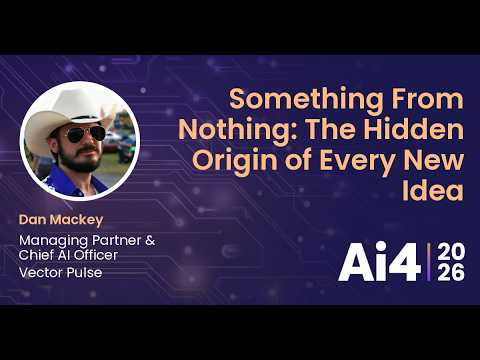
## Background Published on YouTube by Ai4 on August 22, 2026, this presentation features Dan Mackey, Managing Partner and Chief AI Officer at Vector Pulse. The talk explores conceptual blending, unpacking the mental architecture behind how existing concepts synthesize into novel ideas, how this process drives human innovation, and its broader implications for generative AI.
## TL;DR Dan Mackey examines the mystery of creative ideation through the cognitive framework of conceptual blending, categorizing mental integration into simplex, mirror, single-scope, and double-scope networks. By dissecting paradoxes like the Margaret Thatcher political idiom and the historical evolution of the desktop user interface, he reveals how the brain selectively discards constraints, inverts causality, and recursively builds on prior blends. Mackey also frames language as prompt engineering for biological minds, noting that words merely trigger the listener's neural apparatus to assemble complex networks. Ultimately, he argues that while modern generative AI excels at producing candidate cross-domain combinations, genuine creativity hinges on human judgment, qualitative feature selection, and real-world grounding.
## Atmosphere & style The presentation carries an engaging blend of tongue-in-cheek humor, philosophical depth, and structured cognitive analysis. Mackey speaks with lively, curious conviction, moving smoothly from playful personal anecdotes to dense diagrams, linguistic paradoxes, and systemic AI critiques. Watching the talk feels both grounding and intellectually expansive, systematically demystifying the 'spark of divinity' while elevating the subtle, irreplaceable role of lived human judgment.
## Key takeaways - [00:04](https://www.youtube.com/watch?v=4srrBJ_qt4U&t=4s) Early algorithmic art generators operated as bounded rule-following programs, whereas modern generative models destabilize the human-machine divide by producing unprecedented text, code, and conceptual strategies. - [03:08](https://www.youtube.com/watch?v=4srrBJ_qt4U&t=188s) Human creativity rarely originates from a vacuum; it relies on conceptual blending, where the mind projects selected elements from multiple mental spaces into an integrated space to yield functional new consequences. - [03:08](https://www.youtube.com/watch?v=4srrBJ_qt4U&t=188s) Conceptual integration operates across four evolutionary tiers: simplex networks, mirror networks, single-scope networks, and double-scope merges. - [03:08](https://www.youtube.com/watch?v=4srrBJ_qt4U&t=188s) Double-scope merges represent the peak of creative cognition by colliding deeply entrenched, contradictory frames to forge emergent causal logic absent from either input space. - [07:06](https://www.youtube.com/watch?v=4srrBJ_qt4U&t=426s) Complex double-scope blends can selectively discard physical constraints and invert historical causality—such as turning a downstream consequence into an upfront premise—to articulate sophisticated structural insights. - [10:50](https://www.youtube.com/watch?v=4srrBJ_qt4U&t=650s) Innovation functions as a compounding recursive chain, where radical conceptual breakthroughs (such as the personal computer desktop metaphor) gradually calcify into baseline primitives for future generations. - [12:47](https://www.youtube.com/watch?v=4srrBJ_qt4U&t=767s) Human language functions as prompt engineering for biological cognition; words carry no native meaning on their own, but act as lean instructional code prompting the listener's mind to reconstruct an integration network. - [12:47](https://www.youtube.com/watch?v=4srrBJ_qt4U&t=767s) Building cross-disciplinary teams with non-traditional backgrounds maximizes creative problem-solving by providing a broader inventory of conceptual frames to recruit during blending. - [15:26](https://www.youtube.com/watch?v=4srrBJ_qt4U&t=926s) The bottleneck in modern innovation has shifted from candidate generation to evaluative judgment and feature selection—discerning which rare cross-domain mappings hold valid, practical value versus superficial noise. - [15:26](https://www.youtube.com/watch?v=4srrBJ_qt4U&t=926s) While generative AI excels as a vast generator of cross-domain combinations, authentic creativity requires grounding candidate blends in lived experience, emotional intuition, and real-world consequences.
## Detailed walkthrough ### [00:04](https://www.youtube.com/watch?v=4srrBJ_qt4U&t=4s) The Spark of Divinity: Creating Something from Nothing
Dan Mackey introduces himself with a tongue-in-cheek summary of his resume—stepping from a purported past as a bank robber to nuclear engineer, then Director of AI Innovation at the Cigna Group, and currently Chief AI Officer at Vector Pulse. Turning to his lifelong obsession, he poses the core riddle of human cognition: how does a blank page transform into a song, an empty dirt lot become an architected home, or an original thought ignite inside an empty head seemingly for free? Novelty and creativity represent the definitive hallmarks of intelligence—producing outcomes that are surprising, functional, and impossible to predict strictly from what came before.
Historically, an impermeable line separated humans from machines: people authored instructions, and hardware obediently executed them. Mackey recalls early-2000s experiments at Google that generated paintings; though aesthetically convincing, every possible canvas was strictly bounded by initial programmatic rules, operating essentially like an advanced compression algorithm that a human could theoretically recreate with pen and paper on a desert island. Modern generative AI has fundamentally destabilized this divide by generating code, sentences, images, and strategies that no human eye has seen before. This advancement forces a deeper philosophical inquiry: does creativity merely mean outputting unprecedented data, or is an entirely different cognitive architecture at work? Watching performers like the Backstreet Boys at the Sphere, one cannot reverse-engineer their choreography, dance routines, or lighting cues from their biological DNA. Mackey invokes the metaphor of the "spark of divinity"—the profound capacity to face an absolute vacuum and construct an entire coherent universe from nothing.
- Mackey's career spans nuclear engineering, leading AI innovation at Cigna, and serving as Chief AI Officer at Vector Pulse. - Early algorithmic art generators operated as closed-box compression routines where all possible outputs were mathematically predetermined by upfront instructions. - Modern generative models break simple instruction-following paradigms by generating novel sentences, code bases, and conceptual strategies.
---
[03:08](https://www.youtube.com/watch?v=4srrBJ_qt4U&t=188s) The Four Integration Networks of Conceptual Blending
Human beings rarely create out of thin air; rather, human creativity relies on "conceptual blending." The human mind takes multiple mental spaces—memories, situations, rules, actors, and frames—and projects selected elements into an integrated, alternate mental space. To produce creativity rather than meaningless noise, these blends must generate useful, actionable consequences. Cognitive science classifies these integration dynamics into four distinct networks:
```mermaid flowchart TD accTitle: Four Types of Conceptual Integration Networks accDescription: A flowchart showing the progression from simplex networks up to double-scope merges.
subgraph SimpleFrames["Single Frame Operations"] A["Simplex Network<br/>(Role + Value Template)"] B["Mirror Network<br/>(Multiple Inputs, Shared Frame)"] end
subgraph ComplexBlends["Cross-Domain Blends"] C["Single-Scope Network<br/>(One Frame Overpowers Another)"] D["Double-Scope Merge<br/>(Conflicting Frames in Creative Collision)"] end
A --> B B --> C C --> D ```
In a *simplex network*, an established cultural template simply receives values: hearing "Alice is the mother of Bob" instantly activates the familial frame of kinship roles. A *mirror network* introduces multiple distinct inputs that all share an identical organizing frame. Mackey illustrates this with an imaginary boat race: if you line up an 18th-century steamship, a 19th-century clipper ship, and a modern racing yacht, the mind does not need a physics simulator to run the scenario. The shared maritime racing frame immediately produces an outcome—"running the blend" inherently yields consequences.
The *single-scope network* moves beyond shared categories by applying an organizing frame from one domain onto an entirely different subject. Saying "the iPhone delivered a knockout punch to Android" does not mean technology companies possess literal fists; rather, the spectator sports frame of boxing provides an organizing structure of puncher, rival, decisive action, and knockout blow to interpret corporate market competition.
The pinnacle of human creativity—and the threshold separating humans from animals and classical machines—is the *double-scope merge*. In a double-scope network, multiple input spaces each bring their own deeply entrenched organizing frames. These frames frequently clash over basic foundational principles like causality, time, and rules of engagement. Rather than forcing one frame to swallow the other, the mind selectively imports parts of each, discards inconvenient contradictions, and bends relational logic until a workable, novel space emerges. Mackey compares this to solving one face of a Rubik's Cube: you align one plane into perfect harmony while temporarily tolerating unresolved messiness elsewhere. The emergent output contains properties, causal loops, and deductions completely absent from either input space on its own.
- **Simplex Network:** Standard frames mapping fixed roles to specific values (e.g., kinship and family templates). - **Mirror Network:** Multiple distinct entities mapped across a shared overarching frame (e.g., competing ships from disparate centuries racing on the same course). - **Single-Scope Network:** One dominant conceptual frame structured over an alien context (e.g., boxing mechanics overlaid onto tech platform rivalry). - **Double-Scope Merge:** Radical collision between two self-contained, often contradictory conceptual systems, generating brand-new emergent logic.
---
[07:06](https://www.youtube.com/watch?v=4srrBJ_qt4U&t=426s) Anatomy of a Double-Scope Merge: The Margaret Thatcher Paradox
To demonstrate the wild, paradoxical architecture of a double-scope blend, Mackey dissects a political idiom from the 1990s: *"What the US needs is a Margaret Thatcher, but she could never get elected because labor unions would not allow it."* Evaluated literally, the proposition collapses into absurdity. Margaret Thatcher was not an American citizen, already led a foreign sovereign government, was shaped by British parliamentary politics rather than an American primary campaign, and real-world history cannot be swapped into an imagined overseas future. Yet any listener grasps the intended meaning immediately.
The mind constructs an imaginary hybrid figure by ruthlessly discarding irrelevant constraints—dropping British citizenship, geography, and her existing job—while preserving her unyielding temperament, free-market platform, and historic confrontation with organized labor. Then, an unnoticed causal inversion occurs. In authentic British history, Thatcher ran for office, got elected, governed with austere policies, and *consequently* earned the bitter enmity of British trade unions: the conflict was an effect of her tenure. In the blended American campaign space, that historical consequence is warped into a starting condition: American unions hate her *before* she ever enters office, thereby blocking her candidacy before she can govern.
```mermaid flowchart LR accTitle: Causal Inversion in the Thatcher Double Scope Blend accDescription: Flowchart contrasting historical causality with the blended causal structure.
subgraph BritishHistory["UK Reality: Effect Follows Governance"] UK1["Elected PM"] --> UK2["Implements Policies"] --> UK3["Unions Oppose Her"] end
subgraph AmericanBlend["Blended Mindspace: Effect Becomes Cause"] US1["Pre-existing Union Hatred"] --> US2["Blocked at Ballot Box"] --> US3["Cannot Govern"] end ```
By compressing two mutually exclusive causal timelines into a single scene, the mind produces a thought that exists in neither country's history: a vision of Thatcher touring the American Rust Belt and campaigning in Michigan against hostile union rallies. The blend delivers a sophisticated political thesis: an electoral system can be structurally wired to reject the exact leadership archetype that the electorate believes it requires. The literal scenario is an impossibility, but the cognitive conclusion is sharp, functional, and true.
- Double-scope blends routinely reverse causal directionality, taking the downstream historical result of one domain and using it as the upfront premise of another. - Blends discard vital logistical constraints (citizenship, geographic boundaries, existing offices) without disrupting the communicative payload. - The emergent insight—that institutional electoral dynamics filter out the very disruption voters crave—is completely absent from the raw historical facts of either nation in isolation.
---
[10:50](https://www.youtube.com/watch?v=4srrBJ_qt4U&t=650s) Compounding Chains: From Desktop Icons to Cultural Evolution
Actual cognitive blends are rarely neat, two-input equations; real human ideation involves compounding networks that draft dozens of disparate memories, goals, and sensory inputs. Mackey revisits his friend attempting to build a custom house from scratch—an endeavor he warns will consume a person's entire life. The friend standing on an empty plot is not merely blending "dirt lot" with "building." He is weaving together childhood homes, architectural photographs, furniture catalogs, desired aesthetics, and personal aspirations into an initial conceptual space. As soon as that mental model stabilizes, it gets collided with harsh secondary variables: municipal codes, contractor delays, material constraints, and skyrocketing costs.
Each blend's resolution yields a brand-new, consolidated object that instantly acts as an input for the next round of thinking. Breakthroughs do not occur as single, isolated flashes of genius; they form compounding chains across individuals, careers, and civilizations. Mackey traces this evolutionary mechanic through personal computing. In the 1970s and 1980s, computer scientists blended a physical office mahogany workstation with a cathode-ray display, giving birth to the desktop graphical user interface. Concepts like "files," "folders," and "trash cans" were initially radical conceptual metaphors.
Over generations, however, those original creative blends ossified into ordinary, foundational primitives. Modern software designers no longer treat desktop folders as clever metaphors for physical paper manila sleeves; they treat them as self-evident digital facts, building upon them with cloud synchronization, virtual shared team spaces, and autonomous software agents. Culture advances by compounding these creative leaps, converting yesterday's impossible mental syntheses into today's baseline building blocks.
- Creative cognition functions recursively: partial concepts stabilize, face friction, and output composite objects that become inputs for higher-order blends. - Breakthrough design artifacts, such as the computer desktop, start as radical metaphors before calcifying into taken-for-granted foundational reality. - Modern innovations like cloud repositories and autonomous agents are multi-generational stacks: "blends built from blends built from blends."
---
[12:47](https://www.youtube.com/watch?v=4srrBJ_qt4U&t=767s) Language as Prompt Engineering for the Human Mind
This compounding architecture demystifies the true mechanics of human language. Language contains no native meaning of its own; syllables, ink strokes, and text strings are merely tokens and triggers. When someone utters the Thatcher sentence, the words themselves do not contain Detroit, union halls, campaign trails, or Westminster legislation. Instead, words operate as lean instructional code sent to someone else's imagination, instructing their neural apparatus to construct an identical integration network.
In this light, human speech is essentially prompt engineering for biological cognition. A remarkably compact dictionary of words can evoke an infinite spectrum of thoughts precisely because the receiving brain supplies the missing geometry, historical context, and causal scaffolding automatically. The illusion that meaning lives directly inside the sentence persists only because the mind executes this decompression effortlessly below conscious awareness.
This dynamic also explains the fundamental power of intellectual diversity. Ideas do not materialize out of a vacuum; they occur when disparate structural domains—memories, technical schemas, architectural instincts, or personal setbacks—are forced together to address a specific obstacle. Building teams with wildly non-traditional resumes and diverse backgrounds provides a wider, richer inventory of conceptual frames to recruit. Because human working memory operates within a strictly constrained context window, the mind must compact massive cross-domain networks into unified, inspectable concepts that can be manipulated without cognitive overload.
- Words do not transport fully formed thoughts; they act as symbolic prompts instructing a listener to assemble a complex internal integration network. - Meaning is never retrieved passively from a sentence—it is actively reconstructed inside the recipient's imagination. - Cross-disciplinary teams achieve superior problem-solving because diverse frames allow the brain to project non-obvious structural analogies into difficult challenges.
---
[15:26](https://www.youtube.com/watch?v=4srrBJ_qt4U&t=926s) The Frontier of AI: Generation versus Human Judgment
Mackey circles back to the central dilemma of artificial intelligence: can generative models truly execute conceptual blending? Current large language models can readily produce stylistic cross-domain mashups on command, whether tasked with explaining cybersecurity through the biological framework of an immune system or describing emergency room logistics using airport terminal terminology. However, generating candidate mappings is merely the simplest phase of the creative task.
Any two conceptual domains can be arbitrarily mapped against each other in thousands of ways, but the overwhelming majority of those combinations are superficial, incoherent, or dangerously wrong when mapped back into practical reality. The true bottleneck of creativity is "feature selection"—the difficult, high-stakes decision of which attributes to preserve, which differences to discard, and whether the blended construct actually solves the real-world problem at hand. Humans resolve this through lived experience, cultural memory, emotional intuition, and the non-negotiable reality that we must live with the consequences of our decisions.
Generative AI operates brilliantly as an expansive "bubble chamber" for producing endless candidate blends, but the modern frontier of innovation is not generation—it is judgment. The real test of intelligence is not producing a bizarre or novel surprise, but recognizing which rare surprise contains transformative meaning. The myth of the blank page dissolves when one realizes that the creator's mind was never empty; it was saturated with a lifetime of lessons, failures, emotional registers, and conceptual networks. Genuine creativity does not mean living forever in a whimsical daydream—it means venturing into the blank space, blending disparate worlds together, and returning to shared reality with a functional, lasting insight.
| Creative Stage | Generative AI Capabilities | Biological Human Intelligence | |:--- |:--- |:--- | | **Candidate Generation** | Rapidly combines arbitrary domains; produces thousands of cross-domain mappings | Limited by immediate memory retrieval and conscious attention | | **Feature Selection** | Struggles to evaluate which structural parallels matter; often highlights clever but invalid links | Selectively prunes irrelevant variables based on deep domain goals | | **Conflict Resolution** | Frequently generates hallucinated or disastrous causal logic when frames clash | Intuitively inverts or reshapes causal order to solve functional paradoxes | | **Grounding & Judgment** | Cannot evaluate real-world friction, societal impact, or experiential weight | Validates insights against lived consequences, culture, and reality |
- Current LLMs easily generate cross-domain metaphors, but routinely falter at discerning which metaphors hold functional validity. - The fundamental bottleneck in the creative loop has pivoted away from raw ideation toward qualitative feature selection and evaluative judgment. - True creativity is neither mere database retrieval nor unconstrained stochastic generation; it is the compression of multiple distinct worlds into a single, coherent, and useful thought.
## Notable quotes > [00:04](https://www.youtube.com/watch?v=4srrBJ_qt4U&t=4s) spark of divinity — Dan Mackey
> [03:08](https://www.youtube.com/watch?v=4srrBJ_qt4U&t=188s) Alice is the mother of Bob — Dan Mackey
> [03:08](https://www.youtube.com/watch?v=4srrBJ_qt4U&t=188s) running the blend — Dan Mackey
> [03:08](https://www.youtube.com/watch?v=4srrBJ_qt4U&t=188s) the iPhone delivered a knockout punch to Android — Dan Mackey
> [07:06](https://www.youtube.com/watch?v=4srrBJ_qt4U&t=426s) What the US needs is a Margaret Thatcher, but she could never get elected because labor unions would not allow it. — Dan Mackey
> [10:50](https://www.youtube.com/watch?v=4srrBJ_qt4U&t=650s) blends built from blends built from blends — Dan Mackey
> [15:26](https://www.youtube.com/watch?v=4srrBJ_qt4U&t=926s) feature selection — Dan Mackey
> [15:26](https://www.youtube.com/watch?v=4srrBJ_qt4U&t=926s) bubble chamber — Dan Mackey
## Mentioned Dan Mackey, Vector Pulse, The Cigna Group, Google, Backstreet Boys, Sphere, Margaret Thatcher, iPhone, Android, Rubik's Cube, Ai4
## Video description Dan Mackey - Managing Partner & Chief AI Officer, Vector Pulse
Where do new ideas come from? And how can something new come from things that already exist? This talk explores conceptual blending, the hidden mental process of using already existing ideas to create something entirely new. I will explain how this drives creativity, why certain combinations lead to powerful breakthroughs, and what this means for the way generative AI produces new concepts. Attendees will leave with a clearer understanding of where new ideas come from and a practical framework for creating better ones on purpose. Come if you've ever wondered about the source of all inspiration and creativity.
[Source](https://www.youtube.com/watch?v=4srrBJ_qt4U)