Flawless AI Cuts $1 Million Reshoot Days to $1,000 to Reset Studio Budgets
Ai4
Adopting union-cleared assistive AI for visual remapping slashes costly physical reshoots and dubbing barriers, enabling studios to shift capital from bloated $200 million sequels into profitable original films.
## Background
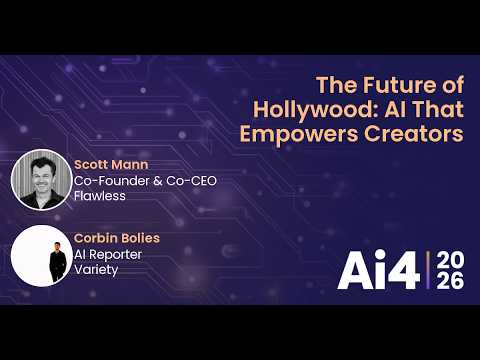
Published on YouTube by the channel Ai4 on August 22, 2026, this video features a fireside chat between Variety AI reporter Corbin Bolies and Flawless co-founder and filmmaker Scott Mann. According to the description, the discussion explores the distinction between assistive and generative AI, outlining how artist-endorsed technology and ethical union safeguards can enhance human creativity and drive a boom in original film and television productions.
## TL;DR
Filmmaker Scott Mann distinguishes prompt-based generative AI from artist-centric assistive AI, highlighting how Flawless technologies like TrueSync and Deep Editor integrate directly into editorial pipelines to preserve authentic human performances. Using real-world case studies like altering MPAA-sensitive dialogue on Lionsgate's Fall and boosting viewer completion rates on UFO Sweden, he demonstrates how AI can replace million-dollar reshoots with affordable, final-pixel solutions. Mann addresses public hostility and studio anxieties surrounding low-quality AI content, emphasizing that proactive collaboration with guilds like SAG-AFTRA is vital to protect talent consent and economic rights. Ultimately, he presents assistive AI as a solution to Hollywood's unsustainable blockbuster budgets, enabling studios to fund diverse, original storytelling and empowering emerging creators.
## Atmosphere & style
The discussion carries a pragmatic, articulate, and cautiously optimistic tone, setting aside typical Silicon Valley evangelism in favor of the grounded perspective of a working film director. Bolies and Mann share an easygoing, conversational rapport that balances lighthearted banter with sharp scrutiny of Hollywood's prevailing economic anxieties and the stigma surrounding 'AI slop.' Listening to the exchange feels reassuring and forward-looking, transforming what is often a contentious industry debate into an artist-led vision for creative renewal.
## Key takeaways
- [00:04](https://www.youtube.com/watch?v=i5X3WRuhN_Y&t=4s) Scott Mann distinguishes between Generative AI (prompt-driven systems that generate assets from scratch) and Assistive AI (tooling designed to integrate into existing workflows while preserving human performance).
- [03:48](https://www.youtube.com/watch?v=i5X3WRuhN_Y&t=228s) Flawless proactively collaborated with SAG-AFTRA and industry unions to establish artist consent workflows and compensation structures before commercializing visual modification tools.
- [07:05](https://www.youtube.com/watch?v=i5X3WRuhN_Y&t=425s) Using the film Fall as a proof of concept, Flawless demonstrated that dialogue and lip remapping can eliminate costly physical reshoots and secure theatrical MPAA rating clearances.
- [10:34](https://www.youtube.com/watch?v=i5X3WRuhN_Y&t=634s) AI-assisted post-production fixes cost roughly $1,000 per shot compared to traditional Hollywood studio reshoots that average over $1 million per day.
- [12:09](https://www.youtube.com/watch?v=i5X3WRuhN_Y&t=729s) TrueSync's visual lip-synchronization technology ('verbing') increased streaming viewer completion rates by 26x during test distributions of foreign-language films like UFO Sweden.
- [14:07](https://www.youtube.com/watch?v=i5X3WRuhN_Y&t=847s) Assistive AI can rescue Hollywood's broken studio economics by lowering production costs, enabling studios to fund multiple $20 million original films instead of singular $200+ million franchise sequels.
- [16:42](https://www.youtube.com/watch?v=i5X3WRuhN_Y&t=1002s) Public backlash against low-quality 'generative AI slop' has made studios hesitant to publicly discuss their adoption of ethical, high-end assistive filmmaking tools.
- [19:20](https://www.youtube.com/watch?v=i5X3WRuhN_Y&t=1160s) Aspiring and independent creators are encouraged to experiment freely with modern AI tools, as legal copyright constraints primarily apply to commercial distribution rather than creative experimentation.
- [20:56](https://www.youtube.com/watch?v=i5X3WRuhN_Y&t=1256s) The long-term roadmap for Flawless focuses on scaling globally alongside regulatory bodies to break language barriers and facilitate native global reach for international cinema.
## Detailed walkthrough
### [00:04](https://www.youtube.com/watch?v=i5X3WRuhN_Y&t=4s) Introduction and the Assistive vs. Generative AI Divide
The session opens with Corbin Bolies of *Variety* introducing filmmaker Scott Mann, noting his background directing screen legends like Robert De Niro and Pierce Brosnan, and his role as co-founder and co-CEO of Flawless. Bolies highlights that Flawless's TrueSync technology earned recognition as one of *Time* magazine's 100 Best Inventions of 2021 for its ability to augment human creativity rather than displace it. Following a video reel showcasing Flawless's dialogue-altering technology—demonstrating an actor's line modified from explicit profanity to "stuck on this stupid freaking tower in the middle of freaking nowhere" alongside explicit in-app talent consent workflows—the discussion kicks off with lighthearted banter about gambling in Las Vegas before turning to what Bolies calls the single biggest gamble in Hollywood today: artificial intelligence.
```mermaid
flowchart TD
accTitle: Film Industry AI Approaches
subgraph Generative["Generative AI Approach"]
G1["Text / Concept Prompts"] --> G2["Algorithmic Output Generation"]
G2 --> G3["Potential Replacement of Human Artistry"]
end
subgraph Assistive["Assistive AI Approach (Flawless)"]
A1["Human Actor Performance"] --> A2["Editorial / Linguistic Corrections"]
A2 --> A3["Consent & Rights Clearances"]
A3 --> A4["TrueSync Visual Remapping & Final Pixel"]
end
```
Mann contextualizes his perspective as that of an active filmmaker who first encountered the foundational technology in an academic white paper at SIGGRAPH in 2018. That initial discovery catalyzed the creation of Flawless, born out of his frustration with traditional international distribution. In conventional foreign dubbing and subtitling, original performances are severely compromised and damaged when adapted for global markets. Mann draws a sharp line between two distinct camps in the tech landscape:
- **Generative AI:** Systems driven purely by prompts that seek to generate complete assets from scratch, often perceived as replacing the artist's role.
- **Assistive AI:** Purpose-built tooling designed to integrate into existing production workflows, preserving authentic human performances while resolving logistical bottlenecks.
[03:48](https://www.youtube.com/watch?v=i5X3WRuhN_Y&t=228s) Protecting Artists, Rights, and Ethical AI Frameworks
Addressing the historical skepticism across the entertainment sector—where "AI" has frequently been treated as a "villainous word"—Mann argues that the narrative is finally shifting. For years, the industry feared AI because many early tech ventures built business models around scraping data, circumventing intellectual property, and replacing creative labor. Mann emphasizes that Hollywood's foundation is intrinsically rights-based; without protecting the fragile economics of artistic ownership and compensation, the ability to tell resonant human stories collapses.
Because Flawless was founded by filmmakers rather than tech opportunists, the company chose to proactively approach industry unions like SAG-AFTRA rather than bypass them. Mann and his co-founder Nick warned guild leadership early on about emerging capabilities and worked directly with them to establish legal guardrails, artist consent mechanisms, and revenue structures. This collaborative approach guarantees that whenever an actor's likeness or voice is manipulated in post-production, the artist retains approval and receives legitimate compensation.
- **Human-Centric Storytelling:** Mann stresses that audiences connect with genuine human emotion, meaning technological adoption must elevate rather than erase the actor.
- **Union Engagement:** Establishing clear contractual consent workflows with SAG-AFTRA ensures AI is implemented as a vetted post-production tool.
- **Economic Sustainability:** Upholding intellectual property boundaries prevents the devaluation of creative labor across the studio system.
[07:05](https://www.youtube.com/watch?v=i5X3WRuhN_Y&t=425s) Case Study: Rescuing Lionsgate's *Fall* and the Power of Deep Editor
Mann illustrates the concrete value of assistive AI through his survival thriller film *Fall*. After completing principal photography, the production secured a major domestic theatrical distribution offer from Lionsgate, contingent upon obtaining a PG-13 rating from the MPAA. However, actress Virginia Gardner had improvised extensively during filming, leaving the final cut with 38 separate F-bombs. Because the entire film is set on top of a remote, 2,000-foot radio tower with continuous direct coverage of the actors' faces, standard editorial workarounds—such as cutaways, reaction shots, or dialogue replacement over the back of a character's head—were physically impossible.
```mermaid
flowchart LR
accTitle: Fall Dialogue Remediation Workflow
A["Raw Cut (R-Rating: 38 F-Bombs)"] --> B["Actor Re-records Clean Dialogue Lines"]
B --> C["Guild Clearances & Talent Consent"]
C --> D["Deep Editor Facial & Lip Remapping"]
D --> E["Theatrical PG-13 Final Pixel Delivery"]
```
Traditional physical reshoots would have required reconstructing complex rigging, rehiring crew, and spending millions of dollars. Instead, the production recorded clean replacement lines (such as "freaking") and used Flawless's pipeline to synthetically remap lip synchronization and rerender the actors' facial movements to photorealistic, final-pixel quality—marking the first time generative facial manipulation was used for an IMAX theatrical delivery under official guild clearances.
Since that milestone, Flawless has formalized this workflow into **Deep Editor**, a tool integrated directly into standard editorial suites:
- Deployed across thousands of productions and major studio tentpole films to refine line deliveries and fix editorial mistakes.
- Eliminates the logistical nightmare of bringing back actors who have already changed physical appearances (such as weight, haircuts, or facial hair) for other roles.
- Prevents ballooning budgets and costly reshoot schedules that can otherwise add millions to studio balance sheets.
[10:34](https://www.youtube.com/watch?v=i5X3WRuhN_Y&t=634s) Practical Applications in Editorial and On-Set Production
Scott Mann explains the immense cost advantages of using assistive AI tools over traditional methods. A typical Hollywood studio reshoot can cost upwards of $1 million per day. By contrast, achieving necessary adjustments using Flawless’s AI tools costs about $1,000—roughly equivalent to a standard visual effects (VFX) task—making it a vastly more economical solution.
Beyond saving money, filmmakers are adopting these tools directly into the creative editorial workflow. Mann notes that directors and editors use the software much like an advanced form of traditional editing to refine pacing and maximize a scene’s dramatic impact. On set, one of the biggest time sinks is repeating scenes across multiple camera angles (from master takes to medium and close-up shots) while trying to maintain strict performance continuity. Actors often struggle to replicate exact movements, line delivery, or emotional nuance across takes. With performance transfer tools, a director can take a standout performance from a wide master shot and apply those exact nuances to a medium shot, allowing the team to craft the ideal scene without wasting hours shooting repeated takes.
- Traditional reshoots cost around $1,000,000 per day, whereas AI-assisted fixes cost closer to $1,000 per shot.
- On-set continuity issues can be resolved by transferring actor performances from wide shots directly to tighter angles.
- Streamlining performance matching on set reduces overall production time and saves director and actor energy.
[12:09](https://www.youtube.com/watch?v=i5X3WRuhN_Y&t=729s) Global Content and Solving the Dubbing Problem with TrueSync
Mann shifts the discussion to Flawless’s flagship product, **TrueSync**, which was built specifically to solve global dubbing and translation challenges. Culturally, audiences in English-speaking territories like the United States and the UK have historically avoided foreign-language films. Subtitles create a visual barrier, while traditional voice dubbing ruins visual immersion because the audio rarely aligns with the actor's lip movements. Consequently, Western viewers miss out on an enormous library of world-class international cinema and diverse cultural stories.
TrueSync addresses this by visually altering the actors' lip movements to match translated voiceover audio in any language—a process Flawless refers to as "verbing." Mann highlights a notable 2025 release test involving the Swedish film *UFO Sweden*. When a streaming platform tested traditional subtitled/dubbed versions against the TrueSync "verbed" version, the "verbed" release achieved a staggering **26-fold increase (26x multiple)** in viewer completion rates and minutes watched. This proves that global audiences crave great international stories once the translation and visual barriers are seamlessly removed without sacrificing artistic integrity.
```mermaid
flowchart LR
accTitle: Translation and TrueSync Pipeline
subgraph Input["Source Content"]
A["Foreign Language Film"]
end
- **TrueSync**: Flawless's proprietary AI technology for seamless multi-language visual lip-synchronization.
- **"Verbed" Version**: A term used for localized film content where visual lip movements are altered to match the target language audio.
- *UFO Sweden*: A Swedish sci-fi film used in a streaming test that saw a 26x lift in completion rates using TrueSync.
[14:07](https://www.youtube.com/watch?v=i5X3WRuhN_Y&t=847s) Economic Crisis in Hollywood and AI as a Silver Bullet
Addressing industry risks and economic pressures, Mann argues that keeping human consent and artistic integrity at the center is vital. The core systemic issue in Hollywood over the last 15 to 20 years is that traditional film production costs have exploded. Studios are trapped into spending $200 million to $500 million per blockbuster, leaving them afraid to take risks on original stories. As a result, studios rely heavily on franchise sequels and reboots that yield marginal financial returns and alienate audiences looking for original content.
Mann points to original breakout hits like *Obsession* to prove that audiences are hungry for fresh, original storytelling when filmmakers are given creative freedom. Assistive AI offers a path out of this crisis by dramatically lowering production and greenlight budgets. Instead of spending $200 million on a single risky blockbuster, studios could produce ten $20 million films with equal visual and cinematic quality. Lowering financial barriers allows studios to take creative risks again, fostering an economic model where artistic originality can thrive.
- Hollywood's studio economics are currently broken due to bloated $500 million blockbuster budgets and over-reliance on sequels.
- Assistive AI can lower greenlight thresholds, allowing studios to make ten $20 million original films instead of one $200 million tentpole.
- Lower production costs restore financial viability to original, non-franchise filmmaking.
[16:42](https://www.youtube.com/watch?v=i5X3WRuhN_Y&t=1002s) Public Misconceptions, Studio Fear, and "AI Slop"
Corbin Bolies notes that while companies like Lionsgate (which hired a Chief AI Officer) and Amazon have embraced AI technologies, many studios remain terrified of speaking publicly about using AI. Mann confirms this, joking that there is "just a touch" of fear in the air. Filmmakers and studio executives are genuinely excited about advanced storytelling tools, but they hesitate to speak out because the general public currently views "AI" as a dirty word.
The core issue stems from audience perception: viewers struggle to distinguish between ethical, high-end assistive tooling used by creative professionals and low-quality, fully automated "generative AI slop." Studios fear that if an audience hears a film used AI, they will assume it is cheap, stolen, or uninspired, which could tank the movie at the box office. Mann draws a parallel to director Christopher Nolan's films (like *Interstellar* or *Oppenheimer*), where practical effects are celebrated even though extensive digital visual effects are used behind the scenes. Because AI has become a societal "villain word," the film industry risks delaying the adoption of beneficial tools due to public misunderstanding.
- Studios fear consumer backlash due to confusion between professional assistive tools and low-quality "AI slop."
- Filmmakers generally reject simple text-prompt generators in favor of precise, controllable tools that support human direction.
- Broader societal mistrust of AI creates friction for Hollywood adopting ethically sound technology.
[19:20](https://www.youtube.com/watch?v=i5X3WRuhN_Y&t=1160s) Encouraging the Next Generation of Independent Filmmakers
When asked what advice he would give to aspiring filmmakers trying to enter the industry, Mann gives an emphatic endorsement to jump in and experiment. He shares a personal anecdote about his own daughter, who wants to become a filmmaker, noting that he gives her the exact same advice: "Try everything." Storytelling has always evolved alongside technology, and mastering modern tools is essential for any emerging artist.
Mann clarifies that ethical concerns surrounding AI—such as copyright infringement and unauthorized data scraping—primarily apply to large-scale commercialization, not early-stage creative experimentation. Platforms like YouTube have already democratized video distribution; combining accessible platforms with cheap, powerful AI tooling creates unprecedented opportunities for young creators. Mann states he would love to be an experimental filmmaker starting out today because the barriers to entry are lower than ever, paving the way for a diverse new generation of storytellers.
- Aspiring directors should freely experiment with new AI tools to sharpen their craft and push storytelling boundaries.
- Copyright and consent issues mainly govern commercial deployment, not personal or experimental learning.
- Combining lower production barriers with digital distribution platforms like YouTube is democratizing film creation globally.
[20:56](https://www.youtube.com/watch?v=i5X3WRuhN_Y&t=1256s) The Road Ahead for Flawless: Ethical Scaling, Global Reach, and Original Filmmaking
With only seconds left in the session, Variety's Corbin Bolies asks Scott Mann to outline the road ahead for Flawless and where he envisions the company heading over the second half of the decade. Mann explains that Flawless plans to focus on scaling out its underlying technologies while maintaining a proactive, highly collaborative posture with the entertainment industry's key governing bodies. He emphasizes that the company works hand-in-hand with guilds, governments, and regulatory frameworks to ensure these generative and assistive tools are integrated responsibly and adopted "in the right way," viewing ethical stewardship as a core obligation rather than an afterthought.
Looking at the broader creative horizon, Mann shares his excitement for the upcoming wave of productions set to utilize Flawless's suite of tools. He envisions a revitalized cinematic landscape where an influx of original films can actually get made and travel much farther across the globe. By seamlessly breaking down linguistic barriers, he anticipates audiences being able to fall in love with outstanding international stories without the jarring friction of traditional dubbing, experiencing "great films that you never even knew were in a different language originally." Corbin Bolies wraps up the fireside chat by thanking Scott Mann and the Flawless AI team as the audience applauds.
- **Regulatory and Industry Partnerships:** Flawless remains focused on ongoing coordination with creative guilds, governing bodies, and policymakers to guarantee responsible, artist-friendly deployment of AI tools.
- **Global Distribution and TrueSync Impact:** A primary objective for the coming years is enabling cinematic storytelling to cross international borders seamlessly, allowing foreign-language features to feel completely native to global viewers.
## Notable quotes
> [00:04](https://www.youtube.com/watch?v=i5X3WRuhN_Y&t=4s) stuck on this stupid freaking tower in the middle of freaking nowhere — Virginia Gardner (in Flawless demonstration reel)
> [03:48](https://www.youtube.com/watch?v=i5X3WRuhN_Y&t=228s) villainous word — Scott Mann
> [12:09](https://www.youtube.com/watch?v=i5X3WRuhN_Y&t=729s) verbed — Scott Mann
> [16:42](https://www.youtube.com/watch?v=i5X3WRuhN_Y&t=1002s) just a touch — Scott Mann
> [16:42](https://www.youtube.com/watch?v=i5X3WRuhN_Y&t=1002s) AI slop — Scott Mann
> [16:42](https://www.youtube.com/watch?v=i5X3WRuhN_Y&t=1002s) villain word — Scott Mann
> [19:20](https://www.youtube.com/watch?v=i5X3WRuhN_Y&t=1160s) Try everything. — Scott Mann
> [20:56](https://www.youtube.com/watch?v=i5X3WRuhN_Y&t=1256s) in the right way — Scott Mann
> [20:56](https://www.youtube.com/watch?v=i5X3WRuhN_Y&t=1256s) great films that you never even knew were in a different language originally — Scott Mann
## Mentioned
Ai4, Amazon, Christopher Nolan, Corbin Bolies, Deep Editor, Fall, Flawless, Interstellar, Lionsgate, MPAA, Nick, Obsession, Oppenheimer, Pierce Brosnan, Robert De Niro, SAG-AFTRA, Scott Mann, SIGGRAPH, Time Magazine, TrueSync, UFO Sweden, Variety, Virginia Gardner, YouTube
## Video description
Scott Mann - Co-Founder & Co-CEO, Flawless
Corbin Bolies - AI Reporter, Variety
AI has shown the power to transform film and television, but its rapid rollout has been marred by many companies ignoring the rights of the creatives whose work underpins the industry. In this fireside chat, Scott Mann, a Hollywood filmmaker and the co-founder of Flawless, will speak about the difference between Assistive and Generative AI and how it can enhance, rather than replace, human creativity. He will lay out AI’s capabilities in the film space and the safeguards necessary to ensure it is implemented ethically. Amid industry headwinds, the discussion will present a positive vision for Hollywood’s future, as companies like Flawless offer artist-endorsed technology that will enable a boom in original productions.
Flawless AI将百万美元单日重拍成本降至千元,重塑片厂预算
采用经工会批准的辅助性AI进行视觉重映射,大幅削减昂贵的实景重拍并打破配音壁垒,使制片厂能够将资金从耗资2亿美元的臃肿续集转移至有利可图的原创电影中。
电影制作人Scott Mann将基于提示词的生成式AI与以艺术家为核心的辅助性AI进行了区分,重点阐述了TrueSync和Deep Editor等Flawless技术如何直接整合到剪辑工作流中,以保留真实的人类表演。他结合为狮门影业电影《Fall》修改涉及MPAA敏感分级的台词,以及大幅提升《UFO Sweden》观众完播率等真实案例,展示了AI如何用经济且达到最终成片像素级水准的方案取代耗资百万美元的重拍。针对公众对低质AI内容的抵触以及制片厂的焦虑,Mann强调主动与SAG-AFTRA等工会合作对于保障演职人员知情同意权和经济权益至关重要。最终,他将辅助性AI视为解决好莱坞不可持续大片预算的应对方案,能够帮助制片厂资助多元化的原创故事,并为新兴创作者赋能。
Flawless 联合创始人 Scott Mann 区分了从零生成的生成式 AI 与赋能工作流的辅助式 AI(Assistive AI),强调必须与 SAG-AFTRA 等行业工会紧密合作,建立艺术家知情同意与报酬保障机制。 (0:04)
好莱坞传统实景补拍通常每天耗费超 100 万美元,而 Flawless 通过 Deep Editor 工具在电影《Fall》中完成对口型修改并获 PG-13 评级,将单镜头修复成本降低至约 1,000 美元。 (7:05)
解决海外影视跨语种传播障碍的 TrueSync 视觉口型同步技术在《UFO Sweden》测试中,让流媒体观众完播率及观看时长实现了高达 26 倍的惊人增长。 (12:09)
针对好莱坞依赖 2 亿至 5 亿美元高成本续集大片的行业危机,辅助式 AI 能大幅降低立项门槛,让制片厂得以在同等预算下扶持多部 2,000 万美元级别的原创优质电影。 (14:07)
Reading summary
Filmmaker and Flawless co-founder Scott Mann argues that Hollywood's economic and creative pressures can be resolved through union-cleared 'assistive AI' that preserves actor performances and lowers production costs, rather than generative text-prompt systems that seek to replace human labor.
Assistive AI and Guild-Aligned Creative Frameworks (0:04)
Mann draws a strict division between generative AI systems—which generate material from text prompts and are widely perceived as threats to creative talent—and assistive AI tooling, which integrates into conventional film pipelines to support human artists. Because the film industry relies fundamentally on intellectual property, artistic ownership, and fair compensation, Mann contends that bypassing talent protections undermines the economics of storytelling.
Rather than avoiding labor organizations, Flawless consulted industry unions such as SAG-AFTRA early in its development process. This collaboration established formal contractual workflows, artist consent mechanisms, and revenue models. Under these legal guardrails, actors retain approval over any post-production manipulation of their likeness or voice while receiving standard compensation, framing AI as an authorized technical tool rather than an uncredited replacement.
Slashing Reshoot Costs with Deep Editor (7:05)
The practical utility of assistive tooling was demonstrated during post-production on Mann's survival thriller 'Fall'. After securing a theatrical distribution offer from Lionsgate contingent on a PG-13 rating, the production needed to remove 38 improvised R-rated profanities. Because the film was shot continuously on a 2,000-foot tower without cutaway angles, standard audio dubbing or traditional reshoots would have cost millions of dollars and required rebuilding sets. Instead, the team recorded clean replacement dialogue and utilized Flawless's Deep Editor to synthetically remap the actors' facial movements to photorealistic, final-pixel quality under union clearances.
Deep Editor has since expanded across thousands of studio productions to resolve continuity issues and dialogue revisions. Mann contrasts the financial models: traditional studio reshoots typically cost upwards of $1 million per day, whereas targeted AI adjustments cost approximately $1,000 per shot. Additionally, directors use performance-transfer tools to port facial nuances from master takes to medium coverage, reducing the fatigue and production delays caused by repetitive on-set continuity filming.
Eliminating Language Barriers with TrueSync (12:09)
Flawless developed its core software, TrueSync, to tackle the historical commercial failure of foreign-language cinema in English-speaking markets. Western audiences have traditionally rejected foreign titles due to the visual fatigue of subtitles and the immersion-breaking distraction of unsynchronized voice dubbing. TrueSync modifies an actor's on-screen lip movements to match foreign voiceover translations in a process Flawless calls 'verbing'.
Mann cites a 2025 streaming distribution test conducted on the Swedish science-fiction feature 'UFO Sweden'. When platforms offered the TrueSync 'verbed' release alongside traditional subtitled and dubbed versions, the AI-synchronized cut achieved a 26-fold increase in completion rates and total minutes viewed. Mann claims this indicates that international cinematic content faces a translation barrier rather than an audience deficit.
Studio Budgets and Public Misconception Headwinds (14:07)
Hollywood's broader business model is under severe strain, with major studio tentpole budgets ballooning between $200 million and $500 million. Mann argues this inflation has forced studios into risk-averse strategies dominated by uninspired sequels and reboots. By lowering post-production and reshoot liabilities, assistive AI could allow studios to greenlight ten $20 million original films for the price of a single blockbuster, reviving mid-budget independent storytelling.
However, studio adoption is tempered by public relations concerns. While major studios and executives quietly deploy assistive tools, they frequently avoid public acknowledgment out of fear that audiences will confuse professional post-production software with low-quality, fully automated 'generative AI slop'. Mann notes that broader societal mistrust risks slowing the adoption of ethical, creator-led technological upgrades.
Mann maintains that the future of film production hinges on responsible scaling through ongoing partnerships with guilds, regulatory bodies, and global distributors. While Flawless positions assistive technology as a catalyst for independent, multilingual cinema, the industry must still navigate widespread public skepticism regarding AI's impact on human artistry.
## Background
该视频由 Ai4 频道于 2026 年 8 月 22 日发布在 YouTube 平台上。视频记录了《Variety》AI 记者 Corbin Bolies 与好莱坞导演兼 Flawless 联合创始人 Scott Mann 的一场炉边对谈,重点探讨辅助型 AI 与生成式 AI 的区别、创作者版权与伦理保障,以及 AI 工具如何赋能人类创意并重塑好莱坞原创电影制作生态。
## TL;DR
对谈深入辨析了“辅助型 AI”与“生成式 AI”的分野,强调以人为本与工会(如 SAG-AFTRA)授权机制在影视技术应用中的核心地位。Scott Mann 结合电影《坠落》(Fall)的微调案例与 TrueSync 口型适配技术,展示了 AI 如何将百万级补拍成本压缩至常规特效水准,并将跨语言电影的完播率提升 26 倍。他指出,辅助型 AI 能打破语言壁垒并大幅拉低制片绿灯门槛,推动好莱坞从押注 2 亿美元高危续集转向批量孵化 2000 万美元的优质原创佳作。同时,他呼吁行业厘清对 AI 的污名化误解,并鼓励年轻创作者充分利用新兴工具以加速电影制作的平民化进程。
## Atmosphere & style
整场对话洋溢着专业务实且极富前瞻性的行业洞察氛围。身兼资深导演与科技创业者双重身份的 Scott Mann 表达诚恳而笃定,将好莱坞长期以来对 AI 的恐慌情绪精准转化为对降本增效与艺术赋能的理性剖析。主持人的提问紧扣产业经济痛点,双方在轻松默契的互动中完成了从商业危机反思到对原创叙事未来的积极展望,带给观众一种在技术变革阵痛中拨云见日的充沛信心。
## Key takeaways
- [00:04](https://www.youtube.com/watch?v=i5X3WRuhN_Y&t=4s) Flawless AI 坚持以人类演员的真实表演为核心,通过 TrueSync 等技术和创作者授权机制(Consent request),确保艺术家对自身数字形象与演绎拥有完全控制权。
- [01:39](https://www.youtube.com/watch?v=i5X3WRuhN_Y&t=99s) 好莱坞制作应严格厘清生成式 AI 与辅助型 AI 的界限:前者试图用算法替代人类艺术创作,而辅助型 AI(Assistive AI)则是为艺术家赋能、解决发行与制作痛点的专业工具。
- [03:46](https://www.youtube.com/watch?v=i5X3WRuhN_Y&t=226s) 电影行业是基于版权且经济模型脆弱的生态,Flawless 主动与 SAG-AFTRA 演员工会合作建立合规授权与利益分配机制,推动好莱坞从单纯的 AI 恐慌转向合规应用。
- [07:05](https://www.youtube.com/watch?v=i5X3WRuhN_Y&t=425s) 院线电影《坠落》(Fall)开创了在工会授权下用 AI 口型技术修改台词并交付 IMAX 终版像素的先河,并由此孵化出面向全行业的深度剪辑工具 Deep Editor。
- [09:43](https://www.youtube.com/watch?v=i5X3WRuhN_Y&t=583s) 传统实景重拍极易因主演档期、体型或发型变化导致数百万乃至数千万美元的预算失控,辅助型 AI 可在原始素材上直接微调台词与表演细节,大幅降低试错成本。
- [10:34](https://www.youtube.com/watch?v=i5X3WRuhN_Y&t=634s) AI 辅助工具将传统补拍成本从每天上百万美元压缩至约千美元的普通特效水准,并通过“表演迁移”(Performance Transfer)跨镜头融合演员的最佳状态,减少片场重复机位拍摄消耗。
- [12:14](https://www.youtube.com/watch?v=i5X3WRuhN_Y&t=734s) TrueSync 口型对齐技术打破了传统跨语言译制配音音画脱节的隔阂,在主流流媒体 A/B 测试中使瑞典电影《UFO Sweden》的完播率与播放时长实现了 26 倍的爆发式增长。
- [14:11](https://www.youtube.com/watch?v=i5X3WRuhN_Y&t=851s) 辅助型 AI 能够从底层重塑好莱坞高成本制作结构并降低绿灯立项门槛,推动行业从单片 2 亿美元的续集豪赌模式,转型为以 2000 万美元规模批量孵化高品质原创佳作。
- [16:46](https://www.youtube.com/watch?v=i5X3WRuhN_Y&t=1006s) 制片厂对公开宣发 AI 仍存顾虑,根源在于公众常将专业辅助工具与低质生成式内容(Slop)混为一谈,行业亟需帮助大众建立“技术赋能艺术表达”的正确认知界限。
- [19:19](https://www.youtube.com/watch?v=i5X3WRuhN_Y&t=1159s) 年轻创作者在学习与实验阶段应毫无保留地拥抱和尝试所有新兴 AI 工具,技术的平民化正打破传统高昂的工业壁垒,为多元背景的新一代导演创造黄金机遇。
- [20:56](https://www.youtube.com/watch?v=i5X3WRuhN_Y&t=1256s) Flawless 的未来愿景是在坚守工会与监管伦理合规的前提下规模化扩展技术,消除全球跨语言视听隔阂,让优质原创故事不再受母语语言限制走向世界。
## Detailed walkthrough
### [00:04](https://www.youtube.com/watch?v=i5X3WRuhN_Y&t=4s) 开场介绍:Flawless AI 与影视行业的未来引领者
《Variety》AI 领域的记者 Corbin Bolies 主持了本场炉石对谈。他首先向观众介绍了嘉宾——好莱坞导演兼 Flawless AI 联合创始人兼联合首席执行官(Co-CEO)Scott Mann。Scott Mann 曾执导过多部知名影片,与罗伯特·德尼罗(Robert De Niro)、皮尔斯·布鲁斯南(Pierce Brosnan)等顶级影星有过密切合作。鉴于电影产业正在经历剧烈的技术迭代,行业极需能够指引未来方向的“护航者”(stewards)。为此,Scott Mann 创立了 Flawless AI,旨在打造以人类创作者和艺术创意为核心的 AI 工具。
Flawless 自研的 TrueSync 技术曾被《时代》(Time)杂志评选为“2021年百大最佳发明”之一。在正式展开谈话前,现场播放了一段展示 Flawless 技术成果的短片,生动演示了如何通过 AI 视觉重对齐与修改台词,将原本包含粗口台词的画面无缝转换为非脏话版本(如将包含粗俗语气的原声替换为 "freaking tower in the middle of freaking nowhere")。视频中还着重展示了创作者端的“授权同意请求”(Consent request)机制——演员与艺术家可以通过点击确认(Thumbs up)来保有对自身数字形象与表演的完全控制权。
- **主持与嘉宾**:Corbin Bolies(《Variety》AI 记者)对话 Scott Mann(Flawless 联合创始人兼 Co-CEO、电影导演)。
- **核心荣誉**:Flawless 的 TrueSync 技术入选《时代》杂志 2021 年最佳发明百大榜单。
- **核心理念**:将人类演员的表演置于核心("It's still the actor's performance and that's the key part."),赋予艺术家掌控权。
---
### [01:39](https://www.youtube.com/watch?v=i5X3WRuhN_Y&t=99s) 概念辨析:生成式 AI 与辅助型 AI 的分野
对谈在拉斯维加斯现场轻松的玩笑中拉开序幕。Corbin 指出,AI 是当前好莱坞“最大的一场赌博”,但在行业语境下这个概念仍显模糊,大致可划分为两大阵营:一类是直接通过文本提示词(Prompt)无中生有创作内容的“生成式 AI”(Generative AI);另一类则是为创作者开发工具、辅助摄制流程的“辅助型 AI”(Assistive AI)。
Scott Mann 结合自身职业背景做了解读。作为一名执导过诸多商业电影的导演,他早在 2018 年的计算机图形学顶会 SIGGRAPH 上读到一篇技术白皮书时就敏锐察觉到了其潜力,并在随后创立了 Flawless。他认为影视制作长期面临发行与跨语言本地化的痛点:传统的电影译制(配音 Dubbing 或字幕 Subbing)往往充斥着艺术妥协,导致原本优秀的英语电影在翻译并输出到全球其他语言市场时品质大打折扣。两者的根本区别在于:生成式 AI 常常被视为对艺术创作本身的替代,而辅助型 AI(Assistive AI)则是为艺术家赋能的工具,旨在让电影在保留原始艺术真实感的同时传播得更远。
```mermaid
flowchart TD
accTitle: Generative AI versus Assistive AI in Filmmaking
subgraph Generative["生成式 AI (Generative AI)"]
G1["文本提示词输入 (Prompts)"] --> G2["完全由算法生成输出"]
G2 --> G3["倾向于替代人类艺术创作"]
end
subgraph Assistive["辅助型 AI (Assistive AI - Flawless)"]
A1["真实演员原声与表演"] --> A2["AI 辅助修补 / 跨语言口型同步 (TrueSync)"]
A2 --> A3["赋能创作者 & 解决发行痛点"]
end
```
---
### [03:46](https://www.youtube.com/watch?v=i5X3WRuhN_Y&t=226s) 好莱坞的 AI 恐慌与创作者权益保护
谈及传统电影制作思维在技术开发中的重要性时,Scott Mann 直言在好莱坞文化中,AI 长期以来被视作一个“反派词汇”(a villainous word),令业内人士深感恐惧。直到最近半年到一年间,行业态度才开始出现转机,人们逐渐分清了两种 AI 的界限:一种是侵犯创作者版权、盗取数据并试图取代人类的威胁性工具;另一种则是真正改善行业生态、提升工作流效率的辅助型工具。
电影业本质上是一个基于知识产权(Rights-based)且经济模型极其脆弱的产业。Scott Mann 强调,故事是人类文明与社会构架的核心基石,而电影则是传播故事最具技术含量的艺术载体。针对行业内许多公司趁混乱期肆意抓取数据训练模型、践踏人类权益的现象,Flawless 选择主动走向演员工会(如 SAG-AFTRA)进行预警,并与工会紧密合作制定合规与授权框架。
- **行业转变**:近 6 至 12 个月内,好莱坞对 AI 的认知逐渐从单纯的恐惧转向理性区分“侵权替代型”与“辅助赋能型”。
- **工会合作**:Flawless 与 SAG-AFTRA 紧密合作,建立合规的艺术家授权与利益分配机制,确保技术成果的正当性。
---
### [07:05](https://www.youtube.com/watch?v=i5X3WRuhN_Y&t=425s) 《坠落》(Fall)实战案例与 Deep Editor 的诞生
Scott Mann 分享了辅助型 AI 首次在院线电影中落地的真实经历。在其执导的极限惊悚电影《坠落》(*Fall*)后期制作阶段,制作组获得狮门影业(Lionsgate)的院线发行意向,但对方要求成片分级必须从限制级(R级)降至 PG-13 级。然而,主演维吉尼亚·加德纳(Virginia Gardner)在拍摄现场即兴发挥,全片累计出现了 38 处脏话("F-bombs")。
传统的补救方案有两种:要么召集原班人马重拍(Costly Reshoot),要么利用演员背影或切镜头做极其生硬的配音(ADR)。但由于《坠落》全片发生在高耸入云的单一废弃电视塔顶端,视觉调度极难避开演员面部。Flawless 当时凭借一套早期的模型工作流,让演员重新录制非脏话版本的台词(例如用 "freaking" 替换原词),随后利用 AI 算法在面部重新映射口型同步动画(Synchronicity),并完成高精度渲染输出。
- **多项行业第一**:该项目是影视史上首次将 AI 口型匹配技术交付为 IMAX 终版像素(Final Pixel),也是首次在 SAG-AFTRA 工会完整授权与合规框架下完成的 AI 面部修饰。
- **产品化演进**:基于该实战验证,Flawless 正式推出了深度编辑软件 Deep Editor。该工具可无缝接入剪辑软件,目前已应用于数千部电影及多部好莱坞大型商业大片(Tentpole films)中,用于微调演员表演与完善叙事。
---
### [09:43](https://www.youtube.com/watch?v=i5X3WRuhN_Y&t=583s) 规避高昂重拍成本的商业价值
在探讨经济效益时,Corbin 询问 Flawless 的技术究竟能为片方节省多少开支。Scott Mann 解释称,重拍(Reshoot)往往是电影制作预算失控的主因,其成本差异极大。在大型商业大片中,一旦补拍涉及的主演已经进驻其他剧组,其体型、发型、胡须等外形特征可能早已发生巨大改变,强行重组摄制组进行实景重拍所需的开销动辄高达数百万甚至数千万美元。通过辅助型 AI 编辑工具直接在原始素材上精细化修改台词和表演细节,能以极低的成本解决传统流程中的棘手难题。
### [10:34](https://www.youtube.com/watch?v=i5X3WRuhN_Y&t=634s) AI 辅助剪辑与片场“表演迁移”的实战突破
在影视制作的实际成本控制中,传统的补拍(Re-shoot)费用极为高昂,每天往往要耗费上百万美元。而借助 AI 视觉工具,不仅能将这类修补成本压缩至普通视觉特效(VFX)的水准——大约只需 1,000 美元左右,更颠覆了后期的剪辑工作流。这种技术本质上已经演变为一种全新的剪辑手段,剪辑师和导演可以在创意剪辑阶段对影片进行精细化打磨,让镜头节奏与戏剧张力达到最完美的状态。
除了后期机房,该技术在实拍片场(Production)同样展现出巨大的时间效益。传统片场中最耗费时间与精力的环节之一,就是在不同机位之间重复拍摄同一场戏以匹配演员的表演连贯性(Continuity)。例如当两个演员拍完一条全景镜头(Master take)后,剧组需要调整摄影机与灯光去拍中景或近景特写,而演员往往很难分毫不差地复刻刚才的情绪与动作细节。现在,导演能够利用“表演迁移”(Performance Transfer)功能,直接将全景镜头中演员最理想的表演状态迁移融合到中景镜头中,让导演与演员能够随心所欲地塑造心目中的理想场景,免去了为了追求细节一致性而反复重拍的消耗。
- **成本对比**:传统补拍单日成本可高达 100 万美元,而 AI 辅助方案仅相当于单次约 1,000 美元的合理 VFX 支出。
- **表演迁移(Performance Transfer)**:打破传统机位拍摄时的连续性限制,跨镜头无缝复用与微调演员的最佳状态。
- **降本增效**:减少片场因重复走位、布光和多轮拍摄所浪费的时间,将创作精力集中于镜头表现力本身。
```mermaid
flowchart TD
accTitle: AI-Assisted Editorial and Performance Transfer Workflow
subgraph S1["传统片场痛点"]
A["全景主镜头 (Master Take)"] --> B["机位与灯光重新布置"]
B --> C["中景/近景反复重拍以匹配表演"]
C --> D["耗费大量拍摄时间 & 容易出现连贯性瑕疵"]
end
subgraph S2["Flawless AI 辅助工作流"]
E["捕捉全景最佳表演"] --> F["表演迁移技术 (Performance Transfer)"]
F --> G["直接融合至中景/特写画面"]
G --> H["大幅缩短片场工时 & 降低百万级补拍成本"]
end
```
---
### [12:14](https://www.youtube.com/watch?v=i5X3WRuhN_Y&t=734s) 突破语言壁垒:TrueSync 与 26 倍完播率的译制革命
Flawless 最核心的产品之一是专注于解决全球内容本土化痛点的 TrueSync。在英美等主要英语国家,观众极少主动观看外国影视作品,其所占市场份额微乎其微。核心原因在于传统的译制配音(Dubbing)往往存在严重的“音画脱节”,破坏了观影的沉浸感与原本的电影美感,导致世界各地众多优秀的跨文化故事无法被全球大众真正领略。
为了打破这种隔阂,Flawless 推出了能够精准适配口型的 TrueSync 技术,该技术正在各大主流制片厂迅速铺开。在实际商业测试中,瑞典科幻电影《UFO Sweden》译制版上映后,某主流流媒体平台将其传统的字幕/传统配音版与应用 TrueSync 深度重构口型的全新译制版(Verbed/Vubbed version)进行了 A/B 对比测试。测试结果显示,TrueSync 版本的完播率与播放时长倍数(Completion and minutes rate)实现了惊人的 **26 倍增长**。这充分证明观众对优质电影有着强烈的渴望,只要用技术打破语言和音画违和的壁垒,就能在保留原本艺术魅力的同时,让优质内容触达前所未有的庞大受众。
- **核心使命**:解决传统配音脱节导致的沉浸感缺失,让全球观众能以电影原本设想的方式体验异国佳作。
- **商业实证**:瑞典电影《UFO Sweden》在流媒体平台的测试中,TrueSync 口型适配版本获得了 **26 倍**的完播率与观看时长提升。
- **技术定位**:该工具的目的并非替代人类艺术家的创作,而是作为技术载体最大化地保留和传播原创艺术。
---
### [14:11](https://www.youtube.com/watch?v=i5X3WRuhN_Y&t=851s) 破解好莱坞经济困局:降低绿灯门槛与重振原创活力
探讨技术带来的红利之余,行业面临的风险同样不容忽视。使用 AI 的红线在于必须获得艺术家和创作者的知情同意与合法授权(Consent),绝不能在未经许可的情况下掠夺表演或艺术资产,“保持以人为本(Keep things human)”必须成为整个影视行业坚守的核心原则。从行业大环境来看,好莱坞过去十到十五年陷入了深重的经济危机——原创电影的制作成本高得令人望而却步,迫使各大制片厂只能将筹码押在观众早已审美疲劳的超级 IP 续集和衍生宇宙上。制片厂动辄砸下数亿美元拍一部大片,换来的却只有微薄的边际回报,整个好莱坞的商业运转模型已经濒临崩溃。
在这一背景下,辅助型 AI(Assistive AI)被视为重振行业生机的“银色子弹”。如果运用得当,它能从底层重构电影制作的成本结构,大幅拉低制片厂的绿灯立项门槛(Greenlight budget),让资方重新有底气去为原创题材承担风险。未来的电影产业有望摆脱“花 2 亿美元去赌 1 部大片”的高危模式,转变为“用 2000 万美元制作 10 部同等精良水准的原创佳作”,在保证工业级品质的同时,让更多充满新意的独立创作者获得机会,迎来原创故事百花齐放的繁荣期。
- **伦理底线**:坚持创作者授权与版权保护,严禁未经许可掠夺表演或美术资产。
- **商业困境**:好莱坞受困于数亿美元的续集大片模式,成本失控且投资回报率持续走低。
- **范式转移**:从单片 2 亿美元的豪赌,转向以 2000 万美元规模批量制作 10 部高质量原创电影,全面激活行业创新。
---
### [16:46](https://www.youtube.com/watch?v=i5X3WRuhN_Y&t=1006s) 舆论恐慌与“AI 污名化”:制片厂的顾虑与认知鸿沟
尽管部分先锋制片厂已经开始公开拥抱新技术——例如 Lionsgate 任命了首席 AI 官(Chief AI Officer),Amazon 也批准了多部在不同环节应用生成式 AI 的影视项目,但行业整体对公开谈论 AI 仍普遍存有顾虑甚至恐惧。Scott 笑着调侃行业内确实存在“不止一点点”的紧张情绪。他指出,真正的电影创作者其实对能够辅助讲故事的新技术抱有纯粹的兴奋感,他们追求的是可控的高质量制作,而非依赖输入文本提示词(Text prompt)碰运气。
制片厂目前最大的担忧,其实是来自大众层面的认知误解。在当前的大众语境中,AI 几乎成了一个饱受争议的“反派词汇”(Villain word)。如果普通观众无法分清“协助创作者提升品质的专业辅助工具”与“低质粗糙的生成式垃圾(Slop crap)”之间的本质区别,只要一听到某部影片使用了 AI,就会先入为主地将其视为廉价粗造的产物,进而伤害影片本身的口碑与市场表现。正如观众去影院观看诺兰的大片是为了追求真实的震撼体验,即便画面中运用了海量特效也不会刻意强调。行业正处于技术革命的过渡期,需要时间让公众建立清晰的认知界限:明确区分哪些是赋能人类艺术家的得力工具,哪些是剥离人性的粗暴替代。
- **行业现状**:制片厂虽积极布局(如设立首席 AI 官、批准实验项目),但在宣发上依然对“AI”标签高度敏感。
- **公众误区**:大众容易将所有 AI 应用误读为低质的“生成式烂片(Slop)”,导致优质辅助技术受到舆论牵连。
- **认知重塑**:呼吁行业与公众厘清界限,明确技术是用来协助人类表达,而非剥夺电影艺术中真实的情感联结。
---
### [19:19](https://www.youtube.com/watch?v=i5X3WRuhN_Y&t=1159s) 寄语新一代创作者:全面拥抱工具与电影制作的平民化
当谈及年轻一代及怀揣导演梦想的新人该如何应对这场技术浪潮时,Scott Mann 给出了无比坚定的建议:“100% 应该去尝试!”他甚至把完全相同的话告诉自己立志成为电影人的女儿。电影艺术的发展史本就是一部人类与技术工具不断融合的历史,理解并驾驭最新的工具是创造出顶尖作品的核心能力。
Scott 强调,在非商业化的探索与练习阶段,任何人都不应给自己设限,应当放手去玩、去实验所有最新的 AI 工具。版权与素材合规的争议主要存在于商业化变现阶段,绝不应成为扼杀年轻一代好奇心的枷锁。正如 YouTube 作为发行平台曾培育出一整代自由创作者一样,如今 AI 工具正在将电影制作的专业门槛彻底打平。当前正是怀抱实验精神入场的绝佳时代,技术的平民化(Democratization)将打破高不可攀的行业壁垒,推动更多来自多元背景的新生代导演脱颖而出,把更多动人的原创故事搬上银幕。
- **给年轻人的建议**:毫不犹豫地尝试和玩转所有新兴工具,将技术作为打磨讲故事能力的利器。
- **实验与商业的界限**:在个人学习与创意实验阶段应鼓励无限探索,商业落地时再严守版权与合规边界。
- **行业民主化**:AI 工具与开放平台的结合正在摧毁传统好莱坞的准入门槛,迎来新一代创作者的黄金爆发期。
### [20:56](https://www.youtube.com/watch?v=i5X3WRuhN_Y&t=1256s) 展望未来:Flawless 的规模化扩展、伦理监管与跨语言电影新篇章
在对电影制作门槛降低以及未来机遇进行总结后,主持人 Corbin Bolies 提醒对谈仅剩最后几十秒时间,并请 Scott Mann 展望 Flawless 在本世纪接下来的五年里(后半个十年)的发展方向与愿景。面对时间的紧迫,Mann 提纲挈领地指出了技术规模化与行业责任并重的未来路径。他明确表示,Flawless 的首要任务是继续全面铺开并扩展现有的 AI 技术栈,但这项工作绝非在真空中进行;公司始终与各大行业公会(如演员工会等)、政府机构以及监管组织保持着极其紧密的合作,以确保这些突破性工具能以正确且负责任的方式被行业接纳,因为在他看来,推动技术落地的同时承担伦理责任是不可推卸的使命。
除了行业监管与标准建立之外,作为导演的 Mann 更对即将到来的创作浪潮感到无比兴奋。他期待看到更多原创独立电影能借助这些 AI 工具得以落地拍摄,突破以往高昂制作成本的限制,让优质故事走得更远("films going further")。他所憧憬的终极愿景,是全球观众在观赏一部精彩绝伦的佳作时,沉浸于自然流畅的表演与对白中,甚至完全意识不到这部电影最初其实是用另一种完全不同的母语拍摄的。随着对谈进入尾声,主持人 Corbin 对 Scott Mann 以及 Flawless 的分享致以诚挚谢意,现场在掌声与互致谢意中圆满落幕。
- **未来发展核心重点**:
- **技术规模化(Scaling Technologies)**:将高精度的视觉重配音(Visual Dubbing)及辅助性 AI 工具进一步扩大应用至更广泛的影视制作流程。
- **制度与伦理合规(Guilds & Regulators)**:深度协同工会、政府与监管机构,确保知识产权保护与创作者权益,树立行业采纳 AI 的合规标杆。
- **赋能原创内容与打破语言壁垒**:推动更多原创电影的立项与孵化,使全球外语佳片实现无缝本地化视听体验,让语言不再成为优秀叙事走向世界的障碍。
## Notable quotes
> [00:04](https://www.youtube.com/watch?v=i5X3WRuhN_Y&t=4s) It's still the actor's performance and that's the key part. — Scott Mann
> [00:04](https://www.youtube.com/watch?v=i5X3WRuhN_Y&t=4s) freaking tower in the middle of freaking nowhere
> [03:46](https://www.youtube.com/watch?v=i5X3WRuhN_Y&t=226s) a villainous word — Scott Mann
> [07:05](https://www.youtube.com/watch?v=i5X3WRuhN_Y&t=425s) freaking
> [10:34](https://www.youtube.com/watch?v=i5X3WRuhN_Y&t=634s) Performance Transfer — Scott Mann
> [14:11](https://www.youtube.com/watch?v=i5X3WRuhN_Y&t=851s) Keep things human — Scott Mann
> [16:46](https://www.youtube.com/watch?v=i5X3WRuhN_Y&t=1006s) Slop crap — Scott Mann
> [19:19](https://www.youtube.com/watch?v=i5X3WRuhN_Y&t=1159s) 100% 应该去尝试! — Scott Mann
> [20:56](https://www.youtube.com/watch?v=i5X3WRuhN_Y&t=1256s) films going further — Scott Mann
## Mentioned
Scott Mann, Corbin Bolies, Flawless, Variety, TrueSync, Deep Editor, Time, SAG-AFTRA, 狮门影业 (Lionsgate), 亚马逊 (Amazon), 罗伯特·德尼罗 (Robert De Niro), 皮尔斯·布鲁斯南 (Pierce Brosnan), 维吉尼亚·加德纳 (Virginia Gardner), 《坠落》(Fall), 《UFO Sweden》, SIGGRAPH, YouTube
## Video description
Scott Mann - Co-Founder & Co-CEO, Flawless
Corbin Bolies - AI Reporter, Variety
AI has shown the power to transform film and television, but its rapid rollout has been marred by many companies ignoring the rights of the creatives whose work underpins the industry. In this fireside chat, Scott Mann, a Hollywood filmmaker and the co-founder of Flawless, will speak about the difference between Assistive and Generative AI and how it can enhance, rather than replace, human creativity. He will lay out AI’s capabilities in the film space and the safeguards necessary to ensure it is implemented ethically. Amid industry headwinds, the discussion will present a positive vision for Hollywood’s future, as companies like Flawless offer artist-endorsed technology that will enable a boom in original productions.
[Source](https://www.youtube.com/watch?v=i5X3WRuhN_Y)
Source quotes
[0:04] Scott Mann: It's still the actor's performance and that's the key part.
[0:04] freaking tower in the middle of freaking nowhere
[3:46] Scott Mann: a villainous word
[7:05] freaking
[10:34] Scott Mann: Performance Transfer
[14:11] Scott Mann: Keep things human
[16:46] Scott Mann: Slop crap
[19:19] Scott Mann: 100% 应该去尝试!
[20:56] Scott Mann: films going further
Source quotes
[0:04] Virginia Gardner (in Flawless demonstration reel): stuck on this stupid freaking tower in the middle of freaking nowhere
[3:48] Scott Mann: villainous word
[12:09] Scott Mann: verbed
[16:42] Scott Mann: just a touch
[16:42] Scott Mann: AI slop
[16:42] Scott Mann: villain word
[19:20] Scott Mann: Try everything.
[20:56] Scott Mann: in the right way
[20:56] Scott Mann: great films that you never even knew were in a different language originally
Original transcript
[0:04] Thanks guys for coming out. We appreciate it.
Um, as you said, my name is Corbin. Now, Scott
[0:09] man knows the world of film and he knows it needs
stewards to help guide its future. An accomplished
[0:14] director who's worked with the likes of Robert
Durham and Bruce Brosman. Scott founded Flawless
[0:18] AI to help augment the film making process with
AI tools that keep humans and creativity at the
[0:24] forefront. That's what's led Time magazine to name
Fall's true SIM technology as one of its hundred
[0:30] best uh inventions of 2021 and what's led us here
today. Scott, thanks for making some time to chat.
[0:37] Before we get started, we have a clip that we're
going to show showcasing some of Flawless's work.
[0:45] Now we're stuck on this stupid tower in the middle
[0:48] of nowhere. And I don't blame you.
And now we're stuck on this stupid
[0:56] stuck on this stupid freaking tower in the
middle of freaking nowhere. This brand new
[1:01] technology is really going to change the way
people film. Consent request. Go ahead and
[1:05] click in it to review it. The best thing is we
as artists get to keep control. Sounds good to
[1:10] me. Thumbs up. Thumbs up. A lot of creative
talent are encouraged by seeing companies
[1:17] like Flawless adopt this type of approach.
There's a medical order. It's remarkable.
[1:24] It's still the actor's performance and
that's the key part. We can go from our
[1:30] small country to the whole world. It's a
game changer. It's a total game changer.
[1:39] Squeak. Thank you. Thank you for that applause.
Scott, thanks for coming out today. Pleasure. Just
[1:46] to kick things off, we're here in Vegas. Have you
lost any money at a card table yet? Uh um not not
[1:51] yet, but definitely later tonight. Yes. All right.
There there we go. Um now, speaking of gambling,
[1:57] um AI is probably the biggest gamble in Hollywood
right now. Yeah. And it's a bit of a nebulous term
[2:02] in the industry. There's there seems to be two
camps. A generative camp where people are making
[2:07] things by just typing things into a prompt and
another camp where people are trying to build
[2:12] tools to sort of help filmmakers in this process.
Can you walk us through where Flawless fits into
[2:18] that mix? Um yeah, sure. I think um so so I'm
a a director by trade, right? I I I um I came
[2:25] into this as a filmmaker and um and I think when
I I kind of was fortunate to just come across the
[2:31] technology very early on um uh in a white paper
at Sigraph in 2018, I saw some of the first stuff
[2:37] that was coming out there and that led to the
foundation of of Flawless actually. Um and what I
[2:43] think that the way that I have always looked at it
actually is that it can provide incredible tools
[2:49] uh for film making and actually can solve some
of filmm's biggest problems. Like one of the
[2:54] biggest things that I kind of struggled with uh
with films I'd made is is with distribution. Um
[3:00] and when films are translated to different uh you
know different languages through either dubbing
[3:05] or subbing um uh the compromises that are made
in that process um I really kind of discovered
[3:12] how damaged like my own films that were done
in the English language were were were being
[3:17] as they were kind of um put into other languages
around the world and and um and yeah and I saw
[3:22] the seed of that technology really being help with
some of these problems to be able to essentially
[3:26] make films kind of remain more authentically as
they were meant to be and travel further. These
[3:31] kind of things and definitely the distinction I
think as you highlight generative typically is is
[3:36] uh regarded as kind of replacing the artistry
whereas assistive AI is the kind of label see
[3:41] uh that seems to have stuck for the tooling that
can really help and and that's what flawless is
[3:46] focused on. Got it. Now you just talked us about
bringing a traditional film making approach to
[3:52] this. You've worked in these spaces. Why is it
important to have that type of mindset as you're
[3:56] engaging with these tools and developing them for
other filmmakers? Well, I think that I I I think
[4:01] that I think AI AI is a big word and it covers so
many things and I think in Hollywood it's kind of
[4:08] a villainous word, right? People are scared of it.
Um and and I think it's only in the last 6 months,
[4:13] 12 months that things have started to
change and people are starting to see
[4:16] that distinction between tooling that can
improve an industry and make it better for
[4:21] the artists and filmmakers within that industry.
um as an improvement uh as an assistive tools and
[4:26] uh and the ones that are threatening the industry
by kind of stealing rights and taking uh taking
[4:31] things and replacing humans which I actually
think people don't want to see really in terms of
[4:36] uh certainly Hollywood and storytelling um I think
that it's it's all about the human aspect anyway
[4:42] and I and I think understanding that and and
and really leaning into tools that can help that
[4:48] um is is actually a wonderful and exciting thing
and an exciting moment in our industry which you
[4:53] know needs it totally and we saw in that video
there Sagastra uh has worked extensively with
[4:59] you. They've talked about Flawless's work within
the industry and you you've kept creatives and
[5:04] artists at the forefront of the work that you do.
Why was that important to make sure that artists
[5:09] are protected as they engage with AI? Well, I
think um it's funny because I I think like I said,
[5:17] we were early to the process and I think a really
clear distinction that appeared um for myself and
[5:23] Nick, co-founder Flawless, really early on is
that there is a route in which you can kind
[5:28] of take everything, steal everything and kind of
profit from the resale and theft of of essentially
[5:34] data and rights and these kind of things. Um and
and there's another route where you can actually
[5:40] support and protect from that. And I think um
the filmmaking industry has been a rightsbased
[5:45] industry and the the kind of fragility of the
economics of making art and then monetizing it
[5:51] that's kind of what sits at the heart of Hollywood
and you have to protect that to enable better art
[5:55] better stories and I think fundamentally like my
belief as a as a human being is that stories are
[6:01] so essential to the human condition and culture
and fabric of society the rest of it and film
[6:06] making is almost the most technical version of
that that can distribute you know stories wide.
[6:11] it's super important as an art form. Um, and so
really early on we kind of saw this distinction
[6:16] and and we actually we saw a lot of, you know,
a lot of companies leaning the other way,
[6:20] right? And and and taking advantage of a moment of
confusion to kind of just train on whatever data,
[6:26] take everything, do outputs and these things and
trample over uh into a replacement of humans. Um,
[6:32] and and that was never what we kind of set out to
do. and and we we we kind of took the the lead I
[6:38] suppose in pioneering through those systems and
those frameworks um and and just leaned in and
[6:44] went to the guilds and warned them about what was
coming and then worked very closely with them all
[6:50] um to try and help design uh ways to to make sure
that the the the benefit of these technologies is
[6:57] distributed in the right way and not just taken
and you know uh stolen away. Got it. Now you've
[7:05] talked about how seeing it on your own films uh
led to you working with these technologies and
[7:10] developing them. Can you walk us through how these
technologies have helped you on your films that
[7:15] you've made and how they've helped some of your
film making colleagues in the in Hollywood? Yeah.
[7:21] Well, I think the first time the first time it
was ever used in film actually in the first use of
[7:26] uh assisted film was a film I was directing.
Flawless was very young at the time. We hadn't
[7:31] built out a product. It was like very early days
of we'd had kind of a patchwork pipeline that was
[7:36] built with with models and things and um uh and
the film uh film called Fall that I was uh that
[7:42] I directed. Um it actually it was going through
the the rating system and uh basically it got an
[7:49] offer from a studio Lionsgate to to distribute the
movie but it needed to be a PG-13. There was it to
[7:55] it ended up there was 38 [ __ ] that were said in
the film which was not supposed to be that way but
[7:59] the we had a pottymouth actress Virginia Gardner
and [laughter] um uh and and we needed to change
[8:05] that. And so typically a film in that situation
would go back and it would reshoot the dialogue or
[8:09] it would try and kind of replace the dialogue from
you know behind heads and this kind of stuff. And
[8:14] um the problem with a movie is it all features in
one spot and there's not much to cut around and
[8:18] uh we looked at shooting but shooting very
expensive bringing everyone back doing all
[8:22] these kind of things. And so, um, what we
kind of pulled together for that was, um,
[8:27] the first use of replacing dialogue. So, we had
the actors, uh, say new lines like freaking like
[8:31] the one you saw there. And, um, instead of goddamn
[ __ ] it's it's, um, I don't know, some some son
[8:37] of a [ __ ] or whatever. And, um, and and so
I tried to retain the kind of the intent of
[8:42] the expression with nonswear equal eyes. Uh, and
then we use technology to remap the synchronicity
[8:48] on the faces and rerender these faces. And that
film, it was the first time on a lot of things
[8:54] in terms of delivering final pixel to an IMAX film
to um pushing through for the first time the right
[9:02] way of doing it with a guild. So like SAG and the
clearances and make making sure it's legitimate.
[9:06] We had to kind of go through all that and that
was our kind of sketch of how this should be done
[9:11] and and done more. And then since then you know
we've done well floors deep ediedtor which which
[9:17] does that and it works with editorial software
has been used in you know thousands of films now
[9:22] and many major films that you'll see tempo films
are typically using it for that kind of use case
[9:27] to edit around performances and perfect things
because it's all about kind of making the film
[9:32] better and and um and and you craft a movie once
you've shot it. or you you kind of do that. But
[9:38] but it's a you know so I think they they really
have kind of made you know movies better and it's
[9:43] it's a it's a nice it's a nice thing to be proud
of. I think now you touched on the cost aspect
[9:48] and as you mentioned re-shooting films can cost a
lot of money um can sometimes increase budgets in
[9:54] a way that studios don't generally like how uh
giving us a rough estimate here. How much would
[10:00] you say Flawless's work can save a film and
a production money through the implementation
[10:05] of them? Well, I guess, you know, it's a it's a
wide question. I think the I I I I I think that
[10:11] it depends on the circumstances. So, if you have a
big tentpole film and let's just say you've got um
[10:17] an actor who has since moved on to another role,
might be physically very different, like both kind
[10:21] of facial hair and weight and the rest of it. I
mean, it's there's all these kind of challenges
[10:25] you have to kind of do any kind of re-shoot. Um,
and re-shoots typically are are a big expense,
[10:30] you know, and you can talk like films typically,
you know, with a temple, you can be spending half
[10:34] a million a day to do a re-shoot, right? So, to be
able to do these things at at a um essentially at
[10:42] the cost of what would be a V effect, a reasonable
V effect cost of let's say $1,000 or something is
[10:48] obviously a lot cheaper as a solution. Um, but
I think what we actually have found now people
[10:54] are utilizing in the editorial process. It's just
another form of editing really. And so what what
[10:58] we see is that it gets utilized in the creative
editorial. So kind of crafting out the film and
[11:04] and really making it kind of punch and and work
best where it needs to be. And we've seen it in
[11:09] used now in production where you can because you
also have the ability to transfer performances.
[11:15] Um, you can say shoot a scene and one of the
biggest time sucks on set is when you're trying
[11:21] to repeat the scene from different angles and
you're trying to match the same performance and
[11:25] get the ex, you know, so you'll do a mass, let's
say you and me, we're acting, we do a master take
[11:29] and then you go in and move the cameras and lights
around and do it and the difficulty is the actors
[11:34] maintaining the exact continuity and all these
things. Um and so what we found is people can use
[11:38] it um to take the performance say from the wide
and apply it to the medium and to kind of tinker
[11:44] with things to really craft it into the scene that
the director and the actors kind of wanted. So
[11:50] um and and that reduces the the time it takes to
shoot said scene, right? Because you don't have to
[11:55] go again to try and do that. So things like that,
I think tools are used differently by everyone,
[12:00] truthfully. So, as long as you've got a tool that
kind of is, you know, has the um the ability to do
[12:05] certain things, then people tend to be creative
with it. Got it. And what are some of the other
[12:09] tools that falls works with that you are seeing
across the broader AI and entertainment space?
[12:14] Uh well I think the the biggest thing like we I
think True Sync like so so in 20 um and one of
[12:21] the kind of the main uh missions of Flawless as
to build out a product was to um to really solve
[12:28] the dubbing problem that um that we kind of faced
with you know content globally. I think that most
[12:34] people especially in say like America, Britain,
English speaking territories don't really um tend
[12:41] to watch foreign movies, right? like it's a very
fractional slither of actual incredible cinematic
[12:48] work from around the world. People don't watch
it when it's dubbed and it's really because it
[12:53] takes the immersion and the film making a lot of
that away from it. Um whereas there's incredible
[12:58] stories from around the world told by many
different cultures that really can be enjoyed,
[13:02] shared and kind of walk in the shoes and and so
we have a product called Trusync which um which
[13:07] is now kind of scaling out with the studios and
we're starting to see a lot of uptake because um
[13:11] allowing uh content to be seen kind of as it was
intended is is a huge huge thing. In 2025, yeah,
[13:19] we released a film, Swedish film originally called
UFO Sweden, translated uh was released in cinemasc
[13:29] um there was one of the streamers put a a
metric test on it um from a subbed subdom
[13:36] versus the new what we call verbed version which
is the translated version and it had a 26 times
[13:41] multiple on the completion and minutes rate.
So it just goes to show that people do want
[13:46] to watch a great movie and if you can break down
the language barrier and the translation of it,
[13:51] it just opens out audiences and I think it it
makes it makes great kind of content go further.
[13:57] So I think that's it's a very like positive use of
technologies as a tool that's not about replacing
[14:03] artistry. It's actually about retaining it. So
it thanks for walking us through a lot of the
[14:07] benefits that we're seeing in the space here.
What are some of the risks that we're seeing?
[14:11] What concerning you? I know. Yeah. No, I think
look personally I can say that um I think that I
[14:19] think the risks are the distinctions between
kind of of of doing something legitimately
[14:26] um and or doing something where you're kind
of replacing or taking without permission like
[14:31] consent of whether it's your artwork performance
of what you're doing and and keeping things human
[14:37] um is needs to be kind of central probably not
well definitely not just to the Hollywood industry
[14:44] as a whole. Um I think the problem the biggest
problem I've seen actually is our industry has
[14:50] been kind of um struggling for for the last
well you know right last 10 15 years it's it's
[14:56] been struggling because the cost of original
film making is so expensive and we've seen it
[15:01] right we've seen how we all have like franchise
sequels and things that I don't think audiences
[15:06] really want but it's the only bet that studios
can make to get a return enough to kind of keep
[15:11] making and it's gotten itself into this problem
where it has to spend like half a billion on a
[15:16] movie and release it and then it has a marginal
kind of lift and um and it's the economy of the
[15:21] Hollywood industry is kind of broken. Um whereas
you see original films and how far they can go and
[15:27] like say take obsession right which is a we a film
that you know the filmmakers were given freedom to
[15:33] tell an original story and look at the success of
that and I think you you see that repeat and more
[15:38] people want original films made and I think that
where where AI assistive AI and tooling that's
[15:45] going to transform the cost of of being able to
make films and greenlight films you can actually
[15:50] take risks again. Um, and so for our industry, I
really think it's going to it it's it's a bit of
[15:55] a silver bullet in terms of if it's done right,
but you have to make sure that everyone's kind of
[16:00] consented and protecting that it's built for the
industry that it's helping. So the economics kind
[16:04] of spin spin up. So I think we'll see kind of
um essentially green lights, green light budget
[16:10] lowering, which allows more risks. So rather
than making kind of one film for $200 million,
[16:16] you'll make 10 for 20 and it'll be at similar kind
of levels of quality. um you'll be able to make
[16:22] films either quicker or do more with the resource.
Um and I think that's good, right? That's that's
[16:28] going to encourage originality and as we get
distributed wider across uh across the world,
[16:34] it opens our audience. So I think there's there's
huge benefits there, but we just have to be
[16:38] careful how we're doing it, who's kind of leading
it forward and just making sure that everything
[16:42] art remains human ultimately. That's the key. Got
it. Now some studios have been very open about how
[16:47] they're using AI. You mentioned Lionsgate earlier.
They've hired a chief AI officer. Amazon has green
[16:52] lit projects that use generative AI in different
capacities, but I sense that there's still a bit
[16:57] of fear being outspoken about it. I think there's
a lot of [laughter] just a tad, just a touch.
[17:03] Yeah. When do you think that studios can be more
outspoken? And how do you explain to audiences the
[17:09] work that you're doing and the distinction there?
Well, look, I think the I think the fears is fair,
[17:16] right? because I don't think it's about the tools.
I think most filmmakers I know most um folks you
[17:23] know industry wise they are excited about the
possibilities of new tools and storytelling right
[17:28] from a genuine place like and I and I think most
of them I see them not wanting to go down the kind
[17:34] of text prompt like it's not a kind of a quality
controllable way to do things. So I think most are
[17:39] very excited and are very keen on it. However,
I actually think it comes back to audiences,
[17:44] right? Because audiences, if you if you don't
know the distinction between whether someone's
[17:49] just used a tool which uses technology versus
something generative which is kind of slop crap,
[17:55] if you don't know the distinction of that and
you just hear the words AI, you're going to think
[18:00] that it's slop crap. And I think that the fear
that studios have is that the misunderstanding
[18:06] of the technologies that they've used will be
misunderstood by an audience. and and it's going
[18:11] to hurt the film's chances. It's like people go
and watch things to have an experience and and
[18:18] you really want to, you know, you want a genuine
experience that's been captured. Like you look at
[18:22] Nolan's Odyssey, right? Like there's reason why
we love that because it's it's all, you know,
[18:27] it's boomed real, but obviously there's loads of
special effects in there, right? But we don't, you
[18:32] know, but we we don't necessarily highlight those
things because we want the audience to go in and
[18:36] enjoy it in the best way possible. But I think AI
in society right now is screwing up so many things
[18:43] that it's it's become kind of the villain word.
And so the risk is that industries like Hollywood
[18:50] might not be able to adopt as quickly with tooling
that's genuinely better for everyone because of
[18:56] that that that misconception. And I think so I
think that it's just going to take a while for
[19:00] people to understand that we're in a revolutionary
time where we've got this new technology filtering
[19:06] across the world and we have to understand
where the value lies and draw the lines and
[19:10] adjust to it and um and I think and understand
the differences between a tool that helps us and
[19:15] something that's replacing us. No, one one side
effect of revolutionizing the industry is opening
[19:21] it up to people who may not have been able to
break in like younger filmmakers. Amazing. Right.
[19:25] Right. Totally. And what would you tell aspiring
filmmakers and directors like a young Scott who
[19:31] want to get into the film industry? Should
they be using and experimenting with some of
[19:35] these tools out there right now? 100%. I would
my encouragement would be and I'll say this to
[19:40] my own children. I do say this to my own children
because my daughter wants to be a filmmaker. Um is
[19:44] is try try everything right try the tooling. It's
like I think this I think un film making you know
[19:51] artistry right it's about using technology and
tooling and and these things. And I think that
[19:56] um understanding the tools to make the best
things that's that's key to it. And I and I think
[20:02] especially when you're experimenting and playing
like anyone should be experimenting on anything
[20:07] like the the issue really with AI and and kind of
the the theft of footage and rights comes in when
[20:13] you're trying to commercialize things, right? And
you're trying to take it from that to that. So,
[20:17] but I personally think like experimentation
we the world desperately needs and is luckily
[20:23] looking like it's getting a new kind of
um generation of filmmakers, right? And
[20:28] I think that's starting to break through. I think
YouTube's been amazing as a distribution platform
[20:32] for to practice the art of of film making and I
think that the more yeah I would I would I would
[20:38] love to be a film an upcoming filmmaker you know
like experimental stage right now because there's
[20:43] so many opportunities to just make films and
that's you know that that brings the barrier
[20:49] down it brings stories forward and it brings it
and it democratizes this industry which has just
[20:56] been increasingly locked off to kings you know so
Um, I think it's it's great for for the future.
[21:02] That's that's great to hear. Now, we have a few
seconds left. Can you walk us through what's next
[21:06] for Fall AI and where you're hoping the company
can go in in the next half of this decade? Well,
[21:11] I think I think we're going to kind of continue
with um really scaling out the technologies and
[21:16] just and and I think we we very much, you know, we
we work very closely with different um you know,
[21:23] guilds and governments and regulators to try
and make sure that that that that things are
[21:28] adopted in the right way because I think there's
kind of responsibility to to do that. And so,
[21:34] um, but really kind of I I think I'm
excited about what's coming down the
[21:37] pipe of seeing kind of more original films
being made and utilizing the technologies,
[21:43] um, and and and films going further basically
and seeing great films that you never even knew
[21:47] were in a different language originally. Great.
Scott, man, follow us AI. Thank you so much. Thank
[21:52] you very much. Thank you. Thanks. Thanks, Mom.
Thank you, guys. Thank you. Here you go. head.