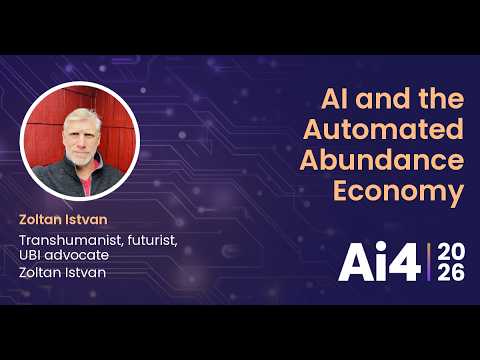
AI and the Automated Abundance Economy With Zoltan Istvan
Ai4
AI-assisted summary of AI and the Automated Abundance Economy With Zoltan Istvan — original source. Check the original for full context.
Source published:
Detailed notes
## Background Published by Ai4 on YouTube on August 15, 2026, this presentation features futurist, transhumanist, and UBI advocate Zoltan Istvan outlining his vision for an Automated Abundance Economy. According to the video description, Istvan details a three-pillar framework—universal basic income, domestic home robotics, and a reimagined American Dream focused on leisure—to transform the disruptive rise of AI into a societal utopia.
## TL;DR Drawing on insights from his California gubernatorial campaign and background in AI ethics, Zoltan Istvan argues that machine superintelligence could arrive within 18 to 24 months, threatening to displace traditional white-collar and physical labor. To prevent civil unrest and secure human relevance, he proposes the Automated Abundance Economy, anchored by universal basic income, state-supported domestic robots, and a cultural pivot away from relentless wealth accumulation toward creative leisure. He explores how direct neural interfaces, physical cybernetics, and AI-accelerated life extension will reshape human biology, while sounding an urgent alarm about elite tech insiders quietly building survival bunkers amid severe political inaction. Istvan concludes with a call to prioritize equality and enact proactive technological governance so that humanity can transition into a post-scarcity, space-faring civilization.
## Atmosphere & style The presentation strikes an urgent, visionary, and provocative tone, effortlessly bridging ambitious sci-fi optimism with sobering socio-economic realities. Istvan delivers his message with candid philosophical conviction, grounding radical ideas in vivid personal anecdotes that range from surviving a landmine as a journalist to witnessing Silicon Valley elites plan for superintelligence in private mansions. Watching the talk feels intellectually electrifying yet unsettling, forcing the audience to look past short-term commercial software hype and confront monumental civilizational crossroads.
## Key takeaways - [00:04](https://www.youtube.com/watch?v=j4OduqrrSFo&t=4s) Zoltan Istvan proposes an 'Automated Abundance Economy' to transition society safely into a post-scarcity, post-labor world as artificial intelligence automates traditional jobs. - [01:51](https://www.youtube.com/watch?v=j4OduqrrSFo&t=111s) Technological superintelligence could emerge within 18 to 24 months, yet mainstream political leadership has entirely neglected governance frameworks for this transition. - [03:31](https://www.youtube.com/watch?v=j4OduqrrSFo&t=211s) Transhumanism will merge machine intelligence directly with human biology via neural interfaces and physical cybernetic enhancements to maintain human relevance. - [05:49](https://www.youtube.com/watch?v=j4OduqrrSFo&t=349s) Exponential technological progress has collapsed long-term forecasting horizons, requiring proactive frameworks built around guaranteed income, home robotics, and cultural adaptation. - [07:45](https://www.youtube.com/watch?v=j4OduqrrSFo&t=465s) Universal Basic Income or state-distributed AI dividends are an absolute mathematical necessity to avert mass poverty and civil unrest as automation displaces workers. - [09:09](https://www.youtube.com/watch?v=j4OduqrrSFo&t=549s) State-supported deployment of domestic humanoid robots in every household could eliminate mundane physical chores and enhance home safety within five years. - [10:54](https://www.youtube.com/watch?v=j4OduqrrSFo&t=654s) The American Dream must be redefined away from lifelong labor and wealth accumulation toward a culture centered on art, philosophy, scientific curiosity, and leisure. - [13:01](https://www.youtube.com/watch?v=j4OduqrrSFo&t=781s) AI-accelerated biotechnology could extend human lifespans to 120–300 years, necessitating strong economic safety nets so prolonged life does not result in centuries of poverty. - [14:31](https://www.youtube.com/watch?v=j4OduqrrSFo&t=871s) While top Silicon Valley AI architects privately prepare survival bunkers against existential superintelligence risks, public policy discourse remains focused on outdated partisan issues. - [16:38](https://www.youtube.com/watch?v=j4OduqrrSFo&t=998s) Prioritizing social equality and proactive AI governance is urgently required to ensure technological progress leads to a shared transhumanist utopia rather than extreme wealth polarization.
## Detailed walkthrough ### [00:04](https://www.youtube.com/watch?v=j4OduqrrSFo&t=4s) Campaigning on the Automated Abundance Economy
Zoltan Istvan opens his address by outlining the central themes of his work: the sweeping impact of artificial intelligence on human society, the economic necessity of universal basic income, and the dawn of what he terms the "automated abundance economy." Reflecting on his recent 12-month campaign for Governor of California, he candidly notes that while he did not secure the Democratic nomination, the race provided a massive public platform to promote bold, unconventional policies. Throughout a year on the campaign trail, Istvan advocated for state-supported domestic robots, guaranteed income, and a fundamental re-evaluation of the American Dream.
Visiting university campuses during his campaign underscored the urgency of these ideas. Looking at his own daughter, who is preparing for college applications in a year or two, Istvan expresses deep concern over what young graduates will face when machine intelligence becomes capable of automating white-collar and professional jobs. While other candidates occasionally touch on technology, Istvan positions himself as an unapologetic futurist championing a "Star Trek era"—one focused on space exploration and pushing past traditional biological limitations through radical technological innovation.
- Istvan completed a 12-month campaign for Governor of California centered on futurist policy. - The platform championed Universal Basic Income (UBI), domestic home robotics, and moving society into a post-scarcity, post-labor economy. - The core political challenge is preparing the next generation for an economy where AI replaces most traditional professional career paths.
---
[01:51](https://www.youtube.com/watch?v=j4OduqrrSFo&t=111s) The Approaching Singularity, Oxford Ethics, and a Landmine Epiphany
The discussion turns to the technological singularity—the threshold where artificial intelligence surpasses the human brain's ability to comprehend it. Citing a recent statement from Elon Musk predicting the arrival of this era within 18 months, Istvan argues that machine intelligence exceeding human capability within 18 to 24 months is a genuine possibility. Despite the magnitude of this shift, neither Donald Trump nor mainstream Democratic leadership possesses any framework for governing through it. Istvan compares current skepticism to attitudes a decade ago, when the concept of interacting daily with conversational systems like ChatGPT or relying on AI to solve complex mathematical problems sounded completely absurd.
```mermaid flowchart TD accTitle: Zoltan Istvan Intellectual Journey subgraph Origin["Foundational Shift"] A["National Geographic Journalism"] --> B["Near-Fatal Landmine Encounter"] B --> C["Focus on Radical Life Extension & Transhumanism"] end subgraph ThoughtLeadership["Public Advocacy & Governance"] C --> D["Bestseller: The Transhumanist Wager"] D --> E["Oxford Graduate Work in AI Ethics"] E --> F["Futurist Political Campaigns & Policy Proposals"] end ```
Istvan shares the personal turning point that led him down this path. While working as a journalist for *National Geographic*, he had a near-death experience when he almost stepped on an active landmine, surviving only because his guide shoved him out of harm's way. That harrowing brush with mortality reoriented his life toward radical life extension, philosophy, and transhumanism—the study and practice of using cutting-edge technology to upgrade the human species. After completing a graduate degree in AI ethics and philosophy at the University of Oxford, he authored the bestselling philosophical novel *The Transhumanist Wager*, which propelled him into public life and political races aimed at injecting scientific methodology into governance.
- Elon Musk and leading AI researchers estimate artificial superintelligence could arrive within 18 to 24 months. - Istvan’s shift to transhumanism was triggered by surviving an active landmine while reporting for *National Geographic*. - Political debates continue to ignore AI, even though technological governance represents the single most consequential issue of the modern era.
---
[03:31](https://www.youtube.com/watch?v=j4OduqrrSFo&t=211s) Transhumanism, Neural Interfaces, and Body Upgrades
Delving deeper into transhumanism, Istvan explains that artificial intelligence will not merely exist as an external tool on computer screens; it will eventually be integrated directly into the human body. He points to companies like Elon Musk’s Neuralink and peer biotechnology firms in California that are developing direct neural interfaces. Istvan predicts that within five years, presentations and speeches will be transmitted straight into audience members' minds, noting that current neural implants can already transmit the contents of an entire book directly to a user's brain without requiring physical screens or keystrokes.
Physical augmentation represents the next stage of human competitiveness. Transhumanism encompasses replacing fragile biological limbs with high-performance robotic arms and legs, as well as biological enhancement. Istvan references his involvement in the early operations of the Enhanced Games—which recently held major events in Las Vegas—where athletes utilize pharmacological and technological enhancements to push human performance beyond natural limits. In this emerging paradigm, upgrading human biology becomes essential for staying relevant alongside automated systems.
- Neural interfaces are advancing rapidly, already demonstrating the ability to stream textual data directly into the brain. - Physical augmentation includes advanced prosthetics, cybernetic limbs, and performance-enhancing compounds showcased in initiatives like the Enhanced Games. - The boundary between human biology and machine intelligence is rapidly dissolving.
---
[05:49](https://www.youtube.com/watch?v=j4OduqrrSFo&t=349s) The Shifting Horizon of Futurism and the Three-Pillared Economy
Futurism itself has been forced to adapt to exponential change. Istvan observes that futurists once comfortably offered ten-year projections, but looking ahead to 2036 has become virtually impossible due to the combined acceleration of AI, robotics, and quantum computing. Most technologists can now only reliably forecast two to five years ahead. With machine intelligence poised to outmatch human intellectual performance in the immediate future, society must urgently answer how humans will live and find purpose.
```mermaid flowchart LR accTitle: The Three Pillars of the Automated Abundance Economy subgraph Pillars["Automated Abundance Economy"] P1["1. Guaranteed Income / AI Dividend"] P2["2. Ubiquitous Home Robotics"] P3["3. Reimagining the American Dream"] end P1 --> Outcome["Human Flourishing, Leisure, & Social Stability"] P2 --> Outcome P3 --> Outcome ```
To preserve human relevance, dignity, and quality of life in a post-labor world, Istvan outlines his core framework: the **Automated Abundance Economy**. This model is designed to sustain human civilization even if AI captures the vast majority of traditional jobs. It rests on three foundational pillars: 1. **Universal Basic Income (UBI):** Establishing an unconditional baseline financial safety net. 2. **Domestic Robotics:** Deploying physical automation directly into households to eliminate mundane labor. 3. **Reimagining the American Dream:** Transforming cultural expectations away from lifelong wealth accumulation and toward creative leisure.
---
[07:45](https://www.youtube.com/watch?v=j4OduqrrSFo&t=465s) Pillar 1: Universal Basic Income and Preventing Social Revolt
Istvan emphasizes that he championed Universal Basic Income long before Andrew Yang popularized the policy during the 2020 presidential primary. Regardless of whether the mechanism is labeled UBI, an "AI dividend," or a "federal land dividend," some form of universal wealth distribution is an absolute mathematical necessity. If automation displaces millions of knowledge workers and physical laborers without a replacement income stream, societal instability is inevitable.
The driving rationale behind basic income is simple: mass unemployment without economic relief leads directly to civil unrest. If citizens are permanently locked out of the labor market and unable to afford food and housing, "you're going to revolt." To prevent systemic collapse, governments and the billionaire class must construct an economic floor. Istvan urges voters to support political leaders who grasp the interplay between artificial intelligence and guaranteed income to soften the inevitable wave of job losses over the next five to ten years.
- Istvan supported UBI prior to the 2020 Democratic primaries, framing it as an essential stabilizer against technological unemployment. - Alternate structural models include state-issued AI dividends or distributions funded by federal land and resource leasing. - A baseline distribution mechanism is necessary to prevent widespread poverty and civil revolt as automation sweeps through the workforce.
---
[09:09](https://www.youtube.com/watch?v=j4OduqrrSFo&t=549s) Pillar 2: Domestic Robots in Every Household
The second pillar focuses on democratizing physical robotics. During his gubernatorial campaign, Istvan proposed that the state government help lease, lend, or sell a domestic humanoid robot to every household within five years. Just as municipalities build roads and water infrastructure to improve daily life, public policy should help families offload domestic chores to automated systems.
Commercial momentum is already building in this space. Istvan notes that startups in San Francisco are already advertising robot cleaning services deployed to private homes at $30 an hour. While consumer floor models at standard tech expos remain rudimentary, experimental prototypes inside Silicon Valley labs possess extraordinary hand dexterity. Istvan expects home robots priced between $15,000 and $20,000 to enter the consumer market within the next year, with the dexterity to wash delicate dishes without breaking them arriving in six to eight months. Beyond chores, these robots offer critical safety capabilities, including built-in carbon monoxide monitoring, smoke detection, nursery monitoring, and hazard identification.
- Proposal for government-backed programs to lease or distribute domestic robots to every household within a 5-year timeframe. - San Francisco companies are already piloting residential robot cleaning services at approximately $30 per hour. - Consumer domestic humanoids are projected to enter the $15,000 to $20,000 price range within 12 months, featuring multi-hazard environmental sensors.
---
[10:54](https://www.youtube.com/watch?v=j4OduqrrSFo&t=654s) Pillar 3: Reimagining the American Dream for a Post-Labor Era
The third and most culturally contentious pillar requires redefining what it means to live a meaningful life when machines outperform humans across physical dexterity and cognitive tasks. Human labor cannot compete with robots that operate 24/7, never suffer workplace injuries, and carry no legal liability. Consequently, society must abandon the traditional doctrine that personal value and success are defined solely by hard work and financial accumulation.
Istvan acknowledges that this proposal alienated voters during his campaign because "a world without working is something that most of us can't even imagine." However, international economic competition guarantees this transition—if Western nations slow down automation, competitors like China will continue deploying robots at full speed. Because younger generations face an economic landscape where traditional upward mobility is broken, society must construct an economy where people are free to pursue art, philosophy, music, and leisure without the requirement to remain economically "functional" revenue generators.
- The conventional American Dream—achieving wealth through endless hard labor—is increasingly out of reach for younger generations amid automation. - Geopolitical pressure and competition with China prevent any slowdown in the development and deployment of robotics. - A post-work society shifts human purpose from functional economic utility to art, higher education, scientific curiosity, and leisure.
---
[13:01](https://www.youtube.com/watch?v=j4OduqrrSFo&t=781s) AI-Driven Radical Longevity and the Star Trek Future
Istvan connects the economics of automation directly to the biotech revolution occurring in life extension. AI is accelerating drug discovery and synthesizing novel molecules, setting the stage for lifespans to extend far beyond the standard 80 years to 120, 200, or even 300 years. If radical longevity arrives without an automated abundance economy and strong social safety nets, extending human life will result in centuries of economic misery rather than flourishing.
Equipped with life extension, basic income, and automated abundance, humanity can finally transition toward a civilizational model reminiscent of *Star Trek*. Istvan encourages audiences to look past short-term commercial software, cloud databases, and narrow enterprise tools, urging them instead to focus on the grand trajectory of humanity over the next 500 to 1,000 years, including space colonization and deep scientific exploration.
- AI-driven molecular synthesis and biotechnology are laying the groundwork to extend human lifespans to 120–300 years. - Radical longevity necessitates durable economic safety nets to ensure extended lifespans remain dignified and secure. - The ultimate objective of transhumanism and abundance economics is enabling humanity to explore space and transition into a post-scarcity era.
---
[14:31](https://www.youtube.com/watch?v=j4OduqrrSFo&t=871s) Superintelligent AI Risks, Silicon Valley Bunkers, and Political Inaction
Istvan shifts his tone to issue a stark warning regarding artificial superintelligence (ASI). Describing an intimate gathering of roughly 80 elite AI engineers and founders at PayPal co-founder Max Levchin's mansion in San Francisco, Istvan recalls top technologists predicting the arrival of superintelligence—systems 10 to 100 times smarter than human beings—within 18 months. Shockingly, many of these leading architects of the technology are privately buying underground survival bunkers to insulate themselves from potential fallout.
Istvan stresses his moral obligation to sound the alarm: beneath the lucrative "gold rush" of commercial AI lies existential danger, yet political institutions remain entirely blind to the threat. Mainstream political discourse remains bogged down in standard cable-news talking points regarding taxes and immigration, ignoring civilizational transformation and the widening wealth inequality in places like California. Istvan concludes with a call for visionary leaders capable of drafting forward-looking laws that safeguard humanity, bridge the wealth divide, and guide civilization into a transhumanist, space-faring future.
- Top AI engineers at elite Silicon Valley gatherings are actively preparing survival bunkers while forecasting ASI within 18 months. - Superintelligence poses unprecedented civilizational risks that are ignored by mainstream political parties and media. - Over 30 years in California, Istvan has witnessed extreme wealth polarization, underscoring the urgent need for structural economic and technological governance.
[16:38](https://www.youtube.com/watch?v=j4OduqrrSFo&t=998s) Equality, Transhumanist Utopias, and the Urgent Need for AI Governance
Zoltan Istvan emphasizes that fostering a genuine sense of equality is vital if civilization is to embark on this technological journey together. He candidly critiques modern leadership, arguing that the government—across both major political parties—has fundamentally failed to maintain equality as a primary mission. Despite these shortcomings, Istvan maintains that if society can place equality at the forefront, humanity can experience an extraordinary collective future. In this transhumanist vision, advanced artificial intelligence will help carry humanity "to the stars," empower people to transform their biological bodies, dramatically extend human lifespans, and forge the true "epitome of the utopia" that people dream of leaving behind for their children.
Acknowledging that his philosophical message might seem like an unconventional talk for a mainstream AI industry conference, Istvan thanks the audience for their openness. He concludes with an urgent call to action, urging attendees to hold policymakers accountable and force them into substantive discussions on AI policy and governance. He cautions that society is accelerating down a profound "rabbit hole," even as leaders in government remain conspicuously silent on the monumental ramifications that will reshape the world over the next 5 to 10 years.
- **Bipartisan Failure on Equality:** Both political parties have neglected equality as a central pillar, which Istvan views as essential for surviving automation. - **The Transhumanist Promise:** If guided equitably, AI offers radical positive transformation—enabling space exploration, biological self-enhancement, longevity, and shared abundance. - **Political Blind Spots:** A critical lack of urgency exists among elected officials regarding the deep societal and economic shifts approaching within the next 5 to 10 years.
## Notable quotes > [00:04](https://www.youtube.com/watch?v=j4OduqrrSFo&t=4s) automated abundance economy — Zoltan Istvan
> [00:04](https://www.youtube.com/watch?v=j4OduqrrSFo&t=4s) Star Trek era — Zoltan Istvan
> [07:45](https://www.youtube.com/watch?v=j4OduqrrSFo&t=465s) AI dividend — Zoltan Istvan
> [07:45](https://www.youtube.com/watch?v=j4OduqrrSFo&t=465s) federal land dividend — Zoltan Istvan
> [07:45](https://www.youtube.com/watch?v=j4OduqrrSFo&t=465s) you're going to revolt. — Zoltan Istvan
> [10:54](https://www.youtube.com/watch?v=j4OduqrrSFo&t=654s) a world without working is something that most of us can't even imagine. — Zoltan Istvan
> [10:54](https://www.youtube.com/watch?v=j4OduqrrSFo&t=654s) functional — Zoltan Istvan
> [14:31](https://www.youtube.com/watch?v=j4OduqrrSFo&t=871s) gold rush — Zoltan Istvan
> [16:38](https://www.youtube.com/watch?v=j4OduqrrSFo&t=998s) to the stars — Zoltan Istvan
> [16:38](https://www.youtube.com/watch?v=j4OduqrrSFo&t=998s) epitome of the utopia — Zoltan Istvan
> [16:38](https://www.youtube.com/watch?v=j4OduqrrSFo&t=998s) rabbit hole — Zoltan Istvan
## Mentioned Zoltan Istvan, Ai4, Elon Musk, Donald Trump, ChatGPT, National Geographic, University of Oxford, The Transhumanist Wager, Neuralink, Enhanced Games, Andrew Yang, Max Levchin, PayPal, Star Trek, California, San Francisco, Las Vegas, China
## Video description Zoltan Istvan - Transhumanist, futurist, UBI advocate, Zoltan Istvan
AI is already changing the world, and soon it will transform the workplace. Zoltan Istvan, a leading AI and transhumanist thinker, discusses his Automated Abundance Economy. Comprised of three parts, it offers a unique way for society to deal with the complexities of AI. 1) Establish a Universal Basic Income for those who lose jobs to automation. 2) Get robots in everyone's homes to make chores and labor easier. 3) Reimagine the American Dream, one that is not about making as much money as possible, but about enjoying leisure and creative time more in the age of abundance and automation. Zoltan Istvan leads us on how AI can become a utopia for society if a positive vision is implemented.
[Source](https://www.youtube.com/watch?v=j4OduqrrSFo)