The AI Operating Model: From Intent to Execution With Kraft Heinz
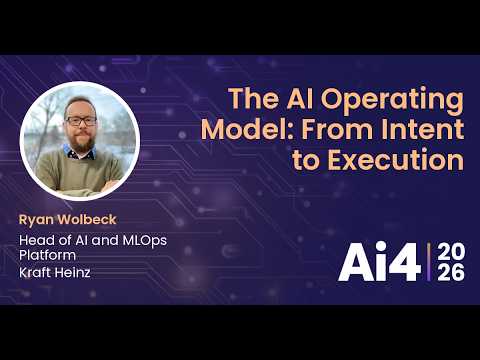
The AI Operating Model: From Intent to Execution With Kraft Heinz — Ai4

Ai4

AI-assisted summary of The AI Operating Model: From Intent to Execution With Kraft Heinz — original source. Check the original for full context.

Source published:

Detailed notes

## Background Published by the Ai4 channel on YouTube on August 19, 2026, this presentation features Ryan Wolbeck, Head of AI and MLOps Platform at Kraft Heinz. According to the video description, the session examines how intent, domain knowledge, governance, and intelligent orchestration unite to build scalable AI operating models that turn strategy into measurable business outcomes beyond isolated experiments.

## TL;DR Ryan Wolbeck argues that raw foundation models are commoditized components, meaning an enterprise's true competitive advantage lies in the operating model engineered around them. He addresses major enterprise failure modes—such as proof-of-concept sprawl, tool-first thinking, and treating human workers as manual 'operating systems' connecting fragmented tools. To solve this, Kraft Heinz implements a multi-layer stack that shifts from brittle prompt engineering to bounded 'goal contracts,' pays down context debt using domain-driven design, and orchestrates specialized domain agents across business workflows. By mapping autonomy against action reversibility and continuously measuring uncertainty, organizations can elevate human domain experts from manual task execution into strategic supervisors of governed, repeatable systems.

## Atmosphere & style The presentation carries a pragmatic, builder-first tone that cuts through corporate AI hype with clear-eyed enterprise realism. Wolbeck speaks with candid, measured authority, approaching agentic AI not as speculative magic, but as a disciplined systems engineering and optimization challenge. The talk feels like an architectural masterclass, balancing technical rigor and probabilistic machine learning concepts with the messy, high-stakes operational realities of a global consumer goods company.

## Key takeaways - [00:04](https://www.youtube.com/watch?v=LxQAGe25QJw&t=4s) Foundation models have become commoditized raw intelligence; sustainable enterprise advantage comes from the operating model built around them rather than the model itself. - [02:38](https://www.youtube.com/watch?v=LxQAGe25QJw&t=158s) Despite high reported AI adoption rates, enterprise scaling is hindered by proof-of-concept sprawl, tool-first thinking, and late-stage, bolted-on governance. - [05:03](https://www.youtube.com/watch?v=LxQAGe25QJw&t=303s) In traditional setups, the human worker acts as the de facto operating system by manually moving context, selecting models, evaluating outputs, and stitching together disjointed steps. - [07:39](https://www.youtube.com/watch?v=LxQAGe25QJw&t=459s) A robust AI operating model stack requires distinct, coordinated layers: Intent, Context, Intelligence, Orchestration, and Governance & Evaluation. - [10:11](https://www.youtube.com/watch?v=LxQAGe25QJw&t=611s) Enterprises must transition from prompt-driven execution to structured goal contracts that define objectives, permitted data sources, tooling boundaries, and automated evaluators. - [11:49](https://www.youtube.com/watch?v=LxQAGe25QJw&t=709s) A governed agentic work loop should resolve to one of three clear terminal states: a supported answer, a budget-constrained best answer, or proactive escalation to a human. - [14:08](https://www.youtube.com/watch?v=LxQAGe25QJw&t=848s) Shifting from prompt engineering to objective engineering means defining falsifiable business outcomes with measurable criteria rather than merely directing what the model should say next. - [16:16](https://www.youtube.com/watch?v=LxQAGe25QJw&t=976s) Applying Domain-Driven Design principles resolves context debt by establishing canonical definitions and specialized domain agents rather than overloading prompts with raw data. - [19:47](https://www.youtube.com/watch?v=LxQAGe25QJw&t=1187s) Cross-domain enterprise orchestration is required to decompose complex business inquiries across functional silos, coordinate domain agents, and preserve an auditable chain of evidence. - [23:20](https://www.youtube.com/watch?v=LxQAGe25QJw&t=1400s) Governance must be embedded upfront into architectural design rather than treated as a post-build gatekeeper, ensuring teams do not repeatedly renegotiate risk tolerances. - [25:42](https://www.youtube.com/watch?v=LxQAGe25QJw&t=1542s) The level of required governance corresponds directly to action reversibility and autonomy; reversible drafting requires minimal oversight, while irreversible transactional actions demand strict human gates. - [27:44](https://www.youtube.com/watch?v=LxQAGe25QJw&t=1664s) Rigorous evaluation must occur continuously across steps, answers, workflows, and business outcomes, with uncertainty explicitly surfaced rather than masked by confident-looking answers. - [30:47](https://www.youtube.com/watch?v=LxQAGe25QJw&t=1847s) AI architecture is fundamentally an optimization problem balancing quality, cost, latency, and risk through deliberate operational trade-offs rather than uniform system configurations. - [35:02](https://www.youtube.com/watch?v=LxQAGe25QJw&t=2102s) Operating models should not eliminate human domain experts, but operationalize surrounding mechanical workflows so humans can supervise objectives and manage high-stakes edge cases. - [37:09](https://www.youtube.com/watch?v=LxQAGe25QJw&t=2229s) Scaling enterprise AI requires leadership to fund context as independent data products and establish explicit intent ownership, decision rights, and quarterly evaluation cadences.

## Detailed walkthrough ### [00:04](https://www.youtube.com/watch?v=LxQAGe25QJw&t=4s) Beyond Demos: Building AI as a Repeatable Enterprise Capability

Ryan Wolbeck introduces himself as the Head of AI and MLOps Platform at Kraft Heinz. His core responsibility revolves around taking generative AI, computer vision, machine learning, and mathematical optimization algorithms, and rapidly prototyping and iterating them with business units to create genuine enterprise automations and workflows. For Wolbeck, the objective goes far beyond proving that a concept simply works in a demo; solutions must be directly useful, integrate naturally into how the enterprise operates, and produce measurable business outcomes that someone in the organization is genuinely willing to own.

Describing himself as "a builder at heart," Wolbeck is actively engaged in the open-source community, particularly contributing to the NGBoost package with Stanford research, where his work focuses heavily on predictive uncertainty. His goal is to balance technical engineering rigor with the practical realities of operationalizing complex AI systems at Kraft Heinz scale, maintaining full accountability for whether these systems actually function in enterprise production.

Wolbeck clarifies that his presentation is intentionally not another talk about choosing the latest model framework, picking a specific foundation model, or selecting an off-the-shelf agentic platform. Because every organization now has commoditized access to increasingly powerful raw intelligence, the significantly harder and far more valuable challenge lies in what organizations build *around* that intelligence: taking messy human intent and translating it into governed, measurable, and reliable execution. Achieving this transition requires far more than an algorithmic model—it requires a comprehensive operating model.

- **Core Mandate:** Transforming generative AI, computer vision, machine learning, and optimization from rapid prototypes into governed business workflows. - **Open-Source Work:** Active contributor to Stanford research on NGBoost, specializing in predictive uncertainty and probabilistic regression. - **The Central Premise:** The model itself is merely a interchangeable component; the enterprise operating model built around it is what creates sustainable competitive advantage.

---

[02:38](https://www.youtube.com/watch?v=LxQAGe25QJw&t=158s) The Enterprise Scaling Gap and the Pitfalls of AI Adoption

Addressing the state of enterprise AI, Wolbeck delivers an intentionally blunt diagnosis: while AI adoption has surged rapidly across corporate environments, true enterprise scaling remains exceptionally rare. Citing industry research, he points out that a McKinsey study revealed 88% of respondents report regular AI usage across their businesses, yet only a third of those organizations have actually begun scaling those applications across the enterprise. Furthermore, Gartner projects that 45% of agentic workflows and AI initiatives currently underway will be cancelled by 2027, driven primarily by escalating compute costs, unclear business value, lack of demonstrable ROI, and inadequate risk controls.

The bottleneck facing enterprises is not a lack of underlying technical capability, but rather the failure to bridge the chasm between an impressive isolated demonstration and a scalable, repeatable capability. At Kraft Heinz, this breakdown historically manifested in three common organizational anti-patterns: 1. **Proof-of-Concept Sprawl:** An explosion of disconnected demos and pilots that lack any shared, standardized path to enterprise production. 2. **Tool-First Thinking:** Teams selecting a vendor, tool, or specific model first, and only then searching across the company for a business problem to retrofit into it. 3. **Bolted-On Governance:** Treating risk, evidence, compliance, and approval requirements as late-stage afterthoughts rather than embedding them into the architecture upfront, forcing teams to painfully "rediscover that risk each time."

For a pilot to mature into a true enterprise capability, it requires explicit ownership, grounding business context, rigorous guardrails, continuous automated evaluation, and an established pathway into day-to-day work.

```mermaid flowchart TD accTitle: The AI Adoption to Execution Gap accDescription: Flowchart illustrating the common failure modes in enterprise AI adoption leading to cancelled initiatives versus the path to production.

subgraph AntiPatterns["Enterprise Anti-Patterns"] A["Proof-of-Concept Sprawl\n(Demos without production paths)"] B["Tool-First Thinking\n(Selecting models before business problems)"] C["Bolted-On Governance\n(Rediscovering risk as an afterthought)"] end

subgraph FailureModes["Industry Failure Modes"] D["Escalating Costs"] E["Unclear Business Value"] F["Inadequate Risk Controls"] end

subgraph Outcome["The Scaling Chasm"] G["45% of Agentic AI Projects\nCancelled by 2027 (Gartner)"] end

A --> D B --> E C --> F D --> G E --> G F --> G ```

---

[05:03](https://www.youtube.com/watch?v=LxQAGe25QJw&t=303s) The Human as the Operating System

Wolbeck observes that enterprise executive conversations almost universally begin with the question: "Which model should we use to solve the problem?" While not an unreasonable query on the surface, it operates at the entirely wrong altitude. Foundation models improve on rapid release cycles, benchmark rankings shift constantly, vendor dynamics change, and pricing structures evolve overnight. Any architectural strategy anchored solely on selecting a specific model product is virtually guaranteed to become obsolete within a single product cycle.

The critical, unexamined reality in modern workflows is that the human worker currently serves as the de facto "operating system" bridging all the gaps. In standard setups, the human holds the business intent in their head, understands the domain nuances, manually selects the model, moves context across fragmented systems, evaluates whether an output is acceptable, retries failed attempts, and synthesizes the final result. Although an AI model might execute an individual task step, the human is left bearing the cognitive burden of the entire end-to-end operating model.

While human control remains essential, forcing workers to manually transport context and enforce operational logic across disjointed steps creates severe organizational bottlenecks. The durable, high-altitude architectural questions organizations must ask instead include: - How should the work actually get done end-to-end? - Who explicitly owns the business objective? - What internal data sources and domain context are authoritative? - Which specific capabilities or tools should be invoked? - Where must a human gatekeeper approve an action versus allowing automated execution? - What exact quality, cost, and risk trade-offs are acceptable? - How will the system empirically verify that the work is complete?

Rather than simply adding more raw intelligence into an organization, the real opportunity is externalizing the implicit logic stored in human heads into an explicit, governed, and repeatable operating architecture.

---

[07:39](https://www.youtube.com/watch?v=LxQAGe25QJw&t=459s) The Layered AI Operating Model Stack

To formalize how enterprise work gets executed, Wolbeck outlines a structured architectural stack designed to externalize the operational logic previously carried by human workers. The stack progresses logically across several foundational layers: - **Intent Layer:** Captures the core business goal, target outcome, and explicit success metrics. - **Context Layer:** Grounds intent in enterprise domain knowledge, definitions, policies, business rules, curated data products, and retrieval systems. - **Intelligence Layer:** Houses the underlying reasoning engines, foundation models, and planning capabilities. - **Orchestration Layer:** Determines the sequential calling of tools and capabilities, manages execution workflows, and orchestrates human-in-the-loop approvals. - **Governance & Evaluation Layer:** Establishes rigid authority boundaries, evaluates output quality against cost thresholds, verifies evidentiary standards, and feeds dynamic updates back into the stack as regulations, models, and data evolve.

Wolbeck clarifies that this stack is not designed to eliminate humans from enterprise operations, but to elevate them. Instead of acting as manual data-movers executing repetitive tasks, humans shift to higher-level governance: defining objectives, establishing decision rights, configuring constraints, and codifying definitions of success.

```mermaid flowchart TD accTitle: The Layered AI Operating Model Stack accDescription: Architectural diagram of the AI operating model layers from Intent to Governance and Adoption.

subgraph Stack["AI Operating Model Architecture"] L1["1. Intent Layer\n(Business goals, outcomes, success metrics)"] L2["2. Context Layer\n(Domain knowledge, policies, data products, retrieval)"] L3["3. Intelligence Layer\n(Foundation models, reasoning, planning)"] L4["4. Orchestration Layer\n(Tool calling, workflows, human approval gates)"] L5["5. Governance & Evaluation Layer\n(Authority boundaries, cost/quality verification, adaptation)"] end

L1 --> L2 L2 --> L3 L3 --> L4 L4 --> L5 L5 -.->|"Feedback & Policy Updates"| L1 ```

---

[10:11](https://www.youtube.com/watch?v=LxQAGe25QJw&t=611s) Shifting from Prompt-Driven Execution to Bounded Goal Contracts

Traditional AI interactions remain heavily prompt-driven: a person crafts a query, selects background data, manually inspects the output, tries alternative prompts if the response falls short, and transfers outputs into downstream systems. While functional for ad-hoc productivity, prompt-driven interaction hits a hard operational ceiling bounded by the human worker's cognitive capacity to decompose, verify, and synthesize information across enterprise platforms at business speed.

To break through this ceiling, Kraft Heinz is transitioning from prompt-driven execution toward an architecture governed by explicit "Goal Contracts." Under a goal contract, the workflow is framed not around brittle prompt text, but around structured parameters: - **Objective & Success Criteria:** Clear definitions of the end state and empirical criteria required for completion. - **Authoritative Context:** Pre-approved enterprise data sources, policies, and schemas the system is permitted to reference. - **Permitted Tooling:** Explicitly authorized capabilities, APIs, and systems the agent may invoke. - **Operational Guardrails & Budgets:** Hard boundaries governing risk tolerances, compute budgets, and execution limits. - **Evidence Trails & Evaluators:** Automated evaluation mechanisms that assess output validity against an auditable decision trail.

By establishing goal contracts, systems can run within tightly bounded loops, automatically reasoning and executing tasks while preserving full transparency and auditability for every operational decision.

[11:49](https://www.youtube.com/watch?v=LxQAGe25QJw&t=709s) The Governed AI Work Loop and Shifting the Human Role

The mechanics of an agentic workflow rely on a continuous loop where the system plans an action, interacts with source systems, observes the resulting evidence, and iterates until it satisfies an explicit "goal contract." When executing against this contract, the agentic process generally terminates in one of three predictable outcomes:

```mermaid flowchart TD accTitle: Governed AI Work Loop Outcomes subgraph Loop["Governed Execution Loop"] P["Plan Action"] --> E["Execute & Query Sources"] E --> O["Observe Evidence"] O --> C{"Evaluate Goal Contract"} end

subgraph Outcomes["Terminal States"] C -->|"Sufficient Evidence"| O1["Supported Answer"] C -->|"Budget / Hop Limit Reached"| O2["Constrained Best Answer"] C -->|"High Ambiguity / Scope Exceeded"| O3["Escalate to Human"] end ```

1. **Sufficient Support:** The agent reaches a thoroughly validated answer based on the accumulated chain of evidence. 2. **Budget-Constrained Resolution:** The system identifies a cost-effective path to an acceptable answer within strict operational limits, such as capping execution at four hops between different agents. 3. **Controlled Escalation:** If ambiguity is too high, critical evidence is missing, or the required decision exceeds the agent's predefined authority boundaries, the system escalates to a human rather than "pretending to know and creating some kind of convincing answer."

While delegating multi-step execution to an agent can initially feel "uncomfortable and autonomous," it does not equate to handing uncontrolled autonomy over to AI. Instead, system design replaces open-ended Q&A prompts with implicit behavioral control. This governed loop relies on hard stopping conditions, systematic evidence capture, token and compute budgets, and risk controls.

The objective is not to eliminate human oversight, but to relieve employees from acting as the manual "operating system" that shuttles context and data from one siloed step to the next. Human responsibility moves upstream toward defining system objectives, establishing authority thresholds, designing boundary conditions, and managing escalations.

- **Three Core Stopping States:** Supported answer, budget-bounded acceptable answer (e.g., maximum four agent hops), or proactive escalation. - **Role Reallocation:** The human transitions from manual task runner to governance architect defining decision rights and operating constraints.

---

[14:08](https://www.youtube.com/watch?v=LxQAGe25QJw&t=848s) Objective Engineering: Defining Falsifiable Business Intent

The effectiveness of an AI operating model is bounded by the quality of intent provided to it. True business intent is not a vague mandate to adopt technology, but a clear, falsifiable statement of the business outcome the system is designed to produce. A generic prompt such as *"let's use AI for replenishment"* fails to provide actionable guidance. In contrast, framing the objective as *"reducing stockouts during peak seasonal demand measured by weekly category growth while keeping planner approval in place above a defined threshold"* creates an unambiguous goal contract that an agent can optimize against across its evaluation chain.

```mermaid flowchart LR accTitle: Prompt Engineering vs Objective Engineering subgraph PE["Prompt Engineering"] P1["Prompt"] --> P2["Tells the model what to SAY next"] end subgraph OE["Objective Engineering"] O1["Intent + Constraints"] --> O2["Tells the system how to PURSUE an outcome"] end ```

To establish a functional goal contract, an intent statement must answer three fundamental questions: 1. What specific business outcome must change? 2. What metric validates that change? 3. What constraints and approval boundaries make the final outcome acceptable?

This distinction marks the necessary evolution from prompt engineering to "objective engineering." Where a prompt merely tells a language model what to generate next, an objective directs the entire architecture on how to navigate trade-offs to achieve a tangible result. Without explicit criteria for success, downstream systems inherit ambiguity, because "vague intent creates vague intelligence and vague outcomes."

- **Falsifiable Goals:** Moving from technology experimentation to measurable outcome criteria (e.g., measuring stockout reduction against weekly category growth in hydration or packaged food categories). - **The Core Rule:** A prompt guides immediate text generation; an objective orchestrates multi-agent outcome pursuit.

---

[16:16](https://www.youtube.com/watch?v=LxQAGe25QJw&t=976s) Domain-Driven Design and Paying Down Context Debt

Once an objective is defined, the system must interpret what that objective means within the specific enterprise. Applying Domain-Driven Design (DDD) principles ensures that general foundation models understand localized corporate vocabulary. While a public model understands standard English terms like "customer," "forecast," "margin," or "share," those concepts carry radically different definitions, business rules, and authoritative source systems across different bounded contexts—such as sales operations versus supply chain logistics.

In traditional setups, highly skilled employees hold this context in their heads. They know which database to trust, which business rules apply to a specific margin calculation, and which stakeholder owns the data. Because experienced teams make this navigation look effortless, organizations consistently underestimate the complex domain reasoning required to solve daily operational problems.

```mermaid flowchart TD accTitle: Resolving Context Debt with Domain Architecture subgraph Debt["Context Debt Vulnerabilities"] D1["Conflicting Definitions"] D2["Stale Documentation"] D3["Raw Ingested Data Dumps"] end subgraph DDD["Explicit Domain Architecture"] M1["Canonical Data Products"] M2["Domain-Specific Agents (e.g. Snowflake Cortex)"] M3["Explicit Policy & Authority Rules"] end Debt -->|"Refactored Into"| DDD ```

To automate these processes, organizations must pay down "context debt"—the friction caused by conflicting terminology, stale documentation, unclear data ownership, and raw database dumps. Building domain-specific data products and deploying specialized agents (such as domain-bounded Snowflake Cortex agents) delivers curated, authoritative context at the exact step it is needed, rather than stuffing unvetted information into a single massive prompt.

- **Context Debt Definition:** Structural friction arising from conflicting terminology, undocumented business logic, unassigned data ownership, and poorly curated data sources. - **Architectural Shift:** Moving beyond basic Retrieval-Augmented Generation (RAG) by enforcing canonical definitions, explicit decision rights, and specialized domain agents. - **Key Insight:** "Large language models understand language, but domain models teach them the business."

---

[19:47](https://www.youtube.com/watch?v=LxQAGe25QJw&t=1187s) Enterprise Orchestration and Cross-Domain Synthesis

Orchestration is the operational core where agents, foundational models, domain tools, human approval steps, and business workflows merge into an integrated enterprise capability. Sustainable enterprise advantage lives within orchestration because critical business questions rarely conform to clean functional or data silos.

```mermaid flowchart TD accTitle: Cross-Domain Enterprise Orchestration Flow Q["Enterprise Query: Why are volume share movers declining?"]

subgraph Orch["Orchestration Layer"] D["Deconstruct into Subordinate Questions"] R["Route Tasks to Specialized Capabilities"] end

subgraph Domains["Specialized Domain Capabilities"] S1["Sales & Consumption Data<br/>(Beverages vs. Mac & Cheese)"] S2["Product & Attribute Signals<br/>(Ingredients, Packaging, Seed Oils)"] S3["Consumer Sentiment Data<br/>(Reviews, Complaints, Taste Perceptions)"] end

subgraph Synth["Synthesis & Verification"] E["Assemble Governed Context & Evidence Chain"] V{"Is Evidence Sufficient?"} V -->|"Yes"| A["Synthesized Business Narrative"] V -->|"No"| ESC["Escalate / Retry"] end

Q --> D D --> R R --> S1 & S2 & S3 S1 & S2 & S3 --> E E --> V ```

Consider an executive question in a consumer packaged goods company: *"Over the last 13 weeks, why are our worst volume share movers declining? Is that because of distribution, customer perception, or formulation?"* Answering this single inquiry spans multiple disparate domains: - **Sales and Consumption Metrics:** Pinpointing which brands or categories (e.g., beverages versus Kraft Mac & Cheese) lost share and whether the losses were tied to seasonal timing or distribution gaps. - **Product and Attribute Signals:** Analyzing formulation changes, ingredient panels, packaging updates, nutritional information, and emerging market topics (such as consumer sentiment regarding seed oils). - **Customer Perception and Complaints:** Evaluating customer service tickets, digital reviews, taste perception shifts, or emerging packaging defects.

No single AI agent possesses the holistic context required to analyze all of these areas at once. Orchestration breaks the overarching question down into subordinate tasks, routes each piece to the appropriate domain agent or tool, transfers governed context between stages, verifies evidence sufficiency, and synthesizes a defensible narrative—all while preserving a clear chain of provenance. While skeptics might ask if this is simply "workflow automation with an LLM in the middle," the true enterprise value lies in establishing a repeatable, governed pipeline capable of synthesizing complex cross-functional evidence.

- **Cross-Domain Query Decomposition:** Breaking high-level enterprise questions into specialized investigations across sales, product formulations, and consumer sentiment. - **Chain of Evidence:** Preserving end-to-end data lineage and reasoning trails throughout the multi-agent routing and synthesis lifecycle.

[23:20](https://www.youtube.com/watch?v=LxQAGe25QJw&t=1400s) Governance as an Upfront Design Principle

Orchestration does not aim to replace human domain expertise; instead, it coordinates that expertise efficiently within approved business boundaries. While a business question may sound simple and singular on the surface, the underlying work is inevitably distributed across multiple specialized domain experts. Intelligent orchestration codifies that human workflow knowledge into a durable, repeatable enterprise capability.

Once an automated system begins coordinating actions and executing work, controls that once resided purely inside human judgment must become explicit. In many organizations, governance is treated as a gatekeeping body that only arrives after a system has been built, but that approach is backwards. In traditional human-operated workflows, controls are informal and intuitive: an experienced employee intrinsically knows which data sets are off-limits, which actions require managerial sign-off, which recommendations carry too much risk to execute without verification, and when to pause and ask for help. In an AI operating model, these implicit boundaries must be formalized upfront in the architecture's "goal contract"—covering risk classification, access controls, data handling, tool permissions, and evidence capture.

```mermaid flowchart TD accTitle: Explicit Governance Architecture subgraph HumanWorkflow["Traditional Human Workflow"] A["Informal Judgment"] --> B["Implicit Data & Action Boundaries"] B --> C["Ad-Hoc Approvals & Pauses"] end subgraph AIOperatingModel["AI Operating Model Goal Contract"] D["Risk Classification"] --> E["Access & Data Controls"] E --> F["Tool Permissions & Scopes"] F --> G["Automated Evidence Capture"] end ```

Designing governance into the foundation does not slow development down; rather, it prevents individual product teams from having to renegotiate risk tolerances from scratch for every single use case. When boundaries are well-defined, teams can build faster and scale safely.

---

[25:42](https://www.youtube.com/watch?v=LxQAGe25QJw&t=1542s) The Autonomy vs. Reversibility Risk Matrix

A practical framework for establishing AI governance separates the degree of granted autonomy from the reversibility of the resulting action. While full enterprise risk management must also weigh severity, data sensitivity, affected populations, and recovery mechanisms, evaluating autonomy against reversibility serves as the fundamental design test.

```mermaid flowchart TD accTitle: Autonomy versus Reversibility Matrix subgraph LowAutonomy["Assisted / Low Autonomy"] AR["Reversible Action<br/>• Low overhead automation<br/>• e.g., Draft a message"] AI["Irreversible Action<br/>• Structured human review<br/>• e.g., Recommend inventory order"] end subgraph HighAutonomy["Autonomous / High Autonomy"] TR["Reversible Action<br/>• Heavy monitoring & audits<br/>• e.g., Temporary routing change"] TI["Irreversible Action<br/>• Explicit approval required<br/>• e.g., Place order / Stop assembly line"] end ```

There is a vast operational difference between systems that recommend or draft actions and systems that execute them in the physical or transactional world: - **Drafting vs. Sending:** A system that drafts an email carries minimal risk, whereas a system that transmits it autonomously requires higher control. - **Recommending vs. Ordering:** An AI that recommends an inventory replenishment order can operate with standard review, but an AI authorized to execute purchase orders directly requires rigorous guardrails. - **Detecting vs. Intervening:** In manufacturing computer vision systems, detecting a packaging defect is fundamentally different from a system empowered to halt an entire physical assembly line.

Reversible, assisted tasks can be automated with minimal overhead, while irreversible actions demand structured human intervention and explicit approval gates. The operating model defines the exact authority granted to the model, recognizing that "risk lives in the action, not necessarily the algorithm."

---

[27:44](https://www.youtube.com/watch?v=LxQAGe25QJw&t=1664s) Explicit Evaluation and Representing Uncertainty

Evaluation is what transforms an impressive proof-of-concept demo into a defensible, production-grade operating claim for the enterprise. It cannot exist merely as a one-time deployment gate because underlying models drift, operational data shifts, user interaction patterns evolve, and business rules change over time. In interactive prompt-driven workflows, humans continually act as implicit evaluators—verifying answers against domain knowledge, asking clarifying questions, and determining fitness for use. To delegate higher-order work to AI systems, evaluation must be decomposed into explicit layers:

* **Step Level:** Verifying whether each individual sub-tool or discrete action executed properly. * **Answer Level:** Checking whether the generated conclusion is factual, supported by evidence, and aligned with user intent. * **Workflow Level:** Ensuring the agent traversed the permitted execution path, stayed within context limits, and obeyed governance controls. * **Outcome Level:** Measuring whether the system demonstrably moved the key business metric it was deployed to improve.

This discipline parallels probabilistic machine learning methods like NGBoost, which outputs a predictive probability distribution rather than a single point estimate to express uncertainty. In generative and agentic systems, "a confident-looking answer is not the same as a well-supported answer." For high-stakes, irreversible tasks, the system must accurately represent its uncertainty, surface supporting evidence, and decide whether to retry or escalate. Furthermore, financial measurement must shift away from cost per token toward the true cost per acceptable outcome.

---

[30:47](https://www.youtube.com/watch?v=LxQAGe25QJw&t=1847s) Architecture as an Optimization of Trade-offs

No single system configuration can simultaneously maximize output quality, minimize operating cost, maximize throughput speed, and eliminate operational risk. Balancing these competing objectives requires deliberate architectural trade-offs:

| Dimension | Architectural Levers & Requirements | Trade-offs & Downstream Impacts | |:--- |:--- |:--- | | **Quality** | Multi-step reasoning chains, comprehensive evidence retrieval, redundant models, mandatory peer reviews. | Higher latency, increased compute cost per query. | | **Cost** | Compact/distilled models, truncated context windows, strict retry limits, minimized tool invocations. | Potential loss in nuance, lower accuracy on edge cases. | | **Speed** | Streamlined execution paths, asynchronous operations, fewer validation checkpoints. | Reduced verification depth, increased risk of uncaught errors. | | **Risk** | Multi-tier human approval gates, detailed audit logging, strict verification steps. | Increased workflow latency, potential operational bottlenecks. |

Human experts balance these trade-offs instinctively, knowing when an immediate approximation suffices versus when high stakes justify deep investigation and peer consultation. An AI operating model formalizes this judgment by assigning tailored reasoning budgets, confidence thresholds, latency targets, and escalation rules to specific use cases. Applying identical model configurations, cost budgets, and controls to every workload optimizes for nothing deliberately. Modern AI architecture is fundamentally an optimization problem, turning intuitive expert trade-offs into consistent, scalable system designs.

---

[32:47](https://www.youtube.com/watch?v=LxQAGe25QJw&t=1967s) The AI Operating Model Maturity Curve

Enterprise AI maturity does not depend on the sheer number of pilot projects an organization has launched; it is defined by the repeatability with which business intent is transformed into controlled, governed execution.

```mermaid flowchart LR accTitle: AI Operating Model Maturity Curve A["Ad-Hoc<br/>Isolated pilots, fragmented tools"] --> B["Managed<br/>Shared platform, bespoke use cases"] B --> C["Orchestrated<br/>Coordinated domains & explicit decision rights"] C --> D["Adaptive<br/>Dynamic evolution of models & business needs"] ```

- **Ad-Hoc:** Isolated pilot experiments built on disparate infrastructure with no common operating standards. - **Managed:** Centralized platforms and foundational governance exist, but each implementation remains largely custom and siloed. - **Orchestrated:** Coordinated capabilities operating across business domains with clearly defined decision rights and automated controls. - **Adaptive:** Resilient enterprise platforms that dynamically adapt workflows, models, and evidence as underlying business requirements evolve.

Most enterprises reside between the Ad-Hoc and Managed stages, trailing behind their external marketing narratives. Transitioning across maturity stages is rarely solved by simply procuring another foundational model; it requires strengthening the underlying operational model.

---

[34:01](https://www.youtube.com/watch?v=LxQAGe25QJw&t=2041s) Case Study: Peak Demand Planning and the Human "Operating System"

To illustrate how these principles apply to core operations, consider a composite supply chain challenge: reducing out-of-stock incidents during peak seasonal demand (measured weekly by category) without accumulating unacceptable excess inventory.

In a traditional enterprise operating environment, the human demand planner functions as the entire "operating system." The planner synthesizes disparate inputs—sales history, promotional calendars, vendor lead times, warehouse constraints, and corporate inventory policies. They assess which algorithmic forecasts to trust, spot anomalies, decide whether to adjust or release purchase orders, monitor downstream fulfillment, and refine the heuristic rules for the subsequent planning cycle. Building an AI operating model requires translating this implicit, human-orchestrated workflow into explicit, multi-agent capabilities that reason, verify, and act within defined risk boundaries.

[35:02](https://www.youtube.com/watch?v=LxQAGe25QJw&t=2102s) Operationalizing Workflows Around Human Experts

A critical misconception about AI orchestration is the belief that the goal is to automate the human planner out of existence. The real objective is not to remove the expert, but to capture and operationalize all the repeatable, mechanical parts of the workflow that surround them.

```mermaid flowchart TD accTitle: Multi-Layer AI Operating Architecture accDescr: Diagram showing how context, intelligence, orchestration, governance, evaluation, and adoption layers coordinate to support the human planner.

subgraph DataAndReasoning["Context & Intelligence"] A["Context Layer\n(Trusted info & business rules)"] B["Intelligence Layer\n(Forecasting, detection, reasoning)"] A --> B end

subgraph ControlAndExecution["Orchestration & Governance"] C["Orchestration Layer\n(Drafts recommendations & evidence)"] D["Governance Layer\n(Supplier limits, spending, access)"] B --> C D -. Enforces constraints.-> C end

subgraph HumanSupervision["Human-in-the-Loop"] E["Human Planner\n(Supervises objectives & overrides)"] C -->|Presents thresholded decisions| E end

subgraph FeedbackLoop["Feedback & Optimization"] F["Evaluation Layer\n(Error rates, overrides, stockouts)"] G["Adoption Layer\n(Updates assumptions & goal contracts)"] E --> F F --> G G -. Updates.-> A end ```

The system operates across coordinated architectural layers: - **Context Layer**: Supplies trusted domain information, metadata, and business rules. - **Intelligence Layer**: Combines specialized capabilities like demand forecasting, execution detection, and complex reasoning. - **Orchestration Layer**: Gathers evidence, synthesizes findings, and drafts recommendations against defined confidence thresholds. - **Governance Layer**: Directly enforces supplier constraints, spending thresholds, volume limits, data access controls, and sign-off rights. - **Evaluation Layer**: Continuously tracks forecast errors, stockout rates, excess inventory, and logs every planner override versus direct acceptance. - **Adoption Layer**: Analyzes recurring misses or frequent manual overrides to refine the underlying assumptions in the goal contract.

Under this operating model, the expert does not disappear from the loop; their role shifts from manually executing every mechanical step to supervising the overall objective, handling edge cases and constraint shifts, and making high-stakes, consequential decisions. The business value does not stem from a single clever prompt or isolated agent, but from coordinating specialized agents around a rigorously governed business objective.

[37:09](https://www.youtube.com/watch?v=LxQAGe25QJw&t=2229s) Leadership Responsibilities for Enterprise AI

Funding and scaling these systems creates distinct, non-negotiable leadership responsibilities rather than discretionary "engineering party favors." To generate real enterprise ROI, executive sponsors must establish governance and operating parameters before deploying systems to production:

- **Intent and Outcome Ownership**: A designated business sponsor must directly own the operational and financial results, rather than merely serving as a passive sign-off authority for technology procurement. - **Context as a Funded Product**: Domain knowledge, unified business definitions, metadata registries, retrieval infrastructure, and baseline data quality cannot remain hidden costs buried inside individual use cases. Data products must receive independent funding so they can ladder directly into broad orchestration systems. - **Decision Rights and Thresholds**: Operational boundaries, spending caps, and escalation triggers for consequential workflows must be made fully explicit before launch. - **Evaluation Cadence**: Systems and autonomous agents should be evaluated on a disciplined quarterly cycle to decide whether to expand, promote, re-tune, or decommission them. - **Adoption and Governance Authority**: Explicit leadership authority must be assigned over the budget, evolving operating models, and regulatory compliance requirements.

[38:34](https://www.youtube.com/watch?v=LxQAGe25QJw&t=2314s) Core Takeaways: Models are Commodities, Operating Models are Advantages

Building lasting value requires shifting organizational focus from model experimentation to system design.

```mermaid flowchart LR accTitle: From Raw Models to Operating Leverage accDescr: Flowchart contrasting raw model commoditization with enterprise operating models and workflow design.

subgraph Commodity["Commoditized Layer"] M["Foundation Models\n(High capability, low differentiation)"] end

subgraph Advantage["Durable Enterprise Advantage"] O["Operating Model\n(Intent, Context, Routing & Governance)"] W["High-Value Workflow\n(Observed human expertise)"] end

M --> O W --> O O --> R["Compounding Business Outcomes"] ```

- **Models are commodities**: While models are not identical, their general intelligence and rapid substitution across providers mean that raw access to foundation models provides zero durable competitive moat. - **The operating model is the durable advantage**: Enterprise value compounds by codifying business intent, rich domain context, routing logic, and guardrails into an integrated operating structure. - **Start with the stack, not the model**: Organizations must select a single high-impact workflow, observe how top human operators navigate it, explicitly capture the context and decision criteria, and deliberately engineer all seven architectural layers to measure and scale performance.

[39:37](https://www.youtube.com/watch?v=LxQAGe25QJw&t=2377s) Moving the Human to the Right Level of the System

For the past several years, enterprise AI initiatives focused heavily on turning individual employees into prompt engineers. In that paradigm, the human worker remains the de facto operating system—holding the objective in their head, assembling domain context, hand-picking tools, sequencing queries, evaluating errors, and producing the final synthesis.

The next evolutionary phase is not about removing humans from the loop, but elevating them to the correct level of abstraction. Instead of micromanaging and operating every intermediate execution step, humans should define the governing objectives, specify operational boundaries, determine decision rights, and establish clear criteria for success.

While reasoning models will inevitably become faster, cheaper, and more ubiquitous, the fundamental enterprise challenge remains constant: translating human intent into execution that is deeply grounded in domain context, orchestrated across diverse tools and teams, and governed according to the real-world stakes of the outcome. "Models are intelligence, operating models are an advantage."

## Notable quotes > [05:03](https://www.youtube.com/watch?v=LxQAGe25QJw&t=303s) Which model should we use to solve the problem? — Ryan Wolbeck

> [11:49](https://www.youtube.com/watch?v=LxQAGe25QJw&t=709s) pretending to know and creating some kind of convincing answer. — Ryan Wolbeck

> [14:08](https://www.youtube.com/watch?v=LxQAGe25QJw&t=848s) let's use AI for replenishment — Ryan Wolbeck

> [14:08](https://www.youtube.com/watch?v=LxQAGe25QJw&t=848s) vague intent creates vague intelligence and vague outcomes. — Ryan Wolbeck

> [16:16](https://www.youtube.com/watch?v=LxQAGe25QJw&t=976s) Large language models understand language, but domain models teach them the business. — Ryan Wolbeck

> [19:47](https://www.youtube.com/watch?v=LxQAGe25QJw&t=1187s) Over the last 13 weeks, why are our worst volume share movers declining? Is that because of distribution, customer perception, or formulation? — Ryan Wolbeck

> [25:42](https://www.youtube.com/watch?v=LxQAGe25QJw&t=1542s) risk lives in the action, not necessarily the algorithm. — Ryan Wolbeck

> [27:44](https://www.youtube.com/watch?v=LxQAGe25QJw&t=1664s) a confident-looking answer is not the same as a well-supported answer. — Ryan Wolbeck

> [37:09](https://www.youtube.com/watch?v=LxQAGe25QJw&t=2229s) engineering party favors. — Ryan Wolbeck

> [39:37](https://www.youtube.com/watch?v=LxQAGe25QJw&t=2377s) Models are intelligence, operating models are an advantage. — Ryan Wolbeck

## Mentioned Ryan Wolbeck, Kraft Heinz, Ai4, Stanford, NGBoost, McKinsey, Gartner, Snowflake Cortex, Kraft Mac & Cheese

## Video description Ryan Wolbeck - Head of AI and MLOps Platform, Kraft Heinz

As AI evolves beyond chatbots and copilots, organizations need more than powerful models.. they need a repeatable operating model that consistently turns business intent into measurable outcomes.

This session explores how intent, domain knowledge, governance, and intelligent orchestration come together to create scalable AI systems that deliver real business value. Through practical examples, we'll examine how organizations can balance quality, cost, risk, and adaptability while building solutions that remain resilient as technologies, models, and business needs continue to evolve.

Attendees will leave with a framework for designing AI operating models that connect strategy to execution, enabling AI to move from isolated experiments to an enterprise capability.

[Source](https://www.youtube.com/watch?v=LxQAGe25QJw)

中文简报

AI 运营模型:卡夫亨氏从意图到执行的实践 Ryan Wolbeck 认为,原始基础模型已成为大宗商品化的组件,这意味着企业的真正竞争优势在于围绕这些模型构建的运营模型。他指出了企业的主要失败模式——例如概念验证泛滥、工具优先思维,以及将人类员工当作连接碎片化工具的手动“操作系统”。为了解决这些问题,卡夫亨氏(Kraft Heinz)部署了一套多层技术栈:从脆弱的提示词工程转向有约束的“目标契约”,利用领域驱动设计偿还上下文债务,并在业务工作流中编排专用的领域智能体。通过权衡自主性与行动可逆性,并持续衡量不确定性,企业可以将人类领域专家从手动执行任务的角色,提升为受治理、可重复系统的战略监督者。 基础模型已成为大宗商品化的原始智能;企业的持久优势来自围绕它们构建的运营模型,而非模型本身。 (0:04) 尽管据报道 AI 采用率很高,但概念验证泛滥、工具优先思维以及后期强行拼凑的治理阻碍了企业的规模化推广。 (2:38) 在传统架构中,人类员工充当着事实上的操作系统,手动传递上下文、选择模型、评估输出,并将脱节的各个步骤拼凑在一起。 (5:03) 一个强大的 AI 运营模型技术栈需要清晰且协调的分层架构:意图层(Intent)、上下文层(Context)、智能层(Intelligence)、编排层(Orchestration)以及治理与评估层(Governance & Evaluation)。 (7:39) 企业必须从提示词驱动的执行模式转变为结构化的目标契约,明确界定目标、允许的数据源、工具边界和自动评估器。 (10:11)

Reading summary

Ryan Wolbeck, Head of AI and MLOps Platform at Kraft Heinz, argues that raw foundation models are commoditized components that offer no durable enterprise advantage on their own. Instead, sustainable enterprise value requires an operating model that externalizes implicit human judgment into governed, bounded, and measurable execution stacks. The Enterprise AI Scaling Bottleneck (2:38) Enterprise adoption of artificial intelligence frequently stalls between initial proofs-of-concept and production capabilities. Wolbeck cites a McKinsey survey showing that while 88% of respondents report regular AI usage in their businesses, only one-third have scaled those applications across the enterprise. Furthermore, Gartner forecasts that 45% of agentic workflows and AI initiatives currently underway will be cancelled by 2027, driven by escalating compute expenses, ambiguous business value, lack of demonstrable ROI, and inadequate risk controls. At Kraft Heinz, this scaling gap historically manifested in three anti-patterns: proof-of-concept sprawl without clear production paths, tool-first thinking that selects models before identifying real business problems, and bolted-on governance where risk and compliance are evaluated as late-stage afterthoughts rather than structural architectural requirements. Replacing Human Glue with Goal Contracts (5:03) In typical corporate setups, human workers serve as the de facto "operating system" bridging fragmented systems. The worker holds the business objective in mind, moves context across siloed applications, handles tool selection, retries failed model prompts, and verifies outputs. Relying on humans to manually shuttle context creates operational bottlenecks bounded by individual cognitive capacity. To move beyond brittle prompt engineering, Wolbeck advocates structuring workflows around "Goal Contracts" and "objective engineering." Rather than directing an LLM on what to say next, an objective contract establishes falsifiable outcomes (such as reducing seasonal stockouts measured by weekly category growth), designates authorized enterprise data sources, sets hard tool permissions, and specifies operational guardrails like compute budgets. Governed execution loops then iterate until they reach a supported answer, hit a budget ceiling (such as four inter-agent hops), or explicitly escalate ambiguous cases to a human supervisor instead of hallucinating a resolution. Domain-Driven Design and Context Debt (16:16) General foundation models grasp common language, but they lack localized corporate context. Concepts like "margin," "customer," or "forecast" carry divergent definitions and conflicting business rules across separate departments, such as sales versus supply chain operations. To automate operational reasoning without stuffing massive, uncurated data dumps into single prompts, enterprises must resolve "context debt"—the structural friction caused by stale documentation, unassigned data ownership, and contradictory terminology. Applying Domain-Driven Design (DDD) principles allows organizations to deploy canonical data products and specialized domain agents (such as domain-bounded Snowflake Cortex agents). When an executive query requires multi-domain synthesis—such as diagnosing why volume share movers are declining across beverages or packaged foods—an orchestration layer deconstructs the problem, routes sub-tasks across sales metrics, ingredient attributes, and customer sentiment signals, and synthesizes a verified narrative while preserving an audit trail of evidence. Risk Governance Across Autonomy and Reversibility (23:20) Enterprise risk resides primarily in the action being taken rather than the algorithm generating the suggestion. Wolbeck outlines a governance design matrix that evaluates system autonomy against action reversibility. Low-risk, reversible tasks—such as drafting an email—can run with light operational overhead. In contrast, irreversible actions in the physical or transactional world—such as executing purchase orders or halting a factory assembly line based on computer vision defect detection—demand strict validation checkpoints and mandatory human approvals. Formalizing these trade-offs prevents organizations from applying identical cost, quality, and latency budgets to every workload. Because evaluation cannot be treated as a one-time deployment gate, architectures must continuously track step-level tool execution, answer-level factual grounding, workflow compliance, and real-world business outcome metrics. Reframing Human Roles and Leadership Accountability (35:02) Operationalizing complex workflows does not eliminate human experts; it abstracts them out of repetitive, manual context transport. In a peak demand planning scenario, specialized agents can draft replenishment proposals against verified forecasting models and supplier constraints, while the human planner evaluates edge cases, manages exceptions, and adjusts top-level business assumptions. Scaling this operating model requires non-negotiable executive responsibilities. Business sponsors must directly own operational and financial outcomes rather than merely signing off on IT procurement. Furthermore, unified business registries, metadata, and context layers must be funded as distinct core products rather than treated as incidental project costs, accompanied by quarterly evaluation cadences to decommission, re-tune, or scale active autonomous agents. Wolbeck concludes that as raw intelligence and reasoning models become cheaper and commoditized across providers, competitive differentiation shifts entirely to the operating model. Organizations must focus on capturing human domain expertise, formalizing explicit goal contracts, and funding foundational context layers to govern AI execution reliably in production.

精炼阅读摘要

卡夫亨氏(Kraft Heinz)AI 与 MLOps 平台主管 Ryan Wolbeck 指出,基础模型正在成为可快速替换的大宗商品,企业的核心竞争壁垒不在于挑选算法或平台,而在于围绕模型构建企业级 AI 操作模型(Operating Model),从而将非结构化的人类意图转化为受控、可衡量且具备确定性的业务执行。 企业规模化鸿沟与人肉操作系统困境 (2:38) 企业 AI 应用正呈现出采纳率高但规模化推进艰难的割裂局面。Wolbeck 援引麦肯锡的研究数据称,尽管有 88% 的受访者表示其企业已常规使用 AI,但仅有约三分之一开始在全企业范围内推广应用。与此同时,Gartner 预测到 2027 年,目前正在进行的智能体工作流及 AI 项目中将有 45% 面临取消,其核心症结在于算力成本失控、业务价值模糊、投资回报率缺失以及风险控制手段不足。 卡夫亨氏在实践中总结出阻碍规模化的三种典型组织反模式:概念验证(PoC)无序蔓延导致缺乏通往生产环境的标准化路径;以工具为先的技术选型思维,在未明确业务问题前便预先锁定供应商或模型;以及将合规与治理作为事后修补的附加项。在传统工作模式下,人类员工被迫充当系统间的“人肉操作系统”,在头脑中维系意图、手动搬运上下文、试错重试并整合输出,这种隐性运作机制直接构成了企业迈向自动化与规模化的关键瓶颈。 从提示词转向受控目标契约 (10:11) 依赖用户逐次输入提示词的交互方式存在明显的承载上限,其效率受限于员工手动分解任务、核验信息与系统搬运数据的认知负荷。为此,卡夫亨氏正在推动从提示词工程(Prompt Engineering)向“目标工程”(Objective Engineering)演进。提示词仅指示模型生成下一个文本,而目标工程则以明确、可证伪的业务成果为导向,例如将模糊的“利用 AI 进行补货”重构为“在维持计划员特定审批阈值的前提下,以品类周度增长为衡量指标降低旺季缺货率”。 系统执行由此建立在结构化的“目标契约”(Goal Contracts)之上,明确界定最终业务指标、经核准的权威上下文来源、允许调用的工具与 API 范围、算力预算以及审计证据链。在此机制下,智能体工作流运行于闭环回路中,并最终收敛至三种确定状态之一:形成具备完整证据链支持的高置信度答案;在硬性预算限制内(例如最多跨智能体跳转 4 次)生成次优约束解;或在面对高歧义度与超权限场景时主动升级转交人类专家处理,杜绝生成看似合理却缺乏事实依据的幻觉结论。 领域驱动设计与偿还上下文债务 (16:16) 公开基础模型能够掌握通用语言逻辑,但无法理解企业的具体运作逻辑。销售运营部门与供应链物流部门对于“客户”、“毛利”、“预测”或“份额”等常用术语可能存在完全相悖的定义规则、数据口径与权威存储系统。当这些背景逻辑仅留存在资深员工的经验认知中时,系统便会累积严重的“上下文债务”(Context Debt),表现为术语口径冲突、文档陈旧以及原始数据库堆砌。 卡夫亨氏应用领域驱动设计(Domain-Driven Design, DDD)理念,将隐性业务规则重构为标准化的规范数据产品,并部署限定领域的专业智能体(如基于 Snowflake Cortex 构建的领域智能体)。在解决跨领域战略归因时(例如分析过去 13 周特定品类销量份额下滑是源于分销渠道受阻、配方变更还是消费者负面评价),智能编排层将复杂大问题拆解为子任务,分发给销售、产品属性及用户情绪等专业领域智能体处理,并在各阶段维持严格的上下文传递与数据血缘,从而生成具备可解释性的业务归因报告。 自主权与可逆性矩阵驱动的分层治理 (25:42) 治理不能充当交付末期的合规关卡,而必须作为系统架构的底层设计原则。Wolbeck 提出了以“系统自主权程度”与“业务行为可逆性”为核心维度的风险评估矩阵:对于生成草稿或低风险推荐等高可逆性、辅助性场景,系统可以采取轻量化监控;但对于直接下发采购订单、调整交易路径或触发物理装配线停机的不可逆操作,系统架构必须强制嵌入结构化的人工审批关卡。这一逻辑确立了核心设计准则:风险源于业务行为本身,而非算法模型本身。 与此对应,企业级评估不能依赖一次性的上线测试,而必须分解为四个连续层次:单步工具执行有效性(步骤层)、结论的事实支撑度(回答层)、执行路径与安全合规性(工作流层),以及对核心业务指标的实际改善度(业务结果层)。借鉴斯坦福大学 NGBoost 算法在预测不确定性表达上的思路,高风险场景下的生成式系统必须能够量化并输出自身的不确定性区间;在财务核算上,企业应逐步告别单一的每 token 成本,转向以“每有效业务结果成本”来衡量架构的投入产出效益。 核心业务落地范式与领导层治理职责 (34:01) 在卡夫亨氏的复合季节性需求规划场景中,AI 操作模型的目标并非替代需求计划员,而是将原本围绕在专家周围的大量机械性、重复性流程系统化。由上下文层提供受信任数据,智能层输出需求预测,编排层综合各方证据拟定决策建议,治理层硬性校验供应商额度与采购开支上限,评估层持续追踪预测误差与人工覆盖(override)记录,最终由适应层将人类专家的调整模式反哺给底层目标契约。在此架构下,业务专家的职能从繁琐的数据搬运,跃升为设定系统约束、应对异常偏差以及执行高风险终审。 Wolbeck 强调,推进 AI 操作模型属于企业领导层的核心治理职责,而非纯粹的技术研发探索。企业高管必须落实明确的要求:业务主管必须直接承担项目的运营与财务结果责任;企业需将上下文基础设施、元数据登记与数据产品作为独立实体予以专项资金支持,避免其沉没于单一应用中;明确设立重大决策权阈值与跨级上报触发机制;并以季度为周期对各智能体资产执行严格的评审、优化或退役迭代,推动企业从点状孤立实验逐步迈入协调自适应的成熟运作阶段。 Wolbeck 总结认为,当前企业 AI 建设正经历从“将员工训练为提示词工程师”向“将人类提升至系统架构层级”的范式转移。由于底层基础模型的推理能力在持续提速与降价中逐渐趋于同质化,单纯接入前沿模型无法构成企业的长期壁垒;真正的护城河在于能否结合高价值业务流,将人类专家的领域智慧与判断准则显性化,构建出打通意图、上下文、编排与治理的分层操作模型。

Detailed notes — zh

## Background 该内容由 Ai4 频道于 2026 年 8 月 19 日在 YouTube 平台发布,主讲人为卡夫亨氏(Kraft Heinz)AI 与 MLOps 平台负责人 Ryan Wolbeck。演讲围绕企业如何跨越孤立的 Demo 演示与 PoC 实验展开,探讨如何将业务意图、领域知识、治理体系与智能编排融为一体,构建能够稳定兑现商业价值的企业级 AI 运营模型。 ## TL;DR 演讲指出企业 AI 落地面临“采纳率高但规模化难”的困境,根本症结在于长期依赖“人类充当操作系统”来手动弥合割裂的工作流。卡夫亨氏提出将隐性人类经验转化为显性架构,通过确立包含意图、上下文、智能、编排、治理与采纳等层级的 AI 运营模型,推动系统从单次 Prompt 走向受控的“目标契约(Goal Contract)”有界循环。通过解耦自主度与不可逆性的二维风险矩阵、建立多维评估与成本度量标准,企业能够将重复性业务流标准化运营,使人类专家升维至战略决策与异常监督层面。最终强调大模型已逐渐成为大宗商品,唯有围绕业务意图与领域上下文构建的 AI 运营模型才是企业的核心持久竞争优势。 ## Atmosphere & style 整场演讲呈现出浓厚的一线工程实践与理性务实基调,主讲人 Ryan Wolbeck 语言沉稳、条理清晰,完全摒弃了追逐技术热点的浮躁叙事与盲目乐观。从剖析行业普遍存在的 PoC 蔓延与治理后置痛点切入,演讲层层递进地展开架构推演,结合卡夫亨氏真实的供应链与消费品业务案例,给观众带来一种高度系统化、极具说服力且直击企业落地要害的专业沉浸感。 ## Key takeaways - [00:04](https://www.youtube.com/watch?v=LxQAGe25QJw&t=4s) 从孤立的 Demo 演示走向企业级运营模型,核心不在于评测单一模型的强弱,而在于构建体系将模糊的业务意图转化为受治理、可衡量的实际工作流。 - [02:38](https://www.youtube.com/watch?v=LxQAGe25QJw&t=158s) 企业在 AI 落地中面临采纳率高但规模化难的断层,主要受制于 PoC 蔓延、工具优先思维以及治理后置这三大典型痛点。 - [05:03](https://www.youtube.com/watch?v=LxQAGe25QJw&t=303s) 传统 AI 交互本质上将人类当作搬运数据与兜底判断的“底层操作系统”,企业必须将人脑中的隐性运营逻辑转化为显式化、可复用的系统架构。 - [07:39](https://www.youtube.com/watch?v=LxQAGe25QJw&t=459s) 卡夫亨氏设计了涵盖意图、上下文、智能、编排、治理与采纳反馈的分层 AI 运营架构,推动人类由单步操作工转变为规则制定者与监督者。 - [10:11](https://www.youtube.com/watch?v=LxQAGe25QJw&t=611s) 从单次 Prompt 驱动跃迁至“目标契约(Goal Contract)”机制,让系统在有界循环中自主推理执行,并依托完整证据链进行自动化评估。 - [11:49](https://www.youtube.com/watch?v=LxQAGe25QJw&t=709s) 目标契约的执行收敛于三种明确结果:基于充分证据的结论、预算约束内的可用解,或主动识别高风险/缺证据并触发人工升级。 - [14:08](https://www.youtube.com/watch?v=LxQAGe25QJw&t=848s) 技术实践需从提示词工程全面转向目标工程(Objective Engineering),明确定义业务改变结果、量化标准以及可接受的边界约束。 - [16:09](https://www.youtube.com/watch?v=LxQAGe25QJw&t=969s) 借助领域驱动设计(DDD)消除上下文债务;通用大模型理解的是自然语言,而显性治理的领域模型才能教会模型理解具体业务。 - [19:38](https://www.youtube.com/watch?v=LxQAGe25QJw&t=1178s) 跨数据域的智能体编排是解决复杂业务问题的核心,通过将大目标拆解分发给专业智能体,汇聚成具备因果可追溯性的完整证据链。 - [23:20](https://www.youtube.com/watch?v=LxQAGe25QJw&t=1400s) 治理应当作为系统的底层前置架构而非上线后的刹车片,将人类隐性经验转化为显式的访问控制、权限边界与风险分类规则。 - [25:48](https://www.youtube.com/watch?v=LxQAGe25QJw&t=1548s) 基于“自主程度”与“操作不可逆性”构建风险评估二维矩阵,以此精准划定智能体的操作权限与人工显式审批卡点。 - [27:44](https://www.youtube.com/watch?v=LxQAGe25QJw&t=1664s) 建立跨步骤、回答、工作流和业务结果的全链路评估体系,量化表达预测不确定性,并将成本关注点转移至“每个可接受成果的综合成本”。 - [30:47](https://www.youtube.com/watch?v=LxQAGe25QJw&t=1847s) AI 架构本质上是质量、成本、速度与风险的约束优化问题,企业成熟度体现在能否系统化、一致性地做出这些显性架构权衡。 - [35:02](https://www.youtube.com/watch?v=LxQAGe25QJw&t=2102s) AI 运营模型的核心目标不是将领域专家自动化淘汰,而是将专家周围的重复性工作全面工程化,让专家聚焦于高价值决策与异常仲裁。 - [37:09](https://www.youtube.com/watch?v=LxQAGe25QJw&t=2229s) 管理层需承担战略职责,将业务上下文作为独立受资助的数据产品进行建设,并明确业务成果所有权与决策权限阈值。 - [38:32](https://www.youtube.com/watch?v=LxQAGe25QJw&t=2312s) 基础模型正在逐步商品化,单靠模型接入无法形成壁垒;围绕业务意图与上下文构建的 AI 运营模型才是企业真正的持久竞争优势。 ## Detailed walkthrough ### [00:04](https://www.youtube.com/watch?v=LxQAGe25QJw&t=4s) 拒绝“Demo 狂欢”:让 AI 走出孤立实验,走向企业级运营 卡夫亨氏(Kraft Heinz)AI 与 MLOps 平台负责人 Ryan Wolbeck 登台致谢并介绍自己的核心工作。在卡夫亨氏,他的主要职责是将生成式 AI(Generative AI)、计算机视觉(Computer Vision)、机器学习(Machine Learning)算法以及运筹优化技术迅速迭代并构建原型,与业务部门深度协同,打造成真正可落地的业务自动化与工作流。 对 Ryan 而言,衡量技术价值的标尺绝非“在 Demo 演示里看起来很酷”,而是必须做到三点:有用、能嵌入企业的实际运营方式、并且结果必须能够被量化衡量。作为一名技术构建者(Builder),Ryan 深度参与斯坦福大学研究相关的开源项目 NGBoost(聚焦于预测不确定性,Predictive Uncertainty)。他强调,本次演讲绝非另一场关于“如何选择最强模型”或“评测各家 Agent 平台优劣”的泛泛之谈。在如今算力与大模型能力唾手可得的大背景下,更有价值、也更具挑战性的命题是:**我们该围绕这些智能构建怎样的体系,从而将混乱模糊的业务意图(Messy Intent),转化为受治理、可衡量、有业务归属的实际工作能力?** 这正是企业级 AI 运营模型(AI Operating Model)的立足点。 ```mermaid flowchart TD accTitle: Demo 到企业级运营的转变 subgraph S1["传统实验思维 (Demo-First)"] A["选模型 / 挑框架"] --> B["孤立 PoC 演示"] B -.->|"缺乏落地路径"| C["无法产生持续业务价值"] end subgraph S2["卡夫亨氏运营模型 (Operating Model)"] D["业务意图 Intent"] --> E["上下文编排 & 治理 Context & Governance"] E --> F["可量化、有责任人的业务工作流 Executable Work"] end ``` --- ### [02:38](https://www.youtube.com/watch?v=LxQAGe25QJw&t=158s) 破解“采用率高、规模化难”:当前 AI 落地的三大致命伤 Ryan 直言不讳地指出了当前企业在 AI 落地上面临的严峻割裂:**AI 的采纳与尝鲜极其普遍,但真正的企业级规模化应用却寥寥无几**。根据麦肯锡(McKinsey)的一项调研,高达 88% 的受访企业表示业务中已有常规的 AI 使用场景,但仅有约三分之一的企业真正启动了全企业范围的规模化推广;而 Gartner 更是给出了悲观预测——到 2027 年,目前正在研发的智能体工作流(Agentic Workflows)和 AI 项目中有 45% 将会被叫停。项目折戟的原因主要集中在成本失控上升、业务价值与成效模糊不清,以及缺乏健全的风险控制。 在卡夫亨氏的实践中,这种从“技术可行性验证”到“可复用能力构建”之间的鸿沟,通常体现为三种典型困境: - **PoC 蔓延(Proof of Concept Sprawl)**:内部充斥着大量原型 Demo,却没有清晰、共识的投产上线路径。 - **工具优先思维(Tool-First Thinking)**:先挑选模型供应商或工具平台,再拿着锤子找钉子,四处拼凑业务场景。 - **治理后置(Governance Bolted On)**:每次启动新项目都在重复发现风险,合规证据与审批流程总是作为事后补丁强行附加,而非原生融入架构设计。 要让试点项目蜕变为可持续运作的企业能力,单纯依靠一个能跑通的模型远远不够,必须系统性地补齐业务所有权(Ownership)、领域上下文(Context)、安全管控(Controls)、评估标准(Evaluation)以及接入真实工作的全链路通道。 --- ### [05:03](https://www.youtube.com/watch?v=LxQAGe25QJw&t=303s) 告别“人类充当操作系统”:从选模型转向重构工作方式 许多企业高管在咨询 AI 落地时,开场白往往是“我们该用哪家的大模型?”Ryan 指出,在技术日新月异、基准跑分每月洗牌、价格与供应商频繁变动的当下,这个问题的观察视角(Altitude)完全错了——基于单一模型构建的方案可能在一个产品周期内就会过时。更深层的症结在于,**当今绝大多数 AI 工作流本质上依然把“人”当成了底层操作系统**: 1. **人类承载意图**:由人理解业务领域与目标; 2. **人类充当胶水**:由人选择模型、在不同系统之间手动搬运上下文数据; 3. **人类兜底循环**:由人肉眼判断生成结果好坏、手动重试、再手动汇总成最终结果。 在此类流程中,AI 只不过执行了零散的单点步骤,真正的长效“运营模型”其实完全依赖人工支撑。 ```mermaid flowchart LR accTitle: 人类充当操作系统的传统流转 subgraph HumanOS["传统交互: 人类即操作系统 (Human as OS)"] H1["人类脑中承载意图"] --> H2["手动挑选模型与搬运上下文"] H2 --> AI1["AI 执行单步生成"] AI1 --> H3["人类评估结果 / 手动重试"] H3 --> H4["人类手工汇总成最终产物"] end ``` Ryan 认为,真正经得起时间考验的高阶问题不是“用什么模型”,而是: - 这项工作究竟该如何被执行?业务目标的最终所有者(Owner)是谁? - 哪些内部数据与上下文具备权威性(Authoritative)? - 应当调用哪些能力与工具?在哪些关键节点必须设立人工审批(Human Approval)? - 质量、成本与风险控制的可接受权衡点在哪里?如何客观判定工作已经完成? 推进 AI 的关键契机,绝不仅是引入更高参数的智能,而是将原本深藏在人类脑海中的运营逻辑转化为**显式化(Explicit)、受治理(Governed)、可复用(Repeatable)**的标准化系统架构。 --- ### [07:39](https://www.youtube.com/watch?v=LxQAGe25QJw&t=459s) 显式化六层技术栈:让人的角色由“操作工”跃升为“规则制定者” 为了将分散在员工脑中的隐性逻辑外化,卡夫亨氏设计了一套分层 AI 运营架构(AI Operating Stack)。该架构绝非追求完全脱离监管的无盲区自主系统,而是将人类从繁重的“单步手动搬运”中解放出来,将人的角色提升至更高维度的决策层——专注于定义目标、确立决策权、划定安全边界与验收标准。 | 架构层级 | 核心职责与外化逻辑 | |:--- |:--- | | **意图层 (Intent)** | 锚定业务终极目标,定义明确的成功衡量指标(Success Metrics)。 | | **上下文层 (Context)** | 注入企业级领域知识、业务定义、合规策略与数据产品,提供精准的检索与语义支持。 | | **智能层 (Intelligence)** | 模型底座,提供规划(Planning)、推理(Reasoning)与基础认知能力。 | | **编排层 (Orchestration)** | 决定调用哪些工具与工作流、执行顺序逻辑,明确哪些步骤必须有人工审核介入。 | | **治理层 (Governance)** | 确立系统的权限与行为边界;通过评估器(Evaluator)判定输出质量与成本回报是否达标。 | | **采纳反馈层 (Adoption)** | 形成反馈闭环,当底层模型、法律法规或业务数据发生变动时,确保系统动态适配。 | ```mermaid flowchart TD accTitle: AI 运营模型分层架构 L1["1. 意图层 (Intent) - 业务目标与成功指标"] L2["2. 上下文层 (Context) - 领域知识、策略、数据产品与检索"] L3["3. 智能层 (Intelligence) - 规划、推理与大语言模型能力"] L4["4. 编排层 (Orchestration) - 工具调度、调用时序与人工审批流"] L5["5. 治理与评估层 (Governance & Evaluation) - 权限边界、质量判定与成本风控"] L6["6. 采纳与反馈层 (Adoption) - 应对模型迭代、法规变更与数据演进"] L1 --> L2 --> L3 --> L4 --> L5 --> L6 ``` --- ### [10:11](https://www.youtube.com/watch?v=LxQAGe25QJw&t=611s) 跃迁至目标契约(Goal Contract):从单次 Prompt 走向有界循环 目前多数企业对 AI 的使用仍停留在单次提示词驱动(Prompt-Driven)的初级阶段:人类决定问什么、给什么数据、肉眼检查回答、不断换词重试,最后手动把信息复制到下一款软件。这种模式的效率瓶颈受制于人类在多个复杂系统之间拆解、评估与综合信息的速度极限。 卡夫亨氏正在全面转向一种基于**目标契约(Goal Contract)**的闭环机制。在该模式下,人不再仅仅扮演“打字写 Prompt”的角色,而是为系统订立严密的履约协议: ```mermaid flowchart TD accTitle: 目标契约机制运行流 subgraph GC["目标契约 (Goal Contract)"] G1["明确的业务目标与成功标准"] G2["权威数据上下文与允许调用的工具清单"] G3["安全护栏 (Guardrails) 与预算上限 (Budget)"] end GC --> Loop["系统在有界循环 (Bounded Loops) 内自主推理与执行"] Loop --> Trace["完整保留决策证据链 (Evidence Trail)"] Trace --> Eval["评估器 (Evaluator) 基于证据链判定是否达标"] ``` - **目标与成功准则**:明确定义任务预期产出与定量完成指标; - **权威上下文与工具白名单**:精准划定系统被允许读取的权威数据源以及可以调用的 API 工具; - **防护栏与预算限额**:预先设定安全边界(Guardrails)与调用开销预算(Budget),严禁逾矩; - **证据链驱动的自动化评估**:系统在“有界循环”(Bounded Loops)中运行,全流程保留完整的决策证据链(Evidence Trail),评估器据此客观判定输出是否合格,确保每一次行动都可溯源、可审计。 ### [11:49](https://www.youtube.com/watch?v=LxQAGe25QJw&t=709s) 目标契约的三种合理结果与治理工作流闭环 当智能体在运行中逐步规划、调用源系统并获取证据时,它会持续循环推进,直到满足预先设定的“目标契约”(Goal Contract)。在实际执行过程中,系统的运行终点通常会收敛为三种合理结果:第一,基于先前步骤中累积的事实证据,得出具备充分支撑力的结论;第二,在既定成本与资源预算内找到可接受的解答路径——例如,系统明确限制在不同智能体之间最多只能进行 4 次跳转(Hops),以此严格约束单次任务的调用成本;第三,系统识别出潜在风险,例如上下文模糊度过高、关键证据缺失,或者决策所需的权限超出了当前智能体的边界,此时系统会主动触发升级(Escalate)机制向上级或人类汇报,而不是“不懂装懂并生造出一个看似令人信服的虚假答案”。 ```mermaid flowchart TD accTitle: 目标契约执行与三大终止结果 subgraph Execution["智能体执行循环"] A["业务目标输入"] --> B["规划与源系统调用"] B --> C["证据捕获与评估"] C --> D{"是否满足目标契约?"} end subgraph Outcomes["三种收敛结果"] D -- "证据充分" --> E["输出高置信度支撑结论"] D -- "预算受限(如<=4次跳转)" --> F["在成本上限内输出可用解"] D -- "高模糊度/超权限" --> G["主动升级并交接给人类"] end ``` 这种多步自主执行往往会让人感到不安,担心系统失控,但这种设计绝非对智能体“完全放权”。系统正在从传统的开放式问答交互,转向架构设计层面的“隐式行为控制”(Implicit Behavioral Control)。这意味着 AI 不是在为所欲为,而是在一个受治理的受控工作循环中运行,内部嵌入了明确的终止条件、证据捕获链条、预算约束以及风险控制机制。 这一转型的核心目的并不是剔除人类,而是重塑人类在系统中的角色。人类不再需要充当在各个孤立工具之间搬运数据的“人工操作系统”,而是上升为设计者与监督者,专注于定义业务目标、系统边界、决策权限以及具体的升级规则。 - **三种终止路径**:充分证据支撑的结论、受预算约束(如限制智能体跳转次数为 4 次)的最优成本解、主动识别风险/缺失证据并触发人工升级。 - **治理原则**:告别单次 Prompt 的黑盒问答,依靠显式终止条件、预算控制和决策权限边界实现对智能体行为的工程化治理。 --- ### [14:08](https://www.youtube.com/watch?v=LxQAGe25QJw&t=848s) 从提示词工程走向目标工程:业务意图的精确定义 AI 系统的商业价值始于“意图”(Intent)。真正的意图不仅是一种新技术的采纳口号,而是一套针对业务结果的、清晰且可证伪的陈述。在企业现实中,“让我们用 AI 做库存补货”根本算不上合格的意图;而诸如“在保持计划员审批阈值的前提下,降低旺季高峰期的缺货率,并以品类周度增长(如水合饮料工具对比其他包装食品)作为衡量指标”,才真正符合目标契约的范式。这种清晰的目标为整个系统的评估链条提供了明确的优化靶心。 一个具有实际指导价值的业务意图必须回答三个根本问题:究竟希望改变什么业务结果?衡量该结果的标准是什么?使该结果在业务上可被接受的边界约束有哪些?这标志着技术实践必须从“提示词工程”(Prompt Engineering)全面转向“目标工程”(Objective Engineering)——正如 Ryan Wolbeck 所强调的:"A prompt tells the model what to say next, but the objective tells the system how to pursue that outcome or goal."(提示词只是告诉模型下一句该说什么,而目标工程则是告诉系统如何去达成那个业务结果)。 如果一家企业自身从未明确成功的定义,系统就绝无可能自主优化并取得成功。在整个操作模型的下游链路中,所有层级都会完整继承上游赋予的清晰度或模糊性:"Vague intent creates vague intelligence and vague outcomes out the other side."(模糊的意图必然导致模糊的智能,并最终产出模糊的业务结果)。 --- ### [16:09](https://www.youtube.com/watch?v=LxQAGe25QJw&t=969s) 领域驱动设计与“上下文债务”的治理 当业务目标确立后,系统还必须理解该目标在特定业务语境下的真实含义。这就需要引入软件工程中的“领域驱动设计”(Domain-Driven Design, DDD)原则。意图告诉系统用户想要达成什么,而“领域上下文”(Domain Context)则告诉系统该意图在特定业务部门(例如销售领域对比供应链运营领域)具体代表什么。 通用大语言模型或许懂得字面词汇,但企业内部的术语(如“客户预测”、“利润率质量”或“市场份额”)在不同的受限上下文(Bounded Context)下具有截然不同的定义、权威数据源与规则归属。过去,资深员工在脑海中默默维系着这些隐性上下文,他们清楚哪种定义适用于哪个场景、信任哪套业务规则、该向谁寻求最终确认;正因为优秀员工处理得驾轻就熟,企业往往极大地低估了解决问题所需的领域推理复杂度。当前构建 AI 工作流的目标,正是将这些隐性领域知识转变为显性化、可检索的数字化资产。 ```mermaid flowchart LR accTitle: 领域知识管理与治理架构 subgraph Debt["上下文债务 (Context Debt)"] D1["定义冲突"] D2["权责不清"] D3["文档陈旧 / 原始数据表堆积"] end subgraph DDD["显性领域资产治理"] A1["统一业务语言与规范定义"] A2["明确的业务结果责任人"] A3["领域数据产品 (如 Snowflake Cortex 智能体)"] end Debt -->|领域驱动工程改造| DDD ``` 这不仅意味着堆叠文档,还要求规范企业业务语言、明确业务负责人、统一跨系统的标准定义(Canonical Definitions),并将策略与规则封装为精选的数据产品。例如在 Kraft Heinz 内部,团队基于 Snowflake Cortex 针对各个独立业务领域构建了高度专业化的智能体,在检索过程中按需跨域调用,精准在正确的环节提供正确的上下文,而非简单粗暴地将所有内容一股脑塞入一个庞大的 Prompt 中。这种超越传统 RAG(检索增强生成)的方法旨在根除“上下文债务”(Context Debt)——即定义冲突、权责不清、陈旧文档堆积及直接摄入原始数据表所引发的系统混乱。 > "Large language models understand language, but domain models teach them the business." > (大语言模型理解的是自然语言,而领域模型教会它们企业业务。) --- ### [19:38](https://www.youtube.com/watch?v=LxQAGe25QJw&t=1178s) 企业级编排:跨数据域的推理与证据链合成 当意图与上下文就绪后,大模型便可针对问题展开推理;但唯有“编排”(Orchestration),才能将这种推理转化为协同有序的企业级工作流。编排层是操作模型落地转化为实际生产力的核心,它将智能体、模型、分析工具、人工审批和业务流程紧密串联,构建出企业能够信赖的执行机制。企业的长期持久竞争优势正蕴藏于此,因为真实的业务问题绝不会局限于某一个单一系统或数据域的边界之内。 以典型的消费品企业(CPG)实际业务场景为例,管理者会提出这样一个复杂的综合性问题:“过去 13 周内,我们销量份额下滑最严重的单品是哪些?导致下滑的原因究竟是渠道铺货分销问题、消费者心智认知变化,还是产品配方本身的原因?”这句话看似是一个单一问题,实则横跨了多个不同的数据领域: 1. **销售与消费数据**:定位市场份额发生变动的具体品类(例如即饮饮料与 Mac & Cheese 通心粉的表现差异)及时间节点; 2. **产品属性与配方数据**:追踪原料趋势、营养成分指标、包装变动及产品规格信号(例如结合社交媒体上公众对“种子油 / Seed Oils”偏好趋势的舆情,排查配方影响); 3. **消费者反馈数据**:挖掘线上评价与客服客诉记录,分析消费者对口感风味的感知是否发生变化,或是否存在包装破损等质量缺陷。 ```mermaid flowchart TD accTitle: 复杂跨域业务问题的智能体编排链路 Q["复杂业务提问:<br/>过去13周销量下滑最严重的单品是什么原因导致的?"] --> Dec["编排层:意图分解与子任务拆解"] subgraph SpecializedAgents["专业领域智能体调用"] Dec --> A1["销售与消费数据智能体<br/>(分析品类份额与周期波动)"] Dec --> A2["配方与属性智能体<br/>(核对原料变动与社交趋势)"] Dec --> A3["消费者声誉智能体<br/>(分析客诉与口味评价)"] end A1 --> Syn["证据链汇聚与置信度评估"] A2 --> Syn A3 --> Syn Syn --> Check{"证据是否充分支撑结论?"} Check -- "是" --> Final["生成完整因果叙事并归档证据链"] Check -- "否" --> Retry["触发重试或升级转人工介入"] ``` 过去,这类跨域分析高度依赖资深业务分析师进行繁琐的手工拼接;而编排层的作用在于将庞大的业务目标拆解为若干子问题,分发给对应领域的专用智能体,在流转过程中传递受治理的上下文,协调工具调用,并完整保留支撑最终决策的“证据链”(Chain of Evidence)。编排引擎最后会严格校验组合证据是否足以支持结论,若不足则自动触发重试或升级由人工介入。这不仅是简单的工作流套上大模型,更是将离散推理转化为具备企业级确定性与可追溯性的自动化闭环。 ### [23:20](https://www.youtube.com/watch?v=LxQAGe25QJw&t=1400s) 治理前置:将隐性人类经验转化为显性架构控制 在动态业务环境中,智能编排系统(Orchestrator)的核心价值并不在于盲目追求新奇的技术,而在于让人工智能在业务明确界定并批准的边界内自主适应与运行。编排系统从来不是为了替代领域专家的专业知识,而是高效协同这些专业能力。很多时候,来自业务端的需求提问听起来非常单一直接,但背后实际的工作流必然是高度分散在各个领域的专家节点上的。编排器的使命正是将这些深植于人类工作流中的知识,固化为企业内部一种可重复、持久化的能力。 当 AI 系统获得协同工作并采取实际行动的权限时,以往隐藏在人类直觉与判断中的控制机制就必须被完全显性化(Explicit),这正是企业级“治理”(Governance)的核心切入点。在许多组织中,治理团队往往被当成系统上线后的“守门人”甚至绊脚石,这种做法完全本末倒置——治理从第一天起就应当是系统的核心设计原则。在传统的人工操作中,很多控制是非常隐性的:经验丰富的员工清楚哪些数据不能碰、哪些操作必须走审批、哪些建议风险太大绝不能贸然执行、何时该停下来向他人求助。而在 AI 运营模型中,这些隐性控制必须转变为“目标契约”(Goal Contract)中的显式约束,包括风险分级、访问控制、数据处理规范、工具调用权限以及完整的证据链捕获。将治理作为前端架构进行设计,不仅不会拖慢进度,反而能避免各个业务团队每次都从零开始重新谈判风险底线,让整个组织在清晰的边界内以更快的速度规模化落地。 - **显性治理要素**:包括风险分类(Risk Classification)、细粒度访问控制(Access Controls)、数据合规处理规范(Data Handling)、工具调用权限边界(Tool Permissions)以及全流程证据留存(Evidence Capture)。 - **规模化效率**:治理并非研发刹车片,可复用的治理控制基座让业务团队无需在每个新项目中反复论证风险边界,从而加速安全落地。 --- ### [25:48](https://www.youtube.com/watch?v=LxQAGe25QJw&t=1548s) 风险评估框架:自主度与不可逆性的二维矩阵 为了给 AI 系统的风险控制建立一个切实可行的起点,必须将系统的“自主程度”(Degree of Autonomy)与操作的“不可逆性”(Reversibility of the Action)进行正交解耦。尽管这并不能涵盖风险评估的全部细节(如影响严重性、数据敏感度、受影响人群范围、证据质量与灾难恢复能力等),但它构成了一个极具实操价值的系统设计测试基准。起草一封通知邮件与直接将其发送出去有着本质区别;系统给出一个补货建议与系统直接向供应商下达采购订单截然不同;在卡夫亨氏(Kraft Heinz)的实际工厂场景中,利用计算机视觉模型在产线上检测出包装缺陷,与直接向控制系统下发停线指令完全是两个不同风险量级的操作。 ```mermaid flowchart TD accTitle: 风险控制二维象限图 subgraph Matrix["自主度与不可逆性控制矩阵"] direction TB subgraph Rev["可逆操作 (Reversible)"] AR["【自主 + 可逆】\n高度自动化运行\n依赖重度监控与抽样审计"] AsR["【辅助 + 可逆】\n低开销自动化\n人类主导,系统辅助"] end subgraph Irrev["不可逆操作 (Irreversible)"] AIr["【自主 + 不可逆】\n极高风险\n必须要求人工显式逐一审批"] AsIr["【辅助 + 不可逆】\n结构化审查\n关键步骤设置人工卡点"] end end ``` 通过这一二维视角,企业可以清晰地为不同业务行为划定操作权限: - **辅助且可逆(Assisted & Reversible)**:可以以极低的开销和门槛实现自动化辅助。 - **辅助但不可逆(Assisted & Irreversible)**:必须在关键影响步骤引入结构化的人工复核流程。 - **自主且可逆(Autonomous & Reversible)**:允许 AI 自主执行,但后台必须配备高密度的运行监控与事后抽样审计机制。 - **自主且不可逆(Autonomous & Irreversible)**:原则上要求每一项最终行动都必须获得人类的显式批准(Explicit Approval)。 底层的大语言模型或算法或许完全相同,但运营模型决定了系统在真实世界中所被赋予的权威半径。正如演讲者强调的准则:"Risk lives kind of in the action, not necessarily the algorithm."(风险存在于系统采取的具体行动中,而不仅在于算法本身)。 --- ### [27:44](https://www.youtube.com/watch?v=LxQAGe25QJw&t=1664s) 全链路评估体系与不确定性表达:超越 Token 成本 如果说控制机制定义了系统“被允许做什么”,那么评估体系(Evaluation)则衡量了系统是否“表现得足够好以维持运行”。评估机制的意义在于将仅仅停留在演示阶段的 Demo,转化为企业业务中经得起推敲、可防御的运营承诺。评估绝不能仅仅是上线前的一次性关卡,因为基础模型在演进、输入数据在漂移、业务规则在调整,用户的实际使用模式也会发生变化。在以往由 Prompt 驱动的简单交互中,人类用户充当了唯一的实时评估员——对照已有经验审视输出、反复追问微调,并最终判断是否采纳。若要让运营模型承担更重的业务负载,必须在目标契约中建立多维度的显式评估机制: 1. **步骤级评估(Step Level)**:各个独立的工具调用或底层动作是否按预期正确执行。 2. **回答级评估(Answer Level)**:生成的结论是否有坚实的事实依据支撑(Grounded in Truth)、是否准确无误,并且是否切合用户的实际业务意图。 3. **工作流级评估(Workflow Level)**:系统在运行中是否遵循了既定的正确路径、是否严格在许可的上下文限制内运转,并恪守了所有既定控制规则。 4. **业务成果级评估(Outcome Level)**:系统最终是否切实改善了它被创造出来旨在影响的核心业务指标。 这一理念与现代机器学习中的概率预测思想(如 NGBoost 算法)紧密相连。NGBoost 这类工具不是简单给出一个单一的点估计(Point Estimate),而是输出完整的预测概率分布,以更丰富的方式表达问题中的不确定性。在生成式 Agent 系统中,核心逻辑同样适用:"A confident-looking answer is not the same as a well-supported answer."(一个看起来语气自信的回答,绝不等于一个拥有充分证据支撑的回答)。面对具有重大不可逆影响的工作,系统必须能够清晰展示其证据链,准确量化并表达自身的不确定性,从而自主判断何时应当重试、何时必须升级上报给人。同时,评估体系必须重构成本衡量维度——企业关注的重点不应仅仅停留在每千 Token 成本(Cost per Token),而必须落脚在“每个可接受业务成果的综合成本”(Cost per Acceptable Outcome)上。 --- ### [30:47](https://www.youtube.com/watch?v=LxQAGe25QJw&t=1847s) 显性架构权衡与企业级 AI 成熟度四阶段 在 AI 系统架构设计中,不存在任何一种可以同时实现“质量最高、成本最低、响应最快、风险最小”的完美配置。各项指标之间充斥着天然的工程与业务妥协:追求更高质量往往意味着需要更复杂的推理链、更冗余的证据检索和多重审查;压降成本可能意味着选用参数量更小的小模型、缩减上下文窗口或减少重试次数;追求极速响应需要精简检查点;而降低业务风险则必须引入额外的前置控制、证据收集与人工介入。 人类专家在日常工作中随时都在动态权衡这些取舍——他们知道何时快速给出一个粗略答复即可,何时必须深度调研甚至请教其他专家,以及何时由于后果严重必须花时间严格推敲。AI 运营模型的职责正是将这些隐性取舍转化为显性的设计决策。不同用例应当被赋予不同的“推理预算”(Reasoning Budget)、时延容忍度、置信度阈值以及升级规则。一份针对生产重大决策的低风险摘要,与直接在车间下发执行的控制策略,绝不应套用相同的资源预算与控制策略。如果企业对所有用例都使用相同的模型、相同的预算和相同的控制标准,其本质就是缺乏深思熟虑的主动优化。从长远来看,AI 架构本质上是一个约束优化问题,而企业的技术成熟度正体现在能否系统化、一致性地做出这些权衡决策,而非依赖某个熟练工人的个人经验。 ```mermaid flowchart LR accTitle: 企业 AI 成熟度演进阶段 A["1. 随意探索阶段\n(Ad hoc)\n孤立试点/缺乏通用逻辑"] --> B["2. 基础管理阶段\n(Managed)\n有平台治理/项目高度定制"] B --> C["3. 统一编排阶段\n(Orchestrated)\n跨领域协同/决策权显性化"] C --> D["4. 自适应演进阶段\n(Adaptive)\n平台与系统随模型/业务自进化"] ``` 大多数企业在 AI 成熟度阶梯上的实际位置往往落后于其对外宣传的声量: - **随意探索(Ad hoc)**:存在零散孤立的 PoC 试点,缺乏共享基础设施或通用的操作逻辑。 - **基础管理(Managed)**:搭建了基础平台并具备初步治理规范,但每个用例在很大程度上仍是烟囱式的定制化开发。 - **统一编排(Orchestrated)**:能够在协同的领域能力之间顺畅流转,并拥有显式定义清晰的决策权划分。 - **自适应演进(Adaptive)**:系统与支撑平台能够随着底层模型能力、证据链以及业务需求的变化而持续动态演化。 走向更高成熟度的关键,不在于采购了多少种新模型或开展了多少个试点项目,而在于企业能否建立起一套可重复、可管控的运营机制,将商业意图稳定转化为受治理约束的实际业务执行。 --- ### [34:08](https://www.youtube.com/watch?v=LxQAGe25QJw&t=2048s) 场景剖析:传统供应链计划中的“人类操作系统” 为了具体说明上述理论,演讲者引入了一个综合性的供应链业务案例:在季节性需求爆发高峰期,目标是在不造成无法承受的过量库存(Excess Inventory)的前提下,大幅降低按周别、品类细分的缺货率(Stockouts)。 在传统的业务运作模式中,人类计划员(Planner)扮演着实际上的“操作系统”角色。计划员首先要充分理解当季的业务目标,随后凭借经验整合历史销售数据、促销计划、供应商交付周期(Lead Times)、库存管理政策以及工厂的实际产能与操作约束。在整合数据的过程中,计划员需要自主判断应当信任哪一份需求预测、识别预测中的异常偏离点、审慎决定是否需要手动调整或下达采购订单、持续追踪执行结果,并在当前周期结束后将经验教训沉淀并应用到下一个规划周期中。人类大脑在此过程中承担了极其繁重的数据融合、预测仲裁与风险决策工作。 ### [35:02](https://www.youtube.com/watch?v=LxQAGe25QJw&t=2102s) 重塑专家角色:七层架构驱动的协同工作流 将 AI 引入计划制定等核心业务流程时,最容易走入的误区就是将其简单理解为“取代计划员(Planner)”。引入 AI 的真正目标绝非将人类专家从流程中彻底移除,而是精准捕获并工程化运营专家工作流中所有可标准化的可复用环节。 在完整的 AI 运营模型中,各个分层各司其职并无缝协同: - **上下文层(Context Layer)**:提供可信的业务数据与核心规则。 - **智能层(Intelligence Layer)**:将销量预测、执行异常检测等算法模型与推理能力深度融合。 - **编排层(Orchestration Layer)**:负责起草行动建议、检索支撑证据,并在预设阈值范围内引导计划员参与决策。 - **治理层(Governance Layer)**:严格执行供应商约束、预算支出上限、物料体积阈值,以及数据访问与审批权限。 - **评估层(Evaluation Layer)**:持续跟踪预测误差、缺货率、过剩库存,并记录计划员人工覆盖(Override)或全盘采纳系统建议的具体频次。 - **采纳层(Adoption Layer)**:针对系统反复预测失误或频繁被人工修正的环节,反向更新目标契约(Goal Contract)中的前提假设与业务上下文。 ```mermaid flowchart TD accTitle: AI Operating Model Layers Flowchart subgraph CoreLayers ["运营模型七层架构"] A["上下文层与智能层<br/>(业务规则 / 预测 / 证据检索)"] --> B["编排层与治理层<br/>(生成建议 / 约束检查 / 权限拦截)"] B --> C["人类专家介入<br/>(监督异常 / 关键决策 / 人工覆盖)"] C --> D["评估层与采纳层<br/>(指标跟踪 / 修正反馈 / 模型进化)"] end ``` 在这一体系下,人类专家的定位发生了根本性蜕变:他们不再需要手动操作流程中的每一个琐碎步骤,而是升维至全局监督业务目标、理解边界约束与异常动态,并专注于对模型输出做出真正重大的决策判断。企业的业务价值并非来自某一个“单打独斗的聪明智能体”,而是源于在合规治理体系下,将多智能体协作与专业能力紧密编排,进而达成明确的业务目标。 - **核心原则**:“目标绝非消灭专家,而是将专家周围的重复性工作全面运营化。”("The goal is not to automate the expert away. It's to operationalize the repeatable work around the expert.") - **价值演进**:将系统的机械执行交由自动化管道,使专家仅聚焦于真正具有业务影响力的关键裁决。 --- ### [37:09](https://www.youtube.com/watch?v=LxQAGe25QJw&t=2229s) 领导者责任:从技术审批转向数据资产与决策权管理 构建企业级 AI 运营模型对管理层提出了极具挑战性的全新要求,这些责任绝非工程团队能单方面解决的技术细节,而是属于高管团队的战略职责: 1. **目标与成效责任制(Intent & Outcome Ownership)**:必须指定具体的业务负责人(Business Sponsor)全权对业务结果负责,而不能仅仅充当技术方案的签字审批人。 2. **将上下文作为独立受资助产品(Context is a Funded Product)**:领域知识、指标定义、元数据管理、检索能力及数据质量,绝不能继续作为每个独立项目里的“隐性成本”被敷衍对待;企业必须为核心数据产品提供独立且持续的预算资助,以支撑长期的系统级编排。 3. **决策权限与阈值设定(Decision Rights & Thresholds)**:对于涉及重大业务风险的工作流,系统上线前必须明确界定 AI 的自主操作边界与人工审批阈值。 4. **常态化评估机制(Evaluation Cadence)**:建立严谨的周期性评估体系,例如按季度全面度量所有在运行智能体的表现,并果断做出晋级推广、拓展应用或下线退役的决策。 5. **采纳与演进治理(Adoption Governance)**:明确专职人员对模型预算、运营架构以及应对行业法规变化的演进方向负责,由管理者厘清人类专家的判断边界与企业级自动化能力的分工。 --- ### [38:32](https://www.youtube.com/watch?v=LxQAGe25QJw&t=2312s) 总结与核心启示:模型是大宗商品,运营模型才是持久优势 在演讲尾声,Ryan Wolbeck 总结了三项给企业管理者的核心建议,并对 AI 时代的底层竞争格局进行了深刻剖析: 首先,**基础模型正在成为大宗商品(Models are commodities)**。这并不意味着模型选择无关紧要,而是各家顶尖模型都在迅速演进,智力水平日益接近,彼此之间的可替代性显著增加。单靠接入某款先进模型已无法为企业构筑护城河,围绕模型所建立的**AI 运营模型**才是持久竞争优势的来源——它沉淀了企业的特定目标、业务上下文、路由决策逻辑,并在组织内部持续产生复利效应。 其次,**从架构技术栈出发,而非从单个模型出发**。落地 AI 时应优先选择企业内部一项核心业务流,深入观察人类专家在此流程中的实际行为,定义明确目标,将上下文与决策逻辑显性化,并有意识地完整设计运营模型的七个层次,以便科学评估产出并有效横向复制。 最后,行业在过去几年过度专注于培训人员掌握“提示词工程(Prompt Engineering)”,但现实中人类自身其实一直扮演着那个最核心的“操作系统”——人脑携带着目标、领域上下文、执行步骤、工具调用选择以及最终的评估与综合能力。 AI 进化的下一阶段绝不是把人类踢出流程,而是**将人类提升到最适宜的层级**:从繁重琐碎的手动步骤中抽身,专注于定义战略目标、设定风控边界、分配决策权限与确立成功标准。尽管未来底层推理将更快、更便宜,技术工具框架也会不断迭代,但企业的核心命题始终如一:如何将人类意图精准转化为受控执行、与领域上下文深度融合、跨工具与人员高效协同,并能兑现真正业务价值的闭环体系。 - **结语金句**:“模型代表智力,而运营模型才是你的绝对优势。”("Models are intelligence, operating models are an advantage.") ## Notable quotes > [14:08](https://www.youtube.com/watch?v=LxQAGe25QJw&t=848s) A prompt tells the model what to say next, but the objective tells the system how to pursue that outcome or goal. — Ryan Wolbeck > [14:08](https://www.youtube.com/watch?v=LxQAGe25QJw&t=848s) Vague intent creates vague intelligence and vague outcomes out the other side. — Ryan Wolbeck > [16:09](https://www.youtube.com/watch?v=LxQAGe25QJw&t=969s) Large language models understand language, but domain models teach them the business. — Ryan Wolbeck > [25:48](https://www.youtube.com/watch?v=LxQAGe25QJw&t=1548s) Risk lives kind of in the action, not necessarily the algorithm. — Ryan Wolbeck > [27:44](https://www.youtube.com/watch?v=LxQAGe25QJw&t=1664s) A confident-looking answer is not the same as a well-supported answer. — Ryan Wolbeck > [35:02](https://www.youtube.com/watch?v=LxQAGe25QJw&t=2102s) The goal is not to automate the expert away. It's to operationalize the repeatable work around the expert. — Ryan Wolbeck > [38:32](https://www.youtube.com/watch?v=LxQAGe25QJw&t=2312s) Models are commodities — Ryan Wolbeck > [38:32](https://www.youtube.com/watch?v=LxQAGe25QJw&t=2312s) Models are intelligence, operating models are an advantage. — Ryan Wolbeck ## Mentioned Ryan Wolbeck, Kraft Heinz, Ai4, Stanford University, NGBoost, McKinsey, Gartner, Snowflake Cortex ## Video description Ryan Wolbeck - Head of AI and MLOps Platform, Kraft Heinz As AI evolves beyond chatbots and copilots, organizations need more than powerful models.. they need a repeatable operating model that consistently turns business intent into measurable outcomes. This session explores how intent, domain knowledge, governance, and intelligent orchestration come together to create scalable AI systems that deliver real business value. Through practical examples, we'll examine how organizations can balance quality, cost, risk, and adaptability while building solutions that remain resilient as technologies, models, and business needs continue to evolve. Attendees will leave with a framework for designing AI operating models that connect strategy to execution, enabling AI to move from isolated experiments to an enterprise capability. [Source](https://www.youtube.com/watch?v=LxQAGe25QJw)

Source quotes

[14:08] Ryan Wolbeck: A prompt tells the model what to say next, but the objective tells the system how to pursue that outcome or goal. [14:08] Ryan Wolbeck: Vague intent creates vague intelligence and vague outcomes out the other side. [16:09] Ryan Wolbeck: Large language models understand language, but domain models teach them the business. [25:48] Ryan Wolbeck: Risk lives kind of in the action, not necessarily the algorithm. [27:44] Ryan Wolbeck: A confident-looking answer is not the same as a well-supported answer. [35:02] Ryan Wolbeck: The goal is not to automate the expert away. It's to operationalize the repeatable work around the expert. [38:32] Ryan Wolbeck: Models are commodities [38:32] Ryan Wolbeck: Models are intelligence, operating models are an advantage.

Source quotes

[5:03] Ryan Wolbeck: Which model should we use to solve the problem? [11:49] Ryan Wolbeck: pretending to know and creating some kind of convincing answer. [14:08] Ryan Wolbeck: let's use AI for replenishment [14:08] Ryan Wolbeck: vague intent creates vague intelligence and vague outcomes. [16:16] Ryan Wolbeck: Large language models understand language, but domain models teach them the business. [19:47] Ryan Wolbeck: Over the last 13 weeks, why are our worst volume share movers declining? Is that because of distribution, customer perception, or formulation? [25:42] Ryan Wolbeck: risk lives in the action, not necessarily the algorithm. [27:44] Ryan Wolbeck: a confident-looking answer is not the same as a well-supported answer. [37:09] Ryan Wolbeck: engineering party favors. [39:37] Ryan Wolbeck: Models are intelligence, operating models are an advantage.

Original transcript

[0:04] Thank you for the introduction and hello everyone.  I'm Ryan Wbeck, our head of AI at Craft Hind. Um I [0:10] my work largely is kind of taking generative  AI technologies as well as computer vision, [0:17] machine learning type algorithms and optimization  and then trying to um rapidly iterate and [0:22] prototype those with the business to try and  create um real business automations and workflows. [0:28] So to me that means kind of going beyond whether  something can work in a demo. It has to be useful. [0:35] It has to connect to the way the business actually  operates and it [snorts] has to be measurable as [0:42] part of that. And so and that is what I want  to produce as kind of an outcome here is that [0:47] someone is willing to own those and I consider  my also [clears throat] to um consider myself [0:52] a builder at heart. I on the technical side I'm  active in open source as well focused on the NG [0:58] boost package with Stanford research um in that  area I focus a lot on predictive uncertainty and [1:04] I hope to kind of balance between some of kind of  those components as well as operationalizing some [1:10] of these components um within craft hind and give  you some context for what that looks like. So that [1:16] kind of perspective I want to bring is kind of  building that systems and then being accountable [1:19] for whether that works within the enterprise. So  you might be thinking is this kind of another talk [1:27] about choosing the right model framework or aentic  platform and the answer to that is no it's not. So [1:34] everyone in this room has access to increasingly  powerful intelligence. And the harder kind of more [1:40] valuable question is what we build around that  intelligence and how do we turn that messy intent [1:46] into work um that governed and measurable as part  of that. And so to that end it requires more than [1:56] a model. It requires an operating model in order  to do that. And so today I want to show you a [2:02] bit of a practical way of how we implement that  operating model um from initial intent through [2:08] the context orchestration and then into governance  and what that means um relative to the adaption of [2:14] our tools. So for me the model is not really a  component or the model is a component per se and [2:22] the operating model is kind of how we create  advantage um within our businesses and so we [2:27] need that operating model to be clear when there's  a gap between AI adoption and execution as well. [2:38] So the headline here is to me is intentionally  blunt in that it's it may sound overly pessimistic [2:43] but the preise version to me is that AI adoption  become widespread and while enterprise scaling [2:49] remains much less common um for example McKenzie  if you if you're into that published a study that [2:56] 88% of respondents reported that regular AI use  happens across their business but only a third [3:02] of those organizations have begun scaling that  across the enterprise right and then Gardner [3:07] also predicted that 45% of agentic workflows  and AI projects that are in in work today will [3:15] be cancelled by 2027. And there's a few reasons  for that, right? Because of escalating costs like [3:22] unclear business outcomes, the business value  associated with that. Um, and then things like [3:26] inadequate risk controls. So to me, the issue is  not kind of that technical capability and what [3:33] that looks like. It's that kind of gap between  convincing people that that demonstration is [3:39] there and then kind of making that some kind of  repeatable capability um within your business. [3:45] So we see that gap today in kind of three familiar  patterns at Craft Hind is one is proof of concept [3:51] scroll. So we have a lot of demos but no really  shared path to production. [snorts] We have tool [3:56] first thinking where people kind of choose the  model or the vendor first and then try and find [4:02] a business problem to apply to that. And then we  also have issues where governance gets bolted on. [4:08] So instead of like having that as a forefront,  we rediscover that risk each time. And that [4:14] evidence and approval requirements typically is  an afterthought after we've already built kind of [4:19] the system we're looking to build. And so for me,  I think about what has to be true then for one of [4:26] our current pilots to become a capability the  enterprise could like readily operate on uh in [4:32] a repeatable fashion. And so it would be more than  kind of a working model. The idea is that you need [4:38] ownership, you need that context, the controls,  the evaluation and that path um into real work. [4:46] And so the problem to me is not kind of the  capability, it's the repeatable associated [4:50] uh components with that. And just to  understand why this kind of keeps happening, [4:54] we need to look at the role of the human  that's playing in most of these AI systems. [5:03] So a lot of executive conversations I have today  start with which model should we use to solve the [5:09] problem? And today that's not an unreasonable  question. But it's usually kind of the wrong [5:14] altitude of that question, right? Because the  models improve rapidly. Our rankings change [5:20] regularly with those models. The pricing changes.  The vendors change regularly. And the reality is [5:27] you can be stale with when whatever kind of  platform or product choice you make within [5:31] one product cycle or very short amount of time.  But within that there's kind of a underpinning [5:37] reality that I think is important and that most  AI workflows today still operate as a human as [5:43] part of that operating system. Right? So the human  holds the intent. The human understands a domain. [5:50] The human chooses which model to use or not. Then  the then the human kind of moves that context [5:55] from one system to another and then decides for  example if the answer is good. The humans retry [6:02] it's not good. And then the human synthesizes  again that final result. And AI may perform [6:08] kind of an individual step in that workflow, but  the person is still the entire operating model [6:15] to achieve the long-term outcomes you're looking  for. And so what you might be thinking then is, [6:20] isn't that exactly what we want in human  control? And often the answer to that is yes. Um, [6:25] and the issue is not necessarily kind of that  human involvement. It's the issue of requiring [6:30] that person to kind of manually carry that context  every time new operating logic changes in order to [6:37] kind of run the final task. Um is what that looks  like. So the more durable question to me is which [6:43] not which model should we use, it's how should  the work get done and who owns the objective? [6:49] Who what context is authorative in trying to  understand that problem? what capabilities [6:55] should be invoked as well as where does a Pearson  need to kind of approve the action or not and what [7:01] quality cost controls and risk trade-offs are  generally acceptable in order to determine that [7:08] and how we will know kind of when the work is  essentially complete in that frame. Right? So [7:13] the first question selects a component and then  the second kind of designs an operating model [7:18] around that work. And so while today the human is  kind of that operating system, the opportunity is [7:24] to simply not kind of add more intelligence is  to make that operating model that the human is [7:31] carrying more explicit and governed and repeatable  within the workflows that we're working with. [7:39] So this stack did that Kate and it kind  of externalizes the operating logic that [7:47] the person currently carries from one step to  the next step in that process. So first intent [7:53] captures the business goal. So the outcome or  success metric you're looking at. Context gives [7:59] you that intent and meaning inside the enterprise  through that domain knowledge, the definitions, [8:04] the policies, the data products you might have as  well as the rich for evil associated with that. [8:11] Then intelligence is your modeling layer. So your  reasoning capabilities, your planning capabilities [8:17] etc. And then orchestration decides which  capabilities and tools and workflows are called [8:23] in what order and which ones require approval  um and which ones are for example coordinated [8:28] by people from there. And then governance defines  the authority boundaries within which the system [8:33] can kind of operate. So the evaluation then  determines whether it's good enough or if it's [8:39] supported well enough and who kind of decides  that as what's worth the cost. For example, [8:47] adoption [snorts] then feeds where we come back  from that stack and those models, the regulations, [8:52] for example, data might change so that we  can make sure to adopt those things as it [8:57] happens. So what I might be sounds like I might  be describing is kind of an autonomous system, [9:01] right? But the reality is it's not. The point  is not that [snorts] the human disappears within [9:07] kind of the loop. It's that the human moves up  a level. So instead of manually operating every [9:11] step of that, the people define the objectives,  the decision rights, the constraints and the [9:17] boundaries associated with those decisions and  the definition of what success looks like. And [9:22] so the operating model then moves from kind of  that human in the process towards more of kind [9:28] of carried repeatable mechanics in terms of how  we do that. And so what should remain in human [9:36] judgment [clears throat] is simply being kind  of repeated as part of a manual process. And [9:42] why and where are we making that operating logic  explicit within our business. So the AI operating [9:50] model makes explicit where the human used to carry  in their head is kind of the point here, right? [9:56] And so to see that shift clearly, we need to look  inside the mechanics of that loop more directly. [10:11] So the way most people think about AI today is  still fundamentally prompt driven, right? So the [10:18] human decides what to ask. The human decides what  data is relevant to that conversation. It decides [10:24] what to check. The human then decides to test  whether the answer is good or not. and then the [10:30] human maybe retries if it's not or the human kind  of manually carries that context on to the next [10:36] step and that can be useful right but it has a  ceiling in terms of the implementation so in that [10:42] case the ceiling is kind of the human's ability to  decompose evaluate and synthesize across multiple [10:50] systems at the pace in which the business  needs it to do. So in that model, the human [10:56] is the operating system and the prompt is simply  the instruction being sent from one component to [11:01] another. And the model we're moving to try and go  towards is a little bit different. So instead of [11:06] only writing the prompt, we define a goal. That  goal has success criteria associated with it. [11:13] We define the context the system is allowed  to use and which sources are authoritative, [11:18] the tools it's allowed to call as part of that  and the guard rails it must operate within as [11:23] part of that process and if there's a budget  that it can exceed that. And then the evaluator [11:28] is what determines whether the result is good  uh enough based on the evidence trail and that [11:34] evidence trail should be preserved along that  path to decision. So you can understand what [11:39] that looks like as it goes through that. So  what we call that at craft irons is our goal [11:43] contract and then we have a system that kind  of runs in bounded loops on top of that goal [11:49] contract whereas you saw in the in the in the  walkth through it kind of plans it works through [11:54] that action and maybe hits the source system  for example it observes the evidence from that [11:59] component and then continues until it meets that  goal contract and it either continues until it [12:05] stops or escalates and there's three kind of  reasonable outcomes in terms of what happens [12:10] is that one it reaches a sufficiently supported  answer based on what happened in the previous [12:16] steps. Two, it finds a cost effective path to an  acceptable answer within the budget. In this case, [12:23] for example, maybe we limit it to four hops  between different agents to constrain the budget, [12:28] for example. Or three, it identifies a risk that  the ambiguity is too high or it's missing evidence [12:35] associated with that or the authority boundary  in which it has to make that decision is getting [12:40] too high and then escalates for example instead of  pretending no and creating some kind of convincing [12:47] answer to that end. So to me this is kind of where  it starts to feel a little bit uncomfortable and [12:53] autonomous, right? But it sounds like we're  handing control to the agent, but we're not, [12:57] right? Because we're moving towards implicit  behavioral control as part of the system design [13:03] instead of kind of open-ended Q&A component.  So again, the idea is that's not the AI doing [13:09] whatever it wants. It's that kind of governed  AI work loop with explicit stopping conditions [13:14] as well as evidence capture the budget component  associated with it and those risk controls. So it [13:21] does not kind of a shift to remove the human. it  kind of changes the human's role so that it can [13:25] manage that context appropriately. And so then the  person moves from operating every step of that to [13:32] focusing on the design, the objective as well as  the boundaries and decision rights that agent has [13:38] and what it needs to escalate for example as part  of that. So here the agent's kind of managing the [13:45] path with that goal contract and that operating  model intact so that it defines and understands [13:50] those boundaries as it works. across that. So  again, the goal is not to remove the human, [13:55] it's to stop requiring the human from being that  operating system as it moves the components from [14:00] one task to the next task, for example. And so  the quality of that operating model really kind [14:08] of depends on the quality of the intent we give  it. And so intent is where value for me actually [14:15] begins. And that's not just technology to adopt.  It's a clear falsifiable statement of the business [14:21] outcome. the system exists to produce. So for  example, let's use AI for replenishment is not [14:30] really intent, right? But reducing stockouts  during peak seasonal demand measured by like [14:37] for example weekly category growth which is like  for example um hydration tools that we have for [14:43] example versus other pen foods. while keeping the  kind of planner approval in place has kind of a [14:49] defined threshold and that's kind of much closer  to what the paradigm of a goal contract looks [14:53] like versus kind of trying to to be more generic  there. So that gives the system then that kind [14:59] of organization or something to optimize around  or something towards as it as it parses through [15:05] kind of that evaluation chain. So a useful intent  should answer three questions to me. what outcome [15:14] should change it and what are the constraints made  that make that outcome acceptable and to me that's [15:22] a shift from kind of prompt engineering towards  objective engineering. So a prompt tells the [15:28] model what to say next but the objective tells  the system how to pursue that outcome or goal. [15:38] So how can a system possibly optimize for success  if the organization has never defined what success [15:47] means. So every downstream layer in the kind of  working model that I talked about earlier right [15:55] inherits either clarity or ambiguity based on kind  of how that parses. So vag intent then creates vag [16:03] intelligence and vag outcomes out the other side.  And once the objective is clear, the system still [16:09] needs to understand what that objective means  with it inside inside the business. All right. [16:16] So polies for that. So this is kind of where that  domain driven design principle that I've worked in [16:22] in the engineering space has become very important  to me as we start to think about management [16:28] um within our business. Intent tells a system what  someone wants to uh accomplish, right? But domain [16:34] context tells the system what that intent means  here or within the individual components of your [16:40] business. For example, within your sales domain  versus uh for example your operations domain. And [16:45] so the general model may understand the words  and the customer like for example the customer [16:51] a forecast the quality of that margin or things  like share inside an enterprise those terms have [16:58] very different meanings um in reality right so  terms can be used for different definitions the [17:04] owners or rules can be different depending  on the authoritative source you're looking [17:08] at and they all exist under different bounded  contexts and so today a skilled employee carry [17:15] much of that context mentally throughout that  process and they know which definition applies [17:20] to what part of the problem, right? And they know  which system to trust. They know which business [17:26] rule applies so that they can interpret the result  properly. And they also know who owns the answer [17:32] to that question. And because good people make  that look easy within organizations, often times [17:39] we underestimate kind of that domain reasoning  that it actually takes in order to solve a lot [17:44] of these problems. And the operating model we're  working towards with these AI work loops is trying [17:49] to make that implicit domain knowledge explicit  and retrievable as part of this process as much [17:55] as we can. So that means more than documents to  me. It also means that you maintain things like [18:01] your business language associated with it. You  have a clear owner for the outcome that you're [18:06] looking for and that for example your definitions  are conical about how for example a customer name [18:12] means in one system relative to another. And then  we have policies and business rules that also [18:17] apply so that we can kind of create things like  curated data products for example that enable for [18:23] example with us like to create snowflake cortex  agents that are very specialized within one of [18:28] those individual domains and then we can call  across that as part of the retrieval process. So [18:33] the idea is and we can deliver the right context  to the right step the right time instead of simply [18:39] putting everything into kind of one enormous  prompt in order to achieve that. So you might be [18:44] thinking is this just a better version of rag and  it's close where it has retrieval but it's broader [18:50] than retrieval because it means maintaining things  like ownership and authority relative to decision [18:56] and what rules should be in order to that evidence  for example um the term I use for this is called [19:05] uh context depth context debt which it means to  me that for example definitions conflict ownership [19:12] is unclear. In some of these cases, your  documents can become stale or raw tables, [19:17] for example, get ingested and then your system  inherits a lot of that occurs. And so large [19:25] language models kind of understand that language,  but domain models teach them to the business. [19:30] And once intent and context are in place,  intelligence can reason over the problem. But [19:38] orchestration is what kind of turns that reasoning  into kind of coordinated enterprise work. [19:47] So orchestration for me is where the operation  of this model becomes operational so to speak, [19:53] right? So it's where the agents, the models,  the tools we use, the people approvals and the [20:01] business workflows are coordinated into something  that the enterprise can trust. And so this is [20:07] where kind of the large share of durable advantage  sits to me because real business questions do not [20:14] respect our system or data domain boundaries. So  imagine for example a generic kind of consumerf [20:22] facing products company like our question over the  last 13 weeks why is our worst volume share movers [20:31] declining is that because of distribution customer  perception or formulation so essentially what I'm [20:37] saying is which categories do we have which brands  are we declining in and is that driven by things [20:44] like the ingredients we have within them and  then we're also valid ating that against things [20:49] like social media trends to understand people's  emphasis towards things like seed oils and if [20:53] they are influential in our products for example  and that sounds like one question but again that [20:59] lives across multiple data domains in order  to understand that right so we have sales and [21:04] consumption data can tell us kind of where that  share moved was it specific to like categories [21:09] for us like in beverages for example versus  things like mac and cheese or related to like [21:15] the timing of the year and some of those related  compon components, right? And then relative to [21:19] the product, we have kind of ingredient trends.  We have attribute data associated with what's in [21:24] our products. We have nutrition information. We  know what's going on with packaging. And we have [21:29] other product signals that change over that  same period. And also, for example, we have [21:34] consumer reviews and consumer complaints that we  look at so that we can understand things like, [21:38] is taste perception changing over time relative  to one of our products? or for example are [21:43] we experiencing new packaging issues that are  driving complaints uh for assoc associated with [21:48] our problems. So in that case again the human has  often acted as that analyst to work through that [21:55] where this orchestration layer hopefully will  start to achieve some of those problems. So we [22:00] then kind of open the system, we translate the  question into smaller subordinate questions and [22:06] then we move that context as part of that chain  I showed earlier and then we kind of judge the [22:11] evidence and synthesize the story um all within  kind of this modeling layer where no kind of [22:17] single agent can understand all of those domains.  But when you can coordinate multiple together and [22:22] with that goal contract in mind, you can start to  build something more compelling where for example [22:28] no analyst does want to be that to stitch together  all of those components and have that while also [22:34] maintaining and preserving the chain of evidence  that they used in order to get to that decision. [22:39] And that's kind of what orchestration here  solves for us. So it decomposes the objective. [22:45] It routes each part of the work to the appropriate  capability and then passes that kind of governed [22:50] context along between those steps so that we  have repeatability and it coordinates kind [22:56] of those tool uses again as well. It assembles  that evidence and then asks whether the combined [23:01] evidence is sufficient to support the answer or it  needs to for example retry or potentially escalate [23:08] to a user for example. And now a fair question  is so isn't this just workflow automation with [23:14] an LM in the middle and sometimes yes and that's  not a bad thing to say but the value is not kind [23:20] of novelty for its own sake in this case right  the difference is that the parts of the path that [23:26] can now be selected and adapted dynamically will  start operating inside boundaries that you define [23:33] um and that your business has approved. So the  orchestrator does not replace replace kind of [23:38] that domain expertise. It coordinates that domain  expertise efficiently and so a question may sound [23:45] singular. The work is inevitably distributed as  part of that through those individual experts. And [23:52] so orchestration then kind of turns that human  workflow knowledge into a repeatable durable [23:58] capability within the business. And as soon as  [clears throat] the system can kind of coordinate [24:04] and work, it can potentially take action, those  controls that lived inside of that human judgment [24:10] have to then become explicit. And that's where we  lean in on governance. So now at our organization [24:19] and many governance is often treated as um kind  of the group that arrives after the system works, [24:25] right? And that's typically backwards because  governance is by default the design principle. [24:30] And in human operated workflow, many controls  are very informal. A person knows which data they [24:35] should not use. They know which actions require  approval, etc. They know which recommendations [24:41] feel too consequential to execute. They know  when to stop and when to ask someone else. [24:47] And this operating model takes more of a workflow  where there's kind of implicit controls that have [24:53] to become explicit as part of your goal  contract as part of that. So for example, [24:58] we need to worry about risk classification, access  controls, data handling, tool permissions, etc. as [25:04] well as that evidence captures components part of  it. So that should be established as part of the [25:10] architecture up front in those governance ideas,  not rediscovered after you get towards deployment. [25:16] So it may feel like a lot of times you're adding  these controls will inevitably slow down the work, [25:21] but in practice these reusable controls prevent  every team from renegotiating what the level of [25:27] risks um they're they're willing to deal with,  for example, from scratch. And so when governance [25:32] is designed in, these teams can move faster  because the boundaries are better known. And [25:36] so governance to me is not slowing it down, is  kind of what allows inevitably for us to scale [25:42] practically. And so a practical starting point  to me is to separate the degree of autonomy from [25:48] the reversibility of the action. So in our space  there are kind of two questions that determine the [25:54] appropriate level of risk control for us. That is  which autonomy are we granting and how reversible [26:01] is the resulting action that the agent is going  to take in that case. And they are not kind of [26:06] the entire risk assessment of course but they  can also help us understand things like severity [26:12] sensitivity affected populations for example  the quality of the evidence and the ability to [26:18] recover. But this is kind of a a first effective  design test essentially for how we start to build [26:24] these systems. And system that for example drafts  a message is a very system from one that sends it. [26:30] For example, system that recommends an order is  very different than a system that actually places [26:37] system a system for example that detects qual  like the computer vision solutions that I work [26:42] on is very different from one that stops the  assembly line as that's happening right and so [26:48] when we have a system and a kind of reversible  work we can be often automated with very little [26:53] overhead assisted but irreversible work needs kind  of more structured review for example as part of [27:00] that consequential step. And then autonomous  and reversible work can be made appropriate [27:06] kind of with heavy monitoring and for example  sample audits where autonomous and irreversible [27:12] work should normally require explicit approval  for pretty much all actions. And so the same [27:18] underlying intelligence here can kind of work  across these different quadrants. And depending [27:22] on the authority we grant it um that operating  model is kind of what defines that authority. [27:29] So what is a system actually allowed to change  and in the real world how can we easily undo it [27:35] if we need to. So risk lives kind of in the action  not necessarily the algorithm the components that [27:44] control it. Right? So controls tell us what the  system may do and evaluation tells us whether it's [27:50] doing the job well enough to keep operating in its  current condition. And so evaluation turns what [27:59] it looks like in a good demo into a defensible  operating claim for your business. And it cannot [28:05] be just a one-time launch gate. So for like  right because models change, the data changes, [28:11] the usage pattern changes of the tool based  on what you had initially intended for and [28:16] the business rules change. And in a prompt driven  workflow, the human often acts as that evaluator. [28:22] And as they look at the answer, they compare it  to what they already know, right? And they retry, [28:28] they ask another question, then they decide  whether it's good enough. And if we want that [28:32] operating model to carry more of that work, then  [clears throat] we need to have that evaluation of [28:37] that capability be very explicit as part of the  way the goal contract works. And so at the step [28:44] level, did the individual tool or action actually  work? So breaking that down in the components, [28:52] are those individual actions happening in the  way you expect? And then at the answer level, [28:56] is that conclusion supported? Is it accurate and  grounded in truth that exist? And is it fit for [29:03] the actual purpose the user intended it to go  um as part of that? So at the workflow level, [29:10] did the system follow the correct path and did  it work with the permitted context and honor the [29:16] required controls and then at the outcome level  did the system improve the business metric that [29:23] it was created to influence. This is where kind of  for me that connection to the kind of open- source [29:30] components that I mentioned earlier becomes  relevant, right? Because NG boost in in its [29:35] bane is kind of designed around probabilistic  prediction. And so instead of producing only [29:41] one point estimate, it produces a predictive  distribution around that which is giving us a [29:46] richer way to kind of represent the uncertainty in  the problem that we're doing. And while the exact [29:52] mechanism is different here for generative agentic  systems but kind of the main principle carries [29:57] over for example that a confidentlooking answer  is not the same as a wellsupported answer. And [30:05] for consequential work where we have irreversible  actions, the system should be able to show that [30:10] evidence, represent the uncertainty well and  determine whether to escalate or retry, for [30:16] example, depending on what that looks like. And  then that cost also belongs within that valuation [30:21] system. So we're not looking again at mostly cost  per token. We're looking at cost per acceptable [30:28] outcome and the component actions associated  with it. And so again, the main point to me [30:32] here is plausibility is not cogent evaluation. So  once evaluation is explicit, the tradeoffs that [30:41] the human used to manage as part of that process  hopefully become intuitive design choices as you [30:47] make that. And then the design kind of trade-offs  component as well too, right? So there's no real [30:54] configuration that will both maximize the quality,  lower your cost, increase speed, and minimize risk [31:01] all at once. Right? Higher quality may require  reasoning or more evidence and more redundancy [31:07] or additional reviews. Lower cost may mean  smaller models, less context, fewer retries or [31:14] maybe for example fewer clicks. But the greater  speed [clears throat] may require kind of fewer [31:22] checkpoints, right? So lower risk may require  additional controls and evidence for example and [31:27] human involvement potentially. But a human expert  kind of maintains kind of the versions of those [31:34] decisions constantly, right? And they decide when  a quick answer is appropriate, when to investigate [31:39] further or for example when to reach out to  another expert in order to understand that. And [31:45] then they also know when the stakes justify taking  more time in order to understand that action. So [31:51] the operating model we're working under is trying  to make those trade-offs more explicit. And for [31:56] example with different use cases we could receive  different reasoning budgets for example different [32:01] latency concerns maybe confidence thresholds  vary and different escalation rules. So for [32:07] example a lowrisisk summary of a consequential  production decision should not receive the same [32:12] as for example execution strategy for within our  plant. So every use case gets the same model, [32:18] the same budget and the same controls. Then what  are we actually optimizing for? And typically [32:24] that usually means nothing deliberately. So to  me longterm this means that AI architecture is [32:32] becoming essentially an optimization problem  where maturity is the ability to make these [32:37] decisions consistently not only when one scaled  individual happens to be operating the workflow. [32:47] So most organizations are somewhere kind of  between ad hoc and manage. And ad hoc means [32:53] isolated pilots with kind of limited shared  infrastructure or kind of a common operating [32:59] logic. Manage means where there's a platform  and some governance, but every use case is [33:05] still largely bespoke. And orchestrated means  well we can work across coordinated capabilities [33:12] and domains with explicit kind of decision rights  associated with that. And adaptive means then the [33:18] system and platform around it can evolve as the  models evidence and business need change. So if [33:27] you can silently kind of place your organization  on this curve, there's real no answer or shame [33:32] in terms of where you land here, right? But most  organizations seem to be earlier than what their [33:37] external messaging suggests. Right? And the  useful question to me is which part of the [33:42] operating model is preventing us moving from one  step over to the right. And it's rarely solved by [33:48] simply buying another model. Right? Maturity is  not how many pilots you have in place. It's how [33:53] repeatable you turn that intent into controlled  governed execution within your business. [34:01] So let's make that more concrete by  giving you one more example quick. [34:08] So this is a hypothetical composite not  an actual business scenario. Um but here [34:13] the business intent is clear. We need to reduce  stockouts during peak seasonal demand measured by [34:20] weekly category without creating unaccessible or  creating unacceptable excess inventory as part of [34:27] that. In the traditional model, the planner  is the operating system, right? The planner [34:32] understands the seasonal objective. They bring  together the sales history, promotional plans, [34:38] supplier lead times, inventory policies, as well  as things like operational constraints. And they [34:44] also do things like deciding what forecast to  trust, for example. They identify the exceptions [34:50] to that forecast. They judge whether to  place or modify the order. They monitor [34:56] the result. and then they adjust the process for  the next planning cycle or planning season. Now, [35:02] the wrong way to hear this is kind of like  working towards automating that planner, [35:05] right? That's not really the point. It's to  kind of get that goal so that it's not to [35:10] remove the planner. It's the goal is to capture  and operationalize the repeatable parts of that [35:16] workflow around that user. So, the context layer  provides that trusted information and the business [35:23] rules. The intelligence layer combines that for  example forecasting and execution detection and [35:29] into reasoning. And the orchestration layer then  drafts the recommendation, retrieves your evidence [35:35] and then brings together the planner into kind  of a defined threshold. And then your governance [35:40] layer enforces kind of your supplier constraints,  spending limits, volume thresholds and data access [35:46] and approval rights. The evaluation layer  then tracks the forecast error, stockouts, [35:52] for example, S exc excess inventory, what times  the planner decided to override the plan and what [35:58] times that they actually accept the plan as  stated. And then adoption layer, for example, [36:02] will maybe have uh things where it gets repeatedly  missed or repeatedly override and start to update [36:08] some of those assumptions that we talked about  as part of that goal contract with context [36:13] etc. So can if we notice kind of what changes is  that the expert does not disappear from that loop [36:18] right the operating model made the workflow  explicit repeatable and measurable as part [36:24] of that component and so the plan then moves  towards operating every step of that system [36:29] to supervising the objective understanding what  constraints or exceptions change and then making [36:36] the consequential decisions that come as a result  of the model. And so what for example could the [36:42] expert accomplish if the system carried a  repeatable mechanics and brought them only [36:47] the decisions that actually truly mattered for  them to execute on. And that value did not come [36:54] from one agent producing one clever agent or one  clever answer, right? It came from coordinating [36:59] specialized agents and capabilities around  a governed business objective in order to do [37:03] that. So the goal is not to automate the expert  away. It's to operationalize the repeatable work [37:09] around the expert. And so to me for leaders kind  of funding this works it creates a very specific [37:15] set of responsibilities and these are not kind of  engineering party favors. It's like that there are [37:21] leadership responsibilities associated with it.  So for example in first and intent and outcome [37:25] ownership a named business sponsor should own  the result not simply approve the technology [37:32] for that project. Right. Second, context is a  funded product. Domain knowledge, definitions, [37:40] metadata, the retrieval associated with that  and data quality cannot remain hidden cost [37:46] included in every individual use case. You need  to fund your data products individually so they [37:51] can ladder into these kind of orchestration  methods long term. And decision rights and [37:56] threshold is also important. So for consequential  workflows, these should be explicit before launch. [38:00] the evaluation cadence. For example, we measure  all agents quarterly and decide to retire and [38:06] produce or promote or expand or decommission them.  And then for example, adoption. So someone needs [38:12] an authority on the budget, the operating model  and how that changes over time as well as things [38:17] like regulations and what that looks like. So this  is where leaders need to determine kind of which [38:22] part of the human operating system should remain  human judgment and which terms um should be part [38:26] of that enterprise capability. So I want to leave  you with three kind of takeaways. So first models [38:34] are commodities and I'm intentionally buying  trying to be provocative there. And the idea is [38:39] that it does not mean that models are identical  and that model selection no longer matters. It [38:46] means that they're all becoming highly capable and  intelligent and becoming broadly available with [38:52] increasing substitution. Right? So access to those  models alone is not a durable advantage anymore. [38:58] the operating models associated with them are  your durable advantages and that operating model [39:03] captures the objective, the context, the routing  logic, those components that I mentioned and then [39:09] those capabilities compound within the enterprise  when you do that. And then third, start with the [39:15] stack and not the model. And so choose one  meaningful workflow in your business. Observe [39:20] how that human operates as part of that process.  Define objective. Make the context and decision [39:26] logic explicit. and design all of those seven  layers that I mentioned deliberately so that you [39:32] can work towards kind of measuring that outcome  and scaling what works. And then kind of the final [39:37] component comment I want to leave you with is we  spent the last few years teaching how to people [39:43] how to be good prompt engineers. And the most AI  a the human is still that operating system right [39:51] the person carries a goal they carry the domain  context the sequence steps the tool selection etc [39:56] the evaluation logic it then retries the judgment  and then produces a final synthesis. And the next [40:03] phase is not kind of removing the human from that  loop. It's about moving the human to the right [40:08] level. So from manually operating every individual  step of that process to defining that objective, [40:14] the boundaries associated with it, the decision  rights and the conditions for what success means. [40:18] So models will continue to improve. Reasoning  will become faster and cheaper. Vendor interfaces [40:24] and frameworks will continue to change. But the  enterprise challenge will largely remain the same. [40:29] And that's how do we translate human intent  into execution that's actually grounded in [40:36] domain context coordinated across tools and  people and governed according to the stakes [40:41] that they're evaluated against for a real outcome.  So there's one kind of turn that operating model [40:49] held by the best people into repeatable  governed workflows is kind of where that [40:53] um leverage lies. So to to complete so models are  intelligence, operating models are an advantage.