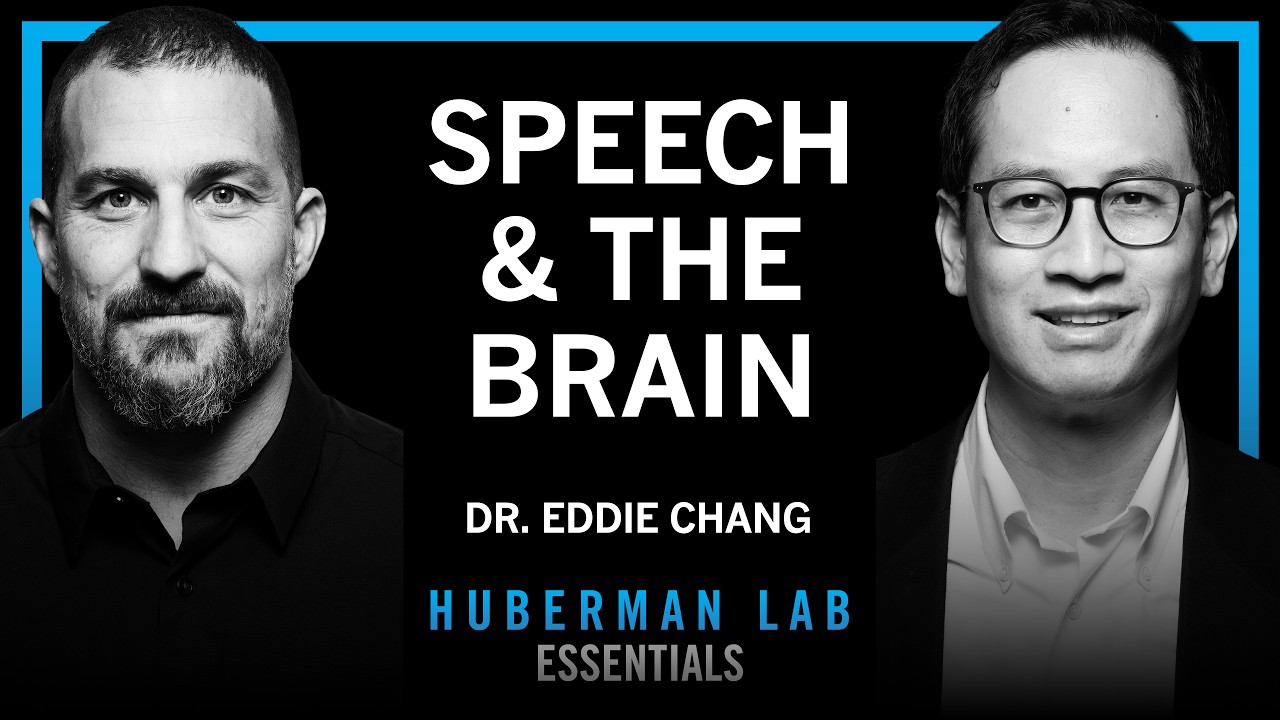
UCSF Neurosurgeon Eddie Chang Decodes Brain-Machine Interface Progress and the Future of Neural Augmentation
Andrew Huberman
The discussion bridges the gap between academic clinical breakthroughs in restoring paralyzed speech and the unaddressed ethical boundaries of commercial cognitive enhancement.
## Background
Published on May 21, 2026, on YouTube by Andrew Huberman, this Huberman Lab Essentials episode features Dr. Eddie Chang, a neurosurgeon and Chair of Neurological Surgery at UCSF. The episode explores the neural circuits underlying speech and language production, pioneering work on speech neuroprosthetics, the neurobiology of stuttering, and the ethical considerations surrounding brain augmentation.
## TL;DR
The program delineates the fundamental distinction between language as a cognitive framework and speech as a complex motor execution requiring precise, unconscious coordination of the vocal tract. Dr. Chang shares groundbreaking insights from the Bravo clinical trial, where AI and machine learning successfully decoded raw neural patterns into full sentences and digital avatar expressions for a patient with locked-in syndrome. The discussion also addresses the future landscape of commercial brain-machine interfaces and clarifies that stuttering is an articulation-specific breakdown in the brain's auditory-motor feedback loop rather than a language or anxiety-driven deficit.
## Atmosphere & style
The dialogue strikes a compelling balance between cutting-edge clinical science and deeply human, emotional storytelling. It feels highly intellectual yet accessible, driven by the warm chemistry and mutual respect of a 38-year friendship between host and guest. The narrative arc moves from technical anatomical breakdown to profound wonder at human resilience, shifting seamlessly from lighthearted moments—like a patient's laughter temporarily breaking a computer algorithm—to cautious, grounded ethical reflection on the future of neural enhancements.
## Key takeaways
- [00:23](https://www.youtube.com/watch?v=MOPqSEK6GvA&t=23s) Speech and language are separate brain concepts, where speech is the physical production of the acoustic communication signal and language is the broader cognitive framework involving pragmatics, semantics, and syntax.
- [03:11](https://www.youtube.com/watch?v=MOPqSEK6GvA&t=191s) Generating speech is an incredibly complex motor feat that requires the vocal folds to vibrate at high frequencies (roughly 100 Hz for men and 200 Hz for women) to create raw sound energy.
- [05:35](https://www.youtube.com/watch?v=MOPqSEK6GvA&t=335s) Primitive vocalizations like crying and laughing are distinct from learned speech and are controlled by separate, more primitive brain structures preserved across non-human primates.
- [06:37](https://www.youtube.com/watch?v=MOPqSEK6GvA&t=397s) Locked-in syndrome, often caused by conditions like brain stem strokes or ALS, results in a total loss of voluntary motor and speech output while cognition and environmental awareness remain fully intact.
- [09:14](https://www.youtube.com/watch?v=MOPqSEK6GvA&t=554s) The Bravo clinical trial successfully used an implanted electrode array over the speech cortex to intercept and route cerebral signals to an external computer to decode speech for a paralyzed patient.
- [13:01](https://www.youtube.com/watch?v=MOPqSEK6GvA&t=781s) The brain-machine interface relies on a combination of raw neural decoding and established commercial speech technologies, like contextual autocorrect language models, to fix translation errors in real-time.
- [14:27](https://www.youtube.com/watch?v=MOPqSEK6GvA&t=867s) The commercialization of brain-machine interfaces marks a major shift from purely academic research to medical and consumer products, yet the ethical implications of using them for healthy human augmentation remain unaddressed.
- [17:02](https://www.youtube.com/watch?v=MOPqSEK6GvA&t=1022s) The ultimate rate-limiting bottleneck for cognitive augmentation is the technology itself, as current devices cannot match the massive bandwidth and complexity of natural, millions-of-neurons human communication systems.
- [19:24](https://www.youtube.com/watch?v=MOPqSEK6GvA&t=1164s) Integrating computer-animated avatars driven by neural signals restores a critical layer of nonverbal facial communication and provides a visual feedback mechanism that accelerates patient learning.
- [22:51](https://www.youtube.com/watch?v=MOPqSEK6GvA&t=1371s) Stuttering is strictly an articulation condition affecting speech production rather than language capacity, resulting from a situational breakdown in the highly coordinated, automated machinery of the vocal tract.
- [22:51](https://www.youtube.com/watch?v=MOPqSEK6GvA&t=1371s) Anxiety is a prominent trigger that can worsen or provoke a stutter, but it is not the underlying cause of the condition.
- [22:51](https://www.youtube.com/watch?v=MOPqSEK6GvA&t=1371s) Auditory feedback loops are vital to speech monitoring, and the breakdown between the brain's motor command centers and auditory processing systems offers a critical clue into stuttering mechanics.
- [26:02](https://www.youtube.com/watch?v=MOPqSEK6GvA&t=1562s) Early intervention utilizing behavioral speech therapy leverages childhood neuroplasticity to address stuttering without requiring invasive neurological procedures.
## Detailed walkthrough
### [00:00](https://www.youtube.com/watch?v=MOPqSEK6GvA&t=0s) Speech vs. Language in the Brain
Andrew Huberman welcomes Dr. Eddie Chang to the podcast to dive into the neurobiology of speech and language. Huberman opens the conversation by asking for a clarification on a fundamental distinction: how do speech and language differ, and are they controlled by separate brain structures? He admits that during a long podcast or general conversation, he rarely thinks about individual syllables or words unless he is trying to accent something or dealing with a difficult word. Dr. Chang shares Huberman's excitement, noting that understanding how the brain processes these elements is one of the most active areas of current neuroscience.
Dr. Chang breaks down the terminology cleanly. "Speech corresponds to the communication signal"—the physical movement of the mouth and vocal tract to generate acoustic vibrations that microphones or human ears pick up and translate into electrical activity. Language, by contrast, is a much broader cognitive framework. It encompasses the "gist" or social context of communication (pragmatics), the meaning of words and sentences (semantics), and the grammatical assembly of those words (syntax). Dr. Chang highlights that speech is merely one modality of language, alongside others like sign language and reading. Generating speech is an incredibly complex motor feat, which some scientists argue is the most complex motor activity humans perform—surpassing extreme athletic or acrobatic achievements.
* **Speech definition:** The physical production of the acoustic communication signal via the vocal tract.
* **Language components:**
* *Pragmatics:* Extracting the general gist or context.
* *Semantics:* Understanding word and sentence meaning.
* *Syntax:* Assembling words into grammatical forms.
* **Alternative language modalities:** Sign language and reading.
[03:07](https://www.youtube.com/watch?v=MOPqSEK6GvA&t=187s) Shaping the Breath: The Mechanics of Voice
Huberman notes the sheer motor complexity of vocalization, referencing the intense physical control seen in opera singers or freestyle rappers, and prompts Dr. Chang to explain the functions of the pharynx and larynx. Dr. Chang explains that speaking is, at its core, the art of "shaping the breath." The process begins normally with expiration, as the lungs fill and push air outward. Human evolution uniquely adapted this standard physiological process by utilizing the larynx (commonly called the voice box) to intercept that airflow.
Within the larynx, a muscle brings two pieces of tissue known as the vocal folds—often mischaracterized as vocal cords—together. As air forces its way through these closed folds, they vibrate at incredibly high frequencies ranging from 100 to 200 Hz. This physical structure explains the vocal differences between men and women; men typically possess a larger larynx, resulting in a lower resonance frequency of roughly 100 Hz, while women's vocal folds vibrate around 200 Hz. This raw sound energy, or "voicing," travels up from the larynx through the pharynx and into the oral cavity. There, the tongue, lips, and jaw move in precise patterns to shape that raw sound into distinct consonants and vowels. Huberman then asks whether primitive vocalizations like crying or laughing utilize these same language networks. Dr. Chang clarifies that these are distinct "vocalizations" controlled by separate, more primitive brain structures that are preserved across non-human primates, which explains why patients with severe injuries to their speech and language areas can often still moan or cry.
* **Vocal fold vibration frequencies:** Approximately 100 Hz for men and 200 Hz for women due to differences in larynx size.
* **Vocal tract anatomy sequence:** Lungs (expiration) $\rightarrow$ Larynx (vocal folds create voicing) $\rightarrow$ Pharynx $\rightarrow$ Oral cavity (tongue, lips, jaw shape consonants and vowels).
* **Primitive vocalizations:** Crying and moaning utilize separate neural structures from learned speech, allowing paralyzed or brain-injured patients to often retain these sounds.
[06:37](https://www.youtube.com/watch?v=MOPqSEK6GvA&t=397s) Overcoming Locked-In Syndrome with BMIs
Huberman praises Dr. Chang for his groundbreaking, highly recognized work utilizing Brain-Machine Interfaces (BMIs) to restore communication to paralyzed individuals. Dr. Chang explains the devastating clinical realities of conditions like brain stem strokes and Amyotrophic Lateral Sclerosis (ALS). The brain stem serves as the critical bridge connecting the cerebrum—where creative, intelligent thoughts and motor commands originate—to the spinal cord and facial nerves. A stroke in this area creates a tragic disconnect: a patient's cognition, awareness, and intellect remain entirely intact, yet they are completely "locked in," utterly unable to articulate words or move their hands to write.
To combat this profound psychological and social isolation, Dr. Chang's laboratory spent years mapping the electrical brain patterns corresponding to individual consonants and vowels. Once they decoded these phonetic elements, they initiated the Bravo clinical trial to intercept cerebral cortex signals and route them via wires to a computer. The first participant in this trial was a man who had been paralyzed for 15 years following a car accident. Though he initially walked out of the hospital after the crash, he suffered a massive, rare brain stem stroke the following day. He emerged from a week-long coma completely unable to speak or move his limbs, a reality so shattering that the patient initially wished to die.
* **Brain stem function:** Connects the cerebrum (thinking and motor control) to the spinal cord and vocal tract nerves.
* **ALS outcome:** In its extreme form, causes a total loss of voluntary movement, eventually causing the diaphragm and lung muscles to give out.
* **Locked-in syndrome:** Fully intact cognition and environmental awareness paired with zero voluntary motor or speech output.
* **The Bravo trial:** A clinical trial designed to intercept speech signals from the cerebral cortex and decode them via external computers.
[10:03](https://www.youtube.com/watch?v=MOPqSEK6GvA&t=603s) The First Bravo Trial Success and Autocorrect Tech
Huberman inquires if the first trial participant retained any minor movements, such as blinking. Dr. Chang notes the patient could blink and had highly limited, completely un-intelligible mouth movements. To communicate prior to the trial, the patient's friends attached a stick to a baseball cap, allowing him to slowly peck out letters one by one on a keyboard using his residual neck movements. After obtaining rigorous institutional and FDA approvals, Dr. Chang's team surgically implanted an electrode array directly over the areas of the patient's cerebral cortex responsible for controlling the vocal tract, larynx, lips, tongue, and jaw.
The electrode array connects to a hardware port screwed to the patient's skull that passes through the scalp, a setup he has lived with safely for three years. Wires connect this port to a computer that translates analog brain waves into digital signals, which are then processed by artificial intelligence and machine learning algorithms. Training the algorithm to detect these incredibly subtle patterns took weeks. Dr. Chang recalls the profound emotional breakthrough when the patient was prompted to think of a word like "outside," and the word successfully populated on a screen. The patient "got a kick out of that" and began giggling so hard his body shook, which hilariously messed up the machine's decoding of the subsequent words. Dr. Chang jokes that instead of fixing this technical "bug," it is far easier to simply tell the patient to stop laughing.
* **Pre-trial communication method:** A stick taped to a baseball cap to manually type letters via neck movements.
* **Hardware configuration:** Electrode array over the speech cortex $\rightarrow$ skull-mounted port $\rightarrow$ digital converter $\rightarrow$ machine learning algorithm.
* **Trial duration:** The first patient has successfully lived with the implanted cranial port for three years.
[13:01](https://www.youtube.com/watch?v=MOPqSEK6GvA&t=781s) Expanding Vocabularies and the Role of AI
Dr. Chang elaborates on the computational mechanics behind this breakthrough, explaining that they began with a modest vocabulary of 50 words. To maximize the accuracy of the system, the researchers mapped out every single sentence permutation possible using those 50 words. This allowed them to build a language context model that functions identically to the predictive text and "autocorrect" features found on modern smartphones.
Because direct brain-wave decoding is far from 100% accurate, integrating these contextual speech technologies is essential. If the AI misinterprets an isolated phonetic pattern from the brain, the language model analyzes the surrounding words and automatically corrects the error in real-time. Dr. Chang emphasizes that their success relies on this powerful combination: AI decoding raw neural patterns paired with established commercial speech tech. This represents the historic first time a paralyzed human generated full sentences decoded directly from brain activity, a vocabulary base that Dr. Chang notes is rapidly expanding.
* **Initial vocabulary size:** 50 target words, which are currently being scaled up.
* **Error correction method:** Utilizing contextual autocorrect language models to fix inaccurate raw neural decodes, mimicking smartphone texting technology.
[14:27](https://www.youtube.com/watch?v=MOPqSEK6GvA&t=867s) The Future of Brain Augmentation
Huberman pivots the conversation toward the broader, commercial landscape of brain-machine interfaces, referencing companies like Elon Musk's Neuralink. He notes that while academic labs have quietly driven BMI research for decades, high-profile corporate ventures have brought the concept of "manipulating neural circuitry to achieve suprahuman or superhuman" capabilities into the public eye. Huberman asks Dr. Chang for his perspective on moving past clinical restorations and entering the realm of super-physiological enhancement.
Dr. Chang reflects on the incredible timing of this technological evolution. He notes that for decades, academic work focused solely on restoring basic functions, such as teaching monkeys or paralyzed humans to navigate a computer cursor or move a robotic arm. The entry of industry commercialization marks a massive turning point, moving devices from pure laboratory research into viable medical products, both via invasive surgeries and non-invasive technologies. However, when it comes to "augmentation"—enhancing a healthy human's capacity for super-memory, lightning-fast communication, or hyper-precise athletic skills—Dr. Chang urges caution. He admits that society has not adequately contemplated the deep ethical implications of consumer-grade neural augmentation, even though humans have historically used substances like coffee and nicotine to modify performance.
* **Historical BMI focus:** Decades of academic research centered on restoring movement, such as cursor control or robotic limb manipulation.
* **Commercial shift:** Transitioning from lab prototypes to commercialized medical products, encompassing both surgical implants and non-invasive consumer tech.
* **Augmentation frontiers:** Theoretical applications aimed at establishing superhuman memory, communication speeds, or athletic precision.
[17:02](https://www.youtube.com/watch?v=MOPqSEK6GvA&t=1022s) Cognitive Augmentation and the Technological Frontier
Cognitive and physical enhancement is not a fundamentally new phenomenon, but the introduction of neurotechnologies brings unique questions regarding invasiveness. When technologies require surgery for non-medical applications, it can feel like uncharted territory; however, humans routinely undergo invasive surgical procedures for physical and cosmetic alterations. The speaker anticipates that as neurotechnology continues to emerge, cognitive augmentation will become a reality in the near future. Rather than dramatic, overt transformations—such as instantly memorizing every fact in the world—these changes will likely manifest in incremental and subtle ways.
In many respects, society has already surpassed the baseline of natural human capabilities through external devices. A person does not need an embedded neural interface to access the entirety of global information when they can simply use an iPhone. While a brain interface might eventually accelerate this data transfer, a significant bottleneck exists in the sheer complexity of our natural systems. Human communication structures have evolved over millions of years and are supported by complex neural networks possessing a bandwidth of millions of neurons. No current commercial technology or research lab project comes close to matching the capability of these evolved, natural systems. Consequently, the rate-limiting step for enhanced cognition remains the technology itself, even as society faces looming, unaddressed real-world questions regarding who will have access to these tools and whether they are ultimately good for society.
---
[19:24](https://www.youtube.com/watch?v=MOPqSEK6GvA&t=1164s) Decoding Nonverbal Communication and Avatars for BCI
The discussion shifts to the integration of brain-machine interfaces (BCIs) with speech signal extraction for locked-in patients, such as an individual named Pancho. The speaker emphasizes that face-to-face human communication relies heavily on nonverbal cues, such as a quizzical look that signals a need to slow down or rephrase a concept. Additionally, seeing the physical movements of a speaker's mouth and jaw provides visual information that directly improves speech intelligibility and naturalness within the brain. To capture this complete form of expression, researchers are developing computer-animated avatars driven by decoded neural signals to reflect a patient's intended speech movements and facial expressions rather than relying solely on text displayed on a screen.
Looking forward, the speaker predicts that social interactions will increasingly migrate into digital and virtual spaces. While mainstream development targets the general consumer, these virtual spaces hold profound implications for disabled and paralyzed individuals, offering them new avenues to participate fully. The goal of this research is to create holistic avatars that decode facial expressions alongside vocal tract movements to enrich communication. When asked if healthy users might someday use these avatars to broadcast typed messages vocally, the speaker confirms that this technology is progressing rapidly and will arrive soon. Beyond mere expression, the avatar serves as a vital feedback mechanism for a patient utilizing a "speech neuroprosthetic," allowing them to embody the animation and feel a sense of direct control, which accelerates the learning process.
---
[22:51](https://www.youtube.com/watch?v=MOPqSEK6GvA&t=1371s) The Mechanics, Triggers, and Treatment of Stuttering
The speaker addresses inquiries regarding stuttering, clarifying the distinct boundary between language and speech. Stuttering is categorized strictly as a speech condition affecting articulation, meaning the individual possesses intact language, grammar, ideas, and meaning, but cannot execute fluent vocal production. The condition disrupts the highly coordinated, precise movements of the vocal tract, including the larynx, lips, and jaw. Because normal speech requires the instantaneous, unconscious orchestration of these structures—resembling a finely tuned symphony—any conscious awareness of the process would render it too complex to execute. Stuttering represents a situational breakdown in this highly automated internal machinery.
While individuals may have a genetic or biological predisposition to stuttering, they do not stutter continuously. Anxiety is widely recognized as a major factor that can provoke or worsen a stutter, but the speaker clarifies that anxiety is not the underlying cause itself. Therapy often focuses on teaching behavioral tricks to overcome initiation problems, which occur when a person struggles to emit an initial vowel or consonant sound. Furthermore, auditory feedback—the process of hearing oneself speak—plays a critical role. Altering this feedback can dramatically increase or decrease stuttering, suggesting that the condition involves a communication breakdown between the brain's motor command centers and its auditory processing systems. When addressing early intervention, the dialogue notes that utilizing speech therapy early in life capitalizes on robust childhood neuroplasticity without resorting to invasive brain surgery.
- **Distinction:** Language (ideas and grammar) remains completely unaffected in individuals who stutter; the impairment is localized entirely to speech articulation.
- **Symphony Metaphor:** Fluent speech requires the perfectly synchronized, unconscious activation of the larynx, lips, and jaw.
- **Auditory Feedback:** The brain continuously monitors vocal output, and disruptions in this auditory-motor loop serve as a primary clue for understanding stuttering mechanics.
---
[27:34](https://www.youtube.com/watch?v=MOPqSEK6GvA&t=1654s) A Shared Milestone in Medicine and Science
The conversation concludes on a warm, personal note as the interviewer reflects on a friendship spanning roughly 38 years. Expressing an "absolute thrill" to be sitting together, the interviewer highlights how meaningful it is to reconnect through the halls of medicine and science. The speaker's current work as a department chair is celebrated as the absolute cutting edge of scientific exploration and real-world application. While patients like Pancho highlight the direct, life-changing benefits of these speech neuroprosthetics, the speaker's broader academic department is also recognized for driving incredible advancements in related fields, including spinal cord research. The segment wraps up with a expression of gratitude for the spectacular contributions the speaker has made to science and patient care.
## Notable quotes
> [01:00](https://www.youtube.com/watch?v=MOPqSEK6GvA&t=60s) Speech corresponds to the communication signal — Dr. Eddie Chang
> [03:07](https://www.youtube.com/watch?v=MOPqSEK6GvA&t=187s) shaping the breath — Dr. Eddie Chang
> [11:07](https://www.youtube.com/watch?v=MOPqSEK6GvA&t=667s) got a kick out of that — Dr. Eddie Chang
> [14:27](https://www.youtube.com/watch?v=MOPqSEK6GvA&t=867s) manipulating neural circuitry to achieve suprahuman or superhuman — Andrew Huberman
> [16:27](https://www.youtube.com/watch?v=MOPqSEK6GvA&t=987s) augmentation — Dr. Eddie Chang
> [19:24](https://www.youtube.com/watch?v=MOPqSEK6GvA&t=1164s) speech neuroprosthetic — Dr. Eddie Chang
> [27:34](https://www.youtube.com/watch?v=MOPqSEK6GvA&t=1654s) absolute thrill — Andrew Huberman
## Mentioned
Dr. Eddie Chang, Andrew Huberman, University of California, San Francisco, UCSF, Bravo trial, Pancho, Neuralink, Elon Musk, iPhone, Amyotrophic Lateral Sclerosis, ALS
Neurosurgeon Dr. Eddie Chang distinguishes the cognitive architecture of language from the physical motor execution of speech, illustrating how mapping cortical speech representations enables brain-machine interfaces to restore communication for paralyzed individuals. His research demonstrates that combining direct neural decoding with commercial predictive language algorithms can successfully reconstruct full sentences, even as biological bandwidth limits and ethical dilemmas constrain the future of neural augmentation.
Language Architecture Versus Motor Speech Execution (0:00)
Dr. Chang separates speech, defined as the physical motor production of acoustic signals through the vocal tract, from language, which operates as an overarching cognitive framework encompassing semantics (meaning), syntax (grammar), and pragmatics (social context and gist). While language can be expressed through alternate modalities such as sign language and reading, speech requires an extraordinarily complex motor sequence. Vocalization begins with lung expiration, which the larynx intercepts via vocal folds that oscillate at roughly 100 Hz in men and 200 Hz in women due to anatomical differences in larynx size. The tongue, lips, and jaw then articulate this acoustic energy into distinct vowels and consonants.
In contrast to learned speech, primitive vocalizations such as laughing, crying, and moaning depend on evolutionary conserved brain structures shared with non-human primates. Because these primitive vocalizations rely on distinct neural pathways, patients suffering from severe trauma to their speech and language networks often retain the ability to vocalize basic emotional sounds.
Speech Restoration in Paralyzed Patients Using AI (6:37)
Severe brain stem strokes and late-stage Amyotrophic Lateral Sclerosis (ALS) can result in locked-in syndrome, a state in which a patient's cognitive awareness and intellect remain fully intact while all voluntary motor output is severed. In the Bravo clinical trial, Dr. Chang's team mapped the cortical electrical patterns corresponding to individual vocal-tract movements and implanted an electrode array over the speech-motor cortex of a participant paralyzed for 15 years. The hardware connects through a skull-mounted transcutaneous port that the participant has used safely for three years, routing analog brain signals to computers for digital processing.
Because raw neural decoding produces classification errors, the team integrated a contextual language model resembling smartphone autocorrect software. By analyzing sentence permutations from an initial 50-word target vocabulary, the predictive algorithm evaluates surrounding context to correct misclassified phonemes in real time. This combined system achieved the first direct decoding of full sentences from cortical activity in a paralyzed individual.
Technical Bottlenecks and Ethics of Neural Augmentation (14:27)
Addressing the commercial push toward brain-machine interfaces by ventures like Neuralink, Dr. Chang notes that the field is transitioning from academic motor-restoration studies to commercial medical devices. However, he urges caution regarding non-medical cognitive augmentation intended to create superhuman memory, communication, or athletic capabilities. He emphasizes that society has not adequately addressed the ethical questions, accessibility concerns, and potential disruptions associated with elective neural surgeries.
Dr. Chang highlights that natural evolutionary biology remains the primary rate-limiting step for brain enhancement. Human communication networks possess a functional bandwidth across millions of neurons that no current laboratory or commercial neurotechnology can replicate. External digital tools like smartphones already supply universal information access, meaning physical interfaces do not yet offer an advantage over evolved natural biological systems.
Decoded Avatars and Embodied Nonverbal Communication (19:24)
Interpersonal communication relies heavily on nonverbal cues and visible jaw and lip movements, which directly aid the listener's brain in processing speech. To replicate these elements, Dr. Chang's laboratory is developing computer-animated avatars driven directly by decoded cortical commands. Rather than merely rendering decoded words as text, the system reconstructs intended facial expressions and articulatory movements.
Dr. Chang forecasts that while virtual communication environments will increasingly serve general consumers, avatar-driven neuroprosthetics offer critical utility for paralyzed patients. Beyond enriching communication for listeners, an avatar provides dynamic visual feedback to the patient. This visual embodiment reinforces the user's perception of direct vocal-tract control, measurably accelerating their ability to operate the speech neuroprosthetic.
Articulatory Coordination and Auditory Disruption in Stuttering (22:51)
Dr. Chang classifies stuttering strictly as a speech articulation disorder rather than an impairment of language. Individuals who stutter retain intact grammatical, semantic, and conceptual capabilities, but experience situational disruptions in the automated motor machinery coordinating the larynx, lips, and jaw. While psychological anxiety can provoke or worsen dysfluent episodes, Dr. Chang clarifies that anxiety is not the root physiological cause.
Instead, research indicates that stuttering stems from a communication breakdown within the brain's auditory-motor integration loop. Because the brain constantly monitors speech through auditory feedback, modifying that feedback can instantly alter the severity of a stutter. Consequently, clinical interventions emphasize non-invasive behavioral therapies that leverage early childhood neuroplasticity to resolve sound-initiation blocks without surgical intervention.
While speech neuroprosthetics demonstrate significant clinical success in decoding cortical intention for locked-in patients, matching the speed and nuance of natural human communication remains constrained by the millions of neurons operating within natural auditory-motor circuits. As commercial interfaces advance toward broader consumer applications, society faces unresolved ethical and regulatory questions regarding access and non-medical cognitive augmentation.
[1:00] Dr. Eddie Chang: Speech corresponds to the communication signal
[3:07] Dr. Eddie Chang: shaping the breath
[11:07] Dr. Eddie Chang: got a kick out of that
[14:27] Andrew Huberman: manipulating neural circuitry to achieve suprahuman or superhuman
[16:27] Dr. Eddie Chang: augmentation
[19:24] Dr. Eddie Chang: speech neuroprosthetic
[27:34] Andrew Huberman: absolute thrill
Original transcript
[0:00] Welcome to Huberman Lab Essentials,
[0:02] where we revisit past episodes for the
[0:04] most potent and actionable science-based
[0:06] tools for mental health, physical
[0:08] health, and performance.
[0:11] I'm Andrew Huberman and I'm a professor
[0:13] of neurobiology and opthalmology at
[0:16] Stamford School of Medicine. And now for
[0:18] my discussion with Dr. Eddie Chang.
[0:20] Eddie, welcome.
[0:21] >> Hi. Hi, Andrew.
[0:23] >> Great to be here with you. Your main
[0:25] focus these days is the neurobiology of
[0:28] speech and language. So for those that
[0:30] aren't familiar, could you please
[0:32] distinguish for us speech versus
[0:34] language in terms of whether or not
[0:36] different brain areas control them? When
[0:38] I think about language, I think about
[0:39] words and just talking. If I sit down to
[0:41] do a long podcast or I think about
[0:43] asking you a question, I don't even
[0:44] think about the words I want to say very
[0:46] much. I mean, I have to think about them
[0:48] a little bit. one would hope, but I
[0:50] don't think about individual syllables
[0:51] unless I'm trying to, you know, accent
[0:54] something or it's a word that I have a
[0:56] particular difficulty saying or I want
[1:00] to change the cadence, etc. So, what in
[1:02] the world is contained in these brain
[1:04] areas? What is represented? Um, to me is
[1:07] is perhaps one of the most interesting
[1:09] questions and I know this lands square
[1:11] in your wheelhouse.
[1:12] >> Sure. Let's get into this uh Andrew
[1:15] because this is one of the most exciting
[1:18] stuff that's happening right now is
[1:19] understanding how the brain processes
[1:21] these exact questions. And speech
[1:24] corresponds to the communication signal.
[1:27] It corresponds to me moving my mouth and
[1:30] my vocal tract to generate words. And
[1:33] you're hearing these as an auditory
[1:35] signal. Language is something much
[1:38] broader. So it refers to what you're
[1:40] extracting from the words that I'm
[1:42] saying. We call that pragmatics and sort
[1:44] of are you getting the gist of what I'm
[1:46] saying? There's another aspect of it
[1:47] that we call semantics. Do you
[1:49] understand the meaning of these words
[1:52] and uh the sentences? There's another
[1:54] part that we call syntax which refers to
[1:56] how the words are assembled in a
[1:58] grammatical form. So those are all
[2:00] really critical parts of language and
[2:03] speech is just one form of language.
[2:06] There's many other forms like sign
[2:08] language, uh, reading. Those are all
[2:10] important modalities for reading. Our
[2:13] research really focuses on this area
[2:16] that we're calling speech. Again, the
[2:18] production of this audio signal, which
[2:22] you can't see, but your microphones are
[2:25] picking up. There are these vibrations
[2:27] in the air that are created by my vocal
[2:30] tract that are picked up by the
[2:31] microphone in the case of this
[2:33] recording, but also picked up by the
[2:35] sensors in your ear. The very tiny
[2:37] vibrations in your uh ear are picking
[2:40] that up and translating that into
[2:42] electrical activity. It's such a complex
[2:45] feat. Some people would say it's the
[2:46] most complex motor thing that we do as a
[2:48] species is is just speaking. not you
[2:51] know the extreme feats of acrobatics or
[2:54] athleticism but speaking
[2:56] >> well and especially when uh one observes
[2:58] you know uh opera or um people who you
[3:01] know freestyle rappers you know and of
[3:04] course it's not just the lips it's the
[3:06] tongue
[3:07] >> and you've mentioned two other
[3:08] structures ferinx and larynx are the
[3:10] main ones that um can you tell us just
[3:12] just educate us at a a superficial level
[3:15] what this ferinx and larynx do
[3:17] differentially because I think most
[3:19] people aren't going to Okay, sure. I'll
[3:21] talk primarily about the larynx here for
[3:24] a second, which is that if you think
[3:26] about when we're speaking, really what
[3:28] we're doing is we're shaping the breath.
[3:30] So, even before you get to the larynx,
[3:31] you got to start with the expiration. We
[3:34] fill up our lungs and then we push the
[3:36] air out. That's a normal part of
[3:38] breathing. What is really amazing about
[3:40] speech and language is that we evolved
[3:43] to take advantage of that normal
[3:44] physiologic thing at a larynx. And what
[3:48] the larynx does is that when you're
[3:50] exhaling, it brings the vocal folds
[3:52] together. Some people call them vocal
[3:54] cords. They're not really cords. They're
[3:56] really vocal folds. They're two pieces
[3:58] of tissue that come together and a
[4:00] muscle brings them together. And then
[4:01] what happens is when the air comes
[4:03] through the vocal folds, when they're
[4:05] together, they vibrate at really high
[4:06] frequencies, like 100 to 200 hertz. And
[4:09] the reason why men and women generally
[4:11] have different voice qualities is it has
[4:14] to do with the size of the larynx and
[4:16] the shape of it. Okay? So in general men
[4:20] have a larger voice box or larynx and
[4:23] the vibrating frequency the resonance
[4:25] frequency of the vocal folds when the
[4:27] air comes through them is about 100
[4:29] hertz for men and about 200 for women.
[4:32] So you take a breath in. As the air is
[4:35] coming out, the vocal folds come
[4:36] together. The air goes through. That
[4:39] creates the sound of the voice that we
[4:41] call voicing. It's not just your voice
[4:44] characteristic. It's the energy of your
[4:47] voice. It's coming from the larynx
[4:50] there. It's a noise. And then it's the
[4:52] source of the voice. And then what
[4:54] happens is that energy that sound goes
[4:58] up through the parts of the vocal tract
[5:01] like the fairings into the oral cavity
[5:04] which is your mouth and your tongue and
[5:06] your lips. And what those things are
[5:08] doing is that they're shaping this the
[5:10] air in particular ways that create
[5:14] consonants and vowels. That's what I
[5:16] mean by shaping the breath. It just
[5:18] starts with this exhalation. You
[5:21] generate the voice in the larynx and
[5:23] then everything above the larynx is
[5:25] moving around just like the way my mouth
[5:27] is doing right now to shape that air
[5:30] into particular patterns that you can
[5:33] hear is words immediately makes me
[5:38] wonder about more um primitive or
[5:41] non-learned vocalizations like crying or
[5:44] laughter. Are those produced by the
[5:47] language areas or do they have their own
[5:49] unique neural structures?
[5:51] >> We call those vocalizations. A
[5:53] vocalization is basically where someone
[5:55] can create a sound like a cry or a moan
[5:59] that kind of sound. And it also involves
[6:03] the exhalation of air. It also involves
[6:06] some phonation at the level of larynx
[6:09] where the vocal folds come together to
[6:11] create that audible sound. But it turns
[6:13] out that those are actually different
[6:15] areas. So people who have injuries in
[6:18] the speech and language areas oftentimes
[6:20] can still moan. They can still vocalize.
[6:23] And it is a different part of the brain.
[6:25] I would say an area that uh even
[6:27] non-human primates have that can be
[6:30] specialized, you know, for vocalization.
[6:32] It's a different form of communication
[6:34] than than words, for example. Speaking
[6:37] of storage of and ability to speak, you
[6:40] are doing some amazing work and have
[6:42] achieved some um pretty incredible
[6:45] well-deserved recognition for your work
[6:48] in bringing language out of paralyzed
[6:51] people. essentially allowing people who
[6:53] are locked in to a paralyzed state or
[6:56] otherwise unable to articulate speech
[6:59] using brain machine interface
[7:02] essentially translating the neural
[7:04] activity of areas of the brain that w
[7:06] would produce speech into hardware
[7:10] artificial non-biological tools in order
[7:12] to allow paralyzed people to
[7:14] communicate.
[7:15] >> So there are a series of conditions um
[7:18] they include things like brain stem
[7:20] stroke. The brain stem is the part of
[7:22] the brain that connects the cerebrum
[7:24] which is the top part does our thinking
[7:26] and a lot of the motor control, speech,
[7:28] language, everything. And the brain stem
[7:29] is what connects that to the spinal cord
[7:31] and the nerves that go out to the face
[7:32] and vocal tract. So if you have a stroke
[7:34] there, you could be thinking all the
[7:36] wild creative intelligent thoughts you
[7:38] have in the mind and the cerebrum, but
[7:40] you can't get them out into words or you
[7:42] can't get them out to your hand to write
[7:44] them down. So that's a very severe form
[7:47] of paralysis called brain stem stroke.
[7:49] There's another kind of conditions that
[7:51] we call neurogenerative where the nerve
[7:53] cells die basically or atrophy and a
[7:57] condition called uh ALS. That's a very
[8:00] severe form of paralysis. In its extreme
[8:02] form, people essentially lose all
[8:04] voluntary movement. The muscles to their
[8:06] diaphragm and their lungs essentially
[8:08] give out as well. They get weakness
[8:10] there and then they can't breathe
[8:11] anymore. In our field, these are kind of
[8:12] like the most devastating things that
[8:14] can happen. This condition of what we
[8:16] call being locked in refers to this idea
[8:20] that you can have completely intact
[8:23] cognition and awareness but have no way
[8:26] to express that. No voluntary movement,
[8:30] no ability to speak and that is
[8:32] devastating because uh psychologically
[8:34] and socially you know you're completely
[8:36] isolated. That's what we call locked in
[8:38] syndrome and it's devastating. So we've
[8:41] been studying this patterning of
[8:44] electrical activity for consonants and
[8:46] vowels. And essentially once we figured
[8:48] out a lot of these codes for the
[8:51] individual phonetic elements, part of
[8:53] the lab started to focus on this very
[8:55] specific question for people who have
[8:57] these kind of paralysis. Could we
[9:01] intercept those signals from the brain,
[9:04] the cerebral cortex, as someone is
[9:06] trying to say those words? And then can
[9:09] we intercept them and then have them
[9:12] taken out of the brain through wires to
[9:15] a computer that are going to interpret
[9:17] those signals and translate them into
[9:19] words. So we started a clinical trial.
[9:23] It's called the Bravo trial. It's still
[9:24] underway. And the first participant in
[9:26] the Bravo trial was a man who had been
[9:29] paralyzed for 15 years. He was in a car
[9:32] accident. He actually walked out of the
[9:34] hospital the day after that car
[9:35] accident, but the next day had a
[9:37] complication related to it where he had
[9:40] a very large stroke in the brain stem
[9:43] and that turned out to be devastating.
[9:46] He didn't wake up from that stroke for
[9:48] about a week. He was in a coma for about
[9:50] a week and when he woke up from that
[9:52] coma, he realized that he couldn't speak
[9:54] or move his arms or legs. As he told me
[9:57] or communicated to us, that was
[9:59] absolutely devastating. He wanted really
[10:02] to die at that time.
[10:03] >> Could he blink his eyes or move his
[10:04] mouth in any way?
[10:06] >> He could blink his eyes. He had some
[10:08] limited mouth movements but couldn't
[10:09] produce any intelligible speech. It was
[10:12] like completely slurred and
[10:13] incomprehensible. He survived this
[10:16] injury. A lot of people who have that
[10:17] kind of stroke just don't survive. The
[10:19] way he actually communicates because he
[10:21] has a little bit of residual neck
[10:23] movements is that he improvised and had
[10:27] his friends basically put a stick
[10:30] attached to his baseball cap because he
[10:33] could move his neck. He would
[10:34] essentially type out letters on a
[10:37] keyboard screen to get out words. In
[10:39] fact, this is how he communicated was
[10:42] through a device that he would
[10:43] essentially peck out letters one by one
[10:46] by moving his neck to control this stick
[10:48] attached to his baseball cap. He hadn't
[10:50] really spoken for about 15 years.
[10:52] >> Oh, goodness.
[10:53] >> Yeah. So, it was part of a clinical
[10:55] trial. It was, you know, something that
[10:57] our hospital and also the FDA, you know,
[11:00] had to approve and looked at very
[11:02] carefully. But given a lot of the work
[11:03] that we had done, there was some basis
[11:05] for for why this might work. And so we
[11:09] did a surgery where we implanted
[11:12] electrodes
[11:13] onto these areas that control the vocal
[11:16] tract, the areas that control the
[11:17] larynx, the areas that control the lips
[11:20] and tongue and jaw movements when we
[11:22] normally speak. These are areas that
[11:24] presumably may be active. That was our
[11:26] hope. And he underwent a surgery, a
[11:29] brain surgery. We put an electrode array
[11:31] and we connected it to a port that was
[11:34] sculled to uh screwed to his skull. And
[11:36] the port actually goes through his
[11:38] scalp. And he's lived with this now for
[11:39] the last three years. So he has an
[11:42] electrode array that's implanted over
[11:44] the part of the brain that's important
[11:46] for speech. It's connected to a port.
[11:49] And then we connect a wire to that port
[11:52] that translates those uh what we call
[11:55] analog, you know, brain waves and
[11:57] converts them into digital signals. We
[12:00] put them through a machine learning or
[12:02] artificial intelligence algorithm that
[12:04] can pick up these very very subtle
[12:07] patterns. You can't actually see them
[12:08] with your eye uh in in the brain
[12:11] activity and translate those into words.
[12:14] And this is something that took weeks to
[12:17] train the algorithm to interpret it
[12:19] correctly. But what was incredible about
[12:22] it was to see how he reacted. He would
[12:25] be prompted to say a given word like you
[12:27] know outside for example and then he
[12:30] would think about it try to say it and
[12:32] finally those words would appear on the
[12:34] screen. And what was really amazing
[12:36] about it was you could really tell that
[12:39] he like got a kick out of that because
[12:41] you know his body would shake in a way
[12:43] and his head would shake in a way that
[12:44] he would start to giggle. That was cool
[12:46] to see, but then I also realized that
[12:48] when he was giggling, it kind of screwed
[12:51] up the next words. Decoding.
[12:54] >> Is that a bug you've since uh fixed?
[12:56] >> No, we haven't fixed that. It's easier
[12:58] just to tell him to stop giggling. The
[13:01] way this worked was we trained uh this
[13:04] computer to recognize 50 words. We
[13:06] started with a very small vocabulary
[13:08] that's expanding as we speak. I think
[13:10] that this is just a matter of time
[13:12] before these vocabularies become much
[13:14] much larger. But we started with a 50
[13:17] set of words. We created essentially all
[13:21] the possible sentences that you could
[13:22] generate from those 50 words. Why that
[13:24] was important was you can use those all
[13:27] those possible sentences to create a
[13:29] computational model computer model of
[13:32] all the different word combinations to
[13:34] give different sentences given those 50
[13:36] words. And then you can essentially do
[13:39] what we call autocorrect. It's the same
[13:41] kind of thing that we do when you're
[13:43] texting, for example, you get the wrong
[13:45] letter in there. Your phone actually
[13:47] knows, you know, because it's context
[13:49] what to correct it. So because the
[13:52] decoding is not 100% correct all the
[13:54] time. In fact, it's far from that. It's
[13:57] really helpful to have these other
[13:58] features like autocorrect, the stuff
[14:00] that we use routinely now with texting
[14:02] that makes it correct and then updates
[14:05] it. So, it's a combination of a lot of
[14:06] things. It's the AI that is translating
[14:09] those brain activity patterns, but it's
[14:11] also things that we've learned from
[14:13] speech and speech technologies that, you
[14:16] know, you put all together and then all
[14:17] of a sudden it starts to work. That was
[14:19] the first time that someone was
[14:21] paralyzed and could create words and
[14:24] sentences uh that was just decoded from
[14:26] the brain activity.
[14:27] >> These days, we hear a lot about neural
[14:29] link, Elon Musk's company. While brain
[14:32] machine interface of the sort that you
[14:34] do and that other laboratories do has
[14:37] been going on for a long time, there's
[14:39] been some press around neural link about
[14:42] the promise of what brain machine
[14:43] interface could do. What are your
[14:45] thoughts about manipulating neural
[14:47] circuitry to achieve suprahuman or
[14:51] superhuman or super physiological
[14:53] functions? And here we don't even have
[14:55] to think about neural link in
[14:56] particular. It's just but one example of
[14:59] companies and people in laboratories
[15:01] that are quite understandably
[15:03] considering all this.
[15:04] >> It's a really interesting time right
[15:06] now. The science has been going on for
[15:09] decades. The work that we've done in
[15:11] this field that you call brain machine
[15:13] interface. It's been going on for a
[15:15] while and a lot of the early work was
[15:17] just trying to restore things like arm
[15:19] movement or having people or monkeys
[15:22] control a computer cursor for example on
[15:24] the screen. That's been going on for
[15:26] decades. What's been really new is that
[15:29] industry is now involved and some some
[15:31] of this now becoming commercialized and
[15:33] we're starting to see us now cross over
[15:36] to this field where it's no longer just
[15:39] research that we're talking about
[15:41] medical products um that are designed to
[15:43] be you know surgically implanted in some
[15:46] cases you know there's people doing this
[15:48] kind of work non-invasively as well that
[15:50] don't require surgery. The specific
[15:52] question that you were asking about is
[15:54] an area that we call augmentation. So
[15:57] can you build a device um that
[16:00] essentially enhances someone's ability
[16:03] beyond superan normal, super memory,
[16:09] super communication speeds, beyond
[16:11] speech for example, superior
[16:15] uh precision athletic abilities. I think
[16:17] that these are very serious kind of
[16:19] questions to be asking now because as
[16:22] you mentioned the pathway so far is
[16:25] really to focus on these medical
[16:27] applications.
[16:29] I personally don't think that we've
[16:31] thought enough actually about what these
[16:33] kind of scenarios are going to look like
[16:35] and I don't think we've thought through
[16:36] all the ethical implications of what
[16:38] this means for augmentation in
[16:40] particular. There's part of this that is
[16:43] not new at all. Humans throughout
[16:46] history have been doing things to
[16:49] augment our function. Coffee, nicotine,
[16:52] all kinds of medications that cross over
[16:54] from medical to consumer that is
[16:58] everywhere. So the pursuit of
[17:00] augmentation or performance or
[17:02] enhancement is really not a new thing.
[17:05] The questions really as they relate to
[17:08] neurochnologies for example have to do
[17:11] with the invasive nature. For example,
[17:14] if these technologies require surgery,
[17:17] for example, to do something that is not
[17:19] for a medical application. Again, there
[17:22] that is not exactly new territory
[17:24] either. People do that routinely for
[17:27] cosmetic kind of procedures for physical
[17:30] appearance, not necessarily cognitive.
[17:32] So, I do think that provided the
[17:36] technology continues to emerge the way
[17:39] that it does, that it's going to be
[17:42] around the corner. And it probably is
[17:43] not going to be in ways that are super
[17:45] obvious. I don't think it's going to be
[17:47] like can we easily memorize every fact
[17:49] in the world, but in forms that are
[17:52] going to be much more incremental and
[17:54] maybe more subtle. In many ways, we
[17:56] already have that now. Like for example,
[17:58] you don't have to have a neural
[17:59] interface embedded in your brain to get
[18:01] information essentially access to all
[18:03] information in the world. You just have
[18:05] to have, you know, your iPhone. Whether
[18:07] you could do it faster through uh a
[18:10] brain interface, I definitely wouldn't
[18:12] rule that out. But think about this that
[18:14] the systems that we have already to
[18:17] speak and to communicate have evolved
[18:19] over, you know, thousands and millions
[18:22] of years and they're supported by neural
[18:24] structures that have bandwidth of
[18:27] millions of neurons.
[18:30] There's no technology that exists right
[18:33] now that people are thinking about that
[18:35] are in commercial form. sternly not even
[18:37] in research labs that come anywhere
[18:39] close to what has been evolved for those
[18:42] natural purposes. So I'm essentially
[18:46] saying two sides of this which is we're
[18:49] already getting into this now. This is
[18:52] not new territory. This topic of
[18:54] augmentation both physical and
[18:56] cognitive. We've already surpassed that.
[18:58] That's part of what humans do in
[18:59] general. But we are entering this area
[19:02] of like enhanced cognition. um these
[19:06] areas that I think the technology is
[19:08] going to be the rate limiting step and
[19:09] how far we can go and we have not had
[19:12] the full conversations about number one
[19:14] is this what we actually want is this
[19:16] going to be good for society who gets
[19:18] access to this technology these are all
[19:21] things that are going to become real
[19:22] world problems could you tell us what
[19:24] you're doing in terms of merging the
[19:26] brain machine interface with extraction
[19:28] of speech signals from people who are
[19:30] locked in like Poncho with facial
[19:32] expressions
[19:33] >> sure yeah I'm here with you in person.
[19:35] We could have done this virtually
[19:37] probably. It's pretty easy to do that.
[19:39] We could have recorded this really
[19:41] separate. But there is something about
[19:43] being able to actually see your
[19:44] expressions and to understand other
[19:48] forms of communication. So, another
[19:50] really important one is nonverbal the
[19:53] expressions that you're making. For
[19:55] example, if you have a quizzical look on
[19:56] your face, if I'm saying something not
[19:58] clear, that's a sign to me that I need
[20:00] to rephrase it or to say it in a
[20:02] different way or to slow down. Facial
[20:05] expressions actually are really
[20:06] important part of the way we speak. And
[20:08] there's two things. It's not just the
[20:10] expressions of like how you're feeling
[20:12] and perceiving what I'm saying. But it's
[20:15] also seeing my mouth move in your eyes.
[20:19] actually see my mouth move and my jaw
[20:21] move in a particular way that actually
[20:23] allows you to hear those sounds better.
[20:26] So having both the visual information
[20:28] but also the sounds go into your brain
[20:31] is going to improved intelligibilityly
[20:33] also make it more natural. And the
[20:36] reason why we're also very interested in
[20:38] this idea of not just having text on a
[20:41] screen, but essentially a fully computer
[20:45] animated face like an avatar of the
[20:49] person's speech movements and their
[20:52] facial expressions is going to be a more
[20:54] complete form of expression. Now you can
[20:57] imagine right now that might just be
[21:00] someone looking at a computer screen
[21:01] interpreting these signals. But I think
[21:04] the way things are going in the next
[21:06] couple of years a lot more of our social
[21:08] interactions more than even now are
[21:11] going to move into this digital virtual
[21:13] space. Of course most people are
[21:14] thinking about what that means for most
[21:16] consumers but it also has really
[21:18] important implications for people who
[21:20] are disabled right and whether how how
[21:23] are they going to participate in that.
[21:24] And so we were thinking really about for
[21:27] people like Poncho and other people who
[21:29] are paralyzed, what other forms of BCI
[21:34] can we do in order to help improve their
[21:36] ability to communicate. So one is
[21:38] essentially building out more holistic
[21:40] avatars, you know, things that can
[21:42] essentially decode, you know,
[21:44] essentially their their expressions or
[21:47] the movements associated with their
[21:49] mouth and jaw when they actually speak
[21:51] to improve that communication. So, do
[21:53] you envision a time not too long from
[21:56] now where instead of tweeting out
[21:57] something in text, my avatar will I'll
[22:00] I'll type it out, but my avatar will
[22:02] just say it. It'll be an image of my
[22:04] avatar saying whatever it is I happen to
[22:06] be tweeting at that moment.
[22:07] >> That's what we're working on. That is
[22:08] going to happen and it's going to happen
[22:10] soon and there's a lot of progress in
[22:12] that. And again, we're just trying to
[22:14] enrich
[22:16] um the the field of, you know, of
[22:18] communication, expression um to make it
[22:21] more normal. And we actually think that
[22:24] having that kind of avatar is a way of
[22:27] getting feedback to people learning how
[22:28] to speak through a speech
[22:30] neuroprothetic. That's the device that
[22:32] we call it. It's a speech
[22:32] neuroprothetic. That is going to be the
[22:34] way that can help people learn how to do
[22:36] it the quickest. Not necessarily like
[22:38] trying to say words and having it come
[22:40] on a screen, but actually have people
[22:43] embody feel like it's part of themselves
[22:46] or that they are directly controlling
[22:47] that
[22:48] >> that illustration or animation. I get a
[22:51] lot of questions about stutter. What can
[22:53] people with stutter do if they'd like to
[22:55] relieve their stutter? Stutter is a
[22:58] condition where the words can't come out
[23:01] fluently. So, you have all the ideas,
[23:03] you've got the language. In fact, you
[23:05] know, remember we talked about this
[23:06] distinction between language and speech.
[23:08] Stuttering is a problem of speech,
[23:10] right? So, the ideas, the meanings, the
[23:13] grammar, it's all there in people's
[23:15] stutter, but they can't get the words
[23:17] out fluently. So that's a speech
[23:20] condition and uh in particular it's a
[23:23] condition that affects articulation
[23:25] specifically about controlling the
[23:28] production of words in this really
[23:30] coordinated kind of movements that have
[23:32] to happen in the vocal tract to produce
[23:35] fluent speech
[23:37] and um stuttering is a condition where
[23:41] people have a predisposition to it. So
[23:44] there's an aspect of stuttering. You are
[23:47] a stutterer or you're not a stutterer.
[23:49] But people who stutter don't stutter all
[23:51] the time either. So you could be a
[23:53] stutterer who stutters at sometimes but
[23:56] not others. And really the the main link
[24:00] between stuttering anxiety is that
[24:03] anxiety can provoke it and make it
[24:06] worse. That's certainly true, but it's
[24:10] not necessarily caused by anxiety. It
[24:14] can essentially trigger it or make it
[24:16] worse, but it's not the cause of it, per
[24:19] se. So the cause of it is still really
[24:22] not clear, but it does have to do with
[24:25] these kind of brain functions that we've
[24:27] been talking about earlier, which is
[24:29] that in order to produce normal fluent
[24:33] speech, we're not even conscious of what
[24:36] is going on in our mouths, in our
[24:38] larynx, we're not conscious. And if we
[24:40] were, we would not be able to speak
[24:41] because it's too complex. It's too
[24:43] precise. It's something that we have
[24:47] really uh developed the abilities to do
[24:49] and we do it naturally, right? It's part
[24:51] of our programming and part of what we
[24:53] learn inherently and you know it's just
[24:55] through exposure.
[24:57] So
[24:59] stuttering is a is essentially a
[25:02] breakdown at certain times
[25:05] in that machinery being able to work in
[25:07] a really coordinated way.
[25:10] You can think about, you know, the
[25:11] operations of these areas that are
[25:13] controlling the vocal tract. Let's say
[25:15] speech is like a symphony. In order for
[25:16] it to come out normally, you've got to
[25:18] have not just one part, the larynx, but
[25:22] the lips, the jaw, they can't be doing
[25:24] their own thing. They have to be very,
[25:27] very precisely
[25:29] activated and very, very precisely
[25:31] controlled in a way to actually create
[25:33] words. And so, in stuttering, there's a
[25:35] breakdown of that coordination. If
[25:38] somebody has a stutter, is it better to
[25:40] address that early in life when there's
[25:42] still neuroplasticity at is very robust?
[25:46] And if so, what's the typical route for
[25:48] treatment? I I have to imagine it's not
[25:49] brain surgery typically. Um I'm guessing
[25:52] there are speech therapists that that
[25:54] people can talk to and and and they can
[25:58] help them work out where they're getting
[26:00] stuck in the relationship to anxiety.
[26:02] >> Yeah, exactly. I mean, part of it is
[26:04] about that anxiety, but a lot of it
[26:06] really has to do with um therapy to sort
[26:11] of like work through and think of tricks
[26:13] basically sometimes to create conditions
[26:16] where you can actually get the words to
[26:18] come out. A lot of some forms of
[26:20] stuttering are really initiation
[26:21] problems. Just getting started itself is
[26:24] is very hard. You want to start with
[26:26] initial vowel or consonant, but it won't
[26:29] emit. So a lot of the therapy is really
[26:32] just focusing on like how do you create
[26:34] the conditions you know for that to
[26:37] happen. There's another aspect to it
[26:39] that I find very interesting is that um
[26:42] the feedback essentially what we hear
[26:44] ourselves say. For example, every time
[26:47] that I say a word I'm also hearing what
[26:49] I'm saying. So that's what we call
[26:50] auditory feedback. That turns out to be
[26:52] very important. And sometimes when you
[26:55] change that it can actually change the
[26:57] amount someone stutters for better or
[26:58] for worse. And it it's giving us a clue
[27:02] that the brain is not just focused on
[27:06] sending the commands out, but it's also
[27:08] possibly interacting with the part that
[27:10] is hearing the sounds. And there's
[27:12] something might be going on in that
[27:14] connection that that breaks down when
[27:16] stuttering occurs. So there are
[27:19] individuals that are stutterers, but
[27:21] they don't stutter all the time. In
[27:23] those instances, there's something
[27:25] happening in those particular moments
[27:27] where this very, very precise
[27:29] coordination needs to happen in the
[27:31] brain in order to get the words out
[27:33] fluently.
[27:34] >> Eddie, I have to say from the first time
[27:36] we became friends, uh, 38 years ago,
[27:39] >> something like that.
[27:40] >> Something like that. To be sitting here
[27:41] with you today for me is a absolute
[27:44] thrill. Not just because we've been
[27:46] friends for that long or that we got
[27:47] reacquainted through the literally the
[27:49] halls of medicine and science, but
[27:51] because I really do see what you're
[27:54] doing as really representing that front
[27:57] absolute cutting edge of of exploration
[27:59] and application. I mean, the story of
[28:01] Poncho is but one of your many patients
[28:04] that um has tremendous benefit from your
[28:07] work and and now as a chair of a
[28:09] department, you of course work alongside
[28:11] individuals who are also doing
[28:12] incredible work in the spinal cord etc.
[28:15] So on behalf of myself and and everyone
[28:17] listening, I just really want to thank
[28:18] you for joining us today to share this
[28:21] information, but also just for the work
[28:23] you do. It's truly spectacular. So thank
[28:26] you ever so much.
[28:27] >> Thanks.