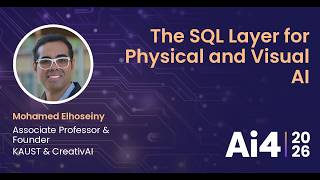
The SQL Layer for Physical and Visual AI With KAUST & CreativAI
Ai4
AI-assisted summary of The SQL Layer for Physical and Visual AI With KAUST & CreativAI — original source. Check the original for full context.
Source published:
Detailed notes
## Background Published on YouTube by Ai4 on August 17, 2026, this presentation features Mohamed Elhoseiny, Associate Professor and Founder at KAUST and CreativAI. The video's description outlines the concept of an SQL layer for physical and visual AI, presenting a unified interface designed to abstract large-scale multimodal streams into structured, database-like assets for fast exploration and analytics.
## TL;DR Mohamed Elhoseiny traces a decade of multimodal AI research, examining how milestones like contrastive pre-training, MiniGPT-4, and spatio-temporal video token compression evolved to handle complex visual data. He argues that despite these algorithmic leaps, current vision-language models remain too verbose and unstructured for enterprise workflows that require deterministic, verifiable operations. To resolve this industrial bottleneck, he presents CreativAI's 'pixels in, structure out' platform, which ingests raw camera feeds and converts them into relational databases. This SQL-like operational layer supports dynamic schema expansion, conversational analytical queries, and automated event dispatching for physical infrastructure and robotics.
## Atmosphere & style The presentation carries the poised, deliberate cadence of an academic lecture while steadily building toward an ambitious entrepreneurial pitch. Elhoseiny establishes an earnest, reflective tone as he candidly describes 'slamming into a wall' when attempting to translate theoretical breakthroughs into industrial reality. As the narrative pivots from technical token-compression diagrams to urgent, multi-camera airport scenarios, the delivery becomes brisk and focused, creating the vivid impression of an engineering puzzle finally being solved with architectural clarity.
## Key takeaways - [00:04](https://www.youtube.com/watch?v=WlZdiBcAzs4&t=4s) Academic vision-language models frequently stall when transitioning to real-world industrial environments due to a lack of deterministic, structured outputs. - [01:01](https://www.youtube.com/watch?v=WlZdiBcAzs4&t=61s) Contrastive image-language pre-training, first introduced in 2013 for zero-shot recognition, established the core embedding alignment architecture later scaled by models like OpenAI's CLIP. - [03:03](https://www.youtube.com/watch?v=WlZdiBcAzs4&t=183s) Frameworks like VisualGPT and MiniGPT-4 pioneered bridging visual features into LLMs, introducing instructable multimodal reasoning and fine-grained spatial grounding. - [05:26](https://www.youtube.com/watch?v=WlZdiBcAzs4&t=326s) Traditional video RAG relying on pre-computed text summaries discards raw visual features, making fine-grained query-time visual inspection impossible. - [07:45](https://www.youtube.com/watch?v=WlZdiBcAzs4&t=465s) Managing video token explosion across long streams requires spatio-temporal token compression, including invariant background deduplication and query-guided token zooming. - [10:00](https://www.youtube.com/watch?v=WlZdiBcAzs4&t=600s) Enterprise and industrial operations require structured, verifiable database records rather than the verbose, unstructured narratives generated by standard VLMs. - [10:00](https://www.youtube.com/watch?v=WlZdiBcAzs4&t=600s) Over a billion optical cameras monitor global physical operations, but visual data remains largely unprogrammable and siloed in raw pixel formats. - [11:50](https://www.youtube.com/watch?v=WlZdiBcAzs4&t=710s) CreativAI implements a 'pixels in, structure out' paradigm, turning raw live and archival video streams into relational database tables tied to exact timestamps and frames. - [11:50](https://www.youtube.com/watch?v=WlZdiBcAzs4&t=710s) The SQL layer acts as a central cognitive brain for physical environments, instantly structuring incidents to automate workflows and dispatch robotic or human responses. - [14:02](https://www.youtube.com/watch?v=WlZdiBcAzs4&t=842s) Dynamic schema expansion enables iterative visual analytics, automatically appending new columns for relational operations like GROUP BY without re-processing entire video datasets.
## Detailed walkthrough ### [00:04](https://www.youtube.com/watch?v=WlZdiBcAzs4&t=4s) From Academic Vision-Language Research to Industrial Reality
Mohamed Elhoseiny introduces his career journey, reflecting on two decades dedicated to teaching machines to understand visual inputs through vision-language research. Throughout this journey, he describes repeatedly "slamming into a wall" whenever attempting to bridge cutting-edge academic models with real-world industrial and operational environments. To set the stage, he structures his presentation into two distinct acts: first, an overview of the foundational academic and algorithmic breakthroughs over the past decade, followed by an analysis of why current vision-language models fall short of enterprise adoption, ultimately motivating the creation of a dedicated SQL layer for physical and visual AI.
```mermaid flowchart LR accTitle: Evolution of Vision-Language Models to Industrial Query Systems accDescription: Diagram tracing the evolution from Contrastive Pre-training to LLM Bridging, Video Token Compression, and the Structured SQL Layer.
subgraph Foundations ["Foundational Image-Language AI"] A["Contrastive Pre-training<br/>(Zero-Shot Recognition)"] --> B["VisualGPT & MiniGPT-4<br/>(LLM Bridging & Grounding)"] end
subgraph VideoScaling ["Video Scaling & Compression"] B --> C["Segment Chunking & RAG"] C --> D["Spatio-Temporal &<br/>Query-Aware Token Compression"] end
subgraph Industry ["Industrial Operational Layer"] D --> E["CreativAI SQL Layer<br/>(Structured Queries on Visual Data)"] end ```
[01:01](https://www.youtube.com/watch?v=WlZdiBcAzs4&t=61s) The Roots of Zero-Shot Learning and Contrastive Pre-training
The foundational architecture underpinning modern vision-language models traces back to Elhoseiny’s 2013 ICCV paper on zero-shot recognition for unseen classes. To illustrate the concept, he presents an intuitive example: most people might not know what a specific bird species looks like in advance, but if given a linguistic description—such as having a short orange beak, darker plumage on top, and white plumage below—one can mentally synthesize the appearance and recognize the bird upon encountering it. Enabling this capability in machines requires cross-modal inference that directly connects natural language semantics to visual feature spaces.
To achieve this cross-modal alignment, Elhoseiny developed contrastive image-language pre-training in 2013. The algorithm pairs visual data with corresponding natural language descriptions, optimizing representations so that pairs belonging to the same semantic class exhibit high similarity and minimal distance in embedding space, while mismatched pairs are pushed far apart. While initially introduced using linear projections, this contrastive framework served as the direct precursor to modern web-scale models like OpenAI's CLIP, which scaled the core algorithm across massive image-text datasets using deep visual and textual encoders.
- **Zero-Shot Principle**: Recognizing unseen visual classes purely from structured textual descriptions via cross-modal semantic mapping. - **Contrastive Pre-Training Mechanics**: Maximizing embedding similarity for matching image-text pairs while minimizing similarity for mismatched pairs. - **Scaling Vector**: Modern breakthroughs like CLIP scale this fundamental contrastive learning paradigm across deep architectures and internet-scale datasets.
[03:03](https://www.youtube.com/watch?v=WlZdiBcAzs4&t=183s) Bridging Images into LLMs: VisualGPT, MiniGPT-4, and Grounded Vision
While contrastive pre-training maps visual representations into a joint space, it does not inherently yield instructable, conversational intelligence. To bridge visual features into language models, Elhoseiny’s lab introduced VisualGPT in 2022, marking the first framework to bridge visual features directly into a large language model (GPT-2 at the time) to perform image captioning. Because early LLMs were not natively instruction-tuned, these initial architectures focused primarily on descriptive captioning rather than multi-turn dialogue.
Shortly thereafter, the lab developed MiniGPT-4, which became the first instructable vision-language model. The project experienced massive viral adoption, accumulating 10,000 GitHub stars within its first three days and eventually surpassing 26,000 stars. MiniGPT-4 utilized a surprisingly lightweight projection layer to bridge visual encoders with instruction-tuned LLMs, allowing users to input arbitrary images—such as a photo of a meal—and receive actionable, multi-step instructions, like generating a recipe specifying ingredients down to tablespoons of olive oil. Subsequent iterations introduced visual grounding (such as MiniGPT-v2), giving models spatial awareness to localize and bound objects dynamically in the image frame as it generates descriptive text, such as pinpointing the exact coordinates of children playing on a seesaw.
- **VisualGPT (2022)**: Pioneered bridging visual representations into LLMs for conditioned text generation. - **MiniGPT-4 (2023)**: Achieved viral breakout success (10k stars in 3 days, 26k+ overall) by enabling zero-shot instruction following on visual inputs. - **Spatial Grounding**: Integrated object-level coordinate prediction directly into generated natural language streams.
[05:26](https://www.youtube.com/watch?v=WlZdiBcAzs4&t=326s) Scaling Modalities: Video Architectures, Chunking, and Query-Time Limits
Scaling from static images to video introduces massive computational bottlenecks, even though video comprises over 80% of all internet traffic. Elhoseiny’s lab expanded their architecture into MiniGPT4-video, encoding sequences of video frames alongside contextual subtitles. However, processing long-form temporal data—such as a full television episode of *Friends*—reveals fundamental challenges when querying specific narrative moments, such as locating the exact scene where Phoebe and Monica are conversing in a restaurant.
To handle long videos, their ACCV paper introduced a temporal chunking and retrieval-augmented generation (RAG) framework:
```mermaid flowchart TD accTitle: Temporal Chunking vs Query-Native Video Processing accDescription: Flow showing the ACCV segment-chunking RAG pipeline compared to native query-time visual processing.
subgraph ACCV_Pipeline ["Pre-Computed Video RAG Pipeline"] V1["Raw Long Video Stream"] --> S1["Temporal Chunking / Segments"] S1 --> S2["Pre-Generated Text Summaries"] S2 --> DB[("Text Index / Vector DB")] Q1["User Query"] --> RET["Text-based Retrieval"] DB --> RET end
subgraph QueryNative ["Query-Native Native Visual Processing"] Q2["User Query"] --> COMP["Query-Guided Frame & Token Compression"] V2["Raw Video Tokens"] --> COMP COMP --> VLM["Direct VLM Spatial-Temporal Reasoning"] end ```
While effective at extending context windows, this pre-captioning approach suffers from a major architectural limitation: at query time, the system lacks native access to raw visual features. Because the natural language descriptions of video segments are pre-computed prior to receiving the user's question, fine-grained visual details not captured in the initial summary are permanently lost to the model.
[07:45](https://www.youtube.com/watch?v=WlZdiBcAzs4&t=465s) Spatio-Temporal Token Compression and Entity Indexing
Overcoming the query-time disconnect requires models to operate natively on raw video tokens without exceeding context budgets. Standard video encoding generates approximately 144 tokens per frame; at that rate, a 20-minute video consumes 172,000 tokens, and a full 24-hour surveillance feed explodes to 12.3 million tokens. To combat this token explosion, Elhoseiny’s team engineered advanced spatio-temporal compression techniques:
```mermaid flowchart TD accTitle: Spatio-Temporal Video Compression Strategies accDescription: Flowchart illustrating the three compression strategies: diversity selection, temporal background deduplication, and query-aware token pooling.
subgraph CompressionStrategies ["Video Token Optimization"] direction TB A["Raw Video Frame Stream<br/>(144 tokens/frame)"]
A --> B["Temporal Diversity Selection<br/>(Sample dynamic moments, drop identical frames)"] A --> C["Spatial Background Deduplication<br/>(Encode static backgrounds once across time)"] A --> D["Query-Guided Token Zooming<br/>(Dense tokens for query regions, sparse for irrelevant)"]
B & C & D --> E["Compressed Visual Token Stream<br/>(High efficiency, full visual fidelity)"] end ```
In addition to static background deduplication and query-informed token allocation—detailed in work presented at ECCV featuring a lightweight VLM selector—the researchers integrated entity-level abstraction layers. By indexing moving objects and human actors as structured entities across temporal segments, models can answer precise tracking queries, such as identifying the exact timestamp and location where a user last opened their laptop.
- **Token Explosion Metrics**: Standard 144 tokens/image leads to 172k tokens for a 20-minute video and 12.3 million tokens for a 24-hour feed. - **Spatial Deduplication**: Identifying and compressing invariant background tokens across consecutive frames. - **Dynamic Query Zooming**: Allocating high token density to query-relevant spatio-temporal regions while downsampling background contexts. - **Entity-Level Indexing**: Tracking persistent physical entities across time intervals for exact physical-world recall.
[10:00](https://www.youtube.com/watch?v=WlZdiBcAzs4&t=600s) The Industrial Dilemma: Launching CreativAI and the SQL Layer
Reflecting on the decade-long evolution of vision-language models, Elhoseiny underscores a fundamental barrier: foundational VLMs are fundamentally "verbose," generating expansive, unstructured textual narratives that do not align with the structured, verifiable requirements of industrial enterprise applications. Industrial settings do not need verbose conversational summaries; they need deterministic, structured querying over visual and physical processes. This gap led to the founding of CreativAI to establish a standardized "SQL layer for physical and visual AI."
Elhoseiny introduces the company’s launch video, which captures the scale of the global visual infrastructure:
| Domain | Historical Breakthrough | Core Mechanism | Resulting Capability | |:--- |:--- |:--- |:--- | | **Documents** | Search Engines | Keyword & Vector Indexing | Instant information retrieval | | **Tabular Data** | SQL / Relational Databases | Structured Query Language | Programmable analytics & operations | | **Source Code** | Git / GitHub | Version Control & Repositories | Collaborative software engineering | | **Visual Data** | *CreativAI SQL Layer* | Unified Multimodal Querying | Structured, actionable physical intelligence |
The presentation highlights that over one billion optical cameras currently monitor real-world environments across hospitals, manufacturing plants, logistics warehouses, and retail spaces. With the rapid deployment of autonomous robots and embodied AI systems, this visual sensor footprint is expanding exponentially. Despite capturing how global physical operations run every second, visual feeds—which represent over 80% of all internet traffic—remain locked in raw, unstructured formats without a programmable interface to query, verify, and automate operational decisions.
[11:50](https://www.youtube.com/watch?v=WlZdiBcAzs4&t=710s) Pixels In, Structure Out: The Vision of CreativAI
Visual and physical AI has long had the ability to observe the world through lenses, but it has lacked a unified cognitive architecture to interpret and coordinate those observations. CreativAI is designed to act as the "SQL layer for physical and visual AI," operating on the foundational principle of "pixels in, structure out." Rather than relying on secondary metadata, human tags, or text captions, the system directly ingests live video streams as they occur, alongside archival footage dating back years. It decomposes raw video into structured relational databases formatted as rows and columns, where every entry links directly back to the exact video frame and moment in time it originated from. This turns disparate feeds from security cameras, aerial drones, autonomous vehicles, and robotic platforms into a synchronized, single source of truth that humans, autonomous agents, and robots can query and operate against simultaneously.
```mermaid flowchart TD accTitle: CreativAI Data Pipeline Architecture subgraph Ingest ["1. Multi-Lens Ingest"] A["Cameras, Drones, Robots & Vehicles"] end subgraph Engine ["2. Structuring Engine"] B["Raw Pixels Analysis"] C["Relational DB: Events, Entities & Behaviors"] end subgraph Act ["3. Unified Action Layer"] D["Humans: Natural Language"] E["AI Agents: REST / Query APIs"] F["Robotics: Real-Time Dispatch"] end A --> B B --> C C --> D C --> E C --> F ```
The practical power of this architecture is highlighted through high-stakes, high-density environments like an international airport—an ecosystem spanning thousands of cameras and tens of thousands of active passengers. CreativAI converts raw visual pixels into actionable structured events the instant an incident unfolds. When a liquid spill occurs in Concourse B, the system immediately generates a structured record containing the substance type, precise location, surface area, and severity level, automatically dispatching a nearby cleaning robot to the site. Similarly, if a passenger collapses near gate B12, the platform logs the individual, the location, and an urgency rating, routing the emergency directly to the nearest airport staff member and elevating it above every other item in the queue.
- **Three Core Jobs**: - **Ingest**: Ingests optical feeds from any device equipped with a lens, including fixed cameras, drones, mobile robots, and vehicles. - **Structure**: Automatically parses raw pixel streams into discrete entities, behaviors, and events as they unfold in real time. - **Act**: Provides an operational query layer where humans communicate in natural language, AI agents query via APIs, and physical robots receive automated instructions. - "Visual and physical AI has eyes. What it never had is a structured brain."
---
[14:02](https://www.youtube.com/watch?v=WlZdiBcAzs4&t=842s) Conversational Visual Analytics and Dynamic Schema Expansion
Whether deployed by individual researchers, software developers, or large enterprise organizations, the underlying platform is built to scale elastically across any camera count and data volume. The infrastructure supports multiple deployment models, running on public clouds, on-premises setups, or isolated private clouds. The core objective is a "structure-first" analytical workflow, allowing users to converse directly with massive camera networks just as they would with a traditional relational database. For instance, an operator monitoring municipal feeds across New York City can ask in plain language for the helmet compliance ratio among cyclists during the day versus at night. The engine autonomously scans the video, identifies the corresponding cyclist segments, and generates a structured data table where the rows represent video snippets and the columns track lighting conditions (daytime vs. nighttime) and whether the cyclist is wearing a helmet, producing the comparative ratio instantly.
```mermaid flowchart LR accTitle: Dynamic Visual Table Expansion A["Query 1: Cyclist Helmet Compliance"] --> B["Initial Table: Segments | Day/Night | Helmet Compliance"] B --> C["Query 2: Intersection Breakdown"] C --> D["Expanded Table: Appends 'Intersection' Column for GROUP BY"] ```
When users iterate with follow-up queries, the system exhibits contextual memory rather than recomputing the visual corpus from scratch. If an analyst subsequently asks how helmet compliance varies between street intersections and non-intersections, the engine recognizes the preexisting table and dynamically appends an intersection column to the schema. This allows operators to immediately run familiar analytical aggregations like `GROUP BY` on the newly enriched dataset. Beyond urban monitoring, this approach applies across domains such as professional sports analytics, where an analyst can provide a photo of Lionel Messi and query how many left-corner kicks versus right-corner kicks he executed across World Cup tournaments. Backed by filed patents on structured-knowledge transformation from visual media, the platform ranks number one on visual retrieval benchmarks, bringing visual computing into parity with standard enterprise SQL workflows.
- **Infrastructure & Scale**: Dynamically auto-scales compute resources based on ingested data volume; supports public cloud, on-premises, and private cloud deployments. - **Dynamic Table Construction**: Converts open-ended video queries into schema-backed rows and columns, enabling subsequent relational operations (`GROUP BY`, filtering, and cross-tabulation). - **Benchmark Standing & IP**: Holds the top ranking on multimodal visual retrieval benchmarks, supported by proprietary patents centering on the transformation of raw unstructured video into SQL-retrievable relational formats.
## Notable quotes > [00:04](https://www.youtube.com/watch?v=WlZdiBcAzs4&t=4s) slamming into a wall — Mohamed Elhoseiny
> [10:00](https://www.youtube.com/watch?v=WlZdiBcAzs4&t=600s) verbose — Mohamed Elhoseiny
> [10:00](https://www.youtube.com/watch?v=WlZdiBcAzs4&t=600s) SQL layer for physical and visual AI — Mohamed Elhoseiny
> [11:50](https://www.youtube.com/watch?v=WlZdiBcAzs4&t=710s) pixels in, structure out — Mohamed Elhoseiny
> [11:50](https://www.youtube.com/watch?v=WlZdiBcAzs4&t=710s) Visual and physical AI has eyes. What it never had is a structured brain. — Mohamed Elhoseiny
> [14:02](https://www.youtube.com/watch?v=WlZdiBcAzs4&t=842s) structure-first — Mohamed Elhoseiny
> [11:50](https://www.youtube.com/watch?v=WlZdiBcAzs4&t=710s) Ingest — Mohamed Elhoseiny
> [11:50](https://www.youtube.com/watch?v=WlZdiBcAzs4&t=710s) Structure — Mohamed Elhoseiny
> [11:50](https://www.youtube.com/watch?v=WlZdiBcAzs4&t=710s) Act — Mohamed Elhoseiny
## Mentioned ACCV, Ai4, CLIP, CreativAI, ECCV, Friends, Git, GitHub, GPT-2, ICCV, KAUST, Lionel Messi, MiniGPT-4, MiniGPT-v2, MiniGPT4-video, Mohamed Elhoseiny, OpenAI, VisualGPT
## Video description Mohamed Elhoseiny - Associate Professor & Founder, KAUST & CreativAI
The SQL layer for Physical and Visual AI is a unified interface that lets developers query, filter, and retrieve structured insights from large-scale multimodal data such as images, video, and sensor streams. It abstracts the complexity of visual and physical-world data into a familiar query paradigm, enabling fast exploration and analytics without custom pipelines. This turns raw perception data into a programmable, database-like asset for building and scaling AI applications.
[Source](https://www.youtube.com/watch?v=WlZdiBcAzs4)