Addington Warns Autonomous Twins Risk Silent Supply Chain Sabotage
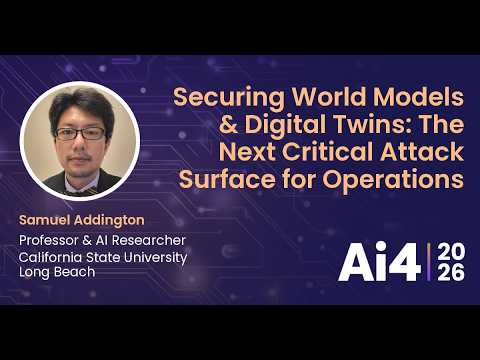
Ai4
Subtle data tampering in automated digital twins compounds through operational feedback loops to cause physical disruption without triggering traditional security alarms.
AI-assisted summary of Securing World Models & Digital Twins: The Next Critical Attack Surface for Operations — original source. Check the original for full context.
Source published:
Detailed notes
## Background Published on YouTube by the Ai4 channel on August 19, 2026, this presentation features Samuel Addington, an AI researcher and professor at California State University Long Beach. The video explores how digital twins are transitioning from passive visual dashboards into automated decision engines, creating a critical new operational attack surface across the Sense-Model-Act loop and requiring practical, vendor-neutral security controls.
## TL;DR Samuel Addington explains how modern digital twins and predictive world models are evolving from informational dashboards into autonomous control planes that directly execute physical actions in warehousing, logistics, and manufacturing. This architectural shift pivots the primary threat model from confidentiality to integrity, where subtle manipulations of sensor telemetry or simulation assumptions compound through closed feedback loops to cause silent operational damage without triggering alarms. To defend against these vectors across the Sense, Model, and Act stages, Addington presents a six-part security blueprint emphasizing input provenance, tamper-evident simulation parameters, twin-reality divergence monitoring, and policy-gated actuation. The talk concludes with an actionable set of procurement questions to ensure organizations rigorously vet vendor integrity controls before deployment.
## Atmosphere & style The presentation carries a lucid, methodical, and authoritative tone, systematically deconstructing complex cyber-physical risks from first principles without relying on hype or obscure jargon. Addington speaks with the calm, pedagogical clarity of an educator, grounding abstract AI concepts in vivid and quietly unsettling industrial failure modes like phantom warehouse bays and unmonitored tolerance drift. Watching the session feels like an empowering, vendor-neutral masterclass that transitions smoothly from an eye-opening threat briefing into a pragmatic architectural and procurement playbook.
## Key takeaways - [00:04](https://www.youtube.com/watch?v=LscxCxPMaBY&t=4s) Digital twins are rapidly evolving from passive informational dashboards into active operational decision engines that directly execute physical workflows. - [01:34](https://www.youtube.com/watch?v=LscxCxPMaBY&t=94s) A digital twin captures current state awareness while a world model runs counterfactual simulations; transitioning to answering 'what should we do' turns the system into an operational control plane. - [04:24](https://www.youtube.com/watch?v=LscxCxPMaBY&t=264s) The operational architecture operates as a closed Sense-Model-Act loop, causing unaddressed data manipulations to compound exponentially over continuous cycles. - [05:45](https://www.youtube.com/watch?v=LscxCxPMaBY&t=345s) Securing world models shifts the primary risk from confidentiality to integrity, where silent manipulations degrade operations without triggering standard alarms or outages. - [07:03](https://www.youtube.com/watch?v=LscxCxPMaBY&t=423s) Adversaries can exploit the loop by fabricating raw sensor telemetry (Sense), poisoning unmonitored simulation assumptions (Model), or exploiting over-privileged execution pathways (Act). - [08:47](https://www.youtube.com/watch?v=LscxCxPMaBY&t=527s) Integrity compromises in warehousing, logistics, and manufacturing subtly skew physical operations while staying cleanly within expected variance thresholds. - [10:39](https://www.youtube.com/watch?v=LscxCxPMaBY&t=639s) Protecting twin state beliefs requires cryptographic input provenance, Zero Trust device-level authentication, and tamper-evident hashing for simulation parameters. - [12:03](https://www.youtube.com/watch?v=LscxCxPMaBY&t=723s) Governing actuation requires categorizing automated actions by blast radius, enforcing human-in-the-loop approvals for high-risk actions via an independent rules engine outside the AI model. - [12:03](https://www.youtube.com/watch?v=LscxCxPMaBY&t=723s) Continuous monitoring of twin-reality divergence is the single most critical early warning mechanism for identifying silent operational integrity breaches. - [12:03](https://www.youtube.com/watch?v=LscxCxPMaBY&t=723s) All automated actions executed by the digital twin must maintain immutable audit trails, clear human accountability, and pre-tested programmatic rollback procedures. - [13:46](https://www.youtube.com/watch?v=LscxCxPMaBY&t=826s) Vendor procurement must verify data-level cryptographic provenance, model assumption auditability, blast-radius boundaries, and built-in divergence tracking. - [15:06](https://www.youtube.com/watch?v=LscxCxPMaBY&t=906s) Organizations deploying world models must treat optimization engines as mission-critical control planes and immediately instrument divergence tracking against ground-truth physical reality.
## Detailed walkthrough ### [00:04](https://www.youtube.com/watch?v=LscxCxPMaBY&t=4s) Introduction: From Dashboard to Control System
Samuel Addington, an AI researcher and professor at California State University, Long Beach whose work focuses on the intersection of AI systems and operational security, opens his presentation with a central thesis: the digital twin systems companies have built as passive dashboards are quietly transforming into active control systems. He assures the audience that no deep specialized background is required to follow the session, as every key term will be defined from first principles.
The session outlines a straightforward roadmap based on a unifying operational loop: Sense, Model, and Act. Addington explains that every threat, cost, and countermeasure discussed anchors directly onto this three-stage cycle. After establishing the core definitions and the shift from descriptive reporting to autonomous operational decision-making, the talk covers where adversaries target these systems across warehousing, logistics, and manufacturing, provides a six-part vendor-neutral security blueprint, and concludes with an actionable checklist of questions to ask vendors before signing any procurement contracts.
```mermaid flowchart LR accTitle: The Sense Model Act Operational Loop subgraph Loop["The Closed Decision Loop"] S["Sense<br/>Telemetry & Ingestion"] --> M["Model<br/>Simulation & Scoring"] M --> A["Act<br/>Execution & Dispatch"] A -. Feedback Telemetry.-> S end ```
---
[01:34](https://www.youtube.com/watch?v=LscxCxPMaBY&t=94s) Defining Digital Twins vs. World Models
Vendors often conflate "digital twin" and "world model," but separating them is essential for understanding operational security. A digital twin is an up-to-date digital representation of a physical environment. In a warehouse setting, for instance, the twin maintains an exact virtual map of storage racks, bay slots, active work orders, paper documentation, and physical equipment, continuously kept current through sensors and enterprise software feeds. A world model operates as a predictive simulation layer built directly on top of the digital twin. It simulates counterfactual scenarios to answer "what if" questions—evaluating what happens if specific orders are rerouted, if a key sorting machine slows down, or if a primary loading dock is taken offline.
Together, the digital twin and world model address three fundamental operational questions: 1. *What is happening?* (State awareness via the digital twin) 2. *What happens next?* (State prediction via the world model) 3. *What should we do?* (Action optimization and policy selection)
The third question represents the critical transition point for system security. "The moment a system answers *what should we do*," Addington emphasizes, "it is not a reporting system anymore."
---
[02:49](https://www.youtube.com/watch?v=LscxCxPMaBY&t=169s) The Architectural Shift: When Analytics Become a Control Plane
Five years ago, a digital twin was primarily a visual artifact—an informational pane where human operators observed operational status, formed subjective judgments, and manually keyed instructions into separate execution software. Today, modern digital twins autonomously close the operational loop without human intervention. They automatically release work orders, reslot warehouse inventory, reroute logistics truck fleets, and modify manufacturing assembly line speeds. While human approvers occasionally remain in the loop, they are increasingly bypassed in favor of straight-through execution.
This transformation is driven by three compounding trends: physical sensors have grown vastly cheaper, simulation engines execute significantly faster, and underlying AI models have become sufficiently accurate that organizations place blind operational trust in their recommendations. This creates a severe security vulnerability. When a system's output is merely an analytical chart, corrupted input data produces an erroneous visualization that a vigilant human supervisor can spot and discard. However, when corrupted input directly produces physical, automated actions, the digital twin is no longer an analytical tool—it has become an unprotected operational control plane.
---
[04:24](https://www.youtube.com/watch?v=LscxCxPMaBY&t=264s) The Operational Feedback Loop: Sense, Model, and Act
The entire architecture of automated digital twins hangs upon the tripartite Sense $\to$ Model $\to$ Act cycle, where each stage serves a distinct operational purpose:
```mermaid flowchart TD accTitle: Detailed Breakdown of the Closed-Loop Threat Surface subgraph SENSE["1. SENSE (Ingestion Layer)"] S1["PLC Signals & GPS Pings"] S2["Barcode Scans & RFID Tags"] S3["ERP & WMS Records"] end
subgraph MODEL["2. MODEL (Simulation & Optimization Layer)"] M1["Simulate Alternative Options"] M2["Score Against Assumptions:<br/>• Cost per mile<br/>• Dock capacity<br/>• Expected lead times"] end
subgraph ACT["3. ACT (Control Plane & Execution)"] A1["Human Recommendation"] A2["Direct Physical Write-Back:<br/>• Reslotting pallets<br/>• Modifying line speeds<br/>• Dispatching fleet"] end
SENSE --> MODEL MODEL --> ACT ACT -- "Action impacts physical state & generates new telemetry" --> SENSE ```
- **Sense:** Telemetry streams into the digital twin—including barcode scans, programmable logic controller (PLC) signals, GPS pings, enterprise resource planning (ERP) records, and warehouse management system (WMS) logs. This aggregated telemetry forms the twin's perceived picture of physical reality. - **Model:** The twin and its associated world model evaluate various operational options through simulations, scoring outcomes against embedded baseline assumptions such as cost per mile, facility capacity, and projected customer demand. - **Act:** The model dispatches recommendations, either sending action prompts to human managers or writing commands directly back to operational control systems.
Because this forms a fully closed feedback loop, the physical consequences of every executed action immediately generate new telemetry that feeds back into the "Sense" stage. As a result, even minor, imperceptible data manipulations compound exponentially over successive operational cycles.
---
[05:45](https://www.youtube.com/watch?v=LscxCxPMaBY&t=345s) Threat Shift: From Confidentiality to Integrity
Traditional cybersecurity focuses almost exclusively on confidentiality—preventing unauthorized adversaries from exfiltrating sensitive organizational data. In decision engines and world-model-driven automation, the highest-value attack surface shifts entirely from confidentiality to *integrity*.
An adversary does not need to steal intellectual property or exfiltrate customer records to inflict severe financial and physical damage. By slightly altering what the digital twin believes, the attacker directly controls what physical operations execute. This class of attack is far quieter and more insidious than conventional ransomware: there are no system outages, no encrypted file systems, and no ransom notes delivered to executive teams. Instead, manufacturing throughput silently degrades, high-value inventory is routed to incorrect bays or unauthorized hands, and machinery is run slightly past safe operating tolerances. Because the feedback loop constantly incorporates these altered states into normal operational baselines, small distortions persist indefinitely and compound over time.
---
[07:03](https://www.youtube.com/watch?v=LscxCxPMaBY&t=423s) The Threat Model Across the Three Stages
To systematically evaluate risk, Addington presents a simple, vendor-neutral threat model that maps one primary attack vector to each stage of the Sense $\to$ Model $\to$ Act loop (referencing the MITRE ATLAS framework as an essential open resource for modeling adversarial techniques against AI systems):
```mermaid flowchart LR accTitle: Attack Vectors across Sense Model and Act Stages subgraph SenseAtk["Sense: Fabricate Fiction"] A1["Spoof barcode scans"] A2["Clone RFID tags"] A3["Replay old sensor telemetry"] A4["Forge ERP records"] end
subgraph ModelAtk["Model: Corrupt Logic"] B1["Poison training data"] B2["Manipulate assumptions:<br/>• Dock capacities<br/>• Fuel/transit costs<br/>• Lead time limits"] end
subgraph ActAtk["Act: Bypass Controls"] C1["Prompt/instruction injection"] C2["Over-privileged service accounts"] C3["Direct write-back paths without human gates"] end
SenseAtk --> ModelAtk --> ActAtk ```
- **Attacking Sense (Fabricating Fiction):** Attackers manipulate raw inputs before the model ingests them. Techniques include spoofing barcode scans, cloning RFID asset tags, replaying recorded sensor telemetry from previous months, or forging upstream ERP database entries. These vectors are inexpensive to execute, operate outside traditional perimeter firewalls, and remain largely invisible to legacy IT monitoring. - **Attacking Model (Poisoning Logic & Assumptions):** Adversaries poison the historical datasets used to train models or covertly edit the hardcoded operational assumptions within simulation engines—such as cost-per-mile variables, dock capacities, or supplier lead times. Simulation assumptions represent an entirely unmonitored back door: security teams rarely audit them, yet they dictate what the system calculates as "optimal" business behavior. - **Attacking Act (Bypassing Execution Guardrails):** Adversaries manipulate execution pathways by injecting malicious instructional text into automated work orders or service support tickets, leveraging over-privileged service accounts with excessive write access, or exploiting automated bypasses that route directly into physical systems without human oversight.
---
[08:47](https://www.youtube.com/watch?v=LscxCxPMaBY&t=527s) Real-World Impact Scenarios: Warehousing, Logistics, and Manufacturing
To illustrate how these subtle integrity manipulations manifest in physical operations without triggering alerts, Addington details hypothetical scenarios across three major industrial environments:
| Industry Sector | Attack Vector | Operational Mechanism | Resulting Business Impact | |:--- |:--- |:--- |:--- | | **Warehousing** | Spoofed Scan Telemetry | False telemetry tricks the twin into believing an occupied storage bay is completely empty. | The twin repeatedly directs inbound pallets to the unavailable bay. Pick paths lengthen, overall inventory accuracy degrades, and logistics staff spend months troubleshooting "bad data." | | **Logistics** | Modified Simulation Assumptions | An adversary silently alters transit time and cost-per-mile assumptions in the routing engine. | Freight volume shifts away from optimal carriers to specific routes benefiting the adversary. Overall transportation spend escalates while staying cleanly within "normal variance" bands that evade threshold alarms. | | **Manufacturing** | Poisoned Quality Model | Subtle data poisoning gradually widens the acceptable tolerance limits in automated inspection models. | Defective finished goods pass quality assurance unnoticed and are shipped directly to consumers. The organization only discovers the breach when warranty claims spike, having compromised physical safety margins throughout production. |
All three scenarios share a chilling commonality: "No outage, no ransom note, no obvious security breaches—just decisions slightly wrong."
---
[10:39](https://www.youtube.com/watch?v=LscxCxPMaBY&t=639s) A Six-Part Control Blueprint: Securing What the Twin Believes
To establish a defense-in-depth framework for autonomous digital twins, Addington presents a six-part control blueprint. The first three controls focus on protecting *what the digital twin believes* (data integrity and modeling assumptions), referencing standards such as NIST SP 800-161 (Supply Chain Risk Management) and NIST SP 800-207 (Zero Trust Architecture):
- **Control 1: Input Provenance & Attestation** Every incoming telemetry packet and data feed must carry cryptographic proof of its source, an unalterable timestamp of generation, and a valid digital signature to ensure telemetry has not been modified in transit. - **Control 2: Device-Level Authentication (Zero Trust Telemetry)** Authentication must be enforced at the individual device level rather than relying on network perimeter segmentation. Addington stresses that a sensor merely existing on an internal corporate subnet does not make it trustworthy; organizations must apply strict Zero Trust principles to raw telemetry streams. - **Control 3: Tamper-Evident Models & Simulation Assumptions** All machine learning models, simulation parameters, and operational assumptions must be cryptographically hashed, signed, and continuously verified against unauthorized modifications. Unaudited simulation assumptions represent an unmonitored back door that bypasses conventional security software, requiring rigorous configuration change controls.
---
[12:03](https://www.youtube.com/watch?v=LscxCxPMaBY&t=723s) A Six-Part Control Blueprint: Governing What the Twin Is Allowed to Do
The remaining three controls in the blueprint shift focus from data integrity to governing *what the system is permitted to execute*:
- **Control 4: Drift & Twin-Reality Divergence Monitoring** Organizations must continuously track the divergence between the digital twin's predictive state models and actual observed physical outcomes. When the delta between predicted metrics and physical reality widens without an obvious operational cause (such as severe weather or documented mechanical failure), the system must immediately flag that divergence as an active security incident. Addington emphasizes that if an organization can only implement a single measure, it must be divergence monitoring. - **Control 5: Policy-Gated Actuation** Automated actions must be strictly categorized by their potential "blast radius." Low-risk actions (such as re-sequencing an individual picker's item list) can run fully autonomously. In contrast, high-risk operational modifications—such as altering industrial machine line speeds, committing capital expenditure, or reallocating fleet routes—must require explicit human authorization. Furthermore, gating policies must reside in an independent rules engine entirely outside the AI model's codebase. - **Control 6: Action Escalation, Audit Trails, and Reversals** Every autonomous action executed by the twin must be assigned to an identifiable, named human owner, log an unalterable audit trail, and include a pre-tested programmatic rollback path. Addington warns teams to rehearse rollback and emergency override procedures *before* going live, as attempting to test emergency procedures during an active operational crisis is far too late.
---
[13:46](https://www.youtube.com/watch?v=LscxCxPMaBY&t=826s) Four Questions to Ask Vendors Before Signing
For leaders evaluating digital twin and world-model software vendors, Addington provides four non-technical, high-impact procurement questions designed to cut through marketing claims:
1. **Provenance:** *"Where does each input come from, and can you prove it was not changed or altered?"* - *The Evaluation Tell:* If the vendor answers by describing their network firewalls or transit encryption rather than verifying data-level provenance and cryptographic signatures, they do not understand operational data integrity. 2. **Change Control:** *"Who can change the model or its operational assumptions, where is that documented, and how is it audited?"* - *The Evaluation Tell:* Demand to inspect real, immutable system audit trail logs rather than settling for high-level corporate security policy PDFs. 3. **Autonomy & Blast Radius:** *"What specific actions can this system execute without human approval, and what is the maximum blast radius of the worst action it can take alone?"* - *The Evaluation Tell:* Vendors should clearly define the absolute worst-case operational disruption that could occur if straight-through execution fails or receives corrupted inputs. 4. **Detection:** *"How would we know if the digital twin has drifted from physical reality?"* - *The Evaluation Tell:* If a vendor cannot demonstrate built-in divergence tracking between predictions and reality, they have no real-time integrity breach detection.
---
[15:06](https://www.youtube.com/watch?v=LscxCxPMaBY&t=906s) Key Takeaways: Treating the Digital Twin as a Critical Control Plane
Addington concludes the presentation with three core takeaways for operational and security leaders:
- **1. Treat Autonomous Twins as Critical Control Planes:** The moment a digital twin moves beyond generating analytical charts to dispatching physical actions, it must be governed like any other mission-critical control plane—with strict change control, granular access permissions, exhaustive audit logging, and rapid rollback mechanisms. - **2. Pivot Security Focus from Confidentiality to Integrity:** Attackers no longer need to breach perimeters to steal enterprise data. In an automated environment, adversaries can quietly inflict catastrophic damage by subtly nudging what the twin believes to be true, letting the system's own feedback loop compound that error into severe operational disruption. - **3. Instrument Reality Divergence Immediately:** As a practical next step for the current quarter, organizations should instrument divergence tracking between digital twin predictions and ground-truth physical reality. Divergence monitoring is inexpensive, straightforward, and vendor-neutral—and it provides the primary early warning mechanism for catching integrity compromises before they cascade. The objective of these controls is not to slow down operational automation, but to ensure that automation rests on a verifiable and resilient operational foundation.
[16:33](https://www.youtube.com/watch?v=LscxCxPMaBY&t=993s) Preventing Optimization Engines from Becoming Unprotected Control Planes
In the closing moments of the presentation, Samuel Addington leaves the audience with a critical guiding principle for securing operational technology: the primary objective "is to make sure your optimization engine does not quietly become an unprotected control plane." As digital twins and world models transition from passive visual dashboards into decision engines with direct actuation capabilities, ensuring that automated optimizations do not introduce unmonitored backdoors or compromised execution paths is vital for maintaining operational integrity.
He wraps up by expressing his hope that attendees now understand the foundational concepts required to securely implement digital twins and world models using straightforward, practical security approaches, before thanking the audience and concluding the session.
## Notable quotes > [01:34](https://www.youtube.com/watch?v=LscxCxPMaBY&t=94s) The moment a system answers what should we do, it is not a reporting system anymore. — Samuel Addington
> [01:34](https://www.youtube.com/watch?v=LscxCxPMaBY&t=94s) What is happening? — Samuel Addington
> [01:34](https://www.youtube.com/watch?v=LscxCxPMaBY&t=94s) What happens next? — Samuel Addington
> [01:34](https://www.youtube.com/watch?v=LscxCxPMaBY&t=94s) What should we do? — Samuel Addington
> [08:47](https://www.youtube.com/watch?v=LscxCxPMaBY&t=527s) No outage, no ransom note, no obvious security breaches—just decisions slightly wrong. — Samuel Addington
> [13:46](https://www.youtube.com/watch?v=LscxCxPMaBY&t=826s) Where does each input come from, and can you prove it was not changed or altered? — Samuel Addington
> [13:46](https://www.youtube.com/watch?v=LscxCxPMaBY&t=826s) Who can change the model or its operational assumptions, where is that documented, and how is it audited? — Samuel Addington
> [13:46](https://www.youtube.com/watch?v=LscxCxPMaBY&t=826s) What specific actions can this system execute without human approval, and what is the maximum blast radius of the worst action it can take alone? — Samuel Addington
> [13:46](https://www.youtube.com/watch?v=LscxCxPMaBY&t=826s) How would we know if the digital twin has drifted from physical reality? — Samuel Addington
> [16:33](https://www.youtube.com/watch?v=LscxCxPMaBY&t=993s) is to make sure your optimization engine does not quietly become an unprotected control plane. — Samuel Addington
## Mentioned Samuel Addington, California State University, Long Beach, Ai4, MITRE ATLAS, NIST SP 800-161, NIST SP 800-207, PLC (Programmable Logic Controller), ERP (Enterprise Resource Planning), WMS (Warehouse Management System), RFID
## Video description Samuel Addington - Professor & AI Researcher, California State University Long Beach
Digital twins are quickly turning from “visual dashboards” into decision engines that can recommend—or automate—real operational actions. In this talk, I will explain how that shift creates a new attack surface: instead of only stealing data, adversaries can manipulate telemetry, model behavior, or simulation assumptions to quietly drive bad decisions in warehousing, logistics, and manufacturing. I will illustrate a simple threat model across the Sense → Model → Act loop and show where integrity failures, poisoning, and policy-bypass attempts can cause real business impact. Attendees will leave with a practical, vendor-neutral security blueprint: provenance and attestation for inputs, tamper-evident model and simulation assets, drift/twin–reality divergence monitoring, and policy-gated actuation with safe escalation for high-risk actions. If you’re planning to deploy digital twins or world-model-driven automation, this session will help you ask the right questions, prioritize controls, and avoid turning your “optimization engine” into an unprotected control plane.
[Source](https://www.youtube.com/watch?v=LscxCxPMaBY)