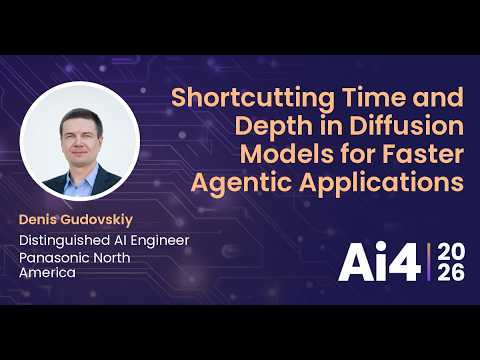
Panasonic Cuts Diffusion Model Latency 100x to Power Edge AI Agents
Ai4
Pruning denoising iterations alongside transformer layer depth achieves a hundredfold latency reduction, allowing diffusion architectures to replace costly autoregressive models in real-time robotics and user-interface agents.
AI-assisted summary of Shortcutting Time and Depth in Diffusion Models for Faster Agentic Applications with Panasonic — original source. Check the original for full context.
Source published:
Detailed notes
## Background Published on YouTube by Ai4 on August 21, 2026, this talk features Denis Gudovskiy, Distinguished AI Engineer at Panasonic North America. According to the description, the session explores few-step generation methods that lower the sampling complexity of diffusion models and details their architectural integration into next-generation AI agents across language, video, audio, robotics, and computer-use workflows.
## TL;DR Denis Gudovskiy explains why diffusion models provide superior parallel generation, error correction, and continuous signal processing compared to standard autoregressive LLMs. He highlights how diffusion-based action heads power Vision-Language-Action (VLA) models and Computer Use Agents (CUAs), as well as video-driven World Action Models (WAMs) like NVIDIA DreamZero for zero-shot physical planning. To solve the edge latency bottleneck of multi-step denoising integrals, Panasonic combines time-discretization consistency distillation with depth pruning across transformer layers, achieving up to a 100x reduction in latency and memory footprint with minimal quality loss. Finally, he outlines the strategic landscape between autoregressive LLMs, discrete diffusion LLMs, VLAs, and WAMs, advocating for lightweight, domain-optimized diffusion agents on edge hardware.
## Atmosphere & style The presentation has the crisp, authoritative tone of an advanced industrial AI research briefing, grounded in practical engineering rather than speculative hype. Gudovskiy speaks with understated, methodical confidence, balancing complex algorithmic concepts like differential equations and consistency distillation with tangible product constraints across cameras, laptops, and mobile devices. Light moments of dry humor—such as noting AI-generated cats across social media—punctuate an otherwise tightly structured, technically rigorous session focused on real-world compute efficiency.
## Key takeaways - [01:20](https://www.youtube.com/watch?v=W-6bXvmG0ao&t=80s) Diffusion models provide three key advantages over autoregressive LLMs: parallel token generation, inherent error correction through iterative denoising, and native support for continuous multimodal signals. - [01:20](https://www.youtube.com/watch?v=W-6bXvmG0ao&t=80s) Discrete diffusion language models (dLLMs) demonstrate that pure diffusion can effectively challenge transformer-based autoregressive models on discrete text generation tasks. - [03:46](https://www.youtube.com/watch?v=W-6bXvmG0ao&t=226s) Vision-Language-Action (VLA) models combine multimodal LLM backbones with diffusion-based action experts to generate high-frequency continuous control trajectories for robotics. - [03:46](https://www.youtube.com/watch?v=W-6bXvmG0ao&t=226s) Physical embodiment frameworks transfer directly to Computer Use Agents (CUAs) by swapping robotic action heads for UI coordinate heads without retraining the core language backbone. - [07:14](https://www.youtube.com/watch?v=W-6bXvmG0ao&t=434s) World Action Models (WAMs) replace LLM backbones with video diffusion engines to perform joint rollout, simultaneously forecasting continuous actions and future visual states. - [07:14](https://www.youtube.com/watch?v=W-6bXvmG0ao&t=434s) Architectures like NVIDIA DreamZero achieve zero-shot physical manipulation by operating in a predictive visual-action latent space that serves as a grounded world simulator. - [09:14](https://www.youtube.com/watch?v=W-6bXvmG0ao&t=554s) Industrial and edge applications on domain-specific hardware require lightweight visual agents optimized for high execution reliability rather than massive, costly autoregressive web models. - [11:13](https://www.youtube.com/watch?v=W-6bXvmG0ao&t=673s) The primary computational bottleneck in diffusion inference is not the neural network forward pass, but the iterative numerical integration across dozens or hundreds of denoising time steps. - [13:41](https://www.youtube.com/watch?v=W-6bXvmG0ao&t=821s) Consistency distillation trains student models under self-consistency constraints to jump across sampling trajectories in just one to few steps using pre-trained teacher checkpoints. - [15:34](https://www.youtube.com/watch?v=W-6bXvmG0ao&t=934s) Simultaneously pruning denoising iterations (time) and transformer block depth (architecture) achieves up to a 100x latency and memory reduction with negligible perceptual quality degradation. - [18:09](https://www.youtube.com/watch?v=W-6bXvmG0ao&t=1089s) The evolving agentic architecture landscape spans autoregressive LLMs, hybrid VLAs, discrete diffusion models, and WAMs, each presenting distinct trade-offs between reasoning capability, training cost, and continuous control efficiency.
## Detailed walkthrough ### [00:04](https://www.youtube.com/watch?v=W-6bXvmG0ao&t=4s) Introduction and Panasonic AI Lab's Research Focus
Denis Gudovskiy introduces the talk, framing its core focus around accelerating agentic applications powered by diffusion models. Reflecting on his career, he notes that he joined the Panasonic AI Lab in Mountain View a decade ago, bringing over ten years of experience developing deep learning and machine learning systems. Within Panasonic, the lab's mandate balances internal artificial intelligence engineering efforts across multiple regional offices with external academic partnerships, actively collaborating with research teams at universities such as Arizona State University and UC Berkeley. These joint academic initiatives primarily focus on efficient AI, robust model architectures, and edge deployment.
- Denis Gudovskiy has worked at Panasonic AI Lab in Mountain View for over 10 years. - Research partnerships focus heavily on academic collaborations with UC Berkeley and Arizona institutions. - Core research pillars: computational efficiency, robustness, and deploying models across distributed edge hardware.
---
[01:20](https://www.youtube.com/watch?v=W-6bXvmG0ao&t=80s) Why Diffusion Models Over Autoregressive LLMs
Addressing the foundational question of why the field is leaning into diffusion architectures, Gudovskiy explains that diffusion models can now augment or entirely replace conventional autoregressive large language models (such as ChatGPT, Claude, and similar systems) across numerous data modalities. This shift stems from three structural advantages: 1. **Parallel token generation**: Autoregressive models must decode text sequentially token by token, whereas diffusion models perform parallel token generation across an entire sequence. 2. **Inherent error correction**: The iterative denoising framework acts as built-in quality control, progressively refining intermediate representations rather than compounding sequential errors. 3. **Native multimodality**: Autoregressive models excel when dealing with discrete tokens like text, but struggle with continuous sensory signals such as time series, robot kinematics, images, and video feeds. Diffusion operates natively in both discrete and continuous state spaces.
The progression of diffusion models has moved rapidly from text-to-image generators like Stable Diffusion to large-scale video systems—acknowledging OpenAI's Sora alongside the broader ecosystem of Silicon Valley startups generating synthetic video (humorously noting how "the cats in the Facebook are now generated with the video generation models"). Beyond continuous media, the industry saw a major push toward discrete diffusion models (DLMs), spearheaded by researchers from Inception Labs and Stanford University, demonstrating that pure diffusion could challenge transformers even on discrete text generation tasks.
```mermaid flowchart TD accTitle: Comparison between Autoregressive LLMs and Diffusion Models subgraph AR["Autoregressive LLMs (e.g., GPT, Claude)"] A1["Discrete Text Tokens"] --> A2["Sequential Generation (Token-by-Token)"] A2 --> A3["Error Compounding / No Inherent Rollback"] end
subgraph Diff["Diffusion Models"] B1["Continuous & Discrete Signals (Sensors, Vision, Actions)"] --> B2["Parallel Generation across Latents"] B2 --> B3["Iterative Denoising (Built-in Quality Control & Correction)"] end ```
---
[03:46](https://www.youtube.com/watch?v=W-6bXvmG0ao&t=226s) Vision-Language-Action Models (VLAs) and UI Agent Adaptation
While discrete diffusion language models represent an exciting theoretical branch, the most transformative advancements over the past six months have emerged in robotics through Vision-Language-Action Models (VLAs). A standard VLA pairs a multimodal vision-language model (VLM) backbone—containing vision and text encoders feeding into an LLM—with a dedicated, diffusion-based action expert. While the upstream VLM processes high-level camera frames, state vectors, and natural language prompts, the downstream diffusion expert generates high-frequency continuous action trajectories, enabling robotic arms to perform dexterous physical manipulations. Gudovskiy highlights the accessibility of these architectures, pointing to open-source foundations like Hugging Face's SmolVLA / LeRobot initiatives that release end-to-end training pipelines, datasets, and checkpoints.
The architectural synergy between robotics and computer use agents (CUAs) is immediately striking: both systems demand dexterous control in an environment devoid of clean APIs or command-line interfaces, relying entirely on visual perception and continuous coordinate control. A computer agent observes raw screen captures and must output precise mouse movements, drags, and clicks. Citing recent work such as ShowUI-π, Gudovskiy explains how researchers adapted small VLA pipelines by swapping the robotic arm action expert for an interface action expert. Crucially, this UI agent requires no fine-tuning or pre-training of the core language backbone—only the diffusion-based action head is adapted, underscoring how seamlessly physical embodiment transfers to graphical user interface manipulation.
```mermaid flowchart LR accTitle: VLA Architecture and Transfer to Computer Use Agents subgraph Perception["Multimodal Backbone (VLM)"] direction TB Inp["Visual Frame + User Command"] --> Enc["Vision & Text Encoders"] Enc --> LLM["Multimodal LLM Backbone"] end
subgraph ActionHeads["Diffusion-Based Action Experts"] direction TB LLM --> Latent["Latent Action Conditioning"] Latent --> RobHead["Robotics Head: Continuous Joint Actions"] Latent --> UIHead["UI Head: Screen Clicks & Cursor Trajectories"] end ```
---
[07:14](https://www.youtube.com/watch?v=W-6bXvmG0ao&t=434s) World Action Models (WAMs) and NVIDIA DreamZero
Over the past few months, the robotics frontier has shifted beyond VLAs toward World Action Models (WAMs). Rather than routing vision through a standard autoregressive LLM to feed a discrete action head, a WAM entirely replaces the LLM backbone with a unified diffusion-based video generation engine. The core breakthrough of a WAM lies in joint rollout: the model simultaneously generates continuous actions and hallucinates the future visual frames that those actions will produce. Predicting multiple minutes into the future dramatically boosts environmental robustness and out-of-distribution generalization.
Gudovskiy highlights NVIDIA’s DreamZero framework as a landmark example of this paradigm. In DreamZero, the robot exhibits zero-shot generalization on completely unseen physical tasks—performing manipulation sequences it never encountered during training. Because the underlying image-to-video diffusion backbone plans entirely within a predictive visual-action latent space, it functions as a grounded simulator of the physical world, making WAMs "the next frontier model for robotics."
- World Action Models replace the conventional autoregressive LLM core with an image-to-video diffusion architecture. - Joint prediction: WAMs forecast both future environment frames and continuous control trajectories simultaneously. - Long-horizon capability: State-of-the-art models predict several minutes into the future to maintain planning stability. - Zero-shot task execution: Architectures like NVIDIA DreamZero enable robots to solve manipulation tasks without task-specific prior training data.
---
[09:14](https://www.youtube.com/watch?v=W-6bXvmG0ao&t=554s) Deploying UI Agents to Domain-Specific Edge Hardware
Translating these embodied paradigms to Panasonic’s business needs brings immediate utility to graphical UI agents. Panasonic manufactures a vast spectrum of physical hardware—ranging from laptops and smart televisions to commercial security cameras—each running specialized, proprietary onboard interfaces. Unlike generic web-browsing agents that require broad internet knowledge, internal industrial applications demand 100% execution robustness across a strictly constrained set of domain-specific workflows, all while operating under stringent compute budgets on edge chips.
Gudovskiy demonstrates working prototypes of these lightweight UI agents in real-world scenarios: - **Mobile photo management**: A smartphone-based agent navigates a local photo gallery, filters and selects designated images based on natural language instructions, and composes an email attachment. - **Developer task automation**: A desktop UI agent opens GitHub, navigates into a specific code repository, generates a structured bug report, and submits an issue directly through the visual web interface without using external APIs.
By avoiding large-scale, high-parameter autoregressive models and utilizing visual diffusion foundations, these agents achieve reliable multi-step tool execution directly on client hardware.
---
[11:13](https://www.youtube.com/watch?v=W-6bXvmG0ao&t=673s) The Computational Challenge of Denoising Integrals
Shifting to the technical mechanics of model acceleration, Gudovskiy breaks down how diffusion models function mathematically at inference time. Diffusion models bridge two probability distributions: a complex ground-truth data distribution (such as natural images of cats or robot control sequences) and an unstructured Gaussian noise distribution. Training teaches the model to approximate the trajectory between these distributions via physics-inspired differential equations.
At inference time, diffusion networks differ fundamentally from standard CNNs or LLMs because they are intrinsically time-dependent: - Conventional neural networks process inputs in a static forward pass without time encoding. - Diffusion backbones integrate explicit time-step embedding layers that track the current noise level $t$. - Data synthesis is formulated as a numerical integration problem across continuous time, starting from pure noise and stepping backward along the reverse denoising trajectory.
The underlying neural network architecture itself remains flexible—relying on convolutional networks, multi-layer perceptrons, vision transformers (DiTs), or hybrid CNN-transformer blocks. However, the bottleneck on edge devices is almost never the single forward pass of the backbone; rather, it is the iterative numerical integral itself. Performing dozens or hundreds of sequential neural network evaluations to denoise a single sample introduces unacceptable latency and compute costs, making trajectory shortcutting and step reduction the central engineering challenge for real-time agentic applications.
[13:41](https://www.youtube.com/watch?v=W-6bXvmG0ao&t=821s) Time Discretization and Few-Step Consistency Distillation
Traditional continuous diffusion models rely on integrating continuous differential equations, which incurs massive computational overhead. To reduce this complexity, standard practice first discretizes the continuous trajectory into a fixed series of time steps—replacing continuous integration with a discrete summation. For example, breaking the trajectory into 100 steps and summing the outputs sequentially produces a sufficiently high-quality image. However, researchers have pushed to determine whether generation can be achieved with even fewer steps, culminating in the recent surge of few-step and single-step generation methods for images, video, and multimodal data.
```mermaid flowchart LR accTitle: Teacher-Student Consistency Distillation accDescription: Workflow illustrating how a teacher diffusion model transfers fast sampling capabilities to a student model via consistency constraints.
subgraph Teacher ["Teacher Model Pipeline"] A["Teacher Model<br>(e.g., Stable Diffusion)"] --> B["Discretized Trajectory<br>(100+ Steps)"] end
subgraph Distillation ["Distillation Objective"] B --> C["Self-Consistency<br>Constraint"] C --> D["Student Model<br>Fine-Tuning"] end
subgraph Inference ["Fast Inference"] D --> E["1-to-Few Step<br>Generation"] end ```
The underlying mechanism relies on training a student model under self-consistency constraints anchored to a pre-trained teacher model, such as Stable Diffusion. By copying the teacher architecture and enforcing that points along the same sampling trajectory map to the same origin, the student learns to jump directly across the trajectory in just one or two steps. Fine-tuning a student in this consistency framework requires relatively few training steps given sufficient data, yielding dramatic reductions in generative latency.
- Time discretization replaces continuous differential equation integration with discrete summations over 100 or more steps. - Consistency models constrain intermediate trajectory points to map consistently to the final output, reducing sampling steps down to 1–2 iterations. - Distillation fine-tuning leverages existing pre-trained teacher checkpoints without requiring full architectural redesign from scratch.
---
[15:34](https://www.youtube.com/watch?v=W-6bXvmG0ao&t=934s) Shortcutting Time and Depth for 100x Latency Reduction
While standard consistency models shortcut only the time domain, Panasonic's optimization framework introduces consistency constraints across both the temporal domain and the neural network's depth domain. In a standard diffusion transformer architecture with 24 blocks (such as in a Diffusion Transformer / DiT backbone), the network can be pruned dynamically down to 18, 15, or fewer layers. By training the network to remain consistent across reduced layer depths as well as reduced time iterations, practitioners obtain fine-grained control over the complexity-quality trade-off.
```mermaid flowchart TD accTitle: 2D Complexity Optimization: Time vs Depth accDescription: Diagram showing simultaneous pruning of denoising iterations and transformer layer depth.
subgraph DenoisingDim ["Temporal Dimension (Iterations)"] T1["Vanilla: 128 Steps"] --> T2["Intermediate: 4 Steps"] --> T3["Extreme: 1 Step"] end
subgraph DepthDim ["Depth Dimension (Layers)"] D1["Full: 24-12 Blocks"] --> D2["Pruned: 8 Blocks"] --> D3["Minimal: 4 Blocks"] end
subgraph Output ["Target Operational Point"] T2 & D2 --> O["Sweet Spot: ~100x Latency & Memory Reduction<br>(Negligible Visual Degradation)"] end ```
Cutting both iterations (e.g., from 128 steps down to 4 or 1) and transformer blocks (e.g., from 12 down to 8 or 4) can yield up to a "100x latency reduction" alongside substantial memory savings. While aggressive pruning in both dimensions simultaneously can cause noticeable visual degradation, there is a wide operational sweet spot where the output is virtually indistinguishable to the human eye from an uncompressed baseline that requires 100 times more compute. Furthermore, because this joint time-depth optimization is solver-agnostic, it reliably cuts generation times from minutes or tens of seconds down to sub-second latencies suitable for real-time applications.
- **Depth pruning:** Dynamically skips or permanently prunes transformer blocks (e.g., from 24 down to 18, 15, 8, or 4 layers). - **Latency reduction:** Generates complete images in one second or less compared to vanilla multi-step pipelines taking multiple minutes. - **Memory footprint:** Shortcutting depth directly reduces the active parameter footprint and activation cache in memory.
---
[18:09](https://www.youtube.com/watch?v=W-6bXvmG0ao&t=1089s) The Next-Gen Agentic Architecture Landscape: LLMs, VLAs, dLLMs, and WAMs
The rapid evolution of agentic AI has sparked an active architectural debate on whether future systems should rely on standard autoregressive LLMs/VLMs, hybrid Vision-Language-Action (VLA) models, Discrete Diffusion LLMs (dLLMs), or World Action Models (WAMs). Conventional autoregressive LLMs continue to scale well for computer-use and general agentic tasks, but training them costs "hundreds of billions of dollars." Crucially, autoregressive models struggle with continuous sensorimotor trajectories and visual data, and they lack the fine-grained complexity-quality trade-offs inherent to iterative diffusion denoising.
| Architecture Type | Primary Mechanism | Strengths | Key Bottlenecks & Open Questions | |:--- |:--- |:--- |:--- | | **Autoregressive LLMs / VLMs** | Sequential token prediction | Strong general reasoning, proven scaling laws | Struggles with continuous sensory data; rigid compute allocation; high training costs | | **Hybrid VLAs (Vision-Language-Action)** | LLM backbone + Diffusion Action Expert | Extends life of existing LLMs; native continuous action outputs for robotics & CUAs | Inherits autoregressive inference bottlenecks from the base LLM | | **Discrete Diffusion LLMs (dLLMs)** | Parallel non-autoregressive token denoising | Substantially faster token generation throughput; built-in quality controls | Open question whether they can match autoregressive reasoning and reasoning depth | | **World Action Models (WAMs)** | Predictive world modeling + trajectory rollout | Superior zero-shot generalization across novel environments | Still in early infancy; optimization and distillation pipelines are not yet mature |
Hybrid VLA frameworks extend the utility of autoregressive foundation models by pairing them with diffusion-based action experts, enabling effective control in robotics and Computer Use Agents (CUAs). In parallel, discrete diffusion LLMs (dLLMs) provide massive speedups via parallel token generation, though their high-level reasoning capabilities remain under active evaluation. World Action Models (WAMs) show exceptional promise for zero-shot environmental generalization, but their optimization remains nascent compared to established VLA setups. Ultimately, specialized, domain-tailored agents built on diffusion backbones can deliver robust real-world execution at a fraction of the inference and operational cost of monolithic frontier models.
## Notable quotes > [01:20](https://www.youtube.com/watch?v=W-6bXvmG0ao&t=80s) the cats in the Facebook are now generated with the video generation models — Denis Gudovskiy
> [07:14](https://www.youtube.com/watch?v=W-6bXvmG0ao&t=434s) the next frontier model for robotics — Denis Gudovskiy
> [15:34](https://www.youtube.com/watch?v=W-6bXvmG0ao&t=934s) 100x latency reduction — Denis Gudovskiy
> [18:09](https://www.youtube.com/watch?v=W-6bXvmG0ao&t=1089s) hundreds of billions of dollars — Denis Gudovskiy
## Mentioned Denis Gudovskiy, Panasonic, Panasonic AI Lab, Ai4, ChatGPT, Claude, Stable Diffusion, Sora, OpenAI, Facebook, Inception Labs, Stanford University, Arizona State University, UC Berkeley, SmolVLA, LeRobot, Hugging Face, ShowUI-π, DreamZero, NVIDIA, GitHub
## Video description Denis Gudovskiy - Distinguished AI Engineer, Panasonic North America
Diffusion models have emerged as a powerful alternative to conventional autoregressive LLMs, offering fast parallel token generation, built-in quality control, and native multi-modality support. However, their iterative denoising process remains computationally expensive for cost-effective deployments. This talk will detail recent few-step generation methods that substantially reduce sampling complexity. I will then bridge these technical optimization strategies with the broader architectural shift of integrating diffusion models into next-generation AI agents across language, video, audio, and robotics. Attendees will walk away with an understanding of recent trends in computationally efficient AI architectures, preparing them to build and deploy the next wave of diffusion-based VLAs (Vision-Language-Action Models), WAMs (World Action Models), and Computer Use Agents (CUAs).
[Source](https://www.youtube.com/watch?v=W-6bXvmG0ao)