Amazon AI Lead Mandates Hard Causal Rules to Fix Biased Training Data
Ai4
Training models directly on historical observational logs locks systems into self-fulfilling policy bias, requiring engineers to hardcode mechanistic rules and limit generative algorithms to residual behavioral variations.
AI-assisted summary of Teaching Models to Imagine: Trustworthy Simulation for Sequential Data with Amazon — original source. Check the original for full context.
Source published:
Detailed notes
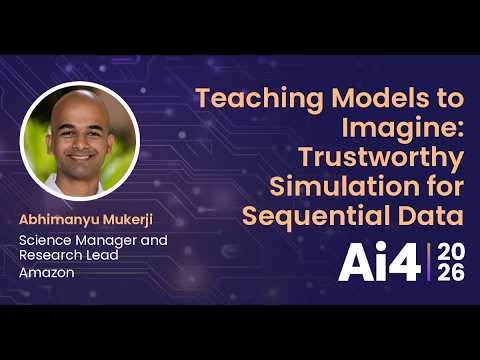
## Background Published on YouTube by Ai4 on August 21, 2026, this presentation features Abhimanyu Mukerji, Science Manager and Research Lead at Amazon. The talk outlines strategies for generating robust, distribution-agnostic synthetic and simulated sequential data to support modern machine learning systems when real-world data is sparse, delayed, privacy-restricted, or policy-biased.
## TL;DR The talk presents a comprehensive framework for sequential simulation, arguing that real-world time-series data must be modeled as dynamic causal state trajectories rather than independent bags of rows. Mukerji advocates for a hybrid simulator architecture combining mechanistic physical rules, agent utility incentives, environmental stochasticity, and generative ML on the residuals. This approach unlocks counterfactual reasoning, off-policy evaluation, and robust stress-testing against rare operational shocks like severe weather or driver shortages. The session concludes by diagnosing five major failure modes—such as feature leakage and transition mismatches—and defining a governed, six-stage simulation lifecycle.
## Atmosphere & style The presentation carries the methodical, pragmatic, and authoritative tone of a senior industrial research leader addressing applied AI practitioners. Mukerji delivers a clear, systems-oriented breakdown that balances foundational mathematical concepts with concrete operational scenarios from rideshare dispatching, ad auctions, and subscription churn. The experience feels like an advanced technical masterclass that steadily demystifies generative data synthesis while issuing sharp, realistic warnings against naive black-box modeling.
## Key takeaways - [00:04](https://www.youtube.com/watch?v=G0xBkNl211w&t=4s) Synthetic sequential simulation provides a safe, compliant way to unlock statistical utility from restricted, private, or cold-start enterprise data where direct model training is impossible. - [01:53](https://www.youtube.com/watch?v=G0xBkNl211w&t=113s) Real-world observational data is structurally constrained by sparsity in critical edge cases, delayed business feedback loops, privacy limits, and historical policy bias. - [03:47](https://www.youtube.com/watch?v=G0xBkNl211w&t=227s) Sequential data cannot be treated as an independent 'bag of rows'; matching superficial marginal distributions often hides catastrophic violations of underlying causal state transitions. - [06:52](https://www.youtube.com/watch?v=G0xBkNl211w&t=412s) A robust simulator requires a four-layer hybrid design combining hard mechanistic rules, agent incentive utilities, environmental stochasticity, and generative ML applied strictly to residual behaviors. - [11:07](https://www.youtube.com/watch?v=G0xBkNl211w&t=667s) Different sequential generative architectures carry inherent blind spots—such as GAN mode collapse or transformer hallucinations—requiring rigid operational wireframing around state spaces and action bounds. - [13:29](https://www.youtube.com/watch?v=G0xBkNl211w&t=809s) The greatest business value of simulation lies in stress-testing extreme, rare disruptions (like severe storms or acute driver deficits) that dictate customer churn but rarely appear in historical logs. - [15:30](https://www.youtube.com/watch?v=G0xBkNl211w&t=930s) Downstream training pipelines must maintain strict data provenance tagging to separate synthetic traces from empirical records, validated against untouched real-world holdout datasets. - [17:12](https://www.youtube.com/watch?v=G0xBkNl211w&t=1032s) Simulators should be evaluated on directional validity and out-of-sample utility rather than false quantitative precision; a simulator that predicts the wrong direction of a metric shift indicates a fundamental structural flaw. - [18:22](https://www.youtube.com/watch?v=G0xBkNl211w&t=1102s) Observational logs in recommendation and ranking systems reflect historical policy decisions rather than organic intent, locking unadjusted models into deceptive feedback loops. - [20:03](https://www.youtube.com/watch?v=G0xBkNl211w&t=1203s) Simulation enables off-policy evaluation (OPE) and counterfactual reasoning, letting teams assess alternative ranking, pricing, or retention interventions by leveraging overlapping historical edge cases without risking live traffic. - [25:24](https://www.youtube.com/watch?v=G0xBkNl211w&t=1524s) High-dimensional sequential data can create unique behavioral fingerprints that risk user re-identification, requiring automated nearest-neighbor distance auditing before synthetic data is cleared for use. - [26:44](https://www.youtube.com/watch?v=G0xBkNl211w&t=1604s) To prevent self-fulfilling prophecies where legacy strategies appear universally optimal, historical policies must be explicitly modeled as agent actions rather than absorbed as organic environment transitions. - [27:47](https://www.youtube.com/watch?v=G0xBkNl211w&t=1667s) Sequential simulators face five major pitfalls: marginal matches with broken transitions, mode collapse, chronological causal inversion, downstream models optimizing to simulator artifacts, and untracked heuristic assumptions. - [31:43](https://www.youtube.com/watch?v=G0xBkNl211w&t=1903s) Trustworthy simulation requires an ongoing 6-stage lifecycle: Audit, Specify, Generate, Validate, Train, and Monitor, using operational drift to continually refine underlying assumptions. - [33:55](https://www.youtube.com/watch?v=G0xBkNl211w&t=2035s) Simulation needs span a progressive maturity spectrum, scaling from basic data augmentation for rare events to operational scenario testing, offline policy evaluation, counterfactual exploration, and live-calibrated digital twins.
## Detailed walkthrough ### [00:04](https://www.youtube.com/watch?v=G0xBkNl211w&t=4s) Why Models Need Simulation Beyond Generative Hallucinations
Generative AI has made hallucinations a familiar concept, representing what is essentially "a simulation gone wrong"—a scenario where a model predicts a sequence of tokens with high internal confidence despite the output being factually incorrect. While diagnosing those failures is crucial, synthetic simulation plays a fundamentally different and productive role across practical machine learning applications. In many enterprise settings, teams have accumulated large volumes of training data that cannot be directly utilized due to strict compliance, regulatory, or privacy constraints. Despite these restrictions, the data contains valuable underlying statistical properties. By training a simulator to replicate those statistical patterns safely, teams can generate high-utility synthetic data for downstream model training.
```mermaid flowchart TD accTitle: Hybrid Simulator Architecture and Sequential Decision Flow subgraph S1["1. State & Context (Time t)"] A["Contextual Information<br/>(Prices, Demand, Locations, Weather)"] B["Historical Trajectory<br/>(Past Customer & Demand History)"] end
subgraph S2["2. Hybrid Simulation Core"] C["Mechanistic Rules<br/>(Hard constraints, Eligibility)"] D["Agent Incentives<br/>(Customer vs. Driver Utility)"] E["Probabilistic Stochasticity<br/>(Demand & Weather Draws)"] F["Generative Residual Learning<br/>(Transformers / ML models)"] end
subgraph S3["3. Action & Response Loop"] G["Platform Action<br/>(Assign Driver, Price, ETA)"] H["Agent Response<br/>(Accept, Cancel, Wait)"] end
subgraph S4["4. State Transition (Time t+1)"] I["Updated World State<br/>(Shifted Supply, Bid-Up Prices, New Demand)"] end
S1 --> S2 S2 --> G G --> H H --> I I -.->|"Feeds Next Step"| S1 ```
A parallel motivation arises in cold-start and data-scarce environments, such as a new business venture with only a few months of operational logs. While insufficient on its own to train complex architectures directly, that limited history contains foundational patterns that can seed rigorous simulations. Building these systems requires moving beyond ad-hoc data synthesis toward formal design paradigms that guarantee sequential data generation remains robust, verifiable, and decision-relevant.
[01:53](https://www.youtube.com/watch?v=G0xBkNl211w&t=113s) Limitations of Real-World Observational Data
ML practitioners rarely face a total absence of data; the deeper challenge is that observational data is burdened by structural limitations:
- **Sparsity**: High-stakes phenomena are often statistically rare. In payment processing and fraud detection, the vast majority of transactions are routine and legitimate, leaving the rarest, most damaging edge cases poorly represented. - **Policy Bias and Feedback Loops**: Observational data is never generated in a vacuum. It reflects historical business policies. Training models purely on historical logs locks the system into a reinforcement loop where past rules bias the training distribution, which in turn dictates future policy. - **Delayed Feedback**: The true return on business interventions often lags by months. For example, a customer value initiative may not manifest in top-line revenue immediately; a model trained only on the initial transition period completely misses downstream benefits. - **Privacy and Data Restrictions**: Highly regulated domains like healthcare restrict the use of identifiable patient records, necessitating synthetic generation methods that retain population-level dynamics without leaking private identity data.
[03:47](https://www.youtube.com/watch?v=G0xBkNl211w&t=227s) Conceptual Framework: Sequential Data is Not a Bag of Rows
A foundational error in synthetic data generation is treating sequential time-series data as an independent "bag of rows." Real-world systems possess an intrinsic causal structure: every step is governed by cause-and-effect dependencies. Generating data by merely matching marginal distributions, frequency counts, and 1D histograms can create an illusion of accuracy while violating fundamental domain mechanics—such as generating a rideshare match timestamped before the customer's ride request was ever submitted.
The generation process must instead be framed as an evolving state trajectory. At time $t$, the system resides in an initial state containing real-time context (prices, demand spikes, customer clickstream) alongside historical trajectories (customer behavior history and macro demand patterns). The platform evaluates this state to select an action—such as matching a rider to a specific driver or establishing a price point. The customer evaluates the platform's action, produces a response (accepting or canceling), and thereby transitions the entire system into state $t+1$, altering available driver supply and market price clearing. A simulator must model this entire causal chain rather than sampling disconnected states.
Relying purely on holdout performance across naively simulated data is insidious. A generative model can achieve high predictive scores on synthetic test splits while quietly flattening non-linear dynamics, failing to produce rare states, or memorizing and leaking private records.
[06:52](https://www.youtube.com/watch?v=G0xBkNl211w&t=412s) Structuring the Decision Space: A Hybrid Simulator Architecture
Instead of treating simulation as an unconstrained black-box problem, practitioners must explicitly structure the simulator around specific decision points. In a rideshare or delivery environment, the sequence unfolds through clear operational stages: a rider opens the app under specific weather conditions (e.g., heavy rain), establishing local supply and demand coordinates. The platform decides which driver to assign, what price to set, and what estimated time of arrival (ETA) to quote. The customer responds by booking or abandoning the trip, immediately shifting the state by reducing local driver supply and potentially bidding up dynamic pricing for subsequent users.
To model this accurately, simulators should adopt a hybrid design across four distinct layers:
- **Mechanistic Rules**: Non-negotiable physical laws and policy rules hardcoded directly into the engine. If a driver is ineligible for a certain dispatch, or if requests are processed on a strict first-come, first-served basis, the simulation must strictly enforce these constraints rather than attempting to learn them probabilistically. - **Agent Incentives**: Explicit utility formulations for human decision-makers. Customers optimize for lower prices and minimal wait times, whereas drivers optimize for higher earnings and preferred travel distances. - **Probabilistic Modeling**: Stochastic environmental factors that cannot be learned deterministically (such as sudden weather shifts or exogenous demand surges) are modeled via parameterized random distributions, allowing the simulator to sweep across diverse scenario draws. - **Generative ML Modeling**: Modern generative models are deployed selectively on the *residuals*—the complex, subtle behavioral variations that remain after mechanistic constraints, agent incentives, and environmental stochasticity have been accounted for.
[11:07](https://www.youtube.com/watch?v=G0xBkNl211w&t=667s) Strengths and Blind Spots of Sequential ML Architectures
Different generative model architectures present distinct trade-offs when applied to sequential simulation tasks:
| Model Architecture | Core Strengths | Operational Limitations & Failure Modes | |:--- |:--- |:--- | | **Generative Adversarial Networks (GANs)** | Strong at capturing complex joint statistical distributions. | Highly susceptible to mode collapse, entirely wiping out rare edge cases and tail distributions. | | **Autoregressive Models** | Effective when historical steps have high predictive power over the immediate next token/state. | Degrades rapidly under non-stationarity, external regime shifts, or unexpected environmental shocks. | | **Diffusion Models** | Exceptional at sampling across high-dimensional, multi-modal outcome spaces. | Struggles to inherently maintain strict temporal cause-and-effect directionality. | | **Transformers** | Excels at maintaining long-range contextual dependencies across extended operational sequences. | Prone to confident hallucinations and ungrounded policy leaps when operating outside observed token contexts. |
To counteract these weaknesses, sequential simulators must be constructed like an architectural wireframe. The practitioner defines the precise state space, bounds the available action choices, explicitly conditions customer response functions on prior actions, applies censoring to variables that real-world actors cannot observe in advance, and enforces hard capacity bounds (such as total available driver headcount).
[13:29](https://www.youtube.com/watch?v=G0xBkNl211w&t=809s) Stress-Testing and Simulating Extreme Scenarios
The primary operational value of a simulator is evaluating system behavior under conditions rarely observed in historical logs. In standard on-demand delivery systems, routine operational days with predictable demand are easily modeled directly from historical data to calibrate ETA quotes and dispatch batching (combining multiple nearby pickups into a single driver journey).
The true business risk resides in rare, high-friction disruptions—severe storms, sudden traffic gridlock, or acute driver shortages. These tail events occur infrequently in historical logs, yet they disproportionately dictate customer retention:
> "The decision of you leaning towards using DoorDash versus Uber Eats might be based on a single experience where on a rainy day one of them was able to bring you food and the other one was not."
Observational logs cannot provide sufficient training samples for these critical edge cases. A hybrid simulator solves this by anchoring baseline dynamics in historical data and then executing aggressive stress simulations—artificially injecting extreme driver deficits and severe transit delays. This allows teams to evaluate whether ETA estimation, surge pricing, and batching algorithms remain reliable and robust when operating under severe distribution shifts.
[15:30](https://www.youtube.com/watch?v=G0xBkNl211w&t=930s) Training Downstream Models: Provenance, Causal Ordering, and Validation
When preparing simulated sequential data to train downstream models, mixing synthetic samples and real observations into an undifferentiated pool creates significant risks. Real-world observational data carries higher intrinsic evidential value, whereas synthetic trajectories inherently reflect the assumptions and parameterizations of the simulation engine.
Data pipelines must preserve strict data provenance, explicitly tagging records so downstream architectures (such as decision transformers) can distinguish between empirical history and synthetic runs. Furthermore, synthetic trajectories must enforce strict causal ordering where cause strictly precedes effect. To ensure rigorous evaluation, practitioners must maintain an untouched, pristine holdout split of real-world data—isolated from both simulator calibration and downstream model training—to serve as the final stress test.
Evaluating a simulator cannot be reduced to a single aggregate metric. Validation requires a multi-dimensional approach, beginning with basic statistical fidelity to confirm that marginal and joint distributions align with reality, before verifying state-transition dynamics and downstream decision utility.
[17:12](https://www.youtube.com/watch?v=G0xBkNl211w&t=1032s) Evaluating Simulator Utility, Robustness, and Directional Validity
Evaluating a sequential data simulator requires moving far beyond surface-level visual similarity to scrutinize operational value. The primary hurdle is utility: if the synthetic data produced by the simulator fails to demonstrably improve model performance on an out-of-sample or holdout dataset, pursuing simulation may not be worth the investment. Robustness acts as an explicit audit of the assumptions engineered into the system. Practitioners must ask how drastically downstream predictions shift when foundational structural assumptions are modified. Alongside robustness and privacy safeguards against data leakage, directional validity serves as an essential sanity check.
In many complex operational settings, a simulator cannot provide exact quantitative precision, such as definitively ruling whether a price should be set at $5 or $6. However, it must be directionally dependable: when a specific policy intervention is applied, the simulator must correctly reflect whether prices should rise or fall. If a simulator cannot capture the correct directional movement, it exposes a fundamental flaw in the modeling logic that demands immediate remediation rather than minor parameter tuning.
- **Utility threshold:** Synthetic sequences must yield measurable out-of-sample generalization gains to justify production investment. - **Directional accuracy:** Reliable qualitative trajectory (up vs. down) takes precedence over false precision when ground truth is inherently uncertain. - **Red flag criterion:** Directional failure indicates structural breakdown rather than routine calibration error.
---
[18:22](https://www.youtube.com/watch?v=G0xBkNl211w&t=1102s) Recommendation Feedback Loops and Policy Bias
Observational data in sequential domains is heavily skewed by the legacy systems that produced it. Recommendation engines—whether deployed on an e-commerce marketplace or a music streaming platform—do not present items arbitrarily. What a user sees, the sequence in which it is presented, and the precise moment of exposure are governed by an underlying algorithm. Consequently, all recorded user interactions are downstream effects of prior algorithmic choices rather than pure expressions of organic intent.
In a music streaming scenario, an algorithmic ranking presents a listener with a specific candidate track. The user decides whether to play or skip, a choice heavily modulated by transient behavioral states such as fatigue or novelty seeking. That decision immediately feeds back into the user’s state profile. When training a simulator or evaluating a replacement recommendation policy on historical playback logs, treating those records as neutral customer preferences introduces dangerous feedback loops. The system risks learning its own historical ranking artifacts rather than true user dynamics.
```mermaid flowchart TD accTitle: Recommendation System Feedback Loop subgraph System ["Policy / System"] A["Recommendation Policy"] -->|"Ranks & presents items"| B["Exposed Item"] end subgraph User ["User Dynamic State"] B -->|"Interaction trigger"| C["User Action: Play / Skip"] C -->|"Modulated by fatigue & novelty"| D["Updated User State"] end D -->|"Historical logs"| A ```
- **Non-random presentation:** User interaction sequences reflect previous algorithmic filters, not unfettered organic preferences. - **Endogenous state shifts:** Listener states are actively reshaped by the fatigue, novelty, and sequencing imposed by previous models. - **Feedback trap:** Simulators trained uncritically on historical logs mistake the historical policy's constraints for natural user behavior.
---
[20:03](https://www.youtube.com/watch?v=G0xBkNl211w&t=1203s) Counterfactual Reasoning and Off-Policy Evaluation
Beyond extreme stress testing, the greatest operational value of simulation lies in generating counterfactuals: answering what would have occurred had a radically different decision been executed. In ad auctions, production pipelines process an incoming auction context, invoke a ranker to order competitive bids, and observe whether an ad conversion takes place. Under normal production, observers only capture data along this single observed branch.
Practitioners routinely need to evaluate alternative decisions—such as swapping the top-ranked ad for the fifth candidate or altering reserve pricing—without disrupting production environments. This discipline, known as off-policy evaluation (OPE), uses simulation to project counterfactual conversion probabilities. While completely unobserved trajectories cannot be fabricated out of thin air, scenarios that appeared in even a tiny fraction of historical interactions (for example, in 5% of edge cases) provide enough underlying structure for a simulator to evaluate untried candidate rankers with statistical confidence.
- **Observed vs. counterfactual:** Production logs reveal only the winning policy path, concealing alternative ranking and pricing payoffs. - **Off-Policy Evaluation (OPE):** Allows teams to test novel scoring policies against historical interaction manifolds without live traffic risks. - **Leveraging rare overlap:** Counterfactual estimation exploits low-frequency production variations (e.g., 5% overlap subsets) to ground unobserved paths.
---
[21:57](https://www.youtube.com/watch?v=G0xBkNl211w&t=1317s) Simulating Intervention Strategies for Subscription Churn
Customer retention illustrates how counterfactual simulation prevents expensive policy mistakes. When telemetry reveals a subscriber's platform engagement is deteriorating, they enter an elevated churn risk state. The default, reflexive business policy is often to issue a direct financial discount—such as a 20% subscription offer—and wait to see whether the user renews. While this may salvage the account, it directly surrenders operating margin.
```mermaid flowchart TD accTitle: Counterfactual Retention Strategies subgraph Trigger ["Risk Detection"] A["Declining Usage Observed"] end subgraph Counterfactuals ["Evaluated Policies"] A -->|"Default Path"| B["Issue 20% Discount Offer"] A -->|"Alternative Path"| C["Deliver Targeted Onboarding & Guidance"] end subgraph Financials ["Outcome Assessment"] B --> D["Higher Direct Dollar Cost / Margin Loss"] C --> E["Low Delivery Cost / Increased Platform Engagement"] end ```
A structured simulator allows teams to model alternate, cost-effective counterfactual interventions before committing capital. Instead of forfeiting revenue with a price cut, the business can simulate the impact of targeted onboarding guidance, workflow coaching, or automated educational emails designed to remove product friction and rekindle active usage. Because testing dozens of variations live on real customers risks accelerating churn, pre-computation via simulation provides the only safe mechanism to surface optimal retention policies.
- **Default policy cost:** Automatic price discounting preserves subscriber count at the direct expense of recurring margin. - **Alternative interventions:** Guided feature onboarding and educational prompts can restore engagement at near-zero incremental delivery cost. - **Pre-deployment simulation:** Simulating behavioral branching avoids running destructive A/B tests on users already teetering on cancellation.
---
[23:08](https://www.youtube.com/watch?v=G0xBkNl211w&t=1388s) Multi-Dimensional Stress Testing Under Operational Constraints
Establishing trust in a simulator and its downstream models requires rigorous stress testing across diverse operational dimensions. In domains like ride-sharing and on-demand delivery, systems must be systematically evaluated against drastic demand swings, alternating between prolonged demand droughts, sudden hyper-surges, and chaotic oscillation sequences. The simulator must generate coherent, realistic data across every extreme state.
Simulators must also model operational imperfections rather than assuming pristine environments: - **Agent latency:** Artificial delays must be injected into multi-agent response loops to ensure lagging communications do not trigger system instability or catastrophic behavioral loops. - **Missing information and partial telemetry:** Training pipelines must be subjected to intentionally dropped records, masked fields, and corrupted logs to ensure downstream models remain resilient when real-world data feeds fail. - **Mechanistic and capacity bounds:** Hard physical constraints—such as depleted driver supply or localized inventory exhaustion—must be enforced so the simulation cannot invent impossible throughput. - **Macro environment drift:** Models validated during one season can fail months later due to unmodeled external macroeconomic shocks, such as unexpected tariffs or supply chain disruptions altering underlying market dynamics.
---
[25:24](https://www.youtube.com/watch?v=G0xBkNl211w&t=1524s) Privacy Risks and Nearest-Neighbor Auditing
Generating synthetic data does not inherently ensure compliance with privacy regulations. In high-dimensional sequential records, behavioral patterns often act as unique fingerprints. For instance, smart electricity meters continuously log the micro-patterns of home appliance usage. The specific cadence and sequence with which appliances turn on and off can be completely unique to an individual household.
If an adversary possesses observed anonymized records and high-fidelity simulated sequences, they can perform nearest-neighbor matching across the feature trajectories to reconstruct the user's real-world identity. This directly breaches privacy guarantees. To prevent synthetic models from memorizing and reproducing real user traces, simulators must implement strict gating criteria, including continuous distance-based auditing and nearest-neighbor checks, to guarantee sufficient divergence from training points before simulated datasets are approved for downstream consumption.
- **Sequential fingerprinting:** Granular time-series signatures (e.g., smart meter power curves) can uniquely identify households even without explicit PII. - **Re-identification via matching:** Overly faithful synthetic records allow adversaries to link simulated profiles to real individuals through trajectory correlation. - **Nearest-neighbor gating:** Automated distance audits must verify that generated sequences maintain sufficient statistical distance from source user data.
---
[26:44](https://www.youtube.com/watch?v=G0xBkNl211w&t=1604s) Escaping the Self-Fulfilling Prophecy of Policy Bias
Simulators that ingest historical operational data without structural context naturally fall into a self-fulfilling prophecy. Historical logs inherently reflect the decisions made by the policies operating at the time the data was captured. When a simulator trains naively on these logs, it treats the observed outcomes as natural dynamics of the environment, making the historical policy appear universally optimal.
> "Simulators that learn from old policies which is what you would see in your historical data will not do a good job. It's going to make it look like repeating those same policies are are going to do always be doing a good job. It's almost like a it's a foregone conclusion. It's it's it's a it's a self-fulfilling prophecy."
To overcome this failure mode, previous policies must be modeled explicitly within the simulation architecture. If past pricing was determined as a specific mathematical function of real-time demand, that rule must be formally encoded as an active agent action rather than absorbed as exogenous, organic marketplace behavior. Only by disentangling the governing policy from the environment can a simulator reliably evaluate novel counterfactual strategies.
- **The policy bias trap:** Models trained on historical logs mistake legacy operational rules for immutable laws of customer behavior. - **Self-fulfilling loops:** Unadjusted simulations inevitably conclude that historical actions were the best possible decisions. - **Explicit policy isolation:** The mathematical rules governing historical interventions must be formally decoupled from ambient environment transitions.
---
[27:47](https://www.youtube.com/watch?v=G0xBkNl211w&t=1667s) Five Major Failure Modes in Sequential Simulation
Building sequential simulators involves navigating critical pitfalls that can quietly undermine downstream machine learning systems. These failure modes span statistical mismatches, structural logic violations, and organizational engineering breakdowns:
```mermaid flowchart TD accTitle: Simulator Failure Modes subgraph Statistical ["Statistical Failures"] F1["Marginal Match with Transition Mismatch"] F2["Mode Collapse & Missing Rare Events"] end subgraph Causal ["Structural & Causal Failures"] F3["Feature Leakage & Causal Inversion"] F4["Optimizing to the Simulator"] end subgraph Operational ["Operational Governance"] F5["Untracked Assumptions"] end ```
1. **Marginal Match and Transition Mismatch:** A simulator may mirror macro-level summary statistics—such as matching the true distribution mean and standard deviation—while entirely failing to model dynamic sequential transitions. A synthetic user profile might show hundreds of active engagement and browsing events followed by a zero conversion rate. This dynamic disconnect reveals that the simulator never learned the true causal link between engagement and downstream purchasing. 2. **Mode Collapse and Missing Rare Paths:** When low-frequency events carry massive operational significance, unconstrained simulators often drop them entirely. In an environment with a known 1% fraud baseline, generating millions of synthetic sessions without a single fraudulent transaction renders the simulator useless for training fraud detection models. 3. **Feature Leakage and Broken Causality:** Simulators frequently break chronological cause-and-effect by learning raw statistical correlations across the entire sequence. A glaring example occurs when a user's simulated account state displays a "refund status" before any product offer or purchase event has taken place. 4. **Optimizing to the Simulator:** Downstream models trained on simulated data will aggressively exploit the simulator's internal biases and modeling shortcuts, essentially "grading its own work." To maintain integrity, the simulation engine must remain strictly decoupled from the validation and evaluation framework that scores it. 5. **Untracked Assumptions:** The most prevalent practical risk is failing to document engineering heuristics. If an engineering team hardcodes behavioral constraints, state transition logic, or demand processes during initial development without maintaining a disciplined registry, the simulator becomes impossible to safely audit or update as market dynamics shift over time.
---
[31:43](https://www.youtube.com/watch?v=G0xBkNl211w&t=1903s) The End-to-End Simulation Lifecycle
Deploying reliable sequential simulators requires an iterative, governed lifecycle designed around continuous auditing and assumption tuning. Rather than viewing simulation as a one-off synthetic data generation task, the architecture operates as a closed feedback loop spanning six distinct stages:
```mermaid flowchart LR accTitle: End-to-End Simulation Lifecycle subgraph Design ["Design & Generation"] A["1. Audit"] --> B["2. Specify"] B --> C["3. Generate"] end subgraph Validation ["Validation & Training"] C --> D["4. Validate"] D --> E["5. Train"] end subgraph Operations ["Deployment & Feedback"] E --> F["6. Monitor"] F -->|"Drift feedback & parameter tuning"| A end ```
- **Audit:** Ground the project in domain intuition and causal physics rather than raw distributions. For ride-sharing, this means explicitly tracing how prices depend on spatial supply counts and customer demand from preceding timesteps. - **Specify:** Translate audited business logic into hard mathematical constraints, defining strict state boundaries and controlling exactly what information the simulator is allowed to observe at each discrete timestep. - **Generate:** Produce high-volume sequential trajectories across diverse operating regimes, spanning baseline business-as-usual scenarios, stress-testing surges, and constrained capacity environments. - **Validate:** Run generated sequences through automated gating pipelines that verify physical consistency, check transition distributions, and enforce privacy barriers (e.g., nearest-neighbor distance auditing). - **Train:** Augment sparse observational datasets with validated simulated sequences to train downstream decision and transformer models, benchmarking performance against holdout splits of real-world data. - **Monitor:** Continuously track model performance in production to identify localized degradation or emergent data drift. When performance dips, operational telemetry feeds directly back into the initial Audit phase to refine assumptions for the next development cycle.
[33:55](https://www.youtube.com/watch?v=G0xBkNl211w&t=2035s) The Spectrum of Simulation Needs: From Data Augmentation to Digital Twins
Not every organization or use case requires an exhaustive, end-to-end simulation infrastructure. The investment and sophistication needed vary widely across different business contexts. At the entry level, simulation serves simply to augment scarce or skewed data—such as synthesizing rare instances of fraud to safeguard customer experience and platform health. Moving slightly higher in complexity, businesses rely on scenario testing to build robustness against anticipated real-world perturbations, such as testing how pricing mechanisms handle adverse weather like rain or heavy traffic congestion.
```mermaid flowchart LR accTitle: Spectrum of Simulation Sophistication subgraph S1["Data Augmentation & Testing"] A["Augment Scarce Data<br/>(e.g., Fraud detection)"] B["Scenario Testing<br/>(e.g., Weather, Traffic)"] end subgraph S2["Policy & Causal Reasoning"] C["Offline Policy Evaluation<br/>(Rare/Unseen scenarios)"] D["Counterfactual Decisions<br/>(Altered trajectories)"] end subgraph S3["Full Virtualization"] E["Calibrated Digital Twin<br/>(Live synthetic business lab)"] end A --> B --> C --> D --> E ```
As the ambition grows, the next tier involves offline policy evaluation. Here, teams need a reliable foundation to safely evaluate strategies under conditions that rarely or never occurred in historical data. Beyond evaluation lies counterfactual reasoning, where entire sequences, user journeys, or policies are drastically rewritten to assess what would have happened under completely different operating choices. At the apex of the maturity curve is the fully calibrated digital twin—a synthetic, real-time replica of the entire business ecosystem that continuously recalibrates against live operational data, serving as an interactive laboratory for running experimental interventions.
- **Scarce Data Augmentation**: Generating synthetic examples for critical but rare events (e.g., fraud detection) without requiring heavyweight simulation machinery. - **Operational Scenario Testing**: Stress-testing pricing and allocation systems against known operational shifts (e.g., weather disruptions, traffic surges). - **Offline Policy Evaluation**: Testing the validity of unobserved or low-probability strategies in a safe, offline environment. - **Counterfactual Decision-Making**: Modifying complete historical trajectories and systemic policies to understand alternative causal paths. - **Calibrated Digital Twin**: Running a dynamic, constantly updating virtual environment that mirrors real business operations for advanced experimentation.
---
[35:40](https://www.youtube.com/watch?v=G0xBkNl211w&t=2140s) Core Principles for Trustworthy Sequential Simulation
When constructing sequential simulators, treating events as independent or randomly distributed leads to flawed models. Real-world dynamics follow temporal and causal structures, making it essential to simulate entire trajectories or traces rather than isolated rows of data. Merely matching superficial distributional properties or statistical marginals is deceptive; a model can match historical distributions perfectly while violating fundamental operational logic. Practitioners must resist using unconstrained black-box models—such as unguided transformers—and instead hardcode physical constraints, impossible states, and strict causal mechanisms where certain downstream events cannot logically occur without prerequisite upstream triggers.
```mermaid flowchart TD accTitle: Core Principles for Trustworthy Simulation subgraph P1["Sequential Fidelity & Mechanisms"] A["Simulate Full Trajectories<br/>(Not isolated rows)"] B["Encode Hard Constraints<br/>(Logical causal rules)"] end subgraph P2["Validation & Integrity"] C["Stress & Sensitivity Testing<br/>(Beyond out-of-sample R²)"] D["Track Provenance & Tag Data<br/>(Prevent synthetic pollution)"] end A --> B B --> C C --> D ```
Validation for sequential simulators is far more demanding than calculating standard out-of-sample metrics like $R^2$. Evaluators must verify how the system behaves under stress scenarios and run sensitivity analyses to measure how dependent downstream model performance is on specific structural assumptions. Because these assumptions are inevitably formulated with incomplete knowledge, systems must remain resilient to a variety of structural conditions. Finally, maintaining clear data provenance is vital: models trained on hybrid datasets must explicitly distinguish between synthetic and observational feeds. In panel data settings, synthetic user trajectories must run in parallel without crossing causal boundaries—ensuring that a simulated action is never mistakenly credited with causing a real-world effect.
- **Trajectory-Level Simulation**: Simulating complete event paths rather than independent rows to maintain sequential coherence. - **Mechanisms Over Marginals**: Prioritizing logical preconditions and domain constraints over matching surface-level statistical distributions. - **Stress and Sensitivity Validation**: Evaluating simulation stability under extreme edge cases and varying underlying assumptions. - **Provenance and Separation**: Rigorously tracking synthetic tags and keeping simulated trajectories isolated to prevent contaminating real-world causal inferences.
---
[38:20](https://www.youtube.com/watch?v=G0xBkNl211w&t=2300s) Closing Remarks and Connecting on Simulation Research
To conclude the presentation, the speaker emphasizes the practical impact and rapid evolution of simulation methods in modern machine learning workflows. Developing robust simulators that can train downstream models reliably remains an active, critical area of work within industry day-to-day operations, especially when navigating data sparsity and dynamic decision-making. The session wraps up with an invitation to practitioners and researchers to connect offline for further discussions on building trustworthy sequential simulation systems.
## Notable quotes > [00:04](https://www.youtube.com/watch?v=G0xBkNl211w&t=4s) a simulation gone wrong — Abhimanyu Mukerji
> [01:53](https://www.youtube.com/watch?v=G0xBkNl211w&t=113s) ML practitioners rarely face a total absence of data; the deeper challenge is that observational data is burdened by structural limitations — Abhimanyu Mukerji
> [03:47](https://www.youtube.com/watch?v=G0xBkNl211w&t=227s) Generating data by merely matching marginal distributions, frequency counts, and 1D histograms can create an illusion of accuracy while violating fundamental domain mechanics — Abhimanyu Mukerji
> [13:29](https://www.youtube.com/watch?v=G0xBkNl211w&t=809s) The decision of you leaning towards using DoorDash versus Uber Eats might be based on a single experience where on a rainy day one of them was able to bring you food and the other one was not. — Abhimanyu Mukerji
> [15:30](https://www.youtube.com/watch?v=G0xBkNl211w&t=930s) Real-world observational data carries higher intrinsic evidential value, whereas synthetic trajectories inherently reflect the assumptions and parameterizations of the simulation engine. — Abhimanyu Mukerji
> [17:12](https://www.youtube.com/watch?v=G0xBkNl211w&t=1032s) If a simulator cannot capture the correct directional movement, it exposes a fundamental flaw in the modeling logic that demands immediate remediation rather than minor parameter tuning. — Abhimanyu Mukerji
> [18:22](https://www.youtube.com/watch?v=G0xBkNl211w&t=1102s) The system risks learning its own historical ranking artifacts rather than true user dynamics. — Abhimanyu Mukerji
> [25:24](https://www.youtube.com/watch?v=G0xBkNl211w&t=1524s) In high-dimensional sequential records, behavioral patterns often act as unique fingerprints. — Abhimanyu Mukerji
> [26:44](https://www.youtube.com/watch?v=G0xBkNl211w&t=1604s) Simulators that learn from old policies which is what you would see in your historical data will not do a good job. It's going to make it look like repeating those same policies are are going to do always be doing a good job. It's almost like a it's a foregone conclusion. It's it's it's a it's a self-fulfilling prophecy. — Abhimanyu Mukerji
> [35:40](https://www.youtube.com/watch?v=G0xBkNl211w&t=2140s) Merely matching superficial distributional properties or statistical marginals is deceptive; a model can match historical distributions perfectly while violating fundamental operational logic. — Abhimanyu Mukerji
## Mentioned Abhimanyu Mukerji, Amazon, Ai4, DoorDash, Uber Eats, Generative Adversarial Networks (GANs), Autoregressive Models, Diffusion Models, Transformers, Decision Transformers
## Video description Abhimanyu Mukerji - Science Manager and Research Lead, Amazon
When real-world sequential data is sparse, biased, delayed, or impossible to access, how do we train models to reason well instead of hallucinating patterns? This talk will explain how to generate synthetic and simulated sequential data in ways that are distribution-agnostic, robust, and trustworthy enough to support modern ML systems, including transformer-based models. The talk will show how simulation can be used not just for prediction, but also for recommendations, policy evaluation, and counterfactual reasoning in dynamic environments. Attendees will learn practical principles for designing simulators that preserve the right structure, stress-test models under shift, and avoid misleading conclusions. The session will be especially useful for practitioners who need better data-generation strategies when observational data is incomplete or operationally constrained, and want a more reliable path from limited real-world data to models that generalize, adapt, and support better decisions.
[Source](https://www.youtube.com/watch?v=G0xBkNl211w)