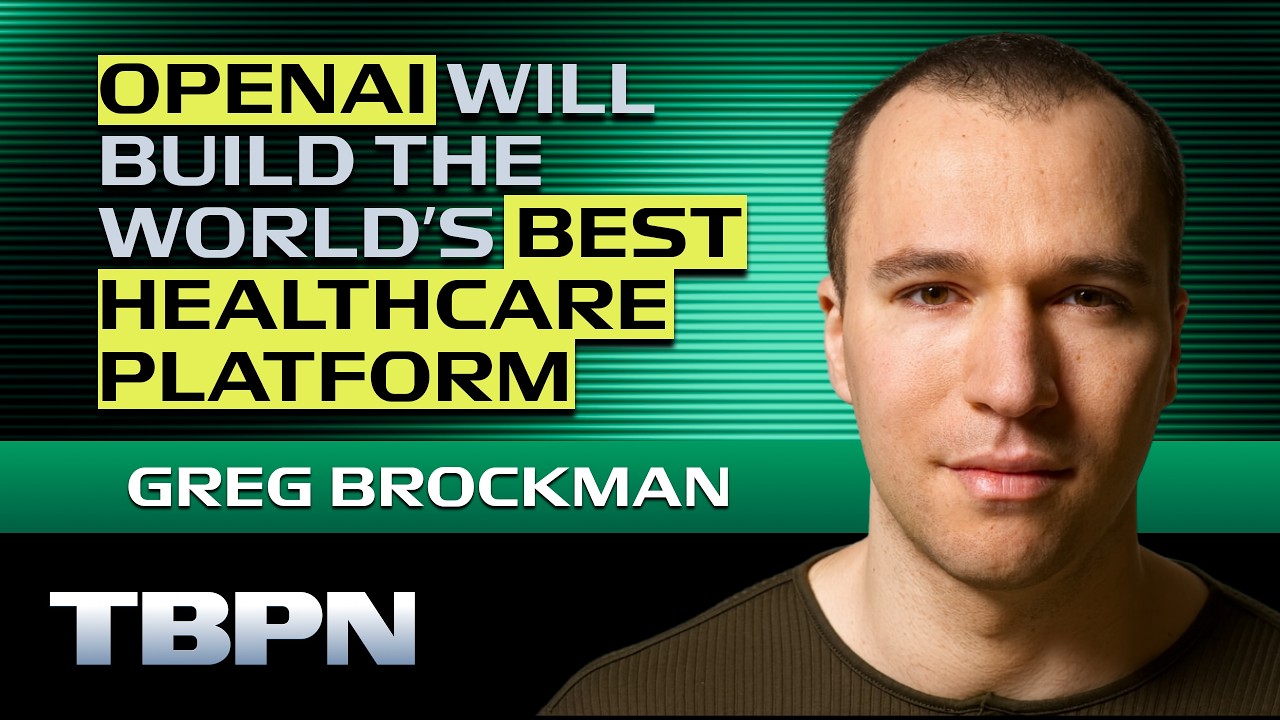
OpenAI Shifts ChatGPT to Autonomous Computer-Use Agents via Astra
TBPN
OpenAI is moving beyond prompt-and-response chatbots toward unified, multimodal agents that operate standard software interfaces visually like humans to automate complex workflows without brittle API connectors.
## Background
Published on YouTube by TBPN on September 8, 2026, this interview features OpenAI Co-Founder and President Greg Brockman. The page description highlights discussions on OpenAI's solution to the Navier-Stokes Millennium Prize problem, Astra and the future of computer use, the shift from chatbots to autonomous agents, ChatGPT's role in healthcare, and operational lessons from Operator.
## TL;DR
Greg Brockman discusses OpenAI's milestone proof and counterexample for the Navier-Stokes Millennium Prize problem, framing it as a breakthrough signaling AI's capacity to produce genuinely novel scientific knowledge. He details how Astra represents a new threshold in agentic computer use by letting models operate complex software like Blender visually and functionally like humans to solve practical real-world problems. Brockman also outlines OpenAI's three-pillar strategy in healthcare—connecting consumer queries, clinician tooling, and enterprise EHR systems like Epic—while emphasizing how long-term memory can overcome fragmented medical silos. Finally, he reflects on the iterative lessons learned from Operator and OpenAI's cultural pivot back to high-conviction startup execution to deliver unified multimodal workflows.
## Atmosphere & style
The conversation carries an energetic, pragmatic, and technically ambitious tone, seamlessly shifting between high-level theoretical milestones and granular, practical user workflows. The dynamic between the TBPN hosts and Brockman is fluid and focused, striking a balance between industry analysis and deeply personal reflections, notably when Brockman recounts his wife's multi-year struggle across siloed medical specialists. Listening feels like an intimate, behind-the-scenes product debrief with a builder who is visibly energized by grassroots user creations and the relentless drive to push experimental AI past utility thresholds.
## Key takeaways
- [00:00](https://www.youtube.com/watch?v=qNxuxwb9ksA&t=0s) OpenAI's model solved the Navier-Stokes existence and smoothness Millennium Prize problem with a counterexample and singularity proof, marking a transition from retrieving known data to generating novel scientific knowledge.
- [00:00](https://www.youtube.com/watch?v=qNxuxwb9ksA&t=0s) Autonomous mathematical reasoning serves as a foundational stepping stone toward practical superintelligence, accelerating downstream discoveries in fluid dynamics, aerodynamics, and drug design.
- [03:19](https://www.youtube.com/watch?v=qNxuxwb9ksA&t=199s) Astra represents a major capability threshold in computer use, allowing AI to directly control complex software like Blender for 3D modeling, architecture, and physical manufacturing.
- [05:50](https://www.youtube.com/watch?v=qNxuxwb9ksA&t=350s) AI interaction is rapidly shifting from reactive, turn-based chatbots to proactive autonomous agents running extended workflows in the background.
- [05:50](https://www.youtube.com/watch?v=qNxuxwb9ksA&t=350s) OpenAI aims to unify fragmented developer and power-user tools, abstracting away model selection and technical parameters so users can focus on setting high-level objectives.
- [08:14](https://www.youtube.com/watch?v=qNxuxwb9ksA&t=494s) OpenAI faces a 'discovery problem' where early adopters still view ChatGPT through a basic chatbot mental model despite massive agentic upgrades across its 1+ billion weekly active users.
- [11:14](https://www.youtube.com/watch?v=qNxuxwb9ksA&t=674s) Product demonstrations are shifting toward concrete, tangible workflows—such as turning rough sketches into physically manufactured goods—to spark real-world user adoption.
- [14:50](https://www.youtube.com/watch?v=qNxuxwb9ksA&t=890s) Crossing key quality and controllability thresholds in image generation unlocks integrated multimodal creation workflows, including automated slide decks and complete website generation.
- [16:36](https://www.youtube.com/watch?v=qNxuxwb9ksA&t=996s) OpenAI's healthcare ecosystem is built on three pillars: consumer health (over 300 million weekly users), clinician-focused literature tools, and enterprise electronic health record (EHR) integrations with systems like Epic.
- [16:36](https://www.youtube.com/watch?v=qNxuxwb9ksA&t=996s) Persistent long-term memory across chat threads allows AI to detect subtle cross-symptom patterns over time, overcoming the diagnostic blind spots inherent in siloed medical specialties.
- [20:51](https://www.youtube.com/watch?v=qNxuxwb9ksA&t=1251s) Astra replaces brittle, hardcoded API connectors with generalized human-like visual interaction across any software interface, building directly on empirical learnings from Operator.
- [20:51](https://www.youtube.com/watch?v=qNxuxwb9ksA&t=1251s) OpenAI restructured its organizational execution away from diffuse, hyperscaler-style experimentation and back into a focused 'startup mode' to accelerate product delivery.
## Detailed walkthrough
### [00:00](https://www.youtube.com/watch?v=qNxuxwb9ksA&t=0s) Solving the Navier-Stokes Millennium Prize Problem
OpenAI Co-Founder and President Greg Brockman opens the conversation by discussing the announcement that OpenAI's model solved the Navier-Stokes existence and smoothness problem, one of the seven Millennium Prize Problems in mathematics. The model produced an elegant proof and counterexample demonstrating that these theoretical equations can form singularities or break down under certain conditions. While Navier-Stokes equations have foundational real-world applications in fluid dynamics—ranging from modeling ocean currents and atmospheric weather to understanding aircraft aerodynamics and turbulence—Brockman emphasizes that the most profound takeaway is what the milestone signals about the state of AI: models have reached the capability to generate genuinely new human knowledge and solve problems previously considered out of reach.
When asked whether such esoteric mathematical breakthroughs will touch everyday life, cure cancer, or merely serve as a recruiting beacon for elite researchers, Brockman explains that the underlying methods represent a stepping stone toward practical superintelligence. The capacity of models to autonomously reason through deep, long-standing scientific barriers directly accelerates the timeline for high-impact applications, making ambitions like designing new therapeutics, curing complex diseases, and accelerating scientific discovery tangible realities.
- **Milestone:** Finding a counterexample/singularity proof for the long-standing Navier-Stokes Millennium Prize problem.
- **Direct Domain Impact:** Enhanced modeling of fluid dynamics, air turbulence, and ocean currents.
- **Broader Trajectory:** Transitioning AI from retrieving known information to generating novel scientific discoveries.
---
[03:19](https://www.youtube.com/watch?v=qNxuxwb9ksA&t=199s) Astra Launch and Reaching a New Threshold in Computer Use
Turning to consumer and developer excitement, the hosts bring up the viral weekend launch of Astra, where users flooded social media with complex 3D projects built in Blender. Brockman expresses his excitement and humility at the community's reaction, noting that Astra represents a distinct new threshold in computer use where AI directly interacts with complex software applications. Users have moved beyond simple text generation to map physical locations into 3D models, iterate on architectural remodels, and engineer custom physical components—including a user who modeled a specialized physical hair catcher for a shower drain to manufacture at home.
```mermaid
flowchart TD
accTitle: Evolution of AI Interaction Paradigms
accDescription: Flowchart illustrating the transition from traditional chat prompting to direct agentic computer use and physical manufacturing.
subgraph Traditional["1. Conversational Chat"]
A["User Text Prompt"] --> B["Low-Level LLM Text Output"]
end
subgraph Agentic["2. Agentic Computer Use (Astra)"]
C["High-Level Goal & Intent"] --> D["Agent Operates Software Tools\n(e.g., Blender, Code Execution)"]
D --> E["Complex 3D Digital Assets & CAD Models"]
end
subgraph Physical["3. Real-World Execution"]
E --> F["Rapid Physical Prototyping & Manufacturing"]
end
Traditional -.-> Agentic
Agentic --> Physical
```
Brockman highlights that while grand mathematical challenges grab headlines, empowering individuals to solve mundane, practical problems in their daily lives represents the true promise of AI. Rather than requiring users to master complex, specialized software interfaces, models like Astra act as personal multipliers, turning everyday people into capable creators and designers.
---
[05:50](https://www.youtube.com/watch?v=qNxuxwb9ksA&t=350s) The Evolution from Chatbots to Proactive Autonomous Agents
Addressing the fragmentation of modern AI setups—where power users juggle local GPUs, Codex threads, cloud sandboxes, and desktop clients—Brockman outlines OpenAI's roadmap toward unification. The ultimate goal is to abstract away low-level technical parameters, context window management, and model selection. Humans should remain accountable for setting high-level objectives and oversight while the AI operates as an amplifier—a "rocket ship for the mind"—that takes care of underlying software execution seamlessly.
OpenAI is observing a dual-engine dynamic in usage. While traditional chat remains massive and growing, deep productivity and agentic workflows have experienced a near-vertical wall of adoption following the release of ChatGPT Work. Brockman explains that these separate interaction modes will converge into persistent, proactive assistants capable of autonomously delegating and executing complex tasks over extended periods.
- **ChatGPT Weekly Active Users:** Well over 1 billion weekly active users across global education, health, and consumer use cases.
- **Workflow Shift:** Rapid transition from short prompt-and-response turns to proactive, background agentic execution.
- **Interface Goal:** Unifying separate interfaces so underlying tool use (such as Blender or code execution) fades into the background.
---
[08:14](https://www.youtube.com/watch?v=qNxuxwb9ksA&t=494s) The Discovery Problem and First-Mover Dynamics in AI
The conversation shifts to the unique strategic friction facing market leaders: the "first-mover disadvantage" where billions of early adopters formed their mental model of ChatGPT based on early conversational iterations and remain unaware of rapid advances in agentic capabilities. While some advanced users already maintain persistent background agents—such as automated bots tracking SpaceX launches and countdown delays—the vast majority of casual users still see a simple text prompt box and do not know what tasks they can delegate.
Brockman frames this as the fundamental "discovery problem" of AI. Because an LLM interface is fundamentally open-ended, users struggle to discern the difference between a standard query box and an advanced agentic environment. OpenAI is addressing this by building self-knowledge into the model itself, enabling ChatGPT to analyze a user's intent and proactively suggest integrations, authentication steps, or alternative prompting strategies to execute multi-step workflows.
- **Scale of User Base:** Over 1 billion weekly active users, with another 1 to 1.5 billion people who have tried the tool in the past and can be re-engaged.
- **ChatGPT for Health:** 300 million people use ChatGPT every week for health-related queries.
- **Onboarding Evolution:** Transitioning from passive text boxes to self-guiding, proactive assistants that teach users how to leverage new capabilities.
---
[11:14](https://www.youtube.com/watch?v=qNxuxwb9ksA&t=674s) Concrete Product Marketing and Real-World Design Workflows
The hosts and Brockman discuss how AI companies must evolve their product communication, drawing a comparison to Apple's classic marketing strategy. Rather than relying solely on abstract brand campaigns or esoteric demonstrations that general audiences cannot relate to, marketing needs to spotlight tangible, granular features—like showcasing the exact mechanics of designing a real-world object.
Brockman reflects on the launch of ChatGPT Images 2.5 as a prime example of this philosophy in action. In the launch demonstration, a simple sketch of a candle holder was visualized, varied, and subsequently turned into a physical manufactured product. When users see a concrete bridge from an initial conceptual prompt to a tangible, finished physical item, the utility immediately resonates, sparking their own exploration into practical use cases.
---
[13:30](https://www.youtube.com/watch?v=qNxuxwb9ksA&t=810s) Asking the AI What It Can Do and the Future of Image Generation
The section concludes with a discussion on user behavior and prompt discovery. The hosts note a common pattern among professionals—such as real estate developers evaluating complex deal memos or users deciding whether to execute a Blender script locally via Codex or in the cloud—who still overlook the simplest strategy: directly asking the AI how it can help structure and solve their task.
Turning to the evolution of generative visual media, the host shares an experience of spending hours on a weekend iterating through hundreds of prompts to design custom furniture, raising the question of where image models go once basic generation feels "solved." Brockman prepares to delve into how image generation is transitioning from standalone static rendering to deeply integrated, functional design tools.
[14:50](https://www.youtube.com/watch?v=qNxuxwb9ksA&t=890s) Image Generation Thresholds and Multimodal Creation
The discussion turns to the downstream impact of advanced image models. The host observes that when users can snap a photo of a physical space and visualize countless variations, it prompts real-world action because people can finally see an idea clearly and decide to make it a reality. Greg Brockman agrees, emphasizing that crossing key capability thresholds unlocks fundamentally new applications that are hard to predict in advance. Within knowledge work, professional workflows, and marketing, being below a certain quality threshold turns generative AI into merely a "cool concept" that produces unusable final material. Once a model achieves precise edit control, rapid iteration, creative diversity, and responsive human interplay, entirely new use cases emerge.
subgraph Outcomes["Downstream Creation"]
SLD["Automated Slide Creation"]
WEB["End-to-End Website Building"]
WRK["Knowledge & Professional Artifacts"]
end
Core --> Outcomes
```
Brockman highlights that native image generation embedded directly into the workflow provides a distinct competitive advantage for OpenAI when creating artifacts like polished presentation slides and dynamic websites. Rather than viewing text, voice, coding, and image generation as isolated silos, OpenAI treats them as a single, unified package designed to empower users to "create anything that you imagine."
- **Quality Threshold Rule:** Models below the threshold remain conceptual demos; crossing the bar transforms them into enterprise-ready tools for marketing and knowledge work.
- **Workflow Synergy:** Integrated image generation directly powers downstream creation tools like slide decks and website generation.
---
[16:36](https://www.youtube.com/watch?v=qNxuxwb9ksA&t=996s) ChatGPT Health: The Three Pillars and Long-Term Memory
Turning to healthcare, the host notes that while users already synthesize lab results or sleep scores with ChatGPT, OpenAI’s ambitions go much deeper. Brockman outlines OpenAI's healthcare strategy across three distinct pillars: consumer health, clinician tooling, and enterprise healthcare infrastructure. Over 300 million people already bring health-related queries to ChatGPT each week. For clinicians, OpenAI is developing specialized models tuned with direct citations to authoritative medical literature. On the enterprise side, OpenAI sells directly to healthcare systems and hospitals, including native integrations with EHR systems like Epic. While each pillar is built to deliver independent value, combining them on a unified platform eliminates the friction of patients having to manually transport medical records between siloed specialists. Furthermore, such platform integration could solve clinical trial enrollment bottlenecks by identifying eligible patients who would benefit from specific drug therapies.
```mermaid
flowchart LR
accTitle: OpenAI Three-Pillar Healthcare Strategy
subgraph Pillars["OpenAI Healthcare Ecosystem"]
direction TB
C["1. Consumer Platform<br/>(300M weekly health queries)"]
CL["2. Clinician Tools<br/>(Literature citations, bottom-up)"]
E["3. Enterprise & Hospitals<br/>(Direct sales, Epic EHR integration)"]
end
subgraph Synergies["Downstream Systemic Benefits"]
REC["Unified Medical Record Portability"]
TRI["Automated Clinical Trial Matching"]
PAT["Cross-Symptom Pattern Recognition"]
end
Pillars --> Synergies
```
The conversation explores how long-term memory will fundamentally reshape AI diagnostics. Because ChatGPT can recall context from weeks prior across disparate threads, it can detect subtle cross-symptom patterns that human clinicians might miss over years. Brockman shares a poignant personal example regarding his wife's healthcare journey: she spent five years visiting various specialists who each examined only "one part of the elephant" in functional isolation. It was ultimately her allergist who recognized that her diverse symptoms stemmed from a single underlying genetic condition affecting multiple subsystems. Brockman reflects on how many people suffer without answers simply because medicine is fragmented, underscoring AI's potential to combine broad holistic memory with deep domain expertise.
- **Scale:** Over 300 million weekly active users engage with health-related queries.
- **EHR Integration:** Direct workflow integration with enterprise electronic health record platforms, specifically Epic.
- **Clinical Impact:** Real-world anecdotes where ChatGPT's cross-checking enabled patients to identify critical diagnoses and save lives.
---
[20:51](https://www.youtube.com/watch?v=qNxuxwb9ksA&t=1251s) From Operator to Astra: Computer Use and Startup Velocity
When asked whether OpenAI's earlier project, Operator, was a failed detour or a stepping stone toward modern computer use, Brockman contextualizes it as a classic example of iterative deployment. Operator was a cloud-based system that attempted autonomous computer operation, but it remained "below threshold"—slow, inaccurate, and frustrating to use. Rather than abandoning the initiative, the team committed to the long-term grind, systematically burning down technical blockers over the course of the year to achieve a breakthrough milestone with Astra.
Brockman explains that past agentic workflows relied heavily on brittle, painstakingly coded API connectors. Astra, by contrast, interacts with computers visually and functionally the exact same way humans do, unlocking universal interaction across any software designed for people. The host notes that OpenAI's operational style underwent a visible shift: while the prior year felt like a sprawling hyperscaler running experiments with low hit-rate expectations, the company restructured itself back into high-conviction "startup mode." Brockman affirms that rallying the entire company around unified focus and execution has been instrumental in delivering cohesive, multimodal agentic products aligned with OpenAI's core mission.
- **Interface Shift:** Replaced fragile, custom API connectors with generalized human-like computer vision and interaction.
- **Evolution:** Operator provided the empirical deployment data needed to refine the underlying models that power Astra.
- **Cultural Pivot:** Transitioned organizational execution from diffuse big-tech experimentation back to high-intensity startup alignment and singular focus.
## Notable quotes
> [00:00](https://www.youtube.com/watch?v=qNxuxwb9ksA&t=0s) models have reached the capability to generate genuinely new human knowledge and solve problems previously considered out of reach. — Greg Brockman
> [03:19](https://www.youtube.com/watch?v=qNxuxwb9ksA&t=199s) Astra represents a distinct new threshold in computer use where AI directly interacts with complex software applications. — Greg Brockman
> [05:50](https://www.youtube.com/watch?v=qNxuxwb9ksA&t=350s) rocket ship for the mind — Greg Brockman
> [08:14](https://www.youtube.com/watch?v=qNxuxwb9ksA&t=494s) discovery problem — Greg Brockman
> [14:50](https://www.youtube.com/watch?v=qNxuxwb9ksA&t=890s) crossing key capability thresholds unlocks fundamentally new applications that are hard to predict in advance. — Greg Brockman
> [14:50](https://www.youtube.com/watch?v=qNxuxwb9ksA&t=890s) create anything that you imagine — Greg Brockman
> [16:36](https://www.youtube.com/watch?v=qNxuxwb9ksA&t=996s) one part of the elephant — Greg Brockman
> [20:51](https://www.youtube.com/watch?v=qNxuxwb9ksA&t=1251s) Astra, by contrast, interacts with computers visually and functionally the exact same way humans do, unlocking universal interaction across any software designed for people. — Greg Brockman
## Video description
This is our full interview with OpenAI Co-Founder and President Greg Brockman.
We discuss how OpenAI solved the Navier-Stokes Millennium Prize problem, what Astra reveals about the future of computer use, why AI is shifting from chatbots to agents that can actually do work for you, how ChatGPT could transform healthcare, why image generation is unlocking entirely new applications, what OpenAI learned from Operator, and where AI goes from here.
TBPN is made possible by:
Ramp - https://ramp.com
Public - https://public.com
Cisco - https://www.cisco.com
Console - https://www.console.com
CrowdStrike - https://www.crowdstrike.com
Figma - https://www.figma.com
MongoDB - https://www.mongodb.com
NYSE - https://www.nyse.com
Railway - https://railway.com
Shopify - https://www.shopify.com/
Codex - http://openAI.com/codex
OpenAI President Greg Brockman argues that artificial intelligence is transitioning from passive text generation to proactive scientific reasoning and direct computer interaction, requiring unified multimodal platforms that turn high-level user intent into practical real-world execution.
Autonomous Reasoning and Scientific Knowledge Generation (0:00)
Brockman highlights OpenAI's model identifying a singularity counterexample for the Navier-Stokes existence and smoothness problem—one of mathematics' Millennium Prize Problems—as evidence that AI can now generate genuinely novel human knowledge rather than merely retrieving known information. While Navier-Stokes equations directly govern fluid dynamics modeling in weather, ocean currents, and aeronautics, Brockman views the mathematical milestone primarily as validation of the model's underlying reasoning depth.
Brockman claims that the ability to autonomously reason through long-standing scientific barriers serves as a critical stepping stone toward practical superintelligence. In his view, these reasoning breakthroughs will compress scientific research timelines, making real-world ambitions like targeted therapeutics and the curing of complex diseases technologically viable.
Transitioning from Chatbots to Agentic Computer Use (3:19)
The launch of Astra represents what Brockman describes as a new threshold in computer use: AI interacting directly with complex software interfaces through vision, just as human users do, rather than through fragile API connectors. Brockman contrasts Astra with its predecessor, Operator—a cloud-based tool that OpenAI acknowledged remained below the usability threshold due to latency and errors. Following an organizational pivot back to focused startup execution, the team refined these agentic capabilities, enabling users to direct models to design complex 3D assets in Blender and produce physical objects like customized shower drain hair catchers.
OpenAI observes this shift as part of a dual-engine dynamic: while conversational chat remains broad, deep productivity workflows are accelerating via ChatGPT Work. Brockman outlines a roadmap to abstract away technical parameters, local and cloud sandboxes, and context window management, aiming to unify separate workflows into proactive background agents for the platform's more than 1 billion weekly active users.
Overcoming Interface Discovery Through Concrete Workflows (8:14)
Despite reaching over 1 billion weekly active users and an additional 1 to 1.5 billion past users eligible for re-engagement, OpenAI faces a distinct discovery challenge. Brockman explains that early adopters still view ChatGPT through the mental model of a simple text prompt box, often unaware of multi-step agentic capabilities or the basic option to ask the AI how to structure a task. To counter this first-mover friction, OpenAI is designing models with self-knowledge to analyze intent and proactively guide users toward relevant integrations and workflows.
Brockman emphasizes that AI product communication must mirror Apple's strategy of spotlighting concrete, granular features over abstract marketing. Pointing to ChatGPT Images 2.5—where a simple sketch of a candle holder was modified and manufactured into a physical product—he argues that crossing critical fidelity and control thresholds allows tightly integrated multimodal tools (combining image generation, voice, and code) to power practical downstream tasks like dynamic website generation and slide design.
Reforming Healthcare Through Long-Term Memory Integration (16:36)
Healthcare has become a major operational focus for OpenAI, with Brockman reporting that over 300 million users submit health-related questions weekly. The company's healthcare strategy rests on three interconnected pillars: consumer self-navigation, clinician-facing tools grounded in authoritative medical literature citations, and enterprise hospital infrastructure integrated directly into electronic health record platforms such as Epic. Brockman asserts that combining these layers can eliminate systemic frictions, including medical record transfer across disparate providers and patient recruitment bottlenecks in clinical trials.
A central component of this strategy is cross-thread, long-term memory. Drawing on a personal account of his wife's five-year medical journey across isolated specialists before an allergist diagnosed an underlying genetic condition, Brockman argues that persistent AI memory can detect subtle cross-symptom patterns over weeks or years that human physicians, operating within specialized silos, frequently miss.
While Brockman outlines a comprehensive vision where unified reasoning models autonomously operate software, conduct scientific discovery, and assist medical decisions, OpenAI faces the immediate practical hurdle of educating more than a billion users to move beyond basic conversational prompts into complex, agentic delegation.
[0:00] Greg Brockman: models have reached the capability to generate genuinely new human knowledge and solve problems previously considered out of reach.
[3:19] Greg Brockman: Astra represents a distinct new threshold in computer use where AI directly interacts with complex software applications.
[5:50] Greg Brockman: rocket ship for the mind
[8:14] Greg Brockman: discovery problem
[14:50] Greg Brockman: crossing key capability thresholds unlocks fundamentally new applications that are hard to predict in advance.
[14:50] Greg Brockman: create anything that you imagine
[16:36] Greg Brockman: one part of the elephant
[20:51] Greg Brockman: below threshold
[20:51] Greg Brockman: Astra, by contrast, interacts with computers visually and functionally the exact same way humans do, unlocking universal interaction across any software designed for people.
Original transcript
[0:00] We have Greg Brockman, the co-founder
[0:02] and president of OpenAI with us. Welcome
[0:04] to the show, Greg. How are you doing?
[0:06] >> Doing great. Thank you for having me.
[0:07] >> Thanks for hopping on. Uh huge day. Can
[0:10] we start with the with the math
[0:12] advances? What is what what is
[0:14] happening? Why is this important? Uh
[0:16] there's a lot of back and forth in the
[0:18] timeline, but I'd love for you to just
[0:19] set the table for us on what actually
[0:21] happened with uh Navier Stokes today.
[0:24] Well, uh it's always a huge day uh in uh
[0:28] AI and modern scientific progress, I
[0:30] would say. Yeah. Today we announced that
[0:33] our model had solved the Navier Stokes
[0:37] uh problem. Uh that we found a a counter
[0:41] example or a sort of proof that you can
[0:43] actually that these these uh theoretical
[0:46] equations do have a singularity or kind
[0:48] of break down under certain
[0:50] circumstances. And this is a problem
[0:51] that has been open for a very long time.
[0:53] It's one of the seven millennium
[0:54] problems which are kind of some of the
[0:56] deepest most important problems in
[0:58] mathematics and I I think that the
[1:01] problem itself is important right this
[1:02] is new knowledge for humanity that the
[1:04] proof itself is actually very elegant
[1:06] and beautiful and I think that there's a
[1:08] lot to learn from it and the the
[1:11] equations have lots of application and
[1:13] fluid dynamics in other areas but to me
[1:15] what's even more important is about what
[1:17] this represents about where we are in
[1:19] terms of model capabilities and the fact
[1:21] that we can actually generate new
[1:22] knowledge that we can learn from these
[1:24] models to and have them help us solve
[1:26] problems that are otherwise outside of
[1:28] reach or would take us a very long to
[1:29] solve.
[1:30] >> Yeah. I mean, where should I actually go
[1:32] with this? Is this going to help me book
[1:33] a flight? Is this going to help me cure
[1:36] cancer? Is this just going to help you
[1:38] recruit researchers who are fascinated
[1:40] by this stuff? Uh because I think that
[1:42] there's this is, you know, taken over
[1:44] the technology world. Uh but I imagine
[1:47] that this will not be something that
[1:48] gets talked about at backyard barbecues
[1:51] with friends and family that are three
[1:53] clicks removed from outside of
[1:54] >> Yeah. Yeah.
[1:55] >> Well, look, I think that there's first
[1:57] of all the applications of this specific
[2:00] result or the equations themselves,
[2:02] right, which are things that let us
[2:03] better understand phenomena from ocean
[2:05] currents to air flow around aircraft.
[2:07] Sure. Uh around, you know, turbulence
[2:09] and things like that. But it's really
[2:10] about the broader insights and methods
[2:13] that can help scientists and
[2:14] mathematicians further accelerate their
[2:16] research. And I think that again
[2:18] representative of if we have models that
[2:20] can help solve this kind of problem then
[2:23] what happens from here like what other
[2:26] problems that are immediately
[2:28] applicable. And I think that talking
[2:30] about curing diseases and new medicines
[2:32] we're going to be able to develop, all
[2:33] of that starts to become much more real
[2:35] when you have models that are at this
[2:37] level of assistance and capability. And
[2:40] I do think that there are going to be
[2:41] real changes to to think about in terms
[2:44] of we can have so much more ambition
[2:46] with the kinds of of challenges that we
[2:49] can hope to tackle now.
[2:50] >> Yeah. I I mean I think uh even even if
[2:53] this doesn't break through to the
[2:56] broader uh the broader world uh the
[3:00] weekend definitely will because it
[3:02] seemed like everyone was talking about
[3:04] Blender, talking about Astra building
[3:06] stuff. Uh take us through the launch of
[3:09] Astra, what the feedback has been, what
[3:11] you've learned. It seemed like there
[3:12] were a couple resets, the model scaled
[3:14] very well. Uh how was this launch
[3:17] different than previous launches?
[3:19] Well, first of all, I've just been blown
[3:21] away by the community reaction to Astra.
[3:23] It's been really amazing and very
[3:26] humbling, honestly, to see all the
[3:28] creativity and the different ways that
[3:30] people have been applying the model. And
[3:31] I think that it's very clear that we've
[3:33] reached a new threshold of computer use.
[3:36] So, this model is able to really work
[3:39] with different kinds of applications in
[3:41] a way that was not previously possible.
[3:43] And people are taking full advantage of
[3:45] that fact and really thinking about how
[3:47] to create. I lots of people showing off
[3:49] 3D creations and
[3:51] >> mapping out physical locations and
[3:53] turning them into into these 3D models
[3:55] and thinking about can you use this for
[3:58] >> design of physical parts. Someone talked
[4:00] about how they were designing some
[4:02] mechanic for catching hair in a shower
[4:04] drain and that they were able to
[4:07] >> super cool, right? That that they're now
[4:08] able to actually manufacture that
[4:10] >> shower hair super intelligence. Yeah.
[4:12] No, that stuff's so mundane, but it's so
[4:14] important. I I feel like uh a lot of
[4:16] this stuff gets lost. Right.
[4:18] >> Ex. Exactly. And I think there's a core
[4:20] there that's very important, which is
[4:21] that we are talking about these grand
[4:23] challenges sometimes or very esoteric
[4:25] applications, but really the everyday
[4:28] the number of problems that you have in
[4:29] your life that you would love to solve.
[4:32] It's now possible, right? That that
[4:33] we're really trying to empower the
[4:34] individual to make it so that you can be
[4:37] you can have superpowers, you can
[4:39] accomplish more. And I think that that
[4:41] you know, really trying to benefit
[4:43] people, empower people, build tools that
[4:45] can really help you and help you in your
[4:47] your daily life. That's all part of what
[4:49] we're we're we're working on.
[4:51] >> So, yeah, I mean, it seems like a huge
[4:54] number of people in uh in tech uh
[4:57] effectively rebuilt their entire house
[4:59] in Blender and planned a remodel this
[5:02] weekend. Uh thanks to Astra and but I am
[5:04] wondering about the merge and how you
[5:06] bring together codecs, chatt work,
[5:10] chacht on desktop. I have a gaming PC
[5:13] now with a Nvidia card in it. I have a
[5:15] Mac Mini. Like I have all these things
[5:17] and I can imagine that I'm just I'm
[5:19] doing that unnecessary or like it's fun
[5:21] for me, but uh that early adopter work
[5:23] of going and unhobling it a little bit
[5:26] here and there, but in the future this
[5:28] will all just be tucked in one, you
[5:30] know, prompt box and it might build a 3D
[5:33] Blender model for to answer my question
[5:35] of should I remodel my house or not. Um,
[5:38] but how do you see the capabilities that
[5:40] we saw on display from sort of light
[5:42] power users over the weekend actually
[5:44] making their way into uh consumers who
[5:47] might not even know what Blender is.
[5:50] >> Well, I think you're exactly right that
[5:52] we really want to shift these tools from
[5:55] requiring kind of low-level
[5:58] sort of
[6:00] >> access or guidance to really having the
[6:03] human be able to fly, right? to really
[6:05] be empowered for you to be able to set
[6:06] the goals and the objectives and that
[6:09] you still should feel like you can get
[6:11] into those details and you can
[6:13] understand them. you can provide that
[6:14] oversight because ultimately you should
[6:16] feel accountable for the outcomes but
[6:18] you have this this absolute amplifier
[6:20] right like a trampoline or like a you
[6:22] know rocket ship for the mind like
[6:23] however you want to to to analogize it
[6:26] and I think what that means at a
[6:27] practical level so first of all this
[6:29] year we've been really seeing this shift
[6:30] from just pure chat use cases to gentic
[6:34] use cases but I would also keep in mind
[6:35] that chat is alive and well I mean we're
[6:37] we're now well over a billion users
[6:39] every week that you can see that the
[6:41] market share of chatbt is starting to
[6:43] climb once again because we've been
[6:44] investing so hard in in so many use
[6:47] cases that are important for people in
[6:49] education and health and a variety of
[6:51] other areas and then at the same time
[6:53] these productivity deep knowledge work
[6:55] use cases those are really taking off
[6:56] we've had this like almost vertical wall
[6:58] of agentic adoption since we launched
[7:00] chat GBT work and I think that the fact
[7:02] that these are two distinct modes that
[7:04] that is actually a point in time that is
[7:06] something that we're continuing to unify
[7:08] and merge and that we're starting to see
[7:10] that there's a new emerging form factor
[7:12] for how people want to consume AI. And I
[7:14] think that it's almost like that the
[7:16] promise of AI has always been that you
[7:19] have something that you can talk to and
[7:21] really delegate work to that's proactive
[7:23] and persistent. And that I what we were
[7:26] promised if you were to rewind five 10
[7:28] years ago was never a low-level language
[7:31] model. You have to think about context
[7:32] windows and you have to select thinking
[7:34] strength and you have to select
[7:35] different models. Like none of that none
[7:37] of that is is the future. And so I think
[7:39] that we're moving towards real
[7:41] amplification, real giving you time
[7:43] back, real having computers that are
[7:46] able to operate according to your goals,
[7:48] to your desires. And I think that that
[7:51] is a core of it. We're developing this
[7:53] safely. That's that's one of the core
[7:55] commitments that that we make and how we
[7:57] think about this. Um but but we really
[7:59] see the power of these tools starting to
[8:02] really um really start to increase in
[8:05] terms of what people are capable of and
[8:06] that under the hood utilizing tools like
[8:09] blender so that that is almost a detail
[8:11] that fades into the background is
[8:12] absolutely the direction of travel. It
[8:14] feels like in AI particularly there's
[8:16] been a almost like a first mover
[8:18] disadvantage in that billions of people
[8:22] have tried Chad GBT and and some
[8:24] percentage of them tried it for the
[8:26] first time and have a certain impression
[8:28] of the product and what it can do and
[8:30] then you know even in the last few weeks
[8:31] there's been new agents and and products
[8:33] that come online and people try it and
[8:35] their mind is just completely blown and
[8:37] I think it's funny because I'm like well
[8:39] as somebody who's like you know trying
[8:41] to get the absolute max out of ChatG
[8:43] GBT. I'm like, well, I've been running
[8:44] like, you know, I've had like an agent
[8:47] running that, for example, will tell me
[8:48] every time a SpaceX launch is going to
[8:50] happen and if it gets delayed, right?
[8:51] These sort of like persistent agents
[8:53] that are running in the background. Um
[8:55] and but but strategically I feel like
[8:57] it's a it's a new kind of challenge
[9:00] because you have this the as capability
[9:02] has been been scaling
[9:05] first movers need to be almost like
[9:07] constantly reminding the the market of
[9:10] um all these just like new ways to use
[9:13] >> overhang. Yeah, we we think about this a
[9:16] lot and I think that there's this
[9:17] discovery problem that we as a field
[9:21] need to really encounter in a first
[9:22] class way and we haven't done it fully
[9:24] yet, but I think we have a real shot at
[9:27] solving it better than any product
[9:29] before because
[9:31] >> the the thing that that right now we
[9:33] kind of rely on. You think about chat
[9:35] GBT chat GBT work. These are both text
[9:37] boxes, right? And it's like, well, this
[9:39] new text box is way more powerful than
[9:40] the old text box. And but oh, oh, there
[9:42] are some reasons that you still want to
[9:43] use the old text box. It's not, you
[9:45] know, it's like far too confusing.
[9:47] People just want something that can help
[9:49] them solve their problem. The whole
[9:50] point is to get your time back, not for
[9:51] you to have to go and become an expert
[9:53] in all these these internal details. But
[9:55] at the same time, we also have a model
[9:57] that understands what you're trying to
[9:58] accomplish, right? That you're
[10:00] explaining to it, here's what I want. It
[10:01] has a lot of context on you. And so it
[10:03] should also be able to proactively say
[10:05] to you, hey actually if you ask me this
[10:07] other way or if you add added this
[10:09] connector or if you authorize me to do
[10:11] this or if you you know hook up your
[10:14] credentials in this in this way I can go
[10:16] and do this other thing for you and so
[10:18] we're thinking a lot about that
[10:19] self-nowledge that onboarding process
[10:21] and I think that is a huge huge
[10:23] opportunity and I think that there is
[10:25] both the the disadvantage that you cite
[10:27] of people tried it they form an
[10:29] impression and it's changed that it's
[10:30] something new but there's also an
[10:32] advantage I chat chatbt like over a
[10:34] billion users every week like that is
[10:36] unique no one has that kind of use on on
[10:39] these on these models and I think that
[10:41] the number of people who have tried
[10:42] chatbt before I think it's it's another
[10:45] you know billion billion and a half
[10:46] something like that and so that's a huge
[10:49] opportunity as well for us to go back to
[10:50] those users and say hey we can now solve
[10:53] the problem for you we can now help you
[10:55] in ways that you didn't see before and I
[10:57] think that it's it's true it's real you
[10:59] look at how many people use chat for
[11:00] health 300 million people every single
[11:03] week with health queries, right? And
[11:04] that that's really making a difference
[11:05] in people's lives and that of their
[11:07] loved ones. And so we have such
[11:08] opportunity.
[11:09] >> Can you stay there with with health and
[11:10] and and explain where
[11:12] >> one note before that? Something that I
[11:14] think is really interesting and I think
[11:16] something that OpenAI can can do a lot
[11:18] better is like when people talk about
[11:20] like everyone in AI wants to be like the
[11:22] Apple of AI from a marketing standpoint.
[11:24] When they when you think like Apple
[11:26] marketing, you're thinking like Mac
[11:28] versus PC or you're thinking 1984, these
[11:30] big branding campaigns. But the actual
[11:33] thing that Apple does really really well
[11:35] with marketing is they just hammer
[11:37] really really specific details about
[11:39] their products, right? They're like
[11:40] >> they're advertising the new camera.
[11:42] They're advertising Mimoji, right?
[11:44] They're advertising like
[11:46] >> certain features in Safari, right? And
[11:48] so it's like with AI, the surface area
[11:50] of like things that you need to
[11:52] communicate is actually like an order of
[11:54] magnitude greater because it can do so
[11:56] many different things. And so I think
[11:57] there's such an opportunity
[11:58] >> um for the company to focus advertising.
[12:02] The brand campaigns are awesome and like
[12:04] the the launch video for Astro was
[12:05] amazing, but it's like there should be
[12:07] billboards running of like very specific
[12:09] things that Chach BT can do to give you
[12:11] back your time. Um
[12:13] >> yes, this this has actually been a real
[12:15] sort of realization or just like
[12:17] something that I have really come to
[12:18] over the course of of of this year. And
[12:21] if you look at even for example the you
[12:23] know we just announced chat GBT images
[12:25] 2.5
[12:26] >> and if you look at the launch video
[12:27] there the thing that I love about it is
[12:29] it shows here's someone creating an
[12:32] image and here's like a bunch of
[12:34] different variations of it and then
[12:36] here's them taking their favorite one
[12:38] and having it in the world. like someone
[12:40] said, "Here's a cool like little sketch
[12:42] of a candle holder." You see an awesome
[12:43] visualization of it and then you see the
[12:45] physical candle holder and you're just
[12:47] like that's what you want, right? It's
[12:48] like you it speaks to you immediately.
[12:50] And I think that that really showing
[12:52] people here's a use case. And the thing
[12:54] that was also a little surprising to me
[12:55] is that we've sometimes highlighted
[12:57] esoteric use cases, something that
[12:59] appeals to someone in particular and
[13:01] it's amazing for that person, but people
[13:03] don't then say, "Oh, because it's this
[13:05] powerful, I can also do this other
[13:07] powerful thing I've been waiting on."
[13:08] like that connection is is is is
[13:10] something that is less sort of easy to
[13:12] make than I than I'd realize and it
[13:14] makes sense. What you want is to for
[13:16] there to be use cases where people say I
[13:17] actually want that particular thing now
[13:19] let me go try it myself and then from
[13:21] there you start exploring and you start
[13:22] to find I actually do have this powerful
[13:24] use case that I didn't even realize was
[13:26] tip at the time.
[13:27] >> Yeah. Studio is probably like the best
[13:29] example of that working really really
[13:30] well.
[13:30] >> The other thing is is reminding people
[13:33] to ask the AI what it's capable of.
[13:35] Yeah, like I was I was having lunch with
[13:37] a buddy who's a real estate developer
[13:38] and he is using chat all day long for
[13:42] different like deal memos and to
[13:44] understand like projects that he's
[13:46] working on all this stuff and he'll ask
[13:47] me he'll ask me all the time can can
[13:49] catch GPT do this or that and I'm like
[13:51] I'm happy to I'm happy to answer you but
[13:53] like you have the thing that will just
[13:55] explain exactly how to do the thing that
[13:57] you want to do or or maybe not but it
[14:00] probably can.
[14:00] >> Yeah, I I I did the same thing. I was
[14:02] kicking off this Blender thing and I was
[14:03] like, should I run this as a local
[14:06] codeex thread or in the cloud? Let me
[14:08] know which one's better based on my
[14:10] system and it gave me a good answer and
[14:11] I was able to go for it.
[14:12] >> On on images, uh when when images 2 came
[14:16] out, I had some moments where I thought,
[14:18] okay, images is solved. Like where do
[14:20] you where do you think images actually
[14:22] go as a category? because it felt uh
[14:25] like this has been something that has
[14:26] maybe oneshoted me more than anything
[14:28] else. specifically with like when it
[14:30] when it released, I was I was um
[14:33] >> uh spending hours like like on a
[14:36] Saturday trying to design furniture,
[14:38] right? And just going through like you
[14:40] know hundreds and hundreds of prompts.
[14:42] But how how far can image models go and
[14:46] where are they going and what are the
[14:47] ways in which you think they can um they
[14:50] can be applied? We were talking earlier
[14:51] too about the downstream impact of of
[14:53] image models. If you can take, you know,
[14:56] a a physical space somewhere and take a
[14:58] picture of it and imagine it as all
[15:00] these other variations, there's so much
[15:02] like real world activity that will be
[15:04] driven from that because people can see
[15:06] this thing.
[15:06] >> Yeah.
[15:07] >> Visually and say like I now I want to go
[15:09] make that reality which I think is
[15:10] really cool.
[15:11] >> Well, I think that's exactly the right
[15:13] way to think about it is as you hit new
[15:14] thresholds of capability, my experience
[15:17] has always been that fundamentally new
[15:19] applications become unlocked in ways
[15:20] that you almost wouldn't have thought
[15:22] about ahead of time. And so I think that
[15:25] within for example knowledge work,
[15:27] professional work, marketing, all those
[15:29] areas, you just need to be above a
[15:31] quality threshold. If you're below it,
[15:32] it's a cool concept, but you can't
[15:34] actually use the final material, right?
[15:35] That that then means that you you
[15:37] haven't really solved the problem. and
[15:39] that having precise edit control, being
[15:42] fast and really being creative and
[15:45] having a diversity of different results
[15:46] and also being able to
[15:48] >> have this this good interplay back and
[15:50] forth with a person. I think that that
[15:52] really unlocks whole new use cases and I
[15:54] think there's a huge market there and
[15:56] even for example the kinds of things you
[15:58] may not think of naively but actually
[16:00] start to be really important
[16:02] applications we're seeing happening is
[16:04] slide creation or making awesome
[16:06] websites, right? Being able to have that
[16:08] image generation capability in the
[16:10] middle is something that's very unique
[16:11] to OpenAI uh relative to to some of our
[16:14] competitors. And I think that you're
[16:15] able to then produce much better
[16:16] artifacts downstream. And so we really
[16:19] view images, we view voice, we view
[16:22] coding, all of these capabilities as one
[16:26] package that are going to come together
[16:27] to create an AI that empowers you. That
[16:30] means you can create anything that you
[16:31] imagine. And I think it's going to be
[16:34] something that's just unlike anything
[16:35] out there. Let's go back to health. I
[16:38] think most people already are aware that
[16:41] you can synthesize some lab data with
[16:43] some sleep scores, but your vision that
[16:46] you laid out recently for where that
[16:49] product goes is much more complex, much
[16:51] deeper. So, uh tell me where uh ChatBT
[16:55] Health is going in the future.
[16:58] >> Well, I would think of it as there are
[17:00] three sides to what we do on health.
[17:02] There's the consumer side again 300
[17:04] million people every week with health
[17:06] queries.
[17:07] >> There's the clinician side which is
[17:09] bottoms up
[17:10] >> and that's really about think of it a
[17:13] chatbt that's really tuned for
[17:14] clinicians that gives them direct
[17:16] citations to medical literature things
[17:18] like that.
[17:19] >> There's a third pillar which is the
[17:21] enterprise side of selling directly to
[17:23] hospitals and them enabling it. And you
[17:25] can see things like we have an
[17:26] integration within Epic and really
[17:28] trying to bring each of these three
[17:32] pillars the best possible service
[17:34] independently. But you think about as
[17:36] those really build momentum that you
[17:38] actually are able to get synergies
[17:39] across them, right? That there's
[17:41] something that actually makes the health
[17:42] experience and the ability to really
[17:44] transform health care in America and the
[17:46] world on the table because there's so
[17:48] many think about how much work you as a
[17:50] patient have to do. If you're talking to
[17:52] different specialists, you have to carry
[17:53] your medical record from one to the
[17:55] other. You have to explain again here's
[17:57] the issue and that ultimately you're on
[17:58] the hook. You're the doctor who has to
[18:00] make the decision whether you like it or
[18:01] not. And actually being able to have
[18:02] just good sharing of of that information
[18:05] across different providers that becomes
[18:06] possible if everyone's on one platform
[18:08] or think about clinical trial
[18:09] enrollment. That's a huge bottleneck to
[18:11] drug development and finding people who
[18:13] are eligible and will benefit from being
[18:15] involved in a particular trial. And if
[18:17] you have that kind of of data, if people
[18:19] are willing to sort of, you know,
[18:21] entrust you with that information, that
[18:23] that's something can actually really
[18:24] benefit them and benefit the world at
[18:26] the same time. And so what I view us as
[18:28] building is really trying to build the
[18:30] world's best healthcare platform to
[18:32] really be able to bring health care into
[18:34] the AI age. And I think that it's
[18:36] something that is going to be absolutely
[18:38] transformative to many people's quality
[18:41] of life, really uplift so many people,
[18:42] and we're seeing it already in such
[18:44] concrete ways. Some of my favorite
[18:46] stories about chatbt are people who say,
[18:48] "Hey, information I got from chat helped
[18:50] me save my own life. Help me save that
[18:52] of a loved one that there was this
[18:54] medical issue that someone had and that
[18:56] I if you know the doctor told me one
[18:58] thing, I was able to to double check
[19:00] that and understand what they were
[19:01] saying and be able to to push back on it
[19:03] and got to a good outcome." And that
[19:05] happens every single day. So I think
[19:06] that health with these AIs is something
[19:09] that it we're still just scratching the
[19:10] surface of what's possible and I think
[19:12] it's one of the most positive
[19:13] applications of AI that that you can you
[19:15] can think of. Yeah, I'm very interested
[19:17] to see how uh the advancements in memory
[19:20] intersect with health because I expect
[19:22] that uh chatbt
[19:26] with where memory has gone where I'll be
[19:27] in a new thread and it will bring up
[19:29] just the right information or tie back
[19:32] to a thread that maybe happened three
[19:34] weeks ago. When you actually apply that
[19:36] to like health related queries, it may
[19:39] be able to like pick up patterns that
[19:42] sometimes would take a human years to
[19:43] figure out like a certain ailment or
[19:45] something like that where it's like,
[19:46] hey, you're asking about all these
[19:47] different things and maybe you thought
[19:49] they were not connected. Turns out they
[19:51] they actually are and you should go down
[19:54] this sort of like rabbit hole.
[19:56] >> Last question. I'm sorry. Please.
[19:57] >> I was I was going to say I think that's
[19:59] absolutely right. We're seeing that very
[20:00] concretely and we've seen you know just
[20:02] in my own personal life my my wife you
[20:05] know talked about some of her her
[20:06] medical conditions publicly but I it was
[20:09] really this five-year journey of talking
[20:10] to many specialists each one who was
[20:12] kind of touching one part of the
[20:13] elephant and would try to address that
[20:14] one part and it was only finally her
[20:16] allergist who said hey I think all these
[20:18] symptoms you're seeing are connected and
[20:20] you have this uh genetic condition that
[20:22] affects all of your subsystems and
[20:24] that's the kind of thing where it's
[20:26] really hard to say how many people have
[20:30] similar kinds of conditions and just
[20:32] never find out. How many people have
[20:33] these areas where it's like if you just
[20:35] sort of are functionally specialized
[20:38] that you're never going to bring
[20:39] together the whole diagnosis and I think
[20:41] that is one of the powers and potentials
[20:43] of an AI that really deeply is able to
[20:45] help you across all parts of your life
[20:47] and also is a deep domain expert in all
[20:50] areas of medicine.
[20:51] >> Yeah. Uh I have one last question. Uh
[20:54] what how do you tell the story of
[20:55] operator? It feels like it was a failure
[20:59] or a side quest, but it feels incredibly
[21:02] important now given the advances in
[21:04] computer use. Is there a clear lineage
[21:06] there? What was operator? Does that
[21:10] still exist somewhere within chat GPT? H
[21:13] how does how did how did computer use
[21:15] get solved?
[21:17] >> Yeah. Well, look, I would look at all
[21:18] these things as timing and all about
[21:20] iterative deployment. Yeah. Right. that
[21:22] that there's a moment where you need to
[21:26] where the capabilities aren't quite
[21:27] there but actually learning from real
[21:30] world deployment is very helpful right
[21:32] and the I think operator was just kind
[21:33] of below threshold in terms of the model
[21:35] capabilities it was a cloud-based system
[21:38] that operated with computer use but it
[21:39] was slow it wasn't fully accurate it was
[21:42] like pretty painful to to use some
[21:44] people got value but it really wasn't
[21:45] above threshold and if you look at
[21:47] what's happened that the team like one
[21:49] thing openai does very well is we make
[21:50] long-term investments on things that
[21:52] really matter and we do the grind and
[21:54] that the team this year I think really
[21:56] started to build momentum that we put in
[21:59] a lot of effort to go and sort of burn
[22:00] down a long list of issues were able to
[22:02] really focus on solving computer use and
[22:05] I think that they delivered in a
[22:06] significant way and there's more to do
[22:09] never done all those things but it's a
[22:11] true milestone I think people are really
[22:12] appreciating what's possible because
[22:14] we've been in a world with these agents
[22:16] using computers through connectors right
[22:19] through these very painstakingly coded
[22:22] systems that are so different from how
[22:23] humans use computers. Whereas humans can
[22:26] already use everything on a computer,
[22:28] right? Everything's designed for people.
[22:30] So if you have an AI that can operate
[22:31] that way and even from the very
[22:33] beginning of OpenAI, we had a dream that
[22:34] one day we could create such an AI, it
[22:37] becomes able to help you across
[22:39] everything that you would be able to do
[22:41] with a computer yourself. And so I think
[22:42] we're there with Astra. I think that
[22:44] there's just so much more that people
[22:47] are going to uncover in terms of
[22:48] applications where this can go. But it's
[22:50] an example of long-term focus, doing the
[22:53] work, and not giving up even when the
[22:55] going gets tough.
[22:55] >> Yeah. And it feels like Astra,
[22:58] my view is it really felt like all these
[23:00] different bets coming together, you
[23:01] know, at the right at the right time,
[23:02] right? The the advancements in in the
[23:04] model itself, the the computer use,
[23:06] voice, all these things. Um, and it uh
[23:09] it's all it's all making sense. So,
[23:12] >> yeah.
[23:12] >> Um,
[23:13] >> together, it's focus. It's uh it's
[23:15] something that I think this company does
[23:17] extremely well when we really put a
[23:19] challenge in front of us and think about
[23:20] how to accomplish it safely well and uh
[23:23] to to really deliver the value we're
[23:24] doing thing.
[23:25] >> Yeah. put different differently, it felt
[23:27] like when you look at last year, it felt
[23:29] like OpenAI was uh operating like a big
[23:33] company and it and it was a big company
[23:35] but but the way in which like product
[23:37] experimentation was happening was you
[23:39] know when you think of like a
[23:40] hyperscaler they'll launch a new product
[23:42] thinking okay if there's a 20% hit rate
[23:45] or even a 10% or 5% chance that's okay
[23:48] and then this year it feels like
[23:49] actually the entire company switched
[23:52] back into actual startup mode which is
[23:54] like you know focus focus focus all
[23:57] these things need to come together the
[23:58] whole team needs to be rowing in the
[24:00] same direction and then the difference
[24:02] in momentum and growth and all these
[24:04] things uh coming from that and and uh
[24:07] actually taking the company from like
[24:08] operating and shipping more like a big
[24:10] company to shipping again and focusing
[24:12] like a startup has been uh feels like an
[24:15] impossible task and it's been uh
[24:17] incredible to watch. So
[24:19] >> yeah,
[24:19] >> thank you. No, it's been a real real
[24:21] effort from many many people at OpenAI
[24:23] to really bring together and something
[24:25] that that I really value that I think we
[24:27] really value as a company and I think
[24:28] that we're just so laser focused on our
[24:30] mission and really thinking about every
[24:32] piece of what we do should add up to
[24:33] helping us accomplish it.
[24:35] >> Well, thank you so much for taking the
[24:36] time to come chat with us.
[24:37] >> Great to see you.
[24:38] >> We'll talk to you soon, Greg.
[24:39] >> Thank you.
[24:39] >> Talk the rest of your day. Goodbye.