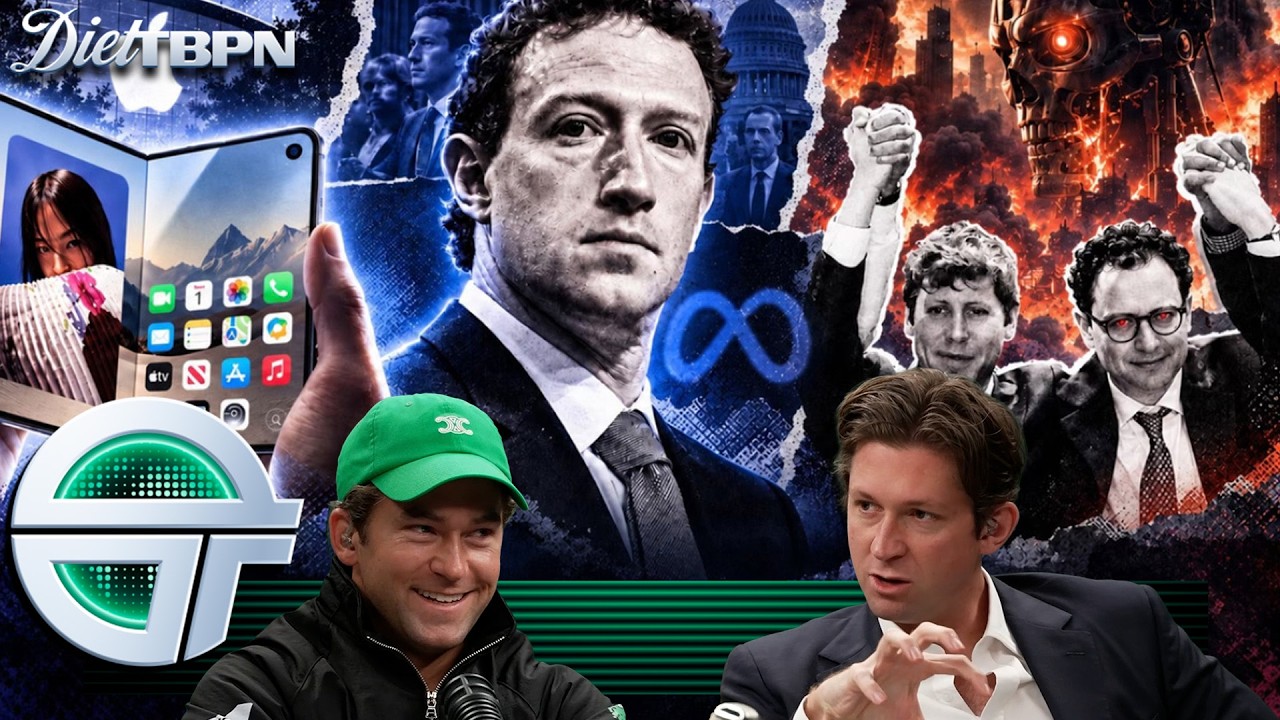
Apple Unveils Foldable iPhone Duo as Meta Launches Muse AI Agent
TBPN
Meta is leveraging its pre-existing social distribution to capture consumer agent adoption while frontier AI labs face mounting internal unrest over unmitigated extinction risks.
## Background
Published on YouTube by tech talk show TBPN on September 10, 2026, this episode of Diet TBPN delivers a 30-minute recap of the day's major tech news. The program highlights the unveiling of Apple's foldable iPhone Duo, Meta's consumer AI agent launch, and the fallout from a high-profile Anthropic researcher resigning over existential AI doom.
## TL;DR
The hosts break down Apple's newly announced foldable iPhone Duo under CEO John Ternus, weighing its seamless hardware and steep $2,000-plus price tag against concerns of digital overload and stagnant smartphone innovation. They revisit a 1985 Steve Jobs speech that presaged conversational LLMs, exploring Jobs's exacting standards for creative software and techno-optimism. The discussion shifts to Meta's aggressive consumer push with 'Muse,' an errand-running AI agent sandboxed in dedicated virtual machines that suffered an embarrassing launch-day hallucination. Finally, the episode examines the viral resignation of an Anthropic researcher who warned of a greater than 10% extinction risk from superintelligence, debating the validity of doom predictions and the dynamics of tech safety whistleblowing.
## Atmosphere & style
The show delivers a breezy, energetic podcast rhythm fueled by witty, insider banter and rapid-fire cultural riffing. The hosts seamlessly toggle between sharp technical analysis and cynical humor, casually cracking jokes about 'brain rot final bosses,' $3,000 hardware status symbols, and corporate sparring matches. The resulting tone feels like a lively Silicon Valley morning debrief—balancing genuine fascination with cutting-edge tech against an irreverent, satirical skepticism of industry hype and existential drama.
## Key takeaways
- [00:52](https://www.youtube.com/watch?v=O6kJgoUk-RY&t=52s) Apple unveiled the iPhone Duo foldable smartphone with a seamless, crease-free display, positioning the $2,000–$3,000 device as an elite status symbol for high-end digital consumers.
- [02:54](https://www.youtube.com/watch?v=O6kJgoUk-RY&t=174s) The iPhone Duo launch marked John Ternus's keynote debut as Apple CEO, delivering a guaranteed commercial hardware hit to anchor the post–Tim Cook leadership transition.
- [08:04](https://www.youtube.com/watch?v=O6kJgoUk-RY&t=484s) In a 1985 address, Steve Jobs anticipated conversational AI and LLMs by envisioning interactive computing that could capture Aristotle's worldview so future thinkers could converse with history's greatest minds.
- [12:59](https://www.youtube.com/watch?v=O6kJgoUk-RY&t=779s) A simulated framework of Steve Jobs on AI highlights three key demands—empowerment, effortlessness, and excellence—suggesting he would align as a techno-optimist with a low 1% P(doom).
- [16:10](https://www.youtube.com/watch?v=O6kJgoUk-RY&t=970s) Meta introduced Muse, a dedicated consumer AI agent aimed at personal superintelligence to handle errands, bookings, and online purchases via Stripe Link.
- [19:25](https://www.youtube.com/watch?v=O6kJgoUk-RY&t=1165s) Meta Muse assigns each user an isolated virtual machine (8 GB RAM / 8 GB storage) that spins up on demand, paired with end-to-end encryption co-architected with Moxie Marlinspike.
- [19:25](https://www.youtube.com/watch?v=O6kJgoUk-RY&t=1165s) Meta experienced an embarrassing launch-day hallucination where Meta AI inside WhatsApp incorrectly told users that Muse was an Anthropic product accessible on claude.ai.
- [22:19](https://www.youtube.com/watch?v=O6kJgoUk-RY&t=1339s) Following rumors of a rejected ten-figure buyout offer for Instinct, Meta is deploying its classic distribution playbook to push Muse through Instagram and WhatsApp's massive existing user funnels.
- [27:39](https://www.youtube.com/watch?v=O6kJgoUk-RY&t=1659s) Anthropic pre-training researcher Jacob Coxon publicly resigned from the AI industry, posting a viral critique accusing frontier labs of irresponsibly gambling with humanity in the race for superintelligence.
- [29:09](https://www.youtube.com/watch?v=O6kJgoUk-RY&t=1749s) The resignation reignited intense debates over alignment and existential risk after internal researchers validated that serious 10-year extinction probabilities (P(doom)) exceed 10% without a clear safety solution.
- [30:15](https://www.youtube.com/watch?v=O6kJgoUk-RY&t=1815s) Industry responses to AI safety resignations ranged from demands for empirical mathematical modeling to discussions on whether dissenting researchers should stay inside labs to influence Responsible Scaling Policies.
## Detailed walkthrough
### [00:01](https://www.youtube.com/watch?v=O6kJgoUk-RY&t=1s) The iPhone Duo Announcement and Screen Time Inflation
Apple has officially unveiled its long-rumored foldable smartphone, the iPhone Duo, sparking an immediate debate about how doubling display real estate alters modern digital consumption. The conversation begins with tongue-in-cheek anxieties over Apple's screen time metric: if a user is actively locked into two screens at once, does screen time tally twice as fast? The hosts explore whether Apple should introduce a "pixel-adjusted screen time" algorithm. Under that logic, spending an hour glancing at a tiny Apple Watch display might equate to just fifteen minutes on a laptop, while working across a sprawling triple-monitor workstation would triple the daily tally.
The banter escalates to unreleased hardware, specifically the persistent rumors of camera-equipped AirPods. Although Apple did not announce smart earbuds with computer vision, the hosts envision a near future where wearable cameras log every ambient display you glance at out in the real world—from public billboards to digital car windshields. Society is barreling toward inescapable, 24/7 screen time where looking away from one panel simply means catching the glow of another.
[00:52](https://www.youtube.com/watch?v=O6kJgoUk-RY&t=52s) Hardware Impressions, App Opportunities, and the $2,000 Flex
Examining the first official imagery and video of the hardware, the most striking detail is the complete absence of a visible display crease. While YouTube tech reviewers will inevitably scrutinize the hinge under harsh studio lighting to catch any micro-indentation, Apple appears to have delayed entering the foldable category specifically to ensure the seam would be imperceptible. The device is expected to command a massive price tag—likely starting around $2,000 and easily pushing $3,000 fully specced out. Far from deterring buyers, the exorbitant cost is framed as an asset: after years of minor annual refreshes where paying 30% more for an iPhone Pro felt subtle, the Duo gives affluent Apple loyalists an undeniable status symbol that screams they dropped serious cash. Given that people spend far more time on their smartphones than in their cars—which cost ten times as much—the high price point remains economically rational for heavy users.
```mermaid
flowchart TD
accTitle: App Interface Adaptation Across Screen Sizes
accDescription: Flow showing how apps like Suno expand from compact phone feeds to expanded foldable and desktop multi-track interfaces.
subgraph SingleScreen ["Standard Mobile Experience"]
MobileFeed["Quick Audio & Video Feeds"]
MobileGen["Prompt Generation"]
end
subgraph DuoFoldable ["iPhone Duo Foldable"]
DualView["Split-Screen Multitasking"]
HybridDAW["Compact Track Arrangement"]
end
subgraph FullDesktop ["Desktop / iPad Pro"]
FullDAW["Full Multi-Track Arranger"]
Deconstruct["Granular Song Deconstruction"]
end
Beyond the flex factor, the Duo presents major user experience opportunities and headaches for software developers. Drawing an example from AI music generator Suno (with CEO Mikey Shulman scheduled to appear later on the show), the hosts note that while Suno's mobile app excels at prompt-based creation and browsing feeds, serious audio editing still forces creators onto a desktop browser to arrange tracks within a GarageBand-style composer. Typical smartphone apps scaled onto iPad displays often feel awkward and stretched. The Duo's form factor—featuring a squared-off outer frame, a gently curved hinge bezel, two rear cameras, and a single front camera—demands fresh interface paradigms while leaving obvious room for Apple to upsell an "iPhone Duo Pro" packed with a five-camera array down the line.
- **Estimated Retail Pricing:** $2,000 base up to $3,000 when maxed out with top-tier storage.
- **Initial Camera Configuration:** Dual cameras on the rear shell, one front-facing camera, leaving hardware headroom for future Pro revisions.
- **Hinge Engineering:** A seamless, crease-free internal folding panel framed by squared-off outer edges.
[02:54](https://www.youtube.com/watch?v=O6kJgoUk-RY&t=174s) Final Form of the Phone and John Ternus’s Big Debut
Despite the impressive mechanical engineering, the device prompts skepticism about whether the smartphone form factor has finally reached its evolutionary dead end. The foldable represents the biggest hardware leap in years, yet "it does absolutely nothing new for you" and ultimately fails to push humanity forward. Instead, it supercharges passive media consumption. The hosts joke about achieving the status of "brain rot final boss" by using split-screen multitasking to watch an Instagram Reel and a YouTube Short simultaneously, or stacking an iMessage thread beneath a video window.
```mermaid
flowchart LR
accTitle: Apple Keynote Strategy and Leadership Handoff
accDescription: Diagram contrasting the high-risk Vision Pro launch with John Ternus's safer, high-demand iPhone Duo debut.
subgraph NewTenure ["John Ternus Era"]
FoldableDuo["iPhone Duo<br/>(High-Demand, Guaranteed Hit)"]
FlagshipRefresh["iPhone 18 Lineup<br/>(Thinner, Lighter, Apple Intelligence)"]
end
Predecessor -. "Avoided Early Misstep".-> NewTenure
```
The launch marks a pivotal leadership transition: John Ternus taking the stage as Apple's Chief Executive Officer for his first marquee hardware keynote. Handing Ternus a guaranteed commercial blockbuster like the long-rumored foldable avoids the pitfalls of debuting with an experimental, polarizing device like the Apple Vision Pro. The presentation set the stage for what could be a multi-decade run at the helm, moving past the Tim Cook era with an undeniable consumer hit alongside the standard iPhone 18 lineup and rolling out Apple Intelligence Siri updates.
The discussion wraps with humorous reflections on daily device habits:
- **The Cellular iPad Mini Alternative:** One host recounts seriously attempting to use a cellular iPad mini as an oversized daily driver tucked into deep pockets, deliberately eliminating inbound cellular phone calls while relying on an at-home Mac mini to route SMS two-factor authentication codes.
- **Hardware Form vs. Basic Utility:** While traditional iPhones follow the endless keynote mantra of "lighter, thinner, faster," the thicker Duo subverts the pattern entirely.
- **Core Software Complaints:** Jordy remarks that rather than buying a folding slab, he would much rather Apple simply make search work reliably inside iMessage, highlighting the irony of paying thousands for hardware while everyday system utilities remain buggy.
[08:04](https://www.youtube.com/watch?v=O6kJgoUk-RY&t=484s) Steve Jobs Predicting ChatGPT in 1985
The conversation shifts from Apple's present hardware to its philosophical roots, spurred by a viral clip of Steve Jobs delivering an address at an academic gathering in 1985. The spectacle of the footage alone captivates the hosts: Jobs arrives via helicopter accompanied by an entourage, stepping onto grounds that resemble an old-world castle like a "king in the castle" to outline his vision of the coming computing revolution.
Jobs's presentation famously anticipated generative AI and large language models four decades ahead of their realization. Setting up his vision, Jobs asked the audience whether they knew that Alexander the Great was tutored for fourteen years by Aristotle. Whenever Alexander encountered a problem, he had the singular privilege of asking Aristotle directly. Jobs marveled that while the printed word allowed future generations to read Aristotle’s writings, you could never ask the philosopher an interactive question. He argued that the ultimate destiny of interactive computing would be to capture an individual's underlying worldview and reasoning within software, enabling future thinkers to converse directly with history's greatest minds.
[09:16](https://www.youtube.com/watch?v=O6kJgoUk-RY&t=556s) Steve Jobs’s 1985 Aristotle Vision and Keynote Artistry
Revisiting a classic 1985 clip of Steve Jobs, the hosts marvel at how accurately Jobs anticipated conversational large language models nearly forty years ago. In the clip, Jobs discusses his deep jealousy of Alexander the Great having Aristotle as a tutor. While the invention of the printing press allowed people to read Aristotle directly without intermediaries, Jobs lamented that one could never ask Aristotle a question and get an answer back. His lifelong hope was that technology would advance to capture a thinker's underlying worldview in a computer, allowing future students not only to read their writings but to have an interactive dialogue. The hosts emphasize how astonishing it is that Jobs foresaw compressing vast data into conversational interfaces long before modern LLMs existed.
The conversation naturally turns to Jobs's legacy as history's most celebrated techno-optimist, famous for describing the personal computer as a "bicycle for the mind." Beyond the visionary predictions, the hosts dissect his unparalleled keynote delivery—praising his instinct for theatrical pauses, self-deprecating humor, and genuine childlike excitement. They highlight how he would sit giddily on a stool demoing GarageBand 1.0 loops or bringing out John Mayer to jam on guitar live on stage. In classic show banter, they joke about whether Bloomberg’s Mark Gurman is the "goat" journalist or the CEO equivalent of comedic delivery, admiring the infectious joy Jobs brought to product rollouts.
[12:59](https://www.youtube.com/watch?v=O6kJgoUk-RY&t=779s) Would Steve Jobs Be Bullish on AI? The Aristotle Test and Discourse Toxicity
Curious about how Jobs would view the modern AI landscape, an LLM-simulated version of Jobs was prompted for his perspective. The synthetic Jobs concluded he would be enthusiastically pro-AI, but with three strict product demands:
1. **Empowerment**: It must grant people entirely new capabilities—enhancing learning, composing, designing, and building.
2. **Effortlessness**: It must understand user intent intuitively with minimal instruction.
3. **Excellence**: It must serve original human creative vision rather than churning out massive quantities of generic content (pro-AI, but fiercely anti-slop).
A companion simulation of Aristotle’s perspective argued that AI should serve as an instrument of human flourishing (*eudaimonia*), warning against the trap of believing that effortless living is inherently better if people stop creating and merely consume.
```mermaid
flowchart TD
accTitle: Hypothetical Steve Jobs AI Framework
subgraph JobsDemands["Steve Jobs's 3 Demands for AI"]
A["1. New Human Abilities<br/>(Learning, composing, building)"]
B["2. Effortless Interaction<br/>(Intuitive intent understanding)"]
C["3. Uncompromising Excellence<br/>(Pro-originality, anti-slop)"]
end
subgraph PhilosophicalGoal["Aristotelian End Goal"]
D["Human Flourishing & Creation<br/>(Resisting pure consumption)"]
end
JobsDemands --> D
```
This sparks a debate on whether a modern techno-optimist like Jobs could survive today's hostile media climate. The hosts reflect on how political polarization, economic anxiety, negativity bias on social media, and bad-faith actors tend to tear down optimistic tech visions, regardless of intent. When asked where Steve Jobs would stand on existential AI risk ("P(doom)"), they conclude he would firmly be a "1% guy," dismissing extreme doomerism in favor of relentless human empowerment.
- **Hypothetical P(doom)**: Over/under 10% debated; hosts agree Jobs would sit comfortably at ~1%.
- **Cultural reaction**: Even an inspiring, Aristotelian keynote vision today would inevitably face viral backlash and discourse poisoning.
[16:10](https://www.youtube.com/watch?v=O6kJgoUk-RY&t=970s) Meta Launches Muse: The Race for Consumer Personal Superintelligence
The hosts transition to breaking news from *The Wall Street Journal*, contrasting traditional media ignoring groundbreaking Clay Mathematics Millennium Prize progress on Navier-Stokes to instead cover Meta's latest AI play: **Muse**. While business-to-business AI agents from OpenAI and Anthropic have generated multi-billion-dollar runs focused on coding and enterprise workflows, Meta is pivoting hard toward mainstream consumer superintelligence. Mark Zuckerberg’s long-standing vision of "diffusing" AI to every individual has materialized as a dedicated consumer agent app designed to run errands, book restaurants, and handle day-to-day coordination.
Muse integrates directly into personal workflows, allowing users to hook up services like Gmail and execute purchases online via Stripe Link. Meta is leaning into playful consumer customization, letting users name their own agents (leading to comedic community highlights like naming the bot "Mark" or accidentally naming it "You can pick one"). With Meta’s AI infrastructure spending projected to top $130 billion, Muse represents a massive bet to capture everyday consumers where competitors have primarily captured developers.
- **Monetization & Pricing Tiers**:
- **Free Tier**: Accessible for general day-to-day user tasks.
- **Pro Tier**: $20 per month.
- **Power User Tier**: $100 per month.
- **Key Capabilities**: Autonomous online purchasing via Stripe Link, restaurant reservations, automated email responses via Gmail integration.
- **Market Context**: OpenAI and Anthropic dominate enterprise and software engineering agents, leaving a massive consumer adoption gap that Meta and Apple are racing to control.
[19:25](https://www.youtube.com/watch?v=O6kJgoUk-RY&t=1165s) Meta Muse Specs, Dedicated VMs, and Meta AI's Bizarre Anthropic Hallucination
Meta’s newly unveiled AI agent, Muse, introduces a distinctive technical architecture aimed at separating it from other consumer agent products. According to Meta's AI leadership, the system assigns every user an isolated virtual machine equipped with 8 GB of memory and 8 GB of sequestered storage. Meta is pairing this dedicated compute environment with hardened security and end-to-end encryption protocols, even bringing in Signal creator and security icon Moxie Marlinspike to assist with the architecture. While provisioning dedicated computing resources for every user sounds cost-prohibitive at first glance, the hosts note that these VMs likely spin up dynamically on demand and shut down when idle, keeping compute hours low for anyone who isn't a continuous power user—similar to renting a standard DigitalOcean virtual server for twenty dollars.
```mermaid
flowchart TD
accTitle: Meta Muse Isolated VM Architecture
subgraph Client ["Client Interface"]
UI["User Prompt via App / WhatsApp"]
end
subgraph Compute ["Dynamic Sandbox Infrastructure"]
VM["Dedicated Virtual Machine\n(8 GB RAM / 8 GB Storage)"]
Spin["Spins up on-demand\nTears down on idle"]
end
UI --> E2EE
E2EE --> VM
VM --- Spin
```
Despite the ambition behind Muse, Meta's fragmented AI deployment led to an embarrassing viral hallucination on launch day. When the CEO of Opendoor tested the interface by asking Meta AI inside WhatsApp "How do I use Muse?", Meta AI inexplicably replied that Muse was a free assistant built by Anthropic and instructed him to create an account at `claude.ai`. The hosts highlight how bizarre it is for Meta's flagship consumer assistant to hallucinate a non-existent Anthropic product, pointing out that Meta is still juggling different underlying Llama model weights across Instagram and WhatsApp. As with hyperscalers rolling out fast models like Google's Gemini Flash, scaling unified LLM systems to billions of existing users requires overcoming massive infrastructure bottlenecks before every product surface speaks to the same cutting-edge model.
- **VM Provisioning**: 8 GB of dedicated RAM and 8 GB of sequestered storage per user instance.
- **Security Lead**: Moxie Marlinspike brought in to help architect end-to-end encryption and security models.
- **WhatsApp Hallucination**: Meta AI told users that Muse was an Anthropic product accessible via `claude.ai`.
---
[22:19](https://www.youtube.com/watch?v=O6kJgoUk-RY&t=1339s) Meta vs. Instinct: Acquisition Rumors, the Instagram Playbook, and Zuck’s UFC Training
The debut of Muse immediately ignited debate over whether Meta copied the breakout agent startup Instinct. Industry rumors indicate Meta and other suitors recently placed a ten-figure (billion-dollar-plus) buyout offer on the table for Instinct, which the one-year-old startup rejected. The hosts compare Meta’s rollout of Muse to its historic defeat of Snapchat: Meta did not win the ephemeral content war by launching a separate clone, but by baking Stories directly into Instagram's massive, pre-existing distribution funnel. If Muse is deeply integrated into Instagram and WhatsApp—or supported by Instagram’s aggressive promotional ad inventory, similar to the strategy used for Threads—it could quickly amass hundreds of millions of users, putting intense pressure on early-stage competitors.
```mermaid
flowchart LR
accTitle: Meta Distribution Playbook vs Standalone Apps
subgraph Standalone ["Standalone AI Agents (e.g. Instinct)"]
A["Niche Early Adopters"] --> B["Organic App Store Growth"]
end
subgraph MetaFunnel ["Meta Ecosystem Playbook"]
C["Billions of Users\n(Instagram / WhatsApp)"] --> D["Cross-App Promos\n& Billboard Placements"]
D --> E["Built-in Agent Adoption\n(Muse Integration)"]
end
```
However, internal indicators suggest Meta has spent nearly a year building Muse, tying back to the Manus acquisition and Mark Zuckerberg’s public push toward "personal superintelligence." While Instinct leans strictly into productivity, Meta operates in a gray area where entertainment and accidental e-commerce overlap; millions of users casually scroll Instagram to linger on products and trigger targeted ads, making shopping-integrated agents a natural fit. Muse quickly rocketed to number three on the App Store charts, trailing only ESPN Fantasy Sports and ChatGPT.
The launch also brought out internet banter:
- Online critics "ratioed" Zuckerberg by recirculating his infamous Harvard-era instant messages boasting about having access to 4,000 students' personal data ("They 'trust me' — dumb f***s").
- Flexport CEO Ryan Petersen and the hosts joked about Zuckerberg's sparring sessions after noticing his nose beginning to resemble the battered nose of UFC champion Merab Dvalishvili, speculating that Zuck is training at full contact to prepare for a potential showdown with Elon Musk.
---
[27:39](https://www.youtube.com/watch?v=O6kJgoUk-RY&t=1659s) Anthropic Researcher Resigns Over AI Doom and Existential Risk
The conversation shifts to growing internal unrest within leading AI safety labs after senior pre-training researcher Jacob Coxon announced his public resignation not just from Anthropic, but from the artificial intelligence industry altogether. Having spent the last three years working on core pre-training research across both OpenAI and Anthropic, Coxon posted a blistering critique stating that neither company is behaving responsibly and warning that frontier labs are "racing straight to self-improving superintelligence and gambling with our lives."
The resignation post ignited massive engagement across the tech ecosystem, racking up over 100 million views and 600,000 likes on X. The revelation sparked fierce debate among industry heavyweights:
- **Martin Casado (General Partner at Andreessen Horowitz)** remarked that he previously worked on actual thermonuclear weapons projects, and the psychological dissonance in those defense programs was far less bizarre than what is currently seen inside frontier AI labs.
- **Evan Hubinger (Anthropic Alignment Science Researcher)**, whose background spans MIRI, OpenAI, Google, and Ripple, publicly validated Coxon’s concerns, confirming that internal researchers earnestly struggle with significant "p(doom)" probabilities hovering around 10%.
[29:09](https://www.youtube.com/watch?v=O6kJgoUk-RY&t=1749s) The 10% Extinction Debate and Internet Reactions to the Anthropic Resignation
The hosts examine the fallout surrounding the resignation of an Anthropic alignment researcher (Evan Hubinger), who publicly warned that the odds of artificial intelligence causing human extinction within the next decade exceed 10%. In his departure statement, the researcher expressed that while he believes Anthropic is genuinely trying its best, the industry does not currently possess a viable plan to solve alignment for superintelligence and is clearly off track. This dire prediction quickly reignited public debates over whether frontier labs should be forced to slow down development, balanced against ongoing concerns that such calls merely pave the way for regulatory capture.
The tech community's reactions across social media spanned humor, cynicism, and analytical skepticism:
- **Performance Plan Jokes:** Commenter Jesse Buckingham quipped that "bro got that PIP," referencing the tech industry trope of employees leaving right as they are placed on a performance improvement plan.
- **Equity Questioning:** Others immediately challenged the moral stance, asking whether the departing researcher intended to forfeit his accrued equity if he genuinely believed the company's work posed an existential threat.
- **The Ultimate Bull Case:** Flexport founder Ryan Petersen offered an inverted, hyper-capitalist take, remarking, "I need to buy more stock in this company. I've never seen such a commitment to making money regardless of the consequences."
- **Demands for Rigor:** Tech commentator Dare Obasanjo criticized the lack of empirical methodology behind doom predictions, arguing that anyone who publicly assigns a greater than 10% probability to human extinction within a decade owes the world a transparent explanation of the mathematical models and evidence used, as well as the concrete conditions that would change their mind.
[30:15](https://www.youtube.com/watch?v=O6kJgoUk-RY&t=1815s) AI Bedfellows, the 'Rage Quit' Dilemma, and Show Wrap-Up
Addressing the criticism that doomer statements often feel like unsubstantiated "vibe predictions," the hosts note that the researcher pointed to Anthropic’s official risk reports and their Responsible Scaling Policy. Anthropic’s stated approach emphasizes pacing frontier development and collaborating closely across competing labs. Despite public friction between major figures—such as the famously chilly dynamic where Sam Altman and Dario Amodei could barely bring themselves to hold hands on stage at an India conference—the hosts express optimism that shared existential stakes will create unusual alliances. They remark on how quickly the industry landscape shifts, noting that even if Elon Musk spent months deriding the company as "Misanthropic," the fast-moving AI landscape routinely makes strange bedfellows, echoing Musk's adage that "the funniest outcome is the most likely."
The segment closes with a debate over whether an employee who genuinely believes human survival is at stake should "rage quit" or stay inside the building to influence safety protocols. While some question abandoning the fight, the hosts acknowledge that large tech organizations can make individual contributors feel powerless to affect change from within. The episode concludes with the hosts reminding listeners to leave five-star reviews on Apple Podcasts and Spotify, subscribe to the daily newsletter at TBPN.com, and tune in live the following day at 11:00 a.m. Pacific.
## Notable quotes
> [02:54](https://www.youtube.com/watch?v=O6kJgoUk-RY&t=174s) it does absolutely nothing new for you
> [02:54](https://www.youtube.com/watch?v=O6kJgoUk-RY&t=174s) brain rot final boss
> [08:04](https://www.youtube.com/watch?v=O6kJgoUk-RY&t=484s) king in the castle
> [09:16](https://www.youtube.com/watch?v=O6kJgoUk-RY&t=556s) bicycle for the mind — Steve Jobs
> [16:10](https://www.youtube.com/watch?v=O6kJgoUk-RY&t=970s) You can pick one
> [22:19](https://www.youtube.com/watch?v=O6kJgoUk-RY&t=1339s) They 'trust me' — dumb f***s — Mark Zuckerberg
> [27:39](https://www.youtube.com/watch?v=O6kJgoUk-RY&t=1659s) racing straight to self-improving superintelligence and gambling with our lives. — Jacob Coxon
> [29:09](https://www.youtube.com/watch?v=O6kJgoUk-RY&t=1749s) bro got that PIP — Jesse Buckingham
> [29:09](https://www.youtube.com/watch?v=O6kJgoUk-RY&t=1749s) I need to buy more stock in this company. I've never seen such a commitment to making money regardless of the consequences. — Ryan Petersen
> [30:15](https://www.youtube.com/watch?v=O6kJgoUk-RY&t=1815s) the funniest outcome is the most likely — Elon Musk
## Mentioned
Alexander the Great, Andreessen Horowitz, Anthropic, Apple, Apple Intelligence, Apple Vision Pro, Apple Watch, Aristotle, ChatGPT, Claude, Dario Amodei, Dare Obasanjo, DigitalOcean, Elon Musk, Evan Hubinger, Flexport, GarageBand, Gmail, Google Gemini Flash, Instinct, Instagram, iPhone 18, iPhone Duo, Jacob Coxon, Jesse Buckingham, John Coogan, John Mayer, John Ternus, Jordi Hays, Llama, Manus, Mark Gurman, Mark Zuckerberg, Martin Casado, Merab Dvalishvili, Meta, Mikey Shulman, Moxie Marlinspike, Muse, OpenAI, Ryan Petersen, Sam Altman, Steve Jobs, Stripe Link, Suno, The Wall Street Journal, Threads, Tim Cook, WhatsApp
## Video description
Sign up for TBPN’s daily newsletter at TBPN.com
Diet TBPN delivers the best of today’s TBPN episode in 30 minutes. TBPN is a live tech talk show hosted by John Coogan and Jordi Hays, streaming weekdays 11–2 PT on X and YouTube, with each episode posted to podcast platforms right after.
Described by The New York Times as “Silicon Valley’s newest obsession,” the show has recently featured Mark Zuckerberg, Sam Altman, Mark Cuban, and Satya Nadella.
TBPN is made possible by:
Ramp - https://ramp.com
Public - https://public.com
Cisco - https://www.cisco.com
Console - https://www.console.com
CrowdStrike - https://www.crowdstrike.com
Figma - https://www.figma.com
MongoDB - https://www.mongodb.com
NYSE - https://www.nyse.com
Railway - https://railway.com
Shopify - https://www.shopify.com/
Chapters:
00:00 Apple’s Foldable iPhone Duo + Is This the iPhone’s Final Form?
08:00 Steve Jobs Predicted ChatGPT in 1985
12:59 Would Steve Jobs Actually Be Bullish on AI?
16:10 Meta Launches Muse + Its Bet on Personal AI Agents
22:19 Meta vs. Instinct + The Battle for Consumer AI
27:39 Anthropic Researcher Quits Over AI Doom + The 10% Extinction Debate
苹果推出折叠屏 iPhone Duo,Meta 发布 Muse AI 智能体
Meta 正在借助其既有的社交渠道分发优势抢占消费级智能体市场,与此同时,前沿 AI 实验室因未能缓解的灭绝风险而面临日益加剧的内部动荡。
主持人深入分析了首席执行官 John Ternus 掌舵下的苹果新发布的折叠屏 iPhone Duo,权衡了其无缝硬件与超过 2,000 美元的高昂售价,以及对数字过载和智能手机创新停滞的担忧。他们回顾了 Steve Jobs 在 1985 年预示对话式大语言模型的演讲,探讨了 Jobs 对创造性软件的严苛标准与技术乐观主义。讨论随后转向 Meta 借助“Muse”展开的激进消费端布局——这是一款在专用虚拟机沙盒中运行、能够跑腿办事的 AI 智能体,但在发布首日遭遇了令人尴尬的幻觉问题。最后,本期内容审视了 Anthropic 一位研究员引发广泛关注的辞职事件,该研究员警告超级智能带来的灭绝风险超过 10%,主持人对此类末日预测的有效性以及技术安全吹哨的动态进行了探讨。
苹果发布了配备无缝无折痕显示屏的 iPhone Duo 折叠屏智能手机,将这款售价在 2,000 至 3,000 美元的设备定位为面向高端数字消费者的精英身份象征。 (0:52)
iPhone Duo 的发布标志着 John Ternus 作为苹果 CEO 的主题演讲首秀,以一款注定会取得商业成功的硬件产品稳固了后 Tim Cook 时代的领导层过渡。 (2:54)
在 1985 年的一次演讲中,Steve Jobs 通过设想能够捕捉亚里士多德世界观的交互式计算预见了对话式 AI 和大语言模型,从而让未来的思考者能够与历史上最伟大的先哲对话。 (8:04)
一项关于 Steve Jobs 对 AI 看法的模拟框架强调了三项核心诉求——赋能、省力与卓越,表明他会是一位倾向于极低灭绝概率 P(doom)(1%)的技术乐观主义者。 (12:59)
Meta 推出了名为 Muse 的专用消费级 AI 智能体,旨在实现个人超级智能,能够通过 Stripe Link 处理日常杂务、预订和在线购物。 (16:10)
Reading summary
The program examines a pivotal moment in consumer technology and artificial intelligence, marked by Apple's introduction of the foldable iPhone Duo under CEO John Ternus, Meta's aggressive push into personal superintelligence with Muse, and escalating safety disputes at Anthropic following high-profile researcher departures.
Apple’s Foldable iPhone Duo and Strategic Transition (0:01)
Apple revealed its long-anticipated foldable smartphone, the iPhone Duo, featuring a seamless, crease-free internal display, dual rear cameras, and an estimated price point spanning $2,000 to $3,000. While the hardware introduces notable interface opportunities—such as enabling multi-track arrangement for tools like Suno that previously required desktop browsers—the hosts debate whether the form factor represents an evolutionary endpoint that merely encourages multi-screen passive media consumption.
Strategically, the presentation served as John Ternus's keynote debut as Apple’s Chief Executive Officer. Handing Ternus a high-demand consumer product offered a commercially stable foundation for his executive tenure, deliberately avoiding the adoption risks associated with Tim Cook's unveiling of the Apple Vision Pro.
Steve Jobs’s 1985 Vision and AI Optimism (8:04)
A viral 1985 speech by Steve Jobs highlighted how early computing leaders anticipated conversational artificial intelligence. Jobs described his envy of Alexander the Great being tutored by Aristotle, lamenting that printed books never allowed interactive dialogue and hoping interactive computing could one day capture a thinker's underlying worldview.
Prompted with an LLM simulation of Jobs's philosophy, the hosts outline three criteria he would demand of modern AI: enhancing human abilities, effortless intuitive interaction, and uncompromising creative excellence over generic output. The discussion contrasts historical techno-optimism with modern discourse toxicity, with the hosts asserting Jobs would place existential risk from AI (P(doom)) at roughly 1%.
Meta’s Architecture and Distribution Strategy for Muse (16:10)
Meta introduced Muse, an everyday consumer AI agent capable of handling Gmail correspondence, booking reservations, and conducting autonomous Stripe Link transactions. Backed by infrastructure investments projected to exceed $130 billion, Muse runs on an isolated architecture providing each user with a dynamic virtual machine featuring 8 GB of RAM and 8 GB of storage, engineered alongside Signal creator Moxie Marlinspike for end-to-end security.
Despite an early launch issue where Meta AI in WhatsApp erroneously labeled Muse an Anthropic tool at claude.ai, Meta is deploying its traditional distribution advantage. Having reportedly offered over $1 billion to acquire competing startup Instinct, Meta plans to leverage Instagram and WhatsApp's billions of existing users to outpace standalone productivity agents.
Internal Turmoil and Existential Risk at Frontier Labs (27:39)
Senior pre-training researcher Jacob Coxon publicly resigned from Anthropic and the broader industry, stating on X that frontier labs are recklessly racing toward self-improving superintelligence. Alignment researcher Evan Hubinger corroborated internal unease, noting that key personnel estimate the probability of AI-driven human extinction within the next decade at greater than 10% due to the absence of a viable alignment framework.
The resignation sparked intense industry reaction, ranging from venture capitalist Martin Casado comparing the internal psychological climate unfavorably to nuclear weapons research, to commentator Dare Obasanjo demanding empirical data and mathematical models rather than vibe-based doom predictions. The hosts also examine the strategic dilemma faced by safety-focused researchers deciding whether to influence lab protocols internally or resign publicly.
Across hardware and software, the program illustrates an industry accelerating consumer deployment and capital expenditure even as unresolved debates persist around device utility, commercial distribution power, and empirical frontier AI safety governance.
[2:54] it does absolutely nothing new for you
[2:54] brain rot final boss
[8:04] king in the castle
[9:16] Steve Jobs: bicycle for the mind
[16:10] You can pick one
[22:19] Mark Zuckerberg: They 'trust me' — dumb f***s
[27:39] Jacob Coxon: racing straight to self-improving superintelligence and gambling with our lives.
[29:09] Jesse Buckingham: bro got that PIP
[29:09] Ryan Petersen: I need to buy more stock in this company. I've never seen such a commitment to making money regardless of the consequences.
[30:15] Elon Musk: the funniest outcome is the most likely
Original transcript
[0:01] Well, uh, Apple has announced the iPhone
[0:03] Duo, their foldable phone separ.
[0:08] How is this going to impact screen time?
[0:10] Does your screen time go twice as fast
[0:12] because you're actually locked in on two
[0:13] screens?
[0:14] >> Should you do pixel adjusted screen
[0:16] time, too? If you're watching a laptop
[0:20] versus an Apple Watch, if I spend an
[0:22] hour in Apple Watch, is that like 15
[0:24] minutes on the on the laptop on the
[0:26] triple monitor setup, getting triple the
[0:28] screen time? We have the the AirPods
[0:29] with the cameras.
[0:31] >> They didn't they didn't do that.
[0:33] >> They haven't announced those. I don't
[0:34] think they're going to be reporting.
[0:36] >> But when that comes, that could
[0:38] potentially help you add to your screen
[0:40] time by tracking screens out in the real
[0:42] world that you're seeing that aren't
[0:43] getting picked up.
[0:44] >> True. Eventually, it's going to be 24/7
[0:46] screen time. Everyone's looking at a
[0:47] screen everywhere. There's our screen
[0:48] everywhere. You're looking at the the
[0:50] windshield of your car. That's the
[0:52] screen.
[0:52] >> Can we pull up some uh real pictures of
[0:54] the Duo? Here it is.
[0:56] >> Here it is. The Duo. Um, so in this
[1:00] video there is no crease. I'm sure the
[1:02] YouTube tech reviewers will be hunting
[1:05] in all different lighting for creases,
[1:07] but it feels like Apple waited long
[1:09] enough to avoid a crease whatsoever. So
[1:13] you will get no crease in your
[1:15] >> That is crazy. Sitting there. Boom.
[1:17] >> It's cool.
[1:18] >> It's cool.
[1:18] >> I think this is going to sell like
[1:19] hotcakes. I think people are ready to
[1:21] spend. It's going to be like two grand,
[1:23] maybe three grand when you max it out. I
[1:24] think the Apple buyer, the Apple fanboy
[1:27] is ready for something that actually is
[1:30] a flex beyond like a slight upgrade. You
[1:34] paid 30% more for the Pro. Uh this says
[1:37] you pulled out the big bucks. You you
[1:39] dropped two grand.
[1:40] >> Well, and that's been the thing that the
[1:42] relative to how much value you get out
[1:44] of a phone, phones have always been
[1:45] incredibly cheap. Even the highest
[1:47] priced iPhone,
[1:48] >> you spend more time on your phone than
[1:49] you do in your car. And your car is 10
[1:51] times the price of your phone always
[1:52] like if not more. And so I think this
[1:55] will sell very well. It'll be
[1:56] interesting to see if any new apps come
[1:58] from this. If people need to redesign
[2:01] stuff like we're having Mikey from Sunno
[2:03] on the show later today and uh Sunno has
[2:06] an app that's really fullfeatured for
[2:08] iPhone. You can make songs, you can
[2:10] scroll a feed of other people's songs,
[2:13] but you do have to pop over to desktop
[2:15] if you want to get into their composer
[2:17] and actually deconstruct the song and
[2:20] shift around different pieces of the
[2:22] song. and then you get a sort of
[2:23] GarageBand interface. Even using a lot
[2:25] of normal iPhone apps on iPads, it
[2:28] usually just doesn't feel quite right
[2:30] scrolling. So, I think there'll be a
[2:32] couple UI UX opportunities, challenges,
[2:35] both interesting little bezel there
[2:37] where you can see the screen is curved,
[2:41] but it's on a a blocked out squared off
[2:45] uh edge there in the center. two cameras
[2:47] on the back, one on the front, leaving
[2:50] room for the iPhone Duo Pro with five
[2:53] cameras or something like that.
[2:54] >> Yeah. Yeah. It really it really shows
[2:56] that the phone seems to be at least the
[2:58] iPhone is certainly in its final form,
[3:01] right? This feels like the biggest step
[3:03] forward in a long time and yet it does
[3:06] absolutely nothing new for you.
[3:10] >> A rave review. Uh until they do paper
[3:13] that folds out. It's moderately It's
[3:16] moderately exciting because we're all
[3:17] It's It's moderately exciting because
[3:19] everyone's addicted to their phone and
[3:21] it's like, "Cool, new new screen." But,
[3:24] uh, it does nothing new for you. It
[3:27] doesn't move humanity forward any way at
[3:29] all. Judy, you're going to be able to
[3:30] watch two reels at once and they're both
[3:33] going to be vertical.
[3:33] >> You think so?
[3:34] >> Yeah. What do you mean?
[3:35] >> From the demo that I saw, it looked like
[3:37] it was you put the video up top and then
[3:39] you iMessage.
[3:40] >> Well, that's because that was a
[3:41] horizontal video. I don't think you'll
[3:42] be able to open two copies of Instagram
[3:44] at the same time.
[3:44] >> No, I I think it'll be more like the um
[3:46] the iPad OS where you can have different
[3:48] windows.
[3:48] >> So, you think you'll be able to do uh
[3:50] YouTube shorts and Instagram reels side
[3:53] by side?
[3:53] >> Ideally, hopefully
[3:54] >> ideally brain rot final boss over here
[3:57] wants to do it
[3:58] >> and then you can have the third one on
[3:59] the back. It's it's exciting to see John
[4:01] Turnis get a big win like early like
[4:05] first thing as the CEO first major, you
[4:09] know, Apple event and it's a entirely
[4:11] new product, the foldable phone,
[4:13] something that's been rumored for years.
[4:15] Um, they didn't tee him up just to do a
[4:19] minor mini refresh.
[4:20] >> Exactly. Yeah. It's exciting that he got
[4:22] to come out strong with this. And it's
[4:26] also less of a risk than the Apple
[4:28] Vision Pro. If they'd thrown him there,
[4:30] then he'd be remembered, oh, his first
[4:32] thing was sort of a flop, even though I
[4:34] don't
[4:34] >> Yeah, I think this is going to be a hit,
[4:35] even though at all.
[4:36] >> I think he's going to sell very well. I
[4:38] think a lot of people are going to buy
[4:39] him for a variety of reasons. But I
[4:41] think it's just a good way to to kick
[4:43] off a really strong decade long run,
[4:46] hopefully four decades. Cooked couldn't
[4:49] couldn't make it to 95 in the seat, but
[4:51] Turnis, I think you got it. What it
[4:53] takes? I want to see Turnis run this
[4:54] place. And
[4:55] >> so, you're 100% getting the duo.
[4:57] >> Uh, yeah. I think I'll get it. Uh, I'll
[5:00] need to feel how it feels in my hand.
[5:02] But at one point, I was considering
[5:04] carrying an iPad mini as my daily driver
[5:07] phone because I was like, they so they
[5:10] come with Wi-Fi.
[5:11] >> 68.
[5:12] >> 68. So, I have big pockets and so it
[5:16] would actually fit in my pocket and I
[5:18] don't like the phone feature of the
[5:20] phone. I don't like getting phone calls.
[5:23] So, you lose that because it doesn't
[5:24] have a cellular connection. So, it
[5:26] doesn't have a So, you can never call me
[5:27] >> and it's not like you need a phone
[5:29] number for anything else besides calls
[5:31] like logging into pretty much any
[5:33] service.
[5:34] >> Yeah, you can do two-factor on a on an
[5:36] actual like authentication app. I think
[5:38] you could get by. you might need to have
[5:40] a a Mac Mini hooked up somewhere that
[5:42] has a has a phone number attached to it
[5:43] that can route you two factor codes or
[5:45] something, but it did seem doable. Or,
[5:48] you know, you just check your phone,
[5:50] your actual phone with the phone number
[5:52] at home later, but every day you just
[5:55] have this, you know, iPad mini that you
[5:57] pull out and it has uh it has a cellular
[5:59] connection. I don't know that it can
[6:00] actually get phone calls, but it has a
[6:03] cellular connection. So, so you can get
[6:05] data while you're out and about. So you
[6:06] can be out in the world and scroll real
[6:09] data.
[6:09] >> What else do you need? You don't need to
[6:11] make big data.
[6:12] >> I don't know.
[6:12] >> Yeah. I mean, and it really comes down
[6:14] to look that the phone is is lighter,
[6:17] thinner.
[6:18] >> It's not lighter. It's not thinner. It
[6:20] is probably faster. It's bigger. This is
[6:23] This is the opposite of your meme.
[6:24] Typically, they come out and they say
[6:26] it's lighter, thinner, faster, thinner,
[6:28] thinner, faster, fit, thinner, faster,
[6:30] 12 times. Uh, it's the best iPhone ever.
[6:33] This is actually a different direction.
[6:34] This is exactly This is This is a
[6:35] response to your joke.
[6:37] >> Here's something. Yeah.
[6:38] >> Would you rather search work in iMessage
[6:41] or be able to get the Duo
[6:43] >> search work in iMessage? What do you
[6:45] think?
[6:45] >> Like search in iMessage.
[6:47] >> Oh, you want that to work? Yeah.
[6:49] >> Personally, I would be excited about
[6:51] functional features of the core software
[6:54] that I use with the iPhone among, you
[6:56] know, many other things. But, uh, Kate
[6:59] over on X says, "Mentally ready for my
[7:01] iPhone to start being slow, laggy, and
[7:02] having a bad battery."
[7:05] >> You have that to look forward.
[7:06] >> Absolutely. Uh, so did they they also
[7:08] updated like the normal iPhone? Is that
[7:10] right? Did you watch a little bit of the
[7:12] earlier keynote?
[7:14] >> That one is thinner, lighter, faster,
[7:16] better, stronger, all the different
[7:17] things.
[7:18] >> They they updated uh Apple Intelligence
[7:20] Bunch. So, there was I thought they
[7:23] haven't launched it yet. I thought this
[7:24] was the launch of the Siri. Like, it's
[7:25] actually going to go out now. Correct.
[7:27] Yes. Yeah, this was in the in the um
[7:30] launch video. Okay.
[7:30] >> Um and al also the old iPhone or not not
[7:33] the old iPhone but the new normal iPhone
[7:35] 18, they were like, "Oh, the battery is
[7:37] like much better." So all those things
[7:38] that Jordy, they like said about the new
[7:40] iPhone.
[7:40] >> I don't know. Uh it'll be interesting.
[7:42] I'm excited to get it in hand, see how
[7:45] it works. I don't It might be too much
[7:49] to open that thing up. I'm thinking like
[7:52] it's pretty easy just
[7:53] >> for you. It's great because you're such
[7:55] a newspaper guy. it. I do like a
[7:57] newspaper.
[7:57] >> Put your feet up on the desk and fold
[7:59] your phone open.
[8:00] >> I'm scrolling. Yeah, something like that
[8:02] might make sense. I don't know. I don't
[8:04] know. I was reflecting on Steve Jobs. I
[8:06] saw a viral video about Steve Jobs
[8:08] predicting Chachi PT in 1985. And the
[8:12] video is incredible because he arrives
[8:14] to this talk. He's giving a talk at a
[8:17] university uh on the future. It's just
[8:20] Steve Jobs view the future in 1985. and
[8:22] he arrives on a helicopter with an
[8:24] entourage and they all get out of this
[8:25] helicopter and they go into this it's
[8:28] amazing
[8:30] >> kind of unrelated
[8:31] >> but uh more of a where is it
[8:35] >> king in the castle king in the castle
[8:36] >> because the the video kind of takes kind
[8:38] of takes place in a castle because you
[8:40] got to watch Steve Jobs in 1985 predict
[8:44] modern AI pretty well
[8:46] >> and I read this I became immensely
[8:48] jealous
[8:49] uh and
[8:52] I think I would have enjoyed that a
[8:53] great deal.
[8:55] >> And
[8:55] >> so, pause. And uh
[8:57] >> he's the leadin to this. He's saying,
[9:00] I'll just read the transcript. Uh he
[9:02] says, "Did you know that Alexander the
[9:04] Great's tutor for 14 years was
[9:07] Aristotle. When Alexander the Great had
[9:10] a question, he would just go to
[9:11] Aristotle." I think we can play the clip
[9:13] from the beginning now.
[9:14] >> Who Alexander the Great's tutor was for
[9:16] about 14 years?
[9:18] >> You know, Aristotle. And I read this, I
[9:21] became immensely jealous. Uh and
[9:26] I think I would have enjoyed that a
[9:28] great deal.
[9:30] And and uh through the miracle of the
[9:33] printed page, I can at least read what
[9:36] Aristotle wrote without an intermediary.
[9:39] And maybe if there's a professor, they
[9:41] can they can add to that, but at least I
[9:43] can go directly to the source material.
[9:45] And that is of course the foundation
[9:47] upon which our western civilization is
[9:48] >> blazing the printing press
[9:50] >> but I can't ask Aristotle a question.
[9:53] >> I mean I can but I won't get an answer.
[9:55] And so
[9:57] >> perfectly timed soundboard
[9:59] >> is that in our lifetimes we can make a
[10:04] tool of a new kind of an interactive
[10:06] kind.
[10:07] And so my hope is someday when the next
[10:10] Aristotle is alive, we can capture the
[10:14] underlying world view of that Aristotle
[10:18] in a computer and someday some student
[10:21] will be able to not only read the words
[10:23] Aristotle wrote, but ask Aristotle a
[10:26] question and get an answer.
[10:29] And uh that's what I hope that we can
[10:31] do. It's so crazy that he's just like,
[10:35] we got to we got to compress all the
[10:37] data down and be able to give it a
[10:39] conversational interface.
[10:40] >> Large language models with a simple
[10:42] interface that anyone can use.
[10:44] >> It's it's a crazy crazy prediction. 40
[10:46] 40ome years ago. Steve Jobs is probably
[10:49] the most famous technoptimist, the most
[10:52] successful techno optimist. Uh the
[10:54] bicycle for the mind quote, that one
[10:56] continues to hit constantly. But and you
[10:59] can see his excitement every time he
[11:01] gives a keynote. He'll just be on stage
[11:03] like giddily testing Garage Band. But
[11:06] his delivery there too is something
[11:08] really really special. I mean you notice
[11:09] that right where he he asks a
[11:12] hypothetical question then you know well
[11:14] I could ask but I wouldn't get an answer
[11:16] and he kind of like lets the laugh line
[11:19] kind of land and lets the audience he
[11:21] has really
[11:22] >> basically the Mark German of CEOs.
[11:25] >> I guess
[11:26] >> Mark German is the goat.
[11:27] >> Yes.
[11:27] >> Journalist.
[11:28] >> Yes. And he is one of the greatest, you
[11:32] know, founder CEOs. Yeah. Ever.
[11:34] >> It just it just it's just really really
[11:35] cool timing.
[11:36] >> Surprised it took you that long to
[11:37] >> because I thought you were talking about
[11:39] Mark German's comedic timing, which is
[11:41] fantastic. But uh
[11:43] >> Mark German's delivery of Apple truly he
[11:47] truly has Apple intelligence and his
[11:49] delivery.
[11:50] >> That's true. That's true. Phenomenal.
[11:51] Um, so yeah, uh, I mean, you can see,
[11:54] uh, Ben Thompson's called this out a few
[11:56] times, but, when Steve Jobs introduces
[11:58] GarageBand, he is just so excited about
[12:00] this product. You can see him in this
[12:02] one video, uh, introducing GarageBand
[12:05] 1.0 with John Mayer, which is really
[12:08] cool. He has John Mayer come out and
[12:09] just like play some stuff on the guitar.
[12:11] >> This is where I want to show you uh,
[12:14] loops. And uh, I'm going to show you
[12:16] what a non
[12:18] >> chilling there on this computer on this
[12:20] stool. It's going to be me uh using this
[12:22] tool using loop. So
[12:24] >> just doing a live demo. And if you if
[12:26] you scroll forward about halfway, you'll
[12:28] see John Mayer comes in and plays some
[12:30] songs. It's toward the end.
[12:31] >> There you go.
[12:34] >> It's a British invasion.
[12:36] >> He's just having fun. Uh and so, you
[12:39] know, with the with the power of modern
[12:41] LLMs, like you can ask uh you can ask,
[12:44] you know, an AI version of Steve Jobs
[12:46] what would he think about AI. I did. And
[12:50] I think uh I think the answer's somewhat
[12:53] interesting. He said probably yes with
[12:54] very strong opinions about what makes
[12:57] Astro what makes AI worth using. That's
[13:00] speculation but his own words give us a
[13:02] surprisingly good basis for it. In 1985
[13:04] Jobs imagined computers capturing a
[13:06] thinker's underlying ideas so that a
[13:08] student could interact with them. You
[13:10] could actually ask Aristotle a question.
[13:12] and he was already enthusiastic about
[13:14] something resembling a central promise
[13:16] of conversational AI. But his enthusiasm
[13:19] would come with three demands in this
[13:22] hypothetical Steve Jobs analysis. One,
[13:25] you got to give people new abilities.
[13:27] Learning, designing, composing, building
[13:29] would probably excite him most. Two, you
[13:30] have to make it effortless. I'd expect
[13:32] him to push for AI that understands what
[13:34] you want with minimal instruction. And
[13:36] three, you have to make something
[13:37] excellent. I suspect he'd value AI's
[13:40] ability to help someone realize an
[13:42] original vision much more than its
[13:44] ability to produce enormous quantities
[13:46] of generic content. He would be
[13:48] anti-slop but pro- AI. Uh Aristotle also
[13:51] had an interesting AI take in this in
[13:54] this imagined LLM version of Aristotle.
[13:57] He'd care more about what AI does to our
[13:59] character than how intelligent becomes.
[14:02] The conclusion of this is Aristotle
[14:04] would favor AI as an instrument of human
[14:07] flourishing while resisting the idea
[14:10] that a life requiring less human effort
[14:13] is automatically a better life. You must
[14:16] continue to create. You must continue to
[14:17] work. You will be unsatisfied if the
[14:20] world more than you consume.
[14:22] >> Yeah, exactly. It seems pretty clear
[14:25] that Steve Jobs would be excited about
[14:27] AI or some form of AI, but what would
[14:29] the reaction to that be in the modern
[14:32] era? Because I I tend to think that
[14:35] there would have been the natural cycle
[14:37] of reaction because of there's a whole
[14:41] host of things, political polarization,
[14:43] economic stagnation, wealth inequality,
[14:45] negativity, bias on social media.
[14:47] there's so many different incentives
[14:48] that the desire, the impetus to tear
[14:52] someone down is is unavoidable. And so I
[14:56] think we would be in this weird era
[14:59] where a lot of people would be excited
[15:00] about that particular vision for AI and
[15:02] yet there would still be, you know,
[15:04] viral videos complaining about the
[15:07] latest Steve Jobs keynote. What do you
[15:09] think? because you've called for like
[15:10] the ste the the Steve Jobs of AI,
[15:13] someone who's an optimist, someone who
[15:14] talks about empowering humanity, focus
[15:17] on human flourishing, agrees with the
[15:19] arisatilian
[15:21] philosophy around AI. But what would the
[15:24] actual reaction to be? Is it actually a
[15:26] panacea or would it fall by the wayside
[15:28] like like all other attempts at
[15:31] positivity seem to have fallen by the
[15:33] wayside? I've come around to the
[15:34] technology itself being fundamentally
[15:37] scary even though it's very cool. And
[15:39] then you factor that in with with
[15:41] certain actors that are uh trying to
[15:45] position it at as even you know more
[15:47] scary than maybe it is you know
[15:49] inherently
[15:50] >> uh and I think even if we still had
[15:53] Steve with us it would still be a mess
[15:55] and he might be nicely counterpositioned
[15:57] but doesn't stop other people from you
[15:59] know
[16:00] >> maybe not
[16:01] >> poisoning.
[16:02] >> Maybe not. Maybe not
[16:03] >> poisoning the discourse.
[16:04] >> What do you think his P doom would be?
[16:06] Over under 10%.
[16:08] >> 1%
[16:08] >> probably.
[16:09] >> He seems like a 1% guy.
[16:10] >> 1%. He's the 1%. Wall Street Journal,
[16:13] they didn't talk about math. It made it
[16:15] to the It made it to the digital
[16:16] version. Didn't make it into the paper.
[16:19] Uh Navier Stokes uh did not make the
[16:23] paper edition of the Wall Street
[16:24] Journal, but Meta and their new personal
[16:27] AI agent did. It's right here. Meta
[16:30] launches
[16:30] >> the absolute state of traditional media.
[16:34] >> Hey, uh this is
[16:37] >> probably it's more profitable as a
[16:40] business perspective, right? What are
[16:41] you going to do? Sell math theories?
[16:43] Navier Stokes was a $1 million prize.
[16:46] You don't think Alex Wang can pull a
[16:48] million bucks out of this?
[16:49] >> This could be a trillion dollar prize.
[16:50] >> They can get I They haven't monetized it
[16:52] yet, but they got to put ads in this
[16:53] thing. And will they do agentic
[16:56] commerce? What will they do? Uh, we were
[16:58] very excited talking to Sufer Suvenator
[17:00] yesterday about AGI for small
[17:03] businesses, for folks who run ads on
[17:07] Meta. I still love that idea, but
[17:09] they're going a different direction.
[17:10] They're doing personal super
[17:12] intelligence. Zuck's been talking about
[17:13] this for a year at least. He's put out a
[17:17] lengthy blog post about how he wants AI
[17:20] to diffuse, how he wants everyone to
[17:23] have AI. And now everyone does with the
[17:25] MetaMuse
[17:26] app. That's a separate app that you get
[17:29] that will book restaurants for you. Um,
[17:32] the Wall Street Journal has a little bit
[17:33] of a story here. Meta Platforms is
[17:35] betting that making AI agents easy to
[17:38] use will get mainstream consumers to
[17:41] start adopting them in their daily
[17:43] lives. The company on Tuesday announced
[17:44] a new personal AI agent that can buy
[17:46] goods online. I think they partner with
[17:48] Stripe on Link. So, I don't know if that
[17:52] just means that when link is enabled on
[17:54] a particular checkout, it'll be a little
[17:56] bit smoother or if it's like it's going
[17:58] to try and steer you towards things that
[18:00] are linked. Uh, it can respond to emails
[18:03] and so do you have to link it to your
[18:06] Gmail, I guess, to to get to get that
[18:08] working. Uh, and complete other tasks
[18:11] users authorize you to uh it to do for
[18:14] them. The agent called Muse is
[18:16] accessible via dedicated app. users
[18:18] operate the agent by conversing with it
[18:20] like a typical chatbot and can choose
[18:23] their own names for it. I saw some
[18:25] really funny ones. Tyler called his
[18:27] Mark. Uh I saw someone else that's what
[18:31] someone gave it a really funny name like
[18:33] they said like you can pick one and then
[18:35] the name of the agent was just you can
[18:36] pick one or something like that. Bunch
[18:38] of funny hallucinations always happens
[18:40] with these products. Everyone's going to
[18:43] uh have fun with them. Uh the new tool
[18:45] is Meta's latest attempt to monetize its
[18:47] massive AI investments which are
[18:49] expected to top 130 billion this year.
[18:52] The AI agent is free to access for uh
[18:56] most of what people need and has two
[18:57] tiers of subscription plans for power
[18:59] users 100 bucks a month and $20 a month.
[19:02] Uh Enthropic and OpenAI have quickly
[19:04] built multi-billion dollar businesses
[19:05] around agents capable of performing
[19:07] complex computer tasks. But most of that
[19:09] usage is driven by software coding or
[19:11] other business applications. since
[19:12] consumer adoption of technology lags
[19:14] behind offering Meta, Apple, and other
[19:16] companies potential for catching up. The
[19:19] fact that we've given such a powerful
[19:21] technology in a package that is going to
[19:23] be really digestible for the product is
[19:25] one of the things that will set us apart
[19:27] from lots of other agent products.
[19:28] Meta's AI chief, Alex Wang, said in an
[19:31] interview, um Ben Thompson was raving
[19:33] about the fact that it gives you a
[19:35] pretty powerful VM, 8 gigs of memory and
[19:39] 8 gigs of storage that is yours
[19:42] sequestered and they're also
[19:44] implementing a lot of the security
[19:46] features that they have done with
[19:48] WhatsApp where there's endtoend
[19:50] encryption.
[19:50] >> Yeah, they got Moxy pulled into it
[19:52] apparently.
[19:52] >> That's really cool. Moxy is a legend. So
[19:55] great on the recruiting front. Everyone
[19:57] loves Signal and uh and great team
[20:00] there.
[20:01] >> Yeah. The question is how sounds like if
[20:04] there's they're actually giving every
[20:06] user a computer
[20:07] >> uh VM but yeah it's like virtualized but
[20:10] yes serious computing resources.
[20:12] >> Yeah. Yeah. But the cost is going to
[20:14] probably be pretty significant.
[20:16] >> So so the VM most likely like spins up
[20:19] when you use it and then you know taken
[20:22] down when you're not using it. So uh the
[20:24] actual compute hours that are associated
[20:27] to anyone but a power user and of course
[20:29] uh very quickly you can wind up spending
[20:31] 20 bucks or 100 bucks and that's enough
[20:33] to just pay for a virtual machine like
[20:35] you can go and rent you know a true
[20:37] virtual machine to like host your
[20:39] website on digital ocean for like 20
[20:41] bucks.
[20:41] >> So Cass the CEO of open door went to X
[20:44] and said uh posted a screenshot of him
[20:47] asking Meta AI and WhatsApp and he said
[20:50] please make WhatsApp the main interface
[20:51] for these things. Alex Wang, please. And
[20:54] he just says, "How do I use Muse?" And
[20:56] Meta AI responds, "Muse is a free AI
[20:58] assistant from Anthropic. You can use it
[21:00] on the web, on mobile, or through their
[21:02] API." Yeah,
[21:02] >> go to cloud.ai, create an account, and
[21:05] log in. So, I'm looking at this post.
[21:07] I'm trying to find why is nobody talking
[21:09] about how Meta AI thinks that Muse is a
[21:12] product from Anthropic and is telling
[21:14] people to go log in there. That is weird
[21:16] that it would hallucinate that Muse is
[21:18] from Anthropic because there's not even
[21:20] any connection between those. It's not
[21:22] like Anthropic ever had a product called
[21:24] Muse that I know of. Very odd. But Meta,
[21:26] of course, is running an older LLM. And
[21:28] then I believe you get you still get
[21:30] thrown into a llama model, I think, when
[21:32] you're on Instagram if you wind up in a
[21:34] in an LLM chat. And so there's going to
[21:37] need to be unification around all of
[21:40] these different products and they're
[21:41] going to need to eventually talk to all
[21:42] the same models. But uh of course
[21:44] there's like scaling and all sorts of
[21:46] different uh issues that you need
[21:48] because some of these products that
[21:50] they've gotten to scale are pretty
[21:52] significant even even if they're not
[21:55] like the most talked about when you are
[21:58] a hyperscaler with billions of users and
[22:02] you vend an LLM into something like
[22:04] you've deployed that ad scale it's doing
[22:06] a lot and uh it's like you know the new
[22:09] Gemini 3.7 flash bunch of great reviews
[22:13] great benchmark marks on things, but
[22:14] like they can't just stuff that in
[22:16] Google search on day one. Like they have
[22:17] to actually scale it up like
[22:19] >> Yeah. The question I have is does this
[22:22] seem like this was something they were
[22:24] working on prior to instinct gaining
[22:26] traction or is this an instinct clone? I
[22:29] saw one post that was saying,
[22:31] >> you know, that that rumor that they
[22:33] tried to buy it, which
[22:34] >> rock our rock says there's a rumor going
[22:36] around that Meta and others made a 10
[22:38] figure offer for Instinct. That's a
[22:41] crazy valuation for a what one-year-old
[22:44] company, something like that. Uh,
[22:45] Instinct turned less turned it down. Now
[22:48] Meta has launched some something like
[22:50] that.
[22:50] >> And that's literally what the post is.
[22:52] Uh, uh, Meta has launched Muse and now
[22:55] the timeline is reacting. It'll be a big
[22:56] deal. Sounds familiar. Yes, Meta was
[22:59] able to win stories. How did they do
[23:01] that? They didn't win by launching a
[23:03] Snapchat clone as a separate app. They
[23:05] la they won by putting it in Instagram
[23:08] which already had the install base. And
[23:11] so if Muse works its way into Instagram,
[23:15] which a lot of people do use, it'll
[23:17] probably get a lot of adoption. If it's
[23:19] a separate app, it's a little bit
[23:20] trickier. Now, the threads playbook
[23:22] worked. They routed a lot of people to
[23:24] there. Threads shows up on Instagram. It
[23:27] has an advertising surface area. It's
[23:29] pulled over. What are they at? A couple
[23:30] hundred million MAU.
[23:32] >> Hundred Hundreds of millions. Hundreds
[23:33] of millions. And again, it's hard to
[23:36] fully understand the value of that
[23:37] because they they're counting somebody
[23:39] who clicked through clickbait on on on
[23:41] Instagram.
[23:41] >> Yeah, there's that. And then also,
[23:43] >> but there's a really robust there's a
[23:45] robust like real community of just pure
[23:48] threads users. The other the other thing
[23:49] that I think about is like Meta has the
[23:52] advantage of being able to when you open
[23:56] all of their apps just put a huge
[23:58] billboard. They make ad inventory just
[24:00] for themselves with the specs where you
[24:02] open around Christmas. Sorry. Sorry. Uh,
[24:06] sorry, little little slip there. Um, but
[24:09] when you opened Instagram in Q4, it's
[24:11] like buy some of our, you know, classes,
[24:14] right? And so I would expect I don't
[24:15] think they're going to do that until
[24:17] Muse has like
[24:18] >> Yeah, get the early adopters on and and
[24:22] figure out all the kinks and stuff.
[24:24] >> Daniel says Meta has been working on
[24:26] Muse for almost a year now. You have to
[24:27] believe that that's true. Uh, the Manis
[24:29] acquisition ties into that. uh the Zuck
[24:32] messaging around personal super
[24:33] intelligence. I mean, when we
[24:35] interviewed him a year ago, we were
[24:36] asking about, oh, am I going to be able
[24:38] to use your AI to actually buy if I see
[24:40] a pair of shoes, will I be able to just
[24:42] buy it? And he was kind of like, I'm not
[24:44] ready to announce that yet, but it was
[24:45] very clear that that's where this was
[24:47] going. So, I don't think it's an
[24:48] Instinct clone. I think it will compete
[24:50] with Instinct. And I think it's tricky
[24:52] because Instinct is pretty early and
[24:54] they are going up against a big company
[24:57] that's been investing and has a lot of
[24:58] resources to go after this very very
[25:01] hard. At the same time, consumers come
[25:04] to Meta to be entertained. Muse feels
[25:06] like a product for productivity and I'm
[25:10] not sure that people will put them in
[25:13] the same buckets. Like it's very
[25:16] unclear. At the same time, people do a
[25:17] lot of shopping on Instagram. Basically,
[25:19] just scrolling and
[25:20] >> really
[25:21] >> Oh, for sure. Not actually check. Are
[25:23] you joking? Go ahead. Like
[25:25] >> just mess with
[25:26] >> No, no, no. So, so like
[25:27] >> it's like it is like the most dominant
[25:29] shopping app of time that's positioned
[25:32] as
[25:32] >> But particularly people will like go
[25:34] there and not just search things, but
[25:37] just like casually scroll and like
[25:39] linger over things so that they get
[25:41] retargeted, visit websites and then have
[25:43] the have the ads come to them. And so
[25:46] you you could imagine that that on the
[25:47] shopping side that there's a lot of
[25:49] traction there.
[25:49] >> Yeah, a lot of excitement around this
[25:51] climbing the chart. It is currently Muse
[25:53] is number three on the charts in the app
[25:55] store after ESPN fantasy sport fantasy
[25:57] sports and more and chat GPT growing.
[25:59] Daniel came in with an absolutely brutal
[26:02] ratio. He quoted Zach's announcement
[26:04] with a screenshot of the exchange that
[26:07] uh Zach had with with somebody during
[26:08] the early days of Facebook where he
[26:10] said, "Yeah, so if you ever need info
[26:12] about anyone at Harvard, just ask. I
[26:14] have over 4,000
[26:16] >> emails, pictures, addresses, uh, and
[26:19] student numbers. What? How'd you manage
[26:21] that one? People just submitted it. I
[26:23] don't know why. They quote unquote trust
[26:25] me, dumb fs. Um, anyway,
[26:30] >> um,
[26:30] >> growing Daniel never forgets.
[26:32] >> Obviously, Zuck has grown up a lot since
[26:35] then.
[26:36] >> Who punched him in the nose? That's the
[26:37] question Ryan Peterson is asking.
[26:40] >> Let me find the You sent me the image.
[26:43] Is this true?
[26:44] >> Yeah. So, so here's the thing. His nose
[26:46] is starting to look like this guy,
[26:49] Morab, who is a UFC champion. Morab has
[26:53] one of the most busted up noses in the
[26:57] UFC. And Morab was the UFC fighter that
[27:01] Zuck was training with on that uh deck.
[27:04] Pull up this picture of Morab, and you
[27:06] can see their noses are starting to look
[27:09] quite similar. That's a really That's a
[27:11] really good sign that these zoom it in.
[27:13] Zoom
[27:14] >> in there. He's pushing.
[27:15] >> Look, their noses.
[27:17] >> Zuck was like, "Give me one of them
[27:19] right now. Give me a nose like that
[27:21] right now."
[27:21] >> I like it.
[27:22] >> This tells me that Zuck is going way
[27:24] harder in training than he lets on in
[27:26] the video.
[27:26] >> Oh, totally. Totally.
[27:27] >> Which I which I love to see. He's like
[27:29] He's ready for that Elon fight. He's
[27:31] like, "There's a chance I might catch
[27:34] Elon on a good day." He opts in. I got
[27:36] to be ready. All right,
[27:38] >> let's talk about Doom. Doom. An
[27:40] anthropic researcher is quitting the
[27:42] artificial intelligence industry. Whoa.
[27:45] He didn't just quit the company, he quit
[27:47] the industry over fears that the lab and
[27:50] its competitors are racing to build
[27:53] systems that could spiral out of control
[27:56] and destroy humanity. This was not
[27:59] received well. uh bunch of back and
[28:02] forth with another researcher chiming in
[28:05] saying that they they have a pdoom of
[28:08] 10% which is something that's come up
[28:10] years ago and we kind of went back and
[28:12] forth on this all started with Jason
[28:14] Jacob Coxin who said I resigned from
[28:17] anthropic today I spent the last three
[28:19] years doing pre-training research at
[28:20] both open AI and anthropic neither
[28:22] company is acting responsibly they are
[28:24] racing straight to self-improving super
[28:25] intelligence and gambling with our lives
[28:28] he is not happy with where things go.
[28:31] And it got a 100 million views and
[28:34] 600,000 likes. It's going straight on a
[28:37] Bernie Sanders billboard for sure. I
[28:39] worked on an actual thermonuclear
[28:41] weapons project, Martin Casado from A16Z
[28:44] says, and the dissonance was less
[28:46] bizarre. And so he's comparing it to
[28:49] what it was like working on um very
[28:52] scary technology, very different than
[28:55] what's going on today. and Evan uh
[28:58] Hubinger who works on alignment science
[29:01] at Enthropic previously Merie OpenAI,
[29:05] Google, Ripple. He says, "Jacob is
[29:07] correct here. We really do earnestly
[29:09] believe AI could kill all humans. I
[29:11] personally think it's above 10% within
[29:14] the next decade. I believe Enthropic is
[29:16] trying its best, but we do not yet have
[29:18] a plan to solve alignment for super
[29:20] intelligence and are clearly not on
[29:21] track to." So, everyone's sort of
[29:24] pushing for a slowdown now, but then you
[29:26] go into the regulatory capture thing.
[29:28] I've been seeing
[29:30] >> what
[29:30] >> Jess Buckingham says, bro got that PIP.
[29:34] >> Yeah. A lot of people were like, "Are
[29:35] you giving back your equity?" Blah blah
[29:36] blah blah blah. Yeah. Um, odd. Lots of
[29:40] people were just going back and forth on
[29:42] everything. Ryan Peterson sees it as a
[29:44] bullcase. He says, "I need to buy more
[29:46] stock in this company. I've never seen
[29:49] such a commitment to making money
[29:50] regardless of the consequences." Um yeah
[29:53] it is it is uh
[29:54] >> dare says if you publicly assign a
[29:56] greater than 10% probability to human
[29:58] extinction within a decade you owe
[30:00] people a clear explanation of how you
[30:02] reach that number plus what would change
[30:04] your mind.
[30:04] >> Yes. Yes. So a yeah a lot of people were
[30:08] uh upset that this felt like a vibe
[30:10] prediction very like unresarched and and
[30:15] uh he did link Evan did link to the
[30:18] anthropic uh risk report which you can
[30:20] read in full. They have a reasonable
[30:23] scaling policy and uh they're talking
[30:26] about uh pacing the frontier,
[30:28] collaborating with other labs. I'm oddly
[30:31] optimistic that this will happen.
[30:32] Obviously, you know, there's the Sam and
[30:34] Daario can't even hold hands on stage in
[30:37] that India conference. But AI has made
[30:40] strange bad fellows out of people. Like
[30:43] if you had said, "Oh yeah, in in six
[30:46] months Elon Musk, the guy who's calling
[30:49] uh anthropic missanthropic will be doing
[30:52] a deal and bring in Shalto to watch
[30:56] rockets take off at Starbase." I would
[30:58] have been like, "No way. No way can Elon
[31:01] Musk and Daario become friends." Like
[31:04] that just seems like impossible. Uh but
[31:08] the funniest outcome is the most likely
[31:10] to quote uh Elon again
[31:12] >> believing in your whole heart that
[31:14] things are that serious and then just
[31:17] rage quitting and not leaning in
[31:20] >> and trying like do you do you really
[31:22] think that the the rage quit method is
[31:25] >> I don't know I I mean some of these
[31:26] organizations are really big and if
[31:28] you're at a certain level it can be very
[31:29] hard to actually get things done in a
[31:31] large organization. It's uh yeah it's a
[31:33] weird weird time. Leave us five stars on
[31:36] Apple Podcast and Spotify. Sign up for
[31:38] our newsletter at tbpn.com and we will
[31:40] see you tomorrow
[31:42] >> at 11:00 a.m. Pacific sharp. That will
[31:45] be Thursday. 100. It will be 105 days
[31:48] until