India Defies US Pressure to Keep Russian Weapons, Crude Flows
Bloomberg Originals
New Delhi cannot sever ties with Moscow because replacing its legacy Russian defense systems would take decades, while Washington's political volatility reinforces India's reliance on discounted energy and historical security partnerships.
AI-assisted summary of Why India Won’t Break Up With Russia — original source. Check the original for full context.
Source published:
Detailed notes
## Background Published on YouTube by Bloomberg Originals on September 11, 2026, this video explores why India maintains strong diplomatic, defense, and energy ties with Russia despite intense pressure from Washington and the Kremlin's war in Ukraine. Drawing on historical context and contemporary trade dynamics, it examines New Delhi's decades-long balancing act between Moscow and the United States.
## TL;DR Despite heavy diplomatic pressure from Washington, India maintains a resilient partnership with Russia driven by legacy defense dependence, discounted energy imports, and a doctrine of strategic autonomy. Cold War alignments—particularly US military backing of Pakistan and Soviet technological assistance—cemented deep institutional trust that keeps roughly 48% of India's military hardware reliant on Moscow. While Western sanctions pushed India to become Russia's top seaborne crude importer, New Delhi simultaneously cultivates vital trade and diaspora ties with the United States to power its economic future. Navigating friction with a volatile Trump administration and wariness over Moscow's growing alignment with Beijing, India treats the Moscow relationship as an indispensable, pragmatic marriage of convenience that it will not abandon.
## Atmosphere & style The presentation carries the polished, data-driven cadence of high-level geopolitical journalism, blending archival history with contemporary economic analysis. It juxtaposes warm cultural nostalgia—evoking Soviet-era children's magazines and mid-century industrial factories—with the clinical, transactional calculations of modern oil arbitrage and fighter jet maintenance. The pacing feels measured and pragmatic, leaving viewers with a sober appreciation of how historical momentum and cold realpolitik routinely outweigh ideological alignment.
## Key takeaways - [00:00](https://www.youtube.com/watch?v=TXGXuWfWFIE&t=0s) India's foreign policy is anchored in a decades-long balancing act between Moscow and Washington, favoring strategic autonomy over formal superpower alliances. - [01:48](https://www.youtube.com/watch?v=TXGXuWfWFIE&t=108s) Early Indian trust in Moscow was forged when the Soviet Union provided heavy industrial technology and blueprints, such as the Bhilai steel plant, which Western nations withheld. - [02:51](https://www.youtube.com/watch?v=TXGXuWfWFIE&t=171s) American military alignment with Pakistan during the Cold War crossed an Indian red line, driving New Delhi to cement Moscow as its primary security counterweight. - [03:39](https://www.youtube.com/watch?v=TXGXuWfWFIE&t=219s) The Indian armed forces remain structurally dependent on Russian military hardware, which accounts for roughly 48% of procurement and nearly the entire fighter jet fleet. - [04:43](https://www.youtube.com/watch?v=TXGXuWfWFIE&t=283s) Following the 2022 Ukraine invasion, India leveraged Western price caps to turn discounted Russian crude into nearly 56% of its oil imports by July 2026. - [05:48](https://www.youtube.com/watch?v=TXGXuWfWFIE&t=348s) Bilateral friction surged under the Trump administration over oil purchases, trade tariffs, and contested claims regarding a 2025 India-Pakistan ceasefire. - [05:48](https://www.youtube.com/watch?v=TXGXuWfWFIE&t=348s) Indian public opinion leans heavily toward Moscow, with 36% of survey respondents viewing Russia as India's primary ally compared to just 16% choosing the US. - [07:17](https://www.youtube.com/watch?v=TXGXuWfWFIE&t=437s) Russia serves as an indispensable technological partner for India's clean energy transition, notably through the Kudankulam Nuclear Power Plant. - [08:05](https://www.youtube.com/watch?v=TXGXuWfWFIE&t=485s) Despite deep ties with Moscow, the US remains an indispensable partner as India's top export destination and home to an influential diaspora of over 5 million people. - [08:44](https://www.youtube.com/watch?v=TXGXuWfWFIE&t=524s) Beijing's growing sway over an isolated Russia complicates New Delhi's strategy, reinforcing India's need to keep Moscow engaged rather than pushed entirely into China's orbit. - [08:44](https://www.youtube.com/watch?v=TXGXuWfWFIE&t=524s) The India-Russia partnership has transformed from Cold War ideological affinity into a durable, time-tested marriage of convenience grounded in mutual predictability.
## Detailed walkthrough ### [00:00](https://www.youtube.com/watch?v=TXGXuWfWFIE&t=0s) The Historic Triangle: Moscow, Washington, and New Delhi
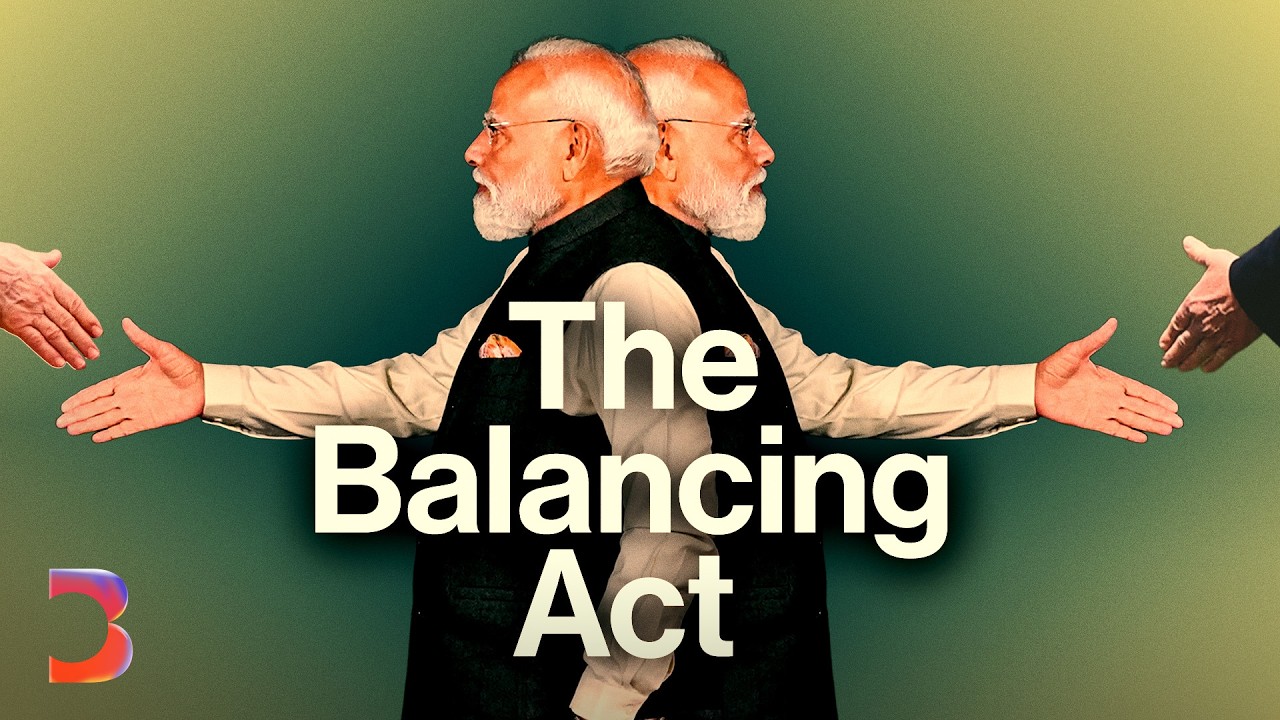
The diplomatic embrace between India and Russia is far more than an exercise in staged optics for cameras. New Delhi has spent decades walking a tightrope between Moscow and Washington, a balancing act that began immediately after Indian independence. Following Russia’s invasion of Ukraine, intense strain fell on India over its continued purchases of Russian crude oil. Pressure intensified as figures like US Treasury Secretary Scott Bessent attacked New Delhi, outright accusing the country of "profiteering off Russian oil." Yet, despite the scrutiny and friction, India remains reluctant to cut ties with Moscow, illustrating a dynamic where history seems to repeat itself as all three capitals navigate overlapping and fiercely competing national interests.
While trade with the United States has expanded rapidly to make America India's most critical economic trading partner, Washington's domestic political unpredictability introduces persistent anxiety. Observers note that a "mercurial Trump administration has made the US a lot less dependable," leaving a "very sour taste" in bilateral diplomacy. In stark contrast, Indian-Russian ties are often viewed through a sentimental, time-tested lens rather than a cold calculation. As one observer describes it, the relationship is "more an emotion and less a transaction," sustained by a genuine meeting of minds and hearts that has weathered decades of geopolitical turbulence.
[01:48](https://www.youtube.com/watch?v=TXGXuWfWFIE&t=108s) Soviet Legacy and Industrial Foundations
In India, public memory of the Soviet Union is surprisingly warm, often rooted in personal nostalgia and cultural exchanges. Many Indians who grew up during the Cold War fondly recall publications like the Russian children's magazine *Misha*, which featured vivid, illustrated stories about Soviet space achievements—what some remember as "propaganda, for sure, but it was gorgeous propaganda." Following independence in 1947, a newly self-governing India urgently sought foreign partnerships to build a modern industrial foundation. When New Delhi approached Western powers for technical assistance, the United States offered financial aid but demonstrated little willingness to transfer advanced technology or industrial know-how.
The Soviet Union stepped into the breach, willing to provide the blueprint and engineering expertise that India wanted. The towering symbol of this early friendship was the Bhilai steel plant in central India, constructed with direct Soviet engineering blueprints. The symbolic weight of the project was immortalized when Soviet Premier Nikita Khrushchev addressed the Indian Parliament in 1960, proclaiming his hope that "the Indo-Soviet friendship be as strong as the metal coming out from the Bhilai factory." This technical solidarity established a baseline of trust that distinguished Moscow from Washington in Indian eyes.
[02:51](https://www.youtube.com/watch?v=TXGXuWfWFIE&t=171s) Cold War Alliances and the Pakistan Fault Line
At the onset of the Cold War, Washington did not oppose partnering with India, but India remained steadfastly committed to the Non-Aligned Movement, refusing to formally enter superpower blocs or pick sides. Meanwhile, the United States forged a formal military alliance with India’s regional arch-rival, Pakistan. For New Delhi, American military support for Islamabad crossed a critical line, permanently cementing Pakistan as a driving factor in pushing India closer to the Kremlin. The United States repeatedly siding with Pakistan emerged as a direct "red line for the Indian administration," driving New Delhi to look to Moscow as a reliable geopolitical counterweight.
The Soviet Union was also willing to meet India's strict defense requirements on terms other superpowers refused. In the 1950s, a fiercely independent India refused to accept foreign weapons as conditional military aid. Instead, New Delhi insisted on either purchasing arms outright or acquiring production licenses to manufacture military hardware domestically. Moscow had no qualms about licensing the domestic Indian production of jet fighters and tanks, establishing a domestic defense manufacturing pipeline that tied India's security apparatus directly to Russian technology.
[03:39](https://www.youtube.com/watch?v=TXGXuWfWFIE&t=219s) The Enduring Military Hardware Dependency
Decades of Soviet licensing and supply agreements have left India's modern armed forces deeply dependent on Russian equipment. Russia remains India's primary foreign defense supplier, accounting for roughly 48%—nearly half—of India's overall military procurement needs. This reliance is especially pronounced in the skies; nearly the entire Indian fighter aircraft fleet is of Russian origin. Maintaining this vast inventory requires an ongoing, uninterrupted pipeline of spare parts, technical overhauls, and specialized maintenance support from Moscow.
India’s expanding regional ambitions and complex security environment necessitate a massive standing military. Even in the face of international sanctions and logistics bottlenecks triggered by the war in Ukraine, India has remained Russia's largest weapons export market. Disentangling the Indian military from its legacy Russian hardware would take decades of capital, training, and strategic retooling, making an abrupt break with Moscow impossible from a national defense perspective.
[04:43](https://www.youtube.com/watch?v=TXGXuWfWFIE&t=283s) Sanctions Arbitrage and the Russian Crude Pivot
Before Moscow’s full-scale invasion of Ukraine in 2022, India purchased virtually no Russian crude oil, obtaining almost all of its imports from the Middle East. While New Delhi repeatedly called for an end to hostilities, it pointedly avoided direct condemnation of the Kremlin's actions. Simultaneously, the imposition of Western price caps on Russian seaborne exports created a massive commercial discount. What was designed by the West to limit Kremlin revenues while keeping global oil supplies stable transformed into a lucrative "arbitrage game" for Indian refiners.
India quickly surged to become Russia's single largest buyer of seaborne crude. By July 2026, Russian imports accounted for nearly 56% of India's total oil intake, funneling an estimated $6.4 billion a month in critical revenue back to the Kremlin. Initially, this trade unfolded with Washington’s tacit approval; the Biden administration encouraged New Delhi to purchase discounted Russian barrels under the price cap to prevent global energy markets from experiencing catastrophic supply shocks.
- **Pre-2022 crude baseline**: Practically zero seaborne oil imports from Russia, with supplies dominated by Middle Eastern producers. - **Import peak (July 2026)**: Russian crude climbed to nearly 56% of total Indian crude imports. - **Monthly capital flow**: Approximately $6.4 billion per month paid by India for Russian oil.
[05:48](https://www.youtube.com/watch?v=TXGXuWfWFIE&t=348s) Political Friction and the Washington Tightrope
The diplomatic tolerance for India's oil purchases evaporated under President Donald Trump, whose administration aggressively lambasted New Delhi. Washington deployed threats of steep tariffs, escalated public criticisms, and leveraged prospective bilateral trade deals in an effort to force India to curtail its Russian energy intake. Compounding bilateral tensions was Trump’s insistence that he deserved the Nobel Peace Prize for allegedly brokering a ceasefire following a 2025 border flare-up between India and Pakistan—a self-aggrandizing claim that the Indian government flatly dismissed.
These diplomatic clashes significantly eroded Indian public sentiment toward the United States. A Pew Research survey revealed that 36% of respondents in India viewed Russia as their country's primary ally, compared to just 16% who chose the United States. However, the pressure on Russian energy purchases abruptly eased once again when US forces launched airstrikes against Iranian military targets amid expanding conflict involving Israel, the US, and Iran. Facing immediate risks of a global oil supply crunch, Washington backed away from its aggressive rhetoric and refreshed sanctions waivers for Russian crude, allowing India to continue capitalizing on discounted barrels.
```mermaid flowchart TD accTitle: Indian Strategic Energy and Geopolitical Realignment accDescr: Diagram illustrating how US policy shifts, military conflict, and Russian discounts drive Indian oil imports and strategic choices.
subgraph EnergyPivots["Global Energy Dynamics"] A["2022 Ukraine Invasion & G7 Price Cap"] --> B["Deep Discounts on Russian Seaborne Crude"] B --> C["India Becomes Top Seaborne Buyer (56% in July 2026)"] end
subgraph USPressures["Washington Policy Volatility"] D["Biden Administration Encouraged Capped Purchases"] --> E["Trump Administration Tariff & Trade Pressure"] E --> F["2025 Ceasefire Feud & Rising Distrust"] end
subgraph MidEastShift["Regional Conflict Shock"] G["US Military Strikes on Iran"] --> H["Global Supply Scare"] H --> I["US Renews Russian Oil Waivers"] end
C --> J["Sustained Indian Strategic Autonomy"] F --> J I --> J ```
[07:17](https://www.youtube.com/watch?v=TXGXuWfWFIE&t=437s) Nuclear Ambitions and the Kudankulam Outpost
Beyond hydrocarbon imports, Russia plays an indispensable role in India's long-term clean energy transition. In its push to decarbonize while meeting skyrocketing electricity demand, New Delhi has identified nuclear power as an essential pillar of its green energy basket. Here again, Russia has served as India's primary international partner where Western partners have been slow or constrained by legal and technical hurdles.
The cornerstone of this civilian atomic cooperation is the Kudankulam Nuclear Power Plant located in the southern state of Tamil Nadu. Although the project has faced steep budget escalations and prolonged delivery delays exacerbated by the Ukraine war and international sanctions, work has steadily advanced. Kudankulam remains a critical component in India’s energy puzzle, representing an advanced technological dependency that New Delhi cannot easily replace with domestic or Western alternatives.
[08:05](https://www.youtube.com/watch?v=TXGXuWfWFIE&t=485s) The Indispensable American Economic Engine
Despite the historic warmth and energy ties binding India to Russia, New Delhi cannot afford to compromise its ties with the United States. The US is decisively India’s largest single export destination, making favorable trade relations with Washington fundamental to India's economic growth. New Delhi continues to seek improved access and tariff terms with the US market, recognizing that its modern economic future is tied to Western capital, trade, and technology.
This economic foundation is fortified by deep human and cultural capital: - **Diaspora scale**: More than 5 million people of Indian origin reside in the United States, constituting one of America's largest and most affluent immigrant demographics. - **Higher education**: Hundreds of thousands of Indian students enroll in American universities annually, establishing direct pipelines into high-skilled domestic careers. - **Corporate leadership**: Indian-origin executives exert vast influence across the American private sector, steering prominent Silicon Valley technology giants and Wall Street financial institutions.
[08:44](https://www.youtube.com/watch?v=TXGXuWfWFIE&t=524s) The China Shadow and a Pragmatic Marriage
The strategic calculus linking India and Russia is increasingly dictated by a third power: China. While international discourse often frames the dynamic as a triangle between India, Russia, and the US, an equally vital axis is the Russia-India-China (RIC) relationship. Beijing’s growing influence over a sanction-isolated Moscow deeply unnerves New Delhi. As Russia becomes economically and diplomatically subservient to China, Moscow's ability to act as an independent partner to India diminishes, especially given that Russia's economy and population are dwarfed by those of its two Asian neighbors.
Nevertheless, India’s longstanding policy of strategic autonomy and non-alignment persists. While India is rebalancing its defense and trade portfolios, an outright break with Moscow remains virtually unthinkable. Indian External Affairs Minister S. Jaishankar has pointedly described the Indo-Russian partnership as "the one constant in geopolitics," observing that while India has changed and Russia has changed, the relationship itself has held steady. Observers conclude that while the ideological "love of the 1950s" may no longer exist, the contemporary relationship functions as an effective, durable "marriage of convenience" buttressed by mutual familiarity: "They know whom they are dealing with."
## Notable quotes > [00:00](https://www.youtube.com/watch?v=TXGXuWfWFIE&t=0s) profiteering off Russian oil — Scott Bessent
> [00:00](https://www.youtube.com/watch?v=TXGXuWfWFIE&t=0s) mercurial Trump administration has made the US a lot less dependable
> [00:00](https://www.youtube.com/watch?v=TXGXuWfWFIE&t=0s) more an emotion and less a transaction
> [01:48](https://www.youtube.com/watch?v=TXGXuWfWFIE&t=108s) propaganda, for sure, but it was gorgeous propaganda
> [01:48](https://www.youtube.com/watch?v=TXGXuWfWFIE&t=108s) the Indo-Soviet friendship be as strong as the metal coming out from the Bhilai factory — Nikita Khrushchev
> [02:51](https://www.youtube.com/watch?v=TXGXuWfWFIE&t=171s) red line for the Indian administration
> [04:43](https://www.youtube.com/watch?v=TXGXuWfWFIE&t=283s) arbitrage game
> [08:44](https://www.youtube.com/watch?v=TXGXuWfWFIE&t=524s) the one constant in geopolitics — S. Jaishankar
> [08:44](https://www.youtube.com/watch?v=TXGXuWfWFIE&t=524s) marriage of convenience
> [08:44](https://www.youtube.com/watch?v=TXGXuWfWFIE&t=524s) They know whom they are dealing with.
## Mentioned Bhilai steel plant, Donald Trump, Kudankulam Nuclear Power Plant, Misha, Nikita Khrushchev, Non-Aligned Movement, Pew Research, S. Jaishankar, Scott Bessent, Silicon Valley, Wall Street
## Video description India has spent decades balancing its ties to Russia, and the USSR before it, with those to the US. Today, Russia remains a major supplier of oil and weapons to India, just as India builds deeper economic and strategic ties with the US.
And while India and Russia have changed over time, their relationship remains strong. Even amid the Kremlin’s war on Ukraine and intense pressure from Washington, New Delhi won’t let Moscow go. So why does India keep Russia so close, and can it keep up this balancing act?
Explore these and other related stories in more depth on Bloomberg.com:
How Trump Is Testing India’s US-Russia Balancing Act https://www.bloomberg.com/news/articles/2026-08-31/modi-putin-meeting-how-trump-tariffs-test-india-s-russia-ties
00:00: Intro 01.48: USSR Support 02.51: US and Pakistan 03.39: Military Support 04.43: Russian Oil 05.48: Mercurial Trump 07.17: Nuclear 08.05: US Relationship 08.44: China 09.21: Conclusion
#India #Russia #Trump #US #ColdWar
-------- Like this video? Subscribe: http://www.youtube.com/Bloomberg?sub_confirmation=1
Get unlimited access to Bloomberg.com for just $1.99 your first month: https://www.bloomberg.com/subscriptions?in_source=YoutubeOriginals Bloomberg Originals offers bold takes for curious minds on today’s biggest topics. Hosted by experts covering stories you haven’t seen and viewpoints you haven’t heard, you’ll discover cinematic, data-led shows that investigate the intersection of business and culture. Exploring every angle of climate change, technology, finance, sports and beyond, Bloomberg Originals is business as you’ve never seen it.
Subscribe for business news, but not as you've known it: exclusive interviews, fascinating profiles, data-driven analysis, and the latest in tech innovation from around the world.
Visit our partner channel Bloomberg News for global news and insight in an instant.
[Source](https://www.youtube.com/watch?v=TXGXuWfWFIE)