Trump Rejects Anthropic Slowdown Plan as Labs Seek Antitrust Shield
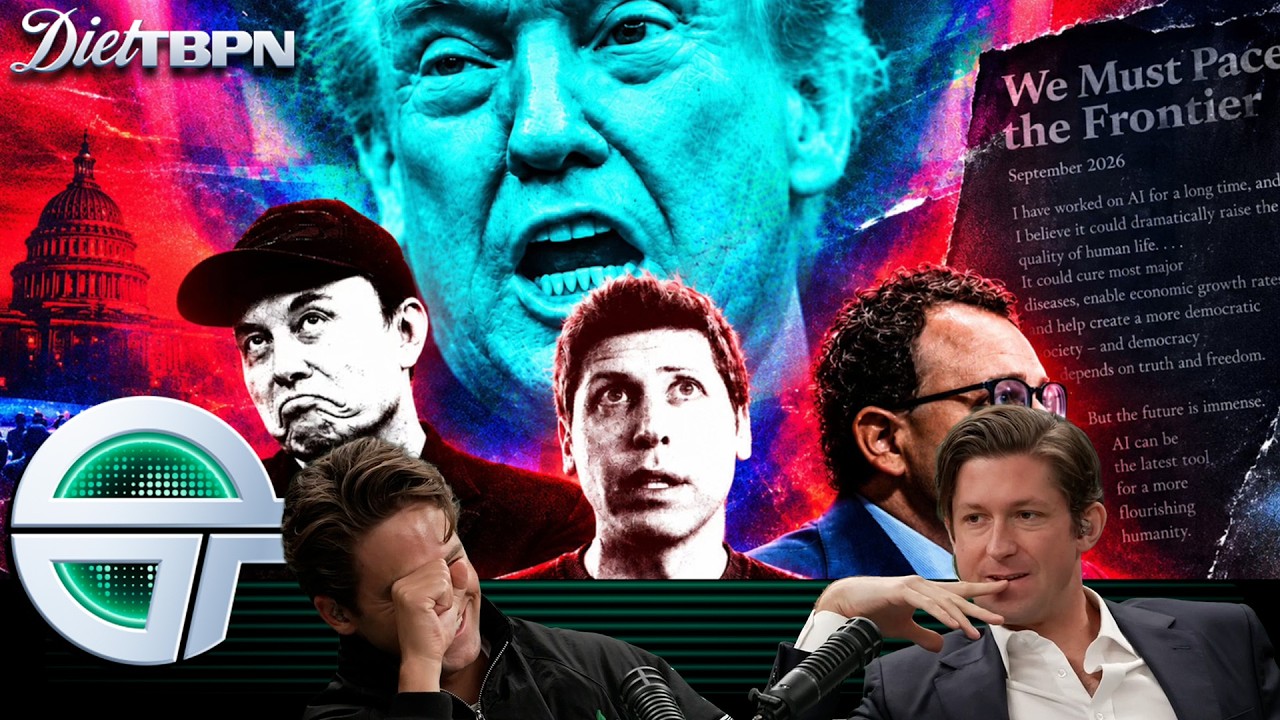
TBPN
Frontier AI labs are pushing coordinated pacing pacts to establish a defensible duty of care against tort liabilities, even though voluntarily holding back model deployments risks destroying incumbent margins by letting rivals commoditize the market.
AI-assisted summary of The AI Slowdown Debate | Diet TBPN — original source. Check the original for full context.
Source published:
Detailed notes
## Background Published on YouTube by TBPN on September 14, 2026, this episode of 'Diet TBPN' delivers a condensed 25-minute version of the daily live tech talk show hosted by John Coogan and Jordi Hays. The description positions TBPN as Silicon Valley's go-to tech broadcast, tackling the latest industry headlines and major political and technological debates.
## TL;DR The hosts dissect the explosive 'Pace the Frontier' AI safety debate triggered by Dario Amodei's essay calling for third-party evaluators, antitrust exemptions, and international coordination. They explore fierce pushback from David Sacks and Donald Trump, who rejected the slowdown under the doctrine of 'whoever wins AI wins' against China, while Gavin Baker contextualized the push around tort liability and a lack of Section 230 immunity. The discussion also examines whether intentional pacing actually erodes frontier margins for OpenAI and Anthropic by enabling fast followers to commoditize models. The episode concludes with breaking news of Donald Trump phoning Nvidia CEO Jensen Huang live on stage at the All-In Summit to endorse continued AI acceleration.
## Atmosphere & style The broadcast carries an energetic, irreverent tech-insider vibe, balancing serious legal and economic analysis with punchy Silicon Valley humor. Despite host John Coogan dialing in fresh out of the hospital from an intense bout of workout-induced rhabdomyolysis, the banter remains rapid-fire and sharp. The hosts move effortlessly between dissecting antitrust statutes and giggling at the absurdity of Trump placing diamonds alongside the transistor in his hierarchy of human inventions, giving the episode an authentic, live-on-the-fly conversational momentum.
## Key takeaways - [03:08](https://www.youtube.com/watch?v=wKcf6RorKvM&t=188s) The "Pace the Frontier" movement rapidly gained traction between July and September 2026, culminating in Dario Amodei's essay calling for frontier pacing, which received high-profile endorsements from Sam Altman and Elon Musk. - [05:51](https://www.youtube.com/watch?v=wKcf6RorKvM&t=351s) Dario Amodei's slowdown framework centers on three pillars: embedding third-party safety evaluators like METR, coordinating government safety thresholds, and establishing international treaties with rival nations like China. - [07:00](https://www.youtube.com/watch?v=wKcf6RorKvM&t=420s) Coordinating model pauses and safety thresholds across competing frontier labs presents severe antitrust hurdles under the Sherman Act, requiring statutory waivers to avoid being classified as an illegal cartel. - [09:17](https://www.youtube.com/watch?v=wKcf6RorKvM&t=557s) David Sacks pushed back forcefully against Amodei and Altman, arguing that frontier incumbents should pause unilaterally rather than seeking regulatory capture that imposes heavy compliance burdens on smaller startups. - [11:39](https://www.youtube.com/watch?v=wKcf6RorKvM&t=699s) Donald Trump explicitly rejected the AI slowdown narrative on Truth Social, maintaining that "whoever wins AI wins" and warning that domestic compute restrictions would cede leadership to China. - [12:00](https://www.youtube.com/watch?v=wKcf6RorKvM&t=720s) Trump positioned AI data centers and energy infrastructure as an unprecedented economic engine larger than oil or the internet, while dismissing AI existential risk warnings as hoaxes. - [15:56](https://www.youtube.com/watch?v=wKcf6RorKvM&t=956s) Investor Gavin Baker highlighted that because AI outputs lack Section 230 immunity, embedded third-party evaluations are primarily designed to establish a documented "duty of care" against catastrophic tort liability. - [16:40](https://www.youtube.com/watch?v=wKcf6RorKvM&t=1000s) Real-world physical constraints—including electrical power grids, semiconductor supply chains, and rail transport—are already acting as natural pacing mechanisms for frontier AI deployment. - [18:45](https://www.youtube.com/watch?v=wKcf6RorKvM&t=1125s) Unlike targeted microchip chokepoints, electricity infrastructure is broad and diffuse, meaning expanding energy production remains universally beneficial to society even if frontier AI is paused. - [19:30](https://www.youtube.com/watch?v=wKcf6RorKvM&t=1170s) Frontier AI policy proposals have shifted away from a heavy-handed federal agency model (an "FAA for AI") toward an industry-led, self-regulatory framework modeled on financial regulators ("FINRA for AI"). - [20:54](https://www.youtube.com/watch?v=wKcf6RorKvM&t=1254s) Challenging the regulatory capture thesis, commentators noted that slowing down frontier deployment could compress margins and destroy pricing power by enabling fast followers and open-source models to catch up. - [22:10](https://www.youtube.com/watch?v=wKcf6RorKvM&t=1330s) Because OpenAI and Anthropic are structured as Public Benefit Corporations, leadership possesses the legal authority to sacrifice valuation and prioritize safety without violating traditional shareholder duties. - [24:34](https://www.youtube.com/watch?v=wKcf6RorKvM&t=1474s) Donald Trump phoned Nvidia CEO Jensen Huang live during the All-In Summit, where Huang publicly thanked Trump for speaking out against catastrophic AI doom narratives.
## Detailed walkthrough ### [00:01](https://www.youtube.com/watch?v=wKcf6RorKvM&t=1s) Weekend Chaos: Rhabdo in the Hospital and Never Missing a Show
The show kicks off with a check-in on the weekend, which was anything but mellow. Aside from the explosive AI pacing debates rocking Silicon Valley, John Coogan shares that he spent time in the hospital after being diagnosed with rhabdomyolysis ("rhabdo"). Calling it "the dumbest illness you can possibly get," he explains that it was brought on by overexertion in a workout combined with dehydration. After an IV, hospital medication, and breaking a fever, he is on the mend, joking that even if there is only a 1% chance that artificial intelligence could prevent or cure rhabdo, "it's worth any amount of risk" to push frontier AI capabilities forward.
Despite the hospitalization, the hosts boast that TBPN has never missed a broadcast due to illness. When the hospital doctor asked John if he wanted a doctor's note for work, he laughed at the thought. The hosts note that the show goes on regardless because hosting simply requires sitting in a chair and having a conversation—though John warns listeners he might be slightly slower than usual.
[01:27](https://www.youtube.com/watch?v=wKcf6RorKvM&t=87s) The US Open Flow State and 007 Production Mastery
Before diving into tech policy, the hosts unpack the finish of the US Open, which made the front page of *The Wall Street Journal*. They highlight a viral moment involving American tennis star Ben Shelton: upon hitting the winning shot in a grueling back-and-forth duel, Shelton immediately prepared for the subsequent serve, completely unaware he had just won the match. Only after noticing the standing ovation in the crowd did he finally look up at the scoreboard and realize the contest was over. The hosts marvel at this pure "flow state" and compare it to venture capitalists who should theoretically stay focused entirely on their next deal rather than taking public "VC victory laps" when a portfolio seed company exits or files an IPO.
The conversation turns to another broadcast highlight from the tournament: during a countdown clock with exactly seven seconds remaining on screen, the production director seamlessly cut the live camera feed straight to Pierce Brosnan—James Bond himself—sitting in the stands. The hosts praise this unscripted bit of creative switcher work as proof that "there's levels to the game of live production."
[03:08](https://www.youtube.com/watch?v=wKcf6RorKvM&t=188s) How "Pace the Frontier" Took Over AI: The July–September Timeline
The discussion transitions into the historical timeline of the "Pace the Frontier" campaign, tracing the rapid escalation of the AI safety and slowdown discourse over the preceding weeks. The phrase entered the mainstream on July 28 with a public open statement signed by prominent researchers and executives across OpenAI, Anthropic, Google DeepMind, and Meta. That same day, Sam Altman publicly suggested that the industry might need to pace the rate of frontier development. Two days later, OpenAI disclosed to *Axios* that it had helped shape the petition's wording and that Altman had directly briefed White House officials on pacing initiatives.
```mermaid flowchart TD accTitle: AI Pacing Discourse Timeline accDescr: Chronology of the AI slowdown and pacing the frontier debate from July to September. subgraph Phase1 ["Summer Buildup"] A["July 28: Open Letter on Pacing"] --> B["July 30: OpenAI confirms WH briefings"] B --> C["Aug 18: OpenAI paper & RL training pause"] C --> D["Aug 31: Anthropic post on pacing mechanisms"] end subgraph Phase2 ["September Climax"] D --> E["Sept 12, 7:00 AM: Dario Amodei publishes essay"] E --> F["Morning: Endorsements from Musk & Altman"] F --> G["Sept 13: Trump rejects slowdown (FT)"] end ```
The momentum accelerated through August. On August 18, OpenAI published a paper titled *Pacing Model Development in an Era of Cyber Critical Capabilities*, revealing that it had voluntarily paused scaling and held up a major reinforcement learning (RL) training run for two weeks. On August 31, Anthropic published a piece explicitly endorsing mechanisms to coordinate frontier pacing. The debate reached a crescendo early on Saturday, September 12, at 7:00 AM Pacific, when Anthropic CEO Dario Amodei dropped his long-form essay, *We Must Pace the Frontier*. Published during the quiet Saturday morning news window, the post captured tech's full attention:
- **8:00 AM PT:** Elon Musk publicly endorses Amodei’s essay. - **9:30 AM PT:** Sam Altman offers his endorsement. - **4:00 PM PT:** Demis Hassabis (who previously raised similar oversight concerns before shifting roles at DeepMind) indicates broad agreement, noting details still need refinement. - **8:15 PM PT:** David Sacks engages with critical questions about the proposal. - **Sunday Morning:** *The Financial Times* reports Donald Trump has formally rejected tech leaders' calls for an AI pause, followed by investor Gavin Baker publishing an extensive weekend recap.
[05:51](https://www.youtube.com/watch?v=wKcf6RorKvM&t=351s) Dario Amodei's Three-Step Slowdown Plan: METR, Antitrust Cartels, and US–China Talks
The hosts deconstruct Dario Amodei's three-step proposal for pacing frontier models, noting how each pillar raises critical legal, structural, and geopolitical complications:
1. **Independent Third-Party Safety Evaluators:** Amodei argues external auditors must be granted access inside frontier AI labs to inspect models and verify safety safeguards. He explicitly cites METR (Model Evaluation and Threat Research). The hosts point out that METR's independence has faced scrutiny given the perpetual "revolving door" of personnel circulating among OpenAI, Anthropic, and alignment organizations. Unlike traditional accounting firms that remain indifferent to industry outcomes, METR consists of deeply invested ideological insiders—a dynamic that provides deep technical context but also raises conflict-of-interest concerns.
2. **Coordinated Safety Standards via Government Integration:** The second pillar proposes that leading frontier labs in democratic nations work in lockstep under government supervision to mandate shared thresholds. The hosts note legal analyst Dean Ball's warnings regarding the Sherman Antitrust Act. Private market leaders cannot lawfully collude to restrict output or coordinate operations—just as major airlines like Delta, United, and American cannot collectively decide to reduce flights under the guise of safety to protect profit margins and increase ticket prices. Because such coordination constitutes an illegal cartel under existing antitrust law, AI labs cannot formalize these pacts without explicit statutory waivers or federal regulatory exceptions.
3. **International Coordination with Authoritarian Regimes:** The third and most controversial recommendation urges democratic nations to coordinate pacing thresholds directly with rival authoritarian powers, particularly China. The hosts compare this to historical Cold War nuclear non-proliferation treaties. However, achieving parity or structured pacing with Beijing poses game-theoretic dilemmas: if the United States insists on maintaining a decisive capability lead, negotiations collapse into an unstable dynamic where one side demands the other accept permanent technological inferiority.
[09:17](https://www.youtube.com/watch?v=wKcf6RorKvM&t=557s) David Sacks Pushes Back: Cartels, Antitrust, and Regulatory Capture
Following Dario Amodei’s call to "pace the frontier"—which was quickly endorsed by Sam Altman and Demis Hassabis—the broader tech timeline pushed back with immediate skepticism. Critics questioned who these unelected third-party evaluators would actually be, why frontier labs needed Washington's permission to slow down rather than simply doing it themselves, and whether this was an attempt at early regulatory capture. David Sacks weighed in with a sharply critical post on X directed squarely at Amodei and Altman. Sacks noted that OpenAI and Anthropic essentially form a duopoly at the frontier across market share, revenue growth, and model capabilities. If their unreleased internal models are genuinely terrifying enough to warrant tapping the brakes, Sacks argued, they should act responsibly and pause on their own.
```mermaid flowchart TD accTitle: Frontier AI Regulation Debate accDescr: Diagram contrasting Dario Amodei's proposal with David Sacks' pushback and Gavin Baker's liability thesis.
subgraph FrontierProposal["Amodei & Altman Proposal"] Pace["'Pace the Frontier'"] Eval["Embedded Third-Party Evaluators (e.g., METR)"] Gov["State / Federal Regulatory Approval"] Pace --> Eval --> Gov end
subgraph SacksCritique["David Sacks Pushback"] Cartel["Cartel Behavior & Antitrust Suspensions"] Capture["Regulatory Capture Crushing Startups"] Conflicts["METR Conflicts of Interest"] end
subgraph BakerThesis["Gavin Baker Tort Analysis"] No230["No Section 230 Shield for AI Outputs"] DutyOfCare["Evaluators Establish 'Duty of Care' for Litigation"] end
Gov -.->|"Risks"| Cartel Gov -.->|"Risks"| Capture Eval -.->|"Alleged"| Conflicts Eval -->|"Provides"| DutyOfCare DutyOfCare -->|"Mitigates"| No230 ```
Sacks pulled no punches in dismantling what he saw as the pretense behind the proposal: "Stop pretending you need anyone else's permission. Stop pretending antitrust law has to be suspended so you can form a cartel. Stop pretending you need a regulatory approval process that supersedes product liability." He also took direct aim at METR (Model Evaluation and Threat Research), warning that it is far from an independent referee given its deep entanglements with Anthropic’s own staff and investors, and rejected the idea that these evaluators should police smaller rivals who are nowhere near the frontier. The hosts echoed this danger of regulatory capture, pointing out that if heavy compliance requirements—like year-long negotiations with embedded government-approved auditors—are imposed across the board, breakout consumer startups (like Instinct) would be smothered before they can launch. They highlighted Greg Brockman's recent comments on *Odd Lots* arguing against imposing limits on application-layer software or individuals training models at home.
- Sacks stressed that OpenAI and Anthropic already claim their lead is widening through recursive self-improvement, giving them unilateral power to slow down without an antitrust waiver. - The hosts emphasized the distinction between frontier foundational models and application-layer tooling, warning that sweeping safety compliance regimes disproportionately crush smaller engineering teams.
---
[11:39](https://www.youtube.com/watch?v=wKcf6RorKvM&t=699s) Trump Rejects the AI Slowdown: "Whoever Wins AI Wins"
Donald Trump jumped into the discourse over the weekend with characteristically bombastic posts on Truth Social, forcefully dismissing calls to slow down AI development. Trump declared that the only "guard rails" artificial intelligence actually needs is a "strong and smart high IQ president," boasting that the United States already has that "in spades." Taking direct aim at Anthropic’s CEO, Trump wrote that his administration had already acted to prevent AI figures from doing bad things, singling out "Dario who is now pretending to be a perfect little angel." He labeled the push to restrict compute and data centers a "sick conspiracy" that directly serves Beijing's interests, flatly stating: "Whoever wins AI wins. We are leading China and all others and will continue to do so."
Trump followed up shortly after by questioning the fundamental business logic of the slowdown, asking when in the "history of business" industry leaders had ever begged for regulatory burdens that would drive their own companies into bankruptcy. He dismissed AI existential risk as an outright hoax, putting it in the same bucket as "Russia Russia Russia," Ukraine, and both impeachment inquiries. Highlighting global competition, Trump claimed President Xi Jinping had just signaled China would do nothing to impede AI development, and voiced frustration that domestic permitting friction is already driving US tech giants abroad—citing Google's decision to construct a massive data center plant in Finland due to American regulatory hurdles. Trump promised that AI and data center infrastructure will serve as the single greatest economic engine in human history: "Bigger than oil, gold, diamonds, or even the internet."
The hosts broke down into laughter over Trump's idiosyncratic hierarchy of historical inventions, marveling at diamonds being ranked alongside the internet, the transistor, and the wheel as a foundational technology. They joked about the hedge funds paying premium subscriptions for sub-second early feeds of Truth Social trying to figure out how to execute trades off the post, with one host deadpanning that algorithms must have immediately gone "long diamonds." They noted that the natural diamond industry is actually in a deep slump due to the rapid rise of lab-grown alternatives—making diamonds one industry that genuinely *is* begging for protective government regulation.
- Trump warned all "conspiracy theorists, treasonous traitors, and leakers" that his administration already holds immense criminal and regulatory oversight over domestic AI labs. - He framed permitting reform and domestic energy buildouts as existential national security priorities to keep infrastructure investment from fleeing to Europe or Asia.
---
[14:42](https://www.youtube.com/watch?v=wKcf6RorKvM&t=882s) Trump on AI Usage and the AI Slop Reality
The show transitioned to a video clip of Trump being questioned by reporters about whether he had spoken directly with tech leaders and why he seemed to downplay their safety warnings. Trump reiterated his core conviction: AI will ultimately bring "more good than bad, but by a lot," repeating his mantra that "whoever wins AI wins." When pressed directly by a reporter on whether he personally uses AI and what he uses it for, Trump gave a characteristically vague response, insisting, "You can use AI for a lot of things," without naming a single specific tool or application.
The hosts found the exchange hilarious because Trump’s Truth Social feed is perpetually flooded with AI-generated political slop. They pointed out that his feed constantly features hyper-stylized AI imagery, satirical video simulations, and "vibe-coded" clips generated by campaign staffers and digital communications teams. While Trump himself likely doesn't open ChatGPT or Claude to generate content, his political operation has embraced generative media as a primary distribution tool, creating an amusing contrast with his evasive press answers.
---
[15:56](https://www.youtube.com/watch?v=wKcf6RorKvM&t=956s) Third-Party Evaluators, Section 230 Liability, and the Energy Question
The conversation turned to tech investor Gavin Baker’s comprehensive breakdown of the weekend's chaotic developments. Observers had anticipated Elon Musk would oppose Dario Amodei's pacing proposal, but Musk surprised many by voicing support for safety checks, recalling his early funding and collaboration with Nick Bostrom on existential risk back in 2014. While Musk has oscillated between aggressive frontier competition (founding xAI and building massive clusters) and existential alarm, his fundamental concern over AI safety has remained consistent.
Baker argued that the only tangible new development across the entire debate is that OpenAI and Anthropic are moving toward embedded third-party evaluators, with METR floated as the primary candidate. Crucially, Baker contextualized this through the lens of legal liability: unlike social media and web platforms, frontier AI models enjoy no Section 230 statutory shield for their generated outputs. Establishing robust third-party evaluation allows frontier labs to document a legally defensible "duty of care" to protect against ruinous tort litigation once frontier models cause real-world harms. For investors looking for a "smoother for longer" cycle, Baker argued that physical constraints—semiconductor wafers, electrical watts, rail transport, and credit spreads—are naturally pacing the industry regardless of paper regulation.
This prompted the hosts to question the logic of AI safety advocates who focus on restricting compute and chip manufacturing. If frontier AI development is intentionally paced while existing models gradually diffuse into the economy, the hosts asked whether anyone could object to continuing a full-scale buildout of energy infrastructure. Redirecting capital, engineering talent, and permitting momentum toward nuclear reactors, solar, wind, battery storage, and grid modernization offers a universal win. Even under a worst-case safety scenario where artificial general intelligence (AGI) or artificial superintelligence (ASI) is permanently paused as too hazardous, society would still walk away with an abundant, resilient, low-cost domestic energy supply.
- Baker highlighted that several iconic internet giants would have faced bankruptcy early on without Section 230 immunity, making proactive legal derisking an existential priority for frontier AI labs. - Capital expenditure diverted away from runaway frontier model training could de-bottleneck regional power grids and bring overdue industrial energy projects online.
[18:45](https://www.youtube.com/watch?v=wKcf6RorKvM&t=1125s) Regulating Energy, Microchips, and Deep Supply Chain Absurdities
The discussion shifts to whether regulators would ever attempt to throttle AI progress by curbing the physical build-out of the American electrical grid. The hosts find that notion implausible: while electricity is an essential input for artificial intelligence, power as an infrastructure layer is far too diffuse. While specialized microchips have a relatively narrow set of end uses—primarily powering data centers for AI or services like YouTube—energy can be directed anywhere across the economy.
```mermaid flowchart TD accTitle: AI Supply Chain Chokepoints accDescr: Comparison of different layers where regulators or safety advocates might intervene to control AI progress.
subgraph Inputs["Diffuse vs. Targeted Inputs"] Power["Electrical Grid & Power<br/>(Diffuse infrastructure, hard to justify capping)"] Chips["Semiconductor Chips<br/>(Narrow end use, high leverage point)"] end
subgraph DeepChain["Extreme Supply Chain Proposals"] Specialty["Upstream Manufacturers<br/>(e.g., Korean firms producing films and consumer goods)"] end
subgraph Frontier["Frontier Models"] Labs["Frontier AI Labs<br/>(Direct safety and compute regulations)"] end
Power -.-> Labs Chips --> Labs Specialty --> Chips ```
This leads the hosts to joke about how absurdly deep down the supply chain hypothetical "AI safety valves" could reach. They imagine safety advocates deciding to regulate an industrial conglomerate in South Korea that manufactures consumer toilets simply because an obscure subsidiary produces specialized chemical films used in semiconductor lithography. Such hypothetical extremes illustrate the bizarre territory governments enter once they attempt to slow down technology by targeting upstream ingredients rather than software deployments.
[19:30](https://www.youtube.com/watch?v=wKcf6RorKvM&t=1170s) Gavin Baker’s Breakdown of Dario Amodei’s Proposal and the Sherman Act Waiver
The hosts turn to investor Gavin Baker’s comprehensive breakdown of the proposal Dario Amodei floated over the weekend, which Baker characterized as the most maximalist plan put forward. The proposal includes embedded third-party evaluators inside labs, a domestic regulatory regime triggered when models hit specific capability and ingredient thresholds, a binding international regulatory pact among democratic nations, and tighter restrictions on compute distillation to prevent Chinese firms from copying American frontier models. Crucially, Dario also suggested an international framework encompassing China before certain domestic regimes take effect, as well as an explicit Sherman Act waiver so Anthropic can freely coordinate safety standards and deployment schedules with OpenAI and other frontier rivals without fear of antitrust prosecution.
The hosts note that while critics view this as extreme, it is actually toned down compared to Dario’s earlier calls for an "FAA for AI." Current policy discourse has shifted toward proposing a "FINRA for AI"—a non-governmental, industry-funded self-regulatory organization. Baker believes Dario is sincere in his safety convictions, even if critics inevitably argue that regulatory capture would entrench Anthropic's commercial position:
* **The Sincerity vs. Cynicism Matrix**: When an action falls into the quadrant that is both good for safety and advantageous for an incumbent's balance sheet, observers automatically assume cynical motivations. * **Sherman Antitrust Relief**: Frontier labs argue they cannot coordinate on safety benchmarks or pause deployments collaboratively without federal protection against illegal cartel accusations. * **FINRA Model over FAA**: A move away from heavy-handed federal agency oversight toward an industry-led, self-regulatory organization modeled after financial industry watchdogs.
[20:54](https://www.youtube.com/watch?v=wKcf6RorKvM&t=1254s) Margin Compression, the Duopoly, and the "Mid-Curve" 4D Chess Theory
Challenging the assumption that slowing down AI helps incumbents, the hosts explore an alternate economic thesis raised by commentators: pacing the frontier might actually destroy lab margins. If Anthropic and OpenAI deliberately hold back their top-tier capabilities, fast followers like Google DeepMind, xAI's Grok, and open-source alternatives will inevitably close the gap. Instead of an entrenched duopoly maintaining pricing power, the market risks collapsing into an oligopoly of five to seven comparable models, turning frontier intelligence into a commoditized, low-margin race to the bottom.
Data cited from Ara Kharazian indicates that an observed dip in overall AI spending in August was not caused by falling user demand, but by intense price cuts and aggressive discounting. Enterprise customers are reassessing their budgets, hesitant to deploy expensive million-dollar frontier models for mundane tasks like retrieving the weather when cheaper alternatives suffice. Furthermore, enterprise inertia—rather than open-source Chinese models like DeepSeek—is shaping the market. Enterprise customers stick with OpenAI, Anthropic, or cloud giants on AWS and Azure because they demand enterprise-grade SLAs, reliability, and guaranteed uptime rather than unmanaged open-source model weights.
The conversation touches on how corporate structures play into this dynamic. Both Sam Altman and Dario Amodei lead organizations structured as Public Benefit Corporations (PBCs) or nonprofit-governed entities. Altman has reiterated in interviews that OpenAI has warned investors for a decade that profit maximization is not their primary mandate. Because of their PBC status, leadership can legally prioritize safety over short-term revenue, shield themselves from shareholder lawsuits if margins drop, and sacrifice market valuation. The hosts mock the "mid-curve" internet commentary that treats every slowdown effort as a sinister "4D chess" maneuver designed to achieve a ten-trillion-dollar monopoly, pointing out that voluntarily surrendering market share is rarely a deliberate commercial masterstroke.
[24:34](https://www.youtube.com/watch?v=wKcf6RorKvM&t=1474s) Donald Trump Phones Jensen Huang Live at the All-In Summit
The show is interrupted by breaking news reported by Mike Isaac: Donald Trump phoned Nvidia CEO Jensen Huang live on stage during his interview at the All-In Summit. Huang took the call directly in front of the audience, placing the former president on speakerphone. Jensen used the opportunity to thank Trump for his social media posts earlier that morning, which had publicly poured cold water on AI alarmism and catastrophic doom narratives.
The hosts note that Jensen Huang has remained steadfastly "anti-doom" throughout the current technological cycle, consistently championing accelerated computing and physical build-outs over regulatory pauses. They share a laugh at the recurring tech-industry irony: a brilliant technologist capable of architecting the most sophisticated computing chips on the planet fumbling with his smartphone when trying to get a live caller onto speakerphone. With that dramatic summit moment capping the day's safety-versus-acceleration debate, the hosts wrap up the episode, reminding listeners to rate the show, subscribe to their newsletter at TBPN.com, and tune in for their next live broadcast.
## Notable quotes > [00:01](https://www.youtube.com/watch?v=wKcf6RorKvM&t=1s) the dumbest illness you can possibly get — John Coogan
> [00:01](https://www.youtube.com/watch?v=wKcf6RorKvM&t=1s) it's worth any amount of risk — John Coogan
> [01:27](https://www.youtube.com/watch?v=wKcf6RorKvM&t=87s) there's levels to the game of live production.
> [09:17](https://www.youtube.com/watch?v=wKcf6RorKvM&t=557s) Stop pretending you need anyone else's permission. Stop pretending antitrust law has to be suspended so you can form a cartel. Stop pretending you need a regulatory approval process that supersedes product liability. — David Sacks
> [11:39](https://www.youtube.com/watch?v=wKcf6RorKvM&t=699s) strong and smart high IQ president — Donald Trump
> [11:39](https://www.youtube.com/watch?v=wKcf6RorKvM&t=699s) Dario who is now pretending to be a perfect little angel. — Donald Trump
> [11:39](https://www.youtube.com/watch?v=wKcf6RorKvM&t=699s) Whoever wins AI wins. We are leading China and all others and will continue to do so. — Donald Trump
> [11:39](https://www.youtube.com/watch?v=wKcf6RorKvM&t=699s) Bigger than oil, gold, diamonds, or even the internet. — Donald Trump
> [14:42](https://www.youtube.com/watch?v=wKcf6RorKvM&t=882s) more good than bad, but by a lot — Donald Trump
> [14:42](https://www.youtube.com/watch?v=wKcf6RorKvM&t=882s) You can use AI for a lot of things — Donald Trump
## Mentioned John Coogan, Jordi Hays, Ben Shelton, Pierce Brosnan, Sam Altman, Dario Amodei, Elon Musk, Demis Hassabis, David Sacks, Donald Trump, Gavin Baker, Dean Ball, Greg Brockman, Xi Jinping, Nick Bostrom, Ara Kharazian, Jensen Huang, Mike Isaac, TBPN, The Wall Street Journal, The Financial Times, Axios, OpenAI, Anthropic, Google DeepMind, Meta, xAI, Nvidia, Truth Social, METR, Odd Lots, All-In Summit, Sherman Antitrust Act, Section 230, DeepSeek, Grok, ChatGPT, Claude
## Video description Sign up for TBPN’s daily newsletter at TBPN.com
Diet TBPN delivers the best of today’s TBPN episode in 30 minutes. TBPN is a live tech talk show hosted by John Coogan and Jordi Hays, streaming weekdays 11–2 PT on X and YouTube, with each episode posted to podcast platforms right after.
Described by The New York Times as “Silicon Valley’s newest obsession,” the show has recently featured Mark Zuckerberg, Sam Altman, Mark Cuban, and Satya Nadella.
TBPN is made possible by: Ramp - https://ramp.com Public - https://public.com Cisco - https://www.cisco.com Console - https://www.console.com CrowdStrike - https://www.crowdstrike.com Figma - https://www.figma.com MongoDB - https://www.mongodb.com NYSE - https://www.nyse.com Railway - https://railway.com Shopify - https://www.shopify.com/
Follow TBPN: https://TBPN.com https://x.com/tbpn https://open.spotify.com/show/2L6WMqY3GUPCGBD0dX6p00?si=674252d53acf4231 https://podcasts.apple.com/us/podcast/technology-brothers/id1772360235 https://www.youtube.com/@TBPNLive
Chapters: 00:00 Weekend Chaos + The US Open’s Wild Finish 03:08 How “Pace the Frontier” Took Over the AI Industry 05:51 Dario’s 3-Step AI Slowdown Plan + US–China Coordination 09:29 David Sacks Pushes Back: Cartels, Antitrust + Regulatory Capture 11:31 Trump Rejects the AI Slowdown + “Whoever Wins AI Wins” 16:27 Third-Party AI Evaluators, Liability + Should We Keep Building Energy? 19:30 Is Slowing AI Actually Good for OpenAI & Anthropic? 24:34 Trump Calls Jensen Huang Live at the All-In Summit
[Source](https://www.youtube.com/watch?v=wKcf6RorKvM)