Lightfield Targets Salesforce With Schema-Less AI Business Models
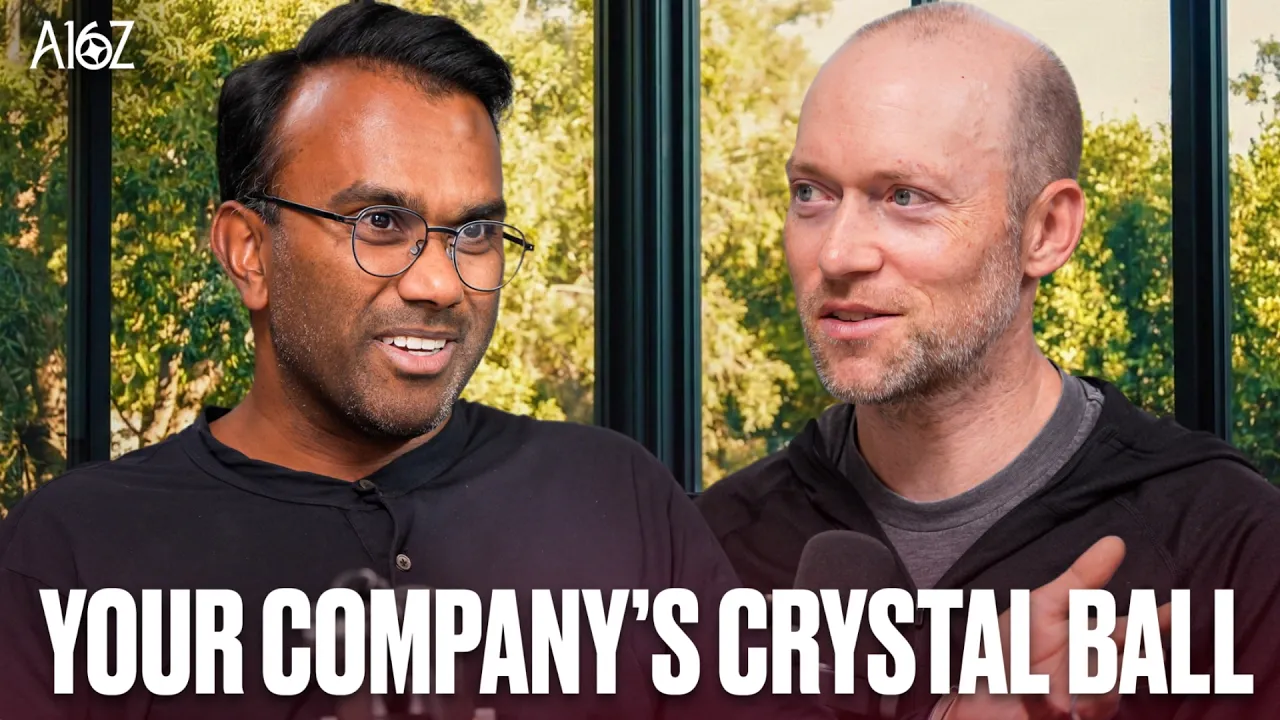
a16z
Legacy CRMs fail because manual data entry corrupts records, making dynamic activity logs and ambient AI inference the only viable way to model enterprise operations.
AI-assisted summary of Why the Next Generation of Enterprise Software Looks Nothing Like Salesforce — original source. Check the original for full context.
Source published:
Detailed notes
## Background Published on YouTube by a16z on September 16, 2026, this episode features hosts Alex Rampell and Joe Schmidt interviewing Lightfield co-founder and CEO Keith Peiris. The discussion explores Lightfield's ambition to replace legacy CRMs with an AI-native "business world model" and details the hard lessons learned from walking away from viral presentation startup Tome to pursue deeper enterprise data infrastructure.
## TL;DR Keith Peiris explains how the context limitations of generative slide creation led his team to pivot from Tome's 25-million-user base into rebuilding the modern CRM from first principles. Rather than relying on rigid relational schemas and manual rep data entry, Lightfield ingests emails, calls, and warehouse metrics into a canonical chronological event log that AI agents can reason over to model dynamic business reality. The conversation examines why pure outcome-based and seat-based pricing both fail in B2B sales software, prompting a hybrid model that balances table-stakes data storage with metered consumption for pipeline generation and frontier intelligence. Peiris also details Lightfield's hyper-lean, generalist culture—which relies on company-wide morning standups and eliminates functional silos—to ship fast enough to outmaneuver legacy incumbents and protect against customer churn.
## Atmosphere & style The conversation carries a candid, operator-to-operator energy, feeling less like a polished promotional interview and more like a high-bandwidth strategy jam between battle-tested founders and venture partners. Peiris speaks with blunt self-awareness and refreshing pragmatism, freely admitting to corporate missteps at Tome, the failure of pure credit-based pricing, and the sheer operational terror of pivoting a venture-backed startup. Rampell and Schmidt match his pace with sharp historical parallels and witty enterprise skepticism, creating a grounded, fast-moving dialogue that cuts through prevailing AI hype in favor of raw product mechanics.
## Key takeaways - [00:52](https://www.youtube.com/watch?v=K5yGLO8c6T0&t=52s) Keith Peiris walked away from Tome despite reaching 25 million registered users because foundation models could not overcome the context ceiling inherent in human-to-human presentations. - [02:28](https://www.youtube.com/watch?v=K5yGLO8c6T0&t=148s) Better foundation model reasoning cannot fix products lacking access to ground-truth context, exposing the flaw of relying on 'hopium' model upgrades. - [05:00](https://www.youtube.com/watch?v=K5yGLO8c6T0&t=300s) Exploring sales workflows revealed that call recordings and legacy CRMs held completely contradictory data, identifying fragmented customer reality as the true bottleneck. - [09:15](https://www.youtube.com/watch?v=K5yGLO8c6T0&t=555s) Traditional CRMs fail because they rely on manual rep data entry, brittle schema rigidity, and poor APIs, acting as static repositories rather than living records. - [10:00](https://www.youtube.com/watch?v=K5yGLO8c6T0&t=600s) Lightfield models business relationships via a chronological semi-structured activity log inspired by social feeds, replacing rigid upfront database schemas with dynamic inference. - [13:00](https://www.youtube.com/watch?v=K5yGLO8c6T0&t=780s) Prioritizing 'intelligence over schema' enables 5-minute customer onboarding and retroactive backfilling of new custom metrics without manual re-entry. - [22:15](https://www.youtube.com/watch?v=K5yGLO8c6T0&t=1335s) Brownfield displacement succeeds by offering free access to non-sales departments (engineering, finance, CS), creating company-wide lock-in that resists legacy CRM rip-and-replace demands. - [27:35](https://www.youtube.com/watch?v=K5yGLO8c6T0&t=1655s) Rigid logic-tree outbound sequences are replaced by plain-language agentic recipes grounded directly in the company's business world model. - [31:54](https://www.youtube.com/watch?v=K5yGLO8c6T0&t=1914s) Pure per-seat pricing fails due to extreme usage skews (10,000x difference), while pure consumption credit pricing paralyzes user adoption with metered fear. - [34:44](https://www.youtube.com/watch?v=K5yGLO8c6T0&t=2084s) Lightfield established a hybrid pricing model balancing predictable subscription fees for everyday CRM operations with metered consumption for pipeline generation, automation, and frontier intelligence. - [34:44](https://www.youtube.com/watch?v=K5yGLO8c6T0&t=2084s) Outcome-based pricing breaks down in sales software because a vendor's conversion rates are inextricably tied to the customer's underlying product-market fit. - [36:22](https://www.youtube.com/watch?v=K5yGLO8c6T0&t=2182s) Operational agility requires dismantling functional silos and swim lanes in favor of generalists pulling from a dynamically prioritized company-wide backlog. - [40:00](https://www.youtube.com/watch?v=K5yGLO8c6T0&t=2400s) Prioritizing roadmap features based on a customer's 3-to-5-year expansion trajectory prevents churn among hyper-growth accounts. - [45:00](https://www.youtube.com/watch?v=K5yGLO8c6T0&t=2700s) Mature enterprises rarely attempt to vibe code a full system of record, but their internal attempts to build bespoke 'company brains' consistently fail due to context modeling complexity. - [48:45](https://www.youtube.com/watch?v=K5yGLO8c6T0&t=2925s) During high-stakes company pivots, founders must ignore peripheral corporate distractions and focus maniacally on solving verified customer pain.
## Detailed walkthrough ### [00:00](https://www.youtube.com/watch?v=K5yGLO8c6T0&t=0s) Introduction and the Genesis of Lightfield
The episode opens with highlights on the founding team's origins and what makes enterprise sales such a compelling domain. Three out of Lightfield's five founding members trace their roots back to Facebook, bringing a deep consumer product orientation into enterprise software. Keith Peiris explains that building revenue infrastructure is a uniquely rich problem space because every company cares deeply about revenue and execution can always be improved. To illustrate the tangible impact of their platform, Keith points to a healthcare customer named Power—a marketplace that connects patients dealing with severe illnesses to frontier treatments. By modeling their entire workflow inside Lightfield, Power was able to match an Alzheimer's patient with an experimental clinical trial within days.
Host Joe Schmidt introduces co-host Alex Rampell and Keith Peiris, CEO and co-founder of Lightfield. Schmidt highlights that Lightfield recently raised a $47 million Series A led by Andreessen Horowitz to build what they term a "business world model." Rather than functioning like a traditional static database, a business world model ingests unstructured customer emails, calls, and meetings, converting them into an active, coherent operational record that AI agents can reason over to execute meaningful work.
- Lightfield raised a $47 million Series A round led by a16z. - Three of the five founding members previously worked at Facebook. - Customer case study: Power uses Lightfield to model complex patient-trial relationships, successfully placing an Alzheimer's patient into frontier clinical trials within days.
[00:52](https://www.youtube.com/watch?v=K5yGLO8c6T0&t=52s) From Tome to Lightfield: Walking Away from Explosive Growth
Keith recounts the unusual trajectory that led him to scrap a massively viral AI company to build Lightfield. Before Lightfield, Keith co-founded Tome. Drawing on backgrounds designing consumer experiences at Instagram and Messenger, the founders believed large language models would revolutionize how people communicate. They set out to build an AI-native storytelling tool, launching around the release of GPT-3 and ChatGPT. The product went viral instantly, pulling in over 2 million users a month. Growth was so intense that prospective users were waiting in virtual lines simply because the company could not secure enough inference capacity to meet real-time demand.
Despite reaching tens of millions of users, Keith made the rare call to walk away and pivot the entire company. The decision stemmed from a fundamental, uncomfortable instinct: "none of us liked the product." As a founder, Keith argues, you must genuinely love what you are building and feel pride when customers use it. The team realized they could not produce consistently high-quality presentations for discerning enterprise professionals. While students and casual creators loved it, they could not envision investment bankers, management consultants, or venture capitalists using Tome to build client decks or investment memos.
```mermaid flowchart TD accTitle: Evolution from Tome to Lightfield accDescr: Diagram tracing the product evolution from viral AI presentation tool to finding the deeper enterprise CRM context problem. subgraph TomeEra ["The Tome Phase"] T1["Consumer Storytelling on GPT-3"] --> T2["Explosive Growth: 2M Monthly Users"] T2 --> T3["Context Ceiling: Lacks Audience Knowledge"] end subgraph TransitionPhase ["Customer Discovery"] T3 --> D1["Engage Enterprise Sales Teams"] D1 --> D2["Request Access to Context Box"] end subgraph ProblemFound ["The Core Problem"] D2 --> P1["Conflicting Data Across CRM & Calls"] P1 --> P2["Lightfield: Business World Model"] end ```
[02:28](https://www.youtube.com/watch?v=K5yGLO8c6T0&t=148s) Why Not Just Wait for the Technology to Get Better?
Alex Rampell questions why the team chose to pivot rather than hold on and ride the model improvement curve, noting that many founders fall victim to "hopium"—the passive belief that upcoming foundation model upgrades (such as the jump from GPT-3.5 to GPT-4 and beyond) will magically fix their product flaws. Keith admits the team seriously considered downsizing and waiting out the curve. However, their diagnosis revealed that better raw model intelligence would never solve Tome's core bottleneck: presentations are deeply contextual artifacts.
A compelling presentation relies on intimate knowledge of the presenter, the audience's idiosyncrasies, and the nuanced interpersonal relationship between them. Keith realized that general reasoning cannot infer context that was never provided in the first place: "no amount of general reasoning gets you past that." Because the software could only ever generate a generic, "one-shot pie in the sky presentation," the team concluded that raw model progress would keep them trapped in consumer novelties rather than an indispensable enterprise workflow.
[05:00](https://www.youtube.com/watch?v=K5yGLO8c6T0&t=300s) Following the Heat: Sales Workflows and Data Fragmentation
To find a durable B2B use case, the team looked inside Tome's 25-million-user base to see which business cohorts were actually engaging. The clearest signal came from sales and marketing teams at 500-to-1,000-person companies. Adopting a blank-slate mindset, Keith reached out directly to these teams with a zero-friction offer: "We'll do this for free. We'll do great presentations for you and let's see where it goes." While they began by generating sales decks and customer proposals, sales leaders quickly asked for help upstream: conducting account research, qualifying inbound leads, and spotting expansion opportunities.
Keith embraced following the heat without attachment to prior code. To do this strategic work, the team asked customers for access to their primary "context box," assuming that system was Salesforce. Once granted access across customer CRMs, call recording platforms, and data warehouses, they ran into a startling reality: the underlying data was hopelessly incomplete and conflicting. What a buyer told an account executive on a recorded call routinely contradicted what was logged in the CRM fields. Keith realized that synthesizing and restructuring this fragmented operational reality was far more valuable and defensible than generating slides.
- Tome had accumulated approximately 25 million registered users before pivoting. - The highest-utility B2B cohort inside Tome was sales and marketing professionals at mid-market firms (500–1,000 employees). - Core realization: Call recording tools and CRMs held completely contradictory accounts of the same customer interactions, making data reconciliation the true bottleneck.
[07:29](https://www.youtube.com/watch?v=K5yGLO8c6T0&t=449s) Reimagining the CRM and the "Free Office Space" Beta
Lightfield's pivot was not an immediate straight line to a full CRM replacement. The team first attempted to build a lightweight go-to-market assistant on top of existing tools. While account executives enjoyed using it, the product suffered from zero pricing power; they were competing against ten nearly identical point-solution startups. Keith made the tough call to cut burn, shrink the team, and spend four months in total stealth rebuilding the CRM foundation from first principles.
When the prototype was ready, they hit a classic enterprise cold-start problem: no company wants to run its core revenue operations on a four-month-old, unproven CRM. Stuck with an expensive, oversized commercial office lease they could not break, Keith turned the liability into a customer acquisition hook. He posted on X and LinkedIn offering free San Francisco office space to early-stage startups on one condition: they had to run their companies on Lightfield. Ten startups moved in under this "negative pricing" arrangement. The feedback dynamic was radically different from Tome: these founders were furious about missing features and slow speeds, but they lived in the software all day long and barraged the engineering team with granular Slack feedback every two hours.
- First product attempt: A GTM assistant that gained daily usage among AEs but lacked pricing power amid intense market saturation. - Development phase: Four months of building the new CRM in stealth after downsizing the team. - The bootstrap distribution hack: Offering free desks in Lightfield's surplus office space recruited 10 beta startup customers who committed their entire operational data to the platform.
[09:15](https://www.youtube.com/watch?v=K5yGLO8c6T0&t=555s) CRM as a Broken Repository
Alex Rampell and Keith reflect on the historical breakdown of legacy customer relationship management software. In theory, platforms like Salesforce and HubSpot exist to serve as the enterprise's unified system of record—the authoritative repository of every prospect, pipeline stage, and customer interaction. In practice, every sales executive knows the single biggest operational headache is getting sales reps to manually enter their data.
Because manual input is tedious and divorced from closing deals, reps log the bare minimum, resulting in stale, inaccurate databases that fail to reflect actual business relationships. Rampell frames this contradiction as the core design challenge: balancing the CRM's role as an exhaustive data repository against the practical reality that human data entry inevitably corrupts the system.
[10:00](https://www.youtube.com/watch?v=K5yGLO8c6T0&t=600s) Building a World Model Instead of an Email Bot
When Keith Peiris and his team started looking at the CRM space, they were aided by an almost accidental naivety. In a typical growth-stage company, a CRM is treated as three things: a reminder tool reps use so they do not forget follow-ups, an engine for low-level automations, and a system to power executive forecasts. While many AI startups rushed into the "CRM for work" category—building bots to write and fire off outbound sales emails—Lightfield saw that the forecasting and business reality layer was the fundamental problem. If a system can model a company’s entire business and customer reality with high fidelity, downstream tasks like drafting emails or updating records naturally become trivial prompts and tool calls.
Keith noticed that traditional CRMs fail at this modeling because of three persistent bottlenecks: manual data entry by reps, brittle schema rigidity, and terrible API quality. Three of Lightfield’s five founding members came from Facebook, bringing a consumer-social mental model to enterprise software. Rather than thinking of a CRM as a static table of leads, they viewed it through the lens of the Facebook timeline: a chronological ledger tracking the evolving relationship between two entities.
```mermaid flowchart TD accTitle: Lightfield Semi-Structured Architecture accDescr: Diagram showing raw multimodal data ingested into a chronological activity log, which then feeds downstream AI inference and traditional CRM schema updates.
subgraph Ingestion["Raw Data Ingestion"] A["Emails & Calendar"] B["Call Transcripts"] C["Product Usage & Warehouse"] D["Support Tickets"] end
subgraph Core["Canonical Activity Log"] E["Chronological Timeline<br/>(Semi-Structured Event Log)"] end
subgraph Intelligence["Inference & Application Layer"] F["Causal Reasoning & AI Queries"] G["Traditional CRM Views<br/>(Fields, Stages, Automations)"] end
A --> E B --> E C --> E D --> E E --> F E --> G ```
The team initially experimented with making the entire system unstructured, but queries were far too slow—running directly into the classic "needle in a haystack" problem. They settled on a semi-structured architecture centered around a canonical activity log. This log ingests every raw interaction—first outreach, email replies, meeting recordings, shared documents, support tickets, and product usage data from data warehouses like Snowflake. Because the underlying log maintains the ground truth of the relationship, the engine can infer causality over time while still feeding the traditional field and pipeline updates sales teams expect.
- Traditional CRMs act primarily as task trackers and automation triggers, but fail to represent the actual state of customer relationships. - Lightfield's core primitive is a chronological activity log inspired by social feeds, storing structured and unstructured data side by side. - A purely unstructured database proved too slow for real-time querying, necessitating a semi-structured hybrid model. - Because the activity log retains the full historical context, changing fields or metrics later does not require reps to retroactively re-enter data.
---
[13:00](https://www.youtube.com/watch?v=K5yGLO8c6T0&t=780s) Deep Context and "Intelligence Over Schema"
The real power of this architecture becomes obvious during complex reasoning tasks. In traditional setups, a customer success manager asking whether an account is ripe for expansion must manually cross-reference support tickets, CRM stage history, and data dashboards. In Lightfield, an open-ended question like "Which accounts should I work on for expansion?" allows the AI to traverse high-level account schemas and simultaneously dive deep into the underlying chronological logs. It can look at interpersonal interactions alongside product analytics—spotting, for example, that an account hasn't logged in for a month, meaning pitching an upsell would likely backfire.
This approach flips the traditional onboarding nightmare on its head. When interviewing enterprise CRM consultants, Keith discovered that their most consequential, high-stakes task is architecting the client's data schema. If a consultant designs the wrong deal stages or fields upfront, reps fail to backfill data properly, and the deployment is permanently crippled. Lightfield circumvents this by being effectively "schema-less."
```mermaid flowchart LR accTitle: Traditional Schema vs Lightfield Intelligence accDescr: Comparison of traditional rigid CRM schemas versus Lightfield's real-time timeline assembly.
subgraph Traditional["Traditional Relational Model"] T1["Rigid Schema Definition"] --> T2["Manual Rep Entry"] T2 --> T3["Brittle / Stale Records"] end
subgraph Lightfield["Intelligence > Schema"] L1["Connect Sources<br/>(Email, Calls, Warehouse)"] --> L2["Chronological Activity Log"] L2 --> L3["Dynamic Schema Synthesis<br/>(Computed on the fly)"] end ```
A new customer simply connects their email accounts, turns on call recording, and hooks up their data warehouse; the software leverages built-in data enrichment sources to assemble relationships dynamically within five minutes. If leadership later decides they want a new tracking field, the AI traverses historical logs and populates it retroactively. Alex Rampell points out the historical contrast: decades ago in relational databases, engineers had to declare strict `VARCHAR(25)` limits to save precious disk space on mainframes. Today, compute and models allow teams to prioritize "intelligence over schema."
- Lightfield replaces weeks of data modeling consultations with a five-minute setup that auto-assembles account histories. - Historical relationship data can be retroactively queried and synthesized into new custom fields at any time. - The AI context window can balance interpersonal communications (calls, emails) against hard operational telemetry (warehouse events, logins) to answer nuanced questions.
---
[16:30](https://www.youtube.com/watch?v=K5yGLO8c6T0&t=990s) Arbitrary Schemas and Greenfield vs. Brownfield Markets
Because Lightfield operates without the rigid constraints of traditional relational tables, it natively supports arbitrary, bespoke schemas and custom entities right out of the box. Keith highlights Power, a marketplace customer that coordinates clinical trials. Power operates a dual-sided model: on one side, they aggregate patients with complex illnesses seeking cutting-edge therapies; on the other, they manage relationships with pharmaceutical companies running the trials.
Using Lightfield, Power built automated workflows that scrape the FDA and clinicaltrials.gov to create a real-time world model of every active clinical trial globally. By maintaining this dynamic graph alongside patient records and sponsor data, the system successfully matched an Alzheimer’s patient with an experimental frontier treatment within days—a multi-sided collision of data that would be nearly impossible to orchestrate in a standard CRM.
The discussion pivots to the classic software go-to-market dilemma: **greenfield** versus **brownfield** opportunities. Brownfield markets are categories already paved over and dominated by entrenched incumbents. As Alex Rampell puts it:
> "The best companies have hostages, not customers. Like SAP has hostages—that's a brownfield."
Breaking into a brownfield usually requires a complete paradigm shift that redefines the terms of engagement. In enterprise software history, cloud computing was the wedge that unseated on-premises giants: instead of managing an aging Siebel deployment on an on-prem IBM AS/400 mainframe whose 92-year-old administrator just retired, companies jumped to cloud-native platforms. Alternatively, startups can bypass entrenched incumbent hostage situations entirely by capturing greenfield territory—targeting modern use cases and workflows that existing legacy tools were never architected to handle.
- Lightfield’s arbitrary data modeling allows unconventional business models (such as two-sided clinical trial marketplaces) to run core operations within the CRM. - Customer Power automated web scrapers over the FDA and clinicaltrials.gov, directly linking external research registries with individual patient pipelines. - Brownfield enterprise markets are notoriously hard to penetrate because customers are effectively "hostages" locked into complex legacy ecosystems. - Winning against legacy incumbents requires either a paradigm shift that changes the deployment equation (akin to on-premises moving to cloud) or attacking greenfield spaces where traditional tools break down.
[20:00](https://www.youtube.com/watch?v=K5yGLO8c6T0&t=1200s) The Greenfield Wedge and Scaling with Hyper-Growth Startups
Keith Peiris candidly admits that when Lightfield first started, the team did not have a fully formed thesis on how to crack "brownfield" enterprise accounts that were already entrenched in Salesforce. What they did understand was that building and scaling a revenue engine is a fundamentally rich, complex problem space that every company obsesses over and continually seeks to optimize. Lacking an immediate inroad to legacy enterprises, Peiris and his chief of staff took a scrappy, manual approach: cold outbound prospecting on LinkedIn and emailing Y Combinator founders with a straightforward pitch: "Hey, can we beat one of these startup CRMs?" The hypothesis was that if they listened intently to early-stage teams, the wedge required to break into brownfield deployments would naturally reveal itself over time.
That wedge surfaced through the unprecedented acceleration of the current startup environment. Startups today move from pre-seed to seed, Series A, and Series B at breakneck speeds. Several of Lightfield’s earliest design partners went from having zero sales representatives to over a hundred reps in a matter of months. Watching these teams scale gave Lightfield a front-row seat to what high-growth businesses genuinely care about. While Silicon Valley billboards over the past few years relentlessly promoted AI CRMs that promised to "do the work"—automating outbound sales emails, drafting messages, and scoring inbound leads—Peiris viewed that as a commoditized dead end. Salesforce and existing incumbents could easily ship automated email generation. Instead, the real wedge was delivering a holistic understanding of the entire business so leadership could steer through hyper-growth and operational chaos.
- Lightfield began its initial go-to-market with direct outbound from Keith and his chief of staff targeting early-stage YC batches. - Rapid startup growth cycles allowed Lightfield to study customers expanding from 0 to 100 sales reps inside of a single year. - Competitors focused heavily on task automation ("do the work"), whereas Lightfield identified that brownfield displacement requires a high-level operational understanding of company-wide data.
---
[22:15](https://www.youtube.com/watch?v=K5yGLO8c6T0&t=1335s) The Brownfield VP of Sales Trap and Company-Wide Network Effects
Alex Rampell highlights a classic trap in software adoption: the cultural friction between greenfield founders and the seasoned sales leadership they hire. Rampell recalls launching an early company and stubbornly refusing to pay Salesforce’s $85-per-month seat fee, opting instead for the free, open-source SugarCRM. His rebellion ended the moment he hired his first experienced VP of sales, who looked at the setup and flatly refused: "I'm not using that f***ing thing." Even when an alternative product is measurably better, faster, and cheaper, seasoned sales executives have decades of muscle memory built around Salesforce’s standard pipelines, reports, and administrative machinery.
To overcome this structural barrier, Lightfield intentionally designed its pricing and distribution model around cross-company network effects. Rather than charging per seat for sales users and locking out the rest of the company, Lightfield offers its platform freely to non-sales departments. This dynamic completely flips the traditional VP of sales objection on its head: when a newly hired sales executive demands to rip out Lightfield in favor of Salesforce, the rest of the organization pushes back. Engineering uses Lightfield to track real-time customer feedback, finance relies on it for revenue recognition, and customer success runs account scoring through it. Faced with an organization-wide system of intelligence, the new VP is encouraged to adapt rather than force a rip-and-replace.
```mermaid flowchart TD accTitle: Lightfield Cross-Functional Network Defense accDescr: Diagram illustrating how company-wide seat distribution prevents legacy CRM displacement.
subgraph NonSales["Non-Sales Teams (Free Access)"] Eng["Engineering\nCustomer feedback"] Fin["Finance\nRev recognition"] CS["Customer Success\nAccount health"] end
subgraph Core["Lightfield Business World Model"] LF["Shared System of Record"] end
subgraph Sales["Sales Leadership"] VP["New Brownfield VP of Sales\n'I only know Salesforce'"] end
Eng --> LF Fin --> LF CS --> LF LF -.->|"Resists Rip-and-Replace"| VP ```
- Traditional sales software relies on high per-seat pricing that isolates CRM data solely within sales departments. - Lightfield distributes free access across engineering, customer support, and finance to create structural organizational lock-in. - When legacy-trained sales leaders arrive, internal company consensus forces them to evaluate the new system rather than defaulting to Salesforce.
---
[25:27](https://www.youtube.com/watch?v=K5yGLO8c6T0&t=1527s) Skeuomorphism vs. Natural Language: Cockpit Knobs, Teslas, and Pragmatism
The conversation turns to the product design trade-off between skeuomorphic interfaces—traditional tabular dashboards, blue UI buttons, and relational database views—versus purely conversational, natural language or command-line interfaces. Joe Schmidt and Alex Rampell observe that many AI-native systems attempt to eliminate visual dashboards entirely. Peiris explains that Lightfield purposefully chose extreme pragmatism over ideological purity. Keith currently acts as Lightfield's de facto sales manager and personally runs the company's internal pipeline and sales reviews directly out of a spreadsheet-style table view. Meeting enterprise teams where they are means supporting familiar table views and deterministic dashboards alongside frontier natural language capabilities.
Rampell draws a comparison to automotive design. Older luxury cars, like a BMW or an airplane cockpit, feature thousands of tactile switches, knobs, and dials that require extensive acclimation—much like a Bloomberg terminal or a complex CRM. By contrast, the newest Teslas have removed physical controls entirely, even eliminating the traditional mechanical stalk used to shift gears. While stripping away knobs can initially alarm power users, intuitive design allows anyone to operate the system with zero formal training, bringing enterprise software into an "ELI5" (Explain Like I'm 5) paradigm where natural language replaces rigid schemas.
- Keith manages Lightfield's own pipeline using tabular spreadsheet views rather than dogmatically forcing conversational UI onto daily operational reviews. - Enterprise customers demand high predictability: leaders still want to sit down with their morning coffee and review deterministic dashboards confirming revenue is growing. - The tension between complex "cockpit" interfaces with thousands of switches and radical minimalism mirrors the transition from legacy enterprise schemas to plain-language AI interactions.
---
[27:35](https://www.youtube.com/watch?v=K5yGLO8c6T0&t=1655s) Reimagining Sequences: From Flowcharts to Agentic Recipes
While deterministic views remain essential for baseline performance tracking, Lightfield has completely dismantled legacy sales workflows like automated outbound sequences. In incumbent platforms, setting up an outbound campaign requires a sales operations rep to manually configure elaborate logic trees filled with conditional branches, trigger delays, variable fields, and visual flowchart arrows. If a prospect replies, clicks a link, or misses a call, complex rules dictate which pre-written email template fires next.
In Lightfield, this visual flowchart architecture is replaced by an agentic "recipe." Instead of building out rigid logic gates, a go-to-market leader converses with an AI agent in plain language to describe their intended strategy. The agent drafts an execution recipe that directly consults the company's overarching world model—accounting for deep contextual signals such as past touchpoints, engineering tickets, product usage, or executive relationships. While seasoned sales leaders occasionally exhibit withdrawal symptoms over losing their traditional knobs and toggles, they quickly realize that natural language recipes produce far more adaptive campaigns with a fraction of the configuration overhead.
- Traditional outbound tooling forces reps to maintain complex, brittle flowchart logic trees with branching conditions. - Lightfield translates plain-language sales intent into an automated recipe powered by deep context from the business world model. - Sales operations leaders transition from manual rules configuration to high-level strategic orchestration.
---
[29:15](https://www.youtube.com/watch?v=K5yGLO8c6T0&t=1755s) Facing the "Build vs. Buy" and "Software Is Dead" Era
Alex Rampell brings up the prevailing Silicon Valley sentiment that "software is dead"—the belief that coding agents and frontier foundation models will soon empower every company to build custom internal tools, CRMs, and workflows from scratch rather than buying commercial off-the-shelf software. He asks how Lightfield handles prospects who consider assembling their own CRM stack using internal engineering resources and AI APIs.
Peiris emphasizes that as a system of record, Lightfield must maintain complete architectural openness and humbleness: the customer owns the underlying data, not the vendor. However, building an enterprise-grade system of record requires far more than spinning up an AI wrapper or stringing together relational database tables. Lightfield's core technical value lies in the precision, modeling integrity, and business accuracy of its underlying engine. To deliver reliable context that outclasses raw foundation models or DIY internal tools, the team invested heavily in foundational infrastructure, including engineering their own dedicated email ingestion and synchronization pipeline from scratch.
[30:00](https://www.youtube.com/watch?v=K5yGLO8c6T0&t=1800s) The Platform Harness and the "SaaSpocalypse" Pricing Dilemma
Lightfield takes pride in the high performance of its native data engine, building its own synchronization layers for Slack and modern data warehouses so customers can treat it as an authoritative system of record. Because the architecture exposes everything cleanly via Model Context Protocol (MCP) and CLI interfaces, several customers initially attempted to use Lightfield purely as an underlying database while layering their own internal company harnesses on top. Keith Peiris welcomes that experimentation, but notes that within weeks, teams inevitably abandon their custom wrappers. They realize Lightfield’s built-in harness is significantly faster, provides vastly superior entity recognition, and achieves higher precision and recall than their bespoke scrapers and agents.
Alex Rampell points out that this technical shift throws enterprise software business models into complete disarray. If human headcount shrinks—such as in customer support, where companies like Zendesk might face customers needing zero seats—traditional seat-based pricing collapses. Conversely, outcome-based pricing sounds attractive on paper but quickly runs into philosophical and practical dead ends: what actually constitutes a discrete outcome in relationship software, especially when software merely maintains a happy customer over many years? Rampell mocks the extreme hyperbole of the so-called "SaaSpocalypse" narrative—the belief that all software is dead—comparing it to claiming supermarkets are obsolete because everyone will grow their own food, or that car manufacturers are finished because everyone will weld their own aluminum.
```mermaid flowchart TD accTitle: Evolution of Lightfield Pricing Model accDescr: Diagram showing the failure of pure seat and pure consumption pricing leading to a hybrid model based on four work buckets.
subgraph Extremes ["Early Pricing Experiments"] Seat["Pure Per-Seat Model<br/>• Familiar Hubspot/Salesforce clone<br/>• Top users consumed 10,000x the tail<br/>• Economically unsustainable"] Credit["Pure Consumption Model<br/>• Everything priced in credits<br/>• Customers froze in fear of usage costs<br/>• 'Worst three weeks in company history'"] end
subgraph Hybrid ["The Four Work Buckets (Hybrid Model)"] B1["1. Core Everyday CRM<br/>(Meetings, records, tasks)<br/>→ Fixed Base / Seat Fee"] B2["2. Pipeline Generation<br/>(Enrichment, finding meetings)<br/>→ Consumption / Alpha Pricing"] B3["3. Workflow Automations<br/>(Smart inbound routing, handoffs)<br/>→ Usage-based ROI"] B4["4. Scenario Planning & Forecasting<br/>(Running frontier models on data)<br/>→ High-value Compute Credits"] end
Seat --> Hybrid Credit --> Hybrid ```
[31:54](https://www.youtube.com/watch?v=K5yGLO8c6T0&t=1914s) The Four Buckets of Work: Why Pure Models Fail
To find what Keith terms the "efficient frontier" of pricing, Lightfield tested both extremes. They began with a conventional per-seat model mimicking Salesforce and HubSpot. Customers loved the predictable line item, but the consumption distribution was radically skewed: the power users in the "head" were consuming 10,000 times more computing resources and API calls than the long tail, making the business unit economics unsustainable. Lightfield swung immediately to the opposite extreme: a pure consumption model where every single action cost credits. The result was an utter disaster—what Keith describes as "the worst three weeks of the company's life." Signups remained strong, but user activity ground to a dead halt because sales reps and managers were terrified of incurring incremental metering costs every time they clicked a record.
Teaming up with Joe Schmidt, Lightfield analyzed user psychology and delineated four distinct buckets of work performed inside the platform:
- **Everyday CRM Table Stakes:** Capturing meeting transcripts, populating basic fields, and updating action items. Customers view this baseline as infrastructure and refuse to tolerate unpredictable error bounds on annual budget forecasts; it must be covered by a predictable fixed platform or seat fee. - **Pipeline Generation:** Account enrichment, targeted prospect research, and discovery of net-new meetings. Customers willingly pay metered consumption for this work because it delivers unmistakable "alpha" that directly yields pipeline. - **Workflow Automations:** Discrete operational actions, such as dynamically enriching an inbound demo submission and routing it to Henry if it is a deep-tech company or Matt if it is health tech. Customers view this as tangible labor being saved and expect to pay for the automated execution. - **Forecasting and Frontier Intelligence:** Running advanced reasoning models over what Keith calls the company’s "snow globe" or "crystal ball" of historical data to conduct deep scenario planning. Customers are happy to pay consumption pricing when letting frontier intelligence iterate over internal records over a weekend to transform their go-to-market strategy.
[34:44](https://www.youtube.com/watch?v=K5yGLO8c6T0&t=2084s) The Limits of Outcome-Based Pricing in Sales
While charging purely for business outcomes is a popular concept among AI commentators, Keith argues that it breaks down completely in sales software because vendor outcomes are intrinsically tethered to the client’s underlying product-market fit. If Lightfield were to perform automated outbound prospecting on behalf of OpenAI, the conversion rates and perceived ROI would be astronomical simply because the market is clamoring for the product. Conversely, running an identical outbound prospecting campaign for a raw seed-stage startup with no functional website or brand validation would yield virtually zero conversions, regardless of how flawless the AI prospecting harness performed.
Because software providers cannot underwrite the fundamental product-market fit or commercial desirability of their customers' offerings, Keith stresses that pure outcome billing is an unworkable trap for sales platforms. Instead, Lightfield charges for the labor executed: - "Where we've landed at the moment is we have to charge for the work; we can't quite charge for the outcome in this space for now." - Core database tracking, contact management, and baseline updates sit inside fixed-seat subscription pricing. - Value-additive autonomous workflows, background research, and heavy compute intelligence run on metered consumption credits.
[36:22](https://www.youtube.com/watch?v=K5yGLO8c6T0&t=2182s) Velocity, No Swim Lanes, and Continuous Planning at Lightfield
Reflecting on the operational differences between his previous company, Tome, and Lightfield, Keith notes that Tome fell into the classic corporate trap of organizational bloat and over-specialization. Henry, Keith’s co-founder, often referred to this as "people playing house"—where specialized product leaders carved out proprietary "swim lanes" and grew hostile if colleagues outside their functional silo offered input or critique. These rigid organizational boundaries slowed iteration to a crawl, severed the "appendages" of execution from strategic thinking, and made rapid pivoting virtually impossible. Furthermore, long-range planning proved actively harmful in an environment where AI capabilities change every quarter, prompting the team's running joke: "Man plans and God laughs; now it's man plans and OpenAI laughs."
```mermaid flowchart LR accTitle: Lightfield Dynamic Execution Model accDescr: Workflow showing how Lightfield operates with a single 40-person morning standup, continuously prioritized backlog, and open project ownership.
subgraph Inputs ["Every Morning: 40-Person Standup"] A["Delivery Needs"] B["Customer Success Needs"] C["Engineering Priorities"] end
subgraph Engine ["Continuous Stack Ranking"] D["Unified Dynamic Priority List<br/>(Reassessed Daily / Formatted Weekly)"] end
subgraph Execution ["Autonomous Execution Engine"] E["Next Available Generalist<br/>(Engineer, Designer, or CSM)"] F["AI Tooling Enablement<br/>• Lightfield context for customer info<br/>• Figma LLM for design system<br/>• Linear sync for auto-ticketing"] end
A --> D B --> D C --> D D --> E E --> F ```
At Lightfield, functional swim lanes have been eliminated across the 40-person company. The entire organization gathers every morning for a single company-wide standup. Instead of maintaining departmental silos, the company stacks and ranks its most critical problems dynamically—whether a problem involves an enterprise delivery bottleneck, deep backend infrastructure, or immediate customer success firefighting. Whichever team member becomes free simply picks up the top unassigned card on the list, regardless of formal title.
[38:50](https://www.youtube.com/watch?v=K5yGLO8c6T0&t=2330s) The Generalist Engine: High Shipping Bars and Company Bug Bashes
This aggressive generalist model is enabled directly by modern AI tooling and Lightfield’s internal connectivity: - **Instant Customer Context:** Any engineer, designer, or CSM can immediately ramp up on an unfamiliar account’s history and nuances by querying Lightfield. - **Figma and Design Libraries:** Team members without traditional frontend design backgrounds can construct interface components because LLMs navigate and utilize their standardized Figma design library. - **Task Orchestration:** Project tickets and execution steps are auto-generated directly into Linear through Lightfield’s native integrations.
While engineers, designers, and CSMs are empowered to spin up projects on demand, this speed does not translate into unstructured chaos. Alex Rampell asks how the company maintains a coherent product vision when every team member acts as an empowered generalist. Keith explains that their roadmapping rhythm relies on rigorous, ruthless pruning during weekly go-to-market review sessions. Whenever a team member wants to address an ad-hoc customer feature request, leadership evaluates whether it strictly aligns with the company's core mission; if it does not, it is cut immediately.
Lightfield balances a remarkably low barrier to *starting* an initiative with an extraordinarily high bar to *shipping* it to customers. Drawing on product testing rituals Keith learned during his tenure at Instagram, Lightfield mandates company-wide "bug bashes" before new capabilities reach users: internal consensus and company-wide satisfaction are required before any software leaves the building.
[40:00](https://www.youtube.com/watch?v=K5yGLO8c6T0&t=2400s) Velocity, Customer Expansion, and the AI Adoption Divide
When asked what keeps him up at night, Keith Peiris answers without hesitation: speed. The current environment demands rapid execution. Prior to launching Lightfield, Keith immersed himself in Tegus expert interview transcripts, studying why fast-growing companies abandon promising startup CRMs and migrate back to Salesforce. One stark example involved an a16z portfolio company, ElevenLabs. They used a modern startup CRM, but the provider couldn't ship analytics dashboards fast enough. After waiting four months without resolution, ElevenLabs pulled the plug and migrated to legacy Salesforce simply because they could not afford to wait.
Alex Rampell points out the acute prioritization tension in modern software development. Historically, software companies operated around rigid, multi-disciplinary pods—a product manager, a product designer, and perhaps nine software engineers—with development roadmaps mapped out years ahead (e.g., booked through 2028). Today, with generalist engineering talent and AI tools, small teams can ship dramatically faster. However, founders face a constant tradeoff: building a feature demanded by a single existing client at risk of churning versus building features that unlock fifteen new prospective enterprise customers.
```mermaid flowchart TD accTitle: Prioritization and Expansion Strategy accDescr: Lightfield prioritizes roadmap items by customer expansion potential over a three-year window rather than raw headcount or initial deal size.
subgraph Evaluation["Account Potential Assessment"] A["Customer Feature Request"] --> B{"Evaluate 3-5 Year Expansion Value"} B -->|"Fast-Growing Account (High Upside)"| C["Prioritize & Build Rapidly"] B -->|"Average Account (Low Growth)"| D["Deprioritize / Generic Roadmap"] end
subgraph Flywheel["Growth Flywheel"] C --> E["Land Small GTM Teams ($200M raised, 3 reps)"] E --> F["Deliver Flawless Execution"] F --> G["Acquire High-Profile Reference Logos"] G --> H["Expand Into Enterprise & Non-Tech Verticals"] end ```
Lightfield navigates this by evaluating the long-term expansion potential of an account over a three-to-five-year trajectory. In a red-ocean category like CRM, initial contract values are rarely massive because competition forces competitive landing terms. However, winning fast-growing startups pays compounding dividends as they scale. Lightfield intentionally skews product roadmap decisions toward its fastest-growing accounts rather than its average customer, adopting a maximalist build mindset.
Turning to broader market dynamics, Keith and Alex contrast the Silicon Valley bubble with the rest of the world. While AI feels near over-saturation in the Bay Area, it remains significantly underhyped outside of it. Many enterprise buyers outside the tech ecosystem dismissed generative AI after experimenting with early iterations like ChatGPT in late 2022, writing off the entire paradigm after seeing an initial hallucination. Reaching mainstream enterprises outside the Valley requires a different playbook:
- Initial customer wins in the Bay Area serve primarily as "efficient marketing capture" rather than pure revenue capture, providing the marquee proof points required to unlock mainstream markets. - Lightfield frequently targets heavily funded tech startups (e.g., companies that have raised $200 million but operate with only three go-to-market reps) because they will inevitably scale into massive revenue accounts. - The ultimate goal is leveraging high-profile reference logos to sell into non-tech verticals—such as healthcare, manufacturing, and financial services—where buyers demand proven enterprise track records.
---
[45:00](https://www.youtube.com/watch?v=K5yGLO8c6T0&t=2700s) Vertical Referenceability and the Reality of DIY "Company Brains"
Alex observes an age-old enterprise software paradox: despite software platforms being functionally identical across verticals (e.g., storing contacts, logging pipeline, generating reports), prospective buyers obsess over industry-specific references. A company selling toothbrushes will hesitate to buy the exact same CRM used successfully by Coca-Cola, demanding instead to see other toothbrush manufacturers using the product. It echoes the classic enterprise mindset of "nobody ever got fired for buying IBM"—buyers need the psychological safety of seeing their direct peers in production.
Keith agrees, noting that migrating a core CRM often carries more friction and anxiety than switching a company's banking partner. Trust and enterprise readiness are non-negotiable. Lightfield earned strong traction in complex sectors like health tech and healthcare specifically because the team invested heavily upfront in enterprise compliance:
- Executing Business Associate Agreements (BAAs) to guarantee HIPAA compliance. - Conducting rigorous, continuous third-party penetration testing. - Mastering complex multi-stakeholder deals where 50 different decision-makers must be coordinated through deep context engineering.
Addressing whether enterprises are opting to build their own systems using AI rather than buying ("vibe coding" their own CRM), Keith clarifies that the DIY impulse is primarily confined to seed-stage founders. Early-stage teams frequently claim they can build a basic CRM over a four-weekend hackathon; Keith routinely advises them to try it, knowing they inevitably return weeks later after encountering unmanageable hallucinations, broken workflows, and errant automated emails.
In contrast, mature mid-market and enterprise companies rarely attempt to hand-roll a system of record. Instead, their internal engineering teams attempt to build an in-house "company brain" or universal business world model. These internal initiatives almost always stall out because modeling customer relationships, disparate communication histories, and dynamic organizational context across systems is extraordinarily difficult. After failing to achieve reliable results internally, those companies turn back to specialized vendors like Lightfield.
---
[48:45](https://www.youtube.com/watch?v=K5yGLO8c6T0&t=2925s) The CRM as a Business Mirror and Advice for Founders Pivoting
Keith explains that his ultimate vision is for Lightfield to become an enterprise "crystal ball" for scenario planning and consequential strategic choices. Rather than serving as a passive historical log of sales touches, the platform synthesizes ambient company data to guide leadership on organizational strategy:
- Determining optimal sales hiring capacity and timing. - Identifying gaps in existing product-market fit and highlighting unmet market demand. - Guiding major strategic bets: for instance, an enterprise-focused Lightfield customer analyzed their ambient sales interactions and discovered latent demand that led them to spin up an entirely new mid-market product line.
Joe Schmidt highlights how this shifts decision-making: historically, running complex strategic scenarios required dedicated business operations teams, bespoke SQL queries, and prolonged reporting cycles. Frontier AI models operating on a complete business world model allow executives to spend an afternoon interrogating their own data conversationally to generate concrete operational roadmaps.
Closing the conversation, Keith shares the key lesson from orchestrating a high-stakes pivot away from a previous product with tens of millions of users:
> "Almost none of the noise around you matters when you're in a pivot. You just need to find pain. You need to be inspired to build a product or service that solves that pain, and you need to be like maniacally focused on your customers. And the rest is total noise."
He reflects on how during the middle of a corporate pivot, peripheral workplace discussions easily become distractions—employees reminiscing about past company milestones, complaining about catered food, or debating stock option repricing schedules. Keith emphasizes that founders navigating an existential transition must tune out internal and external distractions completely, put blinders on, and direct all energy toward solving undeniable customer pain.
## Notable quotes > [00:52](https://www.youtube.com/watch?v=K5yGLO8c6T0&t=52s) none of us liked the product. — Keith Peiris
> [02:28](https://www.youtube.com/watch?v=K5yGLO8c6T0&t=148s) no amount of general reasoning gets you past that. — Keith Peiris
> [05:00](https://www.youtube.com/watch?v=K5yGLO8c6T0&t=300s) We'll do this for free. We'll do great presentations for you and let's see where it goes. — Keith Peiris
> [16:30](https://www.youtube.com/watch?v=K5yGLO8c6T0&t=990s) The best companies have hostages, not customers. Like SAP has hostages—that's a brownfield. — Alex Rampell
> [20:00](https://www.youtube.com/watch?v=K5yGLO8c6T0&t=1200s) Hey, can we beat one of these startup CRMs? — Keith Peiris
> [22:15](https://www.youtube.com/watch?v=K5yGLO8c6T0&t=1335s) I'm not using that f***ing thing. — Alex Rampell
> [34:44](https://www.youtube.com/watch?v=K5yGLO8c6T0&t=2084s) Where we've landed at the moment is we have to charge for the work; we can't quite charge for the outcome in this space for now. — Keith Peiris
> [36:22](https://www.youtube.com/watch?v=K5yGLO8c6T0&t=2182s) people playing house — Keith Peiris
> [36:22](https://www.youtube.com/watch?v=K5yGLO8c6T0&t=2182s) Man plans and God laughs; now it's man plans and OpenAI laughs. — Keith Peiris
> [45:00](https://www.youtube.com/watch?v=K5yGLO8c6T0&t=2700s) nobody ever got fired for buying IBM — Alex Rampell
> [48:45](https://www.youtube.com/watch?v=K5yGLO8c6T0&t=2925s) Almost none of the noise around you matters when you're in a pivot. You just need to find pain. You need to be inspired to build a product or service that solves that pain, and you need to be like maniacally focused on your customers. And the rest is total noise. — Keith Peiris
## Mentioned Alex Rampell, Joe Schmidt, Keith Peiris, Henry, Matt, Lightfield, Tome, Salesforce, HubSpot, SAP, Siebel, SugarCRM, IBM, Facebook, Instagram, Messenger, Power, ElevenLabs, OpenAI, ChatGPT, GPT-3, GPT-3.5, GPT-4, Snowflake, Figma, Linear, Slack, Tegus, Tesla, BMW, Bloomberg, Zendesk, Coca-Cola, Y Combinator, Andreessen Horowitz (a16z), FDA, clinicaltrials.gov, Model Context Protocol (MCP)
## Video description a16z’s Alex Rampell and Joe Schmidt sit down with Lightfield co-founder and CEO Keith Peiris to discuss what it takes to rethink the CRM for an AI-native world, and the unusual pivot that got him there.
Keith previously built Tome to 25 million users, but eventually walked away from the product after concluding that the underlying technology couldn’t capture enough context about a presenter, their audience, and the relationship between them. Starting again, his team followed customers from AI presentations into sales workflows and eventually found a harder problem: making sense of the fragmented and often conflicting data spread across a company’s emails, calls, CRM, and other systems.
They unpack Lightfield’s idea of a “business world model,” why Keith believes intelligence can replace much of the rigid schema behind traditional software, and what changes when AI has enough context to reason about a company and its customers. They also get into building for greenfield versus brownfield markets, AI-era pricing, running a company where everyone is a generalist, and Keith’s lessons from making a hard pivot.
Timestamps: 00:00 - Intro 00:52 - From Tome to Lightfield: The Pivot Story 02:28 - Why Not Just Wait for the Technology to Get Better? 07:29 - Knowing You're Onto Something With the New Product 09:15 - CRM as a Repository: What's Actually Broken Today 11:18 - The Architecture Choices That Make Lightfield Work 18:48 - Greenfield vs Brownfield: Cracking the CRM Market 25:27 - Skeuomorphic vs Natural Language: The Product Trade-Off 30:56 - Pricing in the AI Era & Outcome-Based Models 36:22 - Company Culture, Velocity & Shipping Speed at Lightfield 40:02 - What Worries Keith Most Right Now
Resources: Follow Keith Peiris on LinkedIn: https://www.linkedin.com/in/keithpeiris Follow Alex Rampell on X: https://x.com/arampell Follow Joe Schmidt on X: https://x.com/joeschmidtiv Learn more about Lightfield: https://lightfield.app
Stay Updated: If you enjoyed this episode, be sure to like, subscribe, and share with your friends!
Find a16z on X: https://twitter.com/a16z
Find a16z on LinkedIn: https://www.linkedin.com/company/a16z
Listen to the a16z Show on Spotify: https://open.spotify.com/show/5bC65RDvs3oxnLyqqvkUYX
Listen to the a16z Show on Apple Podcasts: https://podcasts.apple.com/us/podcast/a16z-podcast/id842818711
Follow our host: https://x.com/eriktorenberg
Please note that the content here is for informational purposes only; should NOT be taken as legal, business, tax, or investment advice or be used to evaluate any investment or security; and is not directed at any investors or potential investors in any a16z fund. a16z and its affiliates may maintain investments in the companies discussed. For more details please see http://a16z.com/disclosures.
[Source](https://www.youtube.com/watch?v=K5yGLO8c6T0)