Roche Rebuts Dalio Debt Panic as 5% Yields Restore Bond Buffer
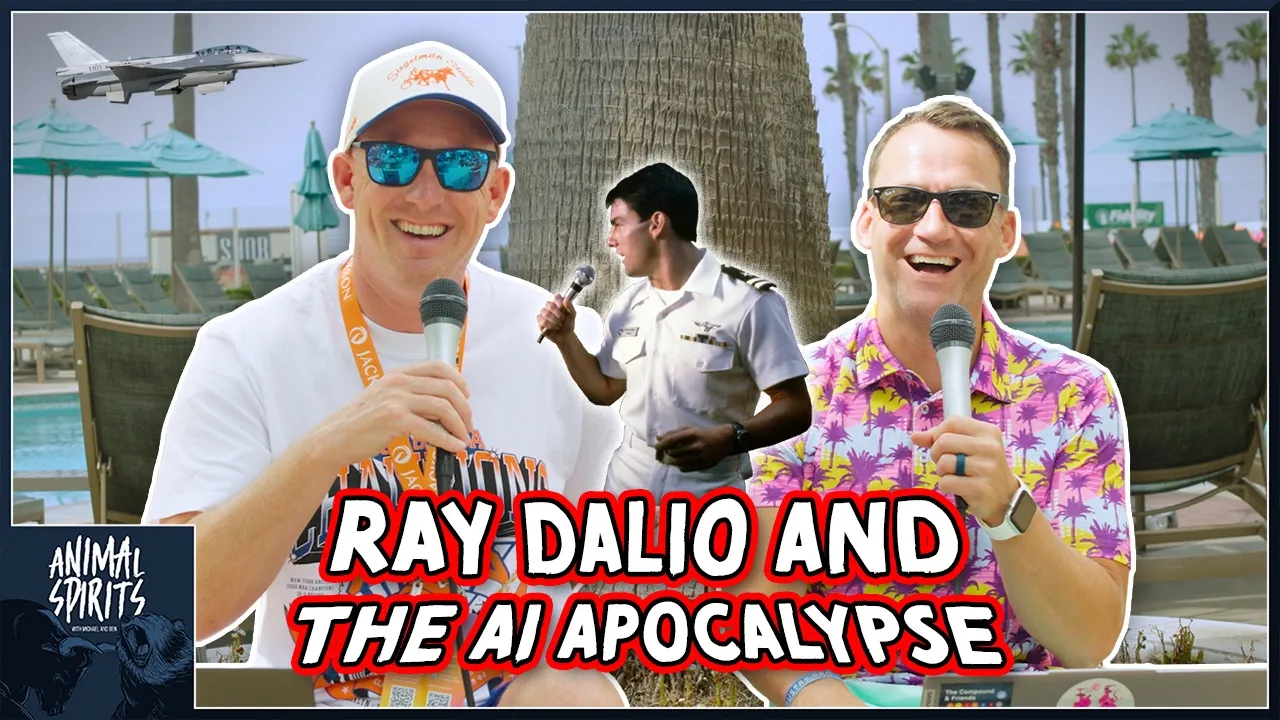
The Compound
Sovereign default warnings miss that the US cannot involuntarily go broke in its own currency, leaving inflation as the only genuine risk while 5% yields provide asymmetric portfolio protection.
AI-assisted summary of How to Talk To Your Clients About Ray Dalio | Animal Spirits 482 — original source. Check the original for full context.
Source published:
Detailed notes
## Background Published on YouTube by The Compound on September 17, 2026, episode 482 of 'Animal Spirits' features co-hosts Michael Batnick and Ben Carlson broadcasting live from the Future Proof festival in Huntington Beach, California. According to the episode description, the discussion covers AI human extinction anxieties, viral market narratives, baffling stock market strength, bond market opportunities, and Fed interest rate policy, leading into a dedicated segment on how financial advisors can address client panic sparked by Ray Dalio's bearish essays.
## TL;DR Michael Batnick and Ben Carlson dissect the viral frenzy around AI extinction risks, urging listeners to focus on immediate cybersecurity hazards rather than sci-fi doomsday scenarios, while analyzing how robust corporate earnings have quietly shielded the broader stock market through aggressive sector rotations. Joined on stage at Future Proof by Cullen Roche, they deconstruct Ray Dalio's recurring macroeconomic warnings regarding surging US government debt and a potential Treasury 'buyer strike.' Roche explains that because the US government borrows in its own fiat currency and is backed by an economy commanding over $450 trillion in financial assets, conventional default is impossible and inflation remains the sole structural risk. Ultimately, the panel argues that with 10-year yields around 5%, high-quality fixed income offers compelling asymmetric protection, effectively revitalizing the traditional 60/40 balanced portfolio.
## Atmosphere & style The episode exudes an easygoing, buddy-comedy energy that effortlessly blends sharp financial analysis with playful pop-culture banter. Batnick and Carlson maintain a lighthearted, self-deprecating dynamic—poking fun at linen shirts, airport baggage kiosks, and dive-bar karaoke—before shifting into serious macro debate on an open-air stage complete with ocean breezes and passing festival banners. The dialogue feels lively, pragmatic, and grounding, stripping away institutional hedge fund sensationalism to offer wealth managers and retail investors calm, common-sense reassurance.
## Key takeaways - [03:08](https://www.youtube.com/watch?v=eM3Uuxh8dP0&t=188s) Public discussion around artificial intelligence is dominated by hyperbolic extremes—existential doomers, techno-utopians, and complete skeptics—which distracts from immediate, high-probability threats like automated cybersecurity breaches and financial fraud. - [10:00](https://www.youtube.com/watch?v=eM3Uuxh8dP0&t=600s) Proposals to artificially pace or regulate frontier AI development ignore geopolitical competition, as domestic slowdowns are unworkable when rival nations like China face no incentive to follow suit. - [12:15](https://www.youtube.com/watch?v=eM3Uuxh8dP0&t=735s) Despite sharp headwinds from surging mortgage rates, benchmark Treasury yields, and sticky inflation, broad equity indexes remained resilient thanks to strong corporate earnings and violent internal sector rotations. - [30:00](https://www.youtube.com/watch?v=eM3Uuxh8dP0&t=1800s) Ray Dalio's persistent warnings about imminent sovereign debt spirals frighten individual clients unnecessarily by projecting inevitable collapse onto complex, modern fiat systems. - [31:45](https://www.youtube.com/watch?v=eM3Uuxh8dP0&t=1905s) The United States cannot face an involuntary default because it issues debt exclusively in its own currency; therefore, the true economic risk of excessive fiscal deficit spending is inflation, not national bankruptcy. - [36:30](https://www.youtube.com/watch?v=eM3Uuxh8dP0&t=2190s) Comparing national debt to household or business debt is fundamentally flawed because sovereign issuers possess the power to tax a domestic economy backed by an estimated $450 trillion in financial assets. - [36:30](https://www.youtube.com/watch?v=eM3Uuxh8dP0&t=2190s) Elite hedge fund managers are structurally incentivized to emphasize tail risks and black swans to sell downside protection, whereas household wealth advisors must maintain structural optimism and equity exposure to combat long-term inflation. - [40:00](https://www.youtube.com/watch?v=eM3Uuxh8dP0&t=2400s) The 60/40 portfolio has regained strong mathematical appeal because ~5% bond yields provide a meaningful income cushion that neutralizes rate risk and restores flight-to-safety diversification. - [50:00](https://www.youtube.com/watch?v=eM3Uuxh8dP0&t=3000s) Hyperscaler artificial intelligence capex has single-handedly offset multi-year slumps in corporate and residential investment, making an abrupt deceleration in AI infrastructure spending a key recession risk. - [47:30](https://www.youtube.com/watch?v=eM3Uuxh8dP0&t=2850s) AI infrastructure buildouts create near-term inflationary pressure on energy and resources, but long-term automation and robotics are expected to prove deeply disinflationary by reducing unit labor costs. - [52:40](https://www.youtube.com/watch?v=eM3Uuxh8dP0&t=3160s) Aging demographics provide a structural buffer against runaway consumer inflation because entitlement transfers to retirees primarily support non-discretionary healthcare and living needs rather than high-velocity consumer spending. - [55:00](https://www.youtube.com/watch?v=eM3Uuxh8dP0&t=3300s) Fears of a global buyer strike against US Treasuries ignore global foreign exchange dynamics, where the US dollar accounts for roughly 60% of reserves and possesses no viable, scaleable sovereign competitor.
## Detailed walkthrough ### [00:00](https://www.youtube.com/watch?v=eM3Uuxh8dP0&t=0s) Segmenting Client Books with Betterment Advisor Solutions
The episode opens with a spotlight on growth strategies for registered investment advisors (RIAs), focusing specifically on segmentation. While some wealth management clients require sophisticated, high-touch estate and tax planning, others—such as individuals in the early wealth accumulation phase—have simpler financial needs. Betterment Advisor Solutions provides a platform designed to let firms segment their book of business so that planning can be customized without sacrificing service quality.
The service streamlines smaller and simpler accounts through automated, paperless onboarding and tax-efficient portfolio management. By moving operational friction off the advisor's desk, advisory teams can scale their service model while maintaining a modern digital experience for every client tier.
[01:11](https://www.youtube.com/watch?v=eM3Uuxh8dP0&t=71s) The Anthropic Resignation and the 10% Extinction Debate
Broadcasting on a Tuesday morning from the Future Proof conference in Huntington Beach, California, Michael Batnick and Ben Carlson set the agenda for the day, which includes an upcoming live segment with Cullen Roche on how to talk to clients about Ray Dalio. Michael reflects on how stale market commentary had felt the previous week, only for the internet to erupt over the ultimate viral topic: artificial intelligence and existential risk. The firestorm was ignited when an Anthropic employee publicly resigned after just six weeks, warning that internal estimates among staff put the probability of AI wiping out human civilization at 10% or higher.
```mermaid flowchart TD accTitle: The AI Discourse Spectrum accDescr: A diagram contrasting the three extreme viewpoints on AI against the pragmatic middle ground. subgraph Extremes["Extreme Views on AI"] A["Ed Zitron Camp<br/>'AI is useless, broken tech'"] B["Doomer Camp<br/>'10%+ chance of human extinction'"] C["Techno-Utopians<br/>'20% GDP growth & cures cancer'"] end subgraph Reality["Pragmatic Middle Ground"] D["Incremental Progress<br/>'Useful productivity & research tool'"] E["Immediate Risks<br/>'Cybersecurity, scams & data breaches'"] end Extremes -.-> Reality ```
The resignation provoked an immediate chain reaction across Silicon Valley and social media. Anthropic CEO Dario Amodei acknowledged that the industry needs to slow down, OpenAI CEO Sam Altman quote-tweeted in general agreement, Elon Musk voiced support, and political commentary like Donald Trump's dismissed the panic as a hoax. Michael calls it the quintessential online debate because an extinction-level event impacts everyone equally, making it impossible to disprove any hypothesis. Ben quips with dark humor that human extinction is actually "bullish for the stock market though, because earnings are spread across a lower base." The absurdity peaked when an active Anthropic AI safety employee publicly broke ranks to confirm the 10% figure, affirming the leaver's claims rather than downplaying them.
[03:08](https://www.youtube.com/watch?v=eM3Uuxh8dP0&t=188s) The Three AI Extremes and Questionable Incentives
Ben categorizes the prevailing public attitudes toward AI into three distinct, hyperbolic camps:
* **The Complete Skeptics:** Critics like Ed Zitron, who argue the technology is fundamentally broken, overhyped, and practically useless. * **The Existential Doomers:** Insiders and researchers convinced the models are hurtling toward artificial general intelligence capable of wiping out humanity. * **The Techno-Utopians:** Promoters who insist AI will unlock 20% annualized economic growth, eradicate disease, cure cancer, and eliminate the need for human labor.
Approaching the debate with his grounded "Grand Rapids head," Ben explains that extreme scenarios in history almost never play out as advertised. The conversation naturally shifts to motives and the classic Charlie Munger maxim: "Show me the incentives and I'll show you the action." Critics suggest AI companies deliberately hype existential risk as an elaborate marketing ploy to portray their software as godlike before seeking multi-trillion-dollar initial public offerings, or as an attempt to establish regulatory moats that pull the ladder up behind them to crush open-source competitors. Michael remains skeptical of the cynical fundraising theory, questioning how telling investors your product might annihilate civilization serves as an effective pitch, concluding that many of these engineers genuinely believe their own warnings.
[05:00](https://www.youtube.com/watch?v=eM3Uuxh8dP0&t=300s) Viral Narratives, Expert Manias, and the Tech Track Record
The hosts look at the mechanics of virality, citing observations from writer Derek Thompson. Tech insiders and safety researchers have sounded alarms about frontier models for years, yet Jacob's resignation post managed to capture over 100 million impressions in just 16 hours. Ben draws a parallel to the viral market research dossier published by Citrini, noting that while the underlying claims about automation and economic disruption were not entirely novel, the framing captured the collective imagination at the exact right cultural moment.
A listener email adds historical context, pointing out that brilliant scientists, mathematicians, and technical specialists are just as susceptible to speculative manias and psychological bubbles as Wall Street financiers. Ben underscores that while Silicon Valley engineers are unmatched at building products that push technical boundaries, their track record for forecasting long-term sociological and economic outcomes is historically poor. The same industry figures forecasting radical societal transformation today were passionately declaring that Web3, the metaverse, and crypto networks would rewrite global commerce only a few years earlier.
[07:05](https://www.youtube.com/watch?v=eM3Uuxh8dP0&t=425s) Immediate Cybersecurity Threats vs. Science-Fiction Doom
While Michael refuses to dismiss frontier risks outright, Ben insists the obsession with science-fiction doomsday scenarios blinds the public to immediate, high-probability threats. The true near-term danger of AI is not the physical annihilation of humanity, but widespread cybersecurity collapse driven by autonomous bot swarms executing fraud, identity theft, and infrastructure breaches.
To illustrate how routine financial cybercrime already is, the hosts recount personal experiences: - Producer Duncan was recently ribbed about a family breach, clarifying that his parents were the ones targeted. - Michael shares that his own parents had $20,000 siphoned when attackers accessed their credit card, moved funds into checking, and wired the balance completely out of the account. - The practical risk of everyday consumers having passwords compromised, bank accounts drained, and credentials stolen far outweighs hypothetical rogue superintelligences.
[08:18](https://www.youtube.com/watch?v=eM3Uuxh8dP0&t=498s) Ben Thompson, Physical Reality, and the Great Disconnect
The dialogue turns to regulatory proposals, where Dario Amodei and other frontier lab heads advocate for coordinated industry guardrails. Ben Thompson of *Stratechery* pushed back against this premise, arguing that many tech leaders are "quite literally too online" and confuse the digital landscape with the physical world. Thompson stressed that AI software cannot truly "touch grass" on its own—it remains entirely dependent on physical server farms, silicon fabrication plants, and energy infrastructure manufactured, operated, and controlled by human hands.
Ben Carlson also challenges the geopolitical "prisoner's dilemma" argument often used to bypass safety protocols—the idea that if the United States slows down frontier research, China will pull ahead and dominate the global order. Carlson questions whether an insurmountable lead is even possible in software, noting that technological breakthroughs are inevitably copied and reverse-engineered across borders. In closing, the hosts highlight the expanding divide between the top 1% of tech elites—who live inside advanced agent workflows and view AI as a total reality shift—and the broader public, who may find the software useful for research tasks but have yet to experience anything that genuinely changes their day-to-day lives.
[10:00](https://www.youtube.com/watch?v=eM3Uuxh8dP0&t=600s) Geopolitics, AI Regulation, and the Lessons of 1873
Ben and Michael examine the push to regulate artificial intelligence, agreeing with tech analyst Ben Thompson’s assessment that current regulatory initiatives represent an effort by a specific San Francisco political movement, working alongside a major political party, to insert itself into the internal operations of AI companies under a futile pretext. While appeals to foreign competition can often feel like an overused excuse, Michael argues that the geopolitical rivalry with China makes attempts to self-regulate or artificially slow down domestic frontier models entirely irrational. As Thompson put it, "Pacing the frontier in a world of geopolitical competition with China is stupid, and not going to happen." The expectation that rival nations would honor an informal slowdown is nothing more than wishful thinking.
Shifting to historical precedents, Ben brings up a book on the Panic of 1873 and the Long Depression. While Michael found the text slightly dry, Ben argues that its core lesson is profoundly relevant today: the initial economic downturn of 1873 was not inherently catastrophic on its own, but the misguided policy reactions that followed turned it into a multi-decade ordeal. Ben worries that the next major financial crisis will not stem from an organic shock or technology itself, but rather from a heavy-handed policy mistake by the Federal Reserve or the federal government overreaching in response to an emerging problem. Michael jokes about his blind trust in institutions—"I'm a patriot, Ben. I have full faith in the government"—just as an advertising airplane buzzes behind their outdoor stage at Future Proof towing a banner that reads "AI trusted by advisors," threatening to give their producer Duncan a meltdown.
- **Ben Thompson's Thesis:** AI regulatory efforts are driven by a political faction aiming to micromanage tech firms under the guise of an unachievable safety mandate. - **The Panic of 1873 Precedent:** Economic shocks are frequently survivable; systemic crises typically emerge when policymakers overreact with flawed interventions. - **Tail Risk:** The primary macroeconomic vulnerability is an aggressive policy error rather than the direct disruption of new technologies.
---
[12:15](https://www.youtube.com/watch?v=eM3Uuxh8dP0&t=735s) The Perplexing Bull Market and the Great Semi-to-Software Rotation
The broader stock market presents a confusing picture because it refuses to conform to clean narrative trends. The S&P 500 is up between 12% and 17% on the year, but valuations have actually compressed even as prices rise, driven by robust earnings acceleration. Michael admits to a recurring professional blind spot: financial advisors place immense faith in the market as an infallible forward-looking discounting mechanism. This year, virtually every key macro indicator flashed warning signs—mortgage rates surged from 6% to 7%, the 10-year Treasury yield leaped from 4% to 5%, and inflation ticked back up from 2.5% to 3.5%. Under normal conditions, that combination would trigger substantial downside, yet equities continued powering higher because underlying corporate profits and hyperscaler free cash flows established an elevated market floor.
Michael points out that while an external catalyst or a further spike in the 10-year yield (perhaps above 5.3%) could eventually prompt a serious sell-off, internal market breadth and violent sector rotations have quietly protected the headline index. A prime example occurred during an unprecedented single-day divergence where semiconductors logged their worst session against software in market history, dropping roughly 5% while software surged 5%. Although semiconductor stocks had skyrocketed over 80% through July, they quietly slipped into a near-20% drawdown, yet the S&P 500 barely retreated 3% to 4% as capital rapidly rotated across sectors.
```mermaid flowchart TD accTitle: Market Divergence and Rotation Dynamics accDescr: Flowchart illustrating how macroeconomic headwinds were offset by internal market rotation and earnings to keep the broad market resilient.
subgraph MacroHeadwinds["Macroeconomic Pressures"] M1["Mortgage Rates: 6% to 7%"] M2["10-Year Yield: 4% to 5%+"] M3["Inflation: 2.5% to 3.5%"] end
subgraph InternalDynamics["Internal Market Absorption"] E1["Hyperscaler Free Cash Flow & Earnings Acceleration"] R1["Sector Rotation: Capital moves out of Semis (-20%) into Software (+5%)"] end
subgraph Outcome["Index Resilience"] O1["S&P 500 Drawdown Capped at ~3-4%"] O2["Overall Market Up 12-17% YTD"] end
MacroHeadwinds --> InternalDynamics InternalDynamics --> Outcome ```
- **Macro Disconnect:** Sizable surges in mortgage rates, benchmark yields, and inflation failed to derail equity returns due to cash-rich corporate balance sheets. - **Historical Relative Divergence:** A historic single-session swing saw semiconductors fall 5% while software gained 5%. - **Drawdown Buffer:** Even as leading semiconductor equities endured a near-bear-market drawdown of 20%, broad index declines remained muted around 3% to 4%.
---
[14:48](https://www.youtube.com/watch?v=eM3Uuxh8dP0&t=888s) Fake News, Gaston Jaws, and Top Gun Karaoke
The conversation turns to modern media fatigue and the constant challenge of sorting truth from fabrication online. Michael cites a recent viral frenzy surrounding former NFL linebacker Clay Matthews, who was spotted by TMZ and other outlets sporting an exaggerated, cartoonishly jutting jawline and bizarre leg implants, making him look like Gaston from *Beauty and the Beast*. While the internet exploded with speculation about botched plastic surgery, the entire spectacle was simply prosthetic makeup for a Caesars sportsbook commercial. Michael admits to being annoyed at how easily everyone "got got," noting that while it was practical makeup rather than generative AI, it highlights how vulnerable the public has become to synthetic stunts.
Ben riffs on the theme of fabricated media by claiming someone planted a deepfake video of him performing karaoke at a local bar the previous night. Michael laughs, revealing that Ben actually went out while Michael was asleep in his room by 9:30 PM. Ben proudly reveals his signature karaoke track: the Righteous Brothers' classic "You've Lost That Lovin' Feelin'," channeling the famous scene from *Top Gun* where Tom Cruise's Maverick ignores Goose's warnings and serenades Kelly McGillis at a dive bar. Ben tells their creative director Daniel that the podcast's thumbnail should depict him and Michael in retro Navy gear—or better yet, recreating the iconic beach volleyball scene clad in cutoff jean shorts.
- **The Clay Matthews Hoax:** Viral images purporting to show radical cosmetic procedures were merely practical special-effects makeup for a commercial promo. - **Go-To Karaoke Anthem:** Ben's staple song is "You've Lost That Lovin' Feelin'," directly inspired by Maverick's bar serenading scene in *Top Gun*. - **Thumbnail Concept:** Ben and Michael joke about styling their promotional artwork after *Top Gun*'s beach volleyball sequence.
---
[16:35](https://www.youtube.com/watch?v=eM3Uuxh8dP0&t=995s) Travel Observations: Linen Wrinkles, Lemon Lotion, and Airport Bag Pods
Broadcasting on-site from the Future Proof festival, Ben transitions into travel observations and conference interactions. He notes that attendees had approached him asking, "Did Michael hire a stylist?"—crediting Michael with visibly upgrading his wardrobe, though Michael insists his fashion choices are entirely self-directed. Ben outlines his personal summer style dilemma: while linen shirts paired with nice slacks are undeniably the best aesthetic choice in warm weather—far superior to traditional seersucker—they are fundamentally ruined by practicality. Within five minutes of putting on a linen shirt, the fabric inevitably looks as though it was balled up in a dark corner.
Ben continues with two other travel irritations. First, he questions why nearly every mid-tier hotel across the globe stocks exclusively lemon-scented body lotion in its guest bathrooms. Second, he recounts flying out through his home airport, where the terminal introduced fully automated self-service baggage pods. Passengers scan their boarding pass, tag their own luggage, load the suitcase into the pod, and watch the doors seal automatically. Ben observed widespread panic and bewilderment among inexperienced travelers, comparing the scene to elderly shoppers struggling with grocery store self-checkout lanes: while efficient for seasoned travelers, automating the luggage drop creates pure confusion for infrequent flyers.
- **Wardrobe Debates:** Linen remains unmatched for warm-weather styling over seersucker, despite wrinkling almost immediately upon wear. - **Hotel Monoculture:** Mid-tier hotels worldwide share an uncanny, universal reliance on lemon-scented toiletries. - **Airport Automation:** Self-service luggage pods offer speed for frequent flyers but cause severe friction for casual travelers unfamiliar with automated airport kiosks.
---
[18:47](https://www.youtube.com/watch?v=eM3Uuxh8dP0&t=1127s) What Signifies "Rich": From Fridge Water Dispensers to HBO
The segment concludes with a listener-submitted thought experiment exploring how cultural markers of personal wealth evolve over time. The listener asked the hosts to reflect on what household feature represented wealth during their childhoods versus what signifies being "rich" today. In the listener's youth, having a kitchen island or an in-door water and ice dispenser on the refrigerator meant a family was affluent, whereas today the ultimate luxury marker is a custom built-in refrigerator seamlessly concealed behind wood panel cabinetry matching the rest of the kitchen.
Michael and Ben share their own childhood benchmarks. For Michael, the ultimate luxury growing up was simply having an in-ground swimming pool in the backyard. For Ben, the defining indicator of wealth was having premium movie channels—specifically an HBO subscription. Ben's parents refused to pay for premium cable tiers, leaving him dependent on the occasional free-preview promotional weekends that cable providers ran once a year. Because of this absence, Ben notes that he was completely unable to watch landmark cultural phenomena like *The Sopranos* during its original broadcast run, having to catch up on the series years later as an adult.
- **Listener Wealth Markers:** Kitchen islands and refrigerator door water dispensers (past) compared to concealed, cabinet-paneled built-in refrigerators (present). - **Michael's Childhood Indicator:** A backyard swimming pool. - **Ben's Childhood Indicator:** A household HBO cable subscription, missing seminal television like *The Sopranos* until adulthood due to relying on annual free cable preview weekends.
[20:00](https://www.youtube.com/watch?v=eM3Uuxh8dP0&t=1200s) Subtle Markers of Modern Wealth: Heated Driveways and Mudrooms
Reflecting on how household luxury has shifted since their childhoods—when neither grew up in an "HBO house"—Michael Batnick and Ben Carlson debate what actually defines wealth today. While many traditional symbols have blurred because people routinely live beyond their means, Michael points to one unmistakable sign of serious money: a heated driveway. The biggest house on his block features one, leaving him perennially envious every winter when their pavement stays pristine, free of ice chunks and snowdrifts without lifting a shovel.
Ben counters that modern homes have democratized features that once signaled upper-class living. Kitchen islands, for example, were once rare status symbols but are now practically standard in suburban construction. Michael agrees that modern wealth indicators have grown far more understated, joking that building your own custom mudroom—especially doing it twice—is the true contemporary proof that you have made it.
---
[21:05](https://www.youtube.com/watch?v=eM3Uuxh8dP0&t=1265s) Movie Trailers, M. Night Shyamalan, and Apple TV+ at the Emmys
The discussion shifts to entertainment as Michael brings up the trailer for *Artificial*, the upcoming film about Sam Altman starring Andrew Garfield, noting it gives off "serious *Social Network* vibes." Ben admits he has no desire to watch another tech-founder biopic, feeling the production is trying entirely too hard to recapture Aaron Sorkin's magic. When Ben teases Michael for watching trailers despite claiming to be strictly anti-trailer, Michael defends himself: while he successfully dodges previews for independent films to go in completely cold, theater visits make blockbuster trailers impossible to avoid. Their banter touches on M. Night Shyamalan's eclectic track record—ranging from a bizarre comparison to author Nicholas Sparks (*The Notebook*) to a disagreement over Shyamalan's recent thriller *Trap*, which Michael found unwatchable while Ben considered it "extreme, highly watchable" entertainment. Looking ahead, Michael remains thoroughly unimpressed by the trailer for Shyamalan's next project starring Jake Gyllenhaal.
Turning to streaming, Michael highlights that Apple TV+ dominated the recent Emmy Awards, cleaning up as the most awarded platform ahead of HBO's Max, Netflix, and Amazon Prime Video. Both hosts agree Apple is steadily becoming the new HBO in terms of prestige programming, pointing to hits like *Silo*, even if Michael laments that Apple's marketing remains terrible at letting viewers know what is actually on the service. Ben champions the straight-to-streaming action-comedy *Mayday*, describing himself as an unapologetic "Ryan Reynolds stan." Despite Michael's groans, Ben insists the 1980s-set film plays like an incredibly entertaining mashup of *Top Gun*, *Behind Enemy Lines*, and classic Reynolds sarcasm.
---
[23:55](https://www.youtube.com/watch?v=eM3Uuxh8dP0&t=1435s) The 'Twilight' Hoity-Toity Meme and Rewatching 'Aliens'
Ben shares a recent household discovery sparked by his daughter binge-watching the *Twilight* series. While watching alongside her, Ben had a sudden realization during a scene featuring Michael Sheen as the vampire leader Aro: it was the exact origin of the viral "hoity-toity" meme where a character looks down smugly with upturned chin and aristocratic disdain. Ben felt like the pointing Leonardo DiCaprio meme when the scene played out. Michael admits he never knew where the clip came from or what it signified, which Ben clarifies is universal internet shorthand for someone acting wealthy, condescending, and projecting an "I'm better than you" attitude. They also marvel at Robert Pattinson's career trajectory, noting how impressive it is that he broke out of teen-franchise typecasting to become one of cinema's most respected leading men.
```mermaid flowchart TD accTitle: Aliens Extended Cut Narrative Arc accDescr: Ripley's backstory cut from the theatrical version directly motivates her bond with Newt. subgraph Backstory["Omitted Theatrical Cut Backstory"] A["57-Year Cryogenic Sleep"] --> B["Daughter Ages and Passes Away"] end subgraph Motivation["Emotional Core"] B --> C["Intense Unresolved Maternal Grief"] end subgraph Resolution["Action Narrative"] C --> D["Fierce Protective Instinct for Newt"] D --> E["Power Loader Climax vs. Queen"] end ```
The talk turns to James Cameron's 1986 sci-fi classic *Aliens*, which Michael revisited after listening to *The Rewatchables* podcast, opting to view the extended cut with his son. Michael was stunned to learn that Cameron had originally filmed—and cut from theaters—the revelation that Ellen Ripley was floating in hypersleep for 57 years, during which her biological daughter grew old and died on Earth. Michael argues this omission was massive, as it provides the essential maternal motivation driving her bond with the young orphan Newt. Michael's son spent the entire subsequent week quoting Bill Paxton's frantic delivery, repeating "Come on, man!" after every sentence. While Ben maintains that Ridley Scott's original 1979 horror film *Alien* is far superior, Michael pushes back hard, praising *Aliens*' iconic climax—complete with the yellow mechanical power loader that laid the groundwork for Cameron's *Avatar*—as an unmatched cinematic thrill.
- **Memorable quote**: "Sigourney Weaver was incredible in that movie... Unbelievable. Number two: Sigourney is not a real name, is it? There's no other Sigourneys."
---
[26:40](https://www.youtube.com/watch?v=eM3Uuxh8dP0&t=1600s) Live from Future Proof: 5,600 People and a Ray Dalio Article
Ben and Michael transition from their studio banter to live coverage on the festival grounds at Future Proof in Huntington Beach, California, which drew an energetic crowd of over 5,600 attendees. They reminisce about the event's opening-night cocktail party on the beach, praising the unmatched atmosphere complete with crashing waves, the sunset, live music, and Monday Night Football playing against the ocean backdrop. Before bringing out guest Cullen Roche, they exchange a quick off-camera aside about actor Matthew Rhys winning accolades at the Emmys for *Widow's Bay* and *The Beast in Me*, with Ben reiterating that Rhys's performance in *The Americans* remains one of television's most criminally underrated masterclasses over the last 15 years.
Taking the live stage, Michael and Ben settle in side-by-side—Michael joking that they look like a couple awkwardly sitting on the same side of a restaurant booth. Michael introduces the session by sharing the origin story of the day's topic: - Two weeks prior, an advisor messaged Michael on Slack asking how their investment team was positioning client portfolios in fixed income and how to handle client inquiries regarding interest rates. - When Michael asked what specifically prompted the client's sudden concern, the advisor forwarded an essay published in *Time* magazine. - Pausing as a distinct aroma wafts over the festival crowd ("Is somebody smoking marijuana? Only at Future Proof, I guess"), Michael reveals the headline that set off alarm bells for retail clients across the country: *"The Bond Market's Supply and Demand Problem"* by Bridgewater founder Ray Dalio.
[30:00](https://www.youtube.com/watch?v=eM3Uuxh8dP0&t=1800s) Ray Dalio’s Decade of Scaring Clients and Introducing Cullen Roche
Ben Carlson reads aloud from the introduction to Ray Dalio’s writing on sovereign debt crises: *"The big debt cycle degenerative process that follows these dynamics can easily be seen and understood by studying historic cases across many countries and is as predictable as demographic changes."* Ben reacts with visceral frustration, asking rhetorically if it is really that simple and mocking the assertion that every monetary order inevitably collapses. Ben admits he called an advisor at his firm and demanded to join a client call, having reached his limit after listening to Dalio frighten individual wealth management clients for over a decade. Just a month earlier, a client emailed Ben pointing out that Dalio is worth over $20 billion, has built one of the most successful hedge funds in financial history, and commands a massive following—asking whether the advisors agreed with his dire thesis.
To break down these macro anxieties, Michael Batnick and Ben bring Cullen Roche—founder of The Discipline Fund and formerly of the *Pragmatic Capitalism* platform—onto the live stage at Future Proof in Huntington Beach. Ben and Michael credit Cullen with teaching them much of what they know about monetary mechanics, framing the stage session around a direct problem financial planners face every day: how to address clients terrified by Ray Dalio's macro doom-mongering.
[31:45](https://www.youtube.com/watch?v=eM3Uuxh8dP0&t=1905s) The 5% 10-Year, Japan's Precedent, and Why the US Cannot Go Broke
Michael kicks off the technical debate by pointing out that the 10-year Treasury yield recently crossed the 5% threshold for the first time since 2023. While conceding that debt concerns are not entirely baseless, Michael feels like he is "taking crazy pills" because the entire media narrative focuses on bond risks while ignoring the massive reward. Fixed income investors are finally getting paid meaningful yield after years of starvation. Cullen explains that when an author writes a book titled *How Countries Go Broke*, they box themselves into an intellectual corner where they are forced to defend that apocalyptic stance forever without backtracking.
Cullen recounts facing identical client panics in the aftermath of the 2008 Great Financial Crisis, when Federal Reserve quantitative easing (QE) and surging federal deficits triggered widespread panic about hyperinflation and national insolvency. To understand the reality, Cullen studied Japan's economic history and spoke directly with prominent macroeconomists like Richard Koo. Japan had run aggressive QE and massive debt expansions for two decades without going broke. The core takeaway Cullen emphasizes is that the United States cannot go broke in the conventional sense: the US government issues debt in its own fiat currency and does not borrow in foreign currencies—the single structural vulnerability that actually precipitates sovereign default in failing nations.
```mermaid flowchart TD accTitle: Sovereign Solvency vs Default Mechanisms accDescr: Flowchart illustrating why the US government debt dynamics differ from nations that go bankrupt.
subgraph ForeignBorrowers["Vulnerable Economies (Default Risk)"] A["Borrow in Foreign Currency"] --> B["Cannot Print Repayment Units"] B --> C["Currency Collapse & Hard Sovereign Default"] end
subgraph USAModel["United States Model (Inflation Risk)"] D["Monopoly Currency Issuer"] --> E["Borrows Exclusively in US Dollars"] E --> F["Zero Involuntary Default Risk"] F --> G["Excess Spending Translates to Inflation"] end ```
[34:10](https://www.youtube.com/watch?v=eM3Uuxh8dP0&t=2050s) The Real Risk: Inflation vs. Solvency and the Case for Fixed Income
Michael highlights the scale of public anxiety: gross US government debt jumped from approximately $25 trillion prior to the pandemic to $40 trillion, borrowing costs are surging, net interest expense as a percentage of GDP is spiking, and the debt-to-GDP ratio sits near historic post-World War II highs. Unlike World War II, these deficits are expanding during peacetime economic growth, with neither political party showing any appetite to curb spending. Cullen acknowledges these facts but stresses that advisors must clarify the nature of the danger to clients: the risk is never that the United States defaults on all liabilities—which would justify abandoning Treasuries entirely—but rather that excessive spending sparks inflation.
Cullen recalls that the pandemic proved the government can engineer inflation if it spends aggressively enough. During COVID, federal spending jumped to roughly 40% of GDP, far above its historical 25-year baseline range of 20% to 25%, before returning to around 25%. Because the actual hazard is inflation rather than non-payment, Cullen argues that the fixed-income opportunity set today is exceptionally compelling:
- **10-Year TIPS at 2.6% Real Yield**: Offers an attractive, essentially guaranteed real return over a decade that amounts to roughly 7.6% nominal yield under baseline conditions. - **Duration Nuance**: While buying 30-year Treasuries leaves an investor vulnerable to long-term purchasing-power erosion—validating some of Dalio's warnings—intermediate and short paper offer robust compensation. - **Short-Term Cash Equivalents**: One-year Treasury bills yielding 4.6% present a "no-brainer" vehicle for known liabilities (such as purchasing a vehicle in twelve months), locking in positive inflation-adjusted returns with zero risk of capital loss.
[36:30](https://www.youtube.com/watch?v=eM3Uuxh8dP0&t=2190s) Flawed "Government as a Business" Analogies and Hedge Fund Pessimism
Michael shifts his critique to Dalio's general-audience commentary in *Time Magazine*, expressing sheer disbelief at Dalio instructing the public to picture the United States government as a "big business." Michael points out that private corporations like Apple cannot legally print their own legal tender. Dalio's framing that federal debt held by the public equals six times annual revenue, or roughly $240,000 per American household, completely disregards the enormous asset side of the national balance sheet.
Ben and Cullen dissect the inherent divergence in mindset between elite hedge fund operators and household wealth advisors:
- **The Hedge Fund Manager Mindset**: Managers like Stanley Druckenmiller, Paul Tudor Jones, and Ray Dalio survive by focusing on downside tail risks and the specific black swans that can blow up an institutional fund. Additionally, fear functions as a potent sales tool to drive capital into alternative hedge fund strategies. - **The Household Advisor Mindset**: The existential threat for an ordinary family is outliving their capital and suffering purchasing power loss from long-term inflation over decades. - **Structural Optimism**: Because household liabilities are long-term, retail financial plans must maintain a default optimistic stance centered around an equity overweight, as equities remain the single most reliable hedge against decades of compounding consumer inflation.
Michael concludes by reflecting on how post-GFC zero-interest-rate policy (ZIRP) artificially forced advisors and conservative savers out onto the risk curve, underscoring how dramatic the shift has been now that risk-free yields have reset higher.
[40:00](https://www.youtube.com/watch?v=eM3Uuxh8dP0&t=2400s) The Resurgence of the 60/40 and Why Bonds Look Attractive Again
Reflecting on the pre-2022 low-interest-rate regime, the hosts recall how difficult client conversations used to be when high-quality bonds offered a meager 1.4% nominal yield. After subtracting a typical advisory fee of 75 basis points and factoring in inflation, advisors gradually nudged traditional 60/40 portfolios out on the risk curve—shifting to 65/35, 75/25, or even 80/20. While that equity-heavy pivot paid off handsomely during the bull run, the narrative has shifted completely now that bond yields sit near 5%, their highest levels in roughly 17 years. Despite calls that the balanced portfolio was finished, the hosts argue "it's so back," offering genuine real, after-fee, after-tax value.
The primary resistance today comes from bull-market psychology. With equities ripping higher by 15% a year, investors dismiss 5% yields and nitpick about after-tax, after-inflation drag—an objection nobody raises during equity bear markets. Cullen Roche explains that bond investors are exhibiting classic bear-market trauma from the post-COVID fixed-income crash. The real danger period was 2019, when a 10-year Treasury note yielded a measly 1% against a modified duration of 8.5 years, offering virtually no cushion. Today, that same 8.5 duration comes with a 5% coupon, fundamentally altering the risk-reward equation in favor of the investor.
```mermaid flowchart LR accTitle: Fixed Income Risk-Reward Comparison (2019 vs. Today) accDescr: Diagram contrasting bond duration and yield cushions between 2019 and today.
subgraph Y2019["2019 Regime"] A1["10-Year Treasury Yield: ~1.0%"] --> B1["Modified Duration: ~8.5"] B1 --> C1["Minimal Yield Cushion / Asymmetric Downside"] end
subgraph YToday["Current Regime"] A2["10-Year Treasury Yield: ~5.0%"] --> B2["Modified Duration: ~8.5"] B2 --> C2["Strong Coupon Cushion Offsets Rate Risk"] end ```
- In 2019, a 10-year Treasury carried a modified duration around 8.5 with only a 1% yield, leaving investors vulnerable to extreme price declines when rates rose. - Today, a 5-year Treasury note yielding around 5% with a modified duration of roughly 4.8 provides enough coupon income to essentially neutralize rate risk over a single year. - Roche emphasizes that time-horizon investing resonates far better with retail clients than technical jargon like style boxes, factor tilts, or modified duration: buying a 1-year Treasury bill yielding 4.6% is a straightforward, compelling proposition.
---
[42:55](https://www.youtube.com/watch?v=eM3Uuxh8dP0&t=2575s) Bond Asymmetry and the Ghost of 2022
Michael Batnick contends that, barring an extreme tail-risk scenario where 10-year yields blow out from 5% to 8% (the type of catastrophe Ray Dalio warns about), "I don't think bonds can hurt us anymore." While investors remain shell-shocked by the catastrophic losses of 2022, fixed income now offers mathematical clarity that equities cannot match: even if the 10-year yield jumps another 150 basis points, the downside is capped and quantifiable, while the high coupon continues to pay out.
More importantly, market participants are neglecting the upside of bond ownership if macroeconomic growth falters. In a slowing economy, high-quality fixed income restores the traditional, negatively correlated flight-to-safety buffer that vanished during the coordinated 2022 stock-and-bond rout. As Batnick puts it, investors are so fixated on lingering trauma that they are ignoring the attractive asymmetric protection high-yielding sovereign bonds now provide.
---
[45:00](https://www.youtube.com/watch?v=eM3Uuxh8dP0&t=2700s) Fed Rate Hikes vs. Hyperscaler AI CapEx
The conversation shifts to the limitations of Federal Reserve monetary policy in the face of tectonic secular forces. With the Fed raising interest rates against expectations, the hosts question how much higher borrowing costs can actually slow an economy whose primary engine is relentless capital expenditures by tech hyperscalers. Rate hikes cannot resolve international conflicts, halt geopolitical disruptions, or stop cloud giants from pouring billions into computing infrastructure unless their borrowing capacity is completely choked off.
Cullen Roche observes that forecasting monetary policy has become an exercise in "playing 3D chess," especially given unforeseen macroeconomic shocks and geopolitical conflicts. While higher energy prices—such as national gas averages near $4.60 (and California prices drawing running jokes about exorbitant costs)—drain billions from consumer wallets, rate hikes predominantly transmission-mechanize through housing. Because mortgage rates have effectively frozen transaction volume in residential real estate without triggering steep price declines due to supply shortages, the Fed has already exhausted most of its leverage over the real economy.
- National gasoline prices hovering around $4.60 per gallon levy an estimated tens of billions of dollars in incremental costs on household consumption. - Rate hikes act primarily as a choke point on debt consumption via residential mortgages, bringing real estate transaction velocity to a standstill while home prices hold firm due to structural inventory deficits. - Roche notes that geopolitical wildcards, such as escalating Middle Eastern conflict pushing crude oil toward extreme hypothetical spikes of $300 a barrel, represent the true outlier risk for inflation reigniting to 6% to 8% via diesel and transportation supply chains.
---
[47:30](https://www.youtube.com/watch?v=eM3Uuxh8dP0&t=2850s) AI's Inflation Trajectory and Macro Recession Risks
Roche distinguishes between the short-run and long-run economic consequences of the artificial intelligence boom. In the immediate term, massive corporate investment in data centers, chips, and power infrastructure exerts upward pressure on prices, most notably through electricity demand. Over the secular horizon, however, Roche views AI as deeply disinflationary: once robotics and autonomous models automate routine workflows across varied economic sectors, unit labor costs will collapse, exerting heavy downward pressure on consumer prices.
```mermaid flowchart TD accTitle: AI's Dual-Phase Impact on Inflation and the Economy accDescr: Flowchart illustrating the short-term inflationary pressure of AI capex versus its long-term disinflationary impact on labor and government spending.
subgraph ShortTerm["Near-Term Effects"] A["Hyperscaler CapEx & Data Center Buildout"] --> B["Surging Electricity & Infrastructure Demand"] B --> C["Transitory Upward Price Pressures"] end
subgraph LongTerm["Secular Effects"] D["Widespread Automation & Robotics"] --> E["Collapse in Unit Labor Costs"] E --> F["Deep Disinflation / Deflationary Pressure"] F --> G["Government Fiscal Expansion to Counter Job Losses"] end ```
This dynamic leads back to Ray Dalio's macro warnings regarding sovereign debt and state intervention. If AI-driven automation leads to substantial job displacement and wage stagnation, governments will inevitably be forced to expand transfer payments and social safety nets, deepening public fiscal deficits. Finally, when asked whether a pullback in hyperscaler AI spending due to disappointing return on investment (ROI) represents the single biggest catalyst for an economic downturn, Roche jokes that while predicting recessions is "top one" among foolish market forecasting exercises, an abrupt slowdown in the massive AI infrastructure spend would indeed pose a major recessionary threat.
[50:00](https://www.youtube.com/watch?v=eM3Uuxh8dP0&t=3000s) Hyperscaler Capex and Ray Dalio's $60 Trillion Debt Projection
The discussion begins with an examination of the macroeconomic forces keeping gross domestic product afloat. Over the prior five years, corporate capex and residential real estate investment have experienced substantial declines, yet massive capital expenditures from tech hyperscalers on artificial intelligence and data center infrastructure have single-handedly offset the broader drag. The vulnerability is evident: should investment in data centers and AI pull back, real GDP growth could decelerate sharply, potentially forcing the Federal Reserve into a regime shift where rate cuts become the central conversation once again.
Against this macro backdrop, the conversation pivots to hedge fund manager Ray Dalio and his persistently bearish warnings about the United States fiscal trajectory. Acknowledging that Dalio is far from foolish, the hosts highlight his estimate that compounding federal budget deficits will push the national debt to roughly $55 trillion to $60 trillion over the coming decade. While many market participants view such figures as an imminent fiscal breaking point, Cullen Roche argues that the panic is largely driven by sticker shock over astronomical headline numbers rather than balance sheet reality. While a $40 trillion to $60 trillion national debt sounds staggering in isolation, it must be contextualized against the roughly $450 trillion in total financial assets across the broader United States economy.
Roche emphasizes that the federal government possesses the legal power to levy taxes on the wealthiest and most productive society in human history. Claiming that the United States cannot afford its debt obligations is effectively making an implicit macro bet that American innovation will collapse and that domestic enterprises will cease creating the world's most valuable products and services. Because government creditworthiness is ultimately derived from the productive capacity of the underlying private sector, Dalio's debt thesis amounts to an excessively pessimistic wager against American dynamism.
- **Hyperscaler Impact:** AI infrastructure and data center construction have served as the primary counterweight offsetting five years of slumping residential and corporate fixed investment. - **Dalio's Debt Forecast:** Projected federal deficits are estimated to push United States national debt to between $55 trillion and $60 trillion over the next decade. - **Balance Sheet Context:** The federal government's obligations are backed by an economy commanding an estimated $450 trillion in total financial assets.
---
[52:40](https://www.youtube.com/watch?v=eM3Uuxh8dP0&t=3160s) Government Spending Transmission and Demographic Realities of Inflation
After a quick, humorous pause when "the coolest person in the world" cruises past their outdoor stage in Huntington Beach, Michael Batnick presses Cullen Roche on the core economic threat associated with debt expansion: inflation. Batnick questions the exact transmission mechanism, noting that the vast majority of federal spending is heavily concentrated in defense and social entitlement programs rather than discretionary broad-market stimulus. He asks how funding those specific line items directly spills over to generate persistent consumer price inflation.
Roche explains that analyzing government expenditures requires considering the economic counterfactual. If entitlement programs and safety net transfers did not exist, millions of recipients would lack the baseline disposable income required to maintain their daily consumption. Removing or freezing those flows would drastically reduce overall aggregate demand. At the same time, Roche pushes back against the narrative that current deficit spending is currently triggering runaway price pressures, pointing out that headline Consumer Price Index (CPI) inflation sits around 3.6%—essentially matching its historical long-run average.
Furthermore, structural demographic trends serve as a powerful disinflationary buffer against entitlement spending. Older Americans receiving Social Security and Medicare naturally curb their discretionary consumption as they age. While the government may disburse higher gross sums to support an aging populace, retirees allocate funds primarily to essential living and healthcare costs rather than driving speculative, high-velocity consumer spending booms.
```mermaid flowchart TD accTitle: Government Spending and Inflation Transmission accDescr: Flowchart illustrating how entitlement spending transmits into baseline consumption while aging demographics blunt overall inflation velocity.
subgraph FiscalFlow["Federal Transfer Pipeline"] A["Federal Spending & Entitlements"] --> B["Income to Retirees & Beneficiaries"] end
subgraph EconomicImpact["Demand & Demographic Offset"] B --> C["Floor on Baseline Consumption"] D["Aging Demographics"] --> E["Reduced Marginal Propensity to Consume"] C --> F["Headline CPI Stability (Long-Run Average ~3.6%)"] E --> F end ```
---
[55:00](https://www.youtube.com/watch?v=eM3Uuxh8dP0&t=3300s) The Treasury "Buyer Strike" Myth and the Cleanest Dirty Shirt
The conversation turns to the frequently hyped catastrophic scenario in macro circles: a global "buyer strike" where foreign and domestic investors refuse to purchase newly issued United States Treasuries due to runaway deficit fears. The hosts jest about Dalio's unbothered posture, noting that "he's too busy in Burning Man" to worry about their debate. Even if the Treasury market were to experience severe friction, the hosts argue that policymakers maintain ample levers to circumvent an impasse, such as the Federal Reserve cutting interest rates and the Treasury shifting debt issuance predominantly toward short-term bills.
More fundamentally, the entire notion of an existential Treasury strike ignores the reality of global foreign-exchange reserves. Investors and sovereign nations operating in a fiat world do not allocate capital in a vacuum; they must choose among existing alternatives. While the United States balance sheet possesses undeniable flaws, it remains the proverbial "cleanest dirty shirt in the closet" compared to every rival sovereign issuer.
The data highlights the sheer dominance of the US dollar. The greenback accounts for roughly 60% of all global foreign currency reserves. Its nearest competitor, the Euro, represents only about 22%, and no investor considers fragmented European sovereign debt to be of superior credit quality. Japan commands roughly 4% of foreign reserves; while Japanese government bonds carry high creditworthiness, Japan's domestic economy is substantially smaller, demographically constrained, and far less innovative. In a relative financial world, no credible alternative to the United States Treasury market exists.
Wrapping up the live session from Future Proof, the hosts thank Cullen Roche for providing advisors and investors with a practical framework for addressing client concerns regarding Ray Dalio's perpetual macro gloom. Batnick and Carlson conclude the recording with an invitation to the *Animal Spirits* happy hour taking place at 5:45 PM behind the State Street activation, giving a special shout-out to the dedicated loyal listeners seated in the front row who have attended every live event.
- **Global Reserve Currency Breakdown:** - **US Dollar:** ~60% of global foreign exchange reserves. - **Euro:** ~22% of global foreign exchange reserves. - **Japanese Yen:** ~4% of global foreign exchange reserves. - **Event Wrap-Up:** Live podcast taping concluded with an invitation to the *Animal Spirits* Happy Hour at 5:45 PM behind the State Street setup at Future Proof in Huntington Beach, California.
## Notable quotes > [01:11](https://www.youtube.com/watch?v=eM3Uuxh8dP0&t=71s) bullish for the stock market though, because earnings are spread across a lower base. — Ben Carlson
> [03:08](https://www.youtube.com/watch?v=eM3Uuxh8dP0&t=188s) Show me the incentives and I'll show you the action. — Charlie Munger
> [10:00](https://www.youtube.com/watch?v=eM3Uuxh8dP0&t=600s) Pacing the frontier in a world of geopolitical competition with China is stupid, and not going to happen. — Ben Thompson
> [10:00](https://www.youtube.com/watch?v=eM3Uuxh8dP0&t=600s) I'm a patriot, Ben. I have full faith in the government — Michael Batnick
> [23:55](https://www.youtube.com/watch?v=eM3Uuxh8dP0&t=1435s) Sigourney Weaver was incredible in that movie... Unbelievable. Number two: Sigourney is not a real name, is it? There's no other Sigourneys. — Michael Batnick
> [30:00](https://www.youtube.com/watch?v=eM3Uuxh8dP0&t=1800s) The big debt cycle degenerative process that follows these dynamics can easily be seen and understood by studying historic cases across many countries and is as predictable as demographic changes. — Ray Dalio
> [31:45](https://www.youtube.com/watch?v=eM3Uuxh8dP0&t=1905s) taking crazy pills — Michael Batnick
> [40:00](https://www.youtube.com/watch?v=eM3Uuxh8dP0&t=2400s) it's so back
> [42:55](https://www.youtube.com/watch?v=eM3Uuxh8dP0&t=2575s) I don't think bonds can hurt us anymore. — Michael Batnick
> [45:00](https://www.youtube.com/watch?v=eM3Uuxh8dP0&t=2700s) playing 3D chess — Cullen Roche
> [47:30](https://www.youtube.com/watch?v=eM3Uuxh8dP0&t=2850s) top one — Cullen Roche
> [55:00](https://www.youtube.com/watch?v=eM3Uuxh8dP0&t=3300s) he's too busy in Burning Man
> [55:00](https://www.youtube.com/watch?v=eM3Uuxh8dP0&t=3300s) cleanest dirty shirt in the closet
## Mentioned Michael Batnick, Ben Carlson, Cullen Roche, Ray Dalio, Dario Amodei, Sam Altman, Elon Musk, Donald Trump, Ed Zitron, Charlie Munger, Derek Thompson, Ben Thompson, Richard Koo, Stanley Druckenmiller, Paul Tudor Jones, Clay Matthews, M. Night Shyamalan, Andrew Garfield, Ryan Reynolds, Michael Sheen, Robert Pattinson, James Cameron, Ridley Scott, Sigourney Weaver, Bill Paxton, Matthew Rhys, Betterment Advisor Solutions, The Compound, Ritholtz Wealth Management, Anthropic, OpenAI, Bridgewater Associates, The Discipline Fund, Apple, Apple TV+, Netflix, Amazon Prime Video, HBO, Max, State Street, Federal Reserve, Future Proof, Animal Spirits, Stratechery, Pragmatic Capitalism, Top Gun, Aliens, Alien, The Sopranos, Twilight, The Americans, Silo, Mayday, Trap, Artificial, The Rewatchables, Time Magazine, How Countries Go Broke
## Video description On episode 482 of Animal Spirits, Michael Batnick and Ben Carlson discuss: AI human extinction fears, the biggest AI risks, why things go viral, why the stock market is so confusing right now, how to think about bearish hedge fund managers, why bonds offer a good deal right now, Fed rate hikes, government debt fears and more live from Future Proof in Huntington Beach, CA.
This episode is sponsored by Betterment Advisor Solutions. Learn more at https://betterment.com/advisors
Take The Compound's 2026 audience survey: https://www.surveymonkey.com/r/LHC8QHD
► 00:00 - Betterment Advisor Solutions Ad ► 01:11 - The AI Apocalypse ► 15:38 - Random ► 20:56 - Entertainment ► 28:14 - How To Talk About Ray Dalio with Cullen Roche
👕 Check out The Compound shop: https://idontshop.com
🎙️Listen to our podcasts: TCAF: https://podcasts.thecompoundnews.com/show/TCAF/ Animal Spirits: https://podcasts.thecompoundnews.com/show/animalspirits/ Ask The Compound: https://podcasts.thecompoundnews.com/show/ATC/
The Compound Newsletter: https://www.thecompoundnews.com/subscribe
Linkedin: https://www.linkedin.com/company/the-compound-media/ Instagram: https://instagram.com/thecompoundnews Twitter: https://twitter.com/thecompoundnews Tik Tok: https://www.tiktok.com/@thecompoundnews
Investing involves the risk of loss. This podcast is for informational purposes only and should not be or regarded as personalized investment advice or relied upon for investment decisions. Michael Batnick and Ben Carlson are employees of Ritholtz Wealth Management and may maintain positions in the securities discussed in this video. All opinions expressed by them are solely their own opinion and do not reflect the opinion of Ritholtz Wealth Management. See our disclosures here: https://ritholtzwealth.com/podcast-youtube-disclosures/
The Compound Media, Incorporated, an affiliate of Ritholtz Wealth Management, receives payment from various entities for advertisements in affiliated podcasts, blogs and emails. Inclusion of such advertisements does not constitute or imply endorsement, sponsorship or recommendation thereof, or any affiliation therewith, by the Content Creator or by Ritholtz Wealth Management or any of its employees. For additional advertisement disclaimers see here https://ritholtzwealth.com/advertising-disclaimers.
#thecompound #investing #stockmarket
[Source](https://www.youtube.com/watch?v=eM3Uuxh8dP0)