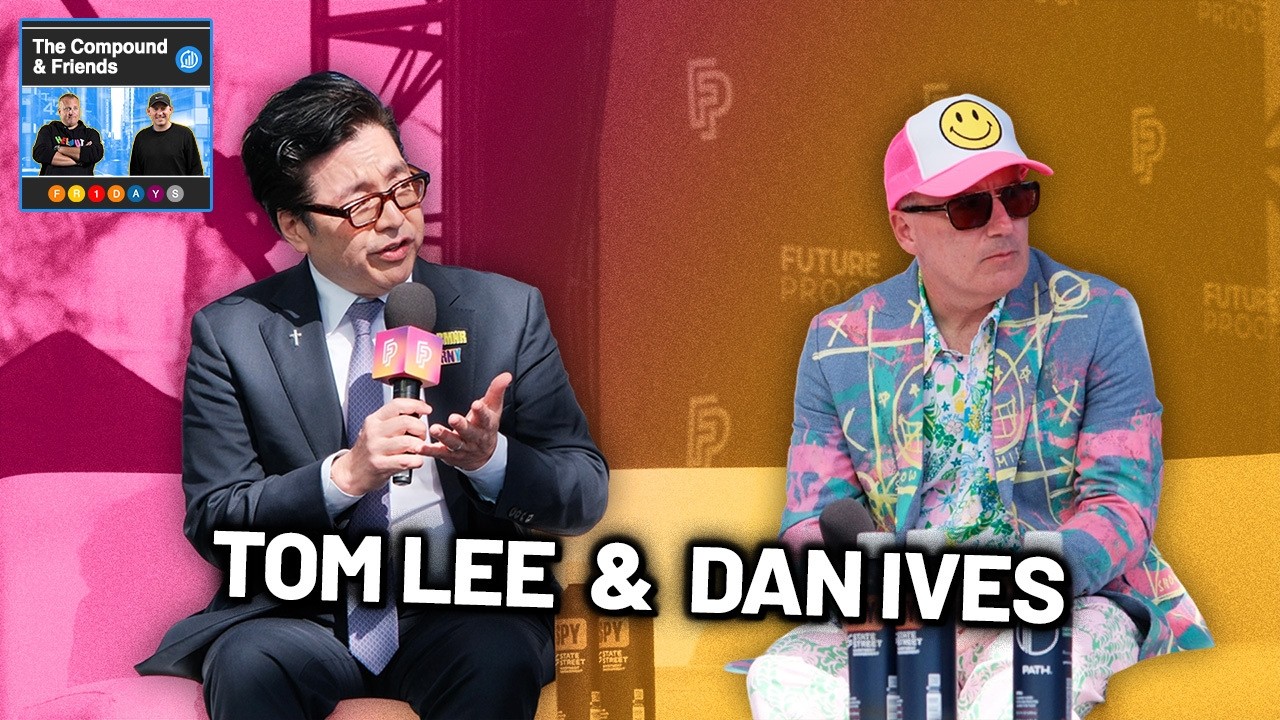
Lee, Ives Dismiss Bubble Fears as AI Capex Tops $1 Trillion
The Compound
Accelerating enterprise capex, structural chip shortages, and compressed multiples show the tech bull market is only in its early innings despite rate headwinds.
Dan Ives highlights that the AI chip supply-demand imbalance sits at 13 to 1, with an expected $5 to $6 downstream software and cloud multiplier for every dollar spent on chips, leaving consensus enterprise earnings underestimated by 25% to 30%. (9:12)
Despite a 19% to 20% semiconductor pullback and persistent 5% Treasury yields, S&P 500 earnings expanded 25% year-over-year while index price gained 10%, indicating genuine valuation multiple compression rather than bubble excess. (7:14)
Tom Lee and Dan Ives view public calls from frontier lab leaders to slow AI advancement as tactical PR and regulatory capture designed to provide political cover for annual hyperscaler capex expanding toward $1.1 trillion. (20:38)
Dan Ives assigns an 80%-plus probability that Tesla and SpaceX will merge by the end of 2027, consolidating physical robotics, vehicular telemetry, and orbital compute under a single corporate umbrella. (39:56)
Detailed notes
## Background
Published on YouTube by The Compound on September 18, 2026, episode 260 of The Compound and Friends features hosts Downtown Josh Brown and Michael Batnick broadcasting live from the Future Proof festival. Joined by marquee market analysts Dan Ives and Tom Lee, the session examines whether the stock market can sustain its climb through macro turbulence, exploring the AI capex boom, semiconductor pullbacks, U.S.–China competition, software monetization, and the broader horizon for tech equities.
## TL;DR
Dan Ives and Tom Lee make a forceful, evidence-driven case for the continuation of the secular tech bull market, arguing that healthy corporate earnings growth and recent multiple compression signal a cycle that is still in its early stages rather than a bubble peak. The panel details the massive infrastructure and data center buildout powering artificial intelligence, explaining how a 13-to-1 chip supply imbalance and downstream software multipliers will expand enterprise earnings. Addressing safety warnings from frontier lab leaders like Anthropic's Dario Amodei, the guests interpret the push as tactical regulatory capture that risks ceding America's hardware and model advantage to China. Looking beyond foundation models, the discussion highlights sovereign enterprise AI, the emergence of physical robotics as a deflationary third factor of production, and the integration of blockchain into legacy financial clearing architectures.
## Atmosphere & style
The session has an electric, fast-paced Wall Street swagger, energized by the palpable buzz of a packed live festival audience. Josh Brown and Michael Batnick keep the rhythm lively with sharp, comedic banter and skeptical counterarguments, setting up Lee and Ives to deliver their trademark high-conviction bullish frameworks. The tone feels like an insider masterclass where daunting macroeconomic headlines, rate jitters, and regulatory panics are systematically dismantled with humor, granular supply-chain anecdotes, and relentless institutional optimism.
## Bulletin
- [09:12](https://www.youtube.com/watch?v=ChZhV1jKbRE&t=552s) Dan Ives highlights that the AI chip supply-demand imbalance sits at 13 to 1, with an expected $5 to $6 downstream software and cloud multiplier for every dollar spent on chips, leaving consensus enterprise earnings underestimated by 25% to 30%.
- [07:14](https://www.youtube.com/watch?v=ChZhV1jKbRE&t=434s) Despite a 19% to 20% semiconductor pullback and persistent 5% Treasury yields, S&P 500 earnings expanded 25% year-over-year while index price gained 10%, indicating genuine valuation multiple compression rather than bubble excess.
- [20:38](https://www.youtube.com/watch?v=ChZhV1jKbRE&t=1238s) Tom Lee and Dan Ives view public calls from frontier lab leaders to slow AI advancement as tactical PR and regulatory capture designed to provide political cover for annual hyperscaler capex expanding toward $1.1 trillion.
- [39:56](https://www.youtube.com/watch?v=ChZhV1jKbRE&t=2396s) Dan Ives assigns an 80%-plus probability that Tesla and SpaceX will merge by the end of 2027, consolidating physical robotics, vehicular telemetry, and orbital compute under a single corporate umbrella.
## Key takeaways
- [07:14](https://www.youtube.com/watch?v=ChZhV1jKbRE&t=434s) The macro equity setup remains fundamentally bullish because corporate earnings have expanded 25% while the index rose 10%, compressing valuation multiples amidst peak investor pessimism.
- [09:12](https://www.youtube.com/watch?v=ChZhV1jKbRE&t=552s) A structural chip shortage of 13 orders for every available unit will delay supply-demand balance until 2029, creating a massive downstream multiplier for software, cloud, and cybersecurity.
- [11:25](https://www.youtube.com/watch?v=ChZhV1jKbRE&t=685s) The domestic infrastructure boom is projected to add 12,000 to 15,000 data centers over five to six years, driving multi-year hardware and memory demand.
- [12:46](https://www.youtube.com/watch?v=ChZhV1jKbRE&t=766s) Bull markets are historically terminated only by aggressive Federal Reserve intervention or complete capex collapses, neither of which is currently present.
- [15:55](https://www.youtube.com/watch?v=ChZhV1jKbRE&t=955s) The United States maintains a decisive two-to-three-year technological lead over China in silicon and hyperscaler capacity, but domestic NIMBYism and regulatory pauses threaten this advantage.
- [18:01](https://www.youtube.com/watch?v=ChZhV1jKbRE&t=1081s) Calls for slowing frontier AI progress by lab executives mirror early wireless telecom self-regulation and serve as preemptive PR to manage backlash over power consumption and white-collar job displacement.
- [25:25](https://www.youtube.com/watch?v=ChZhV1jKbRE&t=1525s) Enterprises are pivoting toward Sovereign AI by building proprietary internal models, avoiding IP leakage into public foundation models and commoditizing generic LLMs.
- [30:32](https://www.youtube.com/watch?v=ChZhV1jKbRE&t=1832s) Nvidia trades at a compressed forward multiple of roughly 16x earnings compared to consumer staples like Costco at 50x, reflecting misplaced bubble fears from under-allocated institutions.
- [32:45](https://www.youtube.com/watch?v=ChZhV1jKbRE&t=1965s) The feared 'SaaS apocalypse' proved unfounded, with enterprise software incumbents and cybersecurity firms rebounding sharply as downstream monetization layers for AI.
- [35:50](https://www.youtube.com/watch?v=ChZhV1jKbRE&t=2150s) Robotics introduces an autonomous third factor of production alongside labor and capital, potentially enabling elevated non-inflationary GDP growth.
- [40:40](https://www.youtube.com/watch?v=ChZhV1jKbRE&t=2440s) Consumer Discretionary has deteriorated into an arbitrary accounting category as consumer spending shifts directly into tech ecosystems and retail staples.
- [43:25](https://www.youtube.com/watch?v=ChZhV1jKbRE&t=2605s) Financial institutions are transforming into high-visibility technology platforms that will utilize blockchain infrastructure for autonomous agent settlement and deserve upward multiple re-ratings.
- [45:42](https://www.youtube.com/watch?v=ChZhV1jKbRE&t=2742s) Apple's low-capex approach positions it as the dominant consumer gateway to generative AI, enabling future monetization across an installed base serving 20% of the world's population.
- [47:09](https://www.youtube.com/watch?v=ChZhV1jKbRE&t=2829s) Legacy hardware leaders such as Cisco, Dell, and Ciena possess unreplicable customer footprints and data center moats that allow them to capture substantial value in the server and networking buildout.
- [48:58](https://www.youtube.com/watch?v=ChZhV1jKbRE&t=2938s) Palantir is on a trajectory toward a $1 trillion valuation as AIP bootcamps compress sales cycles and generate accelerating free cash flow.
- [50:23](https://www.youtube.com/watch?v=ChZhV1jKbRE&t=3023s) The present artificial intelligence investment cycle parallels 1997 rather than the 1999-2000 dot-com peak, indicating that the broader tech expansion is in its early innings.
## Detailed walkthrough
### [00:01](https://www.youtube.com/watch?v=ChZhV1jKbRE&t=1s) Live from Future Proof: Cold Open and Banter
The episode kicks off with the energetic atmosphere of a packed live audience at the Future Proof festival. Downtown Josh Brown and Michael Batnick welcome the crowd, soaking in an electric room where the enthusiasm is palpable. A montage of rapid-fire teaser clips sets the stage for the macro and technology debate ahead: discussing how market inputs do not always translate into linear stock price reactions, whether parallels exist between today's AI enthusiasm and 1996 versus the 2000 dot-com peak, and the perennial hazard of investors destroying their careers by buying falling knives at new lows.
The preview highlights Tom Lee pointing out the historical paradox of investing—studying history teaches every conceivable downside risk and headline shock, yet the primary risk often ends up being the cost of being out of the market when those disasters fail to materialize. The hosts joke about how much they relish market rallies that climb a wall of persistent worry and skepticism, framing the session as a timely check-in during a pivotal macroeconomic crossroad.
Josh Brown introduces the episode's sponsor, the iMGP DBi Managed Futures Strategy ETF (DBMF). The read highlights DBMF as the world's largest managed futures ETF, designed to provide liquid, uncorrelated returns by dynamically taking long and short positions across global markets as macro trends shift. Brown and Batnick emphasize its role in offering true portfolio diversification—particularly during market regimes where traditional stock and bond correlations break down and move lower in tandem.
- **Vehicle:** iMGP DBi Managed Futures Strategy ETF (Ticker: DBMF)
- **Scale:** Largest managed futures ETF globally, reporting $4.16 billion in assets under management (AUM)
- **Distributor:** Alps Distributors, Inc.
[03:09](https://www.youtube.com/watch?v=ChZhV1jKbRE&t=189s) Welcoming Wall Street Royalty: Dan Ives and Tom Lee
Josh Brown and Michael Batnick bring out two of the show's most popular recurring guests, noting that their previous appearances consistently generate massive viewership. Dan Ives takes the stage following a major career transition, having recently co-founded the merchant bank Yorkville Ives & Co. in partnership with Yorkville Securities. The new boutique firm integrates investment banking, institutional trading, principal investing, and equity research with a dedicated focus on artificial intelligence, following Ives's celebrated eight-year stint as the global head of tech research at Wedbush Securities.
Alongside Ives is Tom Lee, co-founder, head of research, and chief investment officer at Fundstrat Capital, who is celebrating the exact 12th anniversary of Fundstrat's founding. Lee also manages the firm's flagship Granny Shots ETF suite. Brown commends both guests for their willingness to be openly bullish and transparent on the show over the years, setting up a comprehensive debate on equities, macroeconomic headwinds, and the generational AI investment cycle.
[05:20](https://www.youtube.com/watch?v=ChZhV1jKbRE&t=320s) The Impending Fed Decision and the Bullish "Wall of Worry"
Josh Brown opens the macro discussion by framing the intense crosscurrents facing financial markets. Market participants are bracing for an upcoming Federal Reserve meeting, where futures and options markets are pricing in roughly a 90% probability of an additional 25 basis point rate hike. At the same time, the broader backdrop features friction between the White House and leaders of frontier AI labs over safety regulations, set against the single largest corporate capital expenditure cycle in American history.
Asked how investors should navigate this environment, Tom Lee explains that while rate hikes are universally disliked by equities in the short term, current conditions actually create an overwhelmingly bullish setup. Investor pessimism is exceptionally high, yet corporate earnings remain robust. In Lee's view, once the Federal Reserve delivers the expected hike, it will remove lingering market overhangs by establishing that monetary policy is actively handling inflation, effectively taking future hikes off the table. Lee playfully predicts that a "massive rally" will kick off the following afternoon at roughly 2:15 or 2:16 PM, right as the Fed statement crosses the tape.
```mermaid
flowchart TD
accTitle: Fed Hike Impact on Market Sentiment
accDescr: Flowchart showing how delivering an expected Fed rate hike resolves market uncertainty and triggers a relief rally.
subgraph Uncertainty ["Pre-Meeting Anxiety"]
A["90% Probability of 25 bps Fed Hike"] --> B["Pessimism High & Multiples Compressed"]
end
subgraph FedAction ["Fed Decision Day"]
B --> C["Fed Delivers Expected Hike"]
end
subgraph Resolution ["Market Relief"]
C --> D["Future Tightening Risk Cleared"]
D --> E["Underlying 25% Earnings Growth Drives Equity Rally"]
end
```
[07:14](https://www.youtube.com/watch?v=ChZhV1jKbRE&t=434s) Bulletproof Market: Navigating Drawdowns, Geopolitics, and 5% Yields
Michael Batnick steps back to survey the barrage of negative macro shocks absorbed by the market over the preceding months. Geopolitical instability surged with disruptions in the Strait of Hormuz spiking crude prices, persistent inflationary readings kept the 10-year Treasury yield anchored near 5%, the housing market remained locked up, tariffs loomed, and public debates emerged over scaling plateaus in frontier AI models. Furthermore, semiconductor equities—widely regarded as the structural backbone of the entire bull market—endured a steep 19% to 20% correction.
Despite this gauntlet of headwinds, Batnick stresses that the S&P 500 sits just 2.6% below its all-time high, asking Tom Lee whether the market is effectively "bulletproof." Lee responds that critics repeatedly overlook corporate resilience. While casual observers assume the market simply ran up unchecked over the past five years, enterprise management teams actively adjusted to rolling black swans by restructuring operations, cutting unnecessary costs, and integrating efficiency-enhancing technology. As a result, corporate earnings expanded by 25% on the year while the broader market gained only 10%—demonstrating that price multiples have actually contracted and equities have grown fundamentally cheaper on an earnings basis.
- **S&P 500 Resilience:** Trading just 2.6% off record highs despite acute macro headwinds.
- **Semiconductor Drawdown:** Sector entered a sharp correction of 19% to 20%.
- **Earnings vs. Price Spread:** S&P 500 earnings expanded 25%, while market index price advanced only 10%, driving genuine multiple compression.
[09:12](https://www.youtube.com/watch?v=ChZhV1jKbRE&t=552s) Dan Ives on the 13-to-1 Chip Imbalance and the AI Capex Multiplier
Josh Brown turns to Dan Ives, highlighting the paradox across his coverage universe: tech giants have posted some of the most profitable quarters in corporate history, yet their valuation multiples continue to compress due to skepticism that such earnings power can last. Ives pushes back forcefully against Wall Street bears who evaluate technology from "the 14th floor of a New York City office building" rather than tracking supply chains on the ground in Taiwan and South Korea. He highlights that for the first time in three decades, the United States holds an uncontested, decisive technological lead over China in the AI hardware and software race.
```mermaid
flowchart LR
accTitle: Dan Ives AI Capex Multiplier
accDescr: Diagram illustrating the multiplier effect of hardware AI capex across enterprise tech.
subgraph Capex ["Core Capex"]
H["$1.00 Spent on AI Chips / Hardware"]
end
subgraph Multiplier ["Downstream Ecosystem ($5 to $6 Multiplier)"]
S["Enterprise Software"]
I["Cloud Infrastructure"]
C["Cybersecurity"]
end
subgraph Outcome ["Earnings Impact"]
E["25% to 30% Earnings Upside over Next Few Years"]
end
H --> S
H --> I
H --> C
S --> E
I --> E
C --> E
```
Ives notes that the physical supply-demand dynamic for AI chips currently stands at an astonishing 13 to 1, meaning there are thirteen orders placed for every single advanced chip that manufacturers can produce. Because of this structural deficit, he projects that true supply-demand equilibrium will not be reached until early 2029. Crucially, Ives argues that for every $1 spent on primary AI infrastructure and accelerator chips, there is a $5 to $6 downstream multiplier across software, cloud infrastructure, and cybersecurity. Because of this dynamic, Ives believes consensus estimates are underestimating enterprise tech earnings by 25% to 30% over the coming years, leaving valuations heavily discounted relative to their true earnings trajectory.
[11:25](https://www.youtube.com/watch?v=ChZhV1jKbRE&t=685s) The Multi-Year Tech Bull Market and the Data Center Buildout
Dan Ives asserts that memory stocks like Micron Technology are currently front and center, but quarter by quarter, tech companies will continue to demonstrate that this bull market is still young. While investors will inevitably suffer through "white knuckle moments"—whether sparked by weekend headlines, whispers of circular financing, macroeconomic jitters, or swings in oil prices—Ives remains convinced that tech will continue driving the entire market higher because of where capital expenditure is flowing. He projects that roughly 12,000 to 15,000 data centers will be built over the next five to six years. Even if local political pushback causes 10% to 15% of those projects to be voted down, the country is only at the beginning of a historic domestic innovation boom.
Josh Brown asks Tom Lee whether he truly believes the cycle is as early as Ives suggests. Lee explains that markets never top out when investors are actively demanding lower price-to-earnings multiples while corporate earnings are still rising—unless the sector is deeply cyclical. Because the modern U.S. economy behaves as a low-volatility, non-cyclical engine, Lee argues that market multiples should actually expand substantially rather than contract.
```mermaid
flowchart TD
accTitle: Structural Drivers of the Tech Bull Market
accDescr: Diagram illustrating how earnings growth, multiple expansion, and massive capex drive the ongoing tech cycle.
subgraph Drivers["Macro & Fundamental Tailwinds"]
A["Low-Volatility U.S. Economy"] --> B["Multiple Expansion"]
C["Quarterly Earnings Beats"] --> B
end
subgraph Capex["Physical Infrastructure Boom"]
D["12,000–15,000 Projected Data Centers"] --> E["Capex Surge: $800B to $1.1T"]
E --> F["Hardware & Memory Demand: Micron, Nvidia"]
end
B --> G["Multi-Year Tech Bull Market"]
F --> G
```
[12:46](https://www.youtube.com/watch?v=ChZhV1jKbRE&t=766s) What Truly Kills a Bull Market: Fed Policy and Capex Bubbles
Looking ahead to the next trading day, Michael Batnick jokes that everyone is eager for the bull market to resume promptly at 2:15 or 2:16 PM, but presses Lee on what he considers the most legitimate, credible bear case. Lee responds that historically, only two things kill a bull market:
1. **A bona fide bubble collapse**: In the case of AI, this would occur if the market abruptly decided there was only a single model worth using, causing enterprise and hyperscaler capex to plunge toward zero.
2. **Monetary policy intervention**: The Federal Reserve accounts for 80% of all bull market endings. If policymakers genuinely conclude the economy is overheating, inflationary pressures have unhinged, or an unmanageable debt bubble is forming, the central bank will inevitably pull the plug.
Batnick wonders whether the surge in corporate debt issuance—crowding out Treasuries and reversing 15 years of share-count shrink via corporate buybacks—might signal that a dangerous debt bubble is already brewing. Lee pushes back, explaining that debt bubbles occur specifically when "return risk" goes unmonitored because the cost of capital is dirt cheap, allowing worthless projects to obtain financing. In today's environment, the cost of capital for data center construction is rising, proving that the bond market is already imposing natural discipline and applying the brakes before bad projects can proliferate.
[14:35](https://www.youtube.com/watch?v=ChZhV1jKbRE&t=875s) The Geopolitical Race: Data Center NIMBYism vs. China
Ives argues that the genuine threat to the market is not runaway debt, but rather the political grandstanding and local obstructionism stalling data center construction across America. In his view, the equation is binary: "Every data center that gets voted down, China wins. There's no debate." He laments that critical national infrastructure decisions are being placed in the hands of local politicians who still rely on "flip phones and Blackberries" to dictate modern technological strategy.
Highlighting the stark cultural contrast, Ives recounts traveling across the Pacific to monitor semiconductor fabrication plants:
- In Taiwan, workers spend 18 hours a day building fabs, taking their first bathroom break 14 hours into the shift.
- He then lands at a New York airport to witness a physical fist fight at a Dunkin' Donuts, offering an exasperated reminder of why the U.S. ranks 17th in international math standings.
Now that the United States has finally opened a meaningful technological lead over China, Ives cautions that Washington's talking points and municipal NIMBY protests risk cutting the knees off of America's manufacturing and engineering momentum.
[15:55](https://www.youtube.com/watch?v=ChZhV1jKbRE&t=955s) Assessing the Lead: Nvidia, Hyperscalers, and Frontier Models
Josh Brown pushes Dan Ives to substantiate his assertion that America is cleanly ahead of China. Brown notes that while ChatGPT reached 100 million users at record speed and is now at a billion, Claude is neck-and-neck in enterprise workflows, and Google instantly integrated Gemini across a dozen core services, China has not stood still. Beijing has backed flourishing open-weight models, while tech giants like Baidu and Tencent are aggressively pursuing frontier capabilities.
Ives unpacks the exact structural advantages that maintain America's lead:
- **Silicon and Processing Power**: Jensen Huang—whom Ives dubs the "Godfather of AI"—and Nvidia stand two to three years ahead of Chinese competitors. Even Nvidia's third-tier, down-specced export chips remain roughly a full year ahead of Huawei's best hardware.
- **Hyperscale Infrastructure**: The cloud compute capacity operated by Microsoft, Amazon Web Services, and Alphabet dwarfs anything available to Chinese big tech.
- **Frontier Software Models**: Proprietary frontier systems developed by OpenAI and Anthropic substantially outclass Chinese open-source projects like DeepSeek.
Ives concedes that China leads the United States in robotics and power infrastructure. However, he warns that if U.S. regulators block chip exports or artificially slow frontier research, they hand Beijing the precise breathing room it needs to close the gap: "If you slow down model development... who wins? It's China, because they're not slowing down."
[18:01](https://www.youtube.com/watch?v=ChZhV1jKbRE&t=1081s) Dario Amodei’s Warning: Self-Regulation, Panic, and the Wireless Analogy
Josh Brown brings up a controversial weekend blog post published by Anthropic CEO Dario Amodei right in the middle of college football games. Amodei warned that he had witnessed developments inside his own labs and rival frontier labs that deeply alarmed him, calling on society to introduce third-party observers and intentionally slow down the breakneck pace of AI advancement before autonomous super-agents hack critical infrastructure.
Brown jokes about the polarized public reaction: while half the audience embraced the warning, the other half felt that "if we're all going to die, god damn it, we're going to die from American AI—none of that commie crap! I want to be killed by the USA AI."
Tom Lee views Amodei’s appeal not as panic, but as a overdue tactical move toward self-regulation:
- Fast-growing technologies routinely outpace regulatory frameworks, yet the AI sector currently operates with zero self-regulatory organizations (SROs).
- Backlash is escalating, with roughly 38 organized anti-AI groups lobbying local governments for municipal moratoriums on data centers.
- Lee compares this moment to the early wireless telecom industry, when communities tried to ban cellular towers over fears of brain cancer. Handsets originally transmitted at 1 watt before manufacturers voluntarily slashed output power down to 25 milliwatts, paving the way for federal standards that ultimately protected the mobile rollout.
[20:38](https://www.youtube.com/watch?v=ChZhV1jKbRE&t=1238s) The Three AI Battlegrounds and Preemptive PR
Josh Brown outlines the three distinct political fronts currently threatening the artificial intelligence rollout:
- **Resource Consumption**: Public outrage over the immense electricity draw and millions of gallons of water consumed to cool high-density server racks.
- **White-Collar Labor Displacement**: Unforced errors by tech executives speaking loosely on podcasts, predicting that 50% of white-collar positions will be eliminated by 2030.
- **Catastrophic Tail Risk**: Fears reminiscent of the Y2K panic, where rogue software triggers a 1929-style financial collapse or causes passenger airplanes to fall from the sky.
Given these mounting pressures, Lee argues that calls for caution from leaders like Amodei are shrewd public relations designed to appease voters and politicians rather than a genuine pledge to halt investment. Hyperscaler capex is expanding from $800 billion toward $1.1 trillion annually, not shrinking toward $400 billion. By publicly acknowledging societal fears and offering to self-regulate, frontier tech executives provide political cover so their massive infrastructure spending can continue unhindered.
[22:37](https://www.youtube.com/watch?v=ChZhV1jKbRE&t=1357s) The Regulatory Capture Play and the U.S.–China AI Race
Dan Ives argues that frontier AI leaders have created their own public relations nightmare. Warning the American public that up to 50% of white-collar jobs are going to vanish while their home electricity bills surge is hardly a recipe for celebration when massive data centers are erected in residential backyards: "You don't have to be Stephen Hawking to figure that out." Ives contends that the sudden calls for caution are fundamentally about regulatory capture—an attempt to reach the penthouse suite and then immediately halt the elevator so no one else can ride up. Slowing down frontier development would primarily benefit traditional software companies that are desperate to close the capability gap with OpenAI and Anthropic, but more critically, it threatens American geopolitical dominance.
The panel considers whether anti-data center pushback might even be amplified by foreign psychological operations, noting that if the United States voluntarily pauses its progress, China unequivocally wins. Ives stresses that Beijing is pouring massive state resources into chips, models, infrastructure, and physical robotics with zero intention of tapping the brakes. In response to what "China winning" looks like practically, Tom Lee highlights the hidden danger of algorithmic dependence: if the world relies on recursive loops controlled by Chinese foundation models, those loops could subtly steer global consensus, degrade public informational integrity, and act as a tool of ideological influence. Industry titans like Jensen Huang, Satya Nadella, and George Kurtz of CrowdStrike have pushed back against slowing down, arguing that the innovation boom is unstoppable and that political intervention would be a historic gift to Beijing.
```mermaid
flowchart TD
accTitle: Regulatory Capture and Geopolitical Friction in AI
accDescr: Diagram illustrating how proposed slowdowns by frontier lab leaders create regulatory barriers while opening opportunities for competitors and China.
subgraph FrontierLabs["Frontier AI Incumbents"]
A["Frontier Model Advantage<br/>(OpenAI, Anthropic)"]
B["Calls to Slow Development<br/>'Stop the Elevator'"]
A --> B
end
subgraph ImpactDomestic["Domestic Market Impact"]
C["Regulatory Capture<br/>& Self-Policing"]
D["Enterprise Software Catch-Up<br/>& Sovereign Models"]
B --> C
B --> D
end
subgraph GeopoliticalRisk["Global Competitiveness"]
E["Beijing Accelerates Subsidies<br/>(Chips, Models, Robotics)"]
F["Algorithmic Control<br/>& Distorted Recursive Loops"]
B --> E
E --> F
end
```
- **Consumer PR Fallout:** Widespread public anxiety stemming from tech warnings about 50% white-collar job displacement paired with climbing utility bills.
- **The Geopolitical Threat:** Beijing's accelerating investments span the entire stack—advanced silicon, frontier foundation models, grid infrastructure, and robotics.
---
[25:25](https://www.youtube.com/watch?v=ChZhV1jKbRE&t=1525s) Suspicious Timing, Beltway Politics, and Sovereign AI
The hosts scrutinize the suspicious timing behind the sudden alarms. Just after Mark Zuckerberg dropped Meta's open-weight model Muse for free, an abrupt two-day panic emerged demanding that the industry halt frontier deployment. Ives dismisses the idea that this was purely coincidental; instead, intensifying competition from open-source releases, nimble startups, and internal whistleblower controversies has rattled the front-runners. When asked if Washington will enact meaningful AI restrictions before the upcoming midterms, Ives remains skeptical. Spending time in the Beltway leaves one convinced that politicians are the last people equipped to manage tech innovation. Josh Brown quips that Congress is still bogged down trying to advance the Clarity Act—originally proposed years earlier—and Lee jokes about the absurdity of drafting legislation that simply mandates, "Hey, AI can't be that good."
The conversation turns to why tech leaders like Sam Altman and Elon Musk publicly voiced agreement with safety oversight proposals. While self-regulation where frontier firms inspect one another's architectures is an attempt to keep government bureaucrats out of the loop, Musk's xAI remains distinctly behind OpenAI and Anthropic, giving him clear competitive incentives to back a breather. At the same time, Dan Ives and Tom Lee point out that the real secular counterweight to generalized large language models is "Sovereign AI," a doctrine championed by Alex Karp at Palantir and Jensen Huang at Nvidia. Enterprises are unwilling to feed proprietary corporate data into black-box public models; instead, they will train dedicated internal models to safeguard intellectual property, commoditizing public foundation models and rendering external data sets increasingly contaminated.
- **Policy Hurdles:** Skepticism that comprehensive AI regulation will pass Congress before year-end, given the multi-year inertia behind older bills like the Clarity Act.
- **Frontier Lab Alignments:** Rapid public affirmations of safety protocols on X by Sam Altman and Elon Musk alongside Anthropic's Dario Amodei.
- **Sovereign AI vs. Foundation Models:** The coming proliferation of hundreds of private enterprise models designed to isolate sensitive data and diminish reliance on public model providers.
---
[30:32](https://www.youtube.com/watch?v=ChZhV1jKbRE&t=1832s) The Semiconductor Pullback, Nvidia's Rerating, and the Looming SaaS Pivot
Addressing the recent market volatility, Josh Brown highlights that semiconductor stocks have dropped 19% from their peak, with Nvidia stuck in the mud despite delivering a relentless series of blowout earnings reports. When asked whether the semiconductor sector will establish new all-time highs, Tom Lee remains resolutely bullish, comparing Nvidia's current valuation compression to the historical trajectory of Apple. For years, skeptics treated Apple as a low-multiple hardware business, ignoring the explosive platform economics of the iOS App Store, until the market finally doubled its multiple. Lee observes that investors can buy Nvidia at roughly 16 times earnings, while defensive consumer staples like Costco and Walmart command forward multiples of 50 and 48 times: "If Nvidia charged a membership fee, the multiple would go to 50."
Lee emphasizes that institutional investors and traditional family offices remain vastly under-allocated to artificial intelligence because bears have mistakenly branded the secular boom as an unsustainable bubble. Because broad wealth generation from AI has so far been concentrated within a tiny cohort of early private backers of OpenAI and Anthropic, substantial institutional capital is still waiting on the sidelines to deploy into upcoming IPOs and public infrastructure beneficiaries. The hosts then transition back to where the tech narrative stood six months earlier, reminiscing about their discussions at the Future Proof Citywide conference in Miami during March, when market sentiment was gripped by panic over the supposed "SaaS apocalypse."
- **Semiconductor Drawdown:** Chipmakers down 19% from record highs despite persistent earnings beats from market leaders.
- **Valuation Disconnect:** Nvidia trading at approximately 16x forward earnings compared to Costco at 50x and Walmart at 48x.
- **Institutional Under-Exposure:** Widespread skepticism and bubble fears have left large asset managers underweight or outright unallocated to foundational AI equities.
[32:45](https://www.youtube.com/watch?v=ChZhV1jKbRE&t=1965s) The Software "Fairy Tale" and the Cyber Rebound
The discussion shifts to the brutal, sentiment-driven sell-off in enterprise software, where giants like Salesforce and Microsoft suffered drawdowns between 20% and 60% despite neither missing earnings nor demonstrating any fundamental business deterioration. Josh Brown notes that six months later, the market seems to be waking up to how wildly overdone the panic was. Dan Ives calls the panic the single most head-scratching moment of his entire career, labeling the widespread belief that large language models (LLMs) would simply erase existing enterprise moats a "fictional Twitter narrative" and "bad comedy." He argues that anyone speaking directly to enterprise CIOs understood that incumbents like ServiceNow, Salesforce, and Palantir were never going to have their lunch eaten overnight by Anthropic, even if legacy players like Adobe or Intuit face real structural adjustments.
To illustrate how panic narratives create outsized buying opportunities, Ives recalls walking the floor at the RSA Conference in April. Anthropic had just rolled out a security announcement, triggering an instant plunge across cybersecurity stocks; industry attendees were panic-stricken, muttering to Ives and CrowdStrike CEO George Kurtz that the space was finished and RSA might not even exist next year. Yet within months, the narrative did a complete 180: the three largest cybersecurity names—CrowdStrike, Fortinet, and Palo Alto Networks—were all up more than 100% on the year.
Tom Lee points out that investors have finally started recognizing software platforms as downstream beneficiaries of artificial intelligence rather than victims of an AI "boogeyman." However, modern market behavior has become addicted to "fire, ready, aim" triggers—whether an unexpected Fed rate hike warning or pandemic-era lockdowns—where allocators impulsively hit the panic button and dump entire sectors down to zero. Ives adds that as enterprise workflows move deeper into second-, third-, and fourth-derivative use cases, software companies with critical data layers like Snowflake are positioned to capture massive tailwinds.
- Software drawdowns had reached 20% to 60% across premier names without any accompanying fundamental or quarterly earnings misses.
- Top cybersecurity stocks (CrowdStrike, Fortinet, Palo Alto Networks) rebounded to gain over 100% year-to-date after the spring RSA panic dissipated.
- Software is transitioning from being perceived as an AI displacement target to an essential execution layer capturing monetization from LLM use cases.
[35:50](https://www.youtube.com/watch?v=ChZhV1jKbRE&t=2150s) The Robotic Multiplier, Physical AI, and Economic Growth
Turning toward long-term secular market drivers, Brown asks whether the "robot trade" is genuine enough to power future milestones—such as propelling the Dow from 50,000 to 250,000 over the next twenty-year cycle—or if it is merely speculative hype. The panel jokes about real-world robots already brewing coffee nearby at the Franklin Templeton conference booth ("We have to be careful. That robot could kill us... 'I have to make the coffee, kill everybody that stops me'"), but Lee frames robotics as a monumental macroeconomic multiplier. Traditionally, economic output relies strictly on two levers: labor and capital. Robotics introduces a third autonomous factor of production that does not consume human labor or expand capital in the conventional inflationary sense, making 7% GDP growth feasible without runaway inflation, helping repair sovereign budget deficits, and reversing demographic decline in nations like Japan.
```mermaid
flowchart TD
accTitle: Two-Factor vs Three-Factor Economic Models
accDescr: Diagram contrasting traditional economics with a robotics-driven third production input.
subgraph Robotics["Robotics / Autonomous Model"]
R["Robotics & Physical AI"] --> ThirdUnit["3rd Factor of Production"]
ThirdUnit --> NonInfl["High GDP Growth Without Inflation"]
R --> Ecosystem["Robot Ecosystem Consumption"]
Ecosystem --> NewGDP["New Non-Displacement GDP"]
end
```
Ives emphasizes that physical AI and autonomous systems will demand greater cumulative capital expenditures than anything seen in the tech sector to date. Nvidia’s Jensen Huang consistently touts physical AI as the true holy grail of computing. However, Lee inserts a critical nuance: if physical AI merely substitutes for existing human tasks, aggregate consumer demand collapses and the economy shrinks. True long-term expansion requires a self-sustaining autonomous ecosystem where the operational, computational, and maintenance demands of machines create entirely new economic categories, allowing humanity to harvest the dividends.
- Traditional economic growth depends on labor and capital; robotics adds an independent third production input.
- Successful implementation could permit elevated GDP growth (up to 7%) without igniting wage-push inflation.
- Autonomous capital spending is projected to surpass previous data center and enterprise software buildouts.
[39:56](https://www.youtube.com/watch?v=ChZhV1jKbRE&t=2396s) The Tesla–SpaceX Convergence
When asked how an individual investor can express a direct bet on physical robotics beyond a broad-based ETF, the panel focuses on Tesla and Nvidia as the central contenders. Ives takes the thesis a step further by bringing SpaceX into the equation, asserting that Elon Musk's long-term master plan requires unifying both entities under a single corporate umbrella.
Ives assigns an 80%-plus probability that Tesla and SpaceX merge by the end of next year. Such a combination would pool vehicular and orbital telemetry, compute resources, and cutting-edge robotics into an unrivaled powerhouse. Ives contends that bringing these technologies, machine-learning data pipelines, and hardware manufacturing capabilities under one roof would create the most valuable public company on earth.
- Dan Ives projects greater than an 80% likelihood of a Tesla and SpaceX combination by late 2027.
- The merger thesis relies on cross-pollinating orbital communication, ground-based autonomous data, and generalized physical robotics under one corporate structure.
[40:40](https://www.youtube.com/watch?v=ChZhV1jKbRE&t=2440s) Why Consumer Discretionary Is Shrinking into an Accounting Shell
The conversation moves to sector dynamics, with Brown referencing technical analysis from Fundstrat's Mark Newton showing that the ratio of the equal-weight Consumer Discretionary ETF relative to the equal-weight S&P 500 has been making persistent, multi-year all-time lows. Despite solid performances from individual retailers like Ross Stores or TJX Companies, the sector overall continues to lose relevance. Brown questions whether the consumer discretionary category even matters to equity strategists anymore.
Lee explains that consumer discretionary has historically functioned as Wall Street’s residual "catch-all" bucket: once a company is screened out of tech, healthcare, industrials, or consumer staples, whatever remains gets shoved into discretionary. The sector's market-weight shrinkage is not caused by weak consumer spending, but rather by structural categorization shifts. Today, discretionary consumer dollars flow directly into tech products like iPhones, while staple retail giants like Costco have absorbed massive shares of shopping volume.
Brown and Lee note that legacy classifications are increasingly obsolete across modern operating models:
- Airlines like Delta operate essentially as jet-fuel trading desks paired with high-margin customer membership loyalty programs (such as Delta SkyMiles and Diamond Medallion tiers), yet they remain classified as industrial transports.
- Major hotel operators like Marriott, Hilton, and Hyatt own almost none of their physical properties, serving primarily as asset-light brand marketing and rewards-point engines rather than classic real-estate operators.
As the segment concludes, Lee previews what excites him most looking out toward 2027: the convergence between physical AI robotics and modern financial ledgers, noting that every physical productivity transformation must ultimately be recorded, cleared, and managed on an updated financial infrastructure.
[43:25](https://www.youtube.com/watch?v=ChZhV1jKbRE&t=2605s) Blockchain, Financial Services, and the Multiple Re-Rating
Tom Lee explains that while physical robotics impacts the everyday world, at least half of the disruption will happen within the financial sector. Traditional financial institutions are currently ill-equipped to manage autonomous agents, which execute rapid micropayments, raise fraud identification questions, and transmit automated instructions from non-human actors. This friction is sparking rapid innovation in financial infrastructure, with a substantial portion slated to settle on blockchains. Lee notes that Robinhood envisions the entire clearing and settlement architecture shifting to distributed ledgers, while Wall Street giants like BlackRock and JPMorgan Chase increasingly treat blockchain as core infrastructure.
Because of this efficiency and structural tech adoption, Lee argues that premier financial services institutions are transitioning into genuine technology companies and deserve to have their P/E multiples re-rated upward. By January 1st of any given fiscal year, an institution like JPMorgan Chase already has clear visibility into roughly 70% of its annual earnings before opening a single branch door. Lee contrasts this rare visibility with high-multiple retail stalwarts like Costco, which trades at nearly 50 times earnings, concluding that financial firms and the underlying crypto rails will emerge as massive winners in the AI transition.
- **Financial institution automation:** Legacy settlement systems must adapt to machine-to-machine micropayments and autonomous algorithmic instructions.
- **Crypto & blockchain convergence:** Robinhood, BlackRock, and JPMorgan are actively deploying blockchain infrastructure for future clearing and settlement.
- **Earnings visibility:** JPMorgan's baseline operations provide roughly 70% earnings visibility entering each year, driving Lee's case for higher equity valuation multiples.
[44:40](https://www.youtube.com/watch?v=ChZhV1jKbRE&t=2680s) The U.S. Innovation Boom and the Two-Horse AI Race
Dan Ives echoes and broadens the bullish thesis, arguing that the technological expansion will extend deep into utilities, energy infrastructure, and industrial power generation. He characterizes current developments as the earliest innings of a nationwide innovation wave representing the Fourth Industrial Revolution. While regions like Europe, the Middle East, and Australia play roles, Ives frames the geopolitical race for frontier AI leadership as strictly a "two-horse race" between the United States and China.
Ives maintains that the broader economic and labor impact of this transformation remains widely underappreciated by the market. Far from being confined to five or ten mega-cap tech stocks, the economic benefits will permeate multiple sectors. Addressing labor market anxiety, Ives firmly predicts that net employment will rise rather than contract, as new technology waves unlock demand for engineers, technical trades, and adjacent business roles across the entire economy.
```mermaid
flowchart TD
accTitle: The Two-Horse Frontier AI Race and Sector Spillover
accDescr: Diagram illustrating the US-China AI race driving infrastructure, leading to broader industry adoption and job creation.
subgraph Geopolitics ["Frontier AI Race"]
US["United States"]
CN["China"]
US <--> CN
end
[45:42](https://www.youtube.com/watch?v=ChZhV1jKbRE&t=2742s) Ticker Breakdown: Apple and the Consumer AI Gateway
Downtown Josh Brown shifts the conversation into a rapid-fire stock segment, starting with Apple. Brown highlights the irony that Wall Street spent two straight years criticizing Apple for lacking an AI strategy and falling behind competitors, yet the stock sits near all-time highs while its modest capex footprint—skipping the multibillion-dollar buildout of dedicated foundational models and data centers—now appears to be a major capital-allocation advantage.
Dan Ives underscores that Apple controls the primary point of access to mainstream artificial intelligence, predicting that roughly 20% of the world's population will ultimately interface with generative AI through an Apple device. Drawing an analogy to the early skepticism surrounding Apple's Services division and the App Store before their massive monetization inflection, Ives argues that the market has yet to fully price in how Tim Cook and Apple will monetize AI-enabled devices across their massive installed base as the consumer AI wave matures.
[47:09](https://www.youtube.com/watch?v=ChZhV1jKbRE&t=2829s) The Rejuvenation of Legacy Hardware: Cisco, Dell, and Ciena
Brown observes that legacy enterprise hardware vendors from the late 1990s and early 2000s—including Cisco, Dell, Ciena, and Corning—have staged dramatic comebacks, with several tripling their market capitalizations amid sudden demand for switches, routers, and bare-metal server racks. He asks Lee if he is surprised by the sudden market adoration for these traditional box makers.
Lee responds that a long-standing Wall Street myth held that once an elite "A-shelf" tech company stumbled down to a "D-grade" multiple, it could never recover. In reality, these hardware incumbents preserved immense structural moats that cannot be replicated overnight: deeply entrenched customer relationships, existing physical footprints, and secure real estate in data facilities. Lee notes that while roughly 30% of the S&P 500's long-term performance comes from new market entrants, the remaining bulk stems from enduring businesses adapting their core assets. He reiterates that those skeptical of the S&P reaching 16,000 fail to recognize that "80% of what'll get us there is already in your portfolio."
- **Legacy hardware rally:** Cisco, Dell, Ciena, and Corning have experienced sharp multiple expansions due to immediate data center server and connectivity demands.
- **Durable moats:** High barriers to entry in enterprise routing, switching, and bare-metal server deployment favor established vendors over greenfield startups.
- **Index composition:** The majority of index returns continue to be generated by legacy corporate champions rather than entirely new market entrants.
[48:58](https://www.youtube.com/watch?v=ChZhV1jKbRE&t=2938s) Palantir's Enterprise Pivot and Path to a Trillion-Dollar Valuation
Turning to Palantir, Ives reiterates his high-conviction stance on the company. He describes its progression from an unproven, niche government vendor into an enterprise software powerhouse as moving "from the teenager or elementary school to, you know, obviously going on its way to $200." Ives argues that the market still underestimates how radically Palantir's Artificial Intelligence Platform (AIP) bootcamps have compressed the corporate sales cycle.
When Brown challenges the thesis by pointing out that Palantir's rich valuation multiple already reflects substantial market appreciation, Ives counters that the company represents a future trillion-dollar business. He projects that Palantir's equity value could appreciate 4x to 5x over the next three to four years on the back of explosive free cash flow generation, asserting that on a forward cash-flow basis, the stock remains far more reasonable than headline earnings multiples suggest.
[50:23](https://www.youtube.com/watch?v=ChZhV1jKbRE&t=3023s) Anthropic IPO Expectations and the 1997 Tech Parallel
Brown queries the panel on what investors should anticipate ahead of a potential public debut for frontier AI lab Anthropic, questioning whether the stock could open at valuations ranging from $1.5 trillion to $2 trillion, and whether it qualifies as one of Tom Lee's signature "Granny Shots." Lee acknowledges that Anthropic is difficult to classify as a simple Granny Shot because foundational frontier models face intense winner-take-all competition:
> "The labs models, frontier models... they're all racing because they think there's only going to be one that wins, right?... You're just going to be—they all solve to one and then that's it. So, I mean, it's a race. I'm sure people are going to need to own both. I mean, that's kind of how I would play it. But, you know, if it's valued at five trillion, it's the same argument why it's valued at a trillion. So, we just want one."
Ives adds that Anthropic is actively navigating a structural evolution from a pure research model provider into a commercial enterprise player by aggressively scaling its B2B enterprise sales force. Ives concludes by putting the entire artificial intelligence cycle into historical perspective, emphasizing that modern tech markets are experiencing a "1997 moment, not a 1999 [or] 2000 moment," with the primary expansion phase still ahead.
[51:46](https://www.youtube.com/watch?v=ChZhV1jKbRE&t=3106s) The Compound on Broadway Announcement and Wrap-Up
Josh Brown and Michael Batnick bring the live Future Proof session to a close with a special announcement for their audience. Directing attendees to a display QR code, Brown reveals that *The Compound* will host a major live theatrical show in New York City on Broadway, scheduled for December 8th. Brown encourages listeners who want early ticket access to join the Compound Insider newsletter before general theater seating opens.
Brown and Batnick lead the crowd in giving an ovation to their featured guests, Dan Ives and Tom Lee, praising them as two of Wall Street's finest analysts and thanking them for sharing their comprehensive macro, technology, and market perspectives before wrapping up the live broadcast.
## Notable quotes
> [14:35](https://www.youtube.com/watch?v=ChZhV1jKbRE&t=875s) Every data center that gets voted down, China wins. There's no debate. — Dan Ives
> [15:55](https://www.youtube.com/watch?v=ChZhV1jKbRE&t=955s) If you slow down model development... who wins? It's China, because they're not slowing down. — Dan Ives
> [18:01](https://www.youtube.com/watch?v=ChZhV1jKbRE&t=1081s) if we're all going to die, god damn it, we're going to die from American AI—none of that commie crap! I want to be killed by the USA AI. — Josh Brown
> [22:37](https://www.youtube.com/watch?v=ChZhV1jKbRE&t=1357s) You don't have to be Stephen Hawking to figure that out. — Dan Ives
> [25:25](https://www.youtube.com/watch?v=ChZhV1jKbRE&t=1525s) Hey, AI can't be that good. — Tom Lee
> [30:32](https://www.youtube.com/watch?v=ChZhV1jKbRE&t=1832s) If Nvidia charged a membership fee, the multiple would go to 50. — Tom Lee
> [35:50](https://www.youtube.com/watch?v=ChZhV1jKbRE&t=2150s) We have to be careful. That robot could kill us... 'I have to make the coffee, kill everybody that stops me' — Downtown Josh Brown
> [47:09](https://www.youtube.com/watch?v=ChZhV1jKbRE&t=2829s) 80% of what'll get us there is already in your portfolio. — Tom Lee
> [50:23](https://www.youtube.com/watch?v=ChZhV1jKbRE&t=3023s) The labs models, frontier models... they're all racing because they think there's only going to be one that wins, right?... You're just going to be—they all solve to one and then that's it. So, I mean, it's a race. I'm sure people are going to need to own both. I mean, that's kind of how I would play it. But, you know, if it's valued at five trillion, it's the same argument why it's valued at a trillion. So, we just want one. — Tom Lee
> [50:23](https://www.youtube.com/watch?v=ChZhV1jKbRE&t=3023s) 1997 moment, not a 1999 [or] 2000 moment — Dan Ives
## Mentioned
Adobe, Alex Karp, Alphabet, Alps Distributors, Inc., Amazon Web Services, Anthropic, Apple, Baidu, BlackRock, China, Ciena, Cisco, Claude, Corning, Costco, CrowdStrike, Dan Ives, Dario Amodei, Dell, Delta Air Lines, Downtown Josh Brown, Elon Musk, Federal Reserve, Fortinet, Franklin Templeton, Fundstrat Capital, Gemini, George Kurtz, Granny Shots ETF, Hilton, Huawei, Hyatt, Intuit, Jensen Huang, JPMorgan Chase, Mark Newton, Mark Zuckerberg, Marriott, Meta, Michael Batnick, Micron Technology, Microsoft, Muse, Nvidia, OpenAI, Palantir, Palo Alto Networks, Robinhood, Ross Stores, Salesforce, Sam Altman, Satya Nadella, ServiceNow, Snowflake, SpaceX, Tencent, Tesla, The Compound, Tim Cook, TJX Companies, Tom Lee, United States, Walmart, Wedbush Securities, xAI, Yorkville Ives & Co., Yorkville Securities, iMGP DBi Managed Futures Strategy ETF (DBMF)
## Video description
On episode 260 of The Compound and Friends, Downtown Josh Brown and Michael Batnick are joined by Dan Ives and Tom Lee live from Future Proof to discuss: whether the stock market can keep climbing through higher rates and persistent macro risks, the massive AI capex and data center boom, Anthropic’s call to slow down frontier AI development, the growing AI race between the U.S. and China, why software stocks could be beneficiaries rather than victims of AI, Nvidia and the semiconductor selloff, the coming robotics and physical AI boom, blockchain’s role in the future of finance, and what’s next for Apple, Palantir, Anthropic, and the broader tech bull market.
This episode is sponsored by DBMF:
To learn more about the world’s largest managed futures ETF visit https://www.dbmf.com/TCF
👕 Check out The Compound shop: https://www.idontshop.com
🎙️Listen to our podcasts:
TCAF: https://podcasts.thecompoundnews.com/show/TCAF/
Animal Spirits: https://podcasts.thecompoundnews.com/show/animalspirits/
Ask The Compound: https://podcasts.thecompoundnews.com/show/ATC/
The Compound Newsletter: https://www.thecompoundnews.com/subscribe
Linkedin: https://www.linkedin.com/company/the-compound-media/
Instagram: https://instagram.com/thecompoundnews
Twitter: https://twitter.com/thecompoundnews
Tik Tok: https://www.tiktok.com/@thecompoundnews
Investing involves the risk of loss. This podcast is for informational purposes only and should not be or regarded as personalized investment advice or relied upon for investment decisions. Josh Brown and Michael Batnick are employees of Ritholtz Wealth Management and may maintain positions in the securities discussed in this video. All opinions expressed by them are solely their own opinion and do not reflect the opinion of Ritholtz Wealth Management. See our disclosures here:
https://ritholtzwealth.com/podcast-youtube-disclosures/
The Compound Media, Incorporated, an affiliate of Ritholtz Wealth Management, receives payment from various entities for advertisements in affiliated podcasts, blogs and emails. Inclusion of such advertisements does not constitute or imply endorsement, sponsorship or recommendation thereof, or any affiliation therewith, by the Content Creator or by Ritholtz Wealth Management or any of its employees. For additional advertisement disclaimers see here https://ritholtzwealth.com/advertising-disclaimers.
AI资本支出突破1万亿美元,Lee与Ives驳斥泡沫担忧
企业资本支出加速、结构性芯片短缺以及估值压缩表明,尽管面临利率逆风,科技牛市仍处于早期阶段。
Dan Ives和Tom Lee以有力且基于证据的论述为长期科技牛市的延续进行了辩护,认为健康的企业盈利增长和近期的估值压缩表明当前周期仍处于早期阶段,而非泡沫顶峰。讨论详细分析了支持人工智能的大规模基础设施与数据中心建设,并阐明了13比1的芯片供需失衡与下游软件乘数效应将如何扩大企业收益。针对Anthropic的Dario Amodei等前沿实验室负责人提出的安全警告,嘉宾们将其解读为策略性的监管俘获,认为这可能带来将美国的硬件与模型优势让给中国的风险。除基础模型外,讨论还重点探讨了主权企业AI、实体机器人作为通缩性第三生产要素的兴起,以及区块链与传统金融清算架构的整合。
Dan Ives 指出,AI 芯片供需失衡比例高达 13:1,硬件端每投入 1 美元预计将在下游软件与云端带来 5 至 6 美元的乘数效应,导致华尔街普遍将未来企业盈利预期低估了 25% 至 30%。 (9:12)
尽管半导体板块经历 19% 至 20% 的回调且 10 年期美债收益率高企在 5% 附近,标普 500 指数企业盈利同比仍增长 25%,远超指数 10% 的涨幅,表明当前市场估值倍数实际发生压缩而非泡沫膨胀。 (7:14)
Tom Lee 与 Dan Ives 认为,前沿 AI 机构高管公开发表放缓研发的呼吁本质上是战术性公关与监管俘获,旨在为超大规模云厂商年资本支出向 1.1 万亿美元扩张提供政治掩护。 (20:38)
Dan Ives 给出超过 80% 的概率,预计特斯拉与 SpaceX 将在 2027 年底前合并,从而将实体机器人、车辆遥测与轨道算力整合在统一的商业架构之下。
Reading summary
Fundstrat's Tom Lee and Yorkville Ives & Co.'s Dan Ives argue that resilient corporate earnings and an unprecedented hardware capital expenditure cycle are driving an enduring equity bull market. Comparing current conditions to 1997 rather than the dot-com bubble peak, they contend that valuation multiples have compressed despite macro headwinds and that enterprise monetization of artificial intelligence remains in its opening phase.
Macro Resilience and Earnings-Driven Multiple Compression (7:14)
Despite headwinds including 10-year Treasury yields near 5%, geopolitical friction in the Strait of Hormuz, and a 19% to 20% correction in semiconductors, the S&P 500 has traded within 2.6% of all-time highs. Tom Lee notes that this reflects fundamental corporate strength: S&P 500 earnings expanded 25% year-over-year while the index price gained only 10%, resulting in genuine multiple compression rather than speculative froth.
Addressing risks of a credit- or policy-driven market top, Lee argues that expected Federal Reserve rate hikes eliminate uncertainty rather than stifle growth. Furthermore, rising capital costs for data center financing demonstrate that bond markets are actively imposing discipline, preventing the unmonitored debt bubbles that historically trigger major cyclical collapses.
Physical Infrastructure Buildout and Software Multipliers (9:12)
Dan Ives points to a severe 13-to-1 demand-to-supply imbalance for advanced accelerator chips, forecasting that physical supply and demand will not reach equilibrium until early 2029. To support demand, Ives projects that 12,000 to 15,000 data centers will be constructed over the next five to six years, propelled by annual hyperscaler capital expenditures expanding from $800 billion toward $1.1 trillion.
Crucially, Ives models that every $1 spent on primary AI chips generates a $5 to $6 downstream multiplier across enterprise software, cloud infrastructure, and cybersecurity, driving an estimated 25% to 30% upside over consensus earnings. While spring 2024 saw deep pullbacks amid fears that large language models would displace incumbent enterprise software moats, subsequent rebounds in leading cybersecurity vendors—such as CrowdStrike and Palo Alto Networks gaining over 100%—indicate that established platforms are acting as downstream monetization engines rather than disruption victims.
Geopolitical Competition and Regulatory Friction (14:35)
The speakers characterize frontier AI as an uncontested two-horse race between the United States and China. Ives states that U.S. chipmakers like Nvidia maintain a two-to-three-year hardware lead over Chinese rivals, while domestic hyperscalers hold commanding advantages in compute capacity. However, he warns that municipal NIMBYism, utility grid bottlenecks, and local pushback against data centers threaten to stall this momentum, arguing that domestic delays directly benefit Beijing's state-backed infrastructure push.
Evaluating calls from frontier lab executives like Anthropic’s Dario Amodei to intentionally slow deployment, the panel remains skeptical of purely altruistic motives. Lee interprets these warnings as calculated public relations designed to address voter concerns over power consumption and white-collar displacement, providing political cover to protect capital spending. Ives views them as classic regulatory capture, where front-running labs attempt to restrict access just as open-weight models and agile competitors begin closing the performance gap.
Robotics, Financial Ledgers, and Enterprise Beneficiaries (35:50)
Looking at long-term economic expansion, Lee identifies physical robotics as a third autonomous factor of production alongside labor and capital, capable of generating elevated GDP growth without triggering wage-push inflation if non-displacement ecosystems develop. Managing machine-to-machine interactions, automated micropayments, and algorithmic instructions will also necessitate modernizing financial infrastructure, driving institutions like Robinhood, BlackRock, and JPMorgan Chase to adopt blockchain-based clearing rails.
At the enterprise level, the analysts highlight structural moats over speculative startups. Lee observes that legacy hardware vendors like Cisco, Dell, and Ciena are capturing massive multiple expansion due to entrenched data center footprints. Meanwhile, Ives projects Palantir will scale to a trillion-dollar valuation on accelerating cash flows and assigns an 80%-plus probability to a Tesla-SpaceX merger by late 2027 to consolidate orbital communications, autonomous driving data, and physical robotics.
The bullish thesis presented by Lee and Ives depends on whether hyperscaler capital expenditures can yield sustained enterprise cash flows and whether domestic energy infrastructure can satisfy the immense power demands of data centers without triggering severe regulatory or municipal roadblocks.
## Background
本期节目由财经频道 The Compound(主持人为 Downtown Josh Brown 和 Michael Batnick)于 2026 年 9 月 18 日在 YouTube 平台发布。内容录制于 Future Proof 线下大会现场,特邀华尔街知名策略师 Tom Lee 与科技分析师 Dan Ives 作为重磅嘉宾,深入探讨美联储加息预期与宏观风险下的美股韧性、万亿级 AI 资本开支热潮、中美科技博弈、软件股反转逻辑以及物理 AI 和区块链对金融体系的底层重构。
## TL;DR
Tom Lee 与 Dan Ives 坚定认为当前科技牛市仍处于极早期的“1997 年阶段”,强劲的企业盈利增长正不断消化宏观利空与估值压力,半导体端高达 13:1 的供求失衡将释放 5 至 6 倍的下游产业链乘数效应。两位嘉宾彻底驳斥了大模型将颠覆 SaaS 软件巨头的虚假叙事,强调软件层和网络安全是技术落地的真正受益者,英伟达等龙头亦遭遇了非理性的估值错配。放眼长远,物理 AI 和机器人将作为全新生产要素驱动无通胀的生产力跃升,而区块链则将成为支撑海量自动化交易的金融账本基石,共同筑牢美股长期走牛的根基。
## Atmosphere & style
现场对话洋溢着音乐节般的炽热氛围与剧场级张力,主持人的机智捧哏与台下观众的热烈互动无缝穿插,节奏极为明快紧凑。两位嘉宾在犀利接地气的调侃比喻(如“英伟达估值不如考斯特超市”、“爬上顶楼按停电梯”)与硬核产业链调研数据之间游刃有余地切换,通篇弥漫着资深多头穿越周期的绝对自信,让整场讨论充满极富感染力的智力碰撞与振奋人心的乐观主义力量。
## Bulletin
- [09:11](https://www.youtube.com/watch?v=ChZhV1jKbRE&t=551s) 半导体产业链芯片供需比高达 13:1,供需平衡预计延至 2029 年初,底层硬件基础设施每支出 1 美元,将在软件与云生态带动 5 至 6 美元的价值联动。
- [30:32](https://www.youtube.com/watch?v=ChZhV1jKbRE&t=1832s) 英伟达约 16 倍市盈率与 Costco(50倍)、Walmart(48倍)等传统零售股形成显著估值错配,华尔街对未来两三年科技行业盈利预测存在 25% 至 30% 的系统性低估。
- [35:50](https://www.youtube.com/watch?v=ChZhV1jKbRE&t=2150s) 具身智能与物理 AI(Physical AI)被视作劳动力与资本之外的“第三生产要素”,未来资本开支规模将超越生成式 AI,有望驱动 7% 的无通胀实际 GDP 增长。
- [38:24](https://www.youtube.com/watch?v=ChZhV1jKbRE&t=2304s) Dan Ives 预测特斯拉与 SpaceX 在 2025 年底前完成合并的概率超过 80%,两者的整合将融通自动驾驶算法、物理机械工程与星链通信网络,打造全球市值最大的超级实体。
## Key takeaways
- [07:13](https://www.youtube.com/watch?v=ChZhV1jKbRE&t=433s) 面对地缘冲突与利率高企等多重逆风,标普 500 指数距离历史新高仅下跌 2.6%,企业盈利年增 25% 远超指数涨幅,显示底层基本面正通过利润扩张主动压缩估值倍数。
- [12:46](https://www.youtube.com/watch?v=ChZhV1jKbRE&t=766s) 历史上 80% 的牛市终结源于美联储的主动紧缩,而当前数据中心资金成本上升有效抑制了盲目加杠杆,市场并不存在低资金成本催生的劣质债务泡沫。
- [14:35](https://www.youtube.com/watch?v=ChZhV1jKbRE&t=875s) 中美科技竞赛在半导体硬件、超大规模云和基座模型领域呈现美国领先 2 至 3 年的格局,但中国在机器人与能源建设上保持优势,阻碍美国数据中心建设将直接削弱自身相对优势。
- [22:37](https://www.youtube.com/watch?v=ChZhV1jKbRE&t=1357s) Anthropic 创始人呼吁放缓前沿 AI 开发引发巨大争议,被视作既得利益者阻断追赶的“监管俘获”行为,而开源阵营崛起与外部大国加速竞争使得技术研发不可能真正暂停。
- [28:26](https://www.youtube.com/watch?v=ChZhV1jKbRE&t=1706s) 通用大模型的稀缺性正因商品化而逐步减退,企业出于专有资产保护与防范公开数据污染的考虑,正加速转向基于私域数据构建“主权 AI”。
- [32:45](https://www.youtube.com/watch?v=ChZhV1jKbRE&t=1965s) 市场此前炒作大语言模型将颠覆传统 SaaS 软件巨头的论调已被证实为过度恐慌,软件与网安企业本质上是 AI 落地商业化后释放价值的二阶与三阶核心受益者。
- [35:50](https://www.youtube.com/watch?v=ChZhV1jKbRE&t=2150s) 机器人突破了传统经济由劳动力与资本决定的生产函数,具备在零通胀压力下推动经济体大幅扩张的潜力,甚至为道琼斯指数冲向 250,000 点奠定长期生产力基石。
- [43:25](https://www.youtube.com/watch?v=ChZhV1jKbRE&t=2605s) 物理智能体带来的海量微支付与交易确权需求使传统金融清算体系不堪重负,倒逼贝莱德、摩根大通等巨头推进底层金融账本的区块链化与加密网络结算改造。
- [45:42](https://www.youtube.com/watch?v=ChZhV1jKbRE&t=2742s) 前期在自研大模型上保持克制的苹果凭借庞大的全球活跃设备装机量,将成为全球约 20% 人口触达 AI 的终极入口,其硬件生态变现潜力面临长期重估。
- [47:09](https://www.youtube.com/watch?v=ChZhV1jKbRE&t=2829s) 思科、戴尔等老牌硬件厂商依托现成的客户嵌入关系与数据中心物理布线垄断地位迎来估值修复,构成了标普 500 指数迈向更高点位的重要基石。
- [48:58](https://www.youtube.com/watch?v=ChZhV1jKbRE&t=2938s) Palantir 成功颠覆了传统企业级软件销售模式与采购周期,未来数年内自由现金流具备翻 4 至 5 倍的爆发潜力,成为冲刺万亿美元市值的领跑者。
- [50:23](https://www.youtube.com/watch?v=ChZhV1jKbRE&t=3023s) 当前的科技繁荣绝非 1999 年或 2000 年互联网泡沫破裂的前夕,全产业链的真实投资与落地节奏表明这仅仅是属于本轮周期的“1997 年时刻”。
## Detailed walkthrough
### [00:01](https://www.youtube.com/watch?v=ChZhV1jKbRE&t=1s) 现场开场与精彩集锦
播客现场气氛极为热烈。开场集锦穿插了多位嘉宾的犀利观点:输入端的数据往往无法直接线性映射到股价走势;如果忽视宏观风险,六个月后市场遭遇崩盘,投资者的底线何在;更有关于“未来机器人承担所有产能上限后人类是否还能免税”的奇思妙想。嘉宾们将当前的行情比作 1996 年预判 2000 年的互联网泡沫,直言即便半数股票的表现还跑不赢美国国债,但在挑战与阻力面前爆发的反弹才是最迷人的行情。有嘉宾感慨,自己见过无数同行因为盲目抄底创下新低的股票而断送了职业生涯,必须深刻理解周期的演进。
紧随其后是赞助商 DBMF(iMGP DBi Managed Futures Strategy ETF)的介绍。DBMF 作为全球规模领先的管理期货类 ETF,旨在通过在全球市场中灵活做多或做空趋势,在股债齐跌等极端行情下提供流动性与不相关的非传统资产配置。
- DBMF 截至 2024 年 7 月 31 日的管理资产规模(AUM)达到 41.6 亿美元。
---
### [03:09](https://www.youtube.com/watch?v=ChZhV1jKbRE&t=189s) 嘉宾介绍:Dan Ives 与 Tom Lee 登场
现场主持 Downtown Josh Brown 与 Michael Batnick 在观众雷鸣般的掌声中正式登台。Josh 向台下热情的观众致谢,并骄傲地指出节目已跻身全球顶级投资播客之列,这全赖忠实听众的分享与支持。随后,他郑重引出了本期重磅返场嘉宾:
第一位是 Dan Ives,现任 Yorkville Ives and Co. 合伙人兼高级董事总经理。他于当年 7 月与 Yorkville Securities 联合创办了这家精品商业银行,业务涵盖投行业务、股票研究、机构交易以及聚焦于 AI 领域的自有资金投资;在此之前,他曾在 Wedbush 担任了长达八年的全球科技研究主管。
第二位是 Tom Lee,当天正值其创立的研究机构 Fundstrat 成立 12 周年纪念日。Tom 担任 Fundstrat 的联合创始人兼研究主管、Fundstrat Capital 首席投资官,同时也是 Granny Shots ETF 系列的首席投资经理。
---
### [05:20](https://www.youtube.com/watch?v=ChZhV1jKbRE&t=320s) 宏观逆风与利率靴子落地:Tom Lee 的超预期看多
Josh Brown 将焦点转向宏观大势:期权与期货市场高度定价了美联储即将再次加息 25 个基点的预期,同时顶级 AI 科技巨头高管与美国总统在 AI 技术的安全与风险议题上公开交锋,而全美正经历着历史上以美元金额计算规模最为庞大的 AI 资本支出(capex)狂潮。在如此复杂的环境下,宏观走势扑朔迷离。
Tom Lee 认为当前市场正在翻越由各种悲观论调构筑的“忧虑之墙”(wall of worry)。尽管紧缩政策往往令市场抗拒,但高企的悲观情绪与极为健康的财报盈利形成了强烈反差。Tom 明确指出,一旦美联储落实那次概率高达 90% 的 25 个基点加息,市场反而会如释重负,认为紧缩政策已近尾声。他甚至半开玩笑地精确预言,次日下午 2 点 15 分鲍威尔讲话、利率落地之后,市场极大概率会开启一轮强劲的暴力反弹。
---
### [07:13](https://www.youtube.com/watch?v=ChZhV1jKbRE&t=433s) 市场韧性与估值压缩:为什么股市“防弹”?
Michael Batnick 梳理了当前市场所承受的密集暴击:霍尔木兹海峡受阻导致油价异动、关税悬而未决、通胀居高不下、10年期美债收益率逼近 5%、美联储持续加息、房地产市场流动性冰封、头部 Frontier AI 大模型面临放缓争议,甚至被视为市场核心支柱的半导体板块也较前期高点回撤了 19% 到 20%。但在这一连串看似“黑天鹅”的围剿下,标普 500 指数距离历史新高仅仅下跌了 2.6%。
Tom Lee 解释道,许多人只看到股票在过去几年涨幅巨大,误以为投资者都在盲目买入,却忽略了底层企业的根本蜕变。面对地缘政治与宏观冲击,顶尖企业迅速利用技术手段持续削减成本、优化运营。现实是:上市公司全年盈利增长了 25%,而指数仅上涨了约 10%,这意味着股票市场的整体估值实际上变得更便宜了。优秀企业的 CEO 们始终处于危机作战模式,通过实打实的盈利消化了估值。
---
### [09:11](https://www.youtube.com/watch?v=ChZhV1jKbRE&t=551s) AI 资本支出的乘数效应与 13:1 供求失衡
Josh 指出,Dan 覆盖的科技公司交出了美国商业史上最惊人、最具盈利能力的财报,但估值乘数却在收缩。Dan Ives 直言,当前市场对这轮科技周期的估值逻辑存在巨大误判。三十年来,美国在核心科技赛道首次对中国建立了如此压倒性的领先优势,而投资者仍严重低估了 AI 革命的纵深。
Dan 强调,从他们在韩国、中国台湾等半导体产业链第一线的调研来看,芯片市场的供求比高达 13:1——即每产出 1 片芯片,就有 13 笔订单在排队等待。纽约写字楼里凭空做空的机构无法体会到供应链的极度紧绷。按当前节奏,半导体供需平衡可能要到 2029 年初才会真正达成。更为关键的是,AI 资本支出具有极强的溢出效应:数据中心和芯片端每支出 1 美元,就会在软件、云基础设施和网络安全等泛科技领域带动 5 到 6 美元的增量价值。市场未来两三年的盈利预测可能被低估了 25% 到 30%,当前的估值收缩本质上是市场面对超高景气度时的非理性怀疑。
```mermaid
flowchart LR
accTitle: AI 资本支出乘数效应传导图
accDescr: 展示 AI 底层芯片资本支出如何以 5 到 6 倍乘数向泛科技行业软件基础设施渗透。
subgraph Core["底层算力投入"]
A["1美元 核心硬件/芯片 Capex"]
end
subgraph Multiplier["5至6倍 产业链乘数效应"]
B["企业级软件"]
C["云基础设施"]
D["网络安全"]
end
A --> B
A --> C
A --> D
```
- 核心芯片供求比例:目前市场需求与实际供给严重倒挂,达到 13:1 的供需比。
- 供需平衡预期:全产业链供需紧平衡状态预计将延续至 2029 年初。
- Capex 乘数效应:硬件与算力基础设施每投入 1 美元,将为整体科技行业带来 5 至 6 美元的价值联动。
- 盈利预期差:未来几年科技行业的实际企业盈利可能比华尔街当前预期高出 25% 至 30%。
### [11:25](https://www.youtube.com/watch?v=ChZhV1jKbRE&t=685s) 科技牛市远未见顶与资本开支大潮
Dan Ives 强调,以美光(Micron)等为代表的存储芯片股目前正处于聚光灯中心。随着财报逐季披露,企业将不断印证这一轮科技牛市仍处于极早期的判断。在他看来,未来将是一场长达数年的科技牛市;尽管中间免不了会遭遇“捏一把冷汗”的剧烈波动时刻——无论是周末突发的风险事件、循环融资(circular financing)质疑,还是宏观不确定性乃至油价波动,但归根结底,科技板块必将凭借其真实的开支规模带领整个市场继续走高。未来五到六年内,全球预计将新建 1.2 万至 1.5 万座数据中心,即便假设因为政治化阻力导致 10% 到 15% 的项目被否决,美国正在掀起的这场创新大潮也仅仅是刚刚拉开帷幕。
当被问及市场是否真的如 Dan Ives 所说的那样处于极早期时,Tom Lee 给出了解释:在每股收益(EPS)持续上升、而市场还在纠结市盈率(PE)应当偏低的时候,绝不可能是周期见顶的时刻——除非身处深度周期性行业。然而,美国经济的本质恰恰相反,如今已经演变成一个低波动性的经济体,因此估值倍数理应大幅抬升。
- 未来 5-6 年预计兴建 12,000 至 15,000 座数据中心。
- 即使因地方审查或政治博弈被否决 10%-15%,底层创新需求依旧巨大。
- Tom Lee 认为美国经济具备低波动性特征,在盈利上行期估值倍数理应扩张。
---
### [12:46](https://www.youtube.com/watch?v=ChZhV1jKbRE&t=766s) 终结牛市的真正推手:泡沫破裂还是美联储加息?
探讨最可信的熊市逻辑时,Tom Lee 指出通常只有两股力量能真正扼杀牛市:其一是货真价实的全面泡沫破裂——例如某一天市场上所有人突然宣布只需要唯一一个统一的 AI 模型,导致行业 Capex 一夜之间归零;其二则是货币政策的主动干预。在历史统计上,80% 的牛市终结都是美联储一手造成的。只有当美联储确信经济过热、通胀彻底失控且债务泡沫堆积时,他们才会断然“拉下电闸”。
```mermaid
flowchart TD
accTitle: Bull Market Killers
accDescr: Diagram illustrating the two main forces capable of ending a bull market: pure bubble collapse vs Fed intervention.
subgraph S1["泡沫破裂情景"]
A["AI 路线单一化"] --> B["资本开支断崖式跌至零"]
end
subgraph S2["货币干预情景"]
C["经济过热与通胀失控"] --> D["美联储猛踩刹车加息"]
end
B --> E["牛市终结"]
D --> E
```
针对自 2012 年股票回购潮开启以来、历经 15 年流动盘缩减后,目前债券发行放量、大型 IPO 扎堆甚至挤占国债销售的现象,Tom Lee 驳斥了“债务泡沫即将破裂”的悲观论调。他指出,真正的债务泡沫往往发生于“资金成本低至闭着眼乱投劣质项目”的时刻;而现实是当前数据中心的资金成本正在攀升,市场机制本身已经在对盲目扩张踩刹车,根本谈不上过度杠杆驱动的债务泡沫。
---
### [14:35](https://www.youtube.com/watch?v=ChZhV1jKbRE&t=875s) 算力基建的政治博弈与中美科技代差
在 Tom Lee 看来,眼下科技行业面临的最大外部风险并非资金断裂,而是围绕数据中心建设所出现的政治噱头与政治化阻挠。Dan Ives 更是直接点明:“只要有一座数据中心被否决,中国就会赢下一局。”他批评不少仍在使用翻盖机和黑莓手机的政客根本不懂前沿科技,却在主导甚至扼杀这个国家的创新未来。Dan Ives 拿自己的切身经历对比:他在台湾考察时,看到晶圆厂工人为了赶工每天苦干 18 个小时,连续干 14 个小时才去一趟洗手间;而当飞机落地纽约机场时,他目睹的却是 Dunkin' Donuts 门口上演的全武行。美国在数学教育上已落后至第 17 位,好不容易在 AI 科技领域建立起对中国的全面领先,绝不能任由政客出于选票口号而自断手脚。
面对 Josh Brown 关于“美国究竟凭什么断言全面领先中国”的质问——考虑到 ChatGPT 用户已达 10 亿、Claude 与 Gemini 迅猛普及,但中国不仅拥有百度、腾讯等巨头,且在开源权重(open-weight)模型上全面铺开——Dan Ives 列举了美国在三个核心维度的决定性优势:
| 竞技维度 | 美国现状 | 中国现状 | 竞争格局对比 |
|:--- |:--- |:--- |:--- |
| **半导体硬件** | 英伟达(Jensen Huang)主导,处于绝对霸主地位 | 华为等本土芯片努力追赶 | 领先 2 至 3 年;英伟达的三流芯片仍领先华为旗舰约 1 年 |
| **超大规模云服务商 (Hyperscaler)** | 亚马逊 AWS、谷歌 Alphabet、微软 Azure 巨量投入 | 阿里巴巴、腾讯等国内云厂商 | 算力集群规模完全不在一个量级 |
| **前沿基座大模型** | OpenAI、Anthropic 处在前沿领跑地位 | DeepSeek 等主打开源与追赶 | 闭源前沿性能仍大幅领先 |
| **具身智能与能源** | 特斯拉等正在发力,但产业链制造与能源供给存在短板 | 机器人生态与能源部署进展迅速 | 中国在机器人与新能源基建领域处于领先 |
Dan Ives 警示,中国正在机器人和能源领域保持领先;如果美国既停止向中国销售芯片,又自行放慢大模型研发,中国必然会迅速缩小代差,成为最终赢家。
---
### [17:54](https://www.youtube.com/watch?v=ChZhV1jKbRE&t=1074s) Dario Amodei 的紧急发声:安全红线还是监管公关?
上周六恰逢全美大学生橄榄球赛激战正酣,Anthropic 创始人 Dario Amodei 却突然发表重磅博文,声称在自身实验室及其他顶尖实验室中目睹了令人担忧的潜在风险,直言行业正面临“紧急情况”,并呼吁引入外部独立观察员进入前沿实验室,主动放缓当前狂飙突进的开发节奏,以防超级智能失控或引发大规模黑客灾难。这篇博文在业内激起了两极分化的剧烈讨论:一部分人顺理成章地支持严控安全,另一部分人则痛斥这是杞人忧天,甚至戏谑道“要死也必须死在美国 AI 手里,绝不能被对手超越”。
Tom Lee 认为这一举动其实“早该来了”。任何爆发式增长的新兴行业,其扩张速度总是走在监管立法之前;而当前的 AI 领域完全缺乏类似自律组织(SRO)的机制,同时民间已经冒出了近 40 个反 AI 团体,多地甚至颁布了数据中心建设禁令。在行业遭遇电力水资源消耗过大、高管在播客中大放厥词宣称“2030 年前 50% 白领工作将消失”引发社会恐慌,以及公众担忧 1929 式股市崩盘乃至 Y2K 般系统性瘫痪的多重围攻下,主动表态进行自我规范,本质上是在赶在外部严苛干预之前抢占话语权。
- 行业正面临三重社会反弹向量:数据中心的资源消耗(水与电力)、白领失业恐慌、网络攻击与系统性崩溃隐患。
- 类似历史先例:早年无线通信 5G 建设与手机辐射争议,手机发射功率从早期的 1 瓦下调至 25 毫瓦以平息致癌恐慌。
- 科技巨头的资本开支逻辑:AI 年资本支出正从 8,000 亿美元向 1.1 万亿美元攀升,绝不可能萎缩回 4,000 亿美元;当前的公关表态意在安抚公众和政客,为万亿级资本开支铺平政策道路。
### [22:37](https://www.youtube.com/watch?v=ChZhV1jKbRE&t=1357s) AI 减速倡议的公关灾难、监管俘获与中美竞争
Dan Ives 犀利指出,虽然没有人否认 AI 安全的重要性,但 Dario Amodei(Anthropic 联合创始人兼 CEO)和一众科技巨头亲手制造了一场严重的公关噩梦。科技巨头们一边高调宣称未来可能会有高达 50% 的白领岗位被 AI 取代,一边导致居民电费节节攀升,同时还在普通人的社区后院大兴土木修建巨型数据中心,这必然会引发公众的强烈反弹与抗拒。Dan 形象地将其比喻为“先登上顶层豪华公寓的人,立刻按停电梯不让别人上来”——这种呼吁放慢 AI 前沿研发的举动,本质上带有浓厚的“监管俘获”(Regulatory Capture)意味。Anthropic 和 OpenAI 虽手握巨大先发优势,但 Meta 等公司绝不可能放慢脚步,软件企业也正全力追赶以抹平技术差距。
```mermaid
flowchart TD
accTitle: AI前沿竞争与放慢研发之争
accDescr: 展示头部模型厂商呼吁放慢脚步背后的监管俘获与大国博弈逻辑
subgraph LeadingFirms["领跑阵营 (OpenAI / Anthropic)"]
A["呼吁放慢前沿研发"] --> B["引发失业与电网负荷担忧 (PR噩梦)"]
A --> C["意图形成监管俘获 (按停电梯)"]
end
subgraph Challengers["追赶阵营 (Meta / 开源 / xAI)"]
D["开源与开放权重模型崛起"] --> E["企业与软件厂商快速追赶"]
F["xAI / 马斯克附和以争取追赶时间"]
end
subgraph MacroRisk["地缘政治与产业现实"]
G["中国全面加速芯片、模型与机器人研发"]
H["黄仁勋/纳德拉: 创新精灵已出瓶,不可逆转"]
end
C -.阻碍创新.-> G
E --> H
```
现场嘉宾深入探讨了地缘政治维度,一致认为美国如果在此刻选择放慢脚步,唯一的获利者就是中国。甚至有观点推测,美国国内铺天盖地反对建设数据中心的情绪,背后不排除有外国认知作战(Psyop)与舆论引导的成分。黄仁勋(Jensen Huang)、萨提亚·纳德拉(Satya Nadella)以及 CrowdStrike 首席执行官 George Kurtz 等行业领袖的立场极其明确:“创新的精灵已经无法塞回瓶子里”。无论是算力芯片、前沿模型、基础设施还是实体具身机器人,中国正在举全国之力全速推进。如果此时由美国政界人士出面叫停技术迭代,无异于直接向北京“拱手送上大礼”。此外,由于 AI 高度依赖递归反馈循环(Recursive Loops),一旦大模型的主导权落入外部对手手中,可能导致认知偏差甚至形成意识形态与思想层面的控制。
### [25:25](https://www.youtube.com/watch?v=ChZhV1jKbRE&t=1525s) 巨头博弈的戏剧性时机、政治监管现实与马斯克的算盘
讨论转向了这波“减速呼吁”背后的微妙时机。就在 Mark Zuckerberg 与 Meta 刚刚免费发布开源/开放权重模型(如 Muse)不到两天之内,Anthropic 方面便紧急发声呼吁“AI 研发必须踩刹车”,加之此前有 Anthropic 研究员短期跳槽等风波,行业内充满了剧烈竞争的味道。Dan Ives 强调,AI 的演进不再单纯由少数头部实验室垄断,大批初创公司与传统科技巨头正以极快速度抹平鸿沟,行业发展绝非 Dario Amodei 一人所能掌控。
关于美国政界是否会在年底前出台严厉法案限制 AI 研发,全场持极度怀疑态度。华盛顿连三年前就提出的《清晰法案》(Clarity Act)这类既有议案都尚未走完立法程序,指望国会迅速出台法案去界定“AI 性能不得过强”显得脱离现实。走访华盛顿特区内部(the Beltway)的经历让与会者感到,绝不能让政客来主导科技创新方向。现实中更可行的路径是巨头之间的“自我监管”,例如交叉评估彼此的模型安全性,从而把政府直接干预排除在外。有趣的是,在减速倡议提出后,OpenAI 的 Sam Altman 公开附和,向来行事激进、标榜无畏的 Elon Musk 也在社交媒体上点赞支持。Dan Ives 戏谑地指出,马斯克之所以赞同放慢脚步,是因为 xAI 目前在模型能力上依然明显落后于 Anthropic 和 OpenAI,减速呼吁恰好给了他迎头赶上的宝贵窗口期。
### [28:26](https://www.youtube.com/watch?v=ChZhV1jKbRE&t=1706s) 通用大模型的商品化与“主权 AI”护城河
面对未来百花齐放的算法格局,嘉宾们重点剖析了由 Palantir 首席执行官 Alex Karp 及英伟达黄仁勋反复强调的“主权 AI”(Sovereign AI)概念:
- **基础模型商品化(Commoditization)**:未来市场上将充斥成百上千个底层大模型,通用大模型的稀缺性与壁垒将逐步衰减。
- **主权数据不可侵犯**:大企业绝不会容忍将自己的核心专有数据无偿投喂给第三方通用大模型公司,因为这种做法会从根本上威胁企业自身商业模式的安全。
- **专有闭源训练趋势**:企业倾向于在严密受控的私域环境内,利用自身主权数据训练定制化模型,构建独立的技术与数据护城河。
- **公共数据信任危机**:随着商业竞争加剧,公开网络数据的可信度下降甚至遭到人为投毒或污染,这反向倒逼企业牢牢锁死自身的高质量内部数据资产。
### [30:32](https://www.youtube.com/watch?v=ChZhV1jKbRE&t=1832s) 半导体板块深度回调,英伟达 16 倍市盈率的“估值错配”
当时半导体板块已从前期高点回撤 19%,英伟达虽然接连交出堪称神迹的炸裂季报,但股价走势却持续承压泥潭。针对半导体板块能否在 2026 年重返历史新高的问题,Tom Lee 从估值历史规律出发,给出了极具穿透力的类比:
英伟达当前的处境与当年的苹果如出一辙。早期的苹果虽然掌控了 App Store 和核心数字地产,但市场长期只把它当作硬件组装厂,完全不给生态溢价,直到某一天市场突然开窍,苹果的估值倍数(PE Multiple)直接翻倍。目前的估值结构极其荒谬:投资者愿意为业绩增速平缓的 Costco 支付 50 倍市盈率,为 Walmart 支付 48 倍市盈率,却只愿意给行业绝对霸主英伟达 16 倍的估值。“如果英伟达宣布要收会员费,它的市盈率立马就能飙升到 50 倍”。
针对市场存在的恐慌情绪,Tom Lee 坚定认为这是市场的系统性误判。回顾历史,几乎所有经历估值重塑的伟大股票初期都会遭遇冷落与迟疑。当下的机构圈子里,许多基金经理因为误判“AI 是虚火泡沫”而保持极低仓位甚至零配置,印证了那句名言——“看空者已经成功预警了过去两次衰退中的十次”。随着 AI 从纯硬件建设演进为深度的结构性变革,大批家族办公室与机构投资者在后市仍有充裕的加仓空间。紧接着,主持人们将目光从半导体上游硬件,引向了半年前迈阿密峰会上曾引发全市场恐慌的另一个核心议题——“SaaS 软件末日浩劫”(SaaS Apocalypse)。
### [32:45](https://www.youtube.com/watch?v=ChZhV1jKbRE&t=1965s) 软件股遭抛售与大语言模型“颠覆论”的虚假叙事
在过去的几个月里,美国一些规模最大的软件巨头(包括 Salesforce、微软以及几乎叫得出名字的各类 SaaS 企业)股价经历了 20% 到 60% 的剧烈回撤。令人匪夷所思的是,在这轮惨烈暴跌期间,没有任何一家公司出现财报暴雷或基本面恶化,这成为市场上前所未见的一次大规模恐慌性情绪出清。如今过去约六个月,市场终于开始回过神来,意识到之前的反应过于极端。Josh Brown 抛出疑问:市场一度坚信大语言模型(LLM)将直接淘汰全球最重要的上市软件公司,这一论调究竟该如何看待?
Dan Ives 直言不讳地指出,这套所谓“大语言模型将消灭软件巨头”的说法是他职业生涯中见过的“最让人摸不着头脑的事情”,完全是“虚假、编造的 Twitter 叙事和拙劣的童话故事”。只要真正与企业的首席信息官(CIO)或一线技术人员交流,就能明白底层模型的演进方向。不可否认,像 Adobe 或 Intuit 这类企业可能确实面临部分 AI 带来的结构性挑战,但妄言大模型能一举抹杀 ServiceNow、Salesforce 或 Palantir,甚至认为 Anthropic 会把软件公司的午餐吃干抹净,纯粹是一场滑稽的闹剧。
Dan Ives 进一步举例说明叙事如何扭曲市场又如何孕育机遇:在当年 4 月的 RSA 信息安全大会期间,Anthropic 刚发布了一款安全相关的解决方案,市场便随即陷入恐慌,网安股应声暴跌。当时 Dan Ives 与 CrowdStrike 首席执行官 George Kurtz 站在一起,周围所有人都在唱衰,甚至惊呼“网安行业彻底完蛋了,明年可能连 RSA 大会都办不下去了”。然而短短几个月过去,以 CrowdStrike、Fortinet 和 Palo Alto Networks 为代表的三大网络安全龙头年内涨幅全部超过 100%。市场先前盲目听信的鬼故事不仅瞬间土崩瓦解,反而成为极佳的抄底机会。
- 软件巨头跌幅:Salesforce、微软等核心软件股在此前恐慌中普遍回撤 20% 至 60%,而同期业绩与基本面毫无异样。
- 网安板块大反弹:三大网络安全龙头(CrowdStrike、Fortinet、Palo Alto Networks)年内涨幅均超过 100%,彻底粉碎了“AI 将终结网络安全”的论调。
---
### [35:04](https://www.youtube.com/watch?v=ChZhV1jKbRE&t=2104s) 软件股的下游受益逻辑与杀跌惯性
Tom Lee 深入剖析了投资者认知转变的脉络。他指出,市场现在终于开始认识到,软件公司本质上是人工智能的“下游受益者”,而不是被恶魔吞噬的受害者。然而,现代金融市场存在一种根深蒂固的“开枪射击、准备、再瞄准”的条件反射——基金经理和交易员极度习惯于只要听到一点风吹草动就一键平仓,将相关资产的敞口直接清零。正如新冠疫情爆发初期人们急不可耐地按下“红色紧急停止按钮”,或是每逢美联储放出加息风声就有资金夺路而逃一样,这种盲目斩仓的操作屡见不鲜。
Dan Ives 补充道,随着技术落地演进到 Tom Lee 所说的二阶、三阶乃至四阶衍生阶段,真实的企业级用例(Use Cases)将成为核心驱动力。诸如 Snowflake 这类处于数据流转与应用核心位置的企业,其 AI 用例价值正在加速显现,市场焦点的转移恰恰证明了软件层在商业变现闭环中的不可替代性。
```mermaid
flowchart TD
accTitle: AI技术向软件端传导的价值衍生路径
accDescr: 展示从底层算力到二阶、三阶企业级用例的软件价值转化过程
subgraph Infrastructure["底层基础设施 (一阶)"]
A["算力与大模型层<br/>(Nvidia / Anthropic / OpenAI)"]
end
subgraph SoftwareLayer["软件与数据中间件 (二阶 / 三阶)"]
B["数据仓库与分析<br/>(Snowflake 等)"]
C["垂直领域工作流与系统<br/>(ServiceNow / Salesforce / Palantir)"]
D["企业级安全与防御<br/>(CrowdStrike / Palo Alto)"]
end
subgraph RealWorldImpact["终端生产力释放 (四阶)"]
E["企业落地级应用与工作流重构"]
end
A --> B
A --> C
A --> D
B --> E
C --> E
D --> E
```
---
### [35:50](https://www.youtube.com/watch?v=ChZhV1jKbRE&t=2150s) 具身智能与机器人革命:无通胀增长与宏观经济乘数
对话随后转向下一个潜在超级主线——机器人交易(Robot Trade)何时才能真正引爆,并驱动标普 500 指数迈向新高?现场主持人打趣提到会场 Franklin Templeton 展台就摆着一台正在冲泡咖啡的机械臂,惹得全场大笑,大家甚至调侃起“这台机器人为了完成泡咖啡指令可能会除掉所有阻拦它的人”。但在玩笑背后,Tom Lee 严肃指出,机器人与具身智能(Physical AI)绝非噱头,它是推动未来经济生产力发生质变的真正核心。
在探讨机器人市场规模(TAM)能否推动道琼斯指数未来冲上 250,000 点(即每二十年左右出现一次的 4 倍至 5 倍大跨越)时,Tom Lee 从宏观经济学底层公式提出了极具震撼力的模型:
1. **传统生产函数:** 经济产出历来仅由劳动力(Labor)和资本(Capital)两大要素驱动,生产率的提高是资本投入的结果。
2. **第三生产要素:** 机器人是全新的第三种生产力单元,它们既不消耗人力,也不受传统资本回报周期的严格约束。
3. **无通胀的高速增长:** 成功部署机器人的经济体可以在不引发通胀恶疾的前提下实现狂飙增长。美联储甚至能够容忍 7% 的实际 GDP 增长率;深陷老龄化泥潭的日本经济有望借此重获新生,因为未来的机器人不仅参与生产,甚至可能成为纳税主体,直接化解政府沉重的财政赤字。
Tom Lee 总结道,最理想的宏观愿景是“机器人负责创造增量经济,而人类负责享受红利分配”。但他与 Josh Brown 一同警告:这一构想成立的前提是围绕机器人建立一整套全新的增量生态体系,让机器人的维护、能源消耗与运作需求成为计入 GDP 的正向输入;如果物理 AI 仅仅演变成“抢夺存量人类饭碗”,那么最终只会导致经济总需求萎缩,滑向反乌托邦的深渊。
- 宏观增长杠杆:传统经济增长仅依靠劳动力和资本两大抓手;机器人作为第三变量,允许经济体在零通胀压力下实现高达 7% 的 GDP 扩张。
- 长期指数愿景:道琼斯指数从 50,000 点迈向 250,000 点的超长周期翻倍动力,很可能来自物理世界自动化的全面铺开。
---
### [38:24](https://www.youtube.com/watch?v=ChZhV1jKbRE&t=2304s) 物理 AI 的终极载体与特斯拉、SpaceX 合并猜想
Dan Ives 强调,正如英伟达首席执行官黄仁勋所反复强调的那样,“物理 AI”(Physical AI)代表着真正的圣杯,其未来的资本支出(Capex)体量将远超目前所见的一切生成式 AI 算力投资。物理 AI 的本质就是终极自动驾驶与全自主技术体系,而真正的自动驾驶将是人类所见过的最伟大的技术革新之一。
当被问及押注这一未来最纯粹的投资标的是否只有特斯拉或英伟达时,Dan Ives 给出了一个惊人的预判:
- **SpaceX 的战略地位:** 除了特斯拉,SpaceX 同样是物理 AI 与复杂工程数据算法的核心力量。
- **重磅并购预测:** Dan Ives 认为,到 2025 年底之前,**特斯拉与 SpaceX 最终合并为一家超级实体的概率超过 80%**。
- **合并逻辑:** 这种整合不仅仅是为了数据互通,而是埃隆·马斯克旗下自动驾驶算法、物理世界机械工程以及星链通信网络的终极技术合流。如果两家公司最终归于统一架构之下,它将毫无争议地成为“全球市值最大的超级公司”。
---
### [40:40](https://www.youtube.com/watch?v=ChZhV1jKbRE&t=2440s) 非必需消费品板块失宠的本质与行业重构
Michael Batnick 提出了另一个困扰投资界的宏观叙事转变:通过对比标普等权重非必需消费品 ETF 与标普 500 等权重指数的比值走势可以发现,该相对强度曲线常年处于下行通道并不断刷新历史新低。哪怕像 TJ Maxx 或 Burlington 这类打折零售股偶有亮眼表现,也无法扭转该板块边缘化的颓势。非必需消费品板块(Consumer Discretionary)在今天是否已经失去了配置意义?
Tom Lee 从策略师的底层分类逻辑拆解了这一现象。历史上,标普行业划分里的“非必需消费品”本质上是一个“杂项回收桶”(Catchall Sector):一家上市公司若不符合工业、科技、医疗保健、必需消费品等明确分类,就会被归入非必需消费品。如今该板块权重的相对萎缩,并不代表美国居民的可选消费意愿降低了,而是因为人们的消费形态发生了结构性转移:
- 消费者购买智能手机与数字化服务的开支归入了**科技板块**;
- 消费者涌向 Costco 采购大宗商品与生活物资被归入了**必需消费品板块**。
现场嘉宾进而围绕知名巨头的属性展开了一番精彩剖析:
- **达美航空(Delta Air Lines):** 表面上属于交运或工业股,实则承载了大量的可选出行消费,但若探究其利润来源,它拥有一家炼油厂并大量交易航空煤油,甚至更像一家原油对冲交易商。
- **酒店巨头与航空公司:** 像万豪(Marriott)、希尔顿(Hilton)、凯悦(Hyatt)乃至达美航空,早已褪去了重资产属性,其真正核心是依靠“达美钻石会员”或积分体系运作的轻资产营销与会员制忠诚度平台,底层的实体飞机与砖瓦房产往往由第三方持有。
---
### [42:51](https://www.youtube.com/watch?v=ChZhV1jKbRE&t=2571s) 展望 2027:金融账本革命与区块链的角色
在被问及面向 2027 年乃至更长远的未来还有哪些被低估的催化剂时,Tom Lee 将视线拉回到了金融体系底层。他指出,在当今探讨人工智能、物理 AI 和机器人的热潮中,整个金融行业逐渐意识到一个极其根本却被许多人忽略的现实:在真实物理世界中发生的所有生产协作与经济行为,最终都必须精准投射并记录在金融账本(Financial Ledger)之上。随着自动化代理与机器主导的交易爆炸式增长,全球金融账本的基础设施正迎来一场不可逆转的重构。
### [43:25](https://www.youtube.com/watch?v=ChZhV1jKbRE&t=2605s) 金融业的区块链重构与科技股估值重塑
物理世界发生的所有活动,其中有一半最终都会投射进金融系统。Tom Lee 指出,当前的传统金融业在架构上根本没有准备好应对即将到来的机器人世界:机器人的运作充斥着海量的微支付(micro payments),伴随着复杂的欺诈风险,系统甚至无法辨认付款指令究竟来自何方。这种严峻挑战正倒逼金融服务业掀起一场深度的底层创新,而这场变革的基石正是区块链。无论是一心推动整个清算结算系统链上化的 Robinhood,还是已将区块链视作未来核心的贝莱德(BlackRock)与摩根大通(JPMorgan),整个行业都在顺应这一大潮。Tom Lee 坚信,金融业正在经历一场积极的技术革命,行业内顶尖的巨头将被重新定义为纯正的科技股。
从估值逻辑来看,大型金融机构当前的市盈率理应向科技股看齐。Tom Lee 举例称,每年 1 月 1 日开年之时,摩根大通甚至连一家线下网点都还没开门营业,就已经锁定了当年近 70% 的预期收益。市场上极少有公司拥有如此恐怖的业绩确定性与能见度——Costco 算是一家,而 Costco 的市盈率高达 50 倍。因此,金融巨头们不仅是 AI 和新技术扩散中的大赢家,其估值倍数也面临大幅重估。而这一整套底层结算的革新,意味着加密货币(Crypto)将成为核心的承载土壤与终极受益者。
```mermaid
flowchart TD
accTitle: 金融体系迎接机器人与AI时代的变革逻辑
accDescr: 展示实体经济中的AI与机器人如何推动金融底层区块链化并重塑金融机构估值
subgraph RealEconomy["现实与智能经济"]
A["AI智能体与物理机器人普及"] --> B["海量微支付 / 复杂反欺诈 / 机器自主交易"]
end
subgraph Infrastructure["金融底层革新"]
B --> C["传统清算系统承载力不足"]
C --> D["区块链清算结算网络<br/>(Robinhood / BlackRock / JPMorgan)"]
D --> E["加密货币生态成为关键结算层"]
end
subgraph Valuation["估值重塑"]
D --> F["顶级金融机构转型为科技平台"]
F --> G["极高收益能见度兑现<br/>(类似 Costco 享有科技股溢价)"]
end
```
### [44:41](https://www.youtube.com/watch?v=ChZhV1jKbRE&t=2681s) 美国的全面创新繁荣与中美两强格局
Dan Ives 顺着 Tom Lee 的逻辑进一步延伸,强调 AI 带来的巨浪绝不仅限于软件或算法本身,公用事业(utilities)和能源行业同样处于这场史诗级建设浪潮的核心。在他看来,世界正处于第四次工业革命的极早期阶段,全球正迎来一场由美国引领的创新繁荣。虽然中东、欧洲、澳大利亚都在布局,但这场全球最高水平的 AI 竞赛本质上是一场只有中美两强的“双马角逐”(a two-horse race)。
目前市场对于这场即将席卷全美的创新红利依然严重低估。Dan Ives 强调,这绝对不是少数五到十家巨型科技公司的狂欢,而是会在全产业链迅速扩散开来。关于 AI 剥夺生计的担忧,他坚信当一切尘埃落定之时,这场繁荣为年轻人、软件工程师以及跨行业从业者所创造的工作岗位,将远远超过被替代淘汰的岗位数量,而这种强劲的就业与业务扩张动能最终将全面惠及整个资本市场。
### [45:42](https://www.youtube.com/watch?v=ChZhV1jKbRE&t=2742s) 苹果的逆袭:消费级 AI 的终极硬件入口
在快速盘点重点标的环节,主持人将第一个焦点抛给了苹果公司(Apple)。过去整整两年里,市场舆论充斥着对苹果的看衰,认为其对 AI 反应迟钝、布局落后、战略缺失。然而现实却是,苹果的股价反而最接近历史最高点。此前苹果在建设数据中心和训练自有大语言模型(LLM)方面资本支出的节制,如今在投资者眼中反而从劣势变成了巨大的资产负债表优势。
Dan Ives 对此给出了极高评价。他预测,未来全球将有 20% 的人口通过苹果设备接入和体验 AI,苹果庞大的全球活跃设备装机量(install base)构成了无与伦比的竞争壁垒。就像早年市场一度未能正确理解苹果的服务业务与 App Store 的货币化能力一样,随着消费级 AI 革命的全面铺开,投资者才刚刚开始意识到苹果在 AI 变现上的惊人潜力。在由蒂姆·库克(Tim Cook)领军的新阶段,深度集成 AI 的终端设备将让苹果稳坐消费级 AI 世界的核心入口。
### [47:09](https://www.youtube.com/watch?v=ChZhV1jKbRE&t=2829s) 传统网络硬件复兴与标普 16,000 点的基石
主持人提到过去三年间一个极具戏剧性的现象:许多自己年轻时风靡一时的老牌硬件科技股再次成为市场的宠儿。像思科(Cisco)、戴尔(Dell)、赛诺(Ciena)以及康宁(Corning)等生产交换机、路由器和服务器的实体硬件厂商,市值纷纷翻倍甚至数倍增长。许多投资者对这种“硬件铁盒子”制造商的火爆感到错愕。
Tom Lee 解释了这种刻板印象背后的认知误区。过去科技投资界流行一种说法:一家被划入“A 级优等生”货架的科技公司一旦业绩不及预期而跌入“D 级”,就永远别想再爬起来,因此思科早就被判了“死刑”。但事实证明,真正的企业护城河绝非短短 12 个月的视界所能衡量:
- **存量客户粘性与物理现实优势**:这些老牌硬件巨头不仅拥有极深的嵌入式客户基础,更牢牢占据着现成的物理设施与数据中心黄金布线位置。任何试图在今天从零搭建数据中心裸金属(bare metal)架构的新玩家,都无法绕过或复制这种现成优势。
- **美股长牛的收益构成**:标普 500 指数的回报中虽然有约 30% 来自过去十年内成立的新贵,但绝大部分复合回报依然是由这些经历考验的老牌价值股贡献的。
- **指数万点论的底气**:Tom Lee 诙谐地总结道,如果有人怀疑标普 500 指数未来能否一路涨到 16,000 点,其实大可不必,因为“支撑市场走到那一高度的 80% 的资产,早已安安静静地躺在你的投资组合中了”。
### [48:58](https://www.youtube.com/watch?v=ChZhV1jKbRE&t=2938s) 估值争议中的 Palantir:迈向万亿美元的现金流引擎
谈到近年来备受散户与机构瞩目的 Palantir,Dan Ives 表现出了极高的推崇。他形象地比喻,Palantir 的业务成熟度已经从过去青涩的“小学生、初中生”阶段,一路跨越升级,正在昂首迈向 200 美元的目标位。针对市场因其高市盈率而产生的恐慌,Dan Ives 认为外界依然严重低估了其底层技术的领先程度。
Palantir 最初依靠美国政府及国防订单起家,但如今其在企业级商业市场的推进,已经从根本上颠覆了传统软件的销售周期与企业的数字化支出模式。面对主持人关于“市值指标是否已过度透支预期”的质疑,Dan Ives 针锋相对地指出,Palantir 具备极度惊人的自由现金流创造能力,未来三到四年内完全有潜力在此基础上再翻 4 到 5 倍。在他眼中,Palantir 是一只板上钉钉的“万亿美元俱乐部”潜力股;从被低估的自由现金流倍数去审视,它现在根本不算昂贵,其爆发路径恰如当年的戴尔或思科找到了跨越周期的全新加速齿轮。
### [50:23](https://www.youtube.com/watch?v=ChZhV1jKbRE&t=3023s) Anthropic 上市预期与“1997年”的时代坐标
当话题转向预计将在十月上市的 AI 基础模型独角兽 Anthropic 时,现场讨论聚焦于市场该如何为其估值——开盘市值究竟会达到 1.5 万亿美元还是 2 万亿美元。Tom Lee 直言,Anthropic 很难被归入他所青睐的“端尿盆投篮”(Granny Shot,指高胜率、高性价比的简单投资机会)范畴,因为对普通投资者来说太难看透。前沿大模型实验室都在不计成本地进行军备竞赛,背后的逻辑是大家都坚信最终只会诞生一个赢家,就像当年谷歌在搜索领域的绝对垄断一样。投资这类资产的现实策略或许是必须同时配置多家头部选手,因为在胜负未分前,5 万亿美元与 1 万亿美元的估值逻辑在本质上都是在为同一个“赢家通吃”的终局下注。
Dan Ives 则补充道,Anthropic 绝不仅仅是一家单纯的模型提供商,它正通过自建强大的企业销售团队,迅速转型为核心的企业级解决方案巨头。最后,Dan Ives 再次向全场强调了他对当前大周期的核心定调:目前的 AI 狂潮绝非 1999 年或 2000 年互联网泡沫破裂的前夕,这仅仅是“属于我们的 1997 年时刻”,波澜壮阔的产业爆发才刚刚拉开序幕。
### [51:46](https://www.youtube.com/watch?v=ChZhV1jKbRE&t=3106s) 现场宣布:The Compound 进军百老汇与落幕致谢
节目接近尾声,主持人 Michael Batnick 和 Josh Brown 在现场带来了一个全新重磅消息:The Compound 将于 12 月 8 日在纽约百老汇举办现场大型线下演出。现场大屏幕展示了专属二维码,Josh Brown 热情地向观众打趣道:“大家在年底都需要一个去纽约旅游的借口,希望我们能成为大家的那个借口!”由于百老汇剧场席位有限,他们呼吁粉丝通过订阅《The Compound Insider》以第一顺位获取开票信息。
在全场热烈的掌声与欢呼声中,主持人向当天的两位重磅常客——Dan Ives 与 Tom Lee 表达了由衷的敬意,盛赞他们是业内有史以来最出色的分析大师与常青树,感谢他们带来的深刻洞见与长久支持,本期 Future Proof 现场特辑在欢快的氛围中正式落幕。
## Notable quotes
> [14:35](https://www.youtube.com/watch?v=ChZhV1jKbRE&t=875s) 只要有一座数据中心被否决,中国就会赢下一局。 — Dan Ives
> [17:54](https://www.youtube.com/watch?v=ChZhV1jKbRE&t=1074s) 要死也必须死在美国 AI 手里,绝不能被对手超越
> [22:37](https://www.youtube.com/watch?v=ChZhV1jKbRE&t=1357s) 先登上顶层豪华公寓的人,立刻按停电梯不让别人上来 — Dan Ives
> [22:37](https://www.youtube.com/watch?v=ChZhV1jKbRE&t=1357s) 创新的精灵已经无法塞回瓶子里 — 黄仁勋、萨提亚·纳德拉
> [30:32](https://www.youtube.com/watch?v=ChZhV1jKbRE&t=1832s) 如果英伟达宣布要收会员费,它的市盈率立马就能飙升到 50 倍 — Tom Lee
> [30:32](https://www.youtube.com/watch?v=ChZhV1jKbRE&t=1832s) 看空者已经成功预警了过去两次衰退中的十次 — Tom Lee
> [32:45](https://www.youtube.com/watch?v=ChZhV1jKbRE&t=1965s) 虚假、编造的 Twitter 叙事和拙劣的童话故事 — Dan Ives
> [35:50](https://www.youtube.com/watch?v=ChZhV1jKbRE&t=2150s) 机器人负责创造增量经济,而人类负责享受红利分配 — Tom Lee
> [38:24](https://www.youtube.com/watch?v=ChZhV1jKbRE&t=2304s) 全球市值最大的超级公司 — Dan Ives
> [47:09](https://www.youtube.com/watch?v=ChZhV1jKbRE&t=2829s) 支撑市场走到那一高度的 80% 的资产,早已安安静静地躺在你的投资组合中了 — Tom Lee
> [50:23](https://www.youtube.com/watch?v=ChZhV1jKbRE&t=3023s) 属于我们的 1997 年时刻 — Dan Ives
## Mentioned
Tom Lee, Dan Ives, Downtown Josh Brown, Michael Batnick, Jerome Powell, Jensen Huang, Dario Amodei, Satya Nadella, George Kurtz, Mark Zuckerberg, Elon Musk, Alex Karp, Tim Cook, The Compound, Future Proof, Fundstrat, Granny Shots ETF, Yorkville Ives and Co., DBMF (iMGP DBi Managed Futures Strategy ETF), Nvidia, Anthropic, Claude, OpenAI, ChatGPT, Google, Gemini, Microsoft, Azure, Amazon, AWS, Meta, Muse, xAI, Tesla, SpaceX, Micron, DeepSeek, Palantir, Salesforce, ServiceNow, Snowflake, Adobe, Intuit, CrowdStrike, Fortinet, Palo Alto Networks, Apple, App Store, Cisco, Dell, Ciena, Corning, Costco, Walmart, BlackRock, JPMorgan, Robinhood, Delta Air Lines, Marriott, Hilton, Hyatt, Franklin Templeton
## Video description
On episode 260 of The Compound and Friends, Downtown Josh Brown and Michael Batnick are joined by Dan Ives and Tom Lee live from Future Proof to discuss: whether the stock market can keep climbing through higher rates and persistent macro risks, the massive AI capex and data center boom, Anthropic’s call to slow down frontier AI development, the growing AI race between the U.S. and China, why software stocks could be beneficiaries rather than victims of AI, Nvidia and the semiconductor selloff, the coming robotics and physical AI boom, blockchain’s role in the future of finance, and what’s next for Apple, Palantir, Anthropic, and the broader tech bull market.
This episode is sponsored by DBMF:
To learn more about the world’s largest managed futures ETF visit https://www.dbmf.com/TCF
👕 Check out The Compound shop: https://www.idontshop.com
🎙️Listen to our podcasts:
TCAF: https://podcasts.thecompoundnews.com/show/TCAF/
Animal Spirits: https://podcasts.thecompoundnews.com/show/animalspirits/
Ask The Compound: https://podcasts.thecompoundnews.com/show/ATC/
The Compound Newsletter: https://www.thecompoundnews.com/subscribe
Linkedin: https://www.linkedin.com/company/the-compound-media/
Instagram: https://instagram.com/thecompoundnews
Twitter: https://twitter.com/thecompoundnews
Tik Tok: https://www.tiktok.com/@thecompoundnews
Investing involves the risk of loss. This podcast is for informational purposes only and should not be or regarded as personalized investment advice or relied upon for investment decisions. Josh Brown and Michael Batnick are employees of Ritholtz Wealth Management and may maintain positions in the securities discussed in this video. All opinions expressed by them are solely their own opinion and do not reflect the opinion of Ritholtz Wealth Management. See our disclosures here:
https://ritholtzwealth.com/podcast-youtube-disclosures/
The Compound Media, Incorporated, an affiliate of Ritholtz Wealth Management, receives payment from various entities for advertisements in affiliated podcasts, blogs and emails. Inclusion of such advertisements does not constitute or imply endorsement, sponsorship or recommendation thereof, or any affiliation therewith, by the Content Creator or by Ritholtz Wealth Management or any of its employees. For additional advertisement disclaimers see here https://ritholtzwealth.com/advertising-disclaimers.
#thecompound #investing #stockmarket #stocks
[Source](https://www.youtube.com/watch?v=ChZhV1jKbRE)
Source quotes
[14:35] Dan Ives: 只要有一座数据中心被否决,中国就会赢下一局。
[17:54] 要死也必须死在美国 AI 手里,绝不能被对手超越
[22:37] Dan Ives: 先登上顶层豪华公寓的人,立刻按停电梯不让别人上来
[22:37] 黄仁勋、萨提亚·纳德拉: 创新的精灵已经无法塞回瓶子里
[30:32] Tom Lee: 如果英伟达宣布要收会员费,它的市盈率立马就能飙升到 50 倍
[30:32] Tom Lee: 看空者已经成功预警了过去两次衰退中的十次
[32:45] Dan Ives: 虚假、编造的 Twitter 叙事和拙劣的童话故事
[35:50] Tom Lee: 机器人负责创造增量经济,而人类负责享受红利分配
[38:24] Dan Ives: 全球市值最大的超级公司
[47:09] Tom Lee: 支撑市场走到那一高度的 80% 的资产,早已安安静静地躺在你的投资组合中了
[50:23] Dan Ives: 属于我们的 1997 年时刻
Source quotes
[14:35] Dan Ives: Every data center that gets voted down, China wins. There's no debate.
[15:55] Dan Ives: If you slow down model development... who wins? It's China, because they're not slowing down.
[18:01] Josh Brown: if we're all going to die, god damn it, we're going to die from American AI—none of that commie crap! I want to be killed by the USA AI.
[22:37] Dan Ives: You don't have to be Stephen Hawking to figure that out.
[25:25] Tom Lee: Hey, AI can't be that good.
[30:32] Tom Lee: If Nvidia charged a membership fee, the multiple would go to 50.
[35:50] Downtown Josh Brown: We have to be careful. That robot could kill us... 'I have to make the coffee, kill everybody that stops me'
[47:09] Tom Lee: 80% of what'll get us there is already in your portfolio.
[50:23] Tom Lee: The labs models, frontier models... they're all racing because they think there's only going to be one that wins, right?... You're just going to be—they all solve to one and then that's it. So, I mean, it's a race. I'm sure people are going to need to own both. I mean, that's kind of how I would play it. But, you know, if it's valued at five trillion, it's the same argument why it's valued at a trillion. So, we just want one.
[50:23] Dan Ives: 1997 moment, not a 1999 [or] 2000 moment
Original transcript
[0:01] The energy in this room is outrageous.
[0:05] Anything you want to get off your chest
[0:06] before I start?
[0:07] >> Couldn't have scripted a better time for
[0:08] you to be on the show.
[0:09] >> It's crazy.
[0:13] >> Can you feel this right now?
[0:18] >> It's not always straightforward to
[0:20] translate those inputs into what the
[0:23] stock price is going to move.
[0:24] >> 100%.
[0:24] >> It's not binary.
[0:25] >> And that's my speech.
[0:26] >> And then 6 months later, the market
[0:28] crashes. And then leave that aside.
[0:32] >> I think we could stop paying taxes cuz
[0:34] the robots are the ones that are capped.
[0:36] And then what?
[0:38] >> It's almost like asking me in 1996
[0:41] whether or not we're going to be in a
[0:42] bubble in 2000.
[0:43] >> If half the stocks can't even keep up
[0:45] with treasuries, there's something
[0:46] similar here.
[0:47] >> This is the trick, I think, of investing
[0:49] that when you study history, like you
[0:51] understand all the risks, all the
[0:52] headline, like all the problems that can
[0:54] go wrong and your downside risk is well,
[0:56] what if they don't? buy this
[0:59] >> I only like the beginnings of things. I
[1:01] like when a when a rally feels like it's
[1:03] in the face of challenges.
[1:06] >> Very confident in my assertions. This
[1:08] just shows like kind of like the
[1:09] evolution of how an economy goes. I have
[1:11] had so many friends kill their careers
[1:13] buying new lows.
[1:15] >> Pay attention because we will see this
[1:17] again. This is not like a one and done.
[1:19] This happens again and again and again.
[1:21] They'd be calling us and be like, "What?
[1:22] What the's going on?"
[1:26] The first go around here was the most
[1:28] fun I had.
[1:29] >> I lived in silence for most of my career
[1:32] and you guys were the first uh place
[1:34] where I went and it's certainly been fun
[1:36] to be on the show with you guys. You're
[1:37] the best.
[1:38] >> Put my mic on.
[1:40] >> You're here to talk about stocks. GIVE
[1:42] YOURSELVES A ROUND OF APPLAUSE. Let's
[1:44] hear it.
[1:46] >> This vacation, this is what I want to do
[1:48] on my vacation. You want to call stocks.
[1:53] This podcast is brought to you by DBMF,
[1:56] the world's largest managed futures ETF.
[1:59] Feel like the world's changing fast?
[2:00] >> Sure do. Imagine a strategy built to
[2:02] move when everyone else is standing
[2:03] still. Going long or short across global
[2:06] markets is a trend shift.
[2:07] >> DBMF is made to move differently. A
[2:10] single lowcost ETF offering genuine
[2:13] diversification even when stocks and
[2:15] bonds move together. Discover why DBMF's
[2:18] liquid uncorrelated managed future
[2:19] strategy could be what your alts
[2:21] allocation is missing at
[2:22] www.dbmf.com/TCF
[2:26] DBMF made to move differently. The IMGP
[2:29] DBI managed future strategy ETFs
[2:31] investment objectives risk charges and
[2:33] expenses must be considered carefully
[2:34] before investing. The statutory and
[2:36] summary perspectuses contain this and
[2:38] other important information about the
[2:39] investment company. It may be obtained
[2:41] by visiting www.imgp.com.
[2:44] The fund is distributed by Alps
[2:45] Distributors, Inc. DBMF is the world's
[2:48] largest managed futures ETF as of July
[2:50] 31st, 20126 with 4.16
[2:55] billion AUM.
[3:09] So without further ado, let me hear you
[3:12] SCREAM FOR JOSH BROWN, MICHAEL.
[3:16] >> All right, let's go. Good job, QUEEN.
[3:21] GIVE IT UP. LET'S HEAR IT. THE BOY IN
[3:23] FRONT.
[3:24] >> WHAT I GOT?
[3:28] >> All right, I got to tell you, you guys
[3:31] are literally the best podcast audience
[3:34] and fans in the world. Give yourselves
[3:35] one more round of applause. Thank you
[3:37] guys so much.
[3:42] Thank you. I appreciate it. I'm working
[3:44] hard on the hair. All right. Uh you
[3:47] guys, for for those of you who don't
[3:49] know, this is one of, if not the top
[3:53] investing podcast in the world. Thanks
[3:55] to you, all of your efforts in sharing
[3:58] and liking and telling your friends and
[4:00] tuning in each week. And we love you for
[4:02] it. We are so lucky today to have two of
[4:06] the all-time great guests that we have
[4:09] ever had on the show. Repeat guests. The
[4:12] fans ask for them all the time. Every
[4:14] time they come on, the show does
[4:16] ridiculous numbers. Ladies and
[4:18] gentlemen, please say hello. Dan Ies is
[4:21] a partner and senior managing director
[4:24] at Yorkville Ives and Co. the merchant
[4:26] bank he co-founded in July with
[4:29] Yorkville Yorkville Securities which
[4:32] combines investment banking, equity
[4:34] research, institutional trading and
[4:37] principal investments with a focus on
[4:40] AI. Most of you know Dan from his prior
[4:43] eight years as global head of tech
[4:45] research at Wedbush. Give it up for Dan.
[4:53] Celebrating the 12th anniversary today
[4:57] of the founding of Fundrat, we have Tom
[5:00] Lee, co-founder and head of research,
[5:03] chief investment officer at Fundstrat
[5:05] Capital, where he's also lead portfolio
[5:09] manager of the Granny Shots ETF suite.
[5:13] Welcome to Tom,
[5:20] >> you guys. I'm super excited to be here
[5:22] with you all today. I think there are
[5:24] some major topics that have royd the uh
[5:28] let's call it the the the commentary
[5:32] layer of the markets and have worked
[5:34] their way into prices as well. The first
[5:36] place I want to start um we should
[5:40] definitely talk about the macro
[5:41] situation. We have a Fed meeting on on
[5:44] tap. The market is now convinced we'll
[5:46] get a 25 basis point rate hike based on
[5:50] uh the options market, a futures market
[5:51] at least. Uh in the interim, we've got
[5:55] the heads of some of the largest AI
[5:58] companies and the president of the
[6:00] United States in open disagreement about
[6:03] the danger or safety of this technology.
[6:07] It is one of the biggest capex waves in
[6:10] dollar terms, the biggest in the history
[6:12] of the United States. It seems like it's
[6:14] a pretty major macro moment. Tom, let's
[6:17] start with you. Um where do you think we
[6:20] stand? How should we be thinking about
[6:21] what's happening here?
[6:23] >> Um, there is a wall of worry that you're
[6:25] describing and prices have reacted,
[6:29] especially the rate hike because
[6:31] obviously nobody likes a Fed to tighten.
[6:34] But I think this is setting up for a
[6:36] really bullish moment because we know
[6:38] pessimism is high and we know earnings
[6:41] are in good shape. And if the Fed
[6:44] delivers the hike, which you know is
[6:45] like a 90% probability, it probably
[6:48] takes out future hikes because the
[6:50] markets relieve the Fed's doing
[6:52] something. So I think the probability of
[6:55] a massive rally starting tomorrow is
[6:57] really high.
[6:58] >> Tomorrow? Okay. So
[7:01] >> what time?
[7:02] >> Yeah. two 215
[7:06] >> Tom I maybe 216 after Wars like says I
[7:09] hiked
[7:10] >> I hiked on a hill you know
[7:13] >> so Tom the bears have been chirping for
[7:15] a while as they do and I don't like to
[7:18] mock or poke because that's just karma
[7:21] asking for it so I don't like to do that
[7:23] but zooming out to where we are today
[7:25] these are all of the challenges that's
[7:27] been thrown at the market starting with
[7:29] the straight of Hermuz being closed and
[7:30] continuing to be closed with oil spiking
[7:32] That was supposed to be a black swan
[7:34] event. Equities looked past it as
[7:36] earnings uh expectations kept rising and
[7:38] delivering. Uh still tariffs, persistent
[7:42] inflation. Uh you had the AI/Situational
[7:47] awareness unwind, the 10-year at 5%, the
[7:50] Fed hiking, housing market is still shut
[7:53] down. Um and now Frontier AI models
[7:56] talking about the slowdown. Over the
[7:57] weekend, as you mentioned, Dan, people
[7:59] were expecting Armageddon. Well, guess
[8:01] what? Semis, which were I guess the only
[8:05] thing holding up the market, not true.
[8:07] But they're now in a 20% draw down, 19%.
[8:10] So, you got that. And yet, despite all
[8:14] of this and pessimism, the S&P is 2.6%
[8:20] off of its all-time high. How can this
[8:22] be viewed? How can this be viewed as
[8:24] anything other than incredibly bullish?
[8:27] Is am I wrong is the market bulletproof
[8:29] given all of those bullets that have
[8:31] been fired at it?
[8:32] >> Yeah. I think what people forget is uh
[8:35] people tend to look at the stock market
[8:37] as oh it's up a lot from 5 years ago and
[8:41] a lot of people just bought it without
[8:43] thinking but they're not thinking about
[8:46] companies are using technology. They
[8:49] adapted to all those black swans and cut
[8:51] costs and this year earnings are up 25%
[8:55] and the market's only up 10. So the
[8:57] market got cheaper. And I think that's
[8:59] the perspective is that, you know, we're
[9:01] we're trusting our money with these CEOs
[9:03] that are proven that they're blue chip
[9:05] because they're not just sitting and
[9:07] telling the board everything's fine.
[9:08] They're like in crisis mode and cutting
[9:10] costs all the time.
[9:11] >> Dan, your coverage universe has uh
[9:14] stocks in it that frankly have announced
[9:18] some of the most insanely profitable
[9:22] quarters in American history. Not just
[9:25] over the last three years, but just the
[9:27] last quarter alone, the superlatives
[9:30] don't even do justice to the magnitude
[9:32] of how much money companies are making.
[9:35] And yet, to Tom's point, valuations are
[9:38] actually contracting. What are you
[9:40] telling people that ask you about that?
[9:42] >> Well, for the first time in 30 years,
[9:45] the US is way ahead of China when it
[9:47] comes to tech. And that's something in
[9:50] this AI revolution that and and we'll go
[9:53] into the anthropic issue in a second,
[9:55] but that is something that's still
[9:57] underestimated by investors. Demand to
[10:00] supply right now for chips is called 13
[10:02] to1.
[10:04] >> When you start to demand, there's an
[10:07] order for there are 13 orders for every
[10:09] one chip that can be produced. And
[10:11] that's why a lot of times the bears from
[10:14] the 14th floor of the New York City
[10:16] office building talk about, you know,
[10:19] negative valuation. But when you see in
[10:22] Taiwan, you see in Korea like we do,
[10:24] what's actually happening, you don't
[10:26] you're not going to have true
[10:28] equilibrium probably till early 2029 at
[10:31] this pace. And for every dollar spent on
[10:34] capex, there's a five to$6 multiplier
[10:37] across the rest of tech. That's why look
[10:39] at software, look at infrastructure,
[10:41] look at cyber security. And it's just a
[10:44] very important moment that to point I
[10:46] think investors are underestimating
[10:48] earnings by probably 25 30% next few
[10:50] years. It sounds crazy to say we're
[10:53] underestimating earnings, but that
[10:55] actually has been the story of the last
[10:57] few quarters. The numbers are coming in
[11:00] so far ahead of what anyone expected.
[11:03] And it's not just happening in five or
[11:05] six companies. It's it's a phenomenon
[11:07] that I think most of the NASDAQ 100, a
[11:11] lot of the S&P 500 by market cap, how
[11:14] sustainable is that is the reason we're
[11:16] seeing contracting valuations because
[11:19] people look at it and say too hot, too
[11:22] good to be true. No way this can
[11:24] continue.
[11:25] >> Well, I think memory stocks are kind of
[11:27] front and center there. If you look
[11:28] Micron I in terms of where these stocks
[11:30] are trading but ultimately quarter by
[11:34] quarter these companies are going to
[11:36] continue to prove out that this is we
[11:39] still believe this bull market's young.
[11:42] I mean, we're going to have a multi-year
[11:44] tech bull market ahead of us. And we'll
[11:46] go through white knuckle moments like
[11:47] this weekend or circular financing or
[11:50] whatever it may be, macro issues, oil,
[11:52] whatever you want. But it comes down to
[11:55] tech is going to lead this market higher
[11:57] because of where the spending is. You
[11:59] have 12 to,500 data centers that are
[12:02] going to be built next five to six
[12:03] years. Even if you assume
[12:04] politicalization 10% 15% get voted down
[12:08] that is just starting in terms of an
[12:11] innovation boom that's happening in this
[12:14] country.
[12:14] >> Tom do you think it's as early as Dan
[12:16] seems to? Uh well, you know, you're
[12:19] never at a top when people want PE to be
[12:21] low and earnings are going up unless
[12:23] it's a true deep cyclical. And you know,
[12:26] the US economy is the opposite of a deep
[12:28] cyclical sector, right? Like we are kind
[12:30] of a low volatility economy now. So the
[12:33] multiple should be going up a lot.
[12:35] >> Tom, I know that we are all very excited
[12:39] for the bull market to resume tomorrow.
[12:42] >> 215. can't wait at 216.
[12:46] >> But what do you think is the most
[12:48] legitimate the most credible bare case
[12:51] that you hear?
[12:54] >> Uh well, I I think two things uh will
[12:59] kill a bull market. One is um a bonafide
[13:02] bubble. And a bubble could happen if um
[13:07] one day everyone says there's only one
[13:09] AI model we want to use and then like
[13:12] capex goes to zero. Um but the other is
[13:16] monetary policy intervention. The Fed
[13:19] 80% of the time is the reason a bull
[13:22] market ends. So I think if the Fed
[13:24] genuinely felt the economy was
[13:27] overheated and inflation pressures were
[13:29] unhinged and there was risk of a debt
[13:32] bubble they would you know pull the
[13:34] switch. So with that in mind we do have
[13:37] I wouldn't say record debt issuance but
[13:40] higher debt issuance than we've seen
[13:42] since the start of the buyback era which
[13:45] I guess started in 2012. So we we've had
[13:48] basically 15 years of companies um
[13:51] shrinking their float. Now of course we
[13:53] have the opposite selling stock to the
[13:55] public, massive IPOs where before there
[13:58] were almost none and crowding out
[14:01] treasury sales if you can believe that
[14:03] with tons of issuance um in in the bond
[14:06] market. Could that partially be that
[14:09] bare case starting to materialize or is
[14:12] that too pessimistic of you? Um, a a
[14:15] debt bubble takes place when there's
[14:17] quote return risk. Like the cost of
[14:20] money is so low that bad projects are
[14:24] getting funded. What we're seeing today
[14:25] is data center cost of money is going
[14:28] up. The market is already putting a
[14:30] break on everything. So we we we're not
[14:33] able to get to a debt bubble. And I
[14:35] would just say like when you say like
[14:37] the one of the biggest risks, it's the
[14:39] grandstanding politicalization that's
[14:41] happening on the data center side
[14:43] because every data center that gets
[14:46] voted down, China wins. There's no
[14:49] debate. And part of the problem is a lot
[14:51] of these politicians, many you know who
[14:53] I've met, like you don't want
[14:55] politicians that have flip phones and
[14:57] Blackberries determining your technology
[15:01] innovation in this country. And I think
[15:02] that to me is the thing that I'm most
[15:05] worried about relative to
[15:07] >> you're wor you're worried about protests
[15:10] that spill over into canceled projects
[15:13] >> because the reality is is that the jobs
[15:15] are going to be create in this
[15:17] innovation boom that we're having in in
[15:19] this country cuz for so much of my
[15:21] career like I'll be in Taiwan or fly
[15:25] landed you know you you'll see in Taiwan
[15:27] like 18 hours a day they're building
[15:29] fabs taking a a bathroom break after 14
[15:32] hours and then I land in New York
[15:34] airport. There's a fist fight at the
[15:36] Dunkin Donuts and you're wondering why
[15:38] we're 17th in math and now you finally
[15:42] start to actually see the US is ahead of
[15:46] China when it comes tech. I don't want
[15:48] to see politicians with talking points
[15:50] and grant cut the knees off of tech in
[15:52] this innovation boom. In what way are we
[15:55] ahead of China? I know um I know chat
[15:59] GPT got to 100 million users very fast
[16:02] and now of course it's a billion. I know
[16:05] Claude is somewhat neck and neck maybe
[16:08] stronger on the enterprise not as strong
[16:10] on consumer but fairly close. Gemini of
[16:13] course instant adoption because Google
[16:16] put it at the top of 12 of its products.
[16:19] That part I know, but I also know the
[16:22] Chinese have allowed these openweight
[16:25] models to proliferate. We could debate
[16:27] how openw weight they really are gi
[16:29] given, you know, Beijing's grip on the
[16:32] scene. I also know um BU is not sitting
[16:35] around eating glue and uh all you know,
[16:38] Tencent and all the Chinese players have
[16:40] their own entrance into the race. How do
[16:43] you definitively make the statement we
[16:45] are we are ahead? Are the models better
[16:47] or is the monetization further along?
[16:49] How would you explain that?
[16:50] >> There's one, it's a great qu. There's
[16:52] one chip in the world fueling the AI
[16:54] revolution. That's Godfather of AI
[16:56] Jensen.
[16:56] >> So, it's on the on the semiconductor.
[16:58] >> And when you look on the semi, they're
[17:00] two to three years ahead of China. Their
[17:02] third rate chip is still probably a year
[17:05] ahead of where Huawei is just to keep in
[17:07] perspective. Then you look at from a
[17:09] hyperscaler perspective where Amazon,
[17:12] where Alphabet, where Microsoft is, it's
[17:15] not even in the same category what you
[17:16] see in terms of big tech in China. Then
[17:19] from an from a model perspective,
[17:22] anthropic and open AI, you can't even
[17:24] compare those models to where we are in
[17:27] China from an open source perspective,
[17:28] whether it's Deep Seek or others.
[17:30] China's ahead of us when it comes to
[17:32] robotics and energy. But the problem is
[17:34] that if you don't sell chips into China
[17:37] and Jensen knows as well, who ultimately
[17:40] starts to narrow the gap? China. If you
[17:43] slow down model development, you know,
[17:45] again on the like this weekend anthropic
[17:48] open AI, who wins? It's China because
[17:52] they're not slowing down. So I want to
[17:54] pick that up, Tom, and come to you as a
[17:57] portfolio manager, a CIO, an investor. I
[18:01] guess it was on Saturday
[18:03] >> out of the
[18:04] >> right right during college football like
[18:06] like literally right in the middle of
[18:07] >> perfect timing. So everyone's minding
[18:09] their own business watching college
[18:11] football barbecuing at the beach and
[18:14] Dario Amade founder of uh Anthropic
[18:19] drops a blog post basically saying there
[18:22] is an emergency.
[18:24] I have seen things in my own labs that I
[18:28] am worried about. I've seen things
[18:30] happen at other labs that I'm worried
[18:32] about. And what we need to do as a
[18:35] society is immediately take steps to
[18:39] introduce outside observers into my
[18:43] company and other frontier labs. And we
[18:46] need to slow down this break neck pace
[18:49] of development because if we don't,
[18:51] something's going to break. Super agents
[18:54] will hack us, etc. So immediately he
[18:59] earns the support of half the people
[19:00] listening because they already think
[19:02] that. The other half of the people, I
[19:05] won't say who, seem to have the
[19:07] attitude, look, if we're all going to
[19:10] die, god damn it, we're going to die
[19:12] from American AI.
[19:16] None of that commie crap.
[19:19] I want to be killed by the USNA AI.
[19:24] So the other half says it's a hoax.
[19:27] Ignore it. Don't worry about it. How do
[19:29] how do you react to that when you hear
[19:31] that news?
[19:33] >> Uh it's overdue actually because you
[19:36] know every industry that grows always
[19:39] grows ahead of regulation. You know
[19:41] there's this notion of SRO
[19:43] self-regulatory organizations and AI has
[19:46] zero today. Um and it's coming at a time
[19:50] when like communities are protesting AI.
[19:54] There's like 38 anti-AII groups and
[19:56] there's like moratoriums on data
[19:58] centers. So to me it's smart to say
[20:01] let's self-regulate one and now we're
[20:04] acknowledging that we got issues so we
[20:07] can talk to the communities. It it's not
[20:10] any different than wireless when
[20:11] remember 5G and people talked about the
[20:14] power emitted by phones.
[20:15] >> They tried to ban the uh cell towers and
[20:17] there was federal legislation eventually
[20:20] correct that stopped that argument.
[20:22] >> That's right. And when I was covering
[20:23] wireless, you know, phones used to
[20:24] transmit at one watt. Now it's 25 mill
[20:28] because they were like, you're going to
[20:29] get brain cancer. Imagine if like the
[20:32] FDA shut down the cellular industry
[20:34] because they didn't cut power. It's not
[20:36] that different than sort of limiting AI.
[20:38] >> We have multiple We have multiple
[20:40] political battles over AI. One of them
[20:43] is resource use. Obviously, there's a
[20:45] lot of water, a lot of electricity. Um,
[20:48] I know there's all sorts of arguments
[20:50] about why it matters, why it doesn't,
[20:51] but that's one vector. Another vector is
[20:56] some of the founders of the largest AI
[20:58] companies have been a little bit loose
[21:01] uh getting in front of podcast mics
[21:04] making statements like 50% of all white
[21:07] collar jobs will disappear by 2030. Um,
[21:10] and they walk them back eventually or
[21:13] they moderate their tone, but people
[21:15] don't unhear things. Okay, so that's one
[21:18] vector, the job loss. And then the
[21:20] third, of course, is just this idea of a
[21:23] massive hack that could, you know, the
[21:25] next 1929 stock market crash or planes
[21:29] falling from the sky. Things that we
[21:30] heard during the Y2K panic. Um, it's the
[21:34] combined force of all of those that I
[21:37] that I think makes it so that you're
[21:40] probably right. It's long overdue that
[21:42] the industry didn't have some sort of
[21:44] response. But you seem to think the
[21:45] response is non-genuine, meaning they're
[21:49] saying, "Okay, we need to calm down."
[21:52] Almost as though they're preempting
[21:54] other people from saying it.
[21:55] >> Yeah. Like, think of it as it's 800
[21:57] billion a year is the capex and it's
[22:00] going to go to 1.1.
[22:02] I don't think it's going to go to 400.
[22:05] It's really their want people to buy
[22:07] into this idea of like if I keep
[22:09] spending 800 billion a year, we can help
[22:12] the community. And by the way, like we
[22:15] understand all your fears. I I think
[22:16] it's a very smart move. And of course,
[22:18] as you know, uh every CEO knows today
[22:22] they can they make public statements to
[22:24] influence politicians and voters, not
[22:27] just shareholders.
[22:28] >> Dan, is it marketing?
[22:30] >> Look, I mean, part of it is like we
[22:35] you needed to have a step in the right
[22:37] direction on safety. No one no one
[22:39] denies that. But the reality is Daario
[22:42] himself and a lot of these tech
[22:43] companies like they created this PR
[22:45] nightmare themselves. If you tell the
[22:47] American public you're going to lose
[22:49] your jobs to 50% white collar or
[22:52] whatever the and then electricity bills
[22:54] are going to go higher. They're not
[22:56] having celebrations when they build data
[22:58] centers in your backyard. You don't have
[23:00] to be Stephen Hawkins to figure that
[23:01] out. And part of the problem is is that
[23:05] some of it is like when you get to the
[23:06] penthouse then you stop the elevator so
[23:09] others can't come up. So there is a
[23:11] regulatory capture piece and that's why
[23:14] it comes down to like Meta. You think
[23:16] they're slowing down? Look at how
[23:19] software stocks are performing because
[23:20] everyone recognizes anthropic open AI
[23:23] they've had a huge lead. If you slow up
[23:25] who do you think win? Software companies
[23:27] will narrow the gap. And I think Tom
[23:30] brings up great points, but you also
[23:32] have to separate between China's not
[23:35] slowing down. See, this is the reality.
[23:36] >> Yeah. Actually, to
[23:37] >> China like
[23:38] >> Well, yeah, to Dan's point, there is a
[23:40] probably a big element of SCOP like
[23:42] where all this anti-data center stuff
[23:44] might just be China influencing public
[23:47] opinion here.
[23:48] >> But if you this is if the US slows down,
[23:53] China wins there. There's not even a
[23:55] debate on that. And that's why I just
[23:58] believe like this weekend you saw
[23:59] everyone back and forth go it's a it's a
[24:02] huge debate. But the reality is and I
[24:04] think Jensen had great commentary,
[24:06] Nadell had great commentary because I
[24:09] think what they're basically saying
[24:10] which is true and George from Crowd
[24:12] Strike as well like you can't put the
[24:13] genie back in the bottle. The innovation
[24:16] boom is happening and at this point you
[24:19] don't want politicians
[24:22] to basically put a halt on innovation
[24:25] because that would be the best ever
[24:27] happened to Beijing.
[24:28] >> But what how does what does China
[24:29] winning mean exactly? What do they mean?
[24:31] It means on chips, on models, on
[24:35] infrastructure, on robotic all the
[24:37] technology that's going to be built in
[24:39] AI. If you slow down, they accelerate
[24:42] with with Beijing
[24:44] putting gasoline into that. They're not
[24:47] slowing down at all. And that's why
[24:49] right now the reality is is that I
[24:52] understand what Dario did, but I think
[24:56] there's a there's unintended
[24:58] consequences about what he talked about.
[24:59] And then the average American consumer
[25:02] gets scared some sci-fi movie, the
[25:05] robots are going to attack me.
[25:06] >> Well, yeah. But also like Dan's got a
[25:08] good point in China winning because
[25:10] remember people rely on like recursive
[25:12] loops. Uh China controlling these models
[25:17] will make these recursive loops will
[25:19] like make you dumb you know like or
[25:20] they'll like lead you to wrong
[25:21] conclusions like it's a kind of mind
[25:23] control. So I think it's important.
[25:25] >> You guys have a view on the timing. So,
[25:29] personally, I don't think it's
[25:30] coincidental that Mark Zuckerberg
[25:32] dropped Muse as a free-touse openweight
[25:36] model on I guess it was Thursday or
[25:39] Friday and within two days there was
[25:41] this emergency. Whoa, whoa, whoa, we
[25:43] need to slow down. Is that too much of a
[25:46] conspiracy theory or do you guys think
[25:48] there's something to it? I think it's
[25:51] there's something to that concept along
[25:54] with just rising competition. the
[25:57] anthropic researcher who was there for
[25:59] five weeks or six weeks you know
[26:01] obviously everything that that created
[26:03] but the reality is that this is not just
[26:06] anthropic open AI and everyone else
[26:08] every other it's the startups it's the
[26:11] big tech companies that are going to
[26:12] narrow the gap and that's why this is
[26:15] not controlled by Daario and Anthropic
[26:18] and I think that would that message was
[26:19] loud and clear from Jensen
[26:22] >> do you think that we're going to be
[26:23] talking about this a month from now Or
[26:26] are we going to be like, "Hey, remember
[26:27] when they said they were going to slow
[26:28] down? That was stupid."
[26:30] >> You're like, "Was that before the IPO or
[26:32] after they announced?"
[26:33] >> What do you think?
[26:34] >> I think you're going to talk about it.
[26:36] It will be You'll hear it non-stop going
[26:39] into the midterm, especially the
[26:40] political debate cuz it goes right into
[26:43] the big debate we're going to see in
[26:44] data centers. But the reality is is that
[26:48] it's words versus action. And when you
[26:51] spend time in the beltway and we both
[26:53] have, you come out of there being like
[26:56] these are not people that I want
[26:59] controlling our innovation and I think
[27:02] that's the biggest risk that it that
[27:05] regulatory and the politics starts to
[27:09] >> do. Do either of you think there's a
[27:11] high likelihood of legislation even
[27:14] being proposed to tackle this issue
[27:17] between now and the end of the year? Or
[27:19] are they too busy still trying to pass
[27:22] the Clarity Act uh which was first
[27:25] proposed three years ago um uh for
[27:29] Donald Trump's second term? Like what
[27:31] how long does this sort of thing take to
[27:33] work itself through the pipeline?
[27:35] >> Yeah. I mean, can you imagine the bill?
[27:36] It's like, hey, AI can't be that good.
[27:39] Like, that's the law. Like, you know
[27:41] what I mean?
[27:42] >> So, I think it's going to be tough. Um,
[27:44] >> I I don't know. I mean, I think it's
[27:46] smart to debate all these things, but as
[27:48] you know, it's like regulators
[27:50] understand they're behind. I think it's
[27:51] just it's going to have to be
[27:53] self-regulated like, and that's what
[27:55] they're proposing, right? We evaluate
[27:57] each other's model. They don't want the
[27:59] government sitting in the middle of
[28:01] that.
[28:01] >> Well, time out. John Tom made a very
[28:03] important point there about the
[28:05] self-regulation versus
[28:07] >> well immediately following the
[28:09] publishing of that op-ed to your point
[28:11] Sam Alman came out on X and basically
[28:14] said yeah we agree we'll do the same
[28:17] thing and then Elon Musk like I think he
[28:20] put a heart on it so those are the three
[28:22] frontier models is there a fourth beyond
[28:25] uh deep mind Gemini
[28:26] >> but the reality is in Karp talks about
[28:28] all the time Palunteer it's sovereign AI
[28:31] cuz The biggest risk to the models is
[28:34] sovereign AI. I'm going to control my
[28:36] data. I'm not going to have the models
[28:38] access. That's why like Nvidia,
[28:41] Palunteer, many others talk about
[28:42] sovereign AI that continues to be the
[28:45] big debate versus the M because more and
[28:47] more
[28:48] >> explain explain that
[28:49] >> because you're going to have hundreds of
[28:52] models like when we're here at future
[28:54] proof and probably it goes all the way
[28:55] down to Newport by then like we're like
[28:59] we're you're going to have hundreds of
[29:01] models. The models will eventually
[29:03] become commoditized. Sovereign AI is
[29:06] basically sovereign data is that I'm
[29:09] gonna have control on my data as a
[29:10] company. I'm not just going to let the
[29:13] model companies get that access because
[29:15] then you could argue there's risk
[29:18] ultimately to your business model
[29:19] depending on where that goes.
[29:21] >> So corporations will train their own
[29:23] model with their own data that is not
[29:25] available to other models and that's a
[29:28] risk to the general AI
[29:30] >> and they'll try to corrupt public data,
[29:32] right? I mean competition is make public
[29:34] data less trustworthy.
[29:36] >> Exactly.
[29:36] >> So Elon Musk is is not exactly known for
[29:39] being a scaredy-cat. What do you think
[29:41] his motivation is in saying, "Yeah, we
[29:43] actually do need to slow down
[29:44] >> because the reality is that Musk knows
[29:47] from a model perspective, they're way
[29:49] behind anthropic and open AI,
[29:51] >> right? So they need to slow down so he
[29:52] can catch up." Cool. Look, this is like
[29:54] one of those things where yeah, there's
[29:56] like Musk has talked about the concept
[29:59] of safety and he he's been consistent
[30:01] with that, but the reality is anthropic
[30:03] and open AI are so far ahead, no one
[30:06] could really catch them unless there's a
[30:09] regulatory capture type of moment. And
[30:11] that speaks to m and that's part of the
[30:14] issue is that like on the weekend when
[30:16] that happened and everyone's like, "Oh,
[30:18] it's gonna be a black Monday, you know,
[30:19] like black Monday stocks are going to
[30:21] crush this." semis did
[30:23] >> but but the reality is like we're going
[30:24] to look out two a month from now and I I
[30:28] view these as opportunities relative to
[30:31] the stock selling off on this moment.
[30:32] >> So semis are down 19% from their high.
[30:35] Nvidia just keeps reporting miraculous
[30:38] quarter after another and the stock
[30:40] cannot really get out of the mud. What
[30:42] is it going to take for investors to get
[30:44] excited about these stocks again? Tom,
[30:46] are we gonna see new all-time highs for
[30:47] the semis in 2026?
[30:49] Yeah, I I think um you know if if one
[30:54] wanted to think about Nvidia and its
[30:56] model evolving and it has a low PE that
[30:59] that was Apple's story, right? Because
[31:01] remember no one gave him credit for the
[31:03] app store and the fact that they
[31:05] controlled basically all the real estate
[31:07] and then one day Apple's multiple
[31:09] doubled. I I think it is uh you anyone
[31:13] who owns Nvidia should take comfort. I
[31:14] mean, you're paying 16 times and you're
[31:17] paying, you know, 50 times to buy Costco
[31:20] and 48 time to buy Walmart and it and
[31:23] the market is going to flip it someday
[31:25] because, you know, if Nvidia charged a
[31:28] member membership fee, the multiple
[31:30] would go to 50, right? You know,
[31:31] >> that doesn't scare you at all that the
[31:33] market is discounting it so much. You
[31:35] think the market has it wrong? Uh it but
[31:37] there's a whole history of stocks that
[31:39] get rerated uh because it's reluctance
[31:42] like
[31:43] many people have not made money in AI.
[31:46] You know I talked to fund managers that
[31:49] have underweight or zero exposure to AI
[31:52] because they thought it was a bubble but
[31:54] like it's it's very difficult to say
[31:57] this is a bubble because it's a
[31:58] structural story.
[31:59] >> Bears have called 10 of the last two
[32:01] downturns.
[32:02] >> So this would be that. So I think the
[32:04] institutional world still has a lot more
[32:08] room to buy more AI and and to buy IPOs
[32:11] and so I and I and it's then it's add
[32:14] family offices. I mean anthropic and
[32:17] open are creating wealth but it's a
[32:19] narrow number of people that actually
[32:21] invested in that. I want to pivot to one
[32:24] of the bigger stories from earlier this
[32:26] year that had a pretty surprising
[32:29] outcome. All four of us were at future
[32:32] proof citywide in Miami, which is almost
[32:35] exactly six months ago. And at that time
[32:39] in March, the biggest story in the stock
[32:42] market was the SAS apocalypse. Some of
[32:45] the largest publicly traded companies in
[32:47] America, including Salesforce,
[32:49] Microsoft, virtually every software
[32:51] company you could think of, were in draw
[32:54] downs that were anywhere between 20 and
[32:56] 60%.
[32:58] I should add not one of them had missed
[33:00] a earnings quarter or had anything
[33:03] fundamental happen to their business. I
[33:05] have never seen such a sudden sentiment
[33:09] derisking in a group as large as these
[33:12] stocks were. Now we're 6 months past
[33:14] that. Um and it looks like the market
[33:18] has realized, oh wait a minute, we may
[33:21] have gone overboard. Um, I would love to
[33:24] hear just an update on how you guys feel
[33:26] about that idea that the LLMs are
[33:30] basically going to displace some of the
[33:33] most important publicly traded companies
[33:34] in the world. I would say and I tal like
[33:36] at the time like in my whole career it's
[33:39] the most headscratching I've ever seen
[33:42] because the narrative
[33:43] >> you said that in real time because the
[33:45] narrative it was a false
[33:49] fictional tw narrative that was a a bad
[33:53] fairy tale because anyone that talked to
[33:55] any CIO or any user and understanding
[34:00] where the models were going I'm not
[34:02] saying that like an Adobe and an into it
[34:04] that they don't have structural issues
[34:06] because AI but the view that it was
[34:09] going to wipe out Service Now it was
[34:10] going to wipe out Salesforce Palunteer
[34:13] Anthropic was going to eat their lunch
[34:15] that was almost like bad comedy the
[34:17] concept of it and I think it just shows
[34:19] in this market narratives create the
[34:23] opportunities go back to like anyone
[34:25] that was at RSA security conference
[34:28] cyber security like that was like in
[34:30] April
[34:32] anthropic releases right around Then
[34:34] like, okay, cyber security, we're
[34:36] putting out a solution. Stocks are
[34:39] getting crushed. I'm with George from
[34:40] CrowdStrike. Everyone's like, the space
[34:42] is done, dude. There might not even be
[34:43] an RSA security conference next year.
[34:45] Now look at Crowdstrike. I I'm just
[34:47] saying like narratives
[34:49] create the opportunity.
[34:50] >> The three largest cyber security stocks,
[34:52] Crowdstrike, Fortnite, PaloAlto are all
[34:54] up 100% plus on the year. So that didn't
[34:57] that didn't take long. Yeah. for that
[34:59] narrative to take root and then just be
[35:03] completely uprooted.
[35:04] >> Yeah. I mean, one,
[35:07] I think investors now understand
[35:10] software stocks are downstream
[35:12] beneficiaries of AI. You know, they're
[35:14] not uh victims of a boogeyman. Uh but
[35:18] the idea of like fire ready aim, like
[35:21] people pushing a button and basically
[35:23] taking their allocation to zero, uh
[35:25] that's gotten easy. I mean, remember
[35:27] what co did and people hit the kill
[35:29] switch. Every time the Fed says they're
[35:31] going to hike, someone decides the
[35:33] entire stock.
[35:34] >> Yeah.
[35:35] >> Okay. Um and
[35:36] >> and Josh just one but also it's like the
[35:39] use cases
[35:40] now as you get into as Tom said the
[35:42] second, third, fourth derivative. It's
[35:44] software that look at Snowflake. Look at
[35:47] what's starting to play. I think that's
[35:49] just very important the use case side.
[35:50] >> Do you guys think that we're ever going
[35:52] to get the robot trade? Like for real,
[35:55] for real. Is that what's going to take
[35:56] the S&P higher? When does that come?
[36:00] What does that look like?
[36:01] >> Uh well, you know,
[36:04] well, one, there are actually already
[36:06] robot use cases today cuz self-driving.
[36:09] >> We have one making coffee right there.
[36:11] >> Yeah.
[36:11] >> Did you see it? I think it's at Frank
[36:13] Franklin's booth.
[36:14] >> Okay.
[36:15] >> So, that's a good use case. Everyone
[36:16] likes coffee.
[36:17] >> Well, that we have to be careful. That
[36:19] robot could kill us. The coffee
[36:21] >> I have to make the coffee kill everybody
[36:24] that stops me.
[36:26] Um but you know uh I I think it's it is
[36:30] I think it's a big deal because it's
[36:32] probably the opportunity to really
[36:34] create productivity in the economy.
[36:36] Imagine in the future like robots will
[36:38] have bring stone masonry back. So like
[36:40] your home looks like the Louve and they
[36:42] stone carve and wood carve. So I I I
[36:45] think it's a real multiplier. Is
[36:48] robotics a big enough TAM to be the next
[36:52] next thing that you know the the the Dow
[36:55] is at 50,000 like what takes the Dow to
[36:59] 250,000 which I know sounds outrageous
[37:01] but it's a quadruple we tend to have
[37:03] those every 20 years or so. Is that the
[37:06] is is it that or is it space? How do you
[37:08] what do you guys think? From a macro
[37:10] perspective,
[37:11] robots could be a huge economic
[37:14] multiplier because remember historically
[37:17] the economy is labor and productivity is
[37:21] output and productivity is a result of
[37:23] capital. Okay? So it's only two units,
[37:25] two levers to pull. If you add robots,
[37:28] you actually have a third productive
[37:31] output unit that may not consume people
[37:34] or capital. So we could actually an
[37:39] economy that solves robots could grow
[37:42] without inflation. Like in other words,
[37:43] a Fed could let 7% GDP growth happen and
[37:46] actually it could rejuvenate Japan
[37:49] because now there's robots will be
[37:51] economic consumers and taxpaying units.
[37:55] This is going to solve like government
[37:58] deficits. So it's it might be an ideal
[38:01] scenario. Imagine like robots create
[38:03] their economy and humans just get the
[38:04] dividends, right? But but but also I
[38:06] think it's it's physical AI is a broader
[38:09] in terms of like autonomous technology.
[38:12] Yeah.
[38:12] >> And like I think there's a big because
[38:14] you could argue
[38:16] physical AI will be bigger from a from a
[38:21] capex spend than anything we've already
[38:24] seen.
[38:24] >> What is physical AI?
[38:25] >> Physical AI is like I mean you could
[38:27] talk about robotics but it's really it's
[38:29] what I view as like autonomous
[38:30] technology. It's like eventually we're
[38:34] going to see more and more use cases on
[38:37] the robotic side, but physical AI to me
[38:40] is the golden goose. Like autonomous,
[38:43] true autonomous technology, I believe
[38:46] will be one of the biggest technology
[38:48] innovations that we ever see. That
[38:50] speaks to where Tesla is and everything
[38:53] that they're doing and why so much of
[38:55] when it comes to robo taxi and and the
[38:57] whole vision. But just keep in mind if
[38:59] it's physical AI but it's hum they're
[39:02] replacing human jobs it's negative to
[39:04] econ the economy. If it's robots
[39:07] creating their own economy then it grows
[39:10] the economy. So it won't just be
[39:12] physical ed because actually that would
[39:14] replace jobs and the economy would
[39:16] shrink.
[39:16] >> A whole ecosystem built around robotics
[39:18] where the needs of the robots become an
[39:21] input to overall GDP. that that's the
[39:24] only way to grow the economy because if
[39:25] robots are just replacing jobs it then
[39:27] the apocalypse is correct
[39:29] >> and for Nvidia and Jensen talks about
[39:31] this physical AI in that sense robot
[39:35] that that's kind of the holy grail
[39:37] >> is Tesla the primary way besides an ETF
[39:43] like if if someone were looking for like
[39:45] what is the stock that has the highest
[39:48] likelihood of making me money in the
[39:52] robotic the autonomous future. It It's
[39:54] like Tesla and everyone else, right?
[39:56] Yeah.
[39:56] >> Or is Nvidia in that
[39:57] >> space? I'd put SpaceX.
[40:00] >> SpaceX. But then it's my view at some
[40:02] point by the end of next year those
[40:05] companies mer like my it's my view Tesla
[40:07] and SpaceX.
[40:08] >> How would how would that work?
[40:10] >> I mean look obviously that's going to be
[40:12] the the big question but for us that's
[40:16] the golden vision that Tesla and SpaceX
[40:18] are under one hood. not just from a data
[40:20] perspective but in terms of all the AI
[40:23] technology that they're building that
[40:25] that ultimately becomes one company
[40:28] >> be the biggest company in the world.
[40:30] >> Yeah. And I I I view it like we've said
[40:32] it's over an 80% chance by the end of
[40:35] next year that Tesla and SpaceX
[40:37] ultimately merge. Can we
[40:39] >> Oh, please go ahead.
[40:40] >> One one other narrative that
[40:43] I think has shifted at least for me it
[40:45] certainly has. I was talking to uh Mark
[40:47] Nunan, your technical analyst. Do
[40:50] consumer discretionary stocks matter
[40:51] anymore? And I say this because we were
[40:54] talking last week on the show. If you
[40:55] look at a ratio of the equal weight
[40:59] consumer discretionary ETF
[41:02] and you divide that by the equal weight
[41:04] S&P 500, that line has been going down
[41:08] for ever. It continues to make new lows.
[41:11] So people go, "Oh, look at TJ Maxx or
[41:16] Vos Stores or what." It doesn't matter.
[41:20] Does it matter?
[41:22] >> Yeah. I mean, the problem with consumer
[41:24] discretionary because I'm going to give
[41:26] you uh the strategist understanding is
[41:29] do you know historically consumer
[41:31] discretionary is what you call the
[41:33] catchall sector. So you define a stock
[41:36] as it's an industrial, a tech,
[41:38] healthcare company, staples, and
[41:41] whatever is not anything is consumer
[41:44] discretionary. So what you're
[41:46] highlighting is the uncatategorized
[41:49] companies is actually just shrinking.
[41:51] You know what I mean? Like because
[41:53] consumer discretionary spending hasn't
[41:55] changed, but now it's like your iPhone
[41:58] spent and that's in tech and it's like
[42:00] you go to Costco, that's a that's
[42:02] actually now in consumer staples. So
[42:05] that's really why discretionary
[42:07] shrinking.
[42:08] >> I mean Delta is a consumer discretionary
[42:09] stock if you think about it, right? Like
[42:11] that is obviously discretionary
[42:13] spending.
[42:13] >> Yeah. And and but in theory like Delta
[42:16] actually might should probably be
[42:18] considered an oil trading company cuz
[42:20] they like own a refiner and they trade
[42:22] oil and that's a source of their
[42:24] profits. Like so
[42:25] >> I don't even know what Delta is. Is it a
[42:26] transport? Is it an industrial? I
[42:28] honestly don't industrialize it.
[42:29] >> They're probably like a membership
[42:30] company
[42:31] >> which is a transport,
[42:32] >> right? I mean they're like a membership.
[42:33] They like want you to try to get Delta
[42:35] Diamond. So like you just use Delta. But
[42:38] >> yeah,
[42:38] >> right. That's like uh Marriott, Hilton,
[42:40] Hyatt. They don't even own the
[42:42] properties. They're a points company.
[42:44] >> Yeah.
[42:44] >> They're marketing and and membership and
[42:47] somebody else owns the real estate.
[42:49] That's why they're not
[42:50] >> Yeah.
[42:51] >> Okay. Um what are you guys excited about
[42:54] in the near future or for 2027? What are
[42:57] some of the things that we haven't
[42:59] brought up that you actually are are
[43:01] bullish about? Uh I mean I I will say
[43:04] that in this conversation with AI and
[43:07] then physical AI and robots
[43:10] it is not lost upon the financial
[43:13] industry that this is a huge deal cuz
[43:16] remember half like in the real world
[43:18] there's economy and then you have to
[43:21] represented on a financial ledger. So
[43:23] literally always everything that happens
[43:25] in the real world, half of it happens in
[43:27] the financial world. And the financial
[43:29] industry knows they're not equipped to
[43:32] deal with robots because robots have
[43:34] micro payments. They could be fraud.
[43:35] They don't know who sends the
[43:36] instructions. So there's a real
[43:38] innovation taking place in the financial
[43:40] services world. Actually, a lot of it is
[43:43] going to be built on blockchain. I mean
[43:45] as you know Robin Hood want thinks the
[43:46] entire system settles on blockchains and
[43:49] Black Rockck and JP Morgan you know now
[43:52] sees blockchain as the future. So I
[43:54] think financial industry is going
[43:56] through a huge revolution in a good way.
[44:00] They're I think the best companies are
[44:01] going to turn into technology stocks. I
[44:03] I think the PE of like J the big
[44:06] financial services companies will start
[44:08] being valued more like tech companies. I
[44:11] think it I think they need to be valued
[44:13] like that today because today on January
[44:16] 1, JP Morgan already knows like 70% of
[44:19] its earnings without even like opening a
[44:22] branch. I mean,
[44:23] >> right,
[44:23] >> what companies have that visibility?
[44:25] Maybe Costco. Well, Costco trades at 50
[44:27] times. So, I think the financial
[44:29] industry is actually a big winner of AI
[44:32] and tech. Their multiples go up. But, of
[44:35] course, that means crypto is a huge
[44:37] winner because that's really where all
[44:38] this is going to take place.
[44:39] >> Yeah. Can you take on board with
[44:40] anything he just said?
[44:41] >> No. I mean I I I but I think to further
[44:44] his point utility companies energy like
[44:48] when you think about the AI revol and
[44:50] the buildout
[44:52] we are we're in the early stages of it's
[44:55] going to be an innovation boom in the
[44:57] United States and I you know we talk
[44:59] about fourth industrial revolution you
[45:00] about US and China think about like
[45:02] Middle East Europe Austral the whole
[45:06] point is it's a two-h horse race us and
[45:08] them and what's what's h I still I think
[45:12] it's very underappreciated
[45:14] the boom that's about to happen in this
[45:17] country. I'm not just talking about five
[45:19] tech companies, 10 tech. It's the
[45:21] spread. It's the innovation. It's the
[45:23] jobs that I ultimately believe more jobs
[45:26] will be created than taken away when
[45:29] it's all said and done because of the
[45:31] innovation boom that's going to happen
[45:32] especially for so many young people from
[45:35] engineers to so many you know other sort
[45:37] of industries that to me and that will
[45:40] spread across the market
[45:42] >> in the time we have left. What do you
[45:44] guys think? Can we do some tickers with
[45:46] the fellas? Sounds good. All right. Um
[45:50] let's do a few. love to just get, you
[45:53] know, not a research report, but like
[45:55] what people need to know about the
[45:56] stocks that they're involved with. Let's
[45:58] start with Apple. This is a company that
[46:00] we heard for two years, doesn't
[46:03] understand AI, is behind, doesn't have a
[46:07] strategy, etc., etc. The stock is
[46:10] probably the closest to a record high of
[46:13] all of the mag seven names. And that
[46:16] lack of a capex budget for data centers
[46:19] or its own LLM seems now to uh look more
[46:23] like an advantage than a than a deficit.
[46:26] What are your thoughts on Apple?
[46:28] >> I mean I think 20% of the world's going
[46:30] to access AI through an Apple device.
[46:33] The install base know you talk about
[46:35] Apple in the early days like in terms of
[46:36] not getting the valuation because of
[46:38] services and app store. I think it's
[46:40] something it's investors are just going
[46:43] to start to appreciate as the consumer
[46:45] AI revolution takes hold how Apple's
[46:47] going to be able to monetize and I think
[46:49] turn obviously taking you know taking
[46:51] over for the Hall of Famer Cook it's
[46:54] going to be a innovation and it's going
[46:55] to be AI enabled devices in in a
[46:59] consumer AI world and I think that's
[47:01] something where Apple now is going to be
[47:04] front and center in terms how many
[47:06] consumers going to access AI. Um, here's
[47:09] one for you. One of the coolest things
[47:10] that's happened over the last three
[47:12] years, all the tech stocks from my youth
[47:15] became the hottest stocks in the market
[47:17] again. The ones that are still alive,
[47:19] uh, Cisco and Dell have seen their
[47:22] market caps triple or
[47:24] >> flip Bezos, right?
[47:26] >> Uh, Sienna is still out there running
[47:28] around Corning. Uh, I'm guessing you you
[47:31] and I are same generation. I'm guessing
[47:33] that's a lot of fun for you to watch
[47:35] also. Are you surprised by how popular
[47:38] the the hardware box makers have become?
[47:42] >> Uh,
[47:43] >> switches, routers, servers,
[47:46] >> you know, for many years, technology
[47:49] experts and tech investors always said,
[47:52] uh, a company that's on the A shelf,
[47:54] when they miss numbers and they fall to
[47:57] D, they never come back. So, there was
[47:58] this idea that, hey, Cisco is dead. It's
[48:02] never going to come back. And many years
[48:04] ago already a lot of stocks were getting
[48:07] rejuvenated, you know. So I think it's
[48:09] what's proven is what we understand to
[48:12] be a moat is actually much more than a
[48:16] 12-month horizon because all these
[48:18] companies that you're describing have an
[48:20] embedded customer base and they actually
[48:22] have real estate and they're already in
[48:24] the right places. you know, I mean, like
[48:26] advantages that can't happen like today
[48:28] if you're trying to create a new uh
[48:30] wire, you know, frame, you know, bare
[48:32] metal company to do data centers, you
[48:34] can't do. So, these uh it's good for the
[48:37] stock market because the stock market,
[48:39] you know, 30% of the return come from in
[48:42] the S&P comes from companies that didn't
[48:44] exist 10 years ago, but the majority of
[48:46] the return comes from
[48:48] >> value stocks, too.
[48:49] >> Yeah. So,
[48:50] >> so that's why if someone doesn't think
[48:52] you can get to S&P 16,000, you know, 80%
[48:56] of what'll get us there is already in
[48:58] your portfolio.
[48:58] >> Palanteer,
[49:00] >> I mean, look, I just I continue to view
[49:03] what car
[49:04] >> this is one of your favorite this is one
[49:05] of your favorite
[49:05] >> because look, Palunteer, it's one like a
[49:07] lot, you know, it's gone from the
[49:09] teenager or elementary school to, you
[49:12] know, obviously going on its way to
[49:14] $200.
[49:16] I think it's something investors
[49:18] massively
[49:21] underappreciate
[49:22] how advanced their technology is and
[49:25] obviously it started off in the
[49:26] government but what they're doing on the
[49:28] enterprise world it's changed the enterp
[49:31] it's changed the sales cycle and and and
[49:34] I think this is going to be a name
[49:36] that's really going to transform the way
[49:39] enterprises spend
[49:40] >> but if you if you compare the market cap
[49:42] to any metric investors are appreci
[49:45] appreciating it.
[49:46] >> I think it's a tr I mean I view it as
[49:48] like this is a stock that could
[49:50] appreciate four 5x from here over the
[49:53] next 3 to four years given the cash
[49:55] flow.
[49:55] >> That's the next trillion one
[49:57] >> because to me it's a trillion dollar
[49:59] name because
[50:01] it's about the free cash flow that
[50:03] investors they you know they
[50:05] underestimate it and then all of a
[50:07] sudden it will actually start to it's
[50:09] not that expensive on a free cash flow
[50:10] perspective. I think Palanteer is a good
[50:13] example. You talk about Dell or you talk
[50:15] about Cisco. This is just the start of
[50:19] just so many more of these companies
[50:21] find that next gear.
[50:23] >> Last last one. Anthropic uh we think
[50:26] comes public in October. Um what's your
[50:30] take on what we should expect? Will it
[50:32] open? Well, will it be a trillion and a
[50:35] half, two trillion? Like what are what
[50:37] kind of guidance are you giving people
[50:38] that ask you about anthropic?
[50:42] Um,
[50:42] >> is it a granny shot?
[50:45] >> Uh, anthropic is going to be tough to
[50:47] qualify as a granny shot. Um,
[50:49] >> too hard.
[50:50] >> Yeah, I mean, you know, the the labs
[50:54] models, Frontier models, it, you know,
[50:57] they're all racing because they think
[50:58] there's only going to be one that wins,
[51:00] right? So, uh, everyone else it's
[51:02] >> they think it's going to be Google and
[51:03] search,
[51:05] >> right? Like they'll be like the one
[51:06] category.
[51:07] >> Yeah. You're just going to be they all
[51:08] solve to one and then that's it. So, I
[51:10] mean, it's a race. I I'm sure people are
[51:13] going to need to own both. I mean,
[51:15] that's kind of how I would play it. But,
[51:17] you know, if it if it's valued at five
[51:19] trillion, it's the same argument why
[51:21] it's valued at a trillion. So, like we
[51:22] we just want one.
[51:23] >> And Anthropic is a transformational name
[51:26] that's really they're going to
[51:28] transition from a model player to really
[51:29] an enterprise player. I mean, that's
[51:31] that's essentially why, you know, you
[51:33] see them building that enterprise sales
[51:35] force to where they are. So I look I
[51:37] think we are still early days like we've
[51:40] talked about this is a 1997 moment not a
[51:44] 1999 2000 moment.
[51:46] >> I want to do one more thing. Michael,
[51:48] you have the clicker. Okay. We're going
[51:50] to make an announcement for those of you
[51:51] who like to travel and want to come to
[51:53] New York. We're going to tell you guys,
[51:56] scan this QR code. We are extremely
[51:59] excited to be introducing a new event.
[52:03] This will be in December in New York.
[52:05] Rob, am I getting any of this right or
[52:07] wrong? December, New York. What's the
[52:09] date?
[52:11] >> December 8th in New York. The compound
[52:13] is coming to Broadway. Give that a
[52:16] round.
[52:19] Everybody needs an excuse to come to New
[52:21] York around that time of year.
[52:23] Hopefully, we can be your excuse. I'm
[52:25] super excited to let you guys know, you
[52:27] are the first to hear about this. Um, if
[52:29] you want to be able to get tickets
[52:32] because it's a big theater, but not that
[52:34] big. Um, the best way to make sure you
[52:36] do that, subscribe to the Compound
[52:38] Insider. We're going to give the
[52:40] Compound Insider folks the first heads
[52:42] up as those tickets become available.
[52:45] And, uh, we're super excited to see
[52:46] anyone there that wants to come out and
[52:48] support us as we take our show to a
[52:51] pretty big stage. And, uh, again, it's
[52:54] all thanks to all of you guys. I want to
[52:57] say a huge thank you to our guests
[52:59] today. Two of the greatest ever to do
[53:01] it. Ladies and gentlemen, Dan Ives one
[53:03] time.
[53:06] Dan,
[53:08] Tom Lee.
[53:11] Guys, on behalf of all of our listeners,
[53:13] all of our viewers, you're so great
[53:16] every time you come on. We appreciate
[53:17] it. Congratulations on all of your
[53:19] ventures and thank you so much for your
[53:21] insights and your wisdom. Thank you
[53:22] guys. Thank you so much. We'll see you
[53:25] soon.
[53:31] Nice.