NASA's Isaacman Pivots $25B Budget to Nuclear Fleet to Beat China
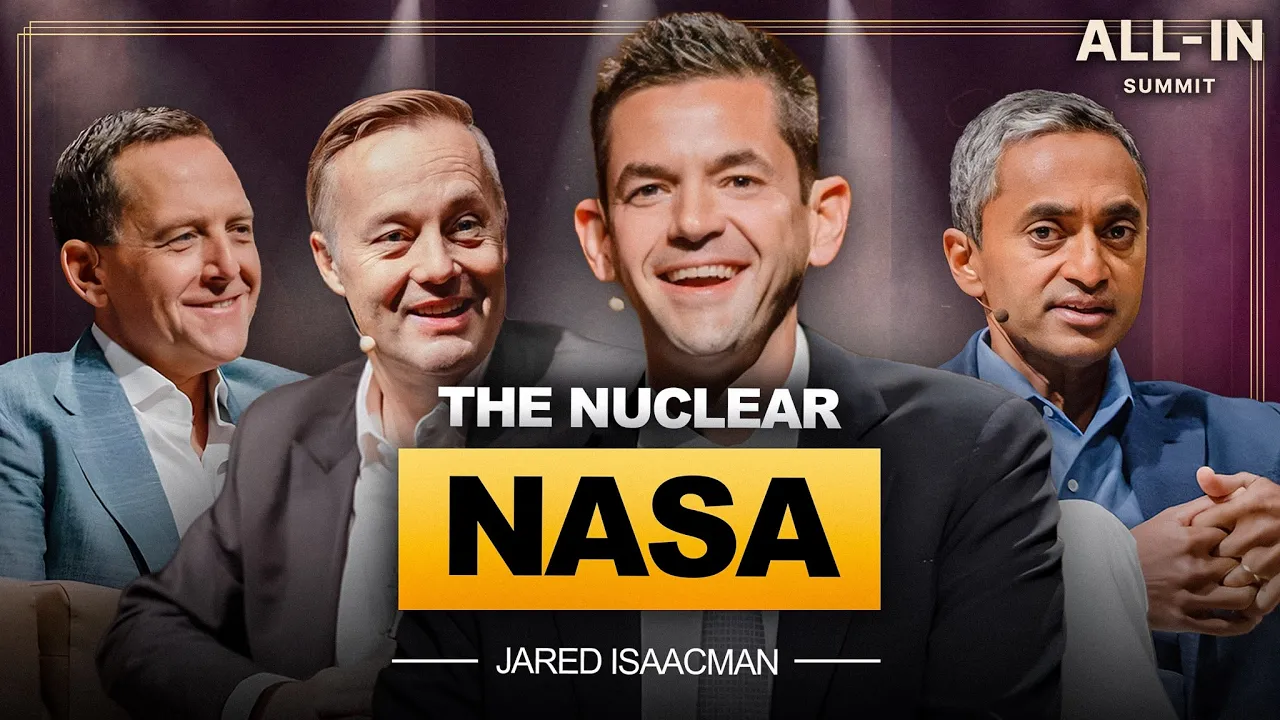
Jared Isaacman: A New Era for NASA and American Space Exploration — All-In Podcast

All-In Podcast

The agency must exit commoditized launch services and redirect its capital toward spaceborne nuclear propulsion to avoid ceding the lunar south pole and deep-space leadership to Beijing.

AI-assisted summary of Jared Isaacman: A New Era for NASA and American Space Exploration — original source. Check the original for full context.

Source published:

Key ideas

  • NASA's operational roadmap targets summer 2027 for Artemis 3's low Earth orbit rendezvous test with SpaceX and Blue Origin landers, followed by Artemis 4 returning astronauts permanently to the lunar surface in 2028. (5:59)
  • NASA plans to inaugurate its "Nuclear NASA" era in 2028 by launching SR-1 Freedom, a 100-kilowatt spaceborne nuclear fission reactor that will transit to Mars and deploy three next-generation radar-equipped rotorcraft. (8:28)
  • Valuable lunar south pole terrain harboring volatile water ice is constrained to an area no larger than Washington, D.C., where China and Russia are actively pursuing a joint nuclear-powered surface research base by 2030. (17:33)
  • Administrator Jared Isaacman asserts NASA's $25 billion budget is sufficient, directing the agency to end subsidies for commoditized commercial launch and focus internal capital strictly on deep-space science, nuclear propulsion, and radical aeronautics. (28:06)

Detailed notes

## Background Published on YouTube by the All-In Podcast on September 18, 2026, this episode features NASA Administrator Jared Isaacman outlining the current state and strategic future of American space exploration. According to the description, the program covers NASA's roadmap to return to the Moon, commercial space expansion, deep-space exploration to Mars, the creation of a 'Nuclear NASA', capital allocation for flagship science, and the geopolitical stakes of Space Race 2.0 against China and Russia.

## TL;DR NASA Administrator Jared Isaacman offers a candid critique of decades of bureaucratic drift at the agency, presenting a streamlined, high-tempo roadmap focused on mission execution and capital efficiency. He outlines the Artemis campaign to build a permanent presence at the resource-rich lunar south pole, followed by the pioneering of a 'Nuclear NASA' that uses spaceborne fission reactors and nuclear electric propulsion to enable sustainable crewed missions to Mars and deep-space probes to ocean worlds. Warning of the existential geopolitical stakes in a renewed space race against China and Russia, Isaacman argues that NASA's $25 billion budget is more than sufficient if the agency stops subsidizing commoditized commercial capabilities and instead focuses on daring, non-commercial frontiers. Throughout the discussion, he emphasizes that retaining elite engineering talent and maintaining deep partnerships with commercial powerhouses like SpaceX are vital to securing American technological leadership.

## Atmosphere & style The presentation blends the urgency of a high-stakes corporate turnaround with the visionary optimism of an Apollo-era mandate, moving from a blunt, hard-hitting keynote into a collegial, energetic fireside chat. Isaacman speaks with the decisive, operational clarity of a seasoned aviator and tech executive, cutting through bureaucratic safe-talk with unvarnished engineering assessments and stark geopolitical realities. The dialogue oscillates between lighthearted stage banter and sober reflection on national pride, leaving listeners with a palpable sense of renewed purpose and techno-optimism for humanity's multiplanetary future.

## Bulletin - [05:59](https://www.youtube.com/watch?v=VTF6p0U98ek&t=359s) NASA's operational roadmap targets summer 2027 for Artemis 3's low Earth orbit rendezvous test with SpaceX and Blue Origin landers, followed by Artemis 4 returning astronauts permanently to the lunar surface in 2028. - [08:28](https://www.youtube.com/watch?v=VTF6p0U98ek&t=508s) NASA plans to inaugurate its "Nuclear NASA" era in 2028 by launching SR-1 Freedom, a 100-kilowatt spaceborne nuclear fission reactor that will transit to Mars and deploy three next-generation radar-equipped rotorcraft. - [17:33](https://www.youtube.com/watch?v=VTF6p0U98ek&t=1053s) Valuable lunar south pole terrain harboring volatile water ice is constrained to an area no larger than Washington, D.C., where China and Russia are actively pursuing a joint nuclear-powered surface research base by 2030. - [28:06](https://www.youtube.com/watch?v=VTF6p0U98ek&t=1686s) Administrator Jared Isaacman asserts NASA's $25 billion budget is sufficient, directing the agency to end subsidies for commoditized commercial launch and focus internal capital strictly on deep-space science, nuclear propulsion, and radical aeronautics.

## Key takeaways - [02:03](https://www.youtube.com/watch?v=VTF6p0U98ek&t=123s) Decades of political logrolling, contract distribution across every congressional district, and 'too big to fail' programming diluted NASA's focus and severely delayed mission timelines. - [02:03](https://www.youtube.com/watch?v=VTF6p0U98ek&t=123s) The Space Launch System (SLS) converts launch mass to trans-lunar payload less efficiently than the 1960s Saturn V, illustrating decades of lost engineering momentum. - [05:59](https://www.youtube.com/watch?v=VTF6p0U98ek&t=359s) Artemis 3 is slated for summer 2027 to validate interoperability in low Earth orbit between SLS, SpaceX, and Blue Origin landers before Artemis 4 attempts a permanent surface return in 2028. - [08:28](https://www.youtube.com/watch?v=VTF6p0U98ek&t=508s) The 'Nuclear NASA' pipeline kicks off in 2028 with the SR-1 Freedom 100 kW fission reactor to Mars, paving the way for high-efficiency Nuclear Electric Propulsion (NEP) to explore outer solar system ocean worlds. - [10:42](https://www.youtube.com/watch?v=VTF6p0U98ek&t=642s) NASA must reserve internal capital for crown-jewel science missions no private entity can fund, including the nuclear-powered Dragonfly octocopter to Titan and Europa Clipper. - [13:07](https://www.youtube.com/watch?v=VTF6p0U98ek&t=787s) A presidential commission has been formed to establish the United States Space Academy to recruit, train, and equip future astronauts, flight controllers, and space nuclear engineers. - [13:07](https://www.youtube.com/watch?v=VTF6p0U98ek&t=787s) Space Race 2.0 with China carries massive geopolitical stakes, where losing the race to the lunar south pole would inflict long-term reputational damage on American technological leadership. - [17:33](https://www.youtube.com/watch?v=VTF6p0U98ek&t=1053s) Strategic real estate at the lunar south pole is tightly constrained, requiring immediate prospecting of permanently shadowed craters that host vital water ice. - [20:22](https://www.youtube.com/watch?v=VTF6p0U98ek&t=1222s) Project Promise will cost-effectively repurpose Curiosity and Perseverance rover flight spares powered by Plutonium-238 to survey freezing, lightless lunar craters. - [23:30](https://www.youtube.com/watch?v=VTF6p0U98ek&t=1410s) Chemical architectures for Mars return missions risk failure due to immense surface propellant refining demands, making Nuclear Electric Propulsion (NEP) essential for continuous round-trip crew transport. - [25:44](https://www.youtube.com/watch?v=VTF6p0U98ek&t=1544s) Workforce retention at NASA depends on abandoning 50-year-old shuttle-derivative maintenance in favor of high-risk, frontier-defining tech like orbital nuclear fission. - [28:06](https://www.youtube.com/watch?v=VTF6p0U98ek&t=1686s) NASA does not face a top-line funding constraint; its $25 billion budget provides ample capital if managed with the disciplined capital allocation of an elite technology company. - [28:44](https://www.youtube.com/watch?v=VTF6p0U98ek&t=1724s) NASA is redirecting its aeronautics division away from subsidizing minor commercial fuel-efficiency tweaks for legacy defense primes and back toward experimental X-planes and novel airframes. - [29:52](https://www.youtube.com/watch?v=VTF6p0U98ek&t=1792s) Human spaceflight remains an irreplaceable cultural imperative, with advanced robotics and edge AI functioning as enablers rather than permanent substitutes for living explorers. - [32:43](https://www.youtube.com/watch?v=VTF6p0U98ek&t=1963s) NASA should purchase commoditized capabilities like satellite launches and Earth observation off the commercial shelf, reallocating savings into deep space exploration. - [37:24](https://www.youtube.com/watch?v=VTF6p0U98ek&t=2244s) SpaceX is NASA's most indispensable operational partner, providing critical crew transport to the ISS, sole science downmass capability, and heavy-lift launch capacity for flagship deep-space telescopes.

## Detailed walkthrough ### [00:00](https://www.youtube.com/watch?v=VTF6p0U98ek&t=0s) Introduction: A New Era and the Convergence of Technological Horizons

The session opens with an announcement welcoming aviator, astronaut, and NASA Administrator Jared Isaacman to the stage. Isaacman frames humanity's cosmic journey as entering a decisive new chapter, declaring that "humankind will not be contained to planet Earth indefinitely" and pointing to nuclear power and propulsion as the next giant leap in American space capability. Addressing the All-In audience, he reflects on the dizzying acceleration of past human achievement: it took merely 65 years to advance from the Wright brothers’ first powered flight at Kitty Hawk to Neil Armstrong and Buzz Aldrin stepping onto the lunar surface. Yet, in the 57 years following Apollo 11, the pace of exploration languished.

That stagnation is now colliding with an unprecedented convergence of deep technologies. Isaacman highlights the simultaneous maturation of artificial intelligence, quantum computing, advanced robotics, additive manufacturing, the promise of commercial fusion energy, life-altering biotechnology, and autonomous transit. This oncoming wave of abundance will fundamentally reshape daily human life, the future of work, warfare, and humanity's ability to "reach out and touch the stars." However, this technological awakening unfolds against the high-stakes backdrop of a modern great-power competition, where geopolitical rivals fully understand that control of the ultimate high ground carries civilizational consequences.

[02:03](https://www.youtube.com/watch?v=VTF6p0U98ek&t=123s) Diagnosing Decades of Bureaucratic Drift and Inefficiency

Isaacman delivers a candid indictment of NASA’s recent past, arguing that without the current administration, acute geopolitical competition, and the clear threat of losing the "second space race," the agency would have remained mired in business-as-usual complacency. For decades, NASA tried to please every congressional district and foreign entity, diluting its resources through performative partnerships that ultimately acted as a drag on execution. He points to several stark symptoms of this institutional malaise: an Orion spacecraft unable to inject directly into low lunar orbit as Apollo did, a canceled Mars Sample Return program that ballooned past the cost of a modern aircraft carrier, and programs deliberately engineered to be "too big to fail" rather than streamlined to succeed.

He draws a sharp contrast with China's rapid rise, noting that when NASA's current heavy-lift rocket architecture was first conceived, China was still running coal-fired locomotives; today, China operates 25,000 miles of high-speed rail and stands only a few years away from its own Apollo 11 moment. By outsourcing, renting out, and shedding core engineering competencies, NASA traded months of potential progress for years of costly delays. The agency drifted into a passive "dream state as a service" contracting posture, shifting impossible programmatic risks onto vendors while producing an SLS moon rocket that is less mass-efficient than the 1960s Saturn V. Between Artemis 1 and Artemis 2, more time elapsed than across the entire 12-flight Gemini program. Billions were poured into stalled nuclear initiatives that had not left a laboratory since 1965, while an orbiting lunar space station threatened to keep astronauts hovering far above prime surface real estate rather than boots-on-the-ground.

```mermaid flowchart TD accTitle: NASA's Pivot from Administrative Drift to Mission Execution accDescr: Diagram illustrating NASA's transition from past bureaucratic inefficiencies to Isaacman's streamlined Artemis and Mars roadmap.

subgraph Drift["The Decades of Inefficiency"] D1["Spreading resources across every district"] D2["Programs structured 'too big to fail'"] D3["Core workforce skills outsourced & rented"] D4["Multi-billion-dollar stalled projects"] end

subgraph Pivot["Strategic Re-alignment"] P1["Clear mission mandate"] P2["Ending performative partnerships"] P3["Urgent, rapid-iteration cadence"] end

subgraph Future["Active Operational Roadmap"] F1["Artemis 3: LEO rendezvous & lander tests (2027)"] F2["Artemis 4: Permanent Lunar surface return (2028)"] F3["SR-1 Freedom: 100 kW fission reactor to Mars (2028)"] end

Drift --> Pivot Pivot --> Future ```

- **Efficiency Paradox**: The modern SLS architecture converts launch mass to trans-lunar payload less efficiently than the Saturn V developed six decades earlier. - **Schedule Disconnect**: The gap between Artemis 1 and Artemis 2 exceeded the duration of the entire 12-mission Gemini program. - **Focus Refusal**: Isaacman explicitly rejected treating NASA as a venture capital fund or market-creation incubator: "I'm not here to be your VC, to entertain your dream or invent new markets... You can take those conversations up with the Department of Commerce."

[05:59](https://www.youtube.com/watch?v=VTF6p0U98ek&t=359s) The Artemis Campaign: From LEO Rendezvous to a Permanent Lunar Outpost

Turning to current operations, Isaacman emphasizes that the successful circumlunar journey of the four Artemis 2 astronauts—who rode 8.8 million pounds of thrust to near-Earth escape velocity—was strictly an opening salvo. Artemis 3 is already in assembly, slated for a rollout to Launch Complex 39B for a wet dress rehearsal tanking test before year's end. Scheduled for flight in the summer of 2027, Artemis 3 will launch on SLS into low Earth orbit for a historic rendezvous with lunar lander test vehicles from SpaceX and Blue Origin. This mission will test direct systems interoperability among the world’s three most powerful rocket architectures, demonstrating how multi-launch campaigns will function and validating operational concepts for follow-on uncrewed test landings.

This testing cadence directly sets the stage for Artemis 4 in 2028, which will return American astronauts to the lunar surface to stay. Rather than waiting years between launches or over-polishing hardware into museum pieces, NASA is adopting an aggressive near-monthly launch tempo to construct humanity's first permanent base at the lunar south pole. The campaign will tackle the direct "science of survival": in-situ resource utilization, surface mobility, habitat construction, logistics, and localized manufacturing. The polar water ice deposits make the moon both an economic and scientific testing ground, serving as the essential rehearsal territory for the subsequent human push to Mars. The entire endeavor will be broadcast live in high definition directly from the lunar surface to leave no doubt of American achievement.

[08:28](https://www.youtube.com/watch?v=VTF6p0U98ek&t=508s) The "Nuclear NASA" and Deep Space Exploration

Looking beyond the Moon, Isaacman unveils the blueprint for a "Nuclear NASA" designed to break decades of stagnation. In 2028, NASA will launch SR-1 Freedom, a 100-kilowatt spaceborne nuclear fission reactor that will depart for Mars. During its transit, the mission will deploy "Skyfall," a specialized payload carrying three next-generation, Ingenuity-class rotorcraft equipped with ground-penetrating radar to prospect subsurface ice reservoirs and survey future human landing zones. This mission initiates a sequential pipeline of nuclear testbeds—SR-2, SR-3, and SR-4—that will push technological limits in high-temperature alloys, advanced power conversion systems, mass-efficient heat radiators, and ultra-high-performance electric propulsion.

These nuclear advancements will enable scientific exploration missions to outer solar system ocean worlds like Enceladus, Europa, and Titan to probe for organic chemistry and signs of alien life. Isaacman envisions this propulsion infrastructure ultimately powering an "American starfleet"—featuring chemically augmented nuclear transfer vehicles operating alongside armadas of commercial Starships to transport crews to Mars and back routinely. Simultaneously, he notes that commercial satellite advances will continue to serve practical missions close to home, continuously tracking Earth's climate, space weather events, and providing real-time data to help mitigate wildfires and natural disasters.

[10:42](https://www.youtube.com/watch?v=VTF6p0U98ek&t=642s) Flagship Science Missions and the New Frontier of Space Industry

Jared Isaacman highlights how NASA’s resources must be directed toward flagship science missions that no other entity on Earth can accomplish. Among these crown jewels is the nuclear-powered Dragonfly octocopter, designed to journey to Saturn’s enigmatic moon Titan in 2028. Dragonfly is powered by a 2-kilowatt Multi-Mission Radioisotope Thermoelectric Generator (MMRTG) that converts heat into just 100 watts of electrical power—barely exceeding an old incandescent light bulb, yet sufficient to explore an alien world. Close behind it, Europa Clipper is slated to arrive at Jupiter’s icy, ocean-bearing moon in 2030. Meanwhile, the Nancy Grace Roman Space Telescope will soon join Hubble and the James Webb Space Telescope in deep space. Equipped with a nearly 300-megapixel widefield instrument and a Jet Propulsion Laboratory-built coronagraph, Roman will observe larger swathes of the universe in a single instant than any prior instrument, capturing imagery of dark matter, dark energy, and tens of thousands of exoplanets with detail so colossal that no display screen on Earth can present an image at full resolution.

```mermaid flowchart TD accTitle: NASA Deep Space Science Pipeline accDescr: Chart showing upcoming flagship missions and their primary target destinations.

subgraph OuterSolarSystem["Outer Solar System Exploration"] A["Dragonfly Octocopter"] -->|"Arrives 2028"| B["Saturn's Moon Titan"] C["Europa Clipper"] -->|"Arrives 2030"| D["Jupiter's Moon Europa"] end

subgraph DeepSpaceAstrophysics["Astrophysics & Planetary Defense"] E["Roman Space Telescope"] -->|"Widefield & Coronagraph"| F["Dark Energy, Dark Matter & Exoplanets"] G["NEO Surveyor"] -->|"Infrared Detection"| H["Hazardous Asteroids & Comets"] end ```

Beyond these cosmic probes, planetary defense instruments like NEO Surveyor will catalog hazardous asteroids and comets that could threaten Earth, while next-generation observatories will search for habitable exoplanets orbiting distant stars. Isaacman emphasizes that the grand space future imagined for generations cannot survive on perpetual taxpayer subsidies alone. Instead, NASA aims to act as a catalyst for a robust private space economy—spanning orbital data centers, commercial space stations, on-orbit additive manufacturing, regolith extraction, and asteroid mining. Revitalizing the foundational "A" in NASA (Aeronautics), the agency is also rebuilding its experimental X-plane fleet, led by the X-59 quiet supersonic aircraft, to push the absolute limits of commercial aviation, advanced airframes, and novel propulsion systems.

- **Dragonfly Octocopter:** Powered by a 2 kW MMRTG yielding 100 W of electrical power; targeted launch/arrival timeline heading to Titan in 2028. - **Europa Clipper:** Scheduled to arrive at Jupiter's icy moon Europa in 2030. - **Roman Space Telescope:** Features a nearly 300-megapixel wide-field camera and a JPL coronagraph designed to survey dark energy, dark matter, and hidden exoplanetary systems. - **Planetary Defense & Aeronautics:** NEO Surveyor tasked with hunting Earth-crossing asteroids and comets; the X-59 quiet supersonic flight demonstrator heads an expanded experimental flight-test program.

---

[13:07](https://www.youtube.com/watch?v=VTF6p0U98ek&t=787s) The United States Space Academy and the Chilling Stakes of Space Race 2.0

Sustaining such rapid expansion across the space frontier requires human capital, prompting the creation of a dedicated pipeline for elite talent. Isaacman references the newly established presidential commission for the United States Space Academy—a federal institution that many have long nicknamed a real-world "Starfleet Academy." Designed to mirror the evolution that gave rise to the U.S. Space Force, this federal academy aims to recruit, train, and equip future astronauts, flight controllers, nuclear propulsion engineers, lunar base operators, and mission commanders headed for Mars.

Turning to the geopolitical urgency facing the nation, Isaacman delivers a blunt, sobering warning about the Artemis program and the renewed race to the Moon. He asks the audience to imagine an astronaut descending a lunar lander ladder, broadcast live in crystal-clear high-definition video to billions of people across the globe—only for the camera to pan upward and reveal that the flag stitched onto the spacesuit is not the Stars and Stripes. In that defining historical moment, Isaacman cautions, the world will not care about congressional districts, contractor lobbying, cost-plus budget overruns, or procedural schedule slips:

> "There will be no footnote explaining that we spent more. No disclaimer that our architecture was complicated. No one will care how many studies we completed, how many meetings we held, what congressional districts benefited, who all the all-star lobbyists were for their hardware... The world will just see who got there."

China has committed to landing taikonauts on the lunar surface by 2030, supported by robotic precursor probes targeting Shackleton Crater at the lunar south pole, a streamlined two-launch mission architecture, and a joint nuclear-powered lunar surface base planned alongside Russia. Should the United States fail to return after spending upwards of $100 billion, Isaacman warns that the geopolitical shockwave will erode allied trust, shift international tech standards, and compromise American technological leadership. Urging an end to complacency and bureaucratic inertia, he demands extreme ownership, competence, and decisive action before concluding his remarks to standing applause.

---

[17:33](https://www.youtube.com/watch?v=VTF6p0U98ek&t=1053s) Stage Banter and the Strategic Reality of the Lunar South Pole

Transitioning from the keynote lectern to the interview chairs, the All-In hosts open with lighthearted banter about the sheer visual spectacle of NASA's portfolio, joking that agencies like the Department of Housing and Urban Development, the IRS, or Social Security could never compete with rocket launches and deep-space telemetry. Isaacman agrees that NASA is uniquely blessed with incredible storytelling material, quipping that he thanks his lucky stars every morning that he does not run the tax collection apparatus.

The conversation quickly pivots into a tactical examination of lunar exploration. When asked whether the Moon is merely an expensive testbed for a future Mars transit or a viable commercial destination in its own right, Isaacman explains that having a celestial body just three days away provides an indispensable proving ground. Decades were spent trying to design replacements for Apollo-era spacesuits; the Moon offers the ultimate crucible to test life support, surface power, radiation habitats, automated robotics, and in situ resource utilization (ISRU). He stresses that human extravehicular activities (EVAs) should actually be minimized on an operational surface base, leaving hazardous construction and raw resource processing to autonomous robotics.

```mermaid flowchart LR accTitle: Lunar South Pole Operational Duality accDescr: Strategic trade-off between illuminated crater rims and permanently shadowed crater floors.

subgraph LunarSouthPole["Lunar South Pole (Area equivalent to Washington, D.C.)"] A["Elevated Crater Rim Cliffs"] -->|"Near-Permanent Sunlight"| B["Continuous Solar Energy Generation"] C["Permanently Shadowed Regions (PSRs)"] -->|"Extreme Cold (< Mars)"| D["Deposits of Volatile Water Ice for ISRU"] end ```

Addressing lunar economics, Isaacman clarifies that while the Commerce Department's Office of Space Commerce oversees commercial markets, NASA's role is to issue a massive demand signal over the next four years—contracting dozens of lunar landers and rovers to spur private innovation in regolith extraction. He points out the harsh geographic realities of lunar real estate: while the total surface area of the Moon rivals the continent of Africa, the critically valuable terrain at the lunar south pole is no larger than Washington, D.C. Within that compact area, steep crater rims provide near-continuous solar illumination, while the adjacent permanently shadowed regions (PSRs)—environments significantly colder and harsher than the surface of Mars—harbor the precious water ice essential for life support and propellant production.

[20:22](https://www.youtube.com/watch?v=VTF6p0U98ek&t=1222s) Project Promise: Prospecting Lunar Craters with Repurposed Hardware

Landing a massive vehicle like SpaceX's Starship on the lunar surface presents severe physical challenges: when an engine that powerful touches down, it will blast out craters and throw high-velocity dust and debris everywhere, making prime landing real estate scarce. To survey these limited spots in advance, NASA is turning to clever, cost-effective hardware repurposing through a rover concept called Promise.

Promise is an SUV-sized, radioisotope-powered rover built originally as a flight spare for the Mars Curiosity and Perseverance rovers. It utilizes decaying Plutonium-238 ($^{238}\text{Pu}$)—a nuclear fuel supply with a finite shelf life that must be utilized before it decays away. Instead of letting that investment spoil or sitting idle in storage, the plan is to mount the $^{238}\text{Pu}$ power source onto Promise and send it straight into the Moon's permanently shadowed regions (PSRs). These frigid, lightless craters destroy solar-powered and battery-reliant hardware within hours, but a nuclear-heated rover can operate indefinitely to prospect for critical water ice and map terrain.

- **Rover Heritage**: Derived directly from the chassis and engineering spares of Mars rovers Curiosity and Perseverance (roughly the physical size of a Jeep). - **Power Source**: Plutonium-238 ($^{238}\text{Pu}$) radioisotope thermoelectric generator (RTG), designed to survive extreme thermal drops inside permanently shadowed craters where standard electronics instantly freeze. - **Cost Efficiency**: Capitalizes on hardware and nuclear material that taxpayers have already funded, turning sunk costs into an active prospecting asset.

---

[21:07](https://www.youtube.com/watch?v=VTF6p0U98ek&t=1267s) Space Race 2.0: Lunar South Pole and NASA's Cultural Turnaround

When asked why claiming the Moon's southern polar region ahead of China is so existential, and what state NASA was in when he took over, Jared Isaacman offers a candid diagnostic of the agency's recent history. NASA has never suffered from a lack of talent—the best engineers and scientists in the nation show up every single day wanting to change the world. However, for decades, "everybody was trying to run NASA other than the people themselves that show up to work there." Political logrolling dictated engineering decisions: spreading contracts across every single congressional district, collecting dozens of foreign flags on joint missions just for diplomatic optics, and turning projects that should cost a couple billion dollars—like Mars Sample Return—into bureaucratic monsters priced "more than an aircraft carrier" until they collapsed under their own weight and were canceled.

Under current leadership, NASA has regained autonomy and realigned squarely around the President's National Space Policy: return to the Moon, establish a permanent base, and operationalize space nuclear power. The urgency is driven by geopolitics. The Moon sits just three days away—the ultimate proving ground for deep space survival—and landing sites around the South Pole's Shackleton Ridge are extremely scarce. China and Russia have already partnered on an International Lunar Research Station powered by a nuclear fission reactor, specifically targeting those exact water-ice deposits. A scrubbed Chinese-Russian launch targeting Shackleton Ridge was a stark reminder of how close the race is; had it landed, it would have locked down prime real estate and triggered immediate domestic panic. If America cedes the Moon, China will capture the ultimate propaganda victory of the century: landing the next Neil Armstrong on Mars and signaling a permanent shift in global leadership.

```mermaid flowchart TD accTitle: Lunar South Pole Competition accDescr: Visual breakdown of the geopolitical competition for lunar landing sites and strategic resources.

subgraph StrategicValue ["Lunar South Pole & Shackleton Ridge"] Ice["Volatile Water Ice Deposits"] Sun["Peaks of Eternal Light"] Base["Prime Real Estate for Permanent Bases"] end

subgraph Competitors ["The Contenders"] US["United States / NASA<br/>Artemis Program & Commercial Partners"] CR["China & Russia Coalition<br/>ILRS Base & Surface Fission Reactor"] end

subgraph LongTermVision ["Next Frontier"] Mars["First Crewed Mars Landing<br/>'Next Neil Armstrong Moment'"] end

US --> StrategicValue CR --> StrategicValue StrategicValue --> Mars ```

---

[23:30](https://www.youtube.com/watch?v=VTF6p0U98ek&t=1410s) Making Mars Realistic: Chemical Limits vs. Nuclear Electric Propulsion

Turning human missions to Mars from science fiction into an operational reality hinges entirely on the physics of transit and return. While chemical heavy-lift launch vehicles like Starship are revolutionary for throwing unprecedented mass into low Earth orbit and putting boots on the Moon, a purely chemical architecture for round-trip Mars voyages introduces massive logistical vulnerabilities. Astronaut habitability and entry velocities are relatively well understood, but the crux of the problem is returning home: lifting off Mars requires massive quantities of propellant manufactured entirely in situ.

Relying exclusively on in-situ resource utilization (ISRU) requires landing football-field-sized solar arrays, maintaining armies of autonomous robots to constantly sweep dust from panels after Martian storms, and running complex chemical refining plants under extreme thermal and atmospheric swings. Isaacman points out that executing a launch countdown at Starbase takes thousands of people under 1G and 1 atmosphere; replicating that with autonomous robots on Mars is a monumental risk. NASA's strategic role is not to duplicate what commercial launch providers have already mastered, but to finance the next giant leap that currently lacks an immediate private business case: spaceborne nuclear fission. Chemically augmented Nuclear Electric Propulsion (NEP) transfer stages could haul crews back and forth between Earth and Mars orbit continuously. Because they rely on high-efficiency noble gases like krypton or xenon rather than chemically synthesized fuel, they eliminate the requirement to build massive surface propellant refineries just to bring the crew home. Furthermore, those exact same high-power nuclear transit systems unlock the outer solar system—enabling flagship science missions to oceanic moons like Europa, Titan, and Enceladus.

- **Chemical Propulsion Constraints**: Excellent for high-thrust Earth departure and initial planetary descent, but penalizes return trips due to heavy surface propellant production requirements. - **ISRU Pitfalls**: Deploying massive solar arrays and dust-clearing robotic fleets on Mars introduces dozens of single-point engineering failures. - **NEP Advantage**: Nuclear fission reactors drive electric thrusters using xenon or krypton, enabling orbital transit vehicles to conduct round-trip journeys without surface refueling. - **Outer Solar System Science**: The high specific impulse of NEP makes long-duration exploration of Jupiter's and Saturn's potentially life-bearing ocean worlds viable.

---

[25:44](https://www.youtube.com/watch?v=VTF6p0U98ek&t=1544s) Retaining Elite Talent and Pioneering the "Nuclear NASA"

Addressing how NASA can attract and retain top-tier aerospace engineers when commercial entities like SpaceX, Blue Origin, Rocket Lab, Stoke Space, and ULA offer fast-paced commercial environments, Isaacman explains that recruiting at the front door has never been an issue. NASA accepts merely 1% of applicants into its Pathways Internship Program, which provides a direct pipeline to civil service careers. The true crisis has always been workforce retention.

If early-career engineers arrive at NASA only to find themselves maintaining 50-year-old Space Shuttle hardware derivatives—systems far less capable for lunar exploration than the Apollo-era Saturn V—they quickly leave for the dynamic environments of the commercial sector. NASA's survival and relevance depend on recognizing when a capability has crossed the commercial threshold. Once launch vehicles and orbital delivery become scalable private business models with multiple commercial customers, NASA must hand those operations off entirely and pivot toward high-risk, frontier-defining tech. Isaacman frames this transition as the birth of the "Nuclear NASA." Just as the USS *Nautilus* revolutionized naval warfare and maritime range as the world's first operational nuclear-powered submarine, NASA's upcoming SR-1 nuclear demonstrator represents the foundational vanguard of an enduring deep-space nuclear fleet.

---

[26:45](https://www.youtube.com/watch?v=VTF6p0U98ek&t=1605s) Primer on Nuclear Electric Propulsion and Deep Space Power

Prompted for an engineering primer on how nuclear fission generates thrust in space, Isaacman walks through the mechanics of electric propulsion compared to thermal systems. Existing orbital infrastructure, such as SpaceX's Starlink satellites, relies heavily on solar-powered Hall-effect ion thrusters. These engines use electricity collected from solar arrays to ionize propellants like krypton or xenon within electromagnetic fields, shooting charged particles out of the thruster bell at staggering exhaust velocities. While this produces very low instantaneous mass flow and gentle thrust, its specific impulse and efficiency are immense.

```mermaid flowchart LR accTitle: Nuclear Electric Propulsion (NEP) Architecture accDescr: Diagram illustrating the conversion of nuclear thermal energy into electric propulsion.

subgraph PowerGeneration ["Nuclear Thermal Generation"] Reactor["Fission Reactor<br/>100 kW to 1 MW+"] Core["High-Temp Core Materials"] Reactor --- Core end

subgraph ConversionCycle ["Power Conversion"] Brayton["Closed Brayton Cycle Unit"] Electricity["High-Voltage Electricity"] Brayton --> Electricity end

subgraph ElectricPropulsion ["Propulsion System"] IonThrusters["Scaled Hall Thrusters<br/>12 kW to 25 kW+"] Exhaust["Ionized Krypton/Xenon<br/>Ultra-High Exhaust Velocity"] IonThrusters --> Exhaust end

PowerGeneration --> ConversionCycle ConversionCycle --> ElectricPropulsion ```

The solar-electric model breaks down in deep space. Beyond the asteroid belt toward Jupiter and Saturn, the inverse-square law reduces sunlight to negligible levels, rendering solar arrays useless for high-power propulsion. Nuclear Electric Propulsion (NEP) overcomes this solar boundary by substituting panels with a compact nuclear fission reactor:

1. **Thermal Core**: The reactor generates high-temperature thermal output, beginning at 100 kilowatts and scaling to 250 kilowatts or multi-megawatt configurations. 2. **Power Conversion**: Heat is converted into electricity via a closed Brayton cycle power conversion unit, requiring advanced high-temperature structural materials to maximize thermodynamic efficiency. 3. **Scaled Ion Thrusters**: The resulting electrical energy powers high-output ion thrusters—scaled from 12 kW to 14 kW and up to 25 kW per unit—providing relentless, constant acceleration across years of interplanetary transit.

---

[28:06](https://www.youtube.com/watch?v=VTF6p0U98ek&t=1686s) Capital Allocation: Why NASA's $25 Billion Budget Is Plenty

When asked about the size of NASA's budget and what he would request in an ideal world, Isaacman pushes back against the persistent narrative that the space agency is underfunded. NASA does not suffer from a top-line budget constraint; it has historically suffered from being a poor capital allocator. Much of that dysfunction was imposed from outside political mandates that forced the agency to subsidize obsolete programs and maintain bloated contractual frameworks.

With a current annual budget of approximately $25 billion, NASA has more than enough capital to achieve historic breakthroughs if funds are directed strictly toward cutting-edge engineering and non-commercial technology frontiers. Pointing out the hundreds of startup founders in the audience, Isaacman notes that private entrepreneurs would achieve incredible feats with a fraction of that balance sheet. NASA's objective now is to allocate its $25 billion with the ruthless focus and capital efficiency of an elite technology enterprise. As the discussion transitions to iconic speed and engineering triumphs, Isaacman glances at an overhead presentation slide featuring a legendary supersonic aircraft, prompting the host to question whether the silhouette on screen is truly an SR-71 Blackbird.

[28:44](https://www.youtube.com/watch?v=VTF6p0U98ek&t=1724s) Revitalizing Aeronautics: Radical Airframes Over Incremental Subsidies

Addressing a slide showing an advanced aircraft concept, Jared Isaacman reminds the hosts that the very first "A" in NASA stands for aeronautics—a foundational portfolio with deep historical roots in both civil aviation and national defense. Groundbreaking breakthroughs enjoyed by modern fighter jets, such as the fly-by-wire and thrust vectoring systems that make an F-22 Raptor perform so spectacularly at air shows, were originally pioneered by NASA research. Over recent decades, however, Isaacman laments that NASA's aeronautics budget was gradually co-opted into subsidizing high Technology Readiness Level (TRL) projects for legacy prime contractors.

He criticizes the status quo where prime defense contractors pressure NASA into footing the bill simply to squeeze a modest 3% fuel efficiency gain out of a 40-year-old legacy engine design. In his view, commercial aerospace primes should self-fund those minor commercial optimizations out of competitive necessity. Instead, Isaacman is redirecting NASA's aeronautics division back toward its core historical mission: pioneering truly radical airframe configurations, advanced aerodynamics, and revolutionary engine concepts.

[29:52](https://www.youtube.com/watch?v=VTF6p0U98ek&t=1792s) The Case for Crewed Exploration in an Era of Robotics

When asked why NASA should continue putting human lives at risk given the rapid emergence of humanoid robotics from companies like Tesla (Optimus) or Figure, Isaacman frames the imperative not as hubris, but as an intrinsic human drive. Exploration is an existential defining trait: humans crossed oceans and scaled the highest peaks because it is our destiny. He argues that the public would never pause their lives to look up in awe at the Artemis II mission swinging around the Moon if the capsule carried only inanimate machines.

While acknowledging that harsh environments—such as extreme radiation fields—require uncrewed robotic probes, Isaacman emphasizes that robots are enablers rather than substitutes for living explorers. Humanity will go to the Moon to establish permanent presence, press forward to Mars, and explore outward into deep space, using advanced robotics as indispensable operational partners along the journey.

```mermaid flowchart TD accTitle: Allocation Strategy Between Human and Autonomous Exploration accDescr: Diagram showing how NASA divides missions between human destiny and robotic or autonomous capabilities.

subgraph Deep_Exploration["Core Exploration Vectors"] A["Human Spaceflight<br/>'Destiny & Inspiration'"] --> B["Artemis Moon Base & Mars"] C["Robotics & AI Systems"] --> D["Extreme Environments<br/>(Radiation, High Pressure)"] end

subgraph Enablers["Autonomous Tech Support"] D --> E["Venus DAVINCI Probe"] D --> F["Next-Gen Mars Helicopters"] C -.->|"Operational Support"| B end ```

[31:01](https://www.youtube.com/watch?v=VTF6p0U98ek&t=1861s) Autonomy, Aviation Safety, and Edge AI on Other Worlds

Addressing civil aviation errors and how autonomy can enhance safety without completely removing human operators, Isaacman highlights NASA's legacy in air traffic modernization. NASA pioneered Automatic Ground Collision Avoidance Systems (Auto-GCAS)—technology that has saved fighter pilots who lose consciousness from pulling excessive G-forces by autonomously detecting ground trajectory and pulling the aircraft to safety. As commercial airspace scales toward millions of autonomous delivery drones carrying medicine and packages, NASA continues to coordinate closely with the FAA on flight automation protocols.

Isaacman extends this autonomous framework directly into planetary exploration, where communications lag or extreme environmental conditions make real-time Earth intervention impossible: - **DAVINCI Venus Mission:** The probe will survive for only a brief window in the crushing, superheated Venusian atmosphere. Onboard algorithms must autonomously process sensory data mid-descent, discarding uninteresting readings and orienting sensors toward novel phenomena to transmit high-value data with its "last dying breath." - **Mars Surface Rovers:** Building on tested edge-AI navigation on Mars, future robotic vehicles will exercise autonomous agency to prioritize scientific observations and direct instrument packages without waiting for ground commands.

[32:43](https://www.youtube.com/watch?v=VTF6p0U98ek&t=1963s) Capital Allocation: Commercial Off-the-Shelf vs. Deep Space Discovery

Turning to NASA's internal capital allocation, Isaacman explains that scientific discovery commands roughly one-third of the agency's total budget. Organizationally, this capital flows through distinct mission directorates: Human Exploration (overseeing the International Space Station and lunar surface bases), Research and Technology (spearheading the ambitious "Nuclear NASA" portfolio), and the Science Mission Directorate.

Isaacman argues that NASA must stop spending internal capital on commoditized capabilities. In sectors like satellite launch, Earth observation, and space-based telecommunications, commercial industry has achieved massive economies of scale. Instead of proprietary builds, NASA should purchase commercial services or license its sensor instruments to private industry for civil and agricultural monitoring. Reallocating those billions allows NASA to finance daring deep-space initiatives that private capital cannot justify—such as a nuclear-powered octocopter exploring Saturn's moon Titan (Dragonfly). He maintains that building the launch craft to harvest novel data from deep space must take financial priority over merely funding institutions to re-analyze existing datasets.

[34:15](https://www.youtube.com/watch?v=VTF6p0U98ek&t=2055s) Nuclear-Powered Mars Aviation: Beyond Ingenuity

The discussion shifts to video footage of advanced rotorcraft operating on the Martian surface, prompting jokes from the hosts that agencies like HUD or the IRS could never produce footage so compelling. Isaacman recounts the trailblazing success of the Ingenuity technology demonstration, which proved controlled aerodynamic flight was possible in Mars's razor-thin atmospheric density—a fractional pressure equivalent to a near-vacuum on Earth.

NASA's follow-up mission dramatically scales up this capability with three next-generation helicopters outfitted with ground-penetrating radar. Crucially, the entire architecture will be delivered via an advanced spacecraft powered by a 100-kilowatt nuclear fission reactor. Slated to launch in 2028, the fission-powered transport will make the journey to Mars in approximately one year before deploying the helicopter array to scan beneath the planetary crust, inaugurating a new paradigm for nuclear exploration across the solar system.

[35:46](https://www.youtube.com/watch?v=VTF6p0U98ek&t=2146s) Space Race 2.0: Sizing Up China and Russia

When questioned about adversarial capabilities—specifically whether Russia's industrial base is depleted by the ongoing war in Ukraine while China copies SpaceX—Isaacman offers a candid appraisal of the geopolitical landscape. While acknowledging the storied history of the Soviet program (which achieved orbit and spacewalk milestones first) and their continued partnership on the ISS, he concedes that Russia's resources are heavily drained by wartime priorities.

China, however, represents a formidable, high-velocity competitor: - **Pragmatic Engineering:** Although Chinese programs lack the sophisticated reusable booster infrastructure perfected by SpaceX, they compensate by brute-forcing heavy payloads into orbit using legacy hypergolic-fueled rockets reminiscent of the American Titan II program. - **Payload Quality:** The hardware, communications arrays, and payloads China places into orbit are exceptionally capable. - **Contested Space Domain:** Citing recent briefings from the Air Force Association (AFA) conference with the Secretary of the Air Force and Space Force leadership, Isaacman underscores that orbital space has become an actively contested theater. - **Sino-Russian Synergy:** Pairing China's rapid manufacturing and orbital deployments with Russian legacy competencies in space nuclear power poses a serious competitive sprint in the race back to the lunar surface.

[37:24](https://www.youtube.com/watch?v=VTF6p0U98ek&t=2244s) SpaceX, the Geopolitical Stakes of Space, and Closing Reflections

The conversation turns to the looming reality of international competition in deep space, specifically China's determined push toward lunar exploration. Jared Isaacman emphasizes that China will undoubtedly reach the Moon and establish a base on the lunar south pole. When asked where the United States would stand relative to China without SpaceX, Isaacman is unequivocal about the company's indispensable position. He underscores that SpaceX is NASA’s most critical launch partner, flatly stating that the agency currently could not transport astronauts to and from the International Space Station without them, nor could they retrieve downmass from orbital scientific experiments. Furthermore, heavy-lift science missions—such as the Nancy Grace Roman Space Telescope designed to unlock the fundamental secrets of the universe—have depended directly on Falcon Heavy launch capabilities. While acknowledging that there are numerous promising commercial space enterprises emerging today, Isaacman warns that without SpaceX's proven operational cadence, the United States would be "seriously challenged in the high ground of space."

```mermaid flowchart TD accTitle: NASA and SpaceX Operational Capabilities accDescr: Diagram illustrating the critical mission dependencies NASA relies on SpaceX to fulfill. subgraph CommercialCapabilities["SpaceX Core Support"] Crew["Crew Dragon<br/>Astronaut Transport to/from ISS"] Cargo["Cargo Dragon<br/>Science Experiment Downmass"] HeavyLift["Falcon Heavy<br/>Deep Space & Science Payloads"] end

subgraph NationalObjectives["NASA Strategic Priorities"] ISS["ISS Continuous Operations"] DeepSpace["Deep Space Science<br/>(e.g., Nancy Grace Roman Telescope)"] Geopolitical["Maintaining Leadership<br/>vs. Lunar Rivals (China)"] end

Crew --> ISS Cargo --> ISS HeavyLift --> DeepSpace ISS --> Geopolitical DeepSpace --> Geopolitical ```

The interview concludes on an appreciative, reflective note. One of the hosts admits to being broadly skeptical of government agencies, yet stresses that NASA occupies a truly irreplaceable mantle for humanity that no private entity or single organization can replicate alone. Praising Isaacman's unique trajectory and leadership, the hosts laud him as an inspiration whose public service offers genuine hope for the country and the broader future of space exploration. Isaacman responds with humble gratitude, reiterating how honored he feels to serve every single day before the hosts exchange parting thanks and remind him to grab his book on the way out.

- **Critical Operational Dependencies**: SpaceX provides NASA's primary means for crew transport to the ISS and serves as the sole mechanism for bringing physical research experiments back from orbit (downmass). - **Major Scientific Launches**: High-priority exploration hardware, including the Nancy Grace Roman Space Telescope, relies on vehicles like SpaceX's Falcon Heavy to head out into deep space. - **Geopolitical Imperative**: Without advanced commercial launch architecture, the United States risks falling behind adversaries like China in securing lunar strategic territory, specifically permanent infrastructure on the Moon's south pole.

## Notable quotes > [00:00](https://www.youtube.com/watch?v=VTF6p0U98ek&t=0s) humankind will not be contained to planet Earth indefinitely — Jared Isaacman

> [00:00](https://www.youtube.com/watch?v=VTF6p0U98ek&t=0s) reach out and touch the stars — Jared Isaacman

> [02:03](https://www.youtube.com/watch?v=VTF6p0U98ek&t=123s) dream state as a service — Jared Isaacman

> [02:03](https://www.youtube.com/watch?v=VTF6p0U98ek&t=123s) I'm not here to be your VC, to entertain your dream or invent new markets... You can take those conversations up with the Department of Commerce. — Jared Isaacman

> [05:59](https://www.youtube.com/watch?v=VTF6p0U98ek&t=359s) science of survival — Jared Isaacman

> [08:28](https://www.youtube.com/watch?v=VTF6p0U98ek&t=508s) American starfleet — Jared Isaacman

> [13:07](https://www.youtube.com/watch?v=VTF6p0U98ek&t=787s) There will be no footnote explaining that we spent more. No disclaimer that our architecture was complicated. No one will care how many studies we completed, how many meetings we held, what congressional districts benefited, who all the all-star lobbyists were for their hardware... The world will just see who got there. — Jared Isaacman

> [21:07](https://www.youtube.com/watch?v=VTF6p0U98ek&t=1267s) everybody was trying to run NASA other than the people themselves that show up to work there. — Jared Isaacman

> [21:07](https://www.youtube.com/watch?v=VTF6p0U98ek&t=1267s) more than an aircraft carrier — Jared Isaacman

> [31:01](https://www.youtube.com/watch?v=VTF6p0U98ek&t=1861s) last dying breath — Jared Isaacman

> [37:24](https://www.youtube.com/watch?v=VTF6p0U98ek&t=2244s) seriously challenged in the high ground of space. — Jared Isaacman

## Mentioned Jared Isaacman, Neil Armstrong, Buzz Aldrin, NASA, All-In Podcast, SpaceX, Blue Origin, Rocket Lab, Stoke Space, United Launch Alliance (ULA), Jet Propulsion Laboratory (JPL), United States Space Force, United States Space Academy, U.S. Department of Commerce, Federal Aviation Administration (FAA), Tesla, Figure, Apollo program, Apollo 11, Saturn V, Gemini program, Space Launch System (SLS), Orion spacecraft, Artemis program, Artemis 1, Artemis 2, Artemis 3, Artemis 4, Starship, Falcon Heavy, Crew Dragon, Cargo Dragon, Starlink, SR-1 Freedom, Skyfall, Dragonfly, Europa Clipper, Nancy Grace Roman Space Telescope, Hubble Space Telescope, James Webb Space Telescope, NEO Surveyor, X-59, Project Promise, Curiosity rover, Perseverance rover, Ingenuity, DAVINCI, International Space Station (ISS), International Lunar Research Station (ILRS), Mars Sample Return, USS Nautilus, F-22 Raptor, SR-71 Blackbird, Titan II, Shackleton Crater, Shackleton Ridge, Lunar South Pole, Moon, Mars, Titan, Europa, Enceladus, Venus, Jupiter, Saturn, China, Russia

## Video description (0:00) NASA Administrator Jared Isaacman lays out the state and future of NASA (17:59) Getting back to the Moon, creating new space industries (23:29) How to make Mars realistic (25:30) Recruiting, moonshots, the "Nuclear NASA," new vehicles and the importance of humans in space (32:43) Allocating capital toward scientific discovery and deep space research (35:46) Space Race 2.0: China and Russia

Thanks to our partners for making this possible!

IREN is a vertically integrated AI Cloud platform, delivering data centers, compute and software for AI training and inference. https://iren.com/

Oracle connects the data, applications, and infrastructure that turn AI into business outcomes—with the flexibility, choice, and control to optimize as AI evolves. http://oracle.com/ai

EY helps tech innovators scale from startup to exit to megacap. You build the future. We’ll handle the rest. http://www.ey.com

Meta believes the future is for everyone. We're focused on giving every person the tools to reach their full potential and making sure the benefits of technology are distributed to all. http://www.meta.com

Keel Infrastructure owns the power, land, and connectivity that HPC and AI run on - backed by secured energy assets and established grid interconnections across North America. https://keelinfra.com/

Airwallex - Agentic Global Business Accounts. Open local accounts in 70+ countries to accept payments, earn yield, pay globally, and manage spend. http://airwallex.com

PayPal has been revolutionizing commerce globally for more than 25 years. Creating innovative experiences that make moving money, selling, and shopping simple, personalized, and secure, PayPal empowers consumers and businesses in approximately 200 markets to join and thrive in the global economy. For more information, visit https://www.paypal.com

Google for Startups connects founders with the right people, products, and best practices to help startups build faster and go further. https://startup.google.com/

Explore ideas, industries, and technologies worth understanding with Chamath every week on Learn with Me: https://research.socialcapital.com/allin

Follow Jared Isaacman: https://x.com/rookisaacman https://x.com/NASAAdmin

Follow the besties: https://x.com/chamath https://x.com/Jason https://x.com/DavidSacks https://x.com/friedberg

Follow on X: https://x.com/theallinpod

Follow on Instagram: https://www.instagram.com/theallinpod

Follow on TikTok: https://www.tiktok.com/@allin

Follow on LinkedIn: https://www.linkedin.com/company/allinpod

Intro Music Credit: https://rb.gy/tppkzl https://x.com/yung_spielburg

#allin #tech #news

[Source](https://www.youtube.com/watch?v=VTF6p0U98ek)

中文简报

NASA艾萨克曼将250亿美元预算转向核动力舰队以击败中国 该机构必须退出商品化的发射服务,将资金转向天基核推进,以避免将月球南极和深空主导权拱手让给北京。 NASA局长Jared Isaacman对该机构数十年来的官僚作风提出了坦率批评,并展示了一份聚焦于任务执行与资金效率的精简、高节奏路线图。他概述了旨在资源丰富的月球南极建立永久存在的Artemis计划,随后将开创“核动力NASA”(Nuclear NASA)时代,利用天基裂变反应堆和核电推进技术实现可持续的载人火星任务以及针对海洋世界的深空探测。在警告美中俄新一轮太空竞赛攸关地缘政治存亡的同时,Isaacman指出,只要NASA停止补贴已实现商品化的商业能力,转而专注于大胆的非商业前沿领域,其250亿美元的预算便绰绰有余。他在讨论中始终强调,留住顶尖工程人才并与SpaceX等商业巨头维持深度合作,对确保美国的技术领导地位至关重要。 NASA 制定了新的月球探索推进路线,计划于 2027 年夏季通过阿尔忒弥斯 3 号(Artemis 3)在近地轨道与 SpaceX 及蓝色起源(Blue Origin)的着陆器开展交会对接测试,并定于 2028 年由阿尔忒弥斯 4 号(Artemis 4)将宇航员永久性送返月球表面。 (5:59) NASA 计划于 2028 年开启“核能 NASA”(Nuclear NASA)时代,发射搭载 100 千瓦天基核裂变反应堆的 SR-1 Freedom 前往火星,并在途中部署三架配备探地雷达的下一代旋翼探测器以勘测地下水冰。 (8:28) 月球南极蕴藏挥发性水冰的高价值区域面积仅相当于华盛顿特区大小,目前中国与俄罗斯正积极推进合作,计划在 2030 年前于该关键区域建立核动力月面科考基地。 (17:33) NASA 局长贾里德·艾萨克曼(Jared Isaacman)强调,机构现有的 250 亿美元年度预算完全充足,未来将终止对已商品化的商业发射进行补贴,将资金严格集中于深空科学、核动力推进及前沿航空技术的突破。 (28:06)

Reading summary

NASA Administrator Jared Isaacman contends that the agency must abandon decades of bureaucratic complacency, programmatic drift, and political logrolling to counter China's rapid advance toward the Moon. He argues that NASA's roughly $25 billion budget is sufficient if the agency relies on private industry for mature capabilities and aggressively pivots toward high-risk frontiers, specifically spaceborne nuclear propulsion and permanent lunar settlement. Overhauling Agency Governance and Capital Allocation (2:03) Isaacman delivers a sharp critique of NASA's recent operational posture, asserting that spreading contracts across congressional districts and preserving programs structured to be "too big to fail" severely degraded execution. As evidence, he points to a canceled Mars Sample Return project that ballooned past the cost of an aircraft carrier, an SLS moon rocket that delivers mass to trans-lunar injection less efficiently than the 1960s Saturn V, and a gap between Artemis 1 and Artemis 2 that exceeded the entire 12-flight Gemini program. To reverse this decline, Isaacman rejects treating NASA as a venture capital incubator or subsidizing mature commercial capabilities, such as paying legacy defense primes to squeeze a 3% fuel efficiency gain from decades-old aviation engines. Instead, he argues NASA should buy commoditized services like low Earth orbit transport and communications directly from private providers, reallocating internal capital with enterprise-grade discipline toward non-commercial engineering frontiers. The Lunar South Pole and Geopolitical Stakes (5:59) Isaacman outlines an accelerated Artemis flight cadence to build humanity's first permanent base at the lunar south pole. Artemis 3 is scheduled to launch on SLS in summer 2027 for a low Earth orbit rendezvous and systems interoperability test with lunar landers from SpaceX and Blue Origin, followed directly by Artemis 4 in 2028 to land astronauts on the surface. To survey scarce real estate cost-effectively, NASA plans to fly Project Promise—an SUV-sized rover repurposing flight spares from the Curiosity and Perseverance rovers and powered by decaying Plutonium-238 ($^{238}\text{Pu}$)—to prospect volatile water ice inside permanently shadowed craters. This schedule is driven by acute competition with China, which has targeted landing taikonauts on the Moon by 2030 and is developing a joint nuclear-powered lunar station with Russia. Isaacman warns that prime landing territory along Shackleton Ridge is limited to an area roughly the size of Washington, D.C., where permanently sunlit crater rims sit adjacent to ice reserves. He stresses that losing this strategic foothold would deliver an unprecedented propaganda victory to adversaries and erode American global technological leadership. Operationalizing Nuclear Fission for Deep Space Transit (8:28) Looking toward Mars, Isaacman argues that relying exclusively on chemical propulsion and surface in-situ resource utilization (ISRU) creates severe logistical vulnerabilities. Replicating the labor-intensive countdown and propellant-refining operations of Starbase using autonomous robots to sweep Martian dust from massive solar arrays introduces compounding failure risks for human return voyages. To overcome chemical limits, Isaacman proposes the "Nuclear NASA" architecture based on Nuclear Electric Propulsion (NEP). Beginning in 2028 with SR-1 Freedom—a spacecraft powered by a 100-kilowatt fission reactor that will deploy three next-generation "Skyfall" radar rotorcraft to Mars—NASA plans a sequential testbed pipeline (SR-2 through SR-4). Utilizing closed Brayton cycles and scaled ion thrusters powered by krypton or xenon, these systems are intended to support continuous round-trip orbital transits without Martian surface refueling, while extending high-power scientific probes to ocean worlds like Europa, Titan, and Enceladus. Flagship Science, Autonomy, and Commercial Dependencies (10:42) Isaacman emphasizes that NASA must reserve its scientific capital for high-complexity deep space exploration that commercial markets cannot justify. Key priorities include the nuclear-powered Dragonfly octocopter launching to Saturn's moon Titan in 2028, Europa Clipper arriving at Jupiter in 2030, the nearly 300-megapixel Nancy Grace Roman Space Telescope, and planetary defense instruments like NEO Surveyor. For environments with extreme communication latency or hazardous conditions, such as the DAVINCI probe descending into Venus, edge AI is being integrated to process and prioritize data collection autonomously before craft destruction. While framing human spaceflight as an essential civilizational drive, Isaacman emphasizes that autonomous robotics should serve as operational enablers rather than human replacements. Crucially, he underscores NASA's deep operational reliance on SpaceX, stating that the agency cannot currently ferry crew to the International Space Station, retrieve research downmass, or launch flagship science platforms like the Roman telescope without SpaceX's operational fleet, warning that the U.S. space posture would be severely compromised without this commercial partnership. Isaacman's strategic pivot hinges on achieving unprecedented launch tempos and rapid technology transitions, particularly deploying operational spaceborne fission by 2028. However, the agency's success ultimately depends on whether NASA can overcome decades of ingrained procurement inertia and whether commercial partners can deliver untested lunar landers and nuclear systems before China secures the lunar south pole.

精炼阅读摘要

NASA局长Jared Isaacman指出,面对与中俄展开的新一轮太空竞赛,NASA必须打破长达数届的官僚积弊与利益均摊模式,将约250亿美元的年度预算重新聚焦于商业资本无法承担的前沿技术,尤其是空间核动力推进系统与深空旗舰科学探测,以确保美国在月球南极及火星建立持久的战略主导地位。 破除官僚积弊与重塑资本分配逻辑 (2:03) Isaacman直言不讳地批评NASA近几十年的机构惯性,指出该机构此前为了讨好各个国会选区和国际伙伴,将资源过度稀释在形式主义的合作中,并形成了“大而不倒”的低效项目机制。他列举的典型症状包括:火星样本取回计划预算膨胀至超过一艘现代航空母舰的建造成本,现代SLS火箭的有效载荷转化效率低于60年前的土星5号,阿耳忒弥斯1号与2号之间的间隔时间甚至超过了整套双子座计划的12次飞行周期。通过外包核心工程能力,NASA陷入了被动的承包商依赖。 针对预算争议,Isaacman强调NASA并没有总预算不足的问题,现有的约250亿美元年度预算若能以技术企业的严谨度高效分配则完全充足。他明确拒绝将NASA视作风险投资基金或孵化器,主张将卫星发射、近地遥感与通信等已具备商业化规模的领域彻底交由私营企业运作,停止出资补贴传统主承包商对40年老旧发动机仅3%燃油效率的微调,将宝贵资金集中投向颠覆性机体(如X-59静音超音速验证机)与非商业性的前沿工程。 阿尔忒弥斯月球部署与极地战略资源 (5:59) 在重返月球的执行节奏上,Isaacman表示阿耳忒弥斯2号的载人绕月只是起点,阿耳忒弥斯3号预计于2027年夏季发射进入近地轨道,与SpaceX和Blue Origin的月面着陆器开展对接演练,验证三大重型火箭系统的协同运作与多发任务架构。这套测试序列将直接支撑2028年阿耳忒弥斯4号任务,届时美国航天员将重返月球表面,并启动高频次的月面基础设施建设。 Isaacman强调,月球是距离地球仅三天路程的绝佳深空生存试验场。月球南极具备战略价值的核心区域实际仅与华盛顿特区相当,峭壁边缘拥有近乎永久的光照可供太阳能发电,而相邻且环境比火星地表更为极端的永久阴影区(PSR)则蕴藏着宝贵的水冰资源。为探明有限的着陆点并勘测水冰,NASA计划启动“Promise项目”,利用火星“好奇号”与“毅力号”遗留的SUV大小备用底盘及正在衰变的有期限钚-238(Pu-238)同位素热电源,研制出能在极低温与无光环境中长期作业的核动力探测车。 太空竞赛2.0的地缘博弈与外部依赖 (13:07) Isaacman警示称,美国正面临极为严峻的地缘政治挑战。中国已公开承诺在2030年前实现航天员登月,并与俄罗斯联合规划由表面核反应堆供电的国际月球科研站(ILRS),其无人探测器正直接瞄准沙克尔顿陨石坑等南极关键区域。Isaacman警告,如果美国在耗费超1000亿美元后无法率先返回月球,国际信任与技术话语权将发生深刻动摇。尽管俄罗斯资源受到乌克兰战事的严重消耗,但其在深空核动力领域的历史积淀若与中国的规模化制造及高频部署相结合,将构成巨大的竞争压力。 与此同时,Isaacman坦承商业航天特别是SpaceX对维持美国太空优势具有不可替代的作用。他明确指出,若缺乏SpaceX的常态化发射能力,NASA目前既无法完成国际空间站的人员轮换(龙飞船),也无法运回轨道科研载荷,甚至连罗曼太空望远镜等旗舰科学任务也依赖猎鹰重型火箭。失去这种发射节奏支持,美国在争夺太空战略制高点时将面临严重挑战。 打造“核动力NASA”与深空科学边疆 (8:28) 针对载人火星任务,Isaacman认为纯化学推进架构存在重大后勤缺陷:仅依靠火星表面的原位资源利用(ISRU)制造返程推进剂,需要铺设足球场规模的太阳能板并依赖机器人除尘,工程故障风险极高。为此,NASA正全面转向“核动力NASA”战略,开发基于闭式布雷顿循环与氪/氙工质的大功率核电推进(NEP)系统。按计划,NASA将于2028年发射搭载100千瓦裂变反应堆的SR-1 Freedom试验飞船前往火星,并携带配备探地雷达的三架下一代火星直升机勘测地下水冰。 核技术突破还将直接赋能深空科学探索。采用2千瓦同位素温差发电机(提供100瓦电能)的蜻蜓号(Dragonfly)八旋翼探测器定于2028年飞往土卫六泰坦;欧罗巴快船(Europa Clipper)定于2030年抵达木卫二;配备近3亿像素宽幅相机的罗曼太空望远镜将用于研究暗能量与系外行星。Isaacman指出,在辐射或超高压极端环境下,诸如金星DAVINCI等探测器将深度结合边缘人工智能算法,在极限生存时间内自主处理并回传高价值科学数据。 Isaacman为NASA设定了摆脱官僚束缚、向核推进技术与深空前沿全面转型的激进路线。然而,该战略能否如期在2027至2028年取得实质突破,不仅取决于商业合作伙伴着陆器与空间核反应堆的工程交付能力,还面临着能否在政治干预与承包商游说压力下长期维持严格资本纪律的现实考验。

Detailed notes — zh

## Background 该视频由知名科技商业播客《All-In Podcast》于 2026 年 9 月 18 日发布在 YouTube 平台。视频简介显示,新任 NASA 局长贾里德·艾萨克曼(Jared Isaacman)在此次大会上发表专题演讲并接受访谈,系统阐述了 NASA 的现状与未来战略、重返月球与建立永久基地的路线图、迈向火星的可行方案、“核能 NASA”与前沿飞行器的重启、深空科研资本配置,以及应对中俄新一轮太空竞赛的关键举措。 ## TL;DR 艾萨克曼直言 NASA 过去因过度迎合政治选区和官僚推诿而丧失了工程效率,宣布 NASA 必须彻底停止充当商业风投,全面回归阿波罗式的工程执行力与极度负责精神。按其全新规划,NASA 将在 2027 年借助阿耳忒弥斯 3 号完成全球推力最强火箭与飞船系统的轨道对接,并在 2028 年通过阿耳忒弥斯 4 号重返月球建立永久基地,全力抢占资源极其稀缺的月球南极阵地。此外,NASA 正式迈入“核能 NASA”时代,将于 2028 年发射配备裂变反应堆的 SR-1 自由号火星验证飞船,并利用核电推进(NEP)构筑深空远征舰队。艾萨克曼强调,NASA 必须将 250 亿美元预算从已成熟的商业航天赛道剥离,全力聚焦于民营资本无法涉足的深空探索与尖端科学旗舰任务,确保美国在第二次太空竞赛中牢牢守住终极战略制高点。 ## Atmosphere & style 整场演讲与对话洋溢着硅谷务实创业精神与国家深空战略碰撞出的昂扬锐气,艾萨克曼以兼具试飞员与企业家的干练气场彻底打破了传统官僚的说辞套路,语言犀利直接且毫不掩饰地道出体制沉疴。面对中俄探月步步紧逼的现实冲击,现场弥漫着如临大敌的竞争紧迫感,但在谈及人类重返月表、核动力穿梭舰队与深空未知宿命时,又涌动着宏大浪漫的历史使命感。主持人的机智调侃与艾萨克曼清晰严谨的技术拆解相得益彰,伴随着现场震撼的科幻概念展示与关于资本配置效率的深度思辨,为观众营造出一场既热血澎湃又极具实干定力的高维思想盛宴。 ## Bulletin - [04:30](https://www.youtube.com/watch?v=VTF6p0U98ek&t=270s) NASA 局长贾里德·艾萨克曼宣布全面改革机构定位,彻底终止“讨好所有国会选区”的官僚分配与 VC 式商业孵化模式,将资源全力聚焦于阿耳忒弥斯登月计划与深空核动力探索。 - [05:59](https://www.youtube.com/watch?v=VTF6p0U98ek&t=359s) 阿耳忒弥斯 3 号加速推进并计划于 2027 年夏季在轨对接检验互操作性,阿耳忒弥斯 4 号定于 2028 年重返月球表面,目标在月球南极建立永久驻留基地以抢占极其稀缺的水冰资源着陆点。 - [08:28](https://www.youtube.com/watch?v=VTF6p0U98ek&t=508s) NASA 正式重启“核能 NASA”(Nuclear NASA)时代,计划于 2028 年发射搭载 100 千瓦裂变反应堆的 SR-1 自由号探测火星,并全面押注化学增强型核电推进(NEP)以破解地火往返与外太阳系深空探索瓶颈。 - [13:07](https://www.youtube.com/watch?v=VTF6p0U98ek&t=787s) 白宫已批准筹建联邦级“美国太空学院”,以系统性培育面向月球基地、核动力航天器及深空指挥任务的专业技术军官与工程团队。 - [37:24](https://www.youtube.com/watch?v=VTF6p0U98ek&t=2244s) 艾萨克曼直言面对中俄联合探月的激烈竞争,世界只会记住谁先登顶,并明确指出若失去 SpaceX 的载人、下行及重型发射能力,美国在太空战略制高点的领导地位将面临严峻危机。 ## Key takeaways - [00:00](https://www.youtube.com/watch?v=VTF6p0U98ek&t=0s) 当前正处于人工智能、量子计算、机器人、核聚变与增材制造等多技术交汇的奇点时刻,深空探索迎来跨越式变革期。 - [01:42](https://www.youtube.com/watch?v=VTF6p0U98ek&t=102s) NASA 过去长期陷入将预算平均拆分至国会各选区及外包核心工程能力的体制泥潭,导致 SLS 研制周期与成本失控、火星取样任务因预算超航母而下马。 - [04:30](https://www.youtube.com/watch?v=VTF6p0U98ek&t=270s) NASA 确立全新施政准则:拒绝扮演风险投资人(VC)为商业航天试错买单,成熟业务移交商业界或商务部,自身专注阿波罗式的国家使命。 - [05:59](https://www.youtube.com/watch?v=VTF6p0U98ek&t=359s) 阿耳忒弥斯 3 号将于 2027 年夏季在近地轨道验证 SLS 与蓝色起源、SpaceX 着陆器的三方交会对接,阿耳忒弥斯 4 号将于 2028 年实现载人落月并开建永久基地。 - [19:47](https://www.youtube.com/watch?v=VTF6p0U98ek&t=1187s) 月球南极资源极其稀缺且地形狭小,永久阴影区(PSR)的水冰与周边长光照峭壁构成战略咽喉,是中美太空竞赛争夺的核心焦点。 - [20:22](https://www.youtube.com/watch?v=VTF6p0U98ek&t=1222s) NASA 启动 Promise 漫游车计划,盘活原有好奇号与毅力号的备份底盘及库存衰变钚-238(Pu-238)同位素热源,用于深入月极极寒阴影区勘探水冰。 - [23:30](https://www.youtube.com/watch?v=VTF6p0U98ek&t=1410s) 火星探索的核心瓶颈在于返航推进剂制备,纯依靠火星地表 ISRU 风险过高,NASA 押注核电推进(NEP)地火穿梭机作为破局方案。 - [26:42](https://www.youtube.com/watch?v=VTF6p0U98ek&t=1602s) NASA 每年坐拥 250 亿美元预算,核心问题是过去缺乏资本配置效率,未来将通过把成熟发射与遥感外包给商业航天,腾出资金用于无人敢投的深空核动力探索。 - [28:44](https://www.youtube.com/watch?v=VTF6p0U98ek&t=1724s) NASA 正在重振航空(Aeronautics)传统,叫停为老旧发动机微幅能效提升买单的高 TRL 补贴,全面转向颠覆性机体构型与极限飞行器试飞。 - [29:52](https://www.youtube.com/watch?v=VTF6p0U98ek&t=1792s) 人类宇航员代表着文明探索的本质与宿命,先进机器人与 AI 将作为极端环境勘测的最强辅助,两者互为支撑而非相互替代。 - [31:01](https://www.youtube.com/watch?v=VTF6p0U98ek&t=1861s) 金星 DAVINCI 任务与未来深空探测器将高度集成边缘 AI 决策,在极端恶劣且无实时通信窗口的极限环境下自主筛选并回传高价值科研数据。 - [34:15](https://www.youtube.com/watch?v=VTF6p0U98ek&t=2055s) 2028 年火星核动力任务将由 100 kW 裂变动力飞船搭载 3 架配备探地雷达的新型无人直升机,执行浅地表地质与地下水冰探测。 - [35:46](https://www.youtube.com/watch?v=VTF6p0U98ek&t=2146s) 中国具备极强的工程执行力与过硬的在轨硬件实力,其简洁的载人登月双发射架构与月极基地方案对美国构成了实实在在的紧迫挑战。 - [37:24](https://www.youtube.com/watch?v=VTF6p0U98ek&t=2244s) SpaceX 在空间站人员轮换、实验样本下行回收以及旗舰科研望远镜发射中扮演了不可替代的基石角色,是美国维系太空优势的核心支柱。 ## Detailed walkthrough ### [00:00](https://www.youtube.com/watch?v=VTF6p0U98ek&t=0s) 引言与汇聚的科技奇点 大会现场在引擎点火倒计时的背景音中拉开帷幕。主持人隆重介绍了新任美国宇航局(NASA)局长贾里德·艾萨克曼(Jared Isaacman),强调让一名兼具飞行员与宇航员身份的实干家执掌 NASA 的非凡意义。艾萨克曼在热烈的掌声中登台,向在场观众问好,并指出人类绝不会被永远限制在地球之上,核动力与核推进将是人类迈向深空的下一次能力飞跃。 艾萨克曼回顾了人类探索史上的惊人跨度:从莱特兄弟(Orville and Wilbur Wright)完成人类首次动力飞行,到尼尔·阿姆斯特朗(Neil Armstrong)与巴兹·奥尔德林(Buzz Aldrin)踏上月球表面,仅仅用了 65 年;然而自阿波罗 11 号(Apollo 11)登月至今的 57 年里,深空探索的进展却长期处于相对缓慢甚至乏善可陈的平淡状态。不过,当下正处于多个前沿技术同时爆发的奇点时刻——人工智能(AI)、量子计算、机器人、增材制造、可控核聚变能源、旨在治疗残疾的生物科技、自动驾驶交通等众多领域的“物质极大丰饶”(abundance)正在剧烈交织汇聚。这种技术融合的深度与广度远超大多数人的理解,将彻底重塑人类的生活、工作、战争模式,以及人类触碰星空的方式。 ### [01:42](https://www.youtube.com/watch?v=VTF6p0U98ek&t=102s) 大国竞争的倒逼与 NASA 过去的体制沉疴 艾萨克曼直言,这场探索旅程并非由美国独行,当今世界正处于激烈的大国竞争之中,而太空正是风险最高、后果最深远的“终极战略制高点”。他毫不客气地指出,如果没有现任总统的领导、地缘政治竞争的紧迫感以及“极有可能在第二次太空竞赛中落败”的真实危机,NASA 几乎不可能主动做出痛苦的变革。过去很长一段时间里,NASA 陷入了“试图讨好所有人”的泥潭:资源被过度分散至各个选区和项目,大量为了合作而合作的国际与企业伙伴关系非但没有加速进度,反而沦为拖累任务推进的沉重包袱。 这种官僚机制和自缚手脚导致了一连串令人震惊的低效恶果: - 猎户座飞船(Orion spacecraft)耗费巨资,却无法像半个世纪前的阿波罗任务那样直接切入近月轨道(Low Lunar Orbit)。 - 上一届政府被迫取消了火星样本取回任务(Mars Sample Return),因为该项目的预算膨胀到“比造一艘航空母舰还要昂贵”。 - 过去打造的项目往往变成了“大到不能倒、贵到无法真正成功”,仅仅是为了跨越不同总统任期苟延残喘。当年的登月火箭(SLS)构思于中国主要依靠燃煤机车的年代,如今该火箭终于具备初步作战能力时,中国已拥有超过 25,000 英里的高速铁路网,且距离他们自己的“阿波罗时刻”仅剩数年之遥。 - NASA 过去将核心专业能力和数万名员工外包、租赁或直接流失,导致原本数月就能攻克的难关拖延数年,成本成倍激增。 由于放弃了以往行之有效的经典工程方法,NASA 转而发明了某种所谓“梦境即服务”(dream state as a service)的推诿模式,将难以承受的工程负担转嫁给外部供应商。最终的讽刺现状是:如今建造的登月火箭在将起飞质量转化为奔月有效载荷的效率上,甚至不如 60 年前的土星 5 号(Saturn V);阿耳忒弥斯 1 号(Artemis 1)与阿耳忒弥斯 2 号(Artemis 2)之间相隔的时间,竟比 60 年前全部 12 次双子座计划(Gemini)任务的时间跨度还要长;规划中的月球轨道空间站(Gateway),充其量只能让宇航员在高空“俯视”最有开发价值的月球黄金地段,而不是在月表扎根落户;此外,还有常年停摆的 X 系列实验飞机,以及自 1965 年以来耗资数十亿美元却从未走出实验室的失败核动力项目。 ```mermaid flowchart TD accTitle: NASA past structural problems vs reform approach accDescr: Comparison between NASA historical issues of budget diffusion and the new focused mission execution strategy. subgraph PastPath["历史沉疴:讨好所有人的推诿模式"] A["预算撒胡椒面 / 迎合各选区"] --> B["机制臃肿与外包流失核心工程能力"] B --> C["SLS 研发周期拉长 / 成本失控"] C --> D["缺乏直达月表的实干工程进展"] end subgraph ReformPath["改革方向:聚焦关键工程与实干胜率"] E["明确使命与削减边缘合作"] --> F["重聚核心能力 / 拒绝充当 VC"] F --> G["高频次发射验证与月表扎根"] G --> H["核动力推进与火星远征能力"] end ``` ### [04:30](https://www.youtube.com/watch?v=VTF6p0U98ek&t=270s) 全新施政准则:拒绝当风险投资人,聚焦登月战略 艾萨克曼指出,第一次太空竞赛时美国起步落后但最终大获全胜,而这一次与对手的差距将被咬得极紧。自去年出任 NASA 局长以来,他做出了坚决的路线切断:彻底终止“试图让每个人都开心”的做派,不再将每一分钱拆分给各个选区,也不会毫无原则地为了面子工程拉拢所有国际伙伴。 他向整个航天业界发出了极具冲击力的宣言:他来到这个职位绝不是为了金钱、头衔、政治名望或给特定私营公司输送利益,更不是来给硅谷和商业航天创业者充当风险投资人(VC)去“为各种商业幻想买单或孵化新市场”。凡是与国家赋予的核心探索使命产生哪怕一丝偏离的诉求,相关企业完全可以“去找商务部谈”。NASA 当前的唯一聚焦点是贯彻执行特朗普总统的国家太空政策,释放美国工业界与自身顶尖人才的合力,重新拿回“属于阿波罗时代的统治力与胜率”,让美国宇航员重返月球。 ### [05:59](https://www.youtube.com/watch?v=VTF6p0U98ek&t=359s) 阿耳忒弥斯 3 号加速与 2028 年月球永久基地部署 在战术推进方面,艾萨克曼强调载人绕月飞行的阿耳忒弥斯 2 号仅仅是序幕。当时四位获得国会太空荣誉勋章(Congressional Space Medal of Honor)的宇航员顶着 880 万磅的惊人推力加速至近第二宇宙速度,完成了人类历史上最遥远的绕月深空航行。NASA 绝不会再等待三年才进行下一次发射,也绝不会把每枚火箭当成需要反复打磨的“艺术品”。 当前,阿耳忒弥斯 3 号(Artemis 3)的组装工作正以超出所有人预期的节奏推进。NASA 计划在年底前将其运往 39B 发射工位(LC-39B)进行加注合练测试(tanking test),以此向全球展示 NASA 重归紧迫节奏的决心。后续的具体行动蓝图规划如下: - **2027 年夏季**:阿耳忒弥斯 3 号将由 SLS 运载火箭发射入近地轨道,在轨道上与蓝色起源(Blue Origin)和 SpaceX 的月面着陆器验证飞船进行交会对接。这将是全球推力最强的三大火箭与飞船系统的首次联合展示,旨在全面检验多发射协同架构与系统互操作性,为后续的无人着陆测试铺平道路。 - **2028 年**:启动阿耳忒弥斯 4 号(Artemis 4),美国宇航员将重返月球表面,且“这一次去就是为了留下来”(this time to stay)。 - **月表永久基地**:同步建立人类在另一星球上的首个前沿基地。NASA 放弃一蹴而就的纸面构想,重拾阿波罗式的渐进工程迭代,维持几乎每月一次的高频次发射节奏,专攻“生存科学”(science of survival)。这涵盖了自动驾驶与载人漫游车、地表工程改造、就地资源利用与制造(ISRU)、深空后勤补给、居住舱生命保障、能源网络、深空通信等。官方甚至将通过高清直播向全世界公开月球基地的建设全过程。而抢占拥有丰富水冰资源的月球南极,不仅关乎科学考察,更是将其作为通往终极目标——火星的工程技术试验场。 ### [08:28](https://www.youtube.com/watch?v=VTF6p0U98ek&t=508s) “核能 NASA”的重启与火星舰队愿景 转向深空核心动力,艾萨克曼宣布彻底告别数十年来耗费巨资却停滞不前的旧体制,正式迈入“核能 NASA”(Nuclear NASA)时代。 - **2028 年发射“SR-1 自由号”(SR-1 Freedom)**:搭载一台 100 千瓦裂变反应堆,标志着美国核动力航天进入实战阶段。该任务在飞掠火星过程中将释放代号为“天降”(Skyfall)的探测系统,内含 3 架“机智号”级别(Ingenuity-class)的新一代火星直升机,配备探地雷达以侦察火星地下水冰储量并圈定未来的火星降落场。 - **后续深空探测路线图(SR-2、SR-3、SR-4)**:NASA 将把自身人员和研发设施重新对准那些“没有明确商业模式、任何单一商业公司或国家目前都无法独立实现”的极高难度任务。借助耐高温材料、更高转换效率的热电系统、轻量化辐射散热器以及高性能电推进技术,探索土卫二(Enceladus)、木卫二(Europa)和土卫六(Titan)等富含地下液态海洋和复杂化学成分的外太阳系卫星,寻找地外生命的线索。 - **火星载人舰队构想**:未来的远征架构将依托化学能与核动力混合推进的深空转移飞船,组成属于美国的“星际舰队”(American Starfleet),在 Starship 等大型航天器编队的协同保障下,运送宇航员安全降落火星表面并往返地球。 - **地球观测应用**:与此同时,借助高度批量化制造的商业卫星星座,NASA 将以更低成本深化对地球气候系统、太阳活动及空间天气的监测,全方位提升极端天气预测及野火等自然灾害的应急响应能力。 ### [10:42](https://www.youtube.com/watch?v=VTF6p0U98ek&t=642s) 旗舰科学任务与新一代深空望远镜 NASA 正在腾出宝贵资源,聚焦于那些唯有国家级机构才能承担的旗舰级科学探索任务。在深空探测领域,核动力旋翼机蜻蜓号(Dragonfly Octocopter)仅依靠一台 2 千瓦的放射性同位素热电发生器(MMRTG)驱动,虽然转换出的电力仅有 100 瓦左右——"勉强比一颗旧灯泡亮一点"——却足以支撑它在 2028 年启程前往土星的最大卫星土卫六(Titan)。与此同时,欧罗巴快船(Europa Clipper)也正朝着木星的冰冷卫星进发,预计于 2030 年抵达目的地。 在空间观测方面,继哈勃(Hubble)与詹姆斯·韦伯(James Webb)之后,南希·格雷斯·罗曼太空望远镜(Nancy Grace Roman Space Telescope)即将升空。它搭载了近 3 亿像素的宽视场仪器以及由喷气推进实验室(JPL)制造的日冕仪。罗曼望远镜一旦在太空中睁开双眼,单次观测所捕获的宇宙视野将超越以往人类送入太空的所有科学仪器。它将全面探索暗能量与暗物质的本质,揭示隐藏在遥远恒星背后的数万个系外世界,其回传的高清图像细节丰富到"地球上没有任何一块屏幕大到足以完整呈现"。此外,近地天体巡天者(NEO Surveyor)将负责搜寻威胁地球的小行星和彗星,而后续的新一代望远镜则将全力寻找绕外星运转的宜居行星。 - **蜻蜓号(Dragonfly)**:计划于 2028 年发射前往土卫六(Titan),依靠仅产生约 100 瓦电能的 MMRTG 系统执行跨天体飞行探测。 - **欧罗巴快船(Europa Clipper)**:预定于 2030 年抵达木星系统,探寻木卫二冰层之下的生命潜能。 - **罗曼太空望远镜(Roman Space Telescope)**:配备近 3 亿像素宽视场成像仪,用于测定暗物质、暗能量并发现数以万计的系外行星。 - **近地天体防御与宜居探测**:NEO Surveyor 致力于近地天体预警防御,后续望远镜则锁定系外宜居带行星。 ### [12:05](https://www.youtube.com/watch?v=VTF6p0U98ek&t=725s) 点燃太空经济生态与重振 X 系列实验机群 过去数十年的经验表明,如果人类对太空的憧憬完全依赖纳税人无限期兜底,儿时的太空梦想便永远无法成真。NASA 绝非要凭借行政力量强行催生某种经济模式,而是在推进自身任务的同时充当催化剂,"竭尽所能去点燃它"。依托发射、对地观测与卫星通信等已成熟的市场,未来的轨道经济乃至月球经济将拓展至轨道数据中心、商业空间站、在轨制造、月壤(Regolith)资源开采以及小行星采矿等前所未见的崭新产业形态。 为了兑现机构全称中第一个字母“A”(Aeronautics,航空)的使命,NASA 正在全力重组其 X 系列实验机群。静音超音速验证机 X-59 只是这场航空复兴的开端。NASA 正重新深化对高风险飞行测试的承诺,与工业界紧密协作,不断推高机体气动与动力推进的工程极限,誓要让 NASA 的飞行器在极短时间内重返数十年前曾达到的极速与极高领域,并实现前所未有的技术超越。 ### [13:07](https://www.youtube.com/watch?v=VTF6p0U98ek&t=787s) 筹建美国太空学院:构筑未来的“星际舰队” 太空边疆的急剧拓展急需专业人才的支撑。为了引领这场变革,总统已正式下令成立筹备委员会,着手建立美国太空学院(United States Space Academy)。这是一所由 NASA 设立的联邦级专业院校,许多人已经形象地将其比作现实版"星际舰队学院"(Starfleet Academy)。 正如太空领域的演变催生了美国太空军(Space Force)一样,面向长远未来的基础设施同样需要相匹配的人才培养体系。该学院旨在系统性培训宇航员、科学家、工程师、技工、飞控操作员、试飞员以及战略领导者,为未来建造月球基地、操作核动力航天器、指挥火星远征任务并维护国家在轨核心利益储备力量。 ```mermaid flowchart TD accTitle: 美国太空学院人才培育体系 accDescr: 展示美国太空学院从国家战略需求出发,向各类专业岗位输送核心人才并支持深空前沿任务的架构图。 subgraph Strategy["国家战略倡议"] A["总统行政指令 / 筹委会"] --> B["美国太空学院<br/>(United States Space Academy)"] end subgraph Disciplines["核心专业培训梯队"] B --> C1["宇航员与试飞员"] B --> C2["核动力与深空操作员"] B --> C3["科学家与工程技术团队"] end subgraph Missions["未来前沿任务与产业"] C1 --> D1["永久性月球基地建设与运营"] C2 --> D2["核动力飞船指挥与火星远征"] C3 --> D3["近地轨道产业与国家安全防御"] end ``` ### [13:52](https://www.youtube.com/watch?v=VTF6p0U98ek&t=832s) 登月竞赛的现实冲击:谁先踏上月球南极 回顾阿波罗时代的辉煌与阿尔忒弥斯 2 号(Artemis 2)传回的月球影像,登月不仅是科技突破,更是跨越世代的情感震撼。然而眼前的竞争态势十分严峻:如果下一次宇航员顺着梯子走下登月舱的画面不再是 1969 年 7 月 20 日那种模糊的黑白影像,而是面向全球数十亿观众直播的超高清全彩画面,当镜头缓缓上移,宇航员宇航服上的国旗却不再是星条旗时,国际格局将产生剧烈震荡。 届时,没有任何注脚能向世人辩解美国耗资更多,也没有任何解释能推脱于架构过于复杂、论证会议繁多、游说集团阻挠或日程延误。"世界只会记住谁先到了那里。"中国计划在 2030 年前实现载人登月,其无人探测器次年便直扑月球南极的沙克尔顿陨石坑(Shackleton Crater)。月球南极条件优越的降落点屈指可数,中国正全力争夺这些黄金站位,并与俄罗斯联手规划核动力月球基地。中国采用的双发射架构高度可行,具备强大的国家意志与工程执行力,完全有能力兑现登月目标。如果美国在历经数十年承诺、耗费超千亿美元之后未能抢先重返月球,全球盟友与中立国家都会重新评估应当购买谁的技术、遵循谁的标准、信赖谁的安全保障。 - **超高清登月直播的象征意义**:一旦非美国宇航员率先在高清晰度直播中踏上月球,美国的太空领导权与技术信誉将遭受根本性打击。 - **沙克尔顿陨石坑竞争**:月球南极的理想着陆与科研点极其稀缺,先到者将占据关键地利。 - **中俄月球计划**:中国凭借简洁高效的双发射架构稳步推进 2030 载人登月,并与俄罗斯推进核动力月球基地方案。 - **千亿美元与地缘连锁反应**:若美国巨额投资无法转化为实际着陆成果,将在盟友信任度、国际技术标准制定和地缘安全格局上引发全面海啸。 ### [15:50](https://www.youtube.com/watch?v=VTF6p0U98ek&t=950s) 践行极度负责:不负历史的战略抉择 面对官僚主义与过度游说,宇航局与工业界必须践行"极度负责(Extreme Ownership)、高超能力与果断行动"。过去半个世纪的先驱树立了登峰造极的技术标杆,但纪念他们的最佳方式绝非沉溺于历史成就止步不前,而是接过接力棒,重返月球、建立永久驻留点,并全速向火星进发。 这项历史任务不仅需要白宫与国会明确的国家太空政策授权,更需要依靠优秀的企业家、科学家、工程师以及全体国民的共同信念。历史审视这一关键转折点时,不应留下美国因官僚僵化、自满推诿或畏惧失败而停滞不前的记录,而必须铭记一个敢于决断、全速前行的伟大国家。 > "世界只会看到谁先到了那里……我们的后代要么继承一个依然有能力创造非凡奇迹的国家的自信,要么只能守着一个曾经辉煌的国度的褪色记忆。" ### [17:33](https://www.youtube.com/watch?v=VTF6p0U98ek&t=1053s) 建立月球基地的战略考量:火星前哨还是独立经济体? 在演讲结束后的对谈环节,主持团队打趣称赞 NASA 拥有全联邦政府最酷炫的视觉素材,绝非住房与城市发展部(HUD)、国税局(IRS)或社保局那种枯燥汇报所能比拟。随后话题迅速转向登月的核心逻辑:月球究竟只是前往火星的装备试验场,还是自身就具备成为自给自足经济体的潜力? 月球距离地球仅三天路程,是检验深空极端生存系统的绝佳试验场。数十年来人类甚至无法打造出合格的新型宇航服,而诸如原位资源利用(ISRU)、重型月表居住舱以及先锋核动力系统都必须在此经历严苛验证。从操作层面看,宇航员在月面蹦跳虽然极具宣传感染力,但在月表极端危险的环境中,舱外活动(EVA)反倒应当尽量克制,让高度自动化与机器人系统承担繁重作业。NASA 将在未来四年内通过密集投放数十个着陆器与漫游车,向商业界释放强烈的需求信号,协助工业界挖掘月壤的商业潜能。然而,NASA 的主要法定职责仍是掌握通往火星的关键科学与工程能力,至于具体的月球商业模式与太空经济孵化,则更多交由商务部空间商业办公室(Office of Space Commerce)来引导。 ### [19:47](https://www.youtube.com/watch?v=VTF6p0U98ek&t=1187s) 月球南极争夺战:“绝佳停车位”与极端环境 谈及探月具体落脚点与地图测绘工作时,月球南极的地形特征凸显出严酷的资源竞争法则。整座月球的表面积大致相当于整个非洲大陆,但资源富集的月球南极核心区域却仅仅与华盛顿特区相当。 这块狭小地带中最具战略价值的是那些包含永久阴影区(PSR)的陨石坑。永久阴影区内部没有阳光直射,其环境严苛冰冷程度甚至远超火星表面,但那里封存着维持生命与转化为火箭推进剂至关重要的水冰。与此形成鲜明对比的是,这些陨石坑的边缘峭壁由于极高的高度,几乎可以享有近乎永恒的阳光照射,能提供稳定充沛的太阳能电力。这种"极度严寒的水冰储藏库"与"近乎永久的光照悬崖"交织的地理特征,导致月球南极适宜建立前哨基地的优质有着陆点和"绝佳停车位"少之又少,构成了大国博弈的核心焦点。 ### [20:22](https://www.youtube.com/watch?v=VTF6p0U98ek&t=1222s) 月球南极着陆点争夺与 Promise 漫游车计划 星舰(Starship)这类庞然大物在降落月球表面时,巨大的发动机喷射流势必会轰击出小型撞击坑并卷起大量月尘碎屑。因此,月球南极真正适宜着陆的“停车位”极其有限。为了在这片极寒与永夜交织的环境中抢占先机,NASA 正在盘活现有的顶尖工程资产,其中最具代表性的便是 Promise 漫游车计划。 Promise 是一台采用放射性同位素热电发生器(RTG)驱动的漫游车,体型堪比一辆吉普车,最初是作为火星上“好奇号”(Curiosity)与“毅力号”(Perseverance)两辆漫游车的备用平台制造的。NASA 目前手中持有一批正在自然衰变、寿命有限的钚-238(Pu-238)原料。Isaacman 指出,与其任由这些昂贵能源白白损耗,不如将其安装在 Promise 上并送往月球南极。由于月球南极的永久阴影区极寒无比,常规硬件进入后几乎瞬间失效,而核动力驱动的 Promise 能够深入这些死寂阴影区展开资源勘探。这种方案让纳税人此前已经支出的资金得到了最具性价比的极致利用。 - **Promise 漫游车规格**:尺寸与吉普车相当,承袭火星“好奇号”与“毅力号”的备份工程底盘。 - **动力源配置**:利用现有库存衰变中的钚-238(Pu-238)同位素热源,克服月球极区长达数周的极度深寒。 - **任务目标**:深入永久阴影区(Permanently Shaded Regions, PSR)勘探水冰等关键挥发物。 ### [21:07](https://www.youtube.com/watch?v=VTF6p0U98ek&t=1267s) 中美太空竞赛 2.0 与 NASA 机构改革 谈及为何必须赶在中国之前占领月球南极,Isaacman 指出这绝非单纯的象征性竞赛,而是事关未来地外生存空间的战略扼守。月球南极拥有极高战略价值的沙克尔顿山脊(Shackleton Ridge),适宜建站和利用水冰的绝佳位置屈指可数。中国与俄罗斯此前原计划发射探测器直奔该区域,虽因天气、机械或其他战略考量延期,但中俄规划的国际月球科研站(ILRS)同样包含裂变核反应堆和水冰开采设备。一旦中方先拔头筹,建立基地并以月球为跳板在第三阶段太空竞赛中率先踏上火星,就将上演一个“震动全球的阿姆斯特朗时刻”。Isaacman 语气坚定地表示,NASA 绝不允许这种被动局面发生。 当被主持人问及 NASA 过去是否迷失了方向时,Isaacman 直言,NASA 内部汇聚着全美最顶尖的空天英才,但长期以来试图对 NASA 发号施令的人太多了。以往的政治逻辑是“为了讨好所有人”,把项目经费机械地分摊到全美几百个国会选区,甚至为了象征性的国际合作生拉硬凑 25 面外国国旗。这种层层加码将原本只需几十亿美元、极具科学发现潜力的任务(例如火星样本取样返回),硬生生推高到超过一艘超级航空母舰的造价,最终惨遭叫停。如今在总统国家太空政策的指引下,NASA 正在夺回自主指挥权,全力聚焦“重返月球、建立基地、攻坚核动力”的核心轨道。 ```mermaid flowchart TD accTitle: NASA 运作模式对比 accDescr: 对比过去受政治制约的低效模式与当下重新掌权后的聚焦模式 subgraph Past["过去:过度官僚化模式"] A["政治利益均摊<br/>(资金拆解至各选区)"] --> B["无限叠加国际旗帜<br/>(增加沟通与协调成本)"] B --> C["预算爆炸破百亿美元<br/>(超越航母造价)"] C --> D["项目被迫下马延误"] end subgraph Present["当下:NASA 重掌主动权"] E["聚焦总统国家太空政策"] --> F["目标高度聚焦<br/>(月球基地与核动力)"] F --> G["精简架构与商业协同"] G --> H["夺取月球南极与火星主动权"] end ``` ### [23:30](https://www.youtube.com/watch?v=VTF6p0U98ek&t=1410s) 迈向火星的关键跨越:从就地制烃到核电推进(NEP) 要让载人登陆火星真正具备工程可行性,单纯依赖化学火箭存在巨大的返程瓶颈。尽管星舰等纯化学能航天器在近地轨道运力与投送火星质量方面无可挑剔,但火星任务最棘手的挑战在于“如何返航”。现有的传统构想高度依赖火星表面就地资源利用(ISRU)生产推进剂,但这意味着必须建立足球场般庞大的太阳能电池板阵列,并部署大批自动化机器人去实时清除频繁肆虐的火星沙尘暴。在地球星舰基地(Starbase)的“零级发射台”(Stage 0),每次发射尚且需要成百上千名顶尖工程师现场驻场维保,若指望在火星的低重力、严酷环境下完全依靠全自动机器人运行大型化工厂,其工程风险极高。 Isaacman 认为 NASA 破局的核心,在于“停止重复商业航天公司已经擅长的事”,转而将国家资本注入商业资本无法承担的高壁垒前沿科技——核裂变动力与化学增强型核电推进(Nuclear Electric Propulsion, NEP)。通过构建核电飞船作为地火穿梭载具(Transfer Vehicle),飞船以氪气或氙气为工质,单次加注即可支撑地火往返,根本无需在火星表面开采、精炼高危推进剂。这套动力系统不仅能使火星探索变得切实可行,更为人类深空舰队探访土卫二(Enceladus)、土卫六(Titan)和木卫二(Europa)等拥有深层海洋、可能孕育地外生命的冰冻卫星打开了大门。 ### [25:44](https://www.youtube.com/watch?v=VTF6p0U98ek&t=1544s) 人才保留战略与“核动力 NASA”的舰队构想 面对商业航天领域 SpaceX、蓝色起源(Blue Origin)、火箭实验室(Rocket Lab)、Stoke Space 和 ULA 等公司的激烈竞争,NASA 必须彻底重构其人才引力场。Isaacman 透露,NASA 在前端招聘上并不缺顶级人才,其 Pathways 实习生项目的录取率不足 1%,只要入选便能锁定正式职位。然而,真正的核心难题是“如何留住这批年轻精英”。如果 NASA 只是守着源自 50 年前航天飞机的老旧构件,去造还不如当年土星五号高效的设备,做着与商业公司完全重叠的琐碎工程,年轻人才必然会流失殆尽。 为了打赢人才留存保卫战,NASA 的策略是在颠覆性突破取得成功、商业逻辑成立之后(例如轨道发射服务),将业务全面移交给民营工业界,自身则果断转向下一代无人涉足的技术极限。NASA 必须向“核动力 NASA”全速转型,打造如同人类第一艘核潜艇“鹦鹉螺号”(USS Nautilus)般的开创性旗舰航天器 SR-1。NASA 留住顶尖工程师的唯一底牌,就是为他们提供在全世界任何商业公司都无法实现的人生工程——建造驶向太阳系边疆的核动力远征舰队。 - **人才选拔高门槛**:Pathways 实习生项目录取率低于 1%,直接对接终身编制。 - **机构职能演进**:完成技术突破并形成成熟商业模式后,退回客户身份,将成熟业务外包给商业航天。 - **前沿科技锚点**:打造代号类似“鹦鹉螺号”的 SR-1 验证飞船,为核动力穿梭舰队奠定基石。 ### [26:42](https://www.youtube.com/watch?v=VTF6p0U98ek&t=1602s) 核电推进技术原理解析与 250 亿美元预算分配 在谈及核动力产生推力的具体机制时,Isaacman 进行了深入浅出的科普。核电推进(NEP)的本质类似于星链(Starlink)卫星广泛使用的霍尔效应离子推力器(Hall Thrusters)。离子推力器利用电磁场电离氪气(Krypton)或氙气(Xenon)并将其高速喷射,虽然瞬时推力极小,但喷气排气速度极高、质量流极低,具备无与伦比的比冲与工质效率。然而在木星以远的深空,太阳辐射能急剧衰减,太阳能帆板基本失效,此时核反应堆的热能转化就成了唯一解。 深空核推进系统的核心在于让裂变反应堆在超高温下运行,利用先进耐高温材料承受极端热负荷,随后通过“闭式布雷顿循环”(Closed Brayton Cycle)发电机组将热能高效转化为电能。这些电能被用来驱动按比例放大的重型离子推力器(从 12 千瓦、14 千瓦一路迭代扩展至 25 千瓦乃至兆瓦级)。 面对主持人关于 NASA 预算诉求的追问(“如果你能随心所欲决定,你希望预算是多少?”),Isaacman 坦言,NASA 的核心痛点从来不是预算上限不足,而是长期以来充当了极其低效的资本配置者(“We are bad capital allocators”)。NASA 每年坐拥 250 亿美元的联邦拨款,对于在场任何一位精打细算的创业者而言,这都是一笔难以想象的天文数字。只要摆脱外在政治干预,把资本科学配置到刀刃上,250 亿美元完全足以研制出改变人类文明版图的顶级航天硬件。现场气氛热烈,主持人赞许 Isaacman 作为少数将白手起家企业做至规模化盈利的商业领袖,其配置资本的敏锐嗅觉正是 NASA 所急需的变革动力。 ### [28:44](https://www.youtube.com/watch?v=VTF6p0U98ek&t=1724s) 重振航空传统:从电传操纵到激进飞行器设计 当主持人对屏幕上展示的高速飞行器画面感到疑惑、指出它看起来更像“地球大气层飞行器”而非太空飞船时,贾里德·艾萨克曼(Jared Isaacman)明确纠正了外界的刻板印象。他指出,NASA 缩写中的第一个“A”代表航空(Aeronautics)。几十年来,NASA 始终在为民用、商用和国家安全航空领域的重大突破奠定基石——普通公众在航展上为 F-22 猛禽战斗机的惊艳机动而惊呼时,很少有人知道其背后的电传操纵(fly-by-wire)技术和推力矢量技术都源于 NASA 的研发积累。 艾萨克曼严厉批评了近年来航空预算被滥用的现状。过去数年间,NASA 被迫把宝贵的航空预算投入到高技术成熟度(High TRL)项目上,替大型军工主承包商兜底研发。某些承包商拿出已有 40 年历史的旧发动机,仅仅为了压榨出 3% 的燃油效率提升,就要求 NASA 掏钱资助。艾萨克曼对此斩钉截铁地表示拒绝:“你们在开玩笑吗?我们绝不可能做这种事。出于商业竞争考量,你们完全应该自己承担这笔投资。”他强调,NASA 的使命必须回归本质:重新投入最具颠覆性、最大胆的全新机体构型与发动机前沿设计。 - **核心突破贡献**:NASA 长期推动民用与军用航空技术革新,F-22 采用的电传操纵与推力矢量喷管核心技术均源于 NASA。 - **科研策略转向**:终止补贴大型承包商对老旧发动机 3% 微幅能效提升的“高 TRL”改良,将资金全面转回激进机体与新型推进系统设计。 --- ### [29:52](https://www.youtube.com/watch?v=VTF6p0U98ek&t=1792s) 探索者的宿命:人类宇航员与机器人探索的分工 针对主持人提出的尖锐问题——既然现在已有特斯拉 Optimus 或 Figure 这样的人形机器人,为何还要让人类冒着生命危险进入深空极端环境?让人类参与究竟是出于虚荣心和证明自我,还是应该全盘交给机器人?艾萨克曼给出了坚定的回答:“这是我们的宿命。”他将深空探索类比于人类历史上横渡大洋、翻越群山的壮举,指出直面未知正是人类文明的本质。如果阿耳忒弥斯 2 号(Artemis 2)绕月任务舱内坐的不是活生生的人类,普通大众根本不会在纷扰的日常生活中停下脚步,去屏息注视人类突破极限的历史瞬间。 艾萨克曼同时强调,自己绝不排斥机器人技术。在强辐射等极端致命的环境中,无人探测器与机器人不仅不可或缺,而且是唯一的选择。但无论是重返月球建立前哨站、登陆火星,还是向更深远的太阳系腹地进发,人类宇航员始终是无可替代的先锋,而先进机器人将作为最关键的辅助力量贯穿整场探索之旅。 --- ### [31:01](https://www.youtube.com/watch?v=VTF6p0U98ek&t=1861s) 自主导航与极端环境 AI:从防撞系统到金星 DAVINCI 任务 主持人随后将话题转向自动化与飞控安全,提到近期民航系统发生的冲出跑道事故,探讨如何加速推广更安全的技术方案,哪怕这可能削弱人类飞行员的直接干预。艾萨克曼回顾了 NASA 在空管现代化与航空安全方面的卓越贡献:正是 NASA 开创了自动地面防撞系统(Auto-GCAS)。该系统曾挽救过无数战斗机飞行员的生命——当飞行员在高过载(High-G)机动中黑视昏迷、战机机头直冲地面时,系统会自动识别危险并强行接管姿态完成改平拉起。随着未来数以百万计的无人机穿梭于低空配送物资和药品,NASA 正在与 FAA(美国联邦航空管理局)展开深度合作,构建全新的低空安全生态。 在深空探索前沿,AI 与完全自主决策正成为新一代探测器的核心中枢。艾萨克曼以即将前往金星的“达芬奇号”(DAVINCI)探测器为例:金星表面环境极度恶劣、伴随恐怖的高温高压,探测器降落后能够存活的时间极其短暂。在这种分秒必争的严苛窗口下,地面根本无法实施实时遥控,完全依赖机载 AI 进行自主航向调整和科学目标甄别:“‘这片区域缺乏价值,直接忽略;那片区域极度关键,立刻转向转向。’在生命的最后一口喘息中,它会自主决定向地球科学家传回最具价值的核心数据。”这一技术此前已在火星车上进行过前导验证,未来将在所有载人与无人航天器中大规模普及。 ```mermaid flowchart TD accTitle: Deep Space and Aviation Autonomy Flow accDescr: Diagram illustrating NASA's autonomy applications across military aviation, low-altitude airspace, and deep-space missions. subgraph GroundAero["地球空域安全与自动化"] A["Auto-GCAS 防撞系统"] -->|"飞行员过载昏迷/机头朝地"| B["系统自主接管挽救生命"] C["无人机低空物流生态"] -->|"医疗与货运密集飞行"| D["与 FAA 协同研发自主空管架构"] end subgraph DeepSpaceAI["深空极端环境探测"] E["金星 DAVINCI 探测器"] -->|"面对极端高温高压"| F["严苛生存时间窗口"] F --> G["机载 AI 自主决策与筛选"] G -->|"滤除无价值目标"| H["锁定高价值科研区域"] H -->|"最后生存喘息"| I["向地球回传核心科研数据"] end ``` --- ### [32:44](https://www.youtube.com/watch?v=VTF6p0U98ek&t=1964s) 资本分配新框架:剥离商业成熟业务,聚焦深空核动力探索 在资金与资源分配上,艾萨克曼清晰拆解了 NASA 当前的预算构成与改革逻辑。目前科学任务占 NASA 总预算约三分之一。NASA 近期重组后主要由三大任务理事会构成:人类空间探索理事会(负责国际空间站运营及月球基地建设)、研究技术任务理事会(挑起“核动力 NASA”的技术大梁)以及科学任务理事会。艾萨克曼认为,NASA 必须彻底摆脱传统的重资产包袱,充分利用民营商业航天的爆发红利。 如今发射、地球观测和空间通信已经高度成熟,NASA 只是众多商业客户中的一个。商业卫星企业能以工业化节奏量产观测卫星,NASA 完全可以直接采购其数据服务,或者仅向其授权科学载荷与技术,服务于农业或地球科学研究。艾萨克曼指出,省下来的宝贵经费必须全额转移到民营企业绝不会涉足的尖端深空领域——例如研制前往土卫六(泰坦)的核动力八旋翼飞行器(“蜻蜓号” Dragonfly 任务)。在预算平衡上,他始终主张将资本优先倾斜于“发射新任务去揭开宇宙奥秘”,而不是无休止地供养庞大的地面分析团队:“只要我们把第一手前沿数据带回来,全国顶尖高校和科研机构里有的是聪明绝顶的学者排队分析;但如果你连下一次探测任务都发不出去,空留分析团队又有什么意义?” - **三大核心业务架构**: - **人类空间探索理事会**:主抓国际空间站(ISS)与阿尔忒弥斯登月基地建设。 - **研究技术任务理事会**:全权承担“核动力 NASA”底层推进与动力系统技术攻坚。 - **科学任务理事会**:聚焦前沿宇宙探索,占据全局预算约三分之一。 - **商业化剥离策略**:在发射、遥感与空间通信等成熟赛道全盘转向服务采购,释放资金压制于核动力八旋翼等高风险、前瞻性深空硬件上。 --- ### [34:15](https://www.youtube.com/watch?v=VTF6p0U98ek&t=2055s) 2028 火星核动力任务:三架雷达直升机与地外探秘 现场大屏幕播放了一段即将前往火星的旋翼机概念演示视频,引来主持团队的阵阵赞叹。现场甚至开起了跨政府部门的玩笑,调侃称“这种酷炫的视觉宣传片绝不可能出自美国住房与城市发展部(HUD)或者国税局(IRS)之手,想象一下 IRS 出个查税员冲进来的科幻宣传片”。 在轻松的插曲之后,艾萨克曼严肃介绍了该项目的技术细节。上一代火星车携带的“机智号”(Ingenuity)直升机在极其稀薄的近真空火星大气中取得了巨大的飞行成功。在此基础上,NASA 将实施全新升级任务:部署三架搭载探地雷达(Ground-Penetrating Radar)的新型火星直升机。最革命性的突破在于其运载模式——它们将由一艘功率达 100 千瓦的真·核裂变动力飞船运载,飞掠火星时释放这三架直升机。该任务计划于 2028 年正式发射,航行约一年后抵达火星。艾萨克曼强调,这仅仅是一个开端,太阳系各大行星的卫星上蕴藏着无数颠覆人类认知的潜在发现,人类只需跨入自家“后院”就能揭开全新图景。 - **运载机制**:由具备 100 kW 反应堆的核裂变动力航天器运载至火星轨道并投放。 - **科研载荷**:携带 3 架配备探地雷达的火星无人直升机,用于火星浅地表地质构造勘探。 - **发射时间表**:锁定 2028 年发射窗口,单程地火转移飞行耗时约 1 年。 --- ### [35:46](https://www.youtube.com/watch?v=VTF6p0U98ek&t=2146s) 太空竞赛 2.0:中俄同盟的实际实力与太空对抗前线 访谈尾声,话题直击国际地缘政治与新一轮太空竞赛:中俄在太空领域的实际能力几何?鉴于俄罗斯深陷俄乌战场且经济捉襟见肘,他们还能在太空掀起风浪吗?中国在实时复刻马斯克与 SpaceX 技术路线的过程中,又具备怎样的真实威胁? 艾萨克曼对此进行了客观而透彻的评估。他首先表达了对苏联及俄罗斯航天历史成就的尊重——发射第一颗人造卫星、首位宇航员升空、首次太空行走,并在国际空间站上与美方保持着长期合作。但不可否认的是,俄罗斯目前由于地缘冲突而将几乎全部资源押注于常规战争。然而,中国是一个实力极其强大的太空对手。尽管中国目前尚未完全掌握像 SpaceX 那样成熟的大规模火箭回收复用能力,甚至仍在使用类似数十年前大力神 2 号(Titan II)那样的自燃推进剂(Hypergolic)火箭“大力出奇迹”地将载荷强行送入轨道,但其送入太空的硬件设备本身技术过硬、质量极佳。艾萨克曼特别提到,当天在美国空军与太空军协会(AFA)年会上,空军部长与太空军高级将领向公众通报了前沿太空态势,直言轨道空间已变成高度竞争对抗的前沿阵地。中国当前在轨硬件能力极其卓越,一旦与俄罗斯老牌的太空核动力技术底蕴相碰撞,其联合重返月球的实力绝对不容小觑。 ### [37:24](https://www.youtube.com/watch?v=VTF6p0U98ek&t=2244s) 太空竞赛2.0与SpaceX对美国航天不可替代的战略支柱作用 在谈到中美新一轮太空竞赛时,对话直指中国探月计划的推进速度——中国势必会登上月球,并计划在月球南极建立基地。面对这种紧迫竞争态势,主持人提问:如果在面对中国的太空挑战时,美国没有 SpaceX,局面将会怎样? 对此,贾里德·艾萨克曼(Jared Isaacman)毫不掩饰地高度评价了 SpaceX 的不可替代性。他坦言,SpaceX 是 NASA 最重要的发射合作伙伴。现实情况非常直接:没有 SpaceX,美国甚至无法将宇航员送往国际空间站并接回地球,也无法将空间站上的各项科研实验样本与载荷安全下行带回地面(downmass)。不仅如此,旨在探索宇宙深处奥秘的南希·格雷斯·罗曼太空望远镜(Nancy Grace Roman Space Telescope)也是通过猎鹰重型运载火箭(Falcon Heavy)规划发射的。艾萨克曼强调,虽然美国商业航天领域如今涌现出了许多优秀的企业,但若失去 SpaceX 的核心能力,美国在争夺太空这一“战略制高点”(high ground of space)时将面临极其严峻的挑战。 - **国际空间站人员运输与载荷下行**:SpaceX 承担了美国进出国际空间站的核心客运任务,以及至关重要的科研样本下行回收(downmass)能力。 - **深空重大科研发射**:诸如南希·格雷斯·罗曼空间望远镜等探究宇宙机理的旗舰科学任务,均依赖猎鹰重型火箭等发射方案。 - **地缘太空竞争的关键壁垒**:商业航天体系赋予了美国应对国际竞争的底气,而 SpaceX 正是美国稳固太空战略主导权的最核心支柱。 ### [38:00](https://www.youtube.com/watch?v=VTF6p0U98ek&t=2280s) 致敬与总结:政府角色、NASA使命与新领航者 访谈最后,主持人深情表达了对 NASA 和艾萨克曼个人的极高赞誉。主持人坦言自己平时并不是政府机构的狂热支持者,但 NASA 对人类发展所承担的关键使命,是任何政府以外的独立机构都无法替代的。他由衷感慨,找不出比贾里德·艾萨克曼更适合领导新时代 NASA 的人选,艾萨克曼不仅激励了无数人,他为国家乃至全人类所做出的奉献值得最高敬意。 艾萨克曼谦逊地回应表示,自己“每天都心怀感恩(grateful every day)”,并在主持人的致谢与互相道别声中,伴随着带走手边书籍的轻松寒暄,圆满结束了整场对话。 ## Notable quotes > [05:59](https://www.youtube.com/watch?v=VTF6p0U98ek&t=359s) 我们绝不会再等待三年才进行下一次发射,也绝不会把每枚火箭当成需要反复打磨的“艺术品”。 — Jared Isaacman > [05:59](https://www.youtube.com/watch?v=VTF6p0U98ek&t=359s) 这一次去就是为了留下来(this time to stay)。 — Jared Isaacman > [13:52](https://www.youtube.com/watch?v=VTF6p0U98ek&t=832s) 世界只会记住谁先到了那里。 — Jared Isaacman > [15:50](https://www.youtube.com/watch?v=VTF6p0U98ek&t=950s) 世界只会看到谁先到了那里……我们的后代要么继承一个依然有能力创造非凡奇迹的国家的自信,要么只能守着一个曾经辉煌的国度的褪色记忆。 — Jared Isaacman > [26:42](https://www.youtube.com/watch?v=VTF6p0U98ek&t=1602s) 我们长期以来充当了极其低效的资本配置者(We are bad capital allocators)。 — Jared Isaacman > [28:44](https://www.youtube.com/watch?v=VTF6p0U98ek&t=1724s) 你们在开玩笑吗?我们绝不可能做这种事。出于商业竞争考量,你们完全应该自己承担这笔投资。 — Jared Isaacman > [29:52](https://www.youtube.com/watch?v=VTF6p0U98ek&t=1792s) 这是我们的宿命。 — Jared Isaacman > [31:01](https://www.youtube.com/watch?v=VTF6p0U98ek&t=1861s) 这片区域缺乏价值,直接忽略;那片区域极度关键,立刻转向转向。在生命的最后一口喘息中,它会自主决定向地球科学家传回最具价值的核心数据。 — Jared Isaacman > [32:44](https://www.youtube.com/watch?v=VTF6p0U98ek&t=1964s) 只要我们把第一手前沿数据带回来,全国顶尖高校和科研机构里有的是聪明绝顶的学者排队分析;但如果你连下一次探测任务都发不出去,空留分析团队又有什么意义? — Jared Isaacman > [38:00](https://www.youtube.com/watch?v=VTF6p0U98ek&t=2280s) 每天都心怀感恩(grateful every day)。 — Jared Isaacman ## Mentioned Jared Isaacman, NASA, All-In Podcast, SpaceX, Blue Origin, Rocket Lab, Stoke Space, ULA, FAA, JPL, 特朗普 (Donald Trump), 莱特兄弟 (Orville and Wilbur Wright), 尼尔·阿姆斯特朗 (Neil Armstrong), 巴兹·奥尔德林 (Buzz Aldrin), 阿波罗 11 号 (Apollo 11), 阿波罗计划 (Apollo program), 双子座计划 (Gemini), 土星 5 号 (Saturn V), 猎户座飞船 (Orion), SLS 运载火箭 (Space Launch System), 星舰 (Starship), 阿耳忒弥斯计划 (Artemis program), 阿耳忒弥斯 1 号 (Artemis 1), 阿耳忒弥斯 2 号 (Artemis 2), 阿耳忒弥斯 3 号 (Artemis 3), 阿耳忒弥斯 4 号 (Artemis 4), 月球轨道空间站 (Gateway), 沙克尔顿陨石坑 (Shackleton Crater), 沙克尔顿山脊 (Shackleton Ridge), Promise 漫游车, 好奇号 (Curiosity), 毅力号 (Perseverance), 机智号 (Ingenuity), 火星样本取回任务 (Mars Sample Return), SR-1 自由号 (SR-1 Freedom), 天降系统 (Skyfall), 蜻蜓号 (Dragonfly Octocopter), 欧罗巴快船 (Europa Clipper), 南希·格雷斯·罗曼太空望远镜 (Nancy Grace Roman Space Telescope), 哈勃太空望远镜 (Hubble), 詹姆斯·韦伯太空望远镜 (James Webb), 近地天体巡天者 (NEO Surveyor), X-59 实验机, F-22 猛禽战斗机, Auto-GCAS (自动地面防撞系统), 达芬奇号 (DAVINCI), 国际月球科研站 (ILRS), 国际空间站 (ISS), 猎鹰重型运载火箭 (Falcon Heavy), 美国太空军 (Space Force), 美国太空学院 (United States Space Academy), 商务部空间商业办公室 (Office of Space Commerce), 美国住房与城市发展部 (HUD), 美国国税局 (IRS) ## Video description (0:00) NASA Administrator Jared Isaacman lays out the state and future of NASA (17:59) Getting back to the Moon, creating new space industries (23:29) How to make Mars realistic (25:30) Recruiting, moonshots, the "Nuclear NASA," new vehicles and the importance of humans in space (32:43) Allocating capital toward scientific discovery and deep space research (35:46) Space Race 2.0: China and Russia Thanks to our partners for making this possible! IREN is a vertically integrated AI Cloud platform, delivering data centers, compute and software for AI training and inference. https://iren.com/ Oracle connects the data, applications, and infrastructure that turn AI into business outcomes—with the flexibility, choice, and control to optimize as AI evolves. http://oracle.com/ai EY helps tech innovators scale from startup to exit to megacap. You build the future. We’ll handle the rest. http://www.ey.com Meta believes the future is for everyone. We're focused on giving every person the tools to reach their full potential and making sure the benefits of technology are distributed to all. http://www.meta.com Keel Infrastructure owns the power, land, and connectivity that HPC and AI run on - backed by secured energy assets and established grid interconnections across North America. https://keelinfra.com/ Airwallex - Agentic Global Business Accounts. Open local accounts in 70+ countries to accept payments, earn yield, pay globally, and manage spend. http://airwallex.com PayPal has been revolutionizing commerce globally for more than 25 years. Creating innovative experiences that make moving money, selling, and shopping simple, personalized, and secure, PayPal empowers consumers and businesses in approximately 200 markets to join and thrive in the global economy. For more information, visit https://www.paypal.com Google for Startups connects founders with the right people, products, and best practices to help startups build faster and go further. https://startup.google.com/ Explore ideas, industries, and technologies worth understanding with Chamath every week on Learn with Me: https://research.socialcapital.com/allin Follow Jared Isaacman: https://x.com/rookisaacman https://x.com/NASAAdmin Follow the besties: https://x.com/chamath https://x.com/Jason https://x.com/DavidSacks https://x.com/friedberg Follow on X: https://x.com/theallinpod Follow on Instagram: https://www.instagram.com/theallinpod Follow on TikTok: https://www.tiktok.com/@allin Follow on LinkedIn: https://www.linkedin.com/company/allinpod Intro Music Credit: https://rb.gy/tppkzl https://x.com/yung_spielburg #allin #tech #news [Source](https://www.youtube.com/watch?v=VTF6p0U98ek)

Source quotes

[5:59] Jared Isaacman: 我们绝不会再等待三年才进行下一次发射,也绝不会把每枚火箭当成需要反复打磨的“艺术品”。 [5:59] Jared Isaacman: 这一次去就是为了留下来(this time to stay)。 [13:52] Jared Isaacman: 世界只会记住谁先到了那里。 [15:50] Jared Isaacman: 世界只会看到谁先到了那里……我们的后代要么继承一个依然有能力创造非凡奇迹的国家的自信,要么只能守着一个曾经辉煌的国度的褪色记忆。 [26:42] Jared Isaacman: 我们长期以来充当了极其低效的资本配置者(We are bad capital allocators)。 [28:44] Jared Isaacman: 你们在开玩笑吗?我们绝不可能做这种事。出于商业竞争考量,你们完全应该自己承担这笔投资。 [29:52] Jared Isaacman: 这是我们的宿命。 [31:01] Jared Isaacman: 这片区域缺乏价值,直接忽略;那片区域极度关键,立刻转向转向。在生命的最后一口喘息中,它会自主决定向地球科学家传回最具价值的核心数据。 [32:44] Jared Isaacman: 只要我们把第一手前沿数据带回来,全国顶尖高校和科研机构里有的是聪明绝顶的学者排队分析;但如果你连下一次探测任务都发不出去,空留分析团队又有什么意义? [38:00] Jared Isaacman: 每天都心怀感恩(grateful every day)。

Source quotes

[0:00] Jared Isaacman: humankind will not be contained to planet Earth indefinitely [0:00] Jared Isaacman: reach out and touch the stars [2:03] Jared Isaacman: dream state as a service [2:03] Jared Isaacman: I'm not here to be your VC, to entertain your dream or invent new markets... You can take those conversations up with the Department of Commerce. [5:59] Jared Isaacman: science of survival [8:28] Jared Isaacman: American starfleet [13:07] Jared Isaacman: There will be no footnote explaining that we spent more. No disclaimer that our architecture was complicated. No one will care how many studies we completed, how many meetings we held, what congressional districts benefited, who all the all-star lobbyists were for their hardware... The world will just see who got there. [21:07] Jared Isaacman: everybody was trying to run NASA other than the people themselves that show up to work there. [21:07] Jared Isaacman: more than an aircraft carrier [31:01] Jared Isaacman: last dying breath [37:24] Jared Isaacman: seriously challenged in the high ground of space.

Original transcript

[0:00] Ignition sequence start [0:04] all engines up. [0:06] >> It's good to have an aviator and [0:08] astronaut in charge. Jared Eisen, [0:10] >> the new NASA administrator. [0:12] >> NASA's still hot. Humankind will not be [0:14] contained to planet Earth indefinitely. [0:16] In the next giant leap capabilities, [0:18] that's nuclear power and propulsion. [0:20] That's what extends America's reach [0:22] farther into the solar system. That's [0:24] what guarantees the third race will [0:26] never be in question. [0:28] Please welcome Jared Isaacman. [0:42] Good morning everyone. It is an absolute [0:44] honor to be here at Allin. [0:48] We are living through an extraordinary [0:50] moment in history, aren't we? It took [0:52] just 65 years from Orville and Wilbur's [0:56] first flight to Neil and Buzz walking on [1:00] the surface of the moon. Now, it's been [1:02] 57 years since Apollo 11. And for a [1:05] while there, pace of progress hasn't [1:07] been all that inspiring, but look at [1:10] what is on the horizon right now. We got [1:12] artificial intelligence, quantum [1:14] technologies, [1:16] robotics, additive manufacturing, the [1:18] promise of fusion energy, biotech to [1:21] heal the disabled, autonomous [1:24] transportation, this whole abundance [1:26] thing everyone's talking about, all [1:27] converging in the years ahead is beyond [1:30] what most people can comprehend. Our [1:33] world will fundamentally change. how we [1:36] live, how we work, how we fight wars, [1:39] how we reach out and touch the stars. [1:42] But we are not alone on this journey. We [1:44] are living through a great power [1:46] competition. Other nations understand [1:48] the opportunities that can elevate [1:51] nations and change civilizations. And [1:54] perhaps nowhere are the possibilities, [1:56] the competition, and the consequences of [1:59] getting it wrong more apparent than in [2:01] the ultimate high ground above us. Now [2:04] at NASA, we are doing things differently [2:06] and we are regaining our swagger and [2:09] putting wins on the board. But absent [2:11] this president, absent this geopolitical [2:15] competition and the very real [2:17] possibility of losing the second space [2:19] race, I suspect very little would have [2:21] changed. For too long, resources at the [2:24] world's most accomplished space agency [2:26] were spread everywhere, trying to make [2:28] everyone happy. Much of it was through [2:31] external imposition, but plenty of it [2:33] was self-inflicted. We partnered for the [2:35] sake of partnerships, oftent times [2:37] becoming a drag on the mission instead [2:40] of accelerating it. As a result, we have [2:43] the Orion spacecraft that we can't [2:45] inject into low lunar orbit like we did [2:47] during Apollo. And the prior [2:49] administration cancelled the Mars sample [2:51] return mission that was on track to cost [2:53] more than an aircraft carrier. We [2:56] created programs that were too big to [2:58] fail fail, too costly to truly succeed [3:01] in the hope that they would survive [3:03] administrations. The results being a [3:05] rocket that was designed when China was [3:07] predominantly operating coal fired [3:09] locomotives and now becoming operational [3:13] as China operates 25,000 mi of highspeed [3:16] rail and is just a few years away from [3:19] their own Apollo 11 like moment. core [3:22] competencies and tens of thousands of [3:25] the NASA workforce were rented, [3:27] outsourced, or lost, which turned what [3:29] should have been months worth of [3:30] progress into years at tremendously [3:33] greater cost. Eventually, too little was [3:36] left to do things the right way. The way [3:39] NASA showed the world how to do it in [3:40] decades past. So, we invented this whole [3:43] dream state as a service thing, forgoing [3:46] the playbook of success and shifting the [3:48] impossible burden onto others. [3:51] The result is that our moon rocket is in [3:53] fact less efficient than Saturn 5 at [3:56] converting launch mass into payload head [3:58] payload headed for the moon with more [4:00] time between the Aremis 1 and Artemis 2 [4:02] mission than all 12 of the Geminy [4:05] missions that were flown 60 years [4:07] before. A lunar space station that [4:10] whenever it may have been delivered put [4:12] our astronauts in a position to look [4:14] down on the most desirable lunar real [4:16] estate instead of operating on the [4:18] surface and occupying it. one XPlane [4:20] that wasn't flying very much and [4:22] billions spent on failed nuclear [4:24] programs that had not left the [4:26] laboratory since 1965. [4:30] Now, during the first space race, we [4:31] were slow out of the gate, but NASA [4:34] ultimately ran up the score. The second [4:36] will be much closer than it ever needed [4:39] to be. Since becoming the administrator [4:41] of LA NASA last year, we have made a [4:44] different choice. We are not going to [4:46] try and make everyone happy. we are not [4:48] going to spread every penny across every [4:50] district or partner with every nation [4:53] just to try and make everyone happy or [4:55] because that's how people incorrectly [4:57] believed it always was. I am certainly [5:00] not here for the money to favor [5:02] companies for the title, the notoriety, [5:04] the politics. I'm not here to be your VC [5:07] to entertain your dream or invent new [5:09] markets if it detracts in the slightest [5:11] way from the missions that we have been [5:13] entrusted to achieve on behalf of the [5:15] American people. You can take those [5:17] conversations up with the Department of [5:19] Commerce if you like. I'm here to [5:21] execute on President Trump's national [5:23] space policy to align and focus [5:25] resources to work alongside and unleash [5:28] this best the best this nation has to [5:30] offer. From the NASA workforce to our [5:32] industry to our partners and deliver the [5:34] world changing outcomes. The kind of [5:36] outcomes that put Neil and Buzz on the [5:39] moon. The kind of outcomes that inspired [5:41] many of you to be in this room in the [5:44] first place. This is a very [5:46] reinvigorated and energized NASA and [5:49] America is back in the business of [5:52] sending our astronauts to the moon. [5:59] Now, Artemis 2 was just the beginning. [6:01] Those four heroic astronauts, recent [6:03] recipients of the Congressional Space [6:05] Medal of Honor, rode 8.8 8 million [6:07] pounds of thrust to near Earth escape [6:09] velocities, traveled farther into space [6:12] than any humans in history around the [6:13] moon and back home safely. And that was [6:16] just the opening act. We are not waiting [6:19] 3 years to fly again. We are not turning [6:21] every rocket into a work of art. Artemis [6:24] 3 is already being assembled right now [6:26] at a pace many doubted was possible just [6:28] months ago. Before year end, we intend [6:31] to roll out to launch complex 39B for a [6:34] tanking test and send a message to our [6:36] workforce, our industry, and our rivals [6:38] overseas. NASA is back and we are not [6:41] going to sit idly by. We are not just a [6:43] procurement organization. We are going [6:45] to do the extremely demanding work and [6:48] achieve our objectives safely, [6:50] responsibly, and urgently because that [6:52] is what meeting the moment requires. [6:55] Now, in the summer of 2027, Artemis 3 [6:57] will launch on SLS into low Earth orbit [7:00] and rendevous with lander test vehicles [7:03] from Blue Origin and SpaceX in what will [7:05] be a remarkable display of the three [7:07] most powerful rockets and spacecraft in [7:09] the world. We will test interoperability [7:12] and show what a future multilaunch [7:13] campaign can actually look like. What we [7:16] learn will inform the uncrrewed test [7:18] landings that follow. and then Artemis 4 [7:21] in 2028 when American astronauts return [7:24] to the lunar surface and this time to [7:27] stay. In parallel [7:35] in parallel we are establishing [7:36] humanity's first outpost on another [7:38] world, a moon base. And this time we are [7:41] leveraging the NASA playbook of decades [7:43] past. We are not jumping directly to the [7:45] dream state. We will launch missions on [7:47] a near monthly cadence and undertake the [7:49] science of survival. That means [7:51] autonomous and crude mobility, surface [7:54] improvement, institute resource util [7:57] utilization and manufacturing, [7:58] logistics, habitability, power, [8:00] communications, and all the science [8:02] instruments the mass budget affords. We [8:04] will bring it to you live and HD on the [8:07] moonbased website. And we will leave no [8:09] doubters this time. We go for the [8:12] scientific and the economic potential. [8:14] we go to learn about the formation of [8:16] our solar system, but primarily because [8:18] the lunar south pole, where the water [8:20] ice is, is going to be the technological [8:22] proving ground for where we inevitably [8:25] go next, which is Mars. [8:28] In 2028, [8:31] in 2028, NASA will leave decades and [8:34] billions of dollars of failed nuclear [8:36] programs behind and launch SR1 Freedom, [8:38] a 100 kilowatt fision reactor that will [8:41] finally get America underway on nuclear [8:43] power. The mission will transit Mars and [8:46] release Skyfall, which carries three [8:49] Ingenuity class helicopters and using [8:51] ground penetrating radar to scout [8:53] subsurface ice and future landing sites. [8:56] This will mark the beginning of the [8:58] nuclear NASA, pivoting our workforce and [9:00] facilities back to doing the near [9:02] impossible. Missions with no obvious [9:04] business case, what no company, no [9:06] agency or nation is presently capable of [9:09] accomplishing, but but that extend [9:11] humanity's reach farther into the outer [9:14] solar system. And just during like just [9:16] like during the Apollo era, the [9:18] technology that we pioneer to get there [9:20] will surely benefit life back here at [9:22] home. There will be lots of nuclear [9:25] missions. SR2, SR3, SR4. Alongside our [9:28] industry partners, we will push the [9:30] boundaries of high temperature [9:31] materials, more efficient power [9:33] conversion, more reduced radiator mass, [9:35] and higher performance electric [9:37] propulsion as we visit some of the most [9:39] interesting moons like Enceladus, [9:42] Europa, and Titan. These are worlds with [9:44] oceans, with complex chemistry, and [9:46] perhaps the ingredients for life. a [9:48] reminder that some of the greatest [9:50] discoveries in human history, they may [9:52] be waiting for us in our own backyard. [9:55] We could answer the question, are we [9:57] alone? And are we alone even in our own [9:59] solar system, let alone the galaxy and [10:02] universe around us? Someday, a [10:05] chemically augmented nuclearpowered [10:06] transfer vehicle, part of an American [10:08] starfleet, supported by a armada of [10:11] starships and other spacecraft, will [10:13] carry humans to the surface of Mars and [10:16] bring them home safely to tell us about [10:17] it. And not just once. We are on this [10:20] great destiny of human exploration, and [10:22] we are not turning back. Along the way, [10:25] we are going to do the other things. [10:27] Commercial satellites are being printed [10:29] off at a rate that will help us [10:30] affordably understand the only planet [10:33] that we presently inhabit, our home star [10:36] and space weather, and better predict [10:38] weather and perhaps respond to to [10:40] wildfires and natural disasters better, [10:42] freeing up more resources to build the [10:44] exquisite flagship science missions that [10:46] only NASA can undertake. Like, for [10:49] example, the nuclearpowered Dragonfly [10:51] Octter. It's powered by a 2 kilowatt [10:53] MMRTG, converting to just 100 watts of [10:56] electricity, barely better than an old [10:58] light bulb, but it will journey to [10:59] Saturn's moon of Titan in 2028. Europa [11:03] Clipper will arrive at Jupiter's icy [11:04] moon in 2030. [11:07] And our great space telescopes like [11:09] James Webb and Hubble will soon be [11:11] joined by Roman. And with her nearly 300 [11:14] megapixel widefield instrument and JPL [11:17] built coronagraph, in the moments ahead, [11:19] Roman will open her eyes. And in that [11:21] instance, she will see more of the [11:24] universe than any scientific instrument [11:25] we've ever put in space before. Her [11:28] surveys will seek to [11:31] it is a cool telescope. [11:36] Her surveys will seek to understand the [11:38] mysteries of dark energy and dark matter [11:41] and reveal tens of thousands of worlds [11:43] that are hidden behind in distant stars. [11:46] Roman will return images so large and in [11:49] such detail there is no screen on Earth [11:52] large enough to display them. Now other [11:55] missions like Neo Surveyor will find [11:56] asteroids and comets that can threaten [11:58] Earth. While next generation telescopes [12:00] in development will seek out habitable [12:02] planets orbiting other stars. The last [12:05] few decades have shown us that the [12:07] future in space that we all imagined as [12:09] children will never be realized if [12:11] they're perpetually funded by taxpayers. [12:13] NASA will do everything within reason to [12:15] support an orbital and perhaps even [12:16] lunar economy someday, building on the [12:19] proven markets of launch, observation, [12:21] and communication. Whether the next [12:22] frontier is in orbital data centers or [12:25] commercial space stations or on orbit [12:26] manufacturing, regulith resource [12:29] extraction, asteroid mining, or [12:32] industries that none of us have even [12:33] imagined yet. Now, it's not NASA's job [12:35] to force an economy, but we will do all [12:37] we can to ignite one as we pursue our [12:40] missions. And in the service of the [12:43] first A and NASA, we are rebuilding our [12:45] XPlane fleet. The X59 is researching [12:48] quiet supersonic flight. But it's just [12:50] the beginning as NASA recommmits to [12:52] flight test and works alongside industry [12:54] to push the boundaries of airframe and [12:56] propulsion design. It will not be long [12:59] before NASA is flying once again as high [13:01] and as fast as we have from decades [13:03] past. and then even more. [13:07] But if this frontier is going to expand [13:08] as rapidly as we believe it will be, we [13:10] will have to cultivate the talent to [13:12] lead it, the space domain deserves an [13:14] institution focused on that future and [13:16] call it what many already have and [13:18] should, a Starfleet Academy. That is why [13:22] the president established the commission [13:24] for the United States Space Academy, a [13:25] NASA federal academy to prepare the next [13:28] generation of astronauts, scientists, [13:29] engineers, technicians, operators, [13:32] pilots, and leaders. And just as the [13:34] need for space force became clear as the [13:36] domain evolved, we should be equally [13:38] forward-looking and preparing [13:41] those who will build the moon base, [13:42] operate nuclearpowered spacecraft, [13:44] command missions to Mars, ensure our [13:46] national security, and create industries [13:49] in orbit we can barely imagine today. [13:52] And there is no time to waste. I want [13:54] you all to think about where you were [13:56] when Artemis 2 astronauts sent back [13:58] those images from the moon. Who did it [14:00] touch? your parents, your friends, your [14:03] colleagues, your children. Now, I want [14:05] you to imagine astronauts climbing down [14:06] the ladder. Only this time, it is not [14:09] grainy black and white footage from July [14:11] 20th, 1969. It's highdefinition color [14:14] streaming live to billions of people all [14:17] around the world. The astronaut steps [14:19] foot on the lunar surface. The camera [14:21] pans up and the flag on the spacuit is [14:24] not American. There will be no footnote [14:28] explaining that we spent more. No [14:30] disclaimer that our architecture was [14:32] complicated. No one will care how many [14:34] studies we completed, how many meetings [14:36] we held, what congressional districts [14:39] benefited, who all the all-star [14:41] lobbyists were for their hardware, who [14:44] served on the committee, or how many [14:45] times we slipped the schedule for what [14:47] someone thought was a perfectly [14:49] reasonable reason. The world will just [14:51] see who got there. China intends to put [14:54] their astronauts on the moon by 2030. [14:56] Its robotic missions are targeting the [14:58] Shackleton crater of the lunar south [15:00] pole next year and there are only so [15:02] many good parking spots in that [15:04] neighborhood and they intend to occupy [15:07] them. They are working with Russia on [15:09] their own nuclearpowered moon base. And [15:11] to be clear, China will accomplish what [15:13] the Soviets never could during the first [15:14] space race. They have a very achievable [15:17] two launch architecture, the national [15:19] will and capabilities to put their [15:20] astronauts on the surface of the moon. [15:22] And if America has not returned despite [15:24] the decades of promises and the more [15:26] than 100 billion invested, the shock [15:28] wave will be felt around the world. Our [15:31] allies will notice. Our adversaries will [15:33] notice. Every nation deciding whose [15:35] technology to buy, whose standards to [15:37] adopt, whose security guarantees to [15:40] trust, and whose vision of the future [15:42] will to follow will take notice. And [15:45] perhaps most importantly, our children [15:47] will notice. That is why we must remain [15:50] focused on the objectives that matter. [15:52] Why NASA was established in the first [15:54] place. There is no time anymore for [15:56] lobbying against America's interests or [15:59] further tolerating the status quo. Only [16:01] extreme ownership, competence, and [16:04] action. Those of us inspired by the [16:07] pioneers and heroes of decades past know [16:09] they set the bar high. But we do not [16:12] honor them by living forever on what [16:14] they accomplished. This is our time to [16:16] pick up where they left off, return, and [16:19] never give up the moon again, and then [16:21] set our sights on Mars and beyond. And [16:23] none of this will be accomplished by [16:25] NASA alone. We have the support of [16:27] President Trump. We have Congress. We [16:29] have a clear mandate in the national [16:30] space policy. But it will take brilliant [16:32] entrepreneurs, scientists, engineers, [16:34] our allies, and Americans across the [16:36] country who still believe that great [16:38] nations can do great things. because our [16:41] children will either inherit the [16:43] confidence of a nation still capable of [16:45] the extraordinary or the memory of one [16:47] that used to be. That responsibility, [16:50] that choice belongs to all of us. And I [16:53] believe when history looks back on this [16:55] moment, let it record that America did [16:57] not hesitate any longer. We did not [17:00] allow the bureaucracy, the complacency, [17:02] the waste, inaction, or fear of failure [17:05] to constrain what we could accomplish. [17:08] We chose to go and we went. Thank you. [17:13] All right, [17:16] let's go. [17:19] Let's go. All right, everybody. [17:22] >> America. Good job. Good job. [17:33] >> Where do you want me? Oh, right on the I [17:35] was commenting backstage on how uh easy [17:39] it is for NASA to come and do speeches [17:42] given the content the the capacity to [17:45] show visuals like this. Can you imagine [17:47] like housing and urban development [17:48] trying to do a presentation? [17:49] >> No, we have we have unbelievable [17:51] material to work with. I'm thankful [17:53] every day that I I don't lead uh the IRS [17:56] or social [17:56] >> Yeah. Right. Can we can we talk about um [17:59] we don't have a lot of time so I I I [18:00] know I want to move our way through the [18:03] universe but can we start with the moon [18:06] um what is is there a you know there's [18:09] kind of this case that NASA makes about [18:11] the new the moon being the starting [18:13] point for getting to Mars but is the [18:15] moon a potentially viable economy on its [18:19] own? Is there an industry to be built on [18:20] the moon? Is there an ongoing set of [18:23] operations [18:24] uh that could be established on the moon [18:26] that make sense beyond just kind of [18:29] testing equipment before we go to Mars? [18:31] >> Yeah, maybe. Right. So, I think we are [18:33] extremely fortunate. We've been gifted a [18:35] moon 3 days away to test out everything [18:37] we need on this great adventure of [18:39] discovery, right? I mean, this is where [18:40] you want to go to really dial in power. [18:42] Your spac suits. It's taken us decades [18:44] to build replacement spac suits from the [18:46] Apollo era. Let's test that out on the [18:48] moon. habitation modules certainly [18:50] insitue resource manufacturing robotics [18:53] right I mean you know look EVAs are [18:55] fantastic astronauts bouncing around on [18:57] the moon is going to be highly [18:58] inspirational that's like one of the [19:00] last things you should do when you have [19:01] a moon base is send somebody outside in [19:03] that extremely dangerous environment let [19:05] robotics do it and in order to [19:07] accomplish all of this you have to send [19:09] an extraordinary demand signal to [19:10] industry I mean over the next four years [19:12] we're talking dozens of landers dozens [19:14] of rovers lots of insitue resource [19:15] manufacturing experimentation you're [19:17] giving industry [19:18] all the opportunity in the world to [19:20] figure out how to unlock value from the [19:21] lunar regalith, right? But I can't [19:23] guarantee it, right? And that's my point [19:25] on the Department of Commerce. They have [19:26] a, you know, a whole space commerce [19:28] office that can can work through that. [19:30] I'm I am going to make sure that NASA, [19:33] you know, can master the skills [19:34] necessary to go to Mars for its [19:36] scientific potential. We'll put radio [19:38] telescopes on the far side to inspire [19:40] the next generation. And if along the [19:42] way it ignites a lunar economy, that's [19:43] fantastic. But it costs an awful lot to [19:45] get there. An awful lot to extract [19:46] resources. [19:47] >> Sorry, one sec. But and then we have to [19:49] map the South Pole to figure out where [19:50] we're going. Is that right? And that's [19:52] part of this promise mission. That's [19:53] kind of the next big mission for the [19:55] moon. [19:55] >> So uh I'm glad you brought up promise. [19:57] Uh so we uh we have mapped the lunar [20:00] south pole. There are only so many good [20:02] landing spots. And what do I mean by [20:03] that? I mean surface area of the moon is [20:05] like the size of Africa. The south pole [20:06] of the moon is like Washington DC. And [20:08] there's only so many good craters that [20:10] have these permanently shaded regions, [20:12] which by the way, I mean, that is a [20:13] harsher environment than Mars itself. [20:15] That's where the water ice is. But the [20:16] crater cliffs can also give you near [20:18] eternal access to light for solar power. [20:20] So there's only so many good landing [20:22] spots. And you think about when like a [20:24] vehicle the size of Starship comes down [20:25] lunar surface. Believe me, that's going [20:26] to blast out a little bit of craters, [20:28] send debris. So really limited uh uh [20:30] parking spots on that. Promise is very [20:33] awesome because Promise is a [20:35] radioisotope powered rover that we built [20:37] as a spare essentially for the two [20:40] rovers uh Perseverance and Curiosity are [20:42] on on on on the on Mars right now. And [20:45] just to give you a sense, this thing is [20:46] the size of like a jeep. Okay, so we [20:49] have some uh PU238 that's decaying right [20:52] now. You only get so much life out of [20:53] it. We want to take that, put it on [20:55] promise, and send it to the moon. and it [20:57] can go in and start prospecting in those [20:59] permanently shaded regions that I mean [21:01] almost any other hardware would die in. [21:03] It's a very good way to make use of [21:05] taxpayer dollars that have largely [21:06] already been spent. [21:07] >> And Jared, you were informing me last [21:10] night, informing me last night and [21:11] educating me on this specific southern [21:14] region of the of the moon being [21:16] absolutely critical for us to get to [21:18] first versus China. Why is it so [21:21] critical that we get there before China? [21:24] and what's it going to take to do that? [21:27] And just as a followup to that, what was [21:29] the state of NASA when you got there? [21:32] Because it did feel like they since the [21:36] space shuttle program haven't been super [21:38] focused or effective, but correct me if [21:40] I'm wrong. [21:41] >> Yeah. I mean, just to be clear, you're [21:42] you're talking about some of the best [21:44] best talent in this nation shows up to [21:45] work at NASA every day, and they want to [21:47] change the world in air and space. And [21:49] for a very long time, everybody was [21:51] trying to run NASA other than the people [21:53] themselves that show up to work there. I [21:55] mean, like I you heard from my remarks, [21:57] you know, let's make everyone happy. [21:58] Let's spread our resources to every [22:00] congressional district. Let's collect 25 [22:02] different flags to partner on the next [22:04] mission that takes something that should [22:05] cost a couple billion, which is very [22:07] cool. Like going and getting samples [22:09] back from Mars that could lead to the [22:11] most consequential discovery in human [22:12] history, and layer a bunch of other [22:14] people on and make it cost more than a [22:15] carrier, and then it then it gets [22:17] canceled, right? So NASA's back in [22:19] charge now, right? We are in a space [22:21] race. People are giving us the latitude [22:22] to to do what we need to do. And as a [22:24] result, we are extremely focused on the [22:26] president's national space policy. [22:27] Return to the moon, build a base, get [22:28] underway in nuclear power and the other [22:30] things. And the workforce is responding [22:32] well. And I'm I'm grateful alongside [22:34] them. So we are in a different state [22:36] today. Unfortunately, we don't have the [22:37] time necessarily we'd like because years [22:39] were lost uh in this now uh new space [22:42] race. Now, the south pole of the moon, [22:44] again, we've been gifted a moon 3 days [22:45] away to again master those skills to go [22:47] to Mars. There's only so many good [22:49] sparking spots. The Chinese and the [22:51] Russians know that, right? They they [22:53] were going to launch a mission a couple [22:54] weeks ago right to the Shackleton Ridge. [22:56] Uh which, you know, maybe it was [22:58] mechanical, maybe it was weather [22:59] related, or maybe they were smart enough [23:00] to know that if they actually did do it, [23:02] it probably would ignite one hell of a a [23:05] fire and urgency in us. Uh but that [23:07] would have taken up one of like a couple [23:09] critical parking spots. They're going to [23:11] build a base there. They've partnered [23:12] with Russia. They're going to have a [23:13] fision power fision reactor there. And [23:15] they're going to do the exact same [23:16] things we are, which is interact with [23:18] the water ice and get very good. And [23:19] then where are they going next? The [23:20] third space race. They're going to go to [23:22] Mars. And then they'll have that massive [23:24] Neil Armstrong like moment that will [23:25] send a message around the world. And we [23:27] are very committed to not letting that [23:29] happen. [23:30] >> What is the big technological leap that [23:32] you have to make from the current course [23:34] in speed to actually make Mars more [23:37] realistic? Is it is it propulsion and [23:39] thrust is the main vector? [23:44] >> So I I think there's a I think there's a [23:46] a couple things there. Look, robotics [23:48] are going to be critical in all of this. [23:50] So uh if you if you chose a path that [23:52] was purely like chemical propulsion of [23:54] which you know vehicles like uh Starship [23:57] are going to be incredible at that. [23:58] Well, you will no doubt have the means [24:00] to send astronauts to Mars. uh they [24:03] they've already figured out habitability [24:05] a long time ago and you're talking very [24:06] comparable velocities whether you're [24:08] going to the to the moon or Mars in that [24:10] regard. The hard part is how do you come [24:11] back right? You're going to need to make [24:14] propellant on Mars to do so and you know [24:17] one solution to that to say is well I'll [24:18] have an army of robots that'll do it and [24:21] uh I'll have football field size you [24:23] know solar panels and then the robots [24:24] can dust them off from all the uh the [24:27] dust storms that'll happen and then [24:29] you'll make your own propellant you'll [24:30] come home. The hard part is it's really [24:31] it's really challenging to do that under [24:33] one atmosphere and 1G here on Earth. I [24:36] mean you can see how many people show up [24:37] at like stage zero at you know at [24:39] Starbase to launch a mission or and by [24:41] the way that is the right right way to [24:43] kind of win the war to put lots of mass [24:45] on the surface. Um NASA can help that by [24:48] kind of pivoting by stop doing what uh [24:50] what industry is already doing really [24:52] well and invest in that next giant leap [24:53] capabilities that have no obvious you [24:55] know business use case today which is [24:57] fision power and then you can have [24:59] chemically augmented NEP spaceships uh [25:02] transfer vehicles and go to and from [25:04] Mars and you don't need to refuel them [25:06] until they come back and what you're [25:07] refilling is krypton or xenon. You're [25:09] not having to make propellant on the [25:10] surface of of uh of Mars. That to me is [25:14] how NASA works alongside industry to [25:16] invest in the capabilities that are [25:18] necessary for American leadership in [25:19] space. And by the way, those are the [25:20] capabilities you want to go to like [25:22] Saturn's moon of Enceladus, to go to [25:23] Titan, to go to Europa where you have [25:25] you have oceans on two of those moons [25:28] that that could have still life in them. [25:31] We don't know. How do you convince these [25:33] incredible learned people to work for [25:35] NASA versus SpaceX or other private [25:39] space companies now in a world where [25:41] there's so many ways in which you can [25:44] contribute? [25:44] >> So, so, so great. I'm I'm glad you asked [25:46] that because it's a double down on [25:47] nuclear, but it's right now we don't [25:49] have a a recruiting problem initially. I [25:51] mean, we take 1% uh of the intern [25:54] applications that go into our pathway [25:56] program which guarantee him a job at [25:57] NASA. Then the question is, can you [25:59] retain them? And if you're doing exactly [26:00] what SpaceX, Blue, Rocket Lab, Stoke, [26:03] ULA, and others are doing in industry, [26:05] except you're doing it off, you know, [26:07] you know, 50-y old shuttle hardware that [26:09] again is not as efficient from for [26:11] missions like going to the moon as [26:13] Saturn 5 was, you're going to lose that [26:15] workforce. So, what do you need to do? [26:17] You know when we have those near [26:18] impossible breakthroughs and there is a [26:19] business case like there certainly is [26:21] for launch where you can be one customer [26:22] many you hand it off to industry and you [26:24] pivot and that's how you retain talent [26:26] that can only do these type of missions [26:28] at NASA which is the nuclear NASA SR1 is [26:31] just the beginning that is our Nautilus [26:33] there will be a grand fleet of [26:34] nuclearpowered uh on the frontier [26:37] essentially you need to constantly keep [26:38] pivoting to the next new thing in the [26:40] >> can you explain just just really briefly [26:42] a primer on how nuclear works for [26:44] generating thrust [26:45] >> yeah sure so actually you And just think [26:47] of a lot of the uh like say Starlink [26:48] satellites that you'd have up right now [26:50] that use uh you hauler ion thrusters [26:53] right now. They're generating [26:54] electricity through solar power uh and [26:57] then they're using through uh [26:58] electromagnetic forces. They're they're [27:00] they're ionizing either krypton or xenon [27:02] and uh and then just basically [27:04] accelerating it out uh of the thruster [27:06] which gives you very very high uh you [27:09] know exhaust velocity. So it's extremely [27:11] efficient, very low thrust uh and you [27:13] can use that propellant for a very long [27:15] time. And and in space, the faster the [27:16] molecule shoots out the back, the more [27:18] thrust it generates for the for the [27:20] craft to move forward. [27:21] >> Yeah. I mean, it's just very low mass [27:22] that you're actually it's very low mass [27:24] flow, but highly efficient, right? So [27:26] very very efficient, high uh you know, [27:28] exhaust velocities. The idea though is [27:30] where that breaks down is the farther [27:32] you get away from the sun. So once you [27:33] get out towards Jupiter, I mean, solar [27:36] effectiveness is is negligible, right? [27:38] So what you're using is like a a a uh [27:40] the thermal energy from a a nuclear [27:42] reactor. So 100 kows will scale it up to [27:44] 250 who knows maybe megawatt class, [27:46] right? You're going to want to run that [27:48] reactor as hot as you possibly can. So [27:50] that's your high temperature materials [27:51] and then you're going to convert it [27:53] through like a a closed braen cycle [27:54] power conversion unit into electricity [27:57] and that electricity is then going to [27:58] power those same thrusters that you [28:00] would see on Starlinks. It's just [28:01] they're scaled up, right? They're like [28:03] 12 kow, then 14 kilow, 25 kow thrusters. [28:06] >> What is NASA's budget and if you could [28:07] have your brothers, what would it be? [28:10] Uh I'm uh incredibly supportive of look [28:13] I've said it I've said it many times [28:15] right now like NASA does not have a [28:16] topline problem like we are bad capital [28:18] allocators and have been for a long time [28:20] and a lot of that is based on NASA [28:22] choices it's based on what other people [28:24] forced us to do and that's changed we [28:26] have $25 billion I mean there's got how [28:28] many how many entrepreneurs are in this [28:30] room starv 25 billion is a lot of money [28:32] you can build some pretty incredible [28:33] hardware you're one of the few [28:35] entrepreneurs that actually has built a [28:37] profitable company and taken it You [28:39] showed a picture of the uh blackbird up [28:41] there. And uh [28:43] >> you sure that's a blackbird? [28:44] >> Well, okay. Uh what was that picture [28:47] that you showed up there? [28:49] >> Like I said, NASA's getting back in the [28:50] business flying high and fast again. [28:52] >> I mean, that doesn't seem like a space [28:54] vehicle. It seems like a [28:57] earth air vehicle. [28:58] >> Yeah. So, uh the first A in NASA is our [29:02] is our aeronautics portfolio. And what [29:04] we've contributed to over the decades, [29:05] you may not realize this. Look, when you [29:07] go see an F-22 fly at an air show and [29:09] wow you, the flybywire technology was [29:12] us. The the, you know, thrust vectoring [29:14] technology was us. Uh NASA's been [29:17] contributing to breakthroughs in [29:18] aeronautics, both civil, commercial, and [29:21] national security applications for a [29:22] long time. And again, kind of similar to [29:24] the same theme, over the years, we've [29:26] been forced to spend our aeronautics [29:28] budget on like subsidizing high TRL uh [29:31] efforts from big prime contractors. An [29:33] engine that's 40 years old, they want to [29:35] squeak 3% more uh fuel efficiency out of [29:37] it. Get NASA to pay for it. I'm like, [29:39] are you kidding? There is no way we are [29:41] doing that. You can underwrite that [29:42] investment yourself for competitive [29:43] reasons. You know what I want to do? I [29:45] want to get back to the radical airframe [29:46] and engine designs like we were always [29:48] supposed to do. And you're getting a [29:50] little bit of a taste for that on the on [29:51] the [29:52] >> Tell us about the importance of having a [29:55] human on these ships when we go to the [29:59] moon, when we go to Mars versus if [30:01] Optimus figure these humanoid robotics [30:04] are ready. Why would we risk a human [30:07] life in these incredibly um dangerous [30:11] environments? Is it ego? Is it we're [30:15] trying to prove a point to have humans [30:17] in the loop on these is or should we [30:19] just be sending robots [30:21] >> or it's our it's our destiny, right? I [30:23] mean the same reason why we we cross the [30:26] oceans and seas and climb the mountains. [30:28] This is who we are. Would have many [30:30] people stopped uh pause from the the [30:33] discourse of our our daily lives uh to [30:36] look at those astronauts go around the [30:38] moon on Artemis 2 if they weren't [30:40] humans. I I don't think so. Now don't [30:41] get me wrong, we are going to need [30:43] robotics and there are some environments [30:44] that just whether it's the radiation [30:46] that we can only do uncrrewed um you [30:50] know robotic missions but we can we can [30:52] go to the moon as we've done before with [30:54] our astronauts, we can go to Mars and we [30:56] can continue on outward and robotics [30:58] will absolutely play a critical role in [31:00] that journey. [31:01] >> What about um then just like the [31:03] autonomous navigation systems you talked [31:05] about fly by wire? I mean, we still see [31:08] even just like last week the the [31:10] incident with Amazon Air. Now, this is [31:11] civil aviation, but the overrun is [31:13] ridiculous. That that that error mode [31:16] was pretty shocking to to people, I [31:18] think. Um, [31:21] how do we push better and safer [31:23] technologies and the more obvious [31:24] solutions, even if that may actually [31:26] disintermediate [31:28] uh human involvement? [31:30] >> Well, I'll just say that NASA's been [31:31] playing a role with uh air traffic [31:33] safety and modernization for a long [31:34] time. It was NASA that pioneered uh the [31:37] um autonomous ground collision avoidance [31:39] software. So I mean it's saved I mean [31:41] countless lives of fighter pilots pull [31:43] too many G's, they black out the point [31:44] the nose of the aircraft's point at the [31:46] ground, the aircraft recognizes it and [31:48] and safely recovers it. That was NASA uh [31:50] work. Um but I will I mean to to your [31:53] point and we are obviously very involved [31:55] as you think about a world that's going [31:56] to have who knows like millions of [31:57] drones flying around delivering us [31:59] medicine and other things like we we [32:00] have to work very closely with the FAA [32:02] on that. But I will tell you we are [32:03] thinking about uh you know uh AI and [32:06] autonomous uh applications within the [32:08] missions we're designing right now like [32:09] one mission going to Venus Da Vinci it [32:12] will not last long uh in that high [32:14] pressure environment right we are going [32:15] to only have so much time to gather as [32:18] much information as we can to update you [32:20] know kind of the trajectory of the [32:22] vehicle this is not interesting [32:23] disregard this is interesting I'm [32:25] turning in that direction we've already [32:26] tested this with some of our rovers on [32:28] Mars and I in my last dying breath this [32:31] is what I choose to send back uh you [32:33] know to the scientists on Earth to [32:35] understand this uh this environment and [32:36] that's just one step towards a direction [32:38] that will inevitably include more [32:40] autonomy in our in our crude and uncrude [32:43] spacecraft and how do you think about [32:45] allocation of capital resources Jared to [32:47] some of the scientific discovery uh the [32:50] the observational systems uh future [32:53] platforms for observational for deep [32:55] space research uh is there a view in [32:58] your mind it should be a 5% of budget [33:00] like how do you think about um [33:02] rationalizing where we go with the spend [33:04] there. [33:05] >> Yeah, I I mean I would say right now [33:06] science is uh approximately call it a [33:10] third of of NASA's budget. We recently [33:11] reorganized but your main mission [33:13] directorates right now are human space [33:14] exploration which covers both the great [33:17] work we're doing in the international [33:18] space station as well as missions to [33:20] example moon and building a moon base. [33:21] You have your research technology [33:22] mission directorate which is shouldering [33:24] most of the nuclear NASA effort. Uh and [33:27] then you have your science mission [33:28] directorate. And how I think about this [33:30] is like you have to take advantage of [33:31] commercial industry right now. Like [33:32] again there's no one would doubt that [33:34] launch observation communications are [33:35] real services where NASA is one customer [33:37] of many. You've got all these great [33:39] companies that are printing out [33:40] satellites again for Earth observation [33:42] whether it's for national security [33:43] reasons um you know or otherwise like [33:45] leverage it for agriculture le level it [33:47] leverage it for earth sciences give them [33:49] the instruments if necessary license it [33:51] to them free up resources to do what [33:53] industry is not going to want to take on [33:55] which is building a nuclearpowered [33:56] octicopter to go to Saturn's moon of [33:58] Titan so free up as much resource we can [34:00] to do that and I would always prioritize [34:02] getting new missions out there to unlock [34:04] the secrets of the universe there versus [34:06] the the researchers if we get the data [34:08] There'll be plenty of brilliant people [34:09] at institutions around the country that [34:11] will want to analyze it, but what's the [34:13] point if you can't uh launch those next [34:15] missions? [34:15] >> And as we wrap up, can we watch the [34:17] video of the helicopters on Mars and can [34:19] you just tell us about the timelines to [34:21] this um becoming reality for [34:22] >> Oh, absolutely. [34:23] >> Yeah. [34:25] >> So, here it is coming in. There it is. [34:27] >> Yeah. I mean, how cool is how cool is [34:28] this? [34:28] >> I mean, I'm telling you, you can't do [34:30] this at HUD [34:32] >> or IRS. Imagine IRS putting out a video. [34:35] I only made the Irish joke cuz I know [34:36] >> here's the auditor. [34:40] >> I mean, it is it is really incredible. [34:42] >> So, what's this what's the status of [34:44] this uh this program? [34:45] >> So, we tested one uh Ingenuity uh on our [34:48] our last rover mission to Mars. It did [34:50] fantastically well. I mean, can you [34:52] imagine this is near vacuum by the way [34:54] on Mars, [34:55] >> right? It's like a 10th atmosphere, [34:56] right? [34:57] >> You know, fractional that are that are [34:59] flying around. Now, we're going to send [35:00] three of these with ground penetrating [35:01] radars, uh which I think is just [35:03] awesome. But most importantly, how it [35:05] got there. It got there under nuclear [35:06] power. A true fisionpowered 100 kilowatt [35:09] spacecraft that flew by Mars and [35:10] released it. This will launch in 28. Uh [35:13] we believe the uh it's it's [35:14] approximately a year before the uh the [35:17] helicopters will get there. We're still [35:18] doing some some trades, but an [35:20] absolutely extraordinary mission and the [35:21] start of many more. I mean, again, think [35:23] about it. There is so much we can learn [35:25] on the moons within our own solar [35:26] system. Some really shocking discoveries [35:28] are just waiting for us in our own [35:30] backyard. [35:30] >> Are you going to test pilot the [35:31] blackbird? That's not the blackbird. [35:34] We have a lot of talented folks. [35:36] >> Hey Jared, you um you mentioned China, [35:39] >> all levels of the organization. [35:41] >> Exactly. All of the or including the [35:43] head of the organization is quitear [35:45] quite a pilot. I [35:46] >> I know we got a wrap, but you mentioned [35:48] China and Russia collaborating together. [35:51] Just wanted to double click on that. [35:53] >> What are their capabilities? Russia [35:55] can't even take Keev. Uh and like [35:57] they've been out of war for four years. [35:58] Are they capable of getting to space and [36:00] doing anything of material? I and I mean [36:03] this genuinely in a very [36:05] >> please come back [36:06] >> but then China is copying a lot of what [36:10] um you don't have to listen to Chimath. [36:12] Um this is a serious question. China is [36:16] copying a lot of what Elon's doing in [36:18] real time. [36:18] >> Yes. And what's their actual capability [36:22] if we assume Russia is up against it and [36:24] they're broke? And am I correct that [36:26] Russia's up against it and they're [36:27] broke? I would just say I mean look [36:29] obviously have a great appreciation for [36:31] the history of the the Russian and [36:32] Soviet space program. I mean like I said [36:34] in my remarks they came out of the gate [36:35] hot first you know astronaut in orbit [36:38] first spacew walk they've done a lot of [36:40] great things and they contribute to us [36:42] contribute with us today and collaborate [36:43] on the international space station but [36:45] yes they have a conflict and they're [36:46] prioritizing resources there. The [36:48] Chinese are an incredible rival in space [36:52] right now. Yes they don't have the same [36:54] reusable launch capabilities that SpaceX [36:55] and others have. what they do put in [36:57] space, even if they brute force it there [36:59] with hypergal powered thrusters or [37:01] hypergall powered rockets akin to like [37:03] Titan 2 of decades past, what goes in [37:06] space is good. And I think there were [37:08] some pretty uh interesting developments [37:10] that came out of AFA today that our [37:12] secretary of air force and others in the [37:13] space force said that enlightened uh I [37:16] think the general public about how [37:17] contested that environment is. The [37:18] bottom line is the Chinese are extremely [37:20] good in space right now. You couple that [37:22] with some Russian capabilities on [37:23] nuclear power, they will return to the [37:24] moon and they will get to the moon and [37:26] they will build a base on the south [37:27] pole. [37:27] >> And where would we be if we didn't have [37:29] SpaceX in relation to China? [37:31] >> I mean, SpaceX is our are I mean, [37:33] they're they're incredible. I mean, [37:35] they're our most important uh launch [37:37] partner. We can't send astronauts to and [37:38] from the space station without them. We [37:40] can't have down mass of our science [37:41] experiments from the space station [37:42] without them. The the the Nancy Grace [37:44] Roman telescope that's going out to [37:45] pursue the secrets of the m of the [37:46] universe was launched on a Falcon Heavy [37:49] not that long ago. We are fortunate. [37:50] There's a lot of great companies in [37:52] commercial space right now, but I mean [37:54] the United States would be uh seriously [37:56] challenged in the in the high ground of [37:58] space without their capabilities. Jared, [38:00] I'm not a huge fan of government. Uh but [38:03] I think NASA plays one of the most [38:05] important roles for humanity that no [38:07] individual organization outside of [38:09] government can play. I cannot think of a [38:11] better person to lead it. I think you're [38:12] an inspiration to so many. Absolutely. [38:14] And I I truly honestly respect your [38:16] service that that you've provided to [38:18] this country and to the world. We're so [38:20] lucky to have you. Thank you for being [38:21] here. [38:21] >> Oh, grateful every day. Thank you all. [38:24] Thank you. Don't forget your book. Yeah. [38:29] Thanks. [38:30] >> Thanks for coming. [38:31] >> Thanks, man. Thank you. Appreciate