Palihapitiya, Sacks Credit US Risk Culture for Tech Innovation
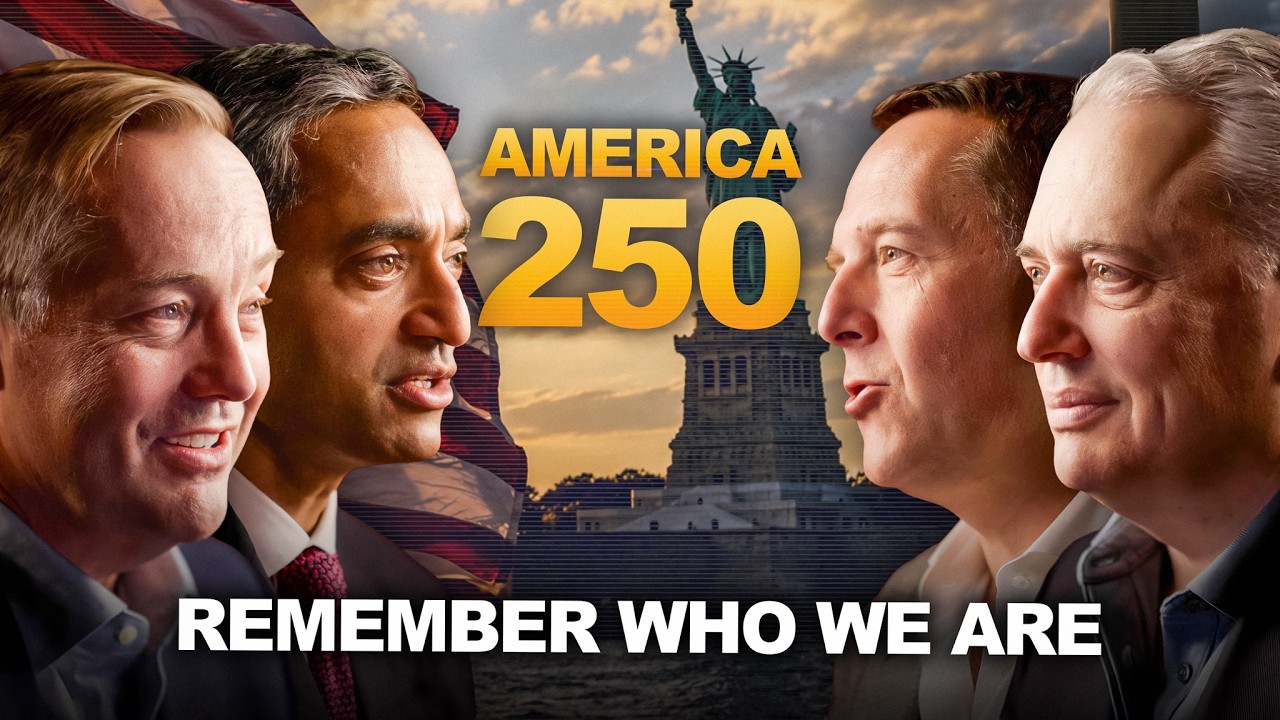
All-In Podcast
The United States maintains an unmatched innovation advantage because its cultural optimism actively champions heterodox thinkers and daring risk-takers over cynical gatekeepers.
AI-assisted summary of America's Next 250: Remember Who We Are — original source. Check the original for full context.
Source published:
Key ideas
- The 2026 All-In Summit opened with an introspective tribute on the American experiment, tracing the diverse roots of hosts Chamath Palihapitiya, David Friedberg, David Sacks, and Jason Calacanis. (0:01)
- Hosts highlighted America's exceptionalism as an open haven for meritocracy, global talent, and heterodox thinkers fueled by a cultural optimism that actively encourages ambitious risk-taking. (2:22)
- The presentation framed modern technological entrepreneurship through Theodore Roosevelt's 'Man in the Arena' philosophy, amplified by historical address excerpts from seven US presidents spanning both major political parties. (3:42)
Detailed notes
## Background Published on YouTube by the All-In Podcast on September 18, 2026, this video serves as the official opening intro for the 2026 All-In Summit. The video highlights hosts Chamath Palihapitiya, Jason Calacanis, David Sacks, and David Friedberg alongside credits for the summit's intro music and video production.
## TL;DR The intro video frames the foundational promise of the American experiment through the personal origin stories of the four podcast hosts, contrasting the immigrant journeys of Chamath, Friedberg, and Sacks from Sri Lanka and South Africa with Jason's gritty upbringing in Brooklyn. It explores America's unique pull as an engine for dreamers, meritocracy, and heterodox ambition where unconventional builders are actively encouraged rather than dismissed. Anchored by Theodore Roosevelt's 'Man in the Arena' philosophy, the presentation weaves together historic speeches from across the political spectrum—including FDR, JFK, Reagan, Clinton, Obama, Biden, and Trump. The piece culminates in a patriotic crescendo that introduces the hosts onto the live summit stage.
## Atmosphere & style The video carries an unapologetically anthemic, cinematic, and stirring tone that moves from intimate personal reflection to high-voltage civic celebration. It opens with candid, nostalgic reflections on hardship and ambition, punctuated by Jason's grounded humor about his Brooklyn roots. As the narrative pivots toward the 'arena,' the mood swells dramatically with orchestral music, resonant presidential soundbites, and thunderous arena chants, giving viewers the electrifying sensation of a heavyweight title fight or political convention kickoff.
## Bulletin - [00:01](https://www.youtube.com/watch?v=Nvc6HWfoSoE&t=1s) The 2026 All-In Summit opened with an introspective tribute on the American experiment, tracing the diverse roots of hosts Chamath Palihapitiya, David Friedberg, David Sacks, and Jason Calacanis. - [02:22](https://www.youtube.com/watch?v=Nvc6HWfoSoE&t=142s) Hosts highlighted America's exceptionalism as an open haven for meritocracy, global talent, and heterodox thinkers fueled by a cultural optimism that actively encourages ambitious risk-taking. - [03:42](https://www.youtube.com/watch?v=Nvc6HWfoSoE&t=222s) The presentation framed modern technological entrepreneurship through Theodore Roosevelt's 'Man in the Arena' philosophy, amplified by historical address excerpts from seven US presidents spanning both major political parties.
## Key takeaways - [00:01](https://www.youtube.com/watch?v=Nvc6HWfoSoE&t=1s) The foundational premise of the American experiment is built not on handouts or guarantees, but on providing the open opportunity to achieve anything. - [00:01](https://www.youtube.com/watch?v=Nvc6HWfoSoE&t=1s) Chamath Palihapitiya fled impending civil war in Sri Lanka in 1986, growing up in Canada before migrating to the United States. - [00:01](https://www.youtube.com/watch?v=Nvc6HWfoSoE&t=1s) David Friedberg and David Sacks both emigrated from apartheid-era South Africa, pursuing American opportunities in Hollywood aspirations and naturalized citizenship respectively. - [00:01](https://www.youtube.com/watch?v=Nvc6HWfoSoE&t=1s) Jason Calacanis contrasts his co-hosts' immigrant odysseys with his upbringing in Bay Ridge, Brooklyn, learning small-business entrepreneurship at his father's bar. - [02:22](https://www.youtube.com/watch?v=Nvc6HWfoSoE&t=142s) The dot-com era demonstrated America's magnetism as top engineering talent from global institutions like the University of Waterloo flocked south to Silicon Valley. - [02:22](https://www.youtube.com/watch?v=Nvc6HWfoSoE&t=142s) American culture distinctively counters cynicism and gatekeeping with default optimism, celebrating unconventional ideas and ambitious risk-taking. - [03:42](https://www.youtube.com/watch?v=Nvc6HWfoSoE&t=222s) Theodore Roosevelt's 'Man in the Arena' doctrine anchors the ethos of builders and entrepreneurs who dare greatly rather than judging from the sidelines. - [03:42](https://www.youtube.com/watch?v=Nvc6HWfoSoE&t=222s) Franklin D. Roosevelt and John F. Kennedy historically defined the American character by forward momentum and an unavoidable 'rendezvous with destiny.' - [03:42](https://www.youtube.com/watch?v=Nvc6HWfoSoE&t=222s) Bill Clinton and Ronald Reagan highlighted national resilience, asserting that America possesses the intrinsic ability and faith to cure its own crises. - [03:42](https://www.youtube.com/watch?v=Nvc6HWfoSoE&t=222s) Barack Obama, Joe Biden, and Donald Trump echoed cross-generational themes celebrating risk-takers, national preeminence, and the pursuit of American greatness. - [05:31](https://www.youtube.com/watch?v=Nvc6HWfoSoE&t=331s) The montage concludes by rallying summit attendees around hard work, civic pride, and technological innovation as drivers of the nation's future.
## Detailed walkthrough ### [00:01](https://www.youtube.com/watch?v=Nvc6HWfoSoE&t=1s) The Besties' Origins: Escapes, Dreams, and Brooklyn Grit
The summit kicks off with a reflection on the foundational promise of the American experiment: it is not designed merely to hand people handouts or guarantees, but rather to give every single individual "the opportunity to have anything"—a defining condition missing virtually everywhere else across the globe. Setting up their personal stories, the hosts recount their respective roots and the journeys that ultimately brought them together. Chamath Palihapitiya shares his beginnings, born in 1976 in Sri Lanka amidst what he describes as a typical developing third-world environment. When the country began spiraling into a brutal, protracted ethnic civil war, his family made their exit in 1986, moving to Canada where his father served as an attaché for the Sri Lankan embassy. Chamath spent his formative years from age 6 to 22 growing up in Canada before setting his sights southward.
David Friedberg and David Sacks share their own early paths out of South Africa during the uncertainty of apartheid. Friedberg describes an atmosphere where anyone who had the means sought an exit route. His parents, who were documentary filmmakers, harbored an aspiration to make it in America, epitomized by a South African bumper sticker they affixed to the bookshelf in his childhood bedroom that read "Go for gold"—a tangible symbol of their ambition to reach Hollywood. Sacks, born in Cape Town in 1972, left with his family when he was just five years old, settling in Memphis, Tennessee, before officially becoming a naturalized United States citizen at the age of ten.
Contrasting his co-hosts' immigrant odysseys, Jason Calacanis jokingly crowns himself the sole "heritage American on the pod," granting his three immigrant besties permission to stay. Jason recounts growing up in Bay Ridge, Brooklyn—the terminus of the subway's R train—during the gritty, unforgiving New York of the 1970s and 1980s. Surrounded by graffiti, street gangs, and Hell's Angels, Jason came of age sweeping floors and working behind the counter at his father's Brooklyn bar, Beards, where watching his dad manage the daily grind provided his very first masterclass in bare-knuckle entrepreneurship.
- **Chamath Palihapitiya**: Born in 1976 in Sri Lanka; fled impending civil war in 1986 when his father took a post as an attaché for the Sri Lankan embassy to Canada; raised in Canada from age 6 to 22. - **David Friedberg**: Born in South Africa under apartheid; son of documentary filmmakers whose aspirations to work in Hollywood were symbolized by a "Go for gold" bumper sticker kept on his bedroom bookshelf. - **David Sacks**: Born in Cape Town, South Africa, in 1972; immigrated to Memphis, Tennessee, at age 5; earned US citizenship at age 10. - **Jason Calacanis**: Raised in Bay Ridge, Brooklyn (the final stop on the R line); spent his childhood in his father's bar, Beards, absorbing firsthand lessons in small-business entrepreneurship amidst 1970s and '80s New York street life.
---
[02:22](https://www.youtube.com/watch?v=Nvc6HWfoSoE&t=142s) The Magnetism of America: An Engine for Dreamers and Heterodox Thinkers
As the turn of the millennium arrived, the pull of the United States became undeniable to top global talent. Reflecting on his graduation with an electrical engineering degree from the University of Waterloo, Chamath recalls watching the sharpest minds in his class pack their bags and head straight south to Silicon Valley at the absolute fever pitch of the dot-com bubble. That mass migration made him question what made the country such an unparalleled magnet. The answer became clear: the United States stood apart as a rare civilization where hard work, intellect, and sheer drive unlocked boundless achievement, regardless of one's background, lineage, religion, or skin color.
Beyond raw meritocracy, the hosts celebrate the distinctive cultural optimism that animates American society—a pervasive generosity of spirit rarely mirrored in other parts of the world. In the US, when someone steps out on a limb with a radical vision, the default reaction is not cynicism, jealousy, or gatekeeping; people cheer them on with enthusiasm, saying, "Fuck yeah. You should do it. Tell me more." This open, hopeful atmosphere serves as a shelter for the ambitious and unconventional, offering a rare haven where people can champion heterodox thoughts, launch disruptive ventures, and be judged by what they can build rather than the cover of their book.
```mermaid flowchart LR accTitle: The American Dream Funnel accDescr: Diagram illustrating the progression from global talent and heterodox ideas through American cultural optimism to world-scale execution.
subgraph Inputs ["Foundations"] A["Global Talent & Heterodox Thinkers"] B["Meritocratic Opportunity"] end
subgraph Culture ["American Environment"] C["Radical Optimism<br/>('Fuck yeah, tell me more')"] D["Willingness to Dare in the Arena"] end
subgraph Outputs ["Impact"] E["Technological Innovation"] F["Frontier Enterprises"] end
A --> C B --> C C --> D D --> E D --> F ```
---
[03:42](https://www.youtube.com/watch?v=Nvc6HWfoSoE&t=222s) Voices from the Arena: Presidential Echoes on the American Experiment
The narrative shifts into a sweeping montage of American statecraft and civic philosophy, anchored by Theodore Roosevelt's famous "Man in the Arena" doctrine: the reminder that credit never belongs to the detached critic on the sidelines, but squarely to the person stained by sweat, dust, and blood who dares greatly—ensuring their place will never be among those cold, timid souls who know neither victory nor defeat. This ethos of daring sets the stage for a lineage of American presidential declarations across generations and political divides, underscoring resilience, forward motion, and the burden of historical destiny.
The tribute weaves together iconic moments from across the political spectrum: - Franklin D. Roosevelt declaring that this generation of Americans has a "rendezvous with destiny." - John F. Kennedy reminding the country that the nation was never built by those who rested, waited, or looked backward, but was conquered by those determined to move forward. - Bill Clinton affirming the enduring self-correcting strength of the republic: "There is nothing wrong with America that cannot be cured by what is right with America." - Ronald Reagan urging citizens to believe that together, with God's help, they can resolve any crisis, posing the rhetorical question: "And after all, why shouldn't we believe that? We are Americans." - Barack Obama honoring the foundational lineage of "the risk-takers, the doers, the makers of things" who carved the rugged path toward American freedom and prosperity. - Joe Biden asserting national resilience and global preeminence: "We are America, second to none, and we own the finish line. Don't forget it." - Donald Trump rallying the crowd with his signature refrain to make America great again, wishing blessings upon the nation.
---
[05:31](https://www.youtube.com/watch?v=Nvc6HWfoSoE&t=331s) Welcoming the Besties to the Arena
The climactic montage builds to a crescendo as the voices of the presidents merge with anthemic music and thunderous chants of "USA! USA!" ringing through the venue. With energy peaking, the voiceover delivers a rousing conclusion: "Thank you for your hard work. Thank you for making the nation proud. And may God bless America."
The lights flash across the stage as the announcer introduces the headliners to the live summit audience: "Ladies and gentlemen, please welcome your besties." The crowd erupts into cheers as the bass-heavy intro music drops, kicking off the All-In Summit.
## Notable quotes > [00:01](https://www.youtube.com/watch?v=Nvc6HWfoSoE&t=1s) the opportunity to have anything
> [00:01](https://www.youtube.com/watch?v=Nvc6HWfoSoE&t=1s) Go for gold
> [00:01](https://www.youtube.com/watch?v=Nvc6HWfoSoE&t=1s) heritage American on the pod — Jason Calacanis
> [02:22](https://www.youtube.com/watch?v=Nvc6HWfoSoE&t=142s) Fuck yeah. You should do it. Tell me more.
> [03:42](https://www.youtube.com/watch?v=Nvc6HWfoSoE&t=222s) rendezvous with destiny — Franklin D. Roosevelt
> [03:42](https://www.youtube.com/watch?v=Nvc6HWfoSoE&t=222s) There is nothing wrong with America that cannot be cured by what is right with America. — Bill Clinton
> [03:42](https://www.youtube.com/watch?v=Nvc6HWfoSoE&t=222s) And after all, why shouldn't we believe that? We are Americans. — Ronald Reagan
> [03:42](https://www.youtube.com/watch?v=Nvc6HWfoSoE&t=222s) the risk-takers, the doers, the makers of things — Barack Obama
> [03:42](https://www.youtube.com/watch?v=Nvc6HWfoSoE&t=222s) We are America, second to none, and we own the finish line. Don't forget it. — Joe Biden
> [05:31](https://www.youtube.com/watch?v=Nvc6HWfoSoE&t=331s) Thank you for your hard work. Thank you for making the nation proud. And may God bless America.
> [05:31](https://www.youtube.com/watch?v=Nvc6HWfoSoE&t=331s) Ladies and gentlemen, please welcome your besties.
## Mentioned All-In Summit, Barack Obama, Beards, Bill Clinton, Chamath Palihapitiya, David Friedberg, David Sacks, Donald Trump, Franklin D. Roosevelt, Hell's Angels, Jason Calacanis, Joe Biden, John F. Kennedy, Ronald Reagan, Theodore Roosevelt, University of Waterloo
## Video description The 2026 All-In Summit Intro Video
Follow the besties: https://x.com/chamath https://x.com/Jason https://x.com/DavidSacks https://x.com/friedberg
Follow on X: https://x.com/theallinpod
Follow on Instagram: https://www.instagram.com/theallinpod
Follow on TikTok: https://www.tiktok.com/@allin
Follow on LinkedIn: https://www.linkedin.com/company/allinpod
Intro Music Credit: https://rb.gy/tppkzl https://x.com/yung_spielburg
Intro Video Credit: https://x.com/TheZachEffect
#allin #tech #news
[Source](https://www.youtube.com/watch?v=Nvc6HWfoSoE)