Gurley Demands Independent Feynman-Style Inquiry into Covid Origins
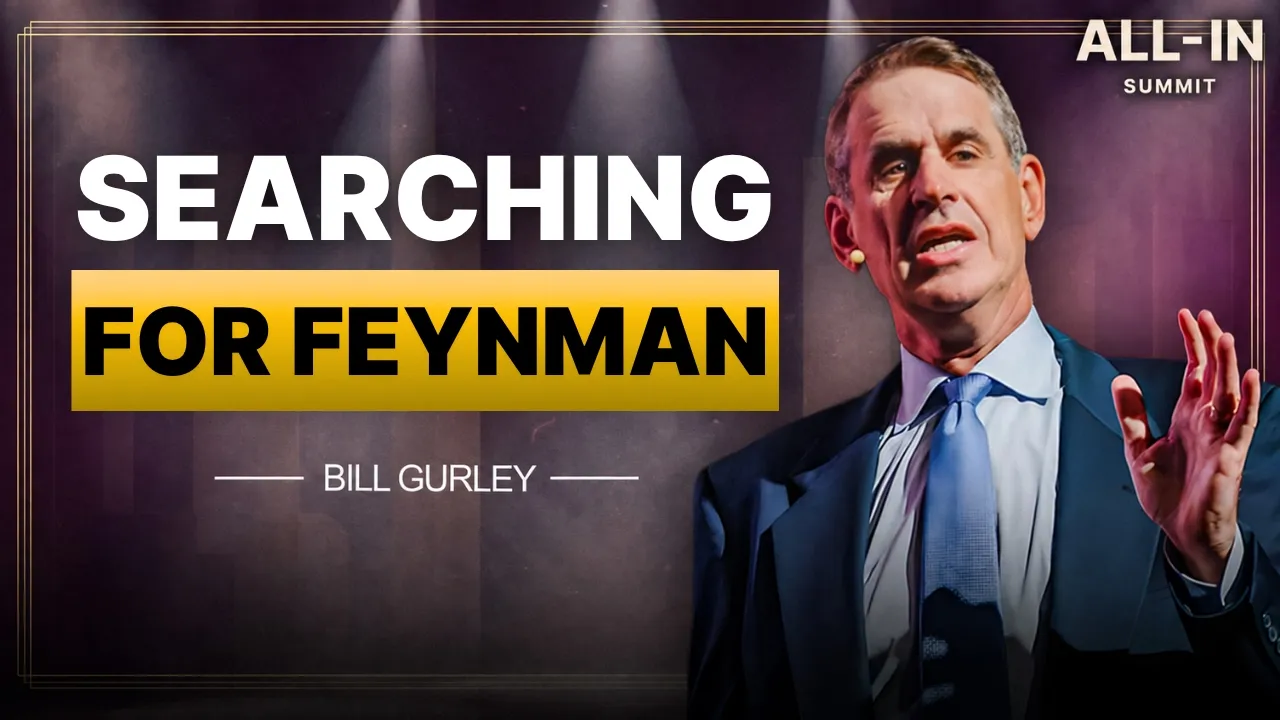
All-In Podcast
Institutional self-preservation and regulatory capture blocked standard root-cause investigations into Covid-19 origins, crippling public trust and leaving humanity vulnerable to future pandemics.
AI-assisted summary of Bill Gurley: Searching for Feynman — original source. Check the original for full context.
Source published:
Key ideas
- Bill Gurley contrasts the rigorous investigations of past disasters—Surfside, Boeing 737 MAX, Katrina, Fukushima, and Challenger—against the unprecedented absence of an authoritative, independent root-cause probe into COVID-19, which caused an estimated 15 million deaths and $45 trillion in economic disruption. (18:45)
- In major historic catastrophes, culpable institutions routinely circled wagons as 'blockers,' but outside 'searchers' like Richard Feynman and Dr. Kiyoshi Kurokawa successfully broke through bureaucratic capture to mandate structural reforms. (10:00)
- Rather than leading transparent investigations, top public health officials who advocated for gain-of-function research manufactured an early consensus labeling lab-leak inquiries a conspiracy theory, leaving the investigation to decentralized outsiders like DRASTIC and US Right to Know. (22:18)
- Under aerospace and medical CAPA (Corrective and Preventive Action) standards, the leaked 2018 DEFUSE proposal—which outlined inserting a furin cleavage site into bat coronaviruses—represents primary top-tier evidence, yet institutions like the University of North Carolina continue to withhold related records. (30:00)
Detailed notes
## Background Published on YouTube by the All-In Podcast on September 19, 2026, this video documents venture capitalist Bill Gurley delivering his keynote address, "Searching for Feynman," at the All-In Summit. The accompanying show notes provide an archive link to the research materials cited in his talk and list the summit's corporate sponsors.
## TL;DR Examining historical catastrophes such as the Surfside condo collapse, Boeing 737 MAX crashes, Hurricane Katrina, Fukushima Daiichi, and the Challenger disaster, Bill Gurley analyzes the perennial clash between independent "searchers" and defensive institutional "blockers." He contrasts the forensic postmortems of those crises with the global response to COVID-19, decrying the total absence of an independent, Feynman-style investigation into pandemic origins despite an estimated 15 million deaths. Highlighting suppressed investigative leads like the DARPA DEFUSE proposal and praising grassroots sleuths from DRASTIC and U.S. Right to Know, Gurley insists that applying formal CAPA (Corrective and Preventive Action) root-cause analysis is vital to depoliticizing inquiry, restoring public trust, and preventing the next catastrophic failure.
## Atmosphere & style Steering completely clear of standard Silicon Valley tech optimism and AI hype, Gurley sets a sobering, intellectually rigorous, and morally charged tone from the outset. The presentation builds a methodical, forensic momentum through historical case studies before escalating into an impassioned indictment of administrative self-preservation and institutional cowardice. The emotional gravity deepens during the post-talk Q&A with host Jason Calacanis, shifting into an unusually raw, vulnerable, and personal reflection on decimated public trust and generational harm.
## Bulletin - [18:45](https://www.youtube.com/watch?v=A4Q7zAayW20&t=1125s) Bill Gurley contrasts the rigorous investigations of past disasters—Surfside, Boeing 737 MAX, Katrina, Fukushima, and Challenger—against the unprecedented absence of an authoritative, independent root-cause probe into COVID-19, which caused an estimated 15 million deaths and $45 trillion in economic disruption. - [10:00](https://www.youtube.com/watch?v=A4Q7zAayW20&t=600s) In major historic catastrophes, culpable institutions routinely circled wagons as 'blockers,' but outside 'searchers' like Richard Feynman and Dr. Kiyoshi Kurokawa successfully broke through bureaucratic capture to mandate structural reforms. - [22:18](https://www.youtube.com/watch?v=A4Q7zAayW20&t=1338s) Rather than leading transparent investigations, top public health officials who advocated for gain-of-function research manufactured an early consensus labeling lab-leak inquiries a conspiracy theory, leaving the investigation to decentralized outsiders like DRASTIC and US Right to Know. - [30:00](https://www.youtube.com/watch?v=A4Q7zAayW20&t=1800s) Under aerospace and medical CAPA (Corrective and Preventive Action) standards, the leaked 2018 DEFUSE proposal—which outlined inserting a furin cleavage site into bat coronaviruses—represents primary top-tier evidence, yet institutions like the University of North Carolina continue to withhold related records.
## Key takeaways - [00:00](https://www.youtube.com/watch?v=A4Q7zAayW20&t=0s) True disaster prevention requires an uncompromising search for root causes through independent, parallel investigations rather than accepting administrative narratives. - [05:00](https://www.youtube.com/watch?v=A4Q7zAayW20&t=300s) The Boeing 737 MAX crashes demonstrated how corporate commercial pressure and regulatory capture by the FAA resulted in 45 days of inaction between preventable fatal disasters. - [05:00](https://www.youtube.com/watch?v=A4Q7zAayW20&t=300s) The Corrective and Preventive Action (CAPA) framework mandated in aerospace and medicine hinges on confirming root cause before effective correction and prevention can occur. - [10:00](https://www.youtube.com/watch?v=A4Q7zAayW20&t=600s) In disasters like Katrina and Fukushima, official bodies manipulated professional associations and buried hazard assessments to avoid liability until independent commissions intervened. - [15:18](https://www.youtube.com/watch?v=A4Q7zAayW20&t=918s) Richard Feynman's refusal to accept bureaucratic briefings during the Challenger investigation proved that forensic breakthroughs require direct, unmediated access to working engineers. - [20:00](https://www.youtube.com/watch?v=A4Q7zAayW20&t=1200s) Despite inflicting 3,000 times the casualty count of major modern disasters combined, COVID-19 has received no dedicated bipartisan commission, newsroom war room, or independent scientific audit. - [22:18](https://www.youtube.com/watch?v=A4Q7zAayW20&t=1338s) Institutional leaders who publicly championed gain-of-function research faced severe psychological cognitive dissonance that led them to act as blockers rather than searchers. - [24:48](https://www.youtube.com/watch?v=A4Q7zAayW20&t=1488s) Decentralized researchers at DRASTIC and investigative reporters at USRTK uncovered vital pandemic records after institutional science abdicated its duty to investigate. - [26:45](https://www.youtube.com/watch?v=A4Q7zAayW20&t=1605s) The DEFUSE proposal submitted to DARPA in 2018 described engineering a furin cleavage site at the S1-S2 junction of bat coronaviruses, matching the defining genetic feature of SARS-CoV-2. - [30:00](https://www.youtube.com/watch?v=A4Q7zAayW20&t=1800s) A standard root-cause audit identifies the DEFUSE document as a critical investigative lead that mandates subpoenaing unreleased institutional records held at North Carolina universities. - [32:15](https://www.youtube.com/watch?v=A4Q7zAayW20&t=1935s) Framing origin inquiries around partisan retribution and criminal prosecution hardens institutional resistance; the focus must remain strictly on engineering root-cause analysis and future prevention. - [34:10](https://www.youtube.com/watch?v=A4Q7zAayW20&t=2050s) Official misinformation and the suppression of legitimate questions have destroyed public trust, leaving society ill-equipped to handle future biological emergencies. - [36:20](https://www.youtube.com/watch?v=A4Q7zAayW20&t=2180s) The natural spillover theory remains unresolved after Chinese authorities tested over 80,000 animals without locating an infected host or immediate precursor virus.
## Detailed walkthrough ### [00:00](https://www.youtube.com/watch?v=A4Q7zAayW20&t=0s) Returning to the Summit: The Weight of Failures and Investigations
Introduced as Silicon Valley royalty and the legendary investor behind Uber and Zillow, Bill Gurley takes the All-In Summit stage to reflect on his previous appearances and set a serious tone for his address. Recalling his talk three years earlier on regulatory capture—a concept that has since exploded into common parlance—Gurley clarifies upfront that despite current market obsessions, he will not be discussing AI. Instead, he addresses a subject that has weighed heavily on him for the past five to six years: how society responds to major catastrophes, how human systems investigate technical and institutional collapse, and how those lessons must drive genuine prevention.
Gurley turns first to the June 2021 disaster at Champlain Towers South in Surfside, Florida, where a sudden building collapse claimed the lives of 98 people. He emphasizes that disasters rarely stem from a single flaw; here, original design errors, deferred maintenance, and condominium board inaction in the face of alarming engineering inspections converged into institutional failure. Demonstrating a New York Times 3D interactive model, Gurley explains the mechanical breakdown: coastal saltwater air corroded the pool deck's reinforcing steel over decades, causing the deck to cave into the subterranean garage and shear off the structural columns anchoring the residential tower.
The heart of the story, however, was the relentless hunt for answers through parallel, independent investigations. Key actors attacked the question from multiple angles: the National Institute of Standards and Technology (NIST), tasked after 9/11 with federal oversight of structural failures, deployed lead investigators Judith Mitrani-Reiser and Glenn Bell on a multi-year project; Surfside hired Alan Kilsheimer, whom Gurley calls the "wolf of building collapses"; Miami-Dade County Judge Randall Sloane convened a statewide grand jury; and lead litigant Harley Tropin worked alongside Judge Michael Hanzman to consolidate 17 wrongful-death lawsuits into a single class. A standout effort came from the *Miami Herald*, led by executive editor Monica Richardson and reporter Sarah Blaskey, who brought on University of Washington civil engineering professor Dawn Lehman. Despite facing recent corporate bankruptcy, the newspaper mobilized 37 staff members, built an investigative 3D collapse model, and secured a Pulitzer Prize. Richardson underscored their mission: *"We will continue to investigate the collapse to find answers to how this happened to ensure a tragedy like this never happens again."* Crucially, those findings led directly to new, legally mandated structural inspection laws across Florida and other coastal states.
```mermaid flowchart TD accTitle: Surfside Collapse Investigation to Prevention accDescr: Diagram tracing the technical failure of Champlain Towers through parallel investigations to policy reform.
subgraph Failures ["Root Failures"] A["Original Design Errors"] B["Deferred Maintenance"] C["Board Inaction on Warnings"] D["Saltwater Pool Deck Corrosion"] A & B & C & D --> E["Deck Collapses into Basement & Destroys Columns"] end
subgraph Searchers ["Parallel Investigations"] E --> F["NIST Investigation<br/>(Mitrani-Reiser & Bell)"] E --> G["Surfside Independent Probe<br/>(Alan Kilsheimer)"] E --> H["Grand Jury & Unified Class Action<br/>(Judge Hanzman & Tropin)"] E --> I["Miami Herald Team<br/>(Richardson, Blaskey & Dr. Lehman)"] end
subgraph Policy ["Prevention"] F & G & H & I --> J["Mandatory Florida & Coastal Building Inspection Laws"] end ```
[05:00](https://www.youtube.com/watch?v=A4Q7zAayW20&t=300s) The Boeing 737 MAX Disasters and Institutional Capture
Examining another structural catastrophe, Gurley recounts the twin crashes of the Boeing 737 MAX in October 2018 (Lion Air Flight 610) and March 2019 (Ethiopian Airlines Flight 302). He outlines the underlying commercial pressures: Airbus had unveiled the fuel-efficient A320neo, eroding Boeing’s market share. To avoid the massive expense and pilot-retraining downtime of engineering an entirely new airframe, Boeing retrofitted oversized, fuel-efficient engines onto its decades-old 737 platform. Because the larger engines had to be positioned further forward and higher on the wings, the plane displayed an aerodynamic tendency to pitch up during test flights. To counter this, Boeing quietly installed the Maneuvering Characteristics Augmentation System (MCAS)—a flight control software designed to automatically push the nose down when an angle-of-attack sensor signaled a pitch upward—while omitting any mention of the system from pilot operating manuals. When a single external sensor malfunctioned on the Ethiopian flight, MCAS forced the plane into an irrecoverable dive despite the pilots' desperate struggles.
Gurley categorizes the ensuing investigation into "searchers" and "blockers." On the search side, an aggressive array of bodies mobilized: Senate and House oversight committees, the Department of Justice, the Indonesian safety agency KNKT (which deciphered the black boxes), and *Seattle Times* reporter Dominic Gates, who won a Pulitzer Prize for uncovering regulatory failures. Peter Robison published *Flying Blind*, 57 Boeing whistleblowers contacted the Senate, victims' families organized persistent demonstrations on Capitol Hill, and pilot union heads secretly taped internal meetings with Boeing executives while filing Freedom of Information Act (FOIA) requests against government regulators.
Conversely, Boeing and the Federal Aviation Administration (FAA) acted as institutional blockers, initially blaming pilot incompetence and stonewalling congressional document requests. Rather than viewing this as deliberate evil, Gurley explains it as the natural self-preservation instinct of massive organizations: when the spotlight swings toward them, they circle the wagons. The cozy relationship between regulator and manufacturer was so pronounced that during hearings, Senator Ted Cruz accused the FAA leadership of being captured, asking pointedly: *"Sir, do you know you don’t work for Boeing?"* Gurley highlights that within 45 days of the Lion Air crash, MCAS was already widely identified as the root cause, yet neither Boeing nor the FAA grounded the aircraft—allowing the Ethiopian tragedy to occur. Commending the strictly bipartisan investigations led by Peter DeFazio, Roger Wicker, and Ted Cruz, Gurley pivots to CAPA (Corrective and Preventive Action), the core five-step failure methodology mandated across aerospace and FDA-regulated medical sectors: detect, investigate, confirm root cause, correct, and prevent. Without an unflinching commitment to determining root cause, true prevention remains impossible.
- **Boeing's MCAS Rationale:** Squeezed by Airbus, Boeing engineered a software workaround rather than redesigning an airframe, concealing the MCAS mechanism to skirt simulator training requirements. - **Institutional Collusion:** Regulatory capture paralyzed the FAA, leading to 45 days of inaction between the first crash and the preventable second disaster. - **CAPA Five-Step Mandate:** 1. Detect 2. Investigate 3. Confirm Root Cause 4. Correct 5. Prevent - **Opening the Next Failure Mode:** Setting up his subsequent case study on large-scale systemic failures, Gurley turns to the catastrophic human and logistical toll of Hurricane Katrina in 2005.
[10:00](https://www.youtube.com/watch?v=A4Q7zAayW20&t=600s) Hurricane Katrina: Flawed Levees and Institutional Whitewashing
When Hurricane Katrina devastated New Orleans, displacing 400,000 people and inflicting $125 billion in damage, the official narrative put forward by the U.S. Army Corps of Engineers was that an extraordinary act of God had overwhelmed the city's defenses. They claimed floodwaters simply overtopped the levees. In reality, Katrina was only a Category 3 hurricane when it made landfall, and the disaster was entirely preventable: the levees did not fail from water spilling over the top, but because the foundations gave way and washed out from underneath.
As with any major catastrophe, the aftermath pitted dedicated "searchers" against defensive "blockers." Investigative journalists Mark Schleifstein and John McQuaid of *The Times-Picayune* had presciently published an award-winning series three years earlier warning of this exact vulnerability. Following the disaster, multiple distinct entities mounted inquiries, including congressional commissions, an LSU-backed team commissioned by the state of Louisiana, and an independent research group funded by the National Science Foundation, led by Professor Raymond Seed of UC Berkeley. While these independent teams occasionally crossed paths or bumped heads, they unanimously concluded that Katrina's catastrophic flooding was an engineering and institutional human error.
Conversely, the Army Corps of Engineers operated as classic blockers, attempting to shield themselves from liability and exposure. In a particularly compromised maneuver, the Corps paid the American Society of Civil Engineers (ASCE) $1 million to participate in an internal assessment, effectively co-opting the professional body until it acted as an institutional shield. Professor Raymond Seed later documented this systemic interference in an exhaustive 42-page public dossier submitted to the ASCE, itemizing repeated attempts to hinder outside analysis and suppress inconvenient findings. Despite the institutional obstruction, the truth forced critical reforms: 90 concrete engineering recommendations were adopted, leading to a $15 billion reconstruction of the city's seawalls and flood barriers that have successfully held for two decades.
```mermaid flowchart TD accTitle: Anatomy of Catastrophic Failures accDescr: Diagram illustrating how technical failures combine with institutional blockers versus independent truth seekers.
subgraph Failure["The Breakdown"] TF["Technical Failure<br/>(Physical defect / flaw)"] IF["Institutional Failure<br/>(Ignored warnings / regulatory capture)"] TF --- IF end
subgraph Conflict["Post-Disaster Reckoning"] B["The Blockers<br/>(Culpable agencies, captured regulators)"] S["The Searchers<br/>(Press, independent scientists, outsiders)"] end
Failure --> Conflict B -. "Suppression & PR".-> Outcome["Reforms or Obfuscation"] S ==> "Root-cause truth" ==> Outcome ```
- **Displacement and damage**: Over 400,000 residents displaced; $125 billion in overall losses. - **Physical failure mode**: Levees undermined from below due to soil and structural design flaws, rather than overtopping by storm surge. - **Independent inquiry**: Professor Raymond Seed (UC Berkeley) published a 42-page expose detailing the ASCE's complicity with the Army Corps of Engineers. - **Infrastructure upgrade**: A $15 billion overhaul produced 90 structural remediations that have protected the region for over 20 years.
---
[12:15](https://www.youtube.com/watch?v=A4Q7zAayW20&t=735s) Fukushima Daiichi: Regulatory Capture and the Kurokawa Commission
The 2011 Fukushima Daiichi nuclear disaster claimed roughly 2,200 lives, displaced 154,000 residents, and generated over $200 billion in cleanup and decommissioning costs. The immediate mechanical trigger was obvious: the plant’s protective seawall measured just 5.7 meters high, allowing tsunami waves to breach the perimeter, drown the emergency backup diesel generators, cut off reactor core cooling systems, and trigger catastrophic meltdowns. Yet the underlying institutional failure ran far deeper. TEPCO (Tokyo Electric Power Company) had conducted a prior risk assessment showing that a major tsunami within a 30-year window could generate waves between 10 and 15 meters, but company leadership buried the report rather than invest in raising the seawall.
The ensuing battle over transparency followed the familiar playbook of searchers versus blockers. Investigative journalists stepped in, including Martin Fackler, who spent two decades with *The New York Times* Tokyo bureau, and Norihiro Yorimitsu, who added 20 dedicated investigators to his newsroom staff to relentlessly track the story. Meanwhile, TEPCO and the Nuclear and Industrial Safety Agency (NISA) formed an obstructionist alliance. Rather than functioning as an arms-length oversight authority, NISA had succumbed to total regulatory capture, operating more like a protective partner to TEPCO than an aggressive public watchdog.
The breakthrough came when the Japanese Diet broke centuries of tradition by establishing the country’s first-ever independent, non-governmental investigation commission (NAIIC), appointing Dr. Kiyoshi Kurokawa to lead it. Kurokawa was deliberately chosen as an outsider; a medical doctor rather than a nuclear physicist, he had zero institutional loyalty to the power monopoly or its captured regulator. Given sweeping subpoena authority, Kurokawa established three fundamental pillars: prioritize public safety over ideological debates about nuclear energy, deliver actionable structural recommendations, and recognize the international gravity of the event alongside Three Mile Island and Chernobyl. Demonstrating his commitment to unfiltered global accountability, Kurokawa published the commission’s final report in English first. Its opening declaration delivered an unambiguous verdict: "The accident at the power plant cannot be regarded as a natural disaster. It was profoundly man-made, and it could have and should have been prevented."
- **Human and financial toll**: 2,200 deaths, 154,000 citizens evacuated, and over $200 billion in decontamination costs. - **Suppressed risk assessments**: TEPCO concealed internal studies projecting potential 10- to 15-meter tsunami waves, choosing to retain an inadequate 5.7-meter barrier. - **Regulatory capture**: NISA prioritized protecting the utility company over enforcing rigorous safety protocols. - **Independent mandate**: Dr. Kiyoshi Kurokawa led the first independent investigative commission appointed by Japan's parliament, deliberately excluding anyone with prior ties to the nuclear industry.
---
[15:18](https://www.youtube.com/watch?v=A4Q7zAayW20&t=918s) The Challenger Disaster and Feynman's Pursuit of Truth
The January 1986 Space Shuttle Challenger disaster remains an indelible case study in the lethal intersection of mechanical defects and bureaucratic arrogance. On an unusually freezing morning in Cape Canaveral, Florida, the primary and secondary O-rings on the solid rocket boosters failed because their rubber polymers lost elasticity in low temperatures. Engineers at Morton Thiokol, the manufacturing subcontractor, had recognized the extreme danger and adamantly argued against launching the night before. Instead of listening, NASA managers pressured the contractor to reverse its recommendation, sacrificing flight safety to maintain launch schedules.
In the immediate aftermath, President Ronald Reagan formed the presidential Rogers Commission to determine what went wrong. Chaired by former Secretary of State William P. Rogers, the panel was deliberately stacked with high-ranking Washington insiders, military generals, NASA executives, and celebrated figures like Neil Armstrong. The organizers sought out Caltech professor and Nobel laureate Richard Feynman, hoping his stature as a Manhattan Project veteran would provide a reliable, prestigious rubber stamp. They fundamentally miscalculated. Feynman was fiercely independent, possessed a relentless drive for ground-level truth, and harbored absolute disdain for bureaucratic posturing and diplomatic etiquette.
While his fellow commission members operated as high-level administrators, Feynman cleared his calendar for six months and immediately began traveling directly to NASA facilities, interviewing technicians, machinists, and assembly-line workers without official handlers. When Neil Armstrong gently tried to rein him in by explaining, "we just evaluate. We don't investigate," Feynman dismissed the caution and pressed on. Rogers grew so exasperated with the physicist’s unscripted probing that he privately complained to Armstrong in the men's room that "Feynman's being a real pain in the ass."
Feynman subsequently bypassed commission decorum during a live televised hearing by clamping a piece of O-ring material, submerging it into a glass of ice water, and demonstrating that it remained rigid and deformed after being released. When the commission's draft report attempted to water down administrative responsibility, Feynman gave an ultimatum: either his unedited technical analysis was included, or they would have to remove his signature entirely. Given his high-profile public demonstrations, the commission caved, publishing his full findings without alterations as the famous Appendix F.
- **Launch objections**: Morton Thiokol engineers explicitly warned NASA leadership the evening before launch that the O-ring seals would fail in freezing conditions. - **Commission dynamics**: Chairman William P. Rogers assembled Washington dignitaries and astronauts intended to perform high-level evaluation rather than adversarial forensic investigation. - **Feynman's methodology**: Refused administrative briefings in favor of direct interviews with working-level shop floor engineers and technicians. - **The ice water demonstration**: Exposed the material defect on live television using ice water and a C-clamp, disproving NASA's assertions regarding O-ring resiliency. - **Appendix F**: Feynman forced the inclusion of his unedited, scathing indictment of NASA's flawed risk modeling by threatening to withdraw his endorsement of the final report.
---
[18:45](https://www.youtube.com/watch?v=A4Q7zAayW20&t=1125s) The Search for Root Cause: From Catastrophes to COVID-19
Every historic catastrophe—from Katrina to Fukushima to Challenger—demonstrates that uncovering the root cause requires overcoming fierce institutional resistance from entrenched blockers. In each of those historic disasters, committed searchers ultimately unmasked the engineering failures and administrative cover-ups, leading to real accountability and system-wide preventative measures. That contrast frames the central anomaly of the modern era: the response to COVID-19.
Beginning in December 2019, COVID-19 claimed an estimated 15 million lives worldwide, derailed global commerce to the tune of $45 trillion, and shuttered educational institutions, inflicting severe, documented learning loss on millions of young people who were robbed of three foundational years of their lives. Yet more than half a decade after the outbreak, there has been no independent, uninhibited investigation, nor has the world established an authoritative, consensus root cause.
The failure to demand an uncompromising search for truth reveals a glaring modern double standard. Society has tolerated evasion and institutional obstruction regarding the origin of a catastrophic real-world disaster, while simultaneously fixating on speculative existential threats. As Gurley concluded to applause from the audience: "Forgive me if I'm unafraid of what some AI guy's chatbot is going to do to humanity when you can't tell me what this thing already did."
- **Global pandemic impact**: 15 million fatalities, widespread socioeconomic paralysis, and an estimated $45 trillion in global economic damage. - **Generational disruption**: Substantial educational regression and social disruption affecting high school and college students over a three-year period. - **Absence of closure**: Unlike Katrina, Fukushima, or Challenger, COVID-19 remains without an internationally accepted, forensic root-cause postmortem years after its emergence. - **Tech critique**: Contrasts intense elite paranoia surrounding speculative artificial intelligence harms against the real-world passivity shown toward uncovering how an actual global crisis started.
[20:00](https://www.youtube.com/watch?v=A4Q7zAayW20&t=1200s) The Magnitude of COVID and the Shocking Absence of Investigation
Putting the conversation around catastrophic risk in perspective, Bill Gurley argues that his "P(second COVID)" is vastly higher than his "P(doom)" regarding artificial intelligence—and if modern predictive models are truly as intelligent as claimed, they ought to be deployed to figure out what happened during the pandemic. Aggregating the human and economic tolls of the five historical disasters previously discussed yields roughly 5,000 casualties and $349 billion in damages; COVID-19, by contrast, was approximately 3,000 times larger, claiming an estimated 15 million lives worldwide. In documentary footage of the Rogers Commission, Richard Feynman recounted how colleagues urged him to tone down his aggressive questioning and be "nicer." Feynman's retort was blunt: "But seven people died." Gurley asks the audience to consider the moral imperative: if Feynman felt that level of urgency over seven lives, how should society behave when 15 million people die? Even summing every fatal airplane crash, hurricane, nuclear disaster, building collapse, and space accident in modern history accounts for only about one-third of the death toll inflicted by COVID-19.
Despite the scale of this catastrophe, none of the standard investigative playbooks used in previous American disasters were deployed:
- **No Dedicated Media War Rooms:** Unlike past major events, no mainstream newspaper created a dedicated investigative unit with 30 or more full-time reporters digging into origins. - **No Dogged Lead Reporters:** Major news organizations failed to unleash and back relentless investigative journalists like John Schleifstein or Mark Fischetti to break open the story. - **No Bipartisan Congressional Inquiries:** Washington established no unified, bipartisan select committees akin to the inquiries following Hurricane Katrina or the Boeing 737 MAX crashes. - **No Independent "Feynman-Style" Commissions:** The government convened no independent civilian panel led by figures with the unimpeachable stature of a Richard Feynman or a Kiyoshi Kurokawa. - **No Independent Scientific Audits:** While NIST and the NSF launched rigorous third-party studies for structural and civil failures, the NIH funded no independent outside review of pandemic origins. - **No Civil Accountability:** The event produced no sweeping victims' liability lawsuits capable of using legal discovery to force internal documents into the public domain.
---
[22:18](https://www.youtube.com/watch?v=A4Q7zAayW20&t=1338s) Institutional Blockers: Why Top Officials Stopped the Search
When the public sought answers about the origin of SARS-CoV-2, five individuals were held up by governments and the press as the definitive scientific authorities: Dr. Francis Collins (former Director of the NIH), Dr. Anthony Fauci (former Director of NIAID), Dr. Peter Daszak (head of EcoHealth Alliance), Sir Jeremy Farrar (former head of the Wellcome Trust, later Chief Scientist at the WHO), and Dr. Ralph Baric (distinguished coronavirus virologist at UNC Chapel Hill). Gurley argues that these men were not objective experts; they functioned as institutional blockers. Much like the FAA, Boeing, and NASA during their respective crises, they circled the wagons to protect their field from outside scrutiny.
Gurley outlines four distinct reasons why these officials acted as blockers rather than seekers of truth:
1. **Virology Insiders:** They occupied the very center of the global virology establishment and possessed a natural instinct to insulate their colleagues and funding mechanisms from public accountability. 2. **Orchestrated Misdirection:** They spearheaded an aggressive media and academic public-relations campaign designed to deflect scrutiny away from laboratory research and discourage further inquiry. 3. **Committed Gain-of-Function Advocates:** All five had spent years championing gain-of-function research—the deliberate genetic alteration of pathogens to enhance their transmissibility or lethality in humans—even after the Obama administration imposed a federal moratorium on such experiments. Fauci himself penned an op-ed arguing that the scientific upside of gain-of-function experiments outweighed the risks. From a behavioral psychology standpoint, someone who publicly tied their reputation to that stance cannot remain impartial: confronting the prospect that an activity you championed might have contributed to 15 million deaths creates psychological cognitive dissonance so severe that the human mind will rationalize away any evidence to avoid that conclusion. 4. **Refusal to Investigate:** Most critically, none of these establishment figures ever initiated a genuine, rigorous forensic search into the laboratory origin hypothesis. They did not merely stop searching; they actively ensured a search never began.
```mermaid flowchart TD accTitle: Institutional Obstruction vs Citizen Investigation of COVID Origins accDescr: Diagram contrasting how official virology leaders blocked origin investigations while independent researchers and journalists uncovered the DEFUSE proposal.
subgraph Blockers["The Official Establishment"] A["Institutional Leaders<br/>(Fauci, Collins, Daszak, Farrar, Baric)"] B["Gain-of-Function Advocacy &<br/>Pre-Existing Institutional Conflicts"] C["Rapid Journal Publications<br/>('Proximal Origin' & Lancet Letter)"] A --> B B --> C end
subgraph Impact["Result on Public Inquiry"] D["Manufactured Consensus<br/>(Lab Leak Labeled 'Conspiracy Theory')"] C --> D end
subgraph Investigators["The Independent Seekers"] E["Grassroots Researchers<br/>(DRASTIC & US Right to Know)"] F["Independent Journalists & Scientists<br/>(Chan, Eban, Kopp, Tufekci, Young)"] G["Document Discoveries<br/>(The DEFUSE Proposal)"] E --> F F --> G end
D -. "Suppressed".-> F ```
---
[24:48](https://www.youtube.com/watch?v=A4Q7zAayW20&t=1488s) The True Investigators: DRASTIC, USRTK, and Five Unsung Heroes
Because institutional science abdicated its duty to investigate, the burden of truth-seeking fell upon an ad-hoc coalition of outsiders, decentralized researchers, and investigative journalists operating without institutional backing. Chief among these groups were **DRASTIC** (a loose international collective of roughly two dozen independent scientists, virologists, and data sleuths) and **U.S. Right to Know (USRTK)**, a nonprofit research group that systematically filed Freedom of Information Act (FOIA) requests to extract sealed internal correspondence from federal agencies and universities.
Gurley highlights five women whom he considers the true heroes of the pandemic origins investigation, all of whom faced fierce personal and professional backlash from the male-dominated scientific hierarchy for daring to pursue the evidence:
- **Dr. Alina Chan:** A molecular biologist at the Broad Institute of MIT and Harvard who observed early on that SARS-CoV-2 exhibited an unusually high adaptation to human cells upon its first emergence. She co-authored *Viral: The Search for the Origin of COVID-19* with Matt Ridley and broke through mainstream silence by publishing two detailed op-eds in *The New York Times*. - **Katherine Eban:** An investigative reporter who stuck her neck out in an extensive *Vanity Fair* investigation titled "The Fight to Discover COVID Origins," documenting how federal officials systematically undermined internal inquiries into the lab-leak hypothesis. - **Emily Kopp:** An investigative reporter at U.S. Right to Know whose FOIA work unearthed the vast majority of internal federal emails, grant drafts, and institutional communications that revealed the hidden ties between American funding agencies and research in Wuhan. - **Zeynep Tufekci:** A Princeton University professor and *New York Times* contributing opinion writer who used her platform to dissect institutional cover-ups and scrutinize scientific orthodoxy. - **Alison Young:** An investigative reporter and author of *Pandora's Gamble: Lab Leaks, Fandangs, and the Next Emerging Pandemic*, which chronicled the extensive, routinely concealed history of laboratory accidents and safety breaches in biosafety facilities before 2020.
---
[26:45](https://www.youtube.com/watch?v=A4Q7zAayW20&t=1605s) Manufactured Consensus and the Uncovering of the DEFUSE Proposal
To suppress scrutiny, the virology establishment built what Katherine Eban termed a "manufactured consensus." Within days of the initial outbreak, small groups of scientists convened private calls and drafted authoritative-sounding papers—most notably "The Proximal Origin of SARS-CoV-2" published in *Nature Medicine*, alongside a joint statement published in *The Lancet*. These documents were composed within days without any formal investigative process, yet they became the universal citations used by Wikipedia, corporate media, and public health officials to brand any inquiry into a laboratory mishap as an unfounded "conspiracy theory." By tying the hypothesis to partisan politics and Donald Trump, institutional leaders polarized the debate so deeply that public opinion on pathogen origins split entirely along party lines.
Over time, FOIA disclosures revealed sharp contradictions between what these scientists conceded in private communications and what they asserted in their published papers. Gurley highlights a post published by Zeynep Tufekci that summarized the situation:
> "Incontrovertible proof of a conspiracy to cover up and deny the possibility it well may be a lab mishap orchestrated from the highest levels of the scientific establishment, and a self-serving group of scientists who deliberately misled the public."
Despite accumulating over 400,000 views, Tufekci's statement attracted zero Community Notes on X, underscoring the factual grounding of her critique.
The fragility of this manufactured consensus became obvious when DRASTIC uncovered the **DEFUSE proposal**—a rejected 2018 research proposal submitted by Peter Daszak's EcoHealth Alliance to DARPA. Gurley polls the audience, noting that only about three attendees raised their hands, reflecting a broader scientific blackout where 78% of surveyed scientists who believed in natural spillover had never even heard of the proposal. The leaked document outlined collaborative research between EcoHealth Alliance, Ralph Baric at UNC, and the Wuhan Institute of Virology to collect SARS-related bat coronaviruses and engineer into them novel furin cleavage sites—the exact genetic feature distinguishing SARS-CoV-2 from all other known wild SARS-related coronaviruses.
[30:00](https://www.youtube.com/watch?v=A4Q7zAayW20&t=1800s) The DEFUSE Proposal, CAPA Analysis, and North Carolina Blockers
Bill Gurley outlines what he considers one of the most critical investigative leads in understanding the origins of COVID-19: the DEFUSE research proposal submitted to DARPA. The collaborative effort involved prominent American coronavirus researchers—including top virologists in North Carolina working alongside Dr. Shi Zhengli (widely known as the "Bat Lady") from the Wuhan Institute of Virology. The document proposed engineering a novel feature into a bat coronavirus: inserting a furin cleavage site at the S1-S2 junction to assess whether it would increase viral infectivity in animal models. Gurley notes that having this exact molecular blueprint documented prior to the pandemic is an extraordinary piece of physical evidence.
To test how standard investigative protocols would view such a finding, Gurley initiated a "clean session" with an AI system—instructing it to ignore all previous conversational context and evaluate the document strictly through the engineering and quality framework of CAPA (Corrective and Preventive Action). The AI's evaluation was instantaneous and unequivocal: it classified the DEFUSE proposal as a "direct investigational lead, highly critical," a "major investigative lead," and "primary document evidence, highest tier evidence class." Gurley asserts that had this single document been made public in January 2020, the global public health conversation would have unfolded entirely differently. While Senator Rand Paul and independent researchers ("searchers") are now aware of it, the general public remains largely in the dark.
```mermaid flowchart TD accTitle: CAPA Origin Investigation and Document Blockade accDescr: Diagram illustrating the CAPA investigation flow from the DEFUSE document to institutional obstruction in North Carolina.
subgraph Evidence ["Primary Documentary Evidence"] D["DEFUSE Proposal to DARPA"] FCS["Proposed inserting furin cleavage site<br/>at S1-S2 junction of bat coronaviruses"] D --- FCS end
subgraph Method ["CAPA Scientific Inquiry"] AI["Clean-Session AI Audit"] Lead["Classified as Highest Tier Lead<br/>Direct Investigational Evidence"] Next["Prescribed Next Action:<br/>Subpoena / Request Institutional Records"] AI --> Lead --> Next end
subgraph Obstruction ["Institutional Bottleneck"] Req["Public Records Requests to UNC / Duke"] Block["University of North Carolina & State Officials"] Halt["Refusal to Disclose Records"] Req --> Block --> Halt end
Evidence --> Method Next --> Req ```
When the AI was asked what the mandatory next step in a CAPA investigation would be, it answered that investigators must immediately pursue internal correspondence, laboratory notes, and related documents from Duke University and the University of North Carolina. However, when independent researchers submitted public records requests, the University of North Carolina and state authorities acted as blockers, refusing to release the material. Gurley issues a direct appeal to anyone in the audience with connections to UNC or its governing board: urge them to reconsider what they are shielding, and ask whether protecting institutional reputations is worth compromising humanity's ability to prevent the next catastrophic outbreak. For those looking to get up to speed on the trail of evidence, he points to an interview conducted by Dr. Jay Bhattacharya with science writer Matt Ridley.
- The DEFUSE proposal laid out the specific genetic insertion—a furin cleavage site at the S1-S2 junction—that characterizes SARS-CoV-2. - A standard CAPA root-cause protocol ranks the pre-existing DEFUSE grant application in the highest tier of investigative evidence. - Both the University of North Carolina and North Carolina state officials continue to stonewall and deny document requests submitted by independent researchers.
---
[32:15](https://www.youtube.com/watch?v=A4Q7zAayW20&t=1935s) Supporting the Searchers, De-politicizing Inquiry, and Plato's Warning
Shifting from the documentary evidence to a broader philosophical plea, Gurley urges the public and scientific community to rally behind independent searchers. He makes it clear that while he cannot claim to "speak for science" in the manner Anthony Fauci famously claimed, he unapologetically speaks for the integrity of scientific inquiry. In Gurley's view, telling people they are forbidden from asking questions or searching for facts violates the core principles of science: "There's no one that should be telling you you can't search. That makes no sense whatsoever. You're not a bad person if you search. You're a good person if you search."
Gurley cautions against turning the origin investigation into a punitive political crusade. He explicitly breaks with Senator Rand Paul's focus on criminal prosecution, arguing that framing the effort around retribution only hardens resistance and creates more blockers. The primary objective must remain root cause analysis and future prevention: "This isn't partisan and should have never been. If your view on what caused COVID is because of who you vote for, please reconsider that." He challenges legacy newsrooms to take inspiration from investigative editors like Monica Richardson and assign serious resources to uncover the truth. He reiterates the urgent necessity of convening a genuinely independent commission, modeled after Richard Feynman's role on the Rogers Commission or Kiyoshi Kurokawa's leadership on the Fukushima Nuclear Accident Independent Investigation Commission.
Gurley concludes his presentation by referencing an enduring aphorism attributed to Plato: "We can easily forgive a child who is afraid of the dark. The real tragedy in life is when men are afraid of the light." He leaves the stage to a standing ovation.
---
[34:10](https://www.youtube.com/watch?v=A4Q7zAayW20&t=2050s) Q&A: Broken Trust, The Failure of the Press, and Institutional Misinformation
Host Jason Calacanis brings Gurley back out to the center of the stage for a fireside Q&A, visibly moved by the presentation. Calacanis remarks that in their thirty years of friendship, he has only seen Gurley emotional twice before—once during a Jason Isbell concert, and once when his top set got counterfeited in a poker hand. Calacanis observes how deeply the societal response and school closures affected children, asking Gurley why the generational harm weighs so heavily on him. Gurley explains that his obsession stems entirely from prevention. He warns that because public health authorities orchestrated systematic misinformation campaigns, public trust has been utterly decimated. If another pandemic struck tomorrow, Gurley has zero confidence that society could successfully navigate it: citizens will refuse to trust official guidance, rendering effective leadership impossible.
Calacanis then shifts the discussion to the Fourth Estate, questioning why mainstream media outlets abdicated their watchdog duty instead of aggressively pursuing Pulitzer Prizes on the biggest story of the century. Gurley references a panel hosted at the Brookings Institution featuring investigative journalists Catherine Eban and Emily Kopp, who examined precisely why the mainstream press missed the story. They explained that top virology establishment figures mounted an aggressive, coordinated public relations campaign that made questioning the natural origin narrative a professional and social faux pas. In an environment where asking critical questions was stigmatized, traditional newsrooms retreated, abandoning the field and leaving the task to independent investigators.
---
[36:20](https://www.youtube.com/watch?v=A4Q7zAayW20&t=2180s) Q&A: The Psychology of Denial and the Search for Root Cause
Calacanis reacts strongly to the weaponization of the "conspiracy theorist" label against anyone questioning whether the virus originated from a laboratory that was actively conducting gain-of-function research on bat coronaviruses with U.S. funding, calling the suppression of legitimate questions "pure evil." Gurley offers a psychological perspective, noting that behavioral scientists recognize how powerful cognitive dissonance is—people will rationalize and fool themselves to preserve their sanity and avoid acknowledging their complicity in a worldwide catastrophe.
When Calacanis asks Gurley directly what he believes is the most probable origin based on the thousands of hours he has poured into the investigation, Gurley deliberately declines to endorse a definitive conclusion. He emphasizes that because a thorough, uninhibited root cause analysis has not yet been executed, declaring certainty would be scientifically irresponsible:
> "I intentionally didn't take a side on that here, because we haven't found root cause. And I would celebrate anyone that's 100% convinced it's animal spillover to do research there. I funded U.S. Right to Know. If you want to go search for the animals, I'll fund that, too."
Gurley underscores the severe gaps in the natural spillover theory: Chinese authorities tested over 80,000 domestic and wild animals across the country without locating a single animal infected with SARS-CoV-2 or an immediate precursor—despite having an overwhelming geopolitical incentive to find a natural animal host to clear the Wuhan Institute of Virology. Furthermore, unredacted internal correspondence revealed that Anthony Fauci himself acknowledged there were human COVID-19 cases occurring prior to the superspreader event at the Huanan Seafood Market. Calacanis closes the session by praising Gurley's dedication, calling it potentially the most impactful work of his life and pledging that the *All-In* platform and its audience will help fund and amplify future independent research efforts.
- Chinese researchers tested 80,000 animals without discovering a single ancestral or intermediate host for SARS-CoV-2. - Internal records demonstrate that top health officials, including Dr. Anthony Fauci, were aware of human cases pre-dating the Huanan wet market outbreak. - Gurley personally funds investigative non-profits like U.S. Right to Know and offers to finance legitimate research testing either natural spillover or laboratory hypotheses.
## Notable quotes > [00:00](https://www.youtube.com/watch?v=A4Q7zAayW20&t=0s) We will continue to investigate the collapse to find answers to how this happened to ensure a tragedy like this never happens again. — Monica Richardson
> [05:00](https://www.youtube.com/watch?v=A4Q7zAayW20&t=300s) Sir, do you know you don’t work for Boeing? — Senator Ted Cruz
> [12:15](https://www.youtube.com/watch?v=A4Q7zAayW20&t=735s) The accident at the power plant cannot be regarded as a natural disaster. It was profoundly man-made, and it could have and should have been prevented. — Dr. Kiyoshi Kurokawa
> [15:18](https://www.youtube.com/watch?v=A4Q7zAayW20&t=918s) we just evaluate. We don't investigate — Neil Armstrong
> [15:18](https://www.youtube.com/watch?v=A4Q7zAayW20&t=918s) Feynman's being a real pain in the ass. — William P. Rogers
> [18:45](https://www.youtube.com/watch?v=A4Q7zAayW20&t=1125s) Forgive me if I'm unafraid of what some AI guy's chatbot is going to do to humanity when you can't tell me what this thing already did. — Bill Gurley
> [20:00](https://www.youtube.com/watch?v=A4Q7zAayW20&t=1200s) But seven people died. — Richard Feynman
> [26:45](https://www.youtube.com/watch?v=A4Q7zAayW20&t=1605s) Incontrovertible proof of a conspiracy to cover up and deny the possibility it well may be a lab mishap orchestrated from the highest levels of the scientific establishment, and a self-serving group of scientists who deliberately misled the public. — Zeynep Tufekci
> [32:15](https://www.youtube.com/watch?v=A4Q7zAayW20&t=1935s) There's no one that should be telling you you can't search. That makes no sense whatsoever. You're not a bad person if you search. You're a good person if you search. — Bill Gurley
> [32:15](https://www.youtube.com/watch?v=A4Q7zAayW20&t=1935s) This isn't partisan and should have never been. If your view on what caused COVID is because of who you vote for, please reconsider that. — Bill Gurley
> [32:15](https://www.youtube.com/watch?v=A4Q7zAayW20&t=1935s) We can easily forgive a child who is afraid of the dark. The real tragedy in life is when men are afraid of the light. — Bill Gurley
> [36:20](https://www.youtube.com/watch?v=A4Q7zAayW20&t=2180s) I intentionally didn't take a side on that here, because we haven't found root cause. And I would celebrate anyone that's 100% convinced it's animal spillover to do research there. I funded U.S. Right to Know. If you want to go search for the animals, I'll fund that, too. — Bill Gurley
## Mentioned Bill Gurley, Jason Calacanis, Chamath Palihapitiya, David Sacks, David Friedberg, All-In Summit, All-In Podcast, Uber, Zillow, Champlain Towers South, NIST, Judith Mitrani-Reiser, Glenn Bell, Alan Kilsheimer, Randall Sloane, Harley Tropin, Michael Hanzman, Miami Herald, Monica Richardson, Sarah Blaskey, Dawn Lehman, University of Washington, Boeing 737 MAX, Airbus A320neo, Lion Air Flight 610, Ethiopian Airlines Flight 302, MCAS, KNKT, Dominic Gates, Seattle Times, Peter Robison, Flying Blind, FAA, Ted Cruz, Peter DeFazio, Roger Wicker, Hurricane Katrina, U.S. Army Corps of Engineers, ASCE, Mark Schleifstein, John McQuaid, The Times-Picayune, Raymond Seed, National Science Foundation, UC Berkeley, Fukushima Daiichi, TEPCO, NISA, NAIIC, Dr. Kiyoshi Kurokawa, Martin Fackler, Norihiro Yorimitsu, The New York Times, Space Shuttle Challenger, Morton Thiokol, NASA, Rogers Commission, William P. Rogers, Neil Armstrong, Richard Feynman, Appendix F, COVID-19, SARS-CoV-2, Dr. Francis Collins, NIH, Dr. Anthony Fauci, NIAID, Dr. Peter Daszak, EcoHealth Alliance, Sir Jeremy Farrar, Wellcome Trust, WHO, Dr. Ralph Baric, UNC Chapel Hill, DRASTIC, U.S. Right to Know, Dr. Alina Chan, Matt Ridley, Viral: The Search for the Origin of COVID-19, Katherine Eban, Emily Kopp, Zeynep Tufekci, Alison Young, Pandora's Gamble, Proximal Origin of SARS-CoV-2, The Lancet, DEFUSE proposal, DARPA, Dr. Shi Zhengli, Wuhan Institute of Virology, Rand Paul, Duke University, Dr. Jay Bhattacharya, Jason Isbell, Brookings Institution, Huanan Seafood Market, Plato
## Video description (0:00) Bill Gurley takes the stage at the All-In Summit (1:29) Bill's Presentation: Searching for Feynman
Links to additional resources mentioned in talk and used in research: https://www.p3.institute/searching_for_feynman_resource_links.html
Thanks to our partners for making this possible!
IREN is a vertically integrated AI Cloud platform, delivering data centers, compute and software for AI training and inference. https://iren.com/
Oracle connects the data, applications, and infrastructure that turn AI into business outcomes—with the flexibility, choice, and control to optimize as AI evolves. http://oracle.com/ai
EY helps tech innovators scale from startup to exit to megacap. You build the future. We’ll handle the rest. http://www.ey.com
Meta believes the future is for everyone. We're focused on giving every person the tools to reach their full potential and making sure the benefits of technology are distributed to all. http://www.meta.com
Keel Infrastructure owns the power, land, and connectivity that HPC and AI run on - backed by secured energy assets and established grid interconnections across North America. https://keelinfra.com/
Airwallex - Agentic Global Business Accounts. Open local accounts in 70+ countries to accept payments, earn yield, pay globally, and manage spend. http://airwallex.com
PayPal has been revolutionizing commerce globally for more than 25 years. Creating innovative experiences that make moving money, selling, and shopping simple, personalized, and secure, PayPal empowers consumers and businesses in approximately 200 markets to join and thrive in the global economy. For more information, visit https://www.paypal.com
Google for Startups connects founders with the right people, products, and best practices to help startups build faster and go further. https://startup.google.com/
Explore ideas, industries, and technologies worth understanding with Chamath every week on Learn with Me: https://research.socialcapital.com/allin
Follow Bill: https://x.com/bgurley
Follow the besties: https://x.com/chamath https://x.com/Jason https://x.com/DavidSacks https://x.com/friedberg
Follow on X: https://x.com/theallinpod
Follow on Instagram: https://www.instagram.com/theallinpod
Follow on TikTok: https://www.tiktok.com/@allin
Follow on LinkedIn: https://www.linkedin.com/company/allinpod
Intro Music Credit: https://rb.gy/tppkzl https://x.com/yung_spielburg
Intro Video Credit: https://x.com/TheZachEffect
#allin #tech #news
[Source](https://www.youtube.com/watch?v=A4Q7zAayW20)