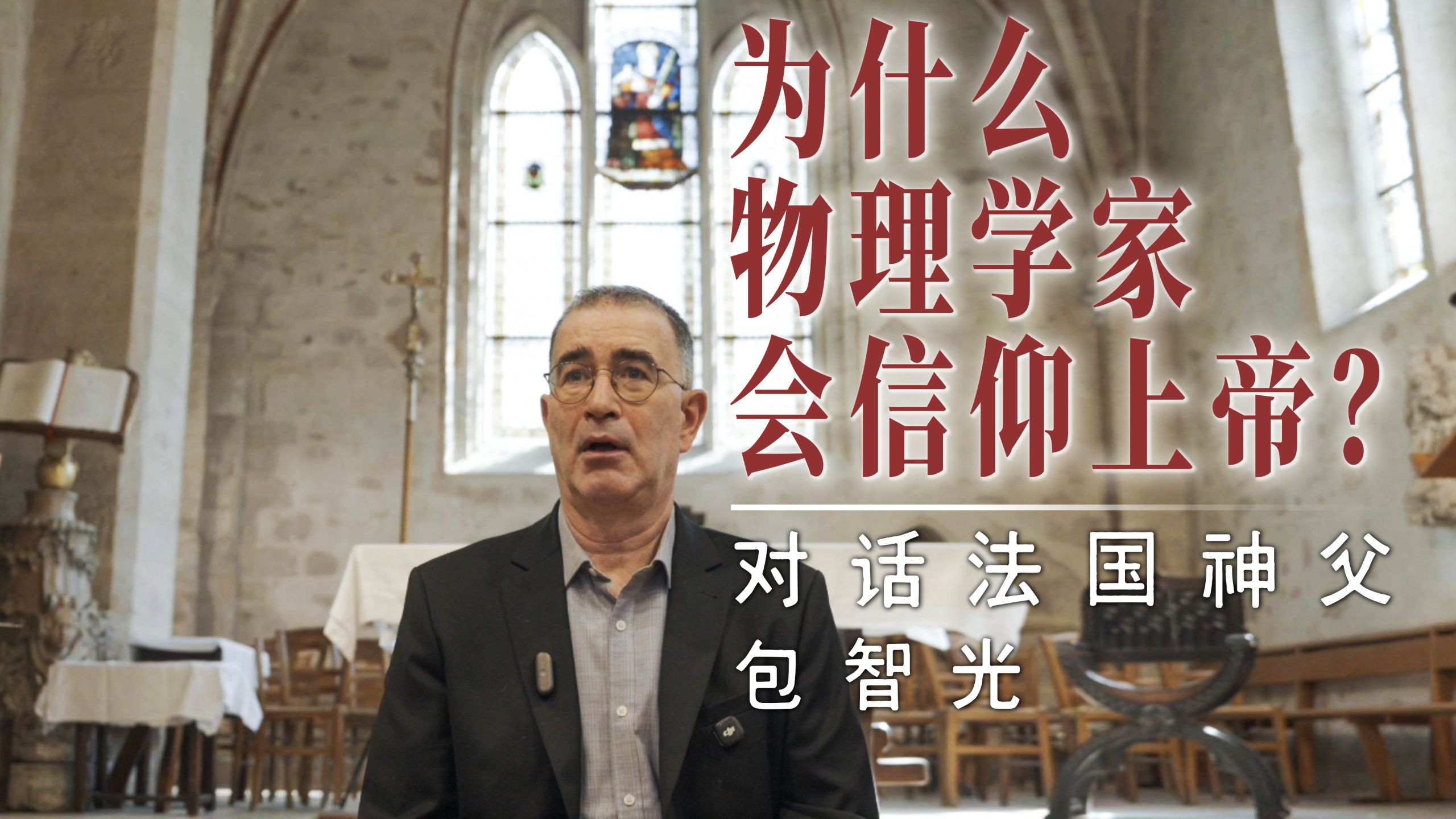
谈及职业前景,包神父指出年轻人的焦虑在近年呈几何级放大。随着人工智能(AI)在全球掀起颠覆性革命,许多既有的职业图景被全盘重构。年轻人无法看清哪些职业将被取代、哪些行业能借技术成长,父辈积累的生活与工作经验在剧变面前几乎完全失效。这种看不清前路的能见度缺失(manque de visibilité)直接化为生存焦虑,进而反噬到他们的精神世界,甚至引发对信仰以及与上帝关系的动摇与质问。
subgraph Medieval["中世纪托马斯主义"]
M1["托马斯·阿奎那"] --> M2["'恩宠不废除自然,而是成全自然'<br/>理性与信仰互补共存"]
end
subgraph ScientificRev["科学革命初期"]
S1["哥白尼、伽利略、牛顿等"] --> S2["秉持基督信仰研究自然法则<br/>将科学视为认识造物主之径"]
end
subgraph Modern["19世纪以降至当代"]
D1["19世纪:制度与思想割裂对立<br/>教会曾主动拉开与科学界的距离"]
D2["当代:复杂的精神光谱<br/>非非黑即白的绝对无神或盲信"]
end
Medieval --> ScientificRev
ScientificRev --> Modern
```
包神父指出,早在中世纪,经院哲学家圣托马斯·阿奎那(Saint Thomas d'Aquin)便提出了极具穿透力的哲学命题:天主的恩宠(la grâce)并不废除或摧毁受造的自然秩序(l'ordre de la nature),而是对自然的升华与补充。科学革命初期的巨擘如哥白尼(Copernic)等人,也皆是怀揣深厚基督信仰探索自然奥秘的哲人。科学与天主教会之间的紧张与疏离,很大程度上是19世纪历史环境下的产物,天主教会在当时自我封闭、疏远科学界关切的做法,本身也承担着不可推卸的历史责任。
[20:00](https://www.bilibili.com/video/BV1XDe46QExW?t=1200s) Du laboratoire à la théologie : la question de la liberté
François Barriquand (le père 包智光) revient sur l'évolution de son propre parcours intellectuel et spirituel. Lorsqu'il travaillait dans la recherche en physique, il ne ressentait pas de tiraillement particulier entre la pratique de sa foi chrétienne d'une part, et ses travaux scientifiques d'autre part; les deux coexistaient sans heurts majeurs. Paradoxalement, c'est au moment d'aborder les études de théologie que les difficultés intellectuelles ont véritablement surgi. En cherchant à embrasser l'ensemble des dimensions de la réalité, la théologie a fait émerger des interrogations beaucoup plus exigeantes que prévu, au premier rang desquelles figure l'énigme de la liberté humaine face à Dieu et aux lois du monde.
Interrogé sur la manière dont un esprit habitué à la rigueur scientifique peut "saisir" la vérité religieuse, le père Barriquand précise immédiatement qu'il est impossible de « mettre la main sur Dieu » par des méthodes expérimentales au sens scientifique du terme. Le Dieu chrétien échappe structurellement à toute capture empirique ou réductionniste. Sa propre démarche ne revendique aucune originalité: elle repose sur une expérience existentielle née de l'écoute de la parole transmise par les générations croyantes qui l'ont précédé, une parole dont il constate qu'elle « produit du fruit » et résonne avec justesse au plus profond de lui-même.
- Dans les paroisses ordinaires (y compris la sienne), la foi de nombreux fidèles qui viennent à la messe le dimanche n'est pas exempte de questions ni de doutes.
- La conciliation entre science et foi s'est révélée plus simple durant sa carrière de physicien qu'au cours de son cursus théologique formel, où les paradoxes existentiels (notamment la liberté) sont apparus plus ardus.
- Le concept biblique du « travail de l'Esprit dans le cœur des êtres humains » décrit une réalité concrète et vérifiable par l'expérience de vie intérieure, sans pour autant constituer une démonstration de laboratoire.
---
[23:00](https://www.bilibili.com/video/BV1XDe46QExW?t=1380s) Une foi vécue en corps et en communauté
À la question de savoir si la foi demeure strictement individuelle ou si elle dépend des autres, le père Barriquand souligne la tension féconde entre responsabilité personnelle et vie communautaire. D'un côté, la démarche reste irréductiblement singulière: « chaque personne est responsable de sa propre vie » et personne ne peut vivre ou décider à notre place. Mais d'un autre côté, la foi chrétienne s'enracine nécessairement dans un corps ecclésial et une communauté vivante.
C'est au sein de ce collectif, dans une écoute attentive des frères et sœurs, que s'opère un discernement partagé. Une parole prononcée par un membre de la communauté peut soudainement faire écho à l'Évangile d'une façon neuve et lumineuse. Par cette médiation humaine, le croyant discerne que « Dieu me parle et Dieu m'indique la direction à suivre pour essayer de porter du fruit ». La parole divine ne descend pas sous la forme d'un oracle désincarné, mais circule horizontalement à travers les liens fraternels.
```mermaid
flowchart TD
accTitle: Dynamique de la transmission et de l'écoute de la parole
accDescr: Schéma illustrant comment la parole de foi transmise par la communauté nourrit l'expérience existentielle et produit des fruits.
subgraph Heritage ["Transmission"]
A["Témoignage reçu des anciens"] --> B["Parole de foi partagée"]
end
subgraph Discernement ["Expérience intérieure"]
B --> C["Écoute fraternelle en communauté"]
C --> D["Résonance intérieure avec l'Évangile"]
end
subgraph Accomplissement ["Action dans le monde"]
D --> E["Fruits concrets de vie:<br/>amour, justice et service de la paix"]
end
```
---
[25:00](https://www.bilibili.com/video/BV1XDe46QExW?t=1500s) Sensations physiques et « la nuit de la foi »
L'interviewer s'interroge en anglais sur la nature intime de cette perception: entend-on une voix physique dans l'oreille? S'agit-il d'une sensation corporelle particulière, ou de paroles chuchotées en rêve? Le père Barriquand désamorce cette vision spectaculaire ou sensorielle en rappelant la grande tradition mystique catholique, où les plus grandes figures spirituelles ont souvent traversé ce qu'on appelle « la nuit de la foi ». Dans ces états, le croyant ne ressent strictement rien: il n'y a ni perception physique, ni évidence intellectuelle, ni consolation affective.
Pour illustrer ce paradoxe, le père Barriquand cite deux figures majeures:
- **Saint Jean de la Croix**: le docteur mystique espagnol a longuement théorisé cette vie de foi dépouillée de toute vision ou illumination sensible, où l'âme progresse dans l'obscurité la plus complète sans appui tangible.
- **Sainte Thérèse de l'Enfant-Jésus (Thérèse de Lisieux)**: durant la dernière étape de son existence, elle a été plongée dans une nuit de la foi radicale, assaillie par le doute absolu envers tout ce en quoi elle avait cru, tout en choisissant de demeurer héroïquement dans l'amour et l'attente patiente.
Le critère décisif de la présence divine n'est donc pas une émotion extatique immédiate (« I don't expect to have a feeling »), mais les fruits durables que la vie produit a posteriori. Conformément à l'adage évangélique de Jésus (« vous les reconnaîtrez à leurs fruits »), les seuls repères tangibles résident dans l'engagement effectif pour la justice, l'amour du prochain et le service de la paix.
---
[28:30](https://www.bilibili.com/video/BV1XDe46QExW?t=1710s) « Fides quaerens intellectum » : le saut de la foi
La discussion aborde ensuite la posture de l'observateur non croyant: peut-on accéder à la foi par l'étude et l'accumulation de lectures, ou bien la foi relève-t-elle d'un élan préalable irréductible à l'érudition livresque? L'interlocuteur cite l'adage classique de la théologie chrétienne: *la foi en quête d'intelligence* (*fides quaerens intellectum*). Le père Barriquand approuve pleinement cette analyse, faisant référence à saint Paul (notamment dans l'Épître aux Romains) qui affirme que tout procède « de foi en foi ». Sans l'étincelle initiale de la confiance, l'accès au mystère demeure impossible de l'extérieur.
Le travail théologique et intellectuel ne sert pas à fabriquer la foi ni à contraindre quelqu'un à y entrer comme au terme d'un syllogisme. Il a pour fonction d'« éclairer ce en quoi on peut déjà croire », et non d'opérer le basculement initial, qui relève d'un mystère insondable de la conscience humaine. L'adhésion croyante ne résulte pas d'une déduction logique, mais d'une rencontre que les concepts viennent seulement articuler et approfondir par la suite.
---
[30:50](https://www.bilibili.com/video/BV1XDe46QExW?t=1850s) Liberté, doute sincère et refus de l'idole rationnelle
Face au doute philosophique — « Dieu existe-t-il vraiment? » —, le père Barriquand insiste sur le fait qu'une telle question n'a rien d'offensant ni de coupable: « tout ce qui va dans le sens de la vérité est une bonne chose ». Si la conscience dicte le doute, l'individu est pleinement légitime à l'exprimer. Certes, le prêtre peut fournir des réponses rationnelles et théologiquement cohérentes: par exemple, si Dieu est par essence Amour, Il recherche une réponse d'amour libre et authentique de la part de l'être humain, et refuse par conséquent de s'imposer par une force contraignante à notre intellect. Un Dieu d'amour laisse toujours le champ libre à la quête humaine.
Cependant, le père Barriquand souligne les limites de cette cohérence logique: elle ne saurait suffire à contraindre l'adhésion. Pis encore, une preuve absolue et indiscutable trahirait la foi:
> « Si j'étais capable de vous persuader d'une manière parfaitement rationnelle que Dieu existe, alors le Dieu que je vous présenterais, ce serait sans doute pour la foi chrétienne une idole. »
Une preuve logique irréfutable réduirait Dieu à un objet qui s'imposerait par nécessité, privant l'homme de sa liberté. La croyance authentique refuse d'emprunter la voie d'une certitude scientifique contraignante. Évoquant enfin son expérience missionnaire passée en Chine, le père Barriquand remarque avec un brin d'ironie paradoxale qu'il lui était souvent plus fluide et naturel de parler de l'Évangile et de sa foi en Chine qu'auprès de ses contemporains en France, où la parole se heurte parfois à d'autres résistances culturelles et intellectuelles.
神父坦承,这种对耶稣的信靠并非全知全觉,而是伴随着某种“幽暗的成分”(une part d'obscurité)。人必须在自身的局限、罪过、黑夜以及对生命意义感到困惑和无法解读时,依然选择信靠。信仰的本质正是试图超越这些晦暗,坚信无论我们做过什么,我们依然能够去爱,并且“在天主的眼中我们至关重要”(on compte aux yeux de Dieu)。
谈及爱的本质,包神父引述了17世纪法国主教圣弗朗索瓦·德·萨勒(Saint François de Sales,又译圣方济各·沙雷氏)在其论述天主之爱的巨著《论天主的爱》(*Traité de l'amour de Dieu*)中的思想。德·萨勒最打动神父之处在于其寻求“内在融洽与整合”(chercher à trouver une cohérence, à intégrer les choses)的视角:
- **情感与喜好(Affection / Goût)**:对某人产生好感、喜爱甚至坠入爱河,具有情感上的吸引力。
- **舍己与无私之爱(Donner sa vie / Désintéressé)**:面对身处困境、患病、需要帮助甚至在外表上毫无吸引力的人,超越偏好去给予关照,乃至付出生命。
- **爱的整合**:在德·萨勒的神学视角下,这两种看似悬殊的爱并非彼此割裂对立,而是能够被整合为一个循序渐进的有机整体。
面对“天主究竟希望人在这样的人生游戏或旅程中获得什么”的提问,包神父给出明确回答:天主对人类的根本期许就是“学习去爱”(to learn how to love)。我们在尘世生命的短暂岁月中操练爱,是为了在永恒的生命中懂得如何去爱。哪怕世俗中许多所谓的爱尚显稚嫩甚至带有缺陷,但只要它包含着爱的要素,就已经具备了不可抹杀的价值,并能在随后的生命中被校准、提升与修正。
包神父指出,基督徒有时会对所谓的“天主的旨意”(the will of God)心生恐惧,害怕天主要求的事物与自己内心的愿望背道而驰。但真正进入深层信仰后会发现,根本无需惧怕天主的旨意,因为在任何境遇下,天主对人的期待无非就是去爱,而爱是人人内心深处都向往的事。尽管当爱要求人付出沉重代价、乃至为他人牺牲生命时,“说起来容易做起来难”,但古往今来所有人类文明,无一例外都对那些甘愿为他人舍命之人抱有崇高的敬意。
主持人随即追问:现实中有许多人声称自己在“爱”,其实背后驱动他们的并不是真正的爱,而是恐惧(fear)——对未来的恐惧、对失去的恐惧,所谓“我爱你”往往只是“我害怕失去她”。对此,包神父再次借用圣弗朗索瓦·德·萨勒的温和人道主义来回应:
- **不贬低任何微小的爱**:一个人被另一个人吸引,有时就像被一顿美餐所吸引一样,仅仅是大脑对愉悦刺激的本能反应;但德·萨勒从不轻易否定这种低层次的吸引,而是将其纳入整体考量,作为向上攀升的起点。
- **耶稣对待人性弱点的态度**:福音书中的耶稣极为接纳人性的艰难与软弱。耶稣真正斥责的是虚伪、自私与谎言("hypocrisy, selfishness or lies");对于一般人性的局限与软弱,耶稣从不一味谴责斥责,而是悉心陪伴,引导他们一步步向前。
- **爱的生长法则**:世间任何一颗哪怕最卑微脆弱的爱的种子,都有可能在正确的滋养下生长为纯正良善之物。
针对“学习去爱”的命题,主持人抛出了全场最具张力的尖锐质问:纵观整个人类历史乃至自然界,苦难从第一天起就无处不在,所有受造物都在承受痛苦。如果一个人想学物理,他可以进入满是物理课本、老师和同伴的学校;但人类身处的却不是一所“爱的学校”,而是一个充斥着苦难的世界,人能听到的只有“天主的沉默”(the silence of God)。在一个看似没有爱、充满苦难的世界里,人究竟如何学会去爱?
包神父对此予以高度认同:
- **自由是至高之爱的基石**:最深厚、最高等级的爱若缺乏自由,根本不可能存在("It's not possible without freedom")。
- **必然性消解美德**:如果我们做某事仅仅是因为不得不做、出于被动驱动,那么其中便不存在任何特殊的美德。
- **自主选择的重量**:如果一个男人对女人说爱她,却并非出自他自主的抉择,而只是受情绪驱使不得不产生依恋,对方必然会质疑当需要做出抉择时会发生什么。爱唯有在自由抉择的土壤上,才能脱离恐惧与强迫,展现出真实的生命力。
[55:00](https://www.bilibili.com/video/BV1XDe46QExW?t=3300s) Love vs. Fear: The Test of Time and the Optimism of St. Francis de Sales
When asked how one can discern whether an action is motivated by love or driven by fear, Father François Barriquand acknowledges that humans constantly harbor a complex bundle of values at any given moment. Fear is frequently present in the mind alongside altruism, generosity, and selfish inclinations. In moments requiring fundamental life choices, François observes that "only time... will tell whether really love will be the determining value or something else." He points to romantic relationships as a prime example: when a man and a woman fall in love, only time reveals whether that bond has the strength to endure for a lifetime. If it ultimately dissolves, it does not invalidate what was felt before; it simply shows that time is the ultimate arbiter of depth and permanence.
François personally leans toward an optimistic view of human nature, taking inspiration from historical figures he admires, most notably Saint Francis de Sales. Known for his deeply hopeful theological outlook, Francis de Sales believed firmly in the innate human capacity for moral progress. François notes that while people routinely experience competing internal forces—the selfless urge to give alongside the self-protective impulse to be selfish—Saint Francis de Sales chose to concentrate on the good aspects of our nature rather than dwelling on the negative, without ever becoming naive about what humanity is capable of doing.
[58:00](https://www.bilibili.com/video/BV1XDe46QExW?t=3480s) "Love and Do What You Want": Navigating Future Anxiety and Personal Calling
The conversation turns to the pragmatic tension between religious ideals and daily human struggles. The host brings up the Gospel passage where Jesus reminds the disciples that the birds of the air neither sow nor reap yet are fed, challenging the necessity of constant worry. Both in France and in China, young people find themselves burdened by anxiety over the future, and hearing high-minded talk of love can feel distant and helpless when real-world uncertainty looms close. François responds by invoking Saint Augustine’s famous fourth-century dictum: "Love and do what you want." While frequently misinterpreted as license to act without restraint, François reads it as an affirmation of integrity: if your actions genuinely originate from love, what you do is fundamentally good and fulfills your responsibility.
François emphasizes that this love cannot be flattened into a universal, rigid formula. Because every human being is unique, each person must discover their own distinct way of loving their neighbors and participating in creation. No outside authority or counselor can provide an off-the-shelf blueprint, because nobody else is living that specific life. While mentors and thinkers can offer inspiration, François cautions against pretending to have all the answers for someone else, arguing that true encouragement means empowering people to discern and live out their own callings.
- **Saint Augustine's Principle**: *"Love and do what you want"* (*Dilige et quod vis fac*) implies that genuine love aligns human will with moral good.
- **The Paradox of Modern Worry**: Despite the biblical admonition that birds neither sow nor reap, anxiety remains a pervasive reality for young generations across different cultures.
- **Individuality of Calling**: Because human existence is non-interchangeable, moral and spiritual paths cannot be externally dictated.
[01:01:45](https://www.bilibili.com/video/BV1XDe46QExW?t=3705s) When the Heart Accuses: Self-Condemnation, Fear, and Constructive Anxiety
Addressing the painful experience of self-loathing—when a person feels crushed by their own mistakes and unable to muster love—François turns to Scripture for solace. He references the First Letter of John: "even if our heart accuses us, God is greater than our heart." François explains that there are seasons in life where we are thoroughly disappointed in ourselves, stripped of the inner warmth or emotional bandwidth to love. Yet even when self-condemnation takes over, God looks upon the struggling person with unconditional mercy, forgiveness, and a single desire: that they find a way to truly live.
The discussion pivots back to the relationship between fear and faith. The First Letter of John also states that perfect love casts out all fear. François reflects on this with remarkable candor: "I must confess that as far as I'm concerned myself, I have not reached that level of love yet." He openly admits to feeling anxious about the future and many challenges in the world. Rather than treating anxiety as an absolute spiritual failure, he suggests that a healthy degree of anxiety is a natural, fitting response to grave and complex realities. If anxiety helps one confront problems and move forward, it serves a purpose; it only becomes harmful when it paralyzes action. In this sense, love itself can contain anxiety, just as a mother naturally worries about the future of her children precisely because she loves them.
```mermaid
flowchart TD
accTitle: The Two Faces of Anxiety in the Context of Love
accDescr: A flow diagram contrasting constructive anxiety that spurs action with paralyzing anxiety that hinders life.
subgraph Trigger["Confronting Severe Realities"]
A["Severe Global & Personal Problems"] --> B["Human Anxiety & Concern"]
end
subgraph Paths["Paths of Anxiety"]
B --> C["Paralyzing Anxiety"]
B --> D["Constructive Anxiety"]
end
subgraph Outcomes["Outcomes"]
C --> E["Stagnation & Despair<br/>(Must be overcome)"]
D --> F["Engagement & Compassionate Care<br/>(Rooted in Love)"]
end
```
[01:05:00](https://www.bilibili.com/video/BV1XDe46QExW?t=3900s) The Infinite Forgiveness of the Curé d'Ars and the Enigma of Human Freedom
When asked whether he personally fears death or the future, François states that while his ultimate trust rests in divine salvation, living in the present means facing real societal anxieties. Modern existence is beset by acute crises that previous generations never had to navigate—environmental degradation, geopolitical fragility, youth unemployment, and novel forms of addiction to drugs and digital screens. Experiencing sleepless nights over these heavy realities is not a lack of faith, but a fundamentally human response.
The host then asks how to view someone who repeatedly stumbles into moral failure, genuinely repents, and yet falls again into even worse behavior. François cautions against human rush to judgment, noting that outsiders can never truly measure how free a person was when committing a harmful act:
- **Society vs. Divine Perspective**: Society must maintain civil justice and accountability, but God alone perceives the inner constraints, wounds, and true state of an individual's freedom.
- **The Sin of Doubting Mercy**: François cites the nineteenth-century French priest Saint Jean-Marie Vianney (the Curé d'Ars), who told his parishioners that believing God could not forgive a particular sin was itself a sin, because divine love is strictly boundless.
- **Humility of Faith**: François disclaims any privileged clerical insight into God's mercy: "It's not because I'm a priest that I can understand anything about God's love better than you." Infinite love remains an unfathomable reality accessed purely through faith.
This reflection on human limitation and culpability naturally leads back to François's own intellectual journey. Asked why he dedicated years to studying the concept of human freedom, François reveals that the inquiry was deeply shaped by his background in scientific and physical studies.
[01:10:00](https://www.bilibili.com/video/BV1XDe46QExW?t=4200s) Physical Determinism, Randomness, and Human Freedom
Scientists generally proceed from the premise that the evolution of everything in the universe obeys physical laws. In principle, these laws are thought capable of describing the whole of reality, even if no individual scientist can compute or articulate all the details. When looking at the physical laws established today, they appear to be composed of a mixture of deterministic processes—events that must occur in a strictly predetermined manner—and fundamentally random events. François Barriquand (Father 包智光) points out that if reality is exhaustively described by this duality, there is simply no room left for human freedom in the sense understood by the Catholic faith. Genuine freedom cannot merely be a passive composite of things predetermined without our consent and random dice-rolls that we likewise cannot choose.
```mermaid
flowchart TD
accTitle: The Tension Between Scientific Determinism and Genuine Freedom
accDescr: Flowchart illustrating the scientific dilemma of determinism versus randomness and the theological proposition of freedom.
subgraph Science["Scientific Description of Reality"]
D["Deterministic Laws<br/>(Predetermined necessity)"]
R["Quantum/Stochastic Randomness<br/>(Unchosen chance)"]
D & R --> NoFree["No Room for Genuine Freedom"]
end
subgraph Theology["Theological & Philosophical Alternative"]
Council["Open Question: Council of Trent & Grace"]
Spirit["Gift of God & Holy Spirit"]
Council --> Spirit
Spirit --> TrueFree["Genuine Freedom Paradox:<br/>Surrender to God's Will Enables True Agency"]
end
NoFree -.->|"Epistemological limit: Cannot disprove freedom"| Council
```
This tension formed the core of Father Barriquand's doctoral dissertation in theology. Rather than confining himself strictly to internal doctrinal questions, his goal was to examine whether Catholic belief in genuine, authentic human freedom can be articulated in a way that is intellectually acceptable and coherent to contemporary scientists. He admits this is an extraordinarily subtle and unresolved question, but his intention was to open the dialogue between theology and physical sciences a little wider.
When the host asks how one might explain this dilemma to an eighteen- or twenty-year-old student, Father Barriquand responds that younger adolescents rarely doubt their freedom; existential questions about whether agency is an illusion usually surface around age twenty or later. If challenged, he begins by acknowledging the open possibility that genuine freedom might not exist at all. Throughout the history of Catholic theology, several thinkers held that God foreknows absolutely everything in advance. In that paradigm, one could easily conclude that if God knows every outcome, a fully developed science could in principle know everything too, leaving freedom merely as a pragmatic or psychological concept. This mirrors Albert Einstein's worldview: Einstein believed that genuine metaphysical freedom does not exist, yet he continued to rely on the concept in daily human life.
---
[01:14:48](https://www.bilibili.com/video/BV1XDe46QExW?t=4488s) The Lamppost Metaphor and the Epistemological Circle
Father Barriquand emphasizes that there is no empirical or mathematical way to prove that genuine freedom exists, and he has no pretension of offering such a proof. However, his philosophical research seeks to establish the inverse: science is equally incapable of proving that freedom *cannot* exist. This limitation stems from the very nature of experimental science as practiced in physics, chemistry, and biology through logic and mathematics.
Scientists inevitably operate inside an "epistemological circle." Humans are never entirely outside this loop; our formulations and experiments always depend on prior premises, existing models, and communal scientific history. Consequently, science cannot experimentally grasp the totality of reality and cannot know for certain whether its current models have artificially restricted knowledge to only those areas amenable to measurement. To illustrate this, Father Barriquand recounts a well-known joke about a man searching under the glow of a streetlamp:
> "One day he is looking for something under the light of a lamp. And a friend comes to him and says, 'What are you looking for?' He says, 'I'm looking for my keys.' 'Did you lose them here?' He says, 'No, but that's where I can see something. Where I can hope to find something.'"
He questions whether the scientific method sometimes drives researchers into this exact posture: pursuing what the light illuminates and then assuming what lies in the light constitutes the whole universe. Because science can neither prove nor disprove the reality of genuine freedom, humanity remains philosophically free to listen to other perspectives—including philosophical and theological traditions—when science reaches its boundary.
---
[01:17:42](https://www.bilibili.com/video/BV1XDe46QExW?t=4662s) The Christian Paradox of Freedom and Resonances with Taoism
Turning to Catholic tradition, Father Barriquand notes that while theological history contains complex debates and occasional contradictions, historical milestones such as the Council of Trent (specifically the decrees of Session Six on justification and human agency) established crucial guidelines regarding free will and divine grace. In this framework, genuine freedom is regarded not as self-generating autonomy, but as a "gift of God." It operates through the mysterious action of the Holy Spirit acting within the human heart, mind, and nature.
This generates what Father Barriquand terms the fundamental Christian paradox of freedom:
- The more a person strives to follow the will of God—a will that originates outside their own ego—the more genuinely free that person becomes.
- By aligning oneself with the divine, one's capacity to make true life-giving choices and mature as a human being expands.
- The Holy Spirit never acts as an external, coercive mechanical force, but rather acts from within, fostering internal freedom and love.
The host observes that under this definition, "freedom is not free" and must be cultivated; simply following one's baseline desires or impulses is not authentic freedom, because one remains enslaved to natural appetites. Genuine freedom requires learning how to love God and neighbor, transforming freedom into an active, disciplined decision. Father Barriquand agrees and identifies an ancient cross-cultural parallel in Chinese tradition: centuries before Christianity reached China, Taoism (道家) developed a strikingly similar insight. In Taoist philosophy, the practice of yielding, non-contriving action, and "letting things go" (自然 / 无为) allows human nature to harmonize with reality in a manner closely mirroring the Christian experience of spiritual freedom.
---
[01:21:39](https://www.bilibili.com/video/BV1XDe46QExW?t=4899s) Translating the Bible into Chinese: Linguistic Differences and Precision
The host transitions to Father Barriquand’s practical missionary scholarship, asking about his work translating the Bible into Chinese and how Chinese compares to biblical Greek, Latin, French, and English. Father Barriquand clarifies modestly that he did not single-handedly translate the scriptures; rather, he served as a theological and critical reader within a collaborative translation team, reviewing drafts and annotating their renderings.
```mermaid
flowchart LR
accTitle: Bible Translation Complexities Across Greek and Chinese
accDescr: Diagram illustrating grammatical adaptations from Pauline Greek to Chinese.
Greek["Biblical Greek<br/>(Long, complex Pauline syntax)"]
Adapt["Translation & Adaptation Process"]
Chinese["Chinese Translation<br/>(Shorter sentences, explicit clarity)"]
Greek --> Adapt --> Chinese
Ambiguity["Greek Ambiguities"] -.->|"Forced contextual resolution"| Chinese
```
He highlights several stark linguistic contrasts that emerged during the work:
- **Direct Equivalents for "Yes" and "No":** Chinese does not possess universal, standalone direct equivalents identical to Western "yes" and "no" (relying instead on verb repetitions such as 是/不是, 对/不对, 有/没有). When translating Jesus's instruction in the Sermon on the Mount—rendered in English as *"Let your yes be yes, and your no be no"*—the phrasing represents an adaptation of the underlying Greek grammar rather than a direct literal mirror.
- **Sentence Architecture and Saint Paul:** Biblical Greek grammar, particularly in the Pauline epistles, relies on sprawling, subordinate clauses that cannot be carried over directly. In French and English, significant structural adaptations were already established; in Chinese, the team had to systematically break these massive syntactic structures into concise, shorter sentences.
- **The Inherent Precision of Chinese:** Contrary to the impression that Chinese is always vague or impressionistic, Father Barriquand observed that Chinese grammar often forces translators to be remarkably precise. While the original Greek of the New Testament frequently leaves grammatical relationships or references intentionally open or ambiguous, Chinese syntax demands structural clarity, requiring the translation team to make explicit contextual decisions to produce natural sentences.
[01:25:00](https://www.bilibili.com/video/BV1XDe46QExW?t=5100s) Translating the Bible into Chinese: Linguistic Precision, Vocabulary Richness, and Missed Nuances
Translating biblical scriptures from ancient Greek and Hebrew into Chinese presents profound linguistic and theological challenges. In Western languages like French or English, translators can frequently preserve ambiguity when an original Greek passage allows two or three distinct interpretations, leaving it to the reader to decide how to understand the text. In Chinese, however, syntax and semantic structures rarely tolerate such calculated vagueness; translators are compelled to commit to a specific reading. While demanding, this constraint forces the translation committee to achieve absolute clarity regarding what they are articulating, often producing a Chinese rendering that is sharper and more precise than its French or English counterparts.
A further discovery during the translation process was the extraordinary richness and contextual specificity of Chinese vocabulary. In French, a single word often suffices across multiple contexts, whereas Chinese may offer three, four, or five distinct terms. While a foreign scholar might initially strive for formal consistency—attempting to translate a recurring Greek term with the exact same Chinese counterpart throughout—this approach quickly proved impossible. The richness of Chinese demands that vocabulary shift according to the specific context. This dynamic led to several memorable translation decisions and theological debates:
```mermaid
flowchart TD
accTitle: Biblical Translation Choices in Chinese
accDescr: Diagram illustrating three key biblical translation challenges into Chinese discussed by Father Barriquand.
subgraph S1["Book of Revelation"]
A["Greek: Drakon / Dragon"] --> B{"Cultural Connotation"}
B -->|"Western / Biblical"| C["Evil creature / Monster"]
B -->|"Traditional Chinese"| D["Auspicious / Benevolent"]
C & D --> E["Translated with modifier as evil dragon"]
end
subgraph S2["Gospel of John: Chapter 1"]
F["Greek: Logos"] --> G["Catholic Tradition: Sheng-Yan (Holy Word)"]
F --> H["Protestant Tradition: Dao (The Way)"]
H --> I["Missed opportunity for cultural resonance"]
end
subgraph S3["John 14:6 Triad"]
J["The Way, Truth, and Life"] --> K["Concise Classical Triad: Dao, Li, Ming"]
end
```
- **The Problem of the Dragon in Revelation**: In the Book of Revelation, the dragon represents cosmic evil. In Chinese culture, however, the dragon (*long*) is traditionally an auspicious and noble symbol. Rendering "dragon" simply as "龙" (*long*) stripped of context would distort the theological meaning, leading the team to modify the term to clearly designate it as a monstrous or evil dragon.
- **Translating *Logos* in John 1:1**: In standard Catholic translations such as the Studium Biblicum version, *Logos* is traditionally rendered as *Shengyan* (圣言, the Holy Word), whereas Protestant translations predominantly use *Dao* (道, the Way/Dao). Looking back, Father Barriquand expresses a sense of regret that their team was not "more bodacious" in adopting *Dao*, which he considers deeply meaningful and resonant with Chinese philosophy, hoping future successors might embrace it.
- **The Triad in John 14:6**: When Jesus declares that he is "the way, the truth, and the life," classical Chinese provides a terse, evocative rendering: *Dao* (道, Way), *Li* (理, Truth/Reason), and *Ming* (命, Life/Destiny)—three single characters that connect directly with thousands of years of native philosophical thought.
---
[01:30:00](https://www.bilibili.com/video/BV1XDe46QExW?t=5400s) The Anatomy of Wisdom, Everyday Benefactors, and the Horizon of Perfect Love
Turning the dialogue back to personal existence, the hosts ask what the wisest kind of person looks like in daily life. Father Barriquand answers with a classic paradox: "whoever thinks he is wise, maybe he's not." Rather than intellectual grandeur, true wisdom reveals itself in those rare individuals who genuinely surrender their lives for others in a completely coherent, unified manner. Such figures exist throughout history, but he is quick to strip wisdom of any exclusive religious ownership. Reflecting on his own youth, he recalls a mathematics teacher when he was 13 or 14 years old who helped him build lasting self-confidence. Though she exerted a foundational influence on his life's trajectory, he confesses he cannot even remember her name today. Many formative benefactors appear on our path, guide our steps, and then fade from view; yet, echoing Descartes' famous ironic remark that good sense is the most widespread commodity because everyone believes they possess it, Barriquand observes that almost every ordinary person carries an authentic fragment of wisdom.
As an ambient church bell rings out in the room, the hosts pause to ask about its purpose given the unusual hour. Barriquand clarifies that it is the call to evening prayer. The conversation then presses into the essence of love: what would human beings look like if they truly, fully understood how to love as God intended? Barriquand maintains that absolute perfection in love is an eschatological reality—something humans will attain only in the afterlife or eternal life, while earthly life remains an endless apprenticeship.
Addressing the tension found in the First Epistle of John—which suggests that if we love one another as brothers and sisters, God's love reaches perfection within us—he acknowledges that love can achieve earthly peaks, but primarily through total self-renunciation. The supreme manifestations of this love are those who disappear to let others live, mirrored in Jesus on the cross or someone sacrificing their life in an emergency. Among those who remain in the mundane world, however, claiming to embody that ultimate level of perfection remains elusive.
---
[01:35:00](https://www.bilibili.com/video/BV1XDe46QExW?t=5700s) Interlude: A European Heatwave and Somatic Reflections on Sacred Architecture
The episode pauses for a brief reflective voiceover from the hosts, detailing the physical conditions of the recording. In early July, a sudden summer heatwave swept across Europe. While stone church sanctuaries are normally temperate retreats, the intense afternoon heat eventually penetrated the interior, making further filming uncomfortable and forcing the team to conclude the first day of interviews ahead of schedule.
After wrapping up, the hosts visited Father Barriquand's modest living quarters, located immediately adjacent to the parish church. Leading up to this interview, the production team had toured numerous historical churches across Europe to capture architectural photographs and build 3D spatial models. That immersive fieldwork accumulated a layer of bodily, tactile sensations—reactions not rooted in academic dogma, but arising from the physical confrontation with sacred spaces, leaving the hosts with lingering questions about the lived reality of Catholic and Christian traditions.
---
[01:36:12](https://www.bilibili.com/video/BV1XDe46QExW?t=5772s) Accompanying Through Darkness: Presence Over Problem-Solving and Truth in Relationships
Resuming the dialogue on the second day, the hosts raise a pastoral dilemma: when someone is enduring deep hardship and we burn with the urge to help, is authentic love about solving their problems, or is it about accompanying them through the dark? Furthermore, how does one discern when to provide comforting words versus speaking a hard truth that might sting?
Father Barriquand explains that while specialized professionals can certainly remedy isolated technical or material difficulties, no human being can presume to solve all of someone else's existential troubles. What the human heart fundamentally hungers for is not a problem-solver, but someone who enters into a relationship grounded in mutual trust and respect. The deepest peace emerges when we realize that another person values who we are in our entirety, rather than viewing us as a collection of dilemmas to be diagnosed and fixed.
```mermaid
flowchart TD
accTitle: The Dynamics of Pastoral Care and Truth
accDescr: A flowchart illustrating the distinction between problem-solving and authentic presence, alongside the criteria for discerning when to tell the truth.
subgraph Accompaniment["The Dynamic of Love"]
A["Someone in Difficulty"] --> B{"Approach to Care"}
B -->|"Technical Mentality"| C["Attempt to solve all problems<br><i>(Ultimately insufficient)</i>"]
B -->|"Relational Presence"| D["Accompany through darkness<br><i>(Trust, respect, and mutual discovery)</i>"]
end
subgraph TruthTelling["The Ethics of Truth"]
E["Delivering Hard Truths"] --> F{"Underlying Foundation"}
F -->|"Genuine Friendship"| G["Speak truthfully with respect<br><i>(Delivery may hurt, but truth heals)</i>"]
F -->|"Oppressive Intent / Danger"| H["Withhold truth<br><i>(e.g., Protecting lives from Nazis)</i>"]
end
```
Regarding truth and comfort, Barriquand asserts that in genuine friendship, truth is a good that should be held in the highest esteem:
- **Tone Versus Content**: If truth inflicts pain between authentic friends, the damage rarely stems from the truth itself, but from a disrespectful or callous delivery. Where real confidence exists, truth will almost always do far more healing than deceit.
- **The Limits of Truth-Telling**: One is not morally obligated to disclose the truth indiscriminately to bad actors. Citing the classic ethical example of the Second World War, Barriquand notes that if someone is harboring a fugitive being hunted by the Gestapo, they are under no moral obligation to tell the truth when the secret police knock on the door. Deceiving them is justified not because lying is intrinsically pleasing, but because oppressors seeking to destroy life have forfeited any qualification to receive the truth.
---
[01:40:40](https://www.bilibili.com/video/BV1XDe46QExW?t=6040s) Sacrifice as the Insurpassable Model: From Giving One's Life to Giving One's Time
The conversation converges on the Christian understanding of personhood, which holds that individual identity cannot be discovered in isolated introspection, but only through relationships—first with God, and equally with fellow human beings. The hosts press into the demanding theology of self-sacrifice: if Jesus giving his life represents the ultimate test and purest form of love, does someone who never physically sacrifices their life fail to fully experience what love is?
Barriquand responds that within Christian theology, the historical life and voluntary death of Jesus stand as an "insurpassable model" and perpetual source of inspiration. Laying down one's life for others is unquestionably the highest expression of love, yet God does not require every believer to undergo violent martyrdom or dramatic self-destruction. Most people, he hopes, will never be forced into such extreme crucibles.
Crucially, the absence of physical martyrdom does not mean sacrifice is absent from ordinary existence. The identical logic of self-giving operates within everyday life through small, recurring choices. Simply choosing to surrender one's personal time, attention, and convenience for the sake of another person is a genuine, lived participation in the very same sacrificial love that Christ modeled on the cross.
[01:45:00](https://www.bilibili.com/video/BV1XDe46QExW?t=6300s) The Inherent Sacrifice of Human Life and Salvation Outside the Church
Father François Barriquand reflects on the quiet, everyday sacrifice embedded in simply offering one's time to others. We often prefer to reserve our limited hours for ourselves, but upon seeing the urgent needs of those around us, we willingly choose to give ourselves away. When a person pours out all their time, virtually nothing remains of their own, because mortal life is inherently finite. In Father François's view, human life is fundamentally loaded with a sacrificial dimension—not in the sense of being deliberately painful or grim, but as a conscious willingness to lose something of oneself for the sake of another.
This leads into a heartfelt theological question raised by the interviewer: what happens to a person who genuinely seeks love and truth and performs sincere good deeds, yet possesses no religious faith whatsoever? Will this person enter the kingdom of heaven? Father François responds with immediate reassurance, pointing out that modern Catholic teaching is quite explicit on this matter. Following the Second Vatican Council (Vatican II), the Church officially affirmed that in ways known to God alone, God possesses both the power and the willingness to save anyone who leads a just life, regardless of whether they have ever known or encountered the Christian faith.
[01:46:48](https://www.bilibili.com/video/BV1XDe46QExW?t=6408s) Saint Thomas Aquinas and the Primacy of Human Conscience
Father François explains that this open perspective is not merely a modern invention; it was already articulated with remarkable clarity in the Middle Ages by Saint Thomas Aquinas. Aquinas examined the mechanics of the human conscience, concluding that acting against one's conscience is inherently wrong, whereas following what one's conscience dictates is fundamentally what a person ought to do. Aquinas illustrated this with an audacious example for his era: if an individual genuinely and sincerely believes in their conscience that their duty is to adhere to the Islamic faith, then being a Muslim is precisely what they must do.
```mermaid
flowchart TD
accTitle: Aquinas's Framework on Human Conscience
accDescr: Diagram showing how sincere moral conscience guides human action and evolves through continuous reflection.
subgraph InternalState["Inner Moral Conviction"]
A["Sincere Human Conscience"] --> B{"Current Conviction"}
B -->|"Belief in Islam, Atheism, etc."| C["Act According to Conscience"]
end
subgraph DivineJudgment["Moral Standing"]
C --> D["Approved by God at that Moment"]
end
subgraph Evolution["Lifelong Discernment"]
D --> E["Ongoing Search & Reflection"]
E -->|"Further Enlightenment"| F["Self-Correction & Growth"]
F --> A
end
```
Extending Aquinas's logic to the modern secular context, Father François posits that if someone sincerely and thoughtfully concludes that they must believe there is no God, then following that conviction is what they are morally bound to do. However, adhering to one's conscience at a given moment does not exempt anyone—atheist, Muslim, or Catholic—from the ongoing responsibility of examining and testing their convictions. Over time, further reflection may reveal that an earlier stance was mistaken, opening room for self-correction. What matters fundamentally before God is that the person acts in total integrity according to their conscience as it stands, which God fundamentally approves at that moment.
- **Vatican II position**: God's grace and salvation are accessible through mysterious ways to any person of goodwill living a just life, even without explicit knowledge of Christ.
- **Aquinas on moral duty**: Violating one's conscience is always a moral transgression; following genuine conscience is obligatory.
- **Continuous discernment**: Following conscience is provisional; individuals must remain open to deeper enlightenment and moral correction across their lifetime.
[01:50:35](https://www.bilibili.com/video/BV1XDe46QExW?t=6635s) The Scope of Theology: Karl Barth versus Catholic Wholeness
The discussion shifts to the fundamental definition and purpose of theology, sparked by a book mentioned by the host titled *We Need Theology Today*. The author of that work argued that theology is exclusively about God rather than about the relationship between humanity and God. Asked whether theology should focus purely on God as an isolated entity or encompass the divine-human relationship, Father François traces the debate back through Church history, noting how prominent 20th-century Protestant theologians like Karl Barth championed a God-centered, neo-orthodox theology strictly focused on divine revelation.
In contrast, Father François affirms that the Catholic theological tradition remains as radically open as possible to all dimensions of reality. His conviction is rooted in the belief that God Himself is intensely interested in every aspect of human life. Divine interest is not confined to formal liturgies, communal prayers, or religious rituals performed inside a church building. Drawing an analogy to human love, he explains that when you truly love someone, every detail of their existence becomes fascinating, meaningful, and beautiful. If God's love embraces all of human life and creation, theology cannot artificially restrict its vision; instead, the divine mystery can be approached through nature, human relationships, and even the elegant physical laws of the universe.
[01:54:15](https://www.bilibili.com/video/BV1XDe46QExW?t=6855s) The Silence of God, Modern Suffering, and the Dark Night of the Soul
The host raises the enduring dilemma that troubles believers and skeptics alike: after more than two thousand years since Christ, why is the world still plagued by devastating wars, catastrophic climate change, and relentless suffering? If God is love, why is there only divine silence? Father François responds with deep empathy rather than facile apologetics, acknowledging that the silence of God is a profound and unsettling reality that must be heard honestly. Even Jesus Christ on the cross experienced this crushing absence, crying out: "My God, my God, why have you forsaken me?" The Gospels do not offer a neat philosophical explanation for suffering; rather, they bear witness to the resurrection—that after horrific agony and abandonment by both disciples and God, Christ returned alive, bearing peace instead of bitterness.
Evaluating whether modern suffering exceeds that of past eras yields mixed conclusions. On one hand, medical progress has drastically expanded human life expectancy compared to the Middle Ages, when many could barely expect to live past thirty. On the other hand, humanity has developed technological tools of mass destruction far more terrifying than medieval weaponry, allowing suffering and devastation to occur on unprecedented scales.
Father François reflects personally on the elusive sense of God's presence. At times, the feeling of divine absence may arise from personal missteps or poor choices, prompting a need for amendment and repentance. Yet Father François underscores that feeling abandoned by God is often completely disconnected from personal sin. He invokes the classic mystical concept of the "dark night of the soul" described by Saint John of the Cross, as well as the harrowing trial endured by Saint Thérèse of Lisieux (Saint Thérèse of the Child Jesus). At the end of her life, despite living an exceptionally holy and innocent existence, Thérèse was engulfed by the agonizing sensation that God was completely absent—or might not even exist at all—tempting her to feel that her entire life of devotion had been in vain. Father François concludes with quiet conviction that even in those moments of absolute darkness and seeming void, God is fully and mysteriously present.
[02:00:00](https://www.bilibili.com/video/BV1XDe46QExW?t=7200s) Choosing God vs. an Encounter: Freedom, Joy, and Student Years
The host raises a probing philosophical challenge: modern people often feel that belief in God is driven by psychological necessity—a human desire to find someone who will take ultimate responsibility for the world’s suffering and the weight of human history. When asked whether he chose God out of this existential need, Father François Barriquand clarifies his own path with deep humility. Emphasizing that he does not view himself as a "model for anyone, and not as a model of virtue either," he explains that his faith did not emerge from a calculated decision to fill an emotional or philosophical void. Although raised in a Catholic household, his pivotal awakening occurred between the ages of 17 and 19 while attending intensive preparatory studies in a Jesuit college.
During those rigorous years, everyone was working relentlessly under severe academic pressure. François felt anxious, constantly preoccupied with the obsessive need to succeed. Yet, he noticed something astonishing in several of his fellow student colleagues: they exhibited an extraordinary inner joy, a lightness of spirit, and a detachment that he lacked. They were genuinely free—free with respect to themselves, their lives, and their uncertain futures. Their day-to-day existence was not dictated by whether they achieved total success or only relative results; rather, it was animated by the steady conviction that they were accompanied by a forgiving God who unconditionally entrusted them with their own lives. Witnessing this lived reality prompted François to look inward, discover that same divine presence in his own life, and realize that faith was not a rational negotiation of human needs, but a genuine "spiritual encounter."
```mermaid
flowchart TD
accTitle: The Shift from Academic Anxiety to Spiritual Freedom
accDescr: Diagram tracing Father François's personal journey from performance anxiety to faith through encountering his peers' inner joy.
subgraph AcademicPressure ["The Competitive Environment"]
A["Intense Prep School Studies"] --> B["Obsessive Focus on Success"]
B --> C["Personal Anxiety & Unease"]
end
subgraph Observation ["The Witness of Classmates"]
D["Observing Christian Peers"] --> E["Profound Detachment & Freedom"]
E --> F["Inner Joy Unbound by Academic Results"]
end
subgraph Awakening ["Spiritual Transformation"]
G["Understanding Their Source of Meaning"] --> H["Trust in God's Accompaniment & Forgiveness"]
H --> I["Personal Encounter rather than Rational Need"]
end
C -.->|"Contrast with"| D
F --> G
```
- **Nature of the Choice**: Belief did not stem from looking for a scapegoat for worldly suffering, but from an encounter with people whose lives pointed toward grace.
- **The Core Difference**: Rather than staking self-worth on academic perfection, his peers drew their serenity from knowing they were accompanied by a God who forgives and trusts human freedom.
---
[02:04:47](https://www.bilibili.com/video/BV1XDe46QExW?t=7487s) The Trap of Religious Idolatry and the Freedom of the Spirit
While rejecting the notion that faith is mere wish-fulfillment, Father François openly acknowledges a widespread human temptation within religious communities: crafting a God in our own image, rather than allowing ourselves to be transformed into the image of God. Believers frequently construct mental idols that cater to self-interest—worshiping an image of God that is purely an omnipotent protector, a divine shield against misfortune, or a partisan force that favors believers over others. He denounces these self-serving mental projections as subtle forms of idolatry that can infiltrate any believer's subconscious mind.
The antidote to this mental trap is cultivating an authentic openness to the Holy Spirit, permitting God to guide one’s life. However, François concedes that this is far easier said than done. Because both God and the Holy Spirit are truly free, there is no guarantee that the divine promptings we receive will align with our personal comfort zones or natural desires. When asked about individuals who sincerely hold a distorted image of God, François remarks that if they genuinely follow their conscience, they can only seek deeper understanding and remain humble enough to amend their perspectives. Yet human nature often clings stubbornly to preconceived notions, to the point where breaking through ideological rigidity sometimes requires nothing short of a miracle.
- **False Images of God**: Projecting fantasies of an all-powerful bodyguard, a guarantee against suffering, or an exclusive patron of the pious.
- **The Challenge of Spiritual Guidance**: Following the Holy Spirit is unpredictable because divine freedom does not conform to human safety or preferences.
---
[02:07:35](https://www.bilibili.com/video/BV1XDe46QExW?t=7655s) Joan of Arc, the Apostle Paul, and the Humility of Uncertainty
To illustrate how hard it is to dismantle entrenched religious self-assurance, Father François recalls the radical transformation of the Apostle Paul. Originally named Saul, he was utterly convinced that his understanding of God was flawless, and in the name of that orthodoxy, he felt completely justified in persecuting early Christians. It took an unexpected, blinding spiritual encounter with Christ on the road to Damascus to break his certainty and overturn his life—a dramatic intervention that is rare in ordinary human experience.
This leads to the host's central question: can any believer ever be entirely certain that their concept of God is correct? François replies candidly that total certainty is impossible, and that embracing our inability to be completely sure is "the safest way to try to find some truth." Far from being a cause for despair, this lack of absolute dogmatic certainty is an intrinsic part of the normal human condition. To illuminate this, he recounts the famous trial of Saint Joan of Arc in Rouen, where Paris theologians attempted to entrap her with a theological paradox:
| Trial Question & Potential Responses | Prosecutorial Trap | Joan of Arc's Famous Answer |
|:--- |:--- |:--- |
| **"Are you in the grace of God?"** | • **If "Yes"**: Condemned for heretical presumption and claiming impossible certainty.<br>• **If "No"**: Condemned for acting on demonic rather than divine inspiration. | *"If I am not, may God put me there; and if I am, may God so keep me."* *(French tradition: "Si je n'y suis, Dieu m'y veuille mettre; et si j'y suis, Dieu m'y veuille garder.")* |
François highlights that Joan of Arc's reply remains the model for every Christian. Believers cannot know with absolute objective certainty whether their faith is authentic or whether their actions perfectly fulfill God's will; one can only pray that if they are within grace, God keeps them there, and if they have strayed, God gently leads them back.
---
[02:12:15](https://www.bilibili.com/video/BV1XDe46QExW?t=7935s) A Silent Prayer for Seekers and Listeners
As the dialogue reaches an intimate, contemplative moment, the host hesitates before asking a personal favor: would Father François be willing to pray for the interviewers and for the listeners who will eventually hear this conversation—especially those who are grappling with their own suffering, questions, and search for direction in life?
Father François welcomes the request with gentle warmth. He shares a small, self-deprecating confession about his life as a priest: people frequently ask him to pray for them, and knowing that his personal prayers as an ordinary man might feel frail or easily forgotten amid daily duties, he has adopted a personal rule. Whenever someone asks for his prayer, he never postpones it; he begins praying for them immediately in his heart. Even as they are seated together in the room, he has already begun offering a silent prayer for the hosts and for every searching soul who will encounter their conversation, asking that God give him the grace to hold those intentions in his heart going forward.
[02:15:00](https://www.bilibili.com/video/BV1XDe46QExW?t=8100s) Words for China's Youth and Mutual Spiritual Enrichment
When asked what message he would offer to the podcast's audience in China—primarily young adults between 25 and 35 years old—Father François Barriquand begins with an affectionate and humble apology. He explains that Chinese people hold a very special place in his heart, having lived in China for eleven years in total, including seven years in Hong Kong and four years in mainland China. However, having returned to France roughly fifteen years ago with few opportunities to practice, his spoken Chinese fluency has substantially declined, leaving him regretful that he cannot express these thoughts directly in Chinese.
Turning to his message, Barriquand stresses that whether listeners are believers or non-believers, humanity is bound together by shared core human values. While acknowledging the profound challenges, uncertainties, and suffering that may lie ahead for humanity, he insists that human life can never be reduced merely to hardship. There remain constant, vital occasions for joy, happiness, and genuine love for one's neighbor. Chinese culture, he observes, is endowed with immense spiritual and moral riches forged over an extensive history.
Looking toward the horizon of history, Barriquand shares his conviction that cultural and religious influence is not a one-way street. For several centuries, Christian missionaries traveled from the West to China, but he anticipates that this dynamic will one day be reversed. He envisions a future where an authentic, distinctively Chinese understanding of the Gospel emerges as a deep source of inspiration for the entire planet. Through this reciprocal exchange of spiritual gifts, both cultures will enrich one another—a harmony that humanity may begin to glimpse during our earthly lives, but will ultimately realize in full in heaven.
- Total time spent in China: 11 years (7 years in Hong Kong, 4 years in mainland China).
- Time elapsed since returning to France: Approximately 15 years.
- Core advice: Sufferings and challenges do not define life; embrace occasions for joy, happiness, and loving one's neighbor.
- Historical vision: Anticipating a reversal of the traditional East-West missionary dynamic through mutual enrichment.
---
[02:18:24](https://www.bilibili.com/video/BV1XDe46QExW?t=8304s) The Enduring Engineering of the Roman Pantheon
Switching to a recurring closing tradition, the host asks Barriquand to name the piece of architecture that has left the deepest impression on his mind. Barriquand clarifies with a modest laugh that he has never formally studied architecture, but when visiting Rome, he was completely captivated by the Pantheon.
What struck him most powerfully as a scientist and thinker is the Pantheon's sheer physical endurance. Constructed out of concrete and brick roughly two millennia ago, the monumental structure remains fully standing today. Barriquand remarks on how extraordinary it is that modern materials science is only now beginning to uncover the chemical secrets behind how ancient Romans engineered such durable, long-lasting concrete. By contrast, most modern concrete structures cannot hope to survive for anywhere near that span of time. To see that builders two thousand years ago possessed the mastery to erect an unreinforced concrete dome of that scale and durability made the Pantheon one of the most stunning works of human construction he has ever witnessed.
---
[02:20:00](https://www.bilibili.com/video/BV1XDe46QExW?t=8400s) Philippians and the Wisdom of Cultivating Cultural Richness
The host follows up with a final, searching question: having spent hours discussing existential fear, loneliness, freedom, and love, what is one single sentence or practice that a young audience can carry into their daily lives? Barriquand pauses, finding the demand for a definitive single maxim daunting, and chooses instead to offer a modest reflection anchored in the New Testament—specifically, Saint Paul's Epistle to the Philippians.
He explains that when Paul wrote to the nascent Christian community in Philippi, rather than prescribing an ethical code entirely from scratch, he encouraged them to look around at their own surrounding society. Paul urged them that whatever is noble, whatever is honorable, valuable, and worthy of esteem in their existing culture should be embraced, respected, and cultivated. Barriquand notes that this principle carries historical weight: during the Chinese Rites controversy centuries ago, Western missionaries often failed to recognize and honor this nuance, stumbling over how to integrate Christian faith with ancestral Chinese traditions.
Barriquand emphasizes that Paul's message carries particular resonance for Chinese youth today. Chinese civilization possesses distinctive treasures, values, and traditions that should never be cast aside or abandoned in the rush toward modernity. Instead, young people should actively encourage one another to nurture, cultivate, and preserve the noble heritage they have inherited. The interview concludes on this note of quiet mutual respect and gratitude, with the hosts thanking Father Barriquand for his hospitality and dialogue.
## Notable quotes
> [05:00](https://www.bilibili.com/video/BV1XDe46QExW?t=300s) grand écart — François Barriquand
> [10:00](https://www.bilibili.com/video/BV1XDe46QExW?t=600s) manque de visibilité — François Barriquand
> [10:00](https://www.bilibili.com/video/BV1XDe46QExW?t=600s) la découverte du Christ ressuscité — François Barriquand
> [20:00](https://www.bilibili.com/video/BV1XDe46QExW?t=1200s) mettre la main sur Dieu — François Barriquand
> [25:00](https://www.bilibili.com/video/BV1XDe46QExW?t=1500s) vous les reconnaîtrez à leurs fruits — François Barriquand
> [30:50](https://www.bilibili.com/video/BV1XDe46QExW?t=1850s) Si j'étais capable de vous persuader d'une manière parfaitement rationnelle que Dieu existe, alors le Dieu que je vous présenterais, ce serait sans doute pour la foi chrétienne une idole. — François Barriquand
> [40:00](https://www.bilibili.com/video/BV1XDe46QExW?t=2400s) to learn how to love — François Barriquand
> [50:00](https://www.bilibili.com/video/BV1XDe46QExW?t=3000s) the silence of God — 汉洋
> [50:00](https://www.bilibili.com/video/BV1XDe46QExW?t=3000s) It's not possible without freedom — François Barriquand
> [58:00](https://www.bilibili.com/video/BV1XDe46QExW?t=3480s) Love and do what you want — Saint Augustine
> [01:01:45](https://www.bilibili.com/video/BV1XDe46QExW?t=3705s) even if our heart accuses us, God is greater than our heart.
> [01:14:48](https://www.bilibili.com/video/BV1XDe46QExW?t=4488s) One day he is looking for something under the light of a lamp. And a friend comes to him and says, 'What are you looking for?' He says, 'I'm looking for my keys.' 'Did you lose them here?' He says, 'No, but that's where I can see something. Where I can hope to find something.' — François Barriquand
> [01:30:00](https://www.bilibili.com/video/BV1XDe46QExW?t=5400s) whoever thinks he is wise, maybe he's not — François Barriquand
> [01:54:15](https://www.bilibili.com/video/BV1XDe46QExW?t=6855s) My God, my God, why have you forsaken me?
> [02:07:35](https://www.bilibili.com/video/BV1XDe46QExW?t=7655s) Si je n'y suis, Dieu m'y veuille mettre; et si j'y suis, Dieu m'y veuille garder. — Joan of Arc
## Mentioned
包智光 (François Barriquand), 汉洋, 吕东, 吴子齐, 圣托马斯·阿奎那 (Saint Thomas d'Aquin), 尼古拉·哥白尼 (Copernic), 杨振宁, 翁帆, 圣十字若望 (Saint Jean de la Croix), 里修的德兰 / 小德兰 (Sainte Thérèse de Lisieux), 圣保罗 / 保禄 (Saint Paul), 圣弗朗索瓦·德·萨勒 (Saint François de Sales), 圣奥古斯丁 (Saint Augustine), 圣若翰·玛利亚·维雅纳 (Saint Jean-Marie Vianney / Curé d'Ars), 阿尔伯特·爱因斯坦 (Albert Einstein), 勒内·笛卡尔 (René Descartes), 卡尔·巴特 (Karl Barth), 耶稣基督 (Jesus Christ), 圣女贞德 (Saint Joan of Arc), 特伦多大公会议 (Council of Trent), 梵蒂冈第二届大公会议 (Second Vatican Council), 巴黎外方传教会, 法国国立理工学院, 耶稣会 (Jésuites), 思高圣经学会 (Studium Biblicum), 罗马万神殿 (Pantheon), 《若望一书》 (First Letter of John), 《腓立比书》 (Epistle to the Philippians), 中国礼仪之争 (Chinese Rites controversy)
## Video description
如果宇宙有规律,人还有自由吗?上帝是不是以沉默在面对世界的痛苦和死亡?我们又该如何去爱?这是本期嘉宾法国神父包智光先生用几十年来试图回答的问题。
François Barriquand,中文名包智光,他此刻是法国巴黎近郊克雷泰伊教区的一名神父。他毕业于法国国立理工学院,拥有物理学博士与神学博士学位。他曾经在长春和北京学习中文,后由巴黎外方传教会派往香港传教多年,长期关注中文圣经翻译、科学与信仰、自由与神学的问题。
[5:00] François Barriquand: grand écart
[10:00] François Barriquand: manque de visibilité
[10:00] François Barriquand: la découverte du Christ ressuscité
[20:00] François Barriquand: mettre la main sur Dieu
[25:00] François Barriquand: vous les reconnaîtrez à leurs fruits
[30:50] François Barriquand: Si j'étais capable de vous persuader d'une manière parfaitement rationnelle que Dieu existe, alors le Dieu que je vous présenterais, ce serait sans doute pour la foi chrétienne une idole.
[40:00] François Barriquand: to learn how to love
[50:00] 汉洋: the silence of God
[50:00] François Barriquand: It's not possible without freedom
[58:00] Saint Augustine: Love and do what you want
[61:45] even if our heart accuses us, God is greater than our heart.
[74:48] François Barriquand: One day he is looking for something under the light of a lamp. And a friend comes to him and says, 'What are you looking for?' He says, 'I'm looking for my keys.' 'Did you lose them here?' He says, 'No, but that's where I can see something. Where I can hope to find something.'
[90:00] François Barriquand: whoever thinks he is wise, maybe he's not
[114:15] My God, my God, why have you forsaken me?
[127:35] Joan of Arc: Si je n'y suis, Dieu m'y veuille mettre; et si j'y suis, Dieu m'y veuille garder.
Original transcript
[0:00] 我和这位是吕东如果你不知道他的话现在应该有字幕告诉你他是谁但这期节目是我俩一起聊的我们现在在的地方是一个公元十世纪的小教堂你现在说的是时事迹其实也不完全正确是因为这里面的每个部分其实都是逐渐建起来的其实只有我们现在右边这扇门是时事迹最原始了但是这个部分可能14 15世纪后面还有些16世纪以及还有一个20世纪建的钟楼我们之所以在这儿录这期节目也是因为我们今天的访谈对象是一名来自法国巴黎的神父这个就是他所在的教区巴黎近郊的克雷太一教区这也是他平时所工作的一个教堂所以我们来到这里录节目了我猜中文播客至少是中文视频播客应该没有在教堂里录过节目的我们这应该是第一个也许是的,然后并且对 是我们第一次英文访谈 福尤天地对这些节目挺独特的是因为我们采访的包神父之前曾经在中国学习过中文并且在中国香港传过教然后后来回到了巴黎所以包神父会说一些中文但毕竟也十多年没说了对15年没说对所以我们也请了一位翻译棚吴子齐老师帮我们做中间的中法的翻译但是后来我们聊着聊着感觉可能如果是翻译的话在其中还是有一点奇怪包括剪辑上来看以及我们实际的想传达的意思因为我们不直接懂法语所以很多时候我们也没有办法直接的像正常节目一样跟包陈夫做互动因为你想正常做节目做互动的话肯定是他一句我一句如果都是自己老师在中间翻译的话其实我们的反应是很靠后的我们会得到很多正确的信息但是我们在这期间就丢失了一些交流对对所以东哥就提议说要不然我们直接上英文因为包审妇英文说的很好然后我俩的英文也够用所以这期的前半部分你看到的可能是一个中文英语法语混合的版本后半部分就是一期纯英文的版本我们前后跟包神父录了两次是昨天和今天我们刚录完今天的最后一部分我们也不知道这个节目最后剪出来你听到的版本是什么比如AI翻译的中文啊还是什么的但whatever呢就是好 这一期节目它不是一期常规的佛洛天机节目但是我觉得它是一期非常非常最后来说我学到了极其多的一期节目是因为我来找包神父之前我就有一个非常明确的主题就是包神父是一个大家听他是神父啊可能你脑中后一堆对于神父的刻板印象但是包神父是一个物理学的博士他后来又拿了深学的博士学位最后两个博士学位然后他但是他一早就决定好作为一个神志人员就你可以想象他是66年生的人然后他20多岁的时候就决定成为一个深知人员了那时候他已经有物理学的博士学位了那个年代是一个像现在一样AI现在兴起那个年代是一个电脑开始兴起的年代他作为一个物理学博士应该是大无可为的但是很早就决定了自己的人生道路一直到今天都在坚持也不后悔这个对我来说非常吸引是因为今天大部分我的同龄人甚至不知道自己35岁该怎么办然后也不知道自己的一生该怎么过仿佛包水服走了一条和我们完全不同但是很坚定的路线所以这是最开始这期节目吸引我的点为什么包成风可以如此早的就清除自己的人生到底该往哪条路上去走并且一直坚持到现在但聊完之后我有很多完全不一样的想法以及我们聊了很多在这个主题之外的话题但这个就留到节目里让你看了没错你不说点啥?我好奇的地方是说一开始我觉得是要去跟一个很智慧的人交流得到信息然后也许对我来讲不管是他是一位神父或者说他是一个佛学家他可能都在他自己这个领域当中有大量的知识和储备去回答我们现实生活中的问题所以这个方面会吸引我说好的我们生活当中那些困惑那么多的疑问会在这个领域当中得到怎样的回答然后这是一开始最吸引我的然后当然也是一样的像汉阳说的就是我会在这个过程当中得到非常多我认为我已经学了很多但依然打破了我原有的认知的一些新的知识和新的体验甚至不只是知识嗯这期节目里面我们聊到了很多关于什么是爱,什么是受苦什么是信仰的这样的话题但是在正式开始这期节目之前我有两个事可能想跟各位观众朋友们解释一下第一我们是在教堂里录的这期节目就像你知道的那样教堂里的回程的升学系统非常好所以这期节目会有一定的回程
[5:00] 这是我们故意的因为我们想要的就是这个效果如果影响你的体感那可能呢有点不好意思不好意思但你可以看视频版它是有资目的在另外一方面我一定想在这节目开始之前和多余观众朋友们说的是就是我们作为中国人对于天主教包神父是一位天主教的神父有很多很多的印象你可以想象我们一提到基督教的时候一提到天主教的时候我们脑子就会想到这是一种迷信或者说这是一种我们不理解的信仰会有一堆刻板像的想法但是我希望你在听这些事情之前先抛开你对于宗教的刻板印象是因为我们来到我俩作为两个中国人来到巴黎和包成父聊这期前面的目标不是作为两个不信教的人来反驳基督教信仰的我觉得这不是我们这期节目的目的我们更多的目的是我们想知道一个天主教眼中天主教教徒眼中的世界是什么样的我们今天的中国是个向外看的时代我们大量的人在出国我们和海外的互动非常多可能有点像当年的唐朝这是一个开放的时代我们和外界有极其强的互动那么我们需要知道他人眼中的世界是什么样的因为这个世界不光是靠我们组成的所以这期节目对我来说我更希望各位朋友能跟我们一起提案的是因为天主教徒眼中的世界是什么样子而不是无存论者跟天想教图之间的信仰博弈可能有人聊这也能聊得好但我们这期节目不是关于这个事情的好所以我也是可能希望大家在听到包神父的回答的时候先想的不是如何反驳一个有信仰不是不是如何反驳一个天主教徒的事业观而是先去试图理解哦 原来他们是如此看待这个世界的互相理解我觉得总归对于大家都是好事他希望的太多了各位听众你们想咋听咋听你就反过就反过挺好也挺好按照你说的方式收听对 如果你要听了不舒服那就开视频版那就是让我们正式开始本期节目观众打个招呼上做个自我介绍我叫我成为了法庄的名字,我也是有名字,巴o Zhukuan因为我经过11年在中国的一年在香港我读了1966年在西方的西方,近来的欧洲那我问我原本其实我准备了一个开场的问题但我俩后来感觉这个问题可能不是特别适合作为开场所以我现在有另外一个问题想和您探讨一下像咱们昨天吃饭的时候您说您这个教区有几千名的天主教徒然后有几百人会来日常的参加弥赏我想我昨天在这吃饭我走着一圈发现年轻人还挺多的我想肯定有很多年轻人会来到这里做弥撒或者跟您交流我们在中国一个很常见的话题就是年轻人们会比年纪更大的人更迷茫问题更多所以我很好奇在您这个教区里面和您交流的这些年轻人法国当代年轻人他们有什么苦恼和困惑或者或者不理解的事情来和您交流呢很多年纪念比较中十八和二十五岁,或多了多了有的最大问题是人家的问题优优独播剧场——在他的生活中的可能性是否有可能性的可以在家庭上我相信它是相似的希望,希望,希望大大大大大大嗯但是,你也知道今天, 房屋的家庭更弱的更弱的游戏。在婚姻嗯?嗯在一段短短的程度这不是很简单他看到我看到了差不多半个人的公司在一段时间很大,有些人曾经有过来的甚至在短期的期限所以
[10:00] Je ne les rassure pas, parfois même ça les fait douter de leur propre capacité. pouvoir s'engager. dans la vie avec quelqu'un Indicou à ça... Ça fragilise aussi la manière dont ils peuvent envisager la... la parentalité. l'idée d'avoir des enfants. ça c'est ça c'est alors l'église leur propose des repères Et puis qui sont toujours ancrés dans l'Évangile avant tout. Mais je pense que pour beaucoup de jeunes, c'est un peu difficile. Ils ont parfois l'impression de faire... ce qu'on peut appeler en français un grand écart entre, d'une part... des convictions de... chrétienne, et puis la réalité du monde dans lequel il vit. Quant à ce qui touche au monde professionnel ? Là, j'avoue que même encore récemment, j'ai discuté avec des... des paroissiens qui me... partager leur sentiment que... Il ne faut pas savoir très bien où ils vont à ce niveau-là. On a eu la révolution mondiale de l'intelligence artificielle. qui remet en cause beaucoup de perspectives professionnelles. on a du mal à savoir quels vont être les métiers qui vont être touchés Quels sont les autres au contraire qui peut-être vont... vont se développer grâce à l'intelligence artificielle. Tout ça, ça crée un certain manque de visibilité. Ça donne aux jeunes, et à juste titre, l'impression que... Les modèles que peuvent leur donner la génération précédente n'est pas fort ne sont pas forcément applicables. de manière très directe. Merci. Et cette fragilité-là peut générer une certaine angoisse vis-à-vis de l'avenir et l'angoisse, L'angoisse se traduit parfois en remise en cause, y compris sur le... sur le plan de la... de la foi. de la relation avec... Allez Dieu ! Parfait, je pense que ça a très intéressant. C'est que vous voyez aujourd'hui, les jeunes jeunes qu'ils sont confrontés avec les jeunes jeunes qui sont très différents. Je vais essayer de faire le futur. mais C'est un peu plus de l'économie. Vous étiez en premier, c'est le début de l'économie. C'est un peu plus de l'économie. C'est un peu plus de l'économie. Et dans le temps, les années 2000 sont à venir. Toutes sont en un changement. Et vous êtes un peu plus de l'économie. Leurier de l'artiste En fait, selon le cas, Mais pourquoi vous êtes en ce moment Vous pouvez mettre un certain objectif, dire que je vais vous présenter la terre. Comment ça se fait à cette transformation ? C'est-à-dire que vous avez fait des choses avec ce qui est un peu de l'économie. Hum. A vrai dire, j'aimais beaucoup la physique. Ah... Je dirais que ce serait même plus que simplement les perspectives de carrière dans la physique qui m'attirait vers ce domaine. C'était vraiment que j'aimais... jamais les questions... que la physique nous fait poser sur le monde. Et les réponses calcées. Laisser d'y apporter. D'ailleurs, c'est toujours un domaine auquel j'essaie de m'intéresser un tout petit peu. Avec le tout ? Le temps libre que... Il me reste de temps. Ah ! Donc c'est vraiment pas parce que la physique me... Il m'a posé des problèmes où il ne m'intéressait pas que j'ai décidé de... de changer un peu d'orientation. C'est vraiment une histoire avant tout très personnelle. Quand je dis... euh Merci. Quand j'ai quitté la maison de mes parents, j'avais 17 ans, pendant deux ans j'ai étudié dans une école tenu par les jésuites. Et j'avais beaucoup de camarades chrétiens dont la foi était beaucoup plus... Assurez que la mienne... et qui leur foi les aidait vraiment à vivre. Ça a suscité en moi des questions. Et finalement, ça m'a fait avancer dans ma propre foi jusqu'à vraiment avoir... Le sentiment d'avoir fait une découverte, celle du... la découverte du Christ ressuscité. Alors, si
[15:00] cette rencontre, cette découverte a un peu bouleversé ma vie sur un plan personnel. Donc, pendant tout le restant de mes études, ... J'ai continué à essayer d'approfondir ma... ma foi chrétienne. Hein ? Et si... C'est seulement une fois que mes études se sont terminées que je... je me suis davantage posé la question de savoir si - Est-ce que vous entendez ? savoir comment je pouvais donner ma vie. d'une manière qui qui correspondent le mieux à ce que Dieu pouvait attendre de moi, puisque je croyais en lui. Alors, j'ai eu le sentiment, la conviction que... Peut-être pour répondre encore mieux à son attente. Il y avait un chemin, le chemin de la... la prêtrise, au départ de la vie missionnaire aussi qui s'ouvrait. s'ouvrez à moi. » J'ai eu une question de question. Mais je vais vous demander une question de la question de la société. C'est que la plupart des gens de la société, les choses sont des choses. et la religion est une autre chose Si on a une ou si on a un état de l'article de l'article. et vous pensez que vous pensez comment vous avez fait de vous faire de vous ? C'est ce qui est dans un peu de choses. en un peu plus de l'unité. cours déjà au moyen âge alors la science n'était pas ce qu'elle est aujourd'hui et Mais on s'était posé la question de... de la relation entre la raison et la foi ? Et saint Thomas d'Aquin ? Il y a eu cette réflexion que la... La grâce de Dieu, c'est ce que Dieu fait dans le monde alors que la création est déjà donnée. et bien... n'abolit pas tout ce qui est relève de l'ordre de la nature ? La grâce de Dieu, le don de Dieu vient en complément. Donc, il y avait déjà ce souci de voir... Comment on peut articuler ce qui relève de l'ordre de la nature ? et ce qui relève de la foi, du surnaturel. Ensuite, après le Moyen-Âge... Hum? Hup. au début de ce qu'on appelle la révolution scientifique à partir de l'époque de Copernic. Beaucoup de meilleurs scientifiques européens étaient chrétiens. Mh. Habité par une certaine forme de foi chrétienne. Pas tous, mais... Une bonne partie. C'est seulement au XIXe siècle qu'il y a eu davantage une sorte de séparation. entre le monde scientifique ? Et l'Église catholique ? Ou le christianisme peut-être en général ? Je pense que l'Église catholique en porte une part de responsabilité. Parce qu'elle-même, c'est un peu... Mise à distance des soucis, des préoccupations, des questions du monde scientifique. Quand j'étais à Hong Kong, une fois, j'écoutais la radio et je suis tombé sur la... l'interview de Yann Janine. - Jean-Yen. - Jean-Yen. Mmh. Ah. Merci. Alors ? Ah. J'entendais Yang Zain à la radio répondre à une interview. Oui ? euh À un moment, il a dit ceci, dont je me souviens encore. Il a dit que d'avoir rencontré celle qui est devenue sa deuxième épouse, de l'avoir épousée, C'était le plus grand cadeau que... que Dieu lui a fait. Enfin, il avait dit « sancti ». Merci. Alors par ailleurs, Yang Jieini... de ce que je connais de lui, ne croyez pas d'une manière très claire en l'existence de Dieu. Mmh. notamment parce qu'il posait la question de savoir s'il y a un dieu. À quel dieu correspond-il ? Le dieu des chrétiens, celui des... ou un autre ? Donc je crois qu'il n'avait pas une conviction très... très ferme concernant l'existence de Dieu, et néanmoins, et néanmoins ce qui m'a beaucoup marqué c'est qu'il a C'est qu'il a... parler de Dieu pour parler de son deuxième mariage. Donc tout ça pour dire que dans le monde d'aujourd'hui aussi, on ne peut pas séparer les gens en des gens qui sont... Complètement hâté. et des gens qui ont une foi catholique très très fortes. En fait, il y a beaucoup
[20:00] gens qui sont un peu entre les deux. Et y compris dans ceux qui viennent ici le dimanche, il y en a beaucoup dont la foi n'est pas forcément... Sans question ou sans doute. Merci. Je ne sais pas si cette idée, c'est pas vrai. Dans votre pays, depuis votre vie, à l'époque, "Je suis pas le cas de la question, "Metro et l'intérêt de l'intérêt" C'est un peu plus de ma tête de la question. Mais ce n'est pas encore plus de ma tête. ... Merci. Oui. À vrai dire, ma compréhension personnelle de cette question a un petit peu évolué au cours de ma vie aussi. En fait, personnellement, quand j'étais, quand j'ai travaillé dans le monde de la recherche physique, Je n'avais pas vraiment de difficulté à croire et pratiquer ma foi chrétienne d'une part. Il y a d'autres parables. travailler dans le monde scientifique. Paradoxalement, c'est quand j'ai fait des études de théologie que je me suis rendu compte que la foi chrétienne est... Ah... Non ? Je cherche tellement à prendre... Tous les heures de réalité en compte ? que finalement, c'était... Des questions m'ont paru plus... posait plus de problèmes que ceux à quoi je m'imaginais jusqu'alors. Notamment la question de la liberté. - Je suis un professeur de la science. Je n'ai pas beaucoup de vous. Je n'ai pas un professeur. Mais si je dois me confirmer un sujet, je dois aussi passer comme je saisis, je saisis, je saisis, je saisis, je saisis, Il y a eu de l'écoute, je sais que c'est vrai. Je veux savoir comment vous avez fait ce que vous sentez de la vie. Hum. Merci. Merci. Alors, certainement que... Ce n'est pas par des méthodes expérimentales, au sens scientifique du terme, qu'on peut... et mettre la main sur Dieu de toute façon. Le Dieu de la foi chrétienne, on ne peut pas le saisir Ah... Alors, ma raison personnelle de croire en lui, mais qui n'a rien de... d'unique ou d'original, c'est que bien quand même d'une manière existentielle, je peux faire l'expérience. En essayant d'écouter... La parole qui m'est donnée, la parole de foi qui m'est transmise. par ceux qui me précèdent et qui sont porteurs de cette foi qu'ils ont eux-mêmes reçue, Je peux faire l'expérience que cette parole produit en moi des... du fruit. et que je peux reconnaître que les mots qui sont utilisés pour décrire ce... Ce processus résonne en moi d'une manière juste. Quand on parle du travail de l'esprit... dans le cœur des êtres humains. il me semble que ça ça décrit quelque chose dont... Je fais au moins de temps en temps l'expérience dans ma vie personnelle. c'est Je n'ai pas de preuves scientifiques. sur lesquels je peux me... m'appuyer J'ai quand même une... une expérience personnelle et qui... dont Je vois aussi, en écoutant les autres, qu'elle correspond à... d'autres expériences. Pour une part, oui, parce que chaque personne est responsable de sa propre vie. Personne ne peut vivre à notre place, notre vie. En même temps, la foi chrétienne, c'est vraiment quelque chose de... qui est porté par... par un corps, une communauté. Et c'est ensemble qu'on... en se mettant à l'écoute des uns des autres, que parfois on reconnaît dans les paroles qui nous sont adressées par tel ou tel... Frères ou sœurs ? Des paroles dont on... On se dit qu'elle résonne bien avec... avec l'évangile, et peut-être à travers ça, tu me Dieu nous, à travers la parole de mon frère, de ma sœur, Dieu me parle. et Dieu m'indique la direction à suivre. pour essayer de porter du fruit. ... I wonder
[25:00] that whatever it feels like in your body, or you can listen some sound from your air, or just like somebody tell you those words in your dream. I wonder what's the specific feeding when you hear the sound of God. Yeah. a sensation and on the moment there are not necessarily It is known as in the life of some of the most saints, the most mystic, of the Catholic Church, or the Christian history. There were people who lived their faith as a sort of a night Maybe the most famous example is that of Saint Jean de la Croix. He talks a lot about the faith as something that we live, that we live in the night. So without seeing and or physically, ni même intellectuellement, ni affectivement. Thank you. But... life produces results. And are these results in the sense of justice, in the sense of love of others? in the sense of service of the peace. These are objectives. but only after So when we believe, we believe, And I... very often, no particular sensation. Yes, yes, yes, yes. I don't expect to have a thing for what? Because I know that that people, infinitely more than five months, So they didn't have the feeling of presence of God. Another example is the Sainte Thérèse of the Enfant-Jésus. The last period of his life has been traversed a night of faith. She didn't anymore. She doubted of everything that she had ever believed until then. And, for example, they lived in love And... Au-delà de cette nuit, elle... continue to Wow. to believe that that she was not there for nothing, that she was waiting. So his life brought a lot of fruit. Okay. The only... Thank you. The only point of tangible point In the first time, the fruit that we have. Jesus in the Evangelion. In this case, We are as no Christian faith in the people It's often There's a question in this. For example, I'm two now. For example, we're two now. We might buy many of the books of the world I have a lot of Christian people But I always felt like We can't do it. We can't do it. We can't do it. We can't do it. We can't do it. It's like a culture But I just felt like you were in your eyes "The faith is not a gospel. It's not a I'm going to study. It's not a I'm going to study. to study the things, it's a kind of a belief. And I will understand why I believe it. So I don't know if the Christian people say "I'm looking for a sense of faith, seeking for the understanding" I don't know if it's this one. So... Thank you. if I understand it I think I would be... is d'accord avec... So... your Mm-hmm. Your proposition, which joins something that Saint Paul says in his epitre, especially in the epitrum, is that it all goes of faith to faith. So without faith, in fact, it's not possible, would-on almost say. How can it start in these cases-là ? In fact, it's a mystery that we can't pass.
[30:00] plaisir. Donc, je suis assez d'accord avec l'idée que... ce qu'on peut... chercher à connaître ? comme connaissance au sujet de la foi ? Ah. sert plutôt à éclairer ce en quoi on peut déjà croire. qu'à conduire quelqu'un. à entrer dans la foi. Parce que l'entrée dans la foi, c'est... C'est plus... c'est... quelque chose qui qu'on ne peut pas vraiment expliquer, je pense. Si on prend cette... Even maybe I doubt si il y a un god ou non. Peut-être que c'est un... Maybe it's an offensive question. Mais, ce n'est pas si je me souviens de cela ? Je ne pense pas que ce soit... Je pense que c'est... tout ce qui va dans le sens de la vérité est une bonne chose Donc si quelqu'un en conscience... suppose-t-il, telle ou telle question, à tel ou tel doute par rapport à la foi ? si c'est sa conscience qui le... qui lui fait exprimer ces doutes-là. il a raison de le faire alors ensuite justement on peut prendre cet exemple là L'exemple de quelqu'un qui se demande ou qui demande Est-ce que Dieu existe ? Bien sûr, on peut essayer d'apporter des éléments de réponse raisonnables. rationnelle par rapport à une question comme ça. Par exemple, Je peux dire que si Dieu vraiment est amour, s'il nous aime... Donc il veut notre liberté. Par amour. pour que notre réponse son amour puisse être. Celle qui sera... La nôtre. Donc, un Dieu d'amour ne s'imposera jamais à notre connaissance. Il nous laissera toujours... le champ libre pour le chercher. Ça, c'est ce que je viens de dire là, c'est raisonnable. c'est cohérent avec la foi chrétienne. Mais est-ce que ça peut conduire quelqu'un à être percé dessus à dire que finalement... Oui, Dieu existe. Je pense que non. Je pense que ça n'est pas suffisant. Et d'ailleurs, c'est cohérent avec ce que je viens de vous dire. que ça ne soit pas suffisant. Parce que si j'étais capable de vous persuader d'une manière parfaitement rationnelle, que Dieu existe. Alors le Dieu que je... vous présenterez, ce serait sans doute pour la foi chrétienne une idole. une réalité qui devrait s'imposer à nous alors que Le Dieu, la voie chrétienne ne s'impose pas. Mais puisqu'il ne s'impose pas une fois, du coup, en toute logique, on doit accepter que Oui. Croire. Ce n'est pas quelque chose qui va passer uniquement Voilà. par le chemin du raisonnement. ou de la connaissance. En tout cas, pas celui d'une connaissance purement scientifique. ou l'œuvre. Hum. Vous pouvez vous dire de l'écrivain et de l'écrivain de la société. Sous-titrage Société Radio-Canada En fait, quand j'étais en Chine, quand j'ai vécu en Chine, j'avais des... Les collègues Kim. Vous avez le constat que parfois, la... dans la culture chinoise où l'évangile est accueilli d'une manière plus facile. qu'ici en France ? Alors, je n'ai jamais eu beaucoup d'efforts à faire pour parler de ma foi... En Chine, Peut-être que c'est plus difficile pour moi ici, en France. Paradoxalement. Merci. mais si Sous-titrage Société Radio-Canada Sans vouloir, encore une fois, sans avoir la prétention de persuader quelqu'un. OK, que... Merci. Merci. qu'il faut croire. Si j'avais à dire qu'est-ce qui est le plus important pour moi, je dirais que... Direct dans ma vie, sans... Sommemme. Enfin, avant même que...
[35:00] J'ai pu moi-même... Merci. Ah... maîtriser quoi que ce soit, c'est peut-être plus Dieu qui dans ma vie est venu à ma rencontre, à travers... Certains amis. ... J'ai cru, j'ai cru qu'à travers eux, Je l'ai rencontré. Quand j'ai essayé de... approfondir cette découverte J'ai lu les évangiles. J'ai découvert dans la personne de Jésus... Quelqu'un qui a parlé comme aucun homme n'a jamais parlé. Hein ? J'ai trouvé quelqu'un qui a... Une vie... plus belle, plus marquante, plus... qui... dont les paroles sonnent vraies. plus que j'ai jamais pu le trou... Le trouvez ailleurs. pour moi jésus jésus christ c'est vraiment un personnage qui continue à m'émerveiller, et en qui j'ai... Je place ma confiance... Ensuite, cette confiance, elle a une part d'obscurité ? Je lui fais confiance... Malgré mes limites, malgré mes péchés. malgré... Parfois, Sous-titrage Société Radio-Canada mes nuits ou le sentiment que parfois je certaine de certaines des choses que je vis dans ma vie non n'ont pas de sens, ou du moins que je... Je n'arrive pas moi-même à... à interpréter le sens qu'il y a. Et c'est... sur certaines choses... que je vis. Mais... La foi, justement, c'est quelque chose qui... qui essaient d'aller au-delà de cela. et de croire que quoi qu'on fasse... On ne peut aimer. et un conte. On compte aux yeux de Dieu. Ah ! Ceciel de l'amour est ce que c'est ? C'est ce qui est un peu plus de la vie ? Chaque amour est différent, certainement. En même temps, si on en croit l'enseignement de Saint François de Sales, c'était un évêque français du XVIIe siècle, qui a écrit un très gros livre sur le... l'amour de Dieu, l'amour que à la mort que nous-mêmes, nous... Ah... nous éprouvons pour Dieu. Une des choses les plus frappantes de ce livre à mes yeux, c'est que C'est que Saint-François de Sol... *cris* cherche toujours à... trouver une cohérence ? à intégrer les choses. Pour lui, il y a une différence dans l'amour entre avoir de l'affection pour quelqu'un ? d'avoir du coût pour quelqu'un ? Peut-être même d'être amoureux de quelqu'un ? et puis l'amour qu'on peut avoir envers quelqu'un par... D'une manière... plus désintéressé peut-être, l'amour qu'on peut avoir pour quelqu'un qui... qui a besoin de nous, qui est en difficulté, qui est malade parfois, qui peut être... qui peut être même... ne pas être attirant du tout. donc il ya une différence entre entre le fait d'avoir du goût pour que quelqu'un et l'aimer par affection, par amitié, par amour. Et puis, Le fait d'aimer en donnant sa vie ? Il y a des différences, mais en même temps... Si on se met à l'école de Saint-François de Sales, on est invité à croire que Tout ça peut fonctionner ensemble. Donc, il y a un autre爱. à Ah, voilà ! Une personne pour ses amis, pour ses amis, pour ses amis, pour ses amis. T'raffait. Il y a eu l'impression d'être un peu d'amour, ou d'être un peu d'être un peu d'amour. Merci. Mais il y a un air, il faut que tu te fais. Oui, bien, bien, bien, bien.
[40:00] 就有帮助什么叫活出来的啊因为我听到各种关于基督教的文本里面经常有说要活出来什么样的但是活出来是一种行为爱似乎是一种情感我们如何让我们的行为中体现出来我们的情案呢阿罗它就在乎中间的语言之中的语言之下,是正常的语言之下,在《论》中文字幕,是很相似的感情和感情所以在感受在信息中的信息中所以,有了一大部分Jésus有了一种招待的招待或是有些人的信息他也有感受但在同时,他有这个名字,他说,他说,他不有更多爱的爱,是给他们的爱人。嗯不太大爱是有多大爱的爱,有些人的爱情是有些人的质值和质值,也不可能是大多大好但要求你自己的生活不是要求你自己的感受如果一位女生与她的婚姻或是婚姻的婚姻,可能是可以的可能你能做的跟了感情感嗯我怕一人可以负责了一家人的一家人,一家人不知名而是感受的感受的感受正如节目开头所说我们意识到如果通过翻译用中文和法语进行交流的话我们很难真正把想法传达到包神福那里所以我们临时齐议决定换成英文交流嗯我以为谢谢大家get into this world, we will invent, right?We were fragileand we need to be fed by other people.我们需要他说了,如何认为这个世界,或是体会认为这个世界,或是体会认为其他人的事情。是的,所以在第一步,我们很快的步骤。 and gradually为我们长大一点点在变得强壮,我们比我们年轻强。我们可以做得到我们还可以吃别人的食物而且we can think independentlyand even we can tell other people how to thinkYes, that is second stage of our life.every people does that.and in the third stage, we grow old.我们变得更加快乐的我们需要再 depend on other people我觉得这是 where our people need to go through such a journey或我们可以叫它一个游戏是我们的生活是的 而且在这里或者我们可以说kind of journey what's the expectation of god上帝希望我们在这个旅途当中获得什么好我和...有些教育的教育我爱说我们在地上学习的方法因为在永久的生活中我们会爱的一段时间or at least in this perspectiveWhat?我看到他的希望是希望的,是我们会有的去爱但要爱,就像我们之前说我们可以爱爱的不同的方式and there are a lot of kinds of love yes但在法治的中文中,基本上是不爱不在乎是一部分的好事 sometimes it must be developed, sometimes corrected perhaps,需要你会improved但是,不然,如果它能够叫做爱的话,已经有价值和一种因素的价值我相信是
[45:00] What God hopes from us is basically this: to love. among Catholic or Christian people, And sometimes we are afraid of what we call the will of God. We are afraid because we fear that maybe what God wants is not what we want. And we are afraid of discovering that this is indeed the case. But I think that when we go deeper in faith. In fact, we discover that we shouldn't fear God's will because There is no situation where What he expects from us is something different than To love. And I think that to love is something that Yeah. more or less everybody likes. Of course, when it's very costly to love, when it's costly to give one's life, for others. then of course It's... faster said than done. But nevertheless, Old people, old cultures. for two has a uh... special reverence, special respect. for people who Keep their lives. for others. Huh? When we talk about this, so there is an important question. That is, what is...or we can say how to understand the love. You said the God expects that. we are here to learn how to love. Yes. But some people when they say they love, actually they are helped to process When they say they love, actually they are fear. right fear about future fear about everything fear about the blues I want to say I love her, I want to... It doesn't mean actually I love her. It just means that I don't want to lose her. So how to understand the true love Certainly there are different possible approaches to that question. So maybe there is no single good answer to that question. Maybe for different people in different situations, the good answer I would have to be different. I like St. Francis of Sales particularly because-- He tries all the time, in as much as it is possible. to get a kind of coherence between all kinds of love. He's well aware that if I have some affection for somebody, If I am attracted towards somebody... This is sometimes a very weak kind of love. I can be attracted to somebody like I'm attracted to a good meal, towards a good meal or... Something that is pleasant and that my brain processes as something that provides me with some pleasure. But even in that case, St Francis of St. has always the--his effort is always not to discard that level of love. but to include it to take it into account. to go further. And I like this approach very much. Because I think that it is very human, I should name And Jesus would have liked. I think when we see the life of Jesus, he is somebody who is Please. uh, Mm-hmm. who receives and takes into account all the difficulties of their human life. And for What he doesn't like is mainly hypocrisy, Alright. selfishness or lies but some Other weaknesses of human nature Usually he He tries rather to take them into account and to help people to make some Good progress. rather than just spending his time uh, A rebuking. them or telling them that what they do is is comprehensible. Every seed of love, even the even at the lowest possible level.
[50:00] can always grow towards something that is good. But... Love is growing all started. I mean, like if you see this human history, From all the mankind history, people are suffering. Right, like from the day one of the human history, people are suffering. Not only people, but also all the animals, all the planets, everything on planet, we are all suffering. Like, I mean, if I want to learn physics, I need to go to school, which a lot of people are talking about physics. The textbook is about physics. The teacher is talking about physics. So this is a world of physics. But we are not in a world of love. I think we are in the world of suffering. People are all We are all suffering and we only hear the silence of God. So how can we learn love if we are living a world without love? Thank you. To that time... I would have a maybe too easy answer, David, just to look at Jesus on the cross. Because he is suffering and he loves. So basically, I think two things can be present at the same time. Of course it's nearly too easy to... to refer to him Because in our own lives, Maybe it's more difficult. I mean... started by my own Of course. Yes, I know. Right. Sufferings always make us doubt. about many things. Not only about what, but about who else. about authors around this. At least some people can and love. Why did they suffer? So what's the difference between those people and us? I mean like Jesus can love everyone, although he is suffering. But we are ordinary people. How can we... I think that we are ordinary people like... Us might we say, we shouldn't also depreciate our our abilities to love. too much. When you take care of somebody who needs you, even you for five minutes It's an act of love, if what you do is not only for yourself, but genuinely for the benefit of the other person. The people who never love anybody are difficult to find them. on the earth. Maybe they exist. but But to some degree, to make the experience of love is something that That is something that we all make. Whether we believe in God or not. Thank you. But do you have questions? I have some follow up questions. I have a lot of questions. Okay, let me ask this one. I love the...yeah. I think the sound of cock is great. Yeah. It's a lot about freedom. I mean, if you imagine there's a man, then he born. The only thing he can do is love. He has no freedom, but he can love everything. He love everyone. But he has no freedom. Is that the love that God wants? Our love is about choice. It's about what I'm going to do. in different situations. So love depends on the freedom of people. Mm-hmm. Thank you. Thank you. Well, at least the deepest kind of love needs Freedom. to exist. It's not possible without freedom. Ah. If we do something just because we need to do it, then There is no particular virtue in what we are doing. If a man tells a woman that he loves her, but in fact In fact, he... It's not his own decision. It's just that He feels compared to... to have feelings towards her. Well, that may be nice, But she may legitimately wonder what will happen when he will make a choice, at least the highest level of love is. It can't exist. Waste. I like the existence of our freedom. Yes. I don't know I can ask this question clearly. I think that is... You talked about love a lot, but I think it's hard for us to distinguish love and the fear in a lot of time.
[55:00] I wonder how to distinguish what move driven by love. when I move driven by fear. I think it's hard for me to distinguish that Two movements. So how to distinguish that? How to know that I'm moving in law? Well, that's a good question. we bear a lot of values in the same time. Fear is some present in our mind. And also-- Bye. other things than possibly love, in the same time. I It's true that sometimes in life we have to make fundamental choices. So only time in those cases We'll tell. of whether really love will be the determining value or something else. Only time. uh... Even if we take the example of M, The love is with a man and a woman who are. who are in love with each other. Sometimes only time can tell. whether this love is It's a possibility to last. for their entire life or not. If it doesn't last, it doesn't mean that they were not feeling anything before. I try to consider human nature and human life rather optimistically, personally. The people I admire most usually have adopted this kind of this kind of attitude toward others and towards the human life. including, as I said earlier, St. Francis of Salles. I think he's very optimistic. Kind of a holy man. towards a human nature. capacity of human nature to to make progress. So yes, many times we have fear. We have disinterested, altruistic. kinds of feelings towards others we have sometimes we we feel the need to be generous and also we feel a kind of strength that in the other direction, towards being selfish. Sometimes the two strengths are present within us in the same time. While St. Francis of Sales would would focus on the good. good aspects of our nature. and let the others aside. Of course, not to be naive about what human nature can sometimes do. ultimate goal. like you said, learn to love. But I still wonder how. I still wonder how to to be in the real life. Like I know that there are paragraphs in the Bible that God said, The birds do not sow or reap, but we have a system. fits the purse. they still have food. You human are better or more honorable than those born. Why do you worry a lot? Like you said, there are young people in French. there are young people in China, we all feel worried about the future. That's our worry that is useless or needless. Or what if I just worry about the future? one even if I heard your even if I hear your saying about the love I still worry about future. Yeah. Then how? I feel... It seems like love is far away from us. Yeah. But the future is near us. Yeah. Yeah. I will feel hopeless this time. Partly because there is one old saying, due to St. Augustine. are in a Fourth century. So he said, "Love and do what you want." It is sometimes misunderstood. but I think how I understand this sentence is basically to say that If you love, basically whatever you do, He is good and it is what you have to do.
[60:00] And I think that every person is unique, every person has a unique way of of having to love She's of her neighbors. and also He's about creating a... So really, I think that because of this uniqueness, I think that it's very difficult to provide a concrete answer Because I think that... It... Every... Every one of us has a different answer to find. for himself or for herself. to this question. Nobody can answer except no. the person who is living his or her whole life. Sometimes we can be inspiring for others, But sometimes it's good that we don't pretend. to be inspiring for others, because what they have to live is not our life. It's something else. And we must encourage them. to live their whole life and to love in the way that can be the most for them Which will be Bye. So, yes. May I ask a specific situation? What if? like me or other people Like, I'm cursing myself now. because I think I did some-- by the behaviors that I can't love myself now and I can't feel any love in my heart now. What will you say or what will you do to such a person? Hmm. For that, the... Holy Scripture is... quite resourceful. There is one saying in the first letter of Saint John, it says: that even if our heart accuses us God is greater than our heart. So basically what John is trying to say is that Yes, sometimes our own heart can accuse us of something, and we are not proud, and maybe we are disappointed by ourselves. And so we are deprived of inner strength to love because we are not in the mood to do it. We're not in... good condition To be open for love. And he says, God is greater than a lot. So even if our heart accuses us, Maybe God. Probably. he continues to Thank you. on us with love, with forgiveness. And with no other desire, then we find a way to live. Coming to another point, because you mentioned this, This theme of the-- anxiety or fear quite a few times. Thank you. I think that, well, Certainly, also in St. John, we find reference here. that says that when our life reaches its perfection, then we don't feel any fear anymore. Well, that's what he says. But I must confess that as far as I'm concerned myself, I have not reached that level of love. Alright. yet I don't know if I reach it, because obviously, I'm sometimes anxious about the future. or about many things. On the other side, I think that anxiety sometimes is... maybe not opposed to the will of God or to to our human vocation, maybe to have at least some degree of anxiety towards . The future is something good. Because maybe there are sometimes some problems that we cannot deny. And if we face them, we have to to accept that these problems are quite complex and severe And If that makes us become anxious, then maybe it's just What has to be. Of course, we don't have to stop there. If our anxiety helps us to move forward, Then it's good. If our anxiety just lets us sit down and do nothing, then... Where? we better try to overcome it. So I'm not sure that every kind of anxiety is necessarily Huh?
[65:00] opposite of what we can call love. Maybe sometimes love also includes. kind of inside me. Maybe A mother who loves her children sometimes, sometimes she can be worried about her future, for good reasons. But just because she loves them, in fact, Do you fear anything? Like death or future or...? Yes, well, ultimately I would like to say no, because ultimately I believe that that our salvation is in God. I believe that. But before we reach Ah. There you are. Ultimate salvation. We have to live as we are. And yes, there are many... many challenges in the world in which we live now. ecological problems, Problems about peace. young people to find a job, new kinds of addictions. with drugs and the internet. Well, many new things that sometimes even didn't exist before. So, yeah, our societies are full of Thank you. tensions and sufferings, That's true. If sometimes I do not sleep so well when I think about these things, maybe it's just normal. Maybe it's just what I have to do. Mm-hmm. What do you think of a-- people, if he feels false down again. He did bad things, like... And he repents. Regrets. And next time... He fails to do the right thing. He even did worse. and maybe he regrets again and again. What do you think of this kind of... if there are such people like this, What will you think about he or she? Well, probably to some extent at least these kind of situations or people certainly do exist. Thank you. Well, I would say that we will never know for sure. what their freedom is when they eat. do what they regret afterwards. So that's one point. If they are not really free, then maybe in the eyes of the society, they are guilty and even maybe sometimes They should be justly punished, but in the eyes of God that's another matter. Maybe sometimes God knows what their heart is, and maybe he knows that their freedom was not really They are And so maybe sometimes God looks people quite differently from how we But we cannot be God, so we have to let him. Let him. be free as he is. Thank you. at our level Yes, I would like also maybe to to to recall one saying of another saint a French one, the curé d'Ars. He lived in the 19th century in a small village called Ars. And he said to his parishioners, if-- If you think that maybe God could not forget something that you've done. a sin that you have committed, then You are committing a sin. because of this doubt. Because the love of God is... is infinite. And there is nothing that God cannot forgive. There are a lot of problems caused because we understand God by imagination of myself, of ourself, right? Thank you. Of course, I cannot imagine it more than you can. The infinite love is something that is beyond our perception or our understanding. It's not because I'm a priest that I can understand anything about God's love better than you. So, but it just belongs to the faith. I'll take a minute to see. That's-- yes. So you take a lot of time to study about freedom. Why this topic? attractive a lot. Certainly, this has something to do with my scientific studies. Nowadays, I have used
[70:00] Scientists believe that The world. The evolution of all the things, of everything in the world, obeys physical laws. In principle, Describe it. everything, the entire reality. Of course, no scientist can describe it himself in detail. But it is not unreasonable to think that Perhaps. The ultimate laws of nature. Bye. even if maybe we will never discover them. All right. If they exist. that maybe they can All right. Describe it. Yeah. Reality. in its entirety. If we look at the laws that we know now, maybe they are made of a mixture of deterministic processes. So things that must-- that must happen in a predetermined way. R.A.D. for another part Parts. You are determined by randomness. But if this description of the reality is correct, then there is no place for-- for human freedom as As the dead. Catholic faith, understand it. I understand. Because... For the Catholic faith, the human freedom should be more than just a mixture of something that we don't choose. because it is predetermined, and something that we also don't choose because it just comes out randomly. either like this or like that. So I think that this is a very deep question for the people contemporary philosophy not only theology but Question of freedom. Does it exist? Not. So I was interested to study this question. But I was also interested to study not only from the point of view of of the hazard face. Because the point of view of the Catholic space is that this rhythm exists. A genuine freedom exists. that you try to see whether This belief. can be... Consider this, yeah. The acceptable passage, barely. for contemporary scientists. That was the topic of my doctoral dissertation in theology. So he doesn't deal only with it. Theological. subjects, but also with the question of how How could we? Yes. Present. the question of freedom, in such a way that... Could be... Received. from a scientific point of view. Thank you. So they This is quite subtle question. So certainly... It remains an open question. But at least I've tried to open it a little bit more. So How do we explain freedom to like-- The 18-year-old student. Oh. Oh, for very young people, I think-- Yeah, maybe like-- I think they don't need so much explanation. The doubts we have or the questions for... Most people, they come later. OK, so how-- When we are 20, maybe. Yeah, how do we explain to the 20? Or how do we explain freedom to both of us? First, I would-- recognize that It is an it is an open possibility that no freedom exists. It is a possibility. That means if there is no freedom exists, it's also God not exists. Yes, although some people Some people have such an understanding of God that they think that God knows everything in advance. Absolutely everything. And even in the Catholic Church, in the history of Catholic theology, A lot of theologians had this view of God, actually. Maybe they would have tended to accept the view that if God can know everything in advance, then maybe science can know everything in advance too. And freedom as we experience it in our world. existential lives still remains a useful concept. Maybe that's how Einstein would have considered it.
[75:00] He believed that genuine freedom does not exist. Thank you. But yet he continued to use this concept. There is no way to prove. that Thank you. Freedom exists. Right. And I have no pretension to be able to prove. that it exists at all. What I've tried to do in my research about freedom from a philosophy point of view is to show that It is also not possible from a scientific point of view - Tourer. to pretend that we know for sure That's... No, freedom can exist. Thank you. Why? Because due to the methodology, of experimental science as we practice it today. in physics or chemistry or biology. with a lot of logic and mathematics. as a tool. Now, in fact, we-- We are always are located ourselves in some kind of epistemological circle. We are never outside a circle. What we say, what we do, depends on what others It saved before us. And there is no way to grasp. as scientifically speaking or experimentally speaking, Yeah, I'm tired. of reality. and to learn to be sure. That when we do that, We are not, in fact. restricting our knowledge to to an area which we can know. Shoot. I even knew Reject to a kind of joke. And one day he... he is looking for something under... the under the light of a lamp. And a friend comes to him and says, what are you looking for? He says, I'm looking for my keys. Did you lose them here? He says, no, but that's where I can see something. where I can hope to find something So of course, that's crazy. But we may wonder. Well, I think. Whether to some extent the scientific method is not sometimes leading us to do just the same. that we have light somewhere, we follow the light. And then we have the impression that what is covered by light is everything. What is that true? Thank you. I think that science cannot has no way to prevail. My conclusion from a philosophical point of view is that we cannot... we cannot know for sure that for... genuine and kind of freedom can exist. But we also cannot know Mm-hmm. for sure that it doesn't exist. So then what to do? then I would say we are free. I Thank you. Why not then... Listen to other voices than the voices of... of the voice of philosophers, because if they cannot provide an answer, Why not listen to something else? And so why not listen to Catholic theology and tradition? Actually, this tradition is quite complex also. sometimes full of debates. Maybe sometimes so, but you know what? A few contradictions. What do you... At least in this tradition, there is a There was a council of Trent. who tried to Provide us with a... with a few guidelines concerning freedom. I kind of believe that genuine freedom can be considered as a gift of God. So maybe the fact that we cannot be sure that we are endowed with freedom is just normal. because it's the mystery and the action of the Holy Spirit does. Christians believe. in the human My mind, for the human heart. human nature. And the canon, the canon letter six. I discover it. new kind of freedom. Very paradoxical kind, because... The Christian paradox is that the more we try to follow the will of God, which is his will, not ours. but the more we become genuinely free. the more we can make choices and grow as human beings.
[80:00] This is quite paradoxical. Can I be understood? Ah. I'm through with the fact that What we know of the Holy Spirit is that will never compare the step like like a natural forest. He will be the one. Or we'll make it. Freedom grow within us. So in this way, freedom is kind of like love. You need to learn how to be freedom. Freedom is a necessary ingredient for love. Yeah, freedom is not free. I mean, like... Like if you don't learn anything, you cannot say you are freedom. Even if you didn't follow the law, you cannot say you are afraid of it. Because you follow your desire. you'll nature. But the freedom that you said It's more like, okay, I can make a decision. I decided I want to love others, I want to love God. I want to be freedom. But those kind of freedom has a lot of things you need to do. Yeah. But at the same time, when I decide-- the paradox is when I decide-- if I decide freely The Holy Spirit is with me. what comes maybe closest to this kind of human experience in the Chinese tradition, just much before the... the Christianity It may be in Taoism. Maybe there is a a way to understand the human nature in Taoism. That has something similar to what we all just said. in Taoism, but... But whatever the vocabulary-- I think that there is an idea in the Taoism that by letting things go. Which is, I would say, very similar to what The Christian faith describes it as freedom. I have more academic questions. May I do the research about your biography and ads? found you used to translate Bible to Chinese. What do you think? Bye. about the difference between Chinese, French, or Latin, or English, if we use those words to translate the Bible. I mean, is there some unique things you found in Chinese words? can describe Babel much better than others, or is an offset. Maybe, okay, this term is really, really hard to translate into Chinese. Yeah, so I'm wondering that. Not a lot of people has the experience to translate the Bible. Just to be more precise, I have not the pretension to have translated anything, I worked with a team of translators and myself. I read their translation and made my comments about their translations. Of course there are ways of saying things. uh... that are different, Different in French and in Chinese, for instance. For instance, even in Chinese, there is no absolutely direct equivalent of yes and no. And at some point, in English, we translate the Bible, Jesus saying, Your yes has to be yes, your no has to be no. In fact, it's a translation because the original grid Amen. Text doesn't exactly say that. But from a... from the Occidental point of view, which was mine by necessity, because I was born in France. So I had the impression in the beginning that to translate that It was really I'm not... Quite different way of reaching the same result. But later I realized that-- In fact, from Greek to French. There's a floor to you. They're already Quite the last one. adaptations. So we tried to adapt when it was necessary. Huh? I think that Thank you. Yes, sometimes also the Mm-hmm. Greek grammar can be quite complex. So in Chinese we had to do it. Sometimes to make us, especially to translate St. Paul. We have to make shorter sentences. But on the other hand, the advantage of the Chinese grammar is that it, by necessity-- It is quite precise. It cannot be imprecise. In some sentences in Greek... in the New Testament. Thank you.
[85:00] There are two different possible interpretations, or sometimes even possibly three. In Chinese, most of the time, this is not possible. So we had to be very careful, because we had to make a choice. When we translate in French, Sometimes we can we can preserve the ambiguity. and let the reader decide how He wants to interpret it. In the translation, sometimes it was not possible. But in fact, it was quite interesting to have Do I have to be to obtain a precise result. Because this compelled us to Two... to understand what we are doing. So in fact, I think that sometimes the result, our translation is, Is that? has a clearer meaning. And the... French translations or English translation. But I think that it is equality. of their Chinese resort. Another peculiarity in my experience is that Chinese vocabulary is extremely rich. uh, When we have one word to say, One thing in French. In Chinese, sometimes there are three, four, five different ways. As a foreign reader, so I paid attention to... to do what I thought would be a kind of consistent translation of one term. I thought that sometimes it-- Maybe we should Yeah. make an effort to translate the same Greek term Always. with his Same. Chinese words. But in fact, it was completely impossible. Because the Chinese vocabularies It's... more complex and richer So sometimes we must in Chinese. I use different words to translate this. a single foreign word, depending on the context. So this was also quite an interesting experience to discover. This phenomenon. Do you still remember any paragraph or sentences from Chinese version of the Bible? That makes you remember a lot. anecdotal was when we had to translate the word dragon Thank you. so long Yes. But the problem is that in the the book of the Revelation, the last book of the New Testament. The dragon is a bad dragon. Yes, but in China, always good term. So we-- Without. that to translate dragon by just long was not correct. Because the context of the culture. So we translated just one word, dragon, by . And we thought it was a great thing to do. One thing I regret is that I think we would have been more bodacious to translate when we translated the first chapter of John. Because just like in the first comprehensive translation of the Chinese Bible in-- Catholic Church. So, it's not a mess, so you can. This translation. So they translated it. Where are you? The logos by Shun-Yen And in most Protestant translations, it's translated by Tao. The same Tao as the Tao. Tao is here. And... I think that it would have been better for us to Thank you. True. Or so. I dropped the term "dao." I think it's a good one and quite meaningful. But never mind. It will be for later. for our successors Yes. Sometimes also another passage where Jesus says that he is the... Thank you. Thank you. Jesus says he's the Yeah. The past? the truth and the life. I'm going to ask for a good job. In Chinese there is a very beautiful way to translate it, just by translating. translated by So... I Paul. and then Well, I think Truth, maybe by Li, maybe. I don't remember. Probably that. And then by... and life by me. Just these three... list Three words.
[90:00] which in Chinese have a very wide meaning, which resonates with the Chinese tradition. Maybe back to our daily life. We discussed a lot about freedom and love. I wonder what does it look like in your life, what the most wise man look like? It's simple. There is this idea that whoever thinks he is wise, maybe he's not. I think the most, the wisest persons are maybe those who really can give their lives for others in a very coherent, comprehensive way. I know that such people exist, they have existed in history. But maybe I think my answer shouldn't be too religious, because I think that many people who have influenced me in a deep way well maybe they had religious beliefs but the way they influenced me was not directly connected to the religious faith. even when I was 13 or 14 years old I had a teacher in mathematics who helped me to get confidence in myself she had a very deep influence on me, on my future but I don't even remember her name a lot of people have helped me to find my way And after some time in life, I've lost their track. So maybe the rest of my life, that will still be so. Yeah. There is a French philosophy kind of wisdom. It's the most widespread kind of thing, because everybody thinks he's wise. So that ironic But in another way I think there are in fact there is some truth in that statement Many people most people they carry they are part of part of wisdom So I really, yeah, I cannot, cannot. May I ask a short question? What's the purpose of the clock? I mean, it's not six o'clock. it's not any oh just now it's the invitation to the either to pray well the evening prayer and beyond that that question i i wonder what if we learned how to love we totally understand how to love like we said god expects us to learn how to love what he will learn what will we look like when we learned how to love totally I totally know how to love well I hope even I believe that we will all reach the point but in the afterlife I mean in the other life in the eternal life so here on earth I think we are still learning It impossible for us if we reach that point in our ordinary life Again, in St. John, there is a saying which says, if somebody, if we like, if we love each other as brothers and sisters, and the love of God in ourselves reaches its perfection. So it tends to say the contrary to what I just said. It tends to say that it is possible to reach a stage in this world where our love is really fully developed or perfect in some way. For me, the most obvious examples of these levels of love are those who disappear, then Jesus on the cross, or somebody who really gives his life because he needs to leave his life aside to save other people.
[95:00] So among those who still live, Well, I am... I'm not sure of it. Thank you. It's... It's possible to find. Amen. This level of profession. 大家可能也关注新闻了就是我们在欧洲这几天呢7月上旬的时候欧洲有一波热浪袭来所以特别热即使正常来说教堂里面是个比较凉爽的空间但是到了下午其实升温之后还是挺热的所以我们的采访也没有持续的特别久第一天到这就结束了然后后来呢我们也去看了看包厂所他自己住的地方就在教堂方面非常近 而且在这之前我们采访包臣父的行程里面已经看了非常多的教堂了,因为我们要给这些建筑拍照建模嘛,但在参观这些教堂的过程中,我们其实也积累了很多身体的感受,它不一定是那种知识的感受,但很多时候是我们体感的一些对于天主教和基督教的一些思考和困惑。 But this question is, we will talk about this again. I still want to ask that sometimes when we see someone in difficulty, and we are eager to help. him or her, and to solve them problems. but there are people say that love is not about solving their problems. And so I would like to ask, It's love about giving answers. or is love about accompanying someone through darkness. And how do you discern when to comfort someone and when to speak the truth to them directly. I want to ask you that how do you distinguish one to comfort some people and want to speak the truth to some people directly. Okay. Or sometimes the truth may hurt. As far as the first question is concerned, I think that... Um... Sometimes we'll... Somebody has a special qualification and can help somebody solve one problem or even several problems, but nobody can pretend to be able to solve all the problems of somebody else. and ultimately that is I think not what um the heart of anybody is uh longing for is is expecting i think that We talked a lot about love yesterday, but I think that Uh... Love is also something that we need ourselves personally. uh... sometimes maybe confusedly and sometimes we don't exactly know what we are expecting, but I think that what gives us... the deepest feeling of peace and confidence is when we feel that somebody Yeah, right. is Thank you. behaving towards ourselves as a Uh-uh. I... somebody who wants to enter into a kind of relationship where trust is present, where respect is present. And I think that has... maybe a greater value than solving the problems of somebody else. What is at stake is not our problems, but Who we are personally. And I think in the end that's what we are all looking for. to try to find out who we are and who other people are. Well, to find out in a good way, I mean, to find out what is best in somebody else. So that was for the... maybe... What I would spontaneously say about the first part of your question, as far as truth is concerned, Well,
[100:00] That's... Sometimes it's true, it can be a delicate kind of a question. I think that as a matter of principle, and many traditions, also philosophical traditions, would agree with the fact that truth is something that That is it. Thank you. that deserves our esteem. And there is usually nothing to fear in truth. I think that if the friendship is genuine, then maybe the only thing to fear is the way that... the truth will be said. Maybe the way it is told could hurt because it is not a respectful way uh but the truth itself I think that if there is confidence between two people, whatever they say, if it's true, At least it's difficult for me to imagine a situation where where Really this truth would really Hurt more than two. Do good. It's very rare to be... Imagine a situation where Something else than truth. would be better. than truth itself. Of course, I took the example of a friendship. Maybe there are different degrees of friendship. Sometimes it's not appropriate for us to Well, it's all right. any kind of truth to anybody. If if I was living during the Second World War if I was protecting somebody who was researched by the Nazis. That's it. Then if they knock at my door and ask me if the man they are searching for is there, Wow. I don't have to tell the truth. Thank you. But it's not because lying in itself is a satisfying option. It's because they they are not qualified to do to receive uh, the truth as an answer. They are not my friends. They want to harm the people. somebody I'm trying to protect. Thank you. And the topic of love that we talked today and yesterday is... The love is not only about happiness, but also about connect Samma Amiz Kaat. Yes. And yeah. And to to. Who we are can only be discovered through our relationships. I think, with God and with the others. At least that is Thank you. That is basically at the heart of the Christian faith. Yeah. So, um... I don't know if it is... my misunderstanding. that we talked about several times about sacrifice about one person gave his... or her life to another person. I wonder is that ultimate test Or we can say it's the ultimate form of love. If I didn't. give my life to other people. maybe like Jesus did. So that I cannot say that I learned all part of love. in the Christian faith, at least, well, because... Jesus is the focus of our faith, and the way he lived and the way he gave his life. He's, uh... a kind of insurpassable model and inspiring one. So yes, I would say that maybe to give one's life for others, as Jesus said himself, is maybe the kind of ultimate or most beautiful way to love. not all of us will die in a way that expresses love directly as as was the case for Jesus. Maybe, hopefully, none of us will have to uh I to go through this kind of experience. But this doesn't mean that some kind of sacrifice is absent from our lives. Just when we give our time.
[105:00] To others, well, that's sometimes already a kind of sacrifice. Because maybe sometimes we... we would kind of prefer to use this time for ourselves in another way. But seeing what other people around us need, we are willing to make the choice of giving for us. But once we have given all our time, then what remains? Well, basically nothing because Our life is limited anymore. So in fact, I think that Any kind of human life is... is loaded with a kind of Uh... or a sacrificial content. But it doesn't mean that it is painful. I mean that it is a sacrifice in the sense that it is something that We... that maybe we agree to lose. for the sake of others. What if... there is a person who-- search for search and learn for love, truth, and did good things. Sincerely, genuinely. but he doesn't, he or she doesn't have religion Face. Yes. Thank you. Will he go to the kingdom of heaven? What will you think of this person? Yes. So fortunately today, the Catholic teachings are rather clear on that issue. the Vatican II Council At well. wrote that and with ways that uh, God only knows. And God has... the power and the possibility to Save. Uh... Anyone? especially anyone who lives a just life whether or not this person knows anything about the Christian faith. But even actually, already in the Middle Ages. Thank you. There was a quite a remarkable teaching from the saint thomas of aquinas reflected upon the question of the human conscience And he concluded that If anybody does something that his or her conscience tells him that he or her, she shouldn't do, uh then it's wrong and And inversely, if somebody follows his or her conscience, well then it's what he or she should do. the So for example, and this is an example that's Is it St. Thomas of Aquinas provides. If somebody believes... Sincerely, genuinely. that what he has to do is to follow the Yeah. Islamic faith? to be a Muslim. then that's what he has to do. Of course, then... that does mean that having made this choice, afterwards this person doesn't have to, like any of us, doesn't have to continue to try to check If I. his or her conscience is following what is right. I'm... sometimes, maybe after some further reflection, here she will find out what is her consciousness. Toby Mustin was right. was in fact not the right direction and that something must be changed. So, but... At least... temporarily what our conscience tells us is what we have to do. I don't think this example exists in St. Thomas of Guines, And following his-- thinking. I think that we could safely say safely say that if somebody thinks that what he must do is to believe that There is no God. then that's what he has to do. Yeah. of course that doesn't mean that this must remain his conclusion during all his life, because then he still try to find
[110:00] And what can enlighten more his whole conscience. But the same is true for a Catholic. person who maybe will find that to do this or that is right, and then he or she has to do it, and afterwards, maybe after a few years, he or she will discover that in fact it would have been better to do something else. and then there is still time to... Sometimes at least to do to correct oneself about that. But in any way, so what we have to do is what God likes. So surely when somebody asks... according to his questions. then God approves it basically, I would say. At least... Mm-hmm. At the moment. When? Thank you. - To sit your chin is. like that It doesn't mean that it was a good choice. I think that can be questioned afterwards. Do you think theology is all about God, all about the relationship between human and God. Because some people think that theology is teaching us about the relationship between our ordinary people and God. But once I read a book called--I read the Chinese version of this book. And it just translated through English. It's called . We need theology today. is the name of that book. In this book, the writer has an idea that the theology is all about God. It's not about the relationship between human and God, but it's about God. So I'm wondering, what do you think of theology? What's your point of view? Is it theology about our relationship with God? R is only about God and theology is everything. is. Abogad. Okay. That's an interesting question that has been raised in quite a few debates, even in the history of the Church. In the 20th century, maybe, among Protestant theologians advocated by Karl Barth Uh... Uh... was that the theology is about God. as you have said. From a more general point of view, I think that The Catholic tradition is... and should remain open to, as open as possible to everything. Because I think that even God himself is interested in everything. in all the aspects of our lives. And God is not interested just in our prayer or in the way we practice our faith when we come, when we gather together in the Church. Every single aspect of our lives is... is something that God finds interesting, because at least if we believe that He loves us. Because when somebody loves somebody, everything about this person... they will find this quite interesting and and beautiful and nice. If God has such broad interests about ourselves and our world, So why should we restrict our own interests towards who God is as a... as a God in the world. through persons. even the mystery of God can be approached to in many ways including the the attention we hear. devoted to the creation than to nature. to Even maybe due to the beauty of the laws of nature. Perhaps. Yes. but that God always loves us. I mean, from Jesus, there are more than 2,000 years. but the word is still suffering a lot. There's war in there. Now, and the climate change, last week, it's really, Everything seems to go worse. Yes. God really love us. Why we still suffer? Yeah, that's a... That's a... There are questions that everybody asks. including among Catholics, especially among children when they... Encourage them to learn something about faith to grow in faith. Yeah, it seems like everybody asks this question what the time is Yes. it seems like we only hear the silence of God Yeah. Yeah, so... I do laugh. I've...
[115:00] Because maybe I have some sympathy for that. for what you say Because I think that we have to listen to this. Ah. I... There is a kind of silence of God. Thanks. Ah... It's quite true. Even Jesus himself on the cross Thank you. may experience that kind of silence. But he asked, "Oh God, oh God." Right. Right. Have you forsaken me? The Christian faith or even the Gospels do not pretend to provide an answer to that question. They just bear witness to the fact that some people after Jesus suffering. Uh... was alive. And that... He... - Right. Even while he was abandoned by, not only by God, but by most of his followers, most of his disciples. Yes, he was not angry. against them And she... offered him his peace. That doesn't solve the question of why there are we There are so many sufferings today. It's very difficult to say whether these sufferings today are greater than in the past or and I think in some ways yes, in some other ways no. For instance, medicine has made a lot of progress. If we together we lived in the Middle Ages, Maybe our life expectancy wouldn't be... above maybe 30 years. Maybe less even. Alright. So from that point of view, some progress has been made. but from some other point of views Well, what... Well, when a war appears, then we have invented it. I... We have ways of that. destruction. that are much more powerful than those that existed in the Middle Ages. Thank you. so people can suffer. more and more quickly. No. than in the past. Thank you. So in the end, I don't know what to say. Thank you. I think that... Mm-hmm. Thank you. Thank you. At least I believe that God is there, but all the time. even when we feel it, he's silent. which is sometimes what I fear myself. - Yeah. Thank you. Sometimes maybe because of my own faults. So maybe, sometimes I... I have the impression that God is not there, but maybe it's because I've made some wrong choices. She doesn't want me to be where I am. so he's waiting for me to - To... Wow. to amend myself and make some progress until and cheer levada. I will find him. I will find his presence back again. But sometimes his absence is or the feeling of his absence. connected with any kind of team. Huh? I'm... Yesterday we already talked about that, and the spiritual experience of the night. Mm-hmm. and the hell of St. John of the Cross. He was an holy man. and and the experience of... the terrorism of the Oh, is it cheap? Child Jesus, St. Teresa, please hear. Thank you. also at the end of her life She had a feeling that God Maybe not only was absent, but maybe that he didn't exist at all. That all what she had given her life for was in vain, was just a mistake. And she was a holy person with virtually no sin. Or so tiny. But nevertheless, she had this experience. But I think that God was present in that.
[120:00] kind of spiritual experience. Thank you. Where is the history? Balls. the modern lesson world I see a point of fear of God. like some philosopher belief. There is not Only God is there. but also is doubt must be there. We need someone to take the responsibility of the whole world. about our suffering. The reason we believe there is God there is because we want to find someone to take the responsibility for all the human history. I'm wondering if you agree with that. You mean it's human choose to have a God there? Yeah, it's not God is there, but me choose there as a God must be there. Because we feel the need for the... the existence of God. about your more direct question. I think that Well, personally, I really don't consider myself as a mother for anyone, and not as a mother of virtue either. But I think I can genuinely say that as far as my personal experience is concerned. I didn't choose to believe in God because I felt the need. for a God to exist. Well, I was educated in a Catholic faith, so maybe this... This... gave me some... some general feeling about the Christian faith. Then as I told you yesterday, it was when I met friends especially between when I was 17 and 19. That's their way of believing. led me to to reflect about myself and to try to understand the secret of their own lives. Well, maybe what I didn't tell yesterday was that These friends, at least a few of them, I was amazed by their inner joy. We were working hard for our studies, all of us. during these two years when we were in a kind of Jesuit college. But I didn't feel so happy at the time. I felt anxious to succeed in my studies. and I was focusing, focusing. - on this. And I was really... amazed by how some of my uh student colleagues. Well... much more detached... much freer, much more free than I was. free with respect to themselves even, and with respect to their own life, free with respect to their own future. Because what was most important for them was not if they would succeed in a perfect way, or only in a relative way or whatever. What's... gave meaning to their everyday life. was the joy that they found in Hmm. believing that somehow - Uh... they were accompanied by a God who can forgive everything and who is accompanying us. and who and trusts us. with our own lives. And in the end I kind of had the experience that or made the discovery that it was really possible if I imitate them to to find out Oh that God was there in my own life too. So it was not a rational decision about what we need or what we don't need. It was really a kind of encounter. A spiritual encounter. This does not mean that among Christians, generally speaking, we don't sometimes have the trend or the defect to try to build a God. according to our own image. instead of doing the reverse, trying to behave in a way that shows that we are created in it. according to his image. And so sometimes you create idle self. of God even to some degree inside, of course, inside of the communities of believers. God will put our trust in His Yes.
[125:00] becomes an idol because what we love, what we what we cherish in this image of God that we mentally build And... in our minds. It's maybe the image of a very powerful God. or a God that will protect us, whatever happens. or even sometimes a God that will favor ourselves, because maybe we are believers, so we'll protect us more than he will protect other people. Well, these kind of images of God are wrong, and I think they are. It's kind of idolatry. But of course it can always be present to some degree. in order of our minds. Her past two hours. A vibe. This kind of theater actually is... Well, it's to try to make an experience of the Holy Spirit and letting Him be the guide of our lives. But that's easy to say in words, but in practice that's good. There is something that... is not Easy to. Either to explain or sometimes for oneself to do. because God is free. and the Holy Spirit is free. And it's We have no guarantee that what she did, the direction she tries to leave. to help us to find it. is the direction that we are really willing to take. What if someone believed in God deeply and sincerely but his or her image of god is wrong Mm-hmm. what will happen to this person or what would you say about this person. Maybe this person is misled in his or her own faith. But if he follows his conscience, then maybe... there is little else that he can do except to try to to understand more deeply what is at stake. and be ready to amend his or her image of God. But of course it's true that in the human experience that when people are really convinced how they understand who God is, is right. And sometimes it's extremely difficult All right. for them to to to modify their understanding of God. Sometimes even maybe only a miracle can... can lead to through our chin. concrete change. That was the case of the... Apostle St Paul He was convinced in the beginning that his understanding of God was right. And that in the name of this understanding that it was right to persecute Christians. And then, well, and then she made a... spiritual and bountiful with Christ on his way to Damascus and then he changed. But unfortunately, this kind of change is not Not offered to many people. how can we make sure that if we if somebody is a believer Or how can I make sure and that my that what I understand of God is right or not. In fact, I cannot be completely sure, I would say. Maybe I better... be convinced that I cannot be sure. Maybe that's the safest way to try to find some truth. Will you be upset for this thing that we cannot make sure our understanding of God? That's right. No, I think that's part of the normal human condition. Aha There's a famous example of that. in the life of St. John of Arc. She was a She was a young woman. Oh. convinced the French king at the time.
[130:00] And to be more courageous and to... to defend France against the I mean, I'm British invasion but in the end she was captured and the bishop of the French city of Fort Rouen and with the theologians who were with him theologians come from paris were those who questioned John of Arcandie who actually in the end were responsible for condemnation to death. Thank you. But one day, in order to try to to find a way to condemn her for heretical beliefs. They asked her, if she was in a state of All right. - Bye. she was living out of the grace of God or not. it was a trap Because they knew that if she said, "Yes, I believe that I'm leaving out of the grace of God. then they could condemn her for pretending to be sure about something she couldn't be certain of. But if she said, if she said, No. maybe I'm not in the grace of God I'm not living according to the grace of God then they could also condemn her because then they could say they're not. Why have you done all what you've done? if you don't know if God is leading you or not. But her answer was quite clever. because in French she said that Or maybe... I'm trying to put it in English. If I leave out now out of the grace of God. then I pray that God will continue to maintain me in that condition. Yeah. If I am not... Living out of the grace of God. Then I pray and now pray that God may introduce me in such a condition that I live out of this grace. So basically what she says... is what what every Christian people could say. We don't know if what we're doing is right, if our faith is authentic, We don't know if we are doing what God expects us to do or not. we can just pray that if this is the case, then that this may continue to be the case. And if this is not the case, we... God may help us to do. find a way to do what he what he expects from us. So that's the normal Human Condition. In fact, So, there I don't think we should be sad. about. about this human condition. I wonder--I don't know if it's-- appropriate for me to ask. Will you pray for us? for the audience who will listen to this conversation. who is also Maybe they are searching for answers. Maybe they are searching for-- how to solve their problems... Yes, I don't know if it's... Thank you for... for asking. As a priest, very often people ask me to pray for them. And I must confess that my own prayers as a human person are maybe not so powerful. But so in order to be sure that when I tell them, yes, I will pray for you, in order to be sure that I will do it, then I do it immediately in my heart. So that's what I'm doing now. Just now, yes, I tried to... to pray for the intention that you have proposed to me. Mmh. And... Hoping, of course, that God may put in my heart capacity to continue to pray for this intention. But I'll just let us say that. This is already started. so that when I say
[135:00] I pray then we can be sure that it's true. Like most of our audience in China is from age 25 to 35. And if you want to say something to them, What will you say? Thank you. So I would... towards them, I would say that... Of course, the Chinese people have a special place in my heart because I've lived in China for 11 years in total, well, seven years in Hong Kong. and four years in Maine and China. I... deeply apologize for having learned Chinese in such an unsatisfactory way. And so that, of course, I can still speak some Chinese. But I came back in France for Maybe... something like 15 years now and uh I in France have very few occasions to speak Chinese and so on. My fluency in the Chinese language as considerably decreased. I'm very sorry for that. as I would have liked to. express myself in Chinese. and to encourage them. Well, whether they are believers or not, I think that we all share, yeah. human values. I think that the Chinese culture is especially endowed many richnesses for a long past. As we said, there are many challenges ahead for humanity, many sufferings. may be awaiting us, but But fortunately, no. Life is not reduced to two. challenges. They're ours. occasions of joy in them. occasions of happiness. occasions of - Love you. one's neighbor And I think that maybe there is a Hopefully in the future there will be a special Chinese way of understanding the Gospel that will be a source of inspiration for us. for the Entire planet. Thank you. That history is... It has been made in such a way that during several centuries, missionaries from from the west came to China but one day or another. This situation will be reversed. and we will mutually enrich ourselves. with her many Many gifts. And I'm looking forward toward this future. Uh-huh. part of it we will see see by ourselves in our human lives. But there is a future even further than that. that we will see when we are in heaven And, uh... I'm sure that and this future will be full of Very... Mm-hmm. Very nice, very beautiful things. I have a final question. And I always ask the same final questions. I don't know, I'm taking pictures for the attackers around the world. I follow... what is the most important architecture in your mind? OK, so I've never studied architecture. Yeah. When I went in Rome, I was Particularly struck by the pantheon So the pumpkin in Rome is made of concrete and bricks. Mm. It has... I don't know exactly, but approximately 2,000 years off. of this history. and it's still there Ah. And this is quite amazing, because... now even with all our technology we only now start to understand how Roman people made It's a long-lasting night. concrete. And all our buildings, modern buildings now, cannot last for so long. At least those that are made out of concrete. I'm sure we've made some progress in the coming years. But to find out that the Romans 2000 years ago we were able to make such a long-lasting kind of piece of architecture. of Rami was really stunning So I think that's just a problem. Yes. Mm-hmm. One of the most impressive. pieces of architecture that I've ever seen in my life. I may have some literally
[140:00] same question that like I asked before our audience, like, 25 or 25 But in my expression, uh... in all this in all of our discussion, we discussed a lot about a lot of fear, loneliness. and a lot of things. And what if I whatever you say if you have... like one sentence to our audience. that not only for us to remember, but you hope this thing that we can live with it this thing that you want to tell us that we can practice it in our daily life. What will It is. *clap* *sniff* Uh... Maybe the question you said to be Too difficult for me to answer. I took to give a more modest kind of answer. Maybe just the conclusion of this interview was one one passage of the New Testament comes to my mind. at peace and listen. I've written to the Philippians. at that time tries to provide the community in the city of Philippi with a few guidelines in ethics. But... uh, instead of trying to write everything from scratch. He tells them at one time that everything that they can find which is valuable, which is noble, in the culture in which they live. Hey. constitutes something that They can follow and respect and... And uh... Cultivate. Thank you. So I think that maybe that's also something that Maybe that has been missed to some extent during the Rice-Quarrel controversy. the idea that everything that is that is Nabal and uh and valuable, and worthy of his team in a culture is something that... that Christians should encourage each other to cultivate. So I think that maybe this has special meaning for a Chinese audience. because in the Chinese culture they certainly are quite unique. well, richnesses and traditions that shouldn't be put aside But on the contrary, we should encourage ourselves to continue to cultivate. you OK. OK. I think that's all we want to ask. Thank you. You're welcome. Thank you. I really-- It's our pleasure. Yeah. Thank you. Thank you. *music* you