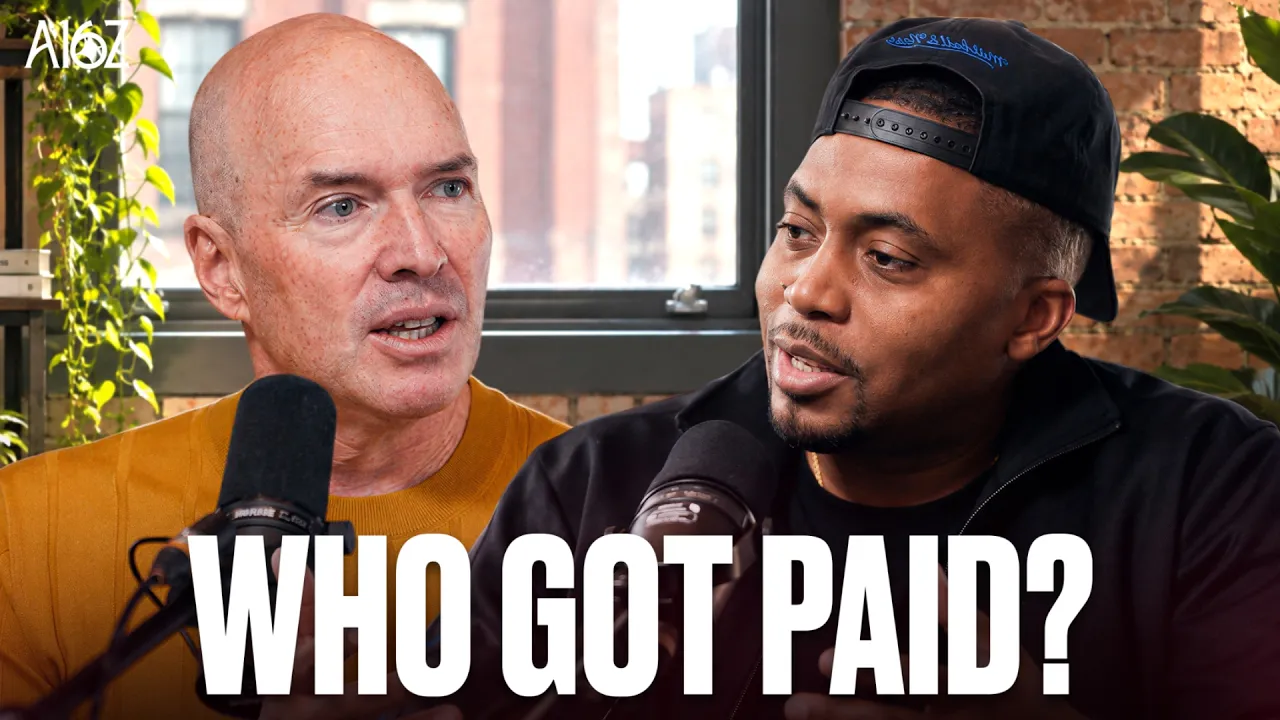
Horowitz, Nas Fund Five-Year Grants to Aid Unpaid Hip-Hop Pioneers
a16z
Because hip-hop lacks industry pensions despite generating billions in corporate value, private grants must pair direct financial relief with public honors to restore dignity to exploited pioneers.
Ben Horowitz, Steve Stoute, and Nas launched the Paid in Full Foundation to provide financial security and overdue recognition to hip-hop's founding pioneers. (1:00)
The foundation pairs multi-year financial grants with the Hip Hop Grandmaster Awards, operating with zero paid staff while Ben and Felicia Horowitz match all public donations 2.5 to 1. (38:04)
Pioneering honorees like Grandmaster Caz highlight the stark economic precarity facing architects of the genre, who received neither social security nor royalties despite fueling multibillion-dollar corporate brand booms. (40:05)
The foundation's intervention extends to direct life-saving health support, including covering organ transplant care and hospital coordination for legendary artist Scarface. (3:53)
Detailed notes
## Background
Published on YouTube by a16z on September 20, 2026, this episode features host Erik Torenberg and Ben Horowitz in conversation with hip-hop icon Nas, pioneer Grandmaster Caz, and music executive Steve Stoute. The discussion centers on the Paid in Full Foundation and its mission to deliver both financial support and overdue cultural recognition to the founding architects of hip-hop.
## TL;DR
The panel explores the founding of the Paid in Full Foundation, initiated after Ben Horowitz realized the immense disparity between the modest price paid for classic hip-hop albums and the millions in value they yielded for his career. Recognizing that traditional charity strips artists of their pride, the foundation established the Hip Hop Grandmaster Awards to pair substantial, multi-year financial grants with elevated public honor, completely unencumbered by administrative overhead. Grandmaster Caz details how the initiative broke his cycle of relentless survival after decades of industry exploitation, while Steve Stoute and Nas reflect on hip-hop's massive uncompensated influence on global brands like Tommy Hilfiger and Adidas. Together, the group emphasizes the moral necessity of hip-hop taking care of its own and bridging the generational divides historically imposed by the record industry.
## Atmosphere & style
The conversation carries an intimate, reverent, and emotionally resonant tone, blending executive strategy with the heartfelt swagger and storytelling of hip-hop royalty. The dynamic between Horowitz, Stoute, and Nas feels like a close-knit brotherhood driven by obsessive musical geekery, punctuated by astonishing historical anecdotes involving Quincy Jones and Scarface. Caz's luminous warmth and humble presence add profound emotional weight, creating an atmosphere that moves between righteous frustration at historical neglect and the joyous relief of long-overdue justice.
## Bulletin
- [01:00](https://www.youtube.com/watch?v=ZO6VyDvysxY&t=60s) Ben Horowitz, Steve Stoute, and Nas launched the Paid in Full Foundation to provide financial security and overdue recognition to hip-hop's founding pioneers.
- [38:04](https://www.youtube.com/watch?v=ZO6VyDvysxY&t=2284s) The foundation pairs multi-year financial grants with the Hip Hop Grandmaster Awards, operating with zero paid staff while Ben and Felicia Horowitz match all public donations 2.5 to 1.
- [40:05](https://www.youtube.com/watch?v=ZO6VyDvysxY&t=2405s) Pioneering honorees like Grandmaster Caz highlight the stark economic precarity facing architects of the genre, who received neither social security nor royalties despite fueling multibillion-dollar corporate brand booms.
- [03:53](https://www.youtube.com/watch?v=ZO6VyDvysxY&t=233s) The foundation's intervention extends to direct life-saving health support, including covering organ transplant care and hospital coordination for legendary artist Scarface.
## Key takeaways
- [18:48](https://www.youtube.com/watch?v=ZO6VyDvysxY&t=1128s) Early hip-hop pioneers generated billions of dollars in global cultural equity while capturing almost none of the financial value.
- [02:53](https://www.youtube.com/watch?v=ZO6VyDvysxY&t=173s) Conventional philanthropic models like direct cash envelopes fail in hip-hop without pairing financial aid with dignity and peer recognition.
- [01:00](https://www.youtube.com/watch?v=ZO6VyDvysxY&t=60s) Ben Horowitz initiated the foundation after calculating that a $10 purchase of Eric B. & Rakim's 'Paid in Full' supplied him with over $5 million in career insights.
- [03:53](https://www.youtube.com/watch?v=ZO6VyDvysxY&t=233s) Decades of exploitation and unfulfilled promises caused many pioneering artists to initially suspect outreach from the foundation was a scam.
- [08:16](https://www.youtube.com/watch?v=ZO6VyDvysxY&t=496s) Grandmaster Caz wrote the foundational lyrics for hip-hop's first commercial hit, 'Rapper's Delight', but received zero credit, royalties, or compensation.
- [11:40](https://www.youtube.com/watch?v=ZO6VyDvysxY&t=700s) Recipients of the Grandmaster Award become active voting members for future classes, creating an autonomous cycle of artist recognition.
- [16:29](https://www.youtube.com/watch?v=ZO6VyDvysxY&t=989s) Commercial recording industry barriers kept hip-hop generations isolated for decades, preventing major figures like Dr. Dre from meeting early idols like Kool Moe Dee and Slick Rick.
- [38:04](https://www.youtube.com/watch?v=ZO6VyDvysxY&t=2284s) Unlike standard corporate charity, the foundation operates with zero paid staff, ensuring 100% of donations go directly to honorees via a 2.5-to-1 match by Ben and Felicia Horowitz.
- [40:05](https://www.youtube.com/watch?v=ZO6VyDvysxY&t=2405s) A five-year grant from the foundation provided Grandmaster Caz with the financial stability to purchase a home outside the Bronx housing projects.
- [42:25](https://www.youtube.com/watch?v=ZO6VyDvysxY&t=2545s) Major consumer corporations such as Tommy Hilfiger, Sprite, and Adidas built massive commercial turnarounds by adopting hip-hop aesthetics and artist phraseology.
- [31:13](https://www.youtube.com/watch?v=ZO6VyDvysxY&t=1873s) The foundation established the annual Quincy Jones Award as a dignified alternative after the Grammys failed to properly honor Jones's foundational legacy.
- [47:58](https://www.youtube.com/watch?v=ZO6VyDvysxY&t=2878s) Hands-on medical intervention and care spearheaded by Felicia Horowitz saved Scarface's life during a critical aortic emergency.
- [18:48](https://www.youtube.com/watch?v=ZO6VyDvysxY&t=1128s) Nas views the Paid in Full Foundation as hip-hop culture finally backing up its lyrics of brotherhood and community with concrete material action.
## Detailed walkthrough
### [00:00](https://www.youtube.com/watch?v=ZO6VyDvysxY&t=0s) Hip-Hop Don't Have Social Security
The discussion opens with reflections on the moral necessity of giving back to the architects of hip-hop. Ben Horowitz emphasizes that achieving something monumental requires abandoning narrow ideas of what seems immediately possible and instead anchoring oneself in what is fundamentally right: "Hip-hop's not that big. Like the guys who made the art form are not that many. And so why can't we honor them?" Grandmaster Caz cuts straight to the economic reality faced by the culture's pioneers, explaining that when people see him performing with relentless passion, it is driven as much by necessity as love for the art: "He's still doing it because I have to. Hip-hop don't have social security. You have to work."
Nas reflects on the duty to acknowledge the trailblazers and bring these disparate generations into the same room—something the commercial music industry neglected for decades. For him, the mission of the Paid in Full Foundation is about "living our lyrics." Nas insists that the wider world must see Grandmaster Caz, celebrate what he built, and accord that same reverence and public spotlight to fellow luminaries like Roxanne Shanté, Melle Mel, and The D.O.C.
[01:00](https://www.youtube.com/watch?v=ZO6VyDvysxY&t=60s) The Paid in Full Foundation and a $5M Debt
Erik Torenberg welcomes the group to their first public conversation about the Paid in Full Foundation, prompting Ben Horowitz to recount its inception. Ben describes the organization's core mandate: to honor the legacy of the pioneers who built hip-hop and ensure they are made whole—financially, spiritually, and culturally.
The initial spark came from an uncomfortable realization Ben had about his own professional success in Silicon Valley. He had purchased Eric B. & Rakim's seminal album *Paid in Full* for roughly $10, yet throughout his career as an entrepreneur and venture capitalist, he drew at least $5 million worth of insight, drive, and value from that record. Knowing there was no formal mechanism to repay that debt, Ben reached out to longtime friend Steve Stoute. Steve immediately validated the urgency, noting that while podcasts and hip-hop commentators frequently complained about aging pioneers being broke or "dusty," nobody was actually stepping up to do anything about it.
```mermaid
flowchart TD
accTitle: Paid in Full Foundation Origin
accDescr: Diagram illustrating how Ben Horowitz, Steve Stoute, and Nas conceived and shaped the Paid in Full Foundation.
subgraph Ideation["The Spark"]
A["Ben Horowitz reflects on $10 album generating $5M+ in value"]
B["Steve Stoute notes cultural urgency: all talk, no action"]
end
subgraph Refinement["The Nas Insight"]
C["Quincy Jones' Jazz Foundation model evaluated"]
D["Nas: In hip-hop, pure charity fails; honor and dignity are vital"]
end
subgraph Execution["The Solution"]
E["Hip Hop Grandmaster Awards"]
F["Financial backing paired with public celebration"]
end
A --> B
B --> C
C --> D
D --> E
E --> F
```
[02:53](https://www.youtube.com/watch?v=ZO6VyDvysxY&t=173s) Beyond Charity: Creating the Grandmaster Award
When Ben approached Nas with the initial concept, they examined the Jazz Foundation of America, a philanthropic model championed by their mutual friend Quincy Jones to deliver direct financial aid to aging jazz musicians. Nas offered an essential correction: that approach would fail in hip-hop. In hip-hop culture, you cannot simply hand an artist an envelope of money like a charity case without damaging their pride. The financial support had to be paired with undeniable cultural recognition.
To restore that dignity, they devised the Hip Hop Grandmaster Awards—a formal ceremony designed to place the true architects under the brightest lights, surrounded by their peers and successors. They launched the initiative by honoring two foundational titans: Rakim and Scarface.
[03:53](https://www.youtube.com/watch?v=ZO6VyDvysxY&t=233s) Saving Scarface and Overcoming Disbelief
The urgent necessity of the foundation crystallized before the first ceremony even took place. Scarface was battling severe health issues and urgently required a kidney transplant, with his son serving as the donor. Steve Stoute was traveling in the South of France in June when he placed a direct call to Scarface to tell him the foundation would cover the medical expenses and secure the appropriate surgical care. Scarface, having not spoken to Steve in two years, was left in absolute shock and disbelief.
That reaction of sheer skepticism proved to be a widespread hurdle. Because early hip-hop pioneers had been exploited and ignored for decades, many artists initially assumed the foundation's outreach was an elaborate scam:
- Several prospective honorees turned down calls or refused initial contact because they could not believe unconditional assistance was real.
- The organizers realized they had to present the initiative not as "reparations" or handouts, but as prestigious, celebratory recognition to overcome deep-seated mistrust.
- The inaugural event was assembled through sheer startup hustle—what Steve describes as using "duct tape" to get the first ceremony off the ground.
- Having Nas openly anchored on the board gave the project immediate credibility, signaling across the community that this effort was genuine.
[06:49](https://www.youtube.com/watch?v=ZO6VyDvysxY&t=409s) Fractured Culture and Stepping Up
Nas and Ben discuss how historically cutthroat, competitive, and fragmented the rap ecosystem has been. While competitiveness is embedded in the genre's DNA, it often left older artists completely abandoned in an "every man for himself" atmosphere. Nas admits that when the group first convened, taking on this responsibility felt almost daring because nothing comparable had ever been attempted in hip-hop.
Ben observes that people tend to look back at history and treat major milestones as inevitable, when in reality nothing happens until someone actively chooses to step forward. Once a structure like the Grandmaster Awards exists, its necessity appears obvious to everyone, but the hardest part was having the will to initiate it.
[08:16](https://www.youtube.com/watch?v=ZO6VyDvysxY&t=496s) Grandmaster Caz and the Stolen Rhyme
Ben recounts meeting Grandmaster Caz in New York around the time of the foundation's first year, marveling at Caz's immense aura. Steve Stoute emphasizes that Caz possesses an ageless star power, walking into rooms with a presence that completely shifts the energy, completely free of the bitterness that his history might otherwise justify.
The tragedy of Caz's career remains one of the music industry's most notorious open secrets. Caz penned the foundational lyrics that became the Sugarhill Gang's "Rapper's Delight"—the very first mainstream hip-hop hit—which even included his own name spelled out in the bars ("C-A-S-A-N-O-V-A"). The lyrics were appropriated without his permission, credit, or compensation. The music industry was fully aware of the theft, yet for decades no label, executive, or institution did anything to rectify it.
When the foundation's board convenes to select honorees, nominating figures like Grandmaster Caz and Roxanne Shanté triggers immediate, passionate consensus:
- Board members do not merely vote "yes"—they actively debate whose "yes" is more emphatic because everyone is overjoyed to get the choice right.
- Honorees consistently arrive without resentment or "about time" bitterness; they show up with radiant joy and pride.
- Roxanne Shanté and Caz both embodied this spirit, stepping into the recognition with genuine warmth, smiles, and the magnetic presence of true icons.
[11:40](https://www.youtube.com/watch?v=ZO6VyDvysxY&t=700s) Roxanne Shanté and the Power of the "Right Award"
The group reflects on the profound personal significance of the Hip Hop Grandmaster Awards, recounting a conversation with pioneering Queensbridge emcee Roxanne Shanté. Her daughter had previously asked her whether she felt bitter seeing modern female rappers collect countless mainstream trophies while she went without. Shanté had responded firmly that she never wanted those trophies: "No, I didn't want that award. I wanted the right award. Paid in Full." Beyond honoring legends in the moment, the foundation establishes continuity by making every recipient an active voter for future classes—meaning Grandmaster Caz and his peers directly choose who gets celebrated next, creating a self-sustaining cycle of recognition.
Nas explains how intimately tied his own career is to Shanté’s legacy. Both grew up in the same Queensbridge neighborhood, and when Shanté dropped the iconic diss record "Roxanne's Revenge" around 1984 or 1985, she was still just a kid challenging established, grown-man rap acts like UTFO. To Nas, seeing a young girl on the radio taking on male emcees and dominating them was revelatory: she wasn't merely rapping, she was acting as a fearless activist for women in an era where female emcees were virtually unheard of. Watching her single-handedly shift hip-hop's trajectory provided Nas with the initial inspiration to pick up a microphone, making her presence in the foundation deeply personal.
[13:26](https://www.youtube.com/watch?v=ZO6VyDvysxY&t=806s) Caz's Vetting, Swizz Beatz's Call, and Bridging the Generations
Grandmaster Caz recounts how he originally became involved with the foundation. Producer QD3 (Quincy Jones III), an old friend he had not spoken to in years, reached out vaguely, asking him to come downtown for a meeting. Caz walked in without expectations and met Ben Horowitz and the team, realizing only in hindsight that he was being subtly vetted to gauge his spirit, attitude, and perspective. The idea of financially supporting hip-hop pioneers had floated around the community for years—notably echoed when Swizz Beatz publicly advocated that founding figures should each be given a million dollars.
Nas interrupts with an excited recollection: back around 1999 or 2000, a magazine had surveyed hip-hop artists asking what they would do to fix the culture, and Nas had outlined the exact framework of the Paid in Full Foundation to a tee. Nas highlights the cultural obsession shared by the founders, humorously contrasting how he interacts with his friends: he and Steve Stoute will passionately debate hip-hop until they end up at complete impasses and stop speaking, while he and Ben Horowitz will dissect albums down to the microscopic details. When Ben—a venture capitalist from the Bay Area—sent Nas a video interview he conducted with Caz about the Sugar Hill Gang, Nas was stunned by Ben’s reverence and care for New York rap history. For Nas, the foundation is the ultimate excuse to eliminate distance and bring figures like Caz and Rakim together into one room.
[16:29](https://www.youtube.com/watch?v=ZO6VyDvysxY&t=989s) The Hip-Hop Reunion: Dr. Dre Meets Kool Moe Dee and Slick Rick
The gathering serves as an overdue class reunion for generations that the recording industry kept isolated from one another. Steve Stoute shares an astonishing moment from the previous year's celebration: when Dr. Dre learned about Paid in Full and attended, he approached Stoute and asked with genuine reverence if Stoute could introduce him to Kool Moe Dee—an icon Dre had never met in his three-decade career. Ben Horowitz adds that Dre did the exact same thing to him in Las Vegas, asking Ben if he could introduce him to Slick Rick.
The panel reflects on the absurdity and emotional weight of that reality: an artist of Dr. Dre's stature, with all his historic commercial triumphs and cultural influence, still harboring the pure fan-like humility of a kid with posters on his wall, waiting decades just to greet the foundational figures who inspired him. The music business had constructed walls that separated artists strictly by commercial era, status, and whether someone was currently hot or signed, leaving legends to run into each other only by sheer chance.
```mermaid
flowchart TD
accTitle: Generational Disconnect vs. Paid in Full Bridge
accDescr: Diagram illustrating how commercial industry dynamics kept hip-hop generations apart, contrasted with Paid in Full's unified ecosystem.
subgraph StandardIndustry["The Traditional Music Industry"]
A["Commercial Segmentation<br/>(Old School vs. New School)"] --> B["Superficial Trophies<br/>(Spotlight with No Financial Pockets)"]
B --> C["Generational Isolation<br/>(Dre Never Met Kool Moe Dee or Slick Rick)"]
end
subgraph FoundationModel["The Paid in Full Ecosystem"]
D["Substantive Financial Grant & Living Honor"] --> E["Direct Generational Reunion<br/>(Founders, Moguls & Superstars in One Room)"]
E --> F["Inductees Join Voting Body<br/>(Grandmaster Caz Voting on Future Classes)"]
end
```
[18:48](https://www.youtube.com/watch?v=ZO6VyDvysxY&t=1128s) Beyond VH1 Hip Hop Honors: Real Value and Living the Lyrics
Steve Stoute and Grandmaster Caz critique how legacy artists have historically been handled. Prior industry spectacles, such as the VH1 Hip Hop Honors, succeeded in shining a brief television spotlight on legendary artists, but did nothing to sustain their livelihoods or put money into their pockets. Stoute argues that the driving philosophy behind both the Paid in Full Foundation and his tech platform, UnitedMasters, is correcting an enormous economic disparity: hip-hop pioneers generated billions in cultural equity—altering global fashion, language, posture, and consumer habits—while taking home virtually nothing in their bank accounts. Accepting that dynamic as "just the way it is" breeds resentment rather than creative inspiration, leaving originators feeling discarded and robbed.
Nas closes by confronting the hypocrisy that has plagued the culture outside the booth. Hip-hop lyrics have always championed revolutionary concepts:
- Tearing down systemic barriers and fighting back against institutions
- Showing authentic love, brotherhood, and collective entrepreneurship
- "Keeping it real" and protecting the community
Yet off the record, artists frequently succumbed to extreme, hyper-competitive posturing—refusing to speak to peers at events, ignoring pioneers who needed financial or medical assistance, and laughing off those who paved the way. Nas stresses that Grandmaster Caz's lyrical DNA built the bedrock for every giant group and solo artist that followed. If hip-hop is truly about personal elevation and truth, the culture must finally back up its words with material action and live out the lyrics in real life.
[22:57](https://www.youtube.com/watch?v=ZO6VyDvysxY&t=1377s) Funding the Mission: Beyond Record Labels to Year Four
The discussion centers on the rare personal commitment required to bankroll the Paid in Full Foundation. While common sense would suggest that the deep-pocketed record corporations that amassed fortunes off hip-hop's catalog would step forward to support its aging pioneers, corporate institutions routinely neglect that responsibility. Instead, the heavy lifting has fallen on Ben Horowitz and his wife, Felicia Horowitz. Praising Felicia as an entrepreneur possessed of deep soul and a genuine reverence for artistic creativity, the panel notes that real change demands someone who is not only willing to put up substantial matching capital, but who is fundamentally an ardent, passionate fan of the music.
As the foundation enters its fourth year, the event has matured into an impeccably produced cultural fixture. Reflecting on the growing pains of year one—which ran long as the team felt their way through the program—the organizers have continually tightened, refined, and elevated the production. The overarching ambition is to scale the ceremony globally so audiences everywhere can witness their foundational heroes receive premier recognition on a world-class stage. When something works at this scale, others invariably attempt to emulate it; by proving that hip-hop legends can be celebrated with dignity and production value, the foundation sets a new benchmark for honoring icons like Grandmaster Caz, Roxanne Shanté, Melle Mel, and The D.O.C.
- The foundation's model relies on substantial philanthropic commitments initiated by Ben and Felicia Horowitz rather than conventional industry or label backing.
- Now approaching Year Four, the gala has evolved from an experimental inaugural run into a streamlined, high-level broadcast-quality production.
- Key foundational figures spotlighted for world-class recognition include Grandmaster Caz, Roxanne Shanté, Melle Mel, and The D.O.C.
---
[26:08](https://www.youtube.com/watch?v=ZO6VyDvysxY&t=1568s) Starting With What’s Right: Paying Back the Inspiration
Addressing the philosophy behind building the foundation, Ben Horowitz pushes back against standard corporate pragmatism. In his view, it is impossible to accomplish anything truly great if you limit your starting point to what appears immediately possible; you have to begin with what is inherently *right*. Because hip-hop’s true foundational architects are a relatively small, identifiable group of creators, properly compensating and honoring them is an entirely solvable problem. Horowitz rejects the label of being merely a benevolent outsider, insisting he is a direct beneficiary of pioneers like Grandmaster Caz, Nas, and Rakim, whose lyrics supplied the fortitude that carried him through the darkest crises of his business career.
Horowitz famously opened each chapter of his bestselling business book, *The Hard Thing About Hard Things*, with rap lyrics—a decision that drew skepticism and condescension across Silicon Valley, where critics dismissed hip-hop quotations as an eccentric marketing gimmick. For Horowitz, however, it was an imperative matter of giving "credit where credit is due," since his core managerial ideas directly originated from the resilience and street philosophy embedded in those bars. Today, that connection converts Silicon Valley elites: tech investors and corporate leaders initially attend the foundation's dinner strictly out of personal loyalty to Ben ("I'll go for Ben"), only to experience an epiphany in the room as they encounter the inventors of the art form and realize the stark economic disparities those artists endured.
```mermaid
flowchart TD
accTitle: Philosophy of the Paid in Full Foundation
accDescr: Flow showing the progression from artistic inspiration through entrepreneurial success to cultural restitution.
subgraph Business["Silicon Valley Application"]
B --> C["Horowitz Business Trials\n& Executive Strategy"]
C --> D["The Hard Thing About Hard Things\n(Rap lyrics frame chapters)"]
end
subgraph Restitution["The Foundation Mission"]
D --> E["Start With What Is Right\n(Reject pure feasibility limits)"]
E --> F["Paid in Full Foundation\n(Direct support & public honor)"]
end
```
---
[28:34](https://www.youtube.com/watch?v=ZO6VyDvysxY&t=1714s) Nuance, Longevity, and Grand Puba’s Three Eras
The foundation intentionally avoids framing its honorees as objects of pity. While the underlying historical injustice—that trailblazers were exploited and left empty-handed—is the bedrock truth, the evening itself is designed purely as an elevated celebration of overdue flowers and respect. Capturing that truth requires a curatorial nuance that corporate sponsors and typical award shows completely lack. Unlike standard philanthropy where donors simply sign a check to satisfy a corporate checklist, the foundation pores over the granular history of the music to honor artists whose technical contributions might otherwise be bypassed.
A prime example cited is Grand Puba, whom Steve Stoute and the panel praise for navigating an almost impossible artistic trajectory. In hip-hop, an "era" is not a leisurely ten-year decade; rapid stylistic shifts can render an artist obsolete inside of four years, stranding legends on the wrong side of the fence as "old school" or "washed." Grand Puba defied that gravity across three distinct stylistic evolutions:
1. His early breakout era with **Masters of Ceremony**
2. His era-defining run leading **Brand Nubian**
3. A critically and commercially acclaimed **solo career**
Seeing an artist of Puba's caliber take the stage to finally receive his credit embodies the foundation's purpose. The environment inside the room strips away celebrity posturing: no egos are inflated, and tech billionaires sit beside rap legends on equal terms, united in genuine education and mutual admiration.
- Hip-hop eras move at a breakneck pace, often transforming the entire cultural landscape every three to four years.
- Grand Puba represents an elite minority of lyricists capable of reinventing their style to stay dominant across three separate artistic eras.
- The ceremony rejects industry pretense and competitive ego, creating an atmosphere where ultra-wealthy attendees and music pioneers participate in mutual respect and cultural learning.
---
[31:13](https://www.youtube.com/watch?v=ZO6VyDvysxY&t=1873s) The Quincy Jones Award, George Clinton, and Nile Rodgers
The conversation shifts to the legendary Quincy Jones and the deep personal bond he shared with Ben Horowitz and Nas prior to his passing. The panel recounts the emotional heights of previous foundation gatherings, including an appearance by 83-year-old funk innovator George Clinton. Clinton brought his signature P-Funk "mothership" aura to the stage, astonishing the audience by flawlessly reciting Rakim’s complex verses from "Follow the Leader"—an unforgettable cross-generational tribute bridging foundational funk and golden-era lyricism.
The panel reveals that the foundation’s annual Quincy Jones Award was born out of frustration after the Grammy Awards thoroughly botched their tribute to Jones. Appalled by the lack of care shown to a musical titan who represented the "triple OG" foundation of modern music, Quincy's son, QD3 (Quincy Jones III), partnered directly with the foundation to establish a permanent, dignified annual accolade. Steve Stoute and the panel unveil the newest recipient of the Quincy Jones Award: disco and funk architect **Nile Rodgers**. Rodgers's indelible guitar lick on Chic's classic "Good Times" served as the foundational rhythm for hip-hop's very first commercial breakthrough, anchoring a historic catalog that spans Sister Sledge, Chic, and modern global smashes like Daft Punk's "Get Lucky."
- The Quincy Jones Award was established as a direct corrective response to the Grammy Awards' inadequate handling of Jones's legacy.
- Quincy Jones's son, QD3, works closely with the foundation to steward the award's continuity on an annual basis.
- At age 83, George Clinton honored Rakim by reciting the lyrics to "Follow the Leader" live on the foundation's stage.
- Nile Rodgers was named as the latest Quincy Jones Award honoree in recognition of his monumental career spanning Chic, Sister Sledge, and Daft Punk, as well as providing the foundational groove of recorded hip-hop.
[34:00](https://www.youtube.com/watch?v=ZO6VyDvysxY&t=2040s) The Quincy Jones Award, Gaining Trust, and Erasing Hip-Hop Ego
The foundation expanded its honors by presenting Nile Rodgers with the Quincy Jones Award, bridging eras from disco and funk to his collaboration with Daft Punk. The organizers emphasize holding themselves accountable to properly celebrate icons who were historically shortchanged by institutions like the Grammys. Because pioneers, their families, and estates have endured decades of empty promises and exploitation, early outreach was met with understandable skepticism. Artists often wondered whether the initiative was a facade or an angle to "sell t-shirts out the trunk." When Steve Stoute contacted Kool Rock-Ski of the Fat Boys, Rock-Ski initially struggled to believe it was legitimate, even walking off the stage at the ceremony still half-convinced it could not be real. Similarly, when Nas personally called Kool G Rap—an MC he reveres as one of his greatest foundational inspirations—the response was pure gratitude once it became clear that the event existed solely to show unconditional love, without commercial exploitation.
```mermaid
flowchart TD
accTitle: Paid in Full Foundation Honoree Experience
accDescr: Flowchart illustrating the journey of hip-hop pioneers from initial skepticism to honor and community support.
subgraph Skepticism["Initial Skepticism"]
A["Outreach to Pioneers<br/>(Kool Rock-Ski, Kool G Rap)"] --> B["Skepticism & Guardedness<br/>('Is this another facade?')"]
end
subgraph Ceremony["The Gathering"]
B --> C["Paid in Full Honors<br/>(Park Jam Spirit & No Merch Exploitation)"]
C --> D["Egos Drop in the Room<br/>(Ice Cube, Scarface, Rakim)"]
end
subgraph Impact["Tangible Support"]
D --> E["5-Year Financial Grant<br/>(Matched 2.5:1 by Horowitz Family)"]
D --> F["Public Reverence & Recognition"]
end
```
Despite the fierce competitive spirit and ego inherent in rap music, the atmosphere at the Paid in Full event strips those defenses away. While the park-jam spirit remains alive—with Nas and peers grabbing microphones and freestyling spontaneously—the prevailing energy is mutual reverence. When Ice Cube attended, he reflected that early in his career, he would not release an album until he knew what Scarface had to say, acknowledging the Houston pioneer's standard even though Scarface debuted after Cube. The room fostered unprecedented peer-to-peer dialogues on craft, including a historic exchange where Scarface and Rakim, two of the greatest lyricists across any genre of writing, sat together to express deep, unadulterated respect for each other’s penmanship.
---
[38:04](https://www.youtube.com/watch?v=ZO6VyDvysxY&t=2284s) Matching Donations and Grandmaster Caz's Life-Changing Grant
Ben Horowitz highlights the structural integrity of the Paid in Full Foundation (paidinfullfoundation.org). He and his wife, Felicia Horowitz, match every public donation two-and-a-half to one (2.5:1). Because the organization employs zero paid staff and operates entirely through volunteers, 100% of every dollar contributed goes directly into funding the artists.
Grandmaster Caz details the profound personal and material impact of receiving the foundation's five-year grant. Up to that point, his financial reality was defined by an unrelenting daily grind to survive:
> "Hip-hop don't have social security. You know what I mean? Hip-hop don't have no health benefits or none of that. You have to work. You got to stay out there... All that was to maintain, to keep me up and at it."
For over a decade, Caz had been haunted by a single recurring thought: "I don't want to die in the projects." Despite having lived in the Bronx his entire life aside from a three-year stretch in California, the grant finally broke that cycle. It gave him an essential financial cushion and allowed him and his wife to purchase a home in Pennsylvania. Caz clarifies that while some artists initially resist outreach out of pride—assuming it is a handout—the foundation’s core mission is restorative honor and dignity. He also credits LL Cool J with extending that same professional respect by hiring both Caz and MC Sha-Rock as daily Monday-through-Friday radio hosts on Rock The Bells Radio.
- **Match Rate:** Ben and Felicia Horowitz match donations 2.5 to 1, ensuring all incoming funds flow straight to honorees.
- **Grant Structure:** The award is distributed as a multi-year grant over a five-year period.
- **Overhead:** Zero paid staff; operations run entirely on a volunteer basis.
---
[42:25](https://www.youtube.com/watch?v=ZO6VyDvysxY&t=2545s) Doing It on the High: How Hip-Hop Built Global Brands
Nas reflects on the transition from quiet, informal philanthropy to public, structured advocacy. Beginning in the late 1990s, active rap stars frequently fielded private calls to assist struggling pioneers and producers financially behind the scenes. While those quiet acts prevented immediate ruin, doing it publicly—"on the high"—validates the pioneers openly and demonstrates to the world that hip-hop takes care of its own.
```mermaid
flowchart LR
accTitle: Hip-Hop Cultural Influence on Corporate Brands
accDescr: Diagram showing the historical economic uplift hip-hop artists provided to major consumer corporations.
subgraph Creators["Hip-Hop Innovators"]
A["Run-DMC"]
B["Grand Puba"]
end
subgraph CulturalAdoption["Cultural Phenomenon"]
A -->|"Laced-out Superstars at MSG"| C["Sneaker Street Culture"]
B -->|"Lyrics & Streetwear Styling"| D["Prep Fashion & Taglines"]
end
subgraph CorporateImpact["Corporate Beneficiaries"]
C --> E["Adidas<br/>(Rebounded from 2% US Market Share)"]
D --> F["Tommy Hilfiger & Sprite<br/>('Obey Your Thirst')"]
end
```
The conversation turns to the corporate wealth built upon hip-hop culture without equitable return, a central premise of Steve Stoute’s book *The Tanning of America*. Hip-hop artists consistently revived or established multibillion-dollar corporate franchises:
- **Tommy Hilfiger:** Propelled into a mainstream fashion powerhouse after Grand Puba adopted, styled, and name-dropped the brand in hip-hop culture.
- **Sprite:** Sourced its defining, long-running commercial slogan, "Obey Your Thirst," straight out of Grand Puba’s lyrical phrasing and cadence.
- **Adidas:** Was commercially struggling in the United States, hovering at roughly a 2% domestic market share. Three-quarters of that 2% was concentrated entirely in the Northeast, where corporate executives could not comprehend why inner-city consumers were buying one specific sneaker silhouette and discarding the shoelaces. The cultural surge culminated at Madison Square Garden when Run-DMC commanded tens of thousands of concertgoers to hold their Adidas sneakers in the air, instantly reshaping the global footwear industry.
[44:48](https://www.youtube.com/watch?v=ZO6VyDvysxY&t=2688s) From Harlem Streets to Global Runways: How Hip-Hop Built Fashion Empires
The conversation turns to the immense cultural and commercial power hip-hop pioneers generated far beyond the recording studio, setting trends in language, lifestyle, and global fashion that multi-billion-dollar corporations capitalized on without ever cutting those pioneers in on the profits. Steve Stoute points to Tommy Hilfiger as an illustrative case study. While acknowledging Hilfiger as a great person who collaborated heavily with artists, Stoute underscores that the brand was essentially dead in the water before hip-hop intervened. At the time, Hilfiger was struggling to sell neckties in an unsuccessful bid to emulate Ralph Lauren, drawing scoffing reactions from consumers: "You're not Ralph Lauren, dog."
Hilfiger's breakthrough came entirely by observing uptown street style. Commuting home from New York City to Greenwich, Connecticut, he often bypassed highway traffic by cutting through Harlem. Cruising through the neighborhood, Hilfiger noticed young men sagging their pants, purposely revealing the elastic waistbands of their Calvin Klein boxer briefs. Struck by the aesthetic, Hilfiger took the concept back to the design room, manufacturing underwear with a dramatically thicker, bolder elastic waistband stamped with his own name so it would be impossible to miss when worn low. That single street-inspired pivot catapulted Hilfiger into global relevance, shifting his company from an ailing tie maker into a powerhouse of modern streetwear—a lineage that directly paved the way for luxury houses like Louis Vuitton appointing icons like Pharrell Williams ("Skateboard P") and the late Virgil Abloh as creative directors. Stoute argues that because corporate fashion empires were built on ideas plucked directly from street culture, those brands and business leaders carry a moral obligation to give back to the pioneers through initiatives like the Paid in Full Foundation:
- Tommy Hilfiger's original product line focused on neckties before adopting hip-hop aesthetics observed directly in Harlem.
- The exaggerated, visible branded waistband was adapted directly from Harlem youth sagging Calvin Klein underwear.
- The evolution of urban streetwear laid the foundation for modern high-fashion appointments, including Virgil Abloh and Pharrell Williams at Louis Vuitton.
- Stoute emphasizes that Paid in Full is not trying to solve every systemic problem alone, but to build enough momentum to inspire other corporations and donors to give back "with love and respect."
[47:58](https://www.youtube.com/watch?v=ZO6VyDvysxY&t=2878s) Genuine Love and Life-Saving Care: Felicia Horowitz and Scarface
Ben Horowitz emphasizes that the foundation's work goes well beyond checks and formal ceremonies; the true ethos is defined by genuine love, personal connection, and the tireless dedication of his wife, Felicia Horowitz, who serves as the foundation’s president. To demonstrate what sets the organization apart, Ben shares a harrowing story about Houston rap icon Scarface. Scarface suffered from a life-threatening heart condition requiring open-heart surgery. Coming from an environment where people avoid going to doctors entirely, let alone signing up for major cardiovascular procedures, he was paralyzed by fear. Sensing his panic over the phone, Felicia hopped on a plane to Houston to see him in person.
Despite her petite frame—standing roughly five feet tall and weighing around 105 pounds, which led Scarface to affectionately nickname her "the bully"—Felicia refused to let him back out. When Scarface insisted he was not going to the doctor, Felicia firmly commanded, "No, I'm taking you to the doctor right now." Her insistence proved miraculous: just as they arrived at the medical facility, Scarface's aorta burst. The surgical team rushed him in immediately, saving his life by mere minutes. Grandmaster Caz passionately validates Felicia's role, explaining that this personal investment is what makes Paid in Full distinct from any cold institutional grant or standard industry award. Long after the cameras leave, Felicia routinely calls artists just to check in on their health, dispatching flowers or pairs of Dior sunglasses to their homes whenever someone's spouse falls ill. Caz implores the hip-hop community and the broader public to support the upcoming Hip Hop Grandmaster Awards and study the work accomplished over the foundation's first four years: "Don't play with it. Stay with it."
[50:48](https://www.youtube.com/watch?v=ZO6VyDvysxY&t=3048s) The Brotherhood: Dinners at Mr. Chow and Obsessing Over Rakim and Prince
Erik Torenberg asks Steve Stoute to recall the moment he knew he and Ben Horowitz would become friends for life, prompting Nas to jump in with the story of their very first encounter. Years earlier, Stoute hosted an intimate gathering of culturally significant figures at Mr. Chow in downtown Manhattan. It was at that lively table that Nas first met Ben Horowitz after hearing Stoute speak highly of him. The two formed an instant bond anchored in their mutual obsession with music and great dining, establishing a friendship that has remained steadfast ever since.
Horowitz reminisces about the time he has spent analyzing records alongside Nas, remarking that despite being one of the greatest lyricists in history, Nas remains an equally passionate music fan. Ben notes that when listening to Rakim, Nas has an uncanny ear that picks up hidden internal rhymes, subtle cadence shifts, and production nuances that fly completely under the radar of average listeners. Their shared musical deep dives regularly crossed genres, from sitting together and meticulously breaking down Prince compositions to visiting living legends like Quincy Jones as starry-eyed students of the craft.
[52:09](https://www.youtube.com/watch?v=ZO6VyDvysxY&t=3129s) Quincy Jones, Steven Spielberg's Audition Tape, and Olu Dara in Saint-Tropez
Steve Stoute recounts a legendary afternoon spent visiting Quincy Jones at his newly redecorated home alongside comedian and actor Chris Tucker. While hosting them, Quincy pulled out original VHS casting tapes from Steven Spielberg's 1985 film adaptation of *The Color Purple*. On the screen, a young Whoopi Goldberg was sitting before Spielberg, who was holding the handheld camera himself. Goldberg began by chatting casually and laughing off-script; the moment Spielberg cued her to begin reading the scene, she transitioned instantly and began weeping with raw, devastating intensity. Stoute recalls being utterly mesmerized, realizing on the spot the extraordinary, world-class skill that true acting requires.
```mermaid
flowchart TD
accTitle: Connections Between Quincy Jones and Olu Dara
accDescr: Flowchart tracing Steve Stoute's visit with Quincy Jones to discovering Nas's father's jazz history.
subgraph Visit["Quincy Jones's Home"]
A["Steve Stoute & Chris Tucker visit Quincy Jones"]
B["Quincy plays rare audition tape:<br>Steven Spielberg filming Whoopi Goldberg for The Color Purple"]
A --> B
end
subgraph Connection["The Living History Connection"]
C["Conversation turns to Nas & his father Olu Dara"]
D["Quincy quickly digs through vinyl & photo archive"]
E["Unveils 1960s photo of Quincy & Olu Dara in Saint-Tropez"]
B --> C
C --> D
D --> E
end
subgraph Legacy["Generational Validation"]
F["Nas recalls childhood doubt over dad's claims:<br>Being close friends with James Mtume (Juicy Fruit)"]
G["Mtume confirms friendship years later to Nas:<br>'That's my guy, man'"]
E -.-> F
F --> G
end
```
The conversation at Quincy's house eventually pivoted to Nas and his father, the revered jazz cornetist Olu Dara. Upon hearing Dara's name, the elderly Quincy sprang up with startling speed and agility, dashed over to a cabinet of vinyl records, and pulled out an archival photograph: a snapshot of Quincy Jones and Olu Dara partying together in Saint-Tropez during the 1960s. Stoute was flabbergasted by the discovery, suddenly realizing that Nas's genius was part of a direct genetic and artistic bloodline rooted in high-level 1960s jazz royalty. Nas laughs, admitting that as a child in Queensbridge, he used to tune out his father's tall-sounding tales about hanging out with musical giants. When James Mtume's smash hit "Juicy Fruit" came out in the early 1980s, Dara casually told young Nas, "Yo, that's my man," which Nas dismissed as an exaggeration meant to impress him. Only years later, when Nas entered the rap business and met Mtume in person, did the legendary musician stop him and affirm, "Your dad is my man." The revelation underscored for Stoute and Nas how deeply interconnected music history truly is, tracing a direct line from 1960s French Riviera jazz circles straight through to the golden era of hip-hop.
[55:49](https://www.youtube.com/watch?v=ZO6VyDvysxY&t=3349s) Nas's Musical Heritage and the Mississippi Roots
Reflecting on the deeper artistic connections woven into the hip-hop lineage, the conversation touches on a memorable evening bridging *The Color Purple* and Olu Dara, highlighting how Nas descends from a remarkable dynasty of generational musicianship. Nas acknowledges this rich ancestral background, tracing his family's roots directly to Natchez, Mississippi. His father, the renowned cornetist and guitarist Olu Dara, was not an isolated creative phenomenon; his grandfather before him had played in a band as well. For Nas, hip-hop is not an abrupt break from the past, but the continuation of an unbroken lineage of Black American musical tradition running straight through his family tree.
- Nas’s father, Olu Dara, was born in Natchez, Mississippi, where Nas's grandfather also performed in a local band, establishing a multi-generational legacy of musicianship.
[56:13](https://www.youtube.com/watch?v=ZO6VyDvysxY&t=3373s) Supporting the Legends: PaidInFullFoundation.org
The discussion concludes with an urgent call to support the pioneers who established hip-hop culture through the Paid in Full Foundation. Listeners and supporters are directed to visit paidinfullfoundation.org, where every dollar contributed goes directly into the hands of the artists themselves, completely unencumbered by administrative overhead. To amplify the impact of outside donations, contributions are matched at a 2.5-to-1 ratio, ensuring that every gift dramatically expands the financial safety net and recognition provided to hip-hop’s founding icons. Ben Horowitz and Steve Stoute passionately affirm that anyone who has ever attended the foundation's annual Hip Hop Grandmaster Awards will attest that it stands as "the greatest charitable event in the world"—a life-affirming, historic gathering that creates indelible memories while directly righting historical wrongs.
- **Website**: Contributions can be made directly at [PaidInFullFoundation.org](https://paidinfullfoundation.org).
- **Direct Support**: 100% of donated funds go directly to the veteran hip-hop artists and honorees.
- **Matching Multiplier**: Donations are matched at a rate of 2.5 to 1.
## Notable quotes
> [00:00](https://www.youtube.com/watch?v=ZO6VyDvysxY&t=0s) Hip-hop's not that big. Like the guys who made the art form are not that many. And so why can't we honor them? — Ben Horowitz
> [00:00](https://www.youtube.com/watch?v=ZO6VyDvysxY&t=0s) He's still doing it because I have to. Hip-hop don't have social security. You have to work. — Grandmaster Caz
> [11:40](https://www.youtube.com/watch?v=ZO6VyDvysxY&t=700s) No, I didn't want that award. I wanted the right award. Paid in Full. — Roxanne Shanté
> [38:04](https://www.youtube.com/watch?v=ZO6VyDvysxY&t=2284s) Hip-hop don't have social security. You know what I mean? Hip-hop don't have no health benefits or none of that. You have to work. You got to stay out there... All that was to maintain, to keep me up and at it. — Grandmaster Caz
> [38:04](https://www.youtube.com/watch?v=ZO6VyDvysxY&t=2284s) I don't want to die in the projects. — Grandmaster Caz
> [44:48](https://www.youtube.com/watch?v=ZO6VyDvysxY&t=2688s) You're not Ralph Lauren, dog. — Steve Stoute
> [47:58](https://www.youtube.com/watch?v=ZO6VyDvysxY&t=2878s) No, I'm taking you to the doctor right now. — Felicia Horowitz
> [47:58](https://www.youtube.com/watch?v=ZO6VyDvysxY&t=2878s) Don't play with it. Stay with it. — Grandmaster Caz
> [52:09](https://www.youtube.com/watch?v=ZO6VyDvysxY&t=3129s) Yo, that's my man — Olu Dara
> [52:09](https://www.youtube.com/watch?v=ZO6VyDvysxY&t=3129s) Your dad is my man. — James Mtume
## Mentioned
Ben Horowitz, Erik Torenberg, Nas, Grandmaster Caz, Steve Stoute, Felicia Horowitz, Quincy Jones, QD3 (Quincy Jones III), Rakim, Scarface, Roxanne Shanté, Melle Mel, The D.O.C., Swizz Beatz, Dr. Dre, Kool Moe Dee, Slick Rick, Grand Puba, George Clinton, Nile Rodgers, Kool Rock-Ski, Kool G Rap, Ice Cube, MC Sha-Rock, LL Cool J, Run-DMC, Tommy Hilfiger, Ralph Lauren, Pharrell Williams, Virgil Abloh, Chris Tucker, Whoopi Goldberg, Steven Spielberg, Olu Dara, James Mtume, Paid in Full Foundation, Hip Hop Grandmaster Awards, Jazz Foundation of America, UnitedMasters, Rock The Bells Radio, Masters of Ceremony, Brand Nubian, Chic, Sister Sledge, Daft Punk, Fat Boys, Sugarhill Gang, UTFO, Adidas, Sprite, Calvin Klein, Louis Vuitton, Dior, Grammy Awards, Mr. Chow, Paid in Full, Rapper's Delight, Roxanne's Revenge, The Hard Thing About Hard Things, Follow the Leader, Good Times, Get Lucky, The Tanning of America, The Color Purple, Juicy Fruit
## Video description
Ben Horowitz and Erik Torenberg sit down with Nas, Grandmaster Caz, and Steve Stoute for a conversation about the Paid in Full Foundation and its mission to recognize and support the pioneers who built hip-hop.
Ben, Nas, and Steve share how the foundation began, why simply giving artists money wasn’t enough, and how the Hip Hop Grandmaster Awards became a way to pair financial support with the recognition many foundational artists never received. Caz brings the perspective of one of those pioneers, reflecting on his role in hip-hop’s earliest history and what receiving the award has meant for his life and legacy.
They also discuss the enormous cultural and commercial impact of hip-hop beyond music, from language and fashion to some of the world’s biggest brands, why so many of its pioneers captured so little of that value, and what happens when generations of hip-hop finally come together in the same room.
Timestamps:
00:00 - Intro
01:00 - Meet the Paid In Full Foundation
01:43 - The Origin Story: $5M in Value, $10 for the Album
09:49 - Grandmaster Caz & the Rhymes That Became Rapper's Delight
17:16 - What This Foundation Actually Does for Its Honorees
25:08 - Celebrating the Legends: Melle Mel, Roxanne, D.O.C.
33:05 - The Quincy Jones Award & Annual Tradition
40:05 - Grandmaster Caz: "Hip Hop Don't Have Social Security"
45:21 - Tommy Hilfiger, the Culture & Who Owes Back
50:48 - How Ben, Steve & Nas Became Friends for Life
56:15 - PaidInFullFoundation.org: How to Get Involved
Resources:
Learn more about the Paid in Full Foundation: https://paidinfullfoundation.org
Follow Nas on X: https://x.com/Nas
Follow Steve Stoute: https://www.linkedin.com/in/stevestoute/
Follow Ben Horowitz on X: https://x.com/bhorowitz
Stay Updated:
If you enjoyed this episode, be sure to like, subscribe, and share with your friends!
Find a16z on X: https://twitter.com/a16z
Find a16z on LinkedIn: https://www.linkedin.com/company/a16z
Listen to the a16z Show on Spotify: https://open.spotify.com/show/5bC65RDvs3oxnLyqqvkUYX
Listen to the a16z Show on Apple Podcasts: https://podcasts.apple.com/us/podcast/a16z-podcast/id842818711
Follow our host: https://x.com/eriktorenberg
Please note that the content here is for informational purposes only; should NOT be taken as legal, business, tax, or investment advice or be used to evaluate any investment or security; and is not directed at any investors or potential investors in any a16z fund. a16z and its affiliates may maintain investments in the companies discussed. For more details please see http://a16z.com/disclosures.
Horowitz与Nas设立五年期资助金 援助未获报酬的嘻哈先驱
由于嘻哈音乐虽创造了数十亿美元的商业价值却缺乏行业养老金保障,民间资助必须将直接经济救助与公开荣誉相结合,以重塑曾遭剥削的先驱们的尊严。
该小组探讨了Paid in Full Foundation的创立历程。该基金会始于Ben Horowitz意识到,购买经典嘻哈专辑所付出的微薄花费与其为他的职业生涯带来的数百万价值之间存在巨大悬殊。考虑到传统慈善方式会剥夺艺术家的自尊,该基金会设立了嘻哈大师奖(Hip Hop Grandmaster Awards),将大额多年期资助金与崇高的公开荣誉相结合,且完全没有任何行政开销负担。Grandmaster Caz详细讲述了在历经数十年的行业剥削后,该项目如何打破了他疲于奔命勉强维生的恶性循环;同时,Steve Stoute和Nas也反思了嘻哈文化对Tommy Hilfiger和Adidas等全球品牌产生的巨大、却未获补偿的影响力。他们共同强调,嘻哈界在道义上有必要照顾自己人,并弥合唱片工业在历史上造成的代际鸿沟。
Ben Horowitz、Steve Stoute和Nas创立了Paid in Full Foundation,旨在为嘻哈创立先驱提供经济保障和迟来的认可。 (1:00)
该基金会将多年期资助金与嘻哈大师奖相结合,以零受薪员工模式运营,同时Ben与Felicia Horowitz按2.5比1的比例对所有公众捐款进行配捐。 (38:04)
Grandmaster Caz等先驱受表彰者揭示了该流派奠基人面临的严峻经济困境——尽管他们推动了数十亿美元的企业品牌繁荣,却既没有获得社保,也没有拿到版税。 (40:05)
该基金会的援助还延伸至直接拯救生命的医疗支持,包括为传奇艺术家Scarface承担器官移植护理费用并协调医院对接。 (3:53)
Reading summary
Ben Horowitz, Steve Stoute, and Nas argue that while hip-hop pioneers generated billions of dollars in commercial value across music, fashion, and advertising, the commercial recording industry abandoned them without royalties, pensions, or healthcare. To correct this economic disparity, they established the Paid in Full Foundation, pairing substantial multi-year financial restitution with institutional recognition to restore dignity to the art form's living architects.
Economic Disparity and Uncompensated Cultural Equity (18:48)
Early hip-hop innovators established trends that revived or established massive corporate franchises, yet the creators took home almost none of the financial return. Steve Stoute notes that brands like Tommy Hilfiger transformed their businesses by co-opting Harlem street aesthetics—such as branding wide boxer waistbands exposed by sagging pants—while Sprite built campaigns around phrasing from lyricist Grand Puba, and Adidas rebounded from a 2% domestic market share after Run-DMC popularized their laceless footwear. Despite driving global commerce, foundational artists faced severe economic precarity, leading Grandmaster Caz to observe that 'hip-hop don't have social security.'
This structural neglect was compounded by outright intellectual theft. Caz authored the core verses for the Sugarhill Gang's 'Rapper's Delight'—the genre's breakout commercial record—which even spelled out his own moniker ('C-A-S-A-N-O-V-A'), yet received neither credit nor royalties. Stoute and Nas argue that previous industry tributes, such as the VH1 Hip Hop Honors, merely offered fleeting television exposure without providing financial stability, perpetuating an extractive relationship between corporations and foundational artists.
Beyond Charity: Designing Dignified Recognition (2:53)
The impetus for the Paid in Full Foundation began when Ben Horowitz reflected that an Eric B. & Rakim album he purchased for $10 had provided him with over $5 million in entrepreneurial insight and resilience, creating an unpaid moral debt. When exploring relief models, Horowitz examined Quincy Jones's Jazz Foundation of America, which offers direct financial assistance to aging jazz musicians. However, Nas cautioned that a pure charity model would fail in hip-hop, where handing artists an envelope of cash would injure their pride and contradict the culture's emphasis on respect.
To bypass the stigma of welfare, the founders created the Hip Hop Grandmaster Awards, pairing direct financial support with elite cultural ceremonies. By framing the grants as prestigious honors rather than reparations or charity, the foundation ensured honorees such as Rakim, Scarface, and Roxanne Shanté were celebrated as masters of their craft. Furthermore, the foundation created generational continuity by turning every recipient into a permanent voting member for future classes, ensuring that pioneers themselves curate subsequent honorees.
Direct Material Aid and Overcoming Deep Skepticism (38:04)
Decades of industry exploitation left veteran artists profoundly distrustful of outside initiatives. When organizers first reached out to offer unencumbered financial support, artists including Kool Rock-Ski of the Fat Boys and Scarface initially assumed the outreach was a scam or an angle to monetize merchandise. Securing community trust required visible validation from respected peers like Nas and personal, hands-on intervention from foundation president Felicia Horowitz, who personally escorted Scarface to immediate medical treatment just as his aorta ruptured, saving his life.
The foundation operates with zero paid staff, ensuring that 100% of outside contributions flow directly to the artists in five-year grants. Ben and Felicia Horowitz match all public contributions at a 2.5-to-1 ratio. Grandmaster Caz stated that receiving the grant broke a decade-long fear of dying in the projects, providing him and his wife with the financial security needed to purchase a home in Pennsylvania and transition away from survival-driven touring.
Dismantling Generational Silos Across Music History (16:29)
The commercial music ecosystem historically kept hip-hop generations strictly separated, isolating creators according to commercial eras, contract statuses, and radio relevance. Stoute and Horowitz recount that multi-platinum icons like Dr. Dre had never met golden-era legends like Kool Moe Dee or Slick Rick during his 30-year career until the foundation brought them into the same room. The gatherings remove competitive pretense and industry egos, allowing generational titans like Scarface and Rakim to discuss lyricism as peers while younger stars engage directly with foundational elders.
The initiative also emphasizes hip-hop's unbroken lineage to older Black American musical traditions. In response to the Grammy Awards mishandling Quincy Jones's legacy, the foundation collaborated with his son, QD3, to launch the annual Quincy Jones Award. Honoring figures like Nile Rodgers—whose rhythm guitar on Chic's 'Good Times' provided the bedrock loop for recorded hip-hop—and featuring George Clinton reciting Rakim lyrics, the platform bridges hip-hop directly to the funk, disco, and jazz legacies of artists like Nas's father, Olu Dara.
The founders argue that major recording labels continue to shirk their moral responsibility to the creators whose catalogs built corporate fortunes, leaving restitution dependent on private philanthropy. While the foundation has expanded into its fourth year, the organizers emphasize that providing long-term solvency for hip-hop's surviving pioneers will require broader corporate and cultural adoption across the music industry.
Detailed notes — zh
## Background
本期内容由著名创投机构 a16z 于 2026 年 9 月 20 日发布在 YouTube 频道。视频记录了 Ben Horowitz 和 Erik Torenberg 邀请传奇说唱歌手 Nas、嘻哈开山先锋 Grandmaster Caz 以及商业领袖 Steve Stoute 展开的深度对谈,围绕“Paid in Full 基金会”的创办缘起,探讨如何通过经济资助与设立特级大师奖(Hip Hop Grandmaster Awards),为那些奠定嘻哈文化却未获得相应商业回报的元老先驱争取应有的历史地位与生活尊严。
## TL;DR
对谈详述了 Ben Horowitz 受 Eric B. & Rakim 经典专辑启发,联手 Steve Stoute 和 Nas 创立 Paid in Full 基金会的心路历程——他们摒弃纯慈善施舍,以“五年资助结合最高行业荣誉”为老牌先锋托底并挽救了 Scarface 等人的生命。嘉宾们深入揭示了嘻哈历史上残酷的剥削与不公,如 Grandmaster Caz 创作《Rapper's Delight》核心歌词却分文未得,以及嘻哈文化如何拯救并重塑 Tommy Hilfiger、Adidas 等跨国商业巨头却从未获得对等反哺。此外,节目还分享了颁奖典礼如何打破代际隔阂促成跨时代大师惺惺相惜,并宣布基金会将以 2.5:1 的私人配捐和零管理成本机制,持续让善款 100% 直达先锋艺术家。
## Atmosphere & style
整场对话洋溢着深厚而赤诚的敬意,既有对流行音乐工业历史不公与剥削的严肃剖析,又充满跨界挚友间围炉长谈的温情与默契。从 Caz 谈及“嘻哈没有社保”与晚年终于购房的动容自白,到 Felicia 飞赴休斯敦挽救 Scarface 生命的惊险往事,情绪在辛酸痛楚与尊严告慰之间剧烈激荡。现场彻底放下了世俗的虚荣与自负,流淌着老派公园派对般的纯粹热爱,让人深切感受到跨越数十年音乐传承所带来的崇高震颤与人文温度。
## Bulletin
- [01:00](https://www.youtube.com/watch?v=ZO6VyDvysxY&t=60s) Ben Horowitz 与 Nas、Steve Stoute 联手打造 Paid in Full 基金会,通过设立特级大师奖(Hip Hop Grandmaster Awards)为嘻哈开山先锋提供长达 5 年的经济资助与最高荣誉认可。
- [36:01](https://www.youtube.com/watch?v=ZO6VyDvysxY&t=2161s) Ben Horowitz 与妻子 Felicia 承诺为社会捐款提供 2.5:1 的全额个人配资,且基金会全部由志愿者零薪酬运营,确保资金 100% 直达受助艺术家。
- [08:16](https://www.youtube.com/watch?v=ZO6VyDvysxY&t=496s) 对谈揭露了嘻哈史上首支爆款单曲《Rapper's Delight》的标志性歌词原封不动抄袭自 Grandmaster Caz 的笔记本,但其几十年间未曾获得任何署名或版权版税分润。
- [38:45](https://www.youtube.com/watch?v=ZO6VyDvysxY&t=2325s) 受助先驱 Grandmaster Caz 坦言嘻哈行业缺乏社保与医保福利,老一代音乐人晚年多陷于手停口停的生存危机,此次资助彻底帮其搬出布朗克斯公屋并购置房产。
- [44:48](https://www.youtube.com/watch?v=ZO6VyDvysxY&t=2688s) 对话呼吁 Tommy Hilfiger、Sprite 等依靠嘻哈街头灵感完成品牌逆袭与商业积累的跨国巨头向基金会反哺,承担应有的文化回馈责任。
## Key takeaways
- [01:00](https://www.youtube.com/watch?v=ZO6VyDvysxY&t=60s) Ben Horowitz 创办基金会的初衷源于当年花 10 美元购买的《Paid in Full》专辑在后来的创业投资中为他带来了超 500 万美元的商业价值,因此决心建立渠道回馈先驱。
- [01:00](https://www.youtube.com/watch?v=ZO6VyDvysxY&t=60s) Nas 指出嘻哈文化极其注重地位与尊严,老一代先驱需要的不是自上而下的施舍救济,而是将大额经济保障与至高历史荣誉紧密绑定的制度化认可。
- [03:53](https://www.youtube.com/watch?v=ZO6VyDvysxY&t=233s) 基金会首届受助者遭遇信任危机,多位传奇先锋因长期受行业欺凌与冷漠对待,在接到资助通知时一度误以为是电话诈骗。
- [03:53](https://www.youtube.com/watch?v=ZO6VyDvysxY&t=233s) Scarface 在面临肾衰竭需活体肾移植的危急关头,获得基金会主动介入全额托底医疗费用,打破了同行防备,促成了整个社群的信任破局。
- [08:16](https://www.youtube.com/watch?v=ZO6VyDvysxY&t=496s) 嘻哈史开山名作《Rapper's Delight》全盘盗用 Grandmaster Caz 的词作笔记本是行业掌权者心知肚明的公开秘密,但几十年来从未有人为其正名与补偿。
- [11:40](https://www.youtube.com/watch?v=ZO6VyDvysxY&t=700s) 基金会建立了良性赋能机制,过往受助的先驱艺术家(如 Grandmaster Caz)将自动进入评审委员会,掌握后续获奖者的提名与投票话语权。
- [16:29](https://www.youtube.com/watch?v=ZO6VyDvysxY&t=989s) 颁奖盛典打破了商业唱片体系构建的人为代际壁垒,甚至让身家亿万的 Dr. Dre 首次在现场以迷弟身份引荐结识传奇先锋 Kool Moe Dee 与 Slick Rick。
- [26:00](https://www.youtube.com/watch?v=ZO6VyDvysxY&t=1560s) Ben Horowitz 反驳自己并非文化获利者的观点,指出嘻哈歌词的坚韧与生存哲学是他度过商业残酷低谷并写出《创业维艰》的思想基石。
- [31:02](https://www.youtube.com/watch?v=ZO6VyDvysxY&t=1862s) 针对格莱美对 Quincy Jones 致敬的草率失准,基金会携手 Quincy Jones 家族设立年度 Quincy Jones 奖,最新一届授予了奠定嘻哈采样基石的 Nile Rodgers。
- [36:01](https://www.youtube.com/watch?v=ZO6VyDvysxY&t=2161s) 盛典让竞技色彩浓厚的嘻哈巨星卸下 Ego(自负),促成了 Scarface 与 Rakim 两位当代顶尖作词大师之间坦诚互敬的历史性对话。
- [38:45](https://www.youtube.com/watch?v=ZO6VyDvysxY&t=2325s) Grandmaster Caz 直言嘻哈行业没有社保与医疗保障,5 年期的稳定资助金彻底改变了他的人生,让他与妻子得以终结大半辈子困于布朗克斯廉租公屋的境遇。
- [44:48](https://www.youtube.com/watch?v=ZO6VyDvysxY&t=2688s) 商业品牌雪碧沿用数十年的经典广告语'Obey your thirst'直接源自 Grandmaster Caz 的说唱歌词,凸显嘻哈语言对现代广告营销的深远渗透。
- [44:48](https://www.youtube.com/watch?v=ZO6VyDvysxY&t=2688s) Tommy Hilfiger 早期走高端学院风濒临失败,是在穿行哈莱姆时目睹黑人青年低腰露内裤(Sagging)的街头风尚后推出宽边大 Logo 内裤,才一举跃升为全球潮流帝国。
- [42:25](https://www.youtube.com/watch?v=ZO6VyDvysxY&t=2545s) 在 Run-D.M.C. 推出《My Adidas》之前,Adidas 在美市场占有率仅 2% 且濒临崩溃,是嘻哈街头青年单枪匹马将其推向了全球运动潮流霸主地位。
- [47:58](https://www.youtube.com/watch?v=ZO6VyDvysxY&t=2878s) 基金会总裁 Felicia Horowitz 在 Scarface 心脏主动脉破裂前夕强行将其带入诊所抢救,体现了基金会超越纯粹金钱资助的深厚人文关怀与家人般的纽带。
- [52:09](https://www.youtube.com/watch?v=ZO6VyDvysxY&t=3129s) Quincy Jones 家中珍藏着 1960 年代与 Nas 父亲 Olu Dara 在圣特罗佩的度假合影,印证了黑人先锋音乐家从爵士乐到嘻哈跨越半个多世纪的艺术血脉传承。
## Detailed walkthrough
### [00:00](https://www.youtube.com/watch?v=ZO6VyDvysxY&t=0s) 开篇:嘻哈先驱为何必须得到应有的尊严与回报
对谈伊始,Ben Horowitz 提出了整个基金会的核心哲学:“在生活中,如果你凡事都从‘可能发生什么’出发,你根本做不成任何伟大的事;你必须从‘什么是正确的’开始。”嘻哈文化如今席卷全球,但真正创造这一艺术形式的核心元老人数其实非常少,业界与后辈完全有责任也有能力去致敬他们。Grandmaster Caz(卡兹大师)则从亲历者的角度动情直言,嘻哈行业长期以来缺乏保障体系:“嘻哈界可没有社会保障金(Social Security),你必须不停工作。”即便年岁渐长、依然站在舞台上拼搏,许多老一辈音乐人并不是因为贪恋聚光灯,而是为了生存“不得不做”。
Nas 和 Steve Stoute 补充强调,嘻哈的本质是成长与向上进化。长期以来,行业不仅亏欠了这群先驱,更把他们遗忘在阴影之中。正如他们所指出的,成立 Paid in Full 基金会并设立“Hip Hop Grandmaster Awards”(嘻哈特级大师奖),其终极目的不仅是经济救助,更是“把他们放回他们本应身处的耀眼聚光灯下”,让全世界重新瞻仰 Grandmaster Caz、Roxanne Shanté、Melle Mel、The D.O.C. 等开创者的面庞与辉煌成就。
---
### [01:00](https://www.youtube.com/watch?v=ZO6VyDvysxY&t=60s) 缘起:用 10 美元买到价值 500 万美元的灵感
作为 Paid in Full 基金会的首次公开对谈,主持人 Erik Torenberg 邀请联合创始人 Ben Horowitz 详细讲述了基金会的创立初衷。Ben 坦言,这源于他长久以来内心深处的一块心病:当年他仅花了 10 美元买下 Eric B. & Rakim 的经典专辑《Paid in Full》,但在后来的科技投资与创业生涯中,这张唱片赋予他的精神力量、思维方式和灵感,保守估计为他带来了至少 500 万美元的商业价值。然而,现行商业体制下没有任何渠道让他把这笔巨大的价值回馈给当年的创作者。
Ben 把这个想法告诉了相识多年的好友 Steve Stoute。Steve 听后立即表示,这不仅是个好主意,而且时机非常紧迫。当时播客与网络舆论经常拿老一代说唱歌手开涮,嘲弄他们“穷困潦倒、灰头土脸(dusty)”,却没有一个人站出来采取实际行动。紧接着,Ben 拨通了传奇说唱家 Nas 的电话。Ben 原本设想参考两人共同的好友 Quincy Jones 运作 Jazz Foundation(爵士乐基金会)的方式,直接给穷困的老艺术家发救济金。但 Nas 当即给出了极具洞察力的纠偏:在嘻哈文化中,纯粹施舍式的“给钱”行不通,嘻哈人极度看重尊严与地位,这种支持必须伴随着对他们历史功勋与艺术地位的崇高致敬。
```mermaid
flowchart TD
accTitle: Paid in Full 基金会诞生逻辑流程图
accDescr: 展示从 Ben Horowitz 的个人初衷到 Nas 的文化洞察,最终演化为特级大师奖的过程。
subgraph Origin["初衷与灵感"]
A["10 美元买下《Paid in Full》专辑<br/>创造 500 万美元商业回报"] --> B["寻找反哺嘻哈先驱的渠道"]
end
subgraph Consult["多方探讨与策略修正"]
B --> C["联系 Steve Stoute<br/>指出行业冷漠与紧迫现状"]
C --> D["致电 Nas 寻求文化洞察"]
D --> E{"对比 Quincy Jones 爵士乐基金模式"}
E -- "纯慈善救济行不通" --> F["Nas 指出:嘻哈讲究尊严与认可<br/>绝不能像施舍救济款"]
end
subgraph Execution["机制落地"]
F --> G["创立 Paid in Full 基金会"]
G --> H["设立特级大师奖 (Grandmaster Awards)<br/>将大额经济支持与最高荣誉结合"]
end
```
---
### [03:53](https://www.youtube.com/watch?v=ZO6VyDvysxY&t=233s) 信任危机与首届破局:拯救 Scarface 与化解“诈骗”疑云
基金会首批锁定的致敬对象是南方说唱传奇 Scarface 和说唱教父 Rakim。当时 Scarface 正经历极为凶险的肾衰竭病痛,急需其儿子的活体肾脏移植手术,不仅涉及顶尖专家的寻找,更有高昂的医疗费用难题。Steve 回忆道,当年 6 月他身在法国南部,突然给两年未联系的 Scarface 打去跨洋电话,告诉他基金会将全额负责医疗手术费并给予支持。Scarface 在电话那头震惊得说不出话,甚至完全不敢相信这是真的。
这种“不敢置信”成了基金会初期面临的最大阻碍。由于嘻哈圈长期充斥着唯利是图、互相割席与巧取豪夺,老艺术家们被欺骗了太久,以至于多位先驱在接到基金会的资助与得奖通知时,第一反应是遇到了电话诈骗,甚至直接拒绝沟通。Steve、Nas 与 Ben 靠着像初创公司一样“用强力胶带东拼西凑(duct tape)”的劲头,拉起董事会阵容,在第一届颁奖典礼上真正兑现了诺言。这种彻底摒弃“赔偿救济(reparations)”心态、将艺术家推向至高荣誉殿堂的做法,最终打破了隔阂,让整个嘻哈社群意识到这是一场真正的变革。
- **Scarface 的紧急医疗援助**:在生命垂危且手术资金存在缺口的关头,基金会主动介入全额托底,帮助他顺利完成肾移植。
- **行业冷漠的创伤后遗症**:多位收到通知的嘻哈元老因防备心过重误以为是骗局而险些错过荣誉,反映出几十年间先驱群体遭遇的系统性忽视与欺凌。
- **从恶性竞争到团结回馈**:Nas 直言嘻哈文化向来以针锋相对的竞争闻名,但到了特定历史节点,必须有人大胆迈出第一步,将分散且自私的生态扭转为互相托举的共同体。
---
### [08:16](https://www.youtube.com/watch?v=ZO6VyDvysxY&t=496s) 被偷走的开山之作:Grandmaster Caz 与行业公开的秘密
Ben 将话题引向在座的嘻哈活化石 Grandmaster Caz。Ben 回忆多年前在纽约初次与 Caz 会面,被其深厚的历史地位所震撼。Steve 看着当下的 Caz 赞叹不已:即便历经磨难,Caz 走进任何一个房间依然自带巨星气场,毫无怨尤、毫不尖酸(no bitterness),拥有令人侧目的魅力与存在感。Steve 直言,如果当年 Caz 得到了应有的回报与公正归属,嘻哈史乃至流行文化史早就被彻底改写。
对谈揭开了嘻哈历史上最为臭名昭著的一段公案:嘻哈史上第一首打入主流商业市场的全球爆款单曲《Rapper's Delight》(1979 年由 Sugarhill Gang 演唱),其中最为人熟知、奠定整首歌韵律灵魂的歌词,完全出自 Grandmaster Caz 之手。当时有人直接拿走了 Caz 记满押韵的笔记本(甚至原封不动地照念了歌词里 Caz 拼写自己名字的韵脚),但 Caz 却没有得到版税,没有得到创作者署名,没有得到任何经济补偿。
正如对谈所揭示的,最令人痛心的是“行业里所有掌权者全都知道这首划时代名曲是偷来的,但几十年来没有一个人为此站出来说过一句话、做过一件事”。正因如此,当 Paid in Full 董事会在评审提名人名单时,一念到 Grandmaster Caz 的名字,全员全票通过,大家甚至在电话会议里争相论证“为什么自己比别人更坚决地投赞成票”。而更让主创们感动的是,当 Caz 和 Roxanne Shanté 收到获奖消息时,没有半句“你们早该这么做”的怨言,而是带着满脸灿烂的笑容、满怀光芒与体面走进了荣誉的殿堂。
### [11:40](https://www.youtube.com/watch?v=ZO6VyDvysxY&t=700s) 迟到的正名:Roxanne Shanté 与“恰逢其时的正确奖项”
谈话切入到首届获奖者之一 Roxanne Shanté 的故事。她的孩子曾问她,看到如今这么多后辈女 Rapper 斩获各类主流大奖,心里是否会感到酸楚或不甘。Shanté 当时的回答掷地有声:“不,我并不想要那些奖,我想要的是正确的奖项(the right award)——那就是 Paid in Full。”这句话让在场所有人深受触动。Paid in Full Foundation 不仅为先驱们送上了这份迟到多年的行业认可与资金支持,更建立起一种良性循环机制:获奖的先驱将直接进入评审委员会,参与票选未来的获奖者。Grandmaster Caz 便是如此,从受助者转变为掌控话语权的评选委员,让这项事业成为一份薪火相传的礼物。
Nas 深情回顾了 Shanté 对自己的深远启蒙。两人来自同一个社区(皇后桥 Queensbridge)。1984 至 1985 年间,Shanté 发行了轰动一时的《Roxanne's Revenge》,当时她还只是个未成年女孩。看到一个同街区的女孩走上电台、用说唱与一整群成年男性正面硬碰硬并击溃对手,年幼的 Nas 感受到了前所未有的震撼。在那个女性在说唱圈几乎毫无立足之地的年代,Shanté 的无畏姿态宛如一位平权斗士,彻底颠覆并开拓了 Hip-Hop 的发展轨迹。对于 Nas 而言,如今能与童年偶像共同站在这个舞台上,依然如梦似幻。
### [13:26](https://www.youtube.com/watch?v=ZO6VyDvysxY&t=806s) Grandmaster Caz 的入选经历与跨世代共鸣
Grandmaster Caz 讲述了自己当初与基金会接触的奇妙过程。多年未联络的老友 Quincy Jones III(QD3)突然打来电话,言辞模糊地邀请他“到市中心来一趟”。Caz 带着好奇前去,在那里初次见到了 Ben Horowitz 等人。虽然形式上像是一场考察与筛选——看看这位传奇老炮儿的心态、格局与精神状态是否契合——但 Caz 完全是以最本真、纯粹的姿态坦诚相见。此前多年,圈内很多人都曾呼吁过应该给老派先锋补偿(比如 Swizz Beatz 曾在公开场合呼吁给先驱们发百万美元),但始终无人真正落地。
这番话唤起了 Nas 的强烈共鸣。他回忆起自己在 1990 年代末或 2000 年左右接受杂志采访时,就曾巨细靡遗地描绘过完全一模一样的设想,直到最近有朋友提醒,他才惊觉自己多年前的构想居然被 Ben 变成了现实。Nas 坦言自己与身边的朋友总是充满对 Hip-Hop 的痴狂:他和 Steve Stoute 常因观点不合争论得面红耳赤;而他和 Ben 则会把一张专辑反复拆解剖析到极致。当 Ben 专程跑去与 Caz 长谈 Sugar Hill Gang 的起源纠葛并录制视频发给 Nas 时,Nas 简直无法相信眼前这位来自湾区、在科技创投界呼风唤雨的投资人,竟然对最底层的 Hip-Hop 历史怀有如此深沉赤诚的敬意。
### [16:29](https://www.youtube.com/watch?v=ZO6VyDvysxY&t=989s) 打破隔阂的“同学会”:Dr. Dre 的追星时刻与行业隔离墙
Paid in Full 颁奖典礼逐渐演变成一场 Hip-Hop 历史上罕见的“家庭聚会”或“校友会”。在这里,几十年来因名利地位、唱片合约、世代交替而被人为割裂的顶尖人物终于汇聚一堂。Steve 和 Nas 透露了一个极具冲击力的幕后插曲:当功成名就、身家亿万的超级巨星 Dr. Dre 去年得知该活动并决定出席时,他居然私下激动地恳求引荐:“你能帮我介绍一下 Kool Moe Dee 吗?我这辈子从来没见过他。”在拉斯维加斯时,Dre 还提出过同样的要求,希望结识 Slick Rick。
这一细节展现了行业内部令人唏嘘的现实:唱片工业的商业运转机制(以商业热度、合约、旧派与新派的概念区隔)在巨星与先驱之间筑起了厚厚的高墙。若非这项基金会搭建平台,相隔二三十年的两代传奇甚至难有同处一室的机会。Caz 直言,在现实中即便彼此心怀敬意,他与 Nas 也只能偶遇或在有合作项目时匆匆碰面,而商业大佬 Steve Stoute 更是常人难以企及的存在;但如今,因为这个基金会,他们每年都能聚首长谈,甚至可以随时通电话交流。
### [19:48](https://www.youtube.com/watch?v=ZO6VyDvysxY&t=1188s) 虚妄的致敬与实质的夺回:从文化输出到资本回馈
Steve Stoute 与 Ben Horowitz 深入剖析了 Hip-Hop 先驱所遭受的系统性不公。过去并非没有类似 VH1 Hip-Hop Honors 这样的致敬活动,但电视节目的聚光灯从来没有给先驱们的口袋里真正放进过一分钱。这催生了两个核心动作:Ben 投资建立分发平台 UnitedMasters,以及共同创立 Paid in Full Foundation。两者的底层逻辑高度统一——直面“为何 Hip-Hop 贡献了如此巨大的文化价值,却换来微不足道的回报”这一残酷现实。
```mermaid
flowchart TD
accTitle: Hip-Hop 文化贡献与经济回报的错配与破局
accDescr: 展现了说唱先驱过去遭受的剥削,以及 Paid in Full 与 UnitedMasters 如何进行实质性纠偏。
subgraph Problem["传统唱片工业困境"]
A["先驱创造文化根基<br>(重塑着装、语言与全球审美)"] --> B["表面致敬但无实质回报<br>(如电视致敬秀,口袋空空)"]
B --> C["行业隔离与资本剥削<br>(艺术家被迫接受被掠夺的现实)"]
end
subgraph Solution["实质性赋能破局"]
D["UnitedMasters 模式<br>(重构独立版权与商业分成)"]
E["Paid in Full 基金会<br>(终身资金资助 + 话语权评选)"]
end
C --> D
C --> E
D --> F["名实相符:践行 Keep It Real"]
E --> F
```
说唱音乐重塑了全球的穿衣风尚、语言习惯与商业潮流,然而缔造这一切的先驱们却看着空空如也的银行账户,整个行业甚至麻木地接受了“现实就是如此”的残酷设定。这种剥夺感扼杀了长久的创造力。Nas 愤慨地指出,说唱歌词里永远在标榜“打破壁垒”、“改变体制”、“互相关爱”和“保持真实”(Keep It Real),但在现实与录音室之外,同行间却充斥着虚伪、冷漠与恶意竞争——看见前辈落难甚至会冷眼嘲笑。Paid in Full 的存在,正是为了终结这种“只在唱片里说漂亮话”的虚伪,将歌词中所倡导的团结与尊严付诸真正的行动。
- **核心观点与论据**:
- **制度化赋能**:获奖者自动成为评审团成员,将先驱的话语权制度化。
- **文化的源泉**:Grandmaster Caz 等先锋的 DNA 孕育了后世所有大型乐团与单飞巨星。
- **知行合一**:真正的 Hip-Hop 不仅停留在唱片音轨上的宏大叙事,更必须在现实中为缔造者提供实实在在的保障。
### [22:57](https://www.youtube.com/watch?v=ZO6VyDvysxY&t=1377s) 付出真金白银:Ben 与 Felicia 的愿景与基金会的演进
Steve Stoute 指出,创立并维持像 Paid in Full 这样的基金会,需要极大的魄力和勇气。Ben Horowitz 和他的妻子 Felicia 拿出真金白银提供配捐资金,才让这一切成为现实。通常大众理所当然地认为,这类扶持老一代艺术家的资金应该来自那些在商业上从嘻哈音乐中赚得盆满钵满的唱片公司或机构,然而现实中他们根本不会掏钱——最后站出来的,是一个被戏称为“疯狂说唱狂热粉”的科技投资人 Ben,以及极富同理心、深谙并尊重创作灵魂的企业家 Felicia。正是这种热爱,促使他们将让老牌开创者获得应有回报与尊重作为自己的核心使命。
这个项目如今已步入第四年,迎来了一个关键的质变节点。第一年摸索时活动办得有些冗长、各环节还略显生疏,但随着团队不断复盘、精简与打磨,第四届的制作水准已然极为精良完备。他们希望将这一舞台推向全球更广泛的观众,让全世界都能清晰看到 Grandmaster Caz、Roxanne Shanté、Melle Mel 以及 The D.O.C. 等传奇人物的面孔,在最顶级的舞台上向这些文化奠基者致敬。商业世界向来跟风成风,只要有人证明了一套行之有效的运作模式,其他人便会争相效仿。
- 资金来源打破了“唱片公司买单”的固有幻想,完全由 Ben Horowitz 与 Felicia 自掏腰包并设立配捐。
- 活动从首届的青涩试水蜕变至第四年的高度成熟,成为嘻哈先锋群体最高规格的年度荣誉舞台。
---
### [26:00](https://www.youtube.com/watch?v=ZO6VyDvysxY&t=1560s) 不从“可能”出发,而从“正确”出发:商业硬仗中的说唱歌词
针对外界为何此前从未有人做成这件事,Ben Horowitz 阐述了他与 Steve 常探讨的核心做事哲学:在人生中,如果你一开始就只盯着“什么是可能的”,那你绝不可能做成任何伟大的事情;唯有从“什么是正确的”出发,哪怕困难重重,你才拥有一丝创造卓越的机会。在 Ben 看来,真正开创嘻哈这一艺术流派的核心人物总共就那么多,为他们讨回公道、给予嘉奖本就是显而易见“正确的事”,绝不能因为没人做过就退缩。
谈及外界说他“并非这一文化的既得利益者”,Ben 当场予以反驳。他直言自己正是 Caz、Nas、Rakim 等人艺术作品的最大受益者。在他的创业生涯中,正是那些蕴含韧性与智慧的嘻哈歌词,陪伴他挺过了极其艰难残酷的商业低谷。当年这些心路历程促使他写下了畅销商管书《创业维艰》(*The Hard Thing About Hard Things*),每一章节都以说唱歌词开篇。尽管当时硅谷很多人讥讽这是在拿嘻哈文化当营销噱头,但 Ben 坚决不以为然——对他来说,他在商业上最重要的思考与决断正来源于这些歌词,引述歌词只是“归功于应得之人”。他具备创业者的搭建能力,因此通过建立基金会回馈这些精神导师,只是在尽自己的一份责任。
```mermaid
flowchart TD
accTitle: 商业哲学与行动闭环
accDescr: 展示从嘻哈歌词中汲取力量、形成做事哲学,最终转化为建立基金会回馈先锋艺术家的闭环过程。
subgraph Inspiration["精神滋养与思想源泉"]
A["先锋说唱艺术 (Caz / Nas / Rakim)"]
B["提炼精神与生存哲学<br/>写进《创业维艰》"]
end
subgraph Philosophy["行动方法论"]
C{"做事准则"}
C1["只看'什么是可能的'<br/>(平庸且难有突破)"]
C2["坚持'什么是正确的'<br/>(具备创造伟大的契机)"]
end
subgraph Action["回馈与落地"]
D["付诸行动:创立基金会"]
E["向奠基者提供经济支持与荣誉"]
end
A --> B
B --> C
C -->|弃用| C1
C -->|选择| C2
C2 --> D
D --> E
```
---
### [28:04](https://www.youtube.com/watch?v=ZO6VyDvysxY&t=1684s) 现场的转化与跨越时代的敬意:Grand Puba 的传奇
Ben 常常将一些原本对嘻哈毫无兴趣、纯粹看在他的面子上才出席的商业精英带到活动现场。令人震撼的是,这些人在现场无一例外被深深打动与感化。当亲眼目睹那些创造了改变世界文化的开创者竟然曾经得不到应有的报酬与地位时,强烈的共情油然而生。不过,晚会的核心基调并不是兜售苦难或控诉不公,而是在这一事实基石之上,为他们“终于在此刻得到了应得的一切”举办最尊严、最体面的庆典。
这种致敬深入到了极其专业与小众的艺术细节中。Steve Stoute 激动地提及去年登台的 Grand Puba。在说唱历史中,“时代”并不按十年划分,短短四年就可能天翻地覆,无数红极一时的顶尖歌手跳不过潮流更迭的高墙,迅速被贴上“过气”(washed)或“老派”的标签。然而 Grand Puba 却神话般地跨越了三大时代:
- 从初期的 Masters of Ceremony 乐团;
- 到黄金时期的 Brand Nubian;
- 再到后续极其成功的 Solo 个人单飞生涯。
让 Grand Puba 这样具备跨时代生命力、却极易被流行工业遗忘的大师走上舞台接受满场膜拜,需要主办方对嘻哈肌理有着极度深刻的敬畏与认知。写一张支票做表面文章很容易,但投入海量时间与真心确保每一个致敬对象分毫不差,才是 Paid in Full 的不可替代之处。
---
### [31:02](https://www.youtube.com/watch?v=ZO6VyDvysxY&t=1862s) 无关名利的纯粹之爱与 Quincy Jones 奖的诞生
Nas 描述了现场无与伦比的气场:那是一个完全没有自负与虚荣(no egos)的殿堂。无论是亿万富翁还是平民乐迷,围坐在桌旁的所有人都在全神贯注地聆听、学习台上正在上演的历史。Nas 回忆起去年 83 岁高龄的 P-Funk 宗师 George Clinton 亲临现场带来“母舰”(Mothership)风采,并在台上即兴背诵 Rakim 在经典曲目《Follow the Leader》中的说唱歌词,那一刻震撼了全场。
也是在这种精神凝聚下,“Quincy Jones 奖”正式确立为基金会的年度固定荣誉。Ben 与 Steve 谈到,之所以设立该奖项,是因为格莱美奖(The Grammys)在此前对 Quincy Jones 这位行业泰斗级人物的致敬办得极其草率失准(botched it)。出于对传奇的不平与尊崇,Quincy 的儿子 QD3(Quincy Delight Jones III)主动携手基金会,决定每年在此评选并颁发真正名实相符的 Quincy Jones 奖。
对话最后,Steve 欣然宣布了最新一届 Quincy Jones 奖的获奖者——传奇音乐制作人与吉他手 Nile Rodgers。Nile Rodgers 创作的吉他旋律(如 Chic 的《Good Times》)成为了早期嘻哈采样的基石,催生了最早的说唱热单,更不用说他为 Sister Sledge 制作的经典,以及一路跨越数十年操刀 Daft Punk 的《Get Lucky》。他是将黑人根源音乐与现代流行、嘻哈彻底打通的真正无冕之王。
### [34:00](https://www.youtube.com/watch?v=ZO6VyDvysxY&t=2040s) 确立行业标杆:从 Quincy Jones 奖到难以置信的先驱们
在探讨奖项设立的初衷时,大家提到了传奇制作人 Nile Rodgers(曾与 Daft Punk 等巨星合作打造传世之作),他获得了当年的昆西·琼斯奖(Quincy Jones Award)。Steve Stoute 与 Nas 指出,无论是在老派嘻哈领域,还是像昆西·琼斯这样本应在格莱美等主流奖项中获得更充分、更具尊严表彰的音乐泰斗,基金会都承担起责任,确保用最高规格“把事情做对”。这项工作分量极重,因为不仅有已故大师的家属、遗产管理委员会在注视,整个行业的老牌艺术家们也都在审视这个舞台究竟是否真诚。
由于嘻哈圈内充斥着各种商业利用与虚假噱头,不少老艺术家面对突如其来的资助甚至心存疑虑,怀疑这会不会是“后备箱兜售文化衫”式的短期炒作。Nas 回忆自己曾亲自致电传奇说唱组合 The Fat Boys 的成员 Kool Rock-Ski 邀请他参与,对方一时间甚至不敢相信这是真的,直到领完奖走下舞台依然觉得恍若梦境。Nas 还给自己的灵感导师、被公认为历史最伟大 MC 之一的 Kool G Rap 打去电话,对方表现得极其感激。Nas 动情地表示,基金会的初心纯粹出于对先驱者的爱与敬意,不是为了借其名义牟利,而是让传奇们真真切切地感受到:这是属于你们的时刻、属于你们的舞台。
---
### [36:01](https://www.youtube.com/watch?v=ZO6VyDvysxY&t=2161s) 放下 Ego 的殿堂:当 Rakim、Scarface 与 Ice Cube 惺惺相惜
在嘻哈竞技文化中,说唱歌手往往带着极强的自尊心(ego),但在颁奖礼的现场,这种防备彻底消融,转化为最纯粹的敬意与狂欢。现场不仅保留了嘻哈黄金年代的“公园派对”(Park Jam)精神——在颁奖礼尾声,Nas、Method Man 等顶尖 MC 依然会拿起麦克风尽情炸场、即兴说唱;更珍贵的是,那些平日互不服输的硬核传奇们在此刻卸下了所有伪装。
例如两年前出席的 Ice Cube 就当众感慨道:“在听过 Scarface 的新词之前,我甚至不敢发布自己的专辑。”尽管 Cube 出道比 Scarface 更早,但他对 Scarface 的作词功力怀有无上敬畏。更震撼全场的一幕是 Scarface 与公认的说唱作词宗师 Rakim 面对面站在一起,真诚探讨彼此的笔力与韵律技巧。在场所有人一致认为,无论是文学界还是音乐界,Scarface 与 Rakim 都是当代最顶尖的文本创作者,而在 Paid in Full 的房间里,这两位平时极少公开表露心声的殿堂级大师展开了历史性的交流。
见此情景,Ben Horowitz 趁热打铁向公众推介基金会官网 paidinfullfoundation.org。他郑重承诺:
- **资金全额直达艺术家**:Ben Horowitz 与妻子 Felicia 会以 **2.5: 1** 的比例为每一笔社会捐赠提供个人配资;
- **零管理成本**:基金会内部没有任何领取薪酬的雇员,所有工作人员全部为无偿志愿者,确保外部捐赠与配资百分之百用于受助艺术家。
```mermaid
flowchart TD
accTitle: Paid in Full 基金会资金流向与运作模式
accDescr: 展示社会捐赠、创始人配资以及零管理费用机制如何保证资金100%流向受助艺术家。
subgraph IN["资金来源"]
A["社会各界捐款"]
B["Ben & Felicia 个人配资<br/>(按 2.5: 1 比例全额匹配)"]
end
subgraph ORG["基金会运作机制"]
C["Paid in Full 基金会<br/>(无带薪雇员 / 100% 志愿者运营)"]
end
subgraph OUT["最终流向"]
D["嘻哈传奇先驱艺术家<br/>(5年期生活与医疗保障资助)"]
end
A --> C
B --> C
C -->|100% 资金直达| D
```
---
### [38:45](https://www.youtube.com/watch?v=ZO6VyDvysxY&t=2325s) Grandmaster Caz 的自白:“嘻哈没有社保”,改变一生的五年度资助
作为首届获奖者,Grandmaster Caz 现场袒露了这笔资助对自己人生的根本性颠覆。他解释道,基金会给予受助者的并非零碎打赏,而是一笔长达五年的稳定资助金(grant)。在获得资助前,尽管 Caz 是嘻哈诞生之初的元老,但他大半辈子都生活在纽约布朗克斯的廉租公屋(projects)里(仅在加州短暂停留过三年)。在过去十到十五年间,他脑海中挥之不去的梦魇就是“我绝不想死在公屋里”。正是依靠 Paid in Full 基金会的支持,他和妻子终于在宾夕法尼亚州购买了自己的独立产权住房,彻底摆脱了居住环境的困境。
Caz 动情地道出了一代老艺人辛酸的生存现实:“嘻哈音乐没有任何社会保障(Hip-hop don't have social security),嘻哈也没有任何医疗福利。”为了糊口,即便年事已高,他也必须每天拼命奔波,做电台节目、办街头公园派对、做嘻哈观光巴士导游。外界看到他依然充满活力与激情,以为他纯粹是热爱,但实际上那是为了生存“必须不停地工作”。这笔资助第一次给了他人生未曾拥有过的“缓冲垫”,让他不必再过手停口停的日子。
Caz 补充说,最初圈内确实有人因为面子问题怀疑这是某种施舍而本能地抗拒(“我过得挺好,我不需要施舍”),但这项荣誉的本质绝非施舍,而是将开创者们推到应得的聚光灯下。他特别致敬了 LL Cool J——早在数年前,LL Cool J 就在 SiriusXM 电台为 Caz 和说唱史上第一位传奇女 MC Sha-Rock 开设了周一到周五的常规电台节目,在无需任何回报的情况下为老将开辟职业生路。这种来自同行的认可与尊重,让老一辈先驱真切体会到了体面与尊严。
---
### [42:25](https://www.youtube.com/watch?v=ZO6VyDvysxY&t=2545s) 从暗中接济到光明正大的敬意:嘻哈对商业巨头的再造与反哺
Nas 接着 Caz 的话表示,这种认可具有巨大的示范效应。他透露,其实早在90年代末起,就有不少老一辈说唱歌手和先驱制作人由于生计困难私下向他求助,包括一位近期离世的知名嘻哈制作人在内,Nas 多年来一直在暗中资助同行。但过去这种帮扶全是“暗地里进行的”(on the low),而 Paid in Full 基金会所做的,是把对先驱的照料转变为“光明正大、最高规格的公开致敬”(on the high),向全世界展现嘻哈文化有能力照顾好创造这个文化的功臣。
谈话随即延伸到嘻哈文化对主流商业帝国不可磨灭的塑造与商业价值的流失:
- **品牌赋能的起源**:Grand Puba 一手将 Tommy Hilfiger 穿成了街头时尚图腾,甚至雪碧(Sprite)沿用数十年的经典广告语“服从你的渴望”(Obey Your Thirst),最初灵感也直接来自 Grand Puba 的说唱歌词。
- **《The Tanning of America》与商业奇迹**:Steve Stoute 提到自己撰写这本著作的核心原因,就是为了记录嘻哈文化如何拯救与重塑跨国品牌。
- **Run-D.M.C. 与 Adidas 的逆转神话**:在 Run-D.M.C. 推出《My Adidas》并在演唱会上号召全场数万名歌迷高举球鞋之前,Adidas 在美国市场的占有率仅仅只有 **2%**,几乎濒临倒闭;而且这 2% 的份额中,有四分之三全靠美国东北部地区的黑人街区支撑。当时德国总部的高管甚至无法理解,为什么唯独这个特定区域的消费者会疯抢某一款特定的鞋号(Superstar),而且买回去第一件事就是把鞋带抽掉。正是嘻哈文化,单枪匹马将 Adidas 推向了全球运动潮流的最顶峰。
### [44:48](https://www.youtube.com/watch?v=ZO6VyDvysxY&t=2688s) 嘻哈塑造全球商业:从雪碧口号到 Tommy Hilfiger 的哈莱姆灵感
谈及嘻哈对商业与流行文化的深远影响,嘉宾们指出主流商业世界往往忽视了嘻哈先驱们的贡献。例如雪碧(Sprite)著名的广告语“听从你的渴望”("Obey your thirst"),最初正是源自 Grandmaster Caz 的经典押韵。这些先锋不仅开创了音乐风格,更创造了至今仍在全球风靡的语言、时尚和品牌文化。很多百亿美元级品牌的崛起,完全建立在嘻哈文化的滋养之上。
Steve Stoute 以时装品牌 Tommy Hilfiger 为例展开分析。他提到 Tommy Hilfiger 本人是个很好的人,也曾与很多艺人合作,但他绝对应当向 Paid in Full 基金会慷慨回馈。因为在嘻哈文化接纳他之前,Tommy 的生意几乎走入了死胡同——他原本靠卖领带起家,试图模仿 Ralph Lauren 走高端学院风,但市场根本不买账。转折点发生在他从曼哈顿开车返回格林威治(Greenwich)的路上:为了避开高速公路拥堵,他选择穿过哈莱姆区(Harlem)。在街头,他看到黑人年轻人把裤子穿得极低(Sagging),露出内层 Calvin Klein 内裤的边缘。Tommy Hilfiger 由此顿悟,决定推出内裤产品,并将腰带上的品牌 Logo 做得更大、更醒目、弹性带更宽,以便让裤腰外露时一目了然。
这一源自哈莱姆街头的灵感让该品牌彻底爆发,从濒临失败的领带商跃升为全球街头潮流的代名词。如今,从 Pharrell Williams(Skateboard P)和已故的 Virgil Abloh 入主 Louis Vuitton 设计街头服饰,到高端奢侈品对街头风格的全面接纳,其源头都可以追溯到嘻哈先锋们的创造,但这些开创者却从未从中分得应得的商业红利。
- **雪碧标语渊源**:雪碧风靡全球的广告语 "Obey your thirst" 直接取自 Grandmaster Caz 的歌词 "First things first, obey your thirst"。
- **Tommy Hilfiger 的街头逆袭**:原先效仿 Ralph Lauren 卖传统领带销量惨淡,在哈莱姆目睹低腰露内裤穿法后,推出了大字宽腰带平角内裤,品牌由此起死回生并跻身全球顶级潮流。
- **倡议品牌反哺**:Steve Stoute 呼吁受惠于嘻哈文化并建立起商业帝国的各大企业与品牌,应本着爱与尊重向 Paid in Full 基金会捐赠,或建立自己的公益组织回馈先驱。
---
### [47:58](https://www.youtube.com/watch?v=ZO6VyDvysxY&t=2878s) 真正的爱与关怀:Felicia Horowitz 挽救 Scarface 生命的故事
Ben Horowitz 强调,Paid in Full 基金会绝不仅仅是颁发奖项或发放支票,其核心凝聚力在于无条件的爱与尊重。他分享了基金会总裁、他的妻子 Felicia Horowitz 亲自挽救说唱传奇 Scarface(Brad Jordan)生命的震撼故事。当时 Scarface 患有极严重的心脏疾病,需要进行心脏直视手术(Open-heart surgery)。然而,在 Scarface 成长的社群环境中,人们通常极少去医院,更不用说面对如此凶险的大手术,因此他内心充满恐惧、拒绝就医。
Felicia 在电话中察觉到了他的恐惧与抗拒,立刻独自飞往休斯敦。面对坚决不肯去医院的 Scarface,身高仅 5 英尺(约 152 厘米)、体重刚过 100 磅出头的 Felicia 展现出不可思议的强硬与魄力,被 Scarface 戏称为“小霸王”(the bully)。她严厉而坚定地坚持:“不行,我现在就必须带你去看医生。”就在他们刚刚踏进诊所的瞬间,Scarface 的主动脉突然破裂(Aorta burst)。由于送医极度及时,医生得以在黄金窗口期内实施抢救,成功保住了他的性命。
Grandmaster Caz 深情地证实了这种超越金钱的关怀氛围。他表示,Felicia 带领基金会对待每位先驱就像对待亲人:日常生活中会冷不丁打电话嘘寒问暖,询问家人的身体;听说谁的妻子生病了,第二天鲜花便会送到门前,甚至还会寄来昂贵的 Dior 墨镜作为心意。这种发自内心的深厚真情,是任何传统商业奖项或艺术资助项目所完全无法比拟的。
---
### [50:48](https://www.youtube.com/watch?v=ZO6VyDvysxY&t=3048s) 跨界挚友:从中餐馆晚宴到 Rakim 歌词的共鸣
谈及彼此长达数十年的友谊是如何建立的,Steve Stoute 回忆起当年他在曼哈顿下城的高档中餐馆 Mr. Chow 组织的一场私人晚宴。那晚聚集了来自各领域的精英,正是通过 Steve 的牵线搭桥,Nas 与 Ben Horowitz 首次相识。两人对美食的热爱以及对音乐深入骨髓的痴迷,瞬间拉近了彼此的距离。
Ben 谈到,多年来他与 Nas 一起度过了许多难忘的时光,其中最美妙的体验莫过于一起深度鉴赏音乐。他们会坐在一起反复拆解 Rakim 的经典曲目——Nas 拥有不可思议的敏锐听觉,能捕捉到 Rakim 歌曲编曲与押韵中任何普通人都察觉不到的隐秘细节;他们也曾一起深入拆解 Prince 的音乐结构,并一同前往传奇音乐大师 Quincy Jones 家中拜访。Nas 虽然本身就是殿堂级的说唱巨星,但他对待音乐依然保有着最纯粹、最狂热的乐迷心态。
---
### [52:09](https://www.youtube.com/watch?v=ZO6VyDvysxY&t=3129s) Quincy Jones 家的试镜录像,以及 Nas 父亲的爵士传奇
Steve Stoute 随后分享了一段在 Quincy Jones 重新装修后的豪宅中的震撼经历。当时他与著名喜剧演员 Chris Tucker 一同在 Quincy 家做客。Quincy 兴致勃勃地给他们播放了当年电影《紫色》(*The Color Purple*)的选角试镜录像带。录像中,年轻的 Whoopi Goldberg 正在与镜头前的手持摄像机交流,而掌镜的正是大导演 Steven Spielberg。前一秒 Whoopi 还在像普通人一样轻松闲聊,下一秒一读台词,眼泪瞬间夺眶而出。这种炉火纯青的顶级表演技艺让现场的 Steve 和 Chris Tucker 目瞪口呆。
随后大家漫谈音乐,Steve 提到了 Nas 以及 Nas 的父亲——著名爵士小号手 Olu Dara。年事已高但行动依然极其敏捷的 Quincy Jones 听到名字立刻起身,在一堆老黑胶唱片中迅速翻找,随即掏出一叠珍贵的老照片递给 Steve:那是早在 1960 年代,Quincy 与 Olu Dara 一起在法国度假胜地圣特罗佩(Saint-Tropez)聚会游玩的合影。
```mermaid
flowchart TD
accTitle: Quincy Jones and Hip-Hop Family Connection
accDescr: Diagram illustrating the artistic and personal bonds connecting Steve Stoute, Quincy Jones, Nas, and jazz legend Olu Dara.
subgraph Legends["殿堂级艺术家交集"]
QJ["Quincy Jones"]
OD["Olu Dara (爵士传奇 / Nas 之父)"]
QJ ---|"1960s 圣特罗佩老友"| OD
end
subgraph HipHopGen["嘻哈世代传承"]
Nas["Nas (说唱巨星)"]
OD -->|"血统与音乐基因传承"| Nas
SS["Steve Stoute"]
SS -->|"在 Quincy 豪宅做客求证"| QJ
end
```
Nas 笑着接话表示,自己小时候父亲常念叨认识许多乐坛传奇,但年轻叛逆的自己总以为父亲是在吹牛。比如在 1983 或 1984 年 R&B 乐队 Mtume 的畅销金曲《Juicy Fruit》火遍全球时,父亲随口说“Mtume 是我的好哥们”,少年的 Nas 完全不信;直到自己后来进入说唱界真正见到 Mtume 本人,对方第一句话就是“你爸爸是我的铁哥们”,Nas 这才意识到父亲当年在先锋爵士与流行音乐界的地位何其显赫。Steve 感慨道,伟大艺术家的天赋与才华确实深植于基因之中,而 Quincy Jones 瞬间找出六十年前的泛黄合照,更印证了黑人跨代际音乐家之间深不可测的历史羁绊。
### [55:49](https://www.youtube.com/watch?v=ZO6VyDvysxY&t=3349s) 音乐世家的传承:从密西西比到嘻哈传奇
谈话回顾了一个令人难忘的夜晚,话题从《紫色姐妹花》(The Color Purple)延展到 Nas 的父亲、著名爵士与蓝调音乐家奥卢·达拉(Olu Dara),令人由衷感慨 Nas 身上所承载的深厚艺术血统。Nas 来自一个真正的音乐世家,这种才华并不是凭空出现的,而是源远流长的家族馈赠。
Nas 动情地证实了这一点,回忆起家族的根脉:“他们来自密西西比州。我父亲来自密西西比州的纳奇兹(Natchez, Mississippi),而他的父亲当年就在乐队里演奏。”音乐就像流淌在全家人血液里的本能一样世代相传,在场嘉宾也纷纷感叹这种跨越数代的音乐天赋确实堪称传奇("It's crazy")。
### [56:13](https://www.youtube.com/watch?v=ZO6VyDvysxY&t=3373s) 呼吁与支持:Paid in Full 基金会的使命与配捐承诺
对谈尾声,嘉宾们再次呼吁大众关注并支持“全额支付基金会”(Paid in Full Foundation),并公布了参与方式与官方网站 paidinfullfoundation.org。本·霍洛维茨(Ben Horowitz)特别强调了基金会的透明度与执行力:支持者所捐助的每一分钱都会百分之百直接交到这些先驱艺术家的手中,绝无中间损耗;不仅如此,基金会还会为筹集到的资金提供高达两倍半(2.5:1)的配捐支持。
谈到基金会举办的年度先驱大奖颁奖礼与慈善盛会时,霍洛维茨充满自豪与底气地表示,任何去过现场的人都会告诉你,这是“全世界最不可思议的慈善盛会”("the greatest charitable event in the world"),没有任何活动能与之媲美。他向所有人保证,只要去过的人,不仅能享受到无与伦比的美好时光,更会收获一段“余生都难以忘怀的珍贵记忆”。在真挚热烈的感谢与掌声中,整场对谈圆满结束。
- **官方网站与参与渠道**:访问 paidinfullfoundation.org 即可参与支持。
- **资金流向与配捐机制**:善款全部直接发放给嘻哈先驱艺术家,并由基金会提供 2.5 比 1 的对等配捐。
- **盛典评价**:被誉为无可比拟的全球顶级慈善文化盛会,致力于为开创嘻哈文化的功勋艺术家提供长久的生活尊严与历史认可。
## Notable quotes
> [00:00](https://www.youtube.com/watch?v=ZO6VyDvysxY&t=0s) 在生活中,如果你凡事都从‘可能发生什么’出发,你根本做不成任何伟大的事;你必须从‘什么是正确的’开始。 — Ben Horowitz
> [00:00](https://www.youtube.com/watch?v=ZO6VyDvysxY&t=0s) 嘻哈界可没有社会保障金(Social Security),你必须不停工作。 — Grandmaster Caz
> [11:40](https://www.youtube.com/watch?v=ZO6VyDvysxY&t=700s) 不,我并不想要那些奖,我想要的是正确的奖项(the right award)——那就是 Paid in Full。 — Roxanne Shanté
> [16:29](https://www.youtube.com/watch?v=ZO6VyDvysxY&t=989s) 你能帮我介绍一下 Kool Moe Dee 吗?我这辈子从来没见过他。 — Dr. Dre
> [36:01](https://www.youtube.com/watch?v=ZO6VyDvysxY&t=2161s) 在听过 Scarface 的新词之前,我甚至不敢发布自己的专辑。 — Ice Cube
> [38:45](https://www.youtube.com/watch?v=ZO6VyDvysxY&t=2325s) 我绝不想死在公屋里。 — Grandmaster Caz
> [44:48](https://www.youtube.com/watch?v=ZO6VyDvysxY&t=2688s) First things first, obey your thirst — Grandmaster Caz
> [47:58](https://www.youtube.com/watch?v=ZO6VyDvysxY&t=2878s) 不行,我现在就必须带你去看医生。 — Felicia Horowitz
> [55:49](https://www.youtube.com/watch?v=ZO6VyDvysxY&t=3349s) 他们来自密西西比州。我父亲来自密西西比州的纳奇兹(Natchez, Mississippi),而他的父亲当年就在乐队里演奏。 — Nas
## Mentioned
Ben Horowitz, Erik Torenberg, Nas, Grandmaster Caz, Steve Stoute, Felicia Horowitz, Paid in Full Foundation, Hip Hop Grandmaster Awards, Eric B. & Rakim, Paid in Full, Quincy Jones, Jazz Foundation of America, Scarface, Rakim, Roxanne Shanté, Melle Mel, The D.O.C., Sugarhill Gang, Rapper's Delight, Quincy Jones III (QD3), Swizz Beatz, Dr. Dre, Kool Moe Dee, Slick Rick, UnitedMasters, VH1 Hip-Hop Honors, The Hard Thing About Hard Things, Grand Puba, Masters of Ceremony, Brand Nubian, George Clinton, Nile Rodgers, Chic, Daft Punk, The Grammys, Kool Rock-Ski, The Fat Boys, Kool G Rap, Ice Cube, Method Man, Sha-Rock, LL Cool J, SiriusXM, Tommy Hilfiger, Sprite, Run-D.M.C., Adidas, Ralph Lauren, Calvin Klein, Pharrell Williams, Virgil Abloh, Louis Vuitton, Mr. Chow, Prince, Chris Tucker, The Color Purple, Whoopi Goldberg, Steven Spielberg, Olu Dara, Mtume
## Video description
Ben Horowitz and Erik Torenberg sit down with Nas, Grandmaster Caz, and Steve Stoute for a conversation about the Paid in Full Foundation and its mission to recognize and support the pioneers who built hip-hop.
Ben, Nas, and Steve share how the foundation began, why simply giving artists money wasn’t enough, and how the Hip Hop Grandmaster Awards became a way to pair financial support with the recognition many foundational artists never received. Caz brings the perspective of one of those pioneers, reflecting on his role in hip-hop’s earliest history and what receiving the award has meant for his life and legacy.
They also discuss the enormous cultural and commercial impact of hip-hop beyond music, from language and fashion to some of the world’s biggest brands, why so many of its pioneers captured so little of that value, and what happens when generations of hip-hop finally come together in the same room.
Timestamps:
00:00 - Intro
01:00 - Meet the Paid In Full Foundation
01:43 - The Origin Story: $5M in Value, $10 for the Album
09:49 - Grandmaster Caz & the Rhymes That Became Rapper's Delight
17:16 - What This Foundation Actually Does for Its Honorees
25:08 - Celebrating the Legends: Melle Mel, Roxanne, D.O.C.
33:05 - The Quincy Jones Award & Annual Tradition
40:05 - Grandmaster Caz: "Hip Hop Don't Have Social Security"
45:21 - Tommy Hilfiger, the Culture & Who Owes Back
50:48 - How Ben, Steve & Nas Became Friends for Life
56:15 - PaidInFullFoundation.org: How to Get Involved
Resources:
Learn more about the Paid in Full Foundation: https://paidinfullfoundation.org
Follow Nas on X: https://x.com/Nas
Follow Steve Stoute: https://www.linkedin.com/in/stevestoute/
Follow Ben Horowitz on X: https://x.com/bhorowitz
Stay Updated:
If you enjoyed this episode, be sure to like, subscribe, and share with your friends!
Find a16z on X: https://twitter.com/a16z
Find a16z on LinkedIn: https://www.linkedin.com/company/a16z
Listen to the a16z Show on Spotify: https://open.spotify.com/show/5bC65RDvs3oxnLyqqvkUYX
Listen to the a16z Show on Apple Podcasts: https://podcasts.apple.com/us/podcast/a16z-podcast/id842818711
Follow our host: https://x.com/eriktorenberg
Please note that the content here is for informational purposes only; should NOT be taken as legal, business, tax, or investment advice or be used to evaluate any investment or security; and is not directed at any investors or potential investors in any a16z fund. a16z and its affiliates may maintain investments in the companies discussed. For more details please see http://a16z.com/disclosures.
[Source](https://www.youtube.com/watch?v=ZO6VyDvysxY)
Source quotes
[0:00] Ben Horowitz: 在生活中,如果你凡事都从‘可能发生什么’出发,你根本做不成任何伟大的事;你必须从‘什么是正确的’开始。
[0:00] Grandmaster Caz: 嘻哈界可没有社会保障金(Social Security),你必须不停工作。
[11:40] Roxanne Shanté: 不,我并不想要那些奖,我想要的是正确的奖项(the right award)——那就是 Paid in Full。
[16:29] Dr. Dre: 你能帮我介绍一下 Kool Moe Dee 吗?我这辈子从来没见过他。
[36:01] Ice Cube: 在听过 Scarface 的新词之前,我甚至不敢发布自己的专辑。
[38:45] Grandmaster Caz: 我绝不想死在公屋里。
[44:48] Grandmaster Caz: First things first, obey your thirst
[47:58] Felicia Horowitz: 不行,我现在就必须带你去看医生。
[55:49] Nas: 他们来自密西西比州。我父亲来自密西西比州的纳奇兹(Natchez, Mississippi),而他的父亲当年就在乐队里演奏。
Source quotes
[0:00] Ben Horowitz: Hip-hop's not that big. Like the guys who made the art form are not that many. And so why can't we honor them?
[0:00] Grandmaster Caz: He's still doing it because I have to. Hip-hop don't have social security. You have to work.
[11:40] Roxanne Shanté: No, I didn't want that award. I wanted the right award. Paid in Full.
[38:04] Grandmaster Caz: Hip-hop don't have social security. You know what I mean? Hip-hop don't have no health benefits or none of that. You have to work. You got to stay out there... All that was to maintain, to keep me up and at it.
[38:04] Grandmaster Caz: I don't want to die in the projects.
[44:48] Steve Stoute: You're not Ralph Lauren, dog.
[47:58] Felicia Horowitz: No, I'm taking you to the doctor right now.
[47:58] Grandmaster Caz: Don't play with it. Stay with it.
[52:09] Olu Dara: Yo, that's my man
[52:09] James Mtume: Your dad is my man.
Original transcript
[0:00] I think in life it's impossible to do
[0:02] anything great if you start with what's
[0:04] possible. You have to start with what's
[0:06] right. Hip-hop's not that big. Like the
[0:09] guys who made the art form are not that
[0:11] many. And so why can't we honor them?
[0:14] >> Acknowledging and celebrating and then
[0:16] bringing this group of people together
[0:18] is something that the industry should
[0:19] have done a long time ago. When people
[0:21] see me and they see my passion, this
[0:24] [ __ ] still got it. He's still doing it
[0:26] because I have to. Hip-hop don't have
[0:28] social security. You have to work.
[0:30] >> The whole thing about hip-hop is about
[0:31] to grow to be better. And I think we are
[0:35] living our lyrics with paid for.
[0:37] >> I want everybody to know around the
[0:39] world what Grandmaster Cass looks like
[0:41] and to celebrate him and applaud this
[0:42] man for what he's done and celebrate
[0:44] Roxan and celebrate Melly and the DOC
[0:47] and everybody else who's had these
[0:48] achievements. The thing is the honor.
[0:51] The thing is putting you in the light
[0:52] that you deserve to be in. if you're
[0:55] watching this and love hip hop.
[1:00] >> So, this is the first time this group
[1:02] has gotten together to publicly talk
[1:04] about the Paid and Full Foundation.
[1:05] Guys, welcome to the podcast.
[1:07] >> Thank you. Yeah.
[1:08] >> So, Ben, why don't you introduce the the
[1:09] the foundation and maybe let's get into
[1:12] the origin story as as as far back as
[1:14] you want to go as to how how this came
[1:16] to be.
[1:17] >> Yeah. So, Peyton is an organization
[1:20] meant to honor uh the legacy of the of
[1:23] the people who created uh one of the
[1:26] most important musical art forms of all
[1:28] time, hiphop, and uh make sure that
[1:31] they're paid in full financially, uh
[1:34] spiritually, and culturally. And uh the
[1:39] idea kind of started um with me, Stephen
[1:43] Nas. So, I had it always bothered me
[1:47] that, you know, that I bought uh paid in
[1:51] full the album for $10 and I got, you
[1:56] know, in my career, and those of you,
[1:57] you know, people in tech know this, I
[1:59] probably got at least $5 million worth
[2:01] of value out of that record. Uh, but
[2:04] there was no way to pay it back. Um, and
[2:07] it needed to be paid back. And so, I had
[2:10] the idea originally, and I called Steve.
[2:13] um uh you know Steve and I have been
[2:15] friends for many many years and I said
[2:17] Steve I have this idea uh what do you
[2:19] think and he said uh well it's not only
[2:22] a good idea but it's a very timely idea
[2:26] because people are talking about this
[2:27] right now and but they're not doing
[2:29] anything. So, like if you listen to the
[2:31] podcast, people are saying, "Oh, these
[2:33] rappers, you know, these old guys, they
[2:36] don't have any money. They're dusty.
[2:38] They're this, the that, you know, and
[2:39] all these kinds of things." And these
[2:41] are very, very important guys. Uh, but
[2:45] nobody's doing anything. And so, I
[2:47] thought, well, let's do something. And
[2:49] then the next call I made was to Nas.
[2:53] And Nas had a great insight cuz a lot of
[2:56] the concept
[2:59] uh our dear friend all of our friend
[3:01] Quincy Jones had a thing called the Jazz
[3:04] Foundation where he would get money to
[3:06] the old jazz guys. And you know I I told
[3:09] it to Nas and Nas said you know that's
[3:12] not going to work that way in hip-hop
[3:15] because in hip-hop you can't just give
[3:18] somebody money. You it has to be more
[3:21] than that. it has to be a recognition uh
[3:24] of what they did and who they are. And
[3:27] so that's uh when we got the idea of
[3:30] well let's have a big award show have
[3:35] this idea of the Grandmaster Award for
[3:37] the true greats of hip hop and uh kind
[3:41] of and then invite everybody to honor
[3:44] these guys. And we started it off with
[3:47] um two all-time greats uh Scarface and
[3:52] Rock Kim.
[3:53] >> Before we even got to the the first
[3:56] show, it was also timely because
[4:01] Scarface was going through a medical
[4:02] condition.
[4:03] >> Yes. And I remember I was in south of
[4:05] France and I called him and he needed to
[4:10] get uh his kidney to get his kidney from
[4:14] his son a kidney transplant and it
[4:17] wasn't the right doctors and it wasn't
[4:19] you know um obviously there was a
[4:21] there's a lot of care and concern on
[4:23] that anyway but more specific was the
[4:26] money and the doctor who was performing
[4:28] it the surgery and I called him and I've
[4:33] known Scar my face for years. But like
[4:35] when I called him literally from the
[4:37] south of France in June and he got that
[4:40] phone call from me about what we were
[4:42] going to do, he was in shock. I mean,
[4:44] just imagine just a phone call come
[4:46] randomly from a guy you hadn't spoken to
[4:48] in two years and I'm calling you about
[4:51] your medical condition and I'm telling
[4:52] you that we got you financially. We're
[4:54] going to help you. And I remember
[4:56] calling Ben after that and saying,
[4:58] "Look, I spoke to Scarface, man, and
[5:01] he was in he was in disbelief.
[5:05] In fact, early on, people were in such
[5:07] disbelief they didn't believe that it
[5:10] was real."
[5:11] >> Yeah.
[5:12] >> We had a hard time
[5:14] we had a hard We had a hard time No, we
[5:17] had a hard time We had a hard time
[5:19] actually helping people cuz they didn't
[5:22] believe it.
[5:23] >> Yeah. I have some stories on that of I
[5:26] don't even know if I can mention the
[5:28] names, but we had people who literally
[5:30] didn't get the award cuz they thought it
[5:31] was a scam.
[5:32] >> Yeah.
[5:33] >> They just they didn't want to mess with
[5:34] it. So, um, and and and and that's
[5:38] actually what reinforced the belief that
[5:43] if you celebrated the artist and it
[5:45] didn't feel like you were giving them
[5:47] something like reparations, but you were
[5:51] actually celebrating them and and give
[5:54] them the honor and dignity they deserve
[5:55] that they had not received properly.
[5:58] Then that would be the way um
[6:02] that it would be accepted and
[6:03] celebrated.
[6:05] And it wasn't until we did the first one
[6:08] and it was you know we you like any
[6:10] other startup you duct tape and right
[6:12] you whatever we got to do to get this
[6:14] thing going but we had Scarface and Rock
[6:18] Kim and then obviously you know the
[6:22] support of the the board and and having
[6:24] Nas on the board and that all all helped
[6:28] and then it was started to go through
[6:29] the community you there is something
[6:31] that's happening and that's when it it
[6:33] worked but literally It was disbelief
[6:35] from the initial phone calls and and
[6:37] just initial reach out like why would
[6:39] anybody do this? That's how [ __ ]
[6:43] they've been for so long. Like why would
[6:45] anybody come look and try to help us
[6:47] now?
[6:49] >> Yeah. And how [ __ ] uh the rap
[6:51] community has been like to not show
[6:53] love, you know, to be so divided, to act
[6:57] like, you know, it's every man for
[6:59] itself. you know, rap is competitive,
[7:02] but at some point we got to bring it
[7:05] around to what it's supposed to be. And
[7:07] it was it was funny like nothing like
[7:09] this ever existed. Um, it's sort of like
[7:13] when you were talking to me, I was like,
[7:16] why hasn't this happened? Like, yeah,
[7:18] >> we're I'm in the right circle of people
[7:20] to be talking about the right thing. And
[7:24] it was almost like um it was it was
[7:26] daring for us to even to do something
[7:29] like this.
[7:30] >> Yeah. Well, it
[7:33] it's one of those things where um
[7:37] I think somebody got to step up at some
[7:39] point and and that's the thing about
[7:42] history in general is people act like
[7:45] things are inev inevitable, but they're
[7:47] not. like somebody's got to do something
[7:49] and that you know that's been the thing
[7:51] that's
[7:53] you know once it's done it's very
[7:54] obvious but until somebody steps up it
[7:56] doesn't happen and actually it was a you
[7:59] know I met Cass uh in New York um uh
[8:03] kind of right around the first year and
[8:07] I remember because you we had a great
[8:10] conversation but then kind of going back
[8:13] and reanding how important Cass was like
[8:16] Steve let Let me ask you this.
[8:19] In a different circumstance, in a
[8:23] different kind of timing, how big would
[8:25] a Cass been?
[8:28] You know, Cass, I talked about you after
[8:32] I met you, I speak about you. I the fact
[8:36] that you are so charismatic
[8:40] >> still right now
[8:43] >> right now
[8:44] >> that you hold no bitterness in your
[8:47] heart
[8:49] and you present yourself as a star I
[8:52] mean it's clear
[8:55] if you would have been if I mean 12
[8:57] years later I mean just forget it by the
[9:00] way if if you would have actually just
[9:02] got the credit you deserve from the
[9:04] beginning in beginning, we wouldn't even
[9:06] have to fast forward it 12 years. But
[9:07] I'm just saying that you are
[9:10] when you walk into a room, it shifts.
[9:14] You have that level of presence and
[9:16] talent and star power. So, um I think
[9:19] it's definitely ageless uh the time
[9:22] period, but
[9:24] >> it was shocking to me that
[9:29] again, everybody had known what had
[9:32] happened to Cass. everybody.
[9:34] >> It's the original.
[9:36] >> Not enough people knew though.
[9:38] >> At the same time,
[9:40] >> not enough people knew, but the right
[9:42] people knew. The industry knew.
[9:44] >> Yes.
[9:44] >> In the music industry knew that.
[9:46] >> 100%.
[9:46] >> Yeah. I mean, the music industry knew.
[9:48] >> Yeah.
[9:49] >> I mean, Cass
[9:52] wrote
[9:54] the rhyme that became Rapers Delight. I
[9:58] mean, those were his rhymes
[10:00] >> with his name.
[10:00] >> With his name in the rhymes. the first
[10:03] hit. Yeah.
[10:03] >> And it was stolen. Yeah. The first
[10:06] hip-hop hit
[10:07] >> was stolen from him
[10:10] >> and he didn't get what he deserved
[10:12] >> and everybody knew it but no one ever
[10:15] did anything about it. Never said
[10:17] anything about it. Didn't give a [ __ ]
[10:18] about it. It just
[10:21] >> when we were get when we were having our
[10:22] board calls and we were thinking about
[10:24] who we were going to honor. I mean,
[10:28] one of the privileges of having this
[10:29] group of people
[10:33] looking at the cases and deciding who
[10:36] we're going to give the award to. You
[10:39] say certain people's names and it's
[10:40] unanimous. It's like it's like
[10:43] >> it's like everybody it's like yes and
[10:45] then
[10:46] >> everyone's arguing why their yes is more
[10:48] yes,
[10:49] >> right?
[10:50] >> It's like yo Cass. But you don't
[10:54] understand why I said yes because
[10:56] everybody's so delighted that we nailed
[10:59] the person
[11:00] >> and
[11:02] >> then you meet the person and it is so
[11:04] beautiful when they walk in the room,
[11:06] >> right? And I like
[11:09] we've been blessed um to have
[11:14] honored people who not only deserve it,
[11:19] but when they got the phone call, they
[11:22] didn't come in with about time or
[11:26] >> right,
[11:26] >> you know, any of that kind of energy.
[11:28] They came in
[11:30] >> smile, bright, glowing. You know, I
[11:33] think about Cass and Shantae when I when
[11:35] I just think about, you know, that like
[11:38] just glowing when when when Roxan got
[11:40] the award
[11:42] and she said, you know, her her child
[11:46] ever said her mother her child never
[11:48] said, you know, mom, you see all these
[11:51] uh rappers, these female rappers getting
[11:53] all these awards. Don't you ever feel
[11:56] bitter about that or you don't feel
[11:58] anything about that? She's like, no, I
[12:01] didn't want that award. I wanted the
[12:02] right award.
[12:03] >> Yeah.
[12:04] >> Paid in full. And I was like,
[12:07] >> "Yeah,
[12:07] >> that's awesome. That's awesome that we
[12:09] were able to do that." And and and to be
[12:11] able to give these artists that
[12:14] recognition um right now and and then
[12:16] having the artists
[12:19] >> be a part of voting for the future.
[12:21] >> Yeah.
[12:21] >> Yes.
[12:22] >> Uh recipients, right? So Cass is now a
[12:25] recipient and he's part of the committee
[12:27] who's voting for future recipients. And
[12:30] that's the gift that keeps giving about
[12:31] this foundation.
[12:32] >> And Shantae is one of the reasons I'm
[12:34] here, you know. Um, she's from my
[12:37] neighborhood, same neighborhood. And
[12:39] when she she released Rox's Revenge back
[12:42] in 1984, 1985, she was a kid older than
[12:46] me, but a kid. And when I saw that she
[12:49] could be on the radio rapping and and
[12:52] going after men, it was like it was like
[12:56] she was like a activist and beating
[12:58] them. She was like an activist, a
[13:00] woman's activist, you know, and because
[13:03] that was unheard of in hip-hop. And when
[13:06] I saw her be that bold and to challenge
[13:09] a whole established rap group and change
[13:12] the course of this whole thing for me,
[13:15] that was incredibly inspiring, you know.
[13:17] Um, so to have her be a part of this,
[13:21] you know, to me is still it's still
[13:23] crazy, you know. I love it
[13:26] >> for me. um when I I was kind of brought
[13:29] in, you know what I mean? Un un you
[13:32] know, I had no idea what was going on. I
[13:34] just know somebody that I know from a
[13:36] while back reached out to me I hadn't
[13:38] heard from in years and that was Quincy
[13:41] Q3. And I'm like cute, what's up? Yo,
[13:44] this and that, such and such. He's like
[13:46] this and that. He was pretty vague, but
[13:47] he was like, I want you to come downtown
[13:49] and you know what I mean? This and that.
[13:51] And that's when I met Ben and everybody.
[13:53] And I really didn't wasn't wasn't fully,
[13:57] you know what I mean? But I was being
[13:59] vetted to some degree, you know what I
[14:02] mean? We want we we want this guy. Let's
[14:05] see what his you know, let's see where
[14:06] his head is at. Let's see where his
[14:07] attitude cuz I've I've I've seen or or
[14:10] heard about, you know, other people who
[14:13] deserve but don't, you know what I mean?
[14:17] I I just I just came just with with with
[14:20] with my spirit and the fact that so many
[14:23] people these guys had alluded to earlier
[14:25] had had brought this up earlier or who
[14:28] brought up the subject. Yo, we should
[14:29] give the old school dudes, you know, a
[14:31] million dollars. You know, I mean, I
[14:32] think Swiss Beast uh made it public.
[14:35] Shout out to Swiss.
[14:37] >> Not to interrupt you, but I just did.
[14:39] Sorry, but I had to say it. Um when you
[14:42] were saying that, you reminded me of
[14:44] something. I spoke about this in a
[14:47] magazine I think in the 90s. They asked
[14:50] what would I do or or or maybe the year
[14:53] 2000. They asked a bunch of hip-hop
[14:55] artists and I described this to a tea.
[14:58] >> So I I just saw somebody pointed that
[15:01] out to me like last month that I forgot
[15:03] I even said that. So we all been wanting
[15:06] this type of thing. Sorry to cut you off
[15:08] again because I just got excited at that
[15:10] memory. And I would debate hip-hop with
[15:14] Ben.
[15:15] >> Yeah.
[15:15] >> I would debate hip-hop with Steve
[15:18] forever. Me and Steve will stop speaking
[15:22] about disagreeing. Me and Ben will
[15:25] analyze the album to death. Ben got with
[15:29] you and sent me a video of your
[15:32] conversation um and about Sugar Hill
[15:35] Gang and everything. I couldn't believe
[15:37] that you cared so much.
[15:40] >> Yeah.
[15:40] >> Being from the Bay about the origin
[15:44] story of some of the greatest hip-hop
[15:47] history ever. But I shouldn't have been
[15:49] surprised. But it was just like the care
[15:52] that we have for the culture is is the
[15:55] same. Like Cass, like I I talk to you
[15:59] about uh history. Every time I approach
[16:01] you, I'm stalking you about what
[16:04] happened this year and that year. No
[16:06] doubt in the other. So that it's not
[16:08] just the the pay the full thing is like
[16:10] a it's a way that we convinced ourselves
[16:14] that we can be together and we can get
[16:17] together and not just talk about it from
[16:20] afar. We can actually talk to Cass. We
[16:22] could actually be in a room with Rock
[16:24] Kim and it's not just this thing that's
[16:26] so spread out. It's bringing us
[16:28] together.
[16:29] >> It Yeah. It it feels like a like a class
[16:32] reunion. Um.
[16:33] >> Yes. And
[16:36] >> last year when Dr. Dre heard about uh
[16:41] Peyton Full and decided to come,
[16:45] >> I was in shock that he asked me could I
[16:50] introduce him to Kumo D. He never met
[16:52] him before.
[16:53] >> And I was like, this is first of all, I
[16:56] would never even think of that.
[16:59] You know, not that you that Dr. Dre
[17:02] never met Kumo D before.
[17:04] >> So Dre did this to me too
[17:06] >> in Vegas. He he said, "Could I introduce
[17:08] him to Slick Rick?" He never met him
[17:10] before.
[17:11] >> Yeah.
[17:14] >> Oh my god.
[17:15] >> Go ahead. Go ahead. Go ahead.
[17:16] >> It's
[17:18] it's it's just a wild it's it's it's
[17:19] it's wild that it took this foundation
[17:24] to bring these type of people together.
[17:26] >> And the bond is that strong. The bond is
[17:29] so strong that 25, 30 years removed,
[17:35] Dr. Dre with all of his glory and
[17:38] success is like, "Man, could you could
[17:41] you please introduce me to Slick Rick
[17:42] and Kumo D?" But at the same time
[17:47] that it took this celebration
[17:51] in order to bring these legends together
[17:54] in the same room.
[17:55] >> Agreed.
[17:56] >> To to create that moment.
[17:57] >> Yeah. I think the industry itself
[18:00] like separates us, you know, by success,
[18:04] status, you know what I mean? Who's hot,
[18:07] who's signed, who who this and that, you
[18:09] know what I mean? So I
[18:11] >> I haven't if I see Nas, it's like by by
[18:14] happen stance or something all these
[18:16] years, you know what I mean? Mutual
[18:18] respect, you know what I mean? But I
[18:19] don't see him all the time. If he
[18:21] reaches out or something as he's did in
[18:23] the past and done a project and say,
[18:25] "Yo, Cass, I want you to be a part." I'm
[18:27] I'm on it automatically. I ain't got to
[18:29] see him on or none of that. Just say it
[18:31] and I'm there. You know what I mean? Now
[18:33] I see him every year. I can call him on
[18:36] the phone. Steve Stout, you hear about
[18:39] Steve Stout, big business, man. He done
[18:40] made this person rich. He done
[18:42] >> It's a It's a It's a It's a special
[18:45] moment that is growing every year.
[18:48] >> Yeah,
[18:49] >> it's growing every year. And
[18:53] to Cass's point, this idea of separating
[18:56] artists,
[18:59] >> I'm not sure why that happened. I'm not
[19:02] sure if it was the industry doing the
[19:03] industry's doings on purpose or was it
[19:07] just the fact that rap was broken into
[19:10] like old school, new school, this that
[19:11] and the third. So they just it it was
[19:14] just no connection. But the truth of the
[19:17] matter is that the real artists
[19:20] have respect for the person that they
[19:21] had their poster on their wall.
[19:24] >> Definitely
[19:25] >> the first CD they bought or the the
[19:27] first
[19:28] CD the first tape that they bought.
[19:32] And that respect that inspired either um
[19:36] me as a businessman or Nas as an artist
[19:40] or Ben as a businessman, whatever it is,
[19:42] that'll never ever go away. like sports
[19:45] heroes never it never goes away.
[19:48] >> And so the foundation
[19:50] acknowledging and celebrating
[19:53] and then bringing this group of people
[19:54] together
[19:55] >> is something that the industry should
[19:57] have done a long time ago. And like
[19:59] there's been attempts like the VH1
[20:01] thing.
[20:02] >> Yeah. The V hip-hop honors.
[20:03] >> Hip-hop honors. Yeah.
[20:05] >> And it's cool.
[20:10] >> It's not It's putting a light on it on
[20:12] these artists.
[20:14] But it's not putting anything in their
[20:16] pockets.
[20:16] >> Yeah.
[20:17] >> It's not it's not investing in the
[20:21] artist. It's not making them feel like
[20:23] they've gotten acknowledged for
[20:25] everything that they contributed. That
[20:26] was that was the point. It was two
[20:29] things. It was starting paid in full but
[20:32] also been investing in United Masters.
[20:34] The idea was like, how do you contribute
[20:37] so much culturally, but yet the
[20:40] financial
[20:42] take is so meaningless? How does how do
[20:45] you put pour so much in and get so
[20:48] little out?
[20:49] >> No respect, I'll tell you.
[20:54] >> You know, and and and everybody became
[20:57] comfortable with that idea. They just
[20:58] accepted it as, oh, that's just the way
[21:00] it is.
[21:01] >> Yeah.
[21:01] >> That's just the way it is. Like
[21:03] meanwhile, you're changing the way
[21:05] people are dressing. You're changing
[21:06] dialect. You're changing so much in the
[21:09] world. And yet
[21:11] your bank account or acknowledgement for
[21:14] what you've contributed is not even
[21:17] partner. It doesn't add up.
[21:21] It's not that's not inspiring. And it
[21:24] doesn't incentivize creativity. It
[21:26] doesn't incentivize anything.
[21:27] Incentivizes people to feel like they've
[21:29] been robbed and stolen from.
[21:31] >> Right. Right. Um and and and not to cut
[21:33] you off um in in the lyrics of hip-hop,
[21:36] we speak about the total opposite. We
[21:38] speak about breaking down barriers. We
[21:40] speak about um changing the system. We
[21:43] speak about uh love. We speak about um
[21:48] being entrepreneurs and taking this
[21:50] thing into our hands and and keeping it
[21:52] real. But then the action of keeping it
[21:55] real didn't wasn't happening outside the
[21:57] studio. You you play a record, this dude
[21:59] sounds like he's the realest ever. Then
[22:01] you see him, he won't speak to you. You
[22:03] see him, he's, you know, he's posted up
[22:06] and he's not talking to you. You see
[22:07] him, you could be like, "Yo, I need some
[22:08] help. He's looking at you, he's laughing
[22:10] at you." You know what I'm saying? It's
[22:12] it's it's a competitiveness to know to
[22:14] to the max. And it doesn't round up
[22:17] being like what the lyrics said. you
[22:19] hear the lyrics of rap. We since the
[22:22] beginning since Cass uh was talking what
[22:24] he was talking and inspiring and putting
[22:26] his DNA into this thing and and and
[22:28] bigger groups will come from Cass uh and
[22:31] bigger soloists and the rap game will be
[22:33] shifted with what Cass put down and the
[22:36] lyrics represent one thing, but if how
[22:39] do we how we going to be real and we say
[22:41] we're hip- hop, we're real and then the
[22:43] actions are not happening. It's just
[22:45] going to be on record. It can't just be
[22:47] on record. The whole thing about hip-hop
[22:49] is about to grow, to be better. And I
[22:54] think uh we are living our lyrics. We're
[22:57] paid in full.
[22:58] >> And it takes the courage of
[23:01] >> Ben and his wife Felicia and and that
[23:03] foundation
[23:04] >> definitely
[23:05] >> to put the money up
[23:07] >> um to match
[23:09] >> the contribution um to be able to to to
[23:12] fund something like this. I mean, um,
[23:15] you would think that or you would hope
[23:21] >> that it would come from an organization
[23:23] that benefited
[23:25] >> financially from
[23:27] >> you would write one would one would
[23:30] guess one would one would guess of if
[23:33] you just to say who do you think will
[23:35] help these guys you'd be like oh
[23:37] definitely the record company
[23:38] >> so and so this person no it takes
[23:41] somebody it takes It is hard for me to
[23:43] sell him a ticket.
[23:45] >> It takes
[23:46] >> It's a crazy rap fan.
[23:47] >> That's crazy name.
[23:49] >> A crazy rap fan.
[23:50] >> And Felicia
[23:51] >> um who is a um entrepreneur who who has
[23:56] deep soul and belief in what in and
[24:00] respect for creativity.
[24:03] that made this one of his missions to
[24:05] help solve this and make sure the right
[24:07] guys get properly awarded and and and
[24:10] and the respect they deserve. Um
[24:15] >> and I think this year I think this year
[24:18] >> all right I think this year
[24:20] >> is going to be a pivotal year for the
[24:22] organization. Um this is our fourth year
[24:27] and we have a great great great lineup.
[24:31] It's very well produced like you don't
[24:33] walk in first year lucky you wasn't
[24:36] there
[24:38] >> you know we were trying we were feeling
[24:40] we were feeling our way through it was a
[24:41] little long it was a little this that
[24:42] and the third
[24:44] >> where we learned like anything else we
[24:46] learned refined got tighter got smarter
[24:50] >> and I think we got it now um in year
[24:54] four where it's going to be our biggest
[24:56] year
[24:59] and hopefully
[25:01] this thing. I believe that as well as
[25:04] produced as this show will be that it's
[25:06] something that we could take um wider.
[25:08] At the same time, I feel like I want
[25:11] everybody to know around the world what
[25:13] Grandmaster Cass looks like and and to
[25:15] celebrate him and applaud this man for
[25:17] what he's done and and celebrate Roxan
[25:19] and celebrate, you know, Melly and and
[25:21] and and the DOC and everybody else
[25:23] who's, you know, had these achievements,
[25:27] these achievements that they've done and
[25:29] contributed so much to their culture
[25:31] that they get a chance to to to see
[25:33] their heroes on the on the platform that
[25:35] they respect. I think when you do
[25:37] something big and important, not only in
[25:40] hip-hop, but in anything, people are
[25:42] going to emulate it. People going to
[25:44] want to follow. If they see a formula
[25:45] that works, Ben, you're a testament to
[25:48] this. You see a formula that works, you
[25:51] want in. And you're going to want to try
[25:52] to, you know, do something. And and a
[25:54] lot of people lost uh uh I don't know,
[25:58] face or whatever because all of these
[26:00] nobody did it yet. And I Steve and I
[26:03] have conversations about this kind of
[26:05] thing all the time, but I think in life
[26:08] it's impossible to do
[26:11] anything great if you start with what's
[26:16] possible. You have to start with what's
[26:18] right. And if you start with what's
[26:21] right, then you have a it may not be
[26:23] possible, but at least you have a chance
[26:24] to do something great. And so, you know,
[26:27] that's always how I came at it. I was
[26:30] like, "Look,
[26:33] we ought to be able to figure this out.
[26:35] It's not
[26:37] hip-hop's not that big. Like, the guys
[26:39] who made the art form are not that
[26:43] many." And so, why can't we honor them?
[26:47] Like, like, it just it didn't make any
[26:48] sense to me. And then, by the way, I
[26:50] mean, you guys were very kind saying,
[26:52] you know, I wasn't a beneficiary. I'm a
[26:54] big beneficiary of Cass and Nas and Rock
[26:58] Kim in that they were you all were the
[27:01] inspiration to my career and one what
[27:05] got me through like a very very
[27:07] difficult times in business so hard that
[27:09] I wrote like a best-selling book about
[27:11] how hard it was. Uh, and in the book,
[27:14] you know, I had the rap lyrics, which
[27:15] but in Silicon Valley, I I actually got
[27:18] a lot of criticism for it because like,
[27:19] what are you doing with hip-hop? You
[27:21] know, is that some kind of gimmick and
[27:22] so forth? And I was like, no, this is
[27:24] credit where credit is due. The ideas
[27:27] that I had in business came from those
[27:29] lyrics. And that's why the chapters,
[27:32] that's why the idea started with the
[27:33] lyric because that's where the idea
[27:35] started. And it was just credit where
[27:38] credit was due. And so it was my, you
[27:41] know, my chance to in my mind just do
[27:45] what was right and pay it back. And uh,
[27:49] you know, look, I'm an entrepreneur. I I
[27:50] know how to build things. So, you know,
[27:52] building a foundation didn't seem that
[27:55] hard. Yeah. No, I haven't. I if I got
[27:58] push back or like people talked about it
[28:00] bad, I don't listen. I can't even hear
[28:01] it.
[28:01] >> No, he doesn't. He doesn't hear it. And
[28:04] you
[28:05] >> Well, you do. You bring people, you
[28:08] invite people who would probably be like
[28:11] have no interest in this topic. Yeah.
[28:12] >> And you and you bring them there and you
[28:15] know what they do?
[28:16] >> I've seen it convert.
[28:18] >> Yeah.
[28:18] >> Where they go there and they're like
[28:21] >> I I'll go I'll go for Ben. I mean,
[28:23] whatever. I'll go for Ben. [ __ ] It's
[28:26] Ben. Then they go there and they're
[28:27] like, "Oh [ __ ] I didn't even know
[28:30] >> this that. I didn't know that."
[28:32] >> And it and it connects a lot of dots.
[28:34] And there's obviously a lot of empathy.
[28:36] How do you not feel empathy for somebody
[28:38] who's invented something
[28:40] >> right
[28:41] >> and didn't get what they deserved? And
[28:43] that and and but we don't
[28:47] the theme of the night isn't that the
[28:49] theme of the night isn't get what you
[28:52] deserve.
[28:53] That's the underlying
[28:56] foundational truth. And on top of that,
[28:59] we celebrate the fact that you are
[29:01] getting now what you deserve. you are
[29:03] getting the acknowledgement you and the
[29:05] light put on you in the right way by a
[29:08] bunch of people who respect you and that
[29:10] you were chosen to do it. I mean, come
[29:12] on, man. Last year, I know my man Grant
[29:14] Puba for so long. I to see Puba out
[29:17] there.
[29:17] >> Yeah.
[29:18] >> That made me feel so proud to have a you
[29:21] know, like why would you skip that? It's
[29:25] easy to skip it.
[29:26] >> It's just like oh no, not that. And you
[29:29] got Grant Puba
[29:30] >> at one point the greatest rapper. Oh, by
[29:32] the way, did it over three different
[29:36] It's funny about rap. It I don't know if
[29:38] if you eras
[29:39] >> like it's not like decades, but errors
[29:41] could be four years,
[29:43] >> right?
[29:43] >> It could be a four year where it just
[29:45] changed.
[29:46] >> And if you don't even if you're not part
[29:48] of it, you don't even realize how fast
[29:49] it changes, right? So,
[29:51] >> Masters of Ceremony,
[29:53] brand new Nubian,
[29:55] >> Puba,
[29:55] >> solo career.
[29:56] >> Yeah, solo career. Three eras. Three. He
[29:59] went through three eras. crazy and got
[30:02] through that and got to the other side.
[30:04] Very few artists had done that. Um, and
[30:07] those changes during that period of time
[30:09] were drastic.
[30:11] Like it was like you were out the a lot
[30:14] of our favorite artists couldn't jump
[30:16] that fence
[30:17] and they got stuck on the other side and
[30:20] then you all of a sudden you're
[30:21] considered old school or you're
[30:23] considered washed or considered not dope
[30:26] anymore, whatever the thing was. And
[30:28] Grand Pa I did that. No one's going to
[30:30] sit and then to turn around and watch
[30:32] this man go on stage and get his props.
[30:37] No one else is going to do that. And no
[30:38] one else is going to put the time in to
[30:40] have the people that understand that
[30:42] nuance. It's easy to write a check. You
[30:45] people write checks to things and
[30:48] >> they check that box,
[30:50] >> right? It's loved. It's it's it's we're
[30:53] we're the check is being written and
[30:55] there's so much time going into making
[30:58] sure we get it right.
[30:59] >> Yeah. Because of the love and in the
[31:02] room there's love. Even if you didn't
[31:04] think you'd be walking in a room like
[31:07] that, you think it's going to be like
[31:08] some type of typical award show or
[31:10] something like that. It's genuine love.
[31:13] It's no egos. Nobody's putting their
[31:16] chest out in front of nobody. Doesn't
[31:17] matter if of a billionaires are over
[31:20] there and over here at that table and
[31:23] that table. Everybody's here on on a
[31:25] real uh uh thing of learning what's
[31:29] happening on the stage. you're get
[31:30] you're be you're being educated. And
[31:32] then we're talking about our our man
[31:35] Quincy Jones who I spent a lot of time
[31:37] with with Ben uh before he passed and
[31:40] then QT3 being there and we getting to
[31:43] to see a Quincy Jones award happened
[31:45] through this cuz Quincy had he been
[31:47] here, he would have been a part of this,
[31:49] right? And and we get this last year
[31:52] George Clinton went he did he brought
[31:54] the mothership. He did he did a
[31:57] mothership thing for us and it was just
[31:59] mindblowing to see him reciting Rock
[32:01] Kim's lyrics to follow the leader. This
[32:04] is George Clinton. He is the outer space
[32:06] guy. He is the the guy who shifted music
[32:08] and then him reciting at 83 years old Ra
[32:12] Kim's lyrics on stage. This is like this
[32:15] is a room of love on another level.
[32:17] Well, let me to to to to the Quincy
[32:20] Jones award. Quincy Jones, obvious
[32:23] legend, the legend of legends, the
[32:25] triple OG, the
[32:26] >> Yeah.
[32:27] >> you know, the the foundation of it all.
[32:31] No disrespect, but the Grammys botched
[32:34] his
[32:35] >> botched it
[32:36] >> botched his celebration.
[32:39] >> Yeah.
[32:40] >> The idea for the Quincy Jones Award was
[32:43] literally because of how bad the Grammys
[32:46] did it. It wasn't like we thought we had
[32:48] to check that box. We couldn't believe
[32:52] >> they got that wrong.
[32:54] >> They didn't they didn't they didn't pay
[32:55] tribute to this man properly
[33:00] to the point that his son was like QD3
[33:03] was like let's do this and now it's part
[33:06] of
[33:07] >> what we do in the foundation on an
[33:09] annual basis.
[33:11] >> That's love. Can we say who the new uh
[33:15] recipient of the Chrissy Jones Award is?
[33:18] >> Yeah, we got to let Steve say it because
[33:19] he works so hard on it.
[33:20] >> No, no,
[33:24] >> such a funny story.
[33:26] >> We're not we're not going to get into
[33:28] the details of the story, but um I mean
[33:31] >> but but who?
[33:32] >> Nile Rogers, man.
[33:33] >> Yes.
[33:33] >> How do you not Nile Rogers?
[33:35] >> Yes. Yes. This is great. Nile Rogers who
[33:38] >> came up with a a guitar lick that's been
[33:41] used that's been used
[33:42] >> good times
[33:44] >> by the way. He I mean hip-hop
[33:48] that's just hip-hop connection. That's
[33:49] his hip-hop chic. Look at all the Sister
[33:53] Sledge. Look I mean go down the the
[33:56] myriad songs they he's produced
[33:59] >> all the way up to get lucky.
[34:00] >> Yeah.
[34:00] >> For death I mean the death punk. He's
[34:02] that guy.
[34:04] >> You know what I'm saying? So boom. So we
[34:06] got Nile Rogers this year getting the
[34:07] Quincy Jones Award. So what we're doing
[34:10] is obviously we're making sure
[34:14] within our purview whether it's old
[34:17] school hip hop or you know Quincy Jones
[34:21] who should have gotten celebrated a
[34:23] little bit more properly with his
[34:25] Grammys
[34:27] that we're making a contribution to make
[34:29] sure we get it right. We're holding
[34:31] ourselves accountable to get it right.
[34:33] This is obviously a big thing to do
[34:36] because
[34:38] you got families, estates,
[34:41] uh um other artists looking at this.
[34:45] >> Do you know aside eye like are these are
[34:49] are these is this real?
[34:51] >> Is this going away anytime soon? Is this
[34:53] another facade? What are they selling on
[34:55] the back of this? They must be selling
[34:57] t-shirts out the trunk,
[34:59] >> right? Yo, I called Kur Rock ski from
[35:01] the Fat Boys and like, "Yo, man, we want
[35:05] you in this." And I think for for a
[35:07] second he didn't think it was real.
[35:08] >> Yeah, I heard.
[35:09] >> I ain't going to lie to you. He was
[35:10] there last year award and didn't think
[35:12] it was real.
[35:13] >> You walk off the stage not thinking it
[35:15] was real.
[35:16] >> Right. Right. Right.
[35:17] >> What did Coog rap say? You called what
[35:20] was very appreciative. G Rap I called
[35:23] him. He was very appreciative. Um, I
[35:27] mean, one of the greatest MC's of all
[35:29] time, man. One of my biggest
[35:31] inspirations.
[35:32] >> Um, and when when people come again,
[35:35] it's love, man. It's it's real love, you
[35:38] know? It's it's your time. It's your
[35:39] show. We're here for you. And I think
[35:42] it's it's surprising for them to feel
[35:44] like it's not it's nothing like like you
[35:47] said, we're not selling shirts out in
[35:48] the back. We're not This is not for us.
[35:51] It gives us joy that we we we're doing
[35:54] this, but it's it's beautiful to see
[35:56] these people show up and and be
[35:59] appreciated and and show.
[36:01] >> And so N you just talked about the ego
[36:04] thing. Of course it is. I mean, first of
[36:07] all, at the end, you start going crazy
[36:09] on the mic, right? I mean, you and Mod
[36:12] last year.
[36:12] >> Oh, yeah. Y'all go y'all go crazy on the
[36:15] mic.
[36:15] >> So that's still there. Let let's let's
[36:17] be clear. It's a celebration, but that
[36:19] part the park the park jam part is not
[36:22] going anywhere. But like
[36:25] >> because there's so much ego in rap, at
[36:27] least in this moment in this room,
[36:30] >> it comes down to the point where Ice
[36:33] Cube came two years ago.
[36:35] >> Yeah.
[36:35] >> Yeah.
[36:35] >> And he says,
[36:38] >> I wouldn't even put out an album until I
[36:40] listened to what Scarface had to say.
[36:42] >> Yeah.
[36:42] >> I knew. You remember when he said this?
[36:44] >> Yeah. Hell yeah.
[36:45] He's like, I knew before I dropped
[36:48] anything, I'd had to make sure what this
[36:50] guy was saying. You would know. And
[36:52] >> Scarface came after Cube.
[36:55] >> Yeah. Scarface came after Cube.
[36:57] >> But when Scarface came,
[37:00] >> woo.
[37:01] >> And to watch Scarface and Ra Kim
[37:05] acknowledge each other's writing skills.
[37:07] Oh
[37:07] >> yo, dude. That's like
[37:10] >> If you love hip-hop, IF YOU BY THE WAY,
[37:11] if you love if you love hip-hop,
[37:16] If you're watching this and love hip
[37:17] hop,
[37:19] you got to know to have Rakim and
[37:21] Scarface have a conversation about
[37:23] writing and respect
[37:27] that they have for each other in a real
[37:30] pure way is
[37:32] you're talking about two of the greatest
[37:34] writers in anything.
[37:35] >> Yeah.
[37:36] >> I don't give a [ __ ] what it is.
[37:37] >> Yes. Anything. in anything having a real
[37:41] discussion about
[37:42] >> and every
[37:44] hip-hop guy in the world before a sense
[37:47] would acknowledge what you said.
[37:48] >> Nobody would even
[37:49] >> Yeah.
[37:50] >> Some of the greatest writers of all
[37:52] >> Yeah.
[37:52] >> in hip-hop, Scarface and Rock Kim, like
[37:55] not even a question. Nothing to discuss.
[37:58] >> Nothing to discuss.
[37:58] >> And they're discussing it for the first
[38:01] time at PaidenF. That's how special this
[38:03] room is.
[38:04] >> Okay, let me give the plug. paid
[38:06] fullfoundation.org.
[38:08] org. You can come and be a part of it.
[38:10] And uh uh Felicia and I match every
[38:14] donation two and a half to one, which
[38:16] means that all your money goes to the
[38:20] artist. There are no paid employees at
[38:23] the foundation. Everything is volunteer.
[38:25] Uh and so, you know, if you want to be
[38:28] part of it, if you want to contribute,
[38:30] uh paidfull.org.
[38:33] Um and that's my plug. And I want to ask
[38:36] Cass That was pretty good. That's like a
[38:39] radio.
[38:40] >> Thank you,
[38:45] >> Cass. We've been talking about it, but
[38:47] like being a recipient,
[38:50] what did it what has it meant to you
[38:53] from an honor standpoint, from a
[38:55] financial standpoint? Like, how did it
[38:57] it affect you? Um, you know, tell us
[39:00] from from from that side. Yeah, I I
[39:02] definitely was gonna address that at
[39:04] some point because it's not
[39:07] >> specifics, you know what I mean? Like,
[39:08] yo, this and that, this one gets that,
[39:10] this one gets that. It's like you get a
[39:13] you get a a grant, you know what I mean?
[39:16] So to speak, and it's over a fiveyear
[39:18] period, and it's it's helped change my
[39:20] life, you know what I mean? I was on a
[39:22] on a path to, you know, for
[39:24] self-improvement and trying to get
[39:26] things that, you know, LL CoolJ called
[39:28] me a few years back and was like, "Yo,
[39:31] it's time. I want you on the radio, you
[39:33] know what I mean?" But
[39:35] when Payeyton Fool called me, you know
[39:38] what I mean? It was like, "Yo, now this
[39:40] is going to change your life." I bought
[39:41] a house.
[39:42] >> Wow.
[39:43] >> You know what I mean? I moved out some
[39:44] projects,
[39:46] >> you know what I'm saying? And I've lived
[39:47] in the Bronx all my life.
[39:49] >> Yeah. I only did a three-year stint in
[39:50] Cali for a while, but I I lived in the
[39:52] Bronx all my life. And I thought I would
[39:54] always I would end up here.
[39:56] >> And my my the last thoughts in my head
[39:59] for the last like 10 15 years, I don't
[40:01] want to die in the projects.
[40:04] >> I don't want to I don't want to end
[40:05] here. I don't want it to end here. And
[40:07] um it it didn't
[40:09] >> and it's not You know what I mean? I got
[40:11] a nice house in Pennsylvania. You know
[40:14] what I'm saying? me and my wife and um
[40:18] my life has improved drastically. I I
[40:20] got a comfort, you know, I got like a a
[40:22] cushion
[40:24] >> that I that I never had, you know what I
[40:27] mean? Everything was dayto-day.
[40:28] Everything was run out, grind, hustle.
[40:30] And when people see me and they see my
[40:33] passion, they see my You know what I
[40:35] mean? This [ __ ] still got it. He's
[40:36] still doing it because I have to.
[40:39] >> I I didn't have no no, you know what I
[40:41] mean? Hip- hop don't have social
[40:43] security. You know what I mean? Hip-hop
[40:44] don't have no um uh health benefits or
[40:47] none of that. You have to work. You got
[40:50] to stay out there. For me anyway, I got
[40:52] to keep working. So, when you see me on
[40:54] radio, you see me doing park jams, you
[40:56] see me doing hip-hop sightsee and tours
[40:59] and all all that was to maintain to keep
[41:01] me up and at it. And I think my attitude
[41:05] that went along with it and the way that
[41:06] I deal with people
[41:08] >> kept me in people's consciousness. You
[41:11] know what I mean? Which I'm so [ __ ]
[41:12] grateful for. You know what I mean? And
[41:15] like I said, uh I can't speak for
[41:17] everybody, but I'm sure what what it's
[41:19] done for me, it's done for everybody.
[41:21] You know what I mean? I know one thing I
[41:23] want to say, and I don't want to say
[41:25] what person, but when you was talking
[41:28] about some people didn't know if it was
[41:29] a scam or whatever, you know, a couple
[41:32] people thought was like, "Yo, I don't I
[41:35] don't need this. Like, I'm good." You
[41:37] know what I mean? I you know,
[41:38] >> Yeah. like a hand like like I don't need
[41:40] nobody to give me. Nah, it's not about
[41:43] that. It's not all about that. That
[41:45] ain't about that. That's that's a part
[41:48] of it. I mean, the thing is the honor.
[41:50] The thing is putting you in the light
[41:52] that you deserve to be in. And I got to
[41:55] salute LL CoolJ for that, too. You know
[41:57] what I mean? He he put us me he put Shy
[42:00] Rock on the radio when um he didn't have
[42:04] to. He didn't have to. And he created a
[42:07] whole lane. He's like, "Now that's y'all
[42:09] go." Monday through Friday, y'all on the
[42:11] air. You know what I mean? So that kind
[42:14] of recognition, it resonates. And when
[42:17] people see important people giving you
[42:19] your props, they feel obligated like,
[42:21] >> "Yo, I got to say that what this does is
[42:25] what how you just ended it is it brings
[42:28] recognition." And that's the gift that
[42:30] keeps giving because it it's it's it's
[42:33] done out of love. And it it kind of
[42:37] inspires more people to think that, you
[42:40] know, we can do things like this, too.
[42:42] We can we got to remember, let's take
[42:45] care of each other. I'll say this. I was
[42:49] getting reached out to by few hip-hop
[42:52] artists
[42:54] for a while, probably the later end of
[42:57] the 90s on. And I would do things for
[43:00] different artists and won't say it. I
[43:03] won't even mention the names. Even up to
[43:05] someone who passed away recently, um, a
[43:09] musical hip-hop uh, producer and
[43:11] whatever. like I was there and you know
[43:16] I wonder how many more of us were doing
[43:18] that but it's on the low this is on the
[43:21] high
[43:21] >> right
[43:22] >> this is on a high on a even bigger level
[43:25] and that that it's you can show it you
[43:27] can show the world we're taking care of
[43:30] our own we're taking care of the thing
[43:32] that took care of us with in Ben's book
[43:35] he has pieces of lyrics uh in one of his
[43:38] books he has pieces of lyrics um that
[43:41] inspired him. These things are important
[43:45] because if we forget if we don't if we
[43:47] sweep it all under the rug, if you don't
[43:49] know that Puba took Hilfinger to another
[43:53] level, if if you don't know
[43:55] >> Sprite,
[43:55] >> Sprite, he what? Say this fashion
[43:59] industry period.
[44:00] >> By the way, that that that's exactly why
[44:02] I wrote The Tanning of America. It was
[44:04] specifically so that all of the things
[44:06] that hip-hop created
[44:08] >> in your book when you talk about at the
[44:09] concert when at the run concert
[44:11] >> I go from
[44:12] >> everybody holds up their Adidas what
[44:15] that did for Adidas.
[44:16] >> What it did for Adidas when he
[44:20] >> Adidas was kind of dead at the time.
[44:22] >> Hold on.
[44:23] >> Dead.
[44:23] >> Oh yeah. 2% market share in America.
[44:26] >> 2% market share in America. And
[44:28] threequarters of that 2% was coming from
[44:30] the Northeast region. And all they knew
[44:32] is that why are everybody up there
[44:35] buying this one specific skew and why
[44:37] are they throwing away the shoelaces?
[44:40] >> Hip hop baby.
[44:42] >> But the uh but Puba
[44:45] obey your thirst is his line.
[44:48] >> First things first, obey your thirst.
[44:51] That's his line. That's their tagline.
[44:53] >> Yeah.
[44:55] >> Like no one would ever pay attention to
[44:57] these things. The these guys are
[45:00] pioneers above and beyond hip-hop. They
[45:03] created the culture around the music
[45:08] that lives on to this day. The fashion,
[45:11] the language, the brands that have uh
[45:16] only exists as a result of their
[45:19] contribution.
[45:21] I love Tommy Hilfiger. Tommy Hilfiger is
[45:23] a great guy. He's done a lot um with uh
[45:27] artists.
[45:29] He should be part of, you know,
[45:31] contributing to Paid in Full. If it
[45:32] wasn't for
[45:34] >> hip hop for sure, he was dead in the
[45:37] water. They were selling ties. I
[45:39] >> mean, he he he he says that they were
[45:41] actually sell he was selling ties. He
[45:43] was trying to be Ralph Lauren. And they
[45:45] were like, "You're not Ralph Lauren,
[45:46] dog."
[45:48] and on his way listen on his way home
[45:51] cuz he lived in uh Greenwich. When you
[45:54] leave the when you live this uh leave
[45:55] the city, you can obviously you can get
[45:57] to Greenwich by the traditional way
[46:00] taking the highway or you can cut
[46:02] through Harlem and get up to
[46:04] Westchester. So he's cutting through
[46:06] Harlem
[46:07] and he's seen everybody wearing their
[46:09] pants low and their Calvin Klein top of
[46:13] the Calvin Klein brief show and
[46:15] literally that's where he got the idea
[46:17] to make underwear and use that where
[46:20] would Calvin the the the top. Yeah. And
[46:23] put Tommy there.
[46:24] >> Whatever the the top of the underwear,
[46:26] whatever this [ __ ] is called the elastic
[46:29] the elastic band. And he put Tommy
[46:30] Hilfiger there and made the waistband
[46:33] bigger, thicker
[46:35] >> so that you could it was it was you
[46:36] could really see it.
[46:38] >> And that's how the whole thing got
[46:40] going. Seriously, that's literally and
[46:42] he talks about and he'd seen it driving
[46:44] through Harlem.
[46:45] >> That's crazy. And that's and that's when
[46:47] the brand took off and went from, you
[46:49] know, selling ties that wasn't working
[46:51] to now selling street wear, the hottest
[46:55] fashion trend in the world. Street wear
[46:58] that Louis Vuitton sells designed by
[47:01] skateboard P. You know what I'm saying?
[47:05] >> God bless and Virgil. like and these
[47:07] these are the things that these guys
[47:10] have been a part of contributing
[47:12] >> right
[47:13] >> that they never got their fair share of
[47:16] and by the way
[47:19] what we're doing
[47:21] >> is a we're just trying to get momentum
[47:25] we're not trying to solve
[47:26] >> right
[47:27] >> the the world's problem here right
[47:29] >> we need others
[47:30] >> to either come and donate to the
[47:33] organization for sure
[47:34] >> or start other organizations that also
[47:39] have the same motive to help
[47:42] celebrate, give back to the guys who
[47:45] have helped contribute to your business,
[47:47] >> contribute to your to inspire you
[47:50] on some real with with love and respect.
[47:53] >> Yes.
[47:54] >> With love and respect.
[47:55] >> Yes sir.
[47:58] And actually on that I want to tell a
[48:00] story because
[48:01] the the love and respect part goes
[48:05] beyond even the award. So Scarface um
[48:12] had a heart condition. Um and you know
[48:16] look he comes from a place where people
[48:18] don't even really go to the doctor let
[48:20] alone go in for open heart surgery which
[48:23] is what he needed. and uh he was on the
[48:26] phone with my wife Felicia and she knew
[48:28] he was scared and she flew out to
[48:31] Houston uh to see him, you know, before
[48:34] he went to the doctor and he didn't want
[48:36] to go in and he's like, "No, I I don't
[48:38] want to go to the doctor. I'm not going
[48:39] to the doctor." And she said, "No." And
[48:41] he calls her the bully. She's about 5
[48:44] feet tall, weighs maybe a buck 05. And
[48:47] she says, "No, I'm taking you to the
[48:48] doctor right now." And
[48:51] right as they got into the doctor, his
[48:52] aorta burst and they got him in just in
[48:56] time and saved his life. And that
[48:59] doesn't happen without her caring so
[49:01] much about him. And a lot of what uh the
[49:05] foundation is about because she runs it.
[49:07] he's the president is how much she cares
[49:12] about these artists and how much uh you
[49:16] know she's committed to taking care of
[49:19] them regardless regardless like forget
[49:23] the award, forget what the actual
[49:26] contract is and all that kind of thing.
[49:28] She's going to do that work and that
[49:30] that creates the whole culture of the
[49:32] thing which is why that feeling at the
[49:34] ward is so different.
[49:37] Agreed. I have not that and I have to,
[49:39] you know,
[49:41] >> definitely kudos to Felicia.
[49:42] >> None more serious than that.
[49:44] >> She makes it she makes it, you know,
[49:46] like it's love involved here. Yeah.
[49:49] >> And like it's like beyond the award,
[49:51] beyond the check, you know what I mean?
[49:53] It's not over,
[49:54] >> right?
[49:54] >> You'll get a call, how are you doing?
[49:56] How's your wife? You know what I mean?
[49:57] Oh. Oh, she's sick. Give me your
[49:59] address. She sent the next day flowers
[50:01] come. You know what I mean? the next day
[50:04] like some glasses from some Dior glasses
[50:06] come in. That's how Felicia is. And it's
[50:09] not about what's going on. She'll
[50:11] randomly call you just to check on you
[50:13] to see if everything's good. And that's
[50:15] the difference between this and anything
[50:17] I've ever experienced in an award uh
[50:21] grant found or anything like that. You
[50:23] know, the love, the genuine love. I
[50:25] don't know. I just can't speak enough
[50:26] about the event that's coming up, the
[50:28] next uh hip-hop Grandmaster Awards. Um,
[50:31] it's going to be monumental and if you
[50:33] haven't been a breast of what's going on
[50:35] with paid in full, definitely check in,
[50:38] okay, this year and then look back at
[50:40] what we've done in the past four years.
[50:43] All right. And then get on board. Don't
[50:45] play with it. Stay with it.
[50:46] >> Yeah.
[50:47] >> Yes, sir.
[50:48] >> Uh, now Steve, I'm curious if you could
[50:49] talk about when was the moment you knew
[50:52] that you and Ben were going to be
[50:54] friends for life.
[50:55] >> Uh, Steve invited me to a dinner years
[50:59] ago.
[50:59] >> That's the craziest. and uh way up.
[51:03] >> Oh yeah, it was a interesting room of PE
[51:06] people, right? He put together a great
[51:09] room, great restaurant.
[51:10] >> It was Mr. Child's downtown,
[51:11] >> Mr. Freddy. Yeah.
[51:13] >> So, this room was dope, right? and he
[51:16] put this together
[51:17] >> and I heard about Ben through him and I
[51:20] met Ben right there and you know just
[51:23] our love for music and and love for food
[51:27] >> was uh was a thing that kind of that
[51:29] connected me me and Ben at that point
[51:33] and um we just we just been cool.
[51:36] >> Yeah.
[51:36] >> Since then.
[51:37] >> Yeah. We're
[51:39] some of my best times listening to Brock
[51:43] Kim with Nas. By the way, Nas hears
[51:45] things in Ra Kim songs that nobody else
[51:47] hears. It's It's like unbelievable. And
[51:50] then listening to Prince. We listen to
[51:52] Prince together.
[51:54] >> And then break it down.
[51:55] >> Yeah. Going and visit Triple OG, Quincy
[51:58] Jones together. Just, you know,
[52:01] >> music fans who just Nas is like as great
[52:05] an artist as he is. He's that great a
[52:08] music fan. Like,
[52:09] >> by the way, I was at Quincy Quincy's
[52:10] house
[52:11] >> when he had just moved into the the
[52:13] house. Yeah.
[52:14] >> Or redecorated the house rather. And it
[52:17] was me and Chris Tucker.
[52:21] And he goes and he shows he was showing
[52:24] us the um the rehearsal tape the the
[52:27] casting tapes for um
[52:30] >> Color Purple.
[52:30] >> Color Purple. Right. He's showing us
[52:33] >> and
[52:35] there was
[52:37] uh Whoopy Goldberg.
[52:39] >> Yeah.
[52:40] and she's talking. She's just talking
[52:42] the camera like this or whatever,
[52:44] whatever. And then she starts reading
[52:46] the script and then within a second
[52:47] starts crying. I was like, "Oh." It was
[52:50] the first time I seen acting and I was
[52:52] like, "Oh, I mean I knew for a fact
[52:54] >> this is [ __ ] a skill that is beyond."
[52:57] She was like like regular normal talking
[53:00] >> and they said, "All right." And Stephen
[53:01] Spielberg's holding the camera.
[53:04] >> Yeah.
[53:04] >> This is that. And boom, she just starts
[53:07] crying. So anyhow,
[53:08] >> yeah, she was great in that role, by the
[53:09] way.
[53:10] >> Yeah. So she just starts crying. So
[53:12] anyhow, um Chris Tucker, we all were
[53:15] blown away by just like that that fact
[53:17] that she did that and we just started
[53:19] talking about a bunch of different [ __ ]
[53:21] and I talk bring up Nas
[53:24] and Nas's dad Oludar.
[53:28] Yo, this guy gets up
[53:32] and Quincy Jones at at that age was
[53:37] still moving very quickly
[53:40] like he just was like a very like a
[53:42] quick guy quickly went and go grab went
[53:45] through a bunch of vinyls and came back
[53:49] with pictures and he showed me a picture
[53:50] of Na of him with Naza's dad in Sanrope
[53:54] in the 60s.
[53:57] That's amazing.
[53:58] >> I was like, "Holy shit."
[54:00] >> Like I knew Naz's dad was like obviously
[54:03] a jazz legend, but I didn't know at what
[54:06] level it was
[54:07] >> that these guys were running around.
[54:09] >> He tells me, he would tell me stories of
[54:11] people he been around, but I didn't
[54:13] listen.
[54:14] >> I'm like, "Oh, yeah. Okay, pop."
[54:16] >> Yeah.
[54:17] >> Yo, my pop told me about Mumi. The song
[54:20] Juicy came out. He's like, "Yo, that's
[54:22] my man." I'm like, "Come on. You
[54:24] probably met him in passing." You know
[54:25] what I'm saying? I ain't thinking
[54:27] nothing about it. What year was that?
[54:28] 83, 84 or something. I got into the rap
[54:31] game and I met him to me and he's like,
[54:33] "Yo,
[54:34] your dad is my man." And I said, you
[54:37] know, I didn't believe him when he told
[54:38] me that. Not that he's a liar or
[54:40] anything, but I didn't know it was like
[54:42] y'all were like that. He was like,
[54:43] that's my guy, man. I was like, yo, you
[54:46] understand? Juicy Fruit was the biggest
[54:48] song in the world. So, I how could I
[54:50] believe that at the time? I'm a kid. I
[54:52] don't know. I think he's just trying to
[54:53] make me feel good or something like
[54:55] that. But uh he knows he knew a lot of
[54:58] people. He's when he was younger, man.
[55:01] And Quincy was Quincy knew everybody.
[55:03] >> That's going to be
[55:04] >> everybody.
[55:04] >> No, no, no. That's definitely going to
[55:05] be him.
[55:06] >> Everybody know everybody know
[55:08] your kids.
[55:10] >> Yeah, we know.
[55:11] >> But the fact that Olu
[55:14] >> it now you you got to understand like
[55:16] like in anything else, you know, the DNA
[55:18] thing, right? Your your dad's a famous
[55:20] football player, right? the son. This I
[55:24] didn't know. I mean, obviously I know
[55:25] Nas is a brilliant artist. I had no idea
[55:28] the connection was that his dad was that
[55:32] level of brilliant. I thought his dad I
[55:34] didn't know I didn't know it was that
[55:35] level of brilliant that Quincy Jones
[55:38] within a second go find a picture of
[55:41] them together. And I'm like these guys
[55:42] were in Sandro Pay in the 60s doing
[55:45] their thing.
[55:47] The whole thing was like uh profound to
[55:49] me that whole evening of going from The
[55:51] Color Purple to to Olud Dara and then
[55:53] reflecting on the fact that Nas comes
[55:55] from this great lineages of the lineage
[55:58] of talent.
[56:00] >> Yeah. They come from Mississippi. My
[56:01] pops. He comes from Nachis, Mississippi,
[56:04] and his dad was in a a band and it it
[56:07] just it just music in the family.
[56:10] >> Yeah.
[56:11] >> It's crazy.
[56:11] >> It's crazy.
[56:13] >> So, one more time. Paid in full.
[56:15] >> Paid in full. foundation.org. All your
[56:18] money goes directly to the artists. Um,
[56:20] >> two and a half times put up and we
[56:23] matching two and a half times to one.
[56:24] And it is um, everybody who's ever been
[56:28] to it will tell you it's the greatest
[56:33] charitable event in the world. Like
[56:35] there's nothing like it. It's you will I
[56:38] guarantee nobody's ever gone and not had
[56:40] a great time. Uh, and a and a time
[56:42] that's will be a memory for the rest of
[56:44] your life.
[56:44] >> Oof. All right.
[56:47] >> All right.
[56:49] >> Thank you guys. That was great.