AppLovin Rides Deep Learning Pivot to $250B Peak After 92% Plunge
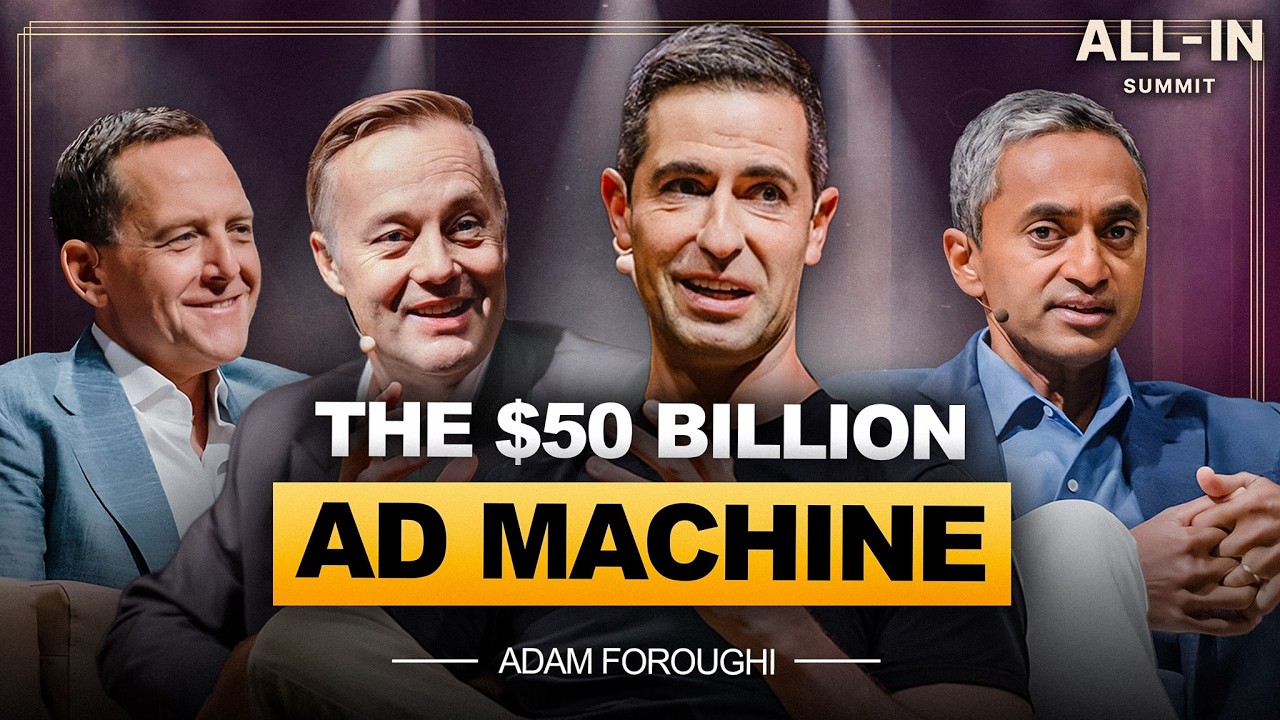
Adam Foroughi, Applovin CEO: Surviving a 92% Drawdown, Ads as ML 1.0 & the $50B Game Ad Market — All-In Podcast

All-In Podcast

AppLovin's recommendation models outpace Big Tech rivals by engineering net-new consumer discovery rather than fulfilling pre-existing search intent.

AI-assisted summary of Adam Foroughi, Applovin CEO: Surviving a 92% Drawdown, Ads as ML 1.0 & the $50B Game Ad Market — original source. Check the original for full context.

Source published:

Key ideas

  • AppLovin operates inside over 100,000 mobile games across a 1-billion-adult gaming audience, scaling run-rate ad spend from $11 billion to roughly $20 billion as it expands into direct-to-consumer e-commerce. (1:12)
  • Following an extreme 92% market drawdown in 2022 to a $3.8 billion valuation despite growing EBITDA to $1 billion, AppLovin deployed $6 billion into aggressive share buybacks, retiring 20% to 25% of its equity. (10:04)
  • A technical upgrade from linear models to deep learning neural networks ('ML 2.0') in April 2023 catalyzed an advertiser ROAS surge that propelled market capitalization from distressed lows to a peak near $250 billion. (12:40)
  • AppLovin achieves industry-leading 84% to 85% EBITDA margins through an ultra-lean operational footprint, performance-arbitrage ad delivery, and engineering talent hubs in China. (20:00)

Detailed notes

## Background Published on YouTube by the All-In Podcast on September 20, 2026, this episode features AppLovin co-founder and CEO Adam Foroughi joining the Besties. The description outlines a wide-ranging discussion covering search versus discovery advertising, phone eavesdropping urban legends, surviving a catastrophic post-IPO market crash, adapting to privacy crackdowns, the future of agentic shopping, and running a hyper-lean company competing with Big Tech.

## TL;DR AppLovin CEO Adam Foroughi breaks down how his company built an ad tech powerhouse processing an estimated $20 billion run rate in ad spend across mobile gaming by treating programmatic recommendation systems as the foundational 'ML 1.0.' He contrasts intent-closing search models with intent-generating discovery platforms and recounts navigating a harrowing 92% public market drawdown by cutting off Wall Street communication, repurchasing $6 billion in undervalued stock, and upgrading to deep learning neural networks (ML 2.0). Foroughi also demystifies microphone-listening myths, explains why autonomous AI agents won't eliminate the emotional thrill of consumer discovery shopping, and reveals how AppLovin sustains 84% to 85% EBITDA margins against trillion-dollar competitors through operational paranoia and elite engineering talent in China.

## Atmosphere & style The conversation carries a frank, operator-level intensity, blending masterclass-grade capital allocation strategy with unvarnished tech pragmatism. Adam maintains an understated, remarkably calm demeanor as he recounts existential public market distress—from fielded 'suicidal wellness checks' to aggressive share retirements—free of Silicon Valley hyperbole or media posturing. The host dynamics are marked by genuine fascination and sharp financial curiosity, creating an engaging, behind-the-curtain look at one of the most profitable yet misunderstood turnarounds in modern public markets.

## Bulletin - [01:12](https://www.youtube.com/watch?v=JtomF4bGxHs&t=72s) AppLovin operates inside over 100,000 mobile games across a 1-billion-adult gaming audience, scaling run-rate ad spend from $11 billion to roughly $20 billion as it expands into direct-to-consumer e-commerce. - [10:04](https://www.youtube.com/watch?v=JtomF4bGxHs&t=604s) Following an extreme 92% market drawdown in 2022 to a $3.8 billion valuation despite growing EBITDA to $1 billion, AppLovin deployed $6 billion into aggressive share buybacks, retiring 20% to 25% of its equity. - [12:40](https://www.youtube.com/watch?v=JtomF4bGxHs&t=760s) A technical upgrade from linear models to deep learning neural networks ('ML 2.0') in April 2023 catalyzed an advertiser ROAS surge that propelled market capitalization from distressed lows to a peak near $250 billion. - [20:00](https://www.youtube.com/watch?v=JtomF4bGxHs&t=1200s) AppLovin achieves industry-leading 84% to 85% EBITDA margins through an ultra-lean operational footprint, performance-arbitrage ad delivery, and engineering talent hubs in China.

## Key takeaways - [00:00](https://www.youtube.com/watch?v=JtomF4bGxHs&t=0s) AppLovin has grown into a dominant mobile advertising infrastructure pacing $6 billion in cash flow while operating without early-stage venture capital backing. - [01:12](https://www.youtube.com/watch?v=JtomF4bGxHs&t=72s) Casual mobile gaming represents an underappreciated $50 billion ad ecosystem populated by over 1 billion daily active adults who serve as primary household financial decision-makers. - [03:07](https://www.youtube.com/watch?v=JtomF4bGxHs&t=187s) Programmatic ad networks functioned as 'ML 1.0'—the foundational, commercial proving ground for production deep learning long before generative AI and LLMs gained prominence. - [05:30](https://www.youtube.com/watch?v=JtomF4bGxHs&t=330s) Conversational AI primarily threatens bottom-of-the-funnel search by redistributing predetermined purchases, whereas discovery ad networks generate net-new GDP growth by creating spontaneous intent. - [09:01](https://www.youtube.com/watch?v=JtomF4bGxHs&t=541s) Persistent urban legends about phones covertly recording conversations are false; ad relevance stems from multi-touch behavioral data, search history, and collaborative graph filtering. - [10:04](https://www.youtube.com/watch?v=JtomF4bGxHs&t=604s) AppLovin suffered an unrelenting post-IPO multiple collapse below 4x EBITDA in 2022 due to heavy insider liquidation and an absence of institutional investor demand. - [10:04](https://www.youtube.com/watch?v=JtomF4bGxHs&t=604s) CEO Adam Foroughi halted Wall Street communication during the crash, redirecting free cash flow to buy back roughly $6 billion of stock before institutional investors realized the fundamental mispricing. - [12:40](https://www.youtube.com/watch?v=JtomF4bGxHs&t=760s) Deploying ML 2.0 deep learning neural networks in April 2023 immediately lifted advertiser conversion rates and ROAS, reversing employee morale through performance equity incentives. - [14:47](https://www.youtube.com/watch?v=JtomF4bGxHs&t=887s) The public market rerating of AppLovin from $9 to over $750 per share demonstrated that institutional allocators often herd behind momentum rather than adopting true contrarian positions. - [16:00](https://www.youtube.com/watch?v=JtomF4bGxHs&t=960s) Apple's ATT privacy restrictions initially degraded ad feeds into irrelevant spam, but migrating to modern deep learning allowed AppLovin to extract strong conversion signals from aggregated cohort data. - [17:57](https://www.youtube.com/watch?v=JtomF4bGxHs&t=1077s) AppLovin originally bought first-party game studios solely to bootstrap proprietary training data for its algorithms, swiftly divesting them once external partner network effects solidified. - [17:57](https://www.youtube.com/watch?v=JtomF4bGxHs&t=1077s) Autonomous AI agents may automate routine subscription refills, but human consumers will still seek the dopamine hit and emotional satisfaction of self-directed discovery shopping. - [20:00](https://www.youtube.com/watch?v=JtomF4bGxHs&t=1200s) A lean operational posture, direct-response arbitrage, and high-velocity engineering talent in China provide AppLovin with an execution moat capable of outmaneuvering tech giants like Meta and Google.

## Detailed walkthrough ### [00:00](https://www.youtube.com/watch?v=JtomF4bGxHs&t=0s) Introduction: The Hidden Giant of Mobile Advertising

The episode opens with the hosts introducing Adam Foroughi, co-founder and CEO of AppLovin, framing him as "probably the best founder no one's ever heard of." Hidden inside over 100,000 mobile games, AppLovin has built an ad network that is quietly outperforming Meta’s Facebook ad infrastructure for direct-to-consumer e-commerce brands. Among more than a thousand public listings, it has emerged as the single most valuable IPO of its class. The hosts highlight the relentless founder mindset required to execute at this scale—one centered strictly on "Chase winning"—with the company on pace to generate roughly $6 billion in free cash flow. When faced with outside skepticism or accusations that the company must be "cheating" to post such staggering numbers, the reality is simpler: AppLovin engineered one of the most advanced, commercially successful machine learning platforms in modern technology.

Welcomed onto the show, Adam is asked how he managed to scale such a behemoth while operating largely in the shadows, virtually absent from tech media headlines and conventional PR circuits. Adam explains that because AppLovin built and grew the business without relying on institutional venture capital in its early days, the company naturally developed a habit of heads-down execution away from the spotlight—a quiet profile humorously compounded by what he concedes is a somewhat "goofy name."

- AppLovin powers ads inside more than 100,000 mobile titles. - The company is pacing to generate around $6 billion in cash flow. - Built without early-stage venture capital backing, enabling the team to execute without chasing public hype.

---

[01:12](https://www.youtube.com/watch?v=JtomF4bGxHs&t=72s) The $50 Billion Mobile Gaming Opportunity and E-Commerce Expansion

Adam defines AppLovin as an advertising platform built to monetize the massive, underappreciated mobile gaming ecosystem. Contrary to popular assumptions that games are primarily played by teenagers, the demographic consists of over one billion daily active users—the vast majority of whom are adults and household financial decision-makers playing casual titles. Nearly two years prior, AppLovin disclosed that its platform alone processed $11 billion in annual ad spend. Having sustained an approximate 60% year-over-year growth trajectory, that volume has expanded to an estimated $20 billion run rate today. Given that competing ad networks also monetize this surface, Adam estimates the broader mobile gaming ad market at roughly $50 billion annually—a scale rivaling the entire social media ad market from just a few years ago.

The foundation of this ecosystem relies on rewarded ad formats: players voluntarily watch video ads or engage with mini-games in exchange for in-game currency or perks. Historically, AppLovin applied this attention to cross-promote other games, routing players from one title to another. However, advances in deep learning recommendation architectures have unlocked a much bigger shift: presenting these adult players with high-performing, hyper-relevant direct-to-consumer shopping experiences. By transitioning the platform from game-to-game discovery into broad e-commerce, AppLovin is expanding into a vastly larger addressable market.

```mermaid flowchart TD accTitle: AppLovin Audience Monetization Flow accDescr: Visual mapping of how mobile game players are converted from in-game intent to cross-promotions and e-commerce shopping.

subgraph MobileAudience["Mobile Gaming Ecosystem"] A["1B+ Daily Active Users<br/>Adults & Household Decision-Makers"] --> B["Rewarded Ad Placement<br/>(Mini-Games & Video Ads)"] end

subgraph CoreEngine["Deep Learning Recommendation Engine"] B --> C{"Intent Generation &<br/>Predictive Modeling"} end

subgraph EconomicOutcomes["Monetization Paths"] C --> D["Gaming Cross-Promotion<br/>($50B Ecosystem)"] C --> E["E-Commerce / DTC Retail<br/>(High-Value Shopper Intent)"] end ```

- More than 1 billion adults play casual mobile games on a daily basis. - AppLovin handled $11 billion in run-rate ad spend two years prior, scaling at roughly 60% year-over-year to ~$20 billion. - The aggregate annual ad spend across the mobile gaming sector is estimated at $50 billion.

---

[03:07](https://www.youtube.com/watch?v=JtomF4bGxHs&t=187s) AdTech as "ML 1.0" and the Evolution of Consumer Ads

When asked whether the infrastructure underpinning mobile advertising mirrors the way Google’s early AdWords and AdSense technologies seeded the modern internet, Adam characterizes programmatic advertising as "ML 1.0." Long before generative AI and modern foundation models took center stage, digital ad networks served as the very first production-scale, highly lucrative implementations of deep learning. While large language models (LLMs) command enormous cultural and societal attention, recommendation engines remain the most direct, reliably profitable vehicle for complex machine learning. The disciplines are deeply intertwined: fundamental research, algorithmic architectures, and senior engineering talent regularly flow back and forth between frontier LLM development and commercial recommendation models.

Reflecting on the historical evolution of consumer advertising from 2005 to the present day, Adam notes that early internet ads were predominantly low-quality spam. Facebook transformed consumer tolerance by leveraging massive behavioral data alongside high-grade machine learning models to make sponsored content feel native and genuinely appealing. In the modern era, particularly on visual platforms like Instagram, ads often function as entertaining content rather than unwanted distractions. AppLovin sees that identical behavioral dynamic in its network: users willingly engage with interactive, playable mini-game previews because underlying recommendation algorithms have become exceptionally accurate at surfacing content they enjoy.

- Advertising algorithms represent the foundational proving ground ("ML 1.0") for modern deep learning systems. - Research, model structures, and machine learning researchers regularly move between large language models and recommendation networks. - User sentiment toward ads has pivoted from dismissing spam (circa 2005) to treating highly tailored creative as native content and entertainment.

---

[05:30](https://www.youtube.com/watch?v=JtomF4bGxHs&t=330s) Search vs. Discovery: Chatbots, Meta, and Economic Expansion

Addressing concerns that conversational chatbots and products like OpenAI's emerging advertising layer could cannibalize legacy ad models, Adam outlines the critical structural distinction between two fundamentally different types of advertising: bottom-of-the-funnel search and top-of-the-funnel discovery.

| Dimension | Bottom-of-the-Funnel (Search / LLMs) | Top-of-the-Funnel Discovery (AppLovin / Meta) | |:--- |:--- |:--- | | **User State** | Existing intent (user knows what product they want) | Zero pre-existing intent (passive consumer browsing or playing) | | **Platform Examples** | Google Search, conversational AI chatbots | Instagram, AppLovin playable game network | | **Model Function** | Facilitates and closes an already predetermined purchase | Generates net-new desire for unthought-of products | | **Macro Impact** | Redistribution of a transaction that would occur anyway | Real economic expansion by driving incremental commerce |

Adam explains that conversational AI will primarily disrupt Google’s core search business. If a user seeks a specific product—such as dress shoes—an LLM simply closes the loop on a purchase that was already destined to happen. Because intent already existed, this dynamic creates minimal incremental demand. In contrast, platforms like Meta and AppLovin engineer spontaneous intent out of thin air. By surfacing an alluring product to a user who was not actively shopping, the platform creates a moment of discovery and delight that induces net-new economic demand.

---

[07:39](https://www.youtube.com/watch?v=JtomF4bGxHs&t=459s) The "Is My Phone Listening?" Urban Legend

The conversation shifts to the persistent cultural paranoia that smartphones are secretly recording private conversations to serve hyper-targeted ads on Meta or mobile apps—the familiar scenario where a user mentions a product over lunch, only to see an ad for it minutes later. Adam firmly dismisses the theory that apps are covertly running microphones in the background.

Instead, Adam attributes these eerie occurrences to subtle, multi-touch behavioral data that users overlook. Often, a consumer performed a related query, clicked a link, or browsed a product days earlier and forgot the action, only for the subsequent conversation to make the ad stand out through confirmation bias. Jason Calacanis pushes back with an alternative programmatic hypothesis: ad networks cross-reference high-precision geolocation data to cluster phones sitting at the same table. If one friend looks up a luxury watch right after lunch, the algorithm might instantly map that intent across the entire cluster. Adam remains highly skeptical that ad tech companies execute that type of synchronized proximity matching, setting the stage to unpack how data privacy and technical tracking boundaries actually operate.

[09:01](https://www.youtube.com/watch?v=JtomF4bGxHs&t=541s) Debunking Ad Myths and the Macroeconomic Power of Targeting

Adam dismisses the persistent urban legend that ad-tech platforms track users' precise physical coordinates or secretly listen in through smartphone microphones to serve ads. Tracking pinpoint physical location in real time to render an ad introduces an immense, unnecessary computational burden. Streaming and parsing live microphone audio across millions of devices to extract advertising intent is technically and economically unrealistic. While AppLovin does not track location or eavesdrop on audio, social platforms do leverage relationship graphs. If Chamath searches for a product, an ad engine might serve related items to people in his social graph, which is standard collaborative filtering rather than surveillance.

Although users often react to targeted advertising with an instinctive "creepy factor," data collection across major platforms is heavily structured and controlled. What the public often overlooks is the massive economic engine unlocked by relevance. Decades ago, consumers routinely tuned out generic television and print ads. Modern digital ad discovery, by contrast, connects buyers with niche goods they genuinely want, directly accelerating GDP growth.

- AppLovin does not collect or process real-time physical GPS coordinates or microphone audio streams to render advertisements. - Highly targeted advertising acts as a macroeconomic accelerant: higher relevance yields higher conversion rates and faster digital commerce growth.

---

[10:04](https://www.youtube.com/watch?v=JtomF4bGxHs&t=604s) From $40B to $3.8B: Becoming Your Own Best Investor

Founded in Silicon Valley, AppLovin maintains engineering offices in Palo Alto, Beijing, and Singapore, with Adam operating out of Los Angeles. Having raised relatively little venture capital during its early days, the company went public in April 2021 amid the COVID tech boom at an initial market capitalization of approximately $28 billion and $600 million in EBITDA, quickly climbing to a peak valuation of around $40 billion. Then the 2022 tech wreck hit: the stock suffered an unrelenting day-over-day decline, crashing to a trough of $3.8 billion. Astonishingly, during the very year the equity dropped by more than 90%, AppLovin actually increased its profitability, generating $1 billion in EBITDA.

```mermaid flowchart TD accTitle: AppLovin Capital Allocation and Rerating Flywheel accDescr: Flowchart illustrating how market mispricing allowed AppLovin to aggressively buy back stock and re-rate.

subgraph MarketDisconnect ["Market Disconnect (2022)"] A["$1B EBITDA Business"] --> B["Stock Collapses to $3.8B Cap<br/>(Sub-4x EBITDA Multiple)"] B --> C["Heavy Insider/PE Selling<br/>+ Low Institutional Demand"] end

subgraph Countermeasure ["Capital Allocation Strategy"] C --> D["Cut Off Wall Street Comms"] D --> E["$6B Aggressive Share Buybacks<br/>(20-25% Shares Retired)"] end

subgraph EngineUpgrade ["Algorithmic Acceleration"] E --> F["ML 2.0 Rollout (April 2023)<br/>Deep Learning Engine"] F --> G["Surging Advertiser ROAS<br/>& Revenue Scaling"] end

G --> H["Stock Rebound: $9 to $750+<br/>Peak Market Cap Reaches $250B"] ```

Leveraging his finance background, Adam recognized that equity valuations are ultimately a function of investor quality and supply-demand dynamics. Following the rush of COVID-era IPOs, institutional blue-chip funds failed to do deep diligence on what seemed like a "goofy named company," while private equity backers and former founders liquidated substantial blocks of stock. This dynamic created an overwhelming overhang of supply and virtually zero institutional demand, compressing the company's valuation multiple from roughly 50x EBITDA to an absurd sub-4x. Rather than begging Wall Street for support, Adam told his executive team he was done talking to investors entirely. AppLovin pivoted its free cash flow into an aggressive capital return program, buying back roughly $6 billion of its own stock and retiring between 20% and 25% of all outstanding shares. At its peak recovery, that repurchased stock alone represented over $50 billion in equity value.

- **April 2021 IPO:** Debuted at a $28 billion market cap on $600 million of EBITDA, later peaking around $40 billion. - **2022 Drawdown:** Market cap collapsed to $3.8 billion despite EBITDA expanding to $1.0 billion (multiple compressed to <4x EBITDA). - **Share Repurchases:** Deployed approximately $6 billion into buybacks, canceling 20% to 25% of total shares outstanding.

---

[12:40](https://www.youtube.com/watch?v=JtomF4bGxHs&t=760s) Surviving a 92% Plunge and the ML 2.0 Rebound

Managing a 92% drawdown created intense internal and external strain. Adam recounted receiving wellness check calls from concerned friends and family members asking, "Are you suicidal?" While Adam maintained perspective—reminding himself that early shares were once valued at a penny and the stock was still trading around $10—he realized rank-and-file employees did not share his equity cushion or ownership scale. Employees were fielding the exact same panic calls from their families after seeing paper net worth evaporate: "We understand you thought you had a house and now you don't." To stem attrition and maintain morale, Adam instituted an "us against the world" culture and issued broad-based performance stock unit (PSU) awards across key contributors, tying compensation to an eventual recovery.

Meanwhile, the engineering team executed a foundational platform overhaul, shifting from ML 1.0 (traditional linear regression models) to ML 2.0 (modern deep learning neural networks). Because AppLovin operates strictly on a performance advertising model—effectively selling measurable revenue and return on ad spend (ROAS) to advertisers—the new deep learning engine immediately improved targeting efficiency. When the model debuted in April 2023, advertiser conversion rates jumped, driving a rapid acceleration in platform revenue.

Adam maintained complete investor radio silence until September 2023, when the stock had quietly rebounded to roughly $80 per share. With the market cap recovering and buybacks becoming less capital-efficient, he flew to New York to tell institutional allocators: "Hey, our company still exists. We survived this." The meetings turned into an immediate buying frenzy; Adam could see fund managers discreetly contacting their execution desks mid-pitch instructing them to buy. Within a single week, the stock surged from $80 to $150, vaulting AppLovin's valuation from $28 billion to $55 billion.

---

[14:47](https://www.youtube.com/watch?v=JtomF4bGxHs&t=887s) Contrarian Swings and Market Momentum

The company's public market arc demonstrated how aggressively public markets swing between unjustified despair and euphoric exuberance. Over a 30-month window, AppLovin's stock catapulted from a bottom of $9 to over $750 per share, driving the overall equity valuation from a low of $3.8 billion to a staggering high of $250 billion. Adam observes that the market is devoid of true contrarians: the moment the stock rebounded, Wall Street analysts immediately flipped from dismissing the business to demanding aggressive diversification into e-commerce and other verticals.

In Adam's assessment, public market investors behave almost identically to private market venture capitalists. Both groups tend to follow momentum and herd into trends well after the fundamental turn has already taken place. The select few top-tier investors—whether venture capitalists or public hedge fund managers—differentiate themselves by identifying structural inflection points early, while the median participant merely chases past performance.

- Share price climbed from a trough of $9 to over $750 in approximately two and a half years. - Enterprise valuation surged from a distressed $3.8 billion to a peak near $250 billion.

---

[16:00](https://www.youtube.com/watch?v=JtomF4bGxHs&t=960s) Adapting to Apple's Privacy Crackdown and the App Ecosystem

Addressing the regulatory headwinds posed by Apple's App Tracking Transparency (ATT) framework and European Union data privacy directives, Adam emphasizes that technology companies thrive when rules are explicit. When platform operators eliminate precise device-level identifiers, ad engines are forced to aggregate users into coarse cohorts, degrading targeting precision. Paradoxically, this change generated consumer backlash: AppLovin received widespread user complaints protesting that their ad feeds had suddenly become filled with irrelevant spam.

Targeting precision is vital because of the implicit value exchange in the mobile ecosystem. When a user watches a 30-second rewarded video ad inside a mobile game in exchange for an extra life or in-game currency, they are receiving an asset with tangible economic value. Forcing players to watch irrelevant junk degrades that experience. By migrating to deep learning architectures, AppLovin successfully adapted to post-ATT restrictions, extracting strong conversion signals from aggregated data without violating consumer privacy standards. As the conversation wraps, the hosts bring up AppLovin's historical acquisitions of first-party game studios and tease an upcoming discussion with Bending Spoons regarding software roll-up strategies.

[17:57](https://www.youtube.com/watch?v=JtomF4bGxHs&t=1077s) Seeding the First Model with Gaming Studios and the Reality of Agentic Commerce

Addressing whether owning gaming studios put AppLovin into conflict with partners, Adam Foroughi explains that the company sold off all its game studios. They were originally acquired purely as a data play: when AppLovin built its first deep learning model, it desperately needed data for training, and third-party game studios are notoriously reluctant to share proprietary data with outside ad platforms. By purchasing studios directly, AppLovin seeded the training datasets for its engine, refined a highly successful model in the market, and scaled rapidly. Once that flywheel took off and external partners flocked to the platform, AppLovin promptly divested the studios.

When asked how the advertising landscape will shift in a world saturated with autonomous AI agents, changing hardware interfaces like Meta smart glasses, and ambient computing, Foroughi pushes back against Silicon Valley echo chambers. While agents will certainly optimize predictable, recurring consumer behaviors—such as automating monthly supplement refills—discovery-driven ad platforms serve an entirely different psychological purpose. The average consumer is not a tech-obsessed user living on Twitter looking to delegate every decision. Instead, AppLovin targets a broader demographic akin to the mainstream New York Times or Yahoo audience: people who actively enjoy window shopping, discovering unexpected items, comparing choices, tracking orders, and feeling the tangible dopamine hit of completing a $50 transaction themselves rather than handing it off to save 20%.

```mermaid flowchart TD accTitle: AppLovin Data Bootstrap and Agentic Reality Flow accDescr: Diagram depicting how AppLovin used internal studios to seed ML data before divesting, and contrasting automated agent utility with human discovery shopping.

subgraph Phase1["Data Bootstrapping Phase"] A["Third-Party Studios Reluctant to Share Data"] --> B["Acquired Internal Game Studios"] B --> C["Seeded First Deep Learning Model"] C --> D["Demonstrated Strong Market ROAS"] D --> E["Divested Studios Once 3rd Parties Onboarded"] end

subgraph Reality["Agentic Commerce vs. Human Discovery"] F["Predictable Subscriptions<br/>(e.g., Supplement Reorders)"] --> G["Autonomous AI Agents"] H["Discovery Shopping<br/>(Browsing, Impulse, Window Shopping)"] --> I["Human Emotional Payoff<br/>(Dopamine Hit on $50 Buys)"] end ```

[20:00](https://www.youtube.com/watch?v=JtomF4bGxHs&t=1200s) Competing with Meta and Google: Lean Teams, Margin Moats, and Chinese Engineering Talent

Asked how a relatively small company could compete and win in an ad market dominated by trillion-dollar giants like Meta and Alphabet, Foroughi emphasizes a mindset of operational paranoia: AppLovin never acts like it has won, operating every morning under the assumption that they could be displaced if they do not execute relentlessly. By maintaining an extremely lean structure staffed with deep subject-matter experts laser-focused on converting mobile gaming interactions into commercial transactions, they retain the speed and agility necessary to outmaneuver bureaucratic corporate behemoths.

When pressed on potential business "leakage" or areas for margin expansion, Foroughi highlights that AppLovin already generates market-leading EBITDA margins of roughly 84% to 85%. Because their platform operates on pure performance arbitrage—allowing an advertiser selling a $20 product like lipstick to acquire a customer profitably below their cost of goods sold—the ad spend scales seamlessly without heavy operational bloat. Furthermore, when competitors claim they will undercut AppLovin's margins at 50% or 60%, they fail because the technical complexity of the models and the proprietary datasets create an insurmountable network moat, comparable to how leading frontier AI labs pull ahead. Foroughi credits much of this execution edge to the company's engineering presence and talent in China, praising their humility, work ethic, and intellect, concluding that he relishes being the "dumbest person in that room" when collaborating with his technical teams.

- **EBITDA Margins**: AppLovin operates at an industry-leading 84% to 85% EBITDA margin, driven by algorithmic automation and an asset-light, ultra-lean team. - **Direct-Response Arbitrage**: Advertisers scale spend friction-free because customer acquisition costs are recouped instantly below product cost-of-goods-sold (COGS). - **Engineering Edge**: Building with top-tier, hardworking, and humble engineering talent in China provides AppLovin with massive leverage against Silicon Valley incumbents.

## Notable quotes > [00:00](https://www.youtube.com/watch?v=JtomF4bGxHs&t=0s) probably the best founder no one's ever heard of — Host

> [00:00](https://www.youtube.com/watch?v=JtomF4bGxHs&t=0s) Chase winning — Host

> [00:00](https://www.youtube.com/watch?v=JtomF4bGxHs&t=0s) goofy name — Adam Foroughi

> [03:07](https://www.youtube.com/watch?v=JtomF4bGxHs&t=187s) ML 1.0 — Adam Foroughi

> [09:01](https://www.youtube.com/watch?v=JtomF4bGxHs&t=541s) creepy factor — Adam Foroughi

> [10:04](https://www.youtube.com/watch?v=JtomF4bGxHs&t=604s) goofy named company — Adam Foroughi

> [12:40](https://www.youtube.com/watch?v=JtomF4bGxHs&t=760s) Are you suicidal? — Adam Foroughi

> [12:40](https://www.youtube.com/watch?v=JtomF4bGxHs&t=760s) We understand you thought you had a house and now you don't. — Adam Foroughi

> [12:40](https://www.youtube.com/watch?v=JtomF4bGxHs&t=760s) us against the world — Adam Foroughi

> [12:40](https://www.youtube.com/watch?v=JtomF4bGxHs&t=760s) Hey, our company still exists. We survived this. — Adam Foroughi

> [20:00](https://www.youtube.com/watch?v=JtomF4bGxHs&t=1200s) dumbest person in that room — Adam Foroughi

## Mentioned Adam Foroughi, All-In Podcast, Alphabet, Apple, AppLovin, App Tracking Transparency (ATT), Bending Spoons, Chamath Palihapitiya, David Sacks, Facebook, Google, Google AdSense, Google AdWords, Google Search, Instagram, Jason Calacanis, Meta, OpenAI, The New York Times, Twitter, Yahoo

## Video description (0:00) Adam Foroughi joins the Besties! (3:07) Discovery vs search & is your phone listening? (10:04) IPO tumble & becoming your own best investor (16:00) Privacy rules, Apple's crackdown & how agents change people’s shopping (20:00) How a lean team beats the giants, margin moats & building in China

Thanks to our partners for making this possible!

IREN is a vertically integrated AI Cloud platform, delivering data centers, compute and software for AI training and inference. https://iren.com/

Oracle connects the data, applications, and infrastructure that turn AI into business outcomes—with the flexibility, choice, and control to optimize as AI evolves. http://oracle.com/ai EY helps tech innovators scale from startup to exit to megacap. You build the future. We’ll handle the rest. http://www.ey.com

Meta believes the future is for everyone. We're focused on giving every person the tools to reach their full potential and making sure the benefits of technology are distributed to all. http://www.meta.com

Keel Infrastructure owns the power, land, and connectivity that HPC and AI run on - backed by secured energy assets and established grid interconnections across North America. https://keelinfra.com/

Airwallex - Agentic Global Business Accounts. Open local accounts in 70+ countries to accept payments, earn yield, pay globally, and manage spend. http://airwallex.com

PayPal has been revolutionizing commerce globally for more than 25 years. Creating innovative experiences that make moving money, selling, and shopping simple, personalized, and secure, PayPal empowers consumers and businesses in approximately 200 markets to join and thrive in the global economy. For more information, visit https://www.paypal.com

Google for Startups connects founders with the right people, products, and best practices to help startups build faster and go further. https://startup.google.com/

Explore ideas, industries, and technologies worth understanding with Chamath every week on Learn with Me: https://research.socialcapital.com/allin

Follow the besties: https://x.com/chamath https://x.com/Jason https://x.com/DavidSacks https://x.com/friedberg

Follow on X: https://x.com/theallinpod

Follow on Instagram: https://www.instagram.com/theallinpod

Follow on TikTok: https://www.tiktok.com/@allin

Follow on LinkedIn: https://www.linkedin.com/company/allinpod

Intro Music Credit: https://rb.gy/tppkzl https://x.com/yung_spielburg

#allin #tech #news

[Source](https://www.youtube.com/watch?v=JtomF4bGxHs)

中文简报

暴跌92%后,AppLovin借深度学习转型冲上2500亿美元巅峰 AppLovin的推荐模型通过激发全新的消费者探索而非满足既有搜索意图,超越了大型科技竞争对手。 AppLovin首席执行官Adam Foroughi阐述了公司如何将程序化推荐系统作为基础的“ML 1.0”,打造出一个在移动游戏领域处理约200亿美元年化广告支出的广告技术巨头。他将终结意图的搜索模型与激发意图的探索平台进行了对比,并回顾了如何通过切断与华尔街的沟通、回购60亿美元被低估的股票,以及升级至深度学习神经网络(ML 2.0),成功渡过公开市场暴跌92%的艰难困境。Foroughi还澄清了有关麦克风窃听的谣言,解释了为何自主AI代理不会消除消费者在探索式购物中的情绪快感,并透露了AppLovin如何通过极致严谨的运营偏执和在中国的顶尖工程人才,在与万亿美元级对手的竞争中维持84%至85%的EBITDA利润率。 AppLovin在超过10万款移动游戏中运营,覆盖10亿成年玩家群体,随着其向DTC电商领域扩张,年化广告支出规模已从110亿美元增长至约200亿美元。 (1:12) 尽管2022年EBITDA增长至10亿美元,但市值仍遭遇92%的极端回撤降至38亿美元;随后AppLovin斥资60亿美元大力回购股票,注销了20%至25%的股本。 (10:04) 2023年4月从线性模型向深度学习神经网络(“ML 2.0”)的技术升级催生了广告主ROAS的大幅提升,推动市值从低谷一路攀升至近2500亿美元的巅峰。 (12:40) AppLovin通过极其精简的运营架构、效果套利广告投放以及在中国的工程人才中心,实现了行业领先的84%至85%的EBITDA利润率。 (20:00)

Reading summary

Adam Foroughi describes how AppLovin turned casual mobile gaming attention into a highly profitable direct-to-consumer advertising engine powered by deep learning recommendation models. He argues that the company's survival and subsequent surge from a 92% post-IPO market drawdown was driven by counter-cyclical share repurchases and technical upgrades that outpaced platform privacy headwinds. Discovery Commerce in the Mobile Gaming Ecosystem (1:12) AppLovin operates across an underappreciated mobile gaming audience of over one billion daily active users, primarily composed of adult household financial decision-makers playing casual games. Foroughi estimates that the total mobile gaming ad sector commands approximately $50 billion annually. AppLovin's platform grew from an $11 billion run-rate to roughly $20 billion, expanding from game cross-promotion into direct-to-consumer e-commerce. Foroughi draws a structural contrast between search advertising and algorithmic discovery. Conversational AI chatbots and traditional search engines fulfill existing bottom-of-the-funnel intent by facilitating purchases consumers already intended to make. Conversely, discovery networks like AppLovin and Meta surface unexpected products to passive users, manufacturing net-new consumer desire and stimulating incremental macroeconomic demand. Algorithmic Upgrades and Post-Privacy Adaptation (12:40) Framing adtech as 'ML 1.0,' Foroughi views recommendation models as the earliest production-grade and commercially proven deployments of deep learning. AppLovin originally acquired internal game studios to bootstrap proprietary training data for its algorithms, later divesting the studios once external partners integrated with the platform and third-party data network effects took hold. In April 2023, AppLovin transitioned its platform from linear regression models to 'ML 2.0' deep neural networks. This migration enabled the company to adapt to Apple's App Tracking Transparency framework and European privacy directives. Rather than relying on invasive real-time geolocation or audio monitoring—which Foroughi dismisses as technically impractical urban legends—the deep learning architecture infers commercial intent from aggregated cohort behavior, elevating advertiser conversion rates and return on ad spend. Severe Multiple Compression and Aggressive Share Buybacks (10:04) AppLovin went public in April 2021 at a $28 billion valuation and climbed to $40 billion before plunging 92% to a trough of $3.8 billion during the 2022 tech downturn. Despite the equity collapse, the underlying business increased annual EBITDA from $600 million to $1.0 billion, creating an extreme multiple compression below 4x EBITDA as private equity sponsors and early holders liquidated shares into thin institutional demand. Treating public equity mispricing as a capital allocation opportunity, Foroughi halted Wall Street outreach and directed company cash flow toward repurchasing roughly $6 billion of equity, retiring 20% to 25% of total shares outstanding. When institutional investor sentiment shifted in late 2023 alongside algorithmic revenue acceleration, the equity rebounded from $9 to over $750 per share, reaching a peak market capitalization of roughly $250 billion. Lean Operations, Margin Moats, and Agentic Limits (20:00) AppLovin reports EBITDA margins of 84% to 85%, supported by an automated performance arbitrage model where direct-response merchants scale customer acquisition spend below product cost of goods sold. Foroughi attributes the company's operating leverage against larger incumbents like Meta and Alphabet to lean staffing and heavy reliance on engineering talent in China, Palo Alto, and Singapore. Addressing forecasts that autonomous AI agents will automate consumer shopping, Foroughi contends that agentic commerce will primarily handle predictable, utilitarian tasks such as recurring household refills. He maintains that mainstream consumers actively derive emotional satisfaction and dopamine from browsing, window shopping, and discovering discretionary purchases, preserving the commercial viability of discovery-driven ad platforms. While AppLovin achieved significant margin expansion and market re-rating through deep learning enhancements and disciplined capital allocation, the business remains closely tethered to external platform operating rules, data compliance constraints, and the enduring willingness of adult gamers to engage with rewarded ad formats.

精炼阅读摘要

AppLovin联合创始人兼首席执行官Adam Foroughi阐述了该公司如何依托移动游戏底层广告网络、深度学习推荐算法以及逆周期的资本配置,在经历市值暴跌92%后实现强劲复苏。他指出,数字广告本质上是“机器学习1.0”,通过在休闲游戏中激发非计划性消费意愿,该模式正向体量庞大的直接面向消费者(DTC)电商领域渗透,并凭借高利润率与精益团队构筑竞争壁垒。 移动游戏广告蓝海与发现式电商扩张 (1:12) 根据Foroughi的介绍,移动游戏广告生态长期被外界低估。目前全球有超过10亿日常活跃用户在玩休闲游戏,他们大多是具备消费能力的成年人及家庭财务决策者,而非刻板印象中的青少年。两年前AppLovin平台处理的广告投放年化规模为110亿美元,伴随约60%的年同比增速,当前运行规模已攀升至约200亿美元;结合同类竞品平台,Foroughi估算整个移动游戏广告市场规模约为500亿美元,足以比肩数年前的整个社交媒体广告体量。 该生态的基础在于激励型广告形态,例如玩家通过主动观看视频或参与试玩以换取游戏内权益。以往此类流量主要用于游戏间的交叉推广,但随着深度学习算法的演进,AppLovin正将这一注意力池转向高转化率的DTC电商体验。与Google搜索等解决现有意图、仅对既定交易进行重配的底层漏斗不同,AppLovin与Meta定位于漏斗上层的“发现”(Discovery)场景,通过向原本没有购物意图的用户展示契合兴趣的商品,凭空激发消费需求,从而在宏观层面上创造增量经济价值。 广告即ML 1.0与数据追踪边界澄清 (3:07) Foroughi将程序化广告体系定义为“机器学习1.0”。他指出,早在生成式AI和大语言模型(LLM)成为行业焦点前,数字广告推荐引擎就已经是深度学习在工业界规模最大、盈利能力最确定的落地应用。前沿大语言模型与商业推荐系统在底层算法架构与核心工程人才上高度互通。回顾2005年以来的演进,数字广告已从早期的低质垃圾信息转变为高匹配度的原生互动内容,用户在平台精准预测下往往愿意将互动式试玩广告视作娱乐体验。 针对公众关于手机窃听麦克风或后台监控GPS以实现超精准推送的传闻,Foroughi予以明确否认。他解释称,实时追踪精确经纬度或持续传输解析麦克风音频,在计算资源与经济成本上完全不切实际。AppLovin既不抓取用户GPS坐标,也不监听音频流。用户之所以产生巧合感,主因在于被忽视的多触点行为数据(例如几天前无意识的点击或搜索)以及社交协同过滤算法,加之证实偏差所带来的错觉。Foroughi强调,基于多维行为数据的精准推荐本质上是现代商业的宏观加速器,能通过提升匹配效率直接带动数字经济增长。 暴跌92%下的资本反击与ML 2.0升级 (10:04) AppLovin于2021年4月上市,市值约280亿美元,EBITDA为6亿美元,峰值曾达400亿美元。然而在2022年科技股暴跌潮中,由于缺乏早期知名风险投资机构站台、PE机构集中抛售以及机构投资者缺乏深度研究,公司估值倍数从约50倍EBITDA断崖式压缩至不足4倍,市值触底至38亿美元,跌幅超90%。在市值大幅缩水期间,AppLovin的实际盈利能力仍在提升,当年实现10亿美元EBITDA。 面对这一市场错配,Foroughi切断了与华尔街的大部分常规沟通,转而利用自由现金流启动激进的股票回购计划。公司累计斥资约60亿美元回购并注销了20%至25%的流通股。对内方面,公司向核心团队发放基于绩效的限制性股票(PSU)以稳定军心并重塑凝聚力;技术层面,工程团队在2023年4月完成了从线性回归(ML 1.0)向现代深度神经网络(ML 2.0)的底层架构迭代。由于AppLovin采用纯效果广告模式,模型升级带来的转化率跃升迅速转化为广告主回报率(ROAS)的提升。至2023年9月股价回升至80美元时,Foroughi重返纽约与机构沟通,随后引发买盘激增,公司股价在约两年半内自9美元低点涨至750美元以上,峰值市值一度攀升至2500亿美元。 隐私合规、数据冷启动与精益运营护城河 (17:57) 在应对苹果ATT框架和欧盟数据隐私法规方面,Foroughi表示当行业规则明确后,技术团队可以通过深度学习在粗粒度聚合数据中提取转化信号,从而在不侵犯隐私的前提下保障投放效率。此外,针对外界关于其曾持有游戏工作室引发利益冲突的质疑,Foroughi澄清,早期收购第一方工作室纯粹是为了解决算法冷启动时的训练数据匮乏问题,因为第三方游戏厂商初期极度抗拒共享底层数据。当首个深度学习模型完成训练验证并在市场上展现出强劲回报后,外部合作方迅速跟进,AppLovin随后便果断剥离并出售了所有游戏工作室。 在竞争策略与技术前景上,Foroughi对完全由自主AI智能体主导的电商叙事持谨慎态度。他认为AI智能体适用于补剂自动续订等高可预测性任务,但广大普通消费者仍享受逛街浏览、偶遇新品和亲自完成50美元购物所带来的多巴胺奖励。面对Meta和Google等科技巨头的竞争,AppLovin通过精益的组织架构运作,实现了84%至85%的高EBITDA利润率。其核心护城河建立在复杂模型、专有数据集以及直接响应式套利机制之上;同时,Foroughi高度推崇公司在中国(及新加坡、帕洛阿尔托)的工程团队,称其卓越的技术敏锐度、谦逊态度和执行力为公司提供了对抗巨头的关键杠杆。 Adam Foroughi总结认为,AppLovin的历程印证了公开市场在极度悲观与非理性繁荣之间的剧烈摇摆,真正的护城河取决于底层算法迭代、极端精益的执行力以及在资本错配时逆势配置的能力。然而,随着该网络由游戏向广阔的DTC电商市场纵深推进,其在无第一方硬件生态和平台隐私政策持续收紧的长期环境下,能否持续维持超过80%的高利润率和算法领先优势,仍有待未来业绩的持续检验。

Detailed notes — zh

## Background 本期内容由知名播客《All-In Podcast》于2026年9月20日发布在 YouTube 平台。节目视频简介显示,主持人邀请到了 AppLovin 联合创始人兼 CEO Adam Foroughi 做客,共同探讨搜索与发现广告的本质、手机监听的都市传说、AppLovin 经历 92% 暴跌后的自救与反弹、苹果隐私新规与 AI 时代的电商演变,以及精简团队如何在巨头夹缝中打造高利润率护城河。 ## TL;DR 访谈深入剖析了移动游戏与效果广告这一常被外界低估的 500 亿美元市场,Adam 指出广告技术本质上是“机器学习 1.0”,通过深度学习激发增量消费需求,而非纯做零和搜索。面对 2022 年市值暴跌 92% 的至暗时刻,AppLovin 拒绝低效路演,凭借强劲现金流大举回购股份、全员股权绑定,并在 ML 2.0(AXON 2.0 引擎)的驱动下实现业绩与市值的惊人爆发。此外,Adam 澄清了手机偷听的迷思,分析了大众享受亲自“逛街”带来的多巴胺体验对 AI Agent 的抵御力,并分享了精简组织与顶尖研发人才如何支撑起 84% 经调整 EBITDA 利润率的核心秘密。 ## Atmosphere & style 整场对话充满硅谷顶尖创业者与硬核投资人之间务实而坦诚的碰撞,既有对二级市场狂热与恐慌周期的深刻反思,也有技术工程层面的清晰推演。Adam 的表述克制内敛却不乏狠劲,坦承绝境时“做自己最好投资人”的孤注一掷与危机感,全场节奏紧凑、干货满满,带给听众一种在资本与科技暗涌中逆风翻盘的震撼感与真实感。 ## Bulletin - [00:00](https://www.youtube.com/watch?v=JtomF4bGxHs&t=0s) AppLovin 接入全球超 10 万款手游,覆盖逾 10 亿成年高消费玩家,正将其年交易额近 200 亿美元的推荐算法从游戏导流拓宽至规模超 500 亿美元的全品类电商广告生态。 - [10:04](https://www.youtube.com/watch?v=JtomF4bGxHs&t=604s) 公司在 2022 年市值暴跌 92% 至 38 亿美元(估值不足 4 倍 EBITDA),管理层随即停止外部路演并斥资 60 亿美元激进回购 20% 至 25% 的流通股,该部分股份在峰值时浮盈超 500 亿美元。 - [13:43](https://www.youtube.com/watch?v=JtomF4bGxHs&t=823s) 2023 年升级基于深度学习的 AXON 2.0(ML 2.0)引擎后,AppLovin 两年半内股价由 9 美元飙升至 750 美元,市值突破 2500 亿美元并维持高达 84% 的调整后 EBITDA 利润率。 - [07:39](https://www.youtube.com/watch?v=JtomF4bGxHs&t=459s) AppLovin 首席执行官明确否认广告平台通过手机麦克风窃听用户,指出上下文模式识别能绕过苹果 ATT 追踪限制,且大众享受亲自网购的多巴胺反馈,AI Agent 短期内难以替代发现式消费。 ## Key takeaways - [00:00](https://www.youtube.com/watch?v=JtomF4bGxHs&t=0s) 休闲移动游戏并非仅面向未成年人,全球每日超 10 亿活跃用户以家庭消费主力的成年人为主,构成了年规模达 500 亿美元的高价值广告大盘。 - [03:07](https://www.youtube.com/watch?v=JtomF4bGxHs&t=187s) 广告技术是现代 AI 的先驱实践(ML 1.0),其推荐模型与大语言模型底层同源,核心优势在于算法预测能获得毫秒级的实时商业回报。 - [06:12](https://www.youtube.com/watch?v=JtomF4bGxHs&t=372s) 对话式 AI 与搜索引擎属于漏斗底部的确定性意图闭环,主要在存量中再分配;而发现式广告机制负责激发全新潜在消费需求,驱动纯增量经济扩张。 - [07:39](https://www.youtube.com/watch?v=JtomF4bGxHs&t=459s) 手机通过后台偷听语音投放广告在算力和传输工程上不切实际,用户产生的精准错觉源于此前分散的行为踪迹与记忆偏差。 - [09:01](https://www.youtube.com/watch?v=JtomF4bGxHs&t=541s) 精准广告匹配大幅消除了低质噪音信息,直接提升转化效率并拉动整体 GDP,不应被简单归为侵犯隐私的恐惧因素。 - [11:14](https://www.youtube.com/watch?v=JtomF4bGxHs&t=674s) 在 2022 年遭遇流动性踩踏且 EBITDA 逆势增至 10 亿美元时,管理层毅然放弃外部路演,以海量现金流启动激进股票回购并推行全员绩效股票激励。 - [13:43](https://www.youtube.com/watch?v=JtomF4bGxHs&t=823s) 底层推荐算法由回归模型向深度神经网络(AXON 2.0)的代际升级,直接撬动广告主 ROI 形成预算飞轮,驱动股价从 9 美元上涨至 750 美元。 - [16:00](https://www.youtube.com/watch?v=JtomF4bGxHs&t=960s) 面对苹果 ATT 政策的限制,先进的深度学习引擎通过上下文特征与海量实时消费信号识别模式,无需依赖个人设备跨应用追踪即可精准匹配。 - [17:59](https://www.youtube.com/watch?v=JtomF4bGxHs&t=1079s) AppLovin 早前收购游戏工作室纯粹是为初代深度学习模型提供闭环冷启动训练数据,在平台网络效应建立后已果断将游戏资产全部剥离变现。 - [18:26](https://www.youtube.com/watch?v=JtomF4bGxHs&t=1106s) AI Agent 难以颠覆发现式电商,因为普通消费者并非极客,更重视浏览选购和等待收货过程中的多巴胺满足感,微小折扣无法取代探索的乐趣。 - [20:00](https://www.youtube.com/watch?v=JtomF4bGxHs&t=1200s) 面对 Meta 与 Google 等科技巨头,公司依靠全员保持生存危机的偏执文化与极度精简的领域专家团队,在敏捷度和垂直执行力上构建竞争优势。 - [21:03](https://www.youtube.com/watch?v=JtomF4bGxHs&t=1263s) 高达 84% 的经调整 EBITDA 利润率并未引发价格战,核心原因在于复杂算法系统、独占数据以及由北京和硅谷顶尖工程团队构筑的高难度技术护城河。 ## Detailed walkthrough ### [00:00](https://www.youtube.com/watch?v=JtomF4bGxHs&t=0s) 隐秘巨头 AppLovin 与 500 亿美元移动游戏广告市场 节目开篇便将 Adam Foroughi 描绘为“可能大家从未听说过的最强创始人”。在超过 1,000 家近年上市的科技公司中,AppLovin 表现尤为惊人,其平台隐藏在全球逾 10 万款移动游戏之中,并在电商领域的广告投放转化效率上,悄然超越了 Facebook。主持人提到创始人的心态永远是“全力追求胜利”(Chase winning),甚至直言“他们今年将创造大约 60 亿美元的现金流”,然而在一个超出常理的商业世界里,“人们往往会怀疑你在作弊,而不是意识到你构建了全球所见过的最酷的技术之一”。 作为 AppLovin 的联合创始人兼首席执行官,Adam Foroughi 在节目中解释了公司之所以长期保持低调、游离于主流媒体聚光灯之外的原因。早期在没有风投机构(VC)青睐的情况下,团队只能专注于埋头苦干,加上当初略显古怪的公司名字(AppLovin),让他们习惯了隐秘前行。从本质上讲,AppLovin 是一家帮助移动游戏开发者进行流量变现的技术型广告平台。 很多人严重低估了移动游戏市场的庞大体量: - 全球每天有超过 10 亿人沉浸在各类休闲移动游戏中,这些玩家并非未成年人,大多是成年人甚至一家之主(heads of households),具备极高的消费能力。 - 近两年前(去年一月),AppLovin 披露其自身平台上的年广告交易额已达 110 亿美元;随后保持了约 60% 的年复合增长率,如今这一数字已攀升至近 200 亿美元。 - 考虑到行业内其他广告变现服务商的体量,全球移动游戏生态系统每年的广告花费规模已达到约 500 亿美元,堪比前些年整个社交网络广告的体量,蕴藏着极其可观的商业潜能。 ```mermaid flowchart TD accTitle: 移动游戏广告生态与价值延展 accDescr: 展示从休闲游戏流量池到通过激励广告激发意向,再拓展至电商消费的价值路径 subgraph Traffic["庞大流量池"] A["10亿+ 每日活跃成年玩家<br/>(家庭消费主力)"] B["10万+ 接入移动游戏生态"] end subgraph Mechanism["广告机制与意向转化"] C["激励视频 / 试玩小游戏广告<br/>(获得游戏奖励 / 深度互动)"] D["创造全新购买意向<br/>(Create Intent)"] end subgraph Market["商业价值延展"] E["早期:游戏间交叉推广导流"] F["当前:拓展至主流电商购物<br/>(撬动500亿美元+大市场)"] end Traffic --> Mechanism C --> D D --> E D --> F ``` ### [03:07](https://www.youtube.com/watch?v=JtomF4bGxHs&t=187s) 广告是“机器学习 1.0”:从游戏互推到电商消费 针对第一代互联网广告(如 Google 的 AdWords、AdSense)孕育了大量扩散至整个科技界的核心技术,Adam 指出广告技术其实就是“机器学习 1.0”(ML 1.0),它构成了当今推动现代 AI 发展的先驱实践。尽管大语言模型(LLM)在整个社会层面所带来的经济价值上限远超广告,但广告本质上是深度学习模型最赚钱、最能快速变现的落地场景。推荐系统与大语言模型在底层研究上有极强的相通性,二者的研究成果与技术人才流动非常频繁。广告预测模型最显著的优势,在于算法做出的任何一次曝光或交互预测,其经济回报都能获得毫秒级的实时反馈。 从受众体验的角度来看,广告行业在过去二十年间发生了翻天覆地的代际进化。回溯至 2005 年前后,网络广告充斥着垃圾信息和欺诈弹窗(spam),技术极其原始;而以 Meta 为代表的企业证明了:只要海量数据与先进算法相结合,广告就会变得高度相关,甚至成为优质“内容”本身。对于 AppLovin 而言,玩家在游戏中试玩交互式微缩预览游戏(playable ads)时往往充满兴趣与乐趣,这种极高参与度的推荐正是得益于底层深度学习模型的爆发式演进。 如今,AppLovin 正在将这套成熟的深度学习引擎从单纯的“游戏间导流”,升级为向成年玩家推送全品类电商购物体验,从而切入体量更庞大、经济影响力更深远的全球电商市场。 ### [06:12](https://www.youtube.com/watch?v=JtomF4bGxHs&t=372s) 发现机制 vs. 搜索匹配:AI 时代的广告护城河 面对 OpenAI 涉足广告以及聊天机器人(Chatbot)可能重塑搜索界面的焦虑,Adam 深刻剖析了广告模式的两大不同派别:漏斗底部的“搜索转化”与漏斗顶部的“需求发现”。 ```mermaid flowchart LR accTitle: 搜索广告与发现广告模式对比 accDescr: 区分Google/AI问答的确定性履约与Meta/AppLovin的发现式意向激发 subgraph SearchModel["漏斗底部:搜索 / LLM 问答"] S1["用户已有明确意图<br/>(如:想买皮鞋)"] --> S2["Google搜索 / 对话式AI<br/>闭环比价与指引"] S2 --> S3["存量交易达成<br/>(闭环履约,经济净增有限)"] end subgraph DiscoveryModel["漏斗顶部:发现机制(Meta / AppLovin)"] D1["用户处于娱乐/休闲状态<br/>(毫无既定购买计划)"] --> D2["深度学习精准预测兴趣<br/>推送相关产品或试玩"] D2 --> D3["激发全新消费需求<br/>(驱动净增量经济扩张)"] end ``` - **漏斗底部(Bottom-of-funnel)的搜索广告:** 以 Google Search 以及当前的对话式 AI 为代表。消费者本身已有明确购买需求(例如想买一双皮鞋),利用搜索引擎或大模型做功课并寻找下单渠道。即使没有广告介入,这笔交易本身也必然会发生。因此,AI 聊天机器人的广告探索,本质上是在零和博弈中直接冲击 Google 的搜索存量盘子,其创造的纯经济增量非常有限。 - **漏斗顶部(Top-of-funnel)的需求发现:** AppLovin 与 Meta(Instagram)所处的核心战场。平台在用户毫无购买意向的情况下,展示其未曾听闻但契合其潜在审美的商品或体验。用户看到推荐后惊呼“这东西太酷了”,进而快速下单。这种“发现机制”(Discovery)不仅给消费者带来了拆快递般的惊喜体验,更为整个商业社会创造了原本并不存在的净增量经济扩张(Economic expansion)。 ### [07:39](https://www.youtube.com/watch?v=JtomF4bGxHs&t=459s) 手机真的在偷听你说话吗?定位群组与追踪真相 在谈及广告技术日益强大引发的隐私焦虑时,主持人们提出了一个普遍存在的疑虑:为什么常常刚在午餐聚会时聊到某款新车或某只手表,随后 Meta 等应用上就会精准推送相关广告,这是否意味着手机一直在暗中窃听? 针对这种让人感到有些“惊悚”(creepy)的体验,Adam 直截了当地打破了这一都市传说,明确表示广告平台并没有调用麦克风进行偷听,也没有通过后台窃听应用霸占系统资源。实际情况通常是用户此前已经产生过一系列可追踪的行为踪迹——例如在不经意间浏览过相关网页、检索过某种商品类别或关键词,由于记忆偏差,在闲聊提及后才会对忽然注意到的相关广告产生“被偷听”的错觉。 面对 Jason 提出的另一种流行假设——即广告公司是否通过地理位置数据(Geolocation)判定几名好友在同一餐桌聚会,只要席间一人在离开后搜索了该手表,系统便将其余三人划入同一群组并无差别投放测试广告——Adam 同样持怀疑态度,指出当下主流广告科技公司的运转逻辑并非依赖这类玄学追踪。 ### [09:01](https://www.youtube.com/watch?v=JtomF4bGxHs&t=541s) 广告精准定位的误解与数字广告的经济价值 Adam Foroughi 澄清了外界关于广告追踪定位与监听麦克风的常见误解。他明确指出,AppLovin 根本不追踪用户的精确地理位置;实时追踪每个人的精确位置并以此渲染广告在工程上极其沉重,而通过监听手机麦克风并解析语音流来投放广告,在数据传输和算力成本上更是完全不切实际。针对主持人关于社交圈子与好友关系链的提问,Adam 解释称 AppLovin 作为第三方广告网络并不掌握这些数据,但像 Meta 这样的社交网络平台确实会根据用户间的关联来驱动广告体验(例如 Chamath 搜索了某样东西,其好友可能会看到相关推荐)。 尽管公众对数据追踪常有一种“毛骨悚然”(creepy factor)的心理恐惧,但随着行业规模扩大,数据收集在合规框架内已受到高度严格的管控。Adam 强调,人们往往忽略了广告精准匹配所创造的巨大经济价值:如果在游戏中看到的广告高度契合需求,用户会欣然接受,而20年前的广告几乎都是毫无关联的噪音。如今数字广告经济已构成 GDP 增长的重要支柱,匹配算法越精准,对整体 GDP 的拉动效益就越显著。 ### [10:04](https://www.youtube.com/watch?v=JtomF4bGxHs&t=604s) 跌幅达92%的暗黑时刻:从400亿暴跌至38亿市值 AppLovin 成立于硅谷帕洛阿尔托(Palo Alto),Adam 个人常驻洛杉矶,公司主要工程研发团队分布在帕洛阿尔托、北京和新加坡。公司早期几乎没有依赖传统风险投资(VC),于2021年4月疫情期间以约280亿美元市值通过 IPO 上市,当时年化 EBITDA 达到6亿美元。上市初期,其市值一度冲高至400亿美元。 然而进入2022年,伴随美联储加息及宏观科技股大溃败,AppLovin 的股价“几乎每天都在下跌”,最终市值一路狂泻92%,最低跌至仅约38亿美元。极其荒谬的是,在市值缩水至38亿美元的同一年,公司的年度 EBITDA 却逆势攀升突破了10亿美元(对应估值倍数不足4倍 EBITDA)。这种惨烈的资本市场脱节不仅是由于加息周期,更因为疫情期间上市企业扎堆,主流蓝筹投资机构根本没有精力去深入研究这家“名字古怪的公司”(goofy named company)。与此同时,早期的私募股权投资人(PE)、联合创始人及前团队成员在解禁后急于套现离场,导致市场上出现了巨额供给而几乎毫无买方需求的流动性踩踏。 ### [11:14](https://www.youtube.com/watch?v=JtomF4bGxHs&t=674s) “做自己最好的投资人”:激进回购与全员绩效股票激励 面对二级市场的彻底失真,拥有金融背景的 Adam 决定不再理会外部投资者。他当时向内部团队明确宣布:“我再也不去跟任何投资人沟通了,他们反正不买我们的股票,纯粹是浪费时间。但猜猜怎么着?我们账上能产生海量的现金流。既然如此,那就让我们自己来做自己最好的投资人。” ```mermaid flowchart TD accTitle: 应对市值暴跌的资本配置与团队激励策略 accDescr: 展示AppLovin在股价暴跌92%后如何通过激进回购与内部绩效激励实现逆袭 subgraph 市场危机 A["2022年市值暴跌92%<br/>跌至38亿美元(EBITDA 10亿美元)"] --> B["蓝筹机构缺乏研究<br/>早期股东抛售,供远大于求"] end subgraph 自救策略 B --> C["管理层拒绝低效路演<br/>专注业务与现金流"] C --> D["启动激进股票回购<br/>耗资约60亿美元注销20-25%股份"] C --> E["设立全员深度绩效股权计划<br/>绑定核心骨干与反弹收益"] end subgraph 业绩与资本飞跃 D --> F["ML 2.0引擎上线带来爆发性增长"] E --> F F --> G["市值从38亿美元逆袭至2500亿美元<br/>回购股份峰值浮盈超500亿美元"] end ``` AppLovin 随即启动了极度激进的股票回购计划。截至采访时,公司累计斥资约60亿美元回购股份,注销了市场上20%至25%的流通股。这部分耗资60亿回购的股票在股价峰值时价值超过500亿美元。 在这一极端承压的阶段,内部团队士气面临巨大危机。股价跌幅达92%时,Adam 甚至会接到亲戚朋友打来的电话,询问他“是否有了自杀倾向”;而普通员工在遭遇股票期权大幅缩水的同时,也承受着来自家人关于“原本看好的房子买不成了”的巨大心理压力。为此,Adam 在公司内部建立了“以我们对抗全世界”(us against the world)的战斗文化,并打破只给 CEO 发放高额绩效奖励的行业惯例,面向核心骨干推出了覆盖范围极广的“绩效股票计划”(Performance Stock Plan),承诺只要大家顶住压力打好逆风局,公司反弹后所有人都能在上涨空间中获得丰厚回报。 ### [13:43](https://www.youtube.com/watch?v=JtomF4bGxHs&t=823s) ML 2.0 驱动的惊人逆袭:从9美元暴涨至750美元 业务转折的关键在于核心技术的代际跃迁。AppLovin 将广告推荐算法从传统的回归模型(ML 1.0)升级为基于深度学习的神经网络模型(ML 2.0,即 AXON 2.0 引擎)。因为其平台商业模式完全基于效果广告(Performance-based),广告算法效果越强大,广告主获得的投放回报率(ROI)就越高,进而推动广告主指数级扩大预算。 2023年4月新模型正式上线后,业务增速瞬间飙升。但在随后的数月里,Adam 依旧拒绝接待投资人,外界对其技术的突破浑然不知。直到2023年9月前后,随着股价从底部回升至80美元左右,Adam 意识到市值已经回升到无法再像此前那样激进全额回购的规模,才决定前往纽约进行机构拜访。在与纽约华尔街基金经理会面的一周内,投资者被其惊人的财务指标所震撼,甚至在会议室内当场给交易员打电话疯狂下单买入,推动股价单周内从80美元直接飙升至150美元,市值瞬间从280亿美元翻倍至550亿美元。 在接下来的两年半里,AppLovin 实现了二级市场罕见的奇迹:股价从最低约9美元飙升至最高750美元,市值从38亿美元暴增至2500亿美元。Adam 感慨,二级市场投资者与一级市场 VC 本质上并无二致,绝大多数人都缺乏逆向思维(contrarians),往往在极度低估时极度悲观,在趋势确立后又陷入极度追捧,真正的顶尖投资者永远是极少数能够提前看清趋势的群体。 ### [16:00](https://www.youtube.com/watch?v=JtomF4bGxHs&t=960s) 应对苹果隐私新规与深度学习的破局 针对苹果推行 ATT(应用追踪透明度)政策以及欧盟收紧隐私保护法规对移动广告生态的冲击,Adam 阐述了科技巨头的适应过程。对于依靠效果广告为生的企业而言,最重要的并不是规则有多严苛,而是“规则必须保持清晰明确”。规则一旦确立,技术工程团队就能够构建应对方案。 当苹果限制 iOS 上的精准跨应用追踪后,如果广告平台仅仅给用户打上粗粒度标签,最直接的后果是广告精准度大幅下降,平台反而会收到大量终端用户的投诉,抱怨屏幕上充斥着毫无价值的垃圾广告(spam)。用户在免费手游中花费30秒观看激励视频换取一次额外生命,这种行为本身蕴含着明确的金钱价值交换,用户本能地希望在这30秒内看到真正对自己有价值的高品质内容。深度学习技术的崛起填补了这一空白:现代深度学习网络极其强大,即使在没有个人设备 ID 和隐私跨应用追踪的前提下,依然能够通过上下文特征与海量实时消费信号完成高精度的模式识别与匹配。访谈最后,主持人就 AppLovin 过去收购游戏工作室的动作,引申询问其是否会效仿当日稍后登场的 Bending Spoons、继续通过并购低增长游戏工作室转型为游戏制作公司。 ### [17:59](https://www.youtube.com/watch?v=JtomF4bGxHs&t=1079s) 出售游戏工作室:从自建数据源到纯技术平台 面对主持人关于是否会与游戏合作伙伴产生利益冲突的提问,Adam 澄清 AppLovin 早已将旗下所有的自研游戏工作室全数剥离。他透露,公司最初收购这些游戏资产完全是为了服务于“数据策略(Data Play)”。在构建首个深度学习模型时,算法的训练高度依赖真实的用户行为数据,然而外部的第三方游戏工作室通常极度保守,根本不愿意将核心数据开放给外部第三方平台。 为了解决这一冷启动难题,AppLovin 决定自己下场收购一批游戏工作室,直接利用自持业务的用户数据来哺育和训练第一代深度学习模型。这一策略取得了立竿见影的效果,新模型在上线后展现出强大的转化效率,推动公司业绩爆炸式增长。随着自身算法技术确立了显著优势,海量第三方游戏开发者与广告主主动接入平台,原本作为“数据试验田”的游戏资产也就完成了历史使命,AppLovin 随后果断选择将其剥离变现,回归纯粹的技术基础设施定位。 ```mermaid flowchart LR accTitle: 数据飞轮与工作室剥离历程 accDescr: 展示 AppLovin 如何通过收购工作室冷启动算法,并在形成网络效应后剥离资产。 subgraph Phase1["冷启动阶段"] A["收购游戏工作室"] --> B["获取自有数据"] B --> C["训练初代深度学习模型"] end subgraph Phase2["扩展与退出阶段"] C --> D["算法在市场取得巨大成功"] D --> E["第三方合作伙伴蜂拥入驻"] E --> F["剥离游戏工作室业务"] end ``` --- ### [18:26](https://www.youtube.com/watch?v=JtomF4bGxHs&t=1106s) AI Agent 时代的电商与大众消费者的多巴胺机制 关于当前大热的 AI Agent(代理式电商)以及人机交互形态的演变(如穿戴式智能眼镜取代手机屏幕),Adam 提出了与主流技术狂热截然不同的务实洞察。他承认,未来确实会有特定比例的日常高频刚需消费被 Agent 接管,比如用户可能会把每月的维生素复合补剂订阅交给智能代理去自动比价、按时续订。然而,以发现和种草为核心的“发现式广告平台(Discovery Platforms)”满足的完全是另一种人性需求。 Adam 直言,科技圈往往过分沉迷于“推特宇宙(Twitterverse)”所营造的技术乌托邦,却忽视了占人口绝大多数的普通大众。真实世界中的主流消费者不是天天追逐前沿科技的技术极客,他们的画像更接近典型的《纽约时报》读者,或是至今仍每天大量使用雅虎(Yahoo)网页服务的普通人群。对于这些用户而言,购物的本质不仅是为了得到一件商品,更是为了享受“逛街(Window Shopping)”、挑选比价以及追踪物流的全套体验。即使事后告诉消费者“如果让 Agent 代劳可以省下 20%”,在一笔 50 美元的日常消费中他们也根本不在乎,因为亲自点击下单所带来的“多巴胺奖赏(Dopamine Hit)”才是无法被机器替代的快乐源泉。 - **代理优化的局限性**:Agent 适合处理高确定性、周期性、无须情感投入的日用品补货,但无法取代探索式、冲动型的发现式消费。 - **大众用户的消费心理**:普通用户享受从浏览、对比到等待收货的完整交易旅程,省去操作换取的微小折扣难以抵消丧失消费乐趣的心理成本。 --- ### [20:00](https://www.youtube.com/watch?v=JtomF4bGxHs&t=1200s) 精简团队与偏执心态:如何以小博大对抗 Meta 和 Google 当主持人探讨一家中等规模的技术公司究竟凭借什么在 Meta、Alphabet/Google 这两座深耕广告模型十数年的科技巨峰之间突围时,Adam 分享了 AppLovin 的核心组织哲学与生存法则。他坦言,团队从不认为自己已经“获胜”,相反,所有高管与员工每天清晨睁开双眼的第一反应都是:“我们今天可能又要大祸临头了,最好立刻拼命干活”("we're probably going to get screwed right now and we better work hard")。 在这种高度警惕的危机感驱使下,AppLovin 保持着极其扁平而精炼的组织架构,团队内部几乎全部由顶尖的领域专家(SMEs)组成。他们心无旁骛地专注于一件事:将移动端的用户互动极致高效地转化为后端的交易转化。Adam 坚信,只要一家公司足够专注、保持精简(Lean),并在垂直战场上的敏捷度与迭代速度全面超越巨头,就完全具备正面击退巨无霸的实力。 --- ### [21:03](https://www.youtube.com/watch?v=JtomF4bGxHs&t=1263s) 84% EBITDA 利润率背后的护城河与中国技术团队的优势 谈及商业模式的健康度与所谓“利润渗漏(Leakage)”,Adam 指出 AppLovin 拥有全市场顶级的盈利能力,调整后 EBITDA 利润率高达 84%,业务链条中几乎不存在浪费。其底层商业逻辑极为清晰高效:当广告主进入平台(例如销售一支售价 20 美元的口红),AppLovin 为其提供精准的套利机制;广告主在平台购买高意向用户,用户完成交易覆盖成本,扣除商品销售成本(COGS)后广告主依然有利可图,进而加大预算规模。AppLovin 并不亲自做品牌商,而是通过高度自动化与算法驱动的撮合机制赋能两端,使得运营边际成本极低。 针对市场上“利润率高达 84% 说明存在超额暴利,竞争对手完全可以用 50% 甚至 60% 的更低利润率大打价格战”的质疑,Adam 解释称这种价格战并未发生,原因在于底层的算法系统极其复杂。只要能在算法上持续突破并拥有独占性的差异化数据,就能筑起坚固的技术壁垒——正如 Anthropic 在大语言模型领域所展现出的技术领先一样,一旦模型达到临界规模并形成广泛的开发者与客户生态,就会凝聚成极难被资本超越的护城河。 在访谈尾声,谈及深具实力的中国研发团队时,Adam 表达了极高的赞誉。他评价中国工程师与技术人员“极其谦逊、异常拼搏、思维极度敏锐(very humble, very hardworking, very sharp)”,无论是在中国国内还是在美国,他们都是全球最顶尖的智慧群体。Adam 风趣地表示,每当自己与技术团队坐在会议室里,他都自认是“房间里最笨的那个人”,而正是与这些才华横溢的天才并肩作战,才让他每天都充满激情地投入工作。节目在全场对 Adam 的热烈致谢与掌声中圆满收尾。 - **超高利润率指标**:公司维持了约 84% 的经调整 EBITDA 利润率,在美股公开市场名列前茅。 - **纯粹的效果转化模型**:基于广告主的投产比(ROI)进行定价与撮合,只要广告主通过买量获利并规模化,平台便能维持稳固的高抽成与网络效应。 - **全球技术人才布局**:高度依托技术精湛的工程师团队,将极致的自动化算法贯彻到底层架构中,形成对抗巨头与降价竞争对手的核心护城河。 ## Notable quotes > [00:00](https://www.youtube.com/watch?v=JtomF4bGxHs&t=0s) 人们往往会怀疑你在作弊,而不是意识到你构建了全球所见过的最酷的技术之一 — 主持人 > [06:12](https://www.youtube.com/watch?v=JtomF4bGxHs&t=372s) 这东西太酷了 — Adam Foroughi > [11:14](https://www.youtube.com/watch?v=JtomF4bGxHs&t=674s) 我再也不去跟任何投资人沟通了,他们反正不买我们的股票,纯粹是浪费时间。但猜猜怎么着?我们账上能产生海量的现金流。既然如此,那就让我们自己来做自己最好的投资人。 — Adam Foroughi > [11:14](https://www.youtube.com/watch?v=JtomF4bGxHs&t=674s) 以我们对抗全世界 — Adam Foroughi > [16:00](https://www.youtube.com/watch?v=JtomF4bGxHs&t=960s) 规则必须保持清晰明确 — Adam Foroughi > [18:26](https://www.youtube.com/watch?v=JtomF4bGxHs&t=1106s) 如果让 Agent 代劳可以省下 20% — Adam Foroughi > [20:00](https://www.youtube.com/watch?v=JtomF4bGxHs&t=1200s) 我们今天可能又要大祸临头了,最好立刻拼命干活 — Adam Foroughi > [21:03](https://www.youtube.com/watch?v=JtomF4bGxHs&t=1263s) 极其谦逊、异常拼搏、思维极度敏锐 — Adam Foroughi > [21:03](https://www.youtube.com/watch?v=JtomF4bGxHs&t=1263s) 房间里最笨的那个人 — Adam Foroughi ## Mentioned Adam Foroughi, Chamath Palihapitiya, Jason Calacanis, David Sacks, David Friedberg, AppLovin, Meta, Instagram, Google, Alphabet, OpenAI, Apple, Anthropic, Bending Spoons, Yahoo, AXON 2.0, AdWords, AdSense, ATT(应用追踪透明度), All-In Podcast ## Video description (0:00) Adam Foroughi joins the Besties! (3:07) Discovery vs search & is your phone listening? (10:04) IPO tumble & becoming your own best investor (16:00) Privacy rules, Apple's crackdown & how agents change people’s shopping (20:00) How a lean team beats the giants, margin moats & building in China Thanks to our partners for making this possible! IREN is a vertically integrated AI Cloud platform, delivering data centers, compute and software for AI training and inference. https://iren.com/ Oracle connects the data, applications, and infrastructure that turn AI into business outcomes—with the flexibility, choice, and control to optimize as AI evolves. http://oracle.com/ai EY helps tech innovators scale from startup to exit to megacap. You build the future. We’ll handle the rest. http://www.ey.com Meta believes the future is for everyone. We're focused on giving every person the tools to reach their full potential and making sure the benefits of technology are distributed to all. http://www.meta.com Keel Infrastructure owns the power, land, and connectivity that HPC and AI run on - backed by secured energy assets and established grid interconnections across North America. https://keelinfra.com/ Airwallex - Agentic Global Business Accounts. Open local accounts in 70+ countries to accept payments, earn yield, pay globally, and manage spend. http://airwallex.com PayPal has been revolutionizing commerce globally for more than 25 years. Creating innovative experiences that make moving money, selling, and shopping simple, personalized, and secure, PayPal empowers consumers and businesses in approximately 200 markets to join and thrive in the global economy. For more information, visit https://www.paypal.com Google for Startups connects founders with the right people, products, and best practices to help startups build faster and go further. https://startup.google.com/ Explore ideas, industries, and technologies worth understanding with Chamath every week on Learn with Me: https://research.socialcapital.com/allin Follow the besties: https://x.com/chamath https://x.com/Jason https://x.com/DavidSacks https://x.com/friedberg Follow on X: https://x.com/theallinpod Follow on Instagram: https://www.instagram.com/theallinpod Follow on TikTok: https://www.tiktok.com/@allin Follow on LinkedIn: https://www.linkedin.com/company/allinpod Intro Music Credit: https://rb.gy/tppkzl https://x.com/yung_spielburg #allin #tech #news [Source](https://www.youtube.com/watch?v=JtomF4bGxHs)

Source quotes

[0:00] 主持人: 人们往往会怀疑你在作弊,而不是意识到你构建了全球所见过的最酷的技术之一 [6:12] Adam Foroughi: 这东西太酷了 [11:14] Adam Foroughi: 我再也不去跟任何投资人沟通了,他们反正不买我们的股票,纯粹是浪费时间。但猜猜怎么着?我们账上能产生海量的现金流。既然如此,那就让我们自己来做自己最好的投资人。 [11:14] Adam Foroughi: 以我们对抗全世界 [16:00] Adam Foroughi: 规则必须保持清晰明确 [18:26] Adam Foroughi: 如果让 Agent 代劳可以省下 20% [20:00] Adam Foroughi: 我们今天可能又要大祸临头了,最好立刻拼命干活 [21:03] Adam Foroughi: 极其谦逊、异常拼搏、思维极度敏锐 [21:03] Adam Foroughi: 房间里最笨的那个人

Source quotes

[0:00] Host: probably the best founder no one's ever heard of [0:00] Host: Chase winning [0:00] Adam Foroughi: goofy name [3:07] Adam Foroughi: ML 1.0 [9:01] Adam Foroughi: creepy factor [10:04] Adam Foroughi: goofy named company [12:40] Adam Foroughi: Are you suicidal? [12:40] Adam Foroughi: We understand you thought you had a house and now you don't. [12:40] Adam Foroughi: us against the world [12:40] Adam Foroughi: Hey, our company still exists. We survived this. [20:00] Adam Foroughi: dumbest person in that room

Original transcript

[0:00] Adam is probably the best founder no [0:02] one's ever heard of. There's an ad [0:04] platform hiding inside 100,000 mobile [0:07] games and is quietly outperforming [0:09] Facebook ads for e-commerce brands. Of [0:11] all those thousand plus IPOs, the number [0:13] one most valuable is AppL. Appe. [0:18] The founder mentality has got to be [0:20] Chase winning. [0:21] >> They're going to print something like $6 [0:22] billion in cash this year. [0:24] >> In a world where things don't make [0:25] sense, people think you're cheating. [0:27] instead of realizing you built one of [0:28] the cooler technologies the world's ever [0:30] seen. [0:31] >> Please welcome Adam Farugi. [0:42] >> All right. Welcome, Adam. Hey, man. [0:45] >> Big man. [0:46] >> How you doing, bro? Good to see you. [0:47] Likewise. [0:48] >> Adam, thanks for being here. Um, we [0:51] thought it'd be really great to chat [0:52] because a lot of people don't talk as [0:54] much about you're not in the headlines [0:55] all the time with your business. You're [0:58] operating your business almost like [0:59] absent media. You don't do a lot of [1:01] press. You don't get out there a lot [1:02] talking about the company, but it's such [1:05] an incredible business. Can you just [1:06] tell the audience kind of what Apploving [1:08] is and maybe also frame up the market a [1:11] little bit for us? [1:12] >> Yeah, totally. I I think the the fact [1:13] that we were able to build a very big [1:15] company without having VC funding at the [1:18] early stage created this world where we [1:21] just had to build quietly and and then [1:23] obviously the goofy name didn't help us [1:25] all that much as well. But what we are [1:27] ultimately is an advertising company [1:28] that's helping mobile game developers [1:30] monetize that space. Now what people [1:32] don't realize is just how big the mobile [1:35] gaming universe has become. You've got [1:37] over a billion people a day playing [1:39] mobile casual games. These are all [1:41] adults, heads of households, and the [1:43] scale of the opportunity is just [1:45] humongous. We disclosed last January, so [1:49] nearly two years ago, that on our own [1:51] platform, there was 11 billion a year of [1:53] ad spend. Since then, we've grown 60% [1:56] year-over-year roughly. And so, if you [1:58] gross that up to a nice round number [2:00] today, you get 20 billion. Now, we're [2:02] not the only player in this marketplace. [2:04] This is a market that's monetized by a [2:06] lot of other ad companies as well. So [2:08] then you'd probably more than double [2:09] that again and round it off and say [2:11] there's probably about $50 billion of [2:14] advertising being spent every single [2:16] year in this mobile gaming ecosystem. It [2:19] was not very long ago that social was a [2:21] $50 billion opportunity. Space is [2:23] growing really quickly. A lot of [2:25] audience these people watch ads. They a [2:28] lot of times they watch the ads to get [2:29] rewards. And so that dynamic creates [2:31] this possibility to create intent. For [2:34] the most of the LE company's life, we've [2:36] been creating that intent to drive a [2:38] user to take one game's experience and [2:40] go to the next games experience. And [2:42] what's really gotten investors excited [2:44] about our company and just us excited [2:46] about the opportunity that we we have in [2:47] front of us is that deep learning models [2:50] have gotten so so powerful now that you [2:52] could take that same space and try to [2:55] take that adult and give them a shopper [2:57] behavior experience. And that allows us [3:00] to tap into much larger economies, make [3:02] more of an economic impact in the world. [3:04] And that's why our team's just really [3:05] really pumped up on what we're doing. [3:07] >> The the first wave of internet [3:09] advertising was in many ways the spark [3:13] for a lot of critical technologies that [3:16] then sort of diffused out into the [3:17] world. So like if you think what Google [3:19] was able to do with Adwords, AdSense, [3:21] applied semantics, all of that whole [3:23] range of technology. Is that true in [3:24] this generation of internet advertising? [3:27] Are there are there technologies and [3:29] things that are being birthed here that [3:31] are consequential and foundational now [3:33] to the rest of the internet? [3:34] >> Yeah, I mean advertising is like ML 1.0 [3:37] but really was the first implementation [3:40] of all these technologies that now are [3:42] are driving AI today and the the [3:45] economic value of a large language model [3:48] and what it's doing in our society today [3:50] is much greater than advertising. But [3:52] advertising is a very profitable [3:54] implementation of a deep learning model. [3:56] Now recommendation systems are [3:58] structured differently than large [3:59] language models but a lot in a lot of [4:01] ways they follow the same trajectory. So [4:03] a lot of the research that's being done [4:05] in the space in the large language model [4:07] space can port to recommendation systems [4:09] and vice versa. A lot of the researchers [4:11] in the large language model space might [4:13] have started early in their careers [4:15] looking at advertising systems. So these [4:17] two spaces are really related. The nice [4:19] thing about our business and any [4:20] advertising business is that when you [4:22] build a model, you're predicting a [4:24] future outcome, an advertisement, or if [4:26] you're building a social network, an [4:27] engagement post, or a sequence of them, [4:30] but you can translate the value of that [4:32] prediction immediately. [4:34] >> Is it is it true that there's just a [4:35] broad-based behavior around humans [4:38] reaction to ads in 2026 versus 2006? [4:42] Like, has there been an evolutionary arc [4:45] that's very predictive? [4:46] >> Yeah, it's it's interesting. I started [4:48] my career in 2005, so I saw the ads back [4:50] then, complete garbage. It was all spam [4:53] and the technologies just weren't [4:55] powerful enough. And your old company, [4:57] Facebook, did a really good job of [4:59] realizing if you can take all the data [5:01] we have in front of us and pair it with [5:03] good technology, the ads can become [5:05] really relevant. And if you talk to most [5:07] people who shop today, most of their [5:09] shopping recommendations are coming from [5:10] Instagram. The ads have become very much [5:12] like content. And in our domain as well, [5:15] people love the ads that we show. And [5:18] you would think people wouldn't like [5:20] them, but we see tons of engagement on [5:22] little mini games that are appearing in [5:24] other games. And people are playing [5:25] these previews because the technologies [5:27] have gotten so good at recommending [5:28] something relevant to someone. [5:30] >> There's been a lot of hand ringing about [5:32] the impact AI will have on [5:35] um the ad networks, specifically [5:38] Google's interface. And OpenAI has an ad [5:41] product now. I'm sure you've been [5:42] monitoring it uh and trying to learn [5:45] from it. What is advertising going to [5:47] look like when people are doing five or [5:50] six queries with a chatbot? Because it's [5:53] pretty obvious 95% of the world are not [5:55] going to pay 20 bucks a month for this [5:56] technology. They're going to expect it [5:57] to be free. Chat GPT has already said [6:00] they're going to make it free. Tell us [6:01] what they're doing in advertising. And [6:03] is it going to be less effective each [6:06] time, but in aggregate people are going [6:07] to use it more, or is it going to just [6:09] be even better than Google searches [6:11] franchise? [6:12] >> Yeah, I mean there's two sides of [6:13] advertising. One one part of it is [6:16] bottom offunnel advertising where a [6:18] consumer sort of knows what they want to [6:20] buy, but they're doing research to go [6:21] complete the transaction. And that's [6:23] Google search business. If I wanted to [6:24] buy a pair of dress shoes, go to Google [6:26] historically, do some research, and they [6:29] direct me to where I need to go based on [6:30] the ads. And today you can go to a large [6:33] language model and close the loop on [6:34] that same thing. So that ads model is [6:37] almost going to exclusively compete with [6:39] the Google search business. What we [6:41] operate in is a world where we're [6:42] showing a user an ad and we don't know [6:44] what their intent is. So we're trying to [6:46] create something that that didn't exist [6:48] before. Show them a recommendation and [6:50] get them to go, "Wow, that looks really [6:52] cool. Let me go transact on that and do [6:54] it really quickly." That that's what [6:55] drives Facebook's ad business, too. And [6:58] so the reason that's interesting to me [7:01] is that the transaction via search or LM [7:05] was going to happen anyways. If the LM [7:07] didn't exist and Google ads had never [7:08] come to existence, but Google search [7:09] existed, that transaction, the closed [7:11] loop would have happened. So there's not [7:13] actually a whole lot of economic [7:15] expansion that happens from that. But [7:17] when you show a consumer an ad for [7:18] something that they had no idea existed, [7:20] they didn't know they needed to buy. [7:21] >> Discovery basically, [7:22] >> totally complete discovery. And this is [7:24] what makes Meta so amazing in their ad [7:26] business and what we aspire to do. You [7:28] create that discovery moment. Not only [7:30] is it a really fun moment for the [7:32] consumer cuz then they're excited about [7:34] what they bought, they wait for the [7:36] package, they're excited to open it up, [7:38] but you create economic expansion. What [7:39] about the the arms race that develops [7:42] over time where [7:46] some people say, you know, I mention [7:48] something [7:49] with my friends at lunch and all of a [7:52] sudden I show up and there are these ads [7:54] on Meta or wherever. Is that just us [7:57] overreacting or is that is that actually [8:00] happening? And is there a push [8:04] not to be more um not intrusive but you [8:07] know like the tendency to want to sell [8:08] more? [8:09] >> That's creepy. [8:10] >> Yeah, it feels creepy when it does [8:12] happen [8:12] >> or just to push the boundaries at him. [8:13] Like what what is actually happening [8:14] when people say I say something at lunch [8:16] and all of a sudden an ad for that same [8:18] thing appears. [8:19] >> I mean I I think you've done other [8:20] actions that are trackable like do a [8:23] search, browse a website, do a product [8:25] search and you don't realize it and then [8:26] you say something related to and you [8:28] start seeing ads that are relevant. So, [8:29] it's not like the mic is on or there's [8:31] an app that has actually taken space. [8:33] >> There's a theory though that if we were [8:35] all at lunch, especially with these [8:37] apps, you know, our geol location, [8:39] you've kind of put us into a group. So, [8:41] we might be talking about this new car [8:43] we're all interested in or watch. And [8:45] then Freeberg, when he's leaving [8:47] searches for the watch to bookmark it [8:49] after the conversation, but you're [8:51] tracking all of our locations, and then [8:53] you say, "Okay, let's give all four of [8:55] them the ads for the watch." and you're [8:57] mix and matching based on [8:58] >> is that what's happening? That's what [8:59] I'm told. [9:00] >> I don't think advertising companies can [9:01] track location. So, we don't track [9:03] location at all. It's a really heavy [9:05] concept to track people's precise [9:07] location to then run render an ad. And [9:09] then to imagine the amount of data [9:12] that's transferring if you're mic to [9:14] then parse the mic on content to try to [9:16] translate to an ad. Not realistic. [9:18] >> But what about us being friends and [9:20] being connected together like groups? [9:22] >> So, we wouldn't have that data. But if [9:24] you're on a social network, of course, [9:26] your relationships together might drive [9:27] an ad experience. If Chimoth searches [9:29] for something, then you might see [9:31] something relevant to it. There's [9:32] nothing wrong with that. I mean, the one [9:33] thing that people lose there there's a [9:35] creepy factor that scares people [9:36] somewhat, but all of the data collected [9:39] at this point, given the scale of [9:40] advertising across all these companies, [9:42] is pretty much controlled in a lot of [9:44] ways. What people then forget is the [9:47] economic value that's created from these [9:48] ads becoming that relevant. that ad that [9:51] you saw, you recognize that ad. 20 years [9:53] ago, you would not have recognized the [9:55] ad. And there's a big part of GDP that's [9:58] now coming from this digital ad economy. [10:00] The better these technologies get, [10:02] faster GDP growth. [10:04] >> Adam, let's just go back to the um [10:07] because what I find so fascinating about [10:08] the business is the the the way you've [10:11] operated it. You're you're based in LA. [10:14] Is that right? [10:14] >> I'm based in LA. Company started in [10:16] Silicon Valley. We're in Palo Alto. [10:18] >> Palo Alto. But you're here and then you [10:20] have a lot of developers in China. Is [10:22] that right? [10:23] >> We have our engineering offices are in [10:25] Palo Alto, um, Beijing and Singapore. [10:28] >> And then the company didn't raise a lot [10:30] of venture money. You take the company [10:32] public 2021. It went public like 20 [10:35] billion market cap out the gate. [10:36] >> Yeah, we were co IPO. We went out in [10:39] April 2021. Uh, it was about $28 [10:42] billion. [10:43] >> 28 billion. And then in 2023, what did [10:45] the market cap collapse to? Well, this [10:47] is the funny thing about the public [10:48] market. So, we went out in 2021, $600 [10:51] million of Ebida, $28 billion market [10:54] cap. We got as high as 40 billion. And [10:56] then in 22, the stock went down [10:58] literally every day. We got to about a [11:00] $3.8 billion market cap. In that year, [11:03] we did a billion dollars in IBIDA. [11:07] >> That's incredible. [11:07] >> So, so hold on. So, so, so, so let's [11:09] just go through this. So, the market's [11:10] in disbelief for some reason about the [11:12] business. And what do you do? [11:14] >> Yeah. What what you learn pretty quickly [11:16] and I'm a finance background so I had [11:18] good education on this is that your [11:21] price in the markets is determined by [11:22] the quality of your investors and we had [11:25] private market investors both private [11:26] equity and and ex-coounders and other [11:29] team members that were going to sell [11:30] when we went public and because there [11:32] were so many companies going public [11:34] during co by the time we went out blue [11:36] chip investors weren't doing the [11:38] research to figure out what is this [11:39] goofy named company so we ended up with [11:41] no demand and a lot of supply and That [11:44] construct created this world where we [11:46] just tanked and multiple went from [11:49] fairly high I mean I wouldn't really [11:51] value companies on 50 times ebata but to [11:54] something that was absurdly low sub four [11:56] times. So being that finance-minded [11:58] person, you have to remember with that [12:02] kind of a bashing, you do have an [12:04] opportunity on the other side of it. And [12:06] I turned in internal to the team and [12:07] said, I'm not going to talk to investors [12:09] at all anymore. They're not buying our [12:11] stock. It's a waste of time. But guess [12:13] what? We generated a ton of cash. Let's [12:15] start buying our own stock. Let's become [12:17] our best investor. So we kicked off a [12:19] super aggressive buyback program. And in [12:22] over the since then, I think we bought [12:23] roughly $6 billion of the company's [12:25] stock. um retired 20 to 25% of the [12:29] shares outstanding. At peak that six [12:32] billion was worth over 50 billion. And [12:34] so you can take that moment which does [12:37] feel super depressing and turn it into a [12:40] huge [12:40] >> How did you manage Sorry. Did you feel [12:41] that way from the like the whole time or [12:43] was there this period of depression [12:44] where you're like [12:46] >> oh my gosh what that's what I was going [12:47] to ask. How do you manage the internal [12:49] culture [12:50] >> when the stock is off 92%. [12:52] >> It's tough. I mean, like I'll tell you, [12:54] like I would get phone calls from family [12:56] members, friends, are you suicidal? And [12:58] I'm like, look, we we got stuck at a [13:01] penny. The stock's still like 10 bucks. [13:03] It's still up a lot. But it's very tough [13:06] then because you realize as a CEO, your [13:08] team is getting those same phone calls [13:10] from their family members. [13:11] >> Exly. And they don't have the the [13:13] gravitas that you do, nor the ownership. [13:16] >> So, so we built it by just saying, [13:17] "Look, it's an us against the world [13:19] mentality." Like, everyone's turned [13:21] against us. we're going to buy back [13:22] shares and we implemented a a [13:24] performance stock plan which typically [13:26] goes to CEOs but we did it across key [13:28] people in the company and said you know [13:30] we understand is tough right now we [13:32] understand you thought you had a house [13:33] and now you don't but if you dig in and [13:36] we recover you're going to make a ton on [13:38] the upside [13:39] >> and then what investors started showing [13:40] up and saying hey we're paying attention [13:43] again it [13:43] >> it was interesting because for us what [13:45] happened was we went from ML 1.0 like we [13:48] talked about a couple minutes ago to [13:50] ML2.0 We we went from a regression model [13:53] to a deep learning model and the outcome [13:55] was we're driven by our advertising [13:58] algorithm. The better it works, the [13:59] better advertiser return is on our [14:02] platform and everything is performance [14:03] based. So we're selling revenue to [14:05] advertisers, the more they scale. And so [14:08] the company just started growing really [14:10] quickly. Now we turned into 23 and [14:12] launched that model in April. We still [14:14] weren't talking to investors. So people [14:17] hadn't found out. And then it was [14:18] somewhere around I think September of 23 [14:21] that I went to New York and I said the [14:23] stock's now like 80 bucks and we'd [14:25] recovered quite a bit cuz performance [14:27] was good. But I said I'm going to start [14:29] talking to investors cuz market cap's [14:30] getting high enough and we can't really [14:32] buy back all that aggressively anymore. [14:34] And in that week, the stock went from 80 [14:37] to 150. And I think it was like 28 [14:39] billion to 55 billion from you being in [14:41] New York. [14:41] >> From me just going out and saying, "Hey, [14:44] >> our company still exists. We survived [14:46] this." [14:47] >> Yeah. And then people like I'd sit in [14:49] the meetings and do like it's pretty [14:51] easy to read the other side of the room [14:52] if you you do that kind of thing. Sell [14:54] your company. I sit in the meetings. I'm [14:56] like these people are literally calling [14:57] their friends in the room going bye bye [14:58] bye bye bye. And I was like ah. [15:00] >> And then what's what's the opposite side [15:02] of that? Once they're long, are they now [15:04] asking you, "Okay, Adam, how do we [15:05] expand? How do we grow faster? Why just [15:07] games? Why not e-commerce? Why not this? [15:09] Why not that?" Absolutely. Damned if you [15:11] do, damned if you don't. [15:12] >> So, unfortunately, not a lot of people [15:13] are contrarians. So, you can go to the [15:16] extreme down and then on the other side [15:18] of it, you can go extreme up, too. We [15:20] ended up going from $9 to $750 a share [15:24] in a matter of 2 and 1/2 years. And so, [15:26] like, it was like a $3.8 billion market [15:28] cap. Some people bought some options [15:30] back then and were probably living in [15:31] some massive homes and we got to $250 [15:33] billion market cap. So extreme on both [15:36] ends. We've now settled into a place [15:39] where we have a lot of excitement about [15:40] our growth opportunities. But I found [15:42] public market investors are not all that [15:45] different than private market investors. [15:47] They follow trends but a lot of times [15:49] later than you'd want. The most [15:50] sophisticated hit those trends early. [15:53] And that's why you have you have really [15:54] good VCs and you have average VCs. You [15:57] have really good public market [15:58] investors. You have average public [15:59] market investors. [16:00] >> Maybe you could talk a little bit about [16:01] privacy. Apple, the EU really are look [16:06] at companies like yours um and they this [16:09] is a little too aggressive in terms of [16:10] the data you're collecting. Some video [16:12] game developers don't like having data [16:15] collected on their users and and they've [16:17] tightened the screws a bit. Zuckerberg [16:18] had to deal with it specifically. So [16:20] what's the headwind on this business and [16:23] and how do you manage privacy when Apple [16:25] really is trying to let's call it what [16:28] it is they're trying to new to your [16:30] business. Look look in any of these [16:32] spaces you want the regulations to be [16:34] clear. So once they're clear technology [16:36] can deal with them and so if you could [16:39] precisely target a user 5 years ago on [16:41] iOS and today someone says I don't want [16:43] you to precisely target me you group [16:45] them in a in a bunch and you serve them [16:47] a worse advertisement. Now, the funny [16:49] outcome of that is we'll get a lot of [16:50] complaints after that change that Apple [16:52] made from users that say, "Serve me more [16:54] relevant ads. You're showing me a bunch [16:56] of spam." So, there is this notion that [16:59] you need privacy regulation so that [17:01] technology companies can do exactly [17:03] what's expected of them. On the other [17:05] side, consumers do want relevant ads. It [17:07] helps them discover products. If you're [17:09] sitting there in a game and you're [17:10] watching an ad for 30 seconds to get a [17:12] free life, you're getting something that [17:14] has monetary value. Now, if you're doing [17:17] that, do you want to sit and watch [17:18] garbage for 30 seconds or do you want to [17:20] watch something relevant? And so, what's [17:22] what's happened since a lot of the [17:24] privacy noise is a lot of comm the rules [17:26] were written, technology companies have [17:28] adapted and deep learning networks are [17:30] really powerful. They can consumer just [17:32] one quick followup with this amazingly [17:35] profitable business. I think you dabbled [17:37] in buying some of the games and we have [17:40] um Bending Spoons coming on today uh to [17:43] talk about their aggressive acquisition [17:45] of not bad businesses but let's call [17:48] them slower growth businesses that maybe [17:50] Venture isn't um interested in. Is that [17:53] going to be a sustainable plan for you [17:55] to become a game studio? And does that [17:57] put you in conflict with the with the [17:59] partners? [17:59] >> Yeah, we we sold all those games. We [18:01] bought them originally as a data play. [18:03] We when we built our first deep learning [18:05] model, we needed to have data to train [18:08] it and game studios don't tend to want [18:10] to share data to third party companies. [18:12] So we bought our own studios, we seated [18:15] the training data in our first model, we [18:17] built a model that was really successful [18:18] in market, we started growing really [18:20] quickly. Once we started doing that, [18:22] third parties were coming in and we [18:25] divested that. What's the world of [18:27] advertising look like where um there's [18:30] agents everywhere, agents are servicing [18:33] you, maybe the human interface to [18:35] compute changes, so it's not necessarily [18:37] a computer that you're typing on or a [18:39] phone that you're browsing. Maybe it's [18:41] the meta glasses or some other device. [18:44] Um what role does the ad play and what [18:47] happens in this agentic commerce that so [18:49] many other people are trying to now push [18:51] into existence? Yeah, I mean I I think [18:54] the reality is part of the world will [18:56] start using things like agents to [18:58] optimize per certain shopper behavior [19:01] that's consistent. For instance, I might [19:02] put my supplement subscription into an [19:04] agent and have it optimized every single [19:06] month and deliver on time. But these [19:08] discovery platforms aren't that. And the [19:11] typical shopper is not the person who's [19:14] deep into agents and sitting on Twitter [19:17] and and adopting the latest technology. [19:19] I sort of say like our audience is the [19:21] New York Times audience. There's still a [19:23] ton of people using Yahoo properties [19:26] every single day. The typical shopper [19:28] wants to find a product and wants to [19:30] actually go through that shopper [19:32] behavior. They want to window shop. They [19:33] want to go through the transaction [19:34] experience. [19:35] >> They want to compare probably [19:36] >> totally. They want to track it. And if [19:38] you told them after the fact, hey, an [19:39] agent could have done this for you and [19:40] saved you 20%. I don't think that [19:42] matters on a $50 transaction because the [19:44] dopamine hit from going through it is [19:47] what they enjoy. So I I think there is [19:49] this part of the world that is [19:50] technologically advanced that's going to [19:52] adopt these technologies. I just don't [19:54] think I think we really overindex on the [19:57] Twitter verse and forget that the [19:58] average shopper is not that [20:00] >> yeah let me just try and understand how [20:02] you won because um the two of the [20:05] smartest companies in the world with the [20:07] best engineers Meta Alphabet Google make [20:11] most of their revenue from advertising. [20:13] They they've built their own models. [20:15] they've been doing it now for one to two [20:17] decades. Um, how did a small company [20:20] compete in this particular domain and [20:23] win? And what's the the operating model [20:26] that you think gives you an advantage to [20:28] continue winning? [20:28] >> Yeah, I mean, here's here's something [20:30] that that helped us get to this point. [20:32] We never think we won. We think every [20:35] day we wake up and we're probably going [20:37] to get screwed right now and we better [20:39] work hard. And so you've got a company [20:41] that's lean with a lot of subject matter [20:44] experts who are really really focused on [20:46] this thing, this mobile gaming [20:48] experience and translated into [20:51] transactional behavior on the other [20:52] side. And so I I I think there's this [20:55] ability to take on giants. If you're [20:58] very focused, you remain lean and you [21:01] can just move faster than them. And [21:03] >> what's the leakage in the business then? [21:05] So meaning when you look at a P&L, you [21:07] know, we did this I did this thing with [21:08] Amazon a decade ago where it's like you [21:10] look at all of these places in which [21:12] they were leaking and our big insight is [21:14] wow they just absorb these things and [21:16] they'll become the new businesses and [21:17] that was our long thesis for Amazon. [21:19] >> Yeah. [21:20] >> Um what's that version for you like [21:21] there there must be is it payment [21:23] infrastructure is it uh other kinds of [21:26] things Jason asked you about apps but I [21:27] guess you've divested that. So where's [21:29] the leakage or said differently where's [21:31] the opportunity for margin expansion so [21:32] that people underwrite this thing? Well, [21:34] our Ebidon margins I think are number [21:35] one in the market. It's 84%. So, I don't [21:37] know how much leakage we have. Yeah. [21:39] Given given the metric, but the the way [21:42] to think about it is advertiser comes [21:43] into our platform and they have a [21:45] transactional model. Let's say they're [21:46] selling lipstick. We give them an [21:48] arbitrage. They buy the they from us are [21:50] buying the consumer. That consumer [21:52] transacts and they cover the cost of the [21:54] consumer immediately. So, the consumer [21:56] buys the lipstick for 20 bucks. They pay [21:58] us less than the 20 bucks minus cost of [22:00] goods sold. They're happy. they scale up [22:02] and that performance model is very [22:04] scalable. Now our leakage is we're not [22:07] the full chain. We're not the advertiser [22:09] in the equation but we want to power the [22:12] advertisers to meet the consumer and [22:14] we've run extremely lean and been so [22:17] algorithmically focused and automation [22:18] focused that we haven't had a lot of [22:20] points of leakage. [22:21] >> The other side then is when you have 85% [22:23] EBIT to margins people say wow they [22:25] could be over earning. Right? That's the [22:27] classic phrase. And then you have [22:28] competition that says I can compete [22:30] Adam's margins away. I'm willing to do [22:32] this at 60% or 50%. But sort of maybe as [22:35] a correlary to David's question, that [22:37] hasn't really happened and it's been [22:38] incredibly sustained. [22:39] >> Yeah. [22:40] >> And why do you think that is? [22:41] >> Because these technologies are really [22:43] complex and if you can innovate and you [22:45] have differentiated data, you can build [22:47] an advantage. I mean by that token [22:49] anthropic shouldn't be running away with [22:51] the large language model space but the [22:53] power of a model that then reaches a [22:55] point of scale and gets adopted by a [22:57] large scale community becomes something [23:00] that is a a moat that is hard for other [23:02] people to overcome [23:03] >> and uh talk to us about this the team in [23:05] China and how big of an edge these folks [23:08] are. I mean, Chinese people are very [23:11] humble. They're very, very hardworking. [23:12] They're very sharp. And if you can work [23:15] with them, whether out of China or [23:17] United States or any other part of the [23:18] world, you're working with some of the [23:20] brightest minds in the world. And so, [23:22] uh, when I started the business, one of [23:24] my goals at this company was just work [23:26] with great people and figure things out. [23:28] And so, I'm when I sit in a room with [23:31] some of the people on my team, I know [23:32] I'm probably the dumbest person in that [23:34] room. And that gets me excited to show [23:36] up. [23:37] >> Got him. gets me to show up for the [23:39] >> feel when you hear that. [23:40] >> Yeah, [23:41] >> works for me. [23:42] >> All right, let's give it up for Adam. [23:44] >> Adam, thank you. Thanks, bro. [23:46] >> That was great. Thanks, man. Thanks, [23:49] man. Great to see you.