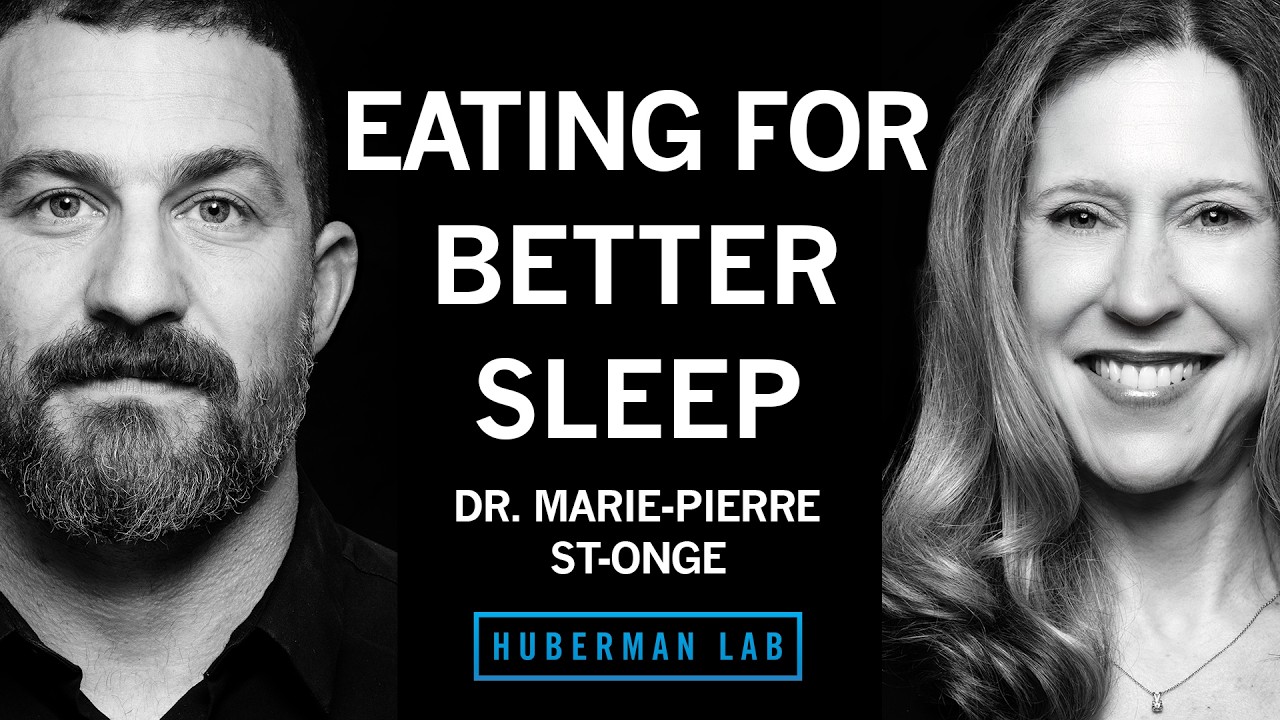
Columbia Scholar St-Onge Links Mild Sleep Loss to Insulin Resistance
Andrew Huberman
Restricting nightly sleep by 1.5 hours over six weeks directly undermines metabolic health, creating a vicious cycle where hormonal disruptions drive overeating and further degrade sleep quality.
## Background
Published on June 8, 2026, on YouTube by Andrew Huberman, this episode features Dr. Marie-Pierre St-Onge, a professor of nutritional medicine at Columbia University School of Medicine. The discussion centers on the bidirectional relationship between nutrition and sleep, exploring how sleep loss drives appetite, changes hunger hormones, and impacts long-term cardiometabolic health. It also details how specific dietary choices, fiber, various oils, and meal timing directly influence sleep architecture and metabolic outcomes.
## TL;DR
The episode explores the profound physiological links between sleep quality, hormone regulation, and metabolic health. Dr. St-Onge explains that even mild sleep restriction alters sex-specific appetite signaling—increasing ghrelin in men and lowering GLP-1 in women—which leads to an average real-world overeating surplus of 300 calories. The conversation highlights the benefits of the Mediterranean and DASH diets for mitigating insomnia, emphasizes maintaining a three-hour buffer between eating and bedtime to allow for circadian cooling, and details the metabolic advantages of medium-chain triglycerides (MCTs). Additionally, the two discuss the mechanics of sleep apnea, the nuances of industry-sponsored research, and why whole foods outperform synthetic fiber supplements.
## Atmosphere & style
The tone is highly academic yet deeply practical, blending rigorous clinical data with actionable lifestyle strategies. The dynamic between Andrew Huberman and Dr. St-Onge is intellectually collaborative and grounded, characterized by mutual scientific respect and a shared desire to demystify complex metabolic mechanisms. It feels like an intimate, deep-dive seminar where the serious physiological consequences of a sleep-deprived society are lightened by pragmatic tools, candid reflections on the hurdles of scientific publishing, and a encouraging vision of entering a self-propelling loop of wellness.
## Key takeaways
- Dietary choices directly alter sleep architecture, with higher fiber intake promoting deep slow-wave sleep, whereas saturated fat and refined carbohydrates reduce deep sleep and cause frequent night arousals.
- [02:29](https://www.youtube.com/watch?v=jjaFnKtytqI&t=149s) Sleep deprivation drives an average overeating surplus of 300 calories, showing contrasting sex-specific hormonal pathways: it increases the hunger hormone ghrelin in men, but decreases the satiety peptide GLP-1 in women.
- [12:39](https://www.youtube.com/watch?v=jjaFnKtytqI&t=759s) Controlled laboratory settings mask metabolic and cortisol disruptions from sleep loss due to artificial safety and isolated stressors, whereas free-living populations compound cardiometabolic risks by actively choosing poorer diets.
- [21:20](https://www.youtube.com/watch?v=jjaFnKtytqI&t=1280s) A mild 1.5-hour sustained sleep deficit in a free-living environment for six weeks significantly worsens insulin resistance and blood pressure, with post-menopausal women showing the highest vulnerability.
- [22:58](https://www.youtube.com/watch?v=jjaFnKtytqI&t=1378s) While forced wakefulness in a metabolic chamber minimally increases energy expenditure by 90 calories, this spike is completely overwhelmed by the typical 300-calorie real-world overeating surge.
- [27:59](https://www.youtube.com/watch?v=jjaFnKtytqI&t=1679s) Adherence to the Mediterranean or DASH diets systematically reduces insomnia symptoms and protects sleep duration over time, independent of specific dietary sodium levels.
- [34:47](https://www.youtube.com/watch?v=jjaFnKtytqI&t=2087s) Switching from a standardized diet to a self-selected diet lengthens sleep latency by over 70% and shortens slow-wave deep sleep by roughly 20% to 23%.
- [37:41](https://www.youtube.com/watch?v=jjaFnKtytqI&t=2261s) Maintaining a buffer of at least three hours between the final meal and bedtime is necessary to prevent the thermic effect of food from elevating core body temperature and disrupting sleep initiation.
- [46:27](https://www.youtube.com/watch?v=jjaFnKtytqI&t=2787s) The optimal window for healthy organ aging sits tightly between 6.5 and 8 hours of sleep per night, forming a distinct U-shaped curve where both insufficient and excessive sleep lead to poorer health outcomes.
- [01:11:20](https://www.youtube.com/watch?v=jjaFnKtytqI&t=4280s) Consuming identical meals later in the day significantly lowers the body's fat oxidation rate, suggesting caloric intake should ideally be concentrated within the first two-thirds of the waking day.
- [01:16:01](https://www.youtube.com/watch?v=jjaFnKtytqI&t=4561s) The human body can assimilate up to 100 grams of protein in a single sitting under optimal recovery conditions, debunking the fitness myth that absorption is capped strictly at 30 grams per meal.
- [01:17:20](https://www.youtube.com/watch?v=jjaFnKtytqI&t=4640s) Medium-Chain Triglycerides (MCTs) bypass peripheral fat storage and travel straight to the liver via the portal vein, boosting the thermic effect of food to generate a metabolic spike of 45 to 60 calories per meal.
- [01:23:28](https://www.youtube.com/watch?v=jjaFnKtytqI&t=5008s) The expanded Portfolio Diet combines soy protein, nuts, plant sterols, soluble fiber, legumes, and olive oil to achieve a level of cholesterol reduction comparable to pharmaceutical statins.
- [01:33:40](https://www.youtube.com/watch?v=jjaFnKtytqI&t=5620s) Replacing standard vending machine snacks with chips fried in corn oil lowered overall lipid profiles and reduced levels of lipoprotein(a) during a three-arm crossover study.
- [01:43:13](https://www.youtube.com/watch?v=jjaFnKtytqI&t=6193s) Corporate and industry funding is often essential to finance lifestyle or food studies due to highly competitive and scarce federal funding from institutions like the NIH or NSF.
- [01:47:43](https://www.youtube.com/watch?v=jjaFnKtytqI&t=6463s) Scientific publication bias heavily penalizes negative or null outcomes, forcing valuable findings that could steer people away from ineffective treatments to be routinely buried or ignored.
- [01:50:28](https://www.youtube.com/watch?v=jjaFnKtytqI&t=6628s) Relying entirely on synthesized fiber powders like psyllium husk instead of whole foods causes individuals to miss out on synergistic polyphenols and non-nutrient components that sustain the gut microbiome.
- [01:53:02](https://www.youtube.com/watch?v=jjaFnKtytqI&t=6782s) Sleep and nutrition interact as a self-propelling loop where quality sleep empowers superior dietary choices, which in turn facilitates better sleep quality and enhanced metabolic health.
## Detailed walkthrough
### How Diet Shapes Sleep Quality
Andrew Huberman introduces a fundamental finding regarding the direct connection between daily food intake and nocturnal sleep architecture. He explains that specific dietary choices during the day have measurable, distinct effects on how a person sleeps that very night. Specifically, higher fiber intake correlates with an increase in deep, restorative sleep. Conversely, eating more saturated fat is associated with a reduction in deep sleep, while consuming refined carbohydrates and simple sugars leads to an increased number of arousals during the night, effectively disrupting both deep slow-wave sleep and REM sleep. Huberman welcomes Dr. Marie-Pierre St-Onge, a professor of nutritional medicine at Columbia University, highlighting her unique laboratory as one of the few worldwide studying this bidirectional relationship between sleep and nutrition.
### The Bidirectional Impact of Sleep Loss and Metabolism
Huberman previews the actionable insights of the episode, noting how modest sleep deprivation increases hunger through sex-specific biological mechanisms. In men, short sleep drives up the specific hormones that stimulate the desire to eat. In women, it dampens naturally occurring peptides like GLP-1 that are responsible for suppressing hunger. The conversation explores how sleep plays a critical role in regulating broader metabolic systems, including blood sugar, cortisol levels, overall metabolism, and cardiometabolic health. Huberman emphasizes that Dr. St-Onge's expertise extends beyond sleep to the general impact of specific nutrients on health, promising listeners novel data to inspire behavioral and nutritional changes. Before diving in, he notes that the podcast is entirely separate from his roles at Stanford and is part of his effort to provide zero-cost scientific information to the public, briefly thanking sponsors David Protein Bars and BetterHelp.
- **David Protein Bars:** Features the new Bronze Bar with 20g of protein, 150 calories, and 0g of sugar in flavors like cookie dough and caramel chocolate.
- **BetterHelp:** An online therapy platform with an average 4.9/5 rating across 1.7 million client reviews; offers a short questionnaire to match users with licensed therapists.
### From Population Observations to Lab Causality
Dr. St-Onge notes that her interest in sleep originally emerged from an obesity research angle during her PhD in nutrition and her postdoctoral training in body composition. At the time, large-scale population-based studies were beginning to reveal that individuals who sleep too little consistently exhibit higher body mass indexes (BMIs) and a greater prevalence of obesity. She references a famous 2006 publication from the Nurses' Health Study, which tracked nurses over a 14-year period. This landmark study found that nurses who reported sleeping only five or six hours per night experienced a significantly higher rate of weight gain over those 14 to 15 years compared to colleagues who slept seven or eight hours. However, Dr. St-Onge points out that while cohort observations show strong correlations over time, they cannot definitively prove that short sleep *causes* weight gain, which inspired her to seek National Institutes of Health (NIH) R01 grant funding to run controlled laboratory studies on energy balance.
### The Crossover Lab Study: Hormones, Brain Reward, and Calories
To isolate causality, Dr. St-Onge designed a rigorous crossover study where participants who normally slept at least seven hours per night (verified by actigraphy) were brought into the lab under two distinct conditions. In the adequate sleep condition, they were given a 9-hour time-in-bed opportunity, resulting in an average of 7.5 hours of sleep. In the restricted sleep condition, they were limited to a 4-hour window for five consecutive nights, averaging just 3 hours and 50 minutes of sleep. For the first three days, a controlled feeding protocol ensured everyone ate the exact same diet regardless of sleep duration, allowing researchers to purely isolate the effect of sleep on appetite hormones and neuroimaging brain responses. On the final day, participants self-selected their food at a buffet.
The data revealed an unexpected sex-specific split. In men, sleep restriction caused an increase in ghrelin, the hormone that triggers hunger. In women, short sleep instead triggered a reduction in GLP-1, the hormone responsible for satiety. Huberman summarizes this brilliantly: "when men are sleep-deprived... the signals that drive appetitive desire to eat are higher, in women it's more that the brake on eating, on satiety, is reduced." Despite these differing pathways, both sexes overate by an average of 300 calories during the self-selection phase when sleep-deprived. Neuroimaging also showed an upregulation in the brain's reward centers when viewing food stimuli under sleep-restricted conditions. Dr. St-Onge notes that prior studies had only found a generalized ghrelin increase because they were conducted exclusively on men; when she initially pooled her mixed-sex data together, the contrasting hormonal responses canceled each other out entirely until analyzed by sex.
- **Sleep reduction:** Represents a massive 50% reduction in habitual sleep for the participants.
- **Caloric surplus:** Sleep-deprived individuals consumed an average of 300 extra calories when given free rein.
- **Brain changes:** Reward and pleasure centers showed heightened activation toward food stimuli during short sleep.
### The Accumulative Toll of Sleep Deprivation
Huberman describes the subjective experience of sleep restriction as feeling like the entire body is in a low level of central, physical ache, wondering if people subconsciously overeat simply to quell that pain or get a temporary jolt of waking energy. Dr. St-Onge agrees that eating provides a thermic effect that helps individuals feel more awake, but notes that intense fatigue also destroys a person's capacity to have a discipline-oriented "conversation with yourself about what to choose at the buffet table." While a few hundred extra calories a day may seem minor, she warns that layering this excess day after day quickly adds up, particularly for night-shift workers, new parents, or students studying for finals. She cites a 2022 paper by Neumann Kovven showing that restricting sleep to 5 hours versus 7.5 hours for just two weeks led to an average weight gain of half a kilogram (roughly one pound). When Huberman asks if this weight gain is fundamentally driven by psychological or physiological stress, Dr. St-Onge reveals a surprising finding: despite the brutal nature of the five-night sleep restriction, data showed that the participants' cortisol levels did not actually change.
[17:18](https://www.youtube.com/watch?v=jjaFnKtytqI&t=1038s) The Safe Haven of the Lab: Cortisol and Controlled Sleep Care
When looking at the effects of five days of sleep restriction—limiting subjects to a mere four hours of sleep a night—researchers observed a highly surprising outcome: there was absolutely no difference in cortisol levels between the short sleep and adequate sleep conditions. Cortisol levels behaved normally, peaking in the morning and dropping in the evening. The speakers ponder whether this lack of disruption stems from the artificial safety of a laboratory setting. In the lab, participants are entirely safe and taken care of, isolated from the external irritants and demands of modern life.
The conversation shifts into lighthearted banter about the realities of sleep deprivation outside the lab. They joke that if you are going to suffer from inadequate sleep, the ultimate strategy is to "get someone to take care of everything else" and essentially ensure you are living in a spa. In the real world, sleep restriction doesn't happen in a vacuum; it is heavily compounded by the grueling activities of daily living, such as managing a job and taking care of children. It is this toxic combination of life stressors and exhaustion, rather than the sleep loss alone, that likely drives basal cortisol levels askew.
- **Sleep Restriction Parameters:** 5 days of sleep restricted to roughly 4 hours per night.
- **Cortisol Behavior:** Remained entirely normal, peaking in the morning and dropping in the evening.
[18:25](https://www.youtube.com/watch?v=jjaFnKtytqI&t=1105s) Free-Living Populations vs. Controlled Metabolic Normality
The metabolic surprises of the laboratory study extended beyond cortisol; the researchers found zero effect on glucose, insulin, or lipid profiles. The physiological curves for the short sleep and adequate sleep groups were completely superimposable. This absolute baseline stability was maintained because participants were fed the exact same food, at the exact same time, and in the exact same quantities. The only variable altered was their nighttime sleep opportunity. This led researchers to conclude that the metabolic abnormalities frequently seen in population studies are triggered by a combination of factors rather than isolated sleep loss. Free-living individuals are not trapped in a controlled box; when exhausted, they actively choose poor diets higher in fat, sugar, and salt, which then compounds their cardiometabolic risks.
To bridge the gap between lab findings and real-world data showing that short sleepers face higher risks of type 2 diabetes, hypertension, and cardiovascular disease, a follow-up study was designed. Researchers recruited verified "good sleepers" who consistently clocked at least seven hours of sleep a night and reported high sleep quality. In this free-living experiment, participants either maintained their excellent habits or delayed their bedtime by an hour and a half, dropping their average sleep from seven and a half hours down to six hours.
- **Lab Biomarkers:** Glucose, insulin, and lipid profiles showed zero adverse changes under isocaloric conditions.
- **Follow-up Study Criteria:** Screened healthy individuals who naturally slept about 7.5 hours per night.
- **Sleep Reduction:** Trimmed sleep by 1.5 hours per night, matching the 6-hour average of short sleepers in the general population, effectively causing them to miss a full sleep cycle.
[21:20](https://www.youtube.com/watch?v=jjaFnKtytqI&t=1280s) The Toll of a Six-Week Mild Sleep Deficit
Shifting the experiment to a free-living environment for six weeks yielded vastly different, adverse results. With a mild but sustained sleep restriction, participants experienced increased insulin resistance, reduced insulin sensitivity, and elevated blood pressure. The deterioration of insulin sensitivity was notably worse in post-menopausal women compared to premenopausal women. Reflecting on the rigor of the trial, the speaker notes that maintaining this restriction out in the wild for six continuous weeks "was tough," a sentiment the host validates with empathetic amazement.
The discussion turns back to the underlying physiology of waking up. The host notes that the morning spike in cortisol is a purely circadian rhythm that merely overlaps with the end of a night's sleep rather than being driven by it. Because cortisol drives glucose release, the host underscores a crucial distinction between the two studies: the first study was strictly "isocaloric," meaning the subjects were not permitted to eat more, even though the hormones driving their desire to feast were heavily elevated. This restriction was even more profound in women, whose satiety-inducing GLP-1 hormones were significantly reduced by sleep loss.
- **Six-Week Study Outcomes:** Documented significant increases in insulin resistance and blood pressure, alongside a distinct drop in insulin sensitivity.
- **Hormonal Sex Differences:** Post-menopausal women suffered worse declines in insulin sensitivity than premenopausal women; women specifically showed a reduction in GLP-1 satiety hormones.
[22:58](https://www.youtube.com/watch?v=jjaFnKtytqI&t=1378s) Fidgeting, Spontaneous Activity, and the Metabolic Chamber
When individuals are restricted to an isocaloric diet but still gain weight due to sleep deprivation, the primary culprit is a drop in spontaneous daily activity. People become much more sedentary when tired. To accurately map energy expenditure—a notoriously difficult metric to capture due to its moving components—researchers utilized Columbia University's specialized metabolic chamber. This facility is a tiny room, roughly the size of a standard bathroom, containing only a bed, a table, a sink, and a toilet. By measuring minute-by-minute oxygen consumption and carbon dioxide production, they discovered that energy expenditure actually *increases* by about 5% during sleep restriction simply because it is energetically costlier for the human body to stay awake than to sleep.
The host connects this to Non-Exercise Activity Thermogenesis (NEAT), highlighting how spontaneous movements like knee-bouncing and fidgeting dictate body composition. While extreme fidgeters out in the world can burn up to 1,500 calories more per day, the tired subjects in the confined metabolic chamber only increased their expenditure by about 90 calories. This small metabolic expenditure spike is entirely eclipsed by the real-world reality that sleep-deprived people typically overeat by roughly 300 calories a day, resulting in a starkly positive energy balance.
- **Energy Expenditure Variance:** Being forced to stay awake increased energy expenditure by roughly 5%, or about 90 calories.
- **Caloric Imbalance:** The 90-calorie increase of staying awake fails to offset the typical 300-calorie intake surge seen when sleep-deprived people eat at will.
- **Extreme NEAT Variance:** High-fidgeting individuals can naturally burn up to 1,500 calories more per day through spontaneous movement.
[25:42](https://www.youtube.com/watch?v=jjaFnKtytqI&t=1542s) Empowering Choices and Intercepting Brain Signals
The conversation pivots to how inflammation ties these systemic disruptions together. The host references a study indicating that while exercising after a single night of poor sleep can be advantageous by offsetting acute spikes in inflammation, chronic exercise paired with chronic sleep deprivation backfires, inviting injury and illness. The speakers agree that arming people with precise hormonal knowledge is incredibly empowering. If women understand that their GLP-1 levels drop when exhausted, and men realize their ghrelin levels spike, they can use their "pretty big prefrontal cortex" to mentally intervene and question their cravings.
Taking a conscious pause allows an exhausted individual to separate true physical hunger from mere fatigue. The speaker models this internal dialogue, explaining how one can realize they don't actually need dessert, but are simply tired and seeking a quick behavioral pick-me-up. Recognizing that a bad night of sleep distorts both appetite and mood allows individuals to make intentional, appropriate dietary choices rather than falling victim to unconscious, fatigue-driven overeating.
- **Acute vs. Chronic Sleep Loss Exercise:** A 1-2 hour sleep deficit can be mitigated by exercise to lower inflammation, but chronic sleep loss combined with intense exercise triggers systemic susceptibility to injury.
- **Appetite Signals:** Sleep deprivation reliably drops satiety hormones (GLP-1) and elevates hunger hormones (ghrelin).
[27:59](https://www.youtube.com/watch?v=jjaFnKtytqI&t=1679s) Turning the Equation Around: How Diet Dictates Sleep
The relationship between sleep and nutrition is a two-way street, prompting an investigation into how the content and timing of food intake shapes sleep quality. While there is a running domestic debate in households regarding how close to bedtime one can eat, the speaker was drawn to the broader, long-term causal impact of food quality on future sleep. Historically, epidemiologists treated sleep as the primary driver of diet and exercise changes, completely ignoring the reverse pathway. To study this, the speaker analyzed data from the Multi-Ethnic Study of Atherosclerosis (MESA), a premium US cohort tracking detailed nutrition, sleep, and multi-year health metrics.
Collaborating with Susan Redline in Boston, the principal investigator of MESA's sleep ancillary study, they evaluated diet quality alongside insomnia symptoms and sleep duration. They discovered that individuals whose eating habits closely aligned with a Mediterranean diet enjoyed a significantly higher probability of achieving adequate sleep and suffered fewer insomnia symptoms. This breakthrough successfully launched a brand-new subfield of nutritional sleep research.
- **Key Cohort Used:** Data pulled from the Multi-Ethnic Study of Atherosclerosis (MESA) and an ancillary sleep study headed by Susan Redline.
- **Dietary Finding:** Adherence to a Mediterranean diet directly correlates with reduced insomnia symptoms and better sleep duration.
[30:31](https://www.youtube.com/watch?v=jjaFnKtytqI&t=1831s) Longevity, Insomnia Fluctuations, and the DASH Diet
Building on the MESA findings, researchers published a unique longitudinal analysis utilizing the massive Women's Health Initiative cohort. Standard longitudinal studies typically exclude any participants who exhibit the target condition at baseline to cleanly observe its future development. However, because insomnia is a highly fluid condition that naturally resolves and relapses over time, the researchers divided their participants into two distinct tracking groups: a healthy/improving group (those with no baseline insomnia or whose insomnia resolved by year three) and a persistent/progressing poor sleep group (those with chronic insomnia or who developed it by year three).
The study demonstrated that women whose dietary profiles aligned closely with either the Mediterranean diet or the DASH (Dietary Approaches to Stop Hypertension) diet were significantly less likely to have insomnia at the three-year mark. The DASH diet emphasizes high consumption of fruits, vegetables, nuts, seeds, and low-fat dairy while leaning heavily on plant-based structures. Though DASH was engineered to combat blood pressure and can be customized for varying salt sensitivities, its overall nutritional profile systematically protected sleep quality regardless of its specific sodium levels.
- **Cohort Size & Focus:** Utilized the extensive Women's Health Initiative data to observe insomnia patterns over a 3-year timeline.
- **Diets Evaluated:** The Mediterranean diet and the DASH diet both proved strongly protective against persistent insomnia.
[33:22](https://www.youtube.com/watch?v=jjaFnKtytqI&t=2002s) The GLP-1 Economic Shift and Disentangling Covariates
The cultural landscape of the typical American diet is shifting dynamically, less so in terms of macronutrient content and more so in sheer volume. The host highlights that sales for snack food companies are openly struggling and appetite is down across the country due to the massive rise of GLP-1 receptor agonist medications. Current estimates suggest an astonishing one in seven Americans have tried a GLP-1 drug, a statistic both speakers find incredibly high and culturally profound.
The host brings up a vital epidemiological critique: individuals who naturally eat pristine Mediterranean diets rich in olive oil, fish, vegetables, and fruits are also far more likely to walk more, exercise, and possess robust social lives. To isolate diet from these deeply entangled lifestyle variables, population-based studies rely heavily on extensive statistical regression. Researchers gather granular demographic data via questionnaires—covering race, occupation, socio-demographic status, and socioeconomic realities—and mathematically adjust for these precise covariates to ensure the observed sleep benefits truly stem from the food on the plate.
- **GLP-1 U.S. Penetration:** Current estimates show up to 1 in 7 Americans have utilized a GLP-1 medication, depressing overall food volume and impacting snack food industry sales.
- **Statistical Controls:** Population studies manage healthy-user bias by using mathematical covariate adjustments for race, occupation, and socioeconomic status.
[34:47](https://www.youtube.com/watch?v=jjaFnKtytqI&t=2087s) Diet Selection and Its Impact on Sleep Architecture
The discussion addresses the complex landscape of epidemiological variables—such as pre-existing illnesses, depression, and physical activity levels—noting that while researchers attempt to control for these, unmeasured factors like social interactions are rarely captured adequately. Shifting focus to an inpatient laboratory study, the speaker describes a systematic evaluation of how diet directly influences subsequent night sleep. Researchers isolated the 9-hour "time in bed opportunity" phase for this analysis because, during the restricted 4-hour phase, participants were highly efficient sleepers, leaving little to no variability to analyze. In contrast, the 9-hour window provided a natural spectrum of sleep durations, allowing the team to observe how food choices correlated with objective sleep patterns measured via polysomnography every single night.
The investigation followed a precise sequential logic, beginning with a basic confirmation: did the participants' self-selected diets differ from the standardized control diet they were initially given? The data showed a distinct shift. When allowed to choose their own food, participants consumed roughly 450 calories more, increased their saturated fat intake by 33%, ate slightly less protein, and consumed marginally more carbohydrates. From there, the researchers analyzed whether this dietary shift altered sleep architecture. While overall sleep duration remained unchanged between the two phases, sleep quality metrics shifted drastically. When eating self-selected diets, participants took over 70% longer to fall asleep, and their slow-wave deep sleep was truncated by approximately 20% to 23% compared to the controlled feeding periods.
- **Caloric Increase:** Participants consumed nearly 450 extra calories per day during the self-selected phase.
- **Saturated Fat:** Saturated fat intake rose by 33% when participants chose their own food.
- **Sleep Latency:** The time required to fall asleep lengthened by over 70% on the self-selected diet.
- **Deep Sleep Reduction:** Slow-wave deep sleep was reduced by roughly 20% to 23% under self-selected dietary conditions.
[37:17](https://www.youtube.com/watch?v=jjaFnKtytqI&t=2237s) Dietary Composition versus Meal Timing
The conversation turns to the potential confounding variable of meal timing, with the host asking if the reduction in slow-wave deep sleep could be attributed to eating too close to bedtime. The speaker candidly admits that the original study did not explicitly analyze the exact timing of the final eating period within the self-selected phase. However, a structural difference existed: the controlled feeding phase featured rigid, set meal times, whereas the self-selected phase allowed flexible timing, though a uniform 10:00 p.m. bedtime was maintained across both conditions.
Isolating specific nutritional components consumed throughout the day revealed clear associations with sleep architecture. Higher daily fiber intake correlated with an increase in deep sleep. Conversely, elevated saturated fat intake was directly tied to less deep sleep. Refined carbohydrates and simple sugars triggered a higher frequency of "arousals." The speaker clarifies that in polysomnography terms, an arousal does not mean a full-on awakening where the person realizes they are awake; rather, it signifies an internal shift from a deeper stage of sleep to a lighter stage, fragmenting sleep quality and depriving the body of sustained slow-wave and REM sleep.
- **Fiber Benefits:** Higher fiber intake is positively associated with increased deep slow-wave sleep.
- **Saturated Fat Detriments:** Increased saturated fat intake is linked to a reduction in deep sleep stages.
- **Simple Sugars & Refined Carbs:** High intake of simple sugars promotes frequent sleep arousals, shifting sleep from deep to light stages.
[38:41](https://www.youtube.com/watch?v=jjaFnKtytqI&t=2321s) Personal Eating Buffers and Thermic Effects
When asked about personal habits, the speaker shares a preference for maintaining a buffer of at least three hours between the final meal of the day and going to sleep. While acknowledging individual variation and different chronotype tolerances, the speaker emphasizes that "eating earlier is better overall for cardiometabolic health."
The host and speaker share a brief laugh over the physiological consequences of late-night dining, pointing to the "thermic effect of food." Eating too close to bedtime raises core body temperature, causing a sensation of getting hot, which runs entirely counter to the body's natural circadian requirement to cool off in order to initiate and sustain high-quality sleep.
[41:43](https://www.youtube.com/watch?v=jjaFnKtytqI&t=2503s) Circadian Alignment and the Realities of Shift Work
The host shares a personal observation regarding a perceived asymmetry in sleep requirements, noting that sleeping from 10:00 p.m. to 4:30 or 5:00 a.m. leaves him feeling perfectly rested without an alarm, whereas sleeping an identical duration starting at midnight results in heavy sleep inertia. In response to the old adage that "every hour before midnight is worth two after," the speaker notes a lack of direct supportive data but offers a circadian explanation. Deviating from a habitual 9:30 or 10:00 p.m. bedtime pushes an individual out of alignment with their internal circadian system, making restorative sleep significantly harder to achieve.
This misalignment is magnified in shift workers who are forced to sleep during daylight hours when their natural melatonin levels are low or declining. They fight an uphill battle against an internal clock that is not designed for daytime rest, a challenge further compounded by environmental disruptions like daylight, ambient noise, and family responsibilities that occur while the rest of the world is awake.
[42:45](https://www.youtube.com/watch?v=jjaFnKtytqI&t=2565s) Graduate School Schedules and the Mechanics of Napping
The speakers exchange lighthearted anecdotes about their contrasting graduate school survival strategies. The host recalls occasionally inverting his schedule to a nocturnal lifestyle during university holidays, going to bed at 4:00 a.m. and sleeping until 3:00 p.m., noting that "your brain gets into a kind of weird space when you're inverted from the rest of the world" and the only real advantage is the absolute quiet. The speaker describes the exact opposite approach: waking up at 4:00 a.m. to study before sunrise, enjoying the psychological edge of feeling "extra sharp" during those quiet hours, only to face a severe afternoon crash around 1:00 p.m. or 2:00 p.m.
This transition leads into a discussion on afternoon napping and its interaction with diet, hunger, and sleep pressure. The speaker explains that naps must be managed carefully to avoid dissipating the "sleep pressure" that builds throughout the day; napping too late or too long disrupts the ability to fall asleep at night, creating a vicious cycle. If a nap is required due to a lack of nocturnal sleep, the scientific recommendation is to keep it brief—between 30 minutes and an hour—and to take it early in the day. The speaker details a humorous past academic debate where a postdoctoral advisor insisted that desk-napping colleagues were merely displaying signs of unhealthy sleep deprivation, prompting a room of "nerds" to pull counter-data from the Stanford sleep lab defending the health benefits of short naps.
- **Ideal Nap Duration:** Short naps should ideally be restricted to 30 minutes and no more than an hour.
- **Sleep Pressure:** Naps should be taken early in the day to allow sufficient time to rebuild the homeostatic sleep pressure required for nighttime rest.
[46:27](https://www.youtube.com/watch?v=jjaFnKtytqI&t=2787s) Working Styles and the Sweet Spot for Optimal Aging
The host notes that the speaker operates with highly focused, efficient, "step function" energy—waking up and moving immediately into peak productivity. The speaker agrees but emphasizes the necessity of incorporating intentional downtime alongside high-speed periods. Reflecting on a time when exercise consisted entirely of frantic running—running kids to school, running to work, and running for leisure—the speaker realized the need for a "breather" and integrated yoga into the routine. Though viewing yoga as stressful during graduate school due to an inability to hold static positions, the speaker notes that the practice has evolved to be more dynamic, offering an ideal balance to high-intensity life demands.
Turning to prescriptive sleep durations, the speaker highlights a newly published study in *Nature* investigating biological clocks and organ aging. The data reveals a clear U-shaped curve where both insufficient and excessive sleep correlate with poorer outcomes. The absolute "sweet spot" for optimal organ aging across most systems sits tightly between 6.5 and 7.5 or 8 hours of sleep per night. These curves display notable sex differences, with women generally requiring slightly longer durations and men demonstrating more pronounced, sharper U-shaped curves depending on the specific organs analyzed.
- **Optimal Sleep Range:** The ideal window for optimized organ aging is 6.5 to 7.5 or 8 hours of sleep.
- **Data Curve Structure:** The relationship between sleep duration and aging outcomes is U-shaped, indicating negative impacts from both undersleeping and oversleeping.
[49:55](https://www.youtube.com/watch?v=jjaFnKtytqI&t=2995s) Sex Differences in Sleep Dynamics and Clinical Practices
The conversation concludes with an exploration of distinct sex differences in baseline sleep requirements and subjective sleep quality. Across the lifespan, women statistically tend to sleep slightly longer than men. However, when surveyed, women consistently report lower subjective sleep quality, displaying higher rates of insomnia symptoms, difficulty falling asleep, and challenges maintaining sleep throughout the night. This disparity is driven by a combination of physiological and hormonal fluctuations across the menstrual cycle, alongside differing social roles and responsibilities.
Furthermore, the speaker outlines findings from a recent review paper focusing on hypertension and sleep, revealing that women exhibit a heightened sensitivity to the cardiovascular and metabolic consequences of poor sleep. For instance, at much lower severity thresholds of sleep apnea, women experience higher spikes in blood pressure compared to men. To combat the historical under-reporting and lack of clinical focus on these dynamics, the speaker highlights a scientific statement published last year with the American Heart Association. The statement urges clinicians to move away from rigid, overly specific diagnostic questions and instead initiate sleep evaluations by simply asking patients an open-ended question: "how's your sleep?"
[51:53](https://www.youtube.com/watch?v=jjaFnKtytqI&t=3113s) Unpacking Sleep Quality Beyond the Hours
Sleep is often mistakenly reduced to a single metric: how many hours you got the night before. True sleep health is multi-dimensional, encompassing regularity, quality, and individual satisfaction, which translate directly into our daytime and nighttime experiences. Clinicians can better uncover what is genuinely bothering a patient by asking open-ended questions. Even if a doctor feels pressed for time, giving a patient space to share their full experience can reveal underlying issues, such as a spouse complaining about loud snoring, which can immediately pivot the conversation toward screening for sleep apnea.
- **Key Sleep Metrics:** Total hours, schedule regularity, subjective satisfaction, and overall quality.
- **Daytime Indicators:** Post-sleep refreshment, vigilance, and the ability to stay alert during waking hours.
- **Clinical Value:** Open-ended questions allow patients to vocalize specific, subtle symptoms that checklists miss.
[52:59](https://www.youtube.com/watch?v=jjaFnKtytqI&t=3179s) Demystifying Sleep Apnea: Snoring, Testing, and the CPAP Hurdle
Sleep apnea is a highly prevalent yet frequently unrecognized condition characterized by breathing interruptions that trigger a "gasping sound" upon arousal. While structural interventions like nose strips can pull the nostrils out and reduce standard snoring, they do not resolve sleep apnea, which is caused by a structural closure deep in the throat that obstructs the trachea. For individuals carrying excess weight, weight loss serves as a critical first-line therapy that can lower the severity of the apnea, subsequently reducing the air pressure required if they use a Continuous Positive Airway Pressure (CPAP) machine.
- **Mechanistic Root:** Apnea is an obstructive closure of the throat and trachea, not a nasal passages issue.
- **First-Line Treatments:** Weight loss is primary for overweight individuals; CPAP and surgical implantables serve as secondary pathways.
- **Diagnostic Methods:** Polysomnography (overnight lab testing) is the gold standard, but convenient in-home sleep testing is widely available via a doctor's prescription.
- **The CPAP Dilemma:** CPAP machines cannot be purchased casually on Amazon because they require precise, customized pressure settings prescribed by a physician to be effective.
- **Public Health Imperative:** Despite the "Darth Vader" aesthetic of the mask making people hesitant, treating apnea is vital for cognitive function, metabolic health, longevity, and daytime alertness.
[53:46](https://www.youtube.com/watch?v=jjaFnKtytqI&t=3226s) The Null Kefir Study and the True Challenge of Controlled Science
The investigation into functional foods—foods providing health benefits beyond basic nutrition—often yields complex or neutral results when subjected to rigorous clinical testing. A master's thesis study conducted at McGill University investigated whether kefir, a fermented dairy product rich in probiotics, could reduce cholesterol synthesis by altering short-chain fatty acids. The trial recruited men with mildly elevated cholesterol and compared a daily intake of two cups (500 mL) of kefir against regular milk over a one-month period. Ultimately, the trial ended up as a "null study" showing zero effect on cholesterol levels, highlighting how difficult it can be to isolate variables and publish non-positive results in controlled science.
- **Study Population:** Men displaying mildly elevated baseline cholesterol levels.
- **Dosage & Duration:** 2 cups (500 mL) of kefir daily for one month versus a control group drinking standard milk.
- **Unmeasured Variables:** While cholesterol synthesis was unchanged, unmeasured pathways like glycemic control or gut inflammation could have still been impacted.
- **Anecdotes vs. Data:** Public health spaces are increasingly influenced by unverified anecdotes shared on social media, which contrast with the highly isolated, intentional variables of artificial clinical settings.
[54:23](https://www.youtube.com/watch?v=jjaFnKtytqI&t=3263s) Exploring Functional Nutrition: Coffee Oligosaccharides and Ginger Thermogenesis
Functional nutrition research frequently uncovers subtle, unexpected mechanisms to alter energy expenditure and tip the metabolic scale. One industry-sponsored, placebo-controlled study looked at manno-oligosaccharides, a substance extracted directly from spent coffee grounds that carries no caffeine or calories. When mixed into a coffee-flavored beverage as part of a weight-loss diet, the compound caused a statistically significant, greater loss of adipose fat tissue in overweight men, though it unexpectedly showed no effect in women. Later, a separate line of inquiry into spices led to a six-hour crossover study testing ordinary ginger powder dissolved in warm water. Placed under a metabolic hood to track oxygen consumption and carbon dioxide production, the participants exhibited a significantly elevated thermic effect of food.
- **Manno-oligosaccharides:** A specific compound extracted from spent coffee grounds that yielded gender-specific weight loss results.
- **Ginger Study Protocol:** Ginger powder dissolved in warm water versus a hot water control, tracking metabolic rates over a multi-hour post-consumption window.
- **Biological Pathway:** The boost in energy expenditure from ginger is believed to occur via stimulation of the capsaicin receptor.
- **The "Quackery" Problem:** The field of functional foods is frequently marginalized by "wild claims," such as asserting a food is healthy for an organ simply because it mimics its shape (e.g., walnuts looking like brains).
- **The Fiber Contrast:** Referencing Justin Sonnenberg’s work at Stanford, low-sugar fermented foods (sauerkraut, kimchi, full-fat Bulgarian yogurt) excel at lowering the systemic "inflammatome," whereas a standard high-fiber diet actually causes a spike in inflammation for a fair number of individuals.
[01:07:56](https://www.youtube.com/watch?v=jjaFnKtytqI&t=4076s) Fiber, Fermented Foods, and the Gut Histamine Story
The discussion begins with a closer look at a study involving a low-sugar fermented food group, where inflammation markers were consistently reduced on average. However, the conversation quickly shifts to the complexities of fiber intake. While increasing fiber decreases inflammation for some people, it actually increases it for many others. This nuance suggests a need to explore different *types* of fibers. A key issue with the study was a lack of control for fiber type; participants were simply told to increase their daily servings. Many people actively avoid fibrous foods not because of taste, but because they experience physical discomfort afterward. There is a strong suspicion that a "histamine story" underlies this reaction, highlighting a need to better parse out what makes certain healthy foods problematic for specific individuals.
A major factor in gut distress from lifestyle changes is the rate of habituation. Suddenly jumping from a baseline of 6 grams of fiber per day to 25 grams can shock the system. Even though the study's participants were ramped up gradually, they were pushed to high levels—reaching up to four servings of low-sugar fermented foods per day. That amounts to a massive quantity of kimchi, which can be incredibly taxing on an unfamiliar gut.
To cope with similar issues, a personal anecdote is shared regarding the use of diamine oxidase (DAO), an inexpensive, tiny pill taken to help digest histamines. This intervention was discovered after noticing intense sleepiness following the consumption of whey protein or broccoli. A colleague at Stanford, Sean Mackey—a pain doctor who directs the pain center—similarly discovered through rigorous elimination and trial-and-error that his own severe gut pain was triggered by onions and other histamine-rich foods. While onions are easy to give up, completely eliminating other nutrient-dense, histamine-containing foods is less desirable, proving that different foods have distinct, powerful physiological effects.
- **Fiber Habituation:** Drastic jumps in fiber intake cause distress; the study ramped participants up heavily, reaching up to 4 servings of fermented foods per day.
- **DAO Enzyme:** Used as a supplemental aid to break down dietary histamines and prevent post-meal lethargy.
- **Clinical Parallel:** Stanford Pain Center director Sean Mackey successfully resolved chronic gut pain by identifying and eliminating dietary histamines like onions.
The conversation pauses briefly for a sponsor acknowledgment of Helix Sleep, a company that designs customized mattresses and pillows tailored to unique sleep profiles. A great night's sleep serves as the absolute foundation for mental health, physical health, and daily performance. When consistent, high-quality sleep is missing, every aspect of life and health suffers; conversely, when sleep is optimized, overall well-being and performance across all endeavors improve markedly.
The physical mattress plays an undeniable role in determining that nightly sleep quality. Factors such as surface softness or firmness must be uniquely tailored to an individual's specific sleep biomechanics. Helix addresses this via a brief, two-minute online quiz covering variables like sleeping positions (back, side, or stomach) and temperature preferences (running hot or cold).
- **Personal Choice:** The speaker has used the Helix Dusk mattress for over four years, calling it "far and away the best sleep that I've ever had."
- **Promotional Offer:** Helix is currently offering up to 27% off across their entire website.
- **Financial Flexibility:** A partnership with TrueMed allows customers to utilize HSA or FSA dollars to purchase these award-winning mattresses.
[01:11:20](https://www.youtube.com/watch?v=jjaFnKtytqI&t=4280s) Meal Timing, Fat Oxidation, and Cultural Eating Schedules
Shifting back to nutritional science, the discussion turns to intriguing new food and timing data presented at an Obesity Society meeting. Lab data revealed that consuming meals later in the day significantly reduces fat oxidation. The controlled study placed participants on identical diets with a fixed 10-hour eating window, testing two distinct schedules: one group started eating 1 hour after waking up, while the other delayed their first meal until 5 hours after waking (a 4-hour relative delay). Despite receiving the exact same foods, identical quantities, and identical spacing between meals inside a metabolic chamber, the group eating later in the day showed lower fat oxidation.
During the presentation, an audience member insightfully asked if individuals eating late-evening meals should substitute standard dietary fats with medium-chain triglycerides (MCTs) to counteract this drop in oxidation. This brilliant connection to research conducted 15 to 20 years prior highlighted the profound ways that the timing of specific macronutrients influences baseline metabolism. Shifting the majority of total caloric intake to the first two-thirds of the waking day—rather than saving it for the final third—yields measurable metabolic advantages.
The practical realities of these schedules vary wildly by geography. While an early schedule matching an 8:00 a.m. to 6:00 p.m. or 7:00 p.m. window is highly reasonable, it directly conflicts with late-night lifestyle cultures. In places like New York, dining out at 5:30 p.m. means sitting in an empty restaurant. This is amplified further in Europe; during a recent Fulbright program in Spain, it was a running joke that academics and families routinely eat dinner at 10:00 p.m. or 11:00 p.m., with children eating around 8:00 p.m. or 9:00 p.m. Similarly, in Buenos Aires, Argentina, restaurants are empty at 9:00 p.m., but fully packed at 11:00 p.m. with patrons across all age groups who rely on afternoon naps to sustain the rhythm.
- **Metabolic Chamber Study:** Confirmed that eating identical food later in the day directly decreases the body's fat oxidation rate.
- **The Optimal Window:** Caloric intake should ideally be concentrated within the first two-thirds of the waking day (e.g., 8:00 a.m. to 6:00/7:00 p.m.).
- **Spanish Weight Loss Data:** Research by Marta Garullet in Spain confirmed that even within late-eating cultures, participants who eat their main meal (lunch) earlier achieve superior weight loss outcomes.
[01:16:01](https://www.youtube.com/watch?v=jjaFnKtytqI&t=4561s) Protein Distribution Myths vs. Reality
Addressing the modern obsession with protein pacing, reassurance is drawn from Alan Aragon, a premier public educator on protein and body recomposition. Many health-conscious individuals experience intense "protein pressure," forcing themselves to consume extra late-night meals or unwanted early breakfasts simply to satisfy a strict structural ration. However, barring elite athletic contexts aiming to maximize every single fraction of muscle protein synthesis, 95% of the total protein benefit is achieved through just two core meals and perhaps a small snack.
The pervasive fitness myth that the human body can only assimilate 30 grams of protein per meal is entirely false. Under the right physiological conditions—such as post-exercise recovery—the body can readily assimilate up to 100 grams of protein in a single sitting. This reality provides immense lifestyle liberation: an individual can completely skip breakfast, enjoy a hearty lunch, and finish with an early dinner without sacrificing their physical composition. The overarching clinical takeaway remains simple: avoid the massive, late-night dinner and stop eating too close to bedtime.
> "The whole notion that you could only assimilate like 30 grams per meal is totally false. Turns out can assimilate up to 100 gram."
[01:17:20](https://www.youtube.com/watch?v=jjaFnKtytqI&t=4640s) The Science of Medium-Chain Triglycerides (MCTs)
The conversation transitions to medium-chain triglycerides (MCTs), a category of fats that exploded in popularity during the peak of the biohacking and "bulletproof coffee" trends before largely fading from public view. The biochemical investigation of MCTs served as the basis for the speaker's PhD dissertation at McGill University. To isolate their effects, the lab utilized purified MCT oil consisting strictly of 8-carbon (caprylic) and 10-carbon (capric) chain fatty acids—structures that are exceptionally rare in standard dietary sources. This experimental functional oil was blended with flaxseed oil to provide omega-3s, alongside plant sterols targeted at cholesterol reduction and cardiovascular protection.
The primary scientific objective was evaluating how MCTs affect daily energy expenditure. The human body processes medium-chain triglycerides entirely differently than standard long-chain triglycerides (which feature carbon chains of 12, 14, 16, or more). Instead of moving through peripheral circulation to be deposited into adipose (fat) tissue, MCTs travel directly to the liver via the portal vein. There, they are rapidly metabolized and burned off as fuel. Two separate clinical studies conducted on both men and women confirmed a statistically significant increase in the thermic effect of food (TEF), meaning the body burns more total calories digesting an MCT-infused meal compared to one containing standard fats.
- **MCT Carbon Structure:** Purified oil utilizes isolated 8-carbon ($C_8$) and 10-carbon ($C_10$) fatty acids.
- **Hepatic Metabolism:** MCTs bypass typical peripheral fat storage pathways, routing straight to the liver for immediate energy conversion.
- **Thermic Effect Boost:** Swapping standard fats for MCTs yields an immediate metabolic spike of roughly 45 to 60 calories per meal.
[01:19:38](https://www.youtube.com/watch?v=jjaFnKtytqI&t=4778s) Dietary Compliance: Beef Tallow vs. MCT Oil
Executing these metabolic studies required intense dietary control, which frequently tested the willpower of the human participants. In the first dissertation study involving female subjects, researchers sought to match the saturated fat content of the control diet to the inherently saturated nature of the 8-carbon and 10-carbon MCTs. To achieve a clean saturated fat control match, the lab utilized massive quantities of beef tallow, delivering half of the diet's total fat content from a single source.
The experimental foods presented a distinct challenge to compliance. Because beef tallow is highly saturated, it remains solid at room temperature. The moment a participant's plate began to cool down, the tallow would unappetizingly gel and turn white across the bottom of the dish—evoking the visual of leftover french fries forgotten in a refrigerator. The smell alone triggered headaches in several female participants, and forced researchers to creatively mask the fat by melting it directly into portions of mashed potatoes.
MCT oil carried its own unique side effects, most notably a potent laxative effect when consumed in high doses. Multiple participants initially complained of loud, intense stomach "gargling" within the first few days of starting the protocol. Fortunately, the gastrointestinal distress resolved rapidly as the gut adapted, allowing the four-week study to conclude with zero dropouts due to GI issues. Over the long term, repeating this dietary swap across three daily meals caused favorable shifts in overall body composition, improving the ratio of lean mass to fat mass. A subsequent follow-up weight-loss study comparing purified MCT oil directly against a highly palatable olive oil control group confirmed significantly greater total weight loss in the MCT cohort.
- **The Tallow Challenge:** Control diets required mixing substantial amounts of solid beef tallow into warm mashed potatoes to maintain macronutrient controls.
- **GI Adaptation:** High initial doses of MCT oil cause noticeable stomach gurgling, though the symptom typically abates completely within a few days.
- **Weight Loss Strategy:** For individuals looking to maximize weight management, substituting a standard tablespoon or two of daily cooking oil with MCT oil—while keeping total calories stable—offers a legitimate metabolic edge.
[01:23:28](https://www.youtube.com/watch?v=jjaFnKtytqI&t=5008s) The Portfolio Diet and Cholesterol Reduction
The conversation turns to whether certain dietary interventions have an additive or synergistic effect, with the speaker noting that their impact likely operates through different biological mechanisms, though it remains largely untested. This prompts a discussion on David Jenkins and his "portfolio diet," which recently gained media attention in the *New York Times*. Initially designed for maximal cholesterol reduction, the original diet specifically combined four key food groups: soy protein, nuts, plant sterols, and soluble fiber.
The speakers share a bit of banter about the public health challenges of promoting such a regimen to the American public. One speaker jokes that as a public health educator, it does not matter if a diet is featured in prominent publications like the *New York Times*, *Wall Street Journal*, or *The New Yorker*—as soon as everyday people hear the word "soy," they tune out. Similarly, while people enjoy nuts, they find them entirely too easy to overeat, and the mention of "plant sterols" simply leaves them completely disconnected. Despite these palatability and marketing hurdles, the diet's clinical efficacy is undeniable; in a head-to-head comparison against standard lipid-lowering medical agents like statins, the portfolio diet achieved the exact same level of cholesterol reduction.
- **Original Components:** The original portfolio diet required a combination of soy protein, nuts, plant sterols, and soluble fiber.
- **Modern Flexibility:** The diet has since been expanded to include legumes and monounsaturated fats like olive oil to increase flexibility for consumers.
- **Clinical Efficacy:** When tested directly against pharmaceutical statins, the portfolio diet demonstrated an identical capacity for reducing cholesterol.
[01:25:22](https://www.youtube.com/watch?v=jjaFnKtytqI&t=5122s) The Battle for Satiety: Plants vs. Animal Protein
A central dilemma emerges regarding how to effectively balance cardiometabolic health with hunger management. While modern regulatory guidelines, such as those from the FDA, make a positive step by emphasizing unprocessed and minimally processed foods, plant-heavy diets present a distinct behavioral challenge. According to the "amino acid protein foraging hypothesis," humans instinctively consume food until they satisfy their baseline requirement for essential amino acids. The speakers contrast the high satiety of eating a chicken breast or four eggs with the relatively low satiety of grains and nuts, which are easy to overeat in large quantities before the brain registers a full signal.
The dialogue highlights a growing polarization within public health and cultural spaces. On one side is a push toward low-saturated-fat, plant-and-nut-heavy diets that explicitly improve blood lipid profiles. On the other side is a focus on high-protein, animal-based diets that maximize metabolic satiety and quell hunger, preventing the constant state of restriction that drives people toward failure. The speakers note that modern GLP-1 receptor agonist medications have stepped into this exact gap by chemically suppressing appetite, proving how desperate people are for hunger relief. Rather than pitting these two dietary philosophies against each other, the speakers suggest the ideal path is a high-volume, plant-based diet to create physical fullness, supplemented with modest portions of nuts for healthy fats and animal products for deep protein satiety.
- **Protein Foraging Hypothesis:** A biological theory stating that organisms will continuously consume calories until their specific amino acid and protein requirements are met.
- **Satiety Profiles:** Animal sources like eggs and poultry trigger strong "stop signals" in the gut and brain, whereas carbohydrate-fat combinations tend to override these signals.
- **Disease Risk Reduction:** A balanced, plant-emphasized diet is strongly associated with a reduced risk of type 2 diabetes, cardiovascular disease, and metabolic disorders.
[01:28:04](https://www.youtube.com/watch?v=jjaFnKtytqI&t=5284s) The Myth of Historical Health and the Sweetening of America
The speakers reflect on their personal eating habits and the broader cultural landscape of nutrition. One host shares that despite being half-Argentine and loving meat and chicken—while still actively struggling to develop a taste for fish—they manage their intake carefully. They point out that the most dangerous foods for overeating are combinations of starch, sugar, and fat, famously embodied by pizza, which completely depress the brain's "stop" signals while lighting up the "go" signals. To combat this, they advocate for eliminating "white foods" like white flour, white pasta, and white rice, which lack color and literally dissolve in the mouth without requiring metabolic work.
The conversation shifts to a broader historical and cross-border critique of food culture, sparked by the observation that one of the speakers is Canadian by birth. They challenge the romanticized "delusion" that the United States was once a bastion of healthy eating, arguing that traditional American staple foods—hamburgers, hot dogs, French fries, corn dogs, fried chicken, and donuts—have always been nutritionally weak. Historically, Americans simply maintained lower body weights because they moved more, ate smaller volumes, and smoked cigarettes heavily to suppress appetite. Upon moving to the U.S., the Canadian speaker noticed immediate differences: restaurant portion sizes were so massive that the concept of a "doggy bag" had to be learned, and identical food brands were formulated with vastly higher sugar content in the U.S. compared to Canada and Europe.
- **Personal Dietary Culprits:** Starch-fat and starch-sugar combinations are identified as the primary drivers of caloric overconsumption due to gut-brain signaling.
- **The "White Food" Rule:** Minimizing highly refined, non-colorful foods (white bread, white rice) helps stabilize appetite.
- **Cross-Border Food Formulations:** Major food corporations explicitly alter chemical formulations by country; for example, the exact same brand of yogurt is significantly sweeter in the U.S. than in Canada or Europe to appeal to regional palates.
- **Sociological Resistance:** The host notes a strange cultural undercurrent where making conscious, healthy choices—like skipping dessert or avoiding alcohol—is often pathologized by peers as an "eating disorder" or being overly restrictive.
[01:33:40](https://www.youtube.com/watch?v=jjaFnKtytqI&t=5620s) The Frito-Lay Study and the Seed Oil Controversy
The host pivots sharply to a fascinating, counterintuitive paper found on the guest's CV titled, *"Snack chips fried in corn oil alleviate cardiovascular risk factors when substituted for lowfat and highfat snacks."* The host reacts with disbelief, exclaiming, "What? What? Tell me the data. I believe you. I'm just like this is wild." The guest explains that the study was funded by Frito-Lay at a time when the company shifted its commercial frying medium for Doritos, Fritos, Cheetos, and Tostitos to corn oil, which is exceptionally high in polyunsaturated fats.
The study featured three distinct arms lasting 25 days each, where participants rotated through different vending machine options: a low-fat/high-carbohydrate snack, a high-fat/high-saturated-fat snack, or the modified Frito-Lay corn chips. Remarkably, the data revealed that the corn chip rotation produced the superior lipid profile among participants, even lowering lipoprotein(a), a dangerous cardiovascular risk factor. This sparks a broader debate on seed oils. While epidemiological data consistently shows better cardiovascular outcomes when saturated fats are replaced by liquid seed oils, a massive cultural contention remains. Critics argue these benefits are observed against a backdrop of high carbohydrate intake, and express deep concern regarding the industrial processing of seed oils, claiming that heating fats alongside carbohydrates creates highly inflammatory, toxic byproducts.
- **Study Duration & Structure:** A three-arm crossover study where participants consumed two designated snacks per day over a series of 25-day periods.
- **Biomarker Outcomes:** Replacing standard vending machine snacks with chips fried in corn oil lowered overall lipid profiles and reduced levels of lipoprotein(a) [$Lp(a)$].
- **The Liquid Rule:** The guest advises using a simple, pragmatic rule of thumb for dietary fat selection: "oils that remain liquid at room temperature" serve as an excellent barometer for what is structurally better for metabolic health.
- **Smoke Points:** Different oils possess unique thermal smoke points; highly delicate choices like flaxseed oil should never be subjected to high-temperature cooking or frying.
[01:39:06](https://www.youtube.com/watch?v=jjaFnKtytqI&t=5946s) Smoke Points, Baked Goods, and the Seed Oil Debate
The conversation starts with a practical question about culinary fats. While agreeing that eating butter "in moderation" is perfectly fine, the host struggles to see any logical reason why someone would actively choose to replace olive oil with a seed oil. The guest steps in with immediate, pragmatic kitchen realities, explaining that olive oil has a much lower smoke point compared to alternatives like peanut oil. If you want to fry something, peanut oil handles the heat, whereas you simply "wouldn't fry anything in olive oil." This prompts a brief, lighthearted aside from the host, who quips, "I wouldn't eat anything fried," though they both acknowledge that culinary applications differ wildly depending on individual preferences.
Beyond heat tolerance, the guest notes that flavor profile plays a major role. Olive oil can be highly fragrant and fragile, meaning it can "impart stronger taste" to baked goods or other dishes where that distinct flavor isn't actually desired. When the host summarizes her personal stance as being neither explicitly "seed oil averse, nor are you pro-seed oil," she agrees entirely. She explains that the wider public debate around seed oils has become deeply "contaminated." A major driver of the anti-seed-oil sentiment is simply that these oils are heavily utilized in ultra-processed foods because they are far less expensive for manufacturers than ordinary butter, grass-fed butter, or olive oil.
---
[01:40:24](https://www.youtube.com/watch?v=jjaFnKtytqI&t=6024s) The Reality of Nutrition Literacy and Processed Foods
The discussion transitions naturally from processed ingredients to the broader need for the general public to become "nutrition facts literate." Ideally, people would mitigate these dietary landmines by cooking at home as much as possible. However, the guest realistically points out that many people simply do not know how to cook or feel they entirely lack the time. The host agrees somewhat pessimistically, interjecting, "people aren't going to start doing that. I wish they would, but they they're not going to."
Because home cooking isn't a reality for everyone, the guest emphasizes the crucial skill of reading the nutrition facts panel at the grocery store to compare products. Crucially, she emphasizes that health is highly individualized, noting, "what's relevant for my health may not be what's relevant for your health."
* **Salt Sensitivity Example:** Some individuals are highly salt-sensitive and must monitor their sodium intake carefully, while highly active individuals may actually need to actively replace salt, meaning it is not a health issue for them at all.
* **Overwhelm:** Navigating grocery aisles without knowing what specific metrics matter to your own body leads to total information overwhelm.
---
[01:41:20](https://www.youtube.com/watch?v=jjaFnKtytqI&t=6080s) Demystifying Industry-Sponsored Research and "Null Results"
The host shifts the conversation toward an overarching, systemic topic rarely directly addressed on the podcast: the difference between a direct financial conflict of interest and an industry-funded study. For the host, a clear conflict of interest occurs when the investigators themselves hold shares in a company or are being personally paid to achieve an outcome. When an outside company funds a study on a consumer product—like a snack chip study the guest previously conducted—the public naturally assumes there is implicit or explicit pressure to manipulate a positive outcome.
The guest welcomes the question, acknowledging the common "knee-jerk reaction" against industry-sponsored research. She strongly defends scientific integrity, asserting that true scientists draft their questions, analyze the data, and publish to the best of their abilities regardless of the source of the capital. To prove her point, she shares a personal anecdote about a study she conducted that was sponsored by industry but yielded entirely "null results," meaning the test product showed no significant health effect compared to the control.
* **The Right to Publish:** The guest confirms that a scientist's right to publish is legally protected in the initial contract. Companies do not short-circuit the data because "there's no point doing research if you're not going to be able to publish."
* **The Journal Rejection Struggle:** Out of courtesy, she showed the final paper to the corporate sponsor, who gave her the green light to submit it. However, because the findings were "not exciting," she faced relentless systemic rejection, trying five different academic journals before running out of steam.
* **Publication Bias:** This difficulty in publishing negative outcomes is a universal scientific hurdle, not something unique to corporate funding.
---
[01:43:13](https://www.youtube.com/watch?v=jjaFnKtytqI&t=6193s) Integrity, Fraud, and the Scarcity of Federal Funding
The guest points out that scientific misconduct is a human integrity issue rather than a funding issue, noting that the National Institutes of Health (NIH) frequently releases reports of scientific misconduct where principal investigators on government grants falsified published data. "If you're not an honest scientist... I don't think it matters who's sponsoring your research," she states. The host finds the concept of fabricating data completely baffling, remarking that doing science for any reason other than finding real answers is "legitimately sick" and "doesn't compute," though he notes these cases "always comes out in the wash."
The conversation turns to why companies fund these trials in the first place if they cannot control the data. The host rightly notes that corporations are inherently selfish and beholden to public shareholders. The guest explains that companies fund research because they legitimately want to discover if their product has a verifiable health benefit so they can "probably market a health benefit at some point." If the study yields a null result, they simply pivot their strategy.
* **Grant Competitiveness:** The guest, who has sat on government grant study sections, notes that federal funding from the NIH or NSF has always been incredibly low and hyper-competitive.
* **The Federal Ideal:** While landing an NIH or USDA grant is always "the ultimate goal," corporate dollars are often the only way to fund specific lifestyle or food studies, especially when researchers need direct access to a proprietary food product.
---
[01:47:43](https://www.youtube.com/watch?v=jjaFnKtytqI&t=6463s) Institutional Shifts and the Hidden World of Negative Outcomes
The host notes that there are ongoing efforts to reform the NIH, including a push championed publicly by previous podcast guest Jay Bhattacharya to create incentives and forums specifically for publishing null results. These negative outcomes are highly valuable because "they steer people away from certain things." Furthermore, evolving federal updates, like the ongoing food pyramid revisions, signal a growing institutional interest in deeply understanding nutrition.
The discussion takes a philosophical turn regarding what the public never gets to see. The host points out that while outright fabrication of data is very rare, the heavy academic incentive to publish means an immense amount of negative data is simply buried or ignored. He notes that running a healthy lab requires creating a culture where graduate students and postdocs feel comfortable admitting "there's nothing here." In laboratory settings, a negative result is often brushed aside with excuses like "that mouse was sick," leaving a massive blind spot of unanswered questions.
* **Statistical Literacy in the Lab:** The guest shares how she instructs her students on parsing data. A student might excitedly point out that one metric is a 25 and another is a 27, believing they found a positive result. She has to teach them to look at the wide standard deviation (e.g., 10) and realize that, statistically, "25 is the same as 27."
* **The Ideal Lab Scenario:** The host jokes that the best scenario is when a student is skeptical of their own data and the principal investigator has to convince them that they actually found something genuinely interesting.
---
[01:50:28](https://www.youtube.com/watch?v=jjaFnKtytqI&t=6628s) Public Fads vs. Whole Foods and Supplemental Fiber
The guest acknowledges that the entire field of nutrition is incredibly contentious, both for the right reasons—because it is universally important—and for unnecessary reasons driven by public confusion. When asked what her personal "antenna" picks up regarding public interest, she says people universally want a simple directive on what to eat or ask if she has heard of the latest "fad that cures everything in the world." She notes that right now, "peptides are really big," but the public obsession is always shifting to a new hyper-specific product.
When the host asks if she personally takes any popular mineral supplements like magnesium, she replies that she strictly prefers making "careful food choices" because eating a complete, whole-food diet is simply more pleasurable. The host counters by noting that doctors are currently recommending supplemental fiber, such as psyllium husk powder, at a surprisingly high rate. The guest finds this trend fascinating, lamenting that "people don't want to eat their fruits and vegetables." She points out that relying on a synthesized powder causes people to miss out on vital polyphenols and non-nutrient components that feed the gut microbiome and interact synergistically to enhance the health impacts of fiber.
---
[01:53:02](https://www.youtube.com/watch?v=jjaFnKtytqI&t=6782s) Conclusion: Breaking the Vicious Cycle
The episode wraps up with the host expressing deep gratitude for the guest's uniquely intersectional research program and her transparency regarding industry funding. He summarizes the core takeaway of her work: society should not just tell people to get better sleep, but should encourage them to eat foods and maintain meal timings that actively facilitate great sleep, which in turn empowers them to make vastly superior dietary choices.
The guest heartily agrees, visualizing this interplay as a choice between two opposing self-propelling loops.
> "I talk often about a vicious cycle where you don't sleep well, you don't eat well, then that makes you not sleep so well. And really hoping for people to get into a healthful cycle, right? where you get good sleep, where you can make good food choices that then helps you get better sleep to keep propelling this uh this cycle of better health."
The host affirms this as true "integrative medicine and science," verifying from his own life that superior sleep always dictates better food choices and vice versa, concluding the interview on a warm, mutually appreciative note.
[01:54:24](https://www.youtube.com/watch?v=jjaFnKtytqI&t=6864s) Supporting the Podcast and Engaging with the Community
The host wraps up the episode by thanking the audience for tuning into his conversation with Dr. Marie-Pierre St-Onge. He directs listeners to the show note captions for links to learn more about her laboratory's research and to find her book, *Eat Better, Sleep Better*. Moving into the housekeeping segment, he notes that subscribing to the YouTube channel is a "terrific zero-cost way to support us." Listeners are also encouraged to follow the podcast on Spotify and Apple, where they can leave up to a five-star review and write comments.
The host explicitly reminds the audience that checking out the sponsors mentioned at the beginning and throughout the episode remains the best way to support the show. For those looking to influence future content, he actively encourages leaving questions, feedback, or guest and topic suggestions in the YouTube comment section, assuring the audience that he personally reads all of them.
* **Dr. Marie-Pierre St-Onge's Book:** *Eat Better, Sleep Better*
* **Review Platforms:** Spotify and Apple (supporting up to five-star reviews and comments)
* **Feedback Channel:** YouTube comment section, read directly by the host
---
[01:55:12](https://www.youtube.com/watch?v=jjaFnKtytqI&t=6912s) Announcements: The "Protocols" Book, Social Media, and the Neural Network Newsletter
The host excitingly announces his very first upcoming book, titled *Protocols: An Operating Manual for the Human Body*. He shares that this project has been a labor of love for more than five years, drawing upon over 30 years of research and experience. The book delivers scientifically substantiated protocols covering a wide array of human optimization topics, including sleep, exercise, stress control, focus, and motivation. It is currently available for pre-sale at protocolsbook.com, where buyers can choose from various retail vendors.
Shifting to digital platforms, the host reminds listeners that they can find him under the handle @HubermanLab across Instagram, X, Threads, Facebook, and LinkedIn. The content shared on these platforms includes science and science-related tools that occasionally overlap with the podcast but are largely distinct. Finally, he invites listeners to sign up for the Neural Network Newsletter, a "zero-cost monthly newsletter" packed with podcast summaries and short, actionable one-to-three-page protocol PDFs. He reassures the audience that their email privacy is secure, stating, "we do not share your email with anybody." The episode closes with a final thank you to the guest and an expression of gratitude to the audience for their enduring interest in science.
* **Book Title:** *Protocols: An Operating Manual for the Human Body*
* **Book Presale Website:** protocolsbook.com
* **Social Media Handle:** HubermanLab (Instagram, X, Threads, Facebook, LinkedIn)
* **Newsletter Signup Process:** Go to hubermanlab.com, open the menu tab in the top right corner, scroll to "newsletter", and enter an email address.
* **Newsletter Content:** 1–3 page PDFs covering sleep optimization, dopamine, deliberate cold exposure, and foundational fitness (cardiovascular and resistance training).
## Notable quotes
> when men are sleep-deprived... the signals that drive appetitive desire to eat are higher, in women it's more that the brake on eating, on satiety, is reduced. — Andrew Huberman
> conversation with yourself about what to choose at the buffet table. — Dr. Marie-Pierre St-Onge
> [38:41](https://www.youtube.com/watch?v=jjaFnKtytqI&t=2321s) eating earlier is better overall for cardiometabolic health. — Dr. Marie-Pierre St-Onge
> [41:43](https://www.youtube.com/watch?v=jjaFnKtytqI&t=2503s) every hour before midnight is worth two after — Andrew Huberman
> [01:16:01](https://www.youtube.com/watch?v=jjaFnKtytqI&t=4561s) The whole notion that you could only assimilate like 30 grams per meal is totally false. Turns out can assimilate up to 100 gram. — Dr. Marie-Pierre St-Onge
> [01:41:20](https://www.youtube.com/watch?v=jjaFnKtytqI&t=6080s) there's no point doing research if you're not going to be able to publish. — Dr. Marie-Pierre St-Onge
> [01:43:13](https://www.youtube.com/watch?v=jjaFnKtytqI&t=6193s) If you're not an honest scientist... I don't think it matters who's sponsoring your research — Dr. Marie-Pierre St-Onge
> [01:43:13](https://www.youtube.com/watch?v=jjaFnKtytqI&t=6193s) always comes out in the wash. — Andrew Huberman
> [01:47:43](https://www.youtube.com/watch?v=jjaFnKtytqI&t=6463s) steer people away from certain things. — Andrew Huberman
> [01:47:43](https://www.youtube.com/watch?v=jjaFnKtytqI&t=6463s) that mouse was sick — Andrew Huberman
> [01:47:43](https://www.youtube.com/watch?v=jjaFnKtytqI&t=6463s) 25 is the same as 27. — Dr. Marie-Pierre St-Onge
> [01:50:28](https://www.youtube.com/watch?v=jjaFnKtytqI&t=6628s) people don't want to eat their fruits and vegetables. — Dr. Marie-Pierre St-Onge
> [01:53:02](https://www.youtube.com/watch?v=jjaFnKtytqI&t=6782s) I talk often about a vicious cycle where you don't sleep well, you don't eat well, then that makes you not sleep so well. And really hoping for people to get into a healthful cycle, right? where you get good sleep, where you can make good food choices that then helps you get better sleep to keep propelling this uh this cycle of better health. — Dr. Marie-Pierre St-Onge
> [01:55:12](https://www.youtube.com/watch?v=jjaFnKtytqI&t=6912s) Protocols: An Operating Manual for the Human Body — Andrew Huberman
## Mentioned
Dr. Marie-Pierre St-Onge, Andrew Huberman, Columbia University School of Medicine, David Protein Bars, BetterHelp, National Institutes of Health, Nurses' Health Study, Neumann Kovven, Multi-Ethnic Study of Atherosclerosis, Susan Redline, Women's Health Initiative, Nature, McGill University, Justin Sonnenberg, Stanford, diamine oxidase, Sean Mackey, Stanford Pain Center, Helix Sleep, Helix Dusk, TrueMed, Obesity Society, Marta Garullet, Alan Aragon, David Jenkins, New York Times, Wall Street Journal, The New Yorker, FDA, Frito-Lay, Doritos, Fritos, Cheetos, Tostitos, National Science Foundation (NSF), USDA, Jay Bhattacharya, psyllium husk powder, Eat Better, Sleep Better, YouTube, Spotify, Apple, Protocols: An Operating Manual for the Human Body, protocolsbook.com, Instagram, X, Threads, Facebook, LinkedIn, Neural Network Newsletter, hubermanlab.com
Dr. Marie-Pierre St-Onge and Andrew Huberman examine the bidirectional relationship between sleep and nutrition, showing that sleep restriction induces sex-specific appetite disruptions and caloric overconsumption, while daily macronutrient selection and meal timing directly govern nocturnal sleep architecture and metabolic regulation.
Appetite Hormones and Metabolism Under Sleep Restriction (17:18)
Controlled laboratory crossover trials conducted by Dr. St-Onge demonstrate that sleep loss alters appetite regulation through distinct hormonal pathways in men and women. Restricting sleep to roughly four hours per night for five consecutive nights elevated the hunger-stimulating hormone ghrelin in men, whereas it suppressed the satiety hormone GLP-1 in women. Despite these divergent mechanisms, both sexes overate by an average of 300 calories per day during ad libitum feeding.
Inside a metabolic chamber, sleep restriction increased total energy expenditure by approximately 5%—around 90 calories—due to the energetic cost of extended wakefulness, an increase easily surpassed by the 300-calorie dietary excess. However, when participants consumed identical isocaloric meals at fixed times, short sleep produced zero alterations in basal cortisol, glucose, insulin, or lipid profiles. St-Onge notes that the metabolic abnormalities observed in epidemiological cohorts are primarily driven by fatigue-induced food choices and compounding daily stressors rather than sleep restriction in isolation.
Dietary Composition and Nocturnal Sleep Architecture (37:17)
Polysomnography data reveals that daytime food composition directly alters sleep architecture that very night. Higher daily fiber consumption is positively correlated with increased slow-wave deep sleep. Conversely, greater saturated fat intake correlates with reduced deep sleep, while refined carbohydrates and simple sugars trigger frequent nocturnal arousals, fragmenting rest by shifting the brain from deep to lighter sleep stages.
These acute laboratory findings correspond with broad longitudinal evidence. Cohort analyses from the Multi-Ethnic Study of Atherosclerosis and the Women’s Health Initiative demonstrated that diets aligning with Mediterranean or DASH patterns significantly lowered the incidence and persistence of insomnia over multi-year follow-ups. St-Onge explains that these protective associations remain robust even after rigorous statistical regression controls for socioeconomic, demographic, and lifestyle covariates.
Meal Timing and Circadian Thermoregulation (71:20)
Nutrient timing regulates both substrate utilization and nocturnal sleep onset. Findings from controlled chamber studies show that delaying the first meal of the day by four hours within a fixed 10-hour eating window significantly depresses fat oxidation compared to an early schedule. To optimize metabolic efficiency, St-Onge advises consuming the majority of daily calories during the first two-thirds of the waking day.
Eating close to bedtime also impedes sleep architecture via the thermic effect of food. Digesting large meals raises core body temperature, conflicting with the natural circadian cooling required to initiate and sustain deep sleep; St-Onge therefore recommends maintaining a minimum three-hour buffer before bedtime. Addressing common nutritional pacing concerns, Huberman cites evidence showing the human body can assimilate up to 100 grams of protein in a single sitting, indicating individuals do not need late-night meals to meet structural amino acid requirements.
Functional Lipids and Whole Food Matrices (77:20)
Investigations into functional fats highlight divergent metabolic fates across lipid classes. Clinical studies by St-Onge on purified medium-chain triglycerides (MCTs with 8- and 10-carbon chains) show that unlike long-chain triglycerides, MCTs travel directly to the liver via the portal vein, significantly raising postprandial thermogenesis. Concurrently, plant-centered regimens like the Portfolio Diet—combining soy, nuts, plant sterols, and soluble fiber—demonstrated cholesterol-lowering efficacy comparable to statins in trials, though palatability and lower satiety per calorie pose challenges for widespread adherence.
St-Onge cautions against replacing whole foods with isolated fiber powders like psyllium husk. Supplemental fiber isolates lack the synergistic polyphenols and micronutrients present in whole fruits and vegetables that nourish the gut microbiome. Furthermore, rapid escalations in fiber or fermented foods can trigger gastrointestinal distress or histamine reactions, requiring gradual digestive habituation.
Dr. St-Onge and Huberman conclude that sleep and nutrition form a self-reinforcing feedback loop: insufficient sleep distorts hormonal appetite control and executive dietary choice, leading to high-sugar, high-saturated-fat consumption that degrades sleep architecture. Conversely, adhering to fiber-dense whole foods, observing an evening fasting buffer, and maintaining 6.5 to 8 hours of sleep per night establish an aligned, protective cycle for long-term cardiometabolic health.
Andrew Huberman: when men are sleep-deprived... the signals that drive appetitive desire to eat are higher, in women it's more that the brake on eating, on satiety, is reduced.
Dr. Marie-Pierre St-Onge: conversation with yourself about what to choose at the buffet table.
[38:41] Dr. Marie-Pierre St-Onge: eating earlier is better overall for cardiometabolic health.
[41:43] Andrew Huberman: every hour before midnight is worth two after
[76:01] Dr. Marie-Pierre St-Onge: The whole notion that you could only assimilate like 30 grams per meal is totally false. Turns out can assimilate up to 100 gram.
[101:20] Dr. Marie-Pierre St-Onge: there's no point doing research if you're not going to be able to publish.
[103:13] Dr. Marie-Pierre St-Onge: If you're not an honest scientist... I don't think it matters who's sponsoring your research
[103:13] Andrew Huberman: always comes out in the wash.
[107:43] Andrew Huberman: steer people away from certain things.
[107:43] Andrew Huberman: that mouse was sick
[107:43] Dr. Marie-Pierre St-Onge: 25 is the same as 27.
[110:28] Dr. Marie-Pierre St-Onge: people don't want to eat their fruits and vegetables.
[113:02] Dr. Marie-Pierre St-Onge: I talk often about a vicious cycle where you don't sleep well, you don't eat well, then that makes you not sleep so well. And really hoping for people to get into a healthful cycle, right? where you get good sleep, where you can make good food choices that then helps you get better sleep to keep propelling this uh this cycle of better health.
[115:12] Andrew Huberman: Protocols: An Operating Manual for the Human Body
Original transcript
[0:00] what was it that they ate that day that
[0:02] impacted how they slept that night? And
[0:05] we found that higher intakes of fiber
[0:09] were associated with more deep sleep,
[0:11] higher intakes of saturated fat, less
[0:13] deep sleep, and then more refined
[0:15] carbohydrates, simple sugars, more
[0:18] arousals. You're not getting deep
[0:21] slowwave sleep, REN sleep as much as you
[0:24] would otherwise. Welcome to the Huberman
[0:27] Lab podcast, where we discuss science
[0:29] and [music] science-based tools for
[0:30] everyday life.
[0:35] I'm Andrew Huberman and I'm a professor
[0:37] of neurobiology and opthalmology at
[0:39] Stanford School of Medicine. My guest
[0:41] today is Dr. Marie Pierre Strange, a
[0:44] professor of nutritional medicine at the
[0:46] Institute of Human Nutrition at Columbia
[0:48] University School of Medicine. Today we
[0:51] discuss how you eat impacts your sleep
[0:53] and how you sleep impacts what you eat
[0:56] as well as how your body utilizes food
[0:58] depending on how you slept. Now we've
[1:01] talked about food and we've talked about
[1:02] sleep many times before on this podcast.
[1:04] But Dr. St. On's work is unique because
[1:07] she runs one of the few laboratories in
[1:08] the world to look at the birectional
[1:10] relationship between sleep and food. For
[1:13] instance, you'll learn how even modest
[1:15] sleep deprivation increases hunger but
[1:17] differently in men and women. In men, it
[1:20] happens to increase the hormones that
[1:21] drive the desire to eat. Whereas in
[1:23] women, it reduces naturally made
[1:25] peptides such as GLP, which suppress
[1:27] hunger. Today's discussion gets into the
[1:29] specific actionable items that you can
[1:31] do to improve your sleep, and the way
[1:33] that your body handles food and hunger.
[1:36] We talk about the role of sleep in
[1:37] regulating blood sugar, cortisol levels,
[1:39] overall metabolism, and cardioabolic
[1:42] health. Now, because Dr. St. Oja's
[1:44] research focuses on sleep and nutrition,
[1:46] but she's also spent a significant
[1:47] amount of time studying how specific
[1:49] nutrients impact overall health and not
[1:51] just sleep. We also talk about that. I'm
[1:54] certain that you'll come away from
[1:55] today's episode with a lot of new
[1:56] information you haven't heard elsewhere,
[1:58] as well as with the intention to make
[2:00] small or perhaps even large changes in
[2:02] behavior and nutritional choices that
[2:04] the science tell us can significantly
[2:06] improve your sleep, your metabolism, and
[2:08] overall health. Before we begin, I'd
[2:10] like to emphasize that this podcast is
[2:12] separate from my teaching and research
[2:13] roles at Stanford. It is however part of
[2:15] my desire and effort to bring zero cost
[2:17] to consumer information about science
[2:19] and science related tools to the general
[2:21] public. In keeping with that theme,
[2:23] today's episode does include sponsors.
[2:25] And now for my discussion with Dr. Marie
[2:27] Pierre St. Dr. Marie Pierre St. welcome.
[2:32] >> Thank you for having me.
[2:33] >> Sleep impacts how and what we eat and
[2:36] how and what we eat impacts sleep.
[2:39] That's a different perspective than I
[2:40] think most people take. I think most
[2:41] people are familiar, however, with not
[2:44] getting the best night's sleep, maybe
[2:46] feeling like their impulsivity to eat
[2:49] quote unquote bad foods is a little
[2:52] higher, and then also hopefully familiar
[2:54] with having a great night's sleep and
[2:56] feeling like we're just kind of in
[2:58] control in a different way. Maybe you
[3:00] could just kind of share for us what's
[3:02] really going on beneath that experience
[3:04] and when subtle or not so subtle chronic
[3:09] sleep loss. So not an allnighter
[3:11] necessarily but you know 45 minutes less
[3:13] here 90 minutes less there etc etc how
[3:17] that plays out in terms of our nutrition
[3:19] and then we'll go in from the nutrition
[3:20] side to sleep.
[3:22] >> Sure. So there's a couple of questions
[3:24] that you have in there actually about
[3:27] the extent of sleep loss and how that
[3:30] influences your food intake, what we see
[3:33] in the general population versus what we
[3:36] do in a lab to address causality. So let
[3:39] me start with you know the
[3:40] population-based studies right. So when
[3:43] I started being interested in in sleep
[3:46] it was coming from an obesity angle. My
[3:50] PhD is in nutrition. I trained as a
[3:52] postoc in uh body composition obesity
[3:55] research and we were getting a lot of
[3:57] information from population based
[3:59] studies that people who sleep too little
[4:03] have a higher body mass index than
[4:06] people who get adequate amount of sleep.
[4:09] Then it became there is a higher
[4:11] prevalence of people with obesity in
[4:14] this short sleep uh group.
[4:18] Then studies evaluating changes over
[4:22] time seeing that people who don't sleep
[4:26] enough tend to gain more weight. There
[4:28] was a famous uh nurses health study that
[4:30] I really like to site uh when I give
[4:33] talks that was published in 2006
[4:36] where uh they tracked nurses over 14
[4:39] years and those nurses that reported
[4:42] sleeping five six hours had much higher
[4:45] rate of weight gain over that 14 15 year
[4:49] period than the nurses who had reported
[4:51] sleeping seven or eight hours per night.
[4:54] So those are observations that we get
[4:56] from largecale population studies,
[4:58] cohorts,
[5:00] but you know what they what those
[5:02] studies tell us is that things are
[5:03] happening at a point in time or may
[5:07] influence something that's happening
[5:09] over time but not necessarily that one
[5:13] causes the other. Right? So I started uh
[5:16] my work in this field trying to uncover
[5:19] whether sleeping too little actually
[5:23] causes weight gain. And so in my opinion
[5:27] because I was coming from a lab where I
[5:29] trained in the measurement of energy
[5:30] balance. So how much energ how much
[5:32] energy you eat versus how much energy
[5:34] you burn like well if sleep leads to
[5:38] obesity leads to weight gain it has to
[5:41] impact this energy balance
[5:44] regulation. So it's either that we eat
[5:47] more than we should or that we exercise
[5:51] less we burn less or we eat more or
[5:55] maybe it's a combination of the two.
[5:57] Let's try this out and and see. So my
[6:00] first uh my first study, my first NIH
[6:04] grant, the big RO1s, you know, was to
[6:07] look at exactly at this. So we had
[6:09] people who had adequate sleep and we
[6:12] brought them in the lab and we asked
[6:15] them in a crossover design. So half of
[6:18] the participants started out sleeping
[6:21] adequately. So they we gave them a
[6:22] 9-hour time in bed opportunity or we
[6:26] asked them to sleep too little. So, they
[6:28] had a 4-hour time in bed opportunity,
[6:30] very short, but we did this for five
[6:33] nights.
[6:34] And then we took all sorts of
[6:36] measurements in a controlled feeding
[6:38] condition. So, for the first three days,
[6:42] we told we had our participants eat the
[6:44] exact same thing regardless of how much
[6:47] time in bed they slept they got at
[6:49] night. And then we measured appetite
[6:51] regulating hormones. We did neuroiming
[6:54] uh to really get at isolating the impact
[6:57] of sleep duration on appetite regulating
[6:59] hormones and and um neuronal responses
[7:03] to foods. And then on the last day we
[7:08] let them self- select their food intake
[7:10] and we measured that in the lab. From
[7:12] that study we showed that in men
[7:15] specifically
[7:17] uh we saw an increase in ghrein in
[7:20] response to short sleep. So this hormone
[7:22] that triggers food intake in women we
[7:25] saw a reduction in GLP-1 interestingly
[7:28] enough glucagon like peptide one. So the
[7:31] satiety hormone was reduced as a result
[7:34] of short sleep in women. And then when
[7:36] uh we measured their food intake in the
[7:38] lab, they ate 300 calories more in the
[7:41] short sleep condition than they when
[7:44] they got their regular adequate sleep of
[7:47] at least 7 and 1/2 hours, a little more
[7:49] than that uh per night. Then uh you were
[7:53] asking about you know brain responses.
[7:56] Uh we looked at neuronal responses to
[7:59] food stimuli. We found upregulation in
[8:02] uh reward centers of the brain in the
[8:05] context of sleep restriction compared to
[8:07] the context of adequate sleep. So
[8:09] altogether really building a case that
[8:12] when you don't sleep enough at night,
[8:14] you have both physiological
[8:17] signals to eat more for men or not stop
[8:21] eating in women that lead to greater
[8:25] food intake. that's also uh could be
[8:28] impacted by just pleasurable centers
[8:31] that are activated to a greater extent
[8:33] as a result of uh insufficient sleep.
[8:35] >> Amazing this sex specific split in the
[8:38] data if I have it correctly that when
[8:40] men are sleepd deprived so getting four
[8:43] hours per night
[8:44] >> the signals that drive a pettitive
[8:48] desire to eat are higher in women it's
[8:51] more that the break uh on eating on
[8:53] satiety is reduced.
[8:55] >> Exactly. Okay. As far as I know, the GLP
[8:57] pathways are not um divergent by by sex,
[9:02] but of course I'm not deeply versed in
[9:04] that literature. Is there any evidence
[9:05] that GLPs are functioning different in
[9:07] men and women like circadian wise or
[9:09] anything like that or this just this was
[9:11] just a fertuitous outcome or I should
[9:14] say uh incidental outcome?
[9:16] >> This was an incidental outcome. We
[9:18] really didn't know what to expect. We
[9:20] didn't really know at all that we'd see
[9:23] sex differences. Mhm.
[9:25] >> Because there had been prior studies and
[9:28] prior studies had shown that ghrein was
[9:31] increased as a result of sleep
[9:33] restriction. They also showed that
[9:34] leptin was reduced as a result of sleep
[9:36] restriction. And when we got our data,
[9:40] if we analyzed our data with all of our
[9:43] participants together
[9:46] >> and there was no effect.
[9:47] >> Mhm. [clears throat]
[9:48] >> And that was surprising. And people
[9:50] would say, "Don't you know? Don't you
[9:52] know sleep restriction
[9:54] increases grein?" Like, well, I guess I
[9:57] don't know because in our study it
[9:59] doesn't. But then we saw these sex
[10:02] specific differences. Then it made sense
[10:04] then that in the full sample when we had
[10:07] an equal number of men and women we saw
[10:10] no effect on ghrein because there was no
[10:11] effect in women but there was an effect
[10:13] in men which was reproducing what others
[10:16] had found because all the prior studies
[10:18] had been done in men only.
[10:20] >> I'd like to take a quick break to
[10:22] acknowledge one of our sponsors David.
[10:24] David makes protein bars unlike any
[10:26] other. Their newest bar, the Bronze Bar,
[10:29] has 20 grams of protein, only 150
[10:32] calories, and zero grams of sugar. I
[10:34] have to say, these are the best tasting
[10:36] protein bars I've ever had, and I've
[10:39] tried a lot of protein bars over the
[10:40] years. These New David bars have a
[10:42] marshmallow base and they're covered in
[10:44] chocolate coating and they're absolutely
[10:47] incredible. I of course eat regular
[10:49] whole foods. I eat meat, chicken, fish,
[10:50] eggs, fruits, vegetables, etc. But I
[10:53] also make it a point to eat one or two
[10:54] David bars per day as a snack, which
[10:57] makes it easy to hit my protein goal of
[10:59] 1 gram of protein per pound of body
[11:00] weight. And that allows me to take in
[11:02] the protein I need without consuming
[11:04] excess calories. I love all the David
[11:06] Bronze Bar flavors, including cookie
[11:08] dough, caramel chocolate, double
[11:10] chocolate, peanut butter chocolate. They
[11:12] all actually taste like candy bars.
[11:14] Again, they're amazing. But again, they
[11:16] have no sugar and they have 20 grams of
[11:17] protein with just 150 calories. If you'd
[11:20] like to try David, you can go to
[11:22] davidprotein.com/huberman.
[11:25] Right now, David is offering a deal
[11:26] where if you buy four cartons, you get
[11:28] the fifth carton for free. You can also
[11:30] find David on Amazon or in stores such
[11:32] as Target, Walmart, and Kroger. Again,
[11:34] to get the fifth carton for free, go to
[11:36] davidproin.com/huberman.
[11:39] Today's episode is also brought to us by
[11:41] BetterHelp. BetterHelp offers
[11:43] professional therapy with a licensed
[11:44] therapist carried out entirely online.
[11:47] Now, I've been doing therapy for a very
[11:49] long time, and I can tell you that it's
[11:50] a lot like physical workouts. There are
[11:52] days when I want to do it, and there are
[11:53] days when I don't want to do it. But
[11:55] when I finish a therapy session, every
[11:57] single time I come away feeling better
[11:59] and knowing that the time was well
[12:00] spent. There's just so many benefits
[12:02] that come through effective therapy.
[12:04] Now, with BetterHel, they make it very
[12:06] easy to find an expert therapist who can
[12:08] help provide the benefits that come from
[12:09] effective therapy. You fill out a short
[12:11] questionnaire to match you to a
[12:12] therapist. And while BetterHelp has an
[12:14] industry-leading match rate, if you
[12:16] aren't happy with your match, you can
[12:17] switch to a different therapist at any
[12:19] time. And it works. BetterHelp has an
[12:22] average rating of 4.9 out of five for
[12:24] its live sessions based on over 1.7
[12:27] million client reviews. If you would
[12:29] like to try BetterHelp, go to
[12:31] betterhelp.com/huberman
[12:33] to get 10% off your first month. Again,
[12:35] that's betterhelp.com/huberman.
[12:39] Whenever I'm sleepd deprived, so four or
[12:42] five hours of sleep I consider sleep
[12:44] deprived. I used to pull allnighters
[12:45] years ago. Now I avoid them at all
[12:47] costs. But whenever I have that
[12:49] experience, I feel like my whole body to
[12:53] some extent is in a low level of pain.
[12:56] It's like kind of like central ache like
[12:58] you just and and I wonder a extent to
[13:01] which people eat to overcome like to
[13:03] kind of quell the the pain of sleep
[13:05] deprivation. Maybe people react
[13:07] differently to sleep deprivation. Maybe
[13:09] their subjective experience of it is is
[13:10] very different. But what do you think is
[13:12] happening in that uh in that short
[13:15] relatively short amount of sleep that's
[13:17] missing? What is getting reset? Is it
[13:20] neural? Is it endocrine? It's obviously
[13:22] all those things, but what do you think
[13:23] is the the switch that allows people to
[13:25] enter a a day in a in a much more
[13:27] healthy fashion or or a sick essentially
[13:30] in a slightly sick fashion? In our
[13:32] study, it was actually a 50% reduction
[13:34] in sleep because when they had 9 hours
[13:37] sleep opportunity, they slept around 7
[13:40] and 1/2 and when they had the they were
[13:43] all people who we had screened to sleep
[13:45] at least seven measured by ectography.
[13:48] So, and on average they get 7 and 1/2.
[13:50] And in the sleep restricted condition,
[13:53] they got on average about 3 hours and 50
[13:56] minutes.
[13:57] >> So, it's like staying up late working on
[13:59] a deadline then trying to catch an early
[14:00] flight. Yeah,
[14:01] >> it's pretty brutal.
[14:02] >> It's pretty brutal. And that was
[14:03] maintained, you know, they had five
[14:05] nights of that. So that
[14:06] >> five nights of that. Were they coming
[14:08] unglued mentally, too? That I think I
[14:10] would feel terrible after that kind of
[14:13] stretch
[14:14] >> that the end they were done. Like there
[14:15] was no way anyone would want to keep
[14:17] keep coming for that. But they were in
[14:19] the lab. They were under supervision the
[14:20] whole time. We didn't let them go out on
[14:22] their own. Uh so they were well
[14:24] supervised. Make sure that nothing uh
[14:26] nothing would happen to them.
[14:28] >> No naps.
[14:28] >> No naps. No. No. Uh but so what happens
[14:32] is I think there's some subconscious
[14:36] need to to eat more when you're
[14:39] sleepdeprived. There's also you know
[14:41] there's a thermic effect of of food,
[14:43] right? So it gives you a jolt of energy
[14:45] to eat something. People know that you
[14:48] eat it wakes you up in a way. You know,
[14:51] neuronal signaling that that enhances uh
[14:55] pleasurable and reward centers of the
[14:58] brain where you know when also fatigue
[15:00] sits in and now it's like do you really
[15:02] want to have this conversation with
[15:05] yourself about what to choose at the
[15:06] buffet table? you know, there's fatigue
[15:11] >> and uh and others have shown also that
[15:13] sleepiness tends to correlate with all
[15:16] of this that there's these triggers for
[15:19] more pleasurable food consumption with
[15:22] um with sleep restriction and it's been
[15:24] reproduced. There's been so many studies
[15:27] uh and they all you know agree to to the
[15:31] extent of overeating you know a meta
[15:33] analysis showed 250 to 400 calories of
[15:36] overeating which might not sound like
[15:38] much but when you start layering that in
[15:40] day after day and you think you know
[15:42] 3500 excess calories more or less for a
[15:45] pound of body weight and then you start
[15:46] when people accumulate that over time
[15:48] >> if they're in a night shift condition or
[15:51] new parents or
[15:53] >> tending to a sick relative were just
[15:55] final exams like it it's a real thing.
[15:57] >> It's a real thing. Uh Neymar Kovven in
[16:00] uh 2022 published a paper where uh they
[16:03] had sleep restriction about 5 hours per
[16:06] night versus 7 and 1 half hours per
[16:08] night for two weeks and participants
[16:10] gained half a kilo in a twoe period. So
[16:13] you do nothing and you just you know
[16:16] sleep less and gain gain almost a pound
[16:19] in two weeks. It strikes me that, you
[16:22] know, for a long time in the stress
[16:23] research, the idea was when people are
[16:25] stressed, they reach for kind of quote
[16:27] unquote comfort foods, carbohydrate, and
[16:29] typically starch fat, starched fat,
[16:32] sugar combination foods to comfort them.
[16:34] And and the the just so story was always
[16:36] that uh okay, well, you know, cortisol's
[16:40] main role is to deploy glucose, and so
[16:42] people are doing this as a way to bring
[16:44] excess energy and and it all kind of
[16:46] fits together. What is the relationship
[16:48] between these forms of sleep deprivation
[16:50] that you work on and stress? Is it
[16:52] really a way of of I'm not saying just
[16:54] inducing stress because I think sleep is
[16:56] its own thing, but it's stressful
[16:59] >> just to be less than adequately rested
[17:02] independent of the things coming at you
[17:03] in life,
[17:04] >> right? Is what you're studying stress.
[17:06] >> So if you're thinking about
[17:07] physiological stress measured by
[17:09] cortisol levels in that study actually
[17:11] cortisol wasn't changed
[17:14] >> in the short sleep.
[17:15] >> In the short sleep. Tell me more about
[17:16] that. I'm fascinated by circadian
[17:18] rhythms and cortisol. So what does what
[17:20] does that what does that mean?
[17:21] >> There was no difference between the two
[17:23] conditions. The adequate sleep or short
[17:25] sleep on cortisol levels
[17:26] >> for 5 days of sleep restriction at
[17:28] basically 4 hours a night.
[17:30] >> So cortisol is still peaking in the in
[17:32] the morning, still dropping in the
[17:34] evening.
[17:35] >> Yeah.
[17:35] >> Wow. That's very surprising to me.
[17:37] >> I don't know. I don't know if it's the
[17:39] context of you know being in a lab where
[17:42] everything's safe taken care of for
[17:45] them. there is nothing outside to
[17:48] aggravate
[17:49] >> this. [clears throat]
[17:50] So I don't know maybe when you're in the
[17:52] context of sleep restriction but also
[17:55] dealing with your daily life
[17:58] >> you needing to take care of your kids
[18:00] needing to get to work needing to do all
[18:03] the activities of daily living maybe
[18:04] then that becomes you know the the added
[18:07] stressful. So the message is if you
[18:10] suffer less than adequate sleep, get
[18:14] someone to take care of everything else.
[18:16] You better [laughter] be in a spa.
[18:17] Exactly. Exactly. [clears throat] No, I
[18:19] and I'm not challenging the result. I
[18:21] just find it really interesting. I would
[18:22] have thought that basil cortisol levels
[18:23] would would go ary.
[18:25] >> Well, in that study also, we didn't see
[18:27] any effect on glucose or insulin.
[18:29] Nothing. Nothing. The curves were
[18:34] superimposable.
[18:36] while
[18:37] >> they were eating the exact same food at
[18:40] the exact same time, exact same
[18:42] quantity. The only thing we changed was
[18:45] the amount of sleep opportunity they got
[18:47] at night. So to me, this means that it's
[18:50] a combination of different things that
[18:52] causes the metabolic abnormalities that
[18:55] we notice in free living populations.
[18:58] People aren't isolated. They're not in a
[19:00] box where they're not sleeping enough
[19:02] and they're choosing to eat higher fat,
[19:06] higher sugar, higher salt, poor diet
[19:10] that then triggers a worsening and may
[19:13] be compounded by the lack of sleep, even
[19:16] worsening of of those cardioabolic
[19:19] outcomes because we did a follow-up
[19:22] study to this uh this severe sleep
[19:24] restriction study. So the reason why we
[19:25] did that was because exactly for this
[19:27] reason because we did not find any
[19:30] adverse impact on glucose or insulin or
[19:33] lipid profile. And we're like so what is
[19:36] it then? Why is it that in population
[19:39] based studies we find that people who
[19:41] sleep too little have higher risk of
[19:45] cardiovascular disease, higher risk of
[19:47] hypertension, higher blood pressure,
[19:48] higher uh risk of type two diabetes. So,
[19:53] because we had seen that food choices
[19:55] were different, that they ate a diet
[19:58] that was higher in calories, higher uh
[20:00] in fat and saturated fat, we thought
[20:02] maybe if you're in a free living
[20:05] situation,
[20:06] that's when you start to see those
[20:08] cardio metabolic outcomes because it's
[20:10] compounded by maybe uh more sedentary
[20:14] behavior and
[20:16] alterations in in uh food choices and
[20:19] and diet. So the follow-up study then
[20:22] was to recruit good sleepers, people who
[20:26] sleep at least seven hours per night,
[20:28] verified by ectography, who answer on
[20:31] questionnaires that their sleep quality
[20:33] is good. And then to take these people
[20:37] and say, "Okay, now you're either going
[20:40] to continue your excellent sleep or
[20:45] you're going to now go to bed an hour
[20:48] and a half later." So that you get an
[20:50] hour and a half reduction in sleep.
[20:52] Because when we screen people to sleep
[20:55] at least seven hours per night, they
[20:56] sleep about seven and a half. And
[20:59] reducing by an hour and a half gets to 6
[21:01] hours, which is short sleep,
[21:04] insufficient
[21:05] on average what people who don't get
[21:07] enough sleep get.
[21:09] >> They're missing a full sleep cycle.
[21:10] >> Yeah, pretty much. and uh and they can
[21:13] sustain that for prolonged periods
[21:16] because that's what people report in in
[21:18] population based studies. And now when
[21:20] we did that, we saw that insulin
[21:23] resistance was increased after 6 weeks
[21:28] of sleep restriction compared to
[21:29] adequate sleep. We saw insulin
[21:32] sensitivity was reduced. It was worse
[21:35] actually in post-menopausal women
[21:37] compared to premenopausal women. We saw
[21:39] blood pressure uh was increased. Uh so
[21:43] those cardio metatabolic outcomes were
[21:44] adversely impacted in free living mild
[21:48] sustained sleep restriction for 6 weeks.
[21:51] 6 weeks was something else also.
[21:52] [laughter]
[21:53] It was it was tough.
[21:54] >> I can only imagine. Wow. Okay. Because
[21:58] my mind always goes to all right. Well,
[22:01] we wake up in the morning because of an
[22:03] increase in cortisol. That's circadian.
[22:05] It's not related to sleep per se. It
[22:07] just kind of overlaps with the end of
[22:08] the night's sleep. If that's independent
[22:11] of sleep and cortisol drives glucose
[22:14] release, we know this.
[22:15] >> At least in the first study you
[22:17] described, glucose levels weren't
[22:18] altered. You said it was isocaloric, so
[22:21] people were it's not like they're eating
[22:22] more. No,
[22:23] >> they're the the hormones that are
[22:25] driving the desire to eat more are
[22:27] elevated.
[22:28] >> The didn't let them eat more,
[22:30] >> but you didn't let them. I think that's
[22:31] a a key thing that you you pointed out
[22:33] before, but I think we want to
[22:35] underscore. And then of course the GLP
[22:38] uh levels in women being reduced. It's
[22:40] not that then they were able to eat as
[22:42] we say ad libidum and then they happen
[22:43] to eat more but they gained weight. So
[22:46] what's kind of the action end of things
[22:48] that causes them to gain weight if
[22:50] they're basically in an isocchloric
[22:52] diet? And I have a I have a I have an
[22:54] idea what it might be but I'm curious
[22:56] what the answer is.
[22:58] >> Yes. I think they're they're more
[22:59] sedentary
[23:01] >> during the day. Less spontaneous
[23:02] activity.
[23:03] >> Right. less spontaneous activity because
[23:05] we also did a study to look at energy
[23:07] expenditure that's really difficult
[23:09] actually to measure in my opinion energy
[23:12] expenditure there's multiple components
[23:14] to energy expenditure
[23:16] uh but we did a study where this was a
[23:19] small study we enrolled only women for
[23:22] that and we have a metabolic chamber
[23:24] [snorts] at Colombia that we were able
[23:26] to use for this uh so this small room in
[23:30] which we keep people and we measure
[23:32] minuteby at oxygen consumption and
[23:34] carbon dioxide production. And we were
[23:37] able to show that energy expenditure is
[23:40] actually increased in the context of
[23:43] sleep restriction in the metabolic
[23:45] chamber [snorts] because it's more
[23:49] costly energetically to remain awake
[23:53] than to fall asleep. So energy
[23:56] expenditure when participants were awake
[23:59] was identical in both [clears throat]
[24:01] conditions regardless of how much sleep
[24:03] they got the night before.
[24:04] >> So it's fidgeting movement because we've
[24:06] talked before in this podcast about the
[24:08] non-ex exercise induced thermogenesis.
[24:10] It's a big number. I mean you people who
[24:12] fidget a lot bounce their knee a lot. I
[24:13] mean sometimes these people are burning
[24:15] 1500 calories more per day and everyone
[24:17] goes oh my god how could that possibly
[24:18] be? But I mean that's a lot. That's at
[24:20] the extreme. But it is kind of
[24:22] interesting to observe people out in the
[24:24] world and you sometimes see that people
[24:27] who are very very lean, very let's just
[24:30] say thin and lean nowadays, who knows
[24:32] because of the GLPS etc. But they tend
[24:34] to have a lot of spontaneous movement.
[24:35] They tend to stand up quickly. They tend
[24:37] to walk quickly. Well, you're from New
[24:38] York, so everyone there walks faster
[24:40] than out here. But it's a real thing,
[24:42] you know, whereas some people like me
[24:44] are kind of more middle of the curve,
[24:45] but you know, I sit a bit more still
[24:47] unless I'm very caffeinated. These
[24:48] things add up over time in ways that I
[24:51] think most people underestimate.
[24:54] >> Yeah. So for us it was about 5% of
[24:57] energy
[24:59] >> increased, but it it and it ended up
[25:02] being about 90 calories, nowhere close
[25:04] to the 300 calories that uh
[25:06] >> more of intake they got over over a day
[25:10] in the prior study. So it's still an
[25:12] imbalance towards a positive energy
[25:14] balance when we do the math but there is
[25:17] an increase in um in energy expenditure
[25:21] again in the confines of a metabolic
[25:23] chamber which you know for most people
[25:25] is equivalent of the size of their
[25:27] bathroom. Right.
[25:27] >> Right. You have like a bed, a table and
[25:29] a sink, a toilet. That's it. So you
[25:31] can't can't do much in there.
[25:33] >> But you can do studies quote unquote out
[25:36] in the wild with um acttometry or what?
[25:39] Yeah,
[25:41] excuse me. Yeah.
[25:42] >> Yes.
[25:42] >> A little while ago, I saw a study that
[25:44] said that if you are one night sleepd
[25:45] deprived, like you get one or two hours
[25:48] less uh sleep than normally you would
[25:51] get to feel rested that it's actually
[25:53] advantageous to exercise because it
[25:55] offsets some of the um increase in
[25:56] inflammation.
[25:58] >> But then if you're going multiple nights
[25:59] that way, exercising on a regular basis
[26:01] when sleep deprived, it just sets up a
[26:04] um susceptibility to illness,
[26:05] susceptibility to injury and so forth.
[26:08] How much of what you observe in the
[26:10] under the conditions of sleep
[26:11] deprivation do you think are downstream
[26:13] or upstream of this thing that we just
[26:16] call inflammation? like is this just
[26:18] like a bodywide response and there are a
[26:20] bunch of things that have gone ary and
[26:22] and so like a bunch of systems are
[26:24] disregulated or can we pinpoint okay
[26:26] when you're sleepd deprived
[26:29] this is what this is what's happening
[26:31] because I think if if women knew that
[26:32] their GLPs were down
[26:34] >> when they're down on sleep so that they
[26:37] should expect that they would feel less
[26:39] satiety if men knew that their ghrein
[26:41] levels were elevated when they're down
[26:43] on sleep that they're going to feel hung
[26:45] hungrier I mean we have pretty big
[26:47] prefrontal cortex most people anyway and
[26:50] we can intervene simply on the basis of
[26:52] knowledge. I think that's what's
[26:54] empowering and I think about this
[26:56] sometimes too when I'm when I'm thinking
[26:59] about you know my my diet at times right
[27:03] I'm like I do I really want to eat this
[27:05] or is it because I really didn't sleep
[27:07] last night right so you can you can make
[27:09] you can ask yourself these questions
[27:11] take a pause and say okay do I really
[27:14] want you know dessert or is it just that
[27:18] I'm tired and you know I should just I'm
[27:21] fine I don't need it Mhm.
[27:22] [clears throat]
[27:23] >> So if you if you step back and think
[27:25] that maybe part of it is because you
[27:27] didn't sleep well the night before, then
[27:29] you can make your appropriate choices,
[27:32] right? Say, "Okay, I probably don't need
[27:34] the the extra calories right now." Or or
[27:38] maybe you say, "You know what? I had a
[27:40] really bad night last night and those
[27:42] extra calories, I don't really care
[27:45] because they're going to make me feel
[27:46] good and I need some pickme up." But you
[27:50] know
[27:51] >> that's that's all the choices to make
[27:53] right you know because mood comes into
[27:56] comes into play as well. So
[27:59] >> well ultimately that brings us to the
[28:01] the other direction of the equation
[28:04] right how does what we eat impact our
[28:06] sleep. This is something that I think
[28:08] most people have heard about in the
[28:10] context of try not to eat too close to
[28:12] bedtime.
[28:13] >> Um this is an active debate in many
[28:15] households actually. Some people seem to
[28:17] be fine eating close to bedtime and
[28:19] sleeping and even if they track their
[28:21] sleep. Other people it really disrupts
[28:23] their sleep. I'm interested in both the
[28:26] timing of food intake relative to sleep
[28:28] but also the content of the food and how
[28:31] it impacts sleep. What's known about
[28:33] that either from your work or from other
[28:34] work? When we started this conversation,
[28:36] I was telling you about these population
[28:38] based studies, you know, cross-sectional
[28:41] data where two things happen at the same
[28:43] time and you, you know, you you don't
[28:45] really know causality, they happen at
[28:47] the same time. And I think early on uh
[28:50] in this field we started thinking about
[28:53] sleep as the promoter of food intake or
[28:59] as a sleepcausing
[29:01] changes in diet exercise but didn't
[29:05] really think that maybe it's the other
[29:06] way around or maybe the other way around
[29:08] is just as plausible.
[29:10] So I started thinking about that and
[29:13] said well what what if we took the other
[29:15] approach? What if we looked at diet and
[29:20] examined how diet influenced future
[29:22] sleep?
[29:24] And my first paper in this field was
[29:27] using data from the multi-ethnic study
[29:29] of atheroscerosis. It's actually kind of
[29:32] hard to find good cohorts that have good
[29:36] nutrition data, good sleep data, and
[29:40] data over over years. Right? So MESA
[29:44] multi-thnics of study of atherosclerosis
[29:46] is one of those great cohorts that we
[29:48] have in here in the US that has all of
[29:51] the above. So I paired up with a
[29:53] colleague of mine, Susan Redline in
[29:55] Boston and uh she's a principal
[29:58] investigator on their sleep ancillary
[30:00] study and we asked the question of diet
[30:03] quality and its impact on sleep
[30:05] duration, insomnia symptoms and we found
[30:08] that having a diet that more closely
[30:11] aligns with the Mediterranean diet was
[30:13] associated with better uh probability of
[30:17] having adequate sleep and reduced um
[30:19] insomnia symptoms in this cohort. So
[30:21] then it launched a whole field of study
[30:24] really to to keep looking at this and
[30:27] we've looked at this in different
[30:28] studies and different cohorts actually
[30:31] uh earlier this year we published data
[30:33] from the women's health initiative
[30:35] another large large cohort with good
[30:37] diet data and and sleep information. We
[30:40] took a really really nice approach in
[30:42] this uh longitudinal analysis. I don't
[30:44] know. Usually when we do longitunal
[30:48] studies, we exclude people who have the
[30:51] condition at baseline, right? So if
[30:53] you're trying to see this factor at
[30:56] baseline, how does it influence
[30:59] hypertension 10 years later, you usually
[31:02] exclude people who have hypertension at
[31:04] baseline? Because you want to see the
[31:05] development of hypertension. In this
[31:08] case, we're looking at insomnia
[31:09] symptoms. But insomnia is one of those
[31:12] conditions that's not necessarily
[31:15] static. It resolves, right? So you can
[31:18] have insomnia and then a few years later
[31:22] not have insomnia
[31:24] or you can not have insomnia now and
[31:27] develop insomnia. So what we did is we
[31:30] broke our down our participants into two
[31:32] groups. the people who had no insomnia
[31:36] at baseline and at three years followup
[31:41] participants who had insomnia at
[31:43] baseline but not at 3 years followup. So
[31:46] they were in the healthful sleep
[31:50] improving sleep and then the other group
[31:52] was all those women who had insomnia at
[31:55] baseline and at 3 years and no insomnia
[31:58] at baseline but insomnia at 3 years. So
[32:00] they were the persistent insomnia
[32:03] progressing towards poor sleep group.
[32:06] And we found that the women who had a
[32:10] diet that was more closely aligned to
[32:12] the Mediterranean diet. But we also
[32:14] looked at uh an American type of diet
[32:17] profile called the DASH diet. The
[32:19] dietary approaches to stop hypertension.
[32:22] Women who had a dietary profile closer
[32:24] to those two types of diets, healthful
[32:26] diets were less likely to have
[32:29] hypertension uh insomnia at three years.
[32:32] And the DASH diet is what?
[32:34] >> Dietary approaches to stop hypert
[32:36] hypertension was developed to uh reduce
[32:39] prevent hypertension, reduce blood
[32:41] pressure in people by increasing intakes
[32:44] of fruits and vegetables, nuts and
[32:46] seeds, consuming low-fat dairy, more
[32:49] plant-based types of uh diet and and can
[32:52] be has been tested in a low salt or
[32:56] regular salt profile.
[32:57] >> How did those work out? I'm just
[32:58] curious. Do you recall if the low salt
[33:00] high salt um condition
[33:02] >> there is salt sensitivity so there are
[33:03] some people who are very sensitive to
[33:05] salt and so having a reduced salt diet
[33:08] will really improve their blood pressure
[33:10] >> others not so much but the DASH diet
[33:13] regardless of its salt content did
[33:16] better than the equivalent non-dash
[33:19] >> which would be your average you know
[33:20] American diet whatever that is yeah
[33:22] higher in saturated fat and sugars
[33:25] >> which seems to be changing now because
[33:26] of the GLPS I I feel Like that's, you
[33:29] know, uh maybe that's a skewed
[33:31] perspective, but I feel like the the
[33:33] typical American diet is it might not be
[33:35] changing so much in content, but in
[33:37] volume it seems like people are eating
[33:38] less. Certainly the snack food
[33:40] companies, from what I understand, are
[33:42] struggling. Alcohol companies, that's a
[33:43] different issue, but there certainly
[33:45] have uh sales are way way down,
[33:48] >> but it just seems like people's
[33:50] appetites are down.
[33:52] >> Well, GLP1s will do that, right?
[33:53] >> Yeah.
[33:54] >> Yeah. And we were talking about this the
[33:56] other day here. uh how many Americans
[33:59] have tried a GLP? The estimates are
[34:01] anywhere from like one in seven. Some
[34:03] people say it's it's more
[34:05] >> which is pretty incredible.
[34:06] >> Yeah, it's pretty high.
[34:07] >> But this is interesting. So how people
[34:09] eat impacts their sleep, I'm sure the
[34:12] listeners and I also am thinking okay
[34:14] but people who are eating a
[34:16] Mediterranean diet, right? olive oils,
[34:18] fish, you know, fruits, vegetables, they
[34:21] are probably more apt to walk more,
[34:25] exercise more, socialize more, all the
[34:27] how do you separate out the variables in
[34:28] a study like that?
[34:29] >> Uh well, so in population based studies,
[34:31] we adjust for a bunch of coariants,
[34:33] right? We have all these questionnaires
[34:35] that uh that are given out to people
[34:37] asking them about their race,
[34:40] occupation, sociodemographic
[34:42] stat, socioeconomic status, and then we
[34:44] adjust. We adjust for um different
[34:47] illnesses that they may have,
[34:49] depression,
[34:50] physical activity level. Um so we try to
[34:55] take all this in into consideration.
[34:57] Obviously we there's always unmeasured
[34:59] factors that you can't control for
[35:02] social interactions like you um you
[35:05] mentioned. It's usually not captured
[35:08] very well. It's not something that we uh
[35:09] we can adjust for. But one thing that we
[35:12] did in my lab uh going back to that
[35:15] original study was to look at uh how
[35:20] diet influenced sleep at night in the
[35:23] participants in our inpatient study. So
[35:27] we took the 9-hour time in bed
[35:31] opportunity phase only that one.
[35:34] [snorts] In the 4-hour time in bed
[35:35] opportunity participants were very
[35:37] efficient. There was not much
[35:39] variability in sleep duration in that
[35:41] phase. They slept as much as they could
[35:43] in that 4-hour opportunity, but in the
[35:46] nine hours, there was variability there.
[35:48] Some people got more or less. So, we
[35:50] wanted to see if food intake was related
[35:53] to their sleep at night. That study, we
[35:56] had polynography assessments of sleep
[36:00] every single night. Like I mentioned, we
[36:03] had uh control diet initially and then
[36:06] we let them self- select their food
[36:07] intakes. So we took a very systematic
[36:10] approach to evaluating how diet could
[36:12] influence sleep in that study. We said
[36:15] first of all,
[36:17] was the diet that they chose different
[36:19] than the diet that we gave them? First
[36:22] step, right? It was. So they ate almost
[36:24] 450 calories more. They ate 33% more
[36:28] saturated fat.
[36:30] uh little less protein I believe a
[36:33] little more carbohydrates not much but
[36:35] it it was different
[36:37] >> so like okay so so there's difference
[36:39] between the diets okay now
[36:41] >> was their sleep at night different when
[36:44] they were eating the diet that we fed
[36:46] them compared to what they self-
[36:48] selected
[36:50] and it they it was different it wasn't
[36:52] different in terms of duration but it
[36:55] was different in time it took them to
[36:57] fall asleep which was
[37:00] over 70% longer to fall asleep when they
[37:02] self- selected their diet and their
[37:05] slowwave sleep. So deep sleep was
[37:08] shorter. I think it was about 23 20%
[37:12] shorter uh when they self- selected
[37:14] their diet compared to what we had given
[37:16] them.
[37:17] >> Was timing of food intake impacted?
[37:19] Because when I think of what impacts
[37:22] what reduces um slowwave deep sleep,
[37:25] it's eating too close to bedtime. Mhm.
[37:28] So
[37:29] we did not take that into consideration
[37:32] in that study. We didn't uh we didn't
[37:34] look at that. We had their their food
[37:37] intake profile and didn't specifically
[37:39] look in that phase when's when was their
[37:43] last eating period. But it could have
[37:45] been different than in the controlled
[37:47] feeding condition because in the
[37:48] controlled feeding condition they had
[37:50] set meals at specific times. But they
[37:52] all went to bed at 10 p.m. Then the
[37:55] other question was, okay, what was it
[37:57] that they ate that day that impacted how
[38:01] they slept that night? And we found that
[38:04] higher intakes of fiber were associated
[38:08] with more deep sleep,
[38:10] higher intakes of saturated fat, less
[38:12] deep sleep, and then more refined
[38:14] carbohydrates, simple sugars, more
[38:17] arousals. So when we talk about arousals
[38:20] in the context of polyynography, it
[38:22] doesn't necessarily mean full-on waking
[38:24] up or awakening, it really means going
[38:27] from a deeper to lighter stage of sleep.
[38:30] So you may still be asleep throughout
[38:32] the night, but you're not getting deep
[38:36] slow wave sleep, REN sleep as much as
[38:38] you would uh otherwise.
[38:41] >> Do you create a buffer between your last
[38:45] bite of food and the time you go to
[38:47] sleep? You personally?
[38:48] >> Me personally, yes.
[38:49] >> Is it an hour, two hours, three hours?
[38:52] >> I personally like to eat my last meal at
[38:55] least three hours before going to bed.
[38:57] And I know there's variability there.
[38:59] Different people have different uh
[39:00] tolerance. You mentioned right before
[39:02] that uh
[39:03] >> you know some people may be later
[39:04] chronotypes, but what we know is that
[39:09] eating earlier
[39:11] is better overall for cardio metabolic
[39:15] health. Eating earlier is better. Me
[39:17] personally, I feel I feel better by
[39:20] eating earlier. If I eat too close to
[39:22] bedtime, I
[39:25] I get hot.
[39:26] >> Right. Yeah. It's [laughter] it's a
[39:27] thermic effective food thermic
[39:29] effective. We want to be cooling off
[39:30] when we go to sleep.
[39:31] >> Exactly. Exactly.
[39:33] >> I'd like to take a quick break and
[39:34] acknowledge our sponsor, AG1. AG1 is a
[39:38] vitamin mineral probiotic drink that
[39:40] also includes prebiotics and adaptogens.
[39:42] I discovered AG1 way back in 2012, long
[39:46] before I ever had a podcast, and I've
[39:48] been taking it every day since. The
[39:49] reason I started taking AG1, and the
[39:51] reason I still take it every day, is
[39:53] because AG1 is, to my knowledge, the
[39:55] highest quality and most comprehensive
[39:57] of the foundational nutritional
[39:58] supplements on the market. AG1 is
[40:00] designed to support things like gut
[40:02] health, immune health, and overall
[40:04] energy. And it does so by helping to
[40:06] fill any gaps that you might have in
[40:07] your daily nutrition. I get asked pretty
[40:10] much all the time, if I could only take
[40:11] one supplement, what should that
[40:12] supplement be? And my answer is always
[40:15] AG1. It has just been so helpful for
[40:18] supporting all aspects of physical
[40:19] health, mental health, and performance.
[40:21] If you would like to try AG1, you can go
[40:24] to drinkag1.com/huberman
[40:26] to get a special offer. For a limited
[40:28] time, AG1 is giving away a free bottle
[40:30] of their new Omega-3 co-enzyme Q10
[40:32] product. Omega-3 and co-enzyme Q10 are
[40:35] known to support cardiovascular health,
[40:37] cellular health and energy, generally,
[40:39] brain health, and much more. I
[40:41] personally take them both every day.
[40:43] Again, go to drinkag1.com/huberman
[40:47] to get a free bottle of the new Omega-3
[40:49] co-enzyme Q10 with your first AG1
[40:51] subscription. There seems to be
[40:53] something asymmetric about sleep
[40:56] requirements in my experience, and I
[40:59] don't think I'm alone in this, whereby
[41:03] if I go to bed at 1000 p.m., I get into
[41:06] bed at 9:30, fall asleep at 10:00, I
[41:08] need about 6 and 1 half, maybe 7 hours
[41:10] to feel completely rested. That's how
[41:12] long I'll sleep. Wake up without an
[41:14] alarm, feeling great.
[41:16] If I go to bed at midnight, I find I
[41:19] could sleep till 9 and still not feel
[41:22] completely rested. So, there's some
[41:24] weird sleep inertia stuff going on
[41:26] there, etc. The old adage is every hour
[41:30] before midnight is worth two after. But
[41:32] is there any real data to support that
[41:34] or is this just all subjective and
[41:36] conjecture?
[41:37] >> I'm not sure there's data to support
[41:39] that. I haven't seen anything. But what
[41:41] I can say from what you're saying is
[41:44] that if you usually go to bed at 9:30,
[41:46] 10:00, and then all of a sudden you go
[41:49] to bed at midnight, now you're kind of
[41:51] out of line with your personal circadian
[41:54] system, right? And it's always harder to
[41:57] to get a good night's sleep if you're
[42:00] not going with your internal clock or
[42:03] your internal circadian
[42:05] >> preference. Um, this is what happens
[42:07] with shift workers, right? for example,
[42:10] they they they're not sleeping at night.
[42:12] They're trying to sleep during the day.
[42:15] They're trying to sleep during the day
[42:16] where their melatonin is low or it
[42:18] should be when it's high. So, they're
[42:20] fighting their circadian system. So,
[42:23] yes, they should they should be getting
[42:25] seven hours, but they're not getting
[42:27] seven hours because their body is not
[42:30] designed to be sleeping during the
[42:32] daytime hours. Plus, then you have, you
[42:35] know, everything else, right? Right. The
[42:37] light, the
[42:38] >> lights, the noise, the kids, the
[42:39] whatever life that that happens during
[42:41] the daytime when everybody else is awake
[42:43] and you're trying to sleep.
[42:45] >> Yeah. The only thing I can think of
[42:46] that's an advantage to being nocturnal
[42:48] is the quiet. [laughter]
[42:50] >> I used to sometimes shift to a nocturnal
[42:52] schedule during holidays in graduate
[42:54] school when everyone would go home
[42:55] because I lived my my parents lived
[42:58] relatively close to where I went to
[42:59] graduate school. So, I could afford to
[43:01] just just go home for Christmas, right?
[43:03] Just that day
[43:04] >> or a couple of days. and everyone else
[43:06] had to travel, so I could invert my
[43:08] schedule. It just kind of drifted that
[43:09] way.
[43:10] >> Yeah,
[43:10] >> I promise that's the only advantage of
[43:13] going to bed at 4:00 a.m. and uh
[43:15] sleeping until, you know, 3:00 p.m. At
[43:17] least for typical people, it you your
[43:20] brain gets into a kind of weird space
[43:22] when you're inverted from the rest of
[43:24] the world.
[43:25] >> Well, the things you do when you're a
[43:26] grad student, I would be the opposite,
[43:28] right? I'd wake up at 4:00 a.m. and then
[43:31] study because I felt like all of the
[43:32] hours of studying before the sun rose
[43:35] were like extras.
[43:37] >> Interesting.
[43:37] >> Extra time for me.
[43:38] >> It was definitely extra. But you felt
[43:39] like you were extra sharp at those
[43:41] hours.
[43:41] >> Extra sharp. I could study and then you
[43:44] know I got that time done and then you
[43:46] know breakfast but then I crash later in
[43:48] the afternoon.
[43:49] >> Yeah, that's the problem. The one 2 PM
[43:51] crash. Um has your work explored napping
[43:54] at all? I'm a believer in naps and
[43:55] non-sleep deep breaths, yoga nidra type
[43:57] things, meditation. Do naps factor into
[44:00] this diet, nutrition, hunger equation.
[44:04] >> So, we haven't done research on napping
[44:07] per se. For me, there there's a lot
[44:10] going on with napping. I don't think we
[44:12] have very good data to be able to say
[44:14] what's appropriate about napping. What
[44:16] we do know is that you don't want to nap
[44:21] too close to bedtime because you want to
[44:24] build sleep pressure throughout the day.
[44:26] And if you're dissipating the sleep
[44:28] pressure, the sleep need too close to
[44:30] bedtime, then you're not going to be
[44:31] able to fall asleep when time comes to
[44:34] go to bed at your usual hour. And then,
[44:37] you know, you get into this vicious
[44:39] cycle and it's it's not helpful. But,
[44:42] you know, there are some studies that
[44:43] say, well, what should you do if you
[44:44] can't sleep enough at night? and you're
[44:46] feeling tired, you know, should you
[44:48] sleep? Should recommendations are that
[44:51] you should make it a short nap, 30
[44:53] minutes, no more than an hour, early
[44:55] enough in the day if possible, so that
[44:58] you can have sufficient time to rebuild
[45:01] that sleep pressure to be able to fall
[45:03] back asleep well when time comes. But
[45:06] then there's also this this whole
[45:08] question about what's an app for, right?
[45:12] Like why are you sleepy? Of course, if
[45:15] you if you've pulled an alada, it's easy
[45:17] to to know. But if if you had sufficient
[45:21] sleep or sufficient opportunity for
[45:23] sleep at night and you're waking up and
[45:25] you're not feeling refreshed, you're not
[45:26] feeling like you had good quality sleep
[45:28] and then you're not able to maintain
[45:31] alertness throughout the day and you
[45:32] need a nap.
[45:35] I think it's you should check to see
[45:37] like what's going on at night like why
[45:38] are you not getting that good good
[45:40] enough sleep? I'm chuckling because my
[45:42] posttock advisor sparked this huge
[45:44] debate. It was a big lab and uh we had a
[45:47] couple of people in lab who like to nap
[45:49] at their desk. These were people that
[45:50] could just like put their head down and
[45:52] nap at their desk in the afternoon. He'd
[45:53] walk in, they'd be napping and then they
[45:54] wake up and keep working. Everyone
[45:56] everyone was working very hard. and he
[45:59] had this theory uh that if you're
[46:02] napping it's because you're sleepd
[46:04] deprived that like napping is unhealthy
[46:06] you know and it it sparked a big debate
[46:09] and people because it we're a bunch of
[46:10] nerds people bring data in like no you
[46:13] know at the sleep lab at Stanford says
[46:15] that naps can be healthy and I think it
[46:17] what you just described summarizes I
[46:19] think that the takeaway I'm a believer
[46:21] in the short nap but but I'm one of
[46:23] these people that can sleep anywhere
[46:24] anytime which may be reflective of sleep
[46:26] deprivation
[46:27] >> maybe yeah
[46:27] >> do Do you find that like when you're
[46:29] going to design a study or when you're
[46:31] going to like really work like this 4:00
[46:32] a.m. time that it's a time of calm or
[46:35] are you like a laz are you do you feel
[46:37] like your mind is moving fast or you're
[46:39] kind of in this like flow zone or
[46:41] whatever you want to call it?
[46:43] >> I'm very focused.
[46:45] >> Mhm.
[46:45] >> Uh very efficient.
[46:48] So I try to be really attentive at my
[46:52] task. I try to take take breaks once in
[46:55] a while, but uh most of the time it's uh
[46:59] it's very efficient. Get to the task and
[47:02] get it done.
[47:03] >> Earlier you were talking about biking
[47:05] into work. You strike me as somebody I
[47:06] always think of people who I'm always
[47:08] impressed by colleagues like this that
[47:09] their life is kind of like a step
[47:11] function. They wake up and it's like
[47:12] they're into the day and then it's down,
[47:14] right? Yeah. Interesting. I think some
[47:16] of us are more like this.
[47:18] >> But I think it's important to have a
[47:19] little bit of both though. I think it's
[47:21] important to have downtime,
[47:24] you know, speed time, uh
[47:27] >> to to not just be go go go go go like
[47:30] you were asking about uh my personal,
[47:33] you know, uh actions and at one point I
[47:39] was running a lot for exercise and uh I
[47:44] felt like my whole life was just running
[47:46] all the time.
[47:48] >> Yeah. Yeah. Run to get my kids to
[47:49] school. run to work, get work done, run
[47:52] to then run for fun. Run, run, run. And
[47:56] then I thought, okay, I kind of need to
[47:58] [snorts]
[47:59] >> I think I need a breather. And so I
[48:01] started incorporating yoga into my uh my
[48:05] exercise routine. I think that's I think
[48:07] that's good. Actually, when I was a grad
[48:09] student, I thought yoga was stressful
[48:11] because I [laughter] couldn't stand in
[48:13] those poses.
[48:14] >> Exactly.
[48:15] >> Yeah. Yeah.
[48:15] >> But I think yoga evolved. I think the
[48:17] yoga I do now, it's not as static
[48:21] >> as the yoga I was doing when I was a
[48:23] grad student. I think it evolved to be a
[48:25] little more active than uh than back
[48:27] then. I see the benefit to having, you
[48:30] know, the
[48:31] >> both types of uh exercise.
[48:34] >> Thanks for being willing to explore
[48:36] that. you know the I'm not an Ayurvedic
[48:38] practitioner but the Ayurvedic folks
[48:40] they'll talk about people like more fire
[48:42] more more earth where you know and and I
[48:44] think it's just a different lens in
[48:46] nomenclature on there's a kind of array
[48:49] of phenotypes but when we talk about
[48:50] this thing sleep it becomes very
[48:53] prescriptive right it's like we all need
[48:56] 6 to 8 hours I mean actually from what
[48:58] you're saying today six sounds like
[49:00] insufficient is what I'm hearing I'm
[49:01] probably a little sleepd deprived is
[49:03] what I'm kind of hearing
[49:04] >> so you know a colleague of mine just
[49:06] published a paper in nature about the
[49:08] biological clocks and aging in different
[49:10] organs. And the sweet spot really was 6
[49:14] and 1 half to about 7 and 1 half 8 hours
[49:17] for optimal aging. Once you get to below
[49:22] that, it's basically you shaped, right?
[49:23] So too much of one thing is not good.
[49:25] Too too little is is not good. You want
[49:28] to be in the sweet spot. Most most
[49:30] organs for optimal aging was in the 6
[49:33] and 1 half to 7.8. And it differed a
[49:36] little bit by men and women depending on
[49:38] which organs he was looking at. Uh a
[49:40] little longer for women. Um some of the
[49:43] curves were different where you know
[49:46] some are more pronounced u shapes in in
[49:48] men than women and different organs. So
[49:51] >> uh very interesting paper
[49:53] >> came out last week or two weeks ago.
[49:54] I'll
[49:55] >> have to check it out. Um what other uh
[49:57] sex differences uh are known to exist in
[50:00] sleep requirements, sleep dynamics that
[50:02] from your work or from other work? This
[50:04] is not something we've really covered on
[50:05] the podcast.
[50:06] >> No.
[50:07] >> No. I mean, well, not in in any
[50:09] sufficient amount of detail.
[50:10] >> Yeah.
[50:11] >> So, women tend to sleep a little longer
[50:13] than men across lifespan. Although, you
[50:16] know, if you ask women about their
[50:17] sleep, they don't rate their sleep as
[50:20] very good. Um, more women than men
[50:22] report having difficulties with sleep.
[50:24] Insomnia for example, insomnia symptoms.
[50:28] More women than men say they have
[50:29] difficulty falling asleep, difficulty
[50:31] maintaining sleep uh across the adult
[50:34] lifespan.
[50:35] >> Why do you think that is?
[50:36] >> There could be some physiological
[50:37] effects, right? Some hormonal effects.
[50:39] Women uh don't sleep the same across a
[50:41] menstrual cycle. Uh there's discomfort
[50:44] at different times. Uh and then there's
[50:47] different responsibilities, different
[50:48] social roles that come into play uh that
[50:51] may influence women differently than
[50:53] men. But you know, we were working on a
[50:56] on a review paper actually about
[50:58] hypertension and and sleep and sex
[51:01] differences. And you know, women are
[51:04] more sensitive to the impact of poor
[51:07] sleep on different metabolic outcomes
[51:09] than men. So for blood pressure at lower
[51:12] sleep apnea for example at lower
[51:15] thresholds of sleep apnnea their blood
[51:17] pressure would be higher uh than men. So
[51:20] I think that there needs to be for sure
[51:22] a lot more research in this area to be
[51:24] able to uncover you know these these
[51:27] differences and then you know knowing
[51:29] that there are these differences to
[51:30] start probing uh women about their
[51:34] sleep. Last year we published um a
[51:37] scientific statement for the American
[51:38] Heart Association about
[51:39] multi-dimensional sleep health and we
[51:41] concluded by uh recommending clinicians
[51:44] that they actually ask their patients
[51:46] about sleep and not ask a question a
[51:49] targeted question just ask their
[51:51] patients how's your sleep because if you
[51:53] start asking about oh how much sleep do
[51:56] you usually get at night then you tell
[51:59] the person that the only thing that
[52:00] matters is how many hours of sleep you
[52:02] got at night That's not all sleep is
[52:05] about, right? Sleep is not just about
[52:08] the number of hours that you got, but
[52:10] it's also about the regularity, the
[52:13] quality, your satisfaction with it. Your
[52:17] there's nighttime experiences, there's
[52:19] daytime experiences from sleep. When you
[52:21] wake up from sleep, are you feeling
[52:23] refreshed? Are you feeling like you had
[52:25] are you satisfied with how the sleep you
[52:28] got the night before? During the day,
[52:30] are you staying alert? are you vigilant
[52:33] during the daytime hours uh from your
[52:36] past sleep experience? So having this
[52:38] open-ended question maybe maybe
[52:40] clinicians uh won't have time for for a
[52:44] for the answer but you know allows the
[52:47] their patient to actually tell them
[52:49] what's bothering them about their sleep.
[52:52] >> Then you can get something like you know
[52:54] my my spouse keeps kicking me because
[52:56] I'm snoring too loud. Then oh well maybe
[52:59] we should test you for sleep apnnea.
[53:00] Does apnea always include snoring?
[53:03] >> Yes.
[53:04] >> So, are there some people who don't
[53:05] snore who have apnea?
[53:07] >> I don't think so. You stop breathing and
[53:09] then there's this gasping
[53:11] sound that people make when they uh they
[53:14] awaken from that or they get aroused
[53:17] from from this breathing interruption.
[53:20] >> I feel like so many people have apnea
[53:22] and don't realize it. Not because I'm
[53:23] sneaking into their rooms at night and
[53:25] listening to if they snore, but it is
[53:27] just remarkable how many people I speak
[53:29] to who say, "Yeah, I found out I had
[53:31] apnea because I saw that I was snoring
[53:33] because they started monitoring their
[53:35] sleep." And there's generally a snoring
[53:37] index on these. Or now there are free
[53:39] apps that can just record you while you
[53:41] sleep.
[53:41] >> So, I know a lot of people are I don't
[53:44] mouth tape when I sleep, but I did I do
[53:47] uh sometimes use one of these nose
[53:48] strips that kind of pulls the nostrils
[53:50] out a bit. That certainly it's reduced
[53:53] the amount of snoring for me
[53:55] >> that would reduce the amount of snoring
[53:57] but the sleep apnea is from the throat
[54:01] right so this closure in the throat that
[54:05] that obstructs the trachea and that's
[54:07] what then prompts the awakening and
[54:11] breathing and then the sound that comes
[54:13] from there actually weight loss is
[54:15] typically like the first line treatment
[54:18] if someone has excess weight to start
[54:20] losing weight that might help with the
[54:22] uh with sleep apnnea then there's sepat
[54:25] which yes people don't like but if they
[54:27] are at a lower weight where the apnea is
[54:30] milder the pressure may be not as uh not
[54:35] as high so that might be helpful for
[54:37] comfort have a colleague of mine who
[54:40] does uh sleep apnnea surgeries so
[54:42] implantables are also
[54:44] >> if people think they might have apnea is
[54:46] it just get a cap pop that thing on is
[54:48] that the best line of of entry
[54:50] >> I I think they should uh they should get
[54:52] tested.
[54:53] >> How do we how does one do that? Cuz
[54:55] that's the problem.
[54:56] >> If you're suspecting that you may have
[55:00] sleep apnnea because you've been told
[55:01] that you snore because you wake up and
[55:04] you're not feeling refreshed and you're
[55:05] feeling sleepy during the day. I think
[55:07] you should talk to your doctor about
[55:09] this. And definitely we have
[55:11] polyenography is the first line, you
[55:13] know, is what we use to detect um sleep
[55:16] apnnea. But there's inhome sleep testing
[55:19] that can be done. So you don't have to
[55:21] stay overnight in a lab for for uh to
[55:24] get tested for this and uh and your
[55:26] doctor can prescribe that test very
[55:29] easily.
[55:29] >> How come we can't just go buy a CPAP on
[55:31] Amazon?
[55:32] >> Because you need to have the the the
[55:34] pressure
[55:36] determined for you, right? So you need
[55:38] to know what kind of pressure to apply
[55:39] and you know how to set it up. Uh it's
[55:42] not as as simple as just
[55:45] >> All right, fair. You need it. It needs
[55:47] to have the proper settings and someone
[55:48] needs to tell you which setting to use
[55:50] because then that's where you run into
[55:51] the trouble of having the wrong settings
[55:53] and and not being effective.
[55:55] >> Yeah. I just know from having done this
[55:56] podcast long a while that like if people
[55:59] think, okay, I got to go to my doctor. I
[56:01] got to find out or convince them that I
[56:04] have apnea. Then they have to like write
[56:06] me a script for a CPAP. Then I got to
[56:08] buy a CPAP, which I'm guessing is not
[56:09] cheap.
[56:10] >> I'm not sure.
[56:11] >> I I don't think they're very
[56:12] inexpensive. They the price might have
[56:14] come down. and I got to sleep with this
[56:15] thing on my face like looking like Darth
[56:17] Vader so I don't sound like Darth Vader.
[56:20] >> I just think very few people are going
[56:22] to do it. So somebody out there should
[56:23] like come up with an at home solution to
[56:25] this. Something like apnea seems
[56:27] important enough to daytime wakefulness,
[56:29] cognitive function, longevity, metabolic
[56:32] like it wicks out to so many things that
[56:34] I feel like it
[56:36] >> it deserves it deserves like a public
[56:37] health messaging.
[56:38] >> Yeah. If you use it well and you feel
[56:40] better during the day, that's a that's
[56:42] reinforcing, right? To keep using it
[56:45] >> and and get treated for it.
[56:46] >> Let's talk about food and nutrients.
[56:48] You've done a substantial amount of work
[56:50] here in this area, and I have a bunch of
[56:52] questions, but first I want to talk
[56:54] about kefir.
[56:54] >> Yeah.
[56:55] >> I love Bulgarian full fat plain yogurt,
[56:59] but it's right next to the kefir.
[57:01] >> Uhhuh.
[57:01] >> And I'm always like, do I get the kefir?
[57:03] Well, I don't know. I love the Bulgarian
[57:04] full fat plain yogurt, so I haven't
[57:06] tried the kefir yet. What's special
[57:07] about kefir and why why did you study
[57:09] kefir?
[57:10] >> Kefir we we studied because it was a
[57:13] fermented dairy product uh probiotics we
[57:16] figured you know maybe it will improve
[57:19] uh cholesterol synthesis based on its
[57:22] impact on short- chain fatty acids. So
[57:24] that was the the subject of my master's
[57:26] thesis
[57:28] for that study uh that was when I was at
[57:30] McGill. We recruited men that had mildly
[57:34] elevated cholesterol levels. We gave
[57:36] them two cups per day versus just
[57:39] regular milk for a month.
[57:42] >> So two cups like two mugs like this.
[57:44] >> Two cups like the measuring cup.
[57:46] >> Okay.
[57:46] >> Yeah.
[57:47] >> Okay.
[57:47] >> Um like 500 mls.
[57:49] >> Okay.
[57:50] >> And uh and we measured their the amount
[57:54] of cholesterol they they produced at
[57:57] baseline endpoint in both phases and
[58:01] there was no effect. It was a null
[58:03] study. It was one of those. It was hard
[58:05] to get published.
[58:07] >> Kept at it and and we got it published.
[58:10] But yeah,
[58:11] >> so these fermented yogurts and things,
[58:13] they don't do anything for for
[58:15] cholesterol levels.
[58:16] >> At least in our study in this population
[58:19] at this level with this comparison
[58:22] >> didn't have any effect.
[58:23] >> What's your general thought about uh low
[58:25] sugar fermented foods? I don't know if
[58:26] kefir uh qualifies as low sugar, but
[58:29] based on Justin Sonnenberg's work at
[58:31] Stanford and others, I've been I've been
[58:33] really bullish on this idea of
[58:35] >> sauerkraut, kimchi,
[58:37] uh full fat Bulgarian yogurt. Fermented
[58:40] foods are are interesting.
[58:42] >> Yeah.
[58:42] >> Are you a proponent in general?
[58:44] >> I'm a proponent. Yeah, absolutely. I
[58:46] think it's important to feed your gut. I
[58:48] think that uh the gut microbiome is uh
[58:50] getting a lot of attention for all sorts
[58:52] of, you know, uh health benefits.
[58:56] So I think that that's something that's
[58:58] uh that's is important. So also it's
[59:00] important to also consider that you know
[59:03] for that study right our main outcome
[59:06] was cholesterol synthesis but there's so
[59:09] many other things we could have looked
[59:11] at that we didn't look at right and
[59:13] maybe it didn't have any impact for
[59:15] cholesterol synthesis but maybe
[59:20] glycemic control might be better or for
[59:25] gut inflammation it would be better but
[59:28] you know You pick your outcomes, right?
[59:30] You study something.
[59:31] >> This is the challenge of doing
[59:32] controlled science. Yeah. Yeah. Sort of
[59:34] the opposite end of the like X what used
[59:38] to be called Twitter science where like
[59:39] people just like report anecdotes but
[59:42] >> actually anecdotes of that sort of
[59:44] become very powerful now in the public
[59:46] health space for better or worse like
[59:47] people you know because
[59:49] >> I we can look at any study and say well
[59:51] that's a very artificial circumstance.
[59:53] You say, "Well, intentionally, because
[59:54] we're trying to isolate variables like
[59:57] people get frustrated." Oh, that's an
[59:59] observational study. Well, I'm going to
[60:02] continue to eat low sugar fermented
[60:03] foods every day. I I I do think in a
[60:06] study like the one you described.
[60:07] Occasionally, there's just there's, let
[60:10] me state this differently. Historically
[60:13] in science, there have been a lot of
[60:15] interesting discoveries that have come
[60:16] from researchers designing a study to
[60:19] look at one thing and then kind of
[60:20] noticing, oh, like all the subjects feel
[60:23] better or sleep better, their skin, they
[60:25] they're reporting things that then lead
[60:27] to another
[60:28] >> another line line of inquiry. But you
[60:31] moved on from kefir. Tell me about this
[60:33] um this paper. I was intrigued by this
[60:35] when I looked over your CV.
[60:37] uh a weight loss diet that includes a
[60:39] coffee beverage enriched in let me try
[60:42] this menolosaccharides.
[60:44] >> Yeah.
[60:44] >> Okay. Long word leads to a greater loss
[60:47] of atapose fat tissue than placebo
[60:50] beverage in overweight men.
[60:52] >> Yep.
[60:52] >> Tell me about this study and what these
[60:54] men oligosaccharides are. And if
[60:57] somebody wants to lose weight, should
[60:59] they be including this in their coffee?
[61:01] >> So this was industry sponsored research
[61:03] that I did. um they wanted to replicate
[61:05] a study that had been done in a
[61:08] different country [snorts] because they
[61:10] wanted to replicate the findings. So we
[61:12] did this study uh it was basically a
[61:14] placeboc controlled study. We got we
[61:17] were provided um coffee manual
[61:19] oligosaccharides. So these are extracted
[61:22] from spent coffee grounds. So it was
[61:24] basically satchets right? So a white
[61:26] packet one had the cap coffee
[61:29] manualsaccharides the other one didn't.
[61:32] We gave it to our study participants. We
[61:34] measured their body composition. We
[61:36] found an effect on body composition in
[61:39] men, not in women.
[61:41] >> And so that was the end of that product.
[61:43] >> Really? They wouldn't market it just
[61:44] [clears throat] because it only had an
[61:45] effect in men.
[61:46] >> Yeah.
[61:47] >> I assure you there are many men who
[61:48] would love to drink a coffee drink and
[61:49] lose more weight as a consequence.
[61:50] >> It's not going to be our market, you
[61:52] know.
[61:53] >> But do we know what the ingredients
[61:54] were?
[61:55] >> It was manualsaccharides
[61:57] extracted. Yeah. So it was just uh
[61:59] basically uh a product that was tasted
[62:03] like coffee, strong coffee, but it
[62:06] didn't have the caffeine or anything
[62:07] like that. It just had this this
[62:09] manualaccharide that was extracted from
[62:11] coffee.
[62:12] >> So this substance comes from coffee
[62:15] ordinarily,
[62:16] >> but coffee is very low low calorie on
[62:19] it,
[62:19] >> but it's from the spent ground. So you
[62:21] no one really consumes this really
[62:24] because you know when you brew your
[62:26] coffee you're
[62:28] >> not getting it. No.
[62:29] >> Can you buy it? Can people get it?
[62:32] >> I don't think so.
[62:33] >> So
[62:34] what what do you First of all, how much
[62:36] weight did they lose relative to the
[62:37] >> It was statistically significant. Yeah.
[62:40] >> Okay. I was intrigued by it because I
[62:41] thought there there's something that I
[62:43] mean you studied it's interesting. You
[62:45] studied kefir metolosaccharides from
[62:48] coffee. Yeah. Now I'm going to ask you
[62:49] about ginger.
[62:50] >> Well, when I was a graduate student, I
[62:52] was interested in functional foods.
[62:55] >> And I was interested in those foods that
[62:57] provide health benefits beyond their
[63:00] nutritional value.
[63:01] >> Right? So kefir is a fermented dairy
[63:05] product. It would we were studying it
[63:08] for its a functional benefit on
[63:10] cholesterol synthesis. That's not a uh
[63:15] that's not a function of dairy, right?
[63:17] Dairy is you consume it for bone health,
[63:21] right? So it's basically when we talk
[63:23] about different claims that foods have,
[63:25] you know, there's those structure
[63:26] function claims like consuming dairy
[63:29] contains calcium that's good for your
[63:31] bones and then there's um functional
[63:34] claims. Those functional claims or
[63:36] health claims we call them that say okay
[63:38] well health claim there's a health claim
[63:40] for oats for example, right? So
[63:42] consuming fiber from oats uh reduces
[63:45] cholesterol levels. That's been
[63:47] demonstrated.
[63:48] >> Yes. So that's that's a health claim.
[63:50] That's an approved health claim. That's
[63:52] why you see the hearts on some boxes of
[63:54] cereal, but that's different than fiber
[63:59] is good for maintaining regularity,
[64:02] right? So anyways, I was interested in
[64:03] in functional foods for health benefits
[64:05] beyond their their nutritional content.
[64:09] And so uh we we studied kefir for I
[64:12] studied kefir for my master's degree and
[64:14] then for my PhD studied uh mediumchain
[64:18] triglycerides
[64:19] um and then um ginger that was uh that
[64:24] was something that I that I uh offered
[64:26] to a grad student at Colombia. It was
[64:29] interesting because uh the McCormick
[64:31] company
[64:33] had an advertisement in uh one of the
[64:35] nutrition journals and they were going
[64:37] to donate um spices for research. I was
[64:41] like, "Okay." They had a list of
[64:43] different herbs and spices that they
[64:44] were going to donate for research. And I
[64:46] had a grad student and I said, "Take a
[64:49] look at this list, come back to me, say
[64:52] if there's something in there that we
[64:54] should test in the lab based on the
[64:57] things that I do, don't come to me with
[64:58] something that's, you know, that I don't
[65:00] study." But and then he did some
[65:03] research and he came back and he said,
[65:05] "I think we should study ginger." I'm
[65:07] like, "Okay, to do what?" like I think
[65:09] you know for energy expenditure
[65:11] looking at thermic effect of food it's
[65:14] like okay so so we did this study I had
[65:17] some some funds that I could use for him
[65:19] to do that and uh
[65:20] >> what did the study look like
[65:21] >> a study where we looked at the thermic
[65:22] effect of food
[65:23] >> like so people ate ginger root spicing
[65:26] their food
[65:27] >> we dissolved ginger powder in warm water
[65:32] >> and so that was one beverage and then uh
[65:34] in the crossover again crossover design
[65:37] so the next time when they came it It
[65:38] was just hot water.
[65:39] >> And how many times a day are they
[65:40] drinking it?
[65:41] >> This was a one time one time uh
[65:44] consumption period. And we looked at the
[65:46] thermic effect of food over a 6-hour
[65:48] period. So again, they're they're under
[65:50] this um we call it a metabolic hood,
[65:53] right? So a little bubble and we measure
[65:56] their uh oxygen consumption, carbon
[65:58] dioxide production for I think it was
[66:00] four or five hours
[66:01] >> and it's significantly elevated.
[66:03] >> Mhm.
[66:03] >> With ginger.
[66:04] >> With ginger.
[66:05] >> Yeah.
[66:06] >> Wow. So we think through the capsain
[66:08] receptor there's an increase in the
[66:10] thermic effect of food. So yeah, so I
[66:12] was interested to see are there little
[66:15] things that we could do, little changes
[66:17] we can make to our diet to boost energy
[66:20] expenditure relative to intake, you
[66:22] know, just to tip the scale because many
[66:26] adults over the course of their life
[66:27] lifetime gain weight. And it's not a big
[66:32] imbalance in calories on a daily basis
[66:34] that leads to
[66:37] 10 pounds of weight gain over 10, 15
[66:40] years, right? Now again the GLPs are
[66:42] coming in and adjusting but yeah I'm
[66:44] very interested also in foods that have
[66:48] impact beyond their you know known
[66:51] >> known roles. I mean the the problem is
[66:54] in this area in the functional foods
[66:56] area not the problems with your work but
[66:58] the is that there are a lot of wild
[67:00] claims that go unchecked like oh you
[67:02] know walnuts are shaped like a brain and
[67:04] therefore they're good for your brain or
[67:06] you know which is they have certain
[67:08] things in them which are brain
[67:10] beneficial but it's not related to the
[67:12] shape of the food so you get there's a
[67:14] that area I feel of nutrition has been
[67:18] um marginalized on the basis of the kind
[67:20] of like quackery associ with it. But of
[67:23] course there are interesting things in
[67:25] different [clears throat] foods. I I do
[67:27] think that the
[67:27] >> the Sonnenberg and colleagues work on
[67:29] low sugar fermented foods has been very
[67:32] informative for lowering the
[67:33] inflammatome even more than fiber. I
[67:36] mean actually in that study this is kind
[67:38] of the like even Justin will kind of
[67:39] downplay this a little bit. He's a
[67:41] colleague so I can say in the fiber
[67:43] group when they compared to low sugar
[67:45] fermented foods and then they measured
[67:46] the inflammatome they did a crossover
[67:48] design. Within the fiber group, there
[67:50] was a fair number of people who their
[67:52] inflammation went way way up when they
[67:54] consumed more fiber.
[67:56] >> But in the low sugar fermented group or
[67:58] when they were in that group, it was it
[68:00] was uh always on average reduced.
[68:03] >> Some people who increase their fiber
[68:05] intake, their inflamm decreases. For a
[68:08] lot of people, it increases, which is
[68:10] not to say that fiber is bad, but I
[68:11] think now we're starting to think about
[68:12] like different types of fibers.
[68:14] >> I was going to ask.
[68:15] >> Yeah, they didn't control for that. They
[68:17] just said increase the number of
[68:18] servings each day. And and I know a lot
[68:20] of people don't like to eat fibrous
[68:22] foods because they don't feel good after
[68:24] they eat them. It's like it's not that
[68:26] they don't taste good. And I think
[68:27] there's this whole like histamine story
[68:29] that needs exploration. I I think food
[68:32] and the healthy foods needs better
[68:34] parsing.
[68:35] >> Yeah.
[68:35] >> In in my opinion.
[68:36] >> Yeah. I I mean there was also
[68:38] habituation. You don't go from consuming
[68:42] six grams of fiber per day to 25.
[68:44] >> They ramped them up. But but I have to
[68:45] say they ramped them up pretty high.
[68:47] Like even the low sugar fermented foods,
[68:48] I think they got them up to like four
[68:50] servings per day. It's a lot of kimchi.
[68:52] You're not familiar with it. Like it can
[68:54] be a little hard on the gut.
[68:56] >> Yeah.
[68:56] >> I actually take an enzyme. I think it's
[68:58] called DAO.
[69:00] >> Very inexpensive little it's like a tiny
[69:03] tiny pill that uh that for digesting
[69:05] histamines
[69:06] >> because I noticed after I had whey
[69:08] protein or I had broccoli or I would I
[69:10] would get kind of sleepy. I was like
[69:12] what is this? and a a a colleague at
[69:14] Stanford, Sean Mackey, who's our head of
[69:16] our pain center, said that he had gut
[69:18] pain at one point, he's a pain doctor,
[69:20] directs the pain center, and he figured
[69:23] out by elimination and trial and error
[69:26] that it was onions and other histamine
[69:28] containing foods. He avoids histamine
[69:29] containing foods. I'm not about to give
[69:31] up the things I just described. Onions I
[69:33] can do without, but so I think that
[69:35] there's a there is foods have real
[69:37] effect. M. So kefir, these men
[69:41] olosaccharides, I have to confess I'm a
[69:42] little disappointed cuz like here it
[69:44] looks like it has like a cool effect,
[69:45] but they didn't they didn't want now
[69:46] can't get them. I'm not going to eat
[69:48] coffee grounds. I'd like to take a quick
[69:50] break and acknowledge our sponsor, Helix
[69:53] Sleep. Helix Sleep makes mattresses and
[69:55] pillows that are customized to your
[69:57] unique sleep needs. Now, I've spoken
[69:59] many times before on this and on other
[70:01] podcasts about the fact that getting a
[70:03] great night's sleep is the foundation of
[70:05] mental health, physical health, and
[70:07] performance. When we aren't getting
[70:08] great sleep on a consistent basis,
[70:10] everything suffers. And when we are
[70:12] sleeping well and enough, our mental
[70:14] health, physical health, and performance
[70:15] in all endeavors improve marketkedly.
[70:18] Now, the mattress you sleep on makes a
[70:20] huge difference in the quality of sleep
[70:22] that you get each night. How soft it is
[70:24] or how firm it is all play into your
[70:26] comfort and need to be tailored to your
[70:28] unique sleep needs. If you go to the
[70:30] Helix website, you can take a brief
[70:32] two-minute quiz and it will ask you
[70:33] questions such as, do you sleep on your
[70:35] back, your side, or your stomach? Maybe
[70:37] you know, maybe you don't. Do you tend
[70:38] to run hot or cold during the night?
[70:40] Things of that sort. You answer those
[70:42] questions and Helix will match you to
[70:43] the ideal mattress for you. For me, that
[70:46] turned out to be the Dusk Dusk mattress.
[70:48] I've been sleeping on a Dusk mattress
[70:50] for more than four years now, and it's
[70:52] been far and away the best sleep that
[70:54] I've ever had. If you'd like to try
[70:56] Helix, you can go to
[70:58] helixleep.com/huberman,
[71:00] take that 2-minut sleep quiz, and Helix
[71:02] will match you to a mattress that's
[71:04] customized for you. Right now, Helix is
[71:06] giving up to 27% off their entire site.
[71:10] Helix has also teamed up with TrueMed,
[71:12] which allows you to use your HSA FSA
[71:14] dollars to shop Helix's award-winning
[71:16] mattresses. Again, that's
[71:18] helixleep.com/huberman
[71:20] to get up to 27% off in your work or in
[71:24] your observation or in your curiosity.
[71:26] What other foods are kind of intriguing
[71:27] to you? Someone had a really um great
[71:31] question for me at the obesity society
[71:34] meeting a couple of years ago. I was
[71:36] showing data that we had just obtained
[71:38] in the lab that showed that if you eat
[71:41] foods later in the day, your fat
[71:44] oxidation is reduced. So this is a study
[71:47] that we're doing. We had uh participants
[71:50] on a controlled diet and they started
[71:52] eating 1 hour after waking up and they
[71:55] had a 10-hour eating window or they
[71:57] started eating 5 hours after waking up.
[72:00] So 4-hour delay relative to the other
[72:02] condition. Again, same thing for a
[72:05] 10-hour window, 10-hour window. We gave
[72:07] our participants the exact same foods,
[72:10] same foods, same quantity, same timing
[72:13] between meals. And this was done in a
[72:16] metabolic chamber.
[72:18] And the meals, especially the meals
[72:21] later in the day that were consumed late
[72:25] relative to the earlier version of those
[72:27] meals led to less fat oxidation.
[72:31] and someone in the audience stood up and
[72:34] said, "So, would you then recommend that
[72:38] people eat mediumchain triglycerides
[72:41] in their evening meal as opposed to, you
[72:45] know, a a different type of of fat?" And
[72:49] my eyes just went like this because, you
[72:51] know, my the my time studying medium
[72:54] chain triglycerides was, you know, 15 to
[72:57] 20 years ago. I was like, "Wow, this
[72:59] person knows my that work that I've done
[73:01] and now is applying it to this work that
[73:04] I'm doing currently." And I thought that
[73:05] was fascinating. And I think that, you
[73:07] know, timing of intake of different
[73:09] foods and how it influences metabolism
[73:12] is something that's uh that's
[73:14] fascinating to me.
[73:15] >> I confess I'm a like first bite of food
[73:18] around 11:00 a.m. person. I'm trying to
[73:20] eat breakfast these days and then kind
[73:22] of shift things earlier. All it's really
[73:24] done is added a meal because I I take my
[73:26] last bite of food usually around 8:00
[73:28] PM. I just can't seem to get much
[73:30] earlier.
[73:32] But
[73:34] I and many other people have wondered
[73:36] whether it's best to eat more towards
[73:38] early day or whether or not it's just
[73:40] overall caloric load. You're saying that
[73:42] >> it does indeed make a difference.
[73:43] >> It makes a difference. Yeah.
[73:44] >> You want to shift most of your caloric
[73:46] intake to the first like twothirds of
[73:48] your waking day
[73:49] >> roughly.
[73:50] >> Mhm. Yeah.
[73:51] >> As opposed to the last 2/3. Yes.
[73:54] >> Yeah. [clears throat] So, in that study,
[73:56] 1 hour after waking up. So, let's say
[73:58] basically 8:00 a.m. to 6 p.m. is our
[74:00] eating window.
[74:01] >> I mean, this is a 10-hour eating window.
[74:03] It's short. It's not, you know, typical.
[74:04] So, it could be 8:00 a.m. to 7:00 p.m.
[74:07] >> That seems pretty
[74:08] >> That's reasonable. Yeah. Versus 12:00
[74:12] p.m. to 10:00 p.m.
[74:14] >> The New York schedule.
[74:15] >> Yeah. The New York schedule.
[74:16] >> Yeah. Well, I I sort of chuckle because
[74:18] when I go to New York, like it's like if
[74:20] you go to dinner at 5:36, you're kind of
[74:23] alone in the restaurant.
[74:24] >> Depends on time of year.
[74:25] >> Early bird special.
[74:26] >> Yeah, it depends on time of year. And in
[74:28] California, it's it's kind of in it's
[74:30] the early shifted.
[74:32] >> Yes.
[74:32] >> But that's just more reflective of
[74:34] culture. I think in Europe they they eat
[74:36] very late often. Depends on where. I I I
[74:39] was saying before we we started I was on
[74:42] a fullbrite uh program last year in in
[74:45] Spain and uh I would joke with my with
[74:48] my colleagues there because they eat
[74:50] very late and even the children eat very
[74:53] late and I was like okay well
[74:55] >> you feed me then you feed the children
[74:57] >> right [laughter]
[74:58] >> then you have your dinner because they
[75:00] could have dinner at 10 11 p.m. and the
[75:02] children 8 900 p.m. And I'm like,
[75:04] >> can't be good. If you uh my dad's from
[75:07] Argentina, if you go to a restaurant in
[75:10] Buenos Cyrus at 9:00 p.m., you're not
[75:13] going to see many people at 11:00 p.m.
[75:14] You'll see people in their 70s and 80s
[75:16] and they're up early the next day. They
[75:18] nap in the afternoon.
[75:19] >> Yeah.
[75:20] >> I don't know how healthy they are as a
[75:21] country on average, but haven't looked
[75:23] at the data, but very very late shifted
[75:26] culture.
[75:26] >> Well, there's been studies in Spain that
[75:28] have looked at timing of eating and
[75:30] their impact on weight management. I'm
[75:32] thinking of work by Marta Garullet where
[75:35] she showed that in her um weight loss
[75:38] program the participants who have lunch
[75:41] so their big bigger meal is is lunch who
[75:44] have their lunch earlier in the day have
[75:46] better weight loss than those who have
[75:48] their lunch later in the day. So you
[75:51] know even in those cultures where they
[75:53] have they tend to eat late they still
[75:56] find that eating earlier is tends to be
[75:58] better for you. I was very very relieved
[76:01] when um Alan Aragon who's a I consider
[76:05] one of the best public educators on the
[76:06] topic of protein and nutrition body
[76:08] recomposition he's formerly trained in
[76:11] this reassured me that you know nowadays
[76:14] there's a lot of interest in getting
[76:15] like protein ration it's probably
[76:17] overdone a little bit but people are
[76:18] striving to get more high quality
[76:20] protein but that
[76:22] except in rare circumstances where
[76:24] people are really trying to optimize
[76:26] every bit of muscle protein synthesis
[76:29] 95% of the effect of getting enough
[76:32] protein can be accomplished by having
[76:33] like two meals.
[76:34] >> Mhm.
[76:35] >> Maybe a little snack that you don't and
[76:37] it can be evenly distributed or unevenly
[76:40] distributed. You know, I think a lot of
[76:41] people are feeling this protein pressure
[76:43] and like, oh, I got to eat another meal
[76:45] late in the day or I have to force
[76:46] myself to eat breakfast in order to get
[76:48] their protein ration. But it turns out
[76:50] >> the whole notion that you could only
[76:52] assimilate like 30 grams per meal is
[76:54] totally false. turns out can assimilate
[76:56] up to 100 gram. Now there are conditions
[76:58] that set that up like exercise etc. But
[77:02] I find that very liberating like you
[77:04] could have breakfast and an early dinner
[77:06] >> with a snack in the middle. You could
[77:08] miss breakfast, have lunch and an early
[77:10] dinner. What I'm hearing from you,
[77:11] however, is that you really want to
[77:13] avoid the the big even or just late
[77:17] dinner. You just don't want to eat too
[77:18] close to bedtime.
[77:19] >> Correct.
[77:19] >> Okay.
[77:20] >> Yeah.
[77:20] >> What about these MCTs, medium chain
[77:23] triglycerides? These were very popular
[77:24] in the health and kind of biohacking
[77:26] space a few years ago. The
[77:28] >> um the whole bulletproof coffee notion,
[77:30] MCTs, butter coffee, and that's more or
[77:33] less faded away. I don't see a lot of
[77:37] people
[77:38] >> putting oil in their coffee these days
[77:40] or coconut. What are some of the known
[77:42] benefits of MCTs? Where do you find them
[77:45] and what what brought you to them as a
[77:48] research topic?
[77:49] >> This was a topic for my uh PhD
[77:51] dissertation. So my PI got a grant
[77:55] looking at the medium chain
[77:56] triglycerides. He had done prior work on
[77:59] this. Uh but what we did was use
[78:02] purified MCT oil. So this is only uh
[78:07] liquid oil that contains 8 carbon and 10
[78:11] carbon chain fatty acids. Those are not
[78:14] very common in our general food source.
[78:17] So it was purified extracted oil that we
[78:21] then gave our participants. We had
[78:24] created this functional oil um that
[78:27] contained flax seed oil also to be able
[78:29] to get some more some omega-3 fatty
[78:31] acids in there. Uh we had added plant
[78:34] steriles because that was a big um big
[78:36] focus of my lab uh at McGill. Plant
[78:39] steriles for cholesterol reduction and
[78:42] uh reduced uh risk of cardiovascular
[78:44] disease.
[78:45] And uh but the idea was to evaluate the
[78:49] impact on energy expenditure because the
[78:52] way we process mediumchain triglycerides
[78:55] is different than how we process
[78:57] longchain triglycerides. So the
[79:01] 12 14 16 and up uh carbon chains. So the
[79:05] medium chain triglycerides they travel
[79:07] directly to the liver they get
[79:09] metabolized. we burn them off more
[79:11] readily than the longchain triglycerides
[79:14] that travel across in peripheral
[79:16] circulation get deposited in atapost
[79:18] tissue and a sort. And so what we did
[79:21] what we found we did two separate
[79:23] studies in men and women in both men and
[79:25] women there was an increase in thermic
[79:28] effect of food. So you burned slightly
[79:29] more calories from the meal that
[79:32] contained medium chain triglycerides
[79:34] compared to the meal that contained your
[79:36] standard fat. for my PhD. The first
[79:38] study we did, we did in women and we
[79:42] were trying to match the saturated fat
[79:44] content of the diets because uh
[79:47] mediumchain fatty acids are by default
[79:51] saturated. They're
[79:53] 80 10. So I said, okay, we're going to
[79:57] try to compare that to a uh a saturated
[80:00] fat matched control comparison. And we
[80:04] used beef tallow.
[80:06] Uh it was a lot of beef tallow. Uh
[80:09] [gasps]
[80:10] participants were not happy with that
[80:12] diet.
[80:12] >> Eat it. Eat it direct like spoonfuls of
[80:14] >> beef. We put it on to mashed potatoes.
[80:17] You know, when you're when you're doing
[80:19] studies like this where you're trying to
[80:21] control the diet and you want to isolate
[80:23] one aspect of it, right? We gave real
[80:25] foods. half of the total fat of the diet
[80:28] came from the the medium chain
[80:32] containing versus and the beef tallow.
[80:34] So it's like 20% of your fat from
[80:37] >> one of the two. So you have to pour it
[80:40] mask it somehow and
[80:41] >> MCT. There's also this issue about
[80:43] laxative effect of MCT oil that that
[80:46] >> we had a few participants who initially
[80:49] felt a lot of gargling
[80:51] >> when like just gargling from their
[80:53] stomach uh from from consuming MCT cuz
[80:56] it was a lot early on it resolved. So
[81:00] after a few days it was fine. It was a
[81:01] one week one month I mean four week
[81:04] study. So
[81:05] >> after a few days no one dropped out for
[81:08] >> you know any GI issues.
[81:10] >> Okay. That's reassuring. Yeah. So, beef
[81:13] tallow it was initially
[81:15] uh beef tallow because it has a lot of
[81:19] saturated fat is solid at room
[81:21] temperature. So, as soon as your food
[81:24] started to get a little colder, it would
[81:28] kind of gel on your plate.
[81:30] >> Yeah. That's sort of like if you bring
[81:32] French fries home from a restaurant,
[81:33] they use tallow and then you like put in
[81:35] the fridge cuz you thought you wanted
[81:36] them as leftovers and the next day
[81:38] they're sort of like in this like stuck
[81:39] to bottom of container configuration.
[81:42] Yeah. It's not very appetizing.
[81:43] >> Not appealing. No, there's like it's
[81:45] white all underneath.
[81:46] >> Yeah. It almost always goes into the
[81:47] trash.
[81:48] >> A couple of women felt it gave them a
[81:50] headache.
[81:51] >> Just the smell of it, you know.
[81:53] >> So with the MCTs big significant
[81:56] increase in thermic effect of food
[81:57] >> that was statistically signing. Yeah. It
[81:59] was about 45 to 50 60 calories.
[82:04] >> Oh, I thought you were going to say
[82:05] percent increase. Oh,
[82:06] >> no. So, it's it's a small change, but it
[82:10] was if you're going to use this versus
[82:12] that,
[82:13] >> you're getting a little boost here. If
[82:15] you repeat this a few times in a day,
[82:17] because when we measured the thermic
[82:19] effect of food, we measured it only
[82:21] after over one meal, but repeated over
[82:24] three meals per day over a certain
[82:27] period of time. We did find changes in
[82:29] body composition, improvements in um in
[82:32] weight status with medium chain
[82:33] triglyceride consumption,
[82:35] >> lean mass to to fat mass. Interesting.
[82:38] >> And then we did follow-up study of a
[82:41] weight loss study with medium chain
[82:43] triglyceride. This time around it was
[82:44] just purified MCT oil, not added with
[82:47] other types versus olive oil, uh, which
[82:50] is much more acceptable and found
[82:52] greater weight loss with MCT.
[82:54] >> Based on what you're saying, it's
[82:55] reasonable if somebody wants to improve
[82:58] weight loss. I'm hearing a sort of a
[83:00] constellation of things. shift your meal
[83:02] timing to in the first twothirds or so
[83:04] of your day, which sounds like it will
[83:07] also improve sleep, which will also
[83:08] improve uh
[83:11] >> appetite and food regul satiety and
[83:13] hunger signals. What is it like a
[83:16] tablespoon or two of MCT per day? Is
[83:18] that kind of what this looks like for
[83:19] the typical person?
[83:21] >> Yeah, about that.
[83:22] >> Okay.
[83:22] >> Yeah.
[83:23] >> In place of some other oil, not in
[83:25] addition.
[83:25] >> Not in addition. Correct.
[83:27] >> Okay. Some ginger.
[83:28] >> Yeah.
[83:29] >> Are they additive? Are they synergistic?
[83:31] I think they could probably be additive
[83:33] because I think that the impact is
[83:34] through different mechanisms. Obviously,
[83:37] no one's tested that. Um, you know, it's
[83:39] interesting you bring it up this way
[83:41] because it makes me think of um David
[83:44] Jenkins and the portfolio diet. It
[83:45] actually made the New York Times uh I
[83:48] think last in December.
[83:50] The portfolio diet uh was a diet he
[83:53] designed for maximal cholesterol
[83:55] reduction. So, it was initially designed
[83:58] to have uh four specific foods. So, it
[84:02] was high in soy protein, nuts, plant
[84:05] steriles, and soluble fiber.
[84:07] >> Yeah, it's going to be a tough one to
[84:08] get past most of the American public.
[84:09] I'll tell you, as a as a public health
[84:12] educator, I don't care if it comes out
[84:13] in the New York Times, the Wall Street
[84:15] Journal, the New Yorker, and everything
[84:17] in between. People hear soy.
[84:19] >> Yeah.
[84:20] >> Nuts they like but easy to overeat. Mhm.
[84:22] >> They hear plant steroids and like
[84:25] they're they're they're someplace else.
[84:27] >> This diet was went on a head-to-head
[84:29] comparison with lipid lowering
[84:33] >> agent, right? Like a statin.
[84:35] >> Yeah. Yeah. They had the same
[84:38] >> uh cholesterol reduction as a statin.
[84:40] >> As a statin. Yeah. The portfolio.
[84:42] >> Interesting name. People are definitely
[84:45] >> unhealthy in this country. And if if
[84:48] they can lower blood lipids
[84:50] >> Yeah. They've expanded it to u to be
[84:53] more flexible. So it's not just soy
[84:56] protein now. It also includes legumes.
[84:58] They've added monounsaturated fats. So
[85:00] olive oil. You know, when I look at a
[85:03] diet like the portfolio diet, which you
[85:05] just I only know what you just told me
[85:06] about it. Or I think about the the
[85:08] current food uh
[85:11] uh suggestions by by the FDA which are
[85:14] you know we could call it kind of um it
[85:18] emphasizes um unprocessed and minim
[85:20] minimally processed food. So I think
[85:22] that's a step in the right direction.
[85:23] Certainly, we look at these. The issue
[85:26] that always comes up for me is I think,
[85:28] okay, in a more plant-based um
[85:30] grainheavy nut diet, it's very easy for
[85:34] people to overeat calories based on this
[85:36] whole like amino acid protein foraging
[85:39] hypothesis. This idea that we eat until
[85:41] we get enough of the amino acids we
[85:42] want. Like a like a an a chicken breast
[85:45] or something and a couple eggs or or or
[85:48] four eggs or something is very
[85:50] satiating. M
[85:51] >> whereas we can eat a lot of grains and
[85:54] nuts before we kind of go okay that's
[85:55] enough. There seems to be this issue
[85:57] like how do how do you ensure
[85:59] cardometabolic health
[86:01] >> while quelling hunger
[86:02] >> and we can't have people walking around
[86:04] hungry all the time and the GLP's help
[86:06] with that
[86:07] >> and it does get down to sort of like do
[86:08] you include animal-based foods or not
[86:10] often.
[86:11] >> So how do you think just from a public
[86:13] health perspective that we can reconcile
[86:16] this because clearly the highly
[86:18] processed food diet is not going to
[86:19] work. the standard American diet that I
[86:21] think that is fading away. But now
[86:22] there's this kind of polarization of
[86:24] like are we going to go mostly plants,
[86:25] grains, nuts, and I think low saturated
[86:28] fat, blood lipids improving, or are we
[86:30] going to think like, you know, more
[86:33] protein satiety? Do you see where I'm
[86:36] getting at here? Like I feel like this
[86:38] this is the contour of things.
[86:39] >> Yeah. Well, I I think that there's
[86:42] there's no reason to pit one another
[86:45] against the other, right? So like this
[86:46] oneonone, but what's important is that
[86:50] also having a diet that's more
[86:53] plant-based, has higher volume, that's
[86:56] filling. It's hard to eat a lot of food.
[87:00] So if your food volume is high but does
[87:04] not provide as much calories, you'll get
[87:07] that satiety from the food volume. And
[87:10] then you take you put in some some nuts
[87:13] helps to prolong the satiety because
[87:16] then you get some protein, some
[87:17] healthful fats. And so I think that's
[87:20] important. I'm not saying animal
[87:22] products are bad. I think they're
[87:24] they're important for a diet. I think
[87:27] they're important for health. It's just
[87:29] a matter of uh portion size and making
[87:31] sure that uh there's not overemphasis on
[87:36] animal products over plant-based
[87:37] products because we know that
[87:38] plant-based products are so much
[87:40] healthier in terms of heart health, uh
[87:43] reduction of type two diabetes, cancer
[87:46] risk, and other u metabolic diseases.
[87:49] >> Yeah. Well, I'm right there with you. I
[87:50] love fruits and vegetables. I'm a huge
[87:52] fan of uh I do eat meat half Argentine.
[87:55] I mean, you know, but and chicken and
[87:57] I'm not a big fan of fish. I keep
[87:58] working on this, but um can't seem to
[88:00] quite get there, but but I I don't eat
[88:02] them in excess.
[88:04] >> Mhm.
[88:04] >> The things that I feel are very very
[88:06] easy for people to overeat are starch
[88:08] fat or starch, sugar, fat combinations.
[88:12] >> It's just like it the brain and gut
[88:14] respond with signals that scream more.
[88:18] You just It's very hard for people to do
[88:19] like a slice of pizza. I I love pizza.
[88:22] It can be done, but it's just very hard
[88:24] for people to do. It's like it it the
[88:26] the stop signals just are all pushed
[88:28] down and the go signals are are all go.
[88:31] >> So reducing white foods as much as
[88:33] possible is what foods.
[88:34] >> Yeah. So the white flour, white rice,
[88:37] white pasta, white, you know, things are
[88:39] [clears throat]
[88:40] >> not as colorful. You know, if you're
[88:42] eating a slice of bread and it just
[88:43] dissolves in your mouth, it's not so
[88:46] good.
[88:46] >> This is more of a editorial reflection
[88:48] again, but it's also I was looking at
[88:50] the history of nutrition in this
[88:51] country. Oh, you're Canadian by birth,
[88:53] right? I detected that. And [snorts]
[88:56] I don't know what the the sort of
[88:57] traditional fair is in Canada, but if
[89:00] you look at the history of food in the
[89:02] United States, it's never been
[89:04] particularly healthy. The foods that we
[89:06] consider like American foods,
[89:09] hamburgers, hot dogs, French fries, corn
[89:11] dogs, fried chicken, donuts. Like, we've
[89:14] never been healthy about food. People
[89:16] probably just moved a lot, ate less,
[89:18] smoked a lot more, which is an appetite
[89:19] suppressant, but gives you cancer, kills
[89:21] you. We've never been that healthy with
[89:25] respect to food. Maybe food volume was
[89:27] more in check, but if you look at
[89:29] traditional food in,
[89:32] you know, in Europe, probably in I mean,
[89:34] in Canada, what what sort of the are the
[89:36] foods nourishing and healthy? I think
[89:38] we're sort of in this like delusion that
[89:40] like we were once healthy about food in
[89:42] this country, we were never healthy
[89:43] about food. The food was always pretty
[89:46] weak in terms of nutritional status
[89:48] except for fruits, vegetables, and some
[89:50] animal products.
[89:51] >> Yeah, I think portion size has a lot to
[89:54] do with it too. So, I know um moving
[89:57] from Canada to US, you know, the go to a
[90:00] restaurant, the portion sizes are so
[90:02] big. Uh it would never have occurred to
[90:04] me to take home doggy bag for at a
[90:08] restaurant ever. And then here it's like
[90:11] kind of have to or else you know you're
[90:13] throwing away half your plate or unless
[90:15] you're finishing the whole thing. So
[90:16] portion size I think is a big one. And
[90:18] also the foods are different in a way.
[90:21] We were talking about yogurt. [snorts]
[90:23] So there are two things when I moved to
[90:25] the US. The first thing the dietician at
[90:28] my work told me was do not buy bagged
[90:31] bread.
[90:33] I like okay what does that mean? Don't
[90:35] buy bagged bread. Like I that's what I
[90:37] always do. No, she says, "You go to the
[90:39] grocery store, you go to the bakery
[90:40] section, they'll cut it up for you. You
[90:42] ask what you want. Don't buy bad bread."
[90:44] Like, "Okay, I'm not gonna buy bad
[90:46] bread." So, apparently, she was talking
[90:48] about like too many additives, too, too
[90:50] much sugar, whatever.
[90:52] >> Okay. We're talking about like the bread
[90:54] that just melts in your mouth. So, and
[90:57] then the other thing was uh yogurt. I
[91:00] used I eat yogurt quite a bit. And then
[91:02] the yogurt in the here in the US tasted
[91:06] sweeter to me. the same thing, the same
[91:10] yogurt,
[91:11] Canada here, the same name, the same
[91:13] everything.
[91:15] It was sweeter. And I didn't know why,
[91:17] but then it occurred to me that, you
[91:20] know, foods are formulated in different
[91:23] ways in different countries to appeal to
[91:26] the population of that country. So
[91:28] yogurt was one where it's a little less
[91:30] sweet in Canada than in US and it was
[91:32] less sweet even than in in Europe than
[91:36] Canada and US. So there's things like
[91:39] that that don't necessarily help.
[91:41] >> Yeah. Yeah. We we love our um sugars and
[91:44] fats in the United States and and I
[91:47] think we paid a substantial health debt
[91:49] as a consequence. I mean, now again, I
[91:52] don't have the numbers on this, but with
[91:53] Redat True Tide and the other GLPS, I've
[91:56] never tried them, but a lot of people
[91:57] are finding it much easier, if not easy,
[92:01] to lose weight that they just couldn't
[92:02] before. They just could not control
[92:03] their appetite
[92:04] >> and they're just not as interested in
[92:06] these foods. There's this argument that
[92:08] maybe they're not as interested as in
[92:09] everything in life. And that's a
[92:11] important question that needs to be
[92:12] resolved.
[92:12] >> But I do think that think that things
[92:14] are changing. I think we're finding a
[92:16] lot more, you know, for example, the
[92:17] yogurt, right? there was a lot more
[92:19] plain yogurt options than there were,
[92:21] >> you know, when I first moved to the US.
[92:23] So, there's, you know,
[92:25] >> things are changing. It's been there's
[92:26] been a lot of resistance. And I think
[92:28] that the the resistance has been um
[92:34] sociological in the sense that um you
[92:38] know, there's been a resistance to
[92:39] people being healthy. There really has.
[92:42] You know, there's this idea that like if
[92:44] you're eating clean, you have an eating
[92:45] disorder. I did an episode about eating
[92:48] disorders. I talked to a lot of experts
[92:49] and this including the group at Colombia
[92:52] Med that works on eating disorders. You
[92:54] know, the frequency of anorexia, the
[92:55] most deadly psychiatric illness of all
[92:57] the psychiatric illnesses, hadn't
[92:59] realized that is not increasing as a
[93:01] function of social media or magazines or
[93:02] anything. It's been very steady for
[93:04] maybe hundreds of years. This is a real
[93:06] neurological issue. There's obviously
[93:08] social pressures and things like that.
[93:10] But what I discovered in in like talking
[93:13] to experts like uh Joanna Steinberg at
[93:15] um at Colombia and others is that you
[93:19] know like there is this so that was
[93:21] about anorexia but what I'm about to say
[93:23] is separate. There's this notion that if
[93:24] you're going to be thoughtful about what
[93:26] you eat you know or maybe you're not
[93:27] going to eat too late or you're going to
[93:29] skip dessert or until a few years ago
[93:31] like if you're not going to drink
[93:32] alcohol like there's something wrong
[93:34] with you like that that you're being
[93:35] restrictive somehow. I think again it's
[93:38] kind of like the parallels to uh Europe
[93:41] are kind of interesting that or the the
[93:42] contrast to Europe are interesting where
[93:44] there's a lot of social convention built
[93:46] up around food that was healthy and I
[93:49] think in the United States the social
[93:51] conventions built up around food and
[93:52] alcohol were pretty unhealthy. It was
[93:54] like everyone does this like everyone
[93:56] eats hot dogs at the game like and hot
[93:58] dogs at a baseball game are a great
[93:59] thing. It's like nothing is as American
[94:01] as that except maybe apple pie, right?
[94:03] But there's this when people start
[94:05] making choices in in the direction of
[94:07] their health, it was and to some extent
[94:10] it still is a there's this quieter
[94:12] undercurrent of well like are you being
[94:15] restrictive? Like are you really going
[94:16] to live like that? But then you look at
[94:18] the the health outcomes and culturally
[94:21] until a few years ago it was considered
[94:22] very not okay to say that obesity was a
[94:25] health risk.
[94:27] >> And now the open discussion about
[94:28] obesity and metabolic health as as like
[94:30] a real health risk. I think now we're
[94:33] kind of like in the actual discussion
[94:35] that for a long time it was like
[94:38] speaking of which and um kind of things
[94:40] outside the box. There's a paper on your
[94:42] CV that I could not help but ask about.
[94:45] Snack chips fried in corn oil alleviate
[94:49] >> cardiovascular risk factors when
[94:51] substituted for lowfat and highfat
[94:53] snacks. Yep.
[94:54] >> What?
[94:54] >> Mhm.
[94:55] >> What?
[94:56] >> Yes.
[94:56] >> Tell me the data. I believe you. I'm
[94:58] just like this is wild. This was funded
[95:02] by Fritoite. At that time they had
[95:04] changed the oil that they were using to
[95:07] fry their corn chips. So this was
[95:11] Doritos, Fritos, Cheetos, and just
[95:13] Titos. All the all the
[95:16] >> all the U. And so they had changed to
[95:19] corn oil. They're like this is an oil
[95:21] that's higher in polyunsaturated fats
[95:22] than what we usually have.
[95:24] >> What were they using before?
[95:26] >> I'm not sure. I forget.
[95:27] >> But it wasn't tallow.
[95:29] >> I don't think so. like does it make a
[95:31] difference? Is it going to improve
[95:33] health if people choose those
[95:36] snacks compared to other snacks? So, we
[95:39] had three arms in that study. Uh each
[95:42] person went through each of the three
[95:45] arms. It was for 25 days. The question
[95:48] was, okay, let's say you have a choice
[95:51] for a snack today and you're going to go
[95:54] to the vending machine and you have your
[95:56] option. Do you eat a lowfat high
[96:00] carbohydrate snack, a highfat,
[96:03] high more highsaturated snack or those
[96:07] chips? So, you just pick one and that's
[96:11] that. So, I think we gave it was two
[96:13] snacks a day for for 25 days. It was a
[96:17] rotation. So, they had four Yeah, they
[96:18] had four different uh chips. So, it was
[96:21] two one day, two the next day like that
[96:23] for 25 days. And then the controls and
[96:27] yeah the the better lipid profile was
[96:31] the one with was the one from the the
[96:34] corn chips. They had the better lipid.
[96:37] Yeah. And they had less uh lipoprotein
[96:39] little a which is another you know
[96:41] factor card metabolic risk factor.
[96:44] >> Data or data
[96:45] >> data or data. Well, I know that in the
[96:47] head-to-head comparison of seed oils, of
[96:49] which corn is, right, with saturated
[96:51] fat, this is where kind of the
[96:53] contention starts to
[96:56] erupt, where there are many studies now,
[96:59] I think, showing that when you
[97:01] substitute saturated fat with seed oils
[97:04] that cardabolic risk factors go down.
[97:07] And this is true, right? Well, I by the
[97:09] way, I'm just going to say I I I avoid
[97:11] seed oils actively cuz I like olive oil
[97:13] and butter.
[97:14] >> Mhm.
[97:14] >> Mostly olive oil. I avoid seed oils. I
[97:17] don't like the way they taste. I love
[97:19] olive oil.
[97:19] >> Okay.
[97:19] >> And there's some health effects of olive
[97:21] oil and I eat small amounts of butter
[97:23] and
[97:23] >> I So, I just like duck the whole
[97:26] controversy, right? And you have to make
[97:28] sure you're getting real olive oil, but
[97:30] that can be done. When you look at the
[97:32] studies that compare saturated fat to
[97:34] seed oils, you do see uh better outcomes
[97:37] for seed oils. But then there's this
[97:40] crowd that comes in and says, but that's
[97:43] on a backdrop of reasonably high
[97:44] carbohydrate intake. When you start
[97:46] replacing some of those carbohydrates
[97:48] with lower carbohydrate diet, increasing
[97:51] protein intake, so not keto, but kind of
[97:53] like lowerish starch and sugar, then
[97:56] maybe that balances out. Okay. But the
[97:58] big contention seems to be around the
[98:00] processing of these seed oils. This idea
[98:02] that when especially when you make
[98:04] things like chips that when you take
[98:06] fats and you combine them with
[98:07] carbohydrate and you heat them up a lot
[98:09] that you create factors that are not
[98:12] good for the body. What is the evidence
[98:14] for or against that?
[98:15] >> Well, so different oils have different
[98:17] smoke points, right? So each oil should
[98:20] be used for its appropriate usage,
[98:22] right? So cooking uh process. So I think
[98:27] that's that's where you know people
[98:28] think that they should be using one type
[98:30] of oil for everything that they do but
[98:34] some oil like you wouldn't put flax seed
[98:36] oil for example and and heat it up to
[98:39] very high uh temperature.
[98:42] >> Are you a fan of flax seed oil?
[98:44] >> I'm a fan of every liquid oil. I use I
[98:46] have no no uh personal
[98:49] >> you seem very healthy restriction on the
[98:52] >> on the types of oils. I think that you
[98:54] know oils are that remain liquid at room
[98:56] temperature that should be your your
[98:59] your barometer for what's better to use.
[99:03] I'm also not saying that people should
[99:06] avoid butter like the plague, right? So
[99:09] all in moderation is is okay. Is there
[99:13] any reason to
[99:15] I just can't find the argument for why
[99:17] anyone would replace olive oil with a
[99:21] seed oil.
[99:23] Olive oil has a lower smoke point than
[99:25] uh than other seed oils. So peanut oil,
[99:28] for example, has a higher smoke point.
[99:29] So you can fry in peanut oil. You
[99:31] wouldn't fry anything in olive oil.
[99:33] >> I wouldn't eat anything fried.
[99:34] >> Well,
[99:35] >> yeah.
[99:36] >> So that's that's a different question,
[99:39] you know. So depending on how you want
[99:40] to use your oil and you know, also some
[99:43] people find, you know, olive oil and
[99:45] baked goods might impart stronger taste.
[99:48] So depending on the type. So some of
[99:49] them are more flavorful, right? And so
[99:52] they're more fragile, let's say, and
[99:54] they'll impart flavors to different uh
[99:56] different foods where they're not
[99:58] supposed to be.
[99:59] >> So you you're not seed oil averse, nor
[100:02] are you pro-se
[100:05] >> personally?
[100:05] >> Yeah.
[100:06] >> No,
[100:06] >> cuz I think that the um the seed oil
[100:09] debate has been very contaminated by the
[100:11] issues that I mentioned before, but also
[100:13] because many many processed foods
[100:15] contain seed oil. they're much less
[100:17] expensive than using, you know,
[100:19] grass-fed butter or or olive oil or even
[100:22] just ordinary butter. So,
[100:24] >> it's important to be
[100:26] nutrition facts literate. So, when
[100:28] you're talking about uh processed foods,
[100:31] so as much as possible, cooking at home,
[100:34] but that's something that a lot of
[100:36] people don't really know how to do, feel
[100:38] they don't have the time for,
[100:39] >> people aren't going to start doing that.
[100:41] >> I'll tell you, they're not going to
[100:42] start doing that. I wish they would, but
[100:44] they they're not going to. the grocery
[100:46] store to to look at the nutrition facts
[100:47] panel and being like, "Okay, what's in
[100:49] here? What's in there?" And comparing
[100:51] products to one another, right? And and
[100:53] also what's more important for your own
[100:55] health,
[100:56] >> right? What's relevant for my health may
[100:58] not be what's relevant for your health.
[101:01] You know, some people are we're talking
[101:03] about salt sensitivity. Some people are
[101:05] very salt sensitive. Some people are
[101:07] very active and need to replace salt and
[101:09] so salt is not an issue for them. But so
[101:12] being able to know uh where to what to
[101:16] pay attention to because otherwise it
[101:18] just gets overwhelming.
[101:20] >> You mentioned uh the study was p paid
[101:22] for by a company and earlier you
[101:24] mentioned companies. I think this is an
[101:25] important issue that we've never really
[101:27] direct um directly addressed on this
[101:29] podcast. I mean anytime I've covered a
[101:31] paper in a sometimes I do these solo
[101:32] episodes. I'll get back to them soon. I
[101:34] used to do a lot more of them. But I
[101:36] would always look like are there
[101:37] financial conflicts of interest?
[101:40] What's the difference between a company
[101:42] funding a study and a financial conflict
[101:45] of interest if any? Like like to me a
[101:47] financial conflict of interest is if the
[101:50] investigators, the scientists running
[101:52] the study um have stakes and you know
[101:54] they have shares in the company or
[101:56] they're being paid to do the study
[101:58] obviously. But when a company funds
[102:00] research on like this uh the snack chips
[102:04] study that you did,
[102:06] >> I think everyone would like to assume
[102:08] that they don't have any you're not
[102:10] feeling any there's no explicit nor
[102:12] implicit pressure for a particular
[102:14] outcome,
[102:14] >> right?
[102:15] >> Could you like how did how does this
[102:17] stuff come about? So, I'm glad you're
[102:18] asking that question because that's
[102:20] something that people often have this
[102:22] knee-jerk reaction to industry sponsored
[102:24] studies and there I know there are
[102:26] people who are very very vocal against
[102:29] industry uh sponsored research but as
[102:31] scientists we do research we do research
[102:34] to the best of our abilities and we
[102:37] provide we draft the research question
[102:40] you get the data you analyze it you
[102:42] publish it some of the studies that I
[102:44] haven't been able to publish have been
[102:45] funded by industry that have had null
[102:48] results.
[102:49] >> Null.
[102:50] >> Null results. So, so we did a we did a
[102:52] study. It was sponsored by industry. We
[102:55] didn't find any significant effect of
[102:57] the test product compared to the
[103:00] control.
[103:00] >> And you can't publish it.
[103:02] >> We wrote the paper. We wrote the report.
[103:04] We provided it to our sponsor
[103:07] just out of uh you know courtesy. So
[103:11] this is the paper. We're going to submit
[103:12] it for publication.
[103:15] Do what you need to do. So they've given
[103:17] you the green light to submit. So the
[103:18] companies aren't short circuiting this.
[103:20] >> No, never. That's in the contract,
[103:22] right? Your
[103:23] >> right to publish because otherwise why'
[103:25] you do research? There's no point
[103:26] [clears throat]
[103:27] doing research if you're not going to be
[103:28] able to publish your research.
[103:30] >> So
[103:32] basically, it's courtesy to show that
[103:36] the paper that you're going to be
[103:37] submitting for publication. That one
[103:40] paper that I'm referring to, I must have
[103:43] tried five different journals.
[103:46] But the findings are not exciting.
[103:50] They're showing that there's no effect
[103:52] on our outcomes. And it got rejected,
[103:55] rejected, rejected, rejected. And I'm
[103:57] pretty persistent.
[103:59] I ran out of steam. So if I run out of
[104:01] steam, I can imagine so many other
[104:03] people, other scientists who have no
[104:05] results have run out of steam much
[104:07] quicker than me.
[104:08] >> So that's a no result issue. It's not
[104:11] necessarily unique to industry funded
[104:13] studies. No,
[104:14] >> that's not unique. Yeah. So, industry
[104:15] sponsored studies, you know, I often
[104:17] also say there we get um NIH reports of
[104:23] scientific misconduct. So, reports of
[104:24] scientific misconduct condonducts can be
[104:27] found from NIH sponsored studies where
[104:29] they find that the principal
[104:31] investigator falsified data that have
[104:33] been published in a specific paper.
[104:36] So to me, if you're not going to if
[104:39] you're not an honest scientist,
[104:43] obviously I don't think it matters who's
[104:45] sponsoring your research because the NIH
[104:47] finds misconduct,
[104:49] >> right? I mean, doing science for any
[104:52] other reason than trying to find real
[104:54] answers is just insane. Like I mean,
[104:57] these people are who do this are like
[104:59] legitimately sick, right? You know, like
[105:01] Yeah,
[105:02] >> it's a lot of work.
[105:03] >> Yeah. I mean I mean well do they really
[105:05] think they discovered something if they
[105:06] made it it's like it's like it doesn't
[105:08] it's not it doesn't it doesn't it
[105:10] doesn't compute well it never ends well
[105:11] and you know we could spend hours
[105:13] talking about the cases these things
[105:15] always it always comes out in the wash
[105:17] >> so I'm hearing that negative outcomes
[105:18] are hard to publish
[105:20] >> when you take on funding from a company
[105:24] to to address a particular question
[105:26] about a product that they sell you it
[105:29] sounds to me I'm trying to I want to be
[105:31] careful I'm not like leading the witness
[105:32] here
[105:33] that you don't feel any pressure.
[105:42] Like why are they why are they funding
[105:43] studies? I mean companies are selfish
[105:45] and they should be. They have
[105:46] shareholders and they need to um some of
[105:48] them are public companies and so the
[105:49] shareholders are the public and so why
[105:52] are they funding research? I mean plenty
[105:53] of people eat chips. Yeah.
[105:54] >> Why are they funding research?
[105:57] >> They wanted to know if it had a health
[105:58] benefit
[105:59] >> so they could market a health benefit.
[106:01] probably market a health benefit at some
[106:03] point. That could be. And then if they
[106:06] don't find a health benefit, maybe they
[106:08] could switch it to something else,
[106:10] right? I don't know.
[106:11] >> I'm very uh sympathetic to the reality
[106:16] that there isn't a lot of research
[106:18] funding coming through NIH and NSF these
[106:21] days, but but always it's been, you
[106:24] know, uh it's been low. I know because I
[106:26] sat on study sections which
[106:28] >> dole out grants. uh got grants, but it's
[106:31] very very very competitive. Are you
[106:33] taking money from companies to do this
[106:35] work because it's a it's a great way to
[106:37] fund studies. Like in other words, I if
[106:41] if NIH had more money to study
[106:43] nutrition,
[106:44] >> I could imagine a world where you would
[106:46] just take money from NIH to do it. Like
[106:48] you wouldn't need the money from because
[106:49] the budgets are better from NIH funding
[106:52] than from uh from industry funding for
[106:54] nutrition research.
[106:56] But
[106:57] >> if you if you could get an NIH grant,
[106:59] that's that's the ultimate goal, right?
[107:02] Or USDA or other governmental grant.
[107:06] >> That's the goal.
[107:07] >> But sometimes also there's specific
[107:10] foods, specific products that would be
[107:12] kind of hard to study without industry
[107:16] support because you need to get access
[107:18] to this specific food
[107:21] >> or product. Well, I don't know what the
[107:23] status of it is right now, but um my
[107:27] fairly frequent um kind of check-in on
[107:29] what the at least stated goals of the
[107:33] now being revised NIH are include um
[107:37] creating a forum
[107:38] >> even some incentive for publishing
[107:40] negative results or null results I
[107:42] should say.
[107:43] >> You know, Jay Bacharia who's been on
[107:45] this podcast has put that out publicly.
[107:48] We need to we need those results.
[107:49] They're important. they steer people
[107:51] away from certain things that need to be
[107:53] steered away from. And also uh it seems
[107:58] at least from the whole food pyramid
[108:01] revision etc that there seems to be more
[108:02] and more interest in nutrition
[108:04] >> as a research topic and something to
[108:07] really understand. So obviously it's
[108:09] really important.
[108:10] >> I mean people are eating every day.
[108:12] >> Yeah.
[108:12] >> Um they're making these choices. So
[108:14] there should be more federal funding for
[108:15] these things and then there's no chance
[108:17] of bias.
[108:18] >> Right.
[108:19] >> Right. Yeah. I think that people assume
[108:21] that if if industry funded a study that
[108:23] um especially on food
[108:25] >> that like something's not to be trusted
[108:27] in there.
[108:28] >> I don't know why for food in particular,
[108:30] right? So if you think about it,
[108:32] >> food and drugs, food and drug companies,
[108:34] >> but drug companies, they do research on
[108:36] their own products all
[108:38] >> most of the R&D for drug companies is
[108:40] definitely done inhouse. That's also
[108:42] part of the scary part about it. We
[108:43] don't see the null results. I actually
[108:45] would prefer if it took on a different
[108:48] shape. I don't know exactly what it
[108:50] would look like. I mean, drug, we don't
[108:51] see a lot of the negative outcomes that
[108:54] might exist. So, I I don't think there's
[108:56] >> probably they just die out before they
[108:57] make it to next step. And
[108:59] >> yeah, I think outright scientific fraud,
[109:02] people making stuff up is pretty rare.
[109:04] >> Very rare.
[109:05] >> But I do think there's a lot of
[109:07] questions about people because of the
[109:09] incentives to need to publish to as you
[109:11] described it's hard to publish no
[109:13] results. We will never know and this is
[109:15] when you run a lab is you know you want
[109:16] to create a culture where graduate
[109:18] students and postocs feel very
[109:19] comfortable saying there's nothing here
[109:21] right
[109:21] >> because the stuff that didn't work out
[109:24] >> you always you know it's just a question
[109:26] that you always have like what what
[109:28] stuff do we never hear about
[109:30] >> because the negative results like they
[109:32] say well that mouse was sick or this you
[109:34] know there's a lot of the brain is a
[109:36] crazy
[109:37] >> thing that's you need to teach the
[109:39] students well right you have a student
[109:41] who comes to you and says
[109:43] Hey, this this is lower. This is better
[109:47] than this. And you look at you look at
[109:48] the numbers and you say, well, it's 25
[109:51] versus 27 and the standard deviation is
[109:55] 10. Like, no, 25 is the same as 27,
[109:59] right? So, you have to make sure you you
[110:01] teach well to know that,
[110:03] >> you know, even numerically different
[110:06] effects may not be statistically
[110:09] significantly different. And that's just
[110:11] part of the you know the curve right.
[110:14] >> Yeah. The ideal situation is when the
[110:15] student or postto doesn't believe their
[110:17] own results. They're like it's not
[110:18] [laughter] really and then you have to
[110:19] convince them actually you have
[110:21] something interesting. That's a good
[110:22] situation. That's a good situation.
[110:23] >> That's a good situation. And then
[110:24] eventually they're like oh okay you know
[110:27] that's the ideal situation. But I think
[110:29] this whole field of nutrition is is is
[110:31] contentious uh for some of the right
[110:34] reasons. It's so very important. And I
[110:36] think it's contentious also for a lot of
[110:39] unfortunate and unnecessary reasons
[110:41] among the students and postocs and
[110:44] general public when you interact what
[110:45] what are people most interested in with
[110:48] respect to nutrition like when people
[110:50] ask you is it like what should I eat
[110:53] what shouldn't I eat like what what do
[110:54] what what's coming like what are your
[110:56] antenna picking up when when you're out
[110:58] there
[110:59] >> I think what should I eat or you know or
[111:02] have you heard about XYZ fad that's also
[111:05] One, have you heard that whatever
[111:09] product cures everything in the world?
[111:12] >> No, I haven't heard that.
[111:14] >> Peptides or is it like very peptide
[111:16] right now? Peptides are really big.
[111:18] >> It's always something else. Yeah. Yeah.
[111:20] Yeah.
[111:20] >> So, it's it's it's very specific to a
[111:22] product.
[111:22] >> Yeah. Often very specific to a product.
[111:24] Yeah.
[111:25] >> You won't be held responsible for your
[111:26] answer. But um do you supplement your
[111:29] diet with with minerals like magnesium
[111:32] or anything like that or you just
[111:33] completely careful food choices?
[111:36] >> I prefer careful food choices. I think
[111:39] it's more pleasurable to eat a complete
[111:42] food uh diet. That said, I think that
[111:45] there are some people who may need to
[111:47] supplement their diets, but I think
[111:50] people should strive to to get their
[111:53] nutrients from uh from whole foods.
[111:57] >> Fiber recommendations are really
[111:59] growing. I I looked into this and many
[112:01] many people's doctors are now telling
[112:03] them you should take uh a little bit of
[112:05] celium husk. I always thought, by the
[112:07] way, celium husk was like the husks like
[112:09] you had like they're like you're going
[112:10] to eat like the seed husks. It's
[112:12] actually ground into a powder or
[112:13] something like that. Yeah,
[112:14] >> I'm still afraid to take it, but uh I
[112:16] should take a little bit of it. But
[112:17] doctors now are prescribing um
[112:20] supplemental fiber
[112:22] >> in a pretty high rate from what I
[112:24] understand.
[112:25] >> Oh, that's interesting.
[112:26] >> Yeah, people don't want to
[112:27] [clears throat] eat their fruits and
[112:27] vegetables,
[112:28] >> but there brings so much more, right?
[112:31] So, yes, there's fiber in fruits and
[112:34] vegetables, but there's also all sorts
[112:37] of polyphenols, right? all sorts of
[112:39] non-nutrient components that themselves
[112:42] may have benefits for health that we
[112:46] don't fully understand yet that feed
[112:49] your gut that are maybe just as relevant
[112:51] that may enhance fiber's impact on
[112:55] health.
[112:56] >> Listen, I
[112:58] >> preaching to the choir. I I I love
[113:00] fruits and vegetables.
[113:02] >> Well, thank you so much for taking time
[113:04] out of your schedule. You have a very uh
[113:06] unique research program. you know, I
[113:08] have to say very few people uh can work
[113:10] on as many different things and find
[113:12] their points of intersection and um so
[113:15] I'm grateful that you're exploring these
[113:16] things. I appreciate your openness about
[113:19] industry funded research. This is
[113:21] something that I think people uh need to
[113:23] know about. I I certainly learned about
[113:26] that from you today and based on your
[113:27] work, I think it's fair to say that we
[113:29] shouldn't just be encouraging people to
[113:31] get great sleep. We should be
[113:32] encouraging people to eat
[113:35] at times and foods that allow them to
[113:38] get great sleep, which will allow them
[113:39] to get better make better food choices.
[113:43] >> Yes.
[113:44] >> And so forth.
[113:44] >> Yeah. So, you know, I talk often about a
[113:46] vicious cycle where you don't sleep
[113:49] well, you don't eat well, then that
[113:51] makes you not sleep so well. And really
[113:55] hoping for people to get into a
[113:57] healthful cycle, right? where you get
[113:58] good sleep, where you can make good food
[114:01] choices that then helps you get better
[114:04] sleep to keep propelling this uh this
[114:06] cycle of better health.
[114:08] >> I love it. It's a true integrative
[114:10] medicine and science. I also can attest
[114:13] that uh when you sleep well, you make
[114:15] better food choices. When you eat well,
[114:16] >> you sleep better. So, thank you so much
[114:19] for coming, for taking time out of your
[114:20] schedule. Really appreciate it. And I've
[114:22] learned a ton. Thank you.
[114:24] >> Thank you.
[114:25] >> Thank you for joining me for today's
[114:26] discussion with Dr. from Marie Pierre
[114:28] Strange. To learn more about her
[114:30] laboratory's research and to find a link
[114:32] to her book, Eat Better, Sleep Better,
[114:35] please see the links in the show note
[114:36] captions. If you're learning from and or
[114:38] enjoying this podcast, please subscribe
[114:40] to our YouTube channel. That's a
[114:41] terrific zerocost way to support us. In
[114:44] addition, please follow the podcast by
[114:46] clicking the follow button on both
[114:47] Spotify and Apple. And on both Spotify
[114:49] and Apple, you can leave us up to a
[114:51] fivestar review. And you can now leave
[114:53] us comments at both Spotify and Apple.
[114:55] Please also check out the sponsors
[114:57] mentioned at the beginning and
[114:58] throughout today's episode. That's the
[114:59] best way to support this podcast. If you
[115:02] have questions for me or comments about
[115:03] the podcast or guests or topics that
[115:05] you'd like me to consider for the
[115:07] Huberman Lab podcast, please put those
[115:09] in the comment section on YouTube. I do
[115:11] read all the comments. For those of you
[115:12] that haven't heard, I have a new book
[115:14] coming out. It's my very first book.
[115:16] It's entitled Protocols, an operating
[115:18] manual for the human body. This is a
[115:20] book that I've been working on for more
[115:21] than five years and that's based on more
[115:23] than 30 years of research and
[115:25] experience. And it covers protocols for
[115:27] everything from sleep to exercise to
[115:30] stress control protocols related to
[115:32] focus and motivation. And of course, I
[115:35] provide the scientific substantiation
[115:37] for the protocols that are included. The
[115:39] book is now available by pre-sale at
[115:41] protocolsbook.com.
[115:43] There you can find links to various
[115:45] vendors. You can pick the one that you
[115:46] like best. Again, the book is called
[115:48] Protocols, an operating manual for the
[115:51] human body. And if you're not already
[115:52] following me on social media, I am
[115:54] Huberman Lab on all social media
[115:56] platforms. So that's Instagram, X,
[115:58] Threads, Facebook, and LinkedIn. And on
[116:01] all those platforms, I discuss science
[116:02] and science related tools, some of which
[116:04] overlaps with the content of the
[116:06] Hubberman Lab podcast, but much of which
[116:07] is distinct from the information on the
[116:09] Hubberman Lab podcast. Again, it's
[116:11] Huberman Lab on all social media
[116:13] platforms. And if you haven't already
[116:15] subscribed to our neural network
[116:16] newsletter, the neural network
[116:17] newsletter is a zerorost monthly
[116:19] newsletter that includes podcast
[116:21] summaries as well as what we call
[116:22] protocols in the form of one to
[116:24] three-page PDFs that cover everything
[116:26] from how to optimize your sleep, how to
[116:28] optimize dopamine, deliberate cold
[116:30] exposure. We have a foundational fitness
[116:32] protocol that covers cardiovascular
[116:34] training and resistance training. All of
[116:36] that is available completely zero cost.
[116:38] You simply go to hubmanlab.com, go to
[116:40] the menu tab in the top right corner,
[116:42] scroll down to newsletter, and enter
[116:43] your email. And I should emphasize that
[116:45] we do not share your email with anybody.
[116:47] Thank you once again for joining me for
[116:49] today's discussion with Dr. Marie Pierre
[116:51] Se. And last, but certainly not least,
[116:53] [music] thank you for your interest in
[116:55] science.
[116:59] [music]