SEBI Probes Jane Street as HFTs Reap $7 Billion in India Options
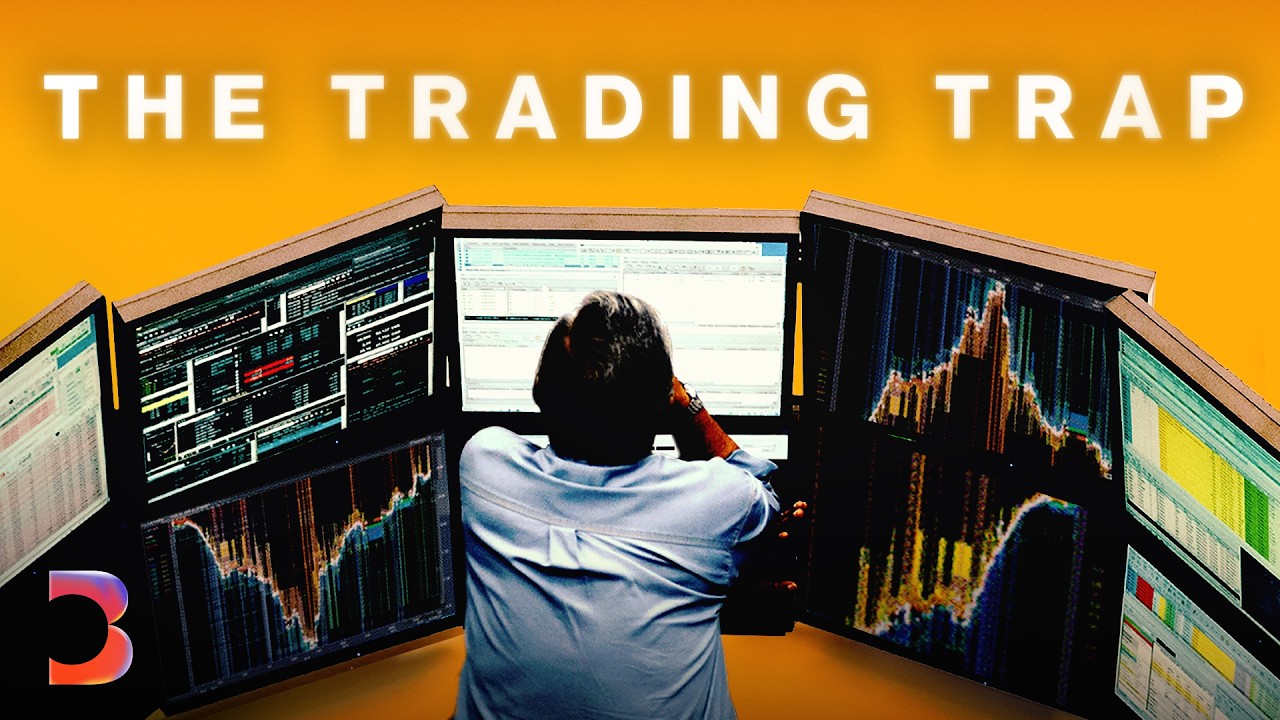
Bloomberg Originals
Algorithmic trading firms systematically extract billions from India's options market because technological and capital imbalances leave everyday retail investors losing money nine times out of ten.
AI-assisted summary of How India's Day Retail Traders Lost Billions — original source. Check the original for full context.
Source published:
Key ideas
- Retail investors in India accumulated over $33 billion in cumulative losses between 2021 and March 2025, driven by smartphone apps and social media finfluencers promoting high-risk options. (0:01)
- In the financial year ending March 2024 alone, algorithmic trading firms generated $7 billion in gross profits from Indian options, exactly mirroring the $7 billion lost by retail traders over the same period. (7:58)
- The Securities and Exchange Board of India (SEBI) opened an investigation into proprietary trading firm Jane Street over concerns that strategic interplay between cash equities and derivative expiries crossed into price manipulation. (7:58)
- High-frequency trading algorithms now represent roughly 75% of overall market volume, using nanosecond microwave links and co-located servers that put unhedged retail participants at an insurmountable technological disadvantage. (0:01)
Detailed notes
## Background Published by Bloomberg Originals on YouTube on September 21, 2026, this short documentary examines how global high-frequency trading (HFT) firms captured massive profits in India's booming options market. The video description details how millions of everyday retail investors flooded into trading via mobile apps and finfluencers only to suffer billions in losses, prompting Indian regulators to scrutinize algorithmic institutions like Jane Street.
## TL;DR Following the COVID-19 pandemic, India emerged as the undisputed global capital of options trading, with individual retail participation surging from under one million in 2019 to nearly eight million by 2026. Lacking institutional infrastructure, capital depth, and risk controls, retail traders accumulated over $33 billion in losses between 2021 and early 2025. Global algorithmic trading firms such as Jane Street, Citadel Securities, and Jump Trading leveraged nanosecond co-location and arbitrage strategies to extract massive profits, including an eye-popping $7 billion gross windfall in FY2024 that mirrored retail losses dollar-for-dollar. This severe wealth transfer ultimately triggered regulatory intervention and price manipulation inquiries by the Securities and Exchange Board of India (SEBI).
## Atmosphere & style The presentation carries an analytical, investigative, and deeply cautionary tone, replacing romanticized imagery of shouting floor traders with sterile, humming server warehouses and custom microwave towers. By weaving in accessible metaphors like a Mumbai fruit stand alongside stark regulatory statistics, the reporting clarifies intricate derivative mechanics while underscoring a stark technological David-versus-Goliath mismatch. It feels like an eye-opening post-mortem of a modern speculative boom, illustrating the quiet ruthlessness of automated financial engineering at the expense of gamified retail enthusiasm.
## Bulletin - [00:01](https://www.youtube.com/watch?v=cndVRiZ9Pdc&t=1s) Retail investors in India accumulated over $33 billion in cumulative losses between 2021 and March 2025, driven by smartphone apps and social media finfluencers promoting high-risk options. - [07:58](https://www.youtube.com/watch?v=cndVRiZ9Pdc&t=478s) In the financial year ending March 2024 alone, algorithmic trading firms generated $7 billion in gross profits from Indian options, exactly mirroring the $7 billion lost by retail traders over the same period. - [07:58](https://www.youtube.com/watch?v=cndVRiZ9Pdc&t=478s) The Securities and Exchange Board of India (SEBI) opened an investigation into proprietary trading firm Jane Street over concerns that strategic interplay between cash equities and derivative expiries crossed into price manipulation. - [00:01](https://www.youtube.com/watch?v=cndVRiZ9Pdc&t=1s) High-frequency trading algorithms now represent roughly 75% of overall market volume, using nanosecond microwave links and co-located servers that put unhedged retail participants at an insurmountable technological disadvantage.
## Key takeaways - [00:01](https://www.youtube.com/watch?v=cndVRiZ9Pdc&t=1s) Automated algorithms and HFT desks account for approximately 75% of market trading activity, largely replacing traditional floor trading. - [00:01](https://www.youtube.com/watch?v=cndVRiZ9Pdc&t=1s) Everyday retail traders face severe structural disadvantages across capital depth, technological infrastructure, and analytical sophistication. - [00:01](https://www.youtube.com/watch?v=cndVRiZ9Pdc&t=1s) Indian retail investors suffered more than $33 billion in total trading losses over the four-year span ending March 2025. - [01:36](https://www.youtube.com/watch?v=cndVRiZ9Pdc&t=96s) HFT firms deploy extreme physical measures, including drilling through terrain and using microwave networks, to gain fractional microsecond and nanosecond execution leads. - [01:36](https://www.youtube.com/watch?v=cndVRiZ9Pdc&t=96s) Algorithmic market makers operate by executing millions of trades for razor-thin margins per share, serving the core market functions of price arbitrage and continuous liquidity. - [04:50](https://www.youtube.com/watch?v=cndVRiZ9Pdc&t=290s) India evolved into the world's largest options trading hub after pandemic lockdowns spurred rapid retail adoption via mobile brokerage applications. - [04:50](https://www.youtube.com/watch?v=cndVRiZ9Pdc&t=290s) Virtually zero regulatory entry barriers for derivatives allowed India's individual trader base to expand from under one million in 2019 to nearly eight million by 2026. - [04:50](https://www.youtube.com/watch?v=cndVRiZ9Pdc&t=290s) The asymmetric payoff profile of options attracted retail speculators seeking leverage, but lack of complex hedging systematically depleted retail capital. - [07:58](https://www.youtube.com/watch?v=cndVRiZ9Pdc&t=478s) Global HFT firms—including Jane Street, Citadel Securities, Jump Trading, and Hudson River Trading—dominated profitability in the Indian derivatives market. - [07:58](https://www.youtube.com/watch?v=cndVRiZ9Pdc&t=478s) During FY2024, algorithmic firms extracted $7 billion in gross options profit, perfectly balancing the $7 billion in net losses suffered by Indian retail investors. - [07:58](https://www.youtube.com/watch?v=cndVRiZ9Pdc&t=478s) SEBI scrutinized Jane Street's activities over whether aggressive cash market buying followed by heavy put option accumulation and cash dumping constituted market manipulation. - [07:58](https://www.youtube.com/watch?v=cndVRiZ9Pdc&t=478s) Jane Street defended its trading strategies as standard index arbitrage intended to capture discrepancies between underlying cash baskets and derivative contracts. - [07:58](https://www.youtube.com/watch?v=cndVRiZ9Pdc&t=478s) Official regulatory findings indicate that individual retail participants entering derivative markets without institutional infrastructure lose money 9 times out of 10. - [07:58](https://www.youtube.com/watch?v=cndVRiZ9Pdc&t=478s) SEBI introduced structural curbs, increased margin requirements, and speed bumps to cool retail derivative speculation, though HFT firms quickly adapted.
## Detailed walkthrough ### [00:01](https://www.youtube.com/watch?v=cndVRiZ9Pdc&t=1s) The Nanosecond Era and the Retail Disadvantage
Financial markets operate at higher speeds than ever before in history, operating on an unforgiving premise: "Speed, naturally across any field, whenever you are quick and fast, you will dominate. Stock markets are no different for that." Trading operations have shifted to servers located directly on-site at exchanges, executing transactions measured in billionths of a second through fiber optics and microwave towers beamed across the open air to strip away the slight delays of physical fiber. Human traders on exchange floors have been largely superseded by bots, with automated trading representing roughly 75% of total market volume.
This transformation does far more than accelerate trade execution; it rewires the rules of the entire marketplace. Everyday, non-professional retail participants find themselves outmatched across every dimension: "From an understanding point of view, he is at a disadvantage, a technology point of view, he's at a disadvantage, from a capital point of view, he's at a disadvantage."
Nowhere has this structural imbalance played out more acutely than in India. Lured by modern mobile smartphone applications and digital financial influencers, millions of retail investors entered the markets in a rapid speculative wave. Between 2021 and March 2025, non-professional investors in India accumulated staggering losses exceeding $33 billion over four years. On the winning side of those exact trades stood elite global high-frequency trading (HFT) firms, exposing a deep fault line across emerging market finance.
- High-frequency trading firms and automated algorithms currently account for approximately 75% of market trading activity. - Retail investors in India suffered more than $33 billion in trading losses across the four-year span ending in March 2025. - Core disadvantages confronting retail traders against institutional algos: technical infrastructure, capital depth, and analytical sophistication.
[01:36](https://www.youtube.com/watch?v=cndVRiZ9Pdc&t=96s) Warehouses of Cables, Micro-Profits, and Market Arbitrage
The cultural image of stock trading—frantic people shouting across a bustling exchange floor—bears zero resemblance to modern reality. Today's trading environment is housed in cavernous server warehouses packed with tens of thousands of computer racks, giant cooling fans humming to prevent thermal overloads, and miles upon miles of interconnected spaghetti cabling. Within these facilities, autonomous algorithms execute complex strategies without direct human oversight. Trading institutions go as far as "moving mountains, literally," drilling through terrain and laying custom undersea cables solely to gain a single nanosecond advantage over competitors.
```mermaid flowchart LR accTitle: High-Frequency Arbitrage Flow accDescr: Diagram illustrating how HFT algorithms identify price discrepancies across venues and equalize prices. subgraph S1["Price Discrepancy"] M1["Market A (Stand 1)<br/>Orange Price: 100 ₹"] M2["Market B (Stand 2)<br/>Orange Price: 110 ₹"] end subgraph S2["HFT Action"] A["Algo buys at 100 ₹<br/>Algo sells at 110 ₹"] end subgraph S3["Market Equilibrium"] E["Demand rises at A / Supply rises at B<br/>Prices equalize at profit"] end M1 --> A M2 --> A A --> E ```
These nanoseconds are what unlock immense operational scale. Individual trade margins are often razor-thin—such as buying 100 shares of a US equity to capture just a single cent per share—meaning a viable business model requires executing that same loop millions and millions of times over. This high-speed capability is broadly permitted and encouraged by financial authorities because it serves essential economic functions: price arbitrage and market liquidity.
Consider an everyday Mumbai fruit market with two stands selling identical oranges: - **The Discrepancy:** Stand one sells oranges for 100 rupees per kilogram, while stand two charges 110 rupees per kilogram. - **The Arbitrage:** A trader purchases fruit at 100 rupees and immediately flips it at the second stall for 110 rupees, locking in a 10-rupee profit per kilogram. - **The Correction:** Heavy buying pressure at the first stand forces its price upward, while increased supply at the second stand drives its price down, eliminating the pricing inefficiency and establishing market parity.
Algorithms perform this identical mechanism on public exchanges, firing millions of orders per second. Beyond arbitrage, these firms provide continuous liquidity. Without high-frequency market makers ready to take the opposite side of buy and sell orders, exchanges risk seizing up entirely—particularly during panics like the 2008 Global Financial Crisis or the COVID-19 crash, when retail investors turn into unilateral sellers and natural buyers vanish from the order books.
[04:50](https://www.youtube.com/watch?v=cndVRiZ9Pdc&t=290s) The Indian Options Boom and the Retail Pitfall
When the COVID-19 pandemic hit, millions of everyday citizens stuck at home turned to the financial markets to cure their boredom. While retail participation surged worldwide, India quickly differentiated itself by turning into the undisputed global epicenter of options trading. In financial markets, an option acts like a side stall contract: for an upfront fee, a trader acquires the right—without the obligation—to buy or sell an asset at a predetermined strike price before a designated expiration date.
In the Mumbai fruit market analogy, if oranges currently trade at 100 rupees per kilogram and a trader expects prices to climb beyond 110 rupees, they can pay an upfront 5-rupee fee for a call option to purchase at 110 rupees next week: - If the price surges past 115 rupees, the buyer earns a net profit by exercising the contract or reselling the option. - If the price plunges to 95 rupees, the buyer simply walks away, forfeiting only the initial 5-rupee premium.
```mermaid flowchart TD accTitle: Indian Options Surge Dynamics accDescr: Flow diagram showing how mobile apps and finfluencers led retail traders into high-risk options resulting in massive losses. subgraph Drivers["Retail Adoption Engines"] A["Mobile Apps & Zero Entry Barriers"] B["Social Media 'Finfluencers' & Tutorials"] end subgraph Market["Market Activity"] C["Surge: <1M traders (2019) to ~8M (2026)"] D["High Leverage & Derivative Complexity"] end subgraph Outcomes["Financial Result"] E["Heavy Retail Trading Losses"] F["Massive Profits for Algorithmic HFTs"] end A --> C B --> C C --> D D --> E D --> F ```
This asymmetric payoff profile, coupled with low capital requirements relative to purchasing full shares, turned options into a wildly speculative phenomenon across India. Digital "finfluencers" proliferated across YouTube and social platforms, pitching options multipliers and promising easy wealth. Crucially, Indian regulatory frameworks featured virtually zero entry barriers for derivatives, allowing any retail user with an active brokerage account to immediately trade high-risk instruments. As a result, the population of individual derivative traders in India skyrocketed from under one million in 2019 to nearly eight million by 2026. However, because complex derivatives require sophisticated hedging, retail traders systematically bled capital on a massive scale.
[07:58](https://www.youtube.com/watch?v=cndVRiZ9Pdc&t=478s) The $7 Billion Transfer, the Jane Street Probe, and Structural Reform
The scale of wealth transfer in India reached its apex in the financial year ending March 2024. During those twelve months alone, algorithmic trading firms generated an eye-popping $7 billion in gross profits trading Indian options—an amount that almost perfectly mirrored the $7 billion lost by retail investors over that exact same duration. This staggering transfer sounded alarms at the Securities and Exchange Board of India (SEBI), raising fears that structural dynamics were systematically tilted toward a small cadre of capital-rich, ultra-fast trading desks.
Regulatory attention converged around proprietary trading firm Jane Street, alongside other global algorithmic giants active in the market like Citadel Securities, Jump Trading, and Hudson River Trading (HRT). SEBI initiated formal proceedings against Jane Street, examining whether specific algorithmic actions stepped beyond market making into outright price manipulation. Using the fruit stand illustration, SEBI's concern mirrors a scenario where a firm: 1. Systematically buys physical cash oranges to artificially ramp their spot price up. 2. Accumulates an enormous volume of "put options," which yield massive gains if the orange price subsequently crashes. 3. Rapidly dumps its physical oranges right before expiration to deliberately crash the cash market, absorbing a minor loss on the fruit while pocketing an enormous windfall on the put contracts.
| Market Participant Type | Strategic Advantage | FY2024 Outcome | |:--- |:--- |:--- | | **Global HFT Firms** *(e.g., Jane Street, Citadel Securities, Jump Trading, HRT)* | Nanosecond co-location, microwave links, algorithmic index arbitrage, immense balance sheets | Captured **$7 billion** in gross options profit | | **Retail Investors** *(Everyday app users)* | Highly fragmented, lured by finfluencer content, limited risk understanding | Suffered **$7 billion** in net options losses |
SEBI alleged that this interplay between the underlying cash equities market and derivative expiries misled everyday retail traders who had written (sold) options contracts without realizing that underlying cash prices were being actively pushed against them. Jane Street defended its conduct, stating its trading represented standard index arbitrage designed to capture structural pricing discrepancies between derivatives and underlying equities.
Nevertheless, the probe illuminated a glaring reality: India's underlying cash equity markets possessed structural vulnerabilities that allowed large capital flows to swing prices. While SEBI has since stepped in with regulatory speed bumps, higher margin requirements, and structural curbs to cool derivative volumes, HFT firms have continued to adapt and post strong profitability in the region. For the average investor, however, the fundamental odds remain brutal: regulatory studies demonstrate that individuals who enter these markets without institutional-grade infrastructure and deep derivative fluency end up losing money 9 times out of 10.
## Notable quotes > [00:01](https://www.youtube.com/watch?v=cndVRiZ9Pdc&t=1s) Speed, naturally across any field, whenever you are quick and fast, you will dominate. Stock markets are no different for that.
> [00:01](https://www.youtube.com/watch?v=cndVRiZ9Pdc&t=1s) From an understanding point of view, he is at a disadvantage, a technology point of view, he's at a disadvantage, from a capital point of view, he's at a disadvantage.
> [01:36](https://www.youtube.com/watch?v=cndVRiZ9Pdc&t=96s) moving mountains, literally
## Mentioned Bloomberg Originals, Citadel Securities, Hudson River Trading (HRT), Jane Street, Jump Trading, Securities and Exchange Board of India (SEBI), YouTube
## Video description Today's financial markets operate at lightning speed, dominated by algorithms and high-frequency trading firms. Nowhere has the impact of this technological advantage been more visible than in India, the world’s largest options trading hub.
Fueled by mobile apps and so-called finfluencers, millions of everyday investors flooded the market, only to lose billions of dollars while global HFT firms raked in massive profits. Now, as Indian regulators scrutinize the trading of one of those firms, Jane Street, a critical question emerges: should ultra-fast automated trading be seen as an engine for efficient markets, or a game stacked against the average investor?
Watch more short documentaries: https://www.youtube.com/playlist?list=PLqq4LnWs3olUDhww8NEcViirkrirzHp27
#India #Trading #Options -------- Like this video? Subscribe: http://www.youtube.com/Bloomberg?sub_confirmation=1
Get unlimited access to Bloomberg.com for just $1.99 your first month: https://www.bloomberg.com/subscriptions?in_source=YoutubeOriginals Bloomberg Originals offers bold takes for curious minds on today’s biggest topics. Hosted by experts covering stories you haven’t seen and viewpoints you haven’t heard, you’ll discover cinematic, data-led shows that investigate the intersection of business and culture. Exploring every angle of climate change, technology, finance, sports and beyond, Bloomberg Originals is business as you’ve never seen it.
Subscribe for business news, but not as you've known it: exclusive interviews, fascinating profiles, data-driven analysis, and the latest in tech innovation from around the world.
Visit our partner channel Bloomberg News for global news and insight in an instant.
[Source](https://www.youtube.com/watch?v=cndVRiZ9Pdc)