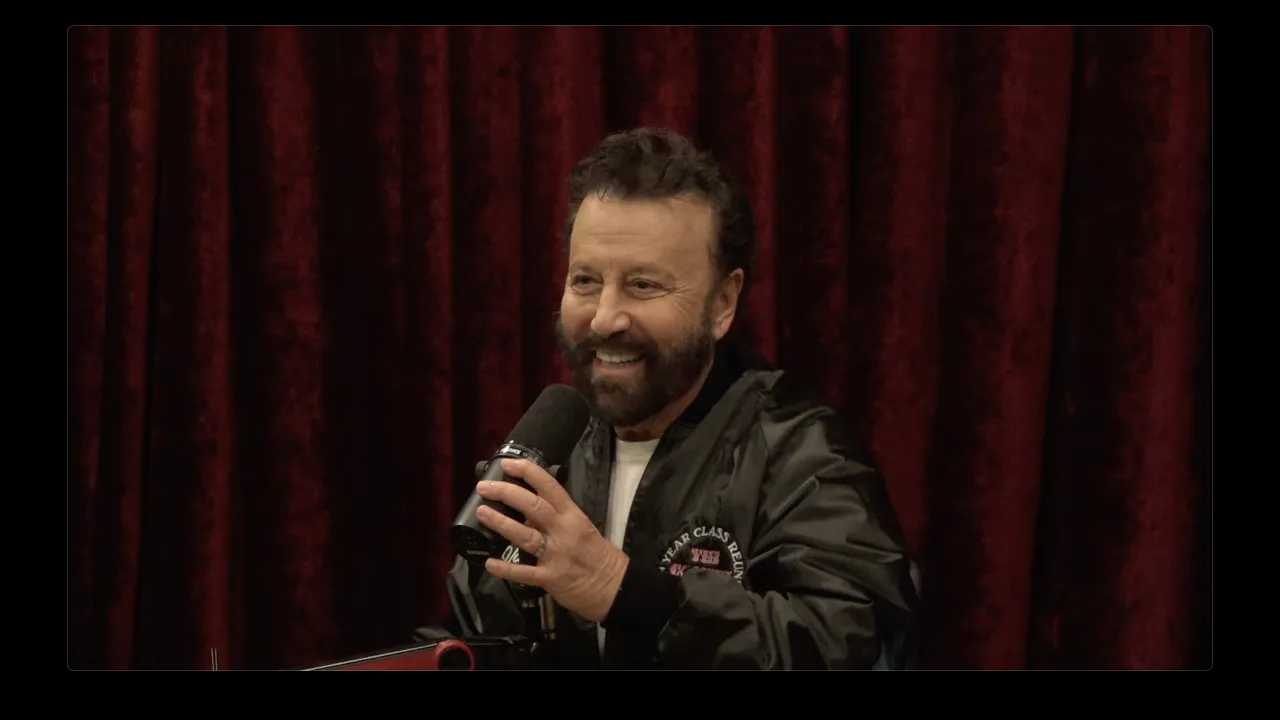
Yakov Smirnoff Resumes Stand-Up Tour Decades After Soviet Collapse
PowerfulJRE
Smirnoff argues that sustaining a career and personal relationships requires diagnosing unmet emotional needs and using humor as a vital sign rather than relying on temporary political setups.
Following the sudden collapse of the Soviet Union, Yakov Smirnoff lost his major casino headlining contracts within six months, prompting an unexpected relocation to Branson, Missouri, where he built a 2,000-seat theater and entertained over six million patrons across three decades. (8:35)
Smirnoff leveraged his personal divorce to pursue academic research, completing a Master's degree in Positive Psychology from the University of Pennsylvania and a Ph.D. from Pepperdine University focused on the role of laughter as a vital sign in romantic relationships. (16:50)
Before emigrating under a Carter administration grain-for-refugees agreement, Smirnoff and his family financed their three-month transit through Italy by smuggling Soviet condoms purchased for one kopek and reselling them for one dollar at flea markets. (51:39)
Prompted by a candid ChatGPT assessment that labeled his long-running Branson act a 'one-man show' rather than stand-up comedy, Smirnoff spent a year stripping theatrical elements from his routine to return to competitive national comedy club touring. (101:34)
Detailed notes
## Background
Published on YouTube by the PowerfulJRE channel on September 23, 2026, this episode of the Joe Rogan Experience features comedian, actor, visual artist, and psychologist Yakov Smirnoff, PhD. According to the show description, Smirnoff is the host of the 'Comedy Couch' podcast, owner of the Yakov Theatre in Branson, Missouri, and was actively touring clubs across the United States at the time of release.
## TL;DR
Yakov Smirnoff details his journey from defecting from the Soviet Union to achieving 1980s superstardom on 'The Tonight Show' and writing summit material for President Ronald Reagan, only to face immediate career collapse when the USSR dissolved. He recounts rebuilding his livelihood through a 33-year residency in Branson, Missouri, and earning a Ph.D. to study how laughter functions as a vital sign for romantic relationship health. Along with Joe Rogan, Smirnoff shares classic Comedy Store lore involving Mitzi Shore, Sam Kinison, and Andrew Dice Clay, and discusses his late-career return to joke-dense touring comedy inspired by contemporary clean headliners like Nate Bargatze.
## Atmosphere & style
The exchange has an affectionate, nostalgic, and deeply respectful energy, marked by Rogan's reverence for Smirnoff as an enduring trailblazer of the classic comedy era. Smirnoff radiates an infectious immigrant optimism and warmth, recounting harrowing Cold War hardships, industry betrayals, and personal reinventions with gentle wit and zero bitterness. The dialogue feels like an intimate late-night green-room conversation, balancing kinetic Sunset Strip anecdotes with reflective, earnest wisdom on love, aging, and stagecraft.
## Bulletin
- [08:35](https://www.youtube.com/watch?v=w6r1O5Udn0c&t=515s) Following the sudden collapse of the Soviet Union, Yakov Smirnoff lost his major casino headlining contracts within six months, prompting an unexpected relocation to Branson, Missouri, where he built a 2,000-seat theater and entertained over six million patrons across three decades.
- [16:50](https://www.youtube.com/watch?v=w6r1O5Udn0c&t=1010s) Smirnoff leveraged his personal divorce to pursue academic research, completing a Master's degree in Positive Psychology from the University of Pennsylvania and a Ph.D. from Pepperdine University focused on the role of laughter as a vital sign in romantic relationships.
- [51:39](https://www.youtube.com/watch?v=w6r1O5Udn0c&t=3099s) Before emigrating under a Carter administration grain-for-refugees agreement, Smirnoff and his family financed their three-month transit through Italy by smuggling Soviet condoms purchased for one kopek and reselling them for one dollar at flea markets.
- [01:41:34](https://www.youtube.com/watch?v=w6r1O5Udn0c&t=6094s) Prompted by a candid ChatGPT assessment that labeled his long-running Branson act a 'one-man show' rather than stand-up comedy, Smirnoff spent a year stripping theatrical elements from his routine to return to competitive national comedy club touring.
## Key takeaways
- [03:25](https://www.youtube.com/watch?v=w6r1O5Udn0c&t=205s) The collapse of the Soviet Union abruptly destroyed Smirnoff's headlining career overnight, illustrating how pre-internet comedians lacked independent platforms to overcome rapid narrative shifts.
- [06:02](https://www.youtube.com/watch?v=w6r1O5Udn0c&t=362s) On the advice of Willie Nelson following a Farm Aid performance, Smirnoff moved to Branson in 1993, expanding an initial crowd of 17 into a permanent 2,000-seat theater operation.
- [14:26](https://www.youtube.com/watch?v=w6r1O5Udn0c&t=866s) Smirnoff treated live stand-up comedy as an observational laboratory, reverse-engineering marital breakdown by tracking the disappearance of shared laughter.
- [16:50](https://www.youtube.com/watch?v=w6r1O5Udn0c&t=1010s) Balancing weekend performances with rigorous study, Smirnoff completed graduate work at UPenn and a Ph.D. at Pepperdine to examine emotional polarity and Maslow's hierarchy in relationships.
- [23:42](https://www.youtube.com/watch?v=w6r1O5Udn0c&t=1422s) Relationship satisfaction depends on satisfying divergent emotional needs: men predominantly crave sexual fulfillment and admiration for achievements, whereas women prioritize affection, conversation, and emotional honesty.
- [51:39](https://www.youtube.com/watch?v=w6r1O5Udn0c&t=3099s) Smirnoff and his family defected from the USSR in the late 1970s via a diplomatic accord brokered by Jimmy Carter that exchanged American grain shipments for Soviet dissident exit visas.
- To survive a three-month Italian layover awaiting U.S. clearance, Smirnoff exploited Soviet price controls by filling half a suitcase with one-kopek condoms to resell in Rome for one dollar apiece.
- [58:12](https://www.youtube.com/watch?v=w6r1O5Udn0c&t=3492s) Working as a bar boy and bartender at Grossinger's Hotel in the Catskills Borscht Belt allowed Smirnoff to master English and test translated jokes on resort patrons.
- [01:06:41](https://www.youtube.com/watch?v=w6r1O5Udn0c&t=4001s) Mitzi Shore provided crucial early patronage at The Comedy Store, giving Smirnoff and his immigrant father housing and odd jobs while nurturing distinct comedic voices.
- [01:14:08](https://www.youtube.com/watch?v=w6r1O5Udn0c&t=4448s) After being rejected for six years by Tonight Show talent coordinator Jim McCawley, a breakout Miller Lite commercial led Johnny Carson to book Smirnoff and invite him onto the couch during his debut.
- [01:21:58](https://www.youtube.com/watch?v=w6r1O5Udn0c&t=4918s) Ronald Reagan consulted Smirnoff regarding Soviet cultural psychology, enlisting him to rewrite Reagan's 1988 Moscow State University speech into a respectful, non-condescending tone.
- [01:37:05](https://www.youtube.com/watch?v=w6r1O5Udn0c&t=5825s) Nate Bargatze's multi-generational arena success inspired Smirnoff to leave Branson semi-retirement and prove that clean, relatable comedy retains immense mainstream commercial demand.
- [01:41:34](https://www.youtube.com/watch?v=w6r1O5Udn0c&t=6094s) After ChatGPT explicitly told Smirnoff that his act had devolved into a theatrical one-man show, he dedicated a year to writing joke-dense material suited for modern comedy clubs.
- [01:45:12](https://www.youtube.com/watch?v=w6r1O5Udn0c&t=6312s) Living at The Comedy Store's Cresthill house alongside Andrew Dice Clay and Sam Kinison exposed Smirnoff to raw comedy development, including the late-night shouting matches that catalyzed Kinison's trademark scream.
- [02:20:40](https://www.youtube.com/watch?v=w6r1O5Udn0c&t=8440s) While Jay Leno advocated that comedy is strictly transactional work for a paycheck, Smirnoff and Rogan view humor as an indispensable psychological tool that keeps human connections from seizing.
## Detailed walkthrough
### [00:01](https://www.youtube.com/watch?v=w6r1O5Udn0c&t=1s) Ground Zero Mural and Overcoming Studio Jitters
Yakov Smirnoff arrives at the studio bearing gifts in a bag, catching Joe Rogan slightly off guard as producer Young Jamie starts rolling immediately. Yakov pulls out a piece of a mural that he personally painted at Ground Zero following September 11, sharing that radio icon Paul Harvey once dedicated an installment of his famous program *The Rest of the Story* to the artwork. While Yakov brought a clip that Paul Harvey Jr. approved for sharing, Rogan and Jamie reluctantly decide not to play the audio due to potential broadcast copyright flags, recalling past studio headaches over licensed audio clips.
Settling behind the microphone, Yakov admits to feeling nervous, expressing admiration for Rogan's career trajectory, longevity, and influential voice. Rogan quickly dismisses the mystique, assuring him that success is largely persistence coupled with an enormous amount of "dumb luck" rather than mystical vision boards. Rogan points out Yakov's patriotic American flag phone case and notes that this relaxed, greenroom-style conversation is the entire premise of the podcast—giving millions of listeners the chance to eavesdrop on fascinating life stories.
- Yakov brought a piece of his original mural painted at Ground Zero after 9/11 as a gift for Rogan.
- Paul Harvey previously highlighted Yakov's Ground Zero mural on his nationally syndicated radio feature *The Rest of the Story*.
- Rogan attributes his podcasting platform not to deliberate grand planning, but to relentless consistency, good guests, and dumb luck.
---
[03:25](https://www.youtube.com/watch?v=w6r1O5Udn0c&t=205s) The Fall of the Soviet Union and the "Vaughn Meader" Effect
The conversation pivots to Yakov's meteoric rise during the Cold War and the sudden, devastating blow his career suffered when geopolitical reality shifted overnight. In the 1980s, Yakov was a comedy sensation, famous for his signature "In Soviet Russia..." punchlines, frequent appearances on *The Tonight Show Starring Johnny Carson*, and even writing Russian-themed jokes for President Ronald Reagan's historic speeches in Moscow. Yakov felt he had achieved the ultimate American dream, living in Pacific Palisades next door to stars like Tom Hanks and Arnold Schwarzenegger.
That dream derailed when the Berlin Wall and the Soviet Union collapsed. David Letterman ran a *Late Night* Top 10 list of things that would change after the fall of the USSR, ranking "Yakov Smirnoff will be out of work" at number one. While Yakov initially laughed at the joke, Letterman's prediction came true with brutal speed: within six months, every venue contract across Las Vegas, Atlantic City, Reno, and Lake Tahoe went unrenewed, and mainstream comedy clubs refused to book him. Yakov compares his sudden decline to Vaughn Meader, the celebrated 1960s John F. Kennedy impersonator whose career instantly vanished the moment JFK was assassinated. Because Yakov's entire public persona was intrinsically linked to Cold War tensions, audiences and promoters suddenly viewed him as obsolete.
```mermaid
flowchart TD
accTitle: Yakov Smirnoff Career Trajectory Flowchart
accDescr: Visual flowchart outlining Yakov Smirnoff's rise, sudden career collapse following the fall of the USSR, and eventual reinvention in Branson.
subgraph Peak ["Cold War Superstardom"]
A["The Tonight Show & Vegas Headliner"] --> B["White House Joke Supplier for Reagan"]
B --> C["Living in Pacific Palisades"]
end
subgraph Collapse ["The Geopolitical Shock"]
C --> D["Fall of the Soviet Union (1991)"]
D --> E["Letterman's Top 10: 'Yakov out of work'"]
E --> F["Contracts canceled in Vegas & Atlantic City"]
end
subgraph Reinvention ["The Branson Pivot"]
F --> G["Willie Nelson Farm Aid Co-Host"]
G --> H["Willie recommends Branson, MO"]
H --> I["Launches 'Yak in a Box' Breakfast Show"]
I --> J["Acquires 2,000-seat Yakov Theatre"]
end
```
- Yakov supplied jokes directly to President Ronald Reagan for his diplomatic summit speeches in Moscow.
- David Letterman's Top 10 list accurately forecasted Yakov losing his mainstream market viability.
- The sudden career halt mirrored that of Vaughn Meader, whose Grammy-winning comedy career collapsed immediately following the JFK assassination.
- Yakov lost lucrative bookings in Las Vegas, Reno, Lake Tahoe, and Atlantic City virtually overnight.
---
[06:02](https://www.youtube.com/watch?v=w6r1O5Udn0c&t=362s) Willie Nelson's Farm Aid Smoke and Branson Advice
Unable to pay his mortgage, forced to sell his California home, and worried about supporting his two young children, Yakov desperately looked for a lifeline. An unexpected opportunity arrived when his agent called asking if he would co-host Willie Nelson's Farm Aid benefit concert. Uncertain whether a stadium full of American heartland farmers would appreciate an immigrant comic whose material centered on the USSR, Yakov accepted out of sheer necessity. He walked out before a crowd of 50,000 people, delivered his stand-up set, and received an overwhelming standing ovation.
After the performance, Yakov went backstage to Willie Nelson's bus to thank the country legend. When Nelson opened the door, a dense cloud of marijuana smoke rolled out, leading Yakov to joke that his lifelong track record of never doing drugs instantly ended right there. Through the haze, Nelson gave him a career-altering piece of advice: "Yakov, you should go to Branson, they'll love you there."
- Yakov faced severe financial hardship, losing his Pacific Palisades house while trying to raise two young children.
- Farm Aid hosted 50,000 attendees, giving Yakov an unexpected standing ovation that proved his appeal to Middle America.
- Willie Nelson personally suggested Branson, Missouri, as an ideal market for Yakov's clean, patriotic brand of comedy.
---
[08:35](https://www.youtube.com/watch?v=w6r1O5Udn0c&t=515s) Rebuilding in Branson: From 17 Seats to Six Million Fans
Following Nelson's tip, Yakov visited Branson in March 1993, after enduring two years of professional drought. Expecting a small-town scene, he was stunned to discover massive 2,000-seat theaters packed to capacity for afternoon matinees by artists like Japanese country fiddle virtuoso Shoji Tabuchi and pop crooner Andy Williams. Realizing the immense business potential of the Ozark resort town, Yakov rented a modest theater space that May and put his name on the marquee.
His opening performance drew an audience of just 17 people. Recognizing that traditional methods would not work, Yakov adapted by creating an early-morning performance called "Yak in a Box," serving breakfast using his mother's recipes directly to patrons in the showroom. Running two shows a day—breakfast and dinner—his audiences steadily grew until he was averaging 400 patrons per show, driven largely by the region's massive tour-bus industry. Over time, Yakov purchased his own 2,000-seat auditorium, where he has since entertained more than six million visitors. While he once performed up to 400 shows a year to rebuild his fortune, he has since scaled his Branson schedule down to roughly 30 dates each autumn.
- Yakov's very first Branson performance was attended by only 17 audience members.
- To attract tour groups, he introduced "Yak in a Box," pairing stand-up comedy with hot breakfasts made from his mother's recipes.
- Branson's bustling motorcoach tour industry catalyzed Yakov's resurgence, pushing average show attendance from 17 to over 400 within a year.
- Yakov eventually acquired his own 2,000-seat theater and has performed for over 6,000,000 ticket holders in Branson.
- At his peak work rate in Missouri, Yakov staged roughly 400 performances annually, later tapering to approximately 30 autumn shows a year.
[11:54](https://www.youtube.com/watch?v=w6r1O5Udn0c&t=714s) The Fall of the Soviet Union and Career Collapse
Yakov and Joe reflect on the sudden precarity of an immigrant performer's career before the era of social media. Coming from the Soviet Union and conquering American comedy felt like the quintessential realization of the American Dream, only to turn overnight into a waking nightmare. In the media landscape of the late 1980s and early 1990s, an artist could not simply bypass traditional gatekeepers by posting online clips to prove they were still touring and drawing crowds. Once an industry narrative took hold that a performer was obsolete, it was almost impossible to counteract.
Yakov notes that his career was effectively canceled through no fault or scandal of his own. Joking about his relationship with President Ronald Reagan, he quips: "I was helping Reagan to chisel the wall down, but there was a writing on the wall that I didn't see. It says get a day job." When the Soviet Union collapsed, public interest dried up almost overnight. Audiences stopped buying tickets, comedy clubs abruptly stopped booking him, and industry perception dictated that his act was over. While Joe laments how unfair it was to write off a genuinely talented comic just because his signature subject matter vanished, Yakov views the setback as a necessary blessing. He likens his Soviet-era material to a temporary remedy: the Soviet Union was a massive headache or a literal "pain in the butt," and he had been "Preparation H"—essential during the acute swelling and itching, but cast aside the moment the pain subsided.
- Before social media, artists had no independent platform to combat prevailing industry narratives.
- The dissolution of the Soviet Union immediately deflated the American public's fear and curiosity regarding Russian-themed humor.
- The abrupt drop in ticket sales prompted comedy clubs across the country to drop Yakov from their rosters simultaneously.
---
[14:26](https://www.youtube.com/watch?v=w6r1O5Udn0c&t=866s) The Comedy Club as a Laboratory of Laughter
The abrupt stall in his comedy career coincided directly with a painful personal crisis: his divorce. Struggling with young children and searching for a new path, Yakov began drawing parallels between international diplomacy and domestic strife. Having seen how comedy could help ease geopolitical tensions during the Cold War, he wondered why humor seemed to vanish inside troubled marriages. He noticed a universal pattern: "Why is there laughter in the beginning of the relationship with men and women? And then when there's divorce, the only people laughing are attorneys."
Yakov turned his live stage into what he calls his "laboratory of laughter," conducting informal field research on his audiences. He would ask crowds whether laughter had been present during the honeymoon phase of their relationships, drawing enthusiastic applause from nearly everyone. Yet when he followed up by asking how many people would have gone on a second date if there had been no laughter on the first, the room went completely silent. Coming from a household where his father was an engineer and inventor, Yakov's instinct was to reverse-engineer human connection. Just as stand-up comedians use audience laughter as an immediate, real-time barometer of connection, he realized that laughter served as the vital sign of romantic health.
```mermaid
flowchart TD
accTitle: Cold War to Domestic Dynamics
accDescr: Flowchart illustrating Yakov's transition from geopolitical satire to relationship psychology.
subgraph ColdWar["Geopolitical Stage"]
A["Cold War Tension"] --> B["Reagan & Political Comedy"]
B --> C["Fall of the Berlin Wall"]
C --> D["Subject Matter Obsolete"]
end
subgraph PersonalCrisis["Personal & Creative Shift"]
D --> E["Divorce & Lost Direction"]
E --> F["Audience as 'Laboratory of Laughter'"]
end
subgraph RelationshipStudy["The Psychology of Relationships"]
F --> G["Reverse-Engineering Romance"]
G --> H["Studying Needs & Humor Dynamics"]
end
```
---
[16:50](https://www.youtube.com/watch?v=w6r1O5Udn0c&t=1010s) The Magnet Metaphor and Academic Pursuits
To explain the divorce to his young children, Yakov brought physical magnets home to demonstrate how attraction works. He showed them that two magnets naturally pull together under the right polarity—representing the early love, attraction, and shared laughter that brought the parents together and created the children. When circumstances shift and the polarity flips, however, the very same magnets violently repel one another.
Determined to understand the underlying mechanics of attraction and repulsion on a scientific level, Yakov pursued advanced education while continuing to perform in Branson, Missouri. He structured his life around intense weekly commutes: performing throughout the week and flying out on weekends to attend rigorous in-person classes. Through this grueling grind, he earned a master's degree in psychology from the University of Pennsylvania followed by a doctorate from Pepperdine University. When Joe asks why he would endure such an exhausting schedule, Yakov explains that he was driven by a deep search for purpose. He felt he had stumbled onto a fundamental truth about human dynamics that he needed to validate through formal academic research.
- Demonstrated marital breakdown to his young children using positive and negative magnetic attraction and repulsion.
- Earned a Master's degree in Positive Psychology from the University of Pennsylvania.
- Completed a Doctorate (Ph.D.) in Organizational Leadership and Psychology at Pepperdine University.
- Balanced full-time live shows in Branson with weekend travel for in-person university coursework.
---
[20:30](https://www.youtube.com/watch?v=w6r1O5Udn0c&t=1230s) Needs, Comedy Mechanics, and the Marital Cold War
Yakov translates his psychological research back into the craft of stand-up comedy. In comedy, a setup works only because it addresses an active interest or "need" within the audience; once that curiosity is engaged, the punchline delivers humor, producing laughter. If an audience has no inherent interest in the subject matter, the joke falls flat regardless of the punchline's cleverness. When Joe pushes back on the word "need"—arguing that true biological needs are simply food, shelter, and community, while everything else is desire—Yakov points to Abraham Maslow’s hierarchy of needs, clarifying that emotional, psychological, and relational needs operate along that extended spectrum.
Joe agrees that genuine fascination is what makes a performer magnetic; an audience will gladly listen to a comic discuss obscure hobbies or unusual topics as long as the performer is authentically invested in them. Yakov applies this principle directly to romantic relationships, describing domestic friction as a transition from the geopolitical Cold War between nations to a "cold war between couples." In his doctoral dissertation and current marriage, his primary focus is identifying and anticipating his partner's distinct needs. When partners understand and fulfill each other's needs, harmony and laughter naturally flourish; when those needs are ignored, friction and resentment take over. He points to Dr. Willard F. Harley Jr.'s seminal book, *His Needs, Her Needs*, as a foundational framework for understanding how men and women navigate emotional fulfillment.
[23:42](https://www.youtube.com/watch?v=w6r1O5Udn0c&t=1422s) The Divergent Emotional Needs of Men and Women
Yakov describes a psychological framework developed by a marriage counselor who worked with couples on the verge of divorce. In an effort to resolve their conflicts, the counselor identified ten core emotional needs and asked husbands and wives to prioritize them. The findings were stark: the five primary needs for men were completely different from the five primary needs for women. Joe remarks that the male list makes men look "really base and stupid," especially with physical attraction sitting right at the top. When Yakov accidentally repeats "sexual fulfillment" twice while listing them, he laughs it off as an intentional joke, though Joe points out how telling it is that admiration and sexual fulfillment dominate the male psyche.
| Rank / Priority | Women's Top Needs | Men's Top Needs |
|:--- |:--- |:--- |
| **1** | Affection | Sexual fulfillment |
| **2** | Conversation | Admiration |
| **3** | Openness and honesty | Attractive spouse |
| **4** | Family commitment | Recreational companionship |
| **5** | Financial support | Domestic support |
Yakov explains that he uses this research as a centerpiece in his live theater show to make audiences both laugh and learn. He asks the men in the room how many of them would appreciate hearing their wives say, "You're such a good man. Thanks for doing things for us." Typically, only a timid handful raise their hands or applaud. Yakov then jokes to the room, "Well, not every man is applauding because they're scared." When he follows up by asking if any man actively disagrees with that statement, the room falls dead silent. Turning to the women in the audience, Yakov reminds them that they used to offer that kind of admiration freely when they first started dating, which is what drew their husbands to them in the first place. Men hunger to be acknowledged and praised for what they accomplish, whereas women do not want to be admired merely for utilitarian tasks; they want to be loved for who they are—as kind, beautiful, intelligent, and selfless individuals.
[26:39](https://www.youtube.com/watch?v=w6r1O5Udn0c&t=1599s) Ambition, Fast Food, and Gendered Standards
Joe agrees that men generally do not evaluate a romantic partner based on professional skill or high-level output. While acknowledging that some men are drawn to a partner's talent or career drive, Joe notes that what most men fundamentally prioritize is finding someone who is pleasant and attractive. He mentions conversations with single friends who openly admit they would not care if a woman worked at McDonald's, provided she is pretty, sweet, and fun to talk to without being annoying.
In contrast, Joe observes that the dynamic rarely works in reverse: a woman meeting an attractive, kind man working at a fast-food counter is far more likely to write him off as a loser lacking drive. Having worked in fast-food restaurants during his youth—including stints at Newport Creamery and Papa Gino's—Joe stresses that there is no inherent shame in the work, but rather that women seeking a family and long-term stability instinctively search for ambition and competence. Ambition is often a prerequisite for female attraction, whereas men seldom prioritize vocational status when choosing a partner.
[28:10](https://www.youtube.com/watch?v=w6r1O5Udn0c&t=1690s) Phil Hartman's Marriage and the Threat of Professional Resentment
Joe reflects on the late comedian Phil Hartman as a notable exception to the rule that men do not care about a partner's drive. Before Hartman was tragically murdered by his wife in a murder-suicide, the couple had weathered repeated marital crises. Joe recalls Hartman once confiding in him during a period of near-divorce, insisting that if he ever remarried, his next wife would have to possess a genuine passion: "I don't give a fuck what it is. I don't care if it's rock climbing, you have to be into something."
Hartman was a man of intense curiosity—he was a licensed pilot, played music, and continually pursued new interests outside of his acting career. Joe recalls flying with Hartman in a private plane over Southern California, where Hartman showed him neighboring counties with open acreage, eventually inspiring Joe to purchase his own property outside the urban sprawl. Hartman grew profoundly alienated by his wife's complete lack of personal interests, while she simultaneously harbored aspirations of fame and appeared to harbor deep-seated bitterness over his immense career success.
Joe connects this to a broader phenomenon in creative industries, noting a female comedian friend whose relationship unraveled when her career took off. Her boyfriend, also a comic, became hostile, insulting, and resentful rather than supportive. As Joe points out, people rarely know their true character flaws until an external test—such as a partner's sudden success—forces those insecurities to the surface.
[30:30](https://www.youtube.com/watch?v=w6r1O5Udn0c&t=1830s) "The Tree of Love" and Rewriting the Subconscious Script
Yakov points Young Jamie toward an image of his painting titled *The Tree of Love*, an artwork he created to map out his emotional evolution and clarify his role within a relationship. Looking back on his first marriage to an American woman, Yakov realizes he was entirely unprepared. When they first met, she gave him a handshake so forceful it nearly crushed his fingers. Subconsciously, that strength felt familiar: in his childhood home in the Soviet Union, his mother was the dominant leader, while his father was an artistic, gentle man who simply followed her lead.
Yakov inadvertently carried that domestic blueprint into his marriage. Because he was an assertive, confident figure on stage—commanding auditoriums of several thousand people and receiving invitations to perform at the White House—his wife assumed he would naturally be a leader at home. Instead, once offstage, Yakov defaulted to his father's passive role, assuming his wife would direct their life: "I said 'I do,' and I didn't do it." The marriage collapsed, prompting a grueling twenty-year period of introspection to dismantle that inherited script and develop into the dependable, grounded protector he wanted to be.
[33:13](https://www.youtube.com/watch?v=w6r1O5Udn0c&t=1993s) Starting Over: Tony Robbins and a Newborn at 75
Joe highlights the immense resilience it took for Yakov to overhaul his identity after suffering a double collapse in the early 1990s: the breakdown of his marriage and the sudden disappearance of his comedy career following the fall of the Soviet Union. Yakov spent two decades single, throwing himself into self-improvement programs, including the full spectrum of Tony Robbins's seminars, determined to transform from his father's passive model into a man capable of providing unwavering emotional and practical security.
Seven years prior to the conversation, Yakov remarried a woman from Ukraine, and he reveals to Joe that at 75 years old, he has a one-year-old baby. Joe is utterly flabbergasted by the revelation, shouting in astonishment and joking that they need to get Yakov on longevity peptides immediately. Remarking that Yakov is nearly two decades older than him while raising an infant, Joe insists they have to do whatever it takes to keep him alive, while Yakov beams with pride and excitement about fatherhood in his mid-seventies.
[34:25](https://www.youtube.com/watch?v=w6r1O5Udn0c&t=2065s) The Quest for a Wife in Ukraine: 51 Dates in Two Weeks
After his divorce from an American woman and a string of unfulfilling relationships, Yakov decided to take his grown children, who were in their twenties, on a trip to his hometown of Odessa, Ukraine. On the return leg, a stroke of fate altered his path: he accidentally left his passport on the flight from Odessa to Kyiv. Stranded for a day while waiting for a temporary passport, he sat in a public park during the lunch rush and watched as crowds of stunning women walked by. The sight felt like watching an elite Paris fashion runway show, and Yakov found himself realizing that he wanted to find a Ukrainian wife. Joe immediately stops him to ask about the timeline and age difference; Yakov explains that this occurred about a decade earlier when he was 65, noting that his wife today is 42. While Joe ponders whether people find large age gaps controversial, Yakov explains that cultural perspectives differ and emphasizes that he was not acting as a playboy, but genuinely searching for a life partner.
To execute his search, Yakov took an intensely pragmatic approach: he hired three separate Ukrainian matchmaking agencies at the same time and scheduled a two-week blitz in Kyiv. Over the course of fourteen days, he went on 51 dates, sitting down for breakfast, lunch, and dinner with different women every single day. Drawing on his academic background in psychology and relationship dynamics, Yakov was specifically looking for a woman with a healthy, positive relationship with her father. He believed that any woman who had an abusive father or harbored deep fears of masculine energy would fundamentally struggle to trust him. With a single handshake and a brief read of their energy, he could tell within seconds whether a match had any potential. None of the 51 dates worked out, leaving Yakov empty-handed and exhausted, having gained weight purely from being obligated to eat three full restaurant meals every day.
- **The Age Gap:** Yakov was 65 during his initial search; his wife was in her early thirties at the time (currently 42, while Yakov is in his seventies).
- **The Matchmaking Blitz:** Hired three agencies simultaneously for a two-week trip, resulting in 51 dates spread across breakfasts, lunches, and dinners.
- **The Psychological Screen:** Evaluated candidates based on father-daughter dynamics and comfort with masculine energy, testing his instinct within the first few seconds of a handshake.
```mermaid
flowchart TD
accTitle: Yakov Smirnoff Search Strategy
accDescr: Flowchart illustrating Yakov's shift from dating agencies to hosting a university seminar to meet his wife.
subgraph Phase1["Phase 1: Agency Approach"]
A["Hire 3 Matchmaking Agencies"] --> B["51 Dates in 2 Weeks"]
B --> C{"Compatibility Screen"}
C -- "Father trauma / Seeking exit visa" --> D["Failed Match & Weight Gain"]
end
subgraph Phase2["Phase 2: Academic Seminar"]
E["Pivot to Relationship Seminar"] --> F["Hire Local Event Promoter"]
F --> G["Meets Olivia"]
G --> H["Courtship & Balloon Proposal"]
end
D --> E
```
---
[38:14](https://www.youtube.com/watch?v=w6r1O5Udn0c&t=2294s) The Relationship Seminar Strategy and Meeting Olivia
Recognizing that the traditional matchmaking agency model had failed, Yakov analyzed the root problem. He realized that women registered with foreign introduction agencies were often "hunting" for an exit out of Ukraine. Approaching dating from an aggressive, survivalist mindset, they operated out of a hardened masculine energy focused on securing an escape. Yakov wanted someone whose focus was personal growth and healthy connection, not an exit visa. Capitalizing on his position as a professor at Missouri State University, he engineered an alternative strategy: he decided to organize and host a public seminar in Kyiv on relationships and laughter. Joe is amused by the sheer calculation, remarking that it was the same pragmatic ingenuity that led Yakov to escape the USSR and build his theater empire in Branson: "You find solutions."
To organize the event, Yakov needed a local coordinator to book the venue, handle promotion, and gather attendees. Someone recommended a woman named Olivia. The moment Yakov met her to discuss the project, he realized the seminar was no longer necessary: "I already knew that I didn't need the seminar. I just met somebody that I really wanted to be with." Because of their age difference, they kept things entirely professional at first, gradually getting to know each other over time. Eventually, Yakov invited her to the United States and planned an elaborate proposal for her birthday aboard a hot air balloon. On the ground below, he had unfurled a massive banner reading, "Will you marry me?" Because Olivia did not yet read English, she looked down without reacting; Yakov then pulled out the engagement ring, and she enthusiastically said yes. The conversation briefly turns to linguistic divides in Ukraine, with Yakov explaining the historic coexistence and cultural tensions between Ukrainian speakers in the west and Russian speakers in the east and south.
- **The Tactical Pivot:** Hosted an academic seminar on love and laughter through Missouri State University to attract women genuinely interested in relationship dynamics rather than foreign citizenship.
- **The Hot Air Balloon Proposal:** Proposed from a hot air balloon over a giant ground banner, which failed to register until he presented the ring because Olivia could not read English.
- **Linguistic Context:** Clarified that while Ukrainian is the official language, broad portions of the country (including his hometown of Odessa) historically spoke Russian, creating longstanding regional nuances.
---
[41:52](https://www.youtube.com/watch?v=w6r1O5Udn0c&t=2512s) Comedy in the USSR: Arkady Raikin and State-Controlled Laughs
Joe shifts the conversation to Yakov’s early beginnings, asking what it was like to start performing stand-up in the Soviet Union at the age of 15. Yakov explains that there was no Soviet equivalent to *The Tonight Show* or open mic comedy clubs. The entire entertainment industry was tightly controlled by the Communist Party, and across the entire nation, only two comedic performers were officially state-approved for radio and television broadcast. Chief among them was Arkady Raikin, a beloved satirist who performed theatrical, vaudevillian monologues with quick costume changes and wigs. Soviet apartments came equipped with a mandatory, hardwired radio speaker mounted on the wall that could not be turned off completely, continuously piping in state-sanctioned broadcasts and propaganda.
Every few weeks or once a month on Sunday mornings, Raikin would perform a brand-new monologue on the radio that had been rigorously vetted and stamped by Communist Party censors. Yakov was obsessed with these broadcasts. He recorded them using a bulky reel-to-reel tape recorder, transcribed every word, and memorized the scripts. Because Raikin's material had already passed state scrutiny, Yakov could perform the monologues in his school clubs without needing additional clearance from authorities. Even though the audiences knew he was reciting Raikin’s jokes, they laughed, giving Yakov his first taste of stage success. The only American comedic influence permitted behind the Iron Curtain was Charlie Chaplin, whose silent films were allowed because the Soviet government viewed his depictions of poverty and the Great Depression as useful anti-capitalist propaganda.
- **Arkady Raikin:** The preeminent, state-licensed Soviet comedian whose scripted monologues served as Yakov's primary artistic blueprint.
- **The Wall Speaker:** Mandatory wired radio speakers inside Soviet apartments provided an inescapable channel for state-approved media and propaganda.
- **Approved Material:** By memorizing and reciting Raikin's already-censored routines verbatim, Yakov bypassed the danger of performing unauthorized humor at school functions.
- **Charlie Chaplin:** The sole American comic icon permitted on Soviet screens, heavily framed by the state as an indictment of American capitalist struggles.
---
[44:39](https://www.youtube.com/watch?v=w6r1O5Udn0c&t=2679s) From the Red Army and Black Sea Cruises to Communal Living
Yakov's early comedy career developed through amateur channels, including his mandatory military service in the Soviet armed forces. Whenever major state celebrations arrived—such as May Day or the anniversary of the Bolshevik October Revolution—commanders turned to Yakov to entertain the troops with humor. After finishing his military duty, he enrolled in college to earn an art degree. In Soviet society, pursuing stand-up comedy as a standalone career was practically unthinkable, and his parents could never envision it as a viable livelihood. Nevertheless, Yakov kept performing and eventually landed a coveted professional gig at age 20 or 21, working as an entertainer aboard Soviet passenger cruise ships navigating the Black Sea.
Performing on the cruise ships provided Yakov with his first legitimate comedy paycheck and, crucially, a private cabin of his own. For Yakov, having a personal room was a life-altering luxury. Until he was 26 years old, he had lived in a cramped communal apartment with his parents, where nine separate families shared a single building without a private telephone, and his entire family was confined to one bedroom. Joe jokingly asks what his parents did when they wanted privacy to "get frisky," leading Yakov to share a favorite routine from his stand-up set: his parents would tell him to go look out the window, and when they asked what he saw, he would reply, "Our neighbors being frisky—and I know because their son is looking right back at me."
- **Military Performances:** Drafted to provide comedy routines for soldiers during major Soviet patriotic holidays like May Day and the October Revolution.
- **Black Sea Cruise Gigs:** Began earning a salary as a shipboard comedian around age 20–21, which granted him his first experience of having a private living cabin.
- **Communal Apartment Living:** Lived in a single shared room alongside his parents until age 26, in a facility housing nine families with no private telephone lines.
[46:42](https://www.youtube.com/watch?v=w6r1O5Udn0c&t=2802s) Capitalism on the Black Sea
Working on cruise ships sailing the Black Sea unexpectedly exposed Yakov to a world that ordinary Soviet citizens were strictly forbidden from interacting with: foreign tourists. Under the rule of General Secretary Leonid Brezhnev, mingling with outsiders was completely off-limits, yet here was an audience comprised of Germans, Britons, Australians, Yugoslavians from the Eastern Bloc, and even Americans. After wrapping up his first week of performances, ship management asked Yakov if he would like to remain on board for an extended run. Yakov agreed, but asked for one condition: whether he could bring his parents along and secure an extra cabin for them. The administration curtly rebuffed him, barking, "No, you don't get any special privileges. We have hundreds of people like you. Get out."
Accepted to his fate, Yakov headed home. Because their apartment had no telephone, a physical messenger arrived at their door a couple of hours later bearing two sets of cruise tickets—one for him and one for his parents. Baffled by this unprecedented reversal in an unyielding Soviet bureaucracy, Yakov later approached the cruise director to ask what had transpired. The director explained that the vessels were routinely chartered to European companies for roughly nine months out of the year, during which the Soviet operators had observed a foundational tenet of free enterprise: valuable talent deserves extra perks. The ship’s captain had been so captivated by Yakov's act that he issued an ultimatum to the management company: even if they had to surrender his personal captain's quarters, Yakov had to remain on board.
The realization struck Yakov like a thunderbolt. He asked the cruise director in astonishment, "Wait a minute. Wait a minute. Are you saying that in capitalistic world if you're more talented, you get more things?" When the director confirmed it was true, the epiphany fundamentally altered Yakov's entire outlook on life and ambition.
```mermaid
flowchart TD
accTitle: The Black Sea Cruise Realization
accDescr: Flowchart showing how Yakov Smirnoff discovered capitalist incentives through cruise ship management.
subgraph SovietBureaucracy["Soviet Bureaucracy"]
A["Performs 1 week on Black Sea cruise for foreign tourists"]
B["Asks for additional cabin for parents"]
C["Denied by management: 'No special privileges'"]
end
subgraph CapitalistInfluence["European Charter Influence"]
D["Ship captain demands Yakov stay, offering his own cabin"]
E["Messenger delivers tickets for Yakov and his parents"]
F["Director explains capitalist perk system: reward for talent"]
end
A --> B
B --> C
C --> D
D --> E
E --> F
F --> G["Epiphany: Talent yields rewards under capitalism"]
```
---
[49:14](https://www.youtube.com/watch?v=w6r1O5Udn0c&t=2954s) Late-Night Static and Voice of America
Hearing Yakov describe the constant surveillance and state-controlled radio speakers hardwired into every Soviet apartment leaves Joe rattled at how effortlessly totalitarian regimes indoctrinate citizens. Yakov explains that while the state actively jammed forbidden shortwave frequencies like Voice of America during normal hours, his father had figured out a workaround: Soviet authorities never imagined anyone would bother waking up in the dead of night. At 3:00 in the morning, his father would slip out of bed, sit beside their large shortwave radio in total silence, and listen to faint, unjammed Western broadcasts filtering through the static.
When young Yakov caught his father tuning in and asked what he was doing, his father urgently hushed him: "Shh, don't let neighbors hear us. This is Voice of America. We're not allowed to listen to it." Eventually, Yakov began waking up alongside him. Through the crackling airwaves, they heard timeless American ideals—the stirring words welcoming the tired, the poor, and the huddled masses yearning to breathe free, alongside descriptions of the Statue of Liberty greeting ships entering New York Harbor. His father would whisper wistfully that he dreamed of Yakov experiencing that freedom firsthand.
Their fascination terrified Yakov’s mother, Clara. Consumed by dread that an accidental slip would bring KGB scrutiny upon the household, she forbade any mention of America. Whenever Yakov drew sketches of the Statue of Liberty as a child, she would frantically warn, "Don't do that. Don't let anybody see this. We'll get in trouble."
---
[51:39](https://www.youtube.com/watch?v=w6r1O5Udn0c&t=3099s) Deciding to Defect and the Grain-for-Refugees Deal
Energized by his revelation aboard the cruise ship, Yakov returned home and directly challenged the family’s complacency, announcing, "Mom, dad, I think we should consider try to get out." His mother exploded with rage, directing her fury at his father for filling the boy's head with forbidden fantasies. But Yakov’s father, ordinarily reserved and timid, firmly stood his ground: "Clara, would you like your son when he is my age sit there by the radio and listen to Voice of America hoping wishing that he would be doing something like that, or would you like him to be in America doing this?"
The question broke through Clara's resistance, though she laid bare the grim reality of what applying for an exit visa meant in the USSR: lifelong friends would cross to the other side of the street to avoid being seen with them, they would become social outcasts, and state harassment would make their lives hell. When his father calmly accepted the consequences, she relented, promising to stand by them.
The escape hatch came courtesy of geopolitical leverage during the Jimmy Carter administration. Grappling with catastrophic domestic food shortages and impending starvation, the Soviet leadership desperately needed grain imports from the United States. President Carter tied agricultural aid directly to human rights concessions, permitting Soviet dissidents and religious minorities to emigrate in exchange for American shipments. As Yakov puts it with wry humor, their family was essentially "exchanged for some wheat."
- Soviet citizens caught listening to Voice of America risked immediate state retribution, forcing families into extreme secrecy even within their own walls.
- Applying to leave the USSR triggered social exile, turning friends and coworkers into fearful strangers who refused public contact.
- President Jimmy Carter conditioned shipments of American grain on Soviet human rights releases, creating the exit window for Yakov and his parents.
---
[53:36](https://www.youtube.com/watch?v=w6r1O5Udn0c&t=3216s) The Naivety of Communism vs. Regulated Capitalism
Joe reflects on the immigrant experience as a vital wake-up call for native-born Americans who take their liberties for granted. While he recognizes that modern youth gravitate toward socialism out of an instinctive impulse for kindness, equality, and sharing, he argues that transferring economic allocation to government bureaucrats inevitably produces catastrophe. When centralized power dictates who receives resources, those in power invariably entrench their own control, indulge in unchecked luxury, and leave the populace standing in breadlines—executing anyone who dares to dissent.
The answer to societal inequality, Joe insists, is not abolishing the market but fostering a more moral, empathetic capitalism anchored by legitimate philanthropy rather than bureaucratic non-profit operations where executive overhead siphons away ninety percent of charitable funds. He views the United States as an imperfect yet profoundly historic experiment in self-governance that cannot simply be cast aside because of flaws or corruption. While corruption must be actively rooted out and tempered with sensible guardrails and regulations, the underlying purpose of American society—allowing individuals the baseline freedom to author their own destinies—remains uniquely precious on the world stage.
---
[56:56](https://www.youtube.com/watch?v=w6r1O5Udn0c&t=3416s) The Meaning of the Flag and Yakov Pokhis
Following an ad read for ZipRecruiter, conversation turns to Yakov’s identity as an outspoken champion of the American dream. Joe notices Yakov's unabashedly patriotic phone case, pointing out that carrying an American flag in certain contemporary cultural circles would ironically get someone labeled a fascist. Yakov mentions having an enormous American flag at his theater in Branson, Missouri, where patriotism is woven into the community fabric.
Joe emphasizes that the Stars and Stripes should never be reduced to partisan politics or tied to whoever happens to occupy the White House—whether Joe Biden, Barack Obama, or Donald Trump. Instead, the flag belongs equally to all citizens across every background, race, and viewpoint as a global beacon of hope and a testament to the melting pot.
When Joe asks whether "Yakov Smirnoff" is his birth name, Yakov reveals it was an American stage invention. His legal family name is **Yakov Pokhis** (spelled P-O-K-H-I-S). Upon landing in the United States, before comedy launched his career, he took his very first steps into the American workforce washing dishes and working as a bar boy and bartender.
[58:12](https://www.youtube.com/watch?v=w6r1O5Udn0c&t=3492s) Arriving in the Catskills and the Rise of Modern Stand-Up
In 1977, shortly after arriving in the United States, Yakov Smirnoff found work as a bar boy at Grossinger’s Hotel in the Catskills (the famed Borscht Belt resort region in upstate New York). Immersed in an entirely new world, he watched legendary old-school entertainers like Freddie Roman and Eddie Fisher perform on stage, and later saw Red Skelton in Atlantic City. During his shifts, he picked up English by osmosis, trying to decipher cultural references such as "Chappaquiddick" that regularly surfaced in comic routines and conversation.
Joe brings up the Amazon television series *The Marvelous Mrs. Maisel*, noting how its depiction of Catskills summer resorts reflects a pivotal chapter in comedy history. Stand-up comedy in its contemporary comedy-club form is an astonishingly young medium, having only crystalized in the 1960s out of earlier vaudeville roots. For decades, New Yorkers and Pennsylvanians took their summer vacations in the Poconos and Catskills, creating a lucrative circuit of resort showrooms where comedians developed their craft before modern dedicated comedy clubs existed.
---
[01:00:16](https://www.youtube.com/watch?v=w6r1O5Udn0c&t=3616s) From Monk’s Inn to Grossinger's and Becoming "Smirnoff"
Determined to learn conversational English, Yakov deduced that bartending would be the ideal entry point. On cruise ships back in the Soviet Union, the bar was always situated right next to the stage; he figured tending bar would allow him to converse with relaxed patrons one-on-one. He spotted a makeshift mixology school on Fifth Avenue in New York City offering a two-week course for $200. Despite knowing virtually no English, he paid the tuition and earned his mixology certificate. His initial placement was at Monk’s Inn, a French restaurant near Lincoln Center where the waitstaff dressed in monk robes and observed a quiet atmosphere—a perfect gig for someone who could barely speak the language.
Shortly after, the mixology school alerted him to an opening for a bar boy at Grossinger’s Hotel. On his day off, Yakov took the bus upstate. He was awed by what he saw: a bustling operation with 18 bartenders and an opulent 2,000-seat theater. He resolved on the spot to take whatever pay they offered. Terribly anxious about quitting Monk’s Inn after just one week, he sheepishly approached his manager. The manager gave him an unexpectedly warm, quintessentially American send-off: "Yakov, it’s America. You should take the opportunity."
Around this period, he also adopted his stage surname. His birth name was Yakov Pokhis, which Americans routinely struggled to pronounce. Standing behind the bar, he noticed patrons constantly ordering Smirnoff vodka with ease. He adopted the name because "Yaks" evoked laughs and Smirnoff brought people cheer. Joe observes how common stage names were at the time, highlighting Arnold Schwarzenegger as one of the rare trailblazers who refused to Americanize his foreign surname.
```mermaid
flowchart TD
accTitle: Yakov Smirnoff Early Career Path
accDescr: Flowchart tracing Yakov's journey from NYC mixology school to his break at The Comedy Store.
subgraph NYC ["New York City (1977)"]
A["5th Avenue Mixology School<br/>($200, 2-week course)"] --> B["Monk's Inn Restaurant<br/>(Lincoln Center silent monk waiter)"]
B --> C["Grossinger's Hotel<br/>(Catskills bar boy to bartender)"]
end
subgraph Catskills ["Catskills & Early Gigs"]
C --> D["Simon Says Lobby Show<br/>(Guest seizure incident)"]
D --> E["Catch a Rising Star (NYC) &<br/>Greeting Bells shipping job"]
end
subgraph Hollywood ["Los Angeles Break"]
E --> F["10-day trip to Hollywood<br/>(Target: Ted Bergmann)"]
F --> G["The Comedy Store Open Mic<br/>(Discovered by Mitzi Shore)"]
end
```
---
[01:04:16](https://www.youtube.com/watch?v=w6r1O5Udn0c&t=3856s) Testing Jokes Behind the Bar and the Simon Says Stage
Yakov spent roughly seven to eight months working at Grossinger’s, gradually advancing from bar boy hauling ice and mixing piña coladas to a full bartender. He used the patrons as a testing ground for his translated jokes: if the customer laughed or left a healthy tip, he knew the translation worked; if met with a blank stare, the joke was scrapped.
Craving real stage time, Yakov approached Barry Wise, the entertainment director of Grossinger’s main showroom. Wise rejected him for the main stage but offered an opening in the hotel lobby, where an emcee hosted afternoon games of Simon Says for elderly guests. Yakov took the small lobby stage and launched into his routine. Mid-set, an elderly woman in the back began shaking violently in what he initially assumed was hysterical laughter, only for paramedics to rush in and cart her out on a gurney with a seizure. When patrons came over afterward saying, "You were killing!", Yakov took the compliment literally and worried he had actually harmed her. Nevertheless, surviving the set gave him the confidence to try open mics at Catch a Rising Star in New York.
- **Joke testing method:** Using customer laughter and tip amounts as a direct feedback metric for whether jokes translated into English.
- **The Simon Says incident:** Performing for seniors in the lobby when an audience member suffered a medical emergency, leading to his first taste of the industry idiom "killing."
---
[01:06:41](https://www.youtube.com/watch?v=w6r1O5Udn0c&t=4001s) The Ten-Day Trip to Hollywood and Meeting Mitzi Shore
Back in New York, Yakov took a day job as a shipping manager at a company named Greeting Bells. A female coworker mentioned she knew Ted Bergmann, the executive producer of the smash-hit sitcom *Three’s Company*, and offered to set up an introduction. Armed with wide-eyed optimism, Yakov purchased a 10-day round-trip ticket to Hollywood. His plan was simple: meet Bergmann, land a part on *Three’s Company*, become an overnight star, and return to New York to buy his parents a luxury apartment on Fifth Avenue.
Upon arriving in Los Angeles, Bergmann told him he needed to see him perform live first. Yakov promptly signed up for an open mic spot at The Comedy Store on Sunset Boulevard. Right before showtime, word arrived that Bergmann could not make it. Crushed, Yakov completed his five-minute set anyway, feeling that four days into his trip his Hollywood dream had slipped away.
As he was walking down Sunset Boulevard in defeat, Mitzi Shore’s assistant, Chrissy, ran out after him, shouting congratulations. Confused, Yakov explained that his contact had never shown up. Chrissy replied, "No, no, no, no. Mitzi liked you." Yakov had no idea who Mitzi was until she pointed to Shore's portrait. Mitzi summoned him to her booth near the Original Room and delivered her assessment: "You're very funny. Stay in Los Angeles. There is always place for good and different." When Yakov hesitated, explaining that he had to return to New York to care for his parents, Mitzi solved the dilemma on the spot: she asked about his father’s profession, learned he was a construction engineer, offered to employ him as a carpenter at the club, and invited Yakov to stay at her house up the hill.
[01:10:21](https://www.youtube.com/watch?v=w6r1O5Udn0c&t=4221s) Early Days at The Comedy Store and Replacing Pauly Shore's Doorknobs
After arriving in Los Angeles, Yakov Smirnoff was offered a room by Mitzi Shore at the Cresthill house for $120 a month. Still not fully grasping who she was, he took her advice to return the following evening to watch a regular showcase. At twenty-six or twenty-seven years old and only five days into his time in Los Angeles, Yakov sat in the back of The Comedy Store while emcee Harris Peet brought out a staggering lineup: Robin Williams—riding high as the star of the number one television show *Mork & Mindy*—followed in rapid succession by Billy Crystal, David Letterman, and Richard Pryor. Sitting in awe, Yakov realized he was way ahead of schedule, thinking to himself, "If she likes them and she likes me, I'm staying. I don't care."
Recognizing that he was not yet polished enough to take the stage regularly, Mitzi hired Yakov and his father to do carpentry work around the venue. Yakov helped build out parts of the Belly Room and performed roughly once a month while sharpening his material at other local clubs. His primary handyman assignment, however, was at Mitzi's personal residence. Her teenage son, Pauly Shore, routinely smoked pot in his room and would unscrew and discard the doorknobs so his mother could not walk in on him unannounced. Yakov's recurring task was to repeatedly purchase and install new doorknobs—a gig that felt like a full-time job in itself, but one for which he remained deeply grateful to Mitzi.
- The room at the legendary Cresthill comics' house cost just $120 a month.
- Yakov completely immersed himself in English, deliberately avoiding speaking Russian to anyone other than his parents.
- Robin Williams later helped Yakov land his breakout film role in *Moscow on the Hudson* (filmed around 1982 and released in 1984), which led to recurring guest spots on *Night Court*, where he appeared in seven episodes.
---
[01:14:08](https://www.youtube.com/watch?v=w6r1O5Udn0c&t=4448s) Jim McCawley's Rebuff and the Miller Lite Breakthrough
Despite his rising profile in television and clubs, Yakov could not break onto *The Tonight Show Starring Johnny Carson*. The show’s legendary talent coordinator, Jim McCawley, attended annual showcases set up by Mitzi Shore but repeatedly dismissed Yakov, insisting Carson would never like his act. After six consecutive years of rejections, McCawley bluntly told him, "Yakov, let's save time for one another. You'll get on that show when hell freezes over." Resigned to the fact that he stood no chance, Yakov joked that he began monitoring the Weather Channel just in case, before simply moving on with his career.
His fortunes shifted dramatically when he was cast in a high-profile Miller Lite commercial. The commercial aired during the Super Bowl and became an overnight sensation, catapulting Yakov into national recognition. Johnny Carson saw the ad and asked McCawley why they had never booked the funny Russian comedian. McCawley scrambled, claiming they had already been planning to bring him on. Mitzi Shore tracked Yakov down at a comedy club payphone in Raleigh, North Carolina, furiously informing him that McCawley was suddenly begging to book him immediately. Though Yakov's immediate instinct was to tell him to shove it, he swallowed his pride and accepted the life-changing invitation.
```mermaid
flowchart TD
accTitle: Yakov Smirnoff Tonight Show Breakthrough Path
accDescr: Step-by-step path from McCawley's repeated rejections to Carson appearance
subgraph Rejection ["Years of Resistance"]
A["6 Years of Showcases at The Comedy Store"] --> B["Jim McCawley: 'When hell freezes over'"]
end
subgraph Catalyst ["The Turning Point"]
C["Cast in Miller Lite Super Bowl Commercial"] --> D["Johnny Carson watches ad and demands booking"]
end
subgraph Triumph ["The Tonight Show"]
B -.-> C
D --> E["Mitzi Shore calls Raleigh club payphone"]
E --> F["Carson Couch Invite & 7 Appearances"]
end
```
---
[01:16:15](https://www.youtube.com/watch?v=w6r1O5Udn0c&t=4575s) The Carson Couch, "Warning Shots," and Modern Parallels
Making his debut on *The Tonight Show*, Yakov killed on stage and earned the ultimate stamp of approval: an invitation to sit on the couch next to Johnny Carson. During their conversation, Yakov delivered a memorable line highlighting American freedoms: "Johnny, you know, in America you have things we never had in Russia, like policemen have warning shots." Carson nearly fell out of his chair laughing. During the commercial break, McCawley hurried over between Yakov and Carson to ask if he could return for another spot in a couple of months. Seizing the moment, Yakov fired his own words back at him: "When hell freezes over." McCawley conceded with a sheepish "Touché," and Yakov went on to make seven appearances on the show.
Joe Rogan and Yakov reflect on the unmatched cultural impact of Carson-era television, noting that with only three major networks and no Fox or internet, *The Tonight Show* drew upwards of thirty million viewers an evening. Having an "as seen on The Tonight Show" credit immediately allowed a comic to headline venues nationwide. Rogan compares that bygone gatekeeper power to *Kill Tony* today, pointing out how Tony Hinchcliffe's show operates as a pure, unfiltered stand-up incubator that single-handedly launches stars like Kam Patterson, William Montgomery, Adam Ray, and Kyle Dunnigan—and noted that Yakov's recent appearance on *Kill Tony* directly led to his invitation onto the Rogan podcast.
- Yakov pitched and starred in a *Tonight Show* sketch playing an interpreter alongside Carson (impersonating Ronald Reagan) and a Mikhail Gorbachev lookalike.
- At the time, thirty million viewers represented a staggering portion of the entire United States population watching a single late-night broadcast.
---
[01:19:50](https://www.youtube.com/watch?v=w6r1O5Udn0c&t=4790s) The Secret Service Gate check for President Reagan
While performing at the Comedy Cafe in Washington, D.C., Yakov was approached after a set by a man who introduced himself and extended a surprising invitation: he was hosting President Ronald Reagan and First Lady Nancy Reagan for an intimate dinner at his home in two weeks and wanted Yakov to attend. Initially suspecting the man was eccentric or delusional, Yakov learned his host was actually the editor-in-chief of *The Washington Times*.
When Yakov returned to D.C. for the dinner, the neighborhood resembled a scene out of an action movie, swarming with Secret Service, FBI agents, and two helicopters hovering overhead. When their vehicle reached the perimeter checkpoint, agents ordered the homeowner out of the car, patted him down, and demanded identification. Even after the man protested that it was his own house where the President was dining, the security detail remained entirely unfazed. An agent then shone a flashlight directly into the passenger seat, instantly recognized Yakov's face, and exclaimed, "Miller Lite commercial, right? Go in." Yakov was waved through without further questioning, leading to his first personal meeting with Reagan, where the two hit it off immediately on the exact same comedic wavelength.
[01:21:58](https://www.youtube.com/watch?v=w6r1O5Udn0c&t=4918s) Writing Jokes and Rewriting Reagan's Moscow Speech
The rapport between Ronald Reagan and Yakov Smirnoff began organically over humor. After Reagan started trading Russian jokes back and forth with him until all eighteen people in the room were laughing, their relationship was cemented. A couple of weeks later, Yakov received an unexpected phone call from Dana Rohrabacher, Reagan’s senior speechwriter. Rohrabacher explained that the President was traveling to Moscow to meet Mikhail Gorbachev and would be addressing Soviet politicians and students at Moscow State University. He asked if Yakov would write some jokes for Reagan's address. Yakov was stunned and terrified by the high stakes: "If something doesn't go right, I don't have any countries to go to. Where am I going?"
```mermaid
flowchart TD
accTitle: Yakov Smirnoff's Advisory Process for Reagan's Moscow Address
accDescr: Flowchart showing how Yakov went from joke writer to tone editor for Ronald Reagan's address at Moscow State University.
subgraph ReaganTeam["White House Outreach"]
A["Dana Rohrabacher contacts Yakov"]
B["Request: Write jokes for Moscow State University speech"]
end
subgraph Review["Tone Assessment"]
C["Rohrabacher shares draft: asks for tone check"]
D["Yakov flags condescending tone regarding capitalism"]
E["'Then rewrite the speech'"]
end
subgraph FinalSpeech["Diplomatic Impact"]
F["Yakov levels the tone to show mutual respect"]
G["Reagan delivers speech to Gorbachev & Soviet leaders"]
end
A --> B
B --> C
C --> D
D --> E
E --> F
F --> G
```
After submitting the jokes, Rohrabacher asked Yakov to review the entire draft to see if the tone felt right. Feeling overwhelmed by the responsibility, Yakov read the text and offered honest feedback: the speech felt condescending, lecturing the Soviets about why capitalism was vastly superior and instructing them to abandon their system. In response, Rohrabacher told him, "Then rewrite the speech." Yakov did not overhaul the substance, but he carefully softened the language, reframing the message to treat Soviet leaders as equals rather than talking down to an empire. The administration kept his adjustments. Comedy Store owner Mitzi Shore later told Yakov that he and Reagan had changed the world, calling Yakov Reagan's "secret weapon" to reach Gorbachev.
[01:24:52](https://www.youtube.com/watch?v=w6r1O5Udn0c&t=5092s) Advising the President and the Era of Hollywood Gatekeepers
Joe Rogan points out that Yakov possessed a cultural nuance that American politicians completely lacked, understanding exactly which phrasing would provoke defensiveness or offense in the Soviet psyche. Yakov recalls Reagan directly asking him, "How would you deal with Gorbachev?" When Yakov questioned whether he was qualified to answer such a monumental question, the President assured him that having lived in the USSR for twenty-six years made him far more qualified than any Washington bureaucrat. Reagan was remarkably open and receptive to his insights throughout the process. When Rogan brings up Reagan’s iconic Berlin Wall speech—"Mr. Gorbachev, tear down this wall"—Yakov jokes, "I didn't write that joke."
The conversation shifts to how precarious an entertainer's career was during the 1980s. With only three or four television networks, gatekeepers had absolute power over an artist's livelihood; if a performer ran afoul of key executives, they could be blackballed overnight and cast out of the industry entirely. Yakov credits his survival to his deep-seated adaptability—the same resilience that led him to reinvent his career in Branson, Missouri, when Hollywood cooled on him, and that had previously carried him out of the Soviet Union.
[01:27:07](https://www.youtube.com/watch?v=w6r1O5Udn0c&t=5227s) Smuggling Condoms to Survive the Italian Transit
Leaving the Soviet Union required extreme resourcefulness. To deter emigrants—whose departure embarrassed the regime—the state strictly limited each person to exchanging only $100 into foreign currency and allowed just two suitcases filled with a narrow list of approved possessions, such as cameras or wool hats, that could be liquidated abroad. While waiting in Italy for three months for American authorities to run security clearances and confirm they were neither Communist Party operatives nor spies, families had to survive on almost nothing.
Through the grapevine, Yakov learned of a unique economic loophole: condoms cost just one Soviet kopek (a penny) in the USSR but sold for a full dollar in Italy, and Soviet border authorities placed no restrictions on how many could be exported. Yakov went from pharmacy to pharmacy across his city, buying as many as possible until he filled half a suitcase, which he packed inside his mother's luggage on the bet that customs guards would be too embarrassed to question an older woman about them:
- **The Capital:** Half a suitcase packed entirely with Soviet-purchased condoms.
- **The Margin:** Purchased for roughly 1 penny in the USSR and resold for $1 each in Italy.
- **The Strategy:** Avoided inspection at Soviet customs by hiding them in his mother's luggage.
- **The Pitch:** Selling at Italian open-air flea markets every Saturday and Sunday to cover food and apartment rent.
To overcome their initial embarrassment, Yakov’s conservative parents embraced the venture. His mother translated a clever sales pitch into Italian on a placard: she would hold up the sign, point directly at Yakov, and announce, "If you don't want to have a kid like this, then buy a condom." Shoppers burst out laughing and bought two or three at a time. The side hustle kept the family fed and housed throughout their entire stay in Italy.
[01:31:09](https://www.youtube.com/watch?v=w6r1O5Udn0c&t=5469s) Learning English at the Cinema and the Five-Year Vegas Prophecy
Determined to master English while stranded in Rome without speaking Italian, Yakov discovered a theater that screened English-language films all day for a single dollar. He sat inside for entire days, soaking in the rhythm and vocabulary of the language. To practice speaking, he struck up an acquaintance with an English-speaking couple—a woman from Belgium and a man from Washington, D.C.—who agreed to meet him once a week at a local coffee shop to converse.
During one of their conversations, the couple asked what he had done back in Russia. Using a pocket dictionary, Yakov explained that he had been a comedian. When they asked what he hoped to accomplish in the United States, Yakov inquired where the top comedians in America performed. They answered Las Vegas. With absolute conviction, Yakov declared in broken English: "In five years, I'll be in Las Vegas."
Exactly five years later, Yakov fulfilled that prediction, sharing a stage at the Tropicana Hotel in Las Vegas alongside Murray Langston, known famously as "The Unknown Comic" from *The Gong Show*. Rogan and Yakov fondly recall Langston performing with a paper bag over his head, noting that the offbeat, unfiltered amateur acts on Chuck Barris's *The Gong Show* served as the direct comedic ancestor to modern open-mic showcases like *Kill Tony*.
[01:33:55](https://www.youtube.com/watch?v=w6r1O5Udn0c&t=5635s) TV Reboots, Dave Attell, and Touring Post-*Kill Tony*
Joe Rogan and Jamie Young try to recall who hosted the reboot of *The Gong Show*, eventually remembering that Dave Attell fronted the short-lived 2008 revival on Comedy Central before another version surfaced in 2017. Rogan reflects on the perils of rebooting classic television concepts, noting that retreading familiar ground is almost always fraught with comparison, citing the three different iterations of *Fear Factor*—including a newer version hosted by Johnny Knoxville. He then marvels at the unpredictable arc of Yakov Smirnoff's life and career, which is currently experiencing a full-fledged renaissance following his celebrated guest appearance on *Kill Tony*.
Capitalizing on that renewed momentum, Smirnoff is launching a nationwide club tour. When Smirnoff proudly holds up a printed tour itinerary poster in the studio, Rogan laughs, pointing out that listeners on audio formats cannot see it and viewers can barely decipher the fine print anyway. Directing fans instead to Smirnoff's official website, Rogan asks about his upcoming dates, with Smirnoff highlighting Atlanta as an early stop on a club schedule that takes him across the country.
- *The Gong Show* revival hosted by Dave Attell aired in 2008, followed by a separate ABC revival in 2017.
- *Fear Factor* has cycled through multiple incarnations, from Rogan's original run to an MTV version and a revival featuring Johnny Knoxville.
- Smirnoff's upcoming tour dates are cataloged on his website, yakov.com, beginning with major comedy clubs nationwide.
---
[01:35:30](https://www.youtube.com/watch?v=w6r1O5Udn0c&t=5730s) Guesting on *Kill Tony* and First Encounters at The Comedy Store
Discussing his guest spot on *Kill Tony*, Smirnoff admits he was initially unsure how his clean, G-rated comedic persona would fit into an uninhibited, famously raunchy environment. However, host Tony Hinchcliffe could not have been more gracious, treating Smirnoff like comedy royalty and giving him glowing introductions. Smirnoff expresses heartfelt gratitude for being recognized as a living legend, confessing it is sometimes surreal to process that level of respect after sixty years in show business.
Rogan looks back on their initial meeting roughly fifteen years prior at The Comedy Store in West Hollywood. Rogan was stunned to see Smirnoff drop by the venue out of the blue from his home base in Branson, Missouri, wanting to see what the younger generation was working on and get some stage time. Hanging out in the green room, Rogan watched Smirnoff effortlessly click with wild, weed-smoking stand-ups like Joey Diaz. Rogan remembers walking away deeply impressed by Smirnoff's warmth, sharpness, and down-to-earth humor.
```mermaid
flowchart TD
accTitle: Yakov Smirnoff's Career Evolution
accDescr: Progression from 1980s headliner to Branson theater owner, to modern club resurgence sparked by Kill Tony.
subgraph Legacy["Traditional Eras"]
A["Stand-Up Headliner & TV Star<br/>(1980s Peak Fame)"] --> B["Branson Theater Residency<br/>(Showmanship & Storytelling)"]
end
subgraph Resurgence["Modern Club Renaissance"]
B --> C["Appearance on Kill Tony<br/>(Celebrated by Young Comics)"]
C --> D["New Club Tour & Mothership Sets<br/>(Punchy, Contemporary Hour)"]
end
```
---
[01:37:05](https://www.youtube.com/watch?v=w6r1O5Udn0c&t=5825s) Connecting Audiences and the Modern Clean Comedy Boom
Smirnoff explains that his current club tour was born out of spending the past year hitting intimate rooms to build a brand-new, modern hour centered on marriage, relationships, and raising a one-year-old child. During a recent weekend spot at Rogan's club, the Comedy Mothership in Austin, Smirnoff observed couples in the crowd who had arrived looking somewhat distant or tense gradually reach out, hold hands, and reconnect through laughter. Rogan applauds him as a "uniter" using laughter to bring couples together.
Smirnoff credits Nate Bargatze as the primary catalyst who motivated him to step outside his comfort zone in Branson and return to the road. Bargatze demonstrated to the entire industry that massive, untapped audiences crave high-level, relatable, family-friendly stand-up. Rogan emphasizes that Bargatze's genius lies in being universally hilarious across generations:
> "The thing about Nate that's so unique is Nate is hilarious to me. Nate is hilarious to a 20-year-old kid in college. Nate is hilarious to their grandmother... You could bring your 10-year-old kids to see Nate."
Rogan and Smirnoff point out that comedy does not have to be categorized strictly as "clean" or "dirty" to succeed. Legends like Brian Regan have long proved that squeaky-clean material can destroy any room, while comics like Leanne Morgan surged to arena-level fame through Southern-infused, relatable comedy that Netflix embraced. Rogan rejects labels applied to the Mothership as purely "anti-woke," noting that audiences simply want distinct perspectives done masterfully—whether that means the heavy-metal intensity of Brian Holtzman, the grit of Dave Attell, or the charm of Smirnoff.
---
[01:41:34](https://www.youtube.com/watch?v=w6r1O5Udn0c&t=6094s) "Stand-Up Comedian" vs. "One-Man Show" and ChatGPT's Diagnosis
Smirnoff shares a humbling realization that altered his creative trajectory roughly a year ago. While working on material, a younger comedian offered a candid critique: *"Yakov, you know that you're not a stand-up comedian. You're a one-man show."* The comment initially stung, but Smirnoff recognized the truth in it. Years spent headlining his private theater in Branson had shifted his cadence toward long-form storytelling and theatrical showmanship rather than rapid-fire setups and punchlines.
To test the critique, Smirnoff turned to artificial intelligence, typing a prompt into ChatGPT asking whether Yakov Smirnoff is a stand-up comedian or a one-man show. The AI gave a blunt verdict: *Yakov Smirnoff used to be a stand-up comedian; now he is a one-man show.* Smirnoff remembers thinking, *"Dang, that's now official."* Rather than dismissing the algorithm, he took it as a personal challenge, dedicating the entire next year to stripping away the theatrical fat and rewriting his hour into pure, tight, joke-dense stand-up.
Rogan points out that there is nothing lesser about theatrical comedy, noting that masters like Colin Quinn create brilliant solo shows that remain authentic stand-up. Nonetheless, Smirnoff explains that the critique forced him out of the comfortable bubble of his Branson theater—where audiences had bought tickets specifically to see him—and shoved him back into competitive comedy clubs alongside other sharp comics, sharpening his timing and reaffirming his identity as a pure stand-up comedian.
[01:44:10](https://www.youtube.com/watch?v=w6r1O5Udn0c&t=6250s) The Dedication of Argus Hamilton
Yakov Smirnoff reflects on spending an entire year honing his latest hour of stand-up comedy before taking it out on the road. Joe Rogan expresses deep admiration for veteran comedians who maintain that relentless hunger, still writing and loving the craft decades into their careers. A prime example they both revere is Argus Hamilton, who continues to perform regularly in Los Angeles, constantly churning out razor-sharp commentary on breaking news cycles.
Rogan highlights Hamilton's complete personal transformation: while he was notoriously deep into substances during his wilder years, Hamilton redirected that intensity entirely into endurance running. Rogan recalls running into him in The Comedy Store parking lot after a show, where Hamilton appeared in running sneakers, explaining that running every day was his non-negotiable motivation to get on stage. Even in his seventies, Hamilton still runs roughly ten miles a day.
[01:45:12](https://www.youtube.com/watch?v=w6r1O5Udn0c&t=6312s) Naivety, Powdered Donuts, and the Birth of Sam Kinison's Scream
Smirnoff looks back on his early days in Hollywood with comedic humility, explaining just how naive an immigrant he truly was. Back then, Mitzi Shore arranged for him to live in a house tied to The Comedy Store. Comedians came and went; Andrew Dice Clay moved in and ended up teaching Smirnoff English, while Sam Kinison spent endless hours hanging out. The residence was a legendary party hub frequented by comedy giants like Robin Williams and Richard Pryor. Smirnoff, having to wake up early to work, would frequently witness Andrew Dice Clay and Sam Kinison screaming at each other late at night purely for fun. One night around midnight, tired of the noise, Smirnoff pleaded with them: "Hey guys, you're friends, stop." He suggested that since The Comedy Store was just down the street, they should go down there and scream instead. Taking his advice, they walked down to the club, Kinison took the stage before a tiny audience, leaned right into a patron's face, and unleashed his ferocious scream for the very first time.
Smirnoff’s cultural innocence also shielded him from recognizing the rampant drug use around him. In the mornings, he would routinely spot mirrors on tables dusted with fine white residue. Genuinely assuming his housemates were eating powdered donuts directly off the mirrors, Smirnoff would wipe them down and hang them back up. He even confronted Hamilton: "Argus, why don't you guys use plates? You have a dishwasher." The comedians would burst out laughing without ever disillusioning him, while Rogan remarks on the staggering volume of cocaine that must have been circulating for them to carelessly leave lines behind on mirrors.
```mermaid
flowchart TD
accTitle: Origin of Sam Kinisons Stage Scream
accDescr: Flowchart showing how a late night argument in the communal comic house led directly to Sam Kinisons signature stage scream at The Comedy Store.
subgraph House["Communal Party House"]
A["Late-night shouting matches between Andrew Dice Clay and Sam Kinison"]
B["Yakov Smirnoff wakes up early for work and intervenes"]
C["Smirnoff suggests: 'Why don't you go downstairs to The Comedy Store and scream?'"]
A --> B --> C
end
subgraph Store["The Comedy Store"]
D["Kinison heads to the club around midnight"]
E["Takes the stage before a sparse late-night crowd"]
F["Kinison gets right in a patron's face and screams"]
G["Birth of Kinison's iconic, career-defining stage persona"]
D --> E --> F --> G
end
C --> D
```
- Kinison arrived at The Comedy Store around 1979, later breaking out nationally with an appearance on *Late Night with David Letterman* in 1985 and a breakthrough HBO special in 1986.
- Smirnoff lived alongside future comedy icons while entirely unaware that the white powder on mirrors was cocaine rather than powdered sugar from breakfast pastries.
[01:49:19](https://www.youtube.com/watch?v=w6r1O5Udn0c&t=6559s) Joe Rogan’s Introduction to Sam Kinison
Rogan recounts how he first learned about Sam Kinison around 1986, when he was a 19-year-old weight trainer working at the Boston Athletic Club in South Boston. A loud, boisterous female volleyball player at the gym told him about an unbelievable comic she had just watched on HBO. Right there in the club’s parking lot, she reenacted Kinison’s infamous bit about homosexual necrophiliacs paying to spend time with fresh corpses. Throwing herself onto her stomach on the asphalt, she performed the routine with a thick Boston accent, screeching: "Feels like someone’s fucking me in the ass! You mean life keeps fucking you in the ass? Even after you're dead, it never ends!" Watching her roll on the ground left an indelible impression on Rogan, opening his eyes to a style of raw, boundary-pushing performance far removed from clean club routines.
[01:51:13](https://www.youtube.com/watch?v=w6r1O5Udn0c&t=6673s) Rogan’s Transition to Stand-Up and Arrival at The Comedy Store
Prior to comedy, Rogan's life revolved exclusively around martial arts competition; he worked at the gym solely to afford training and maintain conditioning. His fighter peers found him hilarious, though Rogan dismissed their encouragement by reminding them that combat fighters were naturally unhinged people whose sense of humor was far from mainstream. Eventually, his close friend Steve Graham persuaded him to take a shot at an open mic night in 1988. Standing in front of the crowd, Rogan had an epiphany: starting out in comedy was identical to starting martial arts—everyone begins completely incompetent, and mastery only comes through relentless practice. Watching Kinison had already broken his preconceived notion that stand-up was restricted to clean setup-and-punchline comics like Jerry Seinfeld.
In the late 1980s, Boston comics treated The Comedy Store as stand-up's true mecca, constantly revering it as the proving ground that launched Richard Pryor, Sam Kinison, David Letterman, and former doorman Bill Hicks. Rogan finally made the pilgrimage to Los Angeles after booking a television pilot, stepping inside the iconic Sunset Strip venue with absolute awe. That pilot turned into the 1994 baseball sitcom *Hardball*, where Rogan played an erratic, Lamborghini-crashing star athlete. Although the show was canceled after roughly six episodes, it gave him his foothold in Los Angeles. Knowing virtually nobody in town, Rogan spent every single night haunting the halls of The Comedy Store, eventually crossing paths with Mitzi Shore that same year.
[01:53:52](https://www.youtube.com/watch?v=w6r1O5Udn0c&t=6832s) Getting Passed at The Comedy Store
Joe Rogan reflects on his early grind breaking into the Los Angeles stand-up scene, describing how he would spend long days on television sets before heading to The Comedy Store to hang out late into the night. Eventually, club owner Mitzi Shore gave him a showcase and made him a non-paid regular. Under that arrangement, he was tasked with going on after the scheduled lineup—which ran from 8:00 p.m. until roughly 1:00 a.m.—meaning he was routinely taking the stage around 1:00 in the morning after everyone else had finished. He kept up that grueling midnight routine for several months until Mitzi finally decided to "pass" him as a paid regular.
Earning that official endorsement was a monumental psychological turning point for Rogan. Even though he had been booking paid comedy gigs, he still felt on shaky ground and frequently bombed. At the time, he was working daytime hours on a sitcom, which paid handsome money but left him creatively unfulfilled compared to the raw electricity of playing to live comedy audiences. While later joining *NewsRadio* exposed him to a much higher level of television craftsmanship alongside brilliant talents like Phil Hartman, nothing matched the thrill of getting passed by Mitzi Shore. Having his name painted on the legendary wall outside The Comedy Store meant more to him than landing any network sitcom.
- Rogan performed in the post-1:00 a.m. slot as a non-paid regular for several months before Mitzi Shore officially passed him.
- Even with early TV success, Rogan considered seeing his name permanently placed on The Comedy Store wall to be the supreme validation of his career.
---
[01:55:40](https://www.youtube.com/watch?v=w6r1O5Udn0c&t=6940s) Mitzi Shore, "The Asylum," and the Origins of Comedy Mothership
Rogan and Yakov Smirnoff discuss Mitzi Shore's peerless status as the single most influential figure outside of the comedians themselves in modern stand-up history. Rogan likens her role to that of a "curator of a mental health asylum," recalling how Mitzi embraced the eccentricities of comic personalities and routinely joked, "The inmates are running the asylum." In fact, when Rogan first set out to build a comedy club in Austin, Texas, his original plan was to name it "The Asylum" as a direct homage to her philosophy of letting brilliant, unhinged comic minds run free.
The venue's ultimate name, Comedy Mothership, came from a blend of logistics and Rogan's personal passions. Comedian Ron White was the first major comic to relocate to Austin, functioning as "patient zero" for the city's stand-up renaissance. White praised Austin's central geographic location because it allowed easy travel across the country to New York, Florida, and beyond. That idea of a central hub launching comics outward—paired with Rogan's admitted obsession with UFOs—sparked the name "Comedy Mothership." To preserve their roots and honor Mitzi's legacy, the venue's main bar was officially named "Mitzi's."
```mermaid
flowchart TD
accTitle: Inspiration for Comedy Mothership
accDescr: Flowchart illustrating how Mitzi Shore and Ron White influenced the creation and naming of the Comedy Mothership.
subgraph Mitzi["Mitzi Shore's Legacy"]
A["'The inmates are running the asylum'"] --> B["Proposed Name: The Asylum"]
C["Deep Comedic Mentorship"] --> D["Bar Named 'Mitzi's'"]
end
subgraph Austin["Austin Relocation"]
E["Ron White: 'Patient Zero' in Austin"] --> F["Centrally Located Travel Hub"]
G["Joe Rogan's UFO Obsession"] --> H["Final Club Name: Comedy Mothership"]
end
B -.-> H
F --> H
```
---
[01:57:24](https://www.youtube.com/watch?v=w6r1O5Udn0c&t=7044s) The Island of Broken Toys and Mitzi's Developmental Instincts
The conversation turns to the warm, communal haven Mitzi built for comedians, which she famously called an "island of broken toys" or a home for lost children. While her comedic instincts were legendary, Rogan laughs about how eccentric—and occasionally terrible—her creative advice could be. Most notoriously, Mitzi insisted on rebranding Joey Diaz with the stage name "Fat Baby," printing lineups as late as 2001 that literally credited him as "Fat Baby." Despite those oddities, comics considered The Comedy Store their emotional home base. Rogan recalls playing a New Year's Eve gig down the street at The Improv and running back to the Store right after, where doorman Harris Peet told him, "I love it. You go over there, you do your shows, but you come back home."
Above all, Mitzi Shore took pride in developing raw, unpolished talent rather than adopting established acts. Jerry Seinfeld famously did not get passed by her because his act was already completely finished and refined; she preferred diamond-in-the-rough comics she could personally mold, such as Roseanne Barr, Jim Carrey, and Smirnoff himself back when he barely spoke English. Part of her development process involved psychological crucible tests: she deliberately sent green comics out directly following powerhouse headliners like Richard Pryor and Robin Williams when the room had already been torn apart, testing whether the up-and-comers had the spine to survive.
- Mitzi insisted on listing Joey Diaz under the stage name "Fat Baby" on Comedy Store lineup boards for a couple of years.
- Jerry Seinfeld was not passed by Mitzi because he arrived with a fully finished act, whereas Mitzi wanted raw artists she could actively shape.
- To test their resilience, Mitzi routinely shoved young comics onstage immediately following monster sets by Richard Pryor and Robin Williams.
---
[02:00:44](https://www.youtube.com/watch?v=w6r1O5Udn0c&t=7244s) Honoring Mitzi and Recreating the Magic at Comedy Mothership
Yakov shares an emotional memory of attending Mitzi Shore's funeral, where her son Peter Shore asked him to serve as one of the pallbearers. Carrying her casket brought his journey full circle, knowing that her early belief in an immigrant with broken English had completely altered the trajectory of his life. Rogan notes that this shared reverence is why so many comics continually speak of her and why the Austin club was designed to maintain her spirit of "Welcome weirdos."
When Rogan asks Smirnoff about his experiences performing at Comedy Mothership, Smirnoff praises the intimate architecture. Rogan explains how the venue's layout borrows directly from the design DNA of The Comedy Store:
* **The Small Room (Mitzi's):** Conceived as a hybrid offspring between The Comedy Store's Original Room and Belly Room.
* **The Big Room (Fat Man):** Conceived as a hybrid of the Original Room and the Main Room.
Smirnoff notes the poetic coincidence that he originally helped with the physical carpentry work building the Belly Room in Los Angeles—the very room where Tony Hinchcliffe's *Kill Tony* show originated years later. Rogan jokes that Yakov was likely the last carpenter to touch that space, describing how nerve-wracking it was to stand in the downstairs bar ordering a drink while wild, raucous crowds from *Roast Battle* upstairs made the entire ceiling visibly bounce. Smirnoff laughingly refuses to take structural blame, insisting he only built the booths.
[02:03:06](https://www.youtube.com/watch?v=w6r1O5Udn0c&t=7386s) The Comedy Store's Crazy Magnetism and "Jesus"
Reflecting on the unique energy of The Comedy Store, Joe Rogan recalls how the space was supposed to hold roughly 70 or 80 people, yet crowds packed in so tightly that the ceiling above the bar would visibly flex. Patrons would look up nervously, hoping the structure wouldn't collapse on them. Beyond the physical quirks, Rogan describes the club as a powerful magnet for eccentric characters and wandering outsiders, including schizophrenic individuals who would drift into the parking lot and talk about the voices they were hearing.
Among the Store's regular fixtures was a gentle, beloved character named Kevin Lee Light (known around Hollywood and to Rogan as "Heavenly Light"), who dressed head-to-toe as Jesus Christ. Rogan and Yakov remember how people initially thought it might be an attention-seeking gimmick, but everyone quickly fell in love with his kind nature and presence. Though Yakov never saw him perform on stage with a microphone in hand, he was a fixture in the room with natural comedic timing. When he eventually passed away, the comedy community mourned him deeply. He had even appeared on comedian Brody Stevens' show with Zach Galifianakis, serving as an emblem of the wild, unscripted eccentricity that defined The Comedy Store era.
---
[02:05:14](https://www.youtube.com/watch?v=w6r1O5Udn0c&t=7514s) Cresthill House and Joe Rogan's Escape-Artist Dog
The conversation naturally shifts to Mitzi Shore’s legendary communal house on Cresthill Road, perched high above the Sunset Strip. Joe notes that while he has tried to cultivate the spirit of The Comedy Store at his own club in Austin, buying a group house for comics to live in together is something he would never touch, calling the prospect an absolute "recipe for disaster."
Rogan reveals that he actually came close to purchasing the Cresthill house when it went on the market. He toured the property while comics were still residing there, but backed out entirely because of his dog, a pit bull named Frank Sinatra. Frank was a notorious escape artist capable of scaling or breaking through nearly any barrier. Seeing the property’s tiny backyard perched right along the edge of a steep hill, Joe knew Frank would hop the fence in an instant. Believing that keeping an active dog without adequate yard space or daily exercise is cruel, Joe chose his dog's safety over owning a piece of Hollywood comedy history.
---
[02:06:44](https://www.youtube.com/watch?v=w6r1O5Udn0c&t=7604s) Living with Andrew Dice Clay and Tom Wilson at Cresthill
Yakov reminisces about his own formative years occupying a modest upstairs room at the Cresthill house for just $120 a month. Downstairs lived an ambitious, pre-fame Andrew Dice Clay, alongside Tom Wilson—who later skyrocketed to fame playing the antagonist Biff Tannen in *Back to the Future*. Back then, Clay performed a clean routine centered around sharp impressions of Elvis Presley, John Travolta, and Sylvester Stallone. Yakov describes himself as thoroughly naive about American romance at the time, leaving Dice to take on the self-appointed role of teaching him how to date women.
Whenever Yakov brought a date back to the house, Dice would melodramatically guilt-trip him, lamenting that his "best friend" was banishing him to the lonely basement, only to repeat the entire routine right in front of the arriving woman to tease him. When Yakov later wanted to break up with a girlfriend, Dice gave him what he claimed was foolproof breakup advice: buy her a gift at a jewelry store so she wouldn't be as upset. Yakov followed the advice and brought the purchase home to show Tom Wilson. Wilson took one look at the box, deadpanned that it was an engagement ring, and warned Yakov never to take life advice from Andrew Dice Clay because "Andrew is not a representative of the human race."
---
[02:09:30](https://www.youtube.com/watch?v=w6r1O5Udn0c&t=7770s) Flipping Mercedes, Buying a Rolls-Royce, and Living for $120 a Month
While working odd jobs for Mitzi at minimum wage, Yakov possessed a sharp entrepreneurial drive that set him apart from his fellow roommates, who were sleeping past noon with no cars to their names. Noticing the vacant two-car garage at Cresthill, Yakov partnered with a friend to travel to Germany, borrow capital, and import two Mercedes-Benz vehicles. By selling one in the United States at a profit, he effectively obtained the other car—a Mercedes-Benz 450SL—for free.
Shortly thereafter, Yakov was hired in the UK to perform on *The Bob Monkhouse Show*, a premier British television program comparable to Johnny Carson’s *Tonight Show*. The producers handed him his performance fee in a literal bag of cash containing £10,000. Rather than letting the funds sit idle, Yakov bought a Rolls-Royce and shipped it back to Los Angeles. Living in a communal room that cost only $120 a month, Yakov suddenly found himself the proud owner of both a classic Rolls-Royce and a Mercedes-Benz 450SL parked outside the comedy house.
```mermaid
flowchart LR
accTitle: Yakov Smirnoff Early Assets and Hustle
accDescr: Visual summary of Yakov Smirnoff moving from Cresthill rent to importing European luxury cars.
subgraph Cresthill ["Cresthill Living"]
A["Room at Cresthill<br/>($120/month)"]
B["Empty 2-car garage"]
end
subgraph CarFlips ["European Car Deals"]
C["Import 2 Mercedes from Germany<br/>(Sell 1, keep 450SL)"]
D["Bob Monkhouse Show (£10,000 cash)<br/>(Buys Rolls-Royce)"]
end
subgraph Result ["Driveway Lineup"]
E["Mercedes 450SL & Rolls-Royce parked at Cresthill"]
end
A --> B
B --> C
C --> D
D --> E
```
---
[02:11:16](https://www.youtube.com/watch?v=w6r1O5Udn0c&t=7876s) Buying Lenny Bruce’s Ruined House and a Deal in Jail with Seymour Cassel
Yearning for his own home with an expansive view comparable to Mitzi Shore’s 5,000-square-foot estate, Yakov struck up a conversation with a local real estate agent who stopped by the driveway to borrow a hammer while he was hand-polishing his Rolls-Royce. Half-joking, Yakov told her his exact wishlist: a 5,000-square-foot home on an acre of land overlooking Los Angeles for just $150,000. Expecting her to laugh, he was stunned when she replied that she had a match.
The property—situated only a block from Mitzi's residence—had once belonged to comedy pioneer Lenny Bruce, and had later been owned by Academy Award-nominated character actor Seymour Cassel. Cassel had fallen into heavy drug troubles and surrendered the deed to his attorney. The house was completely wrecked, with shattered windows and a flooded basement, making it the perfect renovation project to keep Yakov's immigrant parents busy.
During closing, a boundary complication arose requiring Cassel’s legal signature to clear a sliver of land. Informed by the attorney that Cassel was serving time in county jail, Yakov went to visit him, carrying $500 in cash to negotiate the sign-off:
- **The Negotiation:** When Yakov asked Cassel how much money he wanted to sign the document, Cassel answered, "50."
- **The Misunderstanding:** Yakov assumed Cassel meant $50,000, but Cassel clarified he literally meant fifty dollars, explaining that jail rules barred inmates from possessing more than $50 at a time.
- **The Dilemma:** Carrying only large hundred-dollar bills, Yakov found himself scrambling to make change inside a jail visiting room to seal the deed and take ownership of Lenny Bruce’s former home.
[02:14:56](https://www.youtube.com/watch?v=w6r1O5Udn0c&t=8096s) Transition to Branson and Getting Back on Stage with Nate Bargatze
Reflecting on past real estate decisions, Yakov Smirnoff mentions that he sold his former home and moved to Pacific Palisades around the time his daughter was born. Later, he took a significant financial loss on that property when relocating his life and career to Branson, Missouri, where he has owned and operated his own theater for 33 years. When Joe Rogan asks what prompted his recent return to mainstream stand-up touring, Yakov explains that he felt a strong internal drive to share something meaningful with wider audiences. Watching the rise of clean, family-friendly comics like Nate Bargatze made him realize that there was still a major appetite for his style of humor.
This rekindled desire led to an impromptu guest set when Yakov went to watch Nate Bargatze perform at the Hertz Arena in Florida before a crowd of over 12,000 people. Smirnoff simply hoped to attend as an audience member, but Bargatze insisted he walk out and do a set. The second his name was announced, the crowd erupted in thunderous applause, making Yakov feel "like Rocky standing there bowing." He performed an eight-minute set that went over tremendously. Smirnoff emphasizes that Bargatze has always treated him with deep reverence, acknowledging him as one of the comedy pioneers who paved the way for modern family-accessible arena comedy.
[02:16:57](https://www.youtube.com/watch?v=w6r1O5Udn0c&t=8217s) Performing at the Ryman and Connecting with Austin
Smirnoff explains that his eventual path to Austin began when he attended the Moontower Comedy Festival. While there, Rogan's associate Adam booked him a spot, which led directly to meeting Tony Hinchcliffe. Tony immediately invited him to serve as a guest judge on *Kill Tony*. Smirnoff had to postpone because his wife's family from Ukraine had relocated to Europe due to the war, prompting a two-month family visit abroad. However, he promised Hinchcliffe he would return at the end of August to make the appearance happen.
When Rogan asks if he has any plans for the evening, Yakov admits he arrived without an agenda beyond hoping to survive the interview. He admits feeling nervous beforehand, remarking that Rogan might not fully fathom the sheer cultural magnitude of his platform, where guests face a spontaneous, wide-open three-hour conversation. This anxiety reminded him of walking into the Ryman Auditorium during the Nashville Comedy Festival roughly eighteen months earlier. Promoter Brian Dorfman recognized him from decades prior and asked if he wanted to jump into the middle of a lineup featuring Bargatze’s protégés. Stepping up cold, Smirnoff delivered a 15-minute set that earned him a mid-show standing ovation:
```mermaid
flowchart TD
accTitle: Yakov Smirnoff's Return to Mainstream Stages
accDescr: Shows the chain of events leading Yakov Smirnoff back to touring and appearing in Austin.
A["33 Years Performing in Branson, MO"] --> B["Guest Set at Hertz Arena with Nate Bargatze"]
B --> C["Surprise 15-Min Set at Ryman Auditorium"]
C --> D["Austin Visit for Moontower Comedy Festival"]
D --> E["Tony Hinchcliffe Invitation for Kill Tony"]
E --> F["Joe Rogan Experience Appearance"]
```
- Yakov admits he often feels like an "ugly duckling" stepping into rooms dominated by younger comics, comparing the feeling to a veteran boxer testing his reflexes after years away.
- He notes that while audiences give older legends respect when their name is announced, that goodwill lasts only thirty seconds; after that, you have to deliver genuine laughs.
[02:20:40](https://www.youtube.com/watch?v=w6r1O5Udn0c&t=8440s) Laughter as Medicine and Jay Leno's Advice
Rogan praises Smirnoff for being fundamentally wholesome, prompting Yakov to share a conversation he once had with Jay Leno. After graduating with his doctorate from Pepperdine University, Smirnoff proudly wore his cap and gown to the Comedy & Magic Club in Hermosa Beach, giving a nod to club owner Mike Lacy. Leno, who performed there every Sunday, asked him why he bothered getting an advanced degree in psychology to study humor. Smirnoff explained his ambition to use empirical research on laughter to help people and strengthen relationships. Leno bluntly countered with his own pragmatic philosophy: "Yakov, you're a comedian. You write a joke, you tell a joke, you pick up a check, and that's it."
Smirnoff felt comedy possessed a far deeper responsibility to humanity, a perspective Rogan strongly validates. Rogan observes that stand-up operates as actual medicine, serving as an emotional lift for anyone having a rough day. Smirnoff expands on this idea, describing laughter as the essential "lubricant" that prevents the engine of human relationships from seizing up.
[02:22:57](https://www.youtube.com/watch?v=w6r1O5Udn0c&t=8577s) An Invitation to the Mothership and Tour Wrap-Up
Appreciating their conversation and shared comedic bond, Rogan extends an on-the-spot invitation: "Do you want to do a set tonight?" When Smirnoff playfully asks if he knows anyone who can book him, Rogan responds that he can put him on his own showcase that very evening, a gesture Smirnoff gratefully embraces as a wonderful gift.
Before closing, Rogan highlights Smirnoff's active tour dates across the country, directing viewers to his official website, yakov.com. Smirnoff notes that his comedy podcast was put on hiatus following the birth of his new baby, but his stand-up schedule remains bustling. Rogan reviews his upcoming bookings, praising the lineup of iconic rooms:
- The Punch Line in Atlanta
- Punch Line Sacramento
- Cobb's Comedy Club in San Francisco
- Comedy Works South in Greenwood Village
- Side Splitters Comedy Club
Rogan expresses how much he enjoyed chatting with Smirnoff in the green room and learning his wild life story, closing out the episode with mutual declarations of respect and love before bidding the audience farewell.
## Notable quotes
> [06:02](https://www.youtube.com/watch?v=w6r1O5Udn0c&t=362s) Yakov, you should go to Branson, they'll love you there. — Willie Nelson
> [11:54](https://www.youtube.com/watch?v=w6r1O5Udn0c&t=714s) I was helping Reagan to chisel the wall down, but there was a writing on the wall that I didn't see. It says get a day job. — Yakov Smirnoff
> [14:26](https://www.youtube.com/watch?v=w6r1O5Udn0c&t=866s) Why is there laughter in the beginning of the relationship with men and women? And then when there's divorce, the only people laughing are attorneys. — Yakov Smirnoff
> [28:10](https://www.youtube.com/watch?v=w6r1O5Udn0c&t=1690s) I don't give a fuck what it is. I don't care if it's rock climbing, you have to be into something. — Phil Hartman
> [46:42](https://www.youtube.com/watch?v=w6r1O5Udn0c&t=2802s) Wait a minute. Wait a minute. Are you saying that in capitalistic world if you're more talented, you get more things? — Yakov Smirnoff
> [01:06:41](https://www.youtube.com/watch?v=w6r1O5Udn0c&t=4001s) You're very funny. Stay in Los Angeles. There is always place for good and different. — Mitzi Shore
> [01:14:08](https://www.youtube.com/watch?v=w6r1O5Udn0c&t=4448s) Yakov, let's save time for one another. You'll get on that show when hell freezes over. — Jim McCawley
> [01:16:15](https://www.youtube.com/watch?v=w6r1O5Udn0c&t=4575s) Johnny, you know, in America you have things we never had in Russia, like policemen have warning shots. — Yakov Smirnoff
> [01:24:52](https://www.youtube.com/watch?v=w6r1O5Udn0c&t=5092s) How would you deal with Gorbachev? — Ronald Reagan
> [01:31:09](https://www.youtube.com/watch?v=w6r1O5Udn0c&t=5469s) In five years, I'll be in Las Vegas. — Yakov Smirnoff
> [01:37:05](https://www.youtube.com/watch?v=w6r1O5Udn0c&t=5825s) The thing about Nate that's so unique is Nate is hilarious to me. Nate is hilarious to a 20-year-old kid in college. Nate is hilarious to their grandmother... You could bring your 10-year-old kids to see Nate. — Joe Rogan
> [01:45:12](https://www.youtube.com/watch?v=w6r1O5Udn0c&t=6312s) Argus, why don't you guys use plates? You have a dishwasher. — Yakov Smirnoff
> [01:55:40](https://www.youtube.com/watch?v=w6r1O5Udn0c&t=6940s) The inmates are running the asylum. — Mitzi Shore
> [02:20:40](https://www.youtube.com/watch?v=w6r1O5Udn0c&t=8440s) Yakov, you're a comedian. You write a joke, you tell a joke, you pick up a check, and that's it. — Jay Leno
> [02:22:57](https://www.youtube.com/watch?v=w6r1O5Udn0c&t=8577s) Do you want to do a set tonight? — Joe Rogan
## Mentioned
Adam Ray, Andrew Dice Clay, Andy Williams, Argus Hamilton, Arkady Raikin, Arnold Schwarzenegger, Back to the Future, Barry Wise, Bill Hicks, Billy Crystal, Brian Dorfman, Brian Holtzman, Brian Regan, Brody Stevens, Catch a Rising Star, Catskills, Chaplin, Charlie, ChatGPT, Chuck Barris, Cobb's Comedy Club, Colin Quinn, Comedy & Magic Club, Comedy Cafe, Comedy Mothership, Comedy Works South, Dana Rohrabacher, Dave Attell, David Letterman, Eddie Fisher, Farm Aid, Fear Factor, Freddie Roman, Greeting Bells, Grossinger's Hotel, Hardball, Harris Peet, Hertz Arena, His Needs, Her Needs, James 'Jim' McCawley, Jay Leno, Jerry Seinfeld, Jim Carrey, Jimmy Carter, Joe Rogan, Joey Diaz, John F. Kennedy, Johnny Carson, Johnny Knoxville, Kam Patterson, Kevin Lee Light, Kill Tony, Kyle Dunnigan, Late Night, Leanne Morgan, Lenny Bruce, Leonid Brezhnev, Mikhail Gorbachev, Miller Lite, Missouri State University, Mitzi Shore, Monk's Inn, Moontower Comedy Festival, Moscow on the Hudson, Moscow State University, Murray Langston, Nancy Reagan, Nashville Comedy Festival, Nate Bargatze, Newport Creamery, NewsRadio, Night Court, Olivia Smirnoff, Papa Gino's, Paul Harvey, Paul Harvey Jr., Pauly Shore, Pepperdine University, Peter Shore, Phil Hartman, Punch Line Sacramento, Red Skelton, Richard Pryor, Robin Williams, Ronald Reagan, Ron White, Roseanne Barr, Ryman Auditorium, Sam Kinison, Seymour Cassel, Shoji Tabuchi, Side Splitters Comedy Club, Statue of Liberty, Steve Graham, Ted Bergmann, The Bob Monkhouse Show, The Comedy Store, The Gong Show, The Marvelous Mrs. Maisel, The Punch Line (Atlanta), The Rest of the Story, The Tonight Show Starring Johnny Carson, The Tree of Love, The Washington Times, Three’s Company, Tom Hanks, Tom Wilson, Tony Hinchcliffe, Tony Robbins, University of Pennsylvania, Vaughn Meader, Voice of America, Willard F. Harley Jr., William Montgomery, Willie Nelson, Yak in a Box, Yakov Pokhis, Yakov Smirnoff, Yakov Theatre, Young Jamie, Zach Galifianakis
## Video description
Yakov Smirnoff, PhD, is a comedian, actor, visual artist, host of the "Comedy Couch" podcast, and owner of the Yakov Theatre in Branson, Missouri. He is currently touring the United States.
Comedian Yakov Smirnoff and host Joe Rogan examine Smirnoff's trajectory from Soviet defector to Cold War comedy star, the collapse and commercial rebuilding of his career in Branson, Missouri, and his late-career return to club stand-up grounded in doctoral psychology research.
Escaping Soviet Censorship and Breaking into Hollywood (51:39)
Smirnoff's path to American comedy began under strict Soviet media controls, where citizens listened to piped-in state broadcasts and only two comedians were officially sanctioned on national airwaves. After secretly listening to forbidden Voice of America shortwave radio with his father, Smirnoff and his family defected during the Jimmy Carter administration via an agricultural trade agreement that exchanged American grain for Soviet refugee exit visas. To survive a three-month layover in Italy on an exit allowance of only $100 per person, Smirnoff smuggled half a suitcase of Soviet condoms—bought for one kopek each and resold in Italian markets for one dollar—hidden in his mother's luggage.
Arriving in the United States in 1977 as Yakov Pokhis, he worked as a bar boy at Grossinger’s Hotel in the Catskills, testing translated jokes on resort patrons. A subsequent trip to Los Angeles connected him with Comedy Store owner Mitzi Shore, who housed him at her Cresthill property for $120 a month while employing him and his father as handymen. Smirnoff developed his material across local venues, eventually securing seven appearances on Johnny Carson's Tonight Show. His cultural prominence led to consulting for Ronald Reagan, where Smirnoff helped speechwriter Dana Rohrabacher write jokes and soften the diplomatic tone of Reagan's address at Moscow State University.
Geopolitical Collapse and Branson Theater Reinvention (3:25)
In the 1980s, Smirnoff achieved mainstream success with Cold War satire and his signature 'In Soviet Russia...' punchlines. However, when the Berlin Wall and the Soviet Union fell, his act lost its cultural premise overnight. David Letterman aired a Late Night top ten list ranking 'Yakov Smirnoff will be out of work' as the top post-Soviet outcome. Within six months, venues in Las Vegas, Reno, and Atlantic City declined to renew Smirnoff's contracts, and mainstream clubs ceased booking him—a sudden obsolescence Smirnoff compares to Vaughn Meader's career collapse following the assassination of John F. Kennedy.
Without modern social media to circumvent gatekeepers, Smirnoff relocated to the emerging tourist hub of Branson, Missouri, in 1993. His first performance drew only 17 people, prompting him to pivot to a breakfast-and-comedy format called 'Yak in a Box.' Catering to regional tour-bus crowds, he gradually expanded attendance to 400 patrons per show and eventually purchased his own 2,000-seat auditorium. Over 33 years in Branson, Smirnoff entertained more than six million visitors, performing up to 400 shows annually before scaling down to focus on touring.
Translating Academic Psychology into Marital Comedy (16:50)
Following a painful divorce, Smirnoff used magnetic attraction and repulsion to explain the separation to his children, which motivated him to study interpersonal dynamics empirically. Balancing his performance schedule in Branson with weekend travel, he earned a master’s degree in positive psychology from the University of Pennsylvania and a doctorate from Pepperdine University. Smirnoff applied Abraham Maslow's hierarchy of needs to comedy and romance, arguing that humor requires an active audience need and that domestic friction represents an interpersonal 'cold war' stemming from mismatched priorities.
In his lectures and stage shows, Smirnoff incorporates clinical research surveying couples facing divorce, which identified stark divergences between primary male and female emotional priorities: women prioritized affection, conversation, honesty, family commitment, and financial support, whereas men prioritized sexual fulfillment, admiration, spousal attractiveness, recreational companionship, and domestic support. Smirnoff overhauled his own subconscious domestic habits—moving away from a passive dynamic modeled after his parents—and eventually remarried, welcoming a child at age 75.
Recalibrating Craft from Theatrical Shows to Stand-Up (101:34)
Smirnoff initiated a major creative shift after a younger comedian critiqued him for becoming a theatrical 'one-man show' rather than a stand-up comedian—an assessment Smirnoff confirmed when he posed the question to ChatGPT. Taking the feedback as a creative prompt, Smirnoff spent a year stripping away theatrical pacing to build a joke-dense touring hour focused on marriage and parenting in his seventies.
Smirnoff credits Nate Bargatze with demonstrating an enormous modern market for high-level, clean, family-accessible stand-up comedy, recalling an impromptu guest set he performed at Bargatze’s arena show before 12,000 people. Smirnoff also points to an appearance on the live showcase Kill Tony as an important bridge to younger audiences. Rejecting Jay Leno's transactional view that comedy is strictly about telling jokes and collecting checks, Smirnoff and Rogan characterize stand-up as functional medicine that unites tense crowds through shared laughter.
Smirnoff's account demonstrates how an immigrant artist survived sudden geopolitical obsolescence through regional entrepreneurship and academic study, ultimately modernizing his act to capitalize on an industry-wide resurgence in multi-generational clean comedy.
精炼阅读摘要
单口喜剧演员Yakov Smirnoff的职业生涯展现了地缘政治、文化周期与个人危机如何重塑表演艺术。他在对话中回顾了自己从苏联极权审查下逃离、在冷战巅峰期走红、随苏联解体遭遇断崖式失业,最终通过心理学学术研究与剧场自救实现晚年复兴的传奇历程。
苏联极权审查与冷战时期的流亡历程 (41:52)
在20世纪70年代的苏联,脱口秀等形式完全受到国家机器的严格控制,全国仅有极少数如Arkady Raikin这样通过官方严苛政治审查的讽刺演员被允许在国家广播中演出。由于每家每户墙上都装有无法关闭的强制广播扬声器,Yakov只能依靠磁带录音机逐字听写并背诵Raikin的合规段子,以此在学校俱乐部表演而免于审查惩罚。与此同时,他的父亲利用苏联当局的防范盲区,在凌晨三点偷听被官方干扰屏蔽的Voice of America电台。自由世界的讯息深深触动了家庭,促使他们在卡特政府推行“粮食换难民”的人权协议契机下,顶着成为社会弃儿与克格勃监视的巨大风险申请出境签证。
流亡之路充满了现实的残酷与生存智慧。由于苏联政府限制每人仅能兑换100美元并严控行李,Yakov利用跨国差价在意大利转机滞留的三个月内倒卖物资:他在苏联各地药店以1戈比(约1美分)购入避孕套,塞满半个箱子藏在母亲行李中以避开海关盘查,最终在意大利露天跳蚤市场以每个1美元售出以维持生计。1977年抵达美国后,他在纽约Catskills度假区的Grossinger's酒店从端冰块的酒吧侍应生做起,逐步升任调酒师,并敏锐地将客人的笑声与小费数额作为验证英文笑话翻译效果的客观指标,为走向专业喜剧舞台完成了原始积累。
从白宫笑话写手到苏联解体后的事业骤停 (3:25)
抵达洛杉矶后,The Comedy Store的老板Mitzi Shore看中了Yakov独特的移民视角,将他安置在传奇的Cresthill公寓,与青年时期的Andrew Dice Clay等人共同生活。凭借标志性的“在苏联……”反差式笑料,他七次受邀登上《The Tonight Show Starring Johnny Carson》,并因调侃“美国警察居然有鸣枪示警的习惯”引发全美轰动。名声大噪的Yakov随后不仅获邀与里根总统共进私密晚餐,还受白宫高级演讲撰稿人Dana Rohrabacher之托,为里根在莫斯科国立大学向苏联政要及学生的历史性演讲润色基调并撰写笑话,成功以平视尊重的幽默消解了讲稿原有的傲慢姿态。
然而,这种将公众形象完全绑定于冷战对抗的地缘红利在冷战结束时瞬间瓦解。柏林墙倒塌和苏联解体后,David Letterman在其晚间秀节目中将“Yakov Smirnoff将彻底失业”列为十大预测之首。现实比预言更为残酷:在短短六个月内,拉斯维加斯、雷诺等全美各大演艺场所与主流喜剧俱乐部纷纷拒绝续约。Yakov将自己的处境比作肯尼迪遇刺后瞬间失去舞台的特型模仿演员Vaughn Meader——在缺乏社交媒体绕过传统行业把关人的时代,一旦整个演艺工业认定某种标签已经过时,表演者的职业生涯便会被瞬间宣判“技术性死亡”。
布兰森剧场逆袭与亲密关系的心理学转向 (8:35)
遭遇主流演艺界全面抛弃后,Yakov于1993年转战密苏里州度假小镇Branson寻求生机。面对首场演出仅有17名观众的惨淡局面,他打破常规推出“Yak in a Box”清晨秀,将单口喜剧与由母亲食谱制作的早餐相结合,成功撬动了当地庞大的观光大巴旅游客群。通过常年高频次的演艺拼搏,他最终买下属于自己的2000座大剧院,累计接待观众逾600万人次,完成了财富与演艺根据地的彻底重建。
在经历事业崩塌与第一次婚姻破裂后,为了向年幼的孩子解释离婚,Yakov曾用磁铁的正负极演示引力如何转变为剧烈排斥。为了从科学层面解析这种人际动力学,他在常年驻场演出的同时坚持每周跨州通勤,先后获得了宾夕法尼亚大学应用积极心理学硕士学位以及Pepperdine大学心理学博士学位。他将喜剧创作机制与马斯洛需求层次及亲密关系心理学深度融合,认为国内家庭矛盾本质是“夫妻间的冷战”。他指出幽默的本质是精准识别并满足观众或伴侣的隐性心理需求;当夫妻双方长期忽视对方的核心情感诉求时,排斥与怨恨便会爆发。笑声不仅是舞台上的娱乐消费,更是防止人际关系机制“生锈卡死”的润滑剂。
75岁重构人生:算法挑战与重返单口舞台 (101:34)
步入晚年,Yakov彻底重构了自己的生活模式。为了打破源自原生家庭中父亲过度顺从被动的心理脚本,他历经二十年的独身探索与密集个人成长训练。在基辅举办关于爱与幽默的公开学术研讨会时,他结识了现任妻子Olivia,并在75岁高龄迎来了新生儿。这种从被动依赖到主动保护者的角色蜕变,让他获得了充沛的情感与生命活力,甚至令主持人Joe Rogan对他在古稀之年展露的精力感到惊叹。
在艺术创作上,同行的一句客观评价打破了他的舒适区:“你不再是单口喜剧演员,而是一个演单人秀(One-man show)的人。”为了验证这一评价,Yakov向人工智能ChatGPT提问,得到了完全相同的结论:AI认定他已从依靠严密笑点推进的单口演员演变为侧重宏大叙事的大剧场杂耍艺人。这一诊断促使他决定自我革命,在过去一年中剥除布兰森驻场秀中的剧场浮华包装,重写高笑点密度的紧凑专场。受到Nate Bargatze等新一代“纯净喜剧”(Clean Comedy)领军人物在万人场馆大获成功的鼓舞,Yakov重返包括Austin的Comedy Mothership及《Kill Tony》在内的全美俱乐部巡演,证明无需依赖粗俗噱头、扎根于真实情感与家庭观察的经典喜剧在当代依然拥有强大的生命力。
本期节目通过Yakov Smirnoff跨越半个世纪的起伏经历,展现了个体艺术家在极权审查、地缘动荡与工业冷遇下的惊人适应力。尽管对话中关于两性情感需求的分类框架带有特定咨询模型的经验色彩与时代局限,但他将幽默提升为心理修复工具、并在75岁高龄主动接受算法与同行审视、重返俱乐部锤炼纯粹技巧的探索,为当代喜剧艺术的价值提供了深刻的注脚。
Detailed notes — zh
## Background
本期节目由 PowerfulJRE 频道于 2026 年 9 月 23 日发布在 YouTube 平台。节目简介指出,嘉宾雅科夫·斯米尔诺夫博士(Yakov Smirnoff, PhD)是一位资深脱口秀演员、演员、视觉艺术家及播客《Comedy Couch》的主持人,同时也是密苏里州布兰森“雅科夫剧院”的所有者,目前正在全美进行单口喜剧巡演。
## TL;DR
雅科夫·斯米尔诺夫深度回顾了自己从苏联移民美国后风靡全美、担任里根总统演讲幽默顾问,却在柏林墙倒塌后遭遇事业骤停的跌宕人生。在威利·纳尔逊(Willie Nelson)的指引下,他转战密苏里州布兰森建立两千座剧院重获新生,并跨界攻读心理学博士,将喜剧幽默转化为解构亲密关系与消除“家庭冷战”的研究工具。对谈还深入挖掘了 20 世纪 80 年代好莱坞传奇俱乐部“喜剧工坊”(The Comedy Store)的狂野岁月、早期移民倒卖避孕套与豪车的魔幻轶事,并记录了如今 75 岁再得贵子、凭借《Kill Tony》和新一轮全美俱乐部巡演强势重返舞台的生命新篇章。
## Atmosphere & style
全片流淌着温厚、真诚而又充满传奇色彩的叙事底色,乔·罗根对老一辈喜剧先锋的坚韧毅力抱有极高的敬意,雅科夫则以标志性的温和笑容和自嘲智慧从容作答。两人在荒诞离奇的极权生存记忆与深刻严谨的两性心理学洞见之间自如切换,笑点密集却处处透着饱经世事后的通透与体恤。整场对话犹如深夜后台休息室中的促膝长谈,不仅重现了好莱坞喜剧黄金时代的狂野余温,更传达出一种跨越时代变迁、历久弥新的生命感染力。
## Bulletin
- [03:16](https://www.youtube.com/watch?v=w6r1O5Udn0c&t=196s) 苏联解体曾让风靡全美的喜剧演员雅科夫·斯米尔诺夫在六个月内失去所有演出合同,但他随后转战密苏里州布兰森创办剧院并连演33年,累计接待超600万名观众。
- [16:05](https://www.youtube.com/watch?v=w6r1O5Udn0c&t=965s) 在遭遇事业骤停与婚变后,雅科夫攻读了宾夕法尼亚大学应用积极心理学硕士与佩珀代因大学博士学位,将幽默与亲密关系心理学深度结合,并于75岁高龄再度喜得幼子。
- [01:41:34](https://www.youtube.com/watch?v=w6r1O5Udn0c&t=6094s) 受ChatGPT直言其“更像独角戏演员”的刺痛与内特·巴尔加齐干净喜剧热潮的启发,年逾七旬的雅科夫耗时一年彻底重构单口专场,全面重返全美顶级俱乐部巡演路线。
- [01:21:58](https://www.youtube.com/watch?v=w6r1O5Udn0c&t=4918s) 雅科夫回顾了80年代好莱坞The Comedy Store的传奇岁月,包括无意中促成萨姆·基尼森标志性“咆哮喜剧”的诞生,以及为里根总统莫斯科演讲担任秘密笑话顾问的历史内幕。
## Key takeaways
- [03:16](https://www.youtube.com/watch?v=w6r1O5Udn0c&t=196s) 地缘政治剧变对绑定特定题材的艺人具有毁灭性:苏联解体后,莱特曼的预言残酷应验,雅科夫在全美赌城与俱乐部的驻场合同全数遭到解约。
- [06:02](https://www.youtube.com/watch?v=w6r1O5Udn0c&t=362s) 威利·纳尔逊在Farm Aid后台的关键指引,促成了雅科夫转战密苏里州布兰森,开创“盒中雅科夫”早餐秀并打造出拥有2000座专属剧院的常驻商业帝国。
- [13:20](https://www.youtube.com/watch?v=w6r1O5Udn0c&t=800s) 雅科夫将自己冷战时期的幽默比作“痔疮膏”——当对立消除、病症痊愈后,高度特异化的政治讽刺喜剧便不再被主流大众市场渴求。
- [23:42](https://www.youtube.com/watch?v=w6r1O5Udn0c&t=1422s) 婚姻咨询研究显示男女前五大核心情感需求毫无重叠:男性极度渴望性满足与由衷崇拜,而女性更在乎温情沟通与深层家庭承诺。
- [01:27:07](https://www.youtube.com/watch?v=w6r1O5Udn0c&t=5227s) 早年移民全家在罗马滞留政审期间,雅科夫利用计划经济与市场经济的物价剪刀差倒卖苏联避孕套,靠母亲的幽默标牌筹集了全家数月的生活费。
- [01:21:58](https://www.youtube.com/watch?v=w6r1O5Udn0c&t=4918s) 冷战时期雅科夫为里根总统莫斯科大学演讲把关,核心建议是摒弃说教傲慢的语气,以平等尊重的语态进行幽默外交来软化戈尔巴乔夫。
- [01:57:24](https://www.youtube.com/watch?v=w6r1O5Udn0c&t=7044s) 米齐·肖尔掌舵的The Comedy Store是现代喜剧的孵化器与避风港,她更看重未经雕琢的原石,并以极限逆境来严酷试炼新人的控场心理素质。
- [01:45:12](https://www.youtube.com/watch?v=w6r1O5Udn0c&t=6312s) 萨姆·基尼森标志性的“贴面咆哮式喜剧”源于雅科夫在合租派对屋中因被深夜噪音打扰,建议基尼森与戴斯·克莱“去俱乐部舞台上吼”。
- [02:09:30](https://www.youtube.com/watch?v=w6r1O5Udn0c&t=7770s) 早年寄宿在Cresthill公寓时,雅科夫展现出惊人的商业嗅觉,通过跨国倒卖奔驰和劳斯莱斯,并仅用50美元现金酬劳在监狱向原房主换取产权买下废弃豪宅。
- [01:41:34](https://www.youtube.com/watch?v=w6r1O5Udn0c&t=6094s) 内特·巴尔加齐与莉安·摩根的爆发证明了全家皆宜的“干净喜剧”拥有庞大受众,推动雅科夫打破长年专属剧院的舒适圈并回归主流俱乐部。
- [02:20:40](https://www.youtube.com/watch?v=w6r1O5Udn0c&t=8440s) 面对杰·雷诺“写段子、讲段子、拿支票走人”的极端实利主义喜剧观,雅科夫与罗根坚持笑声是修复人际关系与精神创伤不可或缺的“润滑机油”。
## Detailed walkthrough
### [00:01](https://www.youtube.com/watch?v=w6r1O5Udn0c&t=1s) 演播室寒暄与世贸遗址壁画
节目在轻松的日常寒暄中开场。Joe Rogan 热烈欢迎 Yakov Smirnoff,两人打趣制作人 Jamie 总是猝不及防地直接开启录制,让人根本没有紧张慌乱的时间。Rogan 注意到 Smirnoff 带来了一个袋子,便询问里面装了什么。Smirnoff 透露,其中一件物品是他在 9·11 恐怖袭击后,于纽约世贸遗址(Ground Zero)创作的一幅大型壁画的实物碎片,他特意带来赠予 Rogan 留作纪念。
Smirnoff 还提到传奇广播节目主持人 Paul Harvey 曾就这幅壁画做过一期标志性的《The Rest of the Story》专题报道,并表示自己给制作团队发了视频片段。然而 Rogan 和 Jamie 经过权衡后指出,由于过往播放其他受版权保护素材(例如此前节目中播放 Taylor Sheridan 相关片段)带来的麻烦,该广播音源可能涉及严格的版权归属,因此不宜在播客中直接播放该音频。
### [01:53](https://www.youtube.com/watch?v=w6r1O5Udn0c&t=113s) 对 Rogan 的敬佩与播客背后的“运气与坚持”
Rogan 提醒 Smirnoff 靠近麦克风,并建议他戴上耳机以便监听自己的声音。Smirnoff 感慨道,坐在这里录制让他有一种不真实感;他坦言自己一直是 Rogan 的忠实观众,对 Rogan 的职业轨迹、惊人的长青续航能力以及从脱口秀演员成功跨界为全球顶尖发声平台的经历充满敬佩,因此坐在演播室里难免有些紧张。
面对赞誉,Rogan 表现得非常谦逊,称自己的成功很大程度上纯粹是“傻人有傻福”(dumb luck)。他表示,虽然长期坚持不懈起到了关键作用,但绝非外界所谓精心设计的“愿景板”(vision board)或刻意规划的结果:
- 很多人常问 Rogan 是否早有宏大蓝图,Rogan 坚决否认,直言自己只是持之以恒地做下去,节目规模就自然而然地滚雪球般变大了。
- 这个播客的核心本质非常简单,就像两位老友在后台休息室(green room)聊天一样,区别仅仅在于有无数听众在旁听。
- Rogan 强调,播客真正了不起的地方不在于他自己,而在于那些做客节目的精彩嘉宾。
### [03:16](https://www.youtube.com/watch?v=w6r1O5Udn0c&t=196s) 苏联解体与巅峰跌落:大卫·莱特曼的预言成真
Rogan 注意到 Smirnoff 手机壳上的美国国旗图案,随即谈起两人在休息室聊到的传奇经历:Smirnoff 曾在全美红极一时,是《今夜秀》(The Tonight Show)等各大脱口秀节目的常客,凭借其充满智慧与讽刺的“在苏联……”(In Soviet Russia...)对比式幽默风靡美国。然而,当柏林墙倒塌、苏联解体之后,他的喜剧事业竟随之遭遇断崖式暴跌。
Smirnoff 详细回忆了当年的戏剧性转折:
- 著名主持人 David Letterman 曾在节目著名的“十大清单”(Top 10 List)中,列出“苏联解体后将发生改变的十件事”,而排在第一位赫然是:“Yakov Smirnoff 将会失业”("Yakov Smirnoff will be out of work.")。
- Smirnoff 当时觉得这只是个无伤大雅的玩笑,因为他那时住在加州富人区太平洋帕利塞兹(Pacific Palisades),邻居是 Tom Hanks 和 Arnold Schwarzenegger,沉浸在永不落幕的“美国梦”中。
- 不料短短六个月内,大卫·莱特曼的预言残酷应验:他在拉斯维加斯、大西洋城、里诺(Reno)和太浩湖(Lake Tahoe)的所有驻场及演出合同全未获续约,甚至重返普通脱口秀俱乐部也遭到无情拒绝。
- Smirnoff 将自己的遭遇类比为肯尼迪总统的著名模仿者 Vaughn Meader——在 JFK 遇刺后其模仿事业瞬间化为乌有;Smirnoff 的喜剧形象与冷战时期的苏联紧密绑定,失去了地缘政治的对立背景,大众与行业迅速将其视为“过时”。
- 在巅峰时期,Smirnoff 甚至曾是里根总统(Ronald Reagan)的秘密幽默顾问,为里根访问莫斯科的多次重要演说撰写笑话,可谓直通白宫的“笑话供应商”,然而这一切转瞬间烟消云散。
### [06:02](https://www.youtube.com/watch?v=w6r1O5Udn0c&t=362s) 绝境求生:威利·纳尔逊的一句话与布兰森的新生
失去工作后,Smirnoff 甚至连豪宅的房贷都无力偿还,只得卖掉加州的房子,带着两个年幼的孩子苦苦寻找生计。他在脱口秀中自嘲道:“我不得不去找一个‘大家还不知道苏联已经解体’的地方。”这个地方最终变成了密苏里州的布兰森(Branson)。
转机发生在他陷入绝境的艰难时刻:
- 他的经纪人联系他,邀请他去为乡村音乐传奇 Willie Nelson 的 Farm Aid 农夫援助慈善演唱会担任联合主持。Smirnoff 起初十分忐忑,认为台下保守的农民阶层根本不会认识自己。
- 演出当天,现场聚集了 50,000 名观众。Smirnoff 的表演获得了全场起立鼓掌(standing ovation)。
- 演出结束后,Smirnoff 前去向 Willie Nelson 告别并致谢。当推开休息室房门的瞬间,浓烈的烟雾(大麻烟)扑面而来。Smirnoff 幽默地调侃道,自己原本一直自豪从不碰毒品,但“在推开那扇门吸了一大口二手烟之后,我就再也没法这么说了”。
- 就在那片浓烟中,Willie Nelson 对他说了一句改变他后半生的话:“Yakov,你应该去密苏里州的布兰森,那里的观众一定会爱死你的。”
```mermaid
flowchart TD
accTitle: Yakov Smirnoff Career Shift
accDescr: Diagram showing Yakov Smirnoff transition from Cold War fame to Branson Missouri success.
subgraph ColdWarEra["冷战巅峰期"]
A["全美知名脱口秀演员<br/>今夜秀常客 / 白宫笑料撰稿人"]
B["定居太平洋帕利塞兹<br/>与名流为邻"]
A --> B
end
subgraph Collapse["危机降临 (1991年前后)"]
C["柏林墙倒塌与苏联解体"]
D["赌场与俱乐部全面解约<br/>背负房贷且抚养两个幼子"]
C --> D
end
subgraph TurningPoint["转机出现 (1993年)"]
E["Farm Aid 演唱会面对 50,000 观众获得满堂彩"]
F["Willie Nelson 关键引荐:<br/>'去密苏里州布兰森'"]
E --> F
end
subgraph BransonRebirth["布兰森再造辉煌"]
G["自创 '盒中雅科夫' (Yak in a Box) 餐饮喜剧模式"]
H["大巴旅行团涌入<br/>购入 2,000 座专属剧院 (接待超 600 万人次)"]
G --> H
end
B --> C
D --> E
F --> G
```
### [08:34](https://www.youtube.com/watch?v=w6r1O5Udn0c&t=514s) 考察布兰森与建立两千座剧院帝国
1993 年 3 月,在苏联解体后已经苦苦挣扎了两年的 Smirnoff 来到布兰森实地考察。当时好莱坞圈内普遍视布兰森为充斥着创世论博物馆、复制诺亚方舟的极端保守圣经地带。但 Smirnoff 在当地大受震撼:
- 他走进日本乡村小提琴家 Soji Tabuchi 的日场演出,现场竟然坐满了 2,000 名观众;随后他又去看了 Andy Williams 的演出,同样是 2,000 人座无虚席。
- Smirnoff 意识到家庭友好型娱乐在当地蕴藏着巨大商机。同年 5 月,他在布兰森租下一间小剧院,挂上自己的名字挂牌开演。
- 首场演出异常惨淡,仅仅来了 17 名观众。面对绝境,他展现出极强的商业生存智慧:他开创了名为“盒中雅科夫”("Yak in a Box")的剧场早餐模式,把母亲传授的家传早餐食谱装盒分发给观众边吃边看,每天高强度连演早场和晚场两场秀。
- 凭借口口相传,场均观众在一年内迅速攀升至 400 人。随后,布兰森蓬勃的大巴旅游团(bus tours)群体彻底发现了他,观众量迎来爆发式增长。
- 最终,Smirnoff 成功买下了一座拥有 2,000 个座位的专属大剧院(Yakov Theatre)。迄今为止,他在该剧院累计接待了超过 600 万名观众。
- 鼎盛时期,为了赚钱偿债,他每年要在剧院高强度演出多达 400 场;如今他的步调已大幅放缓,每年秋季大约仅演出 30 场左右。Rogan 对他逆境求生、果断转型的坚韧毅力表达了高度赞赏。
### [11:54](https://www.youtube.com/watch?v=w6r1O5Udn0c&t=714s) 苏联解体与“美国梦”的骤然破灭
在没有社交媒体的年代,一个演员的职业生涯可能在一夜之间被主流叙事彻底宣判“死刑”。乔·罗根与雅科夫·斯米尔诺夫(Yakov Smirnoff)谈到,当年雅科夫带着幼小的孩子从苏联移民来到美国,事业一度如日中天,感觉自己就是“美国梦”的鲜活化身;然而局势突变,美梦瞬间沦为梦魇。当时的娱乐工业缺乏如今的网络自媒体渠道,演员无法通过在网上发布表演切片来证明自己依然活跃、仍有票房号召力。一旦行业内部形成了“这个人已经过气”的共识,整个演出市场的大门便会迅速关停。
雅科夫自嘲道,自己没有任何丑闻,却在悄无声息中被“取消”了。他当年积极参与罗纳德·里根总统的文化攻势,用脱口秀“帮着里根凿倒柏林墙”,却没注意到墙上早已写着一行无情的隐喻警示——“赶紧找个白班正经工作去吧”。随着1991年苏联正式解体,俱乐部不再预订他的专场,观众也认为苏联都消失了,他的喜剧自然失去了意义。罗根感叹这种转变既残酷又荒谬,因为优秀的喜剧演员完全有能力驾驭其他题材,但公众和行业却狭隘地将雅科夫死死绑定在冷战题材上。
- 社交媒体出现前,演艺圈的舆论定调具有毁灭性,失去主流渠道的艺人几乎没有自证与翻盘的机会。
- 雅科夫的冷战段子在柏林墙倒塌与苏联解体后遭遇断崖式降温,票务销售骤降,俱乐部迅速停止排期。
---
### [13:20](https://www.youtube.com/watch?v=w6r1O5Udn0c&t=800s) 从“痔疮膏”隐喻到亲密关系的笑声实验室
面对突如其来的事业低谷,雅科夫展现出一种豁达的反思态度。他没有怨天尤人,而是感谢这段挫折迫使自己走出单一题材的舒适区。他生动地打了个比方:冷战时期的苏联就像是美国人挥之不去的“后背之疾与心腹大患”,而他自己就是那支对症下药的“痔疮膏”(Preparation H);“当红肿和瘙痒彻底消失之后,人们自然就不再需要药膏了”。这种事业上的骤冷,恰巧与他个人婚姻的破裂重叠在一起,让他陷入了前所未有的迷茫与挣扎。
走入布兰森(Branson, Missouri)剧场的雅科夫开始把演出舞台转变成探索亲密关系的“笑声实验室”。他意识到自己曾用幽默协助终结了国际间的冷战,但面对家庭冷战却束手无策。他敏锐地向台下观众抛出深思:“为什么男女在确立关系的初期总是欢声笑语,而走向离婚时,唯一在笑的却只有双方的代理律师?”
```mermaid
flowchart TD
accTitle: 幽默与亲密关系的运转逻辑
accDescr: 展示需求满足与幽默如何结合产生欢笑,以及需求错位如何导致矛盾
subgraph Positive ["积极循环(喜剧 / 蜜月期)"]
N1["识别核心需求 (Setup)"] --> H1["契合的幽默表达 (Punchline)"]
H1 --> L1["爆发笑声 / 建立深度情感联结"]
end
subgraph Negative ["消极循环(题材失效 / 婚姻破裂)"]
N2["需求忽视或错位"] --> H2["技巧失效 / 缺乏共鸣"]
H2 --> L2["笑声消逝 / 彼此排斥与争吵"]
end
```
通过与台下观众互动,他验证了一个普遍规律:几乎所有夫妻都能回忆起蜜月期的欢笑,但如果在第一次约会时双方没有产生笑声,几乎没有人会答应第二次约会。受发明家兼工程师父亲的影响,雅科夫的思维惯于“逆向工程”,他迫切想从科学与人性的角度彻底搞清:亲密关系中的笑声究竟是如何消逝的?
- 雅科夫用“痔疮膏”幽默比喻自己在美苏冷战时期的功能定位:危机解除后,特异化的功能性喜剧便不再被市场渴求。
- 剧场互动实验表明,笑声不仅是脱口秀现场的计量单位,更是衡量人际吸引力与亲密关系健康度的直接晴雨表。
---
### [16:05](https://www.youtube.com/watch?v=w6r1O5Udn0c&t=965s) 用磁铁向孩子解释离婚与跨界攻读心理学博士
婚姻破裂期间,由于孩子尚小,雅科夫试图用一种直观的方式向他们解释父母之间的变故。在播客录制现场,他甚至带出了一对磁铁作为教具,向罗根演示自己当年与孩子沟通的过程:磁铁的正负极原本紧紧相吸,象征着父母相爱、生儿育女并共享欢笑;但当两极反转时,同样的磁铁却会产生强烈的相互排斥。罗根见状连忙笑着提醒,节目有大量纯音频听众,道具展示可能无法被所有人看见,雅科夫随即收起磁铁,将话题深入到其背后的心理机制。
为了系统解开人与人为何吸引又为何排斥的谜团,雅科夫一边维持在密苏里州布兰森剧场的繁重常驻演出,一边毅然投身学术深造。他先后拿下了宾夕法尼亚大学(University of Pennsylvania)的应用积极心理学硕士学位,以及佩珀代因大学(Pepperdine University)的组织领导学博士学位。
罗根对此感到十分震惊,直呼这听起来极其折磨人:雅科夫平时全职演出,每逢周末就要搭乘航班飞往宾州进行高强度的线下实体课学习。雅科夫解释道,支撑这种极限通勤的唯一动力,就是寻找生命的使命感(Purpose),他渴望用科学方法论证笑声与亲密关系之间的普适规律。
- 雅科夫通过磁铁相吸相斥的物理现象,具象化解释了亲密关系由爱意欢笑滑向排斥对立的情感过程。
- 他在布兰森常驻演出的空隙中极限穿梭,成功拿下宾夕法尼亚大学硕士学位与佩珀代因大学博士学位。
---
### [18:52](https://www.youtube.com/watch?v=w6r1O5Udn0c&t=1132s) 幽默即“满足需求”:从马斯洛理论到夫妻间的冷战
雅科夫将喜剧创作的本质与商业、心理学进行了横向打通。他提出,喜剧演员在台上的“铺垫”(Setup)本质上是在精准对接台下观众的“需求”与好奇心;而精妙的“包袱”(Punchline)则是满足这一需求后的情感释放,由此引爆笑声。如果演员谈论的内容完全无法引起观众的兴趣或触及他们的心理诉求,那么再巧妙的技巧也无济于事。
罗根对“需求”(Need)这个词提出了商榷,认为生理上的食物、住所与社群归属才是真正的生存需求,其余精神层面的东西更多属于“欲望”(Desire)或“兴趣”。雅科夫对此借用马斯洛(Abraham Maslow)的需求层次理论进行解释,指出人类的高层次追求同样属于延伸的需求体系。两人达成共识:无论在脱口秀舞台还是商业领域,敏锐捕捉并满足受众的核心诉求都是成功的唯一准则。罗根强调,喜剧演员唯有真正对自己所讲的话题充满热情与执念,观众才会产生共情并深度投入。
雅科夫进一步总结道,自己的后半生研究彻底完成了转向——从当年化解美苏两大国之间的“国际冷战”,转向调解红男绿女之间的“家庭冷战”。他指出,男女在心理机制与情感需求上存在根本性差异,如果无法洞察彼此的需求,原本的吸引力就会蜕变为日复一日的争吵。在如今幸福的再婚生活中,他每天的首要目标就是去感知并预判妻子的心理需求;他也特别推崇威拉德·哈利博士(Dr. Willard Harley)的婚恋经典著作《他的需要,她的需要》(*His Needs, Her Needs*),认为理清男女不同维度的核心需求,是维系长久欢笑与亲密无间的关键钥匙。
- 雅科夫的喜剧与人际哲学核心:铺垫对接需求,包袱交付幽默;商业成功(如苹果公司创造潜在需求)与脱口秀控场遵循相同的内在逻辑。
- 罗根赞同喜剧的核心驱动力在于真诚与热爱:“当台上的人在聊一些对他们自身真正有意义的事情时,我才会彻底沉浸进去。”
- 雅科夫将研究焦点落在亲密关系中的男女差异,倡导在婚姻中主动洞察并满足伴侣的差异化需求,以此消弭“家庭冷战”。
### [23:42](https://www.youtube.com/watch?v=w6r1O5Udn0c&t=1422s) 男女前五大核心情感需求的截然不同
雅科夫·斯米尔诺夫(Yakov Smirnoff)谈到了一项针对面临离婚危机并寻求婚姻咨询的夫妻的研究。该研究总结出十项主要的情感需求,并让男女受访者分别排出优先顺序。结果令人大为震惊:男性排在前五位的核心需求,与女性排在前五位的核心需求完全没有任何重合。
```mermaid
flowchart TD
accTitle: 男女核心情感需求对比
accDescr: 展示婚姻咨询研究中男女各自排名前五的截然不同的情感需求
subgraph Women["女性五大情感需求"]
W1["关爱与温情 (Affection)"]
W2["深入沟通 (Conversation)"]
W3["坦诚与真实 (Openness & Honesty)"]
W4["家庭承诺 (Family Commitment)"]
W5["经济支持 (Financial Support)"]
end
subgraph Men["男性五大情感需求"]
M1["性满足 (Sexual Fulfillment)"]
M2["崇拜与赞赏 (Admiration)"]
M3["具有吸引力的伴侣 (Attractive Spouse)"]
M4["休闲玩伴 (Recreational Companion)"]
M5["家庭后勤支持 (Domestic Support)"]
end
```
乔·罗根(Joe Rogan)听完后开玩笑说,这让男人显得极其肤浅和愚钝,甚至第一条就是性满足。雅科夫幽默地附和“男人确实如此”,甚至开玩笑将“性满足”重复念了两遍。随后两人深入探讨了“崇拜”(Admiration)这一项。罗根起初觉得男人需要妻子的崇拜显得滑稽,但雅科夫严肃地指出这极其关键。他在巡演脱口秀中经常跟台下互动:“在座的男士们,有谁希望偶尔能听到妻子由衷地说一句:‘你是个好男人,谢谢你为我们这个家付出的一切’?”台下往往只有零星掌声,雅科夫便打趣道:“很多人不鼓掌是因为老婆坐在身边害怕。”而当他反问“有哪位男士反对这句话吗”时,全场鸦雀无声。
雅科夫向在场的女性解释,在两人最初坠入爱河时,女人往往会毫不吝啬地给予这种崇拜和肯定,这正是吸引男人的根源;然而随着时间推移,很多女人不再这么做。更深层的差异在于:
- **女性的需求心理**:女性通常不希望仅仅因为自己“做了什么具体的事情”而被赞美,她们渴望因为“自己是谁”(温柔、美丽、聪慧、无私的本真特质)而获得无条件的爱。
- **男性的需求心理**:男性内心极度需要自身付出与行动被看见,哪怕只是一句真诚的“谢谢”,如果长期被忽视,男人内心就会感到失落与不对劲。
### [26:39](https://www.youtube.com/watch?v=w6r1O5Udn0c&t=1599s) 择偶标准的男女差异与菲尔·哈特曼的悲剧
罗根顺着这个话题分析了男女择偶维度的巨大反差。普遍而言,男人其实并不太在乎女方在事业或专业技能上有多成功。罗根的单身朋友们常聊到:“哪怕一个女孩在麦当劳打工,只要她长得漂亮、性格温柔善良、聊天有趣不烦人,男人完全不在乎她的工作是什么。”但反过来,如果一个条件不错、长相帅气的男人在麦当劳打工,大部分想成家立业的女性很难真正尊重他,甚至会认为对方“毫无上进心、是个失败者”。罗根补充说自己年轻时也在 Newport Creamery 和 Papa Gino's 等快餐店打过工,并没有贬低快餐从业者的意思,但这确实反映了女性对男性能否提供安全感和具备雄心的本能考量。
不过,凡事皆有特例。罗根回忆起已故著名喜剧演员菲尔·哈特曼(Phil Hartman,后被妻子枪杀,妻子随后自杀身亡)。哈特曼生前经历了几次婚姻危机,曾在一次交谈中向罗根大吐苦水:“如果我真的离婚了,下任妻子必须有自己真正热爱的事物,哪怕是攀岩也行,她必须对某件事充满热情。”哈特曼本身多才多艺、精力旺盛——他不仅是顶尖的喜剧演员,还考取了飞行员执照,甚至开飞机带罗根俯瞰加州,帮罗根挑选了更宁静宜居的县区房产;此外他还会玩乐器。他婚姻中最痛苦的挫败感之一,正是妻子毫无个人抱负和兴趣。
雅科夫指出,哈特曼的妻子很可能也从未真正崇拜过哈特曼的成就。罗根同意并透露,哈特曼的妻子也一心渴望成名,因此对哈特曼的巨大成功心怀怨恨。这种不平衡在演艺圈情侣中屡见不鲜——当一方突然走红而另一方停滞不前时,心理失衡往往会演变成冷嘲热讽与怨怼,最终导致关系破裂。
### [30:31](https://www.youtube.com/watch?v=w6r1O5Udn0c&t=1831s) 从失败中重塑自我:爱之树与75岁得子
雅科夫反思了自己失败的第一段婚姻。他创作了一幅名为《爱之树》(Tree of Love)的画作,帮助自己理清在两性关系中的角色定位。在原生家庭中,雅科夫的母亲极其强势掌权,父亲虽然富有才华与创意,但在家庭中始终扮演顺从者的角色。这种潜意识剧本影响了雅科夫的第一段婚姻:他娶了一位美丽的美国姑娘,初次握手时对方力道极大几乎捏碎他的手,他便潜意识地退回了“父亲”的角色,认为妻子无所不能,自己无需主导。然而这与他在舞台上的形象形成了巨大的撕裂——在舞台上,他是受邀前往白宫演出、掌控两三千名观众的强势男人;但在私人生活中,他却在说出“我愿意”后迷失了方向,不知该如何担当。
经历婚姻破裂与苏联解体带来的事业骤停后,雅科夫没有沉沦,而是花了近20年时间沉淀和重塑自我。他深入进修心理学,参加了托尼·罗宾斯(Tony Robbins)的所有培训课程,努力将自己从一个习惯顺从的男人,转变为一个能够为伴侣遮风挡雨、让妻子感到踏实自由并能够激发家庭生机的支柱。
- **重塑自我的决心**:在经历了离婚和苏联解体导致讽刺喜剧事业断崖的双重打击后,雅科夫通过长达20年的学习彻底弄清两性关系与自我性格缺陷。
- **迟来的幸福与惊人现状**:七年前,雅科夫与来自乌克兰的现任妻子结婚。如今75岁高龄的他,竟然拥有一个刚满一周岁的孩子。
- **罗根的震惊反应**:得知雅科夫75岁当爹,罗根直呼“这太疯狂了!你比我大了快20岁,居然有个一岁大的宝宝!”并开玩笑催促必须立刻给雅科夫安排多肽类抗衰补剂(peptides),“我们得想尽一切办法让你健康长寿”。雅科夫对此则满怀欣喜与期待。
### [34:25](https://www.youtube.com/watch?v=w6r1O5Udn0c&t=2065s) 基辅公园的顿悟与跨国相亲计划
在与前妻离婚并经历了数段无果的约会后,雅科夫·斯米诺夫(Yakov Smirnoff)决定另辟蹊径。当时他带着已经二十多岁的一双成年儿女回到故乡乌克兰敖德萨,想让孩子们看看自己的根基。然而在返程从敖德萨飞往基辅的航班上,雅科夫不慎将护照遗落在了飞机上,不得不被迫在基辅多滞留一天以补办临时护照。等待期间,他漫步到基辅当地的一处公园,恰逢午餐时间,眼前的一幕彻底震撼了他:成群结队、光彩照人的女性正穿过公园去吃午饭,那场面让他感觉自己仿佛置身于巴黎高级时装周的T台秀场。“我心想,这正是我梦寐以求的,我想找这样一位女性共度余生。”
这趟偶遇发生在大约十年前,当时雅科夫65岁。乔·罗根(Joe Rogan)听到这里忍不住打趣询问起年龄差距,雅科夫坦言自己现在的妻子当时才三十岁出头,如今妻子42岁,而自己已经75岁。罗根调侃说,75岁配42岁在社会眼光中似乎莫名地“还能接受”,但若是20岁出头的小伙找年龄差距悬殊的女性,往往会招致强烈的非议。雅科夫认真地澄清,自己当时绝不是怀着花花公子的猎艳心态,而是抱持着非常严谨、务实的态度在寻找一位人生伴侣,并且在东欧的文化语境中,这种年龄观与美国有着微妙的差异。
```mermaid
flowchart TD
accTitle: 雅科夫寻找伴侣的策略演变路径
accDescr: 展示雅科夫从基辅公园顿悟,到中介相亲失败,再到举办讲座结识妻子的全过程。
subgraph S1["第一阶段:契机与传统相亲"]
A["遗失护照滞留基辅公园<br/>目睹街头女性萌生寻妻念头"] --> B["同时雇佣三家跨国婚介机构"]
B --> C["两周内安排51场约会<br/>早餐、午餐、晚餐连续相亲"]
end
subgraph S2["第二阶段:模式反思与策略转变"]
C --> D["发现问题:中介女性多急于逃离出国<br/>带有强烈的进攻性与男性化能量"]
D --> E["转变思路:以大学教授身份<br/>在基辅举办'关系与欢笑'研讨会"]
end
subgraph S3["第三阶段:意外收获与修成正果"]
E --> F["聘请当地活动推广人奥利维亚"]
F --> G["一见钟情:无需讲座即锁定目标<br/>赴美浪漫求婚并喜结良缘"]
end
```
---
### [36:23](https://www.youtube.com/watch?v=w6r1O5Udn0c&t=2183s) 两周51场相亲:高强度的“握手筛选法”
为了高效找到结婚对象,雅科夫展现出了极具工业效率的行动力。在尝试了几次普通跨国相亲中介未果后,他索性同时聘请了三家婚介机构,直接飞往乌克兰展开为期两周的“极限寻妻之旅”。在这短短14天里,他硬生生排满了51场约会,每天的早餐、午餐、晚餐都与不同的女性共进。罗根听闻直呼这听起来简直不可思议,雅科夫则幽默地表示,唯一的副作用就是为了配合约会不停吃正餐,导致自己体重暴增。
凭借多年在心理学和人际关系领域的学术训练,雅科夫发展出了一套快速甄别系统。他极其看重对方与父亲的心理联结,他认为如果一个女性在原生家庭中遭遇过虐待、或者对男性力量怀有恐惧和创伤,就无法真正信任并接纳他的能量。令人惊叹的是,雅科夫几乎只需要通过最初的一个握手和短短几秒钟的直觉感知,就能判断彼此是否合适。然而残酷的是,整整51场约会下来,没有一位女性能通过他的核心考验,几乎每一场刚坐下他就心知肚明“这事成不了”,但出于礼貌又不得不硬着头皮把饭吃完。
- **相亲强度**:2周时间内连续完成51次相亲约会,早中晚三餐全满。
- **核心筛选指标**:握手感知对方能量、观察对方与父亲的原生家庭关系、对男性力量的接纳与信任度。
- **现实代价**:因为必须全程陪同用餐,两周内体重明显增加。
---
### [38:11](https://www.youtube.com/watch?v=w6r1O5Udn0c&t=2291s) 曲线救国办情感讲座,意外结缘推广人妻子
经历了51次相亲的彻底溃败后,雅科夫没有轻言放弃,而是凭借他那股“当年能从苏联成功移民、能在布兰森剧场卖早餐”的坚韧解决问题思维,迅速复盘并推导出了底层逻辑:通过婚介机构报名的女性,目的性极强,大多急于借助外国护照逃离乌克兰,身上带着过剩的防御性和进攻性;而真正懂得经营亲密关系的女性,绝不会出现在这种机构里。当时雅科夫正在密苏里州立大学(Missouri State University)任教,于是他决定以“美国大学教授传授亲密关系与幽默智慧”为诱饵,计划在基辅举办一场大型公开研讨会,以此自然筛选出那些真正热爱生活、渴望深入理解亲密关系的女性。
罗根笑称他为了找老婆真是不择手段,雅科夫也坦然承认自己毫不羞愧,这纯粹是一种极其聚焦的务实策略。为了落实讲座的场地与宣传,有人向他推荐了一位当地的活动公关推广人——奥利维亚(Olivia)。当雅科夫与奥利维亚见面的那一瞬间,强烈的直觉立刻击中了他,他心想:“研讨会根本不用办了,我要找的人就在眼前。”起初因为明显的年龄差距,两人始终保持着严谨的专业合作关系,但随着彼此深入了解,感情逐渐升温。后来雅科夫邀请她来到美国,在她的生日当天安排了一次热气球高空之旅,并在地面铺展巨幅横幅求婚写着“Will you marry me?”。由于奥利维亚当时不懂英语,起初面对横幅毫无反应,直到雅科夫掏出钻戒,她才喜极而泣答应了求婚。雅科夫还顺带向罗根解释了乌克兰内部的语言与文化构成:西部主要使用乌克兰语,而东部及南部许多地区则以俄语为主,两种语言群体在民间原本一直彼此包容。
---
### [41:51](https://www.youtube.com/watch?v=w6r1O5Udn0c&t=2511s) 苏联时期的喜剧启蒙:模仿大师阿尔卡季·莱金
话题随后转向雅科夫单口喜剧生涯的最起点。雅科夫回忆道,自己在苏联开始表演时年仅15岁(大约1966年前后)。当时的苏联社会环境与西方截然不同,整个国家的文化生活被严格管控,没有所谓的《今夜秀》(The Tonight Show)或开放麦舞台,全苏联被官方认可并允许在国家广播和电视上露面的喜剧大师总共只有两位,表演形式更偏向综艺杂耍(Vaudeville)。其中对雅科夫影响最深的标志性人物,正是苏联家喻户晓的讽刺喜剧泰斗阿尔卡季·莱金(Arkady Raikin)。
在雅科夫成长的年代,苏联的每间公寓里都会强制安装一个不能关掉的室内有线广播扬声器,国家用它进行持续的政治宣传和思想灌输。但在隔周或每月一次的周日清晨,这个小喇叭里会播放莱金的最新独白节目。这些段子虽然经过了苏共中央宣传部门的严苛审查,但依然闪烁着高超的讽刺艺术。年少的雅科夫对此如痴如醉,他找来一台笨重的开盘式磁带录音机,把莱金的广播节目录下来,一字一句地背诵模仿。由于这些文本已经是官方盖章批准的“安全内容”,雅科夫便堂而皇之地在学校俱乐部的活动中登台表演。台下的师生虽然一听就知道这是莱金的经典段子,但依然被少年的演绎逗得开怀大笑,这让他第一次真切体验到了用笑声连接人群的巨大魔力。
- **苏联喜剧生态**:高度意识形态化,全国仅有一两位国家级认证喜剧演员获准公开广播。
- **精神导师**:阿尔卡季·莱金(Arkady Raikin),以擅长角色变装与机智讽刺著称的苏联喜剧大师。
- **启蒙手段**:利用公寓内的有线广播系统和开盘磁带录音机,录制审查合格的段子并在学校排演。
---
### [44:38](https://www.youtube.com/watch?v=w6r1O5Udn0c&t=2678s) 军营演出、黑海游轮与九户共住的集体公寓
初尝舞台甜头后,雅科夫应征入伍。在军队服役期间,他成了连队里的业余文艺骨干,每逢五一劳动节、十月革命节等重大国家法定节假日,长官和战友们都会推举他上台为大家表演助兴。退伍后,雅科夫进入大学攻读艺术学位。在那个年代的苏联,喜剧演员根本不能算作一份正经的职业,父母甚至觉得他“前途渺茫”,完全无法想象靠讲笑话能在社会上立足。然而雅科夫执着地在缝隙中寻找机会,大约在20到21岁时,他获得了在黑海苏联国营豪华游轮上担任常驻艺人的工作机会,开始拿正规工资并拥有属于自己的船员舱房。
拥有独立的个人空间,对当时的雅科夫而言是梦寐以求的奢侈体验。在此之前,他从出生到26岁出国前,一直与父母挤在典型的苏联公社集体公寓(Kommunalka)的同一个小房间里。整栋住宅里住了整整九户人家,没有私人电话,共用厨房和卫生间,毫无隐私可言。罗根忍不住好奇地问:“如果当年你父母想要亲热一下怎么办?把你打发出去打电话?”雅科夫大笑着回答:“他们会让我去窗边看风景!”他随即分享了一个自己常在脱口秀里讲的真实底色笑话:
> “父母问我:‘儿子,你在窗外看到什么了?’
> 我说:‘我看到对面的邻居正在亲热呢!’
> 他们纳闷:‘你怎么看出来的?’
> 我回答:‘因为他们家儿子这会儿也正站在窗边盯着我看呢!’”
这句荒诞却写实的经典包袱,淋漓尽致地勾勒出了极权体制下平民家庭逼仄生存空间中的黑色幽默。
### [46:42](https://www.youtube.com/watch?v=w6r1O5Udn0c&t=2802s) 黑海游轮上的资本主义启蒙与特权冲击
在勃列日涅夫执政时期,雅科夫·斯米尔诺夫(Yakov Smirnoff)迎来了人生的重要转折点。他在黑海游轮上表演,突然接触到了平时根本不准接触的外国游客——他们来自西德、英国、美国、澳大利亚以及南斯拉夫等苏东阵营国家。在完成为期一周的表演后,游轮方面邀请他继续留船演出。雅科夫试探性地询问能否带上自己的父母,并为他们单独申请一间客舱。管理人员当场冷酷地拒绝了他:“你没有任何特权,像你这样的人我们有成百上千个,赶紧走开。”
然而,就在雅科夫回家后仅过了几个小时,一名信使突然登门——因为当时家里连电话都没有——直接送来了两套船票,一套给他,另一套给他的父母。雅科夫对此感到不可思议。重返游轮后,他询问游轮总监究竟发生了什么事。总监向他解释,这些游轮一年中有九个月是租借给欧洲公司的,苏联管理层从资本主义运营模式中学到了一点:**如果某个人有价值,就应当给予他更多优待**。当时游轮船长非常欣赏雅科夫的喜剧演出,甚至对管理层放话:“哪怕把我的专属船舱让给他,我也必须让他留在船上表演。”
这一刻彻底震动了雅科夫的认知,宛如头脑中电灯泡被点亮。他反复确认:“等一下,你们的意思是说,在资本主义世界里,只要你更有才华,你就能获得更多回报?”得到对方肯定的答复后,他的世界观被彻底颠覆。
### [49:14](https://www.youtube.com/watch?v=w6r1O5Udn0c&t=2954s) 深夜偷听“美国之音”与自由的种子
乔·罗根对雅科夫童年居所墙上安装强制广播扬声器的经历感到极为震撼,直言这是最彻底的精神控制工具。雅科夫随即透露,苏联当局会用技术手段对短波信号实施强力干扰,阻断美国之音(Voice of America)等西方广播。然而,他的父亲极度渴望了解外面的真实世界,白天信号被死死压制,但当局万万想不到有人会在凌晨三点摸黑起床。
雅科夫的父亲每晚都会悄悄守在收音机旁偷听那断断续续的短波信号。年幼的雅科夫撞见过这一幕并好奇发问,父亲立刻神色紧张地嘘他:“小声点,千万别让隔壁邻居听见,这是美国之音,我们绝对不准听这个。”不久后,雅科夫也开始跟着父亲在深夜爬起来偷听。电台里播送着埃玛·拉扎勒斯铭刻在自由女神像上的名句——“把你们疲惫的、贫困的、蜷缩的灵魂交给我”,讲述着大洋彼岸张开双臂迎接全世界移民的自由土地。父亲常常感慨,希望儿子有朝一日能亲身体验那种自由。
雅科夫的母亲则始终活在恐惧中,严厉禁止在家里讨论这些事情。雅科夫小时候如果在纸上画了自由女神像,母亲都会慌忙警告他立刻藏起来,以免被外人看到招致灭顶之灾。
### [51:39](https://www.youtube.com/watch?v=w6r1O5Udn0c&t=3099s) 决心叛逃申请签证,以“粮食换人质”协议出境
黑海游轮的见闻彻底唤醒了雅科夫。回到家后,他向父母正式提出:“爸爸、妈妈,我们应该认真考虑离开这个国家。”母亲听后既害怕又愤怒,将怨气撒在父亲身上。平日里沉默寡言的父亲这次却挺身而出,坚定地对妻子说道:“克拉拉(Clara),难道你想等儿子到了我这个年纪,也每天半夜坐在这台破收音机旁偷听美国之音,幻想外面的世界?还是希望他真正去到美国,过上那样的人生?”
母亲情绪复杂地退让了,但她残酷地指出了现实的代价:一旦向当局提交出国签证申请,所有的亲友和邻居为了自保都会视他们为叛徒,在街上碰面都会绕道走,不敢与他们扯上半点关系,接下来将是一段人间地狱般的折磨。父亲平静地回答:“是的,我们会经历这些。”母亲最终点头:“既然你做好了准备,我也愿意一起承担。”
雅科夫一家之所以能够离开,恰逢美国总统吉米·卡特(Jimmy Carter)推行“人权外交”。当时苏联国内陷入严重的粮食短缺,民众排队都买不到食物,不得不向美国求购粮食。卡特政府借机提出条件,要求苏联以放宽本国公民(特别是犹太人等群体)出境作为换取小麦援助的交换条件。雅科夫戏称自己一家实际上是“被拿去换了几包小麦”才成功走出国门。
### [53:36](https://www.youtube.com/watch?v=w6r1O5Udn0c&t=3216s) 罗根论自由的脆弱与资本主义的改良
听到雅科夫被换出苏联的往事,罗根感叹许多生在福中不知福的美国人把现有的一切视作理所当然。他特别谈到许多年轻群体中涌向共产主义与激进社会主义的思潮,直言这种现象令人愤怒又痛心:
- **社会主义的理想假象**:罗根表示自己理解年轻人追求社会主义的初衷是出于同理心与善良,希望消灭贫富差距、实现共享与平等。
- **权力集中的必然灾难**:一旦把分配资源的绝对权力交给政府,掌权者为了维持特权与控制,必然走向极权统治;其结果永远是特权阶层穷奢极欲,普通民众排队领面包,稍有异议就会遭到镇压。
- **更道德的资本主义路径**:人类真正需要的是注入同理心与真正慈善精神的伦理资本主义(Ethical Capitalism),而非行政垄断;必须杜绝那种 90% 捐款都进了管理层腰包的虚假慈善。
- **捍卫自治实验**:美国的民主自治是一场极其宝贵的制度实验,尽管充斥着 100% 的腐败和制度漏洞,需要通过监管和防护栏去修补,但它依然是人类迄今为止保障个人自由的最佳机制。
### [56:56](https://www.youtube.com/watch?v=w6r1O5Udn0c&t=3416s) 褪去政治化的星条旗与雅科夫的原名
雅科夫表示自己常被视作实现“美国梦”的招牌人物。看到雅科夫的手机壳上印着醒目的星条旗,罗根调侃说如果自己日常拿着这种手机壳,在某些圈子里恐怕会被人扣上“法西斯分子”的帽子。雅科夫提到自己在密苏里州布兰森(Branson)拥有的剧院里挂着一面巨大的美国国旗。
罗根指出,美国国旗绝不代表某一位具体的在任政客——它不代表拜登、不代表奥巴马,也不代表特朗普。星条旗代表的是全美民众:左派、右派、无党派,黑人、白人、亚裔、俄罗斯裔、菲律宾裔等所有生活在这片土地上的人。针对部分人将国旗与种族主义、殖民主义划等号的论调,罗根坚决反对,强调星条旗对全世界追求自由的人来说是“希望的灯塔”。
对谈最后,罗根询问“雅科夫·斯米尔诺夫”是否为他的真实姓名。雅科夫坦承这只是他的艺名,他的原名叫**雅科夫·波希斯**(Yakov Pokhis)。初到美国时,他在酒吧里从最低层的酒吧小弟(Bar boy)做起,一步步开启了自己的喜剧演艺生涯。
### [58:12](https://www.youtube.com/watch?v=w6r1O5Udn0c&t=3492s) 卡茨基尔山区的初探与单口喜剧的演进
1977 年,初到美国的雅科夫·斯米尔诺夫(Yakov Smirnoff)在纽约卡茨基尔山区(Catskills)著名的格罗辛格度假酒店(Grossinger's Hotel)找到了一份酒吧杂工(bar boy)的工作。在那里,他亲眼见到了弗雷迪·罗曼(Freddy Roman)和埃迪·费舍(Eddie Fisher)等老派传奇艺人的演出,后来还在大西洋城看过雷德·斯克尔顿(Red Skelton)的表演。当时雅科夫还在努力攻克英语关,甚至在听到查帕奎迪克事件(Chappaquiddick)这类美国本土时政文化梗时感到一头雾水,只能在打工的日常中一点一滴去理解美国文化。
乔·罗根(Joe Rogan)顺势提到了亚马逊剧集《了不起的麦瑟尔夫人》(The Marvelous Mrs. Maisel),赞叹其第一季极其精彩,剧中的已婚少妇主角正是跑到卡茨基尔山区度假村打磨单口喜剧技巧的。罗根指出,在人类历史的长河中,单口喜剧(stand-up comedy)其实是一种非常年轻的艺术形式,现代意义上依托专业喜剧俱乐部演出的模式直到 20 世纪 60 年代才真正成型。单口喜剧的前身很大程度源于杂耍杂技秀(vaudeville),而卡茨基尔度假区(又称“罗宋汤带”Borscht Belt)正是至关重要的摇篮——纽约和宾夕法尼亚州的游客夏天都会涌向波科诺山脉(Poconos)或卡茨基尔,大批喜剧演员也纷纷在那里的度假酒店预订演出以磨练段子。
---
### [01:00:16](https://www.youtube.com/watch?v=w6r1O5Udn0c&t=3616s) 从调酒学校到改名“斯米尔诺夫”
雅科夫之所以跑到那里,源于他学习英语的独特思路。当年在苏联的邮轮上工作时,他发现吧台离舞台非常近;他心想,台下的观众都是来寻开心的同类人,如果自己当上调酒师,就能在吧台前一对一地跟客人聊天练习英语。于是,他在纽约第五大道找到了一家简陋的调酒培训班,花了 200 美元学了两个星期,硬是拿下了一张“调酒学学位”(degree of mixology)。学校随后推荐了工作,第一份是在林肯中心一家名为 Monk's Inn 的法式餐厅当服务生,服务员全都要穿得像修道士一样,而且全程不用说话,这让英语不灵光的雅科夫感觉“太完美了”。不久后,学校又发布了格罗辛格酒店招收吧台杂工的消息。雅科夫趁休息日坐车去纽约上州探访,被那里配有 18 名调酒师的气派大吧台和足足容纳 2,000 人的大剧场深深震撼,当场暗下决心:“不管给多少钱,我都一定要在这里工作。”
为了跳槽,雅科夫战战兢兢地向法餐厅经理坦白,担心自己刚上工一周就辞职会惹麻烦。没想到经理十分豁达地鼓励他:“雅科夫,这里是美国,你应该抓住机会;如果哪天你需要工作,随时可以回来。”这番话让他备受鼓舞。聊到名字时,雅科夫澄清自己的原名其实是雅科夫·波库斯基(Yakov Pokhis)。当时美国人根本念不顺他的姓氏,而他在吧台工作时注意到顾客点单时总能脱口而出“给我来点斯米诺伏特加(Smirnoff)”,他便顺水推舟将艺名改成了雅科夫·斯米尔诺夫(Yakov Smirnoff)——“Yak”听起来像笑话(yaks),而“Smirnoff”又能让人联想到美酒与快乐。罗根评论道,在那个年代的好莱坞改名字非常普遍,像阿诺德·施瓦辛格(Arnold Schwarzenegger)那样坚持保留原名反而是极少数的开拓者。
---
### [01:04:16](https://www.youtube.com/watch?v=w6r1O5Udn0c&t=3856s) 吧台测梗与大堂里的“致命首秀”
雅科夫在格罗辛格酒店干了大约七八个月,从搬冰块、摇皮纳可乐达(Piña Colada)的吧台杂工一路升到了调酒师。在这个过程中,他开始把俄语笑话翻译成英文,直接讲给吧台前的顾客听;客人的笑声和给的小费就是他检验语言理解度与喜剧效果的唯一定标:“如果他们笑了,我就知道他们听懂了;如果不笑或者没小费,就说明这梗不行。”
渐渐有了底气后,雅科夫去敲大剧场经理巴里·怀斯(Barry Wise)的门,询问能否让自己登台表演。经理拒绝让他在主剧场试水,但建议他去大堂碰碰运气——大堂下午有一场由老司仪主持、面向老年客人的“西蒙说”(Simon Says)互动游戏,或许能给两三分钟的空档。雅科夫走上了大堂的简易小舞台讲起段子,不料台下一位老太太突然身体剧烈抽动起来,雅科夫误以为对方被逗得前仰后合,心里还沾沾自喜,直到急救人员抬着担架急匆匆把突发癫痫的老太太抬走,全场客人才惊呼连连地围上来对他说:“你刚才简直杀疯了(You were killing)!”雅科夫苦笑不得地向罗根回忆,虽然场面一度混乱,但至少自己讲出了段子,积累了宝贵的自信。
---
### [01:06:31](https://www.youtube.com/watch?v=w6r1O5Udn0c&t=3991s) 进军好莱坞:偶遇米齐·肖尔
回到纽约后,雅科夫曾登上 Catch a Rising Star 俱乐部试演,效果平平。为了维持生计,他在一家名为 Greeting Bells 的公司担任发货主管。期间一位女同事得知他的梦想,热心引荐说自己认识好莱坞的大人物——当时红极一时的情景喜剧《三人行》(Three's Company)的执行制片人特德·伯格曼(Ted Bergman)。怀揣着极度天真的美国梦,雅科夫买了一张为期 10 天的往返机票飞往洛杉矶。他当时的计划单纯得不可思议:“这位制片人会把我塞进《三人行》,我马上就能一炮而红成为巨星,然后回到纽约给父母在第五大道买一套大公寓。”
到达洛杉矶后,伯格曼提出想看看他的现场演出,于是雅科夫赶往著名的喜剧专场“喜剧工坊”(The Comedy Store)报名了开放麦(open mic)。然而在演出的关头,伯格曼传话称临时有事无法到场。已经签下名字的雅科夫只得硬着头皮上台完成了 5 分钟的表演。下台后,雅科夫满心沮丧地漫步在日落大道(Sunset Boulevard)上,觉得自己 10 天的巨星计划在第 4 天就彻底破灭了。就在此时,喜剧工坊老板米齐·肖尔(Mitzi Shore)的秘书克丽茜(Chrissie)一路小跑追了上来,激动地向他道贺。雅科夫茫然地问:“制片人根本没来,恭喜我什么?”克丽茜回答道:“米齐喜欢你!”对当时喜剧圈巨头一无所知的雅科夫甚至脱口反问:“米齐是谁?”
在秘书的指引下,雅科夫走进了标志性的原始剧场(Original Room)旁的专属卡座,见到了端坐着的米齐·肖尔。雅科夫模仿着米齐独特的嗓音回忆两人的对话。米齐当面夸赞他非常幽默,并给出了经典的评价:“留在洛杉矶吧,这里永远欢迎既优秀又与众不同的人(There is always place for good and different)。”当雅科夫面露难色地表示自己在纽约还有靠他抚养的父母时,米齐毫不犹豫地问起他父亲的职业。得知他父亲在苏联是建筑工程师后,米齐爽快地表示:“他能做木工活吗?把你父母接过来,我给他安排工作。”接着又关切地询问雅科夫在洛杉矶住在哪里,并主动提出自己在山上有空闲的房子可以提供住宿。
```mermaid
flowchart TD
accTitle: 雅科夫·斯米尔诺夫的早期喜剧生涯路径
accDescr: 描述雅科夫从纽约度假村吧台杂工逐步走向好莱坞喜剧工坊的转变历程
subgraph Resort ["卡茨基尔时期 (Catskills)"]
A["格罗辛格酒店吧台杂工 / 调酒师"] --> B["在吧台向顾客讲段子测笑果"]
B --> C["大堂'西蒙说'游戏间隙首秀<br>(观众突发癫痫的乌龙)"]
end
subgraph Transition ["转折与好莱坞之行"]
C --> D["纽约打工 (Catch a Rising Star 试水受挫)"]
D --> E["经人牵线前往洛杉矶<br>(抱有一炮而红的10天计划)"]
E --> F["制片人爽约,硬着头皮登台<br>喜剧工坊 (The Comedy Store) 开放麦"]
end
subgraph ComedyStore ["喜剧工坊的转机"]
F --> G["米齐·肖尔 (Mitzi Shore) 现场相中"]
G --> H["'既优秀又与众不同'<br>解决住处并为父亲提供木工工作"]
end
```
### [01:10:21](https://www.youtube.com/watch?v=w6r1O5Udn0c&t=4221s) 在 The Comedy Store 的起步与“换门把手”的杂工岁月
雅科夫·斯米尔诺夫(Yakov Smirnoff)回忆起自己初到洛杉矶的经历。当时米芝·肖尔(Mitzi Shore)告诉他可以在 Cresthill 租一个每月 120 美元的房间,并让他第二天来看正规的脱口秀演出。当时雅科夫大约二十六七岁,当他第二天坐在台下时,报幕的主持人哈里斯·皮特(Harris Peet)接连请上台的演员阵容让他目瞪口呆:刚凭借情景喜剧《莫克与明迪》(Mork & Mindy)红遍全美、位列收视冠军的罗宾·威廉姆斯(Robin Williams)打头阵,紧接着是比利·克里斯托(Billy Crystal)、大卫·莱特曼(David Letterman),随后登台的更是传奇喜剧大师理查德·普赖尔(Richard Pryor)。
坐在后排的雅科夫暗自惊叹:这才是自己来到这里的第五天,进度居然已经远远超前了。他下定决心:“如果她喜欢台上这帮天才,同时她也看好我,那无论如何我都要留下来。”米芝非常信任他并给了他一份工作,当时雅科夫自认水准还不足以登台演出,主要跟着父亲做木工杂活,并在贝利厅(Belly Room)参与搭建工程。米芝给他的最主要任务,其实是去她家里“修门”——当时年少的保利·肖尔(Pauly Shore)躲在屋里偷偷抽大麻,为了防止母亲米芝突然闯入,保利就把房门的门把手拆下来扔掉;而雅科夫的日常全职工作就是跑去买新门把手并重新装上。米芝偶尔一个月会叫雅科夫上台试演一次,其余时间他则在其他俱乐部疯狂打磨段子。
- 雅科夫抵美后在 The Comedy Store 的常客公寓 Cresthill 租房,租金为每月 120 美元。
- 当晚见证的豪华阵容:罗宾·威廉姆斯、比利·克里斯托、大卫·莱特曼、理查德·普赖尔。
- 雅科夫早年在喜剧店打杂,核心差事之一是替米芝·肖尔收拾儿子保利·肖尔拆掉的卧室门把手。
---
### [01:13:06](https://www.youtube.com/watch?v=w6r1O5Udn0c&t=4386s) 苦练英语、踏入影视圈与《今夜秀》的六年闭门羹
为了尽快融入美国喜剧圈,雅科夫展现出了极其顽强的毅力。除了与父母交流保留俄语外,他在生活中彻底切断了俄语圈子,强迫自己只用英语沟通,语言水平突飞猛进。1978 年抵达美国的他,不久后通过罗宾·威廉姆斯的引荐参演了电影《莫斯科先生》(Moscow on the Hudson,1982 年开拍,1984 年上映),随后还在情景喜剧《夜间法庭》(Night Court)中出演了多达七集。
然而,通往全美喜剧最高殿堂——约翰尼·卡森(Johnny Carson)主持的《今夜秀》(The Tonight Show)的大门却始终对他关闭。当时《今夜秀》的天赋发掘兼统筹制片人吉姆·麦考利(Jim McCawley)极度固执,坚信卡森绝不会喜欢雅科夫的喜剧风格。米芝·肖尔每年都会为麦考利单独组织新人选拔专场,但麦考利连看了几年都连连摇头。到了第六年,麦考利甚至当面直截了当地告诉雅科夫:“咱俩就别互相浪费时间了,想上《今夜秀》,除非‘地狱结了冰’(when hell freezes over)。”绝望的雅科夫只得自嘲地去翻看天气预报频道,彻底放弃了上节目的念头。
```mermaid
flowchart TD
accTitle: 雅科夫·斯米尔诺夫的早期突破路径
accDescr: 展现从低谷磨砺到商业广告爆红,最终打脸制片人登上今夜秀的流程
subgraph Groundwork ["底层积累与壁垒"]
A["绝缘母语环境<br/>疯狂苦练英语"] --> B["参演电影《莫斯科先生》<br/>与客串《夜间法庭》"]
B --> C["制片人麦考利断言:<br/>除非地狱结冰否则绝无机会"]
end
subgraph Breakthrough ["爆红契机"]
D["超级碗播出<br/>Miller Lite 啤酒商业广告"] --> E["全美家喻户晓<br/>卡森亲自质问制片人"]
end
subgraph Climax ["终登巅峰"]
F["受邀登上《今夜秀》"] --> G["坐上标志性沙发<br/>冷幽默炸场打脸制片人"]
end
C -.->|转机出现| D
E --> F
```
---
### [01:14:59](https://www.youtube.com/watch?v=w6r1O5Udn0c&t=4499s) 啤酒广告爆红、打脸制片人与卡森的沙发席位
转机来自雅科夫接拍的一支米勒淡啤(Miller Lite)广告。该广告在超级碗(Super Bowl)赛事期间播出后迅速引爆全美,让雅科夫一夜成名。约翰尼·卡森本人在电视上看到这支广告后赞不绝口,直接质问麦考利:“这家伙太搞笑了,我们为什么没请他上节目?”麦考利只能尴尬地圆场谎称“我们正打算请他”。随后米芝打电话给正在北卡罗来纳州罗利市(Raleigh)演出的雅科夫,痛骂麦考利是个前倨后恭的混蛋,现在急得火烧眉毛要他立刻上节目。
尽管雅科夫第一反应是想让对方“滚一边去”,但他明白这是职业生涯千载难逢的契机。最终他登上了《今夜秀》,表演效果拔群,卡森更当场示意邀他坐到沙发上受访——这在当时是脱口秀演员梦寐以求的最高认可。坐在沙发上,雅科夫抛出了著名的包袱:“约翰尼,你知道吗?在美国你们有一样我们在俄罗斯闻所未闻的东西——警察开枪前居然有‘鸣枪示警’。”卡森笑得差点从椅子上翻下去。进广告插播时,麦考利挤到两人中间殷勤地问:“两个月后你能再来录一场吗?”雅科夫当场反唇相讥:“等哪天地狱结冰了吧?”麦考利自知理亏连声称服。此后,雅科夫先后共录制了七期卡森的《今夜秀》。
---
### [01:17:06](https://www.youtube.com/watch?v=w6r1O5Udn0c&t=4626s) 电视黄金时代的 3000 万收视与当代的 Kill Tony
乔·罗根与雅科夫深入探讨了那个时代《今夜秀》无与伦比的造星威力。彼时没有互联网,甚至连 FOX 电视台都尚未成立,全美仅有三大公共广播电视网,卡森的节目每晚吸引多达 3000 万观众收看。全美观众深夜守在电视机前,只为一睹是否有好玩的喜剧人登场;只要脱口秀演员在《今夜秀》一战成名,就能打着“《今夜秀》演出嘉宾”的招牌在全美巡演场场售罄。
罗根指出,当今演艺圈唯一能与卡森当年造星效应相提并论的平台只有《Kill Tony》播客现场秀。诸如卡姆·帕特森(Kam Patterson,后来登上《周六夜现场》SNL)、威廉·蒙哥马利(William Montgomery)、亚当·雷(Adam Ray)和凯尔·杜尼根(Kyle Dunnigan)等一大批喜剧演员都是借由该节目彻底爆红。雅科夫也感慨自己正是因为在《Kill Tony》露面,罗根看到后才促成了两人的这次播客对谈。
- 80 年代全美仅有三大电视台,《今夜秀》坐拥约 3000 万受众的惊人收视率。
- 雅科夫曾为卡森量身创作小品:卡森模仿里根,找来特型演员扮演戈尔巴乔夫,雅科夫则饰演随行翻译,成为轰动一时的经典桥段。
- 罗根对比传统播客与《Kill Tony》,认为纯粹专注于喜剧笑果的平台对年轻演员更具决定性的推力。
---
### [01:19:50](https://www.youtube.com/watch?v=w6r1O5Udn0c&t=4790s) 华盛顿私人晚宴:靠啤酒广告“刷脸”面见里根总统
随着知名度上升,雅科夫在华盛顿特区的“喜剧咖啡馆”(Comedy Cafe)演出时遇到了一位神秘观众。演出结束后,该男子声称自己两周后将在家中宴请罗纳德·里根总统(Ronald Reagan)与第一夫人南希·里根(Nancy Reagan),特邀雅科夫作为晚宴嘉宾出席。雅科夫起初以为遇上了疯子,后来才发现对方竟是《华盛顿时报》(The Washington Times)的总编辑。
雅科夫赴约前往那处宅邸时,眼前的景象宛如动作大片《虎胆龙威》(Die Hard):社区上空有两架直升机盘旋盘查,地面布满了荷枪实弹的特勤人员与 FBI。车辆被特工拦下后,主编被叫下车搜身、查验证件,即便主编再三解释自己是宴请总统的房主,安保人员也丝毫未予通融。然而,当特工拿着手电筒照向副驾驶座上的雅科夫时,特工突然一愣,随即认出了他并大声喊道:“你就是演米勒淡啤广告的那个人对吧?进去吧!”雅科夫就此凭着超级碗广告的知名度顺利过关进入宴会。而与里根总统初次相见时,两人更是瞬间对上了电波、一见如故。
### [01:21:58](https://www.youtube.com/watch?v=w6r1O5Udn0c&t=4918s) 为里根出谋划策:莫斯科演讲与幽默外交
雅科夫·斯米尔诺夫与罗纳德·里根总统的交情始于一次充满笑声的互动。里根不仅爱听笑话,还亲自给雅科夫讲苏联政治笑话,两人你来我往,逗得屋里的十八个人哄堂大笑。几周后,雅科夫接到了里根首席演讲撰稿人达纳·罗拉巴克(Dana Rohrabacher)的电话。罗拉巴克透露,里根即将前往苏联与戈尔巴乔夫会晤,并计划在莫斯科大学向苏联各界精英发表重大演讲。罗拉巴克直截了当地提出请求:希望雅科夫能为里根的演讲稿写几个笑话。雅科夫回忆起那一刻的诚惶诚恐,心里直犯嘀咕:“如果这事搞砸了,我可就无路可退了,全世界都没我的容身之地。”
写完笑话被采纳后,罗拉巴克又进一步请求雅科夫帮忙通读整篇演讲稿,以把关整体基调。雅科夫起初觉得这份责任过于沉重,但在通读之后,他直言不讳地指出演讲的语气有问题:里根的草稿带有明显的居高临下感,仿佛在向苏联人说教,灌输“资本主义远优于你们的体制、你们应该尽快转型”那一套。雅科夫警告说,苏联领导人骨子里非常敏感自负,绝不可能接受这种自上而下的训诫。罗拉巴克听后当场表示:“那你就来修改这篇演讲稿。”雅科夫没有大改内容,而是调整了措辞与态度,将双方置于平等的地位,给予这个庞大帝国应有的尊重。白宫最终采纳了他的修辞调整。
喜剧俱乐部传奇老板米芝·肖尔(Mitzi Shore)后来曾对雅科夫说:“你和里根改变了世界。”雅科夫当时自谦道:“米芝,我只是个讲笑话的。”米芝却严肃地反驳:“不,幽默正是他用来打破戈尔巴乔夫心防的秘密武器。”雅科夫坦言,里根当时甚至非常认真地请教他:“如果是你,你会如何跟戈尔巴乔夫打交道?”雅科夫当时反问自己是否有资格指导一国总统,里根却说:“你绝对是最有资格的人,因为你在那里生活了二十六年,而我们这些政客一天都没生活过。”
- 达纳·罗拉巴克邀请雅科夫为里根在莫斯科大学的演讲写笑话,并直接赋予他修改稿件基调的权限。
- 雅科夫的核心建议是去除对资本主义的说教色彩,避免激怒苏联高层,以平等尊重的语态进行对话。
- 里根非常重视雅科夫作为苏联移民的亲身经验,将其视为了解戈尔巴乔夫心理的重要窗口。
---
### [01:25:39](https://www.youtube.com/watch?v=w6r1O5Udn0c&t=5139s) 时代的剧变与个人的适应力
乔·罗根提到里根那句名垂青史的“戈尔巴乔夫先生,推倒这面墙吧”,雅科夫打趣澄清:“那句可不是我写的笑话。”但不可否认的是,那个时代的政治风云彻底颠覆了全球格局,也改变了雅科夫个人的命运走向。雅科夫和罗根回顾了二十世纪八十年代娱乐圈的严酷生态:当时主流媒体只有寥寥几家电视网,话语权高度垄断,一旦演员或脱口秀艺人得罪了某些关键掌权者,就会遭到彻底封杀,几乎永无翻身之日。
面对这种行业不确定性和后来的事业转型,雅科夫十分庆幸自己拥有极强的生存与适应本能。后来他在密苏里州的布兰森(Branson)建立起自己的剧场大本营,成功开辟了新天地。他认为,从铁幕苏联跨越到自由繁荣的美国,这种巨大的文化冲击让他练就了随时根据环境调整生存策略的能力;在常人看来,一个刚来美国连英语都说不利索的苏联人想要在好莱坞做脱口秀,本就是一件近乎疯狂的奢望。
---
### [01:27:07](https://www.youtube.com/watch?v=w6r1O5Udn0c&t=5227s) 滞留意大利:避孕套倒买倒卖的求生奇迹
谈及跨文化的艰难适应,雅科夫分享了当年全家逃离苏联时的魔幻生存经历。苏联政府为了阻挠国民移民并掩盖体制难堪,给移民家庭设下了严苛限制:每人只允许兑换一百美元外汇,行李额度仅限两个皮箱,且携带物品必须严格符合官方清单。雅科夫一家需要在意大利的中转站滞留三个月,等待西方情报部门严格的身份审查,以确保他们既不是狂热的共产党员,也不是克格勃间谍。在这段漫长的等待期里,靠着区区几百美元在异国他乡养家糊口几乎是不可能的任务。
然而,雅科夫通过难民圈子打探到了一个绝妙的监管漏洞:苏联的一只避孕套只需一便士,而当时意大利的避孕套售价却高达一美元,且苏联海关对携带避孕套的数量没有任何限制。雅科夫果断跑遍各大药房扫货,塞满了半个行李箱,并特意将其装进母亲的箱子里——他赌海关人员绝不好意思当面翻查一位上了年纪的老妇人为何携带如此多的避孕套。计谋顺利得逞,全家抵达罗马后,在露天跳蚤市场倒卖避孕套便成了唯一的房租与伙食来源。起初保守腼腆的父母羞于启齿,但为了生存,母亲展现出了惊人的智慧与幽默感。她将一句俄语译成了意大利语写在硬纸板上举在胸前,并指着身旁的雅科夫:“如果你不想生出这样的孩子,就买个避孕套吧!”这块招牌让路过的意大利人捧腹大笑,路人纷纷出于捧场每次买下两三只,这门奇特的“避孕套经济”硬是支撑着他们熬过了三个月的难民生活。
```mermaid
flowchart TD
accTitle: 移民滞留期间的避孕套套利生存模型
accDescr: 展示雅科夫一家如何利用苏联低价避孕套在意大利高价变现以维持生计的完整流程
subgraph USSR["苏联出境准备"]
A["严格限制外汇<br/>(每人仅准兑换100美元)"] --> B["发现物资差价漏洞<br/>(避孕套:苏联1便士 vs 意大利1美元)"]
B --> C["扫荡药房并藏入母亲行李箱<br/>(利用海关心理盲区成功通关)"]
end
subgraph Italy["意大利罗马跳蚤市场"]
D["周末露天集市摆摊"] --> E["母亲硬纸板幽默营销:<br/>『不想生这样的孩子就买避孕套』"]
E --> F["引发顾客爆笑与购买转化"]
end
subgraph Survival["维持基本生计"]
F --> G["支付房租、购买食物"]
G --> H["熬过3个月移民政审安全赴美"]
end
C --> D
```
- 苏联移民政策极为苛刻,试图通过断绝经济来源让移民在外受挫,以此作为反向政治宣传。
- 雅科夫巧妙利用了苏联计划经济物资与西方市场经济的汇率与物价剪刀差(一便士对一美元)。
- 雅科夫的母亲将儿子的长相作为幽默广告招牌,化解了贩卖计生用品的尴尬,靠着民间智慧解决了温饱。
---
### [01:31:08](https://www.youtube.com/watch?v=w6r1O5Udn0c&t=5468s) 罗马的一美元影院与立足拉斯维加斯的五年之约
在罗马滞留期间,雅科夫没有一刻放弃对未来的谋划。为了尽快攻克语言关,他发现罗马有一家电影院,只要花上一美元,就可以坐在里面看一整天的原声英语电影。雅科夫便整天泡在影院里,一遍又一遍地通过电影对白进行听力磨耳朵。此外,他还极力寻找讲英语的人练习口语。一对热心的年轻情侣——女孩来自比利时,男孩来自华盛顿特区——主动提出每周一在咖啡馆无偿陪他聊天,帮他纠正发音和表达。
在一次聊天中,这对情侣通过查字典费劲地弄明白了雅科夫在苏联的职业是脱口秀演员,便好奇地问他去美国后的梦想是什么。对美国娱乐产业一无所知的雅科夫反问他们:“在美国,最顶尖、最成功的喜剧演员都在哪里表演?”对方回答:“拉斯维加斯。”雅科夫当时便用结结巴巴的英语立下誓言:“五年之内,我一定会去拉斯维加斯表演。”
不可思议的是,这个预言在整整五年后分毫不差地兑现了。五年后,雅科夫正式登上了拉斯维加斯著名的特罗皮卡纳酒店(Tropicana Hotel)舞台,与知名笑星莫里·兰斯顿(Murray Langston,即《铜锣秀》里头上套着纸袋演出的“无名笑星”The Unknown Comic)同台搭档献艺。乔·罗根感慨《铜锣秀》(The Gong Show)堪称早期无限制达人秀的典范,其讽刺与无底线风格在很多方面就像如今爆火的《Kill Tony》,那些毫无才华的表演者被当场敲锣罚下的桥段充满了老派综艺的纯粹魅力。
- 雅科夫利用罗马“一美元泡一整天”的英语影院自学英语,并得到一对跨国情侣每周的志愿口语辅导。
- 刚学英语时便立下五年内登上拉斯维加斯舞台的目标,最终如期在特罗皮卡纳酒店实现。
- 雅科夫与莫里·兰斯顿同台合作,引发了罗根对《铜锣秀》及其纸袋人形象与现代播客脱口秀《Kill Tony》渊源的共鸣。
### [01:33:55](https://www.youtube.com/watch?v=w6r1O5Udn0c&t=5635s) 重启节目的困境与《Kill Tony》带来的巡演热潮
乔·罗根(Joe Rogan)与制作人杰米(Jamie)讨论了经典节目的重启历史。他们回忆起喜剧演员戴夫·阿特尔(Dave Attell)曾主持过的重启版项目(提及 2008 年、2012 年以及 2017 年的尝试),罗根指出阿特尔的风格其实非常契合,但经典节目的宿命在于一旦珠玉在前,后来的复刻版总会被放在放大镜下比较,就像《勇敢者的游戏》(Fear Factor)如今经历过三版更迭,甚至由约翰尼·诺克斯维尔(Johnny Knoxville)接手主持。
随后罗根将话题转到雅科夫·斯米尔诺夫(Yakov Smirnoff)身上,感慨他漫长生涯中经历过如此多的起伏,如今又因为在奥斯汀参加现场脱口秀直播节目《Kill Tony》而迎来了全新的事业复兴。雅科夫对此十分激动,甚至特意带了一张巡演海报来到录音室,想向听众展示他即将展开的全国喜剧俱乐部巡演(下一站定在亚特兰大)。罗根笑着制止他展示海报,调侃播客观众根本看不清,让大家直接去他的官方网站订票。
谈及参加《Kill Tony》的体验,雅科夫表示感受极佳。尽管他的个人风格向来是全年龄段的“G级”(大众级),而《Kill Tony》则是以荤素不忌、残酷辛辣著称,但主持人托尼·欣奇克利夫(Tony Hinchcliffe)对他展现了极大的尊重,将他视作传奇人物隆重介绍。已经从业 60 年的雅科夫谦虚地表示,面对这种被尊为“超级传奇”的崇高礼遇,自己有时甚至受宠若惊、难以坦然接受。
- 戴夫·阿特尔曾参与过相关电视节目的重启尝试(讨论中提到了 2008 与 2017 年版本)。
- 雅科夫·斯米尔诺夫通过做客《Kill Tony》迎来事业新春,并全面开启全国喜剧俱乐部巡回演出,巡演详情可在其个人官网 yakov.com 查询。
---
### [01:36:19](https://www.youtube.com/watch?v=w6r1O5Udn0c&t=5779s) 绿色休息室的旧忆与重返俱乐部打磨段子
罗根回忆起两人初次相遇的情景:大约 15 年前在传奇喜剧俱乐部 The Comedy Store 的绿色休息室。当时雅科夫常驻密苏里州布兰森(Branson)经营自己的专属剧院,突然出现在洛杉矶的俱乐部,让罗根颇感意外。罗根记得雅科夫非常随和,不仅登台演出,还在后台与乔伊·迪亚兹(Joey Diaz)以及一群抽大麻、行事荒唐的年轻喜剧演员打成一片。罗根当时便对所有人夸赞:“雅科夫真的太逗了,为人酷极了。”
雅科夫谈到,在过去一年里,他有意识地频繁去小型俱乐部跑场,目标是彻底告别老旧套路,打磨出一整套紧扣当下生活的一个小时全新段子。他的新素材聚焦于两性关系,以及生活迎来一个 1 岁孩子后的种种经历。最近他在罗根位于奥斯汀的俱乐部 Comedy Mothership 登台演练,观众的反应十分热烈且充满敬意。雅科夫特别提到,演两性情感话题最美妙的时刻,就是看到台下原本冷战或疏离的夫妻,随着笑声渐渐把手放在一起、握紧彼此。罗根赞叹他用幽默做到了“促进和解与团结”。
---
### [01:38:09](https://www.youtube.com/watch?v=w6r1O5Udn0c&t=5889s) 干净喜剧的巨大市场与喜剧本质
雅科夫指出,内特·巴尔加齐(Nate Bargatze)的巨大成功是促使他走出布兰森安乐窝的关键动力。内特向整个行业证明了全家皆宜的“干净喜剧”有着极其庞大的受众群体。他的演出现场能同时坐着祖母、父母和十几岁的小孩,三代人齐聚一堂且都能被逗得前仰后合。
罗根与雅科夫深入探讨了喜剧的包容性与风格多样性:
- 内特·巴尔加齐不仅段子干净,其个人风格和智慧浑然天成,创下了惊人的票房纪录,能够一晚连开两场体育场级别演出甚至在下午三点加场。
- 布莱恩·里根(Brian Regan)同样以毫无脏话、纯粹依靠喜剧技巧带来爆笑而闻名。
- 罗根反驳了外界对 Comedy Mothership 贴上的“极端反政治正确(anti-woke)”标签,强调俱乐部只认幽默本身。雅科夫在此登台时,台下那些不认识他的年轻观众同样全程大笑共鸣。
- 莉安·摩根(Leanne Morgan)凭借质朴干净的南方家庭幽默在 Netflix 走红,迅速火遍全美开展大型巡演。
罗根总结道,脱口秀归根结底是“人类在表达个人视角”,无论风格是像布莱恩·霍尔茨曼(Brian Holtzman)那样粗暴硬核的“死亡重金属喜剧”,还是内特那样的家庭向幽默,只要能逗笑观众就是好喜剧。去俱乐部就像开盲盒,观众可能碰到摇滚乐队 AC/DC,也可能碰到嘻哈组合 Run-D.M.C.,这种不可预测的多样性正是脱口秀的魅力所在。
---
### [01:41:34](https://www.youtube.com/watch?v=w6r1O5Udn0c&t=6094s) ChatGPT 的锐评与重塑单口喜剧之心
雅科夫分享了一段发生在大约一年前的戏剧性经历。当时一位帮他润色段子的年轻喜剧演员直言不讳地对他说:“雅科夫,你心里清楚,你现在根本不是单口喜剧演员(stand-up comedian),你搞的是独角独幕剧(one-man show)。”习惯了在布兰森剧场里讲长故事、铺垫情绪的雅科夫起初很不服气,认为对方没资格对自己六十年的功力指手画脚。
为了求证,雅科夫去询问了人工智能 ChatGPT:“雅科夫·斯米尔诺夫是一名单口喜剧演员,还是一名独角戏演员?”没想到 ChatGPT 竟然回复道:**“雅科夫·斯米尔诺夫曾经是一名单口喜剧演员,而现在他是一名独角戏演员。”** 这句带有定论色彩的回答深深刺痛并警醒了雅科夫。为了摆脱这种状态,他花费了整整一年时间大修所有素材,剔除拖沓的长篇叙事,强化密集的笑点与铺垫反差(punchline after punchline),逼迫自己重新变回一名纯正、凌厉的单口喜剧演员。
罗根对此评论道,单口喜剧和独角戏本身没有高低之分,像柯林·奎因(Colin Quinn)就把一系列独角戏演绎成了行业典范。不过雅科夫坦言,常年留在自己的专属剧院演给冲着自己名字而来的铁杆粉丝看,容易让人产生惰性、过于松弛;而 ChatGPT 的当头一棒和重返俱乐部与各路顶尖演员同台竞争的压力,终于逼着他找回了刀锋般的敏锐度。
### [01:44:10](https://www.youtube.com/watch?v=w6r1O5Udn0c&t=6250s) 巡演复出与阿格斯·汉密尔顿的跑步狂热
雅科夫·斯米尔诺夫谈到自己花了一整年时间打磨出一套全新的单口喜剧专场内容,万事俱备后终于重新开启全美巡演。乔·罗根对此赞叹不已,表示看到老一辈脱口秀演员历经几十年依然热爱创作、活跃在舞台上,令人深受鼓舞。两人随即聊到了仍在洛杉矶喜剧圈发光发热的传奇演员阿格斯·汉密尔顿(Argus Hamilton)。阿格斯不仅宝刀未老,而且紧跟时事,每当新闻里出现新鲜事,他总能立刻写出绝妙的讽刺段子。
罗根提到,阿格斯早年以沉迷各种成瘾物质闻名,但戒毒之后,他将所有精力全部转移到了跑步上。罗根回忆起多年前在喜剧工坊(The Comedy Store)停车场的经历:演出结束后,阿格斯竟然穿着一身跑步鞋和运动装备跑了过来。罗根诧异地问他在干什么,阿格斯回答说,他现在每天都必须跑步,并且每天都要上台讲一组脱口秀,这成了他活下去的动力。如今阿格斯已经七十多岁,每天依然坚持长跑约10英里。
- 雅科夫耗时一年精心打磨出一小时专场,随后正式展开巡回演出。
- 乔·罗根赞叹老牌演员阿格斯·汉密尔顿的持续创作力与新闻敏锐度。
- 阿格斯彻底戒断恶习后沉迷长跑,年逾七旬依然保持每天跑步近10英里并登台演出的生活习惯。
---
### [01:45:12](https://www.youtube.com/watch?v=w6r1O5Udn0c&t=6312s) 派对狂欢屋与萨姆·基尼森的咆哮诞生
雅科夫回忆起自己刚到美国时的极度天真。当时喜剧工坊的老板娘米兹·肖尔(Mitzi Shore)为他办理了工作签证,并让他住在喜剧工坊名下的房子里。安德鲁·戴斯·克莱(Andrew Dice Clay)随后也搬了进来,甚至还教雅科夫学英语。那栋房子实际上是个彻头彻尾的“派对屋”,包括萨姆·基尼森(Sam Kinison)在内的许多演员整天在那里鬼混。安德鲁和萨姆常常在屋里毫无征兆地相互大喊大叫,把这当成彼此之间的玩笑取乐。
有一天半夜,雅科夫因为第二天一早要打工早起,实在无法忍受两人在楼下持续不断的吼叫,便下楼劝解道:“嘿伙计们,你们是朋友啊,别吵了。”见两人还在闹,雅科夫随口提议:“你们离喜剧工坊这么近,为什么不去楼下的舞台上叫呢?”两人对视一眼,欣然同意。半夜十二点,屋里的一伙人赶到喜剧工坊,萨姆走上舞台,直接冲到台下仅有的几名观众脸前放声咆哮。正是这个偶然的深夜举动,促成了萨姆·基尼森标志性“咆哮式喜剧”风格的诞生,自此载入脱口秀史册。
```mermaid
flowchart TD
accTitle: 萨姆·基尼森标志性咆哮风格的诞生过程
accDescr: 展示了从派对屋深夜喧闹到喜剧工坊舞台开创标志性风格的演变过程。
subgraph 派对狂欢屋 ["喜剧工坊宿舍 (派对屋)"]
A["萨姆·基尼森与安德鲁·戴斯·克莱<br>在屋内深夜对吼玩闹"]
B["雅科夫因次日早起打工<br>下楼劝架并建议去俱乐部吼"]
end
subgraph 舞台实验 ["深夜突袭喜剧工坊"]
C["一行人于午夜抵达喜剧工坊"]
D["萨姆首次在舞台上<br>冲着台下稀疏的观众贴面咆哮"]
end
subgraph 风格确立 ["脱口秀史里程碑"]
E["标志性'咆哮喜剧'确立<br>萨姆·基尼森借此红遍全美"]
end
A --> B
B --> C
C --> D
D --> E
```
---
### [01:47:32](https://www.youtube.com/watch?v=w6r1O5Udn0c&t=6452s) 镜子上的甜甜圈糖霜与基尼森的崛起
雅科夫接着爆料当年那栋房子里的混乱生活,罗宾·威廉姆斯(Robin Williams)和理查德·普赖尔(Richard Pryor)等人常常来那里吸毒。由于雅科夫从小在苏联长大,对西方毒品文化一无所知,他甚至天真到了令人啼笑皆非的地步。某天清晨,雅科夫在桌上看到一面留有白色粉末的镜子,他以为大家夜里是在镜子上吃糖霜甜甜圈,便好心拿布把残留的粉末擦干净,并将镜子挂回墙上。第二天早上,雅科夫还认真地对阿格斯说:“伙计,你们为什么不用盘子吃甜甜圈?厨房明明有洗碗机啊!”大家听后哄堂大笑,却谁也没有向他拆穿真相。罗根感叹,这足以说明当时的脱口秀圈子里可卡因泛滥到了何种地步,人们甚至随意把残渣留在镜子上。
两人随后梳理了萨姆·基尼森的发迹时间线:
- 约在1979年,萨姆来到喜剧工坊发展。
- 1985年前后,萨姆受邀登上《大卫·莱特曼深夜秀》(Late Night with David Letterman),凭借狂暴的风格崭露头角。
- 1986年,萨姆推出首部HBO个人喜剧特辑,彻底引爆全美,成为摇滚巨星一般的喜剧偶像。
---
### [01:49:19](https://www.youtube.com/watch?v=w6r1O5Udn0c&t=6559s) 停车场里的停尸房模仿秀与罗根入行
乔·罗根向雅科夫分享了自己最早知道萨姆·基尼森的荒诞往事。1986年,19岁的罗根还在南波士顿的波士顿体育俱乐部(Boston Athletic Club)担任健身教练。健身房里有一位性格豪爽、操着浓重波士顿口音的女子排球运动员。一天,她激动地告诉罗根自己在HBO上看到了一个极其疯狂的家伙,并当场在停车场的沥青地面上躺下来,当众模仿起萨姆那个臭名昭著的恋尸癖段子。她躺在地上大喊:“我要去见耶稣了,我现在死了……等等,那是什么感觉?好像有人在干我的屁股!难道人生就算死了也会一直干你吗?!这永远没完没了!”
看着朋友趴在停车场地上竭力嘶吼,罗根被逗得前仰后合,并在心中惊呼:“我一定要见识一下这家伙,这太疯狂了。”罗根表示,当时自己一门心思全在格斗比赛上,根本没想过要讲脱口秀。他当教练仅仅是为了赚取生活费和免费训练场地。直到拳击馆里并肩作战的朋友们(包括至今仍是好友的史蒂夫·格雷厄姆)不断撺掇他,他才半信半疑地去开放麦试水。萨姆的出现打破了罗根对杰里·赛恩菲尔德(Jerry Seinfeld)那种传统站姿冷笑话的单一认知,让他意识到喜剧原来可以有如此极端的表现形式。
- 罗根19岁在波士顿健身房当教练时,通过朋友在停车场趴地模仿恋尸癖段子第一次听说萨姆·基尼森。
- 罗根最初的目标是成为职业格斗选手,最终在好友史蒂夫·格雷厄姆(Steve Graham)的力劝下走上开放麦舞台。
- 在波士顿喜剧圈,喜剧工坊被视为所有演员朝圣的“麦加”,理查德·普赖尔、大卫·莱特曼、比尔·希克斯(Bill Hicks,曾任门卫)等大师皆出自此地。
- 1994年,罗根凭借主演棒球题材情景喜剧《硬球》(Hard Ball,仅播映6集)试播集前往洛杉矶,由此初访喜剧工坊并结识米兹·肖尔。由于初来乍到举目无亲,他每晚都会泡在工坊里。
### [01:53:52](https://www.youtube.com/watch?v=w6r1O5Udn0c&t=6832s) 从情景喜剧到入选喜剧工坊的转折点
Joe Rogan 回忆起自己早年在洛杉矶 The Comedy Store(喜剧工坊)打拼的日子。当时他常常在情景喜剧片场拍完戏后,便赶到工坊泡着。最终老板娘 Mitzi Shore 给了一次试镜考核的机会,让他成为了非付费常驻演员(non-paid regular)。在工坊的规则中,常规演出通常排在晚上 8 点到午夜 1 点左右,而这类新人只能排在所有正式演员全部演完之后的压轴“垃圾时间”登台。Joe Rogan 往往要熬到凌晨 1 点左右才能上去演出,这种情况持续了数月。
直到有一天,Mitzi 宣布让他正式“通过考核”(passed)。那一刻对 Joe Rogan 来说是人生巨大的分水岭,他当时脑海里闪过的念头是:“天哪,我想我现在可以真正成为一名脱口秀演员了,我能靠这行吃上饭了。”在此之前,即便他偶尔演喜剧能赚到钱,心里也完全没底,经常冷场(bomb),极不稳定。虽然当时白天拍情景喜剧能拿到丰厚的薪酬,但他对纯粹的演戏并无太大热情,脱口秀现场与观众实时互动的刺激感才是真正让他心潮澎湃的归宿。后来他参演了更高水准的剧集《新闻广播台》(NewsRadio),结识了 Phil Hartman 等优秀同行,但无论电视荧幕上的成就如何,他在喜剧工坊考核通过、名字被正式写在墙上的那一瞬间,依然是他心目中最具分量的人生里程碑。
- 在喜剧工坊,未转正的新人通常只能排在午夜 12 点甚至凌晨 1 点之后演出。
- 转正标志着一名演员真正被脱口秀界殿堂认可,名字会被喷涂在工坊内外的墙上。
- Rogan 强调,即便电视剧片酬可观,工坊过审的激动程度也远胜于签约一部情景喜剧。
---
### [01:55:40](https://www.youtube.com/watch?v=w6r1O5Udn0c&t=6940s) 精神病院的掌门人:奥斯汀“母舰”俱乐部的命名渊源
在讨论 Mitzi Shore 的历史地位时,Joe Rogan 直言除了台上的伟大演员之外,她是喜剧界最至关重要的人物,无可匹敌。她不仅是一位导师,更像是一座“精神病院的看护院长”,她自己也常挂着一句玩笑话:“疯子们正在掌管疯人院(The inmates are running the asylum)。”Mitzi 特别喜欢喜剧演员们彻底放飞、陷入疯狂状态的创作氛围,并极力鼓励这种野生自由的环境。
正因如此,当 Joe Rogan 最初计划在德克萨斯州奥斯汀打造自己的喜剧俱乐部时,原计划就直接将其命名为“The Asylum”(精神病院),以此向 Mitzi 致敬。然而,作为最早搬到奥斯汀的“零号病人”喜剧演员 Ron White 曾感慨,奥斯汀位于美国腹地中心,去纽约、佛罗里达或任何地方的航程都不远,宛如一个核心基地。这番话激发了 Rogan 的灵感,加上他自身对外星人和不明飞行物(UFO)的痴迷,俱乐部最终被定名为“Comedy Mothership”(喜剧母舰),各个演出城市则像是发射出去的飞船。不过为了保留这份敬意,俱乐部内的酒吧依然直接命名为“Mitzi's”。
---
### [01:57:24](https://www.youtube.com/watch?v=w6r1O5Udn0c&t=7044s) Mitzi 的雕琢之道:“胖宝贝”、怪癖与试金石
Mitzi 晚年饱受神经系统疾病折磨,状态令人心碎,但她一手提拔和庇护了无数喜剧流浪者。喜剧工坊不仅是俱乐部,更是脱口秀演员们的心灵避难所。演员们即使去 The Improv 等其他场子走穴,收工后还是会回到工坊聚集。Mitzi 常将工坊比喻为“破损玩具之岛”(the island of broken toys),一群古怪孤僻的灵魂在这里抱团取暖、互相激发。
尽管眼光毒辣,Mitzi 偶尔也会给出荒唐透顶的建议,甚至擅自为演员修改戏路和艺名——她曾把 Joey Diaz 强行改名为“Fat Baby”(胖宝贝),在演出排期名单上挂了整整几年。在挖掘新人方面,Mitzi 极度偏爱未经雕琢的“璞玉”,比如当年刚从丹佛出来的 Roseanne Barr、初出茅庐的 Jim Carrey,以及英语尚不流利、仅表演了 5 分钟就被她敏锐发掘的 Yakov Smirnoff;相反,当技艺已经成熟完备的 Jerry Seinfeld 前来表演时,Mitzi 却认为其风格已经定型而没有让他通过。此外,Mitzi 有一套严酷的试炼手段:她会故意将潜力新人硬塞在 Robin Williams 或 Richard Pryor 这种把全场气氛炸翻天的顶级巨星之后登台,借此考验新人在极度逆境下的控场能力与心理素质。
- Joey Diaz 曾在工坊的花名册与海报上顶着“Fat Baby”的名字演出数年之久。
- 拒绝成熟型演员(如 Jerry Seinfeld),专注于从零塑造具有独特性格的原石。
- Yakov 回忆,在 Mitzi 去世后,其子 Peter 邀请他担任葬礼的抬棺人(pallbearer),这让他深感人生轨迹圆满闭环,是 Mitzi 彻底改变了他的人生。
---
### [02:00:44](https://www.youtube.com/watch?v=w6r1O5Udn0c&t=7244s) 传承工坊灵魂:母舰俱乐部与“摇晃的肚子展厅”
谈到奥斯汀的 Comedy Mothership,Yakov 表示自己已经在此登台表演过两次,感觉俱乐部内部的构造非常亲切,仿佛喜剧工坊经典空间的原汁重现。Joe Rogan 解释了母舰俱乐部的空间设计理念:
- **小剧场**:宛如喜剧工坊的“Original Room”与“Belly Room”结合所生出的混血儿;
- **大剧场**:则是“Original Room”与主展厅“Main Room”的融合形态。
```mermaid
flowchart TD
accTitle: Comedy Store与Comedy Mothership空间传承关系
accDescr: 展示Joe Rogan如何将洛杉矶Comedy Store的经典剧场风格融合进奥斯汀Comedy Mothership的新空间
subgraph TheComedyStore["The Comedy Store (洛杉矶原型)"]
direction TB
OR["Original Room (原始厅)"]
BR["Belly Room (肚子展厅)"]
MR["Main Room (主展厅)"]
end
subgraph ComedyMothership["Comedy Mothership (奥斯汀传承)"]
direction TB
SmallRoom["Little Room (小剧场)"]
BigRoom["Big Room (大剧场)"]
end
OR --> SmallRoom
BR --> SmallRoom
OR --> BigRoom
MR --> BigRoom
```
两人随即聊起了当年 Belly Room 的建造趣事。Yakov 曾亲手参与了 Belly Room 的木工装修工程,而后来风靡喜剧界的《Kill Tony》和《Roast Battle》正是起源于这间小剧场。Joe Rogan 调侃道,那个房间的建筑结构多年来一直让人胆战心惊——当楼上的《Roast Battle》激战正酣、满场观众疯狂跺脚欢呼时,坐在楼下吧台喝酒的人一抬头,甚至能看到天花板在剧烈震颤。Rogan 开玩笑说应该让 Yakov 拿着锤子上去补两根支柱,而 Yakov 则笑着甩锅声明,自己当年只负责钉卡座包厢,绝对不承担任何承重结构的责任。
### [02:03:06](https://www.youtube.com/watch?v=w6r1O5Udn0c&t=7386s) 喜剧工坊的疯癫魔力与常驻“耶稣”
乔·罗根(Joe Rogan)与雅科夫·斯米诺夫(Yakov Smirnoff)回忆起洛杉矶传奇喜剧俱乐部“喜剧工坊”(The Comedy Store)的旧日时光。那个原本设计仅容纳七八十人的空间,经常被挤得水泄不通。罗根笑着回忆,每次站在吧台时甚至能看到天花板在微微晃动,心里总忍不住嘀咕:“兄弟,可千万别塌下来,那就惨了。”但正是这样一个小小的避风港,宛如一块巨大的磁铁,吸引着形形色色古怪、疯狂的人。
当时最著名的一个常客是一位总是装扮成耶稣模样的男子,大家都叫他“天光”(Heavenly Light)。他并非只是一时兴起玩噱头,而是长年累月以耶稣的打扮出现在喜剧工坊,性格极其和善,大家久而久之都习惯了他的存在。后来他不幸离世,所有脱口秀演员都陷入了深深的悲伤。罗根提到,虽然记不清他是否真正拿着麦克风上台讲过单口相声,但他在台下极具幽默感和绝佳的节奏感,甚至还上过布罗迪·史蒂文斯(Brody Stevens)与扎克(Zach)的节目。在喜剧工坊的后停车场,演员们也经常碰到各种精神分裂症患者,那些流浪汉会晃悠到后面,一本正经地向演员们解释自己脑海中听到的“声音”。罗根直言,喜剧工坊就是这样一个充斥着奇异与混乱魔力的地方,这也是他在奥斯汀创立俱乐部时想要复刻的某种精神内核。
### [02:05:07](https://www.youtube.com/watch?v=w6r1O5Udn0c&t=7507s) 克雷斯特山别墅的合租往事与安德鲁·戴斯·克莱的“恋爱建议”
话题随即转向了喜剧工坊老板米齐·肖尔(Mitzi Shore)著名的克雷斯特山(Cresthill Road)别墅。罗根直截了当地表示,自己绝对不会效仿米齐去买一栋房子给一群脱口秀演员合住,那完全是一场“注定的灾难”,根本无法管理人事。罗根透露,自己当年曾经动过买下克雷斯特山房子的念头,但当时他养了一只名叫“弗兰克·辛纳屈”(Frank Sinatra)的比特犬。辛纳屈是个翻墙越狱的高手,而那栋房子建在山坡上,后院狭小,围栏根本拦不住它。罗根坚信养狗必须给它宽敞的院子或保证每日充足的奔跑,否则对动物而言太残忍,为了狗的自由,他最终放弃了购买计划。
雅科夫则回忆起自己当年真实寄宿在克雷斯特山一个小房间里的日子。当时,楼下住着尚未大红大紫的安德鲁·戴斯·克莱(Andrew Dice Clay),还有后来在电影《回到未来》(Back to the Future)中饰演反派比夫(Biff)的汤姆·威尔逊(Tom Wilson)。那时的安德鲁表演风格非常干净规矩,常在台上模仿猫王、约翰·特拉沃尔塔(John Travolta)和西尔维斯特·史泰龙(Sylvester Stallone)。雅科夫坦言自己初来乍到极其单纯,安德鲁总爱扮演他的“恋爱导师”来捉弄他。当雅科夫有约会对象要来时,安德鲁就会故意装作一副委屈巴巴的可怜相,当着女生的面大声嚷嚷:“所以你现在要把我赶到楼下去?我最好的朋友有女人陪了,留我一个人孤零零呆在楼下,这怎么行啊?”
最离奇的一次发生在雅科夫打算和一位女友分手时。安德鲁信誓旦旦地给他出谋划策:“我们去珠宝店给她买份礼物,这样提分手会容易得多。”雅科夫真跟着他去买了一枚戒指,拿回别墅展示给老实端正的汤姆·威尔逊看,并转述了安德鲁的逻辑。汤姆看了一眼直接惊呆:“你知不知道这是一枚求婚戒指?”雅科夫辩解说是安德鲁让他买的,汤姆无奈地叹道:“安德鲁根本代表不了正常人类,别再听他瞎扯了。”
### [02:09:30](https://www.youtube.com/watch?v=w6r1O5Udn0c&t=7770s) 倒卖奔驰、劳斯莱斯与仅花50美元买下的破败豪宅
尽管当时在米齐手下只能赚取最低时薪,每个月付着120美元的房租,但雅科夫极为精明且具有商业头脑。同住的脱口秀演员们每天睡到日晒三竿、没有代步工具只能到处蹭车,而雅科夫却盯上了双车位车库。他和一位朋友借钱飞往德国,购入了两辆梅赛德斯-奔驰(Mercedes-Benz),运回美国后卖掉其中一辆,成功净赚了一辆免费的奔驰450 SL。不久后,他又受邀前往英国录制著名主持人鲍勃·芒克豪斯(Bob Monkhouse)的节目(地位堪比英国的《今夜秀》),对方直接用手提袋付给他1万英镑现金。雅科夫当机立断在当地买了一辆劳斯莱斯运回美国。于是在克雷斯特山门前,出现了一个住着120美元廉租房、车库里却停着奔驰与劳斯莱斯的离奇景象。
有了豪车后,雅科夫渴望拥有一座像米齐那样坐拥洛杉矶俯瞰全景的大房子。一天,他在路边擦拭劳斯莱斯时,一位路过的房产中介向他借锤子钉售房牌。雅科夫趁机提出需求:“我想要一座5000平方英尺、占地一英亩、能俯瞰洛杉矶全景的豪宅,预算15万美元。”他本以为对方会拿锤子砸他,没想到中介真的帮他找到了一处物业——距离米齐家仅一个街区,曾是传奇喜剧演员伦尼·布鲁斯(Lenny Bruce)住过的地方,当时的所有者是性格派演员西摩·卡塞尔(Seymour Cassel)。卡塞尔因涉毒官司缠身,将房子抵押给了律师。当时房子已被彻底荒废破坏,地下室积水成灾,窗户全碎。为了给刚来美国的父母找一个落脚重修的寄托项目,雅科夫果断同意接盘。
但在产权过户的最后关头,出现了一块邻地边界争议的小瑕疵,必须由西摩·卡塞尔本人签署放弃声明。雅科夫询问律师去哪里找卡塞尔,律师坦言:“我知道他在哪,他在监狱里关着呢。”雅科夫兜里揣着500美元现金前往监狱探视,准备拿钱砸签字。见到卡塞尔后,雅科夫问他要多少钱才肯签字,卡塞尔伸出手说:“50。”雅科夫脱口而出:“五万美元?”卡塞尔回答:“不,就50美元。因为监狱里规定犯人身上最多只能留50美元。”结果雅科夫发现自己兜里全是一百美元的大钞,只得在充斥着危险分子的监狱里尴尬地到处找人换零钱。换到零钱后,他顺利拿到了签字,正式拿下了这座豪宅。
```mermaid
flowchart TD
accTitle: 雅科夫·斯米诺夫的早期房车创业链路
accDescr: 展示雅科夫从租住便宜房间到倒卖奔驰、劳斯莱斯以及抄底购入废弃豪宅的过程
subgraph 资本原始积累与豪车获取
A["米齐处打工存钱<br/>住120美元月租小房间"] --> B["借钱前往德国<br/>采购两辆奔驰"]
B --> C["卖出一辆奔驰覆盖成本<br/>白赚一辆Mercedes 450 SL"]
C --> D["赴英录制Bob Monkhouse节目<br/>获得10,000英镑现金袋"]
D --> E["在英购买劳斯莱斯运回美国"]
end
subgraph 捡漏伦尼·布鲁斯故居
E --> F["擦车偶遇中介<br/>开出15万美元+5000尺观景房需求"]
F --> G["锁定西摩·卡塞尔涉毒抵押破房<br/>原伦尼·布鲁斯旧居"]
G --> H["发现产权地界争议<br/>需卡塞尔本人签字确认"]
H --> I["前往监狱探视卡塞尔<br/>换开100美元付50美元现金酬劳"]
I --> J["完成签约正式取得产权<br/>交由父母修缮翻新"]
end
```
### [02:14:56](https://www.youtube.com/watch?v=w6r1O5Udn0c&t=8096s) 重返巡演与内特·巴尔加蒂的赫兹体育馆震撼登场
乔·罗根问起雅科夫·斯米尔诺夫(Yakov Smirnoff)当年在加州的豪宅是否还在,雅科夫解释说他早就卖掉了。女儿出生后,全家搬到了太平洋帕利塞兹(Pacific Palisades),后来为了举家搬迁到密苏里州的布兰森(Branson)经营剧场,他不得不亏损巨资把那栋房子变卖。雅科夫在布兰森拥有并经营自己的剧场长达33年,如今依然常驻那里。
谈到为何近年来又重新走出布兰森、活跃于主流喜剧圈,雅科夫坦言自己内心深处始终有一种渴望,觉得自己依然能为当下的观众带来真正有价值的内容。这一契机始于他去佛罗里达观看当红单口喜剧演员内特·巴尔加蒂(Nate Bargatze)的演出。当时内特在容纳1.2万多人的赫兹体育馆(Hertz Arena)开办专场,雅科夫原本只是联系想去现场观摩,内特得知后立刻热情地邀请他:“你何不上台讲一段?”
当主持人报出雅科夫的名字时,全场上万名观众瞬间爆发,完全清楚他是谁。雅科夫回忆那一刻仿佛时光倒流回到了辉煌的1980年代:“观众简直疯了,我站在那里鞠躬致意,感觉自己就像电影里的洛奇(Rocky)一样。”雅科夫在台上表演了8分钟,反响极其热烈。他感叹内特不仅非常尊重老一辈同行,还深知正是像雅科夫这样的先驱为当今单口喜剧的繁荣铺平了道路。
- 雅科夫为了移居密苏里州布兰森投资剧院,曾大幅亏本变卖位于太平洋帕利塞兹的房产。
- 内特·巴尔加蒂在佛罗里达州赫兹体育馆(Hertz Arena)的专场观众人数超过1.2万人。
- 雅科夫在赫兹体育馆登台客串8分钟,全场掌声雷动,让他体验到重回巅峰时期的震撼。
```mermaid
flowchart TD
accTitle: Yakov Smirnoff Return to Standup Flow
accDescr: Diagram tracing Yakov Smirnoff's journey from Branson theater to arena guest spots, festivals, and Rogan's club invitation.
subgraph S1["布兰森长驻时期"]
A["常驻布兰森剧场33年"] --> B["渴望向主流受众输出价值"]
end
subgraph S2["重返主流视野"]
B --> C["佛州赫兹体育馆客串内特·巴尔加蒂专场"]
C --> D["纳什维尔雷曼礼堂客串获全场起立鼓掌"]
end
subgraph S3["奥斯汀汇合"]
D --> E["受邀参加奥斯汀登月塔喜剧节"]
E --> F["结识托尼·欣奇克利夫并录制 JRE"]
F --> G["当晚受邀在罗根的喜剧母舰登台"]
end
```
### [02:16:55](https://www.youtube.com/watch?v=w6r1O5Udn0c&t=8215s) 结缘奥斯汀与面对新一代观众的“丑小鸭”心境
雅科夫谈到自己是如何来到德州奥斯汀的:他最初受邀参加当地的登月塔喜剧节(Moontower Comedy Festival),罗根俱乐部的喜剧总监亚当·埃格特(Adam Eget)为他安排了演出场次。正是在那里,他结识了《Kill Tony》的主持人托尼·欣奇克利夫(Tony Hinchcliffe)。托尼当面力邀他担任节目的特邀评委,但因雅科夫妻子的家人来自乌克兰,当时全家正要前往欧洲看望并陪伴避难的亲人两个月,雅科夫便与托尼约定8月底从欧洲回国后再来录制,整件事情顺理成章地促成了他这次的奥斯汀之行。
当罗根问他今晚有什么安排时,雅科夫坦言自己没有任何计划,只求能顺利录完罗根的播客。他直言面对罗根这个庞然大物级别的平台,哪怕再有经验的人心里也会发怵:“你可能无法想象你的节目影响力有多大……要坐在这里聊上三个小时,不知道话题会走向何方,内心难免紧张。”
雅科夫随即分享了一年半前在纳什维尔喜剧节上的经历。当时他走进著名的雷曼礼堂(Ryman Auditorium),老牌演出推广人布莱恩·多夫曼(Brian Dorfman)认出了他,当时台上正好是内特·巴尔加蒂扶持的年轻脱口秀演员群星场。多夫曼问他愿不愿意中途登台,雅科夫硬着头皮上了台。在这场年轻人的演出中途,他连演了15分钟,结束后全场观众起立鼓掌(Standing Ovation)。雅科夫动情地表示,自己当时像一只“丑小鸭”,因为在布兰森舒适圈呆了33年后,重新面对完全不熟悉自己的年轻观众,就像一位久未登台的老拳手重返拳台:“报幕介绍带来的敬意只能维持前30秒,之后你必须拿出硬实力证明自己宝刀未老。”
- 雅科夫妻子全家来自乌克兰,因俄乌战争搬至欧洲,雅科夫全家为此赴欧陪伴探望了两个月。
- 纳什维尔雷曼礼堂(Ryman Auditorium)演出期间,他在非预定状态下临时登台加演15分钟并收获全场起立致敬。
- 雅科夫将老派喜剧人面对新受众的心态比作老拳手重返拳台,强调“尊重只有前30秒,剩下的全凭真本事”。
### [02:20:40](https://www.youtube.com/watch?v=w6r1O5Udn0c&t=8440s) 佩珀代因的博士帽与杰·雷诺的喜剧哲学分歧
罗根称赞雅科夫是个非常真诚、纯粹的人(wholesome)。雅科夫笑着分享了一段他与传奇脱口秀主持人杰·雷诺(Jay Leno)之间截然不同的处世哲学。当年雅科夫从佩珀代因大学(Pepperdine University)获得博士学位后,满怀自豪地戴着学士帽、穿着学位袍来到赫莫萨海滩的喜剧与魔术俱乐部(Comedy & Magic Club,两人在此向俱乐部老板迈克·莱西 Mike Lacey 致敬)。每周日都在那里演出的杰·雷诺看到雅科夫的装束,不解地质问:“你搞这个干什么?”
雅科夫认真地回答:“我决定攻读博士学位,是因为我相信通过对笑声的科学研究,可以真正帮助人们更好地理解彼此、治愈关系。”然而雷诺对此嗤之以鼻,以标志性极其现实的语调打断他:“雅科夫,你是个喜剧演员。你写笑话,你讲笑话,你拿支票走人,仅此而已!”当雅科夫试图辩解“那人类精神与同理心呢”时,雷诺再次冷冰冰地重复这套实利主义信条:“你不懂,写笑话、讲笑话、拿支票,完事!”
罗根对此明确表示,虽然雷诺有他自己的实用主义视角,但自己完全站在雅科夫这一边。罗根认为喜剧对于观众甚至演员自身都具有极大的精神抚慰价值:“笑声就是良药,尽管这句话听起来很俗套,但它绝对真实。如果我状态不好,去俱乐部看高手讲段子大笑一场,整个人立刻就舒坦了。”雅科夫随即用汽车引擎作比喻:笑声就是人际关系与生命运转中的润滑油,引擎一旦缺乏机油就会彻底报废,而笑声正是维持人与人之间连接的关键机油。
- 雅科夫拥有佩珀代因大学(Pepperdine University)心理学博士学位,长期研究幽默与笑声在亲密关系中的应用。
- 杰·雷诺的名言概括了他对喜剧演员职业的极端实用主义:“You write a joke, you tell a joke, you pick up a check, and you go.”
- 雅科夫与罗根一致认为笑声是人际关系的“润滑机油”(Engine Lubricant),具备实质的心理治愈功效。
### [02:22:50](https://www.youtube.com/watch?v=w6r1O5Udn0c&t=8570s) 罗根的专场邀约与重燃巡演之路
在探讨了喜剧作为社交润滑剂的深层意义后,罗根话锋一转,直接向雅科夫发出登台邀请:“说到这个,你今晚想上台讲一场吗?”雅科夫惊喜地反问:“好啊,你在那边认识管事的人吗?”罗根爽朗地笑道:“对,我认识一个人——正好是我的专场。”雅科夫欣喜若狂地答应下来,连呼这是一份不可思议的礼物。
随后,罗根让导播在屏幕上打出雅科夫的个人官方巡演网站(yakov.com),向全网听众推荐这位喜剧传奇的最新巡回演出。雅科夫提到自己周末的下一站是在亚特兰大,并解释说自己此前曾主持过一年的播客节目《Comedy Couch》,后来因为新生宝宝降生而暂时搁置。
罗根浏览着雅科夫紧锣密鼓的巡演日程,赞叹他排满了全美顶级的标志性喜剧俱乐部,包括萨克拉门托的 The Punch Line、旧金山的 Cobb's Comedy Club、格林伍德村的 Comedy Works 以及坦帕的 Side Splitters。罗根由衷鼓励雅科夫继续站在舞台上:“你非常幽默,看到你依然活跃在舞台前沿真是太棒了。在后台休息室和你的长谈让我非常享受,你的人生经历简直是一段不可思议的传奇。”两人在互致爱意与感谢声中为长达两个半小时的深度对谈画上了圆满句号。
- 罗根现场邀请雅科夫当晚前往其在奥斯汀创办的俱乐部“喜剧母舰”(Comedy Mothership)在罗根的个人演出时段登台客串。
- 雅科夫曾主持播客《Comedy Couch》约一年,后因家庭迎来新生儿而暂停录制。
- 雅科夫最新巡演站点涵盖亚特兰大、萨克拉门托 Punch Line、旧金山 Cobb's、丹佛南郊 Greenwood 旗下的 Comedy Works 以及佛州 Side Splitters 等全美各大传奇脱口秀俱乐部。
## Notable quotes
> [03:16](https://www.youtube.com/watch?v=w6r1O5Udn0c&t=196s) Yakov Smirnoff will be out of work. — David Letterman
> [06:02](https://www.youtube.com/watch?v=w6r1O5Udn0c&t=362s) Yakov, you should go to Branson, Missouri. They'll love you there. — Willie Nelson
> [13:20](https://www.youtube.com/watch?v=w6r1O5Udn0c&t=800s) 当红肿和瘙痒彻底消失之后,人们自然就不再需要药膏了。 — Yakov Smirnoff
> [13:20](https://www.youtube.com/watch?v=w6r1O5Udn0c&t=800s) 为什么男女在确立关系的初期总是欢声笑语,而走向离婚时,唯一在笑的却只有双方的代理律师? — Yakov Smirnoff
> [01:06:31](https://www.youtube.com/watch?v=w6r1O5Udn0c&t=3991s) There is always place for good and different. — Mitzi Shore
> [01:13:06](https://www.youtube.com/watch?v=w6r1O5Udn0c&t=4386s) 想上《今夜秀》,除非‘地狱结了冰’(when hell freezes over)。 — Jim McCawley
> [01:14:59](https://www.youtube.com/watch?v=w6r1O5Udn0c&t=4499s) 约翰尼,你知道吗?在美国你们有一样我们在俄罗斯闻所未闻的东西——警察开枪前居然有‘鸣枪示警’。 — Yakov Smirnoff
> [01:21:58](https://www.youtube.com/watch?v=w6r1O5Udn0c&t=4918s) 你绝对是最有资格的人,因为你在那里生活了二十六年,而我们这些政客一天都没生活过。 — Ronald Reagan
> [01:27:07](https://www.youtube.com/watch?v=w6r1O5Udn0c&t=5227s) 如果你不想生出这样的孩子,就买个避孕套吧! — Clara Pokhis
> [01:41:34](https://www.youtube.com/watch?v=w6r1O5Udn0c&t=6094s) 雅科夫·斯米尔诺夫曾经是一名单口喜剧演员,而现在他是一名独角戏演员。 — ChatGPT
> [01:57:40](https://www.youtube.com/watch?v=w6r1O5Udn0c&t=7060s) The inmates are running the asylum. — Mitzi Shore
> [02:20:40](https://www.youtube.com/watch?v=w6r1O5Udn0c&t=8440s) You write a joke, you tell a joke, you pick up a check, and you go. — Jay Leno
> [02:16:55](https://www.youtube.com/watch?v=w6r1O5Udn0c&t=8215s) 报幕介绍带来的敬意只能维持前30秒,之后你必须拿出硬实力证明自己宝刀未老。 — Yakov Smirnoff
## Mentioned
Joe Rogan, Yakov Smirnoff, Paul Harvey, David Letterman, Willie Nelson, Ronald Reagan, Soji Tabuchi, Andy Williams, Phil Hartman, Tony Robbins, Arkady Raikin, Jimmy Carter, Freddy Roman, Eddie Fisher, Red Skelton, Mitzi Shore, Pauly Shore, Robin Williams, Billy Crystal, Richard Pryor, Johnny Carson, Jim McCawley, Dana Rohrabacher, Mikhail Gorbachev, Murray Langston, Dave Attell, Nate Bargatze, Brian Regan, Leanne Morgan, Argus Hamilton, Sam Kinison, Andrew Dice Clay, Joey Diaz, Roseanne Barr, Jim Carrey, Jerry Seinfeld, Tony Hinchcliffe, Seymour Cassel, Lenny Bruce, Jay Leno, The Comedy Store, Comedy Mothership, The Tonight Show, Kill Tony, Miller Lite, ChatGPT, Branson, Missouri, University of Pennsylvania, Pepperdine University, Ryman Auditorium
## Video description
Yakov Smirnoff, PhD, is a comedian, actor, visual artist, host of the "Comedy Couch" podcast, and owner of the Yakov Theatre in Branson, Missouri. He is currently touring the United States.
https://www.youtube.com/@YakovSmirnoff
https://www.yakov.com
Perplexity: Download the app or ask Perplexity anything at https://pplx.ai/rogan.
Visit https://squarespace.com/ROGAN to save 10% off your first purchase of a website or domain.
Try ZipRecruiter FOR FREE at https://ziprecruiter.com/rogan
[Source](https://www.youtube.com/watch?v=w6r1O5Udn0c)
Source quotes
[3:16] David Letterman: Yakov Smirnoff will be out of work.
[6:02] Willie Nelson: Yakov, you should go to Branson, Missouri. They'll love you there.
[13:20] Yakov Smirnoff: 当红肿和瘙痒彻底消失之后,人们自然就不再需要药膏了。
[13:20] Yakov Smirnoff: 为什么男女在确立关系的初期总是欢声笑语,而走向离婚时,唯一在笑的却只有双方的代理律师?
[66:31] Mitzi Shore: There is always place for good and different.
[73:06] Jim McCawley: 想上《今夜秀》,除非‘地狱结了冰’(when hell freezes over)。
[74:59] Yakov Smirnoff: 约翰尼,你知道吗?在美国你们有一样我们在俄罗斯闻所未闻的东西——警察开枪前居然有‘鸣枪示警’。
[81:58] Ronald Reagan: 你绝对是最有资格的人,因为你在那里生活了二十六年,而我们这些政客一天都没生活过。
[87:07] Clara Pokhis: 如果你不想生出这样的孩子,就买个避孕套吧!
[101:34] ChatGPT: 雅科夫·斯米尔诺夫曾经是一名单口喜剧演员,而现在他是一名独角戏演员。
[117:40] Mitzi Shore: The inmates are running the asylum.
[140:40] Jay Leno: You write a joke, you tell a joke, you pick up a check, and you go.
[136:55] Yakov Smirnoff: 报幕介绍带来的敬意只能维持前30秒,之后你必须拿出硬实力证明自己宝刀未老。
Source quotes
[6:02] Willie Nelson: Yakov, you should go to Branson, they'll love you there.
[11:54] Yakov Smirnoff: I was helping Reagan to chisel the wall down, but there was a writing on the wall that I didn't see. It says get a day job.
[14:26] Yakov Smirnoff: Why is there laughter in the beginning of the relationship with men and women? And then when there's divorce, the only people laughing are attorneys.
[28:10] Phil Hartman: I don't give a fuck what it is. I don't care if it's rock climbing, you have to be into something.
[46:42] Yakov Smirnoff: Wait a minute. Wait a minute. Are you saying that in capitalistic world if you're more talented, you get more things?
[66:41] Mitzi Shore: You're very funny. Stay in Los Angeles. There is always place for good and different.
[74:08] Jim McCawley: Yakov, let's save time for one another. You'll get on that show when hell freezes over.
[76:15] Yakov Smirnoff: Johnny, you know, in America you have things we never had in Russia, like policemen have warning shots.
[84:52] Ronald Reagan: How would you deal with Gorbachev?
[91:09] Yakov Smirnoff: In five years, I'll be in Las Vegas.
[97:05] Joe Rogan: The thing about Nate that's so unique is Nate is hilarious to me. Nate is hilarious to a 20-year-old kid in college. Nate is hilarious to their grandmother... You could bring your 10-year-old kids to see Nate.
[105:12] Yakov Smirnoff: Argus, why don't you guys use plates? You have a dishwasher.
[115:40] Mitzi Shore: The inmates are running the asylum.
[140:40] Jay Leno: Yakov, you're a comedian. You write a joke, you tell a joke, you pick up a check, and that's it.
[142:57] Joe Rogan: Do you want to do a set tonight?
Original transcript
[0:01] Joe Rogan podcast. Check it out.
[0:04] >> The Joe Rogan Experience.
[0:06] >> TRAIN BY DAY. JOE ROGAN PODCAST BY
[0:08] NIGHT. All day.
[0:12] >> Let's go, Yakov. What's happening, baby?
[0:14] How are you?
[0:15] >> I'm good.
[0:15] >> Good to see you.
[0:16] >> Nice to see you.
[0:18] >> I know. Jamie snucking up on us. Bam.
[0:20] Just turn it on. Bam.
[0:22] >> That way you don't have a chance to
[0:23] freak out.
[0:24] >> Um, thank you.
[0:25] >> What's in the bag? What you got in
[0:27] there?
[0:27] >> Okay, so there are a couple of things.
[0:29] Uh, oh, a couple things.
[0:30] >> One, yeah, one is, uh, it's a mir mural
[0:34] piece of the mural that I painted at the
[0:37] ground zero, and I thought it would be
[0:39] interesting for you to have
[0:41] >> You painted a mural at ground zero.
[0:43] >> Yeah.
[0:44] >> Oh, wow.
[0:44] >> Yeah. So, that that was something. And I
[0:47] actually sent them Paul Harvey did a um
[0:52] the rest of the story about that and I I
[0:55] sent them a video if they wanted to.
[0:57] >> Yeah. Don't know if we could play that
[0:59] unfortunately. I think it's got like a
[1:01] copyright to it.
[1:02] >> Actually, I was
[1:03] >> We were told Jamie, that's Isn't that
[1:05] what they said?
[1:06] >> It would be tough.
[1:07] >> Yeah.
[1:07] >> Right.
[1:08] >> And
[1:08] >> so there's the mural. There's a photo of
[1:10] the mural.
[1:11] >> Right. Right. And uh it was I was in
[1:15] touch with Paul Harvey Jr. asking if
[1:18] that would be okay and they said it's
[1:20] fine and they'll send
[1:21] >> Yeah. But I don't think they own it. You
[1:23] know what I'm saying?
[1:24] >> They own his voice. So,
[1:27] >> right. But it's probably if it's on Paul
[1:29] Harvey's television show, right?
[1:31] >> No, no, no. Radio. Yeah.
[1:33] >> Right. If it's on Paul Harvey's radio
[1:35] show, it's probably copyritten. Did we
[1:38] have a problem when we played the Taylor
[1:39] Sheridan one? Remember we played that
[1:41] whole thing?
[1:42] >> It's just I would
[1:43] >> It's just an issue. It's an issue.
[1:45] >> It's an issue.
[1:45] >> Don't sweat it. We don't want
[1:46] >> So anyway, you had a mural.
[1:48] >> Yeah, that's that's And
[1:50] >> there was a couple of other little bur.
[1:53] >> You got to talk into the microphone.
[1:54] >> Sorry.
[1:55] >> That's all right.
[1:55] >> Yeah. You wear headphones if you want.
[1:57] That way you can hear yourself.
[1:58] >> Yes.
[1:59] >> You don't have to.
[2:00] >> This is this is real. This
[2:02] >> this is real. What do you mean?
[2:03] >> No. Like I watch you and I'm in such an
[2:07] awe of what you were able to your your
[2:10] career, your trajectory, how you were
[2:14] able to sustain that longevity and then
[2:18] transition to this amazing voice. Um,
[2:23] it's just it's been an honor to know you
[2:27] and be here. So, I'm I'm a little
[2:30] nervous.
[2:30] >> Well, don't be nervous. Uh, cuz listen,
[2:32] it's all just dumb luck. There's a a
[2:35] giant percentage of it that's dumb luck.
[2:37] That's a fact. I mean, I'm very
[2:38] persistent. That helps. But, uh, this
[2:41] thing, this the podcast is a lot of it
[2:44] is luck. You know how people like talk
[2:46] about like having a vision board. Oh, I
[2:47] had a vision board. I imagined. And
[2:49] people say that to me all the time.
[2:50] Like, I'm sure you did that with this
[2:51] show. I'm like, I didn't do anything of
[2:54] the sort. I just kept doing it and it
[2:56] got big. But it's uh just people
[2:58] talking. Simple. Just like you and I
[3:00] talk in the green room. Yes.
[3:01] >> We're talking here. It's no big deal.
[3:03] It's just a bunch of people get to
[3:05] listen to it.
[3:05] >> Yes. Yes.
[3:06] >> It's nothing that spectacular.
[3:09] The spectacular thing is my guests.
[3:11] That's the fortunate thing. I'm the
[3:13] fortunate one cuz I get to talk to
[3:15] >> so many cool people. Look at you with
[3:16] your [ __ ] American flag on your on
[3:18] your uh phone cover. Look at that. Yeah.
[3:21] >> Don't get fooled by the accent, ladies
[3:23] and gentlemen. Um, you know, we were
[3:26] talking about your story in the green
[3:28] room and I was like, we have to do a
[3:30] podcast because your your story is so
[3:32] crazy how when the wall fell, so did
[3:35] your career.
[3:36] >> Yes.
[3:36] >> Like you had this massive career. I
[3:38] remember you from the Tonight Show. I I
[3:40] remember you all the time, you know, in
[3:42] Russia. You always had these jokes about
[3:44] Russia
[3:45] >> and it was great because like you were a
[3:47] Russian comedian doing standup in the
[3:49] United States.
[3:50] >> Yes.
[3:51] >> And then once once the Soviet Union
[3:54] fell.
[3:55] >> Yes. The Leatherman uh David Letterman
[3:59] had a top 10 list of things that will
[4:02] now change that the Soviet Union is no
[4:04] longer there. And I made number one on
[4:07] the list. Yakov Smeirnov will be out of
[4:09] work. And I thought it was humorous
[4:13] because I was living in Pacific
[4:16] Palisades next to Tom Hanks and Arnold
[4:19] Schwarzenegger. I mean I thought
[4:21] American dream will never end. And all
[4:24] the sudden it six months later none of
[4:28] my contracts in Las Vegas, Atlantic
[4:30] City, Reno, Tahoe, none of them were
[4:32] renewed. And I could not find work.
[4:35] Literally I mean I tried back to clubs
[4:38] and they wouldn't have me either.
[4:40] >> What? Yeah, it was um the comparison uh
[4:46] there was uh Van Meter uh that was
[4:49] impersonator of John F. Kennedy um he
[4:54] was um um an an impersonator. It was
[4:57] very popular at that time and then after
[5:01] the assassin assassination his career
[5:04] went nowhere right away. And so somewhat
[5:09] in in some ways it was similar to that
[5:12] that uh I was associated with the Soviet
[5:16] Union and my humor was associated with
[5:20] that and it was helping
[5:23] I was helping um President Reagan write
[5:27] jokes for his speeches for when he would
[5:30] go to Moscow. Um, you have a picture
[5:34] somewhere, Jamie, of I mean, it was
[5:36] amazing. All of the sudden I was like a
[5:39] joke supplier for the White House and it
[5:43] was my career was just growing higher
[5:47] and higher and all of the sudden it was
[5:51] gone and I
[5:53] >> It doesn't make any sense. I mean, you
[5:55] still had great jokes.
[5:57] >> Yeah.
[5:58] >> And I'm sure people still wanted to see
[6:00] you. That's what didn't make any sense.
[6:02] >> It wasn't I guess I wasn't relevant
[6:06] because they associated me so much with
[6:09] that. And so I started after not having
[6:14] work uh and not be able to pay mortgage.
[6:17] I start looking for a place where they
[6:20] did not know that the Soviet Union
[6:22] collapsed and I ended up in Branson,
[6:26] Missouri. I joke about this in my show,
[6:29] but it's was a blessing in disguise
[6:32] because I was all of a sudden my f uh my
[6:36] humor was family friendly and this town
[6:40] is very much like that and they embraced
[6:44] me and I I mean it wasn't right away but
[6:48] it grew and grew and grew.
[6:50] >> Wow. And what what is Branson like? cuz
[6:53] I would always hear about it like it was
[6:55] always like we we would hear about it in
[6:57] LA that it was this like freaky Bible
[7:00] town that it's like creationist museums
[7:03] and stuff like that like here's a
[7:05] reconstruction of the ark like that's
[7:06] what the kind of stuff that you would
[7:08] hear. I obviously I never went so I
[7:10] don't know.
[7:10] >> Yeah. Um I didn't want to go to Branson.
[7:13] Okay. I was living in LA. I didn't I
[7:16] mean I
[7:16] >> Did you move to Missouri?
[7:18] >> Eventually I had to. Yeah. Because I I
[7:20] had to sell my house. I mean, the whole
[7:22] thing went Yeah.
[7:24] >> So, uh, what happened is I didn't have
[7:28] >> I didn't know where to go. I mean, it
[7:30] literally was scary. I have two little
[7:32] kids at that time and I can't find work.
[7:36] So, my agent calls me and he said, "Uh,
[7:39] Willie Nelson is doing this, uh, farm
[7:42] aid concert and um, would you like to
[7:46] co-host with him?" And I didn't have it,
[7:50] you know, I said, "Sure." But I don't
[7:52] think farmers would know who I am. And I
[7:54] got there 50,000 people. I did my SAT
[7:58] and they gave me a standing ovation and
[8:00] I went like, "Wow, this is I didn't
[8:03] expect that." So I go to say goodbye and
[8:06] say thank you to Willie and I open the
[8:10] door and the smoke comes out and will
[8:14] and I was proud to say that I you know I
[8:17] I I didn't do drugs but after I opened
[8:20] that door I couldn't say that anymore.
[8:23] So I through this through the smoke he
[8:25] goes Yakob you should go to Branson
[8:28] they'll love you there. And I was like,
[8:31] "Okay, I heard about it, but I was not
[8:34] sure." So, I go to Branson just to check
[8:37] it out. And it's
[8:40] um March of 2000, it's 1993.
[8:45] Um, and I've been struggling now for two
[8:48] years after the Soviet Union collapsed.
[8:50] And I go in and and I walk into one of
[8:54] the shows and it was Soji Tabuchi show.
[8:56] It was a a Japanese fiddle player
[9:01] uh that was just playing uh country
[9:05] music. I didn't know about him. And I
[9:08] walk in and it's a matinea and there are
[9:11] 2,000 people in that room.
[9:13] >> Whoa.
[9:14] >> And I'm going, what is going on? And
[9:17] right, this is crazy. I was in Vegas at
[9:19] university. Right. So then I go Andy
[9:22] Williams uh show and it's the same
[9:24] thing. 2,000 people full. And I'm going,
[9:28] well, if if they can do this, I can do
[9:31] it as well. And so I in May I rented the
[9:36] small theater and I just set my shop
[9:40] there, put my name on the wall, and I
[9:44] got first show 17 people came in. And
[9:48] I'm going, "Oh boy, I I I don't have a
[9:52] place to go, but this is not gonna
[9:55] work." But then I start doing I I was
[9:59] pretty creative. I started I said, "I'm
[10:02] going to serve breakfast in this in the
[10:05] showroom. I I I I'll call it yak in a
[10:08] box.
[10:09] And I'm just going to make my mother
[10:12] recipe of breakfast and people will pass
[10:15] it eat and hopefully more people will
[10:18] come.
[10:19] >> Wow.
[10:20] >> So I would do two shows a day uh um on
[10:23] on in the morning and in in the evening,
[10:26] dinner and breakfast. And little by
[10:29] little it grew, it grew, it grew and
[10:32] then a year later my average was like
[10:35] 400 people a show. And then the buses
[10:40] that's the big business there is the the
[10:43] people come by bus in those days a lot
[10:46] of them and they would just um f
[10:49] discovered me and I started to become
[10:53] more and more popular and then I bought
[10:55] 2000 seat theater
[10:58] and now I entertain over six million
[11:01] people there and it became yeah this is
[11:06] uh this is kind of it's
[11:09] >> that's your theater.
[11:10] >> Yeah.
[11:10] >> Look at you.
[11:11] >> Yeah. Yeah. Yeah. So, it's been uh a
[11:15] very successful
[11:17] uh journey overall. I'm, you know, I'm
[11:21] kind of the the the only celebration
[11:25] known person there now.
[11:27] >> Wow. And so, how often you do shows
[11:30] there?
[11:31] >> Now, I got down to like 30 shows a year
[11:33] towards uh the fall. Uh but I used to do
[11:37] 400 uh a year just to make more money
[11:42] and
[11:44] >> people were coming and I it it worked
[11:47] out for me.
[11:48] >> Well, good for you for adapting. I'm
[11:50] sure that must have been very
[11:52] nerve-wracking though. It was
[11:54] >> especially with young children
[11:56] >> big time.
[11:56] >> And you're, you know, from another
[11:58] country. You come to America, you're
[12:00] killing it. You think, "Oh my god, I'm
[12:02] the American dream. This is incredible."
[12:04] And then it's nightmare all of the
[12:06] sudden and you don't know what to do.
[12:08] Yeah.
[12:08] >> That's the problem with the world before
[12:10] social media, right? Because before
[12:13] social media like you you couldn't just
[12:15] put some clips out there and show that
[12:17] you're still performing and still going
[12:19] places.
[12:20] >> Yeah. Yeah.
[12:21] >> Cuz back then there was like a narrative
[12:23] and if that narrative got out, you were
[12:25] done,
[12:25] >> you know? So the narrative was so Yeah.
[12:28] It was cancelled and I didn't have
[12:30] anything to do with it. It's not like I
[12:32] had a scandal or something. It just I
[12:34] was helping Reagan to chisel the wall
[12:38] down, but there was a writing on the
[12:40] wall that I didn't see. It says get a
[12:43] get a day job, you know, and I didn't
[12:45] see it,
[12:46] >> right? So that's how it happened.
[12:48] >> It's amazing that you found Branson and
[12:51] it's what would happen if you didn't.
[12:53] That's what's really crazy. Like what do
[12:56] you think you would have been able to
[12:57] figure out a way to tour? And was it
[12:59] that clubs wouldn't book you or people
[13:01] wouldn't come? uh both at some some
[13:05] because people were not buying tickets,
[13:07] the clubs didn't book me and the whole
[13:10] effect is just you know
[13:12] >> so it was just the fall of the Soviet
[13:14] Union that people got in their mind oh
[13:16] Yakava is done.
[13:18] >> Yeah. It was that quick.
[13:20] >> That's what's [ __ ] up about it is cuz
[13:22] like you have very funny jokes
[13:24] >> like you're a good comic. It's like
[13:26] >> the the idea that you can't be a great
[13:28] comic and talk about other stuff is so
[13:30] stupid. But but what happened it was an
[13:33] evolution for me. I I think that I look
[13:38] back and I'm going thank you for this
[13:40] because it was kind of a a one note um
[13:46] tune and and then it made me forced me
[13:51] to go okay that topic is not necessarily
[13:55] the right thing uh right now. It's not
[13:58] nobody cares because Soviet Union not
[14:01] there and nobody's scared of it because
[14:03] I was kind of like a you know it was a
[14:06] headache from the you know or the pain
[14:11] in the butt Soviet Union and I'm
[14:14] preparation H and I they used me and
[14:17] then after swelling and itching went
[14:20] away you don't need it anymore right so
[14:23] that's how it happened so so I went into
[14:27] That also coincided with my divorce
[14:31] and um and I was struggling trying to
[14:34] figure out what's what direction do I go
[14:37] and I realized that this I was helping
[14:41] the cold war to end in some ways by
[14:46] being in involved with Reagan and and
[14:49] helping with that. And um when when that
[14:53] happened, I figured, you know, my
[14:56] divorce is happening, I know laughter
[14:59] helped the world become a better place.
[15:04] Why is there laughter in the beginning
[15:06] of the relationship with men and women?
[15:09] And then when there's divorce, the only
[15:12] people laughing are attorneys.
[15:15] And I put that question to my audience.
[15:18] So it became kind of like my laboratory
[15:21] of laughter. I just start asking people.
[15:24] I said, "How many of you remember
[15:26] laughter being part of that honeymoon
[15:29] stage of your relationship?" And they
[15:31] all applaud. And I go, "How many of you
[15:34] go on the second date if you didn't have
[15:36] laughter on the first date?" And no one
[15:39] applauded. So I became like this is kind
[15:42] of a universal thing that I was my dad
[15:46] was an engineer and inventor. So my
[15:49] brain is kind of constantly I I'm
[15:52] looking for reverse engineering. Why is
[15:55] it that laughter goes away in a
[15:57] relationship? So as comedians we gauge
[16:01] our relationship with the audience with
[16:03] laughter every time.
[16:05] >> Did the relationship fall apart because
[16:07] you had to move to Missouri?
[16:09] or was it just challenges? Yeah, it it
[16:12] added to this. But I think I was looking
[16:15] for the root of this more uh like what
[16:19] is that that I am uh missing that I
[16:23] didn't do because you know I was
[16:25] >> you had a gimmick,
[16:26] >> huh? I had a gimmick. Yeah.
[16:28] >> But but that was with my audience. What
[16:32] was happening with my wife? Why was that
[16:35] falling apart? So I start seeing the
[16:38] parallel and the kids were little at
[16:41] that time and I um was trying to explain
[16:44] to them uh what was going on and I can
[16:48] show you what I did. I brought this with
[16:50] me.
[16:52] It's uh I I showed this to I know show
[16:56] and tell. I I I bruh for my I started I
[17:00] I took magnets and I was showing my
[17:03] kids. I said, "Look, mommy and daddy,
[17:06] and we um we attracted one another and
[17:11] we had you and we had love and laughter
[17:13] and what was happening and then
[17:16] something happened and I don't know if
[17:19] you can show it, Jamie. Uh
[17:21] >> there's people listening as well."
[17:22] >> Okay. Oh, okay. So, the magnets,
[17:24] >> the magnets, they attract, but then when
[17:28] things don't go well, they repel,
[17:30] >> right? So I was going what is it that
[17:33] attracting us and what is it that's
[17:35] repelling us and then after doing this
[17:38] and I I went to University of
[17:40] Pennsylvania got my um master's degree
[17:44] in psychology got my doctorate degree at
[17:47] Pepperdine I mean I was digging in I was
[17:50] >> you did all this while you were doing
[17:53] >> performing Branson. Yeah.
[17:54] >> How were you doing that?
[17:55] >> I would travel. I would just go do a
[17:58] weekend uh just I would take my
[18:02] schedule, make it the way I wanted and
[18:05] whatever I had to do, I would just
[18:08] travel to uh Pennsylvania to uh and and
[18:12] do that.
[18:13] >> And you were taking in-person classes.
[18:15] >> Yeah. Yeah.
[18:16] >> But how were you doing that weekend for
[18:18] you were on the weekends?
[18:19] >> You can do that. There were classes.
[18:21] Yes, there was.
[18:21] >> Wow. You would work all week and then
[18:24] fly in the weekends to Why were you
[18:25] doing that?
[18:27] >> Well, that sounds exhausting.
[18:29] >> It's interesting.
[18:31] >> I was searching for a purpose. I think
[18:34] that was I I noticed something that was
[18:37] universal. Um, and I wanted to prove
[18:40] that scientifically to myself and to um
[18:44] and I and I did because it was important
[18:48] to me. And what I figured out and as a
[18:52] comedian you'll understand that every
[18:54] time we tell a joke uh we're uh this
[18:58] setup is we're meeting their needs.
[19:00] They're interested in that topic. you
[19:03] and I talked in the green room like you
[19:06] need more topics for example for your
[19:08] one hour more uh to to add and so the
[19:12] topics that you're looking for are the
[19:15] the uh you're meeting the needs of
[19:19] people they want they don't curious and
[19:21] then your humor is the punchline and
[19:25] that creates laughter. If you don't meet
[19:27] their needs, if they're not interested,
[19:30] then your humor doesn't matter much. So,
[19:33] in a relationship, the same thing
[19:35] happens. So, if I put this, and I know
[19:38] people are listening, but they they can
[19:40] maybe picture that. If you put needs in
[19:44] the middle,
[19:46] then you
[19:47] >> you're talking about magnets. You got to
[19:48] remember a lot of these people are not
[19:50] >> listening. Okay. So, I'm going to I'm
[19:52] going to abandon that.
[19:53] >> Yeah, it's abandon. Um, this episode is
[19:55] brought to you by Squarespace. There's
[19:57] no excuse for a bad website anymore.
[19:59] Squarespace makes sure of that.
[20:02] Squarespace's AI website builder gets
[20:04] you something that looks genuinely
[20:07] professional in just a few clicks. No
[20:09] design skills required. You can lock
[20:11] down your domain, build something that
[20:13] actually looks like you, and keep it all
[20:16] protected in one place. Head to
[20:18] squarespace.com/roganogen
[20:21] for a free trial. And when you are ready
[20:23] to launch, use the offer code Rogan to
[20:26] save 10% off your first purchase of a
[20:28] website or domain.
[20:30] >> So,
[20:30] >> I get what you're saying.
[20:31] >> Yeah, the the needs is uh the flexible
[20:35] thing in our humor stays the same,
[20:40] >> but the needs or the setup is different.
[20:44] So if every business
[20:47] uh is successful when they figure out
[20:50] what is the need of people like Apple
[20:54] for example they say we de we develop
[20:58] product that you don't know you need but
[21:02] then you can't live without it. That's
[21:04] their motto. So the same thing a
[21:07] restaurant if they figured out what need
[21:10] is that community has they're
[21:12] successful. you figured out what is the
[21:15] need that people have and they're
[21:17] listening to you and they love it.
[21:19] >> I don't Is it a need? Like we're talking
[21:22] the word need is a weird one because for
[21:24] me need is like food and shelter and
[21:26] community. That's the real needs.
[21:28] Everything else is desires.
[21:30] >> Well, in or interests
[21:32] >> in the hierarchy of needs was Muslow,
[21:35] they just go higher and higher.
[21:37] >> I see what you're saying. So when when
[21:40] you find he called them needs. I
[21:43] couldn't find a better
[21:44] >> No, it's that makes more sense now.
[21:46] Yeah, I get it. Yeah. Um it's uh I I
[21:50] feel like the most important thing about
[21:52] comedy is you have to be actually excuse
[21:54] me, you have to actually be interested
[21:56] in what you're talking about. Obviously,
[21:57] it has to be funny. That's the most
[21:59] important thing. But other than that,
[22:00] the second most important thing or the
[22:02] thing that like really resonates with
[22:03] people is uh when someone's on stage and
[22:06] they're talking about something that
[22:07] means something to them,
[22:08] >> I get invested.
[22:09] >> Yeah. Exactly.
[22:10] >> I'm invested in people that are
[22:12] fascinated with stuff. I'm invested with
[22:14] people that are that have like hobbies
[22:16] that they love. Even if I'm I have no
[22:18] interest in it at all, I want to hear
[22:20] them talk about it.
[22:21] >> Exactly. Exactly. And I I totally that's
[22:24] you found that whatever you want to call
[22:26] it desire need whatever you want to call
[22:28] it but whoever zooms in on that and
[22:31] understands it they're they're
[22:33] successful in what they do. So in
[22:35] marriage um my focus switched from us
[22:40] the cold war between countries to cold
[22:44] war between couples
[22:46] >> and understanding that men and women are
[22:49] different is uh very important because
[22:53] they have different needs
[22:56] and so part of my dissertation was to um
[23:00] to give that understanding so then the
[23:04] person's is not like searching. It
[23:06] doesn't know what he's looking for
[23:08] there. I'm I'm married and I'm happily
[23:11] married now. And my main goal is to
[23:16] figure out what does my wife need and if
[23:19] I can anticipate it then we have love
[23:22] and laughter and it's living there. But
[23:25] if I don't or if she doesn't then we
[23:29] start arguing and that happens in every
[23:32] family. M so I'm easier. So there's a
[23:36] book by Dr. Willard Harley called his
[23:39] needs her needs. And what he did
[23:42] um he was dealing with a lot of couples
[23:45] that was getting a divorce and he was
[23:48] trying to help them in marriage
[23:50] counseling and he asked um uh he
[23:55] identified like 10 emotional needs and
[23:58] he asked um these uh people to
[24:02] prioritize men and women and it was
[24:05] interesting that he said I was shocked
[24:08] that five top needs for men were totally
[24:13] different from five top needs for women.
[24:16] So if we don't know that so the the
[24:19] needs for women were affection,
[24:21] conversation, openness and honesty,
[24:24] family commitment and financial support.
[24:27] Not for every woman but that's was
[24:29] majority. And then for men it was sexual
[24:33] fulfillment, it was admiration.
[24:36] um sexual fulfillment again um but it
[24:41] was admiration um attractive spouse
[24:44] recreational companion and domestic
[24:47] support
[24:49] >> makes men f seem really base
[24:51] >> they are
[24:52] >> base and stupid
[24:53] >> we are
[24:54] >> sexual attraction is number uno
[24:56] >> and then it's in there how's it in there
[24:58] twice that doesn't make sense [ __ ] it
[25:00] up
[25:00] >> yeah I was joking around yeah I was
[25:02] joking around
[25:03] >> yeah that's funny like admiration's a
[25:05] funny one. That's funny.
[25:07] >> Admiration is huge.
[25:08] >> That's hilarious. I ask
[25:09] >> you need admiration from your wife.
[25:11] That's hilarious.
[25:12] >> Well, but it's not because if you if you
[25:15] think if you think that uh I ask the
[25:18] audience, so here is what I do in my
[25:20] show.
[25:20] >> Uhhuh.
[25:21] >> Uh and it's they're laughing, but
[25:23] they're also learning something. I say,
[25:26] how many of you gentlemen here at least
[25:28] once in a while would like to hear your
[25:30] wife said, "You're such a good man.
[25:33] thanks for um doing things for us.
[25:36] Applaud. And few people applaud. And I
[25:40] go, "Well, not every man is applauding
[25:44] because they're scared." And they laugh.
[25:46] And then I go, "So, let me ask you the
[25:48] same question from an opposite point of
[25:50] view. Any of you gentlemen disagree with
[25:52] that silence?" Then I go, "You see
[25:56] ladies, you used to do it. You You don't
[25:58] do it now, but you used to do it in the
[26:01] beginning. That's what that attraction
[26:03] was is was the man needed that. And
[26:07] women don't. They don't want to be
[26:10] acknowledged or uh admired for what they
[26:12] do. They want to be loved for who they
[26:15] are. Kind, beautiful, smart, selfless.
[26:19] And I I ask women, is that true? And
[26:22] they applaud. So it so and it it's
[26:26] subconscious
[26:28] but I know for me that's a very
[26:30] important thing that if I'm doing
[26:32] something all I need is like thank you
[26:35] and sometimes it's overlooked
[26:37] >> and that doesn't feel right.
[26:39] >> That's interesting. It it definitely
[26:41] resonates that men don't necessarily
[26:43] care if a woman does a thing. Like if
[26:46] she's really good at a thing, right?
[26:48] >> Like men I mean I mean this is obviously
[26:51] a great generalization because they're
[26:53] probably some men
[26:54] >> that one of the things that they love is
[26:56] the talent that a woman possesses or the
[26:58] drive and
[26:59] >> absolutely
[26:59] >> but for the most part what men want is
[27:02] someone to be nice.
[27:04] >> Be nice to be pretty. Like my friends
[27:06] have joked around about this before, my
[27:08] single friends, about like I don't give
[27:09] a [ __ ] if a girl works at McDonald's. Is
[27:11] she nice? Is she pretty? And is she
[27:14] nice? You know, and is she not like
[27:16] completely annoying to talk to? Is she
[27:17] fun to talk to? Like, you don't care
[27:19] what her job is. If she's cool and she's
[27:21] fun,
[27:22] >> but a woman meeting a cool, good-looking
[27:25] guy that's nice that works at
[27:27] McDonald's, like you [ __ ] loser, you
[27:29] know? Unfort no shame to the people work
[27:32] at McDonald's. I worked fast food when I
[27:35] was younger, too. I did uh I worked at a
[27:37] couple The first place I worked at was a
[27:39] burger place called Newport Crearyy. I
[27:40] worked at a place called uh Papaginos.
[27:43] It was like Italian fast food place.
[27:46] >> Nothing wrong with working at
[27:47] McDonald's. Point is, women don't
[27:49] respect it
[27:50] >> for whatever reason. Especially women
[27:52] that want to have a family and settle
[27:54] down and all that jazz, they look at a
[27:55] guy working at McDonald's like, "You
[27:57] don't have any ambition." And that's the
[27:59] thing that women uh want from men that
[28:01] men don't seem to really care that much
[28:03] from women. Women want a guy that has
[28:06] ambition and men do not care, right?
[28:09] Generally,
[28:10] >> although I got to say, Phil Hartman when
[28:14] he obviously did not have a good
[28:15] marriage because his wife killed him and
[28:18] then killed herself. Obviously didn't
[28:20] have a good marriage, right?
[28:22] um when he had almost got divorced a few
[28:25] times and one I remember one one time he
[28:27] and I were having a conversation about
[28:29] it and he said he goes he goes if I
[28:31] [ __ ] get divorced he goes my next
[28:33] wife she has to like something he goes I
[28:35] don't give a [ __ ] what it is I don't
[28:36] care it's rock climbing you have to be
[28:38] into something so that was his thing was
[28:40] like that he was really into things like
[28:43] he uh got his pilot's license like the
[28:46] place that I actually bought in
[28:48] California I found out about that part
[28:50] of California because of him cuz he took
[28:53] me up on a plane and he was explaining
[28:55] to me like there's other counties that
[28:57] you could live in and these counties
[28:59] like they have land that's like you're
[29:01] yeah it's a drive but it's like more
[29:03] peaceful and relaxed. You don't have to
[29:04] be like in the heart of everything.
[29:07] >> Um so he was he was into being a pilot.
[29:09] He he had like he played music. He he
[29:12] always had a bunch of different
[29:14] interests that he was pursuing on top of
[29:17] being an actor and being a comedic
[29:19] actor. And so he was very frustrated.
[29:22] One of the things he was frustrated is
[29:23] that his wife didn't have any ambition.
[29:24] She didn't have any interests.
[29:28] >> Well, but she also probably didn't
[29:30] admire him for what his uh
[29:33] accomplishments were.
[29:34] >> I think she wanted to be famous as well.
[29:36] I probably shouldn't talk about this too
[29:38] much, but uh and I think there was
[29:40] probably some resentment at his success.
[29:42] I think she was trying to be famous as
[29:43] well.
[29:44] >> Well, that's like those magnets repel.
[29:46] Yeah. Well, it's like sometimes when a
[29:48] couple I've seen it the opposite. Like a
[29:50] friend of mine, she was dating this guy
[29:52] who was a comedian and when she started
[29:53] doing well, he started getting really
[29:55] shitty with her.
[29:56] >> He uh he started getting very resentful
[29:58] and he would be insulting and she could
[30:00] tell that there was she was he was not
[30:02] happy that she was doing well. Yeah.
[30:04] >> Cuz she started to take off and he
[30:05] wasn't. Yeah.
[30:06] >> And it was like he was very frustrated
[30:07] and they broke up and she was like that
[30:09] always really hurt cuz I really felt
[30:12] like if I was doing well, if he loved
[30:13] me, he was he was going to be happy,
[30:15] too. and he wasn't happy. It
[30:17] >> It's nice if this was discussed in the
[30:20] beginning of the relationship. It's
[30:21] like,
[30:21] >> well, sometimes the man doesn't know and
[30:23] the woman doesn't know how they're going
[30:24] to behave. You don't know what your
[30:26] character flaws are until you're
[30:27] presented by something that tests you.
[30:29] >> Absolutely. Absolutely. So, my my goal
[30:32] was to understand it better. And um
[30:36] there's a painting I sent Jamie if you I
[30:39] painted this painting uh that kind of
[30:42] helped me uh if you can find it. It's a
[30:45] tree of love and it helped me to
[30:48] understand m better what my role is
[30:51] because my first marriage I did not know
[30:55] um what my role was. I was I I met a
[31:00] woman American girl beautiful everything
[31:03] was great. Uh when I shook her hand or
[31:06] shook she shook my hand. She almost
[31:08] broke my hand and my my subconscious was
[31:13] like my mother was very strong in my
[31:16] parents' relationship. Mom was the
[31:19] leader and dad was creative wonderful
[31:22] man but he would follow her. And I
[31:27] subconsciously went with that um that
[31:31] script the manuscript of my life. And so
[31:35] this helped me uh to see something that
[31:39] I wanted who do I want to be? I wanted
[31:43] to be that strong man who is able to
[31:46] give life to a woman that she can be
[31:50] free, creative, uh bring um our um you
[31:55] know fruit uh children so she doesn't
[32:00] have to worry about that. In my previous
[32:02] marriage I didn't understand that. So on
[32:05] stage I came across like I was this you
[32:10] know strong guy who was invited to the
[32:13] White House to perform. Um I was you
[32:17] know I was commanding a big group of
[32:20] 2,000 3,000 people and she saw that and
[32:23] then in a relationship I became like now
[32:27] she knows what to do. I don't have to do
[32:30] anything. So I said I do and I didn't do
[32:33] it. I didn't know what it was, what my
[32:35] role was. So, it took me 20 years and
[32:38] all of that education to get to that
[32:41] place that who do I want to become to
[32:45] attract a woman that wants to be in that
[32:49] role.
[32:50] >> Damn, dude. You thought about this [ __ ]
[32:51] deep.
[32:52] >> I did. Going through it, man. I got
[32:54] >> you going through it cuz you're going
[32:56] through that, which is always a bummer
[32:58] for people, especially with children
[32:59] when you're getting divorced. But then
[33:01] on top of that, your career goes away
[33:03] cuz the Soviet Union collapsed.
[33:05] >> Yes.
[33:05] >> And then you said, "Fuck it." That's
[33:07] very admirable that you said, "Fuck it.
[33:08] I'm going to get educated and figure out
[33:10] what's wrong with me and what's what's
[33:12] you know."
[33:12] >> Yes. Yeah. And I don't know if you have
[33:14] a picture of my my wife and and the kids
[33:17] and the kid. Now I'm 75 and I have a
[33:20] one-year-old.
[33:21] >> What?
[33:22] >> Yes. I am to I know.
[33:23] >> When did you get married? How long did
[33:24] you
[33:25] >> Seven Seven years ago. So this
[33:27] >> So you spent like 20 years single?
[33:29] >> Yeah. just trying to figure yourself
[33:30] out. Damn, man. You went on a walk.
[33:32] >> I went all Tony Robbins. Uh, what?
[33:35] >> Yeah. All of his trainings. I mean, I
[33:38] needed to become I wasn't that strong
[33:42] person. I was more like my dad and I
[33:45] needed to become who I wanted to be. I
[33:48] wanted a woman to trust me that I can
[33:51] sustain no matter what. Um, and I have a
[33:55] feeling there's my wife. And
[33:57] >> did you meet your wife in Missouri?
[33:59] >> No, she is from Ukraine. Uh, that's an
[34:03] interesting
[34:04] >> You have a one-year-old, dude. It's time
[34:05] to get you on some peptides.
[34:07] >> All right, we got That's crazy. You're
[34:09] 75. You have a one-year-old.
[34:11] We got to go to work on you.
[34:13] >> We got to keep you alive. That's That's
[34:15] nuts.
[34:16] >> Uh, it's it's wonderful.
[34:18] >> You're almost 20 years older than me and
[34:19] you have a one-year-old. That's crazy.
[34:21] >> Well, I'm I'm I'm excited. I'm excited
[34:25] because I figured that I figured out
[34:29] something. So the way So I was
[34:33] you'll you'll get a kick out of it. So I
[34:36] was married to an American woman. Then I
[34:38] was dating other women. Wasn't it wasn't
[34:42] happening. So I took my kids uh grown
[34:46] kids to uh Ukraine and I wanted them to
[34:51] show I'm from Odessa. All right. So went
[34:54] there uh with them. They were like
[34:57] probably in their 20s and so and on the
[35:01] way back I forgot my uh passport on the
[35:05] plane from Odessa to Kiev and I had to
[35:08] stay behind for a day to get a temporary
[35:11] passport. So, I went to a a park and I
[35:16] was waiting for this and um and I see
[35:19] this lunchtime and this gorgeous women
[35:23] are going to lunch and back and and and
[35:26] they're like I feel like I'm in Paris
[35:29] watching a runway show. I mean, it's
[35:31] like beautiful women and and I'm going I
[35:35] I'm can relate to that. I would like one
[35:38] of those women.
[35:40] >> Wait a minute. How? But how old are you
[35:41] at this time?
[35:42] >> That was 10 years ago, so 65.
[35:45] >> And how old are these ladies?
[35:48] >> Uh, well, my wife is 42, so but in in
[35:53] their in their 20s, 30s.
[35:56] >> 42 and 75 doesn't seem offensive for
[35:59] whatever reason. You know what I mean?
[36:02] >> Like 20 and what would be the
[36:05] equivalent?
[36:06] >> Well, I wasn't looking. I I wasn't
[36:08] looking. I wasn't a playboy. I was
[36:10] looking for a wife. I had a I had a
[36:13] >> But women don't care about that. If they
[36:14] find out that a man is like that much
[36:16] older than a woman, they kind of get
[36:17] upset.
[36:18] >> Well, it probably in that culture is a
[36:20] little bit different than American
[36:22] culture.
[36:23] >> Um, and so what I did, I said, "Okay,
[36:25] how do I do that?" So I went to Ukraine
[36:30] and I tried to meet women through like
[36:32] agencies that introduce people. It
[36:36] wasn't working a couple of times. Then I
[36:39] decide I'm going to just hire three
[36:42] different agencies at the same time and
[36:45] I'm just going to go for two weeks. And
[36:46] I had 51 dates.
[36:49] >> So you went to Ukraine just to meet a
[36:51] woman.
[36:51] >> I went to look for a wife. It wasn't a
[36:54] woman. It was just But I mean it has to
[36:56] be a woman, right?
[36:57] >> Yeah. Yeah. Yeah. Yeah. And so uh Yes.
[37:02] So that's what happened. And I would
[37:04] just have breakfast, lunch, and dinner
[37:06] with different ladies. And it didn't
[37:08] take me very long because I had all that
[37:11] training and education. I was new and I
[37:14] was looking for a woman who um has um a
[37:20] a father
[37:22] that um is really good for her. I mean,
[37:25] I I knew that if the father
[37:28] if they're afraid of masculine energy,
[37:30] if they're being with the abusive dad or
[37:33] something is not right, they will not
[37:35] trust my energy.
[37:38] >> And that was with a handshake. I could
[37:41] tell pretty much if that woman and and
[37:45] all 51 dates were I it didn't work. I
[37:48] mean I just knew in couple of seconds
[37:51] that it wasn't right but then I have to
[37:53] eat you know so I gained weight just
[37:56] because I I had to eat all this time
[37:59] three meals a day and anyway
[38:01] >> you were going out with three different
[38:02] girls a day to try to find a wife.
[38:04] >> Yeah,
[38:05] >> that sounds kind of crazy.
[38:08] >> Well, it so then a little crazy.
[38:11] >> So then so then I go it didn't work
[38:14] right. So what do I do? So now I I
[38:17] decide I'm going to do a seminar
[38:20] in Kiev
[38:22] uh on relationships because I was
[38:25] teaching at Missouri State University at
[38:28] that time. So a professor from America
[38:31] is going to teach this course on
[38:33] relationships and laughter. Right. That
[38:36] was my hook. And I
[38:38] >> But you did this all just to meet women.
[38:40] >> Yeah. Yes, I did. Well, I'm I'm not I'm
[38:44] I I'm not ashamed of it because I was I
[38:47] was very
[38:48] >> It's pragmatic.
[38:50] A good strategy.
[38:50] >> Very focused.
[38:51] >> It seems like the same strategy that led
[38:53] you to like serve breakfast in Branson.
[38:56] You're an industrial
[38:57] >> get out of the Soviet Union.
[38:59] >> You find solutions.
[39:00] >> Exactly. Exactly. So then so then I uh I
[39:04] need somebody to promote this uh and to
[39:08] find the venue and uh bring women. But
[39:11] the the logic was the logic was that the
[39:15] women who will come uh to uh a seminar
[39:19] are different kind of women that go to
[39:22] those agencies. Those agencies they're
[39:25] hunting for somebody from outside the
[39:27] country. They're looking for somebody.
[39:29] These women were just wanted to know
[39:31] more about relationship. And
[39:34] >> so what do you mean they're hunting for
[39:35] someone outside the country? So they're
[39:36] trying to escape Ukraine. That's what
[39:38] they're doing. So they're trying to find
[39:41] a husband that's going to take them out.
[39:42] >> Exactly. Exactly. So they're more in a
[39:45] masculine energy. They're more like I'm
[39:47] going to get somebody. And I wasn't into
[39:50] that. I wasn't interested.
[39:52] >> So someone recommended uh this lady who
[39:56] can do this, promote this. And it was my
[40:00] uh future wife. It was my uh Olivia who
[40:03] I'm now married to. And when I met her
[40:07] and she promoted this, I already knew
[40:11] that I didn't need the seminar. I just I
[40:14] met somebody that I really um wanted to
[40:19] to be with. And uh it didn't it wasn't
[40:22] immediate because we're age different.
[40:24] So at first I was like, "What? What are
[40:26] you talking about?" And I wasn't I was
[40:29] just professional and doing this
[40:32] professionally. But little by little we
[40:34] started learning about each other. And
[40:38] then I I invited her to America,
[40:41] proposed to her on her uh birthday and I
[40:45] had her balloon ride. I mean I was you
[40:48] know
[40:48] >> very romantic.
[40:50] >> Yeah. Yeah. That way
[40:52] >> she could not get out. That way I could
[40:54] keep her there.
[40:56] >> Wow. Yeah,
[40:57] >> that is a creepy place to propose.
[40:59] >> Propose like you're already scared.
[41:01] You're
[41:02] >> going to take care of me, please.
[41:04] >> But I get this thing down on the ground.
[41:06] >> I put a big big banner on the ground.
[41:09] Will you marry me? A
[41:11] >> uh and and she didn't know how to read
[41:14] English, so she
[41:16] she did not say yes. Uh and then then I
[41:21] opened the ring and you know and then
[41:23] she said yes. So,
[41:25] >> um, does she speak Russian? Is that what
[41:27] they speak in Ukraine? Yeah,
[41:28] >> primarily. Is there a Ukrainian
[41:30] language?
[41:31] >> Yeah, there is. There is. That's the
[41:33] tension between two sides of Ukraine.
[41:37] One is very western, very Ukrainian. The
[41:40] other one is Russian speaking and they
[41:43] uh Russian speaking don't mind the the
[41:46] other side. The other side doesn't mind.
[41:48] So,
[41:50] >> yes.
[41:50] >> Got it. Got it. Got it. Well, it's like
[41:53] what was it like starting out doing
[41:56] standup in the Soviet Union? That's
[41:58] where you started, right? Yeah. How old
[42:00] were you?
[42:00] >> I was 15.
[42:02] >> And what is it like over there when you
[42:04] were 15? Is there like a a version of
[42:06] the Tonight Show in Russia?
[42:08] >> Well, no, it's a lot at those days, you
[42:13] know, uh it was very structured, very
[42:18] communist party controlled. So there was
[42:20] only like two comedians in the whole
[42:23] country that were government approved.
[42:27] So they they would be on the radio and
[42:30] television and nobody else was really
[42:34] doing comedy. So
[42:35] >> what were the comedians like? Do
[42:38] more like Vladville.
[42:39] >> What were the names?
[42:40] >> Uh Arcadi Reichen. You could probably
[42:44] Google him. Arcadi Reichen. He was the
[42:47] main guy that I would listen to and in
[42:50] each each um apartment there would be a
[42:54] little speaker that would be on all the
[42:57] time so they could brainwash you.
[43:01] >> You had a speaker in your apartment all
[43:03] the time.
[43:04] >> Yeah.
[43:05] >> Yeah.
[43:05] >> Wow.
[43:07] >> Yeah.
[43:08] >> So, so but then on Sunday mornings
[43:10] >> uh this is what 66.
[43:13] >> Uh yeah. Yeah. I'm 51. So, yeah. Yeah,
[43:17] that's about that time.
[43:20] >> Yeah, that was the guy. Yeah.
[43:22] >> Wow. Very that was the guy.
[43:24] >> Very famous. Uh the only people from
[43:27] America that we saw were Charlie
[43:30] Chaplain and that's it.
[43:32] >> So,
[43:32] >> just Charlie Chap. So, you thought
[43:34] America was just silent movies?
[43:36] >> Well, they they they portrayed it.
[43:39] >> Oh, he even had a he did a Charlie
[43:41] Chapman impersonation.
[43:42] >> Yeah.
[43:43] >> Wow. Oh
[43:44] >> yeah.
[43:46] >> So, uh,
[43:47] >> he's got wacky wigs and [ __ ]
[43:49] >> I would listen to his
[43:52] So, every other Sunday or every once a
[43:55] month, he would have a different
[43:56] monologue that was written and approved
[44:00] by the Communist Party.
[44:02] Yeah. So, I was really into it. So I
[44:05] would record it and we had a big tape
[44:09] recorder like this and I would record it
[44:12] and I would memorize it and because
[44:14] there was nothing to be approved because
[44:17] it's already been approved then I would
[44:19] go to like a club in my um uh school and
[44:24] I would tell jokes his jokes and people
[44:28] knew that it was his jokes but they
[44:30] would they would laugh and that's how I
[44:33] got my
[44:35] understanding that I really wanted to do
[44:38] that.
[44:38] >> Wow.
[44:39] >> Yeah. And and little by little then I
[44:42] went to military and I did that there
[44:47] kind of as an amateur and then uh
[44:50] >> So you did you did stand up for the
[44:52] military?
[44:53] >> Yeah. Yeah. But it would be just like
[44:56] holidays like if it was Mayday or event
[44:59] >> Octo Yeah. October Revolution, they
[45:01] would look to me to to entertain. So I
[45:05] would do that and then I went to came
[45:08] out of the military, went to college for
[45:12] art degree. My parents didn't think that
[45:14] I could do anything. Comedy would not be
[45:17] like nobody even thought that that's
[45:20] even a possibility.
[45:23] And so um I kept doing it and then start
[45:27] working on the uh Soviet cruise ships
[45:31] um and they they had in the Black Sea
[45:34] Soviet cruise ships. So I went uh they
[45:37] asked me to go and perform there on the
[45:41] cruise ship. Yeah. You're you're like
[45:44] really they have Yeah.
[45:46] >> Yeah. So it was
[45:47] >> How old were you at the time?
[45:48] >> I was 20 21.
[45:51] >> Okay.
[45:51] >> Yeah. Um, now I'm getting paid and I'm
[45:55] getting um a cabin. And now prior to
[45:59] that I lived in a communal apartment
[46:02] with my parents in the same room till I
[46:05] was 26 years old.
[46:06] >> Whoa.
[46:07] >> So yeah. So no phone. Uh nine families.
[46:11] >> What if your parents wanted to get
[46:12] frisky? They tell you to go phone.
[46:14] >> Go look out the window.
[46:16] >> Go look out the window.
[46:18] >> Well, I I joke about this and then Okay.
[46:20] >> Yeah. And then and then they say, "What
[46:22] do you see? What do you see in the
[46:24] window?"
[46:24] >> I might jump out that [ __ ] window.
[46:27] >> Yeah. And they say, "What do you see in
[46:29] the window?" I said, "Our neighbors
[46:31] being frisky." And and they say, "How
[46:33] can you tell?" I said, "Because their
[46:35] son is looking at me." So that's that's
[46:38] a joke I tell. But um but uh that was my
[46:42] my life. And here all of the sudden I'm
[46:46] introduced to this uh so
[46:49] tourists from other countries would take
[46:52] those cruises around Black Sea and all
[46:55] of the sudden I'm introduced to this
[46:57] group of people that I was not allowed
[46:59] to talk to foreigners. We were not
[47:02] allowed to even
[47:03] >> What countries were they from? uh
[47:05] Germany, uh Britain, some Americans,
[47:09] some Australians,
[47:11] uh Yugoslavians,
[47:13] whatever from uh Soviet block and and
[47:18] was who was the president of or the
[47:22] >> Brvn
[47:23] was the president that time. Yeah. And
[47:26] so I started so I did one week of
[47:29] performances
[47:31] and um and then they said, "Would you
[47:34] like to stay on board?" And I said, "Um
[47:38] I I I said, "Can can I bring my parents
[47:42] with me? Can can we give another cabin
[47:45] for them?" And they said, "No, you don't
[47:47] get any special privileges. We have
[47:50] hundreds of people like you. Get out."
[47:52] And I I was like, "Okay." So I left and
[47:57] um uh a couple of hours later a
[48:00] messenger comes. We have no phone. So
[48:02] it's like messenger comes and brings two
[48:04] sets of um sets of tickets for me and my
[48:08] parents. And I never heard that it's
[48:11] even possible like that they would go
[48:13] back and they're worried.
[48:16] So I go on the cruise and um and the uh
[48:20] I go to a cruise director. I said, "What
[48:23] happened?" and he said, "Well, here's
[48:25] what happened. These ships normally are
[48:28] rented to European companies for like
[48:31] nine months out of the year, and we
[48:34] learned from them that if somebody is
[48:37] valuable, we give them more uh perks."
[48:42] Um, the captain liked your performance
[48:46] and he told them, the company that even
[48:49] if you have to give him my own cabin, I
[48:52] want him on the ship.
[48:55] And the light bulb went in my head. I
[48:57] said, "Wait a minute. Wait a minute. Are
[48:58] you saying that in capitalistic world if
[49:03] you're more talented, you get more
[49:06] things?" and they go, "Yeah, that was
[49:10] It's hard to imagine. That was like
[49:13] changed my life." It was
[49:14] >> Well, it's hard to imagine for people
[49:15] that didn't grow up in the environment
[49:17] that you grew up with a speaker in your
[49:19] apartment. Yeah.
[49:20] >> Like just you saying that to me, my mind
[49:22] is rattled. I was like, "Oh my god."
[49:24] Like they could just broadcast in your
[49:26] apartment anytime they wanted.
[49:28] >> Yeah. And
[49:29] >> what a great way to brainwash people.
[49:31] And uh they would jam like uh because we
[49:35] had a big radio and they would jam Voice
[49:39] of America. Uh but my dad would wake up
[49:43] like in the middle of the night he was
[49:46] wanted to know what's happening out
[49:48] there and he would sit there and listen
[49:50] to that quietly. And I remember as a kid
[49:54] I asked dad, "What are you listening to
[49:56] in the middle of the night?" And he
[49:58] goes, "Shh, don't let neighbors hear us.
[50:00] This is Voice of America. We're not
[50:02] allowed to listen to it.
[50:04] >> Wow. So, you had to keep it secret.
[50:06] >> Yeah. But at night time,
[50:08] >> how did he listen to it?
[50:09] >> Just quiet. It just sat there.
[50:11] >> Right. But if they jammed it, how did he
[50:12] listen?
[50:13] >> No. Uh, they would jam it during the
[50:15] day.
[50:16] >> But at night time, they didn't think
[50:17] anybody would wake up at 3:00 in the
[50:19] morning and sit there and listen to it.
[50:21] >> How do they jam it?
[50:23] >> Just
[50:25] I don't know. Sometimes
[50:26] >> Say that again.
[50:27] >> Yeah. I don't know.
[50:30] So they had some way to jam that signal,
[50:32] whatever signal was on.
[50:34] >> Exactly. Exactly. Yeah. It's shortwave,
[50:36] so it goes in and out. Anyway,
[50:38] >> what did he get out of listening to
[50:40] Voice of America? Like what what was he
[50:42] does he did he talk about it?
[50:44] >> Yeah. Yeah. I would then start also
[50:46] waking up and listening and and it would
[50:49] be just standard American thing. Give me
[50:52] you're tired, you're hungry, you're
[50:54] poor. Uh something like that. and you
[50:57] know and they would that there's a
[51:00] Statue of Liberty waiting to greet you
[51:04] uh if you come to the United States and
[51:07] he would always say you know this this
[51:10] would be something that I would love you
[51:12] to experience and um and my mom was she
[51:17] hated that because she was afraid that
[51:19] we'll get in trouble and so she didn't
[51:23] want to even talk about this. So, if I
[51:25] drew a picture as a kid, I would draw a
[51:28] picture of Statue of Liberty. Uh, and
[51:30] she would like, "Don't do that. Don't
[51:32] let anybody see this. We'll get in
[51:34] trouble." And, um, when after I
[51:39] experienced the cruises and got to know
[51:42] this different environment, I came home
[51:45] and I go, "Mom, dad, I think we should
[51:47] consider try to get out of." And mom was
[51:51] like mad at my dad. And my dad stood up,
[51:56] which was good for him at that time.
[51:58] Normally, he would just be quiet, but he
[52:00] said to my mom, Clara, don't you would
[52:04] you like your son when he is my age sit
[52:08] there by the radio and listen uh to
[52:11] Voice of America hoping wishing that he
[52:14] would be doing something like that or
[52:17] would you like him to be in America
[52:19] doing this?
[52:21] And my mom kind of went,
[52:25] you know what's going to happen when we
[52:27] apply for a visa? People who are
[52:30] consider your friends, they will cross
[52:32] the street and they will not want to
[52:35] talk to you and be seen with you and
[52:38] you're going to go through hell and and
[52:41] and and
[52:44] my dad said, "Yeah, we will." and she
[52:48] said, "Well, if you're willing to do it,
[52:50] so so am I."
[52:52] >> And that's all you had to do is apply
[52:53] for a visa.
[52:54] >> Well, what was happening at that time,
[52:57] Jimmy Carter was the president here, and
[53:00] he wanted to uh see some human rights in
[53:06] the Soviet Union and and the Soviet
[53:09] leadership was they were starving. They
[53:11] didn't have food. Uh so they needed food
[53:15] from America. So Jimmy Carter made a
[53:18] deal that we're we're going to give you
[53:20] grain and you allow people to get out
[53:24] >> and that's how we we were kind of
[53:26] exchanged for some wheat, you know.
[53:30] That's how we got out.
[53:31] >> Wow. Holy [ __ ] man.
[53:34] >> Yeah.
[53:34] >> Yeah.
[53:36] Just you um sometimes need to be
[53:39] reminded how fortunate you are.
[53:42] You know, Americans in particular, we're
[53:44] very uh
[53:46] >> you know, it's not our fault. You know,
[53:48] people become accustomed to where they
[53:50] live.
[53:50] >> Yeah.
[53:51] >> And they think this is normal, which is
[53:53] one of the reasons why this uh push
[53:55] towards communism amongst young people
[53:57] is so infuriating to me. It's like I I
[54:00] understand that it comes from this
[54:03] desire for empathy and kindness. I get
[54:05] that the idea of socialism comes from an
[54:09] idea of empathy and kindness that you
[54:10] want you think the world would be better
[54:12] if we all shared and that why are
[54:14] there's people that are so rich and
[54:15] people that are so poor and you're
[54:17] right. Uh but the solution is not to
[54:21] make the government decide who gets what
[54:24] because they never decide the right way.
[54:26] They they do what people do. What people
[54:28] do when they have power is they enact
[54:30] total control over the population so
[54:32] that they can maintain power and then
[54:34] they live in luxury and then you wait in
[54:36] line for bread and that's how it is all
[54:38] over the [ __ ] world and if you step
[54:39] out of line they shoot you. That's where
[54:42] communism goes. So what we need is like
[54:44] a more a more moral and ethical version
[54:48] of capitalism. So we need capitalism but
[54:51] with empathy. capitalism, but with
[54:53] philanthropy, like real philanthropy,
[54:55] not like scams where you you find out
[54:58] that 90% of the money is actually going
[55:00] to all the people that work there and
[55:02] small.
[55:04] >> We need to figure out a way to be more
[55:05] empathetic as a culture, but recognize
[55:07] that the pursuit of freedom and the
[55:09] ability to have freedom is so huge and
[55:11] it's such a great gift. We're so lucky
[55:13] that we have this experiment in
[55:16] self-government that is the United
[55:17] States of America and that we were that
[55:19] at least I was born here. Yeah,
[55:21] >> we're we're lucky as [ __ ] you know, and
[55:23] you don't throw that away because it's
[55:25] not good enough. Don't throw that away
[55:27] because it's not it's not perfect.
[55:29] You're not going to get perfect with
[55:31] human beings, but this is the best
[55:33] system. Is it corrupt? 100%. Yeah, that
[55:37] should be fixed. The corruption should
[55:38] be fixed and guard rail should be put in
[55:40] place and maybe more regulations in
[55:43] regard to some things should be put in
[55:44] place. But the purpose of this whole
[55:47] thing is to allow people to have freedom
[55:50] to do whatever they want and that's not
[55:53] ubiquitous in the world. That's not
[55:55] everywhere. This episode is brought to
[55:57] you by Zip Recruiter. People can get
[56:00] pretty creative when it comes to job
[56:01] hunting, like creating interactive
[56:03] portfolios online or have you ever heard
[56:06] about the person who handed in a resume
[56:08] on a custom candy wrapper? Well, you
[56:11] don't need unusual stunts to see how
[56:13] much someone wants the position, though.
[56:15] You just need Zip Recruiter. Try it free
[56:18] at zip reccruiter.com/rogan.
[56:22] Zip Recruiter's new feature shows you
[56:24] the most interested, qualified
[56:27] candidates first, and candidates can add
[56:30] a personal note explaining why they want
[56:33] the job. Zip Recruiter makes it easy for
[56:36] amazing candidates to get your
[56:38] attention. Four out of five employers
[56:40] who post on Ziprecruiter get a quality
[56:43] candidate within the first day. Try it
[56:45] for free at ziprecruiter.com/rogan.
[56:49] That's ziprecruiter.com/roganogen.
[56:53] Meet your match on Ziprecruiter.
[56:56] >> No. No. And I've been I've been kind of
[56:59] a poster boy child for American dream in
[57:03] a way.
[57:03] >> Look at your phone.
[57:07] >> Look at that phone case. That's if I had
[57:09] that on, people would call me a fascist.
[57:12] >> We have a giant American flag
[57:14] >> in Branson. Yeah. In Branson, that's
[57:16] that's not
[57:17] >> that that flag to me doesn't represent
[57:19] whoever is in it didn't represent Biden
[57:21] when he was in office. It didn't
[57:23] represent Obama. It didn't represent
[57:24] Trump. It that represents all of us,
[57:28] right and left, independent, black,
[57:31] white, Asian, Russian, fill in the
[57:34] blanks, Filipino, everybody from
[57:35] everywhere. Who cares? It's America.
[57:38] This is America. This is the great
[57:39] melting pot. And that's that's how we
[57:41] really should be. And that flag
[57:42] shouldn't represent Some people think
[57:44] the flag represents racism or
[57:47] colonialism. Like, come on, stop. That
[57:49] flag represents hope. And if you were a
[57:52] kid like Yakov Smeirnoff, Is that your
[57:54] real name?
[57:55] >> No. No.
[57:56] >> What's the real name?
[57:56] >> Pocus.
[57:57] >> Say that again.
[57:58] >> That's why.
[58:01] Pocus. P O K H I S is my real name. But
[58:06] uh I was a a bartender, a bar boy at
[58:09] first when I came here and I my first
[58:12] job was a bar boy in Ginger's Hotel uh
[58:16] in the Catskills.
[58:18] >> Oh wow.
[58:19] >> Yeah. And
[58:20] >> what year was this?
[58:21] >> 77.
[58:22] >> Who did you get to see perform there?
[58:24] >> Oh, Freddy Roman.
[58:25] >> Wow.
[58:26] >> Eddie Fisher.
[58:28] >> Yeah. Yeah. Yeah.
[58:29] >> Freddy Roman. Old school, baby.
[58:32] >> Old school. I was learning
[58:33] >> Red Skeleton. Did you see those guys?
[58:34] >> Uhhuh. I did uh later later in in
[58:37] Atlantic City, but yeah.
[58:39] >> Yeah. I I was learning English. Uh I was
[58:44] um learning about Chapa Quitic or stuff
[58:48] like that. I was like, "What is that?"
[58:50] You know, so I was
[58:51] >> I was definitely learning English uh
[58:54] there.
[58:55] >> Have you ever seen the television show
[58:57] on Amazon, The Marvelous Mrs. Masel?
[59:00] >> It's really good, man. Yeah. The first
[59:03] scene, uh, the first season rather, is
[59:05] incredible. It's about a a young woman
[59:08] who's married and decides to become a
[59:11] stand-up comedian. Like she's married
[59:14] with kids, the whole deal, and she
[59:16] decides to do standup. And part of what
[59:18] she does, she does some standup like in
[59:20] the Catkills.
[59:21] >> Interesting.
[59:22] >> And like that is for people that don't
[59:24] know, standup, there's like standup
[59:27] comedy as an art form is a very new art
[59:29] form. Yeah. very new in terms of human
[59:32] history.
[59:32] >> Yes.
[59:33] >> It's only existed like in this form that
[59:35] we call standup where you have comedy
[59:36] clubs and stuff like that. It's only
[59:38] existed like that since the 60s.
[59:40] >> That's true. It's it's Vivville pretty
[59:42] much started that, right? Yeah.
[59:44] >> Uh it's a different form.
[59:47] >> Uh but that was I was learning from
[59:49] those.
[59:50] >> But a big part of it was the cat skills.
[59:52] a big part of it because people from New
[59:54] York and Pennsylvania, they would they
[59:57] go into the Poconos or the Catskills and
[59:59] they would do that on summer vacation
[60:01] and people would get jobs there and
[60:03] comedians would go and book themselves
[60:05] at these places.
[60:06] >> It was a big deal.
[60:08] >> It was it was and I I didn't know um
[60:12] about that. Uh I
[60:14] >> So you just got a job there to
[60:16] >> how it happened. I I decided I need to
[60:19] learn English. I didn't speak English,
[60:20] right? So to to start with, so how do I
[60:24] learn English? And I I thought maybe if
[60:26] I can be a bartender because in the
[60:28] cruise ships bar was in the same uh
[60:32] proximity as the stage was. So I figure
[60:35] it's the same people coming to enjoy
[60:38] evening and I can talk to them
[60:41] individually and learn English. That was
[60:43] my clever idea, right? And so I went and
[60:47] got
[60:48] uh a a bartending, it's called degree of
[60:52] mixology. Uh in New York there was a uh
[60:56] makeshift school on Fifth Avenue. Uh two
[61:00] weeks uh $200 and you get a degree of of
[61:05] being a mixologist. And I don't speak
[61:07] English, but I collected that's $200.
[61:11] Got the degree. So, and they promised
[61:13] you to get a job, right? So, first job
[61:17] they get got me uh there was a
[61:20] restaurant in Lincoln Center called
[61:22] Monks in and it was uh you you dress as
[61:26] a monk and it's a French restaurant and
[61:29] you don't have to speak. You're a waiter
[61:31] but you don't have to speak. Was
[61:33] perfect. Um, and then uh I at the same
[61:37] school said they're requesting some uh
[61:41] bar boy in uh the Catskills at the
[61:44] Gingers Hotel. And I didn't know
[61:47] anything about it. And I uh on my day
[61:51] off I went upstate New York and went
[61:55] walked into this place and it was
[61:58] gorgeous. It was a beautiful bar like an
[62:01] 18 bartenders or whatever. huge and then
[62:04] 2,000 seat uh uh theater and when I saw
[62:09] it at my in my brain I said I don't care
[62:11] what they pay me I want to work here
[62:16] >> and so I um I took that job and
[62:21] uh actually I I was I was nervous
[62:24] because I didn't know that I can quit
[62:27] the other job because they just gave it
[62:28] to me like a week ago and right and So,
[62:32] I go back and I'm so nervous. I go to
[62:36] the manager. I go, "Um, I know this is
[62:40] you gave me a break, but there is an
[62:43] opportunity here." And and he said,
[62:46] "Yakov,
[62:48] um, it's America. You should take the
[62:50] opportunity." And if you ever need the
[62:53] job, you get it here. And I was like
[62:57] Rocky. I was like,
[62:59] >> "Was he calling you Rock? Yakov or was
[63:01] he calling you?" You'd already used that
[63:03] name.
[63:03] >> Oh, yeah. Yakov is my real name. Yakov
[63:06] is my real name.
[63:07] >> But you said it wasn't your real name.
[63:08] >> Pocus. Poke is my last name.
[63:10] >> Oh,
[63:11] >> yeah. Yakov is my real name. So I took
[63:14] >> Yakov Pocus would poke.
[63:17] >> Yeah. Do Spirnoff.
[63:18] >> And I and I people could not pronounce
[63:21] my name. So in a bar they would I would
[63:25] see that they can say I'll have some
[63:28] spirnov and I'm going h maybe that's a
[63:31] good name and I and it stuck and yakov
[63:36] became my name
[63:36] >> that makes sense
[63:37] >> but when you think about how many
[63:39] different people in show business
[63:40] changed their names back then
[63:42] >> that was a super common thing like you
[63:45] didn't keep the name that you were if
[63:46] you had a goofy name like Arnold
[63:47] Schwarzenegger was a groundbreaker cuz
[63:49] he was like one of the first guys to say
[63:51] regardless whether or not you could
[63:53] spell my name or even say that's my
[63:55] name. I'm going to keep that name.
[63:57] >> So many people changed their names and
[63:59] made them their name sound more
[64:01] appealing.
[64:02] >> Well, mine mine kind of worked because
[64:05] Yaks is like jokes. Yaks
[64:08] >> and Smeirnov kind of makes people happy,
[64:11] >> right?
[64:12] >> So, it kind of worked.
[64:13] >> Oh, it works great. It's a great idea.
[64:16] So, you're a young kid and you're at
[64:18] these Catskill shows. How long did you
[64:20] work there?
[64:21] Uh not very long about
[64:25] eight maybe seven eight months.
[64:27] >> And did you slowly learn English when
[64:29] you were?
[64:30] >> I was learning English and I was
[64:32] translating jokes and I would try them
[64:34] on the audience or my my customers and I
[64:37] would just tell a joke and if they laugh
[64:39] then I knew that I I I'm understood and
[64:43] if they didn't laugh or I didn't get a
[64:45] tip then it wasn't working. So, so that
[64:49] was my that was my gauge. And you were a
[64:52] bus boy when you
[64:53] >> I was a bar boy bar boy
[64:56] bringing ice and mixing pinina coladas
[64:59] whatever and then became
[65:00] >> automat and then
[65:01] >> then became a bartender
[65:03] >> and then I would ask the guy I asked the
[65:07] guy who was
[65:09] uh uh the manager of the main room uh
[65:13] Barry Wise his name and he I asked him
[65:17] uh if I could try my comedy and
[65:23] and he said, "No, you can't do it in
[65:26] this room, but in the lobby,
[65:29] uh, in afternoons, they have a game with
[65:33] older people." Simon says, and,
[65:37] uh, the the guy who master of ceremonies
[65:41] there, uh, will probably let you do a
[65:44] couple of minutes of standup.
[65:48] So, I did. I I walked on stage and I
[65:52] it's a little stage in the lobby and I'm
[65:54] I'm telling a couple of jokes and some
[65:58] woman on the back started I thought she
[66:01] was laughing. It was like
[66:04] she had seizures
[66:06] and and I didn't know and I'm thinking
[66:10] I'm doing well and they're getting her
[66:13] on a herni out of there and people
[66:16] coming over and saying you were killing
[66:19] you were killing. I'm going no no no I
[66:21] wasn't killing the whole thing was but
[66:25] at least I told couple of jokes and that
[66:27] gave me some confidence and then I uh
[66:31] did couple of shows in uh catcher rising
[66:34] star which wasn't very good uh for me
[66:37] >> in New York. in New York. Yeah. And then
[66:41] and then I was working as a shipping
[66:44] manager in a company called Greeting
[66:46] Bells and just to make some money and
[66:51] the lady said I know somebody in
[66:55] Hollywood
[66:56] um uh his name is Ted Bergman. He is the
[67:00] producer executive producer of Threes
[67:02] Company which was a huge show at that
[67:04] time.
[67:05] >> Sure. said, "If you go to Hollywood, I
[67:07] can arrange a meeting."
[67:10] And I I I I said, "Okay, I'll go." So, I
[67:14] had a plan. I I bought a ticket uh for
[67:18] 10 days to go to Hollywood uh become a
[67:22] star and then come back to New York and
[67:26] buy Fifth Avenue apartment for my
[67:28] parents. That was my desire.
[67:32] It's crazy, right? But I go, "Okay, he's
[67:35] an executive producer of Tre's company.
[67:37] He'll put me in the show. I'll become a
[67:39] star right away." It I know it's it's
[67:42] crazy, right? But I I really was that
[67:45] naive, right? So I go there and Ted
[67:50] Bergman says, "I would like to see you
[67:52] perform, so I need to find a spot." and
[67:55] I go to the comedy store and I get on
[67:58] the uh open mic list and uh and then the
[68:04] message comes
[68:07] uh that he is not going to make it but
[68:10] I'm already committed. So, I'm doing my
[68:12] five minutes and and I'm bummed because
[68:16] now it's day four and I'm not even close
[68:20] to getting a a a television show.
[68:25] So, I'm walking away and I'm on on
[68:29] sunset and this uh girl Chrissy, her
[68:33] name was Mitsy's secretary at that time
[68:37] and she runs after me and she goes,
[68:38] "Yakob, Yakov, congratulations."
[68:41] And I go, "Why? I mean, the guy didn't
[68:44] show up." And she goes, "No, no, no, no,
[68:46] no. Mity liked you." And I go, "Who who
[68:50] is Mity?"
[68:52] I know. I know. It's silly to see in
[68:55] front of her portrait. And she goes,
[68:58] "She owns the comedy store. Go talk to
[69:00] her." So, I go sit down uh next to her
[69:04] in that booth that is next to uh
[69:07] >> Yeah, sure.
[69:08] >> Uh original room, and I have no idea who
[69:11] I'm talking to, but And she says,
[69:16] "You're very funny. Stay in Los Angeles.
[69:20] There is always place for good and
[69:22] different.
[69:25] And I'm again I'm like, okay, I said I I
[69:29] I'm sorry, but I, you know, I have
[69:32] parents in in LA in in uh uh uh New
[69:38] York, and I need to go back because I
[69:40] they rely on me. And she goes, "So, what
[69:44] does your dad do?" And I go, "He's a
[69:47] building construction engineer." And she
[69:50] goes,
[69:52] "Can he be a carpenter?"
[69:56] And I go, "I think so." And she goes,
[70:00] "Okay, why don't you bring him here?
[70:03] I'll give him a job." I like your Mity
[70:06] impression. It's pretty close.
[70:09] >> And and she she goes, "And where do you
[70:12] live?" I go,
[70:15] I I am staying with some friends. She
[70:18] goes, I have a house up the hill and you
[70:21] can rent a room for $120 a month if you
[70:25] want to.
[70:26] >> That was a Crest Hill.
[70:27] >> Crest Hill. Yeah.
[70:28] >> Yeah.
[70:30] >> So, I I I still don't know again who I'm
[70:33] talking to. Uh and she goes, "And and
[70:36] come back tomorrow and watch a regular
[70:39] show."
[70:41] So I come back.
[70:43] >> How old are you at this time?
[70:44] >> I'm 2 26 27 now. Yeah.
[70:49] >> So I go in next day and I sit in the
[70:52] back and first person uh that Harris
[70:57] Pete, you probably remember. Yeah.
[70:59] >> Harris Pete introduces Robin Williams
[71:02] first on stage and he was he just hit
[71:05] number one uh show on
[71:08] >> Morgan Mindy.
[71:08] >> Yeah.
[71:09] >> Yeah.
[71:10] And after him is Billy Crystal. After
[71:13] him is David Leatherman. After him is uh
[71:17] Richard Prior.
[71:18] >> Wow.
[71:19] >> Yeah. Yeah. It's a lined up like and I'm
[71:21] sitting back there and I'm going
[71:25] this is day five. I'm ahead of schedule.
[71:31] If she likes them and she likes me,
[71:36] I'm staying. I don't care.
[71:39] And that's how it started and she gave
[71:42] me a job. So basically I was helping my
[71:45] dad uh as a carpenter because she wasn't
[71:48] I wasn't ready to perform there really
[71:51] but
[71:52] >> Well, she believed in you.
[71:53] >> Yeah. And she gave me a break and little
[71:55] by little once a month she would say why
[71:58] don't you go up and do what you you know
[72:00] and I was practicing. I would do other
[72:03] clubs meantime just to get better and
[72:06] better and better and and then you know
[72:10] she been an amazing supporter you know
[72:14] and I continue I built the a lot in the
[72:18] bell room. I built a lot of things in in
[72:21] in
[72:23] she my my my main job was to go to her
[72:27] house and uh Paulie was a young kid who
[72:32] was smoking pot and to pre prevent Mits
[72:35] from walking into on him. He would take
[72:39] off the doorork knobs of the door and he
[72:42] would throw them away. And my job was to
[72:45] go and buy door new doorork knobs and
[72:48] put them in. It was like a full-time
[72:51] job, you know. And so, yeah, I she been
[72:55] a blessing. A blessing for me.
[72:57] >> Pauliey's at the club this weekend.
[72:59] >> Oh, is that right? Oh, cool.
[73:00] >> Yeah, he's on the 25th weekend.
[73:03] >> That's crazy. That and and so how good
[73:06] was your English back then?
[73:08] >> It was getting better, you Were you were
[73:10] you taking courses or
[73:12] >> Yeah, I was I was relentless. I would I
[73:15] would do whatever it takes uh to learn.
[73:19] Uh I was I mean I isolated myself
[73:22] totally from uh Russian speaking except
[73:26] my parents. I was speaking to them in
[73:28] Russian but everybody else I spoke in
[73:30] English. So it got was getting better
[73:32] and better and then little by little I
[73:35] got you know u kind of Robin got me a
[73:40] part at Moscow on a Hudson movie. Uh
[73:44] that was the first um
[73:46] >> this is all in the 70s, right? So this
[73:47] is probably like you got arrived there
[73:49] like what 78
[73:50] >> 78. Yeah. And then the movie was 80
[73:54] started in 82
[73:56] came out in ' 84. Uh so at that point I
[74:00] was doing night court a lot. Um did like
[74:04] seven episodes. Um I could not get on
[74:08] the Tonight Show. Uh uh there was a
[74:11] producer Jim Macaulay who didn't think
[74:14] that Carson's gonna like me, right? And
[74:18] so I became and he would come every day.
[74:22] Mity was very supportive of this. She
[74:25] would have like a showcase once a year
[74:27] of people for uh him to look at and he
[74:31] would come and he would say Carson's not
[74:33] going to like he's not going to like
[74:35] he's not going to like and on on year
[74:37] six he came and he said YaKob let's save
[74:41] time for one another
[74:43] uh you'll get on that show when the hell
[74:46] freezes over
[74:48] I swear and I so I start watching
[74:51] weather channel just well I I didn't
[74:54] have a shot. I mean, and and I just kind
[74:59] of moved on. And then I got uh Miller
[75:02] Light commercial uh which uh became very
[75:06] popular. I don't know if you can show
[75:08] that, Jamie. You could probably see it.
[75:10] It became really big. All of the sudden
[75:13] I was uh during Super Bowl shown and all
[75:16] of a sudden people kind of got got to
[75:19] know me and um I um and and and then
[75:25] Carson saw this commercial and he told
[75:29] Maui he said uh this guy is funny how
[75:32] come we don't have him on and Maui said
[75:36] oh yeah we were just about to get him
[75:39] and so Mitzy calls me I'm in uh Raleigh,
[75:43] North Carolina in the club and she calls
[75:46] me and um and I remember on the pay
[75:50] phone I call her back and I go, "What's
[75:54] going on?" She goes, "Guess who?" Hall I
[75:57] go, "Who?" "Maui, he's an a he's such an
[76:01] ass. He now wants you on the show right
[76:03] away." And my gut reaction was like, uh,
[76:08] I want to tell him to go shove it. And
[76:11] then I go, "No, no, no. I got to." So I
[76:15] I I did the Tonight Show and Carson
[76:19] liked me and called me over to the
[76:22] couch, which was Uhhuh. Yeah.
[76:25] >> which was kind of a um a big deal at
[76:30] that time. And I and I sat down and I
[76:33] said, "Johnny, you know, in America you
[76:36] have things we never had in Russia like
[76:38] policeman's have warning shots." And he
[76:42] almost fell off the chair. And we went
[76:44] to a commercial and Maui comes over. It
[76:48] gets between me and Carson. He goes,
[76:50] "Can you do can you do another shot like
[76:53] this like couple of months from now?" I
[76:56] go, "When the hell freeze is over?" He
[76:59] goes, "Touche. Touche and I did six,
[77:03] seven, seven episodes of Carson.
[77:06] >> And people today, young people
[77:09] especially listening, don't understand
[77:12] what a big deal it was to be on Carson.
[77:14] And I think the only thing that's close
[77:16] today is Kill Tony.
[77:17] >> Yes.
[77:18] >> Kill Tony is uh a place where people's
[77:21] careers are actually really legitimately
[77:23] launched. And there's a bunch of people
[77:24] like Cam Patterson's on SNL now. You
[77:27] know, there's guys like when when I did
[77:29] a show uh a podcast with the Black Keys,
[77:32] they were asking for William Montgomery
[77:34] to perform. Like, can we go see William
[77:35] Montgomery? Like there's people that are
[77:37] stars from that show now.
[77:39] >> Amazing. Well, that's pretty cool.
[77:40] >> I'm here with you because I did that
[77:42] show and here I saw you and you invited
[77:45] me. So, I'm very grateful to Tony that
[77:49] kind of got us.
[77:50] >> So, Tony has done that for a lot of
[77:51] people. I mean, he he's blown up Adam
[77:54] Ray. He's blown so many so many of these
[77:56] guys. Yeah.
[77:56] >> Kyle Dunigan. So many of these guys have
[77:59] taken off because of Tony.
[78:01] >> It's a really amazing platform because
[78:03] it's just it's just comedy.
[78:05] >> Yeah.
[78:06] >> You know.
[78:06] >> Yeah. Totally. Totally. Love it.
[78:08] >> It's like a more important uh platform
[78:10] for comedians than a regular podcast
[78:13] like this one because this podcast is
[78:15] not always comedy. Like sometimes I'm
[78:18] talking to scientists, sometimes I'm
[78:20] talking, you know, talk to a lot of
[78:21] weird different people.
[78:22] >> Yeah. Absolutely.
[78:23] >> That show is just funny. And there was
[78:26] nothing like that back then. So the
[78:28] closest thing to it was the Tonight
[78:30] Show. And if you got on the Tonight Show
[78:32] and you did stand up, I mean that was
[78:33] the first time uh I remember watching
[78:36] Richard Jenny was on the Tonight Show
[78:39] and uh there was a bunch of other people
[78:40] that I saw on the Tonight Show too, but
[78:41] everybody would stay up late at night
[78:42] and when there was a comedian on the
[78:44] Tonight Show, you get excited like, "Oh,
[78:46] I was a comedian. Let's see if they're
[78:48] funny." And um if you were good and you
[78:51] were on the Tonight Show, then you could
[78:52] perform at clubs all over the country
[78:54] and they would say as seen on the
[78:56] Tonight Show. Oh, the Tonight Show.
[78:58] >> It was a huge deal. And if you had that
[79:00] credit and people had seen you
[79:02] >> also back then like what were the
[79:04] numbers? The numbers were crazy.
[79:06] >> 30 million.
[79:07] >> Yeah. Because there was only four
[79:08] channel three at the time, not even
[79:10] four. Fox didn't even exist yet.
[79:12] >> So there was three channels
[79:13] >> and a huge percentage of the country was
[79:16] watching this one thing.
[79:17] >> Yes. Yeah. I I was very blessed.
[79:20] >> Isn't that crazy?
[79:22] >> Yeah. And
[79:22] >> 30 million.
[79:23] >> Yeah. And I one time I offered them He
[79:27] loved to do impressions of Reagan uh
[79:31] Carson. He was and I uh I offered them
[79:35] to do a skit of me as an interpreter. He
[79:40] is Reagan and then had a Gorbachev
[79:42] lookalike. And it was a huge hit. it was
[79:46] really uh very very wellreceived. So,
[79:50] uh, and and that's another interesting
[79:52] thing that, you know, like when I met
[79:57] the Reagan, uh, I was still fairly
[80:00] unknown and and I was playing a club in
[80:04] Washington DC and it was called Comedy
[80:07] Cafe and u, and somebody came over to me
[80:11] after the show and a guy, I didn't know
[80:14] who he was, and he said, "I'm having
[80:17] President Reagan
[80:19] and um Nancy Reagan as my guests, dinner
[80:23] guests at my home in the two weeks. Uh I
[80:28] would like to invite you to be one of
[80:30] the guests and I'm thinking this guy is
[80:34] nuts. Who is this? You know, and he was
[80:36] chief editor of Washington Times
[80:38] newspaper.
[80:41] and he um the reason I brought this up
[80:45] because so he sent me tickets, we I come
[80:48] back and then this is like a scene from
[80:52] like a die hard or something. We're
[80:55] pulling into his uh house towards his
[80:58] house. There's helicop two helicopters
[81:00] are hanging over the neighborhood.
[81:03] There's FBI everywhere and I'm going
[81:07] this is going to be a mess. you know,
[81:09] they're going to they won't let me in. I
[81:11] I just didn't think it's possible. So,
[81:14] they get him out of the car, they frisk
[81:16] him, they ask for his IDs, and he said,
[81:19] "I'm the owner of the place where the
[81:21] president is going to dinner, and they
[81:24] said, "We don't care." So, they get him
[81:26] and then they shine the light. I'm
[81:28] sitting in in the uh uh in the passenger
[81:33] seat and they shine the light on me and
[81:36] the guy goes, "Miller light commercial,
[81:39] right?
[81:41] Go in."
[81:43] >> Wow.
[81:44] >> That's how I met That's how I met the
[81:46] president. And then it was uh he the
[81:51] moment we met each other, it's like
[81:53] locked in like the same wavelength. And
[81:56] all of a sudden he was like, "Have you
[81:58] heard this joke?" And he starts telling
[82:01] me Russian jokes. And then it was back
[82:03] and forth and suddenly 18 people in the
[82:06] room and everybody's laughing. And
[82:08] that's how it started that relationship.
[82:11] >> Wow. That's crazy.
[82:14] >> Yeah. And then and then I get a call
[82:16] from his uh Dana Orbacher who is his
[82:19] head speech writer and he calls me a
[82:22] couple of weeks later and he said Reagan
[82:24] is going to go to Russia to meet with
[82:26] Gorbachev. He is going to do a speech in
[82:29] front of all the Russian politicians in
[82:31] University of Moscow.
[82:34] Uh he would like you to write some jokes
[82:36] for his speech. And this is like insane
[82:40] for me to hear this. I'm going
[82:43] if something go doesn't go right, I
[82:46] don't have any countries to go to. This
[82:48] is like where am I where am I going?
[82:50] Right. So,
[82:55] and so I I write some jokes, they put
[82:57] them in the speech, and then uh Dana
[83:01] goes, "Do you mind looking over the
[83:03] speech
[83:05] because we want to make sure that the
[83:07] tone of the speech is right."
[83:10] I'm going, this is too much. This is too
[83:12] much responsibility.
[83:14] But I was honored. I I read it and I
[83:17] said, I personally don't think that the
[83:22] tone is correct. I think you're kind of
[83:24] talking down to them and they're not
[83:26] going to like it. And he goes, he goes,
[83:30] "Then rewrite the speech."
[83:33] I'm going, "Okay." So, I just changed I
[83:37] I didn't rewrite the speech. I just
[83:39] changed some tone of kind of putting
[83:42] them on the equal level as opposed to
[83:46] being talking down to the Soviet
[83:48] leaders. They didn't appreciate that.
[83:50] >> Can you explain how he was talking down?
[83:53] Uh just teaching them that capitalism is
[83:57] so much better than what they got and
[84:01] they should switch to that form of
[84:04] politics as opposed to kind of
[84:07] appreciate what they and their you know
[84:11] their empire at that time that is still
[84:15] very big. So I didn't I I just felt that
[84:19] I would be just nicer and and they liked
[84:23] it. They they
[84:25] changed some of the things that and they
[84:28] kept it that way. And um so
[84:32] I don't know how Mitsy used to tell me
[84:34] you and Reagan changed the world. I go,
[84:38] "Yeah, Mity, you're right. I'm just
[84:40] telling jokes." He goes, "No, it was his
[84:43] secret weapon that he used to get to
[84:47] Gorbachev."
[84:49] Well, maybe there's some truth to that.
[84:52] >> Well, certainly truth in that you kind
[84:54] of understood how they would receive,
[84:57] >> right,
[84:57] >> what he was saying that he was saying
[84:59] something that would they would become
[85:01] defensive and they would be offended by
[85:03] it.
[85:03] >> Exactly. Yeah. Yeah. That that was my
[85:06] concern that but you know I
[85:10] >> well you know that culture way better
[85:11] than
[85:12] >> and that's what he was he was asking me
[85:14] I mean at at some point he goes how
[85:17] would you deal with Gorbachev he was
[85:19] literally it's like and I'm like going
[85:22] am I the most qualified person to answer
[85:24] this question and he goes you are
[85:26] because you you lived there 26 years
[85:29] none of us politicians have so he was
[85:32] really very receptive to my suggestions,
[85:36] whatever they, you know.
[85:39] >> Wow, that had to be weird. I mean,
[85:42] you're talking to Ronald Reagan in the
[85:45] 1980s.
[85:46] >> Yeah.
[85:48] >> Well, Mr. Gorbachov, tear down that
[85:51] wall.
[85:52] >> I didn't write that joke. I did not.
[85:54] >> It wasn't a joke.
[85:55] >> It was a joke. Yeah.
[85:56] >> But crazy that
[85:58] >> changed the world. Yeah. Changed the
[86:00] world.
[86:00] >> Literally changed the world.
[86:01] >> Changed my my world for sure.
[86:03] Unfortunately, that's what's crazy.
[86:06] >> What's crazy is it's like But that was
[86:08] the problem with the world back then
[86:11] with only a few channels.
[86:13] >> They could just decide you were done and
[86:14] you were done.
[86:15] >> Yeah. Yeah.
[86:16] >> I mean that that happened to a lot of
[86:18] >> like if actors ran a foul of per certain
[86:22] people, right? You got cast out, you got
[86:26] black ballalled and that was it. You
[86:27] never worked again.
[86:28] >> Yeah.
[86:29] >> Yeah.
[86:29] >> And that happened to a lot of people.
[86:30] >> Yeah. you know,
[86:31] >> well, I I'm I'm happy that I found
[86:35] Branson. I'm happy that I was able to
[86:38] adjust, you know, and it just like when
[86:41] when you look at trajectory of my life,
[86:45] uh I I realized that that's one of my
[86:48] strong skills to be able to adjust. uh
[86:51] coming uh just having the idea that I
[86:55] will be able to do comedy in America was
[86:58] insane for most people.
[87:01] >> Well, just adjusting from the culture of
[87:03] living in Russia to living in America is
[87:05] insane too. You you made a lot of
[87:06] adjustments.
[87:07] >> A lot. And uh when we were came because
[87:09] we were coming through Italy uh to come
[87:13] to America and they would in Italy they
[87:16] kept us 3 months to check all the
[87:20] documents and make sure that we're not
[87:23] like communist party or uh don't have a
[87:27] a record spy.
[87:28] >> Yeah. Right. Right. Right. Right.
[87:32] >> And we had to survive. That was another
[87:34] interesting moment of our life because
[87:37] we're going and they're uh they they
[87:40] wanted they didn't want people to leave
[87:41] because that looked bad for the Soviet
[87:44] Union. So they
[87:46] uh they would do all the they would only
[87:49] like change you $100 per person and you
[87:53] supposed to survive like three months of
[87:56] living in a foreign country. And so, but
[88:00] they would give you a list of things
[88:02] that you could take with you. So, like a
[88:06] a photo camera, hat, something you could
[88:09] sell there to live on. And yeah, and two
[88:14] suitcases for each person and very
[88:17] strict list of things.
[88:20] What was an interesting kind of
[88:22] loophole, we found out through the
[88:25] grapevine
[88:26] that
[88:28] um um condoms was a very um um expensive
[88:35] item in Italy for some reason. In the
[88:38] Soviet Union, you could buy them for a
[88:40] penny and in Italy you could sell them
[88:43] for a dollar. M
[88:46] >> and so my quest was like when I learned
[88:50] that and there was no restriction how
[88:52] many you can take with you. So I would
[88:54] go to each pharmacy, whatever whatever I
[88:56] could get and just I was, you know, I we
[89:01] got like half of the suitcase of condoms
[89:06] and we put it in my mother's suitcase.
[89:08] So that way hopefully nobody's going to
[89:11] ask her what what why, you know, they
[89:15] would be embarrassed or whatever. So
[89:17] they didn't ask and we got through.
[89:21] And so my job and my parents' job was to
[89:25] go on the open market every Saturday and
[89:28] Sunday and try to sell those condoms so
[89:32] we can pay rent and food and whatever
[89:35] else.
[89:36] So my parents, it was so funny how they
[89:39] transition. They were this uh two very
[89:43] conservative people and they're
[89:45] embarrassed, but then they realize we
[89:48] need money to eat. So they would mom
[89:52] became pretty smart. She translated from
[89:57] Russian into uh uh Italian. Um um if you
[90:03] don't want to have a kid like this and
[90:05] would point at me and would hold that
[90:08] card and said, "Then buy a condom."
[90:13] And people would laugh. They would laugh
[90:17] and they would and they would buy two or
[90:19] three. It was just more of a joke, but
[90:22] we were
[90:22] >> we were, you know, surviving on that for
[90:26] a long time.
[90:26] >> Wow.
[90:27] >> Yeah. Yeah.
[90:29] >> Wow. Yeah.
[90:30] >> So, it was kind of bang for the buck
[90:33] kind of a, you know, uh it it was not
[90:37] expected, but we survived. So, a lot of
[90:39] those moments in life when you I I look
[90:43] at my life and I go, that was a
[90:46] survival. than coming to America and
[90:49] getting a job and getting to
[90:52] uh God is that helped you and me to
[90:56] become who we are. Uh that's just God's
[91:01] hand on that.
[91:03] >> That's amazing. Yeah. You adapted, man.
[91:05] You adapted multiple times. That's so
[91:08] crazy. God. Yeah.
[91:10] >> Just trying to survive in Italy. You
[91:13] didn't speak Italian.
[91:14] >> No. Did you guys speak anything other
[91:16] than Russian?
[91:17] >> No, we just But there was immigration.
[91:20] There was other Russian people that you
[91:23] could kind of communicate with. And I uh
[91:26] I would go even in Italy. I would go to
[91:30] a movie theater and I was so determined.
[91:34] There was a one movie theater in Rome
[91:37] that would for a dollar you can sit and
[91:40] watch English uh speaking movies and you
[91:44] can sit there all day for a dollar. And
[91:47] so I would go, it was like my I was
[91:50] learning English, listening to listening
[91:52] and
[91:53] >> and and then one time I remember a a
[91:58] couple I I needed to practice and there
[92:01] was a couple I asked them uh speak
[92:03] English and they said yes. And the guy,
[92:06] the girl was from Belgium, the guy was
[92:08] from Washington DC. And uh they said,
[92:12] "Uh, we'll help you and we'll just come
[92:15] every week like on Monday or some
[92:17] whatever it was, and we'll just go to a
[92:20] coffee shop and we'll talk to you so you
[92:23] can practice English." And I remember
[92:27] they asked me um like, "What what did
[92:32] you do in Russia?" I said I was a
[92:34] comedian
[92:35] somehow through dictionary whatever I
[92:38] could to make that and and uh and they
[92:43] said what what do you want to accomplish
[92:46] uh when you're in uh in America and
[92:50] again I don't know anything about
[92:52] America and I have this I asked him I
[92:56] said where is the most successful
[93:00] people comedians perform form and they
[93:03] said Las Vegas
[93:06] and I said
[93:08] in five years somehow I deliver I'll be
[93:12] in Las Vegas
[93:14] and it's exactly what happened. Five
[93:17] years later I was at the Tropicana Hotel
[93:22] with Murray Lanston the unknown comic
[93:25] doing a show in Las Vegas.
[93:27] >> I remember that guy with the paper bag
[93:29] over his head. Yeah. From the Gong Show.
[93:31] Yep.
[93:32] >> Yeah. Which was a great show.
[93:35] >> Yeah. It was kind of an early version of
[93:37] Kill Tony
[93:38] >> in a lot of ways. Yeah. In a lot of
[93:39] ways. Cuz some of the people were just
[93:41] like unbelievably untalented
[93:44] >> and then you would hit the gong.
[93:46] >> Exactly.
[93:47] >> That show was great.
[93:48] >> Yeah. Yeah. Yeah.
[93:49] >> Didn't they try to bring that back?
[93:51] Didn't they try to bring the Gong Show
[93:52] back at one point in time with someone
[93:53] else?
[93:54] >> I think they did.
[93:55] >> Who did they bring it back with? Do you
[93:57] remember, Jamie?
[93:59] >> But do you remember? You don't remember?
[94:01] Don't off top my head. No,
[94:03] >> it was someone that you're like, "Huh,
[94:07] >> I wonder why they chose that person."
[94:10] >> Actually, Oh, yeah. 200 Oh, David Tell.
[94:13] >> Oh, it was That's right.
[94:15] >> Who was it?
[94:16] >> It was David Tell.
[94:17] >> Oh,
[94:19] >> that's right. It was 2012.
[94:21] >> Well, it says briefly in 2008 and then
[94:23] again in 2017 and then I don't think he
[94:26] was involved in that one.
[94:27] >> Oh, two 2008. Is that what you said?
[94:30] >> Yeah.
[94:31] Wow. Yeah, he's perfect for that.
[94:35] >> The problem is once a show's been done,
[94:37] you try to redo it, it's like it's
[94:39] always going to be
[94:40] >> Yeah.
[94:41] >> There's been the three different
[94:42] versions of Fear Factor now,
[94:43] >> you know? There's like now they're doing
[94:45] it with Johnny Knoxville.
[94:47] >> Uh it's uh kind of crazy like the amount
[94:50] of different things that have happened
[94:51] in your life, you know, and then now to
[94:54] find yourself with another revival
[94:55] because of Kill Tony.
[94:57] >> Yes. Like
[94:58] >> Yes. and and going back on tour. I have
[95:00] a I have a poster. I don't know if
[95:02] people on the radio can't see it, but I
[95:05] have a poster of of my tour.
[95:08] >> Well, what we'll send them to the
[95:09] website so you have to look at
[95:11] >> I am I'm excited.
[95:13] >> And where are you going? Comedy clubs.
[95:15] Yeah. All over the place.
[95:16] >> Yeah. Atlanta is the next one.
[95:19] >> No one can read that.
[95:19] >> Oh, okay.
[95:20] >> Yeah. Put that down. Go to the website.
[95:22] Jamie will pull up the website.
[95:24] >> Yeah. Brought
[95:25] >> It's on yakov.com. Yeah. Yeah, God
[95:27] brought a sign.
[95:29] >> That's hilarious, man. So, what was the
[95:30] Kill Tony experience like?
[95:32] >> It was great. I mean, I am um obviously
[95:37] my my show is kind of a G-rated
[95:41] and so uh Kilton is not and uh so but
[95:48] yet it was
[95:49] >> it doesn't matter.
[95:50] >> It doesn't matter. It doesn't matter. He
[95:51] he was so respectful of of this uh uh
[95:55] Tony and set me up, you know. I mean, I
[95:59] I felt like my head was this big and um
[96:03] he was seeing me as a super legend and
[96:06] and I am I'm very grateful. It's hard
[96:09] for me sometimes to accept that that
[96:12] people see me because I've been doing
[96:14] this for 60 years.
[96:17] 60 years comedy.
[96:18] >> That's crazy.
[96:19] >> Yeah. Well, I remember the first time we
[96:21] met. We met at the comedy store
[96:24] >> I want to say was that like 15 years ago
[96:26] or something like that. You dropped in
[96:29] and I had never seen and I was like,
[96:30] "Oh, like what is he doing in town?"
[96:32] >> Yeah.
[96:32] >> And you just decided you wanted to come
[96:34] by the store and see what was going on
[96:36] with the young guys and do some standup
[96:37] and we hung out for a little bit in the
[96:39] >> in the green room. I'm like and I
[96:41] remember telling everybody, "You mirn's
[96:42] really funny, man. He's [ __ ] cool."
[96:44] >> Thank you. Thank you.
[96:45] >> It was fun. It was fun to hang out with
[96:47] you, you know. It was like it was fun to
[96:49] see you hanging out with all these
[96:51] weirdo young pot smoking
[96:54] [ __ ] animals
[96:55] >> coming from Branson, right?
[96:57] >> Yeah. You were coming from Branson.
[96:58] You're hanging out with Joey Diaz and
[97:01] >> we were laughing though. We had a good
[97:03] time, man. It was a It was a really good
[97:05] time.
[97:05] >> It was fun. It's fun. And I go back uh
[97:08] to clubs and I my goal was really to uh
[97:13] last year I would go to small clubs and
[97:16] develop an hour of material that is
[97:19] totally current. I talk about
[97:21] relationships. I talk about uh having a
[97:24] one-year-old
[97:26] in my life. I talk and and it's an
[97:29] interesting I was doing it at uh at uh
[97:32] uh your club and it it's great to watch
[97:37] um the the reaction of the audience how
[97:40] they have a lot of respect but they're
[97:42] also laughing and they're seeing it.
[97:45] It's fun because I talk about
[97:46] relationships. So they might come in
[97:50] disconnected, but then all of a sudden
[97:53] you see how they put their hands next to
[97:56] each other and then they put Yeah. Yeah.
[97:58] But I like it. I
[98:00] >> look at you. You're a uniter. You're
[98:01] bringing couples closer together with
[98:03] your comedy.
[98:03] >> I I That's really my goal.
[98:06] >> I like that you like that. I enjoy I
[98:09] enjoy seeing families like Nate Burgetti
[98:13] is really the one who kind of got me out
[98:15] of Branson
[98:17] because he um shown that that there's a
[98:22] need for that um humor.
[98:25] >> Yes.
[98:25] >> And families come and when you go to his
[98:28] show it's like looking around grandma
[98:31] and and and grandchildren and parents
[98:34] >> but everyone's laughing. The thing about
[98:35] Nate that's so unique is Nate is
[98:38] hilarious to me. Nate is hilarious to a
[98:40] 20-year-old kid in college. Nate is
[98:44] hilarious to their grandmother, right?
[98:46] >> Nate is hilarious to your children. You
[98:48] could bring your 10-year-old kids to see
[98:50] Nate.
[98:50] >> Nate is a genius. And he's got and that
[98:53] is who he is all the time. He's like a
[98:55] really funny,
[98:57] >> very smart guy. Yes.
[98:59] >> Who's got a perfect style. It's like
[99:02] he's
[99:02] >> I mean he's Didn't he make like the most
[99:04] money ever or something like that last
[99:06] year doing stand up? He sold the most
[99:08] tickets ever.
[99:08] >> Made a million dollars.
[99:10] >> Something crazy. But it's like he's
[99:11] doing this like selling out stadiums two
[99:14] times in a night.
[99:15] >> Exactly.
[99:16] >> Yeah. And he does like 3 p.m. shows.
[99:18] It's nuts. It's It's incredible.
[99:20] >> But it shows that there is a need for
[99:22] that.
[99:23] >> Well, it shows that it doesn't matter.
[99:25] It's just funny. Like Brian Rean's
[99:28] another great example. Brian Regan,
[99:29] squeaky clean. Unfucking believably
[99:32] funny. So talented, so funny.
[99:35] >> And it's just funny. It doesn't have to
[99:37] be clean or dirty or And we have that at
[99:41] the club, too. I mean, this is like the
[99:42] club gets labeled as some like kind of
[99:45] extreme anti-woke thing. It's nonsense.
[99:47] Like
[99:48] >> I played I performed there at your club
[99:51] a couple of weeks ago. They totally
[99:53] loved it. Nobody expected anything and
[99:56] they just enjoyed. They laughed all the
[99:57] way through. I love doing that. So to
[100:00] me, I see young people who don't know me
[100:04] and they're totally relating and I'm
[100:06] relating to them, which is great. That's
[100:09] what I want to do.
[100:10] >> We're human beings telling jokes, that's
[100:12] it. That's all it is. And and if comedy
[100:14] done correctly is done from your
[100:16] perspective, whether your perspective is
[100:18] Nate Barazi or your perspective is
[100:20] [ __ ] you know, fill in the blank,
[100:22] David Tal, whoever it is, right? Joey
[100:24] Diaz, Brian Holtzman, like whatever it
[100:26] is. It doesn't it doesn't matter. It's
[100:27] like it's what's funny is funny. And it
[100:29] might not be your thing. Like that's the
[100:31] thing, too. The one of the problems with
[100:33] comedy is that there's only one there's
[100:34] like one label and you might go see like
[100:37] Brian Holtzman is like death metal
[100:39] comedy or you might see Nate Batsi who's
[100:42] like, you know, I don't know what's the,
[100:44] you know, what's equivalent. Well, uh,
[100:47] Leanne Morgan is another one that was
[100:49] kind of out of nowhere, uh, became very
[100:53] successful because she has that, uh,
[100:56] clean southern humor and,
[101:00] um, the Netflix embraced her and all of
[101:04] the sudden she is touring and doing
[101:08] concerts.
[101:08] >> Yeah. All you have to do is be funny.
[101:10] It's like funny from whatever
[101:11] perspective you're coming from. And
[101:13] again, it's not going to be for
[101:14] everybody. That's just how it is,
[101:16] >> right?
[101:16] >> There's a lot of people that aren't
[101:17] going to like A or B. It doesn't matter.
[101:20] Doesn't matter. It's just But the thing
[101:22] about comedy is like when you go to a
[101:23] comedy club,
[101:25] >> you don't know what you're going to get.
[101:26] You might get Run DMC or you might get
[101:27] AC/DC. You have no idea.
[101:29] >> Right. Right.
[101:30] >> It's just it's all just comedy. But I
[101:32] think that's one of the cool things
[101:34] about it.
[101:34] >> Right. And I um I totally agree with you
[101:37] and I want to uh be able to do that one
[101:42] hour straight comedy. No. Uh there was
[101:46] an interesting thing that happened
[101:49] about a a year ago or so. Um I a young
[101:54] comedian
[101:56] uh um he he said, you know, I was
[102:00] writing some jokes and he was helping me
[102:04] and he said, "Yakob,
[102:07] you know that you're not a stand-up
[102:09] comedian. You're a one-man show." And I
[102:13] go at first I was like kind of what what
[102:16] are you talking about and because I tell
[102:20] I tell in France it's like more
[102:22] storytelling
[102:24] and not just punchline punchline
[102:26] punchline and and he was he was correct.
[102:30] So I at first I got kind of like what do
[102:34] you mean who are you to tell me I'm not
[102:36] a stand-up comedian? And then I go uh
[102:40] Chad JPT uh is Yakov a stand-up comedian
[102:44] or is he one-man show? And Chad GPT said
[102:49] Yakov Smeirnov used to be a stand-up
[102:52] comedian and now he is a one-man show
[102:55] and now coming from Chad GPT I'm going
[102:58] dang that's
[103:01] that's now official. Wait a minute. So,
[103:04] it took me a whole year to rewrite
[103:08] everything that I needed to rewrite to
[103:11] say it's punchline, punchline. It's just
[103:14] straight comedy. So, I became a stand-up
[103:17] comedian again.
[103:18] >> Well, there's nothing wrong with one man
[103:20] show standup comedy either cuz some
[103:22] people do their comedy like a one-man
[103:25] show and some of the best comics like
[103:27] Colin Quinn. Colin Quinn does a series
[103:29] of oneman shows, but if you ask Chat
[103:32] GPT, who is Colin Quinn? He'll say he's
[103:34] a stand-up comedian,
[103:35] >> right? But Chad GPT got me wrong.
[103:39] Whatever it was,
[103:40] >> it doesn't matter. It's not even a
[103:42] person,
[103:42] >> right? [ __ ] But but it's actually
[103:45] helped me to um tune in uh my comedy and
[103:51] because I was maybe a little bit more
[103:54] relaxed being in my own theater with all
[103:59] people coming to see me.
[104:01] >> So it's not like you're in a club when
[104:03] you're like
[104:04] >> with other comedians when you have to be
[104:06] really really sharp.
[104:08] >> And that's what I think it did for me.
[104:10] So I spent a year doing that. Now I have
[104:14] that hour and I'm ready to go and that's
[104:17] why I went on the tour.
[104:19] >> That's awesome. I love I love when
[104:22] comics are still interested in it and
[104:24] still writing and still love it after
[104:26] all these years.
[104:27] >> Absolutely.
[104:28] >> You know who I I draw some inspiration
[104:30] from as well as Argus Hamilton.
[104:31] >> Yeah.
[104:32] >> Argus is still killing it.
[104:35] >> Still killing it in LA.
[104:37] >> Keeps going.
[104:37] >> And every time there's something new in
[104:38] the news, he's got always got a great
[104:40] [ __ ] line about it. He's a funny
[104:42] dude. He is
[104:43] >> and he's still getting after. He still
[104:45] loves it.
[104:46] >> And you know, Argus used to like
[104:47] famously be into the substances. And uh
[104:50] now all he does is run. And
[104:52] >> I remember one time we were uh at the
[104:55] comedy store and we were in the parking
[104:56] lot and it was uh after the show and
[104:58] Argus showed up with [ __ ] running
[104:59] shoes on. Just ran in and I'm like,
[105:01] "What are you doing, man?" And he's
[105:03] like, "I I have to run every day
[105:05] >> and do a set." Because to him that's his
[105:07] motivation. Yeah.
[105:08] >> He does like I think he runs like 10
[105:10] miles a day. Yeah,
[105:11] >> he's in his 70s.
[105:12] >> And interesting that, you know, when I
[105:15] was so naive because uh Argus was uh
[105:19] very friendly with Mitsy um and I I
[105:23] would go to their house and I would see
[105:26] Argus there in the morning and I was
[105:29] like why is you know and I I couldn't
[105:32] connect those two things. I mean I I
[105:35] could not I I mean honestly it was it
[105:38] was I'll tell you how naive I was. Uh so
[105:42] Mitzy gives me that work right up um and
[105:45] I live in that house and Andrew Dice
[105:48] Clay moves into that house right and
[105:51] Andrew teaches me English. Okay, can you
[105:55] imagine that? Rob
[105:58] and so but but that was a party house. I
[106:02] mean, this was a house where uh
[106:05] >> was Kenisonson living there then?
[106:06] >> Kenisonson would just hang out there all
[106:09] the time. And
[106:12] uh they would scream at each other,
[106:14] Andrew and uh and Kenisonson. And and
[106:18] that was just kind of a joke between
[106:20] those two and they go
[106:22] and I would have to go to bed because I
[106:25] got to get up early in the morning to go
[106:27] work and those guys are screaming at
[106:30] each other.
[106:32] uh just for fun. And I go downstairs and
[106:34] I go, "Hey guys, your friends, stop." So
[106:37] I'm we're playing this joke and they're
[106:39] Yeah.
[106:41] screaming. And I go, "You know what? Why
[106:44] don't you you're close to the comedy
[106:47] store. Why don't you go downstairs and
[106:50] scream there?" And they looked at each
[106:53] other and go, "Okay, let's go." So, it's
[106:56] midnight and we're all going whoever
[106:59] lived there going to the comedy store
[107:03] and Sam gets on stage and start
[107:07] screaming. This is the first time that
[107:10] he ever got on stage and he went to the
[107:13] and there very few people in the
[107:15] audience and he went into their face.
[107:18] Ah, you
[107:19] >> No way.
[107:20] >> That's where it came from.
[107:22] >> That's where it came from. And then
[107:23] after that it just became like his his
[107:27] thing and the rest is history.
[107:30] >> That's crazy.
[107:32] >> Yeah, that was that was happening there.
[107:35] A lot of stuff was happening there. They
[107:37] would come and do drugs, you know, like
[107:41] uh Robin and Richard Richard Prior, they
[107:44] would do. And I
[107:47] tells you this is silly, but I would
[107:50] wake up in the morning and I would see a
[107:53] mirror on the table, right? Okay. So,
[107:57] bear with me. So, and there's like white
[108:00] powder on the table.
[108:02] >> So, you'd clean it up.
[108:03] >> I was thinking they're eating donuts
[108:06] off the mirror. So I would clean
[108:09] whatever it was, hang it up. And next
[108:12] morning I go, Argus,
[108:14] why don't you guys use plates? You have
[108:17] a dishwasher. What? And they would laugh
[108:19] at me and they wouldn't tell me what's
[108:22] going on.
[108:22] >> Well, weren't they mad that you threw
[108:24] away their
[108:24] >> No, no, there was not much. I mean, it
[108:26] was just Yeah. Well, there residue. I I
[108:29] had no idea. I wasn't testing.
[108:31] >> That's how much coke they had that they
[108:33] left some of it on the mirror.
[108:34] >> Yeah. Isn't
[108:34] >> that crazy? That's crazy. It it was and
[108:38] but I didn't know. So I kind of lived in
[108:42] that wholesome kind of a world in that
[108:46] >> So you were there while Kenisonson was
[108:48] developing?
[108:49] >> Yeah. Yeah.
[108:49] >> Wow.
[108:50] >> Yeah. Did he arrive at the store around
[108:53] the same time that you did?
[108:55] >> A little bit later. A
[108:56] >> little later.
[108:57] >> Yeah. A little later.
[108:57] >> Well, like what year did he arrive?
[108:59] >> Probably 79, I would say.
[109:03] >> And he really around like what? 85.
[109:07] 86.
[109:07] >> Yes. Yes.
[109:08] >> I think 85 he did Letterman.
[109:11] >> Yes. Yes.
[109:12] >> And then 86 he had that HBO special that
[109:15] blew him up.
[109:16] >> Probably. Yeah.
[109:17] >> Probably.
[109:19] >> But
[109:19] >> you know how I found out about
[109:20] Kenisonson? It's a funny story. I've
[109:22] told it before. I apologize if the
[109:23] audience has heard it. I was working at
[109:26] a health club at a a gym called the
[109:29] Boston Athletic Club in South Boston.
[109:31] And I was a trainer. I teach people how
[109:33] to lift weights. And there was this girl
[109:35] who was a volleyball player. She was
[109:36] hilarious. She was this big girl, big
[109:38] athletic girl. She was very funny. She
[109:40] was just like boisterous, like a really
[109:43] loud, funny lady. And she was like my
[109:45] age. And um she told me about
[109:48] Kenisonson. And then she told me about
[109:50] his bit. She's like, "Oh my god, I saw
[109:52] this guy on HBO." She had a like heavy
[109:53] Boston accent. This guy on HBO. He was
[109:56] so [ __ ] hilarious. And he did this
[109:58] bit about uh people having sex with
[110:01] corpses. So she does this bit. She laid
[110:04] down in the parking lot of the Boston
[110:07] Athletic Club and did that bit. So
[110:09] Kenisonson had a very famous bit about
[110:12] homosexual necriliacs who were paying
[110:15] money to spend moments alone with the
[110:18] freshest male corpses. So she is lying
[110:21] down on the parking lot in on the ground
[110:24] in the parking lot. She's and she's like
[110:26] in like, "Oh, I'm going to lie down."
[110:28] She's she did the whole thing. I'm going
[110:29] to be with Jesus and now I'm dead. OH,
[110:31] WHAT IS THIS? FEELS LIKE SOMEONE'S
[110:33] [ __ ] ME in the ass. YOU MEAN LIFE
[110:35] KEEPS [ __ ] you in the ass? EVEN AFTER
[110:37] YOU'RE DEAD, IT NEVER ENDS. SO, SHE was
[110:40] doing his bit and I was laughing at her
[110:43] doing his bit. I'm like, I got to see
[110:44] this guy. This is crazy. So, that was my
[110:47] introduction to Sam Kenisonson, my
[110:49] friend, lying on her stomach doing an
[110:53] impression. I'll never forget that, man.
[110:54] Because I was 19 years old. I remember
[110:56] that and I remember think so it was 86.
[110:58] So, I remember thinking, "This is crazy.
[111:02] Unbelievable. That's
[111:03] >> it was so I had no desire to do comedy
[111:05] back then. I wasn't even thinking about
[111:07] it. It wasn't even on my radar. It was
[111:09] never even a thought. I loved comedy. I
[111:11] loved watching it, but I never thought
[111:12] about that.
[111:13] >> So, what made you What was the the
[111:15] transition when you started?
[111:17] >> Well, I was uh heavily invested in
[111:21] martial arts. That's all I wanted to do.
[111:23] All I wanted was I was my my goal was to
[111:26] compete and that's all I was doing. It's
[111:28] the reason why I got the job at the gym
[111:30] so that I could have a place that I
[111:31] could work out and also I could make
[111:34] money there. And um my friends that I
[111:37] used to train with, they're the ones who
[111:39] told me to do comedy. But I was like,
[111:41] "Listen, you laugh at me because you're
[111:44] also psychos. Like the things I'm saying
[111:46] are [ __ ] crazy. Like you're we're all
[111:49] fighters. We're all traveling around the
[111:51] country fighting. Like this is not a
[111:53] normal activity. You're these This is
[111:55] not normal humor." But my good friend
[111:57] Steve Graham, who I'm still friends with
[111:58] to this day, he's the one who talked me
[112:00] into doing it. And then I went to an
[112:02] open mic night and I realized, oh,
[112:03] everybody sucks in the beginning. Like
[112:05] it's just like martial arts. You start
[112:07] off, you suck and then you get better at
[112:08] it.
[112:09] >> But my introduction to comedy was that
[112:12] lady really my introduction to
[112:13] Kenisonson rather. The idea
[112:15] >> cuz I when I saw Kenisonson, I was like,
[112:17] "Oh, comedy is a lot of different
[112:19] things. It's different. There's a lot of
[112:21] different forms to it."
[112:22] >> Yeah. cuz I always saw guys like Jerry
[112:24] Seinfeld who were very funny and they
[112:26] tell these jokes but I never thought
[112:27] that was me. I couldn't do that.
[112:29] >> But I saw Kenisonson I was like, "Oh,
[112:31] this a bunch of different kinds of
[112:32] comedy. This is very interesting."
[112:35] >> And then when I started out
[112:37] >> in 88, boy, the guys in Boston used to
[112:41] talk about the comedy store like it was
[112:43] mecca. Like you had to go there. You had
[112:46] to go to the store. The store was where
[112:48] Richard Prior started and Sam Kenisonson
[112:51] and all the all these comics and David
[112:53] Letterman, they all made they all came
[112:55] out of the store. Bill Hicks, he was a
[112:57] door man at the store
[112:58] >> and everybody talked about the store.
[113:00] >> It was one of those things where it was
[113:02] like, you know, you had to go there.
[113:04] >> And then uh when I first made uh got on
[113:07] a television show, I flew out to LA to
[113:09] do a pilot and that was the first time I
[113:11] ever went to the store. And I remember
[113:13] being so weirded out just being in the
[113:14] building like, "Wow, I can't believe I'm
[113:16] at the comedy store."
[113:19] >> Now, when you when did you meet Mity?
[113:22] >> I met Mitsy in 94. So, I did the pilot.
[113:26] The pilot wound up getting picked up.
[113:28] Then I came out and I was on a TV show
[113:30] that it was it only lasted like six
[113:32] episodes. It was called Hard Ball. It
[113:34] was a sitcom about a baseball team and I
[113:37] played the star player. I played this
[113:39] crazy dude who's always crashing his
[113:41] Lamborghini and that that kind of [ __ ]
[113:44] you know, and so um I would spend my
[113:47] nights every night at the store. I
[113:49] didn't have any friends and I didn't
[113:50] know anybody there. So I just would just
[113:52] go to the set and then after the set I'd
[113:54] go hang out at the store and then I
[113:56] eventually uh Mitsy uh showcased me. I
[113:59] got uh became a non-paid regular so I
[114:02] got to go on after the comedians
[114:04] performed. So, the way it worked at the
[114:06] comedy store, they'd have a show that
[114:08] was scheduled from like 8:00 p.m. to
[114:10] like 1:00 a.m. or close to it. And then
[114:13] after it was probably like really
[114:15] midnight, but it always was like 1:00
[114:16] a.m. by the time I got up. And then I
[114:18] would go on after everybody else. And I
[114:20] did that for a few months.
[114:22] >> And then she passed me. And I remember
[114:24] thinking like when when she passed me,
[114:25] like I was like, "Oh, no. I I think I
[114:29] can be a comedian now." Like this is I
[114:30] actually can make a living doing this.
[114:32] Because before then I wasn't sure,
[114:34] >> right?
[114:35] >> Even though I was getting paid and I
[114:36] would do comedy, I'd get paid to do
[114:38] comedy. It was still like very iffy. I'd
[114:40] bomb a lot. It was like it wasn't
[114:42] >> right.
[114:43] >> Also, it was like in the middle of this
[114:44] sitcom, so I was was working all day and
[114:47] I I didn't want to do that anymore.
[114:49] >> I mean, I I liked it because it paid a
[114:51] lot of money, but it wasn't really my
[114:53] thing. I wasn't into acting that much.
[114:55] It was to me it was like
[114:57] >> comedy was more exciting. It was live
[115:00] live audiences. The sitcom thing was fun
[115:03] because you got to use like your skills
[115:04] and in telling jokes as a comedian,
[115:07] >> but it wasn't the same thing. And then I
[115:09] got news radio, which was a much more uh
[115:13] much better show. And then then I was
[115:15] like, well, this is different. This is
[115:16] there's other levels to this. And that's
[115:18] how I met Hartman and all those other
[115:20] people. But it was to me the most
[115:22] important thing was getting passed at
[115:23] the store. I was like, wow,
[115:25] >> that was more important to me than
[115:26] getting a sitcom or anything. I was
[115:28] like, I can't believe it. I got past my
[115:30] name's on the wall of the [ __ ] comedy
[115:32] store. Like, wow. It was so exciting.
[115:35] >> In lights, too, now, right? Do you have
[115:37] it? Is it in the neon inside?
[115:40] >> Yeah, I'm on the wall inside. It's just
[115:43] like this lady, Mity Shore, like people
[115:45] don't understand. She was the most
[115:47] important figure outside of all the
[115:49] comedians, the most important figure of
[115:51] in comedy. Yeah.
[115:52] >> By far. There was no one like her. She
[115:54] was and she was a mentor. She was like a
[115:58] she was a she was a curator of a mental
[116:01] health asylum.
[116:05] And she would joke around about it. She
[116:06] was like, "The inmates are running the
[116:08] asylum."
[116:10] >> And that was originally when we came to
[116:13] uh Texas, I was going to call it the
[116:15] asylum.
[116:16] >> Really?
[116:16] >> Yeah. Cuz I thought as a nod
[116:19] >> as a nod to Mitsy. Yeah. Yeah. Yeah. It
[116:21] turned out. But as a nod to Mitsy, the
[116:24] idea was that like cuz she was always
[116:26] saying the inmates are running the
[116:27] assai. She would say that all the time
[116:30] while we were there, like she encouraged
[116:31] it. She liked when
[116:33] >> comedians were out of their [ __ ]
[116:34] minds. She she loved it. She loved that
[116:37] environment. And so as a nod to her,
[116:39] >> we were going to call it the asylum. But
[116:41] then
[116:42] >> I was like, one of the things that
[116:44] someone said,
[116:45] >> because you know, Ron White was the
[116:47] first guy to move here. He was really
[116:48] like patient zero in the Austin comedy
[116:51] experience. the new version of the
[116:53] Austin Comedy Experience. And he was
[116:55] like, "It's in the center of the
[116:56] country. I love it cuz I could fly to
[116:58] New York. I go to Florida. I go
[117:00] everywhere. It's in the middle. You
[117:02] know, it's like the flights aren't as
[117:04] long. People are nice. I love it here."
[117:06] And I was like, "Oh, well, it's like the
[117:08] mother ship." And then all the other
[117:10] places like Lynch launch out.
[117:13] And also, I'm obsessed with UFOs.
[117:16] >> Obviously.
[117:16] >> I can see. Right.
[117:17] >> Yeah. Obviously, I have a bit of a UFO
[117:19] problem.
[117:20] >> Yeah. So that's why we called it the
[117:22] mothership. But I mean the bar is named
[117:23] Mitsy's.
[117:24] >> Yes. Yes. And it was I, you know, losing
[117:28] her that early. I still think she went
[117:32] too early, you know, in
[117:34] >> Well, for me it was like she suffered
[117:35] for so long. It was really hard to see
[117:38] her. Uh, you know, she had a
[117:40] neurological condition later in her
[117:42] life. It was very hard to see her. She
[117:43] would come around a store.
[117:45] >> Yeah.
[117:46] >> But you know, she nurtured so many
[117:48] comedians and and helped us
[117:50] Oh, and not always. Like sometimes she
[117:52] had terrible advice.
[117:55] She would change your whole act, make
[117:57] you have a fake name. She tried to turn
[118:00] Joey Diaz into Fat Baby. Is that right?
[118:02] >> That was his nickname or his name.
[118:04] >> So on the lineup, instead of Joey Diaz,
[118:06] it would say Fat Baby.
[118:10] >> She did that for like a couple years.
[118:12] >> Wow.
[118:13] >> Yeah, it was nuts. Yeah, you can find
[118:15] some of the old lineups. Uh Jamie's
[118:18] found them before online. It'll still
[118:19] like line up from like 2001 or something
[118:22] like that. It says fat baby.
[118:24] >> That's what she was calling them.
[118:26] >> Yeah. And uh
[118:27] >> she was a special person. Such a special
[118:30] person. And just that lady loved having
[118:33] that place. She was she knew that there
[118:36] was something going on there and there
[118:37] had been something going on there that
[118:39] was very unique in the world of comedy
[118:42] and it was necessary, you know, to have
[118:44] a place like that where the comics all
[118:47] felt at home. Yeah.
[118:48] >> Like we would perform in other places
[118:50] like we would do sets at the improv. We
[118:52] would do sets at the I remember one time
[118:55] I did New Year's at the improv and I
[118:58] came back to the club and Harris Pete
[118:59] says, "I love it. You go over there, you
[119:01] do your shows, but you come back home."
[119:03] >> I was like, "Yeah, we're all this is our
[119:05] home. This is our our weird [ __ ]
[119:07] home."
[119:08] >> Yeah.
[119:08] >> You know, the home for lost children.
[119:11] >> Like Mitzy would call it the the home
[119:14] for the island of broken toys.
[119:16] >> Yeah. just a bunch of weirdos, you know,
[119:18] and but all like like feeding off of
[119:21] each other.
[119:22] >> But to be able to see somebody who is
[119:26] barely speaks English
[119:28] and does five minutes and
[119:33] spot him somehow.
[119:35] >> Well, she loves developing comics. She
[119:38] loved developing comics. She loved
[119:39] finding a comic and and and getting
[119:42] them, which is one of the problems like
[119:44] she didn't It's really interesting like
[119:46] Jerry Seinfeld went and she didn't pass
[119:48] him because he was already developed,
[119:50] >> right?
[119:51] >> Isn't that crazy?
[119:51] >> Yeah.
[119:52] >> Like she didn't like that. She She was
[119:54] already He's done. He's done.
[119:56] >> She liked taking people when they were
[119:58] really raw.
[119:59] >> That's true. And shaping them.
[120:00] >> Rosanne was her big project. Sure.
[120:04] >> She came a lot of big projects.
[120:05] >> Denver. Yeah. and uh and and so is um uh
[120:09] Jim Carrey
[120:11] >> uh and many many others.
[120:13] >> She also had like very specific like
[120:16] techniques she would use to test you
[120:17] like she would always take comics and
[120:19] put them on like especially the Young
[120:21] New ones after all the the really good
[120:23] comics like she did with you when you're
[120:25] talking about like doing that set
[120:27] Richard Prior going up and Robin
[120:29] Williams and that's what she would do.
[120:31] She would take young comics that she
[120:33] thought had potential and she would
[120:34] shove them after the biggest names,
[120:37] people that were killing.
[120:38] >> Yeah. Yeah.
[120:39] >> Yeah. She was a
[120:40] >> such a unique person and such an
[120:42] important person in comedy
[120:44] >> and and Peter um that was a big moment
[120:48] of my life. I went to her funeral and
[120:51] Peter her son asked me to be one of the
[120:54] polebears in her um funeral and I felt
[120:58] like full circle you know she gave me my
[121:03] life you know to in a totally different
[121:05] way if I didn't meet her god knows what
[121:09] what I would be doing. No, I mean she
[121:12] she helped all of us and I think uh it's
[121:14] one of the reasons why we talk about her
[121:16] so much and it's the reason why we named
[121:18] the bar after her.
[121:19] >> Yeah.
[121:19] >> Just to and the spirit of what she was
[121:21] trying to do at the store we try to do
[121:23] at the mothership. It's all the weirdos.
[121:25] Welcome weirdos.
[121:27] >> Welcome weirdos.
[121:28] >> I'm in.
[121:28] >> Let's have fun. Let's go.
[121:31] >> Yeah.
[121:31] >> How many times have you uh performed at
[121:33] the club now? Just do regular sets.
[121:35] >> Twice. Yeah. Yeah. It it it's feels like
[121:40] the the original room uh the little
[121:42] room, the little boy's room.
[121:44] >> Well, you know what I say? It's like the
[121:45] little room is like if the original room
[121:49] and the belly room had a baby
[121:51] >> and then the big room is like the
[121:55] original room and the main room had a
[121:56] baby.
[121:56] >> Right. Right. It's true. Very close.
[121:59] >> It's true. But you've done a great job.
[122:01] It feels It feels like home when you
[122:03] walk in there. Well, I basically copied
[122:06] everything that I learned from her.
[122:07] Yeah.
[122:08] >> And added more Yes.
[122:09] >> stuff that the comedians requested.
[122:12] >> And it's interesting that I was helping
[122:15] to build that belly room and then Kill
[122:18] Tony started
[122:20] >> in the belly room.
[122:21] >> Yeah. You might have been the last
[122:22] person to work on that belly room, too,
[122:23] because that that [ __ ] room scares
[122:26] the [ __ ] out of me. I' I've been in the
[122:27] bottom like in the the uh bar area
[122:31] ordering a drink and like roast battle
[122:33] will be on stage and you see the ceiling
[122:35] move. You're like Jesus y off get back
[122:38] up there with a [ __ ] hammer and
[122:41] add some support.
[122:45] >> I'm not taking the responsibility. I was
[122:47] just doing
[122:48] >> booths and go
[122:51] structure. That's good. Somebody was
[122:54] somebody. I just think sometime like
[122:56] especially there is no
[122:57] >> Rose Battle when when you have Rose
[122:59] Battle up there like they would get so
[123:01] wild and rowdy and it would be packed.
[123:05] It would be packed and it's only
[123:06] supposed to seat like what 70 people or
[123:08] 80 people,
[123:09] >> right?
[123:10] >> It would be a lot more than that.
[123:13] The [ __ ] ceiling would move a little
[123:16] when you were in the bar. You're like,
[123:17] "Bro, I hope this doesn't cave in. That
[123:19] would suck."
[123:20] >> Yeah. Yep. Yep. Yep.
[123:22] >> That place is a magic place. And it's
[123:24] also a magic place because it was like a
[123:26] a magnet for crazy people. You'd have
[123:29] the weirdest, nuttiest people that would
[123:31] just come there. Like that one guy.
[123:33] There's one guy that we used to come
[123:34] there. He was a really nice guy. And he
[123:36] would always dress as Jesus.
[123:38] >> Yes, I remember that. Yeah. Do you do
[123:40] you remember his name, J?
[123:41] >> Heavenly Light.
[123:42] >> That's right. And uh he wind up dying
[123:45] and everybody was so sad. They were
[123:47] really sad because this guy was it seems
[123:49] like a gimmick, but it
[123:52] we got used to it and he was really nice
[123:55] and he was just like this nice guy that
[123:57] dressed like Jesus all the time. There
[123:58] he is. But it was part of the [ __ ]
[124:02] cool, crazy, weirdness of the comedy
[124:05] store is that we had a guy that dressed
[124:08] as Jesus that was there all the time.
[124:11] >> Yeah.
[124:12] >> You know, and like I don't know if he
[124:15] ever did standup. Did he ever do
[124:17] standup?
[124:18] >> I never saw him on stage, but he would
[124:21] be in the room sometimes and he
[124:22] definitely had timing to, you know, to,
[124:25] you know, give a joke, but like I don't
[124:26] remember ever seeing him like with a mic
[124:27] in his hand.
[124:28] >> Isn't that crazy though? Like he was
[124:30] just always there hanging out and he was
[124:33] like, but that was the part of how nutty
[124:36] that place was,
[124:38] >> right?
[124:38] >> The place was just strange.
[124:40] >> Yeah.
[124:41] >> We ran into so many like completely
[124:43] schizophrenic people in the parking lot.
[124:45] Not like they would they would just
[124:46] wander their way back there and start
[124:48] talking to us and explain to us about
[124:50] the voices there
[124:51] >> on Brody's show with Zach.
[124:53] >> Oh wow.
[124:55] >> Wow.
[124:57] Yeah. I mean Brody had him on his show
[124:58] was just that's how weird that place
[125:01] was. It was just such a [ __ ]
[125:05] just an unusual spot.
[125:07] >> Yeah.
[125:07] >> And so we've done our best to make our
[125:09] own version of that here. and and the uh
[125:14] uh that Crest House was also a crazy
[125:18] place, you know.
[125:19] >> Yeah, I'm not doing that. I think that
[125:20] was a terrible idea. I'm not going to
[125:22] buy a house and have a bunch of
[125:23] comedians live in it. That sounds like a
[125:25] recipe for [ __ ] disaster. I just
[125:28] can't manage all that. You know, I
[125:31] almost bought Crest Hill at one point in
[125:32] time. Really? Yeah. They were selling it
[125:34] and I was really thinking about buying
[125:35] it,
[125:36] >> but I had a dog at the time. His name is
[125:38] Frank Sinatra and Frank Sinatra was an
[125:41] escape artist and that was not a big
[125:43] enough I you know if you I'm a firm
[125:46] believer that if you have a dog you
[125:48] really have to have a big yard I think
[125:50] otherwise it's cruel. I think the dog
[125:52] dogs need exercise. They need they need
[125:55] something. If you don't have a big yard
[125:57] you got to be able to be able to take
[125:58] that dog out every day and exercise and
[126:02] bring them around. Otherwise it's rude.
[126:04] >> And Crest Hill had that little tiny
[126:05] backyard remember? And it was on the
[126:07] hill. I'm like, "He's getting over this
[126:08] fence like he was a pitbull." I'm like,
[126:09] "He's getting over that fence like that.
[126:11] That dog could get out of anything."
[126:13] >> I was like, "That poor guy. I'm not
[126:14] doing that to him."
[126:16] >> So, I never bought it because of my dog.
[126:18] >> Like, literally, I was thinking about
[126:19] buying that house and she was selling it
[126:22] >> and but it was I went to look at it. I
[126:24] went to look at it to see if I could buy
[126:26] it. I think some comics might have been
[126:28] even living there at the time.
[126:30] >> So, this was like
[126:31] >> they sold it several times since then. I
[126:34] was just there not too long ago and
[126:37] there it's all kind of destroyed because
[126:40] the guy is kind of wacky and he's
[126:42] remodeling it.
[126:44] >> But but it was a a big part of my life.
[126:48] Um
[126:49] >> as I was living there in the little
[126:51] room, Andrew Dlay downstairs
[126:55] and he's teaching me how to date women.
[127:00] I know. I know it's it's crazy but I was
[127:03] so naive and he was clean at that time
[127:07] you know his act was very clean he would
[127:09] tell you know he would do impressions of
[127:13] uh Elvis and John Travolta and Sylvester
[127:16] Stallone. So he's and um and and he
[127:22] would be very funny. We were pretty good
[127:25] friends. He would just but he would play
[127:28] with me. He would say, uh, he would play
[127:31] that, you know, I would have a
[127:34] girlfriend come and he would say, "So
[127:37] now you want me to go downstairs? Can
[127:39] you imagine Andrew being this, you know,
[127:42] crazy?" Said, "Now I got to go
[127:44] downstairs
[127:46] and I'll be all by myself and you're
[127:48] going to be with this girl and you're my
[127:51] best friend and how is that going?" I
[127:54] go, "Get the hell out of here. She's
[127:56] going to be here." And then she would
[127:58] come and he would do it in front of her.
[128:01] Well, you guys are going to have fun now
[128:04] and I'm going to have to go downstairs.
[128:06] There's nothing there. And you just play
[128:08] and play along, you know. And then uh uh
[128:13] Tom Wilson was living there, too. Uh Tom
[128:16] is the guy who did um Biff in Back to
[128:21] the Future. He was the the the bad guy,
[128:24] right? And so Tom was kind of a cleancut
[128:28] guy and Andrew was, you know, um, not.
[128:34] So, so, uh, so one time I was supposed
[128:38] to break up with this girl. I wanted to
[128:40] break up with her. And he goes, Andrew
[128:43] goes, "I I have an idea for you. We're
[128:45] going to go to a jewelry store. We're
[128:47] going to get a a gift for her so it will
[128:50] be easy to break up." So, we go, we buy
[128:55] a ring and I'll bring it I brought it
[128:58] back and I go, "Uh, Tom, um, Andrew told
[129:03] me to buy this ring to give it to this
[129:05] girl so it would be an easy breakup."
[129:08] And he looks and he goes, "It's an
[129:10] engagement ring. You know that, right?"
[129:13] And I go, "But Andrew told me to buy
[129:16] it." Hungry.
[129:18] He goes,
[129:20] uh, uh, Tom goes, Andrew is not a
[129:23] representative of a human race, so don't
[129:27] listen to what he's saying.
[129:30] So that's how it was kind of a fun
[129:32] relationship, but it was interesting
[129:35] because I was very enterprising
[129:38] and I'm working for Mity, you know,
[129:40] she's paying me whatever minimum wage um
[129:44] and but I'm saving money and we live
[129:48] with those guys and to have a twocar
[129:50] garage but no cars in it. So, a friend
[129:54] of mine says to me, "Why don't we go to
[129:58] Germany together? We borrow some money.
[130:01] We buy two Mercedes and we'll sell one
[130:05] and we'll get one for free." It was kind
[130:10] of a interesting idea. So, we went with
[130:14] some complications. I was able to bring
[130:17] two cars
[130:18] and sold one. So, so here's these guys
[130:21] are sleeping till like noon and they
[130:26] don't have a car and they don't they're
[130:28] just bombing and I have two Mercedes in
[130:31] the garage. I sell one
[130:34] and then I go to Europe. They hired me
[130:38] to do a Bob Monhouse show which was a
[130:41] kind of a Johnny Carson show for um
[130:44] England. and I fly there and they give
[130:46] me a bag of money, 10,000 euros, not
[130:51] eos, pounds, uh, in a bag to do their
[130:55] show. So, I buy a Rolls-Royce and ship
[130:58] it to America. So, now I have a Mercedes
[131:03] 450 SL and a Rolls-Royce, but I live in
[131:08] a room for $120
[131:11] a month, right? And so,
[131:16] um, this is how weird it is. And, and
[131:20] this, and I want to buy a house, but I
[131:22] don't have enough money. So, this
[131:25] realtor passes by one day, and I'm
[131:29] polishing a Rolls-Royce. And she goes,
[131:32] "Can I borrow like a hammer to put the
[131:34] sign in?"
[131:36] I go, "You know what? You're a realtor.
[131:38] Maybe you can help me. I'm looking for a
[131:40] house."
[131:42] um on and I liked when Mity had that big
[131:46] house, 5,000 square feet overlooking LA.
[131:49] I'm like, I want something like that.
[131:52] And I I said I tell her, I want a 5,000
[131:56] square foot house um with an an acre of
[132:00] land and I want to buy it for uh with
[132:05] the view of LA and I want to buy it for
[132:08] $150,000.
[132:11] And I'm thinking she's going to hit me
[132:12] with a hammer.
[132:14] She goes, "I may have something for
[132:16] you." And I go, "Really?" And she goes,
[132:20] "Yeah." And she There was a house
[132:25] uh literally like a block away from
[132:28] where Mits was. Similar structure, only
[132:31] it was destroyed. It was a house that
[132:34] Laney Bruce used to live in
[132:37] >> years ago.
[132:39] uh was um the Seymour Cassell who is a
[132:43] he is a character actor. I don't know if
[132:45] he's still around. Maybe Jamie can find
[132:48] it of him. Uh he was a character actor
[132:52] and he got into drugs and lost that
[132:58] house to his attorney who and and so um
[133:05] so I go look at the house. It's totally
[133:07] destroyed. But my parents needed a
[133:09] project. They were and I needed them to
[133:12] have a project. So I said, "How much
[133:15] would he?" And he said, "He'll take
[133:17] $150,000
[133:19] because it's totally destroyed. There's
[133:22] stuff swimming, but like there is a
[133:26] stuff in the basement like flooded. The
[133:30] the windows are broken, destroyed.
[133:33] So, I buy that house and uh but I want
[133:38] to buy it, but I have to get all the
[133:41] paperwork
[133:42] and I I go um I need this. There's some
[133:46] kind of discrepancy that a sliver of the
[133:50] land belongs to a neighbor or something
[133:53] like that. So, I need to sign that guy
[133:56] Seymour Cassell supposed to sign
[133:58] something off. And I go, "Where am I
[134:00] going to find him?" I go, the attorney
[134:03] goes, I know where he is. He's in jail.
[134:06] So, I go to jail and I figure I'm going
[134:10] to offer him money to sign this paper.
[134:14] And uh I I go in, I have like $500 in my
[134:19] pocket. And I go, "Uh, I need you to
[134:23] sign this paper."
[134:25] And he goes, I said, "How much?" And he
[134:29] goes, "50."
[134:31] I go, "$50,000?" He said, 'N no $50.
[134:37] I go, "Why $50?" He said, "They won't
[134:39] allow us more than $50 in jail." So now
[134:44] I'm in jail with a $100 bill trying to
[134:47] get change, which is not a good place to
[134:51] do it. I got it and now I own that that
[134:56] beautiful home.
[134:57] >> You still have it?
[134:58] >> No, I sold it. uh and uh moved to
[135:02] Pacific Palisades
[135:04] that time and when my kids were my
[135:08] daughter was born and then had to sell
[135:11] that house and lose a lot of money to
[135:13] move to Branson. So,
[135:16] >> and are you in Branson still?
[135:17] >> I do. Yeah. I own Yeah, I owned a
[135:21] theater there. And
[135:22] >> so, how did you start coming out here?
[135:25] It was a desire to kind of um do what I
[135:30] I felt compelled that I can still offer
[135:36] something valuable to the audience out
[135:39] there watching Nate Burgazi
[135:44] uh doing that. and he had me actually I
[135:47] was in Florida
[135:49] and uh I I wanted to go see his show and
[135:54] he's in a um uh this uh Herz arena
[135:59] 12,000 something people and I I um I
[136:04] asked if I could just go come see the
[136:06] show and he said why don't you go on
[136:08] stage and do a set and that was like I
[136:13] walked out there
[136:16] And I felt like I was
[136:20] back in the 80s. You know, the audience
[136:23] just the moment they said my name, they
[136:27] knew who I was. That audience knows who
[136:29] I am. So they just went crazy and I felt
[136:34] like Rocky standing there bowing and
[136:37] then I did like eight minutes and um so
[136:41] he's very respectful and very he feels
[136:44] like I one of the people that kind of
[136:48] paved the way for comedy to be what it
[136:52] is today.
[136:54] >> That's awesome.
[136:55] >> So I've been very blessed that you know.
[136:57] And so how did you wind up in Austin?
[137:00] >> Um I came here uh for the festival that
[137:05] was that um
[137:06] >> Moon Tower.
[137:07] >> Moon Tower. And then I had Adam your
[137:11] Adam got me a spot. Uh and that's when I
[137:15] met Tony and Tony said why don't you be
[137:20] a guest judge on my show? And I was
[137:23] going with my family to Europe. um uh
[137:28] because my family's from Ukraine. So my
[137:31] wife's family from Ukraine. So they
[137:33] moved to Europe and so we went there for
[137:36] two months and I said, "Tony, I can't do
[137:38] it right now, but end of August, I would
[137:40] love to do it." And that's how it all
[137:43] kind of came together.
[137:45] >> Wow.
[137:46] >> Yeah. Small world, but
[137:47] >> What are you doing tonight?
[137:49] >> I don't have any plans. I was just was
[137:52] hoping to get through through this, but
[137:55] because you never know. I I'm hoping
[137:57] that, you know, I I'll be happy to do
[138:00] whatever is out there. You know,
[138:03] >> you were hoping to get through the show.
[138:05] You
[138:06] >> Well, you have to know. I mean, you your
[138:09] show I don't think you can phantom how
[138:14] big your show. I mean, I know you know
[138:17] the numbers and you know, uh, but
[138:21] to to get
[138:24] to to have the conversation for three
[138:27] hours and not really knowing where it's
[138:30] going to go, what's going to happen, how
[138:32] it's going to be,
[138:34] you you get nervous, you know, and I
[138:36] feel uh like I was uh going to uh
[138:41] Nashville and there was Nashville comedy
[138:44] festival Well, a year and a half ago and
[138:46] I went there and um I walked into
[138:51] Ryman's auditorium and um Brian Dorfman,
[138:55] you probably know he's a promoter,
[138:58] >> he remembered me from
[139:00] the years in the past and there was a
[139:03] show that uh uh all the Nate Betts
[139:09] protes
[139:11] were doing uh and and I walked in. I
[139:15] didn't know what was going on. And he
[139:17] said, "You want to go up?" And I go,
[139:21] "Okay, I'll I'll go up." And I I went in
[139:25] the middle of the show and I did 15
[139:28] minutes and the crowd gave me a standing
[139:32] ovation in the middle of the show. And I
[139:35] I know it's I get emotional because I
[139:38] feel like
[139:41] an ugly duckling that goes in and
[139:44] doesn't know if this young people going
[139:47] to accept you or not. And can you still
[139:51] do it? I was I'm in Branson for 33
[139:54] years. I'm very comfortable in that
[139:56] environment.
[139:58] But going into with the young comedians,
[140:01] it's like a boxer who hasn't been out
[140:04] there. And there is um there is respect,
[140:07] but also respect only last 30 seconds uh
[140:12] after they introduce you, but then you
[140:14] have to you have to prove that you got
[140:17] what it takes. And that's what I feel
[140:21] like I uh I want to continue to do this
[140:26] because I believe I can still offer
[140:29] something valuable uh to the audience
[140:32] that that family audience that uh could
[140:36] learn something from me, could laugh
[140:38] with me, whatever it is.
[140:40] >> That's very wholesome, Yakov. You're a
[140:42] wholesome guy.
[140:43] >> Well, thank you.
[140:45] >> I mean that with all sincerity. Well,
[140:47] I'll tell you, it's interesting. I was
[140:49] when I graduated from my um uh from
[140:54] Pepperdine and I came to comedy and
[140:57] magic club in my beach. I love that
[141:01] place.
[141:01] >> Yeah, me too.
[141:02] >> Shout out to Mike Lacy.
[141:03] >> Yes. Yes. He's the best.
[141:04] >> And I I showed up in my uh cap and gown
[141:07] kind of proud. And Jay Jay Leno is there
[141:12] all the time every Sunday.
[141:15] And Jay goes, "So, what's up? What's up?
[141:17] What's up with that? What's up with
[141:19] that?" And I go, "Well, I decide to get
[141:21] a a doctorate degree because I really
[141:25] think that there is a
[141:28] research on laughter that you could
[141:31] really help people understand it
[141:34] better."
[141:35] And he goes, "Yakob, you're a comedian.
[141:39] You write a joke, you tell a joke, you
[141:43] pick up a check, and you go and you go
[141:46] and and and that's it. And I go, "But
[141:49] what about like humanity?" And no, no.
[141:52] He goes, "No, no, you don't get it. You
[141:55] write a joke, you tell a joke, and you
[141:59] pick up a check, and that's it.
[142:02] I I feel like there is more that I can
[142:05] do." Well, you know, that's Jay's
[142:08] perspective, right? My perspective is
[142:10] much more aligned with yours. I think
[142:12] there's a lot more going on. And I think
[142:14] comedy is very valuable to people,
[142:16] including me. If I don't feel good, then
[142:18] I can go watch people tell great jokes
[142:21] and laugh. I feel better. I like it. I
[142:24] like it. People like it. People keep
[142:26] coming to see it. There's a reason why
[142:27] people come. It's It's medicine. It
[142:29] really is. I know that's like very
[142:31] cliche.
[142:32] >> Say laughter is medicine, but it is.
[142:33] There's something to it.
[142:34] >> It's a lubricant. It's like engine
[142:37] without if you don't have oil in the
[142:40] engine, it will not go. And I think
[142:43] laughter
[142:44] >> in the relationship
[142:47] is that lubricant.
[142:48] >> Well, and with friends, it's just a fun
[142:50] thing to do. Absolutely.
[142:52] >> That's one of the reasons why I like
[142:54] going there is like we get to hang out
[142:56] together and laugh.
[142:57] >> Yes.
[142:57] >> Speaking of which, do you want to do a
[142:59] set tonight?
[143:00] >> Sure. You know anybody?
[143:02] >> Yeah. I got I know a guy. It's It'd be
[143:04] my show
[143:06] on my short. Yeah. Okay.
[143:08] >> I'd love it. Oh my goodness. Wow. We'll
[143:11] have some fun. What a gift.
[143:13] >> And if people want to see you other than
[143:14] that, you're on tour. Um what is the
[143:16] website? Is it yakov.com?
[143:19] Yeah. My next show is in Atlanta this
[143:22] weekend.
[143:23] >> Well, people can go to it. It's up on
[143:24] the screen. There it is.
[143:25] >> Yeah.
[143:26] >> Standup podcast host legend. You have
[143:29] your own podcast?
[143:30] >> I I did for about a year.
[143:32] >> What happened? Uh uh the baby was born.
[143:36] >> Oh, you you're doing a lot of good
[143:38] spots. You're doing the Punchline.
[143:40] You're doing Punch Line in Sacramento.
[143:41] You're doing Cobbs in San Francisco.
[143:45] >> Comedy Works in in Greenville with uh
[143:48] Greenwood, rather. That's the other
[143:49] comedy works. There's two comedy works.
[143:51] Nice. Sid spplitters. Great spots.
[143:53] Beautiful.
[143:54] >> Yeah.
[143:55] >> People will come see you, man.
[143:57] >> And you're very funny. So, it's good.
[143:58] It's good to see you out there still.
[144:00] >> Thanks for having me. I really
[144:01] appreciate it. I really enjoyed talking
[144:02] to you in the green room. I'm glad we
[144:04] did this cuz that's a crazy ass story.
[144:06] >> Thank you. Thank you.
[144:07] >> My pleasure. You're a good dude, Yakov.
[144:09] I love you.
[144:10] >> Thank you. All right.
[144:11] >> I love you, too.
[144:12] >> Bye, everybody.