## Detailed walkthrough
### [00:00](https://www.youtube.com/watch?v=UI09mbzn8ac&t=0s) Opening Teaser: Financial Freedom, Facing OpenAI, and "Toxic" Capital
The interview opens with Todd Li articulating the core philosophical drive behind Retell AI: ensuring that the entire team achieves financial freedom. He stresses that everyone in the company is already pouring tremendous effort into their work; if a team works that hard, succeeds, and still fails to achieve financial independence, it would be "fundamentally unfair." Todd also reframes the daunting prospect of taking on tech giants like OpenAI. Even when facing OpenAI head-to-head, Retell AI isn't going up against the entire multi-billion-dollar enterprise—they are effectively competing against a single director managing that specific domain. While OpenAI may have vast organizational resources, an individual director's singular focus, dedication, and deep domain understanding cannot match the total commitment of an entire startup company laser-focused on one problem. The cold open concludes with a counterintuitive warning received from their Y Combinator mentor: having too many customers and too much capital too early can actually be "toxic" to an early-stage startup.
[00:35](https://www.youtube.com/watch?v=UI09mbzn8ac&t=35s) Retell AI Office Tour: Operations and Team Structure
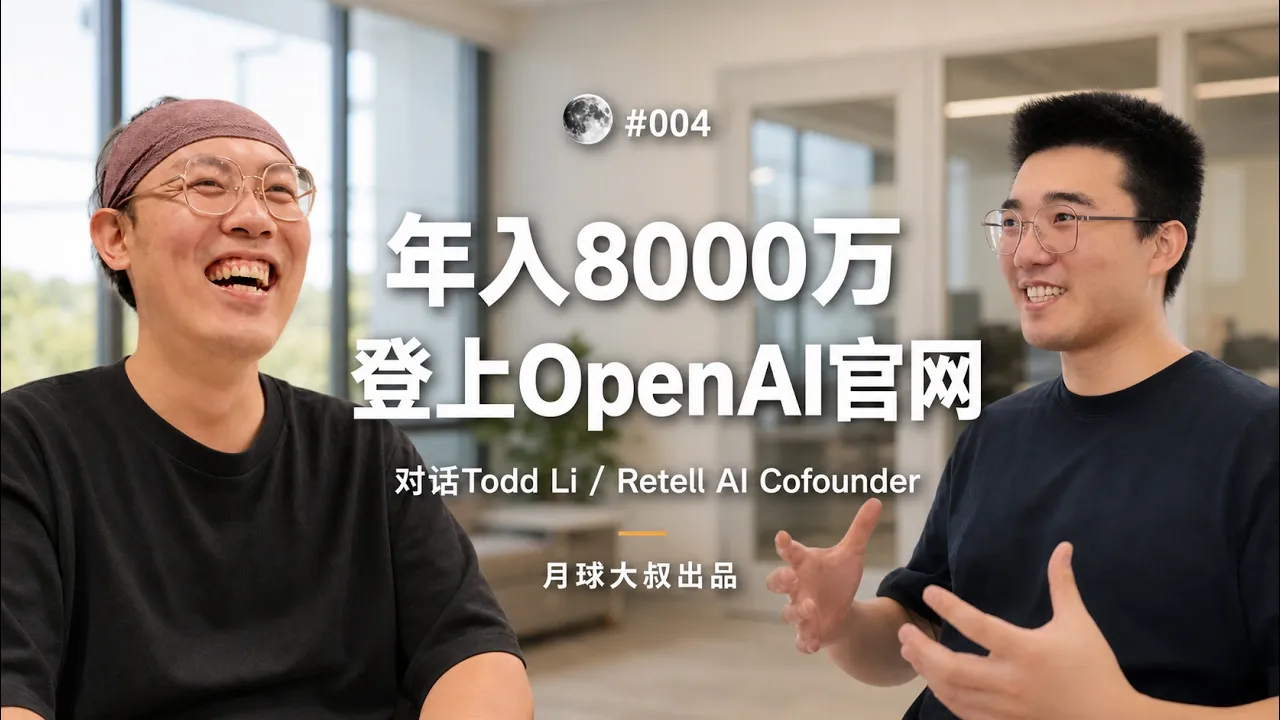
Host Uncle Moon introduces the series context—interviewing one hundred fascinating people in Silicon Valley—before joining Todd Li, co-founder of YC-backed Retell AI, which reached an $80 million annual revenue run-rate within just two years. Todd provides a walkthrough of their two-story workspace, noting the financial reality of maintaining a physical hub in the Valley: rent and utilities total roughly $50,000 every month. The company has expanded to 50 employees, deliberately arranged into clear operational hubs across the office.
Todd points out the split between their core engineering team and their commercial arm, which encompasses go-to-market (GTM) and day-to-day business operations. Despite the aggressive revenue growth, the office environment reflects a focused, pragmatic operational rhythm rather than extravagant tech-boom excess.
- **Monthly Office Overhead**: Approximately $50,000 per month (including rent and utilities) for their two-story facility.
- **Headcount**: 50 people divided primarily between Engineering, Go-To-Market (GTM), and Operations.
- **Milestone Context**: Scaled to $80M in revenue within two years of founding.
[01:16](https://www.youtube.com/watch?v=UI09mbzn8ac&t=76s) From Fortinet to Google Ads: Engineering Rigor and Early Side-Project Failures
Reflecting on his career prior to founding Retell AI, Todd details his tenure at Google, where he joined the ads algorithm team in 2022. His core engineering responsibility was optimizing Google's immense traffic pool: determining algorithmic allocation to serve the most relevant ads to users, maximizing user utility while simultaneously calculating and balancing platform revenue generation. While some entrepreneurs plunge into company-building straight out of school, Todd views his prior corporate tenures at both Fortinet and Google as indispensable. Fortinet drastically sharpened his raw technical execution, improving his software development abilities by "orders of magnitude" compared to his university graduation level. Google subsequently instilled an institutional appreciation for engineering culture, code quality standards, and the operational systems necessary to push software products to the highest possible bar.
Todd acknowledges that nearly every software engineer in Silicon Valley harbors aspirations of launching a startup, and he was no exception. From the moment he graduated, he constantly pursued entrepreneurial side ventures while holding down full-time engineering roles at Fortinet and Google. Nearly every single one of those early side projects failed. However, those cumulative trials provided invaluable foundational lessons. The turning point arrived when one of the side projects he built with his co-founders was accepted into Y Combinator. Because YC strictly mandates that founders commit full-time, the team took the leap, quit their jobs, and accepted the offer—marking the end of repetitive side-project failures and the beginning of a focused, full-time commitment.
```mermaid
flowchart TD
accTitle: Todd Li Career Path to Retell AI
accDescr: Progression from university graduation through corporate engineering at Fortinet and Google, continuous side project failures, and the Y Combinator catalyst.
subgraph CorporateFoundations["Foundational Engineering Roles"]
A["University Graduation"] --> B["Fortinet<br/>(Order-of-magnitude leap in dev skills)"]
B --> C["Google Ads Algorithm Team<br/>(Traffic allocation, code quality, scale)"]
end
subgraph SideProjects["Trial & Error Cycle"]
D["Continuous Side Ventures<br/>(Built nights and weekends)"]
D --> E["Repeated Project Failures<br/>(Compounding practical lessons)"]
end
subgraph InflectionPoint["Full-Time Commitment"]
F["Project Accepted into Y Combinator"]
F --> G["Resign from Google<br/>(Full-time requirement)"]
G --> H["Retell AI Founded"]
end
CorporateFoundations -.-> SideProjects
SideProjects --> F
```
[03:27](https://www.youtube.com/watch?v=UI09mbzn8ac&t=207s) The "Second-Generation Entrepreneur" Dynamic: Exposure, Confidence, and Endurance
The conversation turns to Todd's upbringing as a "second-generation entrepreneur" (创二代). His father launched a venture around the time Todd was born and eventually took the company public. Todd reflects candidly on how this background shaped him, noting that while privilege and exposure offered distinct advantages, they also introduced subtle handicaps. On the positive side, he absorbed real-world business dynamics through continuous osmosis. As a child, he sat beside his father during company meetings, listening to discussions he could barely parse at the time. Afterward, his father would explain the critical pitfalls to avoid, drilling into him that building a company is brutal and that the vast majority of startups fail. Having both parents work together in the business normalized entrepreneurship, removing the psychological barrier of whether a startup could realistically succeed.
Conversely, Todd admits that his background sheltered him from ordinary life hardships growing up. Because entrepreneurship is inherently painful and demands sheer grit, he considers his personal endurance threshold to have initially been somewhat lower than that of founders who clawed their way up through adversity. Furthermore, because his parents' company achieved its IPO when he was only seven or eight years old, Todd grew up after the peak existential pressures had passed. His childhood memories were dominated by the lifestyle upgrades and material comfort brought by entrepreneurial success, alongside interviews with high-profile founders like Elon Musk, Jeff Bezos, and Mark Zuckerberg, which made starting a company seem alluring and manageable. Only upon launching his own venture did he experience the true, unvarnished agony of early-stage survival.
- **Family Background**: Father founded a venture around Todd's birth; company went public when Todd was 7–8 years old; both parents worked in the business together.
- **Double-Edged Impact**: High baseline confidence and early exposure to executive problem-solving, offset by a romanticized initial perception of startups and a lower innate endurance for raw hardship.
- **Family Environment**: Entrepreneurship, fundraising, customers, and industry trends were everyday dinner topics, though Todd spent much of his youth at overseas boarding schools.
[07:47](https://www.youtube.com/watch?v=UI09mbzn8ac&t=467s) Three Generations of Mentors: Family, YouTube, and YC's Michael Seibel
When asked whether his father's prominent public success exerted undue pressure or offered genuine support, Todd emphasizes that it was overwhelmingly beneficial because every founder desperately needs mentors—a form of education that formal schooling never provides. Across his founder journey, Todd categorizes his learning into three distinct mentor groups:
First, his parents served as practical business advisors, routinely debating with him which emerging tech waves were genuine, which software products had the ingredients to succeed, and why certain models collapse. Second, Todd treats prominent startup figures and technical founders on YouTube as virtual mentors, dissecting their shared traits, thinking styles, and educational backgrounds to find parallels in his own development. Third, Retell AI's direct mentors at Y Combinator, most notably partner Michael Seibel (co-founder of Justin.tv/Twitch), provided battle-tested tactical guidance drawn from having built and scaled iconic startups from scratch.
[09:05](https://www.youtube.com/watch?v=UI09mbzn8ac&t=545s) Capital vs. Ability: Why Silicon Valley Doesn't Lack Resources
When Todd Li told his parents he was leaving Google to start a business full-time, their initial reaction was deep worry. Having navigated the entrepreneurial trenches themselves, they understood firsthand that starting a company is a high-stakes, precarious gamble. Todd had already spent nights and weekends tinkering with various side projects, none of which his parents expected to succeed. In a gesture echoing their own past, his parents had set aside a startup fund for him and asked whether he needed their money. Decades earlier, when Todd's father launched his own company, Todd's grandmother had provided the seed capital—roughly tens of thousands of yuan. His parents felt a parental duty to pass on that same lifeline. Todd, however, declined. In his view, the modern landscape has fundamentally shifted: with venture capital and institutional investors readily accessible, founders no longer rely on family savings to get off the ground.
Todd argues that in the contemporary ecosystem, particularly in Silicon Valley, resources are not the limiting factor. Money and network connections are abundant; what is scarce is founder capability and judgment. To illustrate this conviction, Todd offers a striking thought experiment: imagine Elon Musk swapped bodies with an ordinary person, retaining only his memories and drive while being stripped of every dollar and connection. Todd firmly believes that within a few years, Musk would build another massive enterprise from scratch, simply because capital naturally flows to exceptional talent. He references television experiments like *Undercover Billionaire*, where ultra-wealthy founders are dropped into unfamiliar towns with zero capital to see if they can rebuild a fortune from nothing. To Todd, money and network are merely the lagging indicators and compounded byproducts of raw ability over time. The interviewer notes that Todd’s reflective, unhurried cadence and thoughtful pauses during the conversation mirror Musk’s own analytical, introverted demeanor—speaking not to show off, but to articulate genuine, hard-won insights.
- **Generational contrast**: Todd's father received tens of thousands of yuan from Todd's grandmother to launch his business; Todd turned down his parents' startup fund, arguing institutional capital has made family seed money unnecessary.
- **The founder equation**: Capital, connections, and external resources are secondary; they are the compounded result of founder capability, judgment, and relentless skill development.
[12:04](https://www.youtube.com/watch?v=UI09mbzn8ac&t=724s) Competition and Time: The Endless World Cup of AI Startups
Reflecting on an earlier interview with Todd's father, the host brings up the two biggest hazards in entrepreneurship: the relentless pressure of time and the sudden, unannounced emergence of lethal competitors. Todd wholeheartedly agrees with that assessment, comparing startup competition to a World Cup soccer tournament where only the top one or two teams walk away with the prize. While conventional startup wisdom preaches that creating customer value inevitably yields monetary rewards, Todd points out that the advent of large language models completely upended that equation. Once generative AI leveled the playing field, virtually every technical team could deliver basic value. Consequently, customers ruthlessly gravitate toward whoever delivers the maximum value or possesses a defensible, proprietary edge.
Time works against startups because markets are in perpetual flux. Even tech behemoths like Microsoft and NVIDIA face unending waves of disruptive entrants and paradigm shifts. The moment a company discovers a lucrative niche and begins generating revenue, rivals instantly notice and build clones or superior alternatives to displace it. For Todd, this dynamic turns entrepreneurship into a road with no finish line—a continuous, exhausting climb where founders can never rest, knowing that the next technological tide and a new crop of aggressive competitors are already on the horizon.
```mermaid
flowchart TD
accTitle: The Competitive Dynamic in the LLM Era
accDescr: Diagram illustrating how foundational LLM capabilities democratize value, shifting the winning criteria entirely to execution speed and proprietary differentiation.
subgraph Baseline["Market Baseline"]
LLM["Foundation Models & Generative AI"] --> BroadValue["Broad Value Creation (Accessible to Everyone)"]
end
subgraph MarketDynamics["Competitive Pressures"]
BroadValue --> Compete["Customer Filtration: Who Delivers the Most Value?"]
NewEntrants["Sudden Rivals & Tech Shifts"] --> Compete
end
subgraph Outcome["Endless Race"]
Compete --> Winner["Top 1-2 Teams Capture Majority Value"]
Winner --> ContinuousClimb["Continuous Upward Climb: Defend against Replacements"]
end
```
[13:43](https://www.youtube.com/watch?v=UI09mbzn8ac&t=823s) YC Rejections, Pivots, and Quitting Google in the Tech Window
Todd officially left Google in January 2024 to commit to startup life full-time, a move catalyzed by a turbulent journey through Y Combinator's admissions process. The team had previously applied to YC and been rejected. That first attempt was an automated TOEFL essay-grading application; while the interviewers saw raw potential in the engineering team, they bluntly asked, "Do you have any other ideas?"—judging the business premise entirely unviable. Undeterred, the team applied a second time with a live-stream translation software prototype that translated Chinese video streams into English with roughly an eight-second latency. During this second interview, YC partner and Justin.tv/Twitch co-founder Michael Seibel inspected the demo. Given his deep domain expertise in live streaming, Seibel delivered an immediate verdict: "This idea doesn't work. But you've built the product well, and the team is strong. Would you be willing to join YC first, then consider pivoting to another idea?"
That invitation served as the turning point, coinciding with a historical realization. Looking back at paradigm shifts like the commercial internet, mobile smartphones, and cloud computing, Todd and his co-founders recognized that technological transformation windows typically remain wide open for only two to three years. The dominant companies of each era almost invariably launch within that narrow frame. When ChatGPT sparked the generative AI revolution, the team felt an acute urgency to race against the clock, knowing that waiting would forfeit the opportunity. In retrospect, Todd notes that if Retell AI had not staked its claim in the voice AI infrastructure market early in 2024, someone else would have captured the space, and entering it today would be nearly impossible given the crowded field of well-funded startups and tech giants.
- **First YC attempt**: TOEFL essay-grading software; rejected on market viability despite a positive review of the team's talent.
- **Second YC attempt**: Live-stream translation tool with an ~8-second Chinese-to-English latency; accepted by Michael Seibel under the explicit condition that they abandon the idea and pivot inside the batch.
- **The innovation window**: Technological waves (Internet, mobile, cloud, LLMs) offer an open window of approximately 2 to 3 years to establish market dominance before saturation sets in.
[15:45](https://www.youtube.com/watch?v=UI09mbzn8ac&t=945s) Execution as the Only Controllable Multiplier
When Todd resigned from Google, Retell AI did not exist. The five co-founders had spent months building and discarding a graveyard of failed side projects outside their day jobs. They possessed no validated product and no market demand, yet they had conclusively proven their execution velocity and technical chemistry to YC. Todd explains that strategic understanding inherently requires experience and maturity—areas where mentors, veteran founders, and parents can guide young founders. However, mentors cannot write code, talk to users, or ship product on a team's behalf.
Todd highlights a popular formula among successful entrepreneurs: startup success is the product of *Resources × Execution × Luck*. For a young founder starting from zero, resources and luck are completely outside their control. Execution is the sole variable they can dictate. If a team executes relentlessly, external resources and serendipitous luck eventually gravitate toward them; if execution falters, neither capital nor good fortune can save them. Teams with formidable technical muscle can cycle through multiple failed hypotheses in rapid succession, absorbing hard-earned lessons on go-to-market mechanics, product packaging, and customer behavior with each iteration. As the host underscores, agonizing endlessly over "what to choose" is a beginner's trap: picking any reasonable direction and executing ferociously yields the firsthand, ground-truth data required to pivot toward a breakout product.
- **The startup success formula**: $\text{Success} = \text{Resources} \times \text{Execution} \times \text{Luck}$. Execution is the only lever a founding team directly controls early on.
- **The role of mentors**: External advisors and partners can provide strategic frameworks and domain wisdom, but they cannot execute; founders must compensate for initial strategic blind spots through pure iteration speed.
- **Firsthand feedback loops**: Strong execution allows technical teams to test ideas rapidly, discover unvarnished market realities, and organically bridge the gap between technical capability and enterprise-ready products.
[18:10](https://www.youtube.com/watch?v=UI09mbzn8ac&t=1090s) 从语音试错中聚焦:砍掉去口音与纯 TTS,直切 AI 客服呼叫中心
从 Google 离职并全职投入创业后,团队在 YC 导师的指导下密集试错。导师每次都会花上一两个小时,向他们剖析初创公司的运作机制与商业逻辑。团队顺着语音赛道不断推演并向导师抛出各种创意,其中一个方向是“消除客服口音”——例如外包呼叫中心员工往往带有浓重口音,可以通过算法实时消除。但他们很快意识到,如果 AI 技术发展的终局是直接取代人工客服,那么“帮人工坐席去口音”这种过渡型需求迟早会归零,倒不如直接做替代人工客服的 AI 产品。
团队也考虑过只做纯粹的文本转语音(Text-to-Speech,简称 TTS)模型。但深入思考后,他们发现 TTS 的底层价值也是为了让 AI 最终接管人工客服的工作。与其做中间层的技术模型,不如直接下切到“离真实客户最近、最深的那一层商业闭环”。基于这种判断,团队最终选定了 Retell AI 的核心方向——做能够替代传统人工呼叫中心的全托管式 Voice AI 客服系统。
```mermaid
flowchart TD
accTitle: Retell AI 早期方向迭代逻辑
accDescr: 展示从消除口音和纯TTS模型收敛到全流程AI客服的决策演进过程
面对 OpenAI、Anthropic、ElevenLabs 等拥有巨大品牌认知与资本实力的大厂,Retell AI 依然能在大型企业采购中频频胜出。Todd 揭示了语音产品的核心门槛:文字客服产品存在天然的系统延迟容忍度(Buffer),大模型调用、检索增强生成(RAG)和知识库比对即便花费 10 秒以上,用户依然可以接受;但在实时语音交互中,从模型推理、推流服务器链路到网络传输,只要产生数百毫秒的停顿就会让对话显得僵硬破损。因此,语音是一个技术纵深极高的专业垂直赛道。
此外,行业中充斥着“录制一段看似流畅的 AI 电话音频发到网上爆火”的 Demo 级别产品。但从一段炫酷的 Demo 走向支撑企业级生产环境(Production)、彻底替换原有上万人呼叫中心的核心系统,中间横亘着极其复杂的链路开发、严苛的故障排查与海量稳定性磨合。在实际的采购竞标与尽调测试(Due Diligence)中,客户是靠真实指标说话的,Retell AI 依靠长期的工程积累在基准测试中持续领先。
遵循 YC“初期不要过早追求规模化(Do things that don't scale)”的理念,Retell AI 始终坚守先服务好两三家种子客户、把体验打磨到极致再扩张的节奏。YC 导师更向他们提出过一个反直觉的深刻警告:“在初创阶段,过多的客户、过多的钱,本质上可能是一种毒药(Toxic)。”
[28:37](https://www.youtube.com/watch?v=UI09mbzn8ac&t=1717s) A User's Question and the One-Week Pivot to AI Voice Agents
The shift from real-time dubbing to automated AI customer service was sparked by an unexpectedly blunt piece of user feedback. While testing Retell AI's early real-time dubbing and translation software, a user asked straightforwardly: "Why do I still have to speak, translate it, and dub it in real time? Why not have the AI speak for me?" In a startup environment saturated with conflicting feature requests and endless feedback, that single remark cut through the noise because it exposed the friction in the workflow and opened the door to immediate, undeniable market pull.
Todd Li explains that the decision to pivot was validated almost overnight by user traction. With earlier iterations, the team would grind through a month of aggressive marketing only to be met with dead silence and essentially zero paying customers. When they launched the new AI voice product, the dynamic inverted instantly: tens of thousands of users flooded into the product during the very first week. As Todd points out, when a product genuinely works and solves a painful problem, it does not require months of coaxing—it takes off immediately. Addressing the contrast between their rapid pivot and OpenAI’s seven-to-eight-year marathon, Todd notes that even OpenAI was not blindly persisting on one static concept. OpenAI repeatedly changed direction, testing various applications from gaming bots in DOTA to raw developer APIs, before discovering that the conversational chatbot was the breakout interface.
```mermaid
flowchart TD
accTitle: The Pivot to AI Customer Service
accDescr: Diagram illustrating the shift from manual dubbing to automated AI voice agents based on immediate user adoption.
subgraph EarlyStage["Early Product Attempt"]
A["Real-Time Translation & Dubbing"] --> B["Friction: User still required to speak"]
B --> C["Marketing push: 1 month, near-zero traction"]
end
subgraph Breakthrough["The Pivot"]
D["User Feedback: 'Why not have AI speak for me?'"] --> E["Automated AI Voice Agent"]
E --> F["Market Pull: Tens of thousands of users in Week 1"]
end
C -.->|"Pivot triggered"| D
```
- **The Catalyst**: A user questioned the utility of live dubbing their own voice when an artificial intelligence could handle the entire conversation autonomously.
- **The Signal**: Previous products showed zero adoption after a month of marketing; the AI voice agent attracted tens of thousands of active users within its first seven days.
- **Product Validation Principle**: If an offering truly delivers high leverage and utility, adoption is swift; prolonged lack of traction is usually a signal to pivot rather than double down on an ignored thesis.
---
[30:45](https://www.youtube.com/watch?v=UI09mbzn8ac&t=1845s) Five Founders, $3M ARR, and Living on Cloud Credits
Throughout this entire pivot and subsequent explosive growth, the company operated as a tight-knit unit of just five co-founders. Remarkably, Retell AI did not hire its first external engineer until the company had already scaled to $3 million in annual recurring revenue (ARR). During their time in Y Combinator, the five founders drew negligible personal compensation, treating capital efficiency as a core competitive advantage.
When YC invested $500,000, the capital felt virtually inexhaustible because the team refused to bloat their overhead with premature hiring. An office space in the Bay Area cost only a few thousand dollars a month, founder salaries were kept at bare-minimum living expenses, and their cloud compute infrastructure was largely subsidized. Through startup support initiatives, the team secured nearly $1 million in free credits across major hyperscalers: $300,000 from Amazon Web Services (AWS), $300,000 from Google Cloud Platform, and another $300,000 from Microsoft Azure. Todd reflects that in modern Silicon Valley, capital and compute resources are rarely the bottleneck. While starting a tech company twenty or thirty years ago meant scraping for scarce angel funding and purchasing physical servers, today’s barrier to entry is not access to tools—it is pure execution velocity and clarity of mindset.
- **Founder Team Lean Efficiency**: Scaled to $3 million ARR with only the 5 original co-founders before hiring their first software engineer.
- **Runway Math**: The $500,000 YC check was projected to last several years because monthly burn was limited to bare-bones living costs and a modest office space.
- **Cloud Subsidies**: Secured roughly $900,000 to $1,000,000 in credits across AWS ($300k), Google Cloud ($300k), and Microsoft Azure ($300k).
- **Silicon Valley Ecosystem**: Abundant capital accelerators and cloud credit programs mean founders are rarely constrained by technical infrastructure.
---
[32:27](https://www.youtube.com/watch?v=UI09mbzn8ac&t=1947s) The True Value of YC: Cultivating Judgment and the Mentor Effect
Addressing the common Silicon Valley debate over whether YC takes too much equity for its $500,000 check, Todd argues that critics who dismiss YC as "useless" miss its true function. For Retell AI, the cash was secondary; the primary value lay in restructuring their strategic thinking and refining their business judgment.
Todd breaks founder ability into two halves: execution and judgment. Coming from engineering backgrounds at top tech companies and voluntarily sustaining 996 work schedules, the team already possessed top-tier technical execution muscles. What they lacked was seasoned entrepreneurial judgment. Todd credits their YC mentor with being the single variable that saved them from failure. Whenever the founders brainstormed new feature sets or product ideas, their mentor consistently stepped in to dismantle and "kill the bad ones" before the team could waste months pursuing dead ends. Todd likens a founder without an experienced mentor to a doctoral student trying to navigate a PhD without an advisor: technically capable, but blind to structural pitfalls. He contrasts this with academic entrepreneurship courses taught by professors who have never built a viable enterprise, emphasizing that founders must learn directly from mentors who have achieved verified, real-world success.
- **Execution vs. Judgment**: Big tech and 996 routines trained their ability to build quickly, but they required outside mentorship to decide *what* to build.
- **Killing Bad Ideas**: The primary intervention of an elite mentor is disqualifying flawed concepts early, preventing wasted engineering cycles.
- **Access Barrier**: Established founders rarely respond to unsolicited cold outreach; YC serves as a credentialed gateway to access mentors who would otherwise be unreachable.
---
[34:53](https://www.youtube.com/watch?v=UI09mbzn8ac&t=2093s) YC as an Amplifier and Execution as the Ultimate Benefactor
Beyond strategic advice, YC acted as a high-powered distribution engine that changed the market's perception of the team. Prior to entering Y Combinator, Todd notes that Retell AI could not get a single venture capitalist on the phone; after their batch was announced, investors actively competed to set up introduction calls. Furthermore, YC’s distribution machinery—its internal Bookface forum, official Twitter/X platform, and LinkedIn reach—provided an instant broadcast mechanism for product milestones.
Todd characterizes this marketing leverage as "just a little fuel": an amplifier that only works if the underlying product and team are exceptionally strong. Without rapid execution, external exposure and capital are meaningless. Because cloud credits and developer tools have eliminated the need to max out personal credit cards or mortgage a house, prospective founders can run iterative, low-risk side projects while keeping their day jobs. Demonstrating high-velocity delivery on small projects proves genuine capability and passion far better than any theoretical pitch deck. In Todd’s view, founders should not obsess over hunting down a mythical "benefactor" or patron; rapid, relentless execution is the greatest benefactor a startup can have.
- **Investor Access**: Shifted overnight from zero institutional investor interest to inbound meeting requests solely due to the YC signal.
- **Distribution Channels**: Amplification through YC's internal founder network, social media footprint, and community channels.
- **Low-Risk Era**: Side projects can be developed and validated in off-hours without taking catastrophic financial risks or plunging into debt.
- **Core Principle**: "Your execution is your greatest ally"—competence, speed, and high-quality delivery naturally attract resources and support.
---
[37:59](https://www.youtube.com/watch?v=UI09mbzn8ac&t=2279s) Debating Michael Seibel: The Counterintuitive Wisdom of Lean Hiring
The relationship between Retell AI and YC was not characterized by passive agreement; Todd recalls intense, frequent arguments with their managing partner and group partner, Michael Seibel. The founders frequently found Seibel’s advice counterintuitive, pushing back hard on his strategic constraints—only to realize later that Seibel was consistently correct.
The most contentious debate revolved around headcount. As the company started picking up commercial momentum, the founders instinctively wanted to scale the team, but Seibel repeatedly ordered them to "hire as few people as possible." Seibel insisted that surplus capital and premature hiring are active liabilities that mask structural flaws. According to Seibel’s philosophy, the founders needed to max out their own operational capacities and become extraordinarily capable operators first; only then would they have the discernment, authority, and baseline standards required to attract and manage exceptional talent.
- **Mentorship Friction**: Todd and his co-founders routinely pushed back against Michael Seibel’s directives during batch sessions.
- **The Lean Hiring Mandate**: Seibel consistently mandated hiring as few people as possible, warning against the trap of throwing bodies at operational problems.
- **Founder Capability First**: Elite hiring requires the founders themselves to master every function first, establishing the standard before delegating it.
- **Capital Discipline**: Excess capital and bloated staffing are startup hazards rather than assets, distorting product focus and burning leverage.
[38:43](https://www.youtube.com/watch?v=UI09mbzn8ac&t=2323s) Pivoting to Enterprise: Doing the "Hard but Right Thing"
Todd reflects on early guidance from Y Combinator about managing capital and targeting the right customer base. Having excessive capital without the judgment to allocate it wisely turns founders into the proverbial "spoiled rich kid" who hands out bars of gold until opportunistic people flock around simply to extract cash. Early on, YC mentors urged the Retell AI team to shift their focus toward enterprise clients rather than staying comfortable with small- and medium-sized businesses (SMBs). While SMBs are invaluable for early adoption, rapid iteration, and refining product design, they inherently suffer from lower retention rates and smaller contract values. In contrast, enterprise customers are notoriously difficult to close, but once onboarded, their net dollar retention (NDR) and overall stickiness are vastly superior. In B2B software, securing even a single cornerstone enterprise account can establish and sustain the entire company.
Transitioning upmarket, however, is a grueling process that directly clashes with human psychology. Small business owners are typically responsive, eager to experiment, and quick to shower founders with validation and praise. Enterprise buyers, by contrast, frequently ignore outreach or demand endless procurement cycles, forcing founders to swallow their pride and plead for business. Moving attention away from enthusiastic SMB fans to chase unresponsive corporate giants feels deeply counterintuitive, yet Todd emphasizes that this is precisely what YC means by choosing the "hard but right thing." Entrepreneurship at its core requires going against natural human instincts at nearly every critical juncture.
- **Capital Discipline**: Excessive cash without strict discernment leads to waste, attracting vendors and partners who merely seek to drain startup funds.
- **Customer Dynamics**: SMBs provide essential early product-market validation, but enterprise accounts deliver the high retention, strong NDR, and defensibility required to build a lasting business.
- **Psychological Barrier**: Founders must willingly leave the emotional comfort of eager, complimentary SMB users to pursue challenging enterprise clients who offer minimal initial encouragement.
---
[40:31](https://www.youtube.com/watch?v=UI09mbzn8ac&t=2431s) The Five Co-Founder Dynamic and Equal Equity Distribution
While conventional startup wisdom suggests limiting a founding team to two or three individuals, Retell AI launched with five co-founders—making them one of the largest founding teams in their YC batch. Todd explains that their group coalesced organically: three of them were classmates at the University of Southern California (USC), and the remaining two were former colleagues from previous tech jobs. Although large founding teams were once viewed with skepticism, Silicon Valley has increasingly embraced multi-founder setups, as seen in companies like Anthropic (with seven founders) or Nvidia's foundational team under Jensen Huang. To maintain harmony, Retell AI divided responsibilities cleanly across three core pillars: two co-founders lead Go-To-Market (sales and marketing), two direct product development and engineering, and Todd oversees operations.
```mermaid
flowchart TD
accTitle: Retell AI Five Co-Founder Functional Architecture
accDescr: How the five co-founders divide responsibilities across GTM, Engineering, and Operations.
subgraph GTM["Go-To-Market"]
F1["Co-Founder: Sales"]
F2["Co-Founder: Marketing"]
end
subgraph ProdEng["Product & Engineering"]
F3["Co-Founder: Product"]
F4["Co-Founder: Engineering"]
end
subgraph Ops["Operations"]
F5["Todd Li: Operations & President"]
end
```
The team adhered strictly to YC's counterintuitive rule of splitting equity equally among all co-founders. Todd strongly endorses this philosophy, noting that unequal splits run counter to human nature and foster long-term resentment. When one founder holds 40% and another holds 10%, disparities in perceived contribution and external validation inevitably generate friction. YC's stance is definitive: "if you won't split equity equally with someone, why would you call them a co-founder?" By standardizing equal ownership from day one, Retell AI ensured that every founder feels valued, fully aligned, and invested in the collective upside.
- **Founding Team Size**: Five co-founders (three USC alumni and two former tech industry colleagues).
- **Functional Division**: Two dedicated to GTM (sales and marketing), two dedicated to core product and software engineering, and Todd running operations.
- **Equity Philosophy**: Equal equity division mitigates resentment, fosters mutual respect, and prevents the corrosive internal politics that unequal splits create over multi-year horizons.
---
[42:42](https://www.youtube.com/watch?v=UI09mbzn8ac&t=2562s) Constructive Conflict, Shared Trust, and Founding with Friends
Todd challenges the common adage warning entrepreneurs against starting businesses with friends. While critics argue that business failures can ruin personal friendships, Todd contends that having a deep, pre-existing foundation of personal trust is an indispensable asset for an early-stage startup. In high-stress startup environments, building trust from scratch with relative strangers introduces severe fragility. When longstanding friends debate, disagreements are interpreted objectively as disputes about the product or strategy rather than personal attacks. Furthermore, co-founders serve as essential checks and balances against individual ego; without peers who possess equal standing and authority to push back, a solo founder is prone to assuming "I'm the smartest. I'm the hardest-working. I'm the best," leading down dangerous strategic paths with no one capable of intervening.
In parallel with shared trust, sustainable execution requires genuine role alignment. Todd observes that founders should focus exclusively on domains they naturally enjoy, pointing out that "if you made me do sales, I'd be miserable." Because each co-founder is deeply passionate about their specific area—whether engineering, product design, marketing, sales, or operations—the team operates with high autonomy. Each domain owner has full leeway to make operational calls within their sphere, relying on their partners' implicit trust and expertise rather than micromanaging across disciplines.
- **Founding with Friends**: Pre-existing relationships remove the friction of having to construct trust under acute startup pressure, ensuring hard feedback is taken professionally rather than personally.
- **Ego Balancing**: A multi-founder structure prevents any single individual from going rogue or pursuing flawed instincts unchecked.
- **Intrinsic Role Fit**: Longevity and performance depend on founders operating strictly within domains they enjoy, enabling independent execution and domain authority.
---
[45:00](https://www.youtube.com/watch?v=UI09mbzn8ac&t=2700s) Operations as the Company Engine and Scaled Decision-Making
As President, Todd describes his operational role as the company's multifaceted "jack-of-all-trades," perfectly suited to his personal preference for cross-functional problem-solving over repetitive tasks. While the engineering and product founders spend their days immersed deeply in code and system architecture, and the sales and marketing leads focus purely on pipeline and customer acquisition, operations encompasses everything required to keep the organization running: finance, talent acquisition, human resources, customer support and success, legal, regulatory compliance, IT, and internal data infrastructure.
```mermaid
flowchart TD
accTitle: Evolution of Todd Li's Operational Responsibilities
accDescr: Progression from writing backend code to scaling corporate infrastructure.
subgraph EarlyStage["Early Stage: Technical Scaffolding"]
T1["AWS Cloud Infrastructure"]
T2["Low-Latency Voice Server Tuning"]
T3["CI/CD Automation Pipelines"]
end
subgraph MidStage["Growth Stage: Business Logistics"]
T4["Billing & Invoicing Workflows"]
T5["Recruiting & Talent Sourcing"]
end
subgraph ScaleStage["Scale Stage: 50–100 Headcount"]
T6["Internal IT & Access Security"]
T7["Corporate VPN & Compliance"]
T8["Dedicated Department Formation"]
end
EarlyStage --> MidStage --> ScaleStage
```
This operational scope evolved naturally alongside Retell AI's growth. In the earliest days, Todd wrote production code, architected the initial AWS cloud backend, built the CI/CD deployment pipelines, and optimized the server configurations required to keep long-running voice sessions operating with ultra-low latency. As paying users arrived, Todd took on invoicing, billing automation, and hiring sourcers and recruiters. Once the organization expanded toward 50 to 100 employees, operational complexity surged, necessitating structured internal IT departments to manage device security, VPN access controls, and compliance frameworks. In terms of governance, Retell AI relies on a two-tiered decision model: 99% of daily choices are resolved autonomously by the relevant domain expert, while fundamental strategic shifts require all five founders to deliberate until unanimous alignment is reached before execution begins.
- **Operational Breadth**: Todd manages finance, HR, recruiting, legal, customer success, compliance, data systems, and enterprise IT.
- **Hands-on Technical Roots**: Todd personally authored Retell AI's first-generation AWS infrastructure, CI/CD automation, and low-latency voice runtime servers.
- **Scaling Thresholds**: Organizational growth from early traction to 50–100 employees triggered the organic spin-out of dedicated departments, particularly around corporate IT, compliance, and enterprise security.
- **Governance Framework**: 99% of localized decisions are made independently by individual functional leads, while company-defining decisions require unanimous five-way founder consensus.
---
[47:50](https://www.youtube.com/watch?v=UI09mbzn8ac&t=2870s) Early Growth Channels and Developer Traction
Following their strategic pivot to voice AI and the rebranding as Retell AI, the startup unlocked explosive top-line momentum, rapidly scaling its annual revenue run-rate to $3 million. Todd attributes their initial wave of customer acquisition not to expensive outbound campaigns, but to direct engagement with core developer and startup ecosystems. Upon launching the platform, the founders showcased the technology directly on technical forums where early adopters congregate—specifically publishing on the internal YC community forum (Bookface), Hacker News, and Product Hunt.
- **Revenue Velocity**: Surged to a $3 million annual revenue run-rate shortly after pivoting to the Retell AI voice platform.
- **Initial Launch Outlets**: Seeded distribution via grassroots technical communities, leading with YC's internal network, Hacker News, and Product Hunt to capture early adopters and technical builders.
[48:16](https://www.youtube.com/watch?v=UI09mbzn8ac&t=2896s) Social Media Virality, Silicon Valley Backing, and Usage-Based Pricing
When Retell AI first launched, the team posted product demos across X (Twitter) and LinkedIn. The response was immediate and overwhelmingly positive: early users tested the voice technology and remarked that they had "never experienced anything like this." The demo spread completely organically until several of Silicon Valley’s most influential figures took notice. Garry Tan, Paul Graham, and Box CEO Aaron Levie reposted the demo to their massive followings. Commenters expressed disbelief at the natural conversational quality, asking, "How does it sound so much like a real person?" and calling the breakthrough "incredible."
The sudden viral wave instantly crashed Retell AI’s servers. Rather than panicking, the founders treated the outage as an unambiguous roadmap: the immediate priority was simply to scale server capacity and handle the surge. When asked about marketing strategy, Todd explains his pragmatic view that marketing only works if there is a genuinely remarkable product beneath it: "If the product isn't useful, even if everyone in the world sees it, no one will stick around." Inquiries began flooding in about how the underlying architecture achieved such natural responsiveness.
As traffic surged, revenue followed naturally through a usage-based monetization model. Rather than charging fixed subscription tiers, Retell AI charges a per-minute rate based on the duration of calls handled by configured voice agents—functioning much like token-based pricing for LLMs. Once incoming traffic converted into paying callers, managing the business remained grounded in straightforward execution: when infrastructure buckled under traffic, they added compute capacity; when users requested features, engineering built them.
- **Viral Amplifiers:** Reposts by YC leaders Garry Tan and Paul Graham, as well as Aaron Levie, catalyzed rapid organic discovery across the tech ecosystem.
- **Pricing Mechanics:** Purely usage-based, billed by the minute according to call duration for custom-configured voice agents.
- **Product-First Philosophy:** Marketing consumes at most 10% of company focus, resting on the premise that distribution without product utility leads to zero retention.
[50:01](https://www.youtube.com/watch?v=UI09mbzn8ac&t=3001s) Narrowing the Focus: From AI Girlfriends to Enterprise Contact Centers
Because Retell AI is built as an open platform where developers can configure voice agents for arbitrary tasks, early adopters experimented with a wild variety of use cases—including individuals setting up calls with "AI girlfriends." The founders realized they needed to be highly deliberate about where to focus their engineering energy. From the vast array of creative and casual applications hitting the platform, they evaluated which single direction offered the highest long-term enterprise value and probability of enduring success: building automated AI contact centers for large corporations.
Winning enterprise contracts required climbing a structured customer maturity ladder. In the beginning, Retell AI worked exclusively with small startups and local clients. For these smaller users, customer support was hands-on and informal; the Retell team would simply set up dedicated group chats to guide users through implementation and resolve after-sales questions on the fly.
As small-customer traction provided social proof, mid-sized businesses began approaching the company. These accounts brought significantly higher standards, introducing rigorous legal scrutiny, formal due diligence, and mandatory SOC 2 compliance certifications. Successfully serving mid-market accounts in turn unlocked the credibility required to pitch Fortune 500 enterprises.
```mermaid
flowchart TD
accTitle: Retell AI Customer Progression Ladder
accDescr: The three-stage evolution of Retell AI's customer base from small users to large enterprises.
subgraph Small["Small Customers"]
A["Open Platform Sign-ups"] --> B["Ad-hoc Group Chat Support"]
end
subgraph Mid["Mid-Sized Customers"]
C["SOC 2 Compliance"] --> D["Legal Due Diligence"]
end
subgraph Enterprise["Large Enterprises"]
E["Physical Access Controls & Audits"] --> F["Dedicated On-Site FDE Deployment"]
end
B --> C
D --> E
```
[51:26](https://www.youtube.com/watch?v=UI09mbzn8ac&t=3086s) Winning Enterprise Giants: CVS and Rigorous Compliance
Closing major enterprise contracts proved to be an exhausting, detail-heavy journey. Todd highlights their engagement with CVS—the largest pharmacy healthcare retailer in the United States—as a prime example of the friction and discipline required. Enterprise buyers operate under immense regulatory and security mandates, requiring Retell AI to overhaul both its technical systems and physical workspace.
To satisfy enterprise compliance protocols, Retell AI had to install physical access-control security systems in their office—a requirement Todd jokes no startup founder ever imagines dealing with in the early days. Compliance frameworks also demanded strict endpoint firewalls across employee laptops, rigorous data compartmentalization to prevent customer information leaks, and ironclad offboarding processes to ensure former personnel immediately forfeit system access. Todd stresses that taking enterprise trust seriously means never bluffing: if a startup is unwilling or unable to meet every compliance hurdle, telling the customer they can handle the workload is a betrayal of trust that could leave customer data vulnerable.
- **Flagship Enterprise Client:** CVS (America's largest retail pharmacy and healthcare chain).
- **Physical & Digital Security Requirements:** Biometric/badged office access control, mandatory workstation firewalls, granular access permissions, and strict audit trails.
- **Enterprise Ethics:** A zero-compromise approach toward data governance—refusing to sell to accounts whose regulatory requirements the startup cannot strictly guarantee.
[52:16](https://www.youtube.com/watch?v=UI09mbzn8ac&t=3136s) Scaling to $80M+: Pragmatism, Customer Value, and the FDE Model
Reflecting on how Retell AI scaled beyond $80 million in revenue, Todd attributes their trajectory to unyielding pragmatism rather than growth hacks. While product-led virality kickstarted their early momentum, sustaining enterprise expansion required building an enterprise delivery machine. Todd notes that internal discussions rarely dwell on revenue milestones for their own sake; instead, the core metric is whether Retell delivers 10x to 100x the dollar value that customers pay.
To bridge the gap between software capabilities and complex enterprise workflows, Retell AI established a dedicated Forward-Deployed Engineering (FDE) and sales organization. The combined team began with seven people, grew to ten, and is actively hiring for twenty additional roles. These forward-deployed engineers work directly on-site alongside enterprise clients, embedding into their technical operations to guarantee that complex contact center integrations deploy flawlessly.
- **Revenue Milestone:** Surpassed $80 million in annualized run-rate/revenue.
- **Value Equation:** Prioritizing long-term contracts where Retell generates 10x–100x ROI for the customer.
- **Team Expansion:** Sales and FDE team scaling from an initial 7 members to 10, with 20 active open headcount requisitions to support on-site enterprise rollouts.
[54:34](https://www.youtube.com/watch?v=UI09mbzn8ac&t=3274s) "Going Fast Can Be Slow": Quality Over Sales Hype
Todd reflects on the immense institutional courage it takes for a Fortune 500 corporate giant to adopt mission-critical infrastructure from a young startup. Large corporations almost universally prefer doing business with established enterprise vendors. When an enterprise signs with an emerging startup, they are placing their professional reputation on the line, demanding deep empathy and accountability from the startup's team across R&D, sales, and compliance.
This responsibility has shaped an internal philosophy where thoroughness supersedes raw velocity: "Speed isn't even the most important thing anymore. Doing something well is what matters most. Sometimes, when you do it properly, you actually move faster. Going fast can be slow, and going slow can be fast." Todd draws on his personal experience running procurement and purchasing B2B software for Retell AI. He expresses deep frustration with software vendors whose aggressive sales reps make wild, exaggerated promises about non-existent features, only for the buyer to discover post-purchase that the software is broken or incomplete. Todd vows never to inflict that experience on Retell’s customers, warning that overpromising might capture an invoice this month, but inevitably triggers cancellations and reputational ruin the next.
Instead, Retell AI models itself after enduring, product-obsessed hardware and software leaders like Apple and Tesla, where sheer product quality compels customers to buy repeat generations. Todd also points to high-performing Chinese hardware manufacturers—such as Anker (who is a Retell AI client), DJI, and Insta360—noting that their relentless commitment to craftsmanship and product reliability now outperforms many traditional Western legacy brands.
[56:15](https://www.youtube.com/watch?v=UI09mbzn8ac&t=3375s) The Competitive Moat: Bridging the Gap from Demo to Production
Addressing the mounting wave of competitors flooding the voice AI market—including prominent Silicon Valley startups offering humanlike voices and low-latency audio—Todd demystifies the perceived competition. In his view, the overwhelming majority of teams entering the voice AI space possess nothing more than a flashy demo. Having built comparable demo technology three years prior, Todd asserts that a polished video or isolated web call represents less than 10% of the journey.
The true competitive barrier is the grueling engineering bridge from "demo to production." A demo does not demonstrate whether real-world enterprise callers can successfully accomplish transactions, handle accents and interruptions, or integrate with legacy backend databases under peak load. Todd points out that when enterprise prospects run rigorous Request for Proposal (RFP) bake-offs, Retell AI consistently wins on measured accuracy, reliability, and real-world system stability, outperforming competitors whose public marketing footprint is significantly larger than their actual technical substance.
- **The Demo vs. Production Chasm:** Surface-level latency and natural acoustics in a lab environment are commoditized; production-grade orchestration across telephony edge networks is the real moat.
- **RFP Dominance:** Retell AI regularly beats larger, better-funded incumbents during direct, empirical head-to-head enterprise procurement evaluations.
[57:25](https://www.youtube.com/watch?v=UI09mbzn8ac&t=3445s) Retell AI 的长期规划:从单一语音走向全链路产品矩阵与大模型训练
面对短期技术竞争,Todd 指出部分对手虽然表面声势浩大,但实际语音落地能力依然有所欠缺,这构成了 Retell AI 当前的关键窗口期优势。当被问及成立三年后的长远目标时,Todd 将公司的战略重心归纳为三大核心抓手:
第一是继续深耕并大幅拓展产品外延(product surface)。Retell AI 不愿仅止步于一个单纯的“语音 AI 工具”,而是计划进军全流程呼叫工作流:
- **真人坐席平台**:以往企业在人与人通话场景下必须接入第三方客服 SaaS,Retell AI 准备将人机协同与真人坐席通话统一收拢,打通完整呼叫链路;
- **专属 CRM 替代方案**:针对以电话沟通为主要获客/触达渠道的企业,Retell AI 计划直接替代 Salesforce、HubSpot 等传统软件,成为专门针对语音生态的垂直数据系统。
第二是深耕模型层面的后训练(post-training),Retell AI 正在招揽顶尖 AI 研究员,持续提升核心模型在真实对话场景中的表现。第三则是扩充销售和现场部署工程师(Forward-Deployed Engineers, FDE)团队,全力支持更多头部企业级大客户的定制部署与落地。Todd 强调,公司将已积累的丰厚利润全力反哺到这三大长线业务中。
## Notable quotes
> [13:43](https://www.youtube.com/watch?v=UI09mbzn8ac&t=823s) Do you have any other ideas?
> [13:43](https://www.youtube.com/watch?v=UI09mbzn8ac&t=823s) This idea doesn't work. But you've built the product well, and the team is strong. Would you be willing to join YC first, then consider pivoting to another idea? — Michael Seibel
> [28:37](https://www.youtube.com/watch?v=UI09mbzn8ac&t=1717s) Why do I still have to speak, translate it, and dub it in real time? Why not have the AI speak for me?
> [37:59](https://www.youtube.com/watch?v=UI09mbzn8ac&t=2279s) hire as few people as possible — Michael Seibel
> [38:43](https://www.youtube.com/watch?v=UI09mbzn8ac&t=2323s) hard but right thing — Todd Li
> [40:31](https://www.youtube.com/watch?v=UI09mbzn8ac&t=2431s) if you won't split equity equally with someone, why would you call them a co-founder? — Y Combinator
> [42:42](https://www.youtube.com/watch?v=UI09mbzn8ac&t=2562s) I'm the smartest. I'm the hardest-working. I'm the best — Todd Li
> [42:42](https://www.youtube.com/watch?v=UI09mbzn8ac&t=2562s) if you made me do sales, I'd be miserable. — Todd Li
> [48:16](https://www.youtube.com/watch?v=UI09mbzn8ac&t=2896s) never experienced anything like this — Early users
> [48:16](https://www.youtube.com/watch?v=UI09mbzn8ac&t=2896s) How does it sound so much like a real person? — Commenters
> [48:16](https://www.youtube.com/watch?v=UI09mbzn8ac&t=2896s) If the product isn't useful, even if everyone in the world sees it, no one will stick around. — Todd Li
> [54:34](https://www.youtube.com/watch?v=UI09mbzn8ac&t=3274s) Speed isn't even the most important thing anymore. Doing something well is what matters most. Sometimes, when you do it properly, you actually move faster. Going fast can be slow, and going slow can be fast. — Todd Li
> [01:03:00](https://www.youtube.com/watch?v=UI09mbzn8ac&t=3780s) 大家已经付出了极大的心血与努力。如果大家这么拼命帮公司做成了,自己最后却没有实现财务自由,这绝对是不公平的。 — Todd Li
## Mentioned
Aaron Levie, Anker (安克创新), Anthropic, Apple, AWS, Bookface, Box, CVS, DJI, DoorDash, ElevenLabs, Elon Musk, Fortinet, Garry Tan, Google, Google Cloud Platform (GCP), Hacker News, HubSpot, Insta360, Jeff Bezos, Jensen Huang (黄仁勋), Justin.tv, Lenovo (联想), Mark Zuckerberg, Mercury, Meta, Michael Seibel, Microsoft Azure, Naval Ravikant, Nvidia, OpenAI, Opendoor, OpenTable, Oura Ring, Paul Graham, Product Hunt, Retell AI, Salesforce, Tesla, Todd Li (李正韬), Twitch, Undercover Billionaire, University of Southern California (USC), Y Combinator (YC), 月球大叔
## Video description
本期采访嘉宾是 Retell AI 联合创始人 Todd Li。我们聊了他从 Google 工程师到 YC 创业者的经历、Retell AI 如何在两年内做到 8,000 万美元营收,以及公司如何与 OpenAI 等大厂竞争。访谈还涉及企业客户、团队管理、招聘理念、薪酬福利和财富自由。
时间点:
00:00:00:片头金句——财富自由、正面对阵 OpenAI,以及“客户和钱太多也可能有害”。
00:00:35:Todd Li 与 Retell AI 登场,参观办公室并介绍团队规模与分工。
00:01:16:回顾 Google 广告算法经历,以及早期创业项目的连续试错。
00:03:27:讨论“创二代”家庭背景、父母创业的影响和三类创业导师。
00:09:01:讲述离开 Google 创业的决定,以及硅谷资源、个人能力和竞争逻辑。
00:13:43:从两次申请 YC 到全职创业,解释技术窗口期与团队执行力的重要性。
00:18:25:Retell AI 从多个语音创意转向 AI 客服,介绍代表客户、营收与产品壁垒。
Retell AI创8000万美元年营收 李正韬凭深度交付对抗OpenAI
面对巨头竞争,语音AI初创团队无需盲目扩招或拼通用基座,而应聚焦大厂边缘化的垂直场景,通过极速执行力与最后一公里定制交付构建生产级壁垒。
Todd Li 详细讲述了自己从 Google 离职并凭借强悍工程执行力打磨业余项目、最终通过 YC 孵化创立 Retell AI 的过程。面对大厂竞争,公司避开通用大模型战场,专注于毫秒级低延迟的实时语音 AI 呼叫中心,以深度的工程交付与合规能力拿下 CVS 等头部企业客户,在两年内达成 8,000 万美元 ARR。访谈中他拆解了早期靠 5 位联合创始人平分股权起步、善用云厂商免费算力、抵制盲目招人与资本毒药等底层实战法则。最后,他分享了以“带薪试工”替代刷题的务实招聘哲学,以及通过顶级薪酬福利确保全力拼搏的员工共享企业成功、实现财富自由的初心。
语音 AI 初创 Retell AI 在成立两年内实现 8,000 万美元年经常性收入(ARR),覆盖超 3,000 家付费客户,并成功打入 CVS、联想、OpenTable 等大型企业的生产级客服场景。 (0:35)
在 ARR 达到 300 万美元之前,团队仅靠 5 位联合创始人运转且全员平分股权;创始人强调必须亲自在一线跑通 0 到 1 验证业务,警惕过早扩招和资金毒药掩盖产品缺陷。 (30:45)
初创对抗大厂策略主打“一米宽、一公里深”的垂直技术纵深,通过前置部署工程师(FDE)深度整合企业业务流,依靠低延迟抗打断的生产级稳定性击败同类竞品。 (20:41)
团队摒弃传统算法刷题,推行带薪实地试工一周的招聘机制,并提供超越 Google 与 Meta 的顶配薪酬福利,承诺以全员财富自由为公司奋斗终极目标。 (60:03)
Reading summary
Retell AI 联合创始人李正韬指出,初创公司在通用大模型时代的制胜关键在于将极窄垂直赛道做到极致,并依靠高密度的执行力与克制的人力扩张,将技术从演示转化为企业级交付闭环。
执行力为唯一杠杆与防范资源陷阱 (15:45)
李正韬提出创业公式为“资源×执行力×运气”,对于零起步团队,唯有执行力完全可控。他认为硅谷并不匮乏资本与网络资源,早期融资过剩或盲目扩充团队反而是“毒药”——若创始人自身认知未达标,便无法考核与驾驭顶级人才。Retell AI 在达到 300 万美元年经常性收入(ARR)前仅由 5 位联合创始人运转,依靠约 100 万美元的各大云厂商算力补贴与极低开支度过孵化期。
在组织治理上,团队采纳 YC 建议采取五人平分股权的架构,杜绝长期利益分歧。日常 99% 的事务由负责销售、工程、产品和运营的对应负责人独立决策,仅有公司战略级转向才需五人一致同意。李正韬强调,创始人必须亲自在业务泥坑中跑通从 0 到 1 的流程,才能形成对交付质量的有效把控。
从浅层工具收敛至企业级语音客服 (18:10)
在经历托福作文批改、直播实时翻译等多次试错被拒后,团队进入 YC 并持续推演方向。因意识到“去口音”与纯文本转语音(TTS)等中间层技术终会被完全替代人工的终局淘汰,加上早期用户一句“为何不直接让 AI 代替我讲话”的反馈,团队在一周内迅速转型为全托管式 AI 语音客服平台。
产品发布后通过 Hacker News 与社交网络获得病毒式传播,并确立了按通话时长计费的用量商业模式。但团队并未停留在小微客户的狂欢中,而是主动选择推进周期漫长、流程苛刻的大企业客户。通过落地办公区物理门禁、设备防火墙与 SOC 2 强合规改造,Retell AI 成功切入 CVS、联想、安克创新等大型客户,以此建立远高于中小客户的净留存率(NDR)与商业壁垒。
纵深工程跨越 Demo 到生产的鸿沟 (20:41)
面对 OpenAI 等科技巨头的潜在挤压,李正韬认为初创公司的破局点在于业务优先级的错位。大厂的垂直业务往往仅由个别总监带领的非核心团队负责,而初创公司则是全员压上。文字客服对系统延迟容忍度可达数秒,但实时语音交互产生数百毫秒的停顿就会导致体验破损,具有极高的工程纵深。
李正韬强调,行业内充斥着表面流畅的 Demo,但能支撑超高并发、处理真实通话插话与口音,并无缝对接企业内部历史数据库的系统屈指可数。为跨越“从 Demo 到生产”的鸿沟,Retell AI 组建并持续扩张现场部署工程师(FDE)团队,深入客户现场搭建专属业务流,以一站式底座加定制化交付的混合模式应对采购竞标。
实战导向选拔与全员财富自由承诺 (60:03)
在招聘上,Retell AI 彻底弃用传统的 LeetCode 算法刷题考核,转为考察真实工程问题解决能力与原始学习速度,并针对高潜力候选人推行为期一周的带薪实地试工,以验证代码习惯与文化契合度。目前公司团队包含 50 名正式员工和 50 名外包人员,其中招聘人员占比极高。
为了匹配高强度工作与严苛筛选,公司提供高于 Meta 和 Google 的市场前 5% 薪酬,以及每日 70 美元餐饮额度、全额医保等多项福利。李正韬表示,团队的终极目标是在公司走向 IPO 或流动性退出时,让全力拼搏的全体成员实现真正的财务自由,否则在道德与机制上均属“根本性的不公平”。
Retell AI 当前年营收已达约 8,000 万美元,并计划将利润反哺于统一真人坐席与垂直电话 CRM 的全链路布局,以及核心模型的后训练。然而,随着基础模型厂商持续优化原生多模态实时交互,初创团队凭借工程集成构建的护城河是否能长期抵御大模型能力的下沉,仍是该模式面临的长远考验。
Source quotes
[13:43] Do you have any other ideas?
[13:43] Michael Seibel: This idea doesn't work. But you've built the product well, and the team is strong. Would you be willing to join YC first, then consider pivoting to another idea?
[28:37] Why do I still have to speak, translate it, and dub it in real time? Why not have the AI speak for me?
[37:59] Michael Seibel: hire as few people as possible
[38:43] Todd Li: hard but right thing
[40:31] Y Combinator: if you won't split equity equally with someone, why would you call them a co-founder?
[42:42] Todd Li: I'm the smartest. I'm the hardest-working. I'm the best
[42:42] Todd Li: if you made me do sales, I'd be miserable.
[48:16] Early users: never experienced anything like this
[48:16] Commenters: How does it sound so much like a real person?
[48:16] Todd Li: If the product isn't useful, even if everyone in the world sees it, no one will stick around.
[54:34] Todd Li: Speed isn't even the most important thing anymore. Doing something well is what matters most. Sometimes, when you do it properly, you actually move faster. Going fast can be slow, and going slow can be fast.
[63:00] Todd Li: 大家已经付出了极大的心血与努力。如果大家这么拼命帮公司做成了,自己最后却没有实现财务自由,这绝对是不公平的。
Original transcript
[0:00] We want everyone here to
achieve financial freedom.
[0:01] That's our goal.
[0:04] Everyone is already working incredibly hard.
[0:05] If you work this hard,
[0:06] but still can't achieve financial
freedom after succeeding,
[0:08] I think that would be
[0:10] fundamentally unfair.
[0:11] Fundamentally, even if we go
[0:12] head-to-head with OpenAI,
[0:14] we're only competing with
one of their directors.
[0:16] In other words, it's our entire
[0:17] company against one director there. But
[0:19] when it comes to
[0:21] that person's dedication,
[0:22] and their overall understanding, there's no way
[0:25] it can match ours.
[0:28] Our mentor told us that, to some
[0:30] degree, too many customers and too much money
[0:33] can be toxic.
[0:34] Interviewing 100 fascinating
people in Silicon Valley.
[0:36] This is Uncle Moon.
[0:38] Today we're joined by Todd Li,
[0:39] co-founder of Retell AI, whose team joined YC.
[0:42] In just two years, the company has reached
[0:44] $80 million in revenue.
[0:46] This is their office.
[0:47] Let's start with a room tour.
[0:49] Welcome to our office, everyone.
[0:51] How much does it cost each month
[0:53] to run a two-story office like this?
[0:55] About $50,000 a month,
[0:56] including utilities.
[0:57] The company has grown quite a bit.
[0:59] How many people do you have now?
[0:59] We have 50 people now. Right.
[1:01] This is our engineering team.
[1:02] The engineering team.
[1:04] And this is go-to-market,
[1:06] our commercial team,
[1:07] along with operations.
[1:08] They handle company operations.
[1:09] That's it for our quick room tour.
[1:12] Now let's move on to the in-depth interview.
[1:16] Let's begin today's in-depth interview.
[1:17] Before we talk about Retell AI,
[1:18] let's talk about your earlier experience.
[1:21] In 2022,
[1:22] you moved to Google's ads team.
[1:24] What exactly did you do at Google?
[1:26] I mainly developed advertising algorithms.
[1:30] Let's say
[1:31] Google has a huge amount of traffic.
[1:32] how do you allocate that traffic
[1:34] so that you can show
[1:36] the most relevant ads?
[1:37] For example, you want to
[1:39] help customers as much as possible,
[1:41] while also considering how
much revenue it can generate.
[1:43] That's roughly what I did.
[1:44] So you were optimizing that whole traffic pool.
[1:47] Did your time at Google
[1:49] help you later as a founder?
[1:51] I think it helped a lot.
[1:52] Some people
[1:55] start a company right after graduation, but
[1:57] from my own experience,
[1:58] both of my previous jobs
[2:00] helped me tremendously.
[2:01] At Fortinet, for example,
[2:03] my development skills
[2:05] improved by orders of magnitude
from when I graduated.
[2:07] And then,
[2:08] at Google,
[2:10] its overall system,
[2:11] including the culture
[2:13] and its standards for code quality,
[2:15] showed me how to take a
[2:16] product to the highest possible level.
[2:18] All of that helped me a lot.
[2:21] When did you first want to start a company?
[2:22] And when did you begin acting on it?
[2:24] Honestly, I think almost every
[2:25] software engineer working in Silicon Valley
[2:27] has thought about starting a company.
[2:29] I was no exception.
[2:31] Right after graduating,
[2:32] I already wanted to start something.
[2:34] I tried many different projects.
[2:37] While
[2:38] I was at Fortinet and Google,
[2:39] I worked on projects of my own,
[2:41] and nearly all of them failed.
[2:42] But I also gained a lot of experience.
[2:44] Looking back now,
[2:45] all of those experiences were valuable.
[2:48] As for how Retell AI started,
[2:50] my
[2:52] co-founders and I
[2:54] were working on one of those projects,
[2:56] and it got into YC.
[2:57] That became the catalyst.
[2:58] YC requires founders to work full-time,
[3:01] so we all decided to accept the offer.
[3:03] I think that was
[3:04] the real turning point.
[3:05] Before that, I had just kept failing.
[3:07] So before then, you kept
[3:10] trying things in your spare time,
[3:12] failing and trying again.
[3:14] What people saw later was that you built
[3:16] Retell AI and succeeded on the first try,
[3:17] but before that, you'd failed countless times.
[3:19] Is that right?
[3:20] Yes. I think succeeding
on the first try is rare.
[3:21] Maybe
[3:22] some people can do it,
[3:23] but from what I've seen,
[3:25] most people try many times.
[3:27] Before we dive deeper into your founder journey,
[3:29] let's talk about another label people give you:
[3:32] being a second-generation entrepreneur.
[3:34] I really want to use this opportunity to discuss
[3:36] what it takes to accomplish something.
[3:38] It takes more than just a few resources.
[3:41] It requires personal ability, the right moment,
[3:43] support from a team,
[3:45] and some luck, among other things.
[3:47] Only when all of these factors come together
[3:49] can you build something meaningful.
[3:51] So by taking a closer look
[3:54] at your background as a
second-generation entrepreneur,
[3:57] I hope we can give everyone an honest account
[3:59] of why you were ultimately able to succeed.
[4:03] Your father
[4:03] started a company around the time you were born,
[4:05] and later took it public.
[4:07] How did his entrepreneurial journey
[4:11] help and influence you?
[4:13] I think it had many positive effects,
[4:14] but also some negative ones.
[4:16] On the positive side,
[4:18] I learned a lot from his words and example.
[4:21] When he was running the company,
[4:22] for example,
[4:23] when he was in meetings,
[4:24] I would listen nearby.
[4:25] He would also tell me
[4:26] what matters when you're building a company,
[4:28] and that it is extremely difficult.
[4:31] Most startups fail, for instance.
[4:34] Those were
[4:34] important lessons with real depth.
[4:36] But some things
[4:38] may, to some extent,
[4:40] have worked against me.
[4:44] For example, growing up,
[4:45] I probably experienced
[4:50] less hardship than most people.
[4:52] But entrepreneurship
[4:53] is inherently painful.
[4:54] So
[4:56] endurance
[4:57] is extremely important.
[4:58] I think my own endurance
[4:59] might be a little weaker than other people's.
[5:01] If you look at it
[5:02] in terms of my upbringing,
[5:03] those are the two sides:
[5:05] both positive and negative effects.
[5:06] That's how I see it.
[5:07] You just mentioned that
[5:10] he sometimes brought you to meetings.
[5:11] Could you tell us more?
[5:13] Were there any interesting stories
[5:15] or examples you can share?
[5:18] I couldn't really understand
the conference calls,
[5:19] because they dealt with
specialized company matters.
[5:21] But afterward, he would explain things to me,
[5:22] such as what I absolutely
needed to watch out for.
[5:23] Because he had previously
[5:24] encountered certain difficulties,
[5:26] or considered certain things important,
[5:27] he would tell me about them.
[5:29] Also, I grew up in that kind of environment.
[5:32] Both my parents worked at the same company.
[5:34] They more or less
[5:36] started the business together.
[5:37] That environment itself
[5:39] helped me,
[5:40] because it made me believe
[5:41] that a startup could succeed.
[5:43] Of course, the odds are low,
[5:45] but I knew it was possible.
[5:46] That gave me much more confidence.
[5:49] That was
[5:50] a significant shift for me.
[5:52] So your whole family are entrepreneurs.
[5:55] Your mother is one too.
[5:56] When your family
[5:57] sat down for a meal,
what was the atmosphere like?
[5:59] Would you talk about startups,
fundraising, customers, and work?
[6:02] Were those common topics?
[6:03] Yes, very often.
[6:05] We talked about those things a lot.
[6:06] But growing up, I didn't
actually get to have meals
[6:08] with my parents that often.
[6:10] I went abroad at a fairly young age,
[6:11] and most of the time
[6:12] I was at boarding school.
[6:15] Normally,
[6:16] you saw how hard entrepreneurship
was for your parents,
[6:18] right?
[6:18] Yes, extremely hard.
[6:20] So when you became a founder yourself,
[6:22] weren't you afraid?
[6:23] Weren't you worried that once
the company truly got going,
[6:26] you'd be exhausted every day?
[6:28] I honestly didn't think that far ahead.
[6:29] I think everyone
[6:30] comes to entrepreneurship
[6:32] with significant misconceptions.
[6:33] For example, I watched Elon Musk's
[6:36] interviews,
[6:37] as well as Jeff Bezos,
Mark Zuckerberg, and others.
[6:39] It made entrepreneurship seem
[6:40] like it wasn't that difficult.
[6:42] But only
[6:43] after you experience it yourself
[6:44] do you realize how hard it is.
[6:45] Also, my parents' company
[6:47] went public when I was
[6:51] around seven or eight.
[6:52] After that,
[6:54] they weren't under quite as much pressure.
[6:55] What I saw instead were
[6:57] the benefits that came with their success,
[7:00] such as improvements
[7:01] in our life and material circumstances.
[7:02] So in my mind, entrepreneurship always
[7:04] seemed like something wonderful.
[7:05] I see. So
[7:06] in reality, it's extremely painful.
[7:08] Yes.
[7:08] What you saw
[7:10] was what came after the IPO,
[7:11] including your family's
improved financial situation.
[7:14] You were old enough to remember that.
[7:15] That made it seem as though
[7:16] once a startup succeeds,
[7:18] it brings nothing but benefits.
[7:19] You didn't see
[7:20] the dark and difficult
parts of entrepreneurship.
[7:22] In a way, that may have been a good thing.
[7:23] If you'd seen how hard it was,
[7:24] you might never have started a company.
[7:26] That's true.
[7:27] Here in Silicon Valley,
[7:28] so many founders are gathered in one place.
[7:30] Right.
[7:30] There are countless founders.
[7:31] Exactly.
[7:32] And you see countless successful people.
[7:33] Right.
[7:34] You can also attend
[7:35] all kinds of founder events.
[7:37] You can see what happens to people
[7:38] after they succeed,
[7:39] and before anyone has
[7:41] made it, you can support one another.
[7:42] I think that's one reason Silicon Valley
[7:43] continues to produce startups.
[7:46] Later,
[7:47] when your family's company went public,
[7:49] your father became very successful.
[7:54] For your personal growth,
[7:56] was that more pressure or more help?
[7:58] I think it was more helpful.
[8:00] Mainly because
[8:01] founders really need mentors.
[8:04] Right.
[8:05] On my entrepreneurial journey,
[8:06] I've had three groups of mentors.
[8:08] The first was, of course, my father,
[8:09] along with my mother.
[8:11] They would tell me
[8:11] which things founders
[8:13] need to pay attention to.
[8:15] We also often discussed
[8:18] things like
[8:18] which trends were emerging,
[8:19] which products might succeed,
[8:22] and why they might succeed.
[8:23] What ingredients would they need?
[8:26] The second group of mentors
[8:28] were the people I saw
[8:30] on YouTube.
[8:31] They shared a lot,
[8:34] and displayed certain common traits.
[8:36] I later realized
[8:37] that I had some of those traits too.
[8:38] Whether in personality,
[8:41] my field of study,
[8:42] or other areas, I could relate to them.
[8:43] So I learned a great deal from them.
[8:45] The final group included
[8:46] our YC mentor, Michael Seibel.
[8:48] He is a founder himself,
[8:50] and a co-founder of Twitch.
[8:52] So
[8:52] he taught us a great deal as well.
[8:54] When it comes to entrepreneurship,
[8:57] I think having mentors is essential,
[8:59] because school doesn't teach you these things.
[9:01] When you told your father,
[9:03] “I'm leaving Google to start a company,”
[9:05] what was your parents' first reaction?
[9:07] I think they were fairly worried.
[9:09] They had been through it themselves
[9:10] and knew that starting a company
[9:11] is an incredibly risky undertaking.
[9:15] But they also knew
[9:17] I'd been working on projects before.
[9:19] They just didn't think those
projects would succeed.
[9:21] Right.
[9:21] Also,
[9:23] they had set aside some startup capital for me.
[9:25] They were asking
[9:26] whether I would use their
money to start the company.
[9:28] Because
[9:30] when my father started his business,
[9:31] my grandmother gave him
[9:33] what I think was tens of thousands
of yuan. I don't remember exactly.
[9:35] That was his startup capital.
[9:36] So my parents
[9:37] wanted to do the same for me.
[9:38] But I think the world has changed.
[9:40] There are more and more investors now,
[9:42] so founders no longer need
their parents' initial capital.
[9:45] I think the world today
[9:46] increasingly prioritizes ability.
[9:50] That's
[9:51] my personal impression.
[9:52] Let me explain what I mean.
[9:54] Resources,
[9:57] especially in Silicon Valley,
[9:58] are abundant.
[10:00] If someone can't start a company
[10:02] or make something work,
[10:03] it's definitely not because
resources are scarce.
[10:05] It has more to do with
[10:06] one's judgment, abilities,
team, and other factors.
[10:09] It's a combination of factors.
[10:10] You can't attribute your lack of success
[10:12] to insufficient resources.
[10:13] Is that what you mean?
[10:14] Yes. For example,
[10:17] imagine Elon Musk
[10:19] and an ordinary person
[10:22] swapped bodies.
[10:23] Suppose Elon Musk
[10:24] kept all of his memories.
[10:26] In other words, this ordinary person
[10:28] would suddenly become extremely capable,
[10:29] but would have no
[10:30] resources—
[10:30] no money,
[10:31] or network.
[10:33] I believe he could build something
huge within a few years.
[10:36] Because Silicon Valley
[10:37] never lacks money.
[10:39] What it lacks are capable founders.
[10:42] That has always been the case.
[10:44] That's why improving your
own abilities matters most.
[10:45] I firmly believe that.
[10:47] I once watched a show
[10:50] about millionaires starting over from zero.
[10:52] It took several millionaires
[10:53] and billionaires and dropped
them somewhere unfamiliar
[10:56] to see whether they could
start over from nothing.
[10:58] I believe one of them succeeded.
[11:00] That's why I firmly believe
[11:01] successful wealthy people have their own
[11:03] logic for building successful companies.
[11:04] A successful founder
[11:06] can be placed somewhere entirely new
[11:07] and still succeed again and again.
[11:08] I think money,
[11:11] resources, and connections
[11:13] are ultimately
[11:15] a reflection of a person's abilities.
[11:17] They're the product of ability
compounded over time.
[11:20] Exactly.
[11:21] I completely understand.
[11:22] Right.
[11:23] Watching how you've spoken in this interview,
[11:25] yes,
[11:26] if people watch more
[11:28] Elon Musk interviews,
[11:29] they'll notice that Todd's
way of expressing himself
[11:32] really is very similar to Elon Musk's.
[11:35] He's definitely not an
extremely extroverted person
[11:36] who holds forth on every subject.
[11:39] He's genuinely trying to share
[11:41] the thoughts from deep inside him.
[11:44] Personally,
[11:44] I've interviewed many people
[11:46] and met many more.
[11:48] Sometimes, people who appear very introverted
[11:50] and speak thoughtfully,
[11:52] unhurriedly,
[11:53] even with a few stumbles,
[11:57] are incredibly valuable to hear from.
[11:58] There is so much
[11:59] to discover in what they say.
[12:01] Let's continue the interview.
[12:03] All right.
[12:04] So,
[12:05] when I interviewed your father,
[12:07] he said
[12:08] the greatest challenges in entrepreneurship are
[12:10] time, and an opponent who may
[12:14] suddenly appear without warning.
[12:15] Regarding those two points,
[12:16] how did you see them before?
[12:17] And now, after two or three years as a founder,
[12:19] how do you see them?
[12:20] Right.
[12:21] I completely agree.
[12:22] Entrepreneurship is fundamentally
a competitive environment.
[12:24] Right?
[12:24] You can think of it like being on a soccer team
[12:26] playing in the World Cup.
[12:29] Basically, only the top one or two teams win.
[12:31] That's how it feels to me.
[12:33] Another point is,
[12:35] when people discuss entrepreneurship,
[12:38] they often say
[12:38] that you're providing value.
[12:40] If you provide that value,
[12:42] people will reward you accordingly.
[12:43] That's
[12:44] the money you can earn.
[12:46] Then you can use that reward
[12:47] to create even more value.
[12:50] But don't forget:
[12:52] once large language models arrived,
[12:53] everyone could provide that value.
[12:55] Yet only the strongest provider
[12:56] can truly capture the reward,
[12:58] because customers will ask,
[12:59] “Who can give me the most value?”
[13:00] So fundamentally,
[13:02] when everyone can provide value,
[13:04] it still comes down to
[13:05] who can provide more of it,
[13:07] or who has
[13:08] something uniquely theirs to offer.
[13:09] Time is difficult
[13:10] because the market never stops changing.
[13:12] Even giants like
[13:15] Microsoft and NVIDIA
[13:16] continually face
[13:17] new technologies
[13:18] and new competitors.
[13:19] They keep emerging.
[13:21] If a company is making money,
[13:22] people can see it.
[13:24] They'll want to build
[13:26] a similar product,
[13:27] or create a better one and replace it.
[13:29] That's why I think entrepreneurship
[13:32] is a road with no end.
[13:34] You have to keep climbing incredibly hard,
[13:35] but there may always be
[13:37] new competitors appearing,
[13:39] along with new waves of technology.
[13:41] That's true.
[13:42] Now let's officially
[13:43] dive into the story of building Retell AI.
[13:46] According to the official website,
[13:47] you left Google in January 2024
[13:50] to work on Retell AI full-time.
[13:52] What made
[13:53] you feel that you had to leave then?
[13:55] You mentioned YC earlier.
[13:56] Were there any other reasons?
[13:59] We applied to YC twice.
[14:00] The first application failed.
[14:02] Our first product was
[14:04] an app that graded TOEFL essays.
[14:05] We did get an interview,
[14:08] but the first thing
[14:10] our YC interviewer asked was,
[14:11] “Do you have any other ideas?”
[14:12] They thought our team was good,
[14:13] but they thought
[14:15] our business direction was completely wrong.
[14:16] For our second application,
[14:19] we built
[14:22] live-stream translation software.
[14:23] It had a delay of about eight seconds
[14:25] and could translate a Chinese
livestream into English.
[14:28] During the second interview,
[14:29] the interviewer was YC partner Michael Seibel.
[14:31] He was already a veteran
founder in livestreaming.
[14:33] After seeing our idea, he again said,
[14:35] “This idea doesn't work.
[14:37] But you've built the product well,
[14:38] and the team is strong.
[14:39] Would you be willing
[14:40] to join YC first, then consider
[14:42] pivoting to another idea?”
[14:44] I think that was the catalyst.
[14:45] Another factor was that
[14:47] after ChatGPT took off,
[14:49] we began
[14:51] to research
[14:53] the patterns that follow the
emergence of new technology.
[14:56] Think of the internet,
[14:58] mobile technology, or cloud technology.
[15:00] After a new technology appears,
[15:02] its window of opportunity
[15:03] usually lasts only two or three years.
[15:06] Most companies that ultimately succeed
[15:08] are founded during that window.
[15:09] So at the time, we were
racing against the clock.
[15:11] We wanted to move quickly
[15:13] and try different projects
[15:14] to see which one could gain traction.
[15:16] Then we could build that one out.
[15:17] What happened later suggests
[15:20] we were probably right.
[15:21] Because if we hadn't
[15:23] entered the voice AI space,
[15:24] there would have been
[15:25] other people doing it.
[15:26] As for people entering the space now,
[15:28] I think they probably won't succeed,
[15:30] because there are already
[15:31] many competitors.
[15:33] Whether startups
[15:35] or industry giants,
[15:37] everyone is moving into this space.
[15:39] So if you enter now,
[15:40] you'll have a very hard time winning customers.
[15:42] Yes, I think it would be very difficult.
[15:44] Right.
[15:45] So on the day you quit,
[15:46] Retell AI didn't exist yet.
[15:48] Correct.
[15:49] You'd simply been
[15:51] trying countless products in your spare time,
[15:52] and all of them had failed.
[15:53] But YC liked your team
[15:54] and asked you to become
full-time founders first,
[15:56] then develop the product over time.
[15:57] Is that what happened?
[15:57] Yes. We had proven
[15:59] our team's capabilities.
[16:00] Right.
[16:01] But we still had neither a product
[16:02] nor a market.
[16:05] I think the most important
thing for a founding team
[16:07] is the ability to execute.
[16:08] Strategic understanding
[16:10] depends heavily on experience.
[16:11] That's where mentors can help.
[16:12] Whether they're your parents,
[16:15] teachers at school,
[16:16] or successful founders,
[16:18] all of them can offer
[16:19] strategic advice and experience.
[16:22] But they can't execute for you.
[16:24] So for a founding team,
[16:26] it's normal to lack insight
[16:28] or a good strategy at first.
[16:30] The most important thing is still execution.
[16:32] I've heard many
[16:34] successful founders say
[16:35] that startup success equals resources
times execution times luck.
[16:38] It's the product of all three.
[16:41] That's the idea.
[16:42] Early in a young founder's journey,
[16:45] the only thing they can control is execution.
[16:47] If you execute well,
[16:49] people will eventually come to help you.
[16:50] But if you execute poorly,
[16:51] you won't get the other two factors either.
[16:53] Exactly. If you execute well,
[16:54] it's okay to try things almost at random.
[16:55] I remember that at YC,
[16:57] there were other teams
[16:58] their initial
[16:59] ideas didn't work either.
[17:00] But I later noticed that
teams with strong execution
[17:02] and strong technical skills
[17:04] could try several ideas in succession,
[17:06] and eventually one might take off.
[17:07] Along the way, they gain experience
[17:09] about what might work
[17:10] and what might not.
[17:11] On the technical side,
[17:12] they also learn
[17:13] how to turn technology into a product.
[17:15] There's a lot of knowledge involved,
[17:17] including go-to-market.
[17:19] After a team
[17:20] has gone through several experiments,
[17:22] it can usually find its own way forward.
[17:25] That's why I think
[17:26] execution remains the most important thing.
[17:27] I completely agree.
[17:28] We get many questions from viewers
[17:30] who keep asking, “What should I choose?”
[17:32] What I want to tell everyone is this:
[17:35] what you choose truly isn't that important.
[17:37] Just pick something,
[17:39] then execute like crazy.
Build one thing; if it fails,
[17:42] build another. If that fails too,
[17:43] keep building.
[17:44] Eventually, you'll find
[17:46] that one direction works.
[17:47] Right.
[17:48] Choosing well at the start
[17:49] doesn't guarantee success.
[17:50] What seems like a good choice now
[17:51] is based only on your current understanding
[17:53] and today's environment.
[17:55] What truly matters is execution,
[17:57] which gives you the freshest
firsthand information.
[18:00] Then you keep adjusting,
[18:01] and execution ultimately carries you forward.
[18:03] Speed is the foundation of everything.
[18:05] Yes, exactly.
[18:06] So the five of you
[18:08] had already worked together for a long time,
[18:10] and YC believed in your team.
[18:12] So
[18:13] what you thought was, “Okay,
[18:14] if YC wants us to become full-time founders,
[18:15] we'll do it.”
[18:16] That's the full story of how you
left your jobs to start a company.
[18:18] Once you did, you began experimenting again.
[18:21] How long did it take
[18:22] to arrive at the idea for Retell AI?
[18:24] At that time,
[18:26] our mentor would give us
[18:27] advice,
[18:28] and explain
[18:29] how the startup world worked.
[18:31] We learned an enormous amount then.
[18:32] We'd talk for an hour or two each time.
[18:34] We would constantly
[18:36] pitch him different ideas,
[18:38] all of them related to voice.
[18:40] I remember one idea
[18:41] was to help people with accents.
[18:45] For example, some people
[18:46] working in call centers have accents.
[18:47] Our product could remove those accents.
[18:51] But then we realized
[18:54] that “removing accents”
[18:56] would soon be a thing of the past.
[18:58] If AI eventually eliminates
the need for human agents,
[19:00] why would anyone still need this product?
[19:01] We might as well build
[19:03] an AI product that replaces human agents.
[19:05] We also had another idea:
[19:06] building text-to-speech, or TTS.
[19:09] But then again,
[19:11] why build TTS?
[19:12] TTS is
[19:14] technology that turns text into speech,
[19:15] in the form of a model.
[19:16] Why build it?
[19:17] Fundamentally, it's also meant
[19:19] to let AI take over
[19:22] customer-service work from humans.
[19:23] So we might as well go directly
[19:25] to the deepest layer,
[19:28] the layer closest to the customer.
[19:30] That's how we ultimately pivoted
to the idea for Retell AI.
[19:33] I see.
[19:33] Could you explain exactly
[19:35] what service Retell AI provides?
[19:37] You can think of us as
[19:39] a voice-AI customer-service call center.
[19:41] That's one way to describe it.
[19:41] Take a B2C company, for example.
[19:43] It may have millions of customers,
[19:45] or even tens or hundreds of millions.
[19:48] Such companies commonly run
[19:49] a call center with thousands of agents,
[19:51] or even tens of thousands,
[19:52] answering calls around the clock
[19:54] and providing customer service.
[19:55] But it isn't
[19:59] limited to customer support.
[20:01] It also includes sales,
[20:03] payment collection,
[20:05] and various
[20:08] marketing-related use cases.
[20:11] We can handle all of those.
[20:13] Right.
[20:14] Currently,
[20:16] our annual revenue is about $80 million.
[20:19] We have more than 3,000 customers.
[20:21] Some are well-known companies,
[20:25] including OpenTable and Opendoor.
[20:29] We also serve
[20:30] high-profile startup Mercury,
[20:32] that's right.
[20:33] along with consumer-electronics companies,
[20:35] such as Anker,
[20:36] Lenovo,
[20:40] and CVS.
[20:41] In AI customer service,
[20:44] OpenAI,
[20:45] Anthropic,
[20:46] and ElevenLabs are all building products.
[20:47] Yet you've still won
[20:49] so many major customers.
[20:51] What won them over?
[20:53] I don't think those industry giants
[20:56] are actually doing as well as they appear.
[20:57] Here's why.
[20:59] Well,
[21:00] they work on many different projects,
[21:02] whereas voice is
[21:04] an extremely deep field.
[21:06] It's much harder than
text-based customer service.
[21:08] With text,
[21:09] your
[21:10] model,
[21:11] knowledge base,
[21:12] and every other component
[21:14] can have ten seconds or more
[21:16] for computation.
[21:19] In other words, you have a buffer.
[21:20] But with voice,
[21:21] all the components,
[21:22] including inference,
[21:23] the servers,
[21:25] and every connection,
[21:28] all work differently.
[21:29] That's why focus matters so much here.
[21:32] Another point is that
[21:33] everyone can build an impressive demo.
[21:35] They can record an AI phone call,
[21:37] post it online,
[21:38] and get a positive reaction.
[21:39] But going from a demo
[21:44] to something a company will accept
[21:46] and deploy as a working customer-service system,
[21:48] one that truly replaces
its existing call center,
[21:49] is
[21:51] a very long journey.
[21:52] And you'll encounter an
enormous number of problems.
[21:55] We've gone deeper than anyone in this area.
[21:57] When customers conduct
procurement and due diligence,
[21:59] our product consistently comes out ahead.
[22:01] After completing their tests,
[22:03] they generally conclude that ours is the best.
[22:04] That's why they choose us.
[22:05] It isn't because
[22:08] we have a name as big as OpenAI's.
[22:10] Yes
[22:11] There's no way we'd have OpenAI's
level of brand recognition.
[22:13] But after hearing your explanation,
[22:14] I can clearly see that
[22:15] these companies may appear to offer voice
[22:17] or customer-service products,
[22:19] but those products may sit within
[22:21] a small, overlooked team.
[22:23] That team may not get many resources,
[22:24] because it doesn't generate much revenue.
[22:26] It may not even be
[22:27] a top priority.
[22:29] So they don't invest much in it,
[22:31] and the product isn't as good.
[22:33] You, meanwhile, are a
small, highly focused team.
[22:37] You focus on one narrow point
[22:38] and go incredibly deep:
[22:40] one meter wide,
[22:42] one kilometer deep.
[22:43] That's how an entrepreneur once put it.
[22:45] By doing that—
[22:46] and by being
[22:47] the best team in this field—
[22:49] you can beat
[22:51] those seemingly unbeatable giants.
[22:54] That makes perfect sense to me.
[22:55] Stories like this in Silicon Valley
[22:57] happen all the time.
[22:59] An investor once told me
[23:01] that a large company only has a few A-teams—
[23:03] truly top-tier teams.
[23:04] Only a handful.
[23:06] You're not competing with the whole company.
[23:08] What matters is whether you're up against
[23:10] one of its A-teams.
[23:12] If the group competing with you
[23:14] isn't an A-team in this field,
[23:16] and you are,
[23:17] success is only a matter of time.
[23:19] After hearing your example,
[23:20] I feel it confirms once again
[23:22] what I sensed from all this information.
[23:25] Yes, exactly.
[23:26] I think
[23:27] it's extremely hard for one company
[23:28] to innovate across many different fields,
[23:31] because each field
[23:32] requires
[23:32] incredible depth.
[23:34] In practice, if we
[23:35] go head-to-head with OpenAI,
[23:37] we're only competing with one director's team.
[23:39] It's our entire company
[23:40] against one team under that director.
[23:41] But that team's
[23:42] overall commitment to the problem—
[23:44] its dedication—
[23:45] and its understanding
[23:47] could never match
[23:49] ours.
[23:51] If, however, we built
[23:53] the same model as OpenAI
[23:55] and competed head-to-head,
[23:56] or even entered its second-biggest area,
[23:58] coding agents,
[24:00] we couldn't beat them.
[24:02] Voice just isn't
[24:03] that big a priority for them.
[24:06] That's fair to say.
[24:08] And voice itself
[24:09] is an incredibly deep field.
[24:10] For example,
[24:12] serving our enterprise customers
[24:14] is an extremely complex process.
[24:16] It can take us—
[24:17] after signing a contract—nearly
[24:19] a full year to
[24:22] fully replace their contact center.
[24:24] There are many rounds of testing:
[24:26] we keep building and testing,
[24:28] validate product stability,
[24:31] and work through
[24:33] call-related features.
[24:35] We also have to migrate
[24:37] their existing calling workflows to us.
[24:39] All of that takes a long time.
[24:42] That reminds me of
[24:43] something Naval said:
[24:45] in the previous era, development was expensive,
[24:48] so companies built SaaS products
[24:51] to serve as many businesses as possible.
[24:54] Today, development is cheaper,
[24:57] so founders need to
[24:59] go deep into a company's workflow
[25:01] and stay tightly integrated with it.
[25:03] They need Forward Deployed Engineers
[25:06] to help companies make a deep AI transition.
[25:10] That's what creates a moat
[25:11] and makes the solution harder
[25:13] for competitors to replace quickly.
[25:15] Your example
[25:17] really deepened my understanding of this model.
[25:20] What's your take on that?
[25:22] Yes, I agree.
[25:23] If it's just
[25:25] a highly standardized product,
[25:27] then
[25:28] it won't be worth as much.
[25:31] Most of its features
[25:33] may be irrelevant to that customer,
[25:35] and a standardized product
[25:36] can never go as deep as
[25:37] one built specifically
[25:39] for that company.
[25:40] It simply can't be as powerful.
[25:41] What we offer is
[25:42] more of a hybrid model.
[25:43] Our platform
[25:47] can provide every voice-related capability,
[25:49] all in one place.
[25:52] But the last-mile delivery
[25:54] still has to be tailored to each company.
[25:56] We help them build the final workflow.
[25:59] That reflects a classic YC lesson:
[26:02] don't worry about
[26:04] scaling from day one.
[26:06] First, take your service
[26:08] to two or three companies
[26:10] and make it exceptional.
[26:11] Make them absolutely love it.
[26:12] That's a great place for a startup to begin.
[26:15] Exactly. At the beginning,
[26:17] you don't need much money
[26:17] or many people.
[26:19] Our mentor told us that, in some ways,
[26:21] too many customers and too much money
[26:24] can be toxic.
[26:27] Take having too many customers.
[26:28] What problems can that cause?
[26:30] Suppose you're just getting started.
[26:31] There are five of you,
[26:33] and you somehow have $500 million in the bank.
[26:35] Everyone would say,
[26:37] having $500 million just sitting
[26:39] in the bank isn't a good thing.
[26:40] Why collect interest on it?
[26:42] Turn that money into people.
[26:44] Hire a hundred salespeople,
[26:45] a hundred engineers,
[26:47] and go build the business.
[26:48] But the founder—
[26:50] especially a first-time founder—
[26:52] probably has no idea
[26:54] how to hire great people.
[26:55] They'll likely hire the wrong people,
[26:57] and those people
[26:59] won't build a great product.
[27:01] A big part of entrepreneurship
[27:03] is developing yourself.
[27:06] For a company to be strong,
[27:08] the founder has to be its strongest person.
[27:10] I don't mean in any one specialty.
[27:11] I mean overall.
[27:12] Taken as a whole,
the founder must be the strongest.
[27:14] Only then can they hire
[27:17] people who surpass them in their specialties.
[27:20] They also have to work the hardest.
[27:22] The idea that I can
[27:23] sit in the office drinking tea
[27:25] while a team does all the work?
[27:26] That's impossible.
[27:27] At our company,
[27:28] we've never seen that.
[27:30] The founder always dives in first,
[27:33] works like crazy,
[27:34] gets the process working,
[27:37] then brings someone in to replicate it.
[27:39] And whoever takes over
[27:40] usually won't do it as well as
[27:43] the founder did.
[27:44] Quality drops,
[27:46] so you have to work hard
[27:48] to bring it back up.
[27:49] So for a startup,
[27:51] the most important question is
[27:55] whether the founder can
[27:57] level themselves up first.
[27:59] It's not about being weak yourself
[28:01] and trying to recruit a group of stars.
[28:04] Why would those stars work for you?
[28:06] You can't hire Jensen Huang to work for you.
[28:08] I think that's
[28:09] a major misconception.
[28:11] Everyone knows people are
the most important asset,
[28:14] but the most important person
[28:15] is still the founder.
[28:17] More money
[28:19] or more people
[28:20] won't change
[28:22] or solve the underlying problem.
[28:23] If the founder is the problem,
[28:25] they have to fix it.
[28:27] Like you said,
[28:28] Yes
[28:28] if the founder's judgment
[28:29] or execution hasn't caught up,
[28:31] then that company
[28:33] will never get off the ground.
[28:34] Yes
[28:35] Hmm
[28:37] That got pretty deep.
[28:38] Let's lighten things up a little.
[28:41] I read a story about how
[28:42] one of your users tried your
[28:44] real-time dubbing and translation,
[28:47] then asked you,
[28:48] "Why do I still have to speak,
[28:49] translate it,
[28:50] and dub it in real time?
[28:52] Why not have the AI
[28:53] speak for me?"
[28:55] After hearing that feedback,
[28:56] you quickly pivoted
[28:57] into an AI customer-service company.
[28:59] What I'm curious about is this:
[29:01] as a company,
[29:03] you must get lots of user feedback.
[29:06] Why did that one comment
[29:08] lead you to pivot so quickly?
[29:10] With the products we had before,
[29:12] we might spend
[29:13] a month marketing them,
[29:15] but it was obvious:
[29:16] if the market showed no traction,
[29:19] we basically got no customers.
[29:21] But once we built the new
[29:23] voice product,
[29:24] we had, essentially,
[29:26] tens of thousands of users
[29:30] in the first week.
[29:33] So if you build
[29:35] a product
[29:37] that works really well
[29:38] and genuinely helps people,
[29:40] it should take off quickly.
[29:41] Your story really shows
[29:42] how a product can go
[29:43] from having no users
[29:46] for a month or two
[29:47] to a successful pivot
[29:49] and then
[29:51] tens of thousands of users in one week.
[29:53] Yes
[29:53] That traction
[29:55] is the clearest signal, right?
[29:57] But how do you judge
[29:59] whether to keep going
[30:00] for another month or two,
[30:01] or give up?
[30:02] OpenAI persisted for seven or eight years.
[30:04] There are clearly many factors involved.
[30:06] There isn't
[30:07] a one-size-fits-all answer, right?
[30:10] I should take back what I just said.
[30:11] OpenAI,
[30:12] over those seven or eight years,
[30:13] changed direction many times
[30:15] and tried many different things.
[30:16] They worked on DOTA, for example.
[30:19] They must have
[30:20] tested many different products.
[30:22] I also remember
[30:24] Sam Altman talking about ChatGPT.
[30:27] They, too,
[30:28] didn't know at first
[30:28] what product to build.
[30:30] There were no coding agents
or anything like that.
[30:32] They simply released the API.
[30:34] It was an interesting piece of technology.
[30:36] After releasing the API,
[30:37] they still had to decide what product to build.
[30:38] They eventually realized a chatbot
[30:41] might be the right direction.
[30:44] Yes
[30:45] So through that whole pivot,
[30:46] it was still just the five of you
[30:48] trying all those products?
[30:50] Yes. We didn't hire our first engineer
[30:53] until we reached $3 million in annual revenue.
[30:56] So the five of you
[30:57] barely paid yourselves during YC
[30:59] and just kept working.
[31:00] Right. YC gave us $500,000,
[31:03] which, for us,
[31:04] was already a lot of money.
[31:05] If you aren't hiring,
[31:06] it's almost impossible to spend it.
[31:08] An office costs a few thousand dollars,
[31:10] and each person takes a few thousand in salary.
[31:12] Then there's food and other basics.
[31:13] That money could
[31:14] last us several years.
[31:17] For servers
[31:17] and development costs,
[31:18] the cloud providers
[31:19] give you lots of credits.
[31:20] Amazon gave us
[31:23] $300,000 in credits.
[31:26] Google Cloud gave us another $300,000,
[31:28] and Azure another $300,000.
[31:29] So you had nearly $1 million in credits
[31:30] to build with.
[31:32] They all had
[31:33] programs supporting startups.
[31:35] That proves the point again:
[31:36] if you're starting a company in Silicon Valley,
[31:38] resources aren't the problem.
[31:39] What matters is execution
[31:40] and getting your mindset right
[31:42] so you can move quickly.
[31:44] And there are more resources all the time.
[31:45] Beyond YC,
[31:47] other funds
[31:49] run similar accelerators.
[31:51] The basic idea
[31:53] is to help more founders
[31:56] with the ability
[31:57] move faster
[31:59] without being held back by resources.
[32:01] Silicon Valley
[32:02] really scaled up this model.
[32:04] Twenty or thirty years ago,
[32:05] for example,
[32:08] there weren't nearly as many resources.
[32:10] There weren't as many investors,
[32:11] or cloud credits.
[32:13] Then again, there was less competition.
[32:15] So I don't know which
[32:16] era made entrepreneurship easier.
[32:18] As you—or your father in an earlier interview—
[32:19] said,
[32:22] starting a company in Silicon Valley
[32:23] seems to keep getting easier.
[32:25] Yes, that's how it looks.
[32:27] Let's talk about the YC experience.
[32:30] YC gave you $500,000.
[32:33] People in Silicon Valley often say
[32:35] YC got a lot of equity for that money.
[32:38] But the real value wasn't the $500,000.
[32:40] It was the incubation
[32:42] and all the
[32:43] connections and resources.
[32:46] What was the biggest benefit
[32:48] YC gave you?
[32:50] The biggest benefit was
[32:52] how it shaped our thinking and strategy.
[32:54] As we just discussed,
[32:56] the most important thing in a startup
[32:58] is improving the founder's own abilities.
[33:00] Those abilities have two sides:
[33:02] judgment
[33:03] and strategy on one side,
[33:03] execution on the other.
[33:05] When it came to execution,
[33:06] even back then,
[33:07] we were already very strong.
[33:08] We'd worked
[33:09] at big tech companies
[33:11] and voluntarily kept 996 schedules.
[33:12] Those experiences
[33:14] had trained our execution muscles well.
[33:16] What we lacked
[33:18] was experience.
[33:20] That's where
[33:21] YC helped us the most.
[33:23] Personally, I think
[33:24] without YC—or, more specifically,
[33:26] if we hadn't
[33:27] met our mentor—
[33:28] we might not have made it.
[33:30] Our gap
[33:31] in judgment was simply too large.
[33:33] We'd come up with ideas,
[33:35] and he would kill the bad ones.
[33:37] Without him
[33:39] killing those ideas,
[33:39] we might have needed
[33:41] many more attempts before succeeding.
[33:44] I've interviewed and spoken with many people
[33:46] and some see this very differently.
[33:49] They say YC is useless.
[33:50] Hmm.
[33:50] What do you make of that?
[33:52] Whether it's YC specifically doesn't matter.
[33:54] But
[33:55] you do need a mentor.
[33:56] That could be a family member
[33:58] or a friend.
[33:59] Ideally, though, that person
[34:03] has founded a company
[34:04] or has achieved some success.
[34:06] I remember taking
[34:08] some course once.
[34:08] The instructor
[34:11] had never built a successful startup.
[34:12] Frankly, he was pretty average,
[34:14] yet he was teaching the class.
[34:15] I didn't understand that at the time,
[34:16] but now I realize
[34:17] the class probably wasn't very useful.
[34:19] Right.
[34:19] So even outside YC,
[34:21] I'd recommend
[34:22] finding
[34:24] a mentor.
[34:25] YC itself isn't the important part.
[34:27] Find someone with real results,
[34:28] someone who has successfully built a company,
[34:31] and learn from them.
[34:32] The question is how to reach them.
[34:33] YC provides a channel for that.
[34:35] For most people,
[34:37] before they've proven themselves,
[34:38] it's hard to get access to such mentors.
[34:40] But with YC,
[34:41] you can apply
[34:42] and earn your way in.
[34:44] Otherwise, you can knock on doors everywhere,
[34:45] but those mentors
[34:46] probably won't respond.
[34:47] It's like doing a PhD.
[34:48] Without
[34:49] an advisor,
[34:50] the challenge
[34:51] would be beyond
[34:52] what most people could manage.
[34:53] Beyond improving your judgment
[34:56] and sharing experience,
[34:57] did YC provide concrete resources—
[34:59] introductions to customers
[35:01] or investors,
[35:02] help with recruiting,
[35:03] or marketing?
[35:04] Things like that.
[35:06] The mentor's experience
[35:08] was the most important thing.
[35:09] Second was what you mentioned:
[35:10] marketing support.
[35:12] For us,
[35:13] once we got into YC,
[35:15] many investors
[35:17] started reaching out,
[35:18] asking to discuss our company.
[35:19] Before YC,
[35:22] no investor had ever
[35:23] wanted to talk to us.
[35:24] That change alone
[35:25] showed us
[35:25] YC's multiplier effect
[35:27] and gave us tremendous confidence.
[35:29] Another example:
[35:30] when we launched our product,
[35:33] YC had its own forum,
[35:35] a big presence on Twitter,
[35:38] and channels such as LinkedIn.
[35:41] Portfolio companies
[35:43] could use those forums
[35:46] to share startup-related news.
[35:48] Sometimes,
[35:49] all you need is
[35:52] a tiny bit
[35:53] of fuel.
[35:54] Just a little fuel.
[35:55] YC is an amplifier.
[35:57] It helps the world see
[35:58] that you're a strong team.
[36:00] You still need to be strong yourself,
[36:02] but even a great product needs visibility.
[36:04] YC incubates you
[36:06] and helps you
[36:06] ignite those distribution channels.
[36:08] Across all these inputs,
[36:10] execution is what matters most.
[36:12] Once you can execute,
[36:15] many people can help—
[36:16] with money,
[36:18] advice,
[36:19] or marketing.
[36:20] But the most important thing
[36:21] is still core execution.
[36:22] Execution itself
[36:24] is difficult,
[36:26] but you can practice it
[36:28] in many parts of life:
[36:29] while studying,
[36:31] by trying your own projects,
[36:32] or while working at a company.
[36:34] Keep raising the bar.
[36:37] Ask how you can do the best possible work.
[36:38] Treat the company
[36:39] as if it were your own and practice executing.
[36:42] All of that helps enormously.
[36:45] Execution, execution, execution.
[36:46] Almost everything you've said today
[36:48] comes back to execution.
[36:49] I believe in it deeply.
[36:51] What do those successful people
[36:53] see in you?
[36:54] They see your qualities:
[36:56] you move quickly,
[36:57] you work efficiently,
[36:58] and you deliver excellent work.
[36:59] If you can do that
[37:00] and show those qualities,
[37:02] then with some resources,
[37:03] some support,
[37:05] and a few attempts,
[37:06] you're very unlikely
[37:08] to fail completely.
[37:10] You may not achieve extraordinary success,
[37:11] but total failure is unlikely.
[37:13] And today,
[37:16] these experiments are almost risk-free.
[37:18] You can pursue
[37:21] small side projects
[37:22] outside working hours
[37:25] without
[37:26] quitting your job.
[37:29] You invest time, of course,
[37:30] but unlike before,
[37:33] you don't need to max out your credit cards
[37:35] for a single shot.
[37:37] That was
[37:39] a major issue
[37:40] in the previous era.
[37:41] Today,
[37:43] that problem is largely gone.
[37:44] If you build something in your spare time,
[37:46] people can see your passion
[37:47] and your ability to execute.
[37:48] That's the best proof you can offer.
[37:50] Don't deliberately chase
[37:52] some so-called benefactor.
[37:54] Your execution is your greatest ally.
[37:56] I completely agree.
[37:59] Have you ever strongly
[38:00] disagreed with YC,
[38:02] seen things completely differently,
[38:03] and struggled to accept their advice?
[38:05] Often. We disagreed all the time.
[38:07] Tell everyone
[38:08] about those huge arguments with your mentor.
[38:11] What did those arguments look like?
[38:12] What were they about?
[38:13] Hiring, for example.
[38:15] Yes, hiring.
[38:16] He kept telling us to hire
as few people as possible.
[38:20] Our mentor,
[38:21] Michael Seibel,
[38:23] often raised points
[38:25] that we strongly disagreed with.
[38:27] I don't know whether he did it intentionally,
[38:29] but he always turned out to be right.
[38:31] Hiring was one example.
[38:33] Strengthening the founders
[38:34] mattered most.
[38:35] And to hire well,
[38:38] you first have to become highly capable
[38:39] so you can attract great people.
[38:40] That was one lesson.
[38:41] Another was that excess money isn't useful.
[38:43] If you have too much money
[38:44] but not enough judgment,
[38:45] you're like
[38:47] the proverbial
[38:48] spoiled rich kid—
[38:49] exactly—
[38:50] holding gold but not knowing how to use it,
[38:51] handing bars of it to everyone,
[38:54] until
[38:55] everyone takes you for a fool
[38:56] and comes only to spend your money.
[38:58] That's what it feels like.
[38:59] Hmm
[39:00] Right.
[39:00] Another story
[39:01] is that he told us very early
[39:03] to go enterprise.
[39:04] That advice
[39:05] helped us enormously.
[39:07] With SMBs,
[39:08] retention
[39:10] and customer size
[39:11] tend to be lower.
[39:13] One advantage of SMBs is
[39:14] that they're more likely to be early adopters.
[39:16] But in the end,
[39:18] most B2B companies
[39:19] still go enterprise.
[39:22] Enterprise customers
[39:23] are stickier.
[39:24] They're harder to land,
[39:26] but once you're in,
[39:27] retention is stronger,
[39:28] and
[39:29] net dollar retention is better.
[39:31] To clarify,
[39:32] SMB means small or medium-sized business,
[39:34] while enterprise means large customers.
[39:35] YC encourages you
[39:38] to use small customers to refine
[39:40] the overall shape of the product
[39:42] and improve its design and development.
[39:44] But ultimately, you should target enterprises.
[39:47] Landing one major customer
[39:49] can make the company successful.
[39:50] Yes, I agree.
[39:51] Moving from small customers to enterprises
[39:53] is an extremely painful process.
[39:54] Small customers
[39:55] are usually
[39:58] eager to use your product.
[39:59] They'll praise it
[40:01] and tell you how great you are.
[40:03] Enterprise customers, however,
[40:03] may barely respond.
[40:05] Yet you have to shift your attention
[40:07] from small customers to them
[40:09] and go plead for their business.
[40:10] That goes against human nature.
[40:13] It really does.
[40:14] And truly,
[40:15] as we said, it's hard.
[40:17] It is very hard.
[40:18] It sounds like YC keeps teaching you
[40:19] to do the hard but right thing.
[40:21] Yes. Doing the hard but right thing
[40:23] goes against human nature.
[40:25] Entrepreneurship itself does.
[40:27] Everything about it does.
[40:28] Yes
[40:29] Doing the hard but right
thing is deeply unnatural.
[40:31] Okay, let's talk about your team.
[40:34] You have five co-founders,
[40:36] while Anthropic has seven.
[40:38] Some statistics suggest
[40:43] you shouldn't have too many co-founders,
[40:45] that two or three is ideal.
[40:47] With five people,
[40:48] I don't even know how you divide the roles.
[40:50] There are five of us.
[40:51] Two handle
[40:52] go-to-market—
[40:54] sales and marketing.
[40:56] Two handle product and engineering,
[40:59] while I
[41:01] run operations.
[41:03] That's the basic split.
[41:04] How did the five of you come together?
[41:06] Three of us went to the same school,
[41:07] USC.
[41:08] The other two
[41:10] were our colleagues.
[41:11] At the time, we may have been
[41:13] the YC team with the most co-founders.
[41:14] Most teams had only two or three.
[41:17] But today,
[41:18] I think Silicon Valley as a whole
[41:20] is gradually moving toward
[41:22] companies with more founders.
[41:24] The ecosystem is now mature enough.
[41:26] Today, for example,
[41:27] companies such as Anthropic,
[41:29] or teams around people like Jensen Huang,
[41:30] have multiple founders,
[41:33] with equity
[41:34] split fairly evenly.
[41:34] That's becoming common.
[41:35] The point
[41:38] is to make everyone feel treated fairly.
[41:40] That's different from many other places.
[41:42] YC has always argued that
[41:44] no matter how many founders there are,
[41:45] they should split the equity equally.
[41:47] YC's website says,
[41:48] if you won't split equity equally with someone,
[41:50] why would you
[41:51] call them a co-founder?
[41:53] After three years of building a company,
[41:55] how do you view
[41:58] that counterintuitive advice?
[41:59] I completely agree with it.
[42:00] It's also a matter of culture.
[42:02] If every other company does it
[42:06] and yours doesn't,
[42:07] how will the founder with less equity feel?
[42:09] Why does everyone else get that deal,
[42:10] but not me?
[42:12] That creates a problem.
[42:13] Here, you're actually working with human nature.
[42:15] If one founder owns 10%
[42:17] and another owns 40%,
[42:19] we have to be realistic about human nature.
[42:21] Over time,
[42:22] problems will emerge.
[42:23] The wider environment matters too.
[42:25] If everyone outside the company
[42:27] uses the same arrangement as yours,
[42:28] it's easier to accept.
[42:29] Otherwise, resentment
[42:30] and similar feelings
[42:31] will gradually build.
[42:32] That's inevitable.
[42:33] That's how we see it.
[42:34] From meeting each other
[42:37] and working together at big companies
[42:38] to where you are now,
[42:40] have you had many conflicts?
[42:42] Conflicts?
[42:42] Of course we've had them.
[42:44] Conflict is normal.
[42:46] YC generally
[42:47] prefers teams with co-founders.
[42:48] If there's only one person
[42:50] and no one to balance them,
[42:52] many of their decisions
[42:53] may be wrong.
[42:55] Why do people spend so much time
[42:57] arguing in meetings?
[42:59] Because the best ideas,
[43:02] the highest quality,
[43:03] and everything else
[43:04] emerge from those debates.
[43:06] Human nature makes each person
[43:08] want to believe:
[43:10] I'm the smartest.
[43:11] I'm the hardest-working.
[43:12] I'm the best.
[43:14] If nobody in the company
[43:15] can balance that person,
[43:17] they're more likely to go rogue.
[43:20] That's what I mean—
[43:20] they can go down the wrong path,
[43:21] and become impossible to pull back.
[43:23] Yes
[43:23] Someone needs to correct them
[43:27] or provide that balance. It's critical.
[43:29] Yes, exactly.
[43:30] So you believe
[43:32] there should be multiple
[43:34] co-founders,
[43:35] all with equal equity.
[43:37] Yes. And one more thing:
[43:38] ideally, they should be friends.
[43:39] Hmm.
[43:40] If they aren't friends,
[43:41] then during an argument
[43:44] they may perceive criticism as a personal attack
[43:46] or feel deliberately targeted.
[43:48] But friends
[43:49] already have a foundation of trust.
[43:50] They understand
[43:51] that the disagreement is about
the issue, not the person.
[43:54] A common piece of advice says
[43:56] you should never start a company with friends,
[43:58] because the company may fail
[44:00] and you may lose the friendship too.
[44:01] That's how it feels.
[44:02] So I think
[44:04] it's still better to start with friends.
[44:04] After you've been around the block long
enough... [laughs]
[44:08] you realize that trust
[44:09] takes a long time to build.
[44:10] If, at the start of a company,
[44:11] you still have to slowly build trust
[44:13] with your own co-founder,
[44:15] that company will have a hard time
succeeding.
[44:17] I agree.
[44:17] You may as well bring together people you
already trust,
[44:19] people you know inside and out,
[44:20] and move forward together.
[44:23] Right. And there's one more thing:
[44:26] ideally, what each person does
[44:29] should be something they genuinely enjoy.
[44:31] That's important.
[44:31] For example, if you made me do sales,
[44:33] I'd be miserable.
[44:35] Over time,
[44:36] that wouldn't be a very good arrangement.
[44:38] If someone happens to be
[44:39] really interested in one area,
[44:41] they can own that area.
[44:42] If someone else loves another area,
[44:43] they can focus on that.
[44:44] That way, everyone
[44:45] can operate
[44:45] with relative independence.
[44:47] In their own area,
[44:49] everyone trusts their expertise
[44:51] and is willing to step back
[44:52] and let them make the decisions.
[44:53] At least for matters in that area.
[44:55] That makes perfect sense.
[44:56] So, as the President,
[44:59] what do you think is
[45:00] the biggest role you play at the company
now?
[45:01] What do you spend most of your time on?
[45:03] One thing that's unusual about me
[45:07] is that I don't like doing the same thing
all the time.
[45:09] I like working across different departments.
[45:11] I'll do one thing today
[45:12] and something else tomorrow.
[45:13] That preference happens to make
[45:15] operations
[45:16] a good fit for me.
[45:18] For example, we have two co-founders:
[45:21] one focuses on product,
[45:22] and the other on engineering.
[45:23] They're immersed in those areas 24/7,
[45:26] always working on them,
[45:28] or at least spending most of their time
there.
[45:29] They go very deep.
[45:30] And then
[45:31] our other two co-founders—
[45:32] one handles marketing,
[45:33] and the other handles sales—
[45:34] are also deeply focused
[45:35] on their respective areas.
[45:36] Operations, which I run,
[45:38] is made up of many smaller functions:
[45:41] finance, recruiting, HR,
[45:43] and then things like
[45:44] customer success and support,
[45:46] legal
[45:48] and compliance,
[45:49] as well as IT and data.
[45:51] You've painted a picture of yourself as
[45:52] the company's jack-of-all-trades,
[45:54] making sure the entire company
[45:55] runs smoothly.
[45:59] Right.
[45:59] At the beginning,
[46:00] all of us were either
[46:01] doing marketing
[46:02] or engineering.
[46:03] So I was writing code at first, too.
[46:05] Mm-hmm.
[46:05] I built the infrastructure
[46:07] for the first few versions of our product,
[46:10] including the AWS services,
[46:11] and figuring out how to keep
[46:14] long-running voice servers
[46:16] operating as fast as possible,
[46:18] plus CI/CD and things like that.
[46:21] Then, little by little,
[46:23] as more customers came in,
[46:25] collecting payments became an issue.
[46:27] So I had to spend some
[46:28] time on billing.
[46:29] Hiring was another one,
[46:31] including finding recruiters.
[46:32] That also takes a lot of time.
[46:34] As each need appears,
[46:35] it gradually grows into a new department.
[46:36] And then, when we reached
[46:38] around fifty
[46:40] to a hundred people,
[46:41] IT suddenly became a real need.
[46:44] We'd never really thought about it before.
[46:45] I couldn't personally go around
[46:46] setting up every IT system.
[46:48] For example, every employee's computer
[46:49] needs access controls,
[46:51] a VPN, and so on.
[46:52] Those needs
[46:54] mean you suddenly have to
[46:55] create a new department dedicated to them.
[46:58] So, really,
[46:59] as a company grows,
[47:01] more needs emerge.
[47:02] And those new needs
[47:04] lead to
[47:05] new departments.
[47:06] That's one way to think about it.
[47:08] It must feel like you're watching
[47:11] your company grow up every day.
[47:13] What kinds of decisions at the company
[47:16] ultimately require your sign-off?
[47:18] Do you ever need
[47:19] one person to make the final call,
[47:21] or do all five of you discuss everything?
[47:22] Here's how we do it.
[47:23] For smaller matters,
[47:25] one person can make the call.
[47:27] Like we just discussed,
[47:28] everyone needs to
[47:29] respect one another's
[47:30] expertise in their field,
[47:32] the time they've invested,
[47:33] and the work they're doing.
[47:35] That's where 99% of decisions get made.
[47:38] But when
[47:39] it's a bigger decision,
[47:41] the five of us discuss it together.
[47:43] We only move in a direction
[47:45] once everyone agrees,
[47:47] and then we execute.
[47:50] Let's move to the next chapter:
[47:51] your growth.
[47:54] As you just mentioned,
[47:55] once you pivoted to Retell AI,
[47:57] you grew very quickly,
[47:58] soon reaching $3 million in annual revenue.
[48:01] How did you find
[48:05] your first few customers,
[48:06] and how did you choose them?
[48:08] After we launched the product,
[48:10] we posted about it
[48:11] on the YC forum,
[48:13] Hacker News,
[48:15] Product Hunt,
[48:16] Twitter, and LinkedIn.
[48:18] We posted everywhere.
[48:19] After that,
[48:20] people tried the product and said,
[48:22] 'I've never experienced anything like this.'
[48:24] They thought it was really interesting,
[48:25] and it spread completely organically.
[48:26] As word spread,
[48:27] some influential people started reposting
it.
[48:29] Once they did,
[48:30] that was the moment
[48:31] the product really took off.
[48:33] I remember people commenting,
[48:34] 'How does it sound so much like a real
person?'
[48:36] 'This is incredible.'
[48:38] I remember Garry Tan reposted it,
[48:39] and Paul Graham did too,
[48:40] along with
[48:41] Aaron Levie and others.
[48:42] Wow, all those big names.
[48:43] Established Silicon Valley figures
[48:48] and the hottest rising stars
[48:50] were all reposting you.
[48:51] Yes.
[48:52] After they reposted it,
[48:54] our servers crashed.
[48:56] Then we knew what to do next:
[48:57] fix the servers.
[48:59] People also
[49:00] started asking questions—
[49:01] why does it work this way, and so on.
[49:03] That's how the momentum began to build.
[49:05] I think
[49:06] marketing
[49:07] only works when you have a good product
[49:08] worth marketing.
[49:10] If the product isn't useful,
[49:11] even if everyone in the world sees it,
[49:14] no one will stick around.
[49:16] I completely understand.
[49:18] How much did
[49:20] your first paying customer pay,
[49:22] and when did they arrive?
[49:24] Our pricing is usage-based.
[49:26] A customer
[49:27] builds a voice agent
[49:29] with a particular configuration.
[49:30] Once it's configured,
[49:31] we charge a set rate per minute,
[49:33] based on the length of the call.
[49:36] So they simply pay by the minute.
[49:37] It's a bit like token-based pricing.
[49:40] So your website blew up,
[49:41] traffic poured in,
[49:43] and then the orders
[49:45] and payments started rolling in.
[49:46] You began making money naturally.
[49:48] After it took off,
[49:50] everything was fairly straightforward.
[49:53] You could see what needed doing.
[49:54] If the servers crashed,
[49:56] you added more capacity.
[49:57] If customers needed something,
[49:58] you built it.
[49:59] The hard part was that
[50:01] once the voice agent was available,
[50:04] people used it for all kinds of things.
[50:05] Some people, for example,
[50:07] used it to call an AI girlfriend.
[50:08] So we had to evaluate
[50:12] which use cases would be
[50:14] most beneficial to us in the long run.
[50:16] We're an open platform,
[50:17] which means users
[50:18] can build anything they want.
[50:20] In other words,
[50:21] after we released the technology,
[50:24] a lot of people tried it.
[50:25] From all that usage,
[50:27] we chose a direction
[50:27] that we believed had the best odds of
success.
[50:30] Right.
[50:30] Over the long term,
[50:31] it was the most valuable direction to
pursue.
[50:33] That was the idea.
[50:34] And which direction was that?
[50:35] What did you ultimately focus on?
[50:36] Large enterprise customers—
[50:37] building AI contact centers for them.
[50:40] How long did it take to close your first
major customer?
[50:43] Well,
[50:44] we started with only small customers.
[50:46] After those early small customers,
[50:47] larger ones gradually came in.
[50:49] With a small customer,
[50:49] once they started using it,
[50:50] if they had a problem,
[50:51] we might create a group chat to help them.
[50:53] Our support team would assist them
[50:55] with after-sales support
[50:56] and guidance on how to use the product.
[50:59] That's usually enough for small customers.
[51:01] Mid-sized customers, however,
[51:03] often have more
[51:05] compliance
[51:06] and legal requirements.
[51:08] They may conduct company due diligence
[51:11] and ask whether you're SOC 2 compliant.
[51:13] Once small customers use you,
[51:15] mid-sized customers follow,
[51:16] because those small customers provide
validation.
[51:18] And once mid-sized customers use you,
[51:19] large enterprises follow.
[51:21] Did you ever have to invest enormous effort
[51:22] in winning that first
[51:24] major customer—the classic difficult
journey?
[51:25] Can you share that story?
[51:26] CVS was one that took us
[51:29] quite a lot of time.
[51:30] For context, CVS is
[51:32] America's largest pharmacy retailer.
[51:33] Right.
[51:34] So where did the time go?
[51:35] How did you win them over?
[51:37] Large enterprises have very high standards,
[51:39] especially around compliance.
[51:41] For example, to meet compliance
requirements,
[51:42] we recently installed an access-control
system.
[51:44] When you start a company, you never imagine
[51:46] you'll need to install something like that.
[51:48] But compliance standards require it,
[51:51] along with things like
[51:51] firewalls on employees' computers
[51:52] and similar controls.
[51:53] Ultimately, it's a process of
[51:55] understanding the customer's requirements
[51:57] and then meeting them.
[51:59] If we aren't willing to meet those
requirements,
[52:01] then we shouldn't tell
[52:03] the customer that we can do the job,
[52:05] and they shouldn't become our customer.
[52:06] Otherwise, we'd ultimately be hurting them.
[52:09] Their data could be leaked,
[52:11] or someone who has left the company
[52:12] might still have access to our systems.
[52:13] That would mean
[52:15] betraying the customer's trust.
[52:16] You surged to over $80 million.
[52:18] What do you think was
[52:19] the most important thing you got right?
[52:20] Was it simply organic growth?
[52:21] Or
[52:22] did you face
[52:24] many challenges along the way
[52:26] and make a lot of good decisions?
[52:28] I think we're
[52:29] a very pragmatic company.
[52:30] For example, compared with product work,
[52:32] marketing
[52:33] takes at most 10% of our time.
[52:35] We spend most of our time
[52:37] discussing the product
[52:38] or gathering customer feedback
[52:40] and refining the experience as much as
possible.
[52:42] The thing we care about most
[52:43] isn't even revenue.
[52:44] It's
[52:45] how much we genuinely help customers.
[52:47] Even with revenue, we ask:
[52:49] what kind
[52:50] of revenue matters most
[52:51] to us
[52:52] over the long term?
[52:53] Because
[52:54] the revenue
[52:55] we feel best about earning
[52:58] comes from knowing that
[53:00] we deliver ten or a hundred times the value
[53:03] to the customer.
[53:04] That's the kind of value we want to provide.
[53:05] That's where most of our time goes.
[53:07] As for growth,
[53:09] much of it has been organic.
[53:10] But as we discussed,
[53:13] the process of selling to
[53:15] enterprise customers
[53:17] has taken a lot of effort
[53:18] and a long time.
[53:20] We've built that capability gradually.
[53:23] At first,
[53:24] our sales
[53:25] and forward-deployed engineering teams
[53:28] had seven people in total.
[53:30] We've been steadily expanding,
[53:33] and now we're at about ten.
[53:35] We still have roughly twenty open roles,
[53:37] so we can triple down on this:
[53:40] working directly on-site with major
customers
[53:42] and helping them
[53:43] execute the entire integration well.
[53:46] Yes, that's actually very difficult.
[53:48] Another challenge
[53:50] is convincing a large enterprise to use your
product.
[53:52] That's hard,
[53:53] because large enterprises usually work only
with
[53:55] other large companies.
[53:56] When a major enterprise is willing to use
[53:59] a product from a much smaller company,
[54:02] that's an enormous vote of confidence.
[54:04] They're making a major commitment, too.
[54:06] So we have a lot of empathy
[54:08] for the customer throughout that process.
[54:12] They've placed so much trust in us,
[54:12] so we have to do everything we can
[54:14] to deliver for them.
[54:15] That mindset
[54:16] runs through the entire company—
[54:18] from product
[54:20] and R&D to sales,
[54:23] and all the way to compliance.
[54:25] In everything we do, we want
[54:27] to do solid work.
[54:28] Speed isn't even
[54:30] the most important thing anymore.
[54:32] Doing something
[54:33] well is what matters most.
[54:34] Sometimes, when you do it properly,
[54:37] you actually move faster.
[54:38] Going fast can be slow,
and going slow can be fast.
[54:39] That's how it feels.
[54:41] Your company's culture
[54:43] really is remarkably pragmatic.
[54:44] After the market shakes out,
[54:47] over the long term,
[54:48] it's these pragmatic companies
[54:49] that are more likely to endure.
[54:51] That's because you're genuinely
[54:52] putting the customer first
[54:54] and solving their problems.
[54:55] Customers naturally want
[54:58] to keep working with companies like that.
[55:00] Exactly.
[55:01] I handle
[55:02] procurement,
[55:03] so I sometimes buy software.
[55:05] And with some of that software,
[55:06] the salespeople overpromise like crazy.
[55:08] Then, after you buy it, you discover
[55:09] they said a feature existed,
[55:10] but now it doesn't.
[55:11] Some sales tactics are wildly exaggerated.
[55:14] They say the product has a feature,
[55:15] but it doesn't.
[55:16] Or they
[55:17] claim something works incredibly well,
[55:19] only for it to work poorly in practice.
[55:21] Whenever that happens, I think:
[55:22] I never want our customers to feel this way.
[55:24] Exactly.
[55:25] If you do that repeatedly,
[55:26] it damages the company's reputation.
[55:27] If you're constantly overpromising,
[55:28] then in the end,
[55:29] you may win some orders this year
[55:31] using those tactics,
[55:32] but the customer cancels the next month.
[55:33] They try it and leave.
[55:35] Most
[55:36] truly successful companies
[55:37] we see
[55:38] offer very high-quality products.
[55:40] Apple,
[55:42] Tesla—
[55:43] everyone can see it.
[55:44] After buying one product, you want another,
[55:46] then an even more premium
[55:47] and more impressive one.
[55:48] Exactly.
[55:49] Fundamentally,
[55:51] if you want to build something successful,
[55:52] this is how you have to do it.
[55:54] Right.
[55:55] For a long-term business,
[55:56] quality has to come first.
[55:58] Chinese companies
[55:59] are doing very well now, too.
[56:00] Anker, for example,
[56:02] is one of our customers.
[56:03] Then there are DJI
[56:05] and Insta360, whose quality is excellent.
[56:08] I even think they're better
[56:10] than many American and European brands.
[56:12] You can absolutely make that case.
[56:14] All right, we've finished
[56:15] talking about your growth.
[56:16] Now let's move on to your challenges.
[56:19] This industry
[56:20] seems to be getting hotter and hotter.
[56:23] Right.
[56:23] So many companies
[56:25] have entered the market over the past two
years,
[56:27] and even this year,
[56:28] more keep joining.
[56:31] There are many well-known Silicon Valley
companies,
[56:33] not to mention all the startups—
[56:34] we won't name them.
[56:35] Their voices sound increasingly natural,
[56:36] with lower and lower latency.
[56:39] How do you make sure
[56:40] that your existing
[56:41] customers keep using Retell AI,
[56:43] while also attracting new ones?
[56:45] Most people trying to build voice AI
[56:48] really only have a demo.
[56:50] Just a demo.
[56:51] We had that three years ago.
[56:52] The real challenge
[56:53] is going from demo to production.
[56:54] That's what's truly difficult.
[56:55] Others may advertise that they have the
technology,
[56:57] but are real customers actually using it?
[57:00] Are those customers getting value?
[57:01] That
[57:03] is much harder.
[57:05] I think that's
[57:07] our biggest difference from other companies.
[57:10] Everyone can say,
[57:12] 'We have a voice AI product.'
[57:13] But during an RFP,
[57:16] the results show that our product is the
best,
[57:18] so customers often choose us.
[57:21] Another company, for example,
[57:23] may be much larger overall,
[57:25] but its actual capabilities
[57:27] in voice may fall short.
[57:30] In the short term,
[57:32] we see that as a major advantage.
[57:35] And over the long term, there are other
factors.
[57:37] What about the long term?
[57:38] Your company is three years old now.
[57:40] What is your most important goal
[57:41] for the next stage and the long term?
[57:42] Over the long term,
[57:45] there are three priorities.
[57:45] The first is
[57:46] our product.
[57:47] Customers already consider it the best,
[57:50] and we're going to double down on it.
[57:53] We'll also expand our product surface.
[57:55] Right now, we're only a voice platform,
[57:57] but we want to
[58:00] expand into areas beyond voice AI.
[58:01] Human-to-human calls, for example,
[58:03] currently use
[58:05] a separate SaaS platform for human agents.
[58:06] We'll expand into that area,
[58:08] so the entire call
[58:09] workflow can run through us,
[58:11] instead of customers using us only
[58:12] for AI-powered calls,
[58:15] then switching
[58:16] to other software for human agents.
[58:17] We can cover that whole process.
[58:19] Another area is customer data.
[58:21] Right now, customers
[58:22] have their own systems,
[58:23] such as Salesforce or HubSpot.
[58:25] But we could
[58:26] develop a product
[58:27] specifically for companies
[58:29] whose primary customer channel
[58:31] is voice calls.
[58:33] We could replace their CRM.
[58:35] Those are the product initiatives.
[58:37] We're also working on model post-training.
[58:39] We're hiring AI
[58:40] researchers to do more post-training.
[58:43] That, of course,
[58:45] is another major initiative.
[58:46] The third initiative is
[58:48] hiring more salespeople
[58:49] and forward-deployed engineers
[58:51] to help more large
[58:52] customers with deployment.
[58:54] Across these three areas,
[58:55] we can take the profits
[58:58] we've accumulated and reinvest them.
[59:01] We believe these three initiatives
[59:03] are long-term
[59:04] but fundamentally right.
[59:06] Revenue
[59:07] isn't the core objective.
[59:08] If revenue were all I wanted,
[59:10] I could buy ads
[59:10] or do other things.
[59:11] But for us,
[59:12] what matters
[59:13] is how we can
[59:15] deliver more value to customers.
[59:16] From a first-principles perspective,
[59:18] more customer value
[59:20] naturally leads to more revenue.
[59:22] But
[59:22] that conversion takes time.
[59:24] So we only need to
[59:25] focus on customer value.
[59:27] With revenue,
[59:28] say you
[59:29] increase customer value,
[59:31] but revenue doesn't rise right away.
[59:33] In the second year,
[59:34] when those customers continue using your
product,
[59:36] that's when revenue may grow.
[59:38] So the payoff
[59:40] may take twelve or twenty-four months.
[59:42] That's the time horizon.
[59:42] I completely agree.
[59:43] Many prominent founders
[59:45] have said the same thing in interviews:
[59:46] if you do the important things right—
[59:49] technology, product, and the right
marketing—
[59:52] you may not see $100 million in revenue this
year,
[59:56] but you will next year or the year after.
[59:58] As you were just saying,
[59:59] your medium- and long-term goals
[60:01] are extremely clear.
[60:03] And you'll need a lot of people.
[60:04] You're hiring more than thirty right now.
[60:06] On the other hand,
[60:08] many people in my audience
[60:10] keep telling me
[60:11] how hard it is to find a job right now.
[60:13] So next, let's
[60:14] talk about hiring.
[60:16] First of all,
[60:17] how do you hire?
[60:18] For us, hiring
[60:20] is mainly about trying to
[60:22] test a candidate's ability—
[60:23] their ability to do the actual job—
[60:25] rather than
[60:26] their ability to solve
[60:27] a LeetCode algorithm problem.
[60:29] I think that's the most important thing,
[60:30] because 99% of the time, people are
[60:32] doing the actual work.
[60:34] Another thing
[60:35] we care about
[60:36] is the candidate's
[60:37] actual
[60:39] learning speed and
[60:41] what we call raw talent.
[60:43] They may not have much prior experience.
[60:46] More experience can be a plus,
[60:49] but if someone
[60:50] is genuinely very smart,
[60:51] they can quickly pick up
[60:53] new algorithms,
[60:53] new AI
[60:54] tools,
[60:55] and adapt to this environment.
[60:57] So those
[60:58] are some of the things
[61:00] we prioritize.
[61:00] But
[61:01] the most important point—
[61:02] and I still make this mistake—
[61:04] is that we shouldn't assess skills first,
[61:06] talent second,
[61:07] and culture last.
[61:09] It should be the other way around.
[61:09] The most important question is
[61:11] whether this person finds the mission
interesting.
[61:13] Is it just a job to them,
[61:15] or do they genuinely believe
[61:16] the work creates value?
[61:17] Can they genuinely
[61:19] learn something from the work?
[61:20] And do they truly
[61:21] believe in the company's culture?
[61:24] How do you assess those qualities
[61:26] during the hiring process?
[61:29] We use several methods.
[61:31] One thing
[61:32] that sets us apart
[61:33] is practical coding.
[61:35] We don't use LeetCode at all.
[61:36] That way,
[61:38] even if someone hasn't
[61:39] had time to do extensive interview prep,
[61:41] they can still pass the interview.
[61:44] That's one difference.
[61:45] Another is
[61:46] our work-trial process.
[61:47] If someone
[61:49] doesn't perform especially well in the final
interview,
[61:50] for example,
[61:53] but showed us in another round
[61:55] that they're highly capable,
[61:57] we can invite them to a work trial.
[62:00] They can
[62:02] come work at our company,
[62:04] perhaps by taking leave from their current
job,
[62:05] without having to resign,
[62:07] and work with us for a week.
[62:08] Then both sides can see
[62:10] what the other is really like at work.
[62:13] Both methods serve the same purpose:
[62:14] finding a way to make real job performance
[62:17] visible
[62:20] in an interview setting.
[62:21] Of course, there will always be
[62:23] some loss
[62:25] and some noise,
[62:26] because ultimately,
[62:27] you only have a few hours
[62:28] to evaluate someone.
[62:29] So the process
[62:30] inevitably loses some information.
[62:32] You just said you have fifty employees,
[62:35] but twelve people are recruiting for you
full-time.
[62:38] Is that right?
[62:40] We have fifty full-time employees
[62:42] and fifty contractors.
[62:44] Mm-hmm.
[62:44] Two of our full-time employees
[62:46] work in recruiting,
[62:47] and
[62:48] ten contractors also work in recruiting.
[62:49] Did YC tell you to invest
[62:52] that much manpower in hiring
[62:53] and to take recruiting so seriously?
[62:55] Yes.
[62:56] Mm-hmm.
[62:56] Our screening process
[62:57] is honestly a little intimidating.
[62:58] Our friends all say,
[63:00] 'If you're this selective,
[63:01] your pay
[63:03] and benefits had better be exceptional.'
[63:04] 'Otherwise,
[63:05] you're running a sweatshop.'
[63:06] Exactly.
[63:06] At the same level, we probably pay more
[63:08] than Meta or Google,
[63:10] for comparable roles.
[63:12] And our benefits are better.
[63:13] Yes.
[63:14] What benefits do you offer?
[63:15] Our benefits include
[63:16] $70 per person, per day
[63:17] in DoorDash credits.
[63:19] So,
[63:19] whether you're working from home
[63:21] or at the office,
[63:22] you can order whatever you want.
[63:24] We also provide
[63:25] $300 a month in commuter benefits.
[63:28] That can cover rideshares,
[63:29] gas for your own car,
[63:30] or insurance—
[63:31] even auto insurance.
[63:33] Then there's also
[63:35] $300 in wellness benefits.
[63:37] You can use it for a gym membership,
[63:38] an Oura Ring,
[63:39] or, for example,
[63:42] a sleep-aid subscription.
[63:44] Our thinking is
[63:45] that employees should be able to put all
their
[63:48] energy into focused work.
[63:51] Apart from rent,
[63:52] they shouldn't have to worry
[63:53] about the other practical details
[63:54] of daily life. Our health insurance, for
example,
[63:55] includes
[63:57] options with 100% coverage.
[63:59] So none of those benefits are included
[64:00] in the stated compensation package?
[64:02] They're all additional benefits?
[64:04] Yes, exactly.
[64:05] And for salary, we aim for
[64:07] the top 5% of the market.
[64:09] Got it—so it's very high.
[64:10] You offer plenty of both RSUs and cash.
[64:12] And our thinking is,
[64:14] if the company has a successful exit,
[64:16] whether through an IPO
[64:17] or another path,
[64:18] we want everyone to achieve financial
freedom.
[64:20] That's our goal.
[64:22] Everyone already works extremely hard.
[64:24] If they work that hard,
[64:25] help make the company succeed, and still
aren't financially free,
[64:27] I don't think that's fair.
[64:30] Everyone should replay this part.
[64:32] I think a company
[64:34] that's willing to share the upside with its
people
[64:39] is the kind that can succeed.
[64:40] I've always firmly believed that,
[64:42] because it gives people real motivation.
[64:44] After this long interview,
[64:47] I think everyone can see you're that kind of
person.
[64:48] If I became financially free
[64:50] but our employees didn't,
[64:51] I'd feel deeply guilty.
[64:53] Yes, that would be terrible.
[64:54] Everyone created all this value together.
[64:55] Today's interview
[64:57] has been incredibly information-dense.
[64:58] Todd, thank you so much.
[65:00] Thank you. Thanks for visiting our office.