Druski Self-Funds Comedy Slate After Rejection by Netflix, Amazon
The Diary Of A CEO
Creative longevity requires eliminating backup plans and reinvesting commercial revenue directly into self-owned productions rather than waiting for legacy gatekeepers.
Druski reveals that an armed robbery during a botched street scam in Atlanta triggered his ultimate career pivot, prompting a strict 'No Plan B' resolution to commit entirely to comedy. (41:17)
After facing blanket rejections from major streaming networks including Netflix, Amazon, and FX, Druski bypassed traditional gatekeepers by self-funding multi-million-dollar YouTube properties like 'Coulda Been Love', ultimately sparking network bidding wars. (84:24)
Drake provided Druski's mainstream breakthrough by casting him as the comedic lead in the 'Laugh Now Cry Later' music video, turning vanity social media metrics into lucrative commercial contracts. (67:30)
Druski traces his hypervigilant comedic ability to a volatile childhood household marked by physical abuse, using humor to defuse domestic tension and read room dynamics. (7:22)
Detailed notes
## Background
Published on YouTube by The Diary Of A CEO on September 24, 2026, this episode features megastar comedian and creator Druski exploring the psychological origins behind his comedic career and work ethic. According to the show notes, the interview covers how Druski navigated childhood trauma and domestic volatility to build an independent production empire, overcome avoidant attachment, and bypass entertainment gatekeepers.
## TL;DR
In this extensive conversation with Steven Bartlett, Druski details how growing up in an abusive household forced him to use humor and hypervigilance to read room dynamics and defuse volatile situations. After dropping out of college and facing the barrel of a gun during a street scam in Atlanta, he committed fully to comedy with a strict 'no plan B' mentality, enduring car repossession, sleeping on the floor, and constant family skepticism. A career-defining breakthrough arrived when Drake cast him in the 'Laugh Now Cry Later' music video, catapulting him into high-profile brand partnerships and leading him to self-fund his own YouTube comedy shows after early rejections from Netflix, Amazon, and FX. Along the way, Druski unpacks the personal cost of his upbringing, including avoidant attachment patterns in romantic relationships, while outlining his ambitious multi-decade goal to match the lasting legacy of comedy icons like Eddie Murphy and Jim Carrey.
## Atmosphere & style
The dialogue strikes a compelling balance between Druski's natural, razor-sharp comedic delivery and deeply sobering reflections on childhood domestic violence and hypervigilance. Bartlett’s probing, therapeutic line of questioning creates an intimate space where Druski lowers his guard, dissecting the exact moments of silence and pain that shaped his drive rather than deflecting with easy jokes. The listening experience feels intensely grounded and introspective, gradually evolving from a harrowing survival narrative into an energizing, pragmatic masterclass on creative self-belief and artistic ownership.
## Bulletin
- [41:17](https://www.youtube.com/watch?v=UhzI1fg8rCA&t=2477s) Druski reveals that an armed robbery during a botched street scam in Atlanta triggered his ultimate career pivot, prompting a strict 'No Plan B' resolution to commit entirely to comedy.
- [01:24:24](https://www.youtube.com/watch?v=UhzI1fg8rCA&t=5064s) After facing blanket rejections from major streaming networks including Netflix, Amazon, and FX, Druski bypassed traditional gatekeepers by self-funding multi-million-dollar YouTube properties like 'Coulda Been Love', ultimately sparking network bidding wars.
- [01:07:30](https://www.youtube.com/watch?v=UhzI1fg8rCA&t=4050s) Drake provided Druski's mainstream breakthrough by casting him as the comedic lead in the 'Laugh Now Cry Later' music video, turning vanity social media metrics into lucrative commercial contracts.
- [07:22](https://www.youtube.com/watch?v=UhzI1fg8rCA&t=442s) Druski traces his hypervigilant comedic ability to a volatile childhood household marked by physical abuse, using humor to defuse domestic tension and read room dynamics.
## Key takeaways
- [07:22](https://www.youtube.com/watch?v=UhzI1fg8rCA&t=442s) Hypervigilance and observational comedy developed as survival mechanisms to de-escalate domestic tension in a physically abusive childhood home.
- [13:14](https://www.youtube.com/watch?v=UhzI1fg8rCA&t=794s) Radical forgiveness of past trauma liberates mental capacity and builds emotional armor necessary to withstand the entertainment industry.
- [17:48](https://www.youtube.com/watch?v=UhzI1fg8rCA&t=1068s) Childhood instability and the lack of a functional parental model can lead to avoidant attachment patterns, causing individuals to push prospective partners away as emotional intimacy deepens.
- [01:43:12](https://www.youtube.com/watch?v=UhzI1fg8rCA&t=6192s) Sitting in isolated silence away from phones, substances, and idle chatter is essential to cut through external noise and discover authentic life purpose.
- [43:29](https://www.youtube.com/watch?v=UhzI1fg8rCA&t=2609s) A life-threatening armed robbery catalyzed Druski's 'No Plan B' strategy, operating on the premise that backup options dilute focus and hinder total commitment.
- [54:57](https://www.youtube.com/watch?v=UhzI1fg8rCA&t=3297s) Creative stamina and an obsession with micro-progression separate long-term icons from creators who quit during extended periods of zero financial return.
- [01:05:24](https://www.youtube.com/watch?v=UhzI1fg8rCA&t=3924s) Vanity metrics and uncredited celebrity reposts carry no inherent value unless converted into tangible business leverage and ownership.
- [01:07:30](https://www.youtube.com/watch?v=UhzI1fg8rCA&t=4050s) Drake's direct outreach and casting Druski in the 'Laugh Now Cry Later' music video transformed industry perception and unlocked corporate boardroom partnerships.
- [01:14:42](https://www.youtube.com/watch?v=UhzI1fg8rCA&t=4482s) Sustaining brand trust with major corporate sponsors requires proving personal character and avoiding punching down at vulnerable targets in comedic material.
- [01:24:24](https://www.youtube.com/watch?v=UhzI1fg8rCA&t=5064s) Bypassing corporate gatekeepers by reinvesting personal earnings back into self-funded independent IP reverses industry power dynamics.
- [01:32:00](https://www.youtube.com/watch?v=UhzI1fg8rCA&t=5520s) Resisting easy short-term paydays preserves creative energy and long-term brand equity.
- [01:40:38](https://www.youtube.com/watch?v=UhzI1fg8rCA&t=6038s) Blanket 'never quit' advice ignores necessary strategic pivots; recognizing when to quit unaligned pursuits is vital when paired with foundational talent.
## Detailed walkthrough
### [00:00](https://www.youtube.com/watch?v=UhzI1fg8rCA&t=0s) "Comedian or Die Trying": The Armed Robbery and the Breakthrough
The conversation opens with Druski reflecting on the volatile environment of his youth, where many childhood friends wound up incarcerated, shot, or dead. Caught in that gravity, he found himself slipping into illegal activities until a harrowing armed robbery brought him face-to-face with his own mortality. With the cold barrel of a gun pressed against his head, a sudden, radical clarity took hold: if he managed to walk away from that encounter alive, he would dedicate his life completely to comedy—or die trying.
That life-or-death resolve transformed comedy from an instinctive defense mechanism into an urgent life purpose. Druski traces his comedic instincts back to childhood trauma, remembering painful moments such as watching his brother receive harsh beatings for wetting the bed, which compelled Druski to step in and use humor as an emotional shield for his family. Although he was always naturally funny, it was not until college that he recognized comedy as his true calling after realizing how deeply he resonated with the legends of the craft. Walking away from university, he returned home, wrote his ambitions onto a sheet of paper, and stripped his life down to the essentials. He endured sleeping on the floor of a room with no mattress and having his car repossessed—which he promptly turned into comedy material—operating without fear because he had nothing left to lose. That unyielding grind set the stage for his breakthrough moment when Drake called him to co-star in the "Laugh Now Cry Later" music video, permanently altering the trajectory of his career.
- Druski recalls an armed robbery where facing a gun to his head catalyzed his decision to pursue comedy with no backup plan.
- His dedication survived extreme scarcity, including sleeping on the floor without a mattress and turning his car repossession into comedy content.
- The major cultural turning point came when Drake tapped him to appear in the hit music video for "Laugh Now Cry Later."
- The teaser also touches on humorous industry chaos, including an accidental email revealing Jim Carrey's astronomical hourly rate, and rumors surrounding Donald Trump reacting to one of Druski's viral skits.
---
[01:50](https://www.youtube.com/watch?v=UhzI1fg8rCA&t=110s) A Note from Steven Bartlett
Before diving into the full interview, host Steven Bartlett steps in with a direct appeal to his audience. Looking at the channel's analytics, he notes that two months prior, 61% of viewers were not subscribed to *The Diary Of A CEO*. That figure had recently dropped to 58%, and his immediate milestone is to bring it down to 50%. He asks returning listeners who enjoy the conversations to hit the subscribe button, emphasizing that growing the subscriber base directly fuels higher-caliber guests and elevates the show's production standards.
---
[02:14](https://www.youtube.com/watch?v=UhzI1fg8rCA&t=134s) Childhood Camcorders and Early Characters
Steven opens the interview by emphasizing that to understand an anomaly like Druski, one must examine his formative years. When Steven pulls out childhood photographs, Druski is visibly moved, marveling at how looking at them instantly reconnects him to the little boy he used to be. The images evoke a feeling of innocence and creative freedom that was nurtured primarily by his mother and grandparents, even while he had no inkling of the empire he would eventually build. Druski is genuinely taken aback by the archival research, jokingly asking whether his mother secretly provided the production team with the family albums.
Steven then plays archival home video footage filmed on old handheld camcorders. In the footage, a young Druski is already commanding the screen, confidently performing characters and bantering back and forth with the family behind the camera. Druski smiles as he watches, pointing out that even back then, he was slipping into fully realized comedic personas. Whether it was putting on improvised living-room performances alongside his cousin Bri or rapping in a diaper as a toddler, the camcorder served as his safe haven—an expressive outlet where he was celebrated for being himself.
---
[04:55](https://www.youtube.com/watch?v=UhzI1fg8rCA&t=295s) A Broken Home: Tough Lessons and Physical Fear
The conversation shifts to the psychological function of humor. Steven references past interviews with comedians like Jimmy Carr, who explained that his comedy began as an effort to bring a smile to his clinically depressed mother. Druski agrees that his own humor was born as a survival tool, though under drastically different circumstances dictated by his father. His father was an intense, old-school disciplinarian with an explosive temper who constantly pressured his young sons to prepare for the harsh realities of adulthood. By the time Druski was eight or nine years old, his father routinely presented him with only three grim life paths: attend school to learn a trade, face jail or a warehouse job, or enlist in the military to "get your ass blown off" because the country was inevitably heading back to war.
```mermaid
flowchart TD
accTitle: Household Dynamics and Druski's Coping Mechanism
accDescr: Diagram illustrating how parental stress and physical punishment led to hypervigilance and comedy as a defusing mechanism.
subgraph Household ["Household Environment"]
A["Father: United Airlines Pilot"] --- B["High expectations, short temper, physical punishment"]
C["Mother: CDC Employee"] --- D["Nurturing buffer, urged father to relax"]
end
subgraph Reaction ["Childhood Experience"]
B --> E["Flinching & fear of sudden violence"]
B --> F["Unrealistic demands & 'rhetorical questions'"]
end
subgraph Adaptation ["Psychological Adaptation"]
E --> G["Hypervigilance & sharp environmental awareness"]
F --> H["Comedy as a shield: defusing tension to protect family"]
end
```
His father’s teaching methods were physical and unforgiving. Druski recalls high-stress moments centered around simple household chores; his father would demand a Phillips screwdriver, and if Druski mistakenly brought a flathead, he received an immediate blow upside the head. When his brother was sent back and returned with a hammer, he was met with the exact same violent reaction. Outside the house, Druski slowly realized this climate of fear was abnormal when he noticed that he and his brother would reflexively flinch whenever their father raised a hand casually at neighborhood gatherings.
- Druski clarifies that while his family was not a "broke home," it was undeniably a "broken home."
- His father was a commercial pilot for United Airlines, frequently traveling for work, while his mother worked a stable job at the Centers for Disease Control and Prevention (CDC).
- The extreme discipline often escalated into severe beatings that crossed the line, leaving Druski determined to step into the crossfire and lighten the room.
---
[07:22](https://www.youtube.com/watch?v=UhzI1fg8rCA&t=442s) Defusing the Room: Hypervigilance and the Roots of Comedy
Living under the constant threat of unpredictable punishment forced Druski to develop an acute sensitivity to room dynamics. He felt an intense need to make his family laugh to cut through the oppressive tension lingering after an altercation. This formative role shaped the philosophical foundation of his comedy: he refuses to "punch down" or traffic in cruelty. Instead, his gift lies in taking an inherently painful or negative situation and extracting the shared humor in a way that heals both himself and the listener.
Steven connects this upbringing to the insights of Dr. Gabor Maté regarding childhood hypervigilance. Children forced to walk on eggshells develop exceptional observational powers, heightened empathy, and the diagnostic instincts of a therapist, but this heightened awareness carries a heavy psychological toll. Druski agrees wholeheartedly, noting that while hypervigilance catalyzed his artistic genius, the environment took a tragic toll on his brother, who was later diagnosed with schizophrenia and bipolar disorder as a result of the chronic stress and trauma they endured.
[09:56](https://www.youtube.com/watch?v=UhzI1fg8rCA&t=596s) The Origin of Comedy: Humor as a Shield Against Childhood Violence
Druski reflects on the contrasting ways he and his brother navigated the severe trauma of their household. While Druski developed comedy as a survival mechanism, his brother never found a healthy outlet, which Druski believes directly contributed to the mental health issues his brother was diagnosed with as he passed through puberty into adulthood. Early on, Druski recognized that the environment was profoundly dysfunctional and instinctively took on the role of the comic to de-escalate tension and protect those around him. He recalls a chilling instance where his brother received a brutal, disproportionate beating simply for wetting the bed—violence that went far beyond ordinary physical discipline. Druski would intentionally step in during or right after these outbursts, trying to lift his brother's spirits or divert their father's wrath.
That protective instinct extended to his mother, who was also subjected to severe physical intimidation. Druski recounts watching his father choke his mother and push her out of the house, slamming and locking the front door behind her. Caught in a terrifying bind, a very young Druski found himself standing at the glass, staring directly at his mother pleading for him to open the door, while his father stood behind him threatening, "You better not open that door." Being trapped between a rock and a hard place forced Druski to develop a hyper-attuned emotional radar. Out of that domestic war zone grew the instincts that define his comedic career: the instantaneous ability to read any room, assess danger or sadness, evaluate character, and alter the emotional atmosphere before it turns violent.
- Druski views childhood trauma as a fork in the road that can drive a person toward positive resilience or deep psychological harm.
- The domestic abuse he witnessed included extreme beatings over minor infractions, choking, and severe domestic standoffs that forced him to act as an emotional mediator as a child.
---
[12:14](https://www.youtube.com/watch?v=UhzI1fg8rCA&t=734s) Hyper-Awareness and the Dual Nature of Gifts
Steven stops Druski to point out something he rarely experiences across hundreds of interviews: mid-sentence, Druski had paused, looked directly at Steven, and said, "You look like you had something to say there, Steve." Steven observes that while most interviewees stay locked in their own heads merely answering questions, a rare echelon of guests—almost exclusively comedians—remain hyper-aware of micro-expressions and the unspoken emotional temperature of the room. Druski confirms that reading people’s faces and scanning for subtle shifts is entirely second nature to him.
Steven connects this extreme vigilance to a conversation he had with Tim Grover, the legendary trainer for Michael Jordan and Kobe Bryant. Grover explained that an individual's light side is inextricably tied to their dark side: the extraordinary gifts that audiences applaud in public are directly forged by the private wounds and battles they carry. Druski agrees completely, acknowledging that while his heightened perception made him a master entertainer, it was born out of survival and carries its own heavy psychological toll.
---
[13:14](https://www.youtube.com/watch?v=UhzI1fg8rCA&t=794s) Extreme Lessons and the Decision to Forgive
Growing up, Druski had to reconcile the fact that his father was both intensely abusive and a teacher of valuable principles. His father had grown up in the rough housing projects of Northeast Washington, D.C., an environment steeped in neglect and violence that likely shaped his harsh, unforgiving temperament. His father instilled a strict work ethic centered on never "half-assing" anything: if you mop a floor, you cover every square inch; if you do the dishes, you complete the entire sink. However, his delivery was extreme. If a chore was not completed to perfection, his father would deliberately take the dishes, hurl them into the air to shatter across the kitchen floor, and scream at the top of his lungs.
Surviving that level of volatile chaos gave Druski an uncommon emotional armor in the entertainment industry. When critics or colleagues ask if the pressures of his career ever become too heavy, Druski dismisses the notion: "How could I be broken if I feel like I've already gone to my furthest extent?" Knowing he had already endured the worst possible mental and emotional scenarios gave him permission to push fearlessly. Ultimately, Druski realized that to achieve true personal and professional elevation, he had to completely release his past. He chose to forgive his father both internally and face-to-face, understanding that holding onto grievances would only chain him to his trauma.
```mermaid
flowchart TD
accTitle: The Cycle of Inherited Trauma and Forgiveness
accDescr: A flow diagram showing how harsh project upbringing led to volatile discipline, resulting in either brokenness or radical forgiveness.
subgraph Origin["Roots of Trauma"]
A["Father's Upbringing<br/>(Northeast D.C. Projects)"] --> B["Volatile Home Discipline<br/>('Never Half-Ass Anything')"]
end
subgraph Impact["Childhood Reaction"]
B --> C["Hyper-Awareness & Survival Comedy"]
B --> D["Extreme Resilience:<br/>'How can I be broken?'"]
end
subgraph Resolution["Breaking the Cycle"]
C --> E["Face-to-Face Forgiveness"]
D --> E
E --> F["Creative Freedom & No Grudges"]
end
```
---
[15:23](https://www.youtube.com/watch?v=UhzI1fg8rCA&t=923s) Deciphering His Father's Mantras and Breaking the Grudge Cycle
During his childhood, Druski was frequently baffled by the cryptic sayings his father repeated, most notably: "It only takes one 'oh shit' to negate ten 'attaboys.'" As a kid, the phrase made little sense. It was only as Druski grew older—living in an Atlanta suburb that sat right on the edge of the city's harsher street reality—that the meaning became devastatingly clear. He watched friends he grew up with get caught in the justice system, become falsely accused, or end up shot and killed in the streets. A single reckless mistake could undo a lifetime of good deeds. As adulthood set in, the discipline and warnings his father had bellowed began resurfacing, transforming Druski's lingering resentment into genuine appreciation.
Today, Druski and his father share a very close, positive relationship. Druski explains that letting go of the past was essential because holding a grudge is an act of self-harm. Society often tricks people into believing that refusing to forgive proves strength or denies the wrongdoer a victory, but Druski sees that mindset as self-destructive:
> "A grudge is on you as a burden. That's a burden to everything. It's not just physical. It's a mental thing that can really rot people's brain out... You're not helping yourself. That's actually a you thing. That has nothing to do with them or what they did. If you hold on to that, that's a forever thing for you."
- Druski’s father repeatedly drilled the lesson that building a reputation requires immense effort, but a single poor decision can instantly wipe out ten accomplishments.
- Druski stresses that forgiveness is not about validating another person's bad actions, but about unburdening your own mind so you can move forward.
---
[17:48](https://www.youtube.com/watch?v=UhzI1fg8rCA&t=1068s) Avoidant Attachment and the Fear of Romantic Commitment
The conversation pivots to the lingering emotional scars that surface in adulthood, specifically around love and romantic intimacy. Steven shares his own past coping mechanisms: having grown up in a household devoid of love between his parents, he developed a deep-seated fear of relationships. Whenever prospective partners asked to make things official, Steven's immediate reaction was to swerve and run, convinced that romantic closeness inevitably led to misery. Druski relates intensely, explaining that he suffers from the exact same avoidant pattern with women.
Having never witnessed a healthy, functioning two-parent relationship work out in real time, Druski finds that emotional intimacy triggers his defense mechanisms. The moment a connection deepens and a woman wants to grow closer, an instinctual panic sets in. His mind immediately warns him, "No, no, I don't trust it because I know what this comes with." Even when partners point out that they have not even been given a fair chance to build something together, Druski struggles to turn off the alarm bells in his head, battling an ingrained protective impulse that equates closeness with chaos.
[19:34](https://www.youtube.com/watch?v=UhzI1fg8rCA&t=1174s) The Avoidant Attachment Trap and Dating as a Superstar
When Steven Bartlett asks what a romantic partner would say about whether he is affectionate, Druski breaks into a knowing laugh before confessing his deeply avoidant tendencies. He admits that he is completely affectionate—right up until the moment he is not. The moment emotional closeness intensifies, an internal alarm trips and he abruptly pulls away: "It's almost like a magnet when you reverse it on the other side. It's like when it comes too close, it starts to repel itself." Steven relates, noting that he went through the exact same pattern until he turned twenty-seven, but playful banter breaks out as he teasingly reminds the thirty-one-year-old comedian that he needs to settle down and find a wife.
```mermaid
flowchart LR
accTitle: The Fame and Vulnerability Paradox
accDescr: Druski's emotional cycle of pulling back from romantic intimacy as fame increases.
subgraph Repulsion["The Avoidant Cycle"]
A["Initial Connection & Affection"] --> B["Intimacy Deepens"]
B --> C["Magnet Effect: Repulsion & Withdrawal"]
end
subgraph Skepticism["The Fame Filter"]
C --> D["Paranoia of Motives"]
D --> E["Loves 'Druski' the Celebrity vs. 'Drew' on the Sofa"]
end
```
Druski explains that skyrocketing fame only exacerbates this inability to trust. In the early stages of a career, romantic intentions feel balanced—perhaps fifty-fifty between liking him as a person and liking his minor celebrity status. But once an entertainer reaches superstar heights, a persistent, gnawing suspicion takes over: is this woman falling in love with "Druski" the famous entertainer, or does she actually care about Drew? He emphasizes that this is not a convenient excuse for emotional unavailability, but a genuine torment shared by virtually every celebrity:
> "It's a question in every superstar's mind. I guarantee you even when they are with somebody fully, they still have a question in the back of their mind: *Does this person just love the superstar of me?*"
The adoration of screaming crowds on the street and fans at meet-and-greets becomes a mirror that distorts reality. While he wants to believe a partner's affection is pure, it remains nearly impossible to shake the feeling that she only knows the polished public persona, never having seen him in his vulnerable beginnings when he was broke, sitting on his mother's couch.
---
[22:39](https://www.youtube.com/watch?v=UhzI1fg8rCA&t=1359s) The Georgia Southern Spiral: Alienation in the Dorm Room
Reflecting on his transition out of high school, Druski recounts how his academic struggles shaped his path through college. Without the grades required to go directly to a major four-year institution, he enrolled at a local community college in Gwinnett County, Georgia. After grinding through a year and a half of coursework to earn enough transferable credits, he enrolled at Georgia Southern University. He was not yet dreaming of superstardom; he simply craved the authentic four-year collegiate experience, complete with vibrant campus culture and parties.
Upon arriving at Georgia Southern, that anticipated collegiate fantasy immediately unraveled into profound isolation. He attempted to connect with two acquaintances from back home, but every interaction felt like an uphill battle that chipped away at his self-worth. They consistently made excuses and mocked his circumstances:
- Complaining that they always had to pick him up because he did not own a car.
- Barring him from joining them at games because he lacked money for a ticket and they refused to cover him.
- Roasting his wardrobe when he wanted to attend parties, ridiculing him for wearing the same sneakers he used to hoop in.
Feeling unwanted and unwelcome, Druski withdrew entirely. He sank into a deep funk and ceased attending classes altogether throughout his entire second semester. Rather than socializing or admitting defeat by returning to friends back home who were doing nothing with their lives, he spent his days shut inside his dorm room, paralyzed by the existential question of what he was supposed to do with his life.
---
[25:07](https://www.youtube.com/watch?v=UhzI1fg8rCA&t=1507s) The Epiphany: From Sports Journalism to Comedy
While ostensibly enrolled to study sports journalism—a major he chose simply because he thought being an ESPN sportscaster sounded cool and would get his face on television—the forced solitude of his dorm room turned into an intense period of soul-searching. Staring into the mirror in a state of quiet sadness, he began consuming hours of motivational content and long-form interviews on YouTube, repeatedly watching Steve Harvey’s famous speech about jumping off a cliff to take a leap of faith, alongside interviews with Kevin Hart, Jim Carrey, Will Ferrell, and Chris Farley.
Analyzing the figures he looked up to, the realization hit him like a lightning bolt: every single one of his personal heroes was a comedic powerhouse. Looking back across his childhood, the signs were obvious. He had been the class clown in every single room he ever entered, and he had even been kicked off his football team for constantly making jokes. He realized with sudden clarity that comedy was not just a quirk, but his biological calling:
> "I felt like an idiot 'cause I'm like, damn, I'm sitting over here in college. That is my purpose. This is it. I feel more connected to them than I've ever felt to anything I've ever felt in my life."
Although declaring an ambition to become a comedian felt absurd—often dismissed by parents and hometown friends as pursuing a clownish, pipe-dream career in dingy open-mic clubs—hearing his heroes talk about their own sense of purpose validated his calling. Remembering childhood tapes and past memories, he experienced a definitive epiphany that permanently shifted the trajectory of his life.
---
[27:56](https://www.youtube.com/watch?v=UhzI1fg8rCA&t=1676s) The Dark Reality of the Dorm Room Depression
When asked to paint a precise picture of what that depression looked and felt like inside the room, Druski describes an atmosphere of utter confusion, isolation, and quiet neglect. A fly on the wall would have witnessed him sitting alone in his dorm room for endless hours, cycling aimlessly between playing *NBA 2K* and letting music play in silence. He had no real friends on campus and barely ventured outside except for essential survival runs.
His routine was stripped down to bare necessities:
- His mother would wire him $20 to get by.
- He would walk to the local corner store and hoard as much cheap food as twenty dollars could buy.
- He would haul the groceries straight back to his room so he could hide out for days at a time without having to socialize with the thousands of strangers on campus.
The stark contrast between this shut-in reality and his identity back home felt disorienting. He had spent his entire life being the charismatic class clown and the warm light in his family who brought high energy and infectious laughter into every room. Now, trapped in his own head and being mercilessly hard on himself about his future, he was living in complete obscurity and emotional darkness. It took prolonged isolation and obsessive YouTube searching before he could finally make sense of who he was and begin his journey out of that room.
[29:29](https://www.youtube.com/watch?v=UhzI1fg8rCA&t=1769s) The Internal Drive to Be the Funniest in the Room
When Druski found himself isolated in his room researching successful figures to find a direction in life, a striking pattern emerged: every single person who truly resonated with him was a comedian. He realized he felt a deeper connection to stand-up comics and comedic actors than to anyone else he had ever encountered. Steven points out that while audiences view comedians as performers who exist to give laughter, the dynamic goes both ways—the comedian derives something vital from that transaction.
Druski traces that psychological need back to elementary school. As a young boy, he would come home and replay the school day in his mind, questioning why making his peers laugh produced such an exhilarating high. It evolved into a silent, intense competition that only existed inside his own head. He would interrogate classmates to gauge where he stood in the social hierarchy, asking who they thought was the funniest kid in their grade and demanding detailed explanations: "Why do you feel like he's funny? Like why is Mikey funnier than me? Tell me why." When his peers naturally conceded that he was the funniest kid in the entire grade, it delivered profound validation. Earning that title did not feel like trivial playground banter; to him, it felt as monumental as winning an Oscar or being presented with the "Mark Twain Award of the school."
- Druski viewed peer comedic recognition in elementary school as his personal version of the Mark Twain Prize for American Humor.
- Steven notes the challenge of pursuing comedy when growing up, as young people are rarely presented with it as a legitimate career option compared to learning a trade or entering the military.
---
[31:35](https://www.youtube.com/watch?v=UhzI1fg8rCA&t=1895s) Secretly Studying Comedy and His Mother's Balance
Druski had always loved comedy, though he did not initially grasp just how deeply it lived within him. His household was immersed in classic entertainment. His mother introduced him to films like *What About Bob?* and sketch shows like *In Living Color*, where he absorbed memorable characters like Handi-Man and Damon Wayans' *Blankman*. Meanwhile, his father was constantly watching *Chappelle's Show*. Because Dave Chappelle's content was decidedly mature, his parents would order him upstairs, but Druski would sneak back down, peering through the banister stairs in secret, enthralled by the sketches. The next morning at school, he would recite Chappelle’s R-rated material to his classmates to test out the laughs.
Looking back, Druski credits his mother for actively nurturing that creative spark and serving as the emotional counterweight in a volatile household. Whenever his father's harsh disciplinary style escalated, his mother acted as the seesaw that leveled out the room. She would step in and challenge his father, telling him, "David, that's too much." Even when his father barked back that she needed to get out of the way so their sons could learn what it took to become men, she quietly reinforced Druski's self-worth. She constantly reminded him to believe in himself and held an unwavering conviction that he was destined for something massive.
Steven takes a brief interlude to highlight two podcast sponsors that have impacted his daily routine:
- **Cometeer Coffee**: Steven explains how the former president of Nespresso was persuaded to invest after a single sip of Cometeer. When a shipment arrived at Steven's London office, the team Slack channel exploded with inquiries within ninety minutes. The coffee is precision-brewed and flash-frozen at peak flavor into recyclable capsules, allowing users to make hot or iced coffee instantly by adding water without plastic brewing pods or complex machines.
- **Eight Sleep**: Steven shares an anecdote about dining with Eight Sleep founder Matteo Franceschetti and learning about the technology behind smart sleep. Steven and his fiancée, Melanie, have opposite sleep preferences—she prefers a cold mattress while he prefers warmth. The Eight Sleep Pod cover resolves this by regulating each side of the bed independently, offering temperature adjustments 20% faster, a 50% smaller hub, and customized vibrational wake-up routines that wake one partner without disturbing the other.
---
[35:46](https://www.youtube.com/watch?v=UhzI1fg8rCA&t=2146s) The Steve Harvey Video and the Leap of Faith
While stuck in his college room, paralyzed by uncertainty and contemplating dropping out, Druski began studying comedy titans, including Steve Harvey. Harvey had achieved monumental status as one of the original Kings of Comedy, a celebrated stand-up, and an ubiquitous television host. One particular viral motivational clip of Harvey struck Druski with seismic force: Harvey was preaching about the necessity of taking a leap of faith. He insisted that anyone seeking greatness must stop overthinking, abandon fear, and simply jump, because nothing transformative ever happens without taking that initial plunge.
Harvey's core message centered on trusting internal ambition: if an individual continuously envisions a bigger life for themselves, that persistent thought is proof that the potential truly exists. Sitting alone, Druski played the video on a continuous loop, rewinding it over and over as the words sank into his chest. He realized the nagging restlessness he had felt for years was not an illusion. Deep down, he knew his purpose went far beyond college coursework, and Harvey's speech gave him the courage to trust that instinct.
```mermaid
flowchart TD
accTitle: Druski's Leap of Faith Catalyst
accDescr: Flowchart showing how Druski moved from isolation to dropping out of college inspired by Steve Harvey.
subgraph InternalStruggle["Internal Restlessness"]
A["Isolated in College Dorm Room"] --> B["Intuitively Feeling Destined for More"]
end
subgraph Catalyst["The Catalyst"]
C["Watching Steve Harvey's Jump Speech"] --> D["Realizing Persistent Vision = True Destiny"]
end
subgraph Action["The Decisive Move"]
E["Committing to Take the Leap"] --> F["Calling Mother to Drop Out"]
end
[37:04](https://www.youtube.com/watch?v=UhzI1fg8rCA&t=2224s) A Surprise Message from Steve Harvey
Without warning, Steven surprises Druski by revealing that he reached out directly to Steve Harvey, who recorded a personal video message specifically for him. Druski is visibly stunned as the clip begins to play:
> "Hey, what's happening, Druski? Hey look, man... I heard they was doing something for you, so I wanted to jump on here, man, and just give you some big ups, man. Let you know, man, I've been watching you for a while from a distance, man. We've only spoken once, but look, man, I think you're special. You got a gift, man. You're really, really special. And with that specialness, man, come responsibility. And so, just be careful, man. Remember everything your mom and your grandmama told you, 'cause you going to need all of that 'cause you killing the game. But once you start killing the game, it's like chess, man. We're out here playing chess. The object is to kill the king. Sad, but true. Keep your faith, brother. Stay funny, man. If you need me, call Unk. I got you."
The tribute leaves Druski in complete disbelief. Having one of his childhood comedic idols—a King of Comedy whose words had originally given him the bravery to bet on himself—personally validate his talent and offer mentorship as "Unk" represents an extraordinary full-circle milestone. Druski sits back, calling the moment surreal, deep, and truly humbling.
---
[38:23](https://www.youtube.com/watch?v=UhzI1fg8rCA&t=2303s) Breaking the News to His Mother
Steven asks Druski about the immediate aftermath of that pivotal moment in his dorm room: after absorbing Steve Harvey's message and resolving to jump, how did he actually handle the terrifying reality of telling his mother he was leaving university?
The conversation went as badly as he feared. Druski called his mother on FaceTime to deliver the news, hoping to pivot immediately into an elaborate pitch explaining his grand vision and artistic plan. But the moment the words "I'm dropping out" left his mouth, his mother broke down in tears. Overwhelmed by shock and disappointment, she told him the decision was completely foolish and abruptly hung up the call before he could even utter a rebuttal.
[39:01](https://www.youtube.com/watch?v=UhzI1fg8rCA&t=2341s) Dropping Out of College and Family Disapproval
After deciding to leave college deep down in southern Georgia, about four hours away from Atlanta, Druski called a friend in the middle of the night to pick him up. Returning to his mother's house broke and without an income, he was immediately confronted with the reality of his situation: "Now what? Like, now what are you going to do?" In response, Druski presented an extreme, high-stakes declaration. He told her that he was going to become a comedian and make it onto television within a single year, going so far as to make a drastic ultimatum: "If I don't become a comedian and I don't become a famous comedian on TV, I'mma kill myself." His mother dismissed the statement as ridiculous and urged him not to say such things, pressing him on why he felt comedy was his only possible path. Despite explaining that performing was all he had ever wanted to do, he found that nobody could see his vision.
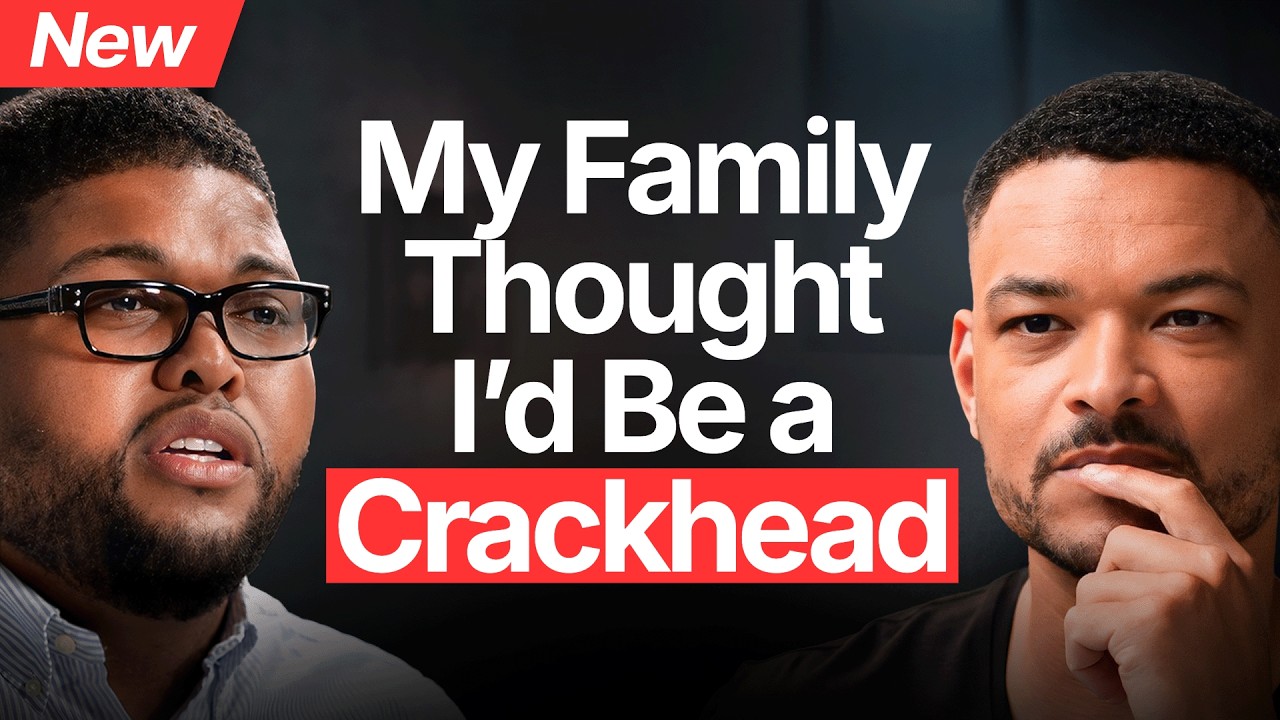
Seeking support, he took the exact same dream to his grandparents, who lived just down the street. Their reaction was completely dismissive, shaped by an older generational mindset that saw formal education as the only safeguard against ruin. In their eyes, people without degrees inevitably ended up on drugs or ruined their lives. When Druski broke the news that he had dropped out, they shut him down immediately: "Don't be coming over here and bothering us. We know what's about to happen. Like, you going to be a crackhead." Convinced that dropping out would only lead to him pulling up to their house begging for money, they refused to entertain his creative ambitions.
[41:17](https://www.youtube.com/watch?v=UhzI1fg8rCA&t=2477s) Survival Jobs, Atlanta Scams, and the Armed Robbery
Unable to launch his comedy career immediately, Druski had to find fast cash. He cycled through entry-level restaurant jobs, working shifts at Red Lobster, LongHorn Steakhouse, Outback Steakhouse, and McDonald's. Eventually, the temptation of quick street money in Atlanta pulled him off track. He got caught up in local card and banking scams—schemes that were common among young people in the city. Though he insisted he was never truly a bad person, he viewed the hustle as a shortcut to finance his creative ambitions. However, the negative energy and moral burden stalled his comedy completely, leaving him merely flirting with the concept rather than executing it.
The turning point arrived abruptly during an armed robbery resulting from a scam deal that went wrong. Finding himself staring down the barrel of a gun with a friend, Druski experienced a sudden out-of-body clarity about the absurdity and danger of his predicament. Facing the real possibility of death forced an uncompromising internal shift. He vowed that if he survived the encounter, he would never look back, take another regular job, or make empty excuses. He resolved that he was going to commit completely: "become a comedian or die trying."
```mermaid
flowchart TD
accTitle: Turning Point from Hustling to Comedy
accDescr: The chain of events leading Druski from college dropout to full-time content creation.
subgraph Phase1["Post-College Drift"]
A["Drops Out of College<br/>(Ages 21–22)"] --> B["Entry-Level Restaurant Jobs<br/>(Red Lobster, McDonald's)"]
B --> C["Atlanta Card & Bank Scams"]
end
subgraph Phase2["The Catalyst"]
C --> D["Armed Robbery<br/>(Gun pointed to head)"]
D --> E["Mental Epiphany:<br/>'Comedian or Die Trying'"]
end
subgraph Phase3["Absolute Commitment"]
E --> F["Writes Out Goals on Paper<br/>(Rule 1: 'No Plan B')"]
F --> G["Loses Everything<br/>(Car repossessed, sleeping on floor)"]
G --> H["Relentless Sketch Creation<br/>in Mother's House"]
end
```
[43:29](https://www.youtube.com/watch?v=UhzI1fg8rCA&t=2609s) The "No Plan B" Goal Sheet
Following the near-death experience, Druski returned home visibly shaken and stressed. Guided by advice his mother had given him since childhood—that a goal is not real unless it is committed to paper—he sat down to write a list of his ultimate ambitions. At roughly 23 years old, after having spent about a year to a year and a half living with his mother post-college, he laid out an uncompromising career roadmap.
- **Rule Number One**: "Don't have a plan B, your plan A will work."
- **Key Written Milestones**: Becoming a full-time professional comedian, hosting a major tour, hosting an awards show, and starring in a major feature film.
[45:06](https://www.youtube.com/watch?v=UhzI1fg8rCA&t=2706s) Hitting Rock Bottom: Repossession and Sleeping on the Floor
The moment Druski locked in and committed everything to his goals without a safety net, his circumstances deteriorated rapidly before showing any sign of progress. Almost immediately after writing his list, his car was repossessed, stripping away his only means of independent travel. He recognized this breaking point as the exact threshold where most aspiring creators quit: after putting in the prayers, vision boards, and written affirmations, a severe setback occurs, and they interpret it as a sign of failure.
Instead of walking away, Druski leaned into the absurdity of the loss, filming the tow truck taking his car away and posting it as content. Though devastated, he found liberation in having nothing left to fear or lose:
- His bedroom had no bed or mattress; he slept directly on the floor using a blanket borrowed from his younger sister.
- All his old furniture and dressers were gone, as his mother had given away, sold, or stored his belongings while he was away at college.
- With his back completely against the wall, his sole focus became generating an endless stream of video content.
[47:08](https://www.youtube.com/watch?v=UhzI1fg8rCA&t=2828s) Turning the House into a Film Studio
Confined to his mother's house without transportation, Druski transformed the living space into a DIY production set. He dragged the living room couch upside down and angled his phone near the ceiling to mimic a surveillance camera for an interrogation parody of *The First 48*. For another sketch, he pulled a jacket from his mother's closet and stood out in the backyard balancing his phone on top of a trash can, performing as a Fox 5 on-the-scene news reporter. His mother would return from work to discover the household turned upside down, questioning what he was doing, yet she endured the chaos alongside him.
As he posted relentlessly, he tracked his traction through vanity metrics, routinely telling his mother he had crossed milestones like 10,000, 15,000, or 100,000 followers. She continually asked the pragmatic question: "Did you make any money yet?" While the initial answer was no, the attention eventually yielded small promo gigs. Artists began paying him a couple hundred dollars to share their music tracks or clips onto his social media stories. While this gave him just enough cash to buy groceries for his mother or go out for an evening, it was not yet life-changing income—but it marked the first financial proof of his momentum.
[48:39](https://www.youtube.com/watch?v=UhzI1fg8rCA&t=2919s) The First 15-Second Video and Hometown Support
Steven pulls up an early piece of archival footage from the archives of Druski's social media beginnings. The video shows a much younger Druski flaunting cash, yelling into the camera fresh off of scamming, acting as if he is rolling in wealth. Laughing at the clip, Druski explains the reality behind the facade: those thick stacks were nothing more than one-dollar bills. It was the very first video he ever uploaded to the internet, right at the exact moment Instagram launched its 15-second video feature. While Vine had pioneered the short-form format with six-second clips, Druski had never participated on Vine. When Instagram expanded video posting, his longtime friend Chauncey—who would later become his lead comedic writer—pushed him to put himself out there, telling him, "Bro, just go like just post it."
Reluctant at first because it felt silly to flex a fistful of singles, Druski posted it anyway. To his surprise, the clip garnered between 60 and 80 comments from people around his hometown. Friends and locals reacted with genuine excitement, praising the humor and urging him to keep going. That initial wave of local validation became the spark he needed. It revealed to him that an audience existed for his comedy, but more importantly, it challenged his creative ambitions: having proven he could get laughs from a goofy stunt, he recognized his own potential and resolved to create deeper, far more inventive comedic material.
[50:18](https://www.youtube.com/watch?v=UhzI1fg8rCA&t=3018s) Shouting at Meek Mill: Manifestation in Gwinnett County
Steven transitions to another vintage clip where Druski brazenly claims that he dapped up hip-hop star Meek Mill and told him, "Yo, let me be on your level one day." Confronted with the footage, Druski comes clean with a laugh: he completely fabricated the handshake. In reality, Meek Mill was surrounded by heavy security at a packed party, so Druski had simply yelled the phrase at the top of his lungs over the crowd.
The setting was a party thrown by NBA veteran Lou Williams, whom Druski describes as an absolute "hood legend" in Gwinnett County, Georgia. Williams attended the same high school as Druski, won NBA Sixth Man of the Year, and was famously immortalized by Drake in the track "6 Man." At the time, Gwinnett County was merely an obscure suburb outside of Atlanta, far removed from the celebrity map. When Williams brought major athletes and recording artists into town for his neighborhood gatherings, local kids like Druski were able to walk through the doors and witness superstardom up close. Seeing Lou Will’s house and standing in the same room as Meek Mill triggered raw, unfiltered manifestation:
> "There was no stutter in my speech right there. I definitely felt that way about everything I was doing... I’ve always been a big fan of pursuing greatness my entire life. I never want to just be good. I always wanted to be great."
- Lou Williams served as a living blueprint for Gwinnett County youth, showing that reaching elite national status was possible from their neighborhood.
- The unrecorded years were defined by constant, vocal affirmations of pursuing greatness, long before Druski had an industry platform.
[52:29](https://www.youtube.com/watch?v=UhzI1fg8rCA&t=3149s) No Plan B: Succeed or Die Trying
Steven points out the stark contrast between Druski's bravado and his objective circumstances at the time: living in his mother’s house, sleeping on a blanket on the floor of the front room, and using that very same corner as his makeshift creative studio. When Steven asks about an extreme declaration Druski made back then—that he would either achieve greatness or kill himself—Druski admits the wording was intense, but insists it captured the absolute gravity of his mindset.
For Druski, failure was not a tolerable outcome. He describes looking into the future and seeing only "a green light down this tunnel." He had made an irrevocable pact with himself and his mother: there was no exit ramp, no alternative career, and no Plan B. While he knew deep down he would never actually end his life, framing the stakes in life-or-death terms eliminated any possibility of surrender. That extreme pressure cultivated a comfort with relentless grind. Even after achieving massive wealth, he rejects leisure and vacations, explaining that he genuinely finds peace within high-stress workloads:
> "I find it soothing to be in a chaos situation of work and juggling multiple projects at once. Like that is what I want to do. This is what I got into it for."
[54:57](https://www.youtube.com/watch?v=UhzI1fg8rCA&t=3297s) The Obsession Gap: Outworking the Field to Be Number One
Reflecting from his perspective as a 31-year-old, Druski breaks down why so few people make a living in creative pursuits where the odds of financial survival are virtually "slim to none." The differentiator is not luck; it is that most people only like the idea of greatness without possessing the appetite for the grueling reality it demands. Many peers talked a big game about waking up early and putting in the work, but they almost always vanished after the first or second day.
Recognizing that almost nobody possesses long-term stamina gave Druski the confidence that he was running in a lane of his own. While everyone professes a desire to be number one, practically nobody is willing to spend 18 consecutive hours in an edit bay combing through footage frame by frame, headline a stand-up tour while simultaneously filming an unscripted series like *Coulda Been Love*, shoot a major Universal feature alongside stars like Emma Stone, and maintain a daily social media output all at the same time. Quoting Ricky Bobby's famous line from *Talladega Nights*—"If you ain't first, you're last"—Druski emphasizes that reaching the top does not bring relaxation. The climb never concludes because remaining number one requires constantly pushing the mountain higher to stay ahead of the hunger behind you.
```mermaid
flowchart TD
accTitle: The Cycle of Pursuing Greatness
accDescr: Druski's self-reinforcing engine showing the mindset, the work ethic filter, and the moving benchmark of reaching the top.
subgraph Mindset["The All-In Mindset"]
A["Eliminate Plan B<br/>('Do or die trying')"]
B["Embrace Chaotic Workloads<br/>(Find peace in high stress)"]
A --> B
end
subgraph TheFilter["The Obsession Gap"]
C["Peers talk ambition<br/>(Quit on Day 2 or 3)"]
D["Obsessive Commitment<br/>(18-hr edits, film, tour, social)"]
B --> D
C -.->|"Separation"| D
end
subgraph Pinnacle["Continuous Elevation"]
E["Reach Number One"]
F["Keep Pushing the Mountain<br/>(Set bar for the next generation)"]
D --> E
E --> F
F -->|"Never complacent"| D
end
```
[58:18](https://www.youtube.com/watch?v=UhzI1fg8rCA&t=3498s) Chasing the Greats and the Long Time Horizon
Druski and Steven Bartlett reflect on what it truly takes to enter the pantheon of comedy legends. Druski points out that while Eddie Murphy set the benchmark at the absolute pinnacle, Kevin Hart has fought his way up into that exact same echelon. Druski observes that Hart looks exceptionally healthy and focused, questioning whether he might ultimately push the boundary even further than Eddie did. He compares this ongoing race to basketball icons like Michael Jordan, Kobe Bryant, and LeBron James—there is always an elite contender coming up right behind the master before them to raise the bar. For Druski, the ultimate objective of a career is not just short-term applause, but leaving a permanent legacy and earning a seat in that legendary conversation when all is said and done.
Steven notes that anyone who reaches real greatness possesses an unusually long time horizon and an extraordinary tolerance for lonely, thankless years. He brings up previous conversations on the podcast, mentioning the world's greatest illusionist who spent ten solitary years performing card tricks table-to-table in restaurants, as well as comedian Jimmy Carr, who gave up a solid marketing career to grind for five or six years in comedy clubs and pubs without making any real money. When Steven asks Druski how long he spent stuck in his mother’s house after dropping out of college before realizing comedy could actually pay his bills, Druski emphasizes that people completely misunderstand the timeline: it was years of grinding in complete obscurity with zero payoff.
[01:00:06](https://www.youtube.com/watch?v=UhzI1fg8rCA&t=3606s) The Relentless Grind and Never Pausing to Celebrate
Druski criticizes modern social media culture, where creators experience a single flash of virality and immediately scramble to build a corporate entourage, hire managers, and secure representation. His advice to aspiring artists is blunt: stop worrying about finding a team, get back in the trenches, and prove you can do it again. A major drawback of chasing greatness, however, is the complete inability to pause and savor any milestone. The moment a goal is accomplished, the mind instantly fixates on the next mountain to climb. Druski lives this reality constantly, describing a grueling work sprint where he barely had a moment to breathe:
```mermaid
flowchart LR
accTitle: Druski's Back-to-Back Production Schedule
accDescr: Druski's rapid sequence from hosting the BET Awards to filming a TV show and jumping into a feature film.
subgraph S1["Award Stage"]
A["Host at BET Awards"]
end
subgraph S2["Television Production"]
B["Fly to set of 'Collect & Praise'"]
C["Two weeks of non-stop filming with Mike Epps"]
end
subgraph S3["Feature Film"]
D["Next-day flight to movie set"]
E["Shoot 'The Catch' alongside Emma Stone & Chris Pine"]
end
A --> B --> C --> D --> E
```
Immediately after wrapping the BET Awards—a bucket-list career achievement—Druski was on an airplane the following morning to shoot his television show *Collect & Praise* alongside Mike Epps. After two continuous, back-to-back weeks of shooting the series, the cast clapped out the final day, and Druski stepped right onto another plane to begin filming the feature film *The Catch* with Emma Stone and Chris Pine the very next morning. Because momentum never stops, there is never space to sit back and reflect. Druski traces this restless drive back to his mother, who never let him get complacent as a child. Whenever he brought home a B on a school assignment, she would say, "Oh, you could have done better," and even if he earned an A, her immediate response was to ask why it was not an A+.
[01:02:24](https://www.youtube.com/watch?v=UhzI1fg8rCA&t=3744s) How Parental Expectations Shaped a Versatile Comedic Mindset
When Steven asks Druski if he envisions becoming a father himself amidst the madness of his schedule, Druski laughs that he has to tackle the first obstacle first: "We got to find a wife first, bro. I’m trying to find love first." Looking back at his childhood, he explains that both of his parents possessed an exacting mindset that dismantled simple victories. His father, an airline pilot, approached everyday schoolwork with intense technical scrutiny. If Druski brought him a straightforward math division problem for help, his father would spend forty minutes breaking down long division formulas into algebraic calculations, illustrating how $mx \cdot bx^2$ could reverse the equation and produce the same result across multiple pathways. A simple homework question turned into an elaborate masterclass in alternative problem-solving routes.
This upbringing conditioned Druski to believe that there is never just one single route or one acceptable answer to any challenge. In entertainment, that psychology translated directly into an unwillingness to be boxed into one lane. Rather than remaining merely an internet skit comic, Druski engineered his comedy to thrive in every medium imaginable:
- **Live Performance:** Translating digital energy to live touring and stage comedy.
- **Sketch & Digital Formats:** Crafting viral, character-driven online scenarios.
- **Television & Film:** Landing roles across episodic series and major feature films.
- **Commercial Campaigns:** Appearing in national mainstream advertisements, such as sharing the screen with Zoe Saldaña and Jeff Bridges in a T-Mobile commercial.
Steven pauses the discussion for a brief sponsor highlight with Wayfair, sharing how frustrating it is to purchase furniture online only to find that the texture, quality, and durability do not match the image. He notes that Wayfair furnished the studio green room and recommends the "Wayfair Verified" program, where products are vetted by internal specialists to eliminate guesswork. Steven then speaks directly to viewers who regularly consume the podcast, encouraging those whose button still reads "Subscribe" rather than "Subscribed" to click the button and support the channel's growth.
[01:05:24](https://www.youtube.com/watch?v=UhzI1fg8rCA&t=3924s) "Now What?": The Reality Check and Ongoing Hunger
Returning to the conversation, Steven asks Druski whether there was a particular breakthrough moment or paycheck that he could not wait to show his mother as undeniable proof that his unconventional path was right. Druski recounts an experience from around 2022, just as the pandemic lockdowns had eased and his social footprint was expanding rapidly. He called his mother bursting with excitement because an A-list celebrity had reposted one of his comedy videos.
Instead of congratulating him, his mother immediately hit him with a pragmatic interrogation:
- "Did they tag you in it?"
- "Did people follow you?"
- "Is there an opportunity? Are you going to shoot a video with them?"
When Druski had to admit that the celebrity had simply reposted the video without a tag or a collaboration lined up, his mother flatly responded, "Now what?" That sharp reality check pushed him right back to square one, reinforcing the lesson that applause without tangible progression means nothing. Because both of his parents were conditioned to break achievements down into their practical consequences, Druski admits he still does not feel fulfilled by his success today. At his age, he insists there is far too much left to accomplish before he can allow himself to feel satisfied.
[01:06:52](https://www.youtube.com/watch?v=UhzI1fg8rCA&t=4012s) The Relentless Hunger for Greatness
Reflecting on comedy legends who paved the way—such as Jim Carrey, Eddie Murphy, Chris Farley, and Adam Sandler—Druski is questioned on whether he currently feels happy and fulfilled with everything he has attained. He distinguishes between the two emotions without hesitation: while he is genuinely happy, he refuses to consider himself fulfilled because there is still so much left to conquer. When asked if one can simultaneously feel fulfilled while continuing the chase, Druski pushes back, arguing that anyone legitimately pursuing greatness must keep their hunger alive. In his view, reaching true fulfillment risks extinguishing that vital drive, insistently stating that for those chasing the peak of their craft, "your hunger has to always continue to live."
[01:07:30](https://www.youtube.com/watch?v=UhzI1fg8rCA&t=4050s) The Drake Turning Point: "Laugh Now Cry Later"
Looking back at the transition out of his mother's house, Druski recalls the physical signs that his life was starting to outgrow his surroundings. Promotional apparel from clothing brands and streetwear labels had begun piling up in stacks across his mother's front dining room. Although he was starting to make just enough money to consider finding his own apartment, no substantial wealth had rolled in yet, and companies still viewed him through the lens of a typical internet influencer—offering free merchandise or club entry in exchange for appearances and video placements.
Everything changed overnight when Drake reached out via Instagram direct messages to cast him in the music video for "Laugh Now Cry Later." What started as casual banter and laughing back and forth at comedy sketches turned into a serious conversation where Drake told Druski that he was destined to lead this generation of comedy. Despite wondering if the megastar was simply "gassing me up," being featured as the central comedic relief alongside superstars like Lil Durk, Marshawn Lynch, Kevin Durant, and Odell Beckham Jr. fundamentally shifted his career. The industry suddenly stopped offering free clothes and began treating him like a bankable star, initiating serious business conversations and converting his visibility into major transactional deals.
```mermaid
flowchart TD
accTitle: Druski Career Inflection Flowchart
accDescr: A diagram illustrating Druski's transition from early internet influencer to mainstream entertainment star.
subgraph EarlyStage["Mom's House Phase"]
A["Free Merch & Unpaid Appearances"] --> B["Dining Room Overrun with Clothes"]
end
subgraph Catalyst["The Breakthrough"]
B --> C["Drake DMs & Endorsement"]
C --> D["Cast in 'Laugh Now Cry Later' Video"]
end
subgraph Mainstream["Industry Shift"]
D --> E["Perception Shift: Legitimate Star"]
E --> F["Transactional Deals & Corporate Brand Partnerships"]
end
```
[01:11:13](https://www.youtube.com/watch?v=UhzI1fg8rCA&t=4273s) The Power of Relationships in Corporate Boardrooms
Behind the scenes of major entertainment deals, Druski emphasizes that technical talent and comedic timing only account for part of the equation—the decisive factor is personal relationships. Corporate executives behind massive campaigns, such as Nike or T-Mobile, need to know who the real individual is away from the public eye before putting their brand reputation in their hands. They schedule private dinners to assess character, ensuring that an artist is reliable, grounded, and safe to represent their company to the world rather than an unguided liability prone to reckless behavior.
Druski attributes his natural ability to connect with corporate executives to his multicultural upbringing in an environment filled with people of Mexican, Indian, Black, White, African, and Jamaican backgrounds. Rather than needing to adopt a corporate persona later in life, he had always been an innate people person. Even as a ten-year-old child at the grocery store, he would casually walk up to his football teammates' fathers and joke around like an adult. That innate comfort talking to anyone, anywhere, laid the groundwork for him to sit down with high-level executives and build immediate trust.
- High-stakes brand deals require corporate executives to evaluate personal character away from the public celebrity persona.
- Exposure to diverse cultures during childhood established his social fluency across varied corporate and creative environments.
- Relationship-building, warmth, and trust remain the primary gatekeepers to long-term commercial success in media.
[01:14:42](https://www.youtube.com/watch?v=UhzI1fg8rCA&t=4482s) Brand Safety and Never Punching Down
Navigating the delicate boundary between corporate brand safety and boundary-pushing comedy requires a clear creative filter. While his sketches are celebrated because he says the unspoken thoughts out loud and leans into raw observational humor, Druski explains that his risk framework rests on a fundamental principle: he never punches down. Every skit, audition, and joke originates from a light-hearted, well-meaning place where everyone can laugh together, rather than attacking marginalized individuals or adopting malicious shock value. Drawing a distinction between his comedy and the abrasive, dark satirical stunts of performers like Sacha Baron Cohen, Druski maintains that his humor has endured with mass audiences and Fortune 500 brands alike precisely because its core foundation is inherently good-natured.
[01:15:42](https://www.youtube.com/watch?v=UhzI1fg8rCA&t=4542s) Observational Humor and Staying Out of Politics
Druski emphasizes that his comedy always originates from a good place rather than malice or political agendas. He clarifies that he is not a political commentator and does not pretend to be an intellectual authority on serious worldly issues: "I am just the guy here for laughs, comedian. I don't care for none of that serious stuff." When people attempt to ask him deep, probing social questions, his response is that he is simply being himself and never intended to wade into heavy topics.
Steven points out that reviewing Druski's catalog of skits reveals a striking consistency: he never punches down or singles out vulnerable targets with ill intent. Druski agrees that never punching down is fundamental to his work. Instead, his material is rooted in keen people-watching and spotlighting subtle, relatable mannerisms that people observe every day without consciously registering. A gifted comedic actor, Druski explains, has the ability to reach into the back of a viewer's memory, pull out a tiny human behavior seen fifteen years earlier, and bring it vividly to life on screen. When Steven notes that finding humor across the board means not being beholden to any political faction, Druski notes that late-night hosts and other entertainers make politics their entire lane, but that has never interested him. Steven relates, noting that while he interviews figures spanning the political spectrum—such as Michelle Obama, JD Vance, Ivanka Trump, and Kamala Harris—the goal remains staying curious rather than partisan.
[01:18:30](https://www.youtube.com/watch?v=UhzI1fg8rCA&t=4710s) The Trump and Erika Kirk Rumor
Steven brings up an internet moment from earlier in the year where Donald Trump appeared to tell Erika Kirk (wife of conservative activist Charlie Kirk) that she should sue Druski. In March, Druski released a viral sketch depicting how conservative white women in America act, which racked up hundreds of millions of views. Approximately a week later in April, Trump publicly suggested to Erika Kirk that she should sue the creator, though he did not explicitly say Druski's name.
Druski remains amused and skeptical about whether the comment was even directed at him: "To this day, I have no idea. But people sent me that video. I just didn't know if it was pertaining towards me. I just left it alone." When Steven suggests that having a former president mention suing you in the White House is an inspiring testament to his cultural impact, Druski adamantly rejects the idea of looking for a lawsuit: "I'm not looking to get sued by nobody... We have too much shit that we're pursuing right now to be looking forward to that." He insists that until someone explicitly asks Trump, no one can say for sure who he was talking about.
[01:20:40](https://www.youtube.com/watch?v=UhzI1fg8rCA&t=4840s) Super Bowl Commercials and the Accidental Jim Carrey Email
The discussion turns to Druski's rare ability to transition from internet skits into mainstream commercial entertainment across multiple mediums. Druski highlights his Super Bowl appearances, including a Dunkin' Donuts commercial and a T-Mobile spot featuring the Backstreet Boys. Steven brings up a legendary industry mishap involving the Dunkin' Donuts campaign, where production accidentally forwarded Jim Carrey's contract proposal to Druski's management team.
Druski clarifies the rumor: they were not accidentally sent Carrey's money, but rather the offer proposal detailing what Carrey would have been paid. The proposal offered an astounding sum—in the neighborhood of $5 million for just two hours of shooting, or roughly $2.5 million per hour. Carrey ultimately passed on the offer and did not do the commercial. Druski jokes that the agency probably mixed up the paperwork and sent his own much smaller proposal to Carrey's team: "I can only imagine if he saw the amount I was getting. That's probably why he didn't do this shit!"
Seeing those numbers served as a major benchmark and source of artistic inspiration for Druski. Beyond the staggering fee, Druski deeply admires Carrey's refusal to be swayed purely by money, citing Carrey's commitment to legacy and craft above all else:
- **Carrey's Craft and Selectivity:** Druski points out that Carrey did not rush into sequels like a *How the Grinch Stole Christmas 2* purely for a payday, because he remains extremely intentional about what projects he attaches his name to.
- **Formative Comedy Influences:** Druski references Carrey's character Fire Marshal Bill from *In Living Color*—where Carrey was the sole white cast member at the time—highlighting how that manic performance was an early precursor to what Carrey later brought to *The Mask* and *The Grinch*. Druski considers Carrey a wise, philosophical figure and names him as one of the top people left on his bucket list to meet.
[01:23:53](https://www.youtube.com/watch?v=UhzI1fg8rCA&t=5033s) Early Rejection from Netflix and Amazon
Steven pushes against the narrative that Druski's career was a seamless, overnight ascent—from dropping out of college to being discovered by Drake and immediately hitting the big time. Beneath the highlight reel lies significant corporate rejection. Steven notes that earlier in his journey, Druski was turned down by both major streaming giants, Netflix and Amazon. Druski confirms that during those early stages, he pitched multiple ideas and projects to both platforms, only to be rejected across the board.
[01:24:24](https://www.youtube.com/watch?v=UhzI1fg8rCA&t=5064s) Bypassing Gatekeepers and Betting on Self-Funded Content
Druski recounts how, after enduring years of pitching show concepts and formats to legacy television networks and streaming platforms, he faced an unrelenting wall of rejection. Pitch after pitch yielded nothing: a potential television show development deal with FX fell through, a movie project with Amazon received a firm no, and multiple different concepts brought to Netflix were flatly declined. Instead of letting repeated denial derail his momentum or attempting to endlessly tweak the same presentations to appease Hollywood executives, Druski instituted a radical pivot. Rather than taking the earnings he received from external brand deals and wasting them on luxury assets—like a brand-new sports car, an additional house, or expensive jewelry—he resolved to reinvest that capital entirely into himself.
```mermaid
flowchart TD
accTitle: Transition from Corporate Rejection to Self-Funded Independence
accDescr: A flow diagram showing Druski pivoting from gatekeeper rejections to self-funded YouTube shows, eventually triggering a streaming bidding war.
subgraph Rejection ["Corporate Gatekeeping"]
A["Network Pitches: FX, Amazon, Netflix"] --> B["Relentless Rejections ('No, No, No')"]
end
subgraph Independence ["Self-Funding Model"]
C["Brand Earnings & Personal Capital"] --> D["Direct Investment into YouTube Shows"]
D --> E["'Coulda Been House', 'Coulda Been Love', etc."]
end
subgraph Leverage ["Market Shift"]
E --> F["Audience Proof & Cultural Phenomenon"]
F --> G["Networks Compete in Bidding Wars"]
end
B --> C
```
He decided to bring all of his unrealized show concepts directly to YouTube, underwriting the production costs with millions of dollars out of his own pocket. That self-funded initiative birthed the expansive "Druski universe", launching viral franchise hits like *Coulda Been Auditions*, *Coulda Been Love*, *Coulda Been House*, and *Coulda Been Daddy*, alongside high-budget cinematic sketches. By taking ownership of his creative output, the power dynamic completely reversed: those very platforms that had previously shut him out returned seeking to purchase his independent IP and commission future work, sparking intense bidding wars.
The core lesson, Druski explains, is that you must carry absolute conviction in your vision before anyone else will see it:
> "The lesson there is just believe in yourself, man. Before anybody sees the vision, you have to see it. If you don't see the vision yourself, you're almost doing yourself a disservice. It has to start with you."
He critiques up-and-coming creators who sit idle waiting for a corporate savior, clinging to excuses like *"I'm waiting on the big movie break"* while neglecting to reinvest a single dime of their yearly brand revenue back into upgrading their own productions. While creators do not necessarily need multimillion-dollar budgets immediately, failing to put resources into your craft reveals that you do not truly bet on yourself. Druski decided he would never double back begging gatekeepers; he would simply build undeniable proof of concept on his own terms.
[01:27:36](https://www.youtube.com/watch?v=UhzI1fg8rCA&t=5256s) Dealing with Skeptics and Breaking Greatness into Steps
Steven observes that rising creatives constantly face knowledgeable corporate figures—people armed with impressive LinkedIn bios and executive job titles—telling them their ideas are worthless. Druski confirms that doubt came from every direction, even dating back to his college days. Right before he dropped out, peers who had mocked him for not having the right shoes to go out told him point-blank that pursuing comedy was pure delusion. They warned him that he would be competing against untouchable industry titans like Kevin Hart and the *Original Kings of Comedy*, including Bernie Mac, calling his aspirations completely unfathomable.
Druski rejected their defeatist rationale on the spot. While his peers viewed legends as unreachable deities operating on a pedestal that ordinary mortals could never touch, Druski recognized that those icons were once nineteen- and twenty-year-olds walking the exact same early path:
- **Debunking the overnight myth:** Observers often see finished masters and imagine their success was an effortless, predestined reality, ignoring the decades-long process required to get there.
- **Focusing on the staircase:** Fixating solely on a distant summit—like winning an Oscar as an absolute beginner—paralyzes an artist; you must construct and focus on the immediate, tangible steps of the ladder.
- **Micro-progression:** By treating the journey as an incremental climb where every completed sketch or refined joke gains ground, the impossible becomes systematically achievable.
> "If you focus on the far goal, no, you'll never achieve shit, man... It's like looking at a mountain without the ladder. You got to find a way to climb this shit."
[01:32:00](https://www.youtube.com/watch?v=UhzI1fg8rCA&t=5520s) Resisting Easy Money to Protect Brand Integrity
Steven points out that rational individuals routinely abandon the grueling climb because convenient compromises exist at every stage of the ladder: taking steady wages at Red Lobster, clocking into a sales call center, or getting pulled into quick street scams. Druski emphasizes that quick cash is ubiquitous, but chasing it is the easiest way to ruin long-term greatness.
Too many artists fall victim to glorifying immediate financial gratification over their ultimate creative legacy. By chasing quick paydays, they cheapen their platform and dilute their personal brand before their true vision ever has a chance to take root. Druski recalls the discipline required early in his ascent, when musicians and promoters waved thousands of dollars in front of him to appear in arbitrary, low-tier music videos. Even when he needed the money, he recognized that accepting unaligned opportunities for short-term gain would permanently compromise his artistic trajectory.
[01:32:56](https://www.youtube.com/watch?v=UhzI1fg8rCA&t=5576s) Saying No to the Quick Bag and Protecting the Brand
Druski reflects on the discipline required to turn down tempting short-term payouts during the early climb of his career. He recalls scenarios where local figures, including neighborhood drug dealers, would offer him a quick $2,000 to promote their music. Despite being broke and hungry, Druski forced himself to evaluate the bigger picture. The music was often terrible, and attaching his name to sub-par art threatened to derail his long-term trajectory before it even got off the ground. He recognized that snatching fast money would knock him off his pivot when he could already sense greatness ahead.
Early on, Druski had fallen into the trap of accepting whatever cash came his way—shouting out merchandise, posting songs, and featuring external brands. He had a sudden realization that he was expending his creative energy elevating everyone else's ventures while neglecting his own identity. He resolved to push money to the back of his mind and focus purely on where he was heading, refusing to lend his platform to anything that did not feel genuinely special.
[01:33:54](https://www.youtube.com/watch?v=UhzI1fg8rCA&t=5634s) Becoming a "Healthy Heavy-Set Guy"
Steven notices Druski’s physical appearance, pointing out that he looks visibly fit, hydrated, and energized as if he has been spending serious time in the gym. Druski agrees, explaining that while currently working on a movie set, he had to take control of what he puts into his body. He embraces his stature and makes no apologies for it, stating plainly that he intends to follow in the footsteps of legendary heavy-set comedic icons like Chris Farley, Cedric the Entertainer, and Jack Black. However, he realized he didn't need to be reckless with his health to maintain that presence.
```mermaid
flowchart TD
accTitle: The Balanced Comedic Icon Mindset
accDescr: Flowchart illustrating Druski's transition from lifestyle excess to sustainable health while honoring iconic heavy-set comedic influences.
subgraph Past["Past Traps of Early Wealth"]
A["Excessive drinking"]
B["Gorging on food"]
end
subgraph Shift["The Mental Pivot"]
C["Recognize both truths can coexist"]
D["Healthy diet & pickup basketball"]
end
subgraph Target["The Ultimate Blueprint"]
E["'Healthy Heavy-Set Legend'"]
F["Inspired by Farley, Cedric & Jack Black"]
end
Past --> Shift --> Target
```
Around a year prior, Druski made a conscious shift away from lifestyle indulgence. He realized that just because he suddenly had money did not mean he needed to binge drink every night or gorge on food at every meal. He found an equilibrium where he can still eat comfortably, hit the court to hoop with his friends, and stay at a weight where he feels agile, energized, and confident on camera.
- **Comedic inspirations cited:** Chris Farley, Cedric the Entertainer, and Jack Black.
- **Core philosophy:** "Both things can be true"—maintaining a recognizable comedic frame without destroying one's health in the process.
[01:35:29](https://www.youtube.com/watch?v=UhzI1fg8rCA&t=5729s) The Next 30 Years: Becoming the Face of Comedy
When Steven asks what success looks like over the next five years, Druski answers without hesitation: "I became a superstar." He is actively shedding the old markers of his internet days—the dyed blonde hair and the unkempt beard—deliberately distancing himself from being perceived as merely "the social media guy." Over the next 30 years, his goal is to establish himself as the undisputed face of comedy for his entire generation, measuring his career against the sustained dominance of Eddie Murphy, Kevin Hart, and Will Ferrell.
Druski studies the longevity and reinvention of the greats. He highlights how Eddie Murphy conquered stand-up and *Saturday Night Live*, transitioned seamlessly into box-office blockbusters alongside top Hollywood stars, stepped into family franchises, and orchestrated legendary collaborations like *Harlem Nights* with Richard Pryor and *Life* with Martin Lawrence. Druski aims to follow that blueprint by spearheading high-level comedic alliances with the sharpest comedic talents of his own era.
[01:37:06](https://www.youtube.com/watch?v=UhzI1fg8rCA&t=5826s) Unapologetic Confidence and the Jamie Foxx Blueprint
Steven asks whether Druski had to learn how to speak with such unapologetic ambition, noting that few performers have the guts to openly proclaim their intent to be the number one superstar of their generation. Druski insists he has always spoken this way, constantly raising his own bar rather than resting on past accomplishments. He points to Jamie Foxx as an aspirational archetype of limitless range: winning an Academy Award for portraying Ray Charles in *Ray*, pivoting to Quentin Tarantino's *Django Unchained*, and returning effortlessly to pure comedy.
```mermaid
flowchart LR
accTitle: The Jamie Foxx Career Blueprint
accDescr: Diagram showing the artistic range Druski seeks to replicate across multiple genres.
A["Prestige Drama: 'Ray' (Oscar Winner)"] --> B["Action / Hybrid: 'Django Unchained'"]
B --> C["Pure Comedy & Commercial Hits"]
```
Druski credits his upbringing and his mother for instilling this bedrock self-belief. From the time he was three to seven years old, his mother constantly pointed a camcorder at him, capturing home videos of him dancing, performing, and making his family laugh. Growing up in front of the lens gave him an innate comfort in his own skin that evolved into absolute self-certainty.
[01:38:54](https://www.youtube.com/watch?v=UhzI1fg8rCA&t=5934s) A Message to the College Dorm: Pushing Through the Storm
Looking back at his lowest moment—sitting alone in a college dorm room after dropping out, isolated and without friends—Druski shares the message that younger version of himself needed to hear: "Believe in yourself more than you have ever believed in your entire life. You can be iconic. You are great. You are one of one." He emphasizes that the single most vital trait is staying consistent when the path grows foggy and the light at the end of the tunnel vanishes completely.
Druski observes that most people quit right when life hits its hardest rough patch—whether it is getting a car repossessed or suffering a painful breakup. He notes the irony that people will spend nights on their knees praying for their lives to change, but the moment God begins clearing the slate and testing their resolve through trials and tribulations, they panic and jump off the tracks. In Druski's eyes, the struggle is not a sign of failure; it is the exact pruning required to step into what was prayed for.
[01:40:38](https://www.youtube.com/watch?v=UhzI1fg8rCA&t=6038s) Knowing When to Quit and the Reality of Talent
Steven challenges the blanket advice of "never quit," pointing out that quitting college was the exact decision that allowed both of them to succeed. Druski bursts out laughing and enthusiastically agrees, delivering a brutally comic piece of advice to aspiring artists: "Rappers, if you out there and you still rapping past 30, quit! Get the f*** off that mic and get the hell out that studio!"
The banter leads Steven to examine the survivorship bias inherent in success stories. While perseverance is essential, Steven notes that persistence only works when paired with foundational, innate ability. Reflecting on Druski's early home tapes, Steven points out that Druski was already remarkably funny at six years old—a natural gift that cannot simply be manufactured through sheer grit alone.
[01:42:08](https://www.youtube.com/watch?v=UhzI1fg8rCA&t=6128s) Self-Awareness, Fake Laughs, and the Trap of Blind Consistency
Steven Bartlett reflects on the survivorship bias that often clouds advice around work ethic. People who break through often look back and simply tell others that "consistency is the number one thing," but Steven points out that without a high degree of self-awareness and "knowing thyself," someone lacking the requisite talent could blindly stay in a studio until past age fifty pursuing something that will never land. Steven notes that Druski must witness this gap firsthand through people walking up to him in public attempting to be funny. Druski wholeheartedly agrees, laughing that learning how to deliver a convincing reaction is a survival skill in everyday life: "You have to have a good fake laugh. I will say, holy shit. Because it does get bad. People just want to come up to you and say random shit."
Druski validates Steven's point that consistency by itself is insufficient. Success requires acute judgment and intuitive awareness to know "the feeling of this is the thing" rather than grinding aimlessly on the wrong path.
[01:43:12](https://www.youtube.com/watch?v=UhzI1fg8rCA&t=6192s) The Power of Sitting in Silence to Find Your Purpose
Druski underscores that the missing link for most people is their inability to sit alone in total silence and confront their own minds. People frequently complain of being lost, confused, or paralyzed by an ambition to do everything at once, yet they never put down their smartphones or isolate themselves from external stimulation. Instead of facing the inner discomfort required to discover who they really are, they immediately run toward numbing mechanisms—getting high, getting drunk, or gathering with friends to talk empty talk about dreams they will never execute.
```mermaid
flowchart TD
accTitle: The Distraction Trap vs The Power of Silence
accDescr: A flowchart contrasting running from discomfort through distractions versus sitting in total silence to discover one's purpose.
subgraph Trap["The Distraction Trap"]
A["Feeling Confused & Overwhelmed"] --> B["Avoid Discomfort"]
B --> C["Phones, Drugs, Alcohol & Talking Big"]
C --> D["Stagnation & Continued Confusion"]
end
subgraph Breakthrough["The Path to Clarity"]
E["Sit in Total Silence"] --> F["Strip Away Substances & Noise"]
F --> G["Reflect on Childhood Loves & Raw Passions"]
G --> H["Uncover True Purpose & Execute"]
end
```
Sitting with oneself in stillness is often painful, but Druski credits it as the single catalyst that revolutionized his life and career direction. Achieving genuine clarity demands confronting yourself as you actually are:
> "That is one of the main things that shifted my entire life was sitting down in silence and figuring out what is it that I want to do... But until you sit in silence and sit with yourself as the true you, not the you that's high, not the you that's drunk, not the you that just wants to go to a friend and talk shit... No, you got to sit with yourself and figure this shit out. Most people don't want to do that, and that's cool, but that is the key to figuring it out by far."
[01:44:30](https://www.youtube.com/watch?v=UhzI1fg8rCA&t=6270s) The Next Life: Emulating the Greatness of Michael Jackson
Steven introduces the podcast’s signature closing ritual, in which the previous guest leaves a blind question for the next person: *"If you could make it happen, who would you most want to be like in your next life?"* Druski thinks about it briefly before choosing Michael Jackson. When Steven asks why, Druski explains that Jackson represents the ultimate pinnacle of pure craft and universal reach. Jackson attained a tier of cultural dominance where he had literal gangsters executing choreography in his music videos, while continually reinventing his persona across eras. Druski highlights that almost nobody in entertainment history has successfully transitioned from being a beloved child star into an even more massive adult superstar; Jackson transformed into an entirely new entity so completely that people almost forgot he was ever the boy in the Jackson 5.
Steven brings up Druski's viral comedy sketch set in the 1960s where he played Joe Jackson ruling over his young sons. In the skit, Druski aggressively berates the children over their focus on school and girlfriends, shouting: *"Ain't y'all worried about selling records? Fix your face, Michael, before I fix it for you."* Druski laughs at the sketch, but then candidly acknowledges the darker origin behind that performance. His own father exhibited traits very similar to Joe Jackson's aggressive demeanor, noting with raw familiarity: "It wasn't hard to uh to rip that belt off, man. I've seen it before."
[01:46:41](https://www.youtube.com/watch?v=UhzI1fg8rCA&t=6401s) Upcoming Projects and Achieving True Greatness
Looking toward the immediate and long-term future, Druski lays out the projects powering his transition from viral creator to studio headliner:
- ***Collect and Praise* (Releasing November):** A semi-scripted comedy television show created alongside Mike Epps exploring the world of megachurch pastors, distributed across both Netflix and YouTube. Druski describes it as a massive, culture-shifting project spawned by his viral mega-pastor sketch.
- ***The Catch* (Targeted May 2027):** A major feature film starring Druski alongside Emma Stone and Chris Pine.
- **Original Netflix Feature Film:** A newly acquired, currently unannounced movie developed under Druski's independent production umbrella.
- **Broad Cultural Footprint:** Expanding appearances across national commercials, television, and independently produced cinema as he actively strives toward undeniable greatness.
Steven closes the conversation by expressing deep admiration for Druski’s boldness in vocalizing his pursuit of greatness. Considering the domestic violence and trauma of his upbringing, Steven observes that the odds were heavily stacked against him, making Druski's rise to the pinnacle of modern comedy both remarkable and deeply inspiring. Commending him for remaining a genuinely good human being both on and off camera, Steven notes that with sixty or seventy years left ahead of him, watching Druski’s trajectory will be historic. Druski shares his gratitude, praising Steven's platform before Steven wraps up the episode by pointing viewers toward the algorithm's personalized next recommendation.
## Notable quotes
> [15:23](https://www.youtube.com/watch?v=UhzI1fg8rCA&t=923s) It only takes one 'oh shit' to negate ten 'attaboys.' — Druski's father
> [15:23](https://www.youtube.com/watch?v=UhzI1fg8rCA&t=923s) A grudge is on you as a burden. That's a burden to everything. It's not just physical. It's a mental thing that can really rot people's brain out... You're not helping yourself. That's actually a you thing. That has nothing to do with them or what they did. If you hold on to that, that's a forever thing for you. — Druski
> [19:34](https://www.youtube.com/watch?v=UhzI1fg8rCA&t=1174s) It's almost like a magnet when you reverse it on the other side. It's like when it comes too close, it starts to repel itself. — Druski
> [19:34](https://www.youtube.com/watch?v=UhzI1fg8rCA&t=1174s) It's a question in every superstar's mind. I guarantee you even when they are with somebody fully, they still have a question in the back of their mind: Does this person just love the superstar of me? — Druski
> [25:07](https://www.youtube.com/watch?v=UhzI1fg8rCA&t=1507s) I felt like an idiot 'cause I'm like, damn, I'm sitting over here in college. That is my purpose. This is it. I feel more connected to them than I've ever felt to anything I've ever felt in my life. — Druski
> [39:01](https://www.youtube.com/watch?v=UhzI1fg8rCA&t=2341s) If I don't become a comedian and I don't become a famous comedian on TV, I'mma kill myself. — Druski
> [43:29](https://www.youtube.com/watch?v=UhzI1fg8rCA&t=2609s) Don't have a plan B, your plan A will work. — Druski
> [52:29](https://www.youtube.com/watch?v=UhzI1fg8rCA&t=3149s) I find it soothing to be in a chaos situation of work and juggling multiple projects at once. Like that is what I want to do. This is what I got into it for. — Druski
> [01:24:24](https://www.youtube.com/watch?v=UhzI1fg8rCA&t=5064s) The lesson there is just believe in yourself, man. Before anybody sees the vision, you have to see it. If you don't see the vision yourself, you're almost doing yourself a disservice. It has to start with you. — Druski
> [01:27:36](https://www.youtube.com/watch?v=UhzI1fg8rCA&t=5256s) If you focus on the far goal, no, you'll never achieve shit, man... It's like looking at a mountain without the ladder. You got to find a way to climb this shit. — Druski
> [01:38:54](https://www.youtube.com/watch?v=UhzI1fg8rCA&t=5934s) Believe in yourself more than you have ever believed in your entire life. You can be iconic. You are great. You are one of one. — Druski
> [01:43:12](https://www.youtube.com/watch?v=UhzI1fg8rCA&t=6192s) That is one of the main things that shifted my entire life was sitting down in silence and figuring out what is it that I want to do... But until you sit in silence and sit with yourself as the true you, not the you that's high, not the you that's drunk, not the you that just wants to go to a friend and talk shit... No, you got to sit with yourself and figure this shit out. Most people don't want to do that, and that's cool, but that is the key to figuring it out by far. — Druski
## Mentioned
Adam Sandler, Amazon, Backstreet Boys, Bernie Mac, BET Awards, Blankman, Centers for Disease Control and Prevention (CDC), Cedric the Entertainer, Chappelle's Show, Chris Farley, Chris Pine, Collect & Praise, Cometeer Coffee, Coulda Been Auditions, Coulda Been Daddy, Coulda Been House, Coulda Been Love, Damon Wayans, Dave Chappelle, Django Unchained, Donald Trump, Dr. Gabor Maté, Drake, Druski, Dunkin' Donuts, Eddie Murphy, Eight Sleep, Emma Stone, Erika Kirk, ESPN, FX, Georgia Southern University, Harlem Nights, In Living Color, Instagram, Jack Black, Jamie Foxx, Jeff Bridges, Jim Carrey, Jimmy Carr, Joe Jackson, Kevin Hart, Laugh Now Cry Later, Life, Lou Williams, McDonald's, Meek Mill, Michael Jackson, Michael Jordan, Mike Epps, Netflix, Nike, Red Lobster, Saturday Night Live, Steve Harvey, Steven Bartlett, T-Mobile, The Catch, The First 48, Tim Grover, United Airlines, Wayfair, What About Bob?, Will Ferrell, YouTube, Zoe Saldaña
## Video description
How do you transform childhood trauma and crippling doubt into a relentless drive for greatness? Druski reveals the psychological forces behind comedy, life, and self-belief to help you break past rejection and master your ultimate purpose.
Druski is a cultural phenomenon, megastar comedian, and the creator of an independent production empire who has rapidly ascended to the top of the entertainment industry. He breaks down how humor was used to navigate a traumatic childhood and manifest his current success. His insights provide a playbook for silencing external noise, overcoming avoidant attachment, and betting everything on yourself.
_Trigger Warning: Please note there are mentions of child abuse and violence within this conversation._
*In this episode, he explains:*
■ *The Trauma of Humor:* How growing up in a high stress, physically abusive household forced him to use comedy as a tool to read the room and defuse tension.
■ *The "No Plan B" Strategy:* Why facing the barrel of a gun during a street scam triggered a radical mental shift, empowering him to commit entirely to his vision.
■ *The Avoidant Attachment Trap:* The reasons why successful individuals often struggle with romantic trust, and how a lack of a healthy parental relationship creates deep rooted intimacy fears.
■ *The Power of Silence:* Why discovering your true calling requires the painful, counter intuitive act of isolating yourself in total silence.
■ *Bypassing the Gatekeepers:* The exact mindset required to overcome corporate rejection by self-funding your own creative projects.
00:00:00 Intro
00:02:14 What My Childhood Tapes Meant To Me
00:06:35 When He Knew He Wanted to Be an Entertainer
00:09:15 Healing From Childhood Trauma
00:12:13 Why Letting Go of Grudges Matters
00:18:31 How Childhood Trauma Shaped His Fear of Commitment
00:22:39 Why Druski Dropped Out of College
00:27:56 Druski Opens Up About Depression
00:29:44 How Comedy Changed His Life
00:33:24 Ads
00:35:46 The Video That Changed Me
00:38:40 How Druski Got His Start in Comedy
00:54:57 What It Really Takes to Be Successful
00:57:46 What Greatness Really Means
00:59:48 How Long Does Success Really Take?
01:04:15 Ads
01:05:24 Proving My Mum I Was Right
01:11:13 Why Relationships Matter in Business
01:14:42 How Druski Protects His Brand
01:18:30 Trump-Druski Moment
01:23:53 How Netflix and Amazon Rejected Druski
01:29:11 When He Realized How Big He Had Become
01:35:29 What’s Next for Druski?
01:38:54 What He Would Tell His Younger Self
*The Diary Of A CEO:*
◼ Join DOAC circle here - https://doaccircle.com/
◼ Shop The Diary Of A CEO collection: https://thediary.com/collections/shop
◼ Get email updates - https://link.thediaryofaceo.com/5IB1H6E
◼ Follow Steven - https://link.thediaryofaceo.com/AGU9QP4
*Sponsors:*
Cometeer - https://cometeer.com/DOAC use code DOAC for $20 off
Eight Sleep - http://eightsleep.com/steven use code STEVEN for up to $200 off
Wayfair - Visit http://Wayfair.com to start your home refresh
遭Netflix与亚马逊拒绝后,Druski自资打造系列喜剧作品
创作的长青之道在于不留退路,并将商业收益直接再投资于自主拥有的制作中,而非被动等待传统行业把关人的青睐。
在与Steven Bartlett的深入对谈中,Druski详细讲述了在遭受虐待的家庭环境中成长,如何迫使他借助幽默感与高度警觉来察言观色并化解一触即发的危机。在大学辍学并在亚特兰大的一次街头骗局中遭遇枪口威胁后,他怀着严格的“不留退路”心态全力投身喜剧事业,期间经历了汽车被抵押没收、睡地板以及家人不断的质疑。当Drake邀请他出演《Laugh Now Cry Later》音乐录影带时,他迎来了决定职业生涯的关键突破,这不仅让他获得了备受瞩目的品牌合作机会,更促使他在早期遭到Netflix、Amazon和FX拒绝后,选择自资制作属于自己的YouTube喜剧节目。与此同时,Druski还剖析了成长背景给他带来的个人代价(包括亲密关系中的回避型依恋模式),并提出了长达数十年、志在比肩Eddie Murphy和Jim Carrey等喜剧偶像传奇成就的宏伟目标。
Druski透露,在亚特兰大一次搞砸的街头骗局中遭遇持枪抢劫,促成了他职业生涯的关键转折,让他下定“绝无后路”的决心全身心投入喜剧事业。 (41:17)
在遭到包括Netflix、Amazon和FX在内的主流流媒体网络全面拒绝后,Druski通过自资制作耗资数百万美元的YouTube作品(如《Coulda Been Love》)绕过传统把关人,最终引发了各大平台的竞价争夺。 (84:24)
Drake邀请Druski在《Laugh Now Cry Later》音乐录影带中担任喜剧主角,为他带来了走向主流的突破契机,将社交媒体上的虚荣指标转化为了丰厚的商业合同。 (67:30)
Druski将自己高度警觉的喜剧应变能力归因于童年充斥着身体暴力的动荡家庭环境,当时他借助幽默来察言观色并缓解家庭紧张气氛。 (7:22)
Reading summary
Comedian and actor Druski argues that creative stardom is not an overnight fluke, but the cumulative product of acute hypervigilance, an uncompromising work ethic, and refusing to compromise brand integrity for short-term paydays.
Forging Hypervigilance from Childhood Adversity (7:22)
Druski traces his comedic instincts to an unpredictable household shaped by his father, a United Airlines pilot with an explosive temper who demanded perfection and routinely threatened his sons with grim adult outcomes like incarceration or military combat. To defuse violent blowups—such as dishes being hurled across the floor—Druski began using humor as an emotional shield for his family. While this chronic stress contributed to his brother later developing schizophrenia and bipolar disorder, it forced Druski to develop extreme observational hypervigilance, learning to read subtle shifts in body language and room temperature that now guide his live performances.
Rather than harboring bitterness, Druski consciously chose to forgive his father face-to-face. He views holding a grudge as an act of mental self-harm that stunts personal elevation. Surviving that domestic volatility gave him durable emotional armor in the entertainment industry, operating on the conviction that no professional pressure can match the extremity of the emotional chaos he endured as a child.
The Near-Death Catalyst and "No Plan B" (41:17)
After struggling academically and facing deep social alienation in his dorm room at Georgia Southern University, Druski experienced an epiphany while watching Steve Harvey's viral speech about taking a leap of faith. He dropped out to pursue comedy, devastating his mother. Without an immediate comedic income, he drifted through entry-level restaurant jobs and local Atlanta banking scams. This dangerous detour culminated in an armed robbery where he stared down the barrel of a gun.
Surviving that brush with mortality provided immediate clarity. Druski committed to comedy completely or die trying, stripping his life down to the essentials and drafting a written roadmap anchored by a single premise: "Don't have a plan B, your plan A will work." Operating without transportation or capital, he converted his mother's living room into a guerrilla production set, balancing his phone on trash cans and inverting couches to film sketches while tracking early traction through community feedback.
Outworking Gatekeepers Through Self-Funded Independence (84:24)
Druski attributes the high failure rate in entertainment to an obsession gap: many people admire the concept of greatness, but few can stomach 18-hour editing sessions, daily social output, and grueling back-to-back film schedules. His initial momentum shifted into bankable industry capital after Drake cast him in the 2020 music video for "Laugh Now Cry Later," which elevated him from an influencer receiving promotional apparel to a commercially viable star.
When legacy networks—including FX, Amazon, and Netflix—repeatedly rejected his original pitches, Druski bypassed corporate gatekeepers. Instead of spending brand endorsement money on luxury lifestyle traps, he self-funded independent unscripted formats like Coulda Been House and Coulda Been Love directly onto YouTube. Building massive, verifiable audience metrics independently forced the same streaming platforms that initially declined his shows into bidding wars.
Brand Integrity, Self-Awareness, and Generational Ambition (92:00)
A key pillar of Druski's commercial longevity is brand safety anchored by a rule against punching down. By avoiding malicious shock value and focusing on relatable observational satire, he secured multi-million-dollar Super Bowl commercial opportunities with brands like T-Mobile and Dunkin' Donuts. Druski maintains that protecting one's platform requires routinely rejecting lucrative but off-brand offers, alongside cultivating brutal self-awareness. He disputes the blanket advice of blind consistency, warning that persistence without genuine, innate talent is a trap.
Aiming to be the undisputed face of comedy over the next 30 years, Druski benchmarks his career against multi-genre icons like Eddie Murphy, Kevin Hart, Jamie Foxx, and Michael Jackson. This transition from internet sketches to mainstream cinema includes his upcoming megachurch comedy series Collect and Praise with Mike Epps and the major feature film The Catch alongside Emma Stone and Chris Pine.
While Druski outlines an ambitious multi-decade blueprint across prestige cinema, television, and touring, his ascent requires navigating private vulnerabilities—including self-described avoidant attachment patterns and fame-induced paranoia—while balancing the intense physical and mental demands of non-stop production.
[15:23] Druski's father: It only takes one 'oh shit' to negate ten 'attaboys.'
[15:23] Druski: A grudge is on you as a burden. That's a burden to everything. It's not just physical. It's a mental thing that can really rot people's brain out... You're not helping yourself. That's actually a you thing. That has nothing to do with them or what they did. If you hold on to that, that's a forever thing for you.
[19:34] Druski: It's almost like a magnet when you reverse it on the other side. It's like when it comes too close, it starts to repel itself.
[19:34] Druski: It's a question in every superstar's mind. I guarantee you even when they are with somebody fully, they still have a question in the back of their mind: Does this person just love the superstar of me?
[25:07] Druski: I felt like an idiot 'cause I'm like, damn, I'm sitting over here in college. That is my purpose. This is it. I feel more connected to them than I've ever felt to anything I've ever felt in my life.
[39:01] Druski: If I don't become a comedian and I don't become a famous comedian on TV, I'mma kill myself.
[43:29] Druski: Don't have a plan B, your plan A will work.
[52:29] Druski: I find it soothing to be in a chaos situation of work and juggling multiple projects at once. Like that is what I want to do. This is what I got into it for.
[84:24] Druski: The lesson there is just believe in yourself, man. Before anybody sees the vision, you have to see it. If you don't see the vision yourself, you're almost doing yourself a disservice. It has to start with you.
[87:36] Druski: If you focus on the far goal, no, you'll never achieve shit, man... It's like looking at a mountain without the ladder. You got to find a way to climb this shit.
[98:54] Druski: Believe in yourself more than you have ever believed in your entire life. You can be iconic. You are great. You are one of one.
[103:12] Druski: That is one of the main things that shifted my entire life was sitting down in silence and figuring out what is it that I want to do... But until you sit in silence and sit with yourself as the true you, not the you that's high, not the you that's drunk, not the you that just wants to go to a friend and talk shit... No, you got to sit with yourself and figure this shit out. Most people don't want to do that, and that's cool, but that is the key to figuring it out by far.
Original transcript
[0:00] A lot of my friends that I grew up with
[0:02] were going to jail or ended up dead or
[0:04] shot in the streets. So, I fell victim
[0:06] to doing illegal stuff. But it was the
[0:08] moment that we got arm robbed where I
[0:10] have a gun to my head now. And once I
[0:13] saw the barrel of that gun being pointed
[0:15] at me, that was the moment I noticed,
[0:17] okay, if I survive this, I'm going to
[0:20] become a comedian or die trying.
[0:26] My comedy comes from that place of a
[0:29] healing, wanting to make our situation
[0:31] better at home. Like one time I watched
[0:33] my brother get beat for wetting the bed.
[0:35] It was a lot. So I would always try to
[0:37] step in to try to be like a coping
[0:39] mechanism for him. Maybe it's my mom. So
[0:41] I knew I was funny. I knew I was very
[0:43] entertaining. But it didn't hit me until
[0:45] like college. And I started to figure
[0:46] out, okay, wow, all the people I look up
[0:48] to are all like comedic legends and I
[0:50] feel more connected to them than
[0:52] anything I've ever felt in my life. That
[0:54] is my purpose. So, I left college. I
[0:56] went home. I wrote all these goals down
[0:58] on the sheet of paper. Now, I'm locked
[1:00] in. I have no other option. I'm sitting
[1:02] here in a room, no mattress. My car got
[1:04] repossessed. I actually made that like a
[1:06] content piece. But I feared nothing
[1:08] because I'm like, I have nothing left.
[1:10] But I knew I'm like, I'm going to keep
[1:11] going. I'm going to continue to keep
[1:13] pursuing, making videos. Boom, boom,
[1:14] boom, boom, boom. And then the thing
[1:16] that changed my life was Drake calling
[1:18] for the laugh now cry later music video.
[1:20] Everything shifted after that.
[1:22] Interesting. I had this crazy story that
[1:24] they accidentally sent you Jim K's
[1:26] money. No, that they sent an email
[1:27] showing how much he would be getting
[1:29] paid for that hour. People are saying it
[1:31] was in the region of insane. I hope he
[1:34] didn't see mine cuz that would have been
[1:35] a little bit embarrassing.
[1:36] >> And then in March, you did a skip and it
[1:38] did hundreds of millions of views and
[1:39] then it sounded like Trump did ask to
[1:41] sue you.
[1:42] >> I don't know if that's true. I'm not
[1:43] looking to get sued by nobody. I'm not
[1:45] looking forward to
[1:46] >> Who is he talking about?
[1:47] >> Uh
[1:50] before this episode starts, I have a
[1:51] small favor to ask you. Two months ago,
[1:52] 61% of the people that watch this
[1:54] channel weren't subscribed. We're now
[1:56] down to 58%. My goal is 50%. So, if
[1:59] you've ever liked any of the videos
[2:00] we've made on this channel, if you like
[2:01] this channel, can you do me a small
[2:02] quick favor and hit the subscribe
[2:04] button? It helps this channel more than
[2:06] you know, and the bigger the channel
[2:07] gets, the more we can invest in the
[2:08] guests and the production. Thank you and
[2:10] enjoy this episode.
[2:14] Trusky, I I really believe that to
[2:16] understand somebody somebody who is an
[2:18] anomaly, and you very much are an
[2:20] anomaly, you first have to sort of
[2:21] understand their earliest context. And I
[2:23] went through all of these old photos of
[2:24] you as a as a young boy.
[2:27] >> Um to try and build some of that context
[2:29] in my in my own head. Um
[2:31] >> Sure.
[2:32] >> What is it that most people might not
[2:34] know about that earliest context that's
[2:35] most informative to sort of who you are
[2:37] today?
[2:38] >> What remains?
[2:40] >> I still literally feel like this little
[2:42] boy in all these pictures. It's like I
[2:43] see these moments and it reminds me of
[2:46] how free I was able to be as a kid. And
[2:49] I wanted to be so much. And my mom and
[2:53] my grandparents, they always supported
[2:54] me being just open and free and having
[2:57] this. What is that right there?
[2:59] >> That was uh your dad and your brother.
[3:01] >> Oh yeah. Yeah. Yeah. My dad and my
[3:02] brother right here for sure. Even
[3:04] looking at these pictures, I had no idea
[3:05] around this time who I was going to
[3:07] become. This is this is dope. How did
[3:09] you get these pictures by the way? Where
[3:11] did you find all this? till my mom send
[3:13] you these.
[3:16] >> I was looking through some of the the
[3:18] videos that your parents recorded of you
[3:21] at that time.
[3:22] >> And you've got like
[3:30] >> it's hard.
[3:32] >> Do you have any more questions about me?
[3:34] >> About your teacher and how you doing at
[3:36] school?
[3:38] >> Great.
[3:40] build. I was just
[3:43] >> That's me in character right there.
[3:45] That's literally in character.
[3:47] >> So, she would put on these these
[3:51] camcorders to let me be free. So, that
[3:54] was like my outlet to be able to do
[3:56] these characters and and and be myself,
[3:59] you know?
[4:01] >> Yeah. Yeah. I have multiple videos. I
[4:03] know you probably got more. There's one
[4:05] of me in a in a diaper like rapping.
[4:08] That's another crazy
[4:09] >> I was in church. This was last week.
[4:14] >> Yeah, that's my cousin Bri.
[4:28] >> Oh my god.
[4:29] >> What did you come up with? Those those
[4:30] balls.
[4:31] >> Nah, it just that's the beginning of
[4:33] Could have been records, right?
[4:36] Nah, th those are the moments, you know,
[4:38] we used to put on these performances for
[4:40] my family and I'm just grateful that we
[4:43] were able to be ourselves and and and I
[4:47] was able to be supported somewhere
[4:49] because you do get confused in these
[4:52] settings, sort of to say, you know, you
[4:54] look like you have something to say to
[4:55] that.
[4:55] >> You know, I've interviewed a lot of
[4:56] comedians and one of the things that I
[4:58] tend to find is that comedy is some sort
[5:00] of like tool. And when I spoke to Jimmy
[5:03] Carr or some of these other comedians
[5:04] that I've interviewed, they're always
[5:05] able to sort of understand in that early
[5:07] context
[5:08] how they were using that tool to often
[5:11] solve a problem that they had in that
[5:13] context. So I remember Jimmy saying to
[5:14] me, he goes, "You often think of
[5:15] comedians as being depressed, but
[5:17] actually for him it was a case of comedy
[5:20] was a way to help his mom who was
[5:22] depressed. It was like how he saw her
[5:24] smile."
[5:24] >> Yes.
[5:25] >> Was comedy for you at that age at tool?
[5:27] >> Very much so. Very much so. I I and I
[5:30] speak about my dad cuz he was one of
[5:33] those tough guys to deal with around
[5:35] that time. He wanted us to figure it out
[5:36] early and like my dad was like the lead
[5:41] person of pushing that narrative. My mom
[5:44] somewhat would do it but she would
[5:45] always try to tell him relax. It's you
[5:48] know he's still he's still a kid like
[5:49] he's I'm at the time like 8 n years old
[5:51] and my dad was like what do you want to
[5:52] do? Figure it out. You're either going
[5:54] to go to jail, you find a a craft or or
[5:59] you're going to end up in a warehouse or
[6:00] something. You got to figure out um
[6:02] whatever you're going to do, or you go
[6:04] to the military, get your ass blown off.
[6:06] And that was the only three options.
[6:10] >> He said, "Get your ass."
[6:11] >> Yes. So, imagine me at like 8, nine
[6:15] years old. Those are my three options.
[6:16] Is school, find a trade, or you go to
[6:19] the military, get your ass blown off,
[6:20] cuz we're going back to war. He was
[6:22] always talking about we're going back to
[6:23] war. are we going back to war? And I'm
[6:24] like, what the [ __ ] Are we going to
[6:26] war? Like, so, so
[6:30] early on, he pushed that he wanted me to
[6:34] figure it out. And he had great lessons,
[6:36] but his teaching skills was was very
[6:41] tough and physical. You know, he's old
[6:44] school. I'm sure you heard it before.
[6:46] He's very old school about his teachings
[6:48] and how he goes about doing it. So, he
[6:49] has a short temper. Immediately he asked
[6:53] he used to ask these rhetorical
[6:54] questions all the time of like he'll be
[6:56] like go get me a Phillips screwdriver
[6:58] and I'll go get a regular screwdriver.
[6:59] He's like this is not a Phillips
[7:00] screwdriver. Bam. Upside the head. Then
[7:04] my brother goes he's like I want you to
[7:05] go get me a Phillips screwdriver. My
[7:08] brother goes and get a hammer. The
[7:12] dumbest [ __ ] right and he would come
[7:14] back and bam upside the head. So that
[7:17] was like the immediate of teaching. It's
[7:20] not the best way of teaching.
[7:22] >> And from an early age, I learned that
[7:26] >> speaking to other people's fathers and
[7:28] parents, I learned that this is not a
[7:30] normal thing.
[7:31] >> And I didn't know that until we would go
[7:33] to like neighborhood parties and stuff
[7:36] and maybe my dad would be like, "Oh,
[7:38] these my boys right here." He'll reach
[7:39] out his hand and we'll flinch like that
[7:40] because it became a a normal thing for
[7:43] him to always lift up his hand like if
[7:45] we said the wrong thing. So, I wouldn't
[7:49] say that my comedy necessarily came from
[7:52] that, but it definitely came from like a
[7:54] healing, wanting to make our situation
[7:57] better at home. It's not like we we
[7:59] don't come from a like a broke home. I
[8:02] ain't going to say we wasn't a broken We
[8:03] were a broken home. We weren't a broke
[8:05] home.
[8:06] >> My dad was a airline pilot for United
[8:08] Airlines for entirely my whole younger
[8:11] life. Um, my mom worked for the CDC.
[8:14] Very two good jobs. Um, my mom was
[8:17] always home. My dad would travel in and
[8:18] out. But I think what I wanted to do and
[8:23] my personality as a kid was always to
[8:26] make the family smile. No matter through
[8:29] all this stuff that we're going through
[8:30] and these teachings being too far
[8:33] sometimes or maybe this ass whooping was
[8:36] too much, the ass whooping went too far
[8:38] because I don't got I'm not going to get
[8:40] into details on here, but we had some
[8:42] ass whoopers in the house that went too
[8:44] far. Um, but yeah, I think I I I feel
[8:47] like my comedy comes from that place of
[8:50] I never tend to punch down. I like to
[8:54] find the funny but also the good side of
[8:58] funny and not look at the negative for
[9:02] my type of comedy. I can find a negative
[9:04] situation and bring the funny out of it
[9:05] for both sides, me and the other person.
[9:09] >> So, I I guess as a child, very
[9:11] perceptive children, you you're you're
[9:13] on edge a little bit then. For sure.
[9:15] >> And it's funny cuz I remember sitting
[9:16] with Gab Mate and him telling me how
[9:18] kids that have an early context where
[9:20] they are they have to be a little bit
[9:21] more
[9:22] >> um aware.
[9:23] >> Yeah.
[9:24] >> They often become very good at
[9:26] observation.
[9:27] >> Yes.
[9:28] >> And they very they become good
[9:29] therapists. They become the most
[9:31] empathetic.
[9:32] >> They also sometimes have struggles with
[9:34] mental health because being
[9:36] hypervigilant or being aware comes at a
[9:38] cost. It's not free. For all the
[9:40] upsides, there's always a downside.
[9:41] >> Does any of that resonate? 1,00%, man.
[9:45] And I think sadly in my brother's case,
[9:47] that went a negative direction. He was
[9:51] diagnosed with schizophrenia and bipolar
[9:54] disorder as we continued to go through
[9:56] puberty and got older. Whereas for me, I
[10:00] feel like I might have found a coping
[10:01] mechanism with comedy and maybe he never
[10:04] found that coping mechanism from that
[10:08] trauma. And I feel like trauma can
[10:10] sometimes give you the the good route or
[10:13] the negative route. And I feel like a
[10:15] lot of that going on in our house early
[10:17] on may have played a role in him being
[10:20] diagnosed with that. And yeah, that's
[10:21] the that's the sad side of the story.
[10:23] But yeah, I I even with him like I think
[10:27] early on I would always try to make him
[10:30] laugh because I knew we were in a [ __ ]
[10:33] up situation. One time I watched my
[10:35] brother get beat for wetting the bed and
[10:37] it was the simplest thing and I couldn't
[10:39] understand. I was like why is he like
[10:41] like getting beat this bad? It was very
[10:44] far very not the normal belt type thing.
[10:46] It was very very far. So I would always
[10:49] try to step in either after or during
[10:52] these moments to try to be like a coping
[10:54] mechanism for him or like maybe it's my
[10:57] mom and and he's arguing with her and
[11:00] they're getting physical as well. So, I
[11:01] would always try to be, oh, the funny
[11:03] guy, maybe at the dinner after or maybe
[11:06] after the next day goes by and I'm
[11:09] trying to lift everybody's vibe up. Um,
[11:12] so you watched your mother get hit as
[11:14] well.
[11:14] >> For sure. For sure. For sure. Not not
[11:17] physically hit, but I've seen different
[11:19] things of like the choking and, you
[11:21] know, pushing her out the door and then
[11:23] locking the door and then I got to go
[11:26] and be the one staring at her at the
[11:28] door and she's like, "Open it." And he's
[11:29] like, "You better not open that door."
[11:30] and I'm in between a rock and a hard
[11:33] place trying to figure out do I open
[11:35] this door with my mom or is he going to
[11:37] come? So I it it was a lot of different
[11:40] situations of
[11:42] trying to figure it out at a very young
[11:44] age and and and it started so young that
[11:46] I some back to some things are kind of
[11:49] blurry for me. But I do know that my
[11:52] comedy comes from that comforting type
[11:56] of space. I can read a room and and
[11:58] sense any type of danger. I can read a
[12:00] room and sense any type of happiness,
[12:02] sadness, anything in any situation.
[12:04] Somebody could be mentally ill, somebody
[12:06] can be physically hurt, somebody could
[12:07] be anything. And I always have been a
[12:09] good judge of character as well. So I
[12:12] feel like that has helped me in my
[12:13] career for sure.
[12:14] >> There's two things I wanted to add to
[12:15] that. Part of the reason I noticed this,
[12:17] obviously I've sat here 700 times or
[12:18] something doing these interview and
[12:20] you're one of the first people to stop
[12:21] mid conversation as you were speaking
[12:24] and say,
[12:24] >> "You look like you had something to say
[12:26] there, Steve."
[12:27] >> Yeah.
[12:27] >> Because you were looking at my face.
[12:28] Yeah, I can read.
[12:29] >> People don't usually do that.
[12:32] >> So, it's funny cuz I meet some people
[12:34] who are much more aware of me.
[12:37] >> You know, some people there are just
[12:38] talking and they're giving their answers
[12:39] to my questions. And then there's this
[12:40] other very rare group of people, often
[12:42] comedians, who I almost feel like I'm
[12:44] speaking to them even when I'm just sat
[12:45] here thinking because they're like hyper
[12:47] aware in that sense. And you just did
[12:49] that to me. So, I thought, "Oh, he is
[12:50] super super aware."
[12:51] >> Which kind of correlates to everything,
[12:53] you know, you were saying there.
[12:53] >> For sure. For sure.
[12:54] >> But it always comes at a cost.
[12:56] >> Yes, I agree.
[12:57] >> All gifts do. I sat with um I think it
[12:59] was Michael Jordan's trainer
[13:01] >> um who also then trained Kobe and he
[13:03] said to me, he goes, "Our dark sides are
[13:05] linked to our light sides." So the
[13:06] things people clap for are inherently
[13:08] linked to the re the things that we then
[13:10] struggle with.
[13:11] >> Yeah.
[13:12] >> That that's true for yourself. I'm
[13:13] presuming
[13:14] >> very true. And I think through life I've
[13:16] learned that not all teachers have the
[13:21] best way of teaching, which I speak on
[13:23] his lessons. like he had many of lessons
[13:26] that were really good and on the
[13:27] positive side of life where I had to
[13:30] eventually come to
[13:32] >> sources and just tell myself like wow
[13:34] like I cannot look for more success and
[13:38] look for the light at the end of the
[13:39] tunnel without forgiving any and
[13:42] everything in my past and that came with
[13:45] having to forgive my father in my head
[13:47] and also to him face to face of like
[13:50] it's all we just let it all go And I
[13:54] think that helped me continue to move
[13:56] forward and h not have any grudges.
[13:58] Grudges can really hold a lot of weight
[13:59] on you. Maybe his mother was abusive to
[14:02] him or um his upbringing was in a
[14:05] different type of area in the world
[14:07] where it's like northeast DC, very
[14:11] trauma
[14:12] neighborhood that's very like, you know,
[14:14] a negative place to grow up in. And he's
[14:17] from like the project buildings of that.
[14:19] But yeah, I I think the lessons he had
[14:22] were very good. He always talked about
[14:24] not halfassing anything. If you're going
[14:26] to do something, do it all the way. If
[14:27] you're going to mop the floor, don't
[14:30] just do this side of it. Do it like
[14:31] this. If you're going to clean the
[14:33] dishes, do all the dishes. Don't just
[14:35] don't half ass rinse it and then put it
[14:38] in there. But his lessons would be over
[14:40] the top. He's going to break the dishes
[14:42] if you do it. He's going to throw it up
[14:43] in the air and watch it crash on the
[14:45] ground and then he's yelling to the
[14:47] highest he could yell and it's just so
[14:50] there used to be a lot, you know, and I
[14:52] think it it almost like
[14:55] you know people talk about you like how
[14:58] can I be broken if I've already been
[15:01] broken
[15:02] at an early age? And I and I kind of
[15:04] feel that way like people like oh it's
[15:06] not too much of a burden on you in your
[15:07] career. It's not too much. I'm like, how
[15:09] could I be broken if I feel like I've
[15:12] already gone to my furthest extent? I I
[15:14] I I can only continue to push myself to
[15:17] higher levels because I I feel like I've
[15:18] gone through everything that could be
[15:20] the worst possible situation at least in
[15:22] my brain.
[15:23] >> Yeah.
[15:24] >> But yeah, he had very good lessons and
[15:26] and always had quotes and sayings on
[15:28] things like I actually have to bring it
[15:31] up. It it's but it's confusing because
[15:33] at a at a at an early age I had no idea.
[15:36] Oh, okay. It only takes one. Wo [ __ ] I
[15:39] really [ __ ] this up to negate 10 attab
[15:41] boys. I have no idea. Still to this day,
[15:44] I get confused. But I understood. Let me
[15:46] tell you when I understood that. I
[15:48] understood that as life went on and I
[15:52] started to notice a lot of my friends
[15:54] that I grew up with and the area I grew
[15:56] up in were going to jail or falsely
[16:00] being accused of things or
[16:03] ended up being dead or shot in the
[16:05] streets. And like we seen a lot of that
[16:06] stuff cuz I I come from a neighborhood
[16:08] where it's this suburb, but it also had
[16:11] a mixture of the real Atlanta in there
[16:13] as well. But yeah, so these things were
[16:16] very confusing to me early on. But as I
[16:19] continued to grow in life, every single
[16:22] lesson that he had taught me and that he
[16:24] had told and talked about and constantly
[16:27] over over again spoke on it started to
[16:31] come back to me in my later years of
[16:33] life. And I began to grow an
[16:35] appreciation for it
[16:38] after I forgave him for, you know, all
[16:42] these, you know, past trauma situations
[16:44] and everything that happened. But yeah,
[16:46] >> and when you say forgive, are you do you
[16:48] have a good relationship with him now?
[16:49] >> Yes. Very, very good.
[16:51] >> For sure. Um, yeah. And I think you just
[16:54] you in anything in life, you have to
[16:57] move on from things and
[17:01] continue to push. I think you can you
[17:03] can never grow to do great things
[17:05] without looking back and being like,
[17:07] "Okay, I have to close the door on this.
[17:09] I cannot hold this grudge." Cuz if you
[17:12] hold a grudge, you got to think about
[17:13] what a grudge is. A grudge is on you as
[17:15] a burden. That's a burden to everything.
[17:18] It's not just physical. It's a mental
[17:21] thing that can really rot people's brain
[17:23] out. It's a thing. I'm sure you
[17:25] probably, you know,
[17:25] >> of course. Yeah. But a lot of people
[17:27] think of forgiveness as
[17:30] letting them win or justification
[17:32] >> or they feel like a loser because, oh,
[17:34] I'm not going to forgive them for that.
[17:35] I'm never I'm hold that grudge to the
[17:37] death. It's like, yo, you're not helping
[17:39] yourself. That's actually a a you thing.
[17:41] That has nothing to do with them or what
[17:44] they did. If you if you hold on to that,
[17:46] that's a forever thing for you.
[17:48] >> And uh one of the things that will give
[17:50] you is great resilience, I imagine. Um
[17:52] and you talked about it there. You said,
[17:53] "How can anything break me when I've
[17:54] already been broken to the fullest
[17:55] extent?"
[17:56] >> Again, with that comes a set of issues
[17:58] you contend with as an adult. I mean, I
[17:59] experienced it myself, which is you if
[18:02] if my parents were quite um there wasn't
[18:04] a lot of love between them.
[18:06] >> So, I I one of the lessons I inherited
[18:08] was that relationships look like this
[18:11] and this isn't necessarily a great thing
[18:13] that I want,
[18:14] >> right?
[18:14] >> So, I swerved relationships at every
[18:16] opportunity I was presented. I'd pursue
[18:18] people and then the minute they turned
[18:19] to me and said, "You want to be in a
[18:20] relationship?" I was like, "Too much."
[18:21] Yeah, I was like too much. Yeah, I've
[18:23] seen this before. This is I'm getting
[18:25] away from this now. I know where this
[18:26] goes. I know what you mean. I I I deal
[18:28] with that as well for sure. I know
[18:30] exactly what you mean.
[18:31] >> Yeah.
[18:32] >> Have you Have you you've experienced
[18:33] that yourself as well?
[18:35] >> Yes. I I feel like I continuously have
[18:39] grown a relationship with women
[18:42] in a way where I feel like I almost get
[18:45] scared with getting too close. kind of
[18:47] like how you explain because of maybe I
[18:51] haven't seen the successful
[18:55] home of two parents or people in a
[18:58] relationship. Yeah. Maybe I haven't seen
[19:00] it with my own two eyes to work. And I
[19:03] feel like that kind of does hinder me a
[19:06] little bit because it it it does come in
[19:08] between
[19:10] when I I feel these feelings for this
[19:13] girl and I almost jump back immediately
[19:17] as soon as they're like, "No, no, I
[19:18] don't trust it because I know what this
[19:20] comes with." And they're like, "Yo, what
[19:22] do you what do you mean? We never we
[19:23] didn't even get a chance to fully." And
[19:26] I don't know. It's it's a natural mind
[19:30] thing that happens to me and I still to
[19:32] this day I have no idea if you want to
[19:34] be my my doctor for this. No, no. I just
[19:38] I'm just hypothe I have no idea why. I
[19:40] feel like that has something to do with
[19:41] it. Maybe I haven't seen it in a way
[19:43] that's healthy
[19:45] >> and that might be the reason why. But I
[19:46] still that's a that's a question that I
[19:49] need answered.
[19:50] >> If I spoke to someone that you were in a
[19:51] relationship with and I said to them,
[19:52] "Is Drew affectionate?"
[19:56] >> You laughing. You know the answer. You
[19:58] start
[20:01] >> No, no, no. I I feel like they they
[20:03] would tell you that I am until I'm not.
[20:06] And I I eventually just I just pull out
[20:08] like I I pull back. I like I almost feel
[20:11] >> once I I get too close, I can't trust
[20:14] it.
[20:16] >> It's just It's almost like a magnet when
[20:17] you reverse it on the other side. It's
[20:19] like when it comes too close, it starts
[20:20] to repel itself. That's how I feel when
[20:22] it comes to me getting more and more
[20:25] closer with the female. Yeah.
[20:26] >> Mhm. That makes sense. I think that's
[20:27] what I experienced up until I was about
[20:29] 27 years old.
[20:30] >> Sure. And
[20:31] >> but I'm 31 still experience.
[20:33] >> Yeah, this ain't about that. It ain't
[20:35] about that.
[20:35] >> YOU GOT TO FIND A WIFE. You have to find
[20:37] a wife. You have to find a wife.
[20:40] >> No, it it'll happen. It'll happen.
[20:42] >> Does it does it matter increasingly as
[20:44] you become more successful to you? Do do
[20:45] you think more about it and as you go?
[20:46] >> It's just it's hard to trust after you
[20:49] become
[20:51] I think when you're when you when you're
[20:53] kind of successful at the beginning.
[20:55] It's not hard to trust. You're just
[20:56] like, "Yo, she likes me for me, but also
[21:00] she can still like me for this celebrity
[21:04] I am." And kind of 50/50. But as you
[21:07] become more and more successful, you
[21:09] have this doubt in your mind like this
[21:11] could absolutely be her in love with
[21:13] just Duski and not Drew at all.
[21:15] >> Is that just a convenient excuse for the
[21:17] whole avoidant?
[21:18] >> No, no, no. I'm I'm serious. I I I
[21:20] promise. Like it's it's a question in
[21:22] every superstar's mind. I guarantee you
[21:25] even with when they are with somebody
[21:28] fully they still have a question in the
[21:31] back of their mind. Does this person
[21:33] just love the superstar of me?
[21:35] >> That's so interesting. And it does
[21:37] bother somebody who is super successful
[21:40] because
[21:42] you see all these people will scream and
[21:44] and chase you and you have a show or
[21:47] maybe a meet and greet and you see how
[21:48] people react to you or you go on the
[21:50] street and you almost want you want to
[21:53] believe that this person that you're
[21:55] dating also is genuine like how these
[21:58] fans are like, "Yo, okay, maybe she just
[22:00] loves me for me. Maybe this is uh not
[22:03] kind of like how the fans are just
[22:04] loving me for that." You want her to
[22:06] believe that this is the same type of
[22:08] real thing. But it's hard to believe
[22:10] after you see all of this stuff. You
[22:12] only know me for that. You didn't meet
[22:14] me when I was just at home living with
[22:18] my mom, broke on the sofa. You know what
[22:22] I'm saying? Like, you didn't see the
[22:24] real side of who I actually am.
[22:26] >> You know, if you get what I'm saying.
[22:28] You see the You see the new personality.
[22:30] >> Mhm.
[22:30] >> Sort of say. Yeah.
[22:33] >> It's tough. stuff out here, man. Could
[22:35] have been love.
[22:36] >> Could have been love. [ __ ]
[22:38] >> So, you go off um you go off to college
[22:40] and you um you last was it two semesters
[22:44] before you dropped out?
[22:45] >> Yeah. No, I I I I started at a at a a a
[22:50] school that was in Gwynette County where
[22:52] I grew up.
[22:52] >> Mhm.
[22:53] >> So, I spent like a year and then another
[22:55] half of a semester there and I got my
[22:58] enough credits to transfer.
[23:00] >> Mhm.
[23:00] >> Because I was like, "Okay, I've got to
[23:02] get out of here like I know my life is
[23:05] bigger than this. And also at the time I
[23:07] wasn't thinking, oh, I want to be a
[23:08] superstar. I was just thinking I wanted
[23:10] a real college experience. I wanted to
[23:13] go to a 4-year college. I didn't have
[23:15] the grades to do it in high school and
[23:16] go straight there. I want to find a way
[23:18] to do it in college. So, I think when I
[23:21] went to Georgia Southern as the school
[23:23] following that, I just wanted to find
[23:26] the college ecosystem of like what's the
[23:28] vibe here? Oh, let's party, let's do
[23:30] this. And I didn't find that as soon as
[23:32] I got there. It's almost like I didn't
[23:34] get the immediate
[23:35] >> this is college like I thought I would
[23:38] get after I got there. And I went into
[23:41] like a deep depression because
[23:43] >> I had two guys that I knew went to the
[23:46] school from like
[23:48] >> like you know somebody from your county
[23:51] of course and I was like oh okay I'll
[23:52] link up with him. He'll be a great
[23:54] friend to be along with on this ride of
[23:57] whatever this new school is. And I would
[23:59] try to link up with them. And for some
[24:01] reason, it always was a hassle for me to
[24:05] link up with them. They always would be
[24:07] like, "Oh, uh, we always got to pick you
[24:09] up. You don't have a car." And I'm like,
[24:11] "No, I I'll get a Uber to y'all." Well,
[24:13] if you don't have any money to get into
[24:14] the game, there's no point in coming
[24:15] because we can't pay for you. Or I want
[24:18] to come to the party with y'all. Oh,
[24:19] well, you have the same shoes that you
[24:21] hoop in. Why would we bring you like
[24:23] you? They will always have jokes about
[24:26] maybe I I felt like I wasn't deserving
[24:28] enough to be around them so to say and I
[24:31] felt like almost very for the first time
[24:35] in my life very depressed and that kind
[24:37] of bothered me because I started to just
[24:39] not even go to classes anymore at this
[24:41] new school. I was just staying in my
[24:42] dorm room. So I went to not even going
[24:44] to class anymore. I stopped going to
[24:46] classes for like the whole second
[24:49] semester of being at that school. No
[24:50] classes. sat in my room and would just
[24:54] sit and think. I'm calling my friends
[24:56] back at home. They're not doing nothing.
[24:58] So, I kind of didn't want to go home cuz
[24:59] I'm like, damn, they're not doing [ __ ]
[25:01] I'm not going to go back. But also like,
[25:03] what am I doing here? I'm not doing
[25:04] anything here either. What is my purpose
[25:07] in life? So, sitting in there and being
[25:11] depressed and sad and looking at myself
[25:13] in the mirror, I started to figure out,
[25:14] I'm like, damn, what do I really want to
[25:17] do in life? Does any of this really make
[25:19] sense? It's like I'm here for sports
[25:21] journalism, but do I want I know I want
[25:24] to be on TV. Like I took sports
[25:26] journalism to be maybe a ESPN sports
[25:29] cast just to get my face on TV. I didn't
[25:30] know. I was like, maybe I want to do
[25:32] that. It sounds cool. But as I continued
[25:35] to do more, I guess soularching, so to
[25:39] say, just sitting in the room and
[25:40] thinking about what I want to do these I
[25:43] would sit and watch Steve Harvey
[25:45] interviews on like what is it uh you
[25:48] want to do in your life? jump jump off a
[25:50] mountaintop and take a risk and like I
[25:52] would watch all these videos of
[25:54] everything of people I looked up to
[25:56] Kevin Hart and
[25:59] and I started to figure out I was okay
[26:00] what's my purpose these are the people I
[26:02] look up to but what exactly do I want to
[26:05] do and as I continue to do more search
[26:08] and I started to figure out okay wow I
[26:11] think all the people I look up to are
[26:13] all like comedic legends I'm watching
[26:15] Will Ferrell stuff Chris Farley these
[26:17] are guys that I find as my heroes. I
[26:22] think since I've always been the funny
[26:24] guy in every classroom, everything I've
[26:27] done, sports, I get kicked off the
[26:29] football team for being funny, all this
[26:31] stuff is because I am a comedian. I I
[26:35] and and it was almost like I'm an I felt
[26:38] like an idiot cuz I'm like, damn, I'm
[26:40] sitting over here in college. That is my
[26:42] purpose. This is it. I'm I I feel more
[26:45] connected to them than I've ever felt to
[26:48] anything I've ever felt in my life.
[26:49] >> Why? The things they would say in a
[26:53] Kevin Hart interview, the things he
[26:56] would say in a Steve Harvey interview,
[26:58] the things Will Ferrell would say or
[27:00] Chris Farley would say or Jim Carrey, I
[27:03] felt more attached to it because they
[27:06] also felt a need and a purpose to become
[27:09] like a hero of comedy. I don't I don't
[27:11] know. It it sounds dumb because when you
[27:13] tell your parents, "Oh, I want to be a
[27:16] comedian." They're like, "Oh, you're
[27:17] like basically a clown, I guess, and
[27:19] you'll go start doing standup rooms and
[27:22] maybe you make it, maybe you don't." It
[27:23] sounds kind of silly telling people or
[27:25] your hometown friends, "Oh, I'm going to
[27:27] be a comedian." But as I continued to do
[27:30] more and more research on everything I
[27:32] wanted to do, I started to figure out,
[27:33] okay, this is my purpose. And it always
[27:35] has been. And I see these videos of me
[27:38] as a kid. I I'm remembering memories of
[27:41] all this stuff early on. This is it. And
[27:44] that and that's when I just had like a I
[27:47] don't know what they would call like
[27:48] epiphany,
[27:49] you know. Um but yeah, that was that was
[27:51] a big uh change for me in my career.
[27:54] Well, not even my career at the
[27:55] beginning processes.
[27:56] >> When you say I was depressed, that word
[27:59] can mean lots of things to lots of
[28:00] people
[28:01] >> for sure.
[28:01] >> What what does it mean in your
[28:02] definition in that moment of your life?
[28:04] If I was a fly on the wall or you know
[28:06] just in the room but also if I was
[28:08] inside your head at that time what would
[28:10] I hear and what would I see if I was a
[28:11] fly on the wall? I think you would just
[28:14] see me in there confused man. I would
[28:16] sit in my room for hours.
[28:19] I would sit there and play 2K. I would
[28:22] sit there and play
[28:25] music for hours and not I I wasn't
[28:29] really doing anything. I had no friends
[28:30] at that school. I would walk to like the
[28:34] corner store. My mom will send me like
[28:37] $20. I'll buy as much as I could get to
[28:40] be able to stay in the room and not go
[28:42] out and socialize with all these people
[28:44] at this huge school. I would get as much
[28:46] food as I could get at the time to go
[28:48] back and just be in the room. And that's
[28:51] when I knew I was like, "Yo, I'm really
[28:53] like in a state I've never been in in my
[28:55] life." Imagine I'm used to being at a
[28:57] high school where I was known as the
[28:58] class clown. Anybody in my family knows
[29:01] me to be the the guy that brings the
[29:04] warmth to the room and to make everybody
[29:06] laugh. And he's he's always bringing
[29:08] good energy to now I'm sitting here
[29:10] almost hiding away from society and very
[29:15] very dark on myself. I was I'm I'm very
[29:18] like hard on myself about everything
[29:21] that I want to do. And and I was it took
[29:24] it took a while for me to understand
[29:26] what it was. I think me going on YouTube
[29:29] and trying to research successful
[29:31] people, I started to line up the people
[29:33] that I I found inspiring and every
[29:37] single one of them were all comedians. I
[29:39] I I felt more attached to every single
[29:42] one of them than I've ever felt attached
[29:43] to anybody else in my life.
[29:44] >> It's funny cuz through your childhood
[29:46] you were you were a comedian, you know,
[29:48] clearly from all the videos that I've
[29:50] seen. And uh people think of comedians
[29:53] as giving like you you make us laugh.
[29:55] >> But obviously that you get something
[29:57] from that too.
[29:58] >> For sure.
[29:59] >> And then suddenly you're in this room
[30:00] and you're no longer getting that thing.
[30:02] >> Yeah.
[30:03] >> Whatever it is.
[30:04] >> For sure.
[30:05] >> What is that thing?
[30:06] >> I knew that was a thing early on when I
[30:08] was a kid. I would have these
[30:10] conversations with myself of at home
[30:14] after elementary of did I make the class
[30:17] laugh today? And why was why does that
[30:20] feel so good to me to brag about? Or I
[30:24] would ask other students, who's the
[30:26] funniest to you in this class? Or who's
[30:28] the funniest in our grade? And I would
[30:30] really ask. I was like, why why do you
[30:31] feel like he's funny? Like why is why is
[30:33] Mikey funnier than me? Tell me tell me
[30:35] why. And it was almost like a
[30:36] competition in my head
[30:40] that nobody knew about, but it it was in
[30:42] me. You know what I'm saying? Like I I
[30:44] felt like it was it meant something if
[30:47] they told me, "Oh, you're of course
[30:48] you're the funniest guy in in our grade.
[30:50] Duh."
[30:50] >> And how would that make you feel?
[30:52] >> That made me feel successful. It felt
[30:53] like I won the Mark Twain Award of the
[30:56] school.
[30:56] >> Like that is like the Oscar for me at a
[31:00] young age if somebody told me, "Oh my
[31:02] god, you're the funniest at the school."
[31:04] >> I think it's it's interesting often that
[31:06] your your nature was clearly you're a
[31:08] comedian, but
[31:09] >> that's not a career that kids are taught
[31:10] about. They're taugh about like you said
[31:11] like your dad said like go get your ass
[31:13] blown off and all these other things but
[31:15] they
[31:15] >> find a trade.
[31:16] >> Find a trade. Yeah. But until you have
[31:18] you're given a word for it sometimes.
[31:20] >> It doesn't you don't you don't have that
[31:21] epiphany.
[31:22] >> I thought that about like being an
[31:24] entrepreneur. I didn't know it was a
[31:25] thing until I was 19 and I was already
[31:27] doing it and then I heard the word and
[31:29] someone gave it meaning. I was like oh
[31:30] that's a thing you can do as a job.
[31:32] >> Yeah.
[31:32] >> And then suddenly you know mind
[31:34] expansion.
[31:35] >> Yeah. You know what it was? I I knew I
[31:37] always knew that comedy was a thing. I
[31:41] didn't know that I
[31:44] wanted to do it as bad as I was doing
[31:47] it. I was always watching it. I always
[31:51] watched My mom would show us in Living
[31:54] Color movies like What About Bob? early
[31:57] on. My dad would always have the
[31:59] Chappelle show on and I would try to
[32:02] sneak and watch that because I was very
[32:04] like much rated R. In the kids' mind,
[32:07] they would they'd be like, "Oh, you
[32:08] can't watch this stuff. Get upstairs."
[32:09] And I would still try to sneak behind
[32:11] the stairs and look like, "Oh my god,
[32:13] that's so funny." And I would try to say
[32:15] these jokes back at school that I hear
[32:17] Dave Chappelle saying or blank man like
[32:21] he was like he was like a guy in a
[32:24] wheelchair from Living Color that ended
[32:26] up becoming a movie and they made this
[32:28] whole thing called Blake. But the fact
[32:30] of the matter is that I it was always in
[32:32] front of me and I always was a big fan
[32:36] of comedy. I just didn't know that my
[32:38] mom
[32:40] sort of to say was influencing and she
[32:42] and and I say my mom because she would
[32:44] always put this stuff in front of us
[32:46] because she wanted she wanted the best
[32:49] for us but she always she she was the
[32:55] like almost like the seessaw to level
[32:57] everything out if something bad happens
[32:59] with my dad. My mom was always there to
[33:02] level it out. She was the one that would
[33:05] come in and tell him like, "David,
[33:07] that's too much." And sometimes he would
[33:08] bark at her and be like, "Get the [ __ ]
[33:10] out of here." Like, "These boys are
[33:11] going to end up being men. They need to
[33:13] learn this now." But she always had like
[33:16] quotes or or or good things she would
[33:18] always say like, "Just just continue to
[33:21] believe in yourself. Continue to know
[33:22] this." So, she was my mom was always a
[33:25] big believer in anything becoming big,
[33:28] you know. Yeah. So, I got to I got to
[33:31] give her a lot for that. You'd think the
[33:34] former president of Nespresso would be a
[33:35] pretty hard person to convert to a new
[33:37] coffee company. But just one sip of
[33:41] Cometier coffee made him invest.
[33:47] But let me tell you the reason why I
[33:48] became an investor. So I had a big box
[33:50] of this arrive on my desk in the London
[33:52] office. And then I'd say within about an
[33:55] hour and a half, the Slack channel that
[33:56] we have starts blowing up with people
[33:58] asking, "What the hell is that thing
[34:00] that's been left in the kitchen?" It is
[34:03] unbelievable. So instead of trying to
[34:04] make it yourself at home and balance the
[34:06] flavors, they flash freeze it at the
[34:09] perfect moment. So all you have to do is
[34:10] pop it out of here into a cup, pour hot
[34:12] water on it, and it tastes like nothing
[34:14] you've tasted before. You can also make
[34:16] delicious iced coffee drinks as well.
[34:18] Just pour it in.
[34:20] No machine, no brewing with plastic and
[34:23] all that nasty stuff. And you can get
[34:25] $30 off your first order at
[34:27] cometier.com/stephven.
[34:30] That's comedy.com/steeden.
[34:34] I went to lunch with a very very
[34:37] successful founder. He told me about
[34:38] this vision where in the future your
[34:40] mattress will be able to check your
[34:41] entire body. He is the founder of a
[34:43] brand called Eightle and it's a brand
[34:44] that has quite frankly changed my life.
[34:46] Me and my fianceé Melanie, we have very
[34:48] different sleeping habits. She likes the
[34:50] bed to be a little bit colder. I like it
[34:51] to be a little bit hotter and so that
[34:53] often causes a little bit of an argument
[34:55] until we discovered eight. The eightle
[34:57] pod 6 is this mattress cover that sits
[35:00] on top of your mattress and it regulates
[35:02] your entire bed while you sleep. So my
[35:04] fianceé Mel can have it as cold as she
[35:05] wants on her side and it knows that I
[35:07] have a different preference on my side.
[35:09] If Mel's getting up earlier, her side
[35:11] can wake her up by sort of slowly
[35:13] vibrating and heating up so that she
[35:15] wakes up while I stay asleep. And pod 6
[35:18] now delivers temperature relief 20%
[35:20] faster than the previous pod with a 50%
[35:23] smaller hub. And I spoke to Matteo, the
[35:25] founder, and he has given me a code to
[35:26] give to you now that he sponsors this
[35:28] podcast, which will allow you to get up
[35:30] to $200 off the new Pod 6. Use my code
[35:35] Steven at8.com/stephven.
[35:39] You'll get 30 days to try it, and if you
[35:42] don't like it, you can return it, but
[35:43] I'm confident that you will.
[35:46] So, you went off to university. You
[35:47] discover these great comedians. You
[35:48] discovered, you said Steve Harvey, who's
[35:50] I think he's 69 years old now. is an
[35:52] American comedian and TV host, stand-up
[35:54] comic as well.
[35:55] >> One of the kings of comedy.
[35:56] >> One of your idols in comedy.
[35:58] >> Yeah, for sure. Hell yeah.
[35:59] >> What was it that he said in particular
[36:01] that you recall that really sort of
[36:02] pushed you forward in that moment?
[36:05] >> I remember he had a video that talked
[36:06] about just taking a risk and just
[36:09] jumping. And he spoke on just take the
[36:12] leap of faith and just jump. Stop
[36:14] overthinking everything. Nothing happens
[36:18] without taking this risk.
[36:20] >> Mhm. And I knew he he he continued to
[36:24] say something in these videos of if you
[36:26] believe there's something more to your
[36:27] life, there is.
[36:29] If you have that vision that keeps
[36:31] popping up in your head, that means it
[36:33] that very much so is in your life. And I
[36:36] just kept hearing him say that. And I
[36:37] played the video back. Played the video
[36:39] back again. Played the video back. I'm
[36:40] like, damn, what the hell?
[36:42] That means there is something. Cuz I I
[36:45] kept feeling that feeling. I kept having
[36:47] I'm like, there's more to my life than
[36:48] what it is right now. And I knew it in
[36:50] the back of my head. I was like, I know
[36:52] it. I know it. I know it. There's more
[36:53] to this than than what I feel. It's in
[36:56] the back of my And I And I continue. And
[36:58] that's what resonated with me from the
[37:00] video that I watched on him. That was it
[37:02] was like life changing.
[37:04] >> I speak to Steve.
[37:05] >> Oh, man. What are you about to show me,
[37:08] man?
[37:09] >> He wanted to send you a little uh a
[37:11] little video message as well.
[37:13] >> Hey, what's happening, Truceki? Hey,
[37:15] look, man. and uh I heard they was doing
[37:16] something for you. So, I wanted to jump
[37:18] on here, man, and just give you some uh
[37:20] some big ups, man. Let you know, man.
[37:21] I've been watching you for a while from
[37:23] a distance, man. We've only spoken once,
[37:25] but
[37:26] >> look, man, I think you're special. You
[37:28] got a gift, man. You're really, really
[37:30] special. And with that specialness, man,
[37:32] come responsibility.
[37:35] And so, just be careful, man. Remember
[37:37] everything your mom and your grandmama
[37:38] told you, cuz you going to need all of
[37:40] that cuz you killing the game. But once
[37:42] you start killing the game, it's like
[37:44] chess, man. We're out here playing
[37:46] chess.
[37:47] >> The object is to kill the king. Sad, but
[37:50] true.
[37:51] >> Keep your faith, brother. Stay funny,
[37:52] man. If you need me, call Unk. I got
[37:55] you.
[37:55] >> This is crazy.
[37:59] That That is nuts, bro. That is amazing,
[38:02] man. And that and that really is a full
[38:05] circle moment even hearing him say that.
[38:08] And wow, man.
[38:10] somebody somebody that definitely I
[38:13] looked up to him amongst you know the
[38:16] other kings of comedy as well is like
[38:19] wow man that's that is that's deep
[38:22] that's deep
[38:23] >> what happens from there you go from
[38:25] being in that room you're watching these
[38:26] Steve Harvey videos presumably you got
[38:28] to call your mom and you got to tell
[38:29] your mom that you're dropping out
[38:30] >> yeah she uh she wasn't happy about that
[38:34] she I remember she cried and she she
[38:38] hung up on me and she was like this this
[38:40] is just so dumb. Like what are you
[38:41] talking about?
[38:42] >> What did you say?
[38:43] >> I couldn't get any words out. She hung
[38:45] up. But I remember seeing her crying on
[38:48] the FaceTime after I just wanted to tell
[38:50] her what my vision was on cuz you know
[38:53] you you say I'm dropping out. But then
[38:55] of course I have a rebuttal. I have a
[38:57] great idea.
[38:58] >> Yeah.
[38:58] >> And she hung up immediately. So then I
[39:01] called my friend. He came and grabbed me
[39:04] from the school in the middle of the
[39:05] night. I was like 4 hours away from
[39:08] Atlanta, Georgia. I'm deep down in
[39:10] southern Georgia. Um, and we drove all
[39:13] the way back. And when I got there, of
[39:15] course, she let me in the house. And I
[39:19] think it was just a confusing time
[39:22] because I'm also not making any money.
[39:24] So, she's like, "Now what? Like, now
[39:27] what are you going to do?" And I had
[39:29] this big plan and I told her what I was
[39:31] going to do. I'm like, "I'm going to be
[39:32] a comedian. I'm going to be on TV. I
[39:34] promise you in a year I'm going to make
[39:36] sure I'm on TV. And if I'm not, I told
[39:38] her this wild story of I'm going to kill
[39:40] myself. I said, if I don't become a
[39:43] comedian and I don't become a famous
[39:44] comedian on TV, I'mma kill myself. And
[39:47] she's like, don't say stuff like that.
[39:48] That is that is so dumb. I want you to
[39:50] go hard for whatever you're doing, but
[39:52] that is just why do you feel like it has
[39:55] to be comedy? And I was like, this is
[39:57] something that And I continue to break
[39:59] down everything. I'm like, this is what
[40:01] I've always wanted to be. And I had it's
[40:03] almost like you have this great idea,
[40:04] but nobody sees the vision. And so then
[40:06] I went to my grandparents. I told them
[40:08] the same vision that I had. They lived
[40:10] down the street from her. And they were
[40:12] like, "This is so what? Like what are
[40:14] you talking about? Go back to school,
[40:15] get your education, and then you do all
[40:17] that other stuff." Because they had the
[40:19] old school mindset of they probably seen
[40:21] people that didn't go to school. And
[40:22] they seen people that did go to school.
[40:24] People that did go to school get a job.
[40:26] People that didn't go to school became
[40:27] maybe crackheads in their era. I don't
[40:30] know like or became failures in life. So
[40:32] they didn't they never really saw the
[40:36] good side of what is and I was like the
[40:39] the 0.1 of people maybe even less than
[40:42] 0.1% of people that are able to
[40:44] accomplish that after dropping out is
[40:46] like very unlikely. So immediately when
[40:49] I told my grandparents they were like oh
[40:50] no no no. They said don't we know what's
[40:53] going to happen. You going to drop out.
[40:54] You're going to be calling us asking for
[40:56] money. Don't be calling our house and
[40:57] pulling up and you going to be doing
[40:59] drugs. And I'm like, "Gosh, listen. I'm
[41:02] not gonna be doing that." They're like,
[41:03] "No, no, no, no." You know, your
[41:05] grandparents, black grandparents, they
[41:06] don't give a [ __ ] They like, "Don't be
[41:09] coming over here and bothering us. We
[41:11] know what's about to happen." Like, you
[41:12] going to be a crackhead. And I'm like,
[41:14] "Listen, guys. I have a plan." And
[41:17] essentially, I didn't do it immediately.
[41:19] I started trying to work at um Red
[41:21] Lobster and then I worked at like a
[41:24] Longhorns and I worked at Outback
[41:26] Steakhouse and McDonald's. I I started
[41:28] to work jobs because it was like a quick
[41:30] money thing and then I fell victim to
[41:32] being living in Atlanta where I was
[41:34] doing illegal stuff and now I'm seeing
[41:37] myself go into this whirlwind of damn I
[41:40] came home to do this
[41:42] >> drug dealing.
[41:43] >> No, no,
[41:46] you said I said no is in Atlanta there's
[41:50] like a it's like a scamming circle of of
[41:54] where a lot of people fall victim to.
[41:56] like you can do quick easy scams with
[41:59] banks or doing card scams, just stuff
[42:01] like that. And I never was a bad guy. I
[42:03] just
[42:04] >> I I felt like
[42:06] >> that was an easier way to do it while
[42:08] I'm trying to pursue this stuff. But I
[42:10] felt like the karma of this stuff was
[42:13] weighing on me. It's like, "Oh, I'm
[42:14] going to do I'm going to try to pursue
[42:15] comedy while doing this." And it never
[42:18] worked out. I didn't even pursue it. I
[42:20] just was
[42:20] >> flirting with it.
[42:21] >> I was going back and forth. Yeah. I was
[42:23] just continued to flirt back and forth
[42:24] with the idea of it. And then
[42:28] it was the moment that we got arm robbed
[42:32] where I had a a outer body feeling of
[42:35] wow I came home to be in this
[42:39] predicament where I have a gun to my
[42:41] head now and now it's like how did I
[42:45] even get here? So let me rewind back.
[42:48] That was the last moment I said, "Okay,
[42:52] if I'm going to do anything, I'm going
[42:55] to become a comedian or die trying."
[42:59] That's it. I have no other outlet. Now I
[43:02] know once I saw the barrel of that gun
[43:05] being pointed at me and my friend at the
[43:07] time it was a bad scamming situation
[43:10] gone left. That was the moment I
[43:12] noticed, okay, if I survive this, I am
[43:16] going to turn my life around and I'm not
[43:20] going to go to a job. I'm not going to
[43:21] go back to my mom's house and try to
[43:23] say, "Oh, I'm doing this, that." I'm
[43:25] going to lock and actually do it. And
[43:29] from there on, I went home. I wrote all
[43:31] these goals down on the sheet of paper.
[43:34] And my mom, she was kind of in the mix
[43:37] of what happened a little bit, too. she
[43:39] had heard cuz she saw me walking around
[43:41] the house being stressed out. I told her
[43:43] what's going on. And I wrote down all
[43:46] these goals because she would always
[43:47] say, "You can't do anything without
[43:50] writing things down." Ever since I was a
[43:51] kid, she was like, "You should write
[43:52] that down. If you want to remember
[43:54] something, write it down. Write it
[43:55] down."
[43:55] >> Do you remember what goals were?
[43:57] >> The first one I ever wrote was don't
[43:59] have a plan B, your plan A will work. No
[44:03] plan B, your plan A will work. The
[44:06] second one I wrote was about
[44:08] >> Was there about hosting a tour on there?
[44:11] >> Yeah. Yeah, hosting a tour was
[44:12] definitely on there.
[44:14] >> Hosting
[44:15] an awards evening.
[44:17] >> Yeah, that both of those was on there. I
[44:19] I wrote down that I wrote down being a
[44:21] comedian. I wrote down amongst a lot of
[44:22] other things. How do you How do you know
[44:24] that? What is it? What is it on that?
[44:26] How do you know that? That was that was
[44:28] on there. I haven't sent y'all a
[44:29] production that
[44:32] >> we got this scamming thing we did where
[44:33] we can scam
[44:35] starring a major movie.
[44:36] >> Mhm. For sure. All that is down there,
[44:40] man.
[44:40] >> And you were 23 at the time roughly.
[44:42] >> Yes, 23.
[44:43] >> So, what's happened then? So, you left
[44:45] college at what what age?
[44:46] >> I left college around 21 22.
[44:49] >> Okay.
[44:50] >> In between 212, I left college.
[44:52] >> So, it's a year or two at home with your
[44:53] mom?
[44:54] >> Year and a half. I'll probably say a
[44:55] full year has been at home before all
[44:57] that transpired. I tried the jobs and
[44:59] tried the legal stuff that didn't work.
[45:01] And now I'm here and I start to actually
[45:04] do the things that I wrote down.
[45:06] >> What does that mean specifically?
[45:08] >> Like I think the first thing that
[45:10] happened after I wrote these goals down,
[45:13] the first thing that happened,
[45:14] everything was taken away. It felt like
[45:16] everything dropped out before it got
[45:18] good. Everything. I wrote down these
[45:21] goals. I wrote the date on there. Boom.
[45:23] I'm doing it. I was like, "All right,
[45:25] now I'm locked in. This is it. I'm I'm
[45:27] all in. I have no other option. There's
[45:30] no other plan B, nothing. Immediately my
[45:32] car gets repossessed.
[45:36] I'm like, yo, what the [ __ ] Now I can't
[45:38] travel and do nothing. So, it's funny
[45:41] because it's like as soon as you want to
[45:45] pursue all these things, everything has
[45:48] to come out. And and you're it's
[45:50] confusing because most people never get
[45:53] a chance to see the real side of success
[45:57] because they quit at that moment. That
[46:00] breaking point of everything falling out
[46:01] of your life. They're like, "Oh my god,
[46:03] I done prayed for all this stuff. I done
[46:04] wrote everything down. I got this this
[46:06] board of this mood board. I got
[46:08] everything." And then I'd lose this and
[46:10] oh, see it don't work. But I knew I'm
[46:14] like, I'm going to keep going. I'm not
[46:16] going to stop here. I actually made that
[46:18] like a content piece. I recorded my car
[46:20] getting repossessed and people were
[46:21] like, "Yo, what the hell are you posting
[46:22] this for?" I was like, "Well, there it
[46:24] is. There she goes." But really, I was
[46:28] sad as [ __ ] I was like, "Damn, I got
[46:29] nothing." But I I feared nothing because
[46:31] I'm like, I have I have nothing left.
[46:34] I'm sitting here in a room, no mattress.
[46:38] I'm laying on the floor. I'm using my
[46:40] little sister's blanket that she had as
[46:42] a blanket on the ground. Like, I don't
[46:44] have any dressers in here. Like you know
[46:46] when you you go to college your mom
[46:47] gives away all your [ __ ] Like she she
[46:49] sells it or she puts it in some
[46:50] warehouse. So I didn't have none of my
[46:52] stuff. I just was laying on the floor
[46:54] and I was like I had my car but now
[46:56] that's gone. So what else could I lose?
[46:59] Like I I'm my back's against the wall.
[47:01] I'm going to continue to keep pursuing
[47:02] making videos. Boom boom boom boom boom.
[47:05] And that's what I did. I continued to
[47:06] boom boom boom boom boom. I wasn't going
[47:08] to stop. And I was using my mom's house
[47:11] as essentially a a movie set. I started
[47:15] to flip the couch upside down. I wanted
[47:17] to do a surveillance camera at the top
[47:19] left side of the room to make it look
[47:21] like I'm on First 48. I'm interviewing
[47:23] myself on a First 48 episode. Boom.
[47:25] That's one of the skits. I have another
[47:26] skit where I'm using this jacket that my
[47:29] mom had in the closet and I'm putting
[47:31] that on. I'm acting like a news
[47:32] reporter, Fox 5 in the backyard and I
[47:35] I'm putting the phone cropped up on the
[47:37] trash can outside in the backyard and my
[47:39] mom used to come home. She'd be like,
[47:40] "What the [ __ ] are you doing?" and she
[47:43] she used to see the house in shambles,
[47:46] but I got to give it to her cuz she she
[47:48] stuck through it with me. I would always
[47:49] give her these updates like I have 10k
[47:52] followers now. I have 15k followers.
[47:54] She's like, "Okay, so what does that
[47:55] mean? Did you make any money?" I'm like,
[47:56] "No, but I have people watching." And I
[47:59] was like, "Oh, I got 100K followers. Did
[48:01] you make any money yet?" No, but people
[48:03] are watching. And I continuously just
[48:05] kept giving these updates as eventually
[48:07] I started to make money through
[48:09] promotion. and I would promote people's
[48:11] music and their their videos and throw
[48:14] it on my story and I would do a full day
[48:16] of promotion. It would make me a couple
[48:18] hundred dollars maybe and that would be
[48:21] enough to maybe go out that night or it
[48:23] just wasn't like it wasn't anything real
[48:25] fulfilling or I would help my mom with
[48:27] groceries like I I would try to do
[48:30] things to you know make money but it
[48:32] wasn't really making any real money at
[48:34] the time and then I continued to keep
[48:37] building. So yeah, no, I think those
[48:39] those early moments really shaped a lot
[48:42] for me.
[48:43] >> I mean, I've got a a video here as well
[48:46] that I found. Um, you can explain what
[48:49] this one is to me,
[48:50] >> man. Yeah, man. I know what the [ __ ]
[48:53] going on, man.
[48:54] >> Counting me up. I ain't never been at
[48:56] the gas.
[48:57] >> That was That was fresh off of scamming
[48:58] right there.
[49:00] >> Fresh off of scammer.
[49:00] >> Shot me out. Shot me out when I got shot
[49:05] me out. GOT ALL HIS ICE ON. Sound me up.
[49:08] Yeah. Ain't know I'm going up like this.
[49:10] Now
[49:10] >> that was actually my first video I ever
[49:12] posted on socials.
[49:14] >> Ever.
[49:14] >> Ever. First video ever. That's when
[49:17] Instagram first started the whole 15sec
[49:20] video post thing. You know, Vine was
[49:23] doing it for like 6 seconds and I didn't
[49:25] never was on that. And I came around and
[49:27] it was like 15 seconds on Instagram you
[49:30] could post a video. my friend Chanty and
[49:33] now he's like my lead comedic writer and
[49:37] he was like, "Bro, just go like just
[49:39] post it." And I was like, "This is kind
[49:41] of silly. I'm just acting like I had
[49:42] like those are like $1 bills, bro. I was
[49:45] acting like I I [ __ ] ones." And I'm
[49:47] just And he was like, "Just post it." I
[49:49] I think that got like maybe 80 comments,
[49:52] 60 or 70 comments, something like that.
[49:54] It was like hometown people.
[49:56] >> And they were just like, "Oh my god,
[49:57] this is so funny. We see what you're
[49:59] doing. that's that's dope. Hopefully you
[50:01] do more. Like people were just
[50:02] supporting it. I was like, "All right,
[50:03] well, I'm more creative than this." And
[50:05] I started to continuously become more
[50:07] and more creative because I was like,
[50:09] "All right, I did that, but that's like
[50:11] silly stuff. I know what I'm capable
[50:13] of." But yeah, that that was the very
[50:15] first video I ever threw up.
[50:18] >> This one I found really interesting. I'm
[50:19] just going to play it fast.
[50:20] >> Mill perform.
[50:22] >> Yes, bro. I'm telling you. No.
[50:24] >> Yo, Mick Mill's my wife. But I said,
[50:26] "Yo, let me be on your level one day."
[50:28] He shot hit you.
[50:29] >> I promise you. I like I told him. I
[50:31] said, "Yo, let me be on your level one
[50:32] day."
[50:33] >> You're saying in that video that you're
[50:35] going to be on Meek Mill's level someday
[50:38] >> and that you dapped him up and told him
[50:39] that.
[50:39] >> Mhm. I lied about that. I did not dap
[50:42] him up and tell him that. I saw him at a
[50:43] party and I was so influential. I I
[50:47] shouted it over somebody like, "Yo,
[50:49] Meek, I'm a big fan, man. I'mma be on
[50:52] your level someday." I didn't shake his
[50:53] hand. I was just I was just chatting.
[50:55] But in our in our county, we have almost
[51:00] like what you would call like a hood
[51:01] legend. Lou Williams. He went to the
[51:03] same high school I went to. He made it
[51:04] to the NBA, played amongst a bunch of
[51:07] teams. Sixman. You probably know him.
[51:09] Drake did a song about Lou Will, you
[51:12] know, balling out of Sonet like Lou
[51:14] Will. So he was almost like the hero to
[51:17] us. He would throw these parties
[51:20] which were like essentially like you
[51:23] know have all these celebrities come to
[51:25] Gwynette County and at the time Gwet
[51:26] County is not on the map. It's not like
[51:28] a known thing like we're just like a
[51:31] suburb outside of Atlanta and he would
[51:33] have these celebrities come to these
[51:34] parties and we would be able to go
[51:36] because we're locals and Gwynette. So
[51:39] you would see all these celebrities and
[51:40] I was like wow I would look at Lou
[51:42] Will's house. He's currently in the NBA
[51:44] and I'm like wow this is insane. And
[51:46] Meek Mill came one night and I I said I
[51:49] told him that but I just shouted it and
[51:51] he had a bunch of security with him. He
[51:52] didn't even let us over there. But yeah,
[51:55] I was you could tell I was man I was
[51:57] it's a kid manifesting in
[51:58] >> Yeah. manifestation and like there was
[52:01] no stutter in my speech right there. I I
[52:03] definitely felt that way about
[52:05] everything I was doing and I probably
[52:06] have said a lot of things around that
[52:08] time that probably weren't recorded
[52:09] where I was very like trying to pursue
[52:12] greatness. I've always been a big fan of
[52:15] pursuing greatness my entire life. I
[52:17] never want to just be good. I always
[52:19] wanted to be great. Um so yeah, that
[52:22] that just shows right there. Now I'm
[52:24] surprised one of my friends, he still
[52:25] had that clip. He sent it to me
[52:27] >> and I posted it. Yeah. The thing I find
[52:29] interesting generally is in that
[52:31] situation, look at that context. You're
[52:33] in your mother's house. You're using the
[52:34] the uh front room and a blanket as both
[52:37] your bed and also your sort like
[52:39] creative studio. Objectively in that
[52:42] situation, the odds are stacked against
[52:43] you. But but in your head, you're
[52:45] thinking, I'm either going to be great
[52:47] or in your words, I'm going to kill
[52:49] myself.
[52:50] >> Yeah, it was a little far. A little far.
[52:53] When you said that, what did you
[52:54] actually mean?
[52:56] >> What did you mean?
[52:57] >> I felt like I
[52:58] >> You meant it. But I was I was You know
[53:02] what it was? I was so
[53:05] I was I was chasing being great. And I
[53:10] and that might have been far-fetched
[53:13] in me to say something as wild as that,
[53:16] but that's honestly how I felt like I
[53:18] was going to make it happen or I was
[53:21] going to see perceive myself as a
[53:23] failure. I didn't see anything
[53:26] different. I saw nothing else but a
[53:29] green light down this tunnel. I saw
[53:30] nothing. I I I I knew in the back of my
[53:33] mind what I was capable of. I already
[53:35] knew. I felt like my entire life I knew
[53:37] but I just didn't put the pieces
[53:39] together. But when I told my mom that I
[53:43] knew I said okay I have committed to
[53:45] something that I know there is no
[53:48] possible in or out. I'm going to do this
[53:52] or die trying truthfully, you know, like
[53:55] I feel like I I'm either going to do
[53:57] this or I'm not and I'm going to make it
[53:59] happen. So I knew I wasn't going to kill
[54:00] myself essentially. I knew
[54:02] >> Mhm.
[54:02] >> I'm not going to kill myself.
[54:03] >> Because you believe.
[54:04] >> Because I believe I'm going to do it.
[54:06] But if I don't,
[54:08] >> M
[54:08] >> I'm out of here.
[54:13] >> Sounds crazy, but it's true. Sounds
[54:16] crazy, but it's true, man. That That's
[54:17] how much belief I had in myself. And
[54:19] that's how I felt like with my back
[54:22] against the wall. Like I really did
[54:26] want to do it that bad. And still like I
[54:28] do feel the same about achieving
[54:31] greatness. I don't tend to like things
[54:34] that are just good.
[54:36] >> And people are like, "Oh my god, I
[54:37] became rich. I'm I'm good, man. I'm
[54:39] going on vacation." I don't do any
[54:41] vacationing. I I I I I I find it
[54:44] soothing to be in a chaos situation of
[54:48] work and juggling a a multiple projects
[54:51] at once. Like that is what I want to do.
[54:53] This is what I got into it for. So that
[54:56] that's my full goal. Yeah.
[54:57] >> And when you look back on that season of
[54:59] life where your you first move home with
[55:01] your mom as as a 31-year-old now, what
[55:04] has it taught you about what it takes to
[55:06] be successful broadly? Again, remove
[55:09] luck from the equation. Let's remove
[55:11] some people getting fortunate with
[55:12] lottery tickets, whatever else. But
[55:14] generally, what has it taught you about
[55:16] what it takes to be successful in the
[55:18] pursuit of a goal like that where to be
[55:20] honest, not many people ever make any
[55:21] money? the odds of you being successful
[55:23] as a comedian defined let's define as as
[55:26] making being able to provide for
[55:27] yourself in a family
[55:28] >> slim to none
[55:29] >> it's it's crazy odds
[55:30] >> but the thing is most people don't
[55:32] really want to be great most people just
[55:34] say it because it sounds good like I I I
[55:37] would be around a lot of guys that be
[55:38] like yo let's do it let's wake up in the
[55:40] morning let's just fall out everybody
[55:42] eventually just goes away everybody that
[55:45] said they were going to do it they do it
[55:46] one day they're not showing up the third
[55:48] or the second day nobody nobody shows up
[55:50] continuously for the work. And once I
[55:53] noticed there's a small amount of people
[55:55] that are showing up for the actual work
[55:57] of anything, it it just showed me that,
[56:01] okay, I'm in a lane of this of my own.
[56:03] I'm pursuing something that most people
[56:05] say, but they're not really trying to
[56:07] pursue. Everybody wants to be number
[56:10] one. You want to be the top of the list.
[56:11] Everybody wants to be top of the list,
[56:13] but nobody really wants to do the work.
[56:14] Nobody's obsessed with it continuously,
[56:17] every day and night, having dreams about
[56:20] it. Nobody's sitting and editing with
[56:22] their editors
[56:24] 18 hours plus of like just sitting
[56:27] looking at clips. Nobody's going and
[56:29] doing tours while trying to continuously
[56:32] film a TV show. Could have been love in
[56:34] the middle of that tour. Nobody's trying
[56:37] to also shoot a movie like right now
[56:40] we're shooting with Universal the catch
[56:42] with Emma Stone and Chris Bond while
[56:44] also still trying to fulfill my social
[56:46] media presence. I'm trying to juggle all
[56:49] these things in one because I want to be
[56:50] great. I don't want to just do it and be
[56:52] like, "Okay, I'm going to take some time
[56:54] off and just No, I really want to be
[56:56] number one. I I I don't I'm not really
[56:59] falling victim to being okay with being
[57:01] cool with number two or three." And I
[57:03] joke about it all the time because one
[57:04] of my favorite movies is Tallaladega
[57:06] Nights. And Ricky Bobby said, "If you
[57:08] ain't first,
[57:10] >> you're last." And I and we me and my
[57:12] family joke about it all the time. We
[57:13] laugh about it, but I kind of took that
[57:15] vision seriously cuz that's really how I
[57:18] live my life and that's really how I
[57:19] feel because what else could be other
[57:22] than wanting to be number one.
[57:24] >> What happens when you become number one?
[57:26] >> You still got to keep pushing the
[57:28] mountain cuz somebody's chasing.
[57:30] There's somebody coming. Somebody's on
[57:32] the way. So, I feel like the journey
[57:34] never ends because you're always
[57:37] continuously chasing.
[57:39] >> Mhm.
[57:40] you know, if it's not the people before
[57:42] you, it's trying to continue to set the
[57:43] bar high for the people behind you.
[57:45] >> Yeah.
[57:46] >> So,
[57:46] >> and what does being great mean in your
[57:49] definition of the word? Like, if I say,
[57:50] cuz you know, you said that you stated
[57:51] that the goal is to be great.
[57:53] >> How would you know you've become great?
[57:55] >> I think being great has a lot of
[57:58] different meanings. It it doesn't it
[58:00] doesn't have a money value or a certain
[58:04] touring value or or I think just being
[58:07] great in all ways just comes down to
[58:10] just how far you're willing to set the
[58:13] bar. There's always people before you
[58:15] that have done great things. You got
[58:17] Eddie Murphy that has set the bar
[58:18] [ __ ]
[58:20] way up here. Then you got Kevin Hart
[58:22] that's [ __ ] damn near where Eddie's
[58:24] at. And he looks very healthy. He looks
[58:26] like he might take it further than
[58:29] Eddie. Who knows? I don't know. But
[58:31] there's always somebody gaining on that
[58:34] right behind the great before you. The
[58:36] same with Kobe, Jordan, LeBron.
[58:38] >> Mhm.
[58:39] >> Somebody's going to continuously keep
[58:41] setting the bar high. So, it's like
[58:43] we're all trying to just leave a legacy,
[58:47] sort of say. Like, I think that's what
[58:48] we're all trying to do. And
[58:50] >> you want to be in that conversation.
[58:51] >> You want to be in that conversation when
[58:53] it's all said and done. I would love to
[58:55] be in that conversation. It's not saying
[58:58] I want to be surpassed and we all want
[59:01] to surpass great things. We all do.
[59:04] >> But just to be in that conversation and
[59:05] to be remembered and to leave a legacy,
[59:08] that's what matters. One of the things
[59:09] that I've observed with people that go
[59:11] in the pursuit of greatness and achieve
[59:12] it is just they have they have like a
[59:14] different level of like patience and
[59:17] they have a longer time horizon. Because
[59:19] with Eddie, with Kevin, it takes a lot
[59:21] of like lonely, lonely years, decades
[59:24] sometimes. I was sat here with the
[59:26] greatest illusionist in the world and he
[59:28] told me that he spent 10 years doing
[59:29] card tricks on restaurant tables and you
[59:31] go, "What a crazy [ __ ] thing to do."
[59:32] Like whatever or like this other I mean
[59:34] even Jimmy Car said to me like he
[59:36] dropped out of his his great job. I
[59:38] believe it was in marketing and spent
[59:39] five six years getting paid absolutely
[59:41] nothing just cracking jokes in pubs and
[59:42] stuff. And you go like what a what sane
[59:45] person
[59:45] >> Yeah.
[59:47] would would think would take that trade.
[59:49] >> Yeah.
[59:50] >> When I zoom back into where you were in
[59:51] your mother's house, how long was it?
[59:54] How how from that I guess from
[59:55] university from college to the moment
[59:58] where you go actually chit this is this
[60:00] might be able to pay my way that I so I
[60:04] can move out. How long was that period
[60:05] of time?
[60:06] >> Years, man. Honestly, years. We're
[60:09] talking like years of seeing nothing.
[60:11] And I think people don't see that.
[60:12] People see with social media, there's a
[60:16] bunch of quick reaction to things and
[60:18] people like, "Oh my god, this person,
[60:20] oh, they went viral for that. Oh my god,
[60:23] now what can I do with this?" People
[60:24] always worried about, "Oh, I'mma take
[60:25] this thing. I I did this video or I
[60:27] did." And and now I'm trying I'm going
[60:29] to go get a team. I'm going to go. It's
[60:31] like, what are you doing? You don't need
[60:32] a [ __ ] team. Keep grind. Do it again.
[60:36] Do it again, man. And and and when
[60:38] you're trying to be great, you never get
[60:39] a chance to celebrate the things that
[60:41] you have done. you almost don't feel in
[60:43] the moment because you're looking for
[60:44] the what's the next thing and I kind of
[60:47] give credit of that cuz I do the same
[60:48] thing. I do it all the time. We did the
[60:50] BET Awards and the next day I was
[60:53] already flying to go shoot my TV show
[60:56] Collect and Praise with Mike Eps that we
[60:58] just shot.
[60:58] >> I had somebody in the congregation ask
[61:00] why I'm wearing Christian Dior and
[61:02] Christian Lupatons.
[61:04] >> CUZ I'M A CHRISTIAN AND I WALK IN THE
[61:06] BLOOD OF JESUS. GIVE HIM SOME PRAISE.
[61:12] IMMEDIATELY the next day, we almost I
[61:14] didn't even get a chance to take it in.
[61:15] I'm like, "Oh my god, I just did a BTS.
[61:17] Something I always want to do in my
[61:18] life." Boom. I'm on a plane. I'm at the
[61:20] next thing. Immediately after I do
[61:22] Collect and Praise, we shot that for two
[61:23] weeks back to back. Boom. On a plane.
[61:26] The next day after the final day of
[61:28] that, we're all clapping everything on a
[61:30] plane. Next day, we're shooting the
[61:32] catch with Emma Stone and Chris Pine.
[61:34] >> Mhm.
[61:34] >> The next day. So, it's like you never
[61:37] really get a chance
[61:39] to take a lot of these things in because
[61:41] you're continuously progressing,
[61:43] progressing, progressing. And my mom
[61:44] would always I feel like she influenced
[61:47] me to be like that because I would come
[61:49] home from school all the time and be
[61:51] like, "Oh, I got to a B on this test."
[61:52] She's like, "Oh, you could have done
[61:53] better." Or I like, "Oh, I I did this at
[61:56] school. They told me I was Oh, come on.
[61:59] You could you could have done better on
[62:00] that."
[62:01] >> Mhm.
[62:02] Not like it's not enough, but it's like
[62:04] you always can do better. There's even
[62:06] if you got an A on this, why did you get
[62:07] an A+?
[62:08] >> Do you want to be a a dad yourself?
[62:10] >> Yeah. Yeah, for sure. Of course.
[62:12] >> Where's that going to fit in this crazy
[62:13] life?
[62:14] >> We have no idea. That's
[62:17] We got to find a wife first, bro. I'm
[62:21] trying to find love first, bro. I have
[62:23] no idea. No, but I I I think both my
[62:26] parents, they they they both did that
[62:27] same [ __ ] of like I would bring my dad
[62:30] math equations and him being a pilot, he
[62:33] would break it down in crazy ways of
[62:35] like what the [ __ ] like I would say, oh
[62:37] this is division. Could you help me with
[62:39] this? And he'll take 40 minutes be like
[62:41] oh you you answered it but you could
[62:43] have done the long division this way.
[62:45] Okay, let me tell you mx
[62:47] time bx^2 and you could get this answer
[62:50] reversed. Let's reverse this answer. If
[62:52] you get this, you get it multiple
[62:53] different ways. So I be like, "Yo, what
[62:55] the hell, bro? I just brought you a
[62:57] simple division equation. Why did you
[62:59] make it long division and then go into
[63:00] MX * bx squ?" But these are my parents
[63:03] though. They're always looking for the
[63:06] greater thing. Always, no matter what it
[63:08] was, even if it was academics, you could
[63:10] have done better or you could have
[63:12] gotten it a different way or there's
[63:13] other routes to get to it. It was almost
[63:15] never a a correct answer in my household
[63:18] because there's different ways you could
[63:19] find an answer to anything. So imagine
[63:21] what that does to my mind of damn,
[63:25] >> I've got to find a way and not just in
[63:27] one way. I got to find it in multiple
[63:29] different ways.
[63:30] >> So when I do my type of comedy, I never
[63:32] sit on doing one thing. If I do one
[63:35] thing, that's amazing.
[63:37] >> I'll come back and hit another situation
[63:39] or I'll hit another situation. I'm going
[63:42] be funny in this way, too. I'm not just
[63:43] going to be funny in this way. I can
[63:44] also be funny at a live show. I can also
[63:47] be funny in a sketch version. I can also
[63:49] be funny in a movie. I can also be funny
[63:51] on a TV show. I can also be funny in a
[63:52] commercial.
[63:53] >> You see a T-Mobile commercial, you see
[63:55] Drewuski's face on it with Zoe Zaldana
[63:57] and Jeff Bridges. Why the [ __ ] is Duski
[64:00] on here with Zo and Jeff? I don't know.
[64:02] But it works. It's a comedic relief of
[64:05] this commercial. But I feel like my life
[64:09] has gone in that direction because of
[64:11] these upbringings, of these teachings
[64:13] that both my parents had set for us.
[64:16] Listen, I've been catfished by furniture
[64:18] my whole life where something has looked
[64:19] fantastic in the picture, whether it's a
[64:21] sofa or whatever it might be and I order
[64:23] it and I get so excited and then it
[64:25] comes and it's something entirely
[64:27] different. The quality was significantly
[64:29] different to what it said or looked like
[64:31] online or the the texture was different
[64:34] or or it it didn't hold up in the same
[64:36] way. And so one of the things that I
[64:38] love about our sponsor Wayfair, who have
[64:40] helped us fit out our green room, which
[64:41] is in the room behind me, is they have
[64:43] this system called Wayfair Verified.
[64:46] Wayfair Verified takes away all of that
[64:47] second guessing. Products are hand
[64:49] vetted by Wayfair specialists for
[64:51] quality so you can feel more confident
[64:53] when you found the thing that you love.
[64:56] So if you're looking for furniture for
[64:58] your house, whatever it might be, any
[64:59] room of your house, go to wayfair.com to
[65:02] start your home refresh today. And make
[65:04] sure you use Wayfair Verified. It is
[65:06] amazing. There should be a button just
[65:09] down below here. And if it says
[65:10] subscribed, you're already subscribed.
[65:12] If it says subscriber, that means you're
[65:14] not yet. And if you're not subscribed,
[65:16] please could you do us a favor and hit
[65:17] that button? It helps the show more than
[65:18] you know. And according to the
[65:20] algorithm, you're someone that watches
[65:22] our show, but you haven't yet hit that
[65:23] button. Thank you so much. Was there a
[65:26] first check or first opportunity that
[65:27] you really like wanted to tell your mom
[65:29] about because this was kind of proof
[65:31] that you were right?
[65:34] Uh, or was there a moment at all?
[65:37] >> I think
[65:39] you're saying like a big check moment.
[65:40] >> You know, like one of those moments an
[65:41] opportunity comes in and you can't wait
[65:43] to tell your mom because suddenly you
[65:44] were right when she should.
[65:46] >> Well, well, well, I had one moment. I
[65:48] went I went like quote unquote at the
[65:50] time. It might have been
[65:54] 2022, like kind of after CO died down. I
[65:58] was gaining a little bit more traction
[66:01] everywhere. And I had told her that a a
[66:04] celebrity had posted me and I was so
[66:06] excited. I was like, "Oh my god, a
[66:07] celebrity posted me." And she was like,
[66:09] "Oh my god." She's like, "So, so she's
[66:11] like, "So what happens now? Did they did
[66:12] they tag you in it? Did people follow
[66:14] you?" I was like, "No, they didn't tag
[66:15] me. It's just they just posted the
[66:16] video." She's like, "Did like is there
[66:18] opportunity? Like are you going to shoot
[66:20] like a video? Are you doing anything
[66:21] with them?" I was like, "No, no, no.
[66:22] They just they just reposted my video."
[66:26] And she's like, "Now what?" And I'm
[66:28] like, "Well, I'm back to square one."
[66:29] And it's like, yeah, my parents were big
[66:31] on breaking things down. So, you feel
[66:34] never really fulfilled. You don't feel
[66:36] fulfilled with anything because you are
[66:39] always trying to figure out, okay, this
[66:42] opportunity is great, but what's next?
[66:43] >> Do you feel fulfilled with your work
[66:45] now?
[66:45] >> No, not yet. Too young. It's it's too
[66:49] much more to go, man. Way too much. Look
[66:52] what Jim Carrey did. Look at Eddie
[66:54] Murphy, man. Look what uh Chris Farley
[66:57] has achieved. Adam Sandler, man. These
[66:59] guys are [ __ ]
[67:00] >> Are you happy though?
[67:01] >> I'm very happy. I'm very happy. But
[67:04] fulfilled? No. I have so much more.
[67:07] >> Is it not possible to be fulfilled and
[67:09] also to be in pursuit?
[67:10] >> Is there a way you're saying to be both?
[67:13] >> Yeah. Like to be fulfilled with
[67:15] >> No, your hunger has to always continue
[67:17] to live. Any anybody that's pursuing
[67:19] >> me like nice try, man.
[67:21] >> Nice try.
[67:22] >> But anybody that is pursuing greatest
[67:24] will never tell you that the hunger has
[67:26] stopped. It has to continuously keep
[67:28] going. There's there's no way. No way,
[67:29] man.
[67:30] >> So, closing off in this period of your
[67:32] life where you're still at your mom's
[67:34] house.
[67:35] >> When did that change? What was the
[67:37] moment where you were like, I can leave
[67:38] now?
[67:39] >> Well, I had all my clothes stacked in
[67:41] the living room because I people started
[67:43] to send me so many merch clothes, you
[67:46] know, when you become, you know, at the
[67:48] time like everybody's an influencer.
[67:50] They they would send influencers all
[67:52] type of loads of clothes. They want you
[67:53] to wear it in your next video or
[67:55] whatever you're doing. So, I had all
[67:57] these clothes stacked up in her like
[67:59] dining room area. I wouldn't even say
[68:01] living room. It was like the dining room
[68:02] in the front of the house. And I started
[68:04] to kind of make some money to where I
[68:06] was like, "All right, maybe I need to
[68:08] find like an apartment now that now I
[68:11] have some type of money, I can actually
[68:12] get out of here." But I think me
[68:14] crowding up that dining room, I started
[68:17] to notice, okay, now I can kind of live
[68:19] on my own. But it wasn't until I started
[68:21] to actually
[68:22] the thing that changed my life at the
[68:26] time
[68:27] was Drake calling for the Laugh Now Cry
[68:31] Later music video. Everything shifted
[68:34] after that because brands started to
[68:36] take me seriously. It wasn't no more
[68:38] send in free merch and oh you get this
[68:40] or we'll bring you out to this event and
[68:42] we just want your appearance and you can
[68:44] get in free. Now it's transactional with
[68:47] everything. Once I was seen on a higher
[68:51] level with you know Drake is I think at
[68:54] the time Lil Durk we had Marshawn Lynch
[68:58] Kevin Durant Odell Beckham Jr. all in
[69:00] this video alongside with me and me
[69:02] being the comedic relief in this video
[69:05] which was called Laugh Now Cry Later.
[69:07] This meant a lot more than just
[69:09] >> another music video. Where where were
[69:11] you when you found that out that he had
[69:12] called?
[69:13] >> No, he just he just was a was a big fan
[69:15] of a lot of the stuff I was posting
[69:17] during that early time, but it wasn't
[69:19] until then no real money was coming in.
[69:22] No money at all. But that that shifted
[69:25] everything because brands started to see
[69:28] me in a broader light. Um, and they
[69:32] started to see me as an actual star, so
[69:35] to say, instead of just another amongst
[69:38] all these other guys who are doing
[69:40] comedic things, you know.
[69:42] >> But were you speaking to him directly on
[69:44] DMs or something?
[69:44] >> Yeah, it was just all through DM at the
[69:46] time. Um, up until I met him. But yeah,
[69:48] all that was like it was very just short
[69:52] back and forth laughing at this video,
[69:54] laugh at that video, find this funny,
[69:56] find that funny. And then we had like a
[69:57] long conversation once he told me that I
[70:00] would be starring in that music video.
[70:02] And that was just about like leading
[70:05] this generation of comedy and just what
[70:07] I am to, you know, the world at the
[70:10] time. And and then I'm I'm hearing his
[70:12] words. I'm like, "Yo, maybe this dude's
[70:13] just gassing me up. I don't This is This
[70:15] is wild to hear from somebody who is in
[70:18] my eyes a full-blown superstar, mega
[70:21] star." But yeah, could that that's one
[70:23] of those things is just like could never
[70:26] repay him, man. Like that was to take a
[70:29] chance on me at the time just doing
[70:31] silly stuff of what I I thought was
[70:34] great. But at the time it was so looking
[70:38] back I've had great stuff, but it's like
[70:40] so minimal to what I do now. It's like
[70:43] >> I can't believe he took a chance, you
[70:44] know, on me in that circumstance. But it
[70:46] it shifted everything.
[70:47] >> It shifted everything almost
[70:49] immediately.
[70:50] >> Almost immediately. Yeah. I think it was
[70:52] it was almost a more of a seriousness
[70:54] that people took me more than just
[70:56] showing up for things.
[70:58] >> Mhm.
[70:58] >> You know, the transactional conversation
[71:02] started to go into play.
[71:03] >> When you look back on your arc and you
[71:05] hear about other people's journeys and
[71:06] arcs, what else have you learned about
[71:08] again what it takes? There's the
[71:10] obsession, there's the dedication,
[71:11] there's the hours. What about like the
[71:14] business part? Like how do you climb
[71:15] ladders? Is it people? Is it knowing a
[71:17] guy?
[71:18] >> It's all all relationships.
[71:20] Even in the biggest buildings, majority
[71:24] of it is relationships. Of course, your
[71:26] talent weighs a lot, but relationships
[71:30] are very much key. What does that mean
[71:33] for someone that has no idea what goes
[71:34] on in these buildings?
[71:36] >> Relationship is key because these people
[71:39] want to know that you are a good person
[71:41] to be around. They want to know if if
[71:44] you're going to be starring in my
[71:45] T-Mobile commercial,
[71:47] we want to have dinner with We want to
[71:49] see if what type of person you are. They
[71:50] want to make sure you're not a guy
[71:52] that's going to go out and do nothing
[71:54] wild after we trust you with this.
[71:56] You're going to be all over TV. We trust
[71:57] you with these things. You we sign you
[71:59] to a Nike deal. You're in a T-Mobile
[72:00] deal. You these people. It's all about
[72:02] relationship. Who you know, how you
[72:04] treat people. They they like to sense
[72:08] what type of person you are in a
[72:09] separate environment from who you are as
[72:11] the celebrity.
[72:12] >> Drewi,
[72:13] >> you know what I'm saying? Like people
[72:15] tend to want to meet who the real you is
[72:18] before we present you to our world. We
[72:21] want to see who you are as a person. So
[72:23] I feel like a lot of my upbringing was
[72:25] around this broad horizon of different
[72:29] different ethnicities, different genders
[72:31] of everybody. We we had Indian people,
[72:34] Mexican, white, black, African,
[72:37] Jamaican, everything you could ever
[72:38] think would count. So that type of stuff
[72:41] shaped me to be able to go in these
[72:42] rooms with these bigger brands and be
[72:44] able to talk to anybody. I
[72:46] >> did have to learn to do that. Did you
[72:48] have to mature or learn a skill of like
[72:50] coming from where you come from to be in
[72:51] a a room with these big brands and these
[72:53] people in suits in corporate America?
[72:56] >> Nah, man. It's it's it's funny because I
[72:58] I always have been a people person. Mhm.
[73:02] >> Like I anytime I would as a kid go into
[73:06] a grocery store, my mom, I would like if
[73:09] I saw a kid's parent that plays with me
[73:11] on a football team, I saw his parents
[73:14] walking around. I would go up and talk
[73:15] to his dad and like make him laugh and
[73:17] jok, like, "Hey, man, give me a
[73:18] cigarette, man. Let me get a cigarette.
[73:20] You You better go outside, smoke, smoke
[73:21] a poke, man." And just jokingly talk as
[73:23] if I'm not 10 years old. But I think
[73:28] that is a big part of what I've learned
[73:30] about, you know, just the industry in
[73:32] general. It's about more about
[73:34] relationships and, you know, how you
[73:36] treat people and how this interview goes
[73:39] or how this, you know, this dinner is
[73:43] with this guy who may not know nothing
[73:45] about you. He may not know your
[73:46] background, nothing. Are you able to
[73:48] have a one-on-one conversation with him
[73:50] >> and have him trust you in whatever goes
[73:53] down, whatever you're talking about,
[73:55] >> are you a good person? And I think it
[73:56] comes down to that regardless of
[73:58] anything you do.
[73:59] >> Yeah. So, it's interesting because when
[74:01] you're dealing with like corporate
[74:02] America and you're dealing with these
[74:03] big brands and you mentioned T-Mobile
[74:05] and all these other brands, you've got
[74:06] this this this sort of off camera Drew
[74:09] guy who meets them for the dinner, but
[74:11] then you got Drewuski on camera and
[74:13] Drewuski on camera part of your comedy
[74:14] is you really like push the boat out.
[74:16] You say the part out loud that most
[74:18] people wouldn't say. How what what is
[74:20] your decision framework there with like
[74:22] because there's this term you know I
[74:24] worked in advertising for a long time.
[74:25] There's this term brand safety which
[74:27] means like
[74:28] >> is this person sufficiently sanitized
[74:31] enough that we can you use the word like
[74:32] trust this person with the brand but
[74:34] then on the other end the thing that
[74:35] people love about you is you say the
[74:37] part that other people don't say. You
[74:39] point at it. What's your risk equ when
[74:41] you're thinking about content?
[74:42] >> What's the like framework you use to
[74:43] decide whether this is okay or if it's
[74:45] not okay? For sure. No, that's a great
[74:47] question. Um, I think the way I look at
[74:49] all of this stuff and and people ask me
[74:52] that all the time in person whenever I
[74:53] see him is that I've never punched down
[74:57] with any jokes that I ever do. Any jokes
[74:59] I ever do always come from a
[75:01] good-hearted place. Even if I'm doing
[75:02] auditions, a skit that I do, anything.
[75:05] You can never show me something that
[75:07] I've done that was like, "Oh, that's
[75:08] punching down or that wasn't inclusive
[75:11] of the other person that might have been
[75:13] in that situation." or oh, he doesn't he
[75:15] doesn't touch on this because of that or
[75:17] he doesn't do that. I always come from a
[75:20] light-hearted place and a good-hearted
[75:21] place
[75:23] of my comedy. I never was the guy to be
[75:27] cuz you do have it. You have those guys
[75:28] out there like a Sasha Baron Cohen that
[75:30] has like the dark humor of things and
[75:33] maybe he might have upset some people
[75:35] that were, you know, and it might come
[75:37] from a bad place. I don't know. I've
[75:38] never met the guy. I don't know. But I
[75:42] come from a good place with majority of
[75:43] all mal humor.
[75:45] >> I've just mental flash of you doing
[75:47] this.
[75:51] >> But even then, even even with that, even
[75:53] with that comes from a good place.
[75:55] Didn't touch on anything because at the
[75:57] at the in the same tone, I'm not a
[76:00] political guy. I'm not a guy that's
[76:01] going out here trying to portray this
[76:03] like I know anything about anything. I
[76:06] am just the guy here for laughs,
[76:08] comedian. I don't care for none of that
[76:11] serious stuff. People ask me all these
[76:12] deep questions. I'm like, yo, I don't
[76:14] look at anything like that. Like, I
[76:15] think I'm just being me. I never was
[76:19] trying to get into no deep side of
[76:21] anything with nothing.
[76:22] >> You are consistent. That's why I went
[76:24] through I was going through all of your
[76:25] all of your skits. Um, and I was think
[76:28] he's consistent with with your values
[76:30] and what you're not aiming at anyone in
[76:31] particular. You're just pointing at
[76:33] >> the funny OB punching down. That's a
[76:36] that's a big one. People can never show
[76:37] me anything or it's like, "Okay, he's
[76:39] punching down at this. This is a it's
[76:40] coming from a bad place." It's always me
[76:43] genuinely just speaking on what's funny
[76:45] or mannerisms or things that I I see
[76:48] people do where I'm people watching or,
[76:51] you know, just exposing things to the
[76:53] world that we see that we don't notice
[76:55] that we see.
[76:55] >> Yeah. Yeah.
[76:56] >> And it has nothing to do with the
[76:58] [ __ ] political side or the race side
[77:00] and all that stuff. It's just stuff
[77:01] that's going on in real life that we
[77:03] see. Sometimes comedians have a have a
[77:08] way of showing the viewer something that
[77:11] they don't notice that they see. It
[77:12] could be in the back of your brain and
[77:14] you can bring it to life and be like,
[77:15] "Wow, I might have saw that 15 years
[77:18] ago, but that's funny because I remember
[77:20] seeing that. You bring these things to
[77:23] life. This is what a great comedic actor
[77:25] does." I think it's probably there's
[77:27] probably something in the fact that if
[77:29] if both sides at some point are angry at
[77:31] you or shouting at you for doing
[77:32] something, at least that means that
[77:34] you're not politically affiliated
[77:36] necessarily
[77:37] >> because you're not even know what the
[77:39] [ __ ] I don't even I don't even touch on
[77:42] none of that political or
[77:44] >> but it means that you're just finding
[77:46] things funny everywhere versus just
[77:49] finding them funny over there or just
[77:50] finding them funny over there.
[77:51] >> I agree. I I think I I just I I've never
[77:54] had the want to do that. And some people
[77:56] like you you have these late night shows
[77:58] that talk about that type of stuff or
[78:00] you know these guys that that's their
[78:02] spill. That's not my spill.
[78:04] >> Same with I don't have Yeah. They touch
[78:08] on that stuff. And I feel like with you,
[78:10] you never
[78:11] >> get too ind depth with any of that. You
[78:13] let them talk and you just ask whatever
[78:16] you're going to ask and it just happens
[78:17] how it's going to happen.
[78:18] >> Yeah. And I'll sit with Michelle Obama
[78:19] or JD Vance or Ivanch Trump or Camala
[78:22] Harris. I've sat with all of them. I'll
[78:23] sit with all of them and I'll ask the
[78:25] questions I'm curious about. And
[78:27] >> I think it's possible just to be
[78:28] curious, you know. So,
[78:29] >> I agree.
[78:30] >> Sounded like Trump did ask Erica Kirk to
[78:32] sue you though.
[78:34] >> But you must be This is crazy.
[78:36] >> I don't know if that's true though. I
[78:37] don't know.
[78:38] >> It looks like it. It looks like it. I
[78:40] read it and I thought that can't be
[78:41] that's there's no way that's true.
[78:43] There's no way that's true. Here we go.
[78:45] In March, you released a video of how
[78:47] conservative white women in America act,
[78:49] and it did hundreds and hundreds and
[78:51] hundreds of millions of views. I think I
[78:52] watched it like
[78:53] >> insane. 20 times.
[78:55] >> Insane, man. Insane.
[78:57] >> And then in April, exactly one week
[78:59] later, Trump made the comment to Erica
[79:02] Kirk that she should sue him. He didn't
[79:06] say who,
[79:08] >> but I'm just saying that is
[79:10] >> who knows. I don't know if he was
[79:11] talking about me.
[79:12] >> Who was he talking about? I don't know
[79:14] about me.
[79:16] >> To this day, I have no idea. But people
[79:17] sent me that video. I just didn't know
[79:19] if it was pretending towards me. I just
[79:22] >> It's crazy.
[79:23] >> Just left it alone. I have no idea. I
[79:26] have no idea. I don't know. I don't
[79:28] know.
[79:28] >> That's crazy though.
[79:30] >> But even in a weird way, it it does
[79:32] speak to the impact that you're working.
[79:34] >> If if he was I don't know if he was
[79:36] though. You
[79:37] >> You hope he was.
[79:39] >> You hope he was. I'm not looking to get
[79:41] sued by nobody. I'm not looking forward
[79:43] to that. No. No, man. No. For sure. No.
[79:47] >> Is it a compliment in a weird way?
[79:50] >> Uh, not necessarily. I don't I don't
[79:53] think I would looking to get sued by
[79:55] anybody.
[79:57] We have too much [ __ ] that we're
[79:59] pursuing right now to be looking forward
[80:02] to that. No, not at all.
[80:04] >> That's crazy. Hey,
[80:07] I love how you like That's crazy. No,
[80:11] but that is it's crazy thinking about
[80:12] it. I'm like thinking about you in that
[80:13] room with your sister's blanket
[80:15] >> and then and then I just had this mental
[80:18] >> then Trump's like sue him
[80:22] >> in the White House which is just
[80:25] >> that's crazy.
[80:26] >> I don't know man.
[80:26] >> Kind of inspiring in a weird way.
[80:27] >> No, but I don't think that was towards
[80:29] me. You're saying
[80:30] >> I think it was I don't think I think it
[80:31] was
[80:33] >> Well, we'll never know until until
[80:35] someone asks him.
[80:37] >> But I mean Yeah. So since then it's been
[80:40] you've had a unbelievable career. You've
[80:41] and you've really managed to do
[80:43] something that very few people who start
[80:45] out making content on the internet
[80:48] >> are able to do which is traverse
[80:49] multiple industries and mediums. I feel
[80:51] like I've seen you everywhere from
[80:53] commercials. Did you do the Super Bowl?
[80:55] >> Yeah, we did a Super Bowl commercial.
[80:57] >> Last year it was Dunkin Donuts Super
[80:58] Bowl commercial. This year
[81:00] >> it was T-Mobile with the Backtory Boys.
[81:02] >> This Dunkin Donuts commercial.
[81:04] >> Yeah. Yeah. I heard this crazy story
[81:06] that they accidentally sent you Jim
[81:07] Car's money.
[81:08] >> Jim Car's No, they didn't send the
[81:10] money. They sent an email showing how
[81:12] much he would be getting paid for that
[81:13] hour.
[81:14] >> Oh.
[81:15] >> Or the two hours that he was there.
[81:17] Insane. And they weren't supposed to.
[81:20] They were actually mad that I even spoke
[81:21] on that. But he didn't even show up. He
[81:24] didn't even I don't I don't think he
[81:26] ever
[81:27] >> said yes to it. But they accidentally
[81:28] sent it to me assuming that it was I
[81:32] guess Jim Car's management. They sent it
[81:35] to my management and I think they
[81:36] accidentally sent the proposal.
[81:39] >> Oh, which was supposed to be for him
[81:42] and they might have sent my proposal to
[81:44] him, but his proposal to me. I can only
[81:47] imagine if he saw the amount I was
[81:49] getting.
[81:51] That's probably why he didn't do this
[81:52] [ __ ] Did anybody saw my
[81:56] Jim Carrey saw the proposal? How much I
[81:58] was getting paid for the [ __ ] I don't
[82:00] know. I don't know. But um yeah. No, it
[82:02] was it was an insane amount of money.
[82:04] And I was like, "Wow." I I that that
[82:08] gives me a lot of inspiration to become
[82:10] on that level one day.
[82:11] >> People are saying it was in the region
[82:13] of $5 million.
[82:14] >> It's around that.
[82:15] >> Yeah.
[82:15] >> For two for two hours of shooting.
[82:18] >> And they sent you that figure so you got
[82:20] to see what he was being paid for two
[82:21] hours, which is two
[82:22] He didn't see mine cuz that would have
[82:24] been that would have been embarrassing.
[82:25] >> So that's a $2.5 million an hour to
[82:27] shoot a commercial and he said no.
[82:29] >> He said no. So imagine what he wants.
[82:32] >> And I'm not sure if it's money.
[82:34] >> Yeah. And that is something I look up to
[82:36] him about. He's one of those guys that
[82:39] doesn't look at a money sign and just
[82:42] say yes to. He's one of those guys that
[82:44] genuinely cares about his craft and his
[82:47] legacy. He still hasn't done a Grinch 2
[82:50] yet. I know they're shooting it right
[82:51] now, but up to this date, they didn't
[82:54] until last week, they didn't announce
[82:56] that they were shooting Grinch 2. So,
[82:58] how much money was he wanting before? Or
[83:00] was it even about money? Or did he just
[83:02] not want to do another one? You never
[83:05] know. I don't know. But I feel like he's
[83:07] very specific about everything
[83:10] that he does. You ever seen Fire
[83:12] Marshall Bill from In Living Color?
[83:15] >> No.
[83:16] >> Oh my god. You have no idea. You haven't
[83:18] seen [ __ ] That's the like damn near the
[83:21] beginning of the character of Grinch.
[83:23] Fire Marshall Bill is like the teaser of
[83:26] what the Grinch became. And the mask, it
[83:28] has a a twist of the mask in there, too.
[83:30] But like
[83:31] >> he was like the only white person on a
[83:32] living color at the time.
[83:33] >> The funny checking guy. He's like a very
[83:38] philosophical.
[83:39] >> For sure.
[83:40] >> Wise.
[83:41] >> Yeah, he's very wise man.
[83:42] >> Have you met him?
[83:43] >> Never met him. one day. That's another
[83:46] guy that's on my um list that I would
[83:49] love to meet, man. Love love love to
[83:52] meet.
[83:52] >> Part of the game that we often don't
[83:53] speak about as well with people like
[83:55] yourself is just the rejection along the
[83:57] way
[83:57] >> because your story could quite easily be
[83:59] portrayed as this sort of like, you
[84:00] know, bump in the road here, college, a
[84:02] couple issues here,
[84:03] >> this situation happens, Drake calls
[84:05] after you've spent
[84:07] >> a long time on your own posting and
[84:08] compounding and then off to the races.
[84:11] >> Happy ending. But there's still
[84:13] rejection along the way. I was reading
[84:14] that you were rejected by both Netflix
[84:16] and Amazon.
[84:18] >> Yeah. Early on.
[84:20] >> What was the proposal you made to them
[84:21] and what was that?
[84:22] >> I think it it was multiple. It wasn't
[84:24] just one time. I think we've we've
[84:28] years and years of proposals and I had
[84:32] like
[84:34] different FX proposals. Like we were
[84:36] supposed to get a show with FX, it was a
[84:38] no. We're supposed to do a movie with
[84:40] Amazon. It was a no. supposed to do
[84:42] multiple different products, do Netflix.
[84:44] No, no, no, no, no, no, no, no, no. And
[84:46] we just never gave up. And I eventually
[84:48] said, if I'm getting money from these
[84:51] companies
[84:53] and they're paying me, instead of going
[84:56] and buying a car or another house or
[84:59] maybe a nice jewelry and all this stuff,
[85:02] I'm going to invest in myself.
[85:06] And I decided to just go and all these
[85:10] show ideas that I had, I'm going to do
[85:12] it on YouTube and spend my own money to
[85:14] invest into it. And that and that is
[85:16] essentially what I
[85:19] did. And I think that's brought to you
[85:21] could have been auditions that's brought
[85:22] to you could have been love that's
[85:24] brought to you could have been house
[85:25] could have been daddy amongst other
[85:27] things like you've seen in the Druski
[85:29] universe of taking it to another level
[85:31] with all the sketches and the production
[85:33] I've done and the millions of dollars
[85:34] I've spent and all these things I I
[85:37] started to just believe in myself and
[85:39] not turn around and try to oh I'm going
[85:41] to come back and try to do the same
[85:43] proposal again in a better way. It's
[85:44] like I'm just bet on myself
[85:46] >> and then they cool. Now it's Yeah. It's
[85:49] a whole different story now. Now they
[85:51] want to purchase these shows that we've
[85:54] made and do more in the future. Yeah. So
[85:57] now it's a bidding war. What is the
[86:00] lesson there?
[86:01] >> The lesson there is just believe in
[86:04] yourself, man. Before anybody
[86:06] sees the vision, you have to see it. If
[86:09] you don't see the vision yourself,
[86:11] you're almost doing yourself a
[86:12] disservice. It has to start with you.
[86:14] And I think most people don't understand
[86:16] what they have in front of them.
[86:18] Everybody's like, "Oh, I'm waiting on
[86:19] the big movie. I'm waiting on my big
[86:20] movie break. Once I do it, d I'm going
[86:22] to do this." Once they give me an
[86:24] opportunity, I'm waiting on my
[86:25] opportunity. [ __ ] I'm going just keep d
[86:27] until they give me I'm keep You don't
[86:29] even believe in yourself, man. All that
[86:31] money you got last year from this and
[86:33] that and all these things. You didn't
[86:34] put not one dime into your content. You
[86:37] still shooting the same [ __ ] with the
[86:39] same phone. And that's cool. Some people
[86:41] are cool with that. You don't need much.
[86:44] Not saying you need the big productions
[86:45] I have. You don't. But are you really
[86:50] doubling down and betting on yourself if
[86:52] you're not investing in your own stuff?
[86:56] And that was a conversation I had to
[86:57] have with myself. And I was like, damn,
[86:59] I'm going to show them not by coming
[87:01] back and doubling back. I'm going to
[87:02] show them by doing it myself and having
[87:05] them wanting what I did in reverse. And
[87:07] maybe they don't want that. Maybe
[87:09] they'll see what I was capable of doing
[87:11] and then wanting to do other things. But
[87:13] along the way, you're going to have to
[87:14] have a lot of smart people for sure who
[87:18] by their job title or their status or
[87:20] their LinkedIn bio evidently know much
[87:22] more than you do telling you that you're
[87:24] wrong. Telling you that that idea is not
[87:26] a good one.
[87:27] >> Yeah.
[87:27] >> And that is something that I guess you
[87:29] have to like conceptualize in your head
[87:30] like how do I deal with that? This smart
[87:32] person at insert streaming platform is
[87:34] telling me no.
[87:35] >> Yeah.
[87:35] >> But I think yes. And they
[87:36] >> plenty plenty of people have told me no,
[87:38] man. even down to the dudes that I was
[87:42] telling you that were making fun of me
[87:44] at the college saying, "Oh, you don't
[87:46] even have no shoes to go out with us.
[87:48] Why would we pick you up?" I told those
[87:50] guys on the
[87:52] the second to last week I kind of was
[87:55] going to classes that I was going to try
[87:57] to pursue comedy and they were like,
[87:59] "Bro, come on, man." They were like,
[88:00] "Yo, you're funny, bro, but you ain't
[88:03] you ain't that funny. Think about what
[88:05] you going up against. you going up
[88:06] against like Kevin Hart or like the
[88:08] Kings of Comedy, Bernie Mack and all
[88:10] these guys. Think about it, bro. What
[88:12] they doing that's big. That's like
[88:13] unfathomable. Like you can't even till
[88:15] that day. I'll never forget that
[88:18] conversation cuz it was like a little
[88:19] side conversation with them. Maybe they
[88:21] was like, "Oh, whatever." They probably
[88:22] might not even remember that convers. It
[88:24] was just like a whatever conversation to
[88:26] them. Were they right when they said,
[88:28] "By the way, Drew, those legends are up
[88:31] there and you're down here."
[88:32] >> Not a not a shot.
[88:33] >> They weren't right.
[88:34] >> Not at all.
[88:36] I believed even then I I could already
[88:40] see it happening. Like I had visions of
[88:42] it already being in front of me before I
[88:44] even got a chance to actually do it. I
[88:48] guess also what I'm saying is like they
[88:50] they they could have been theoretically
[88:52] right that there was a long gap. It's
[88:54] not to say you couldn't close it.
[88:55] >> No. No. There's not to say I couldn't
[88:57] close it. I agree.
[88:58] >> Yeah.
[88:58] >> But what they were saying is almost like
[89:00] as if it wasn't even possible.
[89:02] >> Possible. Yeah. Okay. The way they put
[89:05] it was almost like, "Come on, man.
[89:07] That's so that's so wild to think."
[89:10] >> Do you know why I say this is because
[89:11] there's so many kids right now that are
[89:13] looking at you
[89:14] >> or they're looking at, I don't know,
[89:16] insert sports athlete or insert
[89:17] podcaster and they're going, they're
[89:19] looking up at a mountain top and they're
[89:20] going
[89:21] >> objectively that person is better than
[89:23] me.
[89:24] >> They have the skills. They have the
[89:25] mannerisms. They have the body language
[89:27] down. Like the gap is so big that I
[89:30] won't even bother. And that's kind of
[89:32] what I'm pointing at is did you ever
[89:33] feel did you ever know the gap was big?
[89:36] I never looked at it like it was a big
[89:38] gap. I always felt because when what I'm
[89:40] going to tell you the the problem with
[89:41] looking at it like it's a big gap. Once
[89:44] you process your brain of thinking this
[89:46] is so far unattainable,
[89:49] the journey becomes not even like you're
[89:52] not even thinking these steps could
[89:54] happen.
[89:55] >> There has to be steps. So I from me
[89:57] seeing that those guys are great.
[89:59] They've all done amazing thing. I look
[90:01] up to all of them. But I know it's
[90:03] achievable. I I had steps in place that
[90:06] I knew and nobody else could see these
[90:08] steps up to this level of trying to be
[90:12] great.
[90:12] >> Nobody else sees that. You You're the
[90:14] only person that is able to see these
[90:16] small steps. So once I started to see
[90:18] the small steps, I'm like, I'm only
[90:19] going up a ladder.
[90:21] >> I'm not not getting closer. I said I
[90:24] know that this is a far maybe thing, but
[90:27] I'm not looking at it like that
[90:29] >> because every small thing I'm I feel
[90:31] like I'm gaining in on it.
[90:33] >> So, you're just focused on the small
[90:34] steps.
[90:34] >> I was focused on the small. I never if
[90:36] you focus on the far goal, no, you'll
[90:39] never achieve [ __ ] man. I'm saying it's
[90:43] funny, but it's the truth. It's like,
[90:44] let's say you're like, "Oh, I'mma win an
[90:46] Oscar." And you just started as an
[90:48] actor. Yes, you can say, "I want to win
[90:50] an Oscar." But what are the small steps
[90:52] you're going to do before achieving?
[90:53] What are the all these stairs all the
[90:55] way to where the [ __ ] this Oscar is at?
[90:57] >> Mhm.
[90:58] >> If you don't look at all these stairs,
[90:59] bro, you It's like looking at a mountain
[91:01] without the ladder.
[91:03] >> You You got to find a way to climb this
[91:05] [ __ ] If you don't see If you don't have
[91:06] no steps or no ladder or nothing, you
[91:08] don't have no way to get to it. I agree
[91:11] with what he is saying in a way, but not
[91:13] really. It's like, I'm going to build my
[91:15] own steps to getting there.
[91:17] >> Cuz he's saying don't even bother.
[91:18] >> Yeah, he's saying don't even bother.
[91:20] That is so far out. Come on, man. You're
[91:22] funny, but you ain't. These dudes is
[91:24] like, he's looking at him like they're
[91:26] like a god. Like, this is
[91:29] Don't look at yourself like that. That's
[91:32] you. As if they didn't come from the
[91:34] same thing because those gods, those
[91:36] people you're looking up to, they when
[91:37] they were 19, 20,
[91:39] >> Yeah.
[91:39] >> that they probably were,
[91:40] >> you believe that they just were always
[91:42] destined.
[91:43] >> Exactly.
[91:43] >> You're not thinking that. you're you're
[91:45] think you see them in this light of like
[91:48] oh my gosh this is that guy but you
[91:51] don't see the process once you break
[91:54] down what every single great person has
[91:56] done you start to see they all took
[91:58] these steps nothing just was like a
[92:00] overnight thing I do ask myself though
[92:02] because that through that through that
[92:03] journey up the ladder uh sane people it
[92:07] goes back to what I was saying earlier
[92:08] like sane people wouldn't bo like
[92:09] wouldn't bother because there's always
[92:11] up the ladder naysayers and there's
[92:13] easier money Red Lobster.
[92:15] >> Yes,
[92:15] >> there's easier money at this call center
[92:17] over here selling this. You can scam
[92:19] over here. Like there's a there's other
[92:20] things going on. And uh
[92:22] >> there's easy money everywhere, too.
[92:23] >> That's that's a thing that most people
[92:25] don't recognize. Some people
[92:28] >> glorify money than they glorify the
[92:31] actual pursuit of of the greatness. Most
[92:34] people will go and grab the money
[92:36] because the money's good and they'll
[92:38] they will dilute the whole brand and
[92:41] wash it away before it was ever even
[92:43] able to start.
[92:44] >> Mhm. The whole thing. I've had
[92:45] opportunities. People like, "Oh, come
[92:47] and do my music video, do this." And
[92:49] when I was on the way up and I kept
[92:51] thinking, I was like, "Damn, if I do all
[92:53] these random music videos, yeah, he got
[92:54] a couple thousand dollars from me. He's
[92:56] a drug dealer. He got a couple thousand.
[92:57] I go grab this." But I'm thinking about
[92:59] my image. I'm like, damn, this dude
[93:02] music sucks. If I'm doing this for a
[93:05] quick $2,000 and I'm on the way, I'm on
[93:08] the way. I see where my greatness is
[93:09] going, but if I grab this quick money,
[93:13] this might kind of take me off of my
[93:15] pivot. I want to only do
[93:17] >> special things. I'm not I maybe I just
[93:21] kind of don't look at the money right
[93:22] now and I only focus on the the main
[93:24] goal. And that's when I started to
[93:26] change my way of thinking cuz at first I
[93:28] was grabbing all the money. I'm
[93:29] promoting everybody's music or video and
[93:32] all this stuff. I was like, "Oh, yeah.
[93:33] I'm promoting your your your merch and
[93:35] all this." Then I started to see I'm
[93:36] like, "Damn, I'm creating these great
[93:38] things and I'm giving these looks to all
[93:41] these other things and not myself. This
[93:43] is not where I envisioned myself to be
[93:46] at. I want to not care about all this. I
[93:49] want to put all this in the back of my
[93:50] mind. I'm not even thinking about money.
[93:52] I'm thinking about where I'm going." I
[93:54] was going to say, uh, I was just You
[93:56] look very healthy.
[93:59] look like you've been drinking water.
[94:01] Drinking water. No, but you look like
[94:02] you've been hit like hitting the gym or
[94:03] lifting weights or something.
[94:05] >> No, man. I just I I had You're on set.
[94:07] You're filming.
[94:07] >> Yeah. No, I Yeah, we're filming, but
[94:09] also like I just had to like start
[94:11] eating kind of right, too. Like I I
[94:12] started to care about what I was putting
[94:15] into my body and not just not care. I
[94:17] always will continue to be a heavy set
[94:20] guy. I want to be, you know, one of the
[94:22] heavy set legends of all time, but you
[94:24] ain't got to be the biggest dude in the
[94:25] [ __ ] business. I was like, "Okay, I'm
[94:27] going to be a healthy, heavy set guy."
[94:29] And once I set my mind on that, I was
[94:30] like, "All right, that's what I'm going
[94:31] to do. I'm be a healthy, heavy set
[94:32] dude." Cuz I I understand what my image
[94:35] is. I I know that's what I wanted to be.
[94:38] And I've always looked up to all the
[94:40] great legends that were like heavy set
[94:42] dudes like Chris Farley, Cedric
[94:44] Entertainer, Jack Black. These are guys
[94:46] that like heavy set guys I look up to.
[94:48] So, I never not wanted to be that. I
[94:51] just knew. I was like, "All right, both
[94:53] both things can be true." When did you
[94:55] when did you think this?
[94:56] >> I think like a year ago. He was just
[94:59] like, "All right, every decision doesn't
[95:01] just got to be drinking every night and
[95:04] every decision don't got to be just
[95:07] gorging yourself with food just cuz you
[95:08] got money now." You know, it's like,
[95:10] okay, you can eat these things and still
[95:13] go hoop at the gym with your boys. Both
[95:16] things could be true. And that's I was
[95:17] like, okay, a good balance is a healthy
[95:20] lifestyle. I just wanted to have a good
[95:22] balance with each. So, I'm at a weight
[95:24] where I feel like, all right, I'm
[95:26] comfortable at I'm good. I'm good.
[95:27] You're looking good.
[95:28] >> Yeah. Thank you, man. Appreciate that.
[95:29] >> What is next for you in your world? What
[95:31] is What is the big goals, the big games?
[95:33] You're on set shooting a movie.
[95:35] >> If we sit down in 5 years time, and it's
[95:36] been a great 5 years since we last
[95:38] spoke. What happened?
[95:40] >> I became a superstar. That is my full
[95:44] pursuit right now is now you see, you
[95:47] don't see the blonde hair. You don't see
[95:48] the long beard. You don't see the
[95:50] Drewuski that you once saw, oh, the
[95:52] social media guy. You see the superstar
[95:55] Drewski and what he has evolved to
[95:58] become.
[95:59] That is what my next 5-year goal is and
[96:02] continuously
[96:04] pass that. Like my next 30-year goal is
[96:07] to be the number one comedian of my
[96:09] generation and be the face of comedy for
[96:13] the next 30 years. how Eddie Murphy did
[96:15] or how Kevin Hart did or the list could
[96:18] go on like Will Frell and all these guys
[96:20] that I look up to. I want to have a run
[96:23] like that. My thing is not just doing
[96:26] one thing for one era. I like to watch
[96:29] people and how they evolve and how they
[96:31] have done different things over their
[96:33] career. when you see Eddie go from the
[96:36] raw stuff into the movies where he's
[96:39] alongside one of the biggest white
[96:41] actors of that time and he leaves SNL
[96:43] and then he goes and does family movies
[96:45] and all this [ __ ] and then he does like
[96:47] Harlem Nights with uh Richard Prior and
[96:50] he does life with Martin Lawrence and
[96:51] they team up and you see good comed I
[96:53] would want to do that same type of stuff
[96:56] for my generation. I want to team up
[96:57] with all the big comedic people of this
[97:00] time. I want to be the face of this
[97:03] generation for comedy.
[97:06] >> Have you learned to talk big?
[97:09] Because a a lot of people don't have the
[97:10] guts to say, "I want to be a superstar.
[97:14] I want to be the number one in my
[97:15] generation." Have you learned to talk
[97:17] like that? Is it a useful way of talking
[97:20] or have you always spoken like that?
[97:21] >> I've always spoke that way. Always.
[97:24] Always. even from early on days like I I
[97:27] I I always wanted to be more than just
[97:31] good and I know I say that a lot but
[97:33] that is a it's a true thing.
[97:35] >> I've got the video from you 10 years ago
[97:36] and you're saying I'm going to be on the
[97:37] same level as me now.
[97:38] >> No, I know 10 years ago but see Yeah.
[97:41] Yeah. Yeah. But at the time the the bar
[97:43] was set lower than what I have the bar
[97:45] set now. One of the things that I always
[97:47] wanted to do I wanted to continue to
[97:48] evolve. So certain things that I've said
[97:50] then I've noticed that I've grown since
[97:52] then and I want to break the chains of
[97:55] that. I want to continue to evolve and
[97:57] become this newer person. I want to do
[98:00] the Jamie Fox and doing the Ray biopic
[98:04] and you get an Oscar for that. Oh my
[98:05] god, that's amazing. But then turn
[98:07] around and do Jango, which is a mixture
[98:09] of comedy and real acting. And then turn
[98:11] around and do a a a funny comedy movie.
[98:14] So, it's like that's the type of
[98:16] evolving I'm looking to do in my career
[98:18] where I can continue to just keep
[98:20] transcending and and I didn't learn to
[98:22] talk that way. That is something that
[98:24] was taught to me from my upbringing.
[98:29] Just being confident in myself and just
[98:31] knowing who you are. And that might have
[98:33] been because my mom was recording me
[98:35] from three, four, five, six, seven years
[98:39] old and continuously on and always
[98:41] trying to have home videos of me dancing
[98:43] and making my family laugh and all this
[98:46] crazy stuff. But yeah, the these are
[98:48] things that I built confidence over time
[98:51] to become, you know, this person. And if
[98:54] you could rewind the clock and say a
[98:56] couple of words to this Drewuski on his
[98:58] uh in that college dorm room on his own,
[99:01] no friends,
[99:03] >> what does that guy need to hear? I would
[99:06] say
[99:08] to
[99:11] believe in yourself more than you have
[99:14] ever believed in your entire life. You
[99:17] can be iconic. You are great. You are
[99:20] one of one.
[99:22] and to stay consistent even when the
[99:25] road looks rough and you cannot see the
[99:28] hole at the end of the tunnel
[99:30] because that's something that most
[99:32] people usually jump off the railroad
[99:36] for. They can't see the outcome once it
[99:39] gets kind of blurry and it's foggy and
[99:41] the the nose or like like I said, my car
[99:43] got repossessed. Most people quit.
[99:45] That's the point most people quit. their
[99:47] girl cheats on them or something bad
[99:49] happens when you you you sat on your
[99:51] knees and you prayed all night and you
[99:52] prayed pray oh my God please give me
[99:55] this I'm looking for this I want this to
[99:56] happen for me and boom God starts to
[99:58] shift things sh things things start to
[100:00] shift and then people oh my god this I
[100:02] asked him for this yeah it don't it's
[100:05] because he put you through the trial you
[100:06] didn't even get through the trials and
[100:08] the tribulations yet you just he started
[100:11] to remove things from your life as soon
[100:13] as you asked for it and now you're
[100:15] questioning why it happened. It's like
[100:19] this is this is what you essentially
[100:22] wanted. This is what you asked for. And
[100:24] most people, they get off the track
[100:26] before it even starts. They can't see
[100:28] the outcome, so they get worried and
[100:30] they just jump off.
[100:33] It's and and that's what I would tell
[100:35] myself, man. Stay to it. Stick to it.
[100:37] There's an interesting point here which
[100:38] is um
[100:40] you know a lot of us we talk about never
[100:42] quitting but sometimes
[100:45] you do have to quit right because like
[100:46] you quit college I've I quit college and
[100:50] and there's this weird thing because
[100:52] that certain things certain things
[100:55] rappers if you out there and you still
[100:56] rapping past 30 quit get the [ __ ] off
[101:00] that mic and get the hell out that
[101:01] studio quit that [ __ ] So, you're right.
[101:05] Sometimes you do
[101:09] get the [ __ ] out of that studio, man.
[101:14] I agree. No, that to some sort is is
[101:18] true. Yes. Yes.
[101:21] >> And
[101:21] >> that's a hell of a way to wrap the
[101:23] entire conversation.
[101:23] >> But it's interesting because I think
[101:25] it's everything's nuanced and when
[101:26] you've got a passion, of course, you
[101:28] pursue it and when especially when
[101:29] there's evidence.
[101:30] >> Yeah. But that I I wonder in your
[101:32] industry because there's going to be a
[101:33] lot of people who are pursuing comedy
[101:36] >> who might not have the and this is the
[101:39] always the like balancing act. We I
[101:41] think you know I started a podcast and
[101:43] it went well. So I've got a little bit
[101:44] of like survivorship bias in a way like
[101:47] >> so the advice I might give to young
[101:49] podcasters is just like well just like
[101:51] start it in your kitchen and then put
[101:52] and then just keep at it for six years
[101:54] and then
[101:55] >> but there might have been some
[101:56] advantages that I'm not aware of. In
[101:58] your case, I go I look at you as six
[102:01] years old, you were funny.
[102:02] >> Yeah.
[102:03] >> You were funny at six.
[102:04] >> I wasn't funny at six.
[102:05] >> Yeah.
[102:06] >> So, if I tried to to be you,
[102:08] >> Yeah.
[102:08] >> I would I objectively What if I at least
[102:11] had a harder time if not total failure?
[102:14] >> So, there's almost this weird like
[102:15] self-awareness component of knowing
[102:18] thyself.
[102:19] >> Mhm.
[102:19] >> Because I might stay in the studio
[102:23] >> past 50 if you know what I'm saying.
[102:25] Because people like me and you, we of we
[102:28] we we survived. We got there. So, we
[102:30] look back down and just go, you know,
[102:32] con consistency is the number one thing.
[102:35] >> But somewhere in there, there's like an
[102:36] element of self-awareness. And you must
[102:37] get it all the time. You must have
[102:38] people roll up to you and just start
[102:40] cracking jokes.
[102:40] >> Yeah.
[102:41] >> You have to have a good fake laugh. I
[102:43] will say,
[102:44] >> holy [ __ ]
[102:46] >> Because it does get bad. People just
[102:48] want to come up to you and say random
[102:50] [ __ ]
[102:50] >> Yeah.
[102:50] >> But no, I I do agree with you. You have
[102:53] to have a sense of awareness and your
[102:57] judgment has to be on point because it's
[103:00] not just about staying consistent. It's
[103:01] about knowing
[103:03] the feeling of this is the thing. So, it
[103:06] took me some time with that. It did take
[103:08] me time, but I think most people aren't
[103:12] they're not okay with sitting down in
[103:14] silence and figuring it out.
[103:16] >> Mhm.
[103:17] >> Most people will say, "I'm so confused.
[103:19] I'm I can't figure out what I want to
[103:21] do. I don't know what I want to do. I I
[103:23] have all these great things I want to
[103:25] do. I want to do everything. But they
[103:27] don't never put their phone down. They
[103:29] don't never try to sit with theirel and
[103:31] figure things out. Nobody tries to
[103:33] remove themsel from all the stuff. They
[103:36] that same person will tell you that go
[103:38] get high or get drunk or go and leave
[103:41] and go talk to somebody else. And maybe
[103:43] it hurts for them to do that. And that's
[103:47] the thing that people won't sit with
[103:49] themselves and do. That is one of the
[103:51] main things that shifted my entire life
[103:54] was sitting down in silence and figuring
[103:56] out what is it that I want to do. You go
[104:00] through everything you grew up loving to
[104:02] do. You go through everything that you
[104:03] want to pursue and you figure it out
[104:06] through all that. But until you sit in
[104:08] silence and sit with yourself as the
[104:10] true you, not the you that's high, not
[104:13] the you that's drunk, not the you that
[104:15] just wants to go to a friend and talk
[104:17] [ __ ] and go back and forth about, oh,
[104:18] we're so we want to do all this [ __ ]
[104:21] No, you got to sit with yourself and
[104:23] figure this [ __ ] out. Most people don't
[104:24] want to do that, and that's cool, but
[104:26] that is the key to figuring it out
[104:30] by far. Trishi, we have a closing
[104:33] tradition where the last guest leaves a
[104:35] question for the next, not knowing who
[104:36] they're leaving it for. Mhm.
[104:37] >> The question left for you,
[104:39] >> if you could make it happen, who would
[104:41] you most want to be like in your next
[104:45] life?
[104:46] >> Oh man,
[104:48] that's currently alive. Doesn't say.
[104:52] >> Michael Jackson.
[104:54] >> Why?
[104:55] He's arguably the most iconic individual
[104:59] of all time.
[105:01] He achieved real greatness.
[105:05] Real greatness of like of all aspects of
[105:10] perfecting a craft. He figured out a way
[105:14] to do it all. He had gangsters dancing
[105:17] in his music video.
[105:19] He changed his persona. He continued to
[105:23] evolve with his career. He went from the
[105:25] kid artist. Most people can't go from
[105:26] the kid to the real one and still have
[105:29] success. They can't do that. Most people
[105:32] can never do that, bro. He created a
[105:35] whole new entity, a whole new person,
[105:39] and you forgot that he was the Jackson 5
[105:42] kid. You This is a whole new guy. I
[105:45] would say it would have had to be him
[105:46] for sure.
[105:47] >> I watched your uh skit pretending to be
[105:50] his father.
[105:50] >> Joe Jackson.
[105:52] >> Life in the 1960s where you could get
[105:54] away with just about anything.
[105:57] >> How was school, Jack?
[105:58] >> It was good. I'd probably start passing
[106:00] my classes again.
[106:01] >> Jackie got a girlfriend.
[106:04] >> AIN'T Y'ALL WORRIED ABOUT SELLING
[106:05] RECORDS?
[106:06] >> CALM DOWN, JOSEPH. You're scaring the
[106:08] boys.
[106:08] >> TALKING ABOUT HIT RECORDS. WHO DONE MADE
[106:10] A HIT RECORD IN THIS HOUSE?
[106:12] >> I'M tired of dancing.
[106:13] >> You want me to take this belt off? Fix
[106:15] your face, Michael, before I fix it for
[106:17] you.
[106:17] >> Joe, can we get ice cream after this?
[106:28] Yeah, that was some aspects of Joe
[106:30] Jackson that my dad had some
[106:32] personality.
[106:33] >> Oh [ __ ] Yeah. Oh, damn. Yeah,
[106:35] >> for real.
[106:36] >> It wasn't hard to uh to rip that belt
[106:38] off, man. I've seen it before. Yeah.
[106:40] Hell yeah.
[106:41] >> What can people look forward to from
[106:42] you? Where should we point them? What
[106:43] What are you working? What's your next
[106:44] big project to
[106:45] >> Next big project? Uh the Collect and
[106:47] Praise show that's coming out in
[106:48] November. Me and Mike Eps. It's a show
[106:51] about mega pastors. I did a mega passion
[106:54] skin. That was huge. Um, and this show
[106:56] is a huge comedic semi-scripted TV show
[107:00] that'll be coming to
[107:02] >> Netflix and YouTube.
[107:03] >> Okay.
[107:04] >> So, so it is it is between both of us
[107:06] and it is honestly one of the biggest
[107:09] culture shifting shows of all time, bro.
[107:12] This [ __ ] is going to be amazing. So,
[107:15] that that's a big one that's coming. The
[107:17] catch with Emma Stone, Chris Pine,
[107:19] that's coming out in May of 2027. That's
[107:23] a while out. And then just more of
[107:25] Drewuski like you're also just going to
[107:26] see me everywhere. TV commercials, uh,
[107:29] movies that we're doing oursel. Um, we
[107:32] just got a movie picked up by Netflix. I
[107:34] can't speak on what it's called. Um, and
[107:37] yeah, amongst so many other things. Man,
[107:39] I'm I'm trying to achieve greatness. So,
[107:42] it's super inspiring for so many
[107:43] reasons. It's inspiring because you're
[107:44] so young, but it's also it's inspiring
[107:46] because you're so willing to vocalize
[107:48] your your focus on being truly great.
[107:50] And I think that asks of everybody
[107:52] listening, how can we be greater, you
[107:54] know, and also considering where you've
[107:55] come from and the
[107:56] >> turbulent childhood you had and the odds
[107:59] were very much stacked against you for
[108:00] num numbers of reasons, for you to pass
[108:02] your way through that and climb to the
[108:03] very top
[108:04] >> of your industry with much more room to
[108:06] continue to grow in the [ __ ] 60 70
[108:09] years you have probably left on this
[108:11] planet is going to be unbelievable to
[108:12] watch. and you're a good human being
[108:14] >> on and off camera, which I I respect
[108:16] tremendously. So, we're all going to be
[108:18] cheering for you. And thank you so much
[108:19] for being here. It's been an honor.
[108:20] >> Great to meet you, man. I'm a big fan of
[108:21] your show. You do really well with
[108:23] everything.
[108:24] >> YouTube have this new crazy algorithm
[108:25] where they know exactly what video you
[108:28] would like to watch next based on AI and
[108:30] all of your viewing behavior. And the
[108:32] algorithm says that this video is the
[108:35] perfect video for you. It's different
[108:37] for everybody looking right now. Check
[108:38] this video out and I bet you, you might
[108:40] love it.