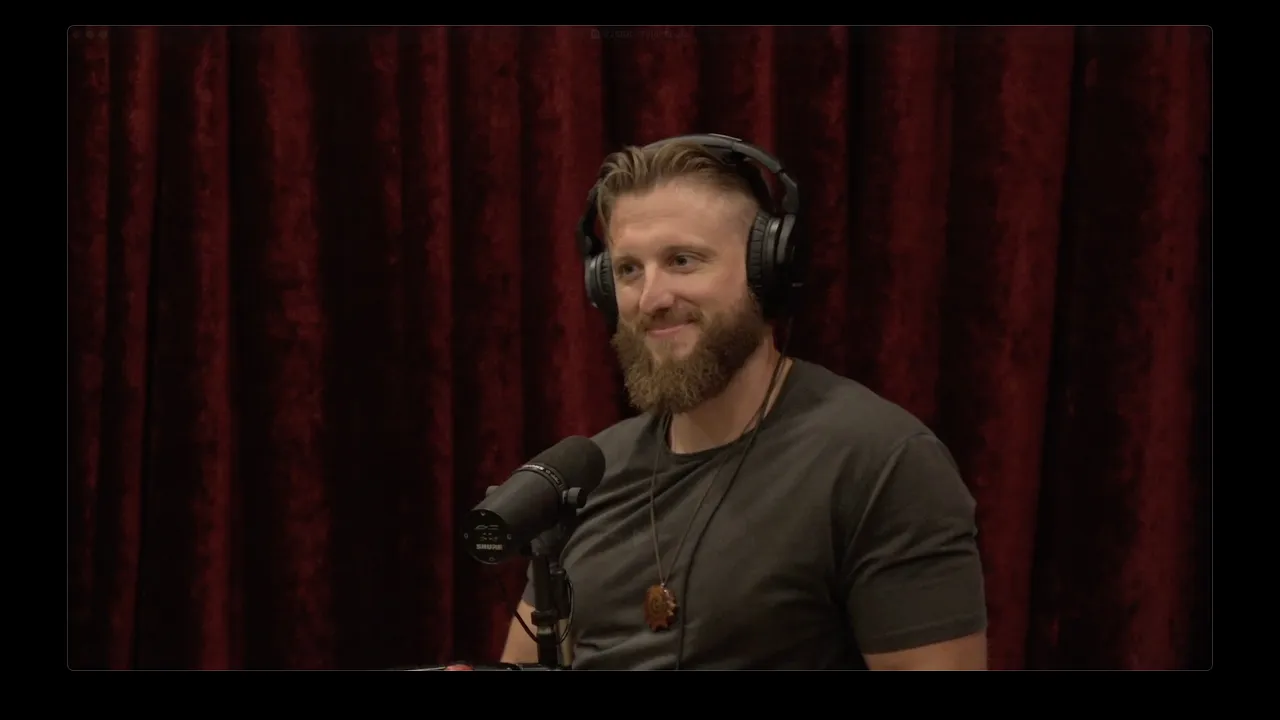
Tyler Engle Reframes Ancient Megaliths as Acoustic Energy Systems
PowerfulJRE
Predynastic monuments functioned as tuned electromagnetic energy sinks and chemical processors engineered to stabilize environments and survive cyclical planetary cataclysms.
Geological core samples from Shuruppak reveal a 50-foot flood mud layer dated to around 2900 BC alongside radar anomalies at the Durupınar site, supporting localized catastrophic Near-East flooding that aligns with Sumerian King List accounts rather than a literal global inundation. (1:16)
Microscopic analysis of kerf lines and stone cuts at Baalbek, Dahshur, and Karnak identified anomalous metallic microspherules and high-temperature alloys, suggesting non-rotary stone-working techniques involving acoustic cavitation or plasmoid reactions. (37:18)
Peer-reviewed electromagnetic and acoustic analyses indicate the eight-sided Great Pyramid acted as a passive band-pass filter and energy sink, down-converting atmospheric frequencies into telluric currents to revitalize surrounding soil and microclimates. (88:00)
Acoustic profiling of rock-cut sanctuaries like India's Bedse Caves confirms megalithic chambers were engineered to produce sustained resonant frequencies that stimulate auricular branches of the vagus nerve and deactivate amygdala stress responses. (134:34)
Detailed notes
## Background
Published on YouTube by PowerfulJRE on September 24, 2026, this episode of The Joe Rogan Experience (#2558) features Tyler Engle, a musician, researcher, author, and host of the BassForge YouTube channel. According to the show description, the discussion spotlights Engle's research into ancient engineering, anomalous history, and alternative scientific frameworks.
## TL;DR
Tyler Engle joins Joe Rogan to re-evaluate human antiquity, beginning with radar surveys of the Durupınar site in Turkey, Sumerian flood chronology, and fossil evidence for oversized archaic hominins like Denisovans. They examine cyclopean stone constructions across Baalbek, Giza, Kailasa, and Ollantaytambo, proposing that lost civilizations utilized divergent technological vectors rooted in acoustic cavitation, low-energy nuclear reactions, and harmonic resonance rather than combustion or manual labor. Engle details his unified model of ancient temples serving as environmental down-converters, structured water systems, and neural interfaces for non-local consciousness transmission. The dialogue ultimately argues for shifting the primary historical inquiry away from mere logistical transport methods toward uncovering the acoustical and metaphysical purposes behind tuning megalithic bedrock chambers.
## Atmosphere & style
The conversation moves with the breathless, inquisitive energy of a late-night rabbit-hole exploration, blending computer engineering terminology with metaphysical speculation. Engle maintains an analytical, pattern-seeking demeanor that methodically connects disparate global sites, while Rogan oscillates between enthusiastic amazement, earthy humor, and grounded reality-checks. The mood shifts from gritty mechanical skepticism about granite quarrying to mind-expanding awe regarding acoustic gnosis, giving the dialogue an intellectually adventurous and boundary-pushing feel.
## Bulletin
- [01:16](https://www.youtube.com/watch?v=ruVJE9po3-U&t=76s) Geological core samples from Shuruppak reveal a 50-foot flood mud layer dated to around 2900 BC alongside radar anomalies at the Durupınar site, supporting localized catastrophic Near-East flooding that aligns with Sumerian King List accounts rather than a literal global inundation.
- [37:18](https://www.youtube.com/watch?v=ruVJE9po3-U&t=2238s) Microscopic analysis of kerf lines and stone cuts at Baalbek, Dahshur, and Karnak identified anomalous metallic microspherules and high-temperature alloys, suggesting non-rotary stone-working techniques involving acoustic cavitation or plasmoid reactions.
- [01:28:00](https://www.youtube.com/watch?v=ruVJE9po3-U&t=5280s) Peer-reviewed electromagnetic and acoustic analyses indicate the eight-sided Great Pyramid acted as a passive band-pass filter and energy sink, down-converting atmospheric frequencies into telluric currents to revitalize surrounding soil and microclimates.
- [02:14:34](https://www.youtube.com/watch?v=ruVJE9po3-U&t=8074s) Acoustic profiling of rock-cut sanctuaries like India's Bedse Caves confirms megalithic chambers were engineered to produce sustained resonant frequencies that stimulate auricular branches of the vagus nerve and deactivate amygdala stress responses.
## Key takeaways
- [01:16](https://www.youtube.com/watch?v=ruVJE9po3-U&t=76s) Sediment cores from ancient Shuruppak and regional Anatolian surveys provide physical evidence of catastrophic flooding around 2900 BC, directly coinciding with the pre-flood reign of King Ziusudra.
- [06:36](https://www.youtube.com/watch?v=ruVJE9po3-U&t=396s) Fossil cranial and jaw morphology indicates Denisovans were massive, robust hominins averaging over 6'2", suggesting cross-cultural giant myths may reflect historical encounters with distinct archaic human lineages.
- [15:09](https://www.youtube.com/watch?v=ruVJE9po3-U&t=909s) The monolithic Kailasa Temple was carved top-down directly from volcanic basalt bedrock, defying orthodox tool assumptions after modern reproduction tests using hardened steel removed only fractional inches over four hours.
- [20:17](https://www.youtube.com/watch?v=ruVJE9po3-U&t=1217s) Mainstream explanations attributing the transport of 80- to 400-ton megaliths to Lebanese cedar rollers and wet sand are mechanically invalid due to timber compressive strength limits.
- [25:46](https://www.youtube.com/watch?v=ruVJE9po3-U&t=1546s) Synthetic aperture radar and ground-penetrating radar surveys conducted by Dr. Filippo Biondi identified extensive unexcavated subterranean voids and acoustic cavities beneath the Giza Plateau.
- [34:20](https://www.youtube.com/watch?v=ruVJE9po3-U&t=2060s) The massive 500- to 600-ton Western Stone in Jerusalem shares quarrying characteristics and monumental scale with the Trilithon foundations at Baalbek, indicating a shared specialized Levant megalithic tradition.
- [36:18](https://www.youtube.com/watch?v=ruVJE9po3-U&t=2178s) Microscopic spherules found embedded in precision cuts at Baalbek and Dahshur mirror residue produced by John Hutchison's RF field experiments, suggesting ancient electromagnetic stone-softening or thermal cutting techniques.
- [40:46](https://www.youtube.com/watch?v=ruVJE9po3-U&t=2446s) Ancient civilization may have advanced along an alternative technological vector centered on geometric matter manipulation, acoustic cavitation, and low-energy nuclear processes rather than combustion engines and silicon circuits.
- [46:01](https://www.youtube.com/watch?v=ruVJE9po3-U&t=2761s) Stratigraphy at sites like Ayanis Fortress and Ollantaytambo shows primitive mortar-and-rubble construction built directly on top of shattered, pre-existing cyclopean foundations from an earlier sophisticated era.
- [52:48](https://www.youtube.com/watch?v=ruVJE9po3-U&t=3168s) Predynastic megalithic monuments functioned as resilient infrastructure hardware, while dynastic temple layouts and sarcophagi served as software interfaces to entrain neural frequencies and transfer ancestral consciousness.
- [01:13:54](https://www.youtube.com/watch?v=ruVJE9po3-U&t=4434s) Egyptian hieroglyphic writing and the Sumerian language emerged fully formed in the archaeological record without transitional proto-alphabetic phases, pointing to a legacy inheritance from earlier civilizations.
- [01:28:00](https://www.youtube.com/watch?v=ruVJE9po3-U&t=5280s) The internal chambers and concavity of the eight-sided Great Pyramid are geometrically aligned to concentrate ambient radio frequencies into subterranean aquifers and telluric ground circuits.
- [02:01:55](https://www.youtube.com/watch?v=ruVJE9po3-U&t=7315s) Jeffrey Drum's 'Land of Chem' hypothesis interprets pyramid complexes as industrial chemical processors utilizing Earth currents and acoustic cavitation, supported by calcium sulfate and ammonia residue found within Dahshur and Giza chambers.
- [02:14:34](https://www.youtube.com/watch?v=ruVJE9po3-U&t=8074s) Acoustic resonant chambers carved from bedrock down-regulate the nervous system via the vagus nerve, prompting ancient engineering research to pivot from mechanical stone-lifting logistics to the neurological purpose of harmonic tuning.
The episode opens with Joe welcoming Tyler Engle, creator and host of the *BassForge* channel, showering high praise on Tyler's social media content. Joe admits that while doom-scrolling on Instagram, Tyler's page (@BassForge_us) stands out as a genuine rabbit hole where he actually feels justified spending time because he is learning something new. In particular, Joe highlights a recent post concerning radar scans of the alleged Noah's Ark site in Turkey. While Joe had previously heard about ground-penetrating scans in the region, Tyler's synthesis connected those physical anomalies directly to ancient Sumerian cuneiform accounts and the Sumerian King List, giving the legendary tale a grounded historical anchor.
Joe has producer Jamie pull up the clip on screen to give Tyler's platform exposure. Tyler notes that the excavation team had made headlines just two days prior after supposedly striking petrified wood within the formation. Both Joe and Tyler marvel at the strangeness of the site, prompting them to play Tyler's breakdown of the newly released data.
---
[01:16](https://www.youtube.com/watch?v=ruVJE9po3-U&t=76s) Drone Scans, Drogue Stones, and the Sumerian King Ziusudra
In the featured clip, Tyler details new geophysical drone surveys conducted at the Durupınar site near Mount Ararat in eastern Turkey. The survey utilized the same imaging technology recently deployed to detect the Hawara labyrinth in Egypt—findings that, while largely ignored by mainstream academia, present data too compelling to brush aside. Mount Ararat stands nearly 17,000 feet tall, flanked by massive hypersaline and carbonate water bodies. Tyler clarifies a frequent point of confusion among alternative historians: this Anatolian deluge should not be conflated with the much earlier Younger Dryas impact event (c. 10,800 BC), as the Turkish flood layers date far closer to historical antiquity.
```mermaid
flowchart TD
accTitle: Sumerian Ark Parallels
accDescr: Connections between Sumerian archaeological finds and the Noah flood account.
subgraph Archaeology ["Archaeological & Geological Evidence"]
MUD["Shuruppak Flood Stratum<br/>(50 ft of mud, c. 2900 BC)"]
SITE["Durupınar Formation<br/>(Mount Ararat scans & petrified wood)"]
DROGUE["Massive Drogue Stones<br/>(Perforated anchor megaliths)"]
end
subgraph SumerianTexts ["Sumerian Tradition"]
LIST["Sumerian King List"]
ZIU["King Ziusudra of Shuruppak<br/>(Final pre-flood monarch)"]
end
MUD --- ZIU
LIST --- ZIU
ZIU -. "Parallel archetype".-> NOAH["Noah's Ark Narrative"]
DROGUE --- SITE
SITE -. "Dimensional match".-> NOAH
```
Geological core samples from the ancient Sumerian city of Shuruppak reveal a catastrophic event that buried the settlement under fifty feet of flood mud—sediment dated remarkably close to the mud encasing the boat-shaped formation in Turkey. According to the Sumerian King List, Shuruppak was the home of Ziusudra, the final king reigning before the great deluge, serving as the direct literary predecessor to the biblical Noah. Tyler highlights the culture's megalithic capabilities, pointing out that shattered remnants of their mountain temples feature displaced ten-ton blocks scattered across the terrain. Adjacent to the ark site lie enormous, perforated stones identified as drogue stones—oversized sea anchors designed to be suspended from a hull by heavy ropes or chains to keep a rudderless, mastless vessel stable in turbulent waters. The dimensions of these anchor stones, along with the subterranean shape outlined by the scans, closely match the scale required for a craft built solely to survive a monumental inland surge.
- **Mount Ararat elevation:** Approximately 17,000 feet above sea level.
- **Sediment depth at Shuruppak:** 50 feet of flood silt and mud dating to the early third millennium BC.
- **Sumerian King List connection:** Ziusudra of Shuruppak, the pre-dynastic king who survived the flood, directly parallels the biblical Noah.
- **Drogue stones:** Massive pierced megaliths used as drift anchors to stabilize high-seas vessels without sails or rudders.
---
[03:07](https://www.youtube.com/watch?v=ruVJE9po3-U&t=187s) Local Cataclysm vs. Global Deluge: Lake Van and Advance Warning
Joe and Tyler dissect the realism behind the flood story. Joe points out that the literal biblical narrative—gathering two of every single animal on Earth onto a single wooden vessel to repopulate the globe—is physically impossible and represents a "ridiculous simplification" of an actual disaster. Tyler explains that geological evidence points to localized yet colossal inundations across the ancient Near East around 3,000 BC rather than an impossible planet-wide submergence. Across the region, encompassing sites from the Ionian coast to Mesopotamia, distinct catastrophic waterlines and debris deposits exist without needing to invoke the Younger Dryas.
The geography of the Anatolian plateau explains why ancient survivors described the calamity as the end of the entire world. Surrounded by expansive mountain ranges stretching from modern Iran to Greece, any catastrophic sea rise, tectonic shift, or tsunami pushing into the basin would leave the entire visible horizon a barren wasteland. Joe questions why the plateau contains massive saltwater basins. Tyler explains that Lake Van is a closed-basin soda lake rich in sodium carbonate produced by underlying volcanic activity, distinct from the hypersaline sodium chloride chemistry of the Dead Sea or Utah's Great Salt Lake.
The biggest mystery remains how the protagonist knew the disaster was imminent:
> "The question is, was it a real event? And if it was a real event, how the hell did this Noah guy know it was coming? That's where things get real weird... how the hell does this guy know enough that he spends years constructing this boat, this massive boat, the biggest boat that had ever been built at the time? And gets all these animals on it going, 'We're fucked in about three years. I got to get to work.'"
---
[06:36](https://www.youtube.com/watch?v=ruVJE9po3-U&t=396s) Giants, The Nephilim, Brian Shaw, and Denisovan Discoveries
The conversation shifts to mythological motifs that accompany ancient flood legends, notably Darren Aronofsky's film *Noah* starring Russell Crowe. While many dismissed the film's fantasy elements, Tyler appreciates that its prologue drew heavily on archaic apocryphal lore, such as the Nephilim and the Watchers. Joe admits that concepts he once discarded as sheer nonsense, particularly references to ancient giants, seem increasingly plausible given the physical variation possible in human genetics and the fossil record. Tyler agrees, remarking, "I am almost all in on Giants."
Joe illustrates human physical extremes using former World's Strongest Man Brian Shaw, who had recently visited the Comedy Mothership in Austin. Standing nearly seven feet tall and weighing over 400 pounds, Shaw possesses an astonishingly rare bone density estimated to occur in roughly one out of 500 million people. Joe contrasts modern extreme population variances—such as the towering Maasai people of East Africa compared to central African Pygmy tribes—to argue that the ancient archetype of "giants" could easily describe an unusually robust genetic lineage or an entirely distinct hominin species.
Their focus turns to recent anthropological findings concerning the Denisovans. Emerging skeletal material, jaws, and massive skulls confirm that Denisovans possessed dense, exceptionally large physical builds that towered over contemporary *Homo sapiens*. Joe jokes that Denisovan craniums look like a "Brian Shaw skull," as the two review recent headlines confirming that these archaic humans were remarkably large apex meat-eaters who walked alongside modern humans during prehistory.
[09:15](https://www.youtube.com/watch?v=ruVJE9po3-U&t=555s) Sizing Up Denisovans and the Fossil Record
Joe Rogan and Tyler Engle examine the physical stature of ancient hominins, kicking off with the size of Denisovans. Engle initially recalls estimates putting them around seven feet tall. Rogan points out how misleading an incomplete fossil record can be through a modern comparison: if an archaeologist in the distant future only discovered his skeleton, they might conclude modern humans stood between 5'7" and 5'9", but if they unearthed Shaquille O'Neal, they would assume he belonged to an entirely different species.
Jamie pulls up data showing that while Neanderthal men averaged around 168 centimeters, Denisovans reportedly reached 190 centimeters. Seeking "freedom units," Rogan asks his phone for the conversion, discovering that 190 centimeters equals roughly 6.23 feet. Rogan emphasizes how extraordinarily large that height was for ancient times, noting that obtaining sufficient dietary protein was historically a massive struggle. He draws parallels to historical malnutrition, mentioning how American Civil War soldiers routinely weighed only around 130 pounds, and medieval people were vastly smaller than modern humans. Recalling his travels through Italy—visiting Florence and Pompeii—Rogan describes how antique suits of armor in castles are shockingly slender and built for men standing roughly 5'5".
- Neanderthal males averaged roughly 168 cm, whereas Denisovans stood around 190 cm (approx. 6'2").
- Historical malnutrition kept human body sizes significantly smaller; soldiers in the American Civil War averaged around 130 pounds.
- Preserved medieval armor in Italian castles reflects soldiers who were extremely narrow-framed and around 5'5" tall.
---
[12:12](https://www.youtube.com/watch?v=ruVJE9po3-U&t=732s) Ancient Discrepancies, Giants, and Historical Myth vs. Fact
Discussing historical portrayals of giants—from towering figures like the stylized Xerxes in the film *300* to ancient bone discoveries—Engle and Rogan look at the shifting timeline of human relatives. Engle notes an article stating most Denisovan remains date back roughly 160,000 years, while recent radiocarbon tests on specimens placed others at around 45,000 years old. Rogan is stunned by the 120,000-year discrepancy, emphasizing that modern humans undoubtedly interacted with them.
Rogan reflects on the sheer rarity of fossil preservation: out of hundreds of millions of years of dinosaur existence, paleontologists have only uncovered a small fraction of remains, without a single 100% complete skeleton even for celebrated species like the T-Rex. Engle jokes about keeping "dragon believer" on his profile, prompting Rogan to point out that nearly every culture throughout antiquity preserved lore about giants and dragons. Rogan notes that ancient folklore repeatedly proves to have real roots; for centuries, the city of Troy was dismissed as pure myth until Heinrich Schliemann and later archaeologists uncovered the actual ruins. In an era when writing was arduous and literacy was rare, Engle and Rogan agree that people preserved detailed histories to pass down essential truths rather than indulging in disposable fiction.
```mermaid
flowchart TD
accTitle: Ancient Myth to Physical Reality
accDescr: Diagram illustrating how ancient lore and incomplete fossils eventually link to real-world archeological discoveries.
subgraph Legends["Ancient Accounts & Folklore"]
L1["Myths of Giants"]
L2["Stories of Dragons"]
L3["The City of Troy"]
end
subgraph ScientificFindings["Physical & Archaeological Findings"]
F1["Denisovans: 190 cm tall\n(45k - 160k YA)"]
F2["Fossil Record Gaps:\nRare preservation"]
F3["Excavations uncover Troy"]
end
L1 --> F1
L2 --> F2
L3 --> F3
```
---
[15:09](https://www.youtube.com/watch?v=ruVJE9po3-U&t=909s) The Mystery of Egyptian Hieroglyphs and the Kailasa Temple
Engle points out a major enigma in standard Egyptology: Egyptian hieroglyphs appear suddenly in the Old Kingdom fully developed and sophisticated, functioning like an intricate engineering language without clear intermediary evolutionary stages. Rogan agrees that assuming modern academia fully understands ancient capabilities is foolish, praising Engle's research into megalithic temples, their acoustic resonance, and the impossible stonework carved directly into living rock.
The conversation turns to the Kailasa Temple at Ellora Caves in India, which was carved top-down entirely from an extremely hard volcanic basalt mountain. Engle recounts posting a video about the temple and receiving blowback from critics claiming the mountain was soft soapstone. He cites an experiment conducted by the YouTube channel *Proto Civilization*, where large, fit men using a modern hardened steel pickaxe chopped at the rock behind Kailasa for four grueling hours; they only managed to carve out a 6-inch by 6-inch divot roughly half an inch deep before becoming completely gassed out. Rogan brings up historical records where an invading ruler deployed 100 men for two years to deliberately demolish the Kailasa Temple, yet they barely managed to scratch or disfigure it. Both conclude that modern society must open its mind to the reality of lost civilizations possessing sophisticated stone-working methods that remain completely unexplained.
- Hieroglyphic writing appears in the Egyptian Old Kingdom already fully formed, lacking evidence of primitive developmental stages.
- The Kailasa Temple at the Ellora Caves in Maharashtra, India, was excavated top-down directly out of basalt bedrock.
- In a modern tool reproduction test by *Proto Civilization*, four hours of hard labor with a hardened steel pickaxe removed an area only 6 inches across and 0.5 inches deep.
- Historical attempts to dismantle the temple using an army of 100 workers over two years inflicted negligible damage on the rock face.
Joe Rogan opens the segment by breaking down the metabolic science behind fasting and clean energy. When the human body enters a fasted state, it naturally produces ketones as an efficient backup fuel that burns cleanly, sustains energy over long stretches, and sharpens mental clarity. Acknowledging that strict fasting is difficult to maintain in everyday life, Rogan highlights Ketone-IQ as an exogenous way to deliver that exact same superfuel directly to the brain without having to skip meals, helping him drop into "laser-like focus" when he needs to lock in and think clearly. He notes that the product is now available nationwide at CVS, where customers can grab their first shot for free, or order online through ketone.com/rogan for a 30% discount on subscriptions.
---
[19:02](https://www.youtube.com/watch?v=ruVJE9po3-U&t=1142s) Kailasa Temple: Impossible Scrapes and Deep Tool Marks
Turning to megalithic architecture, Tyler Engle points to the rock-cut Kailasa Temple at the Ellora Caves in India as a smoking gun of ancient engineering. Unlike completed structures where the original quarrying techniques are polished away, Kailasa remains partly unfinished, exposing the intermediate phases of construction. Satellite temples cut directly from the basalt cliff from the top down reveal a stark contrast: while the upper elevations feature intricate, refined carvings, the lower excavations expose raw scoop marks and horizontal scrapes left behind by whatever excavation methods were deployed.
Engle emphasizes that the penetration depth of these tool marks is baffling when compared to modern equipment. A standard hydraulic jackhammer driven into solid stone cannot achieve the continuous, deep gouging seen on the basalt walls at Kailasa. Even more perplexing, many of these aggressive tool marks occur deep inside confined rock corridors where the trench narrows into a steep "V" shape so tight that a modern human worker has to squeeze through sideways. Rogan and Engle debate how any ancient stonemason could swing a conventional hand tool or position heavy equipment within such cramped quarters, concluding that whatever technology was applied must have cut through hard volcanic rock with effortless, fluid ease.
- **Unfinished excavation**: Kailasa’s satellite shrines show top-down quarrying progress, preserving raw transitional stages.
- **Deep scoop and scrape marks**: Wall striations exceed the penetration depth and continuous cutting profile of modern hydraulic rock breakers.
- **Extreme spatial confinement**: Tool marks extend through narrow, V-shaped rock crevices barely wide enough for a human body to pass sideways.
---
[20:17](https://www.youtube.com/watch?v=ruVJE9po3-U&t=1217s) Moving Ramesses: Modern Heavy Machinery vs. Ancient Sand and Logs
Rogan critiques the prevailing cultural arrogance that views 21st-century society as the undisputed pinnacle of technological sophistication in Earth's history, arguing that ancient stonework flatly contradicts that assumption. Engle shares that his own obsession with anomalous history was ignited by researchers like Graham Hancock, but hit home on an engineering level during the relocation of the colossal granite colossus of Ramesses II into the atrium of the Grand Egyptian Museum (GEM). Visitors standing at the base of the statue barely reach the pharaoh's shins, gazing upward at a monument so gargantuan that pictures fail to capture its scale. Engle humorously notes that while Ramesses famously carved his cartouche over virtually every earlier monument across Egypt, the idealized, generic features of the colossus bear little resemblance to the actual mummified face of Ramesses II.
From a practical construction standpoint, Engle contrasts modern logistics with orthodox Egyptological explanations. When Egyptian authorities moved the 83-ton red granite statue—carved from an original quarry block estimated at well over 200 to 400 tons—it required custom-engineered multi-axle trailers, massive steel reinforcing cradles, and specially paved roads to prevent the transit route from collapsing. Conventional academia, however, still posits that ancient dynastic workers hauled such megaliths across soft desert sand using nothing more than wet sand lubrication and Lebanese cedar rollers. Engle, drawing on his background in engineering, structural restoration, and heavy construction, points out that cedar logs possess nowhere near the compressive strength required to bear dozens of tons without splintering into pulp. He recalls how modern boom lifts cannot even be driven across certain paved streets without caving in the asphalt, making the idea of moving 80- to 300-ton monoliths across untamed terrain with primitive wooden sledges sound mechanically absurd. He also cites Jimmy Corsetti's breakdown of the LACMA *Levitated Mass* project, where moving a single 340-ton boulder over modern paved California highways required a 196-wheel transporter and weeks of meticulous civil engineering.
```mermaid
flowchart TD
accTitle: Megalithic Transport Logistical Comparison
accDescr: Comparing the modern industrial equipment used for Ramesses II and LACMA with orthodox academic theories of ancient logistics.
subgraph ModernTransport["Modern Heavy Transport"]
M1["83-ton Ramesses II / 340-ton LACMA boulder"] --> M2["Multi-axle hydraulic transport trailers"]
M2 --> M3["Heavy welded steel stabilizing cradles"]
M3 --> M4["Reinforced asphalt routes & bridge surveys"]
end
subgraph MainstreamTheory["Mainstream Academic Theory"]
A1["200- to 400-ton rough-quarried granite blocks"] --> A2["Soft desert sand with poured water lubrication"]
A2 --> A3["Low-compressive-strength wooden rollers"]
A3 --> A4["Ropes and human pulling teams"]
end
```
---
[23:36](https://www.youtube.com/watch?v=ruVJE9po3-U&t=1416s) The Flaws of Linear History, Lost Knowledge, and Modern "Magic"
The conversation sharpens around the inconsistencies of linear historical models. Rogan and Engle highlight the double standard in mainstream archaeology: academics praise ancient builders as geniuses capable of moving mountains with copper chisels and hemp rope, yet instantly dismiss those same builders' historical records, king lists, and mythologies as primitive superstition the moment they mention prehistoric epochs or advanced influence. As Rogan observes, whenever conventional narratives hit a wall they cannot logically explain, researchers retreat into imaginative rationalizations rather than acknowledging that our understanding of the timeline is fundamentally incomplete.
To illustrate how quickly high technology can vanish and appear magical, Rogan points to modern life. He describes leaving the Comedy Mothership in Austin in a Tesla that accelerates from zero to sixty in under two seconds and navigates him home on Full Self-Driving while he talks on a handheld smartphone with a friend across the country in Connecticut. If catastrophic nuclear war or an environmental cataclysm wiped global civilization clean, leaving scattered survivors surviving with animal skins and stone scrapers, any future tribe stumbling into an underground bunker full of intact microprocessors and satellite dishes would treat those artifacts as pure witchcraft. Engle adds that even if an instruction manual survived, the loss of language and context would render it unintelligible, leading post-cataclysmic cultures to venerate incomprehensible relics as divine totems.
---
[25:46](https://www.youtube.com/watch?v=ruVJE9po3-U&t=1546s) Geometry as Circuitry and Filippo Biondi’s Pyramid Scans
Engle proposes that in the absence of written manuals, the universal language left behind by advanced ancient builders is geometry. Just as printed circuit boards inside televisions and smartphones rely on precise physical geometry, traces, and pathways to route electromagnetic signals and execute logical functions, ancient temple complexes arranged sacred proportions and architectural alignments to organize societal energy, focus acoustic frequencies, and direct human movement. In that macro-technological framework, humans acted almost like physical data packets moving through a solid-state machine.
```mermaid
flowchart LR
accTitle: Macro Geometric Routing Comparison
accDescr: Visualizing Engle's analogy comparing microchip circuit traces to ancient monumental temple architecture.
subgraph MicroScale["Microcircuit Architecture"]
C1["Silicon & Copper Traces"] --> C2["Geometric Routing"]
C2 --> C3["Signal & Data Transmission"]
end
Rogan brings up the ongoing mystery surrounding the Great Pyramid of Giza, noting that the conventional tomb theory has become untenable in the face of modern remote sensing. He references the ground-penetrating radar and synthetic aperture radar (SAR) research conducted by Italian scientist Dr. Filippo Biondi, who identified anomalous subterranean voids and complex acoustic or structural properties inside the Giza Plateau. Rogan describes Biondi as an exceptionally humble, measured researcher who operates strictly off empirical data rather than hyperbole, having demonstrated the accuracy of his scanning methodologies on known subsurface archaeological sites and the deep-sea wreck of the *Titanic*. Despite repeatedly proving that his imaging technology matches verified physical dimensions, academic institutions and journals reacted with hostility, ultimately retracting his paper—a move Rogan and Engle criticize as institutional gatekeeping designed to silence hard sensor data that threatens orthodox timelines.
- **Circuitry analogy**: Ancient temple geometry functioned like macro-scale microchips, channeling acoustic resonance, energy, and organized human behavior.
- **Filippo Biondi's SAR scans**: Synthetic aperture radar mapping identified anomalous subterranean structures beneath the pyramids.
- **Empirical validation**: Biondi’s imaging methods were verified against known archaeological sites in Egypt and the structural scans of the *Titanic*.
- **Institutional suppression**: Biondi's peer-reviewed paper was retracted after mainstream backlash, exemplifying resistance to disruptive technological discoveries.
[02:27:20](https://www.youtube.com/watch?v=ruVJE9po3-U&t=8840s) Academic Gatekeeping and Giza's Underground
Tyler and Joe explore why mainstream archaeology is so reluctant to thoroughly investigate and excavate anomalous subterranean structures, particularly on Egypt's Giza Plateau. Tyler notes that from a pure business standpoint, stonewalling new discoveries makes no sense because opening up newly uncovered chambers would provide an endless stream of tourism revenue. Joe has not yet visited Egypt, and Tyler describes what it feels like to stand on the plateau: looking out across the landscape, an observer realizes that with a team of a hundred workers, vast sections could be cleared within months. The obstacle is not the labor, but the paralyzing bureaucracy of the antiquities authorities. From the famous vantage point where all three Giza pyramids align with camels in the foreground, anyone can see with their own eyes that extensive structures lie buried beneath the surface, marked by gated doorways and blocked entry points leading underground along the causeway—features documented extensively by independent researchers like Ben van Kerkwyk of UnchartedX.
Joe attributes this institutional resistance to human ego and the defensive posture of academia. For generations, Egyptologists and credentialed academics have built their reputations and careers around a rigid narrative: the pyramids were solely tombs, and ancient records like the Egyptian King’s List that span tens of thousands of years are dismissed as pure mythology. When laypeople or independent researchers question these dogmas, they are routinely met with condescending dismissal. Joe points out that institutional academia is a relatively modern invention, yet experts insist on acting as authoritative gatekeepers.
Tyler references Eric Weinstein’s critiques of academic gatekeeping, noting that a growing counter-movement is pushing back with physical anomalies that defy mainstream explanations. High-precision drill holes, overcuts into solid granite, and ancient oral traditions directly contradict standard historical timelines, exposing a massive divide between official consensus and material reality.
[02:29:53](https://www.youtube.com/watch?v=ruVJE9po3-U&t=8993s) Dangling from High-Rises: Tyler's Path to Ancient Anomalies
Asked how he first fell into the world of alternative history roughly twelve years ago, Tyler reveals an unlikely starting point: hanging off the sides of skyscrapers as a high-rise window cleaner. Having started out washing windows at fast-food joints with his father during high school, Tyler transitioned into high-rise cleaning due to the lucrative pay, despite having an initial fear of heights. Because the work required significant upfront capital for rigging and carried astronomical insurance costs, few people were willing to do it. Suspended hundreds of feet in the air, Tyler spent long hours listening to audiobooks and lectures with one earbud in, immersing himself in Graham Hancock’s *Fingerprints of the Gods*, John Anthony West’s *Magical Egypt* series, and anomalous archaeology.
Joe reacts with disbelief, calling high-rise window cleaning the scariest job imaginable and joking that he would need suction cups on his hands and total silence just to listen for the creak of failing cables. Tyler explains that his background studying computer engineering in college predisposed him to analyze the ancient world through a technical, structural lens. He had never assumed ancient history held anything particularly exciting until he saw engineering-focused breakdowns of cyclopean architecture, which permanently shifted his perspective.
[02:31:30](https://www.youtube.com/watch?v=ruVJE9po3-U&t=9090s) Baalbek’s Trilithon, Pre-Flood Origins, and Templar Excavations
Tyler points to Baalbek in Lebanon as the site that truly shattered his conventional worldview. The colossal stone blocks comprising the Trilithon and the broader temple platform weigh between 400 and over 800 tons. Joe highlights a glaring historical puzzle: while the Romans kept meticulous, comprehensive documentation of their architectural construction throughout the empire, they left absolutely no record of quarrying or placing the foundational megaliths at Baalbek. The platform had to have been there long before the Romans ever built their temples on top of it.
Tyler believes the lowest courses of Baalbek date back to a pre-flood, pre–Younger Dryas civilization, pointing out the distinct discoloration and visible repair layers separating the older megalithic base from later reconstructions. He connects these early mega-engineers to Phoenician Canaanites, who were renowned throughout the Mediterranean not only as peerless maritime navigators but as specialized stone-moving contractors who reportedly assisted with both Egyptian building projects and the foundation of Solomon's Temple in Jerusalem.
Tyler links these ancient engineering traditions to esoteric European history, citing Knight Templar Grand Master Timothy Hogan. Tyler argues that the Templars’ public mission of protecting Christian pilgrims to the Holy Land served as a cover for clandestine excavations in Jerusalem and Egypt. As evidence, he cites the recurring presence of Templar graffiti—specifically the indented cross pattée rather than a traditional Latin Christian cross—etched into sites like the Philae Temple in Egypt and the ancient anchor stones associated with Mount Ararat, marking locations where the order uncovered significant artifacts or lost knowledge.
```mermaid
flowchart TD
accTitle: Megalithic Builders to Templar Excavation Pipeline
accDescr: Diagram illustrating the historical continuum from pre-cataclysmic builders through Phoenician contractors to clandestine Templar excavations.
subgraph Prehistory["Pre-Cataclysm Era"]
A["Pre-Flood / Younger Dryas Civilization"] -->|Foundational Megaliths| B["Baalbek Lower Base<br/>(400–800+ ton blocks)"]
end
subgraph BronzeIronAge["Antiquity & Biblical Era"]
C["Phoenician / Canaanite Builder Guild"] -->|Contract Construction| B
C -->|Foundation Construction| D["Solomon's Temple Substructure<br/>(Western Stone, ~500–600 tons)"]
C -->|Engineering Exchange| E["Egyptian Megalithic Works"]
end
subgraph MedievalEra["Crusader Era"]
F["Knights Templar (Militia Front)"] -->|Secret Excavations| D
F -->|Exploration & Documentation| E
F -->|Signature Markings| G["Cross Pattée Graffiti<br/>(Philae Temple, Anchor Stones)"]
end
```
[02:34:20](https://www.youtube.com/watch?v=ruVJE9po3-U&t=9260s) Jerusalem’s Western Stone: 600 Tons of Hidden Engineering
Prompted by the discussion of Canaanite builders, Joe asks Jamie to search for the enormous subterranean megalith located within the Western Wall Tunnel beneath Jerusalem. After scrolling past modern prayer wall images, Jamie pulls up photographs and dimensions of the Western Stone, leaving Joe visibly stunned by its sheer scale.
The exposed block dwarfs modern masonry, sitting embedded in the ancient foundation levels attributed to Solomon’s Temple:
- **Dimensions:** Approximately 11.5 feet high and between 41 and 44.5 feet long across its exposed face, with an estimated total length reaching up to 16.5 meters.
- **Estimated Weight:** Between 500 and 600 metric tons, placing it among the largest individual building blocks ever quarried and set into a structure in human history.
- **Context:** The stone shares identical engineering characteristics, scale, and quarrying thresholds with the foundation courses at Baalbek, pointing back to the specialized, highly advanced guild of builders whose signatures remain etched into stone across the Levant.
[36:18](https://www.youtube.com/watch?v=ruVJE9po3-U&t=2178s) Plasma Anomalies and Exotic Metals in Ancient Stone
Tyler Engle describes how low-energy nuclear reactions leave microscopic signatures known as microspherules in stone. These microscopic spherical formations, which can be produced by meteorite impacts, intense electrical phenomena, or cutting-edge plasmoid physics, have turned up embedded in ancient megalithic sites across the globe, including Baalbek in Lebanon, Jerusalem, Iran, and Sacsayhuamán in Peru. Recognizing the subject from Tyler's content, Joe Rogan suggests pulling up Tyler's recent video on the topic because it lays the case out clearly.
Tyler directs Jamie to find the clip on his channel, initially sorting through topics on sound science and levitation before pinpointing his video examining exotic metals found in ancient stone cuts.
- **Sites with microspherule signatures:** Baalbek, Jerusalem, sites across Iran, and Sacsayhuamán.
- **Physical causes:** Low-energy nuclear reactions (LENR), plasmoid interactions, cosmic impacts, and high-heat rapid-cooling events.
---
[37:18](https://www.youtube.com/watch?v=ruVJE9po3-U&t=2238s) Analysis of Cuts at Karnak and Dahshur: Saws, Cavitation, and Transmutation
Tyler's video breakdown begins by looking at tool residue lodged directly within ancient stonework rather than loose sand. When researchers examined samples from Egypt's Karnak temple complex—analyzing microscopic saw marks highlighted in a video by Versidoko—they discovered razor-sharp cuts lacking any circular radius. Modern commercial stone-cutting operations rely on massive circular saw blades that invariably leave arced tool tracks. By contrast, the cuts in the Karnak granite are ruler-straight, indicating the tool sliced through the dense rock "more like butter than like a circular saw." Inside the microscopic fissures left by high-speed friction, researchers discovered exotic trace metals that dynastic Egyptians could not have manufactured.
```mermaid
flowchart TD
accTitle: Ancient Stone Cutting and Microspherule Formation
accDescr: Diagram illustrating how acoustic cavitation and low-energy plasma processes generate microscopic cuts and microspherules in megalithic granite.
subgraph Cutting["Tool Mechanism"]
A["Acoustic / Ultrasonic Vibrations"] --> B["Symmetric Water Bubble Compression"]
B --> C["Cavitation Energy Release"]
end
subgraph Effects["Material Impact"]
C --> D["Microscopic Straight Cuts in Granite"]
C --> E["Rapid Heating & Cooling Cycle"]
E --> F["Formation of Microspherules"]
C --> G["Atomic Transmutation / Alloy Traces"]
end
```
The video details a second sample from Dahshur featuring an extremely difficult sloping cut. Material testing revealed traces of three specific elements commonly restricted to the cooling loops of modern nuclear reactors, along with an unnatural copper alloy requiring temperatures far beyond ancient kiln capabilities. Most remarkably, microspherules were discovered clustered across the cuts. While standard meteorite impacts yield roughly one microspherule per square meter, samples tested from Baalbek contained an astonishing three per square centimeter. Tyler points out that acoustic cavitation—symmetrically collapsing micro-bubbles in liquid—generates extreme localized heat and energy capable of pitting marine propellers, perforating metal foils with ultrasonic sound, and leaving elemental transmutation byproducts like silver. He notes this research is discussed on page 67 of the *Cryptex* report, joking that standard historical explanations both fail to make sense and fail to fund his desperate need for a haircut.
- **Karnak tool marks:** Straight kerf lines without circular saw curvature, suggesting non-rotary cutting through hard granite.
- **Dahshur sample:** Featured a complex sloping cut, containing copper alloys requiring extreme melting temperatures and three elements typically found in nuclear cooling systems.
- **Density comparison:** Typical meteoritic background scatter yields ~1 microspherule per square meter, whereas Baalbek samples measured 3 per square centimeter.
- **Acoustic cavitation effects:** Collapsing water bubbles release intense energy; ultrasonic excitation of aluminum foil generates microscopic holes and traces of silver as a byproduct.
---
[40:46](https://www.youtube.com/watch?v=ruVJE9po3-U&t=2446s) Alternative Technological Paths: Low-Energy Plasmoids vs. CERN
Reacting to the video, Rogan observes that modern society constantly attempts to force ancient artifacts into the framework of contemporary technology. Modern humans pursued an industrial path rooted in internal combustion engines, electricity grids, and silicon electronics; an ancient civilization, Rogan argues, may have developed extraordinarily advanced capabilities along an entirely distinct technological vector that contemporary science has overlooked.
Tyler agrees, suggesting that their methods may actually have been far simpler and less resource-intensive than modern solutions. While today’s physics relies on massive, billion-dollar installations like CERN's Large Hadron Collider—which consume so much raw power that running experiments can strain regional power grids—plasmoid phenomena and low-energy nuclear processes operate at room temperature. By manipulating plasma geometrically through physical matter, unexpected transformations occur that resemble classical alchemy without demanding immense electrical infrastructure.
> "There's a very real possibility that technology was super advanced but in a different direction that we haven't pursued... That's just the way we went with the ingenuity that human beings possess. It doesn't mean that these people had to go that way." — Joe Rogan
---
[41:40](https://www.youtube.com/watch?v=ruVJE9po3-U&t=2500s) The Hutchison Effect, Bob Greenyer, and Transmutation Evidence
Tyler brings up the work of Canadian experimenter John Hutchison, who constructed a laboratory nicknamed "the submarine" during the 1980s. Hutchison combined Tesla coils, radio-frequency generators, and cosmic/terrestrial frequency monitors. During his experiments, strange anomalies supposedly occurred: objects levitated, solid metals jellified at room temperature, and dissimilar metals fused together. Hutchison's setup was eventually dismantled and confiscated by the Canadian government, but surviving physical samples made their way to independent researcher Bob Greenyer.
When Greenyer conducted modern material assays on Hutchison's surviving metal specimens, he discovered the exact same unexplainable microspherules found inside ancient stone cuts at Baalbek and Dahshur. To Tyler, this provides an empirical bridge between 20th-century low-energy plasmoid experiments and the anomalous metallurgy found across ancient megalithic masonry, pointing toward clean, room-temperature elemental transmutation rather than brute mechanical force.
- **John Hutchison’s apparatus:** Known as "the submarine," combining Tesla coils, high-frequency transmitters, and frequency modulation to induce anomalous levitation and metal softening.
- **Material findings:** Surviving test pieces analyzed by Bob Greenyer display the identical microscopic spheres found in ancient megalithic tool cuts.
---
[43:20](https://www.youtube.com/watch?v=ruVJE9po3-U&t=2600s) Misidentified Ancient Tools, Votive Cones, and Sumerian Origins
Addressing how ancient builders manipulated these plasmoid effects, Tyler suggests that archaeologists may be misclassifying functional tools as mere ritual art or decorative debris because their forms are deceptively simple. He references ubiquitous ancient features like Egyptian scoop marks and points to the mysterious cones depicted across ancient Mesopotamian reliefs. Tyler has Jamie search for Mesopotamian "votive cones"—clay and stone pegs inscribed with cuneiform script that were inserted into the foundations and walls of temples.
| Object / Feature | Orthodox Archaeological View | Tyler Engle's Alternative Hypothesis |
|:--- |:--- |:--- |
| **Scoop Marks** (Egypt, etc.) | Pounding stone wear or quarry dressing marks | Direct impressions of an energy-softening tool |
| **Votive Cones** (Mesopotamia) | Commemorative foundation deposits marking temple dedication | Directional acoustic or plasmoid energy-focusing devices embedded in masonry |
| **Sumerian Language** | Early bronze-age writing development | An unexplained language isolate appearing abruptly without traceable precursors |
While the Metropolitan Museum of Art defines votive cones as foundational dedication deposits created to preserve the historical memory of the ruler and appease the gods, Tyler suspects their geometric shape served to focus and direct vibrational or plasmoid energy into the structure. The conversation shifts to the broader mystery of Sumer itself. Rogan and Tyler note that while cuneiform is a script format adopted by multiple cultures, the Sumerian tongue is a complete language isolate with no linguistic relatives or developmental precursors—emerging suddenly in the historical record fully formed.
[46:01](https://www.youtube.com/watch?v=ruVJE9po3-U&t=2761s) The Basalt Polygonal Masonry of the Ayanis Fortress
Tyler Engle points Joe Rogan to the ancient fortress of Ayanis in eastern Turkey (Anatolia), situated near Lake Van in the ancient region of Urartu. Looking at imagery on screen, Engle highlights the extreme precision of the dark basalt and andesite stonework, arguing it is cleaner and more precise than almost anything else he has seen. Much of the site remains buried or damaged, leaving large sections unrecognizable, yet the exposed foundations exhibit the unmistakable signature of polygonal masonry found across disparate corners of the ancient world.
Engle notes that independent researcher Matt LaCroix has conducted extensive boots-on-the-ground fieldwork at Ayanis, capturing what Engle believes is some of the only detailed walk-through footage of the site. On screen, the stark juxtaposition between building phases becomes apparent: megalithic, finely fitted stone blocks sit at the base, while cruder mudbrick construction from subsequent cultures rests directly on top of them. Engle argues this mirrors what is repeatedly seen in Peru, where later populations built on top of an exceptionally ancient foundation they did not create.
- **Site & Geography**: The Fortress of Ayanis (Urartian civilization) in eastern Anatolia / Turkey, constructed on basalt and andesite bedrock.
- **Structural Stratigraphy**: Deep, megalithic polygonal stone masonry at the lowest levels, surmounted by later, cruder mudbrick layers.
- **Field Research**: Boots-on-the-ground documentation at the site provided by Matt LaCroix.
---
[47:43](https://www.youtube.com/watch?v=ruVJE9po3-U&t=2863s) Stone Cones, Plasma Resonance, and Magnetic Monopoles
Rogan presses Engle on how ancient stone cones were supposedly able to project energy. Engle explains his working hypothesis: natural plasma events—such as intense solar activity—can embed resonance directly into rocks by eating away at grain boundaries, creating microscopic internal cavities. This altered microscopic architecture produces acoustic resonance, turning ordinary stone into "ringing rocks." Engle asserts this acoustic property is pervasive across Egyptian monuments, where obelisks and central altars chime or ring when struck.
```mermaid
flowchart TD
accTitle: Ancient Plasma and Temple Resonance Concept
accDescr: Diagram illustrating how solar plasma alters stone and how geometric temples supposedly route energy between Earth and the ionosphere.
subgraph Amplification ["Charge & Field Dynamics"]
C["Cones / Sharp Tips"] --> CA["Charge Accumulation"]
CA --> M["Theoretical Monopole Effect"]
M --> BF["Bends Local Geomagnetic Field"]
end
subgraph Network ["Temple Network System"]
G["Earth Ground"] --- T["Geometrical Temple Architecture"]
T --- I["Ionosphere"]
T --> N["Node-to-Node Broadcast ('Wi-Fi Router')"]
end
```
According to Engle, a sharp point—whether on an engineered stone cone or even a human fingertip—acts like a natural lightning rod where electrical charge accumulates. By handling two such focused implements, operators could theoretically steer an electromagnetic field. He suggests this creates an effect akin to a magnetic monopole—a single-pole field embedded in the rock that bends Earth's ambient magnetic field. If a resonant tool matches the acoustic cavity of the stone, Engle theorizes, physical material can be moved or modulated without conventional brute mechanical force.
- **Plasma Imprinting**: High-energy plasma penetrates rock, carving micro-voids along grain boundaries and altering its internal physical structure.
- **Acoustic Signature**: Altered stones produce distinct bell-like rings when tapped, seen across Egyptian obelisks and altars.
- **Charge Concentration**: Sharp conical geometries concentrate charge, acting as focusing tools to manipulate local field dynamics.
- **Monopole Analogy**: Engle references theoretical magnetic monopoles to describe an isolated field pole that bends the surrounding geomagnetic field.
---
[49:26](https://www.youtube.com/watch?v=ruVJE9po3-U&t=2966s) The Temple Network: Divergent Science and Hutchison Gelification
When Rogan asks where this energy originates and how ancient people tapped into it, Engle outlines his broader model of the ancient world as an energetic grid. The fundamental mechanism involves bridging the electrical potential between the Earth's surface and the ionosphere through specific temple geometries. In this schema, a temple acts as specialized hardware that captures and routes the atmospheric signal, broadcasting it across a network of nodes much like a Wi-Fi router.
Engle contrasts this ancient paradigm with modern technology, characterizing it as an entirely "divergent science." While modern engineering relies on combustion, wires, and brute-force mechanics, ancient builders may have mastered field manipulation and state changes in matter. Rather than endorsing the popular geopolymer theory—which posits that megalithic blocks were poured like concrete—Engle points to the work of John Hutchison, whose experiments demonstrated that electromagnetic and RF field interference could induce "gelification," temporarily softening metals and rocks so they could fuse and reshape before hardening again.
> "To me, it's easier to understand than our side, the way we're doing things. I think we hit a dead end at some point... Not like we're not making progress, but this stuff seems to be the right way to do it. And it seems like they everywhere knew it."
---
[51:25](https://www.youtube.com/watch?v=ruVJE9po3-U&t=3085s) The Mystery of Pennsylvania's Ringing Rocks
As Rogan questions the immense timeline required for any civilization to evolve such a radical branch of physics, Jamie brings up Ringing Rocks County Park in Bucks County, Pennsylvania. Rogan is unfamiliar with the location, and Jamie explains that the park contains a vast field of diabase boulders that emit metallic, bell-like chimes when struck lightly with a hammer.
Rogan and Engle discuss the strange anomalies documented at the park: each stone's tone varies by size and shape, Native Americans historically gathered ringing stones for sacred ceremonial grounds, and park lore claims that if a boulder is removed from the field, it loses its resonant ring. Rogan questions the physical plausibility of that claim, joking that it might just be a park ranger's myth to stop tourists from looting the boulders, though they speculate whether acoustic resonance requires direct physical contact with the collective boulder field beneath them.
- **Ringing Rocks County Park**: Located in Bucks County, Pennsylvania; features an 8-acre boulder field of weathering diabase.
- **Acoustic Property**: When struck with a hammer, the boulders resonate with high-pitch, bell-like musical tones rather than a dull thud.
- **Cultural Use**: Native Americans recognized the stones and transported selected resonant rocks to ceremonial and sacred sites.
---
[52:48](https://www.youtube.com/watch?v=ruVJE9po3-U&t=3168s) Hardware, Software, and Wetware: The Egyptian Initiation System
Rogan circles back to the staggering timeline implied by Engle's model, wondering how many thousands or tens of thousands of years it would take for human civilization to master geometric plasma conduits to the ionosphere. Engle clarifies that he does not believe the dynastic Egyptians invented the core technology from scratch. Instead, he conceptualizes ancient Egypt using a computational framework:
In Engle's formulation, ultra-ancient megalithic structures like the Osireion and the Giza pyramid complex represent the surviving "hardware and infrastructure." The later dynastic temples—such as Luxor and Karnak—function as the "software layer" or operating system, encoding philosophical instructions, rites, and operating manuals along the Nile. The human initiate serves as the "wetware," traveling south to north up the river from temple to temple to systematically calibrate their brain receiver.
Rogan asks where Engle draws these concepts from, particularly regarding mummification and claims of individuals living for thousands of years on ancient king lists. Engle explains that in esoteric Egyptian tradition, wisdom was not just handed down by writing, but energetically: the pharaoh was initiated through progressive spiritual and philosophical trials to become the living avatar of Horus, receiving transmitted consciousness down an unbroken lineage. Just as an athlete cannot bench press 405 pounds on their first day in the gym, Engle explains, an initiate had to undergo rigorous years-long physical and mental tuning across the temple complexes before their biological receiver could sustain that level of energetic transmission.
[55:50](https://www.youtube.com/watch?v=ruVJE9po3-U&t=3350s) Consciousness Transfer and the *Altered Carbon* Sarcophagus
Tyler Engle compares the culmination of ancient Egyptian royal training to reaching the absolute pinnacle of an athletic or martial discipline. In his view, when an initiate proved themselves worthy of succession, the coronation ceremony was not merely a symbolic placement of a crown; it functioned as an actual transfer of consciousness, effectively downloading the memories and knowledge base of previous rulers. He asks Joe Rogan if he has seen the Netflix science fiction series *Altered Carbon*, drawing a direct parallel between the show's concept of physical bodies acting as interchangeable "sleeves" and the Egyptian succession method—arguing that ancient Egyptians may have unlocked a biological or spiritual equivalent to that process without requiring modern digital technology.
```mermaid
flowchart TD
accTitle: Egyptian Temple Consciousness Entrainment Flow
accDescr: Flow diagram showing the sequential transition from the sensory outer courtyard through the naos to neural entrainment and memory download.
subgraph EntrainmentProcess["Ritual Entrainment"]
C --> D["Sensory Isolation & Incense<br/>Targeted acoustic tuning"]
D --> E["Spontaneous Synchronization<br/>Brainwaves match deity/pharaoh frequency"]
end
subgraph MemoryAccess["Consciousness Download"]
E --> F["Quantum Anchor / Mummy Link<br/>Direct experiential memory transfer"]
end
```
Rogan immediately connects this hypothesis to the Tibetan Buddhist tradition of the Dalai Lama. In Tibetan culture, leaders do not claim individuals live for tens of thousands of years in a single physical form; instead, search parties locate the reincarnated vessel into which that specific essence has migrated. Rogan clarifies Tyler’s thesis: the ancient pharaohs were ordinary mortals with standard biological lifespans, but their identity, wisdom, and core essence were deliberately channeled and transported across generations into successive physical bodies.
---
[57:56](https://www.youtube.com/watch?v=ruVJE9po3-U&t=3476s) Mummies as Quantum Anchors and Nested Sarcophagi
When Rogan asks why Engle arrived at this consciousness-download theory, Tyler points directly to the sheer oddity of mummification. In the broader scope of human archaeological history, the elaborate, labor-intensive preservation of corpses stands out as an inexplicable anomaly if viewed merely as primitive superstition. Tyler introduces his concept of the mummy functioning as a "quantum anchor"—a physical bookmark left behind in spacetime that allows a living practitioner in an altered state to tune in and access a specific stream of ancestral memory.
Tyler highlights the specific engineering and nested construction of Egyptian sarcophagi. Rather than burying a body in a basic container, the Egyptians encased mummies in multi-tiered layers resembling Russian matryoshka nesting dolls—beginning with an outer megalithic stone sarcophagus, progressing inward through carved wooden coffins, and terminating in gilded innermost casings:
- **Material Selection:** The specific choices of stone, wood, and gold were calculated to isolate, shield, and preserve a coherent electromagnetic or vibrational frequency within the preserved remains.
- **Inherited Wisdom over Oral History:** Instead of learning lessons through spoken didactic advice, incoming pharaohs reportedly entered psychedelic-induced altered states to directly and vividly experience the prior ruler’s life lessons firsthand.
- **The Anchor Effect:** By maintaining the physical vehicle in a state of suspended decay, priests preserved a localized harmonic link connecting the physical world to the departed spirit's information field.
---
[59:33](https://www.youtube.com/watch?v=ruVJE9po3-U&t=3573s) Morphic Resonance and the Non-Local Mystery of Memory
Rogan connects Engle's concept of inherited non-local information to Rupert Sheldrake’s theory of morphic resonance, noting that contemporary science repeatedly runs into bizarre anomalies suggesting memory is not strictly confined to biological brain tissue:
- **Cross-Continental Maze Learning:** When laboratory rats on the East Coast are trained to solve a novel maze, unrelated rat populations on the West Coast subsequently learn to navigate the identical maze noticeably faster, indicating an interconnected species-wide information field.
- **Metamorphosis and Memory Retention:** Research demonstrates that caterpillars subjected to aversion conditioning retain those learned memories after completely liquefying inside their chrysalis and emerging as adult butterflies.
- **Epigenetic Fear Transmission:** Laboratory experiments pairing specific scents (such as acetophenone or lavender) with mild electric shocks result in multiple subsequent generations instinctively avoiding that odor without ever experiencing the negative stimulus themselves.
Engle argues that mainstream modern science operates with a remarkably primitive model of memory. Rather than memories existing purely as physical cellular storage inside the skull, memory may exist as an ambient information field permeating reality. If a sufficiently advanced civilization cracked the physics of that field, they would have been able to map, quantify, store, and transmit consciousness deliberately. Tyler asserts this is precisely what Egyptian texts like the *Book of the Dead* are attempting to describe with hyper-detailed instructions for traversing non-physical realms—closely mirroring reports from modern DMT research where subjects encounter entities and navigate coherent, shared alternative dimensions.
---
[01:01:24](https://www.youtube.com/watch?v=ruVJE9po3-U&t=3684s) Egyptian Temples as Acoustic Neural Programming Interfaces
Engle explains that Egyptian temples were deliberately built to systematically narrow a human's sensory awareness. A visitor started in a vast, sunlit outer courtyard and progressed inward through increasingly dark, cramped hypostyle halls until reaching the central *naos*—the stone inner sanctum. Inside this acoustic chamber, isolated from external light and sound, priests employed incense and harmonic vocalizations to place initiates into deeply tuned states. Engle stresses that in ancient Egyptian, Roman, and Hindu contexts, temples were considered the literal physical bodies of the gods, serving a completely different technical purpose than modern congregational churches:
- **Spontaneous Synchronization:** In physics, out-of-sync metronomes placed on a shared movable base naturally synchronize through mechanical frequency entrainment; Tyler argues Egyptian temple rituals used the same principle to align human brainwave frequencies with the dominant harmonic frequency of the deity or ancestral pharaoh.
- **Programming Interface:** Rather than a simple worship hall, the temple functioned like a high-bandwidth university or a neural programming interface where initiates could rapidly absorb vast stores of complex data, "like Neo downloading the kung fu" in *The Matrix*.
- **Temple vs. Megastructure:** Engle contrasts delicate, ritualistic temple sites with enigmatic megalithic structures like the Osireion at Abydos, which he characterizes as heavy-duty survival infrastructure built to endure planetary catastrophes rather than act as pedagogical spaces.
---
[01:03:52](https://www.youtube.com/watch?v=ruVJE9po3-U&t=3832s) Sumerian King Lists, Long-Lived Rulers, and the Watchers
Rogan asks how many millennia a civilization would have to exist uninterrupted before unlocking technologies of consciousness and frequency entrainment. Engle suggests that rather than assuming ancient records are allegorical fantasy, modern historians should take ancient chronologies seriously. If an advanced antediluvian society existed before being wiped out by a global cataclysm, their recorded timelines might be literal historical records:
- **Sumerian and Egyptian King Lists:** Both chronologies assign staggering lifespans to early predynastic monarchs, with some Sumerian kings credited with reigning for tens of thousands of years—individual rulers reportedly holding power for upwards of 28,000 to 50,000 years.
- **The Book of Enoch and the Watchers:** Rogan notes the pervasive cross-cultural mythos of higher beings descending to Earth, such as the Watchers in the apocryphal *Book of Enoch* who mated with human women to produce the destructive Nephilim.
- **Ubiquitous Sky Visitors:** From Mesopotamian texts discussing the Anunnaki ("those who from heaven to earth came") to pan-global folklore, ancient traditions consistently maintain the identical narrative: advanced visitors descended from the skies to impart advanced civilizational knowledge.
[01:05:28](https://www.youtube.com/watch?v=ruVJE9po3-U&t=3928s) Cataclysms, Interbreeding, and the Reset Loop
Reflecting on the mysterious emergence of advanced human culture, Tyler Engle and Joe Rogan explore the possibility that a surviving advanced group may have blended directly into local hunter-gatherer populations. Tyler suggests that unless these beings looked completely alien—like the elongated Peruvian mummies—they likely resembled the indigenous people they encountered through interbreeding. This genetic and cultural mingling could explain the simultaneous explosion of advanced civilizations around the globe, where agriculture, legal codes, and monumental architecture suddenly appeared out of nowhere. Once a stable society was established, knowledge could be preserved and rebuilt, only to be repeatedly knocked down by subsequent disasters like the Mesopotamian flood between the Younger Dryas and modern history. Tyler frames human advancement as a tragic "cat-and-mouse game" where humanity almost reaches civilizational maturity before a disaster resets the clock.
Joe points out that reaching such an insane degree of architectural and engineering sophistication requires substantial windows of peace—stretches of millennia free from cataclysmic wars or cosmic impacts where societies can uninterruptedly innovate. The primary physical artifacts left behind to testify to these golden eras are the planet's anomalous megalithic structures.
```mermaid
flowchart TD
accTitle: Cyclical Rise and Reset of Ancient Civilizations
accDescr: Flowchart illustrating how civilizations innovate during peaceful eras, get reset by cataclysms, and attempt to rebuild on ancient infrastructure.
subgraph Rise ["Civilization Cycle"]
A["Peaceful Eras & Innovation"] --> B["Breakthrough Megalithic Tech"]
B --> C["Cataclysm (Younger Dryas / Floods)"]
C --> D["Knowledge Loss & Memory Wipe"]
end
subgraph Rebuilding ["Reconstruction"]
D --> E["Interbreeding & Knowledge Seeding"]
E --> F["Building on Megalithic Foundations"]
F --> A
end
```
[01:06:58](https://www.youtube.com/watch?v=ruVJE9po3-U&t=4018s) Megalithic Nesting Dolls and the Erosion at Petra
Tyler explains that ancient builders consistently reused the same sacred sites because they recognized the underlying infrastructure. Temples across the world, such as Angkor Wat and Karnak in Egypt, feature ancient megalithic foundations buried beneath layers of later repairs, Roman additions, and Greco-Roman facades. In the Americas, complexes like Teotihuacan and Chichén Itzá reveal "nesting dolls of pyramids," where newer structures were built directly over an older core to preserve precise geometric and energetic alignments. Tyler notes that walking through these sites in Egypt offers a visceral, physical sensation: one can immediately feel an unmistakable "vibe" distinguishing genuine primordial stonework from later, cruder imitations.
This deep timeline is further complicated by severe weathering patterns. While conventional archaeology dates many monuments to recent millennia, water and wind erosion on the Giza plateau and at Petra in Jordan point to tens of thousands of years of exposure. Tyler highlights that Petra is barely 10% excavated, meaning modern tourists are essentially walking atop the roofs of buried structures. While iconic facades like the Treasury remain remarkably crisp, adjacent carvings—including heavily worn mountain reliefs and an ancient carved lion in the cliffside—are eroded almost beyond recognition, presenting an archaeological enigma of conflicting construction eras carved straight out of the bedrock.
- **Angkor Wat & Karnak**: Megalithic footprints layered over by centuries of successive cultures and restorations.
- **Pyramid Nesting Dolls**: Mesoamerican sites built outward in stages around an aligned megalithic core.
- **Petra Excavation Status**: Estimated to be only around 10% uncovered, leaving vast networks buried under silt and sand.
- **Erosion Discrepancies**: Severely degraded stone reliefs situated right next to pristine facades, indicating vast age gaps between construction phases.
[01:10:11](https://www.youtube.com/watch?v=ruVJE9po3-U&t=4211s) "The Hill" and Ancient Telepathic Commons
The conversation takes an intriguing turn when Jamie Vernon brings up an account documented in the podcast series *The Telepathy Tapes*, which investigated non-verbal autistic children who independently describe meeting in a shared telepathic astral realm they call "The Hill." Despite having no physical contact or conventional means of communication, these children report converging at the same metaphysical landscape to converse and learn. Jamie and Tyler wonder whether this psychic commons is identical to ancient concepts of the dream plane, such as the dream temples of ancient Greece, Celtic mound traditions, or shamanic "soul flights."
Joe and Tyler muse on the sociopolitical implications of such a realm. If ancient populations had natural access to a shared conscious space where they could learn languages, hieroglyphs, or spiritual knowledge directly from non-physical teachers, authoritarian rulers would have perceived it as a direct threat to state power. Joe jokes, "And this is why drugs are illegal," while Tyler observes that despots throughout history have systematically destroyed sacred tablets, closed dream sanctuaries, and smashed ancient monuments—much like the Taliban blowing up ancient Buddhist statues—to ensure that only the ruling class controlled divine access.
[01:12:07](https://www.youtube.com/watch?v=ruVJE9po3-U&t=4327s) Altered States as the Primary Ancient Science
Tyler argues that profound altered states of consciousness—whether triggered by near-death experiences or psychedelics—serve as an existential "download" that permanently reorganizes an individual's worldview. While modern recreational users often find themselves tossed around at the mercy of an overwhelming Ayahuasca journey, ancient priesthoods developed a rigorous, methodical science designed to maintain conscious focus and agency within those spiritual realms.
Inside authentic pharaonic burial chambers (distinct from the barren pyramids), the walls are lined with navigational spells and instructions designed to help the initiate travel through the astral underworld. Tyler describes this as a "celestial university" where initiates interacted with ancestors, downloaded lost memories, and communed with deities. In his view, mastering conscious navigation in these immaterial spaces was not secondary mysticism, but the very first foundational science of antiquity—the metaphysical doorway through which ancients accessed the secrets of nature, revealing how to soften, shape, or levitate massive stones.
[01:13:54](https://www.youtube.com/watch?v=ruVJE9po3-U&t=4434s) Ancient Gnosis, Spells as AI Prompts, and the Solar Barque
Tyler explains that true understanding of the universe transcends limited sensory perception; it is an internal revelation identical to what the ancient world termed gnosis—direct, experiential knowledge of the mechanics governing natural reality. Prompted by this concept, Joe asks Young Jamie to pull up Egyptian hieroglyphs depicting the journey through the afterlife, specifically pointing toward KV7, the tomb of Ramesses II in the Valley of the Kings. As they pull up the ancient funerary texts, Jamie makes an unexpected observation: ancient Egyptian "spells" might actually be conceptualized as prompts. If a traveler doesn't know the exact phrasing or sequence, they cannot generate the desired outcome or open the intended reality. The insight lands immediately with Joe and Tyler, with Joe joking that Jamie needs to write a book on the subject.
Building on the prompt analogy, Tyler connects this directly to navigating psychedelic states such as DMT breakthroughs. In Egyptian funerary iconography, figures are frequently depicted traveling inside a protective enclosure flanked by serpents. While traditional Egyptologists classify this strictly as apotropaic protection, Tyler suggests that sustaining consciousness in these realms requires actively holding a personal vibrational frequency—a psychic vessel forged through rigorous temple initiation protocols. Joe agrees, pointing out that serpents are an almost universal motif encountered during deep psychedelic experiences. Looking at the hieroglyph of an initiate clad in white inside a solar barque crowned by a solar disc, Tyler interprets the boat as an ancient depiction of a wormhole vehicle. The inscriptions were not superstitious nonsense, but a precise, encoded download—a cosmic address and navigational prompt documenting how to reach non-physical entities across dimensional planes.
- Ancient Egyptian funerary spells act functionally like modern AI prompts: without inputting the exact formula or psychic frequency, the initiate cannot access the corresponding realm or entity.
- The serpent motif encircling the traveler in royal tomb inscriptions symbolizes the energetic barrier required to preserve conscious coherence during interdimensional navigation.
- The Egyptian solar barque is interpreted by Tyler as a stylized representation of a wormhole or dimensional transport mechanism rather than merely a mythological boat.
```mermaid
flowchart LR
accTitle: Ancient Spells as Dimensional Prompts
accDescr: Diagram illustrating the parallel between ancient funerary protocols and modern prompting to navigate altered states.
subgraph Initiation ["Temple Preparation"]
A["Initiation Protocol"] --> B["Vibrational Coherence"]
end
subgraph ThePrompt ["The Formula"]
B --> C["Spells / Prompts"]
C --> D["Solar Barque / Wormhole"]
end
subgraph Afterlife ["Non-Physical Reality"]
D --> E["Protected Observer"]
E --> F["Contact with Other Realms"]
end
```
[01:16:32](https://www.youtube.com/watch?v=ruVJE9po3-U&t=4592s) The Book of Caverns and Anomalous Underworld Figures
Joe redirects Jamie to pull up the *Book of Caverns*, an ancient New Kingdom funerary text renowned for containing some of the most surreal and disquieting imagery in Egyptian archaeology. Browsing through public domain extracts and entries on Tour Egypt, Joe zeroes in on a row of deeply bizarre, uniform silhouettes rendered along the bottom register. Tyler observes that the underworld texts carved into subterranean royal tombs are fundamentally different in tone and subject matter from the public hieroglyphs carved onto above-ground temples, remarking that the figures appear almost "Nephilim."
The figures immediately grab Joe's attention because they look unlike any standard human or divine depictions from Egypt. At first glance, they appear to have unnaturally elongated digits and hands, but zooming in reveals an even stranger anatomy: the figures appear entirely headless, bowed on their knees inside tight enclosures or boxes, with bizarre secondary appendages branching off their torsos. Nearby are depictions of nested stone gates—false doors and portal arches seen throughout Egyptian architecture. Amid the visual search, Tyler notes that these funerary compositions also conceal advanced scientific principles, citing a papyrus associated with Queen Khentkaus that appears to diagram the optical physics of spherical refraction.
- The subterranean royal tombs present an artistic register completely divorced from above-ground temple propaganda, focusing on underworld entities, multidimensional geography, and esoteric physics.
- The bottom registers of the *Book of Caverns* depict rows of uniform, headless, kneeling silhouettes confined within compartmentalized boxes alongside nested portal gates.
- Tyler points out that ancient Egyptian scrolls contain precise geometric diagrams that align with the principles of spherical refraction optics.
[01:20:44](https://www.youtube.com/watch?v=ruVJE9po3-U&t=4844s) Interrogating Perplexity AI on Underworld Silhouettes
Hoping to identify the conventional archaeological explanation for these headless entities, Joe has Jamie run the image through their AI search engine, Perplexity. As the model takes an unusually long time analyzing the visual data, Joe and Tyler joke that the engine is having an existential crisis because the imagery is forbidden knowledge. Joe jokes that it feels like asking an AI for bomb-making instructions, reminiscing about a previous episode where they tried to convince an AI to instruct them on how to smoke PCP—a request the AI adamantly refused until they manipulated the prompt by claiming they were already high on it.
When Perplexity finally completes its analysis, the response falls into generic visual descriptions rather than archaeological clarity. The AI identifies them as stylized humanlike silhouette figures painted in red and black standing or kneeling in sequence near wavy serpent symbols, speculating they could represent ritual participants or repeated manifestations of a deity, while explicitly noting that visual data alone cannot definitively identify them. Tyler explains that this ambiguity is standard across Egyptology; whenever he consults local researchers and guides in Egypt regarding these subterranean oddities, no clear consensus exists. The modern world retains an extraordinarily superficial grasp of the actual metaphysical mechanics, rituals, and symbols recorded across deep underworld tombs.
- Perplexity AI struggles to offer an authoritative historical identification, classifying the figures merely as stylized silhouettes and ritual participants.
- The hesitation of the AI prompts playful banter about jailbreaking system filters, referencing past attempts to bypass safety guardrails with absurd premises.
- Tyler emphasizes that mainstream Egyptological translations often provide superficial descriptions rather than unlocking the actual esoteric meaning behind underworld compositions.
[01:23:08](https://www.youtube.com/watch?v=ruVJE9po3-U&t=4988s) The Limits of Greek Interpretation and Academic Blanket Narratives
Tyler Engle emphasizes that modern understanding of ancient Egyptian culture remains heavily filtered through a narrow lens. While the Rosetta Stone allowed linguists to decode the phonetic sounds of hieroglyphics, it did not provide the inner contextual or esoteric meanings held by the ancient Egyptian priesthood. The priests never gave visiting Greeks an exhaustive tour explaining every symbol, meaning classical Greek accounts represent an outside interpretation rather than knowledge straight from the source. Rogan observes that researchers are essentially "throwing our darts in the dark," an assessment Engle agrees with. Engle explains that while he takes mainstream scholarship into account, modern academia fails to see the ancient world through the worldview of the people who actually built it.
```mermaid
flowchart TD
accTitle: Knowledge Transmission and Translation Gap
accDescr: Diagram illustrating the loss of original Egyptian meaning through Greek interpretation and modern academic classification.
subgraph Ancient ["Original Source"]
A["Ancient Egyptian Priests"] -->|"Withheld esoteric secrets"| B["Greek Observers"]
A --> C["Hieroglyphs & Artwork"]
end
subgraph Modern ["Modern Analysis"]
C -->|"Rosetta Stone"| D["Phonetic Translation"]
B -->|"Subjective Accounts"| E["Academic Textbooks"]
D & E --> F["Catch-all Labels:<br/>'Underworld', 'Fertility', 'Protection'"]
C -.->|"Scientific/Physics Lens"| G["Acoustic & Optical Models"]
end
```
Engle illustrates his frustration with standard academic textbooks by noting how readily institutions slap generic labels on complex iconography. As Rogan and Jamie look up interpretations on Perplexity, Engle points out that mainstream analysis predictably categorizes ancient depictions as being about "the underworld," "fertility," or "protection." He compares this intellectual gap to how South American archaeology treats indigenous traditions:
> "There's a huge gap in between our interpretation because we kind of put a blanket over all of these cultures... Even if you go to places that still have a really good cultural anchor like Peru, they don't agree with what we say this thing was. They don't agree that the Incas built the pre-Inca looking stonework... They don't claim that, but we will say that the Inca did it."
- The Rosetta Stone cracked the phonetic script of Egyptian hieroglyphs, but it did not provide direct insight into the symbolic or philosophical concepts behind the imagery.
- Engle seeks to demonstrate that ancient art accurately encoded physical processes that modern science has only recently verified through the scientific method.
---
[01:26:03](https://www.youtube.com/watch?v=ruVJE9po3-U&t=5163s) Optical Refraction, Spheres, and The Book of the Caverns
While working through technical difficulties to AirDrop files to Jamie, Engle directs attention to an image from *The Book of the Caverns*. Drawing upon an analysis by researcher Clay Taylor, Engle demonstrates how the ancient artwork mirrors the exact laws of spherical optical refraction. In the Egyptian relief, a straight, concentrated beam of light passes through figures, including the deity Khnum, which Engle describes as conveying knowledge, consciousness, or spiritual energy transmitted via light.
The solar disc functions visually and mechanically as a spherical transmitter of this information. Engle argues that the ancient priests treated light like a tuning fork to navigate spiritual domains. Crucially, the artwork reproduces the precise physical phenomena observed when light passes through a sphere—including the distinctive inversion where images mirror and flip upside down between top and bottom.
- The relief shows a straight beam carrying deities, terminating at the ram-headed creator god Khnum.
- The path and dispersion of the light in the relief precisely mimic the optical refraction patterns generated by a transparent sphere.
- The solar disc is portrayed as an active transmitter of consciousness and energy rather than merely an artistic or decorative symbol.
---
[01:28:00](https://www.youtube.com/watch?v=ruVJE9po3-U&t=5280s) The Eight-Sided Great Pyramid as an Electromagnetic Energy Sink
Engle connects spherical optical geometry directly to the architecture of the Great Pyramid of Giza. When overlaying the Great Pyramid onto the spherical refraction diagram, the internal geometry lines up precisely with the physics of light dispersion. The side angle of the pyramid matches the optical angle of a double rainbow, and the Grand Gallery corresponds directly to the focal point where the sphere breaks light into the seven colors of the visible spectrum (ROYGBIV).
```mermaid
flowchart LR
accTitle: Great Pyramid Electromagnetic and Optical Mechanics
accDescr: Flowchart showing the transformation of Schumann frequencies and radio waves into underground electromagnetic energy.
subgraph Input ["Environmental Waves"]
A["Schumann Cavity Resonances"]
B["Atmospheric Radio Frequencies"]
end
subgraph Pyramid ["Pyramid Structure"]
C["Concave / 8-Sided Exterior"] --> D["Band-Pass Filter Chambers"]
D --> E["Internal Nodal Resonance"]
end
subgraph Output ["Energy Sink"]
F["Electromagnetic Energy Grounding"]
end
A & B --> C
E --> F
```
Rogan questions Engle's assertion that the Great Pyramid is eight-sided. Engle clarifies that each of the four faces has a subtle central indentation or concavity, turning each face into two distinct planes. This feature is nearly impossible to detect from the ground, but becomes dramatically visible from the air under the oblique lighting of the equinoxes. When Rogan asks whether the original limestone casing would have exaggerated or hidden this, Engle suggests the indentation served a functional internal tuning role rather than a cosmetic one. He cites a peer-reviewed 2018 physics study demonstrating that the Great Pyramid passively concentrates radio frequency waves down into its subterranean base:
> "Internally there's these chambers and these specific little nodes that were like filters, like band-pass filters... taking a bigger wave that's passing through this and creating something inside of it that kind of slips through and that can utilize the frequencies that are passing through it. So to me they're like more of a sink than they were like a transmitter. I think a lot of people think they were a transmitter. I think they were sinking this flow of energy into the ground."
- The Great Pyramid’s eight-sided concavity can only be clearly witnessed from the air around the equinox due to shadow casting.
- Engle contends the pyramid's dimensions resonate with the Schumann resonance frequencies trapped in the Earth's ionospheric cavity.
- Rather than functioning as a broadcasting power plant (such as Christopher Dunn's Giza Power Plant hypothesis), Engle views the monument as a passive collector and band-pass filter sinking atmospheric electromagnetic and radio frequency energy into the bedrock.
[01:32:18](https://www.youtube.com/watch?v=ruVJE9po3-U&t=5538s) Geometry, Telluric Currents, and Ecological Engineering
Tyler Engle explores the idea that ancient megalithic sites functioned through geometry rather than moving mechanical parts. Describing the process as alchemical, he explains that the physical geometry of these structures acts as a down-converter, taking large energetic atmospheric waves and stepping them down into smaller wavelengths capable of directly altering ground-level physics. By manipulating telluric ground currents and the electrical gradients within the Earth's crust, the structures could directly dictate soil conductivity. In turn, soil conductivity determines plant germination rates, vegetation growth, and the overall vitality of an ecosystem. At a baseline level, these monuments served as environmental modifiers; at their peak, they likely routed and focused this energy across entire landscapes.
```mermaid
flowchart TD
accTitle: Ancient Ecological Energy Circuit
accDescr: Diagram showing how atmospheric energy is down-converted through pyramid geometry into telluric currents and water networks to sustain ecosystems.
subgraph Atmosphere ["Atmospheric Interface"]
A["Ionosphere / Atmospheric Radio Waves"]
end
subgraph Megalith ["Pyramidal Structure & Transduction"]
B["Limestone Geometry<br/>(Focusing / Down-conversion)"]
C["King's Chamber Rose Granite<br/>(Piezoelectric Quartz & Ferromagnetic Iron)"]
end
subgraph Distribution ["Subterranean Network"]
D["Telluric Currents & Ground Aquifers"]
E["Underground Piping & Structured Water<br/>(Dahshur, Angkor Wat, Osireion)"]
end
subgraph Impact ["Ecological Output"]
F["Optimized Soil Conductivity & Germination"]
G["Terraformed 'Garden of Eden' Ecosystem"]
end
A --> B
B --> C
C --> D
D --> E
E --> F
F --> G
```
When Rogan asks where this knowledge originated and what exactly ancient peoples were doing with it, Engle responds that the sites represent foundational survival infrastructure. He posits that a pre-dynastic civilization responsible for the Osireion, the Osiris shaft, and the Giza pyramids endured severe planetary upheavals prior to the Younger Dryas and built these sites as environmental recovery systems.
Invoking the research of Gerald Pollack on "EZ water" (exclusion-zone or structured water), Engle notes that the human body relies on this liquid-crystal state of water to transport nutrients and electrical signals. Ancient temples were systematically built over water bodies or intersections of subterranean water to interface between the ionosphere and ground telluric currents. At complexes like Dahshur in Egypt or Angkor Wat in Cambodia, extensive subterranean conduits and pipe systems distributed this energized water throughout the region, functioning as a non-mechanical terraforming machine engineered to sustain life in harsh environments.
---
[01:35:17](https://www.youtube.com/watch?v=ruVJE9po3-U&t=5717s) Resonant Cavities, Rose Granite, and the "Garden of Eden" Grid
Addressing Rogan's question regarding what lies beneath the Great Pyramid and the underground structures mapped by researcher Filippo Biondi, Engle compares the subterranean cavities to colossal tuning forks or resonant chambers. The geometry beneath mirrors the inverted proportions of an obelisk, which is recognized for acoustic ringing properties. The entire structural assembly works in concert: the bulk of the Great Pyramid consists of limestone casing and blocks that channel ambient atmospheric radio waves, focusing them into the King's Chamber.
The King's Chamber is deliberately built from rose granite transported over five hundred miles from Aswan. Engle highlights that each beam weighs upwards of eighty tons and features two critical physical properties:
- High quartz crystal content, making the rock piezoelectric under pressure and acoustic stress.
- Ferromagnetic properties due to high iron content, giving the stone its distinctive rose hue.
As incoming atmospheric waves condense into electromagnetic energy and pass through the rose granite, the chamber tunes the frequency—analogous to spontaneous synchronization in consciousness. By broadcasting this tuned resonance into the earth, the builders established an interconnected grid capable of cultivating a fertile "Garden of Eden" anywhere they chose. Engle asserts that when these energetic nodes function, an area flourishes; when they fall into ruin and stop operating, the land reverts to the hyper-arid, inhospitable desert seen in modern Egypt.
---
[01:37:27](https://www.youtube.com/watch?v=ruVJE9po3-U&t=5847s) The Smartphone Analogy, Genetic Splicing, and Civilizational Templates
When Rogan asks whether the primary objective was deliberate geoengineering, Engle clarifies that labeling it purely as geoengineering misses the multidimensional utility of the technology. He compares it to a smartphone: while the primary battery power stabilizes the device, the applications loaded onto it serve countless other functions. In this model, environmental stabilization and ecological habitability served as the baseline power supply, while human societal systems functioned as the "apps."
Temples acted as educational installations or universities where populations could "download" vital cultural, hydrological, architectural, and seismic engineering knowledge to construct resilient societies. Engle speculates that this civilizational model was effectively a standardized, "white-labeled" operating system meant to be deployed across different locations. Such a template could use naturally evolved local fauna—such as Earth's native primates—which were genetically modified and spliced to receive and interface with these civilizational signals, providing a plug-and-play methodology for establishing thriving outposts on any chosen world.
---
[01:39:44](https://www.youtube.com/watch?v=ruVJE9po3-U&t=5984s) The Global Distribution of Knowledge: Americas, Rome, Egypt, and Beyond
Rogan asks whether this capability extended to actively controlling weather patterns or solely stimulating plant growth. Engle replies that it encompassed both, pointing to distinct regional specializations across the globe:
- **The Americas (Biological and Agricultural Laboratory):** Sites such as Machu Picchu demonstrate sophisticated crop acclimatization across dramatic microclimates from mountain peaks down toward sea level. The Amazon basin itself reveals vast human agricultural engineering, showing that indigenous cultures operated as master biologists shaping regional ecosystems.
- **Greco-Roman Europe (Societal Organization and Administration):** The Mediterranean powers focused heavily on the logistics of distribution, governance, and structural engineering. The Romans sustained their empire by actively assimilating and transmuting foreign belief systems and cultural frameworks into a functional, cohesive civic order.
- **Dynastic Egypt (Consciousness and Metaphysics):** Egyptian sacred science centered on internal states and deciphering the *neters* (or *neteru*)—the fundamental archetypal patterns of nature from which the modern word "nature" is derived. By attuning to these principles through hieroglyphic sciences and ritual architecture, individuals accessed direct gnosis and metaphysical insight.
- **The Hindu World and Pacific Islands (Hydrology and Water Cultivation):** Traditions across the Indian subcontinent and oceanic islands specialized in the manipulation, vibrational preparation, purification, and energetic staging of water networks.
[01:41:44](https://www.youtube.com/watch?v=ruVJE9po3-U&t=6104s) The Acoustic Temple Network and Planetary Awakening
Tyler Engle explains how ancient sacred structures treated water as an active component in complex technological installations. Across India, ancient Hindu stepwells were intentionally integrated with Shiva lingams, over which water was poured in rituals designed to purify, energize, and sanctify the supply. Moving into Southeast Asia, Angkor Wat stands as the most hydrologically advanced civil engineering complex from antiquity, with its true scale and sub-surface footprint still not fully charted. Tyler views Angkor Wat as a benchmark for a unified, worldwide ancient technical paradigm: different cultures possessed fragments of the exact same underlying theory and physical science, but tailored their implementations to local geography.
```mermaid
flowchart TD
accTitle: Ancient Temple Acoustic Processor Model
accDescr: Flowchart showing how celestial alignments, geological resonance, and geometric design interact to form an operational acoustic processor.
subgraph Cosmic ["Cosmic & Geological Inputs"]
A["Celestial Alignments<br>(Orion, Pleiades, Solstices)"]
B["Earth Resonances<br>(Telluric currents, Seismic hum)"]
end
subgraph Architecture ["Temple Transducer System"]
C["Sacred Geometry & Layout<br>(Acoustic Cymatic Tuning)"]
D["Hydrological Systems<br>(Water routing, Stepwells)"]
end
subgraph Function ["Output & Application"]
E["Acoustic / Vibrational Tuning<br>(Consciousness interface, Earth cultivation)"]
end
A --> C
B --> C
D --> C
C --> E
```
Rather than building mere monuments to superstition, these societies established what was effectively a human school designed to awaken planetary intelligence. While modern consumer tech operates on micro-scales utilizing the electromagnetic spectrum—such as radio frequency chips crammed inside smartphones—ancient temple builders worked with macroscopic acoustic and mechanical energy. Temples were deliberately tuned cavities engineered to resonate at precise acoustic frequencies. Their builders documented these vibrational modes using floral motifs that directly match cymatic wave patterns. Operators within the temples effectively drove these spaces like resonant machines. A baffled Joe Rogan reacts to the sheer technical audacity of the concept: "Jesus Christ. How the hell did they learn this?" Tyler chuckles in response: "Your guess is as good as mine. I’m just trying to DJ the stuff and figure out this knowledge."
- **Acoustic vs. Electromagnetic Scales**: Modern electronics harness micro-scale high-frequency electromagnetic waves, whereas megalithic temples harnessed macro-scale acoustic, vibrational, and seismic energy.
- **Cymatic Iconography**: The recurring decorative flower carvings found inside ancient temple sites correspond to physical cymatic standing-wave geometries produced by specific resonance frequencies.
- **Hydrological Integration**: Sites like Angkor Wat and Hindu stepwells combined moving water with resonant stone geometry to alter water's properties and drive energy throughout the architecture.
---
[01:44:00](https://www.youtube.com/watch?v=ruVJE9po3-U&t=6240s) Mars, Interstellar Seedbanks, and Consciousness Routers
Contemplating the origins of such a civilization, Rogan asks what the earliest iteration of this pre-existing culture could have looked like. Tyler posits a radical, cosmological hypothesis: humanity’s deep ancestors may have originated on Mars before catastrophic events tore that planet apart, leaving behind the colossal scars visible today. Given that modern humanity is already actively attempting to figure out terraforming and interplanetary colonization via figures like Elon Musk, the imperative to maintain an off-world backup planet is a logical survival response rather than pure fantasy.
Extrapolating that survival imperative across billions of years of cosmic deep time, advanced civilizations would not necessarily rely on physical metal spaceships to haul physical bodies across interstellar voids. Instead, Tyler suggests they could have engineered an entangled network capable of transferring consciousness—a phenomenon he suspects was connected to Egyptian mummification practices and metaphysical rites. In this setup, specific star systems aligned with ancient Earth monuments, such as Orion or the Pleiades, could act like cosmic relay nodes or network routers. Rather than an isolated world where advanced architecture inexplicably materialized overnight, Earth may have served as a living way-post, biological databank, and agricultural repository where advanced intelligence could safely deposit genetic blueprints—like corn—and retrieve them whenever another colony planet faced catastrophe.
---
[01:46:24](https://www.youtube.com/watch?v=ruVJE9po3-U&t=6384s) The Megalithic Enigma of Ollantaytambo and Reused Foundations
Rogan points out that the deepest historical paradox is that the oldest monuments discovered on Earth consistently display the highest degree of architectural sophistication. Tyler brings up researcher Jay Anderson and his series on ancient technologies, highlighting footage from Ollantaytambo in Peru. At Ollantaytambo, enormous megalithic blocks weighing dozens of tons lie violently shattered and strewn across the mountain slopes, while comparatively primitive, mortar-and-rubble stone stacking sits directly on top of them.
If the conventional historical narrative were accurate—attributing the entirety of the construction to the Inca—it would mean the crude, low-tech brickwork miraculously survived a cataclysm violent enough to fling colossal multi-ton megaliths down a mountainside without disturbing the fragile masonry above. Tyler and Joe laugh at the absurdity of that explanation. The physical stratification makes it clear that successive cultures consistently discovered ruined megalithic structures left behind by a forgotten civilization and rebuilt directly over their footprints, a phenomenon visible in Lebanon's Baalbek, throughout the Mediterranean, and across the Americas. Rogan emphasizes that even the Aztecs never claimed to have erected the colossal pyramids at Teotihuacan; they revered them as pre-existing ruins and explicitly designated the site as "the place where the gods were born," with the initial constructions predating Aztec arrival by at least a millennium.
---
[01:48:15](https://www.youtube.com/watch?v=ruVJE9po3-U&t=6495s) Geometry as an Unfiltered Language: Temples as Planetary Processors
Tyler points out that the true understanding of these sophisticated predecessor cultures became fragmented because knowledge was passed down through spoken myth, song, and later through written scripts like Sanskrit or Egyptian hieroglyphs. Linguistic interpretation inevitably becomes gatekept and clouded by subjective translation: if an academic asserts a Sanskrit verse means one specific thing, an ordinary person has little choice but to take their word for it. However, "what doesn't lie is the geometry."
Geometrical layouts operate as functional hardware blueprints that are physically identical to the circuits etched into contemporary electronic devices. When scaled up into monumental stone architecture, temples were sited to interface directly with the natural seismic hum, telluric vibrations, and acoustic dynamics of the Earth, bridging them with cosmic energy. Tyler reads the instructions preserved in ancient texts not as mystical allegories, but as rigorous engineering specifications: to tap into a specific planetary energy node, an acoustic "processor" had to be constructed at an exact geographic point, calibrated precisely to cardinal directions, and oriented toward specific stars at the dawn of key solar events.
- **Stratified Construction at Ollantaytambo**: Highly sophisticated, finely dressed megaliths lie fractured from a past catastrophic shock, while crude, unmortared repair work attributed to the later Inca rests intact on top of them.
- **Teotihuacan's True Origin**: Aztec oral tradition explicitly rejected the notion that they built the pyramids of Teotihuacan, dating the original complex at least 1,000 years prior to their civilization.
- **Geometric Hardware**: Sacred geometry in temple ground-plans mirrors the trace layouts and architecture of modern processors, using seismic and acoustic vibrations instead of electrical currents.
[01:50:51](https://www.youtube.com/watch?v=ruVJE9po3-U&t=6651s) Translating Ancient Symbolic Systems: Hieroglyphs, Hebrew, and Engineering Diagrams
Tyler emphasizes that cardinal alignments across megaliths represent hard archaeoastronomical evidence validating theories of advanced ancient knowledge. When modern researchers write off legendary lore as mythological fantasy, they miss that ancient peoples were simply using the best vocabulary available to explain complex physical and natural processes. In contrast to modern English—a hyper-specific, absorptive language engineered to expand and evolve—ancient communication relied on expansive, multi-layered visual concepts. Hieroglyphs frequently contained up to seven distinct layers of meaning depending on their context. Because "a picture is worth a thousand words," translating an ancient hieroglyphic concept into modern English inevitably becomes muddy; modern readers must expand a single dense visual glyph into paragraphs of technical text just to approximate its scope.
Joe agrees that nuance is inherently lost in translation, comparing it to the jarring grammatical giveaways in foreign scam emails where someone claims to be writing from the American heartland ("Hey, you're not really from Kansas. Hey, John"). Tyler quips back that he actually is from Kansas. Joe notes that in ancient Hebrew, letters simultaneously doubled as numbers, embedding quantitative and mathematical dimensions directly into written language.
Tyler explains that different ancient writing systems served specialized functional roles rather than merely recording phonetic speech:
- **Mayan Glyphs:** Built around repeating astronomical and biological cycles, aligning with sophisticated genetic and agricultural timing systems.
- **Egyptian Hieroglyphs:** Read more like technical engineering schematics or multi-view part diagrams than narrative literature.
- **Vedic and Hindu Scripts:** Formulated around fluid dynamics, resonance, and energetic flow, which eventually evolved into Buddhist principles of harmonizing with the flow of reality.
- **Misguided Archaeology:** Modern academia routinely defaults to labeling undeciphered artifacts as "ritual," "fertility," or "protection," ignoring their role as practical operational manuals.
---
[01:54:10](https://www.youtube.com/watch?v=ruVJE9po3-U&t=6850s) The Sudden Emergence of Hieroglyphs and Non-Verbal Knowledge Downloads
A central enigma of Egyptian civilization is that hieroglyphs appear in the historical record fully mature, with no crude proto-alphabets or rudimentary developmental precursors. Instead of starting with simple signs like an "X marks the spot" and gradually evolving a lexicon over millennia, the writing system burst forth containing a complete, sophisticated conceptual vocabulary capable of describing principles of physics, optics, and celestial mechanics that modern science is still working to fully grasp.
Joe brings up accounts from the "telepathy tapes"—documented cases where non-verbal autistic children demonstrated an unexplained ability to read and decipher Egyptian hieroglyphs with zero prior education. Tyler suggests these children may be directly accessing or downloading information from the archetypal "primordial mound" or "the hill," a sacred motif found across global mythologies. In these accounts, the children describe a "teacher" or entity residing on the hill who conveys the meaning of the glyphs to them. Joe and Tyler consider why non-verbal individuals seem uniquely receptive to this: lacking verbal speech and standard cultural socialization, they may bypass the conventional ego-filter and redirect conscious neurological energy into uninhibited, non-local perception.
---
[01:56:19](https://www.youtube.com/watch?v=ruVJE9po3-U&t=6979s) Matías De Stefano, the Akashic Spiderweb, and Structured Water as a Quantum Interface
Tyler recounts traveling through Egypt with Matías De Stefano, who claims total recall of past lives. While De Stefano's claims can sound baffling at first, Tyler finds that investigating them often reveals coherent scientific underpinnings. De Stefano describes ancient society as operating primarily through non-verbal, telepathic communication embedded within a shared energetic field. He visualizes this field as an interconnected cosmic spiderweb containing specific nodes of knowledge—an ancient database or living supercomputer analogous to the concept of the Akashic records.
```mermaid
flowchart TD
accTitle: Ancient Field Access Model
accDescr: Diagram illustrating how acoustic vibration, water, and information nodes interact across time.
subgraph Field ["The Informational Spiderweb"]
B --> C["Akashic Field Database"]
C --> D["Nodes of Knowledge & Past/Future Memories"]
end
subgraph Implementation ["Societal Application"]
D --> E["Predicting Cataclysmic Cycles"]
E --> F["Strategic Temple Construction to Restart Civilization"]
end
```
According to this framework, acoustic vibration and harmonic resonance alter the molecular state of water, structuring it at a quantum level to serve as an interface between past, present, and future. Initiates used this water interface to navigate the informational web, allowing them to track civilizational timelines and foresee future cataclysms. By pinpointing when a societal collapse would occur, ancient planners could intentionally design and bury specific temple networks so that future populations would excavate them and restart civilization. Because citizens were immersed in this shared field of knowledge, societies could mobilize massive populations around long-range architectural projects that spanned centuries.
---
[01:58:26](https://www.youtube.com/watch?v=ruVJE9po3-U&t=7106s) The Edfu Building Texts, Stargates, and the True Origins of Atlantis
Joe brings up the literal depiction of "Stargates" carved into ancient Egyptian temple walls. Tyler notes that their Egyptian guide, Mohamed Ibrahim, has broken away from mainstream orthodoxy by translating these literal glyphs directly. When visiting the Temple of Horus at Edfu, the exterior building texts engraved along the massive temple enclosure walls present what Tyler argues is the true, original historical record of Atlantis.
- **Pre-Platonic Record:** While mainstream history attributes the story of Atlantis exclusively to Plato's dialogues *Timaeus* and *Critias* (sourced from the Athenian statesman Solon), the Edfu building texts document the core narrative long before Plato lived.
- **The Primeval Myth:** The reliefs at Edfu explicitly depict the arrival of the primeval creator gods in divine boats across the sea after their sacred homeland was destroyed.
- **Architectural Preservation:** The outer wall inscriptions act as a visual chronicle of how these surviving sea-faring deities arrived in Egypt and established the sacred geometry and foundation rituals for rebuilding civilization.
[01:59:43](https://www.youtube.com/watch?v=ruVJE9po3-U&t=7183s) Egyptian Hieroglyphs, the Edfu Building Texts, and Ancient Defacement
Tyler Engle and Joe Rogan examine carvings and imagery from Egyptian temples. Rogan asks if they feature concentric circle diagrams reminiscent of Plato’s Atlantis. Tyler explains that while they may not have that exact diagram, they are covered in plasma technology hieroglyphs that he personally traveled across Egypt to track down and found in every temple he visited.
Looking at imagery from Dendera, Rogan asks about the winged figures and what they represent, calling them "fucking weird." Tyler breaks down the ancient Egyptian spiritual cosmology: the *Ka* is represented by the uplifted arms, the *Ba* is the spiritual soul or body depicted as a bird that can fly through realms, and the *Mer* represents the light, forming the *Merkaba* or spiritual light body, with the *Ka* serving as the earthly, human counterpart.
```mermaid
flowchart TD
accTitle: Three Aspects of Egyptian Spiritual Cosmology
accDescr: Breakdown of Mer, Ba, and Ka representing light, soul body, and human aspect.
subgraph MERKABA["Merkaba (Spiritual Light Body)"]
M["Mer: Spiritual Light"]
B["Ba: Soul / Spiritual Body (depicted as a bird)"]
K["Ka: Human Aspect / Physical Life Force (depicted with raised arms)"]
M --- B
B --- K
end
```
Tyler then directs Rogan to pull up the Edfu Building Texts from the Temple of Edfu. Examining the relief panels, Tyler notes that the carvings depict people journeying across the ocean from an ancestral homeland to Egypt, alongside giant gods shown on the right teaching diminutive human figures on the left how to cultivate crops and practice agriculture. Rogan immediately notices that the figures' heads and faces have been systematically hacked away and destroyed. Tyler explains that nearly all the oldest reliefs throughout Egypt have been defaced and scratched away by successive regimes across thirty separate conquests, each essentially claiming, "that wasn't him, it was me," obliterating historical predecessors from the permanent stone record.
[02:01:55](https://www.youtube.com/watch?v=ruVJE9po3-U&t=7315s) Jeffrey Drum's "Land of Chem" Theory: Pyramids as Chemical Plants
Rogan pulls up a discussion from Jesse Michels' podcast featuring independent researcher Jeffrey Drum of *The Land of Chem*. Rogan reads Drum’s hypothesis: rather than being royal tombs, the pyramids functioned as industrial-scale chemical manufacturing facilities designed to synthesize industrial acids and fertilizers needed for agriculture and metallurgy, driven by the earth's natural electrical charge. Rogan reads through several supporting points:
- Chemical residues still remain inside the pyramids; 1970s interior sampling revealed a crust of calcium sulfate up to an inch thick inside the Queen's Chamber of the Great Pyramid, which is precisely what dilute sulfuric acid leaves behind when interacting with limestone.
- Independent chemist Dr. Brian Cohen verified that the Great Pyramid's inner workings align with the production of sulfuric acid.
- Different pyramids produced distinct chemicals: the Step Pyramid at Saqqara was configured for methane extraction, the Pyramid of Khafre yielded hydrochloric acid, and the Red Pyramid at Dahshur produced ammonia.
- The Red Pyramid still retains a strong ammonia odor, concentrated deepest within the interior chambers and dissipating toward the entrance. While Egyptologists attribute this to bat guano, wall stain analyses revealed metal oxides, including thorium, which bats cannot produce.
- The entire Giza plateau appears to be an interconnected conductive grid, with natural iron veins and rare earth deposits running through the bedrock. One sample yielded 35% platinum, and the long rock-cut boat pits beside the Great Pyramid may have functioned as massive circuit breakers rather than boat graves.
[02:03:51](https://www.youtube.com/watch?v=ruVJE9po3-U&t=7431s) Acoustic Cavitation, Water Purification, and Scaling Civilization
Tyler enthusiastically agrees with Drum’s findings, explaining that chemical production directly fits his own vibrational model. In Tyler's view, the internal chambers, granite beams, and nodes were cut to tune into specific subterranean earth frequencies. Acoustic resonance in the stones triggers ultrasonic cavitation—similar to sonoluminescence, where sound waves collapsing bubbles in water generate light and extreme localized heat. This process acts as a solid-state mechanism without moving parts, boiling water, creating specific elemental compounds, and sterilizing massive water supplies.
```mermaid
flowchart LR
accTitle: Acoustic Cavitation and Resource Generation Flow
accDescr: Flow showing how earth frequency resonance through pyramids produces chemicals and clean water.
subgraph SOURCE["Input & Tuning"]
A["Earth Natural Frequencies / Bedrock"] --> B["Pyramid Geometry & Chambers"]
B --> C["Acoustic Resonance / Tuning"]
end
subgraph PROCESS["Cavitation Mechanism"]
C --> D["Ultrasonic Cavitation in Deep Wells/Aquifers"]
end
subgraph OUTPUT["Distribution & Outputs"]
D --> E["Chemical Compounds & Fertilizers (Agriculture)"]
D --> F["Purified Structured Water (Sacred Lakes / Human Rituals)"]
end
```
Deep vertical wells like those under the Step Pyramid or Angkor Wat tapped into underlying aquifers to drive this cycle. Cavitation split and transformed water into two key streams:
- Specialized chemical elements and fertilizers (such as nitrates and acids) were distributed through networks of shafts across the plateau to terraform the landscape and boost crop yields.
- Purified, structured water was gathered in the temple complex's "sacred lakes" for drinking, ritual ablutions, and conscious human activities.
Tyler argues that mastering this non-moving acoustic technology explains how civilizations across ancient Egypt, India, and the Americas supported massive, dense populations that modern archeologists are only now uncovering. When Rogan ponders how prehistoric people could have discovered such complex physics, Tyler notes we are closer to understanding the mechanical process than knowing where the knowledge came from. Rogan points out that conventional history assumes everyone back then was a primitive hunter-gatherer using flint tools, but Tyler suggests advanced and primitive populations likely existed concurrently—much like uncontacted tribes coexist with modern society today. Tyler muses that myths of higher beings or "Nephilim" breeding with humans might describe an advanced group selecting human stock to carry forward their lineage and consciousness over thousands of years, leading into ideas of ancient transit networks like "Stargates."
[02:08:17](https://www.youtube.com/watch?v=ruVJE9po3-U&t=7697s) Doorways to Nowhere and Geological Anomalies at Hegra
Tyler Engle introduces the "doorways to nowhere" phenomenon found carved into solid rock faces across the globe, from the high Andes of Peru to the desert monoliths of Hegra in Saudi Arabia. Proposing a radical alternative to mainstream archaeology, Engle points to Nikola Tesla’s experiments demonstrating that energy and information can be transmitted directly through the Earth's stone substrate. In Engle's theory, ancient cultures engineered geometric portals into rock formations to serve as informational hubs or remote-viewing nodes, allowing an individual to project their spirit form—akin to the Egyptian *merkaba*—and emerge through recognized geometric coordinates across continents. When Joe Rogan asks for the conventional explanation of these imposing structures, Engle dryly notes they are labeled as "tombs," prompting Rogan to laugh and joke, "Hell of a fucking tomb. Must be a dope dude that died."
```mermaid
flowchart LR
accTitle: Earth Substrate Information Transfer
accDescr: Concept showing how resonance, geometry, and stone substrates interact for consciousness transit.
subgraph Input["Tuning & State"]
A["Resonant Frequency / Chant"] --> B["Altered Consciousness"]
end
subgraph Substrate["Stone Network"]
B --> C["Substrate Energy Transfer<br/>(Tesla Concept)"]
C --> D["Recognizable Geometric Portal<br/>(Hegra, Peru, Egypt)"]
end
subgraph Output["Destination"]
D --> E["Non-Physical Emergence / Reception"]
end
```
Looking closely at images of Hegra pulled up by Jamie, Rogan marvels at a figure standing at the base of the massive carved cliff, wondering what modern locals make of these structures. Engle recalls speaking with locals during his travels in Egypt, noting that many seem largely disconnected from the deeper history of these sites. Rogan suggests that a catastrophic event must have wiped out the civilization responsible, asking if it coincides with the Younger Dryas impact. Engle believes these specific facades may actually be post-impact because the stonework remains extraordinarily "crispy" and lacks severe wind or water erosion. However, both observe clear horizontal waterlines and distinct discoloration dividing the upper and lower portions of the rock, mirroring similar watermarks found throughout Wadi Rum, Petra, Egypt, and across the base of the Great Sphinx—suggesting these desert formations once stood above massive bodies of water like docks in an ancient lake.
- Mainstream archaeology typically classifies free-standing megalithic rock facades like those in Hegra (Mada'in Salih) and Peru as elaborate ancient tombs.
- Tesla's work on Earth resonance serves as Engle's inspiration for the idea of transferring energy and data through natural bedrock.
- The distinct two-tone erosion lines across Hegra, Petra, and the Great Sphinx enclosure indicate historical immersion in water before desiccation.
- Marine fossils and whale skeletons found throughout the Sahara Desert highlight the dramatic climatic shifts that transformed lush, water-rich regions into arid wastelands.
---
[02:11:15](https://www.youtube.com/watch?v=ruVJE9po3-U&t=7875s) Consciousness Transit, Geometric Gateways, and Ikaros
Engle clarifies that he does not envision these portals as physical matter-transporters, admitting he cannot conceive of a physical mechanism to deconstruct and reassemble biological tissue. Instead, he views them as transit stations for non-physical consciousness, a capability documented across ancient Egyptian hieroglyphs and Hindu texts. Under deep meditative states amplified by temple architecture or plant medicines, an initiate could expand their awareness to unify with the surrounding environment. To navigate this interconnected realm, the traveler relies on decipherable geometry—such as toruses, fractals, or star patterns—using the carved portals as precise landmarks to anchor and exit their journey. In Engle's view, these matched portals functioned like an ancient communication grid, allowing distant cultures in South America, the Middle East, and Egypt to interact and exchange knowledge non-physically.
The conversation naturally shifts to the role of sound and altered states in activating these sites. Rogan brings up the striking acoustic properties engineered into ancient Indian temples, suggesting that their resonant architecture was deliberately calibrated to trigger specific mental states. Engle draws a parallel to the tradition of *ikaros*—the sacred melodic songs chanted by shamans during ayahuasca and DMT ceremonies. He shares his own firsthand experience of listening to these songs while under the influence of DMT: rather than experiencing chaotic or random hallucinations, the sound literally organizes the visionary space, causing the kaleidoscopic patterns to synchronize and "dance with the music." Chanting inside stone chambers, he argues, likely achieved the exact same stabilizing effect on ancient practitioners.
- *Ikaros* are traditional ceremonial songs sung during DMT and ayahuasca rituals to guide, structure, and synchronize the visual and psychological experience.
- Sacred geometry carved into rock faces may have functioned as recognizable energetic coordinates in visionary or out-of-body states.
- Deep meditation combined with natural psychedelics and acoustic architecture allowed ancient cultures to achieve heightened states of nonlocal awareness.
---
[02:14:34](https://www.youtube.com/watch?v=ruVJE9po3-U&t=8074s) Acoustic Resonance in Ancient Chaityas and the Vagus Nerve
Joe shares a video sent to him featuring researcher Liam Richards exploring the Bedse Caves in India, home to an ancient rock-cut Buddhist *chaitya* (prayer hall). When Richards demonstrates the hall's acoustics by chanting inside the stone chamber, an astonishing fundamental note sustains and reverberates continuously for fifteen to twenty seconds without amplification. Rogan and Engle marvel at the engineering feat: the entire structure was not assembled block by block, but meticulously excavated directly out of the living bedrock, meaning that a single structural or mathematical mistake would have ruined the chamber’s acoustic tuning permanently.
Engle stresses that this acoustic precision is universal across sacred architecture, including Egyptian inner chambers, Hindu rock temples, and medieval European Gothic cathedrals. Each was tuned to a precise fundamental resonant frequency, which often corresponded geometrically to the floral and cymatic motifs carved into the walls. These notes functioned as acoustic keys, allowing initiates to match their vocal pitch to the building's standing wave and induce trance states. Connecting this acoustic technology to human biology, Engle explains that the vagus nerve—the primary regulatory highway of the parasympathetic nervous system—has direct auricular branches wired to the ear. Auditory input reaches this nerve before it is even routed to the conscious brain for higher-order processing, an evolutionary adaptation that allowed immediate physiological responses to sound and made resonant frequencies uniquely capable of altering human brain chemistry.
- The Bedse Caves feature a rock-cut *chaitya* where chanting produces a natural acoustic reverb lasting 15 to 20 seconds.
- Megalithic sound chambers across Egypt, India, and medieval Europe were tuned to specific resonant frequencies that often mirror the cymatic geometries carved into their masonry.
- The vagus nerve’s auricular branch links auditory perception directly to physiological and neurological regulation, explaining music's profound influence on altered and emotional states.
[02:17:56](https://www.youtube.com/watch?v=ruVJE9po3-U&t=8276s) Conscious Travel and Sonic Architecture
The conversation delves into the neurological and spiritual effects of acoustic spaces on human perception. When survival instincts kick in—such as hearing a branch snap when a predator is nearby—the reaction bypasses standard cerebral processing centers, notably triggering the amygdala’s fight-or-flight response. Conversely, when placed in an environment imbued with total safety, peace, and serenity—whether an ancient temple complex, a cathedral, or a modern music festival—that fear response is completely deactivated. This shift allows the mind to decouple from immediate physical sensory inputs and enter an abstracted, detached state of conscious experience. Drawing a parallel to a DMT breakthrough where a person feels completely weightless and untethered from the flesh, the speakers note that sound serves as the unique driver capable of steering this detached state, potentially enabling forms of information exchange and conscious travel that modern science cannot yet fully comprehend.
Sound is emphasized as the primary medium humans can actively manipulate beyond basic physical matter. In ordinary conversation within a studio, speech directly reshapes the room's sonic landscape. In antiquity, sound served as the interface between the human nervous system and the specific geometric proportions of stone complexes. While the origins of this knowledge and the exact methods used to route frequencies remain mysterious, the resulting physiological impact is undeniable. When acoustic resonance aligns feeling with thinking, the mind bridges into gnosis—a profound, life-altering state characterized by an immediate and direct download of information.
```mermaid
flowchart TD
accTitle: Acoustic Induction of Gnosis
accDescr: Flowchart illustrating how safe acoustic environments quiet the amygdala and facilitate detached conscious states leading to gnosis.
subgraph Neurobiology ["Neurological Shift"]
B --> C["Bypass Amygdala<br>(Quell Fight-or-Flight)"]
C --> D["Sensory Detachment<br>& Physical Decoupling"]
end
subgraph AlteredState ["Higher Consciousness"]
D --> E["Weightless Mobility<br>(DMT-like State)"]
E --> F["Gnosis<br>(Direct Information Download)"]
end
```
[02:20:11](https://www.youtube.com/watch?v=ruVJE9po3-U&t=8411s) The McKenna Bonfire and the "Why" of Ancient Megaliths
Contemplating the sheer scale of ancient building techniques prompts a reference to a quote often attributed to Dennis McKenna: the idea that the more you ignite the bonfire of wisdom, the more you illuminate the vast surface area of your own ignorance. As modern researchers begin brushing away the dust of history, the realization sets in that current civilization barely understands what these ancient builders were achieving. While popular debates endlessly fixate on the engineering hurdle of how megalithic stones were moved, the far more significant question is *why* they were built in that manner. The structures were purposefully tuned to precise frequencies and acoustic Hertz targets to elicit specific neurochemical and psychological reactions.
Because the subjective effects of acoustic architecture can be tested and measured, empirical validation remains a viable path forward. With institutions like Stanford University currently working to map the DMT realm through sustained intravenous administration, the discussion points to an ideal synthesis of ancient acoustics and modern psychedelic research. The proposal envisions booking a massive cathedral for acoustic frequency tests while participants undergo controlled intravenous DMT infusions to observe the real-time interaction between tuned architectural resonance and transpersonal states.
- **Dennis McKenna Maxim**: Expanding the light of knowledge simultaneously expands awareness of how little humanity actually understands.
- **The Core Architectural Question**: Shifting the historical inquiry from the mechanical logistics ("how did they move the stones?") to the functional purpose ("why tune the chamber to specific resonance frequencies?").
- **Experimental Horizon**: Combining ongoing neuro-mapping research (such as sustained IV DMT studies) with acoustically tuned geometric spaces like historic cathedrals and recreated Egyptian sanctuaries.
[02:22:11](https://www.youtube.com/watch?v=ruVJE9po3-U&t=8531s) Wrapping Up: Upcoming Conferences and BassForge Projects
Bringing the marathon discussion to a close, Joe expresses admiration for the staggering breadth of information presented, noting how effortless it is to get lost down these ancient and sonic rabbit holes. Acknowledging that absorbing this caliber of material is intense for listeners, both agree it marks a fitting place to pause until a future return visit.
Tyler shares his upcoming public appearances and tour itinerary where these theories converge with live performance and lectures:
- **Online Channels**: Content, research, and updates are hosted on YouTube and Instagram under the handle `@BassForge_us`.
- **CPAK (Conference on Precession and Ancient Knowledge)**: An upcoming speaking engagement held in California focusing on lost civilizations, astro-theology, and ancient engineering.
- **Wakaan Music Festival**: A live musical performance scheduled in Arkansas following the California conference.
- **Quest for Ancients**: A conference running from October 15th through the 18th in downtown Austin, Texas, featuring both a lecture and a live performance.
- **Audiovisual Project Debut**: The Austin event marks the debut of a comprehensive project four years in the making, designed to synthesize ancient sacred geometry, custom visuals, and resonant music into a unified sensory experience.
## Notable quotes
> [03:07](https://www.youtube.com/watch?v=ruVJE9po3-U&t=187s) The question is, was it a real event? And if it was a real event, how the hell did this Noah guy know it was coming? That's where things get real weird... how the hell does this guy know enough that he spends years constructing this boat, this massive boat, the biggest boat that had ever been built at the time? And gets all these animals on it going, 'We're fucked in about three years. I got to get to work.' — Joe Rogan
> [06:36](https://www.youtube.com/watch?v=ruVJE9po3-U&t=396s) I am almost all in on Giants. — Tyler Engle
> [40:46](https://www.youtube.com/watch?v=ruVJE9po3-U&t=2446s) There's a very real possibility that technology was super advanced but in a different direction that we haven't pursued... That's just the way we went with the ingenuity that human beings possess. It doesn't mean that these people had to go that way. — Joe Rogan
> [49:26](https://www.youtube.com/watch?v=ruVJE9po3-U&t=2966s) To me, it's easier to understand than our side, the way we're doing things. I think we hit a dead end at some point... Not like we're not making progress, but this stuff seems to be the right way to do it. And it seems like they everywhere knew it. — Tyler Engle
> [01:10:11](https://www.youtube.com/watch?v=ruVJE9po3-U&t=4211s) And this is why drugs are illegal — Joe Rogan
> [01:23:08](https://www.youtube.com/watch?v=ruVJE9po3-U&t=4988s) There's a huge gap in between our interpretation because we kind of put a blanket over all of these cultures... Even if you go to places that still have a really good cultural anchor like Peru, they don't agree with what we say this thing was. They don't agree that the Incas built the pre-Inca looking stonework... They don't claim that, but we will say that the Inca did it. — Tyler Engle
> [01:28:00](https://www.youtube.com/watch?v=ruVJE9po3-U&t=5280s) Internally there's these chambers and these specific little nodes that were like filters, like band-pass filters... taking a bigger wave that's passing through this and creating something inside of it that kind of slips through and that can utilize the frequencies that are passing through it. So to me they're like more of a sink than they were like a transmitter. I think a lot of people think they were a transmitter. I think they were sinking this flow of energy into the ground. — Tyler Engle
> [01:41:44](https://www.youtube.com/watch?v=ruVJE9po3-U&t=6104s) Jesus Christ. How the hell did they learn this? — Joe Rogan
> [01:41:44](https://www.youtube.com/watch?v=ruVJE9po3-U&t=6104s) Your guess is as good as mine. I’m just trying to DJ the stuff and figure out this knowledge. — Tyler Engle
> [01:46:24](https://www.youtube.com/watch?v=ruVJE9po3-U&t=6384s) the place where the gods were born — Joe Rogan
> [01:48:15](https://www.youtube.com/watch?v=ruVJE9po3-U&t=6495s) what doesn't lie is the geometry. — Tyler Engle
> [02:08:17](https://www.youtube.com/watch?v=ruVJE9po3-U&t=7697s) Hell of a fucking tomb. Must be a dope dude that died. — Joe Rogan
## Mentioned
Altered Carbon, Angkor Wat, Ayanis Fortress, Aztecs, Baalbek, BassForge, Bedse Caves, Ben van Kerkwyk, Bob Greenyer, Book of Caverns, Book of Enoch, Book of the Dead, Brian Shaw, CERN, Chichén Itzá, Christopher Dunn, Clay Taylor, Comedy Mothership, CPAK (Conference on Precession and Ancient Knowledge), Cryptex, CVS, Dahshur, Dalai Lama, Darren Aronofsky, Dendera, Denisovans, Dennis McKenna, Dr. Brian Cohen, Durupınar site, Ellora Caves, Elon Musk, Eric Weinstein, Filippo Biondi, Fingerprints of the Gods, Gerald Pollack, Graham Hancock, Grand Egyptian Museum, Great Pyramid of Giza, Great Sphinx, Hawara labyrinth, Hegra (Mada'in Salih), Heinrich Schliemann, Horus, Inca, James 'Jamie' Vernon, Jay Anderson, Jeffrey Drum, Jesse Michels, Jimmy Corsetti, Joe Rogan, John Anthony West, John Hutchison, Kailasa Temple, Karnak, Ketone-IQ, Khnum, Knights Templar, KV7, LACMA, Lake Van, Large Hadron Collider, Levitated Mass, Liam Richards, Luxor Temple, Machu Picchu, Magical Egypt, Matías De Stefano, Matt LaCroix, Metropolitan Museum of Art, Mohamed Ibrahim, Mount Ararat, Neanderthals, Nikola Tesla, Ollantaytambo, Osireion, Perplexity AI, Petra, Philae Temple, Plato, Proto Civilization, Pyramid of Khafre, Queen Khentkaus, Quest for Ancients, Ramesses II, Red Pyramid at Dahshur, Ringing Rocks County Park, Rosetta Stone, Rupert Sheldrake, Russell Crowe, Sacsayhuamán, Shaquille O'Neal, Shiva lingam, Shuruppak, Solomon, Solomon's Temple, Solon, Stanford University, Step Pyramid at Saqqara, Sumerian King List, Temple of Horus at Edfu, Teotihuacan, The Land of Chem, The Matrix, The Telepathy Tapes, Timothy Hogan, Titanic, Troy, Tyler Engle, UnchartedX, Valley of the Kings, Wakaan Music Festival, Wadi Rum, Western Stone, Western Wall Tunnel, Ziusudra
## Video description
Tyler Engle is a musician, researcher, author, and host of the "BassForge" YouTube channel.
Tyler Engle argues that ancient megalithic architecture and mythology preserve the remnants of an advanced, lost technological paradigm—a divergent science utilizing geometry, acoustic resonance, and electromagnetic field manipulation for environmental engineering and consciousness modulation.
Megalithic Tool Marks and Material Anomalies (19:02)
Engle and Rogan contrast conventional archaeological explanations with physical anomalies found in ancient stone masonry. At India’s Kailasa Temple, carved top-down entirely from hard volcanic basalt, deep scoop marks and narrow V-shaped rock trenches appear incompatible with manual chisels or modern jackhammers. Similarly, microscope analysis of granite cuts at Karnak reveals straight saw marks lacking circular blade arcs, accompanied by embedded exotic trace metals that dynastic Egyptians could not have manufactured.
Engle points to microscopic spherical formations—microspherules—embedded in ancient cuts at Baalbek, Dahshur, and Sacsayhuamán. Citing material assays of surviving samples from experimenter John Hutchison's radio-frequency and electromagnetic apparatus, Engle argues that these signatures suggest ancient builders may have applied acoustic cavitation and low-energy plasma reactions to induce room-temperature softening or gelification of solid rock, bypassing brute-force mechanical quarrying.
Monumental Architecture as Planetary Circuitry (25:46)
Engle proposes that ancient builders used sacred geometry as a functional hardware blueprint analogous to printed circuit boards. Rather than serving primarily as tombs or ceremonial displays, monuments were oriented to geological fault lines and celestial markers to down-convert large atmospheric radio waves and manipulate telluric ground currents within the Earth's crust.
Under this model, the Great Pyramid operated as a solid-state processor: its limestone exterior focused atmospheric energy down into the King's Chamber, which was constructed from rose granite containing piezoelectric quartz and ferromagnetic iron. Engle and Rogan hypothesize that this tuned energetic broadcast sustained regional ecosystems by modifying soil conductivity and driving ultrasonic cavitation in deep subterranean aquifers, sterilizing water supplies and producing agricultural chemicals without mechanical parts.
Acoustic Resonance and Consciousness Technologies (134:34)
The discussion frames ancient temples and subterranean chambers as acoustic installations engineered to interact with human neurobiology. Examining India's rock-cut Bedse Caves chaitya, which sustains a vocal fundamental frequency for 15 to 20 seconds without amplification, Engle notes that sacred architectures were tuned to precise resonant frequencies corresponding to geometric motifs on their walls. Because the vagus nerve has auricular branches wired directly to the ear, Engle asserts that sustained acoustic resonance deactivated primitive fear responses to induce receptive trance states.
Within this framework, altered states of consciousness were treated as a methodical science rather than subjective mysticism. Engle hypothesizes that multi-tiered Egyptian sarcophagi and mummification served as physical "quantum anchors" that shielded electromagnetic frequencies, allowing initiates in altered states to tune into non-local ancestral memory and navigate an ambient information field.
Catastrophic Resets and Reused Antediluvian Foundations (106:24)
Engle and Rogan contend that ancient folklore and mythologies preserve authentic historical records of catastrophic civilizational interruptions. Geological evidence across the Near East points to localized yet catastrophic flooding around 3,000 BC rather than an impossible planet-wide deluge, while traditions of towering "giants" find plausible biological grounding in robust extinct hominins such as the Denisovans.
Pointing to Ollantaytambo in Peru and Baalbek in Lebanon, where crude mortar-and-rubble construction sits directly atop shattered, multi-ton megalithic platforms, they argue that dynastic cultures consistently rebuilt over the remnants of an older, pre-cataclysmic civilization. In Engle's view, human technological history represents a recurring cycle where complex engineering knowledge is repeatedly reset by natural cataclysms, leaving surviving fragments to be recorded in accounts like the Edfu Building Texts or Sumerian King Lists.
Engle and Rogan synthesize architectural anomalies, acoustics, and folklore into a model of lost prehistoric engineering, but their claims remain outside academic consensus and rely heavily on speculative translations, fringe electromagnetic experiments, and unverified mechanisms of non-local consciousness.
## Background
该视频由频道 PowerfulJRE 于 2026 年 9 月 24 日在 YouTube 平台发布。节目嘉宾是音乐人、研究者、作家以及“BassForge”频道的主理人 Tyler Engle,双方围绕古代文明遗迹与失落的科学技术展开了深度探讨。
## TL;DR
节目中,Tyler Engle 与 Joe Rogan 从亚拉腊山疑似诺亚方舟遗址、苏美尔泥板及丹尼索瓦人体格切入,深入剖析了黎巴嫩巴尔贝克、耶路撒冷西之石和印度凯拉萨神庙等全球巨石工程。Tyler 提出,远古文明可能掌握了结合等离子体反应(LENR)、声学空化、舒曼共振与神圣几何学的“分支科学”,将神庙与金字塔设计为调控生态、水质乃至引导意识状态的“行星级微处理器”与能量汇。两人进一步探讨了木乃伊作为意识下载的“量子锚”、象形文字中的光学与虫洞隐喻,以及声音如何通过迷走神经诱发超验的“灵知”体验,主张现代科学应从“古人如何搬运巨石”转向探索其“为何调谐声学与几何”的深层动机。
## Atmosphere & style
对谈整体洋溢着浓厚的好奇心与思辨张力,既有严谨的工程学细节推演,又充满了突破常规认知的头脑风暴。Rogan 幽默风趣、善于刨根问底,而 Tyler 则凭借跨学科视野将声学物理、古建筑与意识探索编织成极具说服力的叙事,制作人 Jamie 的现场检索更增添了实时解谜的互动感。整场对话犹如在迷雾重重的远古历史“兔子洞”中畅快漫游,带给听众兼具震撼感、顿悟感与探索未知的兴奋体验。
## Bulletin
- [00:01](https://www.youtube.com/watch?v=ruVJE9po3-U&t=1s) 土耳其亚拉腊山疑似诺亚方舟遗址的最新遥感探测与钻探发现了疑似石化木及十吨级穿孔浮锚石,其周边泥层测年与被50英尺淤泥掩埋的苏美尔古城舒鲁帕克高度契合。
- [37:18](https://www.youtube.com/watch?v=ruVJE9po3-U&t=2238s) 达舒尔与巴勒贝克巨石切痕样本中检测出高密度微球体及核反应堆级特种铜合金残留,呈现出类似超声空化与低能等离子体(LENR)作业的非机械切削特征。
- [01:33:40](https://www.youtube.com/watch?v=ruVJE9po3-U&t=5620s) 吉萨大金字塔在物理建模下被证实能被动汇聚舒曼共振频段的射电波,结合富铁玫瑰花岗岩的压电与铁磁特性,可能构成了一台无运动部件的生态调节与地球工程设备。
- [02:08:17](https://www.youtube.com/watch?v=ruVJE9po3-U&t=7697s) 沙特黑格拉与秘鲁的“无处可通之门”具有相同的几何特征与水位浸泡痕迹,被推测为古人利用岩石基质共振与神圣几何进行非物质意识投射的中转锚点。
## Key takeaways
- [01:16](https://www.youtube.com/watch?v=ruVJE9po3-U&t=76s) 大洪水传说更有可能是公元前3000年左右发生在地中海及安纳托利亚地区的严重区域性浩劫,苏美尔王表中的末代前洪水国王朱苏德拉即为诺亚原型。
- [09:15](https://www.youtube.com/watch?v=ruVJE9po3-U&t=555s) 丹尼索瓦人化石复原显示其男性身高可达190厘米,其强悍的骨骼结构与生理机能为全球古代神话中的“巨人”传说提供了现实生物学依据。
- [19:02](https://www.youtube.com/watch?v=ruVJE9po3-U&t=1142s) 印度埃洛拉石窟的凯拉萨神庙由整块玄武岩山体自上而下开凿而成,其超常深度的刮削痕迹分布在极窄夹缝中,传统人力工具根本无法提供作业与发力空间。
- [20:17](https://www.youtube.com/watch?v=ruVJE9po3-U&t=1217s) 主流学界对大埃及博物馆83吨拉美西斯坐像等巨石工程的“雪松滚杠与沙地浇水”解释,严重违背了木材抗压极限与沙层沉陷的力学原理。
- [34:20](https://www.youtube.com/watch?v=ruVJE9po3-U&t=2060s) 耶路撒冷地下深达500至600吨的“西之石”与黎巴嫩巴尔贝克巨石基座具有相同的工程技术规格,指向大洪水前可能存在掌握超重型石料加工的远古工程行会。
- [40:46](https://www.youtube.com/watch?v=ruVJE9po3-U&t=2446s) 古文明可能走了一条依赖低能等离子体与共振物理的“分支科学”路线,类似于哈奇森效应所展现的常温金属软化与元素嬗变现象。
- [43:17](https://www.youtube.com/watch?v=ruVJE9po3-U&t=2597s) 苏美尔奉献锥及尖锐石锥可能是用于引导和汇聚等离子体能量的物理构件,借助岩石中的微孔空腔与共振特性操纵局部磁场与重力分布。
- [57:28](https://www.youtube.com/watch?v=ruVJE9po3-U&t=3448s) 古埃及木乃伊制作与多层石棺结构可能构成了“量子锚”,配合神庙的声学调谐与感官剥夺,使历代继任法老能够直接继承前任统治者的深层意识与记忆。
- [01:06:58](https://www.youtube.com/watch?v=ruVJE9po3-U&t=4018s) 特奥蒂瓦坎、奇琴伊察等巨石建筑普遍呈现“套娃式”嵌套加盖模式,后代文明多在无法理解原初超高技术的情况下,直接在史前巨石残垣上粗糙叠筑并演化出宗教崇拜。
- [01:13:54](https://www.youtube.com/watch?v=ruVJE9po3-U&t=4434s) 古埃及墓室墙壁上的咒语与指引在功能上类似于人工智能的“提示词”,记录的是意识进入超验多维空间时的精确定位与穿梭操作手册。
- [01:26:03](https://www.youtube.com/watch?v=ruVJE9po3-U&t=5163s) 《洞窟之书》等深层地下墓室壁画中展现的笔直光束与图像倒转,在几何结构上与现代光学中光线穿透球形透镜的光路折射模型完全重合。
- [01:28:06](https://www.youtube.com/watch?v=ruVJE9po3-U&t=5286s) 大金字塔外墙中央存在微弱内陷并具备八个面,其倾斜几何与双彩虹折射角度契合,其内部大走廊的几何起点对应球体折射七色光谱的焦点区域。
- [01:41:44](https://www.youtube.com/watch?v=ruVJE9po3-U&t=6104s) 全球巨石遗迹可能具有明确的分工协作体系:美洲专注于农业驯化与生态实验,欧洲偏向制度构建,埃及深耕意识科学,而印度河流域则聚焦水文操控。
- [01:58:26](https://www.youtube.com/watch?v=ruVJE9po3-U&t=7106s) 埃及埃德夫神庙外墙的“埃德夫建造型铭”完整记录了神明从大洪水中泛舟抵达并奠基文明的过程,构成了比亚特兰蒂斯传说更早的实物文献记录。
- [02:01:55](https://www.youtube.com/watch?v=ruVJE9po3-U&t=7315s) 金字塔群在化学工厂假说下被推测为利用地质电荷与空化效应生产稀硫酸、氨气与化肥的工业设施,从而维系了远古时期的大规模高密度人口。
- [02:13:27](https://www.youtube.com/watch?v=ruVJE9po3-U&t=8007s) 迷走神经耳支与听觉通路直接相连,使得特定几何声学空间产生的低频共振能绕过理性认知直接调节神经系统,为声音诱发“灵知”状态提供了神经生物学解释。
## Detailed walkthrough
### [00:01](https://www.youtube.com/watch?v=ruVJE9po3-U&t=1s) 社交媒体上的考古迷局与亚拉腊山的新扫描
节目伊始,Joe Rogan 热情欢迎了 Tyler Engle 的到来,并毫不吝啬地盛赞 Tyler 运营的 Instagram 账号(@BassForge_us)。Joe 坦言自己在社交平台上“刷末日信息”(doom scrolling)时, Tyler 的内容总能让他眼前一亮,甚至产生一种“我学到了新知识,这时间花得值”的充实感。两人的谈话迅速切入 Tyler 最近发布的一条关于诺亚方舟(Noah's Ark)的爆款视频。Joe 提到自己之前听说过相关的地质雷达扫描,但直到看了 Tyler 的解读,才意识到这一遗迹与苏美尔古文献以及著名的苏美尔王表(Sumerian King List)之间存在着令人震惊的隐秘联系。
根据 Tyler 的介绍,最近土耳其亚拉腊山(Mount Ararat)附近的方舟疑似地点展开了全新的无人机探测,使用的是与不久前在埃及定位哈瓦拉迷宫(Hawara labyrinth)相同的先进遥感探测技术。探测队在地下疑似撞击到了石化木(petrified wood),尽管主流学术界对这一系列发现依然持怀疑态度,但接二连三出土的地质与物理证据正变得越来越难以忽视。
```mermaid
flowchart TD
accTitle: 诺亚方舟疑似遗址与苏美尔文献的关联链条
accDescr: 展示土耳其亚拉腊山遗址的探测发现与其对应历史文献、地质证据的关联
subgraph GroundEvidence ["现场物理与地质证据"]
A["无人机遥感扫描与钻探"] --> B["疑似石化木结构"]
C["巨型穿孔浮锚石 (Drogue Stones)"]
D["50英尺深淤泥覆盖层"]
end
subgraph HistoricalLinks ["苏美尔历史与地理对照"]
E["舒鲁帕克城 (Shuruppak)"] -->|泥层年代吻合| D
F["苏美尔王表: 朱苏德拉 (Ziusudra)"] -->|末代前洪水国王| E
G["船体尺寸与地表结构轮廓吻合"]
end
B -.-> G
C -.-> G
```
---
### [01:16](https://www.youtube.com/watch?v=ruVJE9po3-U&t=76s) 苏美尔泥板、舒鲁帕克泥层与十吨级“浮锚石”
视频片段中展示了亚拉腊山区域令人费解的地理环境:这座海拔近 17,000 英尺的高山两侧被世界上盐度最高的内陆湖泊环绕,南部还有一片干涸盆地。许多人常将圣经中的大洪水与一万两千多年前的新仙女木事件(Younger Dryas)混为一谈,但 Tyler 指出这在年代上过于久远。遗址周围泥土的测年结果,与相距不远的苏美尔古城舒鲁帕克(Shuruppak)被 50 英尺泥沙掩埋的历史地层高度吻合。而舒鲁帕克正是苏美尔神话中诺亚的原型——朱苏德拉(Ziusudra)的故乡,他被明确记载为洪水爆发前苏美尔王表上的最后一位国王。
更为惊人的是方舟结构遗址周边散落的巨型“浮锚石”(Drogue stones)。这些数吨重的巨石上方被打穿了圆孔,用于穿引缆绳或铁链,其设计与古希腊及古罗马港口使用的压舱锚完全一致。当时的造船工艺中,这种巨石被悬挂在船体两侧,用来在没有桅杆、无法主动转向的风暴海浪中维持船体稳定性。现场发现的锚石体积极其庞大,恰恰符合一艘能够经受毁灭性洪灾的超大型巨舰所需,地表显露的船形地质轮廓也与远古记录惊人契合。
- **地理与海拔**:土耳其亚拉腊山海拔近 17,000 英尺,周边地质环境包括凡湖(Lake Van)等高盐度水体。
- **历史人物对应**:圣经中的诺亚对应苏美尔文献中的朱苏德拉(Ziusudra),来自被 50 英尺泥浆掩埋的舒鲁帕克古城。
- **关键遗物**:带有穿孔的巨型浮锚石(Drogue stones),属于巨石文明的加工产物,用于在狂浪中稳定无动力巨舰。
---
### [03:07](https://www.youtube.com/watch?v=ruVJE9po3-U&t=187s) 局部大洪水假说与凡湖的地理谜题
谈及诺亚方舟的经典传说,Joe 提出了普遍存在的理性质疑:如果照字面意思理解“把地球上所有动物成双成对带上方舟,洪水退去后再繁衍世界”,这在生物学和物理空间上显然荒唐至绝伦,因为空间根本不够,且食肉动物还要捕食其他物种。他认为更合理的解释是,这是一个基于真实灾难事件的极度符号化、神话化的版本。两人一致认为,这并非一场席卷整个地球的全球性洪水,而很可能是公元前 3000 年左右发生在地中海及安纳托利亚地区的严重区域性浩劫。
Tyler 补充道,安纳托利亚与地中海盆地在地貌上非常独特,从伊朗一直延伸到希腊的山脉构成了天然的屏障。至于高海拔地区为何存在盐水湖,Tyler 解释了凡湖(Lake Van)的独特性:它是一个具有火山成因的苏打湖(Soda Lake),富含高浓度的碳酸盐,与犹他州大盐湖或死海这种纯盐湖存在化学成分上的差异。对于远古居民而言,当海啸或特大洪水席卷整个盆地、目光所及之处沦为废墟时,他们的“整个世界”确实就已经彻底毁灭了,因此才会在泥板与岩壁上刻下灭世的浩劫记忆。
---
### [06:05](https://www.youtube.com/watch?v=ruVJE9po3-U&t=365s) 诺亚的预知谜团与神话中的“巨人”原型
如果大洪水的地质灾害确实存在,Joe 提出了一个最为核心且诡异的问题:“诺亚到底是怎么提前知道灾难要来的?”即便这只是一场局限于小亚细亚半岛的区域性灾难,一个人需要提前数年甚至更久去伐木、建造当时世界上最庞大的一艘无动力巨船,并收集大量牲畜,这意味着他绝非临时起意,而是坚信几年后必有灭顶之灾。Joe 感叹这种预知能力如果脱离了“神启”或某种尚未被理解的前瞻技术,在逻辑上显得极为离奇。
两人随后聊到了罗素·克劳(Russell Crowe)主演的电影《诺亚方舟:创世之旅》(Noah)。Tyler 表示自己很喜欢这部电影的开篇,因为导演巧妙融入了大量极早期的古代神话元素,例如《以诺书》中记载的“拿非利人”(Nephilim)与堕落天使的传说。Joe 坦言,自己过去一直把关于巨人(Giants)和拿非利人的记载当成无稽之谈,但随着了解的远古遗迹和故事越来越多,他现在对历史上曾存在过巨大人种或异种人类的假说持开放态度。
---
### [07:29](https://www.youtube.com/watch?v=ruVJE9po3-U&t=449s) 现代极端体型、基因变异与丹尼索瓦人的体魄真相
探讨巨人传说时,Joe 用现代人体的极端案例进行了类比。他提到了四届“世界最强壮男人”冠军 Brian Shaw——身高接近 7 英尺、体重达 400 磅、骨密度异于常人,全球仅有几亿分之一的人拥有如此恐怖的骨骼质量。Joe 联想到现实中身材矮小的俾格米人(Pygmy)与平均身高傲人的马赛人(Maasai),提出疑问:古代文献中所说的“巨人”,究竟只是一种罕见的基因突变,还是代表了某种尚未被现代科学完全认知的古人类亚种?
话锋随即转向了近年来的古人类学突破——丹尼索瓦人(Denisovans)。Tyler 提到近期关于丹尼索瓦人的化石研究表明,他们的体格骨架远比同时代的智人魁梧得多。尽管学界目前尚未找到完整的全身骨架,主要依赖颌骨、牙齿和部分骨骼碎片进行复原,但其粗壮硕大的颅骨比例已足以令人震惊。Joe 调侃其骨骼宛如“Brian Shaw 的头骨”,而最新的古人类学术成果也证实,这些古老的人类表亲不仅在体型上远远俯视同时期的智人,而且以大量的肉食为生,其强悍的生理机能为古老传说中的“巨人体魄”提供了极具现实感的科学对照。
### [09:15](https://www.youtube.com/watch?v=ruVJE9po3-U&t=555s) 丹尼索瓦人的体型之谜与古代人类的营养困境
泰勒·恩格尔与乔·罗根探讨了史前巨人和人类身高的推测。在讨论古代人类的遗骸时,罗根指出仅凭零星的化石很容易得出片面的结论:假设后人挖掘出他的遗骨,可能会推断当时的人类平均身高在 5 英尺 7 英寸到 5 英尺 9 英寸之间;但如果突然挖出一具沙奎尔·奥尼尔(Shaquille O'Neal)的骨架,人们或许会震惊地认为那是完全不同的物种。罗根强调人类目前掌握的化石记录极为有限,比如丹尼索瓦人(Denisovans)大约也是在十几年前才被正式确立,而现代智人的起源时间线也在不断被推迟,新的古人类版本接连被发现。
制作人杰米(Jamie)在网上查阅数据,提到尼安德特人男性的平均身高约为 168 厘米,而丹尼索瓦人的推测身高则达到了令人咋舌的 190 厘米。罗根开玩笑地吐槽为什么不用英制单位(“自由单位”),并用手机语音助手换算出 190 厘米约等于 6.23 英尺。在远古时代,食物和蛋白质来源极度匮乏,能长到这样的身躯极其不可思议。罗根类比道,美国南北战争时期的成年男子体重往往只有约 130 磅,中世纪欧洲人的平均身躯也远比现代人矮小;他去意大利佛罗伦萨和庞贝参观古城堡时,展出的中世纪盔甲非常狭窄纤细,适合的身高大概仅有 5 英尺 5 英寸左右。当时的士兵大多来自贫困阶层,在长期的营养不良中挣扎,因此如果他们面对丹尼索瓦人这样高大的人种,自然会产生面对“巨人”的强烈震慑。
- 尼安德特人男性的平均推测身高约为 168 厘米。
- 丹尼索瓦人的身高估计可达 190 厘米(约 6.23 英尺)。
- 美国南北战争时期的士兵平均体重仅约 130 磅,中世纪欧洲士兵常因蛋白质匮乏而身材瘦小(约 5 英尺 5 英寸)。
- 某些丹尼索瓦人骨骼年代测定在 16 万年前,而用于最新研究的样本经放射性碳测年仅为约 4.5 万年前,这意味着两者之间存在近 12 万年的跨度,智人必然与丹尼索瓦人有过漫长的交集。
---
### [13:12](https://www.youtube.com/watch?v=ruVJE9po3-U&t=792s) 化石留存的概率与神话背后的真实历史
罗根感叹任何生物骨骼能形成化石并被现代人发现的概率都微乎其微。即便是统治地球长达数亿年的恐龙,目前人类出土的化石也不过数十万件,几乎没有发现过哪怕一具百分之百完整无缺的恐龙骨骼。两人随即聊到了关于神话的传闻,罗根打趣泰勒在网络个人资料里自称“相信龙的存在”。泰勒则指出,纵观世界各地的古代文明,从巨人到恶龙,再到诺亚方舟般的大洪水故事,这些被现代人斥为荒诞神话的传说,正随着新的考古发现而逐渐显露出真实的原型。
罗根深以为然地指出,古代许多看似荒诞的神话很可能绝非纯粹的虚构。最典型的例子便是特洛伊城(Troy),千百年来学者一直认为荷马史诗中的特洛伊只是童话和寓言,直到近代考古学家终于在现实中挖掘出了这座古城的遗址。罗根进一步从古代信息载体的成本进行剖析:在古文明时期,能够识字与书写的人凤毛麟角,手工凿刻或誊写一本书是耗时费力的苦差事。在普通大众根本不识字的年代,没人会花费如此庞大的人力物力去编写消遣性质的虚构小说;古人写下这些文字,核心目的是为了向后代精确记录曾经发生的重大真实历史,以确保未来的子孙后代不必再从零探索生存经验。
```mermaid
flowchart TD
accTitle: 远古记录传承与现代认知转变
accDescr: 展示古代记录从真实历史经历到后世误认为神话,再到现代考古证实的演变过程
subgraph 古代记录的动机
A["历史事件与真实见闻"] --> B["极高书写成本与低识字率"]
B --> C["为了后代生存经验准确记录真实历史"]
end
subgraph 认知的演变
C --> D["随时间推移被后世视为虚构神话与传说<br>(如特洛伊、大洪水、远古巨人)"]
D --> E["现代重大考古发掘与科学测年"]
E --> F["证实古代神话核心具有真实的地理与历史基础"]
end
```
---
### [15:09](https://www.youtube.com/watch?v=ruVJE9po3-U&t=909s) 凭空出现的埃及古文字与印度凯拉萨神庙的工程奇迹
话题转向了古代文明中无法解释的“断代”与精湛技艺。泰勒指出古埃及文明中一个极其怪异的破绽:埃及的象形文字(圣书体)在古王国时期一亮相,便已经是一套极其成熟、复杂、近乎工程语言的高级书写体系,完全找不到从原始简陋形态逐步演化推进的历史脉络,就仿佛这套系统是一夜之间横空出世一般。罗根补充道,现代人自以为对古代历史有着全面的掌控,这种傲慢本身就是荒谬的,许多远古遗迹展现出的高超技艺,现代科学根本无法复现或合理解释。
泰勒特别提到了他近期做过视频解析的印度凯拉萨神庙(Kailasa Temple)。这座宏伟的建筑并非由石头堆砌而成,而是整座神庙直接从山体的坚硬火山玄武岩中自上而下整体雕凿开采出来的。泰勒提到,YouTube 频道“Proto Civilization”曾做过一项实际挖掘测试:几位身材健硕的壮汉拿着坚硬的现代高碳钢镐,在凯拉萨神庙附近的山体岩壁上拼尽全力挥镐挖掘整整 4 个小时,最终仅仅剥落了一块大约 6 英寸宽、半英寸深的浅坑,几个人便已累得精疲力竭。
从工程计算来看,依靠原始的人力手工作业绝不可能在神庙记载的工期内凿出如此巨量的坚硬玄武岩。更耐人寻味的是历史记载的破坏尝试:曾有统治者派出上百名工人和士兵携带工具全力拆毁这座神庙,在不分昼夜破坏了近两年时间后,整座建筑也仅仅是表面被刮掉了极小一部分皮毛,最终只能放弃。罗根感叹,这让人不得不打开思路去思考一种可能性:在史前或上古时期,或许存在过某种具备我们未知技术水平的文明,他们所掌握的技术路径和建造手段完全超出了现代工具的范畴。谈到这里,罗根顺势引用了当年阿森尼奥·霍尔脱口秀(The Arsenio Hall Show)的经典名梗“让人陷入沉思的事物(things that make you go hmmm)”,并借由古文明对禁食的推崇引出了关于生酮补剂 Ketone-IQ 的插播话题。
- 古埃及象形文字在古王国时期一经出现即达到成熟巅峰,缺乏中间演进阶段的化石证据。
- 印度凯拉萨神庙是由一整块极其坚硬的火山岩(玄武岩)山体自上而下整体雕凿而成。
- 现代实验中,壮汉使用高硬度现代钢镐在同质岩石上持续开凿 4 小时,仅能凿出约 6 英寸宽、0.5 英寸深(约 1.27 厘米)的碎屑。
- 历史上曾有针对凯拉萨神庙的长达两年的破坏企图(动用百余人全力拆除),却几乎未能撼动其主体构造。
### [18:15](https://www.youtube.com/watch?v=ruVJE9po3-U&t=1095s) 赞助商插播与酮体补剂
Joe Rogan 谈到了断食的体验与身体代谢机制。当人处于断食状态时,身体会启动备用燃料储备并产生酮体(ketones)。酮体燃烧效率高、持续时间长、能带来极佳的体感,并显著提升专注度与思维清晰度。然而严格断食往往非常痛苦且难以坚持。为了在工作与录音时保持敏锐,他选择直接饮用 Ketone-IQ。该补剂能直接向大脑输送身体断食时天然产生的超级燃料,让人轻松进入极度专注的思维状态,免去了断食的折磨。该产品现已在全美 CVS 上架,首支免费试饮,用户也可通过其专属网址享受折扣。
---
### [19:02](https://www.youtube.com/watch?v=ruVJE9po3-U&t=1142s) 凯拉萨神庙的工具痕迹与非凡工艺
话题切回古代巨石遗迹,Tyler Engle 重点分析了印度埃洛拉石窟中的凯拉萨神庙(Kailasa temple)。他指出,凯拉萨神庙最耐人寻味之处在于“魔鬼藏在细节里”——它本质上是一个处于未完工状态的工程,其周边的一些附属小神庙几乎是从地面向上开凿并留下了明显的施工阶段痕迹。从上方较为精细的雕刻到底部粗糙的加工面,整座建筑由上而下开凿的脉络清晰可见。
而在那些较深处的岩壁上,留存着大量类似铲刮(scrapes)和舀挖(scoops)的凿削痕迹。Tyler 指出,这些刮凿痕迹在硬质岩石上的穿透深度极其夸张,甚至超过了现代重型液压破碎锤(jackhammer)的破岩深度。更为离奇的是开凿空间本身:有些通道极其狭窄,人必须侧身才能通过,通道截面呈现出收窄的“V”字形。现代工人若想在如此局促且无挥击空间的环境下使用工具切削出这种深度的刮痕,在物理上几乎是不可能的,但古人的工具却仿佛能毫无阻碍地一划而过。这引发了对古代是否存在某种我们完全未知的软化或切削岩石技术的高度怀疑。
```mermaid
flowchart TD
accTitle: 凯拉萨神庙开凿痕迹与现代破岩对比
accDescr: 比较凯拉萨岩壁刮痕的特征与现代机械工具在狭小空间作业的物理限制
subgraph KAILASA["凯拉萨神庙加工痕迹"]
K1["自上而下的开采未完工截面"] --> K2["极窄 V 型岩石夹缝"]
K2 --> K3["超常穿透深度的刮削/舀挖凹痕"]
end
subgraph MODERN["现代工程技术对比"]
M1["现代液压破碎锤"] --> M2["需巨大操作与摆动空间"]
M2 --> M3["破岩穿透力难以在狭缝中复现痕迹"]
end
K3 -.->|"传统木石/铜工具假设无法解释"| CONCLUSION["指向失落的高效工具或岩石软化技术"]
M3 -.-> CONCLUSION
```
- 凯拉萨神庙开凿痕迹表现出比现代液压破碎锤切削岩石更深的单位穿透深度。
- 施工痕迹横贯于人身难以正立通过的极窄 V 型垂直缝隙中。
- 传统学术界认为古人类靠原始手斧与凿子敲击,但在如此狭小空间内根本没有发力与挥动距离。
---
### [20:17](https://www.youtube.com/watch?v=ruVJE9po3-U&t=1217s) 巨型石雕的搬运难题:从拉美西斯到巨石工程
Joe Rogan 批评了现代社会自我为中心的傲慢态度,认为现代人总自诩为地球上出现过的最先进文明,但巨石工程留下的实体证据直接动摇了这一假说。Tyler Engle 回忆自己最初是在受到 Graham Hancock 等研究者的启发后进入这一领域的。当时大埃及博物馆(Grand Egyptian Museum)正在建设,需要搬移一尊拉美西斯二世(Ramesses II)的巨型花岗岩坐像。亲临博物馆现场时,游客的高度甚至不及雕像的小腿迎面骨,那种压迫感是任何照片都无法传递的。雕像的面部特征极为程式化,与拉美西斯二世木乃伊本身的真实长相相去甚远,坐像各处更刻满了他的王名圈(cartouche),这种在全埃及古老遗存上“占为己有”刻名的行为在历史上屡见不鲜。
这尊红花岗岩巨像自身净重约 83 吨,若算上采石场开采时的初始荒料,重量起码在 200 吨以上(另有雕像部件达数百吨)。现代工程团队在平整的硬化道路上转移它时,动用了配备巨型钢梁加固底座的特制重型拖车与专用牵引卡车。Tyler 拥有建筑与建筑修缮的工程学背景,他直言这种工程量极其可怕:现代重型曲臂式高空作业平台(boom lift)在某些市政道路上行驶都会因自重压垮路面,而几十上百吨的岩石重量远超这些器械。古埃及学界声称古人依靠黎巴嫩雪松圆木滚杠、在沙地上浇水润滑来拖动数百吨巨石的解释,在工程力学上完全是无稽之谈——雪松等木材在数吨乃至数十吨的集中垂直荷载下早就被压碎破裂,沙地更无法承受这种惊人的地基压强。
- 大埃及博物馆展厅内的拉美西斯二世巨型花岗岩雕像净重达 83 吨,荒料原始重量预估超 200 吨。
- 洛杉矶县立艺术博物馆(LACMA)安置的 340 吨巨石艺术品“悬浮巨石”(Levitated Mass,由 Jimmy Corsetti 曾提及),在现代道路运输中动用了数百个车轮的特制超长平板车并耗费了数天周折。
- 传统考古学关于“沙地浇水防摩擦+木滚杠搬运”的说法忽视了木材本身的抗压极限与沙层沉陷问题。
---
### [23:16](https://www.youtube.com/watch?v=ruVJE9po3-U&t=1396s) 认知断层:当科技跨越时间即成“魔法”
Joe 与 Tyler 讨论了主流考古学界的认知分裂:一方面将古代人塑造成使用铜凿和沙子就能完成不可能工程的天才,另一方面又完全否定这些文明留下的神话谱系、苏美尔或埃及王表(Kings List),将墙壁记载全部斥为虚构想象。Joe 指出,当代文明的发展成果若展示给 200 年前的人看,本质上与“魔法”毫无区别。他以自己当天的经历为例:开着一辆 0-60 英里加速只需两秒以内的特斯拉电车来到演播室,上车只需按一下按钮车辆就会全自动驾驶,前一晚离开俱乐部时他甚至在全自动驾驶过程中与康涅狄格州的朋友全程通电话,自己口袋里的移动设备能瞬间调阅人类所有的知识宝库。
如果今天发生一场毁灭性的全球灾难或核战争,人类文明记忆被抹去,幸存者退化到穿着兽皮、使用石器茹毛饮血的状态;200 年后有人偶然挖出一个封存完好的地下掩体,在里面发现了电脑、智能手机和卫星天线,后人绝不可能看懂这套体系,只能将其视作不可思议的魔法,甚至会将其当作神明供奉。Tyler 补充说,即便掩体里留有英文说明书,但在语言失传、认知断层的情况下,没人能读懂文字,后人只会把“无形的无线信号”理解为可以用渔网在空气里捕捉的某种超自然存在。
---
### [25:40](https://www.youtube.com/watch?v=ruVJE9po3-U&t=1540s) 几何语言与菲利波·比昂迪的金字塔探测争议
Tyler 提出了一个看待古代遗迹的核心视角:在文字失效后,真正跨越时空承载信息的底层语言是“几何学”(geometry)。现代微电子技术中的电路几何构型用于导流电信号并执行计算功能;而在宏观尺度上,古代大型神庙与金字塔群的几何排布同样在导流人类行为、规划社会结构与能量动线——人就如同在宏观硬件网络中穿梭的数据包。
随后两人将话题引向金字塔的实际功能探索。主流考古学一口咬定金字塔只是法老的陵墓,然而雷达与高精度扫描技术却屡屡发现难以解释的空腔与结构。Joe 提到了地球物理与雷达扫描专家菲利波·比昂迪(Filippo Biondi)的研究。比昂迪态度极其谦逊严谨,多次运用尖端合成孔径雷达(SAR)技术对金字塔及周边进行扫描,其团队此前曾成功对泰坦尼克号残骸以及埃及已知地下结构进行过毫米级精度的高精度三维建模,测绘尺寸完全吻合。然而,当他将同样的技术应用于金字塔并测绘出未被传统学界承认的地下复杂结构与空腔数据后,其研究论文却在主流学界的阻挠下遭到了撤稿(retracted),引发了巨大的学术审查争议。
### [27:20](https://www.youtube.com/watch?v=ruVJE9po3-U&t=1640s) 埃及遗址的发掘瓶颈与学术界的“守门人”心态
乔·罗根与泰勒·恩格尔探讨了为什么面对现代扫描技术发现的大量地下异常,主流考古学界依然选择忽视而非实地勘探。泰勒指出,从商业角度来看这种不作为完全不可理喻,因为一旦正式发掘这些地下结构,必将为埃及带来近乎无穷无尽的旅游收益。乔谈到吉萨高地的现状时直言,只要你亲自去过那里就会明白,阻碍发掘的从来不是工程难度——“如果给我一支百人团队,几个月内我就能把这一片彻底清理出来”——真正的死结在于官僚主义体制以及掌权者的阻挠。在吉萨高原著名的观景台(即骆驼走过、三座金字塔同框的经典拍摄点),普通人仅凭肉眼就能察觉地面下潜藏着大规模结构,沿途通往地下的门洞比比皆是,许多甚至被直接安装了铁栅栏封死,正如独立研究者本(Ben,来自 UnchartedX)在影像中所记录的那样。
两人进一步剖析了学界抗拒真相的深层根源,认为这完全是“人类脆弱的自尊心”(human ego)在作祟。数十年来,正统学术界早已树立起一套牢固的标准叙事,教授与学者们的学术声誉完全捆绑在这些旧结论上,导致专家群体极其热衷于扮演“信息的守门人”。一旦有外行提出质疑,学者们往往傲慢地予以驳斥,声称都灵王表纯属虚构、金字塔仅仅是法老陵墓等。乔辛辣地讽刺道:“去他的,你们其实什么都不知道”,并指出整个现代学术体系的历史其实非常短暂。泰勒随后提到埃里克·韦恩斯坦(Eric Weinstein)也曾深刻揭露学术体制的封闭性与守门现象;而如今民间正掀起一股反向浪潮,通过展示花岗岩上的过度切割痕迹(overcuts)、现代工艺难以复制的管状钻孔(drill holes),以及古老文献与教科书之间的巨大割裂,向公众证明传统历史学论断的荒谬。
```mermaid
flowchart TD
accTitle: 学术守门人与民间实证研究的冲突
accDescr: 展示主流学术界如何通过守门心态维持旧叙事,而民间实证研究通过工程痕迹对其发起挑战。
subgraph AcademicGatekeeping ["传统学术体制"]
A["传统叙事与学术声誉捆绑"] --> B["自诩信息守门人"]
B --> C["对地下扫描与异常发现予以驳斥"]
end
subgraph EvidenceMovement ["民间与实证研究浪潮"]
D["物理遗迹实证:管状钻孔与过度切割"] --> E["民间反向求证与现场勘测"]
E --> F["打破传统断代与陵墓论"]
end
C -. "阻碍发掘进程".-> E
```
### [29:45](https://www.youtube.com/watch?v=ruVJE9po3-U&t=1785s) 擦摩天大楼窗户听汉考克:泰勒·恩格尔的研究起点
当乔问及泰勒是如何踏入替代历史学这一领域时,泰勒回忆道,大约在12年前,这一领域还被主流视为一小撮边缘阴谋论。他最初的启蒙读物是格雷厄姆·汉考克(Graham Hancock)的代表作《上帝的指纹》(*Fingerprints of the Gods*)。令人意想不到的是,当时泰勒的本职工作居然是一名高空外墙清洁工(高楼擦窗工)。乔听后惊呼这简直是“世界上最可怕的工作”,泰勒坦言自己起初非常恐高,但迫于生计只能逼迫自己迅速克服。
这项职业源自泰勒的家族背景:他的父亲早年经营常规窗户清洁生意,泰勒在高中时便靠帮快餐店擦窗赚取了不错的收入;后来他发现高空擦窗虽然需要承担高昂的前期设备租赁资金和极其昂贵的保险费,但由于极少有人愿意涉足,利润十分丰厚。在悬挂于高空数十层楼外的吊板上时,泰勒拥有大量独立思考的时间。为了排解孤独,他常常戴上一只耳机(必须留一只耳朵保持警惕,随时监听钢索、吊篮和机械结构是否有松动或异响),在半空中一边擦窗一边收听汉考克等人的有声书。后来,他又接触到了约翰·安东尼·韦斯特(John Anthony West)的纪录片《神奇埃及》(*Magical Egypt*)。由于泰勒大学攻读的是计算机工程专业,这种从工程学、力学与技术测量切入古代遗址的视角让他脑洞大开,彻底颠覆了他对远古历史的认知。
- 接触替代历史学时间:约在12年前(约2014年前后)。
- 关键启蒙作品与学者:格雷厄姆·汉考克《上帝的指纹》、约翰·安东尼·韦斯特及其《神奇埃及》。
- 高空作业细节:单耳佩戴耳机听书,另一只耳随时监听高空悬吊设备的异响,以防发生致命机械故障。
### [31:37](https://www.youtube.com/watch?v=ruVJE9po3-U&t=1897s) 黎巴嫩巴尔贝克巨石与迦南—腓尼基建造者假说
真正让泰勒感到“迎头痛击”并彻底深陷其中的,是黎巴嫩的巴尔贝克(Baalbek)巨石遗址。那里的石料体量超出了常人的理解范畴,除了闻名遐迩的“三石塔”(Trilithon)之外,整个神庙基座几乎全部由单块重量超过400吨的巨石砌成。乔补充说,最匪夷所思的是现场完全缺乏建造记录——罗马人向来对建筑工程有着极其严密细致的文献记载,他们记录了其在基座上方建造神庙的整个过程,却对这批托底的超巨型石基只字未提。这明确说明在罗马人动工之前,这些基座早已在漫长的岁月中静卧于此。
泰勒推测,巴尔贝克基座极可能是“史前大洪水”之前(甚至可追溯至新仙女木期之前)的遗存。从外观上看,外围巨石墙与内部神庙墙体存在明显的色差和风化断代,呈现出极为清晰的后期修复层迹象。泰勒提出,这批巨石工程的真正建造者可能是古迦南—腓尼基人(Phoenician Canaanites),他们如同远古时期的专业工程承包商,不仅擅长航海、天文导航,更掌握了搬运超重型石料的独门绝技,甚至曾参与建造耶路撒冷的所罗门圣殿以及埃及的工程。泰勒还串联起圣殿骑士团(Knights Templar)的秘史,提到圣殿骑士团大导师蒂莫西·霍根(Timothy Hogan)的论点:当年骑士团表面上是去圣地保护朝圣者,实则是以此为掩护在耶路撒冷和埃及的圣地进行秘密地下发掘。他们在埃及菲莱神庙(Philae Temple)以及被指为诺亚方舟锚石的巨石上,都留下了带有内收V形特征的圣殿十字涂鸦(Templar Cross),以此作为秘密探勘与标记重要遗址的暗号。
```mermaid
flowchart LR
accTitle: 腓尼基建造者与巨石工程流转假说
accDescr: 简述泰勒提出的假说,腓尼基技术行会承建巴尔贝克基座与所罗门圣殿,后世圣殿骑士团对其展开挖掘。
A["史前/大洪水前技术传承"] --> B["迦南-腓尼基建造行会"]
B --> C["黎巴嫩巴尔贝克巨石基座<br/>(400+吨石块)"]
B --> D["耶路撒冷所罗门圣殿地基<br/>(西之石/500+吨)"]
C & D -. "秘密勘探与标记".-> E["圣殿骑士团地下挖掘<br/>(留下圣殿十字标记)"]
```
### [34:20](https://www.youtube.com/watch?v=ruVJE9po3-U&t=2060s) 耶路撒冷哭墙的“西之石”:地下的超巨型石构奇迹
为了佐证腓尼基建造者与超大型巨石工程的关联,泰勒让制作人杰米在屏幕上检索耶路撒冷地下的巨石。起初杰米有些摸不着头脑,随后在乔和泰勒的提示下搜索“西墙巨石”(Western Wall megalith),赫然调出了维基百科页面及独立学者布莱恩·福斯特(Brien Foerster)拍摄的照片。屏幕上展现的这块位于地下深处的所罗门圣殿基石,令乔连连爆粗惊呼:“我的天哪!看看这块石头的尺寸,这太疯狂了!”
这块被称为“西之石”(Western Stone)的整块石灰岩构件,是全人类已知最大的建筑砌块之一。泰勒强调它与巴尔贝克底座的巨石规格完全处于同一重量级,两处遗迹都留有同一种巨石工程行会的痕迹。
- 西之石(Western Stone)测量数据:
- 高度:约11.5英尺(约3.5米)。
- 长度:仅暴露在外的表面就长达41至44.5英尺(约12.5至13.6米),早期勘测推测全长可达16.5米。
- 重量估算:高达500至600吨。
- 材质:巨型石灰岩(Limestone)。
- 历史地位:作为所罗门圣殿地基的一部分深埋地下,长期不对常规游客开放,是世界上现存最庞大的单一建筑石块之一。
### [36:18](https://www.youtube.com/watch?v=ruVJE9po3-U&t=2178s) 远古巨石中的等离子体痕迹与微球体谜团
泰勒·恩格尔(Tyler Engle)与乔·罗根(Joe Rogan)从石材中发现的微观异常切入,探讨了一种颠覆主流考古学的假说:远古巨石上遗留着低能核反应(LENR)或新型等离子体物理(Plasmoid 等离子体子物理)的作用痕迹。这种反应会在石材内部留下肉眼难以察觉的“微球体”(Microspherules)。在自然界中,微球体通常只形成于陨石撞击、火山喷发或雷击等瞬间极高温伴随急剧冷却的极端环境,然而如今研究人员却在黎巴嫩巴勒贝克(Baalbek)、耶路撒冷、伊朗以及秘鲁萨克塞瓦曼(Sacsayhuamán)等全球多处巨石遗址的石材样本中发现了高度集中的微球体分布。
为了让罗根更直观地理解这一物理证据,两人调出了泰勒在其频道“BassForge”上发布的代表性视频。泰勒解释说,这些石头不仅具有特殊的声学共鸣特性(如“会发声/敲击如钟鸣的岩石”),更包含着石材在被切割或加工时嵌入其内部的奇异金属残留与等离子体相互作用迹象。
### [37:18](https://www.youtube.com/watch?v=ruVJE9po3-U&t=2238s) 卡纳克与达舒尔的异常切痕:核反应堆元素与超声空化
屏幕上播放起泰勒制作的调研视频。今年二月,泰勒走访了埃及规模最为宏伟、切割边缘异常锐利的卡纳克神庙(Karnak)。主流假说认为古埃及人使用铜凿或砂石磨割,但微观检测显示那些切口极其平整细密,在没有现代激光的情况下根本无法解释。更关键的是切割痕迹的几何特征:现代切割花岗岩使用巨型圆盘锯,锯片会在石材上留下弧形的工具纹路;而卡纳克石块上的切痕则是绝对的笔直线条,“就像切黄油一样顺滑划过,完全不是圆盘锯的切痕”。当高速旋转或高能工具作业时,微观裂缝中往往会嵌落工具脱落的金属碎屑。
另一组来自达舒尔(Dahshur)的石样分析则带来了更震撼的结果。这块石料带有极难加工的倾斜切口,切痕微隙中竟然检测出了通常仅用于“核反应堆冷却回路”的三种特定元素,而且其微观切面与现代同类材质的切口相比,唯一的区别仅仅是自然老化的岁月痕迹。残留中含量最高的是一种铜合金,但合成该合金所需的极高温度是古埃及冶铁熔炉根本无法达到的。要精细调控出这种合金成分,必须具备现代芯片制造中“在硅晶圆中引入原子级微量杂质制成晶体管”那样的微观精准度。
除了异种金属,样本中更普遍存在微球体。在巴勒贝克遗址的石块中,微球体的密集度达到了每平方厘米 3 颗;作为对比,典型的自然陨石撞击坑每平方米才大约只有 1 颗,这彻底排除了单纯地质作用的可能性。泰勒由此引入了“空化效应”(Cavitation)假说:如果水中的微气泡受到对称挤压破碎,瞬间释放的局部高温高压能量极度惊人,这也是导致船舶螺旋桨迅速剥蚀的原因。实验表明,当用超声波频率振击铝箔时,材料表面不仅会出现蚀孔,甚至会产生银元素作为反应副产物;若对岩石施加高频振动,配合加重管状钻头,无需暴力研磨便能自动穿透石材。
```mermaid
flowchart TD
accTitle: 远古声学空化与低能等离子体切割机制推测
accDescr: 解释超声振动、水空化以及低能等离子体反应如何共同作用,对超硬花岗岩实现平滑切割并留下微球体残留。
subgraph Input ["能量与流体输入"]
A["高频超声振动 / 声学谐振"]
B["水介质引入对称压缩"]
end
subgraph Reaction ["微观物理反应"]
C["剧烈空化效应 (Cavitation)"]
D["低能等离子体 / 原子嬗变 (LENR)"]
end
subgraph Evidence ["巨石遗留物证"]
E["黄油般平直切痕 (非弧形锯纹)"]
F["高密度微球体 (极高温骤冷形成)"]
G["反应堆级异常合金残留"]
end
A --> C
B --> C
C --> D
D --> E
D --> F
D --> G
```
- **微球体密度对比**:自然陨石撞击带平均每平方米约 1 颗微球体,而黎巴嫩巴勒贝克巨石样本中检测到的密度高达每平方厘米 3 颗。
- **工具嵌合痕迹**:卡纳克神庙石块上的微观切痕完全呈直线,彻底颠覆了机械旋转锯轮作业的推论。
- **达舒尔样本金属分析**:切口深层检测出与核电站冷却管路完全吻合的特定元素,并伴有超出该时代常规冶炼温标的高纯度特种铜基合金。
### [40:46](https://www.youtube.com/watch?v=ruVJE9po3-U&t=2446s) 分岔的技术演化:约翰·哈奇森效应与低能等离子体
视频结束后,罗根感叹现代人总是习惯用当下的工业框架去生搬硬套远古谜题。人类今天走的是以内燃机、化石燃料、电子电网为主的高能消耗路线,但这只是人类技术发散的“其中一条分支”;完全有可能存在另一种极度发达、但发展方向完全不同的技术路径,而主流学术界至今未能识别。泰勒深表赞同,并指出古人的方法很可能远比现代技术更加便捷、廉价,耗能极低。
泰勒以 20 世纪 80 年代的传奇加拿大发明家约翰·哈奇森(John Hutchison)为例。哈奇森曾将自己的实验室改装为被称为“潜艇”(The Submarine)的简陋设备间,利用特斯拉线圈、多重高频发生器并结合地球与宇宙自然频率做干扰试验。哈奇森不仅观测到了重物漂浮(磁悬浮/反重力现象),还做到了将金属“果冻化软化”,甚至将互不相溶的异种金属直接冷融合嵌合在一起。这套“哈奇森效应”随后遭到加拿大当局没收与封存,但在哈奇森当年保留下的实验样品被研究员鲍勃·格林尼尔(Bob Greenyer,来自马丁·弗莱施曼纪念项目 MFMP)获取后,显微分析竟然在其变质金属样本中找到了与巴勒贝克古老石材中“完全相同的不明微球体”。
泰勒强调,现代高能物理(例如欧洲核子研究组织 CERN 的大型强子对撞机 LHC)极其笨重暴烈,单次实验耗电量甚至需要调配整个电网负荷;而远古与哈奇森式的低能等离子体技术(LENR),仅需在一间普通房间内通过几何对称引导等离子体穿过物质,就能引发类似古代炼金术般的“元素嬗变”(Transmutation)。
### [43:17](https://www.youtube.com/watch?v=ruVJE9po3-U&t=2597s) 被误读的工具:苏美尔奉献锥与能量聚焦假说
罗根随即提出核心疑问:如果古人真掌握这种技术,他们究竟使用的是什么工具?泰勒认为,现代人极有可能将某种实用的工程工具误当成了纯粹的宗教或文化“文物”。就像埃及浮雕中那些看似无法解释的扁平铲状物一样,真正的核心工具可能结构极简,以至于当代考古学家根本无法识别其功能。低能等离子体能够无害地穿透人体,只要能通过特定几何器具将能量定向导入物体即可。
泰勒特别指出了苏美尔文明遗址中大量出土的“奉献锥”(Votive Cones,又称奠基钉)。按照主流博物馆(如大都会艺术博物馆)的官方解释,这些刻有楔形文字的锥形黏土或石锥只是建筑物地基下的奠基沉积物,用来歌颂统治者功绩和对神庙进行宗教祝圣。但在泰勒看来,这种几何尖锥形态极可能是用来汇聚、传导等离子体或声波谐振的物理构件,将等离子体聚焦注入石材之中。
话题自然延伸到了神秘的苏美尔人本身。罗根与泰勒惊叹于苏美尔文明的突兀降临:楔形文字虽然在后来演变成了类似英文那样被多民族借用的书写载体,但苏美尔语本身在语言学上却是一个绝对的“孤立语言”(Language Isolate)——它在这个星球上找不到任何先祖、雏形或亲属语言分支,就如同凭空降临在美索不达米亚平原上一样,令人费解。
### [46:01](https://www.youtube.com/watch?v=ruVJE9po3-U&t=2761s) 安纳托利亚的阿亚尼斯城堡与失落的多边形巨石工艺
泰勒·恩格尔(Tyler Engle)指引乔·罗根(Joe Rogan)与制作人杰米(Jamie)查看苏美尔与古代近东周边的巨石遗迹,特别是位于土耳其安纳托利亚地区的乌拉尔图(Urartian)遗址——阿亚尼斯城堡(Fortress of Ayanis)。在杰米检索并放大画面时,恩格尔指出,这里展现的玄武岩(或安山岩)石工精度极高,其精确程度甚至超越了他此前见过的任何工艺。城堡的大部分结构早已被深埋在地下,宏大的神庙主体在现代人眼中几乎难以辨认,但露出的基座却带有极其明显的多边形石砌工艺(polygonal masonry)特征。
这种严丝合缝的多边形拼嵌风格,与世界各地其他古老遗迹完全一致。研究员马特·西布森(Matt Sibson)或类似探险者曾拍摄过实地探查的独家画面,显示出这类遗迹的建造分层现象:就像在秘鲁库斯科(Cusco)所见到的情景一样,极度古老的精细巨石构成了不可动摇的地基,而较晚期的文明(如泥砖结构)则直接堆砌在巨石基础之上。这种明显的断代反差直观地证明,底层的巨石建造技术拥有极其悠久且被严重低估的年代。
- **阿亚尼斯城堡(Fortress of Ayanis)**:位于土耳其安纳托利亚范湖(Lake Van)附近的乌拉尔图王国巨石要塞,基座采用坚硬的玄武岩砌筑。
- **多边形石工工艺(Polygonal Masonry)**:石块间无砂浆填充却精密贴合,特征跨越土耳其、埃及与南美洲秘鲁。
- **建造分层现象**:底层为古老坚固的巨石地基,上方叠加后代文明粗糙的泥砖结构,揭示技术代差与文明断层。
---
### [47:43](https://www.youtube.com/watch?v=ruVJE9po3-U&t=2863s) 石锥聚焦、等离子体空化与单极子假说
随后,罗根追问核心问题:这些古代石锥(Stone Cones)究竟是如何工作的?它们凭什么被认为能够投射能量?恩格尔阐述了他的理论:这与等离子体在岩石中的共振作用有关。自然过程(如太阳活动或闪电等离子体放电)能够贯穿岩石,蚀穿晶粒边界并在石材内部形成微小空腔,赋予石头一种特殊的物理特性——被敲击时会像金属一样发声,即所谓的“鸣石”(Ringing Rocks)。这种现象在埃及随处可见,无论是各地的方尖碑还是核心祭坛,敲击时都会发出清脆的鸣响。
恩格尔进一步提出,石锥或尖锐物体的物理机制类似于避雷针,电荷天然容易在尖端积聚;甚至人的手指也能在微观上起到类似引导作用。如果持握两个尖锐石锥,就能在空间中引导、定位并操纵电磁场。他借用理论物理概念提出,这种机制在岩石中嵌入了一种类似“单极子”(Monopole)的结构。普通磁铁必然包含南北两极,而单极子仅有单一磁极;当这种单极特性改变岩石周围的地球磁场时,只要使用者手持共振频率匹配的石锥,就能够像操纵无形场域一样操纵甚至搬运沉重的石块。
```mermaid
flowchart TD
accTitle: 等离子体蚀刻与石锥操纵机制
accDescr: 展示等离子体穿透岩石形成空腔,生成单极子场,再由共振石锥聚焦操纵的能量传导链路
subgraph Phase1["材料改性"]
A["高能等离子体渗透<br/>(太阳/自然放电)"] --> B["蚀刻岩石晶粒边界<br/>形成内部微孔腔"]
B --> C["形成鸣石特性<br/>(具备声学/电磁共振)"]
end
subgraph Phase2["场域激发"]
C --> D["嵌入单极子效应<br/>(扭曲周围地磁场)"]
end
subgraph Phase3["共振操纵"]
E["石锥等尖端工具<br/>(电荷高度积聚)"] --> F["频率与空腔共振"]
D & F --> G["引导与操控重力/磁场分布"]
end
```
---
### [49:26](https://www.youtube.com/watch?v=ruVJE9po3-U&t=2966s) 全球神庙网络:连接地表与电离层的“路由器”
当罗根质疑能量的源头及注入岩石的方法时,恩格尔解释了他关于古代神庙网络的研究假说:整套体系的核心在于将地表与地球电离层(Ionosphere)相互连通。只要借助特定的几何形态和神庙建筑建立起天地之间的桥梁,建筑本身的物理硬件就能引导并路由这股自然信号。神庙就像网络路由器或 Wi-Fi 发射机,能够将能量信号广播至全球网络中的其他节点。在制造这些特殊石构件时,必须将高能等离子体注入岩石,改变其内部晶体排列,而“鸣石”正是这一过程遗留下的典型物理指纹。
恩格尔认为,古代文明走上了一条与现代截然不同的“分支科学”(Divergent Science)。现代工业体系在某些方向上似乎走进了死胡同,而古代技术对大自然自身机制的运用反而更加合理且普及。他不认同把巨石结构归结为浇筑人造石的“地质聚合物理论”(Geopolymer theory),因为巨石之间的咬合痕迹显然经过了物理层面的匹配。相反,约翰·哈奇森(John Hutchison)在金属高频电磁场实验中所展现的“凝胶化”(Gelification)和固液态瞬间转化效应,表明高频能量可以使包括岩石在内的任何固体物质软化并重新配置,这为古代巨石无缝贴合提供了颠覆性的解释方向。
- **天地电磁桥梁**:神庙选址与几何结构旨在导通地表与高空电离层电位差。
- **神庙即路由器**:中央硬件捕捉自然电磁能量,通过共振向周边节点广播。
- **哈奇森效应(Hutchison Effect)启示**:电磁场作用下岩石可能发生可逆的晶格软化与重构,从而实现超精密拟合,无需依靠浇筑混凝土假说。
---
### [51:36](https://www.youtube.com/watch?v=ruVJE9po3-U&t=3096s) 宾夕法尼亚鸣石遗址与科技演进周期的辩论
面对这一超常假设,罗根提出了现实中耐人寻味的自然实例:宾夕法尼亚州的“鸣石公园”(Ringing Rocks Park)。罗根描述道,那里堆积着成千上万块奇异的巨石,当游客用铁锤轻轻敲击它们时,巨石会像金属钟铃一样发出清脆回响,声音的音调随着石头的大小与形状而变化。地质解说牌常声称这是上千年风化侵蚀的结果,但令人费解的是,如果有人将这些巨石搬离遗址带回后院,它们就会失去鸣响的特性。罗根打趣说这或许是景区防止游客偷石头的说辞,但恩格尔和罗根都承认,这印证了岩石可能需要彼此接触、构成整体共振网络才能维持该特性的猜想;美洲原住民历史上也曾将这些石头搬运到自己的圣地使用。
罗根借此展开更深层的追问:“我们人类花了多少时间才研发出智能手机?如果一个文明要演化出利用几何构型连通电离层、并用石头产生等离子体动力的技术,他们究竟需要繁衍存在多久?”恩格尔回应称,我们不能用线性的现代思维来衡量古埃及等文明。在他看来,王朝时期的埃及人并不是这项技术的原创发明者,而更像是一场技术传承的继承者与使用者。
- **宾夕法尼亚鸣石公园**:大面积玄武岩/辉绿岩堆积,锤击发声如钟鸣。
- **离场失活现象**:传说单块巨石脱离原遗址网络后鸣响特性衰退,暗示存在群体共振场。
- **文明演进的时间尺度**:从原始工具到电离层共振科技,意味着此前必须存在长周期稳定发展的先驱文明。
---
### [53:19](https://www.youtube.com/watch?v=ruVJE9po3-U&t=3199s) 硬件、操作系统与湿件:古埃及知识传承的系统架构
恩格尔将古埃及的技术遗产拆解为一个精密的计算机系统比喻:
1. **硬件与基础设施(Hardware & Infrastructure)**:包括阿比多斯的奥西里斯神庙(Osireion)、深邃的竖井系统以及吉萨大金字塔等极古老、规整的重型巨石建筑。这些设施早在王朝文明之前就已存在,是整套体系的基础设施。
2. **软件与操作系统(Software & Operating System)**:王朝时期的埃及神庙群,如卢克索(Luxor)与卡纳克(Karnak)神庙,代表了如何使用这些硬件的说明书、仪式程序与哲学体系。
3. **湿件(Wetware)**:人类肉体与大脑本身。人类通过基础设施的物理场效应和神庙软件的修行指令,实现自身意识与生理状态的“重新编程”。
恩格尔赞同格雷厄姆·汉考克(Graham Hancock)的先驱幸存者假说,认为前代高度发达文明的大灾难幸存者向后世传授了这套技术体系,而后来的王朝统治者在摸索中逐渐自负并神话了这些知识。当罗根询问这是否与苏美尔王表中那些在位成千上万年的君主有关时,恩格尔提出了关于“转世与知识继承”的解释。他认为古埃及的木乃伊制作与法老传承本质上是一套系统化的“意识定向转生”与知识传递技术。在埃及神话中,荷鲁斯(Horus)是人间的太阳神化身,荷鲁斯的智慧在历代法老之间代代相传。年轻的继任者必须沿着尼罗河逆流而上,依次穿过沿途各大神庙进行漫长的启蒙修行。每一座神庙都针对特定主题调校身心,就像去健身房不能立刻卧推 405 磅一样,候选法老必须花费数年时间磨砺调谐自己的“大脑接收器”,最终才能承载并激活太阳神级别的系统权限。
### [55:50](https://www.youtube.com/watch?v=ruVJE9po3-U&t=3350s) 法老的意识转移与《碳变》中的躯体设定
Tyler Engle 接着先前的训练比喻展开讨论:如果一个人苦练多年,终于在比赛中突破四五百磅的极限,他就会被加冕为冠军;但在古埃及人的观念里,成为冠军的“加冕”过程,更像是直接“下载前任法老的记忆”。他认为这本质上是一种意识转移(transfer of consciousness)。Tyler 随即询问 Joe Rogan 是否看过 Netflix 的科幻剧集《碳变》(*Altered Carbon*)——在那个世界里,人类的意识和记忆被储存在植入颈部的“记忆皮层”中,肉体则被称为可以随时更换的“躯体”(sleeves)。
```mermaid
flowchart LR
accTitle: 埃及法老意识转移假说流程
accDescr: 展示前任法老记忆如何通过木乃伊量子锚点和仪式传递给新任法老的流程图。
subgraph S1["物质锚定"]
A["多层石棺与精选材质"] --> B["木乃伊作为'量子锚'"]
end
subgraph S2["神庙同频"]
C["感官剥夺与声学共振"] --> D["频率共振/同频夹带"]
end
subgraph S3["意识下载"]
B & D --> E["新法老直接继承经验与智慧"]
end
```
Joe Rogan 确认自己看过前几集。Tyler 指出,古埃及人所做的事情与此高度相似,唯一的不同在于他们并没有依赖现代人所理解的那种机械或电子技术壁垒,而是通过精神和生物层面的方法达成了这一目标。
- 谈话中插入赞助商 BlueChew 广告(宣传其 Blue Chew Gold 四合一速溶配方及优惠码 Rogan)。
---
### [57:28](https://www.youtube.com/watch?v=ruVJE9po3-U&t=3448s) 木乃伊作为“量子锚”与多层石棺的奥秘
Joe Rogan 将这一概念与达赖喇嘛的转世认定进行了对比——达赖喇嘛也是前任意识与灵魂的再现,僧侣们必须去寻找转世灵童。因此,这些古代统治者并不一定肉身活了成千上万年,而是其精神本质(essence)被转移到了另一个载体或肉身之中。Joe 追问 Tyler 为何会得出这样的推论,Tyler 回应称,人类历史上木乃伊化(mummification)现象本身就极其诡异,完全是人类历史中的一个异类,至今主流科学也没有完全理解其根本目的。
Tyler 提出了自己的术语——“量子锚”(quantum anchor)。他认为木乃伊并非单纯为了防腐,而是一个书签或定位锚,用于访问和调取已故之人的记忆库。他提到古埃及木乃伊的多层棺木:从最外层的巨型石棺到内层木棺,层层嵌套,结构宛如俄罗斯套娃。更关键的是他们对材质的选择极其讲究,Tyler 认为特定材料的筛选是为了将特定的振动频率锁定在那具木乃伊中。当新法老继位时,他们会举行神圣仪式(极可能借助了某种致幻植物),直接“下载”上一代法老的记忆、知识与统治智慧。这种继承使统治基于直观体验的智慧传承,而非仅仅听长辈口传生平教训。
---
### [59:33](https://www.youtube.com/watch?v=ruVJE9po3-U&t=3573s) 形态共振、遗传记忆与意识本质的谜团
两人的对话随即延伸到了生物学和记忆机制的未解之谜。Joe Rogan 提到了生物学家鲁珀特·谢尔德雷克(Rupert Sheldrake)提出的“形态共振”(morphic resonance)理论,Tyler 表达了强烈的赞同与喜爱。Joe 指出自然界中确实存在支持该假说的测量数据:比如在美东训练老鼠走迷宫后,美西原本未受训练的老鼠解决同样迷宫的速度竟然明显变快;此外,科学界还做过毛毛虫记忆实验——毛毛虫在化蛹成蝶的过程中几乎将自身组织完全融化重组,但破茧而出的蝴蝶竟然依旧保留着毛毛虫时期的学习记忆。
- **跨代回避反应**:实验表明,如果让动物在闻到特定气味(如薰衣草味)的同时承受电击,其后代甚至无需接触电击,也会本能地回避该气味。
- **信息存在的另一维度**:人类目前对记忆的理解极其粗浅,并不真正清楚记忆究竟能保存多久、以及其本质为何。如果记忆是存在于某种更高维度场域中的信息,那么极度先进的高等文明完全有可能掌握了量化、捕获、传输和运用记忆的技术。
Tyler 认为,埃及古代文献其实已经在字里行间直接表达了这一点。文献中充斥着超高细节的冥界/精神领域导航指南,其描述与现代人在 DMT(二甲基色胺)体验中遭遇的实体接触和共享体验高度契合。古埃及人很可能是在为那个维度绘制地图。
---
### [01:01:50](https://www.youtube.com/watch?v=ruVJE9po3-U&t=3710s) 神庙设计作为“编程界面”与自发同步
Tyler 详细分析了古埃及神庙的建筑设计逻辑:神庙的核心功能在于“限制感官输入”。信徒从巨大的外部开放庭院逐步向内深入,通道不断收窄,最终进入最内部的神龛/内殿(naos)。在这个由巨石围成、封闭且具有强烈声学共振的环境中,伴随着焚香烟气,人的意识状态被精准调谐。在埃及、古罗马以及印度文化中,神庙并不等同于现代的教堂或大教堂,它们被视作“神灵的活体躯身”(literal bodies of the deities)。
埃及神庙的核心作用是让人的意识与特定能量频率校准。物理学中有一个著名现象叫“自发同步”(spontaneous synchronization)——如果把多个摆动节奏不同的节拍器放在一个可移动的底座上,底座的微小运动会引发频率夹带(frequency entrainment),主导频率最终会让所有节拍器完全同频共振。Tyler 认为古埃及人正是通过神庙空间和仪式对大脑进行同样的神经夹带,将大脑塑造成一台能够接收神灵意识的“接收器”。这不同于像塞提一世水宫(Osireion)那种为抵御大灾难而造的巨型防御基建,神庙在本质上更像一个“程序烧录界面”,人们走进去下载知识,就如同《黑客帝国》中的 Neo 直接往大脑里下载中国功夫。
---
### [01:03:52](https://www.youtube.com/watch?v=ruVJE9po3-U&t=3832s) 苏美尔王表、远古访客与《以诺书》的看守者
这引出了一个根本问题:一个文明需要存在多久才能掌握这种层级的技术?Tyler 认为,如果承认史前存在过某种高度发达、在技术认知上对我们宛如外星维度的文明,并在全球大灾难中灭顶,那么古人留下的历史时间线就应当被严肃对待。苏美尔王表(Sumerian King List)和埃及王表中所记载的漫长时间线,其真实度远比现代历史学家所认为的高得多。
Joe 指出苏美尔王表中的统治周期往往动辄数万年,甚至有单任君王统治长达五万多年的记载。此外,古代文献如《以诺书》(*Book of Enoch*)中详细记录了“看守者”(Watchers)从天而降、与人类女子结合诞下毁天灭地的“伟人”(Nephilim)——这一毁灭性种族的特征听起来与现代人类别无二致。这种“从天而降的造访者”(Those who from heaven to earth came)主题在世界各地几乎所有古代神话与原住民文化中普遍存在,表明古老文明始终在记录着天外来客对地球的深远干预。
### [01:05:28](https://www.youtube.com/watch?v=ruVJE9po3-U&t=3928s) 周期性灾难与文明的“猫鼠游戏”
泰勒·恩格尔(Tyler Engle)与乔·罗根(Joe Rogan)深入探讨了人类文明如何在经历周期性重创后重建技术。泰勒指出,如果古代存在某种过渡性的“记忆抹除与重新下载”机制,高等智慧存有若与当地原住民繁衍生息,其外貌便不会像秘鲁木乃伊那样怪异,而是会与古埃及人等本土族群高度相似。正是这种融合催生了历史上农业、法治以及不可思议的巨石建筑同时井喷的神秘现象。一旦他们建立起相对稳定的根据地,知识便能缓慢恢复并代代相传。
然而,文明的演进并非一帆风顺。在更年轻的仙女木事件(Younger Dryas)与现代之间,还穿插着美索不达米亚大洪水等多次局部浩劫。人类历史仿佛陷入了一场永无休止的“猫鼠游戏”:每当文明即将重返顶峰,一场突如其来的大灾难便会将积累的成果彻底打回原形。乔·罗根对此表示赞同,他认为那些巧夺天工的巨石建筑表明,过去必然存在过一段远离灭绝性灾害与惨烈战争的和平纪元,为古人留出了足够的时间来探索并达到惊人的技术高度。
- 文明大爆发假说:全球多地几乎在同一时期突现规则农业、复杂律法与巨石工程,指向外来系统化知识的植入。
- 发展瓶颈与循环:美索不达米亚洪水等灾难切断了仙女木事件后的复苏进程,导致高精尖技术数次发生断代。
---
### [01:06:58](https://www.youtube.com/watch?v=ruVJE9po3-U&t=4018s) 叠层金字塔与佩特拉的侵蚀之谜
泰勒谈到古代工程师极其清楚先导基础设施的位置所在。以吴哥窟(Angkor Wat)、特奥蒂瓦坎(Teotihuacan)和奇琴伊察(Chichen Itza)为例,这些遗址的金字塔大多呈现“俄罗斯套娃”式的嵌套结构——后人直接在更古老的核心基底上层层加盖。他们似乎深知只要找准古老节点并完成精准的几何对齐,这些结构就能重新运作。埃及最大的卡纳克神庙(Karnak)同样混杂了最古老的巨石构件、后期的希腊罗马风格雕琢以及现代修补痕迹;尽管岁月模糊了界限,但踏入现场时仍能真切感受到最古老巨石散发出的特殊气场。
两人随后对比了吉萨高地及约旦佩特拉(Petra)古城的异常侵蚀特征。杰米(Jamie)调出佩特拉的实景照片,泰勒指出整座佩特拉目前仅发掘了大约10%,游客常常直接踩在某些建筑的房顶上漫步。令人费解的是,山壁上有些立面(如卡兹尼神殿)保存得异常完好,而咫尺之遥的另一些雕凿与石狮浮雕却风化得形似熔蜡,显示出跨越数万年的古老痕迹。
```mermaid
flowchart TD
accTitle: 巨石基底与多代文明层叠演进示意图
accDescr: 展示远古巨石核心如何经过不同历史时期反复加盖与风化,形成如今复杂的考古断层。
subgraph Core["远古源头"]
A["太古巨石核心基础设施<br/>(掌握地脉对齐与特殊物理法则)"]
end
subgraph Layers["后世加盖演化"]
B["中间文明重建与嵌套<br/>(如套娃金字塔/神庙扩建)"]
C["希腊罗马式修整与现代修缮"]
end
subgraph Erosion["地质风化断层"]
D["极端差异化侵蚀<br/>(数万年水蚀痕迹 vs 近代崭新立面)"]
end
A --> B
B --> C
A -. 经受漫长地质浩劫.-> D
```
- 嵌套建筑模式:特奥蒂瓦坎与奇琴伊察在古核心之上层层包裹建造,证明后世统治者是在极力修复并利用残存的能量或结构节点。
- 佩特拉的工程谜团:整座城市几乎全由山体直接掏空雕凿而成,但各建筑间的风化程度天差地别,彻底颠覆了单一时代的建造叙事。
---
### [01:10:11](https://www.youtube.com/watch?v=ruVJE9po3-U&t=4211s) “心灵感应之丘”与古代意识领域的封锁
现场对话转向了意识超空间的存在可能。杰米与泰勒联想到《心灵感应录音带》(The Telepathy Tapes)中记录的诡异案例:那些在现实中毫无交集且无法言语的自闭症儿童,在意识中都频繁描述自己前往一个被称为“小山丘”(The Hill)的心智空间相聚交流。乔·罗根指出,这种意识锚点并非近代产物,古希腊的梦境神庙、凯尔特与爱尔兰的土丘传说,都描述过类似的超验汇聚之地,甚至有成千上万的心智聚集其中,跟随非物质维度的导师学习古象形文字与宇宙知识。
乔·罗根借此打趣道:“这就是为什么毒品会被定为非法。”他剖析了统治者对超验意识通道的制度性恐惧:当权者为了维护绝对控制,必然会封锁通往这一领域的路径、砸碎刻有导航法门的古代泥板,进而宣称“这一切都是我创造的”。正如塔利班无情炸毁巴米扬大佛一样,历史上各个掌权阶级都在系统性地抹除通往自由精神维度的路径指引。
- 意识网络“小山丘”:多起无生理联系的案例共同指向一种超感官共享空间,被视作人类潜意识深处一直存在的非实体殿堂。
- 权力的知识垄断:古今统治阶层普遍采取破坏精神记录、切断致幻与冥想实践的策略,以防止民众绕过世俗权威直接获取高维启示。
---
### [01:12:07](https://www.youtube.com/watch?v=ruVJE9po3-U&t=4327s) 天体大学:作为远古核心科学的意识导航
泰勒与乔讨论了改变意识状态(如濒死体验、迷幻体验)带给人的深远冲击,形容那是一场让灵魂脱胎换骨的“知识下载”。然而,真正的远古秘术绝非现代人喝下死藤水后任凭意识被惊涛骇浪摆布的随波逐流;它是一门讲求精准掌控与定向导航的严谨科学。古埃及法老在真正的陵寝(而非金字塔,他们强调金字塔绝非坟墓)石壁上刻满咒语,其实是灵魂在多维空间穿行的操作手册。
这套体系将死后或离体领域构建为一座宏大的“天体大学”(celestial university)。合格的穿梭者必须在非物质界维持极其稳定的意识形态,才能与神明、先祖沟通并带回失落的完整记忆,并在出关后将其传授给整个人类社会。泰勒总结道,远古文明最核心的初始科学并非机械制造,而是“意识导航学”;只要掌握了进入该维度的权限,诸如“如何使岩石软化成果冻状”(jellify rock)、如何反重力搬运万吨巨石等物理层面的自然造物法则,便会自然迎刃而解。
- 墓室咒语的真实用途:古埃及帝王谷等真正墓室的铭文是跨维度导航地图,旨在指导意识体与宇宙神性及祖先能量精确对接。
- 唯心到唯物的工程学路径:古代巨石加工与软化技术并非试错摸索出来的粗糙科技,而是先贤通过深层意识状态直接从宇宙底层数据库下载的物理秘法。
### [01:13:54](https://www.youtube.com/watch?v=ruVJE9po3-U&t=4434s) 诺斯替智慧、意识“提示词”与太阳神之舟
两人继续探讨古代文明对于意识与现实本质的深刻理解。Tyler Engle 指出,受限于人类有限的感官知觉,对终极真相的认知必然是内在发生的——古人将其称为“诺斯替”(Gnosis),即对自然界真实运行机制的直接通达与体验。乔·罗根(Joe Rogan)让制作人杰米(Jamie Vernon)调出埃及墓室中关于通往来世之路的象形文字壁画,特别是拉美西斯二世陵墓(KV7)的壁画。在讨论古埃及铭文中频繁出现的“咒语”(Spells)时,杰米忽然灵光一现,指出所谓的咒语其实非常像当今人工智能的“提示词”(Prompts)——如果你掌握不了正确的提示词,就无法得到想要的精准反馈,古人对仪式与言语的运用本质上也是一种精密“提示词”。
乔和 Tyler 对杰米的这番见解赞不绝口,直呼“你简直一语中的,杰米你应该去写本书!”Tyler 顺着这个思路进一步推演:如果古代祭司掌握了进入类 DMT 意识体验的正确“提示词”,他们就能精准导航那种超验状态。古埃及壁画中环绕在人物周围的蛇形图案,传统考古学通常笼统地归结为“保护符”,但 Tyler 认为这象征着稳固个体的意识形态,使体验者化身为能够在异界穿梭的纯粹观察者,并依靠神庙启蒙仪式培养出的个人特定振动频率来保护自身。乔也赞同并补充道,在致幻体验(Psychedelic Experience)中与蛇类相遇是非常普遍的原型现象。
当观察到壁画中全身通白、头顶太阳圆盘(Solar disc)、乘坐在小船中穿行的神祇形象时,Tyler 提出了一个更大胆的跨学科解读:这艘穿梭于幽冥的太阳神之舟(Solar Boat),在物理机制上其实就相当于古人用神话语言描述的“虫洞”(Wormhole)。壁画并不是古人在胡乱编造荒诞无稽的神话故事,而是一份严肃的技术操作指南——记录了他们前往何处、去见谁,以及如何通过特定的“提示词/咒语”达成星际或超维度的直连下载。
```mermaid
flowchart TD
accTitle: 古埃及意识技术与现代 AI 提示词类比
accDescr: 对比古埃及神庙启蒙咒语与现代 AI 提示词、精神致幻体验及虫洞物理学的映射关系。
subgraph Ancient ["古埃及仪式与图象系统"]
A["咒语 (Spells)"]
B["神庙启蒙仪式与个人振动"]
C["环绕之蛇 / 保护场"]
D["太阳神之舟 (Solar Boat)"]
end
subgraph Modern ["现代概念与超验映射"]
E["精准提示词 (Prompts)"]
F["DMT / 致幻状态下的意识锚定"]
G["观察者意识形态保护"]
H["虫洞通道 (Wormhole)"]
end
A -->|"概念等价"| E
B -->|"意识频率调谐"| F
C -->|"阻隔外界干扰"| G
D -->|"多维穿梭载具"| H
```
---
### [01:16:32](https://www.youtube.com/watch?v=ruVJE9po3-U&t=4592s) 《洞窟之书》中的异形怪物与光学折射图像
随后,Tyler 引导乔和杰米去搜索《洞窟之书》(Book of Caverns)里的壁画,直言这是古埃及墓室中最为诡异、震撼的图像资料。在点开几张维基百科的高清石刻拓片后,底部排列的一整排怪诞生物让众人倒吸一口凉气。乔惊呼道:“这到底是什么鬼东西?”这些人形生物身形整齐划一,Tyler 开玩笑称自己要对这些生物持有完全的“拿非利人”(Nephilim)阴谋论倾向。
除了这些神秘实体,Tyler 还提到在其他墓葬手稿中(如肯特考斯女王相关文献),甚至出现了类似“球面折射”(Spherical Refraction)的光学物理示意图,显示古埃及人对球体几何光学的认识深不可测。乔困惑地看着墓室深处的图案,发现那些诡异的形象与地面上神庙里常见的常规象形文字完全不同——它们只刻画在不见天日的幽深地下墓室之中。
- **墓室与神庙壁画的鲜明反差**:地面上公开展示的石碑与神庙浮雕多为规整的神王颂歌,而深入地下的墓室(如拉美西斯墓室及《洞窟之书》)则充满了高度抽象、扭曲且不可名状的“异界”图景。
- **肯特考斯女王(Queen Khentkaus)文献疑云**:Tyler 坚称某些手稿中藏有精密的光学几何图示,体现了对球面光线折射与能量汇聚的理解。
---
### [01:19:04](https://www.youtube.com/watch?v=ruVJE9po3-U&t=4744s) 无头长指异界生物与 Perplexity AI 的无力解答
杰米放大图像后,画面细节更加令人毛骨悚然。那些生物不仅以极其怪异的姿势跪倒或拘禁在如同嵌套石门(Nested gates)的方形结构中,而且身体比例极不协调:他们长着细长诡异的手指,甚至仿佛拥有双层下臂。在最下方的一组形象中,他们甚至完全没有头部,只有长长的附肢延伸出来。Tyler 推测这些处于壁画底层位置的生物很可能是某种象征冥界极深处的阴暗恶灵或低阶实体。
为了弄清主流埃及学对这些生物的官方解释,乔建议现场使用他们的 AI 赞助商 Perplexity 进行图像识别搜索。三人开玩笑说,向 AI 询问这种古埃及禁忌知识,迟早会让系统“宕机”——其难度不亚于之前他们故意向 AI 探听如何吸食 PCP(苯环己哌啶)时遭遇的安全过滤。Perplexity 罕见地运转了相当长时间才吐出文字,然而其答案极其保守和泛泛:
- 系统将其描述为“程式化的人形轮廓图,部分涂红,部分涂黑,呈序列站立或行走,身旁带有三条水平波浪蛇形符号”;
- AI 仅能给出推测性描述,称其“身躯微屈、附肢细长,可能代表某种反复出现的神祇或仪式参与者”,但坦承单凭图像无法得出确定性结论。
这一套标准的机械化描述引得乔和 Tyler 哑然失笑。Tyler 尝试用 AirDrop 将自己 Canva 中整理的高清对比素材和关于折射的资料传给杰米,并坦言自己曾多次向埃及当地的研究学者请教这些怪异无头生物的含义,但至今没有人能给出一个站得住脚的合理解释。Tyler 总结道,现代学术界对古埃及象形文字与深层神秘意象的真正内涵,实际上存在着巨大的认知盲区和极度匮乏的理解。
### [01:23:08](https://www.youtube.com/watch?v=ruVJE9po3-U&t=4988s) 象形文字的破译困境与主流考古学的盲区
泰勒·恩格尔(Tyler Engle)指出,现代人对古埃及的理解存在根本性的信息断层。希腊人并未从埃及祭司那里掌握所有真相,古埃及祭司也绝不可能毫无保留地传授给希腊人。罗塞塔石碑(Rosetta Stone)所破译的主要是象形文字的语音读法,让人类得以还原当时的语言发音,但符号背后的深层原始意涵依然迷雾重重;现代人所仰赖的,顶多是希腊人转述的二阶解释,根本谈不上“直接获取第一手信息”。古埃及祭司绝不会带着希腊学者在神庙里漫步并逐一讲解“这个符号代表此意、那个代表彼意”,那从来不是古人的传授方式。乔·罗根(Joe Rogan)感叹,这意味着现代人在很多领域其实依然在“黑暗中盲目掷镖”。泰勒表示,自己虽会参考主流学界的框架,但探究真相必须站在古人的视角,而古人的思维方式与现代人截然不同。
在杰米(Jamie)尝试接收文件的技术间隙,两人聊到了主流学术解释的刻板套路。罗根用 Perplexity 搜索时发现,学术界对这些神秘浮雕的总结千篇一律地归为“阴间描绘”。泰勒对此深有同感,讥讽主流考古学无论看到什么,都会套上“冥界、生育力、辟邪保护”这三板斧的大帽子,用宽泛抽象的词汇一笔带过。这种以现代教科书统揽一切古代文明的做法造成了巨大的认知鸿沟。泰勒以秘鲁为例,当地保留着深厚的文化传承,当地原住民坚决否认那些巧夺天工的前印加石工建筑是由印加人建造的;然而西方大学与教科书却强行给印加人揽功。泰勒反问道:“仅仅因为坐在大学象牙塔里、写在教科书上,我们凭什么就得盲信?”
- 罗塞塔石碑仅解决了象形文字的表音与发音对应,未能完全还原象征层面的深层宇宙观与物理涵义。
- 主流考古学往往将无法解释的古代复杂图景生搬硬套进“冥界、繁衍、祈福”等既定宗教范式。
- 秘鲁原住民坚信巨石遗迹先于印加文明存在,而西方学术界长期无视本土传承,执意归于印加人建造。
---
### [01:26:03](https://www.youtube.com/watch?v=ruVJE9po3-U&t=5163s) 《洞穴之书》与球体光学折射的神秘契合
在杰米调整屏幕画面的过程中,泰勒展示了出自古埃及《洞穴之书》(The Book of the Caverns)的浮雕插图,并结合研究者克莱·泰勒(Clay Taylor)的细致分析展开论述。画面中有一道完全笔直贯穿的光束,束中包容着诸位神祇,尽头处则是象征创造之神的库努姆(Khnum)。在泰勒看来,这幅图并非虚无飘渺的宗教寓言,而是在以神祇意象精准描绘一种通过光束传输的能量、知识与意识。
```mermaid
flowchart LR
accTitle: 古埃及浮雕中的球体折射与能量传递模型
accDescr: 展现从球形透镜产生的光学折射如何对应古埃及神庙的光学操作与意识导航
subgraph 光学物理
A["光源/日光盘"] --> B["球体介质折射"]
B --> C["完全对称的几何光路与图像翻转"]
end
subgraph 神庙实践
C --> D["光线作为音叉调谐"]
D --> E["穿透精神领域与冥界导航"]
end
```
如果将浮雕的线条与现代物理学中光穿过球体的光学折射光路图叠合,两者的几何轨迹完全重合。浮雕下半部分甚至还原了光在球体内部发生反射与折射时,上下图像发生倒转的微观物理现象。泰勒强调,画面最右侧的球体(日光盘)本质上就是该意识能量的发射器;古埃及人将这种光束视作一种“音叉”,通过在神庙建筑中精确调控光线,来接收特定层级的智慧并在精神 realm 中完成导航。古人对球形光学折射的掌握如此严丝合缝,绝非凭空臆想或艺术巧合。
- 浮雕中的笔直光束与神祇阵列,准确对应了现代光学中光线穿透球形介质的折射光锥。
- 浮雕完美重现了球体内光线传播引发的图像倒置现象,显示古埃及人极可能掌握高深的光学实验认知。
- 日光盘(Solar Disc)在古埃及体系中不仅是天体崇拜,更被当成投射高维意识与物理能量的发射透镜。
---
### [01:28:06](https://www.youtube.com/watch?v=ruVJE9po3-U&t=5286s) 大金字塔的“八面体”结构与彩虹光学几何
泰勒进一步抛出震撼性的几何关联:若将吉萨大金字塔的剖面轮廓叠印在球体光学折射图上,二者完全重合。更为惊人的是,球体折射光线并在边缘将白光色散为红橙黄绿青蓝紫七色光谱的位置,恰恰对应了大金字塔内部“大走廊”(Grand Gallery)的倾斜起点。不仅如此,双彩虹的折射偏转角也正好契合大金字塔斜面的几何内陷角度。
面对罗根关于“大金字塔是八面体而非四面体”的疑问,泰勒解释道,大金字塔的四个主侧面并非绝对平整,其中心线其实存在微弱的向内凹陷,从而使整个底座实际上由八个不同斜率的平面构成。这种微小的凹陷构造在地面上极难察觉,只有在春分或秋分等特定光照条件下,从高空俯瞰才能凭借其投射出的阴影清晰识别。罗根感叹这让本就不可思议的建造工程变得更加复杂。泰勒推测,最初外覆平滑白色石灰石时,这种凹陷或许并不仅用于外表美观,而是为了实现某种高精度的声学或电磁学聚焦功能。
- 大金字塔外墙中央微陷,实质上具备八个面,仅在分点(Equinox)前后的特定光影下能从空中俯瞰看清。
- 内部大走廊的几何定位点与球体折射分解七色光谱(ROYGBIV)的焦点区域完美重合。
- 塔身斜面凹陷角度与大气中双彩虹形成时光波的临界折射角度高度一致。
---
### [01:29:40](https://www.youtube.com/watch?v=ruVJE9po3-U&t=5380s) 能量汇聚装置:舒曼共振与被动式电磁能量汇(Sink)
在探讨大金字塔的实际功能时,泰勒指出,改变四面体或金字塔的几何比例,本质上是在调节其内部的波导聚焦特性,从而改变整座结构的能量谐振输出。他引用了2018年由物理学家发表的一项著名学术研究,该研究通过电磁建模证实,大金字塔在其共振波长范围内能够被动聚集环境中的射电波(Radio Waves),并将电磁能量集中导向下方的基岩与地下室。
泰勒强调,大金字塔并非像克里斯托弗·邓恩(Christopher Dunn)所设想的那种主动燃烧化学试剂的工业发电厂,而是一个被动式的谐振转换器。大金字塔的物理尺寸恰好与人类所处的舒曼共振腔(Schumann Cavity)内的射电与电磁波段相互耦合。大金字塔内部复杂的各级腔室、竖井和节点,本质上是各种“带通滤波器”(Band-pass Filters)。它们从弥漫在地球环境中的宽泛电磁波中截取特定频段,加以梳理并沉降。因此在功能定义上,大金字塔绝非传统意义上向外高强度发射信号的“发射机”,而是一个极其精密的“电磁汇”(Sink)——将大气中的电磁谐振流被动吸收、聚焦并灌注到大地深处。
- 2018年的物理学研究证实:吉萨大金字塔在特定共振频率下能聚集环境无线电波,并将能量高度集中于内部腔室及基底。
- 大金字塔的尺寸与几何比例与地球电离层和地面构成的舒曼共振腔频段深度匹配。
- 内部各个石造腔室相当于声学与电磁学意义上的带通滤波器,能够被动筛选特定频段。
- 相比于主动向外发射能量的假说,大金字塔更像是一个将大气自由电磁波汇聚导入地面的“被动能量汇”(Passive Sink)。
### [01:32:18](https://www.youtube.com/watch?v=ruVJE9po3-U&t=5538s) 几何构型的能量转换与土壤电导率的生态机制
泰勒·恩格尔(Tyler Engle)继续深入探讨关于金字塔能量聚焦的实验与假说。他指出,研究人员在封闭受控的环境中建立了模型来验证这一效应,尽管他们可能并没有亲自携带专业读数设备去实地测量地面信号,但其核心物理与炼金术逻辑在于:金字塔独特的几何构型能够聚焦自然能量,完成一种“将长波/大波长信号向下转换为短波/小波长信号”的降频过程。
这种能量转换不仅存在于几何体内部,更能与周围的大地环境产生强烈的电磁交互。恩格尔解释道,一旦改变了土壤的电导率或地壳中流动的电位梯度(electrical gradients),就会对植物生长、种子发芽率以及整个生态系统的活跃程度产生连锁反应。土壤电导率直接决定了一片土地孕育生命的生机与活力。金字塔系统最基础的功能至少是借由电磁交互调节土壤环境,而在更宏观的层面,古人很可能通过专门的渠道将这种能量定向疏导至更广阔的区域。
```mermaid
flowchart TD
accTitle: 金字塔几何构型能量转换与生态调节模型
accDescr: 展示高层大气能量如何通过金字塔几何降频并与地下水流结合,最终转化为调节土壤与动植物生长的生态机能。
subgraph WaveConversion["波动降频与地电交互"]
A["高空电离层大波长电磁波"] --> B["金字塔几何构型聚集与降频"]
B --> C["转换为高频局部微波/电磁梯度"]
end
subgraph GroundSystem["地下管网与结构化水"]
C --> D["大地电流 (Telluric Currents)"]
D --> E["地下暗渠与水网系统 (如吴哥窟/代赫舒尔)"]
E --> F["结构化水 (EZ Water / 液晶水)"]
end
subgraph EcoOutput["生态地貌调节"]
F --> G["优化土壤电导率与微生物活性"]
G --> H["加速种子萌发与农作物生长"]
H --> I["区域性微气候与生态圈维稳"]
end
```
### [01:33:22](https://www.youtube.com/watch?v=ruVJE9po3-U&t=5602s) 地球生态改造与无运动部件的“生态机器”
面对乔·罗根(Joe Rogan)关于“古人究竟是如何知晓这种原理、又拿它来做什么”的追问,恩格尔提出了他关于“古文明基础设施”的核心假说。他认为,在埃及前王朝时期建造了奥西里斯竖井(Osiris Shaft)与大金字塔的核心文明,很可能经历了新仙女木期(Younger Dryas)之前甚至更为久远的全球性灾难。为了在灾后严酷的地球环境中重新立足,他们必须对局部环境进行工程干预,因此这些巨石遗址本质上是灾后恢复重建的关键基础设施。
恩格尔援引了杰拉尔德·波拉克(Gerald Pollack)关于“结构化水”(EZ Water / 第四态水)的研究。人体与生命体本质上依赖的是这种具有液晶特性的水分子结构,它能够高效承载养分并传导生物电流。古代神庙往往建立在水体上方或地下水交汇处,金字塔等结构充当了“电离层与大地电流(Telluric currents)之间的几何交互界面”。当这种界面与吴哥窟(Angkor Wat)或埃及代赫舒尔(Dahshur)发现的复杂地下管网相连接时,整个系统就构成了一台“没有任何机械运动部件的生态机器”,其根本目的在于对地球局部环境进行“地球工程化改造”(Terraforming),打造能够维系生命与高产农业的宜居绿洲。
- **结构化水(EZ Water)**:生命体所必需的液晶态水,既是电荷载体也是营养流动的介质。
- **大地电流(Telluric Currents)**:在地壳浅层流动的自然电流,受到几何巨石建筑的引导和塑形。
- **地下工程管网**:遍布吴哥窟、代赫舒尔等遗址的暗渠网络,负责将调节后的水与能量扩散至周边生态。
### [01:35:17](https://www.youtube.com/watch?v=ruVJE9po3-U&t=5717s) 音叉共振腔与大金字塔的花岗岩物理特性
探讨转向地下结构的物理本质。如果正如菲利波(Filippo)等人所揭示的那样,地下存在巨大的垂直或中空构型,恩格尔认为它们看起来就像是巨大的“音叉”或“声学共振腔”。金字塔在地面上汇聚大气能量并导入地下,其顶端构型与尖顶方尖碑(Obelisk)一脉相承,而方尖碑在声学测试中也被证实具有独特的共振鸣响特性。
恩格尔特别强调了大金字塔在建筑材料学上的精妙搭配:金字塔主体由石灰石堆砌而成,而核心的“国王密室”(King's Chamber)却耗费巨大工程,从500英里之外的阿斯旺运来重达数十甚至80吨的玫瑰花岗岩(Rose Granite)。玫瑰花岗岩呈现粉红色是因为富含铁矿物,具有显著的**铁磁性(ferromagnetic)**;同时其高含量的石英晶体又赋予其极强的**压电效应(piezoelectric)**。当金字塔将自然电磁波聚焦并导入国王密室时,这些物理材料会对穿过其中的电磁能量进行精确的“调谐与校准”,就像先前讨论的大脑意识自发同步现象一样,将能量转化为适合植物与人体细胞吸收的谐振频率,从而使人类能够在任何建立这类节点的地方维系宛如“伊甸园”般的生命绿洲。
### [01:37:27](https://www.youtube.com/watch?v=ruVJE9po3-U&t=5847s) 文明的“白标封装”与物种改造假说
罗根询问这是否相当于一种宏观的“地球工程”(geoengineering)。恩格尔表示不能简单单一地定义它,就像“智能手机不仅仅是电话”一样,智能手机有底层硬件,但它还能运行各种复杂的 App。金字塔与巨石网络的第一核心功能是稳定当地生态与地表环境;第二功能则是充当人类学习如何运用这股能量的大学与教化中心。通过这种系统,社会组织、抗震防灾工程、水文学等高等知识得以建立和传播。
在此基础上,恩格尔提出了一个更大胆的文明传播假说:这套技术是将高等文明“打包封装”(white-labeling)并在不同星球或大陆落地生根的标准化模板。如果外来高等智慧或古老幸存文明来到地球,发现这里已经自然进化出了具有发声与语言潜能的灵长类动物,他们只需将自身基因与本土物种进行拼接改造,使其生理结构能够接收该系统调谐出的电磁信号,再配以神庙作为“知识下载的大学”,就能迅速在任何荒芜之地建立起适应当地的文明体系。一旦节点系统停摆,原本滋养的绿洲便会退化为如今埃及所见的极度干旱不毛之地。
### [01:39:44](https://www.youtube.com/watch?v=ruVJE9po3-U&t=5984s) 全球巨石文明的专业分工:美洲、欧洲与埃及
对于这种系统是否能干预天气与促进植物生长的疑问,恩格尔认为二者兼备,并根据全球不同区域的古建筑与文明特征将其划分为不同的“职能分工”:
1. **美洲板块(生物学与农业实验室)**:从马丘比丘的高山梯田到海平面平原,美洲原住民极其擅长驯化与气候适应农作物,甚至整个亚马逊雨林在很大程度上都是经过人工干预和改造的生态景观,其遗址功能类似专注于农业与植物生物学的高级实验室。
2. **欧洲与希腊-罗马板块(社会组织与秩序构建)**:罗马人展现了惊人的帝国构建能力,他们善于吸收、转化被征服民族的思想与信仰体系,将其整合进一套旨在优化资源分配、维持社会运转与制度稳定的法权体系中。
3. **埃及板块(意识科学与自然交互)**:埃及文明专注于意识层面的探索,其象形文字与神庙核心在于教导人如何与大自然的法则或模式——古埃及称之为“Netres”(内特尔/自然神灵,亦即现代词汇“Nature”的词源)建立感应,通过与之谐振获取超感智慧与诺斯底式的洞见(Gnosis)。
4. **印度河流域与太平洋岛屿板块(水体净化与水文操控)**:该区域的巨石与水利建筑高度集中于对水资源的预处理、净化和动态水力循环,构成了全球能量水网的关键一环。
### [01:41:44](https://www.youtube.com/watch?v=ruVJE9po3-U&t=6104s) 水利工程、寺庙声学与“行星意识唤醒系统”
Tyler Engle 探讨了古代文明对水的处理和利用方式。他指出,印度阶梯井(stepwells)中无一例外都会设立湿婆(Shiva)像,人们通过向神像倒水进行仪式净化,赋予水神圣的属性。而在东南亚,吴哥窟(Angkor Wat)展现了古文明中最为先进的水利工程体系,其真实的规模与技术复杂度至今仍未被完全探明。在 Tyler 看来,吴哥窟是一个极具代表性的范例,表明古代全球似乎共享着同一种核心理论与技术,只是各个文明在将其转化为现实时各有专长。
```mermaid
flowchart TD
accTitle: 现代电磁技术与远古声学神庙系统对比
accDescr: 对比现代智能手机依赖电磁波与古代神庙依赖声学共振及几何结构的运作逻辑
subgraph MODERN["现代科技体系"]
M1["微型几何架构 (微处理器/天线)"]
M2["高频电磁频谱 (RF / Wi-Fi)"]
M3["移动智能终端 (如智能手机)"]
M1 --> M2 --> M3
end
subgraph ANCIENT["古代巨石神庙体系"]
A1["宏观神庙几何布局 (克拉尼全息图案)"]
A2["低频声学与地震波 (地球自然蜂鸣)"]
A3["环境调谐与意识网络 (神庙操作终端)"]
A1 --> A2 --> A3
end
```
这种全球系统在 Tyler 的构想中好比一所“人类学校”:它的核心功能不仅在于提升人口智力、生存能力和掌控自然的能力,更在于培育整个地球——将地球本身视作一个有生命的实体,唤醒行星及其生态、人类的意识。实现这套能量运转的载体正是全球神庙系统。虽然现代科技通过芯片和电路运行在电磁频谱上,但古代神庙走的是声学频谱路线:
- 神庙整体建筑被调谐至极为惊人的复杂共振频率。
- 古人记录这些声学共振的符号正是各种“花朵”图案,这些图案与现代声振学(cymatics,克拉尼图案)显现的几何形状精准契合。
- 花卉图案本质上是操作神庙共振频率的“音键”,主持仪式的祭司实际上就是驱动并操控整座神庙功能的“操作员”(operator)。
面对这种惊人的技术推演,Joe Rogan 忍不住惊呼:“天呐,他们到底是怎么学会这些的?”Tyler 则笑着自嘲回应道:“你猜的和我知道的一样多,我只是在尝试像 DJ 一样把这些知识拼接起来、理清头绪罢了。”
---
### [01:44:00](https://www.youtube.com/watch?v=ruVJE9po3-U&t=6240s) 星际假说:火星创伤、星际意识路由与地球“种子库”
谈话转向这套先验文明的真正起源。Tyler 提出了一些处于主流学术边缘、但逻辑上能够自洽的假说:人类或智能生命的最初家园是否可能是火星?火星表面留有巨大的地质伤疤,可能遭遇了毁灭性灾难导致无法生存;如果一个文明在另一颗星球上历经数十亿年演化,未雨绸缪地寻找“备份星球”是合乎常理的发展轨迹,正如埃隆·马斯克(Elon Musk)现在正积极推进火星地球化(terraforming)一样。
Tyler 进一步推导,如果一个超级文明面临星系衰亡或人口过载,在掌握了这套系统的情况下,根本不需要进行劳民伤财的物理肉身搬迁。木乃伊防腐与保存的背后,很可能折射出意识转移技术的痕迹。在这个构想中:
- 猎户座(Orion)或昴宿星团(Pleiades)等神庙所对准的恒星系统,本身就相当于整个网络中的通信基地或“路由器”(router)。
- 如果摆脱狭隘的“地球时间尺度”,设想对方拥有数十亿年的演化史,地球很可能只是他们设立的“中继站”或“基因种子库”。
- 一旦猎户座某颗星球上的某种作物遭遇灭顶之灾,他们只需回到地球提取玉米的基因样本,再带到其他星球播种繁衍。
相比于主流学术界声称“这些毫无渊源的超级建筑在一无所有的荒原上凭空爆发,且彼此之间没有任何关联”的说法,Tyler 认为这套星际网络假说反而显得更为合理与自洽。
---
### [01:46:18](https://www.youtube.com/watch?v=ruVJE9po3-U&t=6378s) 巨石废墟与叠造谜题:奥兰太坦波、巴勒贝克与特奥蒂瓦坎
Joe Rogan 赞同地指出,人类目前发掘出最古老的东西,往往恰恰是最令人费解的。Tyler 提到了曾做客该节目的独立研究员 Jay Anderson 及其发布的系列纪录片《古代科技》(*Ancient Technologies*)。在秘鲁的奥兰太坦波(Ollantaytambo),巨大的巨石块散落得漫山遍野,仿佛经历了某种毁天灭地的冲击力被直接从山头甩落:
- 荒谬之处在于,在这些重达数百吨、被震飞摔碎的巨石废墟上方,赫然叠砌着粗糙原始的低技术泥浆碎石墙。
- 主流学界将粗劣的石墙归功于印加文明,却往往将底部的巨石结构强行归入同一个时代框架。
- Tyler 讽刺道:如果历史叙事属实,难道那股能把巨石震飞下山的毁灭性力量,竟然奇迹般地避开了顶部那层脆弱不堪的破砖烂瓦?
```mermaid
flowchart TD
accTitle: 远古遗址多层叠加演变逻辑
accDescr: 展示失落史前文明原初巨石结构遭到未知破坏后,后世文明在废墟上进行粗糙叠加与神话化的过程
A["史前超高技术文明"] -->|"建造精密巨石与声学系统"| B["原初巨石基座与精密切石 (如奥兰太坦波下层)"]
B -->|"遭受未知大灾变 / 极端破坏"| C["巨石断裂崩塌、散落四方"]
C -->|"千百年后后继文明发现遗址"| D["后继者在废墟上粗糙堆砌 (印加泥浆碎石 / 阿兹特克接管)"]
D -->|"无法理解原技术"| E["演变为宗教崇拜与口述神话 (如'众神诞生之地')"]
```
Rogan 强调,这种现象不仅存在于美洲,在黎巴嫩(如巴勒贝克 Baalbek)乃至全球古代遗迹中屡见不鲜:后世文明极度习惯于在年代远比自己久远、技术远比自己先进的史前结构顶上二次筑造。美洲的阿兹特克文明也是如此。大众从小被告知阿兹特克金字塔是由阿兹特克人建造的,但事实是阿兹特克人自己明确否认了这点——他们将特奥蒂瓦坎称为“众神诞生之地”(the place where the gods were born),直言他们抵达时这些金字塔早已矗立了至少上千年。
---
### [01:48:15](https://www.youtube.com/watch?v=ruVJE9po3-U&t=6495s) 几何学才是客观真相:将神庙作为行星微处理器对齐星空
Tyler 指出,古代文明的神话、经文(无论是古兰经还是圣经)往往包含着刻意植入的精巧数字结构与编码语言。古人之所以高度依赖口述神话与歌谣进行传承,是因为在意识网络消亡后,口述诗歌是跨越千年的最稳定载体。然而,文字系统(如梵文或象形文字)存在严重的解读局限——现代学者宣称符号是某种祭祀含义,不懂古代语言的大众就只能盲信,无法客观验证。
唯独不会说谎的是**几何学**:
- 现代人在微芯片、移动通信设备中每天使用的微观几何架构,古代巨石建筑在宏观尺度上早已完全运用。
- 现代手机调控的是电磁频谱,而巨石神庙调控的是在大地内部传导的低频地震波与自然谐振。
- 古代神殿扮演的角色,正是坐落在地球特定能量节点上的“微处理器”(processor)。
正如古代典籍所暗示的那样:要在特定的地理节点连通地球的自然脉动,就必须在精确位置建造对应的几何神庙;而要为这座“行星处理器”通电注能,就必须依据基础基点方位(cardinal directions)精确计算,将神庙轴线对准特定时节、日出时分的天空恒星。神庙正是勾连地球自然律动与宇宙星空力量的工程学桥梁。
### [01:50:51](https://www.youtube.com/watch?v=ruVJE9po3-U&t=6651s) 古代语言与现代英语:翻译中的概念降维
乔·罗根与泰勒·恩格尔(Tyler Engle)探讨了古天文学(Archaeoastronomy)中建筑物在基点方位对齐(Cardially aligned)的现象,指出这些实证线索不断印证着那些看似“过于离奇而不像真的”古代传说。恩格尔认为,现代人之所以将古籍中的描述视为荒诞神话,是因为古人当时只能用他们所拥有的词汇去尽力描述复杂的物理或工程过程。现代英语作为一种“高科技语言”,词汇量极其庞大且定义高度专一(Hyper-specific),通过吸收外来词并不断演化来精准命名事物;相反,古埃及象形文字(Hieroglyphs)一个符号通常包含多达七重含义,必须结合语境才能判别具体所指。
这种“一图胜千言”的象形表达方式,使得后人在用现代语言翻译时不可避免地出现信息浑浊与失真。罗根赞同这种“翻译中遗失”(Lost in translation)的困境,并打趣道这就像网络诈骗信件中外国人假装母语者写英语,一眼就能看出“你绝不是来自堪萨斯州的约翰”。两人进一步对比了多种古文明的语言特质:古希伯来语的字母兼具数值功能,使词语内嵌了数学结构;玛雅图腾则几乎完全基于周期律运行,与某种生物或基因工程框架相吻合;古埃及象形文字更像是“工程机械装配图”,同一个符号如同从不同视角剖析零件;而古印度语言则基于流动感与水性,后来演进为佛教对调和现实流动的阐述。恩格尔强调,如果现代学者一味用“祭祀仪式”、“祈求保护”或“生殖崇拜”这种万能标签去粗暴概括所有古迹遗存,就会彻底忽视这些文字和建筑本身作为技术操作手册(Manual)的实际工程功能。
```mermaid
flowchart TD
accTitle: 古代多维符号语言与现代高科技语言的对比与降维
accDescr: 对比古代象形图腾的多维高维工程属性与现代英语的超精确线性定义,揭示翻译过程中的信息损失。
subgraph Ancient["古代语言体系(高维、多义、工程性)"]
A["多维符号 / 象形文字"] --> B["一图包含多重含义\n(古埃及如机械制图零件图)"]
A --> C["周期律与工程框架\n(玛雅图腾与基因/生物工程)"]
A --> D["字母即数值 / 流动性哲学\n(古希伯来语数值、印度语流动模型)"]
end
subgraph Modern["现代语言体系(线性、超精确)"]
E["高科技语言(如现代英语)"] --> F["超具体定义(Hyper-specific)\n词汇量庞大且持续演进"]
end
Ancient -->|"强行降维翻译 / 现代滤镜解读"| Loss["信息损失与误读\n(被粗暴归为'祭祀/生殖崇拜')"]
Modern -->|"试图用千字解释单一符号"| Loss
```
- **古埃及象形文字特质**:单个象形符号往往蕴含多达七层不同含义,阅读体验类似于多视角的工程零件分解图。
- **古希伯来语的数秘结构**:字母直接对应数字数值,词汇本身具备数学计算与几何维度的属性。
- **玛雅图腾系统**:核心围绕周期律展开,呈现出高度结构化的工程学特征。
---
### [01:54:10](https://www.youtube.com/watch?v=ruVJE9po3-U&t=6850s) 象形文字的突现之谜与“心灵感应磁带”自闭症儿童
讨论转向象形文字的起源谜团。正统考古学通常认为文字应遵循从简单标记(如“X代表某处”或“代表国王”)逐步演化为复杂词汇的发展脉络,但成熟的古埃及象形文字在历史上几乎是凭空突现(Emerging out of nowhere),且不存在任何原始、粗糙的过渡版本。这种文字自诞生起就拥有完备且高深的概念词汇库,甚至似乎涉及现代人仍在摸索的光学和量子物理概念。
罗根联想到了纪录片《心灵感应磁带》(The Telepathy Tapes)中那些无语言能力的重度自闭症儿童。这些孩子从未接受过任何正规识字教育,却有人能在毫无准备的情况下直接阅读并理解古埃及象形文字。孩子们在打字交流中称这些知识来自“山丘”(The Hill)上的导师——恩格尔指出,这个“原初之丘”(Primordial mound)正是全球各大远古神话中普遍存在的核心母题。罗根与恩格尔探讨了背后的生理与意识机制:正因为这些孩子缺乏口头语言沟通能力,他们的大脑可能免受了世俗文化与概念过滤器的干扰,没有常规的自我意识阻碍,原本供给语言中枢的意识能量因而被重定向到更高维度的直觉感知中,得以直接从某种非物质源头“下载”信息。
---
### [01:56:19](https://www.youtube.com/watch?v=ruVJE9po3-U&t=6979s) 阿卡西记录、水结晶与预知未来的超级网络
恩格尔提到了他的旅行同伴、宣称拥有前世完整记忆的阿根廷研究者马蒂亚斯·德斯蒂法诺(Matías De Stefano)。恩格尔表示自己很多研究就是在用硬核科学去验证德斯蒂法诺看似玄奥的言论。德斯蒂法诺在埃及时解释,远古社会的交流本质上是非口语的,整个社会完全沉浸在一个庞大的知识能量场中,人们只需将意识调谐到特定节点即可获取知识。德斯蒂法诺将这个场形象地比作一张“蛛网”(Spiderweb),节点储存着宇宙知识库,实质上等同于东方哲学中的阿卡西记录(Akashic records)或一台活体超级计算机。
更关键的是,声波振动能够使人体和环境中的水分子发生量子层面的结构化排列(Structured water),充当意识在过去与未来之间漫游的交互界面(Interface layer)。古人利用这种节点导航机制甚至能预测未来的文明断层:如果某个节点预警文明将在公元前几百年发生崩溃,他们就会测算应对方案,例如精准在特定地理节点修建神庙网络。即便文明周期性灭亡,未来的人类重新挖掘出这些神庙时,散布在建筑结构和水网络中的知识场也会被激活,从而重启文明。整个古埃及神庙网络正是一套凝聚全民共识、对抗时间衰竭的信息场基建。
---
### [01:58:26](https://www.youtube.com/watch?v=ruVJE9po3-U&t=7106s) 埃德夫神庙建造型铭:比柏拉图更早的亚特兰蒂斯记载
罗根谈及埃及象形文字中最令人费解的符号之一——代表“星际之门”(Stargate)的符号,其字面含义极其明确,直指跨维度的门户。恩格尔随即分享了埃及著名导游兼独立研究学者穆罕默德·易卜拉欣(Mohamed Ibrahim)的重大发现。大众普遍认为亚特兰蒂斯(Atlantis)最早的文字记载出自古希腊哲学家柏拉图(Plato)的对话录,但恩格尔指出,真正最早且最完整的亚特兰蒂斯图文实录其实镌刻在埃及埃德夫神庙(Temple of Edfu)的外墙上,即著名的“埃德夫建造型铭”(Edfu Building Texts)。
埃德夫神庙的外墙浮雕连贯展示了神明乘船抵达的宏大场景,详尽记录了神明从大洪水中乘船而来、随身携带着古老秩序并在埃及土地上重新奠基文明的全部史诗。柏拉图通过梭伦(Solon)从埃及祭司处听闻的故事,在时间跨度和具体细节上与埃德夫神庙墙壁上的记载高度重合。恩格尔呼吁听众直接在网上检索“Edfu building texts”,亲自观察那些描绘外来神舟与技术传承的历史雕刻,重新审视文明起源的真实图景。
- **星际之门符号**:古埃及铭文中存在明确指代“星际之门”的象形字符,其构造与现代科幻概念惊人吻合。
- **埃德夫建造型铭(Edfu Building Texts)**:位于埃及埃德夫神庙外墙,是已知最早记录神祇泛舟避难并重建文明的叙事浮雕,被恩格尔视为亚特兰蒂斯传说最原始的实物文献证据。
- **历史传承纽带**:古希腊先贤梭伦所获得的埃及失落文明秘辛,其源头正对应埃德夫等神庙体系世代守护的远古铭文。
### [01:59:43](https://www.youtube.com/watch?v=ruVJE9po3-U&t=7183s) 埃及神庙壁画中的等离子符号与“埃德夫建筑铭文”
乔·罗根与泰勒·恩格尔继续探讨古埃及的遗迹与科学技术象征。当罗根询问壁画中是否存在同心圆图表时,恩格尔指出虽然没有看到同心圆,但处处可见他之前所说的“等离子技术”符号。他特意前往埃及考察,本以为很难寻觅,却惊讶地发现这类等离子象形文字几乎布满了所到访的每一座神庙。
罗根指着丹达腊神庙(Dendera)的一张图像询问那些长着翅膀的人物代表什么,直呼其诡异。恩格尔解释了古埃及意识宇宙学中的三个核心部分:
- **卡(Ka)**:以双手高举的形式表示,代表生命能量及人类特质的部分。
- **巴(Ba)**:以人头鸟身形式表示,代表能够在精神世界中穿梭飞行的灵魂实体。
- **梅尔卡巴(Merkaba)**:“梅尔(Mer)”意为光,结合“巴”与“卡”,代表旋转的光之精神灵体。
恩格尔随后让罗根检索著名的“埃德夫建筑铭文”(Edfu Building Texts)。他指出,整面墙上的浮雕实际上生动地记录了一场伟大的迁徙:先民乘船横渡大洋来到埃及。更加耐人寻味的是,这些古老壁画中人物的头部几乎全被凿毁抹去。罗根打趣说,征服者篡改历史时通常会说“那不是他干的,是我干的”,恩格尔也补充道,埃及历经多达三十多次外族征服,统治者往往将旧时代记录彻底抹除。而在浮雕的右上角,清晰地刻画着体型巨大的“神明”正在向身形矮小的人类传授种植农作物等农业技术。
---
### [02:01:55](https://www.youtube.com/watch?v=ruVJE9po3-U&t=7315s) 杰弗里·德拉姆的化学工厂假说:金字塔作为工业制造厂
罗根随后调出杰西·米歇尔斯(Jesse Michels)与独立研究员杰弗里·德拉姆(Jeffrey Drum,频道“Land of Chem”创办人)近期录制的播客资料。德拉姆历时九年提出颠覆传统认知的假说:埃及金字塔本质上是利用地球自身电荷驱动的“工业化学生产工厂”,专门制造农业所需的肥料和金属加工所需的工业强酸。
```mermaid
flowchart TD
accTitle: 金字塔化学工厂假说架构图
accDescr: 展示吉萨高原金字塔群在工业化学假说下的不同产物与地表网络配置
subgraph ChemProduction["金字塔化学产物体系"]
GP["吉萨大金字塔 (Great Pyramid)"] --> SA["生产稀硫酸 (生成硫酸钙结垢)"]
KP["卡夫拉金字塔 (Khafre)"] --> HA["生产盐酸"]
RP["弯曲/红金字塔 (Red Pyramid)"] --> AM["生产氨气 (残存金属氧化物与钍)"]
SP["左塞尔梯形金字塔 (Step Pyramid)"] --> ME["地下抽取甲烷"]
end
subgraph PlateauGrid["吉萨高原地质网路"]
Bedrock["基岩内部铁矿脉 (富含稀土与35%铂金)"]
Boats["石造巨坑 (原认定为太阳船坑)"] --> Breaker["作为电路断路器 (Circuit Breakers)"]
end
ChemProduction -. 能量耦合.-> PlateauGrid
```
罗根仔细阅读了该理论的一系列实证化验分析数据:
- **大金字塔皇后室的硫酸钙结壳**:1970年代从大金字塔内部采集的样本显示,皇后室墙壁上有一层厚达1英寸的硫酸钙结壳。这正是稀硫酸与石灰石发生化学反应后的典型残留物。化学博士布赖恩·科恩(Brian Cohen)独立分析后同样得出大金字塔曾制造硫酸的结论。
- **多元化学产物分工**:左塞尔梯形金字塔下方提取甲烷;卡夫拉金字塔制造盐酸;红金字塔制造氨气,且越深入内室氨水气味越浓烈。传统考古学归咎于蝙蝠粪便,但对墙体污渍的化验不仅排除了蝙蝠痕迹,反而检测出了包括钍(Thorium)在内的各类金属氧化物。
- **吉萨高原的通电地网**:德拉姆绘制了从金字塔下方延伸至整个吉萨高原的基岩铁矿脉网络,沿线分析发现了贵金属与稀土元素,其中一个样本的铂金含量竟高达35%。原本被视作停放礼仪木船的狭长石坑,按此理论实际是整套供电网络中的“断路器”(Circuit Breakers)。
---
### [02:03:51](https://www.youtube.com/watch?v=ruVJE9po3-U&t=7431s) 声致发光、超声空化与古代行星地形改造系统
恩格尔对德拉姆的研究赞叹不已,认为其完全契合自己倡导的古代技术模型。他解释道,金字塔群内各个腔室的节点与排布,本质上就是在精准调谐不同的地球自然能量与频率。古老炼金术赋予石材谐振发声的特性,其实正是为了通过“超声空化”(Ultrasonic Cavitation)现象实现功能,这与声致发光(Sonoluminescence)原理一致——声波在液体中引发剧烈微小气泡爆炸并闪耀发光,释放出巨大的机械与热能。
这种无活动部件的设计构成了整个古代体系的核心精髓:
- **地质与声学调谐**:像吴哥窟以及达舒尔梯形金字塔下方的深井,直插地下含水层。金字塔作为几何滤波器过滤并放大特定超声波频率注入井中;
- **水质净化与化学合成**:超声空化效应会在不借助机械泵的情况下使水瞬时剧烈沸腾,不仅高效净化水源,更促成了合成肥料所需的化学反应;
- **双重资源产出**:通过吉萨高原庞大的储液坚井与渠道网络,高纯度工业肥料被灌溉至周边农田,支撑起前所未有的大规模农业生产;净化后的高活性水则被汇聚到“圣湖”之中,供人类饮用及进行神圣仪式;
- **跨大陆超大规模人口**:这种技术若按比例放大,就能供养庞大的人口规模。这也解释了为何最新考古发现印度河流域、埃及乃至古代美洲的实际人口远超原先估计。
罗根与恩格尔展开哲理性的追问:远古人类究竟如何掌握如此高深的知识?人类如今似乎更能搞懂这套设备的技术物理机制,却完全无法解答知识究竟“源自何方”。恩格尔指出,主流学界常假定旧石器晚期全都是茹毛饮血的石器猎人,但现实更可能是不同技术层次的文明在此并行并存。如同传说中内非林人(Nephilim)与人类交配,或许高阶文明挑选了优秀的人类基因,将他们纳入长达数千年的文明演化体系,甚至顺理成章地牵引出古代“星际之门”(Stargates)的可能构想。
### [02:08:17](https://www.youtube.com/watch?v=ruVJE9po3-U&t=7697s) 沙特黑格拉与“无处可通之门”的石基假说
谈话转入了一种在全球古代遗迹中反复出现的神秘建筑构件——“无处可通之门”(doorways to nowhere)。泰勒·恩格尔(Tyler Engle)指出,这种现象不仅出现在秘鲁,同样大量坐落在沙特阿拉伯的黑格拉(Hegra,即玛甸沙勒)。乔·罗根(Joe Rogan)表示听说过这个名字但并不熟悉,随即让制作人杰米(Jamie)调出黑格拉的实景照片。泰勒阐释了他的理论核心:信息与能量是通过岩石基质本身传递的。他提到尼古拉·特斯拉(Nikola Tesla)早就证实了通过地球岩石介质传输能量和信息的可行性;如果远古文明掌握了这种技术,他们只需在岩石上雕凿出特定几何形状的“门”,就能像全息投影或远程遥视(remote viewing)一样投射到地球上的任意地点。由于不同文明使用的是相同的通用神圣几何学,旅行者能通过辨识这些几何网格,以精神形态从另一处岩石中脱壳而出——正如古埃及人所描述的“梅尔卡巴”(Merkaba,光之载具)跨维旅行。
针对主流考古学将这些雄伟结构定性为“陵墓”(tombs)的说辞,罗根不以为然地调侃道:“这他妈算哪门子陵墓,那死掉的哥们儿生前得有多牛逼啊。”看着照片中站在巨型石门底部显得极其渺小的人类,两人不禁好奇当地现代人看到这些建筑会有何想法。泰勒回忆起自己去埃及时的经历,坦言与当地许多埃及人交流后,发现他们对这些远古遗迹的深层内涵大多毫无概念,与先祖的历史存在严重断层。罗根推测,必然发生过某种毁灭性的灾难彻底抹去了那个古老群体,并询问这是否与新仙女木期(Younger Dryas)的彗星撞击事件吻合。泰勒分析认为,黑格拉的门廊表面保存得极为锋利完好(“crispy”),缺乏长期风化剥蚀的痕迹,因此更可能是灾变之后的造物。然而,建筑底部的侵蚀与颜色分界线清晰地表明当地曾经历过严重的洪水水位浸泡,顶部暴露在空气中而底部长期浸于水中,这种水蚀痕迹与瓦迪拉姆(Wadi Rum)、佩特拉(Petra)乃至狮身人面像上的水蚀线高度契合。
- 黑格拉(沙特阿拉伯)与秘鲁的高原巨石门具有完全相同的虚构门洞几何特征。
- 特斯拉曾提出并实验过利用大地与岩石基质传导电能与信息的构想。
- 遗迹基座存在明显的水蚀横向水位线(water line),揭示如今干旱的阿拉伯荒漠过去曾有巨大水域存在,类似干涸的特拉维斯湖(Lake Travis)。
- 罗根引述撒哈拉以南非洲沙漠中发掘出的巨大远古鲸鱼骨骼化石,佐证该地带沧海桑田的剧烈地质剧变。
```mermaid
flowchart TD
accTitle: 岩石基质信息传输假说示意图
accDescr: 展示泰勒提出的通过岩石基质与几何共振门实现意识投影的模型。
subgraph Sender["发送端 / 意识投射"]
A["神圣几何石门<br/>(如:秘鲁石门)"] --> B["深度冥想 / 药理激活意识"]
end
subgraph Medium["传输介质"]
B --> C["地球岩石基质<br/>(特斯拉谐振模型)"]
end
subgraph Receiver["接收端 / 投影锚点"]
C --> D["特定谐振频率网格"]
D --> E["对应几何石门<br/>(如:沙特黑格拉)"]
end
```
---
### [02:11:15](https://www.youtube.com/watch?v=ruVJE9po3-U&t=7875s) 意识星际漫游:几何坐标门与迷幻觉知
当罗根追问这些石门真正的实用功能时,泰勒给出了一个更大胆的猜想:它们本质上是“意识中转站”(transit stations)。泰勒坦言,自己无法构想出一种能将物理肉身原子化分解再重组的物理机械机制,但古埃及象形文字和古印度教吠陀文献都详细记载了意识跨越物理维度的漫游。如果一名祭司在神庙的静谧核心进入极深层的冥想状态,甚至借助致幻植物来放大大脑神经元的全局连通性,就会产生一种“与周围环境万物归一”的全知体验。在那种状态下,个体若要脱离肉身在岩基世界中导航,必须先与环境合为一体,再通过特定的图案重新“浮现”。
在脱离物理限制的非物质意识状态中,人类心灵唯一能够准确破译的现实锚点正是神圣几何学。正如人们在摄入致幻剂时总能看见环面(Torus)和分形图案一样,远古行者穿行在地球的岩石介质中时,必须依靠雕刻在荒郊野岭的特定几何门户作为出入座标。泰勒幽默地想象古人如何跨半球沟通:“秘鲁这边出状况了,快发点援助过来!”罗根对此深表认同,并指出印度很多远古神殿在诵经时表现出的不可思议的谐波共振绝非巧合,整个建筑空间在设计之初就是为了诱发特定维度的超凡意识状态。
- 意识穿越理论假定古代修行者利用脑部高阶连通性感知岩体能量流,而非物质肉身的物理传送。
- 几何石门雕刻在非物质感知视域中充当高对比度的导航路标与坐标出口。
- 全球多处同类石刻暗示了一种跨大洲的非物理沟通或遥视观测网络。
---
### [02:13:27](https://www.youtube.com/watch?v=ruVJE9po3-U&t=8007s) 贝德萨石窟共振、伊卡洛斯歌谣与迷走神经机制
谈到声音、建筑与致幻状态的交织,泰勒提到了南美萨满在死藤水(Ayahuasca)和 DMT 仪式中吟唱的“伊卡洛斯”(Ikaros)神圣歌谣。他分享了自己的亲身体验:在 DMT 的作用下播放这些特制歌谣时,原本狂暴混乱的视觉分形会不可思议地与音乐节奏完美同步,仿佛伴随着声波在虚空中跳舞。罗根随即联想到音频对脑波的驱动力,并让杰米播放由研究者利亚姆·理查兹(Liam Richards)在印度贝德萨石窟(Bedse Caves)拍摄的震撼视频。画面中,理查兹站在完全从整块山岩中掏空凿出的“支提”(Chaitya,佛教集会与诵经堂)中,围绕佛塔发出低沉的长音诵唱。令人难以置信的是,整座石殿产生的共振余音持续回荡了整整 15 到 20 秒,整个空间发出低沉而庞大的基频蜂鸣。
罗根惊叹于古人竟能在毫无容错率的硬质岩体中直接掏出声学特性如此精确的殿堂。泰勒进一步解释,从埃及的内殿、印度的石窟到欧洲的大教堂,这些古代圣地全都经过了声学校准,精准匹配某种特定共振频率;而这些频率的驻波波形,往往直接被工匠雕刻成建筑墙面上的花卉和星芒图案(如五角星或八角莲花)。泰勒强调,自己作为音乐人和制作人,正是从声学物理中参透了意识与生理学的互动链条:人体最粗大的主干神经——迷走神经(vagus nerve),并不先经过大脑皮层过滤,而是其耳支直接与内耳相连。从演化生存机制来看,耳朵接收到的声波振动能在第一时间穿透并调节整个自主神经系统与身体状态,这就是音乐与咒音能够直接驱动意识跃迁的底层神经生物学基石。
- 伊卡洛斯(Ikaros)歌谣在萨满仪式中起到将混沌视觉与神经电信号强制结构化、同步化的作用。
- 印度贝德萨石窟的支提殿(Chaitya Hall)整体由山体一体雕凿而成,其回音与共鸣衰减时间长达 15 至 20 秒。
- 古代遗迹墙壁上的几何与花卉雕饰(如五角、八角对称图案)实质上是对应腔室特定声学共振频率的声波图形态(Cymatics)。
- 解剖学生理机制:迷走神经的耳支(Arnold's nerve)与听觉通路直接挂钩,使声波能跳过冗长的理性认知,直接对心率、内脏及中枢神经系统的觉知状态施加物理干预。
### [02:17:56](https://www.youtube.com/watch?v=ruVJE9po3-U&t=8276s) 声音、去肉体化与“灵知”的直接下载
当人类听到树枝折断的声响、察觉到身后潜伏着猛虎时,本能会瞬间绕过大脑的高级处理中枢,直接激活负责恐惧与战斗或逃跑反应的杏仁核。但如果能够逆转这一防御机制,将个体置于一种充满宁静、祥和与受保护的环境中——无论是肃穆的神庙还是沉浸式的音乐节——意识便能从肉体的物理束缚中解脱出来。在这种抽离状态下,感知不再紧盯感官输入,而是聚焦于纯粹的意识体验,变得比肉体本身更加灵动轻盈。这种体验酷似摄入 DMT 时的失重感与灵魂出窍感,而声音恰恰是引导这种意识旅行的关键媒介。在某种与万物紧密互联的环境中,声音便化作一种人类尚未完全理解的“信息交换网络”与意识穿梭途径。
声音是除了直接搬动物体之外,人类唯一能够主动塑造与操控的物理媒介。仅仅通过开口交谈,声波便在空间中扩散,直接改变了整座房间的声学环境。古代造物者正是利用这种声学机制,与神庙建筑的几何结构产生交互。尽管现代人尚不完全清楚古人究竟如何精准掌握声学信号与频率路线的调配,但毋庸置疑的是,无论是身处高耸的哥特式大教堂、古埃及神殿,还是喧闹的现代音乐节现场,声音都在情感与体验层面直接重塑着大脑神经机制。当理性的思考与感性的震颤在特定的声学共振空间中实现深度弥合,便催生了所谓的“灵知”(Gnosis)——一种仿佛直接从宇宙源头“下载信息”的彻悟体验。
```mermaid
flowchart TD
accTitle: 声音与意识超越机制
accDescr: 展示环境与声音如何避开杏仁核恐惧反应,引发从肉体抽离到灵知体验的过程
subgraph Input["环境与声学输入"]
A["沉浸环境<br>(神庙 / 大教堂 / 音乐节)"]
B["声频共振<br>(几何调谐声音)"]
end
subgraph Neuro["神经与意识状态"]
C["绕过杏仁核<br>(脱离战斗或逃跑本能)"]
D["物理感官抽离<br>(类似于 DMT 失重出窍感)"]
end
subgraph Transcendence["终极认知状态"]
E["思考与感受弥合"]
F["达成『灵知』<br>(信息直接下载 / 意识漫游)"]
end
A --> C
C --> D
B --> D
D --> E
E --> F
```
- **杏仁核绕行**:在安全平和的仪式或几何建筑环境中,人类脱离了生存焦虑,使得注意力从外部防御转向内在纯粹体验。
- **声音的主动交互性**:声音是人类唯一无需物理接触即可远程改变空间声学特性的载体,成为连接人体意识与宏大建筑几何学的桥梁。
- **灵知(Gnosis)的本质**:指思考(Thinking)与感受(Feeling)的高度统一,带来犹如直觉般瞬间顿悟与信息承载的人生变革性体验。
---
### [02:20:11](https://www.youtube.com/watch?v=ruVJE9po3-U&t=8411s) 探索古迹的动机:从搬运巨石转向意识科学实验
针对人类探索未知时面临的浩瀚迷雾,乔·罗根联想到了丹尼斯·麦肯纳(Dennis McKenna)的名言:“智慧的篝火烧得越旺,照亮的无知地表面积就越大。”当人类深入探究这些远古遗迹时,越发感到自身的渺小与震撼,整项探索工作宛如抖落历史泥土的现代考古。人们往往过度纠结于“古人究竟是如何搬动那些数百吨巨石”的技术细节,然而更为关键的谜题在于他们的动机(Why)——究竟是谁建造了它们?为何要将其精确调谐至特定的声波赫兹与共鸣频率?这才是通往未来认知跃迁的大门。
泰勒·恩格尔指出,探索建造动机的真正价值在于它是可以通过现代科学来加以实证的。既然声音与几何学能够实质性地重构人类的意识状态,我们便完全可以通过复制埃及神殿的几何比例与调频声学环境来展开严谨的对照实验。目前斯坦福大学等顶尖科研机构已经在尝试为 DMT 状态下的意识空间绘制脑图谱;恩格尔提议将声学测试纳入这一前沿研究矩阵中——比如包租下一座古老的大教堂,让受试者在接受持续静脉注射 DMT 的同时注入特定共振频率,从而记录意识维度的变化。他打趣道,这种先锋实验绝不可能单打独斗去干,否则自己肯定会因为在大教堂里行为怪异像个疯子而被当场轰出去。
- **麦肯纳篝火隐喻**:认知的扩张不仅没有消除疑惑,反而让未知的边界几何级数般倍增。
- **核心探究方向转变**:从机械工程层面的“如何搬运巨石”(How),转向精神与声学层面的“为何精准调谐特定赫兹”(Why)。
- **实证科研设想**:将高几何精度的建筑声场(或古埃及神庙复原场景)与前沿的 DMT 神经映射研究相结合,探寻声音如何作为物理向导诱发深层意识跃迁。
---
### [02:22:11](https://www.youtube.com/watch?v=ruVJE9po3-U&t=8531s) 终局致意与泰勒·恩格尔的全新跨界项目
乔·罗根感叹这期节目包含的信息量极其庞大,需要受众花费大量时间去消化吸收,并对泰勒·恩格尔能够深入钻研如此错综复杂的领域、并清晰流利地复述海量知识细节表达了高度赞赏。恩格尔坦言,深挖这些古老谜团与声学奥秘正是自己的日常生活,虽然极易让人深陷无底的思维“兔子洞”,但他乐此不疲。罗根也热情推荐了恩格尔运营的频道及社交账号“BassForge”(@BassForge_us)。
在节目的最后,泰勒·恩格尔分享了自己接下来的密集行程。他次日将动身前往加利福尼亚州参加岁差与古代知识大会(CPAK)并发表演讲;随后赶赴阿肯色州参加著名的 Wakaan 音乐节进行演出;而在 10 月 15 日至 18 日,他将重返奥斯汀市中心参加“探索古文明大会”(Quest for Ancients)。在那次大会上,他将首次公开展示自己倾注四年心血打造的全新实验项目——将古代几何声学、视觉艺术与现代音乐全面熔铸合成的跨界力作。两人在一片轻松愉悦的气氛中互致谢意,为长达数小时的精彩对谈画上圆满句号。
- **社交主页与平台**:YouTube 与 Instagram 统一账号名称均为 `@BassForge_us`。
- **近期行程安排**:
- 加利福尼亚州:出席 CPAK(Conference on Precession and Ancient Knowledge,岁差与古代知识大会)并演讲;
- 阿肯色州:登上 Wakaan 音乐节舞台进行音乐演出;
- 德克萨斯州奥斯汀:参加 10 月 15 日–18 日举办的 Quest for Ancients 大会。
- **四年打磨项目首秀**:将在奥斯汀大会上亮相的新作,是把节目中探讨的全部声学几何原理、视觉影像与音乐创作融为一体的综合集成项目。
## Notable quotes
> [27:20](https://www.youtube.com/watch?v=ruVJE9po3-U&t=1640s) 如果给我一支百人团队,几个月内我就能把这一片彻底清理出来 — Joe Rogan
> [27:20](https://www.youtube.com/watch?v=ruVJE9po3-U&t=1640s) 去他的,你们其实什么都不知道 — Joe Rogan
> [37:18](https://www.youtube.com/watch?v=ruVJE9po3-U&t=2238s) 就像切黄油一样顺滑划过,完全不是圆盘锯的切痕 — Tyler Engle
> [01:41:44](https://www.youtube.com/watch?v=ruVJE9po3-U&t=6104s) 你猜的和我知道的一样多,我只是在尝试像 DJ 一样把这些知识拼接起来、理清头绪罢了。 — Tyler Engle
> [01:41:44](https://www.youtube.com/watch?v=ruVJE9po3-U&t=6104s) 天呐,他们到底是怎么学会这些的? — Joe Rogan
> [01:46:18](https://www.youtube.com/watch?v=ruVJE9po3-U&t=6378s) 如果历史叙事属实,难道那股能把巨石震飞下山的毁灭性力量,竟然奇迹般地避开了顶部那层脆弱不堪的破砖烂瓦? — Tyler Engle
> [01:13:54](https://www.youtube.com/watch?v=ruVJE9po3-U&t=4434s) 你简直一语中的,杰米你应该去写本书! — Joe Rogan
> [01:23:08](https://www.youtube.com/watch?v=ruVJE9po3-U&t=4988s) 仅仅因为坐在大学象牙塔里、写在教科书上,我们凭什么就得盲信? — Tyler Engle
> [02:08:17](https://www.youtube.com/watch?v=ruVJE9po3-U&t=7697s) 这他妈算哪门子陵墓,那死掉的哥们儿生前得有多牛逼啊。 — Joe Rogan
> [02:11:15](https://www.youtube.com/watch?v=ruVJE9po3-U&t=7875s) 秘鲁这边出状况了,快发点援助过来! — Tyler Engle
> [02:20:11](https://www.youtube.com/watch?v=ruVJE9po3-U&t=8411s) 智慧的篝火烧得越旺,照亮的无知地表面积就越大。 — Dennis McKenna (引述)
## Mentioned
Joe Rogan, Tyler Engle, Jamie Vernon, BassForge, YouTube, Instagram, Perplexity, Ketone-IQ, BlueChew, CVS, Brian Shaw, Shaquille O'Neal, Russell Crowe, Graham Hancock, John Anthony West, Filippo Biondi, Eric Weinstein, Timothy Hogan, Brien Foerster, John Hutchison, Bob Greenyer, Rupert Sheldrake, Gerald Pollack, Clay Taylor, Christopher Dunn, Jesse Michels, Jeffrey Drum, Brian Cohen, Matías De Stefano, Mohamed Ibrahim, Liam Richards, Dennis McKenna, Elon Musk, 《以诺书》, 《上帝的指纹》, 《神奇埃及》, 《碳变》, 《黑客帝国》, 《洞窟之书》, 《心灵感应录音带》, 亚拉腊山, 凡湖, 舒鲁帕克, 凯拉萨神庙, 大埃及博物馆, 吉萨大金字塔, 巴尔贝克, 所罗门圣殿, 西之石, 卡纳克神庙, 达舒尔, 阿亚尼斯城堡, 奥西里斯神庙, 吴哥窟, 特奥蒂瓦坎, 奇琴伊察, 佩特拉, 埃德夫神庙, 丹达腊神庙, 红金字塔, 黑格拉, 贝德萨石窟, CPAK, Wakaan 音乐节, Quest for Ancients 大会
## Video description
Tyler Engle is a musician, researcher, author, and host of the "BassForge" YouTube channel.
www.youtube.com/@BassForge_us
https://bassforge.us
Perplexity: Download the app or ask Perplexity anything at https://pplx.ai/rogan.
Visit https://ketone.com/Rogan for 30% OFF, or find Ketone-IQ at Target nationwide.
Use code DRENCHED at https://BlueChew.com to get 10% OFF + Free Overnight Shipping on your first order
[Source](https://www.youtube.com/watch?v=ruVJE9po3-U)
Source quotes
[27:20] Joe Rogan: 如果给我一支百人团队,几个月内我就能把这一片彻底清理出来
[27:20] Joe Rogan: 去他的,你们其实什么都不知道
[37:18] Tyler Engle: 就像切黄油一样顺滑划过,完全不是圆盘锯的切痕
[101:44] Tyler Engle: 你猜的和我知道的一样多,我只是在尝试像 DJ 一样把这些知识拼接起来、理清头绪罢了。
[101:44] Joe Rogan: 天呐,他们到底是怎么学会这些的?
[106:18] Tyler Engle: 如果历史叙事属实,难道那股能把巨石震飞下山的毁灭性力量,竟然奇迹般地避开了顶部那层脆弱不堪的破砖烂瓦?
[73:54] Joe Rogan: 你简直一语中的,杰米你应该去写本书!
[83:08] Tyler Engle: 仅仅因为坐在大学象牙塔里、写在教科书上,我们凭什么就得盲信?
[128:17] Joe Rogan: 这他妈算哪门子陵墓,那死掉的哥们儿生前得有多牛逼啊。
[131:15] Tyler Engle: 秘鲁这边出状况了,快发点援助过来!
[140:11] Dennis McKenna (引述): 智慧的篝火烧得越旺,照亮的无知地表面积就越大。
Source quotes
[3:07] Joe Rogan: The question is, was it a real event? And if it was a real event, how the hell did this Noah guy know it was coming? That's where things get real weird... how the hell does this guy know enough that he spends years constructing this boat, this massive boat, the biggest boat that had ever been built at the time? And gets all these animals on it going, 'We're fucked in about three years. I got to get to work.'
[6:36] Tyler Engle: I am almost all in on Giants.
[40:46] Joe Rogan: There's a very real possibility that technology was super advanced but in a different direction that we haven't pursued... That's just the way we went with the ingenuity that human beings possess. It doesn't mean that these people had to go that way.
[49:26] Tyler Engle: To me, it's easier to understand than our side, the way we're doing things. I think we hit a dead end at some point... Not like we're not making progress, but this stuff seems to be the right way to do it. And it seems like they everywhere knew it.
[70:11] Joe Rogan: And this is why drugs are illegal
[83:08] Tyler Engle: There's a huge gap in between our interpretation because we kind of put a blanket over all of these cultures... Even if you go to places that still have a really good cultural anchor like Peru, they don't agree with what we say this thing was. They don't agree that the Incas built the pre-Inca looking stonework... They don't claim that, but we will say that the Inca did it.
[88:00] Tyler Engle: Internally there's these chambers and these specific little nodes that were like filters, like band-pass filters... taking a bigger wave that's passing through this and creating something inside of it that kind of slips through and that can utilize the frequencies that are passing through it. So to me they're like more of a sink than they were like a transmitter. I think a lot of people think they were a transmitter. I think they were sinking this flow of energy into the ground.
[101:44] Joe Rogan: Jesus Christ. How the hell did they learn this?
[101:44] Tyler Engle: Your guess is as good as mine. I’m just trying to DJ the stuff and figure out this knowledge.
[106:24] Joe Rogan: the place where the gods were born
[108:15] Tyler Engle: what doesn't lie is the geometry.
[128:17] Joe Rogan: Hell of a fucking tomb. Must be a dope dude that died.
Original transcript
[0:01] Joe Rogan podcast. Check it out.
[0:04] >> The Joe Rogan Experience.
[0:06] >> TRAIN BY DAY. JOE ROGAN PODCAST BY
[0:08] NIGHT. All day.
[0:12] >> Tyler, [music] what's up? What's
[0:14] happening, brother? Thank you very much
[0:15] for being here.
[0:16] >> I love your [ __ ] Instagram.
[0:18] [laughter] You You have a rabbit hole of
[0:20] an Instagram, dude. It's so good. Your
[0:22] latest one on Noah's arc is really
[0:25] [ __ ] interesting because I knew about
[0:28] the scans, but I did not know about the
[0:31] connections to the Samaran text and how
[0:34] he was referred to on the King's List.
[0:35] >> Yeah.
[0:36] >> Yeah. Let's I sent it to you, Jamie,
[0:38] just to start off just because I want to
[0:40] really blow up your Instagram because
[0:42] it's so good, dude.
[0:43] >> Thanks, man.
[0:43] >> My pleasure. I It's so many times where
[0:47] I'm doom scrolling. I find that I'm
[0:48] like, "Oh, I'm learning something. This
[0:50] is justifiable." So, this is um it's
[0:53] called baseforge US. That's Tyler's uh
[0:57] Instagram. And uh this is all about
[1:00] these new scans. And uh they dug into it
[1:03] today. I think today or yesterday.
[1:06] >> It's been two days.
[1:07] >> They think that they hit petrified wood,
[1:11] which is really interesting. This whole
[1:13] thing is very weird. But let's let's
[1:15] just hit this
[1:16] >> new scans from Turkey. Mount Ararat, the
[1:19] Noah's Arc location. They got a new
[1:22] little drone out there that's using the
[1:23] same technology that they used to find
[1:25] the Hawara labyrinth in Egypt recently.
[1:27] Mind you, both of these were not taken
[1:29] seriously by the mainstream. I'm still
[1:32] skeptical, but the evidence is getting a
[1:34] little overwhelming cuz the Earth is not
[1:36] lying. Mount Arat is almost 17,000 ft
[1:38] high, straddled by two of the saltiest
[1:40] lakes on Earth and a dry one to the
[1:42] south. How did it get there? Most people
[1:45] confuse the flood with the younger drius
[1:47] event. That is way too far back in
[1:50] history. The nearby town of Shirupac was
[1:52] buried in 50 ft of mud. That mud was
[1:54] dated very close to the mud that is
[1:56] covering this structure. But Sherupac is
[1:59] very interesting. That is where Noah was
[2:01] from. The ancient Sumerians called Noah
[2:04] Zasudra, the last king on the Sumerian
[2:07] kings list before the flood. These guys
[2:09] were a megalithic culture, meaning they
[2:11] could work really big, really hard
[2:13] rocks. Their temples are so destroyed,
[2:15] there are 10 ton stones just laying out
[2:16] in the middle of nowhere that got thrown
[2:18] off the top of a mountain. But that's
[2:20] very important because these guys could
[2:21] work really big stones. And right by the
[2:24] sight of this ark are these things. What
[2:27] are these things? These are called
[2:29] drogue stones. You see the hole in the
[2:31] top of them? You fit a rope or a chain
[2:33] through that? They're anchor stones.
[2:35] They're found in ancient Greek and Roman
[2:37] ports. What they would do is suspend
[2:39] them off of the boat to keep it stable
[2:41] in rocky water or anchored. Noar didn't
[2:44] have a mast or anything to steer it. It
[2:46] was the largest ship ever built and
[2:48] meant only to survive this one event.
[2:50] They'd need to be that big for a ship
[2:52] that large. And those dimensions are
[2:55] exceptionally close to what we see in
[2:57] the ground. I put this site and the
[2:59] temples in hidden history free update.
[3:01] Explore it. Okay, for real though, how
[3:03] much more evidence do we need? Just dig
[3:05] the thing out.
[3:07] Well, I think they are trying to at
[3:09] least slowly excavate that area and
[3:11] figure out what it is. But just the
[3:13] story itself, it seems like as written
[3:16] so preposterous that the all of the
[3:19] animals on Earth were put on, you know,
[3:22] two of each on a boat and then the flood
[3:25] came and then afterwards they
[3:27] repopulated the earth. Yeah. It seems
[3:29] like a ridiculous simplification of
[3:32] something that was probably at least
[3:35] somewhat true.
[3:37] >> Like I don't think that they had all the
[3:39] animals on the boat cuz that doesn't
[3:40] make any sense. There's not enough room.
[3:41] You know, animals eat other animals.
[3:43] There's a lot of but it does seem like
[3:46] there was some probably multiple events
[3:49] throughout history, but some sort of an
[3:51] event that they're documenting
[3:53] >> that that one's well documented
[3:55] actually. The one in Turkey was uh the
[3:56] flood. Yeah. 3,000 BC or so. I think was
[3:58] the around that area there was multiple
[4:01] and that's where you see all this um
[4:03] like the temple of ionis that whole
[4:06] region there has flood evidence
[4:08] >> right
[4:09] >> but it's not younger dest flood evidence
[4:10] you know
[4:10] >> but it's also probably not global
[4:12] >> it's not that's what that's I think an
[4:14] important distinction that a lot of
[4:16] these places make is uh they have
[4:19] similar stories but they probably
[4:21] weren't the same day you know
[4:23] >> it could have been sequential like some
[4:25] some event's going to happen somewhere
[4:26] and cause this and then another one's is
[4:27] going to happen over here and cause
[4:28] this. But the Mediterranean, that area
[4:31] is very unique because it's basically
[4:33] surrounded by mountains, right? Like
[4:34] there's this giant from Iran to all the
[4:38] way to Greece mountain range. That's
[4:40] >> right. So, how does it have a saltwater
[4:41] lake?
[4:42] >> That's what So, [laughter] so Lake Van
[4:44] is really interesting because there Lake
[4:46] Van has like a volcan volcanic um
[4:49] origin, right? There's a volcano
[4:51] underneath it and so there's like
[4:52] mineral deposits there, but it's one of
[4:54] the saltiest lakes around. You know, the
[4:57] Dead Sea is really close to it as well.
[4:58] So,
[4:58] >> what about the Great Salt Lake in Utah?
[5:00] >> Uh, I don't I think it's a little I
[5:02] think it's saltier. It's a soda lake.
[5:03] So, Lake Van is a soda. It's like
[5:05] carbonate. And then the Great Salt Lake
[5:08] is like pure salt lake, same as a Dead
[5:09] Sea, right?
[5:11] >> So, those those are two different
[5:12] distinctions. This is like this is
[5:14] definitely more of a Randall area over
[5:15] than my area. But, I like I like mixing
[5:18] these different things in because all
[5:19] the all the stories are pointing to the
[5:20] same, you know, that that same origin.
[5:23] And that's where the Zasudra thing comes
[5:25] in. So most likely it was probably a
[5:29] semiloc event like contained to Turkey
[5:33] and just their version of the world what
[5:35] was what was what was around them. So
[5:38] when they were right you know what I
[5:39] mean like they don't know what's
[5:40] happening in China how could they you
[5:42] know they have no idea what's going on
[5:43] in the Philippines
[5:44] >> there out like like you your whole world
[5:46] is gone if everything you see around you
[5:49] is is barren wasteland because you got
[5:51] tsunamied like right the world's over
[5:54] and that's what you're going to put on
[5:54] the rock. So the question is, was it a
[5:57] real event? And if it was a real event,
[5:59] how the hell did this Noah guy know it
[6:01] was coming?
[6:02] >> That's
[6:03] >> that's where things get real weird
[6:05] because if we t even if it's just a
[6:07] local event, even if it's a local event,
[6:09] I mean by local I'm talking about like
[6:11] the continent or at least the area of
[6:13] Turkey. So, even if it was a local
[6:16] event, how the hell does this guy know
[6:18] to enough that he spends years
[6:21] constructing this boat, this massive
[6:24] boat, the biggest boat that had ever
[6:25] been built at the time?
[6:27] >> Yeah.
[6:27] >> And gets all these animals on it going,
[6:29] "We're [ __ ] in about 3 years. I got to
[6:33] get to work." Like,
[6:34] >> it's accelerating this process.
[6:35] >> Wasn't there Who [ __ ] did a movie?
[6:38] [snorts]
[6:39] >> Wasn't there Wasn't there a movie
[6:41] recently?
[6:42] >> No. the movie.
[6:43] >> Wasn't it a Russell Crow movie?
[6:44] >> Yeah. Yeah,
[6:44] >> that's right. I didn't see that.
[6:46] >> I I actually liked it because they they
[6:48] get a lot of the lore in there, like the
[6:50] old old lore, you know, of the Nephilim
[6:52] and all that stuff. Like the intro to
[6:54] the movie. Yeah. Just watch the intro to
[6:55] that thing if you're if you're curious.
[6:57] They do this whole backstory on it. It's
[6:59] really cool.
[6:59] >> So many things that I used to think were
[7:01] nonsense.
[7:01] >> The Nephilim stuff.
[7:02] >> Yeah. And now I'm like, "Hey,
[7:05] >> the Giant stuff for sure."
[7:07] >> Giants.
[7:08] >> Giants for sure. I am almost all in on
[7:10] Giants. I think I think we're all almost
[7:12] all in there.
[7:13] >> Yeah. It just seems like there's too
[7:16] much there's just too many to stories.
[7:18] There's too many tales. I don't know
[7:20] what it means. Like does it mean the
[7:22] mountain from Game of Thrones? You know
[7:24] what I mean? Like that's a giant.
[7:26] Especially compared to me. That guy
[7:27] standing next to me like Brian Shaw. Do
[7:29] you know who Brian Shaw is?
[7:31] >> Brian Shaw was in the mothership the
[7:32] other day.
[7:33] >> He's uh 400 [ __ ] lb. He's like 7 feet
[7:36] tall. He's the biggest [ __ ] human you
[7:38] you've ever seen in your life. His bone
[7:40] structure is so dense that he is one of
[7:44] I think it's what I think there's like
[7:47] five or six people on Earth that have
[7:50] the same density of of bone as this guy.
[7:54] No, it's it's some insane number. Some
[7:57] insane number like one out of 500
[8:00] million people have his bone structure.
[8:03] >> Where does that genetic come from? Where
[8:05] where where are we getting that? But I'm
[8:07] saying is it that is it just exceptional
[8:10] genetics like we have today we have
[8:12] pygmy tribes and yet we also have the
[8:14] Messiah right so we have these seven
[8:16] foot tall people and we have these 3T
[8:18] tall or 4t tall people so like what
[8:20] >> what are we talking about? Are we
[8:22] talking about a different species of
[8:24] human cuz now we keep finding these new
[8:27] species of human like the Dennisovven.
[8:30] >> You saw the new the new research on that
[8:32] now how big they were big as [ __ ] So
[8:34] like and
[8:35] >> tell people about that research
[8:37] >> if humans were okay. So they found uh I
[8:39] think a complete skeleton if I'm not
[8:41] mistaken of the Dennis which was
[8:43] >> I don't think they found a complete
[8:44] skeleton.
[8:45] >> It was it was the more a more complete
[8:47] one than they had before.
[8:48] >> Yeah. I think they just have pieces if
[8:50] I'm correct.
[8:50] >> I don't think we have a full one yet but
[8:52] [snorts] the the proportionally like
[8:54] they are definitely they were bigger
[8:56] than us.
[8:56] >> Well just the skulls alone.
[8:57] >> The skulls are huge.
[8:58] >> The skulls are massive. It's like a
[9:00] Brian Shaw skull. [laughter]
[9:02] Brian's going to be like, "What the
[9:03] fuck?"
[9:04] >> Oh, he's cool, man. He's cool. He likes
[9:06] being giant. [laughter] Who wouldn't
[9:08] like being that [ __ ] big, man?
[9:10] >> You're right. You're right.
[9:10] >> Okay. Dennis Ovenans towered over their
[9:12] contemporaries and munched a bunch of
[9:14] meat.
[9:15] >> Of course, that's how you get so big.
[9:17] >> Um, so how big do they think they were?
[9:20] >> I thought it was like seven, seven foot
[9:22] something maybe.
[9:23] >> Interesting. Right. So, and this is like
[9:25] the ones we found, right? So like if you
[9:28] only found like my body, you would say,
[9:30] "Oh, humans, you know, were under like
[9:33] somewhere around 5'8, 5' 7, maybe they
[9:37] got to about 5' 9" and then you see
[9:39] Shaq's body and you go, "Oh, okay. Well,
[9:42] this is not real.
[9:43] >> Clearly,
[9:43] >> what's going on? This is a different
[9:45] species."
[9:46] >> You would think like we only have a
[9:48] small amount of fossilized record, you
[9:50] know, of just human beings. We keep
[9:52] finding these like the Dennis I think
[9:54] they just found them 10 years ago or
[9:56] less getting older too. That's the thing
[9:58] like it keeps getting pushed back for
[10:00] homo sapiens as well as finding new new
[10:03] versions of them.
[10:04] >> Yes. So it says here um Neanderl men
[10:08] average about 168. Why are they doing it
[10:10] in centimeters? Why you [ __ ] with me?
[10:12] Dennis towered at 190 cmters. What does
[10:14] that mean Jamie? What's 190 centimeters?
[10:17] >> Freedom units.
[10:17] >> Here I'll ask my phone.
[10:20] What is 190 cm in feet?
[10:25] >> 190 cm is 6.23 feet.
[10:27] >> I was right.
[10:28] >> Okay,
[10:28] >> good job.
[10:29] >> I said 60, but that'd be like 60.
[10:30] >> So that's pretty big for the time
[10:32] because people were they it was hard to
[10:34] get food. Yeah. Right. So it's hard to
[10:35] get the protein in order to get big.
[10:37] Like people during the Civil War were
[10:38] like 130 lbs. Like men were tiny because
[10:41] they were starving.
[10:41] >> And medieval medieval people were a lot
[10:44] smaller.
[10:44] >> Yes. A lot smaller. So it was and it's
[10:46] basically a food thing. So obviously
[10:49] this is a very big version of a human
[10:52] especially considering the time that
[10:54] that it existed. But was that a giant?
[10:57] Were people all really tiny and they
[10:58] looked at that? Cuz like have you ever
[11:00] been to uh to uh Italy and uh gone to
[11:05] some of the uh ancient structures in the
[11:07] castles?
[11:07] >> Not Italy. Not yet.
[11:08] >> Pretty dope. Um one of the things you
[11:10] notice is the armor is [ __ ] tiny.
[11:13] >> Yeah.
[11:14] >> Tiny.
[11:14] >> Really?
[11:15] >> Like tiny. I've heard I've heard these
[11:17] things.
[11:18] >> It's weird.
[11:19] >> And how like their uh the the shoes and
[11:22] stuff they like it doesn't look like
[11:23] they could fit into the the proportions
[11:25] of them.
[11:26] >> Well, they're itty bitty people.
[11:27] >> So, um when I was there, I think it was
[11:30] a castle that we're
[11:32] >> I went to a bunch of different places.
[11:34] Went to We went to Pompei, went to
[11:35] Florence. think it was in Florence, but
[11:37] this armor was like that narrow,
[11:40] >> like like super slender and like little
[11:42] like 5 foot fiveish, like tiny little
[11:45] dudes.
[11:46] >> Cuz I think nobody had any food, man. I
[11:48] think it was hard to get the the proper
[11:50] protein to, especially if you're a
[11:51] soldier and you know, you probably come
[11:54] from a poor class of people. You
[11:56] probably didn't have access to enough
[11:58] food to grow, right? Unless you got a
[11:59] lot of those guys, it' be kind of
[12:01] [laughter]
[12:01] >> Well, you got a lot of those guys. And
[12:02] also, they're probably killing a lot of
[12:04] other people that are also similar
[12:06] small.
[12:06] >> Yeah.
[12:07] >> You know.
[12:07] >> Yeah.
[12:08] >> Unless they run into the Vikings
[12:09] >> or the maybe the Egyptians.
[12:11] >> Yeah. Well, maybe the [laughter]
[12:12] Egyptians, right? Xerxes in the movie
[12:15] >> 300, right? [laughter and gasps]
[12:17] >> So, it's he was Persian actually. But
[12:20] it's like when when you hear these
[12:22] stories, particularly the stories of the
[12:24] Giants, it and then you find out things
[12:26] like Dennis Ovenans, you go, "Okay, so
[12:28] we know that Dennis Ovenans existed and
[12:31] when when do they think they existed?
[12:33] What what is the timeline?"
[12:34] >> Oh, that article said that most bones I
[12:37] think are [snorts] about 160,000, but
[12:39] radioarbon testing on I think the ones
[12:42] that they used for this study were maybe
[12:44] 45,000 years old.
[12:46] >> Oh, that's crazy. Okay. So, if they find
[12:49] just let's just think about that. So,
[12:51] that's 120,000 years of discrepancy.
[12:55] >> Yeah.
[12:55] >> Right. That's nuts.
[12:57] >> That that we never interacted with them,
[12:58] too. Like,
[12:59] >> right. For sure we interact. Yeah. We
[13:00] definitely 100%. If they're 45,000 or
[13:02] whatever it is. So, then you got to
[13:04] think, well, this is only the bones we
[13:06] found, right? If you die, if I die, if
[13:07] Jamie dies, the odds of someone finding
[13:09] our bones somewhere, it it's so small.
[13:12] It's like the the fossil record of
[13:15] dinosaurs alone, like dinosaurs lived
[13:18] for [ __ ] hundreds of millions of
[13:21] years. And what do we found? Like a few
[13:23] hundred thousand of them.
[13:24] >> We don't even have like a full skeleton
[13:25] on pretty much any of those. Like 100%
[13:28] full.
[13:29] >> No, I don't think we have any really. We
[13:30] have pretty close ones. We have some
[13:32] really close T-Rex ones
[13:33] >> and some, you know, some that are real
[13:35] close. But the bottom line is the amount
[13:37] that died versus the amount that we find
[13:40] is very small. So easily that could be
[13:42] the case with people.
[13:43] >> And if you're taking dragons and dragons
[13:45] and dragons
[13:46] >> and dragons, [laughter]
[13:48] >> we'll get to dragon.
[13:52] >> We're on it again, honey. [laughter]
[13:55] >> Keep it rolling.
[13:56] >> I [ __ ] never take a dragon believer
[13:58] off my profile. I think that's awesome.
[14:01] He believes in dragons.
[14:02] >> Oh my god.
[14:03] >> Why don't you Why don't you do some
[14:04] research? Yeah, there's something weird
[14:07] going on where all throughout history
[14:08] people talk about giants and people talk
[14:10] about dragons.
[14:11] >> Yep. [snorts] And then yeah, giants were
[14:13] apparently not real and now we're
[14:14] finding those. And then Noah's Arc
[14:15] apparently wasn't real. We're finding
[14:17] that. And all this stuff that's just not
[14:18] real and was legend is now like, oh
[14:20] yeah, that's obviously right there.
[14:22] >> I think very few of those stories were
[14:24] fiction. And I think this is evident
[14:27] when when they find things like Troy,
[14:29] >> you know, which Troy was thought to be a
[14:32] fairy tale was thought to be fiction
[14:34] forever. And then they're like, "Oh, we
[14:36] actually found the city."
[14:38] >> Yeah.
[14:40] >> Wow. [laughter]
[14:40] >> Well, and also like back then it was so
[14:44] [ __ ] difficult to write a book. You
[14:47] had to write it by hand.
[14:48] >> You had to know how to write.
[14:49] >> Yeah. And you know how to read. Yeah.
[14:51] Nobody knew how to read or write. And
[14:53] then you got to imagine like how many
[14:54] people are writing fiction. Who the [ __ ]
[14:56] is reading it? more likely when you're
[14:59] around back then, it's important to
[15:01] write a detailed history of what has
[15:04] happened so that your future generations
[15:06] will have they won't have to learn from
[15:08] scratch.
[15:09] >> Yeah. You want accurate accuracy there.
[15:11] But that's that's another thing that
[15:12] throws a monkey wrench in the whole
[15:14] Egypt thing too is like hieroglyphs
[15:16] appear fully formed and sophisticated,
[15:18] right?
[15:18] >> It's not like there was a you can see
[15:20] the evolution of that. You start at like
[15:22] Old Kingdom and it is flawless. It's
[15:25] like engineering language right there.
[15:27] And so where's the right how
[15:30] >> how how where does it start from?
[15:31] >> So a group of five dudes are over here
[15:33] like, "Okay, we're gonna make the cart
[15:34] and we're going to do this and this
[15:35] symbol means this." No, it just shows
[15:36] up.
[15:37] >> Well, the the idea that we have a we
[15:39] have a complete understanding of the
[15:40] past is just we should just start from
[15:42] there cuz that's foolish. Yeah. And one
[15:45] of the things that you detail so well is
[15:47] some of these temples and the sound that
[15:50] resonates out of these temples and some
[15:53] of them that are just carved right into
[15:55] a mountain with incredible precision.
[15:58] >> And we don't understand how. We don't
[16:00] really know when. It's just kind of
[16:03] guesswork when Yeah.
[16:04] >> And we have no idea what equipment they
[16:07] used because it's not possible they did
[16:10] that with other rocks.
[16:11] >> No.
[16:12] >> So what did they do? So that that the I
[16:14] made a Kyasa temple video a couple weeks
[16:17] ago and it was like that's the one
[16:18] that's in India carved straight out of
[16:20] the mountain, right?
[16:20] >> Out of volcanic rock that is insanely
[16:23] hard.
[16:24] >> I got I got so much blowback that that
[16:26] was soap stone or that was this stone
[16:28] and there's this there's a YouTube
[16:29] channel called Proto Civilization. They
[16:30] did this experiment where this dude took
[16:32] a pickaxe, hardened steel pickaxe and
[16:35] they measured how much of volume they
[16:37] could remove from the mountain on like
[16:38] behind Kyloa like not near the temple.
[16:41] They they remove like an area about this
[16:44] big, maybe that deep. They have the
[16:46] scans for
[16:47] >> So you you're like six inches and like a
[16:49] half of
[16:50] >> maybe maybe a half inch [snorts] deep.
[16:51] And
[16:52] >> how long did they work out?
[16:53] >> 4 hours. And these dudes were huge.
[16:55] [laughter] These dudes were were gassed
[16:57] out. And it was only Yeah. 6 in little
[16:59] thing. And they when they were doing the
[17:01] calculations like there's no way that
[17:03] the population even working non-stop
[17:05] could do that. And then they tried to
[17:07] destroy that temple. And you couldn't
[17:08] destroy the temple with the tools they
[17:10] had. So, how did they make it?
[17:11] >> Then they have guys trying to destroy
[17:13] the temple. What was the timeline that
[17:14] they were trying to destroy the temple?
[17:16] It was like a 100 guys for like 2 years
[17:18] >> and and they barely scratched it.
[17:20] >> And that's what we still have [laughter]
[17:21] left. Two years, 100 dudes non-stop.
[17:24] >> They couldn't pull anything done. It's
[17:26] it's really kind of funny because it it
[17:29] it begs the question, what was the
[17:32] technology? And we need to really open
[17:35] our minds to the possibility that there
[17:38] was a civilization that had achieved
[17:40] some sort of a technological
[17:42] sophistication that we don't understand.
[17:44] We don't know what the technology was.
[17:47] We don't know why they had it, what they
[17:48] did with it, but there was something
[17:50] going on. And I think Kyloa is one of
[17:52] the best pieces of evidence that's like,
[17:55] you know, remember the Arsenal Hall
[17:56] show, things that make you go home. This
[17:58] is a thing that make you go home. I
[18:00] mean, it's like,
[18:01] >> how did you do that, guys? As you know,
[18:02] I'm into ketones and I rock with ketone
[18:04] IQ. But here's something that blew my
[18:07] mind. Throughout history, you see all
[18:09] these civilizations talking about
[18:11] fasting and how good it can be for your
[18:13] body and brain. I honestly feel sharper
[18:15] when I do it. That's because when you
[18:17] fast, your body starts making its backup
[18:20] fuel, ketones. They burn clean, last
[18:23] long, feel amazing, and they help you
[18:25] with focus and mental clarity. But
[18:27] fasting is really hard. So, when I need
[18:29] to stay sharp, I take Ketone IQ. It
[18:32] delivers the same superfuel your body
[18:35] naturally makes when fasting right to
[18:37] your brain. They help me drop into
[18:39] laser-like focus when I want to stay
[18:41] locked in and think clearly, and that's
[18:43] the beauty of it. You get the benefits
[18:44] of ketones without having to fast.
[18:46] Finally, you can pick it up at CVS
[18:49] nationwide, and your first shot of
[18:51] Ketone IQ is always free. So head to
[18:53] your local CVS and try one for yourself
[18:56] or go to ketone.com/rogan
[18:59] for 30% off your subscription order.
[19:02] Well, they have the devil's in the
[19:03] details here cuz if you look at it, Kylo
[19:05] is unique. It's in the process of being
[19:08] finished. It's not finished at all.
[19:09] There's satellite temples that are being
[19:11] worked basically from the ground up. And
[19:13] you can see the construction process. It
[19:15] gets a little more detailed at the top
[19:17] and then at the bottom you can see the
[19:18] scraping tool marks. There's scrapes and
[19:21] scoops, right? But the scrapes, the
[19:23] penetration depth of the scrape is is
[19:25] greater than a jackhammer that we have.
[19:27] So a jackhammer hydraulic one that goes
[19:30] through the rock and you know takes it
[19:31] out of the rock wall does not penetrate
[19:33] as deeply as the marks that are still in
[19:35] Kyloa. So it's something was and the
[19:38] narrow it's like you can you have to go
[19:39] sideways through it and the marks are
[19:41] there. So they were doing it somehow
[19:43] like
[19:44] >> in a narrow corridor
[19:44] >> in a narrow corridor with no
[19:46] >> like as narrow as a human body or more
[19:48] narrow?
[19:48] >> It's it it goes to Yeah, it goes to a V.
[19:51] So you start, it starts wide, but you
[19:53] see the tool marks going all the way
[19:54] through it.
[19:55] >> So do you think that they started wide
[19:57] and then that's how they ved it out and
[19:59] then eventually got it parallel?
[20:00] >> Yeah, I think I think they they were
[20:02] probably using a mixture of what we do
[20:04] today with with it, but I think their
[20:06] tool that they were do made it so much
[20:08] easier that the like the way that they
[20:11] could just go in there like that looks
[20:13] like it was no problem. It looks like
[20:15] we're just, you know, with
[20:17] >> that's so insane to think about and we
[20:19] are just so egocentric in our position
[20:22] that we are the most sophisticated
[20:23] culture that's ever existed on earth.
[20:25] And I think there's a lot of evidence
[20:26] that that's not true. And the best
[20:28] evidence is the stone
[20:30] >> stone work.
[20:32] I to me that's what got me into all of
[20:34] this is like you know obviously Graham
[20:36] stuff and a bunch of like this community
[20:38] is there's a bunch of things that kind
[20:39] of shake your worldview up. But when I
[20:42] started looking into this, they were
[20:44] building the Grand Egyptian Museum and
[20:45] they had to move the statue of Ramsy's.
[20:47] You know which one I'm talking about?
[20:49] The giant one.
[20:50] >> So if you go to that museum, like the
[20:52] pictures don't do it justice. You're
[20:53] standing and you're looking at his shin
[20:55] >> and there's like a pool around it. You
[20:56] know, almost fell into the pool. You
[20:58] look at it's kind of hard to see, but
[21:01] yeah, you're staring at his shin and you
[21:03] look up and you're like, "Okay, in the
[21:06] cartoon." Yeah, that's the one. So you
[21:08] you barely come up to his shin and you
[21:12] know Ramsay's put his his thing on
[21:14] everything, but like it's funny that you
[21:16] look at his face and his face that that
[21:19] Egyptian face is a very generic face. It
[21:22] doesn't look like Ramsay's if you look
[21:23] at Ramsay's as a as his mummy. It does
[21:25] not look like Ramsy's.
[21:27] >> So he did this a lot though. He put his
[21:29] cart on literally everything in Egypt,
[21:31] >> of course. But um it's funny cuz when
[21:33] they moved this, they had to use a
[21:36] enormous truck with huge steel beams to
[21:39] solidify it. Yeah, that's the one. Look
[21:41] at this thing. [laughter] That's
[21:43] >> Whoa. It's like, okay.
[21:46] >> Holy [ __ ]
[21:46] >> Yeah. So,
[21:48] >> how many tons is this thing?
[21:49] >> Oh, dude, it's crazy. I think it's in
[21:51] 200. It's in It's out of granite.
[21:57] >> Wow.
[21:57] >> It's a big boy. 400 tons.
[22:00] >> What's that, Jamie? said 83 tons.
[22:02] >> 83 tons covered up.
[22:05] >> So, but you have to assume that that the
[22:07] block that they had to to get out of the
[22:09] quarry was at least 200 to to get, you
[22:11] know, to remove the material around it
[22:13] and stuff. So, but what I'm what the
[22:15] point is there had to be a special road,
[22:17] a special trailer, a big truck, and all
[22:20] the stuff to move this thing.
[22:22] >> And that's us now. Now, do that in sand.
[22:25] No sand or no roads with just sand.
[22:27] putting water on the sand and rolling it
[22:29] on logs from Lebanon that are really not
[22:31] that compressively strong. So like all
[22:34] of it to my engineering brain was just
[22:36] was absurd. And so I keep having these
[22:39] things and then like the Lakma stone,
[22:40] the 300 ton boulder they put at the
[22:42] museum, you know, the the process they
[22:44] went through on a perfectly flat. I
[22:46] think Jimmy Corsetti was the one that
[22:47] brought that one up. And like just
[22:50] having those examples is very eye
[22:52] opening to the how what tool what
[22:57] equipment what you know it's it it melts
[23:00] my brain dude. I I and I went to school
[23:02] for this and I had to you know do a lot
[23:04] of these calculations. I worked in
[23:05] construction. I worked in restor
[23:07] building restoration. I've had to do all
[23:09] of these things and you can't move like
[23:11] a boom lift on certain roads because
[23:12] it'll cave the road in and those things
[23:14] don't weigh as much as a Ramsay statue.
[23:16] It's just so weird how these
[23:18] conventional archaeologists will dismiss
[23:21] any ideas that are outside of this
[23:25] linear timeline theory and that oh they
[23:28] were just really smart back then.
[23:29] >> They they figured it out with copper
[23:31] tools and sand and this that like
[23:33] >> it doesn't even make sense. None of it
[23:35] makes sense.
[23:36] >> They say they're really smart but they
[23:37] also don't believe the mythology or the
[23:39] kings list or anything like that. It's a
[23:41] simultaneous oh they were super smart
[23:42] but this stuff was imaginary. You know
[23:44] the stuff they put on the walls wasn't
[23:45] real. But the how they built it was
[23:47] >> it gets to a certain point where they
[23:49] can't explain it away and then they go
[23:51] into imagination instead of saying hey
[23:54] maybe we don't have a full picture of
[23:55] this like may look what we can do today
[23:58] is so preposterous that it looks like
[24:00] magic to anybody that lived 200 years
[24:02] ago. We all know that like just I drove
[24:05] here in a Tesla. It goes 0 to 60 in
[24:07] under two seconds. It I press a button
[24:08] it drives me home. Yeah.
[24:10] >> What? [laughter]
[24:12] >> Imagine that [clears throat] explaining
[24:13] that to someone 200 years ago. I left
[24:15] the club last night [laughter]
[24:16] and I was on the phone with a buddy of
[24:18] mine and I just press and it just takes
[24:21] me home. I don't even have to pay
[24:23] attention. [laughter]
[24:24] >> You have a global communication device
[24:26] in your pocket. It can access all the
[24:28] all the world's information
[24:29] >> and I'm on the phone with a guy who
[24:30] lives in Connecticut and we're talking.
[24:32] I mean, the whole thing is crazy and
[24:34] this is normal.
[24:35] >> Wipe the earth's memory and then you're
[24:36] the only one that has a memory of this
[24:38] civilization. Try and explain that to
[24:40] somebody that doesn't. You'd be they'd
[24:41] be like,
[24:42] >> "No." Imagine if you could find this
[24:45] technology 200 years from now after a
[24:48] nuclear war and after people had been
[24:50] like using sticks and stones and [ __ ]
[24:53] animal skins for clothes and then
[24:55] someone stumbles upon some bunker
[24:57] somewhere and inside there's intact
[25:00] computers and cell phones and satellite
[25:02] dishes. You'd be like, "What the [ __ ] is
[25:04] this stuff?
[25:06] >> This is magic." And then people would
[25:08] try to for hundreds of years try to
[25:09] backgineer it and explain it.
[25:12] >> Yeah. You know,
[25:13] >> like what? Okay, that's a that's a
[25:15] perfect segue, though, because you could
[25:17] have an instruction manual with those
[25:18] things, right? I could tell you I could
[25:20] make an instruction man. This is how you
[25:21] use this cell phone,
[25:22] >> right?
[25:23] >> Memories wiped. Cataclysm, whatever
[25:25] happens, no one's going to be able to
[25:26] read English. Not only that, what if
[25:28] it's someone like me who finds
[25:30] [laughter] that thing? And I'm like,
[25:31] what? Huh?
[25:33] Cell phone.
[25:34] >> Then you start worshiping it.
[25:35] >> Signal. What's a signal? It's in the
[25:37] air. Can you catch it with a net?
[25:39] [laughter]
[25:40] >> Yeah. Yeah, it's it's preposterous, but
[25:43] there's there's okay. The way I look at
[25:46] it though is the language that you have
[25:48] to read is the geometry. And that's why
[25:49] the tech comparisons are so so powerful
[25:52] is because the geometry is guiding and
[25:55] routing signals and it's doing
[25:56] something. It's performing a function in
[25:58] your phone or your TV or whatever. And
[26:00] on a macro scale, that's exactly what
[26:02] they were doing too. You know, they were
[26:04] routing human behavior through temples.
[26:05] they were routing all this uh you know
[26:07] organization, societal organization and
[26:09] structure for these components. So at a
[26:11] base level they're doing the same thing
[26:13] except you're kind of like the data
[26:14] packet. You're the technology instead of
[26:16] the cell phone, you know.
[26:18] >> Yeah. Yeah. And then there's like
[26:21] whatever is going on with the pyramids
[26:23] in terms of like what the actual
[26:25] function of the pyramids was. the, you
[26:27] know, obviously the conventional
[26:29] position is that those were tombs, but
[26:32] you know, this Filipo Byondi stuff,
[26:36] Bondi [clears throat]
[26:37] or Beyond
[26:37] >> Beyond,
[26:38] >> how am I saying his am I saying his name
[26:40] wrong?
[26:41] Uh, he was very interesting guy and very
[26:45] humble and, you know, didn't seem like
[26:47] he was using hyperbole when he was
[26:49] describing these things and he was
[26:50] talking about how many times they've
[26:51] done these scans.
[26:52] >> Yeah. And uh people will just want to
[26:54] dismiss that data. And in fact, they
[26:56] retracted his paper.
[26:58] >> What?
[26:59] >> Yeah. Yeah. The the Yeah. There's like a
[27:01] big controversy
[27:03] on that.
[27:04] >> He just did the scan of the Titanic and
[27:06] nailed it.
[27:06] >> Uh-huh. Not only that, he's also done
[27:08] scans of existing structures in Egypt
[27:10] that they know that they've already
[27:12] mapped out. Exactly. And he got all the
[27:15] dimensions correct.
[27:16] >> So it's not like this stuff doesn't
[27:18] work. And so if you've done repeated
[27:20] scans of this area, instead of
[27:22] dismissing it, well, I just don't
[27:24] understand why they're not all gathering
[27:27] around and wanting to have conversations
[27:29] with him and going to look at that
[27:31] stuff.
[27:32] >> It doesn't make sense from a business
[27:34] perspective either because if you
[27:35] discover this stuff, that's like an
[27:36] unlimited source of tourism.
[27:38] >> 100%.
[27:39] >> Which
[27:41] Have you Have you been to Egypt?
[27:42] >> No. Yeah. Okay, dude. When you go there,
[27:44] you're going to walk on the plateau and
[27:45] you're going to be like, "If I had a
[27:46] team of a 100 dudes, I could clear this
[27:48] thing in a couple months." Like the the
[27:51] work is not the problem. That's really
[27:52] not it.
[27:53] >> It's the bottleneck of the It is
[27:54] absolutely
[27:55] >> Yeah. bureaucracy.
[27:57] >> Yeah.
[27:57] >> The people that run it.
[27:58] >> You go there and like there's there's
[28:00] vantage points of like that famous
[28:02] picture of the pyramids with all three
[28:03] of them, the camel walking by. There's
[28:04] like that's like a vantage point where
[28:06] you can go and look at everything. You
[28:08] can see it with your eyes without
[28:09] looking at the satellite. There's
[28:10] something under here. There's something
[28:11] under here. There's something under
[28:12] here. And then there's gateways into it
[28:14] everywhere all over the place. There's
[28:16] gated off doorways into the underground
[28:18] that's like right up the causeway. Ben's
[28:20] done a great job showing that.
[28:21] >> So it's I think it's the
[28:25] I don't want to say it's a fear, but
[28:28] like
[28:28] >> it's ego.
[28:29] >> It's Yeah, I
[28:29] >> it's human ego. It's the fact that
[28:31] they've been they've been saying a
[28:34] certain thing. They have been laying out
[28:36] a certain narrative for a long time. And
[28:38] these guys, they teach this this their
[28:41] reputation is based on it. And one of
[28:43] the things that experts love to be is
[28:45] the gatekeeper of information.
[28:47] >> You know, if you try to talk to a
[28:49] gatekeeper of you try to talk to an
[28:51] expert about something that you don't
[28:52] understand, almost always you're met
[28:54] with dismissal. No, no, no. You don't
[28:56] understand. Let me explain. The King's
[28:58] List is all fiction. You don't. No, no,
[29:00] no, no, no. These were tombs. We know
[29:02] there were tombs. Let it go. Like,
[29:03] [ __ ] you don't know [ __ ] [laughter]
[29:06] You're just another human who's been
[29:07] looking at this thing. And by the way,
[29:09] this whole [ __ ] this whole just
[29:12] academia, academia period is recent.
[29:16] >> Well, I Eric Weinstein has done a great
[29:19] job in in showing how like how gatekept
[29:21] that is.
[29:22] >> And I think there's a movement now where
[29:25] it's like, okay, well, you can say this,
[29:26] but we're going to show you the
[29:28] opposite. We're going to show you that
[29:29] it's that there is proof. There's
[29:32] overcuts in in granite. There's all this
[29:34] weird stuff that we can't do today. The
[29:36] cultures say different stuff than the
[29:39] history books say. There there's a a
[29:42] disconnect.
[29:42] >> The drill hole.
[29:44] >> The drill hole. Yes.
[29:45] >> The disconnect is insane at this point.
[29:47] I was I when I got into it, there was
[29:49] like a a small hill of conspiracies when
[29:52] this was, you know, first.
[29:53] >> When did you get into this?
[29:55] >> Probably like 12 years ago.
[29:56] >> Do you remember what got you?
[29:58] >> Um it was one Graham's book because I I
[30:01] was um
[30:02] >> Fingerprints of the Gods. Yep. I did um
[30:04] I did high-rise window cleaning before
[30:05] this. [laughter]
[30:06] >> Oh my god, dude.
[30:08] >> I've always said that's the [ __ ]
[30:10] scariest job ever.
[30:11] >> I was terrified. And I like before I did
[30:13] it, I was I kind of had a fear of
[30:14] heights, but I had to like really get
[30:16] rid of that quick.
[30:16] >> How did you get that job?
[30:18] >> I It kind of fell in my lap, honestly. I
[30:19] had a window cleaning business. My dad
[30:21] had done it for years before, so we
[30:22] clean like fast food restaurants and
[30:23] stuff. Made great money in high school.
[30:26] And then um there's there's huge money
[30:28] in uh in high-rise window cleaning. You
[30:30] know, these want to do it. No one wants
[30:31] to do it. Yeah. [laughter] The insurance
[30:32] is crazy. Like you have to have huge
[30:34] upfront cash to rent this equipment.
[30:36] Like it's it's a wild [snorts] business.
[30:38] But I had
[30:39] >> so much time I would just put my
[30:41] headphones in. I would listen to books.
[30:42] And so I was
[30:43] >> so I was hanging off of buildings
[30:44] listening to Graham and everybody and
[30:46] like
[30:46] >> I would want to hear creeks and things.
[30:48] I would want [laughter]
[30:51] if something starts giving out. I would
[30:53] want to be like razor sharp. I'd want to
[30:57] have suction cups on my hands.
[30:58] >> It It was one in one out. It wasn't I
[31:00] wasn't noise cancelling that one but
[31:02] [laughter]
[31:03] >> yeah. So
[31:03] >> Wow. So that's how you got into it.
[31:05] >> Yeah, kind of. And then um uh like
[31:07] Magical Egypt, there's a show called Mag
[31:09] John Anthony West. I had him on a couple
[31:11] times.
[31:11] >> I love his work.
[31:12] >> Oh, he was amazing.
[31:13] >> So So the people I really resonated with
[31:15] the the engineering type of mindset cuz
[31:17] I went to college for computer
[31:18] engineering and so when they when you
[31:20] explain it in that way, my brain just
[31:22] got a little tickled cuz I didn't really
[31:24] think there was anything going on in
[31:25] agent history at all until I started
[31:28] looking into that. And then um what
[31:30] really kicked it off was like the
[31:31] Lebanon Ballbeck area. That stuff just
[31:34] smashed me in the face, right? Like that
[31:36] stuff is insane.
[31:37] >> So the the size of those stones is
[31:40] beyond it's beyond comprehension.
[31:42] >> And the whole the whole base of it, it's
[31:45] not just the trilithon. The whole base
[31:46] of it is stones that are upwards of 400
[31:48] tons.
[31:49] >> And there's no record of it. That's
[31:51] what's really weird because the Romans
[31:52] kept meticulous records of the
[31:54] construction. And they have records of
[31:55] the construction of these buildings.
[31:56] They do not have a record of the
[31:58] construction of the base. Like whatever
[31:59] that was was probably ancient and
[32:03] probably there a long time before they
[32:05] ever started building on it.
[32:06] >> I think it's Phoenician honestly.
[32:08] >> Phoenician.
[32:09] >> Phoenician. Yeah. Phoenician Canaanites.
[32:11] >> So what year were we talking that
[32:14] >> I think Baldick is pre flood? I'm pretty
[32:17] convinced that it's pre- flood. pre
[32:18] flood, younger, driest flood or pre
[32:21] >> at least at least the base of it cuz you
[32:22] can see there's like a there's an outer
[32:25] wall and they're huge stones and then
[32:27] there's the inner temple wall right
[32:28] there's a discoloration between the two
[32:30] there like one is clearly older than the
[32:32] other at least in repairs you can see
[32:34] clear layers of repair right but the the
[32:37] Canaanite the Phoenician Canaanites were
[32:39] they helped build the temple Solomon's
[32:41] temple in Jerusalem and in the uh
[32:44] underground of that temple is a stone
[32:46] that's damn near just as big as the
[32:47] trollethon stone It's just not open to
[32:49] the public. You don't see it a lot. You
[32:50] have to photos online.
[32:52] >> Yeah. Uh I think it's a western wall,
[32:54] Jamie. Um it's
[32:56] >> I I don't know the estimates of it
[32:58] because I don't know how deep it is, but
[32:59] it looks enormous. And so they would
[33:02] help uh the Egyptians build too. So they
[33:04] were kind of like a contractor
[33:06] essentially. They were really good at um
[33:08] sailing, navigation, and uh they could
[33:11] move really big [ __ ] rocks. And so
[33:14] that's the legends are um linked kind of
[33:17] by the Templar tradition if you know any
[33:19] of that back story.
[33:21] >> Not really. You know Timothy Hogan the
[33:22] the night templar master.
[33:24] >> I' I've heard of it but I don't know
[33:26] much about the history of it.
[33:27] >> So so they they kind of are the the
[33:30] bridgeformationally between where all of
[33:32] this is coming from because they were
[33:33] the first ones to excavate in Jerusalem
[33:36] uh off the record. you know they were uh
[33:38] the Templars were supposed to guard
[33:39] pilgrims when they were you know going
[33:41] to the sacred sites but that was like
[33:44] their front and then the back was were
[33:46] excavating in Egypt and Jerusalem and
[33:48] you see their graffiti everywhere
[33:49] there's templar graffiti on uh felt
[33:51] temple in Egypt in uh a whole bunch of
[33:54] places in the that the Noah's arc stones
[33:56] the the anchor stones those are Templar
[33:58] crosses those aren't Christian crosses
[34:00] >> so you'll it's the uh the angled
[34:03] >> the angled cross you know where the V's
[34:05] and they go in that's the Templar
[34:07] So their graffiti is kind of everywhere
[34:09] they went. That's where they would they
[34:11] would leave their mark saying that
[34:12] that's you know one to communicate to
[34:14] other Templars that this was a site that
[34:16] they've been to but also saying that
[34:18] there's something here that's important.
[34:20] >> Jamie, did you find that um [snorts]
[34:22] Western stone?
[34:23] >> Well,
[34:25] [clears throat] I'm not sure exactly
[34:26] which one I'm supposed to be on the
[34:27] screen. I don't know which one. I don't
[34:29] know if that's it or
[34:31] >> No, you want to say Western Wall? No,
[34:33] Jerusalem. Western. Well,
[34:35] >> ballback is the
[34:40] >> um
[34:40] >> that's like the I don't think that's
[34:42] what you were looking for either. That's
[34:43] why I didn't look for that.
[34:44] >> Keep scrolling down there.
[34:45] >> Pray wall.
[34:47] >> There's a big
[34:47] >> Maybe if you write huge stone.
[34:49] >> Yeah, just say megalith. Western wall
[34:50] megalith.
[34:54] >> Yeah, that's the one.
[34:55] >> Okay. Whoa.
[34:57] >> Yeah. So, yeah. Whole Wikipedia page for
[34:59] it. It's not like
[35:00] >> Holy [ __ ] It's not a secret or
[35:01] anything, but the
[35:03] >> Holy [ __ ]
[35:04] >> Yeah, that's the foundation of Solomon's
[35:06] Temple.
[35:06] >> HOLY [ __ ] LOOK at the size of that.
[35:10] >> Oh my god. That's insane.
[35:14] >> Yeah. And they have more than that one.
[35:17] >> 11.5 feet tall, 41 feet long.
[35:23] >> And what is it made of?
[35:24] >> I don't know that one. I want to say
[35:27] it's limes. It looks like limestone, but
[35:29] >> 500 tons.
[35:31] >> Yep.
[35:32] >> Holy [ __ ]
[35:33] >> I think Brian Forester's picture was
[35:35] pretty good, too.
[35:36] >> Oh my god. [snorts]
[35:38] >> Ridiculous, right?
[35:39] >> That's just the exposed face is 44.5 ft
[35:41] long.
[35:42] >> Yeah.
[35:43] >> The largest building block, one of the
[35:45] largest building blocks in the world.
[35:48] >> Whoa. So, prior estimates ranged up to
[35:52] 16.5 m,
[35:55] >> 550 to 600 tons. Wow.
[35:58] >> So that that range is the entire bottom
[36:01] of Balbeck. So
[36:03] what the connection there is there's
[36:06] two. One is the builders from the
[36:09] Phoenician builders is the the there's
[36:11] like a guild that did this huge work.
[36:14] They leave traces in the stone though
[36:16] and they're they're called
[36:18] microsphererals and it's a it's an it's
[36:20] a reaction low energy nuclear reaction
[36:23] leaves these um so like if you have a
[36:25] meteorite impact or the uh plasma new
[36:29] plasma physics like the uh the plasmoid
[36:31] science that's coming out now that stuff
[36:33] leaves these in the stone so there's
[36:36] traces of plasma interaction in Balbeck
[36:39] in uh Jerusalem in Iran and some sax say
[36:43] one month.
[36:44] >> I've seen this on your page. Yeah. So,
[36:45] I've seen this. What's this? Maybe it'
[36:48] be a good thing to just go to that
[36:49] because you lay it out really well.
[36:51] >> Okay.
[36:51] >> Where is it on your page? Do you
[36:52] remember?
[36:53] >> Um it's fairly recent.
[36:55] >> Made a new one. Yeah. Um has to do with
[36:57] the ringing rocks, too. The the the ones
[36:59] that that ring are
[37:00] >> which he's got it up there. Which one do
[37:02] you think it would be?
[37:04] >> In sound science. Um insane plasma
[37:06] anomalies found in ancient stone. Um
[37:08] that's
[37:09] >> Well, no, that's the that's the
[37:11] levitation one. The the exotic metals.
[37:13] Sorry, my bad. [snorts]
[37:15] >> Yep.
[37:16] >> All right.
[37:18] >> And this time it's not what's in the
[37:20] sand, it's what's in the rock. Exotic
[37:23] metals from the cutting tool have been
[37:25] found lodged inside the rock, and
[37:27] they're typically only found in
[37:29] asteroids and meteorites. They've also
[37:31] been found in megalithic sites all over
[37:33] the world. [music] Back in February, I
[37:35] was in the largest and crispiest temple
[37:38] in all of Egypt. I had watched this
[37:40] video by Versidoko and [snorts] it was
[37:42] saying how these are unexplainable cut
[37:44] marks because the cuts are
[37:47] microscopically small. There is no
[37:49] reasonable explanation for a cut that
[37:51] sharp even today without lasers. This
[37:53] research team got a sample and they were
[37:55] looking for exotic metals that the
[37:57] Egyptians did not have, which they
[37:58] found. But they also found these. Let me
[38:01] explain what these lines are. When we
[38:02] cut granite today, we used giant saws.
[38:04] These saws leave a circular tool mark
[38:06] like the stone my dog Harvey is
[38:08] guarding. What was found in the Carac
[38:10] stones were perfectly straight lines,
[38:12] which means in layman's terms that
[38:15] something was cutting it more like
[38:16] butter than like a circular saw. Anytime
[38:19] you cut anything, it leaves a mark.
[38:21] Inside those marks are microscopic
[38:23] cracks where pieces of the tool can
[38:24] embed itself. But that typically only
[38:26] happens with high-speed rotation. So,
[38:28] they got their hands on another sample
[38:30] from Dashor. This one has a sloping cut
[38:33] which is insanely difficult to
[38:35] manufacture. In this one, they found
[38:37] three elements that are typically only
[38:39] used in the cooling circuits of nuclear
[38:41] reactors. When they compared this
[38:43] ancient cut to a modern cut of the same
[38:45] material, the only difference was the
[38:48] aged appearance. Now, the material they
[38:50] found the most of was copper. It was an
[38:52] alloy that the Egyptians could not have
[38:54] produced enough heat to make. Best guess
[38:56] was that they used chemical salts to
[38:58] intensify a natural reaction to create
[38:59] more heat. To create the metal, they
[39:01] would need microscopic precision in the
[39:03] mixture. That is something that we do
[39:05] for electronic circuits. Atomic level
[39:07] imperfections are introduced in silicon
[39:10] to produce transistors. [music]
[39:11] But just by doing that, a simple rock
[39:13] gets transformed into something that can
[39:15] show you me. But we haven't even got to
[39:17] the wildest part. Microsphererals were
[39:19] also found in the samples. Bees only
[39:22] come from cosmic impacts, volcanoes,
[39:24] lightning strikes, geological processes,
[39:27] and human industrial processes. It
[39:30] happens when something gets really hot
[39:31] and cools really fast. These were found
[39:33] in Dash, in Balbeck, in Iran, and pretty
[39:38] much everywhere that has megalithic
[39:40] architecture. Well, how do we rule out
[39:42] geology? Balbeck. A typical meteorite.
[39:45] Meteorites have about one per square
[39:47] meter. Balbeck had three per centimeter.
[39:50] One thing that can do this is something
[39:51] called cavitation. If you symmetrically
[39:53] compress a water bubble, it'll release
[39:55] energy. It's the main reason that
[39:57] propellers on boats get worn out so
[39:59] fast. Here you can see what happens in
[40:01] this gear. You can see it happening in
[40:04] this gear. But there's another way to do
[40:05] it. If you hit aluminum foil with
[40:07] ultrasonic frequencies, it creates these
[40:10] holes. With the right frequency, silver
[40:12] is a byproduct. Now, there has been
[40:14] demonstrations of vibrating a rock and
[40:15] then putting a tube drill with weight on
[40:17] top of it and it will actually drill the
[40:20] hole itself. [music] Now, with water
[40:21] involved, there could be a cavitation
[40:23] effect going on there, but this has not
[40:25] been studied. What is for sure is there
[40:27] is some atomic alchemy going on. This is
[40:30] on page 67 of Cryptex if you'd like to
[40:32] [snorts] further explore that concept.
[40:34] [music] There are two huge issues with
[40:35] the normal explanation. One, it does not
[40:37] make sense. Two, it does not fund the
[40:40] haircut that I desperately [laughter]
[40:41] need. And that's glad a haircut
[40:44] uh [snorts] ending made it.
[40:46] >> Well, the the whole thing about the the
[40:51] cutting of these things is we're trying
[40:54] to rationalize or we're trying to
[40:56] explain it away using what we use today.
[40:59] >> Yeah.
[41:00] >> And there's a very real possibility that
[41:02] technology was super advanced but in a
[41:05] different direction that we haven't
[41:06] pursued. If you think about like the
[41:08] directions that we pursued with internal
[41:10] combustion engines, electronics,
[41:12] electricity, all the different things
[41:14] that we use as technology today, that's
[41:16] just the way we went with the ingenuity
[41:19] that human beings possess. It doesn't
[41:21] mean that these people had to go that
[41:23] way. And it seems like they probably
[41:26] went a different way. And we don't
[41:27] really know what that way is.
[41:29] >> I I I think it's an easier way than we
[41:32] are doing it, though. Like there's a lot
[41:34] of the that science that I was just
[41:36] talking about there is a lot cheaper to
[41:38] run these experiments. You you familiar
[41:40] with John Hutcherson?
[41:42] >> No. So back in the 80s he made this lab
[41:46] that he called the submarine and it was
[41:48] just this amalgamation of of uh Tesla
[41:52] coils and frequency generators and he
[41:54] was monitoring like earth frequencies
[41:56] and cosmic stuff and he was able to get
[41:58] objects to levitate and he was he could
[42:00] um he could uh basically jellify metal
[42:04] and embed metals within other metals and
[42:07] he was just messing around with some
[42:08] frequencies and eventually his work got
[42:11] classified. died and he was kind of I
[42:14] think the Canadian government
[42:14] confiscated it and so that it was like
[42:17] shoved under the rug but his samples
[42:19] survived and so the samples that he had
[42:22] got uh acquired by a guy named Bob
[42:25] Grineer and he's been doing uh analysis
[42:28] on these things and he found the same
[42:30] microsphererals that are in the ancient
[42:33] stones that the unexplainable ones in
[42:35] John Hutcherson's samples. So there's a
[42:38] link here between this plasma physics,
[42:40] this low energy plasma physics and the
[42:42] the ancient stuff. And the way we're
[42:45] going is very high energy physic like
[42:47] the large hydron collider like CERN.
[42:50] That stuff is is enormously
[42:53] energy consuming. Like the the the
[42:55] experiments they do there have to like
[42:56] shut power grids off, right? This stuff
[42:58] you can run in a room. like it just it's
[43:01] just basically it's it's putting
[43:04] manipulating plasma through matter in a
[43:06] symmetrical geometric way and it
[43:08] produces these really weird results and
[43:10] there's a lot of and the best way to
[43:12] describe it is is transmutation like old
[43:14] school alchemy. [snorts]
[43:17] >> So
[43:20] so here's the question like what what
[43:23] were they using to make this happen?
[43:27] This is the So, so Bob explains it
[43:30] really well, but I think I and I'm not
[43:32] like 100% on this, but there was a tool
[43:36] that we are mistaking for for an
[43:39] artifact, if that makes sense. There was
[43:41] a tool that doesn't look like a tool.
[43:44] And I think what they were doing is, you
[43:47] know, the scoop mark tool like the one
[43:48] that you see in Egypt and everywhere
[43:50] else.
[43:51] It looks like something that you would
[43:54] it might be so simple is what I'm saying
[43:56] that we don't recognize it as a tool.
[43:58] So, so within their system of doing
[44:00] things whether it was generating power
[44:02] or frequencies that were able to be uh
[44:04] you know passed through the human body
[44:06] because this plasma physics like all
[44:08] this new stuff the plasma can go through
[44:10] your through your body and not harm you.
[44:12] There's there's safe ways to do it. And
[44:15] if you can if you can transmit it to an
[44:18] object and this is where the the ancient
[44:20] like cone stuff gets really really
[44:22] interesting stuff.
[44:24] >> Yeah. So like the pine cone from the the
[44:26] Sumerian stuff where the guy's given a
[44:28] pine cone out.
[44:29] >> There's these things called votive
[44:31] cones. J heard of those.
[44:32] >> No.
[44:33] >> J look up votiv cones.
[44:36] They would put these cones they would
[44:38] they put a kun kuneaoiform inscription
[44:40] on these cones and they would embed them
[44:41] in the temple walls. It's basically like
[44:43] a uh cornerstone or like a consecration
[44:46] of the temple and what they were they
[44:48] don't look like they would be
[44:50] significant in any way to the
[44:51] construction process but we see these
[44:53] cones all over the place. That's it.
[44:55] Yeah.
[44:56] >> So basically they're they're uh yeah
[44:59] type of foundational deposit
[45:02] important billions.
[45:04] Yeah. Historical memory of the ruler and
[45:06] his achievements. But I don't I think
[45:10] this is another misinterpretation of
[45:11] >> Yeah. This is the Met Museum's like
[45:14] official stance on it.
[45:15] >> Yeah, of course. [snorts]
[45:17] >> So, what do you think this is?
[45:18] >> So, I think this is a way of focusing
[45:21] this type of energy. So, the same rock
[45:23] would have
[45:23] >> that little thing is. How big is that
[45:25] thing?
[45:25] >> That's like handheld. You could
[45:27] >> So, you think that stone with those
[45:29] writings on was how they focused energy?
[45:32] So the the way that this stuff works is
[45:34] it they basically embed themselves in
[45:36] the stone. These little plasma objects
[45:37] are called plasmoids. They basically
[45:39] embed themselves.
[45:40] >> That's so cool looking,
[45:41] >> right?
[45:41] >> Look at that writing, man. It's so
[45:43] bizarre.
[45:44] >> You know, Kunea form too is or Sumerian
[45:46] is a is a language isolate. There's no
[45:49] it just appears.
[45:51] >> There's there's no precursor.
[45:54] Kuna form is like English like it's a
[45:55] it's a style of writing, but Sumerian,
[45:57] no precursor. Just here. [ __ ] weird.
[46:01] >> Yeah. And so they have these they have
[46:03] these things. And if you look at the the
[46:05] megalithic work from the Sumerians, like
[46:09] the Temple of Ionis or Kelesi, that
[46:12] stuff is the most precise stuff. It's
[46:14] more precise than anything I've ever
[46:15] seen. Um it's a ya non.
[46:20] >> I tried. [laughter]
[46:23] >> A close.
[46:24] >> Which one is it? A y an i.
[46:28] >> It's in Turkey or Anatolia. Yeah. Silia
[46:32] geometry there. That um basalt.
[46:35] >> Whoa.
[46:36] >> So the gray the gray one uh I think it's
[46:39] like andite or something.
[46:41] >> The one above.
[46:42] >> No, no, no. If you zoom out, Jamie,
[46:44] >> uh it says the fortress of Aonis Turkey.
[46:46] That one. Yeah,
[46:47] >> those are very hard bassalts, I believe.
[46:52] And uh they are
[46:55] completely buried. It's it's like the
[46:58] the vast majority of this temple is is
[47:00] utterly unrecognizable. But they have
[47:02] the same polygonal masonry, same
[47:03] signature of of uh you know, everything
[47:05] we see around the ancient world. But um
[47:08] yeah, Matt Lory is actually doing some
[47:10] great boots on the ground work with
[47:11] this. He's got the I think the only
[47:13] footage that I know of of him walking
[47:16] around this place. So click that. Um
[47:18] this
[47:19] >> No, go back one more. That one.
[47:20] Uritarians
[47:23] down or one more.
[47:25] >> There you go. That one. So, you can
[47:27] clearly see that the uh like the style,
[47:29] you know, is
[47:31] >> exceptionally ancient. And then you've
[47:32] got the same thing you see in Peru where
[47:34] the newer stuff, the mud brick is on top
[47:36] of it and you know, clear signature of
[47:38] of this was exceptionally old.
[47:43] >> And so these cones, this is the
[47:45] question. What what are they doing? How
[47:48] are they getting a stone cone to project
[47:52] energy? Like what is the process or what
[47:54] do they believe?
[47:55] >> What's the theory?
[47:56] >> From my understanding, it's a resonance
[47:58] with the plasma itself. So, it embeds
[48:01] itself in the rock when it goes through
[48:02] this process and the sun can do this.
[48:03] The like natural processes can do this
[48:06] and they do it all the time. They
[48:07] there's a uh the phenomenon is a a rock
[48:11] that rings. So, it creates these little
[48:13] voids in the stone. The plasma goes
[48:15] through the stone and it eats away at
[48:17] the grain boundaries and it creates
[48:18] these little voids in the stone. And
[48:20] when you tap on the stone and this is
[48:21] all over Egypt, all the obelisk ring,
[48:24] most of the central altars will ring and
[48:28] it is still it's the process isn't 100%
[48:31] worked out yet. We're still trying to
[48:32] figure it out. But what I from what I
[48:34] understand is the the cones or a sharp
[48:38] object even your finger can do it. It's
[48:41] uh basically a sharp point is where
[48:43] charge accumulates, right? That's why
[48:45] that we have uh lightning rods on top of
[48:47] houses.
[48:49] That is essentially a tool. And if you
[48:51] have two of them, you can kind of guide
[48:54] and position this and and work the the
[48:58] field that it's in. It's it's creates
[49:00] this thing called a monopole. And it's
[49:02] you know, magnets have two poles like a
[49:03] north south. A monopole has one pole and
[49:06] it's all it's a theoretical particle but
[49:09] it has one pole and it's embedded in
[49:11] into this rock right but it bends the
[49:14] field around it. It bends the uh
[49:16] magnetic field of the earth around it.
[49:18] So if the cone or the tool that you're
[49:20] using resonates with that cavity of the
[49:23] stone then it can essentially move it
[49:25] around like a
[49:26] >> Right. But where are they getting this
[49:28] energy from and how are they getting it
[49:30] into the rock? So that's that's what
[49:32] we're that's kind of my process what I'm
[49:34] trying to figure out with the whole
[49:35] temple network of things because when
[49:38] you connect the basic idea of it is
[49:40] connecting the ground to the ionosphere
[49:44] and if you create a bridge through
[49:47] geometry or temple then you have a
[49:49] connection between those two and then
[49:51] the hardware of that temple kind of
[49:53] routes that that signal and then the
[49:55] signal can then be essentially broadcast
[49:58] out to other nodes in the network and
[50:01] that's where you're getting your u it's
[50:03] like a Wi-Fi like a router and so the
[50:05] process of making them though is it you
[50:08] have to essentially pass this
[50:11] energy through the rock you have to pl
[50:13] pass this plasma through the rock and it
[50:15] it reconfigures the the structure of it
[50:18] internally and one of those signatures
[50:20] is the ringing rocks that's why I made
[50:22] that the video the other day
[50:22] >> how the [ __ ] could they figure that out
[50:25] >> that the divergent science that's what
[50:27] you're saying is is they went down that
[50:28] path and it's honestly
[50:30] To me, it's easier to understand than
[50:32] our side the way we're doing things. I I
[50:34] think we're kind of beating we hit a
[50:36] dead end at some point. We're kind of
[50:37] beating it over the head. Not like we're
[50:39] not making progress, but this stuff
[50:41] seems to be the right way to do it. And
[50:44] it seems like they everywhere knew it.
[50:46] They could reconfigure this stuff and
[50:48] that it would explain a lot of things.
[50:49] Like I I'm not a huge fan of the
[50:51] geopolymer theory of, you know, they
[50:52] pour these rocks because there's just
[50:54] too much evidence that they they were
[50:56] fit together like that.
[50:58] But it would explain it because that
[51:00] gelification like I was saying with John
[51:01] Hutchson's work with metals, it does
[51:04] this to pretty much anything. It can do
[51:06] it to to rock to whatever you pass this
[51:11] thing through. It's it's almost like an
[51:12] intelligent system. I'm I'm I'm probably
[51:15] butchering a lot of this, but like the
[51:17] science is this is the newest frontier
[51:19] of of that research.
[51:22] And so
[51:25] how long do you think a civilization
[51:27] would have to exist before they went
[51:29] down this alternative route of
[51:31] technology where they could figure that
[51:33] out? This is where it gets
[51:36] >> Have you heard of ringing rocks in
[51:37] Pennsylvania?
[51:38] >> Yeah,
[51:38] >> I have not. There's a park where there's
[51:41] [ __ ] tons and tons of these rocks
[51:43] that people go
[51:45] >> and hit with hammers and they ring like
[51:46] bells.
[51:47] >> What?
[51:48] >> That was
[51:48] >> and no one knows how what I'm looking
[51:50] right now. No one knows how they got
[51:51] there or how they were formed. One
[51:53] [music] website said witchcraft made
[51:55] them which is obviously not real. But
[51:57] >> the Native Americans used them. They
[52:00] would bring them to to some of their
[52:03] sites, sacred sites.
[52:04] >> Well, what is that rock made out of that
[52:06] does that
[52:07] >> ringing rocks period of a thousand years
[52:09] these boulders were formed? Erosion,
[52:11] activation of water. A rare geological
[52:13] experience awaits visitors. When struck
[52:15] lightly with a hammer, each boulder
[52:16] gives off a bell-like tone. Size and
[52:19] shape of the boulder affects the tone.
[52:21] If removed from the site, the boulders
[52:23] were no longer possessed this unique
[52:24] quality.
[52:26] >> Just so you don't steal them. But
[52:27] [laughter]
[52:27] >> yeah,
[52:28] >> but maybe not. I mean, that's maybe how
[52:30] you stumble across that.
[52:31] >> How would that be possible?
[52:32] >> Ancient times.
[52:33] >> How would it be possible if you remove
[52:34] the boulders and like put it in your
[52:36] backyard? You couldn't get it to ring.
[52:39] >> I just made a video on the ringing rock
[52:42] phenomenon.
[52:43] >> Yeah, they got to be touching each other
[52:45] or something. That's very strange
[52:46] >> because it's weird.
[52:48] >> That's weird. But it's not as weird as
[52:50] this idea that you're you're suggesting
[52:52] [laughter] because it's like [snorts]
[52:54] when you know we have to think how long
[52:56] did it take us to get to the point where
[52:57] we have cell phones.
[52:58] >> How long did it take them to the point
[53:01] where they were able to use geometric
[53:04] patterns to
[53:06] >> connect the ionosphere with temples and
[53:10] >> generate plasma power with stones? What?
[53:14] Yeah.
[53:15] >> Like what are we talking about? How long
[53:17] do you think these civilizations
[53:18] existed?
[53:19] >> I don't I I'm I'm not sure that it's
[53:21] like a a the way we're looking at it. I
[53:26] don't think it's it that fits like the
[53:28] let's take the dynastic Egyptians for
[53:29] example.
[53:30] >> Okay.
[53:30] >> I don't think they came up with that. I
[53:33] think there's two classes like the
[53:34] Osirian, the shaft and great pyramid.
[53:37] Those are classified in my opinion as
[53:40] hardware and infrastructure. Whereas the
[53:42] temples like Luxor Carnac and the the
[53:45] ones that you would traditionally think
[53:47] of as Egyptian, those are the software
[53:50] layer, the operating system of how to
[53:51] use this stuff, right? So you have two
[53:53] separate things and then you have in the
[53:55] middle you have the wetwware that's a
[53:56] human. So the wetwware can be programmed
[53:59] essentially using the infrastructure and
[54:02] the instructions. So that to me doesn't
[54:06] seem to this whole system does not seem
[54:08] to be invented by the dynastic culture.
[54:11] It seems to have been interpreted by
[54:14] them maybe through a representative of
[54:16] the prior culture. That's like the the
[54:18] kind of the Graham idea of you know
[54:20] maybe there were survivors. They knew
[54:21] how to work it. They came they told
[54:24] these guys how to work it and then they
[54:25] got a little cocky with it. And when we
[54:27] say the original culture, like you are
[54:31] you talking about like the king's list?
[54:34] Yeah. You're talking about like these
[54:36] people that supposedly lived for
[54:37] thousands and thousands of years.
[54:39] >> Yeah. I I don't think they were um
[54:43] I mean, especially with mummification
[54:45] and stuff, I don't I think they knew how
[54:46] to like reinhabit reincarnate
[54:49] intentionally into another body
[54:51] essentially, you know, so they could
[54:52] continue that.
[54:53] >> Where did you get this from?
[54:54] >> What do you mean?
[54:54] >> Where'd you get this idea from? I mean
[54:57] the mummification idea is how they
[54:59] passed on knowledge. That's that's like
[55:00] Egyptian lore. That's that's their
[55:02] that's how they did it. The so so Horus
[55:05] is the is the sun god on earth, right?
[55:07] He the the the wisdom of Horus gets
[55:10] transmitted to every successive pharaoh.
[55:13] So you would go through the training
[55:14] through the the temple complexes and you
[55:16] go up the Nile and you would learn what
[55:18] you need to learn at each temple. Each
[55:20] temple has a theme. Exact. it like every
[55:22] single one of them is trying to teach a
[55:24] life lesson, philosophical lesson,
[55:26] history lesson. And so you you would
[55:28] take that initiatic path and then at the
[55:30] end of that path, you would be anointed
[55:33] as the sun god on earth, right? But that
[55:36] was a process that you had to basically
[55:38] tune your your brain receiver to to
[55:42] handle, right? So it's like I can't go
[55:45] to the gym and immediately hop on and
[55:47] bench 405, right? I have to spend years
[55:50] and years training and and working up to
[55:52] it. But once I hit that four or five,
[55:55] I'm I'm crowned the champion if I if
[55:57] that's my, you know, personal best or if
[55:59] I'm at a competition, right? Their
[56:01] crowning of the champion would would be
[56:05] downloading the previous memories of the
[56:07] the prior pharaoh. It was a transfer of
[56:10] of consciousness essentially. I was I
[56:12] was Have you seen the show Altered
[56:14] Carbon on Netflix?
[56:16] >> Yes.
[56:16] >> Like they had the sleeves.
[56:17] >> Yeah. watch the first couple episodes.
[56:20] >> This episode is brought to you by Blue
[56:22] Chew. Man, let's talk about Blue Chew.
[56:24] They're already the number one brand for
[56:26] better sex, but what they're doing with
[56:28] Blue Chew Gold is completely next level.
[56:31] Gold is a 4in-one formula designed to
[56:34] make your bedroom noisy again.
[56:37] Obviously, it gets you hard like you're
[56:39] back in your 20s, and everything is
[56:42] handled 100% online. But gold boosts
[56:45] your arousal, getting you ready for sex
[56:48] physically and mentally. Plus, it
[56:50] dissolves under your tongue for faster
[56:52] absorption, so you get that spontaneous
[56:55] energy back. Look at the stats. Gold is
[56:58] three times stronger, five times faster,
[57:00] and eight times longerlasting than old
[57:03] school methods. Blue Chew Gold is the
[57:06] real deal. Right now, buy two months of
[57:09] Blue Chew Gold and get the third free
[57:12] with my code Rogan. You will also
[57:14] receive free overnight shipping. Head
[57:16] over to bluechw.com for details and
[57:19] important safety information. Check it
[57:21] out. This ad and the products being
[57:24] advertised are intended for a United
[57:26] States audience.
[57:28] >> I think that was a similar process to
[57:30] what they were doing, but they did it
[57:31] without like a technological barrier.
[57:34] >> Okay. So the idea this is like similar
[57:36] to the idea of the Dollaly Lama like the
[57:38] Dollaly Lama like each person is like a
[57:40] reincarnated version of the Dollaly Lama
[57:42] they have to go out and find who it is.
[57:43] >> Yeah.
[57:44] >> So the idea is that these people didn't
[57:46] live that long. It's not like they lived
[57:48] for tens of thousands of years but the
[57:50] the essence of who they were was
[57:52] transported into another vehicle,
[57:54] another body.
[57:55] >> Yeah.
[57:56] >> Why but why do you come up with this
[57:57] idea? Uh I because I think it was a
[58:00] developmental process in
[58:04] one I think we would maybe see some
[58:06] evidence of of it and I think that the
[58:09] it's kind of right in front of our face.
[58:10] The mummification
[58:12] phenomenon is just weird in general. You
[58:16] know it's it's just a an outlier in
[58:18] terms of history of of a process that we
[58:21] don't really understand. And I think
[58:23] what that was was a [sighs] I I would I
[58:26] call it a quantum anchor in in my
[58:28] terminology. And what I mean by that is
[58:32] like it's a bookmark that can access a
[58:34] certain amount of memory from from
[58:37] another person, right? So what what the
[58:39] Egyptians would do is have you seen a
[58:42] like the full casket of a mummy? They
[58:45] layered. There's huge there's like the
[58:47] outer stone layer and there's a wood
[58:48] layer and then they just keep getting
[58:49] like it's like a Russian doll. Nice
[58:51] doll.
[58:52] >> They're they're selective with their
[58:53] materials though. The se the the
[58:56] selection of materials is in my opinion
[58:58] what they would do to like keep that
[59:00] frequency in that particular mummy. They
[59:04] would hold on to that frequency and then
[59:06] when whenever a new pharaoh would come
[59:08] in, they would basically have a ceremony
[59:10] probably involved psychedelics of some
[59:12] sort and download that previous
[59:16] pharaoh's memories and knowledge and
[59:17] wisdom and all that stuff. And so they
[59:19] could continue the the the reign based
[59:22] off of inherited wisdom instead of me
[59:25] talking to you about the lessons that I
[59:26] learned in my life. You directly
[59:27] experience them through a altered state
[59:29] of consciousness. [clears throat]
[59:33] >> You know about Rupert Sheldrick's uh
[59:35] theory of morphic resonance.
[59:36] >> Love it.
[59:37] >> Weird stuff, right?
[59:39] >> And it's also weird that there seems to
[59:41] be some evidence that points to the fact
[59:43] that it exists in nature. Like if you
[59:46] teach rats how to navigate a maze on the
[59:49] east coast, the rat the rats on the west
[59:50] coast navigate it quicker.
[59:52] >> Yeah.
[59:52] >> Like it's measurable.
[59:54] >> Yeah.
[59:54] >> Like they figure it out quicker.
[59:55] >> Yeah.
[59:56] >> And that you could pass this information
[59:58] on to generations. Like um there was
[60:01] that study that that there was a young
[60:04] man who uh I think it was a lavender
[60:09] smell or something. He did. Well,
[60:12] there's one that he did. There's one
[60:13] that they did with uh caterpillars where
[60:16] they figured out that caterpillars can
[60:18] contain memories.
[60:21] >> Oh, cuz they they dissolve themselves
[60:23] and they become the butterfly and they
[60:25] still remember this stuff. Yeah,
[60:26] >> exactly.
[60:26] >> Yeah. And so there's some weird stuff
[60:29] with memory and with genetics. And that
[60:33] memory is somehow or another like
[60:35] memories of puzzles and different things
[60:38] that they've tried to get people to do
[60:39] and animals to do. And also different
[60:42] reactions that they have to stimuli
[60:44] whether it's negative or positive like
[60:46] getting shocked if they smell a certain
[60:48] thing and then future generations are
[60:51] they avoid that thing.
[60:52] >> Yeah. It seems that we don't totally
[60:55] understand what memory is and we we
[60:58] probably have a very crude idea of uh
[61:01] how to contain it and how long it lasts
[61:04] and like what what it actually is. That
[61:06] it might be information that just exists
[61:10] in some other state that maybe a very
[61:14] sophisticated civilization has figured
[61:17] out how to quantify that and how to
[61:19] capture it and how to transmit it and
[61:21] how to use it. Yeah, that's that's
[61:24] basically the idea. And I think that's
[61:26] what they're saying directly in the
[61:27] Egyptian text. I honestly do believe
[61:29] that because they get hyperdetailed on
[61:31] how to navigate this this realm and it
[61:34] seems very similar to like the stuff you
[61:37] see of the DMT research or you encounter
[61:39] an entity or you have this shared
[61:41] experience of something that you can't
[61:43] really explain. Maybe they were
[61:45] explaining that. Maybe that's what they
[61:46] were, you know, they were mapping that
[61:48] like we're kind of mapping it now. But
[61:50] they the way they did it was to if you
[61:53] go into the temples they restrict your
[61:55] sensory input. That's kind of a po the
[61:57] point of the temple is you start in this
[61:59] big outside courtyard and you narrow
[62:01] into the final the the nouse of the
[62:03] temple the main big old box of it. And
[62:06] when you get in there the the
[62:08] environment is extremely acoustic. They
[62:11] would obviously have like incense and
[62:13] stuff going to so you have this like you
[62:15] have this tuned
[62:17] state that you're in, right? And then
[62:19] the the deity itself in each temple the
[62:24] in in Egypt, Rome and the Hindu culture,
[62:27] all of their temples were the literal
[62:29] bodies of the deities. It wasn't a we
[62:31] associate them with churches and
[62:34] churches are not the same as cathedrals
[62:35] and cathedrals are not the same as
[62:37] temples. Like these are they're all
[62:39] technically a temple if you want to put
[62:41] them under that umbrella, but the
[62:42] function of each one wildly different,
[62:45] right? So the Egyptian version was was
[62:48] uh to align your consciousness with this
[62:51] sort of energy frequency. And if there
[62:55] in physics, there's a concept called
[62:56] spontaneous synchronization where if you
[62:59] have a metronome and it's on a moving
[63:00] base, it will sync up with other
[63:02] metronomes on that moving base. And what
[63:04] it is is frequency in training pretty
[63:06] much. It's it's the the dominant
[63:08] frequency subtly aligns the other
[63:10] frequencies until they match up. And in
[63:14] my opinion, that's what they were doing
[63:15] with the brain. And they were
[63:17] essentially building that that receiver
[63:20] of their brain through this ritual
[63:22] process to receive that deity's
[63:24] consciousness. And that is that is the
[63:27] temple side of things. That's not what
[63:29] like the Osiran's doing. The Oyeran is
[63:31] not one of those things. It's it's a
[63:34] very huge large infrastructure project
[63:36] that looks like it was meant to
[63:37] withstand a whole bunch of stuff. The
[63:39] temple is is something that's meant it
[63:40] looks more like a programming interface
[63:43] where you would go in and you would
[63:44] learn this stuff like a like a
[63:46] university but basic like Neo
[63:48] downloading the kung fu you know.
[63:52] >> So how long would a civilization have to
[63:54] exist before they figured something like
[63:56] this out? That's this is where all of
[63:59] all of everything kind of converges
[64:01] because because if we have
[64:04] if we have evidence of I I don't want to
[64:06] say it's ancient aliens, but a a
[64:09] civilization that appears to be alien to
[64:11] us like we were just talking about with
[64:13] if you found a vault with all our
[64:15] technology locked into it, you'd be
[64:16] like, "What the fuck?" If if that were
[64:18] the case then and it and this cataclysm
[64:21] happened, you know, I think that their
[64:23] timeline is correct. I think that we
[64:25] should take their timeline seriously.
[64:26] The the Sumerian and Egyptian kings
[64:29] list, I think that they're probably more
[64:32] accurate than we want to give off.
[64:33] >> And their timeline is hundreds of
[64:35] thousands of years,
[64:36] >> especially the Sumerians, right?
[64:38] >> Yeah.
[64:38] >> Like some of the rulers, how what's the
[64:40] longest ruler?
[64:41] >> I think it's like 50,000 something like
[64:43] that. Yeah.
[64:44] >> Can you imagine being around here 50,000
[64:46] years?
[64:46] >> And then you have things like the book
[64:48] of Enoch. Yeah.
[64:49] >> Right. which which talks about the
[64:51] watchers who come down and mate with the
[64:54] daughters of men and create the
[64:55] Nephilim, a race that destroys
[64:57] everything.
[64:58] >> Yeah.
[64:58] >> Which sounds a lot like us.
[65:00] >> Uh but this idea of being visited is
[65:04] ubiquitous like throughout all of these
[65:06] ancient cultures. It's they all talk of
[65:09] something and it's generally coming
[65:11] down.
[65:12] >> Yeah.
[65:12] >> Like coming down from somewhere. Those
[65:15] from heaven to earth came.
[65:17] >> Yeah. you know, this is this is the
[65:19] common theme that something comes down
[65:21] from the sky.
[65:22] >> I I think too that if they were that
[65:26] capable of of doing this type of
[65:28] transitionary uh you know, memory wiping
[65:32] and redownloading type of a thing, we we
[65:35] may not have really even noticed that
[65:37] they were that much different unless
[65:39] they look like the Peruvian mummies or
[65:41] something, you know, like those things.
[65:42] >> But if they could do that, then they
[65:44] probably looked a lot like Egyptians.
[65:46] They probably looked a lot like the the
[65:47] people that they were encountering
[65:49] because of this phenomenon of them
[65:51] breeding with the the local populations.
[65:54] And then that's where you probably get
[65:56] your explosion of of civilizations at
[65:58] this same exact time in history where we
[66:00] get agriculture and all this this rule
[66:02] of law and like how to build these crazy
[66:04] things. They all pop up at the same
[66:06] time. So those are those are pointing in
[66:08] that direction in my opinion. And then
[66:10] once they got a stable civilization to
[66:12] to kind of hold on to, they could slowly
[66:16] build it back up and and keep this
[66:18] process going. But then you have
[66:20] something like that Mesopotamia
[66:23] um flood that was intermediate between
[66:26] the younger dus and now where you have
[66:28] these periodic like we almost made it
[66:30] and then the information gets gets
[66:31] thrown back again. So it's just been
[66:33] this like cat-and- mouse game of we
[66:34] almost got it and no something happens,
[66:37] >> right? So there's probably a period of
[66:40] peace in terms of like natural disasters
[66:43] and cataclysmic wars and whatever it was
[66:46] a period of peace where there was enough
[66:50] time where they could innovate and get
[66:52] to this insane level of sophistication.
[66:54] Yeah. And the evidence that we have is
[66:56] probably these megalithic structures.
[66:58] >> Yes. And that's that to me is the they
[67:01] knew where the infrastructure was
[67:03] because even the uh like like Ankor Watt
[67:05] has megalithic infrastructure. There's
[67:07] there's a bunch of places that you can't
[67:10] really tell it's megalithic because they
[67:12] would build on top of these temples,
[67:13] >> right?
[67:14] >> And the infrastructure part like like
[67:16] Teotukon, Chichinita, those the that
[67:18] stuff is the best example I use because
[67:21] they they are also nesting dolls of
[67:22] pyramids, right? So the inner core of
[67:25] the of the uh the pyramids seems to be
[67:28] that someone knew where that thing was
[67:31] and they were like look you got to build
[67:32] it like this and get it aligned properly
[67:34] and then it'll work again. And then they
[67:36] just kept kept on doing that and then it
[67:38] just builds up and then by the time you
[67:40] look at like Carac has megalithic stuff
[67:42] in it. It's the biggest temple in Egypt.
[67:44] But around it it looks there's there's
[67:46] Greor Roman stuff. There's like modern
[67:49] repairs. It's so hard to tell what is
[67:52] the most ancient stuff, but you could
[67:53] when you encounter it in Egypt, you
[67:56] physically feel that it's the ancient
[67:58] stuff. There's there's like a there's a
[68:00] vibe to it. You can you can see it. So,
[68:03] well, this has been detailed, too. When
[68:05] people talk about the erosion uh when
[68:09] they talk about the erosion,
[68:10] particularly in Giza and some of these
[68:12] areas, there's different levels of
[68:14] erosion. There's some erosion that seems
[68:16] to indicate tens of thousands of years.
[68:18] >> Yeah. And that's that's what's thrown
[68:20] kind of a monkey wrench in it. There's
[68:21] like Petra is a great example of this.
[68:23] Some of the the stuff in Petra is uh
[68:26] [snorts] crazy crazy eroded and some of
[68:28] it looks like like pristine perfect, you
[68:31] know, and and there's they're very Petra
[68:34] is only like 10% excavated. You walk
[68:36] around Petra and you're you're walking
[68:38] on the roof of some building and you you
[68:41] can look down in there and it's Yeah. So
[68:44] th that stuff in the right place where
[68:46] where they put these big uh like the
[68:48] treasury and stuff looks fine. It looks
[68:51] it looks like they you know well
[68:52] preserved. But there's this that guy
[68:54] right there. The breathtaking natural
[68:56] wonder natural colors
[68:57] >> to the left. Jamie.
[68:58] >> Yeah. Down and to the right.
[69:00] >> To the right. Yeah.
[69:01] >> That one. Yeah.
[69:02] >> Yeah. Look how heavily eroded that
[69:03] sucker is.
[69:04] >> Isn't this where that lion is, too?
[69:05] >> Yeah.
[69:06] >> There's like a lion cut into the wall.
[69:08] >> You know what I'm talking about?
[69:09] >> I'll look it up real quick.
[69:11] >> But hold on a second. stay on that one.
[69:13] [snorts]
[69:13] >> So that
[69:16] >> so you feel like this is like quite a
[69:17] bit older.
[69:19] >> The whole the whole site of Petra is a
[69:21] crazy enigma, dude. The the engineering
[69:23] that went in there just to make that
[69:25] place livable is looks super super old.
[69:29] And then you'll walk through you'll
[69:30] you'll encounter one of these guys and
[69:32] then you'll encounter a perfect one in
[69:33] the treasury and then you'll encounter
[69:34] one that's just like is a hole in the
[69:36] wall that looks like it was under
[69:37] construction. It's just like all of it
[69:41] does not make any sense.
[69:42] >> So all of Petra is essentially carved
[69:44] out of these mountains.
[69:46] >> Yeah, there's there's a couple Roman
[69:47] there's a Roman temple and an
[69:49] amphitheater at the end of it, but the
[69:52] main stuff is Yeah,
[69:54] >> there's a lion.
[69:55] >> Oh yeah,
[69:56] >> that's a old looking [ __ ] that look
[69:57] like an elephant. What is that?
[69:58] >> You see it in the right shape which is
[70:00] way looked like a mountain lion that
[70:02] was, you know, could have lived there.
[70:04] >> It's got a tail. Okay, that's a
[70:06] different one. Is that a different one
[70:08] or is it a different
[70:08] >> a different one?
[70:09] >> Wow.
[70:11] >> Um, can I bring up side note as you're
[70:13] talking? Uh, I was thinking of something
[70:15] and looked it up and didn't get taken
[70:18] off my path. Is there a place like the
[70:21] hill described on telepathy tapes in
[70:23] ancient descriptions of anything? You
[70:26] know what I'm talking about? The hill.
[70:28] >> Do you know about that?
[70:29] >> I I know the telepathy tapes. I'm I'm
[70:31] not familiar with this. So, the
[70:32] telepathy tapes, they talk about these
[70:34] non-verbal autistic kids that all meet
[70:38] up telepathically in this place that
[70:41] they refer to as the hill. Like people
[70:44] that have not encountered each other
[70:45] physically all talk about this this
[70:48] area.
[70:49] >> And this hill is supposed to be a place
[70:51] that and other people have gotten to it
[70:53] too, right?
[70:53] >> So, that's the weird part. As I was
[70:55] thinking, it's it's uh the hill is it's
[70:57] it maybe is a hill, maybe isn't a hill,
[70:59] you know? It's it's out somewhere in the
[71:01] subconscious or wherever the hell
[71:02] they're actually going. Yeah.
[71:04] >> But as you're talking about, you know,
[71:05] back in the past, I'm like, well, that
[71:07] it didn't just start in the last 50
[71:08] years,
[71:09] >> right?
[71:10] >> That probably has been there forever.
[71:12] >> Well, the ancient Greece has somewhere
[71:14] like dream temples are talking about.
[71:15] [snorts] If you go down to uh this says
[71:18] shamanic soul flights, but I think more
[71:19] interesting is ancient Irish and Celtic.
[71:22] They actually I mean mound builders,
[71:24] there are hills. And the way it was
[71:26] described in telepathy tapes is there's
[71:28] various hills. They're they're sort of
[71:29] geographically located, but there are
[71:31] also big giant hills where there are
[71:33] thousands of people hanging out,
[71:34] talking, communicating, learning.
[71:37] >> People have learned hieroglyphs. They go
[71:39] ask a teacher.
[71:40] >> And this is why drugs are illegal.
[71:42] [laughter]
[71:43] >> And then as you're saying, I'm like,
[71:44] they could if someone was a ruler, they
[71:46] could have like cut off the p like no
[71:48] one's going here anymore,
[71:49] >> right?
[71:50] >> We need full control.
[71:51] >> That's
[71:52] >> break all the tablets that show you how
[71:53] to get there. Yep.
[71:54] >> We're done. It's over. You know, now
[71:56] this my I did this. Right.
[71:58] >> I made all of this and now that's what
[72:00] we
[72:00] >> and there's a lot of evidence that
[72:01] people do that now. Like look what the
[72:03] the Taliban did when they blew up all
[72:05] those ancient
[72:06] >> Yeah.
[72:06] >> Yeah.
[72:07] >> So, and and if you once you add the
[72:09] layer of like an altered state of
[72:10] consciousness, like the the most
[72:12] impactful
[72:13] moments in some people's lives are their
[72:16] first psychedelic experiences or
[72:17] near-death experiences, stuff like that.
[72:20] That's the download. You know, you're
[72:21] you're kind of changed and altered
[72:23] forever after you go through one of
[72:25] these things,
[72:26] >> right? So if you could control that
[72:28] instead of having this this I'm just
[72:29] going to see what happens on Iaska
[72:31] journey you know if you could control
[72:32] that and guide it which is exactly what
[72:34] you find in the uh the bur actual bur
[72:39] not the not the pyramid tombs because
[72:41] they're not tombs in the actual burials
[72:43] of the pharaohs they have spells on the
[72:47] wall that that tell you how to navigate
[72:50] to connect with them to connect with
[72:52] other deities to it's it's how they
[72:54] would they would go through this
[72:57] celestial university and interact with
[73:01] ancestors or uh get full memories
[73:04] sometimes and and have these exp these
[73:06] direct experiences that when they came
[73:08] out of their ex their uh ritual they
[73:10] would bring them out into the world and
[73:13] teach everybody else. But to do that,
[73:16] not anybody can just do that. you know,
[73:17] you have to be able to hold your
[73:20] conscious form in that that realm
[73:24] because anyone that's gone through one
[73:25] of these experiences know that it's kind
[73:26] of like you're you're at the mercy of
[73:29] the experience. You know, you're kind of
[73:31] getting thrown around. But I think to
[73:34] answer that question of like what how
[73:35] long does it take their science to do
[73:37] that? I think that was actually the
[73:39] first core part of the science was
[73:40] learning how to navigate that world. And
[73:42] then everything else kind of would come
[73:43] easy if you could know how to access the
[73:45] information of how do I how do I jellify
[73:48] this rock? How do I how do I move it?
[73:49] How do I because it would it would give
[73:51] you secrets to nature that you're not
[73:53] necessarily going to see with your
[73:54] limited sensory perception. It's going
[73:56] to be something internal. It's nosis.
[73:58] That's what they called it in the
[73:59] ancient world. It's direct knowledge of
[74:00] how the mechanics of the natural world
[74:03] actually work. Jamie, see if you can
[74:05] find the hieroglyphs of the path to the
[74:08] afterworld or the afterlife.
[74:12] >> I think it's KV7. I think it's that's
[74:14] that's Ramsay's um
[74:17] >> burial chamber.
[74:18] >> That's weird as [ __ ]
[74:19] >> I keep saying spells. I keep thinking of
[74:21] prompts for
[74:22] >> Oo.
[74:23] >> And if you don't know the right prompt,
[74:24] you know, you're not going to get the
[74:26] right thing. Yeah. And
[74:28] >> or it's just as magical.
[74:30] >> Oh, dude. I think you just nailed
[74:31] something.
[74:32] >> Damn, Jimmy. Sorry.
[74:34] >> Yeah. So why you apologize?
[74:36] >> Jamie, you need to write a book.
[74:38] [laughter]
[74:39] >> That's Wow.
[74:41] >> Yeah.
[74:44] >> Right.
[74:44] >> You got to And if you don't say it
[74:45] right, you're not going to get the right
[74:46] answer back, right?
[74:48] >> Done that a lot. So, so yeah, if you
[74:50] knew how to prompt that experience, a
[74:52] DMT- like experience, and this is what
[74:54] you're So, this the uh the snake around
[74:57] the the whenever that it's in the
[74:59] hieroglyphs is is they'll say it's
[75:01] protection, you know, but that's what
[75:03] I'm saying. If by holding your conscious
[75:05] form, holding a space for your conscious
[75:06] form, you you essentially become an
[75:08] observer in this world that can navigate
[75:11] it and it's protected by this this uh
[75:14] your your own personal vibration that
[75:17] you had to build up through this temple
[75:19] initiation protocol.
[75:19] >> Well, it certainly also could be under
[75:21] the spell of a psychedelic experience
[75:23] which a lot of people encounter
[75:24] serpents.
[75:25] >> Yeah. Yeah. That's like a main motif in
[75:28] in
[75:29] >> Yeah. Like look, he's got the serpents
[75:31] around him as he's traveling.
[75:34] Look at the uh
[75:35] >> And look, he's all white. Like he's in a
[75:38] protected bubble.
[75:39] >> Yeah.
[75:39] >> Like he's in a vehicle.
[75:41] >> Yeah. That's So this is You'll see
[75:43] >> on his head, too.
[75:44] >> You'll see. That's the solar disc.
[75:47] >> What?
[75:47] >> That's cane. Yeah.
[75:49] >> What's the solar disc?
[75:50] >> Solar the That's So the boat there in in
[75:54] my interpretation of this is a wormhole.
[75:57] Essentially, the way that we would
[75:58] describe a wormhole. Uh you can click
[76:00] that one, Jamie. That you're hovering
[76:01] over. Yeah, that's so the solar boat is
[76:04] the method of transport and this is why
[76:06] I say it's it's like a direct download
[76:08] because this was the protocol of like
[76:11] where they were going, where they were,
[76:12] how you find them and they would put
[76:14] down the
[76:16] prompt to to reach them.
[76:21] Oh, [ __ ] it. Like, why are they writing
[76:23] this stuff down?
[76:24] >> That's what I'm
[76:24] >> You know what I'm saying? Like, is this
[76:26] nonsense or is this are they trying to
[76:28] explain something? That's [snorts] an
[76:30] actual process.
[76:32] >> Jamie, look up the Book of Caverns.
[76:36] >> You're going to love this one.
[76:39] >> Okay. Go to There are these weird
[76:43] figures on the Book of Caverns.
[76:45] >> Like that thing.
[76:45] >> Um, no. The very first one had them.
[76:48] Click it and you'll probably get a
[76:49] better one. Uh,
[76:52] no.
[76:52] >> Ken Casey wrote a book on that. Oh,
[76:54] introduction by Kis.
[76:55] >> That one. Tour Egypt. Right. Right
[76:57] there. That tour Egypt one. Click that
[76:59] one. Right above you. Right above you.
[77:02] Okay. Now, go to that file extract from
[77:04] the book of caverns Wikipdia comments up
[77:06] there. Yeah. Look at the creatures on
[77:08] the bottom there. What the hell are
[77:10] those? [laughter]
[77:13] >> This one is crazy, man. This the Book of
[77:15] Cavern is like some of the most wild
[77:17] hieroglyphic imagery you're going to see
[77:22] there. That's like that to me. I'm I'm
[77:24] I'm going full Nephilim on that one.
[77:26] >> Yeah. What the [ __ ] are those things?
[77:28] >> Yeah. And there's there's
[77:29] >> They're all uniform.
[77:31] >> There's optical physics in another page.
[77:33] Like the spherical refraction um the the
[77:36] diagram for spherical refraction is is
[77:40] the image.
[77:42] [snorts]
[77:44] >> Where where's that? So the the Ken Keysy
[77:46] thing is actually just a novel. Yeah.
[77:48] >> Yeah. So there's another one. Maybe
[77:51] scroll down on this one that you're
[77:52] looking at here. Uh,
[77:57] >> which popping up.
[77:58] >> What would be the spell that we put into
[78:00] the
[78:01] >> What's the the prompt spell? [laughter]
[78:04] >> I've got
[78:06] >> Would you say spherical refraction?
[78:08] >> Yeah. So So the optics of a sphere. This
[78:10] is going to blow your mind. They put
[78:11] this on um It's the scroll of uh man
[78:15] Queen Kent Cow.
[78:16] >> How about spherical refraction? Try not
[78:18] to.
[78:19] >> Yeah.
[78:21] I mean, I ain't got no signal in here.
[78:23] >> Is this it?
[78:25] >> That top that one in the middle
[78:27] >> right there where Jamie's
[78:28] >> No,
[78:28] >> it says Egyptian occult.
[78:30] >> It It shows some sort of refraction
[78:33] above that
[78:35] >> using a Mac, Jamie. I could I could I'm
[78:37] going to airdrop this to you actually.
[78:39] >> See, this is why you
[78:42] had my stuff prepped.
[78:43] >> What is all this stuff right here?
[78:45] >> So, this is these are in burial. These
[78:48] are the burial chambers. the actual
[78:49] burial chambers, not the not the
[78:52] pyramids. So, they run
[78:53] >> Oh, and look at those freaky dudes are
[78:55] on the bottom. The same freaky dudes,
[78:57] but they're on their knees.
[78:58] >> Yeah. No, I'm telling you, it's the
[78:59] weirdest stuff you'll ever see. The
[79:00] hieroglyphs you see above ground and in
[79:02] the like regular temples, nothing like
[79:04] this.
[79:04] >> They all have long ass fingers.
[79:07] >> Yeah, we'll have to search for that.
[79:09] >> They're all these very bizarre
[79:13] >> looking creatures with long fingers.
[79:16] Yeah. and they were standing up walking
[79:18] in the other hieroglyphs and in this one
[79:19] they're all leaning down. But it seems
[79:22] it seems to be important that they
[79:24] document the size of their digits in
[79:27] their hands.
[79:28] >> They're they're utterly unlike any other
[79:31] figures that you see depicted too.
[79:33] >> Jamie, can you go back to the images we
[79:35] were just talking about? We were just
[79:37] looking at
[79:38] and
[79:39] >> this one.
[79:40] >> Yeah, that one. And make those guys in
[79:42] the bottom bigger. Like what the [ __ ]
[79:43] are those things? They look almost tied
[79:45] up, too. It's
[79:46] >> Well, it looks like they're on their
[79:47] knees, like they're in a box.
[79:50] >> And the nested gate thing that that you
[79:52] see that all over the temples. The the
[79:54] things that they're trapped in right
[79:55] next to it is like a this nested gate
[79:58] >> kind of stone doorway type thing that
[80:01] you see everywhere.
[80:02] >> Go back to that image again.
[80:04] >> Oh, there it is. Like, what the [ __ ] are
[80:06] those things, man?
[80:08] >> And they don't have heads here. They
[80:10] don't have heads and they have these
[80:12] weird long appendages that come off of
[80:14] their almost like they have two armed
[80:19] like two lower arms.
[80:21] >> Yeah.
[80:23] >> And so when you see it larger it I
[80:26] thought they were fingers
[80:28] >> but now it looks way weirder than that.
[80:31] >> Yeah. They're they're definitely one of
[80:34] the one of the things I think is uh and
[80:36] they're always kind of lower too. So,
[80:37] like spirits of the underworld, I guess,
[80:39] like the darker darker ones.
[80:42] >> [ __ ] weird.
[80:43] >> Yeah, I was going to try to use a search
[80:44] to try to ask what's in the bottom of
[80:46] the image, you know?
[80:48] >> Yeah, good idea. What What is What's the
[80:50] conventional explanation for what those
[80:52] things are?
[80:53] Dear Perplexity, help us out.
[80:56] >> On the bottom of this image,
[81:00] >> here we go. Our wonderful AI sponsor,
[81:03] Perplexity,
[81:05] checking available files. It's going to
[81:07] be hard. It's going to have to be what?
[81:10] >> Stylized humanlike figures. Some painted
[81:13] black.
[81:15] >> Wow. Perplexity is taking its time on
[81:18] this one. Usually it bangs stuff out
[81:20] quick.
[81:21] >> It's freaking out.
[81:21] >> Yeah, this is
[81:22] >> like this is you can't know this. Double
[81:24] check. [laughter]
[81:24] >> Hey, this is like we're asking it to
[81:27] tell us how to make a bomb.
[81:29] >> We tried to talk to it the other day to
[81:32] teach us how to smoke PCP.
[81:34] >> Yeah,
[81:34] >> it wouldn't do it. Oh man, [laughter]
[81:35] you're not pro. You're not using the
[81:37] right spell, dude.
[81:39] >> Eventually, we convinced it that we're
[81:40] on PCP. Um, wow, look how slow it's
[81:44] going.
[81:44] >> Can I air drop a link to you, Jamie?
[81:46] >> Yeah. Do you see it? It should. Uh,
[81:47] >> here it goes.
[81:48] >> See if I can.
[81:50] >> Some painted black and others red,
[81:52] walking or standing in sequence. To the
[81:54] left of them are three wavy snake- like
[81:57] horizontal symbols. Yeah, I understand
[81:58] that. But what is it?
[82:00] >> Humanike figures.
[82:04] They look they look headless.
[82:07] Small standing human figures in Egyptian
[82:10] style profile rendered as silhouettes
[82:12] rather than detailed people. Their long
[82:14] slightly bent bodies and arms suggest
[82:15] they may be repeated depictions of a
[82:18] deity or ritual participants. But the
[82:20] image alone is not enough to identify
[82:21] them confidently. Yeah, they don't have
[82:23] an answer. They just they're just
[82:24] describing it.
[82:25] >> You can add like the book of the caverns
[82:27] too and it might tell you a little bit
[82:28] more.
[82:28] >> Did you send that refracted? I I'm
[82:31] trying to
[82:32] >> How do I get this to you, Jamie?
[82:33] >> Airrop.
[82:35] >> It's like a link in Canva. I have
[82:39] >> I think I can airdrop a link.
[82:41] >> Okay, let's try that.
[82:45] Airrop.
[82:46] >> So, has have you had anybody explain to
[82:49] you what those headless weird looking
[82:51] things?
[82:52] >> No. Some Sometimes I just I I will
[82:54] encounter stuff while looking for this
[82:56] and it like it'll it'll pop up into my
[82:59] head. And I went to I met a bunch of
[83:00] people in Egypt and so I'll send it to
[83:01] them and often there's not a lot of like
[83:05] we have a really poor understanding of
[83:06] hieroglyphs. I want to like make that
[83:08] very clear. The Greeks didn't get
[83:10] everything from hieroglyphs. They the
[83:12] Greeks they the Egyptian priests the
[83:15] ancient ancient Egyptian priests they
[83:16] didn't tell the Greeks everything you
[83:18] know and so we have the Rosetta Stone
[83:19] that translates the phonetics of
[83:22] hieroglyphs. know how they spoke hier
[83:24] hieroglyphics like their their language,
[83:26] but we don't know what their meanings
[83:29] were. We have the best interpretation
[83:30] from the Greeks of what they mean, but
[83:33] that's it. Like we're not we we didn't
[83:36] get this straight from the the horse's
[83:37] mouth and it was what I'm saying. This
[83:39] is like there was never someone that
[83:40] walked a Greek guy like through the
[83:42] temple like this is what this means.
[83:43] This was that's not how they taught
[83:44] people.
[83:45] >> So we're still like kind of throwing our
[83:48] darts in the dark here
[83:49] >> with a lot of this stuff. And that's why
[83:51] I I I take the mainstream a little bit
[83:53] seriously in terms of like what the idea
[83:56] is, but you also have to look at it like
[83:58] they were probably looking at it and
[84:00] which is not the way that we would look
[84:01] at it, right? So,
[84:05] let's see if I can do this.
[84:08] >> So, this thing that you're sending
[84:09] Jamie, what's the um
[84:12] what's the significance of it? So it's
[84:14] it's basically matching up like I'm I
[84:17] what I like to do is show physics in my
[84:19] like my videos, right, of them
[84:22] accurately describing processes uh that
[84:25] we understand today, but only through
[84:27] our scientific method, right?
[84:29] >> So that's kind of like a a I don't know
[84:33] little little sledgehammer blow I like
[84:35] to take to these to these things. But
[84:37] >> um
[84:39] >> yeah, Jamie, I can't I I don't know if I
[84:41] can airdrop a link.
[84:43] It's showing you're here, but
[84:48] >> I can air drop a file. I'll just aird
[84:49] drop you the file
[84:53] because this one is
[84:54] >> Bear with us, ladies and gentlemen, as
[84:56] we scramble.
[84:57] >> So, sorry.
[84:59] >> Yeah, it just [snorts] I was looking up.
[85:01] It says the perplexity is sort of saying
[85:03] it's like a depiction of the underworld.
[85:06] >> That's sort of what you were saying.
[85:07] >> This is it's always it's always the
[85:08] underworld. It's always fertility. It's
[85:09] always protection. But like that's such
[85:11] a broad term like they
[85:12] >> and they're getting it from academic
[85:14] research, but they're getting it from
[85:16] whatever textbooks have been written
[85:17] about it.
[85:18] >> Yeah. So there's a there's a huge gap in
[85:20] between our interpretation because we
[85:24] kind of put a blanket over all of these
[85:25] cultures and they didn't treat things
[85:28] like we say that they treat these
[85:31] things. And even if you go to places
[85:32] that still have a really good uh
[85:34] cultural anchor like Peru, they they
[85:37] don't agree with what we say this thing
[85:40] was, you know, they don't agree that the
[85:42] Incas built the pre-Inca looking
[85:44] stonework, right?
[85:45] >> They they they don't claim that, but we
[85:47] will say that the Inca did it. And so
[85:50] that that was always a huge problem for
[85:52] me uh like trying to make sense of all
[85:54] this stuff is like, well, they're saying
[85:55] this. Why do I believe you just because
[85:57] you are at a university and this is in a
[85:59] textbook I'm reading, you know,
[86:01] >> right? All right. Here we go.
[86:03] >> So, what are we looking at?
[86:05] >> There we [sighs] go. There's a Yeah. So,
[86:07] this is in that same book, The Book of
[86:08] the Caverns, right? This is just a
[86:10] different page of it.
[86:11] >> But what you're looking at down there is
[86:13] um this guy art of Clay Taylor, I use
[86:15] his stuff all the time, is like just did
[86:16] this amazing analysis of the So, what's
[86:21] happening is there's being light. This
[86:22] is how a sphere recalls.
[86:24] >> Go back to the top, please.
[86:25] >> It's hard to show on the screen for
[86:27] everybody.
[86:27] >> Can you uh shrink it?
[86:29] >> Then no one can see it on the screen.
[86:30] >> Oh, I see on TV.
[86:32] >> Yeah. Yeah. I'm trying to both.
[86:34] >> Yeah. So, the the comparison basically
[86:36] um you see where the the beam is going
[86:38] in a perfectly straight line there.
[86:40] >> Yes.
[86:41] >> So, that's containing all of these uh
[86:43] the deities. You can see that they are
[86:44] pulling the the the end there is Kunum.
[86:48] He's uh man we have to go through the
[86:51] entire Egyptian pantheon to explain this
[86:53] but basically what it's saying is there
[86:55] there's a a energy a knowledge a wisdom
[86:57] being transmitted through this this
[87:00] light and when you look at it it is the
[87:03] exact optical refraction of a sphere and
[87:06] so that's the the solar disc is
[87:09] basically the transmitter of this this
[87:12] information the deity's consciousness so
[87:15] how you manipulate that light is what we
[87:17] see in the actual temples. And so it's
[87:20] basically a tuning fork. The they use
[87:23] the light as a tuning fork to get this
[87:25] information or to navigate through this
[87:27] underworld spiritual realm. And the
[87:30] evidence of that for me is in the
[87:32] perfect optical refraction of a sphere.
[87:36] >> Crazy that it completely aligns.
[87:38] >> No, it's it's it's dead on.
[87:40] >> And there's a sphere.
[87:41] >> Yeah. Sphere at the right side of the
[87:44] image.
[87:44] >> Okay, I'm going to blur your mind even
[87:46] more here. and the spherical refraction
[87:47] that you see that's mirrored down below
[87:49] it. What actually happens with light in
[87:52] a sphere?
[87:53] >> You've seen the exact thing including
[87:55] the reversal of the images top and
[87:58] bottom.
[88:00] So, so Jamie, if you open that last one,
[88:02] I'll make this one will make sense.
[88:06] >> At the tip of that image that we saw,
[88:08] you know, you had that straight line
[88:10] going through it. If you overlay the the
[88:13] great pyramid over this spherical
[88:14] refraction, it is one. We we know that
[88:17] the angle of a rainbow is in the side of
[88:20] the pyramid. It is in the concave part
[88:23] of it because the py great pyramid's
[88:24] eight-sided. There's a line that goes
[88:26] right through it. That is the angle of a
[88:28] double p of a double rainbow. And the
[88:31] the way that the sphere refracts the
[88:34] light is the exact
[88:37] layout of the great pyramid. And so
[88:39] where the the grand gallery goes, the
[88:42] that middle part that I'm pointing the
[88:43] area the or the uh yeah, I'm pointing
[88:46] the arrow to, that is where right on the
[88:49] tip of the of the the sphere, it breaks
[88:52] the colors up into the seven colors of
[88:55] the uh rainbow, right, Roy BIV.
[88:58] >> Now, when you say it's an eight-sided
[89:00] pyramid, how how are you saying that?
[89:02] [sighs]
[89:02] >> I saw a picture of it. Yeah,
[89:06] it's it greatly complicates the
[89:08] construction process being eight-sided
[89:09] as well. So, it's you only see it on the
[89:13] equinox. I believe it's a shadow of
[89:15] Yeah. So,
[89:19] >> so like they're counting that as two
[89:20] sides cuz it's
[89:21] >> it's it's dented in on the flat sides a
[89:24] little bit.
[89:24] >> It's got a concavity, but you can only
[89:26] see it certain times a year.
[89:27] >> So, it looks like it's four-sided, but
[89:30] each So, okay. So, do you think that
[89:32] when it was covered in limestone that
[89:34] was more prevalent?
[89:35] >> No, I I think they probably smoothed it
[89:36] out. I think it's a more of a functional
[89:38] aspect of it because when you when you
[89:40] actually when you look at the tuning of
[89:42] the pyramids, they they kind of
[89:44] >> they they resonate
[89:47] at the Schuman cavity resonances. And
[89:50] so, I think this was a deliberate
[89:52] focusing of those radio frequencies down
[89:54] into the electromagnetic spectrum.
[89:55] >> Go back to those images that you were
[89:56] just showing, please.
[89:57] >> Which ones?
[89:58] >> The ones you just had on screen.
[89:59] >> The pyramid one.
[90:01] >> Go back. Make it larger. I mean,
[90:03] [snorts] uh, scroll back. Scroll back so
[90:04] I can see the rest of the left side of
[90:05] the screen. So, this that right there.
[90:07] So, the Great Pyramid is not
[90:08] eight-sided. What is that?
[90:10] >> I mean, this is a thumbnail from
[90:11] YouTube. I don't
[90:12] >> I mean, they could go down and watch
[90:13] this video and see what
[90:14] >> Or is it? It says Oh, or is it?
[90:16] >> So, you can see it when you go there.
[90:18] You'll see a small uh weird spot in the
[90:21] middle of the Great Pyramid that looks
[90:23] like there's something there, but you
[90:25] only see it really from above on certain
[90:27] times of the year.
[90:28] >> Wow.
[90:29] >> Yeah. And what do you think this
[90:32] function was?
[90:33] >> So when you manipulate the shape of a
[90:35] tetrahedrin or a pyramid, what it does
[90:38] is it adjusts the focus internally. So
[90:41] it'll adjust the shape of the it's it's
[90:43] there's a quantum process for it, but it
[90:46] adjusts the the basically the output of
[90:50] what the what the shape is doing. So, if
[90:53] it's uh we're we're tapping into like a
[90:55] radio wave frequency band in terms of
[90:57] how big the Great Pyramid is, but
[91:00] there's there was a study in 2018 that
[91:02] showed that it can convert radio waves
[91:04] into electromagnetic energy into the
[91:06] ground. And it's doing this passively.
[91:08] It's not like a It's not like Chris
[91:11] Dunn's idea right now. You know, maybe
[91:13] it was at some point, but um what it
[91:15] actually does is it interacts with the
[91:18] electromagnetic spectrum and the radio
[91:21] frequencies that are that are bouncing
[91:23] around the the Schuman cavity, which is
[91:26] where we exist in, right? And so what I
[91:29] think was happening is internally
[91:31] there's these chambers and these
[91:33] specific little nodes that were like
[91:36] filters like band pass filters or or
[91:39] you know taking a a bigger wave that's
[91:44] passing through this and creating
[91:46] something inside of it that kind of
[91:48] slips through and that can utilize the
[91:50] frequencies that are that are passing
[91:52] through it. So to me they're like more
[91:54] of a sync than they were like a
[91:56] transmitter. I think a lot of people
[91:57] think they were a transmitter. I think
[91:58] they were they were sinking the this
[92:01] flow of energy into the ground. Yeah. So
[92:04] those bands there are the radio
[92:06] frequency bands and they tested this. I
[92:08] think it was 2018.
[92:10] >> Yeah, 2018.
[92:13] >> And so how do they how do they think
[92:15] this is happening?
[92:16] >> So I think they did a little I think
[92:18] they did a model of it there. I'm not
[92:21] 100% sure on the normally second
[92:26] I think I think they made a model of it
[92:27] and they tested it in a in a closed
[92:29] environment but um
[92:32] I I don't think they actually got out
[92:33] there with the you know some sort of
[92:36] device that read the signal in the
[92:37] ground but what the what they're saying
[92:40] basically is the geometry does that the
[92:42] geometry focuses the the energy it's an
[92:46] it's an alchemical process you're taking
[92:47] a bigger wave and you're down down
[92:49] converting it into a smaller wave
[92:51] And so that that can interact with the
[92:53] environment as well. So if you change
[92:55] the soil conductivity or the electrical
[92:58] gradients that are moving through the
[93:00] crust of the earth, then that affects
[93:02] plant growth, that affects germination
[93:04] rates, that affects a whole bunch of
[93:05] things. It affects how how lively an
[93:08] ecosystem is is directly related to soil
[93:11] conductivity. And so at at minimum it
[93:14] was interacting in that way. So at
[93:17] maximum they were probably routing it in
[93:19] other ways too.
[93:22] >> Like what first of all
[93:24] >> how did they learn this
[93:26] >> first of all and second of all what are
[93:28] they doing with it? So this is the
[93:30] importance of of this is why I think
[93:32] it's infrastructure because I think that
[93:34] um you know if we if we're talking about
[93:35] these planetary cycles and stuff like
[93:37] that the the civilization that was
[93:39] before the dynastic Egyptians the ones
[93:41] that built the infrastructure like
[93:42] Osiran Osiris shaft and pyramids they
[93:45] probably had to do some environmental
[93:46] modification to make civilization work
[93:49] in certain areas. I think maybe the
[93:51] earth went through something quite
[93:53] serious before the younger dus even and
[93:55] this was kind of a recovery system for
[93:57] that. And when you look at the work of
[94:01] uh you know Gerald Pollock does like
[94:02] easy water like structured water.
[94:05] >> Oh okay.
[94:05] >> Yeah. He does he does because that's
[94:07] what your body uses. Your body is is
[94:08] water but it's structured water. It's a
[94:10] liquid crystal and it that that's
[94:13] because it can carry nutrients and
[94:15] electricity and basically all you need
[94:18] for life is in structured water and
[94:21] every temple was interacting with this
[94:22] structured water or at least a body of
[94:25] water or an intersection between the two
[94:28] and and Randall talks about this in
[94:29] endlessly too but so there's this
[94:31] geometric interface between the
[94:33] ionosphere and the toertic currents or
[94:35] ground currents that control soil
[94:37] conductivity right so if I put a
[94:39] geometric interface between the two,
[94:40] then I can shape that. And then if I
[94:42] shape it even more with an underground
[94:44] network of pipes and systems that are
[94:46] distributing this out to the
[94:47] environment, like we see at Ankorwatt
[94:49] and at Dasher in Egypt, then this starts
[94:52] to become an ecological
[94:56] machine essentially that's that has no
[94:58] moving parts but is interacting with the
[95:02] environment in a way that like I the
[95:04] best thing I can say is is terraforming.
[95:06] you know they were they were
[95:07] terraforming or creating a local ecology
[95:10] that could sustain life where they
[95:12] wanted to live in the most productive
[95:15] parts of the world I guess.
[95:17] >> So [snorts] with this geometric pattern
[95:19] so with the pyramid itself what do you
[95:21] think the structure underneath it is? Do
[95:23] you have a theory like what the purpose
[95:26] of it was? If they are the the shape
[95:30] that Filippo is saying that they are,
[95:32] you know, if they are accurately that
[95:34] big and that large, then those to me
[95:36] sound they look like tuning forks. They
[95:39] look like there's some sort of resonant
[95:41] cavities in a way that if it's if we're
[95:45] focusing that that energy from from uh
[95:48] you know the atmosphere down into the
[95:50] ground
[95:51] >> then the the shape of it you're
[95:55] essentially looking at the top of an
[95:57] obelisk and we know what the obelisks
[95:59] look like and we know the obelisk ring
[96:01] >> and so all of these these um these
[96:03] things are lining up. So, so the the
[96:07] Great Pyramid itself, the main thing is
[96:09] made of of limestone, right? And then
[96:10] you have the King's Chamber that's made
[96:11] of of rose granite that was transported
[96:14] from 500 [ __ ] miles away,
[96:16] >> but the mountains [laughter]
[96:18] >> 80 tons.
[96:19] >> Yeah, no big deal. U but the rose
[96:21] granite's interesting. The rose granite
[96:24] has is is high in quartz, so it's pzo
[96:26] electric and then it is also
[96:28] ferromagnetic. That's why it's rose.
[96:30] There's a lot of iron in it. So if it is
[96:33] taking if the great pyramid is taking
[96:35] the in these these radio waves and then
[96:38] essentially focusing them into
[96:39] electromagnetic energy that energy is
[96:41] passing through the king's chamber which
[96:44] would interact with that in a way that
[96:46] would m basically tune that energy like
[96:48] the spontaneous synchronization of the
[96:50] consciousness we were talking about
[96:51] earlier. Same concept but going into the
[96:54] ground. So, if we're taking this and
[96:55] we're tuning that energy going into the
[96:57] ground that our plants and our our
[96:58] light, our uh humans can work with, then
[97:02] we have a system of cultivating this
[97:05] garden of Eden essentially in any area
[97:08] that we want. You can if you can bring
[97:10] these little devices and you can put a
[97:12] node here and a node here, a node here,
[97:14] node here, then you create this vast
[97:16] network of a very livable environment.
[97:18] And when they don't work, then you have
[97:20] a very aid environment that is
[97:22] unlivable, which is what they what we
[97:25] see in Egypt now. And so
[97:27] >> so you think it was geoengineering?
[97:29] >> I think it was No, I think it was you
[97:33] can't say our phones are just phones,
[97:35] right?
[97:35] >> Our phones do way more than that,
[97:37] >> right?
[97:38] >> I think their main purpose was
[97:40] stabilizing the local local ecology and
[97:43] the environment of these places. I think
[97:46] that was a main purpose. A secondary
[97:48] purpose was learning and teaching humans
[97:50] how to use this energy in other ways
[97:56] that benefited life in general. So
[97:59] organizing society in in a in a proper
[98:02] you know civilization would be very
[98:03] important. Uh engineering things to
[98:06] withstand earthquakes and environmental
[98:08] disasters would be very important.
[98:09] Hydrarology would be very important. All
[98:11] of these things seem to be uh a part of
[98:15] that system as well where once you have
[98:17] this uh the batteries connected to my
[98:20] phone, my phone's working, right? But
[98:22] then I have to download the apps to do
[98:23] other stuff with it. The apps are
[98:25] essentially what the humans are doing.
[98:27] The apps become the human. You get to
[98:30] you you go into this place and it's it's
[98:33] providing you with your with your uh
[98:36] your environment you can live. And then
[98:38] you go into the temples and it's
[98:39] basically your university where you
[98:41] download your your information and then
[98:43] you create your civilization after that.
[98:45] It'd be a way of of boxing up a
[98:47] civilization and basically white
[98:48] labeling it so you could do it somewhere
[98:50] else and using the local
[98:53] uh creatures that evolved there
[98:55] naturally, which would fit in perfectly
[98:56] with what we see, right? If if Earth
[98:58] evolved primates naturally and then they
[99:00] get modified to accept these signals by
[99:02] these people, these beings that came
[99:05] here or that hadn't been here already,
[99:07] then all you'd have to do is really find
[99:09] another creature that's capable of
[99:11] speaking. And then you have your your
[99:14] template and then that template spliced
[99:16] with your genetics and connected with
[99:18] the system becomes a way of living on
[99:21] any world that you choose. [snorts]
[99:24] >> Oh, okay. So you think that this was so
[99:29] in this ability that these things have
[99:32] to control the environment and make it
[99:34] more hospitable, do you think this has
[99:36] an ability to affect weather? Do you
[99:38] think they're doing that? Do you think
[99:40] they're making more plant growth? What
[99:43] What do you think they're doing with
[99:44] this?
[99:44] >> Both. So we have to separate these out
[99:48] into certain um I I I'll separate into
[99:50] three main categories here. So we have
[99:52] the Americas which was like the
[99:54] biologist biologist they were the lab of
[99:57] uh that worked with the plants they were
[100:00] there you we see this in all of their
[100:03] sacred sites right uh they were
[100:05] acclimatizing crops they were living in
[100:07] Machu Picchu where they could grow food
[100:08] up on top of mountains they would they
[100:10] were still close to sea level where they
[100:11] could manipulate that whole environment
[100:13] too. they were masters of of working
[100:15] with this like the entire Amazon is was
[100:17] is pretty much engineered by humans. So
[100:21] that that to me is is um like going to
[100:24] school for biology or agriculture. And
[100:27] then you have Europe, the European um
[100:30] area, Grecomor Roman stuff, which is
[100:33] ordering society and making sure that
[100:35] that resources are distributed properly
[100:38] and and humans can
[100:41] regardless of how you think about that.
[100:43] Uh the Romans were the most successful
[100:45] empire builders of all time and they
[100:48] they did that by absorbing uh different
[100:51] belief systems. So they were kind of
[100:52] transmuting the the different thoughts
[100:55] of the people around them and in their
[100:57] empire to work for the the greater good
[100:59] I guess. And then you have Egypt which
[101:02] is consciousness like all conscious
[101:05] based and and what all their hieroglyphs
[101:07] and stuff. They were kind of the people
[101:10] that were like okay this is how you make
[101:11] a connection with these natural patterns
[101:14] of nature that we call they called nets
[101:17] the neater nets. Um but that's where we
[101:20] get our name for nature. The neters were
[101:23] these patterns of uh you know nature
[101:27] consciousness and things like that. And
[101:29] you could essentially tap into those and
[101:30] gain insight, wisdom and nosis through
[101:33] that. And then you have the Hindu and
[101:36] the Pacific Islands over here which if
[101:38] you look at all of their stuff, they
[101:40] were working with the water. They were
[101:43] prepping the water. They were cleaning
[101:44] the water. They were doing all this
[101:46] stuff to water. You have Hindu
[101:47] stepwells. Every one of them has a Shiva
[101:50] that you pour water on to you know as as
[101:53] their ritual which purifies and and
[101:55] makes the water sacred. And then you get
[101:57] into the Pacific islands, you have
[101:59] places like um Ankor Watt, which is the
[102:02] most hydraological
[102:04] hydraologically advanced system that
[102:05] we've ever seen in the ancient world.
[102:07] And we still don't know if it's it's its
[102:09] true scale, right? And so I like I like
[102:11] using anchor watt because it's kind of a
[102:13] good example of what this ancient system
[102:16] was where they all have a piece of of
[102:20] the same,
[102:22] I guess, theory. They all have the
[102:24] technology, but they have
[102:25] specializations for implementing it into
[102:28] reality. And so with that, you have your
[102:32] your population evolves in terms of
[102:34] intellect and ability and controlling
[102:37] the environment and survivability. And
[102:39] so you have a school essentially a a
[102:41] human school of teaching humans how to
[102:44] cultivate this this living thing on this
[102:48] planet, which is the planet itself. It's
[102:50] basically awakening the planet to
[102:52] intelligence, whether that's plant life,
[102:53] human intelligence. Whatever works with
[102:56] this type of energy, that was the system
[102:59] for implementing it is the is the temple
[103:01] system. And so the evidence in that for
[103:04] for my line of research would be okay,
[103:07] we have clear examples of our tech doing
[103:09] this and this is what it does and this
[103:13] stuff one, yeah, this looks like this,
[103:15] whatever, but we're working with
[103:17] different scales. If you're looking at
[103:19] the layout of these temples, we're
[103:20] working with the electromagnetic
[103:22] spectrum in our phones and they are
[103:24] working in the acoustic spectrum with
[103:26] the temples. They're all tuned to crazy
[103:29] resonances everywhere. And they're not
[103:32] their notation for that was flowers
[103:35] essentially. And the flowers match up
[103:36] with simatic patterns. And so these are
[103:38] essentially the keys to working with the
[103:40] with the different temple frequencies
[103:42] inside of it. So you're you're an
[103:44] operator. You're like driving this thing
[103:46] essentially of of what it can do. Jesus
[103:48] Christ. How the hell [snorts] did they
[103:50] learn this?
[103:53] >> Your guess is as good as mine.
[103:55] [laughter] I'm just I'm just trying I'm
[103:56] just trying to DJ the stuff and figure
[103:58] out this knowledge.
[103:59] >> Well, it's a fascinating perspective,
[104:00] but it also makes you think like what
[104:02] are we really talking about? What does
[104:04] this civilization look like? What does
[104:06] this pre-existing civilization look
[104:08] like? What is the earliest versions of
[104:10] it? Well, there's there's a lot of
[104:11] interesting and and this stuff is kind
[104:13] of on the fringes, but like let's say
[104:16] that, you know, the the Martian world
[104:19] was the our original home and it got
[104:21] unlivable. Something happened to it.
[104:23] There's huge scars on Mars. Like,
[104:24] something horrible could have happened
[104:25] to that place.
[104:27] So, let's say they had that much time to
[104:30] to evolve as a civilization like on
[104:32] another planet. And we're trying to
[104:35] figure out how to terraform Mars right
[104:36] now. Elon's doing that. So this back and
[104:40] forth like okay we need to have a backup
[104:42] world isn't a foreign concept. It's not
[104:44] it's not something that would be wildly
[104:45] out there to suggest that we we should
[104:47] probably find a way of of living on
[104:50] another world right now. Let's
[104:52] extrapolate that. Say your whole solar
[104:54] system's dying or say say you need a uh
[104:57] you know you're you're trying to
[104:58] colonize another world because yours is
[105:00] too full of people. Well if you have the
[105:02] system already that's not a problem. You
[105:04] don't you don't even have to to move
[105:06] things physically. It's it's a it's an
[105:08] interconnected system that works with
[105:10] the local the local environment and the
[105:13] local star that it's in and it's
[105:14] connected to all these other stars and
[105:16] they they've somehow figured out this
[105:17] network that without moving bodies
[105:20] physical bodies you could transfer
[105:22] consciousness. We see that in mummies.
[105:24] So if they can do that then a star
[105:26] system in Orion or the Pletes or
[105:29] wherever that where these these things
[105:31] are aligned to essentially has a
[105:33] communication base like a router in in
[105:35] this system you know so you you say like
[105:38] oh how long would it take to do that but
[105:40] we're we're talking about earth time
[105:41] scales. What if that's not even a
[105:42] factor? What if what if they had
[105:44] billions of years of evolution and they
[105:46] just use Earth as a way post or a
[105:48] seedbank or somewhere to store their
[105:50] information so that let's say something
[105:52] does happen on a on a planet in Orion.
[105:55] They can come back to Earth, retrieve
[105:57] some genetics from corn and go to
[106:00] another planet and plant corn and they
[106:02] can have corn over there. You know, like
[106:04] that that to me seems seems more
[106:06] reasonable than saying, uh, these these
[106:08] things just popped out of nowhere and
[106:10] they're just amazingly sophisticated and
[106:12] they don't have any any connection with
[106:14] anything else. They just popped up and
[106:16] this is this you should believe this
[106:17] story, you know.
[106:18] >> Not only that, but it's the oldest stuff
[106:20] that we can find.
[106:21] >> Yeah.
[106:21] >> The oldest stuff that we can find is the
[106:23] most perplexing.
[106:24] >> Well, the Peru Peru example, Jay
[106:26] Anderson, I think you had him on, right?
[106:27] Jay Anderson. Yeah.
[106:28] >> Yeah. So, he just released uh his his
[106:30] series. I think it's called Ancient
[106:32] Technologies. And he was he went through
[106:34] Alante Tombbo and was showing how how
[106:38] scattered and stuff that stuff was. Like
[106:40] the megalithic blocks are just thrown
[106:42] everywhere.
[106:43] >> And then the the the low tech stone
[106:46] stacking mortar stuff is right on top of
[106:48] it. Right. All right.
[106:49] >> So, if if that story is correct, if that
[106:51] if if the original history of this stuff
[106:54] is correct, uh what we're being told at
[106:56] least, then the the crappier work would
[106:59] have had to survive something that threw
[107:01] a megalithic block off a mountain. If
[107:03] the Inca built all of this, then the
[107:05] crappier work on top is dated to the
[107:07] same they're throwing it into the same
[107:09] date range, right?
[107:10] >> Yeah.
[107:11] >> Something that threw a megalithic block
[107:13] off a mountain didn't touch the the
[107:15] crappy brick work that was on top of it.
[107:18] [snorts and laughter]
[107:19] No, it doesn't make any sense. Well, it
[107:21] also there's also evidence in all these
[107:24] cultures like when particularly Lebanon
[107:26] and all the all these different places
[107:28] that there seems to be this habit that
[107:31] people have of building on top of far
[107:33] older stuff and it exists everywhere
[107:35] >> and we just we need to assume that
[107:37] that's the case I think because it seems
[107:38] to be the case everywhere. when they
[107:40] find something incredibly complex and
[107:42] ancient, they built on top of that area.
[107:45] And then there's so much evidence of
[107:48] these cultures that find pre-existing
[107:51] structures.
[107:52] >> This is the Aztecs. Like, we don't
[107:54] really know who built these Aztec
[107:56] pyramids, which is really weird. I
[107:58] thought my whole life the Aztecs built
[108:01] the Aztec pyramids. Yeah. Duh. Right.
[108:04] And then you find out, oh, no, they
[108:06] don't even say they did it. They called
[108:07] it the place where the gods were born.
[108:09] Yeah.
[108:09] >> And so that stuff existed at least a
[108:12] thousand years before they were there.
[108:15] >> And that that just doesn't it doesn't
[108:18] fit with the level of sophistication
[108:20] that this that the the story itself
[108:23] comes with. the cultures come with this
[108:25] really sophisticated and what seems like
[108:27] encoded language in terms we we say it's
[108:30] like their legends but if you look at
[108:33] even stuff like the Quran or the Bible
[108:35] there's stuff hidden in there
[108:37] numerically and in in the the legends
[108:40] themselves that can be uh extracted from
[108:44] it that were that seem to be intentional
[108:47] that happens all over the ancient world.
[108:50] All of their stuff seems to be like
[108:51] that, which is which is the weirdest
[108:54] thing to me because if you know all of
[108:55] this I if if that theory is correct and
[108:58] they were, you know, terraforming or at
[109:00] least connecting on a like conscious
[109:02] internet level type of a thing, the only
[109:06] way you could really transmit that and
[109:08] they did this is like having a really
[109:10] good legend to orally transmit and that
[109:13] you could, you know, make songs out of
[109:14] and stuff like that.
[109:16] But once it's down on on uh you know in
[109:20] a language in like Sanskrit or or
[109:22] hieroglyphics or whatever uh once it's
[109:25] down in a language then you have the
[109:27] inability to really look at it
[109:30] objectively because the guy that can
[109:32] read Sanskrit says this means this and
[109:35] you can't read Sanskrit. So you're like
[109:37] obviously this means this. But what
[109:39] doesn't lie is the geometry. And that's
[109:41] what what I'm focusing on mostly is
[109:44] showing that this geometry has a
[109:47] function and we use it every day in our
[109:50] devices. And if we scale that up, then
[109:54] we're just working with different levels
[109:57] of vibration in terms of, you know,
[110:00] seismic waves going through the earth.
[110:02] And that is the equivalent essentially
[110:06] of what our phones are doing with the
[110:08] electromagnetic spectrum.
[110:09] >> So their interaction geometrically with
[110:12] the natural,
[110:16] you know, humming of the earth and the
[110:17] natural processes of the earth
[110:20] >> and also of space.
[110:21] >> And of space. Yeah. The natural bridge
[110:23] between that is the actual connection.
[110:26] That's what that that is what they say
[110:27] in in the ancient text. If I if I'm
[110:29] translating it, that's how I read it is
[110:31] they're saying to connect to the earth
[110:33] here, you have to build this temple
[110:35] here. Essentially building putting a
[110:36] processor, our processor on this spot.
[110:40] And to connect to the energy that that
[110:42] processor needs to run, then you have to
[110:43] align it to this star when the sun rises
[110:47] on this day. And to calculate that, you
[110:49] need to know the cardinal directions.
[110:51] And that's why they're all cardially
[110:52] aligned. So, you have these different
[110:54] clues in archoastronomy as well that are
[110:56] kind of validating the the theories. And
[110:59] what most people would write off is the
[111:01] stuff that I'm I'm like looking directly
[111:03] at like that that the legendary stuff
[111:06] that seems too too crazy to be real.
[111:08] Well, that's probably just the best
[111:09] vocab they had to describe the process.
[111:12] We we
[111:13] >> we have the ability to use English,
[111:15] which is a very high-tech language. it
[111:17] absorbs all other languages and we have
[111:19] ways of making new words and it evolves
[111:22] over time.
[111:24] Their systems really didn't, you know,
[111:25] so they had this they had one thing like
[111:28] hieroglyphs had usually had like seven
[111:29] meanings per hieroglyph. So you had to
[111:31] like find which one in context of the
[111:34] hieroglyph it was whereas ours is hyper
[111:37] specific. So our language being used to
[111:40] translate this stuff is inherently
[111:42] going to be muddy because their concepts
[111:44] were much larger. A picture is worth a
[111:46] thousand words. That's what the
[111:47] hieroglyphs were. And now we have to
[111:49] take the hieroglyphs and make it into a
[111:51] thousand words because that's that's our
[111:53] way of understanding it.
[111:54] >> That's a really good way of putting it
[111:56] that this and we know this is the case
[111:58] where things are lost in translation.
[112:00] >> Yeah.
[112:01] >> It's very complicated when you're just
[112:03] going from Russian to English or, you
[112:05] know, we've seen that in scam letters
[112:07] when people go from foreign languages
[112:08] and they try to talk like pretend like
[112:10] they're speaking English as a native
[112:12] language and they [ __ ] things up. like,
[112:14] "Hey, you're not really [laughter] from
[112:17] Kansas." Hey, John.
[112:21] >> That's why I'm actually from Kansas.
[112:22] >> It completely makes sense. It completely
[112:24] makes sense that especially when you
[112:27] deal with other ancient languages like
[112:28] we know this about ancient uh Hebrew,
[112:31] right? That ancient Hebrew letters
[112:32] doubled as numbers, which is really
[112:34] weird. Yeah. So, imagine val there was
[112:36] like numerical value in words.
[112:39] >> That's extra.
[112:41] >> Check this out. Okay. So like ancient
[112:43] Mayan uh glyphs for example,
[112:46] >> they are based uh like almost solely on
[112:48] cycles fits directly in with this
[112:50] genetic engineering um like biological
[112:53] engineering framework that they use.
[112:55] Right? The the Egyptian language is more
[113:00] closely related to engineering diagrams
[113:02] than it is uh an actual language. they
[113:06] can be read some of them can be read
[113:08] almost like um like you're looking at a
[113:10] part diagram and there's different views
[113:12] of the part you know
[113:14] >> and then the the
[113:18] Hindu language is based like flow water
[113:22] type of a it's it eventually evolves
[113:25] into Buddhism right which is basically
[113:27] harmonizing the flow of of your reality
[113:30] so each one of these languages evolves
[113:32] into its its function
[113:35] in this world, right? So, we kind of
[113:38] have to like we have to look at it from
[113:40] that perspective as well instead of
[113:42] instead of blanketing all of this as
[113:44] this was a ritual or like this was for
[113:47] protection or this was for fertility.
[113:49] Well, yeah, it is. But that has such a
[113:52] huge has a different impact on whatever
[113:55] function that you're using it for. So
[113:56] that's that's their manual essentially
[113:59] is is their um style of how they're
[114:03] communicating this stuff and what it
[114:04] what that looks like in the environment
[114:06] itself. [snorts]
[114:10] >> And that's the crazy the crazy thing
[114:13] about the hieroglyphs that this emerged
[114:15] >> Yeah.
[114:16] >> out of nowhere.
[114:17] >> And we don't have like early
[114:19] hieroglyphs. We don't have a ver a crude
[114:22] version of it.
[114:24] There's there's not even a you would
[114:26] think that like you have a you have a
[114:28] starting symbol like X marks a spot or
[114:30] whatever like this means um I'm the king
[114:33] of something and then you just grow that
[114:35] into a vocabulary like most of these
[114:37] emerge having a fully sophisticated
[114:40] vocabulary of concepts that right now we
[114:43] are still trying to understand that's
[114:45] how sophisticated they were they don't
[114:46] make sense to us because it seems like
[114:48] they if we're looking at it from a
[114:50] primitive lens how could they be talking
[114:52] about some quantum some physics here or
[114:54] or optics.
[114:55] >> You know, one of the weird things about
[114:57] these kids, these telepathy cape tape
[114:59] kids, is some of them could read
[115:00] hieroglyphs
[115:01] >> like off the rift like no.
[115:03] >> Yeah. No education.
[115:05] >> So, this would this would mean they
[115:06] probably downloaded that information
[115:07] somehow
[115:08] >> from the hill.
[115:08] >> From the hill,
[115:10] >> right?
[115:10] >> And the and the primordial mound is in
[115:12] every culture.
[115:14] >> That's the description on it was that
[115:15] like there's a teacher there that
[115:16] teaches it to them. They don't know
[115:18] >> on the hill. Yeah. They want to know it.
[115:20] There's like a I don't know if it's a
[115:22] guy or a being or what it would be, but
[115:23] yeah, like the the the teacher of
[115:25] hieroglyphs explains it to them.
[115:27] [snorts]
[115:27] >> Do they describe the teacher at all?
[115:29] >> So I [clears throat]
[115:30] the descriptions through telepathy tapes
[115:32] is now you're getting it from a kid that
[115:34] doesn't talk. So it's a very hard
[115:36] translation, but
[115:37] >> oh man,
[115:38] >> it's you sort of do.
[115:40] >> This the question is like is it does it
[115:42] benefit the kid that it can't talk
[115:44] right? It's not communicating. So, it's
[115:46] able to it doesn't have these it's
[115:48] probably doesn't even have the same
[115:50] sense of self that we do.
[115:52] >> Or is it routing that that like the
[115:54] energy of consciousness in the parts of
[115:56] the brain that would normally light up
[115:58] for the stuff that lights us up? Is it
[115:59] being rerouted into something else,
[116:02] >> right? Or are they just not in their own
[116:05] way because they don't speak verbally
[116:08] because right they're not they're
[116:11] they're not attaching anything to it. It
[116:14] just comes to them and they don't have
[116:16] to process through the the filter of
[116:18] culture.
[116:19] >> Do you know Do you know who Matias
[116:20] Dephano is?
[116:21] >> No.
[116:21] >> So he's a he says he can remember his
[116:23] past lives.
[116:25] >> Yeah. I went to Egypt with him and he's
[116:28] >> Yeah. He uh he
[116:29] >> I bet that dude's fun at a party.
[116:31] >> Oh, dude. No. Like a lot of my work is
[116:33] kind of like trying to decipher what the
[116:35] hell he just said because it makes sense
[116:37] to me. And I got to like put some
[116:38] science to this because I'm like
[116:40] obviously that's right. But he's like he
[116:42] said that the um the main method of
[116:46] communicating in this way was
[116:47] non-verbal. Is their whole society it
[116:50] was basically engulfed in this field of
[116:55] all of this knowledge and all you had to
[116:57] do is really tap into where you what
[116:59] part of the field that you wanted to
[117:00] know this knowledge. He he calls it a
[117:02] spiderweb. Sometimes he'll do this thing
[117:03] where he's like navigating through this
[117:06] spiderweb thing and there's like nodes
[117:09] of knowledge and these guys could all
[117:11] navigate through this this node of
[117:14] knowledge that was being held in a
[117:16] basically you're inside this this giant
[117:18] supercomput of of and a database that is
[117:22] >> is this like the concept of the aashic
[117:23] records?
[117:24] >> Yes. Yeah. That's so same concept,
[117:26] different cultures and different ways of
[117:29] accessing it. And he said that the
[117:30] vibration
[117:32] did something with the water. It aligned
[117:34] the water in a your structured water in
[117:36] a quantum way to where you could get to
[117:38] the location of this information or
[117:41] experience or memory or whatever. That's
[117:42] why water was so important to humans is
[117:44] because that was the interface layer of
[117:46] the past and the future. And that's how
[117:48] they were able to predict things in the
[117:50] future because they could just go to a
[117:52] different node. And if they went to this
[117:53] node and said, "Okay, the civilization
[117:55] is going to collapse in uh, you know,
[117:59] 100 BC. But if we do this, then we could
[118:03] survive and everything's still going to,
[118:05] you know, the the cycles are still going
[118:07] to happen. But if you put this temple
[118:08] right here, then people are going to dig
[118:10] it up and then it's going to restart
[118:12] civilization." So this is why they were
[118:15] able to mobilize their people because
[118:16] they all had that shared vision of this
[118:18] thing happening and they could all
[118:20] access it because they were bathed in
[118:22] this field of information that they were
[118:24] building with this this temple network.
[118:26] >> One of the [ __ ] weirdest things in
[118:27] all the hieroglyphs is these this
[118:31] Stargate thing.
[118:32] >> Mhm.
[118:33] >> Like that that is so strange.
[118:36] >> Literally means Stargate.
[118:37] >> Literally means Stargate. So like
[118:39] >> our tour guide was uh Muhammad Ibrahim.
[118:41] Awesome. And he's kind of the one that
[118:43] that has pushed the the the boundaries
[118:46] of reading this stuff because when you
[118:47] go to Edfu, the building texts of Edfu
[118:50] are um so building texts are on the
[118:52] walls of the temple, right? The building
[118:54] texts of Edfu are actually the first
[118:56] records of Atlantis that we have. That's
[118:58] not Plato. The the story of of Atlantis
[119:02] is on Edfu and you can see it
[119:04] everywhere. There's there's boats coming
[119:05] in with the with the gods. They're
[119:07] carrying him in. And he walks through
[119:08] the entire outer outer wall of the
[119:11] temple and it'll show you all. And
[119:13] >> where is this?
[119:13] >> Edfu. It's in Egypt. Yeah.
[119:16] >> And so how old is this depiction of
[119:19] Atlantis? [snorts]
[119:19] >> I I don't know what exactly their date
[119:22] is, but I'm pretty sure if if Solon got
[119:24] it from the It probably lines up
[119:26] exactly.
[119:27] >> Is this online? Can we look at that?
[119:29] >> Go Edfu building text and you'll see all
[119:30] kinds of boats and all the
[119:32] >> So that's the oldest depiction of
[119:34] Atlantis.
[119:35] >> Yeah. I I don't know why people
[119:36] attribute it to to Plato. That's the
[119:38] first written description that we have
[119:40] is Plato, but Edfu is the legend of
[119:42] Atlantis. That's
[119:43] >> Does it have concentric circles? Is the
[119:45] whole the diagram of
[119:47] >> They don't have that, but it has a lot
[119:48] of the um the the plasma technology
[119:52] stuff that I was talking about. You
[119:53] know, it has like plasma hieroglyphs
[119:56] everywhere. Yeah. What? No, it has a
[119:58] legitimate I I went to Egypt to try and
[120:01] find this hieroglyph cuz I was like,
[120:02] it's got to be somewhere. You know, it
[120:04] was everywhere, dude. And like every
[120:05] temple I went to.
[120:06] >> Is this it?
[120:07] >> That's Dendara.
[120:08] >> Who's those dudes with the wings? What
[120:10] do they represent? That's [ __ ] weird.
[120:12] >> So that's your um Yeah. So the CA is the
[120:15] hands up and the ba the ba is the
[120:17] spiritual body and that's the the bird.
[120:19] So there's three aspects in Egyptian
[120:22] conscious cosmology where it's the my
[120:24] cabba, the light, this spiritual light
[120:26] body. The myrrh means the light, the ba
[120:28] is the body that can fly through it. And
[120:30] then the CA is the your
[120:33] essentially like your human part of it.
[120:36] [snorts]
[120:36] >> So what do we what are we looking at?
[120:38] >> Google Edu building text.
[120:40] >> No, this is I'm in Edu Atlantis, Egypt.
[120:42] Edu.
[120:42] >> Okay, that one right there. If you click
[120:44] Oh, that's kind of a
[120:45] >> Edfu building text.
[120:46] >> Edfu. Yeah. No, yeah, Edfu building
[120:49] text. Google that
[120:51] >> building text.
[120:52] >> Yeah,
[120:56] they're probably not gonna Well, that
[120:57] one that one's a really good one right
[120:58] there. But these are all over the place.
[120:59] The second one to your right. Yep. So
[121:02] this the images of them coming across
[121:05] the ocean to Egypt are all over this.
[121:08] Like if you look right above that little
[121:10] thing that's cut where the picture's cut
[121:11] off, the whole wall is them basically is
[121:13] showing their journey from another land
[121:16] to Egypt.
[121:16] >> And look how their heads have been
[121:18] removed.
[121:19] >> Yeah.
[121:19] >> It's like they've been defaced.
[121:21] >> Almost everything there you'll see that
[121:24] has has been scratched. The faces have
[121:26] been knocked off. All of the old c old
[121:27] old old stuff has been knocked off
[121:29] >> cuz they're like that wasn't him. It was
[121:31] me. [laughter]
[121:32] >> It was me, bro.
[121:34] >> He's just been conquered like 30 times.
[121:36] So
[121:37] >> yeah, it's strange how they did that.
[121:39] Like just nuked all those guys off the
[121:41] record. [ __ ] him.
[121:42] >> At that top right there, it'll show the
[121:44] them showing how to like grow plant grow
[121:46] new plants. It's the the big gods to the
[121:48] right and the little humans to the left.
[121:49] They're showing the humans how to
[121:51] agriculture and stuff.
[121:53] >> Yeah. [laughter]
[121:54] Um,
[121:55] Jessie Michaels posted a new podcast
[121:58] with this guy talking about how the
[122:00] pyramids Jeffrey German.
[122:01] >> Oh yeah. Have you had you heard of
[122:03] Jeffrey?
[122:03] >> I've heard of him. Yeah. Land of Chem.
[122:05] >> Oh, dude. His stuff is good. His
[122:08] >> Go back up, please. It says, uh, new
[122:09] theory suggests the Egyptian pyramids
[122:11] were industrial chemical manufacturing
[122:12] plants intended to produce the products
[122:14] necessary for agriculture and metal
[122:16] working. The acid residue is still in
[122:18] the walls of the Great Pyramid. Jeffrey
[122:20] Drum L uh land of Chem is an independent
[122:23] researcher who has spent nine years
[122:25] building the case that the pyramids made
[122:27] fertilizer and industrial acids powered
[122:30] by the earth's own electrical charge.
[122:32] And the chemistry backs him up. Samples
[122:34] taken from inside the Great Pyramid of
[122:35] the 1970s found a crust of calcium
[122:38] sulfate up to an inch thick on the walls
[122:40] of the Queen's Chamber. And the calc and
[122:42] calcium sulfate is exactly what dilute
[122:45] sulfuric acid leaves behind when it
[122:48] meets limestone. A PhD chemist Brian
[122:52] Cohen has independently concluded the
[122:53] Great Pyramid produced sulfuric acid.
[122:56] Each pyramid made a different chemical
[122:58] from methane extracted beneath the step
[123:00] pyramid to hydrochloric acid in the
[123:02] pyramid of Cafrey. The red pyramid made
[123:05] ammonia and the smell is still there,
[123:07] strongest in the deepest chamber and
[123:09] fading towards the entrance. The usual
[123:11] explanation is bats, but Drum says the
[123:14] analysis of the staining on its walls
[123:16] found metal oxides included including
[123:19] thorium and nothing a bat colony leaves
[123:22] behind.
[123:23] >> Whoa. The whole plateau is wired. Iron
[123:26] veins run through the bedrock from
[123:28] beneath the pyramid out across Giza and
[123:31] Drum has mapped them. Analysis found
[123:34] precious metals and rare earths along
[123:36] the length along their length. One
[123:39] sample at 35% platinum. The long stone
[123:42] pits beside the Great Pyramid assumed to
[123:44] have held ceremonial boats are in his
[123:47] reading circuit breakers in that
[123:49] network.
[123:51] >> Okay. So, his his stuff is you got to
[123:54] dive into is really good. His stuff fits
[123:57] exactly with this this model that I'm
[123:58] telling you about. Like the the
[124:00] connection of these nodes and where the
[124:02] chambers are and stuff are tuning into
[124:04] different types of energy, different
[124:06] frequencies essentially. And the whole
[124:08] basis for this alchemical process I was
[124:11] telling you about with like the that
[124:12] goes into the stone and makes the stones
[124:13] ring and all this stuff that's a tuning
[124:16] mechanism to tune the rocks to do a
[124:18] certain thing. And how they achieve this
[124:19] is through ultrasonic cavitation. It's
[124:21] like sonoluminescence that video I've
[124:22] shown you where flashes.
[124:24] >> So when it does that you have a release
[124:26] of energy that could be harvested for
[124:28] other things. And then you have a
[124:30] chemical reaction that is very likely
[124:32] used for what he was saying is and that
[124:34] would be the mechanism for terraforming
[124:36] is creating these these
[124:38] elements that are needed to grow. That's
[124:40] what we fertilize our our plants with is
[124:43] is these basic things. So, so the
[124:45] process is building a geometric
[124:49] interface between the natural energies
[124:51] that are already here and already tuned
[124:52] for this planet and then you have the
[124:54] the non-moving parts mechanism for this
[124:58] whole thing which is the beauty of it
[124:59] all is the cavitation aspect of it and
[125:03] if you if you look at uh so like ankor
[125:05] watt and the step pyramid of dasher they
[125:07] have these really deep wells are the
[125:08] best examples I can come up with for
[125:10] this but these very deep wells would tap
[125:12] into the aquifers that were underneath
[125:14] them. And so when you tap into a certain
[125:16] frequency, let's say it's uh, you know,
[125:17] in the ultrasonic range, very specific
[125:20] ultrasonic frequency will create a very
[125:22] specific element. And these chambers
[125:24] seem are obviously tuned acoustically.
[125:26] And the the wells below them, they look
[125:28] like they're tuned acoustically as well.
[125:30] So we have this filter. We have a
[125:31] pyramid that's filtering out and then we
[125:33] have a chamber that's isolating a
[125:34] certain frequency and amplifying that
[125:36] certain frequency into the ground. And
[125:38] then when that frequency interacts with
[125:39] the well, the ultrasonic cavitation goes
[125:41] in there, cleans the water because when
[125:43] you have cavitation, you have this this
[125:45] uh basically it boils the water. It's
[125:48] how you you would heat water. There's a
[125:50] guy that made a uh little device that
[125:52] you could stick in a uh cup and you just
[125:54] pumped it with air and it would boil the
[125:56] water and it was doing the exact same
[125:57] thing. And so you have this method of
[126:00] cleaning the water and creating the
[126:01] elements that you need for for
[126:03] fertilization or industrial processes or
[126:06] anything that we see that they had. And
[126:08] you would distribute that out into your
[126:10] network which is the entire Giza plateau
[126:13] is filled with these giant shafts that
[126:15] look like they held liquid or that they
[126:17] were containers of something. And then
[126:19] you have the sacred lakes that were the
[126:20] purified water byproduct of what
[126:23] happened on these sites. And that sacred
[126:25] water was used for the humans. So the
[126:27] purified structure water was used for
[126:29] your rituals and your your um conscious
[126:33] activities as the human whereas the the
[126:35] the stuff that Jeffreey's talking about
[126:37] was used for the plant life and to
[126:38] fertilize plants. So you're getting all
[126:40] you need out of this one device and then
[126:42] the bigger the device grows the bigger
[126:43] the the system gets in Egypt or India or
[126:48] America then the bigger populations that
[126:51] you can support. And we're now seeing
[126:53] that India, Egypt, and America all had
[126:56] populations that were vastly larger than
[126:58] we expected because of this process in
[127:01] my opinion. And so they knew how to work
[127:03] with it. They knew how to use it. And
[127:05] then they basically built it out on
[127:07] scale like what we do with our our
[127:09] devices.
[127:09] >> And the question is how the hell did
[127:10] they learn that?
[127:11] >> That's the question.
[127:12] >> That's the big one. The big one is do we
[127:14] take them seriously?
[127:15] >> I think we're
[127:16] >> do we take their legend seriously? We're
[127:18] more we're we more understand the
[127:20] process of what they were doing than
[127:21] where they got it, which is wild,
[127:24] >> right? [laughter] We're getting closer
[127:26] to that than where we got it,
[127:29] >> right? Like how how how who where how
[127:33] long,
[127:34] >> right? Why
[127:35] >> why is the qu like
[127:36] >> but we were we're assuming that people
[127:38] beyond that period were simply hunter
[127:40] gatherers with stone tools. They they
[127:43] probably were like they probably were
[127:45] concurrent civilization that were doing
[127:46] that
[127:47] >> like they are right now
[127:48] >> like they are right now. And then and
[127:49] then you know when they say like you
[127:51] know Nephilim or whoever bred with the
[127:53] humans they probably were probably
[127:55] taking some some of the best stock of
[127:57] them and being like you guys are going
[127:59] to be us now. And then they they get
[128:01] into this cycle of of conscious you know
[128:04] transfer and then you have civilizations
[128:06] that last for 5,000 years.
[128:09] >> What the [ __ ] [snorts]
[128:11] And you have Stargates.
[128:12] >> And then you have Stargates. Yeah. Well,
[128:14] that would make a lot of sense. Like the
[128:16] whole, you know, the the gate
[128:17] phenomenon, the doorways to nowhere
[128:19] phenomenon. You see them in Peru.
[128:21] They're in Saudi Arabia. Like Hegra and
[128:24] Saudi Arabia. You know what that is?
[128:25] >> I've heard the word. I don't know what
[128:27] it is.
[128:27] >> J pull up Hegra. That this stuff.
[128:30] >> So a a key component of this system is
[128:33] that the information is transferred in
[128:36] the rock itself. Tesla proved that this
[128:38] was possible that you could you could
[128:40] transfer energy and information through
[128:42] through the stone substrate of the
[128:44] earth. Right.
[128:46] >> So if you can Yeah. If you can do this,
[128:49] you basically all you need to do is
[128:50] create gates in the rock and you can
[128:53] remote view like a hologram any place on
[128:56] Earth. You just go through and then you
[128:57] have this geometric gate that you
[128:58] recognize because it's the geometry that
[129:00] that every culture is using. And then
[129:03] you basically pop out of a rock in in
[129:05] your spirit form. That's what the
[129:06] Egyptians said, the merkaba could travel
[129:08] through these things. [laughter] So So
[129:10] then you have the Yeah. You have stuff
[129:12] in the middle of of deserts that
[129:14] >> And what's the conventional explanation
[129:15] for these things?
[129:16] >> Tombs.
[129:17] >> Tombs. Hell of a [ __ ] tomb.
[129:20] >> Yeah.
[129:20] >> Must be a dope dude that died.
[129:23] >> Look at that thing.
[129:24] >> But you see this this same phenomena.
[129:29] >> But hold on before we go there. Is this
[129:30] in the middle of nowhere?
[129:32] >> Uh it's in the middle of Saudi Arabian
[129:33] desert. Yeah. Go go go go go down to
[129:35] that cat on the bottom that's standing
[129:37] there. Look at him. He's like, "Hey,
[129:38] check it out. [laughter]
[129:40] >> This is my home."
[129:42] >> I wonder what that means to them. I
[129:44] wonder what they think it is.
[129:45] >> I genuinely I talked to a lot of uh
[129:49] Egyptians when I was in Egypt. I don't
[129:52] think they're very aware of a lot of
[129:53] this stuff. I think they're quite
[129:55] disconnected from
[129:56] >> So there was something that happened
[129:58] that wiped these people out.
[130:00] >> Yeah.
[130:02] And do you think that this aligns with
[130:03] the younger dus impact?
[130:04] >> I think that these probably are post
[130:08] that
[130:09] >> post that
[130:10] >> just because there's they're really
[130:11] they're they're really crispy
[130:13] >> crispy in terms of lack of erosion.
[130:15] >> Yeah. [sighs and gasps] Yeah. Like and
[130:17] they're in the middle of nowhere. You'd
[130:19] expect to see a lot of wind water
[130:20] erosion on this thing. Clearly water
[130:22] erosion here. So water there now.
[130:25] >> Water.
[130:26] >> Yeah. On the bottom there
[130:27] >> like it would have like it's dry now
[130:29] like Venice, you know.
[130:30] They're all elevated like these are
[130:32] docks. Like I'm thinking of Lake Travis
[130:34] when it's empty, you know.
[130:34] >> And look at the discoloration on the
[130:37] bottom part versus the top part
[130:39] indicates that the top part was exposed
[130:40] and the bottom part was probably
[130:42] underwater. And you see this water line
[130:43] across Wadi Rum and Petra
[130:45] >> and Saudi Arabia and Egypt. There's like
[130:48] a huge
[130:50] >> right
[130:50] >> discrepancy on um you know Sphinx shows
[130:53] it.
[130:53] >> Sure. It's huge discrepancy and that's
[130:56] like kind of a indicator in my opinion
[130:57] of what things were and where they were
[130:59] in that timeline.
[131:00] >> And we're super aware that like
[131:02] especially when it comes to subsaharan
[131:04] Africa when they find these whale
[131:06] skeletons like
[131:07] >> the the giant ones that are still there.
[131:09] >> Yeah. Insane.
[131:10] >> Um
[131:11] >> so this what do you think that was
[131:14] though?
[131:15] >> I think those are like the the transit
[131:17] stations.
[131:19] >> Yeah. I I I genuinely like maybe not for
[131:21] physical bodies. I don't know if that's
[131:23] like I I can't come up with a mechanism
[131:25] that makes that work where you
[131:26] deconstruct your matter. But if you if
[131:29] the the Egyptians could clearly travel
[131:31] with consciousness, they they show that
[131:33] in their their hieroglyphs and the
[131:36] Hindus speak of it as well. And um so if
[131:39] you could do that I think I feel like
[131:40] those were more of um let's say you go
[131:42] to a deep meditative state you're you're
[131:44] aligned in your temple and you have you
[131:46] know this maybe possibly psychedelics or
[131:48] some other thing amplifying the
[131:50] connectivity in your brain and and
[131:51] giving it abilities that it doesn't
[131:52] normally have to connect with another
[131:55] thing about the psychedelic experience
[131:57] is you feel connected with everything
[131:59] all at once. Right.
[132:01] >> Right. So if you're if you can enhance
[132:04] that feeling and be connected with your
[132:06] whole environment, then navigating that
[132:08] environment would require merging with
[132:11] it, but then emerging somewhere wi with
[132:14] a pattern you recognize. And that
[132:16] pattern is why you see the these
[132:18] doorways carved in there because in in
[132:20] the nonphysical
[132:22] conscious state that they talk about,
[132:24] the only thing you really kind of kind
[132:26] of decipher is geometry, right? Well, on
[132:28] psychedelics, you see a lot of, you
[132:30] know, Taurus shapes and fractals and
[132:32] stuff like that. But in this world, if
[132:35] you're tuned in with that and you're
[132:36] traveling kind of consciously through
[132:38] the the the rock substrate, then finding
[132:41] the gateways to exit would be the the
[132:45] goal essentially. And that's why you see
[132:47] these doorways carved in the middle of
[132:48] nowhere in Peru. And the same thing in
[132:51] Saudi Arabia is, in my opinion, that's
[132:54] how they talk to each other. They're
[132:55] like,
[132:56] >> "Yo, this is uh this is happening over
[132:58] in in Peru. [laughter]
[132:59] Send help
[133:00] >> somehow or another." Well, that's also
[133:03] one of the weirder things about these
[133:05] temples uh particularly some of these
[133:07] temples that exist in India where they
[133:09] have this incredible harmonic frequency
[133:12] inside of them when they're chanting.
[133:15] And you have to think this is by design
[133:17] and what is the purpose of that and is
[133:19] it to achieve a certain state of
[133:21] consciousness and what kind of
[133:22] consciousness can be achieved
[133:24] particularly imagine you're on
[133:26] psychedelics.
[133:27] >> So one of the things about psychedelics
[133:28] is um do you know what ikaros are? Have
[133:31] you heard of those? Ikaros are these
[133:33] songs that they sing um when you are
[133:36] under the the spell of DMT
[133:40] >> and um they do it with uh these iawaska
[133:44] rituals, but I've I've had it done. I've
[133:47] experienced it where you play the songs
[133:50] on DMT and it makes the DMT dance like
[133:54] in this very strange syn it synchronizes
[133:58] with the music the experience instead of
[134:00] being like completely chaotic and
[134:02] random. It synchronizes like directly
[134:06] and like the the patterns dance with the
[134:10] music. They work together in some very
[134:12] very strange way. Now, you got to
[134:14] imagine that if that's the case, that
[134:16] would also be the case with chanting.
[134:18] That would also be the case with if they
[134:20] had songs, if they had something they
[134:22] could do, there was some some dance they
[134:25] could do with sound while they were
[134:27] inside these incredibly resonant
[134:29] chambers where like the one that I sent
[134:32] you on Instagram,
[134:34] >> Betsy Caves. Betsy Caves.
[134:35] >> Yeah. I'll send this to Jamie because
[134:38] this is crazy. When when you hear how
[134:40] this guy is chanting inside of it and
[134:44] you you hear the sound that it's making
[134:46] while he's doing that, you're like,
[134:47] what? Why would you do that? Like what
[134:50] what is involved in this [ __ ] thing?
[134:52] Like
[134:52] >> it's a specific frequency, too. Like the
[134:55] it resonates at a fundamental on each
[134:57] one of these things.
[134:59] >> One of the
[135:00] >> um I don't know. Let me hear this,
[135:02] Jamie.
[135:14] But this is outside. Uh I'm sending you
[135:16] something. I just sent it to you.
[135:18] >> Is it that?
[135:19] >> Yeah.
[135:19] >> Yeah, that's it. That's it. And this is
[135:22] from what's this gentleman's name?
[135:24] >> Liam Richards.
[135:26] >> Liam Richards. Freaking crazy. This is
[135:30] Take a look at this. It is freaking
[135:32] crazy. This is called a chhatya. It's a
[135:36] chanting hole. Its whole purpose is for
[135:40] chanting. It is like nothing I've ever
[135:43] seen.
[135:45] Listen to the acoustics in here. So the
[135:47] Buddhist monks, they would come in here
[135:51] and they would meditate or chant. that
[135:53] would perform meditation in here.
[135:56] Walking around the stupa
[136:00] and chants like
[136:14] [ __ ] [laughter]
[136:15] it lasts so long.
[136:16] >> Can you hear that? It reverberates
[136:20] for like 15 or 20 seconds. And this
[136:23] seems like this is all carved out of
[136:25] stone.
[136:26] >> Yeah.
[136:26] >> Not built, but carved out of the stone.
[136:29] >> You can't you can't make one mistake in
[136:30] it. And and that's the thing with these
[136:33] this stuff too is um these things are
[136:36] tuned all of them. The Egyptian
[136:38] chambers, the Hindu chambers in
[136:40] cathedrals especially, they're all tuned
[136:43] to a specific resonance. And that
[136:46] resonance is what you'll usually find
[136:49] carved into the floral patterns on the
[136:51] wall. So these resonances were kind of
[136:54] the key to go to these either places of
[136:57] information or possibly even locations
[136:59] like what we were just talking about is
[137:00] like maybe Hegra had a location that
[137:02] looked like a five-ointed star and then
[137:04] maybe the temples in Egypt had one that
[137:06] looked like an eight-ointed star or
[137:07] something like a flower, you know? And
[137:09] so if you know that, if you know the the
[137:11] resting resonance, then that drives your
[137:13] conscious experience like what you're
[137:15] saying on on these in these altered
[137:16] states. And it's also why psychedelics
[137:18] are so popular in music festivals and
[137:20] stuff like that is because music music
[137:23] drives the experience. That was the
[137:25] second part of like I was always into
[137:26] this stuff. But music when I got into
[137:28] music and making music was the I just
[137:31] kicked everything off because that is
[137:34] the physics mechanism of the interaction
[137:37] with your your neurology. Your vag nerve
[137:41] is directly connected to your ear. So
[137:43] the main nerve of your whole body is
[137:46] connected to your ear. It goes to that
[137:48] before it goes to your brain for
[137:50] processing. This is for survival. It
[137:53] loud noises generally kept us alive. If
[137:56] if we heard, you know, the the tree
[137:58] snapping and that tiger is behind you
[138:00] and you run that mechanism bypasses the
[138:03] the processing centers of the brain,
[138:06] particularly the amygdala, which is the
[138:08] fear fear-based part of the brain,
[138:11] right? fight fight or flight. And so if
[138:13] you bypass that and you are in a state
[138:15] of you know peace and serenity and
[138:18] protection and maybe a temple
[138:20] environment, maybe a music festival
[138:21] environment, whatever you feel, uh then
[138:23] you can achieve a level of uh
[138:26] abstraction from your physical body.
[138:29] Meaning you're not paying attention to
[138:30] your sensory inputs as much as your
[138:32] conscious experience. And then once you
[138:34] have that that detached state that is
[138:38] more mobile than your physical body. I
[138:41] mean even on like a DMT experience you
[138:44] feel almost weightless. It it feels like
[138:46] the the you know you're coming out of
[138:48] your your physical self. And if you can
[138:50] direct that using sound and you're in an
[138:53] environment that's connected with
[138:54] everything else then you have your your
[138:56] method of information exchange or at
[138:59] least you know some sort of conscious
[139:00] travel that we can't really understand
[139:02] yet. [ __ ]
[139:05] >> Yeah, the music music sound is is like
[139:07] the most vital component to to all of
[139:09] this because we we drive that
[139:11] experience. Sound is the only the only
[139:13] medium that we can actually manipulate
[139:15] other than our our immediate physical
[139:16] surroundings. So like talking to you,
[139:19] you know, the sound travels and we can
[139:21] manipulate the sonic environment of this
[139:23] room just by speaking. That's how they
[139:27] interfaced with the geometric
[139:29] environment of the temple complex. Now
[139:32] the design where this stuff came from
[139:34] that stuff is a completely other like
[139:36] how how they know how to route this
[139:37] stuff and what signals and and
[139:39] frequencies work with what don't know
[139:41] that yet. But what we do know directly
[139:43] is that that has a huge impact on your
[139:46] experience whether it's in a cathedral
[139:48] or an Egyptian temple or a music
[139:50] festival. All of this stuff is is
[139:52] happening to the brain in a in a realm
[139:55] of feeling instead of thinking. So if
[139:59] you bridge those two then you have
[140:00] nosis. you have the feeling that comes
[140:02] with the thinking in this in this uh
[140:05] environment that is so life-changing
[140:07] that it's the direct download of of
[140:09] information.
[140:11] >> It reminds me of a Dennis McKenna quote
[140:14] about if you the more you ignite the
[140:18] bonfire of wisdom, the more you
[140:21] illuminate the surface area of
[140:23] ignorance. I might have butchered that,
[140:26] but essentially the more you learn, the
[140:28] more you realize how little you know.
[140:30] Like the more we learn about this stuff,
[140:31] the more you realize like
[140:33] >> what are we even talking about? Like
[140:35] this is really crazy. Like I feel like
[140:37] we're doing some sort of archaeology.
[140:39] Like we're like brushing off the dirt
[140:41] and discovering like this is crazy.
[140:44] Whatever it is, like the the undeniable
[140:47] aspects of like that temple.
[140:49] >> How old is that? Who built that? Why?
[140:51] What was your motivation? How did you do
[140:53] it? Where are your where are your tools?
[140:55] Why did you do it? Why is it re reach
[140:57] this specific hertz? Why does it reach
[141:00] this specific frequency? Why does it
[141:02] resonate that way? What this is the
[141:04] gateway? I think that what you're saying
[141:05] is the gateway into where we're going.
[141:07] >> And how the [ __ ] did they figure out how
[141:09] to do it?
[141:10] >> That that we get lost in how did they
[141:12] move the big stone, which is also an
[141:13] equally perplexing problem. But the why
[141:16] for me is is where it's going to go
[141:18] because that that is substantial in in
[141:22] the sense that you can prove it. If if
[141:24] we can alter the experience of somebody
[141:26] and um the conscious experience and we
[141:29] can drive that experience in a temple
[141:30] environment or at least an acoustically
[141:32] tuned environment with this uh geometric
[141:34] ratio, maybe a recreation of a Egyptian
[141:37] temple or something like that. If we can
[141:39] we can recreate that experience and
[141:41] prove that something is going on that
[141:44] they're already trying to map the DMT
[141:45] world at like Stanford or something. Add
[141:48] that to the list of experiments. You
[141:50] know, maybe go to a cathedral, rent it
[141:52] out for a day and play with some
[141:54] frequencies in there while a bunch of
[141:56] people are on this, you know, sustained
[141:57] DMT intervenous trip and have them have
[142:01] them see what's going on because that's
[142:02] the only way. I can't I can't go do that
[142:05] experiment myself. I'm going to get
[142:06] kicked out of the cathedral cuz I'm
[142:07] going to be acting like a lunatic.
[142:08] [laughter]
[142:09] You know, I need permission. But
[142:11] >> listen, man, this is a lot to absorb for
[142:14] people. So, I think it's probably good
[142:15] to end it right here. We definitely
[142:17] should do this again cuz it's really
[142:19] fascinating stuff and um I commend you
[142:21] for the amount of time that you spent
[142:23] absorbing all this and
[142:25] >> your ability to recite it. It's very
[142:26] impressive.
[142:27] >> Thank you. Thank you.
[142:28] >> Nutty [ __ ] man. It's easy to get sucked
[142:32] down into that rabbit hole.
[142:33] >> That's my dayto-day, dude. Well, that's
[142:35] awesome, man. I'm glad you're doing it.
[142:36] Uh, BassForge us is your Instagram. Um,
[142:40] YouTube.
[142:41] >> Yeah, same thing. Same thing on YouTube.
[142:42] Um, doing a lot more live stuff this
[142:44] year, too. So, like
[142:45] >> what are you doing live?
[142:46] >> Uh, so I'm leaving for CPAC tomorrow,
[142:48] the conference for procession and
[142:50] ancient knowledge that's in Cali and uh
[142:52] I'll be speaking there and then coming
[142:54] back and then I'm going to be playing a
[142:57] music festival called Wakan in Arkansas.
[142:59] And then after that, I'll be back here
[143:01] for a conference called Quest for
[143:02] Ancients. It's downtown Austin. Um,
[143:04] they'll be speaking and playing there.
[143:06] So,
[143:06] >> is that the October thing?
[143:07] >> Yeah,
[143:08] >> that's October 16th.
[143:10] >> 15th through the 18th.
[143:11] >> Okay.
[143:11] >> Yeah. So, that one's that one's going to
[143:13] be really cool. I'm debuting this brand
[143:14] new project I've been working on for
[143:16] like four years there. So, that's Yeah,
[143:18] basically a synthesis of everything that
[143:20] we've talked about with visuals and
[143:21] music. So,
[143:22] >> Oh, amazing.
[143:23] >> Yeah, it's going to be pretty sweet.
[143:24] >> Well, dude, thank you very much for
[143:25] being here. I really appreciate it. It
[143:26] was a [music] lot of fun.
[143:27] >> Yeah. All right. Talk soon. Bye,
[143:28] everybody.
[143:34] >> [music]
[143:40] [music]